WO2010133607A2 - Method for coating micromechanical parts with high tribological performances for application in mechanical systems - Google Patents
Method for coating micromechanical parts with high tribological performances for application in mechanical systems Download PDFInfo
- Publication number
- WO2010133607A2 WO2010133607A2 PCT/EP2010/056835 EP2010056835W WO2010133607A2 WO 2010133607 A2 WO2010133607 A2 WO 2010133607A2 EP 2010056835 W EP2010056835 W EP 2010056835W WO 2010133607 A2 WO2010133607 A2 WO 2010133607A2
- Authority
- WO
- WIPO (PCT)
- Prior art keywords
- micromechanical
- coating
- carbon content
- increase
- diamond
- Prior art date
- Legal status (The legal status is an assumption and is not a legal conclusion. Google has not performed a legal analysis and makes no representation as to the accuracy of the status listed.)
- Ceased
Links
Classifications
-
- C—CHEMISTRY; METALLURGY
- C23—COATING METALLIC MATERIAL; COATING MATERIAL WITH METALLIC MATERIAL; CHEMICAL SURFACE TREATMENT; DIFFUSION TREATMENT OF METALLIC MATERIAL; COATING BY VACUUM EVAPORATION, BY SPUTTERING, BY ION IMPLANTATION OR BY CHEMICAL VAPOUR DEPOSITION, IN GENERAL; INHIBITING CORROSION OF METALLIC MATERIAL OR INCRUSTATION IN GENERAL
- C23C—COATING METALLIC MATERIAL; COATING MATERIAL WITH METALLIC MATERIAL; SURFACE TREATMENT OF METALLIC MATERIAL BY DIFFUSION INTO THE SURFACE, BY CHEMICAL CONVERSION OR SUBSTITUTION; COATING BY VACUUM EVAPORATION, BY SPUTTERING, BY ION IMPLANTATION OR BY CHEMICAL VAPOUR DEPOSITION, IN GENERAL
- C23C16/00—Chemical coating by decomposition of gaseous compounds, without leaving reaction products of surface material in the coating, i.e. chemical vapour deposition [CVD] processes
- C23C16/22—Chemical coating by decomposition of gaseous compounds, without leaving reaction products of surface material in the coating, i.e. chemical vapour deposition [CVD] processes characterised by the deposition of inorganic material, other than metallic material
- C23C16/26—Deposition of carbon only
- C23C16/27—Diamond only
- C23C16/279—Diamond only control of diamond crystallography
-
- C—CHEMISTRY; METALLURGY
- C23—COATING METALLIC MATERIAL; COATING MATERIAL WITH METALLIC MATERIAL; CHEMICAL SURFACE TREATMENT; DIFFUSION TREATMENT OF METALLIC MATERIAL; COATING BY VACUUM EVAPORATION, BY SPUTTERING, BY ION IMPLANTATION OR BY CHEMICAL VAPOUR DEPOSITION, IN GENERAL; INHIBITING CORROSION OF METALLIC MATERIAL OR INCRUSTATION IN GENERAL
- C23C—COATING METALLIC MATERIAL; COATING MATERIAL WITH METALLIC MATERIAL; SURFACE TREATMENT OF METALLIC MATERIAL BY DIFFUSION INTO THE SURFACE, BY CHEMICAL CONVERSION OR SUBSTITUTION; COATING BY VACUUM EVAPORATION, BY SPUTTERING, BY ION IMPLANTATION OR BY CHEMICAL VAPOUR DEPOSITION, IN GENERAL
- C23C16/00—Chemical coating by decomposition of gaseous compounds, without leaving reaction products of surface material in the coating, i.e. chemical vapour deposition [CVD] processes
- C23C16/22—Chemical coating by decomposition of gaseous compounds, without leaving reaction products of surface material in the coating, i.e. chemical vapour deposition [CVD] processes characterised by the deposition of inorganic material, other than metallic material
- C23C16/26—Deposition of carbon only
-
- C—CHEMISTRY; METALLURGY
- C23—COATING METALLIC MATERIAL; COATING MATERIAL WITH METALLIC MATERIAL; CHEMICAL SURFACE TREATMENT; DIFFUSION TREATMENT OF METALLIC MATERIAL; COATING BY VACUUM EVAPORATION, BY SPUTTERING, BY ION IMPLANTATION OR BY CHEMICAL VAPOUR DEPOSITION, IN GENERAL; INHIBITING CORROSION OF METALLIC MATERIAL OR INCRUSTATION IN GENERAL
- C23C—COATING METALLIC MATERIAL; COATING MATERIAL WITH METALLIC MATERIAL; SURFACE TREATMENT OF METALLIC MATERIAL BY DIFFUSION INTO THE SURFACE, BY CHEMICAL CONVERSION OR SUBSTITUTION; COATING BY VACUUM EVAPORATION, BY SPUTTERING, BY ION IMPLANTATION OR BY CHEMICAL VAPOUR DEPOSITION, IN GENERAL
- C23C16/00—Chemical coating by decomposition of gaseous compounds, without leaving reaction products of surface material in the coating, i.e. chemical vapour deposition [CVD] processes
- C23C16/22—Chemical coating by decomposition of gaseous compounds, without leaving reaction products of surface material in the coating, i.e. chemical vapour deposition [CVD] processes characterised by the deposition of inorganic material, other than metallic material
- C23C16/26—Deposition of carbon only
- C23C16/27—Diamond only
- C23C16/271—Diamond only using hot filaments
-
- C—CHEMISTRY; METALLURGY
- C23—COATING METALLIC MATERIAL; COATING MATERIAL WITH METALLIC MATERIAL; CHEMICAL SURFACE TREATMENT; DIFFUSION TREATMENT OF METALLIC MATERIAL; COATING BY VACUUM EVAPORATION, BY SPUTTERING, BY ION IMPLANTATION OR BY CHEMICAL VAPOUR DEPOSITION, IN GENERAL; INHIBITING CORROSION OF METALLIC MATERIAL OR INCRUSTATION IN GENERAL
- C23C—COATING METALLIC MATERIAL; COATING MATERIAL WITH METALLIC MATERIAL; SURFACE TREATMENT OF METALLIC MATERIAL BY DIFFUSION INTO THE SURFACE, BY CHEMICAL CONVERSION OR SUBSTITUTION; COATING BY VACUUM EVAPORATION, BY SPUTTERING, BY ION IMPLANTATION OR BY CHEMICAL VAPOUR DEPOSITION, IN GENERAL
- C23C16/00—Chemical coating by decomposition of gaseous compounds, without leaving reaction products of surface material in the coating, i.e. chemical vapour deposition [CVD] processes
- C23C16/22—Chemical coating by decomposition of gaseous compounds, without leaving reaction products of surface material in the coating, i.e. chemical vapour deposition [CVD] processes characterised by the deposition of inorganic material, other than metallic material
- C23C16/26—Deposition of carbon only
- C23C16/27—Diamond only
- C23C16/277—Diamond only using other elements in the gas phase besides carbon and hydrogen; using other elements besides carbon, hydrogen and oxygen in case of use of combustion torches; using other elements besides carbon, hydrogen and inert gas in case of use of plasma jets
-
- C—CHEMISTRY; METALLURGY
- C23—COATING METALLIC MATERIAL; COATING MATERIAL WITH METALLIC MATERIAL; CHEMICAL SURFACE TREATMENT; DIFFUSION TREATMENT OF METALLIC MATERIAL; COATING BY VACUUM EVAPORATION, BY SPUTTERING, BY ION IMPLANTATION OR BY CHEMICAL VAPOUR DEPOSITION, IN GENERAL; INHIBITING CORROSION OF METALLIC MATERIAL OR INCRUSTATION IN GENERAL
- C23C—COATING METALLIC MATERIAL; COATING MATERIAL WITH METALLIC MATERIAL; SURFACE TREATMENT OF METALLIC MATERIAL BY DIFFUSION INTO THE SURFACE, BY CHEMICAL CONVERSION OR SUBSTITUTION; COATING BY VACUUM EVAPORATION, BY SPUTTERING, BY ION IMPLANTATION OR BY CHEMICAL VAPOUR DEPOSITION, IN GENERAL
- C23C16/00—Chemical coating by decomposition of gaseous compounds, without leaving reaction products of surface material in the coating, i.e. chemical vapour deposition [CVD] processes
- C23C16/44—Chemical coating by decomposition of gaseous compounds, without leaving reaction products of surface material in the coating, i.e. chemical vapour deposition [CVD] processes characterised by the method of coating
- C23C16/52—Controlling or regulating the coating process
-
- G—PHYSICS
- G04—HOROLOGY
- G04B—MECHANICALLY-DRIVEN CLOCKS OR WATCHES; MECHANICAL PARTS OF CLOCKS OR WATCHES IN GENERAL; TIME PIECES USING THE POSITION OF THE SUN, MOON OR STARS
- G04B13/00—Gearwork
- G04B13/02—Wheels; Pinions; Spindles; Pivots
-
- G—PHYSICS
- G04—HOROLOGY
- G04B—MECHANICALLY-DRIVEN CLOCKS OR WATCHES; MECHANICAL PARTS OF CLOCKS OR WATCHES IN GENERAL; TIME PIECES USING THE POSITION OF THE SUN, MOON OR STARS
- G04B15/00—Escapements
- G04B15/14—Component parts or constructional details, e.g. construction of the lever or the escape wheel
-
- G—PHYSICS
- G04—HOROLOGY
- G04D—APPARATUS OR TOOLS SPECIALLY DESIGNED FOR MAKING OR MAINTAINING CLOCKS OR WATCHES
- G04D3/00—Watchmakers' or watch-repairers' machines or tools for working materials
- G04D3/0069—Watchmakers' or watch-repairers' machines or tools for working materials for working with non-mechanical means, e.g. chemical, electrochemical, metallising, vapourising; with electron beams, laser beams
Definitions
- the invention relates to a method for coating micromechanical components of a micromechanical system, in particular a watch movement, in order to provide a reduction of the surface roughness and an enhancement of the tribological performances.
- the invention also relates to the corresponding micromechanical component for a micromechanical system, in particular a watch movement.
- the invention can be used in micromechanical watch movements, in particular for the realisation of escapement wheels and pallets and other friction-relevant components.
- Micromechanical components produced by mechanical machining exhibit two major disadvantages. First, they are either high priced or economically profitable only in mass production because investments are required for expensive production tools. Second, these processes reach their technical limits with an accuracy level lying by +/- 5 micrometers.
- the thbological performances could be enhanced by using special oils in mechanical systems, however at the expense of the demand for a dry running system.
- a further problem of the lubricated systems is the necessity for frequent service intervals, where the movements have to be cleaned and re-lubricated.
- EP0732635B1 an approach is described where the micromechanical parts are etched from a silicon wafer and then coated with diamond films.
- the diamond films obtained via this method have a surface roughness higher than
- EP1233314 discloses a mechanical clockwork assembly for watches having a mechanical escapement with an escapement wheel and an anchor wherein the functional elements of the escapement wheel are at least partially coated on their operating surfaces with a DLC (diamond like carbon) coating.
- DLC diamond like carbon
- DLC has a high sp 2 content (ranging from 30 - 100%) and is amorphous carbon which hardness is not sufficient for effective wear protection applications.
- EP1622826 discloses a micromechanical component comprising a first surface and a second surface, which are substantially perpendicular in relation to one another wherein the first and/or the second surface consist at least partially of diamond.
- US 5308661 discloses a process for the pre-treatment of a carbon- coated substrate to provide a uniform high density of nucleation sites thereon for the subsequent deposition of a continuous diamond film without the application of a bias voltage to the substrate.
- EP1 182274A1 discloses a method for the post-treatment of diamond coatings where a coarse-grained (micrometer regime) diamond coating is deposited on machining tools and subsequently treated be means of plasma processes. The aim of this post-treatment is the degradation of the top layers of the sp 3 -hybhdised diamond coating into sp 2 -hybridised carbon species. The expectation is a filling of the "surface valleys" between the coarse grains protruding from the surface to achieve a more flat surface.
- the result of such method is a film having a coarse grain sp 3 diamond on top of which is a top layer of several hundred nanometres of sp 2 hybridised amorphous carbon.
- the top layer is relatively soft and will wear off quickly in applications involving high friction.
- the solutions described above raised the following problems: the diamond coated micromechanical components often exhibit a high initial coefficient of friction because of the microcrystalline structure of the diamond coatings. This high coefficient of friction severely limits the efficiency of the micromechanical system during the first hours of its life.
- a polishing after removing the parts from the wafers is not easy and moreover uneconomic because of the multitude and the diminutiveness of the micromechanical parts.
- Solutions with plasma etching of a diamond coated wafer comprising the micromechanical parts have also failed due to non- homogeneities of the plasma polishing especially on the flanks of the parts which are the most important areas (see above).
- plasma etching of the flanks is not feasible because this process affects mainly the grain boundaries and etches the surfaces in an anisotropic way.
- anisotropy of the etching treatment can arise from several parameters.
- the etching efficiency depends strongly on crystallographic orientations of the diamond crystals. As diamond films grown on substrates other than diamond (silicon in most cases) exhibit a mixture of crystallographic orientations, then etching is non-uniform, which can even increase the surface roughness of diamond instead of decreasing it.
- a general aim of the invention is therefore to provide a process allowing providing micromechanical components for a micromechanical system, in particular a watch movement, providing a longer lifetime with high thbological performances.
- a further aim of the invention is to provide a process allowing providing micromechanical components for a micromechanical system, in particular a watch movement, reducing service intervals.
- Still another aim of the invention is to provide micromechanical components for a micromechanical system, in particular a watch movement, enhancing tribological performances, reducing wear and friction among others.
- micromechanical components of a micromechanical system in particular a watch movement
- micromechanical component for a micromechanical system as defined in the claims.
- a method for coating micromechanical components of a micromechanical system comprising: providing a substrate component to be coated; providing said component with a diamond coating; wherein diamond coating is provided by CVD (chemical vapour deposition) in a reaction chamber; during CVD deposition, during the last portion of the growth process, a controlled change of the carbon content within the reaction chamber is provided, thereby providing a change of the sp 2 /sp 3 carbon bonds in the vicinity of the surface.
- CVD chemical vapour deposition
- the change is an increase of carbon content in the diamond layer. This increase is obtained by increasing the proportion of carbon containing reactant gas, such as for instance methane.
- the increase of carbon content is obtained by adding an additional carbon containing gas, such as for instance acetylene.
- the increase of carbon content is obtained by increasing the temperature and/or pressure within the processing reaction chamber.
- the increase of carbon content is obtained by adding gaseous nitrogen to the reaction chamber.
- the increase of carbon content is obtained by replacing hydrogen (by up to 100 % of the hydrogen content) by argon (or other element such as for instance nitrogen).
- the increase of carbon content is obtained by adding at least one of the rare gases (namely neon, helium, krypton or xenon).
- the rare gases namely neon, helium, krypton or xenon.
- the increase of carbon content is obtained by lattice distortion.
- the increase of carbon content is obtained by post- treatment, such as for instance plasma or laser treatment.
- post-treatment consists in termination of the diamond- surface, wherein said termination is provided using an element selected from the list consisting of hydrogen, halogens, metals, electrical conductive minerals/organic molecules or proteins.
- post-treatment consists in adding metal containing compounds on top of the diamond in order to decrease the sticking properties.
- grain size is reduced (this enables to reduce surface roughness).
- the invention further provides a micromechanical component for a micromechanical system, in particular a watch movement, obtained by a method as previously described.
- the surface layer has a gradual increase of sp 2 hybridised carbon content.
- - Figure 1 is a graph showing the average coefficient of friction of a nanocrystalline diamond film (sliding on a nanocrystalline diamond film without lubrication) as a function of the grain size of diamond;
- - Figures 2a and 2b are schematic representations of the surface structure of a diamond film deposited according to the method of the invention for different grain sizes, resulting in a low roughness, and therefore a low initial coefficient of friction, when the grain size is the smallest;
- FIG. 3 is an illustration of an example of a local sp 2 -distribution function
- FIG. 4 and 5 are respectively diagrams of X-Ray Diffraction - and Atomic Force Microscopy measurements of films obtained by the method disclosed in AT399726, and
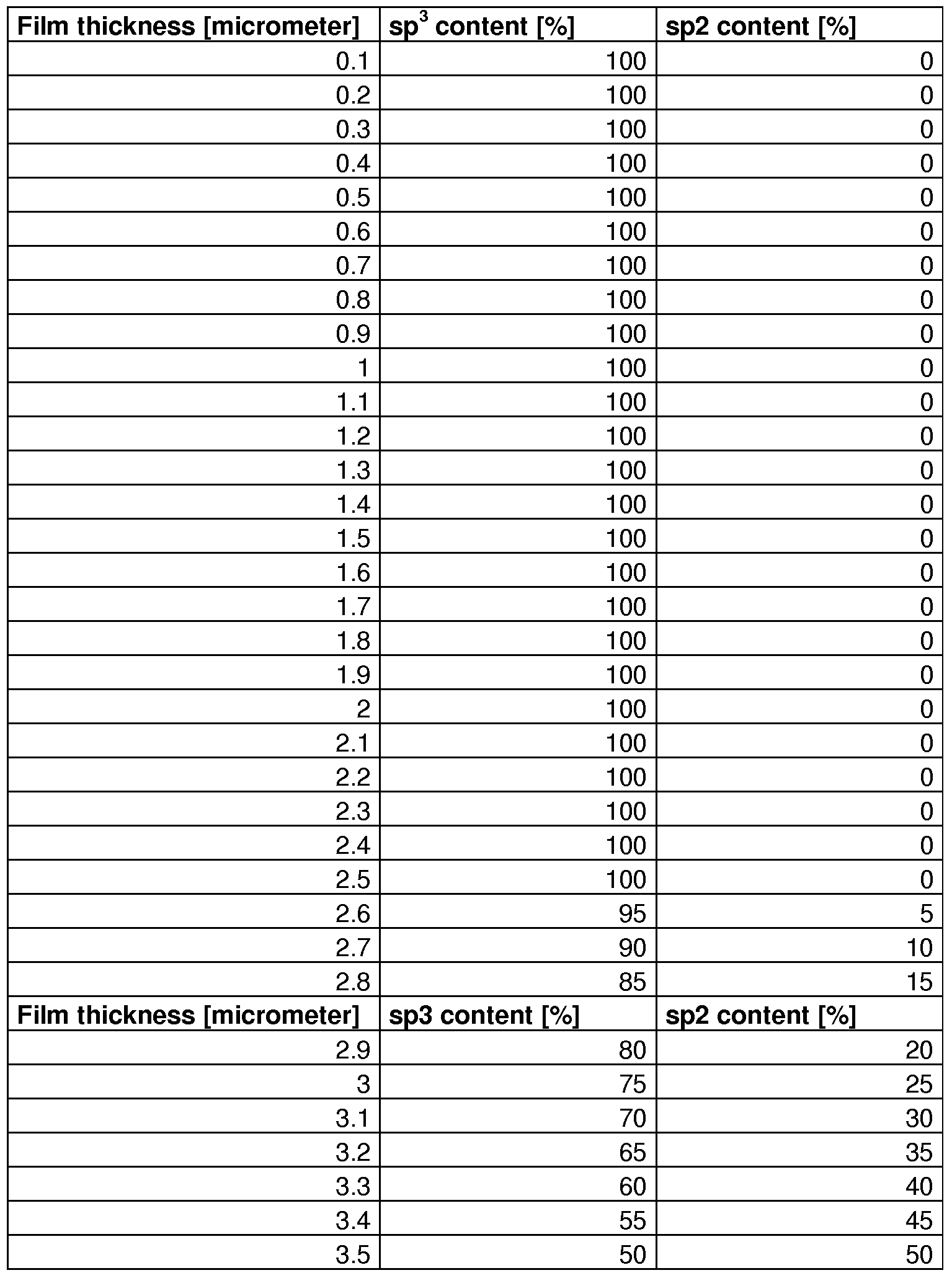
- FIG. 6 is a graph showing the evolution of the sp 3 /sp 2 content as a function of thickness of the deposited diamond film.
- the invention presented is based on micromechanical components coated with nanocrystalline diamond films of thickness between several of nanometres and several micrometers.
- the crystals/grains have a size of a few nanometres, preferably less than 10 nanometres.
- These diamond films comprise coefficients of friction of less than 0.1 , preferred less than 0.05, in special cases 0.03 or less ( Figure 1 ).
- Such nanocrystalline diamond films are produced by a CVD (chemical vapour deposition) process.
- a carbon containing gas species for example methane
- a carbon containing gas species for example methane
- a carbon containing gas species for example methane
- diamond sp 3 -hybridised carbon
- graphite sp 2 - hybridised carbon
- carbohydrates or other carbon species mixtures of sp 2 - and sp 3 -hybhdised carbon.
- hydrogen gas H 2
- the hydrogen gas (H 2 ) is also thermally activated resulting in mono-atomic hydrogen, where, as an important process step, the efficiency of the activation process is extremely high (more than 50%), preferably more than 75% and achieving in special cases 90% and more.
- Such a method is described in AT399726B.
- the nanocrystalline diamond coatings 1 ( Figures 2a nad 2b) can be deposited on silicon, with diamond crystal sizes of less than 8 nanometres having a surface roughness of less than 10 nanometres, for instance as shown in Figure 2b.
- a main aspect of the present invention relates to a nanocrystalline diamond coating, where during the growth of the diamond film the process is tuned in a way to achieve a gradual increase of sp 2 -hybridised carbon content 2 in the sp 3 -hybridised layer matrix in the vicinity of the surface of a substrate 4, as shown in Figure 3.
- the right portion of Figure 3 shows the evolution 5 of sp 2 content at the grain boundaries of the UNCD (Ultra Nano Crystalline Diamond) coating 3.
- Controlled increase of methane or carbon containing gas concentration or adding an additional carbon containing gas at the end of the growth process changes the ratio of sp 2 /sp 3 within the diamond matrix or diamond bulk material respectively leading to e.g. the highest amount at the surface or other local distribution-functions.
- a gradually controlled increase of the carbon containing reactant gas e.g. methane
- adding an additional carbon containing gas e.g. acetylene
- Deposition parameter variation the deposition of nanocrystalline diamond according to the process referenced above (AT399726B) having the highest sp 3 content of more than 97% (detection limit) is performed at an optimal set of parameters comprising pressure in the vacuum system, temperature of the filaments, temperature of the substrate, gas flow of carbon containing gas, gas flow of hydrogen and distance between filaments and substrate. Due to increase or reduction of substrate temperature and/or pressure the sp 2 /sp 3 ratio can be influenced additionally. This variation should be realised at the end of the growth process to achieve the gradual sp 2 - enhchment close to the surface.
- Nitrogen adding during the growth of diamond, a certain quantity of gaseous nitrogen is introduced into the reaction chamber.
- the process of secondary nucleation growth of new diamond grains, instead of growing those already formed) is enhanced and this leads to a decreasing of the grain size, down to only a few nanometres.
- the smaller grains allow a lower roughness of the coating and moreover enhance the amount of sp 2 -hybhdised carbon.
- Argon adding during the growth of diamond, the increase of methane concentration to a very high level and/or replacing up to 100 % of hydrogen by argon or other elements such as nitrogen can also lead to the same effects.
- other gases of any kind may be used, such as the rare gases neon, helium, krypton or xenon, without being restricted to them.
- post-treatment including a plasma or laser treatment, potentially in combination with gases which can change the surface of diamond and/or get inside its structure.
- Termination saturated of the dangling bonds of the diamond-surface with hydrogen, oxygen, fluorine, molecules, oils, wax, etc.
- the structuring can be achieved either by structuring the substrate or by structuring the diamond coating itself.
- structured substrate it is preferable to use diamond coatings with very small grains to allow accurate replication of the structured surface.
- Table 1 shows an example of evolution of sp 3 /sp 2 content as a function of thickness of the deposited diamond film for a micromechanical part with a low friction coefficient for an application in a watch movement.
- the invention can be used in micromechanical watch movements, in particular for the realisation of escapement wheels and pallets and other friction- relevant systems.
- the above detailed description with reference to the drawings illustrates rather than limits the invention.
- the invention can also be used to enhance tribological performances in others macroscopic or microscopic mechanisms where at least one part/piece can be coated with diamond.
- Application examples are Micro-Electro-Mechanical Systems (MEMS), Nano-Electro-Mechanical Systems (NEMS), Electrical motors, in particular micro-motors, pumps, in particular micro-pumps, vacuum systems, static and/or kinetic systems such as engines, etc., without departing from the invention.
- MEMS Micro-Electro-Mechanical Systems
- NEMS Nano-Electro-Mechanical Systems
- Electrical motors in particular micro-motors, pumps, in particular micro-pumps, vacuum systems, static and/or kinetic systems such as engines, etc., without departing from the invention.
Landscapes
- Chemical & Material Sciences (AREA)
- Engineering & Computer Science (AREA)
- Physics & Mathematics (AREA)
- Mechanical Engineering (AREA)
- Organic Chemistry (AREA)
- Chemical Kinetics & Catalysis (AREA)
- General Chemical & Material Sciences (AREA)
- Materials Engineering (AREA)
- Metallurgy (AREA)
- Inorganic Chemistry (AREA)
- General Physics & Mathematics (AREA)
- Plasma & Fusion (AREA)
- Crystallography & Structural Chemistry (AREA)
- Optics & Photonics (AREA)
- Combustion & Propulsion (AREA)
- Chemical Vapour Deposition (AREA)
- Crystals, And After-Treatments Of Crystals (AREA)
- Micromachines (AREA)
Abstract
Description
Claims
Priority Applications (7)
| Application Number | Priority Date | Filing Date | Title |
|---|---|---|---|
| JP2012511266A JP5647232B2 (en) | 2009-05-18 | 2010-05-18 | Method for coating micromechanical components while maintaining high friction performance applied to micromechanical systems |
| HK12110099.5A HK1169456B (en) | 2009-05-18 | 2010-05-18 | Method for coating micromechanical parts with high tribological performances for application in mechanical systems |
| EP10723017.9A EP2432917B1 (en) | 2009-05-18 | 2010-05-18 | Method for coating micromechanical parts with high tribological performances for application in mechanical systems |
| US13/319,446 US8770827B2 (en) | 2009-05-18 | 2010-05-18 | Method for coating micromechanical parts with high tribological performances for application in mechanical systems |
| KR1020147013692A KR20140082838A (en) | 2009-05-18 | 2010-05-18 | Method for coating micromechanical parts with high tribological performances for application in mechanical systems |
| CN201080020732.7A CN102421936B (en) | 2009-05-18 | 2010-05-18 | Method for coating micromechanical parts with high tribological performances for application in mechanical systems |
| KR1020117027694A KR20120011050A (en) | 2009-05-18 | 2010-05-18 | Coating method of micromechanical parts with high tribological performance for application to mechanical systems |
Applications Claiming Priority (2)
| Application Number | Priority Date | Filing Date | Title |
|---|---|---|---|
| EP09160548.5 | 2009-05-18 | ||
| EP09160548 | 2009-05-18 |
Publications (2)
| Publication Number | Publication Date |
|---|---|
| WO2010133607A2 true WO2010133607A2 (en) | 2010-11-25 |
| WO2010133607A3 WO2010133607A3 (en) | 2011-01-20 |
Family
ID=42797512
Family Applications (1)
| Application Number | Title | Priority Date | Filing Date |
|---|---|---|---|
| PCT/EP2010/056835 Ceased WO2010133607A2 (en) | 2009-05-18 | 2010-05-18 | Method for coating micromechanical parts with high tribological performances for application in mechanical systems |
Country Status (6)
| Country | Link |
|---|---|
| US (1) | US8770827B2 (en) |
| EP (1) | EP2432917B1 (en) |
| JP (1) | JP5647232B2 (en) |
| KR (1) | KR20120011050A (en) |
| CN (1) | CN102421936B (en) |
| WO (1) | WO2010133607A2 (en) |
Cited By (2)
| Publication number | Priority date | Publication date | Assignee | Title |
|---|---|---|---|---|
| EP2631721A1 (en) | 2012-02-23 | 2013-08-28 | Richemont International S.A. | Diamond-covered titanium clock components |
| EP3002637B1 (en) | 2014-09-29 | 2018-11-28 | Richemont International S.A. | Clock system with improved tribological properties |
Families Citing this family (15)
| Publication number | Priority date | Publication date | Assignee | Title |
|---|---|---|---|---|
| EP2734897B1 (en) * | 2011-07-21 | 2024-06-12 | The Swatch Group Research and Development Ltd. | Functional micromechanical assembly |
| US12239822B2 (en) | 2013-03-15 | 2025-03-04 | Windgap Medical, Inc. | Portable drug mixing and delivery device and associated methods |
| EP2832899A1 (en) * | 2013-08-02 | 2015-02-04 | The Swatch Group Research and Development Ltd. | Diamond coating and method for depositing such a coating |
| EP3082419A4 (en) | 2013-12-18 | 2017-09-20 | Windgap Medical, Inc. | Drug mixing and delivery system and method |
| EP2942147B1 (en) * | 2014-05-08 | 2018-11-21 | Nivarox-FAR S.A. | Clock escapement mechanism without lubrication |
| WO2016016019A1 (en) * | 2014-08-01 | 2016-02-04 | Cartier International Ag | Timepiece component with a surface comprising silk fibroin |
| CA2971440C (en) | 2014-12-18 | 2024-02-13 | Windgap Medical, Inc. | Method and compositions for dissolving or solubilizing therapeutic agents |
| JP6533286B2 (en) * | 2015-04-27 | 2019-06-19 | 京セラ株式会社 | Cover member |
| EP3171229A1 (en) * | 2015-11-19 | 2017-05-24 | Nivarox-FAR S.A. | Clock component |
| EP3171230B1 (en) * | 2015-11-19 | 2019-02-27 | Nivarox-FAR S.A. | Timepiece component with improved tribology |
| EP3407143A1 (en) * | 2017-05-24 | 2018-11-28 | Rolex Sa | Mechanical linking device |
| EP3750010B1 (en) * | 2018-02-07 | 2022-01-19 | Patek Philippe SA Genève | Micromechanical part of timepiece |
| JP7234023B2 (en) * | 2018-06-15 | 2023-03-07 | キヤノン株式会社 | Fixing device and image forming device |
| WO2020008722A1 (en) * | 2018-07-02 | 2020-01-09 | 住友電工ハードメタル株式会社 | Diamond-coated tool |
| EP4191345B1 (en) * | 2021-12-06 | 2025-06-04 | The Swatch Group Research and Development Ltd | Micromechanical functional assembly with a tribological coating |
Family Cites Families (22)
| Publication number | Priority date | Publication date | Assignee | Title |
|---|---|---|---|---|
| JP2930658B2 (en) * | 1990-05-11 | 1999-08-03 | 株式会社豊田中央研究所 | Diamond coating method |
| US5308661A (en) | 1993-03-03 | 1994-05-03 | The Regents Of The University Of California | Pretreatment process for forming a smooth surface diamond film on a carbon-coated substrate |
| AT399726B (en) | 1993-08-25 | 1995-07-25 | Bertel Erminald Dr | Device for applying diamond-like carbon layers to a substrate |
| FR2731715B1 (en) | 1995-03-17 | 1997-05-16 | Suisse Electronique Microtech | MICRO-MECHANICAL PART AND METHOD FOR PRODUCING THE SAME |
| US6066399A (en) * | 1997-03-19 | 2000-05-23 | Sanyo Electric Co., Ltd. | Hard carbon thin film and method of forming the same |
| JP2001337474A (en) * | 2000-05-25 | 2001-12-07 | Canon Inc | Light receiving member manufacturing method, light receiving member, and electrophotographic apparatus |
| PL199488B1 (en) | 2000-08-26 | 2008-09-30 | Plasmotec Gmbh & Co Kg | Cutting tool made of a hard sinter with diamond coating and method of making such tool |
| WO2002031891A1 (en) | 2000-10-09 | 2002-04-18 | The University Of Chicago | Electrode and electron emission applications for n-type doped nanocrystalline materials |
| EP1233314A1 (en) | 2001-02-15 | 2002-08-21 | DAMASKO, Konrad | Clockwork |
| DE10317889B4 (en) | 2003-04-17 | 2008-10-30 | GFD-Gesellschaft für Diamantprodukte mbH | Micromechanical component and method for its production |
| US20050074636A1 (en) * | 2003-10-03 | 2005-04-07 | Fuji Photo Film Co., Ltd. | Magnetic recording medium and method for producing the same |
| JP4380377B2 (en) * | 2004-03-18 | 2009-12-09 | トヨタ自動車株式会社 | Carbon film forming method |
| US20050227079A1 (en) * | 2004-04-13 | 2005-10-13 | Ravi Kramadhati V | Manufacture of porous diamond films |
| JP2006022895A (en) * | 2004-07-08 | 2006-01-26 | Nissan Motor Co Ltd | High strength gear and manufacturing method thereof |
| CN101213497B (en) | 2005-06-28 | 2010-11-24 | Eta瑞士钟表制造股份有限公司 | Reinforced micromechanical component |
| CN100465334C (en) * | 2005-07-07 | 2009-03-04 | 上海交通大学 | Preparation method of diamond film coating layer bearing supporter |
| JP4876464B2 (en) * | 2005-07-19 | 2012-02-15 | 株式会社豊田中央研究所 | Low friction sliding member |
| US20070269646A1 (en) * | 2006-05-18 | 2007-11-22 | Haverty Michael G | Bond termination of pores in a porous diamond dielectric material |
| WO2008081904A1 (en) * | 2006-12-27 | 2008-07-10 | Hitachi Chemical Co., Ltd. | Engraved plate and base material having conductor layer pattern using the engraved plate |
| JP5120924B2 (en) * | 2007-05-25 | 2013-01-16 | トヨタ自動車株式会社 | Method for producing amorphous carbon film |
| SG155080A1 (en) * | 2008-02-25 | 2009-09-30 | Cal Comp Technology Pte Ltd | Surface coating for hard disk drive cavity |
| JP4551957B2 (en) * | 2008-12-12 | 2010-09-29 | 株式会社東芝 | Method for manufacturing magnetic recording medium |
-
2010
- 2010-05-18 JP JP2012511266A patent/JP5647232B2/en not_active Expired - Fee Related
- 2010-05-18 EP EP10723017.9A patent/EP2432917B1/en active Active
- 2010-05-18 KR KR1020117027694A patent/KR20120011050A/en not_active Ceased
- 2010-05-18 WO PCT/EP2010/056835 patent/WO2010133607A2/en not_active Ceased
- 2010-05-18 CN CN201080020732.7A patent/CN102421936B/en not_active Expired - Fee Related
- 2010-05-18 US US13/319,446 patent/US8770827B2/en not_active Expired - Fee Related
Cited By (2)
| Publication number | Priority date | Publication date | Assignee | Title |
|---|---|---|---|---|
| EP2631721A1 (en) | 2012-02-23 | 2013-08-28 | Richemont International S.A. | Diamond-covered titanium clock components |
| EP3002637B1 (en) | 2014-09-29 | 2018-11-28 | Richemont International S.A. | Clock system with improved tribological properties |
Also Published As
| Publication number | Publication date |
|---|---|
| KR20120011050A (en) | 2012-02-06 |
| US20120051192A1 (en) | 2012-03-01 |
| JP5647232B2 (en) | 2014-12-24 |
| EP2432917A2 (en) | 2012-03-28 |
| CN102421936B (en) | 2014-10-22 |
| WO2010133607A3 (en) | 2011-01-20 |
| US8770827B2 (en) | 2014-07-08 |
| CN102421936A (en) | 2012-04-18 |
| EP2432917B1 (en) | 2018-10-17 |
| JP2012530187A (en) | 2012-11-29 |
| HK1169456A1 (en) | 2013-01-25 |
Similar Documents
| Publication | Publication Date | Title |
|---|---|---|
| US8770827B2 (en) | Method for coating micromechanical parts with high tribological performances for application in mechanical systems | |
| EP2453038A1 (en) | Method for coating micromechanical parts with dual diamond coating | |
| Auciello et al. | Review on advances in microcrystalline, nanocrystalline and ultrananocrystalline diamond films-based micro/nano-electromechanical systems technologies | |
| US8007910B2 (en) | Ultrahard multilayer coating comprising nanocrystalline diamond and nanocrystalline cubic boron nitride | |
| KR20140082838A (en) | Method for coating micromechanical parts with high tribological performances for application in mechanical systems | |
| EP2440684B1 (en) | Method for coating micromechanical components of a micromechanical system, in particular a watch and related micromechanical coated component | |
| CN105603386A (en) | Preparing method of mini-sized milling cutter nanometer diamond coating | |
| JP2005015325A (en) | Method for manufacturing extremely flat microcrystalline diamond thin film by laser ablation method | |
| Cheng et al. | Temperature-dependent properties of nc-Si thin films synthesized in low-pressure, thermally nonequilibrium, high-density inductively coupled plasmas | |
| HK1169456B (en) | Method for coating micromechanical parts with high tribological performances for application in mechanical systems | |
| HK1188262A (en) | Method for coating micromechanical parts with dual diamond coating | |
| Ma et al. | Characteristics of DLC containing Ti and Zr films deposited by reactive magnetron sputtering | |
| Zhang et al. | Increasing fluorine concentration to control the microstructure from fullerene-like to amorphous in carbon films | |
| CN111847435A (en) | A method for adjusting the friction coefficient of two-dimensional materials | |
| Shubina et al. | Effect of temperature on properties of DLC films and DLC-Ni: C sandwich growth | |
| Hayashi et al. | Modification of the physical properties of chemical vapor-deposited nanostructure diamond by argon-hydrogen plasma surface treatment | |
| Rogachev et al. | The Structure and Properties of aC: Ti and aC: Ti: N Coatings Deposited on a Titanium and Titanium Nitride Sublayer | |
| Rubio-Roy et al. | Tribological Properties of Fluorinated Amorphous Carbon Thin Films | |
| US20230173788A1 (en) | Micromechanical functional assembly with a tribological coating | |
| Plano | Electronic device processing | |
| WO2024238505A1 (en) | Systems and methods for cascaded compression of the size distribution of zero-dimensional nanostructures | |
| CN112901737A (en) | Screw rod and reactor control rod driving mechanism | |
| CN120677267A (en) | Composite structure comprising a monocrystalline film on a polycrystalline silicon carbide support substrate and related manufacturing method | |
| Li et al. | Characterization of diamond spherical shell thick film by DC plasma CVD | |
| Moolsradoo et al. | Research Article Influence of Elements on the Corrosion Resistance of DLC Films |
Legal Events
| Date | Code | Title | Description |
|---|---|---|---|
| WWE | Wipo information: entry into national phase |
Ref document number: 201080020732.7 Country of ref document: CN |
|
| 121 | Ep: the epo has been informed by wipo that ep was designated in this application |
Ref document number: 10723017 Country of ref document: EP Kind code of ref document: A2 |
|
| DPE1 | Request for preliminary examination filed after expiration of 19th month from priority date (pct application filed from 20040101) | ||
| WWE | Wipo information: entry into national phase |
Ref document number: 2010723017 Country of ref document: EP |
|
| WWE | Wipo information: entry into national phase |
Ref document number: 13319446 Country of ref document: US Ref document number: 2012511266 Country of ref document: JP |
|
| NENP | Non-entry into the national phase |
Ref country code: DE |
|
| ENP | Entry into the national phase |
Ref document number: 20117027694 Country of ref document: KR Kind code of ref document: A |
|
| WWE | Wipo information: entry into national phase |
Ref document number: 9318/CHENP/2011 Country of ref document: IN |