WO2010134239A1 - メール誤送信防止装置 - Google Patents
メール誤送信防止装置 Download PDFInfo
- Publication number
- WO2010134239A1 WO2010134239A1 PCT/JP2010/001299 JP2010001299W WO2010134239A1 WO 2010134239 A1 WO2010134239 A1 WO 2010134239A1 JP 2010001299 W JP2010001299 W JP 2010001299W WO 2010134239 A1 WO2010134239 A1 WO 2010134239A1
- Authority
- WO
- WIPO (PCT)
- Prior art keywords
- address
- group
- attribute
- erroneous transmission
- Prior art date
- Legal status (The legal status is an assumption and is not a legal conclusion. Google has not performed a legal analysis and makes no representation as to the accuracy of the status listed.)
- Ceased
Links
Images










Classifications
-
- G—PHYSICS
- G06—COMPUTING OR CALCULATING; COUNTING
- G06Q—INFORMATION AND COMMUNICATION TECHNOLOGY [ICT] SPECIALLY ADAPTED FOR ADMINISTRATIVE, COMMERCIAL, FINANCIAL, MANAGERIAL OR SUPERVISORY PURPOSES; SYSTEMS OR METHODS SPECIALLY ADAPTED FOR ADMINISTRATIVE, COMMERCIAL, FINANCIAL, MANAGERIAL OR SUPERVISORY PURPOSES, NOT OTHERWISE PROVIDED FOR
- G06Q10/00—Administration; Management
- G06Q10/10—Office automation; Time management
- G06Q10/107—Computer-aided management of electronic mailing [e-mailing]
Definitions
- the present invention relates to an electronic mail transmission / reception apparatus that exchanges texts and files using a communication network line.
- E-mail is exchanged between personal computers connected to a communication network and portable devices connected to a wireless communication network such as a mobile phone.
- a wireless communication network such as a mobile phone.
- the leakage of personal information and confidential information due to a destination setting error at the time of creating an e-mail may be a problem.
- Patent Document 1 in order to solve this problem, the screen background color and output sound at the time of mail creation are set in advance for each user of the address book, and the address book setting is made at the time of mail address setting at the time of email creation. By performing background and sound output in accordance with the above, erroneous transmission is prevented.
- the email creation software is equipped with an interpolation function when entering a mail address
- a mail that is different from the mail address that should be set as the destination when an address that matches the first character of the mail address is registered. Even if the address is entered in the address field, the user may not notice.
- the present invention has been made to solve the above problems, and when a plurality of e-mail addresses are set in the e-mail address field, the e-mail address which may be wrong is determined, and the result is displayed.
- the purpose is to make the email address mis-set aware by appealing to the user's visual and auditory sense of email creation.
- an address storage unit for storing a plurality of mail addresses, an input operation unit for inputting a plurality of destination addresses at the time of mail creation, and attribute information of the plurality of destination addresses
- the apparatus further comprises: an attribute determination unit that determines with reference to the address storage unit; and a notification unit, wherein the attribute determination unit determines that there is a destination address having different attribute information among the plurality of destination addresses. It is characterized by presenting to the user that the notification means includes a setting different from the usual.
- one or more mail addresses are classified and stored in groups, and each group is stored with a value indicating the importance of each group or a set color or a set sound. .
- the address is classified by using the information stored in the address storage unit as the attribute of the address, and a set of classified addresses
- the notification means that the attribute of ⁇ 1> is different, it becomes possible to notice an incorrect setting of the address.
- the attribute discriminating means for classifying the plurality of new destination mail addresses Grouping information in the address storage unit, Information on whether or not a plurality of destination addresses are email addresses that have been sent and received in the past, stored in the send / receive history storage unit that stores the email addresses sent and received in the past and their send / receive times. Importance of each group stored in the address storage unit, The importance of each email address, An input method corresponding to the destination address stored in the input method discrimination storage unit storing how the user inputs each of a plurality of destination addresses set as the destination; The setting corresponding to the e-mail address stored in the address storage unit determines the attribute information of the address group using the distinction of free or paid when transmitting and receiving.
- a method of inputting the plurality of destination addresses described above a method of referring to and selecting address data stored in the address storage unit and inputting as a new address
- a method of inputting an e-mail address one character at a time by the input operation unit and inputting it as a new address Alternatively, an address interpolation unit is used to present the user with a mail address having a character string as a mail address candidate as a mail address candidate by referring to the address storage unit for one character or a plurality of character strings input by the input operation unit.
- a method of inputting as a new address may be considered by selecting an e-mail address stored in the transmission / reception history storage unit.
- the group having the largest number of addresses with the same attribute is mainly used based on the grouping information in the address storage unit described above and the attribute determination result using the past transmission and reception history stored in the transmission and reception history storage unit.
- a confidence index determination means that determines as a group and determines not as a subgroup. If it is determined by the confidence index determining means that the sub-group exists, When only one "sub-group" is set, all mail addresses not belonging to the main group are determined as one sub-group.
- the e-mail address other than the main group is re-judged the attribute information by the above-mentioned attribute judging means, and is classified into a plurality of sub-groups.
- Subgroups are ranked in descending order of the number of email addresses belonging to the group.
- the apparatus for preventing erroneous transmission of e-mails that the notification means notifies that the attributes of the "main group” and the "one or a plurality of subgroups" are different by the above-mentioned confidence index determination means. It is the feature of
- the e-mail address is classified by using information stored in the address storage unit as attribute information of the e-mail address, and after classification Based on the comparison of the number of e-mail addresses included in the set of e-mail addresses, the "main group" with a low possibility of missetting of the e-mail address and the "Subgroup” new destination address with the possibility of missetting of the e-mail address It is possible to make the mail creating user notice the wrong setting of the mail address by suing the mail creating user using the notification means that the attribute information is different.
- the main group is the address group or mail address to which the highest importance is set.
- a confidence index determination unit that determines groups that are not determined as subgroups.
- the confidence index determining means When it is determined by the confidence index determining means that the sub-group exists, if only one "sub-group" is set, all mail addresses not belonging to the main group are determined as one sub-group. When a plurality of "sub-groups" are set, the e-mail address other than the main group is re-judged the attribute information by the above-mentioned attribute judging means, and is classified into a plurality of sub-groups. Subgroups are ranked according to the importance of address groups or email addresses that belong to the group.
- the mail erroneous transmission prevention of the present invention is that the notification means informs that the attribute information of the "main group” and the "one or a plurality of subgroups" is different by the above-mentioned confidence index determination means. It is the feature of the device.
- the e-mail address when a plurality of e-mail addresses are set in the e-mail destination column, the e-mail address can be used by utilizing the importance of each address group or address stored in the address storage unit as attribute information of the e-mail address.
- the mail address erroneous transmission preventing apparatus or the mail address inputted by the first address input method preset by the user is used.
- a confidence index determination means for determining as a main group and determining a non-group as a subgroup.
- the confidence index determining means When it is determined by the confidence index determining means that the sub-group exists, if only one "sub-group" is set, all mail addresses not belonging to the main group are determined as one sub-group.
- e-mail addresses other than the main group are re-judged the attribute information by the above-mentioned attribute discriminating means, classified into a plurality of subgroups, and further using the above-mentioned confidence index judging means
- the plurality of sub-groups are ranked according to the order of the input method according to the present e-mail erroneous transmission preventing apparatus or the address input method previously set by the user.
- the apparatus for preventing erroneous transmission of e-mails that the notification means notifies that the attributes of the "main group” and the "one or a plurality of subgroups" are different by the above-mentioned confidence index determination means. It is the feature of
- the e-mail addresses are classified by using the importance of the e-mail address input means, and are included in the set of e-mail addresses after classification.
- the degree of importance of email addresses it becomes possible to classify “main group” where the possibility of missetting of email addresses is low, and “subgroup” new destination address where there is a possibility of missetting email addresses.
- the group which becomes free when sending / receiving e-mail is determined as the main group.
- a reliability index determination unit that determines a group other than the group as a subgroup, and notifying that the attributes of the "main group” and the "one subgroup" are different by the notification unit.
- the e-mail address is classified by using information on whether the e-mail transmission / reception is "free” or "paid", and "main group” It becomes possible to classify "sub-group” new destination addresses, and it is possible to appeal to the mail creating user using the notification means that these attributes are different.
- a display unit is provided as notification means, and when it is determined by the attribute determination means that the destination address of the different attribute is included, notification is displayed on the display unit with a difference of two or more colors. It is characterized by According to this configuration, it is possible to notify the user of the possibility of "mis-setting” and the ratio (degree) of the number of mis-settings in a manner that is easy to visually grasp. Also, incorrect setting is possible due to the relative difference between "attribute information" of "set of email addresses considered to be correct email address settings" and "set of addresses that may have errors in other email address settings". By presenting the nature, even if the user forgets the background color setting value of the individual e-mail address, it is possible to prevent the mis-setting from being overlooked.
- a speaker is provided as the notifying means, and when it is judged by the attribute judging means that the destination address of the different attribute is included, the speaker outputs a sound and notifies.
- This configuration allows the user to be notified of the possibility of "mis-setting” in an audible manner. Also, due to the relative difference between "attribute information" in "set of email address considered to be correct email address settings” and “set of email addresses that may be incorrect in other email address settings” Since the notification of the possibility is made, it is possible to prevent the mis-setting from being overlooked even when the user forgets the ringing tone set for each e-mail address.
- the present invention is characterized in that a vibration unit is provided as the notifying means, and when it is judged by the attribute judging means that the destination address of the different attribute is included, notification is given by the vibration of the vibration unit.
- This configuration makes it possible to inform the user of the possibility of "mis-setting” in a manner that is intuitively comprehensible. Also, due to the relative difference between "attribute information" possessed by "set of e-mail addresses considered to be correct e-mail address settings” and "set of e-mail addresses that may have errors in other e-mail address settings" Since the notification of the possibility, it is possible to prevent the missed setting from being missed even if the user forgets the ringtone set for each e-mail address or voice output can not be performed in the manner mode etc. It becomes.
- the present invention it is possible to prevent erroneous mail transmission due to a setting error of a mail address or the like when transmitting mail to a plurality of persons at one time.
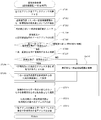
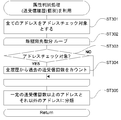
- a block diagram showing a mail erroneous transmission preventing apparatus according to the first, second and third embodiments of the present invention Flowchart showing the operation of the mail erroneous transmission preventing apparatus according to the first, second, and third embodiments of the present invention Flowchart showing operation of attribute discrimination processing according to the first embodiment of the present invention Flow chart showing operation of trust index determination processing of main group according to the first embodiment of the present invention Flowchart showing operation of confidence index determination processing of subgroup when there is one subgroup according to the first embodiment of the present invention
- a flowchart showing an operation of a process of determining a confidence index of subgroups in the case of ranking using a number of addresses among a plurality of subgroups according to the first embodiment of the present invention Flow chart showing operation of display method determination process of main group according to the first embodiment of the present invention Flowchart showing an example of operation of display method determination process of subgroup according to Embodiment 1 of the present invention Flowchart showing an example of operation of display method determination process of sub
- FIG. 6 is a diagram showing a list obtained by grouping individual destinations on an address book in the first embodiment of the present invention.
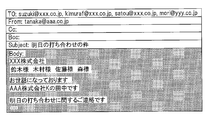
- a diagram showing a display example (the background color of the destination entry field is changed to a checkered pattern) in the case where destination addresses having different attribute information are included in the first, second and third embodiments of the present invention.
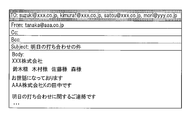
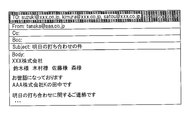
- the figure which shows the example of a display (when the background color of a destination entry column is changed) when the destination address from which attribute information differs is shown in Embodiment 1, 2, 3 of this invention.
- FIG. 1 is a block diagram showing an outline of a configuration of the mail erroneous transmission preventing apparatus in the present embodiment.
- the mail erroneous transmission prevention device of the present invention includes the input operation unit 101 including the keyboard, the numeric keypad, the pointing device, etc., the input method determination storage unit 110 for storing the input method of the mail address, the past mail Transmission / reception history storage unit 111 for storing transmission / reception history, clock unit 112 for measuring e-mail transmission / reception time, address storage unit 113 for storing information such as e-mail address, e-mail stored in the address storage unit when inputting e-mail address
- Address interpolation means 114 that performs interpolation processing of input based on address information, attribute information of the input e-mail address (for example, information for determining the attribute of each e-mail address such as belonging address group, address domain name, etc.)
- Attribute discrimination means 120 to discriminate, attribute information with a mail address Therefore, the reliability index determination unit 121 determines the reliability of each set when classified into sets, the display method determination unit 122 determines the method of presenting the possibility of setting error of
- Embodiment 1 of the present invention will be described using FIGS. 1 to 19.
- FIG. 2 is a flow chart showing an operation from the user's mail address input, until the mail erroneous transmission preventing apparatus of the present invention extracts an address having a possibility of erroneous setting, presents it to the user, and urges correction. is there.
- 3 to 9 are flowcharts showing details of each process in the flowchart shown in FIG.
- the process of the address input operation (ST001) of FIG. 2 performed by the user and the mail erroneous transmission preventing device of the present invention through the input operation unit 101 of FIG. 1 will be described.
- the user uses the input operation unit 101 shown in FIG. 1 in order to send an e-mail, and writes the e-mail address (destination address) of the transmission destination in the address entry field.
- an address input means selection from the address book stored in the address storage unit 113, selection from the transmission / reception history list stored in the transmission / reception history storage unit, or the keyboard or the portable device via the input operation unit 101
- the address interpolation means 114 automatically presents the remaining characters of the address as candidates.
- “address check target?” Is set to “YES” in order to set all the input destination addresses as the address check target as in the address check target item 203 shown in the destination list in FIG. 10 (ST 020) .
- the address information for each group is classified as one set by referring to the group information in the address book stored in the address storage unit 113 while checking whether each input address is an address check target or not (ST021) , ST022, ST023).
- FIG. 11 represents a state in which the input addresses are summed up for each group indicated in the group name 211, and the number of mail addresses included in each group is counted. (The count number is described in the same group count number 212 in FIG. 11) Next, the process of determining the reliability index performed by the reliability index determination unit 121 of FIG. 1 will be described.
- a set of addresses having a low possibility of being mistaken as a destination (hereinafter referred to as a main group) is determined.
- the process (ST003) will be described with reference to FIG.
- the number of mail addresses for each group obtained in the above-described attribute determination processing is set as a value indicating "reliability of mail address set (low possibility of erroneous setting)" (the same group in FIG. The count number 212) is used.
- the number of mail addresses for each group obtained in the process of FIG. 3 is referred to for each group (ST030, ST031). Then, among them, the group with the largest number of e-mail addresses is determined as the main group (ST 032).
- the sub-group indicated in ST 004 in FIG. 2 is subjected to determination of a group not determined to be the main group in the above processing (a set of e-mail addresses having a high possibility of being erroneous as a destination.
- the group confidence index determination process will be described using FIGS. 5 and 6.
- the process shown in FIG. 5 is a flowchart in the case where only one “sub-group” is set even when there are a plurality of sets other than the main group. In this case, all mail addresses not belonging to the main group are determined as one sub-group (ST040).
- the process shown in FIG. 6 is a flowchart in the case of setting a plurality of subgroups when there are a plurality of sets other than the main group.
- the number of belonging mail addresses is compared among the remaining sets.
- the process of determining the reliability index of subgroups shown in ST 004 of FIG. 2 it is determined whether the number of subgroups is one as shown in FIG. 5 or plural as shown in FIG.
- the process may be inquired to the user, or the user may set in advance which one to select, and the same process may be performed until the setting change is performed by the user.
- attribute information and reliability in the case of creating and ranking a plurality of subgroups, other attribute information and reliability to be described later may be used.
- the group setting color is used as the background color of the main group To do (ST061). If the "group setting color” is not set in the address book or the like (if NO at the branch of ST 060), the user or the erroneous mail transmission preventing apparatus of the present invention sets the fixed color in advance as the background color, Alternatively, if a randomly selected color is used as the background color, or if the “set color” of the address described at the top of the address is set in the address book etc., that color will be the main group It is determined as the background color of (ST062).
- the display method is determined by the flow shown in FIG.
- the complementary color of the background color of the main group is determined as the background color (ST 070).
- the complementary color of the main group is used as the background color of the sub group in FIG. 8 and the above, colors other than the background color of the main group randomly selected, or the address book having the largest number of e-mail addresses among the sub groups
- the set color of the group or the fixed color set by the user may be used as the background color.
- the following processing is performed in the order of the subgroups having the largest number of e-mail addresses (ST080). If the group color is set in the address book for the group to be processed (YES in the branch of ST081), and the background color of the other subgroup and its color do not overlap (ST082) The set color on the address book is determined as the background color (ST084).
- the email erroneous transmission preventing apparatus of the present invention is described in a predetermined fixed color, or the email erroneous transmission preventing apparatus of the present invention is randomly selected, or in a subgroup to be processed Select the setting color of the start address as the background color of the subgroup.
- processing is performed in descending order of the number of e-mail addresses belonging to the subgroups, that is, in descending order of reliability, but colors close to complementary colors of the main group in the descending order of subgroups (The lower the order in the sub group, the closer to the complementary color of the set color of the main group).
- FIGS. 12 to 18 the operation when displaying the possibility of incorrect setting (ST 007) on the screen of FIG. 2 using the notification means 123 of FIG. 1 will be described using FIGS. 12 to 18.
- FIGS. 12 to 17 one of four new destinations is determined to have a possibility of misconfiguration, and specifically, the fourth address can be misconfigured. It is an example when there is sex.
- FIG. 12 shows an example in which the background color of the main group and the background color of the sub group are displayed in the mail text portion.
- the determined color is expressed by the ratio of the number of addresses belonging to the main group to the number of addresses belonging to the sub group.
- FIG. 13 shows the background of the mail text in a checkered pattern.
- the range for changing the background color may be the entire mail screen as shown in FIG. 14 or may be a portion other than the mail text as shown in FIG.
- only the background part of the character string of the mail address that may be misconfigured may be set as the background color of the subgroup, or as shown in FIG. You may display an address that may be mis-set as the text color of the background color of.
- FIGS. 12 to 17 there is shown a case where there is only one sub group, and therefore a total of two colors of one background color of the sub group and one background color of the main group is displayed. There is. However, as described in the above-mentioned “processing for determining background color of subgroups”, when there are a plurality of subgroups and different background colors are set for each subgroup, they are displayed on notification means 123.
- the background color of the main group is three or more in combination with the background color of the main group.
- the distribution of the background pattern and the background color is not limited to the contents described above, as long as it is possible to notify the user of a relative color difference using two or more colors.
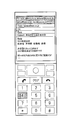
- the present invention may be applied to a device such as a portable terminal capable of changing the background color of the ten key, and when there is an address having a possibility of erroneous setting, the ten key may be blinked or constantly lit.
- the positions of the keys to be blinked or always lighted are in the order of description of addresses having a possibility of incorrect setting (in the case of FIG. 18, the fourth destination address has a high possibility of incorrect setting). Therefore, the "fourth key" of the ten keys may be lighted, or a random key may be lighted or blinked.
- the operation may be performed simultaneously with the operation of changing the background color of the mail creation screen shown in FIGS. 12 to 17 described above.
- Whether the address to be processed is "address check target" in the address check target item 203 in FIG. 10 is "YES” is determined (ST012).
- the address check for the user "do not delete or change the e-mail address because it is incorrect setting” or "not incorrect setting” Prompt for the decision to be excluded from the subject (ST013).
- “group classification on the address book” is used as attribute information at the time of performing attribute determination processing, but the address book data stored in the address storage unit is used for each address. If a value indicating importance is stored, the “importance” may be used as attribute information to sort destination e-mail addresses.
- attribute information at the time of address classification information as to whether or not mail transmission and reception becomes free to the address book data stored in the address storage unit (not only direct information indicating whether transmission and reception are paid or free, If the domain or the judgment on the mail transmission time, which can be judged by referring to the clock unit 112 in FIG. 1, is also stored, this “transmission / reception free / paid information” is used as attribute information, and the destination mail The address may be distributed.
- the main group's confidence index determination processing after classification of the destination mail address by attribute information and the sub-group's confidence index determination processing “ Although the number of destination e-mail addresses is used, "importance of each e-mail address" may be used. The group with the highest degree of importance is taken as the main group, and when the subgroups are ranked, the group with the highest degree of importance is taken as the higher priority.
- free / paid information for mail transmission / reception may be used in the process of determining the reliability index of the main group.
- an address group for which mail transmission and reception is free is determined as the main group.
- the user may change the color of the screen or the numeric keypad, etc., to the user for the possibility of incorrect e-mail address setting.
- the user may be notified of the possibility of incorrect address setting by a sound generated from a speaker or the like in addition to the change of the color of the screen or the numeric keypad.
- the possibility of address missetting to the user may be notified by vibration generated from the vibrator.
- FIG. 20 is a flowchart showing the detailed operation in the second embodiment of the attribute discrimination process (ST002) of FIG.
- a new destination may contain an incorrect setting address. It is determined that there is a request (ST208), and the batch transmission / reception history to be compared is stored as a candidate for the "compared transmission / reception history to be compared with a new destination" (ST209). If the number of matched destinations does not reach a predetermined rate (NO in the branch of ST 206), it is determined not to include a mis-set address, but to be a batch transmission / reception history completely unrelated to a new destination (ST 210).
- the batch transmission / reception history address to be compared is compared with the new destination (ST212), and the new destination is classified using the attribute "matching address” and the attribute information "nonmatching address” (ST213).
- the e-mail address entered as the new address is checked to see if it is the address check target (ST 303). Then, with respect to the address that is the e-mail address check target, the number of times the address is used as a transmission address or a reception address is counted with reference to all the individual transmission / reception histories (ST 304). After that, the mail address of the new destination is classified according to the attribute “more than a certain number of transmission / reception times” and “not more than a certain transmission / reception number” (ST 305).
- the attribute judgment after counting the number of transmission and reception histories for each new destination is not only "more than a certain number of transmission and reception” but also "the most frequent transmission and reception among new destinations" and "other mail addresses Attribute information "" may be used, or attribute information "a certain number of upper addresses” and “lower addresses” when new destinations are arranged in descending order of the number of transmission / reception history may be used.
- the reliability index determination process when the individual transmission / reception history is used in the attribute determination process, the above-mentioned "address more than a certain number of transmission / reception times" or “address having the largest transmission / reception history among new destinations" or "transmission / reception history times"
- the new destinations are arranged in descending order of the number of addresses, it is determined as a main group that "a certain number of higher addresses”.
- the process for determining the display method of the main group (display method determination process ST005 for the main group in FIG. 2) has the same operation as the process described in the first embodiment, and therefore, the process is the same as in the first embodiment. This will be described using the flowchart of FIG.
- the group setting color is used as the background color of the main group To do (ST061). If the "group setting color” is not set in the address book or the like (if NO at the branch of ST 060), the user or the erroneous mail transmission preventing apparatus of the present invention sets the fixed color in advance as the background color, Alternatively, if a randomly selected color is used as the background color, or if the “set color” of the address described at the top of the address is set in the address book etc., that color will be the main group It is determined as the background color of (ST062).
- the display method determination process (ST006) of the subgroup of FIG. 2 which determines the display method of a subgroup is demonstrated.
- the display method determining means of the sub group in the second embodiment is the same as the "display method determining means in the case of one sub group" described in the first embodiment, the flowchart of FIG. Perform the same process as shown in.
- the complementary color of the background color of the main group is determined as the background color (ST 070).
- the complementary color of the main group is used as the background color of the sub group in FIG. 8 and the above, a color other than the background color of the main group randomly selected, or a group on the address book with the largest number of addresses in the sub group
- the background color may be a set color of or a fixed color set by the user.
- the notification means of FIG. 2 is about how to notify the user of the possibility of setting error of the mail destination determined above and the display method thereof. This is similar to that described in the first embodiment. Since this is an operation, the description here is omitted.
- the numeric keypad When the present invention is applied to a device such as a portable terminal capable of changing the background color of the numeric keypad, the numeric keypad may be blinked or constantly lit when there is an address having a possibility of erroneous setting.
- the specific operation is the same as the content described in the first embodiment, and thus the description thereof is omitted here.
- the user may change the color of the screen or the numeric keypad, etc. I was notified.
- the user may be notified of the possibility of incorrect address setting by a sound generated from a speaker or the like in addition to the change of the color of the screen or the numeric keypad.
- the possibility of address missetting to the user may be notified by vibration generated from the vibrator.
- FIG. 22 is a flowchart showing the details of the attribute discrimination process of FIG.
- the input when the user inputs or selects the new destination address stored in the input method discrimination storage unit 110 described in FIG. 1 Read out the method (ST 404). Then, the new destination address is distributed according to the input method (ST 405).
- the input method is a method in which the user inputs from the address book information stored in the address storage unit 113, or in the batch transmission / reception history list or the individual transmission / reception history list stored in the transmission / reception history storage unit 111.
- a method in which the user selects all or a part of the addresses included in the message a method in which the user selects all or a part of the destinations automatically set as a destination when replying to the received e-mail.
- a set of e-mail addresses inputted by the input means with the highest reliability among the addresses distributed by the address input means is taken as a main group.
- means for setting “highest reliability” means set beforehand by the user or the erroneous transmission preventing apparatus of the present invention is set as “highest reliability”.
- the means for setting the "highest reliability” may be one or more. For example, when the user selects “input from address book information” as the input means with the highest degree of reliability, a set of addresses “input from address book information” is set as a main group.
- the subgroup of FIG. 2 determines the subgroup (a set of addresses that are not determined to be the main group in the above processing and are likely to be wrong as a destination)
- the index determination process ST004 will be described.
- the reliability comparison of the address input means is performed among the remaining sets. Specifically, the input means of each set is checked, and the difficulty of missetting when entering a mail address is considered as the reliability, and the subgroups are ranked in the descending order of the reliability.
- the apparatus for preventing erroneous transmission of e-mail of the present invention may determine in advance the "susceptibility of erroneous setting when inputting e-mail address", or may be set by the user.
- the user inputs the address input method, "input from address book information in descending order of reliability", "a method of selecting all or a part of destinations automatically set as a destination when performing a mail reply operation”
- selection from transmission / reception history is set to “a method in which the user inputs directly in the destination field using a keyboard, a numeric keypad, a pointing device or the like in the input operation unit 101”, Determine the order.
- the user may inquire of the user every process whether the number of subgroups should be one or plural.
- the user may set in advance whether the selection should be made, and the same process may be performed until the setting change is performed by the user, or the method for preventing erroneous transmission according to the present invention may follow a method selected in advance.
- the other attribute information and the reliability described above may be used as the attribute and the reliability in the case of creating and ranking a plurality of subgroups.
- a group other than the set of addresses determined to be the main group by the above-mentioned main group confidence index determination processing is a subgroup It is determined that At this time, if there is only one subgroup, even if there is a set of addresses having different attribute information other than the main group, all the mail addresses contained therein are collectively determined as one subgroup. .
- each set is determined as a separate subgroup.
- each subgroup is ranked according to the reliability of the attribute.
- the order of attributes is determined by the user or the erroneous transmission preventing apparatus of the present invention in accordance with the preset order.
- the display method determination process of the main group shown in FIG. 2 for determining the display method of the main group is the same as the process in the main group described in the second embodiment described above, and therefore the description thereof is omitted.
- the process of determining the display method of subgroups in FIG. 2 for determining the method of display of subgroups is also the same as the process of determining display method of subgroups described in the second embodiment described above, and therefore, the description thereof is omitted.
- the notification means shown in FIG. 2 is about how to notify the user of the possibility of the setting error of the mail destination determined above and the display method thereof. This is similar to that described in the first embodiment. Since this is an operation, the description here is omitted.
- the numeric keypad When the present invention is applied to a device such as a portable terminal capable of changing the background color of the numeric keypad, the numeric keypad may be blinked or constantly lit when there is an address having a possibility of erroneous setting.
- the specific operation is the same as the content described in the first embodiment, and thus the description thereof is omitted here.
- the user may change the color of the screen or the numeric keypad, etc., to the user for the possibility of incorrect e-mail address setting.
- the user may be notified of the possibility of the incorrect setting of the e-mail address not only by the change of the color of the screen or the numeric keypad but also by the sound generated from the speaker or the like.
- the possibility of missetting of the mail address to the user may be notified by the vibration generated from the vibrator.
- the e-mail erroneous transmission preventing device of the present invention classifies the e-mail addresses according to "attribute information" possessed by each individual The reliability index is obtained for the set of mail addresses after classification. Furthermore, using the result, it divides into the address address set considered to be correct and the address set that may be wrong, and misinterprets the mail address by setting the difference to the visual and auditory of the mail creation user. Since it has the effect that it can be noticed, it is useful for electronic devices such as personal computers having programs with mail creation and mail transmission / reception functions and communication terminals such as mobile phones.
- E-mail Erroneous Transmission Prevention Device 101 Input Operation Unit 110 Input Method Determination Storage Unit 111 Transmission and Reception History Storage Unit 112 Clock Unit 113 Address Storage Unit 114 Address Interpolation Means 120 Attribute Determination Means 121 Confidence Index Determination Means 122 Display Method Determination Means 123 Notification Means
Landscapes
- Engineering & Computer Science (AREA)
- Business, Economics & Management (AREA)
- Human Resources & Organizations (AREA)
- Entrepreneurship & Innovation (AREA)
- Strategic Management (AREA)
- Marketing (AREA)
- Data Mining & Analysis (AREA)
- Economics (AREA)
- Computer Hardware Design (AREA)
- Operations Research (AREA)
- Quality & Reliability (AREA)
- Tourism & Hospitality (AREA)
- Physics & Mathematics (AREA)
- General Business, Economics & Management (AREA)
- General Physics & Mathematics (AREA)
- Theoretical Computer Science (AREA)
- Information Transfer Between Computers (AREA)
Abstract
一度に複数人に対してメールを送信する際に、メールアドレスの設定ミス等によるメール誤送信を防ぐことを可能とする。 メール送受信装置において、複数のメールアドレスを記憶するアドレス記憶部113と、メール作成時に複数の宛先アドレスを入力する入力操作部101と、複数の宛先アドレスの属性情報をアドレス記憶部を参照して判別する属性判別手段120と、報知手段123を備え、属性判別手段が、前記複数の宛先アドレスのうち属性情報の異なる宛先アドレスが存在すると判別した場合に、報知手段は通常とは異なる設定が含まれることをユーザに提示する。
Description
本発明は、通信ネットワーク回線を利用して文章やファイルのやり取りを行う電子メール送受信装置に関する。
電子メールは、通信ネットワークに接続されたパーソナルコンピュータや、携帯電話などの無線通信ネットワークに接続された携帯機器同士でやり取りが行われるものであり、近年、会社などでの業務だけではなく個人同士のコミュニケーション手段として広く利用されている。
一方で、電子メール作成時の宛先設定ミスによる個人情報や機密情報の流出が問題となる場合がある。
この問題を解決するために特許文献1では、予めアドレス帳のユーザ毎にメール作成時の画面背景色や出力音を設定しておき、電子メール作成の際のメールアドレス設定時に、アドレス帳の設定に従った背景・音出力を行うことによって、誤送信を防いでいる。
しかし、上記の方法で解決できるのは電子メールの宛先が1箇所である場合である。宛先が複数である場合においても、「誤ったメールアドレス」が「正しい(本来送信すべき)メールアドレス」に隠れて、誤送信に気付かない可能性が高い。また、万が一誤送信をしたときの個人情報や機密情報漏洩による影響は、複数の宛先を設定した電子メールを送信する場合には大きくなる。
さらに、電子メール作成ソフトにメールアドレス入力時の補間機能が搭載されている場合、メールアドレスの先頭文字などが一致するアドレスが登録されている場合に、宛先として設定すべきメールアドレスとは異なるメールアドレスが宛先欄に入力されていてもユーザが気づかない可能性がある。
本発明は上記課題を解決するためになされたものであって、電子メールの宛先欄に複数のメールアドレスが設定されているとき、間違っている可能性のあるメールアドレスを判別し、その結果をメール作成ユーザの視覚・聴覚などに訴えることによりメールアドレスの誤設定を気づかせることを目的とする。
前記従来の課題を解決するために、本発明では、複数のメールアドレスを記憶するアドレス記憶部と、メール作成時に複数の宛先アドレスを入力する入力操作部と、前記複数の宛先アドレスの属性情報を前記アドレス記憶部を参照して判別する属性判別手段と、報知手段と、を備え、前記属性判別手段は、前記複数の宛先アドレスのうち属性情報の異なる宛先アドレスが存在すると判別した場合に、前記報知手段によって通常とは異なる設定が含まれることをユーザに提示することを特徴とするものである。
また、このアドレス記憶部には、一つもしくは複数のメールアドレスをグループに分類して記憶し、各グループにグループ毎の重要度を示す値または設定色または設定音を対応づけて記憶してある。
この構成により、電子メールの宛先欄に複数のアドレスが設定されているとき、アドレスの持つ属性としてアドレス記憶部に記憶されている情報を利用することによってアドレスを分類し、分類後のアドレスの集合の属性が異なることを、メール作成ユーザに対して報知手段を用いて訴えることにより、アドレスの誤設定を気付かせることが可能となる。
この複数の新規宛先メールアドレスを分類する属性判別手段では、
前記アドレス記憶部におけるグループ分け情報や、
過去に送受信されたメールアドレスと、その送受信時刻を対応づけて記憶する送受信履歴記憶部に記憶された、複数の宛先アドレスがそれぞれ過去に送受信を行ったメールアドレスであるかどうかの情報や、
前記アドレス記憶部に記憶されたグループ毎の重要度や、
メールアドレス毎の重要度や、
宛先として設定された複数の宛先アドレスをそれぞれユーザがどのように入力したかその入力方法を記憶する入力方法判別記憶部に記憶された前記宛先アドレスに対応する入力方法や、
前記アドレス記憶部に記憶されているメールアドレスに対応する設定が送受信時に無料または有料の区別を利用してアドレスグループの属性情報を判別する。
前記アドレス記憶部におけるグループ分け情報や、
過去に送受信されたメールアドレスと、その送受信時刻を対応づけて記憶する送受信履歴記憶部に記憶された、複数の宛先アドレスがそれぞれ過去に送受信を行ったメールアドレスであるかどうかの情報や、
前記アドレス記憶部に記憶されたグループ毎の重要度や、
メールアドレス毎の重要度や、
宛先として設定された複数の宛先アドレスをそれぞれユーザがどのように入力したかその入力方法を記憶する入力方法判別記憶部に記憶された前記宛先アドレスに対応する入力方法や、
前記アドレス記憶部に記憶されているメールアドレスに対応する設定が送受信時に無料または有料の区別を利用してアドレスグループの属性情報を判別する。
また、前述の複数の宛先アドレスを入力する方法としては、アドレス記憶部に記憶されているアドレスデータを参照および選択して、新規アドレスとして入力する方法、
または、前記入力操作部によってメールアドレスを一文字ずつ入力し新規アドレスとして入力する方法、
または、前記入力操作部によって入力された一文字、もしくは、複数の文字列に対して、文字列をもつメールアドレスを前記アドレス記憶部を参照してメールアドレス候補としてユーザに提示するアドレス補間手段を利用して、新規アドレスとして入力する方法、
または、前記送受信履歴記憶部に記憶されているメールアドレスを選択することによって、新規アドレスとして入力する方法が考えられる。
または、前記入力操作部によってメールアドレスを一文字ずつ入力し新規アドレスとして入力する方法、
または、前記入力操作部によって入力された一文字、もしくは、複数の文字列に対して、文字列をもつメールアドレスを前記アドレス記憶部を参照してメールアドレス候補としてユーザに提示するアドレス補間手段を利用して、新規アドレスとして入力する方法、
または、前記送受信履歴記憶部に記憶されているメールアドレスを選択することによって、新規アドレスとして入力する方法が考えられる。
また、本発明では、前述のアドレス記憶部におけるグループ分け情報や、送受信履歴記憶部に記憶された過去の送受信履歴を利用した属性判別結果を元に、同一属性のアドレス数が最も多いグループをメイングループとして判定し、そうでないグループをサブグループとして判定する信頼指標判定手段を備えている。この信頼指標判定手段により前記サブグループが存在すると判定された場合、
「サブグループ」を1つしか設定しない場合、メイングループに属していないメールアドレスを全て1つのサブグループとして判定する。
「サブグループ」を1つしか設定しない場合、メイングループに属していないメールアドレスを全て1つのサブグループとして判定する。
また、「サブグループ」を複数設定する場合、メイングループ以外のメールアドレスを、前述の属性判別手段によって属性情報を再判別し、複数のサブグループに分類し、さらに、信頼指標判定手段により各サブグループに属するメールアドレス数の多い順にサブグループを順位付けする。
そして、上記の信頼指標判定手段によって判定した、「メイングループ」と「1つ、もしくは、複数のサブグループ」の属性が異なることを前記報知手段により報知することを本発明のメール誤送信防止装置の特徴としている。
この構成により、電子メールの宛先欄に複数のメールアドレスが設定されているとき、メールアドレスの持つ属性情報としてアドレス記憶部に記憶されている情報を利用することによってメールアドレスを分類し、分類後のメールアドレスの集合に含まれるメールアドレス数の比較によって、メールアドレスの誤設定の可能性が低い「メイングループ」と、メールアドレスの誤設定の可能性がある「サブグループ」新規宛先アドレスを分類することが可能となり、これらの属性情報が異なることを、メール作成ユーザに対して報知手段を用いて訴えることにより、メールアドレスの誤設定を気付かせることが可能となる。
また、本発明では、前述のアドレス記憶部におけるアドレスグループもしくはメールアドレス毎の重要度による属性判別手段の判別結果をもとに、最も高い重要度が設定されているアドレスグループもしくはメールアドレスをメイングループとして判定し、そうでないグループをサブグループとして判定する信頼指標判定手段を備えている。
この信頼指標判定手段により前記サブグループが存在すると判定された場合、「サブグループ」を1つしか設定しない場合、メイングループに属していないメールアドレスを全て1つのサブグループとして判定する。また、「サブグループ」を複数設定する場合、メイングループ以外のメールアドレスを、前述の属性判別手段によって属性情報を再判別し、複数のサブグループに分類し、さらに、信頼指標判定手段により各サブグループに属するアドレスグループ、もしくは、メールアドレスの重要度に合わせてサブグループを順位付けする。
そして、上記の信頼指標判定手段によって判定した、「メイングループ」と「1つ、もしくは、複数のサブグループ」の属性情報が異なることを前記報知手段により報知することを本発明のメール誤送信防止装置の特徴としている。
この構成により、電子メールの宛先欄に複数のメールアドレスが設定されているとき、メールアドレスの持つ属性情報としてアドレス記憶部に記憶されているアドレスグループもしくはアドレス毎の重要度を利用することによってメールアドレスを分類し、分類後のメールアドレスの集合に含まれるメールアドレスの重要度の比較によって、メールアドレスの誤設定の可能性が低い「メイングループ」と、メールアドレスの誤設定の可能性がある「サブグループ」新規宛先アドレスを分類することが可能となり、これらの属性情報が異なることを、メール作成ユーザに対して報知手段を用いて訴えることにより、メールアドレスの誤設定を気付かせることが可能となる。
また、本発明では、前述のアドレス入力手段による属性判別手段の判定結果を元に、本メール誤送信防止装置、または、ユーザが予め設定した、第一のアドレス入力方法によって入力されたメールアドレスをメイングループとして判定し、そうでないグループをサブグループとして判定する信頼指標判定手段を備えている。
この信頼指標判定手段により前記サブグループが存在すると判定された場合、「サブグループ」を1つしか設定しない場合、メイングループに属していないメールアドレスを全て1つのサブグループとして判定する。また、サブグループ」を複数設定する場合、メイングループ以外のメールアドレスを、前述の属性判別手段によって属性情報を再判別し、複数のサブグループに分類し、さらに、前記信頼指標判定手段を用いて、本メール誤送信防止装置、または、ユーザが予め順位をつけて設定したアドレス入力方法によって前記複数のサブグループを前記入力方法の順位に従って順位付けする。
そして、上記の信頼指標判定手段によって判定した、「メイングループ」と「1つ、もしくは、複数のサブグループ」の属性が異なることを前記報知手段により報知することを本発明のメール誤送信防止装置の特徴としている。
この構成により、電子メールの宛先欄に複数のメールアドレスが設定されているとき、メールアドレスの入力手段の重要度を利用することによってメールアドレスを分類し、分類後のメールアドレスの集合に含まれるメールアドレスの重要度の比較によって、メールアドレスの誤設定の可能性が低い「メイングループ」と、メールアドレスの誤設定の可能性がある「サブグループ」新規宛先アドレスを分類することが可能となり、これらの属性情報が異なることを、メール作成ユーザに対して報知手段を用いて訴えることにより、メールアドレスの誤設定を気付かせることが可能となる。また、本発明では、前述の、送信先メールアドレスがメール送受信時に無料または有料になるかどうかの区別よる属性判別手段の判別結果をもとに、メール送受信時に無料になるグループをメイングループと判定し、そうでないグループをサブグループとして判定する信頼指標判定手段を備え、「メイングループ」と「1つのサブグループ」の属性が異なることを前記報知手段により報知することを特徴としている。
この構成により、電子メールの宛先欄に複数のアドレスが設定されているとき、メールの送受信が「無料」か「有料」かの情報を利用することによってメールアドレスを分類し、「メイングループ」と「サブグループ」新規宛先アドレスを分類することが可能となり、これらの属性が異なることを、メール作成ユーザに対して報知手段を用いて訴えることが可能となる。
また、本発明では、報知手段として表示部を備え、前記属性判別手段により異なる属性の宛先アドレスを含むと判別した場合に、2色以上の色の差で前記表示部に表示して報知することを特徴とするものである。この構成により、「誤設定」の可能性や誤設定数の割合(程度)を視覚的に捕らえやすい方法でユーザに知らせることができる。また、「正しいメールアドレス設定と考えられるメールアドレスの集合」と「それ以外のメールアドレス設定に誤りの可能性があるアドレスの集合」のもつ"属性情報"の相対的な違いによって誤設定の可能性を提示するので、ユーザが個々のメールアドレスの背景色設定値を忘れた場合でも誤設定の見逃しを防止することが可能となる。
また、本発明では、報知手段としてスピーカを備え、前記属性判別手段により異なる属性の宛先アドレスを含むと判別した場合に、前記スピーカにより音声出力して報知するものである。
この構成により、「誤設定」の可能性を聴覚的に捕らえやすい方法でユーザに知らせることができる。また、「正しいメールアドレス設定と考えられるメールアドレスの集合」と「それ以外のメールアドレス設定に誤りの可能性があるメールアドレスの集合」のもつ"属性情報"の相対的な違いによって誤設定の可能性を通知するので、ユーザが個々のメールアドレスに対して設定した着信音などを忘れた場合でも誤設定の見逃しを防止することが可能となる。
また、本発明では、報知手段として振動部を備え、前記属性判別手段により異なる属性の宛先アドレスを含むと判別した場合に、前記振動部の振動により報知することを特徴とするものである。
この構成により、「誤設定」の可能性を感覚的に捕らえやすい方法でユーザに知らせることができる。また、「正しいメールアドレス設定と考えられるメールアドレスの集合」と「それ以外のメールアドレス設定に誤りの可能性があるメールアドレスの集合」のもつ“属性情報”の相対的な違いによって誤設定の可能性を通知するので、ユーザが個々のメールアドレスに対して設定した着信音などを忘れた場合や、マナーモードなどの設定中で音声出力ができない場合でも誤設定の見逃しを防止することが可能となる。
本発明により、一度に複数人に対してメールを送信する際の、メールアドレスの設定ミス等によるメール誤送信を防ぐことができる。
以下、本発明を実施するための形態について、図面を参照しながら説明する。なお、実施の形態を説明するための全図において、同一の構成要素には同一符号を付与し、重複する説明は省略する。
(実施の形態1)
図1は、本実施の形態におけるメール誤送信防止装置の構成の概要を示すブロック図である。
図1は、本実施の形態におけるメール誤送信防止装置の構成の概要を示すブロック図である。
本発明のメール誤送信防止装置は、メール誤送信防止装置1は、キーボードやテンキーやポインティングデバイスなどから成る入力操作部101、メールアドレスの入力方法を記憶する入力方法判別記憶部110、過去のメール送受信履歴を記憶する送受信履歴記憶部111、メール送受信時間を計測する時計部112、メールアドレスなどの情報を記憶するアドレス記憶部113、メールアドレスを入力する際にアドレス記憶部に記憶されているメールアドレス情報を元に入力の補間処理を行うアドレス補間手段114、入力されたメールアドレスの属性情報(例えば所属するアドレスグループ、アドレスのドメイン名、など各メールアドレスの属性を判別するための情報)を判別する属性判別手段120、メールアドレスをある属性情報に従って集合に分類したときに各集合の信頼度を判定する信頼指標判定手段121、メールアドレスの設定誤りの可能性をユーザに提示する方法を決定する表示方法決定手段122、及びパソコンや携帯通信端末の表示画面やスピーカ、バイブレータなどの振動発生によってユーザにメールアドレスの設定誤りを通知する報知手段123から構成される。
次に、図1から図19を用いて本発明の実施の形態1を説明する。
図2は、ユーザがメールアドレス入力を行った後、本発明のメール誤送信防止装置が誤設定の可能性のあるアドレスの抽出及びユーザへの提示、修正を促すまでの動作を示したフローチャートである。
図3ないし図9は、図2に示したフローチャート内の各処理の詳細を示したフローチャートである。
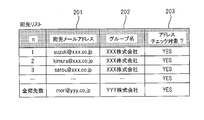
また、図10および図11は、ユーザによって入力されたメールアドレスを、メール送受信装置内に具備するアドレス帳の「グループ設定」を「属性情報」として利用してアドレスを判別する際に利用するリストの一例である。
まず、図1の入力操作部101を介してユーザおよび本発明のメール誤送信防止装置が行う、図2の宛名入力動作(ST001)の処理の説明を行う。具体的には、ユーザがメール送信を行うために図1に示す入力操作部101を利用してアドレス記入欄に送信先のメールアドレス(宛先アドレス)を記入する。このとき、アドレスの入力手段としては、入力操作部101を介して、アドレス記憶部113に記憶されたアドレス帳からの選択、送受信履歴記憶部に記憶された送受信履歴リストからの選択、キーボードまたは携帯端末などに装備されているテンキーなどを用いたアドレスの文字の打ち込み、または、アドレスの先頭文字もしくはその先の数文字を入力したときにその文字に対応するアドレスがアドレス帳に登録済みのときに、自動的にアドレスの残りの文字を候補として提示するアドレス補間手段114などが考えられる。
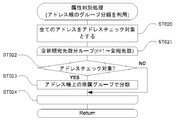
次に、図1の属性判別手段内で行われる、図2の入力されたアドレスの属性判別処理(ST002)を行う。以下では、図3を参照しながら、アドレス帳内で各アドレスを分類している「グループ」をメールアドレスの『属性情報』として利用する場合についての説明を行う。
初めに、図10の宛先リストに示すアドレスチェック対象項目203のように、入力された全ての宛先アドレスをアドレスチェック対象とするために「アドレスチェック対象?」を「YES」に設定する(ST020)。これは後述する処理の中で、ユーザが「誤設定アドレスとは認識させない」と判断した場合に「アドレスチェックを行わない」状態に変化する。さらに、各入力アドレスについて、アドレスチェック対象かどうかを確認しながらアドレス記憶部113に記憶してあるアドレス帳内でのグループ情報を参照して、グループ毎のアドレスを一つの集合として分類する(ST021、ST022、ST023)。図11のグループリストは、入力されたアドレスをグループ名211に示したグループごとに集計し、各グループに含まれるメールアドレス数をカウントした状態を表している。(カウント数は、図11中の同一グループカウント数212に記載)
次に、図1の信頼指標判定手段121で行われる、信頼指標判定処理について説明する。
次に、図1の信頼指標判定手段121で行われる、信頼指標判定処理について説明する。
まずは、前述の属性判別処理後のメールアドレス集合の中から、宛先として誤っている可能性が低いアドレスの集合(以下、メイングループと記載する)を判定する図2中のメイングループの信頼指標判定処理(ST003)について図4を利用して説明する。ここで説明する処理では、「メールアドレス集合の信頼度(誤設定の可能性の低さ)」を示す値として前述の属性判定処理で求めたグループ毎のメールアドレス数(図11中の同一グループカウント数212)を用いる。図4に示すように、グループ毎に図3の処理で求めたグループ毎のメールアドレス数を参照する(ST030、ST031)。そしてその中から、最もメールアドレス数の多いグループをメイングループとして決定する(ST032)。
さらに、上記の処理でメイングループと判定されなかったグループ(宛先として誤っている可能性が高いメールアドレスの集合。以下、サブグループと記載する)の判定を行う、図2中ST004に示したサブグループの信頼指標判定処理について、図5および図6を利用して説明する。図5に示した処理は、メイングループ以外の集合が複数ある場合でも「サブグループ」を1つしか設定しない場合のフローチャートである。この場合は、メイングループに属していないメールアドレスを全て1つのサブグループとして判定する(ST040)。また、図6に示した処理は、メイングループ以外の集合が複数ある場合に、複数のサブグループを設定する場合のフローチャートである。この場合には、残りの集合間で、属しているメールアドレス数の比較を行う。残りのグループに属しているメールアドレス数をチェックし(ST050、ST051)、そのメールアドレス数が多いほど、メイングループに近いと考えられるので、メールアドレス数の多い順番で各サブグループを順位付けする(ST052)。
なお、図2のST004に示した、サブグループの信頼指標判定処理について、図5に示したようにサブグループの数を1つにするか、もしくは図6に示したように複数にするかは、処理の都度ユーザに問い合わせても良いし、どちらを選択するかを予めユーザに設定させ、ユーザによって設定変更が行われるまでは同じ処理を行うようにしても良い。また、複数のサブグループを作成し順位付けする場合の属性情報や信頼度については、後述する別の属性情報および信頼度を用いても良い。
次に、図1の表示方法決定手段122で行われる、表示方法決定処理について図2、図7、図8および図9を用いて説明する。
まず、メイングループの表示方法を決定する図2のメイングループの表示方法決定処理(ST005)について図7のフローチャートを利用して説明する。
メイングループとして選ばれたグループに対して、アドレス帳上などで「グループ設定色」が設定されている場合は(ST060の分岐でYESの場合)、そのグループ設定色をメイングループの背景色として利用する(ST061)。アドレス帳上などで「グループ設定色」が設定されていない場合は(ST060の分岐でNOの場合)、ユーザもしくは本発明のメール誤送信防止装置が予め設定した固定色を背景色とするか、または、ランダムに選択した色を背景色とするか、または、宛先として一番先頭に記載してあるアドレスの「設定色」がアドレス帳上などに設定してある場合はその色を、メイングループの背景色として決定する(ST062)。
さらに、サブグループの表示方法を決定する図2のサブグループの表示方法決定処理(ST006)について図8および図9のフローチャートを利用して説明する。
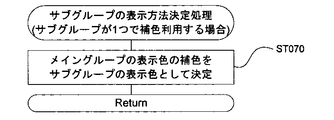
まず、サブグループが1つの場合は図8に示すフローで表示方法を決定する。メイングループの背景色の補色を背景色として決定する(ST070)。
なお、図8および前述ではメイングループの補色をサブグループの背景色としているが、ランダムに選択したメイングループの背景色以外の色、もしくはサブグループの中で最もメールアドレス数の多いアドレス帳上のグループの設定色、もしくはユーザが設定した固定色を背景色としてもよい。
また、サブグループが複数存在し、かつ、サブグループの属性判定にアドレス帳上のグループを利用してサブグループ間に順位付けをしており個々の背景色を変える場合は、図9に示すフローで表示方法を決定する。
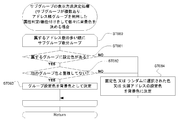
属するメールアドレス数の多いサブグループの順に次の処理を行う(ST080)。処理の対象となっているグループに対して、アドレス帳上でグループ色が設定されていて(ST081の分岐でYES)、かつ、他のサブグループの背景色とその色が重複していない場合は(ST082)、そのアドレス帳上の設定色を背景色として決定する(ST084)。また、処理対象のサブグループにアドレス帳上の設定色がない場合や(ST081の分岐でNO)、他のサブグループの背景色として既に選択されている色の場合は(ST082の分岐でNO)、ユーザもしくは本発明のメール誤送信防止装置が予め決めた固定色、または、本発明のメール誤送信防止装置がランダムに選択した色、または、処理対象となっているサブグループに記載されている先頭アドレスの設定色をそのサブグループの背景色として選択する。
なお、図9および上記の説明では、サブグループに属するメールアドレス数の多い順、すなわち信頼度の高い順に処理を行っているが、順位の低いサブグループ順にメイングループの補色に近い色を背景色として設定してもよい(サブグループ内の順位が低いほど、メイングループの設定色の補色に近い色になる)。
さらに、ユーザの設定などで、複数のサブグループが存在する場合でもまとめて1つの背景色しか利用しない、としてもよい。この場合は、前述の「サブグループが1つの場合」での背景色決定方法と同様に、メイングループの背景色の補色、または、ランダムに選択したメイングループの背景色以外の色、もしくはサブグループの中で最もアドレス数の多いアドレス帳上のグループの設定色、もしくはユーザが設定した固定色を背景色としてもよい。次に、図1の報知手段123を利用して図2の画面上への誤設定可能性の表示(ST007)を行う時の動作について図12から図18を利用して説明する。なお、図12から図17は、4つの新規宛先の中に、誤設定の可能性があると判断された宛先が1つ含まれており、具体的には4つ目アドレスに誤設定の可能性がある場合の例である。
図12は、メール本文部分において、メイングループの背景色とサブグループの背景色を表示した一例である。この例では、決定された色をメイングループに属するアドレス数とサブグループに属するアドレス数の比でしま模様を表現している。また、図13は、メール本文の背景を市松模様で表現しているものである。また、背景色を変える範囲については図14に示したように、メール画面全体としても良いし、図15に示すようにメール本文以外の箇所としても良い。さらに、図16のように誤設定の可能性のあるメールアドレスの文字列の背景部分のみサブグループの背景色にしても良いし、図17のようにメイングループの背景色の中に、サブグループの背景色を文字色として誤設定の可能性があるアドレスを表示しても良い。
なお、図12から図17の例では、サブグループが1つしか存在せず、そのためにサブグループの背景色1色とメイングループの背景色1色の合計2色が表示される場合を示している。しかし、前述の「サブグループの背景色決定処理」で説明したように、サブグループが複数存在し、かつ、個々のサブグループにそれぞれ別の背景色を設定する場合は、報知手段123に表示される背景色はメイングループの背景色と合わせて3色以上となる。
また、背景の模様および背景色の配分については、前記に記載した内容に限らず、2色以上を利用して相対的な色の差をユーザに通知できるものであれば良い。
また、本発明をテンキーの背景色を変えられるような携帯端末のような機器に適用し、誤設定の可能性があるアドレスが存在する場合、テンキーを点滅もしくは常時点灯させるようにしてもよい。このとき、点滅もしくは常時点灯させるキーの位置は、図18に示すように、誤設定の可能性があるアドレスの記載順(図18の場合、4番目の宛先アドレスが誤設定の可能性が高いので、テンキーのうち「4番キー」が点灯)に合わせても良いし、ランダムなキーを点灯もしくは点滅させてもよい。更にこの場合、図19のように、前述の図12から図17に示したメール作成画面の背景色を変化させる動作と同時に動作させても良い。
次に、メイングループおよびサブグループの表示を行った後の処理について図2を用いて説明する。
サブグループとして分類されたメールアドレスが存在する場合(ST010の分岐がNO)、そのアドレス数分だけ以下の処理を行う(ST011)。
誤設定の可能性がある、と本発明の方法によって判別され、かつ、ユーザからも「誤設定の可能性があると判断されたが、誤設定ではない」という判断がされていないメールアドレスかどうか、すなわち、処理対象のアドレスが図10のアドレスチェック対象項目203で「アドレスチェック対象」部分が「YES」となっているかどうかの判定を行う(ST012)。その結果、「アドレスチェック対象」が「YES」だった場合(ST012の分岐がYES)、ユーザに対して「誤設定なので削除またはメールアドレスの変更を行う」か「誤設定ではないので、アドレスチェック対象から外す」の判断を促す(ST013)。
このときユーザが「アドレス修正」を選択した場合(ST014の分岐がYES)、ユーザに該当アドレスの修正を行わせる(ST015)。この後は、新たなメールアドレスを利用した属性判別処理(ST002)を再度行う。
また、ST013の問い合わせ処理で、ユーザが「アドレス修正」を選択しなかった場合、すなわち、「誤設定ではないので、アドレスチェック対象から外す」という判断であった場合は(ST014の分岐がNO)、図10の203欄にある該当アドレスの状態を「NO」とし(ST016)、以降のアドレスチェック対象から外し、次のアドレスに対するユーザへの確認処理(ST012)に戻る。
以上の処理を、全てのサブグループ内の全アドレスについて行い、最終的に「誤設定」と判断されるアドレスがなくなった時点、すなわち、サブグループに分類されるアドレスが0個になった時点(ST010の分岐がYES)で全体の処理を終える。
なお、上記の動作説明では、「アドレス帳上でのグループ分類」を、属性判別処理を行う際の属性情報として利用しているが、アドレス記憶部に記憶してあるアドレス帳データにアドレス毎の重要度をあらわす値が記憶されている場合、この「重要度」を属性情報として利用し、宛先メールアドレスの振り分けを行ってもよい。
更にアドレス分類の際の属性情報として、アドレス記憶部に記憶してあるアドレス帳データにメール送受信が無料になるかどうかの情報(送受信が有料か無料かという直接の情報だけではなく、メールアドレスのドメインや図1の時計部112を参照することによって判断できる、メール送信時間での判断も含む。)が記憶されている場合、この「送受信無料・有料情報」を属性情報として利用し、宛先メールアドレスの振り分けを行ってもよい。
また、上記の動作説明では、属性情報による宛先メールアドレス分類後のメイングループの信頼指標判定処理やサブグループの信頼指標判定処理に「アドレス帳上のグループで分類した後の各グループ内に振り分けられた宛先メールアドレスの数」を利用しているが、「メールアドレス毎の重要度」を利用してもよい。重要度の最も高いグループをメイングループとし、サブグループ間での順位付けをするときには重要度が高いグループほど順位の高いサブグループとする。
さらにメイングループの信頼指標判定処理に「メール送受信の無料・有料情報」を利用してもよい。この場合、メール送受信が無料になるアドレス群をメイングループに決定する。
また、上記の動作説明では、宛先メールアドレスの中に誤設定のものが含まれている可能性がある場合、画面もしくはテンキーなどの色を変化させることで、ユーザにメールアドレス誤設定の可能性を通知していた。ここで、前記の画面もしくはテンキーの色の変化だけではなく、スピーカ等から発生させる音でユーザにアドレス誤設定の可能性を通知してもよい。
さらに、前記の色および音以外に、バイブレータ機能をもつ機器においては、ユーザへのアドレス誤設定の可能性をバイブレータから発生させる振動によって通知する形態でもよい。
(実施の形態2)
次に、図1、図2、図20、図21、図22を用いて本発明の実施の形態2(送受信履歴を利用した方法)を説明する。図20は、図2の属性判別処理(ST002)の本実施の形態2における詳細動作を示したフローチャートである。
次に、図1、図2、図20、図21、図22を用いて本発明の実施の形態2(送受信履歴を利用した方法)を説明する。図20は、図2の属性判別処理(ST002)の本実施の形態2における詳細動作を示したフローチャートである。
図1に記載の送受信履歴記憶部111に記憶してある送受信履歴の中から、1通のメールを複数の宛先に送信もしくは受信した履歴(以下、一括送受信履歴とする)を全て選択する。さらにその中で、新たにメール送信しようとしているメールの新規宛先の数と宛先数が同じもしくは近い一括送受信履歴を抽出する(ST202)。次に、抽出した一括送受信履歴数分だけ、以下のアドレスチェック処理を行う(ST203)。まず、一括送受信履歴として残っているアドレス群と新規宛先を比較する(ST204)。全て宛先が一致しかつ過去の送受信回数が一定回数以上の場合(ST205の分岐がYES)、新規宛先は全て正しい(誤送信とはならない)宛先であると判断し、以降の一括送受信履歴アドレス群のチェックは行わない。アドレス比較処理(ST204)を行った結果、新規宛先と一括送受信履歴として残っているアドレス群が一致しない、もしくは全て一致しても送受信回数が一定回数に満たない場合(ST205の分岐がNO)は、一旦、新規宛先に誤設定アドレスを含む可能性があるものと判断する(ST206)。その後、一致宛先数が一定割合以上あるかどうかの判断を行い(ST207)、一致宛先数が一定割合以上ある場合(ST207の分岐がYES)、「新規宛先には誤設定アドレスを含む可能性がある」と判断し(ST208)、比較対象としている一括送受信履歴を「新規宛先との比較対象一括送受信履歴」の候補として保存する(ST209)。一致宛先数が一定割合に満たない場合(ST206の分岐がNO)は、誤設定アドレスを含むのではなく、新規宛先とはまったく関連のない一括送受信履歴として判定する(ST210)。
上記の処理によって、過去の一括送受信履歴の中から、新規宛先と宛先の内容が近いがいくつかの不一致アドレスが存在するものを抽出することができる。更に、その中から不一致数が最も少ない履歴を最終的な比較対象とする(ST211)。
さらに、比較対象となった一括送受信履歴アドレスと新規宛先を比較し(ST212)、一致アドレスという属性と不一致アドレスという属性情報を利用して、新規宛先を分類する(ST213)。
なお、上記の説明では、送受信履歴部に残っている全ての一括送受信履歴を利用しているが、一定の日付・時間以降の一括送受信履歴のみを利用する、もしくは、一定件数以内の一括送受信履歴のみを利用する、としてもよい。
また、上述の処理では、1通のメールを複数の宛先に送信もしくは受信した履歴(一括送受信履歴)を属性判定に利用しているが、個別のアドレスの送受信履歴(以下、個別送受信履歴とする)を属性判定に利用してもよい。その場合の動作をと図21を使用して説明する。
新規宛先として入力されたメールアドレスに対して、アドレスチェック対象となっているかどうかの確認を行う(ST303)。そして、メールアドレスチェック対象となっているアドレスに対して、全ての個別送受信履歴を参照して、そのアドレスが送信アドレスまたは受信アドレスとして利用されている回数をカウントする(ST304)。その後、「一定の送受信回数以上」「一定の送受信回数に満たない」といった属性で新規宛先のメールアドレスを分類する(ST305)。
なお、新規宛先ごとの送受信履歴回数をカウントしたあとの属性判定には、「一定の送受信回数以上」だけではなく、「新規宛先の中で最も送受信履歴が多いもの」と「それ以外のメールアドレス」という属性情報を用いてもよいし、もしくは、送受信履歴回数が多い順に新規宛先を並べたときの「一定数の上位のアドレス」と「下位のアドレス」という属性情報を用いてもよい。
さらに、上述の個別送受信履歴を利用した属性判定では、全ての個別送受信履歴を利用しているが、一定の日付・時間以降の個別送受信履歴のみを利用する、もしくは、一定件数以内の個別送受信履歴のみを利用する、としてもよい。
次に、送受信履歴を利用した場合の図2のメイングループの信頼指標判定処理(ST003)について説明する。
前述の属性判別処理に一括送受信履歴を用いたときの信頼指標判定処理では、比較対象となった一括送受信履歴アドレス群の中のアドレスと、新規宛先のアドレスの中で一致しているアドレスの集合をメイングループとして判定する。
また、属性判別処理に個別送受信履歴を用いたときの信頼指標判定処理では、前述の「一定の送受信回数以上のアドレス」または「新規宛先の中で最も送受信履歴が多いアドレス」または「送受信履歴回数が多い順に新規宛先を並べたときの一定数の上位のアドレス」をメイングループとして判定する。
次に、上記の処理でメイングループと判定されなかったサブグループ(宛先として誤っている可能性が高いアドレスの集合)の判定を行う図2のサブグループの信頼指標判定処理(ST004)について、説明する。
上述の一括送受信履歴もしくは個別送受信履歴を利用した属性判定処理とその結果を利用したメイングループ判定処理を行った場合、メイングループ以外の集合は1つしか存在しない。その集合を「サブグループ」として判定する。
次に、図1の表示方法決定手段122で行われる、表示方法決定処理について図2、図7、図8を用いて説明する。
メイングループの表示方法を決定するための処理(図2のメイングループの表示方法決定処理ST005)については、本実施の形態1で説明した処理と同じ動作となるので、実施の形態1と同様に、図7のフローチャートを利用して説明する。
メイングループとして選ばれたグループに対して、アドレス帳上などで「グループ設定色」が設定されている場合は(ST060の分岐でYESの場合)、そのグループ設定色をメイングループの背景色として利用する(ST061)。アドレス帳上などで「グループ設定色」が設定されていない場合は(ST060の分岐でNOの場合)、ユーザもしくは本発明のメール誤送信防止装置が予め設定した固定色を背景色とするか、または、ランダムに選択した色を背景色とするか、または、宛先として一番先頭に記載してあるアドレスの「設定色」がアドレス帳上などに設定してある場合はその色を、メイングループの背景色として決定する(ST062)。
さらに、サブグループの表示方法を決定する図2のサブグループの表示方法決定処理(ST006)について説明する。本実施の形態2で説明したメイングループおよびサブグループの決定方法では、メイングループおよびサブグループはそれぞれ1つしか存在しない。よって、本実施の形態2におけるサブグループの表示方法決定手段については、実施の形態1で説明した「サブグループが1つの場合の表示方法決定手段」と同様の動作となるため、図8のフローチャートで示したものと同じ処理を行う。具体的には、メイングループの背景色の補色を背景色として決定する(ST070)。
なお、図8および前述ではメイングループの補色をサブグループの背景色としているが、ランダムに選択したメイングループの背景色以外の色、もしくはサブグループの中で最もアドレス数の多いアドレス帳上のグループの設定色、もしくはユーザが設定した固定色を背景色としてもよい。
次に、図2の報知手段によって、上記で決定したメール宛先の設定誤りの可能性とその表示方法をどのようにユーザに伝えるかについてであるが、これは実施の形態1に記載と同様の動作になるのでここでの説明は省略する。
また、本発明をテンキーの背景色を変えられる携帯端末のような機器に適用する場合に、誤設定の可能性があるアドレスが存在する場合にテンキーを点滅もしくは常時点灯させるようにしてもよい。具体的な動作については、実施の形態1に記載の内容と同様なのでここでの説明は省略する。
更に、メイングループおよびサブグループの表示を行った後の処理についても、実施の形態1に記載の動作と同様のためここでの説明は省略する。
さらに、上記の動作説明では、宛先メールアドレスの中に誤設定のものが含まれている可能性がある場合、画面もしくはテンキーなどの色を変化させることで、ユーザにアドレス誤設定の可能性を通知していた。ここで、前記の画面もしくはテンキーの色の変化だけではなく、スピーカ等から発生させる音でユーザにアドレス誤設定の可能性を通知してもよい。
さらに、前記の色および音以外に、バイブレータ機能をもつ機器においては、ユーザへのアドレス誤設定の可能性をバイブレータから発生させる振動によって通知する形態でもよい。
(実施の形態3)
次に、図1および図2、図22を用いて本発明の実施の形態3(アドレス入力手段利用による属性判定)を説明する。図22は、図2の属性判別処理の詳細を示したフローチャートである。
次に、図1および図2、図22を用いて本発明の実施の形態3(アドレス入力手段利用による属性判定)を説明する。図22は、図2の属性判別処理の詳細を示したフローチャートである。
初めに、全ての新規宛先アドレスに対して次の処理を行う。
該当の新規アドレスが「アドレスチェック対象」である場合(ST403の分岐がYES)、図1に記載の入力方法判別記憶部110に記憶してある新規宛先アドレスをユーザが入力もしくは選択したときの入力方法を読み出す(ST404)。そして、その入力方法によって新規宛先アドレスを振り分ける(ST405)。
該当の新規アドレスが「アドレスチェック対象」ではない場合は(ST403の分岐がNO)、次の新規アドレスに対する処理を行う。
なおここでの入力方法とは、ユーザがアドレス記憶部113に記憶されているアドレス帳情報から入力する方法、送受信履歴記憶部111に記憶してあった一括送受信履歴リストまたは個別送受信履歴リストの中に含まれるアドレス全てもしくはその一部をユーザが選択する方法、ユーザが受信したメールに対する返信動作をする際に自動的に宛先として設定される宛先の全てもしくはその一部を選択する方法、ユーザが宛先欄に直接、入力操作部101にあるキーボードやテンキーやポインティングデバイスなどを使用して入力する方法、または、入力操作部によって入力された一文字、もしくは、複数の文字列に対して、文字列をもつメールアドレスを前記アドレス記憶部を参照してメールアドレス候補としてユーザに提示するアドレス補間手段を利用して、新規アドレスとして入力する方法、などが考えられる。
次に、アドレス入力手段を利用した場合の図2のメイングループの信頼指標判定処理(ST003)について説明する。
上記のアドレス入力手段を利用した属性判別の結果、アドレス入力手段によって振り分けられたアドレスのうち、最も信頼度が高い入力手段によって入力されたメールアドレスの集合をメイングループとする。
ここで、「最も信頼度が高い」とする手段については、ユーザもしくは本発明の誤送信防止装置が予め設定した手段を「最も信頼度が高い」とする。また、「最も信頼度が高い」とする手段は1つでもよいし、複数でもよい。例えば、ユーザが、最も信頼度が高い入力手段として「アドレス帳情報からの入力」を選択している場合、「アドレス帳情報から入力」されたアドレスの集合をメイングループとする。
次に、アドレス入力手段を利用した場合の、サブグループ(上記の処理でメイングループと判断されず、宛先として誤っている可能性が高いアドレスの集合)の判定を行う図2のサブグループの信頼指標判定処理(ST004)について説明する。
メイングループ以外の集合が複数ある場合でも「サブグループ」を1つしか設定しない場合、メイングループに属していないメールアドレスを全て1つのサブグループとして判定する。
また、メイングループ以外の集合が複数あり、それらを複数のサブグループとして考える場合、残りの集合間で、アドレス入力手段の信頼度比較を行う。具体的には、個々の集合の入力手段をチェックし、その「メールアドレス入力時の誤設定のしにくさ」を信頼度として考え、その信頼度の高い順にサブグループを順位付けする。この「メールアドレス入力時の誤設定のしにくさ」については、本発明のメール誤送信防止装置が予め決めてもよいし、ユーザが設定してもよい。
例えば、ユーザがアドレス入力方法を、信頼度が高い順に「アドレス帳情報から入力」「メールの返信動作をする際に自動的に宛先として設定される宛先の全てもしくはその一部を選択する方法」「送受信履歴からの選択」「ユーザが宛先欄に直接、入力操作部101にあるキーボードやテンキーやポインティングデバイスなどを使用して入力する方法」と設定している場合、この順序に従って、サブグループの順位を決定する。
なお、図2のST004に示した、サブグループの信頼指標判定処理について、サブグループの数を1つにするか、もしくは複数にするかは、処理の都度ユーザに問い合わせても良いし、どちらを選択するかを予めユーザに設定させ、ユーザによって設定変更が行われるまでは同じ処理を行うようにしても良いし、本発明の誤送信防止装置が予め選択した方法に従うようにしてもよい。また、複数のサブグループを作成し順位付けする場合の属性や信頼度については、前述の別の属性情報および信頼度を用いても良い。
上記のアドレス入力手段を利用した属性判別の結果、アドレス入力手段によって振り分けられたアドレスのうち前述のメイングループ信頼指標判定処理によってメイングループであると判定されたアドレスの集合以外の集合を、サブグループと判定する。このとき、サブグループを1つにする場合には、メイングループ以外の異なる属性情報を持つアドレスの集合が存在していても、そこに含まれるメールアドレスを全てまとめて一つのサブグループとして判定する。
また、サブグループを複数にする場合には、メイングループ以外の異なる属性情報を持つアドレスの集合が存在している場合、その個々の集合を別々のサブグループとして判定する。この場合、各サブグループ間に属性の信頼度による順位付けを行う。属性の順位については、ユーザもしくは本発明の誤送信防止装置が予め設定した順位に従うこととする。
なお、サブグループを1つにするか複数にするかは、ユーザもしくは本発明の誤送信防止装置が予め選択した方法に従うこととする。
次に、メイングループの表示方法を決定する図2に示すメイングループの表示方法決定処理については、前述の実施の形態2に記載のメイングループのおける処理と同じなので説明を省略する。
また、サブグループの表示方法を決定する図2中のサブグループの表示方法決定処理についても前述の実施の形態2に記載のサブグループの表示方法決定処理と同じなので説明を省略する。
また、図2に示す報知手段によって、上記で決定したメール宛先の設定誤りの可能性とその表示方法をどのようにユーザに伝えるかについてであるが、これは実施の形態1に記載と同様の動作になるのでここでの説明は省略する。
また、本発明をテンキーの背景色を変えられる携帯端末のような機器に適用する場合に、誤設定の可能性があるアドレスが存在する場合にテンキーを点滅もしくは常時点灯させるようにしてもよい。具体的な動作については、実施の形態1に記載の内容と同様なのでここでの説明は省略する。
さらに、メイングループおよびサブグループの表示を行った後の処理についても、実施の形態1に記載の動作と同様のためここでの説明は省略する。
また、上記の動作説明では、宛先メールアドレスの中に誤設定のものが含まれている可能性がある場合、画面もしくはテンキーなどの色を変化させることで、ユーザにメールアドレス誤設定の可能性を通知していた。ここで、前記の画面もしくはテンキーの色の変化だけではなく、スピーカ等から発生させる音でユーザにメールアドレス誤設定の可能性を通知してもよい。
さらに、前記の色および音以外に、バイブレータ機能をもつ機器においては、ユーザへのメールアドレス誤設定の可能性をバイブレータから発生させる振動によって通知する形態でもよい。
本発明を詳細にまた特定の実施態様を参照して説明したが、本発明の精神と範囲を逸脱することなく様々な変更や修正を加えることができることは当業者にとって明らかである。
本出願は、2009年5月20日出願の日本特許出願No.2009-121653に基づくものであり、その内容はここに参照として取り込まれる。
本出願は、2009年5月20日出願の日本特許出願No.2009-121653に基づくものであり、その内容はここに参照として取り込まれる。
以上の説明によって明らかにしたように、本発明のメール誤送信防止装置は、電子メールの宛先欄に複数のメールアドレスが設定されているとき、メールアドレスを個々が持つ「属性情報」によって分類し、分類後のメールアドレスの集合に対して信頼度指標を求める。さらに、その結果を利用して、正しいと思われる宛先アドレス集合と間違っている可能性のあるアドレス集合にわけ、その違いをメール作成ユーザの視覚・聴覚などに訴えることによりメールアドレスの誤設定を気づかせることができる、という効果を持つため、メール作成およびメール送受信機能をもつプログラムを有するパーソナルコンピュータおよび携帯電話などの通信端末などの電子機器に有用である。
1 メール誤送信防止装置
101 入力操作部
110 入力方法判別記憶部
111 送受信履歴記憶部
112 時計部
113 アドレス記憶部
114 アドレス補間手段
120 属性判別手段
121 信頼指標判定手段
122 表示方法決定手段
123 報知手段
101 入力操作部
110 入力方法判別記憶部
111 送受信履歴記憶部
112 時計部
113 アドレス記憶部
114 アドレス補間手段
120 属性判別手段
121 信頼指標判定手段
122 表示方法決定手段
123 報知手段
Claims (19)
- メール送受信装置において、
複数のメールアドレスを記憶するアドレス記憶部と、
メール作成時に複数の宛先アドレスを入力する入力操作部と、
前記複数の宛先アドレスの属性情報を前記アドレス記憶部を参照して判別する属性判別手段と、
報知手段と、
を備え、
前記属性判別手段が、前記複数の宛先アドレスのうち前記属性情報の異なる宛先アドレスが存在すると判別した場合に、
前記報知手段は通常とは異なる設定が含まれることをユーザに提示することを特徴とするメール誤送信防止装置。 - 請求項1に記載のメール誤送信防止装置において、
前記属性判別手段は、前記アドレス記憶部に記憶されているグループ分け情報を前記属性情報が同一か否かを判別することを特徴とするメール誤送信防止装置。 - 請求項1に記載のメール誤送信防止装置は、過去に送受信されたメールアドレスと、その送受信時刻を対応づけて記憶する送受信履歴記憶部を備え、
前記属性判別手段は、複数の宛先アドレスがそれぞれ過去に送受信を行ったメールアドレスであるかどうかを前記属性情報として判別することを特徴とするメール誤送信防止装置。 - 請求項1に記載のメール誤送信防止装置において、
前記属性判別手段は、前記アドレス記憶部におけるグループ毎の重要度を前記属性情報として判別することを特徴とするメール誤送信防止装置。 - 請求項1に記載のメール誤送信防止装置において、
前記属性判別手段は、前記アドレス記憶部におけるメールアドレス毎の重要度を前記属性情報として判別することを特徴とするメール誤送信防止装置。 - 請求項1に記載のメール誤送信防止装置は、宛先として設定された複数の宛先アドレスをそれぞれユーザがどのように入力したかその入力方法を記憶する入力方法判別記憶部を備え、
前記属性判別手段は、前記宛先アドレスに対応する入力方法をそれぞれ属性情報として判別することを特徴とするメール誤送信防止装置。 - 請求項1に記載のメール誤送信防止装置において、
前記属性情報は、前記アドレス記憶部におけるメールアドレスに対応する設定が送受信時に無料または有料の区別であることを特徴とするメール誤送信防止装置。 - 請求項1に記載のメール誤送信防止装置は、
前記複数の宛先アドレスに対する前記属性判別手段の判別結果をもとに同一属性情報をもつアドレス数が最も多いグループをメイングループとして判定し、そうでないグループをサブグループとして判定する信頼指標判定手段を備え、
前記信頼指標判定手段は前記サブグループが存在すると判定した場合、さらに、前記メイングループに属していないメールアドレスを全て1つのサブグループとして判定し、
サブグループが存在することを前記報知手段により報知することを特徴としたメール誤送信防止装置。 - 請求項2に記載のメール誤送信防止装置は、
前記複数の宛先アドレスに対する前記属性判別手段の判別結果をもとに同一属性のメールアドレス数が最も多いグループをメイングループとして判定し、そうでないグループをサブグループとして判定する信頼指標判定手段を備え、
前記信頼指標判定手段は前記サブグループが存在すると判定した場合、
さらにメイングループ以外のメールアドレスを、前記属性判別手段によって属性情報を判別して複数のサブグループに分類し、各サブグループに属するメールアドレス数の多い順にサブグループを順位付けし、
前記複数のサブグループが存在することを前記報知手段により報知することを特徴としたメール誤送信防止装置。 - 請求項4または請求項5に記載のメール誤送信防止装置において、
前記信頼指標判定手段は、前記アドレスグループもしくは前記メールアドレス毎の重要度に応じて最も高い重要度が設定されている前記アドレスグループもしくは前記メールアドレスをメイングループとして判定し、前記メイングループ以外のアドレスグループまたは前記メールアドレスをサブグループとして判定し、
さらに、前記サブグループが存在すると判定した場合、サブグループが存在することを前記報知手段により報知することを特徴としたメール誤送信防止装置。 - 請求項4または請求項5に記載のメール誤送信防止装置において、
前記信頼指標判定手段は、前記アドレスグループもしくは前記メールアドレス毎の重要度に応じて最も高い重要度が設定されている前記アドレスグループもしくは前記メールアドレスをメイングループとして判定し、前記メイングループ以外のアドレスグループまたは前記メールアドレスをサブグループとして判定し、
さらに、前記サブグループが存在すると判定した場合、メイングループ以外のメールアドレスを、前記属性判別手段によって属性情報を判別して複数のサブグループに分類し、各サブグループに含まれるアドレスグループまたは重要度に従ってサブグループを順位付けし、前記複数のサブグループが存在することを前記報知手段により報知することを特徴としたメール誤送信防止装置。 - 請求項6に記載のメール誤送信防止装置は、前記属性情報の判別結果をもとに、
本メール誤送信防止装置、または、ユーザが予め設定した、第一のアドレス入力方法によって入力されたメールアドレスをメイングループとして判定し、前記メイングループ以外のメールアドレスをサブグループとして判定する信頼指標判定手段を備え、前記信頼指標判定手段は前記サブグループが存在すると判定した場合、
前記メイングループ以外のメールアドレスをサブグループとして判定しさらに、前記サブグループが存在すると判定した場合、サブグループが存在することを前記報知手段により報知することを特徴としたメール誤送信防止装置。 - 請求項6に記載のメール誤送信防止装置は、前記属性情報の判別結果をもとに、
本メール誤送信防止装置、または、ユーザが予め設定した、第一のアドレス入力方法によって入力されたメールアドレスをメイングループとして判定し、前記メイングループ以外のメールアドレスをサブグループとして判定する信頼指標判定手段を備え、
前記信頼指標判定手段は前記サブグループが存在すると判定した場合、
さらにメイングループ以外のアドレスを、前記属性判別手段によって属性情報を判別して複数のサブグループに分類し、ユーザが予め順位を設定したアドレス入力方法に従ってサブグループを順位付けし、前記複数のサブグループが存在することを前記報知手段により報知することを特徴としたメール誤送信防止装置。 - 請求項6に記載のメール誤送信防止装置において、
前記複数の宛先アドレスを入力する方法は、
前記アドレス記憶部に記憶されているアドレスデータを参照および選択して、新規アドレスとして入力する方法、
前記入力操作部によってアドレスを一文字ずつ入力し新規アドレスとして入力する方法、
前記入力操作部によって入力された一文字もしくは複数の文字列に対して文字列をもつアドレスを前記アドレス記憶部を参照してアドレス候補としてユーザに提示するアドレス補間手段により新規アドレスとして入力する方法、及び、
前記送受信履歴記憶部に記憶されているアドレスを選択することにより新規アドレスとして入力する方法、
のいずれか1つであることを特徴としたメール誤送信防止装置。 - 請求項7に記載のメール誤送信防止装置は、前記属性情報の判別結果をもとに、
メール送受信時に無料になるグループをメイングループと判定し、前記メイングループ以外をサブグループとして判定する信頼指標判定手段を備え、
前記サブグループが存在した場合、前記報知手段により報知することを特徴としたメール誤送信防止装置。 - 請求項1に記載のメール誤送信防止装置において、前記報知手段として表示部を備え、
前記属性判別手段により異なる属性の宛先アドレスを含むと判別した場合に、2色以上の色の差で前記表示部に表示して報知することを特徴とするメール誤送信防止装置。 - 請求項1に記載のメール誤送信防止装置において、前記報知手段としてスピーカを備え、
前記属性判別手段により異なる属性の宛先アドレスを含むと判別した場合に、前記スピーカにより音声出力して報知することを特徴とするメール誤送信防止装置。 - 請求項1に記載のメール誤送信防止装置において、前記報知手段として振動部を備え、
前記属性判別手段により異なる属性の宛先アドレスを含むと判別した場合に、前記振動部の振動により報知することを特徴とするメール誤送信防止装置。 - 請求項1に記載のメール誤送信防止装置において、
前記アドレス記憶部は、一つもしくは複数のメールアドレスをグループに分類して記憶し、前記グループにグループ毎の重要度を示す値または設定色または設定音を対応づけて記憶することを特徴とするメール誤送信防止装置。
Priority Applications (2)
| Application Number | Priority Date | Filing Date | Title |
|---|---|---|---|
| EP10777479.6A EP2434408A4 (en) | 2009-05-20 | 2010-02-25 | DEVICE FOR PREVENTING IRRADIENT E-MAIL SENDING |
| US13/321,513 US20120072519A1 (en) | 2009-05-20 | 2010-02-25 | Device For Preventing Erroneous E-Mail Transmission |
Applications Claiming Priority (2)
| Application Number | Priority Date | Filing Date | Title |
|---|---|---|---|
| JP2009-121653 | 2009-05-20 | ||
| JP2009121653A JP2010271811A (ja) | 2009-05-20 | 2009-05-20 | メール誤送信防止装置 |
Publications (1)
| Publication Number | Publication Date |
|---|---|
| WO2010134239A1 true WO2010134239A1 (ja) | 2010-11-25 |
Family
ID=43125933
Family Applications (1)
| Application Number | Title | Priority Date | Filing Date |
|---|---|---|---|
| PCT/JP2010/001299 Ceased WO2010134239A1 (ja) | 2009-05-20 | 2010-02-25 | メール誤送信防止装置 |
Country Status (4)
| Country | Link |
|---|---|
| US (1) | US20120072519A1 (ja) |
| EP (1) | EP2434408A4 (ja) |
| JP (1) | JP2010271811A (ja) |
| WO (1) | WO2010134239A1 (ja) |
Cited By (1)
| Publication number | Priority date | Publication date | Assignee | Title |
|---|---|---|---|---|
| JP2019091384A (ja) * | 2017-11-10 | 2019-06-13 | 圭隆 坂本 | 文字、記号、絵によるコミュニケーションにおける、送信対象誤りへの注意喚起装置 |
Families Citing this family (11)
| Publication number | Priority date | Publication date | Assignee | Title |
|---|---|---|---|---|
| JP5584608B2 (ja) * | 2010-12-20 | 2014-09-03 | 株式会社富士通アドバンストエンジニアリング | 電子メールの誤送信の判定方法、判定プログラム、通信装置 |
| JP5544391B2 (ja) * | 2012-04-26 | 2014-07-09 | 東芝テック株式会社 | 電子メール作成装置および電子メール作成プログラム |
| JP5901578B2 (ja) * | 2013-07-08 | 2016-04-13 | 株式会社クオリティア | 電子メール配送システム、電子メール配送方法、電子メール配送サーバおよび電子メール配送プログラム |
| WO2015080032A1 (ja) * | 2013-11-29 | 2015-06-04 | 京セラドキュメントソリューションズ株式会社 | 電子メール送信装置 |
| JP5959072B2 (ja) | 2014-09-29 | 2016-08-02 | インターナショナル・ビジネス・マシーンズ・コーポレーションInternational Business Machines Corporation | 入力文字列に関連付けられた変換候補を表示する方法、その電子装置及びサーバ・コンピュータ、並びに電子装置用プログラム及びサーバ・コンピュータ用プログラム |
| WO2016163043A1 (ja) * | 2015-04-10 | 2016-10-13 | 株式会社ソリトンシステムズ | 電子メール誤送信判定装置、電子メール送信システム及び記録媒体 |
| US11032229B2 (en) * | 2015-07-31 | 2021-06-08 | International Business Machines Corporation | System and method for visual classification of email participants |
| GB2555580A (en) * | 2016-10-28 | 2018-05-09 | Egress Software Tech Ltd | Controlling data transmission |
| US20190182197A1 (en) * | 2017-10-10 | 2019-06-13 | Soliton Systems K.K. | Warning apparatus for preventing electronic mail wrong transmission, electronic mail transmission system, and program |
| JP2020154363A (ja) * | 2019-03-18 | 2020-09-24 | 株式会社Pfu | 情報処理装置、方法、及びプログラム |
| JP2022149357A (ja) * | 2021-03-25 | 2022-10-06 | 日本電気株式会社 | 電子メールシステム、端末装置、電子メール管理装置、電子メール制御方法、及びプログラム |
Citations (7)
| Publication number | Priority date | Publication date | Assignee | Title |
|---|---|---|---|---|
| JP2004145418A (ja) | 2002-10-22 | 2004-05-20 | Sharp Corp | 電子メール作成プログラム及び電子メール作成装置 |
| JP2004334505A (ja) * | 2003-05-07 | 2004-11-25 | Toppan Printing Co Ltd | 電子メールアドレス入力支援プログラム |
| JP2005084768A (ja) * | 2003-09-05 | 2005-03-31 | Fuji Xerox Co Ltd | データ送信装置、データ受信装置、データ送信方法、およびプログラム |
| JP2007166152A (ja) * | 2005-12-13 | 2007-06-28 | Murata Mach Ltd | 通信端末装置 |
| JP2008059044A (ja) * | 2006-08-29 | 2008-03-13 | Hitachi Systems & Services Ltd | 情報処理装置 |
| JP2008117027A (ja) * | 2006-11-01 | 2008-05-22 | Takashi Miyatani | メール誤送信防止プログラム、プログラム格納媒体 |
| JP2009121653A (ja) | 2007-11-19 | 2009-06-04 | Aisin Aw Co Ltd | バルブ取付装置 |
Family Cites Families (9)
| Publication number | Priority date | Publication date | Assignee | Title |
|---|---|---|---|---|
| US6829607B1 (en) * | 2000-04-24 | 2004-12-07 | Microsoft Corporation | System and method for facilitating user input by automatically providing dynamically generated completion information |
| US7320019B2 (en) * | 2000-11-30 | 2008-01-15 | At&T Delaware Intellectual Property, Inc. | Method and apparatus for automatically checking e-mail addresses in outgoing e-mail communications |
| US7543026B2 (en) * | 2000-12-28 | 2009-06-02 | Quine Douglas B | System and method for address correction of electronic messages |
| US7032174B2 (en) * | 2001-03-27 | 2006-04-18 | Microsoft Corporation | Automatically adding proper names to a database |
| US20070005708A1 (en) * | 2005-06-21 | 2007-01-04 | Cornell Juliano | Authorizing control for electronic communications |
| US7774421B2 (en) * | 2005-10-14 | 2010-08-10 | International Business Machines Corporation | Mitigating address book weaknesses that permit the sending of e-mail to wrong addresses |
| JP2007241807A (ja) * | 2006-03-10 | 2007-09-20 | Fujitsu Ltd | 電子メール送信プログラム、電子メール送信装置、電子メール送信方法 |
| US20070294428A1 (en) * | 2006-06-19 | 2007-12-20 | Ido Guy | Method and System for Email Messaging |
| US9560003B2 (en) * | 2008-02-14 | 2017-01-31 | Gary Stephen Shuster | Erroneous addressing prevention for electronic messaging |
-
2009
- 2009-05-20 JP JP2009121653A patent/JP2010271811A/ja not_active Withdrawn
-
2010
- 2010-02-25 US US13/321,513 patent/US20120072519A1/en not_active Abandoned
- 2010-02-25 WO PCT/JP2010/001299 patent/WO2010134239A1/ja not_active Ceased
- 2010-02-25 EP EP10777479.6A patent/EP2434408A4/en not_active Withdrawn
Patent Citations (7)
| Publication number | Priority date | Publication date | Assignee | Title |
|---|---|---|---|---|
| JP2004145418A (ja) | 2002-10-22 | 2004-05-20 | Sharp Corp | 電子メール作成プログラム及び電子メール作成装置 |
| JP2004334505A (ja) * | 2003-05-07 | 2004-11-25 | Toppan Printing Co Ltd | 電子メールアドレス入力支援プログラム |
| JP2005084768A (ja) * | 2003-09-05 | 2005-03-31 | Fuji Xerox Co Ltd | データ送信装置、データ受信装置、データ送信方法、およびプログラム |
| JP2007166152A (ja) * | 2005-12-13 | 2007-06-28 | Murata Mach Ltd | 通信端末装置 |
| JP2008059044A (ja) * | 2006-08-29 | 2008-03-13 | Hitachi Systems & Services Ltd | 情報処理装置 |
| JP2008117027A (ja) * | 2006-11-01 | 2008-05-22 | Takashi Miyatani | メール誤送信防止プログラム、プログラム格納媒体 |
| JP2009121653A (ja) | 2007-11-19 | 2009-06-04 | Aisin Aw Co Ltd | バルブ取付装置 |
Non-Patent Citations (1)
| Title |
|---|
| See also references of EP2434408A4 * |
Cited By (1)
| Publication number | Priority date | Publication date | Assignee | Title |
|---|---|---|---|---|
| JP2019091384A (ja) * | 2017-11-10 | 2019-06-13 | 圭隆 坂本 | 文字、記号、絵によるコミュニケーションにおける、送信対象誤りへの注意喚起装置 |
Also Published As
| Publication number | Publication date |
|---|---|
| EP2434408A4 (en) | 2013-06-26 |
| JP2010271811A (ja) | 2010-12-02 |
| EP2434408A1 (en) | 2012-03-28 |
| US20120072519A1 (en) | 2012-03-22 |
Similar Documents
| Publication | Publication Date | Title |
|---|---|---|
| WO2010134239A1 (ja) | メール誤送信防止装置 | |
| KR101195333B1 (ko) | 사회적 관계 정보 활용에 의한 컨텐츠 이용 할당 방법, 장치 및 컴퓨터 판독 가능한 저장 매체 | |
| US9112731B2 (en) | Prioritization of incoming communications | |
| US20200380003A1 (en) | People suggester using historical interactions on a device | |
| CN101507246A (zh) | 无线通信终端上的数据私有性 | |
| KR20110108133A (ko) | 스팸 전화를 차단하는 이동통신 단말기 및 그 방법 | |
| JP6438197B2 (ja) | 携帯端末装置、及び携帯端末プログラム | |
| WO2016064167A1 (ko) | 인맥 관계망 검색 시스템 및 그 방법 | |
| JP2007241807A (ja) | 電子メール送信プログラム、電子メール送信装置、電子メール送信方法 | |
| JP4044491B2 (ja) | 文字入力変換装置 | |
| JP4569088B2 (ja) | 通信端末装置 | |
| JP7106035B1 (ja) | クレーム発生予測システム、クレーム発生予測方法及びプログラム | |
| JP7310648B2 (ja) | メール端末、不審メール検出システム、プログラム、および不審メールの検出方法 | |
| KR102169410B1 (ko) | 통화 상대방 정보 제공 모바일 앱 시스템 | |
| JP4553662B2 (ja) | 情報保護プログラム及び端末装置 | |
| JP2004040304A (ja) | 電子メールアドレス管理方法およびプログラム、電子メール端末装置 | |
| JP2007043344A (ja) | 電話機、電話帳データ照合方法及び電話帳データ照合プログラム | |
| JP2005012627A (ja) | 携帯通信端末、移動体通信システム及びメール通信制御方法 | |
| JP2009135789A (ja) | 通信システム、接続装置、接続方法及びプログラム | |
| KR100746049B1 (ko) | 스팸 메시지 관리 시스템 및 방법과 이를 위한 이동통신단말 | |
| KR20110074801A (ko) | 주소록을 이용한 검색시스템 및 방법, 그 검색서버 | |
| JP2013223059A (ja) | 情報処理装置、その制御方法およびその制御プログラム | |
| JP4025741B2 (ja) | 情報配信システム、情報処理装置、情報配信方法およびプログラム | |
| KR100851404B1 (ko) | 이동통신 단말기의 스팸 차단 방법 | |
| JP2009027228A (ja) | 着信履歴通知システム、方法、及び、プログラム |
Legal Events
| Date | Code | Title | Description |
|---|---|---|---|
| 121 | Ep: the epo has been informed by wipo that ep was designated in this application |
Ref document number: 10777479 Country of ref document: EP Kind code of ref document: A1 |
|
| WWE | Wipo information: entry into national phase |
Ref document number: 2010777479 Country of ref document: EP |
|
| WWE | Wipo information: entry into national phase |
Ref document number: 13321513 Country of ref document: US |
|
| NENP | Non-entry into the national phase |
Ref country code: DE |