WO2010134540A1 - 有核型の口腔内崩壊錠 - Google Patents
有核型の口腔内崩壊錠 Download PDFInfo
- Publication number
- WO2010134540A1 WO2010134540A1 PCT/JP2010/058429 JP2010058429W WO2010134540A1 WO 2010134540 A1 WO2010134540 A1 WO 2010134540A1 JP 2010058429 W JP2010058429 W JP 2010058429W WO 2010134540 A1 WO2010134540 A1 WO 2010134540A1
- Authority
- WO
- WIPO (PCT)
- Prior art keywords
- outer layer
- tablet
- inner core
- nucleated
- hardness
- Prior art date
- Legal status (The legal status is an assumption and is not a legal conclusion. Google has not performed a legal analysis and makes no representation as to the accuracy of the status listed.)
- Ceased
Links
Classifications
-
- A—HUMAN NECESSITIES
- A61—MEDICAL OR VETERINARY SCIENCE; HYGIENE
- A61K—PREPARATIONS FOR MEDICAL, DENTAL OR TOILETRY PURPOSES
- A61K9/00—Medicinal preparations characterised by special physical form
- A61K9/0012—Galenical forms characterised by the site of application
- A61K9/0053—Mouth and digestive tract, i.e. intraoral and peroral administration
- A61K9/0056—Mouth soluble or dispersible forms; Suckable, eatable, chewable coherent forms; Forms rapidly disintegrating in the mouth; Lozenges; Lollipops; Bite capsules; Baked products; Baits or other oral forms for animals
-
- A—HUMAN NECESSITIES
- A61—MEDICAL OR VETERINARY SCIENCE; HYGIENE
- A61K—PREPARATIONS FOR MEDICAL, DENTAL OR TOILETRY PURPOSES
- A61K31/00—Medicinal preparations containing organic active ingredients
- A61K31/16—Amides, e.g. hydroxamic acids
- A61K31/165—Amides, e.g. hydroxamic acids having aromatic rings, e.g. colchicine, atenolol, progabide
- A61K31/167—Amides, e.g. hydroxamic acids having aromatic rings, e.g. colchicine, atenolol, progabide having the nitrogen of a carboxamide group directly attached to the aromatic ring, e.g. lidocaine, paracetamol
-
- A—HUMAN NECESSITIES
- A61—MEDICAL OR VETERINARY SCIENCE; HYGIENE
- A61K—PREPARATIONS FOR MEDICAL, DENTAL OR TOILETRY PURPOSES
- A61K31/00—Medicinal preparations containing organic active ingredients
- A61K31/33—Heterocyclic compounds
- A61K31/395—Heterocyclic compounds having nitrogen as a ring hetero atom, e.g. guanethidine or rifamycins
- A61K31/41—Heterocyclic compounds having nitrogen as a ring hetero atom, e.g. guanethidine or rifamycins having five-membered rings with two or more ring hetero atoms, at least one of which being nitrogen, e.g. tetrazole
- A61K31/425—Thiazoles
- A61K31/426—1,3-Thiazoles
-
- A—HUMAN NECESSITIES
- A61—MEDICAL OR VETERINARY SCIENCE; HYGIENE
- A61K—PREPARATIONS FOR MEDICAL, DENTAL OR TOILETRY PURPOSES
- A61K47/00—Medicinal preparations characterised by the non-active ingredients used, e.g. carriers or inert additives; Targeting or modifying agents chemically bound to the active ingredient
- A61K47/30—Macromolecular organic or inorganic compounds, e.g. inorganic polyphosphates
- A61K47/36—Polysaccharides; Derivatives thereof, e.g. gums, starch, alginate, dextrin, hyaluronic acid, chitosan, inulin, agar or pectin
-
- A—HUMAN NECESSITIES
- A61—MEDICAL OR VETERINARY SCIENCE; HYGIENE
- A61K—PREPARATIONS FOR MEDICAL, DENTAL OR TOILETRY PURPOSES
- A61K47/00—Medicinal preparations characterised by the non-active ingredients used, e.g. carriers or inert additives; Targeting or modifying agents chemically bound to the active ingredient
- A61K47/30—Macromolecular organic or inorganic compounds, e.g. inorganic polyphosphates
- A61K47/36—Polysaccharides; Derivatives thereof, e.g. gums, starch, alginate, dextrin, hyaluronic acid, chitosan, inulin, agar or pectin
- A61K47/38—Cellulose; Derivatives thereof
-
- A—HUMAN NECESSITIES
- A61—MEDICAL OR VETERINARY SCIENCE; HYGIENE
- A61K—PREPARATIONS FOR MEDICAL, DENTAL OR TOILETRY PURPOSES
- A61K9/00—Medicinal preparations characterised by special physical form
- A61K9/20—Pills, tablets, discs, rods
- A61K9/28—Dragees; Coated pills or tablets, e.g. with film or compression coating
- A61K9/2806—Coating materials
- A61K9/2813—Inorganic compounds
-
- A—HUMAN NECESSITIES
- A61—MEDICAL OR VETERINARY SCIENCE; HYGIENE
- A61K—PREPARATIONS FOR MEDICAL, DENTAL OR TOILETRY PURPOSES
- A61K9/00—Medicinal preparations characterised by special physical form
- A61K9/20—Pills, tablets, discs, rods
- A61K9/28—Dragees; Coated pills or tablets, e.g. with film or compression coating
- A61K9/2806—Coating materials
- A61K9/2833—Organic macromolecular compounds
- A61K9/284—Organic macromolecular compounds obtained by reactions only involving carbon-to-carbon unsaturated bonds, e.g. polyvinyl pyrrolidone
-
- A—HUMAN NECESSITIES
- A61—MEDICAL OR VETERINARY SCIENCE; HYGIENE
- A61K—PREPARATIONS FOR MEDICAL, DENTAL OR TOILETRY PURPOSES
- A61K9/00—Medicinal preparations characterised by special physical form
- A61K9/20—Pills, tablets, discs, rods
- A61K9/28—Dragees; Coated pills or tablets, e.g. with film or compression coating
- A61K9/2806—Coating materials
- A61K9/2833—Organic macromolecular compounds
- A61K9/286—Polysaccharides, e.g. gums; Cyclodextrin
-
- A—HUMAN NECESSITIES
- A61—MEDICAL OR VETERINARY SCIENCE; HYGIENE
- A61K—PREPARATIONS FOR MEDICAL, DENTAL OR TOILETRY PURPOSES
- A61K9/00—Medicinal preparations characterised by special physical form
- A61K9/20—Pills, tablets, discs, rods
- A61K9/28—Dragees; Coated pills or tablets, e.g. with film or compression coating
- A61K9/2806—Coating materials
- A61K9/2833—Organic macromolecular compounds
- A61K9/286—Polysaccharides, e.g. gums; Cyclodextrin
- A61K9/2866—Cellulose; Cellulose derivatives, e.g. hydroxypropyl methylcellulose
-
- A—HUMAN NECESSITIES
- A61—MEDICAL OR VETERINARY SCIENCE; HYGIENE
- A61K—PREPARATIONS FOR MEDICAL, DENTAL OR TOILETRY PURPOSES
- A61K9/00—Medicinal preparations characterised by special physical form
- A61K9/20—Pills, tablets, discs, rods
- A61K9/28—Dragees; Coated pills or tablets, e.g. with film or compression coating
- A61K9/2893—Tablet coating processes
Definitions
- the present invention is characterized in that the inner core is a granular material having low moldability, has an outer layer covering the periphery of the inner core, and imparted appropriate hardness and excellent disintegration property in the oral cavity as a final molded tablet
- the present invention relates to a nucleated molded product (hereinafter sometimes referred to as a nucleated orally disintegrating tablet). That is, the present invention relates to a nucleated type orally disintegrating tablet in which the outer layer portion rapidly disintegrates in the oral cavity even after taking a small amount of water or without water, and then the inner core granules or powder is dispersed in the oral cavity.
- Patent Document 1 discloses a nucleated fast disintegrating tablet as a tablet form that has not been well known so far.
- the nucleated tablet is a tablet having a double structure of an inner core and an outer layer of the tablet, and has attracted attention as a new tablet forming technique.
- the formulation design focuses on the solubility and disintegration of the inner core, and the inner core component is composed of components having moldability as well as the outer layer component ( For example, as can be seen from the results of Test Example 2 in which a tablet was produced only with the inner core component, the inner core component has moldability and is considered to have a certain hardness or more).
- the outer layer of the nucleated molded article disclosed in Patent Document 1 has a composition mainly composed of sugar alcohols mainly composed of erystol, and the combination of essential components of the outer layer of the present invention is not disclosed. It was.
- Patent Document 2 discloses a trial in which microcapsule-like granules are applied to the inner core component of the nucleated molded product in Patent Document 1 described above. That is, in Patent Document 2, the application of microcapsule-like granules to the inner core of a nucleated molded product is studied, and the outer layer is composed of a lactose / crystalline cellulose component, and a predetermined manufacturing method is used to obtain a microcapsule. A manufacturing example in which a nucleated molded product containing a granule-like granule in the inner core is completed is disclosed.
- Patent Document 2 only discloses the invention of the nucleated molded article containing the above microcapsule-like granules in the inner core, and further studies for applying the nucleated molded article here to the orally disintegrating tablet have not been made. There was no suggestion at all.
- the outer layer component the component applicable as a nucleated molded product containing microcapsule-like granules in the inner core has not been studied other than the composition from the above-mentioned lactose / crystalline cellulose component. The essential component combination was not disclosed.
- the orally disintegrating tablet described in Patent Document 3 comprises an active ingredient, crystalline cellulose and an inorganic excipient, and is characterized by not containing a disintegrant. Furthermore, it is described that the orally disintegrating tablet of Patent Document 3 has a high hardness immediately after tableting and is excellent in disintegration compared to an orally disintegrating tablet containing crospovidone or low-substituted hydroxypropylcellulose (for example, Example 5 and Comparative Examples 5 to 9).
- disintegrants contain disintegrants because they cause tablet quality to deteriorate due to moisture absorption and the surface of the tablets may be roughened, and the quality of the tablets may be worsened by absorbing saliva and making it feel crispy.
- the present invention is not advantageous ".
- Patent Document 3 does not disclose a nucleated molded article as disclosed in Patent Documents 1 and 2 and does not suggest application thereof.
- Patent Document 4 has a disclosure regarding an orally disintegrating tablet containing an inorganic excipient, but there is no specific disclosure regarding a nucleated molded product.
- Patent Document 1 discloses a production example in which microcapsule-like granules are applied to the inner core. Therefore, application to further functional preparations such as orally disintegrating tablets was expected.
- the object of the present invention is to newly develop a nucleated molded product characterized in that the inner core is a granular material having a low moldability, and has an excellent disintegration property and appropriate hardness as a whole tablet. It is to provide an orally disintegrating tablet of the type.
- a cored molded product comprising an inner core and an outer layer covering the periphery of the inner core, wherein the inner core portion is composed of a granular material having low moldability, and the outer layer is composed of crystalline cellulose, an inorganic excipient, and specific components shown below It was found that a nucleated type orally disintegrating tablet having appropriate hardness and disintegration as a whole tablet can be produced.
- the ratio of the thickness of the inner core to the whole tablet is 10 to 90%
- the outer layer component is (a) crystalline cellulose, (b) an inorganic excipient, and (c) crospovidone, starches,
- the outer layer component is (a) crystalline cellulose, (b) an inorganic excipient, and (c) crospovidone, starches,
- the present invention provides the following various aspects of the invention.
- [Item 3] The nucleated orally disintegrating tablet according to Item 1 or 2, wherein the blending ratio of the crystalline cellulose (a) in the outer layer portion of 100% by weight is 5 to 80% by weight.
- [Item 4] The nucleated orally disintegrating tablet according to any one of Items 1 to 3, wherein the blending ratio of the inorganic excipient (b) in the outer layer portion of 100% by weight is 10 to 80% by weight.
- [Item 5] The nucleated oral disintegration according to any one of Items 1 to 4, wherein the total proportion of the specific component (c) to be blended in the outer layer portion 100% by weight is 1 to 40% by weight. Tablets.
- [Item 10] The nucleated orally disintegrating tablet according to any one of Items 1 to 9, wherein the inner core contains an active ingredient.
- [Item 11] The nucleated orally disintegrating tablet according to any one of Items 1 to 10, wherein the blending ratio of the crystalline cellulose (a) in the outer layer portion of 100% by weight is 10 to 70% by weight.
- [Item 12] The nucleated oral cavity according to any one of Items 1 to 11, wherein the inner core is a powder, granulated product, or granular material having low formability other than the functional particles such as microcapsules. Inner disintegrating tablet.
- nucleated type orally disintegrating tablet which contains a large amount of powder having low moldability in the inner core and has excellent disintegration property and appropriate hardness as a whole tablet.
- the nucleated type orally disintegrating tablet in the present invention is suitable for an “inner core” composed of a low-formability powder such as microcapsule-like functional particles and a final molded tablet covering the periphery of the inner core. Consists of an “outer layer” that imparts hardness and disintegration.
- an inner core component other than microcapsule-like functional particles, it is possible to carry out powders, granules, powders, etc. having low formability, and have sufficient hardness and disintegration.
- a karyotype orally disintegrating tablet is provided.
- the “outer layer” is selected from the group consisting of (a) crystalline cellulose, (b) inorganic excipients and (c) crospovidone, starches, low-substituted hydroxypropylcellulose and carmellose, or Contains two or more specific components. The combination of these components provides a nucleated orally disintegrating tablet that maintains sufficient hardness as a final molded product even with an inner core having low moldability and has good disintegration.
- Orally disintegrating tablet means a tablet that disintegrates rapidly in the oral cavity without ingesting water to take the tablet. Specifically, in a disintegration test in the human oral cavity or a disintegration test with a device, a tablet in which the inner core and the outer layer disintegrate or disperse within 60 seconds, preferably within 45 seconds, more preferably within 30 seconds. means. Examples of the orally disintegrating tablet tester include model ODT-101 manufactured by Toyama Sangyo Co., Ltd. In the present invention, the oral disintegration time includes the tablet in the oral cavity, and the time until the tablet completely disintegrates was measured. After the test, the contents were discharged and the oral cavity was washed with clean water.
- the tablet hardness was measured using a tablet hardness tester (PORTABLE CHECKER PC-30 manufactured by Okada Seiko Co., Ltd.) to measure the force necessary for crushing in the diameter direction.
- “Absolute hardness” was calculated by the following formula using the value of the split hardness measured by the tablet hardness tester.
- “Absolute hardness” is a value obtained by dividing the hardness measured with a tablet hardness tester by the cross-sectional area (tablet diameter (mm) ⁇ tablet thickness (mm)) obtained by dividing the tablet in the longitudinal direction by the following formula: Desired.
- Absolute hardness (N / mm 2 ) Hardness (N) / Cross sectional area (mm 2 )
- HDBI Hardness and Disintegrating Balance Index
- the orally disintegrating tablet of the present invention has an HDBI value of 0.15 or more, preferably 0.2 or more, more preferably 0.25 or more, and further preferably 0.3 or more.
- HDBI (N / mm 2 ⁇ sec) absolute hardness (N / mm 2 ) ⁇ oral disintegration time (sec)
- the wide allowable range of tableting pressure means that the range of tableting pressure at the time of tableting when producing an orally disintegrating tablet having appropriate hardness and disintegration is wide, that is, tableting pressure. It means that there is little change in hardness and disintegration when changing.
- the allowable range of tableting pressure when the allowable range of tableting pressure is narrow, it is necessary to adjust the tableting pressure for each production, or it is necessary to readjust the tableting pressure during tableting. It may be a hindrance.
- the produced orally disintegrating tablet cannot achieve both appropriate hardness and disintegration.
- the porosity is calculated
- Tablet porosity (%) (1 ⁇ Wt / ( ⁇ ⁇ V)) ⁇ 100 ⁇ : True density of tablets (mg / mm 3 ), V: Tablet volume (mm 3 ), Wt: Tablet weight (mg)
- the porosity of the outer layer portion is determined by the following equation.
- Porosity (%) of outer layer portion (1 ⁇ Wt / ( ⁇ ⁇ 3.14 ⁇ D 2 ⁇ T)) ⁇ 100 ⁇ : true density of outer layer (mg / mm 3 ), D: radius (mm) of outer layer (lower), T: thickness of outer layer (lower) (mm), Wt: weight of outer layer (lower) (mg)
- the thickness of the inner core was calculated by the following method.
- the thickness of the entire tablet was measured with a digital caliper (manufactured by Mitutoyo).
- the dry coated tablet was divided in the diameter direction, the cross section was observed with a digital microscope (VHX-500 manufactured by Keyence), and the thicknesses of the upper and lower outer layers were measured.
- Inner core thickness (mm) Total tablet thickness (mm) ⁇ Total thickness of upper and lower outer layers (mm)
- the “ratio of the thickness of the inner core” means the ratio of the thickness occupied by the inner core to the thickness of the whole tablet. That is, the ratio of the thickness which an inner core occupies in the cross section parallel to the side surface of a tablet is meant.
- Ratio of inner core thickness (%) inner core thickness (mm) ⁇ total tablet thickness (mm) ⁇ 100
- the porosity of the outer layer portion is usually 1 to 40%, preferably 1 to 30%.
- Outer layer (a) Crystalline cellulose The crystalline cellulose used as an essential component of the outer layer of this invention will not be specifically limited if oral administration is possible.
- the average particle size of the crystalline cellulose used as a raw material is preferably 150 ⁇ m or less, more preferably 130 ⁇ m or less. Preferably it is 120 micrometers or less.
- the blending ratio of the crystalline cellulose used in the present invention is usually 5 to 80% by weight when the total weight of the outer layer part is 100% by weight from the viewpoint of hardness, disintegration time and allowable width of tableting pressure, The amount is preferably 9 to 70% by weight, more preferably 20 to 50% by weight.
- crystalline cellulose used in the present invention for example, Theolas (CEOLUS, registered trademark, PH-101, PH-102, PH-301, PH-302, PH-F20J, KG-800, KG-1000, ST-02 : Asahi Kasei Chemicals), Avicel (AVICEL, registered trademark, PH-101, PH-102, PH-301, PH-302, FD-101, FD-301, FD-F20: manufactured by FMC BioPolymer) It is done.
- These crystalline celluloses may be used alone or in combination of two or more.
- the inorganic excipient used as an essential component of the outer layer of the present invention is calcium hydrogen phosphates, magnesium carbonate, magnesium silicate, magnesium hydroxide, dried aluminum hydroxide gel, magnesium oxide, synthetic Aluminum silicate, synthetic hydrotalcite, sodium bicarbonate, magnesium aluminate metasilicate, magnesium aluminate silicate, calcium carbonate, precipitated calcium carbonate, talc, magnesium alumina hydroxide, calcium silicate, aluminum hydroxide / magnesium carbonate mixed Examples thereof include a dry gel, a coprecipitation product of aluminum hydroxide / sodium bicarbonate, a coprecipitation product of aluminum hydroxide / calcium carbonate / magnesium carbonate, and a coprecipitation product of aluminum hydroxide / aluminum potassium sulfate.
- calcium hydrogen phosphates, magnesium carbonate, magnesium silicate, magnesium hydroxide, dry aluminum hydroxide gel, magnesium oxide, synthetic aluminum silicate, synthetic hydrotalcite, and sodium hydrogen carbonate are used. More preferably, calcium hydrogen phosphates, magnesium carbonate, magnesium silicate, magnesium hydroxide, dry aluminum hydroxide gel, magnesium oxide, synthetic aluminum silicate, particularly preferably calcium hydrogen phosphates, magnesium silicate, Examples include dry aluminum hydroxide gel, magnesium oxide, and synthetic aluminum silicate.
- the most preferable among the above-mentioned inorganic excipients are calcium hydrogen phosphates, specifically, calcium hydrogen phosphate (dibasic calcium phosphate), anhydrous calcium hydrogen phosphate (anhydrous dibasic calcium phosphate) and phosphoric acid.
- An example is calcium dihydrogen (monocalcium phosphate).
- These inorganic excipients may be used alone or in combination of two or more.
- the blending ratio of the inorganic excipient is 10 to 80% by weight, preferably 20 to 80% when the total weight of the outer layer portion is 100% by weight from the viewpoint of hardness, disintegration time, and allowable width of tableting pressure. % By weight, more preferably 30 to 60% by weight.
- the specific component that is an essential component of the outer layer of the present invention is at least one selected from the group consisting of crospovidone, starches, low-substituted hydroxypropylcellulose, and carmellose.
- crospovidone starches, low-substituted hydroxypropylcellulose, and carmellose.
- a component that enhances disintegration other than the component is contained, a desired effect cannot be obtained.
- it has been found that a desired effect can be obtained when these specific components are contained together with crystalline cellulose and an inorganic excipient.
- the crospovidone that can be used in the present invention is not particularly limited, but those that are compatible with the Japanese Pharmacopoeia are usually used.
- the average particle size is not particularly limited, but if the average particle size of the crospovidone used is large, it feels rough after disintegrating in the oral cavity.
- the thickness is 10 to 200 ⁇ m, more preferably 10 to 150 ⁇ m, still more preferably 10 to 100 ⁇ m. In order to obtain a desired particle size, it may be appropriately pulverized as necessary. Examples of the pulverization method include a method using an airflow pulverizer or a hammer type pulverizer.
- the compounding amount of crospovidone in the outer layer is usually 1 to 40% by weight, preferably 1 to 30% by weight per 100% by weight of the outer layer part from the viewpoint of hardness, disintegration time and allowable width of tableting pressure. More preferred is 1 to 20% by weight, still more preferred is 1 to 10% by weight, and most preferred is 1 to 5% by weight.
- the starches that can be used in the present invention include corn starch (corn starch), potato starch, rice starch, wheat starch, sweet potato starch, mung bean starch, tapioca starch, partially pregelatinized starch and the like. Among them, corn starch is preferable. In the present invention, completely pregelatinized starch cannot be applied because of its poor disintegration property. These starches may be used alone or in combination of two or more.
- the average particle size is not particularly limited, but if the average particle size is large, it feels rough after disintegrating in the oral cavity. Therefore, the average particle size as a raw material is preferably 10 to 200 ⁇ m, more preferably from the viewpoint of ingestion.
- the thickness is 10 to 100 ⁇ m, more preferably 10 to 50 ⁇ m.
- it may be appropriately pulverized as necessary.
- the pulverization method include a method using an airflow pulverizer or a hammer type pulverizer.
- the total blending ratio of starches to be blended is 1 to 40% by weight per 100% by weight of the outer layer portion.
- the blending ratio of starch is usually 1 to 40% by weight, preferably 1 to 30% by weight, more preferably 1 to 20% by weight, and further preferably 1 to 20% by weight per 100% by weight of the outer layer portion. 10% by weight, most preferably 1-5% by weight.
- the low-substituted hydroxypropylcellulose that can be used in the present invention is not particularly limited to the substitution ratio of the hydroxypropoxy group and can be used as long as it conforms to the Japanese Pharmacopoeia, and usually 7.0. ⁇ 12.9%.
- the average particle size is not particularly limited, but if the average particle size of the low-substituted hydroxypropylcellulose used is large, it feels rough after disintegrating in the oral cavity.
- the average particle size of cellulose is preferably 10 to 200 ⁇ m, more preferably 10 to 150 ⁇ m, and still more preferably 10 to 100 ⁇ m.
- the blending amount of the low-substituted hydroxypropyl cellulose is 1 to 40% by weight, preferably 1 to 30% by weight, more preferably 1 per 100% by weight of the outer layer portion, from the viewpoint of hardness, disintegration time, and allowable range of tableting pressure. -20% by weight, more preferably 1-10% by weight, most preferably 1-5% by weight.
- C-4) Carmellose (CMC) Carmellose that can be used in the present invention is not particularly limited, but those that are compatible with the Japanese Pharmacopoeia are used.
- the average particle size is not particularly limited, but if the average particle size of carmellose used is large, it feels rough after disintegrating in the oral cavity, so that the average particle size of carmellose used as a raw material is preferably 10 to
- the thickness is 200 ⁇ m, more preferably 10 to 150 ⁇ m, still more preferably 10 to 100 ⁇ m.
- the pulverization method include those using an airflow pulverizer or a hammer type pulverizer.
- the blending amount of carmellose is 1 to 40% by weight, preferably 1 to 30% by weight, more preferably 1 to 20% by weight per 100% by weight of the outer layer portion from the viewpoint of hardness, disintegration time and allowable range of tableting pressure. More preferably, it is 1 to 10% by weight, most preferably 1 to 5% by weight.
- crospovidone, starches, and low-substituted hydroxypropylcellulose are preferable from the viewpoint of ingestion. More preferred are crospovidone and starches, and more preferred are crospovidone and corn starch. Most preferred is crospovidone from the viewpoint of the balance between hardness and disintegration.
- the blending ratio of these one specific component or the total blending of the specific components when two or more are used is usually from the viewpoints of hardness, disintegration time, and allowable width of tableting pressure, all per 100% by weight of the outer layer portion. It is 2 to 40% by weight, preferably 2 to 30% by weight, more preferably 2 to 20% by weight, still more preferably 2 to 10% by weight, and most preferably 2 to 5% by weight.
- formulation components can be added to the outer layer of the orally disintegrating tablet of the present invention for formulation.
- the “other formulation component” used in the present invention any component may be used as long as it has no or very little influence on the hardness and disintegration time of the drug and does not hinder formulation.
- other excipients, disintegrants, binders, sweeteners, flavoring agents, stabilizers, surfactants, fluidizing agents, antistatic agents, coating agents, lubricants, coloring agents, flavoring agents Etc. are mentioned as an example.
- the compounding amount of “other formulation components” is 0.01 to 25% by weight per 100% by weight of the outer layer portion. When these formulation components are contained in the tablet, the amount of the above components depends on the compounding amount. Consists of reduced blending proportions.
- Lubricant In the present invention, it is preferable to add a lubricant to the outer layer among the above other formulation ingredients.
- the lubricant include stearic acid, metal stearate, sodium stearyl fumarate, sucrose fatty acid ester, talc, hydrogenated oil, macrogol and the like.
- the metal stearate include magnesium stearate, calcium stearate, aluminum stearate, etc.
- stearic acid or a metal stearate particularly magnesium stearate is preferable.
- the average particle size before formulating the lubricant is 0.5 to 50 ⁇ m, preferably 1 to 30 ⁇ m.
- the blending ratio of the lubricant is usually 0.01 to 2.5% by weight, preferably 0.01 to 2% by weight per 100% by weight of the outer layer portion. More preferably, the content is 0.01 to 1% by weight.
- the lubricant may be blended using any one of an external lubrication method and an internal lubrication method.
- the inner core is not particularly limited as long as it has good oral disintegration or dispersibility. Since the outer layer component of the present invention can impart sufficient hardness as a whole tablet even when the moldability of the inner core is low, the characteristics of the present invention can be exhibited when the inner core is a “powdery powder having low moldability”.
- the term “powders with low formability” means powders with low formability, such as powders, granulated products, etc., and when a compression molding is performed, no molded product is obtained or a molded product is obtained. Even so, the hardness is intended to be extremely low.
- the size of the “powders having low formability” used in the present invention is not particularly limited, but the average particle size is usually 3 mm or less, preferably 1 mm or less, more preferably 300 ⁇ m, from the viewpoint of ingestion in the oral cavity. Hereinafter, it is most preferably 150 ⁇ m or less.
- an active ingredient in the inner core for example, functional particles of microcapsules or coated granules containing the active ingredient, active ingredient powder itself, or microcapsules containing the active ingredient, functional particles or coated granules.
- an active ingredient in the inner core for example, functional particles of microcapsules or coated granules containing the active ingredient, active ingredient powder itself, or microcapsules containing the active ingredient, functional particles or coated granules.
- the granulated product is obtained by fluidized bed granulation method, extrusion granulation method, dry compaction granulation method, rolling granulation method, rolling fluidized bed granulation method, high-speed stirring granulation method, crushing granulation method, etc. Can be prepared.
- the microcapsules include microcapsules in a broad sense such as microcapsules, seamless capsules, mini soft capsules, microspheres, and the like.
- coated granules include polymer-coated granules, wax-coated granules, sugar-coated granules, and the like. Furthermore, it contains granules that may be inactivated by high-pressure tableting, such as enzyme-containing granules.
- the various coated particles are granules in which granular particles are coated with a coating film, granules in which nuclei are present in granular particles, granules in which nuclei are present in granular particles, and the like. It is a coated granule intended for enteric, gastric, heat resistance, light resistance, stability or bitterness improvement.
- coating includes covering all or part of the surface of the active ingredient with a coating component.
- the apparatus for coating include general fluidized bed granulators (including rolling fluidized bed granulators, Wurster type fluidized bed granulators, etc.).
- a fluidized bed granulator for example, SPC manufactured by POWREC Co., Ltd.
- an improved Wurster method equipped with a forced circulation device from the side, and a particle size crushing mechanism (for example, a screen impeller method or a blade stator method) , Cross screw, lamp breaker, etc.) combined fluidized bed granulator (for example, POWREC Co., Ltd., fine particle coating and granulator SFP-01), rotary fluidized bed granulator (for example, Nara Machinery Co., Ltd. Omnitex, etc.) )
- a particle size crushing mechanism for example, a screen impeller method or a blade stator method
- rotary fluidized bed granulator for example, Nara Machinery Co., Ltd. Omnitex, etc.
- a general spray dryer for example, manufactured by Okawara Seisakusho, manufactured by Okawara Chemical Co., Ltd., manufactured by Yamato Co., Ltd., manufactured by Niro Co., Ltd.
- a general spray dryer for example, manufactured by Okawara Seisakusho, manufactured by Okawara Chemical Co., Ltd., manufactured by Yamato Co., Ltd., manufactured by Niro Co., Ltd.
- Examples of core components used in the production of the functional particles include commercially available crystalline cellulose granules, sucrose / starch spherical granules, purified sucrose spherical granules, lactose / crystalline cellulose spherical granules, D-mannitol, anhydrous calcium hydrogen phosphate , Magnesium oxide, magnesium hydroxide and the like.
- Active ingredient used in the orally disintegrating tablet of the present invention is not particularly limited as long as it is used as a pharmaceutically active ingredient for treatment and prevention of diseases and can be administered orally.
- nourishing tonic health drug antipyretic analgesic anti-inflammatory drug; antipsychotic drug; hypnotic sedative drug; antispasmodic drug; central nervous system drug; cerebral metabolism improving drug; cerebral circulation improving drug; antiepileptic drug; sympathomimetic drug; Agent; Anti-ulcer agent; Gastrointestinal motility improving agent; Antacid; Antitussive expectorant; Intestinal motility inhibitor; Antiemetic agent; Respiratory agent; Bronchodilator; Antiallergic agent; Cardiotonic agent; Arrhythmic agent; Vasoconstrictor; Coronary vasodilator; Vasodilator; Peripheral vasodilator; Hyperlipidemia agent; Biliate; Chemotherapeutic agent; Diabetes complication agent; Osteoporosis agent; Antirheu
- the active ingredient in the present invention may be in a salt or free form as long as it is pharmaceutically acceptable. Further, it may be in the form of a solvate such as an alcohol solvate or a hydrate. Furthermore, the active ingredients listed above may be used alone or in combination of two or more.
- the blending amount of the active ingredient in the inner core in the present invention is not particularly limited, but is 0.1 to 100% by weight, preferably 1 to 95% with respect to 100% by weight of the inner core. % By weight.
- the “mixing ratio of the active ingredient in the inner core” in the present invention is based on the form of “pharmaceutical active ingredient” which is generally employed as a drug. That is, in the case of a drug in the form of a salt, the amount of the salt is used as a reference.
- the above active ingredients can be added to the outer layer within a range where the hardness and disintegration time of the final molded product are not affected or extremely small.
- the nucleated orally disintegrating tablet according to the present invention can be produced using a tableting machine capable of producing a nucleated molded product.
- a nucleated type orally disintegrating tablet containing a large amount of microcapsule-like functional particles in the inner core is a tableting machine for a nucleated molded product disclosed in WO2005 / 097041 or the like, or an inner core having a low moldability. It can manufacture using the tableting machine and tableting method which can manufacture the dry molded article which has.
- Examples of the laboratory-level manufacturing method of the present invention include the following.
- the above components (a) to (c) are mixed, put in a mortar corresponding to the diameter of the inner core, and gently shaken to smooth the surface of the powder (outer layer (lower)).
- an appropriate amount of a powder having low formability corresponding to the inner core is added and temporarily compressed at a relatively low pressure using a hand press.
- the above components (a) to (c) are mixed, put into a mortar corresponding to the diameter of the tablet, and temporarily compressed at a relatively low pressure using a hand press.
- a powder having low formability corresponding to the inner core is put into a mortar corresponding to the diameter of the inner core, and temporarily compressed using a hand press machine at a relatively low pressure.
- granules before tableting may be prepared by a known method. For example, after the components (a) to (c) are uniformly mixed, a nucleated molded article can be produced by the above method using the mixture.
- each of the above components (a) to (c) may be granulated before tableting, a lubricant may be added thereto, and a mixture may be used to produce a nucleated molded product by the above method.
- a part of each of the above components (a) to (c) is granulated, and the remaining components (a) to (c) and a lubricant are added thereto, and a mixture thereof is used.
- a nucleated molded article may be produced by the above method.
- the granulation method include fluidized bed granulation method, extrusion granulation method, dry compaction granulation method, rolling granulation method, rolling fluidized bed granulation method, high-speed stirring granulation method, crushing granulation method, etc. Is mentioned.
- the orally disintegrating tablet of the present invention thus obtained means that rapidly disintegrating in the oral cavity without ingesting water to take the preparation.
- the orally disintegrating tablet of the present invention means a preparation that disintegrates within about 60 seconds mainly by saliva in the oral cavity, and usually disintegrates within 45 seconds, preferably within 30 seconds.
- the orally disintegrating tablet of the present invention has sufficient hardness that does not cause chipping or cracking during production or transportation.
- the orally disintegrating tablet of the present invention the absolute hardness of 1.5 N / mm 2 or more, preferably 2.0 N / mm 2 or more.
- the shape of the nucleated type orally disintegrating tablet which is the final molded product of the present invention is not particularly limited, but may be any shape such as a circular tablet, a circular R tablet, a circular corner tablet, and various deformed tablets.
- the tablet diameter is usually 5 to 16 mm, preferably 7 to 10 mm.
- the “ratio of the thickness of the inner core” is usually 10 to 90%, preferably 20 to 80%, more preferably 30 to 80%.
- the thickness of the outer layer is usually 0.3 to 1.5 mm, preferably 0.4 to 1.0 mm.
- the ratio of the volume occupied by the inner core is 10 to 80%, preferably 20 to 70%, when the volume of the final molded product is 100%.
- the nucleated orally disintegrating tablet of the present invention must have disintegration property in the oral cavity and hardness sufficient to keep the shape as a preparation when handled in the manufacturing process, distribution process, medical field, etc. .
- it is characterized by containing a low-moldability powder as an inner core, so that the outer layer must have sufficient strength, compared to a normal orally disintegrating tablet that is not nucleated,
- the hardness of the outer layer portion is required. It is preferable to make the porosity of the outer layer portion smaller than usual, and sufficient hardness can be achieved.
- the porosity of the outer layer portion of the tablet is preferably 1 to 40%, more preferably 1 to 30%.
- calcium hydrogen phosphate, corn starch (corn starch), magnesium stearate, carmellose, low-substituted hydroxypropyl cellulose (L-HPC), crystalline cellulose granules, crystalline cellulose, crospovidone and talc are not particularly specified. The following were used as long as possible.
- Anhydrous calcium hydrogen phosphate (GS: manufactured by Kyowa Chemical Co., Ltd.), corn starch (corn starch (XX16) W: manufactured by Nippon Shokuhin Kako Co., Ltd.), magnesium stearate (light, vegetable: manufactured by Taihei Chemical Industrial Co., Ltd.), carmellose (NS- 300: manufactured by Gotoku Pharmaceutical Co., Ltd., low-substituted hydroxypropyl cellulose (LH-21: manufactured by Shin-Etsu Chemical Co., Ltd.), crystalline cellulose particles (Selfia CP-203: manufactured by Asahi Kasei Chemicals Co., Ltd.), crystalline cellulose (Ceolus PH-101 or Ceorous PH-301: Asahi Kasei Chemicals Co., Ltd.), Crospovidone (Kollidon CL: BASF Japan Co. or Polyplastidon XL-10: ISP Japan Co., Ltd.), Talc (Hayashi Kasei Co., Ltd.), Erythri
- Examples 1-1 to 1-4 Examination of types of specific components ⁇ Manufacture of nucleated type orally disintegrating tablets> According to the formulation shown in Table 1-1, four types of preparations containing different specific components in the outer layer were produced. First, each component of the outer layer was mixed. 40 mg of this was put into a 6 mm diameter mortar and lightly vibrated to smooth the surface of the powder (outer layer (lower)). On top of that, 50 mg of crystalline cellulose particles (Selfia CP-203) was added as an inner core component, and temporarily compressed using a hand press machine (manufactured by Riken, hydraulic press machine) at a low pressure of 3 kN.
- a hand press machine manufactured by Riken, hydraulic press machine
- This temporary compression product is placed concentrically with a diameter of 8 mm so that the outer layer (lower) faces downward, and is covered with a mortar with a diameter of 8 mm, and 140 mg of the mixture of the outer layer components above the temporary compression product (outer layer (side surface + side surface + The above)) was put into a final mold to produce a nucleated orally disintegrating tablet.
- the final molded product was tableted at 10 kN.
- the hardness of the compression molded product obtained by putting 50 mg of crystalline cellulose particles (Selfia CP-203) used in the present preparation into a 6-mm diameter die and compressing with a tableting pressure of 4 kN was less than 10N. .
- the obtained tablets were measured for oral disintegration time, tablet hardness, and thickness, and the absolute hardness, HDBI, and porosity were calculated.
- the tablet physical properties shown in Table 1-3 were obtained.
- any one of carmellose, corn starch, L-HPC, crospovidone was included in the outer layer as in Examples 1-1 to 1-4, the disintegration time in the oral cavity was within 30 seconds, and the absolute hardness was 1.5 N / mm 2
- HDBI which is an index of the balance between hardness and disintegration
- each of the prescriptions was good to take and there was no crispness in the mouth.
- the specific component was crospovidone
- HDBI was the largest.
- the porosity of the outer layer portion of these preparations was 30% or less.
- Comparative Examples 1-1 to 1-2 When no specific component is contained (1) In the formulation shown in Table 2-1, a preparation containing no specific component in the outer layer (Comparative Example 1-1) and a preparation using croscarmellose Na instead of the specific component (Comparative Example 1-2) were carried out. Prepared in the same manner as in Example 1-1. As croscarmellose Na, Ac-Di-Sol (manufactured by Gokyo Sangyo Co., Ltd.) was used.
- the disintegration time in the oral cavity, tablet hardness and thickness were measured, and the absolute hardness, HDBI and porosity were calculated.
- the tablet physical properties shown in Table 2-3 were obtained.
- the disintegration time in the oral cavity is 30 although the porosity of the outer layer portion is similar to that in Example 1.
- the HDBI which is an index of the balance between hardness and disintegration, was as small as 0.15 or less.
- Comparative Example 1-3 No specific component (2) (Outer layer of Patent Document 2) A formulation having the formulation similar to the production example of Patent Document 2 shown in Table 2-4 and not containing the specific component of the present invention in the outer layer was produced in the same manner as in Example 1-1. However, the tool used a small amount of magnesium stearate applied. Cellactose 80 was manufactured by MEGGLE.
- the obtained tablets were measured for oral disintegration time, tablet hardness and thickness, and the absolute hardness and HDBI were calculated, and the tablet physical properties shown in Table 2-6 were obtained. It did not disintegrate in the oral cavity.
- Comparative Example 1-4 No specific component (3) (Outer layer of Patent Document 1)
- a preparation containing no specific component in the outer layer was produced in the same manner as in Example 1-1.
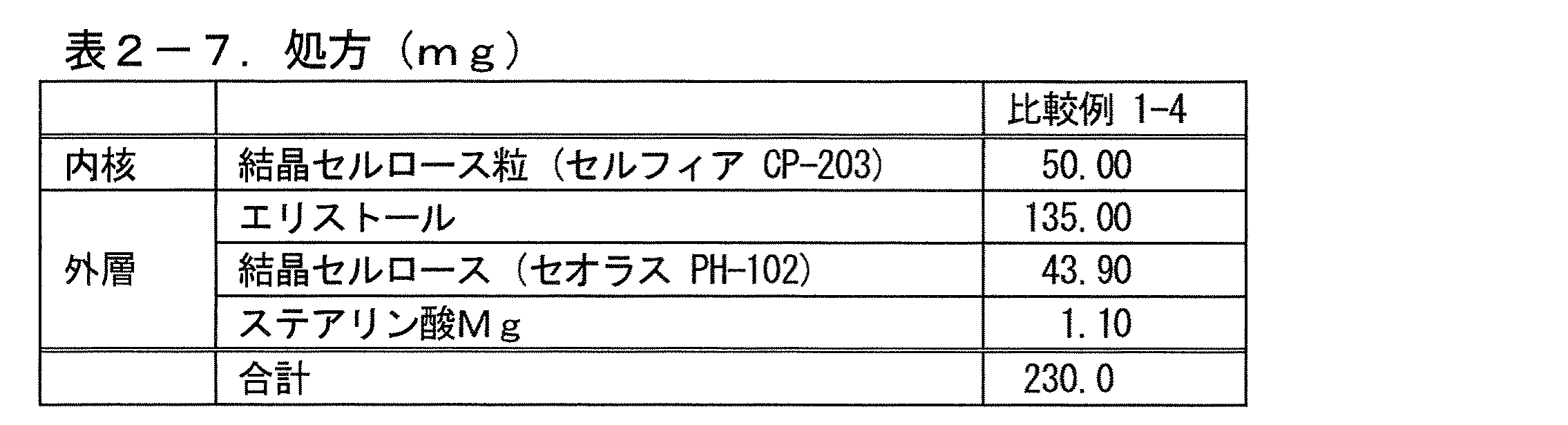
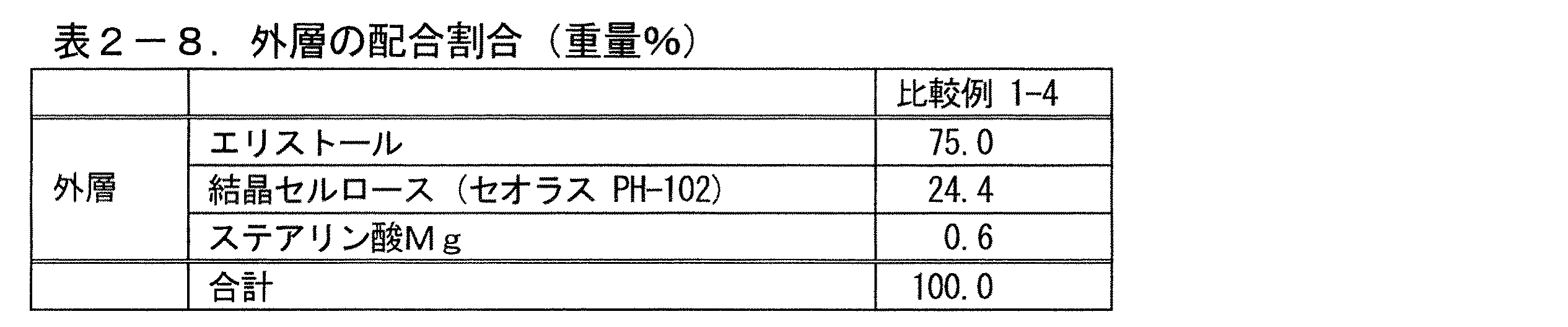
- the outer layer formulation was set to the same blending ratio as in Test Example 6 of Patent Document 1 (erythritol 60 mg, crystalline cellulose 19.5 mg, magnesium stearate 0.5 mg).
- the obtained tablets were measured for oral disintegration time, tablet hardness and thickness, and the absolute hardness and HDBI were calculated, and the tablet physical properties shown in Table 2-9 were obtained.
- the oral disintegration time was fast, but the absolute hardness was low, less than 1 N / mm 2 , and sufficient Hardness could not be obtained. That is, it was found that the outer layer component disclosed in Patent Document 1 cannot give sufficient hardness as a whole tablet when a dry-coated tablet having particles having no moldability as an inner core is produced.
- Examples 2-1 to 2-5 Examination of ratio of crystalline cellulose (1) Five types of preparations with different amounts of crystalline cellulose in the outer layer according to the formulation shown in Table 3-1 were produced in the same manner as in Example 1-1. The final molded product was tableted at 8 kN in Example 2-2, 15 kN in Example 2-4, and 10 kN in the others.
- Example 3-3 The tablet physical properties shown in Table 3-3 were obtained.
- the thickness ratio of the inner core was 38% in Example 2-1, 34% in Example 2-2, 44% in Example 2-4, and 39% in Example 2-5.
- the disintegration time in the oral cavity is within 30 seconds and the absolute hardness satisfies 1.5 N / mm 2 or more.
- HDBI which is an index of the balance between hardness and disintegration, was large.
- Example 2-6 Examination of the proportion of crystalline cellulose (2) A preparation having the amount of crystalline cellulose in the outer layer of 59.2% and the inorganic excipient of 30% according to the formulation shown in Table 3-4 was produced in the same manner as in Example 1-1. The final molded product was tableted at 10 kN.
- the obtained tablets were measured for oral disintegration time, tablet hardness and thickness, and the absolute hardness and HDBI were calculated, and the tablet physical properties shown in Table 3-6 were obtained.
- the ratio of the thickness of the inner core was 31%.
- the oral disintegration time was within 30 seconds, the absolute hardness satisfied 1.5 N / mm 2 or more, and HDBI, which is an index of the balance between hardness and disintegration, was large.
- Examples 3-1 to 3-3 Examination of the ratio of lubricants In the formulation shown in Table 4-1, preparations having different amounts of lubricant in the outer layer were produced in the same manner as in Example 1-1. . The final molded product was tableted at 15 kN in Example 3-1 and at 10 kN in the other cases.
- the oral disintegration time, tablet hardness and thickness were measured, and the absolute hardness and HDBI were calculated.
- the tablet physical properties shown in Table 4-3 were obtained.
- the disintegration time in the oral cavity was within 30 seconds, the absolute hardness satisfied 1.5 N / mm 2 or more, and HDBI, which is an index of the balance between hardness and disintegration, was large.
- Examples 4-1 to 4-4 Examination of ratio of specific component (corn starch) In the formulation shown in Table 5-1, preparations having different amounts of outer layer corn starch were produced in the same manner as in Example 1-1. . The final molded product was tableted at 10 kN.
- Example 4-1 the disintegration time in the oral cavity, tablet hardness and thickness were measured, and the absolute hardness and HDBI were calculated.
- the tablet physical properties shown in Table 5-3 were obtained.
- the thickness ratio of the inner core was 40% in Example 4-1, 39% in Example 4-3, and 38% in Example 4-4.
- Comparative Example 1-1 when the outer layer did not contain any corn starch, it did not disintegrate in the oral cavity within 30 seconds, whereas the outer layer did not disintegrate as in Examples 4-1 to 4-4.
- Examples 5-1 to 5-4 Examination of ratio of specific component (crospovidone) In the formulation shown in Table 6-1, preparations having different amounts of crospovidone in the outer layer were prepared in the same manner as in Example 1-1. Manufactured. The final molded product was tableted at 10 kN.
- Example 5-4 For each of the obtained tablets, the disintegration time in the oral cavity, tablet hardness and thickness were measured, and the absolute hardness and HDBI were calculated.
- the tablet physical properties shown in Table 6-3 were obtained.
- the thickness ratio of the inner core was 44% in Example 5-1, 38% in Example 5-2, 38% in Example 5-3, and 34% in Example 5-4.
- Examples 6-1 to 6-3 Examination of the ratio of the thickness of the inner core (1) Preparations with different ratios of the thickness of the inner core were manufactured according to the formulations shown in Table 7-1. First, the outer layer components were mixed. Take the powder mixture of the outer layer components shown in Table 7-1 (upper) weight, put it in a mortar with the diameter of the inner core shown in Table 7-1, and gently shake the powder surface. A predetermined amount of (Selfia CP-203) was added, and temporary compression was performed at a low pressure of 3 kN using a hand press machine (manufactured by Riken, hydraulic press machine).
- This temporary compression product is placed concentrically with a diameter of 8 mm so that the outer layer faces downward, and a mortar with a diameter of 8 mm is placed over the temporary compression product to the weight of the outer layer (side surface + upper) in Table 7-1.
- the outer layer component shown was put into a final mold to produce a nucleated orally disintegrating tablet.
- the final molded product was tableted at 15 kN.
- the disintegration time in the oral cavity, tablet hardness and thickness were measured, and the absolute hardness and HDBI were calculated.
- the tablet physical properties shown in Table 7-3 were obtained.
- the ratio of the thickness of the inner core is 32 to 76%
- the oral disintegration time is within 30 seconds
- the absolute hardness satisfies 1.5 N / mm 2 or more
- HDBI which is an index of the balance between hardness and disintegration
- Examples 6-4 to 6-5 Examination of the ratio of the thickness of the inner core (2) Preparations with different ratios of the thickness of the inner core were manufactured according to the formulations shown in Table 7-4. First, the outer layer components were mixed. Take the powder mixture of the outer layer components shown in Table 7-4, and put it in a mortar with a diameter of 8 mm to gently shake the powder surface. On top of this, crystalline cellulose particles (Selfia CP-203) was added in a predetermined amount and temporarily compressed at a low pressure using a hand press (Riken, hydraulic press).
- This compressed product is arranged concentrically with a diameter of 10 mm so that the outer layer faces downward, and is covered with a mortar with a diameter of 10 mm, and the weight of the outer layer (side surface + upper) in Table 7-4 is shown on the temporary compressed product.
- the outer layer component was added and finally molded to produce a nucleated orally disintegrating tablet.
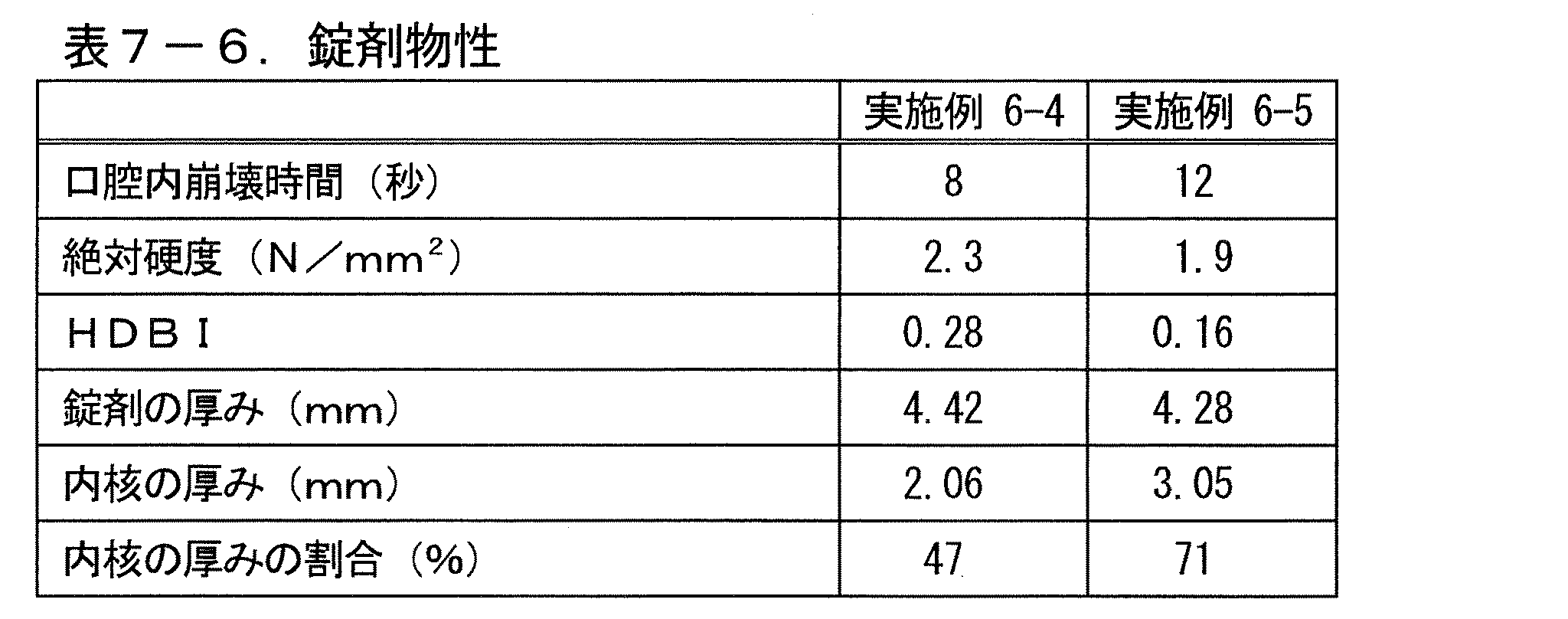
- the final molded product was tableted at 8 kN in Example 6-4 and 15 kN in Example 6-5.
- the disintegration time in the oral cavity, tablet hardness and thickness were measured, and the absolute hardness and HDBI were calculated.
- the tablet physical properties shown in Table 7-6 were obtained.
- the thickness ratio of the inner core is 32 to 76%
- the oral disintegration time is within 30 seconds
- the absolute hardness satisfies 1.5 N / mm 2 or more
- HDBI which is an index of the balance between hardness and disintegration
- Comparative Example 2 Comparison of physical properties of tablets with normal tablets Normal tablets in which particles having no moldability were uniformly distributed in the tablets were prepared. First, the raw materials were uniformly mixed so that the blending ratios shown in Table 7-7 were obtained. Using this mixed powder, tableting was performed with a diameter of 10 mm and a tableting pressure of 8 kN to obtain ordinary tablets. This ordinary tablet is different from the dry-coated tablet obtained in Example 6-4 except that the distribution of non-formable particles is different, and the content of each ingredient, tablet weight, tablet diameter, and tableting pressure are the same. It was made under the same conditions.
- Oral disintegration time, tablet hardness and thickness were measured, and absolute hardness and HDBI were calculated. As shown in Table 7-9, the ordinary tablets had lower absolute hardness and slower oral disintegration time than the dry-coated tablets. As described above, in the orally disintegrating tablet containing a large number of non-moldable particles, the tableted tablet containing the particles inside can obtain more preferable tablet physical properties than the ordinary tablet in which the particles are uniformly distributed. all right.
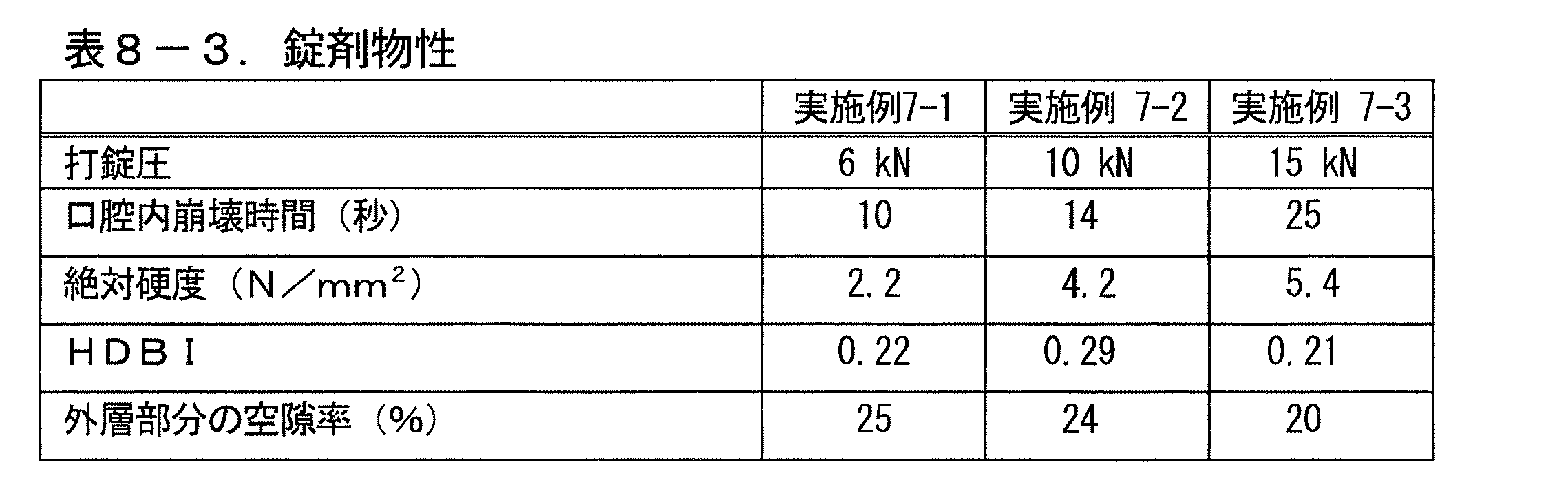
- Examples 7-1 to 7-3 Examination of porosity of outer layer Preparations having different porosity of the outer layer with the formulation shown in Table 8-1 were produced in the same manner as in Example 1-1. The final molded product was tableted at 6 kN, 10 kN and 15 kN.
- the obtained tablets were measured for oral disintegration time, tablet hardness and thickness, and calculated for absolute hardness, HDBI and porosity, and found to have the tablet physical properties shown in Table 8-3.
- the oral disintegration time was within 30 seconds, the absolute hardness satisfied 1.5 N / mm 2 or more, and HDBI, which is an index of the balance between hardness and disintegration, was large.
- the tableting pressure was in the range of 6 kN to 15 kN, it had appropriate hardness and disintegration, and the allowable range of tableting pressure was wide.
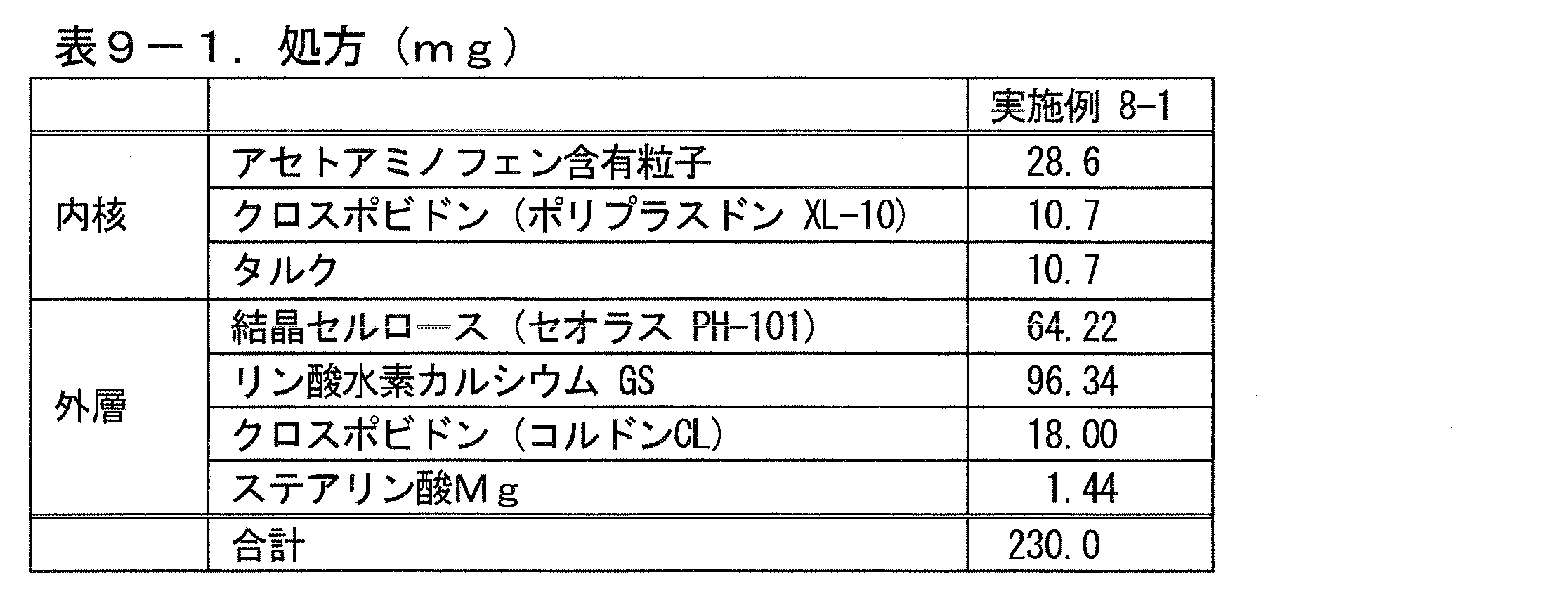
- Example 8 Nucleated orally disintegrating tablet containing active ingredient (8-1) Nucleated tablets containing acetaminophen-containing particles 1) Production of acetaminophen-containing particles (Asahi Kasei Chemicals) Acetaminophen was coated so that the coating amount was 10% to obtain acetaminophen-containing particles.
- the coating component used was Aquacoat (manufactured by Asahi Kasei Chemicals), triacetin and mannitol 100: 25: 50% by weight.
- a solution obtained by dissolving 2.85 g of sodium hydroxide in 67.65 g of purified water was gradually added to 705 g of methacrylic acid copolymer LD (Polykid PA-30S: manufactured by Sanyo Chemical Industries, Ltd.) and stirred ( Second liquid).
- the second liquid was added to the first liquid, suspended, and sieved through a mesh screen having an opening diameter of 177 ⁇ m to obtain a coating coating dispersion.
- famotidine and 3.5 g of light anhydrous silicic acid are sifted through a mesh screen with a 500 ⁇ m opening diameter and thoroughly mixed in a polyethylene bag to prepare a drug-containing composition Then, it was put into a Wurster type fluidized bed granulator with a forced circulation device (an improved Wurster type fluidized bed granulator, MP-01 SPC, manufactured by POWREC Co., Ltd.), and the above coating coating dispersion was sprayed.
- a forced circulation device an improved Wurster type fluidized bed granulator, MP-01 SPC, manufactured by POWREC Co., Ltd.
- the supply air temperature is maintained at 80 to 90 ° C.
- the exhaust temperature is maintained at 26 to 30 ° C.
- the spray liquid flow rate is 10 to 12 g / min
- the spray air flow rate is 80 L / min
- the spray air pressure is 0.2 to 0.
- the production was carried out at 3 MPa, a side air pressure of 0.2 to 0.25 MPa, and an air supply amount of about 0.30 to 0.55 m 3 / min.
- the spray amount of the coating coating dispersion was about 1306 g
- the coating was completed and the coating was dried until the exhaust temperature reached 42 ° C.
- the obtained particles were sieved with a sieve of 32 mesh (aperture 500 ⁇ m) to obtain famotidine-containing particles having an average particle diameter of about 165 ⁇ m.
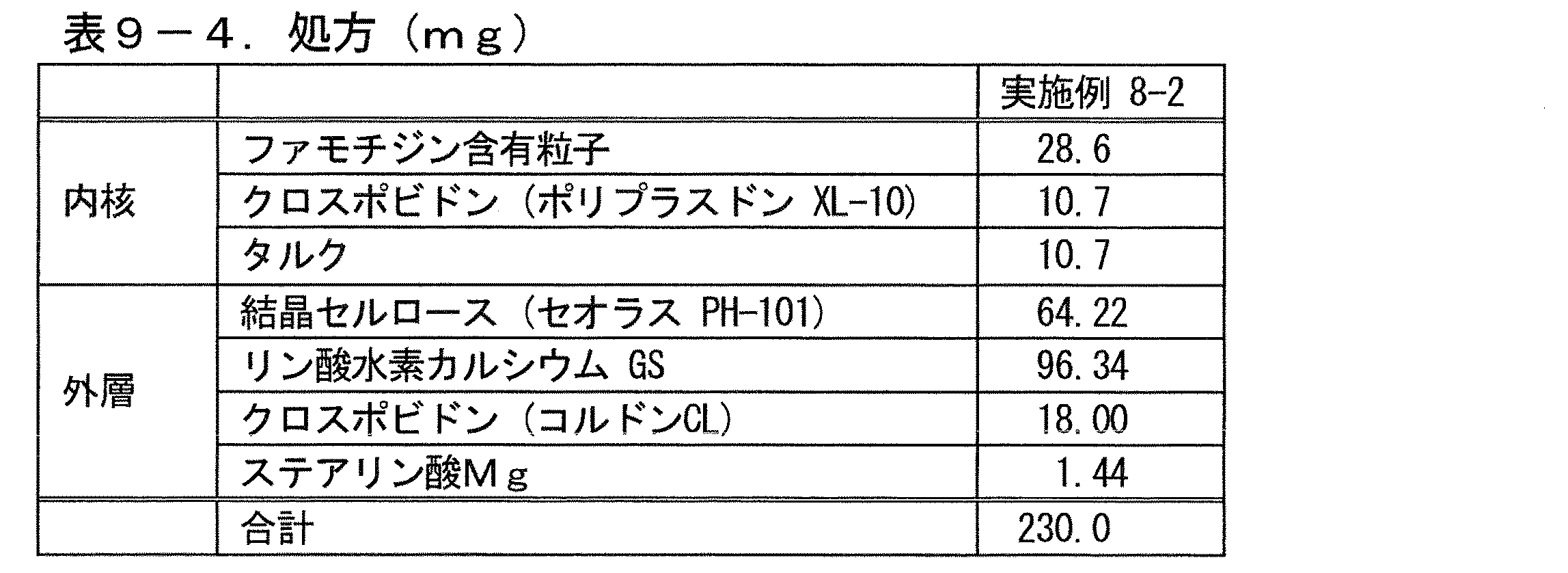
- a preparation containing active ingredient-containing particles in the inner core was prepared according to the formulation shown in Table 9-4.
- As the inner core a mixture of famotidine-containing particles and crospovidone and talc was used.
- the outer layer components were mixed. 40 mg of this was put into a 6 mm diameter mortar and lightly vibrated to smooth the surface of the powder (outer layer (lower)).
- 50 mg of mixed particles of the inner core were added and temporarily compressed at a low pressure of 3 kN using a hand press machine (manufactured by Riken, hydraulic press machine).
- This compressed product is placed concentrically with a diameter of 8 mm so that the outer layer (lower) faces down, and is covered with a mortar with a diameter of 8 mm, and 140 mg of outer layer component (outer layer (side surface + upper)) is placed on the temporary compressed material. It was put into a final mold and a nucleated type orally disintegrating tablet was produced. The final molded product was tableted at 8 kN.
- a preparation containing mosapride-containing particles in the inner core was prepared according to the formulation shown in Table 9-6.
- the inner core mixed particles of mosapride-containing particles and crospovidone and talc were used.
- the outer layer components were mixed. 40 mg of this was put into a 6 mm diameter mortar and lightly vibrated to smooth the surface of the powder (outer layer (lower)).
- 50 mg of mixed particles of the inner core were added and temporarily compressed at a low pressure of 3 kN using a hand press machine (manufactured by Riken, hydraulic press machine).
- This compressed product is placed concentrically with a diameter of 8 mm so that the outer layer (lower) faces down, and is covered with a mortar with a diameter of 8 mm, and 140 mg of outer layer component (outer layer (side surface + upper)) is placed on the temporary compressed material. It was put into a final mold and a nucleated type orally disintegrating tablet was produced. The final molded product was tableted at 8 kN.
- This compressed product is placed concentrically with a diameter of 8 mm so that the outer layer (bottom) faces down, and is covered with a mortar with a diameter of 8 mm, and 120 mg of the outer layer component (outer layer (side surface + upper)) is placed on the temporary compressed product. It was put into a final mold and a nucleated type orally disintegrating tablet was produced. The final molded product was tableted at 6 kN.
- Famotidine microcapsules were agar beads containing 70% famotidine, and those provided by Riken Vitamin Co., Ltd. were used.
- a preparation containing microcapsules in the inner core was prepared according to the formulation shown in Table 9-12.
- the inner core mixed particles of famotidine microcapsule and erythritol (fine powder: manufactured by Nikken Chemical Co., Ltd.) were used.
- the outer layer components were mixed. 40 mg of this was put into a 6 mm diameter mortar and lightly vibrated to smooth the surface of the powder (outer layer (lower)).
- 57.2 mg of mixed particles of the inner core was added and temporarily compressed using a hand press machine (manufactured by Riken, hydraulic press machine) at a low pressure of 3 kN.
- This compressed product is placed concentrically with a diameter of 8 mm so that the outer layer (lower) faces down, and is covered with a mortar with a diameter of 8 mm, and 140 mg of outer layer component (outer layer (side surface + upper)) is placed on the temporary compressed material. It was put into a final mold and a nucleated type orally disintegrating tablet was produced. The final molded product was tableted at 6 kN.
- nucleated type orally disintegrating tablet having an inner core with low moldability, and having a good balance between hardness and disintegration.
Landscapes
- Health & Medical Sciences (AREA)
- Chemical & Material Sciences (AREA)
- Veterinary Medicine (AREA)
- Life Sciences & Earth Sciences (AREA)
- General Health & Medical Sciences (AREA)
- Public Health (AREA)
- Pharmacology & Pharmacy (AREA)
- Epidemiology (AREA)
- Medicinal Chemistry (AREA)
- Animal Behavior & Ethology (AREA)
- Bioinformatics & Cheminformatics (AREA)
- Engineering & Computer Science (AREA)
- Inorganic Chemistry (AREA)
- Zoology (AREA)
- Nutrition Science (AREA)
- Physiology (AREA)
- Pain & Pain Management (AREA)
- Medicinal Preparation (AREA)
- Pharmaceuticals Containing Other Organic And Inorganic Compounds (AREA)
- Acyclic And Carbocyclic Compounds In Medicinal Compositions (AREA)
Abstract
Description
一方、特許文献1や特許文献2に開示される有核型錠剤においては、新たな錠剤の技術として興味深いところであり、特に特許文献2においてはマイクロカプセル様顆粒を内核に適用した製造例が開示されており、口腔内崩壊錠等の更なる機能性製剤への応用が期待されていた。しかしながら、実際特許文献2で開示された製剤と同様の外層を有した有核型錠剤を作製したところ、口腔内での崩壊性が著しく悪く(本発明の比較例1-3参照)、また、有核型速崩壊錠とされている特許文献1に開示されている外層を用い、成形性のない粒子を含む有核錠を作製したところ、十分な硬度が得られないことがわかった(本発明の比較例1-4参照)。
このように、内核と外層の二重構造を有する有核型錠剤、特に内核に成形性のない粒子を用いる場合は、実質的にその外層のみで錠剤の硬度を維持する必要があり、通常の錠剤よりも強固な硬度への工夫が要求される一方、口腔内崩壊錠に適用させる場合には、満足な速崩壊性を得るためにその硬度の低下は避けられず、有核型錠剤として要求される強固な硬度を維持することは難しい状況にあった。
本発明の目的は、内核が成形性の低い粉粒体であることを特徴とする有核成型品を新たに開発することであり、錠剤全体として優れた崩壊性及び適切な硬度を有する有核型の口腔内崩壊錠を提供することにある。
[項2]内核が、成形性の低い粉粒体である項1に記載の有核型の口腔内崩壊錠。
[項3]外層部分100重量%における結晶セルロース(a)の配合割合が、5~80重量%である項1又は2に記載の有核型の口腔内崩壊錠。
[項4]外層部分100重量%における無機賦形剤(b)の配合割合が、10~80重量%である項1~3のいずれか一項に記載の有核型の口腔内崩壊錠。
[項5]外層部分100重量%における配合する特定成分(c)の合計の配合割合が、1~40重量%である項1~4のいずれか一項に記載の有核型の口腔内崩壊錠。
[項6]特定成分(c)が、クロスポビドン、デンプン類及び低置換度ヒドロキシプロピルセルロースからなる群から選択される1種又は2種以上である項1~5のいずれか一項に記載の有核型の口腔内崩壊錠。
[項7]デンプン類が、トウモロコシデンプンである項1~6のいずれか一項に記載の有核型の口腔内崩壊錠。
[項8]錠剤全体の厚みに対する内核の厚みの割合が20~80%である項1~7のいずれか一項に記載の有核型の口腔内崩壊錠。
[項9]外層部分の空隙率が1~40%である項1~8のいずれか一項に記載の有核型の口腔内崩壊錠。
[項10]内核に活性成分が含まれる項1~9のいずれか一項に記載の有核型の口腔内崩壊錠。
[項11]外層部分100重量%における結晶セルロース(a)の配合割合が、10~70重量%である項1~10のいずれか一項に記載の有核型の口腔内崩壊錠。
[項12]内核が、マイクロカプセル様の機能性粒子以外の、成形性の低い粉末、造粒物、または粉粒体である項1~11のいずれか一項に記載の有核型の口腔内崩壊錠。
また本発明においては、内核成分として、マイクロカプセル様の機能性粒子以外の、成形性の低い粉末、造粒物、粉粒体等についても実施可能であり、十分な硬度と崩壊性を有する有核型の口腔内崩壊錠が提供される。
絶対硬度(N/mm2)=硬度(N)/断面積(mm2)
HDBI(N/mm2・秒)=絶対硬度(N/mm2)÷口腔内崩壊時間(秒)
成形性がない内核を有する有核型の口腔内崩壊錠においては、硬度及び崩壊性は外層処方にのみ依存し、単層の口腔内崩壊錠(普通錠の口腔内崩壊錠)及び成形性のある内核を有する有核型の口腔内崩壊錠に比べて、硬度と崩壊性のバランスを両立させることは困難である。たとえ、硬度と崩壊性のバランスを両立させたとしても、打錠圧の許容幅を広く確保することは極めて困難であった。
錠剤の空隙率(%)=(1-Wt/(ρ×V))×100
ρ:錠剤の真密度(mg/mm3)、V:錠剤の体積(mm3)、Wt:錠剤重量(mg)
本発明において、外層部分の空隙率は、以下の式により求められる。
外層部分の空隙率(%)=(1-Wt/(ρ×3.14×D2×T))×100
ρ:外層の真密度(mg/mm3)、D:外層(下)の半径(mm)、T:外層(下)の厚み(mm)、Wt:外層(下)の重量(mg)
内核の厚み(mm)=錠剤全体の厚み(mm)-上下の外層の厚みの合計(mm)
本発明において「内核の厚みの割合」とは、錠剤全体の厚みに対する内核が占める厚みの割合を意味する。つまり、錠剤の側面に対して平行な断面において、内核が占める厚みの割合を意味する。切断部位によって内核が占める厚みの割合が異なる場合は、全ての断面において最も割合が大きい値を「内核の厚みの割合」と定義する。
内核の厚みの割合(%)=内核の厚み(mm)÷錠剤全体の厚み(mm)×100
(a)結晶セルロース
本発明の外層の必須成分として用いられる結晶セルロースは、経口投与が可能なものであれば特に限定されない。結晶セルロースの平均粒子径が大きいと口腔内で崩壊した後に、ザラツキを感じるため、服用感の観点において原料とする結晶セルロースの平均粒子径は150μm以下が好ましく、より好ましくは130μm以下であり、さらに好ましくは120μm以下である。本発明に使用される結晶セルロースの配合割合は、硬度、崩壊時間及び打錠圧の許容幅の観点から、外層部分の全重量を100重量%とした場合、通常5~80重量%であり、好ましくは9~70重量%であり、より好ましくは20~50重量%である。本発明で用いられる結晶セルロースとしては、例えば、セオラス(CEOLUS、登録商標、PH-101、PH-102、PH-301、PH-302、PH-F20J、KG-800、KG-1000、ST-02:旭化成ケミカルズ社製)、アビセル(AVICEL、登録商標、PH-101、PH-102、PH-301、PH-302、FD-101、FD-301、FD-F20:FMC BioPolymer社製)等が挙げられる。これらの結晶セルロースは単独で用いてもよく、2種以上を併用することもできる。
本発明の外層の必須成分として用いられる無機賦形剤は、リン酸水素カルシウム類、炭酸マグネシウム、ケイ酸マグネシウム、水酸化マグネシウム、乾燥水酸化アルミニウムゲル、酸化マグネシウム、合成ケイ酸アルミニウム、合成ヒドロタルサイト、炭酸水素ナトリウム、メタケイ酸アルミン酸マグネシウム、ケイ酸アルミン酸マグネシウム、炭酸カルシウム、沈降炭酸カルシウム、タルク、水酸化アルミナマグネシウム、ケイ酸カルシウム、水酸化アルミニウム・炭酸マグネシウム混合乾燥ゲル、水酸化アルミニウム・炭酸水素ナトリウムの共沈生成物、水酸化アルミニウム・炭酸カルシウム・炭酸マグネシウムの共沈生成物、水酸化アルミニウム・硫酸アルミニウムカリウムの共沈生成物等が挙げられる。好ましくはリン酸水素カルシウム類、炭酸マグネシウム、ケイ酸マグネシウム、水酸化マグネシウム、乾燥水酸化アルミニウムゲル、酸化マグネシウム、合成ケイ酸アルミニウム、合成ヒドロタルサイト、炭酸水素ナトリウムが挙げられる。さらに好ましくはリン酸水素カルシウム類、炭酸マグネシウム、ケイ酸マグネシウム、水酸化マグネシウム、乾燥水酸化アルミニウムゲル、酸化マグネシウム、合成ケイ酸アルミニウムが挙げられ、特に好ましくはリン酸水素カルシウム類、ケイ酸マグネシウム、乾燥水酸化アルミニウムゲル、酸化マグネシウム、合成ケイ酸アルミニウムが挙げられる。上述の無機賦形剤の中で最も好ましいものは、リン酸水素カルシウム類であり、具体的にはリン酸水素カルシウム(第二リン酸カルシウム)、無水リン酸水素カルシウム(無水第二リン酸カルシウム)及びリン酸二水素カルシウム(第一リン酸カルシウム)が挙げられる。これら無機賦形剤は、単独で使用しても良いし、2種類以上を併用しても良い。無機賦形剤の配合割合は、硬度、崩壊時間及び打錠圧の許容幅の観点から、外層部分の全重量を100重量%とした場合、10~80重量%であり、好ましくは20~80重量%であり、より好ましくは30~60重量%である。
本発明の外層の必須成分である特定成分は、クロスポビドン、デンプン類、低置換度ヒドロキシプロピルセルロース及びカルメロースからなる群から選択される少なくとも1種であることを特徴とする。有核型の口腔内崩壊錠の場合、内核を含有しない通常の錠剤と比較して、外層部分の空隙率を小さくして硬度を高める必要があるため、後述の特定成分を含まない場合や特定成分以外の崩壊性を高める成分を含有する場合には、所望の効果が得られない。それに対して、これら特定成分を結晶セルロース及び無機賦形剤とともに含有する場合に、所望の効果が得られることを見出したものである。
本発明に用いることができるクロスポビドンは、特に限定されないが、通常、日本薬局方に適合しているものが用いられる。その平均粒子径としては特に限定されないが、用いるクロスポビドンの平均粒子径が大きいと口腔内で崩壊した後に、ザラツキを感じるため、服用感の観点において原料とするクロスポビドンの平均粒子径は好ましくは10~200μm、より好ましくは10~150μm、さらに好ましくは10~100μmである。所望の粒子径とするため、必要に応じて適宜粉砕してもよい。粉砕方法としては例えば気流粉砕機やハンマー式粉砕機による方法が挙げられる。クロスポビドンの外層中の配合量は、硬度、崩壊時間及び打錠圧の許容幅の観点から、外層部分100重量%あたり、通常1~40重量%、好ましくは1~30重量%であるが、より好ましくは1~20重量%、さらに好ましくは1~10重量%、最も好ましくは1~5重量%である。
本発明に用いることができるデンプン類は、トウモロコシデンプン(コーンスターチ)、バレイショデンプン、コメデンプン、コムギデンプン、甘藷デンプン、緑豆デンプン、タピオカデンプン、部分α化デンプンなどのデンプン類が挙げられるが、中でもトウモロコシデンプンが好ましい。なお、本発明においては、完全α化デンプンは崩壊性が悪いため適用できない。これらのデンプン類は単独で用いてもよく、2種以上併用することもできる。その平均粒子径としては特に限定されないが、平均粒子径が大きいと口腔内で崩壊した後に、ザラツキを感じるため、服用感の観点において原料とする平均粒子径は好ましくは10~200μm、より好ましくは10~100μm、さらに好ましくは10~50μmである。所望の粒子径とするため、必要に応じて適宜粉砕してもよい。粉砕方法としては例えば気流粉砕機やハンマー式粉砕機による方法が挙げられる。硬度、崩壊時間及び打錠圧の許容幅の観点から、配合するデンプン類の合計の配合割合は、外層部分100重量%あたり1~40重量%である。デンプン類の配合割合が多すぎると流動性が低下し、打錠時の製造性が悪くなる。そのため、デンプン類の配合割合は、外層部分100重量%あたり通常1~40重量%であり、好ましくは1~30重量%であり、より好ましくは1~20重量%であり、さらに好ましくは1~10重量%であり、最も好ましくは1~5重量%である。
本発明に用いることができる低置換度ヒドロキシプロピルセルロースは、ヒドロキシプロポキシ基の置換割合に特に限定されることはなく、日本薬局方に適合するものであれば用いることができ、通常は7.0~12.9%である。その平均粒子径としては特に限定されないが、用いる低置換度ヒドロキシプロピルセルロースの平均粒子径が大きいと口腔内で崩壊した後に、ザラツキを感じるため、服用感の観点において原料とする低置換度ヒドロキシプロピルセルロースの平均粒子径は好ましくは10~200μm、より好ましくは10~150μm、さらに好ましくは10~100μmである。所望の粒子径とするため、必要に応じて適宜粉砕してもよい。粉砕方法としては例えば気流粉砕機やハンマー式粉砕機によるものが挙げられる。低置換度ヒドロキシプロピルセルロースの配合量は、硬度、崩壊時間及び打錠圧の許容幅の観点から、外層部分100重量%あたり1~40重量%、好ましくは1~30重量%、より好ましくは1~20重量%であるが、さらに好ましくは1~10重量%、最も好ましくは1~5重量%である。
本発明に用いることができるカルメロースは、特に限定されないが、日本薬局方に適合しているものが用いられる。その平均粒子径としては特に限定されないが、用いるカルメロースの平均粒子径が大きいと口腔内で崩壊した後に、ザラツキを感じるため、服用感の観点において原料とするカルメロースの平均粒子径は好ましくは10~200μm、より好ましくは10~150μm、さらに好ましくは10~100μmである。所望の粒子径とするため、必要に応じて適宜粉砕してもよい。粉砕方法としては例えば気流粉砕機やハンマー式粉砕機によるものが挙げられる。カルメロースの配合量は、硬度、崩壊時間及び打錠圧の許容幅の観点から、外層部分100重量%あたり1~40重量%、好ましくは1~30重量%、より好ましくは1~20重量%であるが、さらに好ましくは1~10重量%、最も好ましくは1~5重量%である。
本発明の口腔内崩壊錠の外層には、上記の成分以外にもその他の製剤化成分を加えて製剤化することができる。本発明で用いられる「その他の製剤化成分」としては、配合しても薬剤の硬度及び崩壊時間に影響が無いか極めて少なく、製剤化するのに支障の無い成分であればいずれでもよい。例えば、他の賦形剤、崩壊剤、結合剤、甘味剤、矯味剤・矯臭剤、安定化剤、界面活性剤、流動化剤、帯電防止剤、コーティング剤、滑沢剤、着色剤、香料等がその例として挙げられる。「その他の製剤化成分」の配合量は、外層部分100重量%あたり0.01~25重量%であり、錠剤中にこれら製剤化成分を含むときは配合量に応じて上記の成分の量が減じられる配合割合でもって構成される。
本発明において、上記のその他の製剤化成分の中でも外層に滑沢剤を添加することが好ましい。滑沢剤としては、例えば、ステアリン酸、ステアリン酸金属塩、フマル酸ステアリルナトリウム、ショ糖脂肪酸エステル、タルク、硬化油、マクロゴール等が挙げられる。ステアリン酸金属塩としては、ステアリン酸マグネシウム、ステアリン酸カルシウム、ステアリン酸アルミニウム等が挙げられるが、滑沢剤の中でステアリン酸又はステアリン酸金属塩、特に、ステアリン酸マグネシウムが好ましい。滑沢剤を製剤化する前の平均粒子径は、0.5~50μmであり、好ましくは1~30μmである。滑沢剤の配合割合は、外層部分100重量%あたり通常0.01~2.5重量%であり、好ましくは0.01~2重量%である。さらに好ましくは0.01~1重量%である。本発明において該滑沢剤は、外部滑沢法及び内部滑沢法のいずれの方法を用いて配合してもよい。
本発明において、内核は口腔内崩壊性又は分散性が良好であれば特に限定されない。本発明の外層成分は、内核の成形性が低い場合にも、錠剤全体として十分な硬度を付与できることから、内核が「成形性の低い粉粒体」の場合、本発明の特徴を発揮できる。「成形性の低い粉粒体」とは、成形性の低い粉末、造粒物等を含む粉粒体を意味し、圧縮成形した際に成形物が得られないか、若しくは成形物が得られたとしても硬度が極めて低いことを意図する。具体的には、直径6mm、重量50mgを4kNで打錠した場合に、全く成形物が得られないか、若しくは成形物が得られたとしても極めて脆弱であり、硬度が10N以下の場合をいう。本発明に用いられる「成形性の低い粉粒体」の大きさは特に限定されないが、平均粒子径は通常3mm以下、口腔内での服用性の観点から、好ましくは1mm以下、さらに好ましくは300μm以下、最も好ましくは150μm以下である。本発明において、内核に活性成分を含めることが好ましく、例えば活性成分を含む微小カプセル又は被覆顆粒の機能性粒子、活性成分粉末自身、或いは活性成分を含む微小カプセル、被覆顆粒の機能性粒子又は活性成分粉末に流動性・分散性・付着性を改善する添加剤を加えた混合末、造粒物が含まれる。
ここで造粒物は、流動層造粒法、押出し造粒法、乾式圧密造粒法、転動造粒法、転動流動層造粒法、高速攪拌造粒法、破砕造粒法などにより調製することができる。
本発明の口腔内崩壊錠において使用される活性成分としては、医薬活性成分として疾患の治療や予防に供され、経口投与可能なものであれば特に限定されない。例えば、滋養強壮保健薬;解熱鎮痛消炎薬;抗精神病薬;催眠鎮静薬;鎮痙薬;中枢神経作用薬;脳代謝改善薬;脳循環改善薬;抗てんかん薬;交感神経興奮剤;健胃消化剤;抗潰瘍剤;消化管運動機能改善剤;制酸剤;鎮咳去痰剤;腸運動抑制薬;鎮吐剤;呼吸促進剤;気管支拡張剤;抗アレルギー剤;強心剤;不整脈用剤;利尿剤;血管収縮剤;冠血管拡張剤;血管拡張薬;末梢血管拡張薬;高脂血症用剤;利胆剤;化学療法剤;糖尿病合併症治療薬;骨粗しょう症治療剤;抗リウマチ剤;骨格筋弛緩剤;痛風治療剤;血液凝固阻止剤;抗悪性腫瘍剤等が挙げられる。本発明における活性成分は、薬学上許容される限り、塩またはフリー体の形であってもよい。また、アルコール和物等の溶媒和物、または水和物等の形であってもよい。さらに、上記に挙げた活性成分は、単独で用いても、または2種以上を組み合わせて用いてもよい。
本発明に係る有核型の口腔内崩壊錠の製造は、有核成型品を製造できる打錠機を用いて行うことができる。多量のマイクロカプセル様の機能性粒子を内核に含有する有核型の口腔内崩壊錠は、WO2005/097041等で開示される有核成型品用打錠機、又は同様に成形性の低い内核を有する有核成型品を製造できる打錠機及び打錠方法を用いて製造することができる。
かくして得られる本発明の口腔内崩壊錠は、製剤を服用するために水を摂取することなく、口腔内で速やかな崩壊性を示すものを意味する。具体的には、本発明の口腔内崩壊錠は、口腔内で主として唾液により、約60秒以内に崩壊する製剤を意味し、通常45秒以内、好ましくは30秒以内で崩壊する。
無水リン酸水素カルシウム(GS:協和化学社製)、トウモロコシデンプン(コーンスターチ(XX16)W:日本食品化工社製)、ステアリン酸マグネシウム(軽質、植物性:太平化学産業社製)、カルメロース(NS-300:五徳薬品社製)、低置換度ヒドロキシプロピルセルロース(LH-21:信越化学工業社製)、結晶セルロース粒(セルフィア CP-203:旭化成ケミカルズ社製)、結晶セルロース(セオラスPH-101又はセオラスPH-301:いずれも旭化成ケミカルズ社製)、クロスポビドン(コリドンCL:BASFジャパン社製又はポリプラスドンXL-10:ISP Japan社製)、タルク(林化成社製)、エリスリトール(微粉:日研化学社製)
<有核型の口腔内崩壊錠の製造>
表1-1に示す処方にて、外層に異なる各特定成分を含む4種類の製剤を製造した。まず、外層の各成分を混合した。これを40mgとり、直径6mmの臼に入れ軽く振動させて粉末の表面を平滑化した(外層(下))。その上に、内核成分として結晶セルロース粒(セルフィアCP-203)を50mg加えて、ハンドプレス機(理研製、油圧式プレス機)を用いて、3kNの低い圧力で仮圧縮した。この仮圧縮物を外層(下)が下方になるように直径8mm杵に同心円状に配置し、直径8mmの臼を被せて、仮圧縮物の上から上記外層成分の混合物140mg(外層(側面+上))を入れて最終成形し、有核型の口腔内崩壊錠を製造した。最終成型物は10kNで打錠した。なお、本製剤に使用した結晶セルロース粒(セルフィアCP-203)50mgを、別途直径6mmの杵臼に入れて、打錠圧4kNで圧縮して得られた圧縮成形物の硬度は10N未満であった。

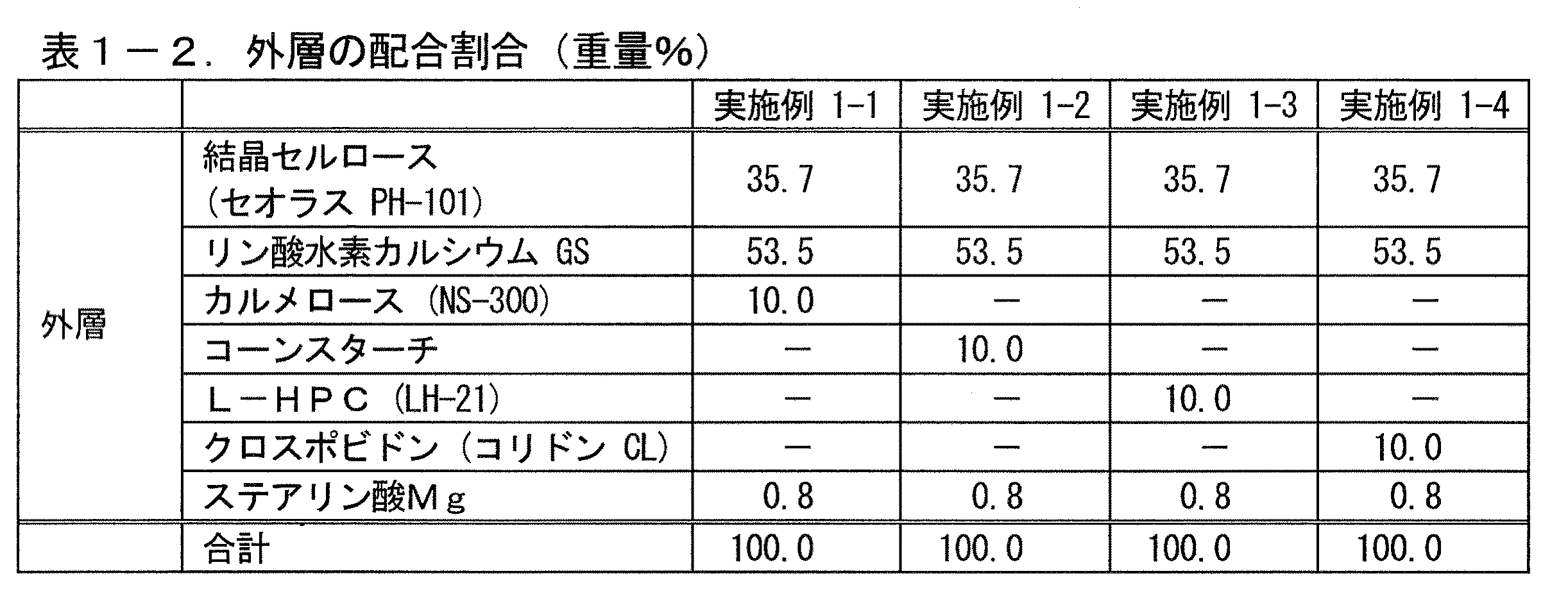
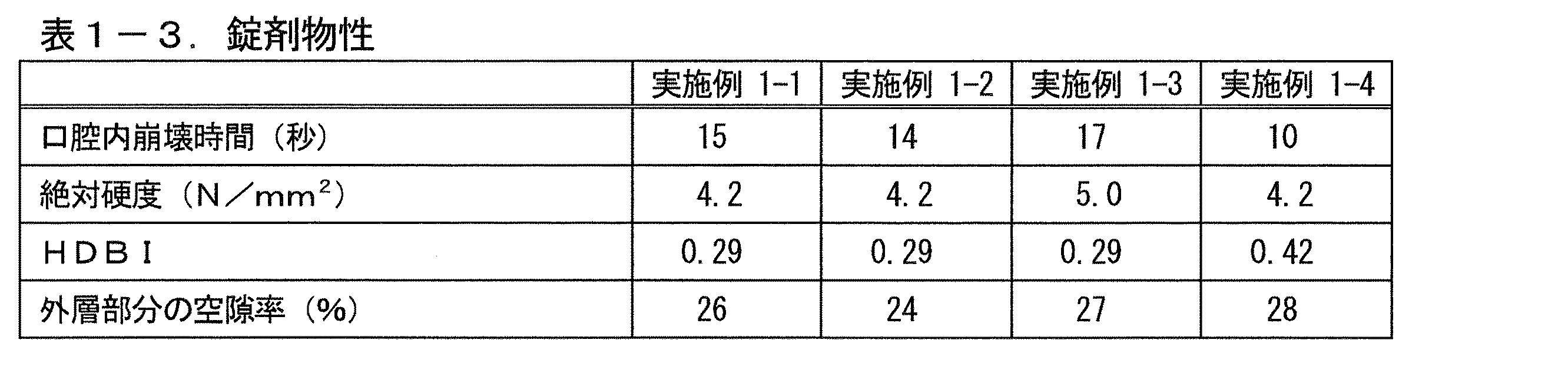
表2-1に示す処方にて、外層に特定成分を含まない製剤(比較例1-1)と特定成分の代わりに、クロスカルメロースNaを用いた製剤(比較例1-2)を、実施例1-1と同様の方法で製造した。なお、クロスカルメロースNaは、Ac-Di-Sol(五協産業社製)を用いた。

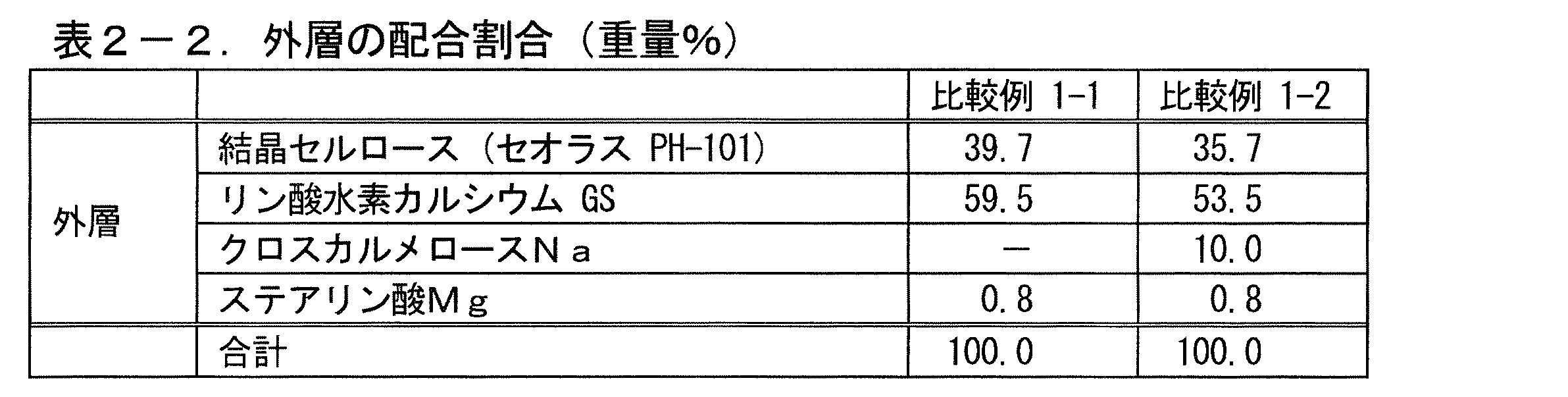
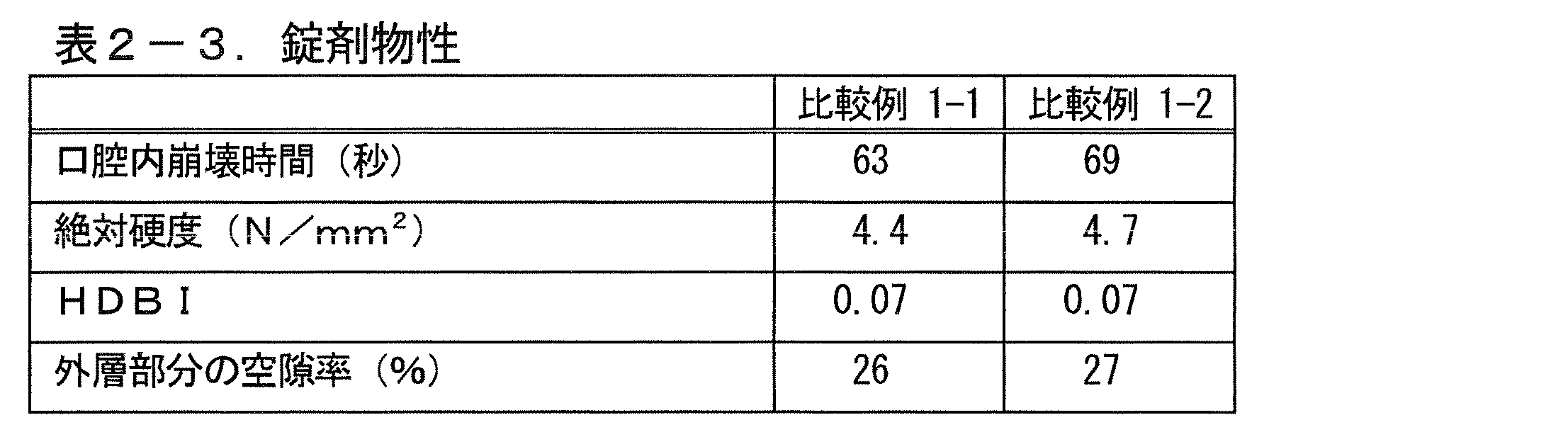
表2-4に示す特許文献2の製造例と類似する処方にて、外層に本発明の特定成分等を含まない製剤を実施例1-1と同様の方法で製造した。ただし、杵臼は少量のステアリン酸マグネシウムを塗布したものを使用した。Cellactose 80はMEGGLE社製を使用した。
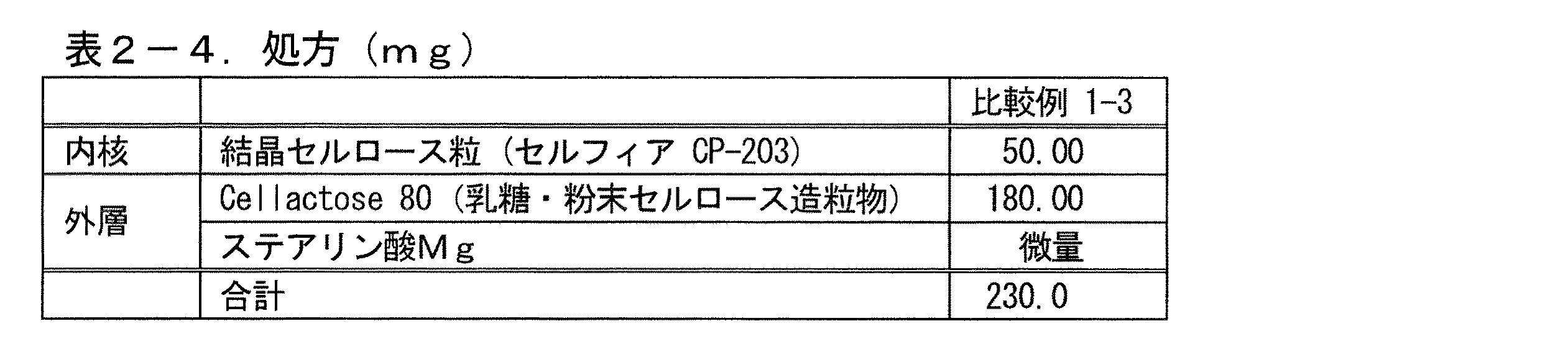


表2-7に示す処方にて、外層に特定成分を含まない製剤を実施例1-1と同様の方法で製造した。外層処方は、特許文献1の試験例6(エリスリトール60mg、結晶セルロース19.5mg、ステアリン酸マグネシウム0.5mg)と同一の配合割合とした。
つまり、特許文献1で開示される外層成分は、成形性のない粒子を内核とした有核錠を作製した場合に、錠剤全体として十分な硬度を付与することができないことがわかった。
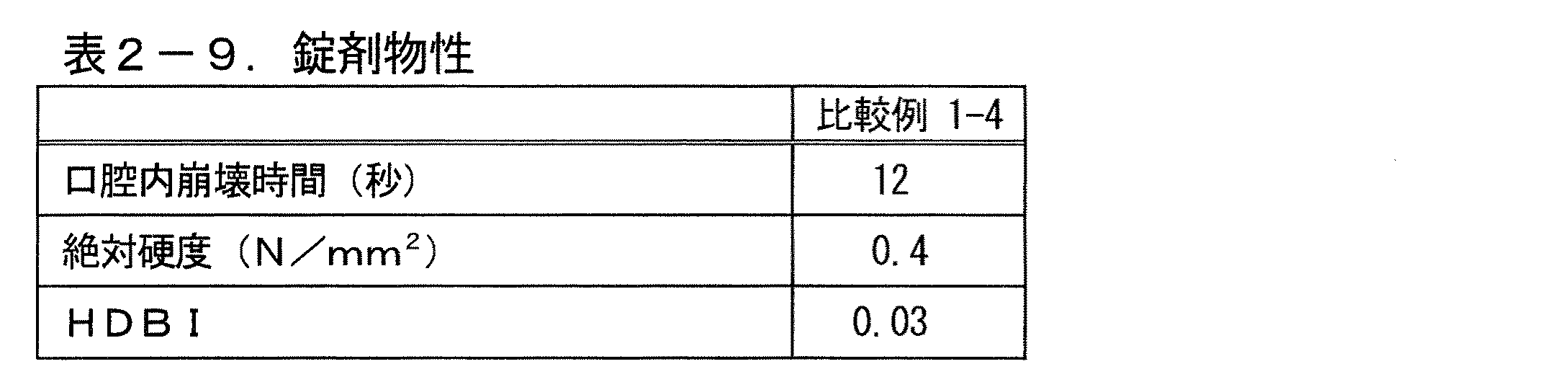
表3-1に示す処方にて、外層の結晶セルロース量が異なる5種類の製剤を実施例1-1と同様の方法で製造した。最終成型物は、実施例2-2は8kN、実施例2-4は15kN、その他は10kNで打錠した。

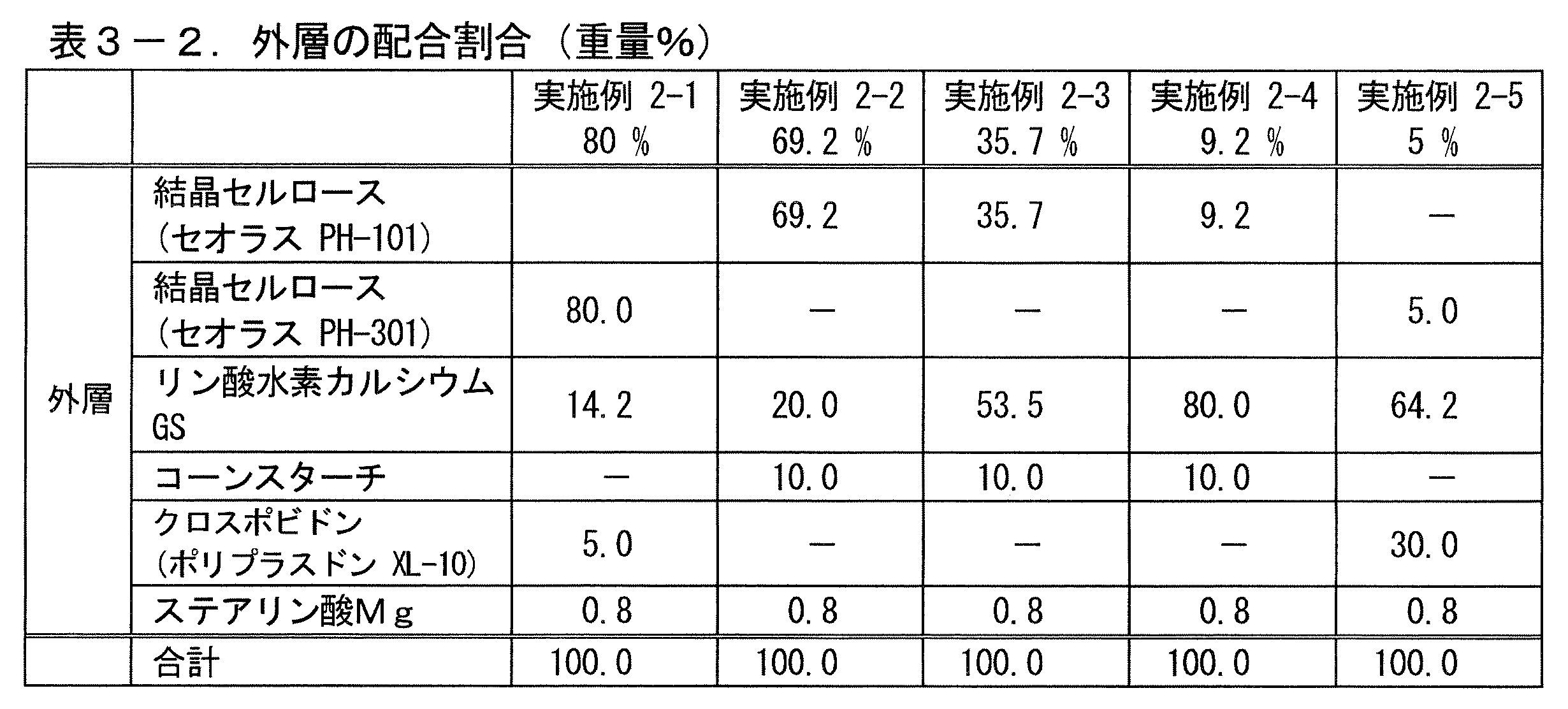
実施例2-1~2-5のように、外層の結晶セルロース量が5~80%の場合、口腔内崩壊時間は30秒以内、絶対硬度が1.5N/mm2以上を満たしており、硬度と崩壊性のバランスの指標であるHDBIが大きかった。

表3-4に示す処方にて、外層の結晶セルロース量が59.2%、無機賦形剤が30%の製剤を実施例1-1と同様の方法で製造した。最終成型物は10kNで打錠した。

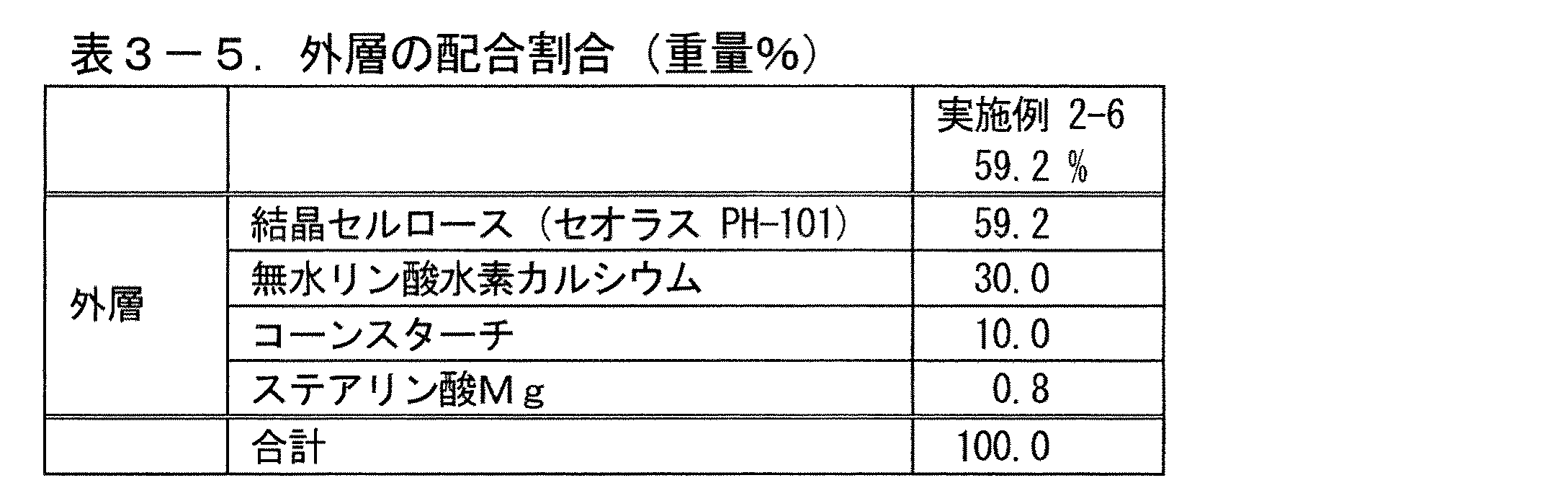
口腔内崩壊時間は30秒以内、絶対硬度が1.5N/mm2以上を満たしており、硬度と崩壊性のバランスの指標であるHDBIが大きかった。

表4-1に示す処方にて、外層の滑沢剤の量が異なる製剤を実施例1-1と同様の方法で製造した。最終成型物は、実施例3-1は15kN、その他は10kNで打錠した。
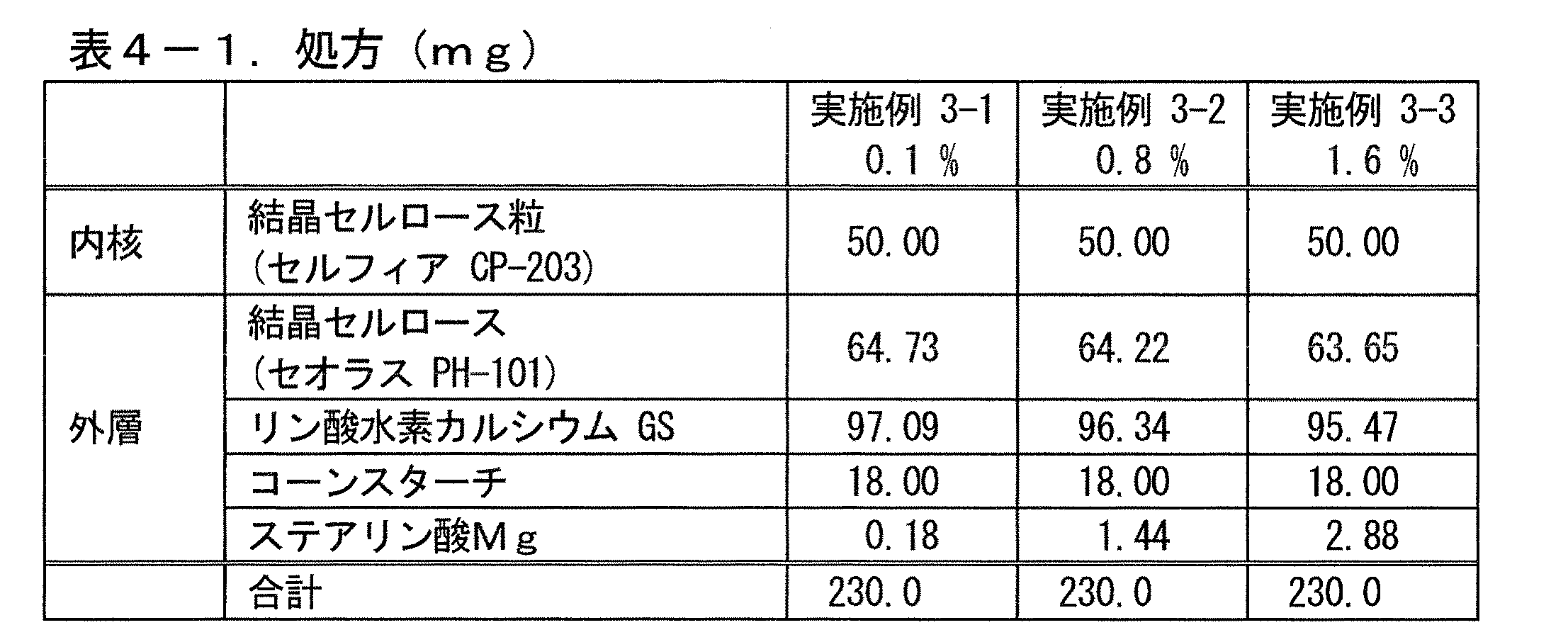
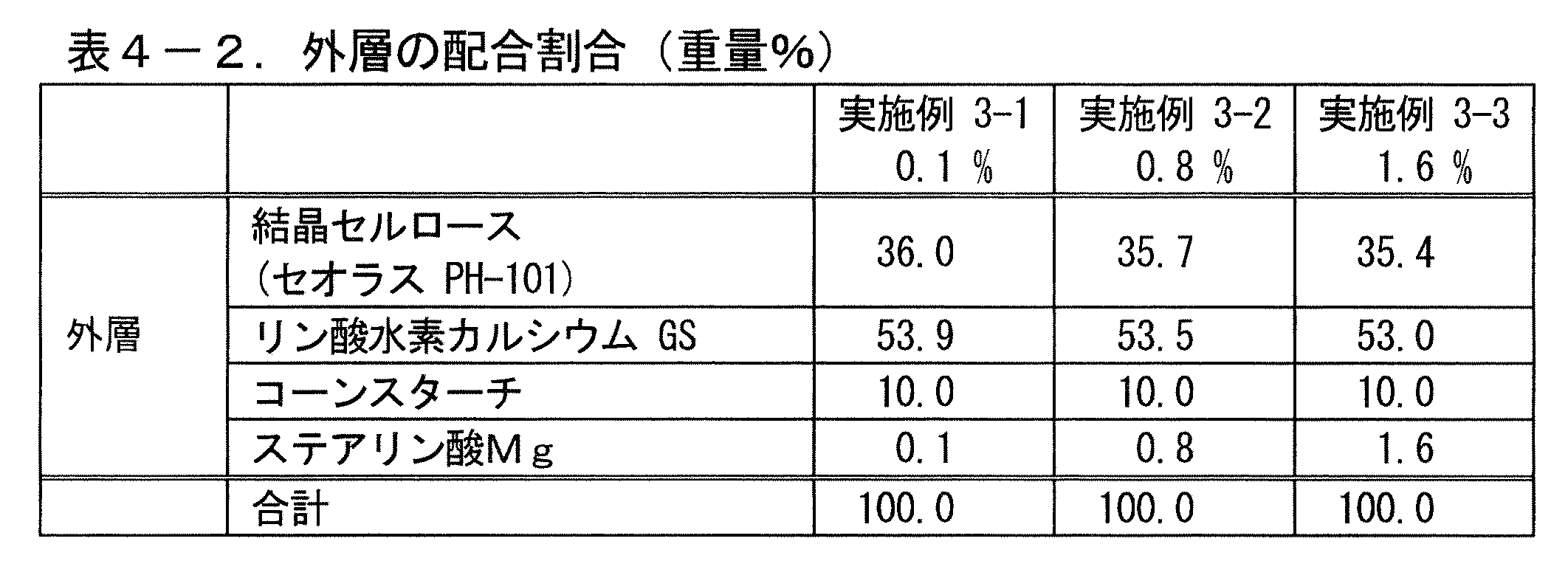
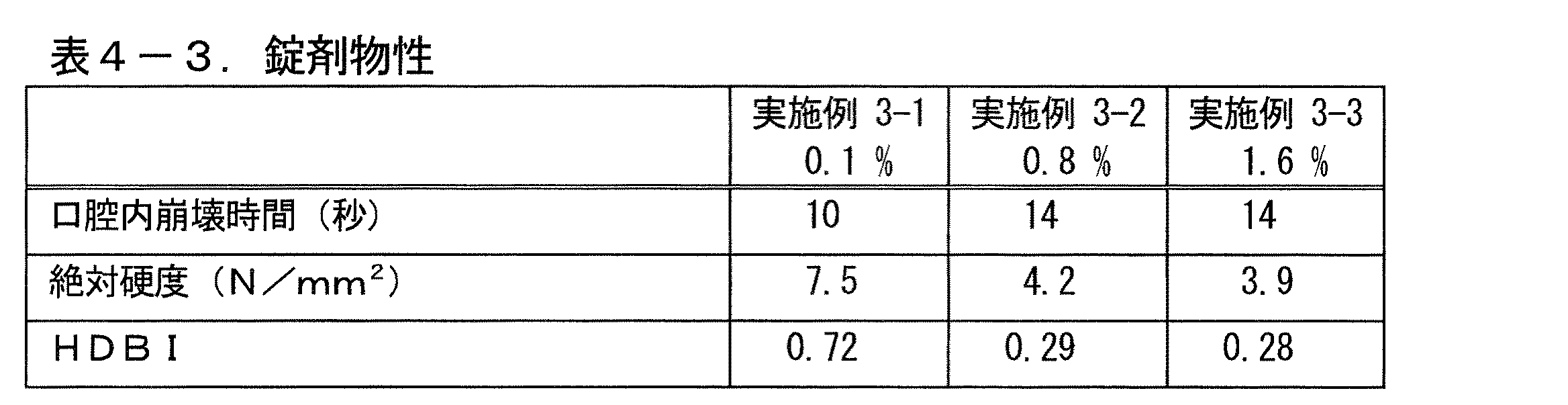
表5-1に示す処方にて、外層のコーンスターチの量が異なる製剤を実施例1-1と同様の方法で製造した。最終成型物は10kNで打錠した。


比較例1-1で示したとおり、外層にコーンスターチを全く含まない場合、口腔内で30秒以内に崩壊しなかったのに対して、実施例4-1~4-4のように、外層のコーンスターチの量が1~40%の場合、口腔内崩壊時間は30秒以内、絶対硬度が1.5N/mm2以上を満たしており、硬度と崩壊性のバランスの指標であるHDBIが大きかった。以上の結果から、外層のコーンスターチ量は1~40%のとき、良好な有核型の口腔内崩壊錠が得られることがわかった。

表6-1に示す処方にて、外層のクロスポビドンの量が異なる製剤を実施例1-1と同様の方法で製造した。最終成型物は10kNで打錠した。

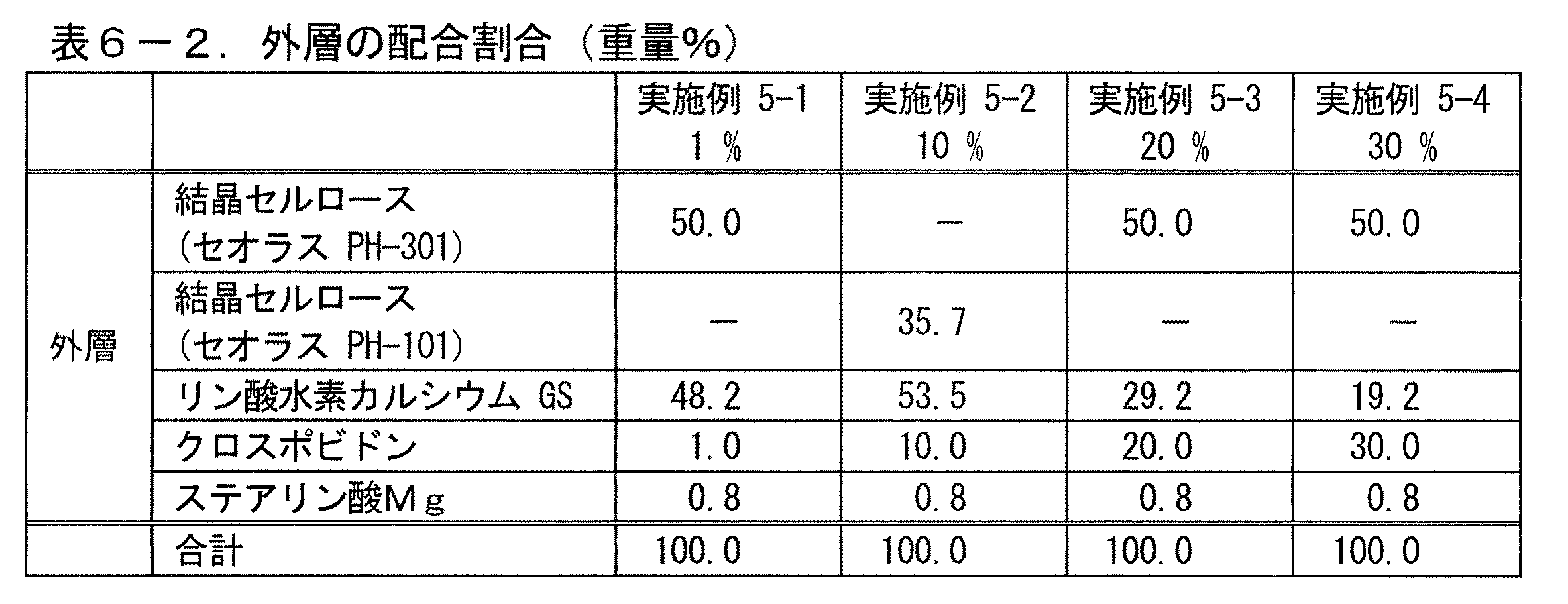
比較例1-1で示したとおり、外層にクロスポビドンを全く含まない場合、口腔内で30秒以内に崩壊しなかったのに対して、実施例5-1~5-4のように、外層のクロスポビドンの量が1~30%の場合、口腔内崩壊時間は30秒以内、絶対硬度が1.5N/mm2以上を満たしており、硬度と崩壊性のバランスの指標であるHDBIが大きかった。特に、クロスポビドンの量が少ない程、HDBIは大きかった。

表7-1に示す処方にて、内核の厚みの割合が異なる製剤を製造した。まず、外層成分を混合した。表7-1の外層(上)重量に示す外層成分の混合末をとり、表7-1示す内核の直径の臼に入れ軽く振動させて粉末の表面を平滑化し、その上に、結晶セルロース粒(セルフィアCP-203)を所定量加えて、ハンドプレス機(理研製、油圧式プレス機)を用いて、3kNの低い圧力で仮圧縮した。この仮圧縮物を外層が下方になるように直径8mm杵に同心円状に配置し、直径8mmの臼を被せて、仮圧縮物の上に、表7-1の外層(側面+上)重量に示す外層成分を入れて最終成型し、有核型の口腔内崩壊錠を製造した。最終成型物は15kNで打錠した。

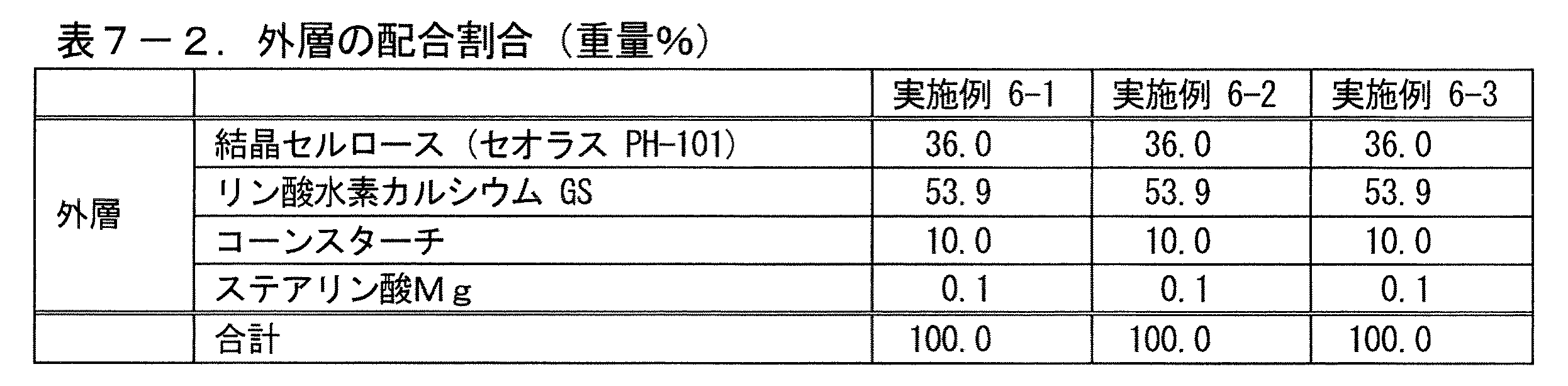
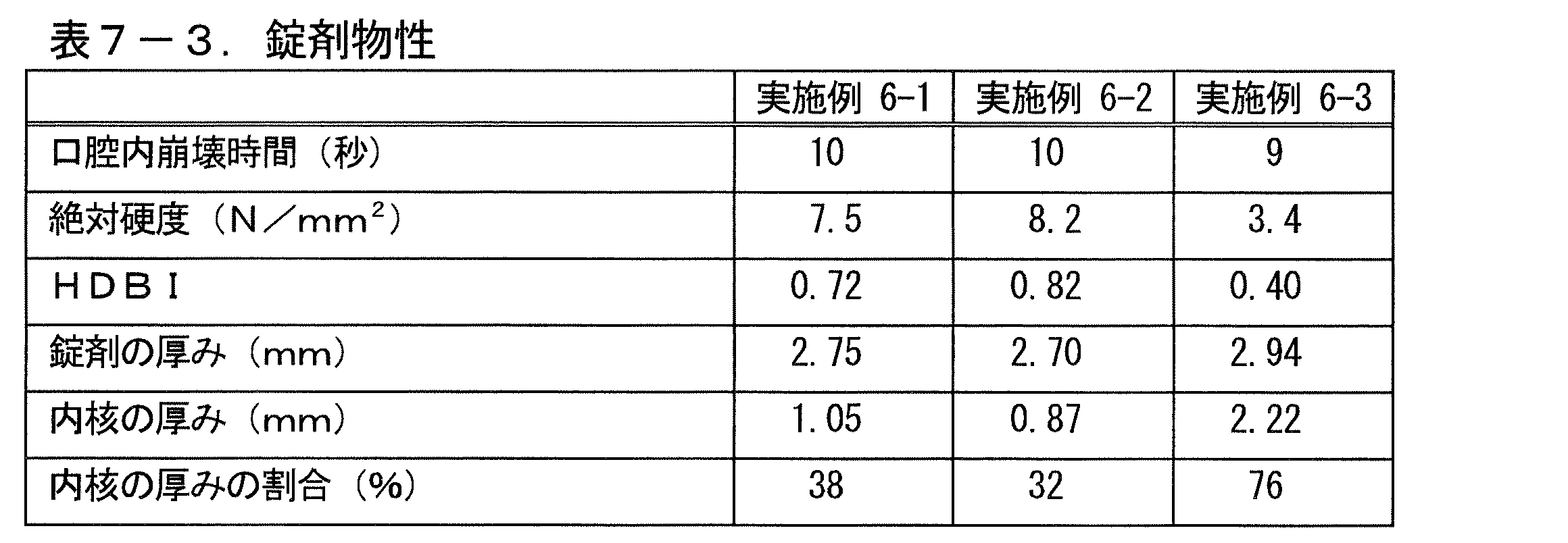
表7-4に示す処方にて、内核の厚みの割合が異なる製剤を製造した。まず、外層成分を混合した。表7-4の外層(上)重量に示す外層成分の混合末をとり、直径8mmの臼に入れ軽く振動させて粉末の表面を平滑化し、その上に、結晶セルロース粒(セルフィアCP-203)を所定量加えて、ハンドプレス機(理研製、油圧式プレス機)を用いて、低い圧力で仮圧縮した。この圧縮物を外層が下方になるように直径10mm杵に同心円状に配置し、直径10mmの臼を被せて、仮圧縮物の上に、表7-4の外層(側面+上)重量に示す外層成分を入れて最終成型し、有核型の口腔内崩壊錠を製造した。最終成型物は実施例6-4は8kN、実施例6-5は15kNで打錠した。


成形性がない粒子が錠剤中に均一に分布した普通錠を作製した。まず、表7-7に示す配合割合になるように原料を均一に混合した。この混合末を用いて、直径10mm、打錠圧8kNで打錠し、普通錠を得た。
尚、この普通錠は、実施例6-4で得た有核錠とは成形性のない粒子の分布が異なる以外は、1錠中の含有成分量、錠剤重量、錠剤径、打錠圧を同一条件にして作製した。


このように、成形性のない粒子を多く含む口腔内崩壊錠において、粒子が均一に分布した普通錠に比べて、粒子を内部に包含する有核錠の方が好ましい錠剤物性が得られることがわかった。

表8-1に示す処方にて、外層の空隙率が異なる製剤を実施例1-1と同様の方法で製造した。最終成型物は6kN、10kN及び15kNで打錠した。


打錠圧が6kN~15kNの範囲において、適切な硬度と崩壊性を有しており、打錠圧の許容幅は広かった。
(8-1)アセトアミノフェン含有粒子を含む有核錠
1)アセトアミノフェン含有粒子の製造(旭化成ケミカルズ社製)
アセトアミノフェンに被膜量10%となるように、コーティングを施し、アセトアミノフェン含有粒子とした。被膜成分は、アクアコート(旭化成ケミカルズ社製)、トリアセチン及びマンニトールが100:25:50重量%のものを使用した。
表9-1に示す処方にて、アセトアミノフェン含有粒子を含む製剤を実施例1-1と同様の方法で製造した。最終成型物は8kNで打錠した。

得られた錠剤について、口腔内崩壊時間、錠剤硬度及び厚みを測定し、絶対硬度、及びHDBIを算出したところ、表9-3の錠剤物性を有していた。口腔内崩壊時間は30秒以内、絶対硬度が1.5N/mm2以上を満たしており、硬度と崩壊性のバランスの指標であるHDBIが大きかった。このように活性成分を含む場合にも、良好な有核型の口腔内崩壊錠が得られることがわかった。

1)ファモチジン含有粒子の製造
精製水567gにポリソルベート80(日局ポリソルベート80(HX):日本油脂株式会社製)31.5gを加え、十分に混和させた後、タルク(林化成株式会社製)73.5g及びクロスカルメロースナトリウム(Ac-Di-Sol:FMC BioPolymer社製)52.5gを加え、十分に攪拌した(第1液)。これとは別に、水酸化ナトリウム2.85gを精製水67.65gに溶解させた溶液を、メタクリル酸コポリマーLD(ポリキッドPA-30S:三洋化成工業株式会社製)705gに徐々に加え、攪拌した(第2液)。第1液に第2液を加え懸濁させ、177μm開口径のメッシュ網で篩過し、被覆コーティング分散液とした。
ファモチジン346.5gと軽質無水ケイ酸(アエロジール200:日本アエロジル株式会社製)3.5gを500μm開口径のメッシュ網で篩過してポリエチレン袋内で十分に混合し、薬物含有組成物を調製後、強制循環装置付ワースター型流動層造粒機(改良ワースター型流動層造粒機、MP-01 SPC、株式会社パウレック製)に入れ、上記の被覆コーティング分散液を噴霧した。噴霧時は給気温度を80~90℃、排気温度を26~30℃に保ち、ボトムスプレーで噴霧液流量10~12g/分、スプレーエア流量80L/分、スプレーエアー圧力0.2~0.3MPa、サイドエアー圧力0.2~0.25MPa、給気風量約0.30~0.55m3/分で製造を行った。被覆コーティング分散液の噴霧量が約1306gの時点でコーティングを終了し、排気温度が42℃になるまで乾燥した。得られた粒子を32メッシュ(目開き500μm)の篩で篩過し、平均粒子径が約165μmのファモチジン含有粒子を得た。
表9-4に示す処方にて、内核に活性成分含有粒子を含む製剤を製造した。内核には、ファモチジン含有粒子とクロスポビドン及びタルクの混合粒子を使用した。まず、外層成分を混合した。これを40mgとり、直径6mmの臼に入れ軽く振動させて粉末の表面を平滑化した(外層(下))。その上に、内核の混合粒子を50mg加えて、ハンドプレス機(理研製、油圧式プレス機)を用いて、3kNの低い圧力で仮圧縮した。この圧縮物を外層(下)が下方になるように直径8mm杵に同心円状に配置し、直径8mmの臼を被せて、仮圧縮物の上から外層成分140mg(外層(側面+上))を入れて最終成型し、有核型の口腔内崩壊錠を製造した。最終成型物は8kNで打錠した。
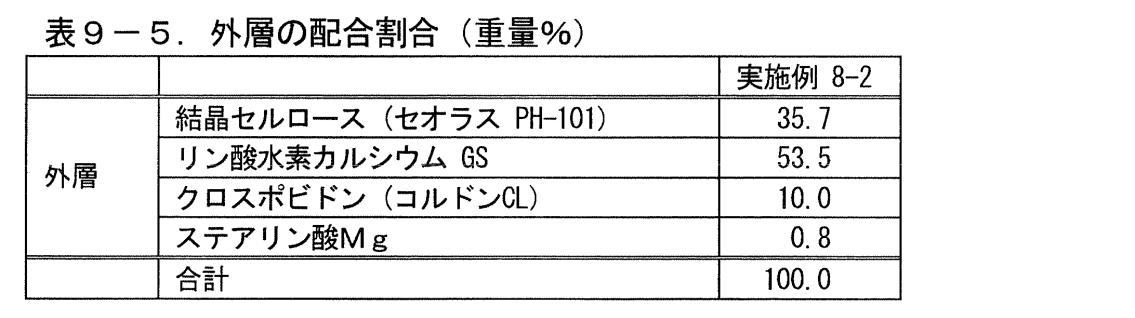
1)モサプリド含有粒子の製造
実施例8-2のファモチジンをクエン酸モサプリドに代えて、モサプリド含有粒子を得た。
表9-6に示す処方にて、内核にモサプリド含有粒子を含む製剤を製造した。内核には、モサプリド含有粒子とクロスポビドン及びタルクの混合粒子を使用した。
まず、外層成分を混合した。これを40mgとり、直径6mmの臼に入れ軽く振動させて粉末の表面を平滑化した(外層(下))。その上に、内核の混合粒子を50mg加えて、ハンドプレス機(理研製、油圧式プレス機)を用いて、3kNの低い圧力で仮圧縮した。この圧縮物を外層(下)が下方になるように直径8mm杵に同心円状に配置し、直径8mmの臼を被せて、仮圧縮物の上から外層成分140mg(外層(側面+上))を入れて最終成型し、有核型の口腔内崩壊錠を製造した。最終成型物は8kNで打錠した。

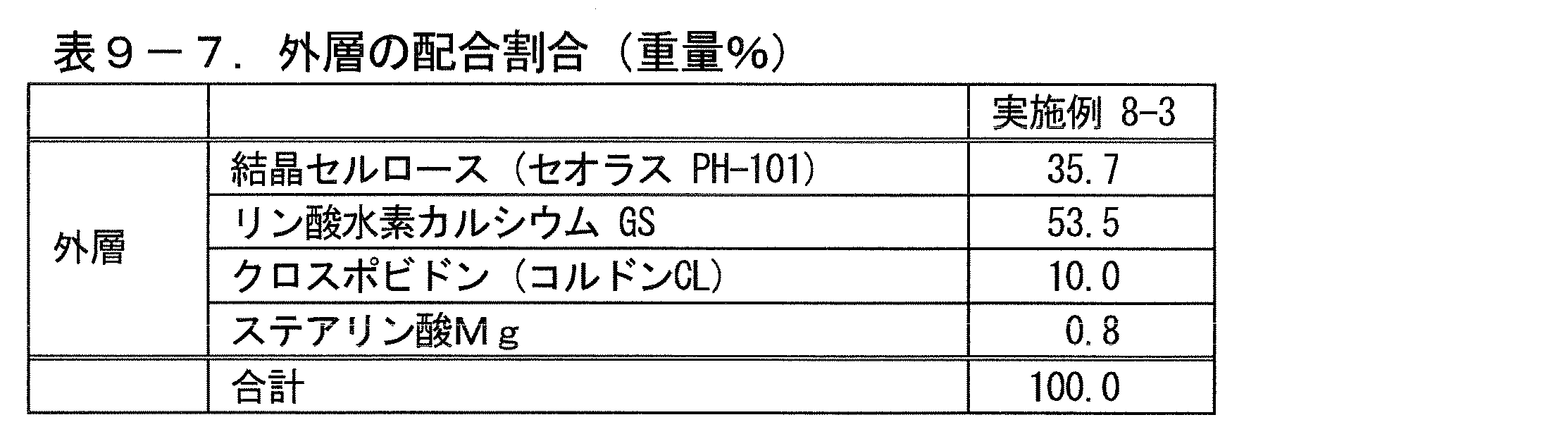
得られた錠剤について、口腔内崩壊時間、錠剤硬度及び厚みを測定し、絶対硬度、及びHDBIを算出したところ、表9-8の錠剤物性を有していた。口腔内崩壊時間は30秒以内、絶対硬度が1.5N/mm2以上を満たしており、硬度と崩壊性のバランスの指標であるHDBIが大きかった。モサプリド由来の味は抑制され、服用感は良好であった。

1)腸溶性粒子含有粒子
コンタック600STの腸溶性粒子は、コンタック600ST カプセル(グラクソ・スミスクライン)の赤色粒子を用いた。
表9-9に示す処方にて、内核に腸溶性粒子を含む製剤を製造した。まず、外層成分を混合した。これを40mgとり、直径6mmの臼に入れ軽く振動させて粉末の表面を平滑化した(外層(下))。その上に、コンタック600ST顆粒を50mg加え軽く振動させて表面を平滑化した。さらに、外層成分を20mg(外層(上))加え軽く振動させて表面を平滑化した。ハンドプレス機(理研製、油圧式プレス機)を用いて、1kNの低い圧力で仮圧縮した。この圧縮物を外層(下)が下方になるように直径8mm杵に同心円状に配置し、直径8mmの臼を被せて、仮圧縮物の上から外層成分120mg(外層(側面+上))を入れて最終成型し、有核型の口腔内崩壊錠を製造した。最終成型物は6kNで打錠した。


得られた錠剤について、口腔内崩壊時間、錠剤硬度及び厚みを測定し、絶対硬度、及びHDBIを算出したところ、表9-11の錠剤物性を有していた。口腔内崩壊時間は30秒以内、絶対硬度が1.5N/mm2以上を満たしており、硬度と崩壊性のバランスの指標であるHDBIが大きかった。

1)ファモチジンマイクロカプセル
ファモチジンマイクロカプセルは、ファモチジンを70%含有する寒天ビーズであり、理研ビタミン社から供与されたものを使用した。
表9-12に示す処方にて、内核にマイクロカプセルを含む製剤を製造した。内核には、ファモチジンマイクロカプセルとエリスリトール(微粉:日研化学社製)の混合粒子を使用した。
まず、外層成分を混合した。これを40mgとり、直径6mmの臼に入れ軽く振動させて粉末の表面を平滑化した(外層(下))。その上に、内核の混合粒子を57.2mg加えて、ハンドプレス機(理研製、油圧式プレス機)を用いて、3kNの低い圧力で仮圧縮した。この圧縮物を外層(下)が下方になるように直径8mm杵に同心円状に配置し、直径8mmの臼を被せて、仮圧縮物の上から外層成分140mg(外層(側面+上))を入れて最終成型し、有核型の口腔内崩壊錠を製造した。最終成型物は6kNで打錠した。

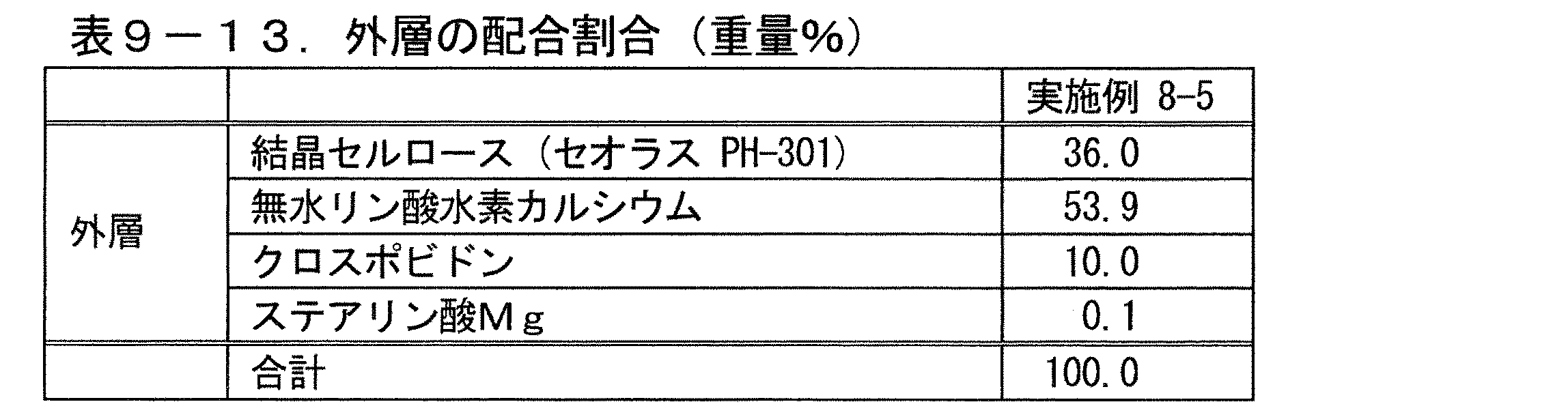
口腔内崩壊時間、錠剤硬度及び厚みを測定し、絶対硬度、及びHDBIを算出したところ、表9-14の錠剤物性を有していた。口腔内崩壊時間は30秒以内、絶対硬度が1.5N/mm2以上を満たしており、硬度と崩壊性のバランスの指標であるHDBIが大きかった。

Claims (10)
- 内核の周辺を覆う外層を有する製剤であって、錠剤全体の厚みに対する内核の厚みの割合が10~90%であり、外層成分として、(a)結晶セルロース、(b)無機賦形剤及び(c)クロスポビドン、デンプン類、低置換度ヒドロキシプロピルセルロース及びカルメロースからなる群から選択される1種又は2種以上の特定成分を含有する有核型の口腔内崩壊錠。
- 内核が、成形性の低い粉粒体である請求項1に記載の有核型の口腔内崩壊錠。
- 外層部分100重量%における結晶セルロース(a)の配合割合が、5~80重量%である請求項1又は2に記載の有核型の口腔内崩壊錠。
- 外層部分100重量%における無機賦形剤(b)の配合割合が、10~80重量%である請求項1~3のいずれか一項に記載の有核型の口腔内崩壊錠。
- 外層部分100重量%における配合する特定成分(c)の合計の配合割合が、1~40重量%である請求項1~4のいずれか一項に記載の有核型の口腔内崩壊錠。
- 特定成分(c)が、クロスポビドン、デンプン類及び低置換度ヒドロキシプロピルセルロースからなる群から選択される1種又は2種以上である請求項1~5のいずれか一項に記載の有核型の口腔内崩壊錠。
- デンプン類が、トウモロコシデンプンである請求項1~6のいずれか一項に記載の有核型の口腔内崩壊錠。
- 錠剤全体の厚みに対する内核の厚みの割合が20~80%である請求項1~7のいずれか一項に記載の有核型の口腔内崩壊錠。
- 該外層部分の空隙率が1~40%である請求項1~8のいずれか一項に記載の有核型の口腔内崩壊錠。
- 内核に活性成分が含まれる請求項1~9のいずれか一項に記載の有核型の口腔内崩壊錠。
Priority Applications (6)
| Application Number | Priority Date | Filing Date | Title |
|---|---|---|---|
| EP10777773.2A EP2433652B1 (en) | 2009-05-20 | 2010-05-19 | Dry-coated orally-disintegrating tablet |
| US13/320,819 US8920839B2 (en) | 2009-05-20 | 2010-05-19 | Dry-coated orally-disintegrating tablet |
| JP2011514430A JP5458096B2 (ja) | 2009-05-20 | 2010-05-19 | 有核型の口腔内崩壊錠 |
| CN201080032989.4A CN102458475B (zh) | 2009-05-20 | 2010-05-19 | 压制包衣的口腔崩解片 |
| HK12108023.0A HK1167324B (en) | 2009-05-20 | 2010-05-19 | Dry-coated orally-disintegrating tablet |
| ES10777773.2T ES2604307T3 (es) | 2009-05-20 | 2010-05-19 | Comprimido de disgregación oral revestido por vía seca |
Applications Claiming Priority (2)
| Application Number | Priority Date | Filing Date | Title |
|---|---|---|---|
| JP2009122476 | 2009-05-20 | ||
| JP2009-122476 | 2009-05-20 |
Publications (1)
| Publication Number | Publication Date |
|---|---|
| WO2010134540A1 true WO2010134540A1 (ja) | 2010-11-25 |
Family
ID=43126217
Family Applications (1)
| Application Number | Title | Priority Date | Filing Date |
|---|---|---|---|
| PCT/JP2010/058429 Ceased WO2010134540A1 (ja) | 2009-05-20 | 2010-05-19 | 有核型の口腔内崩壊錠 |
Country Status (7)
| Country | Link |
|---|---|
| US (1) | US8920839B2 (ja) |
| EP (1) | EP2433652B1 (ja) |
| JP (1) | JP5458096B2 (ja) |
| KR (1) | KR20120034643A (ja) |
| CN (1) | CN102458475B (ja) |
| ES (1) | ES2604307T3 (ja) |
| WO (1) | WO2010134540A1 (ja) |
Cited By (4)
| Publication number | Priority date | Publication date | Assignee | Title |
|---|---|---|---|---|
| WO2015008825A1 (ja) | 2013-07-19 | 2015-01-22 | 株式会社三和化学研究所 | 口腔内崩壊錠 |
| CN104873517A (zh) * | 2011-07-25 | 2015-09-02 | 大鹏药品工业株式会社 | 含有替加氟、吉美拉西、氧嗪酸钾的干压包衣片 |
| JP2016141630A (ja) * | 2015-01-30 | 2016-08-08 | 富士フイルム株式会社 | 口腔内崩壊錠 |
| US10398694B2 (en) | 2014-11-11 | 2019-09-03 | Shionogi & Co., Ltd. | Multi-layered tablet containing drug unstable to light |
Citations (11)
| Publication number | Priority date | Publication date | Assignee | Title |
|---|---|---|---|---|
| JPH03130214A (ja) | 1989-07-20 | 1991-06-04 | Dainippon Pharmaceut Co Ltd | 不快な味が遮蔽された速放性製剤 |
| WO1998002185A1 (en) * | 1996-07-12 | 1998-01-22 | Daiichi Pharmaceutical Co., Ltd. | Quickly disintegrable compression-molded materials and process for producing the same |
| JP2001278812A (ja) * | 2000-03-27 | 2001-10-10 | Kyoto Pharmaceutical Industries Ltd | 錠剤用崩壊剤及びこれを用いた錠剤 |
| JP2002332226A (ja) | 2001-03-07 | 2002-11-22 | Sumitomo Pharmaceut Co Ltd | 薬物顆粒の製造方法、および薬物顆粒、ならびにそれを用いた医薬製剤 |
| WO2003028706A1 (fr) | 2001-09-28 | 2003-04-10 | Sanwa Kagaku Kenkyusho Co.,Ltd | Double comprime a desintegration rapide |
| WO2005055989A1 (ja) | 2003-12-09 | 2005-06-23 | Dainippon Sumitomo Pharma Co., Ltd. | 薬物含有粒子および該粒子を含む固形製剤 |
| WO2005097041A1 (ja) | 2004-04-09 | 2005-10-20 | Sanwa Kagaku Kenkyusho Co., Ltd. | 有核成型品とその製造方法 |
| WO2005123040A1 (ja) | 2004-06-22 | 2005-12-29 | Shionogi & Co., Ltd. | 口腔内速崩壊錠 |
| WO2007018192A1 (ja) | 2005-08-10 | 2007-02-15 | Shionogi & Co., Ltd. | 口腔内崩壊錠剤 |
| JP2007063263A (ja) | 2005-08-01 | 2007-03-15 | Dainippon Sumitomo Pharma Co Ltd | アムロジピン含有粒子およびそれからなる口腔内崩壊錠 |
| WO2009054432A1 (ja) * | 2007-10-26 | 2009-04-30 | Daiichi Sankyo Company, Limited | 口腔内速崩壊性医薬組成物およびその製造方法 |
Family Cites Families (13)
| Publication number | Priority date | Publication date | Assignee | Title |
|---|---|---|---|---|
| JPH1135451A (ja) | 1994-07-27 | 1999-02-09 | Yamanouchi Pharmaceut Co Ltd | 口腔内溶解型錠剤およびその製造方法 |
| DE69901938T3 (de) * | 1998-03-06 | 2012-08-02 | Aptalis Pharma S.R.L. | Schnell zerfallende tablette |
| US7815937B2 (en) | 1998-10-27 | 2010-10-19 | Biovail Laboratories International Srl | Quick dissolve compositions and tablets based thereon |
| CN1315638C (zh) | 2000-06-20 | 2007-05-16 | 株式会社三和化学研究所 | 有核成型品及其制造方法和装置 |
| ATE536988T1 (de) * | 2000-06-20 | 2011-12-15 | Sanwa Kagaku Kenkyusho Co | Verfahren zur herstellung eines nukleierten geformten gegenstandes |
| CN1688291A (zh) * | 2002-02-01 | 2005-10-26 | 辉瑞产品公司 | 含有固体药物分散体的即刻释放剂型 |
| JP3841804B2 (ja) | 2003-10-15 | 2006-11-08 | 富士化学工業株式会社 | 口腔内速崩壊性錠剤用の組成物 |
| KR101159617B1 (ko) | 2003-10-15 | 2012-06-27 | 후지카가쿠고교가부시키가이샤 | 구강내 속붕해성 정제 |
| DE102005009240A1 (de) | 2005-03-01 | 2006-09-07 | Bayer Healthcare Ag | Arzneiformen mit verbesserten pharmakokinetischen Eigenschaften |
| CA2618966C (en) * | 2005-08-10 | 2014-05-13 | Shionogi & Co., Ltd. | Bitterness-reducing agent |
| US20070141151A1 (en) * | 2005-12-20 | 2007-06-21 | Silver David I | Lansoprazole orally disintegrating tablets |
| JP5535616B2 (ja) | 2006-03-31 | 2014-07-02 | ルビコン リサーチ プライベート リミテッド | 口腔内崩壊錠剤のための直接圧縮性複合材 |
| JP2008044870A (ja) * | 2006-08-11 | 2008-02-28 | Elmed Eisai Kk | 医薬組成物及びその製造方法 |
-
2010
- 2010-05-19 US US13/320,819 patent/US8920839B2/en not_active Expired - Fee Related
- 2010-05-19 CN CN201080032989.4A patent/CN102458475B/zh not_active Expired - Fee Related
- 2010-05-19 JP JP2011514430A patent/JP5458096B2/ja active Active
- 2010-05-19 EP EP10777773.2A patent/EP2433652B1/en not_active Not-in-force
- 2010-05-19 KR KR1020117029305A patent/KR20120034643A/ko not_active Ceased
- 2010-05-19 ES ES10777773.2T patent/ES2604307T3/es active Active
- 2010-05-19 WO PCT/JP2010/058429 patent/WO2010134540A1/ja not_active Ceased
Patent Citations (11)
| Publication number | Priority date | Publication date | Assignee | Title |
|---|---|---|---|---|
| JPH03130214A (ja) | 1989-07-20 | 1991-06-04 | Dainippon Pharmaceut Co Ltd | 不快な味が遮蔽された速放性製剤 |
| WO1998002185A1 (en) * | 1996-07-12 | 1998-01-22 | Daiichi Pharmaceutical Co., Ltd. | Quickly disintegrable compression-molded materials and process for producing the same |
| JP2001278812A (ja) * | 2000-03-27 | 2001-10-10 | Kyoto Pharmaceutical Industries Ltd | 錠剤用崩壊剤及びこれを用いた錠剤 |
| JP2002332226A (ja) | 2001-03-07 | 2002-11-22 | Sumitomo Pharmaceut Co Ltd | 薬物顆粒の製造方法、および薬物顆粒、ならびにそれを用いた医薬製剤 |
| WO2003028706A1 (fr) | 2001-09-28 | 2003-04-10 | Sanwa Kagaku Kenkyusho Co.,Ltd | Double comprime a desintegration rapide |
| WO2005055989A1 (ja) | 2003-12-09 | 2005-06-23 | Dainippon Sumitomo Pharma Co., Ltd. | 薬物含有粒子および該粒子を含む固形製剤 |
| WO2005097041A1 (ja) | 2004-04-09 | 2005-10-20 | Sanwa Kagaku Kenkyusho Co., Ltd. | 有核成型品とその製造方法 |
| WO2005123040A1 (ja) | 2004-06-22 | 2005-12-29 | Shionogi & Co., Ltd. | 口腔内速崩壊錠 |
| JP2007063263A (ja) | 2005-08-01 | 2007-03-15 | Dainippon Sumitomo Pharma Co Ltd | アムロジピン含有粒子およびそれからなる口腔内崩壊錠 |
| WO2007018192A1 (ja) | 2005-08-10 | 2007-02-15 | Shionogi & Co., Ltd. | 口腔内崩壊錠剤 |
| WO2009054432A1 (ja) * | 2007-10-26 | 2009-04-30 | Daiichi Sankyo Company, Limited | 口腔内速崩壊性医薬組成物およびその製造方法 |
Non-Patent Citations (1)
| Title |
|---|
| See also references of EP2433652A4 * |
Cited By (4)
| Publication number | Priority date | Publication date | Assignee | Title |
|---|---|---|---|---|
| CN104873517A (zh) * | 2011-07-25 | 2015-09-02 | 大鹏药品工业株式会社 | 含有替加氟、吉美拉西、氧嗪酸钾的干压包衣片 |
| WO2015008825A1 (ja) | 2013-07-19 | 2015-01-22 | 株式会社三和化学研究所 | 口腔内崩壊錠 |
| US10398694B2 (en) | 2014-11-11 | 2019-09-03 | Shionogi & Co., Ltd. | Multi-layered tablet containing drug unstable to light |
| JP2016141630A (ja) * | 2015-01-30 | 2016-08-08 | 富士フイルム株式会社 | 口腔内崩壊錠 |
Also Published As
| Publication number | Publication date |
|---|---|
| JP5458096B2 (ja) | 2014-04-02 |
| KR20120034643A (ko) | 2012-04-12 |
| US20120064162A1 (en) | 2012-03-15 |
| CN102458475A (zh) | 2012-05-16 |
| JPWO2010134540A1 (ja) | 2012-11-12 |
| ES2604307T3 (es) | 2017-03-06 |
| EP2433652B1 (en) | 2016-11-09 |
| US8920839B2 (en) | 2014-12-30 |
| CN102458475B (zh) | 2016-03-30 |
| EP2433652A1 (en) | 2012-03-28 |
| HK1167324A1 (zh) | 2012-11-30 |
| EP2433652A4 (en) | 2013-09-25 |
Similar Documents
| Publication | Publication Date | Title |
|---|---|---|
| JP5702305B2 (ja) | 有核型の口腔内崩壊錠 | |
| JP6092936B2 (ja) | 口腔内崩壊錠の製造方法 | |
| CN101283991B (zh) | 口腔崩解剂及其制造方法 | |
| JP2013224321A (ja) | 口腔内崩壊錠剤 | |
| JP7036856B2 (ja) | 口腔内崩壊錠 | |
| JP5074190B2 (ja) | 口腔内速崩壊性錠剤 | |
| JP2025179197A (ja) | イブプロフェンとトラネキサム酸を含有する錠剤及びその製造方法 | |
| JP5458096B2 (ja) | 有核型の口腔内崩壊錠 | |
| JP2019019113A (ja) | メマンチン塩酸塩含有口腔内崩壊錠 | |
| JP7148319B2 (ja) | プラスグレルを含む口腔内崩壊錠 | |
| JP6476122B2 (ja) | 二段階の湿式造粒工程で製造される崩壊性粒子組成物及び該組成物を含む口腔内崩壊錠剤 | |
| HK1167324B (en) | Dry-coated orally-disintegrating tablet | |
| HK1174847A (en) | Press-coated orally disintegrating tablets | |
| HK1174847B (en) | Press-coated orally disintegrating tablets | |
| JP2006232680A (ja) | 錠剤用崩壊剤及びこれを用いた錠剤 |
Legal Events
| Date | Code | Title | Description |
|---|---|---|---|
| WWE | Wipo information: entry into national phase |
Ref document number: 201080032989.4 Country of ref document: CN |
|
| 121 | Ep: the epo has been informed by wipo that ep was designated in this application |
Ref document number: 10777773 Country of ref document: EP Kind code of ref document: A1 |
|
| DPE1 | Request for preliminary examination filed after expiration of 19th month from priority date (pct application filed from 20040101) | ||
| ENP | Entry into the national phase |
Ref document number: 2011514430 Country of ref document: JP Kind code of ref document: A |
|
| WWE | Wipo information: entry into national phase |
Ref document number: 13320819 Country of ref document: US |
|
| NENP | Non-entry into the national phase |
Ref country code: DE |
|
| ENP | Entry into the national phase |
Ref document number: 20117029305 Country of ref document: KR Kind code of ref document: A |
|
| REEP | Request for entry into the european phase |
Ref document number: 2010777773 Country of ref document: EP |
|
| WWE | Wipo information: entry into national phase |
Ref document number: 2010777773 Country of ref document: EP |