WO2010136345A1 - Mischungen aus funktionalisierten dienkautschuken mit trimethylolpropan und fettsäure,ein verfahren zu deren herstellung und deren verwendung - Google Patents
Mischungen aus funktionalisierten dienkautschuken mit trimethylolpropan und fettsäure,ein verfahren zu deren herstellung und deren verwendung Download PDFInfo
- Publication number
- WO2010136345A1 WO2010136345A1 PCT/EP2010/056663 EP2010056663W WO2010136345A1 WO 2010136345 A1 WO2010136345 A1 WO 2010136345A1 EP 2010056663 W EP2010056663 W EP 2010056663W WO 2010136345 A1 WO2010136345 A1 WO 2010136345A1
- Authority
- WO
- WIPO (PCT)
- Prior art keywords
- rubber
- weight
- parts
- acid
- mixtures
- Prior art date
- Legal status (The legal status is an assumption and is not a legal conclusion. Google has not performed a legal analysis and makes no representation as to the accuracy of the status listed.)
- Ceased
Links
Classifications
-
- C—CHEMISTRY; METALLURGY
- C08—ORGANIC MACROMOLECULAR COMPOUNDS; THEIR PREPARATION OR CHEMICAL WORKING-UP; COMPOSITIONS BASED THEREON
- C08K—Use of inorganic or non-macromolecular organic substances as compounding ingredients
- C08K3/00—Use of inorganic substances as compounding ingredients
- C08K3/34—Silicon-containing compounds
-
- C—CHEMISTRY; METALLURGY
- C08—ORGANIC MACROMOLECULAR COMPOUNDS; THEIR PREPARATION OR CHEMICAL WORKING-UP; COMPOSITIONS BASED THEREON
- C08L—COMPOSITIONS OF MACROMOLECULAR COMPOUNDS
- C08L9/00—Compositions of homopolymers or copolymers of conjugated diene hydrocarbons
- C08L9/06—Copolymers with styrene
-
- C—CHEMISTRY; METALLURGY
- C08—ORGANIC MACROMOLECULAR COMPOUNDS; THEIR PREPARATION OR CHEMICAL WORKING-UP; COMPOSITIONS BASED THEREON
- C08K—Use of inorganic or non-macromolecular organic substances as compounding ingredients
- C08K3/00—Use of inorganic substances as compounding ingredients
- C08K3/34—Silicon-containing compounds
- C08K3/36—Silica
-
- C—CHEMISTRY; METALLURGY
- C08—ORGANIC MACROMOLECULAR COMPOUNDS; THEIR PREPARATION OR CHEMICAL WORKING-UP; COMPOSITIONS BASED THEREON
- C08K—Use of inorganic or non-macromolecular organic substances as compounding ingredients
- C08K5/00—Use of organic ingredients
- C08K5/04—Oxygen-containing compounds
- C08K5/05—Alcohols; Metal alcoholates
-
- C—CHEMISTRY; METALLURGY
- C08—ORGANIC MACROMOLECULAR COMPOUNDS; THEIR PREPARATION OR CHEMICAL WORKING-UP; COMPOSITIONS BASED THEREON
- C08K—Use of inorganic or non-macromolecular organic substances as compounding ingredients
- C08K5/00—Use of organic ingredients
- C08K5/04—Oxygen-containing compounds
- C08K5/09—Carboxylic acids; Metal salts thereof; Anhydrides thereof
-
- Y—GENERAL TAGGING OF NEW TECHNOLOGICAL DEVELOPMENTS; GENERAL TAGGING OF CROSS-SECTIONAL TECHNOLOGIES SPANNING OVER SEVERAL SECTIONS OF THE IPC; TECHNICAL SUBJECTS COVERED BY FORMER USPC CROSS-REFERENCE ART COLLECTIONS [XRACs] AND DIGESTS
- Y02—TECHNOLOGIES OR APPLICATIONS FOR MITIGATION OR ADAPTATION AGAINST CLIMATE CHANGE
- Y02T—CLIMATE CHANGE MITIGATION TECHNOLOGIES RELATED TO TRANSPORTATION
- Y02T10/00—Road transport of goods or passengers
- Y02T10/80—Technologies aiming to reduce greenhouse gasses emissions common to all road transportation technologies
- Y02T10/86—Optimisation of rolling resistance, e.g. weight reduction
Definitions
- the invention relates to functionalized diene rubbers with trimethylolpropane and fatty acid, a process for their preparation and their use for the production of wet-slip and low-rolling-resistance automotive tire treads with high abrasion resistance.
- wet skid resistance and rolling resistance of a tire depend in large part on the dynamic mechanical properties of the rubbers used to build the tire. To reduce the rolling resistance rubbers are used for the tire tread with a high resiliency at higher temperatures (60 0 C to 100 0 C). On the other hand, to reduce the rolling resistance rubbers are used for the tire tread with a high resiliency at higher temperatures (60 0 C to 100 0 C). On the other hand, to reduce the rolling resistance rubbers are used for the tire tread with a high resiliency at higher temperatures (60 0 C to 100 0 C). On the other hand, to
- rubbers having a high damping factor at low temperatures (0 0 C) or lower rebound resilience in the range of 0 0 C to 23 ° C is advantageous.
- mixtures of different rubbers are used in the tread.
- blends of one or more rubbers having a relatively high glass transition temperature, such as styrene-butadiene rubber, are used.
- Rubber and one or more relatively low glass transition temperature rubbers, such as high 1,4-cis polybutadiene or low styrene and low vinyl styrene-butadiene rubber or a low vinyl polybutadiene made in solution.
- Tire tread can be achieved through the use of finely divided precipitated silica as a reinforcing filler.
- the silica is used either alone or in combination with carbon black.
- precipitated silica leads to an increased viscosity of the unvulcanized rubber mixture, which has a disruptive effect on the processing.
- a number of measures are described to lower the mixing viscosity, as set forth in EP 0761734, for example.
- EP 0761734 describes in particular the use of trimethylolpropane as a processing aid which succeeds in lowering the mixing viscosity and at the same time in the resilience of the vulcanized material Increase mixture at 70 0 C, which suggests a reduced rolling resistance.
- DE 10 2004 039 545 shows that the combination viscosity of trimethylolpropane and fatty acids as processing aids can be used to lower the mixing viscosity without adversely affecting the mechanical properties of the vulcanized rubber mixture.
- EP 1 253 167 discloses that the combination of a diene rubber with polar groups, silicic acid and nonaromatic polar substances having at least one hydroxyl group, such as trimethylolpropane, gives vulcanizates having an improved wet grip without greatly impairing the rolling resistance. At the same time, the non-aromatic, polar substances having at least one hydroxyl group cause a reduction in the viscosity of the rubber mixture.
- the rubber mixtures according to the invention may also contain further rubbers F).
- the invention therefore provides vulcanizable rubber mixtures containing
- the dienes are preferably 1,3-butadiene, isoprene, 1,3-pentadiene, 2,3-dimethylbutadiene, 1-phenyl-1,3-butadiene and / or 1,3-hexadiene. Particular preference is given to using 1,3-butadiene and / or isoprene.
- Vinylaromatic monomers for the purposes of the invention are preferably styrene, o-, m- and / or p-methylstyrene, p-tert-butylstyrene, ⁇ -methylstyrene, vinylnaphthalene, divinylbenzene, trivinylbenzene and / or divinylnaphthalene.
- Styrene is particularly preferably used.
- the functionalized diene rubbers (A) have a content of polymerized vinylaromatic monomers of 0 to 60% by weight, preferably 10 to 45% by weight, and a content of dienes of 40 to 100% by weight, preferably 55 to 90% by weight, the content of 1,2-linked dienes (vinyl content) in the dienes being from 0.5 to 95% by weight, preferably from 10 to 85% by weight, and the sum of copolymerized vinylaromatic monomers and Serve to add 100%.
- the functionalized diene rubbers (A) are particularly preferably composed of 40-100% by weight of 1,3-butadiene and 0-60% by weight of styrene, the proportion of bonded functional groups and / or their salts being 0.02 to 5% by weight %, based on 100% by weight
- Functional groups and / or their salts in the functionalized diene rubber are carboxyl and / or hydroxyl groups.
- Preferred salts are alkali metal, alkaline earth metal, zinc and ammonium carboxylates. - A -
- (A) is a functionalized diene rubber from repeat units based on 1, 3-butadiene and styrene which is functionalized with hydroxyl and / or carboxyl groups.
- the functionalized diene rubbers (A) are preferably prepared by polymerization of dienes and optionally vinylaromatic monomers in solution and subsequent introduction of functional groups, such as e.g. in DE 102008023885.6.
- the rubber mixtures according to the invention may contain, in addition to the functionalized diene rubbers (A) mentioned, other rubbers (F), such as natural rubber or other synthetic rubbers. If present, their amount is usually in the range of 0.5 to 95, preferably 10 to 80% by weight, based on the total amount of rubber in the rubber mixture.
- the amount of additionally added rubbers depends again on the particular intended use of the rubber mixtures according to the invention.
- NBR-butadiene-acrylonitrile copolymers having acrylonitrile contents of 5-60
- Suitable bright fillers (B) for the rubber mixtures according to the invention are all known bright fillers used in the rubber industry. These include both active and inactive fillers.
- a light filler according to the invention includes a reinforcing filler.
- a reinforcing filler in the context of the invention is preferably one which, when added with 10 to 100% by weight, brings about an increase in the modulus of at least 100%.
- One or more bright reinforcing fillers may be used in the invention.
- Carbon black in the sense of the invention particularly excludes carbon black According to the invention it is nevertheless possible to use, in addition to the light filler, carbon blacks which are usually used in pneumatic tires and in particular in the treads of pneumatic tires.
- Examples of these are carbon blacks produced according to the method of the flame black, the channel, furnace, gas black, thermal, acetylene black or arc process and have BET surface areas of 9-200 m 2 / g, eg SAF (Super Abrasion Furnace), ISAF-LS (Intermediate Super Abrasion Furnace Low Structure), ISAF
- Extrusion Furnace-Low Structure FEF (Fast Extrusion Furnace), FEF-HS (Fast Extrusion Furnace High Structure), GPF-HS (General Purpose Furnace High Structure), GPF (General Purpose Furnace), APF (AIl Purpose Furnace), SRF-LS (Semi Reinforcing Furnace Low Structure), SRF-LM (Semi Reinforcing Fumace Low Modulus), SRF-HS (Semi Reinforcing Furnace High SDtructure), SRF-HM ( Semi Reinforcing Furnace High Modulus) and MT (Medium Thermal) soot or after
- the proportion of the light reinforcing filler is more than 50% by weight, preferably more than 80% by weight, based on the total amount of the reinforcing filler used.
- the proportion of carbon black is preferably less than 50% by weight, and more preferably less than 20% by weight. In a particular embodiment, no carbon black is added in the process according to the invention.
- the reinforcing white filler is preferably oxidic fillers such as silica (SiO 2 ) or alumina (Al 2 O 3 ) or mixtures thereof.
- the silicic acid used may be any reinforcing silicic acid known to the person skilled in the art, in particular any precipitated silicas or fumed silicas having a BET surface area and a specific surface area determined with CTAB, both of which are below 450 m 2 / g, but highly dispersible precipitated silicas are preferred, especially when the invention is for the production of tires with a low rolling resistance.
- Examples of preferred highly dispersible silicas include, for example: Perkasil KS 430 (Akzo Nobel GmbH), BV 3380 and Ultrasil 7000 (Evonik Degussa), Zeosil 1165 MP and 11 15 MP (Rhodia AG), Hi-SiI 2000 (PPG), Zeopol 8715 , 8741 or 8745 (Zeopol Ltd.) and treated
- Precipitated silicas such as with aluminum "doped” silicas, which are described in EP-A-0 735 088.
- One or more types of silicic acid can be used.
- Alumina is preferably also a highly dispersible alumina as described in EP-A-O 810 258. Examples include: A125 or CR125 (Baikowski), APA-10ORX (Condea), alumina C (Evonik Degussa) and AKP-GO 15 (Sumitomo Chemicals).
- the bright reinforcing filler may be in the form of powders, microbeads, granules or spheres.
- silicas and / or aluminas are used.
- Particular preference is given to silicic acids, in particular highly disperse silicic acid, prepared, for example, by precipitation of solutions of silicates or flame hydrolysis of silicon halides having specific surface areas of from 5 to 1000, preferably from 20 to 400, m 2 / g BET.
- the silicas may optionally also be present as mixed oxides with other metal oxides, such as Al, Mg, Ca, B a, Zn, Zr, Ti oxides.
- Synthetic silicates such as aluminum silicate, alkaline earth silicates such as magnesium silicate or calcium silicate, with BET surface areas of 20-400 m / g and primary particle diameters of 10-400 nm, natural silicates such as kaolin and other naturally occurring silicas, glass fibers and glass fiber products (mats, strands ) or microglass beads, metal oxides such as zinc oxide, calcium oxide, magnesium oxide, alumina, metal carbonates such as magnesium carbonate, calcium carbonate, zinc carbonate, metal hydroxides such as aluminum hydroxide, magnesium hydroxide are also suitable but are preferably used only in admixture with the preferred silicas.
- the bright fillers mentioned are preferably used in amounts of 1 to 200 parts by weight, in particular in amounts of 10 to 150 parts by wt., Based on 100 parts by wt. Of total rubber used (sum of components A) and F)) ,
- rubber gels may additionally be added as fillers to the rubber mixtures according to the invention.
- Such rubber gels are based in particular on polybutadiene, polychloroprene, NBR or SBR rubbers, as described, for example, in US Pat
- the total content of reinforcing white filler and optionally further fillers such as
- Carbon black is preferably in the range of 10 to 300 parts by weight, more preferably 30 to 250 parts by weight, and particularly preferably 50 to 200 parts by weight, per 100 parts by weight of the total rubber used. The optimum amount depends on the type of light filler used and the desired application.
- a bicycle tire requires a lower degree of reinforcement than a pneumatic tire for passenger cars or commercial vehicles such as
- the rubber mixtures according to the invention contain trimethylolpropane (TMP-2-hydroxymethyl-2-ethyl-propane-1,3-diol). Its preparation is technically generally by Aldolkondensation and reduction of n-butyraldehyde with formaldehyde in yields of about 90% and subsequent work-up by distillation. In this connection, reference is made, for example, to Ullmann, Verlag Chemie, Weinheim 1976 (4) 7, page 231. Like component D), TMP serves to improve the processability of the silica-containing rubber mixtures, in particular as a means by which the viscosity of the rubber mixtures during processing can be reduced.
- the rubber mixtures according to the invention preferably contain trimethylolpropane in amounts of about 0.5 to 10 parts by weight, based on
- TMP is added to the rubber mixtures according to the invention particularly preferably in a mixture with component D), as described in more detail below.
- the rubber mixtures according to the invention preferably contain at least one fatty acid.
- the fatty acid serves as the aforementioned component C) as an agent for
- Suitable fatty acids include naturally occurring and synthetic fatty acids and
- saturated and unsaturated aliphatic straight-chain, branched or cyclic carboxylic acids having a carbon number of 6 to 22, preferably 8 to
- Examples are naturally occurring saturated fatty acids such as caproic acid (hexanoic acid), caprylic acid (octanoic acid), capric acid (decanoic acid), lauric acid (dodecanoic acid), myristic acid (Tetradecanoic acid), palmitic acid (hexadecanoic acid), stearic acid (octadecanoic acid), arachic acid (eicosanoic acid), behenic acid (docosanoic acid), lignoceric acid (tetracosanic acid), and cerotic acid (hexacosanoic acid) and mixtures thereof.
- 2-ethylhexanoic acid can be used.
- Myristoleic acid (9:10 tetradecenoic acid), palmitoleic acid (9:10 hexadecenoic acid), oleic acid (9:10 octadecenoic acid), vaccenic acid (11:12 octadecenoic acid), petroselic acid (6: 7 octadecenoic acid), gadoleic acid (9:10 eicosenoic acid), 1: 1 : 12 eicosenoic acid, erucic acid (12:14 docosenoic acid), linoleic acid (9:10 12:13 octadecadienoic acid), linolenic acid (octadecatrienoic acid), etc., and mixtures thereof.
- saturated or unsaturated hydroxy-substituted fatty acids such as ricinoleic acid, and fatty acids with alicyclic side chains, especially cyclopentenyl fatty acids.
- fatty acids are also particularly suitable, such as those based on natural raw materials obtained for example in the fatty acid cleavage, such as coconut, rapeseed and soybean fatty acids, and their fractions, but also other technical mixtures, which consist predominantly of fatty acids, such as for example, tall oil fatty acids and especially tallow fatty acids.
- Particularly preferred fatty acids are distillates from animal wastes, such as pigs, cattle or fish, in particular so-called Taigfettklare mixtures which may be uncured or cured, such as fatty acid mixtures which are available under the name Radiacid ® 409 (Oleon).
- stearic acid is used as the fatty acid D).
- the rubber mixtures of the invention contain fatty acids preferably in amounts of about 0.5 to 20 parts by weight, preferably from 1 to 10 parts by weight, based on 100 parts by weight of total rubber.
- the components C) and D) are added to the rubber mixtures particularly preferably in the form of a mixture containing them.
- the use of silicic acids leads to a thickening effect in polymer matrices.
- the use of said mixture leads in particular to an increase in the flowability, ie a low viscosity and intrinsic viscosity of the rubber mixtures and, surprisingly, an improvement in the dynamic mechanical properties of the vulcanizates is additionally achieved.
- the said mixtures containing components C) and D) are preferably at least 80% by weight, more preferably at least 90% by weight, even more preferably at least 95% by weight, of components C) and D). They may further contain, for example, other processing aids, such as polyols, or extenders, etc.
- the mixtures mentioned contain components C) and D) preferably in a weight ratio of preferably about
- the rubber mixtures of the invention preferably contain the said mixture in such a proportion that the amount of components C) and D) in the rubber mixture is preferably from about 0.1 to 20 parts by wt., Based on 100 Parts by weight of total rubber used.
- the rubber mixtures still contain
- Rubber additives such as rubber auxiliaries which, for example, improve the processing properties of the rubber mixtures, serve for crosslinking the rubber mixtures, improve the physical properties of the vulcanizates prepared from the rubber mixtures according to the invention for their specific purpose, improve the interaction between rubber and filler or for bonding the rubber to the filler serve.
- Rubber auxiliaries are e.g. Crosslinking agents, such as e.g. Sulfur or sulfur donating compounds, coupling agents, such as B. Silanes, vulcanization accelerators, vulcanization activators, anti-aging agents such as amines, phenols, mercaptobenzimidazoles, e.g. Vulkanox® 4010 or 4020, Vulkanox®HS / LG, Vulkanox® SKF or Vulkanox® MB2 from Lanxess Deutschland GmbH, light and antiozonants, e.g. microcrystalline waxes, such as. B.
- Crosslinking agents such as e.g. Sulfur or sulfur donating compounds
- coupling agents such as B. Silanes
- vulcanization accelerators such as B.
- vulcanization activators such as B. Silanes
- anti-aging agents such as amines, phenols, mercaptobenzimidazoles, e.g. Vulkanox® 4010
- Antilux® 654 from Rhein Chemie Rheinau GmbH Tackifier, as e.g. Terpene resins, blowing agents, dyes, pigments, retarders, e.g. Sulfonamides or phthalic acid derivatives, such as. Vulkalent® B / C, E / Coder G from Lanxess Deutschland GmbH.
- Other processing aids such as zinc soaps, fatty acids, fatty acid esters, fatty alcohols, fatty acid amides, extender oils, e.g. DAE (Distilled Aromatic Extract), TDAE (Treated Distillate Aromatic Extract), MES (Mild Extraction Solvates), RAE
- the rubber mixtures according to the invention preferably contain at least one so-called coupling agent as component E).
- the coupling agent serves to bond the hydrophilic reinforcing filler by modifying its surface with the hydrophobic rubber matrix.
- the coupling agents are generally bifunctional compounds, especially bifunctional organosilanes containing two types of functional groups, the alkoxysilyl group which binds to the bright filler and the sulfur-containing group which binds to the elastomer. According to the invention, one or more sulfur-containing alkoxysilanes can be used in combination.
- Sulfur-containing alkoxysilanes are known to those skilled in the art as coupling agents (light filler / diene elastomer) in rubber compounds intended for the production of pneumatic tires; and it is particularly applicable to US Pat. Nos. 3,842,111, 3,873,489, 3,978,103, and US
- n is an integer from 2 to 8;
- B is a divalent, optionally substituted
- Hydrocarbon group, and A is a group of the formula
- R 1 is an optionally substituted alkyl group (preferably having 1 to 20 carbon atoms), a cycloalkyl group (preferably having 3 to 20 carbon atoms) or an aryl group (preferably having 6 to 20 carbon atoms), R 2 is an optionally substituted one
- Alkoxy group preferably having 1 to 20 carbon atoms
- a cycloalkoxy group preferably having 3 to 20 carbon atoms
- the polysulfide-containing alkoxysilane used in the present invention is preferably a polysulfide, especially a disulfide or a tetrasulfide of a bis (C 1 -C 4) alkoxy- [and optionally (C 1 -C 4)] alkyl] silylpropyl, more preferably bis (C 1 -C 4) -trialkoxysilylpropyl and especially Bis (3-triethoxysilylpropyl) or bis (3-trimethoxysilylpropyl).
- the disulfide of bis (triethoxysilylpropyl) or TESPD the formula [(C 2 H 5 O) 3 Si (CH 2) SS] 2 is, for example, (by the company Degussa under the names Si266 or Si75 latter in form of a mixture of di-sulphide (75 wt .-%) and polysulfide) or from the company Witco under the name Silquest A1589 commercially available.
- [(C 2 H 5 O) 3 Si (CH 2 ) 3 S 2 ] 2 is known, for example, from Degussa under the name Si69 (or X50S with 50% by weight of carbon black as carrier) or from Witco under the name Silquest A1289 available (each commercial mixture with an average of n of about four 4).
- TESPT Si69
- the content of the polysulfide-containing alkoxysilane may be preferred in the range of 0.5 to 15 wt .-%, based on the total weight of the reinforcing white filler.
- silanes according to WO2007 / 068555 and EP-A-1285926 are also usable.
- the thiol-containing silane used is particularly preferably the compound of the formula (II).
- silane of the formula (II) is a commercially available product which is available, for example, from Evonik Industries AG / Evonik Degussa GmbH.
- protected mercaptosilanes such as e.g. described in Tire Technology International, 2007, p. 74-77, available as various NXT silanes from Momentive.
- the silane may be pre-coupled to the diene elastomer via the sulfur-containing functional group, leaving the alkoxysilyl-containing group for coupling to the light reinforcing filler.
- the silane can also be coupled in advance via the alkoxysilyl-containing group to the reinforcing white filler, wherein the thus pre-coupled filler can then be coupled via the sulfur-containing group to the diene elastomer.
- the coupling agent is preferably either bound to the reinforcing white filler and then, bound to the filler, blended with the diene elastomer or unreacted with the diene elastomer
- the filler activation may be one step (combining filler, diene elastomer and silane all at once) or two stages (first combining silane and filler or diene elastomer, preferably filler and adding the missing component (filler or diene elastomer).
- the sulfur-containing alkoxysilanes are expediently used in total amounts of from 0.2 phr to 12 phr, based on 100 parts by weight of total rubber.
- any vulcanizing agent can be used per se.
- vulcanizing agents are sulfur and sulfur donors, which may be added in an amount, based on sulfur, of from 0.5 to 5.0 parts by weight, preferably 1 to 2 parts by weight, per 100 parts by weight of total rubber. When the amount is less than 0.5 part by weight, the breaking strength and abrasion resistance of the vulcanized rubber decrease. If the amount is less than 0.5 part by weight, the breaking strength and abrasion resistance of the vulcanized rubber decrease. If the
- the preferred vulcanizing agent is elemental sulfur. Suitable vulcanizing agents are listed, for example, in Chapter 4, “Curing Agents” of the Rubber Handbook, 9th edition, 1996.
- the rubber mixtures according to the invention preferably contain at least one
- Vulcanization accelerator and / or vulcanization activator may be selected from per se known vulcanization accelerators and activators and mixtures thereof.
- Vulcanization accelerators which are preferred according to the invention are selected from the group listed below:
- guanidines such as diphenylguanidine
- dithiocarbamates e.g. zinc dimethyldithiocarbamate
- thioureas e.g. ethylene thiourea
- Dithiophosphate compounds (i) as vulcanization accelerators are per se from soot-filled
- the optimum amount of the dithiophosphate compound is 0 to 5 parts by weight, preferably 0.25 to 3 parts by weight, based on the 100 parts by weight of total rubber.
- sulfenamide compounds usually have the structural element -S-NR 2 -, in which R is hydrogen or an organic radical.
- Preferred sulfenamides have the structure
- R 3 is preferably optionally substituted heteroaryl, more preferably benzo-fused heteroaryl, particularly preferably benzothiazole and R 4 is hydrogen and / or an optionally substituted straight-chain, branched or cyclic, preferably saturated hydrocarbon radical having up to 12 carbon atoms, preferably a branched or cyclic alkyl radical up to 6
- Carbon atoms more preferably cyclohexyl or tert-butyl.
- the amount of the sulfenamide compound which is preferably used in combination with the dithiophosphate compound is suitably 0.1 to 4 parts by weight, preferably 0.2 to 3 parts by weight, more preferably 0.5 to 2 parts by weight. Parts based on the 100 parts by weight of the diene elastomer (component a)).
- compositions obtained according to the invention may further contain one or more thiazole / benzothiazole compounds as vulcanization accelerators, in addition to the dithiophosphate.
- Benzothiazole compounds are those compounds which have at least one benzothiazole radical which may optionally be substituted by wine. According to the invention, the term "benzothiazole compounds" should be understood to mean that it does not contain sulfenamide
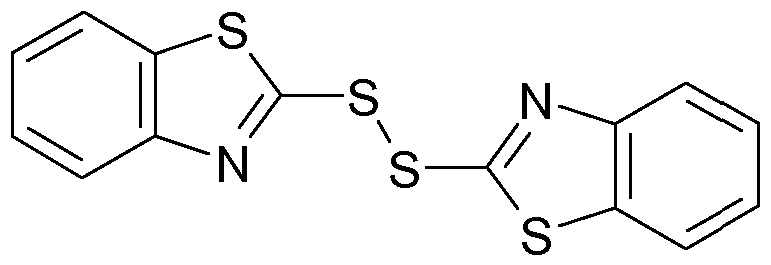
- Such benzothiazole compounds which do not have sulfenamide group -S-NR 2 include: mercaptobenzothiazoles and dibenzothiazolyl disulfides, and preferred examples include alkylated mercaptobenzothiazoles and bis (alkylated benzothiazolyl) disulfides. Specific examples include mercaptobenzothiazole, 4-
- Methylmercaptobenzothiazole 4-ethylmercaptobenzothiazole, 2,2'-dithiobisercaptobenzothiazole, 2,2'-dithiobis (4-methylmercaptobenzothiazo 1), 2, 2 '-dithiobis (4-ethylmercaptobenzothiazole).
- a preferred representative is the MBTS, 2,2'-dithiobis [benzothiazole], of the formula
- the amount of the thiazole compound used in combination with the dithiophosphate compound is suitably 0 to 4 parts by weight, preferably 0.1 to 3 parts by weight, more preferably 0.5 to 2 parts by weight to the 100 parts by weight of the diene elastomer (component a)).
- compositions obtained according to the invention preferably contain a sulfenamide compound as defined above.
- Vulcanization activators are preferably selected from the following group:
- Metal oxides e.g. Zinc oxide and / or amines.
- the total amount of rubber auxiliary is in the range of 1 to 300 parts by weight based on 100 parts by weight of total rubber. Preference is given to using 5 to 150 parts by weight of rubber auxiliaries.
- a preferred vulcanizable rubber mixture according to the invention contains, based on 100
- the present invention further relates to a process for the preparation of the rubber mixture according to the invention in which a mixture containing trimethylolpropane and at least one fatty acid is added to a rubber mixture.
- the method preferably comprises the following steps: (I) mixing at least one functionalized diene rubber, at least one light filler and optionally at least one coupling agent for said filler, then
- trimethylolpropane and fatty acid (s) are added directly to the mixture of the diene elastomer (s) and the bright filler (and optionally the light filler coupling agent).
- trimethylolpropane and the fatty acid (s) may be added together or separately.
- ingredients of the rubber composition such as the ingredients of the selected cure system, such as curatives, cure accelerators, and cure activators.
- the rubber mixtures of the invention can be prepared in the usual Appaturen, such as mixing units, especially rollers, kneaders, internal mixers and mixing extruders.
- Vulcanization of the rubber mixtures of the invention may be preferred at temperatures of
- the vulcanization is per se in a known manner during a sufficient period of time.
- Period of time which may for example be in the range of 5 to 90 minutes, and in particular the vulcanization temperature, the selected vulcanization system and the
- the invention furthermore relates to the use of the rubber mixture according to the invention for the production of pneumatic tires or semi-finished products for pneumatic tires, such as treads, tread underlay layers, crown layers, side profiles, carcass plies, tire beads, protectors, hoses or inner sides for tubeless tires, etc.
- the invention further relates to a process for the preparation of crosslinked elastomer moldings, which comprises introducing the rubber mixtures produced according to the invention into a mold and subsequently vulcanizing the rubber mixture in the mold.
- the invention thus embraces the above-described rubber blends according to the invention in the raw state (i.e., prior to vulcanization) as well as vulcanized (i.e., after crosslinking or curing)
- compositions prepared according to the invention can of course be used used singly or in blends with any other rubber blends useful in making pneumatic tires.
- Another object of the invention is also the use of the rubber mixtures according to the invention for the production of rubber vulcanizates, especially for the production of tires, in particular tire treads.
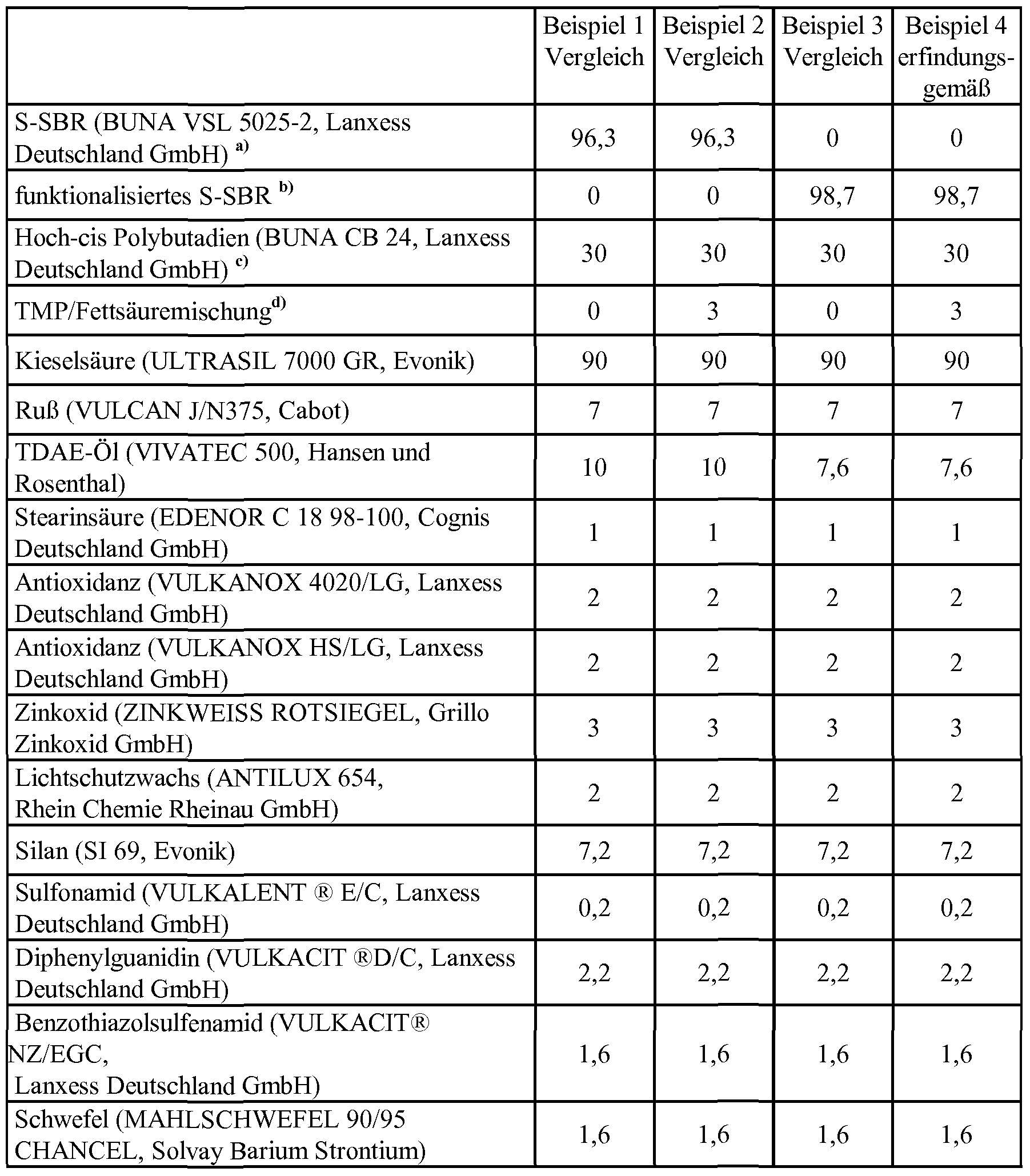
- Comparative Example 1 contains non-functionalized diene rubbers without processing aids.
- Comparative Example 2 contains non-functionalized diene rubber with the processing aid corresponding to components C) and D).
- Comparative Example 3 contains a functionalized
- Inventive Example 4 contains a functionalized diene rubber with a processing aid corresponding to components C) and D).
- VSL 5025-2 solution SBR (50% vinyl content, 25% styrene content, TDAE-oil content of 27.3%, Mooney viscosity ML 1 + 4 at 100 0 C) of 50 Mooney units
- Buna CB 24 Nd-polybutadiene having> 97% cis content, Mooney viscosity (ML 1 + 4 at 100 0 C) of 44 Mooney units d) TMP / fatty acid mixture: 25% trimethylolpropane, 70% stearic acid), 5% polyethylene glycol
- TMP / fatty acid mixture leads in both the rubber mixture with non-functionalized diene rubbers to a lowering of the mixture Mooney viscosity (Comparison Example 2 to Example 1) and in the rubber mixture with functionalized diene rubber (Example 4 to Example 3).
- a low rolling resistance is required, which occurs when in the vulcanizate a high value for the rebound resilience at 60 0 C, a low tan ⁇ value in the dynamic damping at high temperature (60 0 C) and a low ⁇ G * and a low tan ⁇ -
- Example 1 The use of the TMP / fatty acid mixture thus suggests a deterioration of both the rolling resistance and the wet skid resistance.
- TMP / fatty acid mixture in the rubber mixture with the functionalized diene rubber results in the corresponding vulcanizate to a higher rebound resilience at 60 0 C, a lower tan delta value at 60 0 C, a lower ⁇ G * and lower tan delta maximum in the MTS as well as to a higher tan delta value at 0 0 C compared to the Vulkanisat probe from the rubber composition with the functionalized diene rubber, but without processing aids (Comparative Example 4 with Example 3).
- the use of the TMP / fatty acid mixture in the rubber mixture with the functionalized diene rubber thus leads to an improvement in both the rolling resistance and the wet skid resistance.
Landscapes
- Chemical & Material Sciences (AREA)
- Health & Medical Sciences (AREA)
- Chemical Kinetics & Catalysis (AREA)
- Medicinal Chemistry (AREA)
- Polymers & Plastics (AREA)
- Organic Chemistry (AREA)
- Compositions Of Macromolecular Compounds (AREA)
- Tires In General (AREA)
- Addition Polymer Or Copolymer, Post-Treatments, Or Chemical Modifications (AREA)
Abstract
Description


Claims
Priority Applications (8)
| Application Number | Priority Date | Filing Date | Title |
|---|---|---|---|
| BRPI1010622A BRPI1010622A2 (pt) | 2009-05-27 | 2010-05-14 | misturas de borrachas diências funcionalizadas com trimetilolpropano e ácido graxo, um método para sua fabricação e sua utilização |
| US13/321,992 US9593228B2 (en) | 2009-05-27 | 2010-05-14 | Mixtures composed of functionalized diene rubbers with trimethylolpropane and fatty acid, a process for production thereof and use thereof |
| JP2012512298A JP5444459B2 (ja) | 2009-05-27 | 2010-05-14 | トリメチロールプロパンおよび脂肪酸を含む官能化ジエンゴムで構成された混合物、その使用ならびにその製造方法 |
| RU2011153001/05A RU2544658C9 (ru) | 2009-05-27 | 2010-05-14 | Смеси функционализированных диеновых каучуков с триметилолпропаном и жирной кислотой, способ их получения и их применение |
| KR1020117031013A KR101364920B1 (ko) | 2009-05-27 | 2010-05-14 | 관능화 디엔 고무와 트리메틸올프로판 및 지방산으로 구성된 혼합물, 그의 제조 방법 및 그의 용도 |
| CN2010800231400A CN102449049A (zh) | 2009-05-27 | 2010-05-14 | 由功能化的二烯基橡胶与三羟甲基丙烷和脂肪酸组成的混合物、其生产方法及其用途 |
| EP10722041A EP2435510A1 (de) | 2009-05-27 | 2010-05-14 | Mischungen aus funktionalisierten dienkautschuken mit trimethylolpropan und fettsäure, ein verfahren zu deren herstellung und deren verwendung |
| MX2011012506A MX337497B (es) | 2009-05-27 | 2010-05-14 | Mezclas de cauchos de dieno funcionalizados con trimetilolpropano y acido graso, un procedimiento para su preparacion y sus uso. |
Applications Claiming Priority (2)
| Application Number | Priority Date | Filing Date | Title |
|---|---|---|---|
| DE102009023915A DE102009023915A1 (de) | 2009-05-27 | 2009-05-27 | Mischungen aus funktionalisierten Dienkautschuken mit Trimethylolpropan und Fettsäure, ein Verfahren zu deren Herstellung und deren Verwendung |
| DE102009023915.4 | 2009-05-27 |
Publications (1)
| Publication Number | Publication Date |
|---|---|
| WO2010136345A1 true WO2010136345A1 (de) | 2010-12-02 |
Family
ID=42555575
Family Applications (1)
| Application Number | Title | Priority Date | Filing Date |
|---|---|---|---|
| PCT/EP2010/056663 Ceased WO2010136345A1 (de) | 2009-05-27 | 2010-05-14 | Mischungen aus funktionalisierten dienkautschuken mit trimethylolpropan und fettsäure,ein verfahren zu deren herstellung und deren verwendung |
Country Status (11)
| Country | Link |
|---|---|
| US (1) | US9593228B2 (de) |
| EP (1) | EP2435510A1 (de) |
| JP (1) | JP5444459B2 (de) |
| KR (1) | KR101364920B1 (de) |
| CN (2) | CN105348597A (de) |
| BR (1) | BRPI1010622A2 (de) |
| DE (1) | DE102009023915A1 (de) |
| MX (1) | MX337497B (de) |
| RU (1) | RU2544658C9 (de) |
| TW (1) | TWI561584B (de) |
| WO (1) | WO2010136345A1 (de) |
Cited By (5)
| Publication number | Priority date | Publication date | Assignee | Title |
|---|---|---|---|---|
| CN102642447A (zh) * | 2011-02-16 | 2012-08-22 | 建大工业股份有限公司 | 低滚动阻力的公路自行车胎 |
| EP2568003A1 (de) * | 2011-09-06 | 2013-03-13 | Rhein Chemie Rheinau GmbH | Füllstoffmischungen für Kautschukmischungen |
| EP4488074A1 (de) | 2023-07-07 | 2025-01-08 | LANXESS Deutschland GmbH | Kautschukmischungen enthaltend polyethylenimin und mindestens ein prozesshilfsmittel enthaltend mindestens eine fettsäure |
| EP4559967A1 (de) | 2023-11-24 | 2025-05-28 | LANXESS Deutschland GmbH | Kautschukmischungen enthaltend mindestens ein prozesshilfsmittel der formel (i) |
| EP4624523A1 (de) | 2024-03-26 | 2025-10-01 | LANXESS Deutschland GmbH | Kautschukmischungen enthaltend mindestens eine nichtaromatische, polare substanz |
Families Citing this family (10)
| Publication number | Priority date | Publication date | Assignee | Title |
|---|---|---|---|---|
| DE102009023915A1 (de) * | 2009-05-27 | 2010-12-02 | Rhein-Chemie Rheinau Gmbh | Mischungen aus funktionalisierten Dienkautschuken mit Trimethylolpropan und Fettsäure, ein Verfahren zu deren Herstellung und deren Verwendung |
| DE102012205642A1 (de) * | 2012-04-05 | 2013-10-10 | Evonik Industries Ag | Mercaptosilan-Ruß-Abmischung |
| JP5946387B2 (ja) | 2012-10-11 | 2016-07-06 | 東洋ゴム工業株式会社 | ゴムウエットマスターバッチ |
| RU2507225C1 (ru) * | 2012-10-26 | 2014-02-20 | Федеральное государственное бюджетное образовательное учреждение высшего профессионального образования "Волгоградский государственный технический университет" (ВолгГТУ) | Резиновая смесь на основе бутадиен-метилстирольного каучука |
| JP6359411B2 (ja) * | 2014-10-02 | 2018-07-18 | 東洋ゴム工業株式会社 | スチールコード被覆用ゴム組成物及び空気入りタイヤ |
| JP6420196B2 (ja) * | 2015-04-01 | 2018-11-07 | 東洋ゴム工業株式会社 | ゴム組成物の製造方法 |
| US10179479B2 (en) | 2015-05-19 | 2019-01-15 | Bridgestone Americas Tire Operations, Llc | Plant oil-containing rubber compositions, tread thereof and race tires containing the tread |
| TWI614311B (zh) | 2017-06-14 | 2018-02-11 | 台灣奈米碳素股份有限公司 | 用於製造彈性複合材料的配方、以及彈性複合材料之製造方法 |
| TWI672217B (zh) | 2017-06-14 | 2019-09-21 | 台灣奈米碳素股份有限公司 | 胎面膠以及用於生產胎面膠的配方 |
| CN108039241A (zh) * | 2017-12-21 | 2018-05-15 | 江苏长城电缆有限公司 | 一种石化监控系统智能化机器人用控制电缆及制作方法 |
Citations (1)
| Publication number | Priority date | Publication date | Assignee | Title |
|---|---|---|---|---|
| EP1253167A1 (de) * | 2001-04-25 | 2002-10-30 | Continental Aktiengesellschaft | Kautschukmischung für Laufstreifen von Reifen |
Family Cites Families (45)
| Publication number | Priority date | Publication date | Assignee | Title |
|---|---|---|---|---|
| BE787691A (fr) | 1971-08-17 | 1973-02-19 | Degussa | Composes organosiliciques contenant du soufre |
| US3873489A (en) | 1971-08-17 | 1975-03-25 | Degussa | Rubber compositions containing silica and an organosilane |
| US3978103A (en) | 1971-08-17 | 1976-08-31 | Deutsche Gold- Und Silber-Scheideanstalt Vormals Roessler | Sulfur containing organosilicon compounds |
| SU580840A3 (ru) | 1974-02-07 | 1977-11-15 | Дегусса (Фирма) | Способ получени серосодержащих кремнийорганических соединений |
| JP3071885B2 (ja) * | 1991-08-08 | 2000-07-31 | 出光石油化学株式会社 | 制振材用組成物 |
| US5830817A (en) | 1994-07-13 | 1998-11-03 | Rhein Chemie Rheinau Gmbh | Accelerator combinations |
| DE4424681A1 (de) | 1994-07-13 | 1996-01-18 | Rhein Chemie Rheinau Gmbh | Beschleunigergemische |
| US5580919A (en) | 1995-03-14 | 1996-12-03 | The Goodyear Tire & Rubber Company | Silica reinforced rubber composition and use in tires |
| FR2732351B1 (fr) | 1995-03-29 | 1998-08-21 | Michelin & Cie | Composition de caoutchouc pour enveloppe de pneumatique renfermant de la silice dopee aluminium a titre de charge renforcante |
| AT405285B (de) | 1995-09-07 | 1999-06-25 | Semperit Ag | Kautschukmischung |
| US5583245A (en) | 1996-03-06 | 1996-12-10 | The Goodyear Tire & Rubber Company | Preparation of sulfur-containing organosilicon compounds |
| FR2749313A1 (fr) | 1996-05-28 | 1997-12-05 | Michelin & Cie | Composition de caoutchouc dienique a base d'alumine en tant que charge renforcante et son utilisation pour la fabrication d'enveloppes de pneumatiques |
| US5696197A (en) | 1996-06-21 | 1997-12-09 | The Goodyear Tire & Rubber Company | Heterogeneous silica carbon black-filled rubber compound |
| JP3548386B2 (ja) | 1996-09-25 | 2004-07-28 | 株式会社ブリヂストン | 空気入りタイヤ |
| US5663396A (en) | 1996-10-31 | 1997-09-02 | The Goodyear Tire & Rubber Company | Preparation of sulfur-containing organosilicon compounds |
| US5684172A (en) | 1997-02-11 | 1997-11-04 | The Goodyear Tire & Rubber Company | Process for the preparation of organosilicon polysulfide compounds |
| US5684171A (en) | 1997-02-11 | 1997-11-04 | The Goodyear Tire & Rubber Company | Process for the preparation of organosilicon polysulfide compounds |
| FR2763074B1 (fr) * | 1997-05-07 | 1999-06-25 | Michelin & Cie | Composition de caoutchouc a base de noir de carbone ayant de la silice fixee a sa surface et de polymere dyenique fonctionalise ou modifie par des fonctions silanols |
| DE19818552A1 (de) * | 1998-04-24 | 1999-10-28 | Bayer Ag | Mischungen aus Kautschuken und aktivierten und hydrophobierten exidischen und silikatischen Füllstoffen und ein Verfahren zur Herstellung |
| CA2338150A1 (fr) | 1998-07-22 | 2000-02-03 | Societe De Technologie Michelin | Systeme de couplage (charge blanche/elastomere dienique) a base d'alkoxysilane polysulfure, de dithiophosphate de zinc et de derive guanidique |
| DE19914848A1 (de) * | 1999-04-01 | 2000-10-05 | Bayer Ag | Hydroxylgruppenhaltige Lösungskautschuke |
| WO2000073372A1 (fr) | 1999-05-28 | 2000-12-07 | Societe De Technologie Michelin | Composition de caoutchouc pour pneumatique, a base d'elastomere dienique et d'un oxyde de titane renforçant |
| DE19956118A1 (de) | 1999-11-22 | 2001-05-23 | Bayer Ag | Kautschukmischungen aus hydroxyl- und carboxylgruppenhaltigen Dienkautschuken und schwefelfreien Vernetzern |
| RU2266929C2 (ru) | 1999-12-30 | 2005-12-27 | Сосьете Де Текноложи Мишлен | Резиновая композиция для пневматических шин и их полупродуктов, содержащая связующий агент (белая сажа/эластомер) со сложноэфирной функцией, и способ ее получения |
| DE10012407A1 (de) * | 2000-03-15 | 2001-09-20 | Bayer Ag | Polyether enthaltende Kautschukmischungen |
| KR100806662B1 (ko) * | 2000-05-22 | 2008-02-28 | 소시에떼 드 테크놀로지 미쉐린 | 타이어 주행 트레드용 조성물 및 이의 제조방법 |
| DE10054533A1 (de) | 2000-11-03 | 2002-05-08 | Bayer Ag | Mikrogelhaltige Kautschukmischungen mit Phoshorylpolysulfiden und hieraus hergestellte Vulkanisate bzw. Formkörper |
| BR0208762B1 (pt) * | 2001-04-13 | 2012-10-30 | pneu para rodas de veìculo, banda de rodagem de pneu para rodas de veìculo, composição elastomérica, e, produto manufaturado elastomérico reticulado. | |
| DE10119774C2 (de) * | 2001-04-23 | 2003-04-17 | Dura Automotive Plettenberg | Verriegelungsgriff, insbesondere für Kraftfahrzeuge |
| EP1285926B1 (de) | 2001-08-06 | 2004-05-12 | Degussa AG | Organosiliciumverbindungen |
| CA2386628C (en) | 2002-05-16 | 2010-07-06 | Bayer Inc. | Hologen- and sulfur-free shaped articles comprising peroxide curable compounds of butyl rubber |
| CN1200020C (zh) * | 2002-07-17 | 2005-05-04 | 中国石油天然气集团公司 | 一种端羟基聚丁二烯-苯乙烯液体橡胶的合成方法 |
| FR2854404B1 (fr) | 2003-04-29 | 2005-07-01 | Michelin Soc Tech | Procede d'obtention d'un elastomere greffe a groupes fonctionnels le long de la chaine et compositions de caoutchouc |
| JP2006008749A (ja) * | 2004-06-22 | 2006-01-12 | Kuraray Co Ltd | ゴム組成物、架橋性ゴム組成物および架橋物 |
| KR20070053224A (ko) * | 2004-08-10 | 2007-05-23 | 제이에스알 가부시끼가이샤 | 고무 조성물 및 타이어 |
| DE102004039545A1 (de) * | 2004-08-13 | 2006-02-23 | Rhein-Chemie Rheinau Gmbh | Neuartige Verarbeitungswirkstoffe für Kautschuk-Mischungen |
| US20080251174A1 (en) * | 2004-12-23 | 2008-10-16 | Francesco Romani | Pneumatic Tyre |
| US7947782B2 (en) * | 2005-05-16 | 2011-05-24 | Rhein Chemie Rheinau Gmbh | Microgel-containing vulcanisable composition |
| DE102005060122A1 (de) | 2005-12-16 | 2007-06-21 | Degussa Gmbh | Verfahren zur Herstellung von (Mercaptoorganyl)alkylpolyethersilanen |
| US20080027162A1 (en) * | 2006-07-25 | 2008-01-31 | Kuo-Chih Hua | Silica reinforced rubber composition and use in tires |
| JP2008150435A (ja) | 2006-12-14 | 2008-07-03 | Toyo Tire & Rubber Co Ltd | タイヤ用ゴム組成物及び空気入りタイヤ |
| AU2008304584B2 (en) * | 2007-09-25 | 2013-02-14 | Aetrex Worldwide, Inc. | Articles prepared using recycled materials and methods of preparation thereof |
| DE102008023885A1 (de) | 2008-05-16 | 2009-11-19 | Lanxess Deutschland Gmbh | Funktionalisierte hochvinylaromaten-haltige Dienkautschuke |
| DE102008052116A1 (de) * | 2008-10-20 | 2010-04-22 | Lanxess Deutschland Gmbh | Kautschukmischungen mit funktionalisierten Dienkautschuken und Mikrogelen, ein Verfahren zur Herstellung und deren Verwendung |
| DE102009023915A1 (de) * | 2009-05-27 | 2010-12-02 | Rhein-Chemie Rheinau Gmbh | Mischungen aus funktionalisierten Dienkautschuken mit Trimethylolpropan und Fettsäure, ein Verfahren zu deren Herstellung und deren Verwendung |
-
2009
- 2009-05-27 DE DE102009023915A patent/DE102009023915A1/de not_active Withdrawn
-
2010
- 2010-05-14 JP JP2012512298A patent/JP5444459B2/ja active Active
- 2010-05-14 US US13/321,992 patent/US9593228B2/en active Active
- 2010-05-14 RU RU2011153001/05A patent/RU2544658C9/ru not_active IP Right Cessation
- 2010-05-14 WO PCT/EP2010/056663 patent/WO2010136345A1/de not_active Ceased
- 2010-05-14 KR KR1020117031013A patent/KR101364920B1/ko not_active Expired - Fee Related
- 2010-05-14 CN CN201510845589.XA patent/CN105348597A/zh active Pending
- 2010-05-14 CN CN2010800231400A patent/CN102449049A/zh active Pending
- 2010-05-14 MX MX2011012506A patent/MX337497B/es active IP Right Grant
- 2010-05-14 BR BRPI1010622A patent/BRPI1010622A2/pt not_active Application Discontinuation
- 2010-05-14 EP EP10722041A patent/EP2435510A1/de not_active Withdrawn
- 2010-05-26 TW TW099116748A patent/TWI561584B/zh not_active IP Right Cessation
Patent Citations (1)
| Publication number | Priority date | Publication date | Assignee | Title |
|---|---|---|---|---|
| EP1253167A1 (de) * | 2001-04-25 | 2002-10-30 | Continental Aktiengesellschaft | Kautschukmischung für Laufstreifen von Reifen |
Cited By (8)
| Publication number | Priority date | Publication date | Assignee | Title |
|---|---|---|---|---|
| CN102642447A (zh) * | 2011-02-16 | 2012-08-22 | 建大工业股份有限公司 | 低滚动阻力的公路自行车胎 |
| EP2568003A1 (de) * | 2011-09-06 | 2013-03-13 | Rhein Chemie Rheinau GmbH | Füllstoffmischungen für Kautschukmischungen |
| EP4488074A1 (de) | 2023-07-07 | 2025-01-08 | LANXESS Deutschland GmbH | Kautschukmischungen enthaltend polyethylenimin und mindestens ein prozesshilfsmittel enthaltend mindestens eine fettsäure |
| WO2025012012A1 (de) | 2023-07-07 | 2025-01-16 | Lanxess Deutschland Gmbh | Kautschukmischungen enthaltend polyethylenimin und mindestens ein prozesshilfsmittel enthaltend mindestens eine fettsäure |
| EP4559967A1 (de) | 2023-11-24 | 2025-05-28 | LANXESS Deutschland GmbH | Kautschukmischungen enthaltend mindestens ein prozesshilfsmittel der formel (i) |
| WO2025108885A1 (de) | 2023-11-24 | 2025-05-30 | Lanxess Deutschland Gmbh | Kautschukmischungen enthaltend mindestens ein prozesshilfsmittel der formel (i) |
| EP4624523A1 (de) | 2024-03-26 | 2025-10-01 | LANXESS Deutschland GmbH | Kautschukmischungen enthaltend mindestens eine nichtaromatische, polare substanz |
| WO2025202016A1 (de) | 2024-03-26 | 2025-10-02 | Lanxess Deutschland Gmbh | Kautschukmischungen enthaltend mindestens eine nichtaromatische, polare substanz |
Also Published As
| Publication number | Publication date |
|---|---|
| MX337497B (es) | 2016-03-09 |
| KR101364920B1 (ko) | 2014-02-21 |
| JP5444459B2 (ja) | 2014-03-19 |
| RU2544658C9 (ru) | 2015-10-10 |
| RU2544658C2 (ru) | 2015-03-20 |
| BRPI1010622A2 (pt) | 2016-03-15 |
| DE102009023915A1 (de) | 2010-12-02 |
| MX2011012506A (es) | 2011-12-12 |
| CN105348597A (zh) | 2016-02-24 |
| JP2012528213A (ja) | 2012-11-12 |
| KR20120023135A (ko) | 2012-03-12 |
| US9593228B2 (en) | 2017-03-14 |
| TW201109389A (en) | 2011-03-16 |
| EP2435510A1 (de) | 2012-04-04 |
| TWI561584B (en) | 2016-12-11 |
| CN102449049A (zh) | 2012-05-09 |
| RU2011153001A (ru) | 2013-07-10 |
| US20120270974A1 (en) | 2012-10-25 |
Similar Documents
| Publication | Publication Date | Title |
|---|---|---|
| EP2435510A1 (de) | Mischungen aus funktionalisierten dienkautschuken mit trimethylolpropan und fettsäure, ein verfahren zu deren herstellung und deren verwendung | |
| DE102015218745B4 (de) | Kautschukmischung und Fahrzeugreifen | |
| EP1600472B1 (de) | Verfahren zur Herstellung von Kautschukmischungen | |
| EP3152253B1 (de) | Diphenylguanidin-freie kautschukmischungen enthaltend kurzkettige alkylester des glyzerins | |
| EP2105462B1 (de) | Kautschukmischung und daraus hergestellte Reifen | |
| DE102015210421A1 (de) | Kautschukmischung und Fahrzeugreifen | |
| DE102015218746A1 (de) | Kautschukmischung und Fahrzeugreifen | |
| DE102015210423A1 (de) | Kautschukmischung und Fahrzeugreifen | |
| DE102014214144A1 (de) | Schwefelvernetzbare Kautschukmischung und Fahrzeugreifen | |
| EP1626062A1 (de) | Neuartige Verarbeitungswirkstoffe für Kautschuk-Mischungen | |
| EP2700670A1 (de) | Kautschukmischung | |
| US8076404B2 (en) | Rubber compositions | |
| DE102005044456A1 (de) | Kautschukmischung und Reifen | |
| DE102009003720B4 (de) | Kautschukmischung und deren Verwendung | |
| DE102010016161B4 (de) | Kautschukmischung und deren Verwendung | |
| DE102016201195A1 (de) | Kautschukmischung und Fahrzeugreifen | |
| EP1215235B1 (de) | Kautschukmischung und Kieselsäure für eine Kautschukmischung | |
| EP3792306B1 (de) | Schwefelvernetzbare kautschukmischung, vulkanisat und fahrzeugreifen | |
| DE102022210845A1 (de) | Schwefelvernetzbare Kautschukmischung, Vulkanisat der Kautschukmischung und Fahrzeugreifen | |
| DE102023210260A1 (de) | Schwefelvernetzbare Kautschukmischung und Fahrzeugreifen | |
| EP4105277A1 (de) | Kautschukmischung und reifen | |
| DE102021212138A1 (de) | Schwefelvernetzbare Kautschukmischung, Vulkanisat der Kautschukmischung und Fahrzeugreifen | |
| DE102021206273A1 (de) | Kautschukmischung und Reifen | |
| DE102021206271A1 (de) | Kautschukmischung und Reifen |
Legal Events
| Date | Code | Title | Description |
|---|---|---|---|
| WWE | Wipo information: entry into national phase |
Ref document number: 201080023140.0 Country of ref document: CN |
|
| 121 | Ep: the epo has been informed by wipo that ep was designated in this application |
Ref document number: 10722041 Country of ref document: EP Kind code of ref document: A1 |
|
| WWE | Wipo information: entry into national phase |
Ref document number: MX/A/2011/012506 Country of ref document: MX |
|
| NENP | Non-entry into the national phase |
Ref country code: DE |
|
| WWE | Wipo information: entry into national phase |
Ref document number: 2012512298 Country of ref document: JP |
|
| WWE | Wipo information: entry into national phase |
Ref document number: 9442/DELNP/2011 Country of ref document: IN |
|
| WWE | Wipo information: entry into national phase |
Ref document number: 2010722041 Country of ref document: EP |
|
| ENP | Entry into the national phase |
Ref document number: 20117031013 Country of ref document: KR Kind code of ref document: A |
|
| ENP | Entry into the national phase |
Ref document number: 2011153001 Country of ref document: RU Kind code of ref document: A |
|
| WWE | Wipo information: entry into national phase |
Ref document number: 13321992 Country of ref document: US |
|
| REG | Reference to national code |
Ref country code: BR Ref legal event code: B01A Ref document number: PI1010622 Country of ref document: BR |
|
| ENP | Entry into the national phase |
Ref document number: PI1010622 Country of ref document: BR Kind code of ref document: A2 Effective date: 20111124 |