WO2010142851A1 - Thin battery - Google Patents
Thin battery Download PDFInfo
- Publication number
- WO2010142851A1 WO2010142851A1 PCT/FI2010/050476 FI2010050476W WO2010142851A1 WO 2010142851 A1 WO2010142851 A1 WO 2010142851A1 FI 2010050476 W FI2010050476 W FI 2010050476W WO 2010142851 A1 WO2010142851 A1 WO 2010142851A1
- Authority
- WO
- WIPO (PCT)
- Prior art keywords
- cathode
- mixture
- cathode paste
- paste
- boric acid
- Prior art date
- Legal status (The legal status is an assumption and is not a legal conclusion. Google has not performed a legal analysis and makes no representation as to the accuracy of the status listed.)
- Ceased
Links
Classifications
-
- H—ELECTRICITY
- H01—ELECTRIC ELEMENTS
- H01M—PROCESSES OR MEANS, e.g. BATTERIES, FOR THE DIRECT CONVERSION OF CHEMICAL ENERGY INTO ELECTRICAL ENERGY
- H01M6/00—Primary cells; Manufacture thereof
- H01M6/40—Printed batteries, e.g. thin film batteries
-
- H—ELECTRICITY
- H01—ELECTRIC ELEMENTS
- H01M—PROCESSES OR MEANS, e.g. BATTERIES, FOR THE DIRECT CONVERSION OF CHEMICAL ENERGY INTO ELECTRICAL ENERGY
- H01M10/00—Secondary cells; Manufacture thereof
- H01M10/05—Accumulators with non-aqueous electrolyte
- H01M10/058—Construction or manufacture
- H01M10/0585—Construction or manufacture of accumulators having only flat construction elements, i.e. flat positive electrodes, flat negative electrodes and flat separators
-
- H—ELECTRICITY
- H01—ELECTRIC ELEMENTS
- H01M—PROCESSES OR MEANS, e.g. BATTERIES, FOR THE DIRECT CONVERSION OF CHEMICAL ENERGY INTO ELECTRICAL ENERGY
- H01M4/00—Electrodes
- H01M4/02—Electrodes composed of, or comprising, active material
- H01M4/04—Processes of manufacture in general
- H01M4/0402—Methods of deposition of the material
- H01M4/0404—Methods of deposition of the material by coating on electrode collectors
-
- H—ELECTRICITY
- H01—ELECTRIC ELEMENTS
- H01M—PROCESSES OR MEANS, e.g. BATTERIES, FOR THE DIRECT CONVERSION OF CHEMICAL ENERGY INTO ELECTRICAL ENERGY
- H01M4/00—Electrodes
- H01M4/02—Electrodes composed of, or comprising, active material
- H01M4/06—Electrodes for primary cells
- H01M4/08—Processes of manufacture
-
- H—ELECTRICITY
- H01—ELECTRIC ELEMENTS
- H01M—PROCESSES OR MEANS, e.g. BATTERIES, FOR THE DIRECT CONVERSION OF CHEMICAL ENERGY INTO ELECTRICAL ENERGY
- H01M4/00—Electrodes
- H01M4/02—Electrodes composed of, or comprising, active material
- H01M4/36—Selection of substances as active materials, active masses, active liquids
- H01M4/58—Selection of substances as active materials, active masses, active liquids of inorganic compounds other than oxides or hydroxides, e.g. sulfides, selenides, tellurides, halogenides or LiCoFy; of polyanionic structures, e.g. phosphates, silicates or borates
- H01M4/5825—Oxygenated metallic salts or polyanionic structures, e.g. borates, phosphates, silicates, olivines
-
- H—ELECTRICITY
- H01—ELECTRIC ELEMENTS
- H01M—PROCESSES OR MEANS, e.g. BATTERIES, FOR THE DIRECT CONVERSION OF CHEMICAL ENERGY INTO ELECTRICAL ENERGY
- H01M4/00—Electrodes
- H01M4/02—Electrodes composed of, or comprising, active material
- H01M4/62—Selection of inactive substances as ingredients for active masses, e.g. binders, fillers
-
- H—ELECTRICITY
- H01—ELECTRIC ELEMENTS
- H01M—PROCESSES OR MEANS, e.g. BATTERIES, FOR THE DIRECT CONVERSION OF CHEMICAL ENERGY INTO ELECTRICAL ENERGY
- H01M4/00—Electrodes
- H01M4/02—Electrodes composed of, or comprising, active material
- H01M4/62—Selection of inactive substances as ingredients for active masses, e.g. binders, fillers
- H01M4/621—Binders
-
- H—ELECTRICITY
- H01—ELECTRIC ELEMENTS
- H01M—PROCESSES OR MEANS, e.g. BATTERIES, FOR THE DIRECT CONVERSION OF CHEMICAL ENERGY INTO ELECTRICAL ENERGY
- H01M6/00—Primary cells; Manufacture thereof
- H01M6/04—Cells with aqueous electrolyte
- H01M6/06—Dry cells, i.e. cells wherein the electrolyte is rendered non-fluid
- H01M6/12—Dry cells, i.e. cells wherein the electrolyte is rendered non-fluid with flat electrodes
-
- H—ELECTRICITY
- H01—ELECTRIC ELEMENTS
- H01M—PROCESSES OR MEANS, e.g. BATTERIES, FOR THE DIRECT CONVERSION OF CHEMICAL ENERGY INTO ELECTRICAL ENERGY
- H01M4/00—Electrodes
- H01M4/02—Electrodes composed of, or comprising, active material
- H01M4/62—Selection of inactive substances as ingredients for active masses, e.g. binders, fillers
- H01M4/624—Electric conductive fillers
- H01M4/625—Carbon or graphite
-
- Y—GENERAL TAGGING OF NEW TECHNOLOGICAL DEVELOPMENTS; GENERAL TAGGING OF CROSS-SECTIONAL TECHNOLOGIES SPANNING OVER SEVERAL SECTIONS OF THE IPC; TECHNICAL SUBJECTS COVERED BY FORMER USPC CROSS-REFERENCE ART COLLECTIONS [XRACs] AND DIGESTS
- Y02—TECHNOLOGIES OR APPLICATIONS FOR MITIGATION OR ADAPTATION AGAINST CLIMATE CHANGE
- Y02E—REDUCTION OF GREENHOUSE GAS [GHG] EMISSIONS, RELATED TO ENERGY GENERATION, TRANSMISSION OR DISTRIBUTION
- Y02E60/00—Enabling technologies; Technologies with a potential or indirect contribution to GHG emissions mitigation
- Y02E60/10—Energy storage using batteries
-
- Y—GENERAL TAGGING OF NEW TECHNOLOGICAL DEVELOPMENTS; GENERAL TAGGING OF CROSS-SECTIONAL TECHNOLOGIES SPANNING OVER SEVERAL SECTIONS OF THE IPC; TECHNICAL SUBJECTS COVERED BY FORMER USPC CROSS-REFERENCE ART COLLECTIONS [XRACs] AND DIGESTS
- Y02—TECHNOLOGIES OR APPLICATIONS FOR MITIGATION OR ADAPTATION AGAINST CLIMATE CHANGE
- Y02P—CLIMATE CHANGE MITIGATION TECHNOLOGIES IN THE PRODUCTION OR PROCESSING OF GOODS
- Y02P70/00—Climate change mitigation technologies in the production process for final industrial or consumer products
- Y02P70/50—Manufacturing or production processes characterised by the final manufactured product
Definitions
- the invention relates to a thin flexible battery, and in particular, to a cathode paste usable in the battery, providing improved performance proper- ties for a thin battery. Also, a method for manufacturing the cathode paste and a cathode half-cell are provided.
- US 2003/0044686 A1 discloses a conformal separator for an electrochemical cell disposed at the interface of the anode and cathode, providing electrical isolation between the anode and cathode.
- an improved separator construction is provided by including a borate derivate, like boric acid, into the separator.
- a borate derivate like boric acid
- This separator is reported to have improved characteristics, i.a. re- Jerusalem wall thickness and high ionic conductivity between the anode and cathode, compared to those of non-woven fabrics.
- the separator is applicable to both traditional cylindrical cells and button-size metal-air cells. All of this type of batteries have a metal shell outside and radially compressed seal side wall between the anode and cathode to prevent leakage of an electrolyte.
- the present invention relates to a thin battery the construction of which is notably different from that of US 2003/0044686 A1.
- thin batteries have unique properties which distinguish them from conventional batteries, and provide a wide range of applications not possible to be realized by the conventional batteries, such as powers sources for consumer products and for micro-sized applications, like powering smart cards, Radio Frequency Identification (RFID) tags, and generally in low power applications, such as in Light Emitting Diodes (LEDs).
- RFID Radio Frequency Identification
- a thin battery assembly comprises an anode material and cathode material which are applied as aqueous pastes on opposite sides of one or more separator layers.
- the separator layer can be made of paper, plastics or any other material in a form of thin foil. Separator is typically of paper and can comprise one or more paper layers.
- the battery also comprises an electrolyte.
- One problem of the current flexible thin batteries composed of one or more anode layer, separator layer and cathode layer is that delamination of the various layers in the battery assembly occurs to some extent during the life time, i.e. during the storage and use, of the battery. Unlike in conventional bat- teries, there is no metal shell in thin batteries to press the various layers together to prevent delamination.
- the delamination effect causes a remarkable deterioration in the battery performance and can even stop the function entirely.
- the reduced performance can be seen during the long-term use and storage of the battery.
- an improved thin battery is needed which maintains a good performance throughout its life time.
- An object of the present invention is to provide a thin battery which avoids the disadvantages associated with the current thin batteries.
- the object of the invention is achieved by arrangements which are characterized by what is stated in the independent claims.
- a cathode paste in- eluding a suitable amount of boric acid can be more easily printed on the cathode collector compared to that including no boric acid due to its viscosity modification effect in the cathode paste composition. Furthermore, it has been recognised that the use of boric acid increases the homogeneity and uniformity of the cathode paste contributing to a good performance of a thin battery. Also, it has been found that boric acid increases the pH of the cathode paste. The pH increase has a benefit in that open voltage of the battery increases.
- Another object of the invention is to provide a cathode paste for a thin battery.
- a further object of the present invention is to provide a cathode comprising the cathode paste of the present invention. Yet a further object of the invention is to provide a process for preparing a cathode paste of the invention.
- Figure 1 illustrates a schematic view of a typical thin battery assembly of the invention.
- a thin battery assembly of the invention is composed of an anode electrode, a cathode electrode and a separator disposed therebetween.
- An example of typical assembly of a thin battery of the invention is described in Fig. 1.
- the term "thin battery”, in context of the present invention, is to be understood as “layer-structured batteries” in any shape or size. It has a characteristic of a flexible and bendable structure.
- the thickness of a thin battery is typically less than 1 mm.
- the manufacture of the thin battery composed of several layers of the invention can be performed in a conventional manner and can be accomplished, for example, as disclosed in WO 2008/096033.
- separator papers 1 , 2 are wetted with an electrolyte solution whereafter an anode material 7 is applied on a first separator paper 1 , and a cathode material 8 is applied on a second separator paper 2 or on the cathode collector 5 by a printing or coating procedure.
- Wetting of the separator can also be performed by printing the electrolyte solution only on one of the separator papers.
- the separator can also comprise more than two paper layers. Additionally, the separator can be of other material than paper, for instance plastics like polymer films.
- the separator papers 1 , 2 are then combined by pressing them together so that the anode and cathode materials are outermost, respectively. If desired, the combined separator papers are then cut into desired forms and sizes.
- anode and cathode materials are then applied on an anode collector 4 and a cathode collector 5, respectively, by printing or coating. If desired, the collectors thus obtained are cut again into desired forms and sizes. Finally, a cover material 9, like polypropylene, polyethylene, metallized polyethylene terephtalate, polyester, or any other known cover material is applied on both sides of the combined anode and cathode collectors to form an envelope around the product.
- An object of the invention is to provide a cathode paste for a cathode electrode to be used in a thin battery.
- the cathode paste of the invention comprises a cathode active material, an electrolyte solution, one or more binding agent and boric acid.
- the term paste in the context of the present invention is to be understood as a viscous aqueous dispersion of solid particles included in the paste.
- the cathode active material can be, e.g., ferrate, iron oxide, cuprous oxide, cobalt oxide, manganese dioxide, lead dioxide, silver oxide and nickel oxyhydroxide, nickel dioxide, silver peroxide, permanganate or bromate.
- the cathode active material is manganese dioxide.
- the electrolyte included in the cathode paste can be, e.g., ZnCI 2 , NH 4 CI, KOH, NaOH.
- the cathode paste comprises ZnCI 2 electrolyte in an amount ranging from 3M to 1 OM, pre- ferably from 8M to 9M.
- the content of boric acid in the cathode paste ranges from 0.02 to 0.2% on weight basis of the cathode paste. In a specific embodiment of the invention, the content ranges from 0.05% to 0.15% on weight basis of the cathode paste. In another specific embodiment of the invention, the amount is 0.08% on weight basis of the cathode paste.
- the cathode paste can further comprise conductive material, such as carbon powder, like graphite powder, soot, carbon black, carbon nanotubes or combinations thereof.
- conductive material such as carbon powder, like graphite powder, soot, carbon black, carbon nanotubes or combinations thereof.
- the amount of the conductive material in the cathode paste ranges from about 5 to 20% on weight basis of the cathode active material, the preferable amount being 10% on weight basis of the cathode active material .
- the cathode paste further comprises additive(s), like binding agent, such as polyvinyl alcohol (PVA), carboxy methylcellulose (CMC), or mixture thereof.
- PVA polyvinyl alcohol
- CMC carboxy methylcellulose
- the additive is included to bind various ingredients in the paste together to form a paste. Suitable amount of the binding agent ranges from 2 to 10% on weight basis of the electrolyte solution, preferably from 3 to 5% on weight basis of the electrolyte solution.
- the cathode paste comprises Mn ⁇ 2 as a cathode active material, PVA as a binding agent, graphite powder as a conductive material, ZnC ⁇ as an electrolyte, and boric acid.
- the cathode paste comprises Mn ⁇ 2 as a cathode active material, PVA and CMC as binding agents, graphite powder and carbon nanotubes as a conductive material, ZnC ⁇ as an electrolyte, and boric acid.
- An anode material for the anode electrode used in a thin battery of the present invention comprises an anode active material, like metal powder, such as of Cu, Pb, Ni, Fe, Cr, Zn, Al, or Mg.
- the anode active material is zinc.
- the anode material is applied in a form of a dry ink or a paste.
- an electrolyte solution is mixed with an anode active material.
- the anode paste can further comprise conductive material, such as carbon powder, like graphite powder, soot, carbon black, carbon nanotubes or combinations thereof.
- the amount of the conductive material in the anode paste ranges from about 1 to 5% on weight basis of the anode active material, the preferable amount being about 2% on weight basis of the anode active mate- rial.
- the anode paste can further comprise additives, like binding agents, such as polyvinyl alcohol (PVA), carboxy methylcellulose (CMC), or a mixture thereof.
- PVA polyvinyl alcohol
- CMC carboxy methylcellulose
- Suitable amount of the binding agent ranges from 2 to 10% on weight basis of the electrolyte solution, preferably from 3 to 5% on weight basis of the electrolyte solution.
- the anode material is in a dry form composed of powdered Zn and carbon ink.
- the anode material is prepared by adding zinc powder to the conductive carbon ink and keeping stirring until a homogenous mixture is obtained.
- suitable commercial zinc powders of battery grade are e.g. Grillo-Werke Aktiengesellschaft GZN-3-0 and Xstara EC-100 having a particle size of less than 50 ⁇ m and purity of more than 99%.
- a collector material for anode and cathode electrodes may be con- ductive carbon ink, carbon film or any other material which s chemically inert but conductive enough.
- the invention further provides a thin battery with a multilayer structure comprising the cathode paste of the invention for a cathode electrode as one layer.
- an anode material for providing an anode electrode for example, Zn as an anode active material in dry form, i.e. as ink, or in a paste form, can be used.
- the separator layer is paper, for example.
- the entire multilayer battery assembly is covered by a layer of polymeric film, like polyethylene, polypropylene, metallized polyethylene terephtalate, polyester, or any other polymeric films.
- the invention further provides a cathode comprising the cathode paste of the invention.
- the cathode comprises a separator layer, like paper, a cathode collector and a cover material.
- the invention further provides a method for preparing a cathode paste comprising the steps of:
- the method of the invention comprises the steps of:
- the cathode paste is manufactured by dissolving boric acid into an electrolyte solution.
- boric acid forms a crosslinked network structure with a polyvinyl alcohol polymer through hydrogen bonding of hydroxyl groups of the polymer backbone.
- reduced delamination effect may also be derived from the fact that as the cathode paste is in contact with the separa- tor paper, an increased binding between the layers may still be enhanced due to the crosslinking reactions between the amorphous regions of cellulose structure of paper and boric acid, holding the long cellulose chains together even more tightly. Binding force between the layers is thereby increased and de- lamination decreased which provides an improvement in the performance of the battery.
- An important feature of the thin battery of the invention is the viscosity of an electrolyte solution used in the cathode paste, i.e. the viscosity of the cathode paste.
- the quality of the battery depends on viscosity. It has been now found that including boric acid in a cathode paste the viscosity formation is enhanced. If the viscosity of the electrolyte solution is too high, admixture of cathode active materials into the electrolyte solution and printing process of the cathode paste onto a cathode collector becomes diffi- cult.
- the viscosity of an electrolyte solution is too low, difficulties may arise in printing of the desired amount of the cathode paste onto the cathode collector. Also, at a low viscosity range of an electrolyte solution the printed cathode paste owns a high mobility in the battery assembly which causes serious short circuit problems due to the penetration of the cathode paste into an anode side of the battery. Thus, control of the viscosity of the electrolyte solution or cathode paste is important to provide an optimum performance for the battery.
- the suitable viscosity range is controlled by the content of boric acid in the cathode paste. If the content is too high, also the viscosity rises too high making the printing of the cathode paste onto the separa- tor or the cathode collector difficult.
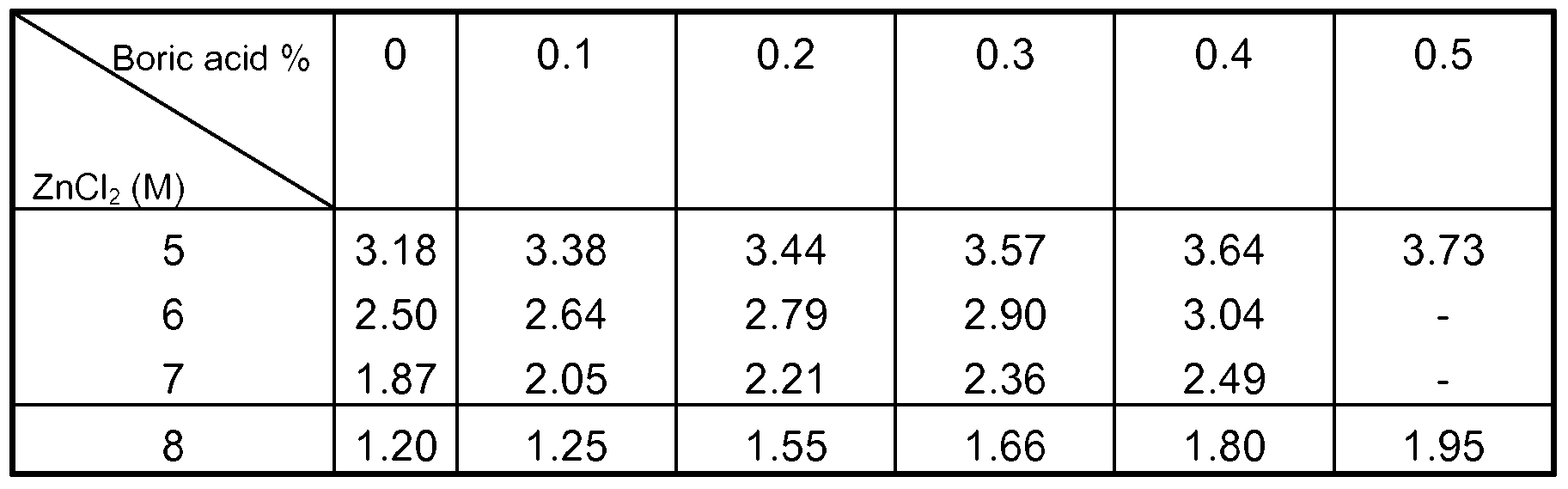
- the electrolyte solution contained an amount given above of ZnCI 2 , 1.6% of PVA, and 2.25% of CMC.
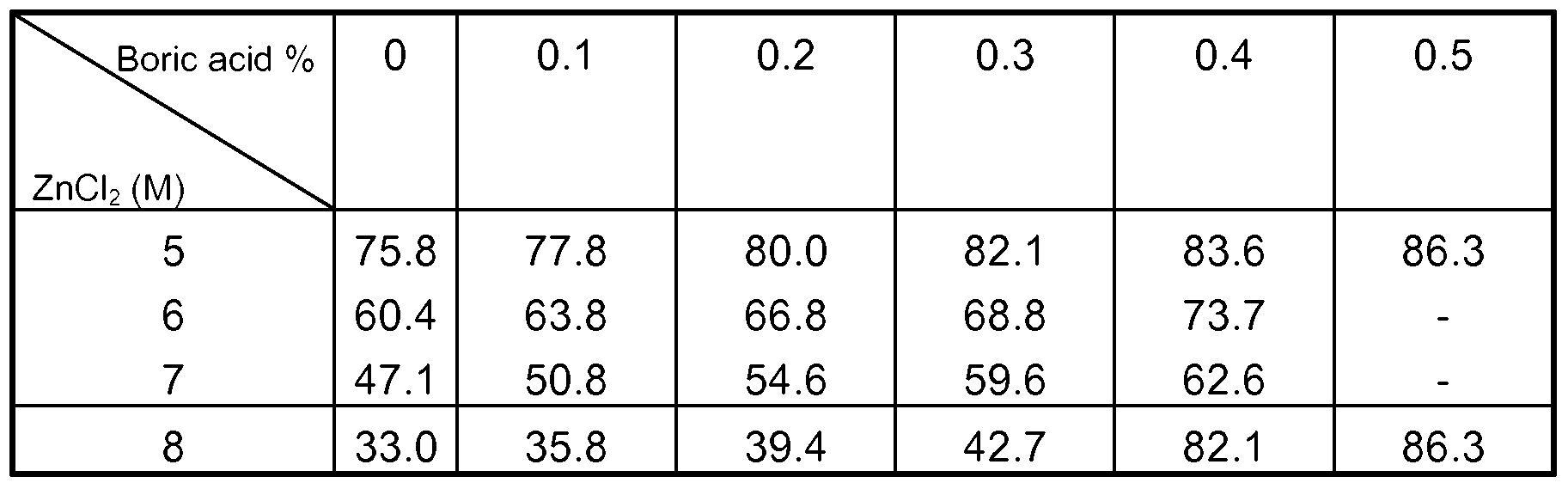
- the conductivity was measured by using FINNOLAB Handheld Conductivity Meter Cond 351 i/ST.
- Table 1 Effect of boric acid on pH of an electrolyte solution.
- Table 2 Effect of boric acid on conductivity (mS/cm) of an electrolyte solution.
- a thin battery comprising a cathode paste prepared above was manufactured as follows:
- An anode was prepared by printing zinc ink on a separator paper. The amount of zinc ink was 12 mg/m 2 .
- a cathode collector was printed by using Creative Materials conductive carbon ink 116 - 19 ink on the polyethylene coated paper. After drying the cathode collector, the cathode paste was applied thereon to form a cathode.
- the anode and cathode prepared above were then laminated together to form a thin battery assembly. Measurements showed that the capacity of the thin battery was 1.6 mAh/cm 2 .
- the cathode paste was applied on the cathode collector.
- a thin battery was assembled in the same manner as in Example 1.
- the capacity was thus 10 to 20% higher than that of the battery in which boric acid is mixed as powder with the cathode active material in the manufacturing process of the cathode paste.
Landscapes
- Chemical & Material Sciences (AREA)
- Chemical Kinetics & Catalysis (AREA)
- Electrochemistry (AREA)
- General Chemical & Material Sciences (AREA)
- Engineering & Computer Science (AREA)
- Manufacturing & Machinery (AREA)
- Crystallography & Structural Chemistry (AREA)
- Inorganic Chemistry (AREA)
- Primary Cells (AREA)
- Battery Electrode And Active Subsutance (AREA)
- Cell Separators (AREA)
Abstract
Description

Claims
Priority Applications (4)
| Application Number | Priority Date | Filing Date | Title |
|---|---|---|---|
| JP2012514503A JP2012529734A (en) | 2009-06-10 | 2010-06-09 | Thin battery |
| US13/376,712 US20120135297A1 (en) | 2009-06-10 | 2010-06-09 | Thin Battery |
| EP10785799A EP2441107A4 (en) | 2009-06-10 | 2010-06-09 | Thin battery |
| CN2010800283496A CN102804465A (en) | 2009-06-10 | 2010-06-09 | Thin battery |
Applications Claiming Priority (2)
| Application Number | Priority Date | Filing Date | Title |
|---|---|---|---|
| FI20095645A FI123479B (en) | 2009-06-10 | 2009-06-10 | thin Battery |
| FI20095645 | 2009-06-10 |
Publications (1)
| Publication Number | Publication Date |
|---|---|
| WO2010142851A1 true WO2010142851A1 (en) | 2010-12-16 |
Family
ID=40825351
Family Applications (1)
| Application Number | Title | Priority Date | Filing Date |
|---|---|---|---|
| PCT/FI2010/050476 Ceased WO2010142851A1 (en) | 2009-06-10 | 2010-06-09 | Thin battery |
Country Status (7)
| Country | Link |
|---|---|
| US (1) | US20120135297A1 (en) |
| EP (1) | EP2441107A4 (en) |
| JP (1) | JP2012529734A (en) |
| KR (1) | KR20120055531A (en) |
| CN (1) | CN102804465A (en) |
| FI (1) | FI123479B (en) |
| WO (1) | WO2010142851A1 (en) |
Cited By (3)
| Publication number | Priority date | Publication date | Assignee | Title |
|---|---|---|---|---|
| JP2014002953A (en) * | 2012-06-20 | 2014-01-09 | Sumitomo Chemical Co Ltd | Coating liquid, laminated porous film, and nonaqueous electrolyte secondary battery |
| US20140199578A1 (en) * | 2013-01-15 | 2014-07-17 | New Jersey Institute Of Technology | Flexible alkaline battery |
| EP2561564B1 (en) * | 2010-04-20 | 2019-05-29 | VARTA Microbattery GmbH | Printable electrolyte |
Families Citing this family (6)
| Publication number | Priority date | Publication date | Assignee | Title |
|---|---|---|---|---|
| KR101511342B1 (en) * | 2013-09-17 | 2015-04-14 | 한국생산기술연구원 | Inverse structured battery |
| WO2015093411A1 (en) | 2013-12-20 | 2015-06-25 | 三洋化成工業株式会社 | Electrode for lithium-ion cell, lithium-ion cell, and method for manufacturing electrode for lithium-ion cell |
| CN103824997B (en) * | 2014-03-20 | 2016-12-07 | 常州恩福赛印刷电子有限公司 | A kind of slim energy storage device and processing technology |
| GB2553128B (en) | 2016-08-24 | 2020-02-26 | Dst Innovations Ltd | Rechargeable power cells |
| CN113012948A (en) * | 2021-02-25 | 2021-06-22 | 海南大学 | Preparation method of zinc-carbon composite electrode material for zinc ion energy storage device |
| EP4279329A1 (en) | 2022-05-17 | 2023-11-22 | Scania CV AB | Control device and method for controlling an energy storage device |
Citations (5)
| Publication number | Priority date | Publication date | Assignee | Title |
|---|---|---|---|---|
| JPS6313270A (en) * | 1986-07-02 | 1988-01-20 | Japan Storage Battery Co Ltd | Manufacture of cadmium negative plate for alkaline storage battery |
| EP0945906A2 (en) * | 1998-03-27 | 1999-09-29 | Matsushita Electronics Corporation | Manganese dry batteries |
| US20030044686A1 (en) | 2001-05-24 | 2003-03-06 | Bushong William C. | Conformal separator for an electrochemical cell |
| WO2008096033A1 (en) | 2007-02-06 | 2008-08-14 | Enfucell Oy | Thin battery and a method of manufacturing a thin battery |
| WO2009069521A1 (en) * | 2007-11-26 | 2009-06-04 | Namics Corporation | Lithium ion rechargeable battery and process for rpoducing the rechargeable battery |
Family Cites Families (7)
| Publication number | Priority date | Publication date | Assignee | Title |
|---|---|---|---|---|
| US4268589A (en) * | 1977-12-08 | 1981-05-19 | Imatra Paristo Oy | Cell having improved rechargeability |
| JPS63250058A (en) * | 1987-04-03 | 1988-10-17 | Japan Storage Battery Co Ltd | Nickel positive electrode for alkaline storage battery and its manufacture |
| DE69226513T2 (en) * | 1991-10-09 | 1998-12-10 | Yuasa Battery Co Ltd | USE OF A MACROMOLECULAR COMPOUND FOR PRODUCING A DEPOLARIZING MIXTURE |
| JP3422457B2 (en) * | 1997-06-03 | 2003-06-30 | ティーポール株式会社 | Higher alcohol concentrated neutral detergent composition |
| US8722235B2 (en) * | 2004-04-21 | 2014-05-13 | Blue Spark Technologies, Inc. | Thin printable flexible electrochemical cell and method of making the same |
| US20060065161A1 (en) * | 2004-06-24 | 2006-03-30 | Miller Gerald D | Substrate coating compositions and their use |
| FI120475B (en) * | 2007-09-24 | 2009-10-30 | Enfucell Oy | Thin battery with longer life |
-
2009
- 2009-06-10 FI FI20095645A patent/FI123479B/en not_active IP Right Cessation
-
2010
- 2010-06-09 WO PCT/FI2010/050476 patent/WO2010142851A1/en not_active Ceased
- 2010-06-09 JP JP2012514503A patent/JP2012529734A/en active Pending
- 2010-06-09 KR KR1020127000448A patent/KR20120055531A/en not_active Withdrawn
- 2010-06-09 EP EP10785799A patent/EP2441107A4/en not_active Withdrawn
- 2010-06-09 CN CN2010800283496A patent/CN102804465A/en active Pending
- 2010-06-09 US US13/376,712 patent/US20120135297A1/en not_active Abandoned
Patent Citations (5)
| Publication number | Priority date | Publication date | Assignee | Title |
|---|---|---|---|---|
| JPS6313270A (en) * | 1986-07-02 | 1988-01-20 | Japan Storage Battery Co Ltd | Manufacture of cadmium negative plate for alkaline storage battery |
| EP0945906A2 (en) * | 1998-03-27 | 1999-09-29 | Matsushita Electronics Corporation | Manganese dry batteries |
| US20030044686A1 (en) | 2001-05-24 | 2003-03-06 | Bushong William C. | Conformal separator for an electrochemical cell |
| WO2008096033A1 (en) | 2007-02-06 | 2008-08-14 | Enfucell Oy | Thin battery and a method of manufacturing a thin battery |
| WO2009069521A1 (en) * | 2007-11-26 | 2009-06-04 | Namics Corporation | Lithium ion rechargeable battery and process for rpoducing the rechargeable battery |
Non-Patent Citations (1)
| Title |
|---|
| See also references of EP2441107A4 |
Cited By (4)
| Publication number | Priority date | Publication date | Assignee | Title |
|---|---|---|---|---|
| EP2561564B1 (en) * | 2010-04-20 | 2019-05-29 | VARTA Microbattery GmbH | Printable electrolyte |
| JP2014002953A (en) * | 2012-06-20 | 2014-01-09 | Sumitomo Chemical Co Ltd | Coating liquid, laminated porous film, and nonaqueous electrolyte secondary battery |
| US10177361B2 (en) | 2012-06-20 | 2019-01-08 | Sumitomo Chemical Company, Limited | Coating fluid, laminated porous film, and non-aqueous electrolyte secondary battery |
| US20140199578A1 (en) * | 2013-01-15 | 2014-07-17 | New Jersey Institute Of Technology | Flexible alkaline battery |
Also Published As
| Publication number | Publication date |
|---|---|
| CN102804465A (en) | 2012-11-28 |
| FI20095645L (en) | 2010-12-11 |
| FI123479B (en) | 2013-05-31 |
| EP2441107A4 (en) | 2013-04-03 |
| US20120135297A1 (en) | 2012-05-31 |
| JP2012529734A (en) | 2012-11-22 |
| KR20120055531A (en) | 2012-05-31 |
| FI20095645A0 (en) | 2009-06-10 |
| EP2441107A1 (en) | 2012-04-18 |
Similar Documents
| Publication | Publication Date | Title |
|---|---|---|
| WO2010142851A1 (en) | Thin battery | |
| US6399246B1 (en) | Latex binder for non-aqueous battery electrodes | |
| US10230132B2 (en) | Secondary cell with high recharging efficiency and long term stability | |
| CN102292851B (en) | Positive electrode for lithium secondary battery, and process for producing same | |
| US8574742B2 (en) | Battery and a method of manufacturing a battery | |
| CN101378135A (en) | Non-aqueous electrolyte secondary battery and producing method of electrode | |
| US20110269017A1 (en) | Positive electrode for lithium secondary batteries and use thereof | |
| CA2389907A1 (en) | Small format, high current density flat plate rechargeable electrochemical cell | |
| JP4358340B2 (en) | Non-sintered nickel electrode | |
| KR102886678B1 (en) | Negative electrode of all solid-state battery having polymer layer for preventing micro short and All solid-state battery having the same | |
| EP2951335B1 (en) | Coated iron electrode and method of making same | |
| JP4845245B2 (en) | Lithium battery | |
| FI122503B (en) | A printed thin battery and method of producing a printed thin battery | |
| AU2014212260B2 (en) | Iron electrode employing a polyvinyl alcohol binder | |
| KR20250047435A (en) | Negative electrode for lithium secondary battery of double layer structure with improved lifespan properties and method of manufacturing method the same and lithium secondary battery thereof | |
| El Baradai | Réalisation d’électrodes souples pour batteries lithium-ion par procédé d’impression | |
| CA2455548A1 (en) | Alkaline manganese dioxide cell with improved open circuit voltage | |
| KR20250026117A (en) | Anode for lithium secondary battery, its preparation method, and lithium secondary battery comprising the same | |
| JPH0367462A (en) | Nonaqueous solvent secondary battery | |
| JP2004296327A (en) | Alkaline battery |
Legal Events
| Date | Code | Title | Description |
|---|---|---|---|
| WWE | Wipo information: entry into national phase |
Ref document number: 201080028349.6 Country of ref document: CN |
|
| 121 | Ep: the epo has been informed by wipo that ep was designated in this application |
Ref document number: 10785799 Country of ref document: EP Kind code of ref document: A1 |
|
| WWE | Wipo information: entry into national phase |
Ref document number: 2012514503 Country of ref document: JP |
|
| NENP | Non-entry into the national phase |
Ref country code: DE |
|
| WWE | Wipo information: entry into national phase |
Ref document number: 2010785799 Country of ref document: EP |
|
| ENP | Entry into the national phase |
Ref document number: 20127000448 Country of ref document: KR Kind code of ref document: A |
|
| WWE | Wipo information: entry into national phase |
Ref document number: 13376712 Country of ref document: US |