WO2010142871A1 - Procede d'etancheification et d'assemblage de composants d'un groupe moto-propulseur - Google Patents
Procede d'etancheification et d'assemblage de composants d'un groupe moto-propulseur Download PDFInfo
- Publication number
- WO2010142871A1 WO2010142871A1 PCT/FR2010/000421 FR2010000421W WO2010142871A1 WO 2010142871 A1 WO2010142871 A1 WO 2010142871A1 FR 2010000421 W FR2010000421 W FR 2010000421W WO 2010142871 A1 WO2010142871 A1 WO 2010142871A1
- Authority
- WO
- WIPO (PCT)
- Prior art keywords
- polyorganosiloxane
- group
- radicals
- polycondensation
- parts
- Prior art date
- Legal status (The legal status is an assumption and is not a legal conclusion. Google has not performed a legal analysis and makes no representation as to the accuracy of the status listed.)
- Ceased
Links
Classifications
-
- C—CHEMISTRY; METALLURGY
- C09—DYES; PAINTS; POLISHES; NATURAL RESINS; ADHESIVES; COMPOSITIONS NOT OTHERWISE PROVIDED FOR; APPLICATIONS OF MATERIALS NOT OTHERWISE PROVIDED FOR
- C09J—ADHESIVES; NON-MECHANICAL ASPECTS OF ADHESIVE PROCESSES IN GENERAL; ADHESIVE PROCESSES NOT PROVIDED FOR ELSEWHERE; USE OF MATERIALS AS ADHESIVES
- C09J183/00—Adhesives based on macromolecular compounds obtained by reactions forming in the main chain of the macromolecule a linkage containing silicon, with or without sulfur, nitrogen, oxygen, or carbon only; Adhesives based on derivatives of such polymers
- C09J183/04—Polysiloxanes
-
- C—CHEMISTRY; METALLURGY
- C08—ORGANIC MACROMOLECULAR COMPOUNDS; THEIR PREPARATION OR CHEMICAL WORKING-UP; COMPOSITIONS BASED THEREON
- C08G—MACROMOLECULAR COMPOUNDS OBTAINED OTHERWISE THAN BY REACTIONS ONLY INVOLVING UNSATURATED CARBON-TO-CARBON BONDS
- C08G77/00—Macromolecular compounds obtained by reactions forming a linkage containing silicon with or without sulfur, nitrogen, oxygen or carbon in the main chain of the macromolecule
- C08G77/04—Polysiloxanes
-
- C—CHEMISTRY; METALLURGY
- C08—ORGANIC MACROMOLECULAR COMPOUNDS; THEIR PREPARATION OR CHEMICAL WORKING-UP; COMPOSITIONS BASED THEREON
- C08L—COMPOSITIONS OF MACROMOLECULAR COMPOUNDS
- C08L83/00—Compositions of macromolecular compounds obtained by reactions forming in the main chain of the macromolecule a linkage containing silicon with or without sulfur, nitrogen, oxygen or carbon only; Compositions of derivatives of such polymers
- C08L83/04—Polysiloxanes
-
- C—CHEMISTRY; METALLURGY
- C09—DYES; PAINTS; POLISHES; NATURAL RESINS; ADHESIVES; COMPOSITIONS NOT OTHERWISE PROVIDED FOR; APPLICATIONS OF MATERIALS NOT OTHERWISE PROVIDED FOR
- C09D—COATING COMPOSITIONS, e.g. PAINTS, VARNISHES OR LACQUERS; FILLING PASTES; CHEMICAL PAINT OR INK REMOVERS; INKS; CORRECTING FLUIDS; WOODSTAINS; PASTES OR SOLIDS FOR COLOURING OR PRINTING; USE OF MATERIALS THEREFOR
- C09D183/00—Coating compositions based on macromolecular compounds obtained by reactions forming in the main chain of the macromolecule a linkage containing silicon, with or without sulfur, nitrogen, oxygen, or carbon only; Coating compositions based on derivatives of such polymers
- C09D183/04—Polysiloxanes
-
- C—CHEMISTRY; METALLURGY
- C09—DYES; PAINTS; POLISHES; NATURAL RESINS; ADHESIVES; COMPOSITIONS NOT OTHERWISE PROVIDED FOR; APPLICATIONS OF MATERIALS NOT OTHERWISE PROVIDED FOR
- C09J—ADHESIVES; NON-MECHANICAL ASPECTS OF ADHESIVE PROCESSES IN GENERAL; ADHESIVE PROCESSES NOT PROVIDED FOR ELSEWHERE; USE OF MATERIALS AS ADHESIVES
- C09J5/00—Adhesive processes in general; Adhesive processes not provided for elsewhere, e.g. relating to primers
-
- C—CHEMISTRY; METALLURGY
- C09—DYES; PAINTS; POLISHES; NATURAL RESINS; ADHESIVES; COMPOSITIONS NOT OTHERWISE PROVIDED FOR; APPLICATIONS OF MATERIALS NOT OTHERWISE PROVIDED FOR
- C09K—MATERIALS FOR MISCELLANEOUS APPLICATIONS, NOT PROVIDED FOR ELSEWHERE
- C09K3/00—Materials not provided for elsewhere
- C09K3/10—Materials in mouldable or extrudable form for sealing or packing joints or covers
-
- F—MECHANICAL ENGINEERING; LIGHTING; HEATING; WEAPONS; BLASTING
- F02—COMBUSTION ENGINES; HOT-GAS OR COMBUSTION-PRODUCT ENGINE PLANTS
- F02F—CYLINDERS, PISTONS OR CASINGS, FOR COMBUSTION ENGINES; ARRANGEMENTS OF SEALINGS IN COMBUSTION ENGINES
- F02F11/00—Arrangements of sealings in combustion engines
-
- C—CHEMISTRY; METALLURGY
- C08—ORGANIC MACROMOLECULAR COMPOUNDS; THEIR PREPARATION OR CHEMICAL WORKING-UP; COMPOSITIONS BASED THEREON
- C08G—MACROMOLECULAR COMPOUNDS OBTAINED OTHERWISE THAN BY REACTIONS ONLY INVOLVING UNSATURATED CARBON-TO-CARBON BONDS
- C08G77/00—Macromolecular compounds obtained by reactions forming a linkage containing silicon with or without sulfur, nitrogen, oxygen or carbon in the main chain of the macromolecule
- C08G77/04—Polysiloxanes
- C08G77/06—Preparatory processes
-
- C—CHEMISTRY; METALLURGY
- C08—ORGANIC MACROMOLECULAR COMPOUNDS; THEIR PREPARATION OR CHEMICAL WORKING-UP; COMPOSITIONS BASED THEREON
- C08G—MACROMOLECULAR COMPOUNDS OBTAINED OTHERWISE THAN BY REACTIONS ONLY INVOLVING UNSATURATED CARBON-TO-CARBON BONDS
- C08G77/00—Macromolecular compounds obtained by reactions forming a linkage containing silicon with or without sulfur, nitrogen, oxygen or carbon in the main chain of the macromolecule
- C08G77/04—Polysiloxanes
- C08G77/14—Polysiloxanes containing silicon bound to oxygen-containing groups
-
- C—CHEMISTRY; METALLURGY
- C08—ORGANIC MACROMOLECULAR COMPOUNDS; THEIR PREPARATION OR CHEMICAL WORKING-UP; COMPOSITIONS BASED THEREON
- C08G—MACROMOLECULAR COMPOUNDS OBTAINED OTHERWISE THAN BY REACTIONS ONLY INVOLVING UNSATURATED CARBON-TO-CARBON BONDS
- C08G77/00—Macromolecular compounds obtained by reactions forming a linkage containing silicon with or without sulfur, nitrogen, oxygen or carbon in the main chain of the macromolecule
- C08G77/04—Polysiloxanes
- C08G77/14—Polysiloxanes containing silicon bound to oxygen-containing groups
- C08G77/16—Polysiloxanes containing silicon bound to oxygen-containing groups to hydroxy groups
-
- C—CHEMISTRY; METALLURGY
- C08—ORGANIC MACROMOLECULAR COMPOUNDS; THEIR PREPARATION OR CHEMICAL WORKING-UP; COMPOSITIONS BASED THEREON
- C08G—MACROMOLECULAR COMPOUNDS OBTAINED OTHERWISE THAN BY REACTIONS ONLY INVOLVING UNSATURATED CARBON-TO-CARBON BONDS
- C08G77/00—Macromolecular compounds obtained by reactions forming a linkage containing silicon with or without sulfur, nitrogen, oxygen or carbon in the main chain of the macromolecule
- C08G77/04—Polysiloxanes
- C08G77/14—Polysiloxanes containing silicon bound to oxygen-containing groups
- C08G77/18—Polysiloxanes containing silicon bound to oxygen-containing groups to alkoxy or aryloxy groups
-
- C—CHEMISTRY; METALLURGY
- C08—ORGANIC MACROMOLECULAR COMPOUNDS; THEIR PREPARATION OR CHEMICAL WORKING-UP; COMPOSITIONS BASED THEREON
- C08G—MACROMOLECULAR COMPOUNDS OBTAINED OTHERWISE THAN BY REACTIONS ONLY INVOLVING UNSATURATED CARBON-TO-CARBON BONDS
- C08G77/00—Macromolecular compounds obtained by reactions forming a linkage containing silicon with or without sulfur, nitrogen, oxygen or carbon in the main chain of the macromolecule
- C08G77/04—Polysiloxanes
- C08G77/20—Polysiloxanes containing silicon bound to unsaturated aliphatic groups
-
- C—CHEMISTRY; METALLURGY
- C08—ORGANIC MACROMOLECULAR COMPOUNDS; THEIR PREPARATION OR CHEMICAL WORKING-UP; COMPOSITIONS BASED THEREON
- C08G—MACROMOLECULAR COMPOUNDS OBTAINED OTHERWISE THAN BY REACTIONS ONLY INVOLVING UNSATURATED CARBON-TO-CARBON BONDS
- C08G77/00—Macromolecular compounds obtained by reactions forming a linkage containing silicon with or without sulfur, nitrogen, oxygen or carbon in the main chain of the macromolecule
- C08G77/04—Polysiloxanes
- C08G77/22—Polysiloxanes containing silicon bound to organic groups containing atoms other than carbon, hydrogen and oxygen
- C08G77/26—Polysiloxanes containing silicon bound to organic groups containing atoms other than carbon, hydrogen and oxygen nitrogen-containing groups
-
- C—CHEMISTRY; METALLURGY
- C08—ORGANIC MACROMOLECULAR COMPOUNDS; THEIR PREPARATION OR CHEMICAL WORKING-UP; COMPOSITIONS BASED THEREON
- C08G—MACROMOLECULAR COMPOUNDS OBTAINED OTHERWISE THAN BY REACTIONS ONLY INVOLVING UNSATURATED CARBON-TO-CARBON BONDS
- C08G77/00—Macromolecular compounds obtained by reactions forming a linkage containing silicon with or without sulfur, nitrogen, oxygen or carbon in the main chain of the macromolecule
- C08G77/04—Polysiloxanes
- C08G77/22—Polysiloxanes containing silicon bound to organic groups containing atoms other than carbon, hydrogen and oxygen
- C08G77/28—Polysiloxanes containing silicon bound to organic groups containing atoms other than carbon, hydrogen and oxygen sulfur-containing groups
-
- C—CHEMISTRY; METALLURGY
- C08—ORGANIC MACROMOLECULAR COMPOUNDS; THEIR PREPARATION OR CHEMICAL WORKING-UP; COMPOSITIONS BASED THEREON
- C08G—MACROMOLECULAR COMPOUNDS OBTAINED OTHERWISE THAN BY REACTIONS ONLY INVOLVING UNSATURATED CARBON-TO-CARBON BONDS
- C08G77/00—Macromolecular compounds obtained by reactions forming a linkage containing silicon with or without sulfur, nitrogen, oxygen or carbon in the main chain of the macromolecule
- C08G77/70—Siloxanes defined by use of the MDTQ nomenclature
-
- C—CHEMISTRY; METALLURGY
- C08—ORGANIC MACROMOLECULAR COMPOUNDS; THEIR PREPARATION OR CHEMICAL WORKING-UP; COMPOSITIONS BASED THEREON
- C08K—Use of inorganic or non-macromolecular organic substances as compounding ingredients
- C08K5/00—Use of organic ingredients
- C08K5/16—Nitrogen-containing compounds
- C08K5/29—Compounds containing one or more carbon-to-nitrogen double bonds
- C08K5/31—Guanidine; Derivatives thereof
-
- C—CHEMISTRY; METALLURGY
- C08—ORGANIC MACROMOLECULAR COMPOUNDS; THEIR PREPARATION OR CHEMICAL WORKING-UP; COMPOSITIONS BASED THEREON
- C08K—Use of inorganic or non-macromolecular organic substances as compounding ingredients
- C08K5/00—Use of organic ingredients
- C08K5/16—Nitrogen-containing compounds
- C08K5/34—Heterocyclic compounds having nitrogen in the ring
- C08K5/3412—Heterocyclic compounds having nitrogen in the ring having one nitrogen atom in the ring
- C08K5/3432—Six-membered rings
- C08K5/3435—Piperidines
-
- C—CHEMISTRY; METALLURGY
- C09—DYES; PAINTS; POLISHES; NATURAL RESINS; ADHESIVES; COMPOSITIONS NOT OTHERWISE PROVIDED FOR; APPLICATIONS OF MATERIALS NOT OTHERWISE PROVIDED FOR
- C09J—ADHESIVES; NON-MECHANICAL ASPECTS OF ADHESIVE PROCESSES IN GENERAL; ADHESIVE PROCESSES NOT PROVIDED FOR ELSEWHERE; USE OF MATERIALS AS ADHESIVES
- C09J2483/00—Presence of polysiloxane
Definitions
- the present invention relates to a method for sealing and assembling components of a powertrain group by means of silicone elastomers prepared from silicone compositions containing no metal catalyst, such as for example, and crosslinking by polycondensation reactions in the presence of water (eg ambient humidity).
- the silicone elastomers prepared from the process according to the invention have: a setting speed (crosslinking of at least 2 mm in 24 hours) adapted to the needs of the applications, and
- coolant any coolant used to evacuate the calories of a mechanical or electronic system.
- Crosslinkable silicone compositions made of elastomer for forming seals are known. Indeed, they are particularly suitable for the formation of "in-situ" seals, which are formed directly during assembly of the elements, in particular in the automotive field.
- crosslinkable silicone elastomer compositions known for this type of application those which crosslink from room temperature form a category that attracts the attention because they do not require the establishment of energy consuming oven.
- RTV-1 single-component compositions
- RTV-2 bi-component compositions
- RTV Room Temperature Vulcanising
- the bicomponent compositions are marketed and stored in the form of two components, a first component containing the base polymer materials and the second component containing the catalyst. The two components are mixed during use and the crosslinked mixture in the form of a relatively hard elastomer.
- These two-component compositions are well known and are described in particular in the work of Walter NoII "Chemistry and Technology of Silicones" 1968, 2nd edition on pages 395 to 398.
- compositions generally comprise at least 3 or 4 different ingredients:
- a reactive silicone polymer (with hydroxyl functional groups or pre-functionalized with a silane so as to have alkoxy ends),
- a crosslinking agent generally a silane, a silicate or a polysilicate
- the condensation catalyst is based on an organic tin compound.
- tin catalysts have already been proposed as a crosslinking catalyst for these RTV-1 or RTV-2.
- Typical polycondensation catalysts include dialkyltin compounds, especially dialkyltin dicarboxylates such as dibutyltin dilaurate and diacetate, alkyl titanate compounds such as tetrabutyl or tetraisopropyltitanate, and titanium chelates (EP-AO). 885,933, US-5,519,104, US-A-4,515,932, US-A-4,563,498, US-A-4,528,353).
- R being a specific radical selected from the following groups: methyl, isopropyl, phenyl and orthotolyl.
- organic imine derivatives are 1,3-diphenylguanidine, 1,3-di-o-tolylguanidine, 1,3-dimethylguanidine and 1,1,3,3-tetramethylguanidine which is the preferred derivative. .
- the problem associated with the use of the imine functional organic catalysts described in the international application WO 2004/020525 is that they must be used in the presence of specific reagents very reactive and expensive (silanes with 1-methylvinyloxy functions), c that is, conventional crosslinkers of simple structures, which are very widely used in RTV-I or RTV-II formulations, such as, for example, alkyl trialkoxysilanes, alkyl silicates or alkyl polysilicates, can not be associated without the mandatory presence of a highly reactive crosslinking agent such as 1-methylvinyloxy functional silane.
- TMG 1, 1, 3,3-tetramethylguanidine
- RTV-I reactive silane methylvinyloxy function in a one-component RTV
- the joint When it is set, the joint first forms a superficial skin (taken on the surface), then the crosslinking must be continued until complete hardening (taken to heart).
- the kinetics of setting is an essential criterion of these joints. It is therefore of great interest to be able to have monocomponent cross-linkable compositions having a kinetics of setting as fast as possible.
- powertrain formulators engine oil, gearbox and deck lubricant, oil / gasoline mixture, coolant, fuel oil or antifreeze liquid
- powertrain formulators continue to improve the performance of these products through the addition of fuel additives. more and more effective.
- the amount of additives incorporated in these products increases more and more, which has the effect of increasing their chemical aggressivity with respect to the flexible members, for example the seals, present in the devices in which these products are used.
- one of the essential objectives of the present invention is to provide a process using a non-tin-containing organopolysiloxane composition that hardens to a silicone elastomer in the presence of moisture with rapid surface-uptake kinetics, followed by a complete heart grip so as to prepare silicone elastomers useful for sealing and assembling the element of a powertrain.
- Another objective is to propose a new method of sealing and assembling components of a powertrain by means of silicone gaskets having good resistance to contact with the different fluids used in a powertrain and prepared from compositions silicones using non-toxic catalysts.
- an elastomeric crosslinkable polyorganosiloxane composition is prepared by polycondensation reactions, not containing a metal catalyst and comprising:
- a silicone base B comprising at least one crosslinkable polyorganosiloxane oil by polycondensation reaction so as to form a silicone elastomer
- radicals R 1 which are identical or different, represent, independently of one another, a linear or branched monovalent alkyl group, a cycloalkyl group, a group
- (cycloalkyl) alkyl the ring being substituted or not and may comprise at least one heteroatom or a fluoroalkyl group
- the radical R 2 represents a hydrogen atom, a linear or branched monovalent alkyl group, a cycloalkyl group, a substituted or unsubstituted ring-substituted alkyl group and may comprise at least one heteroatom, an aromatic group or an arylalkyl group, a fluoroalkyl group, an alkylamine or alkylguanidine group, and
- the radical R 3 represents a linear or branched monovalent alkyl group, a cycloalkyl group, a substituted or unsubstituted ring-substituted alkyl group and may comprise at least one heteroatom, an arylalkyl, fluoroalkyl, alkylamine or alkylguanidine group,
- radical R 2 when the radical R 2 is not a hydrogen atom, the radicals R 2 and R 3 may be linked to form a 3-, 4-, 5-, 6- or 7-membered aliphatic ring optionally substituted with one or more substituents, and with the further proviso that the radicals R 1 , R 2 and R 3 do not comprise a silicon atom, b) applying said polyorganosiloxane composition X to at least one contact zone of said component in a continuous or discontinuous manner and possibly under the shape of a bead, c) is allowed to crosslink said polyorganosiloxane composition X silicone elastomer in the presence of moisture provided by the ambient air or by prior addition of water so as to form a profiled gasket on a piece, and d) assembling said component to another component of the power unit so that the formed joint ensures the assembly and sealing between the two components of the power unit.
- the Applicant has had the merit of highlighting, quite surprisingly and unexpectedly, that the use of a polyorganosiloxane composition X comprising the polycondensation catalyst A according to the invention allows to prepare according to the method of the invention silicone elastomers having a remarkably fast surface-uptake kinetics, followed by a complete heart-setting so as to prepare silicone elastomers for sealing and assembly, components or elements used in a powertrain.
- silicone elastomers used in the process according to the invention have the advantage of maintaining good mechanical properties even when in prolonged contact with chemically aggressive fluids such as those used for example in a powertrain .
- Examples of chemically aggressive fluids include, for example: motor oils, gearbox and deck lubricants, oil / gasoline mixtures, coolants, fuels and antifreeze fluids.
- the unsulphonated compounds used according to the process of the invention and corresponding to the general formula (I) are 1,2,3-trisubstituted and 1,2,3,3-tetrasubstituted guanidines and have the advantage of being liquid, colorless, odorless and soluble in silicone matrices.
- the unsilylated guanidines according to the invention are used in the silicone systems to be crosslinked at very low levels, and allow depending on the content to adapt the working time to the application while guaranteeing excellent hardness of the elastomers obtained, as well as an excellent thermal stability thus eliminating the problems related to the phenomena of reversion.
- steps c) and d) are replaced respectively by the following steps ci) and d1): ci) the zone or zones containing said uncrosslinked polyorganosiloxane composition X are brought into contact with a surface contact of the other component of the powertrain and assembling the two components of the powertrain, and d1) is allowed to crosslink said polyorganosiloxane composition X silicone elastomer in the presence of moisture brought by the ambient air or by pre-addition of water to form a fluid seal ensuring assembly and sealing between the two components of the power unit.
- silicone gaskets encompasses several types of gaskets, namely "glanded” gaskets (JF) also known as crushed gaskets and profiled gaskets (JPP) also called “shaped gaskets”.
- the "fluent" seals are generally formed following the application of a pasty bead of the compositions on the contact zone between two metal or plastic elements to be assembled.
- the pasty cord is first deposited on one of the elements and then the other element is applied to the first; this results in crushing of the bead before it turns into an elastomer.
- This type of seals is intended for assemblies that should not be commonly dismantled (sump seals, timing case seals, etc.).
- “Profiled” joints are used in particular in the transport and automotive sector, for sealing applications on all engine parts requiring disassembly as examples, the cylinder head cover, oil pump, water pump, water box, oil pan, timing case, clutch guide.
- the "profiled seals” (JPP) are generally formed following the application of a pasty bead compositions on the contact area between two elements to be assembled. However, after removal of the pasty bead on one of the elements is allowed to crosslink the elastomeric bead and then applies the second element on the first. As a result, such an assembly is easily dismountable since the element which is applied on the having received the seal, does not adhere to this seal.
- the seal by its elastomeric nature, matches the irregularities of the surfaces to be joined thereby, it is useless to carefully machine the surfaces to be brought into contact with each other and to tighten the assemblies obtained with force.
- These features allow to remove to a certain extent, the attachment joints, spacers, ribs usually designed to stiffen and strengthen the assembly elements.
- the "profiled piece seal” is generally a closed bead of silicone elastomer of ovoid section deposited in a well defined profile and to seal two (or more) removable parts.
- compositions used in the process according to the invention harden rapidly at room temperature and even in a confined environment, it follows that the silicone seals resulting from the hardening of these compositions can be prepared under very restrictive industrial manufacturing conditions. They may, for example, be manufactured on the usual assembly lines of the automotive industry equipped with an automatic device for depositing the compositions.
- This automatic device often has a mixing head and a dispensing nozzle, which moves according to the profile of the joints to be manufactured.
- the compositions manufactured and dispensed by means of this apparatus preferably have a curing time which is well adjusted in order firstly to prevent caking in the mixing head and secondly to obtain complete crosslinking after the end of the coating. pasty cord on the pieces to be grouted.
- These "shaped" seals are especially suitable for rocker cover seals, gearbox covers, distribution spacers and even oil seals.
- the component can be of various and varied nature is made of glass, plastic, metal ...
- the component of the powertrain group is selected from the group consisting of: a cylinder head, an oil sump, a cylinder head cover, a timing cover, a bar of bearing, a cylinder block, a gearbox, a water pump, a crankcase ventilation unit, a water filter, an oil filter, an oil pump, a housing comprising electronic components of a group motor-propeller or a clutch housing.
- the silicone composition is applied to the component either in the form of a continuous or discontinuous joint, or in the form of a continuous or discontinuous layer.
- the polycondensation catalyst A is an unsilylated organic compound corresponding to the general formula (I) and in which:
- radicals R 1 which are identical or different, and the radical R 3 are chosen, independently of each other, from the group consisting of: an isopropyl radical, a cyclohexyl radical and a linear or branched monovalent C 1 -C 12 alkyl radical;
- the radical R 2 represents a hydrogen atom, a linear or branched monovalent alkyl group, a cycloalkyl group, a substituted or unsubstituted ring-substituted alkyl group and which may comprise at least one heteroatom, an arylalkyl group and a fluoroalkyl group; an alkylamine or alkylguanidine group, and
- radical R 2 when the radical R 2 is not a hydrogen atom, the radicals R 2 and R 3 may be bonded to form a 3-, 4-, 5-, 6- or 7-membered aliphatic ring optionally substituted by one or more substituents.
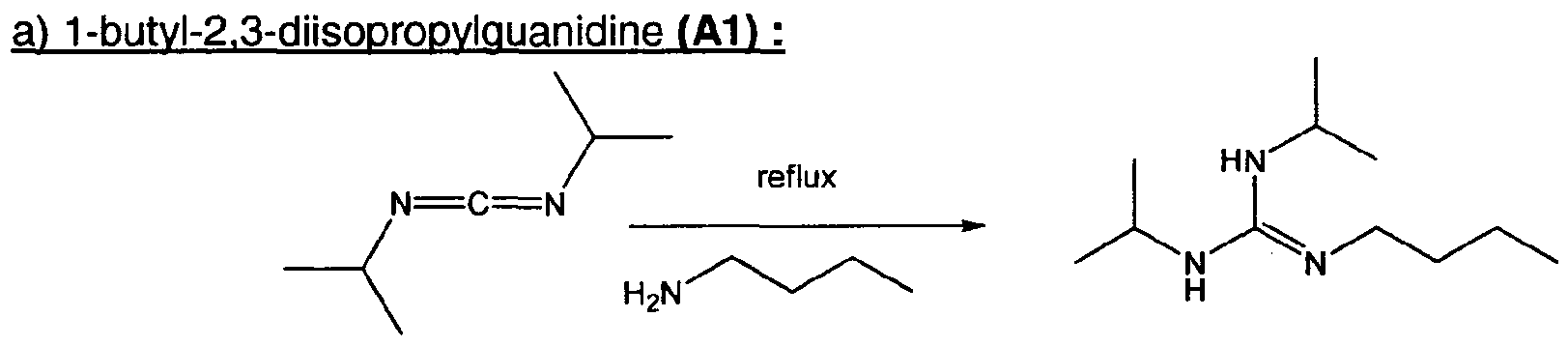
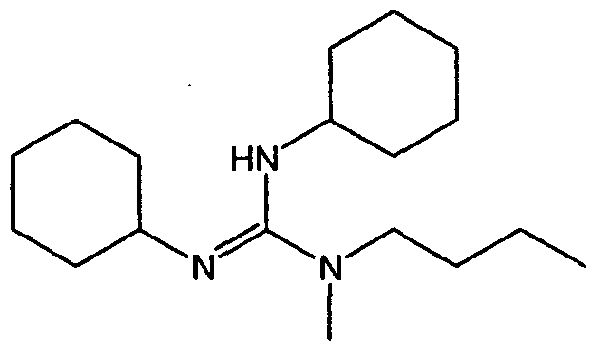
- the polycondensation catalyst A is an unsilylated organic compound selected from the group consisting of the following compounds (A1) to (A6):
- the polycondensation catalyst A is an unsilylated organic compound selected from the group consisting of the compounds (A2) (A3) and (A4) described above.
- the catalysts according to the present invention are non-reprotoxic, unlike alkyltin catalysts. In addition, they make it possible, for both one-component and two-component compositions, to obtain seals having improved resistance to fluids used in the powertrains compared to those obtained from conventional compositions containing titanium catalysts or based on alkyltin.
- the amount of polycondensation catalysts A according to the invention is generally between 0.1 and 10% by weight relative to the total weight of the composition, preferably between 0.1 and 5%, whether it is a mono or two-component preparation. .
- linear polyorganosiloxanes branched polyorganosiloxanes and polyorganosiloxane resins are conventionally described using the following usual notations, used to designate various siloxyl units of formula M, D, T and Q following:
- R may represent various saturated or unsaturated hydrocarbon groups, in particular aromatic, and optionally substituted with hetero atoms, as well as non-hydrocarbon groups.
- the oxygen atoms are shared between two silicon atoms.
- a particular R group is indicated by quoting it by exponent after the symbol M, D or T.
- M OH represents a unit M where a group R is a hydroxyl group -OH.
- substantially linear is meant a POS oil composed of siloxyl units D further comprising siloxyl units T and / or siloxyl units Q, the number of siloxyl units T and Q being less than or equal to one percent silicon.
- crosslinkable polyorganosiloxane oil by polycondensation reaction does not include organic polymers having polycondensation-crosslinkable silica groups such as those described, for example, in patent application EP-A1-1 985666 on page 4, lines 7 to 52.
- These silicone bases may be single-component, that is to say, packaged in a single package, and storage stable in the absence of moisture, curable in the presence of moisture, in particular moisture brought by the ambient air or water generated within the base during its use.
- two-component bases that is to say, packaged in two packages, which harden from the mixture of the two parts. They are conditioned after incorporation of the catalyst into two separate fractions, one of the fractions being able to contain, for example, only the catalyst according to the invention or a mixture with the crosslinking agent.
- the polyorganosiloxane composition X according to the invention as described above is characterized in that it comprises, in addition to a catalytically effective amount of at least one polycondensation catalyst A according to the invention, and as defined in the present application, and a silicone base B comprising:
- the polyorganosiloxane composition X crosslinkable elastomer by polycondensation reactions comprises:
- polyorganosiloxane oil C capable of crosslinking by polycondensation which is a reactive polymer ⁇ , ⁇ -dihydroxydiorganopolysiloxane whose organic radicals are hydrocarbon radicals preferably selected from the group consisting of: alkyls having 1 to 20 carbon atoms; cycloalkyls having 3 to 8 carbon atoms; alkenyls having 2 to 8 carbon atoms and cycloalkenyls having 5 to 8 carbon atoms;
- crosslinking agent D chosen from the group consisting of: polyalkoxysilanes and products resulting from the partial hydrolysis of a polyalkoxysilane;
- non-reactive linear polyorganosiloxane polymer G consisting of a linear homopolymer or copolymer of which, by molecule, the monovalent organic substituents, which are identical or different from each other, linked to the silicon atoms, are chosen from alkyl, cyanoalkyl, alkenyl, aryl, alkylarylenes and arylalkylenes; from 0 to 20 parts by weight of a coloring base or of a coloring agent H,
- auxiliary additives J such as plasticizing agents; organic diluents, cross-linking retarders, mineral oils, antimicrobial agents, thermal resistance additives such as titanium, iron or cerium oxides, and
- the polyorganosiloxane oil C has functionalized ends of alkoxy type and is prepared in situ by reaction, in the presence of a catalytically effective amount of lithium, of a branched polydimethylsiloxane having hydroxyl groups bound to a silicon atom and of general formula
- M x DyQ z (x, y and z being integers) or a linear diorganopolysiloxane, comprising a hydroxyl group bonded to a silicon atom at each chain end, with at least one polyalkoxysilane of the following formula (II):
- R 4 represents a monovalent hydrocarbon radical saturated or unsaturated C 1 -C 3 , substituted or unsubstituted, aliphatic, cyclanic or aromatic, R 4 may be identical to R 5 ,
- R 5 represents a saturated monovalent hydrocarbon radical or not Ci to C 3 substituted or unsubstituted aliphatic, alicyclic or aromatic, and which may comprise an epoxy, primary amine, secondary, tertiary, mercapto, and
- R 6 represents an organic aliphatic radical having 1 to 8 carbon atoms chosen in particular between alkyl radicals, alkyl ether radicals, alkyl ester radicals, alkyl ketone radicals, alkylcyano radicals and aralkyl radicals having 7 to 13 carbon atoms; it being understood that the alkoxy groups of the silane of formula (II) may each have a different meaning for R 6 or the same meaning.
- the polyorganosiloxane oil C is preferably an ⁇ . ⁇ -dihydroxypolydiorganosiloxane polymer having a viscosity of between 50 and 5,000,000 mPa.s at 25 ° C. and the crosslinking agent D is preferably an organosilicon compound carrying more than two hydrolyzable groups bonded to silicon atoms per molecule.
- the polyorganosiloxane oil C may also be functionalized at its ends by hydrolysable radicals obtained by condensation of a precursor bearing hydroxyl functional groups with a cross-linking silane bearing hydrolysable radicals (or by hydrosilylation of ⁇ SiVinyl or ⁇ SiH terminal functions).
- Branched polyorganosiloxanes may also be envisaged, optionally comprising alkylsilyl groups in medium and / or end of chain, that is to say polyorganosiloxanes having groups capable of reacting by polycondensation reactions in medium and / or at the end of the reaction. chains and "inter-chain" alkyl groups linking two polyorganosiloxane chains to each other.
- the crosslinking agents D are products that are accessible on the silicone market; moreover their use in compositions hardening at room temperature is known; it appears in particular in French patents FR-A-1,126,411, FR-A-1,179,969, FR A-1 189 216, FR-A-1 198 749, FR-A-1 248 826, FR-A-1 314 649, FR-A-1 423 477, FR-A-1 432 799 and FR-A- 2,067,636.
- the crosslinking agent D has at least one hydrolyzable group such as: • acyloxy of formula -O-CO-R '
- R ' represents an alkyl or aryl radical having from 1 to 15 carbon atoms
- R 1 and R 2 identical or different, represent alkyl or aryl radicals containing from 1 to 8 carbon atoms
- T an alkylene radical containing from 4 to to 8 carbon atoms.
- R ', R' and R 2 mention may be made especially of the radicals: methyl, ethyl, cyclohexyl and phenyl.
- T that may be mentioned especially those of formula: - (CH 2 J 4 -, - (CH 2 ) 5 - and - (CH 2 ) 6 -.
- alkoxysilanes By way of example of alkoxysilanes, mention may be made of those of formula:
- Cetiminoxysilane crosslinking agents have been well known for a long time. They are described, for example, in French patents FR-A-1,314,649, FR-A-1,371,250, US-A-3,678,003 and US-A-3,986,999, in British patent GB-A- 1,468,467, in Belgian Patent BE-A-901,479 and in European Patent EP-A-157,580.
- cetiminoxysilanes By way of example of cetiminoxysilanes, mention may be made of those of formula:
- acyloxysilane crosslinkers have been well known for a long time. They are described in particular in patents US-A-3 077465, US-A-3 382 205, US-A-3 701 753, US-A-3
- acyloxysilanes By way of example of acyloxysilanes, mention may be made of those of formula: CH 3 Si (OCOCH 3 ) 3 ,
- crosslinking agent D By way of other examples of crosslinking agent D, mention may be made of:
- 1 to 8 carbon atoms such as methyl, ethyl, propyl, butyl, pentyl, 2-ethylhexyl radicals, C 3 -C 6 oxyalkylene radicals, and
- R 1 represents a saturated or unsaturated aliphatic hydrocarbon group, linear or branched, a carbocyclic group, saturated or unsaturated and / or aromatic, monocyclic or polycyclic and k is equal to 0, 1 or 2;
- alkoxysilanes, cetiminoxysilanes, alkyl silicates and alkyl polysilicates are more particularly preferred, in which the organic radicals are alkyl radicals having from 1 to 4 carbon atoms.
- crosslinking agent D examples include ethyl polysilicate, or n-propyl polysilicate.
- crosslinking agent D is used per 100 parts by weight of polyorganosiloxane C capable of crosslinking by polycondensation to an elastomer.
- composition according to the invention may comprise at least one adhesion promoter E such as, for example, organosilicon compounds bearing both:
- GLYMO 3-glycidoxypropyltrimethoxysilane
- MEMO methacryloxypropyltrimethoxysilane
- OCH (CH 2 ) CHOCH 3 H 2 (CH 2 ) NH (CH 2 ) 3 Si-CH CH 2 (OCH 3) 2 or polyorganosiloxane oligomers containing such organic groups at a content greater than 20%.
- adhesion promoters E chosen for example from organosilicon compounds carrying both, on the one hand, organic groups substituted by radicals chosen from the group of amino, ureido, isocyanate and epoxy radicals. , alkenyl, isocyanurate, hydentoile, guanidino and mercaptoester and, on the other hand, hydrolyzable groups, generally alkoxy groups bonded to silicon atoms. Examples of such adhesion promoters are described in US Patents 3,517,001, US 4,115,356, US 4,180,642, US 4,273,698, US 4356,116 and in European Patents EP 31,996 and EP 74,001.
- the mineral fillers F used are very finely divided products whose average particle diameter is less than 0.1 ⁇ m. These fillers include fumed silicas and precipitated silicas; their BET surface area is generally greater than 40 m 2 / g. These fillers may also be in the form of more coarsely divided products with an average particle diameter greater than 0.1 ⁇ m. Examples of such fillers include ground quartz, diatomaceous earth silicas, calcium carbonate optionally surface-treated with an organic acid or an ester of an organic acid, calcined clay, titanium oxide.
- rutile type oxides of iron, zinc, chromium, zirconium, magnesium, the various forms of alumina (hydrated or not), boron nitride, lithopone, barium metaborate, barium sulfate, glass microbeads; their specific surface area is generally less than 30 m 2 / g.
- these fillers may have been surface-modified by treatment with the various organosilicon compounds usually employed for this purpose.
- these organosilicon compounds may be organochlorosilanes, diorganocyclopolysiloxanes, hexaorganodisiloxanes, hexaorganodisilazanes or diorganocyclopolysilazanes (French patents FR-A-1 126 884, FR-A-1 136 885, FR-A-1 236 505, British patent GB -A-1,024,234).
- the treated fillers contain, in most cases, from 3 to 30% of their weight of organosilicic compounds.
- the charges may consist of a mixture of several types of charges of different particle size; for example, they may consist of 30 to 70% of finely divided silicas of BET specific surface area greater than 40 m 2 / g and 70 to 30% of more coarsely divided silicas with a specific surface area of less than 30 m 2 / g. These charges may have been surface treated
- the purpose of introducing the fillers is to impart good mechanical and rheological characteristics to the elastomers resulting from the hardening of the compositions in accordance with the invention.
- inorganic and / or organic pigments as well as agents improving the thermal resistance (salts and oxides of rare earths such as ceric oxides and hydroxides) and / or the flame resistance of the elastomers.
- agents improving the thermal resistance can be mentioned halogenated organic derivatives, organic phosphorus derivatives, platinum derivatives such as chloroplatinic acid (its reaction products with alkanols, ether-oxides), complexes platinum chloride-olefins.
- These pigments and agents together represent at most 20% of the weight of the charges.
- auxiliary agents and customary additives may be incorporated into the composition according to the invention; these are chosen according to the applications in which said compositions are used.
- the silicone base used to produce the composition according to the invention may comprise:
- non-reactive linear polyorganosiloxane polymers G may be introduced in order to act on the physical characteristics of the compositions in accordance with the invention and / or on the mechanical properties of the elastomers resulting from the curing of these compositions.
- non-reactive linear polyorganosiloxane polymers G are well known; they more particularly include: ⁇ , ⁇ -bis (triorganosiloxy) diorganopolysiloxane polymers having viscosities of at least 10 mPa.s at 25 ° C., formed essentially of diorganosiloxy units and at most 1% of monoorganosiloxy and / or siloxy units , the organic radicals bonded to the silicon atoms being chosen from methyl, vinyl and phenyl radicals, at least 60% of these organic radicals being methyl radicals and 10% at most being vinyl radicals.
- the viscosity of these polymers can reach several tens of millions of mPa.s at 25 ° C; they therefore include oils with fluid to viscous appearance and hard soft gums. They are prepared according to the usual techniques described more precisely in the French patents FR-A-978 058, FR-A-1 025 150, FR-A-1 108 764, FR-A-1 370 884.
- the ⁇ , ⁇ -bis (trimethylsiloxy) dimethylpolysiloxane oils having a viscosity ranging from 10 mPa.s to 1000 mPa.s at 25 ° C.
- These polymers which act as plasticizers can be introduced in a proportion of at most 70 parts, preferably 5 to 20 parts, per 100 parts of polyorganosiloxane oil C capable of crosslinking by polycondensation.
- compositions according to the invention may also advantageously comprise at least one silicone resin H.
- silicone resins are branched organopolysiloxane polymers which are well known and commercially available. They have, per molecule, at least two different units chosen from those of formula R 111 S SiO 1Z 2 (unit M), R 1 SiO 2 (unit D), R 111 SiO 3 Z 2 (unit T) and SiO 4/2 (unit Q).
- the radicals R 1 "are identical or different and are chosen from linear or branched alkyl radicals having 1 to 10 carbon atoms, vinyl, phenyl or 3,3,3-trifluoropropyl radicals. from 1 to 6 carbon atoms, more particularly, R 3 alkyl radicals include methyl, ethyl, isopropyl, tert-butyl and n-hexyl radicals.
- resins examples include MQ resins, MDQ resins, DT resins and MDT resins.
- compositions in accordance with the invention it is necessary, in the case of single-component compositions, to use an apparatus which makes it possible to intimately mix, in the absence of moisture, with and without heat input, the various basic constituents to which the adjuvants and additives mentioned above are optionally added. It is it is possible firstly to mix the organopolysiloxane oils C and the fillers F and then to add the crosslinkers D, the compounds E and the catalyst according to the invention to the paste obtained. It is also possible to mix the oils C, the crosslinking agents D, the compounds E and the fillers F and subsequently adding the catalyst according to the invention.
- silicone oils with alkoxy units are prepared in situ by a functionalization reaction of an ⁇ , ⁇ -dihydroxypolydimethylsiloxane oil by reaction with a silane or a polyalkoxysilane in the presence of a catalytically effective amount of lithium hydroxide (process described in US Pat. application FR-2638752.
- compositions according to the invention that is to say undiluted, or in the form of dispersions in diluents, are stable storage in the absence of water and harden at low temperatures (after starting solvents in the case of dispersions) in the presence of water to form elastomers.
- the two-component compositions according to the invention are also produced by mixing the various constituents in suitable apparatus.
- To the mixture obtained preferably brought to a temperature below 80 ° C., for example of the order of room temperature, may be added the other constituents, that is to say the crosslinking agents, the catalyst and optionally additives and various additives and even water.
- the crosslinkable polyorganosiloxane composition X elastomers by polycondensation reactions is prepared from a two-component system which is in two parts P1 and P2 separate compounds intended to be mixed to form said composition X, with one of these parts comprising the polycondensation catalyst A according to the invention and as described in the present application and the crosslinking agent D while the other part is free from the abovementioned species and comprises: - per 100 parts by weight of the polyorganosiloxane (s) oil (s) C (s) capable of crosslinking by polycondensation to an elastomer, and - from 0.001 to 10 parts (s) in weight of water.
- the polyorganosiloxane composition X crosslinkable elastomer by polycondensation reactions is prepared from a single-component system stable storage in the absence of moisture and crosslinking, in the presence of water, in elastomer, comprises:
- crosslinkable linear polyorganosiloxane C oil having functionalized ends of alkoxy, oxime, acyl and / or enoxy, preferably alkoxy, at least one crosslinking agent D,
- At least one catalyst of the polycondensation reaction which is the polycondensation catalyst A according to the invention and as described in the present application.
- the polyorganosiloxane composition X crosslinkable elastomer by polycondensation reactions comprises a sufficient amount of at least one thixotropic agent K to present thixotropic properties.
- thixotropic silicone composition is intended to mean a composition having a thixotropy, defined as being a rheological behavior of a material subject to shear leading to a progressive destructuring of said material.
- Thixotropy is thus a reversible phenomenon which makes it possible to obtain a composition in the form of a gel at rest and which liquefies when it is subjected to agitation or shearing.
- a thixotropic material thus sees its viscosity decrease when the shear applied to it increases, and returns to initial viscosity conditions when shearing is discontinued after a certain time (see Rheology Handbook: A Practical Guide to Rheological Additives, Rheox, Inc., 1998).
- a thixotropic agent K makes it possible to control the rheology of the crosslinkable polyorganosiloxane compositions X in the elastomer and, in particular, makes it possible to confer on the latter a non-flowing viscoelastic behavior.
- Thixotropic agents are well known in the art. In this respect, mention may be made of the various organic and inorganic thickeners commonly used in silicone compositions.
- the thixotropic agent K according to the invention is preferably chosen from the group consisting of: inorganic thickeners, boric acid and borates, titanates, aluminates, zirconates;
- fluorinated resins preferably based on polyfluoroethylene (PFE) and more preferably still based on polytetrafluoroethylene (PTFE or Teflon®).
- PFE polyfluoroethylene
- PTFE polytetrafluoroethylene
- Examples of compounds containing hydroxyl groups that may be mentioned include hydrophilic silicones bearing hydroxyl groups, such as polydimethylsiloxanes or polymethylphenylsiloxanes or polydiphenylsiloxanes or their dimethylhydroxy-terminated copolymers; or hydroxylated "MDT" type silicone resins.
- fluorinated resin means any fluoropolymer containing CF bonds (see for example the book “Encyclopedia of Chemical Technology” 4th edition, 1994, VoU 1 -p., 621-721) such that for example:
- PTFE polytetrafluoroethylene
- Another object of the invention is the use of the crosslinkable elastomeric polyorganosiloxane composition X by polycondensation reactions and as defined above to prepare silicone sealants having good resistance to aging in fluids used in a power train.
- the mash used is prepared as follows: to a mixture of 3464 g of an ⁇ , ⁇ -dihydroxylated oil with a viscosity of 20000 centipoises containing 0.066% of OH, and 120 g of vinyltrimethoxysilane with stirring, is added 16 g of a 2% by weight solution of lithium hydroxide in methanol, and then after 5 min, 400 g of pyrogenic silica AE55 are added. The mixture is devolatilized under vacuum and then stored away from moisture.
- the catalyst tested is mixed with 50 g of this mash, then the catalytic potential is evaluated in 3 ways:
- the symbol ">” corresponds to the hardness values measured on the upper part of the cord and the symbol “ ⁇ ” corresponds to the hardness values measured on the lower part of the bead less exposed to ambient air than the upper part.
- a tin-based catalyst dibutyltin dilaurate (DLBDE), and 1,1,3,3-tetramethylguanidine (TMG) which is described in the international application
- the 1,1,3,3-tetramethylguanidine (TMG) does not allow the crosslinking of the silicone oil, yet at molar concentrations much higher than the guanidines according to the invention (A1) to (A4).
- the 1,2,3-trisubstituted guanidines (A1) and (A2) lead to very short skin formation times and to elastomers.
- the 1,2,3,3-tetrasubstituted guanidines (A3) and (A4) allow not only by adapting the contents to very low values to modulate the durations of skin formation times while obtaining very thermally stable elastomers and slightly higher crosslinking levels than with the tin catalyst (DLDBE).
- a test paste used is prepared as follows: to a mixture of 3464 g of a ⁇ -dihydroxylated polydimethylsiloxane oil of viscosity of 20000 centipoise containing 0.066% of OH, and 120 g of vinyltrimethoxysilane with stirring is added 16 g of a solution of lithium hydroxide at 2% by weight in methanol, then after 5 min 400 g of pyrogenic silica AE55 are added. The catalyst to be tested is then added to the content of x% by weight, and then the mixture is devolatilized in vacuo before bagging.
- Seals in the form of 2 mm thick films are prepared from the formulations to be tested and are previously crosslinked in the conditioned room at 23 ° C. and at 50% humidity for 14 days.
- three square-shaped test pieces cut in the joints and whose Shore A hardness was previously measured are introduced into a 150 ml glass flask filled with 5W30 diesel oil (distributed by Total). After heating at 150 ° C. for 3 days and returning to ambient temperature, the test specimens are wiped with an absorbent paper and the Shore A hardness is measured using a Zwick durometer. The following 3 guanidines were tested:
- Residual DSA (%) 100 * DSA after initial oil / DSA treatment.
- VTMO vinyltrimethoxysilane
- a mixer equipped with a "butterfly” stirring stirrer are introduced 768 g of ⁇ , ⁇ -dihydroxylated polydimethylsiloxane oil with a viscosity of 20000 mPa.s at 23 ° C. and 24 g of vinyltrimethoxysilane (VTMO).
- VTMO vinyltrimethoxysilane
- the medium undergoes a second degassing phase of 3 minutes under 40 mbar and stirring at 130 rpm. Finally the mixture is transferred into closed plastic cartridges.
- the coated supports are then immersed in a reference engine oil (ELF 5W30 Diesel) and heated at 150 ° C. for 70 hours. After this period of heating, they return to room temperature still immersed in the oil and are extracted. The following characteristics are then measured: Shore A hardness on the oil-swollen film, and
- the elements are assembled by applying them against each other by their contact zone before the composition crosslinks elastomer, and then the composition is allowed to crosslink in a silicone elastomer in the presence of moisture brought by the ambient air so as to form a silicone seal.
- the assembly is then immersed in a reference engine oil. The temperature of the oil is maintained at 150 ° C. for 3 days. After cooling, we measure the force (bond breaking strength, unit N) that must be applied to take off the two elements. The results are shown in Table II below Shore A hardness (DSA) measured according to DIN 53505,
- the silicone elastomers sealing obtained with the catalysts according to the invention has mechanical properties (Shore A hardness, tensile strength, modulus at 100%) higher than the comparative after immersion of 70 hours in a motor oil to 15O 0 C thus simulating extreme conditions that may be encountered by elements in contact with a fluid used in a power unit.
- a paste is prepared according to the following: - 70.8% ⁇ , ⁇ -dihydroxylated polydimethylsiloxane oil with a viscosity of 50000 mPa.s
- Catalyst (A3) 0.14% / 5 eq.
- Catalyst (A4) 0.10% / 5 eq.
- PMMA support polymethylmethacrylate support
- PVC support polyvinyl chloride support
- the elastomers prepared from the catalysts according to the invention has as good adhesion as those prepared from tin catalysts.
Landscapes
- Chemical & Material Sciences (AREA)
- Organic Chemistry (AREA)
- Engineering & Computer Science (AREA)
- Chemical Kinetics & Catalysis (AREA)
- Health & Medical Sciences (AREA)
- Medicinal Chemistry (AREA)
- Polymers & Plastics (AREA)
- Materials Engineering (AREA)
- Life Sciences & Earth Sciences (AREA)
- Wood Science & Technology (AREA)
- Combustion & Propulsion (AREA)
- Mechanical Engineering (AREA)
- General Engineering & Computer Science (AREA)
- Compositions Of Macromolecular Compounds (AREA)
- Sealing Material Composition (AREA)
- Gasket Seals (AREA)
Abstract
Description






Claims


Priority Applications (9)
| Application Number | Priority Date | Filing Date | Title |
|---|---|---|---|
| EP10734153.9A EP2440616B1 (fr) | 2009-06-12 | 2010-06-10 | Procede d'etancheification et d'assemblage de composants d'un groupe moto-propulseur |
| US13/377,762 US8470950B2 (en) | 2009-06-12 | 2010-06-10 | Method for sealing and assembling components of a drive train |
| CN201080032052.7A CN102459467B (zh) | 2009-06-12 | 2010-06-10 | 驱动系的部件的密封和组装方法 |
| ES10734153T ES2433598T3 (es) | 2009-06-12 | 2010-06-10 | Procedimiento de sellado y de ensamblaje de componentes de un grupo moto-propulsor |
| PL10734153T PL2440616T4 (pl) | 2009-06-12 | 2010-06-10 | Sposób uszczelniania i montażu elementów układu napędowego |
| KR1020117029756A KR101345492B1 (ko) | 2009-06-12 | 2010-06-10 | 구동계 부품의 밀봉 및 조립 방법 |
| CA2764713A CA2764713C (fr) | 2009-06-12 | 2010-06-10 | Procede d'etancheification et d'assemblage de composants d'un groupe moto-propulseur |
| BRPI1009023A BRPI1009023A2 (pt) | 2009-06-12 | 2010-06-10 | 'processo para vedação e montagem e uso de uma composição de poliorganossiloxano x |
| JP2012514508A JP5467148B2 (ja) | 2009-06-12 | 2010-06-10 | ドライブトレインの構成要素の密封及び組合せ方法 |
Applications Claiming Priority (2)
| Application Number | Priority Date | Filing Date | Title |
|---|---|---|---|
| FR0902847 | 2009-06-12 | ||
| FR0902847A FR2946656A1 (fr) | 2009-06-12 | 2009-06-12 | Procede d'etancheification et d'assemblage de composants d'un groupe moto-propulseur |
Publications (1)
| Publication Number | Publication Date |
|---|---|
| WO2010142871A1 true WO2010142871A1 (fr) | 2010-12-16 |
Family
ID=41693011
Family Applications (1)
| Application Number | Title | Priority Date | Filing Date |
|---|---|---|---|
| PCT/FR2010/000421 Ceased WO2010142871A1 (fr) | 2009-06-12 | 2010-06-10 | Procede d'etancheification et d'assemblage de composants d'un groupe moto-propulseur |
Country Status (11)
| Country | Link |
|---|---|
| US (1) | US8470950B2 (fr) |
| EP (1) | EP2440616B1 (fr) |
| JP (1) | JP5467148B2 (fr) |
| KR (1) | KR101345492B1 (fr) |
| CN (1) | CN102459467B (fr) |
| BR (1) | BRPI1009023A2 (fr) |
| CA (1) | CA2764713C (fr) |
| ES (1) | ES2433598T3 (fr) |
| FR (1) | FR2946656A1 (fr) |
| PL (1) | PL2440616T4 (fr) |
| WO (1) | WO2010142871A1 (fr) |
Families Citing this family (2)
| Publication number | Priority date | Publication date | Assignee | Title |
|---|---|---|---|---|
| FR2929286A1 (fr) | 2008-03-28 | 2009-10-02 | Bluestar Silicones France Soc | Composes a structure guanidine et leurs utilisations comme catalyseurs de polycondensation d'organopolysiloxanes |
| TW201434882A (zh) * | 2013-03-13 | 2014-09-16 | Momentive Performance Mat Inc | 可濕氣固化之有機聚矽氧烷組成物 |
Citations (59)
| Publication number | Priority date | Publication date | Assignee | Title |
|---|---|---|---|---|
| FR978058A (fr) | 1948-11-13 | 1951-04-09 | Amorceur pour pêche | |
| FR1025150A (fr) | 1949-11-10 | 1953-04-10 | Dow Corning | Procédé d'hydrofugeage des tissus |
| FR1108764A (fr) | 1953-06-24 | 1956-01-17 | Thomson Houston Comp Francaise | Stabilisation et perfectionnement des organopolysiloxanes |
| FR1126411A (fr) | 1954-02-18 | 1956-11-22 | Dow Corning | élastomères siloxanes |
| FR1126884A (fr) | 1954-10-02 | 1956-12-03 | Teves Kg Alfred | Régulateur de pression pour la répartition harmonique de la pression |
| FR1136885A (fr) | 1954-10-06 | 1957-05-21 | Dow Corning | Procédé de fabrication de produits organosiliciques pulvérulents hydrophobes |
| FR1179969A (fr) | 1955-08-05 | 1959-05-29 | Wacker Chemie Gmbh | Produits élastomères à base d'organo-polysiloxanes, leur fabrication et leurs appications |
| FR1189216A (fr) | 1956-10-01 | 1959-10-01 | Thomson Houston Comp Francaise | Compositions d'organopolysiloxanes durcissables à la température ambiante |
| FR1198749A (fr) | 1958-02-06 | 1959-12-09 | Rhone Poulenc Sa | Compositions organopolysiloxaniques vulcanisables |
| FR1236505A (fr) | 1956-04-11 | 1960-07-22 | Thomson Houston Comp Francaise | Perfectionnement aux organopolysiloxanes renfermant des charges renforçantes |
| FR1248826A (fr) | 1959-02-20 | 1960-12-23 | Wacker Chemie Gmbh | Masses de caoutchoucs silicones durcissant à l'air |
| FR1314649A (fr) | 1961-02-27 | 1963-01-11 | Dow Corning | Composés intermédiaires silicones contenant des radicaux oximes |
| US3077465A (en) | 1959-09-28 | 1963-02-12 | Dow Corning | One component room temperature vulcanizable organopolysiloxane elastomers |
| FR1370884A (fr) | 1963-07-30 | 1964-08-28 | Dow Corning | Compositions siloxane |
| FR1371250A (fr) | 1962-08-22 | 1964-09-04 | Dow Corning | Procédé de vulcanisation de caoutchouc organopolysiloxane vulcanisable à température ambiante |
| FR1423477A (fr) | 1964-02-06 | 1966-01-03 | Bayer Ag | Nouvelles masses d'organopolysiloxanes se transformant en élastomères sous l'action de l'eau |
| FR1432799A (fr) | 1965-02-12 | 1966-03-25 | Rhone Poulenc Sa | Aldiminoxysilanes et siloxanes et compositions en contenant |
| GB1024234A (en) | 1962-06-27 | 1966-03-30 | Midland Silicones Ltd | Improvements in or relating to siloxane elastomers |
| US3382205A (en) | 1963-09-27 | 1968-05-07 | Gen Electric | Compositions containing silanol chainstopped polydimethyl-siloxane, organosilicon proess aid, and curing agent |
| US3517001A (en) | 1967-09-20 | 1970-06-23 | Gen Electric | Nitrogen-containing organosilicon materials |
| FR2067636A5 (fr) | 1969-11-12 | 1971-08-20 | Rhone Poulenc Sa | |
| US3678003A (en) | 1969-12-23 | 1972-07-18 | Wacker Chemie Gmbh | Room temperature vulcanizable silicone elastomer stocks |
| FR2121289A5 (fr) | 1971-01-06 | 1972-08-18 | Gen Electric | |
| FR2121631A1 (fr) | 1971-01-06 | 1972-08-25 | Gen Electric | |
| US3701753A (en) | 1970-09-28 | 1972-10-31 | Gen Electric | Solutions of room temperature vulcanizable silicone rubber compositions |
| US3801572A (en) | 1971-08-23 | 1974-04-02 | Gen Electric | Amino-functional silicone compounds |
| US3888815A (en) | 1973-08-20 | 1975-06-10 | Gen Electric | Self-bonding two-package room temperature vulcanizable silicone rubber compositions |
| US3957714A (en) | 1975-05-19 | 1976-05-18 | Dow Corning Corporation | Method for making paintable silicone surfaces and elastomer |
| US3986999A (en) | 1973-07-04 | 1976-10-19 | Bayer Aktiengesellschaft | Storable organosiloxane compositions for producing fungi-resistant rubbery masses |
| GB1468467A (en) | 1974-03-22 | 1977-03-30 | Bayer Ag | Transparent storage-stable polysiloxanes which crosslink under atmospheric conditions |
| US4115356A (en) | 1977-07-18 | 1978-09-19 | Dow Corning Corporation | Self adhering room temperature vulcanizable silicone elastomers |
| US4180642A (en) | 1977-06-29 | 1979-12-25 | Shin-Etsu Chemical Company | Room temperature curable organopolysiloxane compositions |
| FR2429811A1 (fr) | 1978-06-27 | 1980-01-25 | Gen Electric | Composition de silicone durcissable a l'humidite |
| EP0010478A1 (fr) | 1978-10-24 | 1980-04-30 | Rhone-Poulenc Industries | Compositions organopolysiloxaniques durcissables en élastomères pour la fabrication de moules |
| EP0021859A1 (fr) | 1979-06-08 | 1981-01-07 | Rhone-Poulenc Specialites Chimiques | Compositions organopolysiloxaniques durcissant en élastomères dès la température ambiante en présence d'eau |
| FR2459820A1 (fr) | 1979-06-25 | 1981-01-16 | Gen Electric | Composition catalytique perfectionnee pour caoutchoucs de silicones |
| US4273698A (en) | 1979-02-28 | 1981-06-16 | General Electric Company | Self-bonding room temperature vulcanizable silicone rubber compositions |
| EP0031996A1 (fr) | 1979-11-28 | 1981-07-15 | M & T Chemicals, Inc. | Hydantoinylsilanes et bis(hydantoinyl)silanes et procédé pour leur préparation |
| EP0050358A2 (fr) | 1980-10-21 | 1982-04-28 | Wacker-Chemie GmbH | Agent de réticulation basé sur un produit de réaction entre des esters d'acide silicique et des composés d'organoétain et procédé pour l'obtention des élastomères polysiloxaniques |
| US4356116A (en) | 1981-04-03 | 1982-10-26 | General Electric Company | Devolatilized room temperature vulcanizable silicone rubber composition |
| EP0074001A1 (fr) | 1981-09-03 | 1983-03-16 | Bayer Ag | Amino-organo-aminosilanes, leur procédé de préparation et leur utilisation |
| EP0102268A1 (fr) | 1982-07-30 | 1984-03-07 | Rhone-Poulenc Chimie | Compositions organopolysiloxaniques monocomposantes comportant en tant que réticulants des silanes à groupements acyloxyle ou cétoniminoxyle et catalysées par des dérivés organiques du titane ou du zirconium |
| EP0117772A1 (fr) | 1983-01-27 | 1984-09-05 | Rhone-Poulenc Chimie | Compositions organopolysiloxaniques contenant des polyacyloxysilanes et durcissant très rapidement en élastomères en présence d'accélérateur du type phosphate |
| EP0118325A1 (fr) | 1983-01-27 | 1984-09-12 | Rhone-Poulenc Chimie | Compositions organopolysiloxaniques contenant des polyacyloxysilanes et durcissant très rapidement en élastomères en présence d'accélérateur du type hydroxyde métallique |
| BE901479A (fr) | 1984-01-14 | 1985-05-02 | Dow Corning Ltd | Composition d'organopolysiloxane durcissable en un elastomere et son utilisation. |
| US4515932A (en) | 1982-09-29 | 1985-05-07 | General Electric Company | End-capping catalysts for forming alkoxy-functional one component RTV compositions |
| EP0141685A1 (fr) | 1983-08-12 | 1985-05-15 | Rhone-Poulenc Specialites Chimiques | Compositions organopolysiloxaniques monocomposantes résistant aux microorganismes |
| EP0147323A2 (fr) | 1983-12-28 | 1985-07-03 | Rhone-Poulenc Chimie | Composition polyorganosiloxanique durcissant en élastomère etcomportant un catalyseur à l'étain chelate. |
| US4528353A (en) | 1982-02-17 | 1985-07-09 | General Electric Company | Adhesion promoters for one-component RTV silicone compositions |
| EP0157580A2 (fr) | 1984-03-27 | 1985-10-09 | Loctite Corporation | Composition d'étanchéité résistant à l'huile, avec module bas, à base de silicone |
| US4563498A (en) | 1984-07-05 | 1986-01-07 | General Electric Company | Curable silicone compositions and processes |
| EP0184966A1 (fr) | 1984-10-29 | 1986-06-18 | Rhone-Poulenc Chimie | Composition organopolysiloxanique vulcanisable à temperature ambiante en élastomère auto-adhérent |
| FR2638752A1 (fr) | 1988-11-04 | 1990-05-11 | Rhone Poulenc Chimie | Procede de preparation de diorganopolysiloxanes a groupements terminaux alcoxy |
| US5519104A (en) | 1995-03-31 | 1996-05-21 | General Electric Company | 1-component alkoxy curing RTV silicone sealant compositions having extended tooling times |
| WO1998029488A1 (fr) | 1996-12-31 | 1998-07-09 | Rhodia Chimie | UTILISATION DE MELANGES A BASE DE Pt ET DE COMPOSE DE METAUX DE TRANSITION AUTRES QUE LE Pt POUR AMELIORER LES PROPRIETES DE RESISTANCE A L'ARC DES ELASTOMERES SILICONES |
| EP0885933A1 (fr) | 1997-06-17 | 1998-12-23 | Hüls Silicone Gesellschaft mit beschränkter Haftung | Compositions d'élastomères de silicone à groupes alkoxy durcissables à température ambiante |
| WO2004020525A1 (fr) | 2002-08-29 | 2004-03-11 | Amber Chemical Company Ltd. | Compositions d'organopolysiloxane prenant a temperature ambiante |
| EP1939257A1 (fr) * | 2005-09-30 | 2008-07-02 | Kaneka Corporation | Composition polymerisable |
| EP1985666A1 (fr) | 2006-02-16 | 2008-10-29 | Kaneka Corporation | Composition durcissable |
Family Cites Families (14)
| Publication number | Priority date | Publication date | Assignee | Title |
|---|---|---|---|---|
| JPS5695923A (en) * | 1979-11-30 | 1981-08-03 | Shin Etsu Chem Co Ltd | Cold curing organopolysloxane composition |
| US4358613A (en) * | 1979-12-26 | 1982-11-09 | General Electric Company | Process for the preparation of substituted guanidines |
| US4395526A (en) * | 1981-06-26 | 1983-07-26 | General Electric Company | One package, stable, moisture curable, polyalkoxy-terminated organopolysiloxane compositions and method for making |
| US4472551A (en) * | 1983-04-01 | 1984-09-18 | General Electric Company | One package, stable, moisture curable, alkoxy-terminated organopolysiloxane compositions |
| US4489127A (en) * | 1983-07-13 | 1984-12-18 | Dow Corning Corporation | Flexible silicone resin coated fabric |
| JPH0674332B2 (ja) * | 1987-08-27 | 1994-09-21 | 東レ・ダウコーニング・シリコーン株式会社 | シリコ−ンゴム粒状物およびその製造方法 |
| US4814368A (en) * | 1988-05-31 | 1989-03-21 | General Electric Company | Shelf stable curable silicone caulking compositions |
| JP3105912B2 (ja) * | 1990-10-31 | 2000-11-06 | 東レ・ダウコーニング・シリコーン株式会社 | 高強度シリコーンゴム粒状物およびその製造方法 |
| US6235832B1 (en) * | 1998-12-21 | 2001-05-22 | Dow Corning Corporation | RTV silicone compositions with rapid development of green strength |
| JP3835796B2 (ja) * | 2002-07-03 | 2006-10-18 | 信越化学工業株式会社 | 室温硬化性オルガノポリシロキサン組成物 |
| DE502004000736D1 (de) * | 2003-03-21 | 2006-07-27 | Goldschmidt Gmbh | Verfahren zur Herstellung von organisch modifizierten Polyorganosiloxanen |
| JP4801320B2 (ja) * | 2003-12-19 | 2011-10-26 | 東レ・ダウコーニング株式会社 | 付加反応硬化型オルガノポリシロキサン樹脂組成物 |
| JP2007161746A (ja) * | 2005-12-09 | 2007-06-28 | Shin Etsu Chem Co Ltd | シリコーンエマルジョン組成物及び木材の処理方法 |
| FR2925496A1 (fr) * | 2007-12-20 | 2009-06-26 | Bluestar Silicones France Soc | Composes a structure guanidine et leurs utilisations comme catalyseurs de polycondensation d'organopolysiloxanes. |
-
2009
- 2009-06-12 FR FR0902847A patent/FR2946656A1/fr active Pending
-
2010
- 2010-06-10 JP JP2012514508A patent/JP5467148B2/ja not_active Expired - Fee Related
- 2010-06-10 WO PCT/FR2010/000421 patent/WO2010142871A1/fr not_active Ceased
- 2010-06-10 CN CN201080032052.7A patent/CN102459467B/zh not_active Expired - Fee Related
- 2010-06-10 PL PL10734153T patent/PL2440616T4/pl unknown
- 2010-06-10 CA CA2764713A patent/CA2764713C/fr not_active Expired - Fee Related
- 2010-06-10 KR KR1020117029756A patent/KR101345492B1/ko not_active Expired - Fee Related
- 2010-06-10 BR BRPI1009023A patent/BRPI1009023A2/pt not_active IP Right Cessation
- 2010-06-10 ES ES10734153T patent/ES2433598T3/es active Active
- 2010-06-10 EP EP10734153.9A patent/EP2440616B1/fr not_active Not-in-force
- 2010-06-10 US US13/377,762 patent/US8470950B2/en not_active Expired - Fee Related
Patent Citations (60)
| Publication number | Priority date | Publication date | Assignee | Title |
|---|---|---|---|---|
| FR978058A (fr) | 1948-11-13 | 1951-04-09 | Amorceur pour pêche | |
| FR1025150A (fr) | 1949-11-10 | 1953-04-10 | Dow Corning | Procédé d'hydrofugeage des tissus |
| FR1108764A (fr) | 1953-06-24 | 1956-01-17 | Thomson Houston Comp Francaise | Stabilisation et perfectionnement des organopolysiloxanes |
| FR1126411A (fr) | 1954-02-18 | 1956-11-22 | Dow Corning | élastomères siloxanes |
| FR1126884A (fr) | 1954-10-02 | 1956-12-03 | Teves Kg Alfred | Régulateur de pression pour la répartition harmonique de la pression |
| FR1136885A (fr) | 1954-10-06 | 1957-05-21 | Dow Corning | Procédé de fabrication de produits organosiliciques pulvérulents hydrophobes |
| FR1179969A (fr) | 1955-08-05 | 1959-05-29 | Wacker Chemie Gmbh | Produits élastomères à base d'organo-polysiloxanes, leur fabrication et leurs appications |
| FR1236505A (fr) | 1956-04-11 | 1960-07-22 | Thomson Houston Comp Francaise | Perfectionnement aux organopolysiloxanes renfermant des charges renforçantes |
| FR1189216A (fr) | 1956-10-01 | 1959-10-01 | Thomson Houston Comp Francaise | Compositions d'organopolysiloxanes durcissables à la température ambiante |
| FR1198749A (fr) | 1958-02-06 | 1959-12-09 | Rhone Poulenc Sa | Compositions organopolysiloxaniques vulcanisables |
| FR1248826A (fr) | 1959-02-20 | 1960-12-23 | Wacker Chemie Gmbh | Masses de caoutchoucs silicones durcissant à l'air |
| US3077465A (en) | 1959-09-28 | 1963-02-12 | Dow Corning | One component room temperature vulcanizable organopolysiloxane elastomers |
| FR1314649A (fr) | 1961-02-27 | 1963-01-11 | Dow Corning | Composés intermédiaires silicones contenant des radicaux oximes |
| GB1024234A (en) | 1962-06-27 | 1966-03-30 | Midland Silicones Ltd | Improvements in or relating to siloxane elastomers |
| FR1371250A (fr) | 1962-08-22 | 1964-09-04 | Dow Corning | Procédé de vulcanisation de caoutchouc organopolysiloxane vulcanisable à température ambiante |
| FR1370884A (fr) | 1963-07-30 | 1964-08-28 | Dow Corning | Compositions siloxane |
| US3382205A (en) | 1963-09-27 | 1968-05-07 | Gen Electric | Compositions containing silanol chainstopped polydimethyl-siloxane, organosilicon proess aid, and curing agent |
| FR1423477A (fr) | 1964-02-06 | 1966-01-03 | Bayer Ag | Nouvelles masses d'organopolysiloxanes se transformant en élastomères sous l'action de l'eau |
| FR1432799A (fr) | 1965-02-12 | 1966-03-25 | Rhone Poulenc Sa | Aldiminoxysilanes et siloxanes et compositions en contenant |
| US3517001A (en) | 1967-09-20 | 1970-06-23 | Gen Electric | Nitrogen-containing organosilicon materials |
| FR2067636A5 (fr) | 1969-11-12 | 1971-08-20 | Rhone Poulenc Sa | |
| US3678003A (en) | 1969-12-23 | 1972-07-18 | Wacker Chemie Gmbh | Room temperature vulcanizable silicone elastomer stocks |
| US3701753A (en) | 1970-09-28 | 1972-10-31 | Gen Electric | Solutions of room temperature vulcanizable silicone rubber compositions |
| FR2121289A5 (fr) | 1971-01-06 | 1972-08-18 | Gen Electric | |
| FR2121631A1 (fr) | 1971-01-06 | 1972-08-25 | Gen Electric | |
| US3801572A (en) | 1971-08-23 | 1974-04-02 | Gen Electric | Amino-functional silicone compounds |
| US3986999A (en) | 1973-07-04 | 1976-10-19 | Bayer Aktiengesellschaft | Storable organosiloxane compositions for producing fungi-resistant rubbery masses |
| US3888815A (en) | 1973-08-20 | 1975-06-10 | Gen Electric | Self-bonding two-package room temperature vulcanizable silicone rubber compositions |
| GB1468467A (en) | 1974-03-22 | 1977-03-30 | Bayer Ag | Transparent storage-stable polysiloxanes which crosslink under atmospheric conditions |
| US3957714A (en) | 1975-05-19 | 1976-05-18 | Dow Corning Corporation | Method for making paintable silicone surfaces and elastomer |
| US4180642A (en) | 1977-06-29 | 1979-12-25 | Shin-Etsu Chemical Company | Room temperature curable organopolysiloxane compositions |
| US4115356A (en) | 1977-07-18 | 1978-09-19 | Dow Corning Corporation | Self adhering room temperature vulcanizable silicone elastomers |
| FR2429811A1 (fr) | 1978-06-27 | 1980-01-25 | Gen Electric | Composition de silicone durcissable a l'humidite |
| EP0010478A1 (fr) | 1978-10-24 | 1980-04-30 | Rhone-Poulenc Industries | Compositions organopolysiloxaniques durcissables en élastomères pour la fabrication de moules |
| US4273698A (en) | 1979-02-28 | 1981-06-16 | General Electric Company | Self-bonding room temperature vulcanizable silicone rubber compositions |
| EP0021859A1 (fr) | 1979-06-08 | 1981-01-07 | Rhone-Poulenc Specialites Chimiques | Compositions organopolysiloxaniques durcissant en élastomères dès la température ambiante en présence d'eau |
| FR2459820A1 (fr) | 1979-06-25 | 1981-01-16 | Gen Electric | Composition catalytique perfectionnee pour caoutchoucs de silicones |
| EP0031996A1 (fr) | 1979-11-28 | 1981-07-15 | M & T Chemicals, Inc. | Hydantoinylsilanes et bis(hydantoinyl)silanes et procédé pour leur préparation |
| EP0050358A2 (fr) | 1980-10-21 | 1982-04-28 | Wacker-Chemie GmbH | Agent de réticulation basé sur un produit de réaction entre des esters d'acide silicique et des composés d'organoétain et procédé pour l'obtention des élastomères polysiloxaniques |
| US4356116A (en) | 1981-04-03 | 1982-10-26 | General Electric Company | Devolatilized room temperature vulcanizable silicone rubber composition |
| EP0074001A1 (fr) | 1981-09-03 | 1983-03-16 | Bayer Ag | Amino-organo-aminosilanes, leur procédé de préparation et leur utilisation |
| US4528353A (en) | 1982-02-17 | 1985-07-09 | General Electric Company | Adhesion promoters for one-component RTV silicone compositions |
| EP0102268A1 (fr) | 1982-07-30 | 1984-03-07 | Rhone-Poulenc Chimie | Compositions organopolysiloxaniques monocomposantes comportant en tant que réticulants des silanes à groupements acyloxyle ou cétoniminoxyle et catalysées par des dérivés organiques du titane ou du zirconium |
| US4515932A (en) | 1982-09-29 | 1985-05-07 | General Electric Company | End-capping catalysts for forming alkoxy-functional one component RTV compositions |
| EP0118325A1 (fr) | 1983-01-27 | 1984-09-12 | Rhone-Poulenc Chimie | Compositions organopolysiloxaniques contenant des polyacyloxysilanes et durcissant très rapidement en élastomères en présence d'accélérateur du type hydroxyde métallique |
| EP0117772A1 (fr) | 1983-01-27 | 1984-09-05 | Rhone-Poulenc Chimie | Compositions organopolysiloxaniques contenant des polyacyloxysilanes et durcissant très rapidement en élastomères en présence d'accélérateur du type phosphate |
| EP0141685A1 (fr) | 1983-08-12 | 1985-05-15 | Rhone-Poulenc Specialites Chimiques | Compositions organopolysiloxaniques monocomposantes résistant aux microorganismes |
| EP0147323A2 (fr) | 1983-12-28 | 1985-07-03 | Rhone-Poulenc Chimie | Composition polyorganosiloxanique durcissant en élastomère etcomportant un catalyseur à l'étain chelate. |
| BE901479A (fr) | 1984-01-14 | 1985-05-02 | Dow Corning Ltd | Composition d'organopolysiloxane durcissable en un elastomere et son utilisation. |
| EP0157580A2 (fr) | 1984-03-27 | 1985-10-09 | Loctite Corporation | Composition d'étanchéité résistant à l'huile, avec module bas, à base de silicone |
| US4563498A (en) | 1984-07-05 | 1986-01-07 | General Electric Company | Curable silicone compositions and processes |
| EP0184966A1 (fr) | 1984-10-29 | 1986-06-18 | Rhone-Poulenc Chimie | Composition organopolysiloxanique vulcanisable à temperature ambiante en élastomère auto-adhérent |
| FR2638752A1 (fr) | 1988-11-04 | 1990-05-11 | Rhone Poulenc Chimie | Procede de preparation de diorganopolysiloxanes a groupements terminaux alcoxy |
| US5519104A (en) | 1995-03-31 | 1996-05-21 | General Electric Company | 1-component alkoxy curing RTV silicone sealant compositions having extended tooling times |
| WO1998029488A1 (fr) | 1996-12-31 | 1998-07-09 | Rhodia Chimie | UTILISATION DE MELANGES A BASE DE Pt ET DE COMPOSE DE METAUX DE TRANSITION AUTRES QUE LE Pt POUR AMELIORER LES PROPRIETES DE RESISTANCE A L'ARC DES ELASTOMERES SILICONES |
| EP0885933A1 (fr) | 1997-06-17 | 1998-12-23 | Hüls Silicone Gesellschaft mit beschränkter Haftung | Compositions d'élastomères de silicone à groupes alkoxy durcissables à température ambiante |
| WO2004020525A1 (fr) | 2002-08-29 | 2004-03-11 | Amber Chemical Company Ltd. | Compositions d'organopolysiloxane prenant a temperature ambiante |
| US20050014894A1 (en) * | 2002-08-29 | 2005-01-20 | Flannigan William Tait | Room temperature curable organopolysiloxane compositions |
| EP1939257A1 (fr) * | 2005-09-30 | 2008-07-02 | Kaneka Corporation | Composition polymerisable |
| EP1985666A1 (fr) | 2006-02-16 | 2008-10-29 | Kaneka Corporation | Composition durcissable |
Also Published As
| Publication number | Publication date |
|---|---|
| US8470950B2 (en) | 2013-06-25 |
| JP5467148B2 (ja) | 2014-04-09 |
| ES2433598T3 (es) | 2013-12-11 |
| US20120181753A1 (en) | 2012-07-19 |
| PL2440616T3 (pl) | 2014-04-30 |
| EP2440616A1 (fr) | 2012-04-18 |
| EP2440616B1 (fr) | 2013-07-31 |
| KR101345492B1 (ko) | 2013-12-30 |
| CA2764713A1 (fr) | 2010-12-16 |
| CN102459467A (zh) | 2012-05-16 |
| CA2764713C (fr) | 2014-12-30 |
| CN102459467B (zh) | 2014-03-12 |
| PL2440616T4 (pl) | 2014-04-30 |
| JP2012529551A (ja) | 2012-11-22 |
| BRPI1009023A2 (pt) | 2016-03-08 |
| KR20120023087A (ko) | 2012-03-12 |
| FR2946656A1 (fr) | 2010-12-17 |
Similar Documents
| Publication | Publication Date | Title |
|---|---|---|
| EP2440628B1 (fr) | Procede d'etancheification et d'assemblage de composants d'un groupe moto-propulseur | |
| EP2268743B1 (fr) | Composes a structure guanidine et leurs utilisations comme catalyseurs de polycondensation d'organopolysiloxanes | |
| CA2744667C (fr) | Composes a structure guanidine et leurs utilisations comme catalyseurs de polycondensation d'organopolysiloxanes | |
| EP2222772B1 (fr) | Composition organopolyseloxanique vulcanisable a temperature ambiante en elastomere et nouveaux catalyseurs de polycondensation d'organopolysiloxanes | |
| WO2009106717A2 (fr) | Composes a structure guanidine et leurs utilisations comme catalyseurs de polycondensation d'organopolysiloxanes | |
| WO2009106724A1 (fr) | Composition organopolyseloxanique vulcanisable a temperature ambiante en elastomere et nouveaux catalyseurs de polycondensation d'organopolysiloxanes | |
| WO2009106720A1 (fr) | Composition organopolysiloxanique vulcanisable a temperature ambiante en elastomere et nouveaux catalyseurs de polycondensation d'organopolysiloxanes | |
| EP2556116B1 (fr) | Procede et compositions utiles pour l'etancheificati0n et l'assemblage de composants d'un groupe moto-propulseur | |
| EP2756211B1 (fr) | Procede et composition utiles pour l'etancheification et l'assemblage de composants d'un groupe moto-propulseur | |
| EP2935407B1 (fr) | Procédé et compositions utiles pour l'étancheification et l'assemblage de composants d'un groupe moto-propulseur | |
| EP2440616B1 (fr) | Procede d'etancheification et d'assemblage de composants d'un groupe moto-propulseur |
Legal Events
| Date | Code | Title | Description |
|---|---|---|---|
| WWE | Wipo information: entry into national phase |
Ref document number: 201080032052.7 Country of ref document: CN |
|
| 121 | Ep: the epo has been informed by wipo that ep was designated in this application |
Ref document number: 10734153 Country of ref document: EP Kind code of ref document: A1 |
|
| WWE | Wipo information: entry into national phase |
Ref document number: 2764713 Country of ref document: CA |
|
| WWE | Wipo information: entry into national phase |
Ref document number: 2012514508 Country of ref document: JP |
|
| ENP | Entry into the national phase |
Ref document number: 20117029756 Country of ref document: KR Kind code of ref document: A |
|
| NENP | Non-entry into the national phase |
Ref country code: DE |
|
| WWE | Wipo information: entry into national phase |
Ref document number: 2010734153 Country of ref document: EP |
|
| WWE | Wipo information: entry into national phase |
Ref document number: 13377762 Country of ref document: US |
|
| REG | Reference to national code |
Ref country code: BR Ref legal event code: B01A Ref document number: PI1009023 Country of ref document: BR |
|
| ENP | Entry into the national phase |
Ref document number: PI1009023 Country of ref document: BR Kind code of ref document: A2 Effective date: 20111209 |