WO2010144522A1 - Ureidophenyl substituted triazine derivatives and their therapeutical applications - Google Patents

Ureidophenyl substituted triazine derivatives and their therapeutical applications Download PDF

Info

Publication number
WO2010144522A1
WO2010144522A1 PCT/US2010/037890 US2010037890W WO2010144522A1 WO 2010144522 A1 WO2010144522 A1 WO 2010144522A1 US 2010037890 W US2010037890 W US 2010037890W WO 2010144522 A1 WO2010144522 A1 WO 2010144522A1
Authority
WO
WIPO (PCT)
Prior art keywords
alkyl
compound
disease
pharmaceutically acceptable
amino
Prior art date
Legal status (The legal status is an assumption and is not a legal conclusion. Google has not performed a legal analysis and makes no representation as to the accuracy of the status listed.)
Ceased
Application number
PCT/US2010/037890
Other languages
French (fr)
Inventor
Chunlin Tao
Qinwei Wang
Lukasz Koroniak
Tulay Polat
Laxman Nallan
Neil Desai
Current Assignee (The listed assignees may be inaccurate. Google has not performed a legal analysis and makes no representation or warranty as to the accuracy of the list.)
Abraxis Bioscience LLC
Original Assignee
Abraxis Bioscience LLC
Priority date (The priority date is an assumption and is not a legal conclusion. Google has not performed a legal analysis and makes no representation as to the accuracy of the date listed.)
Filing date
Publication date
Application filed by Abraxis Bioscience LLC filed Critical Abraxis Bioscience LLC
Priority to CA2765050A priority Critical patent/CA2765050A1/en
Priority to JP2012515092A priority patent/JP2012529527A/en
Priority to BRPI1011527A priority patent/BRPI1011527A2/en
Priority to EP10786737A priority patent/EP2440056A4/en
Priority to US13/376,818 priority patent/US20120202818A1/en
Priority to CN201080032850XA priority patent/CN102573481A/en
Priority to AU2010258825A priority patent/AU2010258825B2/en
Publication of WO2010144522A1 publication Critical patent/WO2010144522A1/en
Priority to IL216829A priority patent/IL216829A0/en
Anticipated expiration legal-status Critical
Ceased legal-status Critical Current

Links

Classifications

    • AHUMAN NECESSITIES
    • A61MEDICAL OR VETERINARY SCIENCE; HYGIENE
    • A61KPREPARATIONS FOR MEDICAL, DENTAL OR TOILETRY PURPOSES
    • A61K31/00Medicinal preparations containing organic active ingredients
    • A61K31/33Heterocyclic compounds
    • A61K31/395Heterocyclic compounds having nitrogen as a ring hetero atom, e.g. guanethidine or rifamycins
    • A61K31/53Heterocyclic compounds having nitrogen as a ring hetero atom, e.g. guanethidine or rifamycins having six-membered rings with three nitrogens as the only ring hetero atoms, e.g. chlorazanil, melamine
    • AHUMAN NECESSITIES
    • A61MEDICAL OR VETERINARY SCIENCE; HYGIENE
    • A61KPREPARATIONS FOR MEDICAL, DENTAL OR TOILETRY PURPOSES
    • A61K31/00Medicinal preparations containing organic active ingredients
    • A61K31/33Heterocyclic compounds
    • A61K31/395Heterocyclic compounds having nitrogen as a ring hetero atom, e.g. guanethidine or rifamycins
    • A61K31/41Heterocyclic compounds having nitrogen as a ring hetero atom, e.g. guanethidine or rifamycins having five-membered rings with two or more ring hetero atoms, at least one of which being nitrogen, e.g. tetrazole
    • A61K31/425Thiazoles
    • A61K31/427Thiazoles not condensed and containing further heterocyclic rings
    • AHUMAN NECESSITIES
    • A61MEDICAL OR VETERINARY SCIENCE; HYGIENE
    • A61PSPECIFIC THERAPEUTIC ACTIVITY OF CHEMICAL COMPOUNDS OR MEDICINAL PREPARATIONS
    • A61P11/00Drugs for disorders of the respiratory system
    • AHUMAN NECESSITIES
    • A61MEDICAL OR VETERINARY SCIENCE; HYGIENE
    • A61PSPECIFIC THERAPEUTIC ACTIVITY OF CHEMICAL COMPOUNDS OR MEDICINAL PREPARATIONS
    • A61P17/00Drugs for dermatological disorders
    • A61P17/02Drugs for dermatological disorders for treating wounds, ulcers, burns, scars, keloids, or the like
    • AHUMAN NECESSITIES
    • A61MEDICAL OR VETERINARY SCIENCE; HYGIENE
    • A61PSPECIFIC THERAPEUTIC ACTIVITY OF CHEMICAL COMPOUNDS OR MEDICINAL PREPARATIONS
    • A61P19/00Drugs for skeletal disorders
    • A61P19/02Drugs for skeletal disorders for joint disorders, e.g. arthritis, arthrosis
    • AHUMAN NECESSITIES
    • A61MEDICAL OR VETERINARY SCIENCE; HYGIENE
    • A61PSPECIFIC THERAPEUTIC ACTIVITY OF CHEMICAL COMPOUNDS OR MEDICINAL PREPARATIONS
    • A61P19/00Drugs for skeletal disorders
    • A61P19/04Drugs for skeletal disorders for non-specific disorders of the connective tissue
    • AHUMAN NECESSITIES
    • A61MEDICAL OR VETERINARY SCIENCE; HYGIENE
    • A61PSPECIFIC THERAPEUTIC ACTIVITY OF CHEMICAL COMPOUNDS OR MEDICINAL PREPARATIONS
    • A61P27/00Drugs for disorders of the senses
    • A61P27/02Ophthalmic agents
    • AHUMAN NECESSITIES
    • A61MEDICAL OR VETERINARY SCIENCE; HYGIENE
    • A61PSPECIFIC THERAPEUTIC ACTIVITY OF CHEMICAL COMPOUNDS OR MEDICINAL PREPARATIONS
    • A61P29/00Non-central analgesic, antipyretic or antiinflammatory agents, e.g. antirheumatic agents; Non-steroidal antiinflammatory drugs [NSAID]
    • AHUMAN NECESSITIES
    • A61MEDICAL OR VETERINARY SCIENCE; HYGIENE
    • A61PSPECIFIC THERAPEUTIC ACTIVITY OF CHEMICAL COMPOUNDS OR MEDICINAL PREPARATIONS
    • A61P3/00Drugs for disorders of the metabolism
    • AHUMAN NECESSITIES
    • A61MEDICAL OR VETERINARY SCIENCE; HYGIENE
    • A61PSPECIFIC THERAPEUTIC ACTIVITY OF CHEMICAL COMPOUNDS OR MEDICINAL PREPARATIONS
    • A61P35/00Antineoplastic agents
    • AHUMAN NECESSITIES
    • A61MEDICAL OR VETERINARY SCIENCE; HYGIENE
    • A61PSPECIFIC THERAPEUTIC ACTIVITY OF CHEMICAL COMPOUNDS OR MEDICINAL PREPARATIONS
    • A61P37/00Drugs for immunological or allergic disorders
    • AHUMAN NECESSITIES
    • A61MEDICAL OR VETERINARY SCIENCE; HYGIENE
    • A61PSPECIFIC THERAPEUTIC ACTIVITY OF CHEMICAL COMPOUNDS OR MEDICINAL PREPARATIONS
    • A61P37/00Drugs for immunological or allergic disorders
    • A61P37/02Immunomodulators
    • A61P37/06Immunosuppressants, e.g. drugs for graft rejection
    • AHUMAN NECESSITIES
    • A61MEDICAL OR VETERINARY SCIENCE; HYGIENE
    • A61PSPECIFIC THERAPEUTIC ACTIVITY OF CHEMICAL COMPOUNDS OR MEDICINAL PREPARATIONS
    • A61P43/00Drugs for specific purposes, not provided for in groups A61P1/00-A61P41/00
    • AHUMAN NECESSITIES
    • A61MEDICAL OR VETERINARY SCIENCE; HYGIENE
    • A61PSPECIFIC THERAPEUTIC ACTIVITY OF CHEMICAL COMPOUNDS OR MEDICINAL PREPARATIONS
    • A61P9/00Drugs for disorders of the cardiovascular system
    • AHUMAN NECESSITIES
    • A61MEDICAL OR VETERINARY SCIENCE; HYGIENE
    • A61PSPECIFIC THERAPEUTIC ACTIVITY OF CHEMICAL COMPOUNDS OR MEDICINAL PREPARATIONS
    • A61P9/00Drugs for disorders of the cardiovascular system
    • A61P9/04Inotropic agents, i.e. stimulants of cardiac contraction; Drugs for heart failure
    • AHUMAN NECESSITIES
    • A61MEDICAL OR VETERINARY SCIENCE; HYGIENE
    • A61PSPECIFIC THERAPEUTIC ACTIVITY OF CHEMICAL COMPOUNDS OR MEDICINAL PREPARATIONS
    • A61P9/00Drugs for disorders of the cardiovascular system
    • A61P9/10Drugs for disorders of the cardiovascular system for treating ischaemic or atherosclerotic diseases, e.g. antianginal drugs, coronary vasodilators, drugs for myocardial infarction, retinopathy, cerebrovascula insufficiency, renal arteriosclerosis
    • CCHEMISTRY; METALLURGY
    • C07ORGANIC CHEMISTRY
    • C07DHETEROCYCLIC COMPOUNDS
    • C07D401/00Heterocyclic compounds containing two or more hetero rings, having nitrogen atoms as the only ring hetero atoms, at least one ring being a six-membered ring with only one nitrogen atom
    • C07D401/02Heterocyclic compounds containing two or more hetero rings, having nitrogen atoms as the only ring hetero atoms, at least one ring being a six-membered ring with only one nitrogen atom containing two hetero rings
    • C07D401/12Heterocyclic compounds containing two or more hetero rings, having nitrogen atoms as the only ring hetero atoms, at least one ring being a six-membered ring with only one nitrogen atom containing two hetero rings linked by a chain containing hetero atoms as chain links
    • CCHEMISTRY; METALLURGY
    • C07ORGANIC CHEMISTRY
    • C07DHETEROCYCLIC COMPOUNDS
    • C07D403/00Heterocyclic compounds containing two or more hetero rings, having nitrogen atoms as the only ring hetero atoms, not provided for by group C07D401/00
    • C07D403/02Heterocyclic compounds containing two or more hetero rings, having nitrogen atoms as the only ring hetero atoms, not provided for by group C07D401/00 containing two hetero rings
    • C07D403/12Heterocyclic compounds containing two or more hetero rings, having nitrogen atoms as the only ring hetero atoms, not provided for by group C07D401/00 containing two hetero rings linked by a chain containing hetero atoms as chain links
    • CCHEMISTRY; METALLURGY
    • C07ORGANIC CHEMISTRY
    • C07DHETEROCYCLIC COMPOUNDS
    • C07D405/00Heterocyclic compounds containing both one or more hetero rings having oxygen atoms as the only ring hetero atoms, and one or more rings having nitrogen as the only ring hetero atom
    • C07D405/14Heterocyclic compounds containing both one or more hetero rings having oxygen atoms as the only ring hetero atoms, and one or more rings having nitrogen as the only ring hetero atom containing three or more hetero rings
    • CCHEMISTRY; METALLURGY
    • C07ORGANIC CHEMISTRY
    • C07DHETEROCYCLIC COMPOUNDS
    • C07D417/00Heterocyclic compounds containing two or more hetero rings, at least one ring having nitrogen and sulfur atoms as the only ring hetero atoms, not provided for by group C07D415/00
    • C07D417/02Heterocyclic compounds containing two or more hetero rings, at least one ring having nitrogen and sulfur atoms as the only ring hetero atoms, not provided for by group C07D415/00 containing two hetero rings
    • C07D417/12Heterocyclic compounds containing two or more hetero rings, at least one ring having nitrogen and sulfur atoms as the only ring hetero atoms, not provided for by group C07D415/00 containing two hetero rings linked by a chain containing hetero atoms as chain links
    • CCHEMISTRY; METALLURGY
    • C07ORGANIC CHEMISTRY
    • C07DHETEROCYCLIC COMPOUNDS
    • C07D417/00Heterocyclic compounds containing two or more hetero rings, at least one ring having nitrogen and sulfur atoms as the only ring hetero atoms, not provided for by group C07D415/00
    • C07D417/14Heterocyclic compounds containing two or more hetero rings, at least one ring having nitrogen and sulfur atoms as the only ring hetero atoms, not provided for by group C07D415/00 containing three or more hetero rings

Definitions

  • the present invention relates generally to the use of compounds to treat a variety of disorders, diseases and pathologic conditions and more specifically to the use of triazine compounds to modulate protein kinases and for treating protein kinase-mediated diseases.
  • Protein kinases constitute a large family of structurally related enzymes that are responsible for the control of a variety of signal transduction processes within the cell. Protein kinases, containing a similar 250-300 amino acid catalytic domain, catalyze the phosphorylation of target protein substrates.
  • the kinases may be categorized into families by the substrates in the phosphorylate (e.g., protein-tyrosine, protein-serine/threonine, lipids, etc.). Tyrosine phosphorylation is a central event in the regulation of a variety of biological processes such as cell proliferation, migration, differentiation and survival. Several families of receptor and non-receptor tyrosine kinases control these events by catalyzing the transfer of phosphate from ATP to a tyrosine residue of specific cell protein targets.
  • families of receptor and non-receptor tyrosine kinases control these events by catalyzing the transfer of phosphate from ATP to a tyrosine residue of specific cell protein targets.
  • kinases in the protein kinase family include, without limitation, abl, Akt, bcr-abl, BIk, Brk, Btk, c- kit, c-Met, c-src, c-fms, CDK1 , CDK2, CDK3, CDK4, CDK5, CDK6, CDK7, CDK8, CDK9, CDK10, cRafl , CSF1 R, CSK, EGFR, ErbB2, ErbB3, ErbB4, Erk, Fak, fes, FGFR1 , FGFR2, FGFR3, FGFR4, FGFR5, Fgr, flt-1 , Fps, Frk, Fyn, Hck, IGF-1 R, INS-R, Jak, KDR, Lck, Lyn, MEK, p38, PDGFR, PIK, PKC, PYK2, ros, Tie, Tie-2,
  • kinase activity acts as molecular switches regulating cell proliferation, activation, and/or differentiation. Uncontrolled or excessive kinase activity has been observed in many disease states including benign and malignant proliferation disorders as well as diseases resulting from inappropriate activation of the immune system (autoimmune disorders), allograft rejection, and graft vs host disease.
  • Src kinase is involved in proliferation and migration responses in many cell types, cell activation, adhesion, motility, and survival, growth factor receptor signaling, and osteoclast activation (Biscardi et al., Adv. Cancer Res. (1999), 76, 61-119; Yeatman et al., Nat. Rev. Cancer (2004), 4, 470-480; Owens, D. W.; McLean et al., MoI. Biol. Cell (2000), 11, 51-64).
  • Src Src
  • Fyn Yes, Fgr, Lyn, Hck, Lck
  • BIk BIk
  • SH4 domain contains the myristylation signals that guide the Src molecule to the cell membrane. This unique domain of Src proteins is responsible for their specific interaction with particular receptors and protein targets (Thomas et al., Annu Rev Cell Dev Biol (1997), 13, 513-609).
  • the modulating regions, SH3 and SH2 control intra- as well as intermolecular interactions with protein substrates which affect Src catalytic activity, localization and association with protein targets (Pawson T., Nature (1995), 373, 573-580).
  • the kinase domain, SH1 found in all proteins of the Src family, is responsible for the tyrosine kinase activity and has a central role in binding of substrates.
  • the N-terminal half of Src kinase contains the site(s) for its tyrosine phosphorylation and regulates the catalytic activity of Src (Thomas et al., Annu Rev Cell Dev Biol (1997), 13: 513-609).
  • v-Src differs from cellular Src (c-Src) on the basis of the structural differences in C-terminal region responsible for regulation of kinase activity.
  • the prototype member of the Src family protein tyrosine kinases was originally identified as the transforming protein (v-Src) of the oncogenic retrovirus, Rous sarcoma virus, RSV (Brugge et al., Nature (1977), 269, 346- 348); Hamaguchi et al. (1995), Oncogene 10: 1037-1043).
  • Viral v-Src is a mutated and activated version of a normal cellular protein (c-Src) with intrinsic tyrosine kinase activity (Collett et al., Proc Natl Acad Sci U S A (1978), 75, 2021- 2024). This kinase phosphorylates its protein substrates exclusively on tyrosyl residues (Hunter et al., Proc Natl Acad Sci U S A (1980), 77, 1311 -1315).
  • Src is a cytoplasmic protein tyrosine kinase, whose activation and recruitment to perimembranal signaling complexes has important implications for cellular fate. It has well-documented that Src protein levels and Src kinase activity are significantly elevated in human breast cancers (Muthuswamy et al., Oncogene, (1995), 11 , 1801-1810); Wang et al., Oncogene (1999), 18, 1227-1237; Warmuth et al., Curr. Pharm. Des.
  • NSCLCs non-small cell lung cancers
  • bladder cancer bladder cancer
  • oesophageal cancer Jankowski et al., Gut, (1992), 33, 1033-8
  • prostate and ovarian cancer Wiener et al., Clin.
  • Src kinase modulates signal transduction through multiple oncogenic pathways, including EGFR, Her2/neu, PDGFR, FGFR, and VEGFR (Frame et al., Biochim. Biophys. Acta (2002), 1602, 114-130; Sakamoto et al., Jpn J Cancer Res, (2001 ), 92: 941-946).
  • Src kinase inhibitors may be useful anti-cancer agents (Abram et al., Exp. Cell Res., (2000), 254, 1 ). It is reported that inhibitors of src kinase had significant antiproliferative activity against cancer cell lines (M. M. Moasser et al., Cancer Res., (1999), 59, 6145; Tatosyan et al., Biochemistry (Moscow) (2000), 65, 49-58).) and inhibited the transformation of cells to an oncogenic phenotype (R.
  • Src-family kinases are also important for signaling downstream of other immune cell receptors.
  • Fyn like Lck, is involved in TCR signaling in T cells (Appleby et al., Cell, (1992), 70, 751 ).
  • Hck and Fgr are involved in Fey receptor signaling leading to neutrophil activation (Vicentini et al., J. Immunol. (2002), 168, 6446). Lyn and Src also participate in Fey receptor signaling leading to release of histamine and other allergic mediators (Turner, H. and Kinet, J-P Nature (1999), 402, B24).
  • Lck plays a role in T-cell signaling. Mice that lack the Lck gene have a poor ability to develop thymocytes. The function of Lck as a positive activator of T-cell signaling suggests that Lck inhibitors may be useful for treating autoimmune disease such as rheumatoid arthritis (Molina et al., Nature, (1992), 357, 161 ).
  • Hck is a member of the Src protein-tyrosine kinase family and is expressed strongly in macrophages, an important HIV target cell and its inhibition in HIV-infected macrophages might slow disease progression (Ye et al., Biochemistry, (2004), 43 (50), 15775 -15784).
  • Hck, Fgr and Lyn have been identified as important mediators of integrin signaling in myeloid leukocytes (Lowell et al., J. Leukoc. Biol., (1999), 65, 313). Inhibition of these kinase mediators may therefore be useful for treating inflammation (Boschelli et al., Drugs of the Future (2000), 25(7), 717). It is reported that Syk is a tyrosine kinase that plays a critical role in the cell degranulation and eosinophil activation and Syk kinase is implicated in various allergic disorders, in particular asthma (Taylor et al., MoI. Cell. Biol. (1995), 15, 4149).
  • BCR-ABL encodes the BCR-AEL protein, a constitutively active cytoplasmic tyrosine kinase present in 90% of all patients with chronic myelogenous leukemia (CML) and in 15-30% of adult patients with acute lymphoblastic leukemia (ALL). Numerous studies have demonstrated that the activity of BCR-ABL is required for the cancer causing ability of this chimeric protein.
  • Src kinases play a role in the replication of hepatitis B virus.
  • the virally encoded transcription factor HBx activates Src in a step required for propagation of the virus (Klein et al., EMBO J. (1999), 18, 5019; Klein et al., MoI. Cell. Biol. (1997), 17, 6427).
  • Some genetic and biochemical data clearly demonstrate that Src-family tyrosine kinases serve as a critical signal relay, via phosphorylation of c-Cbl, for fat accumulation, and provide potential new strategies for treating obesity (Sun et al., Biochemistry, (2005), 44 (44), 14455 -14462).
  • Src inhibitors are also being pursued for the treatment of other diseases including osteoporosis and stroke (Susva et al., Trends Pharmacol. Sci. (2000), 21, 489-495; Paul et al., Nat. Med. (2001 ), 7, 222-227). It is also possible that inhibitors of the Src kinase activity are useful in the treatment of osteoporosis (Soriano et al., Cell (1991), 64, 693; Boyce et al. J Clin. Invest (1992), 90, 1622; Owens et al., MoI. Biol. Cell (2000), 11, 51-64), T cell mediated inflammation (Anderson et al., Adv. Immunol. (1994), 56, 151 ; Goldman, F D et al. J. Clin. Invest. (1998), 102, 421 ), and cerebral ischemia (Paul et al. Nature Medicine (2001 ), 7, 222).
  • src family kinases participate in signal transduction in several cell types.
  • fyn like lck, is involved in T-cell activation.
  • Hck and fgr are involved in Fe gamma receptor mediated oxidative burst of neutrophils.
  • Src and lyn are believed to be important in Fc epsilon induced degranulation of mast cells, and so may play a role in asthma and other allergic diseases.
  • the kinase lyn is known to be involved in the cellular response to DNA damage induced by UV light (Hiwasa et al., FEBS Lett.
  • T cells play a pivotal role in the regulation of immune responses and are important for establishing immunity to pathogens.
  • T cells are often activated during inflammatory autoimmune diseases, such as rheumatoid arthritis, inflammatory bowel disease, type I diabetes, multiple sclerosis, Sjogren's disease, myasthenia gravis, psoriasis, and lupus.
  • T cell activation is also an important component of transplant rejection, allergic reactions, and asthma.
  • T cells are activated by specific antigens through the T cell receptor, which is expressed on the cell surface. This activation triggers a series of intracellular signaling cascades mediated by enzymes expressed within the cell (Kane et al. Current Opinion in Immunol. (2000), 12, 242). These cascades lead to gene regulation events that result in the production of cytokines, like interleukin-2 (IL- 2). IL-2 is a necessary cytokine in T cell activation, leading to proliferation and amplification of specific immune responses.
  • IL-2 interleukin-2
  • 6,440,965 disclosed substituted pyrimidine derivatives in the treatment of neurodegenerative or neurological disorders
  • PCT WO 02/08205 reported the pyrimidine derivatives having neurotrophic activity
  • PCT WO 03/014111 disclosed arylpiperazines and arylpiperidines and their use as metalloproteinase inhibiting agents
  • PCT WO 03/024448 described compounds as inhibitors of histone deacetylase enzymatic activity
  • PCT WO 04/058776 disclosed compounds which possess anti-angiogenic activity.
  • PCT WO 01/94341 and WO 02/16352 disclosed Src kinase inhibitors of quinazoline derivatives.
  • PCT WO03/026666A1and WO03/018021A1 disclosed pyrimidinyl derivatives as kinase inhibitors.
  • U.S. Pat. No 6498165 reported Src kinase inhibitor compounds of pyrimidine compounds.
  • Peptides as Src Tyrosine Kinase Inhibitors is reported recently (Kumar et al., J. Med. Chem., (2006), 49 (11 ), 3395 -3401).
  • the quinolinecarbonitriles derivatives was reported to be potent dual Inhibitors of Src and AbI Kinases (Diane et al., J. Med. Chem., (2004), 47 (7), 1599 -1601 ).
  • Another kinase family of particular interest is the aurora kinases.
  • the aurora kinases is reported to be potent dual Inhibitors of Src and AbI Kinases.
  • Aurora kinase family is a collection of highly related serine/threonine kinase that are key regulators of mitosis, essential for accurate and equal segtion of genomic material from parent to daught cells.
  • Members of the Aurora kinase family include three related kinases kown as Aurora-A, Aurora-B, and Aurora-C. Despite significant sequence homology, the localization and functions of these kinases are largely distinct from one another (Richard D.Carvajal, et al. Clin Cancer Res 2006; 12(23): 6869-6875; Daruka Mahadevan, et al. Expert Opin. Drug Discov. 2007 2(7): 1011-1026) .
  • Aurora-A is ubiquitously expressed and regulates cell cycle events occurring from late S phase through M phase, including centrosome maturation (Berdnik D, et al. Curr Biol 2002; 12:640-7), mitotic entry (Hirota T, et al. Cell 2003;114:585- 98; Dutertre S, et al. J Cell Sci 2004;117:2523-31 ), centrosome separation (Marumoto T, et al. J Biol Chem 2003;278:51786-95), bipolar-spindle assembly (Kufer TA, et al. J CeII Biol 2002;158:617-23; Eyers PA, et al.
  • Aurora-B is a chromosomal passenger protein critical for accurate chromosomal segregation, cytokinesis (Hauf S, et al. J Cell Biol 2003;161 :281- 94; Ditchfield C, et al. J Cell Biol 2003; 161 :267-80; Giet R, et al. J Cell Biol 2001 ;152:669-82; Goto H, et al. J Biol Chem 2003;278:8526-30), protein localization to the centromere and kinetochore, correct microtubule-kinetochore attachments (Murata-Hori M, et al. Curr Biol 2002; 12:894-9), and regulation of the mitotic checkpoint.
  • Aurora-B localizes first to the chromosomes during prophase and then to the inner centromere region between sister chromatids during prometaphase and metaphase (Zeitlin SG, et al. J Cell Biol
  • Aurora-B participates in the establishment of chromosomal biohentation, a condition where sister kinetochores are linked to opposite poles of the bipolar spindle via amphitelic attachments. Errors in this process, manifesting as a merotelic attachment state (one kinetochore attached to microtubules from both poles) or a syntelic attachment state (both sister kinetochores attached to microtubules from the same pole), lead to chromosomal instability and aneuploidy if not corrected before the onset of anaphase.
  • Aurora-B The primary role of Aurora-B at this point of mitosis is to repair incorrect microtubule- kinetochore attachments (Hauf S, et al. J Cell Biol 2003;161 :281-94; Ditchfield C, et al. J Cell Biol 2003;161 :267-80; Lan W, et al. Curr Biol 2004; 14:273-86.).
  • Aurora-A overexpression is a necessary feature of Aurora-A-induced tumorigenesis.
  • mitosis is characterized by the presence of multiple centrosomes and multipolar spindles (Meraldi P et al. EMBO J 2002;21 :483-92.).
  • cells abrogate the mitotic checkpoint and progress from metaphase to anaphase, resulting in numerous chromosomal separation defects.
  • These cells fail to undergo cytokinesis, and, with additional cell cycles, polyploidy and progressive chromosomal instability develop (Anand S, et al. Cancer Cell 2003;3:51-62).
  • Aurora-A inhibition results in delayed, but not blocked, mitotic entry, centrosome separation defects resulting in unipolar mitotic spindles, and failure of cytokinesis (Marumoto T, et al. J Biol Chem 2003;278:51786-95).
  • Encouraging antitumor effects with Aurora-A inhibition were shown in three human pancreatic cancer cell lines (Panc-1 , MIA PaCa-2, and SU.86.86), with growth suppression in cell culture and near-total abrogation of tumorigenicity in mouse xenografts (Hata T, et al. Cancer Res 2005;65:2899-905.).
  • Aurora-B inhibition results in abnormal kinetochore-microtubule attachments, failure to achieve chromosomal biorientation, and failure of cytokinesis (Goto H, et al. J Biol Chem 2003;278:8526-30; Severson AF, et al. Curr Biol 2000;10:1162-71 ). Recurrent cycles of aberrant mitosis without cytokinesis result in massive polyploidy and, ultimately, to apoptosis (Hauf S, et al. J Cell Biol
  • the first three small-molecule inhibitors of Aurora described include ZM447439 (Ditchfield C, et al. J Cell Biol 2003;161 :267-80), Hesperadin (Hauf S, et al. J Cell Biol 2003;161 :281-94), and
  • MK0457 (VX680) (Harrington EA, et al. Nat Med 2004; 10:262-7).
  • the following agents are nonspecific inhibitors: ZM447439 inhibits Aurora-A and Aurora-B; Herperadin inhibits primarily Aurora-B; MK0457 inhibits all three Aurora kinases.
  • ZM447439 inhibits Aurora-A and Aurora-B
  • Herperadin inhibits primarily Aurora-B
  • MK0457 inhibits all three Aurora kinases.
  • Selective inhibitors of Aurora have also been developed.
  • a selective Aurora-A inhibitor is MLN8054 (Hoar HM, et al. [abstract C40].
  • Aurora-B inhibitor A expmple of selective Aurora-B inhibitor is AZD1152 (Schellens J, et al. [abstract 3008]. Proc Am Soc Clin Oncol 2006;24:122s).
  • the next generation of Aurora inhibitors is currently being developed, including agents by Nerviano Medical Sciences (PHA-680632 and PHA-739358), Rigel (R763), Sunesis (SNS-314), NCE Discovery Ltd. (NCED#17), Astex Therapeutics (AT9283), and Montigen Pharmaceuticals (MP- 235 and MP-529).
  • PHA-680632 and PHA-739358 The next generation of Aurora inhibitors is currently being developed, including agents by Nerviano Medical Sciences (PHA-680632 and PHA-739358), Rigel (R763), Sunesis (SNS-314), NCE Discovery Ltd. (NCED#17), Astex Therapeutics (AT9283), and Montigen Pharmaceuticals (MP- 235 and MP-529).
  • RTKs Receptor tyrosine kinases
  • cytoplasm and/or nucleus of a cell are transmembrane proteins that generally include an extracellular ligand-binding domain, a membrane-spanning domain and a catalytic cytoplasmic tyrosine kinase domain. The binding of ligand to the extracellular potion is believed to promote dimerization, resulting in trans-phosphorylation and activation of the intracellular tyrosine kinase domain (Schlessinger et al. Neuron 1992;9:383-391 ).
  • FLT3 FMS-related tyrosine kinase 3
  • FLK-2 fetal liver kinase 2
  • STK-1 human stem cell kinase 1
  • FLT3 FMS-related tyrosine kinase 3
  • FLKIII class III receptor tyrosine kinase family that include KIT, PDGFR, FMS and FLT1
  • FLT3 is a membrane-spanning protein and composed of four domains; an extracellular ligand-binding domains consisting of five immunoglobin-like structures, a transmembrane (TM) domain, a juxtamembrane (JM) domain and a cytoplasmic C-Terminal tyrosine kinase (TK) domain.
  • TM transmembrane
  • JM juxtamembrane
  • TK cytoplasmic C-Terminal tyrosine kinase
  • the ligand for FLT3 was cloned in 1993 and shown to be a Type I transmembrane protein expressed in cells of the hematopoietic bone marrow microenvironment, including bone marrow fibroblasts and other cells (Lyman SD, et al. Cell 1993;75:1157-1167). Both the membrane-bound and soluable forms can activate the tyrosine kinase activity of the receptor and stimulate growth of progenitor cells in the marrow and blood.
  • Binding of ligand to receptor induces dimerisation of the receptor and activation of the kinase domains; which then autophosphorylate and catalyse phosphorylation of substrate proteins of various signal transduction pathways such as signal transducer and activator of transcription 5 (STAT5), RAS/mitogen-activated protein kinase (RAS/MAPK), phosphoinositide 3-kinase (PI3K), src homologous and collagen gene (SHC), SH2-containing inositol-5-phosphatase (SHIP), and cytoplasmic tyrosine phosphatase with 2 Src-homology 2 (SH2) domains (SHP2), which play important roles in cellular proliferation, differentiation, and survival (Dosil M, et al.
  • RAS/MAPK RAS/mitogen-activated protein kinase
  • PI3K phosphoinositide 3-kinase
  • SHC src homologous and collagen gene
  • FLT3 gene is also expressed in placenta, gonads and brain (Maroc N, et al. Oncogene 1993;8:909-918) and also plays an importand role in the immune response (deLapeyriere O, et al. Leukemia 1995;9:1212-1218).
  • FLT3 is overexpressed at the levels in 70-100% of cases of acute myeloid leukemias (AML), and in a high percentage of T-acute lymphocytic leukemia (ALL) cases (Griffin JD, et al. Haematol J. 2004;5: 188-190). It is also overexpressed in a smaller subset of chronic myeloid leukemia (CML) in blast crisis. Studies have shown that the leukemic cells of B lineage ALL and AML frequently co-express FL, setting up autocrine or paracrine signaling loops that result in the constitutive activation of FLT3 (Zheng R, et. al. Blood. 2004; 103:267-274).
  • FLT3 mutations are one of the most frequent somatic alterations in AML, occurring in approximately 1/3 of patients.
  • FLT3-ITD has also been detected at low frequency in myelodysplastic syndrome (MDS) (Yokota S, et al. Leukemia 1997;11 :1605-1609; Horiike S, et al. Leukemia 1997; 11 :1442-1446).
  • MDS myelodysplastic syndrome
  • the ITDs are always in-frame, and are limited to the JM domain. However, they vary in length and position from patient to patient. These repeat sequences may serve to disrupt the autoinhibitory activity of the JM domain resulting in the constitutive activation of FLT3.
  • FLT3-ITD and FLT3- Asp835 mutations are associated with FLT3 autophosphorylation and phosphorylation of downstream targets (Mizuki M, et al. Blood 2000;96:3907- 3914; Mizuki M, et al. Blood 2003;101 :3164-3173; Hayakawa F, et al. Oncogene
  • FLT3 inhibitors such as PKC412 (N-benzoyl staurosporine) (Fabbro D, et al. Anticancer Drug Des 2000;15:17-28; Weisberg E, et al. Cancer Cell 2002; 1 :433-443), CT53518 (also known as MLN518) (Kelly LM, et al. Cancer Cell 2002;1 :421-432), SU11248 (O'Farrell AM, et al.
  • PKC412 N-benzoyl staurosporine
  • CT53518 also known as MLN53518
  • SU11248 O'Farrell AM, et al.
  • Aurora kinase inhibors are of special intrest in treating certain disorders, including cancer.
  • an antitumor agent comprising a triazine derivative as described in formula (I), pharmaceutically-acceptable formulations thereof, methods for making novel compounds and compositions for using the compounds.
  • the compounds and compositions comprising the compounds in formula (I) have utility in treatment of a variety of diseases.
  • the combination therapy described herein may be provided by the preparation of the triazine derivative of formula (I) and the other therapeutic agent as separate pharmaceutical formulations followed by the administration thereof to a patient simultaneously, semi-simultaneously, separately or over regular intervals.
  • the present invention provides methods of use for certain chemical compounds such as kinase inhibitors for treatment of various diseases, disorders, and pathologies, for example, cancer, and vascular disorders, such as myocardial infarction (Ml), stroke, or ischemia.
  • kinase inhibitors for treatment of various diseases, disorders, and pathologies, for example, cancer, and vascular disorders, such as myocardial infarction (Ml), stroke, or ischemia.
  • Ml myocardial infarction
  • the triazine compounds described in this invention may block the enzymatic activity of some or many of the members of the Aurora kinase family, in addition to blocking the activity of other receptor and non-receptor kinase.
  • Such compounds may be beneficial for treatment of the diseases where disorders affect cell motility, adhesion, and cell cycle progression, and in addition, diseases with related hypoxic conditions, osteoporosis and conditions, which result from or are related to increases in vascular permeability, inflammation or respiratory distress, tumor growth, invasion, angiogenesis, metastases and apoptosis.
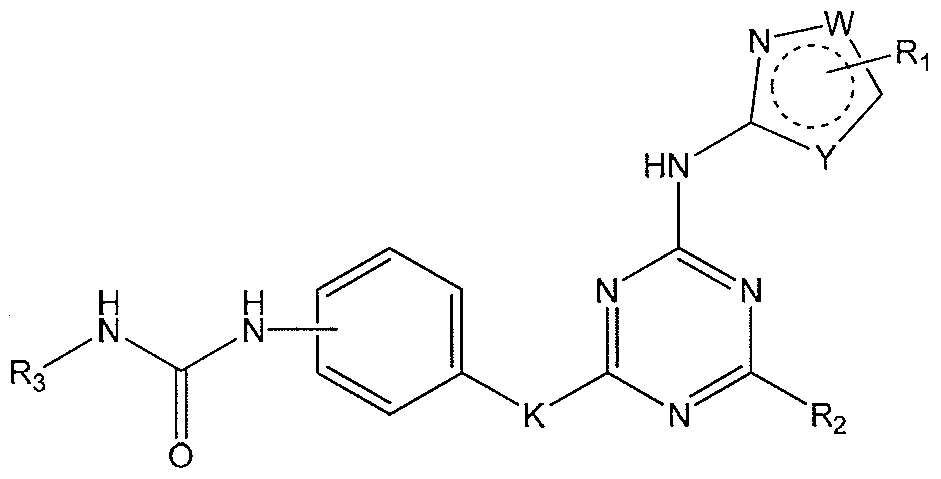
  • the present invention is related to compounds showed as in Formula (I)
  • W and Y are independently selected from S, O, NR4, or CR4
  • R4 is independently selected from hydrogen or an optionally substituted C1-4 aliphatic group.
  • K is selected from -NR4, O, or S
  • R1 represents hydrogen, halogen, hydroxy, amino, cyano, alkyl, cycloalkyl, alkenyl, alkynyl, alkylthio, aryi, arylalkyl, heterocyclic, heteroaryl, heterocycloalkyl, alkylsulfonyl, alkoxycarbonyl and alkylcarbonyl.
  • R2 is selected from:
  • X is CH, when R 6 is hydrogen; or X-R 6 is O; or X is N, R 6 represents groups of hydrogen, C 1 -C 6 alkyl, C 2 -Ce alkenyl, C2-C 6 alkynyl, C3-C- 1 0 aryl or heteroaryl, (C 3 -C 7 cycloalkyl)C 1 -C 4 alkyl, d- Ce haloalkyl, C 1 -C ⁇ alkoxy, C-i- C 6 alkylthio, C 2 -C 6 alkanoyl, d- C 6 alkoxycarbonyl, C 2 - Ce alkanoyloxy, mono- and di-(C 3 -Cs cycloalkyl)aminoCo-C 4 alkyl, (4- to 7- membered heterocycle)Co-C 4 alkyl, C 1 -C 6 alkylsulfonyl, mono- and di-(C 1 - C 6 alkyl)
  • halo refers to fluorine, chlorine, bromine or iodine.
  • alkyl herein alone or as part of another group refers to a monovalent alkane (hydrocarbon) derived radical containing from 1 to 12 carbon atoms unless otherwise defined. Alkyl groups may be substituted at any available point of attachment. An alkyl group substituted with another alkyl group is also referred to as a "branched alkyl group”.
  • Exemplary alkyl groups include methyl, ethyl, propyl, isopropyl, n-butyl, t-butyl, isobutyl, pentyl, hexyl, isohexyl, heptyl, dimethylpentyl, octyl, 2,2,4-trimethylpentyl, nonyl, decyl, undecyl, dodecyl, and the like.
  • substituents include but are not limited to one or more of the following groups: alkyl, aryl, halo (such as F, Cl, Br, I), haloalkyl (such as CCb or CF 3 ), alkoxy, alkylthio, hydroxy, carboxy (-COOH), alkyloxycarbonyl (-C(O)R), alkylcarbonyloxy (- OCOR), amino (-NH2), carbamoyl (-NHCOOR- or -OCONHR- ), urea (-NHCONHR-) or thiol (-SH).
  • alkyl groups are substituted with, for example, amino, heterocycloalkyl, such as morpholine, piperazine, piperidine, azetidine, hydroxyl, methoxy, or heteroaryl groups such as pyrrolidine,
  • the term 'cycloalkyl" herein alone or as part of another group refers to fully saturated and partially unsaturated hydrocarbon rings of 3 to 9, preferably 3 to 7 carbon atoms.
  • the examples include cyclopropyl, cyclobutyl, cyclopentyl and cyclohexyl, and like. Further, a cycloalkyl may be substituted.
  • alkenyl herein alone or as part of another group refers to a hydrocarbon radical straight, branched or cyclic containing from 2 to 12 carbon atoms and at least one carbon to carbon double bond.
  • groups include the vinyl, allyl, 1-propenyl, isopropenyl, 2-methyl-1-propenyl, 1-butenyl, 2- butenyl, 3-butenyl, 1-pentenyl, 2-pentenyl, 3-pentenyl, 4-pentenyl, 1-hexenyl, 2- hexenyl, 3-hexenyl, 4-hexenyl, 5-hexenyl, 1-heptenyl, and like.
  • Alkenyl groups may also be substituted at any available point of attachment.
  • exemplary substituents for alkenyl groups include those listed above for alkyl groups, and especially include C3 to C7 cycloalkyl groups such as cyclopropyl, cyclopentyl and cyclohexyl, which may be further substituted with, for example, amino, oxo, hydroxyl, etc.
  • alkynyl refers to straight or branched chain alkyne. groups, which have one or more unsaturated carbon-carbon bonds, at least one of which is a triple bond.
  • Alkynyl groups include C2-C8 alkynyl, C2-C6 alkynyl and C2-C4 alkynyl groups, which have from 2 to 8, 2 to 6 or 2 to 4 carbon atoms, respectively.
  • Illustrative of the alkynyl group include ethenyl, propenyl, isopropenyl, butenyl, isobutenyl, pentenyl, and hexenyl.
  • Alkynyl groups may also be substituted at any available point of attachment.
  • Exemplary substituents for alkynyl groups include those listed above for alkyl groups such as amino, alkylamino, etc.
  • the numbers in the subscript after the symbol "C" define the number of carbon atoms a particular group can contain.
  • alkoxy alone or as part of another group denotes an alkyl group as described above bonded through an oxygen linkage (-O-).
  • Preferred alkoxy groups have from 1 to 8 carbon atoms. Examples of such groups include the methoxy, ethoxy, n-propoxy, isopropoxy, n-butoxy, isobutoxy, sec-butoxy, tert-butoxy, n-pentyloxy, isopentyloxy, n-hexyloxy, cyclohexyloxy, n-heptyloxy, n- octyloxy and 2-ethylhexyloxy.
  • alkylthio refers to an alkyl group as described above attached via a sulfur bridge.
  • Preferred alkoxy and alkylthio groups are those in which an alkyl group is attached via the heteroatom bridge.
  • Preferred alkylthio groups have from 1 to 8 carbon atoms. Examples of such groups include the methylthio, ethylthio, n-propythiol, n-butylthiol, and like.
  • alkoxycarbonyl herein alone or as part of another group denotes an alkoxy group bonded through a carbonyl group.
  • An alkoxycarbonyl radical is represented by the formula: -C(O)OR, where the R group is a straight or branched C1-C6 alkyl group, cycloalkyl, aryl, or heteroaryl.
  • alkylcarbonyl herein alone or as part of another group refers to an alkyl group bonded through a carbonyl group or -C(O)R.
  • arylalkyl herein alone or as part of another group denotes an aromatic ring bonded through an alkyl group (such as benzyl) as described above.
  • aryl herein alone or as part of another group refers to monocyclic or bicyclic aromatic rings, e.g. phenyl, substituted phenyl and the like, as well as groups which are fused, e.g., napthyl, phenanthrenyl and the like.
  • An aryl group thus contains at least one ring having at least 6 atoms, with up to five such rings being present, containing up to 20 atoms therein, with alternating (resonating) double bonds between adjacent carbon atoms or suitable heteroatoms.
  • halogen such as I, Br, F, or Cl
  • alkyl such as methyl, ethyl, propyl
  • alkoxy such as methoxy or ethoxy
  • hydroxy carboxy
  • carbamoyl alkyloxycarbonyl
  • nitro alkenyloxy
  • amino, cycloalkyl, aryl, heteroaryl cyano, alkyl S(0)m (m
  • aromatic refers to a cyclically conjugated molecular entity with a stability, due to derealization, significantly greater than that of a hypothetical localized structure, such as the Kekule structure.
  • amino herein alone or as part of another group refers to -NH2.
  • An “amino” may optionally be substituted with one or two substituents, which may be the same or different, such as alkyl, aryl, arylalkyl, alkenyl, alkynyl, heteroaryl, heteroarylalkyl, cycloheteroalkyl, cycloheteroalkylalkyl, cycloalkyl, cycloalkylalkyl, haloalkyl, hydroxyalkyl, alkoxyalkyl, thioalkyl, carbonyl or carboxyl.
  • substituents may be further substituted with a carboxylic acid, any of the alkyl or aryl substituents set out herein.
  • the amino groups are substituted with carboxyl or carbonyl to form N-acyl or N- carbamoyl derivatives.
  • alkylsulfonyl refers to groups of the formula (SO2)-alkyl, in which the sulfur atom is the point of attachment.
  • alkylsulfonyl groups include C1- C6 alkylsulfonyl groups, which have from 1 to 6 carbon atoms.
  • Methylsulfonyl is one representative alkylsulfonyl group.
  • heteroatom refers to any atom other than carbon, for example, N, O, or S.
  • heteroaryl herein alone or as part of another group refers to substituted and unsubstituted aromatic 5 or 6 membered monocyclic groups, 9 or 10 membered bicyclic groups, and 11 to 14 membered tricyclic groups which have at least one heteroatom (O, S or N) in at least one of the rings.
  • Each ring of the heteroaryl group containing a heteroatom can contain one or two oxygen or sulfur atoms and/or from one to four nitrogen atoms provided that the total number of heteroatoms in each ring is four or less and each ring has at least one carbon atom.
  • the fused rings completing the bicyclic and tricyclic groups may contain only carbon atoms and may be saturated, partially saturated, or unsaturated.
  • the nitrogen and sulfur atoms may optionally be oxidized and the nitrogen atoms may optionally be quaternized.
  • Heteroaryl groups which are bicyclic or tricyclic must include at least one fully aromatic ring but the other fused ring or rings may be aromatic or non- aromatic.
  • the heteroaryl group may be attached at any available nitrogen or carbon atom of any ring.
  • monocyclic heteroaryl groups include pyrrolyl, pyrazolyl, pyrazolinyl, imidazolyl, oxazolyl, diazolyl, isoxazolyl, thiazolyl, thiadiazolyl, S isothiazolyl, furanyl, thienyl, oxadiazolyl, pyridyl, pyrazinyl, pyrimidinyl, pyridazinyl, triazinyl and the like.
  • bicyclic heteroaryl groups include indolyl, benzothiazolyl, benzodioxolyl, benzoxaxolyl, benzothienyl, quinolinyl, tetrahydroisoquinolinyl, isoquinolinyl, benzimidazolyl, benzopyranyl, indolizinyl, benzofuranyl, chromonyl, coumarinyl, benzopyranyl, cinnolinyl, quinoxalinyl, indazolyl, pyrrolopyridyl, dihydroisoindolyl, tetrahydroquinolinyl and the like.
  • tricyclic heteroaryl groups include carbazolyl, benzidolyl, phenanthrollinyl, acridinyl, phenanthridinyl, xanthenyl and the like.
  • heterocycle or “heterocycloalkyl” herein alone or as part of another group refers to a cycloalkyl group (nonaromatic) in which one of the carbon atoms in the ring is replaced by a heteroatom selected from O, S or N.
  • the "heterocycle” has from 1 to 3 fused, pendant or spiro rings, at least one of which is a heterocyclic ring (i.e. , one or more ring atoms is a heteroatom, with the remaining ring atoms being carbon).
  • the heterocyclic ring may be optionally substituted which means that the heterocyclic ring may be substituted at one or more substitutable ring positions by one or more groups independently selected from alkyl (preferably lower alkyl), heterocycloalkyl, heteroaryl, alkoxy (preferably lower alkoxy), nitro, monoalkylamino (preferably a lower alkylamino), dialkylamino (preferably a alkylamino), cyano, halo, haloalkyl (preferably trifluoromethyl), alkanoyl, aminocarbonyl, monoalkylaminocarbonyl, dialkylaminocarbonyl, alkyl amido (preferably lower alkyl amido), alkoxyalkyl (preferably a lower alkoxy; lower alkyl), alkoxycarbonyl (preferably a lower alkoxycarbonyl), alkylcarbonyloxy (preferably a lower alkylcarbonyloxy) and aryl (preferably phenyl), said aryl being optionally substituted by
  • a heterocyclic ring comprises 1-4 heteroatoms; within certain embodiments each heterocyclic ring has 1 or 2 heteroatoms per ring.
  • Each heterocyclic ring generally contains from 3 to 8 ring members (rings having from to 7 ring members are recited in certain embodiments), and heterocycles comprising fused, pendant or spiro rings typically contain from 9 to 14 ring members which consists of carbon atoms and contains one, two, or three heteroatoms selected from nitrogen, oxygen and/or sulfur.
  • heterocycle or “heterocycloalkyl groups include piperazine, piperidine, morpholine, thiomorpholine, pyrrolidine, imidazolidine and thiazolide.
  • substituted refers to a molecular moiety that is covalently bonded to an atom within a molecule of interest.
  • a “ring substituent” may be a moiety such as a halogen, alkyl group, haloalkyl group or other group discussed herein that is covalently bonded to an atom (preferably a carbon or nitrogen atom) that is a ring member.
  • aryl or heterocyclyl or other group may be substituted at one or more substitutable positions by one or more groups independently selected from alkyl (preferably lower alkyl), alkoxy (preferably lower alkoxy), nitro, monoalkylamino (preferably with one to six carbons), dialkylamino (preferably with one to six carbons), cyano, halo, haloalkyl (preferably trifluoromethyl), alkanoyl, aminocarbonyl, monoalkylaminocarbonyl, dialkylaminocarbonyl, alkyl amido (preferably lower alkyl amido), alkoxyalkyl (preferably a lower alkoxy and lower alkyl), alkoxycarbonyl (preferably a lower alkoxycarbonyl), alkylcarbonyloxy (preferably a lower alkylcarbonyloxy) and aryl (preferably phenyl), said aryl being optionally substituted by halo, lower alkyl and lower alkoxy groups
  • Optional substitution is also indicated by the phrase "substituted with from 0 to X substituents," where X is the maximum number of possible substituents. Certain optionally substituted groups are substituted with from 0 to 2, 3 or 4 independently selected substituents. A dash (“-") that is not between two letters or symbols is used to indicate a point of t attachment for a substituent. For example, -CONH2 is attached through the carbon atom.
  • a dashed cycle that locates inside of a heterocyle ring is used to indicate a conjugated system.
  • the bonds between two atomes may be single bond or double bond.
  • anticancer agent includes any known agent that is useful for the treatment of cancer including, but is not limited, Acivicin; Aclarubicin;
  • Acodazole Hydrochloride AcrQnine; Adozelesin; Aldesleukin; Altretamine; Ambomycin; Ametantrone Acetate; Aminoglutethimide; Amsacrine; Anastrozole;
  • Anthramycin Asparaginase; Asperlin; Azacitidine; Azetepa; Azotomycin;
  • Busulfan Cactinomycin; Calusterone; Caracemide; Carbetimer; Carboplatin; Carmustine; Carubicin Hydrochloride; Carzelesin; Cedefingol; Chlorambucil;
  • Cirolemycin Cisplatin; Cladribine; Crisnatol Mesylate; Cyclophosphamide;
  • Cytarabine dacarbazine; Dactinomycin; Daunorubicin Hydrochloride;
  • Docetaxel Docetaxel; Doxorubicin; Doxorubicin Hydrochloride; Droloxifene; Droloxifene Citrate; Dromostanolone Propionate; Duazomycin; Edatrexate; Eflomithine
  • Interferon Alfa-2b Interferon Alfa-n1 ; Interferon Alfa-n3; Interferon Beta- 1 a;
  • Interferon Gamma- 1 b Interferon Gamma- 1 b; Iproplatin; lrinotecan Hydrochloride; Lanreotide Acetate; Letrozole; Leuprolide Acetate; Liarozole Hydrochloride; Lometrexol Sodium;
  • Metoprine Meturedepa; Mitindomide; Mitocarcin; Mitocromin; Mitogillin;
  • Mitomalcin Mitomycin; Mitosper; Mitotane; Mitoxantrone Hydrochloride; Mycophenolic Acid; Nocodazole; Nogalamycin; Ormaplatin; Oxisuran; Paclitaxel;
  • Pipobroman Piposulfan; Piroxantrone Hydrochloride; Plicamycin; Plomestane;
  • Porfimer Sodium Porfiromycin; Prednimustine; Procarbazine Hydrochloride;
  • Puromycin Puromycin Hydrochloride; Pyrazofurin; Riboprine; Rogletimide; Safmgol; Safingol Hydrochloride; Semustine; Simtrazene; Sparfosate Sodium;
  • Taxane Taxoid; Tecogalan Sodium; Tegafur; Teloxantrone Hydrochloride;
  • Temoporfin Teniposide; Teroxirone; Testolactone; Thiamiprine; Thioguanine; Thiotepa; Tiazofurin; Tirapazamine; Topotecan Hydrochloride; Toremifene
  • Vapreotide Verteporfin; Vinblastine Sulfate; Vincristine Sulfate; Vindesine;
  • kinase refers to any enzyme that catalyzes the addition of phosphate groups to a protein residue; for example, serine and threonine kineses catalyze the addition of phosphate groups to serine and threonine residues.
  • the terms "Src kinase,” “Src kinase family,” and “Src family” refer to the related homologs or analogs belonging to the mammalian family of Src kineses, including, for example, c-Src, Fyn, Yes and Lyn kineses and the hematopoietic- restricted kineses Hck, Fgr, Lck and BIk.
  • terapéuticaally effective amount refers to the amount of the compound or pharmaceutical composition that will elicit the biological or medical response of a tissue, system, animal or human that is being sought by the researcher, veterinarian, medical doctor or other clinician, e.g., restoration or maintenance of vasculostasis or prevention of the compromise or loss or vasculostasis; reduction of tumor burden; reduction of morbidity and/or mortality.
  • pharmaceutically acceptable refers to the fact that the carrier, diluent or excipient must be compatible with the other ingredients of the formulation and not deleterious to the recipient thereof.
  • administering a compound refers to the act of providing a compound of the invention or pharmaceutical composition to the subject in need of treatment.
  • protected refers that the group is in modified form to preclude undesired side reactions at the protected site. Suitable protecting groups for the compounds of the present invention will be recognized from the present application taking into account the level of skill in the art, and with reference to standard textbooks, such as Greene, T. W. et al., Protective Groups in Organic Synthesis, John Wiley & Sons, New York (1999).
  • pharmaceutically acceptable salt of a compound recited herein is an acid or base salt that is suitable for use in contact with the tissues of human beings or animals without excessive toxicity or carcinogenicity, and preferably without irritation, allergic response, or other problem or complication.
  • Such salts include mineral and organic acid salts of basic residues such as amines, as well as alkali or organic salts of acidic residues such as carboxylic acids.
  • Specific pharmaceutical salts include, but are not limited to, salts of acids such as hydrochloric, phosphoric, hydrobromic, malic, glycolic, fumaric, sulfuric, sulfamic, sulfanilic, formic, toluenesulfonic, methanesulfonic, benzene sulfonic, ethane disulfonic, 2- hydroxyethylsulfonic, nitric, benzoic, 2-acetoxybenzoic, citric, tartaric, lactic, stearic, salicylic, glutamic, ascorbic, pamoic, succinic, fumaric, maleic, propionic, hydroxymaleic, hydroiodic, phenylacetic, alkanoic such as acetic, HOOC- (CH2)n-COOH where n is 0-4, and the like.
  • acids such as hydrochloric, phosphoric, hydrobromic, malic, glycolic, fumaric, sulfuric, s
  • pharmaceutically acceptable cations include, but are not limited to sodium, potassium, calcium, aluminum, lithium and ammonium.
  • a pharmaceutically acceptable acid or base salt can be synthesized from a parent compound that contains a basic or acidic moiety by any conventional chemical method. Briefly, such salts can be prepared by reacting the free acid or base forms of these compounds with a stoichiometric amount of the appropriate base or acid in water or in an organic solvent, or in a mixture of the two; generally, the use of nonaqueous media, such as ether, ethyl acetate, ethanol, isopropanol or acetonitrile, is preferred.
  • each compound of Formula I may, but need not, be formulated as a hydrate, solvate or non- covalent complex.
  • the various crystal forms and polymorphs are within the scope of the present invention.
  • prodrugs of the compounds of Formula I are also provided herein.
  • prodrug refers a compound that may not fully satisfy the structural requirements of the compounds provided herein, but is modified in vivo, following administration to a patient, to produce a compound of Formula I, or other formula provided herein.
  • a prodrug may be an acylated derivative of a compound as provided herein.
  • Prodrugs include compounds wherein hydroxy, amine or thiol groups are bonded to any group that, when administered to a mammalian subject, cleaves to form a free hydroxy, amino, or thiol group, respectively.
  • Examples of prodrugs include, but are not limited to, acetate, formate and benzoate derivatives of alcohol and amine functional groups within the compounds provided herein.
  • Prodrugs of the compounds provided herein may be prepared by modifying functional groups present in the compounds in such a way that the modifications are cleaved in vivo to yield the parent compounds.
  • Groups that are "optionally substituted” are unsubstituted or are substituted by other than hydrogen at one or more available positions.
  • Such optional substituents include, for example, hydroxy, halogen, cyano, nitro, C1-C6 alkyl, C2-C6 alkenyl, C2- C6 alkynyl, C1-C6 alkoxy, C2-C6 alkyl ether, C3-C6 alkanone, C2-C6 alkylthio, amino, mono- or di-(C1-C6 alkyl)amino, C1-C6 haloalkyl, -COOH, -CONH2, mono- or di-(C1-C6 alkyl)aminocarbonyl, -SO2NH2, and/or mono or di(C1-C6 alkyl) sulfonamido, as well as carbocyclic and heterocyclic groups.
  • -H, -CH3, -CH2CH3, -CH CHCH3, -CH2CH2CH3, -CH2CH2CH2CH3, iso-propyl, cyclopropyl, cyclobutyl, tert-butyl, phenyl (-Ph), -CH2OH, - COOCH2CH3, -Cl, -F, -Br.
  • R3 groups of formula (I) are list below:
  • the compounds of the invention may be compounds of formula (I) wherein
  • R1 groups of formula (I) are listed below:
  • -H, -CH3, -CH2CH3, -CH CHCH3, -CH2CH2CH3, -CH2CH2CH2CH3, iso-propyl, cyclopropyl, cyclobutyl, tert-butyl, phenyl (-Ph), -CH2OH, - COOCH2CH3, -Cl, -F, -Br.
  • W and Y are independently selected from S, O, NR4, or CR4;
  • R4 is independently selected from hydrogen or an optionally substituted C1-4 aliphatic group.
  • K is selected from -NR4, O, or S R2 is selected from:
  • R 5 represents hydrogen, C 1 -C 4 alkyl, oxo
  • X is CH, when R 6 is hydrogen; or X-R 6 is O; or X is N, R 6 represents groups of hydrogen, C 1 -C 6 alkyl, C 2 -C 6 alkenyl, C 2 -C6 alkynyl, C3-C 1 0 aryl or heteroaryl, (C 3 -C 7 cycloalkyl)C 1 -C 4 alkyl, d- C 6 haloalkyl, C 1 -C 6 alkoxy, Cr C 6 alkylthio, C2-C6 alkanoyl, Cr Ce alkoxycarbonyl, C2- Ce alkanoyloxy, mono- and di-(C 3 -Cs cycloalkyl)aminoCo-C 4 alkyl, (4- to 7- membered heterocycle)Co-C 4 alkyl, C 1 -Ce alkylsulfonyl, mono- and di-(Cr Ce alkyl) sulfonamido, and mono
  • R3 is Hydrogene, C 1 -C 6 alkyl, C 2 -C 6 alkenyl, C 2 -C 6 alkynyl, C 3 -C 1 0 aryl or heteroaryl, (C 3 -C7cycloalkyl)C 1 -C 4 alkyl, d- C 6 haloalkyl, each of which is substituted with from O to 4 substituents independently chosen from halogen, hydroxy, cyano, amino, -COOH and oxo;
  • W and Y are independently selected from S, O, NR4, or CR4; R4 is independently selected from hydrogen or an optionally substituted
  • K is selected from -NR4, O, or S
  • R2 is selected from:
  • R 5 represents hydrogen, C 1 -C 4 alkyl, oxo
  • X is CH, when R 6 is hydrogen; or X-R 6 is O; or X is N, R 6 represents groups of hydrogen, C 1 -C 6 alkyl, C 2 -C6 alkenyl, C 2 -C 6 alkynyl, C3-C10 aryl or heteroaryl, (C 3 -C 7 cycloalkyl)C 1 -C 4 alkyl, d- C 6 haloalkyl, C 1 -C 6 alkoxy, C r C 6 alkylthio, C 2 -C 6 alkanoyl, C 1 - C 6 alkoxycarbonyl, C 2 - C 6 alkanoyloxy, mono- and di-(C 3 -C 8 cycloalkyl)aminoCo-C 4 alkyl, (4- to 7- membered heterocycle)C 0 -C 4 alkyl, C 1 -C 6 alkylsulfonyl, mono- and di-(C- ⁇ - C 6
  • R3 is Hydrogene, C 1 -C 6 alkyl, C 2 -C 6 alkenyl, C 2 -C 6 alkynyl, C 3 -C 10 aryl or heteroaryl, (C 3 -C 7 cycloalkyl)C 1 -C 4 alkyl, d- C 6 haioalkyl, each of which is substituted with from O to 4 substituents independently chosen from halogen, hydroxy, cyano, amino, -COOH and oxo;
  • W and Y are independently selected from S, O, NH, or CH
  • K is selected from -NH, O, or S
  • R2 is selected from: (i) amino, alkyl amino, aryl amino, heteroaryl amino;
  • R 5 represents hydrogen, C 1 -C 4 alkyl, oxo
  • X is CH, when R 6 is hydrogen; or X-R 6 is O; or X is N, R 6 represents groups of hydrogen, C 1 -C 6 alkyl, C 2 -C 6 alkenyl, C 2 -C 6 alkynyl, C3-C10 aryl or heteroaryl, (C 3 -C 7 cycloalkyl)C 1 -C 4 alkyl, Cr C 6 haloalkyl, C 1 -C 6 alkoxy, Cr C 6 alkylthio, C 2 -C 6 alkanoyl, Cr C 6 alkoxycarbonyl, C 2 - C 6 alkanoyloxy, mono- and di-(C 3 -Cs cycloalkyl)aminoCo-C 4 alkyl, (4- to 7- membered heterocycle)Co-C 4 alkyl, C 1 -C 6 alkylsulfonyl, mono- and di-(Cr C 6 alkyl) sulfonamido
  • R3 is Hydrogene, C 1 -C 6 alkyl, C 2 -C 6 alkenyl, C 2 -C 6 alkynyl, C 3 -C 10 aryl or heteroaryl, (C 3 -C 7 cycloalkyl)C 1 -C 4 alkyl, C r C 6 haloalkyl, each of which is substituted with from O to 4 substituents independently chosen from halogen, hydroxy, cyano, amino, -COOH and oxo;
  • Preferred heterocyclic groups in compounds of Formula (I) include
  • the present invention relates to a compound of formula (I) wherein R1 is hydrogen. According to another embodiment, the present invention relates to a compound of formula (I) wherein R1 is chloro.
  • the present invention relates to a compound of formula (I) wherein R1 is methyl.
  • the present invention relates to a compound of formula I wherein R1 is ethyl.
  • the present invention relates to a compound of formula I wherein R1 is propyl.
  • the present invention relates to a compound of formula I wherein R1 is isopropyl. According to another embodiment, the present invention relates to a compound of formula I wherein R1 is isobutyl.
  • the present invention relates to a compound of formula I wherein R1 is tert-butyl.
  • the present invention relates to a compound of formula I wherein R1 is cyclopropyl. According to another embodiment, the present invention relates to a compound of formula I wherein R1 is cyclobutyl.
  • the present invention relates to a compound of formula I wherein R2 is methyl-piperazinyl. According to another embodiment, the present invention relates to a compound of formula I wherein R2 is (2-hydroxylethyl)-piperazinyl.
  • the present invention relates to a compound of formula I wherein R2 is (4-pyridinyl)-piperazinyl.
  • the present invention relates to a compound of formula I wherein R2 is methyl.
  • the present invention relates to a compound of formula I wherein R2 is ethyl.
  • the present invention relates to a compound of formula I wherein R2 is cyclopropyl.
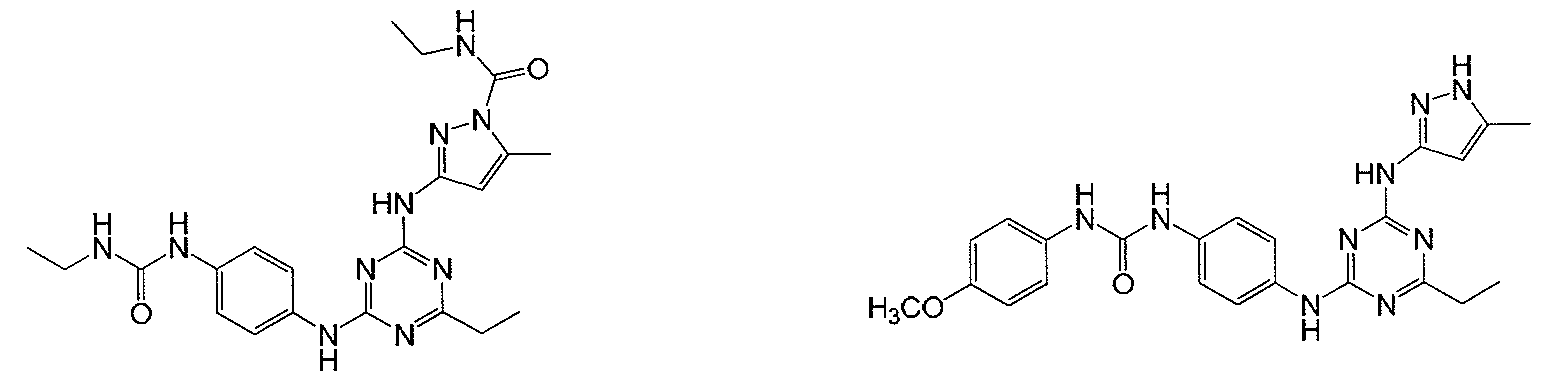
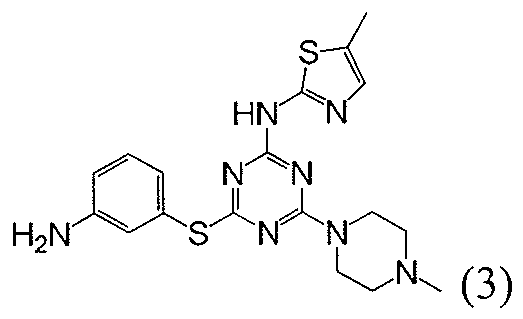
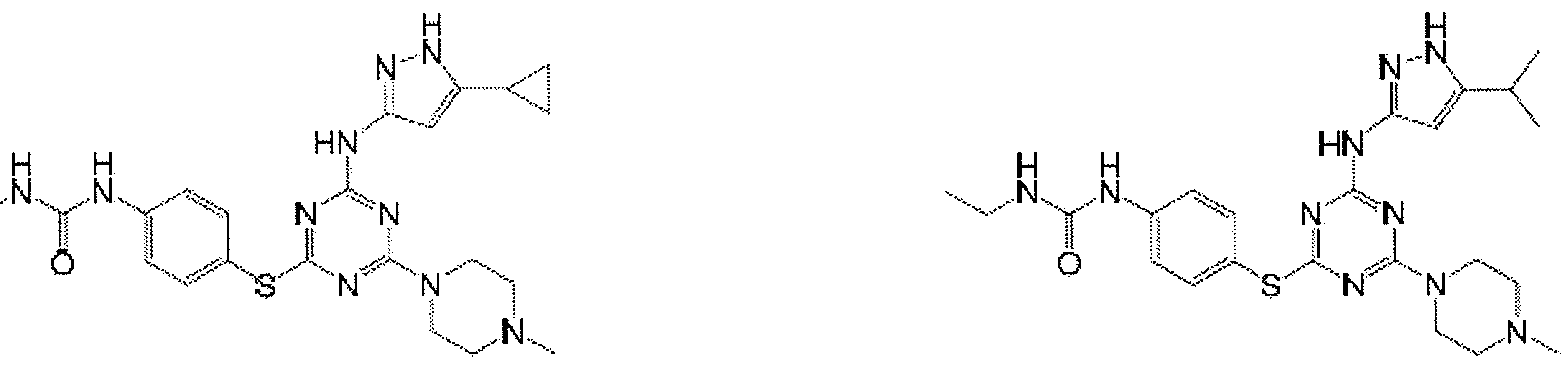
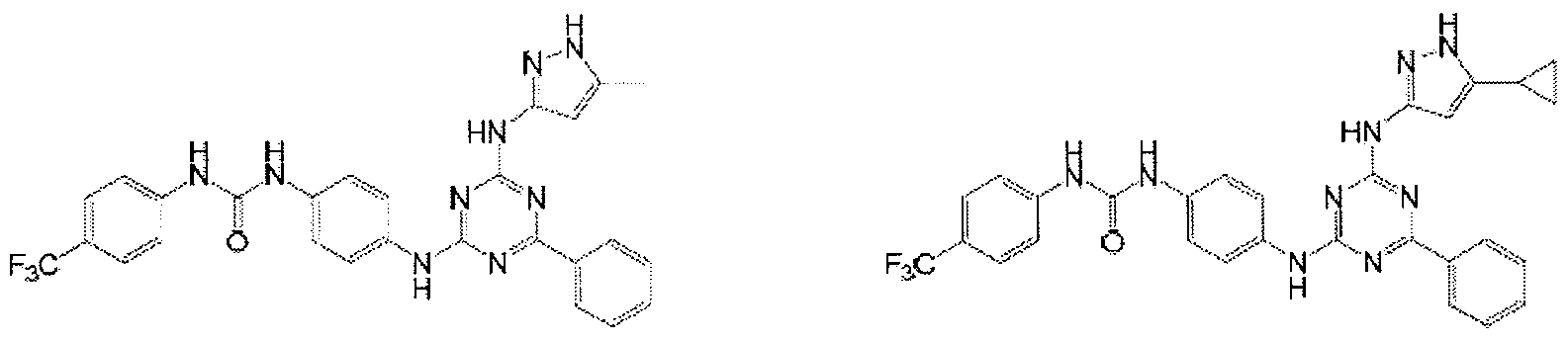
  • Examples of specific compounds of the present invention are those compounds defined in the following:
  • a method of preparing the inventive compounds is provided.
  • the compounds of the present invention can be generally prepared using cyanuric chloride as a starting material.
  • Compound (I) may contain various stereoisomers, geometric isomers, tautomeric isomers, and the like. All of possible isomers and their mixtures are included in the present invention, and the mixing ratio is not particularly limited.
  • the triazine derivative compounds of Formula (I) in this invention can be prepared by known procedure in the prior art. The examples could be found in US patent No. 2005250945A1 ; US patent No. 20050227983A1 ; PCT WO
  • reduction refers to the process of reducing a nitro functionality to an amino functionality, or the process of transforming an ester functionality to an alcohol.
  • the reduction of a nitro group can be carried out in a number of ways well known to those skilled in the art of organic synthesis including, but not limited to, catalytic hydrogenation, reduction with SnCI2 and reduction with titanium bichloride.
  • the reduction of an ester group is typically performed using metal hydride reagents including, but not limited to, diisobutyl-aluminum hydride (DIBAL), lithium aluminum hydride (LAH), and sodium borohydride.
  • DIBAL diisobutyl-aluminum hydride
  • LAH lithium aluminum hydride
  • sodium borohydride sodium borohydride
  • hydrolyze refers to the reaction of a substrate or reactant with water. More specifically, “hydrolyze” refers to the conversion of an ester or nitrite functionality into a carboxylic acid. This process can be catalyzed by a variety of acids or bases well known to those skilled in the art of organic synthesis.
  • the compounds of Formula (I) may be prepared by use of known chemical reactions and procedures. The following general preparative methods are presented to aid one of skill in the art in synthesizing the inhibitors, with more detailed examples being presented in the experimental section describing the working examples.
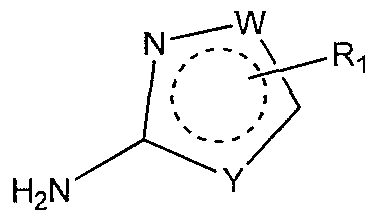
  • Heterocyclic amines are defined in formula (II). Some of heterocyclic amines are commercially available, others may be prepared by known procedure in the prior art (Katritzky, et al. Comprehensive Heterocyclic Chemistry; Permagon Press: Oxford, UK, 1984, March. Advanced Organic Chemistry, 3" Ed.; John Wiley: New York, 1985), or by using common knowledge of organic chemistry.
  • substituted heterocyclic amines can be generated using standard methods (March, J. Advanced Organic Chemistry, 4th Ed.; John Wiley, New York (1992); Larock, R. C. Comprehensive Organic Transformations, 2 nd Ed., John Wiley, New York (1999); World patent No. WO 99/32106).
  • heterocyclic amines can be commonly synthesized by reduction of nitroheteros using a metal catalyst, such as Ni, Pd, or Pt, and H 2 ⁇ r a hydride transfer agent, such as formate, cyclohexadiene, or a borohydride (Rylander. Hydrogenation Methods; Academic Press: London, UK (1985)).
  • Nitroheteros may also be directly reduced using a strong hydride source, such as LAH 1 (Seyden- Penne. Reductions by the Alumino- and Borohydrides in Organic Synthesis; VCH Publishers: New York (1991 )), or using a zero valent metal, such as Fe, Sn or Ca, often in acidic media.
  • LAH 1 Sud- Penne. Reductions by the Alumino- and Borohydrides in Organic Synthesis; VCH Publishers: New York (1991 )
  • a zero valent metal such as Fe, Sn or Ca
  • thiazole amine with a substituent (lib) can be prepared from commercial compounds as illustrated in Scheme 2.
  • a substituted aldehyde which may be commercially available or prepared by oxidizing an alcohole, can be brominated by broming or NBS (N- Bromosuccinimide); after bromination, the aldehyde can be converted to the corresponding thiazole amine (lib) by reacting with thiourea.
  • oxidizing reagent for the oxidation step, a variety of oxidizing reagent can be used, such as pyridinium chlorochromate (PCC) activated dimethyl sulfoxide (DMSO), hypervalent iodide compounds, Tetrapropylammonium perruthenate (TPAP) or 2,2,6,6- Tetramethylpiperidine-1-oxyl (TEMPO).
  • PCC pyridinium chlorochromate
  • DMSO dimethyl sulfoxide
  • TPAP Tetrapropylammonium perruthenate
  • TEMPO 2,2,6,6- Tetramethylpiperidine-1-oxyl
  • pyrazole amines with a substituent can be prepared by known procedure in the prior art, such as US Patent 6407238; F. Gabrera Escribano, et al. Tetrahedron Letters, Vol. 29, No. 46, pp. 6001-6004, 1988; Org. Biomol. Chem., 2006, 4, 4158 - 4164; WO/2003/026666.
  • Precursors R 2 H can be purchased from suppliers such as Alderich.
  • Intermediate of urea compound (III) can be prepared by general knowledge on urea synthesis know in the arts. As illustrated in scheme 3, substituted isocyanate can be be used to react with a substituted aniline under appropriate conditions to produce intermediate (III).
  • Scheme 4 illustrated the synthesis method for compounds with alkyl or aryl as R 2 .
  • the 6-alkyl or aryl substituted dichloro-triazine (b) may be synthesized by the methods known in the art (e.g., J. Med. Chem. 1999, 42, 805-818 and J. Med. Chem. 2004, 47, 600-611 ) from cyanuric chloride (a) and Grignard reagents.
  • the monochloro-triazine (c) can be formed from the reaction of a 6- alkyl or aryl substituted dichloro-triazine (b) with heterocyclic amine, which can be converted to triazine derivatives (I) by reaction with intermiate (111).
  • dichloro-triazine (b) can be converted to monochloro-triazine (d) by reacting with intermediate (III), which also can be converted to triazine derivative (I) by reacting with a heterocyclic amine.
  • the triazine derivative can also be synthesized by the reaction of cyanuric chloride with a sequence of heterocyclic amines and HR 2 to give2,4-disubstituted-6-chloro-1 ,3,5-triazines.
  • the displacement of the last chlorine by intermediate (III) can be achieved by increasing the temperature, affording the trisubstituted-1 ,3,5-triazines (I).
  • the reaction can be completed in one pot or step by step.
  • reaction sequence can also be used to make triazine derivatives such as illustrated in Scheme 6.
  • other reaction sequence can also be utilized.
  • the triazine derivative can be obtained by synthesizinf intermediate (IV), which react with an appropriate regent such as substituted isocyanate to produce compound (I).
  • Othe methods can also be used for the prepreation of urea compound from an amine such as thos kown in the arts (E. Artuso, I. Degani, R. Fochi, C. Magistris, Synthesis, 2007, 3497-3506; C. Han, J. A. Porco, Jr, Org. Lett, 2007, 9, 1517-1520; H. Lebel, O. Leogane, Org. Lett, 2006, 8, 5717-5720; M. B. Bertrand, J. P.
  • the reaction is preferably conducted in the presence of an inert solvent.
  • an inert solvent there is no particular restriction on the nature of the solvent to be employed, provided that it has no adverse effect on the reaction or on the reagents involved and that it can dissolve the reagents, at least to some extent.
  • suitable solvents include: aliphatic hydrocarbons, such as hexane, heptane, ligroin and petroleum ether; aromatic hydrocarbons, such as benzene, toluene and xylene; halogenated hydrocarbons, especially aromatic and aliphatic hydrocarbons, such as methylene chloride, chloroform, carbon tetrachloride, dichloroethane, chlorobenzene and the dichlorobenzenes; esters, such as ethyl formate, ethyl acetate, propyl acetate, butyl acetate and diethyl carbonate; ethers, such as diethyl ether, diisopropyl ether, tetrahydrofuran, dioxane.
  • aliphatic hydrocarbons such as hexane, heptane, ligroin and petroleum ether
  • aromatic hydrocarbons such as benzene, toluene and
  • ketones such as acetone, methyl ethyl ketone, methyl isobutyl ketone, isophorone and cyclohexanone
  • nitro compounds which may be nitroalkanes or nitroaranes, such as nitroethane and nitrobenzene
  • nitriles such as acetonitrile and isobutyronitrile
  • amides which may be fatty acid amides, such as formamide, dimethylformamide, dimethylacetamide and hexamethylphosphoric triamide
  • sulphoxides such as dimethyl sulphoxide and sulpholane.
  • the reaction can take place over a wide range of temperatures, and the precise reaction temperature is not critical to the invention. In general, we find it convenient to carry out the reaction at a temperature of from -50°C to 100°C.
  • the present invention provides compositions of matter that are formulations of one or more active drugs and a pharmaceutically-acceptable carrier.
  • the invention provides a composition for administration to a mammalian subject, which may include a compound of formula I, or its pharmaceutically acceptable salts.
  • Pharmaceutically acceptable salts of the compounds of this invention include those derived from pharmaceutically acceptable inorganic and organic acids and bases.
  • suitable acid salts include acetate, adipate, alginate, aspartate, benzoate, benzenesulfonate, bisulfate, butyrate, citrate, camphorate, camphorsulfonate, cyclopentanepropionate, digluconate, dodecylsulfate, ethanesulfonate, formate, fumarate, glucoheptanoate, glycerophosphate, glycolate, hemisulfate, heptanoate, hexanoate, hydrochloride, hydrobromide, hydroiodide, 2-hydroxyethanesulfonate, lactate, maleate, malonate, methanesulfonate, 2-naphthalenesulfonate, nicotinate, nitrate, oxalate, palmoate, pec
  • Salts derived from appropriate bases include alkali metal (e.g., sodium and potassium), alkaline earth metal (e.g., magnesium), ammonium and N+(C1-4 alkyl)4 salts.
  • alkali metal e.g., sodium and potassium
  • alkaline earth metal e.g., magnesium
  • ammonium and N+(C1-4 alkyl)4 salts This invention also envisions the quaternization of any basic nitrogen-containing groups of the compounds disclosed herein. Water or oil- soluble or dispersible products may be obtained by such quaternization.
  • the compositions of the present invention may be administered orally, parenterally, by inhalation spray, topically, rectally, nasally, buccally, vaginally or via an implanted reservoir.
  • parenteral includes subcutaneous, intravenous, intramuscular, intra-articular, intra-synovial, intrasternal, intrathecal, intrahepatic, intralesional and intracranial injection or infusion techniques.
  • the compositions are administered orally, intrapehtoneally or intravenously.
  • compositions of this invention may be orally administered in any orally acceptable dosage form including, but not limited to, capsules, tablets, troches, elixirs, suspensions, syrups, wafers, chewing gums, aqueous suspensions or solutions.
  • the oral compositions may contain additional ingredients such as: a binder such as microcrystalline cellulose, gum tragacanth or gelatin; an excipient such as starch or lactose, a disintegrating agent such as alginic acid, corn starch and the like; a lubricant such as magnesium stearate; a glidant such as colloidal silicon dioxide; and a sweetening agent such as sucrose or saccharin or flavoring agent such as peppermint, methyl salicylate, or orange flavoring.
  • a binder such as microcrystalline cellulose, gum tragacanth or gelatin
  • an excipient such as starch or lactose, a disintegrating agent such as alginic acid, corn starch and the like
  • a lubricant such as magnesium stearate
  • a glidant such as colloidal silicon dioxide
  • a sweetening agent such as sucrose or saccharin or flavoring agent such as peppermint, methyl salicylate, or orange flavoring.
  • tablets or pills may be coated with sugar, shellac, or other enteric coating agents.
  • a syrup may contain, in addition to the active ingredients, sucrose as a sweetening agent and certain preservatives, dyes and colorings and flavors. Materials used in preparing these various compositions should be pharmaceutically or veterinarally pure and non-toxic in the amounts used.
  • the active ingredient may be incorporated into a solution or suspension.
  • the solutions or suspensions may also include the following components: a sterile diluent such as water for injection, saline solution, fixed oils, polyethylene glycols, glycerine, propylene glycol or other synthetic solvents; antibacterial agents such as benzyl alcohol or methyl parabens; antioxidants such as ascorbic acid or sodium bisulfite; chelating agents such as ethylenediaminetetraacetic acid; buffers such as acetates, citrates or phosphates and agents for the adjustment of tonicity such as sodium chloride or dextrose.
  • the parenteral preparation can be enclosed in ampoules, disposable syringes or multiple dose vials made of glass or plastic.
  • the pharmaceutical forms suitable for injectable use include sterile solutions, dispersions, emulsions, and sterile powders.
  • the final form should be stable under conditions of manufacture and storage. Furthermore, the final pharmaceutical form should be protected against contamination and should, therefore, be able to inhibit the growth of microorganisms such as bacteria or fungi.
  • a single intravenous or intraperitoneal dose can be administered. Alternatively, a slow long-term infusion or multiple short-term daily infusions may be utilized, typically lasting from 1 to 8 days. Alternate day dosing or dosing once every several days may also be utilized.
  • Sterile, injectable solutions may be prepared by incorporating a compound in the required amount into one or more appropriate solvents to which other ingredients, listed above or known to those skilled in the art, may be added as required.
  • Sterile injectable solutions may be prepared by incorporating the compound in the required amount in the appropriate solvent with various other ingredients as required. Sterilizing procedures, such as filtration, may then follow.
  • dispersions are made by incorporating the compound into a sterile vehicle which also contains the dispersion medium and the required other ingredients as indicated above. In the case of a sterile powder, the preferred methods include vacuum drying or freeze drying to which any required ingredients are added.
  • Suitable pharmaceutical carriers include sterile water; saline, dextrose; dextrose in water or saline; condensation products of castor oil and ethylene oxide combining about 30 to about 35 moles of ethylene oxide per mole of castor oil; liquid acid; lower alkanols; oils such as corn oil; peanut oil, sesame oil and the like, with emulsifiers such as mono- or di-glyceride of a fatty acid, or a phosphatide, e.g., lecithin, and the like; glycols; polyalkylene glycols; aqueous media in the presence of a suspending agent, for example, sodium carboxymethylcellulose; sodium alginate; poly(vinylpyrolidone) ; and the like, alone, or with suitable dispensing agents such as lecithin; polyoxyethylene stearate; and the like.
  • a suspending agent for example, sodium carboxymethylcellulose; sodium alginate; poly(vinylpyrolidone)
  • the carrier may also contain adjuvants such as preserving stabilizing, wetting, emulsifying agents and the like together with the penetration enhancer.
  • adjuvants such as preserving stabilizing, wetting, emulsifying agents and the like together with the penetration enhancer.
  • the final form must be sterile and should also be able to pass readily through an injection device such as a hollow needle.
  • the proper viscosity may be achieved and maintained by the proper choice of solvents or excipients.
  • the use of molecular or particulate coatings such as lecithin, the proper selection of particle size in dispersions, or the use of materials with surfactant properties may be utilized.
  • compositions containing triazine derivatives and methods useful for the in vivo delivery of triazine derivatives in the form of nanoparticles which are suitable for any of the aforesaid routes of administration.
  • United States Patent Nos. 5,916,596, 6,506,405 and 6,537,579 teach the preparation of nanoparticles from the biocompatible polymers, such as albumin.
  • methods for the formation of nanoparticles of the present invention by a solvent evaporation technique from an oil-in-water emulsion prepared under conditions of high shear forces (e.g., sonication, high pressure homogenization, or the like).
  • compositions of this invention may be administered in the form of suppositories for rectal administration.
  • suppositories for rectal administration.
  • suppositories can be prepared by mixing the agent with a suitable non- irritating excipient that is solid at room temperature but liquid at rectal temperature and therefore will melt in the rectum to release the drug.
  • suitable non- irritating excipient include cocoa butter, beeswax and polyethylene glycols.
  • compositions of this invention may also be administered topically, especially when the target of treatment includes areas or organs readily accessible by topical application, including diseases of the eye, the skin, or the lower intestinal tract. Suitable topical formulations are readily prepared for each of these areas or organs.
  • Topical application for the lower intestinal tract can be effected in a rectal suppository formulation (see above) or in a suitable enema formulation. Topically-transdermal patches may also be used.
  • the pharmaceutically acceptable compositions may be formulated in a suitable ointment containing the active component suspended or dissolved in one or more carriers.
  • Carriers for topical administration of the compounds of this invention include, but are not limited to, mineral oil, liquid petrolatum, white petrolatum, propylene glycol, polyoxyethylene, polyoxypropylene compound, emulsifying wax and water.
  • the pharmaceutically acceptable compositions can be formulated in a suitable lotion or cream containing the active components suspended or dissolved in one or more pharmaceutically acceptable carriers.
  • suitable carriers include, but are not limited to, mineral oil, sorbitan monostearate, polysorbate 60, cetyl esters wax, cetearyl alcohol, 2-octyldodecanol, benzyl alcohol and water.
  • the pharmaceutically acceptable compositions may be formulated as micronized suspensions in isotonic, pH adjusted sterile saline, or, preferably, as solutions in isotonic, pH adjusted sterile saline, either with or without a preservative such as benzylalkonium chloride.
  • the pharmaceutically acceptable compositions may be formulated in an ointment such as petrolatum.
  • the pharmaceutically acceptable compositions of this invention may also be administered by nasal aerosol or inhalation.
  • Such compositions are prepared according to techniques well-known in the art of pharmaceutical formulation and may be prepared as solutions in saline, employing benzyl alcohol or other suitable preservatives, absorption promoters to enhance bioavailability, fluorocarbons, and/or other conventional solubilizing or dispersing agents.
  • compositions of this invention are formulated for oral administration.
  • the compounds of the invention may be used to treat diseases associated with cellular proliferation or hyperproliferation, such as cancers which include but are not limited to tumors of the nasal cavity, paranasal sinuses, nasopharynx, oral cavity, oropharynx, larynx, hypopharynx, salivary glands, and paragangliomas.
  • cancers which include but are not limited to tumors of the nasal cavity, paranasal sinuses, nasopharynx, oral cavity, oropharynx, larynx, hypopharynx, salivary glands, and paragangliomas.
  • the compounds of the invention may also be used to treat cancers of the liver and biliary tree (particularly hepatocellular carcinoma), intestinal cancers, particularly colorectal cancer, ovarian cancer, small cell and non-small cell lung cancer, breast cancer, sarcomas (including fibrosarcoma, malignant fibrous histiocytoma, embryonal rhabdomysocarcoma, leiomysosarcoma, neuro-fibrosarcoma, osteosarcoma, synovial sarcoma, liposarcoma, and alveolar soft part sarcoma), neoplasms of the central nervous systems (particularly brain cancer), and lymphomas (including Hodgkin's lymphoma, lymphoplasmacytoid lymphoma, follicular lymphoma, mucosa- associated lymphoid tissue lymphoma, mantle cell lymphoma, B-lineage large cell lymphoma, Burkitt's lymphoma, and
  • the compounds and methods of the present invention are also useful in treating a variety of disorders, including but not limited to, for example: stroke, cardiovascular disease, myocardial infarction, congestive heart failure, cardiomyopathy, myocarditis, ischemic heart disease, coronary artery disease, cardiogenic shock, vascular shock, pulmonary hypertension, pulmonary edema (including cardiogenic pulmonary edema), pleural effusions, rheumatoid arthritis, diabetic retinopathy, retinitis pigmentosa, and retinopathies, including diabetic retinopathy and retinopathy of prematurity, inflammatory diseases, restenosis, asthma, acute or adult respiratory distress syndrome (ARDS), lupus, vascular leakage, protection from ischemic or reperfusion injury such as ischemic or reperfusion injury incurred during organ transplantation, transplantation tolerance induction; ischemic or
  • T- cell mediated hypersensitivity diseases including contact hypersensitivity, delayed- type hypersensitivity, and gluten-sensitive enteropathy (Celiac disease); Type 1 diabetes; psoriasis; contact dermatitis (including that due to poison ivy); Hashimoto's thyroiditis; Sjogren's syndrome; Autoimmune Hyperthyroidism, such as Graves' disease; Addison's disease (autoimmune disease of the adrenal glands); autoimmune polyglandular disease (also known as autoimmune polyglandular syndrome); autoimmune alopecia; pernicious anemia; vitiligo; autoimmune hypopituatarism; Guillain-Barre syndrome; other autoimmune diseases; cancers, including those where kineses such as Src-family kineses are activated or overexpressed, such as colon carcinoma and thymoma, or cancers where kinase activity facilitates tumor growth or survival; glomerulonephritis, serum sickness; uticaria; allergic diseases such as respiratory allergies
  • the compounds of the invention may be used to treat diseases associated with undesired cellular proliferation or hyperproliferation comprising identifying the mammal afflicted with said disease or condition and administering to said afflicted mammal a composition comprising the compound of formula 1 , wherein the disease or condition is associated with a kinase.
  • the compounds of the invention may be used to treat diseases associated with undesired cellular proliferation or hyperproliferation comprising identifying the mammal afflicted with said disease or condition and administering to said afflicted mammal a composition comprising the compound of formula 1 , wherein the disease or condition is associated with a tyrosine kinase.
  • the compounds of the invention may be used to treat diseases associated with undesired cellular proliferation or hyperproliferation comprising identifying the mammal afflicted with said disease or condition and administering to said afflicted mammal a composition comprising the compound of formula 1 , wherein the disease or condition is associated with the kinase that is a serine kinase or a threonine kinase.
  • the compounds of the invention may be used to treat diseases associated with undesired cellular proliferation or hyperproiiferation comprising identifying the mammal afflicted with said disease or condition and administering to said afflicted mammal a composition comprising the compound of formula 1 , wherein the disease or condition is associated with the kinase that is a Src family kinase.
  • the invention also provides methods of treating a mammal afflicted with the above diseases and conditions.
  • the amount of the compounds of the present invention that may be combined with the carrier materials to produce a composition in a single dosage form will vary depending upon the host treated, the particular mode of administration.
  • the compositions should be formulated so that a dosage of between 0.01-100 mg/kg body weight/day of the inhibitor can be administered to a patient receiving these compositions.
  • the invention compounds are administered in combination with chemotherapeutic agent, an anti-inflammatory agent, antihistamines, chemotherapeutic agent, immunomodulator, therapeutic antibody or a protein kinase inhibitor, e.g., a tyrosine kinase inhibitor, to a subject in need of such treatment.
  • chemotherapeutic agent an anti-inflammatory agent, antihistamines, chemotherapeutic agent, immunomodulator, therapeutic antibody or a protein kinase inhibitor, e.g., a tyrosine kinase inhibitor
  • the method includes administering one or more of the inventive compounds to the afflicted mammal.
  • the method may further include the administration of a second active agent, such as a cytotoxic agent, including alkylating agents, tumor necrosis factors, intercalators, microtubulin inhibitors, and topoisomerase inhibitors.
  • a second active agent such as a cytotoxic agent, including alkylating agents, tumor necrosis factors, intercalators, microtubulin inhibitors, and topoisomerase inhibitors.
  • the second active agent may be co-administered in the same composition or in a second composition.
  • suitable second active agents include, but are not limited to, a cytotoxic drug such as Acivicin; Aclarubicin; Acodazole Hydrochloride; AcrQnine; Adozelesin; Aldesleukin; Altretamine; Ambomycin; Ametantrone Acetate; Aminoglutethimide; Amsacrine; Anastrozole; Anthramycin; Asparaginase; Asperlin; Azacitidine;
  • a cytotoxic drug such as Acivicin; Aclarubicin; Acodazole Hydrochloride; AcrQnine; Adozelesin; Aldesleukin; Altretamine; Ambomycin; Ametantrone Acetate; Aminoglutethimide; Amsacrine; Anastrozole; Anthramycin; Asparaginase; Asperlin; Azacitidine;
  • Cyclophosphamide Cytarabine; dacarbazine; Dactinomycin; Daunorubicin Hydrochloride; Decitabine; Dexormaplatin; Dezaguanine; Dezaguanine Mesylate; Diaziquone; Docetaxel; Doxorubicin; Doxorubicin Hydrochloride; Droloxifene; Droloxifene Citrate; Dromostanolone Propionate; Duazomycin; Edatrexate; Eflomithine Hydrochloride; Elsamitrucin; Enloplatin; Enpromate; Epipropidine;
  • Fenretinide Floxuridine; Fludarabine Phosphate; Fluorouracil; Flurocitabine;
  • Fosquidone Fostriecin Sodium; Gemcitabine; Gemcitabine Hydrochloride; Gold Au 198; Hydroxyurea; ldarubicin Hydrochloride; Ifosfamide; llmofosine; Interferon
  • Alfa-2a Interferon Alfa-2b; Interferon Alfa-n1; Interferon Alfa-n3; Interferon Beta- La; Interferon Gamma- Ib; Iproplatin; lrinotecan Hydrochloride; Lanreotide
  • Metoprine Meturedepa; Mitindomide; Mitocarcin; Mitocromin; Mitogillin;
  • Mitomalcin Mitomycin; Mitosper; Mitotane; Mitoxantrone Hydrochloride;
  • Pipobroman Piposulfan; Piroxantrone Hydrochloride; Plicamycin; Plomestane;
  • Porfimer Sodium Porfiromycin; Prednimustine; Procarbazine Hydrochloride;
  • Puromycin Puromycin Hydrochloride; Pyrazofurin; Riboprine; Rogletimide;
  • Taxane Taxoid; Tecogalan Sodium; Tegafur; Teloxantrone Hydrochloride;
  • Temoporfin Teniposide; Teroxirone; Testolactone; Thiamiprine; Thioguanine;
  • Vapreotide Verteporfin; Vinblastine Sulfate; Vincristine Sulfate; Vindesine;
  • Vindesine Sulfate Vinepidine Sulfate; Vinglycinate Sulfate; Vinleurosine Sulfate;
  • the present invention also relates to compounds as shown in Formula (A):
  • Y is selected from C 1 -C 6 alkyl, C 2 -C 6 alkenyl, C 2 -C 6 alkynyl, -NR 4 R 5 , and -Q-R 3 ;
  • Q is heterocycloalkyl, which is optionally substituted with C 1 -C 4 alkyl or oxo;
  • R 3 is selected from H, C 1 -C 6 alkyl, C 2 -C 6 alkenyl, C 2 -C 6 alkynyl, aryl, and heteroaryl;
  • R 4 and R 5 are each independently selected from H, and C 1 -C 6 alkyl
  • X is -K- Ar '-R 1 ;
  • K is selected from NR 4 , S, and O;
  • Ar 1 is phenyl
  • R 1 is -NHC(O)NH-R 7 ;
  • R 7 is selected from H, C)-C 6 alkyl, aryl, aryl(C 1 -C 6 )alkyl, each of which is optionally substituted with halo, hydroxy, C 1 -C 6 alkyl, C 1 -C 6 haloalkyl, and C 1 -C 6 alkoxy;
  • Z is -NH-Ar 2 -R 2 ;
  • Ar 2 is heteroaryl including at least one nitrogen
  • R 2 is one or more substituents independently selected from halo, hydroxy, C 1 -C 6 alkyl, -C(O)NH-W, C 2 -C 6 alkenyl, and C 2 -C 6 alkynyl; W is C 1 -C 6 alkyl.
  • the present invention also relates to compounds as shown in Formula (A):
  • Y is selected from C-C 6 alkyl and -Q-R 3 ;
  • Q is piperazinyl;
  • R 3 is C 1 -C 6 alkyl;
  • X is -K- Ar '-R 1 ; K is selected from NH and S;
  • Ar 1 is phenyl
  • R 1 is -NHC(O)NH-R 7 ;
  • R 7 is selected from C 1 -C 6 alkyl, phenyl, benzyl, which phenyl and benzyl are optionally substituted with C 1 -C 6 alkyl, Cj-C 6 haloalkyl, and C 1 -C 6 alkoxy;
  • Z is -NH-Ar 2 -R 2 ;
  • Ar 2 is selected from thiazolyl and pyrazolyl;
  • R 2 is one or more substituents independently selected from C 1 -C 6 alkyl and -C(O)NH-W;
  • W is C 1 -C 6 alkyl.
  • the compounds and compositions may be used at sub-cytotoxic levels in combination with other agents in order to achieve highly selective activity in the treatment of non-neoplastic disorders, such as heart disease, stroke and neurodegenerative diseases (Whitesell et al., Curr Cancer Drug Targets (2003), 3(5), 349-58).
  • the exemplary therapeutical agents that may be administered in combination with invention compounds include EGFR inhibitors, such as gefitinib, erlotinib, and cetuximab.
  • Her2 inhibitors include canertinib, EKB-569, and GW- 572016.
  • Src inhibitors include Src inhibitors, dasatinib, as well as Casodex (bicalutamide), Tamoxifen, MEK-1 kinase inhibitors, MARK kinase inhibitors, PI3 inhibitors, and PDGF inhibitors, such as imatinib, Hsp90 inhibitors, such as 17- AAG and 17-DMAG.
  • anti-angiogenic and antivascular agents which, by interrupting blood flow to solid tumors, render cancer cells quiescent by depriving them of nutrition. Castration, which also renders androgen dependent carcinomas non-proliferative, may also be utilized. Also included are IGF1 R inhibitors, inhibitors of non- receptor and receptor tyrosine kineses, and inhibitors of integrin.
  • the pharmaceutical composition and method of the present invention may further combine other protein therapeutic agents such as cytokines, immunomodulatory agents and antibodies.
  • cytokine encompasses chemokines, interleukins, lymphokines, monokines, colony stimulating factors, and receptor associated proteins, and functional fragments thereof.
  • functional fragment refers to a polypeptide or peptide which possesses biological function or activity that is identified through a defined functional assay.
  • the cytokines include endothelial monocyte activating polypeptide Il (EMAP- II), granulocyte-macrophage-CSF (GM-CSF), granulocyte- CSF (G- CSF), macrophage- CSF (M-CSF), IL-1 , lL-2, IL-3, IL- 4, IL-5, IL-6, IL- 12, and IL-13, interferons, and the like and which is associated with a particular biologic, morphologic, or phenotypic alteration in a cell or cell mechanism.
  • Other therapeutic agents for the combinatory therapy include cyclosporins
  • CD40 and gp39 agents blocking the interaction between CD40 and gp39, such as antibodies specific for CD40 and for gpn39 (i.e., CD154), fusion proteins constructed from CD40 and gp39 (CD40lg and CD8gp39), inhibitors, such as nuclear translocation inhibitors, of NF-kappa B function, such as deoxyspergualin (DSG), cholesterol biosynthesis inhibitors such as HM:G CoA reductase inhibitors (lovastatin and simvastatin), non-steroidal antiinflammatory drugs (NSAIDs) such as ibuprofen and cyclooxygenase inhibitors such as rofecoxib, steroids such as prednisone or dexamethasone, gold
  • NSAIDs non-steroidal antiinflammatory drugs
  • Electrospray (ES+) ionization was used.
  • Analytical gradient consisted of 10% ACN in water ramping up to 100% ACN over 5 minutes unless otherwise stated.
  • HPLC High performance liquid chromatography
  • Example 7 To thesulution of compound 6 (40mg, 0.12mMol) in 2mL of CH 2 CI 2 was added phenylisocyanate (15 ⁇ L, 17mg, 0.14mMol). Reaction mixture was stirred overnight at room temperature. Solvent was evaporated. Flash column chromatography (silica, CH 2 Cl 2 MeOH 100/0 to 95/5to 90/10) yielded 7mg (13%) of desired product of compound 7.
  • Example 9 To the solution of compound 8 (3g, 16.9mMol) in 1OmL of THF was added 3-amino-5- methylpyrazole (1.64g, 16.9mMol) and DIPEA (3.24mL, 2.41g, 18.6mMol) in 5mL of THF. Reaction mixture was stirred for 2 hours at room temperature. 1,4- phenylenediamine (1.83g, 16.9mMol) and DIPEA (3.24mL, 2.41g, 18.6mMol) was added and reaction was microwaved at 100°C for 60 minutes.
  • Example 11 To the solution of compound 9 (150mg, 0.48mMol) in 15mL of CH 2 CI 2 was added phenylisocyanate (57 ⁇ L, 63mg, 0.53mMol). Reaction mixture was stirred overnight at room temperature. Solvent was evaporated. Flash column chromatography (silica, CH 2 Cl 2 /Me0H 98/2 to 95/5 to 90/10) yielded 45mg (22%) of desired product of compound 11.
  • This example illustrated c-Src kinase, Aurora-A kinase, Flt3 kinase, Ret kinase and TrkA Kinase Assays of selected Compounds from this invention (referred to
  • kinaseProfilerTM Service Assay Protocols (Millipore) were used to test the kinase inhibiting activity of novel compounds from this invention.
  • the buffer composition was as: 20 mM MOPS, 1 mM EDTA, 0.01 % Brij-35, 5% Glycerol, 0.1 % ⁇ -mercaptoethanol, 1 mg/mL BSA.
  • Test compounds were initially dissolved in DMSO at the desired concentration, then serially diluted to the kinase assay buffer.
  • Aurora-A(h) (5-10 mU) is incubated with 8 mM MOPS pH 7.0, 0.2 mM EDTA, 200 ⁇ M LRRASLG (Kemptide), 10 mM MgAcetate and [ ⁇ 33 P-ATP].
  • the reaction was initiated by the addition of the MgATP mix. After incubation for 40 minute at room temperature, the reaction was stopped by addition of 5 ⁇ L of a 3% phosphoric acid solution. 10 ⁇ L of the reaction was then spotted onto a P30 filtermat and washed three times for 5 minutes in 50 mM phosphoric acid and once in methanol prior to drying and scintillation counting. Wells containing substrate but no kinase and wells containing a phosphopeptide control were used to set 0% and 100% phosphorylation value, repectively.
  • Kinase Hotspot SM kinase assay was used to test the compounds for IC50 or % inhibitions (Reaction Biology Corp.). Inhibitor IC50 values were determined by titration of compound at the optimal kinase concentration (Kinase EC50).
  • Table 1 shows representative data for the inhibition of c-Src kinase, Aurora-A kinase, Flt3 kinase, Ret kinase and TrkA Kinase by the compounds of this invention at a concentration of 1 ⁇ M.

Landscapes

  • Health & Medical Sciences (AREA)
  • Chemical & Material Sciences (AREA)
  • Organic Chemistry (AREA)
  • General Health & Medical Sciences (AREA)
  • Veterinary Medicine (AREA)
  • Medicinal Chemistry (AREA)
  • Public Health (AREA)
  • Pharmacology & Pharmacy (AREA)
  • Life Sciences & Earth Sciences (AREA)
  • Animal Behavior & Ethology (AREA)
  • Engineering & Computer Science (AREA)
  • Bioinformatics & Cheminformatics (AREA)
  • General Chemical & Material Sciences (AREA)
  • Nuclear Medicine, Radiotherapy & Molecular Imaging (AREA)
  • Chemical Kinetics & Catalysis (AREA)
  • Immunology (AREA)
  • Cardiology (AREA)
  • Heart & Thoracic Surgery (AREA)
  • Epidemiology (AREA)
  • Rheumatology (AREA)
  • Physical Education & Sports Medicine (AREA)
  • Transplantation (AREA)
  • Pain & Pain Management (AREA)
  • Hospice & Palliative Care (AREA)
  • Ophthalmology & Optometry (AREA)
  • Diabetes (AREA)
  • Hematology (AREA)
  • Obesity (AREA)
  • Pulmonology (AREA)
  • Orthopedic Medicine & Surgery (AREA)
  • Vascular Medicine (AREA)
  • Urology & Nephrology (AREA)
  • Biomedical Technology (AREA)
  • Dermatology (AREA)
  • Pharmaceuticals Containing Other Organic And Inorganic Compounds (AREA)
  • Plural Heterocyclic Compounds (AREA)
  • Medicines That Contain Protein Lipid Enzymes And Other Medicines (AREA)

Abstract

The present invention provides Uredophenyl substituted triazine derivatives and provides methods of using these compounds to modulate protein kinases and methods of using these compounds to treat protein kinase mediated diseases and conditions.

Description

Ureidophenyl Substituted Triazine Derivatives and Their Therapeutical Applications
FIELD OF THE INVENTION
The present invention relates generally to the use of compounds to treat a variety of disorders, diseases and pathologic conditions and more specifically to the use of triazine compounds to modulate protein kinases and for treating protein kinase-mediated diseases.
BACKGROUND OF THE INVENTION
Protein kinases constitute a large family of structurally related enzymes that are responsible for the control of a variety of signal transduction processes within the cell. Protein kinases, containing a similar 250-300 amino acid catalytic domain, catalyze the phosphorylation of target protein substrates.
The kinases may be categorized into families by the substrates in the phosphorylate (e.g., protein-tyrosine, protein-serine/threonine, lipids, etc.). Tyrosine phosphorylation is a central event in the regulation of a variety of biological processes such as cell proliferation, migration, differentiation and survival. Several families of receptor and non-receptor tyrosine kinases control these events by catalyzing the transfer of phosphate from ATP to a tyrosine residue of specific cell protein targets. Sequence motifs have been identified that generally correspond to each of these kinase families [ Hanks et al., FASEB J., (1995), 9, 576-596; Knighton et al., Science, (1991 ), 253, 407-414; Garcia- Bustos et al., EMBO J., (1994),13:2352-2361 ). Examples of kinases in the protein kinase family include, without limitation, abl, Akt, bcr-abl, BIk, Brk, Btk, c- kit, c-Met, c-src, c-fms, CDK1 , CDK2, CDK3, CDK4, CDK5, CDK6, CDK7, CDK8, CDK9, CDK10, cRafl , CSF1 R, CSK, EGFR, ErbB2, ErbB3, ErbB4, Erk, Fak, fes, FGFR1 , FGFR2, FGFR3, FGFR4, FGFR5, Fgr, flt-1 , Fps, Frk, Fyn, Hck, IGF-1 R, INS-R, Jak, KDR, Lck, Lyn, MEK, p38, PDGFR, PIK, PKC, PYK2, ros, Tie, Tie-2,
TRK, Yes, and Zap70. Studies indicated that protein kinases play a central role in the regulation and maintenance of a wide variety of cellular processes and cellular function. For example, kinase activity acts as molecular switches regulating cell proliferation, activation, and/or differentiation. Uncontrolled or excessive kinase activity has been observed in many disease states including benign and malignant proliferation disorders as well as diseases resulting from inappropriate activation of the immune system (autoimmune disorders), allograft rejection, and graft vs host disease.
It is reported that many diseases are associated with abnormal cellular responses triggered by protein kinase-mediated events. These diseases include autoimmune diseases, inflammatory diseases, bone diseases, metabolic diseases, neurological and neurodegenerative diseases, cancer, cardiovascular diseases, allergies and asthma, Alzheimer's disease and hormone-related diseases. In addition, endothelial cell specific receptor PTKs, such as VEGF-2 and Tie-2, mediate the angiogenic process and are involved in supporting the progression of cancers and other diseases involving uncontrolled vascularization. Accordingly, there has been a substantial effort in medicinal chemistry to find protein kinase inhibitors that are effective as therapeutic agents.
One kinase family of particular interest is the Src family of kinases. Src kinase is involved in proliferation and migration responses in many cell types, cell activation, adhesion, motility, and survival, growth factor receptor signaling, and osteoclast activation (Biscardi et al., Adv. Cancer Res. (1999), 76, 61-119; Yeatman et al., Nat. Rev. Cancer (2004), 4, 470-480; Owens, D. W.; McLean et al., MoI. Biol. Cell (2000), 11, 51-64). Members of the Src family include the following eight kinases in mammals: Src, Fyn, Yes, Fgr, Lyn, Hck, Lck, and BIk (Bolen et al., Annu. Rev. Immunol, (1997), 15, 371 ). These are nonreceptor protein kinases that range in molecular mass from 52 to 62 kD. All are characterized by a common structural organization that is comprised of six distinct functional domains: Src homology domain 4 (SH4), a unique domain, SH3 domain, SH2 domain, a catalytic domain (SH1 ), and a C-terminal regulatory region (Brown et al., Biochim Biophys Acta (1996), 1287, 121-149; Tatosyan et al. Biochemistry (Moscow) 2000, 65, 49-58). SH4 domain contains the myristylation signals that guide the Src molecule to the cell membrane. This unique domain of Src proteins is responsible for their specific interaction with particular receptors and protein targets (Thomas et al., Annu Rev Cell Dev Biol (1997), 13, 513-609). The modulating regions, SH3 and SH2, control intra- as well as intermolecular interactions with protein substrates which affect Src catalytic activity, localization and association with protein targets (Pawson T., Nature (1995), 373, 573-580). The kinase domain, SH1 , found in all proteins of the Src family, is responsible for the tyrosine kinase activity and has a central role in binding of substrates. The N-terminal half of Src kinase contains the site(s) for its tyrosine phosphorylation and regulates the catalytic activity of Src (Thomas et al., Annu Rev Cell Dev Biol (1997), 13: 513-609). v-Src differs from cellular Src (c-Src) on the basis of the structural differences in C-terminal region responsible for regulation of kinase activity. The prototype member of the Src family protein tyrosine kinases was originally identified as the transforming protein (v-Src) of the oncogenic retrovirus, Rous sarcoma virus, RSV (Brugge et al., Nature (1977), 269, 346- 348); Hamaguchi et al. (1995), Oncogene 10: 1037-1043). Viral v-Src is a mutated and activated version of a normal cellular protein (c-Src) with intrinsic tyrosine kinase activity (Collett et al., Proc Natl Acad Sci U S A (1978), 75, 2021- 2024). This kinase phosphorylates its protein substrates exclusively on tyrosyl residues (Hunter et al., Proc Natl Acad Sci U S A (1980), 77, 1311 -1315).
Investigations indicated that Src is a cytoplasmic protein tyrosine kinase, whose activation and recruitment to perimembranal signaling complexes has important implications for cellular fate. It has well-documented that Src protein levels and Src kinase activity are significantly elevated in human breast cancers (Muthuswamy et al., Oncogene, (1995), 11 , 1801-1810); Wang et al., Oncogene (1999), 18, 1227-1237; Warmuth et al., Curr. Pharm. Des. (2003), 9, 2043-2059], colon cancers (Irby et al., Nat Genet (1999), 21 , 187-190), pancreatic cancers (Lutz et al., Biochem Biophys Res Commun (1998), 243, 503-508], certain B-cell leukemias and lymphomas (Talamonti et al., J. Clin. Invest. (1993), 91 , 53; Lutz et al., Biochem. Biophys. Res. (1998), 243, 503; Biscardi et al., Adv. Cancer Res. (1999), 76, 61 ; Lynch et al., Leukemia (1993), 7, 1416; Boschelli et al., Drugs of the Future (2000), 25(7), 717), gastrointestinal cancer (Cartwright et al., Proc. Natl. Acad. Sci. USA, (1990), 87, 558-562 and Mao et al., Oncogene, (1997), 15, 3083-3090), non-small cell lung cancers (NSCLCs) (Mazurenko et al., European Journal of Cancer, (1992), 28, 372-7), bladder cancer (Fanning et al., Cancer Research, (1992), 52, 1457-62), oesophageal cancer (Jankowski et al., Gut, (1992), 33, 1033-8), prostate and ovarian cancer (Wiener et al., Clin. Cancer Research, (1999), 5, 2164-70), melanoma and sarcoma (Bohlen et al., Oncogene, (1993), 8, 2025-2031 ; tatosyan et al., Biochemistry (Moscow) (2000), 65, 49-58). Furthermore, Src kinase modulates signal transduction through multiple oncogenic pathways, including EGFR, Her2/neu, PDGFR, FGFR, and VEGFR (Frame et al., Biochim. Biophys. Acta (2002), 1602, 114-130; Sakamoto et al., Jpn J Cancer Res, (2001 ), 92: 941-946). Thus, it is anticipated that blocking signaling through the inhibition of the kinase activity of Src will be an effective means of modulating aberrant pathways that drive oncologic transformation of cells. Src kinase inhibitors may be useful anti-cancer agents (Abram et al., Exp. Cell Res., (2000), 254, 1 ). It is reported that inhibitors of src kinase had significant antiproliferative activity against cancer cell lines (M. M. Moasser et al., Cancer Res., (1999), 59, 6145; Tatosyan et al., Biochemistry (Moscow) (2000), 65, 49-58).) and inhibited the transformation of cells to an oncogenic phenotype (R. Kami et al., Oncogene (1999), 18, 4654). Furthermore, antisense Src expressed in ovarian and colon tumor cells has been shown to inhibit tumor growth (Wiener et al., Clin. Cancer Res., (1999), 5, 2164; Staley et al., Cell Growth Diff. (1997), 8, 269). Src kinase inhibitors have also been reported to be effective in an animal model of cerebral ischemia (Paul et al. Nature Medicine, (2001 ), 7, 222), suggesting that Src kinase inhibitors may be effective at limiting brain damage following stroke. Suppression of arthritic bone destruction has been achieved by the overexpression of CSK in rheumatoid synoviocytes and osteoclasts (Takayanagi et al., J. Clin. Invest. (1999), 104, 137). CSK, or C-terminal Src kinase, phosphorylates and thereby inhibits Src catalytic activity. This implies that Src inhibition may prevent joint destruction that is characteristic in patients suffering from rheumatoid arthritis (Boschelli et al., Drugs of the Future (2000), 25(7), 717).
It is well documented that Src-family kinases are also important for signaling downstream of other immune cell receptors. Fyn, like Lck, is involved in TCR signaling in T cells (Appleby et al., Cell, (1992), 70, 751 ). Hck and Fgr are involved in Fey receptor signaling leading to neutrophil activation (Vicentini et al., J. Immunol. (2002), 168, 6446). Lyn and Src also participate in Fey receptor signaling leading to release of histamine and other allergic mediators (Turner, H. and Kinet, J-P Nature (1999), 402, B24). These-findings suggest that Src family kinase inhibitors may be useful in treating allergic diseases and asthma.
Other Src family kinases are also potential therapeutic targets. Lck plays a role in T-cell signaling. Mice that lack the Lck gene have a poor ability to develop thymocytes. The function of Lck as a positive activator of T-cell signaling suggests that Lck inhibitors may be useful for treating autoimmune disease such as rheumatoid arthritis (Molina et al., Nature, (1992), 357, 161 ).
Hck is a member of the Src protein-tyrosine kinase family and is expressed strongly in macrophages, an important HIV target cell and its inhibition in HIV-infected macrophages might slow disease progression (Ye et al., Biochemistry, (2004), 43 (50), 15775 -15784).
Hck, Fgr and Lyn have been identified as important mediators of integrin signaling in myeloid leukocytes (Lowell et al., J. Leukoc. Biol., (1999), 65, 313). Inhibition of these kinase mediators may therefore be useful for treating inflammation (Boschelli et al., Drugs of the Future (2000), 25(7), 717). It is reported that Syk is a tyrosine kinase that plays a critical role in the cell degranulation and eosinophil activation and Syk kinase is implicated in various allergic disorders, in particular asthma (Taylor et al., MoI. Cell. Biol. (1995), 15, 4149).
BCR-ABL encodes the BCR-AEL protein, a constitutively active cytoplasmic tyrosine kinase present in 90% of all patients with chronic myelogenous leukemia (CML) and in 15-30% of adult patients with acute lymphoblastic leukemia (ALL). Numerous studies have demonstrated that the activity of BCR-ABL is required for the cancer causing ability of this chimeric protein.
Src kinases play a role in the replication of hepatitis B virus. The virally encoded transcription factor HBx activates Src in a step required for propagation of the virus (Klein et al., EMBO J. (1999), 18, 5019; Klein et al., MoI. Cell. Biol. (1997), 17, 6427). Some genetic and biochemical data clearly demonstrate that Src-family tyrosine kinases serve as a critical signal relay, via phosphorylation of c-Cbl, for fat accumulation, and provide potential new strategies for treating obesity (Sun et al., Biochemistry, (2005), 44 (44), 14455 -14462). Since Src plays a role in additional signaling pathways, Src inhibitors are also being pursued for the treatment of other diseases including osteoporosis and stroke (Susva et al., Trends Pharmacol. Sci. (2000), 21, 489-495; Paul et al., Nat. Med. (2001 ), 7, 222-227). It is also possible that inhibitors of the Src kinase activity are useful in the treatment of osteoporosis (Soriano et al., Cell (1991), 64, 693; Boyce et al. J Clin. Invest (1992), 90, 1622; Owens et al., MoI. Biol. Cell (2000), 11, 51-64), T cell mediated inflammation (Anderson et al., Adv. Immunol. (1994), 56, 151 ; Goldman, F D et al. J. Clin. Invest. (1998), 102, 421 ), and cerebral ischemia (Paul et al. Nature Medicine (2001 ), 7, 222).
In addition, src family kinases participate in signal transduction in several cell types. For example, fyn, like lck, is involved in T-cell activation. Hck and fgr are involved in Fe gamma receptor mediated oxidative burst of neutrophils. Src and lyn are believed to be important in Fc epsilon induced degranulation of mast cells, and so may play a role in asthma and other allergic diseases. The kinase lyn is known to be involved in the cellular response to DNA damage induced by UV light (Hiwasa et al., FEBS Lett. (1999), 444, 173) or ionizing radiation ( Kumar et al., J Biol Chein, (1998), 273, 25654). Inhibitors of lyn kinase may thus be useful as potentiators in radiation therapy. T cells play a pivotal role in the regulation of immune responses and are important for establishing immunity to pathogens. In addition, T cells are often activated during inflammatory autoimmune diseases, such as rheumatoid arthritis, inflammatory bowel disease, type I diabetes, multiple sclerosis, Sjogren's disease, myasthenia gravis, psoriasis, and lupus. T cell activation is also an important component of transplant rejection, allergic reactions, and asthma.
T cells are activated by specific antigens through the T cell receptor, which is expressed on the cell surface. This activation triggers a series of intracellular signaling cascades mediated by enzymes expressed within the cell (Kane et al. Current Opinion in Immunol. (2000), 12, 242). These cascades lead to gene regulation events that result in the production of cytokines, like interleukin-2 (IL- 2). IL-2 is a necessary cytokine in T cell activation, leading to proliferation and amplification of specific immune responses.
Therefore, Src kinase and other kinase have become intriguing targets for drug discovery (Parang et al., Expert Opin. Ther. Pat. (2005), 15, 1183-1207; Parang et al., Curr. Opin. Drug Discovery Dev. (2004), 7, 630-638). Many classes of compounds have been disclosed to modulate or, more specifically, inhibit kinase activity for use to treat kinase-related conditions or other disorders. For example, U.S. Pat. No. US Pat. No. 6,596,746 and the PCT WO 05/096784A2 disclosed benzotrianes as inhibitors of kinases; the PCT WO 01/81311 disclosed substituted benzoic acid amides for the inhibition of angiogenisis; U.S. Pat. No. 6,440,965, disclosed substituted pyrimidine derivatives in the treatment of neurodegenerative or neurological disorders; PCT WO 02/08205 reported the pyrimidine derivatives having neurotrophic activity; PCT WO 03/014111 disclosed arylpiperazines and arylpiperidines and their use as metalloproteinase inhibiting agents; PCT WO 03/024448 described compounds as inhibitors of histone deacetylase enzymatic activity; PCT WO 04/058776 disclosed compounds which possess anti-angiogenic activity. PCT WO 01/94341 and WO 02/16352 disclosed Src kinase inhibitors of quinazoline derivatives. PCT WO03/026666A1and WO03/018021A1 disclosed pyrimidinyl derivatives as kinase inhibitors. U.S. Pat. No 6498165 reported Src kinase inhibitor compounds of pyrimidine compounds. Peptides as Src Tyrosine Kinase Inhibitors is reported recently (Kumar et al., J. Med. Chem., (2006), 49 (11 ), 3395 -3401). The quinolinecarbonitriles derivatives was reported to be potent dual Inhibitors of Src and AbI Kinases (Diane et al., J. Med. Chem., (2004), 47 (7), 1599 -1601 ). Another kinase family of particular interest is the aurora kinases. The
Aurora kinase family is a collection of highly related serine/threonine kinase that are key regulators of mitosis, essential for accurate and equal segtion of genomic material from parent to daught cells. Members of the Aurora kinase family include three related kinases kown as Aurora-A, Aurora-B, and Aurora-C. Despite significant sequence homology, the localization and functions of these kinases are largely distinct from one another (Richard D.Carvajal, et al. Clin Cancer Res 2006; 12(23): 6869-6875; Daruka Mahadevan, et al. Expert Opin. Drug Discov. 2007 2(7): 1011-1026) . Aurora-A is ubiquitously expressed and regulates cell cycle events occurring from late S phase through M phase, including centrosome maturation (Berdnik D, et al. Curr Biol 2002; 12:640-7), mitotic entry (Hirota T, et al. Cell 2003;114:585- 98; Dutertre S, et al. J Cell Sci 2004;117:2523-31 ), centrosome separation (Marumoto T, et al. J Biol Chem 2003;278:51786-95), bipolar-spindle assembly (Kufer TA, et al. J CeII Biol 2002;158:617-23; Eyers PA, et al. Curr Biol 2003;13:691-7.), chromosome alignment on the metaphase plate (Marumoto T, et al. J Biol Chem 2003;278:51786-95; Kunitoku N, et al. Dev Cell 2003;5:853- 64.), cytokinesis (Marumoto T, et al. J Biol Chem 2003;278:51786-95), and mitotic exit. Aurora-A protein levels and kinase activity both increase from late G2 through M phase, with peak activity in prometaphase. Once activated, Aurora-A mediates its multiple functions by interacting with various substrates including centrosomin, transforming acidic coiled-coil protein, cdc25b, Eg5, and centromere protein A.
Aurora-B is a chromosomal passenger protein critical for accurate chromosomal segregation, cytokinesis (Hauf S, et al. J Cell Biol 2003;161 :281- 94; Ditchfield C, et al. J Cell Biol 2003; 161 :267-80; Giet R, et al. J Cell Biol 2001 ;152:669-82; Goto H, et al. J Biol Chem 2003;278:8526-30), protein localization to the centromere and kinetochore, correct microtubule-kinetochore attachments (Murata-Hori M, et al. Curr Biol 2002; 12:894-9), and regulation of the mitotic checkpoint. Aurora-B localizes first to the chromosomes during prophase and then to the inner centromere region between sister chromatids during prometaphase and metaphase (Zeitlin SG, et al. J Cell Biol
2001 ; 155: 1147-57). Aurora-B participates in the establishment of chromosomal biohentation, a condition where sister kinetochores are linked to opposite poles of the bipolar spindle via amphitelic attachments. Errors in this process, manifesting as a merotelic attachment state (one kinetochore attached to microtubules from both poles) or a syntelic attachment state (both sister kinetochores attached to microtubules from the same pole), lead to chromosomal instability and aneuploidy if not corrected before the onset of anaphase. The primary role of Aurora-B at this point of mitosis is to repair incorrect microtubule- kinetochore attachments (Hauf S, et al. J Cell Biol 2003;161 :281-94; Ditchfield C, et al. J Cell Biol 2003;161 :267-80; Lan W, et al. Curr Biol 2004; 14:273-86.).
Without Aurora-B activity, the mitotic checkpoint is compromised, resulting in increased numbers of aneuploid cells, genetic instability, and tumorigenesis (Weaver BA, et al. Cancer Cell 2005;8:7-12).
Aurora-A overexpression is a necessary feature of Aurora-A-induced tumorigenesis. In cells with Aurora-A overexpression, mitosis is characterized by the presence of multiple centrosomes and multipolar spindles (Meraldi P et al. EMBO J 2002;21 :483-92.). Despite the resulting aberrant microtubule- kinetochore attachments, cells abrogate the mitotic checkpoint and progress from metaphase to anaphase, resulting in numerous chromosomal separation defects. These cells fail to undergo cytokinesis, and, with additional cell cycles, polyploidy and progressive chromosomal instability develop (Anand S, et al. Cancer Cell 2003;3:51-62).
The evidence linking Aurora overexpression and malignancy has stimulated interest in developing Aurora inhibitors for cancer therapy. In normal cells, Aurora-A inhibition results in delayed, but not blocked, mitotic entry, centrosome separation defects resulting in unipolar mitotic spindles, and failure of cytokinesis (Marumoto T, et al. J Biol Chem 2003;278:51786-95). Encouraging antitumor effects with Aurora-A inhibition were shown in three human pancreatic cancer cell lines (Panc-1 , MIA PaCa-2, and SU.86.86), with growth suppression in cell culture and near-total abrogation of tumorigenicity in mouse xenografts (Hata T, et al. Cancer Res 2005;65:2899-905.).
Aurora-B inhibition results in abnormal kinetochore-microtubule attachments, failure to achieve chromosomal biorientation, and failure of cytokinesis (Goto H, et al. J Biol Chem 2003;278:8526-30; Severson AF, et al. Curr Biol 2000;10:1162-71 ). Recurrent cycles of aberrant mitosis without cytokinesis result in massive polyploidy and, ultimately, to apoptosis (Hauf S, et al. J Cell Biol
2003;161 :281-94; Ditchfield C, et al. J Cell Biol 2003;161 :267-80; Giet R, et al. J Cell Biol 2001 ; 152:669-82; Murata-Hori M, Curr Biol 2002; 12:894-9; KaINo MJ, et al. Curr Biol 2002;12:900-5).
Inhibition of Aurora-A or Aurora-B activity in tumor cells results in impaired chromosome alignment, abrogation of the mitotic checkpoint, polyploidy, and subsequent cell death. These in vitro effects are greater in transformed cells than in either non-transformed or non-dividing cells (Ditchfield C, et al. J Cell Biol 2003; 161 :267-80). Thus, targeting Aurora may achieve in vivo selectivity for cancer. Although toxicity to rapidly dividing cell of the hematopoietic and gastrointestinal system is expected, the activity and clinical tolerability shown in xenograft models indicates the presence of a reasonable therapeutic index. Given the preclinical antitumor activity and potential for tumor selectivity, several Aurora kinase inhibitors have been developed. The first three small-molecule inhibitors of Aurora described include ZM447439 (Ditchfield C, et al. J Cell Biol 2003;161 :267-80), Hesperadin (Hauf S, et al. J Cell Biol 2003;161 :281-94), and
MK0457 (VX680) (Harrington EA, et al. Nat Med 2004; 10:262-7). The following agents are nonspecific inhibitors: ZM447439 inhibits Aurora-A and Aurora-B; Herperadin inhibits primarily Aurora-B; MK0457 inhibits all three Aurora kinases. Each induces a similar phenotype in cell-based assays, characterized by inhibition of phosphorylation of histone H3 on SeMO, inhibition of cytokinesis, and the development of polyploidy. Selective inhibitors of Aurora have also been developed. A selective Aurora-A inhibitor is MLN8054 (Hoar HM, et al. [abstract C40]. Proc AACR-NCI-EORTC international Conference: Molecular Targets and Cancer Therapeutics 2005). A expmple of selective Aurora-B inhibitor is AZD1152 (Schellens J, et al. [abstract 3008]. Proc Am Soc Clin Oncol 2006;24:122s). The next generation of Aurora inhibitors is currently being developed, including agents by Nerviano Medical Sciences (PHA-680632 and PHA-739358), Rigel (R763), Sunesis (SNS-314), NCE Discovery Ltd. (NCED#17), Astex Therapeutics (AT9283), and Montigen Pharmaceuticals (MP- 235 and MP-529). Several of these agents are undergoing evaluation in clinical trials.
Many cancers are characterized by distruptions in cellular signaling pathways that lead to uncontrolled growth and proliferation of cancerous cells. Receptor tyrosine kinases (RTKs) play a crucial role in these signaling pathways, transmitting extracellular molecular signals into cytoplasm and/or nucleus of a cell. RTKs are transmembrane proteins that generally include an extracellular ligand-binding domain, a membrane-spanning domain and a catalytic cytoplasmic tyrosine kinase domain. The binding of ligand to the extracellular potion is believed to promote dimerization, resulting in trans-phosphorylation and activation of the intracellular tyrosine kinase domain (Schlessinger et al. Neuron 1992;9:383-391 ).
Another kinase family of particular interest is FLT3. FMS-related tyrosine kinase 3 (FLT3), also known as FLK-2 (fetal liver kinase 2) and STK-1 (human stem cell kinase 1 ), belongs to a member of the class III receptor tyrosine kinase (RTKIII) family that include KIT, PDGFR, FMS and FLT1 (Stirewalt DL, et al. Nat.
Rev. Cancer 2003;3:650-665; Rosnet O, et al. Genomics 1991 ;9:380-385; Yarden Y, et al. Nature 1986;323: 226-232; Stanley E R, et. al. J. Cell. Biochem.1983 21 :151-159; Yarden Y, et al. EMBO J 1987;6:3341-3351 ). FLT3 is a membrane-spanning protein and composed of four domains; an extracellular ligand-binding domains consisting of five immunoglobin-like structures, a transmembrane (TM) domain, a juxtamembrane (JM) domain and a cytoplasmic C-Terminal tyrosine kinase (TK) domain. (Agnes F, et al. Gene 1994;145:283- 288; Scheijen B, et al. Oncogene 2002;21 :3314-3333).
The ligand for FLT3 (FLT3 or FL) was cloned in 1993 and shown to be a Type I transmembrane protein expressed in cells of the hematopoietic bone marrow microenvironment, including bone marrow fibroblasts and other cells (Lyman SD, et al. Cell 1993;75:1157-1167). Both the membrane-bound and soluable forms can activate the tyrosine kinase activity of the receptor and stimulate growth of progenitor cells in the marrow and blood. Binding of ligand to receptor induces dimerisation of the receptor and activation of the kinase domains; which then autophosphorylate and catalyse phosphorylation of substrate proteins of various signal transduction pathways such as signal transducer and activator of transcription 5 (STAT5), RAS/mitogen-activated protein kinase (RAS/MAPK), phosphoinositide 3-kinase (PI3K), src homologous and collagen gene (SHC), SH2-containing inositol-5-phosphatase (SHIP), and cytoplasmic tyrosine phosphatase with 2 Src-homology 2 (SH2) domains (SHP2), which play important roles in cellular proliferation, differentiation, and survival (Dosil M, et al. MoI Cell Biol 1993; 13:6572-6585. Zhang S, Biochem Biophys Res Commun 1999;254:440-445). In addition to hemotopoietic cells, FLT3 gene is also expressed in placenta, gonads and brain (Maroc N, et al. Oncogene 1993;8:909-918) and also plays an importand role in the immune response (deLapeyriere O, et al. Leukemia 1995;9:1212-1218).
FLT3 is overexpressed at the levels in 70-100% of cases of acute myeloid leukemias (AML), and in a high percentage of T-acute lymphocytic leukemia (ALL) cases (Griffin JD, et al. Haematol J. 2004;5: 188-190). It is also overexpressed in a smaller subset of chronic myeloid leukemia (CML) in blast crisis. Studies have shown that the leukemic cells of B lineage ALL and AML frequently co-express FL, setting up autocrine or paracrine signaling loops that result in the constitutive activation of FLT3 (Zheng R, et. al. Blood. 2004; 103:267-274). Evidence is rapidly accumulating that many types of leukemias and myeloproliferative syndromes have mutation in tyrosine kinases. FLT3 mutations are one of the most frequent somatic alterations in AML, occurring in approximately 1/3 of patients. There are two types of activating mutations in FLT3 described in patients with leukemia. These include a spectrum of internal tandem duplications (ITD) occurring within the auto-inhibitory juxtamembrane domain (Nakao M, et al. Leukemia 1996;10:1911-1918; Thiede C, et al. Blood 2002;99:4326-4335), and activation loop mutations that include Asp835Tyr (D835Y), Asp835Val (D835V), Asp835His (D835H), Asp835Glu (D835E), Asp835Ala (D835A), Asp835Asn (D835N), Asp835 deletion and Ne836 deletion (Yamamoto Y, et al., Blood 2001 :97:2434-2439; Abu-Duhier FM, et al. Br. J. Haematol. 2001 ;113:983-988). Internal tandem duplication (ITD) mutations within the JM domain contribute to about 17-34% of FLT3 activating mutations in AML. FLT3-ITD has also been detected at low frequency in myelodysplastic syndrome (MDS) (Yokota S, et al. Leukemia 1997;11 :1605-1609; Horiike S, et al. Leukemia 1997; 11 :1442-1446). The ITDs are always in-frame, and are limited to the JM domain. However, they vary in length and position from patient to patient. These repeat sequences may serve to disrupt the autoinhibitory activity of the JM domain resulting in the constitutive activation of FLT3. Both FLT3-ITD and FLT3- Asp835 mutations are associated with FLT3 autophosphorylation and phosphorylation of downstream targets (Mizuki M, et al. Blood 2000;96:3907- 3914; Mizuki M, et al. Blood 2003;101 :3164-3173; Hayakawa F, et al. Oncogene
2000; 19: 624-631 ).
Inhibitors of FLT3 are presently being studied and have reached clinical trials as monotherapy in relapsed or refractory AML patients, some or all of whom had FLT3 mutations. FLT3 inhibitors, such as PKC412 (N-benzoyl staurosporine) (Fabbro D, et al. Anticancer Drug Des 2000;15:17-28; Weisberg E, et al. Cancer Cell 2002; 1 :433-443), CT53518 (also known as MLN518) (Kelly LM, et al. Cancer Cell 2002;1 :421-432), SU11248 (O'Farrell AM, et al. Blood 2003;101 :3597-3605), SU5614 (Spiekermann K, et al. Blood 2003;101 :1494- 1504), and SU5416 (Giles FJ, et al. Blood 2003; 102:795-801 ), have been shown to have antitumor activity. Collectively, these data suggest that FLT3 is an attractive therapeutic target for the development of kinase inhibitors for AML and other associated diseases.
Considering the lack of currently available treatment options for the majority of the conditions associated with protein kinases, there is still a great need for new therapeutic agents that inhibit these protein targets. Particularly, Aurora kinase inhibors are of special intrest in treating certain disorders, including cancer.
SUMMARY OF THE INVENTION
Accordingly, it is an objective of the present invention to provide an antitumor agent comprising a triazine derivative as described in formula (I), pharmaceutically-acceptable formulations thereof, methods for making novel compounds and compositions for using the compounds. The compounds and compositions comprising the compounds in formula (I) have utility in treatment of a variety of diseases.
The combination therapy described herein may be provided by the preparation of the triazine derivative of formula (I) and the other therapeutic agent as separate pharmaceutical formulations followed by the administration thereof to a patient simultaneously, semi-simultaneously, separately or over regular intervals.
The present invention provides methods of use for certain chemical compounds such as kinase inhibitors for treatment of various diseases, disorders, and pathologies, for example, cancer, and vascular disorders, such as myocardial infarction (Ml), stroke, or ischemia. The triazine compounds described in this invention may block the enzymatic activity of some or many of the members of the Aurora kinase family, in addition to blocking the activity of other receptor and non-receptor kinase. Such compounds may be beneficial for treatment of the diseases where disorders affect cell motility, adhesion, and cell cycle progression, and in addition, diseases with related hypoxic conditions, osteoporosis and conditions, which result from or are related to increases in vascular permeability, inflammation or respiratory distress, tumor growth, invasion, angiogenesis, metastases and apoptosis.
DETAILED DESCRIPTION OF THE INVENTION
The present invention is related to compounds showed as in Formula (I)
Figure imgf000016_0001
(I) or a pharmaceutically acceptable salt thereof, wherein:
W and Y are independently selected from S, O, NR4, or CR4
R4 is independently selected from hydrogen or an optionally substituted C1-4 aliphatic group.
K is selected from -NR4, O, or S
R1 represents hydrogen, halogen, hydroxy, amino, cyano, alkyl, cycloalkyl, alkenyl, alkynyl, alkylthio, aryi, arylalkyl, heterocyclic, heteroaryl, heterocycloalkyl, alkylsulfonyl, alkoxycarbonyl and alkylcarbonyl.
R2 is selected from:
(i) C1-C6 alkyl, C2-C6 alkenyl, C2-C6 alkynyl, C3-C10 aryl or heteroaryl, (C3- C7cycloalkyl)C1-C4alkyl, Cr C6 haloalkyl, each of which is substituted with from 0 to 4 substituents independently chosen from halogen, hydroxy, cyano, amino, - COOH and oxo;
(ii) amino, alkyl amino, aryl amino, heteroaryl amino;
(iii) groups of the formula (Ia):
Figure imgf000017_0001
(Ia) wherein: R5 represents hydrogen, C1-C4 alkyl, oxo;
X is CH, when R6 is hydrogen; or X-R6 is O; or X is N, R6 represents groups of hydrogen, C1-C6 alkyl, C2-Ce alkenyl, C2-C6 alkynyl, C3-C-10 aryl or heteroaryl, (C3-C7cycloalkyl)C1-C4alkyl, d- Ce haloalkyl, C1-Cβ alkoxy, C-i- C6 alkylthio, C2-C6 alkanoyl, d- C6 alkoxycarbonyl, C2- Ce alkanoyloxy, mono- and di-(C3-Cs cycloalkyl)aminoCo-C4alkyl, (4- to 7- membered heterocycle)Co-C4alkyl, C1-C6 alkylsulfonyl, mono- and di-(C1- C6 alkyl) sulfonamido, and mono- and di- (C1-C6alkyl)aminocarbonyl, each of which is substituted with from 0 to 4 substituents independently chosen from halogen, hydroxy, cyano, amino, -COOH and oxo; R3 is Hydrogene, C1-C6 alkyl, C2-C6 alkenyl, C2-C6 alkynyl, C3-C-10 aryl or heteroaryl, (C3-C7cycloalkyl)C1-C4alkyl, C-i- C6 haloalkyl, each of which is substituted with from O to 4 substituents independently chosen from halogen, hydroxy, cyano, amino, -COOH and oxo;
The following definitions refer to the various terms used above and throughout the disclosure.
Compounds are generally described herein using standard nomenclature. For compounds having asymmetric centers, it should be understood that (unless otherwise specified) all of the optical isomers and mixtures thereof are encompassed. In addition, compounds with carbon- carbon double bonds may occur in Z- and E- forms, with all isomeric forms of the compounds being included in the present invention unless otherwise specified. Where a compound exists in various tautomeric forms, a recited compound is not limited to any one specific tautomer, but rather is intended to encompass all tautomeric forms. Certain compounds are described herein using a general formula that include, variables (e.g. X, Ar.). Unless otherwise specified, each variable within such a formula is defined independently of any other variable, and any variable that occurs more than one time in a formula is defined independently at each occurrence.
The term "halo" or "halogen" refers to fluorine, chlorine, bromine or iodine. The term "alkyl" herein alone or as part of another group refers to a monovalent alkane (hydrocarbon) derived radical containing from 1 to 12 carbon atoms unless otherwise defined. Alkyl groups may be substituted at any available point of attachment. An alkyl group substituted with another alkyl group is also referred to as a "branched alkyl group". Exemplary alkyl groups include methyl, ethyl, propyl, isopropyl, n-butyl, t-butyl, isobutyl, pentyl, hexyl, isohexyl, heptyl, dimethylpentyl, octyl, 2,2,4-trimethylpentyl, nonyl, decyl, undecyl, dodecyl, and the like. Exemplary substituents include but are not limited to one or more of the following groups: alkyl, aryl, halo (such as F, Cl, Br, I), haloalkyl (such as CCb or CF3), alkoxy, alkylthio, hydroxy, carboxy (-COOH), alkyloxycarbonyl (-C(O)R), alkylcarbonyloxy (- OCOR), amino (-NH2), carbamoyl (-NHCOOR- or -OCONHR- ), urea (-NHCONHR-) or thiol (-SH). In some preferred embodiments of the present invention, alkyl groups are substituted with, for example, amino, heterocycloalkyl, such as morpholine, piperazine, piperidine, azetidine, hydroxyl, methoxy, or heteroaryl groups such as pyrrolidine, The term 'cycloalkyl" herein alone or as part of another group refers to fully saturated and partially unsaturated hydrocarbon rings of 3 to 9, preferably 3 to 7 carbon atoms. The examples include cyclopropyl, cyclobutyl, cyclopentyl and cyclohexyl, and like. Further, a cycloalkyl may be substituted. A substituted cycloalkyl refers to such rings having one, two, or three substituents, selected from the group consisting of halo, alkyl, substituted alkyl, alkenyl, alkynyl, nitro, cyano, oxo (=0), hydroxy, alkoxy, thioalkyl, -CO2H, -C(=0)H, C02-alkyl, - C(=O)alkyl, keto, =N-OH, =N-O-alkyl, aryl, heteroaryl, heterocyclo, -NR'R", - C(=O)NR'R", -C02NR'R", -C(=O)NR'R", -NR'CO2R", - NR'C(=0)R", -SO2NRfR", and -NR'SO2R", wherein each of R' and R" are independently selected from hydrogen, alkyl, substituted alkyl, and cycloalkyl, or R' and R" together form a heterocyclo or heteroaryl ring. The term 'alkenyl" herein alone or as part of another group refers to a hydrocarbon radical straight, branched or cyclic containing from 2 to 12 carbon atoms and at least one carbon to carbon double bond. Examples of such groups include the vinyl, allyl, 1-propenyl, isopropenyl, 2-methyl-1-propenyl, 1-butenyl, 2- butenyl, 3-butenyl, 1-pentenyl, 2-pentenyl, 3-pentenyl, 4-pentenyl, 1-hexenyl, 2- hexenyl, 3-hexenyl, 4-hexenyl, 5-hexenyl, 1-heptenyl, and like. Alkenyl groups may also be substituted at any available point of attachment. Exemplary substituents for alkenyl groups include those listed above for alkyl groups, and especially include C3 to C7 cycloalkyl groups such as cyclopropyl, cyclopentyl and cyclohexyl, which may be further substituted with, for example, amino, oxo, hydroxyl, etc.
The term "alkynyl" refers to straight or branched chain alkyne. groups, which have one or more unsaturated carbon-carbon bonds, at least one of which is a triple bond. Alkynyl groups include C2-C8 alkynyl, C2-C6 alkynyl and C2-C4 alkynyl groups, which have from 2 to 8, 2 to 6 or 2 to 4 carbon atoms, respectively. Illustrative of the alkynyl group include ethenyl, propenyl, isopropenyl, butenyl, isobutenyl, pentenyl, and hexenyl. Alkynyl groups may also be substituted at any available point of attachment. Exemplary substituents for alkynyl groups include those listed above for alkyl groups such as amino, alkylamino, etc. The numbers in the subscript after the symbol "C" define the number of carbon atoms a particular group can contain.
The term "alkoxy" alone or as part of another group denotes an alkyl group as described above bonded through an oxygen linkage (-O-). Preferred alkoxy groups have from 1 to 8 carbon atoms. Examples of such groups include the methoxy, ethoxy, n-propoxy, isopropoxy, n-butoxy, isobutoxy, sec-butoxy, tert-butoxy, n-pentyloxy, isopentyloxy, n-hexyloxy, cyclohexyloxy, n-heptyloxy, n- octyloxy and 2-ethylhexyloxy.
The term "alkylthio" refers to an alkyl group as described above attached via a sulfur bridge. Preferred alkoxy and alkylthio groups are those in which an alkyl group is attached via the heteroatom bridge. Preferred alkylthio groups have from 1 to 8 carbon atoms. Examples of such groups include the methylthio, ethylthio, n-propythiol, n-butylthiol, and like.
The term "oxo," as used herein, refers to a keto (C=O) group. An oxo group that is a substituent of a nonaromatic carbon atom results in a conversion of-CH2- to -C(=O)-.
The term "alkoxycarbonyl" herein alone or as part of another group denotes an alkoxy group bonded through a carbonyl group. An alkoxycarbonyl radical is represented by the formula: -C(O)OR, where the R group is a straight or branched C1-C6 alkyl group, cycloalkyl, aryl, or heteroaryl. The term "alkylcarbonyl" herein alone or as part of another group refers to an alkyl group bonded through a carbonyl group or -C(O)R.
The term "arylalkyl" herein alone or as part of another group denotes an aromatic ring bonded through an alkyl group (such as benzyl) as described above. The term "aryl" herein alone or as part of another group refers to monocyclic or bicyclic aromatic rings, e.g. phenyl, substituted phenyl and the like, as well as groups which are fused, e.g., napthyl, phenanthrenyl and the like. An aryl group thus contains at least one ring having at least 6 atoms, with up to five such rings being present, containing up to 20 atoms therein, with alternating (resonating) double bonds between adjacent carbon atoms or suitable heteroatoms. Aryl groups may optionally be substituted with one or more groups including, but not limited to halogen such as I, Br, F, or Cl; alkyl, such as methyl, ethyl, propyl, alkoxy, such as methoxy or ethoxy, hydroxy, carboxy, carbamoyl, alkyloxycarbonyl, nitro, alkenyloxy, trifluoromethyl, amino, cycloalkyl, aryl, heteroaryl, cyano, alkyl S(0)m (m=O, 1 , 2), or thiol.
The term "aromatic" refers to a cyclically conjugated molecular entity with a stability, due to derealization, significantly greater than that of a hypothetical localized structure, such as the Kekule structure.
The term "amino" herein alone or as part of another group refers to -NH2. An "amino" may optionally be substituted with one or two substituents, which may be the same or different, such as alkyl, aryl, arylalkyl, alkenyl, alkynyl, heteroaryl, heteroarylalkyl, cycloheteroalkyl, cycloheteroalkylalkyl, cycloalkyl, cycloalkylalkyl, haloalkyl, hydroxyalkyl, alkoxyalkyl, thioalkyl, carbonyl or carboxyl. These substituents may be further substituted with a carboxylic acid, any of the alkyl or aryl substituents set out herein. In some embodiments, the amino groups are substituted with carboxyl or carbonyl to form N-acyl or N- carbamoyl derivatives.
The term "alkylsulfonyl" refers to groups of the formula (SO2)-alkyl, in which the sulfur atom is the point of attachment. Preferably, alkylsulfonyl groups include C1- C6 alkylsulfonyl groups, which have from 1 to 6 carbon atoms. Methylsulfonyl is one representative alkylsulfonyl group.
The term "heteroatom" refers to any atom other than carbon, for example, N, O, or S.
The term "heteroaryl" herein alone or as part of another group refers to substituted and unsubstituted aromatic 5 or 6 membered monocyclic groups, 9 or 10 membered bicyclic groups, and 11 to 14 membered tricyclic groups which have at least one heteroatom (O, S or N) in at least one of the rings. Each ring of the heteroaryl group containing a heteroatom can contain one or two oxygen or sulfur atoms and/or from one to four nitrogen atoms provided that the total number of heteroatoms in each ring is four or less and each ring has at least one carbon atom.
The fused rings completing the bicyclic and tricyclic groups may contain only carbon atoms and may be saturated, partially saturated, or unsaturated. The nitrogen and sulfur atoms may optionally be oxidized and the nitrogen atoms may optionally be quaternized. Heteroaryl groups which are bicyclic or tricyclic must include at least one fully aromatic ring but the other fused ring or rings may be aromatic or non- aromatic. The heteroaryl group may be attached at any available nitrogen or carbon atom of any ring. The heteroaryl ring system may contain zero, one, two or three substituents selected from the group consisting of halo, alkyl, substituted alkyl, alkenyl, alkynyl, aryl, nitro, cyano, hydroxy, alkoxy, thioalkyl, -CO2H, -C(=O)H, -CO2-alkyl, -C(=O)alkyl, phenyl, benzyl, phenylethyl, phenyloxy, phenylthio, cycloalkyl, substituted cycloalkyl, heterocyclo, heteroaryl, - NR1R", -Cf=O)NR1R", -CO2NR'R",-C(=O)NR'R",- NR'CO2R",-NR'C(=O)R",- SO2NR'R", and -NR'SO2R", wherein each of R' and R" is independently selected from hydrogen, alkyl, substituted alkyl, and cycloalkyl, or R' and R" together form a heterocyclo or heteroaryl ring. Preferably monocyclic heteroaryl groups include pyrrolyl, pyrazolyl, pyrazolinyl, imidazolyl, oxazolyl, diazolyl, isoxazolyl, thiazolyl, thiadiazolyl, S isothiazolyl, furanyl, thienyl, oxadiazolyl, pyridyl, pyrazinyl, pyrimidinyl, pyridazinyl, triazinyl and the like.
Preferably bicyclic heteroaryl groups include indolyl, benzothiazolyl, benzodioxolyl, benzoxaxolyl, benzothienyl, quinolinyl, tetrahydroisoquinolinyl, isoquinolinyl, benzimidazolyl, benzopyranyl, indolizinyl, benzofuranyl, chromonyl, coumarinyl, benzopyranyl, cinnolinyl, quinoxalinyl, indazolyl, pyrrolopyridyl, dihydroisoindolyl, tetrahydroquinolinyl and the like.
Preferably tricyclic heteroaryl groups include carbazolyl, benzidolyl, phenanthrollinyl, acridinyl, phenanthridinyl, xanthenyl and the like.
The term "heterocycle" or "heterocycloalkyl" herein alone or as part of another group refers to a cycloalkyl group (nonaromatic) in which one of the carbon atoms in the ring is replaced by a heteroatom selected from O, S or N. The "heterocycle" has from 1 to 3 fused, pendant or spiro rings, at least one of which is a heterocyclic ring (i.e. , one or more ring atoms is a heteroatom, with the remaining ring atoms being carbon). The heterocyclic ring may be optionally substituted which means that the heterocyclic ring may be substituted at one or more substitutable ring positions by one or more groups independently selected from alkyl (preferably lower alkyl), heterocycloalkyl, heteroaryl, alkoxy (preferably lower alkoxy), nitro, monoalkylamino (preferably a lower alkylamino), dialkylamino (preferably a alkylamino), cyano, halo, haloalkyl (preferably trifluoromethyl), alkanoyl, aminocarbonyl, monoalkylaminocarbonyl, dialkylaminocarbonyl, alkyl amido (preferably lower alkyl amido), alkoxyalkyl (preferably a lower alkoxy; lower alkyl), alkoxycarbonyl (preferably a lower alkoxycarbonyl), alkylcarbonyloxy (preferably a lower alkylcarbonyloxy) and aryl (preferably phenyl), said aryl being optionally substituted by halo, lower alkyl and lower alkoxy groups. A heterocyclic group may generally be linked via any ring or substituent atom, provided that a stable compound results. N-linked heterocyclic groups are linked via a component nitrogen atom.
Typically, a heterocyclic ring comprises 1-4 heteroatoms; within certain embodiments each heterocyclic ring has 1 or 2 heteroatoms per ring. Each heterocyclic ring generally contains from 3 to 8 ring members (rings having from to 7 ring members are recited in certain embodiments), and heterocycles comprising fused, pendant or spiro rings typically contain from 9 to 14 ring members which consists of carbon atoms and contains one, two, or three heteroatoms selected from nitrogen, oxygen and/or sulfur.
Examples of "heterocycle" or "heterocycloalkyl groups include piperazine, piperidine, morpholine, thiomorpholine, pyrrolidine, imidazolidine and thiazolide.
The term "substituent," as used herein, refers to a molecular moiety that is covalently bonded to an atom within a molecule of interest. For example, a "ring substituent" may be a moiety such as a halogen, alkyl group, haloalkyl group or other group discussed herein that is covalently bonded to an atom (preferably a carbon or nitrogen atom) that is a ring member.
The term "optionally substituted " as it refers that the aryl or heterocyclyl or other group may be substituted at one or more substitutable positions by one or more groups independently selected from alkyl (preferably lower alkyl), alkoxy (preferably lower alkoxy), nitro, monoalkylamino (preferably with one to six carbons), dialkylamino (preferably with one to six carbons), cyano, halo, haloalkyl (preferably trifluoromethyl), alkanoyl, aminocarbonyl, monoalkylaminocarbonyl, dialkylaminocarbonyl, alkyl amido (preferably lower alkyl amido), alkoxyalkyl (preferably a lower alkoxy and lower alkyl), alkoxycarbonyl (preferably a lower alkoxycarbonyl), alkylcarbonyloxy (preferably a lower alkylcarbonyloxy) and aryl (preferably phenyl), said aryl being optionally substituted by halo, lower alkyl and lower alkoxy groups. Optional substitution is also indicated by the phrase "substituted with from 0 to X substituents," where X is the maximum number of possible substituents. Certain optionally substituted groups are substituted with from 0 to 2, 3 or 4 independently selected substituents. A dash ("-") that is not between two letters or symbols is used to indicate a point of t attachment for a substituent. For example, -CONH2 is attached through the carbon atom.
A dashed cycle that locates inside of a heterocyle ring is used to indicate a conjugated system. The bonds between two atomes may be single bond or double bond.
The term "anticancer" agent includes any known agent that is useful for the treatment of cancer including, but is not limited, Acivicin; Aclarubicin;
Acodazole Hydrochloride; AcrQnine; Adozelesin; Aldesleukin; Altretamine; Ambomycin; Ametantrone Acetate; Aminoglutethimide; Amsacrine; Anastrozole;
Anthramycin; Asparaginase; Asperlin; Azacitidine; Azetepa; Azotomycin;
Batimastat; Benzodepa; Bicalutamide; Bisantrene Hydrochloride; Bisnafide
Dimesylate; Bizelesin; Bleomycin Sulfate; Brequinar Sodium; Bropirimine;
Busulfan; Cactinomycin; Calusterone; Caracemide; Carbetimer; Carboplatin; Carmustine; Carubicin Hydrochloride; Carzelesin; Cedefingol; Chlorambucil;
Cirolemycin; Cisplatin; Cladribine; Crisnatol Mesylate; Cyclophosphamide;
Cytarabine; Dacarbazine; Dactinomycin; Daunorubicin Hydrochloride;
Decitabine; Dexormaplatin; Dezaguanine; Dezaguanine Mesylate; Diaziquone;
Docetaxel; Doxorubicin; Doxorubicin Hydrochloride; Droloxifene; Droloxifene Citrate; Dromostanolone Propionate; Duazomycin; Edatrexate; Eflomithine
Hydrochloride; Elsamitrucin; Enloplatin; Enpromate; Epipropidine; Epirubicin
Hydrochloride; Erbulozole; Esorubicin Hydrochloride; Estramustine; Estramustine
Phosphate Sodium; Etanidazole; Ethiodized Oil I 131 ; Etoposide; Etoposide
Phosphate; Etoprine; Fadrozole Hydrochloride; Fazarabine; Fenretinide; Floxuridine; Fludarabine Phosphate; Fluorouracil; Flurocitabine; Fosquidone;
Fostriecin Sodium; Gemcitabine; Gemcitabine Hydrochloride; Gold Au 198;
Hydroxyurea; ldarubicin Hydrochloride; Ifosfamide; llmofosine; Interferon Alfa-2a;
Interferon Alfa-2b; Interferon Alfa-n1 ; Interferon Alfa-n3; Interferon Beta- 1 a;
Interferon Gamma- 1 b; Iproplatin; lrinotecan Hydrochloride; Lanreotide Acetate; Letrozole; Leuprolide Acetate; Liarozole Hydrochloride; Lometrexol Sodium;
Lomustine; Losoxantrone Hydrochloride; Masoprocol; Maytansine; Mechlorethamine Hydrochloride; Megestrol Acetate; Melengestrol Acetate;
Melphalan; Menogaril; Mercaptopurine; Methotrexate; Methotrexate Sodium;
Metoprine; Meturedepa; Mitindomide; Mitocarcin; Mitocromin; Mitogillin;
Mitomalcin; Mitomycin; Mitosper; Mitotane; Mitoxantrone Hydrochloride; Mycophenolic Acid; Nocodazole; Nogalamycin; Ormaplatin; Oxisuran; Paclitaxel;
Pegaspargase; Peliomycin; Pentamustine; Peplomycin Sulfate; Perfosfamide;
Pipobroman; Piposulfan; Piroxantrone Hydrochloride; Plicamycin; Plomestane;
Porfimer Sodium; Porfiromycin; Prednimustine; Procarbazine Hydrochloride;
Puromycin; Puromycin Hydrochloride; Pyrazofurin; Riboprine; Rogletimide; Safmgol; Safingol Hydrochloride; Semustine; Simtrazene; Sparfosate Sodium;
Sparsomycin; Spirogermanium Hydrochloride; Spiromustine; Spiroplatin;
Streptonigrin; Streptozocin; Strontium Chloride Sr 89; Sulofenur; Talisomycin;
Taxane; Taxoid; Tecogalan Sodium; Tegafur; Teloxantrone Hydrochloride;
Temoporfin; Teniposide; Teroxirone; Testolactone; Thiamiprine; Thioguanine; Thiotepa; Tiazofurin; Tirapazamine; Topotecan Hydrochloride; Toremifene
Citrate; Trestolone Acetate; Triciribine Phosphate; Trimetrexate; Trimetrexate
Glucuronate; Triptorelin; Tubulozole Hydrochloride; Uracil Mustard; Uredepa;
Vapreotide; Verteporfin; Vinblastine Sulfate; Vincristine Sulfate; Vindesine;
Vindesine Sulfate; Vinepidine Sulfate; Vinglycinate Sulfate; Vinleurosine Sulfate; Vinorelbine Tartrate; Vinrosidine Sulfate; Vinzolidine Sulfate; Vorozole;
Zeniplatin; Zinostatin; and Zorubicin Hydrochloride.
The term "kinase" refers to any enzyme that catalyzes the addition of phosphate groups to a protein residue; for example, serine and threonine kineses catalyze the addition of phosphate groups to serine and threonine residues. The terms "Src kinase," "Src kinase family," and "Src family" refer to the related homologs or analogs belonging to the mammalian family of Src kineses, including, for example, c-Src, Fyn, Yes and Lyn kineses and the hematopoietic- restricted kineses Hck, Fgr, Lck and BIk.
The term "therapeutically effective amount" refers to the amount of the compound or pharmaceutical composition that will elicit the biological or medical response of a tissue, system, animal or human that is being sought by the researcher, veterinarian, medical doctor or other clinician, e.g., restoration or maintenance of vasculostasis or prevention of the compromise or loss or vasculostasis; reduction of tumor burden; reduction of morbidity and/or mortality. The term 'pharmaceutically acceptable" refers to the fact that the carrier, diluent or excipient must be compatible with the other ingredients of the formulation and not deleterious to the recipient thereof.
The terms "administration of a compound" or "administering a compound" refer to the act of providing a compound of the invention or pharmaceutical composition to the subject in need of treatment. The term "protected" refers that the group is in modified form to preclude undesired side reactions at the protected site. Suitable protecting groups for the compounds of the present invention will be recognized from the present application taking into account the level of skill in the art, and with reference to standard textbooks, such as Greene, T. W. et al., Protective Groups in Organic Synthesis, John Wiley & Sons, New York (1999).
The term "pharmaceutically acceptable salt" of a compound recited herein is an acid or base salt that is suitable for use in contact with the tissues of human beings or animals without excessive toxicity or carcinogenicity, and preferably without irritation, allergic response, or other problem or complication. Such salts include mineral and organic acid salts of basic residues such as amines, as well as alkali or organic salts of acidic residues such as carboxylic acids. Specific pharmaceutical salts include, but are not limited to, salts of acids such as hydrochloric, phosphoric, hydrobromic, malic, glycolic, fumaric, sulfuric, sulfamic, sulfanilic, formic, toluenesulfonic, methanesulfonic, benzene sulfonic, ethane disulfonic, 2- hydroxyethylsulfonic, nitric, benzoic, 2-acetoxybenzoic, citric, tartaric, lactic, stearic, salicylic, glutamic, ascorbic, pamoic, succinic, fumaric, maleic, propionic, hydroxymaleic, hydroiodic, phenylacetic, alkanoic such as acetic, HOOC- (CH2)n-COOH where n is 0-4, and the like. Similarly, pharmaceutically acceptable cations include, but are not limited to sodium, potassium, calcium, aluminum, lithium and ammonium. Those of ordinary skill in the art will recognize further pharmaceutically acceptable salts for the compounds provided herein. In general, a pharmaceutically acceptable acid or base salt can be synthesized from a parent compound that contains a basic or acidic moiety by any conventional chemical method. Briefly, such salts can be prepared by reacting the free acid or base forms of these compounds with a stoichiometric amount of the appropriate base or acid in water or in an organic solvent, or in a mixture of the two; generally, the use of nonaqueous media, such as ether, ethyl acetate, ethanol, isopropanol or acetonitrile, is preferred. It will be apparent that each compound of Formula I may, but need not, be formulated as a hydrate, solvate or non- covalent complex. In addition, the various crystal forms and polymorphs are within the scope of the present invention. Also provided herein are prodrugs of the compounds of Formula I.
The term of "prodrug" refers a compound that may not fully satisfy the structural requirements of the compounds provided herein, but is modified in vivo, following administration to a patient, to produce a compound of Formula I, or other formula provided herein. For example, a prodrug may be an acylated derivative of a compound as provided herein. Prodrugs include compounds wherein hydroxy, amine or thiol groups are bonded to any group that, when administered to a mammalian subject, cleaves to form a free hydroxy, amino, or thiol group, respectively. Examples of prodrugs include, but are not limited to, acetate, formate and benzoate derivatives of alcohol and amine functional groups within the compounds provided herein. Prodrugs of the compounds provided herein may be prepared by modifying functional groups present in the compounds in such a way that the modifications are cleaved in vivo to yield the parent compounds. Groups that are "optionally substituted" are unsubstituted or are substituted by other than hydrogen at one or more available positions. Such optional substituents include, for example, hydroxy, halogen, cyano, nitro, C1-C6 alkyl, C2-C6 alkenyl, C2- C6 alkynyl, C1-C6 alkoxy, C2-C6 alkyl ether, C3-C6 alkanone, C2-C6 alkylthio, amino, mono- or di-(C1-C6 alkyl)amino, C1-C6 haloalkyl, -COOH, -CONH2, mono- or di-(C1-C6 alkyl)aminocarbonyl, -SO2NH2, and/or mono or di(C1-C6 alkyl) sulfonamido, as well as carbocyclic and heterocyclic groups.
Optional substitution is also indicated by the phrase "substituted with from 0 to X substituents," where X is the maximum number of possible substituents. Certain optionally substituted groups are substituted with from 0 to 2, 3 or 4 independently selected substituents.
Preferred R1 groups of formula I are listed below:
-H, -CH3, -CH2CH3, -CH=CHCH3, -CH2CH2CH3, -CH2CH2CH2CH3, iso-propyl, cyclopropyl, cyclobutyl, tert-butyl, phenyl (-Ph), -CH2OH, - COOCH2CH3, -Cl, -F, -Br.
Preferred R2 groups of formula (I) are listed below:
Figure imgf000029_0001
Figure imgf000029_0002
Figure imgf000029_0003
Figure imgf000029_0004
Figure imgf000029_0005
Preferred R3 groups of formula (I) are list below:
Figure imgf000030_0001
Figure imgf000030_0002
Figure imgf000030_0003
Figure imgf000030_0004
Preferably, the compounds of the invention may be compounds of formula (I) wherein
R1 groups of formula (I) are listed below:
-H, -CH3, -CH2CH3, -CH=CHCH3, -CH2CH2CH3, -CH2CH2CH2CH3, iso-propyl, cyclopropyl, cyclobutyl, tert-butyl, phenyl (-Ph), -CH2OH, - COOCH2CH3, -Cl, -F, -Br.
W and Y are independently selected from S, O, NR4, or CR4;
R4 is independently selected from hydrogen or an optionally substituted C1-4 aliphatic group.
K is selected from -NR4, O, or S R2 is selected from:
(i) C1-C6 alkyl, C2-C6 alkenyl, C2-C6 alkynyl, C3-C10 aryl or heteroaryl, (C3- C7cycloalkyl)C1-C4alkyl, Cr C6 haloalkyl, each of which is substituted with from 0 to 4 substituents independently chosen from halogen, hydroxy, cyano, amino, - COOH and oxo;
(ii) amino, alkyl amino, aryl amino, heteroaryl amino;
(iii) groups of the formula (Ia):
— N X-R6 VK
R5
(Ia) wherein:
R5 represents hydrogen, C1-C4 alkyl, oxo;
X is CH, when R6 is hydrogen; or X-R6 is O; or X is N, R6 represents groups of hydrogen, C1-C6 alkyl, C2-C6 alkenyl, C2-C6 alkynyl, C3-C10 aryl or heteroaryl, (C3-C7cycloalkyl)C1-C4alkyl, d- C6 haloalkyl, C1-C6 alkoxy, Cr C6 alkylthio, C2-C6 alkanoyl, Cr Ce alkoxycarbonyl, C2- Ce alkanoyloxy, mono- and di-(C3-Cs cycloalkyl)aminoCo-C4alkyl, (4- to 7- membered heterocycle)Co-C4alkyl, C1-Ce alkylsulfonyl, mono- and di-(Cr Ce alkyl) sulfonamido, and mono- and di- (C1-C6alkyl)aminocarbonyl, each of which is substituted with from O to 4 substituents independently chosen from halogen, hydroxy, cyano, amino, -COOH and oxo;
R3 is Hydrogene, C1-C6 alkyl, C2-C6 alkenyl, C2-C6 alkynyl, C3-C1 0 aryl or heteroaryl, (C3-C7cycloalkyl)C1-C4alkyl, d- C6 haloalkyl, each of which is substituted with from O to 4 substituents independently chosen from halogen, hydroxy, cyano, amino, -COOH and oxo;
More preferably, the compounds of the invention may be compounds of formula (I) wherein R1 represents -CH3, -CH2CH3, -CH=CHCH3, -CH2CH2CH3, - CH2CH2CH2CH3, iso-propyl, cyclopropyl, cyclobutyl, phenyl (-Ph), -CH2OH, -Cl, -F, -Br.
W and Y are independently selected from S, O, NR4, or CR4; R4 is independently selected from hydrogen or an optionally substituted
C1-4 aliphatic group.
K is selected from -NR4, O, or S
R2 is selected from:
(i) C1-C6 alkyl, C2-Ce alkenyl, C2-C6 alkynyl, C3-C10 aryl or heteroaryl, (C3- C7cycloalkyl)C1-C4alkyl, Cr C6 haloalkyl, each of which is substituted with from 0 to 4 substituents independently chosen from halogen, hydroxy, cyano, amino, - COOH and oxo;
(ii) amino, alkyl amino, aryl amino, heteroaryl amino;
(iii) groups of the formula (Ia):
— N X-R6 R5
(Ia) wherein:
R5 represents hydrogen, C1-C4 alkyl, oxo;
X is CH, when R6 is hydrogen; or X-R6 is O; or X is N, R6 represents groups of hydrogen, C1-C6 alkyl, C2-C6 alkenyl, C2-C6 alkynyl, C3-C10 aryl or heteroaryl, (C3-C7cycloalkyl)C1-C4alkyl, d- C6 haloalkyl, C1-C6 alkoxy, Cr C6 alkylthio, C2-C6 alkanoyl, C1- C6 alkoxycarbonyl, C2- C6 alkanoyloxy, mono- and di-(C3-C8 cycloalkyl)aminoCo-C4alkyl, (4- to 7- membered heterocycle)C0-C4alkyl, C1-C6 alkylsulfonyl, mono- and di-(C-ι- C6 alkyl) sulfonamido, and mono- and di- (C1-C6alkyl)aminocarbonyl, each of which is substituted with from O to 4 substituents independently chosen from halogen, hydroxy, cyano, amino, -COOH and oxo;
R3 is Hydrogene, C1-C6 alkyl, C2-C6 alkenyl, C2-C6 alkynyl, C3-C10 aryl or heteroaryl, (C3-C7cycloalkyl)C1-C4alkyl, d- C6 haioalkyl, each of which is substituted with from O to 4 substituents independently chosen from halogen, hydroxy, cyano, amino, -COOH and oxo;
Most preferably, the compounds of the invention may be compounds of formula (I) wherein R1 represents -CH3, -CH2CH3, -CH=CHCH3, iso-propyl, cyclopropyl, phenyl (-Ph), -F
W and Y are independently selected from S, O, NH, or CH
K is selected from -NH, O, or S
R2 is selected from: (i) amino, alkyl amino, aryl amino, heteroaryl amino;
(ii) groups of the formula (Ia):
Figure imgf000033_0001
(Ia) wherein:
R5 represents hydrogen, C1-C4 alkyl, oxo;
X is CH, when R6 is hydrogen; or X-R6 is O; or X is N, R6 represents groups of hydrogen, C1-C6 alkyl, C2-C6 alkenyl, C2-C6 alkynyl, C3-C10 aryl or heteroaryl, (C3-C7cycloalkyl)C1-C4alkyl, Cr C6 haloalkyl, C1-C6 alkoxy, Cr C6 alkylthio, C2-C6 alkanoyl, Cr C6 alkoxycarbonyl, C2- C6 alkanoyloxy, mono- and di-(C3-Cs cycloalkyl)aminoCo-C4alkyl, (4- to 7- membered heterocycle)Co-C4alkyl, C1-C6 alkylsulfonyl, mono- and di-(Cr C6 alkyl) sulfonamido, and mono- and di- (C1-C6alkyl)aminocarbonyl, each of which is substituted with from O to 4 substituents independently chosen from halogen, hydroxy, cyano, amino, -COOH and oxo;
R3 is Hydrogene, C1-C6 alkyl, C2-C6 alkenyl, C2-C6 alkynyl, C3-C10 aryl or heteroaryl, (C3-C7cycloalkyl)C1-C4alkyl, Cr C6 haloalkyl, each of which is substituted with from O to 4 substituents independently chosen from halogen, hydroxy, cyano, amino, -COOH and oxo; Preferred heterocyclic groups in compounds of Formula (I) include
Figure imgf000034_0001
(Ia) (Ib)
Which optionally may be substituted.
According to another embodiment, the present invention relates to a compound of formula (I) wherein R1 is hydrogen. According to another embodiment, the present invention relates to a compound of formula (I) wherein R1 is chloro.
According to another embodiment, the present invention relates to a compound of formula (I) wherein R1 is methyl.
According to another embodiment, the present invention relates to a compound of formula I wherein R1 is ethyl.
According to another embodiment, the present invention relates to a compound of formula I wherein R1 is propyl.
According to another embodiment, the present invention relates to a compound of formula I wherein R1 is isopropyl. According to another embodiment, the present invention relates to a compound of formula I wherein R1 is isobutyl.
According to another embodiment, the present invention relates to a compound of formula I wherein R1 is tert-butyl.
According to another embodiment, the present invention relates to a compound of formula I wherein R1 is cyclopropyl. According to another embodiment, the present invention relates to a compound of formula I wherein R1 is cyclobutyl.
According to another embodiment, the present invention relates to a compound of formula I wherein R2 is methyl-piperazinyl. According to another embodiment, the present invention relates to a compound of formula I wherein R2 is (2-hydroxylethyl)-piperazinyl.
According to another embodiment, the present invention relates to a compound of formula I wherein R2 is (4-pyridinyl)-piperazinyl.
According to another embodiment, the present invention relates to a compound of formula I wherein R2 is methyl.
According to another embodiment, the present invention relates to a compound of formula I wherein R2 is ethyl.
According to another embodiment, the present invention relates to a compound of formula I wherein R2 is cyclopropyl.
Examples of specific compounds of the present invention are those compounds defined in the following:
Figure imgf000036_0001
Figure imgf000036_0002
Figure imgf000036_0003
Figure imgf000036_0004
Figure imgf000036_0005
Figure imgf000037_0001
Figure imgf000037_0002
Figure imgf000037_0003
Figure imgf000037_0004
Figure imgf000037_0005
Figure imgf000038_0001
Figure imgf000038_0002
Figure imgf000038_0003
Figure imgf000038_0004
Figure imgf000038_0005
Figure imgf000039_0001
Figure imgf000039_0002
Figure imgf000039_0003
Figure imgf000039_0004
Figure imgf000039_0005
Figure imgf000040_0001
Figure imgf000040_0002
Figure imgf000040_0003
Figure imgf000040_0004
Figure imgf000040_0005
Figure imgf000041_0001
Figure imgf000041_0002
Figure imgf000041_0003
Figure imgf000041_0004
Figure imgf000041_0005
In another embodiment, a method of preparing the inventive compounds is provided. The compounds of the present invention can be generally prepared using cyanuric chloride as a starting material. Compound (I) may contain various stereoisomers, geometric isomers, tautomeric isomers, and the like. All of possible isomers and their mixtures are included in the present invention, and the mixing ratio is not particularly limited.
The triazine derivative compounds of Formula (I) in this invention can be prepared by known procedure in the prior art. The examples could be found in US patent No. 2005250945A1 ; US patent No. 20050227983A1 ; PCT WO
05/007646A1 ; PCT WO 05/007648A2; PCT WO 05/003103A2; PCT WO 05/011703 A1 ; and J. of Med. Chem. (2004), 47(19), 4649-4652. Starting materials are commercially available from suppliers such as Sigma-Aldrich Corp. (St. Louis, MO), or may be synthesized from commercially available precursors using established protocols. By way of example, a synthetic route similar to that shown in any of the following Schemes may be used, together with synthetic methods known in the art of synthetic organic chemistry, or variations thereon as appreciated by those skilled in the art. Each variable in the following schemes refers to any group consistent with the description of the compounds provided herein.
In the Schemes that follow the term "reduction" refers to the process of reducing a nitro functionality to an amino functionality, or the process of transforming an ester functionality to an alcohol. The reduction of a nitro group can be carried out in a number of ways well known to those skilled in the art of organic synthesis including, but not limited to, catalytic hydrogenation, reduction with SnCI2 and reduction with titanium bichloride. The reduction of an ester group is typically performed using metal hydride reagents including, but not limited to, diisobutyl-aluminum hydride (DIBAL), lithium aluminum hydride (LAH), and sodium borohydride. For an overview of reduction methods see: Hudlicky, M. Reductions in Organic Chemistry, ACS Monograph 188, 1996. In the Schemes that follow, the term "hydrolyze" refers to the reaction of a substrate or reactant with water. More specifically, "hydrolyze" refers to the conversion of an ester or nitrite functionality into a carboxylic acid. This process can be catalyzed by a variety of acids or bases well known to those skilled in the art of organic synthesis. The compounds of Formula (I) may be prepared by use of known chemical reactions and procedures. The following general preparative methods are presented to aid one of skill in the art in synthesizing the inhibitors, with more detailed examples being presented in the experimental section describing the working examples.
Heterocyclic amines are defined in formula (II). Some of heterocyclic amines are commercially available, others may be prepared by known procedure in the prior art (Katritzky, et al. Comprehensive Heterocyclic Chemistry; Permagon Press: Oxford, UK, 1984, March. Advanced Organic Chemistry, 3" Ed.; John Wiley: New York, 1985), or by using common knowledge of organic chemistry.
Figure imgf000043_0001
(H)
For example, substituted heterocyclic amines can be generated using standard methods (March, J. Advanced Organic Chemistry, 4th Ed.; John Wiley, New York (1992); Larock, R. C. Comprehensive Organic Transformations, 2nd Ed., John Wiley, New York (1999); World patent No. WO 99/32106). As shown in Scheme 1, heterocyclic amines can be commonly synthesized by reduction of nitroheteros using a metal catalyst, such as Ni, Pd, or Pt, and H2 θr a hydride transfer agent, such as formate, cyclohexadiene, or a borohydride (Rylander. Hydrogenation Methods; Academic Press: London, UK (1985)). Nitroheteros may also be directly reduced using a strong hydride source, such as LAH1 (Seyden- Penne. Reductions by the Alumino- and Borohydrides in Organic Synthesis; VCH Publishers: New York (1991 )), or using a zero valent metal, such as Fe, Sn or Ca, often in acidic media. Many methods exist for the synthesis of nitroaryls (March, J. Advanced Organic Chemistry, 4th Ed.; John Wiley, New York (1992); Larock, R. C. Comprehensive Organic Transformations, 2nd Ed., John Wiley, New York (1999))).
Scheme 1
H2/catalyst
Figure imgf000044_0001
eg. Fe, Sn Ca
As illustrated in Scheme 2, thiazole amine with a substituent (lib) can be prepared from commercial compounds as illustrated in Scheme 2. By route 1 , a substituted aldehyde, which may be commercially available or prepared by oxidizing an alcohole, can be brominated by broming or NBS (N- Bromosuccinimide); after bromination, the aldehyde can be converted to the corresponding thiazole amine (lib) by reacting with thiourea. For the oxidation step, a variety of oxidizing reagent can be used, such as pyridinium chlorochromate (PCC) activated dimethyl sulfoxide (DMSO), hypervalent iodide compounds, Tetrapropylammonium perruthenate (TPAP) or 2,2,6,6- Tetramethylpiperidine-1-oxyl (TEMPO). A lot of thiazole amines can be prepared by this way.
Scheme 2
Thiourea
Figure imgf000044_0002
Figure imgf000044_0003
A lot of substituted pyrazole amines are commercially available and can be used directly. In some special case, pyrazole amines with a substituent (Mc) can be prepared by known procedure in the prior art, such as US Patent 6407238; F. Gabrera Escribano, et al. Tetrahedron Letters, Vol. 29, No. 46, pp. 6001-6004, 1988; Org. Biomol. Chem., 2006, 4, 4158 - 4164; WO/2003/026666.
Figure imgf000045_0001
(lie) Precursors R2H can be purchased from suppliers such as Alderich.
Intermediate of urea compound (III) can be prepared by general knowledge on urea synthesis know in the arts. As illustrated in scheme 3, substituted isocyanate can be be used to react with a substituted aniline under appropriate conditions to produce intermediate (III).
Scheme 3
Figure imgf000045_0002
(III) The preparation of the compounds of formula (I) in this invention can be carried out by methods known in the art (e.g., J. Med. Chem. 1996, 39, 4354- 4357; J. Med. Chem. 2004, 47, 600-61 1 ; J. Med. Chem. 2004, 47, 6283-6291 ; J. Med. Chem. 2005, 48, 1717-1720; J. Med. Chem. 2005, 48, 5570-5579; US patent No. 6340683 B1 ; JOC, 2004, 29, 7809-7815; Karen A. Hyre. Et al. J. org. Chem.1962, 27, 1717-1722). Othe common functional group tmsformations in chemistry are also utilized such as converstion of alkyn group to alkene group by catalytical reductions.
Figure imgf000046_0001
(I)
Scheme 4 illustrated the synthesis method for compounds with alkyl or aryl as R2. The 6-alkyl or aryl substituted dichloro-triazine (b) may be synthesized by the methods known in the art (e.g., J. Med. Chem. 1999, 42, 805-818 and J. Med. Chem. 2004, 47, 600-611 ) from cyanuric chloride (a) and Grignard reagents. The monochloro-triazine (c) can be formed from the reaction of a 6- alkyl or aryl substituted dichloro-triazine (b) with heterocyclic amine, which can be converted to triazine derivatives (I) by reaction with intermiate (111). Alternatively, the dichloro-triazine (b) can be converted to monochloro-triazine (d) by reacting with intermediate (III), which also can be converted to triazine derivative (I) by reacting with a heterocyclic amine.
Scheme 4
Cl
N -^N
R,MX
Figure imgf000046_0002
As shown in scheme 5, the triazine derivative can also be synthesized by the reaction of cyanuric chloride with a sequence of heterocyclic amines and HR2 to give2,4-disubstituted-6-chloro-1 ,3,5-triazines. The displacement of the last chlorine by intermediate (III) can be achieved by increasing the temperature, affording the trisubstituted-1 ,3,5-triazines (I). The reaction can be completed in one pot or step by step.
Scheme 5
Figure imgf000047_0001
(I)
Alternative! reaction sequence can also be used to make triazine derivatives such as illustrated in Scheme 6. other reaction sequence can also be utilized.
Scheme 6
Figure imgf000048_0001
(I)
Furthermore, the triazine derivative can be obtained by synthesizinf intermediate (IV), which react with an appropriate regent such as substituted isocyanate to produce compound (I). Othe methods can also be used for the prepreation of urea compound from an amine such as thos kown in the arts (E. Artuso, I. Degani, R. Fochi, C. Magistris, Synthesis, 2007, 3497-3506; C. Han, J. A. Porco, Jr, Org. Lett, 2007, 9, 1517-1520; H. Lebel, O. Leogane, Org. Lett, 2006, 8, 5717-5720; M. B. Bertrand, J. P. Wolfe, Tetrahedron, 2005, 61, 6447-6459; M. McLaughlin, M. Palucki, I. W. Davies, Org. Lett., 2006, 8, 3311-3314; J. A. Fritz, J. S. Nakhla, J. P. Wolfe, Org. Lett, 2006, 8, 2531-2534; L. Marinescu, J. Thinggaard, I. B. Thomsen, M. BoIs, J. Org. Chem., 2003, 68, 9453- 9455; S.-H. Lee, H. Matsushita, B. Clapham, K. D. Janda, Tetrahedron, 2004, 60, 3439-3443.) Scheme 7 illustrated this approach.
Sheme 7
Figure imgf000049_0001
(IV)
Figure imgf000049_0002
(D
The reaction is preferably conducted in the presence of an inert solvent. There is no particular restriction on the nature of the solvent to be employed, provided that it has no adverse effect on the reaction or on the reagents involved and that it can dissolve the reagents, at least to some extent. Examples of suitable solvents include: aliphatic hydrocarbons, such as hexane, heptane, ligroin and petroleum ether; aromatic hydrocarbons, such as benzene, toluene and xylene; halogenated hydrocarbons, especially aromatic and aliphatic hydrocarbons, such as methylene chloride, chloroform, carbon tetrachloride, dichloroethane, chlorobenzene and the dichlorobenzenes; esters, such as ethyl formate, ethyl acetate, propyl acetate, butyl acetate and diethyl carbonate; ethers, such as diethyl ether, diisopropyl ether, tetrahydrofuran, dioxane. dimethoxyethane and diethylene glycol dimethyl ether; ketones, such as acetone, methyl ethyl ketone, methyl isobutyl ketone, isophorone and cyclohexanone; nitro compounds, which may be nitroalkanes or nitroaranes, such as nitroethane and nitrobenzene; nitriles, such as acetonitrile and isobutyronitrile; amides, which may be fatty acid amides, such as formamide, dimethylformamide, dimethylacetamide and hexamethylphosphoric triamide; and sulphoxides, such as dimethyl sulphoxide and sulpholane.
The reaction can take place over a wide range of temperatures, and the precise reaction temperature is not critical to the invention. In general, we find it convenient to carry out the reaction at a temperature of from -50°C to 100°C. The present invention provides compositions of matter that are formulations of one or more active drugs and a pharmaceutically-acceptable carrier. In this regard, the invention provides a composition for administration to a mammalian subject, which may include a compound of formula I, or its pharmaceutically acceptable salts.
Pharmaceutically acceptable salts of the compounds of this invention include those derived from pharmaceutically acceptable inorganic and organic acids and bases. Examples of suitable acid salts include acetate, adipate, alginate, aspartate, benzoate, benzenesulfonate, bisulfate, butyrate, citrate, camphorate, camphorsulfonate, cyclopentanepropionate, digluconate, dodecylsulfate, ethanesulfonate, formate, fumarate, glucoheptanoate, glycerophosphate, glycolate, hemisulfate, heptanoate, hexanoate, hydrochloride, hydrobromide, hydroiodide, 2-hydroxyethanesulfonate, lactate, maleate, malonate, methanesulfonate, 2-naphthalenesulfonate, nicotinate, nitrate, oxalate, palmoate, pectinate, persulfate, 3-phenylpropionate, phosphate, picrate, pivalate, propionate, salicylate, succinate, sulfate, tartrate, thiocyanate, tosylate and undecanoate. Other acids, such as oxalic, while not in themselves pharmaceutically acceptable, may be employed in the preparation of salts useful as intermediates in obtaining the compounds of the invention and their pharmaceutically acceptable acid addition salts.
Salts derived from appropriate bases include alkali metal (e.g., sodium and potassium), alkaline earth metal (e.g., magnesium), ammonium and N+(C1-4 alkyl)4 salts. This invention also envisions the quaternization of any basic nitrogen-containing groups of the compounds disclosed herein. Water or oil- soluble or dispersible products may be obtained by such quaternization. The compositions of the present invention may be administered orally, parenterally, by inhalation spray, topically, rectally, nasally, buccally, vaginally or via an implanted reservoir. The term "parenteral" as used herein includes subcutaneous, intravenous, intramuscular, intra-articular, intra-synovial, intrasternal, intrathecal, intrahepatic, intralesional and intracranial injection or infusion techniques. Preferably, the compositions are administered orally, intrapehtoneally or intravenously.
The pharmaceutically acceptable compositions of this invention may be orally administered in any orally acceptable dosage form including, but not limited to, capsules, tablets, troches, elixirs, suspensions, syrups, wafers, chewing gums, aqueous suspensions or solutions.
The oral compositions may contain additional ingredients such as: a binder such as microcrystalline cellulose, gum tragacanth or gelatin; an excipient such as starch or lactose, a disintegrating agent such as alginic acid, corn starch and the like; a lubricant such as magnesium stearate; a glidant such as colloidal silicon dioxide; and a sweetening agent such as sucrose or saccharin or flavoring agent such as peppermint, methyl salicylate, or orange flavoring. When the dosage unit form is a capsule, it may additionally contain a liquid carrier such as a fatty oil. Other dosage unit forms may contain other various materials which modify the physical form of the dosage unit, such as, for example, a coating. Thus, tablets or pills may be coated with sugar, shellac, or other enteric coating agents. A syrup may contain, in addition to the active ingredients, sucrose as a sweetening agent and certain preservatives, dyes and colorings and flavors. Materials used in preparing these various compositions should be pharmaceutically or veterinarally pure and non-toxic in the amounts used.
For the purposes of parenteral therapeutic administration, the active ingredient may be incorporated into a solution or suspension. The solutions or suspensions may also include the following components: a sterile diluent such as water for injection, saline solution, fixed oils, polyethylene glycols, glycerine, propylene glycol or other synthetic solvents; antibacterial agents such as benzyl alcohol or methyl parabens; antioxidants such as ascorbic acid or sodium bisulfite; chelating agents such as ethylenediaminetetraacetic acid; buffers such as acetates, citrates or phosphates and agents for the adjustment of tonicity such as sodium chloride or dextrose. The parenteral preparation can be enclosed in ampoules, disposable syringes or multiple dose vials made of glass or plastic.
The pharmaceutical forms suitable for injectable use include sterile solutions, dispersions, emulsions, and sterile powders. The final form should be stable under conditions of manufacture and storage. Furthermore, the final pharmaceutical form should be protected against contamination and should, therefore, be able to inhibit the growth of microorganisms such as bacteria or fungi. A single intravenous or intraperitoneal dose can be administered. Alternatively, a slow long-term infusion or multiple short-term daily infusions may be utilized, typically lasting from 1 to 8 days. Alternate day dosing or dosing once every several days may also be utilized.
Sterile, injectable solutions may be prepared by incorporating a compound in the required amount into one or more appropriate solvents to which other ingredients, listed above or known to those skilled in the art, may be added as required. Sterile injectable solutions may be prepared by incorporating the compound in the required amount in the appropriate solvent with various other ingredients as required. Sterilizing procedures, such as filtration, may then follow. Typically, dispersions are made by incorporating the compound into a sterile vehicle which also contains the dispersion medium and the required other ingredients as indicated above. In the case of a sterile powder, the preferred methods include vacuum drying or freeze drying to which any required ingredients are added.
Suitable pharmaceutical carriers include sterile water; saline, dextrose; dextrose in water or saline; condensation products of castor oil and ethylene oxide combining about 30 to about 35 moles of ethylene oxide per mole of castor oil; liquid acid; lower alkanols; oils such as corn oil; peanut oil, sesame oil and the like, with emulsifiers such as mono- or di-glyceride of a fatty acid, or a phosphatide, e.g., lecithin, and the like; glycols; polyalkylene glycols; aqueous media in the presence of a suspending agent, for example, sodium carboxymethylcellulose; sodium alginate; poly(vinylpyrolidone) ; and the like, alone, or with suitable dispensing agents such as lecithin; polyoxyethylene stearate; and the like. The carrier may also contain adjuvants such as preserving stabilizing, wetting, emulsifying agents and the like together with the penetration enhancer. In all cases, the final form, as noted, must be sterile and should also be able to pass readily through an injection device such as a hollow needle. The proper viscosity may be achieved and maintained by the proper choice of solvents or excipients. Moreover, the use of molecular or particulate coatings such as lecithin, the proper selection of particle size in dispersions, or the use of materials with surfactant properties may be utilized.
In accordance with the invention, there are provided compositions containing triazine derivatives and methods useful for the in vivo delivery of triazine derivatives in the form of nanoparticles, which are suitable for any of the aforesaid routes of administration. United States Patent Nos. 5,916,596, 6,506,405 and 6,537,579 teach the preparation of nanoparticles from the biocompatible polymers, such as albumin. Thus, in accordance with the present invention, there are provided methods for the formation of nanoparticles of the present invention by a solvent evaporation technique from an oil-in-water emulsion prepared under conditions of high shear forces (e.g., sonication, high pressure homogenization, or the like). Alternatively, the pharmaceutically acceptable compositions of this invention may be administered in the form of suppositories for rectal administration. These can be prepared by mixing the agent with a suitable non- irritating excipient that is solid at room temperature but liquid at rectal temperature and therefore will melt in the rectum to release the drug. Such materials include cocoa butter, beeswax and polyethylene glycols.
The pharmaceutically acceptable compositions of this invention may also be administered topically, especially when the target of treatment includes areas or organs readily accessible by topical application, including diseases of the eye, the skin, or the lower intestinal tract. Suitable topical formulations are readily prepared for each of these areas or organs.
Topical application for the lower intestinal tract can be effected in a rectal suppository formulation (see above) or in a suitable enema formulation. Topically-transdermal patches may also be used. For topical applications, the pharmaceutically acceptable compositions may be formulated in a suitable ointment containing the active component suspended or dissolved in one or more carriers. Carriers for topical administration of the compounds of this invention include, but are not limited to, mineral oil, liquid petrolatum, white petrolatum, propylene glycol, polyoxyethylene, polyoxypropylene compound, emulsifying wax and water.
Alternatively, the pharmaceutically acceptable compositions can be formulated in a suitable lotion or cream containing the active components suspended or dissolved in one or more pharmaceutically acceptable carriers. Suitable carriers include, but are not limited to, mineral oil, sorbitan monostearate, polysorbate 60, cetyl esters wax, cetearyl alcohol, 2-octyldodecanol, benzyl alcohol and water. For ophthalmic use, the pharmaceutically acceptable compositions may be formulated as micronized suspensions in isotonic, pH adjusted sterile saline, or, preferably, as solutions in isotonic, pH adjusted sterile saline, either with or without a preservative such as benzylalkonium chloride. Alternatively, for ophthalmic uses, the pharmaceutically acceptable compositions may be formulated in an ointment such as petrolatum. The pharmaceutically acceptable compositions of this invention may also be administered by nasal aerosol or inhalation. Such compositions are prepared according to techniques well-known in the art of pharmaceutical formulation and may be prepared as solutions in saline, employing benzyl alcohol or other suitable preservatives, absorption promoters to enhance bioavailability, fluorocarbons, and/or other conventional solubilizing or dispersing agents.
Most preferably, the pharmaceutically acceptable compositions of this invention are formulated for oral administration.
In accordance with the invention, the compounds of the invention may be used to treat diseases associated with cellular proliferation or hyperproliferation, such as cancers which include but are not limited to tumors of the nasal cavity, paranasal sinuses, nasopharynx, oral cavity, oropharynx, larynx, hypopharynx, salivary glands, and paragangliomas. The compounds of the invention may also be used to treat cancers of the liver and biliary tree (particularly hepatocellular carcinoma), intestinal cancers, particularly colorectal cancer, ovarian cancer, small cell and non-small cell lung cancer, breast cancer, sarcomas (including fibrosarcoma, malignant fibrous histiocytoma, embryonal rhabdomysocarcoma, leiomysosarcoma, neuro-fibrosarcoma, osteosarcoma, synovial sarcoma, liposarcoma, and alveolar soft part sarcoma), neoplasms of the central nervous systems (particularly brain cancer), and lymphomas (including Hodgkin's lymphoma, lymphoplasmacytoid lymphoma, follicular lymphoma, mucosa- associated lymphoid tissue lymphoma, mantle cell lymphoma, B-lineage large cell lymphoma, Burkitt's lymphoma, and T-cell anaplastic large cell lymphoma).
The compounds and methods of the present invention, either when administered alone or in combination with other agents (e.g., chemotherapeutic agents or protein therapeutic agents described below) are also useful in treating a variety of disorders, including but not limited to, for example: stroke, cardiovascular disease, myocardial infarction, congestive heart failure, cardiomyopathy, myocarditis, ischemic heart disease, coronary artery disease, cardiogenic shock, vascular shock, pulmonary hypertension, pulmonary edema (including cardiogenic pulmonary edema), pleural effusions, rheumatoid arthritis, diabetic retinopathy, retinitis pigmentosa, and retinopathies, including diabetic retinopathy and retinopathy of prematurity, inflammatory diseases, restenosis, asthma, acute or adult respiratory distress syndrome (ARDS), lupus, vascular leakage, protection from ischemic or reperfusion injury such as ischemic or reperfusion injury incurred during organ transplantation, transplantation tolerance induction; ischemic or reperfusion injury following angioplasty; arthritis (such as rheumatoid arthritis, psoriatic arthritis or osteoarthritis); multiple sclerosis; inflammatory bowel disease, including ulcerative colitis and Crohn's disease; lupus (systemic lupus crythematosis); graft vs. host diseases; T- cell mediated hypersensitivity diseases, including contact hypersensitivity, delayed- type hypersensitivity, and gluten-sensitive enteropathy (Celiac disease); Type 1 diabetes; psoriasis; contact dermatitis (including that due to poison ivy); Hashimoto's thyroiditis; Sjogren's syndrome; Autoimmune Hyperthyroidism, such as Graves' disease; Addison's disease (autoimmune disease of the adrenal glands); autoimmune polyglandular disease (also known as autoimmune polyglandular syndrome); autoimmune alopecia; pernicious anemia; vitiligo; autoimmune hypopituatarism; Guillain-Barre syndrome; other autoimmune diseases; cancers, including those where kineses such as Src-family kineses are activated or overexpressed, such as colon carcinoma and thymoma, or cancers where kinase activity facilitates tumor growth or survival; glomerulonephritis, serum sickness; uticaria; allergic diseases such as respiratory allergies (asthma, hayfever, allergic rhinitis) or skin allergies; mycosis fungoides; acute inflammatory responses (such as acute or adult respiratory distress syndrome and ischemialreperfusion injury); dermatomyositis; alopecia areata; chronic actinic dermatitis; eczema; Behcet's disease; Pustulosis palmoplanteris; Pyoderma gangrenum; Sezary's syndrome; atopic dermatitis; systemic schlerosis; morphea; peripheral limb ischemia and ischemic limb disease; bone disease such as osteoporosis, osteomalacia, hyperparathyroidism, Paget's disease, and renal osteodystrophy; vascular leak syndromes, including vascular leak syndromes induced by chemotherapies or immunomodulators such as IL-2; spinal cord and brain injury or trauma; glaucoma; retinal diseases, including macular degeneration; vitreoretinal disease; pancreatitis; vasculatides, including vasculitis, Kawasaki disease, thromboangiitis obliterans, Wegener s granulomatosis, and Behcet's disease; scleroderma; preeclampsia; thalassemia; Kaposi's sarcoma; von Hippel Lindau disease; and the like. In accordance with the invention, the compounds of the invention may be used to treat diseases associated with undesired cellular proliferation or hyperproliferation comprising identifying the mammal afflicted with said disease or condition and administering to said afflicted mammal a composition comprising the compound of formula 1 , wherein the disease or condition is associated with a kinase.
In accordance with the invention, the compounds of the invention may be used to treat diseases associated with undesired cellular proliferation or hyperproliferation comprising identifying the mammal afflicted with said disease or condition and administering to said afflicted mammal a composition comprising the compound of formula 1 , wherein the disease or condition is associated with a tyrosine kinase.
In accordance with the invention, the compounds of the invention may be used to treat diseases associated with undesired cellular proliferation or hyperproliferation comprising identifying the mammal afflicted with said disease or condition and administering to said afflicted mammal a composition comprising the compound of formula 1 , wherein the disease or condition is associated with the kinase that is a serine kinase or a threonine kinase.
In accordance with the invention, the compounds of the invention may be used to treat diseases associated with undesired cellular proliferation or hyperproiiferation comprising identifying the mammal afflicted with said disease or condition and administering to said afflicted mammal a composition comprising the compound of formula 1 , wherein the disease or condition is associated with the kinase that is a Src family kinase. The invention also provides methods of treating a mammal afflicted with the above diseases and conditions. The amount of the compounds of the present invention that may be combined with the carrier materials to produce a composition in a single dosage form will vary depending upon the host treated, the particular mode of administration. Preferably, the compositions should be formulated so that a dosage of between 0.01-100 mg/kg body weight/day of the inhibitor can be administered to a patient receiving these compositions.
In one aspect, the invention compounds are administered in combination with chemotherapeutic agent, an anti-inflammatory agent, antihistamines, chemotherapeutic agent, immunomodulator, therapeutic antibody or a protein kinase inhibitor, e.g., a tyrosine kinase inhibitor, to a subject in need of such treatment.
The method includes administering one or more of the inventive compounds to the afflicted mammal. The method may further include the administration of a second active agent, such as a cytotoxic agent, including alkylating agents, tumor necrosis factors, intercalators, microtubulin inhibitors, and topoisomerase inhibitors. The second active agent may be co-administered in the same composition or in a second composition. Examples of suitable second active agents include, but are not limited to, a cytotoxic drug such as Acivicin; Aclarubicin; Acodazole Hydrochloride; AcrQnine; Adozelesin; Aldesleukin; Altretamine; Ambomycin; Ametantrone Acetate; Aminoglutethimide; Amsacrine; Anastrozole; Anthramycin; Asparaginase; Asperlin; Azacitidine;
Azetepa; Azotomycin; Batimastat; Benzodepa; Bicalutamide; Bisantrene Hydrochloride; Bisnafide Dimesylate; Bizelesin; Bleomycin Sulfate; Brequinar Sodium; Bropirimine; Busulfan; Cactinomycin; Calusterone; Caracemide; Carbetimer; Carboplatin; Carmustine; Carubicin Hydrochloride; Carzelesin; Cedefingol; Chlorambucil; Cirolemycin; Cisplatin; Cladribine; Crisnatol Mesylate;
Cyclophosphamide; Cytarabine; Dacarbazine; Dactinomycin; Daunorubicin Hydrochloride; Decitabine; Dexormaplatin; Dezaguanine; Dezaguanine Mesylate; Diaziquone; Docetaxel; Doxorubicin; Doxorubicin Hydrochloride; Droloxifene; Droloxifene Citrate; Dromostanolone Propionate; Duazomycin; Edatrexate; Eflomithine Hydrochloride; Elsamitrucin; Enloplatin; Enpromate; Epipropidine;
Epirubicin Hydrochloride; Erbulozole; Esorubicin Hydrochloride; Estramustine; Estramustine Phosphate Sodium; Etanidazole; Ethiodized Oil 131 ; Etoposide;
Etoposide Phosphate; Etoprine; Fadrozole Hydrochloride; Fazarabine;
Fenretinide; Floxuridine; Fludarabine Phosphate; Fluorouracil; Flurocitabine;
Fosquidone; Fostriecin Sodium; Gemcitabine; Gemcitabine Hydrochloride; Gold Au 198; Hydroxyurea; ldarubicin Hydrochloride; Ifosfamide; llmofosine; Interferon
Alfa-2a; Interferon Alfa-2b; Interferon Alfa-n1; Interferon Alfa-n3; Interferon Beta- La; Interferon Gamma- Ib; Iproplatin; lrinotecan Hydrochloride; Lanreotide
Acetate; Letrozole; Leuprolide Acetate; Liarozole Hydrochloride; Lometrexol
Sodium; Lomustine; Losoxantrone Hydrochloride; Masoprocol; Maytansine; Mechlorethamine Hydrochloride; Megestrol Acetate; Melengestrol Acetate;
Melphalan; Menogaril; Mercaptopuhne; Methotrexate; Methotrexate Sodium;
Metoprine; Meturedepa; Mitindomide; Mitocarcin; Mitocromin; Mitogillin;
Mitomalcin; Mitomycin; Mitosper; Mitotane; Mitoxantrone Hydrochloride;
Mycophenolic Acid; Nocodazole; Nogalamycin; Ormaplatin; Oxisuran; Paclitaxel; Pegaspargase; Peliomycin; Pentamustine; Peplomycin Sulfate; Perfosfamide;
Pipobroman; Piposulfan; Piroxantrone Hydrochloride; Plicamycin; Plomestane;
Porfimer Sodium; Porfiromycin; Prednimustine; Procarbazine Hydrochloride;
Puromycin; Puromycin Hydrochloride; Pyrazofurin; Riboprine; Rogletimide;
Safmgol; Safingol Hydrochloride; Semustine; Simtrazene; Sparfosate Sodium; Sparsomycin; Spirogermanium Hydrochloride; Spiromustine; Spiroplatin;
Streptonigrin; Streptozocin; Strontium Chloride Sr 89; Sulofenur; Talisomycin;
Taxane; Taxoid; Tecogalan Sodium; Tegafur; Teloxantrone Hydrochloride;
Temoporfin; Teniposide; Teroxirone; Testolactone; Thiamiprine; Thioguanine;
Thiotepa; Tiazofurin; Tirapazamine; Topotecan Hydrochloride; Toremifene Citrate; Trestolone Acetate; Triciribine Phosphate; Trimetrexate; Trimetrexate
Glucuronate; Triptorelin; Tubulozole Hydrochloride; Uracil Mustard; Uredepa;
Vapreotide; Verteporfin; Vinblastine Sulfate; Vincristine Sulfate; Vindesine;
Vindesine Sulfate; Vinepidine Sulfate; Vinglycinate Sulfate; Vinleurosine Sulfate;
Vinorelbine Tartrate; Vinrosidine Sulfate; Vinzolidine Sulfate; Vorozole; Zeniplatin; Zinostatin; and Zorubicin Hydrochloride. The present invention also relates to compounds as shown in Formula (A):
Figure imgf000060_0001
or a pharmaceutically acceptable salt thereof, wherein:
Y is selected from C1 -C6 alkyl, C2-C6 alkenyl, C2-C6 alkynyl, -NR4R5, and -Q-R3;
Q is heterocycloalkyl, which is optionally substituted with C1-C4 alkyl or oxo;
R3 is selected from H, C1-C6 alkyl, C2-C6 alkenyl, C2-C6 alkynyl, aryl, and heteroaryl;
R4 and R5 are each independently selected from H, and C1-C6 alkyl;
X is -K- Ar '-R1;
K is selected from NR4, S, and O;
Ar1 is phenyl;
R1 is -NHC(O)NH-R7;
R7 is selected from H, C)-C6 alkyl, aryl, aryl(C1-C6)alkyl, each of which is optionally substituted with halo, hydroxy, C1-C6 alkyl, C1-C6 haloalkyl, and C1-C6 alkoxy; Z is -NH-Ar2-R2;
Ar2 is heteroaryl including at least one nitrogen;
R2 is one or more substituents independently selected from halo, hydroxy, C1-C6 alkyl, -C(O)NH-W, C2-C6 alkenyl, and C2-C6 alkynyl; W is C1-C6 alkyl.
The present invention also relates to compounds as shown in Formula (A):
Figure imgf000061_0001
or a pharmaceutically acceptable salt thereof, wherein: Y is selected from C-C6 alkyl and -Q-R3; Q is piperazinyl; R3 is C1-C6 alkyl;
X is -K- Ar '-R1 ; K is selected from NH and S;
Ar1 is phenyl;
R1 is -NHC(O)NH-R7;
R7 is selected from C1-C6 alkyl, phenyl, benzyl, which phenyl and benzyl are optionally substituted with C1-C6 alkyl, Cj-C6 haloalkyl, and C1-C6 alkoxy;
Z is -NH-Ar2-R2; Ar2 is selected from thiazolyl and pyrazolyl;
R2 is one or more substituents independently selected from C1-C6 alkyl and -C(O)NH-W;
W is C1-C6 alkyl.
In accordance with the invention, the compounds and compositions may be used at sub-cytotoxic levels in combination with other agents in order to achieve highly selective activity in the treatment of non-neoplastic disorders, such as heart disease, stroke and neurodegenerative diseases (Whitesell et al., Curr Cancer Drug Targets (2003), 3(5), 349-58).
The exemplary therapeutical agents that may be administered in combination with invention compounds include EGFR inhibitors, such as gefitinib, erlotinib, and cetuximab. Her2 inhibitors include canertinib, EKB-569, and GW- 572016. Also included are Src inhibitors, dasatinib, as well as Casodex (bicalutamide), Tamoxifen, MEK-1 kinase inhibitors, MARK kinase inhibitors, PI3 inhibitors, and PDGF inhibitors, such as imatinib, Hsp90 inhibitors, such as 17- AAG and 17-DMAG. Also included are anti-angiogenic and antivascular agents which, by interrupting blood flow to solid tumors, render cancer cells quiescent by depriving them of nutrition. Castration, which also renders androgen dependent carcinomas non-proliferative, may also be utilized. Also included are IGF1 R inhibitors, inhibitors of non- receptor and receptor tyrosine kineses, and inhibitors of integrin.
The pharmaceutical composition and method of the present invention may further combine other protein therapeutic agents such as cytokines, immunomodulatory agents and antibodies. As used herein the term "cytokine" encompasses chemokines, interleukins, lymphokines, monokines, colony stimulating factors, and receptor associated proteins, and functional fragments thereof. As used herein, the term "functional fragment" refers to a polypeptide or peptide which possesses biological function or activity that is identified through a defined functional assay. The cytokines include endothelial monocyte activating polypeptide Il (EMAP- II), granulocyte-macrophage-CSF (GM-CSF), granulocyte- CSF (G- CSF), macrophage- CSF (M-CSF), IL-1 , lL-2, IL-3, IL- 4, IL-5, IL-6, IL- 12, and IL-13, interferons, and the like and which is associated with a particular biologic, morphologic, or phenotypic alteration in a cell or cell mechanism. Other therapeutic agents for the combinatory therapy include cyclosporins
(e.g., cyclosporin A), CTLA4-lg, antibodies such as ICAM-3, anti-IL-2 receptor (Anti-Tac), anti-CD45RB, anti-CD2, anti-CD3 (OKT-3), anti-CD4, anti-CD80, anti- CD86, agents blocking the interaction between CD40 and gp39, such as antibodies specific for CD40 and for gpn39 (i.e., CD154), fusion proteins constructed from CD40 and gp39 (CD40lg and CD8gp39), inhibitors, such as nuclear translocation inhibitors, of NF-kappa B function, such as deoxyspergualin (DSG), cholesterol biosynthesis inhibitors such as HM:G CoA reductase inhibitors (lovastatin and simvastatin), non-steroidal antiinflammatory drugs (NSAIDs) such as ibuprofen and cyclooxygenase inhibitors such as rofecoxib, steroids such as prednisone or dexamethasone, gold compounds, antiproliferative agents such as methotrexate, FK506 (tacrolimus, Prograf), mycophenolate mofetil, cytotoxic drugs such as azathioprine and cyclophosphamide, TNF-a inhibitors such as tenidap, anti-TNF antibodies or soluble TNF receptor, and rapamycin (sirolimus or Rapamune) or derivatives thereof. When other therapeutic agents are employed in combination with the compounds of the present invention they may be used for example in amounts as noted in the Physician Desk Reference (PDR) or as otherwise determined by one having ordinary skill in the art.
EXAMPLES
The following examples are provided to further illustrate the present invention but, of course, should not be construed as in any way limiting its scope.
All experiments were performed under anhydrous conditions (i.e. dry solvents) in an atmosphere of argon, except where stated, using oven-dried apparatus and employing standard techniques in handling air-sensitive materials. Aqueous solutions of sodium bicarbonate (NaHCO3) and sodium chloride (brine) were saturated.
Analytical thin layer chromatography (TLC) was carried out on Merck Kiesel gel 60 F254 plates with visualization by ultraviolet and/or anisaldehyde, potassium permanganate or phosphomolybdic acid dips. NMR spectra: 1 H Nuclear magnetic resonance spectra were recorded at 400 MHz. Data are presented as follows: chemical shift, multiplicity (s = singlet, d = doublet, t = triplet, q = quartet, qn = quintet, dd = doublet of doublets, m = multiplet, bs = broad singlet), coupling constant (J/Hz) and integration. Coupling constants were taken and calculated directly from the spectra and are uncorrected.
Low resolution mass spectra: Electrospray (ES+) ionization was used. The protonated parent ion (M+H) or parent sodium ion (M+Na) or fragment of highest mass is quoted. Analytical gradient consisted of 10% ACN in water ramping up to 100% ACN over 5 minutes unless otherwise stated.
High performance liquid chromatography (HPLC) was use to anaylize the purity of triazine derivatives. HPLC was performed on a Phenomenex Synergi Polar-RP, 4u, 8OA, 15O x 4.6 mm column using a vShimadzusystem equipted with SPD-M10A Phosphodiode Array Detector.Mobile phase A was water and mobile phase B was acetonitrile with a gradient from 20% to 80% B over 60 minutes and re-equilibrate at A/B (80:20) for 10 minutes. UV detection was at 220 and 254 nm.
Example 1
Figure imgf000064_0001
A solution of 2-amino-5-methylthiazol (1.30 g, 13.56 mmol) and DIPEA (2.00 mL, 11.48 mmol) in THF (55 ml,) was added dropwise to a stirred solution of cyanuric chloride (2.50 g, 13.56 mmol) in THF (70 mL) at -5 * C. After the addition was complete, the reaction mixture was stirred at -5 ° C for 15 more minute. During the stirring, large amount of yellow precipitate foπned, which was collected by filtration, wahed with THF (3X20 mL), ethyl acetate (3X20 mL) and hexanes (1X10 mL). The compound 1 (2.72 g, 91%) was used directly for further reaction without purification. Example 2
Figure imgf000065_0001
To a solution of compound 1 (565 mg, 2.16 mmol) in DMF (60 mL) was added a solution of 1-methylpiperazine (0.20 mL, 1.80 mmol) and DIPEA (0.35 mL, 1.80 mmol) in DMF (30 mL) dropwise at -15 °C. After addition, the mixture was stirred at 0 °C for 30 minutes. A solution of 4-aminothiophenol (700 mg, 5.60 mmol) and sodium hydride (60%, 260 mg, 6.50 mmol) in DMF (7 mL) was added to the above reaction flak at room temperature. The mixture was stirred at room temperature for overnight. Saturated NH4CI in water was added to the flask and the mixture was extracted by DCM/isopropal (v/v: 97/3, 3x). The combined organic was washed with water, dried over sodium sulfate and concentrated. The resulting crude product was purified by flash column chromatography on silica gel using methanol/DCM: 10/90 v/v as eluent to provide compound 2 as white solids (320 mg, 43%). 1H NMR (400 MHz, DMSOd6) δ 1 1.20 (br, 1H), 7.14 (d, J =
8.4Hz, 2H), 7.00 (br, 1H), 6.60 (d, J = 8.4Hz, 2H), 5.60 (br, 2H), 3.80 (m, 4H), 2.25 (m, 10 H); ESI-MS: calcd for (C18H22N8S2) 414, found 415(MH+). HPLC: retention time: 1 1.648 min. purity: 97%.
Example 3
Figure imgf000065_0002
To a solution of compound 1 (1.30, 4.96 mmol) in DMF (60 mL) was added a solution of 1 -methylpiperazine (0.42 mL, 3.81 mmol) and DIPEA (0.66 mL, 3.81 mmol) in DMF (50 mL) dropwise at -15 °C. After addition, the mixture was stirred at 0 °C for 30 minutes. A solution of 3-aminothiophenol (700 mg, 5.60 mmol) and sodium hydride (60%, 260 mg, 6.50 mmol) in DMF (7 mL) was added to the above reaction flak at room temperature. The mixture was stirred at room temperature for overnight. Saturated NH4Cl in water (20 mL) was added to the flask and the mixture was concentrated. The residue was washed by water, decanted and suspended in DCM. The resulting crude product was purified by flash column chromatography on silica gel using methanol/DCM: 15/85 v/v as eluent to provide compound 3 as white solids (210 mg, 13%). 1H NMR (400 MHz, DMSO-d6) δ 11.80 (br, 1H), 7.20-6.80 (m, 5H), 5.20 (br, 2H), 3.80 (m, 4H), 3.00 (m, 4H), 2.25 (m, 6 H); ESI-MS: calcd for (C18H22N8S2) 414, found 415(MH+).
Example 4
Figure imgf000066_0001
To a solution of compound 2 (75 mg, 0.18 mmol) in DMM (5 mL) was added phenylisocyanate (0.05 mL, 0.45 mmol) and the mixture was stirred at room temperature for overnight. The mixture was concentrated to about 1 mL and DCM (15 mL) was added. After stirring overnight at room temperature, white solids precipitated, which were collected by filtration to provide compound 4 (65mg, 68%). 1H NMR (400 MHz, DMSO-d6) δ 1 1.50 (s, 1H), 9.00 (s, 1H), 8.70 (s, 1H), 7.50-7.00(m, 10H), 3.70 (m, 4H), 2.34 (m, 4H), 2.25 (br, 3H) 2.17 (s, 1H); ESI-MS: calcd for (C25H27N9OS2) 533, found 534 (MH+). HPLC: retention time: 21.643 min. purity: 97%.
Example 5
Figure imgf000066_0002
A solution of cyclopropylmagnesium bromide in THF (0.5 M, 25 ml, 12.5 mmol) was added dropwise to a stirred solution of cyanuric chloride (1.8 g, 10.00 mmol) in anhydrous dichloromethane at -10 to 0 ° C. After the addition was complete, the reaction mixture was stirred at 0^ C for 3 h, Water was added dropwise to the reaction mixture at a rate such that the temperature of the reaction stayed below 1O 0 C. After warming to room temperature, the reaction mixture was diluted with additional water and methylene chloride and passed through a pad of cilite. The organic layer was dried and evaporated to give 2,4-dichloro-6-cyclopropyl-1 ,3,5- triazine of 5 as yellow liquid, which solidified after storied in the refrigerator (1.8 g, 95%). 1H NMR (400 MHz, CDCI3) δ 2.20 (m, 1 H), 1.38 (m, 2H), 1.32 (m, 2H).
Example 6
Figure imgf000067_0001
To the solution of compound 5 (200mg, 1.05mMol) in 5mL of THF at room temperature was added 3-amino-5-methylpyrazole (102mg, 1.05mMol) and DIPEA (201μL, 150mg, 1.15mMol) in 5mL of THF. Reaction mixture was stirred at room temperature for 2 hours. 1,3-phenylenediamine (114mg, 1.05mMol) and DIPEA (201μL, 150mg, 1.15mMol) was added in 5mL of THF and reaction mixture was stirred at 6O°C overnight. 30 mL of EtOAc was added and reaction mixture was washed with saturated NaHCC>3, brine, dried over Na2SO4, filtered and solvent was evaporated. Flash column chromatography (silica, CH2Cl2MeOH 98/2 to 95/5 to 90/10) yielded 140mg (74%) of desired product of compound 6. 1H NMR (400 MHz, DMSO) δ 11.89 (s, 1H), 9.40 (s, 1H), 9.19 (s, 1H), 6.88 (s, 2H), 6.42 (s, 1H), 6.24 (s, 1H), 5.05 (s, 1H), 4.87 (s, 2H), 2.21 (s, 3H), 1.82 (m, 1H), 1.00 (m, 4H).
Example 7
Figure imgf000068_0001
To thesulution of compound 6 (40mg, 0.12mMol) in 2mL of CH2CI2 was added phenylisocyanate (15μL, 17mg, 0.14mMol). Reaction mixture was stirred overnight at room temperature. Solvent was evaporated. Flash column chromatography (silica, CH2Cl2MeOH 100/0 to 95/5to 90/10) yielded 7mg (13%) of desired product of compound 7. 1H NMR (400 MHz, DMSO) δ 1 1.90 (s, 1H), 9.51 (s, 1H), 9.46 (s, 1H), 8.66 (s, 1H), 8.53 (s, 1H), 7.75 - 6.90 (m, 9H), 6.43 (bs, 1H), 2.18 (s, 3H), 1.82 (m, 1H),
1.00 (m, 4H). MS (ESI) m/z 442 [M+H]+.
Example 8
Figure imgf000068_0002
A solution of ethylmagnesium bromide in ether (3M, 15 ml, 45 mmole) was added dropwise to a stirred solution of cyanuric chloride (5.64 g, 30.58 mmole) in anhydrous dichloromethane at -10 * C. After the addition was complete, the reaction mixture was stirred at -5 ° C for 1 h, after which time water was added dropwise at a rate such that the temperature of the reaction stayed below 100 C. After warming to room temperature, the reaction mixture was diluted with additional water and methylene chloride and passed through a pad of cilite. The organic layer was dried and evaporated to give 2,4-dichloro-6-ethyl-1 ,3,5-triazine of compound 8 as yellow liquid, which solidified after storied in the refrigerator (5.20 g, 96%). 1H NMR (500 MHz, CDCI3) δ 2.95 (q, J = 7.5 Hz. 2H), 1.38 (t, J = 7.5 Hz. 3H).
Example 9
Figure imgf000069_0001
To the solution of compound 8 (3g, 16.9mMol) in 1OmL of THF was added 3-amino-5- methylpyrazole (1.64g, 16.9mMol) and DIPEA (3.24mL, 2.41g, 18.6mMol) in 5mL of THF. Reaction mixture was stirred for 2 hours at room temperature. 1,4- phenylenediamine (1.83g, 16.9mMol) and DIPEA (3.24mL, 2.41g, 18.6mMol) was added and reaction was microwaved at 100°C for 60 minutes. Solvent was evaporated and flash column chromatography (silica, CH2Cl2/Me0H 95/5 to 90/10 0.1% Et3N) yielded 2.7g (51%) of desired product of compound 9. 1H NMR (400 MHz, DMSO) δ 11.87 (s, 1H), 9.46 (s, 1H), 9.17 (s, 1H), 7.33 (m, 2H), 6.51 (d, J = 8.4Hz, 2H), 6.36 (bs, 1H), 4.82 (s, 2H), 2.47 (m, 2H), 2.20 (s, 3H), 1.20 (t, J = 7.6Hz, 3H). MS (ESI) m/z 311 [M+H]+.
Example 10
Figure imgf000069_0002
To the solution of compound 8 (3g, 16.9mMol) in 1OmL of THF was added 2-amino-5- methylthiazole (1.93g, 16.9mMol) and DIPEA (3.24mL, 2.41g, 18.6mMol) in 5mL of THF. Reaction mixture was stirred for 3 hours at room temperature. 1 ,4- phenylenediamine (1.83g, 16.9mMol) and DIPEA (3.24mL, 2.41g, 18.6mMol) was added and reaction was microwaved at 15O°C for 120 minutes. Solvent was evaporated and flash column chromatography (silica, CH2Cl2/Me0H 95/5 to 90/10 0.1% Et3N) yielded 1.9g (34%) of desired product of compound 10. 1H NMR (400 MHz, DMSO) δ 1 1.27 (s, 1H), 9.47 (s, 1H), 7.32 (m, 2H), 7.05 (s, 1H), 6.53 (d, J = 8.4Hz, 2H), 4.88 (s, 2H), 2.56 (q, J = 7.2Hz, 2H), 2.32 (s, 3H), 1.26 (m, 3H). MS (ESI) m/z 328 [M+H]+.
Example 11
Figure imgf000070_0001
To the solution of compound 9 (150mg, 0.48mMol) in 15mL of CH2CI2 was added phenylisocyanate (57μL, 63mg, 0.53mMol). Reaction mixture was stirred overnight at room temperature. Solvent was evaporated. Flash column chromatography (silica, CH2Cl2/Me0H 98/2 to 95/5 to 90/10) yielded 45mg (22%) of desired product of compound 11. 1H NMR (400 MHz, DMSO) δ 11.92 (s, 1H), 9.60 (s, 1H), 9.49 (s, 1H), 8.59 (s, 1H), 8.45 (s, 1H), 7.65 (bs, 2H), 7.44 (m, 2H), 7.35 (m, 2H), 7.27 (m, 2H), 6.95
(m, 1H), 6.45 (bs, 1H), 2.52 (m, 2H), 2.22 (s, 3H), 1.23 (t, J = 7.6Hz, 3H). MS (ESI) m/z 430 [M+Hf.
Example 12
Figure imgf000070_0002
To the the solution of compound 9 (lOOmg, 0.32mMol) in 1OmL Of CH2Cl2 was added α,α,α-trifluoro-4-methylphenylisocyanate (54μL, 72mg, 0.39mMol). Reaction mixture was stirred overnight at room temperature. Solvent was evaporated. Flash column chromatography (silica, CH2Cl2MeOH 5% to 10 %) yielded 31mg (20%) of compound 12. 1H NMR (400 MHz, DMSO) δ 1 1.94 (s, 1H), 9.58 (bs, 2H), 9.05 (s, 1H), 8.70 (s, 1H), 7.64 (m, 6H), 7.37 (m, 2H), 6.45 (bs, 1H), 2.56 (m, 2H), 2.21 (s, 3H), 1.22 (m, 3H). MS (ESI) m/z 498 [M+H]+.
Example 13
Figure imgf000071_0001
To the solution of compound 9 (lOOmg, 0.32mMol) in 1OmL of CH2CI2 was added ethylisocyanate (30μL, 27mg, 0.38mMol). Reaction mixture was stirred overnight at room temperature. Solvent was evaporated. Flash column chromatography (silica, CH2Cl2MeOH 2% to 5%) yielded 41mg (28%) of compound 13. 1H NMR (400 MHz, DMSO) δ 11.37 (s, 1H), 9.80 (bs, 1H), 8.46 (t, J = 6.0 Hz, 1H), 8.35 (bs, 1H),7.7O - 7.25
(m, 4H), 7.00 - 6.45 (bs, 1H), 6.05 (t, J = 5.6 Hz), 3.26 (m, 2H), 3.10 (m, 2H), 2.59 (m, 2H), 2.19 (s, 3H), 1.24 (t, J = 7.6 Hz, 3H), 1.13 (t, J = 7.2 Hz, 3H), 1.05 (t, J = 7.2 Hz, 3H). MS (ESI) m/z 453 [M+H]+.
Example 14
Figure imgf000071_0002
To the solution of compound 9 (lOOmg, 0.32mMol) in 1OmL of CH2Cl2 was added isopropylisocyanate (38μL, 33mg, 0.38mMol). Reaction mixture was stirred overnight at room temperature. Solvent was evaporated. Flash column chromatography (silica, CH2Cl2MeOH 2% to 5%) yielded 55mg (28%) of compound 9. 1H NMR (400 MHz,
DMSO) δ 10.34 (s, 1H), 9.78 (bs, 1H), 8.22 (bs, 1H), 8.10 (d, J = 8.4 Hz, 1H), 7.70 - 7.25 (m, 4H), 7.00 - 6.45 (bs, 1H), 5.92 (d, J = 7.6 Hz), 3.97 (m, 1H), 3.73 (m, 1H), 2.57 (m, 2H), 2.18 (s, 3H), 1.22 (t, J = 7.6 Hz, 3H), 1.18 (d, J = 6.4 Hz, 3H), 1.05 (t, J = 6.8 Hz, 3H). MS (ESI) m/z 481 [M+H]+.
Example 15
Figure imgf000072_0001
To the solution of compound 10 (lOOmg, 0.3 ImMoI) in 1OmL of DMF was added phenylisocyanate (36μL, 40mg, 0.33mMol). Reaction mixture was stirred overnight at room temperature. Added 3OmL of EtOAc, washed with brine. Aqueous layer extracted with EtOAc, organic fractions were combined, washed with brine, dried over Na2SO4, filtered and solvent was evaporated. Flash column chromatography (silica,
CH2Cl2MeOH 15%) yielded 8mg (6%) of compound 15. 1H NMR (400 MHz, DMSO) δ 11.39 (s, 1H), 9.80 (s, 1H), 8.61 (m, 2H), 7.70 (bs, 2H), 7.42 (m, 4H), 7.27 (m, 2 H), 7.08 (s, 1H), 6.96 (m, 1H), 2.62 (m, 2H), 2.34 (s, 3H), 1.29 (t, J = 7.6 Hz, 3H). MS (ESI) m/z 447 [M+H]+.
Example 16
Figure imgf000072_0002
To the 1,4-phenylenediamine (Ig, 9.25mMol) in 8OmL Of CH2Cl2 was dropwise added isopropylisocyanate (910μL, 787mg, 9.25mMol) in 4OmL Of CH2Cl2. After addition was complete, reaction mixture was stirred overnight at room temperature. Solvent was evaporated and minimal amount of CH2Cl2 added. Foπned solid was filtered to give 1.45g (81%) of compound 16. 1H NMR (400 MHz, DMSO) δ 7.71 (s, 1H), 6.99 (d, J = 8.8 Hz, 2H), 6.45 (d, J = 8.8 Hz, 2H), 5.70 (d, J = 7.6 Hz, 1H), 4.63 (s, 2H), 3. 70 (m, 1H), 1.06 (d, J = 6.8 Hz, 6H). MS (ESI) m/z 194 [M+H]+.
Example 17
Figure imgf000073_0001
To the 1,4-phenylenediamine (Ig, 9.25mMol) in 8OmL Of CHaCl2 was dropwise added ethylisocyanate (727μL, 660mg, 9.25mMol) in 4OmL of CH2Cl2. After addition was complete, reaction mixture was stirred overnight at room temperature. Solvent was evaporated and minimal amount of CH2Cl2 added. Formed solid was filtered to give
1.28g (77%) of compound 17. 1H NMR (400 MHz, DMSO) δ 7.80 (s, 1H), 6.98 (d, J = 8.8 Hz, 2H), 6.45 (d, J = 8.8 Hz, 2H), 5.81 (t, J= 5.6 Hz, 1H), 4.64 (s, 2H), 3.05 (qd, J = 7.2, 5.6 Hz, 1H), 1.02 (t, J = 7.2 Hz, 3H). MS (ESI) m/z 180 [M+H]+.
Example 18
Figure imgf000073_0002
To the 1,4-phenylenediamine (Ig, 9.25mMol) in 8OmL Of CH2Cl2 was dropwise added o- tolylisocyanate (1.15mL, 1.23g, 9.25mMol) in 4OmL of CH2Cl2. After addition was complete, reaction mixture was stirred overnight at room temperature. Solvent was evaporated and minimal amount Of CH2Cl2 added. Formed solid was filtered to give 2.2g (98%) of compound 18. 1H NMR (400 MHz, DMSO) δ 8.50 (s, 1H), 7.84 (dd, J = 8.0, 1.2 Hz, 1H), 7.69 (s, 1H), 7.13 (m, 2H), 7.08 (d, J = 8.8 Hz, 2H), 6.89 (td, J = 7.6, 1.2 Hz, 1H), 6.50 (d, J= 8.8 Hz, 2H), 4.75 (s, 2H), 2.21 (s, 3H). MS (ESI) m/z 242 [M+H]+.
Example 19
Figure imgf000074_0001
To the 1 ,4-phenylenediamine (Ig, 9.25mMol) in 8OmL of CH2CI2 was dropwise added 4- methoxyisocyanate (1.2mL, 1.38g, 9.25mMol) in 4OmL Of CH2Cl2. After addition was complete, reaction mixture was stirred overnight at room temperature. Solvent was evaporated and minimal amount Of CH2Cl2 added. Formed solid was filtered to give 2.3g
(97%) of compound 19. 1H NMR (400 MHz, DMSO) δ 8.24 (s, 1H), 8.00 (s, 1H), 7.31 (d, J= 9.2 Hz, 2H), 7.05 (d, J = 8.8 Hz, 2H), 6.83 (d, J = 9.2 Hz, 2H), 6.49 (d, J= 8.8 Hz, 2H), 4.74 (s, 2H), 3.70 (s, 3H). MS (ESI) m/z 258 [M+H]+.
Example 20
Figure imgf000074_0002
To the 1 ,4-phenylenediamine (Ig, 9.25mMol) in 8OmL of CH2Cl2 was dropwise added benzylisocyanate (1.13mL, 1.23g, 9.25mMol) in 4OmL Of CH2Cl2. After addition was complete, reaction mixture was stirred overnight at room temperature. Solvent was evaporated and minimal amount Of CH2Cl2 added. Formed solid was filtered to give 2.Og (90%) of compound 20. 1H NMR (400 MHz, DMSO) δ 7.96 (s, 1H), 7.40 - 7.20 (m, 5H), 7.01 (d, J = 8.8 Hz, 2H), 6.46 (d, J = 8.8 Hz, 2H), 6.35 (t, J = 6.0 Hz, 1H), 4.68 (s, 2H), 4.25 (d, J= 6.0 Hz, 3H). MS (ESI) m/z 242 [M+H]+.
Example 21
Figure imgf000075_0001
To the solution of compound 8 (lOOmg, 0.56mMol) in 4mL of THF was added 3-amino- 5-methylpyrazole (55mg, 0.56mMol) and DIPEA (108μL, 8Og, 0.62mMol) in ImL of THF. Reaction mixture was stirred for 2 hours at room temperature, compound 16 (108mg, 0.56mMol) and DIPEA (108μL, 80mg, 0.62mMol) was added and reaction was microwaved at 15O°C for 20 minutes. Solvent was evaporated and flash column chromatography (silica, CH2Cl2MeOH 9/1 to 8/2) yielded 21mg (10%) of desired compound 21. 1H NMR (400 MHz, DMSO) δ 11.98 (bs, 1H), 9.67 (bs, 1H), 9.48 (s, 1H), 8.16 (s, 1H), 7.56 (bs, 2H), 7.26 (d, J = 9.2Hz, 2H), 6.31 (bs, 1H), 5.89 (d, J = 7.6Hz, 1H), 3.74 (m, 1H), 2.51 (m, 2H), 2.18 (s, 3H), 1.21 (t, J = 7.6Hz, 3H), 1.07 (d, J = 6.4Hz, 6H). MS (ESI) m/z 396 [M+H]+.
Example 22
Figure imgf000075_0002
To the solution of compound 8 (lOOmg, 0.56mMol) in 4mL of THF was added 3-amino-
5-methylpyrazole (55mg, 0.56mMol) and DIPEA (108μL, 8Og, 0.62mMol) in ImL of
THF. Reaction mixture was stirred for 2 hours at room temperature. Compound 17
(lOOmg, 0.56mMol) and DIPEA (108μL, 80mg, 0.62mMol) was added and reaction was microwaved at 15O°C for 20 minutes. Solvent was evaporated and flash column chromatography (silica, CH2Cl2MeOH 9/1 to 8/2) yielded 61mg (29%) of desired compound 22. 1H NMR (400 MHz, DMSO) δ 11.92 (bs, 1H), 9.57 (bs, 1H), 9.43 (s, 1H),
8.27 (s, 1H), 7.57 (bs, 2H), 7.30 (d, J= 9.2Hz, 2H), 6.41 (bs, 1H), 6.00 (m, 1H), 3.10 (m, 1H), 2.52 (m, 2H), 2.20 (s, 3H), 1.22 (t, J = 7.6Hz, 3H), 1.05 (t, J = 7.2Hz, 3H). MS (ESI) m/z 382 [M+H]+.
Example 23
Figure imgf000076_0001
To the solution of compound 8 (lOOmg, 0.56mMol) in 4mL of THF was carefully added 3-amino-5-methylpyrazole (55mg, 0.56mMol) and DIPEA (108μL, 8Og, 0.62mMol) in
ImL of THF. Reaction mixture was stirred for 2 hours at room temperature.compound 18 (135mg, 0.56mMol) and DIPEA (108μL, 80mg, 0.62mMol) was added and reaction was microwaved at 15O°C for 20 minutes. Solvent was evaporated and flash column chromatography (silica, CH2Cl2MeOH 9/1 to 8/2) yielded 67mg (27%) of desired compound 23. 1H NMR (400 MHz, DMSO) δ 1 1.94 (bs, 1H), 9.60 (bs, 1H), 9.51 (s, 1H),
8.91 (s, 1H), 7.84 (m, 2H), 7.66 (bs, 2H), 7.37 (m, 2H), 7.16 (m, 2H), 6.93 (m, 1H), 6.42 (bs, 1H), 2.53 (m, 2H), 2.24 (s, 3H), 2.21 (s, 3H), 1.23 (t, J = 7.6Hz, 3H). MS (ESI) m/z 444 [M+H]+.
Example 24
Figure imgf000076_0002
To the solution of compound 8 (lOOmg, 0.56mMol) in 4mL of THF was carefully added 3-amino-5-methylpyrazole (55mg, 0.56mMol) and DIPEA (108μL, 8Og, 0.62mMol) in ImL of THF. Reaction mixture was stirred for 2 hours at room temperature. Compound 19 (144mg, 0.56mMol) and DIPEA (108μL, 80mg, 0.62mMol) was added and reaction was microwaved at 15O°C for 20 minutes. Solvent was evaporated and flash column chromatography (silica, CH2Cl2MeOH 9/1 to 8/2) yielded 87mg (34%) of desired compound 24. 1H NMR (400 MHz, DMSO) δ 11.93 (bs, 1H), 9.60 (bs, 1H), 9.49 (bs, 1H), 8.46 (1H), 8.40 (s, 1H), 7.64 (bs, 2H), 7.34 (m, 4H), 6.86 (d, J = 9.2Hz, 2H), 6.45 (bs, 1H), 3.71 (s, 3H), 2.53 (m, 2H), 2.21 (s, 3H), 1.23 (t, J= 7.6Hz, 3H). MS (ESI) m/z 460 [M+H]+.
Example 25
Figure imgf000077_0001
To the solution of compound 8 (lOOmg, 0.56mMol) in 4mL of THF was carefully added 3-amino-5-methylpyrazole (55mg, 0.56mMol) and DIPEA (108μL, 8Og, 0.62mMol) in ImL of THF. Reaction mixture was stirred for 2 hours at room temperature. Compound 20 (135mg, 0.56mMol) and DIPEA (108μL, 80mg, 0.62mMol) was added and reaction was microwaved at 15O°C for 20 minutes. Solvent was evaporated and flash column chromatography (silica, CH2Cl2/Me0H 9/1 to 8/2) yielded 78mg (31%) of desired compound 25. 1H NMR (400 MHz, DMSO) δ 1 1.92 (bs, 1H), 9.57 (bs, 1H), 9.43 (bs, 1H), 8.43 (1H), 7.59 (bs, 2H), 7.40-7.20 (m, 7H), 6.53 (m, 1H), 6.45 (bs, 1H)5 4.30 (d, J = 5.6Hz, 2H), 2.53 (m, 2H), 2.21 (s, 3H), 1.22 (t, J = 7.6Hz, 3H). MS (ESI) m/z 444
[M+H]+.
Example 26
This example illustrated c-Src kinase, Aurora-A kinase, Flt3 kinase, Ret kinase and TrkA Kinase Assays of selected Compounds from this invention (referred to
Daniele Fancelli et al, J. Med. Chem., 2006, 49 (24), pp 7247-7251 ). The
KinaseProfiler™ Service Assay Protocols (Millipore) were used to test the kinase inhibiting activity of novel compounds from this invention. To do this, the buffer composition was as: 20 mM MOPS, 1 mM EDTA, 0.01 % Brij-35, 5% Glycerol, 0.1 % β-mercaptoethanol, 1 mg/mL BSA. Test compounds were initially dissolved in DMSO at the desired concentration, then serially diluted to the kinase assay buffer. In a final reaction volume of 25 μl_, Aurora-A(h) (5-10 mU) is incubated with 8 mM MOPS pH 7.0, 0.2 mM EDTA, 200 μM LRRASLG (Kemptide), 10 mM MgAcetate and [γ33P-ATP]. The reaction was initiated by the addition of the MgATP mix. After incubation for 40 minute at room temperature, the reaction was stopped by addition of 5 μL of a 3% phosphoric acid solution. 10 μL of the reaction was then spotted onto a P30 filtermat and washed three times for 5 minutes in 50 mM phosphoric acid and once in methanol prior to drying and scintillation counting. Wells containing substrate but no kinase and wells containing a phosphopeptide control were used to set 0% and 100% phosphorylation value, repectively.
Also Kinase Hotspot SM kinase assay was used to test the compounds for IC50 or % inhibitions (Reaction Biology Corp.). Inhibitor IC50 values were determined by titration of compound at the optimal kinase concentration (Kinase EC50).
Table 1 shows representative data for the inhibition of c-Src kinase, Aurora-A kinase, Flt3 kinase, Ret kinase and TrkA Kinase by the compounds of this invention at a concentration of 1 μM.
Tabbel 1
Figure imgf000078_0001
Figure imgf000079_0001

Claims

What is claimed is: 1. A compound of the formula
Figure imgf000080_0001
(I) or a pharmaceutically acceptable salt thereof, wherein:
W and Y are independently selected from S, O, NR4, or CR4;
R4 is independently selected from hydrogen or an optionally substituted C1-C4 aliphatic group;
K is selected from -NR4, O, or S;
Ri represents hydrogen, halogen, hydroxy, amino, cyano, alkyl, cycloalkyl, alkenyl, alkynyl, alkylthio, aryl, arylalkyl, heterocyclic, heteroaryl, heterocycloalkyl, alkylsulfonyl, alkoxycarbonyl and alkylcarbonyl;
R2 is selected from:
(i) C1-C-6 alkyl, C2-C6 alkenyl, C2-C6 alkynyl, C3-C10 aryl or heteroaryl, (C3- C7cycloalkyl)C1-C4 alkyl, Cr C6 haloalkyl, each of which is substituted with from O to 4 substituents independently chosen from halogen, hydroxy, cyano, amino, - COOH and oxo;
(ii) amino, alkyl amino, aryl amino, heteroaryl amino; (iii) groups of the formula (Ia):
K t V - D
Vi_/
(Ia) wherein:
R5 represents hydrogen, C1-C4 alkyl, oxo;
X is CH, when R6 is hydrogen; or X-R6 is O; or X is N, R6 represents groups of hydrogen, C1-C6 alkyl, C2-C6 alkenyl, C2-C6 alkynyl, C3-C10 aryl or heteroaryl, (C3- C7cycloalkyl)C1-C4alkyl, C1- C6 haloalkyl, C1-C6 alkoxy, C1- C6 alkylthio, C2-C6 alkanoyl, C1- C6 alkoxycarbonyl, C2- C6 alkanoyloxy, mono- and di-(C3-Cs cycloalkyl)aminoCo-C4alkyl, (4- to 7- membered heterocycle)Co-C4alkyl, C1-C6 alkylsulfonyl, mono- and di-(Cr C6 alkyl) sulfonamido, and mono- and di(C-ι- C6alkyl)aminocarbonyl, each of which is substituted with from 0 to 4 substituents independently chosen from halogen, hydroxy, cyano, amino, -COOH and oxo;
R3 is Hydrogene, C1-C6 alkyl, C2-C6 alkenyl, C2-C6 alkynyl, C3-C10 aryl or heteroaryl, (C3-C7cycloalkyl)C1-C4alkyl, C1- C6 haloalkyl, each of which is substituted with from O to 4 substituents independently chosen from halogen, hydroxy, cyano, amino, -COOH and oxo;
2. A process for making compound of claim 1 or its pharmaceutically acceptable salts, hydrates, solvates, crystal forms salts and individual diastereomers thereof.
3. A pharmaceutical composition comprising at least one compound of claim I or its pharmaceutically acceptable salts, hydrates, solvates, crystal forms salts and individual diastereomers thereof, and a pharmaceutically acceptable carrier.
4. A compound selected from the group consisting of:
Figure imgf000082_0001
Figure imgf000082_0002
Figure imgf000082_0003
Figure imgf000082_0004
Figure imgf000082_0005
Figure imgf000083_0001
Figure imgf000084_0001
Figure imgf000084_0002
Figure imgf000084_0003
Figure imgf000084_0004
Figure imgf000084_0005
Figure imgf000085_0001
Figure imgf000085_0002
Figure imgf000085_0003
Figure imgf000085_0004
Figure imgf000085_0005
Figure imgf000086_0001
Figure imgf000086_0002
Figure imgf000086_0003
Figure imgf000086_0004
Figure imgf000086_0005
Figure imgf000087_0001
Figure imgf000087_0002
Figure imgf000087_0003
5. The composition according to claim 3, further comprising an additional therapeutic agent.
6. A method for treating a disease or condition in a mammal characterized by undesired cellular proliferation or hyperproliferation comprising identifying the mammal afflicted with said disease or condition and administering to said afflicted mammal a composition comprising the compound of claim 1.
7. The method of claim 6, wherein the disease or condition is cancer, stroke, congestive heart failure, an ischemia or reperfusion injury, arthritis or other arthropathy, retinopathy or vitreoretinal disease, macular degeneration, autoimmune disease, vascular leakage syndrome, inflammatory disease, edema, transplant rejection, bum, or acute or adult respiratory distress syndrome.
8. The method of claim 7, wherein the disease or condition is cancer.
9. A compound as shown in Formula (A):
Z N' X""^ NT "Y y
(A) or a pharmaceutically acceptable salt thereof, wherein:
Y is selected from C1-C6 alky!, C2-C6 alkenyl, C2-C6 alkynyl, -NR4R5, and -Q- R3;
Q is heterocycloalkyl, which is optionally substituted with C1-C4 alkyl or oxo;
R3 is selected from H, C1-C6 alkyl, C2-C6 alkenyl, C2-C6 alkynyl, aryl, and heteroaryl;
R4 and R5 are each independently selected from H, and C1-C6 alkyl;
X is -K-Ar1 -R1;
K is selected from NR4, S, and O;
Ar1 is phenyl;
R1 is -NHC(O)NH-R7;
R7 is selected from H, C1-C6 alkyl, aryl, aryl(C1-C6)alkyl, each of which is optionally substituted with halo, hydroxy, C1-C6 alkyl, C1-C6 haloalkyl, and C1-C6 alkoxy;
Z is -NH-Ai^-R2;
Ar2 is heteroaryl including at least one nitrogen;
R2 is one or more substituents independently selected from halo, hydroxy, Cr C6 alkyl, -C(O)NH-W, C2-C6 alkenyl, and C2-C6 alkynyl; and
W is C1-C6 alkyl.
10. A compound as shown in Formula (A):
Figure imgf000089_0001
(A) or a pharmaceutically acceptable salt thereof, wherein:
Y is selected from C1-C6 alkyl and -Q-R3;
Q is piperazinyl;
R3 is C1-C6 alkyl;
X is -K-Ar1 -R1;
K is selected from NH and S;
Ar1 is phenyl;
R1 is -NHC(O)NH-R7;
R7 is selected from C1-C6 alkyl, phenyl, benzyl, which phenyl and benzyl are optionally substituted with C1-C6 alkyl, C1-C6 haloalkyl, and C1-C6 alkoxy;
Z is -NH-Ai^-R2;
Ar2 is selected from thiazolyl and pyrazolyl;
R2 is one or more substituents independently selected from C1-C6 alkyl and - C(O)NH-W; and
W is C1-C6 alkyl.
1 1. A process for making compound of claim 9 or its pharmaceutically acceptable salts, hydrates, solvates, crystal forms salts and individual diastereomers thereof.
12. A pharmaceutical composition comprising at least one compound of claim 9 or its pharmaceutically acceptable salts, hydrates, solvates, crystal forms salts and individual diastereomers thereof, and a pharmaceutically acceptable carrier.
13. A method for treating a disease or condition in a mammal characterized by undesired cellular proliferation or hyperproliferation comprising identifying the mammal afflicted with said disease or condition and administering to said afflicted mammal a composition comprising the compound of claim 9.
14. A process for making compound of claim 10 or its pharmaceutically acceptable salts, hydrates, solvates, crystal forms salts and individual diastereomers thereof.
15. A pharmaceutical composition comprising at least one compound of claim 10 or its pharmaceutically acceptable salts, hydrates, solvates, crystal forms salts and individual diastereomers thereof, and a pharmaceutically acceptable carrier.
16. A method for treating a disease or condition in a mammal characterized by undesired cellular proliferation or hyperproliferation comprising identifying the mammal afflicted with said disease or condition and administering to said afflicted mammal a composition comprising the compound of claim 10.
PCT/US2010/037890 2009-06-09 2010-06-09 Ureidophenyl substituted triazine derivatives and their therapeutical applications Ceased WO2010144522A1 (en)

Priority Applications (8)

Application Number Priority Date Filing Date Title
CA2765050A CA2765050A1 (en) 2009-06-09 2010-06-09 Ureidophenyl substituted triazine derivatives and their therapeutical applications
JP2012515092A JP2012529527A (en) 2009-06-09 2010-06-09 Ureidophenyl substituted triazine derivatives and their therapeutic applications
BRPI1011527A BRPI1011527A2 (en) 2009-06-09 2010-06-09 ureidophenyl substituted triazine derivatives and their therapeutic applications.
EP10786737A EP2440056A4 (en) 2009-06-09 2010-06-09 Ureidophenyl substituted triazine derivatives and their therapeutical applications
US13/376,818 US20120202818A1 (en) 2009-06-09 2010-06-09 Ureidophenyl substituted triazine derivatives and their therapeutical applications
CN201080032850XA CN102573481A (en) 2009-06-09 2010-06-09 Ureidophenyl substituted triazine derivatives and their therapeutical applications
AU2010258825A AU2010258825B2 (en) 2009-06-09 2010-06-09 Ureidophenyl substituted triazine derivatives and their therapeutical applications
IL216829A IL216829A0 (en) 2009-06-09 2011-12-07 Ureidophenyl substituted triazine derivatives, compositions comprising the same and uses thereof

Applications Claiming Priority (2)

Application Number Priority Date Filing Date Title
US18542709P 2009-06-09 2009-06-09
US61/185,427 2009-06-09

Publications (1)

Publication Number Publication Date
WO2010144522A1 true WO2010144522A1 (en) 2010-12-16

Family

ID=43309205

Family Applications (1)

Application Number Title Priority Date Filing Date
PCT/US2010/037890 Ceased WO2010144522A1 (en) 2009-06-09 2010-06-09 Ureidophenyl substituted triazine derivatives and their therapeutical applications

Country Status (10)

Country Link
US (1) US20120202818A1 (en)
EP (1) EP2440056A4 (en)
JP (1) JP2012529527A (en)
KR (1) KR20120016676A (en)
CN (1) CN102573481A (en)
AU (1) AU2010258825B2 (en)
BR (1) BRPI1011527A2 (en)
CA (1) CA2765050A1 (en)
IL (1) IL216829A0 (en)
WO (1) WO2010144522A1 (en)

Cited By (9)

* Cited by examiner, † Cited by third party
Publication number Priority date Publication date Assignee Title
CN102250065A (en) * 2011-05-20 2011-11-23 浙江海正药业股份有限公司 Substituted triazine phenyl urea derivatives and application thereof
EP2440050A4 (en) * 2009-06-08 2013-04-03 California Capital Equity Llc Triazine derivatives and their therapeutical applications
WO2013161919A1 (en) * 2012-04-26 2013-10-31 小野薬品工業株式会社 Trk-INHIBITING COMPOUND
JP2014525418A (en) * 2011-09-05 2014-09-29 浙江海正薬業股▲ふん▼有限公司 4-Substituted- (3-substituted-1H-pyrazole-5-amino) -pyrimidine derivatives having protein kinase inhibitory activity and uses thereof
US9463192B2 (en) 2013-02-19 2016-10-11 Ono Pharmaceutical Co., Ltd. Trk-inhibiting compound
US10017495B2 (en) 2013-07-11 2018-07-10 Agios Pharmaceuticals, Inc. Therapeutically active compounds and their methods of use
US10028961B2 (en) 2013-07-11 2018-07-24 Agios Pharmaceuticals, Inc. Therapeutically active compounds and their methods of use
US10376510B2 (en) 2013-07-11 2019-08-13 Agios Pharmaceuticals, Inc. 2,4- or 4,6-diaminopyrimidine compounds as IDH2 mutants inhibitors for the treatment of cancer
WO2022046861A1 (en) * 2020-08-26 2022-03-03 Nalo Therapeutics Modulators of myc family proto-oncogene protein

Families Citing this family (19)

* Cited by examiner, † Cited by third party
Publication number Priority date Publication date Assignee Title
US20120121515A1 (en) 2009-03-13 2012-05-17 Lenny Dang Methods and compositions for cell-proliferation-related disorders
TWI598337B (en) 2009-06-29 2017-09-11 阿吉歐斯製藥公司 Therapeutic compounds and compositions
WO2011050210A1 (en) 2009-10-21 2011-04-28 Agios Pharmaceuticals, Inc. Methods and compositions for cell-proliferation-related disorders
SMT202400081T1 (en) 2011-05-03 2024-03-13 Agios Pharmaceuticals Inc Pyruvate kinase activators for use in therapy
CN102827170A (en) 2011-06-17 2012-12-19 安吉奥斯医药品有限公司 Active treatment compositions and use method thereof
CN102827073A (en) 2011-06-17 2012-12-19 安吉奥斯医药品有限公司 Therapeutically active compositions and application methods thereof
PE20142098A1 (en) 2012-01-06 2015-01-08 Agios Pharmaceuticals Inc THERAPEUTICALLY ACTIVE COMPOUNDS AND THEIR METHODS OF USE
US9474779B2 (en) 2012-01-19 2016-10-25 Agios Pharmaceuticals, Inc. Therapeutically active compositions and their methods of use
EP2906212A4 (en) 2012-10-15 2016-06-08 Agios Pharmaceuticals Inc COMPOUNDS AND THERAPEUTIC COMPOSITIONS
CA2949048A1 (en) 2013-05-22 2014-11-27 The Regents Of The University Of California Aurora kinase inhibitors
CN105473560B (en) * 2013-07-11 2020-01-17 安吉奥斯医药品有限公司 Therapeutic active compounds and methods of use
AU2014287122B9 (en) 2013-07-11 2018-11-01 Les Laboratoires Servier N,6-bis(aryl or heteroaryl)-1,3,5-triazine-2,4-diamine compounds as IDH2 mutants inhibitors for the treatment of cancer
WO2015010297A1 (en) 2013-07-25 2015-01-29 Agios Pharmaceuticals, Inc. Therapeutically active compounds and their methods of use
NZ723859A (en) 2014-03-14 2023-01-27 Servier Lab Pharmaceutical compositions of therapeutically active compounds and their uses
CA2989111C (en) 2015-06-11 2023-10-03 Agios Pharmaceuticals, Inc. Methods of using pyruvate kinase activators
FI3362065T3 (en) 2015-10-15 2024-06-19 Servier Lab Combination therapy comprising ivosidenib, cytarabine and daunorubicin or idarubicin for treating acute myelogenous leukemia
KR102699521B1 (en) 2015-10-15 2024-08-26 르 라보레또레 쎄르비에르 Combination therapy for the treatment of malignant tumors
CA3023854A1 (en) * 2016-05-12 2017-11-16 Nanjing Shiqi Pharmaceutical Co. Ltd. Novel 2,4,6-trisubstituted s-triazine compounds, preparation method therefor, and use thereof
US10980788B2 (en) 2018-06-08 2021-04-20 Agios Pharmaceuticals, Inc. Therapy for treating malignancies

Citations (2)

* Cited by examiner, † Cited by third party
Publication number Priority date Publication date Assignee Title
WO2008076883A2 (en) * 2006-12-15 2008-06-26 Abraxis Bioscience, Inc. Triazine derivatives and their therapeutical applications
US7473691B2 (en) * 2000-09-15 2009-01-06 Vertex Pharmaceuticals Incorporated Pyrazole compounds useful as protein kinase inhibitors

Family Cites Families (6)

* Cited by examiner, † Cited by third party
Publication number Priority date Publication date Assignee Title
WO2002022605A1 (en) * 2000-09-15 2002-03-21 Vertex Pharmaceuticals Incorporated Pyrazole compounds useful as protein kinase inhibitors
US6989385B2 (en) * 2000-12-21 2006-01-24 Vertex Pharmaceuticals Incorporated Pyrazole compounds useful as protein kinase inhibitors
EP1485381B8 (en) * 2002-03-15 2010-05-12 Vertex Pharmaceuticals Incorporated Azolylaminoazine as inhibitors of protein kinases
PE20040522A1 (en) * 2002-05-29 2004-09-28 Novartis Ag DIARYLUREA DERIVATIVES DEPENDENT ON PROTEIN KINASE
US20050014753A1 (en) * 2003-04-04 2005-01-20 Irm Llc Novel compounds and compositions as protein kinase inhibitors
MX2008005814A (en) * 2005-11-03 2008-10-15 Vertex Pharma Aminopyrimidines useful as kinase inhibitors.

Patent Citations (2)

* Cited by examiner, † Cited by third party
Publication number Priority date Publication date Assignee Title
US7473691B2 (en) * 2000-09-15 2009-01-06 Vertex Pharmaceuticals Incorporated Pyrazole compounds useful as protein kinase inhibitors
WO2008076883A2 (en) * 2006-12-15 2008-06-26 Abraxis Bioscience, Inc. Triazine derivatives and their therapeutical applications

Non-Patent Citations (2)

* Cited by examiner, † Cited by third party
Title
See also references of EP2440056A4 *
WILLIAMS ET AL.: "Crystal Structures of the Lyn Protein Tyrosine Kinase Domain in Its Apo- and Inhibitor-bound State.", J BIOL CHEM, vol. 284, no. 1, 2 January 2009 (2009-01-02), pages 284 - 291, XP008124733 *

Cited By (20)

* Cited by examiner, † Cited by third party
Publication number Priority date Publication date Assignee Title
EP2440050A4 (en) * 2009-06-08 2013-04-03 California Capital Equity Llc Triazine derivatives and their therapeutical applications
CN102250065A (en) * 2011-05-20 2011-11-23 浙江海正药业股份有限公司 Substituted triazine phenyl urea derivatives and application thereof
WO2012159557A1 (en) * 2011-05-20 2012-11-29 浙江海正药业股份有限公司 Substituted triazine phenylurea derivative and use thereof against tumors
JP2014525418A (en) * 2011-09-05 2014-09-29 浙江海正薬業股▲ふん▼有限公司 4-Substituted- (3-substituted-1H-pyrazole-5-amino) -pyrimidine derivatives having protein kinase inhibitory activity and uses thereof
WO2013161919A1 (en) * 2012-04-26 2013-10-31 小野薬品工業株式会社 Trk-INHIBITING COMPOUND
US9242977B2 (en) 2012-04-26 2016-01-26 Ono Pharmaceutical Co., Ltd. Trk-inhibiting compound
US10765676B2 (en) 2013-02-19 2020-09-08 Ono Pharmaceutical Co., Ltd. Trk-inhibiting compound
US10300060B2 (en) 2013-02-19 2019-05-28 Ono Pharmaceutical Co., Ltd. Trk-inhibiting compound
US9763943B2 (en) 2013-02-19 2017-09-19 Ono Pharmaceutical Co., Ltd. Trk-inhibiting compound
US9993479B2 (en) 2013-02-19 2018-06-12 Ono Pharmaceutical Co., Ltd. Trk-inhibiting compound
US9498453B2 (en) 2013-02-19 2016-11-22 Ono Pharmaceutical Co., Ltd. Trk-inhibiting compound
US9463192B2 (en) 2013-02-19 2016-10-11 Ono Pharmaceutical Co., Ltd. Trk-inhibiting compound
US10017495B2 (en) 2013-07-11 2018-07-10 Agios Pharmaceuticals, Inc. Therapeutically active compounds and their methods of use
US10172864B2 (en) 2013-07-11 2019-01-08 Agios Pharmaceuticals, Inc. Therapeutically active compounds and their methods of use
US10376510B2 (en) 2013-07-11 2019-08-13 Agios Pharmaceuticals, Inc. 2,4- or 4,6-diaminopyrimidine compounds as IDH2 mutants inhibitors for the treatment of cancer
US10028961B2 (en) 2013-07-11 2018-07-24 Agios Pharmaceuticals, Inc. Therapeutically active compounds and their methods of use
US10946023B2 (en) 2013-07-11 2021-03-16 Agios Pharmaceuticals, Inc. Therapeutically active compounds and their methods of use
US11844758B2 (en) 2013-07-11 2023-12-19 Servier Pharmaceuticals Llc Therapeutically active compounds and their methods of use
US12433895B2 (en) 2013-07-11 2025-10-07 Servier Pharmaceuticals Llc Therapeutically active compounds and their methods of use
WO2022046861A1 (en) * 2020-08-26 2022-03-03 Nalo Therapeutics Modulators of myc family proto-oncogene protein

Also Published As

Publication number Publication date
AU2010258825A1 (en) 2012-01-12
KR20120016676A (en) 2012-02-24
EP2440056A1 (en) 2012-04-18
JP2012529527A (en) 2012-11-22
EP2440056A4 (en) 2012-12-05
CN102573481A (en) 2012-07-11
BRPI1011527A2 (en) 2016-07-26
AU2010258825B2 (en) 2014-08-21
US20120202818A1 (en) 2012-08-09
IL216829A0 (en) 2012-02-29
CA2765050A1 (en) 2010-12-16

Similar Documents

Publication Publication Date Title
AU2010258825B2 (en) Ureidophenyl substituted triazine derivatives and their therapeutical applications
AU2010258964B2 (en) Benzyl substituted triazine derivatives and their therapeutical applications
WO2010144338A1 (en) Triazine derivatives and their therapeutical applications
WO2010144345A1 (en) Triazine derivatives and their therapeutical applications
EP2440055B1 (en) Styryl-triazine derivatives and their therapeutical applications
US9078902B2 (en) Triazine derivatives and their therapeutical applications
AU2014227487A1 (en) Triazine derivatives and their therapeutical applications
HK1172509A (en) Benzyl substituted triazine derivatives and their therapeutical applications
HK1172514A (en) Styryl-triazine derivatives and their therapeutical applications
HK1172506A (en) Ureidophenyl substituted triazine derivatives and their therapeutical applications

Legal Events

Date Code Title Description
WWE Wipo information: entry into national phase

Ref document number: 201080032850.X

Country of ref document: CN

121 Ep: the epo has been informed by wipo that ep was designated in this application

Ref document number: 10786737

Country of ref document: EP

Kind code of ref document: A1

WWE Wipo information: entry into national phase

Ref document number: 2010258825

Country of ref document: AU

WWE Wipo information: entry into national phase

Ref document number: 2765050

Country of ref document: CA

NENP Non-entry into the national phase

Ref country code: DE

WWE Wipo information: entry into national phase

Ref document number: 2012515092

Country of ref document: JP

WWE Wipo information: entry into national phase

Ref document number: 9966/DELNP/2011

Country of ref document: IN

ENP Entry into the national phase

Ref document number: 20127000625

Country of ref document: KR

Kind code of ref document: A

REEP Request for entry into the european phase

Ref document number: 2010786737

Country of ref document: EP

WWE Wipo information: entry into national phase

Ref document number: 2010786737

Country of ref document: EP

ENP Entry into the national phase

Ref document number: 2010258825

Country of ref document: AU

Date of ref document: 20100609

Kind code of ref document: A

WWE Wipo information: entry into national phase

Ref document number: 13376818

Country of ref document: US

REG Reference to national code

Ref country code: BR

Ref legal event code: B01A

Ref document number: PI1011527

Country of ref document: BR

ENP Entry into the national phase

Ref document number: PI1011527

Country of ref document: BR

Kind code of ref document: A2

Effective date: 20111209