WO2010146791A2 - Control agent for soft rot and control method for the same - Google Patents
Control agent for soft rot and control method for the same Download PDFInfo
- Publication number
- WO2010146791A2 WO2010146791A2 PCT/JP2010/003727 JP2010003727W WO2010146791A2 WO 2010146791 A2 WO2010146791 A2 WO 2010146791A2 JP 2010003727 W JP2010003727 W JP 2010003727W WO 2010146791 A2 WO2010146791 A2 WO 2010146791A2
- Authority
- WO
- WIPO (PCT)
- Prior art keywords
- alpha
- chloro
- plant
- soft rot
- compounds
- Prior art date
- Legal status (The legal status is an assumption and is not a legal conclusion. Google has not performed a legal analysis and makes no representation as to the accuracy of the status listed.)
- Ceased
Links
Classifications
-
- A—HUMAN NECESSITIES
- A01—AGRICULTURE; FORESTRY; ANIMAL HUSBANDRY; HUNTING; TRAPPING; FISHING
- A01N—PRESERVATION OF BODIES OF HUMANS OR ANIMALS OR PLANTS OR PARTS THEREOF; BIOCIDES, e.g. AS DISINFECTANTS, AS PESTICIDES OR AS HERBICIDES; PEST REPELLANTS OR ATTRACTANTS; PLANT GROWTH REGULATORS
- A01N43/00—Biocides, pest repellants or attractants, or plant growth regulators containing heterocyclic compounds
- A01N43/34—Biocides, pest repellants or attractants, or plant growth regulators containing heterocyclic compounds having rings with one nitrogen atom as the only ring hetero atom
- A01N43/40—Biocides, pest repellants or attractants, or plant growth regulators containing heterocyclic compounds having rings with one nitrogen atom as the only ring hetero atom six-membered rings
Definitions
- the present invention relates to a control agent for soft rot of a plant such as a vegetable, and a control method for soft rot using the control agent.
- Soft rot is a plant disease which is caused by Erwinia carotovora and causes plant tissues to become soft and rotten.
- Examples of a plant to be a target for controlling soft rot include vegetables such as cabbage, celery, Japanese radish, tobacco, onion, tomato, carrot, Chinese cabbage, potato, lettuce, wasabi, oil-seed rape, and the like. Since a usual pesticide is rarely effective in a bacterial disease, an antibiotic such as streptomycin or a copper-based bactericide such as Bordeaux mixture is conventionally applied to a target plant to effect disease control. However, an antibiotic which has been used for controlling a bacterial disease such as soft rot is expensive and also has a problem that resistant bacteria appear.
- JP-A-56-092272 describes that a N-pyridylaniline compound containing 3-chloro-N-(3-chloro-5-trifluoromethyl-2-pyridyl)-alpha,alpha,alpha-trifluoro-2,6-dinitro-p-toluidine (common name: fluazinam) shows an excellent antifungal and antibacterial activity for inhibition and sterilization of harmful fungi and bacteria capable of proliferating in industrial products, seeds, and fruits in storage such as Aspergillus, Gibberella, and Penicillium. Further, it describes that the compound shows an excellent inhibitory effect on growth of insects, mites, and pathogenic fungi and bacteria. However, it is not known that soft rot caused by Erwinia carotovora can be controlled by fluazinam.
- Patent Document 1 JP-A-56-092272
- an object to be achieved by the invention is to provide a control agent for soft rot and a control method for the same by which the above-mentioned conventional problems are solved.
- the control agent for soft rot of a plant of the invention has been achieved on the basis of the above finding, and the invention relates to a control agent for soft rot of a plant containing 3-chloro-N-(3-chloro-5-trifluoromethyl-2-pyridyl)-alpha,alpha,alpha-trifluoro-2,6-dinitro-p-toluidine as an active ingredient.
- This control agent also includes the above-mentioned control agent for soft rot, wherein it is a control agent to be applied to plant cultivation soil.
- the invention relates to a control method for soft rot of a plant, comprising applying an effective amount of 3-chloro-N-(3-chloro-5-trifluoromethyl-2-pyridyl)-alpha,alpha,alpha-trifluoro-2,6-dinitro-p-toluidine to plant cultivation soil.
- This method includes a control method for soft rot of a plant, comprising applying an effective amount of 3-chloro-N-(3-chloro-5-trifluoromethyl-2-pyridyl)-alpha,alpha,alpha-trifluoro-2,6-dinitro-p-toluidine to plant cultivation soil, and thereafter sowing seeds of a plant or planting seedlings of a plant therein; and a control method for soft rot of a plant, comprising applying an effective amount of 3-chloro-N-(3-chloro-5-trifluoromethyl-2-pyridyl)-alpha,alpha,alpha-trifluoro-2,6-dinitro-p-toluidine onto a surface of the cultivation soil without mixing in the cultivation soil.
- control methods for soft rot of a plant also include a method wherein, in the above-mentioned control methods for soft rot of a plant, an amount of 3-chloro-N-(3-chloro-5-trifluoromethyl-2-pyridyl)-alpha,alpha,alpha-trifluoro-2,6-dinitro-p-toluidine applied to the cultivation soil is from 0.025 to 2.5 g/m 2 .
- the invention includes control agents for soft rot of a plant and control methods for the same, wherein, in the above-mentioned control agent for soft rot of a plant and control method for the same, the plant is a vegetable, and the vegetable is at least one kind selected from the group consisting of asparagus, endive, calla, cauliflower, cabbage, amorphophallus konjac, Brassica campestris, celery, Japanese radish, tobacco, onion, qing-geng-cai, tomato, eggplant, carrot, green onion, Chinese cabbage, Brassica oleracea x Brassica campestris, parsley, potato, broccoli, rakkyo, lettuce, wasabi, and oil-seed rape.
- the plant is a vegetable
- the vegetable is at least one kind selected from the group consisting of asparagus, endive, calla, cauliflower, cabbage, amorphophallus konjac, Brassica campestris, celery, Japanese radish, tobacco, onion, qing-geng-cai, tomato, eggplant,
- 3-chloro-N-(3-chloro-5-trifluoromethyl-2-pyridyl)-alpha,alpha,alpha-trifluoro-2,6-dinitro-p-toluidine is used as an active ingredient, and the compound is a compound having a control activity against soft rot of a plant.
- the control agent for soft rot of a plant according to the invention can be formulated into preparations in various formulations such as an emulsifiable concentrate, a dust formulation, a wettable powder, a liquid formulation, a granule, and a suspension-concentrate by blending various auxiliary agents to 3-chloro-N-(3-chloro-5-trifluoromethyl-2-pyridyl)-alpha,alpha,alpha-trifluoro-2,6-dinitro-p-toluidine, which is an active ingredient, according to a common production method for an agricultural chemical.
- 3-chloro-N-(3-chloro-5-trifluoromethyl-2-pyridyl)-alpha,alpha,alpha-trifluoro-2,6-dinitro-p-toluidine and the above-mentioned auxiliary agents may be mixed all together and formulated into a preparation, or they may be separately formulated into different preparations and the resulting preparations may be mixed with each other.
- auxiliary agents examples include a carrier, an emulsifying agent, a suspending agent, a thickening agent, a stabilizing agent, a dispersing agent, a spreading agent, a wetting agent, a penetrating agent, an antifreezing agent, an antifoaming agent, and the like, and these may be added appropriately as needed.
- the carrier is classified into a solid carrier and a liquid carrier, and examples of the solid carrier include animal and plant powders such as starch, sugar, cellulose powder, cyclodextrin, activated carbon, soybean powder, wheat powder, rice husk powder, wood powder, fish powder, and milk powder; mineral powders such as talc, kaolin, bentonite, organic bentonite, calcium carbonate, calcium sulfate, sodium bicarbonate, zeolite, diatomaceous earth, white carbon, clay, alumina, silica, sulfur powder, and slaked lime; and the like.
- animal and plant powders such as starch, sugar, cellulose powder, cyclodextrin, activated carbon, soybean powder, wheat powder, rice husk powder, wood powder, fish powder, and milk powder
- mineral powders such as talc, kaolin, bentonite, organic bentonite, calcium carbonate, calcium sulfate, sodium bicarbonate, zeolite, diatomaceous earth,
- liquid carrier examples include water; plant oils such as soybean oil and cotton seed oil; animal oils such as beef tallow and whale oil; alcohols such as ethyl alcohol and ethylene glycol; ketones such as acetone, methyl ethyl ketone, methyl isobutyl ketone, and isophorone; ethers such as dioxane and tetrahydrofuran; aliphatic hydrocarbons such as kerosene, lamp oil, liquid paraffin, and cyclohexane; aromatic hydrocarbons such as toluene, xylene, trimethylbenzene, tetramethylbenzene, and solvent naphtha; halogenated hydrocarbons such as chloroform and chlorobenzene; acid amides such as N,N-dimethylformamide; esters such as ethyl acetate ester and fatty acid glycerol ester; nitriles such as acetonitrile; sulfur-containing compounds such as di
- emulsifying agent various emulsifying agents are used, and examples thereof include nonionic surfactants and anionic surfactants capable of functioning as an emulsifying agent, and the like.
- suspending agent examples include Veegum R (trade name, manufactured by Sanyo Chemical Industries, Ltd.), and the like.
- thickening agent examples include inorganic particles such as carbonates, silicates, oxides; organic substances such as urea-formaldehyde condensates; and the like.
- stabilizing agent examples include epoxidized animal and plant oils, nonionic polyoxyethylene surfactants, anionic polyoxyethylene surfactants, polyhydric alcohols, basic substances, and the like.
- dispersing agent examples include anionic surfactants such as naphthalene sulfonate salts, naphthalene sulfonate-formalin condensate salts, alkyl naphthalene sulfonate salts, alkyl naphthalene sulfonate-formalin condensate salts, phenol sulfonate salts, phenol sulfonate-formalin condensate salts, lignin sulfonate salts, polycarboxylate salts, polyoxyethylene alkyl ether sulfate ester salts, polyoxyethylene alkyl aryl ether sulfate salts, polyoxyethylene alkyl ether sulfate ester salts, polyoxyethylene alkyl ether phosphate salts, and polyoxyethylene alkyl aryl ether phosphate ester salts; nonionic surfactants such as oxyalkylene block polymers, poly
- the spreading agent examples include sodium alkyl sulfates, sodium alkylbenzene sulfonates, sodium lignin sulfonates, polyoxyethylene glycol alkyl ethers, polyoxyethylene lauryl ethers, polyoxyethylene alkyl aryl ethers, polyoxyethylene sorbitan fatty acid esters, and the like.
- wetting agent examples include cationic, anionic, amphoteric, and nonionic surfactants and the like as well known in this technical field.
- penetrating agent examples include fatty alcohol alkoxylates, mineral oils, plant oils, esters of mineral oils or plant oils, and the like.
- antifreezing agent examples include ethylene glycol, propylene glycol, and the like.
- antifoaming agent examples include Rhodorsil 432 (trade name, manufactured by Rhodia Nicca Ltd.), Anti-mousse (trade name, manufactured by BELCHIM CROP PROTECTION), and the like.
- the blending ratio of the above-mentioned 3-chloro-N-(3-chloro-5-trifluoromethyl-2-pyridyl)-alpha,alpha,alpha-trifluoro-2,6-dinitro-p-toluidine to the various auxiliary agents is from about 1 : 100000 to 100000 : 1, preferably from about 1 : 1000 to 1000 : 1 in terms of weight ratio.
- the preparation product is used as such or can be used by diluting it with a diluent such as water to a given concentration.
- control agent for soft rot of the invention can be used in admixture or in combination with another agricultural chemical, a fertilizer, an agent for reducing phytotoxicity, or the like, and by doing this, a further superior effect or action may be exhibited in some cases.
- another agricultural chemical include a herbicide, a fungicide, an antibiotic, a plant hormone, an insecticide, a miticide, a nematicide, a soil insecticide, and the like.
- Examples of the active ingredient of the herbicide include the following compounds (common names, including some which are under application for ISO). (1) Those believed to exhibit a herbicidal effect by disturbing hormone activities of plants, including phenoxy compounds such as 2,4-D, 2,4-D-butotyl, 2,4-D-butyl, 2,4-D-dimethylammonimum, 2,4-D-diolamine, 2,4-D-ethyl, 2,4-D-2-ethylhexyl, 2,4-D-isobutyl, 2,4-D-isoctyl, 2,4-D-isopropyl, 2,4-D-isopropylammonium, 2,4-D-sodium, 2,4-D-isopropanolammonium, 2,4-D-trolamine, 2,4-DB, 2,4-DB-butyl, 2,4-DB-dimethylammonium, 2,4-DB-isoctyl, 2,4-DB-potassium,
- urea compounds such as chlorotoluron, diuron, fluometuron, linuron, isoproturon, metobenzuron, tebuthiuron, dimefuron, isouron, karbutilate, methabenzthiazuron, metoxuron, monolinuron, neburon, siduron, terbumeton, and trietazine; triazine compounds such as simazine, atrazine, atratone, simetryn, prometryn, dimethametryn, hexazinone, metribuzin, terbuthylazine, cyanazine, ametryn, cybutryne, triaziflam, terbutryn, propazine, metamitron, prometon, and indaziflam; uracil compounds such as bromacil, bromacyl-lithium, lenacil,
- pyridazinone compounds such as norflu
- aryloxyphenoxypropionic acid compounds such as diclofop-methyl, diclofop, pyriphenop-sodium, fluazifop-butyl, fluazifop, fluazifop-P, fluazifop-P-butyl, haloxyfop-methyl, haloxyfop, haloxyfop-etotyl, haloxyfop-P, haloxyfop-P-methyl, quizalofop-ethyl, quizalofop-P, quizalofop-P-ethyl, quizalofop-P-tefuryl, cyhalofop-butyl, fenoxaprop-ethyl, fenoxaprop-P, fenoxaprop-P-ethyl, metamifop-propyl, metam
- sulfonylurea compounds such as chlorimuron-ethyl, chlorimuron, sulfometuron-methyl, sulfometuron, primisulfuron-methyl, primisulfuron, bensulfuron-methyl, bensulfuron, chlorsulfuron, metsulfuron-methyl, metsulfuron, cinosulfuron, pyrazosulfuron-ethyl, pyrazosulfuron, azimsulfuron, flazasulfuron, rimsulfuron, nicosulfuron, imazosulfuron, cyclosulfamuron, prosulfuron, flupyrsulfuron-methyl-sodium, flupyrsulfuron, triflusulfuron-methyl, triflusulfuron, halosulfuron-methyl, halosulfuron, thifens
- sulfonylurea compounds such as chlorimuron-ethyl, chlor
- Those believed to exhibit a herbicidal effect by inhibiting cell mitoses of plants including dinitroaniline compounds such as trifluralin, oryzalin, nitralin, pendimethalin, ethalfluralin, benfluralin, prodiamine, butralin, and dinitramine; amide compounds such as bensulide, napropamide, propyzamide, and pronamide; organic phosphorus compounds such as amiprofos-methyl, butamifos, anilofos, and piperophos; phenyl carbamate compounds such as propham, chlorpropham, barban, and carbetamide; cumylamine compounds such as daimuron, cumyluron, bromobutide, and methyldymron; and others, for example, asulam, asulam-sodium, dithiopyr, thiazopyr, chlorthal-dimethyl, chlorthal, and diphenamid.
- dinitroaniline compounds such as trifluralin
- chloroacetamide compounds such as alachlor, metazachlor, butachlor, pretilachlor, metolachlor, S-metolachlor, thenylchlor, pethoxamid, acetochlor, propachlor, dimethenamid, dimethenamid-P, propisochloror, and dimethachlor; thiocarbamate compounds such as molinate, dimepiperate, pyributicarb, EPTC, butylate, vernolate, pebulate, cycloate, prosulfocarb, esprocarb, thiobencarb, diallate, tri-allate, and orbencarb; and others, for example, etobenzanid, mefenacet, flufenacet, tridiphane, cafenstrole, fentrazamide, oxaziclomef
- Examples of the active ingredient compound (common names, including some which are under application or the test code of the Japan Plant Protection Association) of the fungicide include anilinopyrimidinamine compounds such as mepanipyrim, pyrimethanil , cyprodinil, and ferimzone; triazolopyrimidine compounds such as 5-chloro-6-(2,4,6-trifluorophenyl)-7-(4-methylpiperidin-1-yl)[1,2,4]triazolo[1,5-a]pyrimidine; azole compounds such as triadimefon, bitertanol, triflumizole, etaconazole, propiconazole, penconazole, flusilazole, myclobutanil, cyproconazole, tebuconazole, hexaconazole, furconazole-cis, prochloraz, metconazole, epoxiconazole, tetraconazole, oxpoconazo
- antibiotics examples include streptomycin, validamycin, kasugamycin, polyoxins, avermectin, emamectin benzoate, milbemectin, milbemycin, spinosad, ivermectin, lepimectin, DE-175, abamectin, emamectin, spinetoram, and the like.
- plant hormone examples include auxin, gibberellin, cytokinin, abscisic acid, ethylene, brassinosteroid, jasmonic acid, florigen, strigolactone, salicylic acid, and the like.
- Examples of the active ingredient compound (common names, including some which are under application or the test code) of the insecticide, miticide, nematicide, or soil insecticide include organic phosphate ester compounds such as profenofos, dichlorvos, fenamiphos, fenitrothion, EPN, diazinon, chlorpyrifos, chlorpyrifos-methyl, acephate, prothiofos, fosthiazate, cadusafos, dislufoton, isoxathion, isofenphos, ethion, etrimfos, quinalphos, dimethylvinphos, dimethoate, sulprofos, thiometon, vamidothion, pyraclofos, pyridaphenthion, pirimiphos-methyl, propaphos, phosalone, formothion, malathion, tetrachlovinphos, chlorfenvinphos,
- microbial agricultural chemicals such as crystalline protein toxins produced by Bacillus thuringiensis aizawai, Bacillus thuringiensis kurstaki, Bacillus thuringiensis israelensis, Bacillus thuringiensis japonensis, Bacillus thuringiensis tenebrionis, or Bacillus thuringiensis; entomopathogenic viral agents, entomopathogenic fungal agents, and nematopathogenic fungal agents; natural substances such as azadirachtin and rotenone; repellents such as deet; and the like can be mentioned.
- fertilizer examples include a liquid fertilizer, a vitalizing agent, an activating agent, a foliar liquid fertilizer, and the like.
- agent for reducing phytotoxicity examples include a calcium carbonate agent, and the like.
- the blending ratio of 3-chloro-N-(3-chloro-5-trifluoromethyl-2-pyridyl)-alpha,alpha,alpha-trifluoro-2,6-dinitro-p-toluidine to the above-mentioned another agricultural chemical is from about 1 : 10000 to 10000 : 1, preferably from about 1 : 1000 to 1000 : 1 in terms of weight ratio.
- the blending ratio of 3-chloro-N-(3-chloro-5-trifluoromethyl-2-pyridyl)-alpha,alpha,alpha-trifluoro-2,6-dinitro-p-toluidine to the fertilizer is from about 1 : 100000 to 100000 : 1, preferably from about 1 : 1000 to 1000 : 1 in terms of weight ratio.
- the blending ratio of 3-chloro-N-(3-chloro-5-trifluoromethyl-2-pyridyl)-alpha,alpha,alpha-trifluoro-2,6-dinitro-p-toluidine to the agent for reducing phytotoxicity is from about 1 : 100000 to 100000 : 1, preferably from about 1 : 1000 to 1000 : 1 in terms of weight ratio.
- the above-mentioned another agricultural chemical, fertilizer, agent for reducing phytotoxicity, and the like can be used alone or by mixing two or more kinds thereof.
- 3-chloro-N-(3-chloro-5-trifluoromethyl-2-pyridyl)-alpha,alpha,alpha-trifluoro-2,6-dinitro-p-toluidine and another agricultural chemical, a fertilizer, an agent for reducing phytotoxicity, and the like may be used by separately formulating them into different preparations and mixing the resulting preparations immediately before use, or may be used by formulating them all together into a preparation.
- a mulch-sheet for agricultural use is spread on plant cultivation soil, a planting holes for sowing of seeds of a plant or planting of seedlings of a plant are bored into the mulch-sheet, and then, the control agent is applied to the mulch-sheet for agricultural use, and thereafter, sowing of seeds of a plant or planting of seedlings of a plant is performed through the planting holes. 3. After sowing of seeds of a plant or planting of seedlings of a plant is performed, the control agent is applied to cultivation soil. 4. After the control agent is applied to plant cultivation soil, sowing of seeds of a plant or planting of seedlings of a plant is performed. It is preferred that in the control methods described in the above items 1 to 4, the control agent is applied onto a surface of the cultivation soil. It is more preferred that in the control methods described in the above items 1 to 4, the control agent is applied onto a surface of the cultivation soil without mixing in the cultivation soil.
- control agent for soft rot of the invention for soft rot of the invention to the soil
- an appropriate apparatus such as a watering pot, a sprayer, a hand-operated granule applicator, an electric-powered granule applicator, or a powder applicator, for example, spraying, nebulizing, misting, atomizing, granule applying, or the like can be performed.
- the control agent is sprayed onto soil in a cell tray, and planting of seedlings may be performed together with the soil in the cell.
- a common mulch-sheet for agricultural use such as a mulch-film, a functional mulch-film, a polyethylene film for agricultural use, or a biodegradable plastic mulch-film can be used.
- 3-chloro-N-(3-chloro-5-trifluoromethyl-2-pyridyl)-alpha,alpha,alpha-trifluoro-2,6-dinitro-p-toluidine is applied to cultivation soil in an amount of from 0.025 to 2.5 g/m 2 , preferably from 0.05 to 1 g/m 2 , more preferably from 0.1 to 0.5 g/m 2 .
- the application amount thereof to cultivation soil can be suitably changed depending on the form of the preparation, the application method thereof, the plant to be a target for application, the application time or place, the state of occurrence of soft rot, or the like.
- examples of the plant to be a target for controlling soft rot include vegetables and the like.
- examples of the vegetables include asparagus, endive, calla, cauliflower, cabbage, amorphophallus konjac, Brassica campestris, celery, Japanese radish, tobacco, onion, qing-geng-cai, tomato, eggplant, carrot, green onion, Chinese cabbage, Brassica oleracea x Brassica campestris, parsley, potato, broccoli, rakkyo, lettuce, wasabi, oil-seed rape, and the like.
- Example 1 Preparation of spray solution Preparation was performed using 500 g/L of 3-chloro-N-(3-chloro-5-trifluoromethyl-2-pyridyl)-alpha,alpha,alpha-trifluoro-2,6-dinitro-p-toluidine (fluazinam (common name), Frowncide SC (trade name), manufactured by Ishihara Sangyo Kaisha, Ltd.) such that the amount of the active ingredient was 250 g ai/10 a (500 mL product/10 a), and the amount of dilution water was 150 L/10 a.
- fluazinam common name
- Frowncide SC trade name
- Comparative example 1 (1) Preparation of spray solution Preparation was performed by diluting streptomycin (Mycin 20 wettable powder (trade name), manufactured by Hokko Chemical Industry Co., Ltd.) with water to 1/1000. (2) Test for disease control of Chinese cabbage In a field covered with a mulch-sheet for agricultural use, seedlings of Chinese cabbage (cultivar: Musou) grown in a cell tray were planted, in the same manner as in Example 1, and foliage application was performed by spraying the spray solution of streptomycin prepared in (1) (spraying amount per application: 200 L/10 a) twice (39 days and 47 days after the planting of the seedlings).
- streptomycin Mycin 20 wettable powder (trade name), manufactured by Hokko Chemical Industry Co., Ltd.
- Example 2 (1) Preparation of spray solution Preparation was performed using 500 g/L of 3-chloro-N-(3-chloro-5-trifluoromethyl-2-pyridyl)-alpha,alpha,alpha-trifluoro-2,6-dinitro-p-toluidine (fluazinam, Frowncide SC (trade name), manufactured by Ishihara Sangyo Kaisha, Ltd.) such that the amount of the active ingredient was 250 g ai/10 a (500 mL product/10 a), and the amount of dilution water was 150 L/10 a.
- fluazinam Frowncide SC (trade name), manufactured by Ishihara Sangyo Kaisha, Ltd.
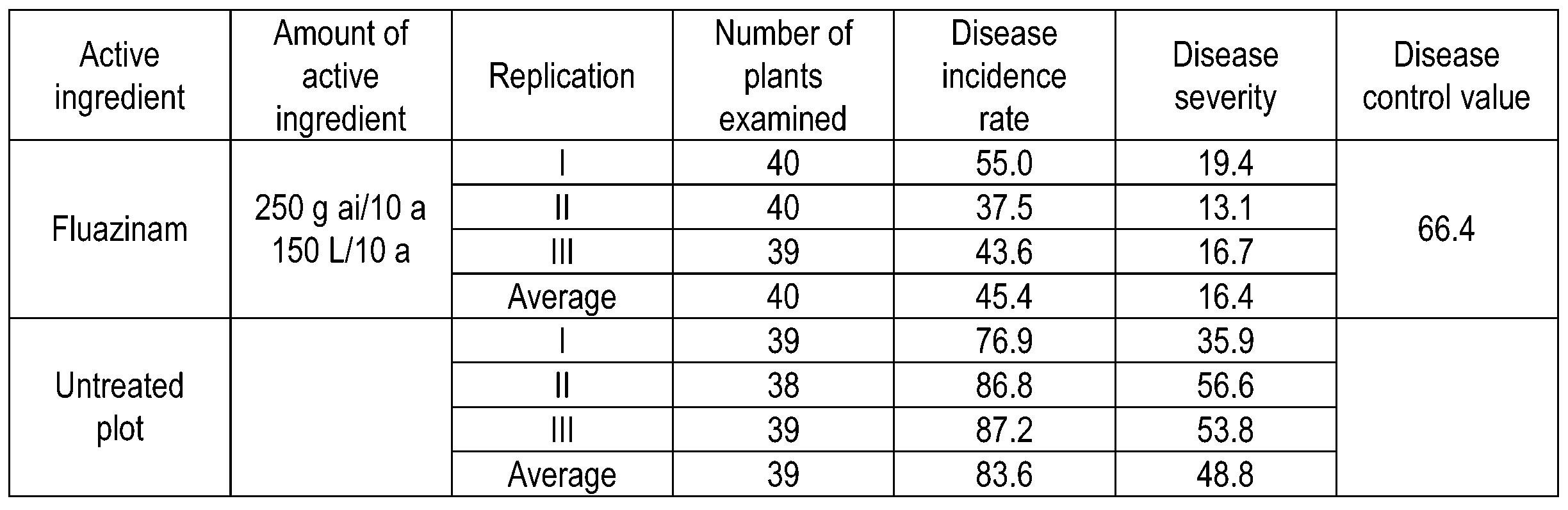
- the degree of disease incidence was examined for all the plants in each test plot 50 days after the start of the test, and the disease severity and the disease control value were evaluated. Incidentally, the disease severity and the disease control value were obtained in the same manner as described above. The test results are shown in Table 2.
- Example 3 (1) Preparation of spray solution Preparation was performed using 500 g/L of 3-chloro-N-(3-chloro-5-trifluoromethyl-2-pyridyl)-alpha,alpha,alpha-trifluoro-2,6-dinitro-p-toluidine (fluazinam, Frowncide SC (trade name), manufactured by Ishihara Sangyo Kaisha, Ltd.) such that the amount of the active ingredient was 62.5 g ai/10 a (125 mL product/10 a), 125 g ai/10 a (250 mL product/10 a), and 250 g ai/10 a (500 mL product/10 a), and each amount of dilution water was 150 L/10 a.
- fluazinam Frowncide SC (trade name), manufactured by Ishihara Sangyo Kaisha, Ltd.
- Comparative example 2 (1) Preparation of spray solution Preparation was performed by diluting streptomycin (Mycin 20 wettable powder (trade name), manufactured by Hokko Chemical Industry Co., Ltd.) with water to 1/1000. (2) Test for disease control of Chinese cabbage In a field covered with a mulch-sheet for agricultural use, seedlings of Chinese cabbage (cultivar: Musou) grown in a cell tray were planted, in the same manner as in Example 3, and foliage application was performed by spraying the spray solution of streptomycin prepared in (1) (spraying amount per application: 300 L/10 a) three times (13 days, 20 days, and 27 days after the planting of the seedlings).
- streptomycin Mycin 20 wettable powder (trade name), manufactured by Hokko Chemical Industry Co., Ltd.
- the degree of disease incidence was examined for all the plants in each test plot 54 days after the start of the test, and the disease severity and the disease control value were evaluated. Incidentally, the disease severity and the disease control value were obtained in the same manner as described above. The test results are shown in Table 3.
- Example 3 in order to confirm the control effect of fluazinam on Chinese cabbage soft rot according to a difference in the spraying amount, the test was performed such that the amount of treated active ingredient was set to 62.5 g ai/10 a, 125 g ai/10 a, and 250 g ai/10 a.
- the test conditions were moderate incidence conditions.
- Example 3 In the disease control test in Example 3, as compared with the treatment by foliage application of streptomycin, a higher control effect on Chinese cabbage soft rot was observed even when the amount of treated active ingredient was 62.5 g ai/10 a or 125 g ai/10 a, which is less than 250 g ai/10 a.
- Example 4 (1) Preparation of spray solution Preparation was performed using 500 g/L of 3-chloro-N-(3-chloro-5-trifluoromethyl-2-pyridyl)-alpha,alpha,alpha-trifluoro-2,6-dinitro-p-toluidine (fluazinam, Frowncide SC (trade name), manufactured by Ishihara Sangyo Kaisha, Ltd.) such that the amount of the active ingredient was 62.5 g ai/10 a (125 mL product/10 a), 125 g ai/10 a (250 mL product/10 a), and 250 g ai/10 a (500 mL product/10 a), and each amount of dilution water was 150 L/10 a.
- fluazinam Frowncide SC (trade name), manufactured by Ishihara Sangyo Kaisha, Ltd.
- Comparative example 3 (1) Preparation of spray solution Preparation was performed by diluting streptomycin (Mycin 20 wettable powder (trade name), manufactured by Hokko Chemical Industry Co., Ltd.) with water to 1/1000. (2) Test for disease control of Chinese cabbage In a field covered with a mulch-sheet for agricultural use, seedlings of Chinese cabbage (cultivar: Harebutai 65) grown in a cell tray were planted, in the same manner as in Example 4, and foliage application was performed with a sprayer by spraying the spray solution of streptomycin prepared in (1) (spraying amount per application: 300 L/10 a) twice (27 days and 48 days after the planting of the seedlings).
- streptomycin Mycin 20 wettable powder (trade name), manufactured by Hokko Chemical Industry Co., Ltd.
- the degree of disease incidence was examined for all the plants in each test plot 64 days after the start of the test, and the disease severity and the disease control value were evaluated. Incidentally, the disease severity and the disease control value were obtained in the same manner as described above. The test results are shown in Table 4.
- Example 4 the test for disease control of Chinese cabbage was performed by changing the treated active ingredient amount of fluazinam in the same manner as in Example 3.
- Comparative example 3 the test for disease control of Chinese cabbage in the case of foliage application of streptomycin was performed.
- Table 4 as for the disease incidence in the untreated plot, the average of the disease severity was 31.6, and therefore, the test conditions were moderate incidence conditions.
- a higher control effect on Chinese cabbage soft rot was observed even when the amount of treated active ingredient was 62.5 g ai/10 a or 125 g ai/10 a, which is less than 250 g ai/10 a.
- Example 5 Preparation of spray solution Preparation was performed using 500 g/L of 3-chloro-N-(3-chloro-5-trifluoromethyl-2-pyridyl)-alpha,alpha,alpha-trifluoro-2,6-dinitro-p-toluidine (fluazinam, Frowncide SC (trade name), manufactured by Ishihara Sangyo Kaisha, Ltd.) such that the amount of the active ingredient was 250 g ai/10 a (500 mL product/10 a), and the amount of dilution water was 150 L/10 a.
- fluazinam Frowncide SC (trade name), manufactured by Ishihara Sangyo Kaisha, Ltd.
- the spray solution prepared in the above was sprayed onto the planting holes such that the spraying amount was 0.25 g/m 2 (150 L/10 a) without spreading a mulch-sheet for agricultural use, followed by air-drying. Then, seedlings of Chinese cabbage (cultivar: Harebutai 65) grown for 4 weeks in a cell tray (128 holes/nursery box) were planted such that 19 seedlings were planted in one test plot having an area of 2.4 m 2 with two replications.
- the degree of disease incidence was examined for all the plants in each test plot 64 days after the start of the test, and the disease severity and the disease control value were evaluated. Incidentally, the disease severity and the disease control value were obtained in the same manner as described above. The test results are shown in Table 5.
- Example 5 the test for disease control of Chinese cabbage of fluazinam was performed by providing a test plot covered with a mulch-sheet for agricultural use and a test plot without being covered therewith.
- Table 5 as for the disease incidence in the untreated plot, the average of the disease severity was 31.6, and therefore, the test conditions were moderate incidence conditions.
- the control effect of fluazinam on Chinese cabbage soft rot even in the treated plot without being covered with a mulch-sheet for agricultural use, the disease control value was 72.8, and an effect substantially equal to that of the treated plot covered with a mulch-sheet for agricultural use was observed.
- fluazinam onto a surface of soil a control effect on Chinese cabbage soft rot was observed regardless of with or without a mulch-sheet for agricultural use.
- Test for growth inhibition of potato Erwinia carotovora A test for growth inhibition of Erwinia carotovora in the case of direct application of the control agent to Erwinia carotovora was performed. To previously melted PSA medium (55 degrees C), a predetermined amount of a pesticide 3-chloro-N-(3-chloro-5-trifluoromethyl-2-pyridyl)-alpha,alpha,alpha-trifluoro-2,6-dinitro-p-toluidine (fluazinam, Frowncide SC (trade name), manufactured by Ishihara Sangyo Kaisha, Ltd.), ethaboxam wettable powder (Ethaboxam, Gardian (trade name), manufactured by LG Chemical), or streptomycin (Mycin wettable powder (trade name), manufactured by Hokko Chemical Industry Co., Ltd.) and a suspension of Erwinia carotovora (potato Erwinia carotovora) were added and
- the invention has industrial applicability as a control agent having a control effect on soft rot and a control method for soft rot using the control agent.
Landscapes
- Life Sciences & Earth Sciences (AREA)
- Agronomy & Crop Science (AREA)
- Pest Control & Pesticides (AREA)
- Plant Pathology (AREA)
- Health & Medical Sciences (AREA)
- Engineering & Computer Science (AREA)
- Dentistry (AREA)
- General Health & Medical Sciences (AREA)
- Wood Science & Technology (AREA)
- Zoology (AREA)
- Environmental Sciences (AREA)
- Agricultural Chemicals And Associated Chemicals (AREA)
- Cultivation Of Plants (AREA)
Abstract
Description
The control agent for soft rot of a plant of the invention has been achieved on the basis of the above finding, and the invention relates to a control agent for soft rot of a plant containing 3-chloro-N-(3-chloro-5-trifluoromethyl-2-pyridyl)-alpha,alpha,alpha-trifluoro-2,6-dinitro-p-toluidine as an active ingredient. This control agent also includes the above-mentioned control agent for soft rot, wherein it is a control agent to be applied to plant cultivation soil.
Further, the invention relates to a control method for soft rot of a plant, comprising applying an effective amount of 3-chloro-N-(3-chloro-5-trifluoromethyl-2-pyridyl)-alpha,alpha,alpha-trifluoro-2,6-dinitro-p-toluidine to plant cultivation soil. This method includes a control method for soft rot of a plant, comprising applying an effective amount of 3-chloro-N-(3-chloro-5-trifluoromethyl-2-pyridyl)-alpha,alpha,alpha-trifluoro-2,6-dinitro-p-toluidine to plant cultivation soil, and thereafter sowing seeds of a plant or planting seedlings of a plant therein; and a control method for soft rot of a plant, comprising applying an effective amount of 3-chloro-N-(3-chloro-5-trifluoromethyl-2-pyridyl)-alpha,alpha,alpha-trifluoro-2,6-dinitro-p-toluidine onto a surface of the cultivation soil without mixing in the cultivation soil. Further, these control methods for soft rot of a plant also include a method wherein, in the above-mentioned control methods for soft rot of a plant, an amount of 3-chloro-N-(3-chloro-5-trifluoromethyl-2-pyridyl)-alpha,alpha,alpha-trifluoro-2,6-dinitro-p-toluidine applied to the cultivation soil is from 0.025 to 2.5 g/m2.
Further, the invention includes control agents for soft rot of a plant and control methods for the same, wherein, in the above-mentioned control agent for soft rot of a plant and control method for the same, the plant is a vegetable, and the vegetable is at least one kind selected from the group consisting of asparagus, endive, calla, cauliflower, cabbage, amorphophallus konjac, Brassica campestris, celery, Japanese radish, tobacco, onion, qing-geng-cai, tomato, eggplant, carrot, green onion, Chinese cabbage, Brassica oleracea x Brassica campestris, parsley, potato, broccoli, rakkyo, lettuce, wasabi, and oil-seed rape.
When such a preparation product is actually used, the preparation product is used as such or can be used by diluting it with a diluent such as water to a given concentration.
(1) Those believed to exhibit a herbicidal effect by disturbing hormone activities of plants, including phenoxy compounds such as 2,4-D, 2,4-D-butotyl, 2,4-D-butyl, 2,4-D-dimethylammonimum, 2,4-D-diolamine, 2,4-D-ethyl, 2,4-D-2-ethylhexyl, 2,4-D-isobutyl, 2,4-D-isoctyl, 2,4-D-isopropyl, 2,4-D-isopropylammonium, 2,4-D-sodium, 2,4-D-isopropanolammonium, 2,4-D-trolamine, 2,4-DB, 2,4-DB-butyl, 2,4-DB-dimethylammonium, 2,4-DB-isoctyl, 2,4-DB-potassium, 2,4-DB-sodium, dichlorprop, dichlorprop-butotyl, dichlorprop-dimethylammonium, dichlorprop-isoctyl, dichlorprop-potassium, dichlorprop-P, dichlorprop-P-dimethylammonium, dichlorprop-P-potassium, dichlorprop-P-sodium, MCPA, MCPA-butotyl, MCPA-dimethylammonium, MCPA-2-ethylhexyl, MCPA-potassium, MCPA-sodium, MCPA-thioethyl, MCPB, MCPB-ethyl, MCPB-sodium, mecoprop, mecoprop-butotyl, mecoprop-sodium, mecoprop-P, mecoprop-P-butotyl, mecoprop-P-dimethylammonium, mecoprop-P-2-ethylhexyl, mecoprop-P-potassium, naproanilide, and clomeprop; aromatic carboxylic acid compounds such as 2,3,6-TBA, dicamba, dicamba-butotyl, dicamba-diglycolamine, dicamba-dimethylammonium, dicamba-diolamine, dicamba-isopropylammonium, dicamba-potassium, dicamba-sodium, dichlobenil, picloram, picloram-dimethylammonium, picloram-isoctyl, picloram-potassium, picloram-triisopropanolammonium, picloram-triisopropylammonium, picloram-trolamine, triclopyr, triclopyr-butotyl, triclopyr-triethylammonium, clopyralid, clopyralid-olamine, clopyralid-potassium, clopyralid-triisopropanolammonium, and aminopyralid; and others, for example, naptalam, naptalam-sodium, benazolin, benazolin-ethyl, quinclorac, quinmerac, diflufenzopyr, diflufenzopyr-sodium, fluoroxypyr, fluoroxypyr-2-butoxy-1-methylethyl, fluoroxypyr-meptyl, chlorflurenol, and chlorflurenol-methyl.
(2) Those believed to exhibit a herbicidal effect by inhibiting photosynthesis of plants, including urea compounds such as chlorotoluron, diuron, fluometuron, linuron, isoproturon, metobenzuron, tebuthiuron, dimefuron, isouron, karbutilate, methabenzthiazuron, metoxuron, monolinuron, neburon, siduron, terbumeton, and trietazine; triazine compounds such as simazine, atrazine, atratone, simetryn, prometryn, dimethametryn, hexazinone, metribuzin, terbuthylazine, cyanazine, ametryn, cybutryne, triaziflam, terbutryn, propazine, metamitron, prometon, and indaziflam; uracil compounds such as bromacil, bromacyl-lithium, lenacil, and terbacil; anilide compounds such as propanil and cypromid; carbamate compounds such as swep, desmedipham, and phenmedipham; hydroxybenzonitrile compounds such as bromoxynil, bromoxynil-octanoate, bromoxynil-heptanoate, ioxynil, ioxynil-octanoate, ioxynil-potassium, and ioxynil-sodium; and others, for example, pyridate, bentazone, bentazone-sodium, amicarbazone, methazole and pentanochlor.
(3) Those believed to convert to a free radical by itself in the plant body to generate active oxygen, thereby exhibiting a rapid herbicidal effect, including quaternary ammonium salt compounds such as paraquat and diquat.
(4) Those believed to exhibit a herbicidal effect by inhibiting chlorophyll biosynthesis of plants and abnormally accumulating a photosensitizing peroxide substance in the plant body, including diphenylether compounds such as nitrofen, chlomethoxyfen, bifenox, acifluorfen, acifluorfen-sodium, fomesafen, fomesafen-sodium, oxyfluorfen, lactofen, aclonifen, ethoxyfen-ethyl (HC-252), fluoroglycofen-ethyl, and fluoroglycofen; cyclic imide compounds such as chlorphthalim, flumioxazin, flumiclorac, flumiclorac-pentyl, cinidon-ethyl, and fluthiacet-methyl; and others, for example, oxadiargyl, oxadiazon, sulfentrazone, carfentrazone-ethyl, thidiazimin, pentoxazone, azafenidin, isopropazole, pyraflufen-ethyl, benzfendizone, butafenacil, saflufenacil, flupoxam, fluazolate, profluazol, pyraclonil, flufenpyr-ethyl, and bencarbazone.
(5) Those believed to exhibit a herbicidal effect characterized by bleaching activities by inhibiting chromogenesis of plants such as carotenoids, including pyridazinone compounds such as norflurazon, chloridazon, and metflurazon; pyrazole compounds such as pyrazolynate, pyrazoxyfen, benzofenap, topramezone (BAS-670H), and pyrasulfotole; and others, for example, amitrole, fluridone, flurtamone, diflufenican, methoxyphenone, clomazone, sulcotrione, mesotrione, tembotrione, tefuryltrione (AVH-301), isoxaflutole, difenzoquat, difenzoquat-metilsulfate, isoxachlortole, benzobicyclon, picolinafen, and beflubutamid.
(6) Those exhibiting a strong herbicidal effect specifically to gramineous plants, including aryloxyphenoxypropionic acid compounds such as diclofop-methyl, diclofop, pyriphenop-sodium, fluazifop-butyl, fluazifop, fluazifop-P, fluazifop-P-butyl, haloxyfop-methyl, haloxyfop, haloxyfop-etotyl, haloxyfop-P, haloxyfop-P-methyl, quizalofop-ethyl, quizalofop-P, quizalofop-P-ethyl, quizalofop-P-tefuryl, cyhalofop-butyl, fenoxaprop-ethyl, fenoxaprop-P, fenoxaprop-P-ethyl, metamifop-propyl, metamifop, clodinafop-propargyl, clodinafop, and propaquizafop; cyclohexanedione compounds such as alloxydim-sodium, alloxydim, clethodim, sethoxydim, tralkoxydim, butroxydim, tepraloxydim, profoxydim, and cycloxydim; and others, for example, flamprop-M-methyl, flamprop-M and flamprop-M-isopropyl.
(7) Those believed to exhibit a herbicidal effect by inhibiting an amino acid biosynthesis of plants, including sulfonylurea compounds such as chlorimuron-ethyl, chlorimuron, sulfometuron-methyl, sulfometuron, primisulfuron-methyl, primisulfuron, bensulfuron-methyl, bensulfuron, chlorsulfuron, metsulfuron-methyl, metsulfuron, cinosulfuron, pyrazosulfuron-ethyl, pyrazosulfuron, azimsulfuron, flazasulfuron, rimsulfuron, nicosulfuron, imazosulfuron, cyclosulfamuron, prosulfuron, flupyrsulfuron-methyl-sodium, flupyrsulfuron, triflusulfuron-methyl, triflusulfuron, halosulfuron-methyl, halosulfuron, thifensulfuron-methyl, thifensulfuron, ethoxysulfuron, oxasulfuron, ethametsulfuron, ethametsulfuron-methyl, iodosulfuron, iodosulfuron-methyl-sodium, sulfosulfuron, triasulfuron, tribenuron-methyl, tribenuron, tritosulfuron, foramsulfuron, trifloxysulfuron, trifloxysulfuron-sodium, mesosulfuron-methyl, mesosulfuron, orthosulfamuron, flucetosulfuron, amidosulfuron, propyrisulfuron (TH-547), NC-620, and compounds disclosed in WO 2005/092104; triazolopyrimidinesulfonamide compounds such as flumetsulam, metosulam, diclosulam, cloransulam-methyl, florasulam, penoxsulam, and pyroxsulam; imidazolinone compounds such as imazapyr, imazapyr-isopropylammonium, imazethapyr, imazethapyr-ammonium, imazaquin, imazaquin-ammonium, imazamox, imazamox-ammonium, imazamethabenz, imazamethabenz-methyl, and imazapic; pyrimidinylsalicylic acid compounds such as pyrithiobac-sodium, bispyribac-sodium, pyriminobac-methyl, pyribenzoxim, pyriftalid, and pyrimisulfan (KUH-021); sulfonylaminocarbonyltriazolinone compounds such as flucarbazone, flucarbazone-sodium, propoxycarbazone-sodium, and propoxycarbazone; and others, for example, glyphosate, glyphosate-sodium, glyphosate-potassium, glyphosate-ammonium, glyphosate-diammonium, glyphosate-isopropylammonium, glyphosate-trimesium, glyphosate-sesquisodium, glufosinate, glufosinate-ammonium, glufosinate-P, glufosinate-P-ammonium, glufosinate-P-sodium, bilanafos, bilanafos-sodium, and cinmethylin.
(8) Those believed to exhibit a herbicidal effect by inhibiting cell mitoses of plants, including dinitroaniline compounds such as trifluralin, oryzalin, nitralin, pendimethalin, ethalfluralin, benfluralin, prodiamine, butralin, and dinitramine; amide compounds such as bensulide, napropamide, propyzamide, and pronamide; organic phosphorus compounds such as amiprofos-methyl, butamifos, anilofos, and piperophos; phenyl carbamate compounds such as propham, chlorpropham, barban, and carbetamide; cumylamine compounds such as daimuron, cumyluron, bromobutide, and methyldymron; and others, for example, asulam, asulam-sodium, dithiopyr, thiazopyr, chlorthal-dimethyl, chlorthal, and diphenamid.
(9) Those believed to exhibit a herbicidal effect by inhibiting protein biosynthesis or lipid biosynthesis of plants, including chloroacetamide compounds such as alachlor, metazachlor, butachlor, pretilachlor, metolachlor, S-metolachlor, thenylchlor, pethoxamid, acetochlor, propachlor, dimethenamid, dimethenamid-P, propisochloror, and dimethachlor; thiocarbamate compounds such as molinate, dimepiperate, pyributicarb, EPTC, butylate, vernolate, pebulate, cycloate, prosulfocarb, esprocarb, thiobencarb, diallate, tri-allate, and orbencarb; and others, for example, etobenzanid, mefenacet, flufenacet, tridiphane, cafenstrole, fentrazamide, oxaziclomefone, indanofan, benfuresate, pyroxasulfone (KIH-485), dalapon, dalapon-sodium, TCA-sodium, and trichloroacetic acid.
(10) Those believed to exhibit a herbicidal effect by being parasitic on plants, including Xanthomonas campestris, Epicoccosirus nematosorus, Epicoccosirus nematosperus, Exserohilum monoseras, and Drechsrela monoceras.
(11) Those believed to exhibit a herbicidal effect and not listed in (1) to (10), including MSMA, DSMA, CMA, endothall, endothall-dipotassium, endothall-sodium, endothall-mono(N,N-dimethylalkylammonium), ethofumesate, sodium chlorate, pelargonic acid, nonanoic acid, fosamine, fosamine-ammonium, pinoxaden, ipfencarbazone (HOK-201), aclolein, ammonium sulfamate, borax, chloroacetic acid, sodium chloroacete, cyanamide, methylarsonic acid, dimethylarsinic acid, sodium dimethylarsinate, dinoterb, dinoterb-ammonium, dinoterb-diolamine, dinoterb-acetate, DNOC, ferrous sulfate, flupropanate, flupropanate-sodium, isoxaben, mefluidide, mefluidide-diolamine, metam, metam-ammonium, metam-potassium, metam-sodium, methyl isothiocyanate, pentachlorophenol, sodium pentachlorophenoxide, pentachlorophenol laurate, quinoclamine, sulfuric acid, urea sulfate, and the like.
Further, the blending ratio of 3-chloro-N-(3-chloro-5-trifluoromethyl-2-pyridyl)-alpha,alpha,alpha-trifluoro-2,6-dinitro-p-toluidine to the fertilizer is from about 1 : 100000 to 100000 : 1, preferably from about 1 : 1000 to 1000 : 1 in terms of weight ratio.
Further, the blending ratio of 3-chloro-N-(3-chloro-5-trifluoromethyl-2-pyridyl)-alpha,alpha,alpha-trifluoro-2,6-dinitro-p-toluidine to the agent for reducing phytotoxicity is from about 1 : 100000 to 100000 : 1, preferably from about 1 : 1000 to 1000 : 1 in terms of weight ratio.
The above-mentioned another agricultural chemical, fertilizer, agent for reducing phytotoxicity, and the like can be used alone or by mixing two or more kinds thereof. Further, 3-chloro-N-(3-chloro-5-trifluoromethyl-2-pyridyl)-alpha,alpha,alpha-trifluoro-2,6-dinitro-p-toluidine and another agricultural chemical, a fertilizer, an agent for reducing phytotoxicity, and the like may be used by separately formulating them into different preparations and mixing the resulting preparations immediately before use, or may be used by formulating them all together into a preparation.
1. The control agent is applied to plant cultivation soil, a mulch-sheet for agricultural use is spread on the soil, and thereafter, sowing of seeds of a plant or planting of seedlings of a plant is performed through planting holes of the mulch-sheet for agricultural use.
2. A mulch-sheet for agricultural use is spread on plant cultivation soil, a planting holes for sowing of seeds of a plant or planting of seedlings of a plant are bored into the mulch-sheet, and then, the control agent is applied to the mulch-sheet for agricultural use, and thereafter, sowing of seeds of a plant or planting of seedlings of a plant is performed through the planting holes.
3. After sowing of seeds of a plant or planting of seedlings of a plant is performed, the control agent is applied to cultivation soil.
4. After the control agent is applied to plant cultivation soil, sowing of seeds of a plant or planting of seedlings of a plant is performed.
It is preferred that in the control methods described in the above items 1 to 4, the control agent is applied onto a surface of the cultivation soil. It is more preferred that in the control methods described in the above items 1 to 4, the control agent is applied onto a surface of the cultivation soil without mixing in the cultivation soil.
(1) Preparation of spray solution
Preparation was performed using 500 g/L of 3-chloro-N-(3-chloro-5-trifluoromethyl-2-pyridyl)-alpha,alpha,alpha-trifluoro-2,6-dinitro-p-toluidine (fluazinam (common name), Frowncide SC (trade name), manufactured by Ishihara Sangyo Kaisha, Ltd.) such that the amount of the active ingredient was 250 g ai/10 a (500 mL product/10 a), and the amount of dilution water was 150 L/10 a.
(2) Test for disease control of Chinese cabbage
The spray solution prepared in the above was sprayed onto cultivation soil in a field such that the spraying amount was 0.25 g/m2 (150 L/10 a), and thereafter, a mulch-sheet for agricultural use was spreaded on the soil. After planting holes for settlement (diameter: about 5 cm) were made, seedlings of Chinese cabbage (cultivar: Musou) grown for 4 weeks in a cell tray (128 holes/nursery box) were planted such that 30 seedlings were planted in one test plot having an area of 6 m2 with three replications.
(1) Preparation of spray solution
Preparation was performed by diluting streptomycin (Mycin 20 wettable powder (trade name), manufactured by Hokko Chemical Industry Co., Ltd.) with water to 1/1000.
(2) Test for disease control of Chinese cabbage
In a field covered with a mulch-sheet for agricultural use, seedlings of Chinese cabbage (cultivar: Musou) grown in a cell tray were planted, in the same manner as in Example 1, and foliage application was performed by spraying the spray solution of streptomycin prepared in (1) (spraying amount per application: 200 L/10 a) twice (39 days and 47 days after the planting of the seedlings).
(Disease incidence rate) = [(number of diseased plants) / (number of plants examined)] * 100
(Disease severity) = {S[(number of diseased plants in each class into which the plants are classified according to the degree of disease) * (disease index)] / [(number of plants examined) * 4]} * 100
(Disease control value) = {1 - [(Disease severity in treated plot) / (Disease severity in untreated plot)]} * 100
Incidentally, the evaluation criteria for the disease index are as follows.
(Disease index)
0: No lesion
1: Lesions appear only in part of outer leaves (shipment can be made).
2: Lesions appear in outer leaves and part of head leaves (the damaged part is removed and shipment as a small size plant can be made, rated Grade B).
3: Lesions appear in most head leaves or more (shipment cannot be made).
4: Lesions appear in the entire plant and the plant dies.

(1) Preparation of spray solution
Preparation was performed using 500 g/L of 3-chloro-N-(3-chloro-5-trifluoromethyl-2-pyridyl)-alpha,alpha,alpha-trifluoro-2,6-dinitro-p-toluidine (fluazinam, Frowncide SC (trade name), manufactured by Ishihara Sangyo Kaisha, Ltd.) such that the amount of the active ingredient was 250 g ai/10 a (500 mL product/10 a), and the amount of dilution water was 150 L/10 a.
A mulch-sheet for agricultural use was spreaded on soil, and planting holes for settlement (diameter: about 5 cm) were made, and then, the spray solution prepared in the above was sprayed onto the planting holes such that the spraying amount was 0.25 g/m2 (150 L/10 a), followed by air-drying. Then, seedlings of Chinese cabbage (cultivar: Yumebuki) grown for 4 weeks in a cell tray (128 holes/nursery box) were planted such that 34 to 40 seedlings were planted in one test plot having an area of 4.8 m2 with three replications.
(1) Preparation of spray solution
Preparation was performed using 500 g/L of 3-chloro-N-(3-chloro-5-trifluoromethyl-2-pyridyl)-alpha,alpha,alpha-trifluoro-2,6-dinitro-p-toluidine (fluazinam, Frowncide SC (trade name), manufactured by Ishihara Sangyo Kaisha, Ltd.) such that the amount of the active ingredient was 62.5 g ai/10 a (125 mL product/10 a), 125 g ai/10 a (250 mL product/10 a), and 250 g ai/10 a (500 mL product/10 a), and each amount of dilution water was 150 L/10 a.
(2) Test for disease control of Chinese cabbage
A mulch-sheet for agricultural use was spreaded on soil, and planting holes for settlement (diameter: about 9 cm) were made, and then, the spray solution prepared in the above was sprayed onto the planting holes such that the amount of treated active ingredient was 0.0625 g/m2 (150 L/10 a) in the case of the spray solution containing the active ingredient at 62.5 g ai/10 a, 0.125 g/m2 (150 L/10 a) in the case of the spray solution containing the active ingredient at 125 g ai/10 a, and 0.25 g/m2 (150 L/10 a) in the case of the spray solution containing the active ingredient at 250 g ai/10 a, followed by air-drying. Then, seedlings of Chinese cabbage (cultivar: Musou) grown for 4 weeks in a cell tray (128 holes/nursery box) were planted such that 30 seedlings were planted in one test plot having an area of 6 m2 with two replications.
(1) Preparation of spray solution
Preparation was performed by diluting streptomycin (Mycin 20 wettable powder (trade name), manufactured by Hokko Chemical Industry Co., Ltd.) with water to 1/1000.
(2) Test for disease control of Chinese cabbage
In a field covered with a mulch-sheet for agricultural use, seedlings of Chinese cabbage (cultivar: Musou) grown in a cell tray were planted, in the same manner as in Example 3, and foliage application was performed by spraying the spray solution of streptomycin prepared in (1) (spraying amount per application: 300 L/10 a) three times (13 days, 20 days, and 27 days after the planting of the seedlings).
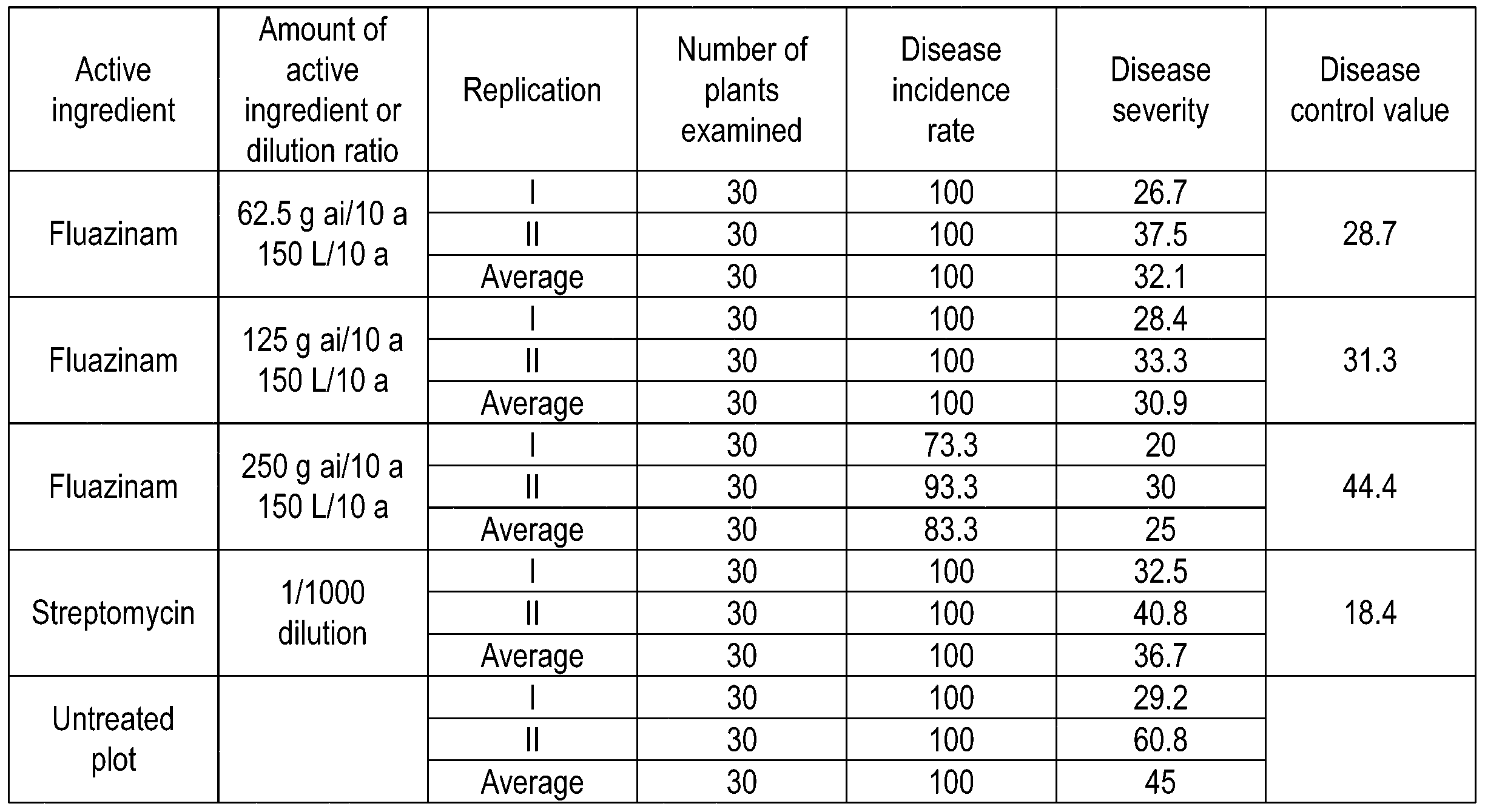
In Table 3, as for the disease incidence in the untreated plot, the average of the disease severity was 45, and therefore, the test conditions were moderate incidence conditions. In the disease control test in Example 3, as compared with the treatment by foliage application of streptomycin, a higher control effect on Chinese cabbage soft rot was observed even when the amount of treated active ingredient was 62.5 g ai/10 a or 125 g ai/10 a, which is less than 250 g ai/10 a.
(1) Preparation of spray solution
Preparation was performed using 500 g/L of 3-chloro-N-(3-chloro-5-trifluoromethyl-2-pyridyl)-alpha,alpha,alpha-trifluoro-2,6-dinitro-p-toluidine (fluazinam, Frowncide SC (trade name), manufactured by Ishihara Sangyo Kaisha, Ltd.) such that the amount of the active ingredient was 62.5 g ai/10 a (125 mL product/10 a), 125 g ai/10 a (250 mL product/10 a), and 250 g ai/10 a (500 mL product/10 a), and each amount of dilution water was 150 L/10 a.
(2) Test for disease control of Chinese cabbage
A mulch-sheet for agricultural use was spreaded on soil, and planting holes for settlement (diameter: about 5 cm) were made, and then, the spray solution prepared in the above was sprayed onto the planting holes such that the amount of treated active ingredient was 0.0625 g/m2 (150 L/10 a) in the case of the spray solution containing the active ingredient at 62.5 g ai/10 a, 0.125 g/m2 (150 L/10 a) in the case of the spray solution containing the active ingredient at 125 g ai/10 a, and 0.25 g/m2 (150 L/10 a) in the case of the spray solution containing the active ingredient at 250 g ai/10 a, followed by air-drying. Then, seedlings of Chinese cabbage (cultivar: Harebutai 65) grown for 4 weeks in a cell tray (128 holes/nursery box) were planted such that 19 seedlings were planted in one test plot having an area of 2.4 m2 with two replications.
(1) Preparation of spray solution
Preparation was performed by diluting streptomycin (Mycin 20 wettable powder (trade name), manufactured by Hokko Chemical Industry Co., Ltd.) with water to 1/1000.
(2) Test for disease control of Chinese cabbage
In a field covered with a mulch-sheet for agricultural use, seedlings of Chinese cabbage (cultivar: Harebutai 65) grown in a cell tray were planted, in the same manner as in Example 4, and foliage application was performed with a sprayer by spraying the spray solution of streptomycin prepared in (1) (spraying amount per application: 300 L/10 a) twice (27 days and 48 days after the planting of the seedlings).
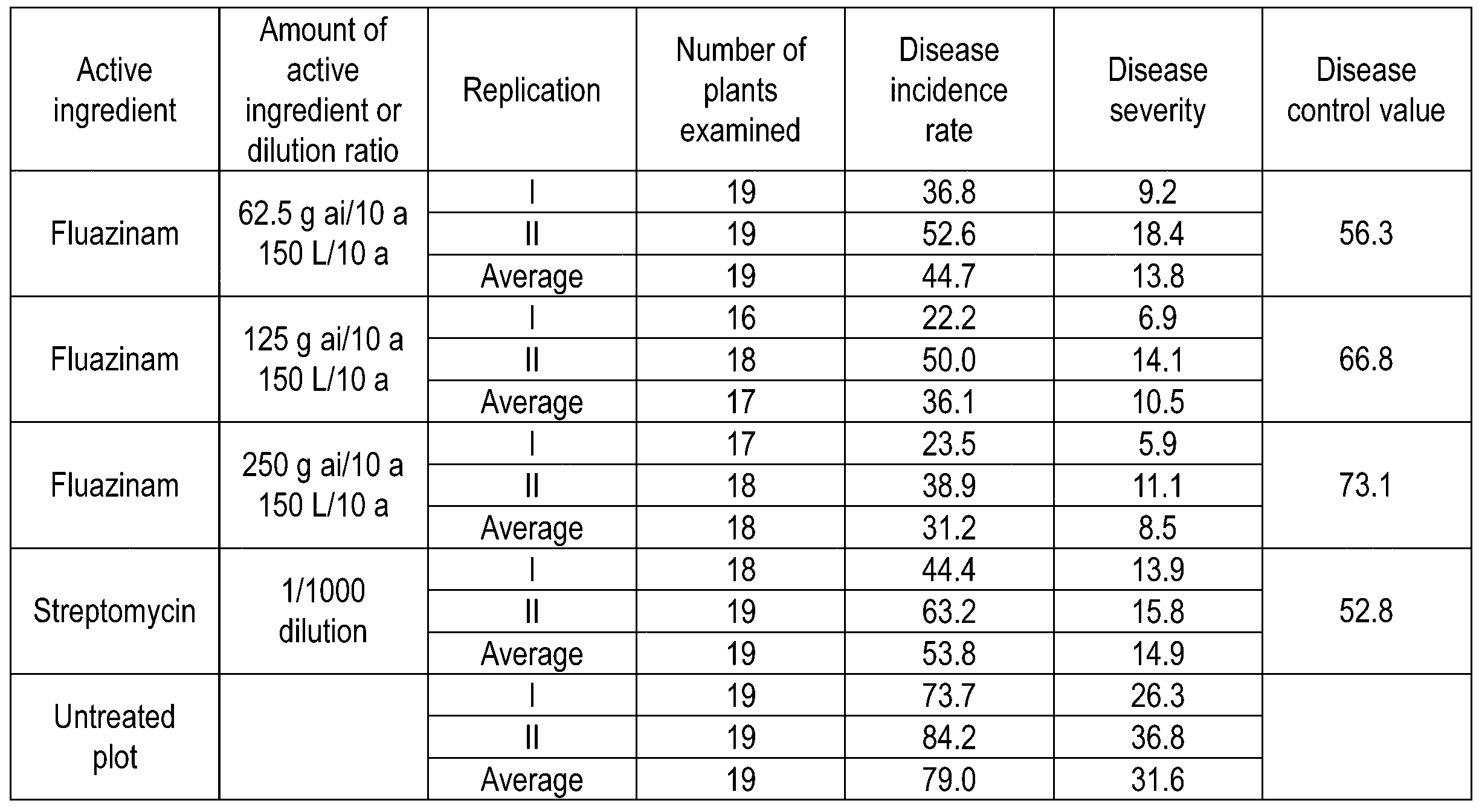
In Table 4, as for the disease incidence in the untreated plot, the average of the disease severity was 31.6, and therefore, the test conditions were moderate incidence conditions. As compared with the case of the foliage application of streptomycin, a higher control effect on Chinese cabbage soft rot was observed even when the amount of treated active ingredient was 62.5 g ai/10 a or 125 g ai/10 a, which is less than 250 g ai/10 a.
(1) Preparation of spray solution
Preparation was performed using 500 g/L of 3-chloro-N-(3-chloro-5-trifluoromethyl-2-pyridyl)-alpha,alpha,alpha-trifluoro-2,6-dinitro-p-toluidine (fluazinam, Frowncide SC (trade name), manufactured by Ishihara Sangyo Kaisha, Ltd.) such that the amount of the active ingredient was 250 g ai/10 a (500 mL product/10 a), and the amount of dilution water was 150 L/10 a.
(2) Test for disease control of Chinese cabbage
A mulch-sheet for agricultural use was spreaded on soil, and planting holes for settlement (diameter: about 5 cm) were made, and then, the spray solution prepared in the above was sprayed onto the planting holes such that the spraying amount was 0.25 g/m2 (150 L/10 a), followed by air-drying. Then, seedlings of Chinese cabbage (cultivar: Harebutai 65) grown for 4 weeks in a cell tray (128 holes/nursery box) were planted such that 19 seedlings were planted in one test plot having an area of 2.4 m2 with two replications.
The spray solution prepared in the above was sprayed onto the planting holes such that the spraying amount was 0.25 g/m2 (150 L/10 a) without spreading a mulch-sheet for agricultural use, followed by air-drying. Then, seedlings of Chinese cabbage (cultivar: Harebutai 65) grown for 4 weeks in a cell tray (128 holes/nursery box) were planted such that 19 seedlings were planted in one test plot having an area of 2.4 m2 with two replications.
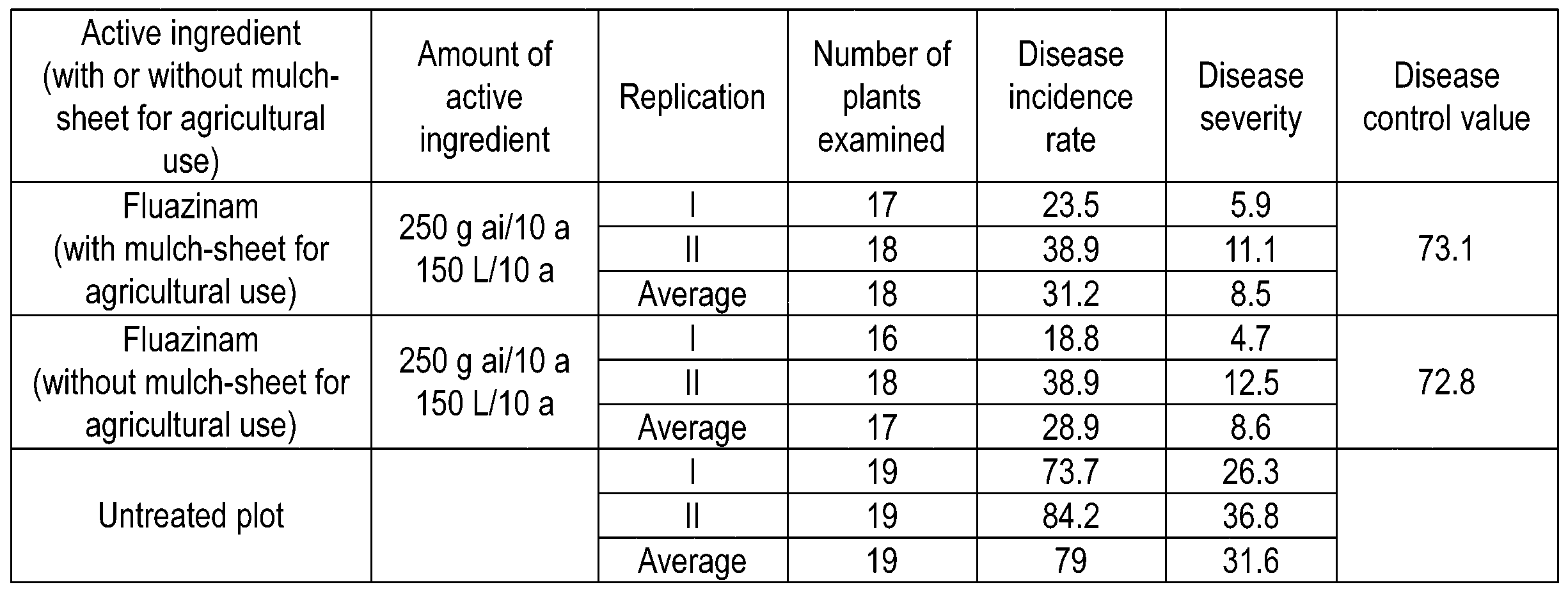
In Table 5, as for the disease incidence in the untreated plot, the average of the disease severity was 31.6, and therefore, the test conditions were moderate incidence conditions. As for the control effect of fluazinam on Chinese cabbage soft rot, even in the treated plot without being covered with a mulch-sheet for agricultural use, the disease control value was 72.8, and an effect substantially equal to that of the treated plot covered with a mulch-sheet for agricultural use was observed. By applying fluazinam onto a surface of soil, a control effect on Chinese cabbage soft rot was observed regardless of with or without a mulch-sheet for agricultural use.
A test for growth inhibition of Erwinia carotovora in the case of direct application of the control agent to Erwinia carotovora was performed. To previously melted PSA medium (55 degrees C), a predetermined amount of a pesticide 3-chloro-N-(3-chloro-5-trifluoromethyl-2-pyridyl)-alpha,alpha,alpha-trifluoro-2,6-dinitro-p-toluidine (fluazinam, Frowncide SC (trade name), manufactured by Ishihara Sangyo Kaisha, Ltd.), ethaboxam wettable powder (Ethaboxam, Gardian (trade name), manufactured by LG Chemical), or streptomycin (Mycin wettable powder (trade name), manufactured by Hokko Chemical Industry Co., Ltd.) and a suspension of Erwinia carotovora (potato Erwinia carotovora) were added and the resulting mixture was stirred well, and then, poured in a plate. Then, the plate was cultured at 25 degrees C for 4 days, and the growing state of Erwinia carotovora was examined. Thereafter, the formed colonies were examined according to the following three criteria.
+: Equal to the colonies of the untreated group
Plus or minus: Apparently less than the colonies of the untreated group
-: Almost no colonies
The test results are shown in Table 6.

Claims (10)
- A control agent for soft rot of a plant, comprising 3-chloro-N-(3-chloro-5-trifluoromethyl-2-pyridyl)-alpha,alpha,alpha-trifluoro-2,6-dinitro-p-toluidine as an active ingredient.
- The control agent for soft rot according to claim 1, wherein it is a control agent to be applied to plant cultivation soil.
- A control method for soft rot of a plant, comprising applying an effective amount of 3-chloro-N-(3-chloro-5-trifluoromethyl-2-pyridyl)-alpha,alpha,alpha-trifluoro-2,6-dinitro-p-toluidine to plant cultivation soil.
- The control method for soft rot according to claim 3, comprising applying an effective amount of 3-chloro-N-(3-chloro-5-trifluoromethyl-2-pyridyl)-alpha,alpha,alpha-trifluoro-2,6-dinitro-p-toluidine to plant cultivation soil, and thereafter sowing seeds of a plant or planting seedlings of a plant therein.
- The control method for soft rot according to claim 3 or 4, comprising applying an effective amount of 3-chloro-N-(3-chloro-5-trifluoromethyl-2-pyridyl)-alpha,alpha,alpha-trifluoro-2,6-dinitro-p-toluidine onto a surface of the cultivation soil without mixing in the cultivation soil.
- The control method for soft rot according to claim 5, wherein an amount of 3-chloro-N-(3-chloro-5-trifluoromethyl-2-pyridyl)-alpha,alpha,alpha-trifluoro-2,6-dinitro-p-toluidine applied to the cultivation soil is from 0.025 to 2.5 g/m2.
- The control agent for soft rot according to claim 1 or 2, wherein the plant is a vegetable.
- The control agent for soft rot according to claim 7, wherein the vegetable is at least one kind selected from the group consisting of asparagus, endive, calla, cauliflower, cabbage, amorphophallus konjac, Brassica campestris, celery, Japanese radish, tobacco, onion, qing-geng-cai, tomato, eggplant, carrot, green onion, Chinese cabbage, Brassica oleracea x Brassica campestris, parsley, potato, broccoli, rakkyo, lettuce, wasabi and oil-seed rape.
- The control method for soft rot according to any one of claims 3 to 6, wherein the plant is a vegetable.
- The control method for soft rot according to claim 9, wherein the vegetable is at least one kind selected from the group consisting of asparagus, endive, calla, cauliflower, cabbage, amorphophallus konjac, Brassica campestris, celery, Japanese radish, tobacco, onion, qing-geng-cai, tomato, eggplant, carrot, green onion, Chinese cabbage, Brassica oleracea x Brassica campestris, parsley, potato, broccoli, rakkyo, lettuce, wasabi and oil-seed rape.
Priority Applications (17)
| Application Number | Priority Date | Filing Date | Title |
|---|---|---|---|
| UAA201200502A UA109258C2 (en) | 2009-06-17 | 2010-04-06 | WINDOW REMOVAL MEANS AND WAY TO CONTROL THEM |
| EP10727509.1A EP2442659B1 (en) | 2009-06-17 | 2010-06-04 | Use of a control agent for soft rot and control method for the same |
| AU2010261291A AU2010261291B2 (en) | 2009-06-17 | 2010-06-04 | Control agent for soft rot and control method for the same |
| KR1020127001201A KR101528963B1 (en) | 2009-06-17 | 2010-06-04 | Control agent for soft rot and control method for the same |
| ES10727509.1T ES2574613T3 (en) | 2009-06-17 | 2010-06-04 | Use of a soft rot control agent and method for controlling it |
| RS20160464A RS54863B1 (en) | 2009-06-17 | 2010-06-04 | USE OF ANTI-DAMAGING MEANS AND PROCESS |
| RU2012101444/13A RU2529166C2 (en) | 2009-06-17 | 2010-06-04 | Preparation for fighting soft rot and method of fighting it |
| MX2011013681A MX2011013681A (en) | 2009-06-17 | 2010-06-04 | Control agent for soft rot and control method for the same. |
| MA34541A MA33435B1 (en) | 2009-06-17 | 2010-06-04 | MOLLE ROTTEN CONTROL AGENT AND METHOD OF CONTROLLING THE SAME |
| JP2011553181A JP5613183B2 (en) | 2009-06-17 | 2010-06-04 | Soft rot control agent and control method |
| CA2765544A CA2765544C (en) | 2009-06-17 | 2010-06-04 | Control agent for soft rot and control method for the same |
| DK10727509.1T DK2442659T3 (en) | 2009-06-17 | 2010-06-04 | Use of a means to combat blødråd and method for fighting whereof |
| US13/378,768 US20120088803A1 (en) | 2009-06-17 | 2010-06-04 | Control agent for soft rot and control method for the same |
| NZ597206A NZ597206A (en) | 2009-06-17 | 2010-06-04 | Control agent for soft rot and control method for the same |
| BRPI1015177-0A BRPI1015177B1 (en) | 2009-06-17 | 2010-06-04 | Control process for soft rot of a plant |
| CN201080027003.4A CN102802422B (en) | 2009-06-17 | 2010-06-04 | Control agent for soft rot and control method thereof |
| IL216406A IL216406A (en) | 2009-06-17 | 2011-11-17 | Control agent for soft rot and control method for the same |
Applications Claiming Priority (4)
| Application Number | Priority Date | Filing Date | Title |
|---|---|---|---|
| JP2009-144191 | 2009-06-17 | ||
| JP2009144191 | 2009-06-17 | ||
| JP2010-004308 | 2010-01-12 | ||
| JP2010004308 | 2010-01-12 |
Publications (2)
| Publication Number | Publication Date |
|---|---|
| WO2010146791A2 true WO2010146791A2 (en) | 2010-12-23 |
| WO2010146791A3 WO2010146791A3 (en) | 2011-06-30 |
Family
ID=42805986
Family Applications (1)
| Application Number | Title | Priority Date | Filing Date |
|---|---|---|---|
| PCT/JP2010/003727 Ceased WO2010146791A2 (en) | 2009-06-17 | 2010-06-04 | Control agent for soft rot and control method for the same |
Country Status (26)
| Country | Link |
|---|---|
| US (1) | US20120088803A1 (en) |
| EP (1) | EP2442659B1 (en) |
| JP (1) | JP5613183B2 (en) |
| KR (1) | KR101528963B1 (en) |
| CN (1) | CN102802422B (en) |
| AR (1) | AR077100A1 (en) |
| AU (1) | AU2010261291B2 (en) |
| BR (1) | BRPI1015177B1 (en) |
| CA (1) | CA2765544C (en) |
| CL (1) | CL2011003187A1 (en) |
| CO (1) | CO6470893A2 (en) |
| DK (1) | DK2442659T3 (en) |
| ES (1) | ES2574613T3 (en) |
| HU (1) | HUE028359T2 (en) |
| IL (1) | IL216406A (en) |
| MA (1) | MA33435B1 (en) |
| MX (1) | MX2011013681A (en) |
| MY (1) | MY159035A (en) |
| NZ (1) | NZ597206A (en) |
| PE (1) | PE20121258A1 (en) |
| PL (1) | PL2442659T3 (en) |
| PT (1) | PT2442659E (en) |
| RS (1) | RS54863B1 (en) |
| RU (1) | RU2529166C2 (en) |
| TW (1) | TWI513410B (en) |
| WO (1) | WO2010146791A2 (en) |
Cited By (2)
| Publication number | Priority date | Publication date | Assignee | Title |
|---|---|---|---|---|
| WO2012011287A3 (en) * | 2010-07-23 | 2012-04-12 | Ishihara Sangyo Kaisha, Ltd. | Control agent for soft rot and control method for the same |
| JP2013006828A (en) * | 2011-05-25 | 2013-01-10 | Ishihara Sangyo Kaisha Ltd | Agriculture/gardening disinfectant composition and prevention/elimination method of plant disease |
Families Citing this family (11)
| Publication number | Priority date | Publication date | Assignee | Title |
|---|---|---|---|---|
| CN103053555A (en) * | 2012-12-29 | 2013-04-24 | 广东中迅农科股份有限公司 | Bactericide composition of thifluzamide and fluazinam |
| CN104255773B (en) * | 2014-10-15 | 2016-08-24 | 柳州市惠农化工有限公司 | A kind of containing MTI-446 with the composition pesticide of fluazinam |
| CN104255734B (en) * | 2014-10-15 | 2016-01-20 | 柳州市惠农化工有限公司 | The composition pesticide of a kind of containing chlorfenapyr and fluazinam |
| CN104222125B (en) * | 2014-10-15 | 2016-08-24 | 柳州市惠农化工有限公司 | A kind of containing lufenuron with the composition pesticide of fluazinam |
| CN105794802A (en) * | 2016-04-16 | 2016-07-27 | 广东中迅农科股份有限公司 | Pesticide composition containing fluazinam and emamectin benzoate |
| KR101823525B1 (en) * | 2017-12-18 | 2018-01-30 | 한국식품연구원 | Antibacterial composition for inhibiting Pectobacterium carotovorum subsp. Carotovorum comprising Suaeda japonica extracts as an active ingredient |
| KR101853385B1 (en) * | 2017-12-18 | 2018-04-30 | 한국식품연구원 | Antibacterial composition for inhibiting Pectobacterium carotovorum subsp. Carotovorum comprising Salicornia herbacea extracts as an active ingredient |
| CN110786210A (en) * | 2018-08-02 | 2020-02-14 | 刘珂 | Pepper soft rot control |
| CN111436435A (en) * | 2018-12-29 | 2020-07-24 | 柏玉兰 | Vaccine for preventing and treating soft rot of potato |
| CN112616842A (en) * | 2021-01-11 | 2021-04-09 | 中国烟草总公司郑州烟草研究院 | Bactericidal composition for preventing and treating bacterial wilt, bactericide and application |
| CN112772655A (en) * | 2021-01-11 | 2021-05-11 | 中国烟草总公司郑州烟草研究院 | Nano sulfur compound medicament and application thereof |
Citations (2)
| Publication number | Priority date | Publication date | Assignee | Title |
|---|---|---|---|---|
| JPS5692272A (en) | 1979-12-25 | 1981-07-25 | Ishihara Sangyo Kaisha Ltd | N-pyridylaniline compound, its preparation and control agent against injurious organisms containing the same |
| WO2005092104A1 (en) | 2004-03-27 | 2005-10-06 | Bayer Cropscience Gmbh | Use of sulfonylureas |
Family Cites Families (8)
| Publication number | Priority date | Publication date | Assignee | Title |
|---|---|---|---|---|
| US3965109A (en) * | 1971-03-19 | 1976-06-22 | Imperial Chemical Industries Limited | Certain aryl amino pyridines |
| US4331640A (en) * | 1978-06-26 | 1982-05-25 | Kureha Kagaku Kogyo Kabushiki Kaisha | Process for removing sulfur dioxide from an exhaust gas containing the same |
| RU2140908C1 (en) * | 1994-12-19 | 1999-11-10 | Ниппон Сода Ко., Лтд. | Derivatives of benzamide oxime, method of their synthesis and fungicide agent for protection of agriculture plants |
| ATE536345T1 (en) * | 2001-05-31 | 2011-12-15 | Nihon Nohyaku Co Ltd | SUBSTITUTED ANILIDE DERIVATIVES, THEIR INTERMEDIATE PRODUCTS, AGRICULTURAL AND HORTICULTURE CHEMICALS AND THEIR USE |
| UA80364C2 (en) * | 2003-10-09 | 2007-09-10 | Basf Ag | Fungicidal mixture and agent, containing triazolopyrimidine derivative and fluazinam, method for control rice pathogens |
| JP2007308482A (en) * | 2006-04-18 | 2007-11-29 | Nissan Chem Ind Ltd | Method for applying agrochemical |
| JP2008189658A (en) * | 2007-01-12 | 2008-08-21 | Nissan Chem Ind Ltd | Method of controlling plant disease |
| CN101653132B (en) * | 2009-08-12 | 2013-01-02 | 东莞市瑞德丰生物科技有限公司 | Bactericidal composition containing fluazinam |
-
2010
- 2010-06-04 JP JP2011553181A patent/JP5613183B2/en active Active
- 2010-06-04 KR KR1020127001201A patent/KR101528963B1/en active Active
- 2010-06-04 PT PT107275091T patent/PT2442659E/en unknown
- 2010-06-04 AU AU2010261291A patent/AU2010261291B2/en active Active
- 2010-06-04 PL PL10727509.1T patent/PL2442659T3/en unknown
- 2010-06-04 MY MYPI2011006124A patent/MY159035A/en unknown
- 2010-06-04 RS RS20160464A patent/RS54863B1/en unknown
- 2010-06-04 WO PCT/JP2010/003727 patent/WO2010146791A2/en not_active Ceased
- 2010-06-04 EP EP10727509.1A patent/EP2442659B1/en active Active
- 2010-06-04 BR BRPI1015177-0A patent/BRPI1015177B1/en active IP Right Grant
- 2010-06-04 MX MX2011013681A patent/MX2011013681A/en active IP Right Grant
- 2010-06-04 CA CA2765544A patent/CA2765544C/en active Active
- 2010-06-04 US US13/378,768 patent/US20120088803A1/en not_active Abandoned
- 2010-06-04 RU RU2012101444/13A patent/RU2529166C2/en active
- 2010-06-04 DK DK10727509.1T patent/DK2442659T3/en active
- 2010-06-04 HU HUE10727509A patent/HUE028359T2/en unknown
- 2010-06-04 PE PE2011002115A patent/PE20121258A1/en active IP Right Grant
- 2010-06-04 NZ NZ597206A patent/NZ597206A/en unknown
- 2010-06-04 MA MA34541A patent/MA33435B1/en unknown
- 2010-06-04 CN CN201080027003.4A patent/CN102802422B/en active Active
- 2010-06-04 ES ES10727509.1T patent/ES2574613T3/en active Active
- 2010-06-10 TW TW099118937A patent/TWI513410B/en active
- 2010-06-15 AR ARP100102111A patent/AR077100A1/en unknown
-
2011
- 2011-11-17 IL IL216406A patent/IL216406A/en active IP Right Grant
- 2011-12-15 CO CO11172839A patent/CO6470893A2/en active IP Right Grant
- 2011-12-15 CL CL2011003187A patent/CL2011003187A1/en unknown
Patent Citations (2)
| Publication number | Priority date | Publication date | Assignee | Title |
|---|---|---|---|---|
| JPS5692272A (en) | 1979-12-25 | 1981-07-25 | Ishihara Sangyo Kaisha Ltd | N-pyridylaniline compound, its preparation and control agent against injurious organisms containing the same |
| WO2005092104A1 (en) | 2004-03-27 | 2005-10-06 | Bayer Cropscience Gmbh | Use of sulfonylureas |
Cited By (4)
| Publication number | Priority date | Publication date | Assignee | Title |
|---|---|---|---|---|
| WO2012011287A3 (en) * | 2010-07-23 | 2012-04-12 | Ishihara Sangyo Kaisha, Ltd. | Control agent for soft rot and control method for the same |
| AU2011280762B2 (en) * | 2010-07-23 | 2014-04-24 | Ishihara Sangyo Kaisha, Ltd. | Control agent for soft rot and control method for the same |
| US8993584B2 (en) | 2010-07-23 | 2015-03-31 | Ishihara Sangyo Kaisha, Ltd. | Control agent for soft rot and control method for the same |
| JP2013006828A (en) * | 2011-05-25 | 2013-01-10 | Ishihara Sangyo Kaisha Ltd | Agriculture/gardening disinfectant composition and prevention/elimination method of plant disease |
Also Published As
Similar Documents
| Publication | Publication Date | Title |
|---|---|---|
| CA2765544C (en) | Control agent for soft rot and control method for the same | |
| US8993584B2 (en) | Control agent for soft rot and control method for the same | |
| WO2012096405A1 (en) | Method for controlling clubroot | |
| JP2016011260A (en) | Potato scab control method |
Legal Events
| Date | Code | Title | Description |
|---|---|---|---|
| WWE | Wipo information: entry into national phase |
Ref document number: 201080027003.4 Country of ref document: CN |
|
| 121 | Ep: the epo has been informed by wipo that ep was designated in this application |
Ref document number: 10727509 Country of ref document: EP Kind code of ref document: A2 |
|
| WWE | Wipo information: entry into national phase |
Ref document number: 2765544 Country of ref document: CA |
|
| WWE | Wipo information: entry into national phase |
Ref document number: 2011003187 Country of ref document: CL Ref document number: 11172839 Country of ref document: CO Ref document number: MX/A/2011/013681 Country of ref document: MX |
|
| WWE | Wipo information: entry into national phase |
Ref document number: 13378768 Country of ref document: US Ref document number: 2011553181 Country of ref document: JP Ref document number: 002115-2011 Country of ref document: PE |
|
| NENP | Non-entry into the national phase |
Ref country code: DE |
|
| WWE | Wipo information: entry into national phase |
Ref document number: 2010261291 Country of ref document: AU Ref document number: 2010727509 Country of ref document: EP |
|
| WWE | Wipo information: entry into national phase |
Ref document number: 237/CHENP/2012 Country of ref document: IN |
|
| ENP | Entry into the national phase |
Ref document number: 20127001201 Country of ref document: KR Kind code of ref document: A |
|
| WWE | Wipo information: entry into national phase |
Ref document number: A201200502 Country of ref document: UA |
|
| WWE | Wipo information: entry into national phase |
Ref document number: 2012101444 Country of ref document: RU |
|
| ENP | Entry into the national phase |
Ref document number: 2010261291 Country of ref document: AU Date of ref document: 20100604 Kind code of ref document: A |
|
| REG | Reference to national code |
Ref country code: BR Ref legal event code: B01A Ref document number: PI1015177 Country of ref document: BR |
|
| WWE | Wipo information: entry into national phase |
Ref document number: P-2016/0464 Country of ref document: RS |
|
| REG | Reference to national code |
Ref country code: BR Ref legal event code: B01E Ref document number: PI1015177 Country of ref document: BR Free format text: IDENTIFICAR, EM ATE 60 (SESSENTA) DIAS, E COMPROVAR QUE O SIGNATARIO DO FORMULARIO 1.03 DA PETICAO NO 020110129569 DE 15/12/2011 TEM PODERES PARA ATUAR EM NOME DO DEPOSITANTE, UMA VEZ QUE NAO FOI POSSIVEL IDENTIFICAR O NOME DO RESPONSAVEL PELA ASSINATURA DO FORMULARIO, NAO SENDO, ENTAO, POSSIVEL DETERMINAR SE ELE FAZ PARTE DOS PROCURADORES ELENCADOS NA PROCURACAO E O ARTIGO 216 DA LEI 9.279/1996 DE 14/05/1996 (LPI) DETERMINA QUE OS ATOS PREVISTOS NESTA LEI SERAO PRATICADOS PELAS PARTES OU POR SEUS PROCURADORES, DEVIDAMENTE QUALIFICADOS. |
|
| ENP | Entry into the national phase |
Ref document number: PI1015177 Country of ref document: BR Kind code of ref document: A2 Effective date: 20111215 |