WO2010146946A1 - 金管楽器用練習器具 - Google Patents
金管楽器用練習器具 Download PDFInfo
- Publication number
- WO2010146946A1 WO2010146946A1 PCT/JP2010/057908 JP2010057908W WO2010146946A1 WO 2010146946 A1 WO2010146946 A1 WO 2010146946A1 JP 2010057908 W JP2010057908 W JP 2010057908W WO 2010146946 A1 WO2010146946 A1 WO 2010146946A1
- Authority
- WO
- WIPO (PCT)
- Prior art keywords
- instrument
- lips
- brass
- brass instrument
- cylindrical body
- Prior art date
- Legal status (The legal status is an assumption and is not a legal conclusion. Google has not performed a legal analysis and makes no representation as to the accuracy of the status listed.)
- Ceased
Links
Images



Classifications
-
- G—PHYSICS
- G09—EDUCATION; CRYPTOGRAPHY; DISPLAY; ADVERTISING; SEALS
- G09B—EDUCATIONAL OR DEMONSTRATION APPLIANCES; APPLIANCES FOR TEACHING, OR COMMUNICATING WITH, THE BLIND, DEAF OR MUTE; MODELS; PLANETARIA; GLOBES; MAPS; DIAGRAMS
- G09B15/00—Teaching music
- G09B15/06—Devices for exercising or strengthening fingers or arms; Devices for holding fingers or arms in a proper position for playing
-
- G—PHYSICS
- G10—MUSICAL INSTRUMENTS; ACOUSTICS
- G10D—STRINGED MUSICAL INSTRUMENTS; WIND MUSICAL INSTRUMENTS; ACCORDIONS OR CONCERTINAS; PERCUSSION MUSICAL INSTRUMENTS; AEOLIAN HARPS; SINGING-FLAME MUSICAL INSTRUMENTS; MUSICAL INSTRUMENTS NOT OTHERWISE PROVIDED FOR
- G10D7/00—General design of wind musical instruments
- G10D7/10—Lip-reed wind instruments, i.e. using the vibration of the musician's lips, e.g. cornets, trumpets, trombones or French horns
Definitions
- the present invention relates to a practice instrument for brass instruments, and more particularly to a practice instrument for training muscles around the lips so that a correct form for playing a wind can be worn and pronounced.
- brass instruments such as trumpet, trombone, and horn are not provided with a sounding body in the instrument itself, and the lips of the blower are the sound source.
- the lips are vibrated by sending air from the lungs while the lips are in contact with the mouthpiece.
- the embouchure is formed by keeping the gap between the upper and lower lips properly and keeping the lips soft and tensioning the muscles around the lips.
- the present invention has been made in order to solve the problems associated with the above-described prior art, and maintains the shape of the lips properly and realizes the air blowing similar to that when actually playing a musical instrument.
- An object of the present invention is to provide a brass instrument training instrument capable of training the muscles around the instrument.
- a brass instrument practice instrument is a brass instrument practice instrument for training while maintaining the state of lips for playing a brass instrument, and has a through hole inside. It has a formed cylinder and a gripping part fixed to one end of the cylinder.
- the grip portion has a relatively long cross-sectional shape in one direction so as to match the shape between the upper and lower lips, and constitutes a flow path through which air from the lips flows in communication with the through-hole. It has an opening.
- the brass instrument practice instrument according to the present invention configured as described above has a relatively long cross-sectional shape in one direction so as to conform to the shape between the upper and lower lips, By holding the part with lips, the muscles around the lips can be trained while maintaining the exact lip shape. Moreover, since an opening is formed in the grip part and this opening communicates with the through hole of the cylindrical body, air can be discharged at the center between the upper and lower lips. Therefore, while maintaining the proper lip foam in the air discharge state that is similar to that when actually playing a musical instrument, the air resistance and weight generated by the through hole when air is discharged are simultaneously received by the lip muscles. The lip muscles can be trained to “shape-memory” the muscle conditions needed for the embouchure.
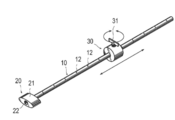
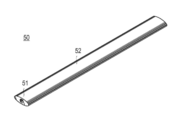
- FIG. 2 is a brass instrument practice instrument according to the present embodiment, in which (A) is a plan view and (B) is a sectional view taken along line BB of (A). It is a perspective view which shows the training instrument for the brass instruments. It is a perspective view which shows the time of using the training instrument for brass instruments. It is a perspective view which shows the time of using the training instrument for brass instruments, without a weight part. It is a perspective view which shows the other example of the training instrument for brass instruments.
- the brass instrument practice instrument 1 is an instrument for a brass player to train the muscles around the lips.
- the brass instrument practice instrument 1 includes a cylindrical body 10 having a through hole 11 formed therein, and a gripping part 20 fixed to one end of the cylindrical body 10. Yes.
- the tailor 20 has a cross-sectional shape having a relatively long width D in one direction so as to fit a horizontally long space formed between the upper and lower lips when playing a brass instrument.
- the cross-sectional shape of the grip part 20 the whole over the circumferential direction of the surface is a linear plane in a direction perpendicular to the cross section (axial direction of the cylinder 10).
- the outer peripheral surface 21 of the gripper 20 is formed to be smoothly curved in the circumferential direction.
- the cross-sectional shape is substantially elliptical. In this way, the lips can be naturally aligned with the gripping part 20.
- a fixing hole 21 in which the outer diameter of the cylindrical body 10 is fitted and fixed is formed in the gripping portion 20, and the side of the fixing hole 21 opposite to the side on which the cylindrical body 10 is fixed, An opening 22 communicating with the through hole 11 of the cylindrical body 10 is formed.
- the cylindrical body 10 is inserted to the center portion of the fixing hole 21, but is not limited to such a form, for example, is inserted to the opening portion 22, or is inserted to the fixing hole 21. You may fix to the edge part of the fixing hole 21 by an adhesive agent, welding, etc., without doing.
- a plurality of scales 12 are formed on the outer surface of the cylinder 10 so as to be arranged at regular intervals in the extending direction of the cylinder 10.
- the scale 12 can be formed, for example, in the form of a groove or by applying a paint, but is not limited thereto. Further, the interval between the scales 12 is not particularly limited.
- the weight part 30 can be detachably connected to the outer surface of the cylindrical body 10.
- the weight portion 30 is a ring-shaped member, and is fixed to the outer surface of the cylindrical body 10 by a fixing screw 31 that is screwed into a screw hole penetrating from the outer peripheral surface to the inner peripheral surface, as shown in FIG. Therefore, it can be fixed by loosening the fixing screw 31 and moving it along the outer surface of the cylinder 10 and tightening the fixing screw 31 at an arbitrary position.
- the form of the weight part 30 is not limited to this, For example, it can also form in the form of the clip which can be pinched elastically and can move easily. Further, the weight portion may be fixedly formed at a predetermined position of the cylindrical body 10.
- the material of the grip part 20, the cylindrical body 10, and the weight part 30 is not particularly limited, and any material can be used as long as the shape can be maintained, such as a metal material such as stainless steel or aluminum, a resin material, or wood. Is possible. In order to prevent breakage as much as possible, it is preferable to use a metal material in consideration of securing a certain level of strength. In view of productivity, it is preferable to make the resin material.
- the outer shape of the gripping section 20, the inner diameter of the opening 22, the inner diameter and length of the cylinder 10, and the weight of the weight section 30 depend on the type of musical instrument, the level of the player used, and the shape of the player's lips. The design can be changed as appropriate. And it is preferable to provide a plurality of types of brass instrument training instruments 1 according to the type of musical instrument, the level of the performer to be used, and the shape of the performer's lips.
- the major axis of the cross section of the gripper 20 is preferably 5 mm to 30 mm
- the minor axis is preferably 3 mm to 8 mm
- the axial length is preferably 5 mm to 20 mm, but is not limited thereto.
- the axial length of the cylindrical body 10 is preferably 50 mm to 200 mm
- the outer diameter is preferably 2 mm to 6 mm
- the inner diameter is preferably 1 mm to 5 mm, but is not limited thereto.
- the weight part 30 When using the brass instrument practice instrument 1, first, the weight part 30 is fixed to a desired position on the outer surface of the cylindrical body 10. Since the scale 12 is formed in the outer surface of the cylinder 10 at this time, the weight part 30 can be arrange
- the weight part 30 can be inserted into the cylinder body 10 from the tip side of the cylinder body 10 (the side opposite to the side connected to the gripping section 20).
- the weight portion 30 As the weight portion 30 is fixed to the distal end side of the cylindrical body 10, the position of the weight portion 30 moves away from the lip L when the grip portion 20 is held by the lip L as shown in FIG. A large moment acts on it. Therefore, as the weight portion 30 is fixed to the distal end side, the load acting on the lips L can be increased, and the muscles around the lips L can be strongly trained.
- the brass instrument training instrument 1 can arbitrarily select training with a desired strength of the user by changing the position of the weight portion 30.
- the weight part 30 is fixed in multiple numbers, or several weights from which weight differs.
- An appropriate weight portion 30 may be selected from the weight portions 30.
- the gripping part 20 is gripped between the upper and lower lips L as shown in FIG.
- the grip portion 20 has a cross-sectional shape having a relatively long width D in one direction, the space between the upper and lower lips L is generated by the brass instrument when the user grips. Because of this, it is held as a proper horizontally long space. From this state, the brass instrument practice instrument 1 is held only by the lips L so that it does not fall. At this time, as in the case of playing a brass instrument, it is important to strain the muscles around the lips L while keeping the lips L soft and relaxed. In addition, as shown in FIG. 4, not only the lips L but also the fingers F can be used.
- the brass instrument practice instrument 1 receives a force in the direction of jumping out of the mouth. Further, the brass instrument practice instrument 1 receives a force in the direction of jumping out of the mouth by the inner wall of the through hole 11 receiving the resistance of the discharged air. Therefore, it is necessary for the embouchure while receiving the weight of the gripper 20 that tries to jump out by the intraoral pressure when discharging air, the air resistance generated in the through hole 11 and the weight of the brass instrument 1 at the muscle of the lip L at the same time.
- the muscles can be trained to “shape memory” the state of the muscles. Further, even when the intraoral pressure does not act, it is possible to learn how to support the muscular strength around the lower lip as if it were in a pressurized state by the weight of the brass instrument practice instrument 1 itself.
- the gripping portion 20 in contact with the lips L in the circumferential direction is linear in the direction perpendicular to the cross section (the axial direction of the cylinder 10), the gripping portion 20 in contact with the lips L
- the entire surface over 360 degrees has a smooth shape with no irregularities in the direction perpendicular to the cross section.
- the user can practice while changing the intraoral pressure by adjusting the degree of discharge, so that he can naturally experience the stepless adjustment of barking muscle strength, and the “jump” of the pitch when actually playing brass instruments (
- the flexibility to perform pitch changes) can be cultivated.
- the pitch “jump” may be realized only by the shape of the lips (embouchure). Therefore, the brass instrument practice instrument 1 according to the present embodiment is very useful for practicing the pitch “jump”. It is effective.
- the brass instrument practice instrument 1 is removed from the lip L while holding the cylindrical body 10 as shown in FIG. It can be pulled out, and further, a brass instrument can be played while being pulled out and maintaining the state of the lips L. Further, as described above, when the brass instrument practice instrument 1 is pulled out from the lips L while breathing out, the lips L vibrate by the movement, and therefore, as practice for causing a brass instrument that requires vibration of the lips to sound. Is effective.
- the muscles around the lips L can be trained so as to be suitable for brass instruments.
- the brass instrument practice instrument 1 allows anyone to easily learn the actions necessary to pronounce a brass instrument, and anyone can easily wear a form for pronunciation. And Therefore, if the brass instrument practice instrument according to the present invention is used, anyone can easily play the brass instrument, which has been difficult until now.
- FIG. 5 shows another embodiment of the brass instrument practice instrument 50, but the cross-sectional shapes of the barb 51 and the cylindrical body 52 can be the same. With such a configuration, the production becomes easy and the productivity can be improved.
- the brass instrument practice instrument 50 may be provided with a scale or a weight.
- the brass instrument practice instrument 1 shown in FIGS. 1 to 4 uses less material than the brass instrument practice instrument 50 shown in FIG. Moreover, the brass instrument practice instrument 1 and 50 concerning this invention does not limit the kind of brass instrument.
Landscapes
- Engineering & Computer Science (AREA)
- Physics & Mathematics (AREA)
- Multimedia (AREA)
- Educational Technology (AREA)
- General Health & Medical Sciences (AREA)
- Business, Economics & Management (AREA)
- Health & Medical Sciences (AREA)
- Educational Administration (AREA)
- Physical Education & Sports Medicine (AREA)
- General Physics & Mathematics (AREA)
- Theoretical Computer Science (AREA)
- Acoustics & Sound (AREA)
- Auxiliary Devices For Music (AREA)
- Rehabilitation Tools (AREA)
- Toys (AREA)
Abstract
Description
Claims (5)
- 金管楽器の演奏のための唇の状態を保持して訓練するための金管楽器用練習器具であって、
内部に貫通孔(11)が形成された筒体(10)と、
前記筒体(10)の一端側に固定され、上下の唇の間の形状に適合するように一方向へ相対的に長い断面形状を備え、かつ前記貫通孔(11)と連通して唇からの空気が流通する流路を構成する開口部(22)を備えた咥え部(20)と、を有することを特徴とする金管楽器用練習器具。 - 前記咥え部(20)の前記唇と接する表面の周方向にわたる全体が、前記断面と直角方向へ直線的に形成されたことを特徴とする請求項1に記載の金管楽器用練習器具。
- 前記筒体(10)に取り付けられる重り部(30)を更に有することを特徴とする請求項1又は2に記載の金管楽器用練習器具。
- 前記重り部(30)は、前記筒体(10)の延在方向の任意の位置に取り付け可能であることを特徴とする請求項3に記載の金管楽器用練習器具。
- 前記筒体(10)の外面に、当該筒体(10)の延在方向の位置を示す目盛(12)が形成されたことを特徴とする請求項1~4のいずれかに記載の金管楽器用練習器具。
Priority Applications (4)
| Application Number | Priority Date | Filing Date | Title |
|---|---|---|---|
| EP10789323.2A EP2444949A4 (en) | 2009-06-19 | 2010-05-10 | DEVICE FOR EXERCISING A MUSICAL INSTRUMENT OF THE COPPER FAMILY |
| CN201080023756.8A CN102449674B (zh) | 2009-06-19 | 2010-05-10 | 铜管乐器用练习器具 |
| KR1020127001134A KR20120061795A (ko) | 2009-06-19 | 2010-05-10 | 금관 악기용 연습기구 |
| US13/377,570 US8686267B2 (en) | 2009-06-19 | 2010-05-10 | Brass instrument practice device |
Applications Claiming Priority (2)
| Application Number | Priority Date | Filing Date | Title |
|---|---|---|---|
| JP2009-146837 | 2009-06-19 | ||
| JP2009146837A JP4521666B1 (ja) | 2009-06-19 | 2009-06-19 | 金管楽器用練習器具 |
Publications (1)
| Publication Number | Publication Date |
|---|---|
| WO2010146946A1 true WO2010146946A1 (ja) | 2010-12-23 |
Family
ID=42709047
Family Applications (1)
| Application Number | Title | Priority Date | Filing Date |
|---|---|---|---|
| PCT/JP2010/057908 Ceased WO2010146946A1 (ja) | 2009-06-19 | 2010-05-10 | 金管楽器用練習器具 |
Country Status (6)
| Country | Link |
|---|---|
| US (1) | US8686267B2 (ja) |
| EP (1) | EP2444949A4 (ja) |
| JP (1) | JP4521666B1 (ja) |
| KR (1) | KR20120061795A (ja) |
| CN (1) | CN102449674B (ja) |
| WO (1) | WO2010146946A1 (ja) |
Families Citing this family (4)
| Publication number | Priority date | Publication date | Assignee | Title |
|---|---|---|---|---|
| US8697971B1 (en) * | 2011-09-02 | 2014-04-15 | Michael B. Williams | Musical instrument training aid |
| US8975499B1 (en) * | 2013-08-24 | 2015-03-10 | Chris Stoutenborough | Wind instrument training device |
| CN114822149A (zh) * | 2022-03-25 | 2022-07-29 | 湖州师范学院 | 一种声乐气息练习装置 |
| ES1306869Y (es) * | 2024-02-26 | 2024-07-10 | Martin Perez Roberto | Util de práctica para instrumentos musicales de viento metal |
Citations (8)
| Publication number | Priority date | Publication date | Assignee | Title |
|---|---|---|---|---|
| FR1111489A (fr) * | 1953-11-05 | 1956-02-27 | Appareil pour développer les muscles faciaux | |
| JPH0645981Y2 (ja) * | 1989-02-20 | 1994-11-24 | 光夫 山田 | 金管楽器用の訓練器具 |
| JP2000250532A (ja) * | 1999-02-25 | 2000-09-14 | Hiroshi Nishimura | 金管楽器練習用マウスピース |
| JP3097484U (ja) * | 2003-04-28 | 2004-01-29 | ノーブル株式会社 | 顎筋肉訓練具 |
| US20050192157A1 (en) * | 2001-04-12 | 2005-09-01 | Norton Jewellita F. | Apparatus for enhancing exercises and methods of using same |
| JP2006345945A (ja) * | 2005-06-13 | 2006-12-28 | Magical:Kk | トレーニング器具及びトレーニング方法 |
| JP2007117688A (ja) * | 2005-10-25 | 2007-05-17 | Masahiro Kamata | 多機能口元トレーニング器具 |
| JP2008152015A (ja) * | 2006-12-18 | 2008-07-03 | Yamaha Corp | 金管楽器用マウスピース |
Family Cites Families (12)
| Publication number | Priority date | Publication date | Assignee | Title |
|---|---|---|---|---|
| US3853034A (en) * | 1973-11-23 | 1974-12-10 | R Vale | Brass musical instrument practice device |
| JPH0397484A (ja) | 1989-09-10 | 1991-04-23 | Jiyareko:Kk | 駆動装置 |
| JP2507098Y2 (ja) * | 1990-01-25 | 1996-08-14 | 鹿島建設株式会社 | タワ―クレ―ンにおけるクレ―ンのクライミング装置 |
| CN2206487Y (zh) * | 1994-09-15 | 1995-08-30 | 王泽羽 | 用于儿童吹奏的塑料竖笛 |
| JP3097484B2 (ja) | 1995-02-03 | 2000-10-10 | 株式会社村田製作所 | チョークコイル |
| CN2537095Y (zh) * | 2002-04-28 | 2003-02-19 | 艾伦·詹姆士 | 一种笛子 |
| DE202005004630U1 (de) * | 2005-03-22 | 2005-06-09 | Michel, Andreas | Trainingsgerät zur Kräftigung der Lippen-, Atem- und Ansatzmuskulatur mit variabler Gewichtsverschiebung (für Bläser) |
| AT502569B1 (de) * | 2005-06-14 | 2007-06-15 | Hubert Wegscheider | Lippen-massagegerät für blechbläser |
| GB0520614D0 (en) * | 2005-10-11 | 2005-11-16 | Lifelab Innovations Ltd | Respiratory protection device |
| US7465864B2 (en) * | 2006-10-17 | 2008-12-16 | Clarflupet, Llc | Musical instrument training device with multiple mouthpieces |
| CN201007904Y (zh) * | 2007-01-29 | 2008-01-16 | 李达 | 一种有吹嘴的笛子 |
| CN201134235Y (zh) * | 2007-12-28 | 2008-10-15 | 黄华穗 | 一种铜管乐器练习用号嘴 |
-
2009
- 2009-06-19 JP JP2009146837A patent/JP4521666B1/ja active Active
-
2010
- 2010-05-10 CN CN201080023756.8A patent/CN102449674B/zh not_active Expired - Fee Related
- 2010-05-10 KR KR1020127001134A patent/KR20120061795A/ko not_active Ceased
- 2010-05-10 WO PCT/JP2010/057908 patent/WO2010146946A1/ja not_active Ceased
- 2010-05-10 EP EP10789323.2A patent/EP2444949A4/en not_active Withdrawn
- 2010-05-10 US US13/377,570 patent/US8686267B2/en not_active Expired - Fee Related
Patent Citations (8)
| Publication number | Priority date | Publication date | Assignee | Title |
|---|---|---|---|---|
| FR1111489A (fr) * | 1953-11-05 | 1956-02-27 | Appareil pour développer les muscles faciaux | |
| JPH0645981Y2 (ja) * | 1989-02-20 | 1994-11-24 | 光夫 山田 | 金管楽器用の訓練器具 |
| JP2000250532A (ja) * | 1999-02-25 | 2000-09-14 | Hiroshi Nishimura | 金管楽器練習用マウスピース |
| US20050192157A1 (en) * | 2001-04-12 | 2005-09-01 | Norton Jewellita F. | Apparatus for enhancing exercises and methods of using same |
| JP3097484U (ja) * | 2003-04-28 | 2004-01-29 | ノーブル株式会社 | 顎筋肉訓練具 |
| JP2006345945A (ja) * | 2005-06-13 | 2006-12-28 | Magical:Kk | トレーニング器具及びトレーニング方法 |
| JP2007117688A (ja) * | 2005-10-25 | 2007-05-17 | Masahiro Kamata | 多機能口元トレーニング器具 |
| JP2008152015A (ja) * | 2006-12-18 | 2008-07-03 | Yamaha Corp | 金管楽器用マウスピース |
Non-Patent Citations (1)
| Title |
|---|
| See also references of EP2444949A4 * |
Also Published As
| Publication number | Publication date |
|---|---|
| US8686267B2 (en) | 2014-04-01 |
| US20120085220A1 (en) | 2012-04-12 |
| JP4521666B1 (ja) | 2010-08-11 |
| EP2444949A4 (en) | 2015-03-25 |
| EP2444949A1 (en) | 2012-04-25 |
| JP2012168206A (ja) | 2012-09-06 |
| KR20120061795A (ko) | 2012-06-13 |
| CN102449674B (zh) | 2015-04-08 |
| CN102449674A (zh) | 2012-05-09 |
Similar Documents
| Publication | Publication Date | Title |
|---|---|---|
| US10086230B2 (en) | Lung instrument training device and method | |
| US8273973B2 (en) | Bow hold training device | |
| JP2004070071A (ja) | 打楽器用スティック | |
| CN102449674B (zh) | 铜管乐器用练习器具 | |
| KR101567513B1 (ko) | 현악기 연습용 손가락 보조기구 | |
| US9792831B2 (en) | Incentive spirometer and musical instrument | |
| Ely et al. | Wind talk for brass: A practical guide to understanding and teaching brass instruments | |
| JP6617366B1 (ja) | 管楽器の音響改善装置 | |
| US8946530B1 (en) | Hand-operated clapping percussion and rhythm device with controllable tone of sound | |
| US3339444A (en) | Trumpet embouchure | |
| JP3175916U (ja) | 練習用尺八 | |
| CN113035156B (zh) | 演奏辅助器具以及气簧乐器 | |
| JP3191282U (ja) | 縦式篠笛に着脱自在に設けた歌口具 | |
| JP3199364U (ja) | 尺八セット | |
| Ferreira | Chaos in Your Clarinet Section? Tips to Improve Your Student Clarinetists | |
| JP3217921U (ja) | バズィング練習器具及びトランペット練習セット | |
| Kreitmair et al. | Lip Relaxation and Lip Training for Wind Musicians | |
| KR200330873Y1 (ko) | 플루트 | |
| HK40093236A (en) | Bow hold training device | |
| CN205862640U (zh) | 唇振练习器 | |
| JP2022056610A (ja) | 木管楽器用演奏補助具 | |
| US20160296793A1 (en) | Brass Instrument Mouthpiece Emulator | |
| US20050211056A1 (en) | Bagpipe blow resistance training device | |
| KR20190002290U (ko) | 색소폰 바이브레이션 연습 보조기구 | |
| JP2020187337A (ja) | 指用マレット |
Legal Events
| Date | Code | Title | Description |
|---|---|---|---|
| WWE | Wipo information: entry into national phase |
Ref document number: 201080023756.8 Country of ref document: CN |
|
| 121 | Ep: the epo has been informed by wipo that ep was designated in this application |
Ref document number: 10789323 Country of ref document: EP Kind code of ref document: A1 |
|
| WWE | Wipo information: entry into national phase |
Ref document number: 13377570 Country of ref document: US |
|
| NENP | Non-entry into the national phase |
Ref country code: DE |
|
| ENP | Entry into the national phase |
Ref document number: 20127001134 Country of ref document: KR Kind code of ref document: A |
|
| WWE | Wipo information: entry into national phase |
Ref document number: 2010789323 Country of ref document: EP |
|
| NENP | Non-entry into the national phase |
Ref country code: JP |