WO2011006400A1 - 实现远距离ranging检测的方法与装置 - Google Patents
实现远距离ranging检测的方法与装置 Download PDFInfo
- Publication number
- WO2011006400A1 WO2011006400A1 PCT/CN2010/073302 CN2010073302W WO2011006400A1 WO 2011006400 A1 WO2011006400 A1 WO 2011006400A1 CN 2010073302 W CN2010073302 W CN 2010073302W WO 2011006400 A1 WO2011006400 A1 WO 2011006400A1
- Authority
- WO
- WIPO (PCT)
- Prior art keywords
- ofdm symbol
- peak
- sequence
- symbol
- ofdm
- Prior art date
- Legal status (The legal status is an assumption and is not a legal conclusion. Google has not performed a legal analysis and makes no representation as to the accuracy of the status listed.)
- Ceased
Links
Classifications
-
- H—ELECTRICITY
- H04—ELECTRIC COMMUNICATION TECHNIQUE
- H04L—TRANSMISSION OF DIGITAL INFORMATION, e.g. TELEGRAPHIC COMMUNICATION
- H04L27/00—Modulated-carrier systems
- H04L27/32—Carrier systems characterised by combinations of two or more of the types covered by groups H04L27/02, H04L27/10, H04L27/18 or H04L27/26
- H04L27/34—Amplitude- and phase-modulated carrier systems, e.g. quadrature-amplitude modulated carrier systems
- H04L27/38—Demodulator circuits; Receiver circuits
- H04L27/3845—Demodulator circuits; Receiver circuits using non - coherent demodulation, i.e. not using a phase synchronous carrier
- H04L27/3854—Demodulator circuits; Receiver circuits using non - coherent demodulation, i.e. not using a phase synchronous carrier using a non - coherent carrier, including systems with baseband correction for phase or frequency offset
- H04L27/3872—Compensation for phase rotation in the demodulated signal
-
- H—ELECTRICITY
- H04—ELECTRIC COMMUNICATION TECHNIQUE
- H04L—TRANSMISSION OF DIGITAL INFORMATION, e.g. TELEGRAPHIC COMMUNICATION
- H04L27/00—Modulated-carrier systems
- H04L27/26—Systems using multi-frequency codes
- H04L27/2601—Multicarrier modulation systems
- H04L27/2647—Arrangements specific to the receiver only
- H04L27/2655—Synchronisation arrangements
- H04L27/2662—Symbol synchronisation
-
- H—ELECTRICITY
- H04—ELECTRIC COMMUNICATION TECHNIQUE
- H04L—TRANSMISSION OF DIGITAL INFORMATION, e.g. TELEGRAPHIC COMMUNICATION
- H04L27/00—Modulated-carrier systems
- H04L27/26—Systems using multi-frequency codes
- H04L27/2601—Multicarrier modulation systems
- H04L27/2647—Arrangements specific to the receiver only
- H04L27/2655—Synchronisation arrangements
- H04L27/2668—Details of algorithms
- H04L27/2673—Details of algorithms characterised by synchronisation parameters
- H04L27/2675—Pilot or known symbols
-
- H—ELECTRICITY
- H04—ELECTRIC COMMUNICATION TECHNIQUE
- H04L—TRANSMISSION OF DIGITAL INFORMATION, e.g. TELEGRAPHIC COMMUNICATION
- H04L27/00—Modulated-carrier systems
- H04L27/26—Systems using multi-frequency codes
- H04L27/2601—Multicarrier modulation systems
- H04L27/2647—Arrangements specific to the receiver only
- H04L27/2655—Synchronisation arrangements
- H04L27/2668—Details of algorithms
- H04L27/2681—Details of algorithms characterised by constraints
- H04L27/2686—Range of frequencies or delays tested
-
- H—ELECTRICITY
- H04—ELECTRIC COMMUNICATION TECHNIQUE
- H04L—TRANSMISSION OF DIGITAL INFORMATION, e.g. TELEGRAPHIC COMMUNICATION
- H04L5/00—Arrangements affording multiple use of the transmission path
-
- H—ELECTRICITY
- H04—ELECTRIC COMMUNICATION TECHNIQUE
- H04W—WIRELESS COMMUNICATION NETWORKS
- H04W56/00—Synchronisation arrangements
Definitions
- the present invention relates to the field of communications technologies, and in particular, to a method and apparatus for implementing remote range detection. Background technique
- Orthogonal Frequency Division Multiplexing is a multi-carrier transmission technology.
- OFDM has been widely used. Especially in the field of mobile communication, OFDM is considered to be a very promising key technology.
- OFDM technology has become one of the physical layer technologies of the IEEE 802.16 protocol.
- the uplink synchronization between the mobile station and the base station is completed by the ranging detection.
- the detection method of the ranging is mainly for the detection of a single ranging symbol, but the detection method of the single ranging symbol cannot satisfy the mobile station.
- the base station cannot detect the mobile station ranging symbol.
- the IEEE 802.16e protocol provides a method of increasing the detection distance. This method requires the mobile station to transmit two identical slanted symbols to the base station through a channel, and the base station detects the ranging symbol according to the OFDM signal it receives.
- 1 is a schematic diagram of two consecutive ranging symbols described by the IEEE 802.16 protocol. As shown in FIG. 1, the symbol 101 and the symbol 102 are identical ranging symbols, and the two ranging symbols are processed to obtain the FIG. The two consecutiveranging symbols are shown as follows: a part of the following symbol is copied as a cyclic prefix (CP, Cyclic Prefix) to obtain the first ranging symbol, and a part of the front of the replica symbol 102 is obtained as a protection signal (GRG). Tworanging symbols.
- CP cyclic prefix
- GAG protection signal
- the present invention is directed to a method and apparatus for implementing remote range detection to solve the phase ambiguity problem caused by the ranging detection method existing in the prior art.
- the present invention provides a method for implementing long range ranging detection, including:
- Step A The base station receives two consecutive orthogonal frequency division multiplexing OFDM signals of the mobile station, and removes the prefixes of the two OFDM signals respectively to obtain the first OFDM symbol and the second OFDM symbol; for the first OFDM symbol and the second OFDM Performing fast Fourier transform on the symbols to obtain a first OFDM symbol carrier sequence and a second OFDM symbol carrier sequence;
- Step B Perform operation on the second OFDM symbol carrier sequence to detect whether the second OFDM symbol includes a ranging symbol, and if yes, perform step C, otherwise end the ranging detection;
- Step C perform operation on the first OFDM symbol carrier sequence, Eliminate phase blur.
- the step B specifically includes:
- Step B1 Perform a correlation operation between the second OFDM symbol carrier sequence and the local pseudo-random PN code of the base station to obtain a second correlation sequence, and perform inverse fast Fourier transform on the second correlation sequence.
- Step B2 Calculating the average power and peak power of the sequence after the inverse fast Fourier transform, and obtaining the average power, peak power, and peak position of the second OFDM symbol;
- Step B3 Compare a ratio of a peak power of the second OFDM symbol to an average power of the second OFDM symbol with a first threshold, and compare the average power of the second OFDM symbol with a second threshold, if both are greater than the respective a threshold, determining that the second OFDM symbol includes a ranging symbol; the first threshold is a peak power of the second OFDM symbol and the second OFDM The threshold of the ratio of the average power of the symbol, the second threshold being the threshold of the average power of the second OFDM symbol.
- the step B2 specifically includes:
- the step C includes:
- Step C1 performing a correlation operation between the first OFDM symbol carrier sequence and a local PN code of the base station to obtain a first correlation sequence.
- Step C2 Calculating according to a peak position of the second OFDM symbol and a first correlation sequence, to obtain a peak power of the first OFDM symbol;
- Step C3 determining whether a ratio of a peak power of the second OFDM symbol and a peak power of the first OFDM symbol exceeds a third threshold, and if yes, determining that the distance between the mobile station and the base station exceeds one OFDM symbol time, and correcting the second
- the peak position of the OFDM symbol is output and otherwise directly outputs the peak position of the second OFDM symbol
- the third threshold is a threshold of the ratio of the peak power of the second OFDM symbol to the peak power of the first OFDM symbol.
- the step C2 specifically includes:
- the step C2 specifically includes:
- the first correlation sequence is subjected to inverse Fourier transform, and the sequence obtained by inverse Fourier transform and the symbol peak position of the second OFDM are calculated to obtain peak power of the first OFDM symbol.
- the present invention also provides an apparatus for implementing remote ranging detection, comprising: a signal processing unit, a first symbol detecting unit, and a second symbol detecting unit;
- the signal processing unit is configured to receive a first OFDM signal and a second OFDM signal of the mobile station, and perform fast Fourier transform on a symbol length to obtain a first OFDM symbol carrier sequence and a second OFDM symbol carrier sequence ;
- the second symbol detecting unit is configured to perform operation on the second OFDM symbol carrier sequence to detect whether the second OFDM symbol includes a ranging symbol, and if yes, trigger the first symbol detecting unit, otherwise end the ranging detection;
- the first symbol detecting unit is configured to calculate a first OFDM symbol to eliminate phase blur.
- the signal processing unit specifically includes: a receiving module, a Fourier transform module, and a data cache module; wherein
- the receiving module is configured to receive a first OFDM signal and a second OFDM signal of the mobile station, and respectively remove a cyclic prefix of the first OFDM signal and the second OFDM signal to obtain a first OFDM symbol and a second OFDM Symbol
- the Fourier transform module is configured to perform Fourier transform on the first OFDM symbol and the second OFDM symbol to obtain a first OFDM symbol carrier sequence and a second OFDM symbol carrier sequence, and the first OFDM symbol carrier sequence And outputting a second OFDM symbol carrier sequence to the data buffer module;
- the data buffering module is configured to buffer a first OFDM symbol carrier sequence and a second OFDM symbol carrier sequence.
- the second symbol detecting unit specifically includes: a second PN code correlation module, an inverse Fourier transform module, a peak mean calculation module, and a detection decision module;
- the second PN code correlation module is configured to perform a correlation operation between the second symbol carrier sequence and the local PN code of the base station to obtain a second correlation sequence;
- the inverse Fourier transform module is configured to perform inverse fast Fourier transform on the second correlation sequence and output the same;
- the peak mean calculation module is configured to calculate an average power and a peak power of the sequence output by the inverse Fourier transform module to obtain an average power, a peak power, and a peak position of the second OFDM symbol;
- the detection decision module is configured to compare a ratio of a peak power of the second OFDM symbol and an average power of the second OFDM symbol to a first threshold, and compare the average power of the second OFDM symbol with a second threshold, if If both are greater than the respective thresholds, it is determined that the second OFDM symbol includes a ranging symbol, and the first symbol detecting unit is triggered, otherwise the ranging detection is ended; the first threshold is the peak power of the second OFDM symbol and the second OFDM symbol. a threshold of a ratio of average power, the second threshold being a threshold of an average power of the second OFDM symbol.
- the first symbol detecting unit specifically includes: a first PN code correlation module, a peak calculation module, a third threshold comparison module, and a peak position correction module;
- the first PN code correlation module is configured to perform a correlation operation between the second symbol carrier sequence and the local PN code of the base station to obtain a first correlation sequence
- the peak calculation module is configured to calculate, according to a peak position of the second OFDM symbol and the first correlation sequence, to obtain a peak power of the first OFDM symbol;
- the third threshold comparison module is configured to determine whether a ratio of a peak power of the second OFDM symbol and a peak power of the first OFDM symbol exceeds a third threshold, and if yes, determine that the distance between the mobile station and the base station exceeds one OFDM symbol time Triggering the peak position correction module to perform peak correction, otherwise triggering the peak position correction module to directly output;
- the third threshold is a threshold of a ratio of a peak power of the second OFDM symbol to a peak power of the first OFDM symbol;
- the peak position correction module is configured to correct and output a peak position of the second OFDM symbol, or directly output a peak position of the second OFDM symbol.
- the peak calculation module is specifically configured to calculate a phase according to a peak position of the second OFDM symbol a bit rotation sequence, and adjusting a phase of the first correlation sequence; and then calculating an accumulated value of the phase rotation sequence and the first correlation sequence product, the power of the accumulated value being the peak power of the first OFDM symbol;
- the peak calculation module is specifically configured to perform inverse Fourier transform on the first correlation sequence, calculate a peak position obtained by inverse Fourier transform and a peak position of the second OFDM symbol, to obtain a first OFDM symbol. Peak power.
- the invention eliminates the phase ambiguity problem while realizing remote detection. And, the calculation of the first OFDM symbol is based on the detection result of the second OFDM symbol, which reduces the computational complexity.
- 1 is a schematic diagram of two consecutive ranging symbols described in the IEEE 802.16e protocol
- FIG. 2 is a schematic flowchart of an embodiment of a method for implementing remote range ranging detection according to the present invention
- FIG. 3 is a schematic structural diagram of an embodiment of an apparatus for implementing remote range ranging detection according to the present invention
- FIG. 4 is a schematic diagram of double symbol detection using the present invention. Comparison chart. Detailed ways
- the method of the embodiment of the present invention specifically includes the following steps:
- Step 201 When the mobile station transmits two consecutive ranging symbols through the channel, the base station receives two consecutive OFDM symbols of the mobile station, that is, the first OFDM signal and the second OFDM signal, and removes the prefixes of the two OFDM signals respectively. Obtaining a first OFDM symbol and a second OFDM symbol R 2 .
- Step 202 the first OFDM symbol and second OFDM symbols R 2 are as Fast Fourier Transform (FFT), obtaining a first carrier OFDM symbol sequence S n) and a second carrier OFDM symbol sequence S 2 (n). Specifically, it can be expressed as shown in formula (1) and formula (2), respectively:
- FFT Fast Fourier Transform
- N represents the number of samples of the OFDM symbol
- n and k both represent the sample points, n [0 ⁇ 1023], k 6 [0 ⁇ 1023].
- Step 203 Perform a sequence correlation operation on the carrier sequence & ( «) of the second symbol and the local pseudo random code (PN code) P(n) of the base station (here, the correlation operation of the sequence is a mathematical operation, usually It can be considered as the inner product of two signals in the signal space to obtain the second correlation sequence, and then the inverse fast Fourier transform (IFFT) is performed on the second correlation sequence to obtain the sequence ⁇ 2 ⁇ .
- PN code pseudo random code
- IFFT inverse fast Fourier transform
- Step 205 Comparing the ratio of the peak power Peak 2 to the average power Mean 2 with the first threshold
- Threshold is compared, and the average power Mean 2 is compared with the second threshold Threshold?, if both are greater than the respective thresholds, it is determined that the second OFDM symbol R 2 contains the ranging symbol, and step 206 is performed; If the two OFDM symbols R 2 do not contain the ranging symbol, the ranging detection fails, and the process ends.
- the ranging detection condition is as shown in the formula (5):
- the apparatus for implementing remote ranging detection according to the present invention may be set in a wireless environment.
- the noise signal and the ranging signal are received, and the ratio of the peak power Peak 2 to the average power Mean 2 is calculated multiple times, and a reasonable ratio is selected as the first threshold. Since the peak power is definitely greater than the average power, the first threshold is a value greater than one. The worse the quality of the signal, the smaller the ratio of peak power to average power, so the first threshold cannot be set too large.
- the first The threshold cannot be set too small.
- the second threshold Threshold is a threshold of the average power of the second OFDM symbol, and the device for realizing the remote ranging detection according to the present invention can be set to receive the noise signal and the ranging signal in the wireless environment, and calculate the average power Mean 2 multiple times, and select a reasonable one. The value is taken as the second threshold;
- Step 208 Determine whether the peak Peak 2 of the second OFDM symbol and the peak power Peak ratio of the first OFDM symbol exceed a third threshold Thresthold. If yes, determine that the mobile station is more than one OFDM symbol time from the base station, and correct the second. The peak position of the symbol, otherwise the peak position is not corrected and is directly output.
- the corrected peak position of the second symbol is as shown in equation (9):
- the third threshold Threshold is a threshold of the ratio of the peak power of the second OFDM symbol to the peak power of the first OFDM symbol, and the peak power of the second OFDM symbol in each case can be obtained by analyzing the ranging signal of different delays. And the ratio of the peak power of the first OFDM symbol, and then selecting a reasonable comparison as the third threshold; the test result indicates that if the ranging signal exceeds the time difference of an ofdm symbol, then the peak of the second OFDM symbol The value power is greater than the peak power of the first OFDM symbol, so the third threshold can be set to a value greater than one. In addition, in order to prevent false detection, the third threshold cannot be set too small.
- Step 209 Output the final peak position Pos.
- FIG. 3 is a schematic structural diagram of an apparatus according to an embodiment of the present invention, which may specifically include: a signal processing unit, a second symbol detecting unit, and a first symbol detecting unit, and each unit will be separately described in detail below. among them,
- the signal processing unit configured to receive a first OFDM signal and a second OFDM signal of the mobile station, and perform fast Fourier transform on a symbol length to obtain a carrier sequence of the first OFDM symbol and a carrier sequence of the second OFDM symbol .
- the signal processing unit specifically includes: a receiving module, an FFT module, and a data cache module; wherein
- a receiving module receiving a first OFDM signal and a second OFDM signal of the mobile station, respectively removing a cyclic prefix of the first OFDM signal and the second OFDM signal to obtain a first OFDM symbol and a second OFDM symbol;
- the FFT module performs FFT transform on the first OFDM symbol and the second OFDM symbol to obtain a first OFDM symbol carrier sequence S ⁇ n) and a second OFDM symbol carrier sequence S 2 (n), and the first OFDM symbol carrier sequence S ⁇ n) and the second OFDM symbol carrier sequence S 2 (n) are output to the data buffer module;
- a data buffering module configured to buffer the first OFDM symbol carrier sequence Si(n) and the second OFDM symbol carrier sequence S 2 (n) for the first symbol detecting unit and the second detecting unit to call.
- the second symbol detecting unit is configured to detect whether the ranging symbol is included in the second OFDM symbol, and if yes, triggering the first symbol detecting unit to perform operation on the first OFDM symbol to eliminate phase blur, otherwise, ending the range detection.
- the second symbol detecting unit specifically includes: a second PN code correlation module, an inverse Fourier transform module, a peak mean calculation module, and a detection decision module; wherein, the second PN code correlation module is configured to take out the second in the data cache module Carrier sequence Column & ( «), the carrier sequence & ( «) of the second symbol is correlated with the local PN code P(n) of the base station to obtain a second correlation sequence;
- An inverse Fourier transform module configured to perform an IFFT on the second correlation sequence to obtain a sequence M 2 ⁇ k);
- Peak mean calculation means for calculating a power of each signal sampling point sequence M 2 (k) of, and search for M 2 (k) Peak 2 peak power and the peak position Pos 2, while the average power calculated M 2 (k) of Value Mean 2 ;
- a detection decision module configured to compare the ratio of the peak power Peak 2 and the average power Mean 2 to the first threshold Threshold, and compare the average power with the second threshold Threshold 2 , if both are greater than the respective thresholds, Then, it is determined that the second OFDM symbol R 2 includes a ranging symbol, and the first symbol detecting unit is triggered to perform operation on the first OFDM symbol, otherwise the ranging detection fails.
- the second symbol detecting unit may specifically include: a first PN code correlation module, a peak calculation module, a third threshold comparison module, and a peak position correction module;
- a first PN code correlation module configured to extract a first OFDM symbol carrier sequence S ⁇ n) from the data buffer module, and calculate a first correlation sequence d between the first OFDM symbol carrier sequence S ⁇ n) and the local PN code P(n) (n);
- a peak calculation module configured to calculate a peak power Peak of the first OFDM symbol according to a peak position Pos 2 and a first correlation sequence dn) of the second OFDM symbol; obtaining the peak power Peak of the first OFDM symbol includes two implementations, That is, the peak calculation module calculates the phase rotation sequence r(n) according to the second OFDM symbol peak position, and adjusts the phase of the first correlation sequence d(n); then calculates the phase rotation sequence r(n) and the first correlation The accumulated value of the product of the sequence d(n), the power of the accumulated value is the peak power Peak of the first OFDM symbol; or, the peak calculation module performs inverse Fourier transform on the first correlation sequence, and performs Fourier inverse on the Fourier inverse Transformed order
- the column and the second OFDM symbol peak position Pos 2 are calculated to obtain the peak power Peak l Q of the first OFDM symbol. Two embodiments are specifically referred to the description in the previous method.
- a third threshold comparison module configured to determine whether a ratio of a peak power Peak 2 of the second OFDM symbol and a peak power Peak of the first OFDM symbol exceeds a third threshold Threshold. If yes, determine that the mobile station is more than one OFDM symbol from the base station Time, trigger the peak position correction module, otherwise the peak position will not be corrected.
- a peak position correction module configured to: when a ratio of a peak power Peak 2 of the second OFDM symbol and a peak power Peak of the first OFDM symbol exceeds a third threshold Threshold, correct a peak position of the second OFDM symbol and output, otherwise directly output the first The peak position of the two OFDM symbols.
- the embodiments of the present invention provide a method and apparatus for implementing remote range detection, which eliminates the phase blur problem while implementing remote detection. Moreover, the calculation of the first OFDM symbol is based on the detection result of the second OFDM symbol, which reduces computational complexity and improves system response time.
- 4 is a comparison diagram of effects of dual symbol detection by the method and apparatus of the present invention. As shown in FIG. 4, the sub-picture 401 shows: If only single symbol detection is performed, when the distance between the mobile station and the base station exceeds one OFDM symbol time A sudden change in phase occurs at the peak position; as shown by sub-picture 402: After the double symbol detection, the peak position can correctly indicate the distance of the mobile station.
- modules or steps of the present invention can be implemented by a general computing device, which can be concentrated on a single computing device or distributed over a network composed of multiple computing devices. Alternatively, they may be implemented by program code executable by the computing device to store them in a storage device for execution by the computing device. Alternatively, they may be fabricated into individual integrated circuit modules, or a plurality of modules or steps may be fabricated into a single integrated circuit module. Thus the invention is not limited to any particular hard The combination of software and software.
Landscapes
- Engineering & Computer Science (AREA)
- Signal Processing (AREA)
- Computer Networks & Wireless Communication (AREA)
- Mobile Radio Communication Systems (AREA)
Abstract
本发明提供了一种实现远距离ranging检测的方法及装置,方法包括:基站接收移动站的两个连续的正交频分复用OFDM信号,分别去掉两个OFDM信号的前缀后得到第一OFDM符号和第二OFDM符号;对第一OFDM符号和第二OFDM符号分别进行快速傅里叶变换,得到第一OFDM符号载波序列和第二OFDM符号载波序列;对第二OFDM符号载波序列进行运算,检测第二OFDM符号中是否包含ranging信号,如果是,对第一OFDM符号载波序列进行运算,消除相位模糊,否则结束ranging检测;本发明在实现远距离检测的同时消除了相位模糊;并且第一OFDM符号的计算基于第二OFDM符号的检测结果,降低了计算复杂度。
Description
实现远巨离 ranging检测的方法与装置 技术领域
本发明涉及通信技术领域, 尤其涉及一种实现远距离 ranging检测的方 法与装置。 背景技术
正交频分复用 ( OFDM, Orthogonal Frequency Division Multiplexing ) 是一种多载波传输技术。 近年来, OFDM得到了广泛应用, 尤其在移动通 信领域, OFDM被认为是一种非常具有发展前景的关键技术, OFDM技术 已经成为 IEEE 802.16协议的物理层技术之一。
在 IEEE802.16e协议的 OFDM系统中, 移动站与基站之间的上行同步 通过 ranging检测来完成, 目前 ranging的检测方法主要是针对单个 ranging 符号的检测, 但是单个 ranging符号的检测方法无法满足移动站远距离接入 的要求, 当移动站信号延迟超过一个 OFDM符号的时间长度, 基站就无法 检测到移动站 ranging符号。
IEEE 802.16e协议提供了一种增加检测距离的方法,这种方法要求移动 站将两个相同的 ranging符号通过信道发送给基站, 基站根据其接收到的 OFDM信号检测 ranging符号。 图 1为 IEEE802.16协议所描述的两个连续 的 ranging符号的示意图, 如图 1所示, 符号 101和符号 102是完全相同的 ranging符号,对这两个 ranging符号进行处理后得到图 1所示的两个连续的 ranging符号, 具体处理过程为, 复制符号 101后面的一部分作为循环前缀 ( CP, Cyclic Prefix )得到第一个 ranging符号, 复制符号 102前面的一部 分作为保护信号 ( GRG )得到第二个 ranging符号。
对于 IEEE 802.16e协议提供的这种方法, 如果基站只检测单个符号,
就无法区分开接收到的是哪一个 ranging符号, 从而造成相位模糊; 如果同 时检测两个符号, 可以消除相位模糊问题, 但是这样不仅系统实现成本高, 而且也影响了系统的响应时间。 发明内容
鉴于上述的分析, 本发明旨在提供一种实现远距离 ranging检测的方法 与装置,用以解决现有技术中存在的 ranging检测方法带来的相位模糊问题。
本发明的目的主要是通过以下技术方案实现的:
本发明提供了一种实现远距离 ranging检测的方法, 包括:
步驟 A: 基站接收移动站的两个连续的正交频分复用 OFDM信号, 分 别去掉两个 OFDM信号的前缀后得到第一 OFDM符号和第二 OFDM符号; 对第一 OFDM符号和第二 OFDM符号分别进行快速傅里叶变换,得到第一 OFDM符号载波序列和第二 OFDM符号载波序列;
步驟 B: 对第二 OFDM符号载波序列进行运算, 检测第二 OFDM符号 中是否包含 ranging符号, 如果是, 则执行步驟 C, 否则结束 ranging检测; 步驟 C: 对第一 OFDM符号载波序列进行运算, 消除相位模糊。
所述步驟 B具体包括:
步驟 B1 : 将所述第二 OFDM符号载波序列与所述基站的本地伪随机 PN码进行序列的相关运算后得到第二相关序列, 再对所述第二相关序列进 行快速傅里叶逆变换;
步驟 B2: 对经过快速傅里叶逆变换后的序列进行平均功率和峰值功率 的计算, 得到第二 OFDM符号的平均功率、 峰值功率和峰值位置;
步驟 B3: 将第二 OFDM符号的峰值功率和第二 OFDM符号的平均功 率的比值与第一门限作比较, 同时将第二 OFDM符号的平均功率与第二门 限作比较, 如果两者都大于各自的门限, 则判定第二 OFDM符号中含有 ranging符号; 所述第一门限为第二 OFDM符号的峰值功率和第二 OFDM
符号的平均功率的比值的门限, 所述第二门限为第二 OFDM符号的平均功 率的门限。
所述步驟 B2具体包括:
对所述经过快速傅里叶逆变换后的序列, 计算该序列的各信号采样点 的功率, 从多个信号采样点的功率中搜索第二 OFDM符号的峰值功率和峰 值位置, 同时对多个信号采样点的功率取平均得到平均功率。
所述步驟 C包括:
步驟 C1 : 将所述第一 OFDM符号载波序列与基站的本地 PN码进行序 列的相关运算, 得到第一相关序列;
步驟 C2:根据所述第二 OFDM符号的峰值位置和第一相关序列进行计 算, 得到第一 OFDM符号的峰值功率;
步驟 C3: 判断所述第二 OFDM符号的峰值功率和第一 OFDM符号的 峰值功率的比值, 是否超过第三门限, 如果是, 则判断为移动站与基站距 离超过一个 OFDM符号时间,修正第二 OFDM符号的峰值位置并输出, 否 则直接输出第二 OFDM符号的峰值位置;所述第三门限为第二 OFDM符号 的峰值功率和第一 OFDM符号的峰值功率的比值的门限。
所述步驟 C2具体包括:
根据所述第二 OFDM符号的峰值位置计算相位旋转序列, 并调整第一 目^: 歹1 J的? 立;
计算相位旋转序列和所述第一相关序列乘积的累加值, 累加值的功率 是第一 OFDM符号的峰值功率; 或者,
所述步驟 C2具体包括:
将所述第一相关序列进行傅里叶逆变换, 对经过傅里叶逆变换得到的 序列和第二 OFDM的符号峰值位置进行计算,得到第一 OFDM符号的峰值 功率。
本发明还提供一种实现远距离 ranging检测的装置, 包括: 信号处理单 元、 第一符号检测单元和第二符号检测单元; 其中,
所述信号处理单元, 用于接收移动站的第一个 OFDM信号和第二个 OFDM信号, 并在一个符号长度内进行快速傅里叶变换得到第一 OFDM符 号载波序列和第二 OFDM符号载波序列;
所述第二符号检测单元, 用于对第二 OFDM符号载波序列进行运算, 检测第二 OFDM符号中是否包含 ranging符号, 如果是, 触发所述第一符 号检测单元, 否则结束 ranging检测;
所述第一符号检测单元, 用于对第一个 OFDM符号进行计算, 消除相 位模糊。
所述信号处理单元具体包括: 接收模块、 傅里叶变换模块和数据緩存 模块; 其中,
所述接收模块, 用于接收移动站的第一个 OFDM信号和第二个 OFDM 信号,并分别去除第一个 OFDM信号和第二个 OFDM信号的循环前缀后得 到第一 OFDM符号和第二 OFDM符号;
所述傅里叶变换模块,用于对第一 OFDM符号和第二 OFDM符号分别 进行傅里叶变换后得到第一 OFDM符号载波序列和第二 OFDM符号载波序 列,并将第一 OFDM符号载波序列和第二 OFDM符号载波序列输出到所述 数据緩存模块中;
所述数据緩存模块, 用于緩存第一 OFDM符号载波序列和第二 OFDM 符号载波序列。
所述第二符号检测单元具体包括: 第二 PN码相关模块、傅里叶逆变换 模块、 峰值均值计算模块和检测判决模块; 其中,
所述第二 PN码相关模块, 用于将第二个符号载波序列与基站的本地 PN码进行序列的相关运算, 得到第二相关序列;
所述傅里叶逆变换模块, 用于对所述第二相关序列进行快速傅里叶逆 变换并输出;
所述峰值均值计算模块, 用于对所述傅里叶逆变换模块输出的序列进 行平均功率和峰值功率的计算, 得到第二 OFDM符号的平均功率、 峰值功 率和峰值位置;
所述检测判决模块, 用于将第二 OFDM符号的峰值功率和第二 OFDM 符号的平均功率的比值与第一门限作比较, 同时将第二 OFDM符号的平均 功率与第二门限作比较, 如果两者都大于各自的门限, 则判定第二 OFDM 符号中含有 ranging符号, 触发第一符号检测单元, 否则结束 ranging检测; 所述第一门限为第二 OFDM符号的峰值功率和第二 OFDM符号的平均功率 的比值的门限, 所述第二门限为第二 OFDM符号的平均功率的门限。
所述第一符号检测单元具体包括:第一 PN码相关模块、峰值计算模块、 第三门限比较模块和峰值位置修正模块; 其中,
所述第一 PN码相关模块, 用于将第二个符号载波序列与基站的本地 PN码进行序列的相关运算, 得到第一相关序列;
所述峰值计算模块, 用于根据第二 OFDM符号的峰值位置和第一相关 序列进行计算, 得到第一 OFDM符号的峰值功率;
所述第三门限比较模块, 用于判断第二 OFDM符号的峰值功率和第一 OFDM符号的峰值功率的比值, 是否超过第三门限, 如果是, 则判断移动 站与基站距离超过一个 OFDM符号时间, 触发所述峰值位置修正模块进行 峰值修正, 否则触发所述峰值位置修正模块直接输出; 所述第三门限为第 二 OFDM符号的峰值功率和第一 OFDM符号的峰值功率的比值的门限; 所述峰值位置修正模块,用于修正并输出第二 OFDM符号的峰值位置, 或者直接输出第二 OFDM符号的峰值位置。
所述峰值计算模块具体用于, 根据第二 OFDM符号的峰值位置计算相
位旋转序列, 并调整第一相关序列的相位; 然后计算所述相位旋转序列和 所述第一相关序列乘积的累加值, 累加值的功率即是第一 OFDM符号的峰 值功率;
或者, 所述峰值计算模块具体用于, 将第一相关序列进行傅里叶逆变 换, 对经过傅里叶逆变换得到的序列和第二 OFDM符号的峰值位置进行计 算, 得到第一 OFDM符号的峰值功率。
本发明有益效果如下:
本发明在实现远距离检测的同时消除了相位模糊问题。 并且, 第一 OFDM符号的计算基于第二 OFDM符号的检测结果, 降低了计算复杂度。
本发明的其他特征和优点将在随后的说明书中阐述, 并且, 部分的从 说明书中变得显而易见, 或者通过实施本发明而了解。 本发明的目的和其 他优点可通过在所写的说明书、 权利要求书、 以及附图中所特别指出的结 构来实现和获得。 附图说明
图 1为 IEEE 802.16e协议所述描述的两个连续的 ranging符号的示意 图;
图 2为本发明实现远距离 ranging检测的方法的实施例的流程示意图; 图 3为本发明实现远距离 ranging检测的装置的实施例的结构示意图; 图 4为采用本发明进行双符号检测的效果对比图。 具体实施方式
下面结合附图来具体描述本发明的优先实施例, 其中, 附图构成本申 请一部分, 并与本发明的实施例一起用于阐释本发明的原理。 为了清楚和 简化目的, 当其可能使本发明的主题模糊不清时, 将省略本文所描述的器 件中已知功能和结构的详细具体说明。
下面结合附图对本发明实施例所述方法及装置进行详细说明。
首先结合附图 2对本发明实施例的方法进行详细说明。 如图 2所示, 本发明方法具体包括以下步驟:
步驟 201 : 当移动站通过信道发送两个连续的 ranging符号, 基站接收 移动站的两个连续的 OFDM符号, 即第一个 OFDM信号和第二个 OFDM 信号, 分别去掉这两个 OFDM信号的前缀, 得到第一 OFDM符号 和第 二 OFDM符号 R2。
步驟 202: 对第一 OFDM符号 和第二 OFDM符号 R2分别作快速傅 里叶变换( FFT ), 获得第一 OFDM符号载波序列 S n)和第二 OFDM符号 载波序列 S2(n)。 具体地, 分别可表示如公式 (1)和公式 (2)所示:
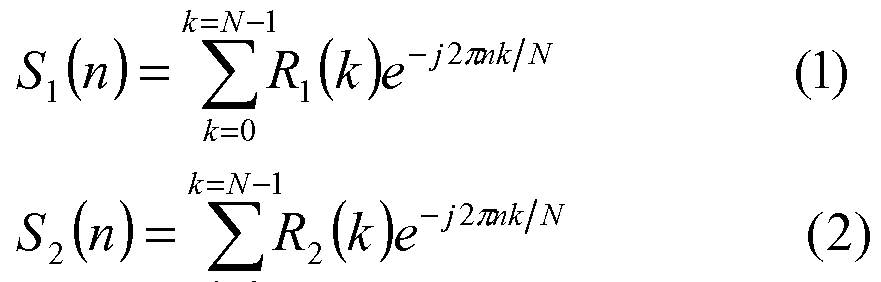
其中, N表示 OFDM符号的采样点数, n和 k均表示采样点, n [0 ~ 1023] , k 6 [0 ~ 1023]。
步驟 203 : 将第二个符号的载波序列 & («)与基站的本地伪随机码(PN 码) P(n)进行序列的相关运算(在这里, 序列的相关运算是一种数学运算, 通常可以认为是信号空间内的两个信号的内积)得到第二相关序列, 然后 再对第二相关序列进行快速傅里叶逆变换(IFFT )得到序列 Μ2 Ιή。 具体如 公式 (3)所示: (3)

步驟 204: 计算序列 M2(k)的各信号采样点的功率, 并搜索 M2(k)的功 率峰值 Peak2和峰值位置 Pos2,同时计算 M2(k)的平均功率值 Mean2。具体如 公式 (4)所示:
Peak2 = max^M2(^)|)

步驟 205 : 将峰值功率 Peak2和平均功率 Mean2的比值与第一门限
Threshold作比较, 同时将平均功率 Mean2与第二门限 Threshold?作比较, 若两者都大于各自的门限值, 则判定为第二 OFDM符号 R2中含有 ranging 符号, 执行步驟 206; 如果第二 OFDM符号 R2中不含有 ranging符号, 则 ranging检测失败, 结束本流程。 具体地, ranging检测条件如公式 (5)所示:
Peak2 1 Mean2 > Threshold^
Mean2 > Threshold 2 (5) 其中,第一门限 Thresholdi是第二 OFDM符号的峰值功率和第二 OFDM 符号的平均功率的比值的门限, 可以将本发明实现远距离 ranging检测的装 置设置在无线环境中接收噪声信号和 ranging信号,多次计算峰值功率 Peak2 和平均功率 Mean2的比值, 从中选取一个合理的比值作为第一门限。 因为 峰值功率肯定大于平均功率, 所以第一门限是一个大于 1 的值。 信号的质 量越差, 则峰值功率和平均功率的比值就越小, 所以第一门限就不能设置 的太大; 另一方面, 因为无线通信存在各种干扰, 所以为了防止干扰的影 响, 第一门限就不能设置的太小。
第二门限 Threshold是第二 OFDM符号的平均功率的门限, 可以将本 发明实现远距离 ranging检测的装置设置在无线环境中接收噪声信号和 ranging信号, 多次计算平均功率 Mean2 , 从中选取一个合理的值作为第二 门限;
一般情况下,如果收到的 ranging信号的功率很小,则认为是无效信号。 步驟 206:计算第一 OFDM符号载波序列 S^n)与基站的本地 PN码 P(n) 的第一相关序列 d(n)。 具体如公式 (6)所示:
Cx n) = Sx (n )P(n ) (6) 步驟 207: 计算第一 OFDM符号的峰值功率 Peak 具体可以有两种实 施方案;
方案一: 根据第二 OFDM符号峰值位置 Pos2, 计算相位旋转序列 r(n), 然后调整第一相关序列 d(n)的相位; 接着求 r n d n)乘积的累加值, 累 加值的功率即是第一 OFDM符号的峰值功率 Peakl Q 具体如公式 (7)所示: r(n) = &χρ(]2π - n x Pos2 1 N)
^efl^ = |^r(«)C1 («)| (7) 方案二: 将^^)进行 IFFT变换得到序列 M k), 然后根据第二 OFDM 符号的峰值位置 Pos2, 计算 M^Poss)的功率, 获得第一 OFDM符号的峰值 功率 Peak^ 具体如公式 (8)所示:

步驟 208: 判断第二 OFDM符号的峰值 Peak2和第一 OFDM符号的峰 值功率 Peak 比值, 是否超过第三门限 Threshold^ 如果是, 则判断出为 移动站距离基站超过一个 OFDM符号时间, 修正第二符号的峰值位置, 否 则不修正峰值位置, 直接输出。 修正后的第二符号的峰值位置如公式 (9)所 示:
[ <¾*, + N Peak, I PeaL > Threshold,
Pos = \ 2 2 1 3 (9
Pos2 Peak2 1 Peakx≤ Threshold^
其中,第三门限 Threshold是第二 OFDM符号的峰值功率和第一 OFDM 符号的峰值功率的比值的门限, 可以通过分析不同延时的 ranging信号, 得 到各种情况下的第二 OFDM符号的峰值功率和第一 OFDM符号的峰值功率 的比值, 然后从中选取一个合理的比较作为第三门限; 试验结果表明, 如 果 ranging信号超过一个 ofdm符号的时间差度, 那么第二 OFDM符号的峰
值功率比第一 OFDM符号的峰值功率大, 所以第三门限可以设置为一个大 于 1的值。 另外为了防止误检测, 第三门限不能设置得太小。
步驟 209: 输出最终峰值位置 Pos。
下面结合附图 3对本发明实施例所述装置进行详细说明。
如图 3所示, 图 3为本发明实施例所述装置的结构示意图, 具体可以 包括: 信号处理单元、 第二符号检测单元和第一符号检测单元, 以下将对 各个单元分别进行详细说明。 其中,
信号处理单元, 用于接收移动站的第一个 OFDM信号和第二个 OFDM 信号, 并在一个符号长度内进行快速傅里叶变换得到第一 OFDM符号的载 波序列和第二 OFDM符号的载波序列。信号处理单元具体包括:接收模块、 FFT模块和数据緩存模块; 其中,
接收模块,接收移动站的第一个 OFDM信号和第二个 OFDM信号, 分 别去除第一个 OFDM信号和第二个 OFDM信号的循环前缀得到第一 OFDM 符号和第二 OFDM符号;
FFT模块, 对第一 OFDM符号和第二 OFDM符号分别进行 FFT变换 后得到第一 OFDM符号载波序列 S^n)和第二 OFDM符号载波序列 S2(n), 将第一 OFDM符号载波序列 S^n)和第二 OFDM符号载波序列 S2(n)输出到 数据緩存模块中;
数据緩存模块,用于緩存第一 OFDM符号载波序列 Si(n)和第二 OFDM 符号载波序列 S2(n), 供第一符号检测单元和第二检测单元调用。
第二符号检测单元, 用于检测第二 OFDM符号中是否包含 ranging符 号, 如果是, 触发第一符号检测单元对第一 OFDM符号进行运算, 消除相 位模糊, 否则结束 ranging检测。 第二符号检测单元具体包括: 第二 PN码 相关模块、 傅里叶逆变换模块、 峰值均值计算模块和检测判决模块; 其中, 第二 PN码相关模块,用于取出数据緩存模块中的第二个符号的载波序
列 & («), 将第二个符号的载波序列 & («)与基站的本地 PN码 P(n)进行序列 的相关运算, 得到第二相关序列;
傅里叶逆变换模块, 用于对所述第二相关序列进行 IFFT 得到序列 M2{k);
峰值均值计算模块, 用于计算序列 M2(k)的各信号采样点的功率, 并搜 索 M2(k)的功率峰值 Peak2和峰值位置 Pos2, 同时计算 M2(k)的平均功率值 Mean2;
检测判决模块,用于将峰值功率 Peak2和平均功率 Mean2的比与第一门 限 Threshold^ 比较, 同时将平均功率与第二门限 Threshold2作比较, 若 两者都大于各自的门限值, 则判定为第二 OFDM符号 R2中含有 ranging符 号, 触发第一符号检测单元对第一 OFDM符号进行运算, 否则 ranging检 测失败。
第二符号检测单元, 用于对第一 OFDM符号进行运算, 消除相位模。 第二符号检测单元具体可以包括:: 第一 PN码相关模块、 峰值计算模块、 第三门限比较模块和峰值位置修正模块; 其中,
第一 PN码相关模块, 用于从数据緩存模块取出第一 OFDM符号载波 序列 S^n) ,计算第一 OFDM符号载波序列 S^n)与本地 PN码 P(n)的第一相 关序列 d(n);
峰值计算模块,用于根据第二 OFDM符号的峰值位置 Pos2和第一相关 序列 d n), 计算第一 OFDM符号的峰值功率 Peak ; 第一 OFDM符号的峰 值功率 Peak 的获得包括两种实施方案, 即峰值计算模块根据第二 OFDM 符号峰值位置计算相位旋转序列 r(n) , 并调整第一相关序列 d(n)的相位; 然后计算所述相位旋转序列 r(n)和所述第一相关序列 d(n)乘积的累加值, 累加值的功率即是第一 OFDM符号的峰值功率 Peak ; 或者, 峰值计算模 块将所述第一相关序列进行傅里叶逆变换, 对经过傅里叶逆变换得到的序
列和第二 OFDM符号峰值位置 Pos2进行计算, 得到第一 OFDM符号的峰 值功率 Peakl Q 两种实施方案具体参照前面方法中的说明。
第三门限比较模块, 用于判断第二 OFDM符号的峰值功率 Peak2和第 一 OFDM符号的峰值功率 Peak的比值,是否超过第三门限 Threshold 如 果是, 则判断为移动站距离基站超过一个 OFDM符号时间, 触发峰值位置 修正模块, 否则不修正峰值位置。
峰值位置修正模块, 用于当第二 OFDM符号的峰值功率 Peak2和第一 OFDM符号的峰值功率 Peak的比值超过第三门限 Threshold时,修正第二 OFDM符号的峰值位置并输出,否则直接输出第二 OFDM符号的峰值位置。
对于本发明实施例所述装置的具体实现过程, 由于上述方法中已有详 细说明, 故此处不再赘述。
综上所述, 本发明实施例提供了一种实现远距离 ranging检测的方法与 装置, 在实现远距离检测的同时消除了相位模糊问题。 并且, 第一 OFDM 符号的计算基于第二 OFDM符号的检测结果, 降低了计算复杂度, 提高了 系统响应时间。 图 4为采用本发明方法及装置进行双符号检测的效果对比 图, 如图 4所示, 由子图 401显示出: 如果只做单符号检测, 那么在移动 站和基站距离超过一个 OFDM符号时间时, 峰值位置会出现相位突变; 由 子图 402显示出: 做双符号检测后, 峰值位置可以正确表示出移动站的距 离。
显然, 本领域的技术人员应该明白, 上述的本发明的各模块或者各步 驟可以用通用的计算装置来实现, 他们可以集中在单个的计算装置上, 或 者分布在多个计算装置所组成的网络上, 可选的, 它们可以用计算装置可 执行的程序代码来实现, 从而将它们存储在存储装置中, 由计算装置来执 行。 或者将它们分别制作成各个集成电路模块, 或者将它们中的多个模块 或步驟制作成单个集成电路模块来实现。 这样本发明不限于任何特定的硬
件和软件结合。
以上所述, 仅为本发明较佳的具体实施方式, 但本发明的保护范围并 不局限于此, 任何熟悉本技术领域的技术人员在本发明揭露的技术范围内, 可轻易想到的变化或替换, 都应涵盖在本发明的保护范围之内。 因此, 本 发明的保护范围应该以权利要求书的保护范围为准。
Claims
1、 一种实现远距离 ranging检测的方法, 其特征在于, 包括: 步驟 A: 基站接收移动站的两个连续的正交频分复用 OFDM信号, 分 别去掉两个 OFDM信号的前缀后得到第一 OFDM符号和第二 OFDM符号; 对第一 OFDM符号和第二 OFDM符号分别进行快速傅里叶变换,得到第一 OFDM符号载波序列和第二 OFDM符号载波序列;
步驟 B: 对第二 OFDM符号载波序列进行运算, 检测第二 OFDM符号 中是否包含 ranging符号, 如果是, 则执行步驟 C, 否则结束 ranging检测; 步驟 C: 对第一 OFDM符号载波序列进行运算, 消除相位模糊。
2、 根据权利要求 1所述的方法, 其特征在于, 所述步驟 B具体包括: 步驟 B1 : 将所述第二 OFDM符号载波序列与所述基站的本地伪随机
PN码进行序列的相关运算后得到第二相关序列, 再对所述第二相关序列进 行快速傅里叶逆变换;
步驟 B2: 对经过快速傅里叶逆变换后的序列进行平均功率和峰值功率 的计算, 得到第二 OFDM符号的平均功率、 峰值功率和峰值位置;
步驟 B3: 将第二 OFDM符号的峰值功率和第二 OFDM符号的平均功 率的比值与第一门限作比较, 同时将第二 OFDM符号的平均功率与第二门 限作比较, 如果两者都大于各自的门限, 则判定第二 OFDM符号中含有 ranging符号; 所述第一门限为第二 OFDM符号的峰值功率和第二 OFDM 符号的平均功率的比值的门限, 所述第二门限为第二 OFDM符号的平均功 率的门限。
3、 根据权利要求 2所述的方法, 其特征在于, 所述步驟 B2具体包括: 对所述经过快速傅里叶逆变换后的序列, 计算该序列的各信号采样点 的功率, 从多个信号采样点的功率中搜索第二 OFDM符号的峰值功率和峰 值位置, 同时对多个信号采样点的功率取平均得到平均功率。
4、 根据权利要求 2或 3所述的方法, 其特征在于, 所述步驟 C包括: 步驟 C1 : 将所述第一 OFDM符号载波序列与基站的本地 PN码进行序 列的相关运算, 得到第一相关序列;
步驟 C2:根据所述第二 OFDM符号的峰值位置和第一相关序列进行计 算, 得到第一 OFDM符号的峰值功率;
步驟 C3: 判断所述第二 OFDM符号的峰值功率和第一 OFDM符号的 峰值功率的比值, 是否超过第三门限, 如果是, 则判断为移动站与基站距 离超过一个 OFDM符号时间,修正第二 OFDM符号的峰值位置并输出, 否 则直接输出第二 OFDM符号的峰值位置;所述第三门限为第二 OFDM符号 的峰值功率和第一 OFDM符号的峰值功率的比值的门限。
5、 根据权利要求 4所述的方法, 其特征在于, 所述步驟 C2具体包括: 根据所述第二 OFDM符号的峰值位置计算相位旋转序列, 并调整第一 目^: 歹1 J的? 立;
计算相位旋转序列和所述第一相关序列乘积的累加值, 累加值的功率 是第一 OFDM符号的峰值功率; 或者,
所述步驟 C2具体包括:
将所述第一相关序列进行傅里叶逆变换, 对经过傅里叶逆变换得到的 序列和第二 OFDM的符号峰值位置进行计算,得到第一 OFDM符号的峰值 功率。
6、 一种实现远距离 ranging检测的装置, 其特征在于, 包括: 信号处 理单元、 第一符号检测单元和第二符号检测单元; 其中,
所述信号处理单元, 用于接收移动站的第一个 OFDM信号和第二个 OFDM信号, 并在一个符号长度内进行快速傅里叶变换得到第一 OFDM符 号载波序列和第二 OFDM符号载波序列;
所述第二符号检测单元, 用于对第二 OFDM符号载波序列进行运算,
检测第二 OFDM符号中是否包含 ranging符号, 如果是, 触发所述第一符 号检测单元, 否则结束 ranging检测;
所述第一符号检测单元, 用于对第一个 OFDM符号进行计算, 消除相 位模糊。
7、 根据权利要求 6所述的装置, 其特征在于, 所述信号处理单元具体 包括: 接收模块、 傅里叶变换模块和数据緩存模块; 其中,
所述接收模块, 用于接收移动站的第一个 OFDM信号和第二个 OFDM 信号,并分别去除第一个 OFDM信号和第二个 OFDM信号的循环前缀后得 到第一 OFDM符号和第二 OFDM符号;
所述傅里叶变换模块,用于对第一 OFDM符号和第二 OFDM符号分别 进行傅里叶变换后得到第一 OFDM符号载波序列和第二 OFDM符号载波序 列,并将第一 OFDM符号载波序列和第二 OFDM符号载波序列输出到所述 数据緩存模块中;
所述数据緩存模块, 用于緩存第一 OFDM符号载波序列和第二 OFDM 符号载波序列。
8、 根据权利要求 6所述的装置, 其特征在于, 所述第二符号检测单元 具体包括: 第二 PN码相关模块、傅里叶逆变换模块、峰值均值计算模块和 检测判决模块; 其中,
所述第二 PN码相关模块, 用于将第二个符号载波序列与基站的本地 PN码进行序列的相关运算, 得到第二相关序列;
所述傅里叶逆变换模块, 用于对所述第二相关序列进行快速傅里叶逆 变换并输出;
所述峰值均值计算模块, 用于对所述傅里叶逆变换模块输出的序列进 行平均功率和峰值功率的计算, 得到第二 OFDM符号的平均功率、 峰值功 率和峰值位置;
所述检测判决模块, 用于将第二 OFDM符号的峰值功率和第二 OFDM 符号的平均功率的比值与第一门限作比较, 同时将第二 OFDM符号的平均 功率与第二门限作比较, 如果两者都大于各自的门限, 则判定第二 OFDM 符号中含有 ranging符号, 触发第一符号检测单元, 否则结束 ranging检测; 所述第一门限为第二 OFDM符号的峰值功率和第二 OFDM符号的平均功率 的比值的门限, 所述第二门限为第二 OFDM符号的平均功率的门限。
9、 根据权利要求 8所述的装置, 其特征在于, 所述第一符号检测单元 具体包括: 第一 PN码相关模块、峰值计算模块、 第三门限比较模块和峰值 位置修正模块; 其中,
所述第一 PN码相关模块, 用于将第二个符号载波序列与基站的本地 PN码进行序列的相关运算, 得到第一相关序列;
所述峰值计算模块, 用于根据第二 OFDM符号的峰值位置和第一相关 序列进行计算, 得到第一 OFDM符号的峰值功率;
所述第三门限比较模块, 用于判断第二 OFDM符号的峰值功率和第一 OFDM符号的峰值功率的比值, 是否超过第三门限, 如果是, 则判断移动 站与基站距离超过一个 OFDM符号时间, 触发所述峰值位置修正模块进行 峰值修正, 否则触发所述峰值位置修正模块直接输出; 所述第三门限为第 二 OFDM符号的峰值功率和第一 OFDM符号的峰值功率的比值的门限; 所述峰值位置修正模块,用于修正并输出第二 OFDM符号的峰值位置, 或者直接输出第二 OFDM符号的峰值位置。
10、 根据权利要求 9所述的装置, 其特征在于, 所述峰值计算模块具 体用于, 根据第二 OFDM符号的峰值位置计算相位旋转序列, 并调整第一 相关序列的相位; 然后计算所述相位旋转序列和所述第一相关序列乘积的 累加值, 累加值的功率即是第一 OFDM符号的峰值功率;
或者, 所述峰值计算模块具体用于, 将第一相关序列进行傅里叶逆变
换, 对经过傅里叶逆变换得到的序列和第二 OFDM符号的峰值位置进行计 算, 得到第一 OFDM符号的峰值功率。
Priority Applications (1)
| Application Number | Priority Date | Filing Date | Title |
|---|---|---|---|
| EP10799398.2A EP2442478A4 (en) | 2009-07-17 | 2010-05-27 | Method and apparatus for implementing long-distance ranging detection |
Applications Claiming Priority (2)
| Application Number | Priority Date | Filing Date | Title |
|---|---|---|---|
| CN200910157935.X | 2009-07-17 | ||
| CN200910157935XA CN101958728B (zh) | 2009-07-17 | 2009-07-17 | 实现远距离ranging检测的方法与装置 |
Publications (1)
| Publication Number | Publication Date |
|---|---|
| WO2011006400A1 true WO2011006400A1 (zh) | 2011-01-20 |
Family
ID=43448924
Family Applications (1)
| Application Number | Title | Priority Date | Filing Date |
|---|---|---|---|
| PCT/CN2010/073302 Ceased WO2011006400A1 (zh) | 2009-07-17 | 2010-05-27 | 实现远距离ranging检测的方法与装置 |
Country Status (3)
| Country | Link |
|---|---|
| EP (1) | EP2442478A4 (zh) |
| CN (1) | CN101958728B (zh) |
| WO (1) | WO2011006400A1 (zh) |
Families Citing this family (2)
| Publication number | Priority date | Publication date | Assignee | Title |
|---|---|---|---|---|
| US9939521B2 (en) * | 2015-01-09 | 2018-04-10 | Qualcomm Incorporated | Techniques for use in wideband time-of-arrival estimation |
| CN109088842B (zh) * | 2018-09-03 | 2021-02-02 | 西安宇飞电子技术有限公司 | 一种用于ofdm的多重同步方法及系统 |
Citations (6)
| Publication number | Priority date | Publication date | Assignee | Title |
|---|---|---|---|---|
| US20070133697A1 (en) * | 2005-12-13 | 2007-06-14 | Spock Gregory P | Method and system for synchoronizing a receiver in an OFDM system |
| EP1883175A1 (en) * | 2004-03-05 | 2008-01-30 | Samsung Electronics Co., Ltd | Apparatus and method for assigning a ranging channel and transmitting and receiving a ranging signal in an OFDM system |
| CN101136881A (zh) * | 2006-08-31 | 2008-03-05 | 世意法(北京)半导体研发有限责任公司 | 基于单个正交频分复用符号训练序列的盲载波频偏估计器 |
| CN101193398A (zh) * | 2006-11-22 | 2008-06-04 | 浙江大学 | 一种上行测距方法、装置及一种基站 |
| CN101217291A (zh) * | 2008-01-02 | 2008-07-09 | 中兴通讯股份有限公司 | 一种ranging检测方法与装置 |
| CN101217818A (zh) * | 2008-01-03 | 2008-07-09 | 北京北方烽火科技有限公司 | 一种基站接收机的测距码检测方法 |
Family Cites Families (1)
| Publication number | Priority date | Publication date | Assignee | Title |
|---|---|---|---|---|
| US7675888B2 (en) * | 2005-09-14 | 2010-03-09 | Texas Instruments Incorporated | Orthogonal frequency division multiplexing access (OFDMA) ranging |
-
2009
- 2009-07-17 CN CN200910157935XA patent/CN101958728B/zh not_active Expired - Fee Related
-
2010
- 2010-05-27 WO PCT/CN2010/073302 patent/WO2011006400A1/zh not_active Ceased
- 2010-05-27 EP EP10799398.2A patent/EP2442478A4/en not_active Withdrawn
Patent Citations (6)
| Publication number | Priority date | Publication date | Assignee | Title |
|---|---|---|---|---|
| EP1883175A1 (en) * | 2004-03-05 | 2008-01-30 | Samsung Electronics Co., Ltd | Apparatus and method for assigning a ranging channel and transmitting and receiving a ranging signal in an OFDM system |
| US20070133697A1 (en) * | 2005-12-13 | 2007-06-14 | Spock Gregory P | Method and system for synchoronizing a receiver in an OFDM system |
| CN101136881A (zh) * | 2006-08-31 | 2008-03-05 | 世意法(北京)半导体研发有限责任公司 | 基于单个正交频分复用符号训练序列的盲载波频偏估计器 |
| CN101193398A (zh) * | 2006-11-22 | 2008-06-04 | 浙江大学 | 一种上行测距方法、装置及一种基站 |
| CN101217291A (zh) * | 2008-01-02 | 2008-07-09 | 中兴通讯股份有限公司 | 一种ranging检测方法与装置 |
| CN101217818A (zh) * | 2008-01-03 | 2008-07-09 | 北京北方烽火科技有限公司 | 一种基站接收机的测距码检测方法 |
Also Published As
| Publication number | Publication date |
|---|---|
| EP2442478A1 (en) | 2012-04-18 |
| CN101958728A (zh) | 2011-01-26 |
| EP2442478A4 (en) | 2017-12-27 |
| CN101958728B (zh) | 2013-03-27 |
Similar Documents
| Publication | Publication Date | Title |
|---|---|---|
| CN110224968B (zh) | 一种ofdm通信系统中的帧定时同步方法和装置 | |
| TWI271048B (en) | Cell search method for orthogonal frequency division multiplexing based cellular communication system | |
| WO2010028537A1 (zh) | 一种随机接入信道的信号检测方法 | |
| CN102497349B (zh) | 联合多策略的ofdm帧同步方法 | |
| WO2009155882A1 (zh) | 一种随机接入前导的检测方法 | |
| CN107820273B (zh) | 一种检测D2D中sidelink的同步信号的方法及装置 | |
| JP2011521557A5 (zh) | ||
| WO2011157134A2 (zh) | 基站间干扰检测方法及基站 | |
| CN109428847B (zh) | NB-IoT系统中下行次同步信号的检测与同步方法及装置 | |
| JP2005303691A (ja) | 同期検出装置および同期検出方法 | |
| CN102340796B (zh) | 辅同步信道检测方法及装置 | |
| CN104023386B (zh) | 发送端、接收端、及其帧同步方法、帧同步系统 | |
| WO2015066866A1 (en) | Method and device for detecting secondary synchronous signal, computer program and storage medium | |
| CN102111894B (zh) | 随机接入信道中抑制频偏虚警的方法及装置 | |
| WO2011006400A1 (zh) | 实现远距离ranging检测的方法与装置 | |
| JP6437577B2 (ja) | ランダムアクセス信号の検出方法、装置及びシステム | |
| CN101621493B (zh) | Ofdm的频率偏移估计的判决方法 | |
| CN101667990B (zh) | Ofdm频率偏移联合估计方法 | |
| WO2012052771A1 (en) | Multicarrier packet synchronisation | |
| TW200808086A (en) | FFT-size detector and FFT-size detection method and cell search apparatus and cell search method in cellular system | |
| JP5657733B2 (ja) | 無線通信システムにおけるタイミング情報の獲得 | |
| JP4448454B2 (ja) | シンボル同期回路 | |
| CN101820407A (zh) | 基于串行干扰抵消的频域初始测距方法及系统 | |
| JP6140055B2 (ja) | 伝搬測定システム及び伝搬測定方法 | |
| CN114422313A (zh) | 一种帧检测方法 |
Legal Events
| Date | Code | Title | Description |
|---|---|---|---|
| 121 | Ep: the epo has been informed by wipo that ep was designated in this application |
Ref document number: 10799398 Country of ref document: EP Kind code of ref document: A1 |
|
| WWE | Wipo information: entry into national phase |
Ref document number: 2010799398 Country of ref document: EP |
|
| NENP | Non-entry into the national phase |
Ref country code: DE |