WO2011009890A2 - Use of azabicycloalkyl derivatives or pyrrolidine-2-one derivatives - Google Patents

Use of azabicycloalkyl derivatives or pyrrolidine-2-one derivatives Download PDF

Info

Publication number
WO2011009890A2
WO2011009890A2 PCT/EP2010/060571 EP2010060571W WO2011009890A2 WO 2011009890 A2 WO2011009890 A2 WO 2011009890A2 EP 2010060571 W EP2010060571 W EP 2010060571W WO 2011009890 A2 WO2011009890 A2 WO 2011009890A2
Authority
WO
WIPO (PCT)
Prior art keywords
ring system
atoms
halogen
once
nitrogen
Prior art date
Legal status (The legal status is an assumption and is not a legal conclusion. Google has not performed a legal analysis and makes no representation as to the accuracy of the status listed.)
Ceased
Application number
PCT/EP2010/060571
Other languages
French (fr)
Other versions
WO2011009890A3 (en
Inventor
Dominik Feuerbach
Baltazar Gomez-Mancilla
Current Assignee (The listed assignees may be inaccurate. Google has not performed a legal analysis and makes no representation or warranty as to the accuracy of the list.)
Novartis AG
Original Assignee
Novartis AG
Priority date (The priority date is an assumption and is not a legal conclusion. Google has not performed a legal analysis and makes no representation as to the accuracy of the date listed.)
Filing date
Publication date
Application filed by Novartis AG filed Critical Novartis AG
Priority to EP10734744A priority Critical patent/EP2456438A2/en
Priority to JP2012521032A priority patent/JP2012533601A/en
Priority to US13/383,690 priority patent/US20120157464A1/en
Priority to CN2010800335791A priority patent/CN102573842A/en
Publication of WO2011009890A2 publication Critical patent/WO2011009890A2/en
Publication of WO2011009890A3 publication Critical patent/WO2011009890A3/en
Anticipated expiration legal-status Critical
Ceased legal-status Critical Current

Links

Classifications

    • AHUMAN NECESSITIES
    • A61MEDICAL OR VETERINARY SCIENCE; HYGIENE
    • A61KPREPARATIONS FOR MEDICAL, DENTAL OR TOILETRY PURPOSES
    • A61K31/00Medicinal preparations containing organic active ingredients
    • A61K31/33Heterocyclic compounds
    • A61K31/395Heterocyclic compounds having nitrogen as a ring hetero atom, e.g. guanethidine or rifamycins
    • A61K31/435Heterocyclic compounds having nitrogen as a ring hetero atom, e.g. guanethidine or rifamycins having six-membered rings with one nitrogen as the only ring hetero atom
    • A61K31/439Heterocyclic compounds having nitrogen as a ring hetero atom, e.g. guanethidine or rifamycins having six-membered rings with one nitrogen as the only ring hetero atom the ring forming part of a bridged ring system, e.g. quinuclidine
    • AHUMAN NECESSITIES
    • A61MEDICAL OR VETERINARY SCIENCE; HYGIENE
    • A61KPREPARATIONS FOR MEDICAL, DENTAL OR TOILETRY PURPOSES
    • A61K31/00Medicinal preparations containing organic active ingredients
    • A61K31/33Heterocyclic compounds
    • A61K31/395Heterocyclic compounds having nitrogen as a ring hetero atom, e.g. guanethidine or rifamycins
    • A61K31/435Heterocyclic compounds having nitrogen as a ring hetero atom, e.g. guanethidine or rifamycins having six-membered rings with one nitrogen as the only ring hetero atom
    • A61K31/44Non condensed pyridines; Hydrogenated derivatives thereof
    • A61K31/4427Non condensed pyridines; Hydrogenated derivatives thereof containing further heterocyclic ring systems
    • A61K31/444Non condensed pyridines; Hydrogenated derivatives thereof containing further heterocyclic ring systems containing a six-membered ring with nitrogen as a ring heteroatom, e.g. amrinone
    • AHUMAN NECESSITIES
    • A61MEDICAL OR VETERINARY SCIENCE; HYGIENE
    • A61KPREPARATIONS FOR MEDICAL, DENTAL OR TOILETRY PURPOSES
    • A61K31/00Medicinal preparations containing organic active ingredients
    • A61K31/33Heterocyclic compounds
    • A61K31/395Heterocyclic compounds having nitrogen as a ring hetero atom, e.g. guanethidine or rifamycins
    • A61K31/495Heterocyclic compounds having nitrogen as a ring hetero atom, e.g. guanethidine or rifamycins having six-membered rings with two or more nitrogen atoms as the only ring heteroatoms, e.g. piperazine or tetrazines
    • A61K31/50Pyridazines; Hydrogenated pyridazines
    • A61K31/501Pyridazines; Hydrogenated pyridazines not condensed and containing further heterocyclic rings
    • AHUMAN NECESSITIES
    • A61MEDICAL OR VETERINARY SCIENCE; HYGIENE
    • A61KPREPARATIONS FOR MEDICAL, DENTAL OR TOILETRY PURPOSES
    • A61K31/00Medicinal preparations containing organic active ingredients
    • A61K31/33Heterocyclic compounds
    • A61K31/395Heterocyclic compounds having nitrogen as a ring hetero atom, e.g. guanethidine or rifamycins
    • A61K31/495Heterocyclic compounds having nitrogen as a ring hetero atom, e.g. guanethidine or rifamycins having six-membered rings with two or more nitrogen atoms as the only ring heteroatoms, e.g. piperazine or tetrazines
    • A61K31/505Pyrimidines; Hydrogenated pyrimidines, e.g. trimethoprim
    • A61K31/506Pyrimidines; Hydrogenated pyrimidines, e.g. trimethoprim not condensed and containing further heterocyclic rings
    • AHUMAN NECESSITIES
    • A61MEDICAL OR VETERINARY SCIENCE; HYGIENE
    • A61PSPECIFIC THERAPEUTIC ACTIVITY OF CHEMICAL COMPOUNDS OR MEDICINAL PREPARATIONS
    • A61P25/00Drugs for disorders of the nervous system
    • AHUMAN NECESSITIES
    • A61MEDICAL OR VETERINARY SCIENCE; HYGIENE
    • A61PSPECIFIC THERAPEUTIC ACTIVITY OF CHEMICAL COMPOUNDS OR MEDICINAL PREPARATIONS
    • A61P25/00Drugs for disorders of the nervous system
    • A61P25/14Drugs for disorders of the nervous system for treating abnormal movements, e.g. chorea, dyskinesia

Definitions

  • the present invention relates to pharmaceutical uses of certain azabicycloalkyl derivatives or pyrrolidine-2-one derivatives.
  • Ataxia is a disorder of the central nervous system wherein the patient is unable to coordinate muscles for the execution of voluntary movement; for review see T Klockgether, 2007 (T Kiockgether, Parkinsonism and Related Disorders, 13, S391-S394, 2007).
  • Typical symptoms of ataxia are gait dysfunctions, imbalance, impaired limb coordination and altered speech.
  • the ataxia is due to degeneration of the cerebellar cortex and its afferent or efferent fibre connections; typical affected brain regions are cerebellum, posterior column, pyramidal tracts and basal ganglia. Ataxia may lead to a decreased motoneuron function. Ataxia is typically classified into hereditary and non-hereditary ataxias.
  • Autosomal recessive ataxias are, for example, Friedreichs ataxia (FRDA), Ataxia telangiectasia (AT), Autosomal recessive ataxia with oculomotor apraxia type 1, Autosomal recessive ataxia with oculomotor apraxia type 2, Spinocerebellar ataxia with axonal neuropathy, Abetalipoproteinemia, Ataxia with isolated vitamin E deficiency, Refsums disease and Cerebrotendinous xanthomatosis.
  • FRDA Friedreichs ataxia
  • AT Ataxia telangiectasia
  • Autosomal recessive ataxia with oculomotor apraxia type 1 Autosomal recessive ataxia with oculomotor apraxia type 2
  • Spinocerebellar ataxia with axonal neuropathy Abetalipoproteinemia
  • Ataxia with isolated vitamin E deficiency Refsums
  • Autosomal dominant ataxias are, for example, Spinocerebellar ataxias (SCA), which can be further classified into ataxias associated with translated CAG repeat expansions (SCA1, 2, 3, 6, 7 and 17), ataxias associated with untranslated repeat expansions in non-coding regions (SCA8, 10 and 12), ataxias associated with point-mutations (SCA5, 13, 14 and 27).
  • SCA3 is aiso known as Machado-Joseph disease.
  • Non-hereditary ataxias can be further classified into degenerative and acquired ataxias.
  • Degenerative ataxias are, for example, multiple system atrophy ataxia and sporadic adult- onset ataxia.
  • Acquired ataxias can be, for example, associated with alcoholic/toxin-caused cerebellar degeneration or paraneoplastic cerebellar degeneration.
  • Ataxia may result from a wide range of underlying causes - either genetic (e.g. FRDA is caused in the vast majority of patients by a homozygous intronic GAA repeat expansion of the frataxin gene, which leads to a lower expression level of frataxin, which ultimately leads to an accumulation of mitochondrial iron) or environmental (e.g. ataxia associated with toxin- caused cerebellar degeneration) - many potential therapies are discussed in the field. An overview relating to potential therapies for ataxias is given in the review from T Klockgether, 2007.
  • genetic e.g. FRDA is caused in the vast majority of patients by a homozygous intronic GAA repeat expansion of the frataxin gene, which leads to a lower expression level of frataxin, which ultimately leads to an accumulation of mitochondrial iron
  • environmental e.g. ataxia associated with toxin- caused cerebellar degeneration
  • FRDA for example, therapies based on idebenone, a short-chain coenzyme Q10 analogue, or deferiprone, a penetrant oral iron chelator, showed effects in clinical trials (T Klockgether, 2007; WO2007095728). Additionally, therapies based on porphyrine compounds comprising a complexed Ca 2+ , ZN 2* or Mg 2+ ion showed beneficial effects in preclinical models (WO2007085036).
  • varenicline (7,8,9,10-tetrahydro-6,10-methano-6H-pyrazino-(2,3- h)(3)-benzazepine), a medicament to treat smoking addiction.
  • FRDA TA Zesiewicz et al, J Clinical Neuromuscular Disease, 10(4), 191-193, 2009
  • SCA3/SCA14 TA Zesiewicz et al, Clinical Neuropharmacology, 31(6), 363-365, 2008
  • varenicline can act as a partial agonist at the alpha-4/beta-2 nicotinic acetylcholine receptor ( ⁇ 4 ⁇ 2-nAChR; K i in oocytes: 0.4nM) and as a full agonist at the ⁇ 7-nAChR ( K i in oocytes: 125nM), its functional behaviour changes with dosing.
  • varenicline desensitizes the receptors; only at high doses it leads to (partial) receptor activation.
  • varenicline is believed to desensitize both receptors, i.e. to be a functional antagonist (H Rollema et at, Biochemical Pharmacology, 78, 813-824, 2009).
  • varenicfine During clincial use of varenicfine, adverse effects have been reported, such as nausea, sleep disturbance, constipation, vivid dreams, flatulence and vomiting. Further, potentially due to said adverse effects, treatment of smoking addiction with varenicline is limited to maximally 24 weeks; whereas for ataxia, a life-long treatment would be indicated.
  • L 1 is -CH 2 -;
  • L 2 is -CH 2 - or -CH 2 -CH 2 -; and
  • L 3 is -CH 2 - or -CH(CH 3 )-; or
  • L 1 is -CH 2 -CH 2 -;
  • L 2 is -CH 2 -; and
  • L 3 is -CH 2 -CH 2 -;
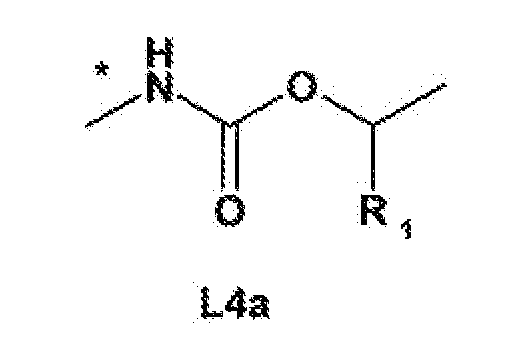
  • L 4 is a group selected from
  • R 1 is hydrogen or C 1-4 alkyl
  • X 1 is -O- or -NH-
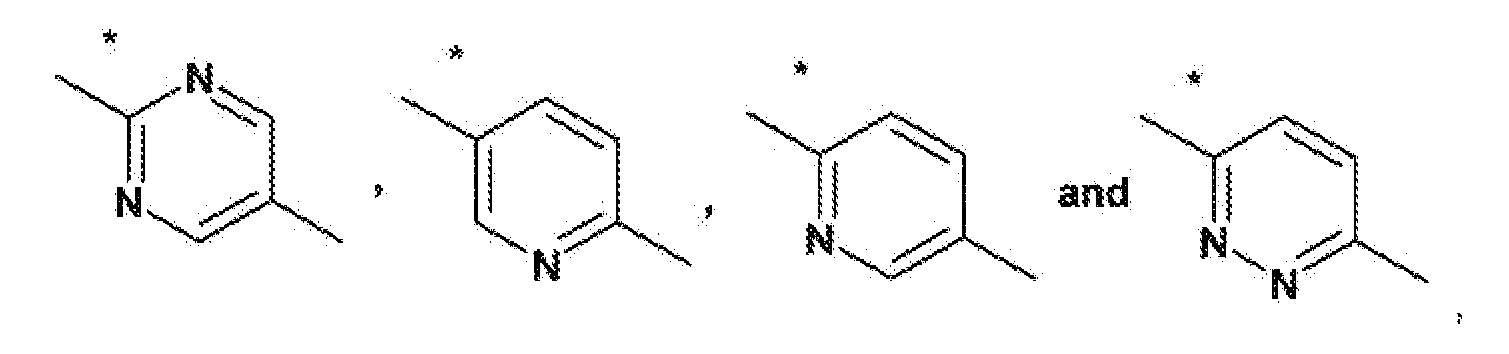
  • a 2 is selected from
  • a 1 is a five- to ten-membered monocyclic or fused potycyciic aromatic ring system which may contain from 1 to 4 hetero atoms selected from nitrogen, oxygen and sulfur, wherein the ring system may contain not more than 2 oxygen atoms and not more than 2 sulfur atoms, and wherein the ring system may be substituted once or more than once by R 2 , and wherein a substituent on a nitrogen in a heterocyclic ring system may not be halogen;
  • each R 2 independently is C 1-6 alkyl, C 1-6 halogenalkyl, C 1-6 aIkoxy, C 1-6 halogenalkoxy, halogen, cyano or a three- to six-membered monocyclic ring system which may be aromatic, saturated or partially saturated and which may contain from 1 to 4 hetero atoms selected from nitrogen, oxygen and sulfur, and wherein each ring system may contain not more than 2 oxygen atoms and not more than 2 sulfur atoms, and wherein each ring system may in turn be substituted once or more than once by C 1-6 alkyl, C 1-6 halogenalkyl, C 1-6 alkoxy, C 1- 6 halogenalkoxy, halogen or cyano, and wherein a substituent on a nitrogen in a heterocyclic ring system may not be halogen;
  • R 2 at adjacent ring atoms form a C 3-4 alkylene group, wherein 1-2 carbon atoms may be replaced by X 2 , and wherein the C 3-4 alkylene group may be substituted once or more than once by R 3 ;
  • each X 2 independently is -O- or -N(R 4 )-;
  • each R 4 independently is hydrogen or C 1-6 alkyl
  • each R 3 independently is halogen or C,. 6 alkyi
  • a 3 is a five- to ten-membered monocyclic or fused potycyclic aromatic ring system which may contain from 1 to 4 hetero atoms selected from nitrogen, oxygen and sulfur, wherein the ring system may contain not more than 2 oxygen atoms and not more than 2 sulfur atoms, and wherein the ring system may be substituted once or more than once by R 5 , and wherein a substituent on a nitrogen in a heterocyclic ring system may not be halogen;
  • each R 5 independently is C 1-6 alkyl, C 1-6 haiogenalkyl, C 1-6 alkoxy, C 1-6 halogenalkoxy, halogen, cyano, amino or a three- to six-membered monocyclic ring system which may be aromatic, saturated or partially saturated and which may contain from 1 to 4 hetero atoms selected from nitrogen, oxygen and sulfur, and wherein each ring system may contain not more than
  • each ring system may in turn be substituted once or more than once by C 1-6 alkyl, C 1-6 halogenalkyl, C 1-6 aIkoxy, C 1-
  • R 5 at adjacent ring atoms form a C 3-4 alkylene group, wherein 1-2 carbon atoms may be replaced by X 3 , and wherein the C 3-4 alkylene group may be substituted once or more than once by R 6 ;
  • each X a independently is -O- or -N(R 7 )-;
  • each R 7 independently is hydrogen or C 1-6 alkyl; and each R 6 independently is halogen or C 1-6 alkyl;
  • a first aspect of the invention concerns the use of a compound of formula (I) or a compound of formula (I! for the treatment (whether therapeutic or prophylactic), prevention or delay of progression of ataxia.
  • the compounds of formula (I) or compounds of formula (II) are ⁇ 7-nAChR agonists. These compounds and their use as pharmaceuticals are described in WO2001/85727,
  • ⁇ 7-nAChR are widely distributed throughout the central nervous system (CNS) and are potential targets for CNS diseases, such as neuropsychiatric diseases, e.g. cognitive dysfunction (SL Cincotta et al, Current Opinion in Investigational Drugs, 9(1), 47-56, 2008; LM Broad et al, Drugs of the Future, 32(2). 161- 170, 2007). Furthermore, it was found that activation of off-nAChR promotes survival of cultured spinal cord motoneurons (ML Messi, FEBS Letters, 411, 32-38, 1997).
  • a further aspect of the invention relates to a method for the treatment, prevention or delay of progression of ataxia in a subject in need of such treatment, which comprises administering to said subject a therapeutically effective amount of a compound of formula (I) or a compound of formula (II).
  • a further aspect of the invention relates to a pharmaceutical composition
  • a pharmaceutical composition comprising a compound of formula (I) or a compound of formula (II) for the treatment, prevention or delay of progression of ataxia.
  • a further aspect of the invention relates to the use of a compound of formula (I) or a compound of formula (Ii) for the manufacture of a medicament for the treatment, prevention or deiay of progression of ataxia.
  • a further aspect of the invention relates to a compound of formuia (i) or a compound of formula (If) for the treatment, prevention or delay of progression of ataxia.
  • preferred compounds of the invention should be well absorbed from the gastrointestinal tract, should be sufficiently metabolicafty stable and possess favorable pharmacokinetic properties.
  • Preferred compounds of the invention should be non-toxic and demonstrate few side-effects.
  • a preferred compound of the invention will be able to exist in a physical form that is stable, non-hygroscopic and easily formulated.
  • Alkyl represents a straight-chain or branched-chain alkyl group, for example, methyl, ethyl, n- or iso-propyl, n-, iso-, sec- or tert-butyl, n-pentyl, n-hexyl;
  • C 1-6 alkyl preferably represents a straight-chain or branched-chain C 1-4 alkyl with particular preference given to methyl, ethyl, n- propyl, iso-propyl and tert-butyl.
  • a substituent being substituted "once or more than once", for example as defined for A 1 is preferably substituted by one to three substituents.
  • Halogen is generally fluorine, chlorine, bromine or iodine; preferably fluorine, chlorine or bromine.
  • Halogenalkyl groups preferably have a chain length of 1 to 4 carbon atoms and are, for example, fiuoromethyl, difluoromethyl, trifl ⁇ oromethyl, chloromethyl, dichloromethyl, trichloromethyl, 2,2,2-triffuoroethyl, 2-fiuoroethyl, 2-chloroethyl, pentafluoroethyl, 1,1-difiuoro- 2,2,2-trichloroethyl, 2,2,2-trichloroethyi 1,1,2.2-tetrafluoroethyl, 2,2,3,3-tetrafluoropropyl, 2,2,3,3,3-pentafluoropropyl or 2,2,3.4.4,4-hexafluorobutyl; preferably -CF 3 , -CHF 2 , -CH 2
  • a 1 or A 3 as a "five- to ten-membered monocyclic or fused polycyclic aromatic ring system" encompasses a C 6 - or C 10 -aromatic hydrocarbon group or a five- to ten-membered heterocyclic aromatic ring system.
  • Polycyclic means preferably bicyclic. in the context of the invention, the definition of R 2 as a "three- to six ⁇ membered monocyclic ring system" encompasses a C 6 -aromatic hydrocarbon group, a five- to six-membered heterocyclic aromatic ring system and a three- to six-membered monocyclic aliphatic or heterocyclic ring system.
  • a Cs- or C 10 -aromatic hydrocarbon group is typically phenyl or naphthyl, especially phenyl.
  • heterocyclic aromatic ring systems consist of 5 to 10 ring atoms of which 1-3 ring atoms are hetero atoms.
  • Such heterocyclic aromatic ring systems may be present as a single ring system or as bicyclic or tricyclic ring systems; preferably as single ring systems or as benz-annelated ring systems.
  • Bicyclic or tricyclic ring systems may be formed by anneiation of two or more rings, or by a bridging atom. e.g. oxygen, sulfur, nitrogen.
  • heterocyclic ring systems are: imidazo(2,1-bjthiazole, pyrrole, pyiroline, pyrrolidine, pyrazole, pyrazoline, pyrazoiidine, imidazole, imidazoline, imidazolidine, triazole, triazoiine, triazoiidine, tetrazole, furane, dihydrofurane, tetrahydrofurarte, furazane (oxadiazote), dioxolane, thiophene, dihydrothiophene, tetrahydrothiophene, oxazoie, oxazoline, oxazolidine, isoxazole, isoxazoline, isoxazoiidine, thiazole, thiazoline, thiazolidine, isothiazole, isothiazoline, isothiazolidtne.
  • thiadiazote thiadiazoline, thiadiazolidine, pyridine, piperidine, pyridazine, pyrazine, piperazine, triazine, pyrane, tetrahydropyrane, thiopyrane. tetrahydrothiopyrane, oxazine, thiazine, dioxine, morpholine, purine, pteridine, and the corresponding benz- annelated heterocycles, e.g. indole, isoindole, coumarin, isoquinoline, qutnoline and the like.
  • Preferred heterocycles are: imidazo[2,1-b]thiazole, oxazote, isoxazole, thiazole, isothiazole, triazote, pyrrole, furane, tetrahydrofurane, pyridine, pyrimidine, imidazole or pyrazoie.
  • three- to stx-membered monocyclic aliphatic ring systems are typically cycfopropyl, cyclobutyl, cyclopentyl or cyclohexyl.
  • the acid addition salts of compounds of formula (t) or of compounds of formula (II) are pharmaceutically acceptable salts.
  • Such salts are known in the field (e.g. S.M. Berge, et al, "Pharmaceutical Salts", J. Pharm. Sd., 1977, 66:1-19; and "Handbook of Pharmaceutical Salts, Properties, Selection, and Use", Stahl, RH., Wermuth, C.G., Eds.; Wiley-VCH and VHCA: Zurich, 2002).
  • a “pharmaceutically acceptable salt” is intended to mean a salt of a free base of a compound represented by formula (I) or by formula (II) that is not toxic, biologically intolerable, or otherwise biologically undesirable.
  • Preferred pharmaceutically acceptable salts are those that are pharmacologically effective and suitable for contact with the tissues of patients without undue toxicity, irritation, or allergic response.
  • WO2Q06/005608 WO2007/045478, WO2007/068476 and WO2007/068475, or can be prepared analogously to said references.
  • WO2005/118535, WO2005/123732, WO2006/005608, WO2007/045478, WO2007/068476 and WO2007/068475 are incorporated herein by reference.
  • the compounds may exist in optically active form or in form of mixtures of optical isomers, e.g. in form of racemic mixtures or diastereomeric mixtures.
  • optical isomers and their mixtures, including racemic mixtures are part of the present invention.
  • a compound of formula (I) is used.
  • a compound of formula (I) is used
  • L 1 is ⁇ CH 2 -;
  • La is -CH 2 -CH 2 -; and
  • L 3 is ⁇ CH r or -CH(CH 3 )-;
  • L 4 is a group selected from
  • R 1 is hydrogen or C 1-4 alkyl
  • X 1 is -O- Or -NH-;
  • a 2 is selected from
  • a 1 is a five- to ten-membered monocyclic or fused pofycycltc aromatic ring system which may contain from 1 to 4 hetero atoms selected from nitrogen, oxygen and sulfur, wherein the ring system may contain not more than 2 oxygen atoms and not more than 2 sulfur atoms, and wherein the ring system may be substituted once or more than once by R 2 , and wherein a substttuent on a nitrogen in a heterocyclic ring system may not be halogen; and
  • each R 2 independently is C 1-6 alkyl, C 1-6 halogenalkyl, C 1-6 aIkoxy, C 1-6 halogenalkoxy or halogen.
  • L 1 is -CH 2 -;
  • L 2 is -CH 2 -CH 2 -; and
  • L 3 is -CH 2 -;
  • Ri is hydrogen or C 1-6 alkyl
  • a 1 is a five- to ten-membered monocyclic or fused polycycfic aromatic ring system which may contain from 1 to 4 hetero atoms selected from nitrogen, oxygen and sulfur, wherein the ring system may contain not more than 2 oxygen atoms and not more than 2 sulfur atoms, and wherein the ring system may be substituted once or more than once by R 2 , and wherein a substit ⁇ ent on a nitrogen in a heterocyclic ring system may not be halogen; and
  • each R 2 independently is C 1-6 alkyl, C 1-6 halogenalkyl, C 1-6 aIkoxy, C 1-6 halogenalkoxy or halogen,
  • L is -CH 2 -;
  • L 2 is -CH 2 -CH 2 -;
  • L 3 is -CH 2 - or -CH(CH 3 )-;
  • X is -O- or -NH-
  • a 2 is selected from and
  • Ai is a five- to ten-member ⁇ d monocyclic or fused pofycyciic aromatic ring system which may contain from 1 to 4 hetero atoms selected from nitrogen, oxygen and sulfur, wherein the ring system may contain not more than 2 oxygen atoms and not more than 2 sulfur atoms, and wherein the ring system may be substituted once or more than once by R 2 , and wherein a substituent on a nitrogen in a heterocyclic ring system may not be halogen; and
  • each R 2 independently is C 1-6 alkyl, C 1-6 halogenalkyl, C 1-6 aIkoxy, C 1-6 halogenalkoxy or
  • L 1 is -CH 2 -CH 2 -;
  • L 2 is -CH 2 -; and
  • L 3 is -CH 2 -CH 2 -;
  • X is -O- or -NHs
  • a 2 is selected from
  • a 1 is a five- to ten-membered monocyclic or fused poiycycttc aromatic ring system which may contain from 1 to 4 hetero atoms selected from nitrogen, oxygen and sulfur, wherein the ring system may contain not more than 2 oxygen atoms and not more than 2 sulfur atoms, and wherein the ring system may be substituted once or more than once by R 2 , and wherein a substituent on a nitrogen in a heterocyclic ring system may not be halogen; and
  • each R 2 independently is C 1-6 alkyl, C 1-6 halogenalkyl, C 1-6 alkoxy, C 1-6 halogenalkoxy or halogen.
  • a compound of formula (Ii) is used.
  • a compound of formula (Ii) is used
  • a 3 is a five- to ten-membered monocyclic or fused polycyciic aromatic ring system which may contain from 1 to 4 hetero atoms selected from nitrogen, oxygen and sulfur, wherein the ring system may contain not more than 2 oxygen atoms and not more than 2 suifur atoms, and wherein the ring system may be substituted once or more than once by R 5 , and wherein a substituent on a nitrogen in a heterocyclic ring system may not be halogen; and
  • each R 5 independently is C 1-6 alkyl, C 1-6 halogenalkyl, C 1-6 aIkoxy, C 1-6 halogenalkoxy, amino or haiogen.
  • the compound of formula (I) is a compound selected from the group consisting of
  • A-1 (S)-(1-aza-bicydo[2.2.2Joct ⁇ 3-yl) ⁇ carbamic acid (S)-1- ⁇ 2-ftuoro-phenyl)-ethyl ester;
  • D-2 1 -methyl- ⁇ -phenyiethynyl-S-piperidin-i -ylmethyl-pyrrolidin-2-one
  • D-3 1-methyl-5- ⁇ 1-methyl-1H-indol-5-yiethynyt)-3-piperidin-1--ylmethyt-pyrrolicli ⁇ -2-one
  • D-4 5- ⁇ 3-Amino ⁇ phenylethynyl)-1-methyf-3-piperidin-1-ylmethyl-pyrrolidin-2-one.
  • the compound of formula (I) is a compound selected from the group consisting of compound A-1 , A-2 and A-3.
  • the compound of formuia (!) is a compound selected from the group consisting of compound B-1, B-2, B-3, B-4, S-5, B-6. B-7, B-8, B-9, B-10, B- 11, B-12, B-13, B-14, B-15, B-16, B-17, B-18, B-19, B-20 and B-21.
  • the compound of formuia (I) is a compound selected from the group consisting of compound C-1, C-2, C-3, C-4, C-5, C-6. C-7, C-8, C-9, C-10, C- 11 and C-12.
  • the compound of formula (II) is a compound selected from the group consisting of compound D- 1 , D-2, D-3 and D-4.
  • the compounds of formula (I) or compounds of formula (H) are for the treatment of ataxia.
  • the compounds of formula (I) or compounds of formula (Ii) are for the prevention of ataxia.
  • the compounds of formula (! or compounds of formula (H) are for the deiay of ataxia.
  • Treatment may comprise a reduction in the symptoms associated with ataxia, including for example, although not limited to, an improvement of gait, balance, limb coordination and/or speech; or an increased period of time between episodes of ataxia.
  • the compounds of formuia (I) or compounds of formula (il) may be used to delay or prevent the onset of ataxia.
  • the compounds of formuia (I) or compounds of formula (il) are for the treatment, prevention or delay of hereditary ataxia.
  • the compounds of formula (I) or compounds of formula (H) are for the treatment, prevention or deiay of autosomal recessive ataxia.
  • the compounds of formula (I) or compounds of formula (H) are for the treatment, prevention or delay of Friedreichs ataxia.
  • the compounds of formula (I) or compounds of formula (M) are for the treatment, prevention or deiay of Spinocerebellar ataxia.
  • the compounds of formula (I) or compounds of formula (H) are for the treatment, prevention or delay of Spinocerebellar ataxia types 1, 2, 3, 6, 7 or 17, especially Spinocerebellar ataxia type 3 (Machado-Joseph disease).
  • the compounds of formula (I) or compounds of formula (tl) are for the treatment, prevention or deiay of Spinocerebellar ataxia types 8, 10 or 12.
  • the compounds of formula (i) or compounds of formula (H) are for the treatment, prevention or delay of Spinocerebellar ataxia types 5, 13, 14 or 27, especiaiiy Spinocerebellar ataxia type 14.
  • the appropriate dosage will vary depending upon, for example, the compound employed, the host, the mode of administration and the nature and severity of the condition being treated. However, in general, satisfactory results in animals are indicated to be obtained at a daily dosage of from about 0.01 to about 100 mg/kg body weight, preferably from about 0.1 to about 10 mg/kg body weight, e.g. 1 mg/kg. in larger mammals, for example humans, an indicated daily dosage is in the range from about 0.1 to about 1000 mg, preferably from about 1 to about 400 mg, most preferably from about 10 to about 100 mg of a compound of formula (I) or a compound of formula (H) conveniently administered, for example, in divided doses up to four times a day.
  • the compounds of formula (I) or compounds of formula (H) may be administered as single active agent or m combination with other active agents, in any usual manner, e.g. orally, for example in the form of tablets or capsules, parenterally, for example in the form of injection solutions or suspensions, or transdermal! ⁇ for example in the form of a patch.
  • the manner of administration is oral administration, for example in the form of tablets or capsules.
  • the manner of administration is transdermal administration, for example in the form of a patch.
  • the present invention provides a pharmaceutical composition
  • a pharmaceutical composition comprising a a compound of formula (I) or a compound of formula (II) in association with at least one pharmaceutical carrier or diluent for the treatment, prevention or delay of progression of ataxia.
  • Such compositions may be manufactured m conventional manner.
  • Unit dosage forms may contain, for example, from about 2.5 to about 25 mg of one or more of the compounds of formula (I) or compounds of formula (Ii).
  • compositions for enteral administration such as rectal or oral administration; or parenteral administration, such as intravenous, nasal or transdermal (e.g. by patch) administration to warm-blooded animals (human beings and animais) that comprise an effective dose of the pharmacological active ingredient alone or together with a significant amount of a pharmaceutically acceptable carrier.
  • the dose of the active ingredient depends on the species of warm-blooded animai, body weight, age and individual condition, individual pharmacokinetic data, the disease to be treated and the mode of administration.
  • compositions comprise from approximately 1% to approximately 95%, preferably from approximately 20% to approximately 90%, active ingredient.
  • Pharmaceutical compositions according to the invention may be, for example, in unit dose form, such as in the form of ampoules, vials, suppositories, dragees, tablets or capsules.
  • compositions of the present invention are prepared in a manner known per se, for example by means of conventional dissolving, iyophilizing, mixing, granulating or confectioning processes. Such processes are exemplified in WO 2005/079802, WO
  • compositions for transdermal are described in Remington's Pharmaceutical Sciences 16 th Edition Mack; Sucker, Fuchs and Spieser, Pharmazeutician Technologie, 1 st Edition, Springer.
  • the agonists 50 ⁇ l were added to the cell plate using the FLlPR 96-ttp pipettor white simultaneously recording the fluorescence.
  • Calcium kinetic data were normalized to the maximal fitted response induced by epibatidine, which is a full agonist at ⁇ 7-nAChR, Four parameter Hill equations were fitted to the concentration-response. Values of Emax (maximal effect in % compared to the epibatidine response) and EC50 (concentration producing half the maximal effect in uM) were derived from this fit.
  • mice Based on the pharmacokinetic data shown below it is concluded that the brain concentration of said compounds in mice is beyond (or at least equal) to the compound's EC 50 at the ⁇ 7- nAChR for at least 4 hours following an acute oral dose of 30 ⁇ moi/kg.
  • Assav Compounds were orally (30 ⁇ moi/kg) administered. Male mice (30-35g, OFI/ICstrain) were sacrificed at indicated time points after oral administration. Trunk- blood was collected in EDTA-containing tubes and the brain was removed and immediately frozen on dry ice. To 100 ⁇ l plasma 10 ⁇ i internal standard (1.0 pmol of a compound with solubility and ionization properties similar to test compounds) was added and extracted three times with 500 ⁇ l dichloromethane. The combined extracts were then dried under a stream of nitrogen and re-dissolved in 100 ⁇ l acetonitrile/water (70% acetonitrile). Brains were weighed and homogenized in water (1.5 w/v).
  • the limit of detection defined as the lowest concentration of the extracted standard sample with a signal to noise ratio of ⁇ 3.
  • Baseline-test Pairs consisting of one adult and one young mouse were assigned at random to the experimental and control groups. In each pair only the adult mouse was orally treated 1 hour before the trial with either vehicle or the test compound. The duration of active contacts of the adult mouse with the young mouse was manually recorded over a period of 3 min, including the following behavioural, approach-related items: sniffing, nosing, grooming, licking, pawing and playing, anoge ⁇ itaf exploration and orientation toward the young mouse; orientation, thereby, was defined as tip of nose of the adult mouse less man approximately 1cm distant from the young mouse's body.
  • Pcd mice Pcd mice
  • Nna1 a putative zinc protease induced by axotomy
  • SCA7 Spino-Cerebellar Ataxia-7
  • ProtocoJ Mice are tested at different ages. One group of mice is treated with an effective dose of a compound of formula (I) or a compound of formula ⁇ II), the control group receives the vehicle only. The compounds of formula (I) or compounds of formula (H) are tested for motor coordination on the rotating rod acutely and after repeated dosing.
  • Clinical testing of the compounds of formula (I) or compounds of formula (M) may be conducted, for example, in one of the following study designs.
  • the skilled physician may look at a number of aspects of behaviors and abilities of patients. He will realize that such studies are considered as guidelines and the certain aspects of the studies may be modified and redefined depending on the circumstance and environment, for example.
  • a patient population, with a normal control is dosed once a day for a week or longer tested.
  • the test is designed to allow for improvement, i.e. that there is a measurable parameter increase of the impaired function.
  • the patients are tested at the beginning and at the end of the dosage period and the results are compared and analyzed.
  • a patient population with a deficit associated with ataxia is dosed once a day for a week or longer and tested.
  • the test is designed to allow for improvement, i.e. that there is a measurable parameter increase of the impaired function.
  • the patients are tested at the beginning and at the end of the dosage period and the results are compared and analyzed.
  • Placebo control is required for all trials.
  • contaminating the data to produce false positives should be taken in to account when designing the test, e.g. the tests should not be identical (e.g. commit the same list of words to memory) but designed to study the same mechanism.
  • the tests should not be identical (e.g. commit the same list of words to memory) but designed to study the same mechanism.
  • co ⁇ ntermeas ⁇ res may include single testing at the end of a trial only.

Landscapes

  • Health & Medical Sciences (AREA)
  • Chemical & Material Sciences (AREA)
  • Medicinal Chemistry (AREA)
  • Pharmacology & Pharmacy (AREA)
  • Life Sciences & Earth Sciences (AREA)
  • Animal Behavior & Ethology (AREA)
  • General Health & Medical Sciences (AREA)
  • Public Health (AREA)
  • Veterinary Medicine (AREA)
  • Epidemiology (AREA)
  • Bioinformatics & Cheminformatics (AREA)
  • General Chemical & Material Sciences (AREA)
  • Organic Chemistry (AREA)
  • Biomedical Technology (AREA)
  • Neurology (AREA)
  • Neurosurgery (AREA)
  • Chemical Kinetics & Catalysis (AREA)
  • Engineering & Computer Science (AREA)
  • Nuclear Medicine, Radiotherapy & Molecular Imaging (AREA)
  • Psychology (AREA)
  • Pharmaceuticals Containing Other Organic And Inorganic Compounds (AREA)
  • Nitrogen Condensed Heterocyclic Rings (AREA)
  • Pyrrole Compounds (AREA)
  • Plural Heterocyclic Compounds (AREA)

Abstract

The invention concerns the use of azabicycloalkyl derivatives or pyrrolidine-2-one derivatives for the treatment, prevention or delay of progression of ataxia.

Description

Use of azabicycloalkyl derivatives or Dyrrolidine-2-one derivatives
The present invention relates to pharmaceutical uses of certain azabicycloalkyl derivatives or pyrrolidine-2-one derivatives.
Ataxia is a disorder of the central nervous system wherein the patient is unable to coordinate muscles for the execution of voluntary movement; for review see T Klockgether, 2007 (T Kiockgether, Parkinsonism and Related Disorders, 13, S391-S394, 2007). Typical symptoms of ataxia are gait dysfunctions, imbalance, impaired limb coordination and altered speech. In most ataxia disorders, the ataxia is due to degeneration of the cerebellar cortex and its afferent or efferent fibre connections; typical affected brain regions are cerebellum, posterior column, pyramidal tracts and basal ganglia. Ataxia may lead to a decreased motoneuron function. Ataxia is typically classified into hereditary and non-hereditary ataxias.
Hereditary ataxias are further classified into autosomal recessive and autosomal dominant ataxias. Autosomal recessive ataxias are, for example, Friedreichs ataxia (FRDA), Ataxia telangiectasia (AT), Autosomal recessive ataxia with oculomotor apraxia type 1, Autosomal recessive ataxia with oculomotor apraxia type 2, Spinocerebellar ataxia with axonal neuropathy, Abetalipoproteinemia, Ataxia with isolated vitamin E deficiency, Refsums disease and Cerebrotendinous xanthomatosis. Autosomal dominant ataxias are, for example, Spinocerebellar ataxias (SCA), which can be further classified into ataxias associated with translated CAG repeat expansions (SCA1, 2, 3, 6, 7 and 17), ataxias associated with untranslated repeat expansions in non-coding regions (SCA8, 10 and 12), ataxias associated with point-mutations (SCA5, 13, 14 and 27). SCA3 is aiso known as Machado-Joseph disease.
Non-hereditary ataxias can be further classified into degenerative and acquired ataxias. Degenerative ataxias are, for example, multiple system atrophy ataxia and sporadic adult- onset ataxia. Acquired ataxias can be, for example, associated with alcoholic/toxin-caused cerebellar degeneration or paraneoplastic cerebellar degeneration.
As ataxia may result from a wide range of underlying causes - either genetic (e.g. FRDA is caused in the vast majority of patients by a homozygous intronic GAA repeat expansion of the frataxin gene, which leads to a lower expression level of frataxin, which ultimately leads to an accumulation of mitochondrial iron) or environmental (e.g. ataxia associated with toxin- caused cerebellar degeneration) - many potential therapies are discussed in the field. An overview relating to potential therapies for ataxias is given in the review from T Klockgether, 2007. For FRDA, for example, therapies based on idebenone, a short-chain coenzyme Q10 analogue, or deferiprone, a penetrant oral iron chelator, showed effects in clinical trials (T Klockgether, 2007; WO2007095728). Additionally, therapies based on porphyrine compounds comprising a complexed Ca2+, ZN2* or Mg2+ ion showed beneficial effects in preclinical models (WO2007085036).
Recently. TA Zesiewicz published information about ataxia improvements seen for some patients in clinical trials of varenicline (7,8,9,10-tetrahydro-6,10-methano-6H-pyrazino-(2,3- h)(3)-benzazepine), a medicament to treat smoking addiction. Two patients with FRDA (TA Zesiewicz et al, J Clinical Neuromuscular Disease, 10(4), 191-193, 2009) and two patients with SCA3/SCA14 (TA Zesiewicz et al, Clinical Neuropharmacology, 31(6), 363-365, 2008), which all received varentcline p.o. at a dose of 0.5mg/kg per day, showed improvements. Although varenicline can act as a partial agonist at the alpha-4/beta-2 nicotinic acetylcholine receptor (α4β2-nAChR; Ki in oocytes: 0.4nM) and as a full agonist at the α7-nAChR ( Ki in oocytes: 125nM), its functional behaviour changes with dosing. At iow doses varenicline desensitizes the receptors; only at high doses it leads to (partial) receptor activation. At 0.5mg/kg in humans, varenicline is believed to desensitize both receptors, i.e. to be a functional antagonist (H Rollema et at, Biochemical Pharmacology, 78, 813-824, 2009).
During clincial use of varenicfine, adverse effects have been reported, such as nausea, sleep disturbance, constipation, vivid dreams, flatulence and vomiting. Further, potentially due to said adverse effects, treatment of smoking addiction with varenicline is limited to maximally 24 weeks; whereas for ataxia, a life-long treatment would be indicated.
Although some benefits are seen in the above-described clinical trials/pre-cltntcal models, there is no effective treatment of ataxia with acceptable side-effects available to patients. Consequently, there is a need to provide drugs for the treatment of ataxia. it has been found that a compound selected from the group consisting of
(A) a compound of formula (I)
Figure imgf000004_0003
wherein
L1 is -CH2-; L2 is -CH2- or -CH2-CH2-; and L3 is -CH2- or -CH(CH3)-; or
L1 is -CH2-CH2-; L2 is -CH2-; and L3 is -CH2-CH2-;
L4 is a group selected from
Figure imgf000004_0001
wherein the bond marked with the asterisk is attached to the azabicycloalkyl moiety;
R1 is hydrogen or C1-4alkyl;
X1 is -O- or -NH-;
A2 is selected from
Figure imgf000004_0002
wherein the bond marked with the asterisk is attached to Xt;
A1 is a five- to ten-membered monocyclic or fused potycyciic aromatic ring system which may contain from 1 to 4 hetero atoms selected from nitrogen, oxygen and sulfur, wherein the ring system may contain not more than 2 oxygen atoms and not more than 2 sulfur atoms, and wherein the ring system may be substituted once or more than once by R2, and wherein a substituent on a nitrogen in a heterocyclic ring system may not be halogen;
each R2 independently is C1-6alkyl, C1-6halogenalkyl, C1-6aIkoxy, C1-6halogenalkoxy, halogen, cyano or a three- to six-membered monocyclic ring system which may be aromatic, saturated or partially saturated and which may contain from 1 to 4 hetero atoms selected from nitrogen, oxygen and sulfur, and wherein each ring system may contain not more than 2 oxygen atoms and not more than 2 sulfur atoms, and wherein each ring system may in turn be substituted once or more than once by C1-6alkyl, C1-6halogenalkyl, C1-6alkoxy, C1- 6halogenalkoxy, halogen or cyano, and wherein a substituent on a nitrogen in a heterocyclic ring system may not be halogen;
or two R2 at adjacent ring atoms form a C3-4alkylene group, wherein 1-2 carbon atoms may be replaced by X2, and wherein the C3-4alkylene group may be substituted once or more than once by R3;
each X2 independently is -O- or -N(R4)-;
each R4 independently is hydrogen or C1-6alkyl; and
each R3 independently is halogen or C,.6alkyi; and
(B) a compound of formula (Ii),
Figure imgf000005_0001
wherein
A3 is a five- to ten-membered monocyclic or fused potycyclic aromatic ring system which may contain from 1 to 4 hetero atoms selected from nitrogen, oxygen and sulfur, wherein the ring system may contain not more than 2 oxygen atoms and not more than 2 sulfur atoms, and wherein the ring system may be substituted once or more than once by R5, and wherein a substituent on a nitrogen in a heterocyclic ring system may not be halogen;
each R5 independently is C1-6alkyl, C1-6haiogenalkyl, C1-6alkoxy, C1-6halogenalkoxy, halogen, cyano, amino or a three- to six-membered monocyclic ring system which may be aromatic, saturated or partially saturated and which may contain from 1 to 4 hetero atoms selected from nitrogen, oxygen and sulfur, and wherein each ring system may contain not more than
2 oxygen atoms and not more than 2 sulfur atoms, and wherein each ring system may in turn be substituted once or more than once by C1-6alkyl, C1-6halogenalkyl, C1-6aIkoxy, C1-
6halogenalkoxy, halogen or cyano, and wherein a substituent on a nitrogen in a heterocyclic ring system may not be halogen;
or two R5 at adjacent ring atoms form a C3-4alkylene group, wherein 1-2 carbon atoms may be replaced by X3, and wherein the C3-4alkylene group may be substituted once or more than once by R6;
each Xa independently is -O- or -N(R7)-;
each R7 independently is hydrogen or C1-6alkyl; and each R6 independently is halogen or C1-6alkyl;
in free base form or in pharmaceutically acceptable acid addition salt form
may be used in the treatment, prevention or delay of ataxia.
Accordingly, a first aspect of the invention concerns the use of a compound of formula (I) or a compound of formula (I!) for the treatment (whether therapeutic or prophylactic), prevention or delay of progression of ataxia.
The compounds of formula (I) or compounds of formula (II) are α7-nAChR agonists. These compounds and their use as pharmaceuticals are described in WO2001/85727,
WO2004/022556, WO2005/118535, WO2005/123732, WO2006/005608. WO2007/045478, WO2007/068476 and WO2007/068475. α7-nAChR are widely distributed throughout the central nervous system (CNS) and are potential targets for CNS diseases, such as neuropsychiatric diseases, e.g. cognitive dysfunction (SL Cincotta et al, Current Opinion in Investigational Drugs, 9(1), 47-56, 2008; LM Broad et al, Drugs of the Future, 32(2). 161- 170, 2007). Furthermore, it was found that activation of off-nAChR promotes survival of cultured spinal cord motoneurons (ML Messi, FEBS Letters, 411, 32-38, 1997).
A further aspect of the invention relates to a method for the treatment, prevention or delay of progression of ataxia in a subject in need of such treatment, which comprises administering to said subject a therapeutically effective amount of a compound of formula (I) or a compound of formula (II).
A further aspect of the invention relates to a pharmaceutical composition comprising a compound of formula (I) or a compound of formula (II) for the treatment, prevention or delay of progression of ataxia.
A further aspect of the invention relates to the use of a compound of formula (I) or a compound of formula (Ii) for the manufacture of a medicament for the treatment, prevention or deiay of progression of ataxia.
A further aspect of the invention relates to a compound of formuia (i) or a compound of formula (If) for the treatment, prevention or delay of progression of ataxia. In particular, preferred compounds of the invention should be well absorbed from the gastrointestinal tract, should be sufficiently metabolicafty stable and possess favorable pharmacokinetic properties.
Further preferred compounds of the invention bind in-vivo potently to α7-nAChRs whilst showing little affinity for other receptors, especially for XXX, YYY and ZZZ.
Further preferred compounds of the invention cross the blood brain barrier effectively.
Preferred compounds of the invention should be non-toxic and demonstrate few side-effects.
Furthermore, a preferred compound of the invention will be able to exist in a physical form that is stable, non-hygroscopic and easily formulated.
Unless indicated otherwise, the expressions used in this invention have the following meaning:
"Alkyl" represents a straight-chain or branched-chain alkyl group, for example, methyl, ethyl, n- or iso-propyl, n-, iso-, sec- or tert-butyl, n-pentyl, n-hexyl; C1-6alkyl preferably represents a straight-chain or branched-chain C1-4alkyl with particular preference given to methyl, ethyl, n- propyl, iso-propyl and tert-butyl.
Each alkyl part of "alkoxy". "halogenalkyl" and so on shall have the same meaning as described in the above-mentioned definition of "alkyl", especially regarding linearity and preferential size.
A substituent being substituted "once or more than once", for example as defined for A1, is preferably substituted by one to three substituents.
Halogen is generally fluorine, chlorine, bromine or iodine; preferably fluorine, chlorine or bromine. Halogenalkyl groups preferably have a chain length of 1 to 4 carbon atoms and are, for example, fiuoromethyl, difluoromethyl, triflυoromethyl, chloromethyl, dichloromethyl, trichloromethyl, 2,2,2-triffuoroethyl, 2-fiuoroethyl, 2-chloroethyl, pentafluoroethyl, 1,1-difiuoro- 2,2,2-trichloroethyl, 2,2,2-trichloroethyi 1,1,2.2-tetrafluoroethyl, 2,2,3,3-tetrafluoropropyl, 2,2,3,3,3-pentafluoropropyl or 2,2,3.4.4,4-hexafluorobutyl; preferably -CF3, -CHF2, -CH2F, - CHF-CH5, -CF2CH3, or -CH2CF3. In the context of the invention, the definitions of "two R2 at adjacent ring atoms form a C3. 4aikyiene group, wherein 1-2 carton atoms may be replaced by X2" or "two R5 at adjacent ring atoms form a C3-4alkylene group, wherein 1-2 carbon atoms may be replaced by X3" encompass -CH2-CH2-CH2-, -CH2-CH2-C2-H2-CH2-, -0-CH2-O-, -O-CH2-CH2-O- and -CH2-CH2- NH-. An example of a substituted group is -CH2-CH2-N(CH3)-, tn the context of the invention, the definition of A1 or A3 as a "five- to ten-membered monocyclic or fused polycyclic aromatic ring system" encompasses a C6- or C10-aromatic hydrocarbon group or a five- to ten-membered heterocyclic aromatic ring system.
"Polycyclic" means preferably bicyclic. in the context of the invention, the definition of R2 as a "three- to six~membered monocyclic ring system" encompasses a C6-aromatic hydrocarbon group, a five- to six-membered heterocyclic aromatic ring system and a three- to six-membered monocyclic aliphatic or heterocyclic ring system.
A Cs- or C10-aromatic hydrocarbon group is typically phenyl or naphthyl, especially phenyl.
Preferably, but also depending on substituent definition, "five- to ten-membered heterocyclic aromatic ring systems" consist of 5 to 10 ring atoms of which 1-3 ring atoms are hetero atoms. Such heterocyclic aromatic ring systems may be present as a single ring system or as bicyclic or tricyclic ring systems; preferably as single ring systems or as benz-annelated ring systems. Bicyclic or tricyclic ring systems may be formed by anneiation of two or more rings, or by a bridging atom. e.g. oxygen, sulfur, nitrogen. Examples of heterocyclic ring systems are: imidazo(2,1-bjthiazole, pyrrole, pyiroline, pyrrolidine, pyrazole, pyrazoline, pyrazoiidine, imidazole, imidazoline, imidazolidine, triazole, triazoiine, triazoiidine, tetrazole, furane, dihydrofurane, tetrahydrofurarte, furazane (oxadiazote), dioxolane, thiophene, dihydrothiophene, tetrahydrothiophene, oxazoie, oxazoline, oxazolidine, isoxazole, isoxazoline, isoxazoiidine, thiazole, thiazoline, thiazolidine, isothiazole, isothiazoline, isothiazolidtne. thiadiazote. thiadiazoline, thiadiazolidine, pyridine, piperidine, pyridazine, pyrazine, piperazine, triazine, pyrane, tetrahydropyrane, thiopyrane. tetrahydrothiopyrane, oxazine, thiazine, dioxine, morpholine, purine, pteridine, and the corresponding benz- annelated heterocycles, e.g. indole, isoindole, coumarin, isoquinoline, qutnoline and the like. Preferred heterocycles are: imidazo[2,1-b]thiazole, oxazote, isoxazole, thiazole, isothiazole, triazote, pyrrole, furane, tetrahydrofurane, pyridine, pyrimidine, imidazole or pyrazoie.
Jn the context of the invention, three- to stx-membered monocyclic aliphatic ring systems are typically cycfopropyl, cyclobutyl, cyclopentyl or cyclohexyl.
The acid addition salts of compounds of formula (t) or of compounds of formula (II) are pharmaceutically acceptable salts. Such salts are known in the field (e.g. S.M. Berge, et al, "Pharmaceutical Salts", J. Pharm. Sd., 1977, 66:1-19; and "Handbook of Pharmaceutical Salts, Properties, Selection, and Use", Stahl, RH., Wermuth, C.G., Eds.; Wiley-VCH and VHCA: Zurich, 2002). A "pharmaceutically acceptable salt" is intended to mean a salt of a free base of a compound represented by formula (I) or by formula (II) that is not toxic, biologically intolerable, or otherwise biologically undesirable. Preferred pharmaceutically acceptable salts are those that are pharmacologically effective and suitable for contact with the tissues of patients without undue toxicity, irritation, or allergic response.
The compounds of formula (I) or compounds of formula (H) and their manufacture are known from WO2001/85727, WO2004/022556, WO2005/118535, WO20057123732,
WO2Q06/005608, WO2007/045478, WO2007/068476 and WO2007/068475, or can be prepared analogously to said references. WO2001/85727, WO2004/022556,
WO2005/118535, WO2005/123732, WO2006/005608, WO2007/045478, WO2007/068476 and WO2007/068475 are incorporated herein by reference.
On account of asymmetrical carbon atom(s) that may be present in the compounds of formula (I) and compounds of formula (U)1 the compounds may exist in optically active form or in form of mixtures of optical isomers, e.g. in form of racemic mixtures or diastereomeric mixtures. Ail optical isomers and their mixtures, including racemic mixtures, are part of the present invention. in one embodiment of the invention, a compound of formula (I) is used. In one embodiment of the invention, a compound of formula (I) is used
Figure imgf000010_0003
wherein
L1 is ~CH2-; La is -CH2-CH2-; and L3 is ~CHr or -CH(CH3)-;
L4 is a group selected from
Figure imgf000010_0001
wherein the bond marked with the asterisk is attached to the azabicycloalkyi moiety;
R1 is hydrogen or C1-4alkyl;
X1 is -O- Or -NH-;
A2 is selected from
Figure imgf000010_0002
wherein the bond marked with the asterisk is attached to X1;
A1 is a five- to ten-membered monocyclic or fused pofycycltc aromatic ring system which may contain from 1 to 4 hetero atoms selected from nitrogen, oxygen and sulfur, wherein the ring system may contain not more than 2 oxygen atoms and not more than 2 sulfur atoms, and wherein the ring system may be substituted once or more than once by R2, and wherein a substttuent on a nitrogen in a heterocyclic ring system may not be halogen; and
each R2 independently is C1-6alkyl, C1-6halogenalkyl, C1-6aIkoxy, C1-6halogenalkoxy or halogen.
In one embodiment of the invention, a compound of formula (!) is used
wherein
Figure imgf000010_0004
L1 is -CH2-; L2 is -CH2-CH2-; and L3 is -CH2-;
Figure imgf000011_0001
wherein the bond marked with the asterisk is attached to the azabicycfoaikyi moiety;
Ri is hydrogen or C1-6alkyl;
A1 is a five- to ten-membered monocyclic or fused polycycfic aromatic ring system which may contain from 1 to 4 hetero atoms selected from nitrogen, oxygen and sulfur, wherein the ring system may contain not more than 2 oxygen atoms and not more than 2 sulfur atoms, and wherein the ring system may be substituted once or more than once by R2, and wherein a substitυent on a nitrogen in a heterocyclic ring system may not be halogen; and
each R2 independently is C1-6alkyl, C1-6halogenalkyl, C1-6aIkoxy, C1-6halogenalkoxy or halogen,
In one embodiment of the invention, a compound of formula (I) is used
Figure imgf000011_0002
wherein
L, is -CH2-; L2 is -CH2-CH2-; and L3 is -CH2- or -CH(CH3)-;
L1 is
Figure imgf000011_0003
wherein the bond marked with the asterisk is attached to the azabicycloaikyi moiety;
X, is -O- or -NH-;
A2 is selected from and
Figure imgf000012_0001
Figure imgf000012_0002
wherein the bond marked with the asterisk is attached to X1;
Ai is a five- to ten-memberβd monocyclic or fused pofycyciic aromatic ring system which may contain from 1 to 4 hetero atoms selected from nitrogen, oxygen and sulfur, wherein the ring system may contain not more than 2 oxygen atoms and not more than 2 sulfur atoms, and wherein the ring system may be substituted once or more than once by R2, and wherein a substituent on a nitrogen in a heterocyclic ring system may not be halogen; and
each R2 independently is C1-6alkyl, C1-6halogenalkyl, C1-6aIkoxy, C1-6halogenalkoxy or
In one embodiment of the invention, a compound of formula (I) is used
Figure imgf000012_0004
wherein
L1 is -CH2-CH2-; L2 is -CH2-; and L3 is -CH2-CH2-;
L4 is
Figure imgf000012_0005
wherein the bond marked with the asterisk is attached to the azabicycloalkyl moiety;
X, is -O- or -NHs
A2 is selected from
Figure imgf000012_0003
wherein the bond marked with the asterisk is attached to X1; A1 is a five- to ten-membered monocyclic or fused poiycycttc aromatic ring system which may contain from 1 to 4 hetero atoms selected from nitrogen, oxygen and sulfur, wherein the ring system may contain not more than 2 oxygen atoms and not more than 2 sulfur atoms, and wherein the ring system may be substituted once or more than once by R2, and wherein a substituent on a nitrogen in a heterocyclic ring system may not be halogen; and
each R2 independently is C1-6alkyl, C1-6halogenalkyl, C1-6alkoxy, C1-6halogenalkoxy or halogen. in one embodiment of the invention, a compound of formula (Ii) is used. In one embodiment of the invention, a compound of formula (Ii) is used
Figure imgf000013_0001
wherein
A3 is a five- to ten-membered monocyclic or fused polycyciic aromatic ring system which may contain from 1 to 4 hetero atoms selected from nitrogen, oxygen and sulfur, wherein the ring system may contain not more than 2 oxygen atoms and not more than 2 suifur atoms, and wherein the ring system may be substituted once or more than once by R5, and wherein a substituent on a nitrogen in a heterocyclic ring system may not be halogen; and
each R5 independently is C1-6alkyl, C1-6halogenalkyl, C1-6aIkoxy, C1-6halogenalkoxy, amino or haiogen. in one embodiment of the invention, the compound of formula (I) is a compound selected from the group consisting of
A-1: (S)-(1-aza-bicydo[2.2.2Joct~3-yl)~carbamic acid (S)-1-<2-ftuoro-phenyl)-ethyl ester;
A-2: (RM1~aza-bicyclo[2.2.2]oct-3-yl)-carbamic acid (R)-1-(2-chloro-phenyi)-ethyl ester;
A-3: (S)-(I -aza-bicyclo[2.2.2]oct-3-yl)-carbamic acid (S)-1-phenyl-ethyl ester;
B*1 : (R)-3-(5-phenyl-pyrimidin-2-yloxy)-1-aza-bicyclo[2.2.2]octane;
B-2: (R)-3-(5-p-tolyl-pyrimidin-2-yloxy)-1-aza-bicyclo[2.2.2]octane;
8-3: (R)-3-(5-(2-fluoro-4-methyl-phenyl)-pyrimidin-2-yloxy)-1 -aza-bicyclo[2.2.2]octane; B-4: (RJ-S-Cδ^S^-dimethyl-fΛenyO-pyiimidin^-yloxyJ-1-'aza-bicydop.a^Joctane;
B-5: (R)-3-(6-p-iolyl~pyridin-3-yloxy)-1-aza-bicycloϊ2.2.2]octanθ;
B-6: (R)-3-{6-phenyi-pyridin-3-y}oxy)-iHaza-bicyclo(2.2.2Ioctane;
B-7: {R)-3-{6-(3,4-dimethyl-pheπyi)-pyridiπ-3-yloxy)-1-aza-bicycto[2.2.2Joctane;
B-8: {R)-3-[6-(2-fluoro-4-mett>yl-phenyl)-pyήdazin-3-yloxyJ-1-aza-b}cydo[2-2,2]octane;
B-9: {R)-3-[6-(4,5-dimethyl-2-fluoro-phenyl)-pyridazin-3-yloxy]-1-aza-t»cyclo[2.2.2Joctanβ;
B-10: (R)-3-p3-(3,4-dimethyl-phenyl)-pyridazin-3-yloxy]-1 -aza-bicydσ[2.2.2]octane;
B-11: (R)-3-[6-(4-methyl-phenyl)-pyπdazin-3-ySoxy]-1-aza-blcydo[2.2.2]octane;
B-12: (R)>3-[β-(2,5-dJfiυcMO-4-mβthyl-phenyl)i3yrldazin-3-yloxy]-1 -aza-bicydo[2.2.2]octane;
B-13: (2S,3R)-3-{6-(1 H-Jndol-5-yl)-pyridazin-3-ytoxy3-2-methyl-1 -aza-bicyclo[2.2.23octane;
B-14: (2R,3S)-3-ϊβ-{1H-indol-5-yl)-pyridazin-3-yk)xy]-2-methyf-1-aza-bicycio[2.2.23octane;
B-15: (2S,3R)-3-ϊ5-{1 H~indol~5-yl)-pyπmidin-2-yloxy]-2-methyM -aza-blcydo[2.2.2]octane;
B-16: (2R,3S)-3-(5-(1 H-iπdol-5-yl)-pyrimidιn-2-yloxy]-2-methyl-1 -aza-blcydo[2.2.2]octane;
B-17: 3-[β-(1 H-indd-5-yl)-pyridin-3-yloxy]-2-methy!-1-aza'bicydo[2,2.2]octane;
B-18: (2S,3R)-2-methyl-3-[β-(5-methyl-thi(^)hen-2-yl)-pyridazJn-3-yloxy]-1-aza- btcycio[2.2.2}octane;
B-19: 3-[6-(2f3-dimethyH H-indol~5-yl)φyridazin-3-y!oxy3-2-methyM -aza- bicycio[2.2.2]octane;
B-201. trans^-methyl-1-aza-bicydop.Σ^Joct-S-yO-ce-phenyl-pyrldin-S-yO-amine;
8-21 : trans -[6-(1H-indo{-5-yl)-pyridin-3-yf3-{2-methyl-1-aza-bicydo[2.2.2]oct-3-yJ)-amine;
C-1 : (4S,5R)-4-[5-( 1 H-indol-5-yl)i3yrimJdin-2-yloxy]-1 -aza-bicyclo[3.3.1 ]nonane;
C-2: 5-{2-[(4S,5R)-{1-aza-bicydoI3.3.13non-4-yl)oxy]-pyrimidin-5-yl}-1 ,3-dihydro-indol-2-one;
C-3: (4S,5R)-4-[6-(1 H-indol-5-yl)^>yrkJiπ-3-y(oxy]-1 -aza-blcyclo[3.3.13πonane;
C-4: (4S,5R)-4~[5-(1 H-indol~5-yl)i>yridin-2-yloxy]-1 -aza-bicydol3.3.13πonane;
C-5: (4S,5R)-4-[6-(1H-Jndol-5-yl)-pyridazin-3-yloxy]-1-aza-bicyd(^3.3.13nonane;
C-6: 5-{6-[(4S,5R)-(1-aza-bicyclol3.3.13ncM>4-yl)oxy]-pyridazin-3-yl}-1,3-dihydro-indol-2-one;
C-7: (1 -aza-bicydo[3.3.13non-4-yl)-[5-(1 H-indol-5-yl)-pyridin-2-yl3-amine;
C-8: ( 1 -aza-bicydo[3.3.13non-4-yi)-[5-( 1 H-indol-5-yl)-pyrimidin-2-yl]-amine;
C-9; ( 1 -aza-bicydo[3.3.13non-4-yl)-(6-( 1 H-indol-5-yt)-pyridin-3-yi3-amine;
C-10: (1 «aza~bicydo[3.3.13non-4-yl)^6-{1 H-indol-5-yl)-pyridin-3-ylJ-amine;
C-11 : (1 -aza-bJcyclo(3.3.1 jnon-4-yl)H(5-(1 HHndol-4-yl)-pyrimidin-2-yl)-amine;
C-12: (i-aza-bicydofS.S.IJnon^-yO-Jδ-C1H-indol-δ-ylJ-pyπdazin-S-yll-amine;
D-1 : 5-benzofυran-5-ylethyny(-1 -methyl-3-piperidin-1-ylmethyl-pyrrolidin-2-one;
D-2: 1 -methyl-δ-phenyiethynyl-S-piperidin-i -ylmethyl-pyrrolidin-2-one; D-3: 1-methyl-5-{1-methyl-1H-indol-5-yiethynyt)-3-piperidin-1--ylmethyt-pyrrolicliπ-2-one; and D-4: 5-{3-Amino~phenylethynyl)-1-methyf-3-piperidin-1-ylmethyl-pyrrolidin-2-one.
In one embodiment of the invention, the compound of formula (I) is a compound selected from the group consisting of compound A-1 , A-2 and A-3.
In one embodiment of the invention, the compound of formuia (!) is a compound selected from the group consisting of compound B-1, B-2, B-3, B-4, S-5, B-6. B-7, B-8, B-9, B-10, B- 11, B-12, B-13, B-14, B-15, B-16, B-17, B-18, B-19, B-20 and B-21.
In one embodiment of the invention, the compound of formuia (I) is a compound selected from the group consisting of compound C-1, C-2, C-3, C-4, C-5, C-6. C-7, C-8, C-9, C-10, C- 11 and C-12. in one embodiment of the invention, the compound of formula (II) is a compound selected from the group consisting of compound D- 1 , D-2, D-3 and D-4. in one embodiment, the compounds of formula (I) or compounds of formula (H) are for the treatment of ataxia.
In one embodiment, the compounds of formula (I) or compounds of formula (Ii) are for the prevention of ataxia.
In one embodiment, the compounds of formula (!) or compounds of formula (H) are for the deiay of ataxia.
Treatment may comprise a reduction in the symptoms associated with ataxia, including for example, although not limited to, an improvement of gait, balance, limb coordination and/or speech; or an increased period of time between episodes of ataxia.
In the case of prophylactic treatment, the compounds of formuia (I) or compounds of formula (il) may be used to delay or prevent the onset of ataxia.
In one embodiment, the compounds of formuia (I) or compounds of formula (il) are for the treatment, prevention or delay of hereditary ataxia. in one embodiment, the compounds of formula (I) or compounds of formula (H) are for the treatment, prevention or deiay of autosomal recessive ataxia. fn one embodiment, the compounds of formula (I) or compounds of formula (H) are for the treatment, prevention or delay of Friedreichs ataxia.
In one embodiment, the compounds of formula (I) or compounds of formula (M) are for the treatment, prevention or deiay of Spinocerebellar ataxia. in one embodiment, the compounds of formula (I) or compounds of formula (H) are for the treatment, prevention or delay of Spinocerebellar ataxia types 1, 2, 3, 6, 7 or 17, especially Spinocerebellar ataxia type 3 (Machado-Joseph disease).
In one embodiment, the compounds of formula (I) or compounds of formula (tl) are for the treatment, prevention or deiay of Spinocerebellar ataxia types 8, 10 or 12.
In one embodiment, the compounds of formula (i) or compounds of formula (H) are for the treatment, prevention or delay of Spinocerebellar ataxia types 5, 13, 14 or 27, especiaiiy Spinocerebellar ataxia type 14.
For the above-mentioned indications (the conditions and disorders) the appropriate dosage will vary depending upon, for example, the compound employed, the host, the mode of administration and the nature and severity of the condition being treated. However, in general, satisfactory results in animals are indicated to be obtained at a daily dosage of from about 0.01 to about 100 mg/kg body weight, preferably from about 0.1 to about 10 mg/kg body weight, e.g. 1 mg/kg. in larger mammals, for example humans, an indicated daily dosage is in the range from about 0.1 to about 1000 mg, preferably from about 1 to about 400 mg, most preferably from about 10 to about 100 mg of a compound of formula (I) or a compound of formula (H) conveniently administered, for example, in divided doses up to four times a day.
For use according to the invention, the compounds of formula (I) or compounds of formula (H) may be administered as single active agent or m combination with other active agents, in any usual manner, e.g. orally, for example in the form of tablets or capsules, parenterally, for example in the form of injection solutions or suspensions, or transdermal!^ for example in the form of a patch.
In one embodiment, the manner of administration is oral administration, for example in the form of tablets or capsules.
In one embodiment, the manner of administration is transdermal administration, for example in the form of a patch.
Moreover, the present invention provides a pharmaceutical composition comprising a a compound of formula (I) or a compound of formula (II) in association with at least one pharmaceutical carrier or diluent for the treatment, prevention or delay of progression of ataxia. Such compositions may be manufactured m conventional manner. Unit dosage forms may contain, for example, from about 2.5 to about 25 mg of one or more of the compounds of formula (I) or compounds of formula (Ii).
The pharmaceutical compositions according to the invention are compositions for enteral administration, such as rectal or oral administration; or parenteral administration, such as intravenous, nasal or transdermal (e.g. by patch) administration to warm-blooded animals (human beings and animais) that comprise an effective dose of the pharmacological active ingredient alone or together with a significant amount of a pharmaceutically acceptable carrier. The dose of the active ingredient depends on the species of warm-blooded animai, body weight, age and individual condition, individual pharmacokinetic data, the disease to be treated and the mode of administration.
The pharmaceutical compositions comprise from approximately 1% to approximately 95%, preferably from approximately 20% to approximately 90%, active ingredient. Pharmaceutical compositions according to the invention may be, for example, in unit dose form, such as in the form of ampoules, vials, suppositories, dragees, tablets or capsules.
The pharmaceutical compositions of the present invention are prepared in a manner known per se, for example by means of conventional dissolving, iyophilizing, mixing, granulating or confectioning processes. Such processes are exemplified in WO 2005/079802, WO
2003/047581, WO 2004/000316, WO 2005/044265, WO 2005/044266, WO 2005/044267, WO 2006/114262 and WO 2007/071358.
Compositions for transdermal are described in Remington's Pharmaceutical Sciences 16th Edition Mack; Sucker, Fuchs and Spieser, Pharmazeutische Technologie, 1st Edition, Springer.
The usefulness of the compounds of formula (I) or compounds of formula (Ii) m the treatment of the above-mentioned disorders can be confirmed in a range of standard tests including those indicated below.
1. In-vijro Tests
1.1. Activity at α7-nAChR. Selectivity aoainst α4S2-nAChR
Based on the activity/seiectivity data shown below it is concluded that said compounds are selective agonists at the α7~nAChR.
Figure imgf000018_0001
Assay. To assess α7-nAChR activity, a functional assay was employed using GH3 ceils that recombinant^ expressed human α7-nAChR. 5 x 10⁴ cells per well were seeded 72 h prior to the experiment on black 96-well plates (Costar) and incubated at 37'C in a humidified atmosphere (5 % CO2IQS % air). On the day of the experiment, medium was removed by flicking the plates and replaced with 100 μl growth medium containing 2 mM Fluo-4, (Molecular Probes) in the presence of 2.5 mM probenecid (Sigma). The cells were incubated at 37oC in a humidified atmosphere (5 % CO2/95 % air) for 1 h. Plates were fiicked to remove excess of Fluo-4, washed twice with Hepes-buffered salt solution (in mM: aC1 130, KCi 5.4, CaCI2 2, MgSO4 0.8, NaH2PO4 0.9, glucose 25, Hepes 20, pH 7.4; HBS) and refilled with 100 μl of HBS containing antagonist when appropriate. The incubation in the presence of the antagonist lasted 3-5 minutes. Plates were placed in the cell plate stage of a FLIPR device {fluorescent imaging plate reader, Molecular Devices, Sunnyvale, CA, USA). After recording of the baseline (laser-, excitation 488 nm at 1 W, CCD camera opening of 0.4 seconds) the agonists (50 μl) were added to the cell plate using the FLlPR 96-ttp pipettor white simultaneously recording the fluorescence. Calcium kinetic data were normalized to the maximal fitted response induced by epibatidine, which is a full agonist at α7-nAChR, Four parameter Hill equations were fitted to the concentration-response. Values of Emax (maximal effect in % compared to the epibatidine response) and EC50 (concentration producing half the maximal effect in uM) were derived from this fit.
Assay described in: D Feuerbach et ai. Neuropharmacology (2005), 48, 215-227.
To assess the activity of the compound of the invention on Hie human neuronal nAChR α4β2, a similar functional assay is carried out using a human epithelial cell line stably expressing the human ot4β2 subtype (Michetmore et at., Naunyn-Schmiedeberg's Arch. Pharmacol. (2002) 366, 235).
2. In-vivo Preclinical Tests
2.1. Oral bioavailability and brain penetration in Mice
Based on the pharmacokinetic data shown below it is concluded that the brain concentration of said compounds in mice is beyond (or at least equal) to the compound's EC50 at the α7- nAChR for at least 4 hours following an acute oral dose of 30 μmoi/kg.
Compound A-1 :
Figure imgf000019_0001
Compound B-13:
Figure imgf000019_0002
Compound C-1:
Figure imgf000020_0001
Assav: Compounds were orally (30 μmoi/kg) administered. Male mice (30-35g, OFI/ICstrain) were sacrificed at indicated time points after oral administration. Trunk- blood was collected in EDTA-containing tubes and the brain was removed and immediately frozen on dry ice. To 100 μl plasma 10 μi internal standard (1.0 pmol of a compound with solubility and ionization properties similar to test compounds) was added and extracted three times with 500 μl dichloromethane. The combined extracts were then dried under a stream of nitrogen and re-dissolved in 100 μl acetonitrile/water (70% acetonitrile). Brains were weighed and homogenized in water (1.5 w/v). Two 100 μl aliquots of each homogenate + 10 μl of internal standard (same standard as used for the plasma samples) were extracted three times with 500 μl dichloromethane and further processed as the plasma sampies. Samples were separated on Beckmann high-performance liquid chromatography equipment system with an autosampler (Gϋsoπ 233XL). A 10 min linear gradient (10 - 70%) of acetonitrile containing 0.5 % (v/v) formic acid was used to elutβ the compounds from Nudeosil CC-125/2 C18 reversed phase (Machery&Nagel) column
The limit of detection (LOD), defined as the lowest concentration of the extracted standard sample with a signal to noise ratio of ~ 3.
2.2. Functional read-out in Mice (Social Recognition Test)
Based on the functional in-vivo data shown below it is concluded that oral dosing of said compounds at relevant concentrations lead to a specific effect associated with α7~nAChR (i.e. cognition enhancement in the Sociai Recognition Test in mouse).
Figure imgf000020_0002
Assav: Social interactions between two experimental animals are influenced by their degree of famiiiarity: the better they know each other, the less time they spend on mutual scrutiny at each meeting, in agreement with published data in rats (Mondadoii et at, 1993) we have observed (i) that an adult mouse shows a shortened scrutiny of a young coπspecific if the two mice are brought together again within a short time interval {e.g. 1 hour), (ii) that this curtailment is attributable to memory processes: it does not occur if the familiar young partner is replaced by a strange (unfamiliar) young mouse on the second occasion and (iii) that the adult mouse's recollection of the previously scrutinized juvenile partner fades with the elapsed time, i.e., after 24 h, scrutiny takes just about as long as at the first encounter. Memory enhancing agents (i.e. oxiracetam) facilitate learning to the extent that the previously met (familiar) partner is still remembered after 24 h, whereas in vehicle treated control animals the memory usually fades after less than 1 hour (Thor and Hoiioway, 1982) or after 2-3 hours.
Baseline-test: Pairs consisting of one adult and one young mouse were assigned at random to the experimental and control groups. In each pair only the adult mouse was orally treated 1 hour before the trial with either vehicle or the test compound. The duration of active contacts of the adult mouse with the young mouse was manually recorded over a period of 3 min, including the following behavioural, approach-related items: sniffing, nosing, grooming, licking, pawing and playing, anogeπitaf exploration and orientation toward the young mouse; orientation, thereby, was defined as tip of nose of the adult mouse less man approximately 1cm distant from the young mouse's body.
Re-test: Twenty-four hours after the baseline-test, the adults in each treatment group were confronted again with the previously encountered (familiar) partner, whereas the half of the adult animals were put together with the previously encountered (familiar) partner and the other half with another (unfamiliar) young mouse. Again the duration of active approach- behaviours was recorded during a 3-min period. Prior to re-test no oral injection was given, in the table the reduction in time scrutinizing the familiar partner at time 24 compared with the familiar partner at time 0 minutes is given (value of zero would signify no reduction).
2.3. Assessment of anti-ataxic effect in animal models
Method: "Purkinje cell degeneration" mice (pcd mice) are considered a valid mouse model of cerebellar ataxia. Pcd mice bear a mutation in the Nna1 gene, a putative zinc protease induced by axotomy (A Fernandez-Gonzalez et af. Science, 295: 1904-1906, 2002). These mice also show delayed degeneration of other brain areas, with retinal photoreceptor degeneration starting a 1 year of age. Concomitant Purkinje cell death and photoreceptor degeneration is also found in Spino-Cerebellar Ataxia-7 (SCA7).
Assessment: Motor performance is quantified by the ability to remain in position on a rotating rod ("rota-rod" test, see: AM Fernandez et al, Proc Natl Acad Sci USA, 95: 1253-1258,
1998). Mice obtaining vehicle controls and acute/repeated dosing of compounds of formula
(I) or compounds of formula (M) are analyzed.
ProtocoJ: Mice are tested at different ages. One group of mice is treated with an effective dose of a compound of formula (I) or a compound of formula {II), the control group receives the vehicle only. The compounds of formula (I) or compounds of formula (H) are tested for motor coordination on the rotating rod acutely and after repeated dosing.
3. Clinical Testing: Improvement Trials
Clinical testing of the compounds of formula (I) or compounds of formula (M) may be conducted, for example, in one of the following study designs. The skilled physician may look at a number of aspects of behaviors and abilities of patients. He will realize that such studies are considered as guidelines and the certain aspects of the studies may be modified and redefined depending on the circumstance and environment, for example.
3.1 Trial A: Normal Patient Population
A patient population, with a normal control is dosed once a day for a week or longer tested. The test is designed to allow for improvement, i.e. that there is a measurable parameter increase of the impaired function. The patients are tested at the beginning and at the end of the dosage period and the results are compared and analyzed.
3.2 Trial B: Deficit population
A patient population with a deficit associated with ataxia is dosed once a day for a week or longer and tested. The test is designed to allow for improvement, i.e. that there is a measurable parameter increase of the impaired function. The patients are tested at the beginning and at the end of the dosage period and the results are compared and analyzed.
3.3 Considerations for designing a trial
• When designing a trial, the skilled person wili appreciate the need to protect both against floor and ceiling effects, in other words, the study designing should allow cognition to the measurably raised or lowered. Conditions that artificially impair a function, e.g. cognition, are one way to test enhancement of that function. Such conditions are, for example, sieep deprivation and pharmacological challenges.
Placebo control is required for all trials.
In assessing the data, evaluation of the likelihood of learning and practice effects from repeat assessments must be made. The likelihood of such effects
contaminating the data to produce false positives should be taken in to account when designing the test, e.g. the tests should not be identical (e.g. commit the same list of words to memory) but designed to study the same mechanism. Other
coυntermeasυres may include single testing at the end of a trial only.

Claims

1. A compound selected from the group consisting of
(A) a compound of formula (t)
(T NT
>
wherein
L1 is -CH2-; L2 is -CH2- Or-CH2-CH2-; and L3 is -CHr or -CH(CH3)-; or
L1 is -CH2-CH2-; L2 is -CH2-; and L3 Is -CH2-CH2-;
L* is a group selected from
Y or ^X
Figure imgf000024_0001
L4a L4b
wherein the bond marked with the asterisk is attached to the azabicycloalkyl moiety;
Ri is hydrogen or C1-6alkyl;
X, is -O- or -NH-;
A3 is selected from
and
Figure imgf000024_0002
Figure imgf000024_0003
wherein the bond marked with the asterisk is attached to X1;
A1 is a five- to ten-membered monocyclic or fused polycyclic aromatic ring system which may contain from 1 to 4 hetero atoms selected from nitrogen, oxygen and sulfur, wherein the ring system may contain not more than 2 oxygen atoms and not more than 2 sulfur atoms, and wherein the ring system may be substituted once or more than once by R2, and wherein a substituent on a nitrogen in a heterocyclic ring system may not be halogen;
each R2 independently is C1-6a(kyf, C1-6halogenalkyl, C1-6alkoxy, CLβhalogenalkoxy, halogen, cyano or a three- to six-membered monocyclic ring system which may be aromatic, saturated or partially saturated and which may contain from 1 to 4 hetero atoms selected from nitrogen, oxygen and sulfur, and wherein each ring system may contain not more than
2 oxygen atoms and not more than 2 sulfur atoms, and wherein each ring system may in turn be substituted once or more than once by C,.ealkyl, d.βhalogenalkyl, C1-6aikoxy, Ci. ehalogenalkoxy, halogen or cyano. and wherein a sυbstituent on a nitrogen in a heterocyclic ring system may not be halogen;
or two R2 at adjacent ring atoms form a C3-4alkylene group, wherein 1-2 carbon atoms may be replaced by X2, and wherein the C3-4alkylene group may be substituted once or more than once by R3;
each X2 independently is -O- or -N(R4)-;
each R4 independently is hydrogen or C1-6alkyl; and
each R3 independently is halogen or C1-6alkyl; and
(B) a compound of formula (If),
QH3
wherein
A3 is a five- to ten-membered monocyclic or fused poiycyclic aromatic ring system which may contain from 1 to 4 hetero atoms selected from nitrogen, oxygen and sulfur, wherein the ring system may contain not more than 2 oxygen atoms and not more than 2 sulfur atoms, and wherein the ring system may be substituted once or more than once by R8, and wherein a substituent on a nitrogen in a heterocyclic ring system may not be halogen;
each R5 independently is C1-5alkyl, C,.6halogenalkyi, Ci^aSkoxy, C1-6halogenalkoxy, halogen, cyano, amino or a three- to six-membered monocyclic ring system which may be aromatic, saturated or partially saturated and which may contain from 1 to 4 hetero atoms selected from nitrogen, oxygen and sulfur, and wherein each ring system may contain not more than 2 oxygen atoms and not more than 2 sulfur atoms, and wherein each ring system may in turn be substituted once or more than once by C1-Sa!kyi, C1-βhaiogena!kyi, Ci.6aikoxy, C1. shaiogenalkoxy, haiogen or cyano, and wherein a substituent on a nitrogen in a heterocyclic ring system may not be halogen; or two Rs at adjacent ring atoms form a C3.4alkylene group, wherein 1-2 carbon atoms may be replaced by X3, and wherein the C3^a!kylene group may be substituted once or more than once by R6;
each X3 independently is -O- or -N(R7)-;
each R7 independently is hydrogen or Ci.6aiky$; and
each R6 independently is haiogen or C1-6aikyt;
in free base form or in pharmaceutically acceptable acid addition salt form
for use in the treatment, prevention or delay of progression of ataxia.
2. A compound of formula (I)
wherein
L1 is -CHr-; U is -CH2- or -CHrCH2-: and L3 is -CH2- or -CH(CH3)-; or
L, is -CH2-CH2-; L2 is -CH2-; and L3 is -CH2-CH2-;
L1 is a group selected from
A Y or /A^
Figure imgf000026_0001
L4a ub
wherein the bond marked with the asterisk is attached to the azabicyctoafkyf moiety;
Ri is hydrogen or Ci^alkyl;
X1 Js -O- Or -NH-;
A2 is selected from
Figure imgf000026_0002
Figure imgf000026_0003
wherein the bond marked with the asterisk is attached to X1;
Ai is a five- to ten-membered monocyclic or fused polycyclic aromatic ring system which may contain from 1 to 4 hetero atoms selected from nitrogen, oxygen and sulfur, wherein the ring system may contain not more than 2 oxygen atoms and not more than 2 sulfur atoms, and wherein the ring system may be substituted once or more than once by R2, and wherein a substitυent on a nitrogen in a heterocyclic ring system may not be halogen;
each R2 independently is C1-δalkyt, C1-ehalogena!kyf, C1-δalkoxy, C,.βhalogenalkoxy, halogen, cyano or a three- to six-membered monocyclic ring system which may be aromatic, saturated or partially saturated and which may contain from 1 to 4 heiero atoms selected from nitrogen, oxygen and sulfur, and wherein each ring system may contain not more than
2 oxygen atoms and not more than 2 sulfur atoms, and wherein each ring system may in turn be substituted once or more than once by C1-6alkyl, C1-6halogenalkyl, C1-6alkoxy, C1. δhatogenalkoxy, halogen or cyano, and wherein a substitυent on a nitrogen in a heterocyclic ring system may not be halogen:
or two R2 at adjacent ring atoms form a C3.4alkylene group, wherein 1-2 carbon atoms may be replaced by X2, and wherein the C1-6alkylene group may be substituted once or more than once by R3;
each X2 independently is -O- or -N(R4)-;
each R4 independently is hydrogen or Ci^alkyl; and
each R3 independently is halogen or C1-6afkyl;
in free base form or in pharmaceutically acceptable acid addition salt form
for use in the treatment, prevention or delay of progression of ataxia.
3. A compound of formula (H)
QH3
Figure imgf000027_0001
wherein
A3 is a five- to ten-membered monocyclic or fused polycyclic aromatic ring system which may contain from 1 to 4 hetero atoms selected from nitrogen, oxygen and sulfur, wherein the ring system may contain not more than 2 oxygen atoms and not more than 2 sulfur atoms, and wherein the ring system may be substituted once or more than once by Rs, and wherein a substituent on a nitrogen in a heterocyclic ring system may not be haiogen; each Rs independently is C1-6alkyl, C1-6halogenalkyl, Cβalkoxy, Cvβhalogenalkoxy, halogen, cyano, amino or a three- to six-membered monocyclic ring system which may be aromatic. saturated or partially saturated and which may contain from 1 to 4 hetero atoms selected from nitrogen, oxygen and sulfur, and wherein each ring system may contain not more than
2 oxygen atoms and not more than 2 sulfur atoms, and wherein each ring system may \n turn be substituted once or more than once by Chalky!, Ci.βhalogenalkyl, C1-6alkoxy, C,. ehalogenalkoxy. halogen or cyano, and wherein a substituent on a nitrogen in a heterocyclic ring system may not be halogen;
or two R5 at adjacent ring atoms form a C3.4alkylene group, wherein 1-2 carbon atoms may be replaced by X3, and wherein the C3-4alkylene group may be substituted once or more than once by Rβ;
each X3 independently is -O- or -N(R7)-;
each R7 independently is hydrogen or C)-8a!kyl; and
each R6 independently is halogen or C1-6alkyl:
in free base form or in pharmaceutically acceptable acid addition salt form
for use in the treatment, prevention or delay of progression of ataxia.
4. A method for the treatment, prevention or deiay of progression of ataxia in a subject in need of such treatment, which comprises administering to said subject a therapeutically effective amount of a compound of formula (I) as defined in claim 1 or of a compound of formula (M) as defined in claim 1.
5. A pharmaceutical composition comprising a compound of formula (I) as defined in claim 1 or of a compound of formula (H) as defined in claim 1 ; for the treatment, prevention or deiay of progression of ataxia.
PCT/EP2010/060571 2009-07-23 2010-07-21 Use of azabicycloalkyl derivatives or pyrrolidine-2-one derivatives Ceased WO2011009890A2 (en)

Priority Applications (4)

Application Number Priority Date Filing Date Title
EP10734744A EP2456438A2 (en) 2009-07-23 2010-07-21 Use of azabicycloalkyl derivatives or pyrrolidine-2-one derivatives
JP2012521032A JP2012533601A (en) 2009-07-23 2010-07-21 Use of an azabicycloalkyl derivative or a pyrrolidin-2-one derivative for the treatment or prevention of ataxia
US13/383,690 US20120157464A1 (en) 2009-07-23 2010-07-21 Use of azabicycloalkyl derivatives or pyrrolidine-2-one derivatives for the treatment or prevention of ataxia
CN2010800335791A CN102573842A (en) 2009-07-23 2010-07-21 Use of azabicycloalkyl derivatives or pyrrolidine-2-one derivatives

Applications Claiming Priority (2)

Application Number Priority Date Filing Date Title
US22795109P 2009-07-23 2009-07-23
US61/227,951 2009-07-23

Publications (2)

Publication Number Publication Date
WO2011009890A2 true WO2011009890A2 (en) 2011-01-27
WO2011009890A3 WO2011009890A3 (en) 2011-09-29

Family

ID=43127649

Family Applications (1)

Application Number Title Priority Date Filing Date
PCT/EP2010/060571 Ceased WO2011009890A2 (en) 2009-07-23 2010-07-21 Use of azabicycloalkyl derivatives or pyrrolidine-2-one derivatives

Country Status (5)

Country Link
US (1) US20120157464A1 (en)
EP (2) EP2959902A1 (en)
JP (2) JP2012533601A (en)
CN (1) CN102573842A (en)
WO (1) WO2011009890A2 (en)

Cited By (10)

* Cited by examiner, † Cited by third party
Publication number Priority date Publication date Assignee Title
JPS6262265A (en) * 1985-09-13 1987-03-18 Hitachi Ltd Automatic inspection/repair system for condenser
JP2014508188A (en) * 2011-03-18 2014-04-03 ノバルティス アーゲー Combination of alpha7 nicotinic acetylcholine receptor activator and mGluR5 antagonist for use in dopamine-induced dyskinesia in Parkinson's disease
CN103717596A (en) * 2011-07-15 2014-04-09 诺华股份有限公司 Salts of aza-bicyclic diaryl ethers and methods of making them or their precursors
WO2014111837A1 (en) * 2013-01-15 2014-07-24 Novartis Ag Use of alpha 7 nicotinic acetylcholine receptor agonists
WO2014111751A1 (en) * 2013-01-15 2014-07-24 Novartis Ag Use of alpha 7 nicotinic receptor agonists for the treatment of narcolepsy
KR20160037199A (en) * 2013-07-31 2016-04-05 노파르티스 아게 1,4-disubstituted pyridazine derivatives and their use for treating smn-deficiency-related conditions
US11311525B2 (en) 2013-01-15 2022-04-26 Novartis Ag Use of alpha 7 nicotinic acetylcholine receptor agonists
US11857512B2 (en) 2020-07-24 2024-01-02 Genzyme Corporation Pharmaceutical compositions comprising venglustat
US12060349B2 (en) 2012-09-11 2024-08-13 Genzyme Corporation Glucosylceramide synthase inhibitors
US12527776B2 (en) 2019-02-04 2026-01-20 Genzyme Corporation Treatment of ciliopathies using inhibitors of glucosylceramide synthase (GCS)

Families Citing this family (2)

* Cited by examiner, † Cited by third party
Publication number Priority date Publication date Assignee Title
JO3250B1 (en) 2009-09-22 2018-09-16 Novartis Ag Use of nicotinic acetylcholine receptor alpha 7 activators
JP2023512366A (en) 2020-02-03 2023-03-27 ジェンザイム・コーポレーション Methods for treating neurological conditions associated with lysosomal storage diseases

Citations (19)

* Cited by examiner, † Cited by third party
Publication number Priority date Publication date Assignee Title
WO2001085727A1 (en) 2000-05-05 2001-11-15 Novartis Ag Azabicyclic carbamates and their use as alpha-7 nicotinic acetylcholine receptor agonists
WO2003047581A1 (en) 2001-12-04 2003-06-12 Novartis Ag Acetylene derivatives having mglur 5 antagonistic activity
WO2004000316A1 (en) 2002-06-20 2003-12-31 Astrazeneca Ab Use of mglur5 antagonists for the treatment of gerd
WO2004022556A1 (en) 2002-09-04 2004-03-18 Novartis Ag Aza-bicycloalkyl ethers and their use as alpha7-nachr agonist
WO2004022666A1 (en) 2002-09-03 2004-03-18 Kluber Lubrication Lubrificantes Especiais Ltda & Cia. Heat transmitting fluid and its respective obtaining process
WO2005044266A1 (en) 2003-10-31 2005-05-19 Astrazeneca Ab Alkynes i
WO2005044265A1 (en) 2003-10-31 2005-05-19 Astrazeneca Ab Alkynes iii
WO2005044267A1 (en) 2003-10-31 2005-05-19 Astrazeneca Ab Alkynes ii
WO2005073802A2 (en) 2004-01-28 2005-08-11 Eastman Kodak Company Direct thermographic materials with improved protective layers
WO2005118535A1 (en) 2004-05-28 2005-12-15 Novartis Ag Substituted pyrrolidine-2-ones
WO2005123732A1 (en) 2004-06-18 2005-12-29 Novartis Ag 1-aza-bicyclo[3.3.1]nonanes
WO2006005608A1 (en) 2004-07-14 2006-01-19 Novartis Ag 3-(heteroaryl-oxy)-2-alkyl-1-aza-bicycloalkyl derivatives as alpha.7-nachr ligands for the treatment of cns diseases
WO2006114282A1 (en) 2005-04-25 2006-11-02 Hoerbiger Antriebstechnik Gmbh Activation control device for the clutch packs of a hydraulic double clutch
WO2007045478A1 (en) 2005-10-21 2007-04-26 Novartis Ag Novel 1-aza bicycloalkyl derivatives for the treatment of psychotic and neurodegenerative disorders
WO2007068476A1 (en) 2005-12-16 2007-06-21 Novartis Ag [ (1h- indol- 5 -yl) -heteroaryloxy] - (1-aza-bicyclo [3.3.1] nonanes as cholinergic ligands of the n-achr for the treatment of psychotic and neurodegenrative disorders.
WO2007068475A1 (en) 2005-12-16 2007-06-21 Novartis Ag (1-aza-bicyclo[3.3.1] n0n-4-yl)-[5-(ih-indol-5-yl)-heteroaryl]-amines as cholinergic ligands of the n-achr for the treatment of psychotic and neurodegenerative disorders
WO2007071358A1 (en) 2005-12-20 2007-06-28 Novartis Ag Nicotinic acid derivatives as modulators of metabotropic glutamate receptors
WO2007085036A1 (en) 2006-01-26 2007-08-02 Medizinische Universität Wien Treatment of friedreich' s ataxia
WO2007095728A1 (en) 2006-02-22 2007-08-30 Arnold Munnich The use of deferiprone and methods to treat and/or prevent friedreich ataxia resulting from intracellular mishandling of iron

Family Cites Families (6)

* Cited by examiner, † Cited by third party
Publication number Priority date Publication date Assignee Title
WO2004016608A1 (en) * 2002-08-14 2004-02-26 Neurosearch A/S Novel quinuclidine derivatives and their use
US7244745B2 (en) * 2002-08-30 2007-07-17 Memory Pharmaceuticals Corp. Heterocyclic compounds, methods for the preparation thereof, and uses thereof
US20070060588A1 (en) * 2003-12-22 2007-03-15 Jianguo Ji Fused bicycloheterocycle substituted quinuclidine derivatives
TW200901974A (en) * 2007-01-16 2009-01-16 Wyeth Corp Compounds, compositions, and methods of making and using them
MX2010003156A (en) * 2007-10-04 2010-04-01 Hoffmann La Roche Tetrazole-substituted aryl amide derivatives and uses thereof.
WO2009146031A1 (en) * 2008-03-31 2009-12-03 University Of South Florida Methods of treating disease-induced ataxia and non-ataxic imbalance

Patent Citations (19)

* Cited by examiner, † Cited by third party
Publication number Priority date Publication date Assignee Title
WO2001085727A1 (en) 2000-05-05 2001-11-15 Novartis Ag Azabicyclic carbamates and their use as alpha-7 nicotinic acetylcholine receptor agonists
WO2003047581A1 (en) 2001-12-04 2003-06-12 Novartis Ag Acetylene derivatives having mglur 5 antagonistic activity
WO2004000316A1 (en) 2002-06-20 2003-12-31 Astrazeneca Ab Use of mglur5 antagonists for the treatment of gerd
WO2004022666A1 (en) 2002-09-03 2004-03-18 Kluber Lubrication Lubrificantes Especiais Ltda & Cia. Heat transmitting fluid and its respective obtaining process
WO2004022556A1 (en) 2002-09-04 2004-03-18 Novartis Ag Aza-bicycloalkyl ethers and their use as alpha7-nachr agonist
WO2005044266A1 (en) 2003-10-31 2005-05-19 Astrazeneca Ab Alkynes i
WO2005044265A1 (en) 2003-10-31 2005-05-19 Astrazeneca Ab Alkynes iii
WO2005044267A1 (en) 2003-10-31 2005-05-19 Astrazeneca Ab Alkynes ii
WO2005073802A2 (en) 2004-01-28 2005-08-11 Eastman Kodak Company Direct thermographic materials with improved protective layers
WO2005118535A1 (en) 2004-05-28 2005-12-15 Novartis Ag Substituted pyrrolidine-2-ones
WO2005123732A1 (en) 2004-06-18 2005-12-29 Novartis Ag 1-aza-bicyclo[3.3.1]nonanes
WO2006005608A1 (en) 2004-07-14 2006-01-19 Novartis Ag 3-(heteroaryl-oxy)-2-alkyl-1-aza-bicycloalkyl derivatives as alpha.7-nachr ligands for the treatment of cns diseases
WO2006114282A1 (en) 2005-04-25 2006-11-02 Hoerbiger Antriebstechnik Gmbh Activation control device for the clutch packs of a hydraulic double clutch
WO2007045478A1 (en) 2005-10-21 2007-04-26 Novartis Ag Novel 1-aza bicycloalkyl derivatives for the treatment of psychotic and neurodegenerative disorders
WO2007068476A1 (en) 2005-12-16 2007-06-21 Novartis Ag [ (1h- indol- 5 -yl) -heteroaryloxy] - (1-aza-bicyclo [3.3.1] nonanes as cholinergic ligands of the n-achr for the treatment of psychotic and neurodegenrative disorders.
WO2007068475A1 (en) 2005-12-16 2007-06-21 Novartis Ag (1-aza-bicyclo[3.3.1] n0n-4-yl)-[5-(ih-indol-5-yl)-heteroaryl]-amines as cholinergic ligands of the n-achr for the treatment of psychotic and neurodegenerative disorders
WO2007071358A1 (en) 2005-12-20 2007-06-28 Novartis Ag Nicotinic acid derivatives as modulators of metabotropic glutamate receptors
WO2007085036A1 (en) 2006-01-26 2007-08-02 Medizinische Universität Wien Treatment of friedreich' s ataxia
WO2007095728A1 (en) 2006-02-22 2007-08-30 Arnold Munnich The use of deferiprone and methods to treat and/or prevent friedreich ataxia resulting from intracellular mishandling of iron

Non-Patent Citations (11)

* Cited by examiner, † Cited by third party
Title
A FERNANDEZ-GONZALEZ ET AL., SCIENCE, vol. 295, 2002, pages 1904 - 1906
AM FERNANDEZ ET AL., PROC NATL ACAD SCI USA, vol. 85, 1998, pages 1253 - 1258
D FEUERBACH ET AL., NEUROPHARMACOLOGY, vol. 48, 2005, pages 215 - 227
H ROLLEMA ET AL., BIOCHEMICAL PHARMACOLOGY, vol. 78, 2009, pages 813 - 824
LM BROAD ET AL., DRUGS OF THE FUTURE, vol. 32, no. 2, 2007, pages 161 - 170
MICHELMORE, NAUNYN-SCHMIEDEBERG'S ARCH. PHARMACOL., vol. 366, 2002, pages 235
ML MESSI, FEBS LETTERS, vol. 411, 1997, pages 32 - 38
S.M, BERGE ET AL.: "Pharmaceutical Salts", J. PHARM. SD., vol. 66, 1977, pages 1 - 19
SL CINCOTTA ET AL., CURRENT OPINION IN INVESTIGATIONAL DRUGS, vol. 9, no. 1, 2008, pages 47 - 56
TA ZESIEWICZ ET AL., CLINICAL NEUROPHARMACOLOGY, vol. 31, no. 6, 2008, pages 363 - 365
TA ZESIEWICZ ET AL., J CLINICAL NEUROMUSCULAR DISEASE, vol. 10, no. 4, 2009, pages 191 - 193

Cited By (21)

* Cited by examiner, † Cited by third party
Publication number Priority date Publication date Assignee Title
JPS6262265A (en) * 1985-09-13 1987-03-18 Hitachi Ltd Automatic inspection/repair system for condenser
JP2014508188A (en) * 2011-03-18 2014-04-03 ノバルティス アーゲー Combination of alpha7 nicotinic acetylcholine receptor activator and mGluR5 antagonist for use in dopamine-induced dyskinesia in Parkinson's disease
JP2016185963A (en) * 2011-07-15 2016-10-27 ノバルティス アーゲー Salt of azabicyclic di-aryl ether and method for producing the same or method for producing the precursor
JP2014520824A (en) * 2011-07-15 2014-08-25 ノバルティス アーゲー Salt of azabicyclic di-aryl ether and method for producing the same or method for producing the precursor
US9365565B2 (en) 2011-07-15 2016-06-14 Novartis Ag Salts of aza-bicyclic di-aryl ethers and pharmaceuticals thereof
CN103717596A (en) * 2011-07-15 2014-04-09 诺华股份有限公司 Salts of aza-bicyclic diaryl ethers and methods of making them or their precursors
US9802931B2 (en) 2011-07-15 2017-10-31 Novartis Ag Salts of aza-bicyclic di-aryl ethers and methods to make them or their precursors
CN103717596B (en) * 2011-07-15 2017-11-21 诺华股份有限公司 Salts of aza-bicyclic diaryl ethers and methods of making them or their precursors
US10421755B2 (en) 2011-07-15 2019-09-24 Novartis Ag Salts of aza-bicyclic di-aryl ethers and methods to make them or their precursors
US12060349B2 (en) 2012-09-11 2024-08-13 Genzyme Corporation Glucosylceramide synthase inhibitors
US11311525B2 (en) 2013-01-15 2022-04-26 Novartis Ag Use of alpha 7 nicotinic acetylcholine receptor agonists
WO2014111751A1 (en) * 2013-01-15 2014-07-24 Novartis Ag Use of alpha 7 nicotinic receptor agonists for the treatment of narcolepsy
JP2016508159A (en) * 2013-01-15 2016-03-17 ノバルティス アーゲー Use of alpha 7 nicotinic acetylcholine receptor agonists
WO2014111837A1 (en) * 2013-01-15 2014-07-24 Novartis Ag Use of alpha 7 nicotinic acetylcholine receptor agonists
JP2018021042A (en) * 2013-01-15 2018-02-08 ノバルティス アーゲー Use of alpha 7 nicotinic acetylcholine receptor agonists
KR20160037199A (en) * 2013-07-31 2016-04-05 노파르티스 아게 1,4-disubstituted pyridazine derivatives and their use for treating smn-deficiency-related conditions
KR102318727B1 (en) * 2013-07-31 2021-10-28 노파르티스 아게 1,4-disubstituted pyridazine derivatives and their use for treating smn-deficiency-related conditions
US11672799B2 (en) 2013-07-31 2023-06-13 Novartis Ag 1,4-disubstituted pyridazine quinolne analogs there of and methods for treating SMN-deficiency-related conditions
JP2016527272A (en) * 2013-07-31 2016-09-08 ノバルティス アーゲー 1,4-disubstituted pyridazine derivatives and their use to treat conditions associated with SMN deficiency
US12527776B2 (en) 2019-02-04 2026-01-20 Genzyme Corporation Treatment of ciliopathies using inhibitors of glucosylceramide synthase (GCS)
US11857512B2 (en) 2020-07-24 2024-01-02 Genzyme Corporation Pharmaceutical compositions comprising venglustat

Also Published As

Publication number Publication date
JP2015212277A (en) 2015-11-26
US20120157464A1 (en) 2012-06-21
JP2012533601A (en) 2012-12-27
EP2456438A2 (en) 2012-05-30
CN102573842A (en) 2012-07-11
EP2959902A1 (en) 2015-12-30
WO2011009890A3 (en) 2011-09-29

Similar Documents

Publication Publication Date Title
WO2011009890A2 (en) Use of azabicycloalkyl derivatives or pyrrolidine-2-one derivatives
EP2480228B1 (en) Use of nicotinic acetylcholine receptor alpha 7 activators
AU2012210652B2 (en) Use of nicotinic acetylcholine receptor alpha 7 activators
KR101879919B1 (en) Use of alpha 7 nicotinic acetylcholine receptor agonists
AU2012232711B2 (en) Combinations of alpha 7 nicotinic acetylcholine receptor activators and mGluR5 antagonists for use in dopamine induced dyskinesia in Parkinson&#39;s Disease
HK1167081A (en) Use of nicotinic acetylcholine receptor alpha 7 activators
HK1167081B (en) Use of nicotinic acetylcholine receptor alpha 7 activators
CN110051670B (en) Uses of nicotinic acetylcholine receptor α7 activators
HK1172557A (en) Use of nicotinic acetylcholine receptor alpha 7 activators

Legal Events

Date Code Title Description
WWE Wipo information: entry into national phase

Ref document number: 201080033579.1

Country of ref document: CN

121 Ep: the epo has been informed by wipo that ep was designated in this application

Ref document number: 10734744

Country of ref document: EP

Kind code of ref document: A2

WWE Wipo information: entry into national phase

Ref document number: 2010734744

Country of ref document: EP

WWE Wipo information: entry into national phase

Ref document number: 2012521032

Country of ref document: JP

NENP Non-entry into the national phase

Ref country code: DE

WWE Wipo information: entry into national phase

Ref document number: 13383690

Country of ref document: US