WO2011024221A1 - Système de copie à distance - Google Patents
Système de copie à distance Download PDFInfo
- Publication number
- WO2011024221A1 WO2011024221A1 PCT/JP2009/004148 JP2009004148W WO2011024221A1 WO 2011024221 A1 WO2011024221 A1 WO 2011024221A1 JP 2009004148 W JP2009004148 W JP 2009004148W WO 2011024221 A1 WO2011024221 A1 WO 2011024221A1
- Authority
- WO
- WIPO (PCT)
- Prior art keywords
- data
- remote copy
- controller
- target data
- copy target
- Prior art date
- Legal status (The legal status is an assumption and is not a legal conclusion. Google has not performed a legal analysis and makes no representation as to the accuracy of the status listed.)
- Ceased
Links
Images


Classifications
-
- G—PHYSICS
- G06—COMPUTING OR CALCULATING; COUNTING
- G06F—ELECTRIC DIGITAL DATA PROCESSING
- G06F11/00—Error detection; Error correction; Monitoring
- G06F11/07—Responding to the occurrence of a fault, e.g. fault tolerance
- G06F11/16—Error detection or correction of the data by redundancy in hardware
- G06F11/20—Error detection or correction of the data by redundancy in hardware using active fault-masking, e.g. by switching out faulty elements or by switching in spare elements
- G06F11/2053—Error detection or correction of the data by redundancy in hardware using active fault-masking, e.g. by switching out faulty elements or by switching in spare elements where persistent mass storage functionality or persistent mass storage control functionality is redundant
- G06F11/2056—Error detection or correction of the data by redundancy in hardware using active fault-masking, e.g. by switching out faulty elements or by switching in spare elements where persistent mass storage functionality or persistent mass storage control functionality is redundant by mirroring
- G06F11/2071—Error detection or correction of the data by redundancy in hardware using active fault-masking, e.g. by switching out faulty elements or by switching in spare elements where persistent mass storage functionality or persistent mass storage control functionality is redundant by mirroring using a plurality of controllers
- G06F11/2074—Asynchronous techniques
-
- G—PHYSICS
- G06—COMPUTING OR CALCULATING; COUNTING
- G06F—ELECTRIC DIGITAL DATA PROCESSING
- G06F11/00—Error detection; Error correction; Monitoring
- G06F11/07—Responding to the occurrence of a fault, e.g. fault tolerance
- G06F11/14—Error detection or correction of the data by redundancy in operations
- G06F11/1446—Point-in-time backing up or restoration of persistent data
- G06F11/1456—Hardware arrangements for backup
-
- G—PHYSICS
- G06—COMPUTING OR CALCULATING; COUNTING
- G06F—ELECTRIC DIGITAL DATA PROCESSING
- G06F11/00—Error detection; Error correction; Monitoring
- G06F11/07—Responding to the occurrence of a fault, e.g. fault tolerance
- G06F11/16—Error detection or correction of the data by redundancy in hardware
- G06F11/1658—Data re-synchronization of a redundant component, or initial sync of replacement, additional or spare unit
-
- G—PHYSICS
- G06—COMPUTING OR CALCULATING; COUNTING
- G06F—ELECTRIC DIGITAL DATA PROCESSING
- G06F11/00—Error detection; Error correction; Monitoring
- G06F11/07—Responding to the occurrence of a fault, e.g. fault tolerance
- G06F11/14—Error detection or correction of the data by redundancy in operations
- G06F11/1446—Point-in-time backing up or restoration of persistent data
- G06F11/1458—Management of the backup or restore process
- G06F11/1464—Management of the backup or restore process for networked environments
-
- G—PHYSICS
- G06—COMPUTING OR CALCULATING; COUNTING
- G06F—ELECTRIC DIGITAL DATA PROCESSING
- G06F11/00—Error detection; Error correction; Monitoring
- G06F11/07—Responding to the occurrence of a fault, e.g. fault tolerance
- G06F11/14—Error detection or correction of the data by redundancy in operations
- G06F11/1446—Point-in-time backing up or restoration of persistent data
- G06F11/1458—Management of the backup or restore process
- G06F11/1469—Backup restoration techniques
-
- G—PHYSICS
- G06—COMPUTING OR CALCULATING; COUNTING
- G06F—ELECTRIC DIGITAL DATA PROCESSING
- G06F11/00—Error detection; Error correction; Monitoring
- G06F11/07—Responding to the occurrence of a fault, e.g. fault tolerance
- G06F11/16—Error detection or correction of the data by redundancy in hardware
- G06F11/20—Error detection or correction of the data by redundancy in hardware using active fault-masking, e.g. by switching out faulty elements or by switching in spare elements
- G06F11/2053—Error detection or correction of the data by redundancy in hardware using active fault-masking, e.g. by switching out faulty elements or by switching in spare elements where persistent mass storage functionality or persistent mass storage control functionality is redundant
- G06F11/2056—Error detection or correction of the data by redundancy in hardware using active fault-masking, e.g. by switching out faulty elements or by switching in spare elements where persistent mass storage functionality or persistent mass storage control functionality is redundant by mirroring
- G06F11/2064—Error detection or correction of the data by redundancy in hardware using active fault-masking, e.g. by switching out faulty elements or by switching in spare elements where persistent mass storage functionality or persistent mass storage control functionality is redundant by mirroring while ensuring consistency
Definitions
- the present invention relates to a technique of copying data in a storage apparatus located at a main site to a storage apparatus located at a remote site.
- a known technique for realizing the disaster recovery is a remote copy system for copying data in a storage apparatus installed at a main site to a storage apparatus installed at a remote site, without sending the data through a host computer.
- Another type is asynchronous remote copying whereby a buffer for temporarily storing update data is provided at both a main site and a remote site; after storing update data for a duplication source volume from a host computer in the buffer at the main site, the update data is reflected in the duplication source volume; and the update data stored in the buffer for the main site is stored in the buffer for the remote site asynchronously and the pieces of update data stored in the buffer for the remote site are sorted in the update order at the main site and then written to a duplication destination volume.
- the duplication source volume is a primary volume constituting a copy pair with the duplication destination volume
- the duplication destination volume is a secondary volume of the copy pair.
- examples of systems related to this type of technology include: a system for which data consistency between sites is guaranteed (see Patent Document 2); a system for which replica data whose time order is guaranteed is prepared, wherein the system can be restored by using the replica data when a failure has occurred at a remote site (see Patent Document 3); and a system for which the update order of data copied from a main site can be secured among a plurality of secondary volumes at a remote site even if the plurality of secondary volumes at the remote site exist and extend across a plurality of storage subsystems (see Patent Document 4).
- Japanese Patent Application Laid-Open Publication No. 2006-318505 Japanese Patent Application Laid-Open Publication No. 2005-267216; Japanese Patent Application Laid-Open Publication No. 2006-79568; and Japanese Patent Application Laid-Open Publication No. 2008-299789.
- the present invention was devised in light of the above-described problems of the conventional art. It is an object of the invention to provide a remote copy system and remote copy method for judging, at a remote site, whether or not a disaster has occurred at a main site, based on communication during asynchronous remote copying, wherein if the disaster has occurred, the remote copy system and the remote copy method make it possible to start recovery processing at the remote site.
- the present invention is designed so that when performing asynchronous remote copying between a first controller located at a main site and a second controller located at a remote site, command information including a heart-beat signal is sent and received between the first controller and the second controller; and if the second controller fails to receive first command information sent from the first controller to the second controller within a set time period, the second controller judges that a disaster has occurred at the main site, and then outputs the judgment result to a backup center server; and the backup center server executes recovery processing.
- the occurrence of a disaster at a main site can be automatically detected at a remote site; and when a disaster is detected, the recovery processing can be started at the remote site.
- Fig. 1 is a block configuration diagram of a remote copy system according to an embodiment of the present invention
- Fig. 2 is a configuration diagram of a data order management table
- Fig. 3 is a configuration diagram of another data order management table
- Fig. 4 is a diagram explaining the connection relationship between a disk subsystem and a user management terminal and a display panel
- Fig. 5 shows an example of display on a remote copy data order check screen
- Fig. 6 is an external view of a data order check display panel
- Fig. 7 is a schematic diagram explaining the state where asynchronous remote copying is performed
- Fig. 8 is a diagram explaining batch processing and online processing in the remote copy system
- FIG. 9 is a diagram explaining intra-channel-processor periodic processing at a main site and intra-processor periodic processing at a remote site;
- Fig. 10 is a block diagram of the remote copy system in the state where the main site suffers from a disaster; and
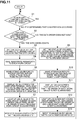
- Fig. 11 is a flowchart illustrating processing executed by the channel processor at the remote site.
- This embodiment is designed so that when performing asynchronous remote copying between a main site and a remote site, command information including a heart-beat signal is sent and received between the main site and the remote site; and if the command information sent from the main site cannot be received at the remote site within a set time period, it is judged that a disaster has occurred at the main site, and this judgment result is then output to a backup center server; and the backup center server executes recovery processing.
- Fig. 1 is a block diagram of a remote copy system according to an embodiment of the present invention.
- the remote copy system includes a disk subsystem 12 located at a main site 10 and a disk subsystem 16 located at a remote site 14 and is configured to be capable of performing asynchronous remote copying between the disk subsystem 12 and the disk subsystem 16.
- the disk subsystem 12 serving as a first storage subsystem includes a controller 18 and a storage apparatus 20.
- the disk subsystem 16 serving as a second storage subsystem includes a controller 22 and a storage apparatus 24.
- the controller 18 is connected via a network 26 to a main center server 28, and the controller 22 is connected via a network 30 to a backup center server 32.
- the controller 18 and the controller 22 are connected to each other via a remote copy cable 34, a public line 36, and a remote copy cable 38.
- the main center server 28 serves as a computer for sending/receiving information to/from the controller 18 and includes a processor (CPU), an operating system (OS), a memory for storing programs such as application programs, input devices for inputting information, and a display device for displaying information.
- the main center server 28 adds update information to the data and then send them in order to guarantee the data order.
- This update information is, for example, a time stamp indicating data update time and a sequence number indicating the data update order.
- the controller 18 serves as a first controller and includes a plurality of channel processors 40, a plurality of channel processors 42, a plurality of cache memories 44, a plurality of shared memories 46, a plurality of disk processors 48, a plurality of disk processors 50, and a maintenance terminal 52, where these components are connected each other via an internal network 54.
- Each channel processor 40 is connected via the network 26 to the main center server 28 and also connected to a host computer (not shown).
- Each channel processor 42 is connected to the remote copy cable 34.
- Each disk processor 48, 50 is connected to the storage apparatus 20.
- the storage apparatus 20 serves as a first storage apparatus for storing data and includes a plurality of disk drives 58.
- Each channel processor 40 includes an operating system and application programs, receives commands and data sent from the main center server 28, analyses the received commands, processes data according to the analysis result, and stores the processed data in the cache memory 44. If the data stored in the cache memory 44 is remote copy target data, the channel processor 42 transfers the remote copy target data to the controller 22 via the remote copy cable 34, the public line 36, and the remote copy cable 38.
- the disk processors 48, 50 control data input/output to/from each disk drive 58.
- each disk processor 48, 50 controls read access or write access to the disk drive 58.
- the disk processor 48 stores data that has been temporarily stored in the cache memory 44, in the disk drive 58.
- the maintenance terminal 52 includes a processor (CPU), an operating system (OS), a memory for storing programs such as management programs, input devices for inputting information, and a display device for displaying information.
- the processor can manage the configuration of the disk subsystem 12, for example, the configuration to construct a RAID (Redundant Array of Independent Disks) using the disk drives 58, in accordance with the management programs and as operated by the operator.
- RAID Redundant Array of Independent Disks
- the shared memories 46 store, for example, difference management information and a data order management table.
- the difference management information is, for example, information used when asynchronous remote copying is temporarily stopped, to manage data updated during the stopped state as difference information, from among pieces of data in the storage apparatus 20.
- the data order management table is a table used to manage whether the data order of the remote copy target data, from among the pieces of data in the storage apparatus 20, is guaranteed or not.
- the expression "the data order is guaranteed" as herein used means to guarantee that, for example, pieces of data stored in the storage apparatus 20 have been sorted in the updated order and then stored.
- the disk drives 58 constituting the storage apparatus 20 form, for example, a RAID group, and physical storage areas are configured as logical primary volume groups.
- Each primary volume is an access target volume for the main center server 28 or the host computer and, for example, the primary volumes are divided into a plurality of work groups.
- each disk processor 48, 50 stores the data in each primary volume in the state where the data order is guaranteed for each work group; and the disk processor 48, 50 stores information indicating whether the data order is guaranteed or not regarding the data belonging to each work group, in the data order management table in the shared memory 46.
- the backup center server 32 serves as a computer for sending/receiving information to/from the controller 22 for the remote site 14 via the network 30 and includes a processor (CPU), an operating system (OS), a memory for storing programs such as application programs, input devices for inputting information, and a display device for displaying information.
- a processor CPU
- OS operating system
- a memory for storing programs such as application programs, input devices for inputting information
- a display device for displaying information.
- the controller 22 for the remote site 14 serves as a second controller and includes a plurality of channel processors 60, a plurality of channel processors 62, a plurality of cache memories 64, a plurality of shared memories 66, a plurality of disk processors 68, a plurality of disk processors 70, and an SVP (SerVice Processor) maintenance terminal 72, and these components are connected to each other via an internal network 74.
- a plurality of channel processors 60 a plurality of channel processors 62, a plurality of cache memories 64, a plurality of shared memories 66, a plurality of disk processors 68, a plurality of disk processors 70, and an SVP (SerVice Processor) maintenance terminal 72, and these components are connected to each other via an internal network 74.
- SVP SeserVice Processor
- Each channel processor 60 is connected to each channel processor 42 via the remote copy cable 38, the public line 36, and the remote copy cable 34.
- Each channel processor 62 is connected to the backup center server 32 via the network 30 and also connected to the host computer (not shown).
- Each disk processor 68, 70 is connected to the storage apparatus 24.
- the maintenance terminal 72 is connected to a hub 78 via a cable 76.
- the hub 78 is connected to a user open terminal 82 via a cable 80 and also to a data order check display panel 86 via a cable 84.
- the storage apparatus 24 constitutes a second storage apparatus for storing data from the controller 18 and a third storage apparatus for storing the data stored in the second storage apparatus as backup data, and includes a plurality of disk drives 88 as storage media.
- Each disk drive 88 is configured to include a plurality of physical storage areas which are secondary volume groups serving as logical storage areas.
- Each secondary volume is a volume constituting a pair with the primary volume during remote copying, and the secondary volumes are divided into a plurality of work groups.
- Each channel processor 60, 62 includes an operating system and application programs.
- the channel processor 60 receives the remote copy target data transferred from the controller 18 via the remote copy cable 34, the public line 36, and the remote copy cable 38, processes the received remote copy target data, and stores the processed remote copy target data in the cache memory 64.
- the channel processor 62 receives commands and data sent from the backup center server 32, analyses the received commands, processes data according to the analysis result, and stores the processed data in the cache memory 64.
- Each disk processor 68, 70 includes an operating system and application programs and controls data input/output to/from each disk drive 88.
- each disk processor 68, 70 controls data read access or write access to the disk drives 88.
- the disk processor 68 stores data that has been temporarily stored in the cache memory 64, for example, the remote copy target data, in the disk drives 88 in the state where the data order is guaranteed.
- the maintenance terminal 72 includes a processor (CPU), an operating system (OS), a memory for storing programs such as management programs, input devices for inputting information, and a display device for displaying information.
- the processor can manage the configuration of the disk subsystem 16, for example, the configuration to construct a RAID using the disk drives 88, in accordance with the management programs and as operated by the operator.
- the shared memories 66 store, for example, difference management information and a data order management table.
- the difference management information is, for example, information used when asynchronous remote copying is temporarily stopped, to manage data updated during the stopped state, from among pieces of data in the storage apparatus 24.
- the data order management table is a table used to manage whether the data order of the remote copy target data as difference information, from among the pieces of data in the storage apparatus 24, is guaranteed or not.
- the expression "the data order is guaranteed" as herein used means to guarantee that, for example, pieces of data stored in the storage apparatus 24 have been sorted in the updated order and then stored.
- the channel processors 40, 42, 60, 62 manage the primary volumes and the secondary volumes in accordance with a data order management table T1 shown in Fig. 2 before the occurrence of a disaster, and in accordance with a data order management table T2 shown in Fig. 3 after the occurrence of a disaster.
- the channel processors 40, 42 manage primary volumes #1 to #n in association with work groups #0-0, #0-1, and so on up to #n-n, respectively; and the channel processors 60, 62 manage secondary volumes #1 to #n in association with the work groups #0-0, #0-1, and so on up to #n-n, respectively.
- the data order management table T1 before the occurrence of a disaster as shown in Fig. 2 is constituted from a "management number" field 100, a "work group number” field 102, a “volume number” field 104, a “volume status” field 106, a "work group status” field 108, and a "READ/WRITE permission status” field 110.
- the "management number” field 100 stores numbers such as “1,” “2,” “3,” and so on up to “n” in each entry.
- the "work group number” field 102 stores the work group number, such as "0-0,” “0-1,” “1-1,” “1-1,” “1-2,” and so on up to "n-n,”for the primary volumes or the secondary volumes.
- the "volume number” field 104 stores the volume number from “1” to "n” corresponding to the relevant work group from the first entry to the n th entry.
- the "volume status" field 106 stores information about whether or not the data order exists regarding each relevant volume, that is, information about whether or not the data order of each relevant volume is guaranteed. If the status has changed from an "uncertain" state to the state where each channel processor 40, 42, 60, 62 judges that the data order exists regarding the relevant volume, information indicating "SUSPENDED GROUP" is stored in the "volume status" field 106; and if each channel processor 40, 42, 60, 62 then judges that the data order does not exist regarding the relevant volume, information indicating "SUSPENDED VOLUME" is stored in the "volume status" field 106.
- volume status field 106 for volume #4 in the fourth entry stores "SUSPENDED VOLUME” indicating that the status has changed from the "uncertain” state to the state where it is judged that the data order does not exist; and the "volume status” field 106 for the other entries stores "SUSPENDED GROUP” indicating that the status has changed from the "uncertain” state to the state where it is judged that the data order exists.
- the "work group status" field 108 stores information about whether the data order of each relevant work group is guaranteed or not.
- the "work group status" field 108 for work group "0" to which the primary volumes or the secondary volumes belong stores information indicating that the status has changed from the "uncertain” state to the state where it is judged that the data order is guaranteed, i.e., "ORDER-GUARANTEED GROUP.”
- the "READ/WRITE permission status" field 110 stores information indicating that read access or write access to the disk drives 58, 88 is unpermitted. Specifically speaking, since read access or write access cannot be made to the disk drives 88 when performing asynchronous remote copying, the information indicating "unpermitted" is stored.
- FIG. 3 shows the configuration of the data order management table T2 after the occurrence of a disaster.
- the data order management table T2 has the same configuration as that of the data order management table T1.
- the "management number” field 100, the "work group number” field 102, the "volume number” field 104, the “volume status” field 106, and the "work group status” field 108 store the same pieces of information as those in the data order management table T1, respectively.
- the "READ/WRITE permission status" field 110 stores different information from that in the data order management table T1.
- the "work group status" field 108 for volume numbers #1 and #2 belonging to the work group “0” stores information indicating "ORDER-GUARANTEED GROUP,” so that information indicating that the READ/WRITE permission status changes from "UNPERMITTED” to "PERMITTED” is stored in the "READ/WRITE permission status" field 110.
- Information stored in the data order management tables T1, T2 is output from the maintenance terminal 72 via the hub 78 to the user open terminal 82 and the data order check display panel 86 as shown in Fig. 4.
- Fig. 5 shows a display example of a remote copy data order check screen 200 that is a display screen for the user open terminal 82.
- the remote copy data order check screen 200 includes a "work group number" display area 202, an "intended use” display area 204, an "order-guaranteed” display area 206, an "order-nonguaranteed” display area 208, and a "data-guaranteed time” display area 210.
- the remote copy data order check screen 200 also includes a "work group number” display area 212, an "intended use” display area 214, an "order-guaranteed” display area 216, an "order-nonguaranteed” display area 218, and a "data-guaranteed time” display area 220.
- the user open terminal 82 which is a display terminal can be configured using, for example, a personal computer.
- the work group number" display areas 202, 212 display work group numbers from “00" to “0F” and from “10" to "1F,” respectively.
- the "intended use” display areas 204, 214 display, for example, “A system backbone,” “B system backbone,” “A system development,” or “B system development,”as the intended use of each relevant work group.
- the "order-guaranteed” display areas 206, 216 display "[Character] indicating "yes” " when the order of data (remote copy target data) belonging to each relevant work group is guaranteed.
- the "order-nonguaranteed” display areas 208, 218 display "[Character] indicating "yes”” when the order of data (remote copy target data) belonging to each relevant work group is not guaranteed.
- the "data-guaranteed time” display areas 210, 220 display information about the time and date when the order of data (remote copy target data) belonging to the relevant work group was guaranteed.
- Fig. 6 is an external view of the data order check display panel 86.
- display elements LED00 to LED7F corresponding to the work groups "00" to “7F” are placed on the surface of the display panel 86.
- Each display element LED00 to LED7F is connected to a display element drive circuit (not shown in the drawing).
- Each display element LED00 to LED7F lights up in different manners depending on whether the data order of the data (remote copy target data) belonging to each relevant work group is guaranteed or not.
- each display element LED00 to LED7F lights up in blue; and if the data order of the data (remote copy target data) belonging to the relevant work group is not guaranteed, each display element LED00 to LED7F lights up in red.
- asynchronous remote copying performed between the controller 18 and the controller 22 means that the controller 18 updates data in primary volumes V1 and transfers the updated data as the remote copy target data to the controller 22, and the controller 22 copies the received remote copy target data to secondary volumes V2 not in synchronization with the update timing by the controller 18, that is, asynchronously.
- the controller 18 extracts the updated data as the remote copy target data from the data in the primary volumes V1 constituted from the disk drives 58 and adds update information including, for example, a time stamp indicating data update time and a sequence number indicating the data update order, to the extracted remote copy target data.
- the controller 18 transfers the remote copy target data to which the update information is added, to the controller 22 via a remote copy channel 94 including a circuit equipment 90, the remote copy cable 34, the public line 36, the remote copy cable 38, and a circuit equipment 92.
- the controller 22 judges, based on the update information added to the remote copy target data, whether the data order of the remote copy target data is guaranteed or not.
- the controller 22 judges whether or not the pieces of remote copy target data have been received in the data update order; and if the pieces of remote copy target data have not been received in the data update order, the controller 22 sorts the received pieces of remote copy target data in the data update order and stores the sorted remote copy target data in the secondary volumes V2 in the state where the data order is guaranteed.
- the secondary volumes V2 constituted from the disk drives 88 and the primary volumes V1 make pairs (copy pairs), and the same pieces of data as those in the primary volumes V1 will be stored in the secondary volumes V2.
- the controller 22 stores the data, which was stored in the secondary volumes V2, as backup data in backup volumes V3 periodically about once a day. This processing is executed in the process of batch processing or online processing as shown in Fig. 8.
- the controller 22 stores the data stored in the secondary volumes V2 as backup data in the backup volumes V3 at 5 o'clock.
- the channel processor 42 and the channel processor 60 execute periodic processing, so that the command information including the heart-beat signal is sent and received between the channel processor 42 and the channel processor 60 via the remote copy channel 94.
- the term "heart-beat signal” herein used means a signal that the channel processor 42 and the channel processor 60 transmit periodically in order to check if the connection with the communication counterpart is effective or not.
- the channel processor 42 sends a command frame 300 as first command information via the remote copy channel 94 to the channel processor 60 as transmission processing at regular intervals, for example, once per second; receives a data request frame 302 sent from the channel processor 60 as second command information in response to the command frame 300; then transmits a data frame (dummy control information) 304 via the remote copy channel 94 to the channel processor 60; and receives the status 306 sent from the channel processor 60 as second command information in response to the data frame 304.
- the channel processor 60 when receiving the command frame 300 as reception processing in the command frame reception wait state, the channel processor 60 sends the data request frame 302, as the second command information in response to the command frame 300, via the remote copy channel 94 to the channel processor 42; and subsequently, when receiving the data frame 304 sent from the channel processor 42, the channel processor 60 sends the status 306, as the second command information in response to the data frame 304, via the remote copy channel 94 to the channel processor 42.
- the channel processor 60 fails to receive the command frame 300 within a set time period, for example, a monitoring time period set by the maintenance terminal 72 in the above-described circumstances, the channel processor 60 outputs information about the occurrence of a disaster at the main site 10 to the channel processor 62 and the backup center server 32 and also to the user open terminal 82, and the intra-channel-processor periodic processing shifts to data order judgment processing.
- the channel processors 60, 62 manage the data order of the remote copy target data using the data order management table T2 instead of the data order management table T1 stored in the shared memory 66.
- the channel processor 62 for the controller 22 searches the data order management table T2 to judge whether the data order of each relevant secondary volume V2 is guaranteed or not; and if it is determined that the data order is guaranteed, the channel processor 62 executes processing for changing the READ/WRITE permission status of the relevant secondary volume V2 of each work group from "UNPERMITTED” to "PERMITTED.”
- the channel processor 62 also executes processing for changing the READ/WRITE permission status of the backup volumes V3 from "UNPERMITTED” to "PERMITTED.”
- the backup center server 32 can immediately start the recovery processing by accessing the data in the secondary volumes V2 or the backup volumes V3.
- the channel processor 62 outputs, as an attention report, information about the state transition of the data stored in each secondary volume from the state where the data order is guaranteed to the state where the data order is not guaranteed, or information about the state transition from the state where the data order is not guaranteed to the state where the data order is guaranteed, to the backup center server 32.
- the channel processor 62 makes, via the maintenance terminal 72, a GUI (Graphical User Interface) screen for the user open terminal 82 display information indicating whether the data order of data belonging to each work group is guaranteed or not; and also makes the data order check display panel 86 display whether the data order of the data belonging to each work group is guaranteed or not, using the display elements.
- GUI Graphic User Interface
- the backup center server 32 starts up a work recovery OS, starts work recovery processing using the data in the secondary volumes V2 belonging to each work group, and resumes the work. In other words, the backup center server 32 restores the disk subsystem 16 to the operating state before the occurrence of the disaster by using the data in the secondary volumes V2 and resumes the work at the disk subsystem 16.
- the backup center server 32 starts up the OS, starts the work recovery processing using the data in the backup volumes V3, and resumes the work.
- the backup center server 32 restores the disk subsystem 16 to the operating state before the occurrence of the disaster by using the data in the backup volumes V3 and resumes the work at the disk subsystem 16.
- the channel processor 60 sends and receives, for example, the command information including the heart-beat signal via the remote copy channel 94 as communication during the asynchronous remote copying and thereby judges whether or not the remote copy communication takes place within a designated time period (monitoring time period) (S1).
- the channel processor 60 determines that the remote copy communication takes place within the designated time period, i.e., the remote copy communication is conducted within the designated time period, the channel processor 60 repeats the processing in step S1; and if the channel processor 60 determines that the remote copy communication does not take place within the designated time period, i.e., the remote copy communication is not conducted within the designated time period, the channel processor 60 determines that a disaster has occurred at the main site 10, and then judges whether or not the data order exists regarding the data belonging to the secondary volumes V2 (S2).
- the channel processor 60 judges whether the data order is guaranteed or not, regarding the data belonging to all the secondary volumes V2; and if the data order is guaranteed, the channel processor 60 concludes that the data order exists, and then sets the status of all the secondary volumes V2 to "SUSPENDED GROUP" (S3).
- the channel processor 62 gives READ/WRITE permission to the secondary volumes V2 belonging to each work group (S4).
- the backup center server 32 can make read access or write access to the secondary volumes V2 belonging to each work group.
- the processing details in steps S3 and S4 are reflected in the data order management table T2 shown in Fig. 3. Accordingly, the information in the data order management table T2 is updated.
- the channel processor 62 outputs information regarding the state transition of the remote copy pairs as an attention report to the backup center server 32 (S5). For example, based on the information stored in the data order management tables T1, T2, the channel processor 62 outputs, as the attention report, information indicating that the state of the secondary volume V2 constituting a pair with the primary volume V1 made the transition from "SUSPENDED VOLUME" to "SUSPENDED GROUP” and information indicating that the state of the secondary volume V2 made the transition from "SUSPENDED GROUP" to "SUSPENDED VOLUME,” to the backup center server 32.
- the channel processor 62 has the remote copy data order check screen 200 displayed on the GUI screen for the user open terminal 82 (S6).
- the mark "[Character] indicating "yes”” in the "order-guaranteed” display area 206, 216 indicates that the data order is guaranteed regarding the relevant secondary volume V2 belonging to each work group; and the "data guaranteed time” display area 210, 220 displays until what time (hours, minutes, and seconds) on what date the data order is guaranteed regarding the secondary volumes V2 belonging to each work group.
- the channel processor 62 lights up a light-emitting device LED in blue, that corresponds to the work group whose data order is guaranteed, from among light-emitting devices for the display panel 86 (S7).
- the channel processor 62 outputs information about the work groups whose data order is guaranteed, based on the information stored in the data order management table T2, to the backup center server 32 and then terminates the processing in this routine.
- step S2 determines whether the data order does exist, that is, if the data order of the data in the secondary volumes V2 belonging to the relevant work group is not guaranteed.
- the channel processor 62 sets the status of the secondary volumes V2 whose data order cannot be guaranteed, to "SUSPENDED VOLUME,” and sets the status of the secondary volumes V2 whose data order can be guaranteed, to "SUSPENDED GROUP" (S9).
- the channel processor 62 sends information about the state transition of the remote copy pairs, as the attention report, to the backup center server 32 (S10).
- the channel processor 62 outputs, as the attention report, information indicating that the state of the secondary volume V2 constituting a pair with the primary volume V1 made the transition from "SUSPENDED VOLUME" to "SUSPENDED GROUP” and information indicating that the state of the secondary volume V2 made the transition from "SUSPENDED GROUP” to "SUSPENDED VOLUME,” to the backup center server 32.
- the channel processor 62 has the remote copy data order check screen 200 displayed on the GUI screen for the user open terminal 82 (S11).
- the mark "[Character] indicating "yes”” in the "order-nonguaranteed" display area 208, 218 indicates that the data order is not guaranteed regarding data of the relevant secondary volume V2 belonging to each work group.
- the channel processor 62 has the display panel 86 display that the data order is not guaranteed regarding the secondary volumes V2 belonging to each work group.
- the light-emitting device LED with the number corresponding to the work group whose data order is not guaranteed lights up in red.
- the channel processor 62 outputs information about the work groups whose data order is not guaranteed, based on the information stored in the data order management table T2, to the backup center server 32 and then terminates the processing in this routine.
- the backup center server 32 receives, from the channel processor 62, information indicating that the data order is guaranteed regarding the secondary volumes V2 belonging to each work group, the backup center server 32 starts work recovery processing based on the data in the secondary volumes V2. In this case, since the controller 22 permits data input/output to/from the secondary volumes V2 at the time of the occurrence of a disaster, the backup center server 32 can immediately starts the work recovery processing based on the data in the secondary volumes V2.
- the backup center server 32 receives, from the channel processor 62, information indicating that the data order is not guaranteed regarding the secondary volumes V2 belonging to each work group, the backup center server 32 starts the work recovery processing based on the data in the backup volumes V3. In this case, since the controller 22 permits data input/output to/from the backup volumes V3 at the time of the occurrence of a disaster, the backup center server 32 can immediately starts the work recovery processing based on the data in the backup volumes V3.
- the backup center server 32 starts the work recovery processing, the main center server 28 and the controllers 18, 22 resume the work.
- the controller 22 does not immediately give permission to input/output data to/from the secondary volumes V2 or the backup volumes V3 when a disaster has occurred, the operator can give the permission to input/output data to/from the secondary volumes V2 or the backup volumes V3 by, for example, operating the maintenance terminal 72.
- the backup center server 32 can start the work recovery processing using the data in the secondary volumes V2 or the backup volumes V3.
- the controller 18 transfers the command information and the remote copy target data stored in the primary volumes V1, via the remote copy channel 94 to the controller 22; and when the controller 22 receives the command information within the set time period and also receives the remote copy target data, the controller 22 stores the remote copy target data in the secondary volumes V2; and if the controller 22 fails to receive the command information within the set time period, it judges that a disaster has occurred at the main site 10, and then outputs this judgment result to the backup center server 32; and if the judgment result indicating that the disaster has occurred is input, the backup center server 32 executes the recovery processing based on the data in the secondary volumes V2 or the backup volumes V3.
- the occurrence of a disaster at the main site 10 can be detected at the remote site 14; and when a disaster is detected, the recovery processing can be started at the remote site 14.
- the work can be resumed at the remote site 14 without having the operator at the backup center perform cumbersome and complicated operation, and it is possible to reduce the time it takes to resume the work after the occurrence of a disaster.
- the controller 22 gives permission to input/output data to/from the secondary volumes V2 or the backup volumes V3 when a disaster has occurred at the main site 10, the backup center server 32 can immediately start the work recovery processing using data in the secondary volumes V2 or the backup volumes V3.
- the work recovery can be executed depending on whether the data order exists or not. Specifically speaking, if the data order is guaranteed regarding the secondary volumes V2 belonging to each work group, the work recovery processing is immediately executed based on the data in the secondary volumes V2; and if the data order is not guaranteed regarding the secondary volumes V2 belonging to each work group, the work recovery processing can be immediately executed based on data whose data order is guaranteed, from among the data in the backup volumes V3.
- the backup center server 32 can immediately start the work recovery processing, using the data in the secondary volumes V2 or the backup volumes V3.
Landscapes
- Engineering & Computer Science (AREA)
- Theoretical Computer Science (AREA)
- Quality & Reliability (AREA)
- Physics & Mathematics (AREA)
- General Engineering & Computer Science (AREA)
- General Physics & Mathematics (AREA)
- Information Retrieval, Db Structures And Fs Structures Therefor (AREA)
Abstract
La présente invention se rapporte à un système de copie à distance. Lors de l'exécution d'une copie asynchrone à distance, la survenue éventuelle d'un sinistre informatique au niveau d'un site principal est déterminée au niveau d'un site distant ; et, si le sinistre informatique s'est effectivement produit, une opération de récupération est instantanément initiée au site distant. Quand une copie asynchrone à distance est exécutée entre un contrôleur 18 et un contrôleur 22, le contrôleur 18 transfère des données cible de copie à distance dans un appareil de stockage 20 et des informations de commande au contrôleur 22 par le biais d'un canal de copie à distance 94. Ensuite, après avoir reçu les données cible de copie à distance, le contrôleur 22 stocke les données cible de copie à distance dans un appareil de stockage 24. D'autre part, si le contrôleur 22 ne parvient pas à recevoir les informations de commande au cours d'une période de temps prédéterminée, le contrôleur 22 détermine qu'un sinistre informatique s'est produit et il envoie alors le résultat de la détermination à un serveur central de sauvegarde 32. A ce moment-là, le serveur central de sauvegarde 32 exécute une opération de récupération sur la base des données contenues dans l'appareil de stockage 24 au moment où le sinistre informatique s'est produit.
Priority Applications (2)
| Application Number | Priority Date | Filing Date | Title |
|---|---|---|---|
| US12/669,475 US8281094B2 (en) | 2009-08-26 | 2009-08-26 | Remote copy system |
| PCT/JP2009/004148 WO2011024221A1 (fr) | 2009-08-26 | 2009-08-26 | Système de copie à distance |
Applications Claiming Priority (1)
| Application Number | Priority Date | Filing Date | Title |
|---|---|---|---|
| PCT/JP2009/004148 WO2011024221A1 (fr) | 2009-08-26 | 2009-08-26 | Système de copie à distance |
Publications (1)
| Publication Number | Publication Date |
|---|---|
| WO2011024221A1 true WO2011024221A1 (fr) | 2011-03-03 |
Family
ID=41467107
Family Applications (1)
| Application Number | Title | Priority Date | Filing Date |
|---|---|---|---|
| PCT/JP2009/004148 Ceased WO2011024221A1 (fr) | 2009-08-26 | 2009-08-26 | Système de copie à distance |
Country Status (2)
| Country | Link |
|---|---|
| US (1) | US8281094B2 (fr) |
| WO (1) | WO2011024221A1 (fr) |
Cited By (1)
| Publication number | Priority date | Publication date | Assignee | Title |
|---|---|---|---|---|
| CN105980995A (zh) * | 2013-10-30 | 2016-09-28 | 慧与发展有限责任合伙企业 | 数据中心复制 |
Families Citing this family (3)
| Publication number | Priority date | Publication date | Assignee | Title |
|---|---|---|---|---|
| US8788601B2 (en) * | 2011-05-26 | 2014-07-22 | Stratify, Inc. | Rapid notification system |
| JP6217302B2 (ja) * | 2013-10-15 | 2017-10-25 | 富士通株式会社 | ストレージ管理装置、情報処理システムおよびストレージ管理プログラム |
| JP2016162261A (ja) * | 2015-03-03 | 2016-09-05 | 富士通株式会社 | 情報処理装置、情報処理システム、および制御プログラム |
Citations (5)
| Publication number | Priority date | Publication date | Assignee | Title |
|---|---|---|---|---|
| EP1357465A2 (fr) * | 2002-04-26 | 2003-10-29 | Hitachi, Ltd. | Système de stockage ayant une ressource virtualisée |
| US20050055523A1 (en) * | 2003-06-27 | 2005-03-10 | Hitachi, Ltd. | Data processing system |
| US20050229034A1 (en) * | 2004-03-17 | 2005-10-13 | Hitachi, Ltd. | Heartbeat apparatus via remote mirroring link on multi-site and method of using same |
| US20060020640A1 (en) * | 2004-07-21 | 2006-01-26 | Susumu Suzuki | Storage system |
| EP1657631A1 (fr) * | 2004-10-27 | 2006-05-17 | Hitachi Ltd. | Système de stockage et dispositif de commande de stockage |
Family Cites Families (10)
| Publication number | Priority date | Publication date | Assignee | Title |
|---|---|---|---|---|
| US6105078A (en) * | 1997-12-18 | 2000-08-15 | International Business Machines Corporation | Extended remote copying system for reporting both active and idle conditions wherein the idle condition indicates no updates to the system for a predetermined time period |
| US7836029B2 (en) * | 2003-07-08 | 2010-11-16 | Pillar Data Systems, Inc. | Systems and methods of searching for and determining modified blocks in a file system |
| JP4307982B2 (ja) * | 2003-12-19 | 2009-08-05 | 株式会社日立製作所 | データ多重化制御方法 |
| JP4422519B2 (ja) | 2004-03-18 | 2010-02-24 | 株式会社日立製作所 | 情報処理システム |
| JP4508798B2 (ja) | 2004-08-09 | 2010-07-21 | 株式会社日立製作所 | ストレージリモートコピー方式 |
| US7395265B2 (en) * | 2004-08-27 | 2008-07-01 | Hitachi, Ltd. | Data processing system and storage subsystem provided in data processing system |
| JP2006318505A (ja) | 2006-08-01 | 2006-11-24 | Hitachi Ltd | リモートコピーシステム及びリモートコピー方法 |
| JP4884198B2 (ja) * | 2006-12-19 | 2012-02-29 | 株式会社日立製作所 | ストレージネットワークの性能管理方法、並びに、その方法を用いた計算機システム及び管理計算機 |
| JP2008299789A (ja) | 2007-06-04 | 2008-12-11 | Hitachi Ltd | リモートコピーシステム及びリモートコピーの制御方法 |
| JP5508798B2 (ja) * | 2009-09-29 | 2014-06-04 | 株式会社日立製作所 | クラスタを考慮してレプリケーションを管理する管理方法及びシステム |
-
2009
- 2009-08-26 WO PCT/JP2009/004148 patent/WO2011024221A1/fr not_active Ceased
- 2009-08-26 US US12/669,475 patent/US8281094B2/en not_active Expired - Fee Related
Patent Citations (5)
| Publication number | Priority date | Publication date | Assignee | Title |
|---|---|---|---|---|
| EP1357465A2 (fr) * | 2002-04-26 | 2003-10-29 | Hitachi, Ltd. | Système de stockage ayant une ressource virtualisée |
| US20050055523A1 (en) * | 2003-06-27 | 2005-03-10 | Hitachi, Ltd. | Data processing system |
| US20050229034A1 (en) * | 2004-03-17 | 2005-10-13 | Hitachi, Ltd. | Heartbeat apparatus via remote mirroring link on multi-site and method of using same |
| US20060020640A1 (en) * | 2004-07-21 | 2006-01-26 | Susumu Suzuki | Storage system |
| EP1657631A1 (fr) * | 2004-10-27 | 2006-05-17 | Hitachi Ltd. | Système de stockage et dispositif de commande de stockage |
Cited By (2)
| Publication number | Priority date | Publication date | Assignee | Title |
|---|---|---|---|---|
| CN105980995A (zh) * | 2013-10-30 | 2016-09-28 | 慧与发展有限责任合伙企业 | 数据中心复制 |
| EP3063638A4 (fr) * | 2013-10-30 | 2017-07-26 | Hewlett-Packard Enterprise Development LP | Reproduction de centre de données |
Also Published As
| Publication number | Publication date |
|---|---|
| US8281094B2 (en) | 2012-10-02 |
| US20120137092A1 (en) | 2012-05-31 |
Similar Documents
| Publication | Publication Date | Title |
|---|---|---|
| US8078581B2 (en) | Storage system and remote copy control method | |
| CN100570574C (zh) | 用于管理存储系统之间的数据拷贝的系统和方法 | |
| US8452933B2 (en) | Storage system and remote copy recovery method | |
| US7941622B2 (en) | Point in time remote copy for multiple sites | |
| US7185152B2 (en) | Storage system, method of controlling storage system, and storage device | |
| US8156369B2 (en) | Remote copying management system, method and apparatus | |
| JP4108074B2 (ja) | 多重リモートストレージでのデータ同期 | |
| US20140019802A1 (en) | Multiple hyperswap replication sessions | |
| CN100383749C (zh) | 远程复制方法及远程复制系统 | |
| JP5286212B2 (ja) | ストレージクラスタ環境でのリモートコピー制御方法及びシステム | |
| US20070067584A1 (en) | Storage system, redundancy control method, and program | |
| EP1785833B1 (fr) | Système de commande de stockage | |
| US8281094B2 (en) | Remote copy system | |
| US7275178B2 (en) | Computer system having failure recovery function, and failure recovery method thereof | |
| JP2005122453A (ja) | ストレージ装置のディスクコントローラ制御方式およびストレージ装置 | |
| CN113312209B (zh) | 一种数据热备方法、装置、服务器和存储介质 | |
| JP5573118B2 (ja) | ディスクアレイ装置の故障診断システム、故障診断方法、故障診断プログラムおよびディスク装置 | |
| EP2093655A2 (fr) | Système de stockage et procédé de copie | |
| US7302604B2 (en) | Remote management commands in a mass storage system | |
| CN114244638B (zh) | 组播网络通信方法、装置、设备及介质 | |
| JPH11102307A (ja) | リモート制御装置の障害処理方式 |
Legal Events
| Date | Code | Title | Description |
|---|---|---|---|
| WWE | Wipo information: entry into national phase |
Ref document number: 12669475 Country of ref document: US |
|
| 121 | Ep: the epo has been informed by wipo that ep was designated in this application |
Ref document number: 09787919 Country of ref document: EP Kind code of ref document: A1 |
|
| NENP | Non-entry into the national phase |
Ref country code: DE |
|
| 122 | Ep: pct application non-entry in european phase |
Ref document number: 09787919 Country of ref document: EP Kind code of ref document: A1 |