WO2011024787A1 - 合わせガラス用中間膜及び合わせガラス - Google Patents
合わせガラス用中間膜及び合わせガラス Download PDFInfo
- Publication number
- WO2011024787A1 WO2011024787A1 PCT/JP2010/064246 JP2010064246W WO2011024787A1 WO 2011024787 A1 WO2011024787 A1 WO 2011024787A1 JP 2010064246 W JP2010064246 W JP 2010064246W WO 2011024787 A1 WO2011024787 A1 WO 2011024787A1
- Authority
- WO
- WIPO (PCT)
- Prior art keywords
- laminated glass
- content
- interlayer film
- particles
- weight
- Prior art date
- Legal status (The legal status is an assumption and is not a legal conclusion. Google has not performed a legal analysis and makes no representation as to the accuracy of the status listed.)
- Ceased
Links
Images
Classifications
-
- C—CHEMISTRY; METALLURGY
- C03—GLASS; MINERAL OR SLAG WOOL
- C03C—CHEMICAL COMPOSITION OF GLASSES, GLAZES OR VITREOUS ENAMELS; SURFACE TREATMENT OF GLASS; SURFACE TREATMENT OF FIBRES OR FILAMENTS MADE FROM GLASS, MINERALS OR SLAGS; JOINING GLASS TO GLASS OR OTHER MATERIALS
- C03C27/00—Joining pieces of glass to pieces of other inorganic material; Joining glass to glass other than by fusing
- C03C27/04—Joining glass to metal by means of an interlayer
-
- B—PERFORMING OPERATIONS; TRANSPORTING
- B32—LAYERED PRODUCTS
- B32B—LAYERED PRODUCTS, i.e. PRODUCTS BUILT-UP OF STRATA OF FLAT OR NON-FLAT, e.g. CELLULAR OR HONEYCOMB, FORM
- B32B17/00—Layered products essentially comprising sheet glass, or glass, slag, or like fibres
- B32B17/06—Layered products essentially comprising sheet glass, or glass, slag, or like fibres comprising glass as the main or only constituent of a layer, next to another layer of a specific material
- B32B17/10—Layered products essentially comprising sheet glass, or glass, slag, or like fibres comprising glass as the main or only constituent of a layer, next to another layer of a specific material of synthetic resin
-
- B—PERFORMING OPERATIONS; TRANSPORTING
- B32—LAYERED PRODUCTS
- B32B—LAYERED PRODUCTS, i.e. PRODUCTS BUILT-UP OF STRATA OF FLAT OR NON-FLAT, e.g. CELLULAR OR HONEYCOMB, FORM
- B32B17/00—Layered products essentially comprising sheet glass, or glass, slag, or like fibres
- B32B17/06—Layered products essentially comprising sheet glass, or glass, slag, or like fibres comprising glass as the main or only constituent of a layer, next to another layer of a specific material
- B32B17/10—Layered products essentially comprising sheet glass, or glass, slag, or like fibres comprising glass as the main or only constituent of a layer, next to another layer of a specific material of synthetic resin
- B32B17/10005—Layered products essentially comprising sheet glass, or glass, slag, or like fibres comprising glass as the main or only constituent of a layer, next to another layer of a specific material of synthetic resin laminated safety glass or glazing
- B32B17/10009—Layered products essentially comprising sheet glass, or glass, slag, or like fibres comprising glass as the main or only constituent of a layer, next to another layer of a specific material of synthetic resin laminated safety glass or glazing characterized by the number, the constitution or treatment of glass sheets
- B32B17/10036—Layered products essentially comprising sheet glass, or glass, slag, or like fibres comprising glass as the main or only constituent of a layer, next to another layer of a specific material of synthetic resin laminated safety glass or glazing characterized by the number, the constitution or treatment of glass sheets comprising two outer glass sheets
-
- B—PERFORMING OPERATIONS; TRANSPORTING
- B32—LAYERED PRODUCTS
- B32B—LAYERED PRODUCTS, i.e. PRODUCTS BUILT-UP OF STRATA OF FLAT OR NON-FLAT, e.g. CELLULAR OR HONEYCOMB, FORM
- B32B17/00—Layered products essentially comprising sheet glass, or glass, slag, or like fibres
- B32B17/06—Layered products essentially comprising sheet glass, or glass, slag, or like fibres comprising glass as the main or only constituent of a layer, next to another layer of a specific material
- B32B17/10—Layered products essentially comprising sheet glass, or glass, slag, or like fibres comprising glass as the main or only constituent of a layer, next to another layer of a specific material of synthetic resin
- B32B17/10005—Layered products essentially comprising sheet glass, or glass, slag, or like fibres comprising glass as the main or only constituent of a layer, next to another layer of a specific material of synthetic resin laminated safety glass or glazing
- B32B17/1055—Layered products essentially comprising sheet glass, or glass, slag, or like fibres comprising glass as the main or only constituent of a layer, next to another layer of a specific material of synthetic resin laminated safety glass or glazing characterized by the resin layer, i.e. interlayer
- B32B17/10614—Layered products essentially comprising sheet glass, or glass, slag, or like fibres comprising glass as the main or only constituent of a layer, next to another layer of a specific material of synthetic resin laminated safety glass or glazing characterized by the resin layer, i.e. interlayer comprising particles for purposes other than dyeing
- B32B17/10633—Infrared radiation absorbing or reflecting agents
-
- B—PERFORMING OPERATIONS; TRANSPORTING
- B32—LAYERED PRODUCTS
- B32B—LAYERED PRODUCTS, i.e. PRODUCTS BUILT-UP OF STRATA OF FLAT OR NON-FLAT, e.g. CELLULAR OR HONEYCOMB, FORM
- B32B17/00—Layered products essentially comprising sheet glass, or glass, slag, or like fibres
- B32B17/06—Layered products essentially comprising sheet glass, or glass, slag, or like fibres comprising glass as the main or only constituent of a layer, next to another layer of a specific material
- B32B17/10—Layered products essentially comprising sheet glass, or glass, slag, or like fibres comprising glass as the main or only constituent of a layer, next to another layer of a specific material of synthetic resin
- B32B17/10005—Layered products essentially comprising sheet glass, or glass, slag, or like fibres comprising glass as the main or only constituent of a layer, next to another layer of a specific material of synthetic resin laminated safety glass or glazing
- B32B17/1055—Layered products essentially comprising sheet glass, or glass, slag, or like fibres comprising glass as the main or only constituent of a layer, next to another layer of a specific material of synthetic resin laminated safety glass or glazing characterized by the resin layer, i.e. interlayer
- B32B17/10651—Layered products essentially comprising sheet glass, or glass, slag, or like fibres comprising glass as the main or only constituent of a layer, next to another layer of a specific material of synthetic resin laminated safety glass or glazing characterized by the resin layer, i.e. interlayer comprising colorants, e.g. dyes or pigments
-
- B—PERFORMING OPERATIONS; TRANSPORTING
- B32—LAYERED PRODUCTS
- B32B—LAYERED PRODUCTS, i.e. PRODUCTS BUILT-UP OF STRATA OF FLAT OR NON-FLAT, e.g. CELLULAR OR HONEYCOMB, FORM
- B32B17/00—Layered products essentially comprising sheet glass, or glass, slag, or like fibres
- B32B17/06—Layered products essentially comprising sheet glass, or glass, slag, or like fibres comprising glass as the main or only constituent of a layer, next to another layer of a specific material
- B32B17/10—Layered products essentially comprising sheet glass, or glass, slag, or like fibres comprising glass as the main or only constituent of a layer, next to another layer of a specific material of synthetic resin
- B32B17/10005—Layered products essentially comprising sheet glass, or glass, slag, or like fibres comprising glass as the main or only constituent of a layer, next to another layer of a specific material of synthetic resin laminated safety glass or glazing
- B32B17/1055—Layered products essentially comprising sheet glass, or glass, slag, or like fibres comprising glass as the main or only constituent of a layer, next to another layer of a specific material of synthetic resin laminated safety glass or glazing characterized by the resin layer, i.e. interlayer
- B32B17/10761—Layered products essentially comprising sheet glass, or glass, slag, or like fibres comprising glass as the main or only constituent of a layer, next to another layer of a specific material of synthetic resin laminated safety glass or glazing characterized by the resin layer, i.e. interlayer containing vinyl acetal
-
- B—PERFORMING OPERATIONS; TRANSPORTING
- B32—LAYERED PRODUCTS
- B32B—LAYERED PRODUCTS, i.e. PRODUCTS BUILT-UP OF STRATA OF FLAT OR NON-FLAT, e.g. CELLULAR OR HONEYCOMB, FORM
- B32B27/00—Layered products comprising a layer of synthetic resin
- B32B27/18—Layered products comprising a layer of synthetic resin characterised by the use of special additives
-
- B—PERFORMING OPERATIONS; TRANSPORTING
- B32—LAYERED PRODUCTS
- B32B—LAYERED PRODUCTS, i.e. PRODUCTS BUILT-UP OF STRATA OF FLAT OR NON-FLAT, e.g. CELLULAR OR HONEYCOMB, FORM
- B32B7/00—Layered products characterised by the relation between layers; Layered products characterised by the relative orientation of features between layers, or by the relative values of a measurable parameter between layers, i.e. products comprising layers having different physical, chemical or physicochemical properties; Layered products characterised by the interconnection of layers
- B32B7/04—Interconnection of layers
- B32B7/12—Interconnection of layers using interposed adhesives or interposed materials with bonding properties
-
- C—CHEMISTRY; METALLURGY
- C08—ORGANIC MACROMOLECULAR COMPOUNDS; THEIR PREPARATION OR CHEMICAL WORKING-UP; COMPOSITIONS BASED THEREON
- C08K—Use of inorganic or non-macromolecular organic substances as compounding ingredients
- C08K3/00—Use of inorganic substances as compounding ingredients
- C08K3/18—Oxygen-containing compounds, e.g. metal carbonyls
- C08K3/20—Oxides; Hydroxides
- C08K3/22—Oxides; Hydroxides of metals
-
- C—CHEMISTRY; METALLURGY
- C08—ORGANIC MACROMOLECULAR COMPOUNDS; THEIR PREPARATION OR CHEMICAL WORKING-UP; COMPOSITIONS BASED THEREON
- C08K—Use of inorganic or non-macromolecular organic substances as compounding ingredients
- C08K5/00—Use of organic ingredients
- C08K5/0008—Organic ingredients according to more than one of the "one dot" groups of C08K5/01 - C08K5/59
- C08K5/0016—Plasticisers
-
- C—CHEMISTRY; METALLURGY
- C08—ORGANIC MACROMOLECULAR COMPOUNDS; THEIR PREPARATION OR CHEMICAL WORKING-UP; COMPOSITIONS BASED THEREON
- C08K—Use of inorganic or non-macromolecular organic substances as compounding ingredients
- C08K5/00—Use of organic ingredients
- C08K5/0008—Organic ingredients according to more than one of the "one dot" groups of C08K5/01 - C08K5/59
- C08K5/0041—Optical brightening agents, organic pigments
-
- C—CHEMISTRY; METALLURGY
- C08—ORGANIC MACROMOLECULAR COMPOUNDS; THEIR PREPARATION OR CHEMICAL WORKING-UP; COMPOSITIONS BASED THEREON
- C08K—Use of inorganic or non-macromolecular organic substances as compounding ingredients
- C08K5/00—Use of organic ingredients
- C08K5/16—Nitrogen-containing compounds
- C08K5/34—Heterocyclic compounds having nitrogen in the ring
- C08K5/3467—Heterocyclic compounds having nitrogen in the ring having more than two nitrogen atoms in the ring
-
- Y—GENERAL TAGGING OF NEW TECHNOLOGICAL DEVELOPMENTS; GENERAL TAGGING OF CROSS-SECTIONAL TECHNOLOGIES SPANNING OVER SEVERAL SECTIONS OF THE IPC; TECHNICAL SUBJECTS COVERED BY FORMER USPC CROSS-REFERENCE ART COLLECTIONS [XRACs] AND DIGESTS
- Y10—TECHNICAL SUBJECTS COVERED BY FORMER USPC
- Y10T—TECHNICAL SUBJECTS COVERED BY FORMER US CLASSIFICATION
- Y10T428/00—Stock material or miscellaneous articles
- Y10T428/31504—Composite [nonstructural laminate]
- Y10T428/31551—Of polyamidoester [polyurethane, polyisocyanate, polycarbamate, etc.]
- Y10T428/31645—Next to addition polymer from unsaturated monomers
Definitions
- the present invention relates to an interlayer film for laminated glass used for laminated glass such as an automobile or a building, and more specifically, an interlayer film for laminated glass capable of enhancing the heat shielding property of laminated glass, and the interlayer film for laminated glass. It is related with the laminated glass using.
- Laminated glass is superior in safety even if it is damaged by an external impact and the amount of glass fragments scattered is small. For this reason, the said laminated glass is widely used for a motor vehicle, a rail vehicle, an aircraft, a ship, a building, etc.
- the laminated glass is manufactured by sandwiching an interlayer film for laminated glass between a pair of glass plates. High heat-insulating properties are required for laminated glass used in such vehicle and building openings.
- Infrared rays having a wavelength longer than 780 nm longer than visible light have a smaller amount of energy than ultraviolet rays.
- infrared rays have a large thermal effect, and once infrared rays are absorbed by a substance, they are released as heat. For this reason, infrared rays are generally called heat rays. Therefore, in order to improve the heat shielding property of the laminated glass, it is necessary to sufficiently block infrared rays.
- Patent Document 1 listed below includes a heat-shielding particle such as tin-doped indium oxide particles (ITO particles) or antimony-doped tin oxide particles (ATO particles).
- ITO particles tin-doped indium oxide particles
- ATO particles antimony-doped tin oxide particles
- An interlayer film for glass is disclosed.
- CARB California Air Resources Board
- the CARB regulates the heat energy that passes through the laminated glass and flows into the automobile, reducing the fuel consumed by the air conditioner and reducing the fuel consumption of the automobile. I was considering improving it. Specifically, the CARB had planned to introduce cool car regulations (Cool Cars Standards).
- Tts Total Solar Transmission
- heat-reflective laminated glass using a metal thin film or heat ray reflective PET generally referred to as a thermal reaction type, reflects not only infrared rays but also communication waves in the communication wavelength region.
- the heat ray reflective laminated glass is used for the windshield, it is necessary to cut out the heat ray reflective portion in order to cope with many sensors.
- the average Tts of the entire windshield using the heat ray reflective laminated glass having a Tts of 50% is about 53%. Therefore, in a type of laminated glass that transmits communication waves and absorbs infrared rays, Tts was expected to be allowed up to 53%.
- the laminated glass is required not only to have a high heat shielding property but also to have a high visible light transmittance (Visible Transmittance).
- the visible light transmittance is desirably 70% or more. That is, it is required to reduce the Tts while keeping the visible light transmittance high.
- An object of the present invention is to provide an interlayer film for laminated glass capable of obtaining a laminated glass having high heat shielding properties and high visible light transmittance, and a laminated glass using the interlayer film for laminated glass.
- the thermoplastic resin 100 includes a thermoplastic resin, a plasticizer, heat shielding particles, and at least one component of a phthalocyanine compound, a naphthalocyanine compound, and an anthocyanin compound.
- content A is 0.1 to 3 parts by weight.
- an interlayer film for laminated glass having a ratio of the content A to the content B (the content A / the content B) within the range of 3 to 2000.
- the ratio (the content A / the content B) is in the range of 6 to 1300. In another specific aspect of the interlayer film for laminated glass according to the present invention, the ratio (the content A / the content B) is in the range of 25 to 600.
- the content A is in the range of 0.2 to 2 parts by weight.
- the content B is in the range of 0.001 to 0.02 parts by weight.
- the component is at least one selected from the group consisting of phthalocyanine, a derivative of phthalocyanine, naphthalocyanine, and a derivative of naphthalocyanine.
- the heat shielding particles are metal oxide particles.
- the heat shielding particles are tin-doped indium oxide particles.
- the laminated glass according to the present invention comprises first and second laminated glass constituent members and an intermediate film sandwiched between the first and second laminated glass constituent members, and the intermediate film comprises: 1 is an interlayer film for laminated glass constructed according to the present invention.
- the interlayer film for laminated glass according to the present invention contains a thermoplastic resin, a plasticizer, a heat shielding particle, and at least one component of a phthalocyanine compound, a naphthalocyanine compound, and an anthocyanin compound, and contains a heat shielding particle.
- the amount A is in the range of 0.1 to 3 parts by weight, and the ratio of the content A of the heat shielding particles to the content B of the above component (content A / content B) is in the range of 3 to 2000 Therefore, it is possible to obtain a laminated glass having high heat shielding properties and sufficiently high visible light transmittance.
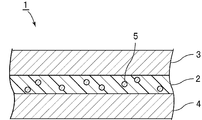
- FIG. 1 is a cross-sectional view schematically showing an example of laminated glass using an interlayer film for laminated glass according to an embodiment of the present invention.
- the interlayer film for laminated glass according to the present invention contains a thermoplastic resin, a plasticizer, heat shielding particles, and at least one component of a phthalocyanine compound, a naphthalocyanine compound, and an anthracocyanine compound.
- a phthalocyanine compound a phthalocyanine compound, naphthalocyanine compound and anthracocyanine compound
- component X at least one component of the phthalocyanine compound, naphthalocyanine compound and anthracocyanine compound.
- the content (parts by weight) of the heat shielding particles with respect to 100 parts by weight of the thermoplastic resin is defined as content A, and the content of the component X with respect to 100 parts by weight of the thermoplastic resin.
- content A is in the range of 0.1 to 3 parts by weight, and the ratio of the content A to the content B (the content A / The content B) is in the range of 3 to 2000.
- the heat shield particles are metal oxide particles
- the content A of the heat shield particles indicates the content of metal oxide particles.
- the heat shield particles are tin-doped indium oxide particles (ITO particles)
- the content A of the heat shield particles indicates the content of ITO particles.
- the main feature of the present invention is that the heat shielding particles and the component X are used in combination, and their contents satisfy the above relationship. Thereby, a laminated glass having a sufficiently high heat shielding property and a sufficiently high visible light transmittance (Visible Transmittance) can be obtained. Furthermore, a laminated glass having a sufficiently low Tts (Total Solar Transmission) and a sufficiently high visible light transmittance (Visible Transmittance) can be obtained. That is, by using the interlayer film for laminated glass according to the present invention, the heat shielding property and transparency of the laminated glass can be enhanced.
- the interlayer film for laminated glass for example, the required performance of cool car regulations (Cool Cars Standards) planned to be introduced by the California Air Resources Board (CARB (California Air Resources Board)) is achieved.
- a laminated glass can be obtained.
- the Tts of the laminated glass can be 53% or less.
- the visible light transmittance of the laminated glass can be 70% or more.
- the performance of the Tts and the visible light transmittance is the performance required by the cool car regulation.
- the Tts is measured, for example, by a measurement method defined by cool car regulations that are scheduled to be introduced.
- the visible light transmittance is measured in accordance with, for example, JIS R3211 (1998).
- thermoplastic resin The said thermoplastic resin contained in the intermediate film for laminated glasses which concerns on this invention is not specifically limited.
- a conventionally well-known thermoplastic resin can be used as said thermoplastic resin.
- the said thermoplastic resin only 1 type may be used and 2 or more types may be used together.
- the thermoplastic resin include polyvinyl acetal resin, ethylene-vinyl acetate copolymer resin, ethylene-acrylic copolymer resin, polyurethane resin, and polyvinyl alcohol resin. Thermoplastic resins other than these may be used.
- the thermoplastic resin is preferably a polyvinyl acetal resin.
- the polyvinyl acetal resin can be produced, for example, by acetalizing polyvinyl alcohol with an aldehyde.
- the polyvinyl alcohol can be obtained, for example, by saponifying polyvinyl acetate.
- the degree of saponification of the polyvinyl alcohol is generally in the range of 80 to 99.8 mol%.
- the preferable lower limit of the polymerization degree of the polyvinyl alcohol is 200, the more preferable lower limit is 500, the preferable upper limit is 3,000, and the more preferable upper limit is 2,500.
- the said polymerization degree is too low, there exists a tendency for the penetration resistance of a laminated glass to fall.
- the said polymerization degree is too high, shaping
- the aldehyde is not particularly limited. In general, an aldehyde having 1 to 10 carbon atoms is preferably used as the aldehyde.
- Examples of the aldehyde having 1 to 10 carbon atoms include n-butyraldehyde, isobutyraldehyde, n-valeraldehyde, 2-ethylbutyraldehyde, n-hexylaldehyde, n-octylaldehyde, n-nonylaldehyde, n- Examples include decyl aldehyde, formaldehyde, acetaldehyde, and benzaldehyde.
- propionaldehyde, n-butyraldehyde, isobutyraldehyde, n-hexylaldehyde or n-valeraldehyde is preferable, propionaldehyde, n-butyraldehyde or isobutyraldehyde is more preferable, and n-butyraldehyde is further preferable.
- the said aldehyde only 1 type may be used and 2 or more types may be used together.
- the hydroxyl group content (hydroxyl content) of the polyvinyl acetal resin is preferably in the range of 15 to 40 mol%.
- the more preferable lower limit of the hydroxyl group content is 18 mol%, and the more preferable upper limit is 35 mol%. If the hydroxyl group content is too low, the adhesion of the interlayer film may be lowered. On the other hand, if the hydroxyl group content is too high, the flexibility of the intermediate film is lowered, and problems in handling the intermediate film are likely to occur.
- the hydroxyl group content of the polyvinyl acetal resin is a value indicating the mole fraction obtained by dividing the amount of ethylene groups to which the hydroxyl group is bonded by the total amount of ethylene groups in the main chain, as a percentage.
- the amount of the ethylene group to which the hydroxyl group is bonded can be determined, for example, by measuring the amount of ethylene group to which the hydroxyl group of polyvinyl alcohol as a raw material is bonded in accordance with JIS K6726 “Testing method for polyvinyl alcohol”. it can.
- the preferable lower limit of the degree of acetylation (acetyl group amount) of the polyvinyl acetal resin is 0.1 mol%, the more preferable lower limit is 0.3 mol%, the still more preferable lower limit is 0.5 mol%, and the preferable upper limit is 30 mol%. A more preferable upper limit is 25 mol%, and a further preferable upper limit is 20 mol%. If the degree of acetylation is too low, the compatibility between the polyvinyl acetal resin and the plasticizer may be reduced. If the degree of acetylation is too high, the moisture resistance of the interlayer film may be lowered.
- the degree of acetylation is obtained by subtracting the amount of ethylene groups to which acetal groups are bonded and the amount of ethylene groups to which hydroxyl groups are bonded from the total amount of ethylene groups of the main chain, It is a value indicating the mole fraction obtained by dividing by the percentage.
- the amount of ethylene group to which the acetal group is bonded can be measured, for example, according to JIS K6728 “Testing method for polyvinyl butyral”.
- the preferable lower limit of the degree of acetalization of the polyvinyl acetal resin (the degree of butyralization when the polyvinyl acetal resin is a polyvinyl butyral resin) is 60 mol%, the more preferable lower limit is 63 mol%, and the preferable upper limit is 85 mol%.
- a preferable upper limit is 75 mol%, and a more preferable upper limit is 70 mol%. If the degree of acetalization is too low, the compatibility between the polyvinyl acetal resin and the plasticizer may be low. When the said acetalization degree is too high, reaction time required in order to manufacture polyvinyl acetal resin may become long.
- the degree of acetalization is a value indicating the mole fraction obtained by dividing the amount of ethylene groups to which acetal groups are bonded by the total amount of ethylene groups in the main chain, as a percentage.
- the degree of acetalization was determined by measuring the degree of acetylation (acetyl group content) and the hydroxyl group content (vinyl alcohol content) according to JIS K6728 “Testing methods for polyvinyl butyral”. The fraction can be calculated and then calculated by subtracting the degree of acetylation and the hydroxyl content from 100 mol%.
- the polyvinyl acetal resin is a polyvinyl butyral resin
- the acetalization degree (butyralization degree) and acetylation degree (acetyl group amount) were measured by a method in accordance with JIS K6728 “Testing methods for polyvinyl butyral”. It can be calculated from the result.
- the said plasticizer contained in the intermediate film for laminated glasses which concerns on this invention is not specifically limited.
- a conventionally known plasticizer can be used as the plasticizer.
- the said plasticizer only 1 type may be used and 2 or more types may be used together.
- plasticizer examples include organic ester plasticizers such as monobasic organic acid esters and polybasic organic acid esters, and phosphate plasticizers such as organic phosphate plasticizers and organic phosphorous acid plasticizers. It is done. Of these, organic ester plasticizers are preferred.
- the plasticizer is preferably a liquid plasticizer.
- the monobasic organic acid ester is not particularly limited.
- examples include esters.
- Examples of the glycol include triethylene glycol, tetraethylene glycol, and tripropylene glycol.
- Examples of the monobasic organic acid include butyric acid, isobutyric acid, caproic acid, 2-ethylbutyric acid, heptylic acid, n-octylic acid, 2-ethylhexylic acid, n-nonylic acid, and decylic acid.
- the polybasic organic acid ester is not particularly limited, and examples thereof include an ester compound of a polybasic organic acid and an alcohol having a linear or branched structure having 4 to 8 carbon atoms.
- Examples of the polybasic organic acid include adipic acid, sebacic acid, and azelaic acid.
- the organic ester plasticizer is not particularly limited, and triethylene glycol di-2-ethylbutyrate, triethylene glycol di-2-ethylhexanoate, triethylene glycol dicaprylate, triethylene glycol di-n- Octanoate, triethylene glycol di-n-heptanoate, tetraethylene glycol di-n-heptanoate, dibutyl sebacate, dioctyl azelate, dibutyl carbitol adipate, ethylene glycol di-2-ethylbutyrate, 1,3-propylene glycol di -2-Ethyl butyrate, 1,4-butylene glycol di-2-ethyl butyrate, diethylene glycol di-2-ethyl butyrate, diethylene glycol di-2-ethyl hexanoate, dipropylene glycol Rudi-2-ethylbutyrate, triethylene glycol di-2-ethylpentanoate, te
- the organophosphate plasticizer is not particularly limited, and examples thereof include tributoxyethyl phosphate, isodecylphenyl phosphate, triisopropyl phosphate, and the like.
- the plasticizer is preferably at least one of triethylene glycol di-2-ethylhexanoate (3GO) and triethylene glycol di-2-ethylbutyrate (3GH), and triethylene glycol di-2 More preferred is ethylhexanoate.
- the content of the plasticizer in the interlayer film for laminated glass according to the present invention is not particularly limited.
- a preferable lower limit of the plasticizer content is 25 parts by weight, a more preferable lower limit is 30 parts by weight, a preferable upper limit is 60 parts by weight, and a more preferable upper limit is 50 parts by weight with respect to 100 parts by weight of the thermoplastic resin.
- fills the said preferable minimum the penetration resistance of a laminated glass can be improved further.
- the heat shielding particles contained in the interlayer film for laminated glass according to the present invention are not particularly limited. As for the said heat-shielding particle, only 1 type may be used and 2 or more types may be used together. Infrared rays having a wavelength longer than 780 nm longer than visible light have a smaller amount of energy than ultraviolet rays. However, infrared rays have a large thermal effect, and once infrared rays are absorbed by a substance, they are released as heat. For this reason, infrared rays are generally called heat rays. By using heat shielding particles such as the ITO particles, infrared rays (heat rays) can be effectively blocked. In addition, a heat shielding particle means the particle
- heat shielding particles include aluminum-doped tin oxide particles, indium-doped tin oxide particles, antimony-doped tin oxide particles (ATO particles), gallium-doped zinc oxide particles (GZO particles), and indium-doped zinc oxide particles (IZO particles).
- Aluminum doped zinc oxide particles (AZO particles), niobium doped titanium oxide particles, sodium doped tungsten oxide particles, cesium doped tungsten oxide particles, thallium doped tungsten oxide particles, rubidium doped tungsten oxide particles, tin doped indium oxide particles (ITO particles) And metal oxide particles such as tin-doped zinc oxide particles and silicon-doped zinc oxide particles, and lanthanum hexaboride (LaB 6 ) particles. Heat shielding particles other than these may be used.
- metal oxide particles are preferable because of their high heat ray shielding function, ATO particles, GZO particles, IZO particles, ITO particles, or cesium-doped tungsten oxide particles are more preferable, and ITO particles are particularly preferable.
- tin-doped indium oxide particles are preferable because they have a high heat ray shielding function and are easily available.
- the preferred lower limit of the average particle diameter of the heat shielding particles is 10 nm, the more preferred lower limit is 20 nm, the preferred upper limit is 80 nm, the more preferred upper limit is 50 nm, and the more preferred upper limit. Is 25 nm.
- the average particle diameter satisfies the above preferable lower limit, the heat ray shielding property can be sufficiently enhanced.
- the average particle diameter satisfies the preferable upper limit the dispersibility of the heat shielding particles can be improved.
- the “average particle diameter” indicates a volume average particle diameter.
- the average particle diameter can be measured using a particle size distribution measuring device (“UPA-EX150” manufactured by Nikkiso Co., Ltd.) or the like.
- the content A indicating the content of the heat shielding particles is in the range of 0.1 to 3 parts by weight.
- the heat shielding property can be made sufficiently high
- the Tts can be made sufficiently low
- the visible light transmittance can be made sufficiently high.
- the Tts can be 53% or less
- the visible light transmittance can be 70% or more.
- the haze value of the laminated glass obtained will become high.
- the preferred lower limit of the content A is 0.14 parts by weight, the more preferred lower limit is 0.2 parts by weight, the still more preferred lower limit is 0.55 parts by weight, the particularly preferred lower limit is 0.6 parts by weight, and the preferred upper limit is 2 parts by weight.
- a more preferred upper limit is 1.8 parts by weight, and a still more preferred upper limit is 1.65 parts by weight.
- the interlayer film for laminated glass of the present invention preferably contains the heat shielding particles at a rate of 0.1 to 12 g / m 2 .
- the heat shielding property can be sufficiently increased, the Tts can be sufficiently decreased, and the visible light transmittance can be sufficiently increased.
- the preferable lower limit of the ratio of the heat shielding particles is 0.5 g / m 2
- the more preferable lower limit is 0.8 g / m 2
- the still more preferable lower limit is 1.5 g / m 2
- the particularly preferable lower limit is 3 g / m 2 .
- the preferred upper limit is 11 g / m 2
- the more preferred upper limit is 10 g / m 2
- the still more preferred upper limit is 9 g / m 2
- the particularly preferred upper limit is 7 g / m 2 .
- the component X is at least one component among phthalocyanine compounds, naphthalocyanine compounds, and anthracocyanine compounds.
- the component X is not particularly limited.
- conventionally known phthalocyanine compounds, naphthalocyanine compounds and anthracocyanine compounds can be used.
- As for the said component X only 1 type may be used and 2 or more types may be used together.
- the combined use of the heat shielding particles and the component X can sufficiently block infrared rays (heat rays). In combination with the ITO particles and the component X, infrared rays can be blocked more effectively.
- the component X include phthalocyanine, a derivative of phthalocyanine, naphthalocyanine, a derivative of naphthalocyanine, anthracyanine, an anthracocyanine derivative, and the like.
- the phthalocyanine compound and the phthalocyanine derivative preferably each have a phthalocyanine skeleton.
- the naphthalocyanine compound and the naphthalocyanine derivative preferably each have a naphthalocyanine skeleton. It is preferable that each of the anthocyanin compound and the derivative of the anthracyanine has an anthracyanine skeleton.
- the component X is at least one selected from the group consisting of phthalocyanine, phthalocyanine derivatives, naphthalocyanine, and naphthalocyanine derivatives. Preferably, it is at least one of naphthalocyanine and naphthalocyanine derivatives.
- the component X preferably contains a vanadium atom or a copper atom, and contains a vanadium atom. Is more preferable, and it is more preferable to contain a copper atom.
- the component X preferably has a structure containing a copper atom.
- the ratio of the content A indicating the content of the heat shielding particles to the content B indicating the content of the component X is in the range of 3 to 2000.
- the heat shielding property can be sufficiently increased, the Tts can be sufficiently decreased, and the visible light transmittance is achieved.
- the Tts can be 53% or less, and the visible light transmittance can be 70% or more.
- the preferable lower limit of the ratio (the content A / the content B) is 6, a more preferable lower limit is 20, a further preferable lower limit is 25, a particularly preferable lower limit is 30, a preferable upper limit is 1300, a more preferable upper limit is 600, and further preferable.
- the upper limit is 250, and a particularly preferred upper limit is 150.
- the interlayer film for laminated glass of the present invention preferably contains the component X at a ratio of 0.01 to 0.5 g / m 2 .
- the ratio of the component X is within the above range, the heat shielding property can be sufficiently increased, the Tts can be sufficiently decreased, and the visible light transmittance can be sufficiently increased. it can.
- a preferred lower limit of the proportion of the component X, 0.05g / m 2, and more preferable lower limit is 0.08 g / m 2, more preferably the lower limit is 0.1 g / m 2, especially preferred lower limit is 0.12 g / m 2 Yes, a preferable upper limit is 0.4 g / m 2 , a more preferable upper limit is 0.3 g / m 2 , a further preferable upper limit is 0.25 g / m 2 , and a particularly preferable upper limit is 0.2 g / m 2 .
- the ratio satisfies the preferable lower limit
- the Tts can be further reduced.
- the visible light transmittance can be further increased.
- the content (content B) of the component X with respect to 100 parts by weight of the thermoplastic resin is not particularly limited, but the preferable lower limit of the content B of the component X is 0.001 part by weight, and the more preferable lower limit is 0.0014 weight. Parts, more preferred lower limit is 0.002 parts by weight, particularly preferred lower limit is 0.0025 parts by weight, preferred upper limit is 0.05 parts by weight, more preferred upper limit is 0.025 parts by weight, and further preferred upper limit is 0.02 parts by weight. A particularly preferred upper limit is 0.01 parts by weight.
- the content B satisfies the preferable lower limit, the heat shielding property can be further increased, and the Tts can be further decreased.
- the visible light transmittance can be further increased.
- the saturation of a laminated glass can be made low.
- the saturation can be measured according to JIS Z8729.
- the preferable upper limit of the saturation of the laminated glass is 65, the more preferable upper limit is 50, the still more preferable upper limit is 40, and the particularly preferable upper limit is 35.
- coloring of the laminated glass can be suppressed.
- the interlayer film for laminated glass according to the present invention includes an ultraviolet absorber, an antioxidant, a light stabilizer, a flame retardant, an antistatic agent, a pigment, a dye, an adhesive force adjusting agent, a moisture resistant agent, and a fluorescent whitening as necessary.
- An additive such as an agent and an infrared absorber may be contained.
- the interlayer film for laminated glass according to the present invention preferably contains an antioxidant.
- the interlayer film for laminated glass according to the present invention preferably contains an ultraviolet absorber.
- FIG. 1 An example of the laminated glass using the intermediate film for laminated glasses which concerns on one Embodiment of this invention is typically shown with sectional drawing.
- a laminated glass 1 shown in FIG. 1 includes an intermediate film 2 and first and second laminated glass constituting members 3 and 4.
- the intermediate film 2 is used to obtain a laminated glass.
- the interlayer film 2 is an interlayer film for laminated glass.
- the intermediate film 2 is disposed between the first and second laminated glass constituting members 3 and 4.
- the intermediate film 2 is sandwiched between the first and second laminated glass constituting members 3 and 4. Therefore, the laminated glass 1 is constituted by laminating the first laminated glass constituting member 3, the intermediate film 2, and the second laminated glass constituting member 4 in this order.
- the intermediate film 2 contains a thermoplastic resin, a plasticizer, ITO particles 5, and a naphthalocyanine compound.
- a component X other than the naphthalocyanine compound may be used.
- a phthalocyanine compound or the like may be used.
- the intermediate film 2 contains a plurality of ITO particles 5. Heat shielding particles other than the ITO particles 5 may be used.
- the intermediate film 2 may have a multilayer structure of two or more layers.
- the first and second laminated glass constituent members 3 and 4 include glass plates and PET (polyethylene terephthalate) films.
- the laminated glass 1 includes not only laminated glass in which an intermediate film is sandwiched between two glass plates, but also laminated glass in which an intermediate film is sandwiched between a glass plate and a PET film or the like.
- Laminated glass 1 is a glass plate-containing laminate, and at least one glass plate is preferably used.
- the glass plate examples include inorganic glass and organic glass.
- the inorganic glass examples include float plate glass, heat ray absorbing plate glass, heat ray reflecting plate glass, polished plate glass, mold plate glass, mesh plate glass, wire plate glass, and green glass.
- the organic glass is a synthetic resin glass substituted for inorganic glass.
- the organic glass examples include polycarbonate plates and poly (meth) acrylic resin plates.
- the poly (meth) acrylic resin plate include a polymethyl (meth) acrylate plate.
- the thickness of the first and second laminated glass constituting members 3 and 4 is preferably 1 mm or more, preferably 5 mm or less, more preferably 3 mm or less. Moreover, when the laminated glass structural members 3 and 4 are glass plates, the thickness of the glass plates is preferably 1 mm or more, preferably 5 mm or less, more preferably 3 mm or less. When the laminated glass constituting members 3 and 4 are PET films, the thickness of the PET film is preferably in the range of 0.03 to 0.5 mm.
- the manufacturing method of the laminated glass 1 is not particularly limited.
- the intermediate film 2 is sandwiched between the first and second laminated glass constituent members 3 and 4 and passed through a pressing roll, or put in a rubber bag and sucked under reduced pressure.
- the air remaining between the laminated glass constituent members 3 and 4 and the intermediate film 2 is deaerated. Thereafter, it is pre-adhered at about 70 to 110 ° C. to obtain a laminate.
- the laminate is put in an autoclave or pressed and pressed at about 120 to 150 ° C. and a pressure of 1 to 1.5 MPa.
- the laminated glass 1 can be obtained.
- Laminated glass 1 can be used for automobiles, railway vehicles, aircraft, ships and buildings.
- the laminated glass 1 can be used for a windshield, side glass, rear glass, roof glass, or the like of an automobile.
- the laminated glass 1 can be used for other purposes. Since the heat shielding property is high, the Tts is low, and the visible light transmittance is high, the laminated glass 1 is suitably used for an automobile.
- the Tts of the laminated glass 1 is preferably 53% or less, preferably 50% or less, and preferably 40% or less. Furthermore, from the viewpoint of obtaining a laminated glass that is more excellent in transparency, the visible light transmittance of the laminated glass 1 is preferably 70% or more.
- the visible light transmittance of the laminated glass obtained by sandwiching the interlayer film for laminated glass of the present invention between two glass plates having a thickness of 2.0 mm is preferably 70% or more. Furthermore, the visible light transmittance of the laminated glass obtained by sandwiching the interlayer film for laminated glass of the present invention between two heat ray absorbing plate glasses having a thickness of 2.0 mm is preferably 70% or more. .
- the heat ray absorbing plate glass is preferably a heat ray absorbing plate glass based on JIS R3208.
- the visible light transmittance of the laminated glass obtained by sandwiching the interlayer film for laminated glass having a thickness of 0.76 mm between two heat ray absorbing plate glasses having a thickness of 2.0 mm is 70% or more. It is preferable.
- the visible light transmittance means the visible light transmittance at a wavelength of 380 to 780 nm of the laminated glass obtained by measurement according to JIS R3211 (1998).
- the apparatus for measuring the visible light transmittance is not particularly limited.
- a spectrophotometer (“U-4100” manufactured by Hitachi High-Tech) can be used.
- Example 1 (1) Preparation of dispersion 40 parts by weight of triethylene glycol di-2-ethylhexanoate (3GO), 0.98 parts by weight of ITO particles (manufactured by Mitsubishi Materials), and naphthalocyanine compound (copper naphthalocyanine compound, After mixing 0.0182 parts by weight of “FF IRSORB 203” manufactured by Fujifilm, and further adding a phosphate ester compound as a dispersant, the mixture was mixed in a horizontal microbead mill to obtain a mixed solution. Thereafter, 0.1 part by weight of acetylacetone was added to the mixed solution with stirring to prepare a dispersion. The content of the phosphate ester compound was adjusted to be 1/10 of the content of the heat shielding particles.
- 3GO triethylene glycol di-2-ethylhexanoate
- ITO particles manufactured by Mitsubishi Materials
- naphthalocyanine compound copper naphthalocyanine compound
- Example 2 to 13 and Comparative Examples 1 to 4 A dispersion, an interlayer film for laminated glass, and a laminated glass were produced in the same manner as in Example 1 except that the composition (blending amount) of the interlayer film for laminated glass was changed as shown in Table 1 below. .
- the content of the phosphate ester compound was adjusted to be 1/10 of the content of the heat shielding particles.
- Comparative Example 3 no phosphate ester compound was used.
- Tts and Tds Solar Direct Transmission
- the Tts and Tds of the obtained laminated glass were measured in accordance with the measurement method defined by the cool car regulation that was scheduled to be introduced. Specifically, the Tts and the Tds were measured according to JIS R3106 (1998) using a spectrophotometer (“U-4100” manufactured by Hitachi High-Tech).
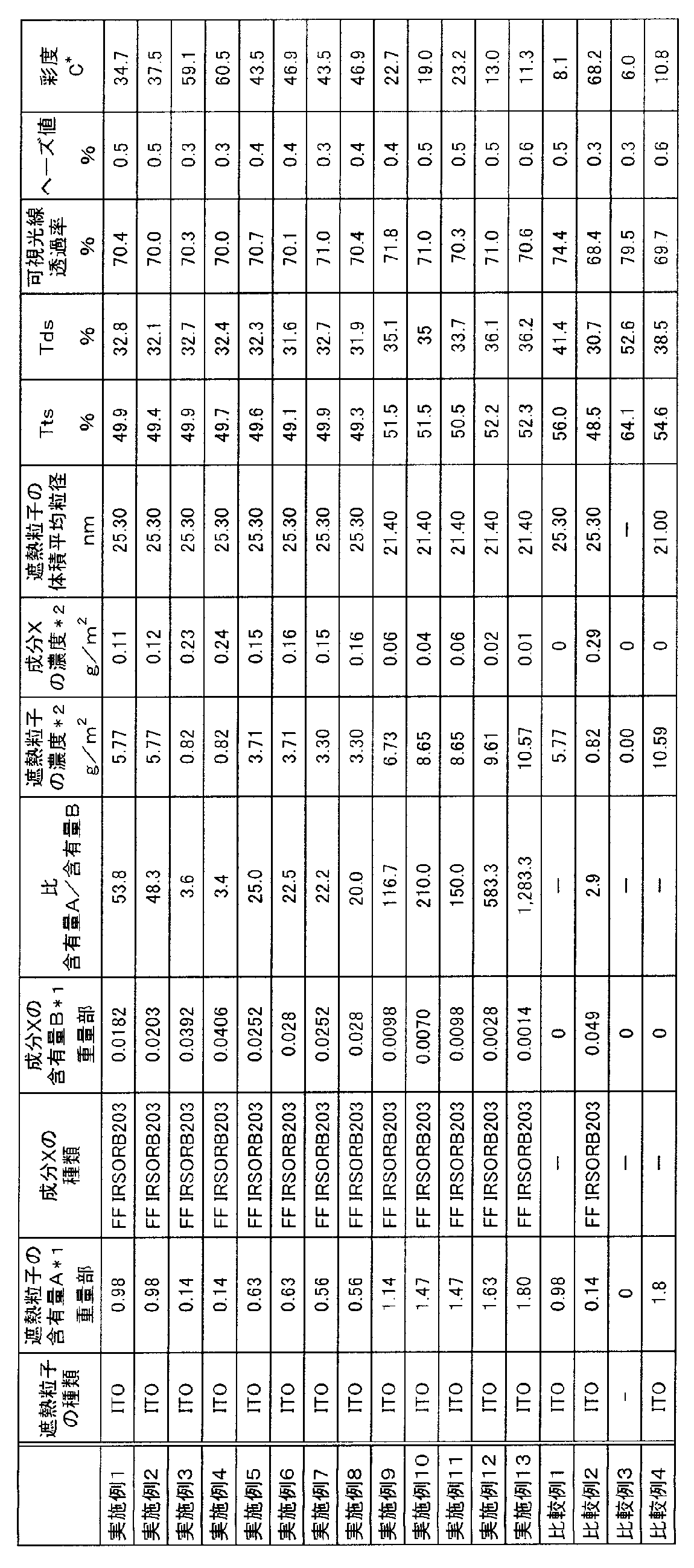
- Table 1 The results are shown in Table 1 below.
- Table 1 the volume average particle diameter of the heat shielding particles in the dispersion is shown.
- * 1 indicates the content (parts by weight) relative to 100 parts by weight of the thermoplastic resin
- * 2 indicates the ratio (g / m 2 ) in the interlayer film for laminated glass.
- Table 1 below the description of the content of the phosphate ester compound is omitted.
- Example 14 Except for changing the ITO particles (Mitsubishi Materials Co., Ltd.) to IZO particles and further changing the composition (blending amount) of the interlayer film for laminated glass as shown in Table 1 below, in the same manner as in Example 1, A dispersion, an interlayer film for laminated glass, and a laminated glass were produced.
- the content of the phosphate ester compound was adjusted to be 1/10 of the content of the heat shielding particles.
- Example 15 Except for changing the ITO particles (Mitsubishi Materials Co., Ltd.) to ATO particles and further changing the composition (blending amount) of the interlayer film for laminated glass as shown in Table 1 below, in the same manner as in Example 1, A dispersion, an interlayer film for laminated glass, and a laminated glass were produced.
- the content of the phosphate ester compound was adjusted to be 1/10 of the content of the heat shielding particles.
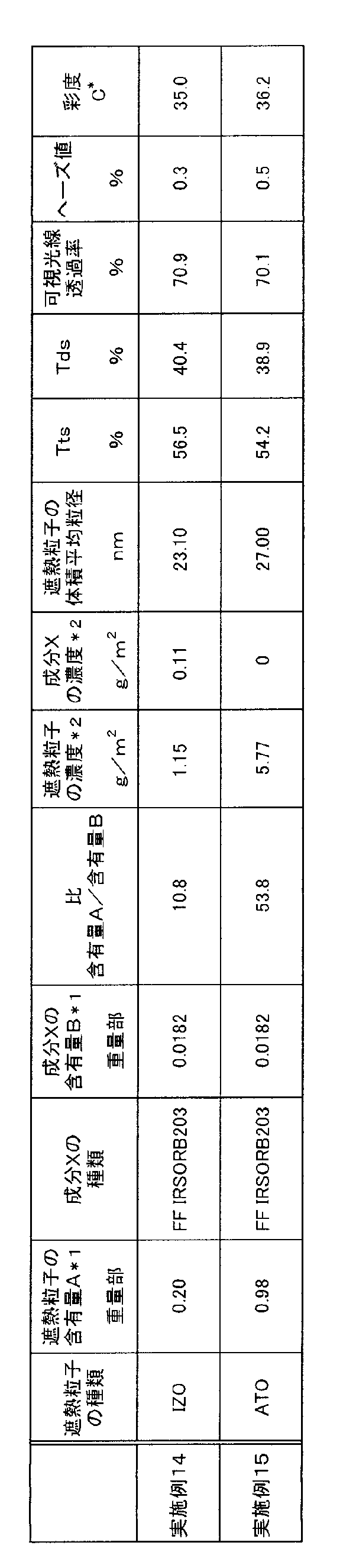
- Table 2 The results are shown in Table 2 below.
- Table 2 the volume average particle diameter of the heat shielding particles in the dispersion is shown.
- * 1 indicates the content (parts by weight) relative to 100 parts by weight of the thermoplastic resin
- * 2 indicates the ratio (g / m 2 ) in the interlayer film for laminated glass.
- Table 2 the description of the content of the phosphate ester compound is omitted.
- Examples 1 to 15 and Comparative Examples 1 to 4 except that two transparent float glasses (length 30 cm ⁇ width 30 cm ⁇ thickness 2.5 mm) were used instead of the two heat ray absorbing plate glasses.
- the laminated glass obtained in the same manner was evaluated for the laminated glass of Examples 1 to 15 and Comparative Examples 1 to 4 as the results of evaluating Tts, Tds, visible light transmittance, haze value, and saturation. The tendency was similar to the result value.
Landscapes
- Chemical & Material Sciences (AREA)
- Organic Chemistry (AREA)
- Chemical Kinetics & Catalysis (AREA)
- Polymers & Plastics (AREA)
- Health & Medical Sciences (AREA)
- Medicinal Chemistry (AREA)
- Engineering & Computer Science (AREA)
- Ceramic Engineering (AREA)
- Geochemistry & Mineralogy (AREA)
- Materials Engineering (AREA)
- General Chemical & Material Sciences (AREA)
- Life Sciences & Earth Sciences (AREA)
- Joining Of Glass To Other Materials (AREA)
- Compositions Of Macromolecular Compounds (AREA)
- Laminated Bodies (AREA)
- Manufacture Of Macromolecular Shaped Articles (AREA)
Abstract
Description
さらに、上記合わせガラスには、遮熱性が高いだけでなく、可視光線透過率(Visible Transmittance)が高いことも要求される。例えば、可視光線透過率は70%以上であることが望ましい。すなわち、上記可視光線透過率を高く維持したままで、上記Ttsを低くすることが要求される。
本発明に係る合わせガラス用中間膜の他の特定の局面では、上記比(上記含有量A/上記含有量B)は25~600の範囲内である。
本発明に係る合わせガラス用中間膜のさらに他の特定の局面では、上記含有量Bは0.001~0.02重量部の範囲内である。
本発明に係る合わせガラス用中間膜のさらに別の特定の局面では、上記遮熱粒子は錫ドープ酸化インジウム粒子である。
本発明に係る合わせガラス用中間膜は、熱可塑性樹脂と、可塑剤と、遮熱粒子と、フタロシアニン化合物、ナフタロシアニン化合物及びアントラシアニン化合物の内の少なくとも一種の成分とを含有する。以下、フタロシアニン化合物、ナフタロシアニン化合物及びアントラシアニン化合物の内の少なくとも一種の成分を、成分Xと記載することがある。
本発明に係る合わせガラス用中間膜に含まれている上記熱可塑性樹脂は特に限定されない。上記熱可塑性樹脂として、従来公知の熱可塑性樹脂を用いることができる。上記熱可塑性樹脂は1種のみが用いられてもよく、2種以上が併用されてもよい。
上記熱可塑性樹脂としては、ポリビニルアセタール樹脂、エチレン-酢酸ビニル共重合体樹脂、エチレン-アクリル共重合体樹脂、ポリウレタン樹脂及びポリビニルアルコール樹脂等が挙げられる。これら以外の熱可塑性樹脂を用いてもよい。
上記ポリビニルアセタール樹脂は、例えば、ポリビニルアルコールをアルデヒドによりアセタール化することにより製造できる。上記ポリビニルアルコールは、例えば、ポリ酢酸ビニルをけん化することにより得られる。上記ポリビニルアルコールのけん化度は、一般に80~99.8モル%の範囲内である。
上記アセタール化度は、JIS K6728「ポリビニルブチラール試験方法」に準拠した方法により、アセチル化度(アセチル基量)と水酸基の含有率(ビニルアルコール量)とを測定し、得られた測定結果からモル分率を算出し、ついで、100モル%からアセチル化度と水酸基の含有率とを差し引くことにより算出され得る。
本発明に係る合わせガラス用中間膜に含まれている上記可塑剤は特に限定されない。上記可塑剤として、従来公知の可塑剤を用いることができる。上記可塑剤は、1種のみが用いられてもよく、2種以上が併用されてもよい。
上記可塑剤は、トリエチレングリコールジ-2-エチルヘキサノエート(3GO)及びトリエチレングリコールジ-2-エチルブチレート(3GH)の内の少なくとも一種であることが好ましく、トリエチレングリコールジ-2-エチルヘキサノエートであることがより好ましい。
本発明に係る合わせガラス用中間膜に含まれている遮熱粒子は、特に限定されない。上記遮熱粒子は、1種のみが用いられてもよく、2種以上が併用されてもよい。
可視光よりも長い波長780nm以上の赤外線は、紫外線と比較して、エネルギー量が小さい。しかしながら、赤外線は熱的作用が大きく、赤外線が物質にいったん吸収されると熱として放出される。このため、赤外線は一般に熱線と呼ばれている。上記ITO粒子などの遮熱粒子の使用により、赤外線(熱線)を効果的に遮断できる。なお、遮熱粒子とは、赤外線を吸収することができる粒子を意味する。
合わせガラスの透明性及び遮熱性をより一層高める観点からは、上記遮熱粒子の平均粒子径の好ましい下限は10nm、より好ましい下限は20nm、好ましい上限は80nm、より好ましい上限は50nm、更に好ましい上限は25nmである。平均粒子径が上記好ましい下限を満たすと、熱線の遮蔽性を充分に高めることができる。平均粒子径が上記好ましい上限を満たすと、遮熱粒子の分散性を高めることができる。
上記遮熱粒子の含有量を示す上記含有量Aは0.1~3重量部の範囲内である。上記含有量Aが上記範囲内である場合には、遮熱性を充分に高くすることができ、上記Ttsを充分に低くすることができ、かつ上記可視光線透過率を充分に高くすることができる。例えば、上記Ttsを53%以下にすることができ、かつ上記可視光線透過率を70%以上にすることができる。また、上記含有量Aが3重量部を超えると、得られる合わせガラスのヘーズ値が高くなる。上記含有量Aの好ましい下限は0.14重量部、より好ましい下限は0.2重量部、更に好ましい下限は0.55重量部、特に好ましい下限は0.6重量部、好ましい上限は2重量部、より好ましい上限は1.8重量部、更に好ましい上限は1.65重量部である。上記含有量Aが上記好ましい下限を満たすと、遮熱性をより一層高くすることができ、上記Ttsをより一層低くすることができる。上記含有量Aが上記好ましい上限を満たすと、上記可視光線透過率をより一層高くすることができる。
上記成分Xは、フタロシアニン化合物、ナフタロシアニン化合物及びアントラシアニン化合物の内の少なくとも一種の成分である。
上記成分Xは特に限定されない。上記成分Xとして、従来公知のフタロシアニン化合物、ナフタロシアニン化合物及びアントラシアニン化合物を用いることができる。上記成分Xは、1種のみが用いられてもよく、2種以上が併用されてもよい。
上記成分Xとしては、フタロシアニン、フタロシアニンの誘導体、ナフタロシアニン、ナフタロシアニンの誘導体、アントラシアニン及びアントラシアニンの誘導体等が挙げられる。上記フタロシアニン化合物及び上記フタロシアニンの誘導体はそれぞれ、フタロシアニン骨格を有することが好ましい。上記ナフタロシアニン化合物及び上記ナフタロシアニンの誘導体はそれぞれ、ナフタロシアニン骨格を有することが好ましい。上記アントラシアニン化合物及び上記アントラシアニンの誘導体はそれぞれ、アントラシアニン骨格を有することが好ましい。
本発明に係る合わせガラス用中間膜は、必要に応じて、紫外線吸収剤、酸化防止剤、光安定剤、難燃剤、帯電防止剤、顔料、染料、接着力調整剤、耐湿剤、蛍光増白剤及び赤外線吸収剤等の添加剤を含有していてもよい。本発明に係る合わせガラス用中間膜は、酸化防止剤を含有することが好ましい。本発明に係る合わせガラス用中間膜は、紫外線吸収剤を含有することが好ましい。
図1に、本発明の一実施形態に係る合わせガラス用中間膜を用いた合わせガラスの一例を模式的に断面図で示す。
図1に示す合わせガラス1は、中間膜2と、第1,第2の合わせガラス構成部材3,4とを備える。中間膜2は、合わせガラスを得るために用いられる。中間膜2は、合わせガラス用中間膜である。中間膜2は、第1,第2の合わせガラス構成部材3,4の間に配置されている。中間膜2は、第1,第2の合わせガラス構成部材3,4の間に挟み込まれている。従って、合わせガラス1は、第1の合わせガラス構成部材3と、中間膜2と、第2の合わせガラス構成部材4とがこの順で積層されて構成されている。
(1)分散液の作製
トリエチレングリコールジ-2-エチルヘキサノエート(3GO)40重量部、ITO粒子(三菱マテリアル社製)0.98重量部、及び、ナフタロシアニン化合物(銅ナフタロシアニン化合物、富士フイルム社製「FF IRSORB203」)0.0182重量部を混合し、さらに、分散剤であるリン酸エステル化合物を添加した後、水平型のマイクロビーズミルにて混合し、混合液を得た。その後、混合液にアセチルアセトン0.1重量部を撹拌下で添加し、分散液を作製した。なお、リン酸エステル化合物の含有量は遮熱粒子の含有量の1/10となるように調整した。
ポリビニルブチラール樹脂(ブチラール化度68.5モル%、水酸基量30.5モル%)100重量部に対し、得られた分散液全量を添加し、ミキシングロールで充分に溶融混練した後、押出機を用いて押出して、厚み0.76mmの中間膜を得た。
得られた合わせガラス用中間膜を、その両端からJIS R3208に準拠した2枚の熱線吸収板ガラス(縦30cm×横30cm×厚さ2.0mm)で挟み込み、積層体を得た。この積層体をゴムバック内に入れ、2.6kPaの真空度で20分間脱気した後、脱気したままオーブン内に移し、更に90℃で30分間保持して真空プレスし、積層体を予備圧着した。オートクレーブ中で135℃及び圧力1.2MPaの条件で、仮圧着された積層体を20分間圧着し、合わせガラスを得た。
合わせガラス用中間膜の組成(配合量)を下記の表1に示すように変更したこと以外は、実施例1と同様にして、分散液、合わせガラス用中間膜、及び、合わせガラスを作製した。なお、実施例2~13及び比較例1~2,4でも、リン酸エステル化合物の含有量は遮熱粒子の含有量の1/10となるように調整した。比較例3では、リン酸エステル化合物を用いなかった。
(1)Tts、及び、Tds(Solar Direct Transmittance)の測定
導入が予定されていた上記クールカー規制により定められた測定方法に従って、得られた合わせガラスの上記Tts及び上記Tdsを測定した。具体的には、分光光度計(日立ハイテク社製「U-4100」)を用いて、JIS R3106(1998)に準拠して、上記Tts及び上記Tdsを測定した。
分光光度計(日立ハイテク社製「U-4100」)を用いて、JIS R3211(1998)に準拠して、得られた合わせガラスの波長380~780nmにおける上記可視光線透過率を測定した。
ヘーズメーター(東京電色社製「TC-HIIIDPK」)を用いて、JIS K6714に準拠して、得られた合わせガラスのヘーズ値を測定した。
分光光度計(日立ハイテク社製「U-4100」)を用いて、JIS R3211(1998)に準拠して、得られた合わせガラスの波長380~780nmにおける上記可視光線透過率を測定した。次に、JIS Z8729に準拠して、L*a*b*表色系におけるa*およびb*を算出した。算出したa*およびb*を基に、以下の数式を用いて、L*C*h表色系における彩度C*を算出した。
[C*]=([a*]2+[b*]2)0.5
ITO粒子(三菱マテリアル社製)をIZO粒子に変更し、更に合わせガラス用中間膜の組成(配合量)を下記の表1に示すように変更したこと以外は、実施例1と同様にして、分散液、合わせガラス用中間膜、及び、合わせガラスを作製した。なお、実施例14でも、リン酸エステル化合物の含有量は遮熱粒子の含有量の1/10となるように調整した。
ITO粒子(三菱マテリアル社製)をATO粒子に変更し、更に合わせガラス用中間膜の組成(配合量)を下記の表1に示すように変更したこと以外は、実施例1と同様にして、分散液、合わせガラス用中間膜、及び、合わせガラスを作製した。なお、実施例15でも、リン酸エステル化合物の含有量は遮熱粒子の含有量の1/10となるように調整した。
実施例1~13及び比較例1~4と同様の評価項目(1)~(4)について、評価を実施した。
2…合わせガラス用中間膜
3…第1の合わせガラス構成部材
4…第2の合わせガラス構成部材
5…ITO粒子
Claims (9)
- 熱可塑性樹脂と、
可塑剤と、
遮熱粒子と、
フタロシアニン化合物、ナフタロシアニン化合物及びアントラシアニン化合物の内の少なくとも一種の成分とを含有し、
前記熱可塑性樹脂100重量部に対する前記遮熱粒子の含有量を含有量Aとし、前記熱可塑性樹脂100重量部に対する前記成分の含有量を含有量Bとしたときに、前記含有量Aが0.1~3重量部の範囲内であり、かつ、前記含有量Aの前記含有量Bに対する比(前記含有量A/前記含有量B)が3~2000の範囲内である、合わせガラス用中間膜。 - 前記比(前記含有量A/前記含有量B)が6~1300の範囲内である、請求項1に記載の合わせガラス用中間膜。
- 前記比(前記含有量A/前記含有量B)が25~600の範囲内である、請求項1に記載の合わせガラス用中間膜。
- 前記含有量Aが0.2~2重量部の範囲内である、請求項1~3のいずれか1項に記載の合わせガラス用中間膜。
- 前記含有量Bが0.001~0.02重量部の範囲内である、請求項1~3のいずれか1項に記載の合わせガラス用中間膜。
- 前記成分が、フタロシアニン、フタロシアニンの誘導体、ナフタロシアニン及びナフタロシアニンの誘導体からなる群から選択される少なくとも一種である、請求項1~3のいずれか1項に記載の合わせガラス用中間膜。
- 前記遮熱粒子が、金属酸化物粒子である、請求項1~3のいずれか1項に記載の合わせガラス用中間膜。
- 前記遮熱粒子が、錫ドープ酸化インジウム粒子である、請求項7に記載の合わせガラス用中間膜。
- 第1,第2の合わせガラス構成部材と、
前記第1,第2の合わせガラス構成部材の間に挟み込まれた中間膜とを備え、
前記中間膜が、請求項1~3のいずれか1項に記載の合わせガラス用中間膜である、合わせガラス。
Priority Applications (8)
| Application Number | Priority Date | Filing Date | Title |
|---|---|---|---|
| CN2010800372409A CN102625785A (zh) | 2009-08-24 | 2010-08-24 | 夹层玻璃用中间膜及夹层玻璃 |
| RU2012111202/03A RU2526951C2 (ru) | 2009-08-24 | 2010-08-24 | Промежуточная пленка для многослойного стекла и многослойное стекло |
| KR1020127004675A KR101782657B1 (ko) | 2009-08-24 | 2010-08-24 | 접합 유리용 중간막 및 접합 유리 |
| MX2012001806A MX336801B (es) | 2009-08-24 | 2010-08-24 | Pelicula intermedia para vidrio laminado y vidrio laminado. |
| US13/391,679 US20120164457A1 (en) | 2009-08-24 | 2010-08-24 | Intermediate film for laminated glass, and laminated glass |
| BR112012003911A BR112012003911B1 (pt) | 2009-08-24 | 2010-08-24 | película intermediária para vidro laminado e vidro laminado |
| JP2010533371A JP4949519B2 (ja) | 2009-08-24 | 2010-08-24 | 合わせガラス用中間膜及び合わせガラス |
| EP20100811837 EP2471761B1 (en) | 2009-08-24 | 2010-08-24 | Intermediate film for laminated glass, and laminated glass |
Applications Claiming Priority (4)
| Application Number | Priority Date | Filing Date | Title |
|---|---|---|---|
| JP2009-193720 | 2009-08-24 | ||
| JP2009193720 | 2009-08-24 | ||
| JP2009-225598 | 2009-09-29 | ||
| JP2009225598 | 2009-09-29 |
Publications (1)
| Publication Number | Publication Date |
|---|---|
| WO2011024787A1 true WO2011024787A1 (ja) | 2011-03-03 |
Family
ID=43627892
Family Applications (1)
| Application Number | Title | Priority Date | Filing Date |
|---|---|---|---|
| PCT/JP2010/064246 Ceased WO2011024787A1 (ja) | 2009-08-24 | 2010-08-24 | 合わせガラス用中間膜及び合わせガラス |
Country Status (9)
| Country | Link |
|---|---|
| US (1) | US20120164457A1 (ja) |
| EP (2) | EP2692708B1 (ja) |
| JP (2) | JP4949519B2 (ja) |
| KR (1) | KR101782657B1 (ja) |
| CN (4) | CN103641337B (ja) |
| BR (1) | BR112012003911B1 (ja) |
| MX (1) | MX336801B (ja) |
| RU (1) | RU2526951C2 (ja) |
| WO (1) | WO2011024787A1 (ja) |
Cited By (9)
| Publication number | Priority date | Publication date | Assignee | Title |
|---|---|---|---|---|
| WO2012108537A1 (ja) * | 2011-02-10 | 2012-08-16 | 積水化学工業株式会社 | 合わせガラス用中間膜及び合わせガラス |
| JP2012250879A (ja) * | 2011-06-03 | 2012-12-20 | Sekisui Chem Co Ltd | サーモクロミック性フィルム、合わせガラス用中間膜、合わせガラス及び貼り付け用フィルム |
| WO2013065662A1 (ja) * | 2011-11-01 | 2013-05-10 | 日本化薬株式会社 | 熱線遮蔽性粘着剤組成物および熱線遮蔽性粘着シート |
| WO2013118890A1 (ja) * | 2012-02-10 | 2013-08-15 | 積水化学工業株式会社 | 合わせガラス用中間膜及び合わせガラス |
| WO2015019921A1 (ja) | 2013-08-05 | 2015-02-12 | 旭硝子株式会社 | 車両用の合わせガラス |
| WO2015174196A1 (ja) * | 2014-05-15 | 2015-11-19 | 旭硝子株式会社 | 合わせガラス用中間膜および合わせガラス |
| CN103842463B (zh) * | 2011-11-01 | 2016-11-30 | 日本化药株式会社 | 热射线屏蔽性粘合剂组合物和热射线屏蔽性粘合片 |
| US10427384B2 (en) | 2014-11-10 | 2019-10-01 | Kuraray Co., Ltd. | Interlayer film for laminated glass and laminated glass |
| US10538063B2 (en) | 2016-05-09 | 2020-01-21 | Kuraray America, Inc. | Multilayer interlayer and glass laminate |
Families Citing this family (16)
| Publication number | Priority date | Publication date | Assignee | Title |
|---|---|---|---|---|
| WO2011024787A1 (ja) * | 2009-08-24 | 2011-03-03 | 積水化学工業株式会社 | 合わせガラス用中間膜及び合わせガラス |
| US20120171479A1 (en) * | 2009-09-29 | 2012-07-05 | Juichi Fukatani | Intermediate film for laminated glass, and laminated glass |
| EP2610226B1 (en) * | 2010-08-24 | 2015-09-30 | Sekisui Chemical Co., Ltd. | Interlayer film for laminated glass, and laminated glass |
| JP4975892B2 (ja) * | 2010-09-30 | 2012-07-11 | 積水化学工業株式会社 | 合わせガラス用中間膜及び合わせガラス |
| EP2883847B1 (en) | 2012-07-31 | 2018-03-07 | Sekisui Chemical Co., Ltd. | Intermediate film for laminated glass, laminated glass, and method of mounting laminated glass |
| US10442163B2 (en) | 2013-06-14 | 2019-10-15 | Sekisui Chemical Co., Ltd. | Multilayer interlayer film having infrared ray reflection layer and thermoplastic resin, and laminated glass having such film |
| CN103641336A (zh) * | 2013-08-23 | 2014-03-19 | 南京凯尚信息科技有限公司 | 一种防紫外线及红外线隔热夹胶玻璃 |
| US20160332424A1 (en) * | 2014-01-31 | 2016-11-17 | Sekisui Chemical Co., Ltd. | Intermediate film for laminated glass, laminated glass and method for fitting laminated glass |
| DE102014214250B4 (de) | 2014-07-22 | 2021-09-02 | se ma Gesellschaft für Innovationen mbH | UV/VIS-absorbierendes Verbundglas und Verfahren zu dessen Herstellung |
| RU2703627C2 (ru) * | 2014-09-11 | 2019-10-21 | Секисуй Кемикал Ко., Лтд. | Промежуточная пленка для многослойного стекла, многослойное стекло и способ установки многослойного стекла |
| US10252495B2 (en) * | 2014-09-29 | 2019-04-09 | Sekisui Chemical Co., Ltd. | Intermediate film for laminated glass, and laminated glass |
| CN104527164A (zh) * | 2014-12-08 | 2015-04-22 | 南车青岛四方机车车辆股份有限公司 | 一种轨道车辆用夹胶玻璃及其加工方法 |
| CN107406661B (zh) * | 2015-04-09 | 2020-04-07 | 日本瑞翁株式会社 | 树脂组合物及其利用 |
| EP3604451A4 (en) * | 2017-03-31 | 2021-02-24 | Sekisui Chemical Co., Ltd. | THERMOPLASTIC RESIN FILM AND GLASS PANEL LAMINATE |
| KR102050664B1 (ko) * | 2018-06-05 | 2019-11-29 | 에스케이씨 주식회사 | 유리접합용 필름, 이의 제조방법 및 이를 포함하는 이동수단 |
| KR20240009412A (ko) * | 2021-05-18 | 2024-01-22 | 세키스이가가쿠 고교가부시키가이샤 | 분산액, 수지 조성물, 접합 유리용 중간막 및 접합 유리 |
Citations (2)
| Publication number | Priority date | Publication date | Assignee | Title |
|---|---|---|---|---|
| WO2001025162A1 (fr) | 1999-10-01 | 2001-04-12 | Sekisui Chemical Co., Ltd. | Film intermediaire pour verre feuillete et verre feuillete |
| WO2003018502A1 (en) * | 2001-07-26 | 2003-03-06 | Sekisui Chemical Co., Ltd. | Laminated glass-use intermediate film and laminated glass |
Family Cites Families (10)
| Publication number | Priority date | Publication date | Assignee | Title |
|---|---|---|---|---|
| ATE87752T1 (de) * | 1988-01-15 | 1993-04-15 | Du Pont | Verfahren zur herstellung von reflexionshologrammen in photopolymerisierbaren schichten. |
| DE19654296A1 (de) * | 1996-12-27 | 1998-07-02 | Bollig & Kemper Gmbh & Co Kg | Beschichtung für ein elektrisch leitfähiges Substrat |
| WO2006025484A1 (ja) * | 2004-09-02 | 2006-03-09 | Sekisui Chemical Co., Ltd. | 合わせガラス用中間膜及び合わせガラス |
| RU2395397C2 (ru) * | 2004-10-01 | 2010-07-27 | Секисуй Кемикал Ко., Лтд. | Лист и слоистый материал из термопластичной смолы |
| JP2006240893A (ja) * | 2005-02-28 | 2006-09-14 | Sekisui Chem Co Ltd | 合わせガラス用着色中間膜および合わせガラス |
| US20080057185A1 (en) * | 2005-12-30 | 2008-03-06 | Wall Jason S | Solar control laminates |
| WO2007132777A1 (ja) * | 2006-05-12 | 2007-11-22 | Sekisui Chemical Co., Ltd. | 合わせガラス用中間膜及び合わせガラス |
| EP2471762B1 (en) * | 2009-08-24 | 2016-04-13 | Sekisui Chemical Co., Ltd. | Intermediate film for laminated glass, and laminated glass |
| WO2011024787A1 (ja) * | 2009-08-24 | 2011-03-03 | 積水化学工業株式会社 | 合わせガラス用中間膜及び合わせガラス |
| US20120171479A1 (en) * | 2009-09-29 | 2012-07-05 | Juichi Fukatani | Intermediate film for laminated glass, and laminated glass |
-
2010
- 2010-08-24 WO PCT/JP2010/064246 patent/WO2011024787A1/ja not_active Ceased
- 2010-08-24 MX MX2012001806A patent/MX336801B/es active IP Right Grant
- 2010-08-24 KR KR1020127004675A patent/KR101782657B1/ko active Active
- 2010-08-24 EP EP20130190935 patent/EP2692708B1/en active Active
- 2010-08-24 CN CN201310571292.XA patent/CN103641337B/zh active Active
- 2010-08-24 BR BR112012003911A patent/BR112012003911B1/pt active IP Right Grant
- 2010-08-24 US US13/391,679 patent/US20120164457A1/en not_active Abandoned
- 2010-08-24 EP EP20100811837 patent/EP2471761B1/en active Active
- 2010-08-24 JP JP2010533371A patent/JP4949519B2/ja active Active
- 2010-08-24 CN CN201510483769.8A patent/CN105153609A/zh active Pending
- 2010-08-24 CN CN2010800372409A patent/CN102625785A/zh active Pending
- 2010-08-24 RU RU2012111202/03A patent/RU2526951C2/ru active
- 2010-08-24 CN CN201310571286.4A patent/CN103693864B/zh active Active
-
2012
- 2012-03-06 JP JP2012049113A patent/JP5662957B2/ja active Active
Patent Citations (2)
| Publication number | Priority date | Publication date | Assignee | Title |
|---|---|---|---|---|
| WO2001025162A1 (fr) | 1999-10-01 | 2001-04-12 | Sekisui Chemical Co., Ltd. | Film intermediaire pour verre feuillete et verre feuillete |
| WO2003018502A1 (en) * | 2001-07-26 | 2003-03-06 | Sekisui Chemical Co., Ltd. | Laminated glass-use intermediate film and laminated glass |
Non-Patent Citations (1)
| Title |
|---|
| See also references of EP2471761A4 |
Cited By (21)
| Publication number | Priority date | Publication date | Assignee | Title |
|---|---|---|---|---|
| JP2013216571A (ja) * | 2011-02-10 | 2013-10-24 | Sekisui Chem Co Ltd | 合わせガラス用中間膜及び合わせガラス |
| WO2012108537A1 (ja) * | 2011-02-10 | 2012-08-16 | 積水化学工業株式会社 | 合わせガラス用中間膜及び合わせガラス |
| JP5340478B2 (ja) * | 2011-02-10 | 2013-11-13 | 積水化学工業株式会社 | 合わせガラス用中間膜及び合わせガラス |
| JP2012250879A (ja) * | 2011-06-03 | 2012-12-20 | Sekisui Chem Co Ltd | サーモクロミック性フィルム、合わせガラス用中間膜、合わせガラス及び貼り付け用フィルム |
| JPWO2013065662A1 (ja) * | 2011-11-01 | 2015-04-02 | 日本化薬株式会社 | 熱線遮蔽性粘着剤組成物および熱線遮蔽性粘着シート |
| CN103842463B (zh) * | 2011-11-01 | 2016-11-30 | 日本化药株式会社 | 热射线屏蔽性粘合剂组合物和热射线屏蔽性粘合片 |
| CN103842463A (zh) * | 2011-11-01 | 2014-06-04 | 日本化药株式会社 | 热射线屏蔽性粘合剂组合物和热射线屏蔽性粘合片 |
| WO2013065662A1 (ja) * | 2011-11-01 | 2013-05-10 | 日本化薬株式会社 | 熱線遮蔽性粘着剤組成物および熱線遮蔽性粘着シート |
| TWI553071B (zh) * | 2011-11-01 | 2016-10-11 | Nippon Kayaku Kk | Hotline Masking Adhesive Composition and Hot Wire Masking Adhesive Sheet |
| CN103889917A (zh) * | 2012-02-10 | 2014-06-25 | 积水化学工业株式会社 | 夹层玻璃用中间膜及夹层玻璃 |
| JP2015006986A (ja) * | 2012-02-10 | 2015-01-15 | 積水化学工業株式会社 | 合わせガラス用中間膜及び合わせガラス |
| WO2013118890A1 (ja) * | 2012-02-10 | 2013-08-15 | 積水化学工業株式会社 | 合わせガラス用中間膜及び合わせガラス |
| JPWO2013118890A1 (ja) * | 2012-02-10 | 2015-05-11 | 積水化学工業株式会社 | 合わせガラス用中間膜及び合わせガラス |
| JP2017119626A (ja) * | 2012-02-10 | 2017-07-06 | 積水化学工業株式会社 | 合わせガラス用中間膜及び合わせガラス |
| WO2015019921A1 (ja) | 2013-08-05 | 2015-02-12 | 旭硝子株式会社 | 車両用の合わせガラス |
| KR20170009850A (ko) | 2014-05-15 | 2017-01-25 | 아사히 가라스 가부시키가이샤 | 접합 유리용 중간막 및 접합 유리 |
| WO2015174196A1 (ja) * | 2014-05-15 | 2015-11-19 | 旭硝子株式会社 | 合わせガラス用中間膜および合わせガラス |
| US10427384B2 (en) | 2014-11-10 | 2019-10-01 | Kuraray Co., Ltd. | Interlayer film for laminated glass and laminated glass |
| US10857763B2 (en) | 2014-11-10 | 2020-12-08 | Kuraray Co., Ltd. | Interlayer film for laminated glass and laminated glass |
| US11155062B2 (en) | 2014-11-10 | 2021-10-26 | Kuraray Co., Ltd. | Interlayer film for laminated glass and laminated glass |
| US10538063B2 (en) | 2016-05-09 | 2020-01-21 | Kuraray America, Inc. | Multilayer interlayer and glass laminate |
Also Published As
| Publication number | Publication date |
|---|---|
| KR20120065332A (ko) | 2012-06-20 |
| EP2471761A1 (en) | 2012-07-04 |
| CN103693864A (zh) | 2014-04-02 |
| EP2471761A4 (en) | 2013-02-06 |
| KR101782657B1 (ko) | 2017-09-27 |
| CN105153609A (zh) | 2015-12-16 |
| JPWO2011024787A1 (ja) | 2013-01-31 |
| EP2692708B1 (en) | 2015-03-04 |
| RU2012111202A (ru) | 2013-10-10 |
| BR112012003911B1 (pt) | 2019-12-10 |
| JP5662957B2 (ja) | 2015-02-04 |
| JP4949519B2 (ja) | 2012-06-13 |
| RU2526951C2 (ru) | 2014-08-27 |
| BR112012003911A2 (pt) | 2016-03-29 |
| CN103641337A (zh) | 2014-03-19 |
| MX336801B (es) | 2016-02-02 |
| EP2471761B1 (en) | 2013-11-06 |
| US20120164457A1 (en) | 2012-06-28 |
| CN103641337B (zh) | 2017-01-18 |
| CN103693864B (zh) | 2017-01-18 |
| CN102625785A (zh) | 2012-08-01 |
| JP2012126639A (ja) | 2012-07-05 |
| MX2012001806A (es) | 2012-05-08 |
| EP2692708A1 (en) | 2014-02-05 |
Similar Documents
| Publication | Publication Date | Title |
|---|---|---|
| JP4949519B2 (ja) | 合わせガラス用中間膜及び合わせガラス | |
| JP5685084B2 (ja) | 合わせガラス用中間膜及び合わせガラス | |
| JP6374914B2 (ja) | 合わせガラス用中間膜及び合わせガラス | |
| JP5220956B2 (ja) | 合わせガラス用中間膜及び合わせガラス | |
| EP3409466B1 (en) | Intermediate film for laminated glasses, and laminated glass | |
| WO2012108537A1 (ja) | 合わせガラス用中間膜及び合わせガラス | |
| JP2011042552A (ja) | 合わせガラス用中間膜及び合わせガラス | |
| JP2012206877A (ja) | 合わせガラス用中間膜及び合わせガラス | |
| WO2015046584A1 (ja) | 合わせガラス用中間膜及び合わせガラス |
Legal Events
| Date | Code | Title | Description |
|---|---|---|---|
| WWE | Wipo information: entry into national phase |
Ref document number: 2010533371 Country of ref document: JP Ref document number: 201080037240.9 Country of ref document: CN |
|
| 121 | Ep: the epo has been informed by wipo that ep was designated in this application |
Ref document number: 10811837 Country of ref document: EP Kind code of ref document: A1 |
|
| DPE1 | Request for preliminary examination filed after expiration of 19th month from priority date (pct application filed from 20040101) | ||
| WWE | Wipo information: entry into national phase |
Ref document number: MX/A/2012/001806 Country of ref document: MX |
|
| WWE | Wipo information: entry into national phase |
Ref document number: 2010811837 Country of ref document: EP |
|
| ENP | Entry into the national phase |
Ref document number: 20127004675 Country of ref document: KR Kind code of ref document: A |
|
| NENP | Non-entry into the national phase |
Ref country code: DE |
|
| WWE | Wipo information: entry into national phase |
Ref document number: 1677/CHENP/2012 Country of ref document: IN |
|
| WWE | Wipo information: entry into national phase |
Ref document number: 13391679 Country of ref document: US |
|
| WWE | Wipo information: entry into national phase |
Ref document number: 2012111202 Country of ref document: RU |
|
| REG | Reference to national code |
Ref country code: BR Ref legal event code: B01A Ref document number: 112012003911 Country of ref document: BR |
|
| ENP | Entry into the national phase |
Ref document number: 112012003911 Country of ref document: BR Kind code of ref document: A2 Effective date: 20120223 |