WO2011040022A1 - 負極活物質、この負極活物質の製造方法、及びこの負極活物質を用いたリチウムイオン二次電池 - Google Patents
負極活物質、この負極活物質の製造方法、及びこの負極活物質を用いたリチウムイオン二次電池 Download PDFInfo
- Publication number
- WO2011040022A1 WO2011040022A1 PCT/JP2010/005875 JP2010005875W WO2011040022A1 WO 2011040022 A1 WO2011040022 A1 WO 2011040022A1 JP 2010005875 W JP2010005875 W JP 2010005875W WO 2011040022 A1 WO2011040022 A1 WO 2011040022A1
- Authority
- WO
- WIPO (PCT)
- Prior art keywords
- negative electrode
- active material
- electrode active
- tin
- carbon powder
- Prior art date
- Legal status (The legal status is an assumption and is not a legal conclusion. Google has not performed a legal analysis and makes no representation as to the accuracy of the status listed.)
- Ceased
Links
Images






Classifications
-
- H—ELECTRICITY
- H01—ELECTRIC ELEMENTS
- H01M—PROCESSES OR MEANS, e.g. BATTERIES, FOR THE DIRECT CONVERSION OF CHEMICAL ENERGY INTO ELECTRICAL ENERGY
- H01M4/00—Electrodes
- H01M4/02—Electrodes composed of, or comprising, active material
- H01M4/36—Selection of substances as active materials, active masses, active liquids
- H01M4/48—Selection of substances as active materials, active masses, active liquids of inorganic oxides or hydroxides
- H01M4/483—Selection of substances as active materials, active masses, active liquids of inorganic oxides or hydroxides for non-aqueous cells
-
- C—CHEMISTRY; METALLURGY
- C01—INORGANIC CHEMISTRY
- C01G—COMPOUNDS CONTAINING METALS NOT COVERED BY SUBCLASSES C01D OR C01F
- C01G19/00—Compounds of tin
- C01G19/02—Oxides
-
- H—ELECTRICITY
- H01—ELECTRIC ELEMENTS
- H01G—CAPACITORS; CAPACITORS, RECTIFIERS, DETECTORS, SWITCHING DEVICES, LIGHT-SENSITIVE OR TEMPERATURE-SENSITIVE DEVICES OF THE ELECTROLYTIC TYPE
- H01G11/00—Hybrid capacitors, i.e. capacitors having different positive and negative electrodes; Electric double-layer [EDL] capacitors; Processes for the manufacture thereof or of parts thereof
- H01G11/22—Electrodes
- H01G11/24—Electrodes characterised by structural features of the materials making up or comprised in the electrodes, e.g. form, surface area or porosity; characterised by the structural features of powders or particles used therefor
-
- H—ELECTRICITY
- H01—ELECTRIC ELEMENTS
- H01G—CAPACITORS; CAPACITORS, RECTIFIERS, DETECTORS, SWITCHING DEVICES, LIGHT-SENSITIVE OR TEMPERATURE-SENSITIVE DEVICES OF THE ELECTROLYTIC TYPE
- H01G11/00—Hybrid capacitors, i.e. capacitors having different positive and negative electrodes; Electric double-layer [EDL] capacitors; Processes for the manufacture thereof or of parts thereof
- H01G11/22—Electrodes
- H01G11/30—Electrodes characterised by their material
- H01G11/32—Carbon-based
-
- H—ELECTRICITY
- H01—ELECTRIC ELEMENTS
- H01G—CAPACITORS; CAPACITORS, RECTIFIERS, DETECTORS, SWITCHING DEVICES, LIGHT-SENSITIVE OR TEMPERATURE-SENSITIVE DEVICES OF THE ELECTROLYTIC TYPE
- H01G11/00—Hybrid capacitors, i.e. capacitors having different positive and negative electrodes; Electric double-layer [EDL] capacitors; Processes for the manufacture thereof or of parts thereof
- H01G11/22—Electrodes
- H01G11/30—Electrodes characterised by their material
- H01G11/32—Carbon-based
- H01G11/42—Powders or particles, e.g. composition thereof
-
- H—ELECTRICITY
- H01—ELECTRIC ELEMENTS
- H01G—CAPACITORS; CAPACITORS, RECTIFIERS, DETECTORS, SWITCHING DEVICES, LIGHT-SENSITIVE OR TEMPERATURE-SENSITIVE DEVICES OF THE ELECTROLYTIC TYPE
- H01G11/00—Hybrid capacitors, i.e. capacitors having different positive and negative electrodes; Electric double-layer [EDL] capacitors; Processes for the manufacture thereof or of parts thereof
- H01G11/22—Electrodes
- H01G11/30—Electrodes characterised by their material
- H01G11/46—Metal oxides
-
- H—ELECTRICITY
- H01—ELECTRIC ELEMENTS
- H01G—CAPACITORS; CAPACITORS, RECTIFIERS, DETECTORS, SWITCHING DEVICES, LIGHT-SENSITIVE OR TEMPERATURE-SENSITIVE DEVICES OF THE ELECTROLYTIC TYPE
- H01G11/00—Hybrid capacitors, i.e. capacitors having different positive and negative electrodes; Electric double-layer [EDL] capacitors; Processes for the manufacture thereof or of parts thereof
- H01G11/22—Electrodes
- H01G11/30—Electrodes characterised by their material
- H01G11/50—Electrodes characterised by their material specially adapted for lithium-ion capacitors, e.g. for lithium-doping or for intercalation
-
- H—ELECTRICITY
- H01—ELECTRIC ELEMENTS
- H01G—CAPACITORS; CAPACITORS, RECTIFIERS, DETECTORS, SWITCHING DEVICES, LIGHT-SENSITIVE OR TEMPERATURE-SENSITIVE DEVICES OF THE ELECTROLYTIC TYPE
- H01G11/00—Hybrid capacitors, i.e. capacitors having different positive and negative electrodes; Electric double-layer [EDL] capacitors; Processes for the manufacture thereof or of parts thereof
- H01G11/84—Processes for the manufacture of hybrid or EDL capacitors, or components thereof
- H01G11/86—Processes for the manufacture of hybrid or EDL capacitors, or components thereof specially adapted for electrodes
-
- H—ELECTRICITY
- H01—ELECTRIC ELEMENTS
- H01M—PROCESSES OR MEANS, e.g. BATTERIES, FOR THE DIRECT CONVERSION OF CHEMICAL ENERGY INTO ELECTRICAL ENERGY
- H01M10/00—Secondary cells; Manufacture thereof
- H01M10/05—Accumulators with non-aqueous electrolyte
- H01M10/052—Li-accumulators
- H01M10/0525—Rocking-chair batteries, i.e. batteries with lithium insertion or intercalation in both electrodes; Lithium-ion batteries
-
- H—ELECTRICITY
- H01—ELECTRIC ELEMENTS
- H01M—PROCESSES OR MEANS, e.g. BATTERIES, FOR THE DIRECT CONVERSION OF CHEMICAL ENERGY INTO ELECTRICAL ENERGY
- H01M4/00—Electrodes
- H01M4/02—Electrodes composed of, or comprising, active material
- H01M4/13—Electrodes for accumulators with non-aqueous electrolyte, e.g. for lithium-accumulators; Processes of manufacture thereof
- H01M4/139—Processes of manufacture
-
- H—ELECTRICITY
- H01—ELECTRIC ELEMENTS
- H01M—PROCESSES OR MEANS, e.g. BATTERIES, FOR THE DIRECT CONVERSION OF CHEMICAL ENERGY INTO ELECTRICAL ENERGY
- H01M4/00—Electrodes
- H01M4/02—Electrodes composed of, or comprising, active material
- H01M4/36—Selection of substances as active materials, active masses, active liquids
- H01M4/362—Composites
- H01M4/364—Composites as mixtures
-
- H—ELECTRICITY
- H01—ELECTRIC ELEMENTS
- H01M—PROCESSES OR MEANS, e.g. BATTERIES, FOR THE DIRECT CONVERSION OF CHEMICAL ENERGY INTO ELECTRICAL ENERGY
- H01M4/00—Electrodes
- H01M4/02—Electrodes composed of, or comprising, active material
- H01M4/36—Selection of substances as active materials, active masses, active liquids
- H01M4/58—Selection of substances as active materials, active masses, active liquids of inorganic compounds other than oxides or hydroxides, e.g. sulfides, selenides, tellurides, halogenides or LiCoFy; of polyanionic structures, e.g. phosphates, silicates or borates
- H01M4/583—Carbonaceous material, e.g. graphite-intercalation compounds or CFx
- H01M4/587—Carbonaceous material, e.g. graphite-intercalation compounds or CFx for inserting or intercalating light metals
-
- H—ELECTRICITY
- H01—ELECTRIC ELEMENTS
- H01M—PROCESSES OR MEANS, e.g. BATTERIES, FOR THE DIRECT CONVERSION OF CHEMICAL ENERGY INTO ELECTRICAL ENERGY
- H01M4/00—Electrodes
- H01M4/02—Electrodes composed of, or comprising, active material
- H01M4/62—Selection of inactive substances as ingredients for active masses, e.g. binders, fillers
- H01M4/624—Electric conductive fillers
- H01M4/625—Carbon or graphite
-
- Y—GENERAL TAGGING OF NEW TECHNOLOGICAL DEVELOPMENTS; GENERAL TAGGING OF CROSS-SECTIONAL TECHNOLOGIES SPANNING OVER SEVERAL SECTIONS OF THE IPC; TECHNICAL SUBJECTS COVERED BY FORMER USPC CROSS-REFERENCE ART COLLECTIONS [XRACs] AND DIGESTS
- Y02—TECHNOLOGIES OR APPLICATIONS FOR MITIGATION OR ADAPTATION AGAINST CLIMATE CHANGE
- Y02E—REDUCTION OF GREENHOUSE GAS [GHG] EMISSIONS, RELATED TO ENERGY GENERATION, TRANSMISSION OR DISTRIBUTION
- Y02E60/00—Enabling technologies; Technologies with a potential or indirect contribution to GHG emissions mitigation
- Y02E60/10—Energy storage using batteries
-
- Y—GENERAL TAGGING OF NEW TECHNOLOGICAL DEVELOPMENTS; GENERAL TAGGING OF CROSS-SECTIONAL TECHNOLOGIES SPANNING OVER SEVERAL SECTIONS OF THE IPC; TECHNICAL SUBJECTS COVERED BY FORMER USPC CROSS-REFERENCE ART COLLECTIONS [XRACs] AND DIGESTS
- Y02—TECHNOLOGIES OR APPLICATIONS FOR MITIGATION OR ADAPTATION AGAINST CLIMATE CHANGE
- Y02E—REDUCTION OF GREENHOUSE GAS [GHG] EMISSIONS, RELATED TO ENERGY GENERATION, TRANSMISSION OR DISTRIBUTION
- Y02E60/00—Enabling technologies; Technologies with a potential or indirect contribution to GHG emissions mitigation
- Y02E60/13—Energy storage using capacitors
-
- Y—GENERAL TAGGING OF NEW TECHNOLOGICAL DEVELOPMENTS; GENERAL TAGGING OF CROSS-SECTIONAL TECHNOLOGIES SPANNING OVER SEVERAL SECTIONS OF THE IPC; TECHNICAL SUBJECTS COVERED BY FORMER USPC CROSS-REFERENCE ART COLLECTIONS [XRACs] AND DIGESTS
- Y02—TECHNOLOGIES OR APPLICATIONS FOR MITIGATION OR ADAPTATION AGAINST CLIMATE CHANGE
- Y02T—CLIMATE CHANGE MITIGATION TECHNOLOGIES RELATED TO TRANSPORTATION
- Y02T10/00—Road transport of goods or passengers
- Y02T10/60—Other road transportation technologies with climate change mitigation effect
- Y02T10/70—Energy storage systems for electromobility, e.g. batteries
Definitions
- the present invention relates to a negative electrode active material having good cycle characteristics and a method for producing the same.
- the present invention also relates to a lithium ion secondary battery using this negative electrode active material.
- Lithium ion secondary batteries that use non-aqueous electrolytes with high energy density are widely used as the power source for information devices such as mobile phones and laptop computers.
- the performance of these information devices and the amount of information handled In order to cope with the increase in power consumption accompanying the increase in the battery capacity, it is desired to increase the discharge capacity of the lithium ion secondary battery.
- low-emission vehicles such as electric vehicles and hybrid vehicles that replace gasoline and teal vehicles.
- Expectations are increasing, and it is desired to develop a large-sized lithium ion secondary battery having high energy density and high output density and thus high capacity density as a motor drive power source for these low-pollution vehicles.
- a current lithium ion secondary battery using a non-aqueous electrolyte includes a lithium layered compound such as lithium cobaltate (LiCoO 2 ) as a positive electrode active material, graphite that occludes and releases lithium ions as a negative electrode active material,
- the mainstream is a solution obtained by dissolving a lithium salt such as lithium phosphate (LiPF 6 ) in a non-aqueous solvent such as ethylene carbonate or propylene carbonate.
- a lithium salt such as lithium phosphate (LiPF 6 )
- a non-aqueous solvent such as ethylene carbonate or propylene carbonate.
- tin is dispersed in a matrix of carbon material or oxide to relieve stress due to tin volume change.
- the conductive carbon material as a matrix not only relieves stress due to the volume change of tin, but also plays a role of securing an electron conduction path even if the negative electrode active material is mechanically damaged by the volume change of tin.
- Patent Document 1 Japanese Patent Laid-Open No. 2000-909166
- Japanese Patent Laid-Open No. 2000-90916 Japanese Patent Laid-Open No. 2000-90916
- Japanese Patent Laid-Open No. 2000-90916 Japanese Patent Laid-Open No. 2000-90916
- the powdered powder is heat treated at 900 ° C. to show a negative electrode active material in which tin metal fine particles coated in a carbonaceous material matrix are highly dispersed.
- the discharge capacity of the half-cell using this negative electrode active material and having the counter electrode as lithium deteriorated to 60% or 91% after only four charge / discharge cycle tests, and good cycle characteristics were obtained.
- the discharge capacity of the half-cell using this negative electrode active material and having the counter electrode as lithium deteriorated to 60% or 91% after only four charge / discharge cycle tests, and good cycle characteristics were obtained.
- Tin dioxide occludes lithium by the reactions of the following formulas (I) and (II).
- conversion reaction reduction reaction
- alloy of tin and lithium of formula (II) is generated
- lithium oxide generated by the conversion reaction acts as a matrix of tin, relieves stress caused by tin volume change in the alloying reaction region, and suppresses aggregation of tin in the alloying reaction region.
- the theoretical capacity of the conversion reaction is 711 mAhg ⁇ 1
- the theoretical capacity of the alloying reaction is 783 mAhg ⁇ 1
- the total theoretical capacity reaches 1494 mAhg ⁇ 1 .
- lithium oxide is thermodynamically stable, the conversion reaction is said to be irreversible.
- tin dioxide is used as the negative electrode active material, a large initial irreversible capacity due to the irreversibility of the conversion reaction is recognized. It was done.
- Non-Patent Document 1 (Journal of Power Sources 159 (2006) 345-348) is composed of porous tin dioxide particles having a particle diameter of 0.5 to 1 ⁇ m and internal pores formed by a spray pyrolysis method.
- a negative electrode active material is disclosed.
- the tin dioxide particles have primary particles composed of crystals having an average of about 5 nm, and stress due to tin volume change in the alloying reaction region is suppressed not only by the lithium oxide matrix but also by vacancies inside the tin dioxide particles. .
- Non-Patent Document 2 (CARBON 46 (2008) 35-40) discloses a negative electrode active material in which a carbon film is formed by thermal decomposition of malic acid on the surface of tin dioxide particles of several tens to 300 nm. Using this negative electrode active material, a half-cell with lithium as the counter electrode was subjected to a charge / discharge cycle in the range of 0.05 to 1.5 V with respect to the Li / Li + electrode at a current density of 100 mAg ⁇ 1.
- a stable negative electrode active material is desired even after 200 charge / discharge cycles.
- a negative electrode active material having a higher discharge capacity than that of an existing negative electrode active material made of graphite and good cycle characteristics showing a high capacity retention rate up to at least 200 cycles has not been confirmed so far.
- an object of the present invention is to provide a negative electrode active material having a high discharge capacity and improved cycle characteristics based on a composite material of tin oxide and carbon.
- the inventors of the present invention have found that, in a composite material of tin oxide and carbon, when the size of tin oxide particles is nanosized and composited in a highly dispersed state, the cycle characteristics in the alloying reaction region are improved, and carbon When the size of the powder is nanosized and compounded in a highly dispersed state, the conversion reaction occurs reversibly, thus realizing a charge / discharge cycle in the range of 0 V to about 2 V with respect to the Li / Li + electrode. And found that the discharge capacity can be increased.
- nano-sized tin oxide powder and nano-sized carbon powder in a highly dispersed state, existing graphite that can be charged / discharged in the range of 0 V to about 2 V with respect to the Li / Li + electrode.
- a negative electrode active material having a higher discharge capacity than that of the negative electrode active material and having excellent cycle characteristics is obtained.
- “powder” means a powder having no limitation in shape, and is not limited to a spherical powder, and includes a needle-like, tubular or string-like powder. Of these, spherical ones are particularly referred to as “particles”.
- the term “having nanosize” means that when the powder is a particle, the average particle diameter is 1 to 500 nm, preferably 1 to 50 nm, and the powder is needle-like, tubular or string-like. In some cases, it means that the diameter is 1 to 500 nm, preferably 1 to 50 nm.
- the present invention first provides a first negative electrode active material in which tin oxide particles having nano-size are supported in a highly dispersed state on conductive carbon powder.
- This negative electrode active material exhibits extremely good cycle characteristics in the alloying reaction region.
- the “highly dispersed state” means that the primary particles of tin oxide particles are generally 30% by mass or more, preferably 85% by mass or more, more preferably 95% by mass or more, and particularly preferably 98% by mass or more. It means that it is not aggregated.
- the non-aggregation rate of the particles is a value calculated from the result of observing the particle state with a transmission electron microscope (TEM) photograph.
- TEM transmission electron microscope
- nano-sized tin oxide particles are supported in a carbon powder in a highly dispersed state. Therefore, after the conversion reaction, fine tin is dispersed in the lithium oxide matrix, which is reversible. Thus, a large volume change of tin accompanying lithium occlusion and release in the alloying reaction that occurs in is suppressed. Further, since the surface area of the tin oxide particles is large, the reaction sites are increased, and since the tin oxide particles are small, the diffusion distance of lithium ions in the tin oxide particles is shortened.
- the nano-sized tin oxide particles are supported on the conductive carbon powder in a highly dispersed state, the distance between the tin oxide particles is secured, and tin aggregation in the charge / discharge cycle experience is suppressed.
- the conductive carbon powder relieves the stress of tin volume change associated with lithium occlusion and release in the alloying reaction region, and provides an electron conduction path to the negative electrode active material. As a result, this negative electrode active material exhibits extremely good cycle characteristics in the charge / discharge cycle test in the alloying reaction region.
- the tin oxide particles have an average particle diameter of 1 to 10 nm because a negative electrode active material having particularly stable cycle characteristics can be obtained. Further, when the mass ratio of the carbon powder and the tin oxide particles is in the range of 20:80 to 40:60, a higher discharge capacity than that of the conventional graphite negative electrode active material can be obtained, and in the alloying reaction region. It is preferable because good cycle characteristics can be obtained.
- the carbon powder only needs to have conductivity.
- a carbon powder having a nanosize, preferably carbon particles is used, the surface area of the carbon powder increases. This is preferable because the dispersion state of the tin oxide particles having a size is further improved.
- the conversion reaction is reversibly caused by the use of carbon powder having nanosize, preferably carbon particles.
- Ketjen Black granular oil furnace black with a hollow shell structure and open cells connecting the inner and outer surfaces of the shell
- the tin oxide particles are preferentially supported in the internal pores.
- the shell is particularly preferable because it suppresses the volume expansion of tin in the alloying reaction region.
- the present invention also provides a second negative electrode active material containing tin oxide powder and nano-sized conductive carbon powder in a highly dispersed state.
- the “highly dispersed state” is generally 30% by mass or more, preferably 85% by mass or more, more preferably 95% by mass or more, and particularly preferably primary particles of carbon powder and tin oxide powder. Means 98% by mass or more is not aggregated.
- the non-aggregation rate of the powder is a value calculated from the result of observing the powder state with a TEM photograph.
- the conversion reaction that has been considered to be an irreversible reaction in the past and caused a large initial irreversible capacity is allowed to proceed reversibly, and therefore, the lithium absorption and release is not promoted. Therefore, not only the alloying reaction region but also the conversion reaction region can be used, and as a result, a charge / discharge cycle in the range of 0 V to about 2 V can be realized with respect to the Li / Li + electrode. And the discharge capacity can be increased.
- the reason why the conversion reaction has progressed reversibly is not clear at the present time, but is considered as follows.
- the conductive carbon powder having a nanosize contains abundant oxygen atoms (oxygen of surface functional groups such as carbonyl group and hydroxyl group, adsorbed oxygen).
- oxygen atoms oxygen of surface functional groups such as carbonyl group and hydroxyl group, adsorbed oxygen.
- Sn—O—C bonds mediated by abundant oxygen are likely to occur.
- the lithium oxide produced by the conversion reaction is considered to exist in a metastable state as shown in the following formula (III), and a state in which lithium is easily detached from this metastable lithium oxide is formed. Therefore, it is considered that the formation of tin oxide is likely to occur along with the elimination of lithium, and the conversion reaction occurs reversibly.
- the metastable state of the formula (III) is preferably formed at more sites.
- a combination of the carbon powder having nanosize, preferably carbon particles, and the tin oxide powder having nanosize, preferably tin oxide particles has a higher discharge capacity than that of the negative electrode active material made of existing graphite. Even in a charge / discharge cycle test in the range of 0 V to about 2 V with respect to the Li + electrode, a negative electrode active material having extremely good cycle characteristics with little reduction in discharge capacity can be obtained.
- the carbon powder is nano-sized carbon powder, preferably nano-sized carbon particles, as long as it has conductivity, but the carbon powder has a larger surface area.
- Carbon powder with a large surface area and a small particle size has abundant oxygen (oxygen of surface functional groups, adsorbed oxygen), and therefore, Sn—O—C bonds are likely to occur, and the metastable state is likely to be formed. is there.
- the carbon powder is a particle having a particle size of 10 to 50 nm, the surface area per 1 g of the carbon powder is 1000 m 2 or more, and the oxygen amount per 1 g of the carbon powder is 5.0 mmol or more. Is preferred.
- oxygen amount per gram of carbon powder means TG at a rate of temperature increase of 1 ° C./min in the range of 30 to 1000 ° C. in a nitrogen atmosphere for the carbon powder used for the negative electrode active material. It means the oxygen amount calculated by measuring and assuming that all weight loss in the range of 150 to 1000 ° C. is desorbed as CO 2 . For example, if the weight loss of 1 g of carbon powder in the range of 150 to 1000 ° C. is 22 mg, the amount of oxygen per 1 g of carbon powder is calculated as 1 mmol.
- the carbon powder and the tin oxide powder are present in a highly dispersed state.
- the “void” includes not only pores of the porous carbon powder, but also ketchen black internal pores, carbon nanofibers and carbon nanotubes, and intertube voids.
- the term “tin oxide is substantially present in the void” means that 95% by mass or more, preferably 98% by mass or more, particularly preferably 99% by mass or more of the entire tin oxide is present in the void.
- Ketjen Black having a hollow shell structure as the conductive carbon powder.
- Ketjen Black has a large surface area and a large amount of oxygen (surface functional group oxygen, adsorbed oxygen) on the inner and outer surfaces and edge surfaces, so abundantly formed Sn—O—C bonds and the above metastable states Is done.
- nano-sized tin oxide particles are preferentially supported in the internal pores of the ketjen black, the aggregation of the negative electrode active material that occurs in the conversion reaction region is suppressed, and the shell of tin in the alloying reaction region is further suppressed. This is preferable because volume expansion is suppressed.
- the first negative electrode active material of the present invention or the second negative electrode active material containing nano-sized tin oxide particles can be preferably produced by utilizing the sol-gel reaction and dispersion in an ultracentrifugal force field.
- the present invention also provides a method for producing the first negative electrode active material of the present invention or the second negative electrode active material containing nano-sized tin oxide particles, wherein a tin salt is dissolved in a swirlable reactor.
- a step of introducing a reaction solution in which conductive carbon powder is added to the prepared solution, and the reaction of the tin salt while adding shear stress and centrifugal force to the reaction solution while rotating the reactor and polycondensation There is provided a method for producing a negative electrode active material, comprising a step of supporting a reaction product obtained simultaneously with the reaction in a highly dispersed state on the carbon powder. It is extremely preferable not to add a reaction accelerator or reaction inhibitor for hydrolysis reaction and polycondensation reaction to the reaction solution containing tin salt and conductive carbon powder.
- a reactor that is composed of a concentric cylinder of an outer cylinder and an inner cylinder, a through-hole is provided on the side surface of the inner cylinder, and a slat is arranged at the opening of the outer cylinder. It can. Then, the reaction force in the inner cylinder is moved to the inner wall surface of the outer cylinder through the through hole of the inner cylinder by centrifugal force generated by the rotation of the inner cylinder, and a thin film containing tin salt is generated on the inner wall surface of the outer cylinder. The hydrolysis and polycondensation reaction of tin salt are promoted while applying shear stress and centrifugal force.
- the tin oxide particles are made finer and highly dispersed. The effect of making can be increased.
- the first negative electrode active material or the second negative electrode active material of the present invention is suitable for a lithium ion secondary battery because it has a high discharge capacity and good cycle characteristics. Therefore, the present invention further provides a lithium ion secondary battery comprising a negative electrode containing these negative electrode active materials, a positive electrode, and a separator holding a non-aqueous electrolyte disposed between the negative electrode and the positive electrode. .
- the negative electrode active material of the present invention can also be suitably used to form a hybrid capacitor in combination with a positive electrode active material such as activated carbon.
- the negative electrode active material of the present invention in which tin oxide particles having nanosize are supported in a highly dispersed state on conductive carbon powder has good cycle characteristics in the alloying reaction region.
- the negative electrode active material of the present invention which contains tin oxide powder and nano-sized conductive carbon powder in a highly dispersed state, causes a reversible conversion reaction that was previously considered an irreversible reaction.
- a charge / discharge cycle in the range of 0 V to about 2 V can be realized with respect to the Li / Li + electrode, and the discharge capacity can be increased.
- the Li / Li + electrode has a higher discharge capacity than the existing negative electrode active material made of graphite.
- a negative electrode active material having very good cycle characteristics with little reduction in discharge capacity can be obtained. Therefore, the negative electrode active material of the present invention is very promising as a negative electrode active material that can replace graphite in lithium ion secondary batteries.
- the present invention provides a first negative electrode active material in which tin oxide particles having nano-size are supported in a highly dispersed state on conductive carbon powder.
- This negative electrode active material exhibits extremely good cycle characteristics in a charge / discharge cycle test in the alloying reaction region.
- a known conductive carbon powder can be used without any particular limitation.
- Examples include carbon black such as ketjen black, acetylene black, channel black, fullerene, carbon nanotube, carbon nanofiber, amorphous carbon, carbon fiber, natural graphite, artificial graphite, graphitized ketjen black, activated carbon, mesoporous carbon And so on.
- vapor grown carbon fiber can be used. These carbon powders may be used alone or in combination of two or more.
- the conductive carbon powder does not need to have a nano size. However, when the carbon powder having the nano size is used, the surface area of the carbon powder is increased. Further improvement is preferable.
- carbon particles having an average particle size of 10 to 50 nm are preferable because the dispersion state of the nano-sized tin oxide particles can be kept highly stable, and the carbon particles whose surface is relatively flat are preferable. Is preferable because aggregation of tin oxide particles having nano-size to be supported can be suppressed.
- preferable carbon particles include carbon black having nanosizes. Particularly, when ketjen black is used, particularly fine tin oxide particles can be supported in the internal pores as shown in the following examples.
- the shell is preferable because it suppresses the volume expansion of tin in the alloying reaction region.
- the nano-sized tin oxide particles are supported on the conductive carbon powder in a highly dispersed manner.
- tin oxide particles tin dioxide particles, or a mixture of tin dioxide particles and tin monoxide particles can be used.
- the volume change is suppressed, the reaction sites of the tin oxide particles are increased, the diffusion distance in the tin oxide particles is shortened, and thus a negative electrode active material having stable cycle characteristics can be obtained.
- the average particle diameter of the tin oxide particles is preferably in the range of 1 to 20 nm, particularly preferably 1 to 10 nm.
- the ratio of the conductive carbon powder, preferably Ketjen Black, and the nano-sized tin oxide particles is preferably 20:80 to 40:60, and 30:70 to 40:60 in terms of mass ratio. Is particularly preferred.
- a method of supporting the conductive carbon powder preferably nano-sized conductive carbon particles, particularly preferably Ketjen Black, with nano-sized tin oxide particles in a highly dispersed manner, a method of obtaining a high dispersion can be used.
- a method of simultaneously performing the sol-gel method and the dispersion in an ultracentrifugal force field is extremely preferable.
- the method of simultaneously performing the sol-gel method and the dispersion in an ultracentrifugal force field includes a step of introducing a reaction solution in which conductive carbon powder is added to a solution in which a tin salt is dissolved in a swirlable reactor, Performing a hydrolysis reaction and a polycondensation reaction of a tin salt while applying a shear stress and a centrifugal force to the reaction liquid and simultaneously supporting the obtained reaction product on the carbon powder in a highly dispersed state; including.
- mechanical energy of both shear stress and centrifugal force can be applied to the reaction solution at the same time, which seems to be due to the conversion of this mechanical energy into chemical energy.
- the hydrolysis reaction and polycondensation reaction can be carried out, and at the same time, the obtained reaction product can be supported on the carbon powder in a highly dispersed state.
- a method of simultaneously performing the sol-gel method and dispersion in this ultracentrifugal force field is disclosed in Japanese Patent Application Laid-Open No. 2007-160151 by the applicant by an example in which titanium oxide and ruthenium oxide are supported on carbon powder with high dispersion.
- the description of the swirlable reactor and the description of the sol-gel reaction using this reactor in this publication are incorporated herein by reference in their entirety. It is extremely preferable not to add a reaction accelerator or reaction inhibitor for hydrolysis reaction and polycondensation reaction to the reaction solution containing tin salt and conductive carbon powder.
- a method of simultaneously performing the sol-gel method and dispersion in an ultracentrifugal force field is composed of a concentric cylinder of an outer cylinder and an inner cylinder shown in FIG. 1 of Japanese Patent Application Laid-Open No. 2007-160151. Can be carried out using a reactor in which a plate is arranged at the opening of the outer cylinder.
- a tin salt an inorganic salt such as tin dichloride, tin tetrachloride, tin nitrate or tin carbonate, an organic salt such as tetramethoxytin, tetraethoxytin or tetraisopropoxytin, or a mixture thereof is used. can do.
- the solvent for dissolving these salts is not particularly limited as long as it can dissolve these salts and does not adversely affect the reaction, and water, methanol, ethanol, isopropyl alcohol, etc. are preferably used. be able to.
- a solution in which NaOH, KOH, Na 2 CO 3 , NaHCO 3 , NH 4 OH, or the like is dissolved in the above-described solvent can be used.
- Water can also be used for the hydrolysis of tin salts.
- the solution in which the tin salt is dissolved and the conductive carbon powder described above are introduced into the inner cylinder of the reactor, and the inner salt is swirled to mix and disperse the tin salt and the carbon powder. Furthermore, an alkali solution for hydrolysis of the tin salt is added, and the inner cylinder is turned again.
- the reaction force in the inner cylinder moves to the inner wall surface of the outer cylinder through the through hole of the inner cylinder due to the centrifugal force generated by the rotation of the inner cylinder, and a thin film containing tin salt is generated on the inner wall surface of the outer cylinder. Go up to the top of the inner wall of the cylinder. As a result, shear stress and centrifugal force are applied to this thin film, and this mechanical energy is thought to be converted into chemical energy necessary for the reaction, so-called activation energy. Progresses in a short time.
- the thickness of the thin film is generally 5 mm or less, preferably 2.5 mm or less, and particularly preferably 1.0 mm or less.
- the thickness of the thin film can be set by the width of the reactor plate and the amount of the reaction liquid introduced into the reactor.
- the reaction is considered to be realized by the mechanical energy of shear stress and centrifugal force applied to the reaction solution, and this shear stress and centrifugal force are generated by the centrifugal force applied to the reaction solution by the rotation of the inner cylinder.
- the centrifugal force applied to the reaction solution in the inner cylinder is generally 1500 kgms ⁇ 2 or more, preferably 70000 kgms ⁇ 2 or more, particularly preferably 270000 kgms ⁇ 2 or more.
- the turning of the inner cylinder is stopped, the carbon powder is recovered, and dried at a temperature of 200 ° C. or less, whereby the nano-sized tin oxide particles are supported on the carbon powder in a highly dispersed state. Can be obtained.
- ketjen black suitable as carbon particles even if a divalent tin salt is used as a raw material, as long as judging from the X-ray powder diffraction pattern, tin oxide particles having nanosize are It consists only of tin dioxide particles, and the tin dioxide particles are mainly supported in the internal pores of ketjen black.
- the present invention also provides a second negative electrode active material containing tin oxide powder and nano-sized conductive carbon powder in a highly dispersed state.
- this negative electrode active material it is conventionally considered that the reaction is an irreversible reaction, and the conversion reaction that causes a large initial irreversible capacity proceeds reversibly.
- the alloying reaction region but also the conversion reaction region can be used for the storage and release of lithium, and charging / discharging in the range of 0 V to about 2 V with respect to the Li / Li + electrode. Cycles can be realized and the discharge capacity can be increased.
- the conductive carbon powder having a nanosize contains abundant oxygen atoms (oxygen of surface functional groups such as carbonyl group and hydroxyl group, adsorbed oxygen).
- oxygen oxygen of surface functional groups such as carbonyl group and hydroxyl group, adsorbed oxygen.
- Sn—O—C bonds are likely to occur due to the presence of abundant oxygen.
- the lithium oxide produced by the conversion reaction is considered to exist in a metastable state as shown in the above formula (III), and a state in which lithium is easily detached from this metastable lithium oxide is formed. Therefore, it is considered that the formation of tin oxide is likely to occur along with the elimination of lithium, and the conversion reaction occurs reversibly.
- the tin oxide powder in the second negative electrode active material can be tin dioxide or a mixture of tin dioxide and tin monoxide.
- the tin oxide powder does not need to have a nanosize, but also in the second negative electrode active material, if the tin oxide powder has a nanosize, the surface area of the tin oxide increases and the nanosize is reduced. Since the contact point with the carbon powder is increased, Sn—O—C bonds are formed at more sites, and therefore, the metastable state is easily formed, which is preferable.
- nano-sized tin oxide in addition to nanoparticles, nanowires and nanotubes can be used, but it is preferable to use nanoparticles.
- the combined use of nano-sized carbon particles and nano-sized tin oxide particles has a higher discharge capacity than the existing negative electrode active material made of graphite, and can charge a Li / Li + electrode in the range of 0V to about 2V.
- a negative electrode active material having a very good cycle characteristic with little decrease in discharge capacity is obtained even after 500 cycles or more.
- the nano-sized conductive carbon powder includes nano-sized carbon black such as ketjen black, acetylene black, channel black, fullerene, carbon nanotube, carbon nanofiber, amorphous carbon, Examples thereof include carbon fiber, natural graphite, artificial graphite, graphitized ketjen black, activated carbon, and mesoporous carbon. Also, vapor grown carbon fiber can be used. These carbon powders may be used alone or in combination of two or more.
- the conversion reaction proceeds reversibly due to the formation of Sn—O—C bonds through the oxygen of the carbon powder. Therefore, oxygen atoms are added to the conductive carbon powder having a nanosize to be used. Is preferably contained in abundance. Therefore, a carbon powder having a large surface area is preferable, and a surface area per 1 g of the carbon powder is preferably 1000 m 2 or more. In terms of the amount of oxygen in the carbon powder, the amount of oxygen per gram of carbon powder is preferably 5.0 mmol or more. Further, it is preferable to use fine particulate carbon powder, preferably particles having a particle size of 10 to 50 nm. Examples of such carbon powder include carbon black having a particulate nanosize, preferably ketjen black.
- a negative electrode active material containing conductive carbon powder and tin oxide powder in a highly dispersed state
- a negative electrode active material having good cycle characteristics in a potential range including a conversion reaction region.
- it has been found that it is important not only to suppress the stress due to the volume change in the alloying reaction region but also to suppress the aggregation of the negative electrode active material that occurs in the conversion reaction region.
- it is effective to use a nano-sized carbon powder having a large surface area, and it is important that the carbon powder and tin oxide are present in a highly dispersed state.
- the conductive carbon powder has voids such as chain black, carbon nanotubes, carbon nanofibers, and porous carbon, and tin oxide is substantially present in the voids. This is because it has been found that the aggregation of the negative electrode active material is particularly induced by tin oxide supported on the outer surface of the carbon powder.
- Ketjen Black has a large surface area and a large amount of oxygen on the inner and outer surfaces and the edge surface, so that it has abundant Sn—O—C bonds, and therefore abundant metastable states shown in formula (III). Formed.
- nano-sized tin oxide particles are preferentially supported in the internal pores of the ketjen black, the aggregation of the negative electrode active material that occurs in the conversion reaction region is suppressed, and the shell of tin in the alloying reaction region is further suppressed. This is preferable because volume expansion is suppressed.
- the method for producing the second negative electrode active material in which the conductive carbon powder having nanosize and the tin oxide powder are contained in a highly dispersed state is not particularly limited as long as the highly dispersed state is realized.
- the sol-gel reaction in the ultracentrifugal force field described above can be suitably used for the production of the second negative electrode active material.
- nano-sized carbon powder preferably carbon particles having a particle size of 10 to 50 nm, particularly preferably Ketjen black
- tin oxide particles having a nano-size preferably an average particle size of 1 to 10 nm.
- the first negative electrode active material and the second negative electrode active material of the present invention are suitable for a lithium ion secondary battery. Therefore, the present invention also provides a negative electrode including the first negative electrode active material or the second negative electrode active material of the present invention, a positive electrode, and a separator holding a non-aqueous electrolyte disposed between the negative electrode and the positive electrode.
- a lithium ion secondary battery comprising:
- the negative electrode in the lithium ion secondary battery of the present invention can be formed by providing an active material layer containing the first negative electrode active material or the second negative electrode active material of the present invention on a current collector.
- a conductive material such as platinum, gold, nickel, aluminum, titanium, steel, or carbon can be used.
- shape of the current collector any shape such as a film shape, a foil shape, a plate shape, a net shape, an expanded metal shape, and a cylindrical shape can be adopted.
- the active material layer is formed using a mixed material obtained by adding a binder, a conductive material, or the like to the first negative electrode active material or the second negative electrode active material of the present invention as necessary.
- binder known binders such as polytetrafluoroethylene, polyvinylidene fluoride, tetrafluoroethylene-hexafluoropropylene copolymer, polyvinyl fluoride, and carboxymethyl cellulose are used.
- the binder content is preferably 1 to 30% by mass with respect to the total amount of the mixed material. If it is 1% by mass or less, the strength of the active material layer is not sufficient, and if it is 30% by mass or more, disadvantages such as a decrease in the discharge capacity of the negative electrode and an excessive internal resistance occur.
- the conductive material carbon powder such as carbon black, natural graphite, and artificial graphite can be used.
- the electrode active material of the present invention and other additives as necessary are dispersed in a solvent in which a binder is dissolved, and the obtained dispersion is applied onto a current collector by a doctor blade method or the like. It can be created by coating and drying. Moreover, a solvent may be added to the obtained mixed material as necessary to form into a predetermined shape, and may be pressure-bonded on the current collector.
- a polyolefin fiber nonwoven fabric or a glass fiber nonwoven fabric is preferably used.
- an electrolytic solution in which an electrolyte is dissolved in a non-aqueous solvent is used, and a known non-aqueous electrolytic solution can be used without any particular limitation.
- electrochemically stable ethylene carbonate, propylene carbonate, butylene carbonate, dimethyl carbonate, ethyl methyl carbonate, diethyl carbonate, sulfolane, 3-methyl sulfolane, ⁇ -butyrolactone, acetonitrile and dimethoxyethane, N-methyl-2-pyrrolidone, dimethylformamide or a mixture thereof can be preferably used.
- a salt that generates lithium ions when dissolved in an organic electrolytic solution can be used without any particular limitation.
- LiPF 6, LiBF 4, LiClO 4, LiN (CF 3 SO 2) 2, LiCF 3 SO 3, LiC (SO 2 CF 3) 3, LiN (SO 2 C 2 F 5) 2, LiAsF 6, LiSbF 6 Or a mixture thereof can be preferably used.
- a quaternary ammonium salt or a quaternary phosphonium salt having a quaternary ammonium cation or a quaternary phosphonium cation can be used as a solute of the nonaqueous electrolytic solution.
- a known positive electrode active material can be used without particular limitation.
- composite oxides of lithium and transition metals such as LiMn 2 O 4 , LiMnO 2 , LiV 3 O 5 , LiNiO 2 , LiCoO 2 , sulfides such as TiS 2 and MoS 2 , selenides such as NbSe 3 , Cr Transition metal oxides such as 3 O 8 , V 2 O 5 , V 5 O 13 , VO 2 , Cr 2 O 5 , MnO 2 , TiO 2 , MoV 2 O 8 , polyfluorene, polythiophene, polyaniline, polyparaphenylene Conductive polymers such as can be used.
- the active material layer for the positive electrode can be formed using a mixed material obtained by adding a binder, a conductive material, and the like exemplified for the negative electrode to the positive electrode active material as necessary.
- the positive electrode active material and other additives as necessary are dispersed in a solvent in which a binder is dissolved, and the obtained dispersion is applied to the negative electrode by a doctor blade method or the like. It can be made by coating and drying.
- a solvent may be added to the obtained mixed material as necessary to form into a predetermined shape, and may be pressure-bonded on the current collector.
- the first negative electrode active material and the second negative electrode active material of the present invention are suitable not only as a lithium ion secondary battery but also as a negative electrode active material for a hybrid capacitor.
- activated carbon, carbon nanotube, mesoporous carbon, etc. are used as the positive electrode active material, and lithium salts such as LiPF 6 , LiBF 4 , LiClO 4 are dissolved in non-aqueous solvents such as ethylene carbonate, dimethyl carbonate, diethyl carbonate and the like.
- non-aqueous solvents such as ethylene carbonate, dimethyl carbonate, diethyl carbonate and the like.
- the electrolyte is used.
- Example 1 As shown in FIG. 1 of Japanese Patent Application Laid-Open No. 2007-160151, it is composed of a concentric cylinder of an outer cylinder and an inner cylinder. In the inner cylinder of the reactor, a solution prepared by dissolving 1.9 g of SnCl 2 ⁇ 2H 2 O in 30 mL of water and Ketjen Black (trade name Ketjen Black EC600J, manufactured by Ketjen Black International Co., Ltd., primary particle size: 34 nm) And the inner cylinder is rotated for 300 seconds so that a centrifugal force of 70000 kgms -2 is applied to the reaction solution, and SnCl 2 .2H 2 O and ketjen black are dispersed.
- Ketjen Black trade name Ketjen Black EC600J, manufactured by Ketjen Black International Co., Ltd., primary particle size: 34 nm
- Ketjen Black is abbreviated as KB, but this abbreviation is also used in the drawings.
- the negative electrode active material in which KB is used as the carbon powder and tin oxide and KB are contained in a mass ratio of a: b is represented as “KB (a: b)” in the drawing.
- Example 2 The procedure of Example 1 was repeated except that 0.54 g of KB (trade name Ketjen Black EC600J, manufactured by Ketjen Black International Co., Ltd., primary particle size 34 nm, pore size 4 nm) was used.
- KB trade name Ketjen Black EC600J, manufactured by Ketjen Black International Co., Ltd., primary particle size 34 nm, pore size 4 nm
- the tin dioxide has produced
- Example 3 The procedure of Example 1 was repeated except that 0.33 g of KB (trade name Ketjen Black EC600J, manufactured by Ketjen Black International Co., Ltd., primary particle size 34 nm, pore size 4 nm) was used.
- KB trade name Ketjen Black EC600J, manufactured by Ketjen Black International Co., Ltd., primary particle size 34 nm, pore size 4 nm
- the tin dioxide has produced
- the TEM photograph confirmed that the particle diameter of the tin dioxide particles was 1 to 2 nm, and 85% by mass of the primary particles were present in a non-aggregated state.
- Example 4 The procedure of Example 1 was repeated, except that 0.33 g of hydrophilic carbon black (trade name TOKABLACK # A700F, manufactured by Tokai Carbon Co., Ltd., primary particle size 40 nm) was used.
- hydrophilic carbon black is abbreviated as TB, but this abbreviation is also used in the drawings.
- a negative electrode active material in which TB is used as the carbon powder and tin oxide and TB are included in a mass ratio of a: b is represented as “TB (a: b)” in the drawing.
- the surface area per 1 g of carbon of TB used in the reaction is 46.5 m 2 g ⁇ 1
- the surface area per 1 g of carbon on which the obtained tin oxide particles are supported is 106 m 2 g ⁇ 1.
- the tin oxide particles were supported on the outer surface of TB.
- Example 5 The procedure of Example 1 was repeated except that 0.33 g of graphitized ketjen black (trade name ketjen black graphitized product, manufactured by Tokai Carbon Co., Ltd., primary particle size 40 nm) was used.
- graphitized ketjen black is abbreviated as KBg, and this abbreviation is also used in the drawings.
- the negative electrode active material in which KBg is used as the carbon powder and tin oxide and KBg are contained at a mass ratio of a: b is represented as “KBg (a: b)” in the drawing.
- the surface area per 1 g of carbon of KBg used in the reaction was 177 m 2 g ⁇ 1
- the surface area per 1 g of carbon of KBg on which the obtained tin oxide particles were supported was 295 m 2 g ⁇ 1 .
- the tin oxide particles were supported on the outer surface of KBg.
- FIG. 1 is an X-ray powder diffraction diagram of the negative electrode active materials of Example 3, Example 4, and Example 5.
- FIG. 2 shows the negative electrodes of Example 3, Example 4, and Example 5.
- a TEM photograph of the active material is shown.
- a) b) is a TEM photograph of the negative electrode active material of Example 3
- c) d) is a TEM photograph of the negative electrode active material of Example 4
- e) f) is the negative electrode of Example 5.
- It is a TEM photograph of an active material.
- b) d) f) are high-magnification photographs of a) c) e), respectively.
- Example 3 tin dioxide particles were produced, and in Examples 4 and 5, a mixture of tin dioxide particles and tin monoxide particles was formed because of the amount of oxygen in KB (6.1 mmol / g). Is considered to be higher than TB (3.0 mmol / g) and KBg (1.0 mmol / g).
- FIG. 3 shows TEM photographs of the negative electrode active materials of Example 1, Example 2, and Example 3.
- a) is a TEM photograph of the negative electrode active material of Example 1
- b) is a TEM photograph of the negative electrode active material of Example 2
- c) is a TEM photograph of the negative electrode active material of Example 3.
- tin dioxide particles are surrounded by 7.4 nm and 5.5 nm graphene layers, respectively.
- the graphene layer has 3
- tin dioxide particles supported on the outer surface of KB were also confirmed.
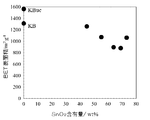
- Example 2 In order to further clarify the supported form of tin dioxide particles with respect to KB, the procedure of Example 1 was repeated while changing the amount of KB used, and the obtained negative electrode active material was measured for the BET surface area per gram of carbon by the nitrogen adsorption method. BJH pore distribution was measured.
- FIG. 4 shows the relationship between the tin dioxide content and the BET surface area in the negative electrode active material
- FIG. 5 shows the relationship between the tin dioxide content and the BJH pore distribution. 4 and 5 also show the KB used for the reaction and the BET surface area and BJH pore distribution of particles (denoted as KBuc) after only KB is centrifuged in the reactor.
- the surface area of the negative electrode active material containing tin dioxide particles and KB once decreases as the tin dioxide content in the negative electrode active material increases, but when the tin dioxide content is 69% or more, the tin dioxide content is reduced. It showed a tendency to increase as it increased.
- the pore volume of the negative electrode active material decreases as the content of tin dioxide increases, but when the content of tin dioxide is 69% or more, the pore volume of tin dioxide As the content increased, the mesopore volume decreased, but the micropore volume tended to increase. From the results of FIGS.
- FIG. 6 is a diagram showing a change in discharge capacity in a charge / discharge cycle test for a half-cell using the negative electrode active material of Example 1. Even after 200 charge / discharge cycles, the capacity retention rate was 98%, indicating good cycle characteristics.
- FIG. 7 is a graph showing changes in discharge capacity in 50 half charge / discharge cycle experiences for half cells using the negative electrode active materials of Examples 3 to 5.
- Table 1 below summarizes the capacity retention rate after 50 charge / discharge cycles and the capacity reduction rate per cycle.
- the half cells using the negative electrode active materials of Examples 3 to 5 all have a discharge capacity higher than the theoretical capacity of graphite (372 mAhg ⁇ 1 ), and experience of 50 charge / discharge cycles. It can be seen that a high capacity retention rate of 80% or more is exhibited later.
- the negative electrode active material of Example 3 using KB as carbon particles provided extremely stable cycle characteristics. This is presumably because particularly fine tin dioxide particles of 1 to 2 nm are supported in the internal pores of KB in a non-aggregated state with 85% by mass of particles.
- FIG. 8 is a diagram showing a change in discharge capacity in the experience of 50 charge / discharge cycles for the half-cells using the negative electrode active materials of Example 1 and Example 3.
- the negative electrode active material of Example 3 SnO 2 : KB 75: 25 (non-aggregation rate 85 mass%, tin dioxide supported on both the inside and outside surfaces of KB (see FIG. 3c)) Although it initially showed a large discharge capacity, the discharge capacity gradually decreased as the charge / discharge cycle was experienced.
- the negative electrode active material terminated at 0 V (lithium occlusion state) and 2 V (lithium release) after 10 charge / discharge cycles and 50 charge / discharge experiences, respectively.
- X-ray photoelectron spectroscopy (XPS) spectrum was measured for the negative electrode active material starting from the state.
- FIG. 9 shows the results obtained. With the charging from 0V to 2V, the intensity of the peak indicating Sn (IV) increases, and it can be seen that tin dioxide is regenerated with the release of lithium.
- the conversion reaction that has been considered to be an irreversible reaction is reversible after 50 charge / discharge cycles. It was confirmed that it would progress.
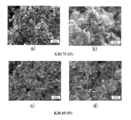
- FIG. 10 is a scanning electron microscope (SEM) photograph of the negative electrode active material before and after the charge / discharge cycle test shown in FIG. a) b) is an SEM photograph of the negative electrode active material of Example 3, and c) d) is an SEM photograph of the negative electrode active material of Example 1.
- a) c) is a photograph before the charge / discharge cycle experience
- b) d) is a photograph after the charge / discharge cycle experience.
- the negative electrode active material of Example 3 in which a decrease in discharge capacity was observed in the charge / discharge cycle test, the structure of the tin dioxide / KB composite was significantly changed, but the discharge capacity was stable in the charge / discharge cycle test. In the negative electrode active material of Example 1, the change in the structure of the tin dioxide / KB composite was slight.
- FIG. 11 is a TEM photograph of the negative electrode active material before and after the charge / discharge cycle test shown in FIG. a) b) is a TEM photograph of the negative electrode active material of Example 3, and c) d) is a TEM photograph of the negative electrode active material of Example 1.
- a) c) is a photograph before the charge / discharge cycle experience
- b) d) is a photograph after the charge / discharge cycle experience.
- aggregates of 100 nm or more were observed, and the structure of the tin dioxide / KB composite was destroyed.
- the negative electrode active material of Example 1 in which the discharge capacity was stable in the charge / discharge cycle test no aggregate was observed, and the structure of the tin dioxide / KB composite was maintained.
- FIG. 12 is SEM photographs of the negative electrode active material before and after the charge / discharge cycle test.
- a) b) is an SEM photograph of the negative electrode active material of Example 3
- c) d) is an SEM photograph of the negative electrode active material of Example 1.
- a) c) is a photograph before the charge / discharge cycle experience
- b) d) is a photograph after the charge / discharge cycle experience.
- Example 3 In the negative electrode active material of Example 3 in which a decrease in discharge capacity was observed in the charge / discharge cycle test, significant volume expansion and aggregation of the tin dioxide / KB composite was observed, but the discharge capacity was stable in the charge / discharge cycle test. In the negative electrode active material of Example 1, the structural change of the tin dioxide / KB composite was hardly observed.
- the volume expansion and aggregation of the tin dioxide / KB composite in the negative electrode active material of Example 3 was generated by the conversion reaction on the outer surface of KB. This is thought to be due to lithium oxide.
- the negative electrode active material of Example 1 almost no structural change of the tin dioxide / KB composite was observed. Therefore, if tin dioxide is present in the internal pores of KB, tin dioxide in the conversion reaction It is thought that volume expansion and aggregation of the / KB complex are suppressed.
- FIG. 13 is a graph showing rate characteristics for a half-cell using the negative electrode active material of Example 1.
- the discharge capacity was stabilized, and almost no decrease was observed, and excellent cycle characteristics were exhibited. Even at rate 1C, the capacity retention rate was stable up to 600 charge / discharge cycle experiences. A moderate decrease in discharge capacity was observed at rate 10C.
- the rate 10C is considered to be the limiting rate in the used half-cell. However, the value of 10C corresponds to 40C in terms of the current graphite negative electrode active material, which is an extremely high value.
- Table 2 below shows the initial discharge capacity (after stabilization) in the charge / discharge cycle test at a rate of 0.2 C and 100 charge / discharge cycle experiences for the half-cells using the negative electrode active materials of Example 1 and Example 2.
- the capacity maintenance rate after that was summarized.
- each of these negative electrode active materials exhibits a higher discharge capacity than the theoretical capacity of current graphite (372 mAhg ⁇ 1 ), and also exhibits good cycle characteristics in the potential range including the conversion reaction region. Show.
- Example 6 15% by mass of polyvinylidene fluoride was added to the negative electrode active material of Example 1 and dispersed in N-methyl-2-pyrrolidone, and applied and dried on Cu foil as a negative electrode. Add 4% by mass of vinylidene and disperse it in N-methyl-2-pyrrolidone, and apply and dry it on Al foil as a positive electrode. 1M LiPF 4 ethylene carbonate / diethyl carbonate 1: 1 solution A battery cell was prepared as an electrolytic solution.
- Example 6 Comparative Example The procedure of Example 6 was repeated except that hard carbon was used as the negative electrode active material.
- Example 6 b) Evaluation of Battery Cell For the battery cells of Example 6 and Comparative Example, 0.2, 0.4, 0.8, 1.6, 3.2 mA / cm 2 in the voltage range 4.5-1.0V. Charging / discharging measurement was performed with the current density, and the energy density and power density per liter of the electrode volume were calculated. The results are shown in FIG.
- the high energy device of Example 6 has higher energy density and power density than the comparative example.
- the negative electrode active material of the present invention has high capacity and extremely good cycle characteristics, it is promising as a negative electrode active material replacing graphite, and should be used suitably for the next-generation lithium ion secondary battery. And is also suitable as a negative electrode active material for a hybrid capacitor.
Landscapes
- Engineering & Computer Science (AREA)
- Chemical & Material Sciences (AREA)
- Power Engineering (AREA)
- Materials Engineering (AREA)
- General Chemical & Material Sciences (AREA)
- Electrochemistry (AREA)
- Chemical Kinetics & Catalysis (AREA)
- Microelectronics & Electronic Packaging (AREA)
- Inorganic Chemistry (AREA)
- Composite Materials (AREA)
- Manufacturing & Machinery (AREA)
- Organic Chemistry (AREA)
- Battery Electrode And Active Subsutance (AREA)
- Secondary Cells (AREA)
- Electric Double-Layer Capacitors Or The Like (AREA)
Abstract
Description


実施例1:
特開2007-160151号公報の図1に示されている、外筒と内筒の同心円筒からなり、内筒の側面に貫通孔が設けられ、外筒の開口部にせき板が配置されている反応器の内筒に、SnCl2・2H2Oの1.9gを水30mLに溶解させた液とケッチェンブラック(商品名ケッチェンブラックEC600J、ケッチェンブラック・インターナショナル社製、一次粒子径34nm、細孔径4nm)の1.3gとを導入し、70000kgms-2の遠心力が反応液に印加されるように内筒を300秒間旋回させ、SnCl2・2H2Oとケッチェンブラックとを分散させた。一旦内筒の旋回を停止し、内筒内に1MのNaOH水溶液16.8mLを添加し、再び70000kgms-2の遠心力が反応液に印加されるように内筒を120秒間旋回させた。この間に、外筒の内壁に薄膜が形成され、この薄膜にずり応力と遠心力が印加され、SnCl2の加水分解と重縮合反応が進行した。内筒の旋回停止後に、ケッチェンブラックをろ過して回収し、180℃で12時間真空乾燥した。以後、ケッチェンブラックをKBと略記するが、図においてもこの略号が使用されている。また、炭素粉末としてKBが使用され、酸化スズとKBとがa:bの質量比で含まれている負極活物質は、図において「KB(a:b)」と表されている。
KB(商品名ケッチェンブラックEC600J、ケッチェンブラック・インターナショナル社製、一次粒子径34nm、細孔径4nm)を0.54g使用した点を除いて、実施例1の手順を繰り返した。
KB(商品名ケッチェンブラックEC600J、ケッチェンブラック・インターナショナル社製、一次粒子径34nm、細孔径4nm)を0.33g使用した点を除いて、実施例1の手順を繰り返した。
親水性カーボンブラック(商品名TOKABLACK#A700F、東海カーボン社製、一次粒子径40nm)を0.33g使用した点を除いて、実施例1の手順を繰り返した。以後、親水性カーボンブラックをTBと略記するが、図においてもこの略号が使用されている。また、炭素粉末としてTBが使用され、酸化スズとTBとがa:bの質量比で含まれている負極活物質は、図において「TB(a:b)」と表されている。
黒鉛化ケッチェンブラック(商品名ケッチェンブラック黒鉛化品、東海カーボン社製、一次粒子径40nm)を0.33g使用した点を除いて、実施例1の手順を繰り返した。以後、黒鉛化ケッチェンブラックをKBgと略記するが、図においてもこの略号が使用されている。また、炭素粉末としてKBgが使用され、酸化スズとKBgとがa:bの質量比で含まれている負極活物質は、図において「KBg(a:b)」と表されている。
実施例1~5の各負極活物質0.7mgにポリフッ化ビニリデンを全体の30質量%加えて成形したものを負極とし、1MのLiPF4のエチレンカーボネート/ジメチルカーボネート1:1溶液を電解液とし、対極をリチウムとした半電池を作成した。
実施例1,3~5の負極活物質を使用した半電池について、レート0.2C(298mAg-1)の定電流条件で0~1Vの電位範囲(可逆的な合金化反応のみが生じる範囲)で充放電サイクル試験を行った。この評価は半電池としての評価であるが、正極を用いた全電池においても同様の効果が期待できる。

実施例1~3の負極活物質を使用した半電池について、レート0.2C(298mAg-1)の定電流条件で0~2Vの電位範囲(コンバージョン反応領域を含む範囲)で充放電サイクル試験を行った。この評価は半電池としての評価であるが、正極を用いた全電池においても同様の効果が期待できる。

a)電池セルの作成
実施例6:
実施例1の負極活物質にポリフッ化ビニリデンを全体の15質量%加えてN-メチル-2-ピロリドン中に分散させ、Cu箔上に塗布・乾燥したものを負極とし、コバルト酸リチウムにポリフッ化ビニリデンを全体の4質量%を加えてN-メチル-2-ピロリドン中に分散させ、Al箔上に塗布・乾燥したものを正極とし、1MのLiPF4のエチレンカーボネート/ジエチルカーボネート1:1溶液を電解液とし、電池セルを作製した。
負極活物質としてハードカーボンを用いた点を除いて、実施例6の手順を繰り返した。
実施例6及び比較例の電池セルについて、電圧範囲4.5-1.0Vにおいて0.2、0.4、0.8、1.6、3.2mA/cm2の電流密度で充放電測定を行い、電極体積1L当たりのエネルギー密度とパワー密度を算出した。結果を図14に示す。実施例6の高エネルギーデバイスは、比較例に比べて高いエネルギー密度とパワー密度を有している。
Claims (21)
- 導電性炭素粉末にナノサイズを有する酸化スズ粒子が高分散状態で担持されている負極活物質。
- 酸化スズの一次粒子の30質量%以上が凝集していない、請求項1に記載の負極活物質。
- 前記酸化スズ粒子が1~10nmの平均粒径を有する、請求項1又は2に記載の負極活物質。
- 前記炭素粉末がナノサイズを有する粒子である、請求項1~3のいずれか1項に記載の負極活物質。
- 前記炭素粉末がケッチェンブラックである、請求項1~4のいずれか1項に記載の負極活物質。
- 前記炭素粉末と前記酸化スズ粒子との割合が、質量比で、20:80~40:60の範囲である、請求項1~5のいずれか1項に記載の負極活物質。
- ナノサイズを有する導電性炭素粉末と、酸化スズ粉末とが、高分散状態で含まれている負極活物質。
- 前記炭素粉末及び前記酸化スズ粉末の一次粒子の30質量%以上が凝集していない、請求項7に記載の負極活物質。
- 前記酸化スズ粉末がナノサイズを有する粒子である、請求項7又は8に記載の負極活物質。
- 前記酸化スズ粉末が1~10nmの平均粒径を有する粒子である、請求項7~9のいずれか1項に記載の負極活物質。
- 前記炭素粉末が空隙を有しており、前記酸化スズ粉末が実質的に前記空隙内に存在している、請求項9又は10に記載の負極活物質。
- 前記炭素粉末がケッチェンブラックである、請求項7~11のいずれか1項に記載の負極活物質。
- 前記炭素粉末が10~50nmの平均粒径を有する粒子である、請求項7~12のいずれか1項に記載の負極活物質。
- 前記炭素粉末の1gあたりの表面積が1000m2以上である、請求項7~13のいずれか1項に記載の負極活物質。
- 前記炭素粉末の1gあたりの酸素量が5.0ミリモル以上である、請求項7~14のいずれか1項に記載の負極活物質。
- 請求項1~6及び請求項9~15のいずれか1項に記載の負極活物質の製造方法であって、
旋回可能な反応器内に、スズ塩を溶解させた溶液に前記炭素粉末を添加した反応液を導入する工程、及び、
前記反応器を旋回させて、前記反応液にずり応力と遠心力とを加えながらスズ塩の加水分解反応と重縮合反応とを行うと同時に、得られた反応生成物を前記炭素粉末に高分散状態で担持させる工程
を含むことを特徴とする負極活物質の製造方法。 - 旋回する前記反応器内でスズ塩を含む薄膜を生成させ、該薄膜にずり応力と遠心力とを加えながらスズ塩の加水分解反応と重縮合反応とを促進させる、請求項16に記載の負極活物質の製造方法。
- 前記反応器が外筒と内筒の同心円筒からなり、内筒の側面に貫通孔が設けられ、外筒の開口部にせき板が配置されており、
内筒の旋回による遠心力によって、内筒内の前記反応液を前記貫通孔を通じて外筒の内壁面に移動させ、外筒の内壁面にスズ塩を含む薄膜を生成させるとともに該薄膜にずり応力と遠心力を加えながらスズ塩の加水分解と重縮合反応とを促進させる、請求項16又は17に記載の負極活物質の製造方法。 - 前記薄膜の厚さが5mm以下である、請求項17又は18に記載の負極活物質の製造方法。
- 前記反応器の内筒内の反応液に加えられる遠心力が1500kgms-2以上である、請求項18又は19に記載の負極活物質の製造方法。
- 請求項1~15のいずれか1項に記載の負極活物質を含む負極と、正極と、負極と正極との間に配置された非水系電解液を保持したセパレータとを備えたリチウムイオン二次電池。
Priority Applications (3)
| Application Number | Priority Date | Filing Date | Title |
|---|---|---|---|
| EP10820143.5A EP2485304A4 (en) | 2009-09-30 | 2010-09-29 | NEGATIVE ELECTRODE ACTIVE MATERIAL, METHOD FOR PRODUCING THE NEGATIVE ELECTRODE ACTIVE MATERIAL, AND LITHIUM ION SECONDARY BATTERY WITH THE NEGATIVE ELECTRODE ACTIVE MATERIAL |
| CN2010800437935A CN102576867A (zh) | 2009-09-30 | 2010-09-29 | 负极活性物质电极、该负极活性物质的制造方法、及使用了该负极活性物质的锂离子二次电池 |
| US13/498,939 US20120183860A1 (en) | 2009-09-30 | 2010-09-29 | Negative electrode active material, method for producing the negative electrode active material, and lithium ion secondary battery using the negative electrode active material |
Applications Claiming Priority (6)
| Application Number | Priority Date | Filing Date | Title |
|---|---|---|---|
| JP2009-229006 | 2009-09-30 | ||
| JP2009229006 | 2009-09-30 | ||
| JP2010106032 | 2010-05-01 | ||
| JP2010-106032 | 2010-05-01 | ||
| JP2010106124A JP2011253620A (ja) | 2009-09-30 | 2010-05-06 | 負極活物質、この負極活物質の製造方法、及びこの負極活物質を用いたリチウムイオン二次電池 |
| JP2010-106124 | 2010-05-06 |
Publications (1)
| Publication Number | Publication Date |
|---|---|
| WO2011040022A1 true WO2011040022A1 (ja) | 2011-04-07 |
Family
ID=43825867
Family Applications (1)
| Application Number | Title | Priority Date | Filing Date |
|---|---|---|---|
| PCT/JP2010/005875 Ceased WO2011040022A1 (ja) | 2009-09-30 | 2010-09-29 | 負極活物質、この負極活物質の製造方法、及びこの負極活物質を用いたリチウムイオン二次電池 |
Country Status (6)
| Country | Link |
|---|---|
| US (1) | US20120183860A1 (ja) |
| EP (1) | EP2485304A4 (ja) |
| JP (1) | JP2011253620A (ja) |
| KR (1) | KR20120091084A (ja) |
| CN (1) | CN102576867A (ja) |
| WO (1) | WO2011040022A1 (ja) |
Cited By (8)
| Publication number | Priority date | Publication date | Assignee | Title |
|---|---|---|---|---|
| WO2013062129A1 (ja) * | 2011-10-29 | 2013-05-02 | 日本ケミコン株式会社 | 電極材料の製造方法 |
| US20140023920A1 (en) * | 2012-07-20 | 2014-01-23 | Semiconductor Energy Laboratory Co., Ltd. | Secondary battery |
| WO2015132888A1 (ja) * | 2014-03-04 | 2015-09-11 | リンテック株式会社 | 粘着剤および粘着シート |
| CN105390675A (zh) * | 2015-10-29 | 2016-03-09 | 陕西科技大学 | 钠离子电池负极用Sn/SnO2/C复合材料的制备方法 |
| CN112194186A (zh) * | 2020-09-14 | 2021-01-08 | 广东工业大学 | 一种MnO2掺杂改性SnO2-C负极材料及其制备方法和应用 |
| CN112194174A (zh) * | 2020-09-14 | 2021-01-08 | 广东工业大学 | 一种MoO2掺杂改性SnO2-C负极材料及其制备方法和应用 |
| CN112209429A (zh) * | 2020-09-21 | 2021-01-12 | 广东工业大学 | 一种MoO3掺杂改性SnO2@C负极复合材料及其制备方法应用 |
| CN114551833A (zh) * | 2022-02-23 | 2022-05-27 | 安徽师范大学 | 珊瑚形貌二氧化锡@碳复合纳米材料及制备方法、半固态负极浆料及半固态锂离子电池 |
Families Citing this family (18)
| Publication number | Priority date | Publication date | Assignee | Title |
|---|---|---|---|---|
| JP5593919B2 (ja) * | 2010-07-27 | 2014-09-24 | トヨタ自動車株式会社 | 二次電池負極およびそれを用いた二次電池 |
| CN103155065A (zh) * | 2010-10-15 | 2013-06-12 | 横滨橡胶株式会社 | 导电性高分子/多孔质碳材料复合体及使用了该复合体的电极材料 |
| WO2012133844A1 (ja) * | 2011-03-30 | 2012-10-04 | 日本ケミコン株式会社 | 負極活物質、この負極活物質の製造方法、及びこの負極活物質を用いたリチウムイオン二次電池 |
| CN105174252B (zh) * | 2011-06-24 | 2018-12-14 | 株式会社半导体能源研究所 | 多层石墨烯及蓄电装置 |
| WO2014034933A1 (ja) * | 2012-09-03 | 2014-03-06 | 日本ケミコン株式会社 | リチウムイオン二次電池用電極材料、この電極材料の製造方法、及びリチウムイオン二次電池 |
| JP6178554B2 (ja) * | 2012-09-03 | 2017-08-09 | 日本ケミコン株式会社 | 金属酸化物と導電性カーボンとの複合材料の製造方法 |
| WO2014049991A1 (ja) * | 2012-09-28 | 2014-04-03 | パナソニック株式会社 | キャパシタ用電極およびそれを用いたキャパシタ |
| JP6099038B2 (ja) * | 2012-11-13 | 2017-03-22 | 日本ケミコン株式会社 | 電極材料の製造方法 |
| JP6031615B2 (ja) * | 2012-11-30 | 2016-11-30 | ベレノス・クリーン・パワー・ホールディング・アーゲー | 充電式バッテリ用スズ系アノード材料及びその調製方法 |
| CN103193263B (zh) * | 2013-03-27 | 2014-07-09 | 东北师范大学 | SnO2C空心纳米球的制备方法及其在锂离子电池中的应用 |
| JP6722703B2 (ja) | 2015-08-25 | 2020-07-15 | エルジー・ケム・リミテッド | 二次電池用の負極及びこれを含む二次電池 |
| JP7143069B2 (ja) | 2016-11-07 | 2022-09-28 | 三洋化成工業株式会社 | リチウムイオン電池用負極及びリチウムイオン電池 |
| CN109923699B (zh) | 2016-11-07 | 2022-03-15 | 日产自动车株式会社 | 锂离子电池用负极和锂离子电池 |
| CN107610944A (zh) * | 2017-08-10 | 2018-01-19 | 中国铝业股份有限公司 | 一种用于超级电容器的复合材料的制备方法 |
| CN109461908B (zh) * | 2018-09-27 | 2020-12-08 | 华南理工大学 | 一种高性能薄膜电极材料及其制备方法和应用 |
| CN110697762B (zh) * | 2019-10-15 | 2022-03-29 | 哈尔滨工业大学 | 一种中空结构Sn/SnO2@C锂离子电池负极材料的制备方法 |
| CN111453765A (zh) * | 2020-04-09 | 2020-07-28 | 吉林大学 | 一种多孔炭负载超小SnO2纳米粒子复合材料及其制备方法以及应用 |
| CN116799219B (zh) * | 2023-08-25 | 2023-12-15 | 浙江华宇钠电新能源科技有限公司 | 一种锡基氧化物纳米晶修饰的硬碳、钠离子电池及车辆 |
Citations (6)
| Publication number | Priority date | Publication date | Assignee | Title |
|---|---|---|---|---|
| JPH10233211A (ja) * | 1996-12-18 | 1998-09-02 | Tokuyama Corp | 非水電解液二次電池用負極活物質および非水電解液二次電池 |
| JP2000090916A (ja) | 1998-09-10 | 2000-03-31 | Mitsubishi Chemicals Corp | 非水系炭素被覆リチウム二次電池用負極活物質 |
| JP2004349253A (ja) * | 2003-05-21 | 2004-12-09 | Samsung Sdi Co Ltd | リチウム二次電池用負極活物質,その製造方法,及びそれを含むリチウム二次電池 |
| JP2005071938A (ja) * | 2003-08-27 | 2005-03-17 | Nec Corp | 二次電池用負極活物質、それを用いた二次電池用負極および二次電池、ならびに二次電池用負極活物質およびそれを用いた二次電池用負極の製造方法 |
| JP2007160151A (ja) | 2005-12-09 | 2007-06-28 | K & W Ltd | 反応方法及びこの方法で得られた金属酸化物ナノ粒子、またはこの金属酸化物ナノ粒子を担持したカーボン及びこのカーボンを含有する電極、並びにこれを用いた電気化学素子。 |
| JP2008526664A (ja) * | 2004-12-30 | 2008-07-24 | ソディフ・アドバンスド・マテリアルズ・カンパニー・リミテッド | 非炭素材料が挿入された球形炭素質粉末、その製造方法及びリチウム二次電池 |
Family Cites Families (4)
| Publication number | Priority date | Publication date | Assignee | Title |
|---|---|---|---|---|
| US20020122985A1 (en) * | 2001-01-17 | 2002-09-05 | Takaya Sato | Battery active material powder mixture, electrode composition for batteries, secondary cell electrode, secondary cell, carbonaceous material powder mixture for electrical double-layer capacitors, polarizable electrode composition, polarizable electrode, and electrical double-layer capacitor |
| KR100599602B1 (ko) * | 2004-10-28 | 2006-07-13 | 삼성에스디아이 주식회사 | 리튬 이차 전지용 양극 및 이를 포함하는 리튬 이차 전지 |
| FR2939786B1 (fr) * | 2008-12-11 | 2011-03-25 | Arkema France | Procede de fabrication d'un materiau composite sno2 et nanotubes de carbone et/ou nanofibres de carbone, materiau obtenu par le procede, electrode pour batterie au lithium comportant ledit materiau. |
| JP2011071063A (ja) * | 2009-09-28 | 2011-04-07 | Kobe Univ | 炭素−半金属酸化物複合材料及びその製造方法、ならびに、これを用いたリチウムイオン電池用負極 |
-
2010
- 2010-05-06 JP JP2010106124A patent/JP2011253620A/ja active Pending
- 2010-09-29 EP EP10820143.5A patent/EP2485304A4/en not_active Withdrawn
- 2010-09-29 WO PCT/JP2010/005875 patent/WO2011040022A1/ja not_active Ceased
- 2010-09-29 KR KR1020127009742A patent/KR20120091084A/ko not_active Ceased
- 2010-09-29 CN CN2010800437935A patent/CN102576867A/zh active Pending
- 2010-09-29 US US13/498,939 patent/US20120183860A1/en not_active Abandoned
Patent Citations (6)
| Publication number | Priority date | Publication date | Assignee | Title |
|---|---|---|---|---|
| JPH10233211A (ja) * | 1996-12-18 | 1998-09-02 | Tokuyama Corp | 非水電解液二次電池用負極活物質および非水電解液二次電池 |
| JP2000090916A (ja) | 1998-09-10 | 2000-03-31 | Mitsubishi Chemicals Corp | 非水系炭素被覆リチウム二次電池用負極活物質 |
| JP2004349253A (ja) * | 2003-05-21 | 2004-12-09 | Samsung Sdi Co Ltd | リチウム二次電池用負極活物質,その製造方法,及びそれを含むリチウム二次電池 |
| JP2005071938A (ja) * | 2003-08-27 | 2005-03-17 | Nec Corp | 二次電池用負極活物質、それを用いた二次電池用負極および二次電池、ならびに二次電池用負極活物質およびそれを用いた二次電池用負極の製造方法 |
| JP2008526664A (ja) * | 2004-12-30 | 2008-07-24 | ソディフ・アドバンスド・マテリアルズ・カンパニー・リミテッド | 非炭素材料が挿入された球形炭素質粉末、その製造方法及びリチウム二次電池 |
| JP2007160151A (ja) | 2005-12-09 | 2007-06-28 | K & W Ltd | 反応方法及びこの方法で得られた金属酸化物ナノ粒子、またはこの金属酸化物ナノ粒子を担持したカーボン及びこのカーボンを含有する電極、並びにこれを用いた電気化学素子。 |
Non-Patent Citations (3)
| Title |
|---|
| CARBON, vol. 46, 2008, pages 35 - 40 |
| JOURNAL OF POWER SOURCES, vol. 159, 2006, pages 345 - 348 |
| See also references of EP2485304A4 |
Cited By (17)
| Publication number | Priority date | Publication date | Assignee | Title |
|---|---|---|---|---|
| CN103891013A (zh) * | 2011-10-29 | 2014-06-25 | 日本贵弥功株式会社 | 电极材料的制造方法 |
| JPWO2013062129A1 (ja) * | 2011-10-29 | 2015-04-02 | 日本ケミコン株式会社 | 電極材料の製造方法 |
| US9299977B2 (en) | 2011-10-29 | 2016-03-29 | Nippon Chemi-Con Corporation | Manufacturing method of electrode material |
| CN103891013B (zh) * | 2011-10-29 | 2016-11-09 | 日本贵弥功株式会社 | 电极材料的制造方法 |
| WO2013062129A1 (ja) * | 2011-10-29 | 2013-05-02 | 日本ケミコン株式会社 | 電極材料の製造方法 |
| US11699782B2 (en) | 2012-07-20 | 2023-07-11 | Semiconductor Energy Laboratory Co., Ltd. | Secondary battery |
| US20140023920A1 (en) * | 2012-07-20 | 2014-01-23 | Semiconductor Energy Laboratory Co., Ltd. | Secondary battery |
| US12573608B2 (en) | 2012-07-20 | 2026-03-10 | Semiconductor Energy Laboratory Co., Ltd. | Secondary battery |
| WO2015132888A1 (ja) * | 2014-03-04 | 2015-09-11 | リンテック株式会社 | 粘着剤および粘着シート |
| CN105390675A (zh) * | 2015-10-29 | 2016-03-09 | 陕西科技大学 | 钠离子电池负极用Sn/SnO2/C复合材料的制备方法 |
| CN112194186A (zh) * | 2020-09-14 | 2021-01-08 | 广东工业大学 | 一种MnO2掺杂改性SnO2-C负极材料及其制备方法和应用 |
| CN112194186B (zh) * | 2020-09-14 | 2023-06-16 | 广东工业大学 | 一种MnO2掺杂改性SnO2-C负极材料及其制备方法和应用 |
| CN112194174A (zh) * | 2020-09-14 | 2021-01-08 | 广东工业大学 | 一种MoO2掺杂改性SnO2-C负极材料及其制备方法和应用 |
| CN112209429A (zh) * | 2020-09-21 | 2021-01-12 | 广东工业大学 | 一种MoO3掺杂改性SnO2@C负极复合材料及其制备方法应用 |
| CN112209429B (zh) * | 2020-09-21 | 2023-07-25 | 广东工业大学 | 一种MoO3掺杂改性SnO2@C负极复合材料及其制备方法应用 |
| CN114551833A (zh) * | 2022-02-23 | 2022-05-27 | 安徽师范大学 | 珊瑚形貌二氧化锡@碳复合纳米材料及制备方法、半固态负极浆料及半固态锂离子电池 |
| CN114551833B (zh) * | 2022-02-23 | 2023-11-03 | 安徽师范大学 | 珊瑚形貌二氧化锡@碳复合纳米材料及制备方法、半固态负极浆料及半固态锂离子电池 |
Also Published As
| Publication number | Publication date |
|---|---|
| US20120183860A1 (en) | 2012-07-19 |
| KR20120091084A (ko) | 2012-08-17 |
| JP2011253620A (ja) | 2011-12-15 |
| EP2485304A4 (en) | 2014-05-21 |
| CN102576867A (zh) | 2012-07-11 |
| EP2485304A1 (en) | 2012-08-08 |
Similar Documents
| Publication | Publication Date | Title |
|---|---|---|
| WO2011040022A1 (ja) | 負極活物質、この負極活物質の製造方法、及びこの負極活物質を用いたリチウムイオン二次電池 | |
| US20220209219A1 (en) | Electrodes and lithium ion cells with high capacity anode materials | |
| US10756382B2 (en) | Metal sulfide composite materials for batteries | |
| JP6236006B2 (ja) | リチウムイオン二次電池用電極材料、この電極材料の製造方法、及びリチウムイオン二次電池 | |
| JP6124786B2 (ja) | 負極活物質、この負極活物質の製造方法、及びこの負極活物質を用いたリチウムイオン二次電池 | |
| JP2013527579A (ja) | リチウム硫黄電池における膨張黒鉛の使用方法 | |
| JP6689741B2 (ja) | 導電性カーボン、この導電性カーボンの製造方法、この導電性カーボンを含む電極材料の製造方法、及びこの電極材料を用いた電極の製造方法 | |
| JP6124784B2 (ja) | 負極活物質、この負極活物質の製造方法、及びこの負極活物質を用いたリチウムイオン二次電池 | |
| JP2024500147A (ja) | リチウムイオン二次電池用金属系-炭素系複合負極材、その製造方法およびこれを含む二次電池 | |
| JP6307133B2 (ja) | ポリアニオン系正極活物質及びその製造方法 | |
| US20150037674A1 (en) | Electrode material for lithium-based electrochemical energy stores | |
| US9905372B2 (en) | Electrochemical capacitor | |
| JP2013073816A (ja) | 負極活物質、この負極活物質の製造方法、及びこの負極活物質を用いたリチウムイオン二次電池 | |
| JP2011181387A (ja) | 電気化学素子用電極合材の製造方法 | |
| JP2017091819A (ja) | 電極材料、電極材料の製造方法、および電極材料を備えた蓄電デバイス | |
| KR102925449B1 (ko) | 도전성 카본 및 그 제조 방법, 이 도전성 카본을 포함하는 도전성 카본 혼합물의 제조 방법, 및 이 도전성 카본 또는 도전성 카본 혼합물을 사용한 전극의 제조 방법 | |
| US20250006941A1 (en) | New conductive additive in lithium and sodium batteries | |
| WO2014098007A1 (ja) | 電極材料、該電極材料を備えた蓄電デバイス及び電極材料の製造方法 |
Legal Events
| Date | Code | Title | Description |
|---|---|---|---|
| WWE | Wipo information: entry into national phase |
Ref document number: 201080043793.5 Country of ref document: CN |
|
| 121 | Ep: the epo has been informed by wipo that ep was designated in this application |
Ref document number: 10820143 Country of ref document: EP Kind code of ref document: A1 |
|
| WWE | Wipo information: entry into national phase |
Ref document number: 2010820143 Country of ref document: EP |
|
| WWE | Wipo information: entry into national phase |
Ref document number: 13498939 Country of ref document: US |
|
| NENP | Non-entry into the national phase |
Ref country code: DE |
|
| ENP | Entry into the national phase |
Ref document number: 20127009742 Country of ref document: KR Kind code of ref document: A |