WO2011043467A1 - 着色ポリイミド成形体及びその製造方法 - Google Patents
着色ポリイミド成形体及びその製造方法 Download PDFInfo
- Publication number
- WO2011043467A1 WO2011043467A1 PCT/JP2010/067760 JP2010067760W WO2011043467A1 WO 2011043467 A1 WO2011043467 A1 WO 2011043467A1 JP 2010067760 W JP2010067760 W JP 2010067760W WO 2011043467 A1 WO2011043467 A1 WO 2011043467A1
- Authority
- WO
- WIPO (PCT)
- Prior art keywords
- polyamic acid
- film
- polyimide
- colored
- porous
- Prior art date
- Legal status (The legal status is an assumption and is not a legal conclusion. Google has not performed a legal analysis and makes no representation as to the accuracy of the status listed.)
- Ceased
Links
Images

Classifications
-
- C—CHEMISTRY; METALLURGY
- C08—ORGANIC MACROMOLECULAR COMPOUNDS; THEIR PREPARATION OR CHEMICAL WORKING-UP; COMPOSITIONS BASED THEREON
- C08J—WORKING-UP; GENERAL PROCESSES OF COMPOUNDING; AFTER-TREATMENT NOT COVERED BY SUBCLASSES C08B, C08C, C08F, C08G or C08H
- C08J5/00—Manufacture of articles or shaped materials containing macromolecular substances
- C08J5/18—Manufacture of films or sheets
-
- C—CHEMISTRY; METALLURGY
- C08—ORGANIC MACROMOLECULAR COMPOUNDS; THEIR PREPARATION OR CHEMICAL WORKING-UP; COMPOSITIONS BASED THEREON
- C08J—WORKING-UP; GENERAL PROCESSES OF COMPOUNDING; AFTER-TREATMENT NOT COVERED BY SUBCLASSES C08B, C08C, C08F, C08G or C08H
- C08J3/00—Processes of treating or compounding macromolecular substances
- C08J3/20—Compounding polymers with additives, e.g. colouring
- C08J3/205—Compounding polymers with additives, e.g. colouring in the presence of a continuous liquid phase
- C08J3/21—Compounding polymers with additives, e.g. colouring in the presence of a continuous liquid phase the polymer being premixed with a liquid phase
- C08J3/212—Compounding polymers with additives, e.g. colouring in the presence of a continuous liquid phase the polymer being premixed with a liquid phase and solid additives
-
- C—CHEMISTRY; METALLURGY
- C08—ORGANIC MACROMOLECULAR COMPOUNDS; THEIR PREPARATION OR CHEMICAL WORKING-UP; COMPOSITIONS BASED THEREON
- C08G—MACROMOLECULAR COMPOUNDS OBTAINED OTHERWISE THAN BY REACTIONS ONLY INVOLVING UNSATURATED CARBON-TO-CARBON BONDS
- C08G73/00—Macromolecular compounds obtained by reactions forming a linkage containing nitrogen with or without oxygen or carbon in the main chain of the macromolecule, not provided for in groups C08G12/00 - C08G71/00
- C08G73/06—Polycondensates having nitrogen-containing heterocyclic rings in the main chain of the macromolecule
- C08G73/10—Polyimides; Polyester-imides; Polyamide-imides; Polyamide acids or similar polyimide precursors
-
- C—CHEMISTRY; METALLURGY
- C08—ORGANIC MACROMOLECULAR COMPOUNDS; THEIR PREPARATION OR CHEMICAL WORKING-UP; COMPOSITIONS BASED THEREON
- C08J—WORKING-UP; GENERAL PROCESSES OF COMPOUNDING; AFTER-TREATMENT NOT COVERED BY SUBCLASSES C08B, C08C, C08F, C08G or C08H
- C08J5/00—Manufacture of articles or shaped materials containing macromolecular substances
-
- C—CHEMISTRY; METALLURGY
- C08—ORGANIC MACROMOLECULAR COMPOUNDS; THEIR PREPARATION OR CHEMICAL WORKING-UP; COMPOSITIONS BASED THEREON
- C08J—WORKING-UP; GENERAL PROCESSES OF COMPOUNDING; AFTER-TREATMENT NOT COVERED BY SUBCLASSES C08B, C08C, C08F, C08G or C08H
- C08J9/00—Working-up of macromolecular substances to porous or cellular articles or materials; After-treatment thereof
- C08J9/0066—Use of inorganic compounding ingredients
-
- C—CHEMISTRY; METALLURGY
- C08—ORGANIC MACROMOLECULAR COMPOUNDS; THEIR PREPARATION OR CHEMICAL WORKING-UP; COMPOSITIONS BASED THEREON
- C08J—WORKING-UP; GENERAL PROCESSES OF COMPOUNDING; AFTER-TREATMENT NOT COVERED BY SUBCLASSES C08B, C08C, C08F, C08G or C08H
- C08J9/00—Working-up of macromolecular substances to porous or cellular articles or materials; After-treatment thereof
- C08J9/28—Working-up of macromolecular substances to porous or cellular articles or materials; After-treatment thereof by elimination of a liquid phase from a macromolecular composition or article, e.g. drying of coagulum
-
- C—CHEMISTRY; METALLURGY
- C08—ORGANIC MACROMOLECULAR COMPOUNDS; THEIR PREPARATION OR CHEMICAL WORKING-UP; COMPOSITIONS BASED THEREON
- C08J—WORKING-UP; GENERAL PROCESSES OF COMPOUNDING; AFTER-TREATMENT NOT COVERED BY SUBCLASSES C08B, C08C, C08F, C08G or C08H
- C08J9/00—Working-up of macromolecular substances to porous or cellular articles or materials; After-treatment thereof
- C08J9/34—Chemical features in the manufacture of articles consisting of a foamed macromolecular core and a macromolecular surface layer having a higher density than the core
-
- C—CHEMISTRY; METALLURGY
- C08—ORGANIC MACROMOLECULAR COMPOUNDS; THEIR PREPARATION OR CHEMICAL WORKING-UP; COMPOSITIONS BASED THEREON
- C08L—COMPOSITIONS OF MACROMOLECULAR COMPOUNDS
- C08L79/00—Compositions of macromolecular compounds obtained by reactions forming in the main chain of the macromolecule a linkage containing nitrogen with or without oxygen or carbon only, not provided for in groups C08L61/00 - C08L77/00
- C08L79/04—Polycondensates having nitrogen-containing heterocyclic rings in the main chain; Polyhydrazides; Polyamide acids or similar polyimide precursors
- C08L79/08—Polyimides; Polyester-imides; Polyamide-imides; Polyamide acids or similar polyimide precursors
-
- C—CHEMISTRY; METALLURGY
- C08—ORGANIC MACROMOLECULAR COMPOUNDS; THEIR PREPARATION OR CHEMICAL WORKING-UP; COMPOSITIONS BASED THEREON
- C08J—WORKING-UP; GENERAL PROCESSES OF COMPOUNDING; AFTER-TREATMENT NOT COVERED BY SUBCLASSES C08B, C08C, C08F, C08G or C08H
- C08J2201/00—Foams characterised by the foaming process
- C08J2201/04—Foams characterised by the foaming process characterised by the elimination of a liquid or solid component, e.g. precipitation, leaching out, evaporation
- C08J2201/05—Elimination by evaporation or heat degradation of a liquid phase
-
- C—CHEMISTRY; METALLURGY
- C08—ORGANIC MACROMOLECULAR COMPOUNDS; THEIR PREPARATION OR CHEMICAL WORKING-UP; COMPOSITIONS BASED THEREON
- C08J—WORKING-UP; GENERAL PROCESSES OF COMPOUNDING; AFTER-TREATMENT NOT COVERED BY SUBCLASSES C08B, C08C, C08F, C08G or C08H
- C08J2379/00—Characterised by the use of macromolecular compounds obtained by reactions forming in the main chain of the macromolecule a linkage containing nitrogen with or without oxygen, or carbon only, not provided for in groups C08J2361/00 - C08J2377/00
- C08J2379/04—Polycondensates having nitrogen-containing heterocyclic rings in the main chain; Polyhydrazides; Polyamide acids or similar polyimide precursors
- C08J2379/08—Polyimides; Polyester-imides; Polyamide-imides; Polyamide acids or similar polyimide precursors
-
- Y—GENERAL TAGGING OF NEW TECHNOLOGICAL DEVELOPMENTS; GENERAL TAGGING OF CROSS-SECTIONAL TECHNOLOGIES SPANNING OVER SEVERAL SECTIONS OF THE IPC; TECHNICAL SUBJECTS COVERED BY FORMER USPC CROSS-REFERENCE ART COLLECTIONS [XRACs] AND DIGESTS
- Y10—TECHNICAL SUBJECTS COVERED BY FORMER USPC
- Y10T—TECHNICAL SUBJECTS COVERED BY FORMER US CLASSIFICATION
- Y10T428/00—Stock material or miscellaneous articles
- Y10T428/249921—Web or sheet containing structurally defined element or component
- Y10T428/249953—Composite having voids in a component [e.g., porous, cellular, etc.]
- Y10T428/249981—Plural void-containing components
Definitions
- the present invention relates to a method for producing a colored polyimide molded body and a colored polyimide molded body obtained by the method.
- dyes and pigments are used for coloring polymer molded products.
- Patent Document 1 when a colored resin pattern is formed using a colored polyimide resin material mixed with a polyamic acid and then cured by heat treatment, an aromatic diamine is previously added to the colored polyimide resin material.
- Patent Document 2 contains a coloring pigment for a resin component mainly composed of an aromatic tetracarboxylic dianhydride, an aliphatic diamine having an aliphatic straight chain, and a polyimide resin obtained from siloxane diamine.
- a colored polyimide film for coating electronic components is disclosed.
- a pigment is advantageous in terms of heat resistance, but it is difficult to uniformly disperse it in a resin.
- the dye is uniformly dispersed (or dissolved), there is a problem that the dye is easily eluted from the resin due to the influence of a solvent or the like.
- Patent Document 3 is characterized by laminating a porous film on a polyimide porous film having a through hole having a diameter of about 0.01 to 10 ⁇ m and a cast film of polyamic acid varnish, and then immersing the film in a poor solvent.
- a method for producing a polyimide porous membrane is disclosed.
- a polyimide molded product such as a colored polyimide film is manufactured by kneading a pigment such as carbon black and a polymer solution such as a polyamic acid solution, and after molding, removing the solvent, etc., and heating to precipitate the polymer. Yes.
- the molded body is a porous film
- the surface of the porous film is also colored.
- pigments such as carbon black are not soluble in the polymer solution, and in order to obtain a uniform mixed / dispersed state, the surface of the pigment such as carbon black is modified or sufficiently kneaded.
- a special kneading machine is required, and a great deal of labor is required in practice. Furthermore, it is not always easy to obtain a molded article with excellent surface appearance, and it is necessary to determine the optimum conditions by trial and error according to the combination of materials, molding conditions, kneading conditions, and the like. Furthermore, since the production line becomes dirty when pigments such as carbon black are used, it is necessary to prepare a dedicated production line, or to disassemble the line completely and clean it thoroughly. A cleaning agent such as a cleaning solvent is required.
- the present invention provides a method for producing a black colored polyimide molded body without using a pigment or dye such as carbon black, and a colored polyimide molded body obtained by the method. For the purpose.
- the present invention relates to the following (1) and (2).
- (1) After molding a polyamic acid solution composition containing at least a polyamic acid solution obtained from a tetracarboxylic acid component and a diamine component and a colored precursor, or a polyimide solution composition containing a polyimide solution and a colored precursor, The manufacturing method of a colored polyimide molding including the process heat-processed at 250 degreeC or more.
- the coloring precursor is compatible with a polyamic acid solution or a polyimide solution and has a property of being heated to 250 ° C. or more and colored black, (1) Without using a special kneader, it can be easily and uniformly dissolved in a polyamic acid solution or a polyimide solution, (2) a colored polyimide molded product with excellent surface appearance can be easily obtained, and (3) after production The line cleaning can be easily performed.
- the effects of the present invention will be described in detail as follows.
- the method for producing a colored polyimide molded body of the present invention uses a colored precursor that spontaneously decomposes and carbonizes and colors in the thermal imidization step regardless of the presence or absence of polyamic acid.
- the colored precursor used in the present invention is transparent at normal temperature and white, Since it is colored by thermal decomposition in a thermal imidization process or high temperature use environment and denatured to carbide, it can maintain the initial hue without decoloring even in use at high temperature for a long period of time, The present invention using this colored precursor is very useful industrially.
- FIG. 1 is a graph showing the change in thermal weight loss rate when a polyacrylonitrile copolymer is heated from room temperature at a rate of 5 ° C./min in an air atmosphere (Reference Example 1).
- the method for producing the colored polyimide molded body of the present invention is as follows. (1) A step of heat-treating at least 250 ° C. after forming a polyamic acid solution composition containing at least a polyamic acid solution obtained from a tetracarboxylic acid component and a diamine component and a colored precursor (first invention) And (2) including a step of heat-treating at 250 ° C. or higher after molding a polyimide solution composition containing a polyimide solution and a colored precursor (second invention). Further, in the first invention, when the colored polyimide molded body is a colored polyimide porous film, the method for producing the colored polyimide porous film of the present invention is a film obtained by casting the polyamic acid solution composition. And a step of producing a porous polyamic acid film by dipping in a poor solvent for polyamic acid, and a step of heat-treating the porous polyamic acid film at 250 ° C. or higher (third invention).
- the first invention includes a step of heat-treating at least 250 ° C. after molding a polyamic acid solution composition containing at least a polyamic acid solution obtained from a tetracarboxylic acid component and a diamine component and a colored precursor. To do.
- Polyamic acid A polyamic acid is obtained by polymerizing a tetracarboxylic acid component and a diamine component. Polyamic acid is a polyimide precursor that can be ring-closed to form polyimide by thermal imidization or chemical imidization.
- tetracarboxylic acid component a known tetracarboxylic acid component can be used, and tetracarboxylic dianhydride is preferable.
- tetracarboxylic dianhydride include pyromellitic dianhydride, 3,3 ′, 4,4′-biphenyltetracarboxylic dianhydride (s-BPDA), 2,3,3 ′, 4.
- Biphenyltetracarboxylic dianhydrides such as '-biphenyltetracarboxylic dianhydride (a-BPDA), 2,2', 3,3'-biphenyltetracarboxylic dianhydride; oxydiphthalic dianhydride, diphenylsulfone -3,4,3 ', 4'-tetracarboxylic dianhydride, bis (3,4-dicarboxyphenyl) sulfide dianhydride, 2,2-bis (3,4-dicarboxyphenyl) -1, 1,1,3,3,3-hexafluoropropane dianhydride, 2,3,3 ′, 4′-benzophenone tetracarboxylic dianhydride, 3,3 ′, 4,4′-benzophenone tetracarboxylic dianhydride Anhydride, bis (3 4-dicarboxyphenyl) methane dianhydride, 2,2-bis (3,4-dicarbox
- one or more aromatic tetracarboxylic dianhydrides selected from biphenyltetracarboxylic dianhydride and pyromellitic dianhydride are preferable.
- the biphenyltetracarboxylic dianhydride 3 ′, 4,4′-biphenyltetracarboxylic dianhydride (s-BPDA) is more preferred.
- Said tetracarboxylic acid component can be used individually or in combination of 2 or more types.
- a well-known diamine component can be used. Examples include (i) one benzene nucleus benzene diamine, (ii) two benzene nucleus diamines, (iii) three benzene nucleus diamines, (iv) four benzene nucleus diamines, and the like.
- Benzene nucleus One benzenediamine includes 1,4-diaminobenzene (paraphenylenediamine), 1,3-diaminobenzene, 2,4-diaminotoluene, 2,6-diaminotoluene and the like.
- Two amines of benzene nucleus include 4,4′-diaminodiphenyl ether (DADE), 3,4′-diaminodiphenyl ether, 3,3′-diaminodiphenyl ether and other diaminodiphenyl ethers, 4,4′-diaminodiphenylmethane, 3,3′-dimethyl-4,4′-diaminobiphenyl, 2,2′-dimethyl-4,4′-diaminobiphenyl, 2,2′-bis (trifluoromethyl) -4,4′-diaminobiphenyl, 3,3′-dimethyl-4,4′-diaminodiphenylmethane, 3,3′-dicarboxy-4,4′-diaminodiphenylmethane, 3,3 ′, 5,5′-tetramethyl-4,4′-diamino Diphenylmethane, bis (4-aminoph
- (Iii) benzene nucleus The three diamines include 1,3-bis (3-aminophenyl) benzene, 1,3-bis (4-aminophenyl) benzene, 1,4-bis (3-aminophenyl) benzene, 1,4-bis (4-aminophenyl) benzene, 1,3-bis (4-aminophenoxy) benzene, 1,4-bis (3-aminophenoxy) benzene, 1,4-bis (4-aminophenoxy) Benzene, 1,3-bis (3-aminophenoxy) -4-trifluoromethylbenzene, 3,3'-diamino-4- (4-phenyl) phenoxybenzophenone, 3,3'-diamino-4,4'- Di (4-phenylphenoxy) benzophenone, 1,3-bis (3-aminophenyl sulfide) benzene, 1,3-bis (4-aminophenyl
- the four diamines include 3,3′-bis (3-aminophenoxy) biphenyl, 3,3′-bis (4-aminophenoxy) biphenyl, 4,4′-bis (3-aminophenoxy) ) Biphenyl, 4,4′-bis (4-aminophenoxy) biphenyl, bis [3- (3-aminophenoxy) phenyl] ether, bis [3- (4-aminophenoxy) phenyl] ether, bis [4- ( 3-aminophenoxy) phenyl] ether, bis [4- (4-aminophenoxy) phenyl] ether, bis [3- (3-aminophenoxy) phenyl] ketone, bis [3- (4-aminophenoxy) phenyl] ketone Bis [4- (3-aminophenoxy) phenyl] ketone, bis [4- (4-aminophenoxy) phenyl] ketone, [4- (3-aminophenoxy)
- aromatic diamines are preferable, and one or more selected from benzenediamine, diaminodiphenyl ether, and bis (aminophenoxy) benzene are more preferable.
- Preferred examples thereof include paraphenylenediamine and 3,3′-diaminodiphenyl ether.
- Said diamine component can be used individually or in combination of 2 or more types.
- Tetracarboxylic acid component containing as a main component a component selected from 3,3 ′, 4,4′-biphenyltetracarboxylic dianhydride and pyromellitic dianhydride, preferably 100 mol% of tetracarboxylic acid component Among them, a tetracarboxylic acid component containing 70 mol% or more, further 80 mol% or more, particularly 90 mol% or more, (2) Paraphenylenediamine, 4,4′-diaminodiphenyl ether (DADE), 3,4′-diaminodiphenyl ether, 3,3′-diaminodiphenyl ether, o-tolidine, m-tolidine, 4,4′-diaminobenzanilide 1,3-bis (3-aminophen
- Polyimides obtained by these combinations are suitably used as materials for electronic components such as printed wiring boards, flexible printed boards, TAB and COF tapes, cover sheets and reinforcing sheets, and have excellent mechanical properties and long-term heat resistance. Therefore, it is preferable because of its excellent hydrolysis resistance, high thermal decomposition starting temperature, and excellent flame retardancy.
- the polyamic acid solution may be a solution obtained by polymerizing tetracarboxylic dianhydride and diamine in the presence of an organic polar solvent, or a solution obtained by dissolving polyamic acid in an organic polar solvent. Also good. There is no restriction
- NMP N-methyl-2-pyrrolidone
- DMAc N-dimethylacetamide
- DMAc N-dimethylformamide
- dimethyl sulfoxide tetramethylurea
- the polyamic acid can be produced by polymerizing a tetracarboxylic acid component and a diamine component in approximately equimolar amounts.
- the polymerization temperature is preferably about 100 ° C. or less, more preferably 80 ° C. or less, further preferably 0 to 60 ° C., particularly preferably 20 to 60 ° C., and the polymerization time, preferably about 0.2 hours. More preferably, it is 0.3 to 60 hours.
- An arbitrary molecular weight modifier can be added during the production of the polyamic acid.
- the solution viscosity may be appropriately selected according to the purpose of use (coating, casting, etc.) and the purpose of production.
- the polyamic acid solution (polyimide precursor solution) has a rotational viscosity measured at 30 ° C. of about 0.1 to 5000 poise, preferably 0.5 to 2000 poise, more preferably 1 to 2000 poise. It is preferable that. Therefore, the polymerization reaction is preferably carried out to such an extent that the produced polyamic acid exhibits the above viscosity.
- the concentration of all monomers in the solvent may be appropriately selected according to the purpose of use and the purpose of production.
- the polyamic acid solution preferably has a concentration of all monomers in the solvent. Is preferably 5 to 40% by mass, more preferably 6 to 35% by mass, and still more preferably 10 to 30% by mass.
- the polyamic acid even if a part of the amic acid is imidized, it can be used as long as it does not affect the present invention. That is, the polyamic acid may be partially thermally imidized or chemically imidized.
- fine particles such as an imidization catalyst, an organic phosphorus-containing compound, inorganic fine particles, and organic fine particles can be added to the polyamic acid solution.
- fine particles such as a chemical imidating agent, a dehydrating agent, inorganic fine particles, and organic fine particles, etc. can be added to a polyamic acid solution as needed. Even when the above components are added to the polyamic acid solution, it is preferable that the coloring precursor is not precipitated.
- the imidization catalyst examples include a substituted or unsubstituted nitrogen-containing heterocyclic compound, an N-oxide compound of the nitrogen-containing heterocyclic compound, a substituted or unsubstituted amino acid compound, an aromatic hydrocarbon compound having a hydroxyl group, or an aromatic heterocyclic compound.
- a cyclic compound is mentioned. More specifically, lower alkyl imidazoles such as 1,2-dimethylimidazole, N-methylimidazole, N-benzyl-2-methylimidazole, 2-methylimidazole, 2-ethyl-4-imidazole, and 5-methylbenzimidazole.
- Benzimidazole such as N-benzyl-2-methylimidazole, isoquinoline, 3,5-dimethylpyridine, 3,4-dimethylpyridine, 2,5-dimethylpyridine, 2,4-dimethylpyridine, 4-n-propylpyridine
- Substituted pyridines such as can be suitably used.
- the amount of the imidization catalyst used is preferably about 0.01 to 2 equivalents, more preferably about 0.02 to 1 equivalents, relative to the amic acid unit of the polyamic acid. It is preferable to use an imidization catalyst because the properties of the resulting polyimide film, particularly elongation and end tear resistance, are improved.
- organic phosphorus-containing compounds examples include monocaproyl phosphate, monooctyl phosphate, monolauryl phosphate, monomyristyl phosphate, monocetyl phosphate, monostearyl phosphate, triethylene glycol monotridecyl Monophosphate of ether, monophosphate of tetraethylene glycol monolauryl ether, monophosphate of diethylene glycol monostearyl ether, dicaproyl phosphate, dioctyl phosphate, dicapryl phosphate, dilauryl phosphate, dimyristyl phosphate, Dicetyl phosphate, distearyl phosphate, diethylene phosphate of tetraethylene glycol mononeopentyl ether, trie Diphosphate of glycol mono tridecyl ether, diphosphate of tetraethyleneglycol monolauryl ether, and phosphoric acid esters such as diphosphate esters of diethylene glycol monostearyl
- amine ammonia, monomethylamine, monoethylamine, monopropylamine, monobutylamine, dimethylamine, diethylamine, dipropylamine, dibutylamine, trimethylamine, triethylamine, tripropylamine, tributylamine, monoethanolamine, diethanolamine, triethanolamine Etc.
- inorganic fine particles fine particles of titanium dioxide powder, silicon dioxide (silica) powder, magnesium oxide powder, aluminum oxide (alumina) powder, inorganic oxide powder such as zinc oxide powder, fine particle silicon nitride powder, titanium nitride powder Inorganic nitride powder such as silicon carbide powder, inorganic carbide powder such as silicon carbide powder, and inorganic salt powder such as particulate calcium carbonate powder, calcium sulfate powder and barium sulfate powder.
- a known dispersing means can be applied.
- the organic fine particles include organic fine particles that are unnecessary for a solvent and do not change even when heated to 250 ° C.
- polyimide particles include polyimide particles, polyamide particles, crosslinkable particles, and the like.
- the above-mentioned imidization catalyst, organic phosphorus-containing compound, inorganic fine particles, and organic fine particles can be used alone or in combination of two or more.
- Examples of chemical imidizing agents include aliphatic tertiary amines such as trimethylamine and triethylenediamine, aromatic tertiary amines such as dimethylaniline, isoquinoline, pyridine, 2-methylpyridine, 3-methylpyridine, 4-methylpyridine, Heterocyclic tertiary amines such as imidazole and benzimidazole can be mentioned, and heterocyclic tertiary amines are preferable, and 3-methylpyridine, 4-methylpyridine, imidar and benzimidazole are more preferable.
- Examples of the dehydrating agent for water generated in the imidation reaction include aliphatic acid anhydrides such as acetic anhydride, propionic anhydride, and butyric anhydride, and aromatic acid anhydrides such as benzoic anhydride and phthalic anhydride.
- aliphatic acid anhydride is preferred, and acetic anhydride is more preferred.
- the colored precursor means a precursor that is partially or wholly carbonized by heat treatment at 250 ° C. or higher to produce a colored product.
- the colored precursor used in the present invention is uniformly dissolved in a polyamic acid solution or a polyimide solution and is heat treated at 250 ° C. or higher, preferably 260 ° C. or higher, more preferably 280 ° C. or higher, more preferably 300 ° C. or higher, preferably Is preferably one that thermally decomposes and carbonizes to form a colored product by heat treatment in the presence of oxygen such as air at 250 ° C. or higher, preferably 260 ° C. or higher, more preferably 280 ° C.
- the carbon-based coloring precursor is not particularly limited.
- polymers such as petroleum tar, petroleum pitch, coal tar, coal pitch, or polymers obtained from monomers including pitch, coke, and acrylonitrile, ferrocene compounds (ferrocene and ferrocene derivatives). Etc.
- the polymer and / or ferrocene compound obtained from the monomer containing acrylonitrile are preferable, and polyacrylonitrile is preferable as a polymer obtained from the monomer containing acrylonitrile.
- Ferrocene (C 10 H 10 Fe) is di- ⁇ -cyclopentadienyl iron, which itself is carbonized by heating, but is also considered to have an effect of promoting the carbonization of polyamic acid.
- ferrocene for example, a commercial product of Wako Pure Chemical Industries, Ltd. can be used.
- the ferrocene derivative in the present invention refers to a di- ⁇ -cyclopentadienyl iron complex, and includes those in which various substituents are bonded as pendant groups of the cyclopentadienyl ring.
- bisindenyl iron (II) dibenzferrocene
- 1,1′-diacetylferrocene, 1,2-diacetylferrocene, 1,1-diferrocenylethane dimethylaminoethylferrocene, methylaminomethylferrocene, ferroce Nylacetonitrile
- ferrocenylcarbonal ferrocenesulfonic acid
- 1,2-diferrocenylethane diferrocenylmethane
- phenylferrocene, ferrocenecarboxaldehyde ⁇ -ferrocenyl fatty acid
- phenylsilocpentaferrocene 1,1 ' -(1,3-cyclopentylene) ferrocene
- phenylsilocpentyl ferrocene benzoyl ferrocene, acetyl ferrocene and the like.
- the polyamic acid solution composition is a solution composition obtained by uniformly dissolving the colored precursor in a polyamic acid solution.
- the polyamic acid solution composition is preferably a suspension or a transparent uniform solution.
- the polyamic acid solution composition is a method in which a colored precursor is added to a polyamic acid solution and mixed, a method in which a colored precursor is added to a solvent in advance before polymerization of the polyamic acid, and polymerization is performed during the polymerization of the polyamic acid. It can be produced by a method of polymerizing by adding a precursor.
- the blending amount of the colored precursor contained in the polyamic acid solution composition, particularly the carbon-based colored precursor may be appropriately selected depending on the target coloring amount, and the colored precursor is preferably used with respect to 100 parts by mass of the obtained polyimide. Is preferably 1 to 60 parts by mass, more preferably 1 to 40 parts by mass, further preferably 2 to 40 parts by mass, further preferably 2 to 30 parts by mass, and particularly preferably 3 to 25 parts by mass. Even if it is blended in an amount of 60 parts by mass or more, a coloring effect can be obtained. However, depending on the type of the colored precursor, the film properties, particularly the mechanical properties, of the obtained colored polyimide molded product may be deteriorated.
- 2nd invention is characterized by including the process heat-processed above 250 degreeC after shape
- polyimide used in the second invention a polyimide that dissolves in a solvent at a molding temperature can be used, and a combination of a tetracarboxylic acid component and a diamine component can be selected and combined in a solvent to be used as a solvent.
- a soluble polyimide can be obtained.
- the tetracarboxylic acid component and the dimine component constituting the polyimide are as described above, and the preferred combination of the tetracarboxylic acid component and the dimine component is also as described above.
- Solvents for polymerizing polyimide include organic polar solvents such as N-methyl-2-pyrrolidone (NMP), N, N-dimethylacetamide (DMAc), N, N-dimethylformamide, dimethyl sulfoxide, tetramethylurea, etc.
- N-methyl-2-pyrrolidone (NMP), N, N-dimethylacetamide (DMAc), phenols such as phenol, p-chlorophenol, o-chlorophenol, cresol, and the like are preferable.
- a polyimide can be produced by polymerizing a tetracarboxylic acid component and a diamine component in approximately equimolar amounts.
- the polymerization temperature is preferably 130 ° C. or higher, more preferably 150 to 250 ° C., still more preferably 170 to 230 ° C., and the polymerization time, preferably about 0.2 hours or higher, more preferably 0.3 ⁇ 60 hours.
- An arbitrary molecular weight modifier can be added during the production of polyimide.
- the solution viscosity may be appropriately selected according to the purpose of use (coating, casting, etc.) and the purpose of production.
- the polyimide solution has a rotational viscosity measured at a molding temperature of about 0.1 to 5000 poise, preferably 0.5 to 2000 poise, more preferably 1 to 2000 poise from the viewpoint of workability. Is preferred. Therefore, it is preferable to carry out the polymerization reaction to such an extent that the produced polyimide exhibits the above viscosity.
- the concentration of all monomers in the solvent may be appropriately selected according to the purpose of use and the purpose of production.
- the concentration of all monomers in the solvent is preferably 5%. It is preferably 30 to 30% by mass, more preferably 6 to 25% by mass, and still more preferably 10 to 20% by mass.
- the polyimide solution composition is a solution composition obtained by uniformly dissolving the colored precursor in a polyimide solution at a molding temperature.
- the polyimide solution composition is preferably a suspension or a transparent uniform solution.
- the polyimide solution composition is a method in which a colored precursor is added to and mixed with a polyimide solution, a method in which a colored precursor is added to a solvent in advance before polymerization of polyimide, and a colored precursor is added during polymerization of polyimide. Then, it can be produced by a method of polymerization.
- the blending amount of the colored precursor contained in the polyimide solution composition may be appropriately selected depending on the target coloring amount, and the colored precursor is preferably 1 to 60 parts by mass with respect to 100 parts by mass of the obtained polyimide. Preferably 2 to 40 parts by mass, more preferably 2 to 30 parts by mass is added. Even if it is blended in an amount of 60 parts by mass or more, a coloring effect can be obtained. However, depending on the type of the colored precursor, the film properties, particularly the mechanical properties, of the obtained colored polyimide molded product may be deteriorated.
- fine particles such as an imidization catalyst, an organic phosphorus-containing compound, inorganic fine particles, and organic fine particles can be added as necessary. Even if it mix
- the imidation catalyst, the organic phosphorus-containing compound, the inorganic fine particles, and the organic fine particles are the same as described above, and can be used alone or in combination of two or more.
- (Ii) A method of obtaining a belt or a tube by cutting a film or a sheet-like molded product obtained by the method (i) or the like into a predetermined length and width and joining them.
- (Iii) A separate metal for applying the polyamic acid solution composition or the polyimide solution composition to the inner surface or outer surface of the cylindrical mold, volatilizing the solvent, heating it as it is, or peeling it once to define the inner diameter
- Specific examples of the method for producing a colored polyimide molded body using the polyamic acid solution composition include the following (1) and (2).
- a polyamic acid solution composition is formed into a film or the like, and heat-treated at 250 ° C. or higher, if necessary, to a maximum heating temperature of 350 to 600 ° C. while gradually removing part or all of the solvent, A method of imidization and coloring.
- the polyamic acid solution composition is molded into a film or the like, and the molded product is heated to a temperature at which the colored precursor is not colored, preferably 50 to 210 ° C., more preferably 60 to 200 ° C.
- Part or all of which is gradually removed and pre-dried (if it is a film, it is pre-dried until it has a self-supporting property that can be peeled off from the support), and then the temperature at which the colored precursor is colored is 250 ° C.
- a polyamic acid solution composition is supplied by a suitable support (for example, a metal, ceramic plastic roll, or metal belt, or a metal thin film tape).
- the polyamic acid solution having a uniform thickness of about 10 to 2000 ⁇ m, particularly about 20 to 1000 ⁇ m is formed into a film state by casting on the surface of a roll or belt that is being processed.
- it is heated to 50 to 210 ° C., particularly 60 to 200 ° C. using a heat source such as hot air or infrared rays, and the solvent is gradually removed and at the same time a part of the polyamic acid is imidized to be peeled off from the support.
- Pre-drying is performed until the film becomes self-supporting, and the self-supporting film is peeled from the support.
- the peeled self-supporting film is heat-treated at a temperature of 250 ° C. or higher, preferably 280 to 600 ° C., more preferably 310 to 590 ° C., further preferably 320 to 580 ° C., particularly preferably 350 to 500 ° C.
- the heat treatment can be performed in multi-stage conditions. When heating at 250 ° C.
- the heat treatment can be performed using various known devices such as a hot air furnace and an infrared heating furnace.
- the heating time can be appropriately selected and is preferably 5 to 120 minutes, more preferably 5 to 60 minutes.
- imidization and / or coloring proceeds.
- the above method can also be applied to a polyimide solution composition.
- Specific examples of the method for producing a colored polyimide molded body using the polyimide solution composition include the following (1) and (2).
- (1) A method in which a polyimide solution composition is formed into a film or the like, and is colored by heat treatment at 250 ° C. or higher, preferably at a maximum heating temperature of 350 to 600 ° C. while gradually removing part or all of the solvent. .
- (2) A polyimide solution composition is molded into a film or the like, and the molded product is heated to a temperature at which the colored precursor is not colored, preferably 50 to 210 ° C., more preferably 60 to 200 ° C.
- a colored polyimide molded body with controlled light shielding properties can be obtained efficiently.
- This colored polyimide molded body is, for example, a printed wiring board, a flexible printed circuit board, a TAB tape, a COF tape, a cover film, a reinforcing film, a belt such as a driving belt, a material such as an electronic component such as a tube, a copper, It can be suitably used as a covering of a molded article such as a metal molded article such as a wire.
- the method for producing a colored polyimide porous film of the third invention includes a step of immersing a film obtained by casting a polyamic acid solution composition in a poor solvent for polyamic acid to produce a porous polyamic acid film, and It includes a step of heat-treating the porous polyamic acid film at 250 ° C. or higher.
- the polyamic acid solution composition used in the third invention is the same as the polyamic acid solution composition used in the first invention.
- the limiting viscosity number (30 ° C., concentration: 0.5 g / 100 mL, solvent: NMP) of the polyamic acid solution should be a viscosity at which the polyimide porous membrane of the present invention can be produced. That's fine.
- the concentration of the polymer contained in the polyamic acid solution used in the third invention is not particularly limited as long as it is a concentration at which the polyamic acid porous body can be obtained by contacting with a poor solvent, and preferably a polyamic acid (solid content) Concentration) 0.3 to 60% by mass and organic polar solvent 40 to 99.7% by mass.
- a polyamic acid (solid content) Concentration) 0.3 to 60% by mass and organic polar solvent 40 to 99.7% by mass.
- the solid content concentration of the polyamic acid in the polyamic acid solution used in the third invention is more preferably 1 to 40% by mass, further preferably 3 to 30% by mass, and particularly preferably 5 to 15% by mass.
- the content of the solvent is more preferably 60 to 99% by mass, still more preferably 70 to 97% by mass, and particularly preferably 85 to 95% by mass.
- the colored precursor used in the third invention is uniformly dissolved in the polyamic acid solution, not substantially dissolved in the poor solvent, and heat treatment at 250 ° C. or higher, preferably 250 ° C. or higher in the presence of oxygen such as air. Those that thermally decompose by carbonization and carbonize to produce a colored product are preferred, those that produce a black colored product are more preferred, and carbon-based colored precursors are more preferred.
- Preferred specific examples of the colored precursor used in the third invention are the same as the preferred specific examples of the colored precursor used in the first invention.
- ⁇ Preparation of film of polyamic acid solution composition In the method for producing the porous polyimide of the present invention, first, the polyamic acid solution obtained above and the colored precursor are mixed, and the colored precursor is uniformly dissolved in the polyamic acid solution. A solution composition is prepared and cast onto a substrate to create a film. In the case of performing chemical imidization, a catalyst and a dehydrating agent are mixed with the polyamic acid solution composition, and at the same time, this is cast on a substrate to form a film.
- the casting method is not particularly limited, and for example, the polyamic acid solution composition can be cast into a film on a substrate such as a glass plate or a stainless plate using a T die, a comma coater, a blade, or the like. Moreover, a polyamic acid solution composition can be intermittently or continuously cast into a film shape on a continuously movable belt to continuously produce a film piece or a long film.
- the belt may be any belt as long as it is not affected by the polyamic acid solution composition and the poor solvent described later, and may be made of a metal such as stainless steel or a resin such as polytetrafluoroethylene.
- the polyamic acid solution composition formed into a film can be put into a poor solvent as it is.
- one or both sides of a film-like material obtained as required are provided with a gas containing water vapor (air, inert gas, etc.), a porous material of polyolefin or fluorine-based polyolefin, a mixed solution of a poor solvent and a solvent, etc. May be contacted.
- the solution viscosity (30 ° C.) of the polyamic acid solution composition can be cast as a film, and the viscosity at which the polyamic acid is deposited can be appropriately determined.
- the solution viscosity (30 ° C.) is preferably 10 to 10,000 poise (1 to 1000 Pa ⁇ s), more preferably 100 to 3000 poise (10 to 300 Pa ⁇ s). More preferred is 200 to 2000 poise (20 to 200 Pa ⁇ s), and particularly preferred is 300 to 2000 poise (30 to 200 Pa ⁇ s).
- solution viscosity (30 degreeC) is measured by the method as described in an Example.
- the porous polyamic acid film can be obtained by making the film (non-stretched) obtained by casting the polyamic acid solution composition porous by bringing it into contact with a polyamic acid poor solvent by dipping or the like. it can. By replacing the good solvent in the polyamic acid solution composition with a poor solvent, a phase separation phenomenon of the polyamic acid is caused, and after washing and / or drying as necessary, a porous polyamic acid film can be obtained. it can.
- the obtained porous polyamic acid film was washed and / or dried as necessary, and then simultaneously colored and imidized by thermal imidization by heat treatment at 250 ° C. or higher. can do.
- This colored polyimide porous membrane is preferably colored from black to brown.
- the film (non-stretched) obtained by casting the polyamic acid solution composition may contain (i) one or both sides of the film containing an organic vapor such as water vapor or alcohol before contacting with a poor solvent.
- Contact time is preferably within 5 minutes, more preferably within 3 minutes, even more preferably within 2 minutes),
- a polymerization solvent poor solvent is added to one or both sides of the film
- a porous film such as polyolefin may be laminated on one side or both sides of the film.
- stacked on the film obtained by casting the polyamic acid solution composition what has the following properties is preferable. (1) It is easily peeled off from the precipitated polyamic acid.
- the porous film is made of a polyolefin such as polyethylene or polypropylene, Teflon (registered trademark), or the like, and a porous film having a pore diameter of 0.1 to 5 ⁇ m and a thickness of 10 to 100 ⁇ m is preferably used.
- Polyamic acid poor solvent As the poor solvent for the polyamic acid, a compound miscible with the polymerization solvent used for the polymerization of the polyamic acid can be used.
- a compound miscible with the polymerization solvent used for the polymerization of the polyamic acid can be used.
- a mixed solvent with a poor solvent is preferred.
- a mixed solvent with the polymerization solvent used for the polymerization of the polyamic acid can be used as necessary.
- the content of water in the mixed solvent is preferably 5% by mass or more and less than 100% by mass, more preferably 20% by mass or more and 100% by mass. Less than, more preferably 30 to 95% by mass, particularly preferably 45 to 90% by mass.
- the content of the organic solvent (poor solvent) in the mixed solvent is preferably more than 0% by mass and 95% by mass or less, more preferably more than 0% by mass and 80% by mass or less, still more preferably 3 to 60% by mass, Particularly preferred is 5 to 30% by mass.
- the temperature of the poor solvent is usually ⁇ 30 to 70 ° C., preferably 0 to 60 ° C., more preferably 10 to 50 ° C.
- porous polyamic acid film For the resulting porous polyamic acid film, the type of polyamic acid used, the solid content concentration of the polyamic acid solution, the solution viscosity of the polyamic acid solution composition, the organic solvent, the coagulation conditions (temperature, type of poor solvent, etc.), etc. are appropriately selected. By doing so, a film thickness, a porosity, an average hole diameter, etc. can be adjusted suitably. According to the production method of the present invention, porous polyamic acid films of various forms can be obtained. For example, typical forms include porous polyamic acid films of the following forms (1) to (4).
- Form (1) A homogeneous porous film having no dense surface layer on both surfaces and substantially free of voids (large pores) inside the film.
- Form (2) a porous film having a three-layer structure having two surface layers and a macrovoid layer sandwiched between the surface layers, and the macrovoid layer is divided into the surface layer and a partition bonded to the surface layer.
- the organic compound having a polar group in advance in the polyamic acid solution composition is 1 to 150 parts by mass, preferably 10 to 100 parts by mass with respect to 100 parts by mass of the polyamic acid. Part, more preferably 20 to 70 parts by mass.
- the organic compound having a polar group is preferably an organic compound having a carboxylic acid group such as benzoic acid or phthalic acid.
- Form (3) A symmetric or asymmetric porous film having a dense surface layer on one or both surfaces and substantially free of voids (large pores) inside the film.
- Form (4) A symmetric or asymmetric porous film having a dense surface layer on one or both surfaces and having many voids (large pores) inside the film.
- the colored polyimide porous membrane of the present invention can be obtained by heat-treating the porous polyamic acid film at 250 ° C. or higher.
- a part or all of the end portion of the porous polyamic acid film preferably both end portions or all end portions (entire circumference), in order to suppress adverse effects such as loss of film smoothness due to heat shrinkage.
- the heating temperature is preferably 280 to 500 ° C, more preferably 300 to 480 ° C, still more preferably 330 to 450 ° C.
- the heating time can be appropriately selected and is preferably 5 to 120 minutes, more preferably 5 to 60 minutes.
- imidization and / or coloring proceeds.
- the water produced by the imidization reaction can be removed from the reaction system together with the heated air stream.
- the polyimide composing the obtained colored polyimide porous membrane has an imidization ratio by IR measurement method of preferably 70% or more, more preferably 80% or more, more preferably 85% or more, still more preferably 90% or more, particularly Preferably, the heat resistant polymer is 95% or more.
- Chemical imidation is usually performed at 20 to 200 ° C., preferably 25 to 150 ° C., more preferably 30 to 100 ° C. in the presence of a catalyst and a dehydrating agent from the viewpoint of reaction rate, suppression of increase in viscosity, molecular weight control, and the like. It can be carried out.
- Catalysts include aliphatic tertiary amines such as trimethylamine and triethylenediamine, aromatic tertiary amines such as dimethylaniline, isoquinoline, pyridine, 2-methylpyridine, 3-methylpyridine, 4-methylpyridine, imidazole, and benz Examples include heterocyclic tertiary amines such as imidazole, but heterocyclic tertiary amines are preferable, and 3-methylpyridine, 4-methylpyridine, imidazole, and benzimidazole are more preferable.
- dehydrating agent examples include aliphatic acid anhydrides such as acetic anhydride, propionic anhydride, and butyric anhydride, and aromatic acid anhydrides such as benzoic anhydride and phthalic anhydride, but aliphatic acid anhydrides are preferable, Acetic anhydride is more preferred.
- the porous polyamic acid film by using the porous polyamic acid film, the following two representative forms of colored polyimide porous membranes can be produced.
- a protective solvent such as a polymerization solvent (which may contain a poor solvent) on one side or both sides of the film.
- a porous film of polyolefin or the like on one or both sides of the film.
- the obtained laminate is made porous by being brought into contact with a poor solvent of polyamic acid by dipping or the like.
- the obtained porous polyamic acid film can be heat-treated at 250 ° C. to obtain a colored polyimide porous film [form (A)].
- the colored polyimide porous film of the form (A) is a homogeneous porous film having no dense surface layer on both surfaces and substantially free of voids (large pores) inside the film.
- the thickness of this porous membrane is preferably 5 to 100 ⁇ m, more preferably 10 to 80 ⁇ m, and the average pore diameter on one or both surfaces is preferably 0.01 to 5 ⁇ m, more preferably 0.02 to 2 ⁇ m, and further Preferably, it has a pore of 0.03 to 1 ⁇ m, and the pore has a porous structure that continues non-linearly from one side to the other side, and the porosity is preferably 15 to 80%, more Preferably, it is 20 to 70%, more preferably 25 to 60%, and the Gurley value (air permeability) is preferably 30 to 1000 seconds / 100 cc, more preferably 30 to 1000 seconds / 100 cc, still more preferably 30 to 120. What is a second / 100cc is desirable.
- a phase separation phenomenon of the polyamic acid is caused, and after washing and / or drying as necessary, a porous polyamic acid film can be obtained. It can.
- the obtained porous polyamic acid film can be heat-treated at 250 ° C. to obtain a colored polyimide porous film [form (B)].
- the colored polyimide porous film of the form (B) is a porous polyimide film having a three-layer structure having two surface layers and a macrovoid layer sandwiched between the two surface layers, and the macrovoid layer includes the surface layer and the macrovoid layer.
- This is a porous film having a so-called honeycomb sandwich structure, which has a plurality of macrovoids and a plurality of pores surrounded by partition walls bonded to the surface layer, and the pores and the macrovoids communicate with each other.
- the surface layer of the porous film and the partition walls of the macrovoid layer each preferably have a thickness of 0.1 to 15 ⁇ m, more preferably 1 to 12 ⁇ m, still more preferably 2 to 10 ⁇ m, and the total film thickness is preferably 5 to 500 ⁇ m, more preferably 10 to 300 ⁇ m, still more preferably 20 to 100 ⁇ m, and the average pore diameter of the macrovoids in the film plane direction is preferably 10 to 150 ⁇ m, more preferably 10 to 100 ⁇ m, still more preferably 10 to 80 ⁇ m.
- the average pore diameter of the pores is preferably 0.01 to 5 ⁇ m, more preferably 0.01 to 3 ⁇ m, still more preferably 0.02 to 2 ⁇ m, and the porosity is preferably 70 to 95%, more preferably 71 to 90%, more preferably 72 to 85%, and Gurley value (air permeability) is preferably 100 seconds or less / 100 cc, more preferably 8 Sec / 100 cc, more preferably preferably those of 50 seconds or less / 100 cc.
- the length (L) in the film plane direction and the length in the film thickness direction of macrovoids having an average pore diameter of 10 ⁇ m or more in the film plane direction is preferably 60% or more, more preferably 70% or more, and further preferably 73 to 100%.
- the rate of change in film thickness after loading with a compressive stress of 250 ° C., 15 minutes, 0.5 MPa is preferably 5% or less, more preferably 3% or less, and further preferably 0 to 1%.
- the dimensional stability in the film plane direction at 200 ° C. for 2 hours in accordance with ASTM D1204 is preferably within ⁇ 1%.
- a film thickness, an average hole diameter, a porosity, and a Gurley value are measured by the method as described in an Example.
- EHD type high-viscosity conical plate type rotary type, cone rotor: 1 ° 34 ′. The measurement was performed 3 times and the average value was adopted. When there was a variation of 5% or more at the measurement points, two more measurements were performed and an average value of five points was adopted.
- Intrinsic Viscosity is synonymous with intrinsic viscosity, and the reduced viscosity (increment of relative viscosity ⁇ r relative to mass concentration c of polymer ⁇ r / c) or inherent viscosity ( This is the limit value of the ratio of the natural logarithm of relative viscosity to the mass concentration c of the polymer.
- the intrinsic viscosity is used as an index of molecular weight. Strictly speaking, the intrinsic viscosity should be measured using a ⁇ solvent and a dilute solution in the ⁇ state.
- the polyamic acid to be measured has a large interaction with the solvent molecules, and the ⁇ solvent must be prepared. Is difficult.
- the molecular weight can be calculated by the Mark-Houink equation even when a good solvent is used for the measurement of the intrinsic viscosity.
- N-methyl-2pyrrolidone ( Hereinafter, it was measured by the following procedure using NMP).
- An NMP solution of polyamic acid to be measured was prepared so that the solution concentration c was 0.1, 0.075, 0.05, 0.025, 0.010 [g / dL]. The solution was continuously stirred for one week in an anaerobic atmosphere.
- NMP flow-down time was measured in a constant temperature bath of 30 ° C. using an Ubbelohde type dilution viscometer. Subsequently, the flow-down time was measured for each of the solutions prepared in (1). Each measurement was performed three times, and an average value was adopted.
- the measurement target film is compressed under the conditions of 250 ° C., 15 minutes, and 0.5 MPa using a high-precision hot press that is a compression plate having a parallelism of less than ⁇ 10 ⁇ m and a temperature distribution of ⁇ 1 ° C. Then, after leaving a film
- Total light transmittance (%) and turbidity (haze) The total light transmittance and turbidity (haze) of the film were measured using a haze meter (manufactured by Nippon Denshoku Industries Co., Ltd., trade name: NDH5000) based on JIS K7361, 7136 and 7105, and ASTM D1003.
- Hue The hue of the colored polyimide molded body (film) was measured using a spectrocolorimeter (manufactured by Color Techno System Co., Ltd., trade name: Color Robot III) under conditions of transmission with respect to the plane of the measurement object. . The measurement was performed through a neutral density filter.
- the hue of the polyimide porous film was measured using a spectrocolorimeter (manufactured by Color Techno System Co., Ltd., trade name: Color Robot III) under the condition of a projection angle of 45 degrees with respect to the measurement object plane.
- the film to be measured was placed on a white body and measured.
- the result is an L * a * b * color system (where L * is lightness, a * is chromaticity in the red-green direction, and b * is chromaticity in the yellow-blue direction). Digitized.
- Reference example 1 The rate of thermal weight loss when pellets of polyacrylonitrile copolymer (manufactured by Mitsui Chemicals, trade name: Valex 2090S, hereinafter also referred to as “PAN”) are heated at a rate of 5 ° C./minute from room temperature in an air atmosphere. It was measured. The results are shown in FIG. As a result, a slight weight loss was observed from around 250 ° C., and about 0.2% at 280 ° C., about 0.5% at 290 ° C., about 2% at 300 ° C., and about 8% at 330 ° C. It was found to occur.
- PAN polyacrylonitrile copolymer
- PAN can be preferably used as a colored precursor in the present invention, and when PAN is used as a colored precursor in the present invention, 250 ° C. or higher, preferably 280 ° C. or higher, more preferably 300 ° C. It can be seen that it is preferable to perform the above heat treatment.
- Preparation Example 101 (Preparation of polyamic acid solution composition A1)
- NMP N-methylpyrrolidone
- s-BPDA 4,4′-biphenyltetracarboxylic dianhydride
- DADE 4,4′-Diaminodiphenyl ether
- the polyamic acid solution had a solid content concentration of 6% by mass and an intrinsic viscosity number of 3.5. 5 parts by mass of PAN (trade name: Valex 2090S, manufactured by Mitsui Chemicals, Inc.) was added to 100 parts by mass of the obtained polyamic acid. Thereafter, the lid was covered with a separable cover equipped with a stirring blade, a nitrogen introduction pipe, and an exhaust pipe, and stirring was started. After 20 hours, 0.5 parts by mass of 3,3 ′, 4,4′-biphenyltetracarboxylic acid (BPDA) was added to the flask with respect to 100 parts by mass of the polyamic acid, and the stirring operation was continued.
- PAN trade name: Valex 2090S, manufactured by Mitsui Chemicals, Inc.
- Preparation Example 102 (Preparation of polyamic acid solution composition B1) Except not adding PAN, operation similar to the preparation example 101 was performed, and polyamic acid solution composition B1 was obtained.
- the solution was a viscous liquid and the solution viscosity was 400 poise (30 ° C.).
- Preparation Example 201 (Preparation of polyamic acid solution composition A2)
- NMP N-methylpyrrolidone
- s-BPDA 4,4′-biphenyltetracarboxylic dianhydride
- DADE 4,4′-Diaminodiphenyl ether
- This polyamic acid solution had an intrinsic viscosity of 3.8 and a solid content concentration of 6% by mass.
- 5 parts by mass of PAN (trade name: Valex 2090S, manufactured by Mitsui Chemicals, Inc.) was added to 100 parts by mass of the obtained polyamic acid. Thereafter, the lid was covered with a separable cover equipped with a stirring blade, a nitrogen introduction pipe, and an exhaust pipe, and stirring was started. After 20 hours, 30 parts by mass of benzoic acid and 1 part by mass of 3,3 ′, 4,4′-biphenyltetracarboxylic acid were added to the flask with respect to 100 parts by mass of the polyamic acid, and the stirring operation was continued.
- Preparation Examples 202 to 204 (Preparation of polyamic acid solution compositions B2, C2, and D2) As shown in Table 1, the same operations as in Preparation Example 201 were performed except that the amount of PAN added was changed to obtain polyamic acid solution compositions B2, C2, and D2. The solution was a viscous suspension.
- Preparation Example 205 (Preparation of polyamic acid solution composition E2)
- Preparation Example 201 5 parts by mass of ferrocene (manufactured by Wako Pure Chemical Industries, Ltd.), 30 parts by mass of benzoic acid, and 3,3 ′, 4,4′-biphenyltetracarboxylic acid 1 per 100 parts by mass of polyamic acid Except having added the mass part, operation similar to the preparation example 201 was performed, and the polyamic acid solution composition E2 was obtained.
- the solution was a viscous liquid and the solution viscosity was 460 poise (30 ° C.).
- Preparation Example 206 (Preparation of polyamic acid solution composition F2) A polyamic acid solution composition F2 was obtained in the same manner as in Preparation Example 201 except that PAN was not added. The solution was a viscous liquid and the solution viscosity was 390 poise (30 ° C.).
- Preparation Example 207 (Preparation of polyamic acid solution composition G2) A polyamic acid solution composition G2 was obtained in the same manner as in Preparation Example 203, except that benzoic acid was not added. The solution was a viscous liquid and the solution viscosity was 450 poise (30 ° C.).
- Preparation Example 208 (Preparation of polyamic acid solution composition H2) A polyamic acid solution composition H2 was obtained in the same manner as in Preparation Example 207, except that PAN was not added. The solution was a viscous liquid and the solution viscosity was 425 poise (30 ° C.).
- Example 101 (Preparation of polyimide film) Using a tabletop automatic coater at room temperature, the polyamic acid solution composition A1 obtained in Preparation Example 101 is uniformly flowed to a thickness of about 300 ⁇ m on a stainless 20 cm square substrate whose surface is mirror-polished. The coating was applied. Thereafter, the entire substrate was placed in a hot air furnace, heated to 360 ° C. at an average temperature increase rate of 10 ° C./min, held as it was for 5 minutes, and then gradually cooled. The substrate was taken out from the hot stove, cut out with a cutter knife around the four sides of the film attached to the substrate, and then immersed in pure water for 24 hours together with the substrate.
- the polyimide film naturally peeled from the substrate was dried at a temperature of 100 ° C. to obtain a polyimide film having a film thickness of 20 ⁇ m. This film was dark brown.
- Table 2 shows measurement results such as total light transmittance, turbidity, and hue of the polyimide film.
- Comparative Example 101 (Preparation of polyimide film) The same operation as in Example 101 was performed except that the polyamic acid solution composition B1 obtained in Preparation Example 102 was used to obtain a polyimide film.
- the obtained film was dark yellow and transparent, and the thickness was 21 ⁇ m.
- Table 2 shows measurement results such as total light transmittance, turbidity, and hue of the polyimide film.
- Example 101 coloring was appropriately performed and the light transmittance was effectively suppressed.
- Example 201 Using a tabletop automatic coater at room temperature, the polyamic acid solution composition A2 obtained in Preparation Example 201 is uniformly flowed to a thickness of about 120 ⁇ m on a stainless steel 20 cm square substrate whose surface is mirror-polished. The coating was applied. Thereafter, the substrate was left in the atmosphere at a temperature of 23 ° C. and a humidity of 40% for 90 seconds, and then the entire substrate was immersed in a poor solvent for polyamic acid (water 80 mass%, NMP 20 mass%) at room temperature. After dipping, it was left for 8 minutes to deposit a polyamic acid film on the substrate.
- a poor solvent for polyamic acid water 80 mass%, NMP 20 mass%
- the substrate is taken out of the bath, and the polyamic acid film deposited on the substrate is peeled off, and then immersed in pure water for 3 minutes, and dried in air at a temperature of 23 ° C. and a humidity of 40% to obtain a polyamic acid film. It was.
- the hue was measured by sampling a part of the polyamic acid film. Table 3 shows the measurement results of the hue of the polyamic acid film.
- the polyamic acid film was attached to a 10 cm square pin tenter and set in a hot stove. Heating was performed to 360 ° C. at a rate of temperature increase of about 10 ° C./min, and heat treatment was performed using a temperature profile that was maintained for 10 minutes, thereby obtaining a polyimide porous film.
- the obtained polyimide porous membrane had a thickness of 32 ⁇ m, a porosity of 79%, and a Gurley value of 22 seconds / 100 cc.
- the surface on the substrate side had a porous structure having many communicating holes, and the average pore diameter on the surface was 0.19 ⁇ m and the maximum pore diameter was 10 ⁇ m or less.
- the obtained porous film is a three-layered porous film having two surface layers and a macrovoid layer sandwiched between the two surface layers, and the macrovoid layer is formed on the surface layer and the surface layer.
- a plurality of macrovoids and a plurality of pores surrounded by the bonded partition walls have a structure in which the pores and the macrovoids communicate with each other.
- the glass transition temperature of the polyimide porous membrane was about 290 ° C., and the dimensional stability was within 1% at 200 ° C.
- the rate of change in film thickness after applying a compressive stress of 250 MPa, 15 minutes, 0.5 MPa was 1% or less.
- Table 3 shows the measurement results of the total light transmittance, turbidity, hue and the like of the polyimide porous membrane.
- Example 202-205 Except for using the polyamic acid solution compositions B2 to E2 obtained in Preparation Examples 202 to 205, the same operations as in Example 201 were performed to obtain a polyimide porous membrane.
- Table 3 shows the film thickness, porosity, and Gurley value of the obtained polyimide porous membrane. All films were dark brown to black and opaque.
- the surface of the polyimide porous film was observed with a scanning electron microscope, the surface on the substrate side had a porous structure having many communicating holes, and the average pore diameter of the surface was in the range of 0.15 to 0.20 ⁇ m. The maximum pore diameter was 10 ⁇ m or less.
- the obtained porous film is a three-layered porous film having two surface layers and a macrovoid layer sandwiched between the two surface layers, and the macrovoid layer is formed on the surface layer and the surface layer. It has been found that a plurality of macrovoids and a plurality of pores surrounded by the bonded partition walls have a structure in which the pores and the macrovoids communicate with each other.
- the dimensional stability was less than 1% at 200 degreeC, and the film thickness change rate after the said compressive-stress load was 1% or less.
- Table 3 shows the measurement results of the total light transmittance, turbidity, hue and the like of the polyimide porous membrane.
- Example 206 Using a tabletop automatic coater at room temperature, the polyamic acid solution composition G2 obtained in Preparation Example 207 is uniformly flowed to a thickness of about 250 ⁇ m on a stainless steel 20 cm square substrate whose surface is mirror-polished. The coating was applied. On the polyamic acid solution applied on the substrate, NMP was uniformly applied as a protective solvent layer using a doctor knife having a spacing of 100 ⁇ m with respect to the liquid surface of the polyamic acid solution, and allowed to stand for 1 minute. Thereafter, the whole substrate was immersed in a poor solvent for polyamic acid (90% by mass of methanol, 5% by mass of water, and 5% by mass of NMP) at room temperature for 90 seconds at a temperature of 23 ° C.
- a poor solvent for polyamic acid 90% by mass of methanol, 5% by mass of water, and 5% by mass of NMP
- the polyamic acid film was attached to a 10 cm square pin tenter and set in a hot stove. Heating was performed to 360 ° C. at a rate of temperature increase of about 10 ° C./min, and heat treatment was performed using a temperature profile that was maintained for 10 minutes, thereby obtaining a polyimide porous film.
- the obtained polyimide porous film was dark brown to black and opaque, had a film thickness of 29 ⁇ m, a porosity of 48%, and a Gurley value of 78 seconds / 100 cc.
- both surfaces had a porous structure in which polyimide was connected on the network, with an average surface pore size of 0.17 ⁇ m and a maximum pore size of 1.6 ⁇ m. Met.
- the cross section of the polyimide porous membrane had a porous structure in which polyimide and space were continuously and uniformly connected, and no void having a length of 1 ⁇ m or more in the lateral direction of the membrane was observed. That is, the obtained film is a uniform film having no dense layer on both surfaces, and has holes with an average pore diameter of 0.01 to 5 ⁇ m on one or both surfaces, and the holes are formed from one surface to the other surface.
- the glass transition temperature of the polyimide porous membrane was about 280 ° C., and the dimensional stability was within 1% at 200 ° C.
- the rate of change in film thickness after applying a compressive stress of 250 MPa, 15 minutes, 0.5 MPa was 1% or less.
- Table 3 shows the measurement results of the total light transmittance, turbidity, hue and the like of the polyimide porous membrane.
- Example 207 Using a tabletop automatic coater, the polyamic acid solution composition B2 obtained in Preparation Example 202 is uniformly flowed at a thickness of about 120 ⁇ m on a stainless steel 20 cm square substrate having a mirror polished surface at room temperature. The coating was applied. Thereafter, the substrate was left in the atmosphere at a temperature of 23 ° C. and a humidity of 40% for 90 seconds, and then the entire substrate was immersed in a poor solvent for polyamic acid (water 80 mass%, NMP 20 mass%) at room temperature. After dipping, it was left for 8 minutes to deposit a polyamic acid film on the substrate.
- a poor solvent for polyamic acid water 80 mass%, NMP 20 mass%
- the substrate is taken out of the bath, and the polyamic acid film deposited on the substrate is peeled off, and then immersed in pure water for 3 minutes, and dried in air at a temperature of 23 ° C. and a humidity of 40% to obtain a polyamic acid film. It was.
- the hue was measured by sampling a part of the polyamic acid film. Table 3 shows the measurement results of the hue of the polyamic acid film.
- the polyamic acid film was attached to a 10 cm square pin tenter and set in a hot stove. Heating was performed up to 280 ° C. at a rate of temperature increase of about 10 ° C./min, and heat treatment was performed with a temperature profile maintained for 10 minutes as it was to obtain a polyimide porous film.
- the obtained polyimide porous membrane had a thickness of 33 ⁇ m, a porosity of 80%, and a Gurley value of 56 seconds / 100 cc.
- the surface on the substrate side had a porous structure having many communicating holes, and the average pore diameter of the surface was 0.16 ⁇ m and the maximum pore diameter was 10 ⁇ m or less.
- the obtained porous film is a three-layered porous film having two surface layers and a macrovoid layer sandwiched between the two surface layers, and the macrovoid layer is formed on the surface layer and the surface layer.
- a plurality of macrovoids and a plurality of pores surrounded by the bonded partition walls have a structure in which the pores and the macrovoids communicate with each other.
- the glass transition temperature of the polyimide porous membrane was about 275 ° C., and the dimensional stability was within 1% at 200 ° C.
- the rate of change in film thickness after applying a compressive stress of 250 MPa, 15 minutes, 0.5 MPa was 1% or less.
- Table 3 shows the measurement results of the total light transmittance, turbidity, hue and the like of the polyimide porous membrane.
- Example 208 Except that the maximum temperature of the heat treatment was 300 ° C., the same operation as in Example 207 was performed to obtain a polyimide porous membrane.
- the obtained polyimide porous membrane had a thickness of 33 ⁇ m, a porosity of 79%, and a Gurley value of 41 seconds / 100 cc.
- the surface on the substrate side had a porous structure having many communicating holes, and the average pore diameter of the surface was 0.17 ⁇ m and the maximum pore diameter was 10 ⁇ m or less. It was.
- the obtained porous film is a three-layered porous film having two surface layers and a macrovoid layer sandwiched between the two surface layers, and the macrovoid layer is formed on the surface layer and the surface layer.
- a plurality of macrovoids and a plurality of pores surrounded by the bonded partition walls have a structure in which the pores and the macrovoids communicate with each other.
- the glass transition temperature of the polyimide porous membrane was about 280 ° C., and the dimensional stability was within 1% at 200 ° C.
- the rate of change in film thickness after applying a compressive stress of 250 MPa, 15 minutes, 0.5 MPa was 1% or less.
- Table 3 shows the measurement results of the total light transmittance, turbidity, hue and the like of the polyimide porous membrane.
- Example 209 Except that the maximum temperature of the heat treatment was set to 400 ° C., the same operation as in Example 207 was performed to obtain a polyimide porous membrane.
- the obtained polyimide porous membrane had a thickness of 31 ⁇ m, a porosity of 76%, and a Gurley value of 31 seconds / 100 cc.
- the surface on the substrate side had a porous structure having many communicating holes, and the average pore diameter on the surface was 0.18 ⁇ m and the maximum pore diameter was 10 ⁇ m or less. It was.
- the obtained porous film is a three-layered porous film having two surface layers and a macrovoid layer sandwiched between the two surface layers, and the macrovoid layer is formed on the surface layer and the surface layer.
- a plurality of macrovoids and a plurality of pores surrounded by the bonded partition walls have a structure in which the pores and the macrovoids communicate with each other.
- the glass transition temperature of the polyimide porous membrane was about 290 ° C., and the dimensional stability was within 1% at 200 ° C.
- the rate of change in film thickness after applying a compressive stress of 250 MPa, 15 minutes, 0.5 MPa was 1% or less.
- Table 3 shows the measurement results of the total light transmittance, turbidity, hue and the like of the polyimide porous membrane.
- Example 210 Except having changed the used solution into the polyamic-acid solution composition C2 obtained by the preparation example 203, operation similar to Example 207 was performed and the polyimide porous membrane was obtained.
- the obtained polyimide porous membrane had a thickness of 34 ⁇ m, a porosity of 81%, and a Gurley value of 53 seconds / 100 cc.
- the surface on the substrate side had a porous structure having many communicating holes, and the average pore diameter of the surface was 0.16 ⁇ m and the maximum pore diameter was 10 ⁇ m or less. It was.
- the obtained porous film is a three-layered porous film having two surface layers and a macrovoid layer sandwiched between the two surface layers, and the macrovoid layer is formed on the surface layer and the surface layer.
- a plurality of macrovoids and a plurality of pores surrounded by the bonded partition walls have a structure in which the pores and the macrovoids communicate with each other.
- the glass transition temperature of the polyimide porous membrane was about 275 ° C., and the dimensional stability was within 1% at 200 ° C.
- the rate of change in film thickness after applying a compressive stress of 250 MPa, 15 minutes, 0.5 MPa was 1% or less.
- Table 3 shows the measurement results of the total light transmittance, turbidity, hue and the like of the polyimide porous membrane.
- Example 211 Except having changed the used solution into the polyamic acid solution composition C2 obtained by the preparation example 203, operation similar to Example 208 was performed and the polyimide porous membrane was obtained.
- the obtained polyimide porous film had a film thickness of 32 ⁇ m, a porosity of 80%, and a Gurley value of 38 seconds / 100 cc.
- the surface on the substrate side had a porous structure having many communicating holes, and the average pore diameter of the surface was 0.17 ⁇ m and the maximum pore diameter was 10 ⁇ m or less. It was.
- the obtained porous film is a three-layered porous film having two surface layers and a macrovoid layer sandwiched between the two surface layers, and the macrovoid layer is formed on the surface layer and the surface layer.
- a plurality of macrovoids and a plurality of pores surrounded by the bonded partition walls have a structure in which the pores and the macrovoids communicate with each other.
- the glass transition temperature of the polyimide porous membrane was about 285 ° C., and the dimensional stability was within 1% at 200 ° C.
- the rate of change in film thickness after applying a compressive stress of 250 MPa, 15 minutes, 0.5 MPa was 1% or less.
- Table 3 shows the measurement results of the total light transmittance, turbidity, hue and the like of the polyimide porous membrane.
- Example 212 Except having changed the used solution into the polyamic-acid solution composition C2 obtained by the preparation example 203, operation similar to Example 209 was performed and the polyimide porous membrane was obtained.
- the obtained polyimide porous membrane had a thickness of 31 ⁇ m, a porosity of 78%, and a Gurley value of 28 seconds / 100 cc.
- the surface on the substrate side had a porous structure having many communicating holes, and the average pore diameter on the surface was 0.18 ⁇ m and the maximum pore diameter was 10 ⁇ m or less. It was.
- the obtained porous film is a three-layered porous film having two surface layers and a macrovoid layer sandwiched between the two surface layers, and the macrovoid layer is formed on the surface layer and the surface layer.
- a plurality of macrovoids and a plurality of pores surrounded by the bonded partition walls have a structure in which the pores and the macrovoids communicate with each other.
- the glass transition temperature of the polyimide porous membrane was about 290 ° C., and the dimensional stability was within 1% at 200 ° C.
- the rate of change in film thickness after applying a compressive stress of 250 MPa, 15 minutes, 0.5 MPa was 1% or less.
- Table 3 shows the measurement results of the total light transmittance, turbidity, hue and the like of the polyimide porous membrane.
- Comparative Example 201 Except for using the polyamic acid solution composition F2 obtained in Preparation Example 206, the same operation as in Example 201 was performed to obtain a polyimide porous membrane.
- the resulting film was pale yellow and opaque.
- Table 3 shows the film thickness, porosity, and Gurley value of the obtained polyimide porous membrane.
- the surface on the substrate side had a porous structure having many communicating holes, and the average pore diameter on the surface was 0.18 ⁇ m and the maximum pore diameter was 10 ⁇ m or less. It was.
- the obtained porous film is a three-layered porous film having two surface layers and a macrovoid layer sandwiched between the two surface layers, and the macrovoid layer is formed on the surface layer and the surface layer. It has been found that a plurality of macrovoids and a plurality of pores surrounded by the bonded partition walls have a structure in which the pores and the macrovoids communicate with each other.
- the dimensional stability of the polyimide porous membrane was within 1% at 200 ° C., and the rate of change in film thickness after loading with the compressive stress was 1% or less.
- Table 3 shows the measurement results such as total light transmittance, turbidity, and hue.
- Comparative Example 202 Except for using the polyamic acid solution composition H obtained in Preparation Example 208, the same operation as in Example 206 was performed to obtain a polyimide porous membrane.
- the obtained film was pale yellow and opaque, had a film thickness of 30 ⁇ m, a porosity of 48%, and a Gurley value of 69 seconds / 100 cc.
- both surfaces When the surface of the polyimide porous film was observed with a scanning electron microscope, both surfaces had a porous structure in which polyimide was connected on the network. The average pore diameter of the surface was 0.17 ⁇ m, and the maximum pore diameter was 1.7 ⁇ m. Met.
- the cross section of the polyimide porous membrane had a porous structure in which polyimide and space were continuously and uniformly connected, and no void having a length of 1 ⁇ m or more in the lateral direction of the membrane was observed. That is, the obtained film is a uniform film having no dense layer on both surfaces, and has holes with an average pore diameter of 0.01 to 5 ⁇ m on one or both surfaces, and the holes are formed from one surface to the other surface. It was confirmed that it had a porous structure that was non-linearly continuous toward.
- the glass transition temperature of the polyimide porous membrane was about 285 ° C., and the dimensional stability was within 1% at 200 ° C.
- the rate of change in film thickness after applying a compressive stress of 250 MPa, 15 minutes, 0.5 MPa was 1% or less.
- Table 3 shows the measurement results of the total light transmittance, turbidity, hue and the like of the polyimide porous membrane.
- the colored polyimide molded body of the present invention is, for example, a printed wiring board, a flexible printed circuit board, a TAB tape, a COF tape, a carver film, a reinforcing film, a belt such as a driving belt, a material such as an electronic component such as a tube, or an electronic device. It can be suitably used as a covering for a molded product such as a metal molded body such as a copper wire.
- the colored polyimide porous film of the present invention has various fields that require heat resistance, light shielding properties, antistatic properties, thermal conductivity, etc., such as interlayer insulating films for multilayer substrates, liquid crystal alignment films, color filter protective films, It can be suitably used for an optical waveguide, an optical compensation film, and the like.
Landscapes
- Chemical & Material Sciences (AREA)
- Engineering & Computer Science (AREA)
- Polymers & Plastics (AREA)
- Health & Medical Sciences (AREA)
- Chemical Kinetics & Catalysis (AREA)
- Medicinal Chemistry (AREA)
- Organic Chemistry (AREA)
- Materials Engineering (AREA)
- Manufacturing & Machinery (AREA)
- Inorganic Chemistry (AREA)
- Macromolecular Compounds Obtained By Forming Nitrogen-Containing Linkages In General (AREA)
- Manufacture Of Porous Articles, And Recovery And Treatment Of Waste Products (AREA)
- Moulding By Coating Moulds (AREA)
- Physics & Mathematics (AREA)
- Thermal Sciences (AREA)
Abstract
Description
例えば、特許文献1には、ポリアミック酸中に染料を混入した着色ポリイミド樹脂材料を用いて着色樹脂パターンを形成した後、熱処理することによって硬化させるに際し、着色ポリイミド樹脂材料中に予め芳香族ジアミンを加え、熱処理によって、その芳香族ジアミンを介して染料をポリイミド化した高分子マトリックスと結合させる着色樹脂パターンの色溶出防止方法が開示されている。
特許文献2には、芳香族テトラカルボン酸二無水物、脂肪族直鎖を有する芳香族ジアミン、及びシロキサンジアミンから得られるポリイミド樹脂を主成分とする樹脂成分に対して、着色顔料が含有された電子部品被覆用着色ポリイミドフィルムが開示されている。
例えば、特許文献3には、直径約0.01~10μmの貫通穴を有するポリイミド多孔膜、及びポリアミック酸ワニスのキャストフィルムに多孔質フィルムを積層した後、貧溶媒に浸漬することを特徴とするポリイミド多孔質膜の製造方法が開示されている。
しかし、多孔質膜の表面を着色すると、制御した多孔質膜の特性を失う可能性がある。
また、カーボンブラック等の顔料は、ポリマー溶液との溶解性がなく、均一な混合・分散状態を得るためには、カーボンブラック等の顔料の表面を改質したり、十分な混練を行うための特殊な混練機が必要となり、実用上多大な労力を有する。さらに得られる成形体は、表面外観に優れた物が容易に得られる訳ではなく、材料の組み合わせ、成形条件、混練条件等に合わせて試行錯誤し、最適条件を決定する必要がある。
さらに、カーボンブラック等の顔料を使用すると生産ラインが汚れるために、専用の製造ラインを準備するか、又はラインを全て分解して十分に洗浄する必要があり、多大な労力と費用、また多量の洗浄溶媒等の洗浄剤が必要となる。
(1)少なくともテトラカルボン酸成分とジアミン成分とから得られるポリアミック酸溶液と着色前駆体とを含むポリアミック酸溶液組成物、又はポリイミド溶液と着色前駆体とを含むポリイミド溶液組成物を成形した後、250℃以上で熱処理する工程を含む、着色ポリイミド成形体の製造方法。
(2)前記(1)に記載の方法により得られる着色ポリイミド成形体。
本発明の効果をより詳細に述べれば以下のとおりである。
本発明の着色ポリイミド成形体の製造方法は、熱イミド化工程においてポリアミック酸の存在の有無に関わらず自発的に熱分解、炭化して着色する着色前駆体を用いることから、ポリイミドやその添加物との組み合わせ、すなわち材料を設計する際の自由度が大きく、工業的に非常に有益である。
また、染料、顔料は熱イミド化工程や材料の使用環境下で熱分解により脱色するものがほとんどであるが、本発明で用いる着色前駆体は、室温、常態では透明、白色であっても、熱イミド化工程や高温使用環境下で熱分解して炭化物に変性することで着色することから、材料の長期高温化での使用においても脱色することなく初期の色相を維持することができるため、この着色前駆体を用いる本発明は工業的に非常に有益である。
(1)少なくともテトラカルボン酸成分とジアミン成分とから得られるポリアミック酸溶液と着色前駆体とを含むポリアミック酸溶液組成物を成形した後、250℃以上で熱処理する工程を含むこと(第1発明)、及び
(2)ポリイミド溶液と着色前駆体とを含むポリイミド溶液組成物を成形した後、250℃以上で熱処理する工程を含むこと(第2発明)、を特徴とする。
また、第1発明において、前記着色ポリイミド成形体が着色ポリイミド多孔質膜である場合、本発明の着色ポリイミド多孔質膜の製造方法は、前記ポリアミック酸溶液組成物を流延して得られるフィルムを、ポリアミック酸の貧溶媒に浸漬して多孔質ポリアミック酸フィルムを作製する工程、及び該多孔質ポリアミック酸フィルムを250℃以上で熱処理する工程を含むことを特徴とする(第3発明)。
第1発明は、少なくともテトラカルボン酸成分とジアミン成分とから得られるポリアミック酸溶液と着色前駆体とを含むポリアミック酸溶液組成物を成形した後、250℃以上で熱処理する工程を含むことを特徴とする。
ポリアミック酸は、テトラカルボン酸成分とジアミン成分とを重合して得られる。ポリアミック酸は、熱イミド化又は化学イミド化することにより閉環してポリイミドとすることができるポリイミド前駆体である。
テトラカルボン酸二無水物の具体例としては、ピロメリット酸二無水物、3,3’,4,4’-ビフェニルテトラカルボン酸二無水物(s-BPDA)、2,3,3’,4’-ビフェニルテトラカルボン酸二無水物(a-BPDA)、2,2’,3,3’-ビフェニルテトラカルボン酸二無水物等のビフェニルテトラカルボン酸二無水物;オキシジフタル酸二無水物、ジフェニルスルホン-3,4,3’,4’-テトラカルボン酸二無水物、ビス(3,4-ジカルボキシフェニル)スルフィド二無水物、2,2-ビス(3,4-ジカルボキシフェニル)-1,1,1,3,3,3-ヘキサフルオロプロパン二無水物、2,3,3’,4’-ベンゾフェノンテトラカルボン酸二無水物、3,3’,4,4’-ベンゾフェノンテトラカルボン酸二無水物、ビス(3,4-ジカルボキシフェニル)メタン二無水物、2,2-ビス(3,4-ジカルボキシフェニル)プロパン二無水物、p-フェニレンビス(トリメリット酸モノエステル酸無水物)、p-ビフェニレンビス(トリメリット酸モノエステル酸無水物)、m-ターフェニル-3,4,3’,4’-テトラカルボン酸二無水物、p-ターフェニル-3,4,3’,4’-テトラカルボン酸二無水物、1,3-ビス(3,4-ジカルボキシフェノキシ)ベンゼン二無水物、1,4-ビス(3,4-ジカルボキシフェノキシ)ベンゼン二無水物、1,4-ビス(3,4-ジカルボキシフェノキシ)ビフェニル二無水物、2,2-ビス〔(3,4-ジカルボキシフェノキシ)フェニル〕プロパン二無水物、2,3,6,7-ナフタレンテトラカルボン酸二無水物、1,4,5,8-ナフタレンテトラカルボン酸二無水物、4,4’-(2,2-ヘキサフルオロイソプロピリデン)ジフタル酸二無水物等が挙げられる。また、2,3,3’,4’-ジフェニルスルホンテトラカルボン酸等の芳香族テトラカルボン酸を用いることもできる。
上記のテトラカルボン酸成分は、単独で又は2種以上を組み合わせて用いることができる。
(i)ベンゼン核1つのべンゼンジアミンとしては、1,4-ジアミノベンゼン(パラフェニレンジアミン)、1,3-ジアミノベンゼン、2,4-ジアミノトルエン、2,6-ジアミノトルエン等が挙げられる。
(ii)ベンゼン核2つのアミンとしては、4,4’-ジアミノジフェニルエーテル(DADE)、3,4’-ジアミノジフェニルエーテル、3,3’-ジアミノジフェニルエーテル等のジアミノジフェニルエーテル、4,4’-ジアミノジフェニルメタン、3,3’-ジメチル-4,4’-ジアミノビフェニル、2,2’-ジメチル-4,4’-ジアミノビフェニル、2,2’-ビス(トリフルオロメチル)-4,4’-ジアミノビフェニル、3,3’-ジメチル-4,4’-ジアミノジフェニルメタン、3,3’-ジカルボキシ-4,4’-ジアミノジフェニルメタン、3,3’,5,5’-テトラメチル-4,4’-ジアミノジフェニルメタン、ビス(4-アミノフェニル)スルフィド、4,4’-ジアミノベンズアニリド、3,3’-ジクロロベンジジン、3,3’-ジメチルベンジジン、2,2’-ジメチルベンジジン、3,3’-ジメトキシベンジジン、2,2’-ジメトキシベンジジン、3,3’-ジアミノジフェニルエーテル、3,4’-ジアミノジフェニルエーテル、4,4’-ジアミノジフェニルエーテル、3,3’-ジアミノジフェニルスルフィド、3,4’-ジアミノジフェニルスルフィド、4,4’-ジアミノジフェニルスルフィド、3,3’-ジアミノジフェニルスルホン、3,4’-ジアミノジフェニルスルホン、4,4’-ジアミノジフェニルスルホン、3,3’-ジアミノベンゾフェノン、3,3’-ジアミノ-4,4’-ジクロロベンゾフェノン、3,3’-ジアミノ-4,4’-ジメトキシベンゾフェノン、3,3’-ジアミノジフェニルメタン、3,4’-ジアミノジフェニルメタン、4,4’-ジアミノジフェニルメタン、2,2-ビス(3-アミノフェニル)プロパン、2,2-ビス(4-アミノフェニル)プロパン、2,2-ビス(3-アミノフェニル)-1,1,1,3,3,3-ヘキサフルオロプロパン、2,2-ビス(4-アミノフェニル)-1,1,1,3,3,3-ヘキサフルオロプロパン、3,3’-ジアミノジフェニルスルホキシド、3,4’-ジアミノジフェニルスルホキシド、4,4’-ジアミノジフェニルスルホキシド等が挙げられる。
上記のジアミン成分は、単独で又は2種以上を組み合わせて用いることができる。
(1)3,3’,4,4’-ビフェニルテトラカルボン酸二無水物及びピロメリット酸二無水物から選ばれる成分を主成分として含むテトラカルボン酸成分、好ましくはテトラカルボン酸成分100モル%中、70モル%以上、さらに80モル%以上、特に90モル%以上含むテトラカルボン酸成分と、
(2)パラフェニレンジアミン、4,4’-ジアミノジフェニルエーテル(DADE)、3,4’-ジアミノジフェニルエーテル、3,3’-ジアミノジフェニルエーテル、o-トリジン、m-トリジン、4,4’-ジアミノベンズアニリド、1,3-ビス(3-アミノフェニル)ベンゼン、1,3-ビス(4-アミノフェニル)ベンゼン、1,4-ビス(3-アミノフェニル)ベンゼン、1,4-ビス(4-アミノフェニル)ベンゼン、1,3-ビス(4-アミノフェノキシ)ベンゼン及び1,4-ビス(3-アミノフェノキシ)ベンゼンから選ばれる成分を主成分として含むジアミン、好ましくはジアミン成分100モル%中、70モル%以上、さらに80モル%以上、特に90モル%以上含むジアミン成分とから得られるポリイミドが好ましい。
(1)3,3’,4,4’-ビフェニルテトラカルボン酸二無水物と、p-フェニレンジアミン又はp-フェニレンジアミン及びジアミノジフェニルエーテル類(4,4’-ジアミノジフェニルエーテル又は3,4’-ジアミノジフェニルエーテル)の組合せ、
(2)3,3’,4,4’-ビフェニルテトラカルボン酸二無水物及びピロメリット酸二無水物と、p-フェニレンジアミン又はp-フェニレンジアミン及びジアミノジフェニルエーテル類(4,4’-ジアミノジフェニルエーテル又は3,4’-ジアミノジフェニルエーテル)の組合せ、
(3)ピロメリット酸二無水物と、p-フェニレンジアミン及びジアミノジフェニルエーテル類(4,4’-ジアミノジフェニルエーテル又は3,4’-ジアミノジフェニルエーテル)の組合せ等が挙げられる。
これらの組合せにより得られるポリイミドは、プリント配線板、フレキシブルプリント基板、TABやCOFテープ、カバーシート、補強シート等の電子部品の素材として好適に用いられ、優れた機械的特性を有し、長期耐熱性を有し、耐加水分解性に優れ、熱分解開始温度が高く、難燃性に優れるために好ましい。
ポリアミック酸溶液は、有機極性溶媒の存在下でテトラカルボン酸二無水物とジアミンを重合反応させて得られる溶液であってもよく、ポリアミック酸を有機極性溶媒に溶解させて得られる溶液であってもよい。
前記溶媒としては特に制限はない。例えば、N-メチル-2-ピロリドン(NMP)、N,N-ジメチルアセトアミド(DMAc)、N,N-ジメチルホルムアミド、ジメチルスルホキシド、テトラメチル尿素等の有機極性溶媒等が挙げられ、N-メチル-2-ピロリドン(NMP)、N,N-ジメチルアセトアミド(DMAc)等が好ましい。
ポリアミック酸の製造は、例えば、テトラカルボン酸成分とジアミン成分とを略等モルで重合することができる。その重合温度は、好ましくは約100℃以下、より好ましくは80℃以下、更に好ましくは0~60℃、特に好ましくは20~60℃の温度であり、その重合時間、好ましくは約0.2時間以上、より好ましくは0.3~60時間である。
ポリアミック酸の製造時には、任意の分子量調整剤を添加することができる。
ポリアミック酸の重合反応を行うに際して、溶媒中の全モノマーの濃度は、使用する目的や製造する目的に応じて適宜選択すればよく、例えばポリアミック酸溶液は、溶媒中の全モノマーの濃度が、好ましくは5~40質量%、より好ましくは6~35質量%、更に好ましくは10~30質量%であることが好ましい。
ポリアミック酸を熱イミド化する場合は、必要に応じて、イミド化触媒、有機リン含有化合物、無機微粒子、有機微粒子等の微粒子等をポリアミック酸溶液に添加することができる。また、ポリアミック酸を化学イミド化する場合は、必要に応じて、化学イミド化剤、脱水剤、無機微粒子、有機微粒子等の微粒子等をポリアミック酸溶液に添加することができる。ポリアミック酸溶液に前記成分を配合しても、着色前駆体が析出しない条件で行うことが好ましい。
イミド化触媒の使用量は、ポリアミック酸のアミド酸単位に対して0.01~2倍当量、特に0.02~1倍当量程度であることが好ましい。イミド化触媒を使用することによって、得られるポリイミドフィルムの物性、特に伸びや端裂抵抗が向上するので好ましい。
有機微粒子としては、溶媒に不要で250℃以上に加熱しても変質しない有機微粒子を挙げることができ、ポリイミド粒子、ポリアミド粒子、架橋性の粒子等を挙げることができる。
上記のイミド化触媒、有機リン含有化合物、無機微粒子、及び有機微粒子は、それぞれ単独で又は二種以上を組合せて使用することができる。
イミド化反応に伴い生成する水の脱水剤としては、無水酢酸、無水プロピオン酸、無水酪酸等の脂肪族酸無水物、無水安息香酸、無水フタル酸等の芳香族酸無水物等が挙げられるが、脂肪族酸無水物が好ましく、無水酢酸がより好ましい。
本発明において着色前駆体とは、250℃以上の熱処理により一部または全部が炭化して着色化物を生成する前駆体を意味する。
本発明で用いられる着色前駆体としては、ポリアミック酸溶液又はポリイミド溶液に均一に溶解し、250℃以上、好ましくは260℃以上、更に好ましくは280℃以上、より好ましくは300℃以上の熱処理、好ましくは空気等の酸素存在下での250℃以上、好ましくは260℃以上、更に好ましくは280℃以上、より好ましくは300℃以上の熱処理により熱分解し、炭化して着色化物を生成するものが好ましく、黒色系の着色化物を生成するものがより好ましく、炭素系着色前駆体がより好ましい。
着色前駆体は、加熱していくと一見炭素化物に見えるものになるが、組織的には炭素以外の異元素を含み、層構造、芳香族架橋構造、四面体炭素を含む無秩序構造のものを含む。
炭素系着色前駆体は特に制限されず、例えば、石油タール、石油ピッチ、石炭タール、石炭ピッチ等のタール又はピッチ、コークス、アクリロニトリルを含むモノマーから得られる重合体、フェロセン化合物(フェロセン及びフェロセン誘導体)等が挙げられる。これらの中では、アクリロニトリルを含むモノマーから得られる重合体及び/又はフェロセン化合物が好ましく、アクリロニトリルを含むモノマーから得られる重合体としてはポリアクリルニトリルが好ましい。
本発明におけるフェロセン誘導体とは、ジ-π-シクロペンタジエニル鉄錯体をいい、シクロペンタジエニル環のペンダント基として種々の置換基が結合していているものが挙げられる。例えば、ビスインデニル鉄(II)(ジベンズフェロセン)、1,1’-ジアセチルフェロセン、1,2-ジアセチルフェロセン、1,1-ジフェロセニルエタン、ジメチルアミノエチルフェロセン、メチルアミノメチルフェロセン、フェロセニルアセトニトリル、フェロセニルカルボナール、フェロセンスルホン酸、1,2-ジフェロセニルエタン、ジフェロセニルメタン、フェニルフェロセン、フェロセンカルボキシアルデヒド、Ω-フェロセニル脂肪酸、フェニルシロクペンタフェロセン、1,1’-(1,3-シクロペンチレン)フェロセン、フェニルシロクペンチルフェロセン、ベンゾイルフェロセン、アセチルフェロセン等が挙げられる。また、アザフェロセンのような複素環式π錯体も使用することができる。
ポリアミック酸溶液組成物は、ポリアミック酸溶液に前記着色前駆体を均一に溶解してなる溶液組成物である。なお、ポリアミック酸溶液組成物は、懸濁液又は透明の均一溶液であることが好ましい。
ポリアミック酸溶液組成物は、ポリアミック酸溶液に、着色前駆体を添加して混合する方法、ポリアミック酸の重合前に予め着色前駆体を溶媒に添加して重合する方法、ポリアミック酸の重合中に着色前駆体を添加して重合する方法等により製造することができる。
ポリアミック酸溶液組成物に含まれる着色前駆体、特に炭素系着色前駆体の配合量は、目的とする着色量により適宜選択すればよく、得られるポリイミド100質量部に対して、着色前駆体を好ましくは1~60質量部、より好ましく1~40質量部、更に好ましくは2~40質量部、更に好ましくは2~30質量部、特に好ましくは3~25質量部配合して行うことが好ましい。60質量部以上配合しても着色効果は得られるが、着色前駆体の種類によっては得られる着色ポリイミド成形体の膜特性、特に力学特性が低下する場合があるので好ましくない。
第2発明は、ポリイミド溶液と着色前駆体とを含むポリイミド溶液組成物を成形した後、250℃以上で熱処理する工程を含むことを特徴とする。
第2発明で用いられるポリイミドとしては、成形温度で、溶媒に溶解するポリイミドを用いることができ、テトラカルボン酸成分とジアミン成分とを選択して組み合わせて、溶媒中で重合することにより溶媒に可溶なポリイミドを得ることができる。
ポリイミドを構成するテトラカルボン酸成分及びジミン成分は前記のとおりであり、テトラカルボン酸成分とジミン成分との好適な組み合わせも前記のとおりである。
ポリイミドの製造は、例えば、テトラカルボン酸成分とジアミン成分とを略等モルで重合することができる。その重合温度は、好ましくは130℃以上、より好ましくは150~250℃、更に好ましくは170~230℃の温度であり、その重合時間、好ましくは約0.2時間以上、より好ましくは0.3~60時間である。
ポリイミドの製造時には、任意の分子量調整剤を添加することができる。
ポリイミドの重合反応を行うに際して、溶媒中の全モノマーの濃度は、使用する目的や製造する目的に応じて適宜選択すればよく、例えばポリイミド溶液は、溶媒中の全モノマーの濃度が、好ましくは5~30質量%、より好ましくは6~25質量%、更に好ましくは10~20質量%であることが好ましい。
ポリイミド溶液組成物は、成形時の温度でポリイミド溶液に前記着色前駆体を均一に溶解してなる溶液組成物である。なお、ポリイミド溶液組成物は、懸濁液又は透明の均一溶液であることが好ましい。
ポリイミド溶液組成物は、ポリイミド溶液に、着色前駆体を添加して混合する方法、ポリイミドの重合前に予め着色前駆体を溶媒に添加して重合する方法、ポリイミドの重合中に着色前駆体を添加して重合する方法等により製造することができる。
ポリイミド溶液組成物に含まれる着色前駆体の配合量は、目的とする着色量により適宜選択すればよく、得られるポリイミド100質量部に対して、着色前駆体を好ましくは1~60質量部、より好ましくは2~40質量部、更に好ましくは2~30質量部配合して行うことが好ましい。60質量部以上配合しても着色効果は得られるが、着色前駆体の種類によっては得られる着色ポリイミド成形体の膜特性、特に力学特性が低下する場合があるので好ましくない。
上記のイミド化触媒、有機リン含有化合物、無機微粒子、及び有機微粒子は、前記と同じであり、それぞれ単独で又は二種以上を組合せて使用することができる。
第1発明及び第2発明において、ポリアミック酸溶液組成物及びポリイミド溶液組成物の成形方法としては特に制限はなく、公知の方法を使用して、膜状、フィルム状、シート状、繊維状、管状等に成形することができる。より具体的には、以下の(i)~(iii)の方法等が挙げられる。
(i)ポリアミック酸溶液組成物又はポリイミド溶液組成物を基板上に流延し、加熱乾燥又は減圧乾燥等により溶媒を揮発させた後、基板からフィルム又はシートを剥離する方法。
(ii)上記(i)等の方法により得たフィルム又はシート状成形体を所定の長さ及び幅に切り、繋ぎ合わせてベルト又はチューブを得る方法。
(iii)円筒状金型の内面又は外面にポリアミック酸溶液組成物又はポリイミド溶液組成物を塗布し、溶媒を揮発させ、そのまま加熱するか、又は一旦剥離して、内径を規定するための別金型の外周にはめ込み、加熱して、無端ベルト又はチューブ状成形体を得る方法。
ポリアミック酸溶液組成物を用いる着色ポリイミド成形体の製造方法の具体例としては、以下の(1)及び(2)等を挙げることができる。
(1)ポリアミック酸溶液組成物をフィルム状等に成形し、溶剤の一部又は全部を徐々に除去しながら、250℃以上、必要に応じて最高加熱温度350~600℃に加熱処理して、イミド化と着色とを行う方法。
(2)ポリアミック酸溶液組成物をフィルム状等に成形し、その成形物を着色前駆体が着色しない温度、好ましくは50~210℃、より好ましくは60~200℃に加熱して、溶剤の一部又は全部を徐々に除去して前乾燥し(フィルム状であれば、支持体から剥離できる自己支持性を有するまで前乾燥し)、その後、着色前駆体が着色する温度である250℃以上、必要に応じて最高加熱温度350℃~600℃に加熱処理して、イミド化と着色とを行う方法。
次いで、剥離した自己支持性フィルムを250℃以上の温度、好ましくは280~600℃、より好ましくは310~590℃、更に好ましくは320~580℃、特に好ましくは350~500℃で熱処理する。
熱処理時間はポリアミック酸を構成する酸成分とジアミン成分の組み合わせで、適宜選択すればよい。熱処理は、多段の条件で行うことができ、250℃以上の加熱では、ピンテンター、クリップ、枠等で、両端又は全周、長尺のフィルムでは長手方向に直角の方向の両端縁を固定して加熱処理を行うことが好ましい。熱処理は、熱風炉、赤外線加熱炉等の公知の種々の装置を使用して行うことができる。加熱時間は、適宜選択して行うことができるが、好ましくは5~120分間、より好ましくは5~60分間である。この熱処理によりイミド化及び/又は着色が進行する。
上記の方法はポリイミド溶液組成物にも適用することができる。
ポリイミド溶液組成物を用いる着色ポリイミド成形体の製造方法の具体例としては、以下の(1)及び(2)等を挙げることができる。
(1)ポリイミド溶液組成物をフィルム状等に成形し、溶剤の一部又は全部を徐々に除去しながら、250℃以上、好ましくは最高加熱温度350~600℃に加熱処理して、着色する方法。
(2)ポリイミド溶液組成物をフィルム状等に成形し、その成形物を着色前駆体が着色しない温度、好ましくは50~210℃、より好ましくは60~200℃に加熱して、溶剤の一部又は全部を徐々に除去することにより、自己支持性になるまで前乾燥して、その後着色前駆体が着色する温度である250℃以上、好ましくは最高加熱温度350℃~600℃に加熱処理して、着色する方法。
第3発明の着色ポリイミド多孔質膜の製造方法は、ポリアミック酸溶液組成物を流延して得られるフィルムを、ポリアミック酸の貧溶媒に浸漬して多孔質ポリアミック酸フィルムを作製する工程、及び該多孔質ポリアミック酸フィルムを250℃以上で熱処理する工程を含むことを特徴とする。
第3発明に用いられるポリアミック酸溶液組成物は、第1発明に用いられるポリアミック酸溶液組成物と同様である。
第3発明に用いられる着色前駆体の好ましい具体例は、第1発明に用いられる着色前駆体の好ましい具体例と同様である。
本発明の多孔質ポリイミドの製造方法では、まず、前記で得られたポリアミック酸溶液と、前記の着色前駆体とを混合して、着色前駆体がポリアミック酸溶液に均一に溶解しているポリアミック酸溶液組成物を調製し、これを基板上に流延して、フィルムを作成する。
化学イミド化で行う場合には、ポリアミック酸溶液組成物に触媒と脱水剤とを混合すると同時に、これを基板上に流延して、フィルムを作成することができる。
流延方法は特に限定されず、例えば、Tダイ、コンマコーター、ブレード等を用いて、ポリアミック酸溶液組成物をガラス板やステンレス板等の基板上にフィルム状に流延することができる。また、連続可動式のベルト上に、ポリアミック酸溶液組成物をフィルム状に断続的又は連続的に流延して、連続的にフィルム個片又は長尺状フィルムを製造することができる。ベルトは、ポリアミック酸溶液組成物及び後述する貧溶媒に影響を受けないものであればよく、ステンレス等の金属製、ポリテトラフルオロエチレン等の樹脂製を用いることができる。また、フィルム状に成形したポリアミック酸溶液組成物をそのまま貧溶媒中に投入することもできる。また、必要に応じて得られたフィルム状物の片面又は両面を、水蒸気等を含むガス(空気、不活性ガス等)、ポリオレフィンやフッ素系ポリオレフィンの多孔質材料、貧溶媒と溶媒の混合溶液等と接触させてもよい。
多孔質ポリアミック酸フィルムは、ポリアミック酸溶液組成物を流延して得られた前記のフィルム(無延伸)を、ポリアミック酸の貧溶媒に浸漬等により接触させて多孔質化することにより得ることができる。ポリアミック酸溶液組成物中の良溶媒を貧溶媒で置換することにより、ポリアミック酸の相分離現象を起こし、必要に応じて洗浄及び/又は乾燥を行った後、多孔質ポリアミック酸フィルムを得ることができる。
得られた多孔質ポリアミック酸フィルムは、必要に応じて洗浄及び/又は乾燥を行った後、250℃以上で熱処理する熱イミド化により、着色とイミド化とを同時に行い、着色ポリイミド多孔質膜とすることができる。この着色ポリイミド多孔質膜は、黒色系から茶色系に着色していることが好ましい。
ポリアミック酸溶液組成物を流延して得られたフィルムに積層することができる多孔フィルムとしては、以下の性質を有するものが好ましい。
(1)析出するポリアミック酸から容易に剥がれること。
(2)N-メチル-2-ピロリドン(NMP)、N,N-ジメチルアセトアミド(DMAc)等のポリアミック酸溶媒及び水、アルコール等の析出溶媒が適切な速度で透過することができる程度の透過性を有し、これらの溶媒と適度な親和性をもち、0.1~数μmの孔が十分な密度で分散している構造を有すること。
(3)少なくとも片面が、作製しようとしている多孔膜に求められる程度以上の平滑性を有していること。
(4)ポリアミック酸溶液が浸漬した際にしわを発生しない程度の剛性を有すること。
上記の多孔フィルムとしては、ポリエチレン、ポリプロピレン等のポリオレフィン、テフロン(登録商標)等からなり、孔径0.1~5μm、厚み10~100μm多孔フィルムが好適に用いられる。
ポリアミック酸の貧溶媒としては、ポリアミック酸の重合に用いられる重合溶媒と混和するものを用いることができる。例えば、水、メタノール、エタノール、イソプロピルアルコール、エチレングリコール、トリエチレングリコール、2-ブチルアルコール、2-プロピルアルコール、2-ヘキシルアルコール、シクロペンチルアルコール、シクロヘキシルアルコール、フェノール、t-ブチルアルコール等のアルコール、アセトン、メチルエチルケトン、メチルイソブチルケトン、ジエチルケトン等のケトン、トルエン、キシレン等の芳香族炭化水素等の有機溶媒が挙げられる。
これらの中でも、安全性及び得られる多孔質フィルムの均質性の観点から、水単独、又は、水とメタノール、エタノール、イソプロピルアルコール等の1~3の脂肪族アルコール、炭素数3~6のケトン等の貧溶媒との混合溶媒が好ましい。
貧溶媒は、必要に応じてポリアミック酸の重合に用いた重合溶媒との混合溶媒を用いることができる。
貧溶媒の温度は、通常-30~70℃、好ましくは0~60℃、更に好ましくは10~50℃である。
得られる多孔質ポリアミック酸フィルムは、用いるポリアミック酸の種類、ポリアミック酸溶液の固形分濃度、ポリアミック酸溶液組成物の溶液粘度、有機溶媒、凝固条件(温度、貧溶媒の種類等)等を適宜選択することにより、膜厚、空孔率、平均孔径等を適宜調整することができる。
本発明の製造方法によれば、種々の形態の多孔質ポリアミック酸フィルムを得ることができる。例えば、代表的な形態として、次の(1)~(4)の形態の多孔質ポリアミック酸フィルムが挙げられる。
形態(1):両表面に緻密な表層がなく、膜内部にボイド(大きな空孔)も実質的に存在しない均質な多孔質フィルム。
形態(2):2つの表面層とそれに挟まれたマクロボイド層とを有する三層構造の多孔質フィルムであって、該マクロボイド層は、該表面層と該表面層に結合した隔壁とに囲まれた複数のマクロボイドと複数の細孔を有し、該細孔及び該マクロボイドが互いに連通している、いわゆるハニカムサンドウィッチ構造を有する多孔質フィルム。
形態(2)のフィルムを作製する場合は、ポリアミック酸溶液組成物中に、予め極性基を有する有機化合物を、ポリアミック酸100質量部に対して、1~150質量部、好ましくは10~100質量部、更に好ましくは20~70質量部含有させておく必要がある。極性基を有する有機化合物としては、安息香酸、フタル酸等のカルボン酸基を有する有機化合物が好ましい。
形態(3):片面又は両表面に緻密な表層を有し、膜内部にボイド(大きな空孔)も実質的に存在しない対称又は非対称な多孔質フィルム。
形態(4):片面又は両表面に緻密な表層を有し、膜内部にボイド(大きな空孔)が多数存在する対称又は非対称な多孔質フィルム。
形態(1)及び(2)の多孔質ポリアミック酸フィルムを用いた着色ポリイミド多孔質膜の作製については、後術する。
本発明の着色ポリイミド多孔質膜は、前記の多孔質ポリアミック酸フィルムを250℃以上で熱処理することにより得ることができる。
熱処理においては、熱収縮によりフィルムの平滑性が損なわれる等の悪影響を抑制するため、例えば、多孔質ポリアミック酸フィルムの端部の一部又は全部、好ましくは両端部又は全端部(全周)を、ピン、チャック又はピンチロール等を用いて支持体に固定し、大気中で加熱することにより行うことができる。加熱温度は、好ましくは280~500℃、より好ましくは300~480℃、更に好ましくは330~450℃である。加熱時間は、適宜選択して行うことができるが、好ましくは5~120分間、より好ましくは5~60分間である。この熱処理によりイミド化及び/又は着色が進行する。
イミド化反応に伴い生成する水は、加熱気流と共に反応系外に取り除くことができる。
得られる着色ポリイミド多孔質膜を構成するポリイミドは、IR測定法によるイミド化率が、好ましくは70%以上、より好ましくは80%以上、より好ましくは85%以上、更に好ましくは90%以上、特に好ましくは95%以上の耐熱性ポリマーである。
化学イミド化は、反応速度、粘度上昇の抑制、分子量制御等の観点から、触媒及び脱水剤の存在下で、通常20~200℃、好ましくは25~150℃、より好ましくは30~100℃で行うことができる。
触媒としては、トリメチルアミン、トリエチレンジアミン等の脂肪族第3級アミン、ジメチルアニリン等の芳香族第3級アミン、イソキノリン、ピリジン、2-メチルピリジン、3-メチルピリジン、4-メチルピリジン、イミダール、ベンズイミダゾール等の複素環第3級アミン等が挙げられるが、複素環式第3級アミンが好ましく、3-メチルピリジン、4-メチルピリジン、イミダール、ベンズイミダゾールがより好ましい。
脱水剤としては、無水酢酸、無水プロピオン酸、無水酪酸等の脂肪族酸無水物、無水安息香酸、無水フタル酸等の芳香族酸無水物等が挙げられるが、脂肪族酸無水物が好ましく、無水酢酸がより好ましい。
<形態(A)着色ポリイミド多孔質膜の作製>
前記形態(1)の多孔質ポリアミック酸フィルム(無延伸)に、(i)該フィルムの片面又は両面に重合溶媒(貧溶媒を含んでもよい)等の保護溶媒をコーティングする、さらに必要に応じて放置する、又は(ii)該フィルムの片面又は両面にポリオレフィン等の多孔フィルムを積層する。その後、得られた積層体をポリアミック酸の貧溶媒に浸漬等により接触させて多孔質化する。多孔質ポリアミック酸フィルム中の良溶媒を貧溶媒で置換することにより、ポリアミック酸の相分離現象を起こし、必要に応じて洗浄及び/又は乾燥を行った後、多孔質ポリアミック酸フィルムを得ることができる。
得られた多孔質ポリアミック酸フィルムは、250℃で熱処理され、着色ポリイミド多孔質膜〔形態(A)〕とすることができる。
形態(A)の着色ポリイミド多孔質膜は、両表面に緻密な表層がなく、膜内部にボイド(大きな空孔)も実質的に存在しない均質な多孔質膜である。この多孔質膜の膜厚は好ましくは5~100μm、より好ましくは10~80μmであり、片面又は両面の表面に平均孔径が好ましくは0.01~5μm、より好ましくは0.02~2μm、更に好ましくは0.03~1μmの孔を有し、該孔が一方の面から他の面に向かって非直線に連続する多孔質構造を有し、空孔率が好ましくは15~80%、より好ましくは20~70%、更に好ましくは25~60%であり、ガーレー値(透気度)が好ましくは30~1000秒/100cc、より好ましくは30~1000秒/100cc、更に好ましくは30~120秒/100ccであるものが望ましい。
前記形態(2)の多孔質ポリアミック酸フィルム(無延伸)を(i)大気中に放置するか、又はポリアミック酸溶液組成物を流延して得られた前記のフィルム(無延伸)に、(ii)該フィルムの片面又は両面に重合溶媒(貧溶媒を含んでもよい)等の保護溶媒をコーティングする、又は(iii)該フィルムの片面又は両面にポリオレフィン等の多孔フィルムを積層する。その後、得られた積層体を、ポリアミック酸の貧溶媒に浸漬等により接触させて多孔質化することにより得ることができる。ポリアミック酸溶液組成物中の良溶媒を貧溶媒で置換することにより、ポリアミック酸の相分離現象を起こし、必要に応じて洗浄及び/又は乾燥を行った後、多孔質ポリアミック酸フィルムを得ることができる。
得られた多孔質ポリアミック酸フィルムは、250℃で熱処理され、着色ポリイミド多孔質膜〔形態(B)〕とすることができる。
更に、250℃、15分、0.5MPaの圧縮応力負荷後の膜厚変化率は、好ましくは5%以下、より好ましくは3%以下、更に好ましくは0~1%である。また、ASTM D1204に準拠した200℃、2時間での膜平面方向における寸法安定性は、好ましくは±1%以内である。
なお、膜厚、平均孔径、空孔率、ガーレー値は、実施例に記載の方法で測定される。
I-1.ポリアミック酸溶液組成物の溶液粘度の測定
ポリアミック酸溶液組成物を密閉容器に入れ、30℃の恒温槽に10時間保持して得られたポリアミック酸溶液を測定溶液として、E型粘度計(東京計器株式会社製、高粘度用(EHD型)円錐平板型回転式、コーンローター:1°34’)を用いて、温度30±0.1℃の条件で溶液粘度を測定した。測定は3回行い、平均値を採用した。測定点に5%以上のばらつきがあった場合は、さらに2回の測定を行い、5点の平均値を採用した。
極限粘度数は、固有粘度と同義であり、重合体の無限希釈における還元粘度(重合体の質量濃度cに対する相対粘度の増加分ηrの比ηr/c)又はインヘレント粘度(相対粘度の自然対数の、重合体の質量濃度cに対する比)の極限値である。
下記のマーク-ホーウインク式(Mark-Houwink equation:ポリマーの固有粘度の分子量依存性を記述する式。)を用いることにより、極限粘度数から分子量を求めることができる。
[η]=K×Mr a
(式中、Mrは通常、分子量の1つ。aはポリマーと溶媒の種類で一義的に決まる定数である。)
極限粘度数の測定は、厳密にはθ溶媒を用いてθ状態の希薄溶液を用いて行うべきであるだが、測定対象であるポリアミック酸は溶媒分子との相互作用が大きくθ溶媒を作製することが困難である。ポリアミック酸の場合は極限粘度数の測定に良溶媒を用いてもマーク-ホーウインク式で分子量を算出できるという研究報告例があることから、本発明では、希釈溶媒としてN-メチル-2ピロリドン(以下、NMPという)を用いて、以下の手順で測定した。
(1)溶液濃度cが0.1,0.075,0.05,0.025,0.010〔g/dL〕になるように、測定対象のポリアミック酸のNMP溶液を調製した。溶液は、嫌気雰囲気中で1週間の間連続して攪拌操作を施した。
(2)ウベローデ型希釈粘度計を用いて30℃の恒温槽中で、NMPの流下時間を測定した。続けて、前記(1)で作製した溶液についても各々流下時間を測定した。いずれの測定も3回行い、平均値を採用した。測定時間のばらつきが3%以上であった場合は、更に2回の追加測定を行い、小さい値から3点の平均値を取り、採用値とした。
前記測定値から比粘度ηspを算出し、y軸をηsp/c、x軸をcにしたグラフを作成した(Hugginsプロット)。プロット点をグラフソフトで直線回帰分析を行い回帰直線の切片から極限粘度数を求めた。回帰直線のR2が0.900以下であった場合は、再度溶液を作製し、再測定を行った。
(1)膜厚
多孔質膜の膜厚の測定は、接触式厚み計を用いて行った。
(2)空孔率
所定の大きさに切取った多孔質膜の膜厚及び質量を測定し、目付質量から空孔率を次式によって求める。
空孔率=S×d×D/w×100
上式中、Sは多孔質膜の面積、dは膜厚、wは測定した質量、Dはポリイミドの密度をそれぞれ表す。ポリイミドの密度は1.34g/cm3とする。
(3)ガーレー値(透気度)
ガーレー値(0.879g/m2の圧力下で100ccの空気が多孔質膜を透過するのに要する秒数)の測定は、JIS P8117に準拠して行った。
多孔質膜表面の走査型電子顕微鏡写真より、200点以上の開孔部について孔面積を測定し、該孔面積の平均値から次式(式中、Saは孔面積の平均値である)に従って孔形状が真円であるとした際の平均孔径を計算より求めた。
平均孔径=2×(Sa/π)1/2
また、該孔面積から孔形状が真円であるとした際の直径を計算し、その最大値を最大孔径とした。
(5)ガラス転移温度
固体粘弾性アナライザーを用いて、引張モード、周波数10Hz、ひずみ2%、窒素ガス雰囲気、の条件で動的粘弾性測定を行い、その温度分散プロファイルにおいて損失正接が極大値を示す温度をガラス転移温度とした。
(6)寸法安定性
ASTM D1204に準拠し、200℃、2時間の条件での膜平面方向における寸法安定性を測定した。
(7)圧縮応力負荷後の膜厚変化率
測定する膜を3cm角の正方形に切り出し、格子状に9点にマジックで目印を付け接触式の厚み計で膜厚みを測定する。次に、平行度±10μm未満、温度分布±1℃の圧縮盤である高精度ホットプレスを用いて、測定対象膜を250℃、15分、0.5MPaの条件で圧縮する。続いて、膜を室温のSUS板の上に30分間静置した後に、接触式の膜厚み計で目印部分の膜厚みを測定する。9点での圧縮前後の膜厚変化率(%)を次式によって求めた。9点の平均値を膜厚み変化率とした。
膜厚変化率(%)=〔1-[(圧縮後の膜厚み)/(圧縮前の膜厚み)]〕×100
JIS K7361、7136及び7105、並びにASTM D1003に準拠したヘーズメーター(日本電色工業株式会社製、商品名:NDH5000)を用いて、膜の全光線透過率、濁度(ヘイズ)を測定した。
(9)色相
着色ポリイミド成形体(フィルム)の色相を、分光測色計(株式会社カラーテクノシステム社製、商品名:カラーロボIII)を用いて、測定物平面に対して透過の条件で測定した。測定に際しては減光フィルターを介して測定を行った。
また、ポリイミド多孔質膜の色相を、分光測色計(株式会社カラーテクノシステム社製、商品名:カラーロボIII)を用いて、測定物平面に対する投光角度45度の条件で測定した。測定するフィルムは白色体の上に静置して測定を行った。
結果は、L*a*b*表色系(ここで、L*は明度、a*は赤-緑方向の色度、b*は黄-青方向の色度を示す。)で各指数を数値化した。
ポリアクリロニトリル共重合体(三井化学株式会社製、商品名:バレックス2090S、以下「PAN」ともいう)のペレットを空気雰囲気下で室温から5℃/分の速度で加熱した際の熱重量減少率を測定した。結果を図1に示す。その結果、250℃付近から微小の重量減少が観察され、280℃では約0.2%、290℃では約0.5%、300℃では約2%、330℃では約8%の重量減少が発生することがわかった。これらの重量減少は、ポリアクリロニトリル分子中の切断及び架橋反応が同時に進行する形で炭素化が進んだことによるものであると考えられる。
以上の結果から、PANが本発明における着色前駆体として好ましく用いることができること、並びに本発明においてPANを着色前駆体として用いる場合には、250℃以上、好ましくは280℃以上、より好ましくは300℃以上の熱処理を施すことが好ましいことがわかる。
500mlのセパラブルフラスコに、N-メチルピロリドン(NMP)を溶媒とし、テトラカルボン酸成分として3,3’,4,4’-ビフェニルテトラカルボン酸二無水物(s-BPDA)を、ジアミン成分として4,4’-ジアミノジフェニルエーテル(DADE)をモル比が1、ポリマー濃度が6質量%になる量を測り取って投入し、30℃で28時間重合反応させて、ポリアミック酸溶液を得た。このポリアミック酸溶液の固形分濃度は6質量%、極限粘度数は3.5であった。
得られたポリアミック酸100質量部に対してPAN(三井化学株式会社製、商品名:バレックス2090S)5質量部を投入した。その後、撹拌翼、窒素導入管、排気管を取り付けたセパラブルカバーで蓋をし、撹拌を開始した。20時間後、ポリアミック酸100質量部に対して、3,3’,4,4’-ビフェニルテトラカルボン酸(BPDA)0.5質量部をフラスコ内に添加し、攪拌操作を継続した。40時間後に攪拌を終了し、フラスコ内のドープを加圧ろ過器(アドバンテック東洋株式会社製、粘調液用濾紙No.60使用)でろ過して、ポリアミック酸溶液組成物A1を得た。溶液は粘調な懸濁液体で、溶液粘度は410ポイズ(30℃)であった。
PANを添加しなかった以外は調製例101と同様の操作を行い、ポリアミック酸溶液組成物B1を得た。溶液は粘調な液体で溶液粘度は400ポイズ(30℃)あった。
500mlのセパラブルフラスコに、N-メチルピロリドン(NMP)を溶媒とし、テトラカルボン酸成分として3,3’,4,4’-ビフェニルテトラカルボン酸二無水物(s-BPDA)を、ジアミン成分として4,4’-ジアミノジフェニルエーテル(DADE)をモル比が1、ポリマー濃度が6質量%になる量を測り取って投入し、30℃で28時間重合反応させて、ポリアミック酸溶液を得た。このポリアミック酸溶液の極限粘度数は3.8であり、固形分濃度は6質量%であった。
得られたポリアミック酸100質量部に対してPAN(三井化学株式会社製、商品名:バレックス2090S)5質量部を投入した。その後、撹拌翼、窒素導入管、排気管を取り付けたセパラブルカバーで蓋をし、撹拌を開始した。20時間後、ポリアミック酸100質量部に対して、安息香酸30質量部、及び3,3’,4,4’-ビフェニルテトラカルボン酸1質量部をフラスコ内に添加し、攪拌操作を継続した。40時間後に攪拌を終了し、フラスコ内のドープを加圧ろ過器(アドバンテック東洋株式会社製、粘調液用濾紙No.60使用)でろ過して、ポリアミック酸溶液組成物A2を得た。溶液は粘調な懸濁液体で、溶液粘度は430ポイズ(30℃)であった。結果を表1に示す。
表1に示すように、PANの添加量を変化させた以外は調製例201と同様の操作を行い、ポリアミック酸溶液組成物B2、C2、D2を得た。溶液は粘調な懸濁液体であった。
調製例201において、ポリアミック酸100質量部に対して、フェロセン(和光純薬工業株式会社製)5質量部、安息香酸30質量部、及び3,3’、4,4’-ビフェニルテトラカルボン酸1質量部を添加した以外は、調製例201と同様の操作を行い、ポリアミック酸溶液組成物E2を得た。溶液は粘調な液体で、溶液粘度は460ポイズ(30℃)であった。
PANを添加しなかった以外は調製例201と同様の操作を行い、ポリアミック酸溶液組成物F2を得た。溶液は粘調な液体で、溶液粘度は390ポイズ(30℃)であった。
安息香酸を添加しなかった以外は調製例203と同様の操作を行い、ポリアミック酸溶液組成物G2を得た。溶液は粘調な液体で、溶液粘度は450ポイズ(30℃)であった。
PANを添加しなかった以外は調製例207と同様の操作を行い、ポリアミック酸溶液組成物H2を得た。溶液は粘調な液体で、溶液粘度は425ポイズ(30℃)であった。

室温下、卓上自動コーターを用いて、表面に鏡面研磨を施したステンレス製の20cm角の基板上に、調製例101で得られたポリアミック酸溶液組成物A1を厚さ約300μmで、均一に流延塗布した。その後、熱風炉中に基板全体を入れ、平均10℃/分の昇温速度で360℃まで加熱し、そのまま5分間保持した後、徐々に冷却した。基板を熱風炉から取り出し、基板に張り付いたフィルムの四辺の周囲にカッターナイフで切り欠きを入れ、その後純水中に基板ごと24時間浸漬した。基板上から自然剥離したポリイミドフィルムを温度100℃で乾燥させ、膜厚みが20μmのポリイミドフィルムを得た。このフィルムはこげ茶色を呈していた。ポリイミドフィルムの全光線透過率、濁度、及び色相等の測定結果を表2に示す。
調製例102で得られたポリアミック酸溶液組成物B1を用いた以外は実施例101と同様の操作を行い、ポリイミドフィルムを得た。得られたフィルムは濃い黄色で透明であり、厚みは21μmであった。ポリイミドフィルムの全光線透過率、濁度、及び色相等の測定結果を表2に示す。
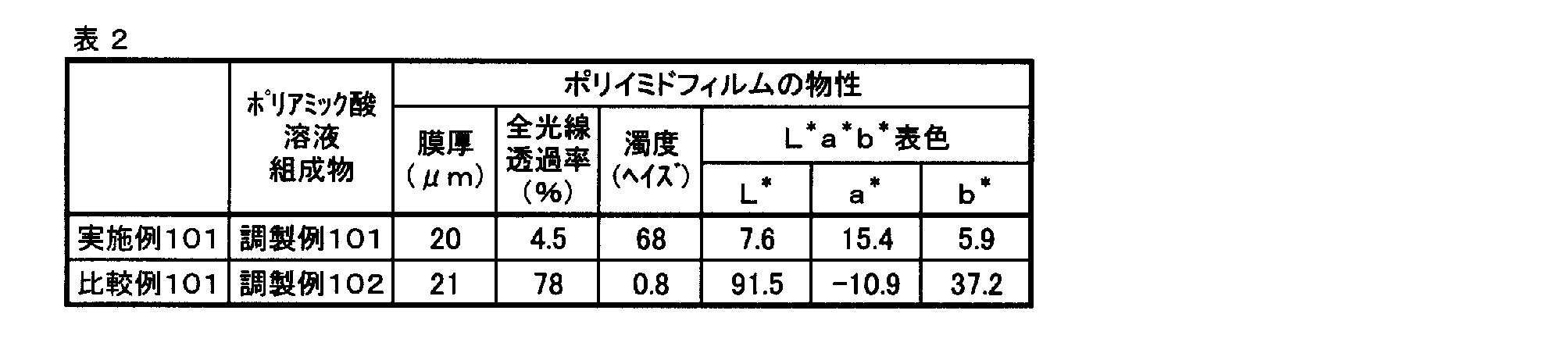
室温下、卓上自動コーターを用いて、表面に鏡面研磨を施したステンレス製の20cm角の基板上に、調製例201で得られたポリアミック酸溶液組成物A2を厚さ約120μmで、均一に流延塗布した。その後、90秒間、温度23℃、湿度40%の大気中に放置し、その後、ポリアミック酸の貧溶媒(水80質量%、NMP20質量%)、室温中に基板全体を浸漬した。浸漬後、8分間放置し、基板上にポリアミック酸膜を析出させた。その後、基板を浴中から取り出し、基板上に析出したポリアミック酸膜を剥離した後に、純水中に3分間浸漬し、温度23℃、湿度40%の大気中で乾燥させてポリアミック酸膜を得た。なお、このポリアミック酸膜の一部をサンプリングして色相測定を行った。ポリアミック酸膜の色相の測定結果を表3に示す。
得られたポリイミド多孔質膜は、膜厚が32μm、空孔率が79%、ガーレー値が22秒/100ccであった。
ポリイミド多孔質膜の表面を走査型電子顕微鏡で観察したところ、基板側の表面には連通する孔を多数有する多孔質構造であり、表面の平均孔径は0.19μm、最大孔径が10μm以下であった。また、ポリイミド多孔質膜の断面には複数のマクロボイドが存在し、膜横方向の長さ10μm以上のマクロボイドが多数確認でき、横方向の長さ5μm以上のボイド中、横方向の長さ(L)と膜厚み方向の長さ(d)との比(L/d)が0.5~3の範囲に入るボイドの数は75%以上であった。すなわち、得られた多孔質膜は、2つの表面層とそれに挟まれたマクロボイド層とを有する三層構造の多孔質膜であって、該マクロボイド層は、該表面層と該表面層に結合した隔壁とに囲まれた複数のマクロボイドと複数の細孔を有し、該細孔及び該マクロボイドが互いに連通した構造を有することが分かった。
ポリイミド多孔質膜のガラス転移温度は約290℃であり、寸法安定性は200℃で1%以内であった。250℃、15分、0.5MPaの圧縮応力負荷後の膜厚変化率は、1%以下であった。ポリイミド多孔質膜の全光線透過率、濁度、及び色相等の測定結果を表3に示す。
調製例202~205で得られたポリアミック酸溶液組成物B2~E2を用いた以外は実施例201と同様の操作を行い、ポリイミド多孔質膜を得た。得られたポリイミド多孔質膜の膜厚、空孔率、及びガーレー値を表3に示す。膜はいずれもこげ茶~黒色で不透明であった。
ポリイミド多孔質膜の表面を走査型電子顕微鏡で観察したところ、基板側の表面には連通する孔を多数有する多孔質構造であり、表面の平均孔径は0.15~0.20μmの範囲であり、最大孔径が10μm以下であった。また、ポリイミド多孔質膜の断面には複数のマクロボイドが存在し、前記(L/d)が0.5~3の範囲に入るボイドの数は75%以上であった。すなわち、得られた多孔質膜は、2つの表面層とそれに挟まれたマクロボイド層とを有する三層構造の多孔質膜であって、該マクロボイド層は、該表面層と該表面層に結合した隔壁とに囲まれた複数のマクロボイドと複数の細孔を有し、該細孔及び該マクロボイドが互いに連通した構造を有することが分かった。また、すべてのポリイミド多孔質膜について、寸法安定性は200℃で1%以内であり、前記圧縮応力負荷後の膜厚変化率は1%以下であった。ポリイミド多孔質膜の全光線透過率、濁度、及び色相等の測定結果を表3に示す。
室温下、卓上自動コーターを用いて、表面に鏡面研磨を施したステンレス製の20cm角の基板上に、調製例207で得られたポリアミック酸溶液組成物G2を厚さ約250μmで、均一に流延塗布した。基板上に塗布したポリアミック酸溶液の上に、ポリアミック酸溶液液面に対して100μmの間隔を持つドクターナイフを用いて、保護溶媒層としてNMPを均一に塗布し1分間静置した。その後、90秒間、温度23℃、湿度40%の大気中に放置し、ポリアミック酸の貧溶媒(メタノール90質量%、水5質量%、NMP5質量%)、室温中に基板全体を浸漬した。浸漬後、10分間放置し、基板上にポリアミック酸膜を析出させた。その後、基板を浴中から取り出し、基板上に析出したポリアミック酸膜を剥離した後に、純水中に3分間浸漬し、温度23℃、湿度40%の大気中で乾燥させてポリアミック酸膜を得た。このポリアミック酸膜の一部をサンプリングして色相測定を行った。ポリアミック酸膜の色相の測定結果を表3に示す。
得られたポリイミド多孔質膜はこげ茶~黒色で不透明であり、膜厚が29μm、空孔率が48%、ガーレー値が78秒/100ccであった。
ポリイミド多孔質膜の表面を走査型電子顕微鏡で観察したところ、両表面共に、ポリイミドがネットワーク上に連なったような多孔質構造であり、表面の平均孔径は0.17μm、最大孔径が1.6μmであった。また、ポリイミド多孔質膜の断面は、ポリイミドと空間とが共連続的に均質に連なった多孔質構造であり、膜横方向の長さが1μm以上のボイドは観察されなかった。すなわち、得られた膜は両表面に緻密層がない均一な膜であり、片面又は両面の表面に平均孔径が0.01~5μmの孔を有し、該孔が一方の面から他の面に向かって非直線に連続する多孔質構造を有していることを確認した。
ポリイミド多孔質膜のガラス転移温度は約280℃であり、寸法安定性は200℃で1%以内であった。250℃、15分、0.5MPaの圧縮応力負荷後の膜厚変化率は、1%以下であった。ポリイミド多孔質膜の全光線透過率、濁度、及び色相等の測定結果を表3に示す。
室温下、卓上自動コーターを用いて、表面に鏡面研磨を施したステンレス製の20cm角の基板上に、調製例202で得られたポリアミック酸溶液組成物B2を厚さ約120μmで、均一に流延塗布した。その後、90秒間、温度23℃、湿度40%の大気中に放置し、その後、ポリアミック酸の貧溶媒(水80質量%、NMP20質量%)、室温中に基板全体を浸漬した。浸漬後、8分間放置し、基板上にポリアミック酸膜を析出させた。その後、基板を浴中から取り出し、基板上に析出したポリアミック酸膜を剥離した後に、純水中に3分間浸漬し、温度23℃、湿度40%の大気中で乾燥させてポリアミック酸膜を得た。なお、このポリアミック酸膜の一部をサンプリングして色相測定を行った。ポリアミック酸膜の色相の測定結果を表3に示す。
得られたポリイミド多孔質膜は、膜厚が33μm、空孔率が80%、ガーレー値が56秒/100ccであった。
ポリイミド多孔質膜の表面を走査型電子顕微鏡で観察したところ、基板側の表面には連通する孔を多数有する多孔質構造であり、表面の平均孔径は0.16μm、最大孔径が10μm以下であった。また、ポリイミド多孔質膜の断面には複数のマクロボイドが存在し、膜横方向の長さ10μm以上のマクロボイドが多数確認でき、横方向の長さ5μm以上のボイド中、横方向の長さ(L)と膜厚み方向の長さ(d)との比(L/d)が0.5~3の範囲に入るボイドの数は75%以上であった。すなわち、得られた多孔質膜は、2つの表面層とそれに挟まれたマクロボイド層とを有する三層構造の多孔質膜であって、該マクロボイド層は、該表面層と該表面層に結合した隔壁とに囲まれた複数のマクロボイドと複数の細孔を有し、該細孔及び該マクロボイドが互いに連通した構造を有することが分かった。
ポリイミド多孔質膜のガラス転移温度は約275℃であり、寸法安定性は200℃で1%以内であった。250℃、15分、0.5MPaの圧縮応力負荷後の膜厚変化率は、1%以下であった。ポリイミド多孔質膜の全光線透過率、濁度、及び色相等の測定結果を表3に示す。
熱処理の最高温度を300℃にした以外は実施例207と同様の操作を行い、ポリイミド多孔質膜を得た。得られたポリイミド多孔質膜は、膜厚が33μm、空孔率が79%、ガーレー値が41秒/100ccであった。
ポリイミド多孔質膜の表面を走査型電子顕微鏡で観察したところ、基板側の表面には連通する孔を多数有する多孔質構造であり、表面の平均孔径は0.17μm、最大孔径が10μm以下であった。また、ポリイミド多孔質膜の断面には複数のマクロボイドが存在し、膜横方向の長さ10μm以上のマクロボイドが多数確認でき、横方向の長さ5μm以上のボイド中、横方向の長さ(L)と膜厚み方向の長さ(d)との比(L/d)が0.5~3の範囲に入るボイドの数は75%以上であった。すなわち、得られた多孔質膜は、2つの表面層とそれに挟まれたマクロボイド層とを有する三層構造の多孔質膜であって、該マクロボイド層は、該表面層と該表面層に結合した隔壁とに囲まれた複数のマクロボイドと複数の細孔を有し、該細孔及び該マクロボイドが互いに連通した構造を有することが分かった。
ポリイミド多孔質膜のガラス転移温度は約280℃であり、寸法安定性は200℃で1%以内であった。250℃、15分、0.5MPaの圧縮応力負荷後の膜厚変化率は、1%以下であった。ポリイミド多孔質膜の全光線透過率、濁度、及び色相等の測定結果を表3に示す。
熱処理の最高温度を400℃にした以外は実施例207と同様の操作を行い、ポリイミド多孔質膜を得た。得られたポリイミド多孔質膜は、膜厚が31μm、空孔率が76%、ガーレー値が31秒/100ccであった。
ポリイミド多孔質膜の表面を走査型電子顕微鏡で観察したところ、基板側の表面には連通する孔を多数有する多孔質構造であり、表面の平均孔径は0.18μm、最大孔径が10μm以下であった。また、ポリイミド多孔質膜の断面には複数のマクロボイドが存在し、膜横方向の長さ10μm以上のマクロボイドが多数確認でき、横方向の長さ5μm以上のボイド中、横方向の長さ(L)と膜厚み方向の長さ(d)との比(L/d)が0.5~3の範囲に入るボイドの数は75%以上であった。すなわち、得られた多孔質膜は、2つの表面層とそれに挟まれたマクロボイド層とを有する三層構造の多孔質膜であって、該マクロボイド層は、該表面層と該表面層に結合した隔壁とに囲まれた複数のマクロボイドと複数の細孔を有し、該細孔及び該マクロボイドが互いに連通した構造を有することが分かった。
ポリイミド多孔質膜のガラス転移温度は約290℃であり、寸法安定性は200℃で1%以内であった。250℃、15分、0.5MPaの圧縮応力負荷後の膜厚変化率は、1%以下であった。ポリイミド多孔質膜の全光線透過率、濁度、及び色相等の測定結果を表3に示す。
用いた溶液を調製例203で得られたポリアミック酸溶液組成物C2に変更した以外は実施例207と同様の操作を行い、ポリイミド多孔質膜を得た。得られたポリイミド多孔質膜は、膜厚が34μm、空孔率が81%、ガーレー値が53秒/100ccであった。
ポリイミド多孔質膜の表面を走査型電子顕微鏡で観察したところ、基板側の表面には連通する孔を多数有する多孔質構造であり、表面の平均孔径は0.16μm、最大孔径が10μm以下であった。また、ポリイミド多孔質膜の断面には複数のマクロボイドが存在し、膜横方向の長さ10μm以上のマクロボイドが多数確認でき、横方向の長さ5μm以上のボイド中、横方向の長さ(L)と膜厚み方向の長さ(d)との比(L/d)が0.5~3の範囲に入るボイドの数は75%以上であった。すなわち、得られた多孔質膜は、2つの表面層とそれに挟まれたマクロボイド層とを有する三層構造の多孔質膜であって、該マクロボイド層は、該表面層と該表面層に結合した隔壁とに囲まれた複数のマクロボイドと複数の細孔を有し、該細孔及び該マクロボイドが互いに連通した構造を有することが分かった。
ポリイミド多孔質膜のガラス転移温度は約275℃であり、寸法安定性は200℃で1%以内であった。250℃、15分、0.5MPaの圧縮応力負荷後の膜厚変化率は、1%以下であった。ポリイミド多孔質膜の全光線透過率、濁度、及び色相等の測定結果を表3に示す。
用いた溶液を調製例203で得られたポリアミック酸溶液組成物C2に変更した以外は実施例208と同様の操作を行い、ポリイミド多孔質膜を得た。得られたポリイミド多孔質膜は、膜厚が32μm、空孔率が80%、ガーレー値が38秒/100ccであった。
ポリイミド多孔質膜の表面を走査型電子顕微鏡で観察したところ、基板側の表面には連通する孔を多数有する多孔質構造であり、表面の平均孔径は0.17μm、最大孔径が10μm以下であった。また、ポリイミド多孔質膜の断面には複数のマクロボイドが存在し、膜横方向の長さ10μm以上のマクロボイドが多数確認でき、横方向の長さ5μm以上のボイド中、横方向の長さ(L)と膜厚み方向の長さ(d)との比(L/d)が0.5~3の範囲に入るボイドの数は75%以上であった。すなわち、得られた多孔質膜は、2つの表面層とそれに挟まれたマクロボイド層とを有する三層構造の多孔質膜であって、該マクロボイド層は、該表面層と該表面層に結合した隔壁とに囲まれた複数のマクロボイドと複数の細孔を有し、該細孔及び該マクロボイドが互いに連通した構造を有することが分かった。
ポリイミド多孔質膜のガラス転移温度は約285℃であり、寸法安定性は200℃で1%以内であった。250℃、15分、0.5MPaの圧縮応力負荷後の膜厚変化率は、1%以下であった。ポリイミド多孔質膜の全光線透過率、濁度、及び色相等の測定結果を表3に示す。
用いた溶液を調製例203で得られたポリアミック酸溶液組成物C2に変更した以外は実施例209と同様の操作を行い、ポリイミド多孔質膜を得た。得られたポリイミド多孔質膜は、膜厚が31μm、空孔率が78%、ガーレー値が28秒/100ccであった。
ポリイミド多孔質膜の表面を走査型電子顕微鏡で観察したところ、基板側の表面には連通する孔を多数有する多孔質構造であり、表面の平均孔径は0.18μm、最大孔径が10μm以下であった。また、ポリイミド多孔質膜の断面には複数のマクロボイドが存在し、膜横方向の長さ10μm以上のマクロボイドが多数確認でき、横方向の長さ5μm以上のボイド中、横方向の長さ(L)と膜厚み方向の長さ(d)との比(L/d)が0.5~3の範囲に入るボイドの数は75%以上であった。すなわち、得られた多孔質膜は、2つの表面層とそれに挟まれたマクロボイド層とを有する三層構造の多孔質膜であって、該マクロボイド層は、該表面層と該表面層に結合した隔壁とに囲まれた複数のマクロボイドと複数の細孔を有し、該細孔及び該マクロボイドが互いに連通した構造を有することが分かった。
ポリイミド多孔質膜のガラス転移温度は約290℃であり、寸法安定性は200℃で1%以内であった。250℃、15分、0.5MPaの圧縮応力負荷後の膜厚変化率は、1%以下であった。ポリイミド多孔質膜の全光線透過率、濁度、及び色相等の測定結果を表3に示す。
調製例206で得られたポリアミック酸溶液組成物F2を用いた以外は実施例201と同様の操作を行い、ポリイミド多孔質膜を得た。得られた膜は薄い黄色で不透明であった。得られたポリイミド多孔質膜の膜厚、空孔率、及びガーレー値を表3に示す。
ポリイミド多孔質膜の表面を走査型電子顕微鏡で観察したところ、基板側の表面には連通する孔を多数有する多孔質構造であり、表面の平均孔径は0.18μm、最大孔径が10μm以下であった。また、ポリイミド多孔質膜の断面には複数のマクロボイドが存在し、横方向の長さ5μm以上のボイド中、横方向の長さ(L)と膜厚み方向の長さ(d)との比がL/d=0.5~3の範囲に入るボイドの数は75%以上であった。すなわち、得られた多孔質膜は、2つの表面層とそれに挟まれたマクロボイド層とを有する三層構造の多孔質膜であって、該マクロボイド層は、該表面層と該表面層に結合した隔壁とに囲まれた複数のマクロボイドと複数の細孔を有し、該細孔及び該マクロボイドが互いに連通した構造を有することが分かった。また、ポリイミド多孔質膜の寸法安定性は200℃で1%以内であり、前記圧縮応力負荷後の膜厚変化率は1%以下であった。全光線透過率、濁度、及び色相等の測定結果を表3に示す。
調製例208で得られたポリアミック酸溶液組成物Hを用いた以外は実施例206と同様の操作を行い、ポリイミド多孔質膜を得た。得られた膜は薄い黄色で不透明であり、膜厚が30μm、空孔率が48%、ガーレー値が69秒/100ccであった。
ポリイミド多孔質膜の表面を走査型電子顕微鏡で観察したところ、両表面共に、ポリイミドがネットワーク上に連なったような多孔質構造であり、表面の平均孔径は0.17μm、最大孔径が1.7μmであった。また、ポリイミド多孔質膜の断面は、ポリイミドと空間とが共連続的に均質に連なった多孔質構造であり、膜横方向の長さが1μm以上のボイドは観察されなかった。すなわち、得られた膜は両表面に緻密層がない均一な膜であり、片面又は両面の表面に平均孔径が0.01~5μmの孔を有し、該孔が一方の面から他の面に向かって非直線に連続する多孔質構造を有していることを確認した。
ポリイミド多孔質膜のガラス転移温度は約285℃であり、寸法安定性は200℃で1%以内であった。250℃、15分、0.5MPaの圧縮応力負荷後の膜厚変化率は、1%以下であった。ポリイミド多孔質膜の全光線透過率、濁度、及び色相等の測定結果を表3に示す。

Claims (10)
- 少なくともテトラカルボン酸成分とジアミン成分とから得られるポリアミック酸溶液と着色前駆体とを含むポリアミック酸溶液組成物、又はポリイミド溶液と着色前駆体とを含むポリイミド溶液組成物を成形した後、250℃以上で熱処理する工程を含む、着色ポリイミド成形体の製造方法。
- 前記テトラカルボン酸成分が、ビフェニルテトラカルボン酸二無水物及びピロメリット酸二無水物からなる群から選ばれる少なくとも1種であり、前記ジアミン成分が、パラフェニレンジアミン、ジアミノジフェニルエーテル、及びビス(アミノフェノキシ)ベンゼンからなる群から選ばれる少なくとも1種である、請求項1に記載の着色ポリイミド成形体の製造方法。
- 前記着色前駆体が、アクリロニトリルを含むモノマーから得られる重合体、及び/又はフェロセン化合物である、請求項1又は2に記載の着色ポリイミド成形体の製造方法。
- 前記ポリアミック酸溶液組成物又は前記ポリイミド溶液組成物が、懸濁液又は透明の均一溶液である、請求項1~3のいずれかに記載の着色ポリイミド成形体の製造方法。
- 前記ポリアミック酸溶液組成物を流延して得られるフィルムを、ポリアミック酸の貧溶媒に浸漬して多孔質ポリアミック酸フィルムを作製する工程、及び該多孔質ポリアミック酸フィルムを250℃以上で熱処理する工程を含み、前記着色ポリイミド成形体が着色ポリイミド多孔質膜である、請求項1~4のいずれかに記載の着色ポリイミド成形体の製造方法。
- 前記貧溶媒が、水又は水を含有する混合溶媒である、請求項5に記載の着色ポリイミド成形体の製造方法。
- 前記熱処理が、前記ポリアミック酸溶液組成物又はポリイミド溶液組成物を用いて成形した成形品を固定した状態で、大気中、280~500℃で5~60分間行う、請求項1~6のいずれかに記載の着色ポリイミド成形体の製造方法。
- 請求項1~7のいずれかに記載の方法により得られる着色ポリイミド成形体。
- 両表面に緻密層がない均一な膜厚5~100μmの膜であり、片面又は両面の表面に平均孔径が0.01~5μmの孔を有し、該孔が一方の面から他の面に向かって非直線に連続する多孔質構造を有し、空孔率が15~80%、ガーレー値が30~1000秒/100ccである着色ポリイミド多孔質膜である、請求項8に記載の着色ポリイミド成形体。
- 2つの表面層とそれに挟まれたマクロボイド層とを有する三層構造の多孔質膜であって、該マクロボイド層は、該表面層と該表面層に結合した隔壁とに囲まれた複数のマクロボイドと複数の細孔を有し、該細孔及び該マクロボイドが互いに連通した構造を有する、請求項8に記載の着色ポリイミド成形体。
Priority Applications (6)
| Application Number | Priority Date | Filing Date | Title |
|---|---|---|---|
| EP10822137.5A EP2487196B1 (en) | 2009-10-09 | 2010-10-08 | Process for the production of a colored polyimide molded article |
| JP2011535478A JP5720574B2 (ja) | 2009-10-09 | 2010-10-08 | 着色ポリイミド成形体及びその製造方法 |
| CN201080045100.6A CN102575028B (zh) | 2009-10-09 | 2010-10-08 | 着色聚酰亚胺成型体及其制造方法 |
| US13/500,771 US9346927B2 (en) | 2009-10-09 | 2010-10-08 | Colored polyimide molded article, and process for production thereof |
| KR1020127008940A KR101747462B1 (ko) | 2009-10-09 | 2010-10-08 | 착색 폴리이미드 성형체 및 그의 제조 방법 |
| US15/094,223 US9902824B2 (en) | 2009-10-09 | 2016-04-08 | Colored polyimide molded article, and process for production thereof |
Applications Claiming Priority (4)
| Application Number | Priority Date | Filing Date | Title |
|---|---|---|---|
| JP2009235673 | 2009-10-09 | ||
| JP2009235672 | 2009-10-09 | ||
| JP2009-235673 | 2009-10-09 | ||
| JP2009-235672 | 2009-10-09 |
Related Child Applications (2)
| Application Number | Title | Priority Date | Filing Date |
|---|---|---|---|
| US13/500,771 A-371-Of-International US9346927B2 (en) | 2009-10-09 | 2010-10-08 | Colored polyimide molded article, and process for production thereof |
| US15/094,223 Division US9902824B2 (en) | 2009-10-09 | 2016-04-08 | Colored polyimide molded article, and process for production thereof |
Publications (1)
| Publication Number | Publication Date |
|---|---|
| WO2011043467A1 true WO2011043467A1 (ja) | 2011-04-14 |
Family
ID=43856916
Family Applications (1)
| Application Number | Title | Priority Date | Filing Date |
|---|---|---|---|
| PCT/JP2010/067760 Ceased WO2011043467A1 (ja) | 2009-10-09 | 2010-10-08 | 着色ポリイミド成形体及びその製造方法 |
Country Status (7)
| Country | Link |
|---|---|
| US (2) | US9346927B2 (ja) |
| EP (1) | EP2487196B1 (ja) |
| JP (1) | JP5720574B2 (ja) |
| KR (1) | KR101747462B1 (ja) |
| CN (1) | CN102575028B (ja) |
| TW (1) | TWI485191B (ja) |
| WO (1) | WO2011043467A1 (ja) |
Cited By (10)
| Publication number | Priority date | Publication date | Assignee | Title |
|---|---|---|---|---|
| WO2012169383A1 (ja) * | 2011-06-06 | 2012-12-13 | 日東電工株式会社 | ポリイミド多孔質体及びその製造方法 |
| JP2015028630A (ja) * | 2013-07-30 | 2015-02-12 | ゼロックス コーポレイションXerox Corporation | フューザー部材組成物 |
| JP2015071755A (ja) * | 2013-09-06 | 2015-04-16 | 宇部興産株式会社 | ポリイミド多孔質膜及び多孔質膜製造用のポリイミド前駆体反応生成物溶液 |
| KR20150069409A (ko) * | 2013-12-13 | 2015-06-23 | 엘지디스플레이 주식회사 | 플렉서블 표시장치의 제조방법 |
| WO2016039299A1 (ja) * | 2014-09-10 | 2016-03-17 | 東京応化工業株式会社 | 多孔質ポリイミド膜の製造方法 |
| WO2016121766A1 (ja) * | 2015-01-26 | 2016-08-04 | 宇部興産株式会社 | 細胞を分離、除去、及び解析する方法 |
| JP2016194025A (ja) * | 2015-04-02 | 2016-11-17 | 宇部興産株式会社 | ポリイミドフィルムの製造方法 |
| WO2018021366A1 (ja) * | 2016-07-25 | 2018-02-01 | 宇部興産株式会社 | 細胞の調製方法、細胞培養装置及びキット |
| WO2018021356A1 (ja) * | 2016-07-25 | 2018-02-01 | 宇部興産株式会社 | 多孔質ポリイミド膜の製造方法、及び当該方法で製造される多孔質ポリイミド膜 |
| JP2018027705A (ja) * | 2017-11-20 | 2018-02-22 | 宇部興産株式会社 | 積層体および積層体の製造方法 |
Families Citing this family (17)
| Publication number | Priority date | Publication date | Assignee | Title |
|---|---|---|---|---|
| TWI466924B (zh) * | 2013-01-23 | 2015-01-01 | Mortech Corp | 聚醯亞胺膜及其聚醯亞胺積層板 |
| KR102283213B1 (ko) * | 2014-02-21 | 2021-07-29 | 도쿄 오카 고교 가부시키가이샤 | 카본 블랙 분산액 |
| JP6269373B2 (ja) * | 2014-07-29 | 2018-01-31 | 日立金属株式会社 | エナメル線の製造方法及び製造装置 |
| US9985251B2 (en) * | 2014-10-28 | 2018-05-29 | The Trustees of Princeton University, Office of Technology and Trademark Licensing | Process for fabricating a porous film in a scattering layer |
| CN112940940B (zh) * | 2015-01-26 | 2024-03-15 | Ube株式会社 | 细胞的培养方法及试剂盒 |
| JP6288311B2 (ja) * | 2015-01-26 | 2018-03-07 | 宇部興産株式会社 | 物質の産生方法 |
| WO2016121773A1 (ja) | 2015-01-26 | 2016-08-04 | 宇部興産株式会社 | ポリイミド多孔質膜を用いる細胞の大量培養方法、装置及びキット |
| WO2016121767A1 (ja) * | 2015-01-26 | 2016-08-04 | 宇部興産株式会社 | ポリイミド多孔質膜を用いる細胞の長期培養、及びポリイミド多孔質膜を用いる細胞の凍結保存方法 |
| CN107208058B (zh) * | 2015-01-26 | 2021-06-25 | 宇部兴产株式会社 | 利用骨髓类似结构的细胞培养方法、和用于骨损伤部位的治疗的聚酰亚胺多孔膜 |
| WO2018058342A1 (en) | 2016-09-28 | 2018-04-05 | Dow Global Technologies Llc | Solvent systems for synthesis of poly(amic acid) and polyimide polymers |
| JP6940408B2 (ja) | 2016-09-28 | 2021-09-29 | ダウ グローバル テクノロジーズ エルエルシー | ポリ(アミド酸)及びポリイミドポリマーの合成用のdmpaベースの溶媒系 |
| CN106751822B (zh) * | 2016-11-29 | 2018-11-09 | 江西师范大学 | 高介电常数聚酰亚胺金属有机络合物复合膜及其制备方法 |
| CN108169997B (zh) | 2017-12-26 | 2020-12-22 | 武汉华星光电技术有限公司 | 光学补偿膜、掩膜版以及曝光机 |
| JP2019124830A (ja) * | 2018-01-17 | 2019-07-25 | 株式会社ジャパンディスプレイ | 液晶表示装置及びその製造方法 |
| CN109056102B (zh) * | 2018-08-13 | 2021-06-29 | 长春高琦聚酰亚胺材料有限公司 | 一种黑色系聚酰亚胺纳米纤维长丝纱线及其批量化制备方法 |
| KR102347593B1 (ko) * | 2019-11-21 | 2022-01-10 | 피아이첨단소재 주식회사 | 폴리이미드 필름 및 이의 제조 방법 |
| CN113025038B (zh) * | 2019-12-25 | 2022-05-10 | 中国科学院上海硅酸盐研究所 | 一种含高相容性色素的黑色聚酰亚胺膜及其制备方法 |
Citations (6)
| Publication number | Priority date | Publication date | Assignee | Title |
|---|---|---|---|---|
| JPH05119212A (ja) | 1991-10-29 | 1993-05-18 | Kyodo Printing Co Ltd | 着色樹脂パターンの色溶出防止方法およびカラーフイルタの製造方法 |
| JPH11310658A (ja) | 1998-04-27 | 1999-11-09 | Ube Ind Ltd | ポリイミド多孔膜及び製造方法 |
| JP2000275423A (ja) * | 1999-03-24 | 2000-10-06 | Toray Ind Inc | カラーフィルターおよび液晶表示装置 |
| JP2001145826A (ja) * | 1999-11-19 | 2001-05-29 | Ube Ind Ltd | 多孔質膜の製造方法および多孔質膜 |
| JP2004304024A (ja) | 2003-03-31 | 2004-10-28 | Nippon Steel Chem Co Ltd | 電子部品被覆用ポリイミドフィルム |
| WO2010038873A1 (ja) * | 2008-10-02 | 2010-04-08 | 宇部興産株式会社 | 多孔質ポリイミド膜及びその製造方法 |
Family Cites Families (45)
| Publication number | Priority date | Publication date | Assignee | Title |
|---|---|---|---|---|
| US3541036A (en) | 1967-03-30 | 1970-11-17 | Du Pont | Polyamic acid polymer dispersion |
| FR2220552B1 (ja) * | 1973-03-07 | 1976-06-11 | Rhone Poulenc Ind | |
| WO1987006251A1 (fr) * | 1986-04-09 | 1987-10-22 | Mitsui Toatsu Chemicals, Incorporated | Composition de resine de polyimide |
| JPH0723427B2 (ja) * | 1986-06-26 | 1995-03-15 | 共同印刷株式会社 | ポリアミド酸膜の熱硬化方法 |
| DE3626333C2 (de) * | 1986-08-02 | 1996-01-18 | Teves Gmbh Alfred | Ausgleichsbehälter für eine hydraulische Bremsanlage |
| JPH06329997A (ja) * | 1993-05-18 | 1994-11-29 | Toray Dow Corning Silicone Co Ltd | シリコーンゴムによる基材の接着方法 |
| WO1997007975A1 (en) * | 1995-08-28 | 1997-03-06 | Daicel-Huels Ltd. | Composite member and process for producing the same |
| JP3940546B2 (ja) * | 1999-06-07 | 2007-07-04 | 株式会社東芝 | パターン形成方法およびパターン形成材料 |
| US6441083B1 (en) | 1999-06-11 | 2002-08-27 | Nippon Shokubai Co., Ltd. | Polyamidic acid-containing and fine particles-dispersed composition and production process therefor |
| US6653433B2 (en) * | 1999-11-24 | 2003-11-25 | E. I. Du Pont De Nemours And Company | Polyimide composition having improved peel strength when clad |
| JP3908424B2 (ja) | 1999-12-16 | 2007-04-25 | 株式会社リコー | 無端状ベルトの製造方法 |
| GB2369311B (en) * | 2000-11-24 | 2002-12-11 | Membrane Extraction Tech Ltd | Separating phase transfer agents |
| DE10116232A1 (de) * | 2001-04-02 | 2002-10-10 | Creavis Tech & Innovation Gmbh | Verfahren zur Herstellung von Formkörpern mit innenbeschichteten Hohlräumen |
| US6565962B2 (en) * | 2001-07-23 | 2003-05-20 | Ube Industries, Ltd. | Polyimide porous film |
| US6913694B2 (en) * | 2001-11-06 | 2005-07-05 | Saehan Industries Incorporation | Selective membrane having a high fouling resistance |
| DE60323367D1 (de) * | 2002-06-19 | 2008-10-16 | Ube Industries | Polyelektrolytmembran und herstellungsverfahren dafür |
| EP1537445B1 (en) * | 2002-09-05 | 2012-08-01 | Nanosys, Inc. | Nanocomposites |
| JP4398650B2 (ja) * | 2002-09-18 | 2010-01-13 | マナック株式会社 | 新規な熱可塑性ポリイミド及びイミドオリゴマー |
| US8034866B2 (en) * | 2003-12-30 | 2011-10-11 | Sabic Innovative Plastics Ip B.V. | Polymer compositions, method of manufacture, and articles formed therefrom |
| US8193291B2 (en) * | 2004-02-23 | 2012-06-05 | Caiteng Zhang | Solution of metal-polymer chelate(s) and applications thereof |
| JP4993845B2 (ja) * | 2004-03-03 | 2012-08-08 | グンゼ株式会社 | 半導電性高濃度ポリイミド前駆体組成物及びそれを用いた半導電性ポリイミド管状物 |
| JP4919030B2 (ja) * | 2004-03-12 | 2012-04-18 | 大日本印刷株式会社 | カラーフィルタ |
| JP2006068920A (ja) * | 2004-08-31 | 2006-03-16 | Shin Etsu Chem Co Ltd | フレキシブル銅箔ポリイミド積層板の製造方法 |
| US20060118999A1 (en) * | 2004-12-06 | 2006-06-08 | Bayer Materialscience Llc | Method of preparing a coated molded article |
| US7754108B2 (en) * | 2005-06-08 | 2010-07-13 | UBE Industires, Ltd. | Polyimide powder for antistatic polyimide molded product and polyimide molded product thereby |
| US8475694B2 (en) * | 2005-10-25 | 2013-07-02 | Zephyros, Inc. | Shaped expandable material |
| US7854788B2 (en) * | 2007-06-06 | 2010-12-21 | The Boeing Company | Filter membrane |
| CN102700111B (zh) * | 2008-03-27 | 2015-06-24 | 东洋制罐株式会社 | 拉伸发泡塑料容器及其制造方法 |
| WO2009120151A1 (en) * | 2008-03-28 | 2009-10-01 | Nanyang Technological University | Membrane made of a nanostructured material |
| JP5479163B2 (ja) * | 2009-03-31 | 2014-04-23 | 富士フイルム株式会社 | カラーフィルタ用着色硬化性組成物、カラーフィルタ及びその製造方法、並びに固体撮像素子 |
| TW201037035A (en) * | 2009-04-01 | 2010-10-16 | Microcosm Technology Co Ltd | Polyimide film having sheltering property and application thereof and preparation method thereof |
| JP2011009147A (ja) * | 2009-06-29 | 2011-01-13 | Tokai Carbon Co Ltd | 燃料電池用セパレータの製造方法 |
| KR101470524B1 (ko) * | 2009-06-30 | 2014-12-08 | 한화케미칼 주식회사 | 혼화성이 증대된 복합탄소소재 및 이의 연속적인 제조 방법 |
| US8697208B2 (en) * | 2009-07-24 | 2014-04-15 | Fina Technology, Inc. | Polystyrene nanocomposites for blow molding applications |
| US8541107B2 (en) * | 2009-08-13 | 2013-09-24 | E. I. Du Pont De Nemours And Company | Pigmented polyimide films and methods relating thereto |
| KR101810258B1 (ko) * | 2010-03-01 | 2017-12-18 | 신닛테츠 수미킨 가가쿠 가부시키가이샤 | 금속 미립자 복합체 및 그 제조 방법 |
| WO2011125988A1 (ja) * | 2010-04-07 | 2011-10-13 | 宇部興産株式会社 | 多孔質ポリイミド膜及びその製造方法 |
| JP5827578B2 (ja) * | 2011-02-14 | 2015-12-02 | 株式会社半導体エネルギー研究所 | 光学素子の作製方法 |
| TW201302858A (zh) * | 2011-06-24 | 2013-01-16 | Du Pont | 有色聚醯亞胺膜及與其有關之方法 |
| EP2751891B1 (en) * | 2011-09-02 | 2021-10-27 | ABB Power Grids Switzerland AG | Insulator for high-voltage gas insulated switch gear |
| GB201117950D0 (en) * | 2011-10-18 | 2011-11-30 | Imp Innovations Ltd | Membranes for separation |
| KR20140107445A (ko) * | 2011-12-16 | 2014-09-04 | 미쯔비시 가스 케미칼 컴파니, 인코포레이티드 | 성형품 |
| US9123955B2 (en) * | 2012-04-06 | 2015-09-01 | Samsung Sdi Co., Ltd. | Negative active material, lithium battery including the material, and method for manufacturing the material |
| TWI492970B (zh) * | 2013-01-28 | 2015-07-21 | Taimide Technology Inc | 粉狀呈色消光劑、含有該消光劑之聚醯亞胺膜、及其製造方法 |
| CN104117288B (zh) * | 2013-04-25 | 2017-07-18 | 财团法人工业技术研究院 | 过滤材料及其制造方法 |
-
2010
- 2010-10-08 JP JP2011535478A patent/JP5720574B2/ja active Active
- 2010-10-08 WO PCT/JP2010/067760 patent/WO2011043467A1/ja not_active Ceased
- 2010-10-08 KR KR1020127008940A patent/KR101747462B1/ko active Active
- 2010-10-08 US US13/500,771 patent/US9346927B2/en active Active
- 2010-10-08 CN CN201080045100.6A patent/CN102575028B/zh active Active
- 2010-10-08 EP EP10822137.5A patent/EP2487196B1/en active Active
- 2010-10-08 TW TW099134532A patent/TWI485191B/zh active
-
2016
- 2016-04-08 US US15/094,223 patent/US9902824B2/en active Active
Patent Citations (6)
| Publication number | Priority date | Publication date | Assignee | Title |
|---|---|---|---|---|
| JPH05119212A (ja) | 1991-10-29 | 1993-05-18 | Kyodo Printing Co Ltd | 着色樹脂パターンの色溶出防止方法およびカラーフイルタの製造方法 |
| JPH11310658A (ja) | 1998-04-27 | 1999-11-09 | Ube Ind Ltd | ポリイミド多孔膜及び製造方法 |
| JP2000275423A (ja) * | 1999-03-24 | 2000-10-06 | Toray Ind Inc | カラーフィルターおよび液晶表示装置 |
| JP2001145826A (ja) * | 1999-11-19 | 2001-05-29 | Ube Ind Ltd | 多孔質膜の製造方法および多孔質膜 |
| JP2004304024A (ja) | 2003-03-31 | 2004-10-28 | Nippon Steel Chem Co Ltd | 電子部品被覆用ポリイミドフィルム |
| WO2010038873A1 (ja) * | 2008-10-02 | 2010-04-08 | 宇部興産株式会社 | 多孔質ポリイミド膜及びその製造方法 |
Non-Patent Citations (1)
| Title |
|---|
| See also references of EP2487196A4 |
Cited By (22)
| Publication number | Priority date | Publication date | Assignee | Title |
|---|---|---|---|---|
| WO2012169383A1 (ja) * | 2011-06-06 | 2012-12-13 | 日東電工株式会社 | ポリイミド多孔質体及びその製造方法 |
| JP2013014742A (ja) * | 2011-06-06 | 2013-01-24 | Nitto Denko Corp | ポリイミド多孔質体及びその製造方法 |
| CN103597016A (zh) * | 2011-06-06 | 2014-02-19 | 日东电工株式会社 | 聚酰亚胺多孔体及其制造方法 |
| JP2015028630A (ja) * | 2013-07-30 | 2015-02-12 | ゼロックス コーポレイションXerox Corporation | フューザー部材組成物 |
| JP2015071755A (ja) * | 2013-09-06 | 2015-04-16 | 宇部興産株式会社 | ポリイミド多孔質膜及び多孔質膜製造用のポリイミド前駆体反応生成物溶液 |
| KR20150069409A (ko) * | 2013-12-13 | 2015-06-23 | 엘지디스플레이 주식회사 | 플렉서블 표시장치의 제조방법 |
| KR102156766B1 (ko) * | 2013-12-13 | 2020-09-16 | 엘지디스플레이 주식회사 | 플렉서블 표시장치의 제조방법 |
| WO2016039299A1 (ja) * | 2014-09-10 | 2016-03-17 | 東京応化工業株式会社 | 多孔質ポリイミド膜の製造方法 |
| US10177357B2 (en) | 2014-09-10 | 2019-01-08 | Tokyo Ohka Kogyo Co., Ltd. | Method for producing porous polyimide film |
| JPWO2016039299A1 (ja) * | 2014-09-10 | 2017-06-22 | 東京応化工業株式会社 | 多孔質ポリイミド膜の製造方法 |
| JPWO2016121766A1 (ja) * | 2015-01-26 | 2017-10-26 | 宇部興産株式会社 | 細胞を分離、除去、及び解析する方法 |
| US10647956B2 (en) | 2015-01-26 | 2020-05-12 | Ube Industries, Ltd. | Method for isolating, removing and analyzing cells |
| WO2016121766A1 (ja) * | 2015-01-26 | 2016-08-04 | 宇部興産株式会社 | 細胞を分離、除去、及び解析する方法 |
| JP2016194025A (ja) * | 2015-04-02 | 2016-11-17 | 宇部興産株式会社 | ポリイミドフィルムの製造方法 |
| WO2018021366A1 (ja) * | 2016-07-25 | 2018-02-01 | 宇部興産株式会社 | 細胞の調製方法、細胞培養装置及びキット |
| WO2018021356A1 (ja) * | 2016-07-25 | 2018-02-01 | 宇部興産株式会社 | 多孔質ポリイミド膜の製造方法、及び当該方法で製造される多孔質ポリイミド膜 |
| CN109477055A (zh) * | 2016-07-25 | 2019-03-15 | 宇部兴产株式会社 | 细胞的制备方法、细胞培养装置和试剂盒 |
| JPWO2018021366A1 (ja) * | 2016-07-25 | 2019-05-16 | 宇部興産株式会社 | 細胞の調製方法、細胞培養装置及びキット |
| JPWO2018021356A1 (ja) * | 2016-07-25 | 2019-05-16 | 宇部興産株式会社 | 多孔質ポリイミド膜の製造方法、及び当該方法で製造される多孔質ポリイミド膜 |
| US10968328B2 (en) | 2016-07-25 | 2021-04-06 | Ube Industries, Ltd. | Porous polyimide film production method and porous polyimide film produced using said method |
| CN109477055B (zh) * | 2016-07-25 | 2022-06-21 | 宇部兴产株式会社 | 细胞的制备方法、细胞培养装置和试剂盒 |
| JP2018027705A (ja) * | 2017-11-20 | 2018-02-22 | 宇部興産株式会社 | 積層体および積層体の製造方法 |
Also Published As
| Publication number | Publication date |
|---|---|
| CN102575028B (zh) | 2015-06-17 |
| US20160221279A1 (en) | 2016-08-04 |
| EP2487196A4 (en) | 2014-04-09 |
| US9902824B2 (en) | 2018-02-27 |
| EP2487196B1 (en) | 2018-01-17 |
| US9346927B2 (en) | 2016-05-24 |
| JP5720574B2 (ja) | 2015-05-20 |
| EP2487196A1 (en) | 2012-08-15 |
| TWI485191B (zh) | 2015-05-21 |
| KR20120093856A (ko) | 2012-08-23 |
| JPWO2011043467A1 (ja) | 2013-03-04 |
| CN102575028A (zh) | 2012-07-11 |
| KR101747462B1 (ko) | 2017-06-14 |
| TW201130898A (en) | 2011-09-16 |
| US20120207999A1 (en) | 2012-08-16 |
Similar Documents
| Publication | Publication Date | Title |
|---|---|---|
| JP5720574B2 (ja) | 着色ポリイミド成形体及びその製造方法 | |
| KR101680391B1 (ko) | 다공질 폴리이미드막 및 그의 제조 방법 | |
| KR101814225B1 (ko) | 다공질 폴리이미드막 및 그의 제조 방법 | |
| JP5577804B2 (ja) | 多孔質ポリイミド膜及びその製造方法 | |
| JP5577803B2 (ja) | 多孔質ポリイミド膜及びその製造方法 | |
| KR102189214B1 (ko) | 다공질 폴리이미드막의 제조 방법 및 이 방법으로 제조되는 다공질 폴리이미드막 | |
| JP6330261B2 (ja) | ポリマー多孔質膜の製造方法及びポリマー多孔質膜 | |
| JP7326785B2 (ja) | 多孔質ポリイミド膜及びその製造方法 | |
| KR20240131021A (ko) | 그라파이트 시트용 폴리이미드 필름 및 이로부터 제조된 그라파이트 시트 | |
| KR20250058995A (ko) | 폴리이미드 필름 및 그로부터 제조된 그라파이트 시트 |
Legal Events
| Date | Code | Title | Description |
|---|---|---|---|
| WWE | Wipo information: entry into national phase |
Ref document number: 201080045100.6 Country of ref document: CN |
|
| 121 | Ep: the epo has been informed by wipo that ep was designated in this application |
Ref document number: 10822137 Country of ref document: EP Kind code of ref document: A1 |
|
| WWE | Wipo information: entry into national phase |
Ref document number: 2011535478 Country of ref document: JP |
|
| WWE | Wipo information: entry into national phase |
Ref document number: 2010822137 Country of ref document: EP |
|
| ENP | Entry into the national phase |
Ref document number: 20127008940 Country of ref document: KR Kind code of ref document: A |
|
| WWE | Wipo information: entry into national phase |
Ref document number: 13500771 Country of ref document: US |
|
| NENP | Non-entry into the national phase |
Ref country code: DE |