WO2011046128A1 - 人物服装特徴抽出装置、人物検索装置、及びその処理方法 - Google Patents
人物服装特徴抽出装置、人物検索装置、及びその処理方法 Download PDFInfo
- Publication number
- WO2011046128A1 WO2011046128A1 PCT/JP2010/067914 JP2010067914W WO2011046128A1 WO 2011046128 A1 WO2011046128 A1 WO 2011046128A1 JP 2010067914 W JP2010067914 W JP 2010067914W WO 2011046128 A1 WO2011046128 A1 WO 2011046128A1
- Authority
- WO
- WIPO (PCT)
- Prior art keywords
- person
- clothing
- clothes
- feature
- area
- Prior art date
- Legal status (The legal status is an assumption and is not a legal conclusion. Google has not performed a legal analysis and makes no representation as to the accuracy of the status listed.)
- Ceased
Links
Images


Classifications
-
- G—PHYSICS
- G06—COMPUTING OR CALCULATING; COUNTING
- G06F—ELECTRIC DIGITAL DATA PROCESSING
- G06F16/00—Information retrieval; Database structures therefor; File system structures therefor
- G06F16/50—Information retrieval; Database structures therefor; File system structures therefor of still image data
-
- G—PHYSICS
- G06—COMPUTING OR CALCULATING; COUNTING
- G06F—ELECTRIC DIGITAL DATA PROCESSING
- G06F16/00—Information retrieval; Database structures therefor; File system structures therefor
- G06F16/50—Information retrieval; Database structures therefor; File system structures therefor of still image data
- G06F16/53—Querying
-
- G—PHYSICS
- G06—COMPUTING OR CALCULATING; COUNTING
- G06V—IMAGE OR VIDEO RECOGNITION OR UNDERSTANDING
- G06V40/00—Recognition of biometric, human-related or animal-related patterns in image or video data
- G06V40/10—Human or animal bodies, e.g. vehicle occupants or pedestrians; Body parts, e.g. hands
-
- G—PHYSICS
- G06—COMPUTING OR CALCULATING; COUNTING
- G06F—ELECTRIC DIGITAL DATA PROCESSING
- G06F18/00—Pattern recognition
- G06F18/20—Analysing
- G06F18/22—Matching criteria, e.g. proximity measures
-
- G—PHYSICS
- G06—COMPUTING OR CALCULATING; COUNTING
- G06T—IMAGE DATA PROCESSING OR GENERATION, IN GENERAL
- G06T7/00—Image analysis
- G06T7/20—Analysis of motion
- G06T7/246—Analysis of motion using feature-based methods, e.g. the tracking of corners or segments
- G06T7/248—Analysis of motion using feature-based methods, e.g. the tracking of corners or segments involving reference images or patches
-
- G—PHYSICS
- G06—COMPUTING OR CALCULATING; COUNTING
- G06V—IMAGE OR VIDEO RECOGNITION OR UNDERSTANDING
- G06V10/00—Arrangements for image or video recognition or understanding
- G06V10/20—Image preprocessing
- G06V10/255—Detecting or recognising potential candidate objects based on visual cues, e.g. shapes
-
- G—PHYSICS
- G06—COMPUTING OR CALCULATING; COUNTING
- G06V—IMAGE OR VIDEO RECOGNITION OR UNDERSTANDING
- G06V10/00—Arrangements for image or video recognition or understanding
- G06V10/40—Extraction of image or video features
- G06V10/42—Global feature extraction by analysis of the whole pattern, e.g. using frequency domain transformations or autocorrelation
-
- G—PHYSICS
- G06—COMPUTING OR CALCULATING; COUNTING
- G06V—IMAGE OR VIDEO RECOGNITION OR UNDERSTANDING
- G06V10/00—Arrangements for image or video recognition or understanding
- G06V10/40—Extraction of image or video features
- G06V10/52—Scale-space analysis, e.g. wavelet analysis
-
- G—PHYSICS
- G06—COMPUTING OR CALCULATING; COUNTING
- G06V—IMAGE OR VIDEO RECOGNITION OR UNDERSTANDING
- G06V10/00—Arrangements for image or video recognition or understanding
- G06V10/40—Extraction of image or video features
- G06V10/56—Extraction of image or video features relating to colour
-
- G—PHYSICS
- G06—COMPUTING OR CALCULATING; COUNTING
- G06V—IMAGE OR VIDEO RECOGNITION OR UNDERSTANDING
- G06V10/00—Arrangements for image or video recognition or understanding
- G06V10/70—Arrangements for image or video recognition or understanding using pattern recognition or machine learning
- G06V10/74—Image or video pattern matching; Proximity measures in feature spaces
- G06V10/761—Proximity, similarity or dissimilarity measures
-
- G—PHYSICS
- G06—COMPUTING OR CALCULATING; COUNTING
- G06V—IMAGE OR VIDEO RECOGNITION OR UNDERSTANDING
- G06V20/00—Scenes; Scene-specific elements
- G06V20/50—Context or environment of the image
- G06V20/52—Surveillance or monitoring of activities, e.g. for recognising suspicious objects
-
- G—PHYSICS
- G06—COMPUTING OR CALCULATING; COUNTING
- G06V—IMAGE OR VIDEO RECOGNITION OR UNDERSTANDING
- G06V40/00—Recognition of biometric, human-related or animal-related patterns in image or video data
- G06V40/10—Human or animal bodies, e.g. vehicle occupants or pedestrians; Body parts, e.g. hands
- G06V40/16—Human faces, e.g. facial parts, sketches or expressions
- G06V40/161—Detection; Localisation; Normalisation
-
- G—PHYSICS
- G06—COMPUTING OR CALCULATING; COUNTING
- G06T—IMAGE DATA PROCESSING OR GENERATION, IN GENERAL
- G06T2207/00—Indexing scheme for image analysis or image enhancement
- G06T2207/30—Subject of image; Context of image processing
- G06T2207/30108—Industrial image inspection
- G06T2207/30124—Fabrics; Textile; Paper
-
- G—PHYSICS
- G06—COMPUTING OR CALCULATING; COUNTING
- G06T—IMAGE DATA PROCESSING OR GENERATION, IN GENERAL
- G06T2207/00—Indexing scheme for image analysis or image enhancement
- G06T2207/30—Subject of image; Context of image processing
- G06T2207/30196—Human being; Person
-
- G—PHYSICS
- G06—COMPUTING OR CALCULATING; COUNTING
- G06T—IMAGE DATA PROCESSING OR GENERATION, IN GENERAL
- G06T2210/00—Indexing scheme for image generation or computer graphics
- G06T2210/16—Cloth
Definitions
- the present invention relates to a person clothes feature extraction apparatus that extracts person clothes features from an input video.
- the present invention also relates to a person search apparatus for searching for a person based on a person clothes feature extracted from an input video.
- the present invention relates to a person clothes feature extraction processing method and a person search processing method.
- Patent Document 1 discloses a person search method for searching for a person from videos stored in a monitoring system.
- this monitoring system when recording a video, information on a person's face and clothes is extracted and stored in a database.
- searching for a person the face / clothing feature stored in the database is compared with the face / clothing feature of the image given as a query to determine whether or not they are the same person.
- FIG. 10 shows the configuration of a person search apparatus, which includes face area detection / face feature extraction units 1000 and 1020, clothing area detection / clothing feature extraction units 1010 and 1030, clothing feature database 1040, face feature database 1050, and face similarity.
- the degree calculation unit 1070 and the person identity determination unit 1080 are configured.
- the face area detection / face feature extraction unit 1000 performs face area detection and face feature extraction from the video acquired from the monitoring system, and outputs the extracted face features to the face feature database 1050.
- the clothing region detection / clothing feature extraction unit 1010 performs clothing region detection and clothing feature extraction from the video acquired from the monitoring system, and outputs the extracted clothing features to the clothing feature database 1040.
- the face area detection / face feature extraction unit 1020 performs face area detection and face feature extraction from the input query image, and outputs the query face feature to the clothing similarity calculation unit 1070.
- the face similarity calculation unit 1060 compares the face feature stored in the face feature database 1050 with the query face feature input from the face area detection / face feature extraction unit 1020, calculates the face similarity, and calculates the person identity determination unit. Output to 1080.
- the clothing similarity calculation unit 1070 compares the clothing feature stored in the clothing feature database 1040 with the query clothing feature input from the clothing region detection / clothing feature extraction unit 1030, calculates the clothing similarity, and calculates the person identity determination unit. Output to 1080.
- the person identity determination unit 1080 determines person identity based on the face similarity calculated by the face similarity calculation unit 1060 and the clothing similarity calculated by the clothing similarity calculation unit 1070, and the person search result is obtained. Output.
- the video acquired from the monitoring system is input to the face area detection / face feature extraction unit 1000 and the clothes area detection / clothing feature extraction 1010.
- the face area detection / face feature extraction unit 1000 performs face area detection for each frame of the input video, and performs face feature extraction for the detected face area. Face features extracted from the face area detected from the input video are stored in the face feature database 1050.
- the clothing region detection / clothing feature extraction unit 1010 detects a clothing region from the input video and extracts the visual feature, that is, the clothing feature.
- the extracted clothing features are stored in the clothing feature database 1040.
- the query image is input to the face area detection / face feature extraction unit 1020 and the clothes area detection / clothing feature extraction 1030.
- the face region detection / face feature extraction unit 1020 and the clothing region detection / clothing feature extraction unit 1030 function in the same manner as the face region detection / face feature extraction unit 1000 and the clothing region detection / clothing feature extraction 1010, and query face features. And query clothing features.
- the face similarity calculation unit 1060 compares the query face feature and the face feature stored in the face feature database 1050 to calculate the face similarity.
- the clothing similarity calculation unit 1070 compares the query clothing feature and the clothing feature stored in the clothing similarity database 1040 to calculate the clothing similarity.
- the person identity determination unit 1080 determines the person identity by integrating the face similarity and the clothing similarity, and outputs a person search result.
- Patent Document 2 discloses an image storage / retrieval system, which retrieves image data having image characteristics suitable for a color sensation language representing a hue that is perceived subjectively by humans.
- the correspondence between the color expression included in the human natural language and the pixels in the color space is set in advance.
- pixels are extracted from the image data stored in the database, and the similarity with the color expression is calculated and saved.
- a color expression is given as a query, the similarity between the color expression and the image data is examined, and image data having a high similarity is retrieved and displayed.
- the person search system shown in FIG. 10 accepts only query images and cannot perform person search using query text. That is, a person search is performed by extracting visual features (for example, clothing color and pattern information) from the query image, and the query text indicating the linguistic expression “red clothes” is converted into a visual feature to search for a person. Cannot be done.
- visual features for example, clothing color and pattern information
- the direction of the person is not considered, and the difference in the appearance of the clothing due to the difference in the direction of the person cannot be considered.
- the visual features of the entire clothing area are extracted, if the visual features of the clothing differ between the upper body / lower body, such as “white pants and blue pants”, the difference between the upper body / lower body clothing is reflected in the person search.
- the person search result output by the conventional person search system includes many errors.
- Patent Document 2 can search for a person using a query text for a single-colored clothing such as “red clothes”. However, since the query text can specify only one color, You can't search for people using colors. Similar to Patent Document 1, differences in the orientation of the person and differences in visual characteristics between the upper and lower body of the person cannot be reflected in the person search results.
- the present invention has been made in view of the above circumstances, and provides a person clothes feature extraction apparatus that can characterize the clothes characteristics of a person included in a video.
- the present invention provides a person search apparatus that searches for a person by comparing a person's clothing feature acquired from a video with a query text.
- the present invention provides a program describing a person clothes feature extraction processing method and a person search processing method.
- the human clothes feature extraction apparatus includes a person area detection unit that detects a person area from an input video, a person direction determination unit that determines the direction of a person in the person area, and the possibility of separation of person clothes in the person area.
- a clothing part separation unit that outputs clothing part separation information; and a clothing feature extraction unit that extracts a clothing feature indicating a visual feature of a person's clothes in a person region in consideration of the person's orientation and clothing part separation information;
- a clothing feature storage unit for storing the extracted clothing features.
- the person search device includes a clothes feature search unit that searches for clothes feature parameters based on clothes query text representing the type and color of a person's clothes, and a clothes feature that outputs clothes feature queries based on the clothes feature parameters.
- the person clothes feature extraction method includes a person area detection process for detecting a person area from an input video, a person direction determination process for determining a person direction in the person area, and the possibility of separation of person clothes in the person area.
- Human clothing part separation processing for determining clothes and generating clothing part separation information
- clothing feature extraction processing for extracting the clothing features indicating the visual features of the person's clothes in the person region in consideration of the person's orientation and clothing part separation information Execute.
- the person search method includes a clothing feature search process for searching for a clothing feature parameter based on a clothing query text representing a type and color of a person's clothing, and a clothing feature for generating a clothing feature query based on the clothing feature parameter.
- a query generation process, a clothing feature matching process for matching a clothing feature retrieved from a clothing feature storage unit with a clothing feature query, and a person search process for outputting a person search result based on the matching result are executed.
- the present invention provides a program in which the above-described clothing feature extraction method is described in a format that can be read and executed by a computer.
- the present invention also provides a program in which the person search method is described in a format that can be read and executed by a computer.
- the present invention detects a person area from a video acquired by a surveillance camera or the like, accurately extracts clothes characteristics of a person existing in the person area, and a person close to a searcher's intention based on the extracted person clothes characteristics
- the search result is output.
- FIG. 1 is a block diagram illustrating a configuration of a person clothes feature extraction apparatus according to the present embodiment.
- the person clothes feature extraction apparatus includes a person region detection unit 100, a person orientation determination unit 110, a clothing part separation unit 120, and a person clothes feature extraction unit 140.
- the person clothes feature extraction apparatus is realized by installing a person clothes feature extraction program in a computer including a CPU, a ROM, a RAM, and the like.
- the person clothes feature extraction program (or information collection program) may be stored in various storage media, or may be transferred via a communication medium.
- Storage media include flexible disks, hard disks, magnetic disks, magneto-optical disks, CD-ROMs, DVDs, ROM cartridges, RAM cartridges with battery backup, flash memory cartridges, and nonvolatile RAM cartridges.
- the communication medium includes a wired communication medium such as a telephone line, a wireless communication medium such as a microwave line, and the Internet.
- the person area detection unit 100 detects a person area existing in the input video.
- the person region detected from the input information is input to the person orientation determining unit 110, the clothing part separating unit 120, and the person clothing feature extracting unit 130.
- the person orientation determination unit 110 determines the orientation of the person in the person area of the input video and outputs the person orientation feature extraction unit 130.
- the clothing part separation unit 120 determines whether or not the clothing of the person existing in the person area of the input information can be separated into each part, and outputs the clothing part separation information to the person clothing feature extraction unit 130. Specifically, the clothing part separation information is calculated based on the person region and the background region of the input video, and is output to the person clothing feature extraction unit 130.
- the person clothes feature extraction unit 130 extracts visual information of the person's clothes based on the person area, the person orientation, and the clothes part separation information of the input video, and outputs them to the person clothes feature storage unit 140.
- the person clothes feature is extracted from the person area, the person orientation, and the clothes part separation information of the input information and is output to the person clothes feature storage unit 140.
- the person clothes feature storage unit 140 receives and stores the person clothes features from the person clothes feature extraction unit 130.
- the person area extraction unit 100 inputs a desired video as an image processing target, and can receive image data of a predetermined compression format and image data of an uncompressed format after decoding processing.
- a compression format MPEG-2 (Moving Picture Expert Group) format or H.264 is used.
- the H.264 format (or MPEG-4 format) may be adopted.
- the compressed format image data is decoded and input in frame units or field units.
- the input video is in frame units, but similar image processing is possible even in field units.
- a YUV format, RGB format, or other color space description format can be adopted as the color format of the input video.
- the person area detection unit 100 performs a person area detection process for each frame of the input video.
- Various methods can be adopted as the person area detection processing method. For example, a difference between the background image acquired in advance and the input video (hereinafter referred to as “difference image”) is calculated, and threshold processing is executed to extract only the person region in the input video.
- a difference image indicating a difference between the input video and the background image may be extracted from each frame, or each frame may be divided into a plurality of regions and a difference image may be extracted for each divided portion. That is, for each divided part of each frame of the input video, it is determined whether or not a moving object (animal other than a person, etc.) exists, and the difference between the video with no moving object and the background image is calculated.
- the threshold value used in the threshold processing performed on the difference image may be set uniformly for the entire screen, or may be set adaptively for each screen region. For example, the threshold value may be increased for a screen region where information fluctuation is large over time, while the threshold value may be decreased for a screen area where there is little temporal information fluctuation and is stable.
- the human regions extracted from the input video are grouped for each adjacent region, and an individual ID (identification information) is assigned to each group, and the region corresponding to each ID constitutes a human region.
- Various methods can be applied as a description method of the person area. For example, you may calculate as mask information which shows the two-dimensional information comprised by substituting the value different from the value which shows the background of the area
- the person area calculated in this way is output to the person orientation determination unit 110 together with the input video.
- the person orientation determination unit 110 determines the orientation of the person based on the input video and the person area.
- the orientation of the person is determined based on the orientation of the face, the movement direction of the person, and the symmetry of the person's clothes. This is because the direction of the person has a strong correlation with the direction of the face and the movement of the person. In general, since clothes often have a symmetrical pattern, the symmetry of clothes can be used to determine whether a person is facing the front. These pieces of information are used to determine the orientation of a person existing in the person area in the input image. Details of the information used for the person orientation determination will be described later.
- the person orientation is calculated for each ID corresponding area.
- the direction of the person is calculated by dividing into three sections: front, back, and direction indefinite (that is, the person direction cannot be determined).
- the calculated person orientation is output to the person clothes feature extraction unit 130.
- it is not necessary to limit a person's direction to 3 divisions of a front, back, and direction indefinite, and you may subdivide into 4 divisions or more.
- the clothing part separation unit 120 inputs an input image, a person area, and a background area.
- the clothing part separation unit 120 separates a person's clothes into a plurality of parts based on these pieces of information.
- the background area is information indicating how the person changes depending on the position of the person area on the background. For example, when the lower end (foot, shoes, etc.) of the person area exists on the floor in the imaging range of the camera, the background area is considered to visualize the whole body of the person. On the other hand, if there are obstacles such as desks and shelves in the imaging range of the camera, and the lower end of the person area is in contact with the obstacles, the background area only visualizes a part of the person (for example, the upper body) Conceivable.
- the background is marked as a background area where the entire image of the person can be visualized, while a part of the person (for example, the upper body) is visualized above the obstacle. Mark as area. Since the imaging range is fixed in the surveillance camera, the background area needs to be acquired only once. As a method for acquiring the background area, a monitor (or an operator) manually acquires the background area by marking it. When the imaging range of the surveillance camera changes to a plurality of fixed positions, the background area is manually marked and acquired for each fixed position. When the imaging range of the monitoring camera changes continuously, the background area is once marked and acquired by human, and the background area is automatically changed following the movement of the monitoring camera. Specifically, feature points such as shelf and desk corners are automatically extracted by conventional feature point extraction methods, and feature points that move within the imaging range following the movement of the camera are correlated between frames. The movement of the person area in each background area can be tracked.
- the clothing feature extraction unit 130 determines the visual features in the person region for each part of the person based on the input video, the person region output from the person region extraction unit 100, and the clothing part separation information output from the clothing part separation unit 120. To extract.
- the clothing part separation information is that the person's image is separated into the upper body and lower body, and the separation position is specified
- the visual features of the upper body are extracted from the part above the separation position in the person region
- the visual features of the lower body are extracted from the lower side than the separation position in the person area.
- the human face portion and foot portion may be determined from the upper and lower body portions of the person region, and the visual features excluding these portions may be extracted.
- the visual features extracted from the person area in this way are output in association with each part of the person.
- the visual feature of the upper body is output in combination with an index indicating the upper body of a person. Further, it may be output in combination with the person orientation output from the person orientation determining unit 110.
- the information when the person orientation is the front direction, the information is output together with an index indicating the front direction.
- the person orientation is the back direction (or side surface direction)
- it is output together with an index indicating the back surface direction (or side surface direction).
- the information is output together with an index indicating the indefinite direction (for example, an index having a specific value).
- Visual features indicate the color and pattern of a person's clothes.
- visual features When visual features are expressed in the HSV color space, pixel information of the human region is converted into hue (Hue), saturation (Saturation), and lightness (Value), and further quantized to generate an HSV histogram.
- the representative color is a visual feature, as in the MPEG-7 Dominant Color Descriptor specified in ISO / IEC 15938-3, the person area is color-divided, and the dominant color is searched within each division.
- Visual features In addition to the above methods, various visual features representing colors can be used, such as the color layout of MPEG-7.
- an edge histogram is used as a visual feature representing a pattern, an edge histogram is generated by extracting edges in each direction in the person region.
- a visual feature based on the wavelet method wavelet conversion is performed on the person region, and a wavelet coefficient is calculated.
- the wavelet coefficient or the statistical value (that is, the average value of the direction component of the wavelet coefficient, variance, etc.) is used as a visual feature.
- various visual features related to patterns can be used, such as MPEG-7 Homogeneous Texture.
- the visual feature does not need to include both color and pattern components, and may be either a color or pattern component.
- the visual features may include components other than colors and patterns.
- the visual features of the person's clothes extracted as described above are stored in the clothes feature storage unit 140 as clothes features.
- Various formats can be used as a storage format for clothing features.
- the input video is divided into time units of a fixed time length and stored in a file in units of each time.
- each video is stored in a file.
- FIG. 6 shows an example of a visual feature storage format.
- visual features are sequentially stored for each person area following the header information. For each person area, the person area ID, clothing part index, person orientation index, color visual feature, and pattern visual feature are sequentially stored.
- the visual feature storage format is not limited to the format shown in FIG. 6, and any format may be used as long as each person area can be uniquely identified.
- FIG. 5 is a flowchart showing the entire processing of the person clothes feature extraction apparatus.
- the person area detection unit 100 detects a person area from the input video for each frame (step S100).
- the person orientation determination unit 110 determines the orientation of the person in the person area (step S110). Details of this processing will be described later.
- the clothing part separation unit 120 separates the person's clothes into a plurality of parts (step S120). Details of this processing will be described later.
- the clothing feature extraction unit 130 extracts the clothing features of the person (step S130). Note that the order of step S110 and step S120 may be reversed.
- the person clothes feature extraction device extracts and stores clothes features based on the orientation of the person and the separability of the clothes parts. For this reason, it is possible to provide information (that is, clothing feature information) that makes it possible to search for clothing having different visual features for each person's orientation and clothing part.
- FIG. 3 is a block diagram illustrating an internal configuration of the person orientation determination unit 110.
- the person orientation determination unit 110 includes a face orientation determination unit 300, a person motion analysis unit 310, a clothing symmetry determination unit 320, and an integrated orientation determination unit 330.
- the face orientation determining unit 300 determines the orientation of the person's face from the input video, and outputs the determination result to the integrated orientation determining unit 330.
- the person motion analysis unit 310 analyzes the person motion based on the input video and the person region, and outputs the analysis result to the integrated direction determination unit 330.
- the clothing symmetry determination unit 320 determines clothing symmetry based on the input video and the person area, and outputs the determination result to the integrated direction determination unit 330.
- the integrated orientation determination unit 330 determines the orientation of the person based on the orientation of the person's face, person movement, and clothing symmetry.
- the face orientation determination unit 300 detects a human face area for each frame of the input video and estimates the face orientation.
- Various conventional methods can be used as a method for detecting a human face area and estimating a face direction.
- the face orientation of each person is estimated.
- the information related to the orientation of a person's face is a collection of face positions and orientations (particularly, the orientation in the left-right direction) for each person's face. If no human face is detected in the input image, information indicating that no human face has been detected is output.
- a reliability indicating the certainty of detection / estimation is also calculated and attached to information related to the face direction of the person.
- the orientation of the person's face determined in this way is output to the integrated orientation determination unit 330.
- the person motion analysis unit 310 analyzes the motion of the person area based on the input video and the time series information of the person area. For example, feature points in the person area are detected for each frame and tracked between frames, thereby estimating the movement of the person area. Alternatively, the center of gravity of the person area is calculated for each frame, and the movement of the person area is estimated by tracking the movement. At this time, the motion of the person area may be estimated based on two frames that are moved back and forth in time series. Alternatively, the motion of the person area may be estimated based on a large number of frames. When the movement of the person area is relatively small, an optical flow is calculated between frames, and the movement of the person area is estimated based on the optical flow.
- the motion of the person area may be estimated by calculating an average value of optical flows between pixels in the person area, or performing nonlinear statistical processing such as median.
- the estimated movement of the person area (that is, the person movement) is output to the integrated direction determination unit 330.
- the clothing symmetry determination unit 320 determines clothing symmetry based on the input video and the person area.
- Various methods can be considered as a method of determining the symmetry of clothes. For example, whether or not the pixel function obtained by scanning the pixels in the person area in the horizontal direction has the objectivity around the center of the person area. You may make it check. Specifically, the deviation of symmetry is calculated according to Equation 1.
- I (x, y) indicates pixel data (three-dimensional vector of color spaces R, G, and B) at coordinates (x, y).
- M (x, y) is mask information indicating a person area, and is set to “1” when the coordinate (x, y) is the person area, and is set to “0” otherwise.
- W is a constant, and u is set to a value near the center of the person area.
- Formula 1 calculates D s (y) for each value of y as the minimum value of the deviation in objectivity when the center of the person region is moved (that is, when the u value is changed).
- the I (x, y) bar indicates a value obtained by averaging pixel data obtained by scanning in the horizontal direction with y fixed.
- the D s bar and D f bar calculated as described above are output to the integrated direction determination unit 330 as clothing symmetry. Or you may make it output the function value of symmetry and flatness represented by Numerical formula 1 and Numerical formula 3 as clothes symmetry.
- the integrated direction determination unit 330 determines the integrated person direction based on the face direction of the person in the person area, the movement of the person, and the clothing symmetry.
- various methods can be applied. For example, a score for the front direction (hereinafter referred to as “frontality score”) is calculated for each of the face direction of the person, the movement of the person, and the clothing symmetry. The score is integrated to determine the orientation of the person. In this case, the orientation of the person's face may be used as it is as the frontality score.
- the direction of the person is moving is estimated by calculating the similarity between the calculated motion vector and the downward vector.
- the cosine value of the motion vector and the downward vector is calculated, and the direction of the person is estimated based on the magnitude of the cosine value.
- the motion vector is an upward vector
- the cosine value is “ ⁇ 1”.
- the frontality score is calculated according to Equation 5.
- the correlation between the motion vector and the downward vector is high, the frontality score is a large positive value.
- the correlation between the motion vector and the upward vector is high, the frontality score is a large negative value.
- the positive direction of the y-axis is downward.
- the frontality score may be calculated in consideration of the magnitude of the motion vector. For example, when the magnitude of the motion vector is equal to or smaller than the threshold value, the frontality score calculated by Expression 5 may be “0”.
- the frontality score can be calculated based on clothes symmetry. That is, when the D s bar and the D f bar are output from the clothing symmetry determination unit 320 as clothing symmetry, the frontality score is calculated according to Equation 6.
- g (x) is a monotone non-decreasing function with respect to x
- s (x) is a monotonic non-increasing function that becomes “0” when x is large.
- D s (y) and D f (y) are output from the clothing symmetry determination unit 320 as clothing symmetry, the frontality score is calculated according to Equation 7.
- the orientation of the person is determined based on the frontality score calculated for the orientation of the person's face, the movement of the person, and the clothing symmetry.
- the sum or product of each frontality score is calculated, and when the value is larger than a certain threshold value, it is determined that the person is facing the front.
- an identification system such as a neural network that inputs each frontality score and outputs an overall frontality determination result is constructed by using a learning function of input data, thereby determining the frontality of a person. May be.
- the direction of the person is classified into one of the front direction, the back direction, and the direction indefinite to determine the person direction.
- the face orientation determination unit 300 determines the orientation of the person's face, and outputs the determination result to the integrated orientation determination unit 330 (step S300).
- the person motion analysis unit 310 estimates the motion of the person region and outputs the estimation result to the integrated direction determination unit 330 (step S310).
- the clothing symmetry determination unit 320 determines the clothing symmetry of the person, and outputs the determination result to the integrated orientation determination unit 330 (step S320).
- the integrated orientation determination unit 330 determines the orientation of the person based on the orientation of the person's face, the movement of the person, and the clothing symmetry (step S330). Note that the order of steps S300, S310, and S320 may be changed.
- FIG. 4 is a block diagram showing an internal configuration of the clothing part separating unit 120.
- the clothing part separating unit 120 includes an area shape analyzing unit 400, a visible part determining unit 410, and an integrated part separating unit 420.
- the region shape analysis unit 400 analyzes the person region, generates shape analysis information, and outputs the shape analysis information to the integrated part separation unit 420.
- the visible part determination unit 410 generates visible part information based on the person area and the background area, and outputs the visible part information to the integrated part separation unit 420.
- the integrated part separation unit 420 generates clothing part separation information based on the input video, the shape analysis information output from the region shape determination unit 400, and the visible part information output from the visible part determination unit 410.
- the area shape separation unit 400 analyzes the geometric shape of the person area and generates shape analysis information for determining whether the person is standing or whether only the upper body of the person is in the imaging range. . For example, assuming a rectangular area surrounding a person area, the aspect ratio is calculated and used as shape analysis information. The calculated shape analysis information is output to the integrated part separation unit 420.
- the visible region determination unit 410 determines whether or not a person can be separated into an upper body and a lower body based on the person region and the background region. Specifically, a coordinate value corresponding to the lower end of the person area is calculated, and based on this, it is determined whether or not the whole body of the person can be seen in the person area. When the whole body of a person can be visualized, visible part information indicating that fact is output. When the person area visualizes only the upper half (or lower half) of the person, the visible part information indicating that fact is output. In cases other than the above, visible part information indicating that the visible part is unknown is output. The visible part information is output to the integrated part separation unit 420.
- the integrated part separation unit 420 determines whether or not the clothes part of the person can be separated based on the shape analysis information and the visible part information. Specifically, based on the shape analysis information, it is determined whether or not the person is within an appropriate range (that is, an appropriate range within the imaging range). For example, if the upright person is within a reasonable range and the visible part information indicates that the whole body of the person can be visualized, the integrated part separating unit 420 can make the person an upper body and a lower body. It is determined that separation is possible. On the other hand, when the shape analysis information indicates that only the upper body of the person is within an appropriate range, the integrated part separating unit 420 determines that only the upper body of the person can be visualized.
- an appropriate range that is, an appropriate range within the imaging range. For example, if the upright person is within a reasonable range and the visible part information indicates that the whole body of the person can be visualized, the integrated part separating unit 420 can make the person an upper body and a lower body. It is determined that separation is
- the integrated part separating unit 420 determines that the person cannot be separated into the upper body and the lower body.
- the integrated part separation unit 420 sets the person to the upper body and the lower body. Judged as inseparable.
- the integrated part separation unit 420 determines that the person can be separated into the upper body and the lower body
- the integrated part separation unit 420 also calculates the separation position.
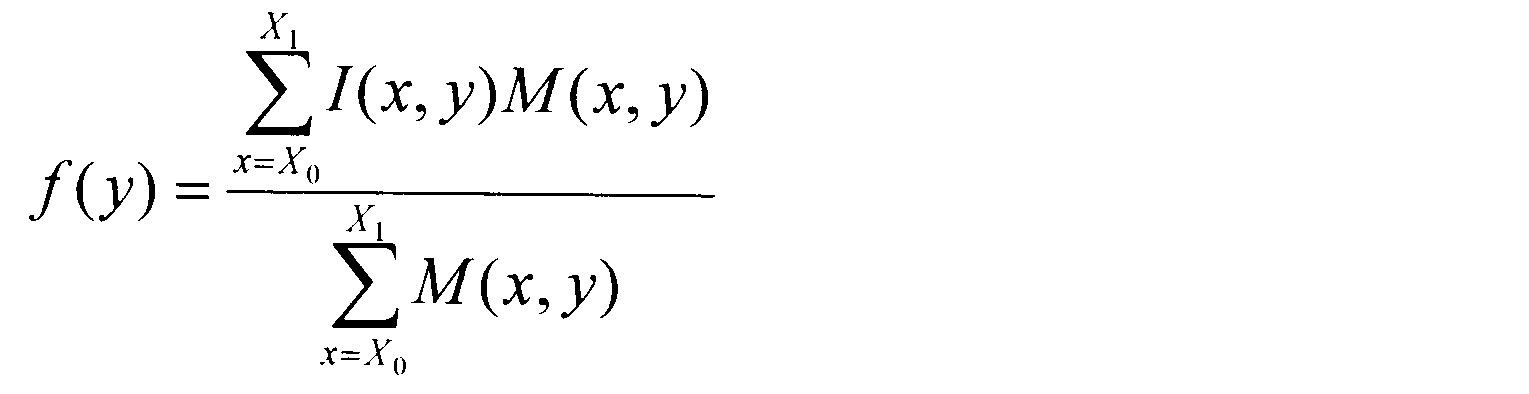
- Various methods for calculating the separation position are conceivable. For example, pixel function values obtained by scanning the pixel data of the person area in the horizontal direction according to Equation 8 and projecting in the y-axis direction are calculated.
- I (x, y) indicates pixel data (three-dimensional vector of color spaces R, G, and B) at coordinates (x, y), and M (x, y) indicates mask information of the person area.
- a y-coordinate that greatly changes the pixel function value f (y) is obtained. For example, it is determined that the maximum value of the difference between the pixel function value according to Equation 9, the maximum difference value D 0 is the larger than the threshold can be separated into upper and lower body of a person. When it is determined that the person can be separated into the upper body and the lower body, the y-coordinate value y 0 at that time is calculated according to Equation 10.
- integration site separation unit 420 in addition to the determination result to allow separation of the person on the upper body and lower body, and outputs the stored values y 0 y coordinate at that time to dress site separation information.
- the person area can be divided at a predetermined division ratio, and the division ratio is determined based on the clothing part separation information. Store in the output.
- the region shape analysis unit 400 analyzes the shape of the human region and outputs shape analysis information to the integrated part separation unit 420 (step S400).
- the visible region determination unit 410 determines a visible region visualized in the imaging range of the camera based on the person region and the background region, and outputs the visible region information to the integrated region separation unit 420 (step S410).
- the integrated part separation unit 420 executes the above-described integrated part separation process, thereby generating clothing part separation information (step S420). Note that the order of steps S400 and S410 may be changed.
- FIG. 2 is a block diagram illustrating the configuration of the person search apparatus according to the present embodiment.
- the person search apparatus includes a clothing feature search unit 200, a clothing feature query generation unit 210, a clothing feature matching unit 220, a person search unit 230, and a clothing feature storage unit 140.
- the person search apparatus shown in FIG. 2 does not include the constituent elements of the person clothes feature extraction apparatus other than the clothes feature storage unit 140 shown in FIG.
- the person search device of FIG. 2 and the person clothes feature extraction device of FIG. 1 may be combined.
- the function of the person search apparatus can be realized by installing a person search program in a computer constituted by a CPU, ROM, RAM, and the like.
- the clothing feature search unit 200 searches for a word representing a clothing type and a visual feature based on the clothing query text, and outputs the word as a clothing feature parameter. More specifically, the clothes query text is analyzed with reference to the clothes dictionary to generate clothes feature parameters, which are output to the clothes feature query generation unit 210.
- the clothing feature query generation unit 210 estimates the visual features of the clothing from the clothing feature parameters, generates a clothing feature query, and outputs the clothing feature query to the clothing feature matching unit 220.
- the clothing feature storage unit 140 stores the clothing features of the person extracted by the person clothing feature extraction device shown in FIG. This clothing feature is a visual feature of a person's clothing generated based on the person region of the input video and the clothing part separation information.
- the clothing feature matching unit 220 matches the clothing feature stored in the clothing feature storage unit 140 with the clothing feature query, and outputs the matching result to the person search unit 230.
- the person search unit 230 counts the collation results of the clothing feature collation unit 220 and outputs the person search results.
- the clothing feature search unit 200 inputs a clothing query text.
- the clothing feature search unit 200 refers to the clothing dictionary and searches for clothing feature parameters indicating the type and color of clothing from the clothing query text.
- the clothing dictionary stores pixel data (for example, RGB data or HSV data) as clothing information in association with words representing various colors.
- the clothes dictionary also describes in the clothes information whether the type of clothes is related to the upper body or the lower body.
- the clothing feature search unit 200 refers to the clothing information registered in the clothing dictionary, analyzes the clothing query text, and generates clothing feature parameters.
- the clothing feature search unit 200 when “white shirt and blue jacket, black trousers” is input as the clothing query text, the clothing feature search unit 200 relates “shirt” and “jacket” to the upper body, and each color is “white”. And “blue” are searched from the clothes dictionary. Also, the clothing feature search unit 200 searches the clothing dictionary that “trousers” are related to the lower body and the color is “black”. In addition, the clothing feature search unit 200 determines that the jacket and the jacket are placed on the upper side when layered, and the ratio of “blue” is larger than “white” as the upper body color. Determine.
- the clothing feature search unit 200 Considering that both a shirt and a jacket are visible when a person is viewed from the front, and only a jacket is visible when viewed from the back, the clothing feature search unit 200 generates different color parameters for the front and back of the upper body. To do. For the lower body, a color parameter indicating that both the front and back colors are “black” is generated.
- the degree of ambiguity is also described in the clothes feature parameter. For example, when clothing features are represented by a color histogram, the degree of spread of the color histogram can be adjusted according to the degree of ambiguity.
- the clothing feature query generation unit 210 describes pixel data (for example, RGB data or HSV data) corresponding to the upper body and the lower body, the color ratio, the color parameter, and the degree of ambiguity of the color expression in the clothing feature parameter. Output to.
- pixel data for example, RGB data or HSV data
- the clothing feature query generation unit 210 generates a clothing feature query based on the clothing feature parameters output from the clothing feature search unit 200. For example, when a color histogram is used as a clothing feature, the pixel data included in the clothing feature parameter is used as a peak value, and a color histogram having a spread determined by the degree of ambiguity of the color expression is generated. Here, the peak value of the color histogram is adjusted according to the color ratio. In addition, since the appearance of the color of the clothes varies depending on the orientation of the person (that is, whether or not the person is facing the front), a color histogram is generated individually for the front direction and the non-front direction of the person. Also, a clothing feature query is generated for each of the upper and lower body of the person. The clothing feature query generated in this way is output to the clothing feature matching unit 220.
- the clothing feature matching unit 220 compares the clothing feature query output from the clothing feature query generation unit 210 with the clothing features stored in the clothing feature storage unit 140 (that is, the clothing features of the person to be searched), Calculate the matching score.
- the comparison between the clothing feature query and the clothing feature may be performed for each clothing site specified by the clothing site separation information.
- the above collation score represents the similarity of clothing features, and can be calculated by, for example, the inner product of clothing feature vectors.
- a distance (difference) between clothing features may be calculated and converted into a similarity of clothing features. That is, the distance d between the clothing features is converted into the similarity S according to Equation 11.
- the clothing feature matching unit 220 also considers the information and searches the clothing feature query and search clothing features. Is checked. Specifically, when the search clothing feature corresponds to the front of the person, it is compared with the clothing feature query related to the front of the person. If the retrieved clothing feature corresponds to the non-frontal direction of the person, it is matched with a clothing feature query related to the non-frontal direction of the person. In addition, when the person related to the retrieval clothes feature is indefinite, the clothes characteristics related to both the front direction and the non-front direction of the person are collated, and the one with the better collation result is adopted.
- the retrieved clothing feature corresponds to the upper body of the person, it is checked against the clothing feature query for the upper body of the person. If the retrieved clothing feature corresponds to the lower body of the person, it is checked against a clothing feature query for the lower body of the person.
- the clothes are matched with the integrated clothes feature query obtained by integrating the clothes feature queries related to the upper body and the lower body of the person. For example, when clothing features are represented by a color histogram, the clothing features of the upper and lower body of the person are added, normalized as necessary, and collated with the retrieved clothing features.
- the clothing feature verification unit 220 can obtain the verification results for both the upper body and the lower body of the person at the same time.
- the matching degree is determined using both the matching results of the clothing features of the upper body and lower body of the person.
- the clothing feature matching unit 220 can obtain only one matching result. In this case, the degree of matching is determined using only one matching result.
- the clothing feature matching unit 220 generates different numbers of matching results depending on how the person looks.
- the similarity of the clothing feature at that time becomes the entire collation result as it is.
- the similarity S 1 and S 2 of the plurality of clothing features are calculated.
- the integrated similarity S is calculated according to Equation 12.
- h (x) represents a monotonous non-decreasing function, and is represented by, for example, Expression 13.
- the matching result of the clothing feature matching unit 220 is output to the person search unit 230.
- the person search unit 230 outputs a person search result based on the matching result of the clothing feature matching unit 220. Specifically, the collation results are rearranged in descending order of the integrated similarity, and they are output as person search results. When the number of collation results included in the person search result is fixed to N, the top N collation results are selected and output in order of large integrated similarity.
- the clothing feature retrieval unit 200 retrieves a clothing feature parameter corresponding to the clothing query text from the clothing dictionary and outputs it to the clothing feature query generation unit 210 (step S200).
- the clothing feature query generation unit 210 generates a clothing feature query based on the clothing feature parameters and outputs the clothing feature query to the clothing feature matching unit 220 (step S210).
- the clothing feature matching unit 220 matches the clothing feature query and the retrieved clothing feature (read from the clothing feature storage unit 140), and outputs the matching result to the person searching unit 230 (step S220).
- the person search unit 230 generates and outputs a person search result based on the matching result between the clothes feature query and the search clothes feature (step S230).
- the person search apparatus shown in FIG. 2 realizes an advanced person search process in consideration of a person's direction and clothes part separation information based on clothes query text expressed in a natural language such as Japanese or English. Is.
- the clothes feature of a person is input in a natural language, and the person search is performed in consideration of the difference in the direction of the person and the clothes feature.
- the clothing part separating unit 120 may not only separate a person's clothing part into two parts, an upper body and a lower body, but also separable into other clothing parts such as shoes and hats.
- the present invention detects a person area in the imaging range of the surveillance camera, extracts clothes features of the person included in the person area, and searches for a person with high accuracy by referring to a database. It is applied to security use of institutions and private companies.
Landscapes
- Engineering & Computer Science (AREA)
- Theoretical Computer Science (AREA)
- General Physics & Mathematics (AREA)
- Physics & Mathematics (AREA)
- Multimedia (AREA)
- Computer Vision & Pattern Recognition (AREA)
- Data Mining & Analysis (AREA)
- General Engineering & Computer Science (AREA)
- Databases & Information Systems (AREA)
- Evolutionary Computation (AREA)
- Artificial Intelligence (AREA)
- Human Computer Interaction (AREA)
- General Health & Medical Sciences (AREA)
- Health & Medical Sciences (AREA)
- Computing Systems (AREA)
- Life Sciences & Earth Sciences (AREA)
- Bioinformatics & Cheminformatics (AREA)
- Bioinformatics & Computational Biology (AREA)
- Evolutionary Biology (AREA)
- Software Systems (AREA)
- Medical Informatics (AREA)
- Oral & Maxillofacial Surgery (AREA)
- Image Analysis (AREA)
- Image Processing (AREA)
Abstract
Description
本願は、2009年10月16日付で日本国に出願された特願2009-239360号に基づき優先権を主張し、その内容をここに援用する。
顔領域検出/顔特徴抽出部1000は、監視システムから取得した映像から顔領域検出及び顔特徴抽出を行い、抽出した顔特徴を顔特徴データベース1050へ出力する。着衣領域検出/着衣特徴抽出部1010は、監視システムから取得した映像から着衣領域検出及び着衣特徴抽出を行い、抽出した着衣特徴を着衣特徴データベース1040へ出力する。一方、顔領域検出/顔特徴抽出部1020は入力したクエリー画像から顔領域検出及び顔特徴抽出を行い、クエリー顔特徴を着衣類似度算出部1070へ出力する。顔類似度算出部1060は、顔特徴データベース1050に蓄積された顔特徴と顔領域検出/顔特徴抽出部1020から入力したクエリー顔特徴を比較し、顔類似度を算出して人物同一性判定部1080へ出力する。着衣類似度算出部1070は、着衣特徴データベース1040に蓄積された着衣特徴と着衣領域検出/着衣特徴抽出部1030から入力したクエリー着衣特徴を比較し、着衣類似度を算出して人物同一性判定部1080へ出力する。人物同一性判定部1080は、顔類似度算出部1060で算出された顔類似度と着衣類似度算出部1070で算出された着衣類似度に基づいて人物の同一性を判定し、人物検索結果を出力する。
また、本発明は映像より取得した人物服装特徴とクエリーテキストを照合して人物検索を行なう人物検索装置を提供するものである。
更に、本発明は人物服装特徴抽出処理方法や人物検索処理方法を記述したプログラムを提供するものである。
図1は、本実施例に係る人物服装特徴抽出装置の構成を示すブロック図である。人物服装特徴抽出装置は、人物領域検出部100、人物向き判定部110、服装部位分離部120、人物服装特徴抽出部140より構成される。












110 人物向き判定部
120 服装部位分離部
130 服装特徴抽出部
140 服装特徴格納部
200 服装特徴検索部
210 服装特徴クエリー生成部
220 服装特徴照合部
230 人物検索部
300 顔向き判定部
310 人物動き解析部
320 服装特徴対象性判定部
330 統合向き判定部
400 領域形状分析部
410 可視部位判定部
420 統合部位分離部
1000 顔領域検出/顔特徴抽出部
1010 着衣領域検出/着衣特徴抽出部
1020 顔領域検出/顔特徴抽出部
1030 着衣領域検出/着衣特徴抽出部
1040 着衣特徴データベース(DB)
1050 顔特徴データベース(DB)
1060 顔類似度算出部
1070 着衣類似度算出部
1080 人物同一性判定部
Claims (22)
- 入力映像から人物領域を検出する人物領域検出部と、
人物領域における人物の向きを判定する人物向き判定部と、
人物領域における人物の服装の分離可能性を判定し、服装部位分離情報を出力する服装部位分離部と、
人物の向き及び服装部位分離情報を考慮して人物領域における人物の服装の視覚特徴を示す服装特徴を抽出する服装特徴抽出部と、
抽出した服装特徴を格納する服装特徴格納部を具備する人物服装特徴抽出装置。 - 前記人物向き判定部は、人物の顔の向き、人物の動き、及び服装の対称性の少なくとも1つに基づいて人物の向きを判定するようにした請求項1記載の人物服装特徴抽出装置。
- 前記人物向き判定部により判定された人物の向きは、正面方向、背面方向、及び方向不定の少なくとも1つを示すものである請求項1記載の人物服装特徴抽出装置。
- 前記服装部位分離部は、入力映像、人物領域、及び背景領域に基づいて人物の服装部位の分離可能性を判定するものである請求項1記載の人物服装特徴抽出装置。
- 前記服装部位分離部は、人物領域の幾何学的形状を分析して形状分析情報を生成する領域形状分析部と、人物領域と背景領域に基づいて可視化された人物の服装部位を示す可視部位情報を生成する可視部位判定部と、形状分析情報及び可視部位情報に基づいて人物の服装部位の分離可能性を判定して服装部位分離情報を生成する統合部位分離部を具備する請求項4記載の人物服装特徴抽出装置。
- 人物の服装の種類と色を表す服装クエリーテキストに基づいて服装特徴パラメータを検索する服装特徴検索部と、
服装特徴パラメータに基づいて服装特徴クエリーを出力する服装特徴クエリー生成部と、
服装特徴格納部から検索した服装特徴と服装特徴クエリーを照合し、その照合結果を出力する服装特徴照合部と、
照合結果に基づいて人物検索結果を出力する人物検索部を具備する人物検索装置。 - 前記服装部位格納部は、入力映像の人物領域と人物の服装部位の分離可能性を示す服装部位分離情報に基づいて予め生成された服装特徴を格納するものである請求項6記載の人物検索装置。
- 前記服装部位格納部は、入力映像の人物領域及び服装部位分離情報に加えて人物の向きを考慮して生成された服装特徴を格納するものである請求項7記載の人物検索装置。
- 前記服装特徴照合部は、服装部位分離情報で指定される服装部位毎に検索服装特徴と服装特徴クエリーを照合するものである請求項6記載の人物検索装置。
- 入力映像から人物領域を検出する人物領域検出部と、
人物領域における人物の向きを判定する人物向き判定部と、
人物領域における人物の服装の分離可能性を判定し、服装部位分離情報を出力する服装部位分離部と、
人物の向き及び服装部位分離情報を考慮して人物領域における人物の服装の視覚特徴を示す服装特徴を抽出する服装特徴抽出部を更に具備し、
前記服装特徴格納部は抽出された服装特徴を格納するものである請求項6記載の人物検索装置。 - 入力映像から人物領域を検出し、
人物領域における人物の向きを判定し、
人物領域における人物の服装の分離可能性を判定して服装部位分離情報を生成し、
人物の向き及び服装部位分離情報を考慮して人物領域における人物の服装の視覚特徴を示す服装特徴を抽出して格納するようにした人物服装特徴抽出方法。 - 人物の顔の向き、人物の動き、及び服装の対称性の少なくとも1つに基づいて人物の向きを判定するようにした請求項11記載の人物服装特徴抽出方法。
- 人物の向きは、正面方向、背面方向、及び方向不定の少なくとも1つを示すものである請求項11記載の人物服装特徴抽出方法。
- 入力映像、人物領域、及び背景領域に基づいて人物の服装部位の分離可能性を判定するものである請求項11記載の人物服装特徴抽出方法。
- 人物領域の幾何学的形状を分析して形状分析情報を生成し、
人物領域と背景領域に基づいて可視化された人物の服装部位を示す可視部位情報を生成し、
形状分析情報及び可視部位情報に基づいて人物の服装部位の分離可能性を判定して服装部位分離情報を生成するようにした請求項14記載の人物服装特徴抽出方法。 - 人物の服装の種類と色を表す服装クエリーテキストに基づいて服装特徴パラメータを検索し、
服装特徴パラメータに基づいて服装特徴クエリーを生成し、
服装特徴格納部から検索した服装特徴と服装特徴クエリーを照合して、その照合結果を出力し、
照合結果に基づいて人物検索結果を出力するようにした人物検索方法。 - 前記服装特徴格納部は、入力映像の人物領域と人物の服装部位の分離可能性を示す服装部位分離情報に基づいて予め生成された服装特徴を格納するものである請求項16記載の人物検索方法。
- 前記服装部位格納部は、入力映像の人物領域及び服装部位分離情報に加えて人物の向きを考慮して生成された服装特徴を格納するものである請求項17記載の人物検索方法。
- 服装部位分離情報で指定される服装部位毎に検索服装特徴と服装特徴クエリーを照合するものである請求項16記載の人物検索方法。
- 入力映像から人物領域を検出し、
人物領域における人物の向きを判定し、
人物領域における人物の服装の分離可能性を判定して、服装部位分離情報を生成し、
人物の向き及び服装部位分離情報を考慮して人物領域における人物の服装の視覚特徴を示す服装特徴を抽出して前記服装特徴格納部に格納するものである請求項16記載の人物検索方法。 - 請求項11乃至15記載の服装特徴抽出方法をコンピュータに読み取り実行可能な形式で記述したプログラム。
- 請求項16乃至20記載の人物検索方法をコンピュータに読み取り実行可能な形式で記述したプログラム。
Priority Applications (5)
| Application Number | Priority Date | Filing Date | Title |
|---|---|---|---|
| JP2011536146A JP5664553B2 (ja) | 2009-10-16 | 2010-10-13 | 人物服装特徴抽出装置、人物検索装置、人物服装特徴抽出方法、人物検索方法及びプログラム |
| EP10823396.6A EP2490171B1 (en) | 2009-10-16 | 2010-10-13 | Person image search starting from clothing query text. |
| CN201080045981.1A CN102687171B (zh) | 2009-10-16 | 2010-10-13 | 人物检索装置及人物检索方法 |
| US13/501,647 US8891880B2 (en) | 2009-10-16 | 2010-10-13 | Person clothing feature extraction device, person search device, and processing method thereof |
| US14/508,477 US9495754B2 (en) | 2009-10-16 | 2014-10-07 | Person clothing feature extraction device, person search device, and processing method thereof |
Applications Claiming Priority (2)
| Application Number | Priority Date | Filing Date | Title |
|---|---|---|---|
| JP2009239360 | 2009-10-16 | ||
| JP2009-239360 | 2009-10-16 |
Related Child Applications (2)
| Application Number | Title | Priority Date | Filing Date |
|---|---|---|---|
| US13/501,647 A-371-Of-International US8891880B2 (en) | 2009-10-16 | 2010-10-13 | Person clothing feature extraction device, person search device, and processing method thereof |
| US14/508,477 Division US9495754B2 (en) | 2009-10-16 | 2014-10-07 | Person clothing feature extraction device, person search device, and processing method thereof |
Publications (1)
| Publication Number | Publication Date |
|---|---|
| WO2011046128A1 true WO2011046128A1 (ja) | 2011-04-21 |
Family
ID=43876178
Family Applications (1)
| Application Number | Title | Priority Date | Filing Date |
|---|---|---|---|
| PCT/JP2010/067914 Ceased WO2011046128A1 (ja) | 2009-10-16 | 2010-10-13 | 人物服装特徴抽出装置、人物検索装置、及びその処理方法 |
Country Status (5)
| Country | Link |
|---|---|
| US (2) | US8891880B2 (ja) |
| EP (1) | EP2490171B1 (ja) |
| JP (1) | JP5664553B2 (ja) |
| CN (2) | CN104933669A (ja) |
| WO (1) | WO2011046128A1 (ja) |
Cited By (27)
| Publication number | Priority date | Publication date | Assignee | Title |
|---|---|---|---|---|
| CN102521565A (zh) * | 2011-11-23 | 2012-06-27 | 浙江晨鹰科技有限公司 | 低分辨率视频的服装识别方法及系统 |
| JP2013046135A (ja) * | 2011-08-23 | 2013-03-04 | Nec Corp | 映像提供装置、映像利用装置、映像提供システム、映像提供方法、および、コンピュータ・プログラム |
| CN103108151A (zh) * | 2011-11-09 | 2013-05-15 | 华为技术有限公司 | 视频监控的方法和系统 |
| JP2013186546A (ja) * | 2012-03-06 | 2013-09-19 | Tokyo Denki Univ | 人物検索システム |
| JP2013200895A (ja) * | 2013-06-28 | 2013-10-03 | Casio Comput Co Ltd | データ処理装置及びプログラム |
| JPWO2012161291A1 (ja) * | 2011-05-20 | 2014-07-31 | 日本電気株式会社 | 部位分離位置抽出装置、プログラム、方法 |
| JP2014229010A (ja) * | 2013-05-21 | 2014-12-08 | 株式会社デンソー | 物体検出装置 |
| JP2015002547A (ja) * | 2013-06-18 | 2015-01-05 | 富士通株式会社 | 画像処理装置、プログラム、および画像処理方法 |
| US8989454B2 (en) | 2011-06-17 | 2015-03-24 | Casio Computer Co., Ltd | Sales data processing apparatus and computer-readable storage medium |
| JP2016162099A (ja) * | 2015-02-27 | 2016-09-05 | 富士通株式会社 | 画像判定装置、画像判定方法、及びプログラム |
| JP2018028784A (ja) * | 2016-08-17 | 2018-02-22 | 富士通株式会社 | 移動体群検出プログラム、移動体群検出装置、及び移動体群検出方法 |
| JP2018081654A (ja) * | 2016-11-18 | 2018-05-24 | 株式会社東芝 | 検索装置、表示装置および検索方法 |
| US10037466B2 (en) | 2013-08-23 | 2018-07-31 | Nec Corporation | Video processing apparatus, video processing method, and video processing program |
| US10127310B2 (en) | 2015-03-24 | 2018-11-13 | Fujitsu Limited | Search method and system |
| US20190188486A1 (en) * | 2012-09-28 | 2019-06-20 | Nec Corporation | Information processing apparatus, information processing method, and information processing program |
| JP2019212205A (ja) * | 2018-06-08 | 2019-12-12 | トヨタ自動車株式会社 | 情報処理装置、情報処理システム、情報処理方法及びプログラム |
| JP2020021170A (ja) * | 2018-07-30 | 2020-02-06 | Kddi株式会社 | 特定装置、特定方法及び特定プログラム |
| WO2020065790A1 (ja) * | 2018-09-26 | 2020-04-02 | 日本電気株式会社 | 推定装置、推定方法、および記憶媒体 |
| US10635908B2 (en) | 2013-09-19 | 2020-04-28 | Nec Corporation | Image processing system and image processing method |
| JPWO2021176945A1 (ja) * | 2020-03-05 | 2021-09-10 | ||
| JPWO2021220354A1 (ja) * | 2020-04-27 | 2021-11-04 | ||
| JP2022510963A (ja) * | 2019-11-20 | 2022-01-28 | 上▲海▼商▲湯▼智能科技有限公司 | 人体向き検出方法、装置、電子機器及びコンピュータ記憶媒体 |
| CN114549475A (zh) * | 2022-02-24 | 2022-05-27 | 浙江大华技术股份有限公司 | 一种人体实时档案的检索方法、装置及存储介质 |
| KR102403242B1 (ko) * | 2021-08-23 | 2022-05-30 | (주)그린아이티코리아 | 객체 특징 식별을 위한 서비스 제공 장치 및 방법 |
| JP2023109299A (ja) * | 2022-01-27 | 2023-08-08 | 富士通株式会社 | 人物推定プログラム、人物推定方法、及び人物推定装置 |
| JP2024029417A (ja) * | 2022-08-22 | 2024-03-06 | 日本電気株式会社 | 画像処理装置、画像処理方法、およびプログラム |
| KR102923528B1 (ko) * | 2025-05-09 | 2026-02-06 | (주) 씨이랩 | Ai를 활용한 복장 검출 장치 및 그 방법 |
Families Citing this family (43)
| Publication number | Priority date | Publication date | Assignee | Title |
|---|---|---|---|---|
| US8798362B2 (en) * | 2011-08-15 | 2014-08-05 | Hewlett-Packard Development Company, L.P. | Clothing search in images |
| US10685234B2 (en) * | 2012-03-31 | 2020-06-16 | Xerox Corporation | Automatic and semi-automatic metadata generation via inheritance in homogeneous and heterogeneous environments |
| US9528847B2 (en) * | 2012-10-15 | 2016-12-27 | Microsoft Technology Licensing, Llc | Pictures from sketches |
| JP6098133B2 (ja) * | 2012-11-21 | 2017-03-22 | カシオ計算機株式会社 | 顔構成部抽出装置、顔構成部抽出方法及びプログラム |
| RU2676147C2 (ru) | 2013-07-22 | 2018-12-26 | Конинклейке Филипс Н.В. | Непрерывное автоматическое наблюдение за движениями пациента |
| GB201320974D0 (en) * | 2013-11-28 | 2014-01-15 | Univ Dublin City | System and method for identifying an image |
| JP6428144B2 (ja) * | 2014-10-17 | 2018-11-28 | オムロン株式会社 | エリア情報推定装置、エリア情報推定方法、および空気調和装置 |
| JP6492746B2 (ja) * | 2015-02-23 | 2019-04-03 | 富士通株式会社 | 画像処理プログラム、画像処理装置、及び画像処理方法 |
| CN105069466B (zh) * | 2015-07-24 | 2019-01-11 | 成都市高博汇科信息科技有限公司 | 基于数字图像处理的行人服饰颜色识别方法 |
| US9449254B1 (en) * | 2015-08-04 | 2016-09-20 | Adobe Systems Incorporated | Adaptive environment targeting |
| US9811762B2 (en) * | 2015-09-22 | 2017-11-07 | Swati Shah | Clothing matching system and method |
| TWI569212B (zh) * | 2015-12-10 | 2017-02-01 | 財團法人工業技術研究院 | 影像辨識方法 |
| RU2634225C1 (ru) | 2016-06-20 | 2017-10-24 | Общество с ограниченной ответственностью "САТЕЛЛИТ ИННОВАЦИЯ" (ООО "САТЕЛЛИТ") | Способы и системы поиска объекта в видеопотоке |
| CN106599880A (zh) * | 2016-12-29 | 2017-04-26 | 湖南强视信息科技有限公司 | 一种面向无人监考的同人判别方法 |
| CN106845373A (zh) * | 2017-01-04 | 2017-06-13 | 天津大学 | 面向监控视频的行人属性预测方法 |
| CN109426785B (zh) * | 2017-08-31 | 2021-09-10 | 杭州海康威视数字技术股份有限公司 | 一种人体目标身份识别方法及装置 |
| CN109426787A (zh) * | 2017-08-31 | 2019-03-05 | 杭州海康威视数字技术股份有限公司 | 一种人体目标轨迹确定方法及装置 |
| US11361018B2 (en) | 2017-11-28 | 2022-06-14 | Adobe Inc. | Automatically curated image searching |
| US11030236B2 (en) * | 2017-11-28 | 2021-06-08 | Adobe Inc. | Image searching by employing layered search constraints |
| CN108230297B (zh) * | 2017-11-30 | 2020-05-12 | 复旦大学 | 一种基于服装替换的色彩搭配评估方法 |
| WO2019169053A1 (en) * | 2018-02-27 | 2019-09-06 | Levi Strauss & Co. | Laser finishing design tool |
| CN108769585A (zh) * | 2018-05-30 | 2018-11-06 | 深圳万智联合科技有限公司 | 一种监控效果良好的监控系统 |
| JP7132046B2 (ja) | 2018-09-13 | 2022-09-06 | 株式会社東芝 | 検索装置、検索方法及びプログラム |
| CN109376256B (zh) * | 2018-09-29 | 2021-03-26 | 京东方科技集团股份有限公司 | 图像搜索方法及装置 |
| JP2020119284A (ja) | 2019-01-24 | 2020-08-06 | 日本電気株式会社 | 情報処理装置、情報処理方法及びプログラム |
| US11334617B2 (en) * | 2019-09-25 | 2022-05-17 | Mercari, Inc. | Paint-based image search |
| US11599575B2 (en) | 2020-02-17 | 2023-03-07 | Honeywell International Inc. | Systems and methods for identifying events within video content using intelligent search query |
| US11030240B1 (en) | 2020-02-17 | 2021-06-08 | Honeywell International Inc. | Systems and methods for efficiently sending video metadata |
| US11681752B2 (en) | 2020-02-17 | 2023-06-20 | Honeywell International Inc. | Systems and methods for searching for events within video content |
| WO2022003854A1 (ja) * | 2020-07-01 | 2022-01-06 | 日本電気株式会社 | 画像処理装置、画像処理方法、及びプログラム |
| EP3937071A1 (fr) * | 2020-07-06 | 2022-01-12 | Bull SAS | Procédé d'assistance au suivi en temps réel d'au moins une personne sur des séquences d'images |
| US12106486B2 (en) | 2021-02-24 | 2024-10-01 | Snap Inc. | Whole body visual effects |
| US11790531B2 (en) | 2021-02-24 | 2023-10-17 | Snap Inc. | Whole body segmentation |
| US12100156B2 (en) | 2021-04-12 | 2024-09-24 | Snap Inc. | Garment segmentation |
| US11670059B2 (en) | 2021-09-01 | 2023-06-06 | Snap Inc. | Controlling interactive fashion based on body gestures |
| US12198664B2 (en) | 2021-09-02 | 2025-01-14 | Snap Inc. | Interactive fashion with music AR |
| US11673054B2 (en) | 2021-09-07 | 2023-06-13 | Snap Inc. | Controlling AR games on fashion items |
| US11900506B2 (en) | 2021-09-09 | 2024-02-13 | Snap Inc. | Controlling interactive fashion based on facial expressions |
| US11734866B2 (en) | 2021-09-13 | 2023-08-22 | Snap Inc. | Controlling interactive fashion based on voice |
| US11636662B2 (en) | 2021-09-30 | 2023-04-25 | Snap Inc. | Body normal network light and rendering control |
| US11983826B2 (en) | 2021-09-30 | 2024-05-14 | Snap Inc. | 3D upper garment tracking |
| US11651572B2 (en) | 2021-10-11 | 2023-05-16 | Snap Inc. | Light and rendering of garments |
| US12190270B2 (en) | 2022-05-16 | 2025-01-07 | Honeywell International Inc. | Methods and systems for managing an incident |
Citations (7)
| Publication number | Priority date | Publication date | Assignee | Title |
|---|---|---|---|---|
| JP2000030033A (ja) * | 1998-07-09 | 2000-01-28 | Matsushita Electric Ind Co Ltd | 人物検出方法 |
| JP2005202938A (ja) * | 2003-12-19 | 2005-07-28 | Matsushita Electric Ind Co Ltd | 映像検索装置及び映像検索方法 |
| JP2008139941A (ja) * | 2006-11-30 | 2008-06-19 | Seiko Epson Corp | 画像処理装置、画像処理方法、および画像処理プログラム |
| JP2008165700A (ja) * | 2007-01-05 | 2008-07-17 | Seiko Epson Corp | 画像処理装置、電子機器、画像処理システム、画像処理方法、および、プログラム |
| JP2009003581A (ja) | 2007-06-19 | 2009-01-08 | Viva Computer Co Ltd | 画像蓄積・検索システム及び画像蓄積・検索システム用プログラム |
| JP2009110460A (ja) * | 2007-11-01 | 2009-05-21 | Hitachi Ltd | 人物画像検索装置 |
| JP2009199322A (ja) | 2008-02-21 | 2009-09-03 | Hitachi Kokusai Electric Inc | 監視システム、人物検索方法 |
Family Cites Families (27)
| Publication number | Priority date | Publication date | Assignee | Title |
|---|---|---|---|---|
| SG91841A1 (en) * | 1999-11-03 | 2002-10-15 | Kent Ridge Digital Labs | Face direction estimation using a single gray-level image |
| US7206778B2 (en) * | 2001-12-17 | 2007-04-17 | Knova Software Inc. | Text search ordered along one or more dimensions |
| US6937745B2 (en) * | 2001-12-31 | 2005-08-30 | Microsoft Corporation | Machine vision system and method for estimating and tracking facial pose |
| EP1434170A3 (en) * | 2002-11-07 | 2006-04-05 | Matsushita Electric Industrial Co., Ltd. | Method and apparatus for adding ornaments to an image of a person |
| US7221775B2 (en) * | 2002-11-12 | 2007-05-22 | Intellivid Corporation | Method and apparatus for computerized image background analysis |
| JP4479194B2 (ja) * | 2003-08-29 | 2010-06-09 | 富士ゼロックス株式会社 | 動作識別装置、及び対象物の姿勢識別装置 |
| US20080064333A1 (en) * | 2004-02-28 | 2008-03-13 | Hymes Charles M | System and method for specifying observed targets and subsequent communication |
| US20060159370A1 (en) * | 2004-12-10 | 2006-07-20 | Matsushita Electric Industrial Co., Ltd. | Video retrieval system and video retrieval method |
| US7783135B2 (en) * | 2005-05-09 | 2010-08-24 | Like.Com | System and method for providing objectified image renderings using recognition information from images |
| US7657126B2 (en) * | 2005-05-09 | 2010-02-02 | Like.Com | System and method for search portions of objects in images and features thereof |
| ATE546800T1 (de) | 2005-07-05 | 2012-03-15 | Omron Tateisi Electronics Co | Tracking-vorrichtung |
| US7457825B2 (en) * | 2005-09-21 | 2008-11-25 | Microsoft Corporation | Generating search requests from multimodal queries |
| GB2430736A (en) * | 2005-09-30 | 2007-04-04 | Sony Uk Ltd | Image processing |
| JP2007147762A (ja) * | 2005-11-24 | 2007-06-14 | Fuji Xerox Co Ltd | 発話者予測装置および発話者予測方法 |
| US20070237364A1 (en) * | 2006-03-31 | 2007-10-11 | Fuji Photo Film Co., Ltd. | Method and apparatus for context-aided human identification |
| US7864989B2 (en) * | 2006-03-31 | 2011-01-04 | Fujifilm Corporation | Method and apparatus for adaptive context-aided human classification |
| US8270709B2 (en) * | 2006-08-31 | 2012-09-18 | Corel Corporation | Color selection and/or matching in a color image |
| US20090058615A1 (en) * | 2007-08-30 | 2009-03-05 | Motorola, Inc. | Clothing history application and method for mobile station having an integrated transponder reader |
| US8447100B2 (en) * | 2007-10-10 | 2013-05-21 | Samsung Electronics Co., Ltd. | Detecting apparatus of human component and method thereof |
| US8036416B2 (en) * | 2007-11-06 | 2011-10-11 | Palo Alto Research Center Incorporated | Method and apparatus for augmenting a mirror with information related to the mirrored contents and motion |
| US8170280B2 (en) * | 2007-12-03 | 2012-05-01 | Digital Smiths, Inc. | Integrated systems and methods for video-based object modeling, recognition, and tracking |
| US8150098B2 (en) * | 2007-12-20 | 2012-04-03 | Eastman Kodak Company | Grouping images by location |
| CN100568262C (zh) * | 2007-12-29 | 2009-12-09 | 浙江工业大学 | 基于多摄像机信息融合的人脸识别检测装置 |
| US8180112B2 (en) * | 2008-01-21 | 2012-05-15 | Eastman Kodak Company | Enabling persistent recognition of individuals in images |
| JP5155001B2 (ja) * | 2008-04-01 | 2013-02-27 | 株式会社日立製作所 | 文書検索装置 |
| US20090296989A1 (en) * | 2008-06-03 | 2009-12-03 | Siemens Corporate Research, Inc. | Method for Automatic Detection and Tracking of Multiple Objects |
| US8379920B2 (en) * | 2010-05-05 | 2013-02-19 | Nec Laboratories America, Inc. | Real-time clothing recognition in surveillance videos |
-
2010
- 2010-10-13 US US13/501,647 patent/US8891880B2/en active Active
- 2010-10-13 JP JP2011536146A patent/JP5664553B2/ja active Active
- 2010-10-13 EP EP10823396.6A patent/EP2490171B1/en not_active Not-in-force
- 2010-10-13 WO PCT/JP2010/067914 patent/WO2011046128A1/ja not_active Ceased
- 2010-10-13 CN CN201510345029.8A patent/CN104933669A/zh active Pending
- 2010-10-13 CN CN201080045981.1A patent/CN102687171B/zh active Active
-
2014
- 2014-10-07 US US14/508,477 patent/US9495754B2/en active Active
Patent Citations (7)
| Publication number | Priority date | Publication date | Assignee | Title |
|---|---|---|---|---|
| JP2000030033A (ja) * | 1998-07-09 | 2000-01-28 | Matsushita Electric Ind Co Ltd | 人物検出方法 |
| JP2005202938A (ja) * | 2003-12-19 | 2005-07-28 | Matsushita Electric Ind Co Ltd | 映像検索装置及び映像検索方法 |
| JP2008139941A (ja) * | 2006-11-30 | 2008-06-19 | Seiko Epson Corp | 画像処理装置、画像処理方法、および画像処理プログラム |
| JP2008165700A (ja) * | 2007-01-05 | 2008-07-17 | Seiko Epson Corp | 画像処理装置、電子機器、画像処理システム、画像処理方法、および、プログラム |
| JP2009003581A (ja) | 2007-06-19 | 2009-01-08 | Viva Computer Co Ltd | 画像蓄積・検索システム及び画像蓄積・検索システム用プログラム |
| JP2009110460A (ja) * | 2007-11-01 | 2009-05-21 | Hitachi Ltd | 人物画像検索装置 |
| JP2009199322A (ja) | 2008-02-21 | 2009-09-03 | Hitachi Kokusai Electric Inc | 監視システム、人物検索方法 |
Non-Patent Citations (2)
| Title |
|---|
| MASAAKI SATO ET AL: "Person Search System using Face and Clothing Features", MATSUSHITA TECHNICAL JOURNAL, vol. 52, no. 3, 2006, pages 67 - 71, XP008155788 * |
| See also references of EP2490171A4 |
Cited By (48)
| Publication number | Priority date | Publication date | Assignee | Title |
|---|---|---|---|---|
| JPWO2012161291A1 (ja) * | 2011-05-20 | 2014-07-31 | 日本電気株式会社 | 部位分離位置抽出装置、プログラム、方法 |
| US8989454B2 (en) | 2011-06-17 | 2015-03-24 | Casio Computer Co., Ltd | Sales data processing apparatus and computer-readable storage medium |
| US9483798B2 (en) | 2011-06-17 | 2016-11-01 | Casio Computer Co., Ltd | Sales data processing apparatus and computer-readable storage medium |
| JP2013046135A (ja) * | 2011-08-23 | 2013-03-04 | Nec Corp | 映像提供装置、映像利用装置、映像提供システム、映像提供方法、および、コンピュータ・プログラム |
| CN103108151A (zh) * | 2011-11-09 | 2013-05-15 | 华为技术有限公司 | 视频监控的方法和系统 |
| CN102521565A (zh) * | 2011-11-23 | 2012-06-27 | 浙江晨鹰科技有限公司 | 低分辨率视频的服装识别方法及系统 |
| CN102521565B (zh) * | 2011-11-23 | 2014-02-26 | 浙江晨鹰科技有限公司 | 低分辨率视频的服装识别方法及系统 |
| JP2013186546A (ja) * | 2012-03-06 | 2013-09-19 | Tokyo Denki Univ | 人物検索システム |
| US12315260B2 (en) | 2012-09-28 | 2025-05-27 | Nec Corporation | Information processing apparatus, information processing method, and information processing program |
| US12183083B2 (en) | 2012-09-28 | 2024-12-31 | Nec Corporation | Information processing apparatus, information processing method, and information processing program |
| US11816897B2 (en) * | 2012-09-28 | 2023-11-14 | Nec Corporation | Information processing apparatus, information processing method, and information processing program |
| US20190188486A1 (en) * | 2012-09-28 | 2019-06-20 | Nec Corporation | Information processing apparatus, information processing method, and information processing program |
| US9501720B2 (en) | 2013-05-21 | 2016-11-22 | Denso Corporation | Object detection apparatus |
| JP2014229010A (ja) * | 2013-05-21 | 2014-12-08 | 株式会社デンソー | 物体検出装置 |
| JP2015002547A (ja) * | 2013-06-18 | 2015-01-05 | 富士通株式会社 | 画像処理装置、プログラム、および画像処理方法 |
| JP2013200895A (ja) * | 2013-06-28 | 2013-10-03 | Casio Comput Co Ltd | データ処理装置及びプログラム |
| US10037466B2 (en) | 2013-08-23 | 2018-07-31 | Nec Corporation | Video processing apparatus, video processing method, and video processing program |
| US10956753B2 (en) | 2013-09-19 | 2021-03-23 | Nec Corporation | Image processing system and image processing method |
| US10635908B2 (en) | 2013-09-19 | 2020-04-28 | Nec Corporation | Image processing system and image processing method |
| JP2016162099A (ja) * | 2015-02-27 | 2016-09-05 | 富士通株式会社 | 画像判定装置、画像判定方法、及びプログラム |
| US10489640B2 (en) | 2015-02-27 | 2019-11-26 | Fujitsu Limited | Determination device and determination method of persons included in imaging data |
| US10127310B2 (en) | 2015-03-24 | 2018-11-13 | Fujitsu Limited | Search method and system |
| JP2018028784A (ja) * | 2016-08-17 | 2018-02-22 | 富士通株式会社 | 移動体群検出プログラム、移動体群検出装置、及び移動体群検出方法 |
| JP2018081654A (ja) * | 2016-11-18 | 2018-05-24 | 株式会社東芝 | 検索装置、表示装置および検索方法 |
| CN110580272A (zh) * | 2018-06-08 | 2019-12-17 | 丰田自动车株式会社 | 信息处理装置、系统、方法及非暂时性存储介质 |
| JP2019212205A (ja) * | 2018-06-08 | 2019-12-12 | トヨタ自動車株式会社 | 情報処理装置、情報処理システム、情報処理方法及びプログラム |
| US11758375B2 (en) | 2018-06-08 | 2023-09-12 | Toyota Jidosha Kabushiki Kaisha | Information processing apparatus, information processing system, information processing method, and non-transitory storage medium |
| JP7006515B2 (ja) | 2018-06-08 | 2022-01-24 | トヨタ自動車株式会社 | 情報処理装置、情報処理システム、情報処理方法及びプログラム |
| JP6995714B2 (ja) | 2018-07-30 | 2022-01-17 | Kddi株式会社 | 特定装置、特定方法及び特定プログラム |
| JP2020021170A (ja) * | 2018-07-30 | 2020-02-06 | Kddi株式会社 | 特定装置、特定方法及び特定プログラム |
| US12217539B2 (en) | 2018-09-26 | 2025-02-04 | Nec Corporation | Estimation device, estimation method, and storage medium |
| US12125315B2 (en) | 2018-09-26 | 2024-10-22 | Nec Corporation | Direction estimation device, direction estimation method, and storage medium |
| US12112570B2 (en) | 2018-09-26 | 2024-10-08 | Nec Corporation | Direction estimation device, direction estimation method, and storage medium |
| WO2020065790A1 (ja) * | 2018-09-26 | 2020-04-02 | 日本電気株式会社 | 推定装置、推定方法、および記憶媒体 |
| JP2022510963A (ja) * | 2019-11-20 | 2022-01-28 | 上▲海▼商▲湯▼智能科技有限公司 | 人体向き検出方法、装置、電子機器及びコンピュータ記憶媒体 |
| JP7456659B2 (ja) | 2020-03-05 | 2024-03-27 | Necソリューションイノベータ株式会社 | 認証装置 |
| JPWO2021176945A1 (ja) * | 2020-03-05 | 2021-09-10 | ||
| WO2021176945A1 (ja) * | 2020-03-05 | 2021-09-10 | Necソリューションイノベータ株式会社 | 認証装置 |
| WO2021220354A1 (ja) * | 2020-04-27 | 2021-11-04 | 日本電気株式会社 | 人物検索システム |
| JP7485017B2 (ja) | 2020-04-27 | 2024-05-16 | 日本電気株式会社 | 人物検索システム |
| US12437503B2 (en) | 2020-04-27 | 2025-10-07 | Nec Corporation | Person retrieval system |
| JPWO2021220354A1 (ja) * | 2020-04-27 | 2021-11-04 | ||
| KR102403242B1 (ko) * | 2021-08-23 | 2022-05-30 | (주)그린아이티코리아 | 객체 특징 식별을 위한 서비스 제공 장치 및 방법 |
| JP2023109299A (ja) * | 2022-01-27 | 2023-08-08 | 富士通株式会社 | 人物推定プログラム、人物推定方法、及び人物推定装置 |
| JP7783491B2 (ja) | 2022-01-27 | 2025-12-10 | エフサステクノロジーズ株式会社 | 人物推定プログラム、人物推定方法、及び人物推定装置 |
| CN114549475A (zh) * | 2022-02-24 | 2022-05-27 | 浙江大华技术股份有限公司 | 一种人体实时档案的检索方法、装置及存储介质 |
| JP2024029417A (ja) * | 2022-08-22 | 2024-03-06 | 日本電気株式会社 | 画像処理装置、画像処理方法、およびプログラム |
| KR102923528B1 (ko) * | 2025-05-09 | 2026-02-06 | (주) 씨이랩 | Ai를 활용한 복장 검출 장치 및 그 방법 |
Also Published As
| Publication number | Publication date |
|---|---|
| JP5664553B2 (ja) | 2015-02-04 |
| US8891880B2 (en) | 2014-11-18 |
| CN104933669A (zh) | 2015-09-23 |
| CN102687171B (zh) | 2015-07-08 |
| JPWO2011046128A1 (ja) | 2013-03-07 |
| US20150023596A1 (en) | 2015-01-22 |
| US9495754B2 (en) | 2016-11-15 |
| EP2490171A4 (en) | 2017-10-25 |
| EP2490171B1 (en) | 2020-11-25 |
| CN102687171A (zh) | 2012-09-19 |
| US20120201468A1 (en) | 2012-08-09 |
| EP2490171A1 (en) | 2012-08-22 |
Similar Documents
| Publication | Publication Date | Title |
|---|---|---|
| JP5664553B2 (ja) | 人物服装特徴抽出装置、人物検索装置、人物服装特徴抽出方法、人物検索方法及びプログラム | |
| JP7132387B2 (ja) | 画像処理装置、画像処理方法およびプログラム | |
| US8897560B2 (en) | Determining the estimated clutter of digital images | |
| JP6013241B2 (ja) | 人物認識装置、及び方法 | |
| US8270806B2 (en) | Information processing apparatus and method of controlling same | |
| US20090290791A1 (en) | Automatic tracking of people and bodies in video | |
| JP6527421B2 (ja) | 人物認識装置及びそのプログラム | |
| US20100118205A1 (en) | Information processing apparatus and method of controlling same | |
| JP5180922B2 (ja) | 画像検索システム及び画像検索方法 | |
| JP6362085B2 (ja) | 画像認識システム、画像認識方法およびプログラム | |
| WO2006115939A1 (en) | Using time in recognizing persons in images | |
| US8731291B2 (en) | Estimating the clutter of digital images | |
| JP6349448B1 (ja) | 情報処理装置、情報処理プログラム、及び、情報処理方法 | |
| CN107231519B (zh) | 视频处理装置及控制方法 | |
| US20260045117A1 (en) | Video processing system, video processing method, and non-transitory computer-readable medium | |
| JP2016197345A (ja) | 画像解析装置、画像解析方法、およびプログラム | |
| JP6855175B2 (ja) | 画像処理装置、画像処理方法およびプログラム | |
| JP2019121184A (ja) | 照合装置、照合方法およびコンピュータプログラム | |
| JP2019040592A (ja) | 情報処理装置、情報処理プログラム、及び、情報処理方法 | |
| JP6789676B2 (ja) | 画像処理装置、画像処理方法およびプログラム | |
| CN115457644B (zh) | 一种基于扩展空间映射获得目标的识图方法及装置 | |
| Moise et al. | Face recognition using modified generalized Hough transform and gradient distance descriptor | |
| Kim et al. | Salient region detection using discriminative feature selection |
Legal Events
| Date | Code | Title | Description |
|---|---|---|---|
| WWE | Wipo information: entry into national phase |
Ref document number: 201080045981.1 Country of ref document: CN |
|
| 121 | Ep: the epo has been informed by wipo that ep was designated in this application |
Ref document number: 10823396 Country of ref document: EP Kind code of ref document: A1 |
|
| WWE | Wipo information: entry into national phase |
Ref document number: 2011536146 Country of ref document: JP Ref document number: 13501647 Country of ref document: US |
|
| NENP | Non-entry into the national phase |
Ref country code: DE |
|
| WWE | Wipo information: entry into national phase |
Ref document number: 2010823396 Country of ref document: EP |