WO2011046946A2 - Bifunctional molecules with antibody-recruiting and entry inhibitory activity against the human immunodeficiency virus - Google Patents
Bifunctional molecules with antibody-recruiting and entry inhibitory activity against the human immunodeficiency virus Download PDFInfo
- Publication number
- WO2011046946A2 WO2011046946A2 PCT/US2010/052344 US2010052344W WO2011046946A2 WO 2011046946 A2 WO2011046946 A2 WO 2011046946A2 US 2010052344 W US2010052344 W US 2010052344W WO 2011046946 A2 WO2011046946 A2 WO 2011046946A2
- Authority
- WO
- WIPO (PCT)
- Prior art keywords
- group
- alkyl
- hiv
- compound according
- linker
- Prior art date
- Legal status (The legal status is an assumption and is not a legal conclusion. Google has not performed a legal analysis and makes no representation as to the accuracy of the status listed.)
- Ceased
Links
- 0 C*1=CN=CCC1 Chemical compound C*1=CN=CCC1 0.000 description 9
- PFYPDUUXDADWKC-UHFFFAOYSA-N CC(C)c1ccccn1 Chemical compound CC(C)c1ccccn1 PFYPDUUXDADWKC-UHFFFAOYSA-N 0.000 description 2
- FGBZKVZPZYYCLH-UHFFFAOYSA-N CC(C)c1cnc[o]1 Chemical compound CC(C)c1cnc[o]1 FGBZKVZPZYYCLH-UHFFFAOYSA-N 0.000 description 1
- UFWIBTONFRDIAS-UHFFFAOYSA-N c(cc1)cc2c1cccc2 Chemical compound c(cc1)cc2c1cccc2 UFWIBTONFRDIAS-UHFFFAOYSA-N 0.000 description 1
Classifications
-
- A—HUMAN NECESSITIES
- A61—MEDICAL OR VETERINARY SCIENCE; HYGIENE
- A61K—PREPARATIONS FOR MEDICAL, DENTAL OR TOILETRY PURPOSES
- A61K39/00—Medicinal preparations containing antigens or antibodies
- A61K39/385—Haptens or antigens, bound to carriers
-
- A—HUMAN NECESSITIES
- A61—MEDICAL OR VETERINARY SCIENCE; HYGIENE
- A61K—PREPARATIONS FOR MEDICAL, DENTAL OR TOILETRY PURPOSES
- A61K31/00—Medicinal preparations containing organic active ingredients
- A61K31/33—Heterocyclic compounds
- A61K31/395—Heterocyclic compounds having nitrogen as a ring hetero atom, e.g. guanethidine or rifamycins
- A61K31/435—Heterocyclic compounds having nitrogen as a ring hetero atom, e.g. guanethidine or rifamycins having six-membered rings with one nitrogen as the only ring hetero atom
- A61K31/47—Quinolines; Isoquinolines
- A61K31/4738—Quinolines; Isoquinolines ortho- or peri-condensed with heterocyclic ring systems
- A61K31/4745—Quinolines; Isoquinolines ortho- or peri-condensed with heterocyclic ring systems condensed with ring systems having nitrogen as a ring hetero atom, e.g. phenantrolines
-
- A—HUMAN NECESSITIES
- A61—MEDICAL OR VETERINARY SCIENCE; HYGIENE
- A61K—PREPARATIONS FOR MEDICAL, DENTAL OR TOILETRY PURPOSES
- A61K45/00—Medicinal preparations containing active ingredients not provided for in groups A61K31/00 - A61K41/00
- A61K45/06—Mixtures of active ingredients without chemical characterisation, e.g. antiphlogistics and cardiaca
-
- A—HUMAN NECESSITIES
- A61—MEDICAL OR VETERINARY SCIENCE; HYGIENE
- A61K—PREPARATIONS FOR MEDICAL, DENTAL OR TOILETRY PURPOSES
- A61K47/00—Medicinal preparations characterised by the non-active ingredients used, e.g. carriers or inert additives; Targeting or modifying agents chemically bound to the active ingredient
- A61K47/50—Medicinal preparations characterised by the non-active ingredients used, e.g. carriers or inert additives; Targeting or modifying agents chemically bound to the active ingredient the non-active ingredient being chemically bound to the active ingredient, e.g. polymer-drug conjugates
- A61K47/51—Medicinal preparations characterised by the non-active ingredients used, e.g. carriers or inert additives; Targeting or modifying agents chemically bound to the active ingredient the non-active ingredient being chemically bound to the active ingredient, e.g. polymer-drug conjugates the non-active ingredient being a modifying agent
- A61K47/54—Medicinal preparations characterised by the non-active ingredients used, e.g. carriers or inert additives; Targeting or modifying agents chemically bound to the active ingredient the non-active ingredient being chemically bound to the active ingredient, e.g. polymer-drug conjugates the non-active ingredient being a modifying agent the modifying agent being an organic compound
- A61K47/545—Heterocyclic compounds
-
- A—HUMAN NECESSITIES
- A61—MEDICAL OR VETERINARY SCIENCE; HYGIENE
- A61K—PREPARATIONS FOR MEDICAL, DENTAL OR TOILETRY PURPOSES
- A61K47/00—Medicinal preparations characterised by the non-active ingredients used, e.g. carriers or inert additives; Targeting or modifying agents chemically bound to the active ingredient
- A61K47/50—Medicinal preparations characterised by the non-active ingredients used, e.g. carriers or inert additives; Targeting or modifying agents chemically bound to the active ingredient the non-active ingredient being chemically bound to the active ingredient, e.g. polymer-drug conjugates
- A61K47/51—Medicinal preparations characterised by the non-active ingredients used, e.g. carriers or inert additives; Targeting or modifying agents chemically bound to the active ingredient the non-active ingredient being chemically bound to the active ingredient, e.g. polymer-drug conjugates the non-active ingredient being a modifying agent
- A61K47/68—Medicinal preparations characterised by the non-active ingredients used, e.g. carriers or inert additives; Targeting or modifying agents chemically bound to the active ingredient the non-active ingredient being chemically bound to the active ingredient, e.g. polymer-drug conjugates the non-active ingredient being a modifying agent the modifying agent being an antibody, an immunoglobulin or a fragment thereof, e.g. an Fc-fragment
- A61K47/6891—Pre-targeting systems involving an antibody for targeting specific cells
- A61K47/6897—Pre-targeting systems with two or three steps using antibody conjugates; Ligand-antiligand therapies
-
- A—HUMAN NECESSITIES
- A61—MEDICAL OR VETERINARY SCIENCE; HYGIENE
- A61K—PREPARATIONS FOR MEDICAL, DENTAL OR TOILETRY PURPOSES
- A61K9/00—Medicinal preparations characterised by special physical form
- A61K9/0012—Galenical forms characterised by the site of application
- A61K9/0019—Injectable compositions; Intramuscular, intravenous, arterial, subcutaneous administration; Compositions to be administered through the skin in an invasive manner
-
- A—HUMAN NECESSITIES
- A61—MEDICAL OR VETERINARY SCIENCE; HYGIENE
- A61K—PREPARATIONS FOR MEDICAL, DENTAL OR TOILETRY PURPOSES
- A61K9/00—Medicinal preparations characterised by special physical form
- A61K9/0012—Galenical forms characterised by the site of application
- A61K9/0053—Mouth and digestive tract, i.e. intraoral and peroral administration
-
- A—HUMAN NECESSITIES
- A61—MEDICAL OR VETERINARY SCIENCE; HYGIENE
- A61P—SPECIFIC THERAPEUTIC ACTIVITY OF CHEMICAL COMPOUNDS OR MEDICINAL PREPARATIONS
- A61P31/00—Antiinfectives, i.e. antibiotics, antiseptics, chemotherapeutics
- A61P31/12—Antivirals
- A61P31/14—Antivirals for RNA viruses
- A61P31/18—Antivirals for RNA viruses for HIV
-
- B—PERFORMING OPERATIONS; TRANSPORTING
- B82—NANOTECHNOLOGY
- B82Y—SPECIFIC USES OR APPLICATIONS OF NANOSTRUCTURES; MEASUREMENT OR ANALYSIS OF NANOSTRUCTURES; MANUFACTURE OR TREATMENT OF NANOSTRUCTURES
- B82Y5/00—Nanobiotechnology or nanomedicine, e.g. protein engineering or drug delivery
-
- C—CHEMISTRY; METALLURGY
- C07—ORGANIC CHEMISTRY
- C07D—HETEROCYCLIC COMPOUNDS
- C07D403/00—Heterocyclic compounds containing two or more hetero rings, having nitrogen atoms as the only ring hetero atoms, not provided for by group C07D401/00
- C07D403/02—Heterocyclic compounds containing two or more hetero rings, having nitrogen atoms as the only ring hetero atoms, not provided for by group C07D401/00 containing two hetero rings
- C07D403/12—Heterocyclic compounds containing two or more hetero rings, having nitrogen atoms as the only ring hetero atoms, not provided for by group C07D401/00 containing two hetero rings linked by a chain containing hetero atoms as chain links
-
- C—CHEMISTRY; METALLURGY
- C07—ORGANIC CHEMISTRY
- C07D—HETEROCYCLIC COMPOUNDS
- C07D405/00—Heterocyclic compounds containing both one or more hetero rings having oxygen atoms as the only ring hetero atoms, and one or more rings having nitrogen as the only ring hetero atom
- C07D405/02—Heterocyclic compounds containing both one or more hetero rings having oxygen atoms as the only ring hetero atoms, and one or more rings having nitrogen as the only ring hetero atom containing two hetero rings
- C07D405/04—Heterocyclic compounds containing both one or more hetero rings having oxygen atoms as the only ring hetero atoms, and one or more rings having nitrogen as the only ring hetero atom containing two hetero rings directly linked by a ring-member-to-ring-member bond
-
- C—CHEMISTRY; METALLURGY
- C07—ORGANIC CHEMISTRY
- C07D—HETEROCYCLIC COMPOUNDS
- C07D405/00—Heterocyclic compounds containing both one or more hetero rings having oxygen atoms as the only ring hetero atoms, and one or more rings having nitrogen as the only ring hetero atom
- C07D405/14—Heterocyclic compounds containing both one or more hetero rings having oxygen atoms as the only ring hetero atoms, and one or more rings having nitrogen as the only ring hetero atom containing three or more hetero rings
-
- C—CHEMISTRY; METALLURGY
- C07—ORGANIC CHEMISTRY
- C07D—HETEROCYCLIC COMPOUNDS
- C07D471/00—Heterocyclic compounds containing nitrogen atoms as the only ring hetero atoms in the condensed system, at least one ring being a six-membered ring with one nitrogen atom, not provided for by groups C07D451/00 - C07D463/00
- C07D471/02—Heterocyclic compounds containing nitrogen atoms as the only ring hetero atoms in the condensed system, at least one ring being a six-membered ring with one nitrogen atom, not provided for by groups C07D451/00 - C07D463/00 in which the condensed system contains two hetero rings
- C07D471/04—Ortho-condensed systems
-
- A—HUMAN NECESSITIES
- A61—MEDICAL OR VETERINARY SCIENCE; HYGIENE
- A61K—PREPARATIONS FOR MEDICAL, DENTAL OR TOILETRY PURPOSES
- A61K39/00—Medicinal preparations containing antigens or antibodies
- A61K2039/54—Medicinal preparations containing antigens or antibodies characterised by the route of administration
-
- A—HUMAN NECESSITIES
- A61—MEDICAL OR VETERINARY SCIENCE; HYGIENE
- A61K—PREPARATIONS FOR MEDICAL, DENTAL OR TOILETRY PURPOSES
- A61K39/00—Medicinal preparations containing antigens or antibodies
- A61K2039/57—Medicinal preparations containing antigens or antibodies characterised by the type of response, e.g. Th1, Th2
-
- A—HUMAN NECESSITIES
- A61—MEDICAL OR VETERINARY SCIENCE; HYGIENE
- A61K—PREPARATIONS FOR MEDICAL, DENTAL OR TOILETRY PURPOSES
- A61K39/00—Medicinal preparations containing antigens or antibodies
- A61K2039/58—Medicinal preparations containing antigens or antibodies raising an immune response against a target which is not the antigen used for immunisation
-
- A—HUMAN NECESSITIES
- A61—MEDICAL OR VETERINARY SCIENCE; HYGIENE
- A61K—PREPARATIONS FOR MEDICAL, DENTAL OR TOILETRY PURPOSES
- A61K39/00—Medicinal preparations containing antigens or antibodies
- A61K2039/60—Medicinal preparations containing antigens or antibodies characteristics by the carrier linked to the antigen
- A61K2039/6012—Haptens, e.g. di- or trinitrophenyl (DNP, TNP)
-
- A—HUMAN NECESSITIES
- A61—MEDICAL OR VETERINARY SCIENCE; HYGIENE
- A61K—PREPARATIONS FOR MEDICAL, DENTAL OR TOILETRY PURPOSES
- A61K39/00—Medicinal preparations containing antigens or antibodies
- A61K2039/62—Medicinal preparations containing antigens or antibodies characterised by the link between antigen and carrier
- A61K2039/627—Medicinal preparations containing antigens or antibodies characterised by the link between antigen and carrier characterised by the linker
Definitions
- the present invention relates to bi functional molecules for inhibiting Human
- HIV Immunodeficiency Virus
- AIDS Acquired Immune Deficiency Syndrome
- the human immune system is highly versatile in its ability to target and destroy foreign pathogens. HIV, however, is an elusive virus to the body's immune system which has evolved mechanisms both to evade and to destroy the immune response of human hosts in the process of causing AIDS.
- An antibody is a Y-shaped molecule with two epitopes comprising antigen recognizing proteins on the two Y tips. These two epitopes allow the antibody to bind to two proteins on the antigen's surface, creating a stronger bond when compared to a one-epitope protein bond.
- Viruses have proteins extending from their viral coat, which are the proteins the antibodies bind to.
- HIV has fewer proteins than normal viruses. The proteins are placed farther apart and this structural difference is believed responsible for the antibody's epitopes being unable to bind to two different HIV surface proteins (See Klein et al. "Examination of the contributions of size and avidity to the neutralization mechanisms of the anti-HIV antibodies bl2 and 4E10" Proceedings of the National Academy of Sciences, 2009 Abstract).
- HIV has also been shown to bind to a surface molecule known as the CD4 or T4 receptor, which is present on various cells susceptible to HIV infection, including T lymphocytes and macrophages. (See Shaw et al.. Science 226. pp. 1 165-1 171 for a discussion of tropism of I I TLV -III.)
- compositions for treating HIV infection which can improve the immune system's ability to respond to HIV infection.
- We have discovered one way to assist the body is to recruit existing antibodies to attack HIV.
- bi functional molecules (Corson. T. W.; Aberle, N.; Crews. C. M. ACS Chem. Biol. 2008, 3. 677-692) capable of which inhibit the pathogenic behavior of HIV through two distinct mechanisms: ( 1 ) by interfering with viral entry via antagonism of the interaction between the viral envelope protein gpl20 and the human protein CD4. and (2) by recruiting anti-dinitropheny l (“anti-DNP”) antibodies, a population of antibodies present in high concentrations in the human bloodstream, to the surface of the HIV virus and/or HIV-infected cells.
- anti-DNP anti-dinitropheny l
- Antibodies recognizing the DNP epitope have been estimated to constitute 1 % of circulating IgM and 0.8% of circulating IgG. See: (a) Karjalainen, K., Makela. O. Eur. J. Immunol. 1976, 6, 88-93. (b) Farah, F. S. Immunology 1973, 25, 217-226. The prevalence of anti-DNP antibodies has been estimated at between 18 and 90% of humans. See: (c) Ortega, E.; Kostovetzky. M.; Larralde, C. Mol. Immunol. 1984, 21, 883-888. (d) Jormalainen, S.; Makela. O. Eur. J. Immunol. 1971 , 1 , 471-478. Consequently, administration of a bifunctional molecule which can recruit these existing antibodies to attack HIV in a patient suffering from HIV infection may provide a basis for an effective treatment for the symptoms associated with HIV infection.
- the present invention relates to ARM-H ("Antibody-Recruiting Molecules targeting HIV”) compounds according to the general formula:
- ABT is an antibody binding terminus (moiety) comprising a hapten which is capable of binding to an antibod present in a patient;
- PBT is a pathogen binding terminus (moiety) which is capable of binding to gpl 2() envelope protein on HIV virus or a cell surface of CD4 cells which are infected with HIV (HIV+) in said patient;
- LI is a linker molecule which chemically links PBT to CT in a molecule
- L2 is a linker molecule which chemically links ABT to CT in a molecule
- CT is a bond or a connector molecule which links LI and/or L2 to ABT and/or PBT;
- n and m in a molecule is independently an integer from 1 to 15, 1 to 10, 1 to 5, 1 to 3, 2 to 3, 2 to 5, 1 to 2 or 1 (preferably m and n are each 1);
- Eachj is independently 0, 1, 2, 3, 4 or 5 (preferably 0 or 1 , more preferably 1); and each k is independently 0, 1. 2. 3. 4 or 5 (preferably 0 or 1. more preferably 1), with the proviso that k and j are other than 0 when CT is a bond.
- a pharmaceutical composition comprises an effective amount of a ARM-H compound as described above, optionally and preferably in combination with a pharmaceutically acceptable carrier, additive or excipient.
- pharmaceutical combination compositions comprise an effective amount of a ARM- H compound as described herein, in combination with at least one additional agent which is used to treat HIV.
- Certain preferred bifunctional compounds according to the present invention have the following chemical structure:
- X 2 and X 3 are each independently a bond.
- H Q-Q, alkyl. 0-(Ci-C 6 alkyl), (such that the linker and ABT are absent from the molecule at that position).
- O CH 2 , NR 1 , S(O), S(0) 2 , -S(0) 2 0. -OS(0) 2 , or OS(0) 2 0;
- R 1 is H or a C]-C 3 alkyl group
- i is 0 or 1, preferably 1 ;
- Y 2 is N or a C-R ⁇ group
- R Y is H, C
- Y 3 is H or a Ci-C 3 alkyl group (disposed out of or into the plane, preferably out of the plane on the chiral carbon;
- CT connector
- Ci-C 6 alkyl 0-(Ci -C 6 alkyl) such that the molecule contains at least one ABT moiety
- Preferred bi unctional compounds for use in the present invention include those which are derived from BMS-378806 according to the chemical formula:
- X 2 and X 3 are each independently a bond, H, C r C 6 alkyl, 0-(Cj-C 6 alkyl ) (such that the linker and ABT are absent from the molecule at that position).
- R 1 is H or a C1-C3 alkyl group
- i is 0 or 1 , preferably 1 ;
- X 2 and X 3 are linker as otherwise disclosed herein and includes a connector (CT) which may be a bond or a chemical connector; and is an antibody binding terminus as otherwise described here (preferably a DNP group) with the proviso that at least one of X 2 and X 3 is other than H, Ci-Q, alkyl or 0-(C] alkyl) (such that the molecule contains at least one ABT moiety),
- CT connector
- X 3 is other than H, Ci-Q, alkyl or 0-(C] alkyl
- X 2 and X 3 are each independently a bond, H, Ci-Q alkyl, 0-(Ci-C 6 alkyl) (such that the linker and ABT are absent from the molecule at that position). O, CH 2 , NR 1 , S(0). S(0) 2 ,
- R 1 is IT or a Ci-C 3 alkyl group, preferably II;
- i is 0 or 1 , preferably 1 ;
- R Y is H, C]-C 6 alkyl, 0-(CrO, alkyl), an aryl or hetcroaryl group as otherwise described herein, preferably a phenyl, naphthyl.
- thiazolyl (2-, 4- or 5-thiazoie) isothiazolyl.
- oxazolyl (2-, 4- or 5-oxazole) isoxazolyi, furanyl (2- or 3-furan) or thiophenyl. (2- or 3-thiophene);
- Y 3 is H or a C ] -C alkyl group (disposed out of or into the plane, preferably out of the plane on the chiral carbon to which it is attached;
- a linker as otherwise disclosed herein and includes a connector (CT) which may be a bond or a chemical connector; and
- CT connector
- X 2 and X 3 is other than H, C
- the connector is a multifunctional compound which is chemically bonded to three or more linkers to which are bonded two or more PBT groups and/or ABT groups.
- each PBT group and/or ABT group can itself be bonded to more than one linker molecule, resulting in complex compounds containing more than two PBT groups and/or ABT groups.
- compounds according to the present invention are used to treat and/or reduce the likelihood of an HIV infection or a secondary effect of HIV (such as AIDS, ARC and related disease states or conditions which occur secondary to an HIV infection) in a patient.
- the method of treating and/or reducing the likelihood of an HIV infection or secondary effect of an HIV cancer comprises adm inistering to a patient in need an effective amount of a ARM-H compound as otherwise described herein in combination with a pharmaceutically acceptable carrier, additive or excipient, optionally in further combination with at least one additional agent which is effective in treating and/or reducing the likelihood of an HIV infection, or one or more of its secondary conditions or effects.
- the present invention also relates to instances in which destruction of CD4 cells which are infected with HIV (I IIV+ CD4 cells) may be useful to inhibit latent HIV infections from becoming active.
- destruction of HIV+ CD4 cells in an HIV positive patient may be used to inhibit or more completely eradicate an HIV infection and/or reduce the likelihood of an occurrence or recurrence of HIV in a patient who is HIV positive.
- the present invention also relates to a method for binding and eliminating HIV in a patient comprising administering to a patient infected with HIV. an effective amount of a ARM-H compound as otherwise described herein.
- the present invention presents unique, non-peptidic, bifunctional molecules which can operate through the bifunctional mechanisms specified above in treating HIV.
- viruses may exert cell and tissue tropism by attachment at highly specific sites on cell membrane receptors.
- investigators in the past to seek agents which would bind at the viral receptor sites of cell membranes and thus prevent binding of a specific virus to these cells.
- HIV has been shown to bind to a surface molecule known as the CD4 or T4 receptor which is present on various cells susceptible to HIV infection, including T lymphocytes and macrophages. The binding occurs via the HIV envelope protein. g l20.
- bifunctional compounds that would act to alleviate the symptoms of AIDS by binding a bifunctional molecule which has a first terminus for binding to the gpl20 envelope protein, the bifunctional molecule having a second antibody recruiting terminus which attracts antibodies already circulating throughout the body, to form a ternary complex between anti-DNP antibodies and gpl20 and/or gpl 20- expressing cells, the antibodies attacking the HIV engaged by the bifunctional molecule.
- These bifunctional (which term also includes multifunctional) molecules are thus generically referred to herein as "Antibody-Recruiting Molecules targeting HIV" or "ARM-H”.
- the inventive ARM-H molecules are "bifunctional" in that they possess a at least one pathogen binding terminus (PBT) and at least one antibody recruiting terminus (ABT) connected by at least one linker and a connector molecule.
- PBT pathogen binding terminus
- ABT antibody recruiting terminus
- the PBT is designed to bind to the HIV glycoprotein gp 120 (gpl20 on the viral membrane as well as gpl20 displayed on infected cells).
- the ABT is designed to bind and/or recruit antibodies to the site of the binding of the ARM-H compound. .
- a bifunctional ARM-H molecule which is capable of redirecting a population of anti-hapten (e.g. anti-dinitrophenyl or ami- DNP) antibodies, which represent a population of antibodies present in high concentrations in the human blood stream ("endogenous antibodies”), to the HIV gpl20 Env gene product.
- anti-hapten e.g. anti-dinitrophenyl or ami- DNP
- endogenous antibodies e.g. anti-dinitrophenyl or ami- DNP
- Endogenous antibodies e.g. anti-dinitrophenyl or ami- DNP
- the Env glycoprotein, a complex between gpl20 and membrane-bound gp 41 is expressed on both the surface of the HIV virus and on virus-infected cells, especially CD4 cells.
- the gpl 20 component of Env mediates the first step in viral entry into human cells by binding the protein CD4.
- a ternary complex is formed between anti-hapten (e.g. DNP or other haptent) antibodies, ARM-H, and Env-expressing cells which mediates the complement-dependent destruction of these cells.
- anti-hapten e.g. DNP or other haptent
- ARM-H binds gpl 20 competitively with CD4, it also inhibits the entry of live HIV into human T-cells.
- ARM-H has the potential to interfere with the survival of HIV through multiple
- the ARM-H compounds of the invention are unique in that they represent a molecule-based, not a peptide and/or protein based, anti-HIV strategy for targeting the virus life cycle through mutually reinforcing molecular mechanisms, inhibiting virus entry while targeting Env-expressing cells for immune recognition and clearance.
- the ARM-H molecules have certain advantages over proteins from a therapeutic standpoint because of their low propensity for immunogenicity. high metabolic stability, ready large-scale production, and relatively low cost. Molecule based antibody-recruiting therapeutics such as ARM-H have additional benefits over available treatment approaches to HIV.
- directing HI V-infected cells and virus particles to Fey receptors on antigen-presenting cells enhances the presentation of viral antigens on MHC proteins and contributes to long-lasting anti-HIV immunity.
- anti-hapten (anti-DNP) antibodies are already present in the human blood stream, no pre-vaccinafion is necessary for ARM-H activity.
- the binding of bifunctional molecule targeting agents to antibodies should prolong their plasma half-life, thus increasing their effectiveness. (See Rader. C; Sinha. S. C; Popkov. M.; Lerner. R. A.; Barbas, C. F. Proc. Natl. Acad. Sci. U.S.A. 2003, 100, 5396-5400)
- the invention is directed to "bifunctional" molecules, the inventive molecules being “bifunctional” in that they possess a pathogen binding terminus (PBT) and an antibody recruiting terminus (ABT) connected by a linker.
- PBT pathogen binding terminus
- ABT antibody recruiting terminus
- the PBT is designed to bind to the HIV glycoprotein gpl20 (gpl 20 on the viral membrane as well as gpl 20 displayed on infected cells).
- the ABT is designed to bind antibodies and therefore redirect endogenous antibodies and hence the immune response to the pathogen. Formation of a ternary complex between these molecules, the antibodies, and the target pathogen, leads to targeted cytotoxicity through various mechanisms including antibody dependent cellular cytotoxicity (ADCC), or complement-dependent cytotoxicity (CDC).
- ADCC antibody dependent cellular cytotoxicity
- CDC complement-dependent cytotoxicity
- the present invention is directed to pharmaceutical compositions comprising the above-described bifunctional molecules that can inhibit HIV entry into a target cell, while also recruiting antibodies to attack the HIV or an HIV infected cell, in a pharmaceutically acceptable carrier.
- a pharmaceutical composition comprising a bifunctional molecule compound of the invention in association with a pharmaceutically acceptable carrier or excipient. adapted for use in human or veterinary medicine.
- Such compositions may be presented for use in conventional manner in admixture with one or more physiologically acceptable carriers or excipients.
- compositions may optionally further contain one or more other therapeutic agents which may, if desired, be a different anti viral agent.
- the bifunctional molecule compounds according to the invention may be formulated for oral, buccal, nasal, parenteral, topical or rectal administration.
- the bifunctional molecule compounds according to the invention may be formulated for injection or for infusion and may be presented in unit dose form in ampoules or in multi-dose containers with an added preservative.
- the compositions may take such forms as suspensions, solutions, or emulsions in oily or aqueous vehicles, and may contain formulatory agents such as suspending, stabilizing and/ or dispersing agents.
- the active ingredient may be in powder form for constitution with a suitable vehicle, e.g. sterile, pyrogen-free water, before use.
- compositions according to the invention may also contain other active ingredients such as antimicrobial agents, or preservatives.
- compositions may contain from 0.001-99% of the active material.
- the invention further provides a process for preparing a pharmaceutical composition which comprises bringing a bifunctional molecule compound of the invention into association with a pharmaceutically acceptable excipicnt or carrier.
- dosages and desired drug concentrations of the disclosed pharmaceutical compositions may vary depending on the particular use. patient condition, age, drug tolerance, etc., as would be understood by one skilled in the field. Consequently, the determination of an appropriate dosage and/or route of administration is well within the skill of an ordinary practitioner, and the compounds can certainly be formulated without undue experimentation for administration in the treatment of humans, for example, using standard and well known dose-response protocols.
- the amount of compound in a pharmaceutical composition of the instant invention that may be combined with the carrier materials to produce a single dosage form vary depending upon the host and disease treated, the particular mode of administration.
- compositions should be formulated to contain between about 0.05 milligram to about 750 milligrams or more, more preferably about 1 milligram to about 600 milligrams, and even more preferably about 10 milligrams to about 500 milligrams of active ingredient, alone or in combination with at least one other ARM-H compound which may be used to treat HIV infection or a secondary effect or condition thereof.
- ARM-H compound which may be used to treat HIV infection or a secondary effect or condition thereof.
- Fig. 1 illustrates the effects of ARM-H in forming a ternary complex between gpl20 and an antibody.
- Fig. 2a shows the results of a composition EL1SA monitoring binding of sCD4 to immobilized gp!20
- Fig. 2b shows the results of a HIV-1 viral replication assay
- Fig. 3a shows the results of an MT-2 cell assay for HIV- 1 inhibition for Formula 1 ;
- Fig. 3b shows the results for d4t.
- Raw absorbance data reported ⁇ SI).
- Fig. 4a shows the results of an ELISA showing ARM-H concentration dependent increase in absorbance when anti-DNP antibodies are allowed to bind to a comple of ARM- IT and gpl 2()
- Fig. 4b shows the results of an ELISA showing an anti-DNP IgG concentration dependent increase in absorbance when allowed to bind to complexed ARM-H and gpl20.
- Raw absorbance data reported ⁇ SD.
- Fig. 5a-l are the results of immunoflourescent microscopy.
- Fig. 6 shows the ARM-H mediated killing of live HIV-Env expressing CHO cells.
- Fig. 7 shows th rat anti-DNP mediated CDC of dinitrobenzenesulfonie acid
- DNP labeled CHO-Kl cells DNP labeled (see experimental) and un-labeled CHO-Kl cells were incubated with a concentration series of rat anti-DNP IgG antibodies in the presence and absence of rabbit complement serum. DNP-labeled cells, in the presence of serum (red), demonstrated a anti-DNP concentration dependent trend of cell death whereas unlabeled CHO-Kl cells ( blue) demonstrated no cell death. Complement dependence of cell death was confirmed with incubations of antibody with labeled (black) and unlabeled (green) CHO-Kl cells in the absence of complement. Data represents the mean ⁇ standard error.
- Fig. 8a shows the ARM-H mediated killing of CHO-gp120 cells and ATP control.
- HIV gpl20-expressing CHO cells were treated in the presence or absence of antibody (rat anti-DNP IgG (50 and rabbit complement, plus the indicated concentrations of ARM-H or control compounds as detailed above. Decreased cell death (enhanced cell viability) is observed at
- Fig. 9 shows the DNBSA labeling of CHO-Kl cells, showing the fluorescent shift; 2,4-Dinitrobenzenesulfonic acid labeling of CHO-Kl cells.
- A Fluorescence shift of CHO- Kl cells labeled with dinitrobenzenesulfonic acid and then stained with AlexaFluor 488 conjugated anti-DNP IgG (20 ⁇ g/mL, green) compared to unlabeled cells (red).
- B Concentration screen of dinitrobenzenesulfonic acid labeling of CHO-Kl cells as determined through flow cytometry. Note: Significant cell death detected at higher concentrations of dinitrobenzenesulfonic acid (data not shown).
- Fig. 10 shows the results of an ELISA for the various ARM-H analog compounds discussed herein.
- Fig. 1 1 illustrates the results of MT-2 cell assay for the various ARM-H analogs discussed herein.
- Fig. 12a illustrates the recruitment of an immune response showing the complement dependent cytotoxicity (CDC) of the analogs.
- Fig. 12b illustrating the CDC for ARM-H.
- Fig. 13 illustrates the dual mechanisms of action exhibited by the bifunctional molecules of the present invention.
- Fig. 14 shows representative bifunctional compounds according to the present invention and/or precursors which can be used to synthesize bifunctional compounds according to the present invention.
- 1 5 shows the results of testing of the various compounds from figure 14 in antibody recruiting, CD4 cell inhibition and MT2 antiviral activity and cellular cytotoxicity testing as otherwise described herein.
- compound refers to any specific chemical compound disclosed herein and includes tautomers, regioisomers, geometric isomers, and where applicable, optical isomers (enantiomers) thereof, as well as pharmaceutically acceptable salts and derivatives (including prodrug forms) thereof.
- compound generally refers to a single compound, but also may include other compounds such as stereoisomers, regioisomers and/or optical isomers
- Alkyl refers to a fully saturated monovalent radical containing carbon and hydrogen, and which may be cyclic, branched or a straight chain.
- alkyl groups are methyl, ethyl, n-butyl, n-hexyl, n-heptyl. n-octyl. n-nonyl, n-decyl, isopropyl, 2-methyl- propyl. cyclopropyl, cyclopropylmethyl, cyclobutyl. cyclopentyl, cyclopentylethy], cyelohexylethyl and cyclohexyl.
- Preferred alkyl groups are C1-C3 alkyl groups.
- Aryl or “aromatic" in context, refers to a substituted (with 1 , 2 or 3, hydroxy! and/or halo groups (F, CI, Br or I) and/or with 1. 2 or 3 C1-C3 alkyl groups) or unsubstituted monovalent aromatic radical having a single ring (e.g., benzene or phenyl ) or multiple condensed rings (e.g., naphthyl. anthracenyl, phenanthryl) and can be bound to the compound according to the present invention at any position on the ring(s) or as otherwise indicated in the chemical structure presented.
- aryl groups in context, may include heterocyclic aromatic ring systems "heteroaryl” groups having one or more nitrogen, oxygen, or sulfur atoms in the ring (moncyclic) such as imidazole, fury), pyrrole, furanyl. thiene, thiazole, pyridine, pyrimidine, pyrazine, triazole. oxazole or fused ring systems such as indole, among others, which may be optionally substituted as described above.
- heterocyclic aromatic ring systems "heteroaryl” groups having one or more nitrogen, oxygen, or sulfur atoms in the ring (moncyclic) such as imidazole, fury), pyrrole, furanyl. thiene, thiazole, pyridine, pyrimidine, pyrazine, triazole.
- oxazole or fused ring systems such as indole, among others, which may be optionally substituted as described above.
- patient or “subject” is used throughout the specification within context to describe an animal, generally a mammal and preferably a human, to whom treatment, including prophylactic treatment (prophylaxis), with the compositions according to the present invention is provided.
- treatment including prophylactic treatment (prophylaxis)
- the term patient refers to that specific animal.
- Compounds according to the present invention are useful for treating and/or reducing the likelihood of HIV infections or the secondary effects of HIV infections, especially including AIDS and/or ARC.
- treat refers to any action providing a benefit to a patient at risk for HIV infection or having an HIV infection, including improvement in the condition through lessening or suppression of titers of HIV or at least one symptom of HIV, prevention or delay in progression of the disease, prevention or delay in the onset of disease states or conditions which occur secondary to HIV, including AIDS or ARC, among others.
- Treatment encompasses both prophylactic and therapeutic treatment.
- prophylactic when used, means to reduce the likelihood of an occurrence or the severity of an occurrence within the context of the treatment of HIV, as otherwise described hereinabove.
- HIV human immunodeficieiney virus
- ARC and ""AIDS' * refer to syndromes of the immune system caused by the human immunodeficiency virus, which are characterized by susceptibility to certain diseases and T cell counts which are depressed compared to normal counts. HIV progresses from Categor 1 (Asymptomatic HIV Disease) to Category 2 (ARC), to Category 3 (AIDS), with the severity of the disease.
- a Category 1 HIV infection is characterized by the patient or subject being HIV positive, asymptomatic (no symptoms) and having never had fewer than 500 CD4 cells. If the patient has had any of the AIDS-defining diseases listed for categories 2 (ARC) or 3 ( AIDS), then the patient is not in this category. If the patient's t-cell count has ever dropped below 500, that patient is considered either Category 2 (ARC) or Category 3 (AIDS).
- a Category 2 (ARC) infection is characterized by the following criteria: The patient " s T-cells have dropped below 500 but never below 200, and that patient has never had any Category 3 diseases (as set forth below) but have had at least one of the following defining illnesses—
- Cervical dysplasia (moderate or severe V'cervical carcinoma in situ
- Herpes zoster shingles
- Herpes zoster involving at least two distinct episodes or more than one dermatome
- a Category 3 (AIDS) infection is characterized by the following criteria:
- T-cells have dropped below 200 or the patient has had at least one of the following defining illnesses—
- Cryptosporidiosis chronic intestinal (greater than 1 month's duration)
- Cytomegalovirus disease other than liver, spleen, or nodes
- Cytomegalovirus retinitis (with loss of vision)
- Herpes simplex chronic ulcer(s) (greater than 1 month's duration); or bronchitis, pneumonitis, or esophagitis
- Lymphoma primary, of brain
- coadministration shall mean that at least two compounds or compositions are administered to the patient at the same time, such that effective amounts or concentrations of each of the two or more compounds may be found in the patient at a given point in time.
- compounds according to the present invention may be co-administered to a patient at the same time, the term embraces both administration of two or more agents at the same time or at different times, provided that effective concentrations of all coadministered compounds or compositions are found in the subject at a given time.
- one or more of the bifunction ARM-H compounds described above are coadministered in combination with at least one additional anti-HIV agent as otherwise described herein in a cocktail for the treatment of HIV infections.
- the coadministration of compounds results in synergistic anti-HIV activity of the therapy.
- additional anti-HIV agent shall mean a traditional anti-HIV agent (ie., a non-bifunctional ARM-H compound as otherwise described herein) which may be coadministered to a patient along with ARM-H compounds according to the present invention in treating a patient for HIV.
- Such compounds include, for example, agents such as nucleoside reverse transcriptase inhibitors (NRTI), non-nucloeoside reverse transcriptase inhibitors, protease inhibitors and fusion inhibitors.
- NRTI nucleoside reverse transcriptase inhibitors
- Exemplary compounds include, for example, Amprenivir. Abacavir. Acemannan, Acyclovir, AD-439, AD-519, Adefovir dipivoxil. Alpha Interferon. Ansamycin. 097. AR 177. Beta-fluoro-ddA, BMS-232623 (CGP- 73547). BMS-234475 (CGP-61755), CI- 1012, Cidofovir, Curdlan sulfate. Cytomegalovirus Immune globin.
- Ganciclovir Dideoxyinosine, DMP-450, Efavirenz (DMP-266).
- EL Famciclovir.
- Lobucavir Nelfinavir. Nevi rapine. Novapren, Peptide T Octapeptide Sequence. Tri sodium Phosphono fonnate, PNU- 140690, ProbucoJ, RBC-CD4, Ritonavir. Saquinavir. Valaciclovir.
- GM-CSF Granulocyte Macrophage Colon Stimulating Factor
- IL-2 Interleukin-2
- IMREG-1 IMREG-2, Imuthiol Diethyl Dithio Carbamate.
- Methionine-Enkephalin, MTP-PE Muramyl-Tripeptide
- GCSF Granulocyte Colony Stimulating Factor
- Remune rCD4 (Recombinant Soluble Human CD4-IgG), rCD4-IgG Hybrids, Recombinant Soluble Human CD4.
- rCD4 Recombinant Soluble Human CD4-IgG
- rCD4-IgG Hybrids Recombinant Soluble Human CD4.
- C31G. Carbopol 974P Calanolide A, Carrageenan, Cellulose sulfate, Cyanovirin-N, Danmavir, Delavirdine, Didanosine (Videx), Efavirenz, Elvucitabine.
- Emtricitabine Fosamprenavir (Lexiva), Fozivudine tidoxil. GS 9137, GSK-873,140 (aplaviroc).
- GSK- 364735 Thymopentin, Tumor Necrosis Factor (TNF), AK60
- GW6403 5 (brecanavir), HG0004, HGTV43. INCB9471, KP-1461, Lopinavir. Mifepristone (VGX410), MK-0518, PPL- 100.
- Valganciclovir Clindamycin with Primaquine. Fluconazole Pastille, Nystatin Pastille, Erlornithine. Pentamidine, Isethionate. Trimethoprim, Trimethoprim/sulfa, Piritrexim.
- Preferred anti-HIV compounds for use in the present invention include, for example, 3TC (Lamivudine), AZT (Zidovudine), (-)-FTC, ddl (Didanosine), ddC (zalcitabine), abacavir (ABC), tenofovir (PMPA). D-D4FC (Reverset).
- D4T Stavudine
- Racivir Racivir
- L-FddC L-FD4C
- NVP Nevirapine
- DLV Delavirdine
- EFV Efavirenz
- SQVM Sequinavir mesylate
- RTV Rathavir
- IDV Indinavir
- fusion inhibitors such as T20. among others, fuseon and mixtures thereof
- salt is used throughout the specification to describe a salt form of one or more of the compounds herein which are presented to increase the solubility of the compound in saline for parenteral delivery or in the gastric juices of the patient's gastrointestinal tract in order to promote dissolution and the bioavailability of the compounds.
- Pharmaceutically acceptable salts include those derived from pharmaceutically acceptable inorganic or organic bases and acids. Suitable salts include those derived from alkali metals such as potassium and sodium, alkaline earth metals such as calcium, magnesium and ammonium salts, among numerous other acids well known in the pharmaceutical art. Sodium and potassium salts may be particularly preferred as neutralization salts of carboxylic acid containing compositions according to the present invention.
- salt shall mean any salt consistent with the use of the compounds according to the present invention. In the case where the compounds are used in
- salt shall mean a pharmaceutically acceptable salt, consistent with the use of the compounds as pharmaceutical agents.
- antibody binding terminal moiety , "antibody binding terminus” or “antibody binding moiety” (ABT within the general formula of compounds according to the present invention) is used to described that portion of a bifunctional ARM-IT compound according to the present invention which comprises at least one small molecule or hapten which can bind to antibodies within the patient.
- hapten is used to describe a small-molecular-weight inorganic or organic molecule that alone is not antigenic but which when linked to another molecule, such as a carrier protein (albumin, etc.) or in the case of the present invention, as an antibody terminus in the present compounds, is antigenic: and an antibody raised against the hapten (generally, the hapten bonded or complexed to the carrier) will react with the hapten alone.
- anti-hapten (anti-DNP) antibodies are already present in the human blood stream as endogenous antibodies because they naturally become raised to endogenous haptens (already present in patients), no pre- vaccination is necessary for ARM-H activity.
- the antibody binding terminal comprise a hapten which is reactive with (binds to) an endogenous antibody that pre-exists in the patient prior to initiate therapy with the compounds of the present invention and does not have to be separately raised as part of a treatment regimen (for example, by vaccination or other approach for enhancing immunogenicity).
- haptens which comprise a di-or trinitro phenyl group as depicted below, or a digalactose hapten (Gal-GaJ-Z, preferably Gal-GaJ-sugar, preferably Gal-Gal- Glu). are preferred.
- a compound according to the general structure is preferred.
- R 1 is H. a C1-C3 alkyl group or a -C(0)(Ci-C 3 ) group;
- X b is a bond
- X b is a bond
- NR 1 or S may also be used as a hapten (ABT) in the present invention.
- ABT hapten
- the di- or trinitro phenyl hapten (ABT) moiety for use in the present invention may be represented by the following formula:
- X is O, CH 2 , NR. 1 , S(O), S(0) 2 , -S(0) 2 0, -OS(0) 2 , or OS(0) 2 0;
- R 1 is H. a C1-C3 alkyl group, or a -C(0)(Ci-C 3 ) group;
- the ( Gal-Gal -Z) hapten is represented by the chemical formula:
- X' is CH 2 , O, N-R 1 ', or S, preferably O;
- R 1 is H or C1-C3 alkyl
- Z is a bond, a monosaccharide, disaccharide, oligosaccharide, glycoprotein or glycolipid, preferably a sugar group, more preferably a sugar group selected from the monosaccharides, including aldoses and ketoses, and disaccharides, including those disaccharides described herein.
- Monosaccharide aldoses include monosaccharides such as aldotriose (D- glyccraldehdye.
- aldotetroses D-erythrose and D-Threose, among others
- aidopentoses D-ribose, D-arabinose, D-xylose, D-lyxose, among others
- aidohexoses D- allose, D-altrose.
- D-Glucose D-Mannose, D-gulose, D-idose, D-galactose and D-Talose.
- the monosaccharide ketoses include monosaccharides such as ketotriose (dihydroxyacetone, among others), ketotetrose (D-erythrulose, among others), ketopentose (D-ribulose and D-xylulose, among others), ketohexoses (D-Psicone, D-Fructose, D-Sorbose, D-Tagatose, among others), aminosugars, including galactoseamine , sialic acid, N- acetylglucosamine, among others and sulfosugars, including sulfoquinovose, among others.
- monosaccharides such as ketotriose (dihydroxyacetone, among others), ketotetrose (D-erythrulose, among others), ketopentose (D-ribulose and D-xylulose, among others), ketohexoses (D-Psicone, D-Fructose,
- Exemplary disaccharides which find use in the present invention include sucrose (which may have the glucose optionally N-acetylated), lactose (which may have the galactose and/or the glucose optionally N-acetylated), maltose (which may have one or both of the glucose residues optionally N-acetylated), trehalose (which may have one or both of the glucose residues optionally N-acetylated ), cellobiose (which may have one or both of the glucose residues optionally N-acetylated).
- sucrose which may have the glucose optionally N-acetylated
- lactose which may have the galactose and/or the glucose optionally N-acetylated
- maltose which may have one or both of the glucose residues optionally N-acetylated
- trehalose which may have one or both of the glucose residues optionally N-acetylated
- cellobiose which may have one or both of
- kojibiose (which may have one or both of the glucose residues optionally N-acetylated), nigerose (which may have one or both of the glucose residues optionally N-acetylated), isomaltose (which may have one or both of the glucose residues optionally N-acetylated).
- ⁇ , ⁇ -trehalose (which may have one or both of the glucose residues optionall N-acetylated), sophorose (which may have one or both of the glucose residues optionally N-acetylated).
- laminaribiose which may have one or both of the glucose residues optionally N-acetylated
- gentiobiose which may have one or both of the glucose residues optionally N-acetylated
- turanose which may have the glucose residue optionally N-acetylated
- maltulose which may have the glucose residue optionally N-acetylated
- palatinose which may have the glucose residue optionally N-acetylated).
- gentiobiluosc (which may have the glucose residue optionally N-acetylated), mannobiose, melibiose (which may have the glucose residue and/or the galactose residue optionally N-acetylated), melibiulose (which may have the galactose residue optionally N-acetylated).
- rutinose (which may have the glucose residue optionally N-acetylated), rutinulose and xylobiose, among others.
- Oligosaccharides for use in the present invention as Z can include any sugar of three or more (up to about 100) individual sugar ( saccharide) units as described above (i.e., any one or more saccharide units described above, in any order, especially including glucose and/or galactose units as set forth above), or for example, fructo-oligosaccharides,
- Glycoproteins for use in the present invention include, for example, N- glycosylated and O-glycosylated glycoproteins, including the mucins, collagens. transferring, ceruloplasmin, major histocompatability complex proteins (MHC), enzymes, lectins and selectins, calnexin, calreticulin, and integrin glycoprotein Ilb/IIa, among others.
- Glycolipids for use in the present invention include, for example, glyceroglycolipids (galactolipids, sulfolipids), glycosphingolipids. such as cerebrosides, galactocerebrosides, glucocerebrosides (including glucobicaranateoets), gangliosides, globosides, sulfatides,
- Z is a bond (linking a Gal-Gal disaccharide to a linker or connector molecule) or a glucose or glucosamine (especially N-acetylglucosamine).
- Gal-Gal-Glu which is represented by the structure:
- pathogen binding terminus or "pathogen binding terminal moiety”
- PBT pathogen binding terminal moiety
- PBT groups i.e.. the chemical moiety connected to linkers and ABT in the bifunctional chemical compound below
- PBT groups for use in the present invention include those which are found in the following bifunctional compounds having the following chemical structure:
- X 2 and X 3 are each independently a bond, H, C,-C 6 alkyl, 0-(C,-C f , alkyl) (in the case of H, C C 6 alkyl and 0-(C r C fi alkyl) such that the linker and ABT are absent from the molecule at that position with the proviso that at least one of X; and X. s is substituted with an
- ABT group O, CH 2 , NR 1 , S(O), S(0) 2 , -S(0) 2 0. -OS(0) 2 . or OS(0) 2 0;
- R 1 is H or a C,-Cj alky] group
- i is 0 or 1 , preferably 1 ;
- Y 2 is N or a C-R Y group
- R y is H, an aryl or heteroaryl group
- Y 3 is H or a C1-C3 alkyl group (disposed out of or into the plane, preferably out of the plane on the chiral carbon;
- ——— I is a linker as otherwise disclosed herein and includes a connector (CT) which may be a bond or a chemical connector; and s an antibody binding terminus as otherwise described herein (preferably a DNP group) with the proviso that at least one of X 2 and X 3 is other than H (such that the molecule contains a linker and ABT moiety ).
- CT connector
- X 2 and X 3 is other than H
- Preferred PBT groups for use in the present invention include those (i.e.. the chemical moiety connected to linkers and ABT below) which are derived BMS-378806 according to the chemical formula:
- X 2 and X 3 are each independently a bond, H, Ci-C 6 alkyl, 0-(C i-C fatigue alkyl) (such that the linker and ABT are absent from the molecule at that position), O, CH 2 , NR 1 , S(0). S(0) 2 , -S(0) 2 0, -OS(0) 2 , or OS(0) 2 0;
- R 1 is H or a Cj-C 3 alkyl group
- i 0 or 1 ;
- C I is a linker as otherwise disclosed herein and includes a connector (C I ) which may be a bond or a chemical connector;
- X 2 and X 3 are antibodies binding terminus as otherwise described here (preferably a DNP group) with the proviso that at least one of X 2 and X 3 is other than H (such that the molecule contains a linker and ABT moiety ).
- X 2 and X 3 are each independently a bond.
- H C,-C 6 alkyl, 0-(C,-C 6 alkyl) (such that the linker and ABT are absent from the molecule at that position), O, CH 2 , NR 1 , S(0), S(0) 2 , -S(0) 2 0, -OS(0) 2 , or OS(0) 2 0;
- 1 is H or a C 1 -C3 alkyl group, preferably H;
- R y is an aryl or heieroaryl group, preferably a phenyl, naphthyl, pyridyl (2-, 3- or 4-pyridyl group), thiazolyl (2-, 4- or 5-thiazole), isothiazolyi, oxazolyl (2-, 4- or 5-oxazole), isoxazolyl. furanyl (2- or 3-furan) or thiophenyl (2- or 3-thiophene);
- Y 3 is I I or a C r C 3 alkyl group (disposed out of or into the plane, preferably out of the plane on the chiral carbon to which it is attached;
- a linker as otherwise disclosed herein and includes a connector (CT) which may be a bond or a chemical connector; and
- CT connector
- X 2 and X 3 are antibodies binding terminus as otherwise described herein (preferably a DNP group) with the proviso that at least one of X 2 and X 3 is other than H (such that the molecule contains a linker and ABT moiety ),
- linker refers to a chemical entity connecting an antibody binding terminus (ABT) moiety to a pathogen binding terminus (CBT) moiety, optionally through a connector moiety (CT ) through covalent bonds.
- the linker between the two active portions of the molecule, that is the antibody binding terminus (ABT) and the pathogen binding terminus (PBT) ranges from about 5 A to about 5 ⁇ or more in length, about 6A to about 45A in length, about 7 A to about 4 ⁇ in length, about 8 A to about 35 A in length, about 9A to about 30A in length, about IOA to about 25A in length, about 7 to about 20 A in length, about 5 A to about 16A in length, about 5 A to about 15A in length, about 6A to about 14A in length, about IOA to about 20A in length, about 1 1 A to about 25 A in length, etc.
- Linkers which are based upon ethylene glycol units and are between 4 and 14 glycol units in length may be preferred.
- the ABT moiety and the PBT moiety may be situated to advantageously take advantage of the biological activity of compounds according to the present invention which bind to HIV envelope protein gpl20 (gpl20) and attract endogenous antibodies to the virus and/or infected cells (e.g. HIV infected CD4 eels) to which the compounds are bound, resulting in the selective and targeted death of those viruses and/or cells.
- the selection of a linker component is based on its documented properties of biocompatibility, solubility in aqueous and organic media, and low immunogenicity/antigenicity.
- linker based upon polyethyleneglycol (PEG) linkages, polypropylene glycol linkages, or polyethyleneglycol-co-polypropylene oligomers (up to about 100 units, about 1 to 100, about 1 to 75. about 1 to 60, about 1 to 50. about 1 to 35, about 1 to 25, about 1 to 20, about 1 to 15, 2 to 10, about 4 to 12, about 1 to 8, etc.) may be favored as a linker because of the chemical and biological characteristics of these molecules.
- PEG polyethylene
- Alternative preferred linkers may include, for example, polyproline linkers and/or collagen linkers as depicted below (n is about 1 to 100. about 1 to 75. about 1 to 60, about 1 to 50, about 1 to 45. about 1 to 35, about 1 to 25. about 1 to 20, about 1 to 1 5. 2 to 10, about 4 to 12. about 5 to 10, about 4 to 6, about 1 to 8, etc.).
- Preferred linkers include those according to the chemical structures:
- R is H, C 1-C3 alkyl or alkanol or forms a cyclic ring with R 3 ( proline) and R 3 is a side chain derived from an amino acid preferably selected from the group consisting of alanine (methyl), arginine (propyleneguanidine).
- n is an integer from 1 to 100. 1 to 75. 1 to 60, 1 to 55. 1 to 50, 1 to 45. 1 to 40. 2 to 35, 3 to 30, 1 to 15, 1 to 10, 1 to 8, 1 to 6, 1, 2, 3, 4 or 5; or
- Another linker according to the present invention comprises a polyethylene glycol linker containing from 1 to 1 to 100. 1 to 75, 1 to 60. 1 to 55, 1 to 50, 1 to 45, 1 to 40, 2 to 35. 3 to 30. 1 to 15. 1 to 10, 1 to 8. 1 to 6, 1 , 2, 3, 4 or 5 ethylene glycol units, to which is bonded a lysine group (preferably at its carboxylic acid moiety) which binds one or two DNP groups to the lysine at the amino group(s) of lysine.
- Still other linkers comprise amino acid residues (D or L) to which arc bonded to ABT moieties, in particular, DNP, among others at various places on amino acid residue as otherwise described herein.
- the amino acid has anywhere from 1 -15 methylene groups separating the amino group from the acid group in providing a linker to the ABT moiety.
- Z and Z' are each independently a bond, -(CH 2 )i-0, -(CH 2 )i-S, -(CH 2 )j-N-R ,
- Each R 2 is independently H or a C 1 -C3 alkyl group
- Each Y is independently a bond.
- Each i is independently 1 to 100, 1 to 75, 1 to 60. 1 to 55, 1 to 50, 1 to 45. 1 to 40, 2 to 35, 3 to 30, 1 to 15. 1 to 10. 1 to 8. 1 to 6. 1, 2, 3. 4 or 5;
- j is 1 to 100. 1 to 75. 1 to 60. 1 to 55. 1 to 50, 1 to 45. 1 to 40. 2 to 35. 3 to 30, 1 to 1 5, 1 to
- m' is 1 to 100, 1 to 75, 1 to 60. 1 to 55, 1 to 50, 1 to 45. 1 to 40. 2 to 35, 3 to 30, 1 to 15, 1 to 10. 1 to 8, 1 to 6. 1. 2. 3. 4 or 5:
- n is 1 to 100, 1 to 75, 1 to 60, 1 to 55. 1 to 50. 1 to 45. 1 to 40. 2 to 35. 3 to 30. 1 to 15, 1 to 10, 1 to 8, 1 to 6. 1, 2, 3. 4 or 5;
- X 1 is O. S or N-R;
- R is as described above, or a pharmaceutical salt thereof.
- connector symbolized in the generic formulas by [CT]
- CT is used to describe a chemical moiety which is optionally included in bifunctional compounds according to the present invention which forms from the reaction product of an activated ABT-linker with a PTB moiety (which also is preferably activated) or an ABT moiety with an activated linker-PTB as otherwise described herein.
- the connector group is often the resulting moiety which forms from the facile condensation of two or more separate chemical fragments which contain reactive groups which can provide connector groups as otherwise described to produce bifunctional or multifunctional compounds according to the present invention.
- a connector may be distinguishable from a linker in that the connector is the result of a specific chemistry which is used to provide bi functional compounds according to the present invention wherein the reaction product of these groups results in an identifiable connector group or part of a connector group which is
- a connector group may be linked to a number of linkers to provide multifunctionality (i.e., more than one PBT moiety and/or more than one ABT moiety within the same molecule. It is noted that there may be some overlap between the description of the connector group and the linker group, especially with respect to more common connector groups such as amide groups, oxygen (ether), sulfur (thioether) or amine linkages, urea or carbonate -OC(0)0- groups as otherwise described herein. It is further noted that a connector (or linker) may be connected to ABT. a linker or CBT at posit which are represented as being linked to another group using the using the symbol . Where two or more such groups are present in a linker or connector, any of an ABT. a linker or a PBT may be bonded to such a group.
- X 2 is O.
- X 3 is O. S, NR 4 ;
- R 4 is H, a C1-C3 alkyl or alkanol group, or a -C(0)(Ci-C 3 ) group.
- each of the above groups may be further linked to a chemical moiety which bonds two or more of the above connector groups into a multifunctional connector, thus providing complex multifunctional compounds comprising more than one ABT and/or PBT group within the multifunctional compound.
- An example of such compound is the compound B-ARM- I , described herein.
- Formula 1 was re-engineered to include the capability to recruit anti-DNP antibodies to gpl20-expressing particles (infected cells or viruses), increasing the "visibility" of the combination to the human immune system.
- an ARM-H of Formula 4 was prepared in high yield (38% overall) via azide- alkyne cycloaddition (Rostovtsev, V. V.; Green, L. G.; Fokin, V. V.; Sharpless, K. B. Angew. Chem., Int, Ed. 2002, 41. 2596-2599. Tornoe, C; Christensen, C; Meldal, M. J. Org. Chem. 2002, 67. 3057-3064 ) of the compounds of Formula 2 and Formula 3. which were derived in turn from known intermediates, as will be discussed further below. Wang, T.; et al. J. Med. Chem. 2003. 46, 4236-4239.
- ARM-H compounds target HIV by inhibiting virus entry while targeting Env-expressing cells for immune recognition and clearance.
- ELISA enzyme- linked immunosorbent assay
- the increase in potency of Formula 1 in MT-2 cells versus ELlSAs may be the result of a cooperative enhancement in binding to viral envelope gpl20, which exists as a t rimer, noting that the ELISA studies were performed using monomeric gp l 20.
- the steric bulk of ARM-H due to the C4 tether may impede binding of more than one ARM-H molecule per gpl20 trimer.
- ARM-H demonstrated no observable cytotoxicity in control MT-2 cultures lacking HIV virus (Fig. 2b, white circles).
- ARM-H has the ability to recruit antibodies to gp l20 both in vitro and in tissue culture.
- Initial ELISA experiments (Figs. 4a. 4b) demonstrated a concentration-dependent increase in anti-DNP antibody binding to the ARM-H-gpl20 complex but not to gpl20 alone.
- ARM-H is capable of templating a ternary complex that also includes gp 120 and anti-DNP antibody.
- ARM-H is capable of recruiting anti-hapten (e.g. anti-DNP) antibodies to cells expressing the Env glycoprotein in a fashion that depends upon its simultaneous binding to both gpl 20 and anti-DNP antibodies.
- anti-hapten e.g. anti-DNP
- the present inventors confirmed that the ternary complex formed from anti-DNP antibody, ARM-H, and alive Env-expressing cell activates complement proteins and mediates cellular death.
- Complement proteins are known to lyse cells by forming pores in lipid membranes and have been shown to play a critical role in inactivating HIV in humans. (See Aasa-Chapman. M. M. I.; Holuigue. S.; Aubin. K.; Wong. M.; Jones, N.
- rabbit complement proteins were added to CHO-gp 120 cells in the presence of ARM-H and a fixed concentration anti-DNP antibodies (Fig. 6). Substantial cell killing that exhibited a significant dependence on the ARM-H concentration (data in red) was observed.
- ARM-H is capable of recruiting a functional complement-dependent cytotoxic response against Env-expressing cells.
- inventive bifunctional molecule ARM-H can both recruit anti-DNP antibodies to gpl20-expressing cells and inhibit the gpl20-CD4 interaction.
- ARM-H binds to gpl 20 competitivel with CD4 and decreases viral infectivity in an MT-2 cell assay.
- the ARM- H molecule can guide the formation of a ternary complex that includes anti-DNP antibodies and Env-expressing cells.
- Antibodies present in this ternary complex can promote the complement-mediated killing of Env-expressing cells.
- the present invention takes a novel approach and is directed to the development of compositions which recruit anti-DNP antibodies and other ant i -hapten antibodies, endogenous in most patients, to HIV via binding to the gpl20 envelope protein, which additionally prevents HIV from binding to CD4 and T4 cells, providing a new therapy for treating HIV infection and the symptoms associated therewith.
- BMS-378806 (1) is prepared according to the scheme which is presented hereinbelow. It is used to prepare a number of bifunctional compounds according to the present invention.
- a PBT containing molecule contains a linker molecule to which is attached an azide which, when condensed with an acetylenic group as is presented in the synthetic scheme below can form a 1 ,2.3-triazole connector molecule to which is linked an ABT group.
- the introduction of a ABT moiety onto the PBT containing molecule to form a bi functional molecule is exemplified.
- the ABT moiety contains a linker which also contains an acetylenic moiety at its distil end, which is capable of reacting with the azido group on the PBT containing molecule to form a trial zole connector molecule in forming the bi functional compounds according to the present invention.
- the connector molecular (CT) is a multifunctional compound to which more than two linker molecules and correspondingly, more than two PTB and/or ABT molecules may be bound. Note that the multifunctional connector molecule contains several triazolyl moieties through which a number of linker molecules are attached thus, providing two PBT moieties and an ABT moiety in a single molecule.
- the ABT (DNP) containing compound is derivatived to produce a tosyl group at the distil end of the ( poly)ethylene glycol linker and an azido group at the other end of the linker to provide compound 9.
- Compound 28 is provided containing the ABT group (DNP).
- Compound 9 is condensed onto the PBT moiety compound 10 to provide compound 12 which is reacted with compound 12 to produce compound 13 which can be reacted with furan to produce compound 14.
- compound 11 is reacted with compound 30 to produce ABT (DNP) containing compound 40, which can be reacted with furan or another aryl moiety (furan. pyridine, thiophene, oxazole, thiazole, benzene, naphthylene, etc.) to produce compound 28.
- the ABT moiety may be introduced onto the PBT moiety directly through a linker without reliance on a connector to link two separate linkers as described above.
- the alternative PBT moiety may contain a single carbonyl, rather than the dicarbonyl moiety typically found attached to the indole, linking the piperazine group to the indole.
- the resulting compound 26 links the ABT moiety through the benzoyl portion of the molecule.
- an ABT moiety comprising DNP is linked to a PBT moiety using an amino acid D P (dinitrophenyl ) moieties.
- the first scheme relates to the introduction of DNP amino acids into ARM-H diiunctional compounds through the indole moiety of the PBT portion of the molecule using a connector moiety as indicated.
- FIG. 10 shows the results of an ELISA confirming that the various ARM analog compounds illustrated above inhibit the gpl20-CD4 interaction.
- Fig. 1 1 illustrates the results of MT-2 assay to illustrate the analog ARM-H activity.
- Fig. 12a illustrates the recruitment of an immune response showing the complement dependent cytotoxicity (CDC) of the above analogs.
- Fig. 12b illustrating the CDC for ARM- H.
- the targeted cytotoxicity is dependent on ARM-H, gpl2(), DNP and antibody/serum.
- Fig. 13 illustrates the dual mechanisms of action in fighting HIV achieved with the bi functional molecules of the present invention.
- compositions comprising combinations of an effective amount of at least one bifunctional compound according to the present invention, and one or more of the compounds otherwise described herein, all in effective amounts, in combination with a pharmaceuticall effective amount of a carrier, additive or excipient, represents a further aspect of the present invention.
- compositions of the present invention may be formulated in a conventional manner using one or more pharmaceutically acceptable carriers and may also be administered in control led-release formulations.
- Pharmaceutically acceptable carriers that may be used in these pharmaceutical compositions include, but are not limited to. ion exchangers, alumina, aluminum stearate, lecithin, serum proteins, such as human serum albumin, buffer substances such as phosphates, glycine, sorbic acid, potassium sorbate, partial glyceride mixtures of saturated vegetable fatty acids, water, salts or electrolytes, such as prolamine sulfate, di sodium hydrogen phosphate, potassium hydrogen phosphate, sodium chloride, zinc salts, colloidal silica, magnesium trisilicate, polyvinyl pyrrolidone, cellulose-based substances, polyethylene glycol, sodium carboxymethylcellulose, polyacrylates, waxes, polyethylene- polyoxypropylene-block polymers, polyethylene glycol and wool fat.
- compositions of the present invention may be administered orally, parenterally. by inhalation spray, topically, rectally, nasally, buccally, vaginally or via an implanted reservoir.
- parenteral as used herein includes subcutaneous, intravenous, intramuscular, intra-articular, intra-synovial. intrasternal, intrathecal, intrahepatic, intralesional and intracranial injection or infusion techniques.
- the compositions are administered orally, intraperitoneally or intravenously.
- Sterile injectable forms of the compositions of this invention may be aqueous or oleaginous suspension. These suspensions may be formulated according to techniques known in the art using suitable dispersing or wetting agents and suspending agents.
- the sterile injectable preparation may also be a sterile injectable solution or suspension in a nontoxic parenterally-acceptable diluent or solvent, for example as a solution in 1, 3-butanedioi.
- the acceptable vehicles and solvents that may be employed are water. Ringer's solution and isotonic sodium chloride solution, in addition, sterile, fixed oils are examples of the acceptable vehicles and solvents that may be employed.
- any bland fixed oil may be employed including synthetic mono- or di-glycerides.
- Fatty acids, such as oleic acid and its glyceride derivatives are useful in the preparation of injectables, as are natural pharmaceutically-acceptable oils, such as olive oil or castor oil, especially in their polyoxyethylated versions.
- These oil solutions or suspensions may also contain a long-chain alcohol diluent or dispersant, such as Ph. I lelv or similar alcohol.
- compositions of this invention may be orally administered in any orally acceptable dosage form including, but not limited to, capsules, tablets, aqueous suspensions or solutions.
- carriers which are commonly used include lactose and corn starch.
- Lubricating agents such as magnesium stearate, are also typically added.
- useful diluents include lactose and dried corn starch.
- aqueous suspensions are required for oral use, the active ingredient is combined with emulsifying and suspending agents. If desired, certain sweetening, flavoring or coloring agents may also be added.
- compositions of this invention may be administered in the form of suppositories for rectal administration.
- suppositories for rectal administration.
- suppositories can be prepared by mixing the agent with a suitable non-irritating excipient which is solid at room temperature but liquid at rectal temperature and therefore will melt in the rectum to release the drug.
- suitable non-irritating excipient include cocoa butter, beeswax and polyethylene glycols.
- compositions of this invention may also be administered topically. Suitable topical formulations are readily prepared for each of these areas or organs. Topical application for the lower intestinal tract can be effected in a rectal suppository formulation (see above) or in a suitable enema formulation. Topically-acceptable transdermal patches may also be used.
- the pharmaceutical compositions may be formulated in a suitable ointment containing the active component suspended or dissolved in one or more carriers.
- Carriers for topical administration of the compounds of this invention include, but are not limited to, mineral oil, liquid petrolatum, white petrolatum, propylene glycol, polyoxyethylene, polyoxypropy 1 ene compound, emulsifying wax and water.
- the pharmaceutical compositions can be formulated in a suitable lotion or cream containing the active components suspended or dissolved in one or more pharmaceuticall acceptable carriers.
- suitable carriers include, but are not limited to, mineral oil, sorbitan monostearate, polysorbate 60. cetyl esters wax, cetearyl alcohol, 2- octyldodecanol. benzyl alcohol and water.
- the pharmaceutical compositions may be formulated as micronized suspensions in isotonic, pH adjusted sterile saline, or, preferably, as solutions in isotonic. pH adjusted sterile saline, either with our without a preservative such as benzyl alkonium chloride.
- the pharmaceutical compositions may be formulated as micronized suspensions in isotonic, pH adjusted sterile saline, or, preferably, as solutions in isotonic. pH adjusted sterile saline, either with our without a preservative such as benzyl alkonium chloride.
- the pharmaceutical compositions may be formulated as micronized suspensions in isotonic, pH adjusted sterile saline, or, preferably, as solutions in isotonic. pH adjusted sterile saline, either with our without a preservative such as benzyl alkonium chloride.
- the pharmaceutical compositions may be formulated as micronized suspensions in isotonic, pH adjusted sterile
- compositions may be formulated i an ointment such as petrolatum.
- compositions of this invention may also be administered by nasal aerosol or inhalation.
- Such compositions are prepared according to techniques well-known in the art of pharmaceutical formulation and may be prepared as solutions in saline, employing benzyl alcohol or other suitable preservatives, absorption promoters to enhance
- the amount of compound in a pharmaceutical composition of the instant invention that may be combined with the carrier materials to produce a single dosage form will vary depending upon the host and disease treated, the particular mode of administration.
- compositions should be formulated to contain between about 0.05 milligram to about 750 milligrams or more, more preferably about 1 milligram to about 600 milligrams, and even more preferably about 10 milligrams to about 500 milligrams of active ingredient, alone or in combination with at least one other ARM-H compound which may be used to treat HIV infection or a secondary effect or condition thereof.
- a specific dosage and treatment regimen for any particular patient will depend upon a variety of factors, including the activity of the specific compound employed, the age, body weight, general health, sex, diet, time of administration, rate of excretion, drug combination, and the judgment of the treating physician and the severity of the particular disease or condition being treated.
- a patient or subject (e.g. a male human) suffering from HIV infection can be treated by administering to the patient (subject) an effective amount of the ARM-H compound according to the present invention including pharmaceutically acceptable salts, solvates or polymorphs, thereof optionally in a pharmaceutically acceptable carrier or diluent, either alone, or in combination with other known antiviral or pharmaceutical agents, preferably agents which can assist in treating HIV infection, including AIDS or ameliorate the secondary effects and conditions associated with HIV infection.
- This treatment can also be administered in conjunction with other conventional HIV therapies.
- These compounds can be administered by any appropriate route, for example, orally, parenteral ly, intravenously, intradermal ly, subcutaneously, or topically, in liquid, cream, gel, or solid form, or by aerosol form.
- the active compound is included in the pharmaceutically acceptable carrier or diluent in an amount sufficient to deliver to a patient a therapeutically effective amount for the desired indication, without causing serious toxic effects in the patient treated.
- a preferred dose of the active compound for all of the herein-mentioned conditions is in the range from about 10 ng/kg to 300 mg/kg, preferably 0.1 to 100 mg/kg per day, more generally 0.5 to about 25 mg per kilogram body weight of the recipient/patient per day.
- a typical topical dosage will range from 0.01-3% wt/wt in a suitable carrier.
- the compound is conveniently administered in any suitable unit dosage form, including but not limited to one containing less than lmg. 1 mg to 3000 mg, preferably 5 to 500 mg of active ingredient per unit dosage form.
- An oral dosage of about 25-250 mg is often convenient.
- the active ingredient is preferably administered to achieve peak plasma
- concentrations of the active compound of about 0.00001-30 mM. preferably about 0.1 -30 ⁇ . This may be achieved, for example, by the intravenous injection of a solution or formulation of the active ingredient, optionally in saline, or an aqueous medium or administered as a bolus of the active ingredient. Oral administration is also appropriate to generate effective plasma concentrations of active agent.
- the concentration of active compound in the drug composition will depend on absorption, distribution, inactivation, and excretion rates of the drug as well as other factors known to those of skill in the art. It is to be noted that dosage values will also vary with the severity of the condition to be alleviated. It is to be further understood that for any particular subject, specific dosage regimens should be adjusted over time according to the individual need and the professional judgment of the person administering or supervising the administration of the compositions, and that the concentration ranges set forth herein are exemplary only and are not intended to limit the scope or practice of the claimed composition.
- the active ingredient may be administered at once, or may be divided into a number of smaller doses to be administered at varying intervals of time.
- Oral compositions will generally include an inert diluent or an edible carrier. They may be enclosed in gelatin capsules or compressed into tablets. For the purpose of oral therapeutic administration, the active compound or its prodrug derivative can be incorporated with excipients and used in the form of tablets, troches, or capsules. Pharmaceutically compatible binding agents, and/or adjuvant materials can be included as part of the composition.
- the tablets, pills, capsules, troches and the like can contain any of the following ingredients, or compounds of a similar nature: a binder such as microcrystalline cellulose, gum tragacanth or gelatin; an excipient such as starch or lactose, a dispersing agent such as alginic acid. Primogel, or corn starch; a lubricant such as magnesium stearate or Sterotes; a glidant such as colloidal silicon dioxide; a sweetening agent such as sucrose or saccharin; or a flavoring agent such as peppermint, methyl salicylate, or orange flavoring.
- a binder such as microcrystalline cellulose, gum tragacanth or gelatin
- an excipient such as starch or lactose, a dispersing agent such as alginic acid.
- Primogel, or corn starch a lubricant such as magnesium stearate or Sterotes
- a glidant such as colloidal silicon dioxide
- the active compound or pharmaceutically acceptable salt thereof can be administered as a component of an elixir, suspension, syrup, wafer, chewing gum or the like.
- a syrup may contain, in addition to the active compounds, sucrose as a sweetening agent and certain preservatives, dyes and colorings and flavors.
- the active compound or pharmaceutically acceptable salts thereof can also be mixed with other active materials that do not impair the desired action, or with materials that supplement the desired action, such as other anti-HIV agents, antibiotics, antifungals, antiinflammatories, or antiviral compounds.
- one or more ARM-H compounds according to the present invention are coadministered with another anti-HIV agent and/or another bioactive agent, as otherwise described herein.
- Solutions or suspensions used for parenteral, intradermal, subcutaneous, or topical application can include the following components: a sterile diluent such as water for injection, saline solution, fixed oils, polyethylene glycols, glycerine, propylene glycol or other synthetic solvents; antibacterial agents such as benzyl alcohol or methyl parabens; antioxidants such as ascorbic acid or sodium bisulfite; chelating agents such as
- ethylenediaminetetraacetic acid ethylenediaminetetraacetic acid
- buffers such as acetates, citrates or phosphates
- agents for the adjustment of tonicity such as sodium chloride or dextrose.
- the parental preparation can be enclosed in ampoules, disposable syringes or multiple dose vials made of glass or plastic.
- preferred carriers are physiological saline or phosphate buffered saline (PBS).
- PBS physiological saline or phosphate buffered saline
- the active compounds are prepared with carriers that will protect the compound against rapid elimination from the body, such as a controlled release formulation, including implants and microencapsulated delivery systems.
- Biodegradable, biocompatible polymers can be used, such as ethylene vinyl acetate, polyanhydrides.
- polyglycolic acid collagen, polyorthoesters. and polylactic acid. Methods for preparation of such formulations will be apparent to those skilled in the art.
- Liposomal suspensions may also be pharmaceutically acceptable carriers. These may be prepared according to methods known to those skilled in the art, for example, as described in U.S. Pat. No. 4.522,81 1 (which is incorporated herein by reference in its entirety).
- liposome formulations may be prepared by dissolving appropriate lipid(s) (such as stearoyl phosphatidyl ethanolamine, stearoyl phosphatidyl choline, arachadoyl phosphatidyl choline, and cholesterol) in an inorganic solvent that is then evaporated, leaving behind a thin film of dried lipid on the surface of the container. An aqueous solution of the active compound are then introduced into the container. The container is then swirled by hand to free lipid material from the sides of the container and to disperse lipid aggregates, thereby forming the liposomal suspension.
- appropriate lipid(s) such as stearoyl phosphatidyl ethanolamine, stearoyl phosphat
- Flash column chromatography was performed using silica gel (230-400 mesh). The solvent compositions reported for all chromatographic separations are on a volume/volume (v/v) basis. ELISA and CDC experiments were performed in triplicate and repeated at least three times unless otherwise noted. 1mm uno f 1 uorescenc e ( IF) experiments were performed in duplicate and repeated at least two times. Instrumentation: 1 11-NMR spectra were recorded at either 400 or 500 MHz and arc reported in parts per million (ppm) on the ⁇ scale relative to CDCI3 ( ⁇ 7.26) as an internal standard unless otherwise noted.
- UPLC/MS Ultra high-performance liquid chromatography- mass spectrometry
- UPLC/MS Waters UPLC/MS instrument equipped with a reverse-phase CI 8 column ( 1 .7 ⁇ particle size. 2.1 50 mm), dual atmospheric pressure chemical ionization (APIVelectrospray (ESI) mass spectrometry detector, and photodiode array detector.
- Samples were eluted with a linear gradient of 20% acetonitrile- water ⁇ 100% acetonitrile containing 0.1% formic acid over 3 min at a flow rate of 0.8 mL/min.
- Analytical UPLC/MS data are represented as follows: m/z; retention time (Rt) in minutes.
- High Pressure Liquid Chromatography using a Dynamax Rainin Solvent Delivery System equipped with a Van an Prostar Detector (Galaxie Chromatography Data System version 1.8.505.5), and absorbance measurements were made at 214 and 254 nra simultaneously.
- a Waters Xterra Prep MS CI 8 7.8x150mm column was used for semi- preparative purifications using a watenacetonitrile (A:B) gradient containing 0.1% TFA at 5.0 mL/min. as specified below for individual compounds.
- Infrared (IR) spectra were recorded on a Thermo Nicolet 6700 FT-IR Spectrometer.
- the golden yellow solution was transferred to a flask using CH 3 OH and all solvents were evaporated, providing 35 mg of crude 4 as a golden yellow solid which was subsequently purified by flash chromatography (0% to 10% CH 3 OH in CH 2 C1 2 ) to deliver 57 mg (0.053 mmol, 80%) of 2 as a golden yellow solid.
- IR (thin fflm NaCI) 3356 (w), 31 1 1 (w), 2931 (m), 2876 (s), 1620 (s), 1515 (m), 1433 (m), 1334 (m), 1297 (m), 1 123 (m) cm “1 .
- ⁇ -NMR 500 MHz, CDCI 3 , rt) ⁇ 12.74. (broad peak. I H).
- the golden yellow solution was transferred to a flask using CH30H, and solvents were evaporated, providing 55 mg of crude 47 as a golden yellow solid, which was purified by flash chromatography (0% to 10% CH30H in CH2C12) to deliver 44 mg (0.033 mmol, 75%) of 12 as a golden yellow solid.
- HRMS (EI) rn/z (%) for C 44 H 50 N 6 Oi5 (MH+) calc'd 903.3413. found 903.3472.
- Antiviral activity and cellular toxicity were determined using the MTT colorimetric method 7 ' 8 .
- MT-2 cell 9 ' 10 at a concentration of 1 x 10 5 cells per mil!ilitre were infected with wild-type HIV IIIB 1 U2" 1 3 ⁇ 4 at a multiplicity of infection (MOI) of 0.1.
- MOI multiplicity of infection
- Infected and mock- infected cells were incubated in growth medium (RPMI 1640, 10% 5FBS, kanamycin) for 5 days with varying concentrations of each compound being tested in triplicate in a 96-well
- stop solution 86% isopropanol, 4% NP-40, 10% H 2 0, and 0.3% concentrated HCl
- the plates were gently shaken gently overnight on a horizontal rotator, and quantitated the following morning.
- Cell viability was measured spectrophotometrically by quantifying the amount of purple precipitate via determining the absorbance at 595 nm using a Multiskan Plus from Labsystems (Helsinki, Finland) microplate reader. The average of these triplicate samples was then plotted versus inhibitor concentration to generate dose-response curves.
- the 50% effective concentration (EC 5 o) and 50% cytotoxic concentration (CC 5 0) of the compounds were defined as the concentrations required to inhibit viral replication and to reduce the number of viable cells by 50%, respectively. Positive controls were done during each set of experiments using d4T and the appropriate parent NNRT (HI -236 or TMC-derivative). Data were quantitated using KaleidaGraph (Synergy Software).
- Nunc-lmmuno 96-well plates were coated with soluble gpl 20 and blocked as described above. After the PBS (Aldrich) wash, varying concentrations of ARM-H (4) were added to the plate and incubated for 1 hr at RT. After washing (3 ⁇ 100 ⁇ ) the plate with Buffer D (50 niM Tris HC1, 100 mM NaCl. 23 mM HEPES, 1 mM MgCl 2 , 1 mM CaCl 2 .
- Buffer D 50 niM Tris HC1, 100 mM NaCl. 23 mM HEPES, 1 mM MgCl 2 , 1 mM CaCl 2 .
- Nunc-lmmuno 96-well plates were coated with soluble g l 20 and blocked as described above. After the PBS ( Aldrich) wash, 25 ⁇ of ARM-H (4 ) were added to the plate and incubated for 1 hr at RT. After washing (3x l 00uL ) the plate with Buffer D, wells were incubated with varying concentrations of rat monoclonal anti-dinitrophenyl (anti-DNP) IgG antibodies (Zymed; Carlsbad, CA) in Buffer E at room temperature for 1 hr. Plates were then washed, and incubated with HRP-conjugated goat anti-rat antibody.
- PBS Aldrich
- Bound antibody was detected with 3,3,5,5-tetramethylbenzidine (TMB; Pierce Protein Research Products), and the absorbance was read at 450 nm. The mean ( ⁇ SD) of these triplicate samples was then plotted versus inhibitor concentration and a non-linear fit curve was generated using GraphPad Prism.
- the 50% effective concentration (EC 50 ) was defined as the concentration of anti-DNP antibody to bind 50% of the maximum bound HRP conjugated anti-DNP in the ternary complex with ARM-H (4).
- the competition ELISAs were conducted following a known assay protocol containing a detergent (see Supporting Information ef. 11), and had previously been employed to measure the IC 50 for BMS-378806, the parent compound in our studies.
- Wild-type HIV-1 env expressing CHO-WT (described as 'CHO-gpl2Q' in the text) cells were obtained from the AIDS Research and Reference Reagent Program, Division of AIDS, NIAID, NIH: CHO-WT from Dr. Carol Weiss and Dr. Judith White. Cells were grown glutamine-deficient minimal essential medium containing 400 ⁇ methionine sulfoximine ( MSX. Sigma) (GMEM-S selection media) as described by associated NIH protocol 15 .
- CHO- Kl (described as 'CHO-WT' in the text) cells (ATCC) were grown in A I CC -formul ated F- 12K medium with 10% FBS (Gibco). Cells were detached from cell culture flasks with 2.5mM EDTA/0.5mM EGTA in DPBS ( Gibco) for passage.
- CHO-WT or CHO-K1 cells taken from a T-75 flask (-80% confluent), were washed once with DPBS (Gibco, 5 mL), and cells were then detached with 2.5mM EDTA/0.5mM EGTA in DPBS. Resulting cell suspension was centrifuged at 900 rpm for five minutes, then pellet was aspirated and re-suspended at a density of 9.00 X 10 5 cells/mL in Buffer E.
- cell suspension was added to prepared dilutions of ARM-H (4) (or control molecule) in Buffer E.
- Resulting cell mixtures were plated in triplicate (50 xh, 22,500 cells/welljonto 96 well plates (CoStar, black sides/clear bottom), covered with tin foil and incubated at 4 °C for 1.5 hours.
- 50 xL of 20% rabbit complement serum (v/v, Aldrich) and 100 pg/mL rat anti-DNP IgG (Zymed; Carlsbad. CA) in Buffer E was added, resulting in a 10% (v/v) complement and 50 ⁇ g/mL antibody concentration per well.
- Negative control wells containing only ARM-H dilutions were prepared in addition to maximum cell death controls (0.15% H 2 0 2 ). Covered plate was incubated for an additional hour at 4 °C and then for 4 hours at room temperature. All control experiments were conducted following the same protocol. Cell viability was determined using the luciferase- based CellTiter-Glo Luminescent Cell Viability Assay (Promega). Complement mediated cell death and cytotoxicity was calculated as: [l-((sample-max killing)/(untreated-max killing)) ] X 100 and plotted using GraphPad Prism. Raw data was subjected to Dixon Q-test analysis at the 90% confidence interval and statistical outliers removed accordingly 16 ' 17 .
- CHO-WT cells were detached and re-suspended at a density of 9.00 X 10 s cells/mL in Buffer E as described above. Subsequently, cell suspension was added to prepared dilutions of anti-gp 120 antibody in Buffer E. Resulting cell mixtures were plated in triplicate (50 ⁇ , 22,500 cells/welljonto 96 well plates (CoStar, black sides/clear bottom), covered with tin foil and incubated at 4 °C for 1.5 hours. To each well.
- Resulting cell suspension was centrifuged at 900 rpm for five minutes, then pellet was aspirated and re-suspended at a density of 9.0 X 10 5 cells/mL in F12-K growth medium.
- Cells were incubated with 2,4-dinitrobenzenesulfonic acid (TCI, 50mg/mL solution in MeOH) at a concentration of 1 mg/mL for 30 min. at room temperature. Cells centrifuged and washed with growth medium (x2) and with Buffer E once. Cell suspension was added to prepared dilutions of rat anti-DNP IgG (Zymed; Carlsbad, CA) in Buffer E and subsequently plated in triplicate (50 ⁇ .
- TCI 2,4-dinitrobenzenesulfonic acid
- CHO-K1 cells taken from a T-75 flask (-80% confluent), were washed once with DPBS (Gibco, 5 mL), and cells were then detached with 2.5mM EDTA/0.5mM EGTA in DPBS. Resulting cell suspension was centrifuged at 900 rpm for five minutes, then pellet was aspirated and re-suspended at a density of 1.40 X 10 6 cells/ml , in F12-K growth medium. Cells were incubated with 2.4-dinitrobenzenesulfonic acid (TCI, 50mg/mL solution in MeOH) at varying concentrations for 30 min. at room temperature.
- TCI 2.4-dinitrobenzenesulfonic acid
- the present invention meets the strategic need for a new treatment for HIV infection by providing bifunctional small molecules generally referred to as ARM-H's which function through orthogonal pathways - both by inhibition the g l20-CD4 interaction, and by recruiting anti-DNP antibodies to gpl20-expressing cells - in preventing the cell infection and spread of HIV.
- ARM-H's bifunctional small molecules generally referred to as ARM-H's which function through orthogonal pathways - both by inhibition the g l20-CD4 interaction, and by recruiting anti-DNP antibodies to gpl20-expressing cells - in preventing the cell infection and spread of HIV.
- ARM-H's bind to gpl20 competitively with CD4 and decreases viral infectivity in an MT-2 cell assay
- the bifunctional molecule can guide the formation of a ternary complex between anti-DNP antibodies and both g l 20 and g l20-expressing cells
- antibodies present in this ternary complex can promote the complement-dependent destruction of g l20-expressing cells.
- This antiviral approach has distinct advantages over other small-molecule, protein, and vaccine-based anti-HIV strategies.
- these materials likely possess substantial advantages over protein-based therapeutics including low propensity f r immunogenicity, high metabolic stability, ready large-scale production, and relatively low cost.
Landscapes
- Health & Medical Sciences (AREA)
- Chemical & Material Sciences (AREA)
- Organic Chemistry (AREA)
- Life Sciences & Earth Sciences (AREA)
- General Health & Medical Sciences (AREA)
- Pharmacology & Pharmacy (AREA)
- Medicinal Chemistry (AREA)
- Animal Behavior & Ethology (AREA)
- Public Health (AREA)
- Veterinary Medicine (AREA)
- Epidemiology (AREA)
- Engineering & Computer Science (AREA)
- Bioinformatics & Cheminformatics (AREA)
- Nanotechnology (AREA)
- Immunology (AREA)
- Molecular Biology (AREA)
- Crystallography & Structural Chemistry (AREA)
- General Engineering & Computer Science (AREA)
- Biotechnology (AREA)
- Medical Informatics (AREA)
- Biophysics (AREA)
- Virology (AREA)
- Microbiology (AREA)
- Dermatology (AREA)
- Mycology (AREA)
- Physiology (AREA)
- Nutrition Science (AREA)
- Tropical Medicine & Parasitology (AREA)
- Nuclear Medicine, Radiotherapy & Molecular Imaging (AREA)
- Communicable Diseases (AREA)
- General Chemical & Material Sciences (AREA)
- Chemical Kinetics & Catalysis (AREA)
- AIDS & HIV (AREA)
- Oncology (AREA)
- Medicines That Contain Protein Lipid Enzymes And Other Medicines (AREA)
- Pharmaceuticals Containing Other Organic And Inorganic Compounds (AREA)
- Peptides Or Proteins (AREA)
Abstract
The present invention is directed to new bifunctional compounds and methods for treating HIV infections. The bifunctional small molecules, generally referred to as ARM-H' function through orthogonal pathways, by inhibiting the gp120-CD4 interaction, and by recruiting anti-DNP antibodies to gp120-expressing cells, thereby preventing cell infection and spread of HIV. It has been shown that ARM-H's bind to gp120 and gp-120 expressing cells competitively with CD4, thereby decreasing viral infectivity as shown by an MT-2 cell assay, the binding leading to formation of a ternary complex by recruiting anti-DNP antibodies to bind thereto, the antibodies present in the ternary complex promoting the complement-dependent destruction of the gp120-expressing cells. Compounds and methods are described herein.
Description
Biftinctiona! Molecules with Antibody-Recruiting and Entry Inhibitory Activity Against the Human Immunodeficiency Virus
Fie!d of the Invention
The present invention relates to bi functional molecules for inhibiting Human
Immunodeficiency Virus (HIV) infection through binding to the HIV glycoprotein gp 120, while also engaging in antibody-recruiting for attracting and binding antibodies which combat the bound HIV.
Priority Claim and Grant Support
This application claims priority from provisional application serial number
US61/278,913 entitled. Development of Small Molecule Antibody Recruiting Therapeutics for the Treatment of HI V. filed October 13, 2009, the entire contents of said application being incorporated by reference herein.
This invention was made with support from the National Institutes of Health grant no. 1DP2OD002913. Consequently, the government retains rights in the invention.
Background and Discussion of the Invention
In recent years, antibody based therapeutics have become important instruments in treating human disease. (Brekke. O. H.; Sandlie. I. Nat. Rev. Drug Discovery 2003, 2, 52-62.) Current antibody-based therapeutics function either by blocking the effector actions of pathological molecules, or by targeting specific epitopes on cell surfaces for immune- mediated destruction. However, these approaches suffer from certain limitations, including severe side effects, lack of oral bioavailability, and high cost. (Allen. T. M. Nat. Rev. Cancer 2002. 2. 750-763. ) Thus, alternative methods are being sought that would still exploit the powerful cytolytic potential of antibodies already present in the human blood stream yet avoid many of these disadvantages.
Acquired Immune Deficiency Syndrome (AIDS) is a world-wide epidemic that has claimed many lives and severely debilitated many more through immune suppression. A great deal of effort has been directed toward the development of a vaccine for this disease,
without success. The failure to develop an effective vaccine underscores the need for new prevention and treatment strategies toward this disease.
The human immune system is highly versatile in its ability to target and destroy foreign pathogens. HIV, however, is an elusive virus to the body's immune system which has evolved mechanisms both to evade and to destroy the immune response of human hosts in the process of causing AIDS. Researchers recently found that one of the shortfalls of the human immune system in combating HIV is also one the antibody's stronger point against other viruses; its structure.
An antibody is a Y-shaped molecule with two epitopes comprising antigen recognizing proteins on the two Y tips. These two epitopes allow the antibody to bind to two proteins on the antigen's surface, creating a stronger bond when compared to a one-epitope protein bond. Viruses have proteins extending from their viral coat, which are the proteins the antibodies bind to.
HIV has fewer proteins than normal viruses. The proteins are placed farther apart and this structural difference is believed responsible for the antibody's epitopes being unable to bind to two different HIV surface proteins (See Klein et al. "Examination of the contributions of size and avidity to the neutralization mechanisms of the anti-HIV antibodies bl2 and 4E10" Proceedings of the National Academy of Sciences, 2009 Abstract).
HIV has also been shown to bind to a surface molecule known as the CD4 or T4 receptor, which is present on various cells susceptible to HIV infection, including T lymphocytes and macrophages. (See Shaw et al.. Science 226. pp. 1 165-1 171 for a discussion of tropism of I I TLV -III.)
A few methods for recruiting naturally occurring antibodies to cancer cells have appeared in the literature, but none are believed to have been explored directed to HIV (See Carlson, C; Mowery, P.; Owen, R.; Dykhuizen, E. C: Kiessling. L. ACS Chem. Biol. 2007. 2, 1 19-127; Owen. R.; Carlson, C; Xu, J.; Mowery, P.; Fasella, E.; Kiessling, L.
ChemBioChem 2007. 8, 68-82; Popkov. M: Gonzalez, E.; Sinha, S.; Barbas. C. Proc. Natl. Acad. Sci. U.S.A. 2009. 106, 4378-4383; Popkov. M.; Rader. C; Gonzalez, B.; Sinha. S.; Barbas, C. Intl. J. Cancer 2006, 119, 1194-1207; (25) Low, P.; Henne, W.; Doorneweerd. D.
Acc. Chem. Res. 2008, 41, 120-129; Lu, Y.: You, F.; Vlahov, I.; Westrick. E.; Fan, M.; Low, P. S.; Leamon, C. P. Mol. Pharm. 2007. 4, 695-706.
(27) Rader. C; Sinha, S. C; Popkov, M.: Lerner, R. A.; Barbas, C. F. Proc. Natl. Acad. Sci. U.S.A. 2003, 100, 5396-5400). bacteria (Bertozzi. C. R.: Bednarski. M. D. J. Am. Chem. Soc. 1992, 1 14. 5543-5546; Bertozzi, C. R.; Bednarski. M. D. J. Am. Chem. Soc. 1992. 1 14.
2242-2245; Li, J.: Zacharek, S.; Chen, X.; Wang, J. Q.. Zhang, W.; Janczuk, A.; Wang, P. G. Bioorg. Med. Chem. 1999, 7. 1549-1558; Krishnamurthy, V. M.; Quinton, L. J.; Estroff. L. A.; Metallo, S . J.; Isaacs, J. M.; Mizgerd, J. P; Whitesides, G. M. Biomaterials 2006, 27, 3663-3674), and viruses ((32) Shokat, K. M.; Schultz. P. G. .1. Am. Chem. Soc. 1991, 113, 1861-1862; Naicker, K . P.: Li, H.; Heredia, A.; Song, H.; Wang. L. Org. Biomol. Chem. 2004, 2, 660-664; Perdomo, M. F.: Levi. M.; Ilberg, M. S.; Vahlne, A. Proc. Natl. Acad. Sci. U.S.A. 2008, 105, 6).
In the HIV realm, most approaches have relied upon protein-or peptide-based antibody targeting constructs. For example. Shokat and Schultz (Shokat. K. M.; Schultz, P. G. J. Am. Chem. Soc. 1991. 1 13. 1861 - 1 62) first demonstrated that anti-DNP antibodies could be redirected to immobilized protein targets (gpl 20 and streptavidin) as a therapeutic strategy toward HIV. More recent work in this vein has employed peptide-R-Gal conjugates to target human anti-Gal antibodies to HIV-infected cells. (Naicker, K. P.: Li, H.; Heredia, A.; Song, H.; Wang, L. Org. Biomol. Chem. 2004, 2, 660-664; Perdomo, M. F.: Levi. M.; Ilberg, M. S.; Vahlne, A. Proc. Natl. Acad. Sci. U.S.A. 2008, 105, 6)
While these peptide conjugates were shown to be effective in killing Env-expressing cells, they were also found to exhibit some non specific cytotoxicity. Bertozzi, C. R.;
Bednarski. M. D. J. Am. Chem. Soc. 1992, 114, 5543-5546.
The present work sought to address these deficiencies, by providing compositions for treating HIV infection which can improve the immune system's ability to respond to HIV infection. We have discovered one way to assist the body is to recruit existing antibodies to attack HIV. Specifically, we have developed bi functional molecules (Corson. T. W.; Aberle, N.; Crews. C. M. ACS Chem. Biol. 2008, 3. 677-692) capable of which inhibit the pathogenic behavior of HIV through two distinct mechanisms: ( 1 ) by interfering with viral entry via antagonism of the interaction between the viral envelope protein gpl20 and the human protein CD4. and (2) by recruiting anti-dinitropheny l ("anti-DNP") antibodies, a
population of antibodies present in high concentrations in the human bloodstream, to the surface of the HIV virus and/or HIV-infected cells.
Antibodies recognizing the DNP epitope have been estimated to constitute 1 % of circulating IgM and 0.8% of circulating IgG. See: (a) Karjalainen, K., Makela. O. Eur. J. Immunol. 1976, 6, 88-93. (b) Farah, F. S. Immunology 1973, 25, 217-226. The prevalence of anti-DNP antibodies has been estimated at between 18 and 90% of humans. See: (c) Ortega, E.; Kostovetzky. M.; Larralde, C. Mol. Immunol. 1984, 21, 883-888. (d) Jormalainen, S.; Makela. O. Eur. J. Immunol. 1971 , 1 , 471-478. Consequently, administration of a bifunctional molecule which can recruit these existing antibodies to attack HIV in a patient suffering from HIV infection may provide a basis for an effective treatment for the symptoms associated with HIV infection.
Summary Of The Invention
The present invention relates to ARM-H ("Antibody-Recruiting Molecules targeting HIV") compounds according to the general formula:

Where ABT is an antibody binding terminus (moiety) comprising a hapten which is capable of binding to an antibod present in a patient;
PBT is a pathogen binding terminus (moiety) which is capable of binding to gpl 2() envelope protein on HIV virus or a cell surface of CD4 cells which are infected with HIV (HIV+) in said patient;
LI is a linker molecule which chemically links PBT to CT in a molecule;
L2 is a linker molecule which chemically links ABT to CT in a molecule;
CT is a bond or a connector molecule which links LI and/or L2 to ABT and/or PBT;
Each n and m in a molecule is independently an integer from 1 to 15, 1 to 10, 1 to 5, 1 to 3, 2 to 3, 2 to 5, 1 to 2 or 1 (preferably m and n are each 1);
Eachj is independently 0, 1, 2, 3, 4 or 5 (preferably 0 or 1 , more preferably 1); and
Each k is independently 0, 1. 2. 3. 4 or 5 (preferably 0 or 1. more preferably 1), with the proviso that k and j are other than 0 when CT is a bond.
or a pharmaceutically acceptable salt, solvate or polymorph thereof.
In an additional aspect of the invention, a pharmaceutical composition comprises an effective amount of a ARM-H compound as described above, optionally and preferably in combination with a pharmaceutically acceptable carrier, additive or excipient. In alternative aspects, pharmaceutical combination compositions comprise an effective amount of a ARM- H compound as described herein, in combination with at least one additional agent which is used to treat HIV.
Certain preferred bifunctional compounds according to the present invention have the following chemical structure:

Where X2 and X3 are each independently a bond. H, Q-Q, alkyl. 0-(Ci-C6 alkyl), (such that the linker and ABT are absent from the molecule at that position). O, CH2, NR1, S(O), S(0)2, -S(0)20. -OS(0)2, or OS(0)20;
R1 is H or a C]-C3 alkyl group;
i is 0 or 1, preferably 1 ;
Y2 is N or a C-R^ group;
RY is H, C|-C(, alkyl, 0-(CrCh alkyl), an aryl or heteroaryl group;
Y3 is H or a Ci-C3 alkyl group (disposed out of or into the plane, preferably out of the plane on the chiral carbon;
Linker
is a linker as otherwise disclosed herein and includes a connector (CT) which may a bond or a chemical connector; and
ABT
is an antibody binding terminus as otherwise described herein (preferably a DNP group) with the proviso that at least one of X2 and X3 is other than H. Ci-C6 alkyl, 0-(Ci -C6 alkyl) such that the molecule contains at least one ABT moiety,
or a pharmaceutically acceptable salt, solvate or polymorph thereof.
Preferred bi unctional compounds for use in the present invention include those which are derived from BMS-378806 according to the chemical formula:

Where X2 and X3 are each independently a bond, H, CrC6 alkyl, 0-(Cj-C6 alkyl ) (such that the linker and ABT are absent from the molecule at that position). O. CH2, NR.', S(O), S(0)2, -S(0)2 (). -OS(0)2. or OS(0)20;
R1 is H or a C1-C3 alkyl group;
i is 0 or 1 , preferably 1 ;
Linker
is a linker as otherwise disclosed herein and includes a connector (CT) which may be a bond or a chemical connector; and
 is an antibody binding terminus as otherwise described here (preferably a DNP group) with the proviso that at least one of X2 and X3 is other than H, Ci-Q, alkyl or 0-(C] alkyl) (such that the molecule contains at least one ABT moiety),
or a pharmaceutically acceptable salt, solvate or polymorph thereof.
Alternative bifunctional compounds for use in the present invention include those are included in compounds according to the chemical formula:

Where X2 and X3 are each independently a bond, H, Ci-Q alkyl, 0-(Ci-C6 alkyl) (such that the linker and ABT are absent from the molecule at that position). O, CH2, NR1, S(0). S(0)2,
-S(0)20, -OS(0)2, or OS(0)20;
R1 is IT or a Ci-C3 alkyl group, preferably II;
i is 0 or 1 , preferably 1 ;
RY is H, C]-C6 alkyl, 0-(CrO, alkyl), an aryl or hetcroaryl group as otherwise described herein, preferably a phenyl, naphthyl. pyridyl (2-, 3- or 4-pyridyl group), thiazolyl (2-, 4- or 5-thiazoie), isothiazolyl. oxazolyl (2-, 4- or 5-oxazole), isoxazolyi, furanyl (2- or 3-furan) or thiophenyl. (2- or 3-thiophene);
Y3 is H or a C ] -C alkyl group (disposed out of or into the plane, preferably out of the plane on the chiral carbon to which it is attached;
Linker
is a linker as otherwise disclosed herein and includes a connector (CT) which may be a bond or a chemical connector; and
ABT
is an antibody binding terminus as otherwise described herein (preferably a DNP group ) with the proviso that at least one of X2 and X3 is other than H, C|-C6 alkyl or O-fCi-G, alkyl) (such that the molecule contains at least one ABT moiety),
or a pharmaceutically acceptable salt, solvate or polymorph thereof.
In certain preferred multifunctional compounds, the connector is a multifunctional compound which is chemically bonded to three or more linkers to which are bonded two or more PBT groups and/or ABT groups. In addition, each PBT group and/or ABT group can itself be bonded to more than one linker molecule, resulting in complex compounds containing more than two PBT groups and/or ABT groups.
In a further aspect of the invention, compounds according to the present invention are used to treat and/or reduce the likelihood of an HIV infection or a secondary effect of HIV (such as AIDS, ARC and related disease states or conditions which occur secondary to an HIV infection) in a patient. The method of treating and/or reducing the likelihood of an HIV infection or secondary effect of an HIV cancer comprises adm inistering to a patient in need an effective amount of a ARM-H compound as otherwise described herein in combination with a pharmaceutically acceptable carrier, additive or excipient, optionally in further combination with at least one additional agent which is effective in treating and/or reducing the likelihood of an HIV infection, or one or more of its secondary conditions or effects.
The present invention also relates to instances in which destruction of CD4 cells which are infected with HIV (I IIV+ CD4 cells) may be useful to inhibit latent HIV infections from becoming active. In this aspect of the invention, destruction of HIV+ CD4 cells in an HIV positive patient may be used to inhibit or more completely eradicate an HIV infection and/or reduce the likelihood of an occurrence or recurrence of HIV in a patient who is HIV positive.
The present invention also relates to a method for binding and eliminating HIV in a patient comprising administering to a patient infected with HIV. an effective amount of a ARM-H compound as otherwise described herein.
Thus, the present invention presents unique, non-peptidic, bifunctional molecules which can operate through the bifunctional mechanisms specified above in treating HIV.
The realization that viruses may exert cell and tissue tropism by attachment at highly specific sites on cell membrane receptors has encouraged investigators in the past to seek agents which would bind at the viral receptor sites of cell membranes and thus prevent binding of a specific virus to these cells.
Specifically. HIV has been shown to bind to a surface molecule known as the CD4 or T4 receptor which is present on various cells susceptible to HIV infection, including T lymphocytes and macrophages. The binding occurs via the HIV envelope protein. g l20.
It is an object of the present invention to provide bifunctional compounds that would act to alleviate the symptoms of AIDS by binding a bifunctional molecule which has a first terminus for binding to the gpl20 envelope protein, the bifunctional molecule having a second antibody recruiting terminus which attracts antibodies already circulating throughout the body, to form a ternary complex between anti-DNP antibodies and gpl20 and/or gpl 20- expressing cells, the antibodies attacking the HIV engaged by the bifunctional molecule. These bifunctional (which term also includes multifunctional) molecules are thus generically referred to herein as "Antibody-Recruiting Molecules targeting HIV" or "ARM-H".
The inventive ARM-H molecules are "bifunctional" in that they possess a at least one pathogen binding terminus (PBT) and at least one antibody recruiting terminus (ABT) connected by at least one linker and a connector molecule. The PBT is designed to bind to the HIV glycoprotein gp 120 (gpl20 on the viral membrane as well as gpl20 displayed on infected cells). The ABT is designed to bind and/or recruit antibodies to the site of the binding of the ARM-H compound. .
In one embodiment of the invention, a bifunctional ARM-H molecule is described which is capable of redirecting a population of anti-hapten (e.g. anti-dinitrophenyl or ami-
DNP) antibodies, which represent a population of antibodies present in high concentrations in the human blood stream ("endogenous antibodies"), to the HIV gpl20 Env gene product. The Env glycoprotein, a complex between gpl20 and membrane-bound gp 41 , is expressed on both the surface of the HIV virus and on virus-infected cells, especially CD4 cells.
(Miranda. L. R.; Schaefer, B. C:.; Kupfer. A.; Hu, Z. X.; Franzusoff, A. Proc. Natl. Acad. Sci. U.S.A. 2002, 99, 8031-8036). The gpl 20 component of Env mediates the first step in viral entry into human cells by binding the protein CD4.
According to the present invention, a ternary complex is formed between anti-hapten (e.g. DNP or other haptent) antibodies, ARM-H, and Env-expressing cells which mediates the complement-dependent destruction of these cells. Further, since ARM-H binds gpl 20 competitively with CD4, it also inhibits the entry of live HIV into human T-cells. Thus, ARM-H has the potential to interfere with the survival of HIV through multiple
complementary mechanisms, and may also function as a prophylactic.
The ARM-H compounds of the invention are unique in that they represent a molecule-based, not a peptide and/or protein based, anti-HIV strategy for targeting the virus life cycle through mutually reinforcing molecular mechanisms, inhibiting virus entry while targeting Env-expressing cells for immune recognition and clearance. In general, the ARM-H molecules have certain advantages over proteins from a therapeutic standpoint because of their low propensity for immunogenicity. high metabolic stability, ready large-scale production, and relatively low cost. Molecule based antibody-recruiting therapeutics such as ARM-H have additional benefits over available treatment approaches to HIV. For example, directing HI V-infected cells and virus particles to Fey receptors on antigen-presenting cells enhances the presentation of viral antigens on MHC proteins and contributes to long-lasting anti-HIV immunity. (See Lu, Y.: You, F.; Vlahov. I.; Westrick. E.; Fan, M.; Low, P. S.; Leamon, C. P. Mol. Pliarm. 2007, 4, 695-706. Rawool, D. B.; Bitsaktsis. C; Li. Y.; Gosselin, D. R., Lin. Y.; Kurkure. N. Y.; Metzger, D. W.; Gosselin, E. J. J. Immunol, 2008, 180, 5548- 5557) Critically, no non specific cytotoxicity was observed in either MT-2 or CHO cell lines in response to the inventive ARM-H molecules, li miting the possibility of encountering serious side effects from treatment therewith.
Furthermore, because anti-hapten (anti-DNP) antibodies are already present in the human blood stream, no pre-vaccinafion is necessary for ARM-H activity. Also, the binding
of bifunctional molecule targeting agents to antibodies should prolong their plasma half-life, thus increasing their effectiveness. (See Rader. C; Sinha. S. C; Popkov. M.; Lerner. R. A.; Barbas, C. F. Proc. Natl. Acad. Sci. U.S.A. 2003, 100, 5396-5400)
Elucidation of the molecular details governing the interactions among ARM-H, gpl 2(). and anti-DNP antibodies assists in optimization efforts as well as in the evaluation of this strategy in more complex biological models of HIV infection.
As stated above, the invention is directed to "bifunctional" molecules, the inventive molecules being "bifunctional" in that they possess a pathogen binding terminus (PBT) and an antibody recruiting terminus (ABT) connected by a linker. The PBT is designed to bind to the HIV glycoprotein gpl20 (gpl 20 on the viral membrane as well as gpl 20 displayed on infected cells). The ABT is designed to bind antibodies and therefore redirect endogenous antibodies and hence the immune response to the pathogen. Formation of a ternary complex between these molecules, the antibodies, and the target pathogen, leads to targeted cytotoxicity through various mechanisms including antibody dependent cellular cytotoxicity (ADCC), or complement-dependent cytotoxicity (CDC).
The present invention is directed to pharmaceutical compositions comprising the above-described bifunctional molecules that can inhibit HIV entry into a target cell, while also recruiting antibodies to attack the HIV or an HIV infected cell, in a pharmaceutically acceptable carrier. As an aspect of the invention, therefore, we provide a pharmaceutical composition comprising a bifunctional molecule compound of the invention in association with a pharmaceutically acceptable carrier or excipient. adapted for use in human or veterinary medicine. Such compositions may be presented for use in conventional manner in admixture with one or more physiologically acceptable carriers or excipients. The
compositions may optionally further contain one or more other therapeutic agents which may, if desired, be a different anti viral agent.
The bifunctional molecule compounds according to the invention may be formulated for oral, buccal, nasal, parenteral, topical or rectal administration.
In particular, the bifunctional molecule compounds according to the invention may be formulated for injection or for infusion and may be presented in unit dose form in ampoules
or in multi-dose containers with an added preservative. The compositions may take such forms as suspensions, solutions, or emulsions in oily or aqueous vehicles, and may contain formulatory agents such as suspending, stabilizing and/ or dispersing agents. Alternatively, the active ingredient may be in powder form for constitution with a suitable vehicle, e.g. sterile, pyrogen-free water, before use.
The pharmaceutical compositions according to the invention may also contain other active ingredients such as antimicrobial agents, or preservatives.
The compositions may contain from 0.001-99% of the active material.
The invention further provides a process for preparing a pharmaceutical composition which comprises bringing a bifunctional molecule compound of the invention into association with a pharmaceutically acceptable excipicnt or carrier.
For administration by injection or infusion, dosages and desired drug concentrations of the disclosed pharmaceutical compositions may vary depending on the particular use. patient condition, age, drug tolerance, etc., as would be understood by one skilled in the field. Consequently, the determination of an appropriate dosage and/or route of administration is well within the skill of an ordinary practitioner, and the compounds can certainly be formulated without undue experimentation for administration in the treatment of humans, for example, using standard and well known dose-response protocols.
The amount of compound in a pharmaceutical composition of the instant invention that may be combined with the carrier materials to produce a single dosage form ill vary depending upon the host and disease treated, the particular mode of administration.
Preferably, the compositions should be formulated to contain between about 0.05 milligram to about 750 milligrams or more, more preferably about 1 milligram to about 600 milligrams, and even more preferably about 10 milligrams to about 500 milligrams of active ingredient, alone or in combination with at least one other ARM-H compound which may be used to treat HIV infection or a secondary effect or condition thereof.
Brief Description Of The Drawings
Fig. 1 illustrates the effects of ARM-H in forming a ternary complex between gpl20 and an antibody.
Fig. 2a shows the results of a composition EL1SA monitoring binding of sCD4 to immobilized gp!20; Fig. 2b shows the results of a HIV-1 viral replication assay;
Fig. 3a shows the results of an MT-2 cell assay for HIV- 1 inhibition for Formula 1 ; Fig. 3b shows the results for d4t. BMS-377806 (A) (IC50 = 320 nM) and d4T (B) (IC50 = 4.2 μΜ) l llV-1 inhibition in MT-2 cell assay. Raw absorbance data reported ± SI).
Fig. 4a shows the results of an ELISA showing ARM-H concentration dependent increase in absorbance when anti-DNP antibodies are allowed to bind to a comple of ARM- IT and gpl 2(); Fig. 4b shows the results of an ELISA showing an anti-DNP IgG concentration dependent increase in absorbance when allowed to bind to complexed ARM-H and gpl20. Raw absorbance data reported ± SD.
Fig. 5a-l are the results of immunoflourescent microscopy.
Fig. 6 shows the ARM-H mediated killing of live HIV-Env expressing CHO cells.
Fig. 7 shows th rat anti-DNP mediated CDC of dinitrobenzenesulfonie acid
(DNBSA) labeled CHO-Kl cells. DNP labeled (see experimental) and un-labeled CHO-Kl cells were incubated with a concentration series of rat anti-DNP IgG antibodies in the presence and absence of rabbit complement serum. DNP-labeled cells, in the presence of serum (red), demonstrated a anti-DNP concentration dependent trend of cell death whereas unlabeled CHO-Kl cells ( blue) demonstrated no cell death. Complement dependence of cell death was confirmed with incubations of antibody with labeled (black) and unlabeled (green) CHO-Kl cells in the absence of complement. Data represents the mean ± standard error.
Fig. 8a shows the ARM-H mediated killing of CHO-gp120 cells and ATP control. ARM-H-mediated killing of CHO-gpl20 cells and ATP control. (A) HIV gpl20-expressing CHO cells were treated in the presence or absence of antibody (rat anti-DNP IgG (50
 and rabbit complement, plus the indicated concentrations of ARM-H or control compounds as detailed above. Decreased cell death (enhanced cell viability) is observed at
concentrations greater than ~50μΜ. 8b shows the corresponding percent change in luminescence. In the absence of cellular material when assay reagents are combined with ARM-H or BMS-378806 (1) and ATP (50nM), no increase/decrease in assay signal is observed. Values on the Y-axes correspond to the percent of cell death (versus background)
or the corresponding percent change in luminescence. Data represents the mean ± standard error. All individual experiments were performed in triplicate, and the indicated trends were reproduced on at least six separate occasions.
Fig. 9 shows the DNBSA labeling of CHO-Kl cells, showing the fluorescent shift; 2,4-Dinitrobenzenesulfonic acid labeling of CHO-Kl cells. (A) Fluorescence shift of CHO- Kl cells labeled with dinitrobenzenesulfonic acid and then stained with AlexaFluor 488 conjugated anti-DNP IgG (20 μg/mL, green) compared to unlabeled cells (red). (B) Concentration screen of dinitrobenzenesulfonic acid labeling of CHO-Kl cells as determined through flow cytometry. Note: Significant cell death detected at higher concentrations of dinitrobenzenesulfonic acid (data not shown).
Fig. 10 shows the results of an ELISA for the various ARM-H analog compounds discussed herein.
Fig. 1 1 illustrates the results of MT-2 cell assay for the various ARM-H analogs discussed herein.
Fig. 12a illustrates the recruitment of an immune response showing the complement dependent cytotoxicity (CDC) of the analogs. Fig. 12b illustrating the CDC for ARM-H.
Fig. 13 illustrates the dual mechanisms of action exhibited by the bifunctional molecules of the present invention.
Fig. 14 shows representative bifunctional compounds according to the present invention and/or precursors which can be used to synthesize bifunctional compounds according to the present invention.
rig. 1 5 shows the results of testing of the various compounds from figure 14 in antibody recruiting, CD4 cell inhibition and MT2 antiviral activity and cellular cytotoxicity testing as otherwise described herein.
Detailed description of the invention
The following terms are used to describe the present invention. In instances where a term is not specifically defined herein, that term is given an art-recognized meaning b those of ordinary skill applying that term in context to its use in describing the present invention.
The term "compound", as used herein, unless otherwise indicated, refers to any specific chemical compound disclosed herein and includes tautomers, regioisomers, geometric isomers, and where applicable, optical isomers (enantiomers) thereof, as well as
pharmaceutically acceptable salts and derivatives (including prodrug forms) thereof. Within its use in context, the term compound generally refers to a single compound, but also may include other compounds such as stereoisomers, regioisomers and/or optical isomers
(including racemic mixtures) as well as specific enantiomers or enantiomerically enriched mixtures of disclosed compounds. The term also refers, in context to prodrug forms of compounds which have been modified to facilitate the administration and delivery of compounds to a site of activity. It is noted that in describing the present compounds, numerous substituents, linkers and connector molecules and variables associated with same, among others, are described. It is understood by those of ordinary skill that molecules which are described herein are stable compounds as generally described hereunder.
"Alkyl" refers to a fully saturated monovalent radical containing carbon and hydrogen, and which may be cyclic, branched or a straight chain. Examples of alkyl groups are methyl, ethyl, n-butyl, n-hexyl, n-heptyl. n-octyl. n-nonyl, n-decyl, isopropyl, 2-methyl- propyl. cyclopropyl, cyclopropylmethyl, cyclobutyl. cyclopentyl, cyclopentylethy], cyelohexylethyl and cyclohexyl. Preferred alkyl groups are C1-C3 alkyl groups.
"Aryl" or "aromatic", in context, refers to a substituted (with 1 , 2 or 3, hydroxy! and/or halo groups (F, CI, Br or I) and/or with 1. 2 or 3 C1-C3 alkyl groups) or unsubstituted monovalent aromatic radical having a single ring (e.g., benzene or phenyl ) or multiple condensed rings (e.g., naphthyl. anthracenyl, phenanthryl) and can be bound to the compound according to the present invention at any position on the ring(s) or as otherwise indicated in the chemical structure presented. Other examples of aryl groups, in context, may include heterocyclic aromatic ring systems "heteroaryl" groups having one or more nitrogen, oxygen, or sulfur atoms in the ring (moncyclic) such as imidazole, fury), pyrrole, furanyl. thiene, thiazole, pyridine, pyrimidine, pyrazine, triazole. oxazole or fused ring systems such as indole, among others, which may be optionally substituted as described above.
The term "patient" or "subject" is used throughout the specification within context to describe an animal, generally a mammal and preferably a human, to whom treatment, including prophylactic treatment (prophylaxis), with the compositions according to the present invention is provided. For treatment of those infections, conditions or disease states which are specific for a specific animal such as a human patient or a patient of a particular gender, such as a human male patient, the term patient refers to that specific animal.
Compounds according to the present invention are useful for treating and/or reducing the likelihood of HIV infections or the secondary effects of HIV infections, especially including AIDS and/or ARC.
The term "effective" is used herein, unless otherwise indicated, to describe an amount of a compound or composition which, in context, is used to produce or effect an intended result, whether that result relates to the inhibition of the effects of a toxicant on a subject or the treatment of a subject for secondary conditions, disease states or
manifestations of exposure to toxicants as otherwise described herein. This term subsumes all other effective amount or effective concentration terms (including the term
"therapeutically effective*") which are otherwise described in the present application.
The terms "treat",•"treating", and "treatment", etc, as used herein, refer to any action providing a benefit to a patient at risk for HIV infection or having an HIV infection, including improvement in the condition through lessening or suppression of titers of HIV or at least one symptom of HIV, prevention or delay in progression of the disease, prevention or delay in the onset of disease states or conditions which occur secondary to HIV, including AIDS or ARC, among others. Treatment, as used herein, encompasses both prophylactic and therapeutic treatment. The term "prophylactic" when used, means to reduce the likelihood of an occurrence or the severity of an occurrence within the context of the treatment of HIV, as otherwise described hereinabove.
The term "'human immunodeficieiney virus" or "HIV" shall be used to describe human immunodeficiency viruses 1 and 2 (HIV- 1 and HIV -2 ).
The terms "ARC" and ""AIDS'* refer to syndromes of the immune system caused by the human immunodeficiency virus, which are characterized by susceptibility to certain diseases and T cell counts which are depressed compared to normal counts. HIV progresses from Categor 1 (Asymptomatic HIV Disease) to Category 2 (ARC), to Category 3 (AIDS), with the severity of the disease.
A Category 1 HIV infection is characterized by the patient or subject being HIV positive, asymptomatic (no symptoms) and having never had fewer than 500 CD4 cells. If the patient has had any of the AIDS-defining diseases listed for categories 2 (ARC) or 3
( AIDS), then the patient is not in this category. If the patient's t-cell count has ever dropped below 500, that patient is considered either Category 2 (ARC) or Category 3 (AIDS).
A Category 2 (ARC) infection is characterized by the following criteria: The patient "s T-cells have dropped below 500 but never below 200, and that patient has never had any Category 3 diseases (as set forth below) but have had at least one of the following defining illnesses—
Bacillary angiomatosis
Candidiasis, oropharyngeal (thrush)
Candidiasis, vulvovaginal; persistent, frequent, or poorly responsive to therapy Cervical dysplasia (moderate or severe V'cervical carcinoma in situ
Constitutional symptoms, such as fever (38.5 C) or diarrhea lasting longer than 1 month
Hairy leukoplakia, oral
Herpes zoster (shingles), involving at least two distinct episodes or more than one dermatome
Idiopathic thrombocytopenic purpura
Listeriosis
Pelvic inflammatory disease, particularly if complicated by tubo-ovarian abscess Peripheral neuropathy
According to the U.S. government, in Category 2 ARC, the immune system shows some signs of damage but it isn't life-threatening.
A Category 3 (AIDS) infection is characterized by the following criteria:
T-cells have dropped below 200 or the patient has had at least one of the following defining illnesses—
Brain Toxoplasmosis
Candidiasis of bronchi, trachea, or lungs
Candidiasis, esophageal
Cervical cancer, invasive**
Coccidioidomycosis, disseminated or extrapulmonary
Cryptococcosis, extrapulmonary
Cryptosporidiosis. chronic intestinal (greater than 1 month's duration)
Cytomegalovirus disease (other than liver, spleen, or nodes)
Cytomegalovirus retinitis (with loss of vision)
Encephalopathy, HIV-related
Herpes simplex: chronic ulcer(s) (greater than 1 month's duration); or bronchitis, pneumonitis, or esophagitis
Histoplasmosis, disseminated or extrapulmonary
Isosporiasis, chronic intestinal (greater than 1 month's duration)
Kaposi's sarcoma
Lymphoma, Burkitt's (or equivalent term)
Lymphoma, immunoblastic (or equivalent term)
Lymphoma, primary, of brain
Mycobacterium avium complex or M. kansasii, disseminated or extrapulmonary Mycobacterium tuberculosis, any site (pulmonary** or extrapulmonary) Mycobacterium, other species or unidentified species, disseminated or extrapulmonary
Pneumocystis earinii pneumonia
Pneumonia, recurrent
Progressive multifocal leukoencephalopathy
Salmonella septicemia, recurrent
Wasting syndrome due to HIV
The term "coadministration" or "combination therapy" shall mean that at least two compounds or compositions are administered to the patient at the same time, such that effective amounts or concentrations of each of the two or more compounds may be found in the patient at a given point in time. Although compounds according to the present invention may be co-administered to a patient at the same time, the term embraces both administration of two or more agents at the same time or at different times, provided that effective concentrations of all coadministered compounds or compositions are found in the subject at a given time. In certain preferred aspects of the present invention, one or more of the bifunction ARM-H compounds described above, are coadministered in combination with at least one additional anti-HIV agent as otherwise described herein in a cocktail for the treatment of HIV infections. In particularly preferred aspects of the invention, the coadministration of compounds results in synergistic anti-HIV activity of the therapy.
The term "additional anti-HIV agent" shall mean a traditional anti-HIV agent (ie., a non-bifunctional ARM-H compound as otherwise described herein) which may be coadministered to a patient along with ARM-H compounds according to the present invention in treating a patient for HIV. Such compounds include, for example, agents such as nucleoside reverse transcriptase inhibitors (NRTI), non-nucloeoside reverse transcriptase inhibitors, protease inhibitors and fusion inhibitors. Exemplary compounds include, for example, Amprenivir. Abacavir. Acemannan, Acyclovir, AD-439, AD-519, Adefovir dipivoxil. Alpha Interferon. Ansamycin. 097. AR 177. Beta-fluoro-ddA, BMS-232623 (CGP- 73547). BMS-234475 (CGP-61755), CI- 1012, Cidofovir, Curdlan sulfate. Cytomegalovirus Immune globin. Ganciclovir, Dideoxyinosine, DMP-450, Efavirenz (DMP-266). EL 10, Famciclovir. FTC. GS S40. IIBY097. Hypericin. Recombinant Human Interferon Beta, Interferon alfa-n3. Indinavir. ISIS-2922. KN 1-272. Laniivudine ( 3TC). Lobucavir, Nelfinavir. Nevi rapine. Novapren, Peptide T Octapeptide Sequence. Tri sodium Phosphono fonnate, PNU- 140690, ProbucoJ, RBC-CD4, Ritonavir. Saquinavir. Valaciclovir. Virazole Ribavirin, VX-478, Zalcitabine, Zidovudine (AZT), Tenofovir diisoproxil fumarate salt, Combivir, Abacavir succinate. T-20). AS- 101, Bropirimine. CL246, EL 10, FP-21399, Gamma
Interferon, Granulocyte Macrophage Colon Stimulating Factor (GM-CSF), HIV Core Particle Immunostimulant. Interleukin-2 (IL-2), Immune Globulin Intravenous. IMREG-1. IMREG-2, Imuthiol Diethyl Dithio Carbamate. Alpha- 2 Interferon. Methionine-Enkephalin, MTP-PE (Muramyl-Tripeptide), Granulocyte Colony Stimulating Factor (GCSF), Remune, rCD4 (Recombinant Soluble Human CD4-IgG), rCD4-IgG Hybrids, Recombinant Soluble Human CD4. Interferon Alfa 2a. SK&F 1-6528, Soluble T4, Thymopentin, Tumor Necrosis Factor (TNF), AK602, Alovudine, Amdoxovir. AMD070, Atazanavir (Reyataz), AVX754 (apricitabine), Bevirimat, BI-201 , BMS-378806, BMS-488043, BMS-707035. C31G. Carbopol 974P, Calanolide A, Carrageenan, Cellulose sulfate, Cyanovirin-N, Danmavir, Delavirdine, Didanosine (Videx), Efavirenz, Elvucitabine. Emtricitabine, Fosamprenavir (Lexiva), Fozivudine tidoxil. GS 9137, GSK-873,140 (aplaviroc). GSK- 364735,
GW6403 5 (brecanavir), HG0004, HGTV43. INCB9471, KP-1461, Lopinavir. Mifepristone (VGX410), MK-0518, PPL- 100. PRO 140. PRO 542, PRO 2000. Racivir. SCH-D
( vicriviroc), SP01 A, SPL7013, TAK-652, Tipranavir (Aptivus), TNX-355, TMC125
(etravirine), UC-781 , UK-427,857 (Maraviroc). Valproic acid, VRX496. Zalcitabine.
Valganciclovir. Clindamycin with Primaquine. Fluconazole Pastille, Nystatin Pastille, Erlornithine. Pentamidine, Isethionate. Trimethoprim, Trimethoprim/sulfa, Piritrexim.
Pentamidine isethionate. Spiramycin. Intraconazole-R5121 1. Trimetrexate. Daunorubicin,
Recombinant Human Erythropoietin, Recombinant Human Growth Hormone, Megestrol Acetate, Testosterone, Aldesleukin (Proleukin). Amphotericin B. Azithromycin (Zithromax). Calcium hydroxyapatite. Doxorubicin, Dronabinol. Entecavir, Epoetin alfa, Etoposide, Fluconazole, Isoniazid, Itraconazole (Sporanox). Megestrol, Paclitaxei (Taxol), Pcginterferon alfa-2, Poly-L-lactic acid (Seulptra). Rifabutin (Mycobutin). Rifampin, Somatropin and Sulfamethoxazole/Trimethoprim. Preferred anti-HIV compounds for use in the present invention include, for example, 3TC (Lamivudine), AZT (Zidovudine), (-)-FTC, ddl (Didanosine), ddC (zalcitabine), abacavir (ABC), tenofovir (PMPA). D-D4FC (Reverset). D4T (Stavudine), Racivir, L-FddC, L-FD4C, NVP (Nevirapine), DLV (Delavirdine), EFV (Efavirenz), SQVM (Saquinavir mesylate), RTV (Ritonavir), IDV (Indinavir). SQV
(Saquinavir), NFV (Neitlnavir), APV (Amprenavir). LPV (Lopinavir). fusion inhibitors such as T20. among others, fuseon and mixtures thereof
The term "pharmaceuticall acceptable salt" is used throughout the specification to describe a salt form of one or more of the compounds herein which are presented to increase the solubility of the compound in saline for parenteral delivery or in the gastric juices of the patient's gastrointestinal tract in order to promote dissolution and the bioavailability of the compounds. Pharmaceutically acceptable salts include those derived from pharmaceutically acceptable inorganic or organic bases and acids. Suitable salts include those derived from alkali metals such as potassium and sodium, alkaline earth metals such as calcium, magnesium and ammonium salts, among numerous other acids well known in the pharmaceutical art. Sodium and potassium salts may be particularly preferred as neutralization salts of carboxylic acid containing compositions according to the present invention. The term "salt" shall mean any salt consistent with the use of the compounds according to the present invention. In the case where the compounds are used in
pharmaceutical indications, including the treatment of HIV infections, the term "salt" shall mean a pharmaceutically acceptable salt, consistent with the use of the compounds as pharmaceutical agents.
The term "antibody binding terminal moiety", "antibody binding terminus" or "antibody binding moiety" (ABT within the general formula of compounds according to the present invention) is used to described that portion of a bifunctional ARM-IT compound according to the present invention which comprises at least one small molecule or hapten which can bind to antibodies within the patient. The term "hapten" is used to describe a
small-molecular-weight inorganic or organic molecule that alone is not antigenic but which when linked to another molecule, such as a carrier protein (albumin, etc.) or in the case of the present invention, as an antibody terminus in the present compounds, is antigenic: and an antibody raised against the hapten (generally, the hapten bonded or complexed to the carrier) will react with the hapten alone. Because, in many instances, anti-hapten (anti-DNP) antibodies are already present in the human blood stream as endogenous antibodies because they naturally become raised to endogenous haptens (already present in patients), no pre- vaccination is necessary for ARM-H activity.
It is preferred that the antibody binding terminal comprise a hapten which is reactive with (binds to) an endogenous antibody that pre-exists in the patient prior to initiate therapy with the compounds of the present invention and does not have to be separately raised as part of a treatment regimen (for example, by vaccination or other approach for enhancing immunogenicity). Thus, haptens which comprise a di-or trinitro phenyl group as depicted below, or a digalactose hapten (Gal-GaJ-Z, preferably Gal-GaJ-sugar, preferably Gal-Gal- Glu). are preferred. Additionally, a compound according to the general structure:

Where X" is O, CH2, NR , S: and
R1 is H. a C1-C3 alkyl group or a -C(0)(Ci-C3) group;
May be used as haptens in the present invention.
Further, a moiety according to the chemical structure:

Where Xb is a bond, 0, CH2, NR1 or S may also be used as a hapten (ABT) in the present invention.
The di- or trinitro phenyl hapten (ABT) moiety for use in the present invention may be represented by the following formula:

Where Y' is H or N02;
X is O, CH2, NR.1, S(O), S(0)2, -S(0)20, -OS(0)2, or OS(0)20;
R1 is H. a C1-C3 alkyl group, or a -C(0)(Ci-C3) group;
The ( Gal-Gal -Z) hapten is represented by the chemical formula:

Where X' is CH2, O, N-R1', or S, preferably O;
R1 is H or C1-C3 alkyl; and
Z is a bond, a monosaccharide, disaccharide, oligosaccharide, glycoprotein or glycolipid, preferably a sugar group, more preferably a sugar group selected from the monosaccharides, including aldoses and ketoses, and disaccharides, including those disaccharides described herein. Monosaccharide aldoses include monosaccharides such as aldotriose (D- glyccraldehdye. among others), aldotetroses (D-erythrose and D-Threose, among others), aidopentoses, (D-ribose, D-arabinose, D-xylose, D-lyxose, among others), aidohexoses (D- allose, D-altrose. D-Glucose, D-Mannose, D-gulose, D-idose, D-galactose and D-Talose. among others), and the monosaccharide ketoses include monosaccharides such as ketotriose (dihydroxyacetone, among others), ketotetrose (D-erythrulose, among others), ketopentose (D-ribulose and D-xylulose, among others), ketohexoses (D-Psicone, D-Fructose, D-Sorbose, D-Tagatose, among others), aminosugars, including galactoseamine , sialic acid, N-
acetylglucosamine, among others and sulfosugars, including sulfoquinovose, among others. Exemplary disaccharides which find use in the present invention include sucrose (which may have the glucose optionally N-acetylated), lactose (which may have the galactose and/or the glucose optionally N-acetylated), maltose (which may have one or both of the glucose residues optionally N-acetylated), trehalose (which may have one or both of the glucose residues optionally N-acetylated ), cellobiose (which may have one or both of the glucose residues optionally N-acetylated). kojibiose (which may have one or both of the glucose residues optionally N-acetylated), nigerose (which may have one or both of the glucose residues optionally N-acetylated), isomaltose (which may have one or both of the glucose residues optionally N-acetylated). β,β-trehalose (which may have one or both of the glucose residues optionall N-acetylated), sophorose (which may have one or both of the glucose residues optionally N-acetylated). laminaribiose (which may have one or both of the glucose residues optionally N-acetylated), gentiobiose (which may have one or both of the glucose residues optionally N-acetylated). turanose (which may have the glucose residue optionally N-acetylated), maltulose (which may have the glucose residue optionally N-acetylated). palatinose ( which may have the glucose residue optionally N-acetylated). gentiobiluosc (which may have the glucose residue optionally N-acetylated), mannobiose, melibiose (which may have the glucose residue and/or the galactose residue optionally N-acetylated), melibiulose (which may have the galactose residue optionally N-acetylated). rutinose, (which may have the glucose residue optionally N-acetylated), rutinulose and xylobiose, among others. Oligosaccharides for use in the present invention as Z can include any sugar of three or more (up to about 100) individual sugar ( saccharide) units as described above (i.e., any one or more saccharide units described above, in any order, especially including glucose and/or galactose units as set forth above), or for example, fructo-oligosaccharides,
galactooligosaccharides and mannan-oligosaccharides ranging from three to about ten-fifteen sugar units in size. Glycoproteins for use in the present invention include, for example, N- glycosylated and O-glycosylated glycoproteins, including the mucins, collagens. transferring, ceruloplasmin, major histocompatability complex proteins (MHC), enzymes, lectins and selectins, calnexin, calreticulin, and integrin glycoprotein Ilb/IIa, among others. Glycolipids for use in the present invention include, for example, glyceroglycolipids (galactolipids, sulfolipids), glycosphingolipids. such as cerebrosides, galactocerebrosides, glucocerebrosides (including glucobicaranateoets), gangliosides, globosides, sulfatides,
glycophosphphingolipids and glycocalyx, among others.
Preferably, Z is a bond (linking a Gal-Gal disaccharide to a linker or connector molecule) or a glucose or glucosamine (especially N-acetylglucosamine).
It is noted that Z is linked to a galactose residue through a hydroxyl group or an amine group on the galactose of Gal-Gal, preferably a hydroxyl group. A preferred hapten is Gal-Gal-Glu which is represented by the structure:

The term "pathogen binding terminus" or "pathogen binding terminal moiety" ("PBT") is use to described that portion of a difunctional ARM-H compound according to the present invention which comprises at least one small molecule or moiety which can bind specifically to is capable of binding to gpl20 envelope protein on HIV virus or a cell surface of CD4 cells which are infected with HIV (HIV+) in said patient.
PBT groups (i.e.. the chemical moiety connected to linkers and ABT in the bifunctional chemical compound below) for use in the present invention include those which are found in the following bifunctional compounds having the following chemical structure:

Where X2 and X3 are each independently a bond, H, C,-C6 alkyl, 0-(C,-Cf, alkyl) (in the case of H, C C6 alkyl and 0-(CrCfi alkyl) such that the linker and ABT are absent from the
molecule at that position with the proviso that at least one of X; and X.s is substituted with an
ABT group), O, CH2, NR1, S(O), S(0)2, -S(0)20. -OS(0)2. or OS(0)20;
R1 is H or a C,-Cj alky] group;
i is 0 or 1 , preferably 1 ;
Y2 is N or a C-RY group;
Ry is H, an aryl or heteroaryl group;
Y3 is H or a C1-C3 alkyl group (disposed out of or into the plane, preferably out of the plane on the chiral carbon;
Linker
——— I is a linker as otherwise disclosed herein and includes a connector (CT) which may be a bond or a chemical connector; and
 s an antibody binding terminus as otherwise described herein (preferably a DNP group) with the proviso that at least one of X2 and X3 is other than H (such that the molecule contains a linker and ABT moiety ).
or a pharmaceutically acceptable salt, solvate or polymorph thereof.
Preferred PBT groups for use in the present invention include those (i.e.. the chemical moiety connected to linkers and ABT below) which are derived BMS-378806 according to the chemical formula:

N N
Where X2 and X3 are each independently a bond, H, Ci-C6 alkyl, 0-(C i-C„ alkyl) (such that the linker and ABT are absent from the molecule at that position), O, CH2, NR1, S(0). S(0)2, -S(0)20, -OS(0)2, or OS(0)20;
R1 is H or a Cj-C3 alkyl group;
i is 0 or 1 ;
Linker
is a linker as otherwise disclosed herein and includes a connector (C I ) which may be a bond or a chemical connector; and
ABT
is an antibody binding terminus as otherwise described here (preferably a DNP group) with the proviso that at least one of X2 and X3 is other than H (such that the molecule contains a linker and ABT moiety ).
or a pharmaceutically acceptable salt, solvate or polymorph thereof.
Alternative PBT groups for use in the present invention include those (i.e.. the chemical moiety connected to linkers and ABT below) which arc included in compounds according to the chemical formula;

Where X2 and X3 are each independently a bond. H, C,-C6 alkyl, 0-(C,-C6 alkyl) (such that the linker and ABT are absent from the molecule at that position), O, CH2, NR1, S(0), S(0)2, -S(0)20, -OS(0)2, or OS(0)20;
1 is H or a C1-C3 alkyl group, preferably H;
i is 0 or ] :
Ry is an aryl or heieroaryl group, preferably a phenyl, naphthyl, pyridyl (2-, 3- or 4-pyridyl group), thiazolyl (2-, 4- or 5-thiazole), isothiazolyi, oxazolyl (2-, 4- or 5-oxazole), isoxazolyl. furanyl (2- or 3-furan) or thiophenyl (2- or 3-thiophene);
Y3 is I I or a CrC3 alkyl group (disposed out of or into the plane, preferably out of the plane on the chiral carbon to which it is attached;
Linker
is a linker as otherwise disclosed herein and includes a connector (CT) which may be a bond or a chemical connector; and
ABT
is an antibody binding terminus as otherwise described herein (preferably a DNP group) with the proviso that at least one of X2 and X3 is other than H (such that the molecule contains a linker and ABT moiety ),
or a pharmaceutically acceptable salt, solvate or polymorph thereof.
The term "linker" refers to a chemical entity connecting an antibody binding terminus (ABT) moiety to a pathogen binding terminus (CBT) moiety, optionally through a connector moiety (CT ) through covalent bonds. The linker between the two active portions of the molecule, that is the antibody binding terminus (ABT) and the pathogen binding terminus (PBT) ranges from about 5 A to about 5θΑ or more in length, about 6A to about 45A in length, about 7 A to about 4θΑ in length, about 8 A to about 35 A in length, about 9A to about 30A in length, about IOA to about 25A in length, about 7 to about 20 A in length, about 5 A to about 16A in length, about 5 A to about 15A in length, about 6A to about 14A in length, about IOA to about 20A in length, about 1 1 A to about 25 A in length, etc. Linkers which are based upon ethylene glycol units and are between 4 and 14 glycol units in length may be preferred. By having a linker with a length as otherwise disclosed herein, the ABT moiety and the PBT moiety may be situated to advantageously take advantage of the biological activity of compounds according to the present invention which bind to HIV envelope protein gpl20 (gpl20) and attract endogenous antibodies to the virus and/or infected cells (e.g. HIV infected CD4 eels) to which the compounds are bound, resulting in the selective and targeted death of those viruses and/or cells. The selection of a linker component is based on its documented properties of biocompatibility, solubility in aqueous and organic media, and low immunogenicity/antigenicity. Although numerous linkers may be used as otherwise
described herein, a linker based upon polyethyleneglycol (PEG) linkages, polypropylene glycol linkages, or polyethyleneglycol-co-polypropylene oligomers (up to about 100 units, about 1 to 100, about 1 to 75. about 1 to 60, about 1 to 50. about 1 to 35, about 1 to 25, about 1 to 20, about 1 to 15, 2 to 10, about 4 to 12, about 1 to 8, etc.) may be favored as a linker because of the chemical and biological characteristics of these molecules. The use of polyethylene (PEG) linkages is preferred. Alternative preferred linkers may include, for example, polyproline linkers and/or collagen linkers as depicted below (n is about 1 to 100. about 1 to 75. about 1 to 60, about 1 to 50, about 1 to 45. about 1 to 35, about 1 to 25. about 1 to 20, about 1 to 1 5. 2 to 10, about 4 to 12. about 5 to 10, about 4 to 6, about 1 to 8, etc.).

or
 linker.
Preferred linkers include those according to the chemical structures:

Or a polypropylene glycol or polypropylene-co-polyethylene glycol linker having between 1 and 100 glycol units;
Where R, is H, C 1-C3 alkyl or alkanol or forms a cyclic ring with R3 ( proline) and R3 is a side chain derived from an amino acid preferably selected from the group consisting of alanine (methyl), arginine (propyleneguanidine). asparagine (methylenecarboxyamide), aspartic acid (ethanoic acid), cysteine (thiol, reduced or oxidized di-thiol ), glutamine (ethylcarboxyamide), glutamic acid (propanoic acid), glycine (H), histidine (methyleneimidazole), isoleucine ( 1 - methylpropane), leucine (2-meth (propane ), lysine (butyleneamine), methionine
(ethylmethylthioether), phenylalanine (benzyl), proline (R3 forms a cyclic ring with Ra and the adjacent nitrogen group to form a pyrrolidine group), hydroxyproline, serine (methanol), threonine (ethanol, 1 -hydroxy ethane), tryptophan ( methyleneindole). tyrosine (methylene phenol) or valine (isopropyl);
m is an integer from 1 to 100. 1 to 75. 1 to 60, 1 to 55. 1 to 50, 1 to 45. 1 to 40. 2 to 35, 3 to 30, 1 to 15, 1 to 10, 1 to 8, 1 to 6, 1, 2, 3, 4 or 5; or
Another linker according to the present invention comprises a polyethylene glycol linker containing from 1 to 1 to 100. 1 to 75, 1 to 60. 1 to 55, 1 to 50, 1 to 45, 1 to 40, 2 to 35. 3 to 30. 1 to 15. 1 to 10, 1 to 8. 1 to 6, 1 , 2, 3, 4 or 5 ethylene glycol units, to which is bonded a lysine group (preferably at its carboxylic acid moiety) which binds one or two DNP groups to the lysine at the amino group(s) of lysine. Still other linkers comprise amino acid residues (D or L) to which arc bonded to ABT moieties, in particular, DNP, among others at various places on amino acid residue as otherwise described herein. In another embodiment, as otherwise described herein, the amino acid has anywhere from 1 -15 methylene groups separating the amino group from the acid group in providing a linker to the ABT moiety.
Or another linker according to the chemical formula:
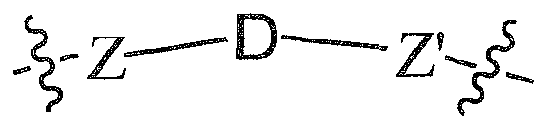
Where Z and Z' are each independently a bond, -(CH2)i-0, -(CH2)i-S, -(CH2)j-N-R ,

Each R2 is independently H or a C1-C3 alkyl group;
Each Y is independently a bond. O, S or N-R;
Each i is independently 1 to 100, 1 to 75, 1 to 60. 1 to 55, 1 to 50, 1 to 45. 1 to 40, 2 to 35, 3 to 30, 1 to 15. 1 to 10. 1 to 8. 1 to 6. 1, 2, 3. 4 or 5;
D is
O
— (CH,)i-Y-C II-Y (CH2),-.
— (CH2)m-—

j is 1 to 100. 1 to 75. 1 to 60. 1 to 55. 1 to 50, 1 to 45. 1 to 40. 2 to 35. 3 to 30, 1 to 1 5, 1 to
10, 1 to 8. 1 to 6. 1 , 2, 3. 4 or 5;
m' is 1 to 100, 1 to 75, 1 to 60. 1 to 55, 1 to 50, 1 to 45. 1 to 40. 2 to 35, 3 to 30, 1 to 15, 1 to 10. 1 to 8, 1 to 6. 1. 2. 3. 4 or 5:
n is 1 to 100, 1 to 75, 1 to 60, 1 to 55. 1 to 50. 1 to 45. 1 to 40. 2 to 35. 3 to 30. 1 to 15, 1 to 10, 1 to 8, 1 to 6. 1, 2, 3. 4 or 5;
X1 is O. S or N-R; and
R is as described above, or a pharmaceutical salt thereof.
The term "connector", symbolized in the generic formulas by [CT], is used to describe a chemical moiety which is optionally included in bifunctional compounds according to the present invention which forms from the reaction product of an activated ABT-linker with a PTB moiety (which also is preferably activated) or an ABT moiety with an activated linker-PTB as otherwise described herein. The connector group is often the resulting moiety which forms from the facile condensation of two or more separate chemical fragments which contain reactive groups which can provide connector groups as otherwise
described to produce bifunctional or multifunctional compounds according to the present invention. It is noted that a connector may be distinguishable from a linker in that the connector is the result of a specific chemistry which is used to provide bi functional compounds according to the present invention wherein the reaction product of these groups results in an identifiable connector group or part of a connector group which is
distinguishable from the linker group as otherwise described herein. It is noted also that a connector group may be linked to a number of linkers to provide multifunctionality (i.e., more than one PBT moiety and/or more than one ABT moiety within the same molecule. It is noted that there may be some overlap between the description of the connector group and the linker group, especially with respect to more common connector groups such as amide groups, oxygen (ether), sulfur (thioether) or amine linkages, urea or carbonate -OC(0)0- groups as otherwise described herein. It is further noted that a connector (or linker) may be connected to ABT. a linker or CBT at posit which are represented as being linked to another group using the using the symbol
 . Where two or more such groups are present in a linker or connector, any of an ABT. a linker or a PBT may be bonded to such a group.
Common connector groups which are used in the present invention include the following chemical groups:

Where X2 is O. S, NR1, S(O), S(0)2, -S(0)20, -OS(0)2, or OS(0)20;
X3 is O. S, NR4; and
R4 is H, a C1-C3 alkyl or alkanol group, or a -C(0)(Ci-C3) group.
As discussed hereinabove, it is noted that each of the above groups may be further linked to a chemical moiety which bonds two or more of the above connector groups into a multifunctional connector, thus providing complex multifunctional compounds comprising more than one ABT and/or PBT group within the multifunctional compound. An example of such compound is the compound B-ARM- I , described herein.
Initial work by the inventors involved in identifying compound ARM-H began with the small molecule BMS-378806, (4-benzoyl-1 -(2-(4-methoxy-l H-pyrrolo(2.3-b) pyridin-3- yl)-1.2-dioxoethyl )-2-methyl-. (2R)- Piperazine, CAS Number 357263-13-9, MW 406) shown here as Formula 1 , a known inhibitor of the CD4-gpl20 interaction. ( Wang, et al. J. Med. Chem. 2003. 46, 4236-42396)
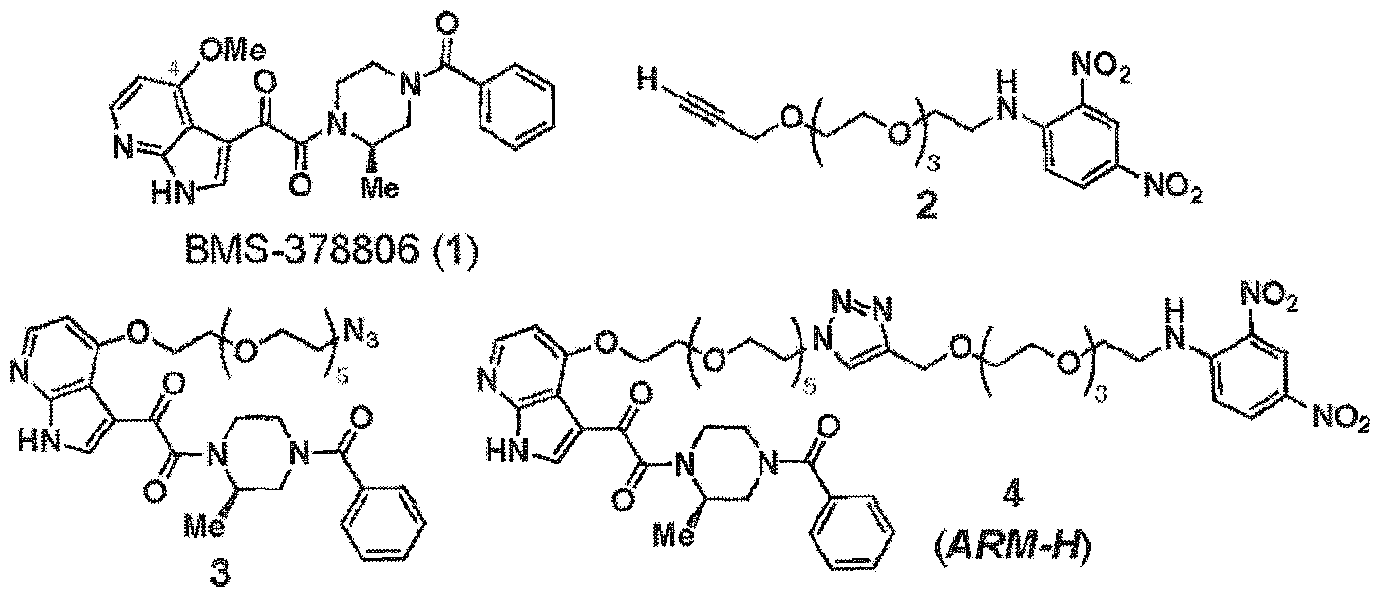
It was hypothesized that it might be possible to derivatize Formula 1, at the carbon atom of the C4 methox group, in which the carbon atom of the C4 methoxy group could be replaced with various bulky substituents. (Wang, J. S.; Le, N.; Heredia, A .: Song. H. J.: Redfield. R.: Wang. L. X. Org. Biomol. Chem. 2005. 3, 1781 -1786) so as to provide a linker which would attract DNP without sacrificing the compound's ability to inhibit viral entry. This hypothesis was supported by an analysis of a published computational docking model suggesting that the C4 methoxy group in Formula 1 points toward the solvent in the complex. See Kong. R.; Tan, J.; Ma, X.; Chen. W.; Wang, C:. Biochim. Biophys. Acta 2006, 1764. 766-7728.
Thus, in accordance with the invention. Formula 1 was re-engineered to include the capability to recruit anti-DNP antibodies to gpl20-expressing particles (infected cells or
viruses), increasing the "visibility" of the combination to the human immune system.
Consequently, an ARM-H of Formula 4 was prepared in high yield (38% overall) via azide- alkyne cycloaddition (Rostovtsev, V. V.; Green, L. G.; Fokin, V. V.; Sharpless, K. B. Angew. Chem., Int, Ed. 2002, 41. 2596-2599. Tornoe, C; Christensen, C; Meldal, M. J. Org. Chem. 2002, 67. 3057-3064 ) of the compounds of Formula 2 and Formula 3. which were derived in turn from known intermediates, as will be discussed further below. Wang, T.; et al. J. Med. Chem. 2003. 46, 4236-4239.
As discussed above, ARM-H compounds target HIV by inhibiting virus entry while targeting Env-expressing cells for immune recognition and clearance. (See Fig. 1) The ability of ARM-H to inhibit CD4 binding to HIV-1 gpl 20 was assessed first in an enzyme- linked immunosorbent assay (ELISA) (Fig. 2a). (See Ho, H.; et al. J. Virol. 2006, 80, 4017- 4025). As shown in Fig. 2a, ARM-H was able to out-compete the CD4-gpl20 interaction with a mean inhibitory concentration (IC50) of about 8.7μΜ, and it was only slightly less potent than the parent compound Formula 1 (IC50 = 1.3 Μ). Next we investigated ARM-H' s ability to inhibit the entry of live HIV- 1 virus into the human MT-2T-cell line (Fig. 2b, IC50 = 6.4μΜ). Although in this assay ARM-H once again proved to be less potent than Formula 1 (IC50 =0.32μΜ; Fig. 3a), it demonstrated potency equivalent to that of d4T, which is currently a mainstay in HIV pharmacotherapy (IC50 = 4.2μΜ; Fig. 3b).
It should be noted that the increase in potency of Formula 1 in MT-2 cells versus ELlSAs may be the result of a cooperative enhancement in binding to viral envelope gpl20, which exists as a t rimer, noting that the ELISA studies were performed using monomeric gp l 20. The steric bulk of ARM-H due to the C4 tether may impede binding of more than one ARM-H molecule per gpl20 trimer. Notably, however, ARM-H demonstrated no observable cytotoxicity in control MT-2 cultures lacking HIV virus (Fig. 2b, white circles).
It was confirmed that ARM-H has the ability to recruit antibodies to gp l20 both in vitro and in tissue culture. Initial ELISA experiments (Figs. 4a. 4b) demonstrated a concentration-dependent increase in anti-DNP antibody binding to the ARM-H-gpl20 complex but not to gpl20 alone. Thus. ARM-H is capable of templating a ternary complex that also includes gp 120 and anti-DNP antibody.
It was also confirmed that this ternary association could form in a complex cellular milieu, and that ARM-H has the ability to recruit AlexaFluor 488-labeled anti-DNP antibodies to HI V-Env-expressi ng Chinese hamster ovary cells (CHO-gpl20cells) by immunofluorescence microscopy (See Weiss. C; White, J. J Viral. 1993, 67, 7060-7066).
A strong fluorescence signal was observed when CHO-gpl 20 cells were incubated with ARM-H and labeled anti-DNP antibodies (Figure 5a. 5b). Because it was necessary to permeabilize the cells prior to labeling, intracellular gp 120 can also be observed in these micrographs. This fluorescence was absent from both CHO-gpl20 cells not treated with ARM-H (Figure 5c. 5d) and CHO cells not coding for HIV-env gene expression (CHO-WT cells, Figure 5e, 5 ). Furthermore, the intense fluorescence observed in Fig. 5b was considerably diminished in the presence of the competing ligands soluble CD4 (sCD4, Fig. 6g, 6h), Formula 1 (Fig. 5i, 5j). and a DNP-containing alkyne that lacks the gpl 20-binding motif (Formula 2. Fig. 5k. 51 ).
Taken together, these results provide strong evidence that ARM-H is capable of recruiting anti-hapten (e.g. anti-DNP) antibodies to cells expressing the Env glycoprotein in a fashion that depends upon its simultaneous binding to both gpl 20 and anti-DNP antibodies. Finally, the present inventors confirmed that the ternary complex formed from anti-DNP antibody, ARM-H, and alive Env-expressing cell activates complement proteins and mediates cellular death. Complement proteins are known to lyse cells by forming pores in lipid membranes and have been shown to play a critical role in inactivating HIV in humans. (See Aasa-Chapman. M. M. I.; Holuigue. S.; Aubin. K.; Wong. M.; Jones, N. A.; Cornforth. D.; Pellegrino, P.; Newton. P.; Williams. 1.: Borrow. P.; Mcknight. A. J. Virol. 2005. 79. 2823- 2830; Gerencer. M.; Burek, V.; Crowe, B. A.; Barrett, N. P.; Dorner, F. Microb. Pathog. 1998, 25, 253-266. Thus, rabbit complement proteins were added to CHO-gp 120 cells in the presence of ARM-H and a fixed concentration anti-DNP antibodies (Fig. 6). Substantial cell killing that exhibited a significant dependence on the ARM-H concentration (data in red) was observed.
The modest levels of complement-dependent cytotoxicity observed for ARM-H in Fig. 6 are similar to values reported in other systems (see Perdomo. M. F.: Levi. M.; Ilberg, M. S.; Vahlne. A. Proc. Natl. Acad. Sci. U.S.A. 2008, 105. 6) and may result from the low levels of Env expression on the CHO-gp 120 cells (see Weiss. C; White. J. J Viral. 1993. 67,
7060-7066 ). Also, because of assay incompatibilities, CDC data corresponding to ARM-H concentrations greater than 30 μΜ could not be obtained.
Characteristic autoinhibition of ternary complex formation at high levels of bifunctional molecule, arising from excess free bifunctional material that drives the equilibria toward formation of binary complexes, was not reliably observed in these assays. For more information on autoinhibitory behavior in ternary complexes, see: Mack, P.. T.; Perez- Castillejos. R.; Suo, Z.; Whitesides, G. M. Anal. Chem. 2008, 80, 5550-5555. and references contained therein.
Notably, in the absence of anti-DNP antibody and complement-preserved serum (data in green), in cells lacking the Env glycoprotein) CHO-WT, data in black), or in the presence of the compound of Formula 3, which lacks the DNP group (data in blue), no cell death was observed, suggesting that termolecular complex formation is necessary for complement- dependent cytotoxicity (CDC ) and that ARM-H itself is not toxic to cells.
Positive control experiments in which cells were directly labeled with 2, 4- dinitrobenzene-sulfonic acid (Fig. 7) were found to yield levels of CDC comparable to those observed for ARM-H. providing a bench-mark for the assay results depicted in Fig. 6. Thus. ARM-H is capable of recruiting a functional complement-dependent cytotoxic response against Env-expressing cells. Thus, it was confirmed that the inventive bifunctional molecule ARM-H can both recruit anti-DNP antibodies to gpl20-expressing cells and inhibit the gpl20-CD4 interaction.
Data supporting these conclusions include the following: (1) ARM-H binds to gpl 20 competitivel with CD4 and decreases viral infectivity in an MT-2 cell assay. (2) The ARM- H molecule can guide the formation of a ternary complex that includes anti-DNP antibodies and Env-expressing cells. (3) Antibodies present in this ternary complex can promote the complement-mediated killing of Env-expressing cells.
Critically, no non specific cytotoxicity was observed in either MT-2 or CHO cell lines in response to ARM-H. Also. ARM-H-mediated inhibition of HIV entry and CDC activity were both operative at concentrations ranging from 6 to 30μΜ, confirming that ARM-H could function simultaneously through dual mechanisms under therapeutic conditions.
The present invention takes a novel approach and is directed to the development of compositions which recruit anti-DNP antibodies and other ant i -hapten antibodies, endogenous in most patients, to HIV via binding to the gpl20 envelope protein, which additionally prevents HIV from binding to CD4 and T4 cells, providing a new therapy for treating HIV infection and the symptoms associated therewith.
The following detailed description outlines the design and synthesis of a new class of small-molecules capable of redirecting endogenous anti-hapten antibodies, especially including anti-dinitrophenyl (DNP) antibodies selectively to HIV, and inducing antibody- directed, cell-mediated cytotoxicity.
Treatment of Formula 1 with azido alcohol (2) gave rise to an intermediate azide (3) following N-oxide reduction. This compound was then conjugated to known DNP-PEG conjugate (4) to provide ARM-H- 1 (6).

BMS-378806 (1) is prepared according to the scheme which is presented hereinbelow. It is used to prepare a number of bifunctional compounds according to the present invention.

Various analogs were also synthesized, specifically exemplary compounds of the invention which include alteniative ABT substituents include but are not limited to ARM-H- 1, ARM-H-2 and ARM-H-3, and B ARM-1 , illustrated in the following syntheses. In the following synthetic scheme, PBT (in this case BMS-378806) is derivatized with a linker containing an azide group which can form a connector molecule in subsequent reactions. Once the derivatives PBT molecule is formed, Afunctional compounds according to the present invention may be condensed with appropriate ABT-containing molecules to produce the final bifunctional compounds according to the present invention.
Compound 14. a PBT containing molecule, contains a linker molecule to which is attached an azide which, when condensed with an acetylenic group as is presented in the synthetic scheme below can form a 1 ,2.3-triazole connector molecule to which is linked an ABT group.
In the next scheme, the introduction of a ABT moiety onto the PBT containing molecule to form a bi functional molecule is exemplified. In this synthesis, the ABT moiety contains a linker which also contains an acetylenic moiety at its distil end, which is capable of reacting with the azido group on the PBT containing molecule to form a trial zole connector molecule in forming the bi functional compounds according to the present invention.
In the following schemes, alternative bifunctional compounds according to the present invention are provided. These compounds containing a single PBT moiety to which is linked a compound which comprises two ABT groups, using lysine as a means to link more than one ABT group to the PBT moiety.
Derivativization: ABT Construction and Final Assembly

1) NaH, DMF
DNPO, Et,N
2) PPhj, H..CVTHF EtOH
18
73% (2 steps) 90%

(Antibody Recruiting Molecule targeting Hj ;
In addition to the bi functional compounds B-ARM-1, ARM-H-1 aned ARM-H-2 presented in the above schemes, more complex versions of the bi functional compound according to the present invention such as B-ARM- 1 below, which contains two pathogen binding termini (PTB) molecules and one antibody binding terminus (ABT) are presented herein. In this aspect of the invention, the connector molecular (CT) is a multifunctional compound to which more than two linker molecules and correspondingly, more than two PTB and/or ABT molecules may be bound. Note that the multifunctional connector molecule contains several triazolyl moieties through which a number of linker molecules are attached thus, providing two PBT moieties and an ABT moiety in a single molecule.
Bi-functional Molecule Synthesis: ARM Analogs
In

TtCI
T«0
DC* *
90%
HQ n N»
NMONP
2) ONPCI, EtsN. EtOH
¾ TsCI, OC , pij>
57%, 3 Steps


Af = QH OH C3
M—
In a modification of the above synthesis, the ABT moiety may be introduced onto the PBT moiety directly through a linker without reliance on a connector to link two separate linkers as described above.

O-l .OH H
In yet another synthesis according to the present invention, the alternative PBT moiety may contain a single carbonyl, rather than the dicarbonyl moiety typically found attached to the indole, linking the piperazine group to the indole. The resulting compound 26 links the ABT moiety through the benzoyl portion of the molecule.
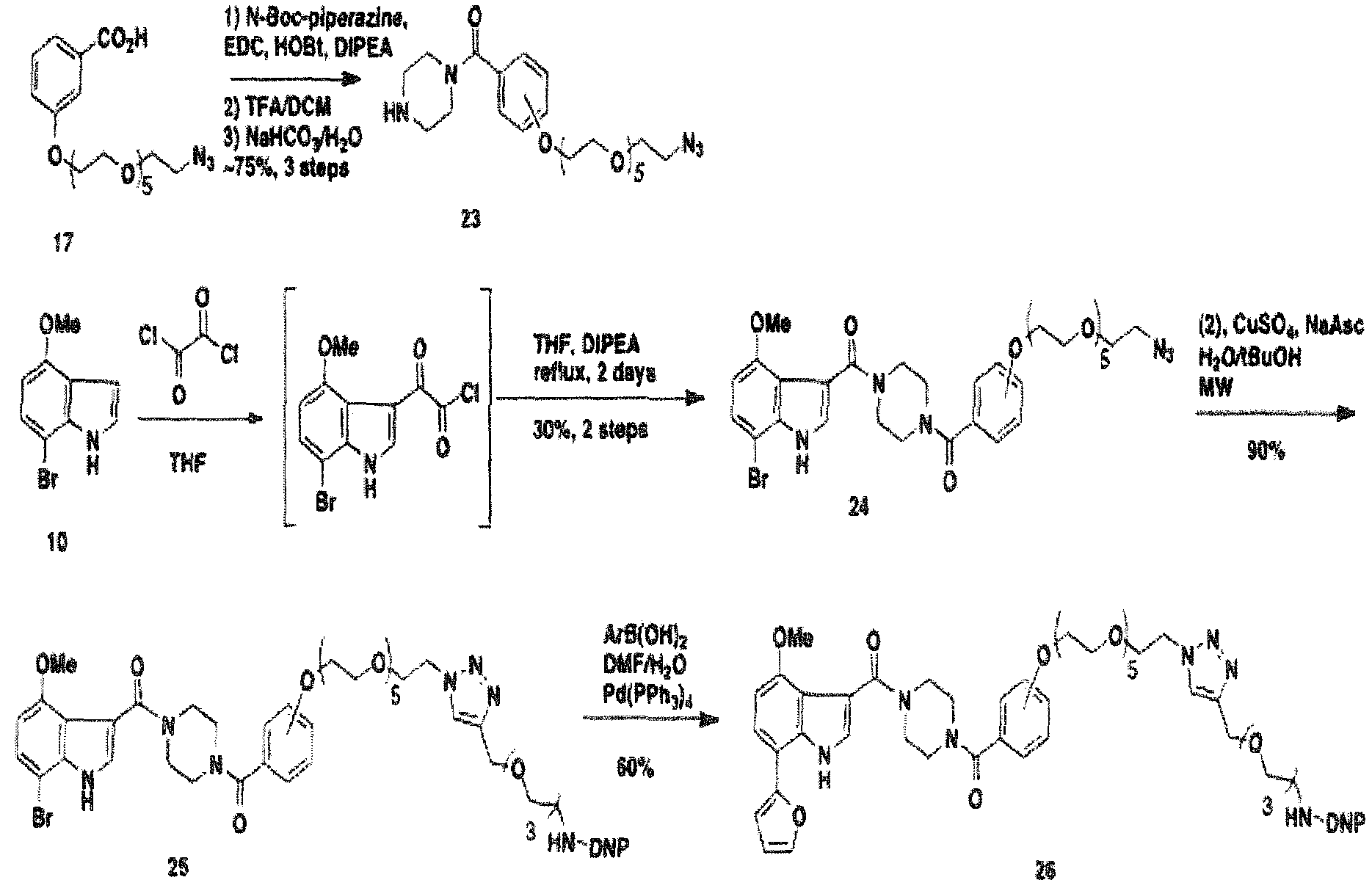
•Of* Af

In another general synthetic route to ARM-H analogs of the type (38), which do not contain a connecting functionality (CT) attached to the linker (i.e.. CT is a bond), introduction of the linker- ABT moiety as in compounds 63 and 64 is provided and the car boxy! ie acid compound 64, which contains the linker-ABT without a connector moiety, is then condensed onto the secondary amine (piperidine moiety) of compound 19 to produce compound 65. An aryl group as indicated is introduced onto the carbon atom containing the bromine of compound 65 to provide compound 38 and related compounds as indicated in the scheme.

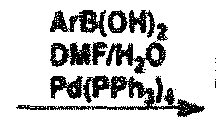

In the following exemplary schemes, an ABT moiety comprising DNP is linked to a PBT moiety using an amino acid D P (dinitrophenyl ) moieties. The first scheme relates to the introduction of DNP amino acids into ARM-H diiunctional compounds through the indole moiety of the PBT portion of the molecule using a connector moiety as indicated.


In the following alternative synthetic approach, a general synthetic route is described to provide DNP amino acid containing ARM-H molecules functionalized at the phenyl position of the molecule.

Still other di functional compounds introduce the DNP amino acids into the phenyl (benzoyl) portion of the molecule without using a connector molecule using analogous methods described herein, in contrast to the method described above.

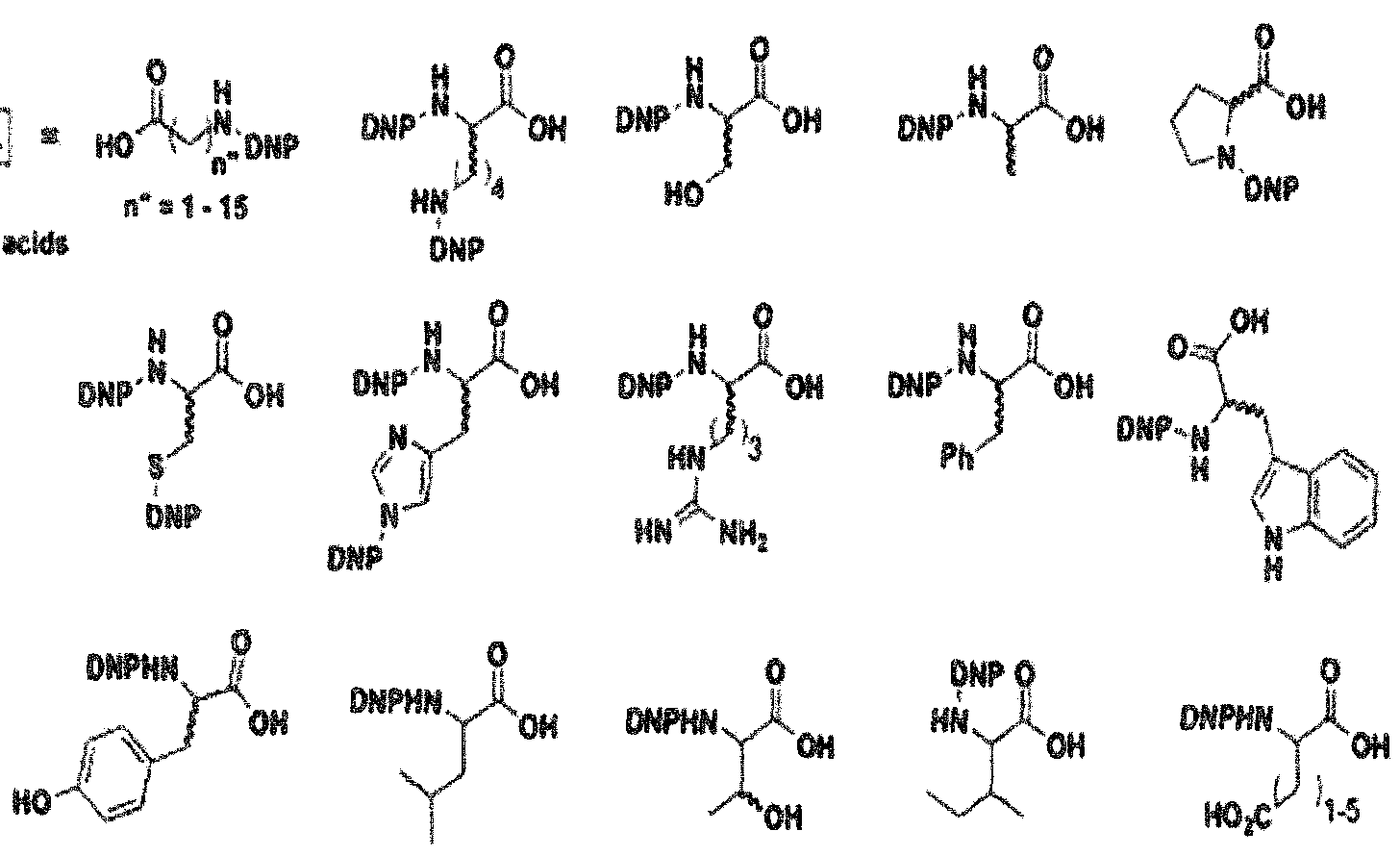
The above schemes provide exemplary synthesis of compounds according to the present invention with various iterations of same provided by analogy using well known methods as described herein and as understood by those of ordinary skill in the art. It is noted that the experimental section provides significant detail to allow the facile synthesis of a variety of ARM-H molecules as otherwise described herein. The schemes are not to be considered 1 imitating in setting forth teachings which provide compounds according to the present invention.
Turning to biological data of ARM-H compounds according to the present invention, with reference to Fig. 10, this shows the results of an ELISA confirming that the various ARM analog compounds illustrated above inhibit the gpl20-CD4 interaction. Subsequent experiments using BMS-378806 instead of sCD4 have confirmed that ARM-H-2 and ARM- H-3 cannot be out competed at BMS concentrations up to ImM, though ARM-H- 1 can be.
Fig. 1 1 illustrates the results of MT-2 assay to illustrate the analog ARM-H activity.
Fig. 12a illustrates the recruitment of an immune response showing the complement dependent cytotoxicity (CDC) of the above analogs. Fig. 12b illustrating the CDC for ARM- H. The targeted cytotoxicity is dependent on ARM-H, gpl2(), DNP and antibody/serum.
Fig. 13 illustrates the dual mechanisms of action in fighting HIV achieved with the bi functional molecules of the present invention.
While specific analogs have been shown and described, the present invention is not limited to these specific analogs and other antibody recruiting compounds that can function as the antibody recruiting terminus connected by a linker to a binding terminus that will bind to the HIV glycoprotein gpl20 (g l20 on the viral membrane as well as gpl20 displayed on infected cells), would fall within the scope of the present invention. All of these compounds can be formulated into pharmaceutical compositions as otherwise described herein and use in the methods which are presented.
Pharmaceutical compositions comprising combinations of an effective amount of at least one bifunctional compound according to the present invention, and one or more of the compounds otherwise described herein, all in effective amounts, in combination with a pharmaceuticall effective amount of a carrier, additive or excipient, represents a further aspect of the present invention.
The compositions of the present invention may be formulated in a conventional manner using one or more pharmaceutically acceptable carriers and may also be administered in control led-release formulations. Pharmaceutically acceptable carriers that may be used in these pharmaceutical compositions include, but are not limited to. ion exchangers, alumina, aluminum stearate, lecithin, serum proteins, such as human serum albumin, buffer substances such as phosphates, glycine, sorbic acid, potassium sorbate, partial glyceride mixtures of saturated vegetable fatty acids, water, salts or electrolytes, such as prolamine sulfate, di sodium hydrogen phosphate, potassium hydrogen phosphate, sodium chloride, zinc salts, colloidal silica, magnesium trisilicate, polyvinyl pyrrolidone, cellulose-based substances, polyethylene glycol, sodium carboxymethylcellulose, polyacrylates, waxes, polyethylene- polyoxypropylene-block polymers, polyethylene glycol and wool fat.
The compositions of the present invention may be administered orally, parenterally. by inhalation spray, topically, rectally, nasally, buccally, vaginally or via an implanted reservoir. The term "parenteral" as used herein includes subcutaneous, intravenous, intramuscular, intra-articular, intra-synovial. intrasternal, intrathecal, intrahepatic, intralesional and intracranial injection or infusion techniques. Preferably, the compositions are administered orally, intraperitoneally or intravenously.
Sterile injectable forms of the compositions of this invention may be aqueous or oleaginous suspension. These suspensions may be formulated according to techniques known in the art using suitable dispersing or wetting agents and suspending agents. The sterile injectable preparation may also be a sterile injectable solution or suspension in a nontoxic parenterally-acceptable diluent or solvent, for example as a solution in 1, 3-butanedioi. Among the acceptable vehicles and solvents that may be employed are water. Ringer's solution and isotonic sodium chloride solution, in addition, sterile, fixed oils are
conventionally employed as a solvent or suspending medium. For this purpose, any bland fixed oil may be employed including synthetic mono- or di-glycerides. Fatty acids, such as oleic acid and its glyceride derivatives are useful in the preparation of injectables, as are natural pharmaceutically-acceptable oils, such as olive oil or castor oil, especially in their polyoxyethylated versions. These oil solutions or suspensions may also contain a long-chain alcohol diluent or dispersant, such as Ph. I lelv or similar alcohol.
The pharmaceutical compositions of this invention may be orally administered in any orally acceptable dosage form including, but not limited to, capsules, tablets, aqueous suspensions or solutions. In the case of tablets for oral use. carriers which are commonly used include lactose and corn starch. Lubricating agents, such as magnesium stearate, are also typically added. For oral administration in a capsule form, useful diluents include lactose and dried corn starch. When aqueous suspensions are required for oral use, the active ingredient is combined with emulsifying and suspending agents. If desired, certain sweetening, flavoring or coloring agents may also be added.
Alternatively, the pharmaceutical compositions of this invention may be administered in the form of suppositories for rectal administration. These can be prepared by mixing the agent with a suitable non-irritating excipient which is solid at room temperature but liquid at
rectal temperature and therefore will melt in the rectum to release the drug. Such materials include cocoa butter, beeswax and polyethylene glycols.
The pharmaceutical compositions of this invention may also be administered topically. Suitable topical formulations are readily prepared for each of these areas or organs. Topical application for the lower intestinal tract can be effected in a rectal suppository formulation (see above) or in a suitable enema formulation. Topically-acceptable transdermal patches may also be used.
For topical applications, the pharmaceutical compositions may be formulated in a suitable ointment containing the active component suspended or dissolved in one or more carriers. Carriers for topical administration of the compounds of this invention include, but are not limited to, mineral oil, liquid petrolatum, white petrolatum, propylene glycol, polyoxyethylene, polyoxypropy 1 ene compound, emulsifying wax and water.
Alternatively, the pharmaceutical compositions can be formulated in a suitable lotion or cream containing the active components suspended or dissolved in one or more pharmaceuticall acceptable carriers. Suitable carriers include, but are not limited to, mineral oil, sorbitan monostearate, polysorbate 60. cetyl esters wax, cetearyl alcohol, 2- octyldodecanol. benzyl alcohol and water.
For ophthalmic use, the pharmaceutical compositions may be formulated as micronized suspensions in isotonic, pH adjusted sterile saline, or, preferably, as solutions in isotonic. pH adjusted sterile saline, either with our without a preservative such as benzyl alkonium chloride. Alternatively, for ophthalmic uses, the pharmaceutical
compositions may be formulated i an ointment such as petrolatum.
The pharmaceutical compositions of this invention may also be administered by nasal aerosol or inhalation. Such compositions are prepared according to techniques well-known in the art of pharmaceutical formulation and may be prepared as solutions in saline, employing benzyl alcohol or other suitable preservatives, absorption promoters to enhance
bioavailability, fluorocarbons, and/or other conventional solubilizing or dispersing agents.
The amount of compound in a pharmaceutical composition of the instant invention that may be combined with the carrier materials to produce a single dosage form will vary depending upon the host and disease treated, the particular mode of administration.
Preferably, the compositions should be formulated to contain between about 0.05 milligram to about 750 milligrams or more, more preferably about 1 milligram to about 600 milligrams, and even more preferably about 10 milligrams to about 500 milligrams of active ingredient, alone or in combination with at least one other ARM-H compound which may be used to treat HIV infection or a secondary effect or condition thereof.
It should also be understood that a specific dosage and treatment regimen for any particular patient will depend upon a variety of factors, including the activity of the specific compound employed, the age, body weight, general health, sex, diet, time of administration, rate of excretion, drug combination, and the judgment of the treating physician and the severity of the particular disease or condition being treated.
A patient or subject (e.g. a male human) suffering from HIV infection can be treated by administering to the patient (subject) an effective amount of the ARM-H compound according to the present invention including pharmaceutically acceptable salts, solvates or polymorphs, thereof optionally in a pharmaceutically acceptable carrier or diluent, either alone, or in combination with other known antiviral or pharmaceutical agents, preferably agents which can assist in treating HIV infection, including AIDS or ameliorate the secondary effects and conditions associated with HIV infection. This treatment can also be administered in conjunction with other conventional HIV therapies.
These compounds can be administered by any appropriate route, for example, orally, parenteral ly, intravenously, intradermal ly, subcutaneously, or topically, in liquid, cream, gel, or solid form, or by aerosol form.
The active compound is included in the pharmaceutically acceptable carrier or diluent in an amount sufficient to deliver to a patient a therapeutically effective amount for the desired indication, without causing serious toxic effects in the patient treated. A preferred dose of the active compound for all of the herein-mentioned conditions is in the range from about 10 ng/kg to 300 mg/kg, preferably 0.1 to 100 mg/kg per day, more generally 0.5 to about 25 mg per kilogram body weight of the recipient/patient per day. A typical topical
dosage will range from 0.01-3% wt/wt in a suitable carrier.
The compound is conveniently administered in any suitable unit dosage form, including but not limited to one containing less than lmg. 1 mg to 3000 mg, preferably 5 to 500 mg of active ingredient per unit dosage form. An oral dosage of about 25-250 mg is often convenient.
The active ingredient is preferably administered to achieve peak plasma
concentrations of the active compound of about 0.00001-30 mM. preferably about 0.1 -30 μΜ. This may be achieved, for example, by the intravenous injection of a solution or formulation of the active ingredient, optionally in saline, or an aqueous medium or administered as a bolus of the active ingredient. Oral administration is also appropriate to generate effective plasma concentrations of active agent.
The concentration of active compound in the drug composition will depend on absorption, distribution, inactivation, and excretion rates of the drug as well as other factors known to those of skill in the art. it is to be noted that dosage values will also vary with the severity of the condition to be alleviated. It is to be further understood that for any particular subject, specific dosage regimens should be adjusted over time according to the individual need and the professional judgment of the person administering or supervising the administration of the compositions, and that the concentration ranges set forth herein are exemplary only and are not intended to limit the scope or practice of the claimed composition. The active ingredient may be administered at once, or may be divided into a number of smaller doses to be administered at varying intervals of time.
Oral compositions will generally include an inert diluent or an edible carrier. They may be enclosed in gelatin capsules or compressed into tablets. For the purpose of oral therapeutic administration, the active compound or its prodrug derivative can be incorporated with excipients and used in the form of tablets, troches, or capsules. Pharmaceutically compatible binding agents, and/or adjuvant materials can be included as part of the composition.
The tablets, pills, capsules, troches and the like can contain any of the following ingredients, or compounds of a similar nature: a binder such as microcrystalline cellulose,
gum tragacanth or gelatin; an excipient such as starch or lactose, a dispersing agent such as alginic acid. Primogel, or corn starch; a lubricant such as magnesium stearate or Sterotes; a glidant such as colloidal silicon dioxide; a sweetening agent such as sucrose or saccharin; or a flavoring agent such as peppermint, methyl salicylate, or orange flavoring. When the dosage unit form is a capsule, it can contain, in addition to material of the above type, a liquid carrier such as a fatty oil. In addition, dosage unit forms can contain various other materials which modi fy the physical form of the dosage unit, for example, coatings of sugar, shellac, or enteric agents.
The active compound or pharmaceutically acceptable salt thereof can be administered as a component of an elixir, suspension, syrup, wafer, chewing gum or the like. A syrup may contain, in addition to the active compounds, sucrose as a sweetening agent and certain preservatives, dyes and colorings and flavors.
The active compound or pharmaceutically acceptable salts thereof can also be mixed with other active materials that do not impair the desired action, or with materials that supplement the desired action, such as other anti-HIV agents, antibiotics, antifungals, antiinflammatories, or antiviral compounds. In certain preferred aspects of the invention, one or more ARM-H compounds according to the present invention are coadministered with another anti-HIV agent and/or another bioactive agent, as otherwise described herein.
Solutions or suspensions used for parenteral, intradermal, subcutaneous, or topical application can include the following components: a sterile diluent such as water for injection, saline solution, fixed oils, polyethylene glycols, glycerine, propylene glycol or other synthetic solvents; antibacterial agents such as benzyl alcohol or methyl parabens; antioxidants such as ascorbic acid or sodium bisulfite; chelating agents such as
ethylenediaminetetraacetic acid; buffers such as acetates, citrates or phosphates and agents for the adjustment of tonicity such as sodium chloride or dextrose. The parental preparation can be enclosed in ampoules, disposable syringes or multiple dose vials made of glass or plastic.
If administered intravenously, preferred carriers are physiological saline or phosphate buffered saline (PBS).
In one embodiment, the active compounds are prepared with carriers that will protect the compound against rapid elimination from the body, such as a controlled release formulation, including implants and microencapsulated delivery systems. Biodegradable, biocompatible polymers can be used, such as ethylene vinyl acetate, polyanhydrides.
polyglycolic acid, collagen, polyorthoesters. and polylactic acid. Methods for preparation of such formulations will be apparent to those skilled in the art.
Liposomal suspensions may also be pharmaceutically acceptable carriers. These may be prepared according to methods known to those skilled in the art, for example, as described in U.S. Pat. No. 4.522,81 1 (which is incorporated herein by reference in its entirety). For example, liposome formulations may be prepared by dissolving appropriate lipid(s) (such as stearoyl phosphatidyl ethanolamine, stearoyl phosphatidyl choline, arachadoyl phosphatidyl choline, and cholesterol) in an inorganic solvent that is then evaporated, leaving behind a thin film of dried lipid on the surface of the container. An aqueous solution of the active compound are then introduced into the container. The container is then swirled by hand to free lipid material from the sides of the container and to disperse lipid aggregates, thereby forming the liposomal suspension.
Detailed Synthetic Information
Materials and General Information: Purchased starting materials were used as received unless otherwise noted. All moisture sensitive reactions were performed in an inert, dry atmosphere of nitrogen in flame dried glassware. Reagent grade solvents were used for extractions and flash chromatography. Reaction progress was checked by analytical thin- layer chromatography (TLC. Merck silica gel 60 F-254 plates). The plates were monitored either with UV illumination, or by charring with anisaldehyde (2.5% /?-anisaldehyde, 1% AcOH, 3.5% H2S04(conc.) in 95% EtOH) or ninhydrin (0.3% ninhydrin (w/v), 97:3 EtOH- AcOH) stains. Flash column chromatography was performed using silica gel (230-400 mesh). The solvent compositions reported for all chromatographic separations are on a volume/volume (v/v) basis. ELISA and CDC experiments were performed in triplicate and repeated at least three times unless otherwise noted. 1mm uno f 1 uorescenc e ( IF) experiments were performed in duplicate and repeated at least two times.
Instrumentation: 111-NMR spectra were recorded at either 400 or 500 MHz and arc reported in parts per million (ppm) on the δ scale relative to CDCI3 (δ 7.26) as an internal standard unless otherwise noted. Data are reported as follows: chemical shift, multiplicity (s = singlet, d = doublet, t = triplet, q = quartet, br = broad, m = multiplet ). coupling constants (Hz), and integration. 13C-NMR spectra were recorded at either 100 or 125 MHz and are reported in parts per million (ppm) on the δ scale relative to CDCI3 (δ 77.00). High resolution mass spectra (HRMS) were recorded on a 9.4T Bruker Qe FT-ICR MS (W.M. Keck Facility, Yale University). Analytical ultra high-performance liquid chromatography- mass spectrometry (UPLC/MS) was performed on a Waters UPLC/MS instrument equipped with a reverse-phase CI 8 column ( 1 .7 μι particle size. 2.1 50 mm), dual atmospheric pressure chemical ionization (APIVelectrospray (ESI) mass spectrometry detector, and photodiode array detector. Samples were eluted with a linear gradient of 20% acetonitrile- water→100% acetonitrile containing 0.1% formic acid over 3 min at a flow rate of 0.8 mL/min. Analytical UPLC/MS data are represented as follows: m/z; retention time (Rt) in minutes. High Pressure Liquid Chromatography (HPLC) using a Dynamax Rainin Solvent Delivery System equipped with a Van an Prostar Detector (Galaxie Chromatography Data System version 1.8.505.5), and absorbance measurements were made at 214 and 254 nra simultaneously. A Waters Xterra Prep MS CI 8 7.8x150mm column was used for semi- preparative purifications using a watenacetonitrile (A:B) gradient containing 0.1% TFA at 5.0 mL/min. as specified below for individual compounds. Infrared ( IR) spectra were recorded on a Thermo Nicolet 6700 FT-IR Spectrometer. Unless otherwise noted, all micro- plate based assays were quantitated using a BioTek Synergy 3 Microplate reader and data was fitted and graphed using GraphPad Prism version 5.00 for Windows (GraphPad Software. San Diego California USA, www.graphpad.com) or KaleidaGraph (Synergy Software).

Supplementary Scheme 1. Representative synthesis of DNP-PEGn-Alkynes
l -azido-3,6,9,12-tetraoxapentadec-14-yne (6)
2-(2-(2-(2-azidoethoxy)ethoxy)ethoxy)ethanol1 (7.55 g, 34 mmol, 1.0
 equiv., 5) was dissolved in DMF ( 1 50mL). and sodium hydride (989 mg. 40.8 mmol, 1.2 equiv.) was added, followed by propargyl bromide (80% in PhMe, 7.4 niL, 68 mmol, 2.0 equiv.). The reaction ran for 3 h at rt. at which time it was found complete by thin layer chromatography, was concentrated and chromatographed by silica gel chromatography (30% EtOAc in hexanes) to yield 6 as a clear oil (7.55 g, 86% yield). IR (thin f lm/NaCl) 3252 (w), 2869 (s), 21 10 (s), 1460 (w), 1349 (m). 1 103 (s), 943 (w), 848 (w), 663 (w) crn- 1 ; 1HNMR (400 MHz, CDC13) δ 4.13-4.23 (t, J = 2.4 Hz, 1H), 3.71 - 3.59 (m. 14H), 3.41 - 3.30 (t, J=5.1 Hz, 2H), 2.41 (t, J = 2.4 Hz, 1H); 13CNMR (125 MHz, CDC13) δ 79.55, 74.47. 70.47, 70.45. 70.43. 70.42. 70.20, 69.84. 68.91 , 58.18, 50.50; HRMS (ES+) calc'd for C I 1H19N304 (M+H) m/z 258.14483. Found 258.14496.
o ^N3 (41) Prepared 41 in the same manner as compound 6 from 2-(2- ^ 2 azidoethoxy)ethanol.
3,6,9,12-tetraoxapentadee-14-yn-l -amine (7)
1 -azido-3 ,6.9.12-tetraoxapcntadec- 14-yne 6 (2.45 g, 9.53 mmol, 1 equiv.),
 triphenylphosphine (3.00 g, 1 1 .4 mmol. 1.2 equiv. ), and water ( 172 ml.,
9.53 mmol, 1.0 equiv.) were dissolved in THF (30mL) and stirred for 12 h when TLC (95:5 CH2CI2/ CH3OH) indicated completion. Reaction was concentrated and chromatographed (100% CH2Q2 to 80:20:1 CH2Ci2/MeOH/Et3N) to yield 7 as a clear oil (1.88 g, 85% yield). IR (thin film, NaCI) 3372 (br), 3251 (s), 2868 (s), 21 12 (w), 1652 (m), 1596 (m). 1459 (m), 1350 (m), 1301 (m), 1249 (m), 1 100 (s), 946 (m), 681 (m) cm"' . Ή-NMR (500 MHz, CDCI3) δ 4.16 (m. 2H), 3.66-3.57 (m, 12H), 3.49 (t, 2H. ./= 5.3 Hz), 2.85 (t, 2H, J= 5.0 Hz), 2.56 (bs, 2H), 2.41 (m, 1H). C NMR (125 MHz, CDC13) δ 79.52, 74.63. 73.06. 70.45, 70.41 , 70.24. 70.1 1 , 68.96. 58.26, 41.50. HRMS ES+) calc'd for C1 1 H2 1N04 (M+H) m/z 232.154335. Found 232.15402.
;;i «'' ~o''' '^ NH2 '^) Prepared 42 in the same manner as compound 7 starting from 41.
Gong, Y.; Luo, Y.; Bong, Γ). ./. ICS' 2006. 45, 14430-14431.
N-(2,4-dinitrophenyl)-3,6,9, 12-tetraoxapentadec- 14-yn- 1 -amine (2)
NHDNP
V°^ l4 3,6,9.12-tetraoxapentadec- 14-yn-l -amine 7 (1.0 g, 4.3 mmoL 1 equiv.) was dissolved in EtOH (18mL), and triethylamine ( 1.68mL, 8.6mmol, 2 equiv.) and l -chloro-2.4-dinitrobenzene (876 mg. 4.3 mmol. 1 equiv.) were added. The reaction flask was fitted with a reflux condenser and the reaction was heated to reflux for 2 h. cooled, and concentrated to a crude yellow oil. The crude mixture was re-dissolved in H20 (25 mL) and extracted with CH2C12 (5 x 10 mL). Organic layers were dried over Na2S04 and concentrated to a yellow oil that was purified by flash chromatography (CombiFiash Automated Chromatographer, 25 g column, dryloaded with 25g pre-packed dry loading column. Run using 10% EtOAc-.Hexanes to 50% EtOAc:Hexanes gradient over 30 column volumes, followed by EtOAc flush) to yield 2 as a yellow solid (1.70g, >98% yield). IR (thin film/NaCl) 3360(m), 3290 (m), 31 10 (w), 2873 (m). 21 14(w). 1621 (s), 1588 (m), 1336 (s), 1134 (m) cm"1; T l-NMR (500 MHz, CDC13) δ 9.13 (d, 1H, J = 2.6 Hz), 8.80 (broad peak, I H). 8.25 (dd, 1H, J = 2.6, J= 9.5 Hz), 6.94 (d, 1H, J = 9.5 Hz), 4.1 8 (m, 2H), 3.83 (t, 2H. J - 5.2 Hz), 3.67 (m, 12H), 3.60 (q, 21 ). 2.41 (m, 1H); 13C- MR ( 125 MHz, CDC13) δ 148.6. 136.2. 130.4. 124.4. 1 14.3, 79.8, 74.7. 70.8. 70.7. 70.5, 69.2, 68.7. 58.5, 43.4; HRMS (EI) calc'd for C17H23 3O8 (MH+) m/z 398.1558. Found 398.1557. (43) Prepared 43 in the same manner as compound 2 starting from 42.

Ή MR (400 MHz, CDC13) δ 9.15 (d. J - 2.7. 1 H). 8.81 (s. I H). 8.42 -
8.19 (m. IH), 6.96 ( d. J = 9.5. IH), 4.21 (d, J = 2.4, 2H), 3.84 (t, J = 5.3, 2H), 3.74 (broad peak, 4H), 3.61 (dd. J = 5.2, 10.5. 211). 2.44 (t, J = 2.4. IH).

Supplementary Scheme 2. Representative Synthesis of ARM-H type ( 47) molecules with DNP containing Amino Acids
(44) To a solution of N,S-Di(2,4-dinitrophenyl)-L-cysteine
(200 mg, 0.441 mmol, purchased from Aldrich) in anhydrous

CH2C12 (T O mL) at 0 C, added 7 (148 mg, 0.641 mmol. 1.45 equiv). 1 -ethyl- 3-(3- dimethylaminopropyl) carbodiimide hydrochloride (EDC-HCl. 126 mg. 0.651 mmol).
hydroxybenzotriazole monohydrate (HOBT, 89 mg, 0.659 mmol) and diisopropylethylamine ( 330 uL). Let yellow solution warm to room temperature while stirring under an atmosphere of nitrogen. After 48 hrs, TLC (9: 1 CH2C12/CH30H) indicated reaction completion and solution was diluted with CH2C12 (40 mL), washed with saturated NaHC03 (2 X 40 mL) and brine (1 x 40 mL). Organic fraction was dried over anhydrous Na2S04, filtered and concentrated under reduced pressure, yielding crude 10, which was purified by flash column chromatography (0%-5% CH30H in CH2C12. note: purification can be monitored visually by observing separation of yellow band on silica), resulting in pure 44 (230 mg, 0.35 mmol 80%) as a sticky yellow solid. 1H NMR (500 MHz, CDC13) δ 9.10 (s, 1 H), 9.03 (s, 211), 8.41 (d, J = 8.9, 1H), 8.29 (d, J = 9.3. I ll), 7.77 (d. J = 8.8, 1H), 7.66 (s. 1H), 6.99 (d, J = 9.3, 1 H). 4.63 (dd. J = 6.4. 12.2, 1H), 4.13 (s, 211). 3.78 (dd, J = 4.6. 13.1 , 1 H). 3.74 - 3.36 (m, 17H), 2.41 (t, J = 2.1, 1H).

Supplementary Scheme 3. Representative synthesis of ARM-H type (4) analogs.
4-Benzoyl-2-(R)-methyl-l -[(4-nitro-7-oxido-lH-pyrro]o[2,3- b] pyridin-3-yl)oxoacetylJ -piperazine (8)
This compound was synthesized as previously described2. All synthetic intermediates as well as the final product analytical data were in agreement with that reported3.

Method I : Synthesis of Azide-PEG-Azaindoles (Synthesis of 3 provided as example)
To a stirred mixture of 255 mg NaH (95%, 9.88 mmol. 7.2 equiv. Aldrich ). anhydrous dimethoxyethane (21 mL) was added followed by addition of hexaethylenc azido glycol (1.512g, 4.93 mmol, 7.2
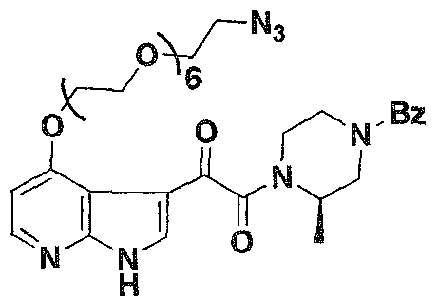 equiv) 3 in anhydrous dimethoxyethane (21 mL). The resulting yellow solution was stirred for 2 hrs before 8 (300 mg. 0.686 mmol) was added as a solution in dimethoxyethane (7.5 mL) via cannula at room temperature. The resulting copper colored mixture was heated to 45 °C and monitored by TLC (9: 1 CH2C12/ CH3OH). After approximately 2 hrs, the brown mixture was allowed to cool to room temperature, aq. NH4CI (15 mL) was slowly added and the organic layer was extracted with CH2C12 (5 x 80 mL). The organic phases were combined, dried over anhyd. MgSOt. filtered, and all solvents were evaporated. The resulting brown crude residue 9 was purified chromatographically on silica (0% to 20% CH3OH in CH2CI2) to remove unreacted azido alcohol. The resulting yellow oil (650 mg) was carried on without further purification. Compound 9 (650 mg) was then dissolved in 40 mL EtOAc. To this solution was added 1 .10 mL PC13 (6.92mmol, 10 equiv). resulting in an orange heterogeneous mixture, which was allowed to stir at r.t. After 2 hrs the reaction was quenched by the careful addition of aq. TMaHCCh at 0 °C until pH of 6 was reached. The mixture was extracted with EtOAc (5 x 50 mL) and the combined organic layers were dried over anhydrous Na2S04, filtered, and all solvents were evaporated. These crude isolates were then purified by column chromatography (0% to 8% CH3OH in CH2C12), to yield 3 as a clear solid (421mg, 0.618 mmol, 45% over 2 steps). IR (thin film/NaCI) 3095 (w), 2872 (s), 21071s), 1635 (s), 1433 (m), 1097 (m) cm"1. 1H-NMR (500 MHz, CDCI3, rt) δ 12.5 (s, 1 H). 8.28 (d. J = 5.6 Hz, 1H), 8.03 (d, J = 18.3 Hz, 1H) 7.41 (broad peak, 5H), 6.76 (d, J= 3.8 Hz, 1H), 5.05-4.45 (broad peak, 2H), 4.38 (broad peak, 2H), 4.02 (broad peak,
2. Wang, T.; Zhang, Z.; et al. J. Med. Chem. 2003, 46, 4236-4239.
Zych, A.; Iverson, B. J ICS 2000. 37, 8898-8909.
2H), 3.78(broad peak. 2H) 3.68-3.58 (m. 18H), 3.48 (m, I II). 3.37 (m, 211), 3.15 (broad peak, 2H), 1.30 (broad peak, 3H) 13C-NMR (75 MHz, CD3OD, rt) δ 184.8, 167.2, 161.4, 152.1, 146.8, 135.5, 130.5. 129.1, 127.5. 1 18.9. 1 14.5. 108.4, 102.3, 71.5, 71.1, 71.0, 70.4, 69.7, 69.00, 68.9, 51.1, 45.2, 16.6, 1 5.5. HRMS (El) m/z (%) for C33H43N7O9 (MH+) calc'd 682.3195, found 682.3205; for (M+Na)+ calc'd 704.3014. found 704.3017. -
 5 (t, J = 5.0, 211). 3.08 (s, 211). 1.25 (broad signal. 3H).
(46) Prepared according to Method 1 as in compound 3 using 2-(2- azidoethoxy)ethanol. Ή-NMR (400 MHz, CDC13, rt) δ 8.20 (d, J = 5.8. I H). 7.96 (d. J = 13.8. 1H), 7.34 (s, 5H), 6.71 (d, J = 5.3, HI). 4.94
 4.42 (m, 2H), 4.33 (s, 211), 3.98 (s, 2H). 3.79 (s, 2H), 3.67 - 2.86 (m,
7H) 1.30 (broad peak, 3H).
Method 2: General Procedure for alkyne-azide coupling reactions (Synthesis of 4 provided as example)
To a solution of 2 (45.0 mg, 0.066 mmol ) dissolved in t- BuOH ( 1.7 niL) and H20 ( 1.6 mL) was added 3 (5 1 mg. 0.125 mmol, 1.9 equiv). The mixture was stirred for 5 min before aqueous CuS04 5H20 (0.1M, 3 μΐ, 0.05
 equiv) and aqueous sodium ascorbate (0.1M, 66 uL. 0.1 equiv) were added. The reaction vessel was then capped and heated in a microwave reactor for 20 min at 125 °C at which time TLC (9: 1 CH2C12/CH30H) indicated reaction completion. The golden yellow solution was transferred to a flask using CH3OH and all solvents were evaporated, providing 35 mg of crude 4 as a golden yellow solid which was subsequently purified by flash chromatography (0% to 10% CH3OH in CH2C12) to deliver 57 mg (0.053 mmol, 80%) of 2 as a golden yellow solid. IR (thin fflm NaCI) 3356 (w), 31 1 1 (w), 2931 (m), 2876 (s), 1620 (s), 1515 (m), 1433 (m), 1334 (m), 1297 (m), 1 123 (m) cm"1. Ή-NMR (500 MHz, CDCI3, rt) δ 12.74. (broad peak. I H). 9.08 (d, J = 2.5 Hz, H I) 8.76 (s, I II), 8.26
(d. J= 4.7 Hz, IH), 8.22 (dd. J= 2.6.9.5 Hz, IH).8.01 (d. J = 19.9 Hz, IH), 7.70 (s, IH), 7.40 (broad peak.5H), 6.93 (d, J= 9.5 Hz. IH).6.73 (broad peak. IH), 5.1-4.7 (broad peak, IH) 4.4 (broad peak.2H).4.49 (t, 2H, J= 5.1 Hz), 4.36 (broad peak, 2H), 4.01 (broad peak, 2H), 3.95-3.31 (m, 38H), 3.29-2.9 (broad peak, 2H) 1.30-1.38 (broad peak.3H). NOTE: When sample is heated in DMSO-c^ to 100 °C, broadened proton signals coalesce, suggesting the presence ofrotameric conformations. 13C-NMR (75 MHz, CDC13, rt) δ 184.9, 167.1, 161.2, 151.9, 48.8, 147.2.145.2. 36.5.1 5.6.130.9, 130.6.130.5, 130.4.129.1.127.5. 124.6, 124.1.114.6, 114.5, 108.1.102.3.102.3,71.5,71.1,71.1,71.1,71.0, 70.9.70.8.70.0, 69.9, 69.8, 69.7.69.0, 64.9.50.6.50.3.45.2, 43.7, 16.6, 15.5. HRMS (EI) m/z (%) for C50H66 ioOi7 (MH+) calc'd 1079.4680, found 1079.4663; for (M+Na)+ calc'd 1101.4500, found 1101.4458.
equiv) and aqueous sodium ascorbate (0.1M, 66 uL. 0.1 equiv) were added. The reaction vessel was then capped and heated in a microwave reactor for 20 min at 125 °C at which time TLC (9: 1 CH2C12/CH30H) indicated reaction completion. The golden yellow solution was transferred to a flask using CH3OH and all solvents were evaporated, providing 35 mg of crude 4 as a golden yellow solid which was subsequently purified by flash chromatography (0% to 10% CH3OH in CH2C12) to deliver 57 mg (0.053 mmol, 80%) of 2 as a golden yellow solid. IR (thin fflm NaCI) 3356 (w), 31 1 1 (w), 2931 (m), 2876 (s), 1620 (s), 1515 (m), 1433 (m), 1334 (m), 1297 (m), 1 123 (m) cm"1. Ή-NMR (500 MHz, CDCI3, rt) δ 12.74. (broad peak. I H). 9.08 (d, J = 2.5 Hz, H I) 8.76 (s, I II), 8.26
(d. J= 4.7 Hz, IH), 8.22 (dd. J= 2.6.9.5 Hz, IH).8.01 (d. J = 19.9 Hz, IH), 7.70 (s, IH), 7.40 (broad peak.5H), 6.93 (d, J= 9.5 Hz. IH).6.73 (broad peak. IH), 5.1-4.7 (broad peak, IH) 4.4 (broad peak.2H).4.49 (t, 2H, J= 5.1 Hz), 4.36 (broad peak, 2H), 4.01 (broad peak, 2H), 3.95-3.31 (m, 38H), 3.29-2.9 (broad peak, 2H) 1.30-1.38 (broad peak.3H). NOTE: When sample is heated in DMSO-c^ to 100 °C, broadened proton signals coalesce, suggesting the presence ofrotameric conformations. 13C-NMR (75 MHz, CDC13, rt) δ 184.9, 167.1, 161.2, 151.9, 48.8, 147.2.145.2. 36.5.1 5.6.130.9, 130.6.130.5, 130.4.129.1.127.5. 124.6, 124.1.114.6, 114.5, 108.1.102.3.102.3,71.5,71.1,71.1,71.1,71.0, 70.9.70.8.70.0, 69.9, 69.8, 69.7.69.0, 64.9.50.6.50.3.45.2, 43.7, 16.6, 15.5. HRMS (EI) m/z (%) for C50H66 ioOi7 (MH+) calc'd 1079.4680, found 1079.4663; for (M+Na)+ calc'd 1101.4500, found 1101.4458.

(m, 33H) 1.30-1.37 (broad peak.3H).. UPLC/ S: (ES+) m/z (M+H)+ 991 ; (M+Na)+ 1013; Rt= 1.21

3H).UPLCMS: (ES+) m/z (M+H)' 991 ; (M+Naf 1013; Rt
(31) Prepared according to Method 2 as in compound 4. Ή-NMR (500 MHz, CDC¾, rt) δ 8.71 (s, IH), 8.22 (s, HI).8.17 (d, J = 9.4. IH).7.99 (d, .1 = 17.5, IH).7.56 (s, IH), 7.41 (s, 5H), 6.86 (d, J = 9.5, IH), 6.65 (s, IH), 4.53

(s, 2H).4.31 (s, 4H), 4.02 (d, .1 =21.9, 4H).3.79 (t, J = 4.7.
2H), 3.75 - 3.39 (m, 19H) 1.31 -1.38 (broad peak, 3H). UPLC/ S: (ES+) m/z (M+H)+ 903 ; (M+Na)+ 925; Rt = 1.20

5.1, 2H), 4.35 (s, 2H), 4.00 (s, 2H), 3.87 - 3.50 (m. 25H) 1.30-1.38 (broad peak, 3H)..
UPLC/MS: (ES+) m/z (M+Hf 903 ; (M+Na)+ 925; Rt = 1.19 ) Prepared according to Method 2 as in compound 4. Ή- NMR (500 MHz, CDC13, rt) δ 9.09 (d, J = 2.6, 1H), 8.85 -
8.75 (m. 1H), 8.35 - 8.17 (m, 2H), 8.00 (d, J = 1 5.3. 1 H). 7.75 (s, I H). 7.43 (broad signal, 5H), 6.91 (d, J = 9.8, 1 H),
 6.71 (s, 1H), 4.58 (s, 2H), 4.52 (s, 3H), 4.32 (s, 2H), 4.10 (s,
2H), 4.02 (s. 2H), 3.80 (s, 2H), 3.65 (m. 6H). 3.58 (s, 2H). 3.51 (s, 2H) 1 .31 -1.39 (broad peak, 3H). UPLC/MS: (ES+) m/z (M+H)+ 815; (M+Na)+ 837; Rt = 1.15
a solution of 3 (30.0 mg, 0.044 d in -BuOH ( 1.4 mL) and H20

mL) in a microwave reaction vessel, was added
44 (32 mg. 0.048 mmol. 1.1 equiv). The mixture was stirred for 5 min before aqueous CuS04 .5H20 (0.1M, 20 μΐ,) and aqueous sodium ascorbate (0.1M, 60 μΐ.) were added. The reaction vessel was then capped and heated in a microwave reactor for 18 min at 25 oC at which time TLC (9: 1 CH2CT2/CH30H) indicated reaction completion. The golden yellow solution was transferred to a flask using CH30H, and solvents were evaporated, providing 55 mg of crude 47 as a golden yellow solid, which was purified by flash chromatography (0% to 10% CH30H in CH2C12) to deliver 44 mg (0.033 mmol, 75%) of 12 as a golden yellow solid. 1H NMR (500 MHz, CDC ) δ 12.17 (bs, 111), 9.04 (d. J = 7.3, 1H), 9.01 (s, 1 H). 8.93 (s, 1H) 8.52 (bs, IH), 8.31 (dd, J = 2.2, 8.9, IH), 8.22 (broad peak, 1H), 8.15 (d, J = 9.0, 1H), 8.02 (s, 0.5H), 7.98 (s, 0.5H) 7.78 (d, J = 9.0, I H), 7.70 (s, IH), 7.41 (broad peak, 5H), 7.03 (d, J =
9.4, 1H), 6.72 (broad peak, 1H), 4.82 (broad peak, 2H), 4.60 (s, 2H), 4.45 (t, J = 4.9, 2H), 4.36 (s, 2H), 4.01 (broad peak, 2H), 3.79-3.14 (m, 40H), 3.29-2.95 (broad peak, 2H) 1.28 (s, 3H) HRMS (EI) m/z (%) for C59H73N13O22S (MH+) calc'd 1348.4793, found 1348.4740; for (M+Na)+ calc'd 1370.4558, found 1370.4594.
TsCI
TsO
OCM, pip
H0- ., 0 ,/ - Ns 9 %

Supplementary Scheme 4. Representative Synthesis of ARM-H type (14) and type (28 ) molecules
, » (9)To a solution of 5 (6.45 g. 21 mmol) in CH2C12 (35 mL), added a solution of 4-toluenesulfonyl chloride (4.56 g, 25.2 mmol, 1.2 equiv) in pyridine (9 mL) dropwise via addition funnel. Let homogeneous mixture stir at room temperature until TLC (20: 1 CH2C12/CH30H) indicated reaction completion (14 hrs).
Reaction mixture was diluted with additional CH2C12, the organic layer was washed twice with aq. HCl (2M, 30 mL), dried over anhydrous MgS04, filtered and all solvents were evaporated yielding 9 as a colorless oil (8.67 g, 18.8 mmol, 90%). Crude material was used without further purification. Ή NMR (400 MHz, CDC13) δ 7.76 (d, J = 8.3, 2H), 7.31 (d, J =
8.0, 2H), 4.12 (dd, J = 4.3. 5.4, 2H), 3.68 - 3.56 (m, 24H), 3.35 (dd, J = 3.6, 6.6, 2H), 2.41 (s, 3H).
^ /^ NH2 (48) Prepared 48 in the same manner as compound (7) in 86% yield. Ή H0 6 NMR (400 MHz, CDC!3) 6 3.71 - 3.67 (m, 2H ). 3.66 - 3.54 (m, 18H), 3.53
- 3.48 (m, 2H), 2.88 - 2.79 (m, 2H), 2.58 (broad peak, 2H).
, , NHONP (49) Prepared 49 in the same manner as compound (2) in 66% yield. Ή
HO v η
NMR (400 MHz, CDC13) δ 9.15 (d, J = 2.7, 1H), 8.82 (s, I II). 8.27 (dd, J = 2.7, 9.5, I H), 6.97 (d, J = 9.6, 1H), 3.83 (t, J = 5.3, 2H), 3.76 - 3.55 (m, 22H).
Tso "t N HDN P '"^ Prepared 39 in the same manner as compound (9) in 67% yield. 1H
NMR (400 MHz, CDC!3) δ 9.21 - 9.13 (m, IH), 8.83 (s, IH), 8.29 (dd, J = 2.7, 9.5, IH), 7.81 (d, J = 8.1 , 2H), 7.37 (d, J = 8.5, 2H), 6.98 (d, J = 9.5, IH), 4.17 (dt, J = 6.8, 13.7. 2H), 3.86 (t, .1 = 5.1 , 2H), 3.78 - 3.55 (m, 20H), 2.47 (s, 3H).
(11) To a flame-dried flask, added 10b (750 mg, 1.6 mmol)4 followed by 35 mL anhydrous CH2CI2. Resulting mixture was cooled to -78 °C with dry ice/acetone bath and BBr3 (1.0M in CH2C12, 13.5 mL. 13.5

mmol, 8.4 equiv) was carefully added via syringe under an atmosphere of N2. The resulting purple mixture was allowed to warm to RT over a period of 2 hr and then heated to reflux until indicated no remaining starting material (72 hrs). The mixture was allowed to cool to RT and carefully quenched with aq. NaOH (0.5M, 50 mi.) and extracted with EtoOAc (3 x 200 mL). The combined organic layers were then washed with saturated NaHC03 and brine, dried over anhydrous MgS04, filtered and all solvents were evaporated, yielding crude 11 as a red solid. Crude 11 purified by flash chromatography (3: 1 hexanes/acetone -> 1 : 1 - 100% acetone). Compound can be further purified by washing several times with a 1 : 1 mixture of dichloromethane/hexanes, resulting in pure 11 as an off yellow powder (218 mg, 0.48 mmol, 30%). Ή NMR (500 MHz, CDCI3) δ 10.42 (s, IH), 9.08 (s, I H). 8.01 (s, IH), 7.42 (s, 5H), 7.33 (d, J = 8.4, IH), 6.69 (d, J = 8.6, IH), 3.83 - 3.36 (m. 8H). IJPLC/MS: (ES+) m/z (M+H)+ 456; Rt = 1.34. . . US PATENT: US20030069245
(12) To a flame-dried flask containing a solution ol Nai l (>95%, 1.1 mg, 0.046 mmol) in anhydrous THF (1.0 niL). added 11 (10 mg, 22.0 μηιοΐ) n THF ( 1.0 ml.) followed by slow addition of 9 in THF (1.0
 niL). The resulting green mixture was allowed to stir at RT under an atmosphere of N2. After 12, 24 and 36 hr, carefully added addition NaH (2 mg each addition). After 5 days. TLC ( 1 : 1 hexanes/acetone) indicated reaction completion. Reaction was quenched with H20 (5 mL) and extracted with CH2C12 (3 x 10 mL). The combined organic layers were washed with brine (30 mL), dried over anhydrous over anhydrous MgS04, filtered and all solvents were evaporated. Crude 12 was purified by prepatory thin layer chromatography (AnalTech Uniplate 1000 urn: eluting with 1 : 1 hexanes/acetone). resulting in 12 as a clear residue (6.0 mg, 0.008 mmol, 40%). Ή NMR (500 MHz, CDC¾) δ
8.12 - 7.99 (m. 1 H), 7.42 (s, 511). 7.33 (s, 1H), 6.65 (d, J = 8.1 , l H). 4.29 (s, 2H). 3.92 (s, 2H), 3.71 (s, 2H), 3.62 (d, J = 24.2, 15H), 3.39 (m. 2H). UPLC/MS: (ES+) m/z (M+H)+ 745;
Rt = 1 .72. Pre ared according to Method 2 as in compound 4 using 3.5 mg (0.0047 mmol) of 12. Crude 13 purified by HPLC (0-
60% B, 60 min.) Yielded 13 as a yellow residue (4 mg, 75%). UPLC MS; (ES+) m/z (M+Hf 885; Rt = 1.56

Method 3: Coupling between Indole Bromides and Aryl Boronic Adds (synthesis of 14 as example)
(14) To a solution of 13 (3 mg, 2.63 μηιοΐ) in 300 μί dimethylformamide (DMF) in a microwave vial, added NaHC03 (0.287 mg, 3.4 μιηοΐ. 1.3 equiv; in 185 μΐ IhO) and 2-furanylbornic acid (0.4 mg, 3.4 μιηοΐ. 1 .3 equiv). Removed 02 from solution by bubbling with N2 for at least

10 min. Carefully added Pd(PPh3)4 (0. 15 mg. 0.13 μηιοΐ, 5 moi%), capped vial and heated in a microwave reactor for 12 min at 150 °C. Evaporated all
solvents and purified crude residue by HPLC (0-60% B gradient. 60 min run time). Yielded 14 as a yellow solid (4 mg, 67%).
(40) To a flame-dried flask containing a solution of NaH (>95%, 1 .1 mg. 46.0 μιηοΐ) in anhydrous THF (1.0 mL), added 11 ( 10 mg, 22.0 μιηοΐ) in THF (1.0 ml.) followed by slow addition of 39 in THF (1.0 mL) and finally, by the addition of 15-crown-5 (5 mg, 4.6 L). The resulting red mixture was allowed to stir at RT under an atmosphere of N2. After 12 and 24 hrs carefully added additional NaH (2 mg each addition), monitoring by TLC (30: 1 EtOAc/CH3OH). After 3 days, all solvents were evaporated and crude 40 was purified by HPLC (0-60% B gradient, 60 min run time), isolated pure 40 as a yellow residue (4.0 mg, 4.5 μηιο1, 21%). ' H N R (500 MHz. CDC13) δ 9.11 (d, J = 2.7, 1H), 9.09 - 9.01 (m, 1 H), 8.78 (s, 1 H). 8.23 (dd. J = 2.7. 9.5, 1H), 8.01 (s, 1H), 7.44 (broad signal, 5H), 7.33 (d, J = 8.5, 1 H). 6.92 (d. J = 9.5. 1H), 6.65 (d, J = 8.5, 1H), 4.28 (s, 2H), 3.97 - 3.52 (m,
30H).UPLC/MS: (ES+) m/z (M+H)+ 885; Rt = 1.56. (28) Prepared according to Method 3 as in compound 14 starting from 2.5 mg of 40 (2.8 μιηοΐ). Crude 28 was purified by HPLC (0-60% B gradient, 60 min run time), yielding 28 as a yellow residue ( 1.9 mg. 2.2 μηιοΐ, 78%). Ή NMR (500 MHz, CDCI3) δ 9.05 (s, 1H), 8.72 (s, 2H ).

8.17 (d. J - 9.2, 1 H), 8.03 (s, 1 H), 7.56 (d, J = 1.5, l H). 7.49 - 7.38 (m.
II), 6.86 (d, J = 10.0, 1H), 6.76 (d, J - 7.6. 1 H). 6.67 (d, J = 3.0, 1H), 6.55 (dd, J = 1.7, 3.5. 1H), 4.38 - 4.29 (m, 2H), 3.99 - 3.90 (m, 2H), 3.87 - 3.51 (m, 30H). UPLC/MS: (ES+) m/z (M+Hf 873; (M+H)+ 895 Rt = 1.63.

Supplementary Scheme 5. Representative Synthesis of ARM-H type (22) molecules
^ ozMe ( 16) To a flame-dried flask containing a solution of methyl 3- I hydroxybenzoate (190 mg, 1.25 mmol, 1.16 equiv) in anhydrous CH3CN (10 mL), added K2C03 (173 mg, 1.25 mmol. 1.16 equiv) and 9 (500 mg. 1.08 mmol). Resulting mixture was heated to reflux under an atmosphere of N2 until TIC (5: 1 He anes/EtOAc) indicated reaction completion ( 14 hrs). Reaction was quenched with saturated NH4C1 (30 mL) and extracted with CH2C12 (3 x 50 mL). The combined organic layers were dried over anhyd. MgS04, filtered, and all solvents were evaporated. Crude 16 was purified by flash chromatography (CombiFlash Automated Chromatographer. 12g column, dryloaded with 25g pre-packed dry loading column. Run using 10%
EtOAcrHexanes to 50% EtOAcrHexanes gradient over 40 column volumes, followed by EtOAc flush) to yield 16 as a clear viscous oil (331 mg, 70%). Ή NMR (500 MHz, CDCI. δ 7.64 - 7.57 (m, 1H), 7.54 (dd, J = 1.5, 2.5. 1 H). 7.31 (t, J = 8.0. I H). 7.10 (ddd, J = 1.0, 2.7,
8.3. 1H), 4.19 - 4.10 (m, 2H), 3.88 (s, 3H). 3.86 - 3.82 (m, 211), 3.73 - 3.57 (m, 20H), 3.40 - 3.33 (m, 211).
(50) Prepared SO in the same manner as compound 16 starting from methyl
Hz, CDCl3) δ 7.97 (d. H), 3.87 (m. 5H), 3.75 0, 211). 16 starting from (400 MHz, CDC13) δ .4, IH), 7.02 - 6.92 (m,

2H), 4.21 - 4.16 (m. 2H). 3.91 - 3.86 (m, 2H), 3.85 (s, 3H), 3.77 - 3.71 (m, 211). 3.69 - 3.58 (m, 18H), 3.37 (dd, J = 4.2, 9.3, 2H).
( 17) A solution of 16 (3 1 mg. 0.72 mmol) in THF ( 12 mL) and aq. NaOH was heated to 45 °C for 20 hrs when TLC indicated reaction (20: 1 CH2CI2/CH3OH). The solution was acidified to a pH of aq HC1 ajld then extracte(i wjm CH2C12 (3 x 30 mL). The

combined organic layers were dried over anhyd. MgS04, filtered, and all solvents were evaporated, resulting in 17 as a clear viscous oil (280 mg, 90%), which was used without further purification. IH NMR (400 MHz, CDCI3) δ 7.67 (d, J = 7.7. I H ). 7.59 (s, 1H), 7.33 (t, J = 8.0, IH), 7.13 (dd, J = 1.9, 8.2, IH), 4.21 - 4.12 (m, 2H), 3.91 - 3.82 (m, 2H), 3.74 - 3.69 (m. 2H), 3.69 - 3.58 (m, 16H), 3.40 - 3.29 (m. 2H).
(52) Prepared 52 in the same manner as compound 17 in 76% yield. I H
NMR (400 MHz, CDCI3) 6 10.61 (broad peak, I H). 7.66 (d. J = 7.7. I H). 7.59 (d. J = 0.9, I H). 7.33 (t. J = 7.9. I H), 7.18 - 7.08 (m, I H). 4.21 4.10
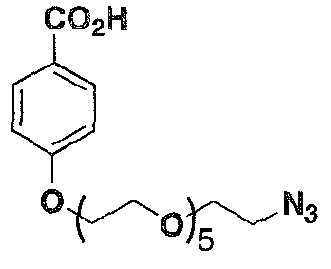 (m, 2H). 3.92 - 3.82 (m. 2H ), 3.75 - 3.59 (m. 1 8H). 3.41 - 3.31 (m, 2H).
(53) Prepared 53 in the same manner as compound 17 in 93% yield. 1H
(m, 2H). 3.92 - 3.82 (m. 2H ), 3.75 - 3.59 (m. 1 8H). 3.41 - 3.31 (m, 2H).
(53) Prepared 53 in the same manner as compound 17 in 93% yield. 1H

(18) To a flame-dried flask containing 10a5 (50.0 mg. 0.233 mmol) in anhyd. THF (600 ί), added oxalyl chloride (97 μί, 1.11 mmol, 5 equiv) and let stir under an atmosphere of N2 until TLC (5: 1
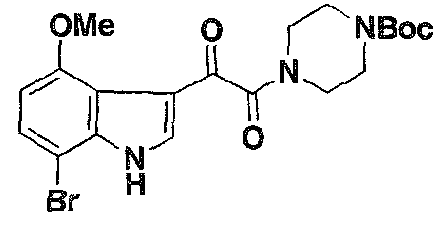
hexanes/EtOAc) indicated consumption of starting material (5-12 hr, depending on scale). All volatiles were removed by rotoevaporation and resulting green residue was immediately suspended in anhyd. THF (1 mL), followed by the addition of N- Boc piperazine6 (52 mg, 0.28 mmol, 1.2 equiv) and DIPEA (78 μί, 2 equiv). Resulting mixture was stirred under an atmosphere of N2 at R for 12 hr. and then at reflux for 30 min (if needed) when TLC (5: 1 hexanes/EtOAc ) indicated reaction completion. Reaction was allowed to cool to RT, poured into H20 (10 mL) and extracted with EtOAc (3 x 10 mL). The combined organic layers were dried over anhyd. MgSO. , filtered, and all solvents were evaporated. Crude 18 was purified by flash chromatography (CombiFlash Automated Chromatographer. 12g column, dryloaded with 4g pre-packed dry loading column. Run using 100% Hexanes to 50% EtOAc Tlexanes gradient over 30 column volumes, followed by EtOAc flush) to yield 18 as a light brown powder ( 78 mg, 75%). *H NMR (400 MHz,
CDCI3) δ 9.44 (s, l H ), 7.94 (d, J = 3.1 , l H). 7.28 (d, J = 8.5. I l l), 6.56 (d. J = 8.5, 111 ), 3.90 (s, 3H), 3.71 (m. 2H). 3.60 - 3.51 (m, 2H), 3.46 (m. 4H). 1.47 (s, 911). : (ES+) m/z (M+H)+ 466; ( M i-Naf 488; Rt = 1.34.
(19) To a solution of 18 (75 mg. 0.161 mmol) in CH2C12 (1.5 mL), added trifluoroacetic acid (TFA) (0.5 mL), resulting in an immediate color change from clear to yellow. The resulting solution was stirred

at RT for 30 min when TLC (20: 1 CH2C12/CH30H) indicated complete starting material consumption. All volatiles were removed by rotoevaporation and residue was redissolved in CH2C12 (15 mL) and NaOH (2M. until a pi I of 1 1 is achieved) and then extracted with CH2C12 (3 15 mL). The combined organic layers were dried over anhyd. MgS04, filtered, and all solvents were evaporated, resulting in 19 as an off-white solid (51
5 . US PATENT: US20030069245
Faust, A.; Waschkau, B.; Waldeck, J.; Holtke, C; Breyholtz, H.; Wagner, S.; opka, .; Heindel, W.; Schafer. M; Bremer, C. Bioconjug. Chen. 2008, 19, 1001-1008.
mg, 86%). 1H NMR (400 MHz, CDCI3/CD3OD (10:1 )) δ 7.87 (s, 1H), 7.18 (d, J = 8.4, Hi). 6.46 (d. J = 8.4, 1H), 3.98 (broad peak, 3H), 3.78 (s, 3H), 3.60 (broad peak. 2H), 3.33 (broad peak, 2H), 2.86 (broad peak, 2H), 2.75 (broad peak, 2H).
Method 4: Coupiing of Piperazines to Benzoic Acids (Synthesis of 20 shown as example).
(20) To a flame-dried flask containing a solution of 19
(20 mg. 0.055 mmol) in C¾C12 (2 ml .), added 17 (25.8 mg, 0.06 mmol, 1.1 equiv), EDC-HCl ( 1 1.5 mg, 0.06
 mmol, 1.1 equiv ). HOBT (9.2 mg, 0.06 mmol, 1.1 equiv) and DIPEA (30 uL. 0.16mmol, 3 equiv). Resulting mixture was stirred at RT under an atmosphere of N2 at RT for 8 hr when TLC (9: 1 CH2C12/CH30H) indicated reaction completion. Mixture was diluted with CH2C12 ( 10 mL) and washed with sat. NaHC03 ( 15 mL), sat. NH4CI ( 15 mL) and brine ( 15 mL). The combined organic layers were dried over anhyd. MgS04, filtered, and all solvents were evaporated, resulting in crude 20 as a sticky solid. Crude 20 was purified by flash chromatograph (CombiFlash Automated
Chromatographer, 4g column, dryloaded with 4g pre-packed dry loading column. Run using 100% CH2C12 to 10% CH3OH in CH2C12 gradient over 40 column volumes) to yield 20 as a clear sticky solid (38 mg, 90%). Ή NMR (400 MHz, CDC13) δ 9.66 (s, 1 H). 7.96 (d, J = 3.1, 1H), 7.34 (broad peak, 111), 7.29 (d, J = 8.4. 1H), 6.96 (broad peak, J = 7.5. 3H), 6.57 (d, J = 8.5, 1H), 4.12 (broad peak, 211 ). 3.91 (s, 3H), 3.84 (s, 4H), 3.74 - 3.39 (m, 24H), 3.36 (t, J = 5.0, 2H). 13C NMR (125 MHz, CDCI3) δ 186.43, 170.83, 167.67, 159.35, 153.86, 136.96, 136.68. 1 34.98, 130.25, 127.23, 1 19.67. 116.84, 1 16.65. 1 16.07, 1 13.72. 105.24, 97.15, 71.20, 71 .06. 71 .04. 70.99. 70.95. 70.40. 70.01 , 68.00, 56.54. 51.06. 20 (s,
 , 4.1 8 - 4. 1 (m, 2H>, 3.90 (s, 3H), 3.87 - 3.81 (m. 2H). 3.80 - 3.41 (m. 26H), 3.40 - 3.32 (m, 2H).
(55) Prepared 55 in the same manner as compound 20 in 81% yield. 1H NMR (400 MHz, CDC13) 6 9.1 1 (d, J = 2.6. 1 H). 8.78 (s, I H). 8.23 (dd, J = 2.4, 9.5, 1H), 7.68 (s,
 IH), 7.41 -7.14 (m, IH), 7.09-6.72 (m, 2H). 6.41 (s, IH), 4.64 (s, 2H), 4.41 (s, 211), 4.29-3.98 (m, 2H). 3.92 - 3.05 (m, 27H).
(21) Prepared according to Method 2 as in compound 4 using 15 mg (0.019 mmol) of 20 with 17 ( 14 mg, 0.035 mmol, 1.8 equiv). Crude 21 purified by flash column chromatography (100% CH2C12 20: 1 CH2C12/CH30H -> 10: 1 CH2C12/CH30H), resulting in 21 as a sticky yellow solid (20 mg. 90%). IH NMR (400 MHz, CDC13) δ 10.37 (s, I H), 9.04 (d, J = 2.6, IH), 8.73 (broad peak, IH), 8.18 (dd, J = 2.6. 9.5. Ill), 7.96 (d, J = 1.7, 2H). 7.69 (s, IH), 7.28 (m. 11). 7.24 (d, .1 = 8.5, 211). 6.92 (m, 3H), 6.89 (d, J = 9.6. 111). 6.52 (d. J = 8.5. I l l), 4.62 (s, 211). 4.47 (t. J = 5.0. 211). 4.09 (broad peak, 4H), 3.87 (s, 3H), 3.85 - 3.71 (m. 14H), 3.71 - 3.29 (m, 28H). 13C NMR (125 MHz, CDC13) δ 185.98, 170.34. 167.19, 158.88, 153.44. 148.35. 144.70. 136.58. 136.30, 135.90. 134.82. 130.32, 130.12, 129.81, 126.75, 124. 13. 123.84, 1 19.24, 1 16.35, 1 16.12, 1 15.66. 1 14.16. 1 13.23, 104.72, 96.72. 70.76. 70.63, 70.58. 70.54. 70.52. 70.50. 70.46. 70.45, 70.41. 69.58. 69.56, 69.35, 68.52. 67.56, 64.45, 56.08. 50.16, 43.19. (56) Prepared according to Method 2 as in compound 4. Crude 56 purified by flash column chromatography ( 100%
 CH2C12 -» 20: 1 CH2C12/C¾0H -> 10:1
CH2C12/CH30H), resulting in 56 as a sticky yellow solid in 73% yield. IH NMR (400 MHz, CDCI3) δ 10.59 (two singlet, J = 62.6, IH), 9.09 (d. J = 2.6. IH), 8.76 (s, IH). 8.30 - 8.12 (m. IH), 8.01 (s, IH), 7.47 - 7.20 (m. 4H). 7.1 1 - 6.77 (m. 3H). 6.57 (dd. J = 8.5, 12.4. I H), 4.63 (s, 2H). 4.43 (s, 211), 4.20-3.99 (m, 4H), 3.92 (2 singlets, J = 14.4, IH), 3.87 - 3.16 (m. 42H). DNP (57) prepared according to Method 2 as in compound 4. Crude 57 purified by flash column chromatography (100% CH2C12 ->
20: 1 CH2C12/CH30H - 10: 1
CH2CI2/CH3OH), resulting in 57 as a sticky
 yellow solid in 90% yield. IH NMR (400
MHz, CDClj) δ 10.59 (two singlets. I H), 9.09 (d, J = 2.6, 2H). 8.76 (s, 2H), 8.32 - 8.15 (m, 2H), 8.01 (s, 2H). 7.40 7.27 (m. 5H), 7.24 (d, J = 1.4, I H ), 7.08 - 6.73 (m, 6H ), 6.57 (dd, J
= 8.5, 12.4, 2H), 4.63 (s, 3H), 4.43 (s, 4H), 4.10 (del, J = 17.4, 56.7, 7H), 3.92 (d, J = 14.4, 6H), 3.86 - 3.15 (m. 94H). UPLC/MS: (ES+) m/z (M+H)+ 1173; (M+Na)+ 1 195; Rt = 1 .51.
(22) Prepared according to Method 3 as in compound 14 using 21 ( 15 mg, 0.017 mmol). Crude 22 was purified by HPLC (0- 60% B gradient, 46 min run time), resulting
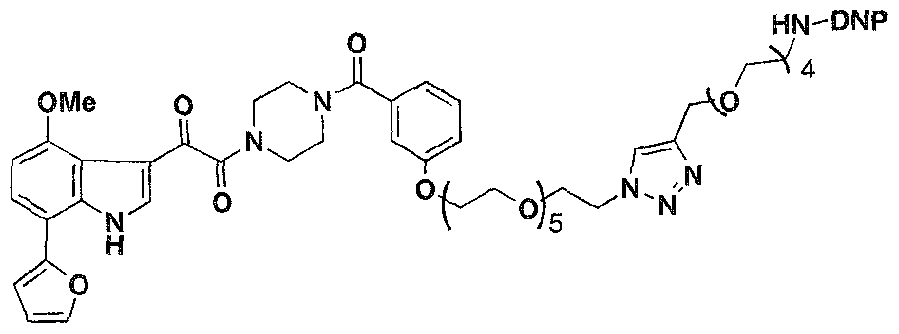
in 22 as a sticky yellow solid (12.7 mg, 64%). Ή NMR (500 MHz, CDC13) δ 10.21 (s, 1H), 9.09 (d. J = 2.6, 1H), 8.77 (broad peak, 1H), 8.21 (dd, J = 2.5, 9.5. 111). 8.08 (d, J = 3.1, 1 H). 7.71 (broad peak. 1 H), 7.55 (s, I II), 7.45 (d. J = 8.3. 1 H). 7.30 (broad peak. I I I). 6.95 (broad peak, 3H), 6.91 (d, J = 9.5. 1 11). 6.71 (d, J = 8.2. 1H), 6.67 (d, J = 3.3. 1 H). 6.54 (dd, J = 1.8, 3.3, I H), 4.64 (s, 2H), 4.50 (broad peak, 211), 4.12 (broad peak. 4H), 3.95 (s, 3H), 3.92 - 3.75 (m. 12H), 3.74 - 3.31 (m, 30H). C NMR (125 MHz, CDCI3) δ 154.10, 153.38, 148.82, 141.67, 136.77, 136.40, 134.87, 134.45, 130.84. 130.59. 130.25, 124.62. 124.1 7. 124.15. 121.54. 1 19.73, 1 16.85. 1 15.87, 1 15.62, 1 14.56. 1 13.72, 1 12.25, 109.85. 104.95, 104.45. 100.39. 71 .08, 71 .03. 70.90. 70.87. 70.79. 70.74. 70.68. 70.65, 69.98, 69.92, 69.77, 69.01. 68.01. 64.69. 56.41 , 50.64, 50.64. 43.55. UPLC/MS: (ES+) m/z (M 1 I I) 1 160. (M+Na)+ 1 182: Rt = 1 .55.
(36) Prepared according to Method 3 as in compound 14 using Crude 36 was purified by HPLC ( 0-60% B gradient, 46 min run time), resulting in 36 as a sticky yellow solid
 in 50% yield. Ή NMR (500 MHz, CDCI3) δ 1 0.13 (s. 1H). 9.10 (d, J = 2.6, lH), 8.77 (s, 1 H), 8.23 (dd. J = 2.5, 9.5. 1H), 8.08 (d, J = 2.3, IH), 7.74 (s, IH), 7.55 (s, I H). 7.45 (d, J = 8.3. I H), 7.39 (d, J = 8.3, 2H), 6.93 (apparent d. J = 9.3, 3H), 6.72 (d, J = 8.4, IH), 6.67 (d, J = 3.4. IH), 6.55 (dd, J = 1.8, 3.4, IH), 4.66 (s, 2H), 4.51 (s, 2H), 4.14 (s. 2H). 3.95 (s, 3H), 3.90 - 3.74 (m, 1211), 3.73 - 3.30 (m, 32H). UPLC/MS: (ES+) m/z (M+H)+ 1160; (M+Na)+ 1182; Rt = 1.53.
(35) Prepared according to Method 3 as in compound 14. Crude 35 was purified by HPLC (0-60% B gradient, 60 min run time), resulting
 in 35 as a sticky yellow solid in 53% yield. Ή NMR (500 MHz, CDCJj) δ 10.48 (two singlets, J = 50.2, 1H), 9.10 (d, J = 2.6. 1H), 8.77 (s, 1H), 8.22 (dd, J = 2.5, 9.5. I l l), 8.08 (t, J = 2.8, 1H), 7.73 (d. J = 6.8, 1H), 7.54 (dd, J = 1.2. 8.4, 1 H ), 7.46 (dd, J = 8.3, 10.3, 1 H), 7.41 - 7.28 (m, 2H), 7.02 (two triplets, J = 7.5. 25.4, I ff), 6.96 - 6.84 (m, 2H), 6.73 (dd, J = 8.4, 12.8, 1 H). 6.68 (t, J = 3.8, 11 1). 6.54 (ddd, J = 1.8, 3.4, 5.3, 1H), 4.65 (s, 2H). 4.49 - 4.40 (m. 2H), 4.29 - 3.99 (m, 4H), 3.97 (d. J = 1 1.5, 3H), 3.88 - 3.20 (m. 42H) (Note:
Broadened/doubled signals coalesce upon heating). UPLC/MS: (ES+) m/z (M+H)"" 1 160;


Supplementary Scheme 6. Representative Synthesis of ARM-H type (26) molecules
(58) Prepared according to Method 4 as in compound 20 from 17 and N-Boe-piperazine. Crude 58 was purified by flash column chromatography (1 : 1 hexanes/EtOAc-> 1 :5 hexanes/EtOAc ->

100% EtOAc), resulting in 58 as a colorless oil (70%). 1H NMR (400 MHz, CDCb) δ 7.30 (t, J = 8.1, 1 H), 7.02 - 6.84 (m. 3H), 4.1 8 - 4.08 (m, 2H), 3.90 - 3.82 (m, 2H), 3.78 - 3.55 (m. 20H), 3.54 - 3.25 (m, 8H), 1.46 (s, 9H).
(23) Prepared 23 in the same manner as compound 19 in from 58 75% yield as a clear oil. 1H NMR (400 MHz, CDC13) δ 7.3 1 -
 7.25 (m, 1H), 6.93 (m, 3H), 4.17 - 4.04 (m, 211). 3.87 - 3.81 (m, 211), 3.77 - 3.56 (m. 18H), 3.42 - 3.27 (m, 2H), 2.91 (s, 1H).
Prepared 59 in the same manner as compound 23, starting 53 and N-Boc-piperazine. Isolated as a clear oil.
(24) To a flame-dried flask containing 10a ( 17 mg, 0.0744 mmol) in anhyd. THF (500 μΕ), added oxalyl chloride (33 μΐ... 0.37 mmol, 5 equiv) and let stir under an

atmosphere of N2 until TLC (5: 1 hexanes/EtOAc) indicated consumption o starting material (5-12 hr, depending on scale). All volatiles were removed by rotoevaporation and resulting green residue was immediately suspended in anhyd. THF ( 1 mL), followed by the addition of 23 (37 mg, 0.28 mmol, 1.2 equiv) and DIPEA (34 μΐ.). The resulting orange mixture was stirred under an atmosphere of N2 at reflux for 8hr when TLC (9: 1 CH2C12/CH30H) indicated reaction completion. Reaction was allowed to cool to RT, poured into H20 (5 mL) and extracted with EtOAc ( 3 x 15 mL). The combined organic layers were dried over anhyd. MgS04, filtered, and all solvents were evaporated. Crude 24 was purified by flash column chromatography ( 1 : 1 hexanes/EtOAc-» 1 :5 hexanes/EtOAc - 100% EtOAc), resulting in 24 as a sticky solid ( 14 mg, 25%). 1H NMR (400 MHz, CDC13) δ 8.59 (s, 1H), 7.32 (m, 2H). 6.95 (broad peak, 3H), 6.48 (d. J = 8.7, 1 H), 4.13 (s, 2H), 3.89 (s. 3H), 3.85 (broad peak, 2H), 3.76 - 3.58 (m. 24H). 3.40 - 3.35 (m, 4H). UPLC/MS: (ES+) m/z (M 1 Hf 747; (M+Na)+ 769: Rt = 1 .28.
(60) Prepared 60 in the same manner as compound 24 in 79% yield starting from 10a and 59. UPLC/MS: (ES+) m/z (M+H)+ 747: (M+Na)' 769; Rt = 1.33
 in ->
in ->

CH2CI2/CH3OH), resulting in 25 as a sticky yellow solid in 58% yield. 1H NMR (400 MHz, CDCI3) δ 9.12 (d, J - 2.7, 1H), 8.78 (s, 2H), 8.24 (d, J = 9.5, 1H), 7.72 (s, IH), 7.33 (m. 2H), 6.94 (m, 5H), 6.47 (s, I H), 4.65 (s, 2H), 4.51 (t, J = 5.0. 2H), 4.13 (s, 2H), 3.89 (s, 3H), 3.83 (m. 8H). 3.74 - 3.52 (m, 36H). UPLC/MS: (ES+) m/z (M+H)+ 1 146; (M+Na)+ 1 168; Rt = 1.51 .
(61) Prepared according to Method 2 as in compound 4. Crude 61 purified by flash column chromatography (100% CH2CI2 ->

20: 1 CH2CI2/CH3OH -» 10: 1
CH2CI2/CH3OH), resulting in 61 as a sticky yellow solid in 90% yield. IH NMR (400 MHz, CDCI3) δ 10.40 (s, I H). 10.19 (s, IH), 8.00 (dd, J = 3.3, 4.9. 2H), 7.4-7.24 (m. 4H). 7.03 (t, J = 7.4. IH), 6.97 (d, J = 7.4. I H). 6.91 (d, J = 8.3. IH), 6.82 (d, J = 8.3, IH), 6.61 (d. J = 8.5. IH), 6.57 (d, J = 8.5, IH), 4.25-3.98 (m, 8H), 3.95 (s, 3H), 3.91 (s, 3H). 3.87 - 3.16 (m. 39H) (Note: Broadened/doubled signals coalesce upon heating). UPLC/MS: (ES+) m/z (M+H) 1146; (M+Na)+ 1168; Rt = 1.52.
(26) Prepared according to Method 3 as in compound 14. Crude 26 was purified by HPLC (0-60% B gradient. 60 min run time),

resulting in 26 as a sticky yellow solid in 61% yield. Ή MR (400 MHz, CDCI3) δ 9.57 (s, I H). 9.12 (d, J = 2.6. IH), 8.86 - 8.72 (broad signal, I H). 8.23 (s, IH), 7.74 (s, IH), 7.55 (s, IH), 7.42 (s, 2H). 6.94 (m. 4H), 6.72 - 6.38 (m, 311). 4.66 (broad signal, 2H). 4.51 (broad signal, 2H), 4.12 (broad signal, 2H ). 3.93 (s, 3H), 3.83 (d. J = 13.9, 8H), 3.74 - 3.27 (m, 36H). UPLC MS: (ES+) m/z (M+H)+ 1 132; (M+Na)+ 1 154; Rt = 1.58
W 201
76
(62) Prepared according to Method 3 as in compound 14. Crude 62 was purified by HPLC (0-60% B gradient. 60 min run time),
 resulting in 62 as a sticky yellow solid in 59% yield. Ή NMR (400 MHz, CDCI3) δ 9.74 (broad peak, 1 H). 9.11 (d, J = 2.5, IH), 8.77 (s, IH), 8.23 (d. J = 9.3. I l l), 7.67 (s, I H). 7.44 (m, 5H). 6.89 (m, 3H), 6.58 (m, 3H), 4.64 (s, 2H). 4.43-4.04 (m. 8H), 3.91 (s, 3H), 3.82-3.76 (m. 8H), 3.70 - 3.40 (m, 32H) (Note:
Broadened/doubled signals coalesce upon heating). UPLC/MS: (ES+) m/z (M+H)+ 1 132. (M+Na)+ 1 154; Rt = 1.59.

Supplementary Scheme 7. Representative Synthesis of ARM-H type (38) molecules
(63 ) Prepared 63 in the same manner as compound 16 starting from methyl 4-hydroxybenzoate and 39 in 70% yield as a yellow oil. IH
 NMR (400 MHz, CDC13) δ 9.13 (d, J = 1.9, IH), 8.79 (s, IH), 8.25 (dd, J = 2.5. 9.5. I H). 7.79 (d, J = 8.1, I H), 7.55 (s, I H). 7.32 (t, J = 8.3, IH), 7.1 1 (dd. J = 2.7, 8.3, IH), 6.94 (d, J = 9.5, IH), 4.1 5 (m. 2H), 3.90 (s, 3H), 3.82 (t, J = 5.3, 2H), 3.75 - 3.52 (m, 20H).
COjH (64) Prepared 64 in the same manner as compound 17 in 86% yield as a yellow oil. IH NMR (400 MHz, CDC 13) δ 9.1 1 (d, J = 2.7, I H). 8.85 -
0^,- 0^\, NHDNP
8.70 (m, I H). 8.24 (d, J = 9.5, I H). 7.65 (d. J = 7.6. I H). 7.60 (s, I H ).
7.33 ft, J = 7.9, 1H), 7.14 (s, 1H), 6.93 (d, J = 9.5. 1H), 4.23 - 4.15 (m, 2H), 3.90 - 3.83 (m, 2H), 3.81 (t, J = 5.3. 2H), 3.75 - 3.55 (m, 18 ).
(65) Prepared 65 in the same manner as compound
20 in 60% yield as a yellow residue. 1H NMR (400 MHz, CDC13) δ 9.64 (s, 1H), 9.08 (d, J = 2.5. 1H),
 8.75 I s, 1H), 8.21 (d, J - 9.5, 1H), 7.98 (s, 1H), 7.29
(d. J -- 8.4. 2H). 7.03 - 6.85 (m, 4H), 6.56 (d, J = 8.5. 111). 4. 1 1 (s, 2H). 3.90 (s, 3H). 3.79 (m, 6H), 3.73 - 3.59 (m. 20H), 3.55 (m. 411).
(38) Prepared according to Method 3 as in compound 14. Crude 38 was purified by HPI .C (0-60% B gradient, 46 min run time), resulting in 38 as a sticky yellow solid in 58% yield. Ή NMR (400 MHz,

CDCI3) δ 10.07 (s, l H), 9.09 (s, 1 H). 8.76 (s, 1H), 8.23 (d. J = 9.5, 1H), 8.09 (s, 1H), 7.56 (s, 1H), 7.45 (d, J = 8.3. 1H), 7.36 - 7.28 (m. 1H), 6.96 (broad peak, 311), 6.91 (d, J = 9.8, 1 H). 6.72 (d, J = 8.5, 1 H). 6.67 (s, 1H), 6.55 (s, 1H), 4.13 (s, 2H), 3.96 (s, 3H), 3.84 (s, 3H), 3.79 (m, 3H), 3.74 - 3.41 (m, 24H). HRMS (EI) rn/z (%) for C44H50N6Oi5 (MH+) calc'd 903.3413. found 903.3472.
MT-2 Cell Assay (Figure 2b and Figure 3a and b)
Antiviral activity and cellular toxicity were determined using the MTT colorimetric method7'8. MT-2 cell9'10 at a concentration of 1 x 10⁵ cells per mil!ilitre were infected with wild-type HIV IIIB 1 U2" 1 ¾ at a multiplicity of infection (MOI) of 0.1. Infected and mock- infected cells were incubated in growth medium (RPMI 1640, 10% 5FBS, kanamycin) for 5 days with varying concentrations of each compound being tested in triplicate in a 96-well
1. Mosmann, T. . Immunol Methods 1983, 65, 55-63.
8. Pannecouque, C; Daelemans, D.; Clercq, E.D. NatProtoc. 2008, 3, 427-434.
. Haertle, T.; Carrera,C.J.; Wasson, D.B.; Sowers, L.C.; Richman, D.D.; Carson, D.A. J. Biol Chem. I9SS, 263, 5870-5875.
10. Harada, S.; Koyanagi, Y.; Yamamoto, N. Science 1985, 229, 563-566.
n. Popovic, .; Read-Connole, E.; Gallo, R.C. Lancet 1984, 2 Ull-Uli.
12. Popovic, M.; Sarngadharan, M.G.; Read, E.; Gallo, R.C. Science 1984, 224, 497-500.
13. Ratner, L.; Haseitine, W.; Patarca, R.; Livak, .J.; Starcich, B.; Josephs, S.F; Doran, E.R.; Rafalski. J.A.; Whitehom, E.A.; Baumeister, K.; et al. Nature 1985, 313, 277-284.
plate. MTT (thiazolyl blue tetrazolium bromide), a cell-permeable tetrazolium dye was then added to each well. Active mitochondria reduce the yellow tetrazolium salt to a blue formazan precipitate. After 5 h, stop solution (86% isopropanol, 4% NP-40, 10% H20, and 0.3% concentrated HCl) was added to lyse the cells and stop the reaction. The plates were gently shaken gently overnight on a horizontal rotator, and quantitated the following morning. Cell viability was measured spectrophotometrically by quantifying the amount of purple precipitate via determining the absorbance at 595 nm using a Multiskan Plus from Labsystems (Helsinki, Finland) microplate reader. The average of these triplicate samples was then plotted versus inhibitor concentration to generate dose-response curves. The 50% effective concentration (EC5o) and 50% cytotoxic concentration (CC50) of the compounds were defined as the concentrations required to inhibit viral replication and to reduce the number of viable cells by 50%, respectively. Positive controls were done during each set of experiments using d4T and the appropriate parent NNRT (HI -236 or TMC-derivative). Data were quantitated using KaleidaGraph (Synergy Software).
CD4 Inhibition EL IS A (Figure 2A)
This procedure was adapted from the protocol reported by Lin. et al.14 96 well plates ( Nunc; Immuno) were coated overnight at 4 °C with soluble recombinant HIV-1 gpl20jRn, (Immune Technology: Yonkers. NY) at 1 ng ml in 0.05M Buffer A (carbonate/bicarbonate, pH =9.6, Aldrich). Plates were washed with PBS (Aldrich. Ι χΙ ΟΟμΙ,) and then blocked with 3% nonfat milk in phosphate buffered saline solution ( PBS. Aldrich) for 1 hr at room
temperature. After washing with Buffer B (50 mM Tris HCl. 100 mM NaCl, 0.05% Tween- 20. pH 7.4). varying concentrations of the inhibitor were added simultaneously with recombinant human T-cell CD4 ( lmmunoDiagnostics. Inc; Woburn. MA) in Buffer C (50 mM Tris HCl, 100 m NaCl. 1% BSA, pH 7.4) so that the final concentration/well of CD4 is 0.1 μ&ΊηΙ and plates were incubated for 1 hr at room temperature. Plates were washed with Buffer B (3 1 ()0μΙ.) and then incubated with mouse OKT4 anti-CD4 IgG antibody
(Biolegend; San Diego. CA) at 0.36 pg/mi in Buffer C at RT for 1 hr. Following washes with Buffer B, plates were incubated with horse radish peroxidase (HRP)-conjugated goat anti- mouse antibody ( 1 :2500; Biolegend; San Diego. C A). Bound antibody was detected with 3,3,5,5-tetramethylbenzidine (TMB, Pierce Protein Research Products), the chromogenic substrate for H PR. and absorbance was read at 450 nm. The mean (±SD) of these triplicate
M. Ho, H.; Fan, L.; Nowicka-Sans, B.; McAuliffe, B.; Li, C; Yamanaka, G.; Lin, P.; et al. J. Vir. 2006, 80, 4017-4025.
samples was then plotted versus inhibitor concentration and a non-linear fit curve was generated using GraphPad Prism. The 50% inhibitory concentration (IC50) was defined as the concentration of inhibitor to reduce the amount o bound CD4 to sgpl20 by 50% of the maximum bound.
Anti-DNP IgG Recruiting ELISA's (Figure 4)
A. Varying ARM-H Concentration (Figure 4A)
Nunc-lmmuno 96-well plates were coated with soluble gpl 20 and blocked as described above. After the PBS (Aldrich) wash, varying concentrations of ARM-H (4) were added to the plate and incubated for 1 hr at RT. After washing (3χ 100μΕ ) the plate with Buffer D (50 niM Tris HC1, 100 mM NaCl. 23 mM HEPES, 1 mM MgCl2, 1 mM CaCl2. pH 7.4), wells were incubated with rat monoclonal anti-dinitrophenyl (anti-DNP) IgG antibodies (Zymed; Carlsbad, CA ) at 5 g/ml in Buffer E (50 mM Tris HC1, 100 mM NaCl, 23 mM HEPES, 1 mM MgCl2, 1 mM CaCl2, 1% BSA, pH 7.4) at room temperature for 1 hr. Plates were then washed, and incubated with HRP-conjugated goat anti-rat antibody ( 1 :2000; Novus
Biologicals; Littleton. CO). Bound antibody was detected with 3,3,5,5-tetramethylbenzidine (TMB; Pierce Protein Research Products), and the absorbance was read at 450 nm. The mean (±SD) of these triplicate samples was then plotted versus inhibitor concentration and a nonlinear fit curve was generated using GraphPad Prism. The 50% effective concentration (EC50) was defined as the concentration of ARM-H to bind 50% o the maximum bound HRP conjugated anti-DNP in the ternary complex with sgpl20.
B. Varying Anti-DNP IgG Concentration (Figure 4B)
Nunc-lmmuno 96-well plates were coated with soluble g l 20 and blocked as described above. After the PBS ( Aldrich) wash, 25 μΜ of ARM-H (4 ) were added to the plate and incubated for 1 hr at RT. After washing (3x l 00uL ) the plate with Buffer D, wells were incubated with varying concentrations of rat monoclonal anti-dinitrophenyl (anti-DNP) IgG antibodies (Zymed; Carlsbad, CA) in Buffer E at room temperature for 1 hr. Plates were then washed, and incubated with HRP-conjugated goat anti-rat antibody. Bound antibody was detected with 3,3,5,5-tetramethylbenzidine (TMB; Pierce Protein Research Products), and the absorbance was read at 450 nm. The mean (±SD) of these triplicate samples was then plotted versus inhibitor concentration and a non-linear fit curve was generated using GraphPad Prism. The 50% effective concentration (EC50) was defined as the concentration of anti-DNP antibody to bind 50% of the maximum bound HRP conjugated anti-DNP in the ternary complex with ARM-H (4).
*Notc: The competition ELISAs were conducted following a known assay protocol containing a detergent (see Supporting Information ef. 11), and had previously been employed to measure the IC50 for BMS-378806, the parent compound in our studies.
Utilizing these published conditions allowed us to calibrate our IC50 values directly with literature values. However, when investigating recruitment of anti-DNP antibodies by ARM- H (Figure 4), we utilized an ELISA buffer system that was compatible with tissue culture (i.e., one that lacks detergent) in order to model the conditions employed in subsequent CDC assays. Thus we would not expect an exact correlation between the competition ELISA IC50 and the antibody recruiting ELISA EC50 values. In addition, we recognize that the antibody/ARM-H/gpl 20 complex should exhibit auto-inhibitory behaviors consistent with ternary complex formation under certain circumstances, however, data collected in the antibody recruiting ELISA (Figure 4) would not be expected to do so because of the assay conditions. A series of washes were performed prior to addition of anti-DNP antibody, thus removing unbound ARM-H, and preventing auto-inhibition by antibody/ARM-H complexes.
CHO Cell Culture
Wild-type HIV-1 env expressing CHO-WT (described as 'CHO-gpl2Q' in the text) cells were obtained from the AIDS Research and Reference Reagent Program, Division of AIDS, NIAID, NIH: CHO-WT from Dr. Carol Weiss and Dr. Judith White. Cells were grown glutamine-deficient minimal essential medium containing 400 μΜ methionine sulfoximine ( MSX. Sigma) (GMEM-S selection media) as described by associated NIH protocol15. CHO- Kl (described as 'CHO-WT' in the text) cells (ATCC) were grown in A I CC -formul ated F- 12K medium with 10% FBS (Gibco). Cells were detached from cell culture flasks with 2.5mM EDTA/0.5mM EGTA in DPBS ( Gibco) for passage.
*Note: As described in the associated NIH culture protocol, a drop in envelope expression in CHO-WT cells was observed upon several passages and it is recommended to maintain low passage stocks of cells in liquid nitrogen.
Immunofluorescence (Figure 3)
Confluent CHO-WT (env expressing) or CHO-Kl (non-em' expressing) cells were incubated on cover slips (15CIR-1D, Fisher) over 2 nights at 37 °C in 5% C02. Cover slips were
15. Weiss, C. D.; White, J.M. J. Vir. 1993, 67, 7060-7066.
washed with DPBS (1 mL, Gibco) and then cells fixed with 4% parafomaldehyde in DPBS at 4°C for 10 minutes. To demonstrate antibody recruitment, cover slips were washed with DPBS (1 x 70 μΐ ) then with Buffer E (1 x 70 μΐ) and incubated with ARM-I 1 (4) in Buffer E (70 μΐ) for 1 far at 4°C. Cover slips then washed with Buffer E (2 x 70 μΐ) and incubated with AlexaFluor488 rabbit anti-DNP IgG antibodies (Invitrogen) at 15 μg ml in Buffer E (70 μΐ) for 1 hr at 4°C. All cover slips were washed prior to mounting onto slides using Gel Mount mounting medium (Biomeda Corp.) with Buffer E and water. Corresponding competition experiments were performed in the presence of recombinant human T-cell CD4
( ImmunoDiagnostics. Inc; Woburn. MA). BMS-378806 (1 ) and DNP-PEG-alkyne (2). Cells were checked using a Zeiss Axiovert 200M fluorescence microscope equipped with a GFP filter.
CDC Assay (Figure 4 and Figure 8)
CHO-WT or CHO-K1 cells taken from a T-75 flask (-80% confluent), were washed once with DPBS (Gibco, 5 mL), and cells were then detached with 2.5mM EDTA/0.5mM EGTA in DPBS. Resulting cell suspension was centrifuged at 900 rpm for five minutes, then pellet was aspirated and re-suspended at a density of 9.00 X 10⁵ cells/mL in Buffer E.
Subsequently, cell suspension was added to prepared dilutions of ARM-H (4) (or control molecule) in Buffer E. Resulting cell mixtures were plated in triplicate (50 xh, 22,500 cells/welljonto 96 well plates (CoStar, black sides/clear bottom), covered with tin foil and incubated at 4 °C for 1.5 hours. To each well. 50 xL of 20% rabbit complement serum (v/v, Aldrich) and 100 pg/mL rat anti-DNP IgG (Zymed; Carlsbad. CA) in Buffer E was added, resulting in a 10% (v/v) complement and 50 μg/mL antibody concentration per well.
Negative control wells containing only ARM-H dilutions were prepared in addition to maximum cell death controls (0.15% H202). Covered plate was incubated for an additional hour at 4 °C and then for 4 hours at room temperature. All control experiments were conducted following the same protocol. Cell viability was determined using the luciferase- based CellTiter-Glo Luminescent Cell Viability Assay (Promega). Complement mediated cell death and cytotoxicity was calculated as: [l-((sample-max killing)/(untreated-max killing)) ] X 100 and plotted using GraphPad Prism. Raw data was subjected to Dixon Q-test analysis at the 90% confidence interval and statistical outliers removed accordingly16'17.
16 Dean, R.B.; Dixon, W.J. Anal. Chem. 1951, 23, 636-638.
11. Efstathiou, C. E. Talanta 2006, 69, 1068-1071.
*Note: When performing above CDC analyses, authors observed consistent complement dependent cytotoxicity results over several CHO-gpl20 cell passages. However, as reported in the NIH culture protocol, we observed a decrease in envelope protein expression over many passages and associated with this decrease, we observed a considerable reduction in ARM-H (4) mediated CDC. In addition, at higher concentrations (> 50μΜ ) of ARM-H and Azide (3), authors observed enhanced cell viability (decreased cell death) in both CHO- gpl 2() and CHO-WT cells, as shown in Figure 8. Importantly, this effect was only observed at concentrations greater than -50 μΜ, which is outside the concentration range reported in Figure 9. Furthermore, since these effects lead to an enhancement in viability, they would tend to underestimate any effect ARM-H mediated antibody-dependent cytotoxicity.
Nevertheless, the inventors studied this phenomenon in more detail, and based upon follow up experiments, this enhancement in viability appears to take place independent of the presence of antibody/complement and gp!20. It is also not due to a direct effect on assay reagents. Thus, following the general protocol for CDC experiments outlined above, we found that both ARM-H (4) and Azide (3) exhibit some degree of viability enhancement at high concentrations in both wild-type and gp 120-expressing CIIO cells (Figure 8 A).
However, in the absence of all cellular material (Figure 8B), when assay reagents are combined with either 1 or 4 and ATP (50 nM), no increase in assay signal is observed. Lastly, we expected to observe auto-inhibition, a phenomenon associated with ternary complexes that would favor gp 120/ ARM-H and ARM-H/antibody binary complexes over the ternary complex at higher concentrations of ARM-H in this assay. This behavior may exist at concentrations of ARM-H tested as shown in Figure 9A (red dots) and may indeed explain the decrease in cell killing at higher concentrations of ARM-H in the presence of antibody and serum (Note: this ARM-H dependent CDC never attains "negative" values). However, this characteristic behavior cannot be confirmed, as it may be masked by the viability enhancement described above. Experiments to determine the cause of these phenomena are currently ongoing. The optimal ATP concentration was determined in Figure 8B by generating a standard concentration-signal curve for ATP as outlined by the associated Promega protocol for CellTiter-Glo. Percent change in luminescence was calculated as: [1 - ( sample/untreated) ] X 100.
CDC Positive Control (Figure 7)
With the goal of developing a positive control for the CDC assay, we screened a series of anti-gp 120 antibodies and subjected them to the assay conditions above, however, none were capable of mediating CDC under our conditions. After extensive review of the literature, we found no examples of monoclonal or polyclonal anti-gp 120 antibodies capable o f mediating CDC of gpl20-expressing cells. There are very few examples of anti-gp 120 antibodies reported to mediate virolysis and in these reported antibody screens, no single antibody was capable of mediating virolysis beyond 20%18'19. Following a rigorous search, we found a commercially available antibody that has been reported2" to mediate CDC to "gpl20 V3-like protein" expressing activated T cells. In addition to this antibody, we screened 5 other antibodies, including: goat polyclonal anti-HIV-l -gpl20 IgG (Abeam; Cambridge, MA; ab21 179): rabbit polyclonal anti-HIV- l -gp 20 IgG (Abbiotec, San Diego, CA; 250694); human anti-HIV-l -g l20 monoclonal (binds to CD4 binding region of gpl 20) IgG
(ImmunoDiagnostics; Woburn, MA; 3501); mouse anti-I IIV-l -gpl 20 monoclonal IgGl (Novus; Littleton, CO; NB 120- 1 341 1 ); rabbit polyclonal anti-HIV-l-g l20/160 IgG (Thermo; Rockford. IL; PA1-43526); anti-gp 120 V3 loop (a.a.'s 308-322) monoclonal IgG (PerkinElmer; Waltham, MA; NEA9205)15. These results underscore the potential utility of these reported small molecule conjugates
All gp 120 antibodies were tested at concentrations up to 50 ng/mL
(ImmunoDiagnostics #3501 was tested up to 25 ng/'mL) and were performed once in triplicate. CHO-WT cells were detached and re-suspended at a density of 9.00 X 10s cells/mL in Buffer E as described above. Subsequently, cell suspension was added to prepared dilutions of anti-gp 120 antibody in Buffer E. Resulting cell mixtures were plated in triplicate (50 μΕ, 22,500 cells/welljonto 96 well plates (CoStar, black sides/clear bottom), covered with tin foil and incubated at 4 °C for 1.5 hours. To each well. 50 ah of 20% rabbit complement serum (v/v, Aldrich) in Buffer E was added, resulting in a 10% (v/v) complement concentration per well. Negative control wells containing only antibody dilutions were prepared in addition to maximum cell death controls (0.15% H202). Covered plate was incubated for an additional hour at 4 °C and then for 4 hours at room temperature.
l Spear, G.T.; Takefman, D.M.; Sullivan, B.L.; Landay, A.L.; Zolla-Panzer, S. J. Virol. 1993, 67, 53-59.
. Takefman, DM; Sullivan, B.L.; Sha, B.E.; Spear, G.T. Virology, 1998, 246, 370-378.
20
. Trujillo, J. R.; Rogers. R. A.; Brain, J. D. Virology 1998, 246, 53-62.
Cell viability was quantitated with Cell l iter-Glo Luminescent Cell Viability Assay as described above.
As an alternative, we were able to label CHO- 1 cells with 2,4-dintrobenzenesulfonic acid and mediate anti-DNP antibody dependent CDC (Supplementary Figure 4), which was repeated twice and in triplicate. This procedure was adapted from the protocol reported by Geczy, et al 2i CHO-K1 cells taken from a T-75 flask (-80% confluent), were washed once with DPBS (Gibco, 5 mL), and cells were then detached with 2.5mM EDTA/0.5mM EGTA in DPBS. Resulting cell suspension was centrifuged at 900 rpm for five minutes, then pellet was aspirated and re-suspended at a density of 9.0 X 10⁵ cells/mL in F12-K growth medium. Cells were incubated with 2,4-dinitrobenzenesulfonic acid (TCI, 50mg/mL solution in MeOH) at a concentration of 1 mg/mL for 30 min. at room temperature. Cells centrifuged and washed with growth medium (x2) and with Buffer E once. Cell suspension was added to prepared dilutions of rat anti-DNP IgG (Zymed; Carlsbad, CA) in Buffer E and subsequently plated in triplicate (50 μΕ. 22.500 cells/welljonto 96 well plates, covered with tin foil and incubated at 4 "C for 1.5 hours. To each well, 50 \iL of 20% rabbit complement serum (v/v, Aldrich) in Buffer E was added, resulting in a 10% (v/v) complement concentration per well. Cell viability was quantitated as described above.
Flow Cytometry Detection of DNP Labeling (Figure 9)
CHO-K1 cells taken from a T-75 flask (-80% confluent), were washed once with DPBS (Gibco, 5 mL), and cells were then detached with 2.5mM EDTA/0.5mM EGTA in DPBS. Resulting cell suspension was centrifuged at 900 rpm for five minutes, then pellet was aspirated and re-suspended at a density of 1.40 X 10⁶ cells/ml , in F12-K growth medium. Cells were incubated with 2.4-dinitrobenzenesulfonic acid (TCI, 50mg/mL solution in MeOH) at varying concentrations for 30 min. at room temperature. Cells centrifuged and washed with growth medium (x3) and then aliquoted (0.5ml) into Eppendorf tubes at a cell density of 1.40 X 10⁶ cells/mL. Cells incubated with AlexaFluor 488 conjugated rabbit anti- DNP IgG (Invitrogen) antibodies (20 ng mL) for 1 hr at 4 °C. Cells were subsequently centrifuged, washed with DPBS (3x0.5mL), resuspended in 0.5mL DPBS containing 1 50 ng of propidium iodide (to monitor cell death) and immediately analyzed for fluorescence using
18. Geczy, A.F.; Baumgarten, A. Immunology, 1970, 19, 189-203.
a FACSCalibur flow cytometer (Becton Dickinson) monitoring at least 10,000
events/measurement. Data were analyzed using FlowJo Analysis Software (Tree Star).
Summary
The present invention meets the strategic need for a new treatment for HIV infection by providing bifunctional small molecules generally referred to as ARM-H's which function through orthogonal pathways - both by inhibition the g l20-CD4 interaction, and by recruiting anti-DNP antibodies to gpl20-expressing cells - in preventing the cell infection and spread of HIV. It has been shown that: (1) ARM-H's bind to gpl20 competitively with CD4 and decreases viral infectivity in an MT-2 cell assay, (2) the bifunctional molecule can guide the formation of a ternary complex between anti-DNP antibodies and both g l 20 and g l20-expressing cells, and (3) antibodies present in this ternary complex can promote the complement-dependent destruction of g l20-expressing cells.
This antiviral approach has distinct advantages over other small-molecule, protein, and vaccine-based anti-HIV strategies.
Although the human immune response has been demonstrated to generate neutralizing anti-gpl 20 antibodies around which the virus does not effectively mutate, vaccine-based approaches toward inducing such antibodies in human hosts have not yet proven successful. In theory, although the HIV virus mutates extremely rapidly in human hosts, since it must retain CD4-binding activity in order to remain infectious, antibody-recruiting small molecules that mimic the CD4 recognition motif such as the ARM-H's of the invention have the hope of serving the same functional role as neutralizing anti-gpl 20 antibodies.
Furthermore, as small molecules, these materials likely possess substantial advantages over protein-based therapeutics including low propensity f r immunogenicity, high metabolic stability, ready large-scale production, and relatively low cost.
The evidence suggests that a cellular immune response is necessary for viral inactivation in vivo, and the bifunctional small molecules of the invention have been shown to directly target gpl 20-expressing particles to macrophages and neutophils.
This approach to antiviral therapy is also ideal as a prophylactic, as the bifunetional compound are not be expected to have any significant adverse side effects, being only active when virus is present.
The complete disclosure of all patents, patent applications, and publications, and electronically available material (including, for instance, nucleotide sequence submissions in, e.g., GenBank and RefSeq, and amino acid sequence submissions in, e.g.. SwissProt, PIR, PRF, PDB, and translations from annotated coding regions in GenBank and RefSeq) cited herein are incorporated by reference. Any inconsistency between the material incorporated by reference and the material set for in the specification as originally filed shall be resolved in favor of the specification as originally filed. The foregoing detailed description and examples have been given for clarity of understanding only. No unnecessary limitations are to be understood therefrom. The invention is not limited to the exact details shown and described, for variations obvious to one skilled in the art will be included within the invention defined by the following claims.
All headings are for the convenience of the reader and should not be used to limit the meaning of the text that follows the heading, unless so specified.
Claims
1. A bifunctional molecule comprising:
a first terminus configured for binding to gp 120 which is an HIV envelope protein, and a second terminus which attracts anti-DNP antibodies already circulating throughout the body, the first and second terminus connected through at least one linker or connector, the biofunctional molecule capable of forming a ternary complex between antibodies present in a patient to be treated with the bifunctional molecule and gp 120 and/or gpl 20-expressing cells.
2. The compound according to claim 1 according to the formula:

Where ABT is an antibody binding terminus (moiety) comprising a hapten which is capable of binding to said antibody present in a patient;
PBT is a pathogen binding terminus (moiety) which is capable of binding to gp!20 and/or gpl20 expressing cells in said patient;
LI is a linker molecule which chemically links PBT to CT in a molecule;
L2 is a linker molecule which chemically links ABT to CT in a molecule;
C is a bond or a connector molecule which links L I and/or L2 to ABT and/or PBT;
Each n and m in a molecule is independentl an integer from 1 to 15;
Each j is independently from 0 to 5; and
Each k is independently from 0 to 5. with the proviso that k and j are other than 0 when CT is a bond,
or a pharmaceutically acceptable salt, solvate or polymorph thereof.
3. The bifunctional molecule according to claim 1 or 2 according to the chemical structure:

Where X2 and X3 are each independently a bond, H, Ci-C6 alkyl, 0-(C|-C6 alkyl), O, CH2, NR.', S(O), S(0)2, -S(0)20, -OS(0)2, or OS(0)20;
R1 is H or a C 1-C3 alkyl group;
i is 0 or 1 ;
Y2 is N or a C-RY group;
RY is H, C]-C6 alkyl, 0-(C]-Q, alkyl), or an aryl or heteroaryl group;
Y3 is H or a C1-C3 alkyl group;
Linker
is a linker comprising a CT group; and  is an antibody binding terminus as otherwise described herein with the proviso that at least one of X2 and X;, is other than H. Ci-Q alkyl, 0-(Ci-C6 alkyl) such that the molecule contains art least one ABT moiety,
or a pharmaceutically acceptable salt, solvate or polymorph thereof.
4. The bifunctional molecule according to claim 1 or 2 according to the chemical formula: 
Where X2 and X3 are each independently a bond. I, C]-C6 alkyl, 0-(C]-C6 alkyl), O, CH2, NR1, S(Q), S(0)2, -S(0)20, -OS(0)2, or OS(0)20;
R is H or a C1-C3 alkyl group;
i is 0 or 1, preferably 1 ;
Linker
is a linker comprising a CT group; and  is an antibody binding terminus as otherwise described here (preferably a DNP group) with the proviso that at least one of X2 and X3 is other than H, C|-C6 alkyl or 0-(Ci-C6 alkyl) such that the molecule contains at least one ABT moiety,
or a pharmaceutically acceptable salt, solvate or polymorph thereof.
5. The bifunctional compound according to claim 1 or 2 according to the chemical structure:

Where X2 and X3 are each independently a bond, H, Ci-C*, alkyl, 0-(Ci-C6 alkyl), O, CH2, NR.1, S(O), S(0)2, -S(0)20, -OS(0)2, or OS(0)20;
R1 is H or a C|-C? alkyl group;
i is 0 or 1 ;
RY is H, C|-Cf, alky], O-iCi-Q, alkyl), an aryl or heteroaryl group;
Y3 is H or a C1-C3 alkyl group;
Linker
is a linker comprising a CT group; and
ABT
is an antibody binding terminus, with the proviso that at least one of X2 and X.? is other than H, Ci-C6 alkyl or 0-(C i-C6 alkyl) such that the molecule contains at least one ABT moiety,
or a pharmaceutically acceptable salt, solvate or polymorph thereof.
6. The compound according to any of claims 1-5 wherein ABT comprises a moiety according to the chemical formula:


Where Y' is H or N02;
X is O. CH2, NR1, S(O), S(0)2, -S(0)20, -OS(0)2, or OS(0)20;
R' is H, a C1-C3 alkyl group, or a -C(0)(CrC3) group;
X' is CH2, O, N-R1' or S;
R1' is H or C 1-C3 alkyl;
7 is a bond, a monosaccharide, di saccharide, oligosaccharide, glycoprotein or glycolipid; Xb is a bond, O, CH2, NR1 or S;
X" is O, CH2, NR1; and
R1 is H, a C1-C3 alkyl group or a -C(0)(Ci-C3) group.
7. The compound according to any of claims 1 -6 wherein said A BT moiety comprises a dinitrophenyl group.
8. The compound according to claim 6 wherein X' is O or N-R1' and R1 " is H.
9. The compound according to claim 6 or 7 wherein X' is 0.
10. The compound according to any of claims 2-6 wherein said ABT moiety is 
11. The compound according to claim 6-8 wherein Z is a monosaccharide selected from the group consisting of aldoses, ketoses and aminosugars.
12. The compound according to any of claim 6-8 or 10 wherein Z is a
monosaccharide selected from the group consisting of D-glyceraldehdye, D-erythrose, D- Threose, D-ribose, D-arabinose, D-xylose, D-lyxose, D-allose, D-altrose, D-Glucose, D- Mannose. D-gulose, D-idose. D-galactose, di hyd roxyacetone, D-erythrulose, D-ribulose, D- xylulose, D-Psicone, D-Fructose, D-Sorbose, D-Tagatose, galactoseamine, sialic acid and N- acetylglucosamine.
13. The compound according to any of claims 6-8 or 10 wherein Z is a disaccharide selected from the group consisting of sucrose, which may be optionally N-acetylated. lactose, which may be optionally N-acetylated, maltose, which may be optionally N-acetylated, trehalose, which may be optionally N-acetylated, cellobiose, which may be optionally N- acetylated. kojibiose. which may be optionally N-acetylated, nigerose, which may be optionally N-acetylated, isomaltose, which may be optionally N-acetylated, β,β-trehalose. which may be optionally N-acetylated, sophorose, which may be optionally N-acetylated, laminaribiose. which may be optionally N-acetylated, gentiobiose, which may be optionally N-acetylated. turanose, which may be optionally N-acetylated. maltulose, which may be optionally N-acetylated, palatinose, which may be optionally N-acetylated, gentiobiluose, which may be optionally N-acetylated, mannobiose, melibiose, which may be optionally N- acetylated, melibiuiose, which may be optionally N-acetylated, rutinose, which may be optionally N-acetylated, rutinulose and xylobiose.
14. The compound according to any of claims 1-6 wherein said ABT moiety comprises a group according to the chemical formula: 
Where Υ' is H or N02; and
X is O, CH2, NR1, S(O), S(0)2, -S(0)20, -OS(0)¾ or OS(0)20.
15. The compound according to any of claims 1 -14 wherein said linker is

Where Ra is 11, C|-C3 alkyl or alkanol or forms a cyclic ring with R3 and R3 is a side derived from an amino acid; and
m is an integer from 1 to 45.
16. The compound according to any of claims 1 -14 wherein said linker is

or  linker.
f
17. The compound according to any of claims 1 to 14 wherein said linker is an amino acid linker or a polypropylene glycol or polypropylene-co-polyethylene glycol linker having between 1 and 100 glycol units.
18. The compound according to any of claims 1 to 14 wherein said linker is a compound according to the chemical formula: 
Where Z and Z' are each independently a bond, -(CH2)i-0, -(CH2)i-S, -(CH2)j-N-R ,

Each R is H, or a Ci-C3 alkyl or alkanol group;
Each R2 is independently H or a C1 -C alkyl group;
Each Y is independently a bond, O, S or N-R;
Each i is independently 1 to 50;
D is
o
II
(CH2)i-Y-c-Y (CH2) -. — (CH )m,

j is 1 to 100;
m' is 1 to 100;
n is 1 to 100;
X1 is CX S or N-R; and
R is as described above, or a pharmaceutical salt thereof.
19. The compound according to any of claims 1 -18 wherein said compound comprises a connector and said connector is a multifunctional compound which is chemically bonded to three or more linkers to which are bonded two or more PBT groups and/or ABT groups.
20. The compound according to claim 19 wherein each PBT group and/or ABT group is itself bonded to more t han one linker molecule.
21. The compound according to any of claims 1 -2 and 6-20 wherein said PBT group is a moiety according to the chemical structure:

R! is H or a C 1 -C3 alkyl group;
i is 0 or 1 ;
Y2 is N or a C-RY group;
Rv is H, Ci-C6 alkyl. 0-(Ci-C6 alkyl), or an aryl or heteroaryl group: and
Y3 is H or a CrC3 alkyl group;
or a pharmaceutically acceptable salt, solvate or polymorph thereof.
22. The compound according to any of claims 1-2 and 6-20 wherein said PBT group is a moiety according to the chemical structure:

Where X2 and X3 are each independently a bond. H, C|-C6 alkyl, 0-('Ci-C6 alkyl), O. CH2, NR1, S(O), S(0)2, -S(0)20, -OS(0)2, or OS(0)20;
R1 is H or a C 1 -C3 alkyl group; and
i is 0 or 1,
or a pharmaceutically acceptable salt, solvate or polymorph thereof.
23. The compound according to any of claims 1 -2 and 6-20 wherein said PBT group is a moiety according to the chemical structure:

Where X2 and X3 are each independently a bond. H. Ci-C(, alkyl, 0-(CrC6 alkyl), O, CH2, NR1, S(O), S(0)2. -S(0)20. -OS(0)2, or OS(0)20;
R1 is H or a ' Cj alkyl group;
i is 0 or 1 ;
Y2 is N or a C-RY group;
RY is H. Ci-Ce alkyl. 0-(Ci-C6 alkyl), or an aryl or heteroaryl group: and
Y3 is H or a CV s alkyl group;
or a pharmaceutically acceptable salt, solvate or polymorph thereof.
24. The compound according to any of claims 1-5 and 15-23 wherein said ABT moiety is selected from the group consisting of the moieties having the following structures:

25. The compound according to any of claims 1-24 comprising a connector CT according to the chemical structure:

Where X2 is O. S, NR.4, SCO), S(0)2, -S(0)20, -OS(0)2, or OS(0)20;
X3 is O, S, NR4; and
R4 is H, a C 1-C3 alkyl or alkanol group, or a -C(0)(C] -C3 ) group.
26. A compound of figure 14.
27. Compound 22, 27 or 38 of figure 14.
28. The compound according to any of claims 1-25 wherein said L1-CT-L2 has the following structure: 
29. A pharmaceutical composition comprising an effective amount of a biiunctional compound according to any of claims 1-28 in combination with a pharmaceutically acceptable carrier, additive or excipient.
30. The composition according to claim 29 wherein said composition further comprises an effective amount of an additional anti-HIV agent.
31. The composition according to claim 30 wherein said additional anti-HIV agent is selected from the group consisting of nucleoside reverse transcriptase inhibitors (NRTI), non- nucloeoside reverse transcriptase inhibitors, protease inhibitors and fusion inhibitors.
32. The composition according to claim 30 wherein said additional anti-HIV agent is selected from the group consisting of Amprenivir, Abacavir, Acemannan, Acyclovir, AD- 439, AD-519, Adefovir dipivoxil, Alpha Interferon, Ansamycin, 097. AR 177, Beta-fiuoro- ddA, BMS-232623 (CGP-73547). BMS-234475 (CGP-61755), Cl-1012, Cidofovir, Curdlan sulfate, Cytomegalovirus Immune globin, Ganciclovir, Dideoxyinosine, DMP-450, Efavirenz (DMP-266), EL 10. Famciclovir, FTC. GS 840, HBY097. Hypericin. Recombinant Human Interferon Beta, Interferon alfa-n3, Indinavir, ISIS-2922, KNI-272, Lamivudine (3TC), Lobucavir. Nelfinavir. Nevirapine, Novapren, Peptide T Octapeptide Sequence. Trisodium Phosphonoformate, PNIJ- 140690, Probucol, RBC-CD4, Ritonavir, Saquinavir, Valaciclovir, Virazole Ribavirin, VX-478, Zalcitabine, Zidovudine (AZT), Tenofovir diisoproxil funiarate salt, Combivir, Abacavir succinate. T-20), AS- 101, Bropirimine, CL246, EL 10, FP-21399, Gamma Interferon, Granulocyte Macrophage Colony Stimulating Factor (GM-CSF), HIV Core Particle Immunostimulant, Interleukin-2 ( IL-2). Immune Globulin Intravenous, IMREG-l , lMREG-2. Imuthiol Diethyl Dithio Carbamate, Alpha-2 Interferon, Methionine- Enkephalin, MTP-PE ( Muramyl-Tripeptide), Granulocyte Colony Stimulating Factor (GCSF). Remune, rCD4 (Recombinant Soluble Human CD4-IgG), rCD4-IgG Hybrids, Recombinant Soluble Human CD4, Interferon Alfa 2a, SK&F1-6528, Soluble T4,
Thymopentin. Tumor Necrosis Factor (TNF), AK602, Alovudine, Amdoxovir. AMD070. Atazanavir (Reyataz), AVX754 (apricitabine), Bevirimat. Bl-201 , BMS-378806, BMS- 488043, BMS-707035. C31 G, Carbopol 974P, Calanolide A, Carrageenan, Cellulose sulfate. Cyanovirin-N, Darunavir, Delavirdine, Didanosine (Videx), Efavirenz.
Elvucitabine, Emtricitabine. Fosamprenavir (Lexiva), Fozivudine tidoxil, GS 9137. GSK- 873,140 (aplaviroc), GS - 364735, GW640385 (brecanavir). HG0004, HGTV43.
INCB9471, KP-1461, Lopinavir, Mifepristone (VGX410), MK-0518, PPL- 100, PRO 140, PRO 542, PRO 2000, Racivir, SCH-D (vicriviroc). SP01A. SPL7013, TAK-652, Tipranavir (Aptivus), TNX-355, TMC125 (etravirine). UC-781, UK-427,857 (Maraviroc). Valproic acid, VRX496, Zalcitabine, Valganciclovir, Clindamycin with Primaquine, Fluconazole Pastille, Nystatin Pastille, Eflornithine, Pentamidine, Isethionate, Trimethoprim,
Trimethoprim/sulfa, Piritrexim, Pentamidine isethionate. Spiramycin. Intraconazole-R5121 1, Trimetrexate, Daunorubicin, Recombinant Human Erythropoietin, Recombinant Human Growth Hormone, Megestrol Acetate, Testosterone, Aldesleukin (Proleukin), Amphotericin B, Azithromycin (Zithromax), Calcium hydroxyapatite. Doxorubicin, Dronabinol, Entecavir, Epoetin alfa. Etoposide, Fluconazole, Isoniazid, Itraconazole (Sporanox), Megestrol, Paclitaxel (Taxol), Peginterferon alfa-2, Poly-L-lactic acid (Sculptra), Rifabutin (Myeobutin), Rifampin, .Somatropin and Sulfamethoxazole/Trimethoprim.
33. The composition according to claim 30 wherein said additional anti-HIV agent is selected from the group consisting of 3TC (Lamivudine), AZT (Zidovudine), (-)-FTC, ddl (Didanosine), ddC (zalcitabine), abacavir (ABC), tenofovir (PMPA), D-D4FC (Reverset), D4T (Stavudine), Racivir, L-FddC, L-FD4C, KVP (Nevirapine), DLV (Delavirdine), EFV (Efavirenz), SQVM (Saquinavir mesylate), RTV (Ritonavir), IDV (Indinavir), SQV
(Saquinavir), NFV (Nelfmavir), APV (Amprenavir), LPV (Lopinavir), T20, fuseon and mixtures thereof.
34. The composition according to any of claims 29-33 in oral dosage form.
35. The composition according to any of claims 29-33 in parenteral dosage form.
36. The composition according to claim 35 in parenteral dosage form.
37. The composition according to claim 36 wherein said parenteral dosage form is an intravenous dosage form.
38. A method of treating an I II V infection in a patient in need thereof comprising administering to said patient an effective amount of a pharmaceutical composition according to any of claims 29-37.
39. The method according to claim 38 wherein an active compound is said composition inhibits entry of HIV into a target cell by binding to a gpl20 envelope protein thereof, and recruits antibodies to form a tertiary complex for attacking the bound HIV, leading to HIV and/or cell death.
40. A method of reducing the likelihood of an HIV infection in a patient in need thereof comprising administering to a patient at risk for an HIV infection an effective amount of a pharmaceutical composition according to any of claims 29-37.
41. A method of reducing the likelihood of AIDS or ARC in a patient infected with HIV comprising administering to said patient at risk for AIDS or ARC an effective amount of a composition according to any of claims 1 -28.
42. A method of reducing or abolishing HIV infected CD cells in a patient comprising administering to an HI V infected patient an effective amount of a compound according to any of claims 1-28.
43. A method of inhibiting or abolishing HIV in a patient comprising administering to said patient an effective amount of a compound according to any of claims 1-28.
44. Use of a compound according to any of claims 1-28 in the manufacture of a medicament for the treatment of an HIV infection in a patient.
45. Use of a compound according to any of claims 1-28 in the manufacture of a medicament for reducing the likelihood that a patient at risk for an HIV infection will contract an HIV infection.
46. Use of a compound according to any of claims 1-28 in the manufacture of a medicament for reducing the likelihood of AIDS or ARC in a patient infected with HIV.
47. Use of a compound according to any of claims 1-28 in t he manufacture of a medicament for reducing or abolishing HIV infected CD cells in an HI V infected patient.
48. Use of a compound according to any of claims 1-28 in the manufacture of a medament for inhibiting or abolishing HIV in a patient in need.
Priority Applications (2)
| Application Number | Priority Date | Filing Date | Title |
|---|---|---|---|
| US13/501,592 US9181224B2 (en) | 2009-10-13 | 2010-10-12 | Bifunctional molecules with antibody-recruiting and entry inhibitory activity against the human immunodeficiency virus |
| US14/883,959 US10188727B2 (en) | 2009-10-13 | 2015-10-15 | Bifunctional molecules with antibody-recruiting and entry inhibitory activity against the human immunodeficiency virus |
Applications Claiming Priority (2)
| Application Number | Priority Date | Filing Date | Title |
|---|---|---|---|
| US27891309P | 2009-10-13 | 2009-10-13 | |
| US61/278,913 | 2009-10-13 |
Related Child Applications (2)
| Application Number | Title | Priority Date | Filing Date |
|---|---|---|---|
| US13/501,592 A-371-Of-International US9181224B2 (en) | 2009-10-13 | 2010-10-12 | Bifunctional molecules with antibody-recruiting and entry inhibitory activity against the human immunodeficiency virus |
| US14/883,959 Division US10188727B2 (en) | 2009-10-13 | 2015-10-15 | Bifunctional molecules with antibody-recruiting and entry inhibitory activity against the human immunodeficiency virus |
Publications (2)
| Publication Number | Publication Date |
|---|---|
| WO2011046946A2 true WO2011046946A2 (en) | 2011-04-21 |
| WO2011046946A3 WO2011046946A3 (en) | 2011-08-18 |
Family
ID=43876829
Family Applications (1)
| Application Number | Title | Priority Date | Filing Date |
|---|---|---|---|
| PCT/US2010/052344 Ceased WO2011046946A2 (en) | 2009-10-13 | 2010-10-12 | Bifunctional molecules with antibody-recruiting and entry inhibitory activity against the human immunodeficiency virus |
Country Status (2)
| Country | Link |
|---|---|
| US (2) | US9181224B2 (en) |
| WO (1) | WO2011046946A2 (en) |
Cited By (12)
| Publication number | Priority date | Publication date | Assignee | Title |
|---|---|---|---|---|
| WO2012068366A2 (en) | 2010-11-18 | 2012-05-24 | Yale University | Bifunctional molecules with antibody-recruiting and entry inhibitory activity against the human immunodeficiency virus |
| EP2634179A1 (en) * | 2012-02-28 | 2013-09-04 | Sanofi | Functional PLA-PEG copolymers, the nanoparticles thereof, their preparation and use for targeted drug delivery and imaging |
| WO2013162757A1 (en) | 2012-04-26 | 2013-10-31 | Yale University | Cytotoxic-drug delivering molecules targeting hiv (cdm-hs), cytotoxic activity against the human immunodeficiency virus and methods of use |
| WO2014178878A1 (en) * | 2013-05-03 | 2014-11-06 | Yale University | Synthetic antibody mimetic compounds (syams) targeting cancer, especially prostate cancer |
| US9556167B2 (en) | 2012-05-02 | 2017-01-31 | Yale University | TLR-agonist-conjugated antibody recruiting molecules (TLR-ARMs) |
| US9902690B2 (en) | 2013-12-27 | 2018-02-27 | Novus International, Inc. | Ethoxylated surfactants |
| US10188727B2 (en) | 2009-10-13 | 2019-01-29 | Yale University | Bifunctional molecules with antibody-recruiting and entry inhibitory activity against the human immunodeficiency virus |
| US10584306B2 (en) | 2017-08-11 | 2020-03-10 | Board Of Regents Of The University Of Oklahoma | Surfactant microemulsions |
| US10633374B2 (en) | 2015-08-06 | 2020-04-28 | Yale University | Small molecule based antibody-recruiting compounds for cancer treatment |
| CN111534475A (en) * | 2019-11-28 | 2020-08-14 | 厦门诺康得生物科技有限公司 | A kind of method of conjugated antibody on cell surface and its application |
| US10780084B2 (en) | 2016-08-03 | 2020-09-22 | Yale University | Antibody-recruiting molecules for the treatment of cancer |
| US10961527B2 (en) | 2011-11-11 | 2021-03-30 | Yale University | Reprogramming urokinase into an antibody-recruiting anticancer agent |
Families Citing this family (4)
| Publication number | Priority date | Publication date | Assignee | Title |
|---|---|---|---|---|
| CN106709092A (en) * | 2015-11-12 | 2017-05-24 | 中国石油化工股份有限公司 | Distribution heredity lumping kinetic method with random function preprocessing and simulated Newton postprocessing |
| US12364766B2 (en) | 2018-04-09 | 2025-07-22 | Yale University | Bifunctional small molecules to target the selective degradation of circulating proteins |
| US12485178B2 (en) | 2018-04-09 | 2025-12-02 | Yale University | Bifunctional small molecules to target the selective degradation of circulating proteins |
| US20230097887A1 (en) | 2018-04-09 | 2023-03-30 | Yale University | Bi-functional Molecules to Degrade Circulating Proteins |
Family Cites Families (7)
| Publication number | Priority date | Publication date | Assignee | Title |
|---|---|---|---|---|
| WO1992015326A1 (en) * | 1991-02-27 | 1992-09-17 | The Regents Of The University Of California | Targeting complex mediated immunogenicity |
| US7115262B1 (en) * | 1999-03-16 | 2006-10-03 | The United States Of America As Represented By The Department Of Health And Human Services | Chimeric protein for prevention and treatment of HIV infection |
| US6573262B2 (en) | 2000-07-10 | 2003-06-03 | Bristol-Myers Sqibb Company | Composition and antiviral activity of substituted indoleoxoacetic piperazine derivatives |
| US7635750B2 (en) * | 2003-09-05 | 2009-12-22 | Sloan-Kettering Institute For Cancer Research | Method for preparing polyfunctionalized peptides and/or proteins via native chemical ligation |
| US7662926B2 (en) | 2004-09-02 | 2010-02-16 | Genentech, Inc. | Anti-Fc-gamma receptor antibodies, bispecific variants and uses therefor |
| US9181224B2 (en) * | 2009-10-13 | 2015-11-10 | Yale University | Bifunctional molecules with antibody-recruiting and entry inhibitory activity against the human immunodeficiency virus |
| MX350974B (en) * | 2010-11-18 | 2017-09-27 | Univ Yale | Bifunctional molecules with antibody-recruiting and entry inhibitory activity against the human immunodeficiency virus. |
-
2010
- 2010-10-12 US US13/501,592 patent/US9181224B2/en active Active
- 2010-10-12 WO PCT/US2010/052344 patent/WO2011046946A2/en not_active Ceased
-
2015
- 2015-10-15 US US14/883,959 patent/US10188727B2/en active Active
Cited By (42)
| Publication number | Priority date | Publication date | Assignee | Title |
|---|---|---|---|---|
| US10188727B2 (en) | 2009-10-13 | 2019-01-29 | Yale University | Bifunctional molecules with antibody-recruiting and entry inhibitory activity against the human immunodeficiency virus |
| CN103402998B (en) * | 2010-11-18 | 2017-09-26 | 耶鲁大学 | Bifunctional molecule with antibody-recruiting and inhibitory activity against human immunodeficiency virus entry |
| US10703743B2 (en) | 2010-11-18 | 2020-07-07 | Yale University | Bifunctional molecules with antibody-recruiting and entry inhibitory activity against the human immunodeficiency virus |
| CN107011333B (en) * | 2010-11-18 | 2021-03-19 | 耶鲁大学 | A bifunctional molecule with anti-body recruitment and inhibitory activity against human immunodeficiency virus entry |
| CN103402998A (en) * | 2010-11-18 | 2013-11-20 | 耶鲁大学 | Bifunctional molecule with antibody-recruiting and inhibitory activity against human immunodeficiency virus entry |
| JP2013543003A (en) * | 2010-11-18 | 2013-11-28 | イェール ユニバーシティー | Bifunctional molecules with antibody mobilization and entry inhibition activity against human immunodeficiency virus |
| US11136316B2 (en) | 2010-11-18 | 2021-10-05 | Yale University | Bifunctional molecules with antibody-recruiting and entry inhibitory activity against the Human Immunodeficiency Virus |
| US10030008B2 (en) | 2010-11-18 | 2018-07-24 | Yale University | Bifunctional molecules with antibody-recruiting and entry inhibitory activity against the human immunodeficiency virus |
| CN107011333A (en) * | 2010-11-18 | 2017-08-04 | 耶鲁大学 | Bifunctional molecule with antibody-recruiting and inhibitory activity against human immunodeficiency virus entry |
| US11858917B2 (en) | 2010-11-18 | 2024-01-02 | Yale University | Bifunctional molecules with antibody-recruiting and entry inhibitory activity against the human immunodeficiency virus |
| WO2012068366A2 (en) | 2010-11-18 | 2012-05-24 | Yale University | Bifunctional molecules with antibody-recruiting and entry inhibitory activity against the human immunodeficiency virus |
| JP2017052776A (en) * | 2010-11-18 | 2017-03-16 | イェール ユニバーシティーYale University | Bifunctional molecules with antibody mobilization and entry inhibition activity against human immunodeficiency virus |
| US9562038B2 (en) | 2010-11-18 | 2017-02-07 | Yale University | Bifunctional molecules with antibody-recruiting and entry inhibitory activity against the human immunodeficiency virus |
| US10961527B2 (en) | 2011-11-11 | 2021-03-30 | Yale University | Reprogramming urokinase into an antibody-recruiting anticancer agent |
| US11920172B2 (en) | 2011-11-11 | 2024-03-05 | Yale University | Reprogramming urokinase into an antibody-recruiting anticancer agent |
| US12312621B2 (en) | 2011-11-11 | 2025-05-27 | Yale University | Reprogramming urokinase into an antibody-recruiting anticancer agent |
| EP3034498A1 (en) | 2012-02-28 | 2016-06-22 | Sanofi | Intermediates for functional pla-peg copolymers |
| US9364444B2 (en) | 2012-02-28 | 2016-06-14 | Sanofi | Functional PLA-PEG copolymers, the nanoparticles thereof, their preparation and use for targeted drug delivery and imaging |
| CN104470904A (en) * | 2012-02-28 | 2015-03-25 | 赛诺菲 | Functional pla-peg copolymers, the nanoparticles thereof, their preparation and use for targeted drug delivery and imaging |
| CN104470904B (en) * | 2012-02-28 | 2017-08-08 | 赛诺菲 | The PLA PEG copolymers of functionalization, its nano particle, it is prepared and its application for targeted delivery of drugs and radiography |
| KR20140137389A (en) * | 2012-02-28 | 2014-12-02 | 사노피 | Functional pla-peg copolymers, the nanoparticles thereof, their preparation and use for targeted drug delivery and imaging |
| RU2631653C2 (en) * | 2012-02-28 | 2017-09-26 | Санофи | Functional plg copolymers, their nanoparticles, their preparation and application for targeted drug delivery and image obtaining |
| WO2013127949A1 (en) | 2012-02-28 | 2013-09-06 | Sanofi | Functional pla-peg copolymers, the nanoparticles thereof, their preparation and use for targeted drug delivery and imaging |
| EP2634179A1 (en) * | 2012-02-28 | 2013-09-04 | Sanofi | Functional PLA-PEG copolymers, the nanoparticles thereof, their preparation and use for targeted drug delivery and imaging |
| KR102052225B1 (en) * | 2012-02-28 | 2019-12-04 | 사노피 | Functional pla-peg copolymers, the nanoparticles thereof, their preparation and use for targeted drug delivery and imaging |
| EP2841107A4 (en) * | 2012-04-26 | 2016-04-27 | Univ Yale | HIV-TARGETING CYTOTOXIC MEDICINAL PRODUCTION MOLECULE (CDM-H), CYTOTOXIC ACTIVITY AGAINST THE HUMAN IMMUNODEFICIENCY VIRUS AND METHODS OF USE THEREOF |
| US20150087609A1 (en) * | 2012-04-26 | 2015-03-26 | Yale University | Cytotoxic-drug delivering molecules targeting hiv (cdm-hs), cytotoxic activity against the human immunodeficiency virus and methods of use |
| WO2013162757A1 (en) | 2012-04-26 | 2013-10-31 | Yale University | Cytotoxic-drug delivering molecules targeting hiv (cdm-hs), cytotoxic activity against the human immunodeficiency virus and methods of use |
| EP4005600A1 (en) | 2012-04-26 | 2022-06-01 | Yale University | Cytotoxic-drug delivering molecules targeting hiv (cdm-hs), cytotoxic activity against the human immunodeficiency virus and methods of use |
| US9745334B2 (en) | 2012-04-26 | 2017-08-29 | Yale University | Cytotoxic-drug delivering molecules targeting HIV (CDM-Hs), cytotoxic activity against the human immunodeficiency virus and methods of use |
| US10016412B2 (en) | 2012-05-02 | 2018-07-10 | Yale University | TLR-agonist-conjugated antibody recruiting molecules (TLR-ARMs) |
| US9556167B2 (en) | 2012-05-02 | 2017-01-31 | Yale University | TLR-agonist-conjugated antibody recruiting molecules (TLR-ARMs) |
| US10912836B2 (en) | 2013-05-03 | 2021-02-09 | Yale University | Synthetic antibody mimetic compounds (SyAMs) targeting cancer, especially prostate cancer |
| US10117943B2 (en) | 2013-05-03 | 2018-11-06 | Yale University | Synthetic antibody mimetic compounds (SYAMS) targeting cancer, especially prostate cancer |
| WO2014178878A1 (en) * | 2013-05-03 | 2014-11-06 | Yale University | Synthetic antibody mimetic compounds (syams) targeting cancer, especially prostate cancer |
| US12042542B2 (en) | 2013-05-03 | 2024-07-23 | Yale University | Synthetic antibody mimetic compounds (SYAMS) targeting cancer, especially prostate cancer |
| US9902690B2 (en) | 2013-12-27 | 2018-02-27 | Novus International, Inc. | Ethoxylated surfactants |
| US10633374B2 (en) | 2015-08-06 | 2020-04-28 | Yale University | Small molecule based antibody-recruiting compounds for cancer treatment |
| US10780084B2 (en) | 2016-08-03 | 2020-09-22 | Yale University | Antibody-recruiting molecules for the treatment of cancer |
| US10584306B2 (en) | 2017-08-11 | 2020-03-10 | Board Of Regents Of The University Of Oklahoma | Surfactant microemulsions |
| CN111534475A (en) * | 2019-11-28 | 2020-08-14 | 厦门诺康得生物科技有限公司 | A kind of method of conjugated antibody on cell surface and its application |
| CN111534475B (en) * | 2019-11-28 | 2022-03-15 | 厦门诺康得生物科技有限公司 | Method for coupling antibody on cell surface and application thereof |
Also Published As
| Publication number | Publication date |
|---|---|
| WO2011046946A3 (en) | 2011-08-18 |
| US20160082102A1 (en) | 2016-03-24 |
| US20120269766A1 (en) | 2012-10-25 |
| US10188727B2 (en) | 2019-01-29 |
| US9181224B2 (en) | 2015-11-10 |
Similar Documents
| Publication | Publication Date | Title |
|---|---|---|
| US10188727B2 (en) | Bifunctional molecules with antibody-recruiting and entry inhibitory activity against the human immunodeficiency virus | |
| US11858917B2 (en) | Bifunctional molecules with antibody-recruiting and entry inhibitory activity against the human immunodeficiency virus | |
| US9745334B2 (en) | Cytotoxic-drug delivering molecules targeting HIV (CDM-Hs), cytotoxic activity against the human immunodeficiency virus and methods of use | |
| US20200270299A1 (en) | Compounds, compositions, and methods for the treatment of disease | |
| EP4257137A2 (en) | Polycyclic carbamoylpyridone derivatives for the treatment of hiv | |
| EP1763513A1 (en) | Bi- or tetra-guanidino-biphenyl compounds as small molecule carriers | |
| US20250326771A1 (en) | Piperazine derivatives useful in hiv therapy | |
| HK1240932A1 (en) | Bifunctional molecules with antibody-recruiting and entry inhibitory activity against the human immunodeficiency virus | |
| HK1240932B (en) | Bifunctional molecules with antibody-recruiting and entry inhibitory activity against the human immunodeficiency virus | |
| HK1189219B (en) | Bifunctional molecules with antibody-recruiting and entry inhibitory activity against the human immunodeficiency virus | |
| HK1189219A (en) | Bifunctional molecules with antibody-recruiting and entry inhibitory activity against the human immunodeficiency virus |
Legal Events
| Date | Code | Title | Description |
|---|---|---|---|
| 121 | Ep: the epo has been informed by wipo that ep was designated in this application |
Ref document number: 10823954 Country of ref document: EP Kind code of ref document: A1 |
|
| NENP | Non-entry into the national phase |
Ref country code: DE |
|
| WWE | Wipo information: entry into national phase |
Ref document number: 13501592 Country of ref document: US |
|
| 122 | Ep: pct application non-entry in european phase |
Ref document number: 10823954 Country of ref document: EP Kind code of ref document: A2 |