WO2011048802A1 - 重合性組成物及び歯科材料 - Google Patents
重合性組成物及び歯科材料 Download PDFInfo
- Publication number
- WO2011048802A1 WO2011048802A1 PCT/JP2010/006201 JP2010006201W WO2011048802A1 WO 2011048802 A1 WO2011048802 A1 WO 2011048802A1 JP 2010006201 W JP2010006201 W JP 2010006201W WO 2011048802 A1 WO2011048802 A1 WO 2011048802A1
- Authority
- WO
- WIPO (PCT)
- Prior art keywords
- meth
- weight
- acrylate
- polymerizable composition
- polymerizable
- Prior art date
- Legal status (The legal status is an assumption and is not a legal conclusion. Google has not performed a legal analysis and makes no representation as to the accuracy of the status listed.)
- Ceased
Links
Classifications
-
- C—CHEMISTRY; METALLURGY
- C08—ORGANIC MACROMOLECULAR COMPOUNDS; THEIR PREPARATION OR CHEMICAL WORKING-UP; COMPOSITIONS BASED THEREON
- C08F—MACROMOLECULAR COMPOUNDS OBTAINED BY REACTIONS ONLY INVOLVING CARBON-TO-CARBON UNSATURATED BONDS
- C08F265/00—Macromolecular compounds obtained by polymerising monomers on to polymers of unsaturated monocarboxylic acids or derivatives thereof as defined in group C08F20/00
- C08F265/04—Macromolecular compounds obtained by polymerising monomers on to polymers of unsaturated monocarboxylic acids or derivatives thereof as defined in group C08F20/00 on to polymers of esters
- C08F265/06—Polymerisation of acrylate or methacrylate esters on to polymers thereof
-
- A—HUMAN NECESSITIES
- A61—MEDICAL OR VETERINARY SCIENCE; HYGIENE
- A61K—PREPARATIONS FOR MEDICAL, DENTAL OR TOILETRY PURPOSES
- A61K6/00—Preparations for dentistry
- A61K6/30—Compositions for temporarily or permanently fixing teeth or palates, e.g. primers for dental adhesives
-
- A—HUMAN NECESSITIES
- A61—MEDICAL OR VETERINARY SCIENCE; HYGIENE
- A61K—PREPARATIONS FOR MEDICAL, DENTAL OR TOILETRY PURPOSES
- A61K6/00—Preparations for dentistry
- A61K6/60—Preparations for dentistry comprising organic or organo-metallic additives
- A61K6/62—Photochemical radical initiators
-
- A—HUMAN NECESSITIES
- A61—MEDICAL OR VETERINARY SCIENCE; HYGIENE
- A61K—PREPARATIONS FOR MEDICAL, DENTAL OR TOILETRY PURPOSES
- A61K6/00—Preparations for dentistry
- A61K6/80—Preparations for artificial teeth, for filling teeth or for capping teeth
- A61K6/884—Preparations for artificial teeth, for filling teeth or for capping teeth comprising natural or synthetic resins
- A61K6/887—Compounds obtained by reactions only involving carbon-to-carbon unsaturated bonds
-
- C—CHEMISTRY; METALLURGY
- C08—ORGANIC MACROMOLECULAR COMPOUNDS; THEIR PREPARATION OR CHEMICAL WORKING-UP; COMPOSITIONS BASED THEREON
- C08F—MACROMOLECULAR COMPOUNDS OBTAINED BY REACTIONS ONLY INVOLVING CARBON-TO-CARBON UNSATURATED BONDS
- C08F287/00—Macromolecular compounds obtained by polymerising monomers on to block polymers
-
- C—CHEMISTRY; METALLURGY
- C08—ORGANIC MACROMOLECULAR COMPOUNDS; THEIR PREPARATION OR CHEMICAL WORKING-UP; COMPOSITIONS BASED THEREON
- C08G—MACROMOLECULAR COMPOUNDS OBTAINED OTHERWISE THAN BY REACTIONS ONLY INVOLVING UNSATURATED CARBON-TO-CARBON BONDS
- C08G81/00—Macromolecular compounds obtained by interreacting polymers in the absence of monomers, e.g. block polymers
- C08G81/02—Macromolecular compounds obtained by interreacting polymers in the absence of monomers, e.g. block polymers at least one of the polymers being obtained by reactions involving only carbon-to-carbon unsaturated bonds
- C08G81/021—Block or graft polymers containing only sequences of polymers of C08C or C08F
Definitions
- the present invention relates to a polymerizable composition suitable for use in living tissue, particularly suitable for temporary cement for implants and a rocking tooth fixing material, and a dental material using the same.
- Adhesive materials and filling materials are used for repairing teeth and bones.
- polymerizable compositions comprising a polymerizable monomer, a polymerization initiator, a filler and the like are widely used.
- the polymerizable composition for the repair treatment of teeth, bones and the like can be roughly classified into two types in terms of hardness after curing. One of them is a soft material that is used as a temporary sealing material, a denture base rebase, an artificial cartilage, or an adhesive material with a living tissue, a shock absorbing material, etc., and a hardened material is flexible. With recent developments in dentistry, new soft materials have become necessary.
- the implant is composed of an artificial root portion directly embedded in the jawbone, an upper crown portion, and a tooth base portion called an abutment that connects the artificial root portion and the crown portion, and these are used by bonding them together.
- Temporary cement is used for this adhesion, but since the implant may be removed for maintenance such as cleaning, the adhesive part needs to be pierce. For this reason, temporary cement is required to have a cured product with excellent flexibility.
- the viscosity and formability before curing are appropriate and the operability is excellent.
- it is required to have good adhesion to metals and ceramics.
- Patent Document 1 reports an example in which impact resistance is improved by blending a butadiene-methyl methacrylate-styrene copolymer powder into a dental adhesive metal color shielding material set and softening it.
- Patent Documents 2 to 4 stress relaxation and adhesion to the denture base are improved by adding a styrene-diene block copolymer to the dental composition used for the denture base, etc., and softening it. An example has been reported.
- Patent Document 5 reports an example in which long-term color change and water absorption are improved by blending a styrenic thermoplastic elastomer or a methyl methacrylate-butyl acrylate copolymer with a dental coating material composition. .
- JP 2002-226316 A JP-A-9-67223 JP-A-10-139613 Japanese Patent Laid-Open No. 10-182329 JP 2001-89693 A
- Patent Document 1 Since the dental adhesive metal color shielding material set of Patent Document 1 contains an elastomer in powder form, it is inferior in dispersibility and miscibility of each component. It does not satisfy the characteristics required for cement and rocking tooth fixing materials.
- the polymerizable composition of the present invention preferably further contains a polymerization accelerator (d). Moreover, it is preferable that the polymeric composition of this invention further contains a filler (e).
- the polymerizable composition of the present invention is suitable for biological tissue applications.
- the present invention is also a dental cement using the polymerizable composition described above.
- the dental cement is optimally a temporary cement for an implant.
- the present invention is also a rocking tooth fixing material using the polymerizable composition described above.
- Acrylic block copolymer (a) The acrylic block copolymer (a) used in the present invention contains at least one polymer block A [hereinafter simply referred to as “polymer block A”] that mainly contains (meth) acrylic acid ester units and functions as a hard segment. And at least one polymer block B mainly containing an acrylate unit and functioning as a soft segment [hereinafter simply referred to as “polymer block B”]. Therefore, the acrylic block copolymer (a) functions as an elastomer.
- polymer block A mainly contains (meth) acrylic acid ester units and functions as a hard segment.
- polymer block B mainly containing an acrylate unit and functioning as a soft segment
- “mainly contains” means that the total monomer units (repeating units) of the polymer block include the corresponding monomer units in an amount of 50% by weight or more, preferably 80% by weight or more, more preferably 90% by weight or more. It means that.
- the (meth) acrylic acid ester unit constituting the polymer block A is not particularly limited as long as the polymer block A functions as an elastomer hard segment.
- a methacrylic acid ester is preferable. Examples thereof include methyl methacrylate, ethyl methacrylate, n-propyl methacrylate, isopropyl methacrylate, n-butyl methacrylate, s-butyl methacrylate, methacrylic acid.
- the content of the polymer block A in the acrylic block copolymer (a) is preferably in the range of 1 to 75% by weight, more preferably in the range of 1.5 to 60% by weight. More preferably, it is in the range of% by weight. When the content of the polymer block A is in the range of 1 to 75% by weight, appropriate flexibility is imparted to the cured product of the polymerizable composition.
- the polymer block A and the polymer block B may contain an acrylate ester unit constituting the polymer block B as long as the effects of the present invention are not impaired.
- the block B may contain a (meth) acrylic acid ester unit constituting the polymer block A.
- these polymer blocks may contain other monomer units as long as the effects of the present invention are not impaired.
- Examples of other monomers include functional groups such as 2-hydroxyethyl (meth) acrylate, 2-aminoethyl (meth) acrylate, glycidyl (meth) acrylate, and tetrahydrofurfuryl (meth) acrylate ( (Meth) acrylic acid esters; vinyl monomers having a carboxyl group such as (meth) acrylic acid, maleic acid and maleic anhydride; (meth) acrylamide; aromatic vinyl monomers such as styrene, ⁇ -methylstyrene and p-methylstyrene Conjugated diene monomers such as butadiene and isoprene; olefin monomers such as ethylene and propylene; and lactone monomers such as ⁇ -caprolactone and valerolactone.
- functional groups such as 2-hydroxyethyl (meth) acrylate, 2-aminoethyl (meth) acrylate, glycidyl (me
- the bonding type is not limited and is linear, branched, radial, or two of them. Any of the above combined forms may be used. Among these, it is preferable that the coupling
- a diblock copolymer (AB), a triblock copolymer are preferable because of the ease of production (a) of the acrylic block copolymer and the excellent flexibility of the cured product of the polymerizable composition.
- (ABA) is preferably used, and a triblock copolymer (ABA) is more preferably used.
- the weight average molecular weight (Mw) of the acrylic block copolymer (a) used in the present invention is the solubility of the acrylic block copolymer (a) in the polymerizable monomer (b) and the curing of the polymerizable composition. From the viewpoint of the flexibility of the product, it is preferably in the range of 5,000 to 500,000, more preferably in the range of 10,000 to 200,000, and still more preferably in the range of 30,000 to 150,000.
- a weight average molecular weight here means the weight average molecular weight of polystyrene conversion calculated
- the molecular weight distribution (weight average molecular weight / number average molecular weight: Mw / Mn) of the acrylic block copolymer (a) used in the present invention provides appropriate viscosity and formability of the composition and high flexibility of the cured product. From the standpoint of ease, it is preferably 1.0 to 1.5, more preferably 1.0 to 1.4, and still more preferably 1.0 to 1.3.
- the method for producing the acrylic block copolymer (a) used in the present invention is not particularly limited as long as a copolymer satisfying the conditions of the present invention relating to the chemical structure is obtained, and is according to a known method. Can be adopted.
- a method for obtaining a block copolymer having a narrow molecular weight distribution a method of living polymerizing monomers as constituent units is employed. According to the living polymerization, it is possible to obtain a block copolymer having a molecular weight distribution of 1.0 to 1.3.
- Such living polymerization techniques include, for example, a method of polymerizing an organic rare earth complex as a polymerization initiator, an organic alkali metal compound as a polymerization initiator, and in the presence of a mineral salt such as an alkali metal or alkaline earth metal salt. And an anionic polymerization in the presence of an organoaluminum compound, an atom transfer radical polymerization (ATRP) method, and the like.
- a method of polymerizing an organic rare earth complex as a polymerization initiator an organic alkali metal compound as a polymerization initiator
- a mineral salt such as an alkali metal or alkaline earth metal salt.
- ATRP atom transfer radical polymerization
- the acrylic block copolymer (a) used in the present invention uses an organic alkali metal compound as a polymerization initiator. It is preferably produced by an anionic polymerization method in the presence of an organoaluminum compound.
- R 1 represents an alkyl group which may have a substituent, an alkoxy group which may have a substituent, or an aryloxy group which may have a substituent
- R 2 and R 3 each represent Independently represents an alkyl group which may have a substituent, an alkoxy group which may have a substituent, or an aryloxy group which may have a substituent, or R 2 and R 3 are bonded and substituted
- An aryleneoxy group which may have a group may be formed.
- organolithium compounds that can be used in the production of the acrylic block copolymer (a) include alkyllithiums such as methyllithium, n-butyllithium, sec-butyllithium, and t-butyllithium; 1,1 -Aralkyllithiums such as diphenylhexyllithium and diphenylmethyllithium; phenyllithium, trimethylsiloxylithium and the like.
- organoaluminum compound represented by the general formula examples include trimethylaluminum, triethylaluminum, triisobutylaluminum, dimethyl (2,6-di-t-butyl-4-methylphenoxy) aluminum, diethyl (2,2, 6-di-t-butyl-4-methylphenoxy) aluminum, diisobutyl (2,6-di-t-butyl-4-methylphenoxy) aluminum, methylbis (2,6-di-t-butyl-4-methylphenoxy) ) Aluminum, ethylbis (2,6-di-t-butyl-4-methylphenoxy) aluminum, isobutylbis (2,6-di-t-butyl-4-methylphenoxy) aluminum and the like.
- isobutylbis (2,6-di-t-butyl-4-methylphenoxy) aluminum is preferably used from the viewpoints of suppressing side reactions during the polymerization and ease of handling.
- the acrylic block copolymer (a) used in the present invention is preferably produced by a living polymerization method.
- the acrylic block copolymer (a) is acrylic from the viewpoint of preventing side reactions.
- the polymerization terminal of the system block copolymer (a) is preferably stopped.
- the acrylic block copolymer (a) is preferably inactive with respect to the polymerizable group of the polymerizable monomer (b).
- inert to a polymerizable group means that no chemical reaction such as a polymerization initiation reaction or a coupling reaction occurs on the polymerizable group.
- Polymerizable monomer (b) As the polymerizable monomer (b) used in the polymerizable composition of the present invention, a radical polymerizable monomer is preferably used.
- the radical polymerizable monomer in the polymerizable monomer (b) include ⁇ -cyanoacrylic acid, (meth) acrylic acid, ⁇ -halogenated acrylic acid, crotonic acid, cinnamic acid, sorbic acid, maleic acid. Examples thereof include esters such as acid and itaconic acid, (meth) acrylamide, (meth) acrylamide derivatives, vinyl esters, vinyl ethers, mono-N-vinyl derivatives, styrene derivatives, and the like.
- the polymerizable monomer (b) is preferably a (meth) acrylate polymerizable monomer from the viewpoint of miscibility with the acrylic block copolymer (a).
- monofunctional monomers examples include 2-hydroxyethyl (meth) acrylate, 2-hydroxypropyl (meth) acrylate, 3-hydroxypropyl (meth) acrylate, 4-hydroxybutyl (meth) acrylate, 6-hydroxy Hexyl (meth) acrylate, 10-hydroxydecyl (meth) acrylate, propylene glycol mono (meth) acrylate, glycerol mono (meth) acrylate, erythritol mono (meth) acrylate, N-methylol (meth) acrylamide, N-hydroxyethyl ( (Meth) acrylamide, N, N- (dihydroxyethyl) (meth) acrylamide, methyl (meth) acrylate, ethyl (meth) acrylate, propyl (meth) acrylate, isopropyl (meth) acrylate , N-butyl (meth) acrylate, sec-butyl (meth) acrylate
- sec-butyl (meth) acrylate t-butyl (meth) acrylate
- isobutyl (meth) methacrylate n-hexyl (meth) acrylate, cyclohexyl (meth) acrylate, and isobornyl (meth) acrylate
- methyl methacrylate, t-butyl (meth) acrylate, and isobornyl methacrylate are more preferable from the viewpoint of excellent toughness of the cured product.
- the polymerizable composition of the present invention may contain an acidic group-containing polymerizable monomer as the polymerizable monomer (b) because it has good adhesion strength to teeth, bones, and metals.
- an acidic group-containing polymerizable monomer has at least one acidic group such as a phosphoric acid group, a pyrophosphoric acid group, a thiophosphoric acid group, a phosphonic acid group, a sulfonic acid group, and a carboxylic acid group, and is polymerized.
- radically polymerizable monomers having a functional group is radically polymerizable monomers having a functional group.
- Examples of the polymerizable monomer having a phosphate group include 2- (meth) acryloyloxyethyl dihydrogen phosphate, 3- (meth) acryloyloxypropyl dihydrogen phosphate, 4- (meth) acryloyloxybutyl di- Hydrogen phosphate, 5- (meth) acryloyloxypentyl dihydrogen phosphate, 6- (meth) acryloyloxyhexyl dihydrogen phosphate, 7- (meth) acryloyloxyheptyl dihydrogen phosphate, 8- (meth) acryloyloxy Octyl dihydrogen phosphate, 9- (meth) acryloyloxynonyl dihydrogen phosphate, 10- (meth) acryloyloxydecyl dihydrogen phosphate, 11- (meth) a Liloyloxyundecyl dihydrogen phosphate, 12- (meth) acryloyl oxide de
- the acidic group-containing polymerizable monomer preferably has a phosphoric acid group or a phosphonic acid group, and more preferably has a phosphoric acid group.
- the molecule preferably has an alkyl group or alkylene group having 6 to 20 carbon atoms in the main chain, and the number of carbon atoms in the main chain in the molecule such as 10- (meth) acryloyloxydecyl dihydrogen phosphate. More preferably has 8 to 12 alkylene groups.
- polyfunctional monomer examples include aromatic compound-based bifunctional polymerizable monomers, aliphatic compound-based bifunctional polymerizable monomers, and trifunctional or higher functional polymerizable monomers. It is done.
- aromatic compound-based bifunctional polymerizable monomers examples include 2,2-bis ((meth) acryloyloxyphenyl) propane, 2,2-bis [4- (3- (meth) acryloyloxy) -2-hydroxypropoxyphenyl] propane (commonly referred to as “Bis-GMA”), 2,2-bis (4- (meth) acryloyloxyethoxyphenyl) propane, 2,2-bis (4- (meth) acryloyloxypolyethoxy) Phenyl) propane, 2,2-bis (4- (meth) acryloyloxydiethoxyphenyl) propane, 2,2-bis (4- (meth) acryloyloxytetraethoxyphenyl) propane, 2,2-bis (4- (Meth) acryloyloxypentaethoxyphenyl) propane, 2,2-bis (4- (meth) acryloyloxydipropo Cyphenyl) propane, 2- (4- (meth) acryloyloxydiethoxypheny
- aliphatic compound-based bifunctional polymerizable monomers examples include glycerol di (meth) acrylate, ethylene glycol di (meth) acrylate, diethylene glycol di (meth) acrylate, triethylene glycol di (meth) acrylate, propylene Glycol di (meth) acrylate, butylene glycol di (meth) acrylate, neopentyl glycol di (meth) acrylate, polyethylene glycol di (meth) acrylate, 1,3-butanediol di (meth) acrylate, 1,4-butanediol Di (meth) acrylate, 1,6-hexanediol di (meth) acrylate, 2-ethyl-1,6-hexanediol di (meth) acrylate, 1,9-nonanediol di (meth) acrylate, 1,10- Decandio Di (meth) acrylate, 1,2-bis (3
- the “total amount of polymerizable monomer (b)” means the total amount of polymerizable monomers contained in the entire composition.
- the composition of the present invention When taking the form of two-agent type, it means the sum of the weights of polymerizable monomers contained in each agent.
- the amount of the acidic group-containing polymerizable monomer is not particularly limited, but is preferably 1 to 50% by weight when the total amount of the polymerizable monomer (b) is 100% by weight. It is more preferably 5 to 25% by weight, and further preferably 2.5 to 15% by weight.
- the blending amount of the acidic group-containing polymerizable monomer is 1% by weight or more, good adhesive strength is obtained, and the blending amount of the acidic group-containing polymerizable monomer is 50% by weight or less. Therefore, the miscibility of the polymerizable composition is kept moderate.
- acrylic block copolymer (a) and a polymerizable monomer (b) About the usage-amount of an acrylic block copolymer (a) and a polymerizable monomer (b), acrylic block copolymer (a) 5 with respect to 100 weight part of total amounts of a polymerizable monomer (b). It is preferably ⁇ 500 parts by weight, and more preferably 10 to 250 parts by weight.
- Polymerization initiator (c) used in the present invention can be selected from polymerization initiators used in the general industry, and among them, polymerization initiators used for dental use are preferably used.
- the photopolymerization initiator (c-1) and the chemical polymerization initiator (c-2) are used alone or in appropriate combination of two or more.
- Photopolymerization initiator (c-1) includes (bis) acylphosphine oxides, thioxanthones or quaternary ammonium salts of thioxanthones, ketals, ⁇ -diketones, coumarins, anthraquinones, benzoin alkyl ether compounds And ⁇ -aminoketone compounds.
- photopolymerization initiators it is preferable to use at least one selected from the group consisting of (bis) acylphosphine oxides and salts thereof, and ⁇ -diketones.
- a composition having excellent photocurability in the visible and near-ultraviolet regions and having sufficient photocurability can be obtained using any light source such as a halogen lamp, a light emitting diode (LED), or a xenon lamp.
- acylphosphine oxides include 2,4,6-trimethylbenzoyldiphenylphosphine oxide, 2,6-dimethoxybenzoyldiphenylphosphine oxide, 2,6 -Dichlorobenzoyldiphenylphosphine oxide, 2,4,6-trimethylbenzoylmethoxyphenylphosphine oxide, 2,4,6-trimethylbenzoylethoxyphenylphosphine oxide, 2,3,5,6-tetramethylbenzoyldiphenylphosphine oxide, benzoyldi- And (2,6-dimethylphenyl) phosphonate.
- bisacylphosphine oxides include bis- (2,6-dichlorobenzoyl) phenylphosphine oxide, bis- (2,6-dichlorobenzoyl) -2,5-dimethylphenylphosphine oxide, bis- (2,6-dichloro).
- Benzoyl) -4-propylphenylphosphine oxide bis- (2,6-dichlorobenzoyl) -1-naphthylphosphine oxide, bis- (2,6-dimethoxybenzoyl) phenylphosphine oxide, bis- (2,6-dimethoxybenzoyl) ) -2,4,4-trimethylpentylphosphine oxide, bis- (2,6-dimethoxybenzoyl) -2,5-dimethylphenylphosphine oxide, bis- (2,4,6-trimethylbenzoyl) phenylphosphine oxide, ( 2 5,6-trimethylbenzoyl) -2,4,4-trimethylpentylphosphine oxide, 2,4,6-trimethylbenzoylphenylphosphine oxide sodium salt, 2,4,6-trimethylbenzoylphenylphosphine oxide potassium salt, 2,4 And ammonium salt of 6,6-trimethylbenzo
- Examples of the ⁇ -diketone used as the photopolymerization initiator include diacetyl, dibenzyl, camphorquinone, 2,3-pentadione, 2,3-octadione, 9,10-phenanthrenequinone, 4,4′- Examples thereof include oxybenzyl and acenaphthenequinone.
- camphorquinone is particularly preferable from the viewpoint of having a maximum absorption wavelength in the visible light region.
- an organic peroxide is preferably used as the chemical polymerization initiator (c-2).
- the organic peroxide used for a chemical polymerization initiator is not specifically limited, A well-known thing can be used.
- Typical organic peroxides include ketone peroxide, hydroperoxide, diacyl peroxide, dialkyl peroxide, peroxyketal, peroxyester, peroxydicarbonate, and the like.
- hydroperoxide used as the chemical polymerization initiator examples include 2,5-dimethylhexane-2,5-dihydroperoxide, diisopropylbenzene hydroperoxide, cumene hydroperoxide, t-butyl hydroperoxide, and 1, Examples include 1,3,3-tetramethylbutyl hydroperoxide.
- diacyl peroxide used as the chemical polymerization initiator examples include acetyl peroxide, isobutyryl peroxide, benzoyl peroxide, decanoyl peroxide, 3,5,5-trimethylhexanoyl peroxide, and 2,4-dichlorobenzoyl. Examples thereof include peroxide and lauroyl peroxide.
- dialkyl peroxide used as the chemical polymerization initiator examples include di-t-butyl peroxide, dicumyl peroxide, t-butyl cumyl peroxide, 2,5-dimethyl-2,5-di (t-butyl peroxide).
- Examples of the peroxyketal used as the chemical polymerization initiator include 1,1-bis (t-butylperoxy) -3,3,5-trimethylcyclohexane, 1,1-bis (t-butylperoxy) cyclohexane, 2,2-bis (t-butylperoxy) butane, 2,2-bis (t-butylperoxy) octane, 4,4-bis (t-butylperoxy) valeric acid-n-butyl ester, etc. Can be mentioned.
- peroxyester used as the chemical polymerization initiator examples include ⁇ -cumyl peroxyneodecanoate, t-butylperoxyneodecanoate, t-butylperoxypivalate, 2,2,4-trimethylpentyl.
- Peroxy-2-ethylhexanoate t-amylperoxy-2-ethylhexanoate, t-butylperoxy-2-ethylhexanoate, di-t-butylperoxyisophthalate, di-t- Examples include butyl peroxyhexahydroterephthalate, t-butylperoxy-3,3,5-trimethylhexanoate, t-butylperoxyacetate, t-butylperoxybenzoate, and t-butylperoxymaleic acid. It is done.
- peroxydicarbonate used as the chemical polymerization initiator examples include di-3-methoxyperoxydicarbonate, di-2-ethylhexylperoxydicarbonate, bis (4-tert-butylcyclohexyl) peroxydicarbonate, and diisopropyl. Examples thereof include peroxydicarbonate, di-n-propyl peroxydicarbonate, di-2-ethoxyethyl peroxydicarbonate and diallyl peroxydicarbonate.
- diacyl peroxide is preferably used from the comprehensive balance of safety, storage stability, and radical generating ability, and benzoyl peroxide is particularly preferably used among them.
- the blending amount of the polymerization initiator (c) exceeds 30 parts by weight, if the polymerization performance of the polymerization initiator itself is low, it may cause precipitation from the composition. Parts or less, more preferably 15 parts by weight or less, and most preferably 10 parts by weight or less.
- the polymerizable composition of the present invention is not particularly limited as long as it contains the acrylic block copolymer (a), the polymerizable monomer (b), and the polymerization initiator (c), and is known to those skilled in the art. It can be easily manufactured by the method.
- the polymerizable composition of the present invention preferably contains a polymerization accelerator (d).
- a polymerization accelerator (d) examples include amines, sulfinic acid and salts thereof, sulfites, bisulfites, aldehydes, thiourea compounds, organophosphorus compounds, borate compounds, barbituric acid derivatives, triazine compounds, copper compounds, A tin compound, a vanadium compound, a halogen compound thiol compound, etc. are mentioned.
- At least one selected from the group consisting of dimethylaminobenzoic acid n-butoxyethyl ester and 4-N, N-dimethylaminobenzophenone is preferably used.
- Examples of the sulfinic acid and salts thereof used as the polymerization accelerator (d) include p-toluenesulfinic acid, sodium p-toluenesulfinate, potassium p-toluenesulfinate, lithium p-toluenesulfinate, p-toluenesulfin.
- Acid calcium benzenesulfinic acid, sodium benzenesulfinate, potassium benzenesulfinate, lithium benzenesulfinate, calcium benzenesulfinate, 2,4,6-trimethylbenzenesulfinate, sodium 2,4,6-trimethylbenzenesulfinate, Potassium 2,4,6-trimethylbenzenesulfinate, lithium 2,4,6-trimethylbenzenesulfinate, calcium 2,4,6-trimethylbenzenesulfinate, 2,4,6-triethylbenzene Zensulfinic acid, sodium 2,4,6-triethylbenzenesulfinate, potassium 2,4,6-triethylbenzenesulfinate, lithium 2,4,6-triethylbenzenesulfinate, 2,4,6-triethylbenzenesulfinate Calcium, 2,4,6-triisopropylbenzenesulfinic acid, sodium 2,4,6-triisopropylbenzenesul
- Examples of the sulfite and bisulfite used as the polymerization accelerator (d) include sodium sulfite, potassium sulfite, calcium sulfite, ammonium sulfite, sodium bisulfite, and potassium bisulfite. Among these, sodium sulfite is preferably used from the viewpoint of curability.
- aldehydes used as the polymerization accelerator (d) include terephthalaldehyde and benzaldehyde derivatives.
- examples of the benzaldehyde derivative include dimethylaminobenzaldehyde, p-methyloxybenzaldehyde, p-ethyloxybenzaldehyde, pn-octyloxybenzaldehyde and the like.
- pn-octyloxybenzaldehyde is preferably used from the viewpoint of curability.
- Examples of the thiourea compound used as the polymerization accelerator (d) include 1- (2-pyridyl) -2-thiourea, thiourea, methylthiourea, ethylthiourea, N, N′-dimethylthiourea, N, N′-.
- Diethylthiourea N, N'-di-n-propylthiourea, N, N'-dicyclohexylthiourea, trimethylthiourea, triethylthiourea, tri-n-propylthiourea, tricyclohexylthiourea, tetramethylthiourea, tetraethylthio
- Examples include urea, tetra-n-propylthiourea, tetracyclohexylthiourea and the like.
- organic phosphorus compound used as the polymerization accelerator (d) examples include triphenylphosphine, 2-methyltriphenylphosphine, 4-methyltriphenylphosphine, 2-methoxytriphenylphosphine, 4-methoxytriphenylphosphine, tri-n- Examples thereof include butylphosphine, triisobutylphosphine, tri-t-butylphosphine and the like. Of these, triphenylphosphine and 2-methyltriphenylphosphine are preferably used from the viewpoint of curability.
- the compounding quantity of the polymerization accelerator (d) used for this invention is not specifically limited, From viewpoints, such as sclerosis
- the blending amount of the polymerization accelerator (d) is less than 0.001 part by weight, the polymerization may not proceed sufficiently and may cause stickiness, more preferably 0.05 part by weight or more, and even more preferably 0. .1 part by weight or more.
- the blending amount of the polymerization accelerator (d) exceeds 30 parts by weight, if the polymerization performance of the polymerization initiator itself is low, it may cause precipitation from the composition. Part or less, more preferably 10 parts by weight or less.
- the chemical polymerization initiator (c-2) and the polymerization accelerator (d) may be combined to form a redox polymerization initiator.
- the chemical polymerization initiator (c-2) and the polymerization accelerator (d) are stored in separate containers. Therefore, the dental polymerizable composition is provided as comprising at least a first agent containing a chemical polymerization initiator (c-2) and a second agent containing a polymerization accelerator (d), preferably As a kit used in the form of a two-paste type comprising the first agent and the second agent, and more preferably as a kit used in the form of a two-paste type, wherein both of the two agents are pasty. Provided.
- each paste When used in the form of a two-paste type, each paste is stored in a state where the pastes are isolated from each other, and the two pastes are kneaded immediately before use to advance chemical polymerization, and further contains a photopolymerization initiator. In some cases, it is preferable to cure by proceeding chemical polymerization and photopolymerization.
- a filler (e) In order to adjust the paste property of the polymerizable composition before curing and to increase the mechanical strength of the cured product, a filler (e) can be further blended in the polymerizable composition of the present invention.
- fillers include organic fillers, inorganic fillers, and organic-inorganic composite fillers.
- organic filler material examples include polymethyl methacrylate, polyethyl methacrylate, methyl methacrylate-ethyl methacrylate copolymer, cross-linked polymethyl methacrylate, cross-linked polyethyl methacrylate, polyester, polyamide, polycarbonate, and polyphenylene.
- Ether polyoxymethylene, polyvinyl chloride, polystyrene, polyethylene, polypropylene, chloroprene rubber, nitrile rubber, ethylene-vinyl acetate copolymer, styrene-butadiene copolymer, acrylonitrile-styrene copolymer, acrylonitrile-styrene-butadiene copolymer A polymer etc. are mentioned, These can be used individually or in mixture of 2 or more types.
- the shape of the organic filler is not particularly limited, and the particle size of the filler can be appropriately selected and used.
- Inorganic filler materials include quartz, silica, alumina, silica-titania, silica-titania-barium oxide, silica-zirconia, silica-alumina, lanthanum glass, borosilicate glass, soda glass, barium glass, strontium glass, and glass ceramic. , Aluminosilicate glass, barium boroaluminosilicate glass, strontium boroaluminosilicate glass, fluoroaluminosilicate glass, calcium fluoroaluminosilicate glass, strontium fluoroaluminosilicate glass, barium fluoroaluminosilicate glass, strontium calcium fluoroaluminosilicate glass, etc. . These can also be used individually or in mixture of 2 or more types.
- the shape of the inorganic filler is not particularly limited, and an amorphous filler and a spherical filler can be appropriately selected and used.
- the inorganic filler may be used after being surface-treated with a known surface treating agent such as a silane coupling agent as necessary.
- a known surface treating agent such as a silane coupling agent
- surface treating agents include vinyltrimethoxysilane, vinyltriethoxysilane, vinyltrichlorosilane, vinyltri ( ⁇ -methoxyethoxy) silane, 3-methacryloyloxypropyltrimethoxysilane, 11-methacryloyloxyundecyltrimethoxysilane. , 3-glycidoxypropyltrimethoxysilane, 3-mercaptopropyltrimethoxysilane, 3-aminopropyltriethoxysilane, and the like.
- the surface treatment agent is spray-added while vigorously stirring the inorganic filler, the inorganic filler and the surface treatment into an appropriate solvent, and the like. After dispersing or dissolving the agent, remove the solvent, or hydrolyze the alkoxy group of the surface treatment agent with an acid catalyst in an aqueous solution to convert it to a silanol group, and adhere to the surface of the inorganic filler in the aqueous solution.
- heating is usually performed in the range of 50 to 150 ° C. to complete the reaction between the surface of the inorganic filler and the surface treatment agent. It can be carried out.
- the organic-inorganic composite filler is obtained by previously adding a monomer compound to the above-described inorganic filler, forming a paste, polymerizing, and pulverizing.
- a monomer compound for example, TMPT filler (trimethylolpropane methacrylate and silica filler mixed and polymerized and then pulverized) can be used.
- the shape of the organic-inorganic composite filler is not particularly limited, and the particle diameter of the filler can be appropriately selected and used.
- the average particle diameter of the filler (e) is preferably 0.001 to 50 ⁇ m, and preferably 0.001 to 10 ⁇ m, from the viewpoints of the handleability of the resulting polymerizable composition and the mechanical strength of the cured product. It is more preferable.
- the average particle diameter of the filler can be measured by any method known to those skilled in the art, and can be easily measured by, for example, a laser diffraction type particle size distribution measuring apparatus described in the following examples.
- the polymerizable composition of the present invention includes other polymers such as natural rubber, synthetic polyisoprene rubber, and liquid polyisoprene for the purpose of modifying flexibility, fluidity and the like within the range not impairing the gist of the present invention.
- a known additive can be blended with the polymerizable composition of the present invention within a range that does not deteriorate the performance.
- additives include polymerization inhibitors, antioxidants, pigments, dyes, ultraviolet absorbers, organic solvents, thickeners and the like.
- polymerization inhibitor examples include hydroquinone, hydroquinone monomethyl ether, dibutyl hydroquinone, dibutyl hydroquinone monomethyl ether, t-butylcatechol, 2-t-butyl-4,6-dimethylphenol, 2,6-di-t-butylphenol, 3,5-di-t-butyl-4-hydroxytoluene and the like.
- the content of the polymerization inhibitor is preferably 0.001 to 1.0 part by weight based on 100 parts by weight of the total amount of the acrylic block copolymer (a) and the polymerizable monomer (b).
- the dental cement comprises 5 to 500 parts by weight of the acrylic block copolymer (a) and 0.05 to 15 parts by weight of the polymerization initiator (c) with respect to 100 parts by weight of the total amount of the polymerizable monomer (b).
- the temporary cement for the implant is 5 to 500 parts by weight of the acrylic block copolymer (a) and 0.05% of the polymerization initiator (c) with respect to 100 parts by weight of the total amount of the polymerizable monomer (b).
- the filler (e) is contained in an amount of 0 to 100 parts by weight.
- the dental composite resin is used in an amount of 5 to 250 parts by weight of the acrylic block copolymer (a) and 0.05 to 15 parts of the polymerization initiator (c) with respect to 100 parts by weight of the total amount of the polymerizable monomer (b).
- Part by weight containing 0.05 to 20 parts by weight of a polymerization accelerator (d), and filler (e) with respect to 100 parts by weight of the total amount of the acrylic block copolymer (a) and the polymerizable monomer (b) Is preferably contained in an amount of 0 to 500 parts by weight, and 10 to 250 parts by weight of the acrylic block copolymer (a) and 0.1% of the polymerization initiator (c) are added to 100 parts by weight of the polymerizable monomer (b).
- the weight average molecular weights of the sampled polymer (polymer forming a block) and the acrylic block copolymer (final polymer) are polystyrene of gel permeation chromatography (hereinafter referred to as GPC). Calculated by conversion.
- GPC measurement equipment and conditions ⁇ Equipment: GPC equipment “HLC-8020” manufactured by Tosoh Corporation Separation column: “TSKgel GMHXL”, “G4000HXL” and “G5000HXL” manufactured by Tosoh Corporation are connected in series.
- Eluent Tetrahydrofuran
- Eluent flow rate 1.0 ml / min
- Detection method Differential refractive index (RI) UV absorption rate (Reference Example 4)
- the constituent ratio of each polymer block in the acrylic block copolymer was determined by 1 H-NMR measurement.
- the apparatus and conditions used for 1 H-NMR measurement are as follows. [1 apparatus and conditions H-NMR measurement] ⁇ Equipment: Nuclear magnetic resonance apparatus “JNM-LA400” manufactured by JEOL Ltd. ⁇ Deuterated solvent: Deuterated chloroform
- the acrylic block copolymer used in this example was produced as follows.
- the white precipitate finally obtained in the above (1) is a triblock copolymer composed of PMMA-PnBA-PMMA, and the overall Mw is 85,000, Mw / Mn is 1.13, The ratio of each polymer block was found to be PMMA (10% by mass) -PnBA (80% by mass) -PMMA (10% by mass) (a total of 20% by mass of PMMA).
- Sample 1 is PMMA, whose Mw is 7,300, and Mw / Mn is 1.06;
- Sample 2 is a PMMA-PnBA diblock copolymer, and its Mw is 77,000. , Mw / Mn was 1.16.
- the white precipitate obtained was a triblock copolymer composed of PMMA-PnBA-PMMA, the total Mw was 85,000, Mw / Mn was 1.03, and the ratio of each polymer block was PMMA ( 25 mass%)-PnBA (50 mass%)-PMMA (25 mass%) (total 50 mass% of PMMA).
- Sample 1 is PMMA having an Mw of 18,000 and Mw / Mn of 1.05;
- Sample 2 is a PMMA-PnBA diblock copolymer and has an Mw of 67,000. , Mw / Mn was 1.14.
- the poly ⁇ -methylstyrene (polymer block A) had a weight average molecular weight of 7800, and the polymerization conversion of ⁇ -methylstyrene was 90%.
- 40.5 g of butadiene was added to the reaction solution, and stirred at ⁇ 10 ° C. for 30 minutes to polymerize butadiene (form block B1), and then 1680 g of cyclohexane was added.
- the polymerization conversion of ⁇ -methylstyrene was 90%, and the amount of 1,4-bond in the polybutadiene block (B1) determined from 1 H-NMR measurement was 19 mol%.
- the coupling efficiency at this time was determined as follows: coupling body (poly ( ⁇ -methylstyrene) -polybutadiene-poly ( ⁇ -methylstyrene) triblock copolymer: A-B1-B2-X-B2-B1-A) It was 97% when calculated from the area ratio of UV absorption in GPC of the unreacted block copolymer (poly ( ⁇ -methylstyrene) -polybutadiene block copolymer: A-B1-B2).
- the ⁇ -methylstyrene polymer block content in the poly ( ⁇ -methylstyrene) -polybutadiene-poly ( ⁇ -methylstyrene) triblock copolymer was 33% by weight
- the 1,4-bond amount of the entire butadiene block (ie, block B1 + B2) was 53 mol%.
- a Ziegler-type hydrogenation catalyst formed from nickel octylate and triethylaluminum is added to the polymerization reaction solution obtained in the above (2) under a hydrogen atmosphere, and at a hydrogen pressure of 0.8 MPa and 80 ° C.
- a hydrogenated product of poly ( ⁇ -methylstyrene) -polybutadiene-poly ( ⁇ -methylstyrene) triblock copolymer [hereinafter referred to as styrene block copolymer 1 and Abbreviated] was obtained.
- PDE N, N-dimethylaminobenzoic acid ethyl ester
- DEPT N, N-di (2-hydroxyethyl) -p-toluidine
- TEA triethanolamine
- TPBSS sodium 2,4,6-triisopropylbenzenesulfinate
- Fillers (e) -1 and (e) -2 are obtained according to the following production method.
- Filler (e) -1 3-methacryloyloxypropyltrimethoxysilane-treated silica powder
- Silica powder (“KE-P250” manufactured by Nippon Shokubai Co., Ltd.) was pulverized with a vibration ball mill to obtain silica powder. 100 g of the obtained silica powder, 0.5 g of 3-aminopropyltriethoxysilane and 200 ml of toluene were placed in a 500 ml one-necked eggplant flask and stirred at room temperature for 2 hours. Subsequently, toluene was distilled off under reduced pressure, followed by vacuum drying at 40 ° C. for 16 hours, and further vacuum drying at 90 ° C.
- filler (e) -1) 3-methacryloyloxypropyltrimethoxysilane-treated silica powder (filler (e) -1) Got.
- the average particle size of the filler (e) -1 was measured using a laser diffraction particle size distribution analyzer (manufactured by Shimadzu Corporation, model “SALD-2100”) and found to be 2.4 ⁇ m.
- Filler (e) -2 3-methacryloyloxypropyltrimethoxysilane-treated colloidal silica powder 100 g of colloidal silica powder (“Aerosil OX50” manufactured by Nippon Aerosil Co., Ltd.), 500 ml of 3-methacryloyloxypropyltrimethoxysilane and 200 ml of toluene And stirred at room temperature for 2 hours. Subsequently, toluene was distilled off under reduced pressure, followed by vacuum drying at 40 ° C. for 16 hours, and further vacuum drying at 90 ° C. for 3 hours to obtain colloidal silica powder treated with 3-methacryloyloxypropyltrimethoxysilane (filler (e) -2 )
- Viscosity and shapeability of polymerizable compositions obtained in Examples and Comparative Examples, and flexural modulus, toughness, transparency, color stability of cured products of the compositions, adhesion to teeth, metals and ceramics Sex was measured or evaluated as follows.
- Test Example 1 Viscosity The polymerizable composition is placed on a rheometer (TA Instruments Japan, Inc., AR2000), a parallel plate having a diameter of 20 mm is used, and the plate is kept constant at a shear rate of 1.0 sec ⁇ 1 while being maintained at 25 ° C. The viscosity was measured by rotating in the direction. The viscosity in this measurement is 50 Pa. s or less is too fluid, 1000 Pa.s. Those above s have no fluidity and poor operability.
- a rheometer TA Instruments Japan, Inc., AR2000
- Test Example 2 Shapeability: A circle with a diameter of 3 mm is drawn on a dental kneaded paper of 59 mm long and 83 mm wide, 0.3 g of the polymerizable composition is placed in the circle, and it stands upright in a 35 ° C. incubator for 3 minutes. The movement distance from the circle of the polymerizable composition was measured after standing. This test was performed three times, and the average value of the three measurement values was defined as the sagging distance (mm). It shows that a polymeric composition tends to flow, so that drooping distance is large. Those having a sagging distance of 3 mm or more in this test have no formability and poor operability.
- Test Example 3 Flexural modulus It evaluated by the bending test based on ISO4049. That is, the polymerizable composition prepared in the following example was filled in a SUS mold (length 2 mm ⁇ thickness 2 mm ⁇ length 25 mm), and the top and bottom were pressed with a slide glass, and a dental visible light irradiator (stock) The polymerizable composition was cured by irradiating light on the front and back at 5 places on one side for 20 seconds with a jet light 3000 manufactured by Morita Co., Ltd.
- the obtained cured product was subjected to a bending test at a crosshead speed of 2 mm / min using a universal testing machine (manufactured by Shimadzu Corp., Autograph AG-100kNI), and the flexural modulus was measured.
- a bending elastic modulus is 1000 Mpa or less.
- Test Example 5 Transparency: After filling the polymerizable composition into a SUS mold (dimensions 2 mm ⁇ 20 mm ⁇ ), the top and bottom are pressed with a slide glass, and each side is exposed for 20 seconds with a dental visible light irradiator (Morita Co., Ltd., Jetlight 3000). The polymerizable composition was cured by irradiating the front and back with light at 6 locations. The obtained cured product was measured for transparency ( ⁇ L) using a spectrocolorimeter (manufactured by Minolta, CM-3610d, D65 light source). In addition, in order to ensure high aesthetics, the transparency ( ⁇ L) needs to be 25 or more.
- Test Example 6 Color stability: The test piece prepared in Test Example 5 was measured using a spectrocolorimeter (Minolta, CM-3610d, D65 light source), and this was defined as the chromaticity before the test. Next, after immersing the test piece in distilled water at 70 ° C. for 10 days, color measurement was performed again, and this was taken as the chromaticity after the test. The change in chromaticity after the test from the chromaticity before the test was evaluated by the ⁇ E value. The ⁇ E value is defined by the following equation. In order to ensure color tone stability, the ⁇ E value needs to be 5 or less, and the higher the color tone stability in this test, the better the water resistance.
- Test Example 7 Tensile bond strength with dentin (bovine enamel / dentin) Enamel by polishing the lip of bovine mandibular anterior teeth with # 80 silicon carbide paper (Nihon Kenshi Co., Ltd.) under running water A quality flat surface or a dentin flat surface was obtained. Each flat surface was further polished with # 1000 silicon carbide paper (Nihon Kenshi Co., Ltd.) under running water, and then water on the surface was blown off with a dental air syringe.
- An adhesive tape having a thickness of about 150 ⁇ m having a 3 mm diameter round hole was applied to each flat surface to define an adhesion area.
- the following dental adhesive 1 was applied in a round hole with a brush, allowed to stand for 30 seconds, and then dried with a dental air syringe until the applied dental adhesive 1 was no longer fluid.
- the polymerizable composition is filled on the surface of the dental adhesive 1 coated in the round hole, and the surplus portion overflowing from the round hole is removed with a razor so that the surface becomes smooth, and then visible for dental use.
- the polymerizable composition was cured by irradiating light for 30 seconds with a light irradiator (Morita Co., Ltd., Jetlight 3000).
- a stainless steel cylindrical rod (diameter: 7 mm, length: 2) using a commercially available dental resin cement (Panavia 21 manufactured by Kuraray Medical Co., Ltd.) for the cured product leaving an unpolymerized layer of the polymerizable composition obtained. 0.5 cm) was bonded to one end face (circular cross section). After bonding, the sample was allowed to stand at room temperature for 30 minutes and then immersed in distilled water. A total of five samples for adhesion test were prepared, and all the samples immersed in distilled water were stored in a thermostat kept at 37 ° C. for 24 hours.
- a commercially available dental resin cement Panavia 21 manufactured by Kuraray Medical Co., Ltd.
- the tensile bond strength of the above sample for the adhesion test was measured with a universal testing machine (manufactured by Shimadzu Corp., Autograph AG-100kNI) at a crosshead speed of 2 mm / min, and the average value was taken as the tensile bond strength.
- Dental adhesive 1 bis-GMA (2,2-bis [4- (3-methacryloyloxy-2-hydroxypropoxy) phenyl] propane) 5 parts by weight # 801 (1,2-bis (3-methacryloyloxy-2-hydroxypropoxy) ethane) 25 parts by weight HEMA (2-hydroxyethyl methacrylate) 25 parts by weight 10 parts by weight of MDP, 1.5 parts by weight of CQ, 1.0 part by weight of BAPO, 1.0 part by weight of PDE, 1.5 parts by weight of DEPT, 0.05 parts by weight of BHT, 15.0 parts by weight of distilled water, A mixture of 15.0 parts by weight of ethanol
- Test Example 8 Adhesiveness to Metal # 1000 Silicon Carbide Paper (Nippon Kenshi) under running water of 5 mm titanium pieces (length and width 10 mm x thickness) (manufactured by Matsukaze Co., Ltd., titanium 100, titanium content 99.5% or more) After polishing to obtain a smooth surface, water on the surface was blown off with a dental air syringe.
- the following dental adhesive 2 was applied to the smooth surface of the titanium piece, allowed to dry naturally, and then an adhesive tape with a thickness of 150 ⁇ m having a round hole with a diameter of 5 mm was applied to define the adhesive area.
- the polymerizable composition is filled on the application surface of the dental adhesive 2 in the round hole, and the excess portion overflowing from the round hole is removed with a razor so that the surface becomes smooth, and then visible for dental use.
- the polymerizable composition was cured by irradiating light for 30 seconds with a light irradiator (Morita Co., Ltd., Jetlight 3000).
- a stainless steel cylindrical rod (diameter: 7 mm, length: 2) using a commercially available dental resin cement (Panavia 21 manufactured by Kuraray Medical Co., Ltd.) for the cured product leaving an unpolymerized layer of the polymerizable composition obtained. 0.5 cm) was bonded to one end face (circular cross section). After bonding, the sample was allowed to stand at room temperature for 30 minutes and then immersed in distilled water. A total of five samples for adhesion test were prepared, and all the samples immersed in distilled water were stored in a thermostat kept at 37 ° C. for 24 hours.
- a commercially available dental resin cement Panavia 21 manufactured by Kuraray Medical Co., Ltd.
- the tensile bond strength of the above sample for the adhesion test was measured with a universal testing machine (manufactured by Shimadzu Corp., Autograph AG-100kNI) at a crosshead speed of 2 mm / min, and the average value was taken as the tensile bond strength.
- Dental adhesive 2 Acetone 99.0%, 6- (4-vinylbenzyl-propyl) amino-1,3,5-triazine-ni, 4-dithione 0.6%, 10-methacryloyloxydecyl dihydrogen phosphate 0.4% A mixture of
- Test Example 9 Adhesiveness with Ceramics Titanium 100 of Test Example 8 was changed to a ceramic piece (Vita Serei, manufactured by VITA), and the dental adhesive 2 was changed to the following dental adhesive 3, The test was conducted in the same manner as in Test Example 8.
- Dental adhesive 3 Ethanol 95.0%, 3-methacryloyloxypropyltrimethoxysilane 5.0%, 10-Methacryloyloxydecyl dihydrogen phosphate 1.0% A mixture of
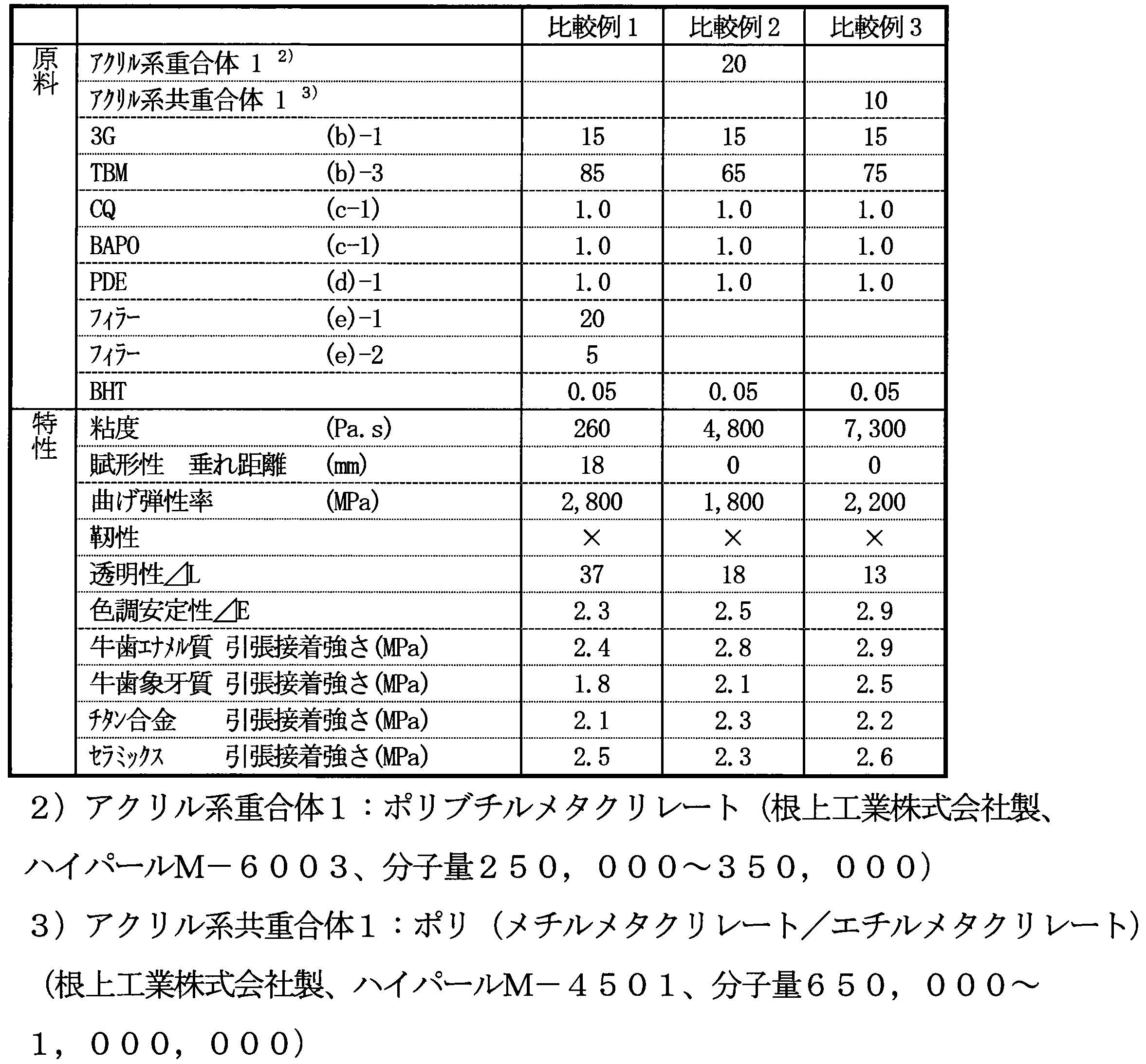
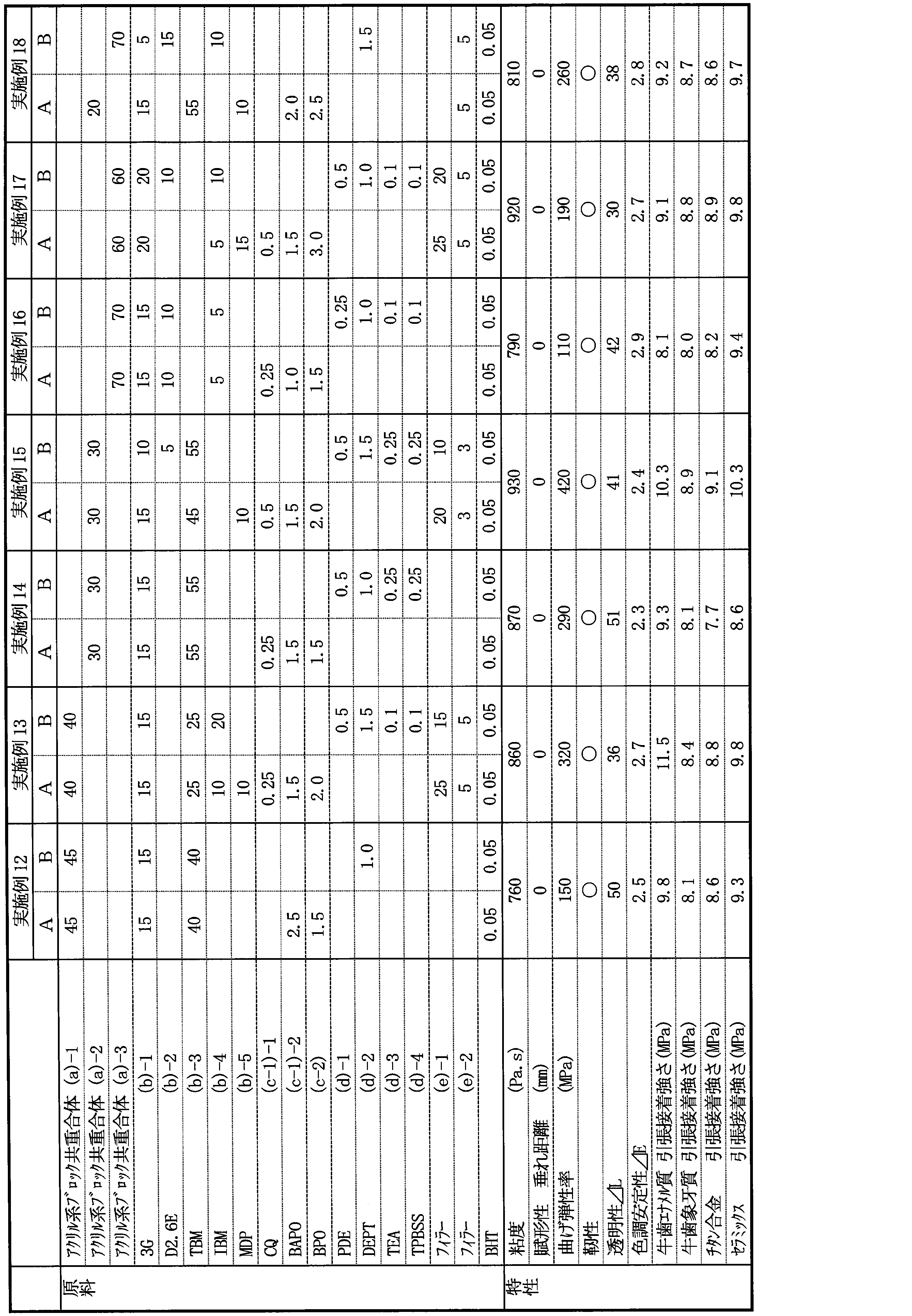
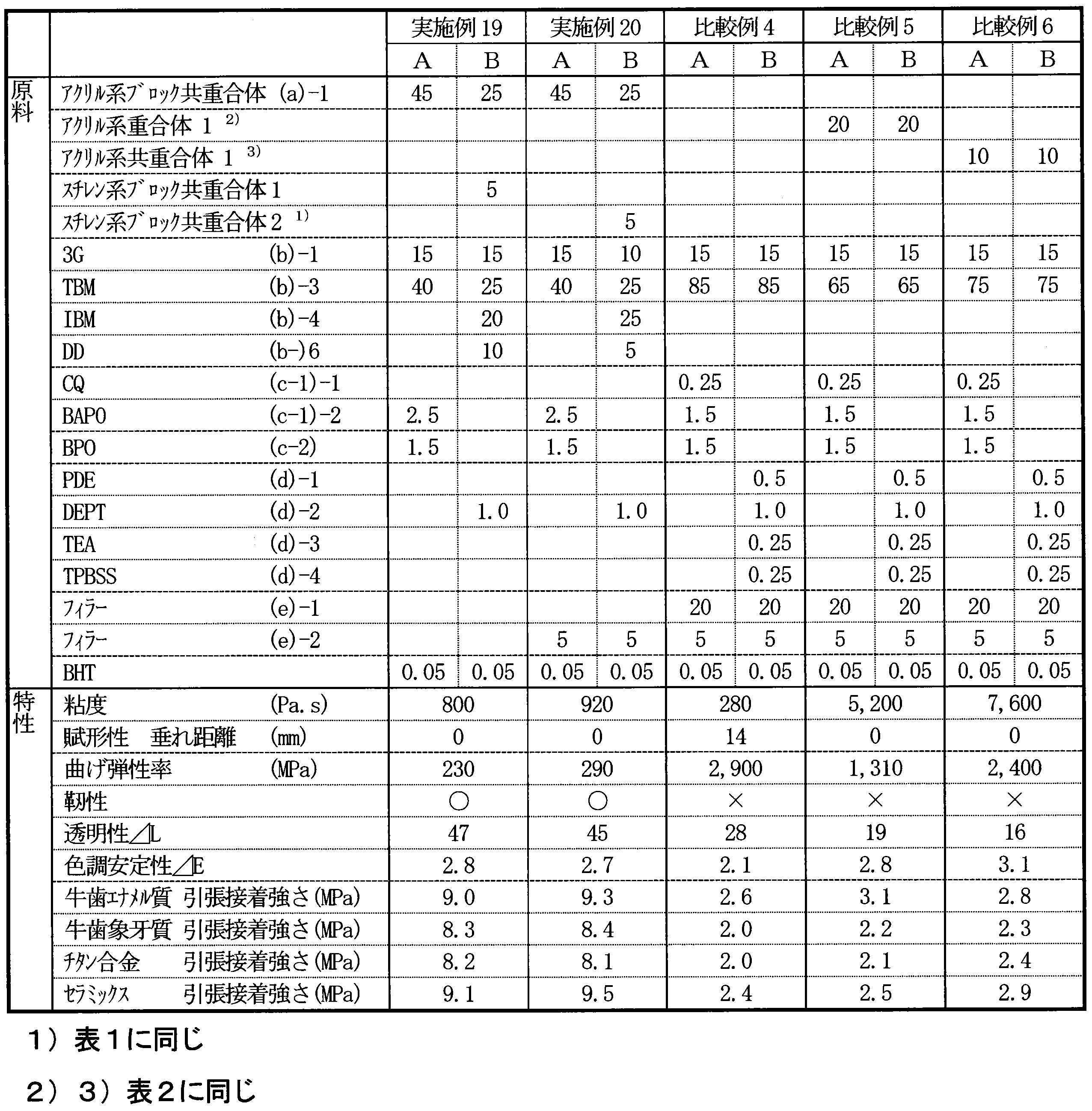
- the polymerizable compositions containing the acrylic block copolymers of the examples are more viscous and shaped than the polymerizable compositions not containing the acrylic block copolymers of the comparative examples. It can be seen that the properties are appropriate and the operability before curing is excellent. Moreover, since the bending elastic modulus is low and destruction is not observed, it is excellent in flexibility. Furthermore, it has high transparency, small change in color tone and excellent aesthetics.
- the polymerizable composition having adhesiveness to teeth, adhesiveness to titanium and ceramics and containing the acrylic block copolymer of the present invention can be suitably applied to living tissue, It turns out that it is most suitable for cement and a rocking tooth fixing material.
- the polymerizable composition of the present invention can be suitably applied to biological tissues (teeth, bones, and particularly teeth), and is specifically suitable for temporary implant cements and swing tooth fixing materials. It can also be suitably used as a dental composite resin.
Landscapes
- Health & Medical Sciences (AREA)
- Chemical & Material Sciences (AREA)
- Life Sciences & Earth Sciences (AREA)
- Oral & Maxillofacial Surgery (AREA)
- Veterinary Medicine (AREA)
- Animal Behavior & Ethology (AREA)
- General Health & Medical Sciences (AREA)
- Public Health (AREA)
- Epidemiology (AREA)
- Medicinal Chemistry (AREA)
- Chemical Kinetics & Catalysis (AREA)
- Polymers & Plastics (AREA)
- Organic Chemistry (AREA)
- Plastic & Reconstructive Surgery (AREA)
- Biophysics (AREA)
- Dental Preparations (AREA)
- Graft Or Block Polymers (AREA)
- Polymerisation Methods In General (AREA)
Abstract
Description
重合性単量体(b)、及び
重合開始剤(c)を含有してなる重合性組成物である。
本発明で用いるアクリルブロック共重合体(a)は、(メタ)アクリル酸エステル単位を主として含み、ハードセグメントとして機能する重合体ブロックA[以下単に「重合体ブロックA」という]を少なくとも1個と、アクリル酸エステル単位を主として含み、ソフトセグメントとして機能する重合体ブロックB[以下単に「重合体ブロックB」という]を少なくとも1個有する。従って、アクリルブロック共重合体(a)は、エラストマーとして機能する。
AlR1R2R3
(式中、R1は置換基を有してもよいアルキル基、置換基を有してもよいアルコキシ基又は置換基を有してもよいアリールオキシ基を示し、R2及びR3はそれぞれ独立して置換基を有してもよいアルキル基、置換基を有してもよいアルコキシ基又は置換基を有してもよいアリールオキシ基を示すか又はR2とR3が結合して置換基を有してもよいアリーレンジオキシ基を形成していてもよい。)
で表される有機アルミニウム化合物存在下に、必要に応じてN,N,N’,N’’,N’’-ペンタメチルジエチレントリアミンやその他の3級アミン;1,2-ジメトキシエタンや12-クラウン-4等のクラウンエーテル等のエーテルをさらに用いて、アクリル系ブロック共重合体(a)中の各重合体ブロックを形成する(メタ)アクリル酸エステル及びアクリル酸エステルを逐次重合させる方法などを採用することができる。
本発明の重合性組成物に用いられる重合性単量体(b)には、ラジカル重合性単量体が好適に用いられる。重合性単量体(b)におけるラジカル重合性単量体の具体例としては、α-シアノアクリル酸、(メタ)アクリル酸、α-ハロゲン化アクリル酸、クロトン酸、桂皮酸、ソルビン酸、マレイン酸、イタコン酸等のエステル類、(メタ)アクリルアミド、(メタ)アクリルアミド誘導体、ビニルエステル類、ビニルエーテル類、モノ-N-ビニル誘導体、スチレン誘導体等が挙げられる。重合性単量体(b)としては、アクリル系ブロック共重合体(a)との混和性の観点から(メタ)アクリレート系重合性単量体が好ましい。
本発明に用いられる重合開始剤(c)は、一般工業界で使用されている重合開始剤から選択して使用でき、中でも歯科用途に用いられている重合開始剤が好ましく用いられる。特に、光重合開始剤(c-1)及び化学重合開始剤(c-2)が、単独で又は2種以上適宜組み合わせて使用される。
本発明の重合性組成物は、重合促進剤(d)を含むことが好ましい。重合促進剤(d)としては、アミン類、スルフィン酸及びその塩、亜硫酸塩、亜硫酸水素塩、アルデヒド類、チオ尿素化合物、有機リン化合物、ボレート化合物、バルビツール酸誘導体、トリアジン化合物、銅化合物、スズ化合物、バナジウム化合物、ハロゲン化合物チオール化合物などが挙げられる。
本発明の重合性組成物には、硬化前の重合性組成物のペースト性状を調整するために、また硬化物の機械的強度を高めるために、フィラー(e)をさらに配合することができる。このようなフィラーとして、有機フィラー、無機フィラー、及び有機-無機複合フィラー等が挙げられる。
〔GPC測定の装置及び条件〕
・装置:東ソー株式会社製GPC装置「HLC-8020」
・分離カラム:東ソー株式会社製「TSKgel GMHXL」、「G4000HXL」及び「G5000HXL」を直列に連結
・溶離液:テトラヒドロフラン
・溶離液流量:1.0ml/分
・検出方法:示差屈折率(RI)
UV吸収率(参考例4)
〔1H-NMR測定の装置及び条件〕
・装置:日本電子株式会社製の核磁気共鳴装置「JNM-LA400」
・重溶媒:重水素化クロロホルム
(1)1リットルの三口フラスコに三方コックを付け内部を脱気し、窒素で置換した後、室温にてトルエン390g、N,N’,N’,N’’,N’’-ペンタメチルジエチレントリアミン1.4ml、及びイソブチルビス(2,6-ジ-t-ブチル-4-メチルフェノキシ)アルミニウム11mmolを含有するトルエン溶液18mlを加え、さらに、sec-ブチルリチウム2.2mmolを含有するシクロヘキサンとn-ヘキサンの混合溶液1.7mlを加えた。これにメタクリル酸メチル14mlを加え、室温で1時間反応させた。この時点で反応液1gを採取してサンプリング試料1とした。引き続き、重合液の内部温度を-15℃に冷却し、アクリル酸n-ブチル120mlを6時間かけて滴下した。滴下終了後、反応液1gを採取してサンプリング試料2とした。続いてメタクリル酸メチル14mlを加えて反応液を室温に昇温して、約10時間撹拌した。この反応液にメタノール1gを添加して重合を停止した。この重合停止後の反応液を大量のメタノールと水の混合溶液(メタノール90質量%)に注ぎ、析出した白色沈殿物を回収してサンプリング試料3とした。
(1)1リットルの三口フラスコに三方コックを付け内部を脱気し、窒素で置換した後、室温にてトルエン390g、N,N’,N’,N’’,N’’-ペンタメチルジエチレントリアミン1.4ml、及びイソブチルビス(2,6-ジ-t-ブチル-4-メチルフェノキシ)アルミニウム11mmolを含有するトルエン溶液18mlを加え、さらに、sec-ブチルリチウム2.2mmolを含有するシクロヘキサンとn-ヘキサンの混合溶液1.7mlを加えた。これにメタクリル酸メチル35mlを加え、室温で1時間反応させた。この時点で反応液1gを採取してサンプリング試料1とした。引き続き、重合液の内部温度を-15℃に冷却し、アクリル酸n-ブチル75mlを5時間かけて滴下した。滴下終了後、反応液1gを採取してサンプリング試料2とした。続いてメタクリル酸メチル35mlを加えて反応液を室温に昇温して、約10時間撹拌した。この反応液にメタノール1gを添加して重合を停止した。この重合停止後の反応液を大量のメタノールと水の混合溶液(メタノール90質量%)に注ぎ、析出した白色沈殿物を回収してサンプリング試料3とした。
(1)1リットルの三口フラスコに三方コックを付け内部を脱気し、窒素で置換した後、室温にてトルエン390g、N,N’,N’,N’’,N’’-ペンタメチルジエチレントリアミン0.95ml、及びイソブチルビス(2,6-ジ-t-ブチル-4-メチルフェノキシ)アルミニウム11mmolを含有するトルエン溶液12mlを加え、さらに、sec-ブチルリチウム2.2mmolを含有するシクロヘキサンとn-ヘキサンの混合溶液1.1mlを加えた。これにメタクリル酸メチル5mlを加え、室温で1時間反応させた。この時点で反応液1gを採取してサンプリング試料1とした。引き続き、重合液の内部温度を-15℃に冷却し、アクリル酸n-ブチル97mlを5時間かけて滴下した。滴下終了後、この反応液にメタノール1gを添加して重合を停止した。この重合停止後の反応液を大量のメタノールと水の混合溶液(メタノール90質量%)に注ぎ、析出した白色の液状沈殿物を回収してサンプリング試料2とした。
(1)窒素置換した撹拌装置付き耐圧容器に、α-メチルスチレン144g、シクロヘキサン251g、メチルシクロヘキサン47.3g及びテトラヒドロフラン6.8gを加えた。この混合溶液にsec-ブチルリチウム(1.3Mシクロヘキサン溶液)15.0mlを添加し、-10℃で5時間重合させた。重合開始3時間後のポリα-メチルスチレン(重合体ブロックA)の重量平均分子量は7800であり、α-メチルスチレンの重合転化率は90%であった。次いで、この反応液にブタジエン40.5gを添加し、-10℃で30分間撹拌して、ブタジエンを重合(ブロックB1を形成)した後、シクロヘキサン1680gを加えた。この時点でα-メチルスチレンの重合転化率は90%であり、1H-NMR測定から求めたポリブタジエンブロック(B1)の1,4-結合量は19モル%であった。次にこの反応液にさらにブタジエン230gを加え、50℃で2時間重合した。この時点のサンプリングで得られたブロック共重合体(構造:A-B1-B2)のポリブタジエンブロック(B2)の重量平均分子量は33000であり、1H-NMR測定から求めた1,4-結合量は60モル%であった。
3G:トリエチレングリコールジメタクリレート
D-2.6E:2,2-ビス(4-メタクリロイルオキシポリエトキシフェニル)プロパン
TBM:t-ブチルメタクリレート
IBM:イソボルニルメタクリレート
MDP:10-メタクリロイルオキシデシルジハイドロジェンホスフェート
DD:1,10-デカンジオールジメタクリレート
CQ:カンファーキノン
BAPO:ビス-(2,4,6-トリメチルベンゾイル)フェニルホスフィンオキサイド
BPO:ベンゾイルパーオキサイド
PDE:N,N-ジメチルアミノ安息香酸エチルエステル
DEPT:N,N-ジ(2-ヒドロキシエチル)-p-トルイジン
TEA:トリエタノールアミン
TPBSS:2,4,6-トリイソプロピルベンゼンスルフィン酸ナトリウム
フィラー(e)-1及び(e)-2は、以下の製造方法に従って得られる。
シリカ粉(日本触媒社製「KE-P250」)を振動ボールミルで粉砕し、シリカ粉を得た。得られたシリカ粉100g、3-アミノプロピルトリエトキシシラン0.5g及びトルエン200mlを500mlの一口ナスフラスコに入れ、室温で2時間撹拌した。続いて、減圧下トルエンを留去した後、40℃で16時間真空乾燥し、さらに90℃で3時間真空乾燥し、3-メタクリロイルオキシプロピルトリメトキシシラン処理シリカ粉(フィラー(e)-1)を得た。フィラー(e)-1の平均粒子径をレーザー回折式粒度分布測定装置(島津製作所製、型式「SALD-2100」)を用いて測定したところ、2.4μmであった。
コロイドシリカ粉(日本アエロジル社製「アエロジルOX50」)100g、3-メタクリロイルオキシプロピルトリメトキシシラン0.5g及びトルエン200mlを500mlの一口ナスフラスコに入れ、室温で2時間撹拌した。続いて、減圧下トルエンを留去した後、40℃で16時間真空乾燥し、さらに90℃で3時間真空乾燥し、3-メタクリロイルオキシプロピルトリメトキシシラン処理コロイドシリカ粉(フィラー(e)-2)を得た。
BHT:3,5-ジ-t-ブチル-4-ヒドロキシトルエン
レオメータ(ティー・エイ・インスツルメント・ジャパン株式会社製、AR2000)に重合性組成物を載せ、直径20mmのパラレルプレートを用い、25℃に保持しながら剪断速度1.0sec-1でプレートを一定方向に回転させて、粘度を測定した。この測定での粘度が50Pa.s以下のものは流動性が高過ぎ、1000Pa.s以上のものは流動性がなく操作性が悪い。
縦59mm×横83mmの歯科用練和紙に直径3mmの円を描いておき、その円内に重合性組成物を0.3g載せ、35℃の恒温器内に垂直に立て、その状態で3分間静置して重合性組成物の円内からの移動距離を測定した。この試験を3回行い、3回の測定値の平均値を垂れ距離(mm)とした。垂れ距離が大きいほど重合性組成物が流れやすいことを示す。この試験での垂れ距離が3mm以上のものは、賦形性がなく、操作性が悪い。
ISO4049に準拠して曲げ試験により評価した。すなわち、以下の例で作製した重合性組成物をSUS製の金型(縦2mm×厚さ2mm×長さ25mm)に充填し、上下をスライドガラスで圧接し、歯科用可視光照射器(株式会社モリタ製、ジェットライト3000)で、20秒間ずつ片面5箇所で裏表に光照射して重合性組成物を硬化させた。得られた硬化物について、万能試験機(株式会社島津製、オートグラフAG-100kNI)を用いて、クロスヘッドスピード2mm/minで曲げ試験を実施し、曲げ弾性率を測定した。なお、優れた柔軟性を確保するために、曲げ弾性率は1000MPa以下であることが好ましい。
前述の曲げ弾性率の測定において、降伏点に達するまで、又は破壊するまで試験を継続した。破壊しなかったものを○、破壊したものを×とした。試験片が破壊しなかった場合は靭性に優れ、試験片が破壊した場合は靭性が低く脆いと判定した。
重合性組成物をSUS製の金型(寸法2mm×20mmφ)に充填後、上下をスライドガラスで圧接し、歯科用可視光照射器(株式会社モリタ製、ジェットライト3000)で、20秒間ずつ片面6箇所で裏表に光照射して重合性組成物を硬化させた。得られた硬化物について、分光測色計(ミノルタ製、CM-3610d、D65光源)を用いて、透明性(ΔL)を測定した。なお、高い審美性を確保するために、透明性(ΔL)が25以上である必要がある。
試験例5で作製した試験片について、分光測色計(ミノルタ製、CM-3610d、D65光源)を用いて測色を行い、これを試験前の色度とした。次いで、蒸留水に試験片を70℃で10日間浸漬した後、再度測色を行い、これを試験後の色度とした。試験前の色度からの試験後の色度の変化をΔE値で評価した。ΔE値は下式で定義される。なお、色調安定性を確保するために、ΔE値が5以下である必要があり、本試験での色調安定性が高いほど耐水性に優れる。
ΔE={(L*1-L*2)2+(a*1-a*2)2+(b*1-b*2)2}1/2
[式中、L*1、a*1、b*1、L*2、a*2、b*2は、分光測色計にて測定したL*、a*、b*表色系での色度(L*、a*、b*)を表す値であり、色度(L*1、a*1、b*1)は、70℃水中に浸漬後の、色度(L*2、a*2、b*2)は、70℃水中に浸漬前の色度である。
ウシ下顎前歯の唇面を流水下にて#80シリコン・カーバイド紙(日本研紙株式会社製)で研磨してエナメル質の平坦面又は象牙質の平坦面を得た。各平坦面を流水下にて#1000のシリコン・カーバイド紙(日本研紙株式会社製)でさらに研磨した後、表面の水を歯科用エアシリンジで吹き飛ばした。
bis-GMA(2,2-ビス〔4-(3-メタクリロイルキシ-2-ヒドロキシプロポキシ)フェニル〕プロパン) 5重量部、
#801(1,2-ビス(3-メタクリロイルオキシ-2-ヒドロキシプロポキシ)エタン) 25重量部
HEMA(2-ヒドロキシエチルメタクリレート) 25重量部、
MDP 10重量部、
CQ 1.5重量部、
BAPO1.0重量部、
PDE 1.0重量部、
DEPT1.5重量部、
BHT 0.05重量部、
蒸留水 15.0重量部、
エタノール 15.0重量部
からなる混合物
縦横10mm×厚さの5mmチタン片(株式会社松風製、チタン100、チタン含有率99.5%以上)を流水下にて#1000シリコン・カーバイド紙(日本研紙株式会社製)で研磨して平滑面を得た後、表面の水を歯科用エアシリンジで吹き飛ばした。
アセトン 99.0%、
6-(4-ビニルベンジル-ンープロピル)アミノ-1、3、5-トリアジン-ニ、4-ジチオン 0.6%、
10-メタクリロイルオキシデシルジハイドロジェンホスフェート 0.4%
からなる混合物
試験例8のチタン100をセラミックス片(VITA社製、ビタ セレイ)に変えたこと、及び歯科用接着材2を下記の歯科用接着材3に変えたこと以外、試験例8と同様にして試験した。
エタノール 95.0%、
3-メタクリロイルオキシプロピルトリメトキシシラン 5.0%、
10-メタクリロイルオキシデシルジハイドロジェンホスフェート 1.0%
からなる混合物
表1~表4に示す原料を常温下で混合して、Aペースト(及びBペースト)を調製し、上記の試験例1~9の方法に従って特性を調べた。結果を表1~表4に示す。

Claims (11)
- (メタ)アクリル酸エステル単位を主として含み、ハードセグメントとして機能する重合体ブロックAを少なくとも1個と、アクリル酸エステル単位を主として含み、ソフトセグメントとして機能する重合体ブロックBを少なくとも1個有するアクリル系ブロック共重合体(a)、
重合性単量体(b)、及び
重合開始剤(c)を含有してなる重合性組成物。 - 前記アクリル系ブロック共重合体(a)の分子量分布Mw/Mnが1.0~1.5である請求項1に記載の重合性組成物。
- 前記アクリル系ブロック共重合体(a)が、前記重合性単量体(b)の重合性基に対して不活性である請求項1に記載の重合性組成物。
- 前記重合性単量体(b)が、(メタ)アクリレート系重合性単量体である請求項1に記載の重合性組成物。
- 重合促進剤(d)をさらに含む請求項1に記載の重合性組成物。
- フィラー(e)をさらに含む請求項1に記載の重合性組成物。
- 生体組織用である請求項1に記載の重合性組成物。
- 請求項1に記載の重合性組成物を用いた歯科用セメント。
- インプラント用仮着セメントである請求項8に記載の歯科用セメント。
- 請求項1に記載の重合性組成物を用いた歯科用動揺歯固定材。
- 請求項1に記載の重合性組成物を用いた歯科用コンポジットレジン。
Priority Applications (6)
| Application Number | Priority Date | Filing Date | Title |
|---|---|---|---|
| JP2011537136A JP5655001B2 (ja) | 2009-10-23 | 2010-10-19 | 重合性組成物及び歯科材料 |
| CN201080047714.8A CN102648216B (zh) | 2009-10-23 | 2010-10-19 | 聚合性组合物以及牙科材料 |
| EP10824654.7A EP2492289B1 (en) | 2009-10-23 | 2010-10-19 | Polymerizable composition and dental material |
| US13/501,118 US9333148B2 (en) | 2009-10-23 | 2010-10-19 | Polymerizable composition and dental material |
| EP15157706.1A EP2918258B1 (en) | 2009-10-23 | 2010-10-19 | Polymerizable composition and dental material |
| US14/594,206 US20150126641A1 (en) | 2009-10-23 | 2015-01-12 | Polymerizable composition and dental material |
Applications Claiming Priority (2)
| Application Number | Priority Date | Filing Date | Title |
|---|---|---|---|
| JP2009244795 | 2009-10-23 | ||
| JP2009-244795 | 2009-10-23 |
Related Child Applications (2)
| Application Number | Title | Priority Date | Filing Date |
|---|---|---|---|
| US13/501,118 A-371-Of-International US9333148B2 (en) | 2009-10-23 | 2010-10-19 | Polymerizable composition and dental material |
| US14/594,206 Continuation US20150126641A1 (en) | 2009-10-23 | 2015-01-12 | Polymerizable composition and dental material |
Publications (1)
| Publication Number | Publication Date |
|---|---|
| WO2011048802A1 true WO2011048802A1 (ja) | 2011-04-28 |
Family
ID=43900046
Family Applications (1)
| Application Number | Title | Priority Date | Filing Date |
|---|---|---|---|
| PCT/JP2010/006201 Ceased WO2011048802A1 (ja) | 2009-10-23 | 2010-10-19 | 重合性組成物及び歯科材料 |
Country Status (5)
| Country | Link |
|---|---|
| US (2) | US9333148B2 (ja) |
| EP (2) | EP2918258B1 (ja) |
| JP (1) | JP5655001B2 (ja) |
| CN (1) | CN102648216B (ja) |
| WO (1) | WO2011048802A1 (ja) |
Cited By (9)
| Publication number | Priority date | Publication date | Assignee | Title |
|---|---|---|---|---|
| JP2013203718A (ja) * | 2012-03-29 | 2013-10-07 | Kuraray Noritake Dental Inc | 歯科用仮着セメント組成物 |
| WO2015129180A1 (ja) * | 2014-02-25 | 2015-09-03 | クラレノリタケデンタル株式会社 | 歯科用重合性組成物、歯科用仮着セメント、歯科用充填材、義歯床裏装材、及び歯科用粘膜調整材 |
| JP2016127935A (ja) * | 2012-11-13 | 2016-07-14 | ヘレウス メディカル ゲーエムベーハー | ポリメチルメタクリレート骨セメント |
| JPWO2016042770A1 (ja) * | 2014-09-17 | 2017-06-29 | クラレノリタケデンタル株式会社 | 歯科用重合性組成物 |
| JP2017533298A (ja) * | 2014-09-19 | 2017-11-09 | スリーエム イノベイティブ プロパティズ カンパニー | アクリル系ブロックコポリマー接着剤 |
| JP2018510187A (ja) * | 2015-03-30 | 2018-04-12 | デンツプライ デトレイ ゲー.エム.ベー.ハー. | 歯科用組成物 |
| JP2018529807A (ja) * | 2015-09-04 | 2018-10-11 | アルケマ フランス | 光重合性接着剤組成物 |
| WO2023223979A1 (ja) * | 2022-05-19 | 2023-11-23 | 株式会社レゾナック | ポリオキシアルキレン鎖を有する化合物及びアクリル系共重合体を含有する組成物 |
| WO2025225722A1 (ja) * | 2024-04-26 | 2025-10-30 | クラレプラスチックス株式会社 | 熱可塑性重合体組成物、シートまたはフィルム、積層体およびその製造方法 |
Families Citing this family (29)
| Publication number | Priority date | Publication date | Assignee | Title |
|---|---|---|---|---|
| JP5174217B2 (ja) * | 2010-06-10 | 2013-04-03 | 公立大学法人大阪市立大学 | 易解体性粘着剤組成物及び易解体性粘着テープ |
| KR101866756B1 (ko) * | 2011-06-02 | 2018-06-18 | 디아이씨 가부시끼가이샤 | 이해체성 점착제 조성물 및 이해체성 점착 테이프 |
| KR101868835B1 (ko) | 2011-06-02 | 2018-06-19 | 디아이씨 가부시끼가이샤 | 이해체성 점착제 조성물 및 이해체성 점착 테이프 |
| JP5577463B2 (ja) | 2011-06-02 | 2014-08-20 | Dic株式会社 | 易解体性粘着剤組成物及び易解体性粘着テープ |
| WO2013089078A1 (ja) * | 2011-12-15 | 2013-06-20 | 株式会社トクヤマデンタル | 樹脂複合材料、歯科用材料および樹脂複合材料の製造方法 |
| ES2689025T3 (es) * | 2013-10-10 | 2018-11-08 | Kuraray Noritake Dental Inc. | Kit de adhesivo dental |
| JP6403691B2 (ja) * | 2014-01-10 | 2018-10-10 | 株式会社トクヤマデンタル | 義歯床用裏装材 |
| KR101445524B1 (ko) * | 2014-03-20 | 2014-10-02 | 백현영 | 임시 레진계 치관 |
| EP3075372A1 (en) * | 2015-03-30 | 2016-10-05 | Dentsply DeTrey GmbH | Dental composition |
| FR3040706B1 (fr) * | 2015-09-04 | 2019-08-30 | Arkema France | Composition photo-polymerisable a base d'une matrice (meth)acrylique et de copolymeres a blocs (meth)acryliques |
| KR102459004B1 (ko) * | 2018-03-20 | 2022-10-26 | 미쓰이 가가쿠 가부시키가이샤 | 경조직 보수용 조성물 및 경조직 보수용 키트 |
| DE102018114690A1 (de) * | 2018-06-19 | 2019-12-19 | Voco Gmbh | Thermowirksame dentale Kompositzusammensetzung |
| US11426818B2 (en) | 2018-08-10 | 2022-08-30 | The Research Foundation for the State University | Additive manufacturing processes and additively manufactured products |
| US12390308B2 (en) | 2018-12-31 | 2025-08-19 | Solventum Intellectual Properties Company | Multi-layered dental appliance |
| WO2022009986A1 (ja) * | 2020-07-09 | 2022-01-13 | 三井化学株式会社 | 歯科用接着性組成物及び歯科材料 |
| EP4085893B1 (de) * | 2021-05-07 | 2025-02-26 | Ivoclar Vivadent AG | Transparente, bruchzähe polymerisationsharze zur herstellung dentaler formkörper |
| DE102022105737A1 (de) | 2022-03-11 | 2023-09-14 | Tesa Se | Aushärtbare Klebemasse mit verbesserter Stanzbarkeit und verbesserten Schockeigenschaften |
| DE102022105738A1 (de) | 2022-03-11 | 2023-09-14 | Tesa Se | Aushärtbare Klebemasse mit verbesserter Stanzbarkeit |
| DE102022124904A1 (de) | 2022-09-28 | 2024-03-28 | Tesa Se | Aushärtbare Haftklebemasse mit verbesserten Klebeeigenschaften |
| DE102022124902A1 (de) | 2022-09-28 | 2024-03-28 | Tesa Se | Kationisch härtbare Klebemasse mit Indikation der Haltefestigkeit |
| DE102022124903A1 (de) | 2022-09-28 | 2024-03-28 | Tesa Se | Kationisch härtbare Klebemasse mit definierter Färbung im ausgehärteten Zustand |
| EP4368167A1 (de) | 2022-11-08 | 2024-05-15 | Ivoclar Vivadent AG | Dentalwerkstoff zur herstellung dentaler voll- oder teilprothesen |
| WO2024182521A1 (en) * | 2023-02-28 | 2024-09-06 | Align Technology, Inc. | Additives for 3d printing polymer resins |
| DE102023135599A1 (de) | 2023-12-18 | 2025-06-18 | Tesa Se | Aushärtbare Haftklebemasse mit hoher Verklebungsfestigkeit und guter Klebkraft im ausgehärteten Zustand |
| CN120230493A (zh) | 2023-12-28 | 2025-07-01 | 德莎欧洲股份公司 | 固化性电绝缘带 |
| DE102024107751A1 (de) | 2024-03-19 | 2025-09-25 | Tesa Se | Chemikalienbeständige, reaktiv aushärtbare Klebemasse und Klebeband |
| DE102024107753A1 (de) | 2024-03-19 | 2025-09-25 | Tesa Se | Reaktives Klebeband |
| KR20260044514A (ko) * | 2024-09-26 | 2026-04-02 | (주)룰루즈 | 항균성 치과 소재용 조성물 및 이를 이용한 치과 소재의 제조방법 |
| CN118956306B (zh) * | 2024-10-17 | 2025-02-18 | 深圳好电科技有限公司 | 一种负极粘结剂、负极片及锂离子电池 |
Citations (12)
| Publication number | Priority date | Publication date | Assignee | Title |
|---|---|---|---|---|
| JPH067223A (ja) | 1992-02-19 | 1994-01-18 | Johnson & Johnson Consumer Prod Inc | ボディグルーミング器具用ホルダー |
| JPH091997A (ja) | 1995-06-21 | 1997-01-07 | Toru Hachisu | 折り紙立体額 |
| JPH0967223A (ja) * | 1995-08-31 | 1997-03-11 | Kuraray Co Ltd | 歯科用組成物 |
| JPH10139613A (ja) | 1996-11-07 | 1998-05-26 | Kuraray Co Ltd | 歯科用接着剤組成物 |
| JPH10182329A (ja) | 1996-12-24 | 1998-07-07 | Kuraray Co Ltd | 歯科用重合性組成物 |
| JP2000159621A (ja) | 1998-12-02 | 2000-06-13 | Kuraray Co Ltd | 歯科用光重合性組成物 |
| JP2001089693A (ja) | 1999-09-27 | 2001-04-03 | Kuraray Co Ltd | 歯科用コーテイング材組成物 |
| JP2002040657A (ja) * | 1997-11-28 | 2002-02-06 | Hitachi Chem Co Ltd | 光硬化性樹脂組成物及びこれを用いた感光性エレメント |
| JP2002226316A (ja) | 2001-02-01 | 2002-08-14 | Sun Medical Co Ltd | 歯科用接着性金属色遮蔽材セット及びその使用方法 |
| JP2006282714A (ja) * | 2005-03-31 | 2006-10-19 | Kuraray Co Ltd | 硬化性樹脂組成物及びそれを用いた造形物 |
| WO2007029783A1 (ja) | 2005-09-07 | 2007-03-15 | Kuraray Co., Ltd. | アクリル系粘着剤組成物および粘着製品 |
| JP2007126527A (ja) | 2005-11-02 | 2007-05-24 | Kuraray Co Ltd | 熱可塑性エラストマー組成物及びその射出成形品 |
Family Cites Families (9)
| Publication number | Priority date | Publication date | Assignee | Title |
|---|---|---|---|---|
| EP0434334B1 (en) | 1989-12-21 | 1994-02-02 | Minnesota Mining And Manufacturing Company | Dental compositions, a method of making shaped dental articals via photoiniferter polymerization of the dental compositions, and shaped dental articles produced thereby |
| EP0633918A1 (en) * | 1992-03-31 | 1995-01-18 | Minnesota Mining And Manufacturing Company | Ultraviolet radiation curable acrylate pressure-sensitive adhesive compositions |
| US6583198B2 (en) | 1997-11-28 | 2003-06-24 | Hitachi Chemical Company, Ltd. | Photo curable resin composition and photosensitive element |
| TWI284540B (en) * | 1999-05-13 | 2007-08-01 | Kuraray Co | Bonding composition suitable to tooth tissue |
| WO2005116038A1 (ja) * | 2004-05-28 | 2005-12-08 | San-Apro Limited | 新規なオニウムおよび遷移金属錯体のフッ素化アルキルフルオロリン酸塩 |
| DE102006038858A1 (de) * | 2006-08-20 | 2008-02-21 | Voxeljet Technology Gmbh | Selbstaushärtendes Material und Verfahren zum schichtweisen Aufbau von Modellen |
| DE102007035735A1 (de) * | 2006-08-16 | 2008-02-21 | Ivoclar Vivadent Ag | Pastenförmige, polymerisierbare Dentalmassen und Verfahren zu deren Herstellung |
| US8298452B2 (en) * | 2007-02-26 | 2012-10-30 | Dai Nippon Printing Co., Ltd. | Negative type resist composition for color filter, color filter using same, and liquid crystal display |
| WO2009101961A1 (ja) * | 2008-02-15 | 2009-08-20 | Kuraray Co., Ltd. | 硬化性樹脂組成物および樹脂硬化物 |
-
2010
- 2010-10-19 JP JP2011537136A patent/JP5655001B2/ja active Active
- 2010-10-19 EP EP15157706.1A patent/EP2918258B1/en active Active
- 2010-10-19 WO PCT/JP2010/006201 patent/WO2011048802A1/ja not_active Ceased
- 2010-10-19 CN CN201080047714.8A patent/CN102648216B/zh not_active Expired - Fee Related
- 2010-10-19 EP EP10824654.7A patent/EP2492289B1/en active Active
- 2010-10-19 US US13/501,118 patent/US9333148B2/en active Active
-
2015
- 2015-01-12 US US14/594,206 patent/US20150126641A1/en not_active Abandoned
Patent Citations (12)
| Publication number | Priority date | Publication date | Assignee | Title |
|---|---|---|---|---|
| JPH067223A (ja) | 1992-02-19 | 1994-01-18 | Johnson & Johnson Consumer Prod Inc | ボディグルーミング器具用ホルダー |
| JPH091997A (ja) | 1995-06-21 | 1997-01-07 | Toru Hachisu | 折り紙立体額 |
| JPH0967223A (ja) * | 1995-08-31 | 1997-03-11 | Kuraray Co Ltd | 歯科用組成物 |
| JPH10139613A (ja) | 1996-11-07 | 1998-05-26 | Kuraray Co Ltd | 歯科用接着剤組成物 |
| JPH10182329A (ja) | 1996-12-24 | 1998-07-07 | Kuraray Co Ltd | 歯科用重合性組成物 |
| JP2002040657A (ja) * | 1997-11-28 | 2002-02-06 | Hitachi Chem Co Ltd | 光硬化性樹脂組成物及びこれを用いた感光性エレメント |
| JP2000159621A (ja) | 1998-12-02 | 2000-06-13 | Kuraray Co Ltd | 歯科用光重合性組成物 |
| JP2001089693A (ja) | 1999-09-27 | 2001-04-03 | Kuraray Co Ltd | 歯科用コーテイング材組成物 |
| JP2002226316A (ja) | 2001-02-01 | 2002-08-14 | Sun Medical Co Ltd | 歯科用接着性金属色遮蔽材セット及びその使用方法 |
| JP2006282714A (ja) * | 2005-03-31 | 2006-10-19 | Kuraray Co Ltd | 硬化性樹脂組成物及びそれを用いた造形物 |
| WO2007029783A1 (ja) | 2005-09-07 | 2007-03-15 | Kuraray Co., Ltd. | アクリル系粘着剤組成物および粘着製品 |
| JP2007126527A (ja) | 2005-11-02 | 2007-05-24 | Kuraray Co Ltd | 熱可塑性エラストマー組成物及びその射出成形品 |
Non-Patent Citations (1)
| Title |
|---|
| See also references of EP2492289A4 |
Cited By (12)
| Publication number | Priority date | Publication date | Assignee | Title |
|---|---|---|---|---|
| JP2013203718A (ja) * | 2012-03-29 | 2013-10-07 | Kuraray Noritake Dental Inc | 歯科用仮着セメント組成物 |
| JP2016127935A (ja) * | 2012-11-13 | 2016-07-14 | ヘレウス メディカル ゲーエムベーハー | ポリメチルメタクリレート骨セメント |
| WO2015129180A1 (ja) * | 2014-02-25 | 2015-09-03 | クラレノリタケデンタル株式会社 | 歯科用重合性組成物、歯科用仮着セメント、歯科用充填材、義歯床裏装材、及び歯科用粘膜調整材 |
| JPWO2015129180A1 (ja) * | 2014-02-25 | 2017-03-30 | クラレノリタケデンタル株式会社 | 歯科用重合性組成物、歯科用仮着セメント、歯科用充填材、義歯床裏装材、及び歯科用粘膜調整材 |
| US10285913B2 (en) | 2014-02-25 | 2019-05-14 | Kuraray Noritake Dental Inc. | Dental polymerizable composition, dental temporary cement, dental filling material, denture liner, and dental tissue conditioner |
| JPWO2016042770A1 (ja) * | 2014-09-17 | 2017-06-29 | クラレノリタケデンタル株式会社 | 歯科用重合性組成物 |
| US10426712B2 (en) | 2014-09-17 | 2019-10-01 | Kuraray Noritake Dental Inc. | Dental polymerizable composition |
| JP2017533298A (ja) * | 2014-09-19 | 2017-11-09 | スリーエム イノベイティブ プロパティズ カンパニー | アクリル系ブロックコポリマー接着剤 |
| JP2018510187A (ja) * | 2015-03-30 | 2018-04-12 | デンツプライ デトレイ ゲー.エム.ベー.ハー. | 歯科用組成物 |
| JP2018529807A (ja) * | 2015-09-04 | 2018-10-11 | アルケマ フランス | 光重合性接着剤組成物 |
| WO2023223979A1 (ja) * | 2022-05-19 | 2023-11-23 | 株式会社レゾナック | ポリオキシアルキレン鎖を有する化合物及びアクリル系共重合体を含有する組成物 |
| WO2025225722A1 (ja) * | 2024-04-26 | 2025-10-30 | クラレプラスチックス株式会社 | 熱可塑性重合体組成物、シートまたはフィルム、積層体およびその製造方法 |
Also Published As
| Publication number | Publication date |
|---|---|
| EP2918258A1 (en) | 2015-09-16 |
| EP2492289A1 (en) | 2012-08-29 |
| JPWO2011048802A1 (ja) | 2013-03-07 |
| EP2918258B1 (en) | 2020-03-18 |
| CN102648216A (zh) | 2012-08-22 |
| US9333148B2 (en) | 2016-05-10 |
| US20120196952A1 (en) | 2012-08-02 |
| JP5655001B2 (ja) | 2015-01-14 |
| US20150126641A1 (en) | 2015-05-07 |
| EP2492289A4 (en) | 2014-10-29 |
| EP2492289B1 (en) | 2020-03-18 |
| CN102648216B (zh) | 2014-08-13 |
Similar Documents
| Publication | Publication Date | Title |
|---|---|---|
| JP5655001B2 (ja) | 重合性組成物及び歯科材料 | |
| JP6340066B2 (ja) | 歯科用重合性組成物、歯科用仮着セメント、歯科用充填材、義歯床裏装材、及び歯科用粘膜調整材 | |
| US7488762B2 (en) | Two paste-type glass ionomer cement | |
| JP6304858B2 (ja) | 異なる屈折率の粒子を含む硬化性歯科用組成物 | |
| CN107427414A (zh) | 牙科材料用聚合性单体、组合物、粘接性牙科材料及试剂盒 | |
| CN111743783A (zh) | 双膏型牙科用树脂加强型玻璃离子水门汀组合物 | |
| JP7649619B2 (ja) | 連鎖移動剤を含む歯科用接着性組成物 | |
| CN101448479A (zh) | 牙科用粘合性底涂剂组合物 | |
| JP4986437B2 (ja) | 歯科用硬化性組成物 | |
| JP5683875B2 (ja) | 歯科用キット | |
| JP5890220B2 (ja) | 歯科用仮着セメント組成物 | |
| JP5543977B2 (ja) | 歯科用重合性組成物及びそれを用いた歯科材料 | |
| JP5894100B2 (ja) | 歯科用重合性組成物 | |
| JP6286352B2 (ja) | 歯科用硬化性組成物 | |
| CN101636420A (zh) | 聚合性单体、聚合性组合物以及牙科用材料 | |
| JP2010202560A (ja) | 歯科用複合硬化性組成物 | |
| JP6353789B2 (ja) | 歯科用重合性組成物 | |
| JP2024013169A (ja) | 歯科用レジン強化型グラスアイオノマーセメントキット | |
| WO2022270601A1 (ja) | 歯科用接着キット | |
| JP2022172925A (ja) | 歯科充填用キット |
Legal Events
| Date | Code | Title | Description |
|---|---|---|---|
| WWE | Wipo information: entry into national phase |
Ref document number: 201080047714.8 Country of ref document: CN |
|
| 121 | Ep: the epo has been informed by wipo that ep was designated in this application |
Ref document number: 10824654 Country of ref document: EP Kind code of ref document: A1 |
|
| WWE | Wipo information: entry into national phase |
Ref document number: 2011537136 Country of ref document: JP |
|
| WWE | Wipo information: entry into national phase |
Ref document number: 2010824654 Country of ref document: EP |
|
| WWE | Wipo information: entry into national phase |
Ref document number: 13501118 Country of ref document: US |