WO2011049100A1 - 基板用ガラス板、その製造方法およびtftパネルの製造方法 - Google Patents
基板用ガラス板、その製造方法およびtftパネルの製造方法 Download PDFInfo
- Publication number
- WO2011049100A1 WO2011049100A1 PCT/JP2010/068410 JP2010068410W WO2011049100A1 WO 2011049100 A1 WO2011049100 A1 WO 2011049100A1 JP 2010068410 W JP2010068410 W JP 2010068410W WO 2011049100 A1 WO2011049100 A1 WO 2011049100A1
- Authority
- WO
- WIPO (PCT)
- Prior art keywords
- glass plate
- glass
- substrate
- temperature
- sio
- Prior art date
- Legal status (The legal status is an assumption and is not a legal conclusion. Google has not performed a legal analysis and makes no representation as to the accuracy of the status listed.)
- Ceased
Links
Images

Classifications
-
- C—CHEMISTRY; METALLURGY
- C03—GLASS; MINERAL OR SLAG WOOL
- C03C—CHEMICAL COMPOSITION OF GLASSES, GLAZES OR VITREOUS ENAMELS; SURFACE TREATMENT OF GLASS; SURFACE TREATMENT OF FIBRES OR FILAMENTS MADE FROM GLASS, MINERALS OR SLAGS; JOINING GLASS TO GLASS OR OTHER MATERIALS
- C03C3/00—Glass compositions
- C03C3/04—Glass compositions containing silica
- C03C3/076—Glass compositions containing silica with 40% to 90% silica, by weight
- C03C3/089—Glass compositions containing silica with 40% to 90% silica, by weight containing boron
- C03C3/091—Glass compositions containing silica with 40% to 90% silica, by weight containing boron containing aluminium
- C03C3/093—Glass compositions containing silica with 40% to 90% silica, by weight containing boron containing aluminium containing zinc or zirconium
-
- C—CHEMISTRY; METALLURGY
- C03—GLASS; MINERAL OR SLAG WOOL
- C03C—CHEMICAL COMPOSITION OF GLASSES, GLAZES OR VITREOUS ENAMELS; SURFACE TREATMENT OF GLASS; SURFACE TREATMENT OF FIBRES OR FILAMENTS MADE FROM GLASS, MINERALS OR SLAGS; JOINING GLASS TO GLASS OR OTHER MATERIALS
- C03C3/00—Glass compositions
- C03C3/04—Glass compositions containing silica
- C03C3/076—Glass compositions containing silica with 40% to 90% silica, by weight
- C03C3/083—Glass compositions containing silica with 40% to 90% silica, by weight containing aluminium oxide or an iron compound
- C03C3/085—Glass compositions containing silica with 40% to 90% silica, by weight containing aluminium oxide or an iron compound containing an oxide of a divalent metal
-
- C—CHEMISTRY; METALLURGY
- C03—GLASS; MINERAL OR SLAG WOOL
- C03B—MANUFACTURE, SHAPING, OR SUPPLEMENTARY PROCESSES
- C03B18/00—Shaping glass in contact with the surface of a liquid
- C03B18/02—Forming sheets
-
- C—CHEMISTRY; METALLURGY
- C03—GLASS; MINERAL OR SLAG WOOL
- C03C—CHEMICAL COMPOSITION OF GLASSES, GLAZES OR VITREOUS ENAMELS; SURFACE TREATMENT OF GLASS; SURFACE TREATMENT OF FIBRES OR FILAMENTS MADE FROM GLASS, MINERALS OR SLAGS; JOINING GLASS TO GLASS OR OTHER MATERIALS
- C03C3/00—Glass compositions
- C03C3/04—Glass compositions containing silica
- C03C3/076—Glass compositions containing silica with 40% to 90% silica, by weight
- C03C3/089—Glass compositions containing silica with 40% to 90% silica, by weight containing boron
- C03C3/091—Glass compositions containing silica with 40% to 90% silica, by weight containing boron containing aluminium
-
- G—PHYSICS
- G02—OPTICS
- G02F—OPTICAL DEVICES OR ARRANGEMENTS FOR THE CONTROL OF LIGHT BY MODIFICATION OF THE OPTICAL PROPERTIES OF THE MEDIA OF THE ELEMENTS INVOLVED THEREIN; NON-LINEAR OPTICS; FREQUENCY-CHANGING OF LIGHT; OPTICAL LOGIC ELEMENTS; OPTICAL ANALOGUE/DIGITAL CONVERTERS
- G02F1/00—Devices or arrangements for the control of the intensity, colour, phase, polarisation or direction of light arriving from an independent light source, e.g. switching, gating or modulating; Non-linear optics
- G02F1/01—Devices or arrangements for the control of the intensity, colour, phase, polarisation or direction of light arriving from an independent light source, e.g. switching, gating or modulating; Non-linear optics for the control of the intensity, phase, polarisation or colour
- G02F1/13—Devices or arrangements for the control of the intensity, colour, phase, polarisation or direction of light arriving from an independent light source, e.g. switching, gating or modulating; Non-linear optics for the control of the intensity, phase, polarisation or colour based on liquid crystals, e.g. single liquid crystal display cells
- G02F1/133—Constructional arrangements; Operation of liquid crystal cells; Circuit arrangements
- G02F1/1333—Constructional arrangements; Manufacturing methods
-
- H—ELECTRICITY
- H01—ELECTRIC ELEMENTS
- H01J—ELECTRIC DISCHARGE TUBES OR DISCHARGE LAMPS
- H01J9/00—Apparatus or processes specially adapted for the manufacture, installation, removal, maintenance of electric discharge tubes, discharge lamps, or parts thereof; Recovery of material from discharge tubes or lamps
- H01J9/24—Manufacture or joining of vessels, leading-in conductors or bases
-
- H—ELECTRICITY
- H01—ELECTRIC ELEMENTS
- H01J—ELECTRIC DISCHARGE TUBES OR DISCHARGE LAMPS
- H01J2211/00—Plasma display panels with alternate current induction of the discharge, e.g. AC-PDPs
- H01J2211/20—Constructional details
- H01J2211/34—Vessels, containers or parts thereof, e.g. substrates
Definitions
- an alkali-free glass containing no alkali metal oxide has been used for a glass substrate for an LCD panel.
- the reason for this is that if an alkali metal oxide is contained in the glass substrate, the thin film transistor (TFT) used by the alkali ions in the glass substrate to drive the LCD panel during the heat treatment performed in the LCD panel manufacturing process. This is because it may diffuse into the semiconductor film and cause deterioration of TFT characteristics.
- alkali-free glass has a low coefficient of thermal expansion and a high glass transition point (Tg), so there is little dimensional change in the LCD panel manufacturing process, and there is little effect on display quality due to thermal stress when using the LCD panel. Therefore, it is preferable as a glass substrate for an LCD panel.
- the present inventor has found that the glass compaction (heat shrinkage rate) can greatly affect the film forming quality (film forming pattern accuracy) on the glass substrate in the heat treatment in the low temperature range described above.
- the glass compaction heat shrinkage rate
- it must be manufactured under conditions where the amount of water in the glass is high (for example, fuel such as city gas and heavy oil is burned by an oxygen combustion method or an oxygen and air combustion method).
- fuel such as city gas and heavy oil is burned by an oxygen combustion method or an oxygen and air combustion method.
- a hydroxide as a glass raw material
- the ⁇ -OH value (mm ⁇ 1 ) of the glass is used as an indicator of the moisture content in the glass.
- the productivity improvement is, for example, efficient dissolution by selecting a combustion method
- the quality improvement is, for example, improvement of defoaming property by decompression defoaming.
- the present invention contains an alkali metal oxide, has a small amount of B 2 O 3, and has a water content of 0.05 to 0 in terms of ⁇ -OH value (mm ⁇ 1 ). .5, and compaction during heat treatment at a low temperature (150 to 300 ° C.) in the TFT panel manufacturing process (specifically, heat treatment in the step of forming a gate insulating film) is small, particularly large (for example, one side is It is an object of the present invention to provide a glass plate for a substrate which can be suitably used as a glass substrate for a TFT panel having a size of 2 m or more, a method for producing the same, and a method for producing a TFT panel using the glass plate.
- the above-mentioned compaction is small. It aims at providing the manufacturing method of a TFT panel using the board, its manufacturing method, and the said glass plate.
- the glass plate for a substrate of the present invention is a glass suitable for lowering the temperature of the heat treatment process of the TFT process, that is, when being heat-treated at 150 to 300 ° C., and is effective for energy saving of the TFT process.
- the glass plate for a substrate of the present invention is suitable as a glass substrate for a TFT panel, but can be used for other display substrates such as a plasma display panel (PDP) and an inorganic electroluminescence display.
- PDP plasma display panel
- an inorganic electroluminescence display For example, when used as a glass plate for PDP, it has a smaller coefficient of thermal expansion than that of a conventional glass plate for PDP, so that it is possible to suppress glass breakage in the heat treatment step.
- the glass plate for substrates of this invention can be used also for uses other than a display panel. For example, it can also be used as a glass plate for a solar cell substrate.
- the glass plate for substrates of the present invention is expressed in mol% on the basis of oxide, and as a glass mother composition, SiO 2 67-72, Al 2 O 3 1-7, B 2 O 3 0-4, MgO 11-15, CaO 0-3, SrO 0-3, BaO 0-2, ZrO 2 0-4, Na 2 O 8-15, K 2 O 0-7, Consists of SiO 2 + Al 2 O 3 is 73 to 77, MgO + CaO + SrO + BaO is 11 to 17, Na 2 O + K 2 O is 8 to 17, K 2 O / (Na 2 O + K 2 O) ⁇ 0.13 ⁇ (SiO 2 + Al 2 O 3 ) ⁇ 9.4 is satisfied, ⁇ -OH value (mm ⁇ 1 ) is 0.05 to 0.5, The thermal shrinkage rate (C) is 16 ppm or less.
- the glass plate for a substrate of the present invention preferably has a ⁇ -OH
- Compaction is the glass heat shrinkage generated by relaxation of the glass structure during the heat treatment.
- the heat shrinkage rate (C) means that the glass plate is heated to the transition temperature Tg + 50 ° C., held for 1 minute, cooled to room temperature at 50 ° C./min, and then the surface of the glass plate
- the compaction (C) will be described more specifically.
- the compaction (C) means a value measured by the method described below. First, after a target glass plate is melted at 1600 ° C., the molten glass is poured out, cooled into a plate shape, and then cooled. The obtained glass plate is polished to obtain a sample of 200 mm ⁇ 20 mm ⁇ 2.8 mm. Next, the obtained glass plate is heated to a transition temperature Tg + 50 ° C., held at this temperature for 1 minute, and then cooled to room temperature at a temperature lowering rate of 50 ° C./min.
- SiO 2 A component that forms a glass skeleton. If it is less than 67 mol% (hereinafter simply referred to as “%”), the heat resistance and chemical durability of the glass are lowered, and the thermal expansion coefficient may be increased. In addition, when the fluctuation of the compaction (C) with respect to the ⁇ -OH value of the glass becomes large and the ⁇ -OH value (mm ⁇ 1 ) is 0.2 to 0.5, the compaction (C) should be 16 ppm or less. May become difficult.
- the content of SiO 2 is preferably 67 to 71%, more preferably 68 to 71%, and further preferably 69 to 71%.
- Al 2 O 3 Raises glass transition point, improves heat resistance and chemical durability, and raises Young's modulus. If the content is less than 1%, the glass transition point is lowered. In addition, when the fluctuation of the compaction (C) with respect to the ⁇ -OH value of the glass becomes large and the ⁇ -OH value (mm ⁇ 1 ) is 0.2 to 0.5, the compaction (C) should be 16 ppm or less. May become difficult. However, if it exceeds 7%, the high-temperature viscosity of the glass increases, and the meltability may deteriorate. Further, the devitrification temperature is increased, and the moldability may be deteriorated.
- the content of Al 2 O 3 is preferably 2 to 6%, more preferably 3 to 5%.
- SiO 2 and Al 2 O 3 are glass network-forming components, and if the total content is less than 73%, the heat resistance and chemical durability of the glass may decrease, and the thermal expansion coefficient may increase. is there.
- the compaction (C) should be 16 ppm or less. May become difficult.
- the total content of SiO 2 and Al 2 O 3 is preferably 73 to 76%, more preferably 73.5 to 76%.
- the total content of SiO 2 and Al 2 O 3 is preferably 73 to 77%, more preferably 73 to 76%. Preferably, it is 73.5 to 76%.
- B 2 O 3 The glass plate for a substrate of the present invention has a B 2 O 3 content as low as 4% or less. Therefore, when glass is melted during glass plate production, there is little volatilization of B 2 O 3 in the melting step, clarification step and molding step, especially in the melting step and clarification step, and the glass substrate to be produced is homogeneous. Excellent flatness. As a result, when used as a glass plate for a TFT panel that requires a high degree of flatness, the polishing amount of the glass plate can be reduced as compared with a conventional glass plate for a substrate. Moreover, even when considering the environmental burden by volatilization of B 2 O 3, the content of B 2 O 3 is that less is preferable.
- SrO It can be contained because it has the effect of lowering the viscosity at the time of melting the glass and promoting the melting. However, if it exceeds 3%, the thermal expansion coefficient and compaction (C) of the glass plate may increase.
- the content of SrO is preferably 0 to 1%, more preferably 0 to 0.5%, and still more preferably substantially not contained.
- BaO Since it has the effect of decreasing the viscosity at the time of melting of glass and promoting melting, it can be contained. However, if it exceeds 2%, the thermal expansion coefficient and compaction (C) of the glass plate may be increased.
- the content of BaO is preferably 0 to 1%, more preferably 0 to 0.5%, and still more preferably substantially not contained. In the case of a composition that takes into account the influence of B 2 O 3 and BaO described later, if the BaO content exceeds 4%, the thermal expansion coefficient and compaction (C) of the glass plate may be increased.
- the content of BaO is preferably 0 to 2%, more preferably 0 to 1%, and more preferably 0 to 0.5%. More preferably, it does not contain substantially.
- Na 2 O and K 2 O In order to sufficiently lower the viscosity at the glass melting temperature, the total amount of Na 2 O and K 2 O is 8% or more. However, if the total amount exceeds 17%, the thermal expansion coefficient may increase.
- the total content of Na 2 O and K 2 O is preferably 9 to 16%, more preferably 9.5 to 14%, and even more preferably 10 to 13.5%.
- ZrO 2 At the time of glass production, it has the effect of improving the clarity of glass, so it can be contained up to 4%. However, if it exceeds 4%, the density increases. In consideration of reduction of glass compaction (C), 2% or less is preferable.
- the content of ZrO 2 is preferably 2 to 4%, more preferably 2.5 to 4%, and further preferably 3 to 4%.
- the glass plate for a substrate of the present invention preferably has a composition satisfying the following formula (1) in addition to the above-described contents of the individual components in the mother composition.
- the inventor manufactured glass under the condition that the ⁇ -OH value (mm ⁇ 1 ) is 0.2 or more while changing individual components in the glass matrix composition, and examined the compaction of the glass.
- FIG. 1 shows the ratio of K 2 O to the alkali metal oxide in the glass (K 2 O / Na 2 O + K 2 O) and the compaction of the glass (G 2 O) for glasses having different amounts of SiO 2 and Al 2 O 3.
- B 2 O 3 has a coordination number of 3 and is smaller than the coordination number 4 of SiO 2 and Al 2 O 3 , the contribution ratio of B 2 O 3 is lower than these.
- the contribution of B 2 O 3 was 0.5.
- BaO is a component whose ionic radius is large and difficult to move as compared with other alkaline earth metal oxides such as MaO, CaO, and SrO, and therefore, it is considered that BaO contributes less to structural relaxation during heat treatment.
- the contribution of BaO was set to 0.3.
- even the composition satisfying the above formula (2) preferably satisfies the above formula (1).
- the glass plate for substrates of the present invention has a compaction (C) of 16 ppm or less. Moreover, Preferably it is 10 ppm or less, More preferably, it is 8 ppm or less. Moreover, although it is suitable as a glass substrate for TFT panels, it can be used for other display substrates such as a plasma display panel (PDP) and an inorganic electroluminescence display. It can also be used for applications other than display panels. For example, it can also be used as a glass plate for a solar cell substrate.
- C compaction
- the manufacturing method of the glass plate for substrates of this invention is demonstrated.
- the dissolution / clarification step and the molding step are performed in the same manner as when manufacturing a conventional glass plate for substrates.
- the glass plate for substrates of the present invention is an alkali glass substrate containing an alkali metal oxide (Na 2 O, K 2 O), SO 3 can be effectively used as a fining agent, and a molding method Suitable for the float process.
- a float method capable of forming a large area glass plate easily and stably with the recent increase in size of liquid crystal televisions and the like is used. Is preferred.
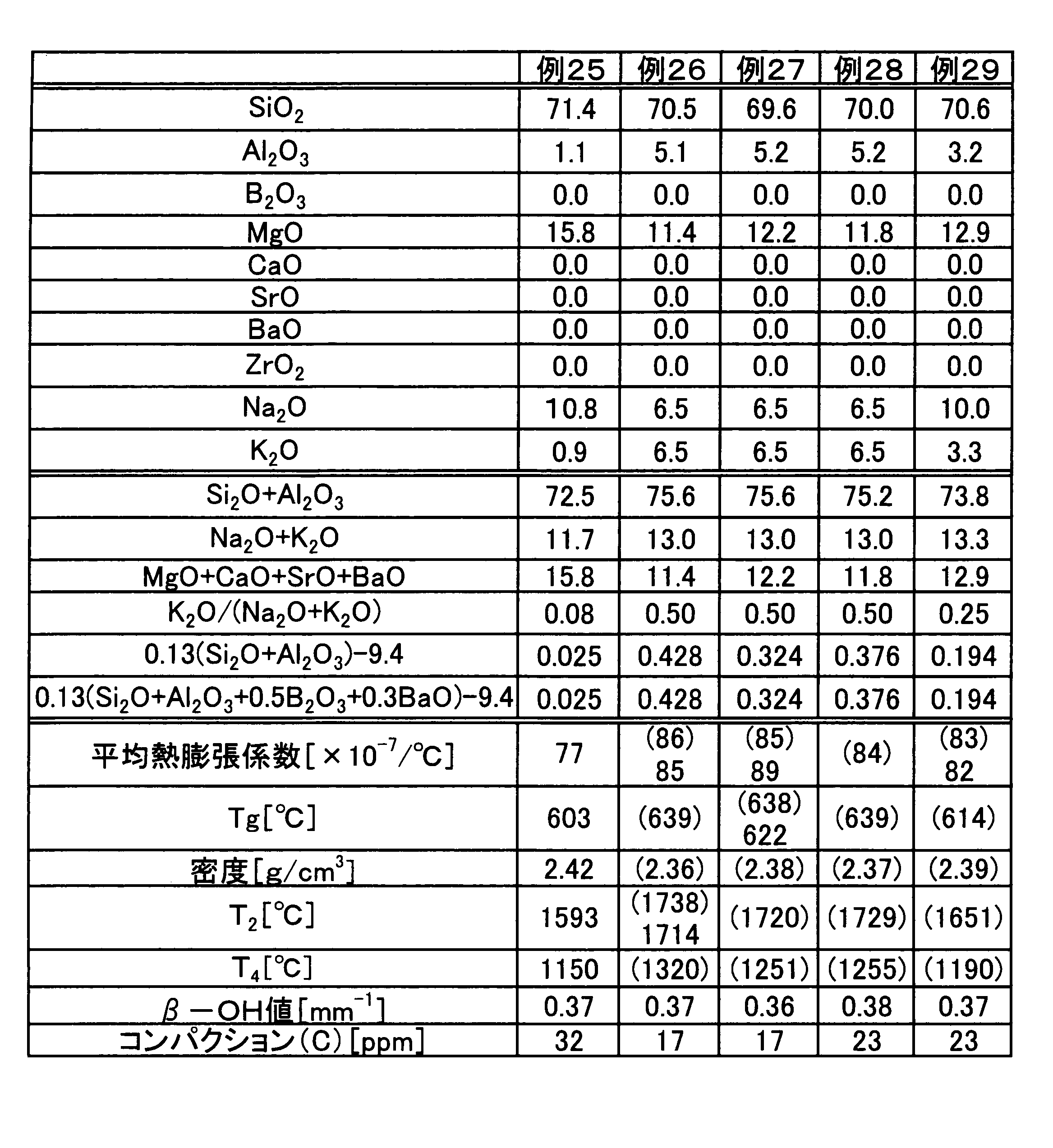
- the glass of the comparative examples (Examples 25 to 29) has a large compaction (C) of 17 ppm or more, there is a possibility of affecting the thermal shrinkage at a low temperature in the TFT panel manufacturing process.
- the substrate glass plate of the present invention having a compaction (C) of 16 ppm or less is obtained.
- the glass melting step of the present invention when SO 3 is used as a fining agent, a glass with excellent fining effect and few bubbles can be obtained.
- the glass plate for substrates of the present invention can be suitably used particularly as a glass substrate for TFT panels having a large size (one side of 2 m or more).
Landscapes
- Chemical & Material Sciences (AREA)
- Engineering & Computer Science (AREA)
- Organic Chemistry (AREA)
- Materials Engineering (AREA)
- Chemical Kinetics & Catalysis (AREA)
- Life Sciences & Earth Sciences (AREA)
- General Chemical & Material Sciences (AREA)
- Geochemistry & Mineralogy (AREA)
- Physics & Mathematics (AREA)
- Nonlinear Science (AREA)
- General Physics & Mathematics (AREA)
- Optics & Photonics (AREA)
- Crystallography & Structural Chemistry (AREA)
- Mathematical Physics (AREA)
- Manufacturing & Machinery (AREA)
- Glass Compositions (AREA)
- Liquid Crystal (AREA)
Abstract
Description
また、無アルカリガラスは、熱膨張係数が低く、ガラス転移点(Tg)が高いため、LCDパネルの製造工程での寸法変化が少なく、LCDパネル使用時の熱応力による表示品質への影響が少ないことからも、LCDパネル用のガラス基板として好ましい。
無アルカリガラスは粘性が非常に高く、溶融が困難といった性質を有し、製造に技術的な困難性を伴う。
また、一般的に、無アルカリガラスは清澄剤の効果が乏しい。例えば、清澄剤としてSO3を使用した場合、SO3が(分解して)発泡する温度がガラスの溶融温度よりも低いため、清澄がなされる前に、添加したSO3の大部分が分解して溶融ガラスから揮散してしまい、清澄効果を十分発揮することができない。
アルカリ金属酸化物を含有するガラスは、一般的に熱膨張係数が高いため、TFTパネル用のガラス基板として好ましい熱膨張係数とする目的で、熱膨張係数を低減させる効果を有するB2O3が通常含有される(特許文献1、2参照)。
だが、B2O3含有率が低いと、TFTパネル用のガラス基板として好ましい熱膨張係数まで下げること、および粘性の上昇を抑えつつ所定のTg等を得ることは困難であった。
また、ガラスの生産性向上や品質向上の観点からは、ガラス中の水分量が高くなる条件で製造すること(例えば、都市ガス、重油などの燃料を酸素燃焼方式または酸素及び空気燃焼方式で燃焼すること、あるいは、ガラス原料として水酸化物を用いること)が好ましいが、ガラス中の水分量が高くなる条件で製造した場合、製造されるガラスのコンパクションを所望のレベルまで低減することが難しいことを見出した。ガラス中の水分含有量の指標としては、ガラスのβ-OH値(mm-1)が用いられる。特に該β-OH値が0.2以上となる条件でガラスを製造した場合、従来のガラス組成ではガラスのコンパクションを16ppm以下とすることが困難であることを見出した。なお、前記生産性向上とは、例えば燃焼方法の選択による効率的な溶解であり、前記品質向上とは、例えば減圧脱泡での脱泡性向上等である。
また、ガラス中の水分量がβ-OH値(mm-1)で0.2~0.5、さらに0.35~0.5と高い場合であっても、上記コンパクションが小さい、基板用ガラス板とその製造方法、および前記ガラス板を用いたTFTパネルの製造方法を提供することを目的とする。
SiO2 67~72、
Al2O3 1~7、
B2O3 0~4、
MgO 11~15、
CaO 0~3、
SrO 0~3、
BaO 0~2、
ZrO2 0~4、
Na2O 8~15、
K2O 0~7、
からなり、
SiO2+Al2O3が73~77であり、
MgO+CaO+SrO+BaOが11~17であり、
Na2O+K2Oが8~17であり、
K2O/(Na2O+K2O)≦0.13×(SiO2+Al2O3)-9.4を満たし、
β-OH値(mm-1)が0.05~0.5であり、
熱収縮率(C)が16ppm以下である、基板用ガラス板を提供する。
また、本発明は、
酸化物基準のモル%表示で、ガラス母組成として、
SiO2 67~72、
Al2O3 1~7、
B2O3 0~4、
MgO 11~15、
CaO 0~3、
SrO 0~3、
BaO 0~4、
ZrO2 0~4、
Na2O 8~15、
K2O 0~7、
からなり、
SiO2+Al2O3が71~77であり、
MgO+CaO+SrO+BaOが11~17であり、
Na2O+K2Oが8~17であり、
K2O/(Na2O+K2O)≦0.13×(SiO2+Al2O3+0.5B2O3+0.3BaO)-9.4を満たし、
β-OH値(mm-1)が0.05~0.5であり、
熱収縮率(C)が16ppm以下である、基板用ガラス板を提供する。
上記の基板用ガラス板は、β-OH値(mm-1)が0.2~0.5であることが好ましい。
また、本発明の基板用ガラス板はB2O3含有率が低いので、ガラス製造時におけるB2O3の揮散が少ないことから、ガラス板の均質性に優れ、平坦性に優れており、成形後のガラス板表面の研磨が少なくてすみ、生産性に優れている。
また、本発明の基板用ガラス板は、アルカリ成分を含有しているため、原料を溶融しやすく製造が容易となり得る。
また、本発明の基板用ガラス板は、ガラスのβ-OH値が0.2~0.5と高い場合には、ガラスの製造時に、都市ガス、重油などの燃料を酸素燃焼方式または酸素及び空気燃焼方式で燃焼することや、ガラス原料として酸化物の代わりに水酸化物を用いることができるので、ガラスの生産性及び品質に優れている。
また、本発明の基板用ガラス板は、TFT工程の熱処理工程の低温化、すなわち150~300℃で熱処理される際に適したガラスであり、TFT工程の省エネ化に有効である。
本発明の基板用ガラス板は、TFTパネル用のガラス基板として好適であるが、他のディスプレイ用基板、例えば、プラズマディスプレイパネル(PDP)、無機エレクトロ・ルミネッセンス・ディスプレイなどに使用することができる。例えば、PDP用のガラス板として使用した場合、従来のPDP用のガラス板にくらべて熱膨張係数が小さいため、熱処理工程におけるガラスの割れを抑制することができる。
なお、本発明の基板用ガラス板は、ディスプレイパネル以外の用途にも用いることができる。例えば、太陽電池基板用ガラス板としても用いることもできる。
本発明の基板用ガラス板は、酸化物基準のモル%表示で、ガラス母組成として、
SiO2 67~72、
Al2O3 1~7、
B2O3 0~4、
MgO 11~15、
CaO 0~3、
SrO 0~3、
BaO 0~2、
ZrO2 0~4、
Na2O 8~15、
K2O 0~7、
からなり、
SiO2+Al2O3が73~77であり、
MgO+CaO+SrO+BaOが11~17であり、
Na2O+K2Oが8~17であり、
K2O/(Na2O+K2O)≦0.13×(SiO2+Al2O3)-9.4を満たし、
β-OH値(mm-1)が0.05~0.5であり、
熱収縮率(C)が16ppm以下であることを特徴とする。
本発明の基板用ガラス板は、β-OH値(mm-1)が0.2~0.5であることが好ましい。
本発明では、ガラス中の水分含有量の指標として、ガラスのβ-OH値(mm-1)を用いる。ガラスのβ-OH値は、ガラス試料について波長2.75~2.95μmの光に対する吸光度を測定し、その最大値βmaxを該試料の厚さ(mm)で割ることで求めることができる。
コンパクションとは、加熱処理の際にガラス構造の緩和によって発生するガラス熱収縮率である。
本発明において熱収縮率(C)(コンパクション(C))とは、ガラス板を転移点温度Tg+50℃まで加熱し、1分間保持し、50℃/分で室温まで冷却した後、ガラス板の表面に所定の間隔で圧痕を2箇所打ち、その後、ガラス板を300℃まで加熱し、1時間保持した後、100℃/時間で室温まで冷却した場合の、圧痕間隔距離の収縮率(ppm)を意味するものとする。
本発明においてコンパクション(C)とは、次に説明する方法で測定した値を意味するものとする。
初めに、対象となるガラス板を1600℃で溶融した後、溶融ガラスを流し出し、板状に成形後冷却する。得られたガラス板を研磨加工して200mm×20mm×2.8mmの試料を得る。
次に、得られたガラス板を転移点温度Tg+50℃まで加熱し、この温度で1分間保持した後、降温速度50℃/分で室温まで冷却する。その後、ガラス板の表面に点状の圧痕を長辺方向に2箇所、間隔A(A=190mm)で打つ。
次にガラス板を300℃まで昇温速度100℃/時(=1.6℃/分)で加熱し、300℃で1時間保持した後、降温速度100℃/時で室温まで冷却する。そして、再度、圧痕間距離を測定し、その距離をBとする。このようにして得たA、Bから下記式を用いてコンパクション(C)を算出する。なお、A、Bは光学顕微鏡を用いて測定する。
SiO2:ガラスの骨格を形成する成分で、67モル%(以下単に%と記載する)未満ではガラスの耐熱性および化学的耐久性が低下し、熱膨張係数が増大するおそれがある。また、ガラスのβ-OH値に対するコンパクション(C)の変動が大きくなり、β-OH値(mm-1)が0.2~0.5の場合に、コンパクション(C)を16ppm以下にすることが難しくなるおそれがある。しかし、72%超ではガラスの高温粘度が上昇し、ガラスの溶融性および清澄性が悪化する問題が生じるおそれがある。
SiO2の含有率は67~71%が好ましく、68~71%がより好ましく、69~71%であることがさらに好ましい。
Al2O3の含有率は2~6%であることが好ましく、3~5%であることがより好ましい。
SiO2およびAl2O3の含有率は合量で73~76%であることが好ましく、73.5~76%であることがより好ましい。
なお、後述するB2O3とBaOの影響を考慮した組成の場合、SiO2およびAl2O3の含有率が合量で71%未満では、ガラスの耐熱性および化学的耐久性が低下し、熱膨張係数が増大するおそれがある。後述するB2O3とBaOの影響を考慮した組成の場合、SiO2およびAl2O3の含有率は合量で73~77%であることが好ましく、73~76%であることがより好ましく、73.5~76%であることがさらに好ましい。
また、B2O3の揮散による環境負荷を考慮しても、B2O3の含有率はより低いことが好ましい。
その一方で、B2O3を2%以上含有させることでガラスの清澄性を改善する効果が期待される。
清澄性の改善効果を期待する場合、B2O3の含有率は1~4%であることが好ましく、2~4%であることがより好ましく、2.5~4%であることがさらに好ましい。
他の清澄剤を添加する場合のように、B2O3の添加による清澄性の改善効果を期待しない場合、B2O3の含有率は0~2%であることが好ましく、0~1%であることがより好ましく、実質的に含有しないことがさらに好ましい。
なお、本発明において「実質的に含有しない」と言った場合、原料等から混入する不可避的不純物以外には含有しないこと、すなわち、意図的に含有させないことを意味する。
MgOの含有率は11.5~15%が好ましく、12~15%であることがより好ましい。
CaOの含有率は0~2%が好ましく、0~1%であることがより好ましく、実質的に含有しないことがさらに好ましい。以下、本明細書において、0%とは該当する物質を実質的に含有しないこと、即ち、不純物を除き意図的に含有させないことである。
SrOの含有率は0~1%が好ましく、0~0.5%であることがより好ましく、実質的に含有しないことがさらに好ましい。
BaOの含有率は0~1%が好ましく、0~0.5%であることがより好ましく、実質的に含有しないことがさらに好ましい。
なお、後述するB2O3とBaOの影響を考慮した組成の場合、BaOを4%超含有するとガラス板の熱膨張係数およびコンパクション(C)が大きくなるおそれがある。後述するB2O3とBaOの影響を考慮した組成の場合、BaOの含有率は0~2%が好ましく、0~1%がより好ましく、0~0.5%であることがより好ましく、実質的に含有しないことがさらに好ましい。
MgO、CaO、SrOおよびBaOの含有率は合量で11~15%が好ましく、11.5~15%であることがより好ましく、12~15%であることがさらに好ましい。
Na2Oの含有率は8~14%、さらには8~13%であることが好ましく、9~11%であることがさらに好ましい。
K2Oの含有率は0~5%が好ましく、0~3%であることがより好ましく、0~2%であることがさらに好ましい。
Na2OおよびK2Oの含有率は合量で9~16%であることが好ましく、9.5~14%であることがより好ましく、10~13.5%であることがさらに好ましい。
清澄性の改善効果を期待する場合、ZrO2の含有率は2~4%であることが好ましく、2.5~4%であることがより好ましく、3~4%であることがさらに好ましい。
K2O/(Na2O+K2O)≦0.13×(SiO2+Al2O3)-9.4 (1)
本発明者は、ガラス母組成における個々の成分を変えつつ、β-OH値(mm-1)が0.2以上となる条件でガラスを製造し、ガラスのコンパクションを調べた。図1は、SiO2とAl2O3の合量が異なるガラスについて、ガラス中のアルカリ金属酸化物に占めるK2Oの割合(K2O/Na2O+K2O)と、ガラスのコンパクション(Compaction(C))と、の関係をプロットしたグラフである。ここで、SiO2,Al2O3,Na2OおよびK2Oはモル%での量である。
このグラフから明らかなように、ガラス中のアルカリ金属酸化物に占めるK2Oの割合が高くなるにつれてガラスのコンパクション(C)が増加するが、ガラスのネットワークを構成するSiO2およびAl2O3の合量が高いガラスの場合、コンパクション(C)の増加が緩やかになることを本発明者は見出した。そして、この知見に基づいて鋭意検討した結果、上記式(1)を満たす組成とすることで、β-OH値(mm-1)が0.2~0.5のガラスであっても、コンパクション(C)を16ppm以下とすることができることを見出した。すなわち、上記式(1)は、コンパクション(C)を16ppm以下となるガラスにおける、K2O/(Na2O+K2O)と、SiO2+Al2O3と、の関係から実験的に導いたものである。
B2O3とBaOの影響を考慮した場合、上記式(1)の代わりに下記式(2)を満たす組成であってもよい。
K2O/(Na2O+K2O)≦0.13×(SiO2+Al2O3+0.5B2O3+0.3BaO)-9.4 (2)
B2O3は、SiO2およびAl2O3と同じくネットワーク構成成分であり、これらと同様に、ガラスのβ-OH値に対するコンパクション(C)の変動を小さくする効果が期待される。但し、B2O3は配位数が3配位でありSiO2およびAl2O3の配位数4配位と比較して小さいため、B2O3の寄与率はこれらに比べて低いと考えられ、B2O3の寄与分を0.5とした。
BaOは、MaO,CaOおよびSrOといった他のアルカリ土類金属酸化物にくらべると、イオン半径が大きく動きにくい成分であるため、加熱処理の際の構造緩和への寄与は少ないと考えられる。しかしながら、SiO2やAl2O3にくらべると、動きやすい成分であると考えられるため、BaOの寄与分を0.3とした。
但し、上記式(2)を満たす組成であっても、上記式(1)を満たすことが好ましい。
また、ガラスの化学的耐久性向上のため、または、ガラスのヤング率向上のため、ガラス中にY2O3、La2O3、TiO2、SnO2等を合量で5モル%以下含有させてもよい。
また、ガラスの色調を調整するため、ガラス中にFe2O3、CeO2等の着色剤を含有してもよい。このような着色剤の含有量は、合量で1モル%以下が好ましい。
また、本発明の基板用ガラス板は、環境負荷を考慮すると、As2O3、Sb2O3を実質的に含有しないことが好ましい。また、安定してフロート成形することを考慮すると、ZnOを実質的に含有しないことが好ましい。
また、TFTパネル用のガラス基板として好適であるが、他のディスプレイ用基板、例えば、プラズマディスプレイパネル(PDP)、無機エレクトロ・ルミネッセンス・ディスプレイなどに使用することができる。
なお、ディスプレイパネル以外の用途にも用いることができる。例えば、太陽電池基板用ガラス板としても用いることもできる。
本発明の基板用ガラス板は、密度が2.46g/cm3以下であることが好ましく、2.45g/cm3以下であることがより好ましい。
この平均熱膨張係数は80×10-7/℃以下であることがより好ましく、75×10-7/℃以下であることがさらに好ましく、70×10-7/℃以下であることがさらに好ましい。また、60×10-7/℃以上であると好ましい。
本発明の基板用ガラス板を製造する場合、従来の基板用ガラス板を製造する際と同様に、溶解・清澄工程および成形工程を実施する。なお、本発明の基板用ガラス板は、アルカリ金属酸化物(Na2O、K2O)を含有するアルカリガラス基板であるため、清澄剤としてSO3を効果的に用いることができ、成形方法としてフロート法に適している。
基板用ガラス板の製造工程において、ガラスを板状に成形する方法としては、近年の液晶テレビなどの大型化に伴い、大面積のガラス板を容易に、安定して成形できるフロート法を用いることが好ましい。
初めに、原料を溶解して得た溶融ガラスを板状に成形する。例えば、得られるガラス板の組成となるように原料を調製し、前記原料を溶解炉に連続的に投入し、1450~1650℃程度に加熱して溶融ガラスを得る。
ここで、製造される基板用ガラス板のβ-OH値(mm-1)は、原料中の水分量、溶解槽中の水蒸気濃度、および溶解槽における溶融ガラスの滞在時間に支配され、ガラスの生産性向上、品質向上のために、ガラス原料として酸化物の代わりに水酸化物を用いる方法(例えば、マグネシウム源として酸化マグネシウム(MgO)の代わりに水酸化マグネシウム(Mg(OH)2)を用いる)を用いると好ましい。また、都市ガス、重油などの燃料を酸素燃焼方式または酸素及び空気燃焼方式で燃焼するため、溶融ガラス中の水分量がβ-OH値(mm-1)で0.05~0.5、好ましくは0.2~0.5となる。
その後、リボン状のガラス板をフロート成形炉から引出した後に、冷却手段によって室温状態まで冷却し、切断後、基板用ガラス板を得る。ここで冷却手段は、前記フロート成形炉から引出されたリボン状のガラス板の表面温度をTH(℃)、室温をTL(℃)とし、さらに前記リボン状ガラス板の表面温度がTHからTLに冷却されるまでの時間をt(分)とした場合に、(TH-TL)/tで示される平均冷却速度を10~300℃/分とする冷却手段である。具体的な冷却手段は特に限定されず、従来公知の冷却方法であってよい。例えば温度勾配を持った加熱炉を用いる方法が挙げられる。
THは、ガラス転移点温度Tg+20℃であり、具体的には540~730℃が好ましい。
前記平均冷却速度は15~150℃/分であることが好ましく、20~80℃/分であることがより好ましく、40~60℃/分であることがさらに好ましい。上記のガラス板製造方法により、コンパクション(C)が16ppm以下のガラス板が容易に得られる。
本発明のTFTパネルの製造方法は、本発明の基板用ガラス板の表面の成膜領域を150~300℃の範囲内の温度(以下、成膜温度という)まで昇温した後、前記成膜温度で5~60分間保持して、前記成膜領域に前記アレイ基板ゲート絶縁膜を成膜する成膜工程を具備するものであれば特に限定されない。ここで成膜温度は150~250℃であることが好ましく、150~230℃であることがより好ましく、150~200℃であることがさらに好ましい。また、この成膜温度に保持する時間は5~30分間であることが好ましく、5~20分間であることがより好ましく、5~15分間であることがさらに好ましい。
ゲート絶縁膜の成膜は上記のような成膜温度および保持時間の範囲内で行われるので、この間にガラス板が熱収縮する。なお、一度ガラス板が熱収縮した後は、その後の冷却条件(冷却速度等)によっては、上記の熱収縮の結果に大きな影響を及ぼさない。本発明の基板用ガラスはコンパクション(C)が16ppm以下と小さいので、ガラス板の熱収縮が小さく、成膜パターンのずれが生じ難い。
すなわち、前記アレイ基板、カラーフィルタ基板各々に配向膜を形成し、ラビングを行う配向処理工程、TFTアレイ基板とカラーフィルタ基板を所定のギャップを保持して高精度で貼り合せる貼り合せ工程、基板よりセルを所定サイズに分断する分断工程、分断されたセルに液晶を注入する注入工程、セルに偏光板を貼り付ける偏光板貼り付け工程からなる一連の工程によりTFTパネルを製造することができる。
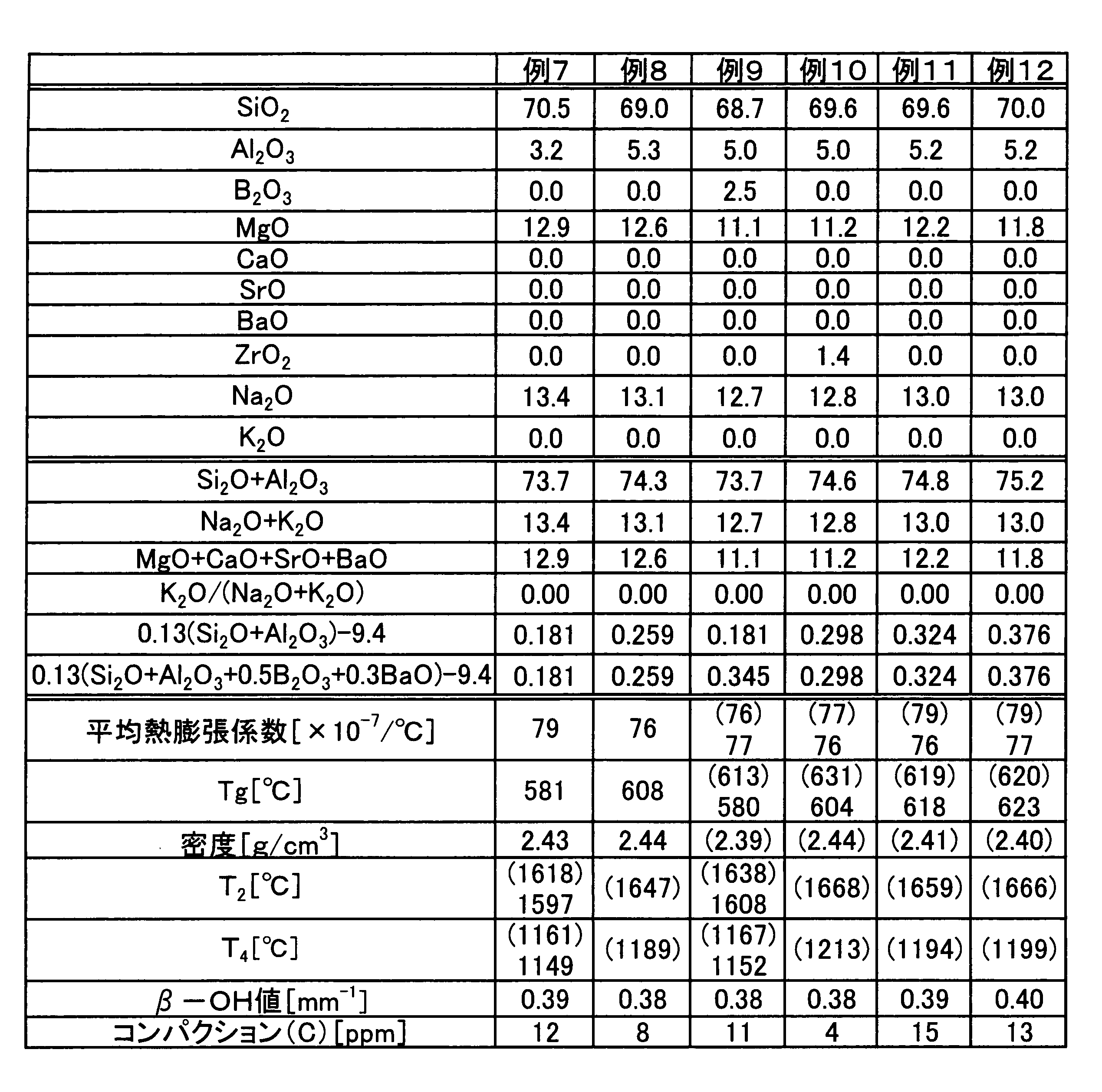
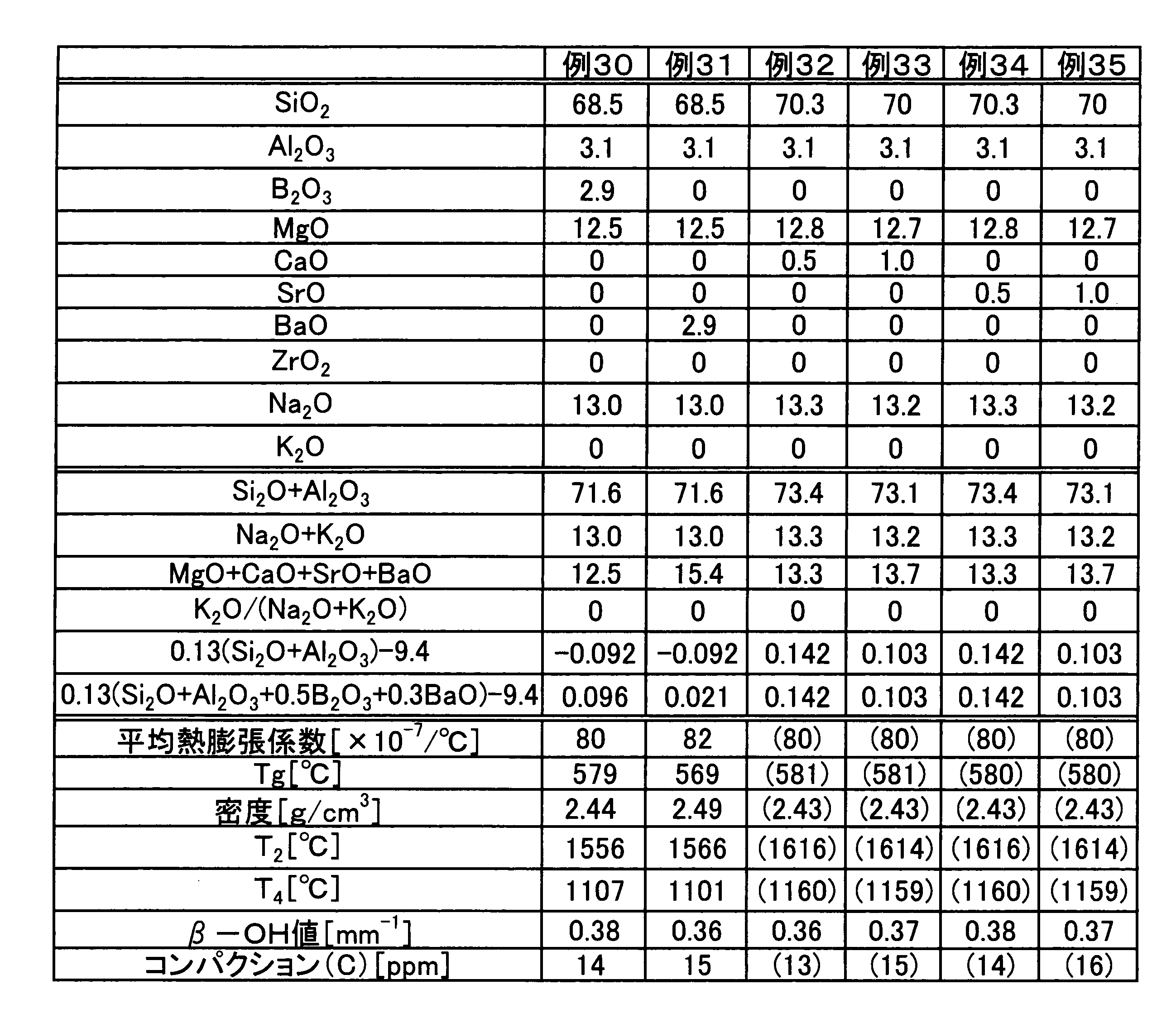
本発明の基板用ガラス板の実施例(例1~24、30~35)及び比較例(例25~29)を示す。
表1~6にモル%で表示した組成になるように各成分の原料を調合し、該組成の100質量部に対し、硫酸塩をSO3換算で0.1質量部添加し、白金坩堝を用いて1600℃の温度で3時間加熱し溶融した。溶融にあたっては、白金スターラーを挿入し1時間攪拌しガラスの均質化を行った。ここで、製造されるガラス板のβ-OH値(mm-1)を水蒸気雰囲気(露点80℃)で調整してガラスを溶融した。
次いで溶融ガラスを流し出し、板状に成形後冷却した。
こうして得られたガラスの密度、平均熱膨張係数(単位:×10-7/℃)、転移点温度Tg(単位:℃)、溶解の基準温度として、ガラスの粘度が102dPa・sとなる温度T2(単位:℃)、成形の基準温度としてガラス粘度が104dPa・sとなる温度T4(単位:℃)、コンパクション(C)、および、β-OH値を測定し、表1~6に示した。以下に各物性の測定方法を示す。
密度:泡を含まない約20gのガラス塊をアルキメデス法によって測定した。
50~350℃の平均熱膨張係数:示差熱膨張計(TMA)を用いて測定し、JIS R3102(1995年度)より求めた。
Tg:TgはTMAを用いて測定した値であり、JIS R3103-3(2001年度)により求めた。
粘度:回転粘度計を用いて粘度を測定し、粘度が102dPa・sとなるときの温度T2と、104dPa・sとなるときの温度T4を測定した。
コンパクション(C):前述のコンパクション(C)の測定方法により測定した。
β-OH値:波長2.75~2.95μmの光に対する吸光度を測定し、その最大値βmaxをサンプルの厚さで割ることで求めた。
なお、表中のかっこ書きした値は、計算により求めたものである。
ガラス中のSO3残存量は100~500ppmであった。
表1、3はβ-OH値が0.05以上0.2未満の例、表2は表1の例の組成に対しβ-OH値が0.2~0.5の例、表4は表3の例の組成に対しβ-OH値が0.2~0.5の例、表5は比較例、表6はβ-OH値が0.2~0.5の例である。



また、密度が2.50g/cm3以下であるので、軽量なTFTパネル用のガラス板として好適に用いることができる。
また、50~350℃の平均熱膨張係数が85×10-7/℃以下であるため、TFTパネル用のガラス板として使用した場合に、TFTパネル製造工程での寸法変化を抑制することができる。
表1の組成になるように各成分の原料を調合し、該原料を連続的に溶融炉に投入し、1550~1650℃の温度で溶解する。ここで、製造される基板用ガラス板のβ-OH値(mm-1)が0.05~0.5、好ましくは0.2~0.5となるように溶融ガラス中の水分量を制御する。
そして、フロート法にて連続的にリボン状ガラス板に成形し、ガラス板表面温度が転移点温度Tg+20℃でフロート炉から引出し、冷却炉によって平均冷却速度40~60℃/分で、ガラス板の表面温度が室温(TL=25℃)となるまで冷却する。その後、所定の寸法(一辺が2m以上)に切断する。コンパクション(C)が16ppm以下である本発明の基板用ガラス板が得られる。
本発明の基板用ガラス板は、特に大型(一辺が2m以上)のTFTパネル用ガラス基板として好適に用いることができる。
アレイ基板の製造工程において、本発明の基板用ガラス板を洗浄後、ゲート電極、配線パターンを形成する。
次に、ガラス板を成膜温度250℃で15分保持して、CVD法によってゲート絶縁膜を成膜する。
次に、a-Si膜を成膜し、チャネル保護膜を成膜し、パターニングしてパターンを形成する。
次に、N+型a-Si膜、画素電極、およびコンタクトパターンを形成する。
次に、ソース・ドレイン電極を形成し、次に保護膜を成膜してTFTアレイ基板を得る。その後、以下のような公知の工程を用いてTFTパネルを得る。
すなわち、前記アレイ基板、カラーフィルタ基板各々に配向膜を形成し、ラビングを行う配向処理工程、TFTアレイ基板とカラーフィルタ基板を所定のギャップを保持して高精度で貼り合せる工程、基板よりセルを所定サイズに分断する分断工程、分断されたセルに液晶を注入する注入工程、およびセルに偏光板を貼り付ける偏光板貼り付け工程からなる一連の工程によりTFTパネルを製造することができる。
本発明の基板用ガラス板はコンパクション(C)が16ppm以下であるため、このようなTFTパネルの製造方法に供しても熱収縮は小さく、成膜パターンのずれが生じ難い。
本出願は2009年10月19日出願の日本特許出願2009-240204に基づくものであり、その内容はここに参照として取り込まれる。
Claims (8)
- 酸化物基準のモル%表示で、ガラス母組成として、
SiO2 67~72、
Al2O3 1~7、
B2O3 0~4、
MgO 11~15、
CaO 0~3、
SrO 0~3、
BaO 0~4、
ZrO2 0~4、
Na2O 8~15、
K2O 0~7、
からなり、
SiO2+Al2O3が71~77であり、
MgO+CaO+SrO+BaOが11~17であり、
Na2O+K2Oが8~17であり、
K2O/(Na2O+K2O)≦0.13×(SiO2+Al2O3+0.5B2O3+0.3BaO)-9.4を満たし、
β-OH値(mm-1)が0.05~0.5であり、
熱収縮率(C)が16ppm以下である、基板用ガラス板。 - 酸化物基準のモル%表示で、ガラス母組成として、
SiO2 67~72、
Al2O3 1~7、
B2O3 0~4、
MgO 11~15、
CaO 0~3、
SrO 0~3、
BaO 0~2、
ZrO2 0~4、
Na2O 8~15、
K2O 0~7、
からなり、
SiO2+Al2O3が73~77であり、
MgO+CaO+SrO+BaOが11~17であり、
Na2O+K2Oが8~17であり、
K2O/(Na2O+K2O)≦0.13×(SiO2+Al2O3)-9.4を満たし、
β-OH値(mm-1)が0.05~0.5であり、
熱収縮率(C)が16ppm以下である、請求項1に記載の基板用ガラス板。 - 50~350℃の平均熱膨張係数が85×10-7/℃以下であり、ガラス転移点温度(Tg)が560℃以上であり、ガラスの粘度が102dPa・sとなる温度T2が1700℃以下であり、ガラス粘度が104dPa・sとなる温度T4が1250℃以下である、請求項1または2に記載の基板用ガラス板。
- β-OH値(mm-1)が0.2~0.5である、請求項1~3のいずれか1項に記載の基板用ガラス板。
- 酸化物基準のモル%表示で、
SiO2の含有量が67~70.5、
Na2Oの含有量が8~12.8、
である、請求項1~4のいずれか1項に記載の基板用ガラス板。 - 原料を溶解して得た溶融ガラスをフロート成形炉にてリボン状のガラス板に成形した後に、冷却手段によって冷却し、室温状態にある請求項1~3のいずれか1項に記載の基板用ガラス板を得る、基板用ガラス板の製造方法であって、
製造される基板用ガラス板のβ-OH値(mm-1)が0.05~0.5となるように溶融ガラス中の水分量を制御し、
前記フロート成形炉から引出されるガラス板の表面温度をTH(℃)、室温をTL(℃)とし、さらに前記ガラス板が前記冷却手段によって冷却されて、その表面温度がTHからTLに達するまでの時間をt(分)とした場合に、前記冷却手段が、(TH-TL)/tで示される平均冷却速度を10~300℃/分とする冷却手段である、基板用ガラス板の製造方法。 - 原料を溶解して得た溶融ガラスをフロート成形炉にてリボン状のガラス板に成形した後に、冷却手段によって冷却し、室温状態にある請求項4に記載の基板用ガラス板を得る、基板用ガラス板の製造方法であって、
製造される基板用ガラス板のβ-OH値(mm-1)が0.2~0.5となるように溶融ガラス中の水分量を制御し、
前記フロート成形炉から引出されるガラス板の表面温度をTH(℃)、室温をTL(℃)とし、さらに前記ガラス板が前記冷却手段によって冷却されて、その表面温度がTHからTLに達するまでの時間をt(分)とした場合に、前記冷却手段が、(TH-TL)/tで示される平均冷却速度を10~300℃/分とする冷却手段である、基板用ガラス板の製造方法。 - 基板用ガラス板の表面にアレイ基板ゲート絶縁膜を成膜する成膜工程を具備し、該アレイ基板とカラーフィルタ基板とを貼り合せる貼り合せ工程を具備するTFTパネルの製造方法であって、
前記成膜工程が、請求項1~5のいずれか1項に記載の基板用ガラス板の表面の成膜領域を、150~300℃の範囲内の成膜温度まで昇温した後、前記成膜温度で5~60分間保持して、前記成膜領域に前記ゲート絶縁膜を成膜する工程である、TFTパネルの製造方法。
Priority Applications (4)
| Application Number | Priority Date | Filing Date | Title |
|---|---|---|---|
| JP2011537269A JP5761025B2 (ja) | 2009-10-19 | 2010-10-19 | 基板用ガラス板、その製造方法およびtftパネルの製造方法 |
| CN201080043823.2A CN102574725B (zh) | 2009-10-19 | 2010-10-19 | 基板用玻璃板、其制造方法及tft面板的制造方法 |
| EP10824949.1A EP2492246A4 (en) | 2009-10-19 | 2010-10-19 | GLASS PLATE FOR A SUBSTRATE, METHOD FOR THE PRODUCTION THEREOF, AND METHOD FOR PRODUCING A TFT DISPLAY PANEL |
| US13/435,222 US8791036B2 (en) | 2009-10-19 | 2012-03-30 | Glass plate for substrate, method for producing same, and method for producing TFT panel |
Applications Claiming Priority (2)
| Application Number | Priority Date | Filing Date | Title |
|---|---|---|---|
| JP2009240204 | 2009-10-19 | ||
| JP2009-240204 | 2009-10-19 |
Related Child Applications (1)
| Application Number | Title | Priority Date | Filing Date |
|---|---|---|---|
| US13/435,222 Continuation US8791036B2 (en) | 2009-10-19 | 2012-03-30 | Glass plate for substrate, method for producing same, and method for producing TFT panel |
Publications (1)
| Publication Number | Publication Date |
|---|---|
| WO2011049100A1 true WO2011049100A1 (ja) | 2011-04-28 |
Family
ID=43900323
Family Applications (1)
| Application Number | Title | Priority Date | Filing Date |
|---|---|---|---|
| PCT/JP2010/068410 Ceased WO2011049100A1 (ja) | 2009-10-19 | 2010-10-19 | 基板用ガラス板、その製造方法およびtftパネルの製造方法 |
Country Status (7)
| Country | Link |
|---|---|
| US (1) | US8791036B2 (ja) |
| EP (2) | EP2805929A1 (ja) |
| JP (1) | JP5761025B2 (ja) |
| KR (1) | KR20120098601A (ja) |
| CN (1) | CN102574725B (ja) |
| TW (1) | TWI461381B (ja) |
| WO (1) | WO2011049100A1 (ja) |
Cited By (9)
| Publication number | Priority date | Publication date | Assignee | Title |
|---|---|---|---|---|
| WO2012101221A1 (en) * | 2011-01-28 | 2012-08-02 | Kornerstone Materials Technology Co., Ltd | High-strength alkali-aluminosilicate glass |
| US20120208309A1 (en) * | 2009-10-19 | 2012-08-16 | Asahi Glass Company, Limited | Glass plate for substrate, method for producing same, and method for producing tft panel |
| US20120234368A1 (en) * | 2011-03-09 | 2012-09-20 | Saint-Gobain Glass France | Substrate for photovoltaic cell |
| WO2013136949A1 (ja) * | 2012-03-14 | 2013-09-19 | 旭硝子株式会社 | フロートガラス板およびその製造方法 |
| EP2426093A4 (en) * | 2009-04-28 | 2014-05-14 | Asahi Glass Co Ltd | GLASS PLATE FOR A SUBSTRATE |
| US20140209169A1 (en) * | 2011-09-30 | 2014-07-31 | Asahi Glass Company, Limited | GLASS SUBSTRATE FOR CdTe SOLAR CELL, AND SOLAR CELL |
| US20140235425A1 (en) * | 2011-10-31 | 2014-08-21 | Asahi Glass Company, Limited | Glass substrate and method for producing same |
| JP2017014025A (ja) * | 2015-06-26 | 2017-01-19 | 旭硝子株式会社 | 化学強化用フロートガラス |
| JP2019048767A (ja) * | 2012-12-21 | 2019-03-28 | コーニング インコーポレイテッド | トータルピッチ安定性が改善されているガラス |
Families Citing this family (29)
| Publication number | Priority date | Publication date | Assignee | Title |
|---|---|---|---|---|
| JPWO2011049146A1 (ja) * | 2009-10-20 | 2013-03-14 | 旭硝子株式会社 | Cu−In−Ga−Se太陽電池用ガラス板およびこれを用いた太陽電池 |
| DE102010023366B4 (de) * | 2010-06-10 | 2017-09-21 | Schott Ag | Verwendung von Gläsern für Photovoltaik-Anwendungen |
| WO2013005401A1 (ja) * | 2011-07-01 | 2013-01-10 | AvanStrate株式会社 | フラットパネルディスプレイ用ガラス基板およびその製造方法 |
| US10350139B2 (en) | 2011-10-25 | 2019-07-16 | Corning Incorporated | Pharmaceutical glass packaging assuring pharmaceutical sterility |
| RU2719857C2 (ru) | 2011-10-25 | 2020-04-23 | Корнинг Инкорпорейтед | Композиции стекла с повышенной химической и механической стойкостью |
| KR102120349B1 (ko) | 2011-10-25 | 2020-06-09 | 코닝 인코포레이티드 | 개선된 화학적 및 기계적 내구성을 갖는 알칼리 토 알루미노-실리케이트 유리 조성물 |
| US9517966B2 (en) | 2011-10-25 | 2016-12-13 | Corning Incorporated | Glass compositions with improved chemical and mechanical durability |
| US11707409B2 (en) | 2011-10-25 | 2023-07-25 | Corning Incorporated | Delamination resistant pharmaceutical glass containers containing active pharmaceutical ingredients |
| KR20130124754A (ko) * | 2012-05-07 | 2013-11-15 | 삼성전기주식회사 | 터치패널 및 그 제조방법 |
| US10273048B2 (en) | 2012-06-07 | 2019-04-30 | Corning Incorporated | Delamination resistant glass containers with heat-tolerant coatings |
| KR101583114B1 (ko) * | 2012-10-02 | 2016-01-07 | 아반스트레이트 가부시키가이샤 | 유리 기판의 제조 방법 및 제조 장치 |
| JP5797222B2 (ja) * | 2012-10-02 | 2015-10-21 | AvanStrate株式会社 | ガラス基板の製造方法および製造装置 |
| US9717648B2 (en) | 2013-04-24 | 2017-08-01 | Corning Incorporated | Delamination resistant pharmaceutical glass containers containing active pharmaceutical ingredients |
| US9717649B2 (en) | 2013-04-24 | 2017-08-01 | Corning Incorporated | Delamination resistant pharmaceutical glass containers containing active pharmaceutical ingredients |
| US9700485B2 (en) | 2013-04-24 | 2017-07-11 | Corning Incorporated | Delamination resistant pharmaceutical glass containers containing active pharmaceutical ingredients |
| US9839579B2 (en) | 2013-04-24 | 2017-12-12 | Corning Incorporated | Delamination resistant pharmaceutical glass containers containing active pharmaceutical ingredients |
| US9700486B2 (en) | 2013-04-24 | 2017-07-11 | Corning Incorporated | Delamination resistant pharmaceutical glass containers containing active pharmaceutical ingredients |
| US9713572B2 (en) | 2013-04-24 | 2017-07-25 | Corning Incorporated | Delamination resistant pharmaceutical glass containers containing active pharmaceutical ingredients |
| US9707154B2 (en) | 2013-04-24 | 2017-07-18 | Corning Incorporated | Delamination resistant pharmaceutical glass containers containing active pharmaceutical ingredients |
| US9849066B2 (en) | 2013-04-24 | 2017-12-26 | Corning Incorporated | Delamination resistant pharmaceutical glass containers containing active pharmaceutical ingredients |
| US9707153B2 (en) | 2013-04-24 | 2017-07-18 | Corning Incorporated | Delamination resistant pharmaceutical glass containers containing active pharmaceutical ingredients |
| US9603775B2 (en) | 2013-04-24 | 2017-03-28 | Corning Incorporated | Delamination resistant pharmaceutical glass containers containing active pharmaceutical ingredients |
| US9707155B2 (en) | 2013-04-24 | 2017-07-18 | Corning Incorporated | Delamination resistant pharmaceutical glass containers containing active pharmaceutical ingredients |
| WO2016190303A1 (ja) * | 2015-05-28 | 2016-12-01 | 旭硝子株式会社 | ガラス基板、および積層基板 |
| WO2018025883A1 (ja) * | 2016-08-05 | 2018-02-08 | 旭硝子株式会社 | ガラス基板、半導体装置および表示装置 |
| US12122714B2 (en) | 2020-12-10 | 2024-10-22 | Corning Incorporated | Glass with unique fracture behavior for vehicle windshield |
| US11951713B2 (en) | 2020-12-10 | 2024-04-09 | Corning Incorporated | Glass with unique fracture behavior for vehicle windshield |
| CN118459087B (zh) * | 2024-05-22 | 2025-09-19 | 中国南玻集团股份有限公司 | 一种玻璃基Mini LED背光基板材料及制备方法和应用 |
| CN118637822A (zh) * | 2024-05-24 | 2024-09-13 | 北京工业大学 | 一种基于铜膜电路的Mini LED背光基板玻璃 |
Citations (9)
| Publication number | Priority date | Publication date | Assignee | Title |
|---|---|---|---|---|
| JP2005162536A (ja) * | 2003-12-03 | 2005-06-23 | Nippon Electric Glass Co Ltd | フラットパネルディスプレイ装置用ガラス基板 |
| JP2005213132A (ja) * | 2004-02-02 | 2005-08-11 | Nippon Electric Glass Co Ltd | プラズマディスプレイパネル用ガラス基板の製造方法及びプラズマディスプレイパネル用ガラス基板 |
| JP2005324992A (ja) * | 2004-05-14 | 2005-11-24 | Central Glass Co Ltd | ディスプレイ装置用基板ガラス |
| JP2006137631A (ja) | 2004-11-11 | 2006-06-01 | Nippon Electric Glass Co Ltd | ガラス基板及びその製造方法 |
| JP2006169028A (ja) | 2004-12-15 | 2006-06-29 | Nippon Sheet Glass Co Ltd | ガラス組成物およびその製造方法 |
| JP2008056508A (ja) * | 2006-08-30 | 2008-03-13 | Nippon Electric Glass Co Ltd | フラットパネルディスプレイ用ガラス基板 |
| JP2008305711A (ja) * | 2007-06-08 | 2008-12-18 | Nippon Electric Glass Co Ltd | プラズマディスプレイパネル用ガラス基板の製造方法及びプラズマディスプレイパネル用ガラス基板 |
| JP2009084073A (ja) * | 2007-09-27 | 2009-04-23 | Asahi Glass Co Ltd | ガラスの製造方法 |
| JP2009240204A (ja) | 2008-03-31 | 2009-10-22 | Iseki & Co Ltd | 水田作業機 |
Family Cites Families (13)
| Publication number | Priority date | Publication date | Assignee | Title |
|---|---|---|---|---|
| US6399525B2 (en) * | 1997-03-28 | 2002-06-04 | Johns Manville International, Inc. | Flame attenuated fiberglass |
| GB2335423A (en) * | 1998-03-20 | 1999-09-22 | Pilkington Plc | Chemically toughenable glass |
| JP4737709B2 (ja) * | 2004-03-22 | 2011-08-03 | 日本電気硝子株式会社 | ディスプレイ基板用ガラスの製造方法 |
| JP5233669B2 (ja) * | 2006-06-30 | 2013-07-10 | 旭硝子株式会社 | 液晶表示パネル |
| CN101784494B (zh) * | 2007-08-31 | 2013-01-30 | 旭硝子株式会社 | 玻璃板及其制造方法以及tft面板的制造方法 |
| WO2009131053A1 (ja) * | 2008-04-21 | 2009-10-29 | 旭硝子株式会社 | ディスプレイパネル用ガラス板、その製造方法およびtftパネルの製造方法 |
| JP5444846B2 (ja) * | 2008-05-30 | 2014-03-19 | 旭硝子株式会社 | ディスプレイ装置用ガラス板 |
| KR20120022713A (ko) * | 2009-04-28 | 2012-03-12 | 아사히 가라스 가부시키가이샤 | 기판용 유리판 |
| WO2011049100A1 (ja) * | 2009-10-19 | 2011-04-28 | 旭硝子株式会社 | 基板用ガラス板、その製造方法およびtftパネルの製造方法 |
| JP5621239B2 (ja) * | 2009-10-20 | 2014-11-12 | 旭硝子株式会社 | ディスプレイ装置用ガラス板、ディスプレイ装置用板ガラスおよびその製造方法 |
| JPWO2011049146A1 (ja) * | 2009-10-20 | 2013-03-14 | 旭硝子株式会社 | Cu−In−Ga−Se太陽電池用ガラス板およびこれを用いた太陽電池 |
| CN102892722B (zh) * | 2010-05-19 | 2015-01-21 | 旭硝子株式会社 | 化学强化用玻璃及显示装置用玻璃板 |
| KR20130091252A (ko) * | 2010-07-15 | 2013-08-16 | 아사히 가라스 가부시키가이샤 | 플라즈마 디스플레이 장치 |
-
2010
- 2010-10-19 WO PCT/JP2010/068410 patent/WO2011049100A1/ja not_active Ceased
- 2010-10-19 EP EP14002563.6A patent/EP2805929A1/en not_active Withdrawn
- 2010-10-19 TW TW099135635A patent/TWI461381B/zh not_active IP Right Cessation
- 2010-10-19 CN CN201080043823.2A patent/CN102574725B/zh not_active Expired - Fee Related
- 2010-10-19 KR KR1020127008255A patent/KR20120098601A/ko not_active Withdrawn
- 2010-10-19 JP JP2011537269A patent/JP5761025B2/ja not_active Expired - Fee Related
- 2010-10-19 EP EP10824949.1A patent/EP2492246A4/en not_active Withdrawn
-
2012
- 2012-03-30 US US13/435,222 patent/US8791036B2/en not_active Expired - Fee Related
Patent Citations (9)
| Publication number | Priority date | Publication date | Assignee | Title |
|---|---|---|---|---|
| JP2005162536A (ja) * | 2003-12-03 | 2005-06-23 | Nippon Electric Glass Co Ltd | フラットパネルディスプレイ装置用ガラス基板 |
| JP2005213132A (ja) * | 2004-02-02 | 2005-08-11 | Nippon Electric Glass Co Ltd | プラズマディスプレイパネル用ガラス基板の製造方法及びプラズマディスプレイパネル用ガラス基板 |
| JP2005324992A (ja) * | 2004-05-14 | 2005-11-24 | Central Glass Co Ltd | ディスプレイ装置用基板ガラス |
| JP2006137631A (ja) | 2004-11-11 | 2006-06-01 | Nippon Electric Glass Co Ltd | ガラス基板及びその製造方法 |
| JP2006169028A (ja) | 2004-12-15 | 2006-06-29 | Nippon Sheet Glass Co Ltd | ガラス組成物およびその製造方法 |
| JP2008056508A (ja) * | 2006-08-30 | 2008-03-13 | Nippon Electric Glass Co Ltd | フラットパネルディスプレイ用ガラス基板 |
| JP2008305711A (ja) * | 2007-06-08 | 2008-12-18 | Nippon Electric Glass Co Ltd | プラズマディスプレイパネル用ガラス基板の製造方法及びプラズマディスプレイパネル用ガラス基板 |
| JP2009084073A (ja) * | 2007-09-27 | 2009-04-23 | Asahi Glass Co Ltd | ガラスの製造方法 |
| JP2009240204A (ja) | 2008-03-31 | 2009-10-22 | Iseki & Co Ltd | 水田作業機 |
Non-Patent Citations (1)
| Title |
|---|
| See also references of EP2492246A4 * |
Cited By (16)
| Publication number | Priority date | Publication date | Assignee | Title |
|---|---|---|---|---|
| EP2426093A4 (en) * | 2009-04-28 | 2014-05-14 | Asahi Glass Co Ltd | GLASS PLATE FOR A SUBSTRATE |
| US20120208309A1 (en) * | 2009-10-19 | 2012-08-16 | Asahi Glass Company, Limited | Glass plate for substrate, method for producing same, and method for producing tft panel |
| US8791036B2 (en) * | 2009-10-19 | 2014-07-29 | Asahi Glass Company, Limited | Glass plate for substrate, method for producing same, and method for producing TFT panel |
| WO2012101221A1 (en) * | 2011-01-28 | 2012-08-02 | Kornerstone Materials Technology Co., Ltd | High-strength alkali-aluminosilicate glass |
| US20120234368A1 (en) * | 2011-03-09 | 2012-09-20 | Saint-Gobain Glass France | Substrate for photovoltaic cell |
| US8940996B2 (en) * | 2011-03-09 | 2015-01-27 | Saint-Gobain Glass France | Substrate for photovoltaic cell |
| US20140209169A1 (en) * | 2011-09-30 | 2014-07-31 | Asahi Glass Company, Limited | GLASS SUBSTRATE FOR CdTe SOLAR CELL, AND SOLAR CELL |
| CN104024171A (zh) * | 2011-10-31 | 2014-09-03 | 旭硝子株式会社 | 玻璃基板及其制造方法 |
| US20140235425A1 (en) * | 2011-10-31 | 2014-08-21 | Asahi Glass Company, Limited | Glass substrate and method for producing same |
| JPWO2013065489A1 (ja) * | 2011-10-31 | 2015-04-02 | 旭硝子株式会社 | ガラス基板およびその製造方法 |
| JP2016193831A (ja) * | 2011-10-31 | 2016-11-17 | 旭硝子株式会社 | ガラス基板およびその製造方法 |
| CN104169230A (zh) * | 2012-03-14 | 2014-11-26 | 旭硝子株式会社 | 浮法玻璃板及其制造方法 |
| WO2013136949A1 (ja) * | 2012-03-14 | 2013-09-19 | 旭硝子株式会社 | フロートガラス板およびその製造方法 |
| US9512026B2 (en) | 2012-03-14 | 2016-12-06 | Asahi Glass Company, Limited | Float glass plate and method of manufacturing thereof |
| JP2019048767A (ja) * | 2012-12-21 | 2019-03-28 | コーニング インコーポレイテッド | トータルピッチ安定性が改善されているガラス |
| JP2017014025A (ja) * | 2015-06-26 | 2017-01-19 | 旭硝子株式会社 | 化学強化用フロートガラス |
Also Published As
| Publication number | Publication date |
|---|---|
| JP5761025B2 (ja) | 2015-08-12 |
| US8791036B2 (en) | 2014-07-29 |
| EP2492246A1 (en) | 2012-08-29 |
| CN102574725B (zh) | 2014-12-17 |
| TW201118053A (en) | 2011-06-01 |
| EP2492246A4 (en) | 2014-06-11 |
| JPWO2011049100A1 (ja) | 2013-03-14 |
| TWI461381B (zh) | 2014-11-21 |
| CN102574725A (zh) | 2012-07-11 |
| KR20120098601A (ko) | 2012-09-05 |
| US20120208309A1 (en) | 2012-08-16 |
| EP2805929A1 (en) | 2014-11-26 |
Similar Documents
| Publication | Publication Date | Title |
|---|---|---|
| JP5761025B2 (ja) | 基板用ガラス板、その製造方法およびtftパネルの製造方法 | |
| JP5510315B2 (ja) | ディスプレイパネル用ガラス板、その製造方法およびtftパネルの製造方法 | |
| JP5233998B2 (ja) | ガラス板およびその製造方法ならびにtftパネルの製造方法 | |
| CN101842328B (zh) | 基板用玻璃板 | |
| JP6354808B2 (ja) | ガラス基板 | |
| WO2013005401A1 (ja) | フラットパネルディスプレイ用ガラス基板およびその製造方法 | |
| JP5708484B2 (ja) | 基板用ガラス板 | |
| CN109843817B (zh) | 玻璃 | |
| JP2020063168A (ja) | 無アルカリガラス板 | |
| WO2014208524A1 (ja) | 無アルカリガラス | |
| WO2014208523A1 (ja) | 無アルカリガラス | |
| JP5067177B2 (ja) | ディスプレイパネル用ガラス板 |
Legal Events
| Date | Code | Title | Description |
|---|---|---|---|
| WWE | Wipo information: entry into national phase |
Ref document number: 201080043823.2 Country of ref document: CN |
|
| 121 | Ep: the epo has been informed by wipo that ep was designated in this application |
Ref document number: 10824949 Country of ref document: EP Kind code of ref document: A1 |
|
| WWE | Wipo information: entry into national phase |
Ref document number: 2011537269 Country of ref document: JP |
|
| WWE | Wipo information: entry into national phase |
Ref document number: 2010824949 Country of ref document: EP |
|
| ENP | Entry into the national phase |
Ref document number: 20127008255 Country of ref document: KR Kind code of ref document: A |