WO2011056806A1 - Process for the preparation of pyrazinone thrombin inhibitor and its intermediates - Google Patents

Process for the preparation of pyrazinone thrombin inhibitor and its intermediates Download PDF

Info

Publication number
WO2011056806A1
WO2011056806A1 PCT/US2010/055176 US2010055176W WO2011056806A1 WO 2011056806 A1 WO2011056806 A1 WO 2011056806A1 US 2010055176 W US2010055176 W US 2010055176W WO 2011056806 A1 WO2011056806 A1 WO 2011056806A1
Authority
WO
WIPO (PCT)
Prior art keywords
compound
formula
difluoro
fluoropyridine
preparation
Prior art date
Legal status (The legal status is an assumption and is not a legal conclusion. Google has not performed a legal analysis and makes no representation as to the accuracy of the status listed.)
Ceased
Application number
PCT/US2010/055176
Other languages
French (fr)
Inventor
Reguri Buchi Reddy
Upparapalli Sampathkumar
Nilam Sahu
Javvaji Karunakara Rao
Gade Brahma Reddu
Current Assignee (The listed assignees may be inaccurate. Google has not performed a legal analysis and makes no representation or warranty as to the accuracy of the list.)
Diakron Pharmaceuticals Inc
Original Assignee
Diakron Pharmaceuticals Inc
Priority date (The priority date is an assumption and is not a legal conclusion. Google has not performed a legal analysis and makes no representation as to the accuracy of the date listed.)
Filing date
Publication date
Application filed by Diakron Pharmaceuticals Inc filed Critical Diakron Pharmaceuticals Inc
Priority to CN2010800499062A priority Critical patent/CN102711481A/en
Priority to EP10828989.3A priority patent/EP2496087A4/en
Priority to JP2012537955A priority patent/JP2013510159A/en
Priority to MX2012005165A priority patent/MX2012005165A/en
Priority to CA2778922A priority patent/CA2778922A1/en
Priority to RU2012118499/04A priority patent/RU2012118499A/en
Priority to AU2010315338A priority patent/AU2010315338A1/en
Publication of WO2011056806A1 publication Critical patent/WO2011056806A1/en
Anticipated expiration legal-status Critical
Ceased legal-status Critical Current

Links

Classifications

    • CCHEMISTRY; METALLURGY
    • C07ORGANIC CHEMISTRY
    • C07DHETEROCYCLIC COMPOUNDS
    • C07D401/00Heterocyclic compounds containing two or more hetero rings, having nitrogen atoms as the only ring hetero atoms, at least one ring being a six-membered ring with only one nitrogen atom
    • C07D401/14Heterocyclic compounds containing two or more hetero rings, having nitrogen atoms as the only ring hetero atoms, at least one ring being a six-membered ring with only one nitrogen atom containing three or more hetero rings
    • AHUMAN NECESSITIES
    • A61MEDICAL OR VETERINARY SCIENCE; HYGIENE
    • A61KPREPARATIONS FOR MEDICAL, DENTAL OR TOILETRY PURPOSES
    • A61K31/00Medicinal preparations containing organic active ingredients
    • A61K31/33Heterocyclic compounds
    • A61K31/395Heterocyclic compounds having nitrogen as a ring hetero atom, e.g. guanethidine or rifamycins
    • A61K31/495Heterocyclic compounds having nitrogen as a ring hetero atom, e.g. guanethidine or rifamycins having six-membered rings with two or more nitrogen atoms as the only ring heteroatoms, e.g. piperazine or tetrazines
    • A61K31/4965Non-condensed pyrazines
    • A61K31/497Non-condensed pyrazines containing further heterocyclic rings
    • AHUMAN NECESSITIES
    • A61MEDICAL OR VETERINARY SCIENCE; HYGIENE
    • A61KPREPARATIONS FOR MEDICAL, DENTAL OR TOILETRY PURPOSES
    • A61K31/00Medicinal preparations containing organic active ingredients
    • A61K31/33Heterocyclic compounds
    • A61K31/395Heterocyclic compounds having nitrogen as a ring hetero atom, e.g. guanethidine or rifamycins
    • A61K31/495Heterocyclic compounds having nitrogen as a ring hetero atom, e.g. guanethidine or rifamycins having six-membered rings with two or more nitrogen atoms as the only ring heteroatoms, e.g. piperazine or tetrazines
    • A61K31/505Pyrimidines; Hydrogenated pyrimidines, e.g. trimethoprim
    • A61K31/506Pyrimidines; Hydrogenated pyrimidines, e.g. trimethoprim not condensed and containing further heterocyclic rings
    • AHUMAN NECESSITIES
    • A61MEDICAL OR VETERINARY SCIENCE; HYGIENE
    • A61PSPECIFIC THERAPEUTIC ACTIVITY OF CHEMICAL COMPOUNDS OR MEDICINAL PREPARATIONS
    • A61P43/00Drugs for specific purposes, not provided for in groups A61P1/00-A61P41/00
    • AHUMAN NECESSITIES
    • A61MEDICAL OR VETERINARY SCIENCE; HYGIENE
    • A61PSPECIFIC THERAPEUTIC ACTIVITY OF CHEMICAL COMPOUNDS OR MEDICINAL PREPARATIONS
    • A61P7/00Drugs for disorders of the blood or the extracellular fluid
    • A61P7/02Antithrombotic agents; Anticoagulants; Platelet aggregation inhibitors
    • CCHEMISTRY; METALLURGY
    • C07ORGANIC CHEMISTRY
    • C07BGENERAL METHODS OF ORGANIC CHEMISTRY; APPARATUS THEREFOR
    • C07B61/00Other general methods

Definitions

  • Described herein is an improved process for the preparation of 3-fluoro-2-pyridyl methyl-3-(2,2-difluoro-2-(2-pyridyl)ethylamino)-6-chloropyrazin-2-one-l-acetamide of compound of formula (I).
  • the improvement comprises the preparation of intermediates namely, 2-aminomethyl-3-fluoropyridine or its salt (Kl) and 2,2-difluoro-2-(2-pyridyl) ethylamine or its salt (K2).
  • the present invention relates to a simple, commercially viable and industrially scalable process for the preparation of compound of the formula (I) and its intermediates, which involves the use of cost effective raw materials, simple isolation of the product, purification and work-up.
  • the present invention also relates to a simple and industrially scalable process for the preparation of compound of formula (I) and its intermediates, which avoids chromatographic purification techniques.
  • the present invention provides an improved process for the preparation of com ound of the formula (I).
  • the invention comprises processes for making key intermediates namely, 2- aminomethyl-3-fluoropyridine as a hydrochloride salt (Kl) and 2,2-difluoro-2-(2- pyridyl)ethylamine as a benzenesulfonic acid salt (K2).
  • the intermediates (Kl) and (K2) are used in the preparation of compound of formula (I), thrombin inhibitor.
  • a process for the preparation of 2-aminomethyl-3- fluoropyridine as a hydrochloride salt (Kl) is provided.
  • a process for preparing 2-aminomethyl-3-fluoropyridine.2HCl comprises reduction of 3-fluoropyridine-2-carbonitrile of a compound of formula (D) with the reducing agent H 2 /Raney Ni in the presence of acetic acid or trifluoroacetic acid.
  • the reported processes use expensive H 2 /Pd/C that is replaced with cost-effective Raney Nickel.
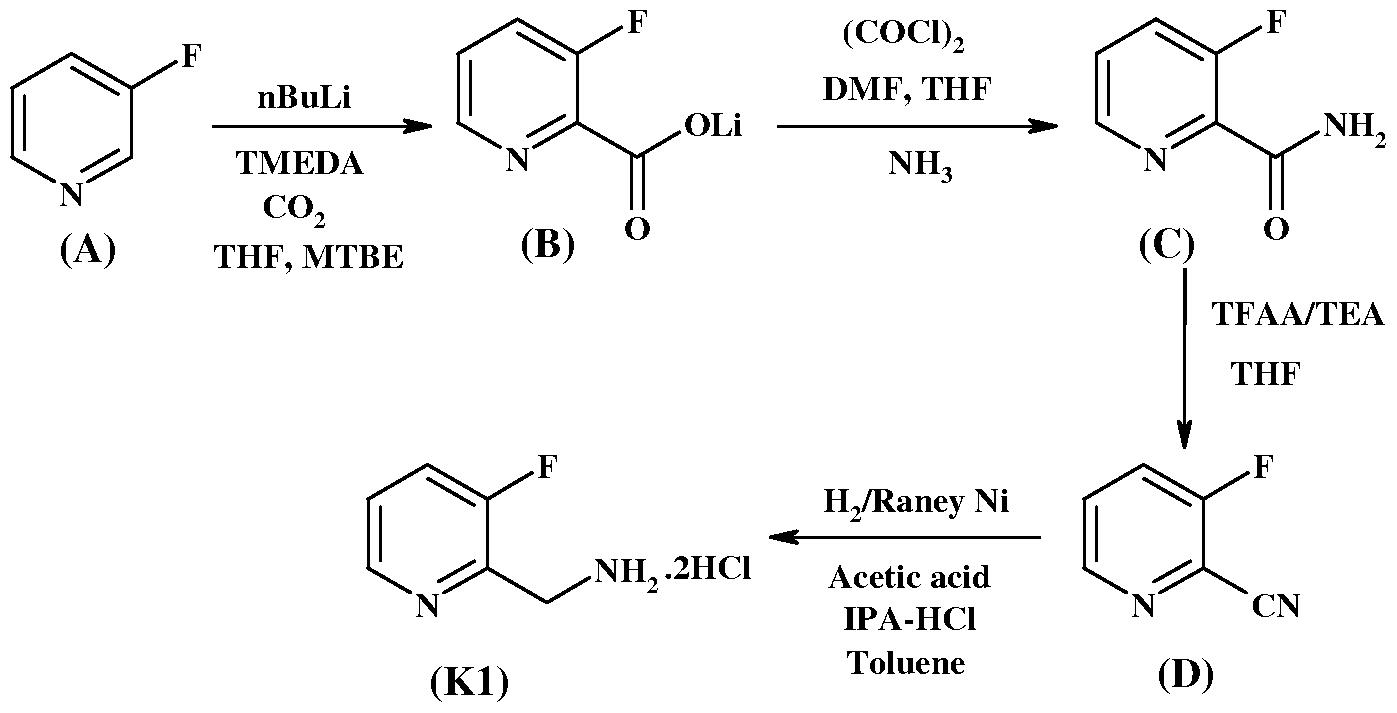
  • the synthetic scheme for the preparation of 2-aminomethyl-3-fluoropyridine.2HCl is depicted in Scheme 1 as follows.
  • a process for the preparation of 2,2-difluoro-2-(2- pyridyl)ethylamine as a benzenesulfonic acid (BSA) salt (K2) is provided (Scheme 2).
  • the improved process utilizes p-toluenesulfonyl chloride (pTsCl or Tosyl chloride) in the preparation of a tosylate or mesylate (J) from the corresponding difluoro alcohol (H).
  • pTsCl or Tosyl chloride p-toluenesulfonyl chloride
  • Triflic anhydride was used previously in place of low cost pTsCl or MsCl.
  • a process for purifying 3-fluoro-2-pyridylmethyl-3-(2,2- difluoro-2-(2-pyridyl)ethylamino)-6-chloropyrazin-2-one-l-acetamide, a compound of formula (I), using organic solvents including but not limited to ketones, alcohols, esters, ethers, hydrocarbons, halogenated solvents, and the like or a mixture thereof is provided.
  • Ketones include, but are not limited to, acetone, butanone and the like.
  • Alcohols include, but are not limited to, methanol, ethanol, n-propanol, isopropanol (IPA), n-butanol, t- butanol, hexanol, isoamyl alcohol and the like.
  • Esters include, but are not limited to, ethyl acetate, methyl acetate, isopropyl acetate and the like.
  • Ethers include, but are not limited to, diisopropyl ether (IPE), methyl t-butyl ether (MTBE) and the like.
  • Hydrocarbons include, but are not limited to, hexane, heptane, cyclohexane, decalin, pentane and the like.
  • Halogenated solvents include, but not limited to, dichloromethane (MDC), 1,2-dichloroethane and the like or mixture thereof, preferably acetone, isopropyl alcohol or mixtures thereof.
  • salts used herein includes inorganic acids such as hydrochloride (hydrochloric), hydrobromide (hydrobromic), sulfuric, sulfamic, phosphoric, nitric and the like, or quaternary ammonium salts, which are formed, e.g., from inorganic or organic acids or bases.
  • inorganic acids such as hydrochloride (hydrochloric), hydrobromide (hydrobromic), sulfuric, sulfamic, phosphoric, nitric and the like, or quaternary ammonium salts, which are formed, e.g., from inorganic or organic acids or bases.
  • acid addition salts include acetate, adipate, alginate, aspartate, benzoate, benzenesulphonate, bisulfate, butyrate, citrate, camphorate, camphorsulfonate, cyclopentanepropionate, digluconate, dodecylsulfate, ethanesulfonate, fumarate, glucoheptanoate, glycerophosphate, hemisulfate, heptanoate, hexanoate, hydrochloride, hydrobromide, hydroiodide, 2-hydroxyethanesulfonate, lactate, maleate, methanesulfonate, toluenesulfonate, 2-naphthalenesulfonate, nicotinate, nitrate, oxalate, pamoate, pectinate, persulfate, 3-phenylpropionate, picrate, pivalate, propionate,
  • Solvates are addition complexes in which a compound is combined with a solvent in some fixed proportion.
  • Solvents include, but are not limited to water, methanol, ethanol, 1-propanol, isopropanol, 1-butanol, isobutanol, i-butanol, acetone, methyl ethyl ketone, acetonitrile, ethyl acetate, benzene, toluene, xylene, ethylene glycol, dichloromethane, 1,2-dichloroethane, N-methylformamide, ⁇ , ⁇ -dimethylformamide, N- methylacetamide, pyridine, dioxane, diethyl ether and the like. Hydrates are solvates in which the solvent is water. It is to be understood that the definition of the compounds or intermediates of the present invention encompasses all possible hydrates and solvates, in any proportion.
  • thromboin inhibition is used for anticoagulant therapy in individuals having thrombotic conditions, and whenever inhibition of blood coagulation is required such as to prevent coagulation of stored whole blood and to prevent coagulation in other biological samples for testing or storage. Therefore, thrombin inhibitors are added to any medium containing or suspected of containing thrombin and in which it is desired that blood coagulation be inhibited.
  • the present invention provides an improved process for the preparation of compound of formula (I); an improved process for the preparation of key intermediates of the compound of formula (I); and/or a pharmaceutical composition comprising the compound; and/or a compound for inhibiting thrombin; and/or an improved method for inhibiting thrombin in blood.
  • Step-1 Lithium 3-fluoropyridin -2-carboxylate (B)
  • the RM was cooled to -75 °C, then 10 g of 3-fluoropyridine (in 10 mL of MTBE) was added dropwise while maintaining the temperature in the range of - 75 °C to - 70 °C.
  • the RM was stirred at the same temperature for 4 hours.
  • 100 mL of tetrahydrofuran (THF) was taken and cooled to - 70 °C followed by bubbling of C0 2 gas for 1 hour.
  • lithiated 3-fluoropyridine solution (mixture of 3- fluoropyridine + n-BuLi + TMEDA in MTBE) was added dropwise using cannula maintaining the reaction temperature below -70 °C (- 70 °C to - 60 °C). Bubbling of C0 2 gas was continued for another hour and then the reaction temperature was slowly brought to +30 °C. The resulting solid was filtered, dried and washed with 100 mL of 1:1 THF: MTBE, then vacuum dried at 45 °C, resulting in 14.5 g of the titled compound.
  • the RM temperature was brought to 10 to 15 °C and maintained for 30 minutes.
  • the RM was filtered, and the solid was washed with 5 mL of cold IPA, and dried under vacuum at 40 °C, resulting in 3.8 g of l-(3-fluoropyridin-2-yl)methanamine dihydrochloride salt (Kl).
  • the RM was quenched by adding saturated ammonium chloride solution at 0-5 °C and the volume of reaction mixture was reduced to half by distilling under vacuum.
  • the solution was basified with 50% NaOH solution and extracted with MTBE.
  • Step-4 Preparation of 2,2-Difluoro-2-pyridin-2-ylethanamine benzenesulfonate salt
  • Example 3 Process for purifying the compound of formula (I).

Landscapes

  • Chemical & Material Sciences (AREA)
  • Organic Chemistry (AREA)
  • Health & Medical Sciences (AREA)
  • Animal Behavior & Ethology (AREA)
  • Veterinary Medicine (AREA)
  • Public Health (AREA)
  • General Health & Medical Sciences (AREA)
  • Pharmacology & Pharmacy (AREA)
  • Medicinal Chemistry (AREA)
  • Life Sciences & Earth Sciences (AREA)
  • General Chemical & Material Sciences (AREA)
  • Bioinformatics & Cheminformatics (AREA)
  • Nuclear Medicine, Radiotherapy & Molecular Imaging (AREA)
  • Chemical Kinetics & Catalysis (AREA)
  • Engineering & Computer Science (AREA)
  • Epidemiology (AREA)
  • Hematology (AREA)
  • Diabetes (AREA)
  • Pyridine Compounds (AREA)
  • Pharmaceuticals Containing Other Organic And Inorganic Compounds (AREA)
  • Plural Heterocyclic Compounds (AREA)
  • Catalysts (AREA)
  • Low-Molecular Organic Synthesis Reactions Using Catalysts (AREA)

Abstract

An improved process for the preparation of 3-fruoro-2-pyridylmethyl-3-(2,2- difluoro-2-(2-pyridyl)ethylamino)-6-chloropyrazin-2-one- 1 -acetamide and its intermediates.

Description

PROCESS FOR THE PREPARATION OF PYRAZINONE
THROMBIN INHIBITOR AND ITS INTERMEDIATES
Related Application
This application claims priority under 35 U.S.C. § 119(a)-(d) to Indian Provisional Patent Application No. , filed November 3, 2009, the entire contents of which are incorporated herein by reference.
Field of the Invention
Processes for the preparation of 3-fluoro-2-pyridylmethyl-3-(2,2-difluoro-2-(2- pyridyl)ethylamino)-6-chloropyrazin-2-one-l-acetamide of the formula (I) and its intermediates are described.
Figure imgf000002_0001
Background of the Invention
3-Fluoro-2-pyridylmethyl-3-(2,2-difluoro-2-(2-pyridyl)ethylamino)-6-chloro pyrazin-2-one-l-acetamide of formula (I), which is useful as thrombin inhibitor is described in US 6,455,532 Bl. The following scheme-A is provided in US 6,455,532 Bl for the preparation of compound of formula (I).
Figure imgf000003_0001
Scheme-A
Process for preparing compound of formula (I) is described in WO2002046160 shown in the following scheme.
Figure imgf000003_0002
Organic Process Research and Development, 2004, 8(2), 192-200 describes a scalable process for the thrombin inhibitor of compound of formula (I). The following synthetic schemes are disclosed.
Figure imgf000004_0001
In order to appropriately develop an efficient, scalable and cost effective process by avoiding expensive and hazardous raw materials in the preparation of compound of formula (I) and its intermediates compared to the above-mentioned processes, we have come out with an improved process as provided in the following.
Described herein is an improved process for the preparation of 3-fluoro-2-pyridyl methyl-3-(2,2-difluoro-2-(2-pyridyl)ethylamino)-6-chloropyrazin-2-one-l-acetamide of compound of formula (I). The improvement comprises the preparation of intermediates namely, 2-aminomethyl-3-fluoropyridine or its salt (Kl) and 2,2-difluoro-2-(2-pyridyl) ethylamine or its salt (K2).
The present invention relates to a simple, commercially viable and industrially scalable process for the preparation of compound of the formula (I) and its intermediates, which involves the use of cost effective raw materials, simple isolation of the product, purification and work-up.
The present invention also relates to a simple and industrially scalable process for the preparation of compound of formula (I) and its intermediates, which avoids chromatographic purification techniques. Summary of the Invention
Accordingly, the present invention provides an improved process for the preparation of com ound of the formula (I).
Figure imgf000005_0001
The invention comprises processes for making key intermediates namely, 2- aminomethyl-3-fluoropyridine as a hydrochloride salt (Kl) and 2,2-difluoro-2-(2- pyridyl)ethylamine as a benzenesulfonic acid salt (K2). The intermediates (Kl) and (K2) are used in the preparation of compound of formula (I), thrombin inhibitor.
Process for the preparation of 2-aminomethyl-3-fluoropyridine or its salt (Kl) preferably dihydrochloride, which comprises the steps of:
(a) reducing nitrile compound of formula (D) with a reducing agent such as H2/Raney Nickel optionally in presence of acid selected from acetic acid, trifluoroacetic acid to amine compound of formula (Kl) and
(b) isolating 2-aminomethyl-3-fluoropyridine preferably as its hydrochloride salt by treatment with either alcoholic HC1 such as IPA.HC1 or purging dry HC1 in a suitable organic solvent selected from toluene, IPA, MeOH, EtOH and the like or mixture thereof.
Process for the preparation of 2,2-difluoro-2-(2-pyridyl)ethylamine or its salt (K2) preferably as a benzenesulfonic acid salt, which comprises the steps of:
(i) converting difluoro ethanol compound of formula (H) to tosylate compound of formula (J) using tosyl chloride or mesyl chloride and
(ii) treating mesylate or tosylate compound of formula (J) with ammonia to yield difluoroamine compound of formula (K2).
Process for the preparation of 3-fluoro-2-pyridylmethyl-3-(2,2-difluoro-2-(2- pyridyl)ethylamino)-6-chloropyrazin-2-one-l-acetamide, which comprises the steps of: (A) reacting 2,2-difluoro-2-(2-pyridyl)ethylamine or its salt (K2) with 3- chloropyrazin(lH)-2-one-l-acetate (K3) to form ethyl 3-(2,2-difluoro-2-(2- pyridyl) ethylamino)-pyrazin(lH)-2-one-l-acetate (K); (B) chlorinating the compound of formula (K) and further reacting with 2- aminomethyl-3-fluoropyridine or its salt (Kl) to form 3-fluoro-2- pyridylmethyl-3-(2,2-difluoro-2-(2-pyridyl)ethylamino)-6-chloropyrazin-2-one- 1-acetamide, the compound of formula (I); and
(C) optional purification of compound of formula (I).
The processes described herein can be used for the preparation of compound of formula (I) as a thrombin inhibitor.
Detailed Description of the Preferred Embodiment
Processes for the preparation of compound of formula (I) and key intermediates are described herein.
In a first embodiment, a process for the preparation of 2-aminomethyl-3- fluoropyridine as a hydrochloride salt (Kl) is provided. In another embodiment, a process for preparing 2-aminomethyl-3-fluoropyridine.2HCl (Kl) comprises reduction of 3-fluoropyridine-2-carbonitrile of a compound of formula (D) with the reducing agent H2/Raney Ni in the presence of acetic acid or trifluoroacetic acid. The reported processes use expensive H2/Pd/C that is replaced with cost-effective Raney Nickel. The synthetic scheme for the preparation of 2-aminomethyl-3-fluoropyridine.2HCl is depicted in Scheme 1 as follows.
Figure imgf000006_0001
(Kl) Toluene
Scheme 1
In a second embodiment, a process for the preparation of 2,2-difluoro-2-(2- pyridyl)ethylamine as a benzenesulfonic acid (BSA) salt (K2) is provided (Scheme 2). The improved process utilizes p-toluenesulfonyl chloride (pTsCl or Tosyl chloride) in the preparation of a tosylate or mesylate (J) from the corresponding difluoro alcohol (H). Triflic anhydride
Figure imgf000007_0001
was used previously in place of low cost pTsCl or MsCl.
Figure imgf000007_0002
Scheme 2
In another embodiment, a process for purifying 3-fluoro-2-pyridylmethyl-3-(2,2- difluoro-2-(2-pyridyl)ethylamino)-6-chloropyrazin-2-one-l-acetamide, a compound of formula (I), using organic solvents including but not limited to ketones, alcohols, esters, ethers, hydrocarbons, halogenated solvents, and the like or a mixture thereof is provided. Ketones include, but are not limited to, acetone, butanone and the like. Alcohols include, but are not limited to, methanol, ethanol, n-propanol, isopropanol (IPA), n-butanol, t- butanol, hexanol, isoamyl alcohol and the like. Esters include, but are not limited to, ethyl acetate, methyl acetate, isopropyl acetate and the like. Ethers include, but are not limited to, diisopropyl ether (IPE), methyl t-butyl ether (MTBE) and the like. Hydrocarbons include, but are not limited to, hexane, heptane, cyclohexane, decalin, pentane and the like. Halogenated solvents include, but not limited to, dichloromethane (MDC), 1,2-dichloroethane and the like or mixture thereof, preferably acetone, isopropyl alcohol or mixtures thereof.
In yet another embodiment a process for the preparation of a compound of formula (I) is provided:
Figure imgf000008_0001
in which 2,2-difluoro-2-(2-pyridyl)ethylamine or its salt (K2) is reacted with ethyl 3- chloropyrazin(lH)-2-one-l-acetate (K3) to form ethyl 3-(2,2-difluoro-2-(2- pyridyl)ethylamino)-pyrazin(lH)-2-one-l-acetate (K), chlorinated, which is further reacted with 2-aminomethyl-3-fluoropyridine or its salt (Kl) to form 3-fluoro-2- pyridylmethyl-3-(2,2-difluoro-2-(2-pyridyl)ethylamino)-6-chloropyrazin-2-one-l- acetamide, the compound of formula (I), the improvement comprising:
reducing 2-cyano-3-fluoropyridine with Raney Nickel optionally in the presence of an acid to form 2-aminomethyl-3-fluoropyridine or its salt (Kl);
reacting 2,2-difluoro-2-pyridin-2-ylethanol with 4-toluenesulfonyl chloride to form 2,2-difluoro-2-pyridin-2-ylethyl 4-methylbenzenesulfonate, which is converted to compound of formula (K2); and
optionally purifying the compound of formula (I).
The term, "salts" used herein includes inorganic acids such as hydrochloride (hydrochloric), hydrobromide (hydrobromic), sulfuric, sulfamic, phosphoric, nitric and the like, or quaternary ammonium salts, which are formed, e.g., from inorganic or organic acids or bases. Examples of acid addition salts include acetate, adipate, alginate, aspartate, benzoate, benzenesulphonate, bisulfate, butyrate, citrate, camphorate, camphorsulfonate, cyclopentanepropionate, digluconate, dodecylsulfate, ethanesulfonate, fumarate, glucoheptanoate, glycerophosphate, hemisulfate, heptanoate, hexanoate, hydrochloride, hydrobromide, hydroiodide, 2-hydroxyethanesulfonate, lactate, maleate, methanesulfonate, toluenesulfonate, 2-naphthalenesulfonate, nicotinate, nitrate, oxalate, pamoate, pectinate, persulfate, 3-phenylpropionate, picrate, pivalate, propionate, succinate, sulfate, tartrate, thiocyanate, tosylate, undecanoate and the like.
Solvates are addition complexes in which a compound is combined with a solvent in some fixed proportion. Solvents include, but are not limited to water, methanol, ethanol, 1-propanol, isopropanol, 1-butanol, isobutanol, i-butanol, acetone, methyl ethyl ketone, acetonitrile, ethyl acetate, benzene, toluene, xylene, ethylene glycol, dichloromethane, 1,2-dichloroethane, N-methylformamide, Ν,Ν-dimethylformamide, N- methylacetamide, pyridine, dioxane, diethyl ether and the like. Hydrates are solvates in which the solvent is water. It is to be understood that the definition of the compounds or intermediates of the present invention encompasses all possible hydrates and solvates, in any proportion.
When any term occurs more than once in the patent application, the definition thereof on each occurrence is independent of its definition at every other occurrence. This application contemplates all acceptable acid or base salt forms of the compounds, where applicable.
Thrombin inhibition is used for anticoagulant therapy in individuals having thrombotic conditions, and whenever inhibition of blood coagulation is required such as to prevent coagulation of stored whole blood and to prevent coagulation in other biological samples for testing or storage. Therefore, thrombin inhibitors are added to any medium containing or suspected of containing thrombin and in which it is desired that blood coagulation be inhibited.
The present invention provides an improved process for the preparation of compound of formula (I); an improved process for the preparation of key intermediates of the compound of formula (I); and/or a pharmaceutical composition comprising the compound; and/or a compound for inhibiting thrombin; and/or an improved method for inhibiting thrombin in blood.
The following examples are provided by way of illustration only, which should not be construed to limit the scope of the invention.
Scheme 1
Figure imgf000009_0001
Scheme 1 Example 1:
Preparation of l-(3-fluoropyridin-2- l)methanamine dihydrochloride salt (Kl)
Figure imgf000010_0001
Step-1: Lithium 3-fluoropyridin -2-carboxylate (B)
Figure imgf000010_0002
240 mL of Methyl ί-butyl ether (MTBE) and 18.55 mL of Ν,Ν,Ν',Ν'- tetramethylethylenediamine (TMEDA) are taken in a reaction flask under nitrogen atmosphere and cooled to - 70 °C to - 60 °C. To the cooled mass, 80 mL of n-BuLi (1.6 M in hexane) was added dropwise with stirring. Temperature of the reaction mixture (RM) was maintained at - 70 °C to - 60 °C for 1 hour. The RM was cooled to -75 °C, then 10 g of 3-fluoropyridine (in 10 mL of MTBE) was added dropwise while maintaining the temperature in the range of - 75 °C to - 70 °C. The RM was stirred at the same temperature for 4 hours. Meanwhile, in another reaction flask, 100 mL of tetrahydrofuran (THF) was taken and cooled to - 70 °C followed by bubbling of C02 gas for 1 hour. To this solution, lithiated 3-fluoropyridine solution (mixture of 3- fluoropyridine + n-BuLi + TMEDA in MTBE) was added dropwise using cannula maintaining the reaction temperature below -70 °C (- 70 °C to - 60 °C). Bubbling of C02 gas was continued for another hour and then the reaction temperature was slowly brought to +30 °C. The resulting solid was filtered, dried and washed with 100 mL of 1:1 THF: MTBE, then vacuum dried at 45 °C, resulting in 14.5 g of the titled compound.
Purification
The above dried mass (14.5 g) was taken into a reaction flask, 29 mL of methanol was added thereto at room temperature (RT) with stirring., then 145 mL of isopropyl alcohol (IP A) was slowly added. The reaction temperature was maintained at 10 °C to 15 °C for 30 minutes, then the solid obtained was filtered and dried under vacuum, resulting in 12 g of pure Lithium 3-fluoropyridine-2-carboxylate.
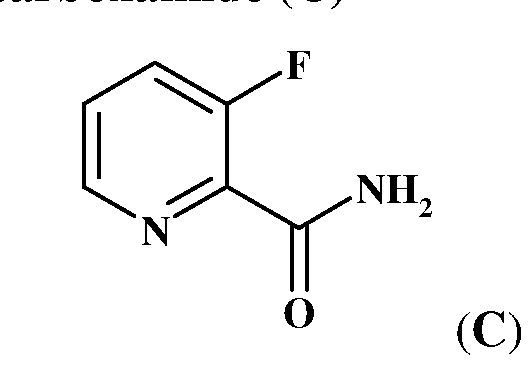
Step-2: 3-Fluoropyridine-2-carboxamide (C)
Figure imgf000011_0001
50 g of Lithium 3-fluoropyridine-2-carboxylate (B), 1.5 mL of N,N-dimethyl formamide (DMF) and 1.15 mL of THF were taken in a reaction flask and cooled to 0-5 °C. 74 mL of Oxalyl chloride was added dropwise and the reaction mass was stirred for 2 hours at 0-5 °C. After completion of the reaction, ammonia gas was bubbled into the RM for 2 hours and then reaction mass was brought to RT and stirred for 30 minutes. The RM was filtered and washed with 100 mL of THF. The residue was stirred with 300 mL of THF, filtered and washed with 50 mL of THF. The combined filtrates were distilled under vacuum to a residual volume of 100 mL. 450 mL of diisopropyl ether (IPE) was added dropwise to the concentrated mass at RT with stirring. After 30 minutes, the solid obtained was filtered, washed with 100 mL of IPE and dried under vacuum at 40 °C to 45 °C for 8 hours, resulting in 30 g of 3-fluoropyridine-2-carboxamide (C).
Step 3: 3-Fluoropyridine-2-carbonitrile (D)
Figure imgf000011_0002
(D)
30 g of 3-Fluoropyridine-2-carboxamide (C), 120 mL of THF and 768.5 mL of TEA were taken in a reaction flask and cooled to 0-5 °C. To this mixture, 72.2 mL of Trifluoroacetic anhydride (in 30 mL of THF) was added dropwise over a period of 30 minutes keeping the reaction temperature below 5 °C (0 °C to 5 °C) and the RM was stirred for 2 hours 30 minutes at a temperature below 10 °C (5 °C to 10 °C). After completion of the reaction, 150 mL of 20% Na2C03 solution was added dropwise to the RM while maintaining the temperature below 10 °C (5 °C to 5 °C), followed by addition of 360 mL of purified water. The RM was brought to room temperature (RT) and extracted with dichloromethane (MDC) and the organic layer was washed with 300 mL purified water, 150 mL of 2% dil HC1, followed by purified water and brine. The organic layer was dried over Na2S04 and distilled under vacuum, resulting in the titled compound as a dark brown viscous oily mass. Crude Yield: 22-24 g.
Step 4: l-(3-Fluoropyridin-2-yl)methanamine dihydrochloride salt (Kl)
Figure imgf000012_0001
3g of 3-Fluoropyridine-2-carbonitrile (D) (crude), 50 mL of acetic acid and 0.75 g of Raney Ni were taken in a par shaker vessel. The reaction mass was hydrogenated for 4 hours under 6 kg hydrogen pressure at RT. After completion of the reaction, the catalyst was filtered off and the bed was washed with 30 mL of isopropyl alcohol (IPA). The combined filtrate was concentrated under vacuum. To this mass, 30 mL of toluene was added and distilled off to a minimum volume. To the above residue, 20 mL of toluene and 13 mL of IPA.HC1 was added dropwise at RT with stirring. After 30 minutes, the RM temperature was brought to 10 to 15 °C and maintained for 30 minutes. The RM was filtered, and the solid was washed with 5 mL of cold IPA, and dried under vacuum at 40 °C, resulting in 3.8 g of l-(3-fluoropyridin-2-yl)methanamine dihydrochloride salt (Kl).
Scheme 2:
Figure imgf000013_0001
Scheme 2
Example 2:
Preparation of 2,2-Difluoro-2- ridin-2-ylethanamine benzene sulfonate salt (K2):
Figure imgf000013_0002
Step-1: Preparation of Ethyl difluoro(pyridin-2-yl)acetate (G)
Figure imgf000013_0003
2-Bromopyridine (20 g), ethyl bromodifluoroacetate (27.2 g) and DMF (120 mL) were added and stirred for 10 minutes under nitrogen. Copper powder was added to the reaction mixture and heated to 70-80 °C for 45 minutes. The reaction mixture was cooled to RT and 400 mL of isopropyl acetate (IP Ac) was added. The reaction mixture was quenched with the aqueous potassium dihydrogen phosphate at 0 -10 °C and stirred for 30 minutes. The reaction mixture was filtered off and the residue obtained was washed with ethyl acetate. The organic layer was collected and washed with brine solution and dried over sodium sulphate then distilled under vacuum. (Crude weight = 20 g).
Step 2: Preparation of 2,2-Difluoro-2- ridin-2-ylethanol (H)
Figure imgf000014_0001
Ethyl difluoro(pyridin-2-yl)acetate (G) obtained in step 1 (20 g) and 120 mL of ethanol were added, and 4 g of sodium borohydride was added to the reaction mixture over a period of 30 minutes at 0-5 °C. The reaction mixture was stirred for 1 hour at 0-10 °C. After completion of the reaction, the RM was quenched by adding saturated ammonium chloride solution at 0-5 °C and the volume of reaction mixture was reduced to half by distilling under vacuum. The solution was basified with 50% NaOH solution and extracted with MTBE. The organic layer was washed with a brine solution, dried over sodium sulphate and distilled under vacuum. The crude material was dissolved in 40 mL MTBE, 70 mL of n-hexane at 0-10 °C was added, and the RM was stirred for 30 minutes. The solid obtained was filtered and washed with hexane, resulting in pure product. (Yield = 11 g).
Step-3: Preparation of 2,2-Difluoro-2-pyridin-2-ylethyl 4-methylbenzenesulfonate
(J)
Figure imgf000014_0002
2,2-Difluoro-2-pyridin-2-ylethanol (H) from step 2 (10 g) was dissolved in 100 mL of MDC, 19 g of TEA was added, then the RM was cooled to 0 -10 °C. To the cooled solution, 16.77 g of pTsCl was added over a period of 1 hour and stirred for 24 hours at RT. The RM was then quenched with 100 mL of 10% sodium bicarbonate solution and the organic layers were separated. The aqueous layer was extracted with (100 mL x 3) MDC. The organic layer was combined and washed with 10% sodium bicarbonate (150 mL), followed by water (150 mL) and a brine solution (150 mL). The organic layer was distilled under vacuum. The crude mass obtained was treated with 30 mL of hexane with cooling and filtered, resulting in pure tosylate. (Weight = 15 g, Yield = 76.2 %). It should be noted that the above process may be followed for the preparation of other sulfonates such as methanesulfonate by using the corresponding sulfonyl chloride (e.g. methanesulfonyl chloride). The compound thus prepared is used in the preparation of a compound of formula (K2). 1H-NMR (CDC13, δ, ppm): 400 MHz: 2.45
(s, 3H), 4.63-4.69 (t, 2H), 7.31-7.33 (d, 2H), 7.36-7.39 (t, 1H), 7.63-7.65(d, 1H), 7.71- 7.73 (d, 2H), 7.79-7.82 (t, 1H), 8.55 - 8.54 (d, 1H); MS m/z: 314 (M+l).
Step-4: Preparation of 2,2-Difluoro-2-pyridin-2-ylethanamine benzenesulfonate salt
(K2)
Figure imgf000015_0001
10 g of 2,2-Difluoro-2-pyridin-2-ylethyl 4-methylbenzenesulfonate (J) obtained in step 3, 5 g of Nal, 20 mL of DMSO and 90 mL of aqueous ammonia were taken in a 500 mL autoclave vessel. The reaction mixture was heated to 80 °C and a pressure of 15 to 17 kg of ammonia maintained for 30-40 hours. The volume of the reaction mass was reduced by vacuum distillation. The RM was washed with 60 mL of IPE. The pH of the RM was adjusted to 10-14 by adding a 50 % NaOH solution and extracted three times with 60 mL of MDC. The combined MDC layers were washed with brine, dried over sodium sulphate and distilled under vacuum (crude weight = 8 g). The crude mass obtained was dissolved with 10 mL of MDC, and to this 4.5 g benzene sulphonic acid (BSA) dissolved in 30 mL isopropyl acetate (IPAc) was added dropwise over a period of 30 minutes with stirring at RT. The RM was stirred for 30 minutes at RT. The solid obtained was filtered and washed with IPAc and dried under vacuum, resulting in 5 g of the titled compound (Yield = 49.5 %). Scheme 3:
Figure imgf000016_0001
t arcoa
Preparation of 3-fluoro-2-pyridyl-methyl-3(2,3-difluoro-2-(2-pyridyl)ethylamino)-6- chloro-pyrazin-2-one-l -acetamide I) :
Figure imgf000016_0002
Ethyl 3-chloropyrazin(lH)-2-one-l-acetate (K3) was reacted with 2,2-difluoro-2- (2-pyridyl)ethylamine or its salt (K2), which on chlorination and further treatment with 2-aminomethyl-3-fluoropyridine or its salt (Kl) by following the procedure, which is illustrated in the art to yield the compound of formula (I). The compound of formula (I) was purified by following the procedure as described below.
Example 3: Process for purifying the compound of formula (I).
To the crude sample obtained (10 g), a mixture of 40 mL of acetone and 60 mL of isopropyl alcohol were added, and then the reaction mixture was heated to reflux over a period of 1.5 hours to 2.5 hours. The reaction mixture was filtered and washed with 30 mL of cold isopropyl alcohol (0-5 °C). The product obtained was dried under vacuum at 50-55 °C up to 8-10 hours to yield 8-9 g of the pure compound of formula (I). Yield = 80-90%.
Having thus described in detail preferred embodiments of the present invention, it is to be understood that the invention defined by the above paragraphs is not to be limited to particular details set forth in the above description, as many apparent variations thereof are possible without departing from the spirit or scope of the present invention.

Claims

What is claimed is:
1. In a process for the preparation of a compound of formula (I):
Figure imgf000018_0001
wherein 2,2-difluoro-2-(2-pyridyl)ethylamine or its salt (K2) is reacted with ethyl 3- chloropyrazin(lH)-2-one-l-acetate (K3) to form ethyl 3-(2,2-difluoro-2-(2- pyridyl)ethylamino)-pyrazin(lH)-2-one-l-acetate (K), chlorinated, which is further reacted with 2-aminomethyl-3-fluoropyridine or its salt (Kl) to form 3-fluoro-2- pyridylmethyl-3-(2,2-difluoro-2-(2-pyridyl)ethylamino)-6-chloropyrazin-2-one-l- acetamide, the compound of formula (I), the improvement comprising:
reducing 2-cyano-3-fluoropyridine with Raney Nickel optionally in the presence of an acid to form 2-aminomethyl-3-fluoropyridine or its salt (Kl);
reacting 2,2-difluoro-2-pyridin-2-ylethanol with 4-toluenesulfonyl chloride to form 2,2-difluoro-2-pyridin-2-ylethyl 4-methylbenzenesulfonate, which is converted to compound of formula (K2); and
optionally purifying the compound of formula (I).
2. The process of claim 1, wherein salt used comprises one or more of hydrochloride, hydrobromide, benzenesulphonate, hydrate or solvate.
3. The process of claim 1, wherein acid used in reducing 2-cyano-3- fluoropyridine comprises acetic acid or trifluoroacetic acid.
4. The process for purifying the compound of formula (I), wherein the organic solvent is selected from the group consisting of a ketone, alcohol, ester, ether, hydrocarbon, halogenated solvent and a mixture thereof.
5. The process of claim 4, wherein the ketone is acetone or butanone
6. The process of claim 4, wherein the alcohol is selected from the group consisting of methanol, ethanol, n-propanol, isopropanol (IPA), n-butanol, i-butanol, hexanol and isoamyl alcohol
7. The process of claim 4, wherein the ester is selected from the group consisting of ethyl acetate, methyl acetate and isopropyl acetate
8. The process of claim 4, wherein the ether is diisopropyl ether or methyl i-butyl ether (MTBE)
9. The process of claim 4, wherein the hydrocarbon is selected from the group consisting of hexane, heptane, cyclohexane, decalin and pentane
10. The process of claim 4, wherein the halogenated solvent is dichloromethane (MDC) or 1,2-dichloroethane.
11. The process of claim 4, wherein the organic solvent is acetone, isopropyl alcohol or a mixture thereof.
12. A process for the preparation of 2-aminomethyl-3-fluoropyridine or its salt (Kl), which comprises reducing 2-cyano-3-fluoropyridine using Raney Nickel/H2.
13. The compound 2,2-difluoro-2-pyridin-2-ylethyl 4-methylbenzenesulfonate.
14. A process for the preparation of 2,2-difluoro-2-pyridin-2-ylethyl sulfonate, comprising reacting 2,2-difluoro-2-pyridin-2-ylethanol with 4-toluenesulfonyl chloride or methanesulfonyl chloride.
15. A compound of formula (I) prepared by a process according to claim 1.
16. A compound of formula (I) prepared by a process according to claim 12.
17. A compound of formula (I) prepared by a process according to claim 14.
PCT/US2010/055176 2009-11-03 2010-11-02 Process for the preparation of pyrazinone thrombin inhibitor and its intermediates Ceased WO2011056806A1 (en)

Priority Applications (7)

Application Number Priority Date Filing Date Title
CN2010800499062A CN102711481A (en) 2009-11-03 2010-11-02 Process for the preparation of pyrazinone thrombin inhibitor and its intermediates
EP10828989.3A EP2496087A4 (en) 2009-11-03 2010-11-02 Process for the preparation of pyrazinone thrombin inhibitor and its intermediates
JP2012537955A JP2013510159A (en) 2009-11-03 2010-11-02 Pyrazinone thrombin inhibitor and method for producing the same
MX2012005165A MX2012005165A (en) 2009-11-03 2010-11-02 Process for the preparation of pyrazinone thrombin inhibitor and its intermediates.
CA2778922A CA2778922A1 (en) 2009-11-03 2010-11-02 Process for the preparation of pyrazinone thrombin inhibitor and its intermediates
RU2012118499/04A RU2012118499A (en) 2009-11-03 2010-11-02 METHOD FOR PRODUCING THROMBIN PYRAZININE INHIBITOR AND INTERMEDIATE COMPOUNDS FOR ITS PRODUCTION
AU2010315338A AU2010315338A1 (en) 2009-11-03 2010-11-02 Process for the preparation of pyrazinone thrombin inhibitor and its intermediates

Applications Claiming Priority (2)

Application Number Priority Date Filing Date Title
IN2663CH2009 2009-11-03
IN2663/CHE/2009 2009-11-03

Publications (1)

Publication Number Publication Date
WO2011056806A1 true WO2011056806A1 (en) 2011-05-12

Family

ID=43926105

Family Applications (1)

Application Number Title Priority Date Filing Date
PCT/US2010/055176 Ceased WO2011056806A1 (en) 2009-11-03 2010-11-02 Process for the preparation of pyrazinone thrombin inhibitor and its intermediates

Country Status (10)

Country Link
US (1) US8541580B2 (en)
EP (1) EP2496087A4 (en)
JP (1) JP2013510159A (en)
KR (1) KR20120106727A (en)
CN (1) CN102711481A (en)
AU (1) AU2010315338A1 (en)
CA (1) CA2778922A1 (en)
MX (1) MX2012005165A (en)
RU (1) RU2012118499A (en)
WO (1) WO2011056806A1 (en)

Families Citing this family (4)

* Cited by examiner, † Cited by third party
Publication number Priority date Publication date Assignee Title
KR20140090663A (en) 2011-11-07 2014-07-17 디아크론 파마슈티칼스, 인코포레이티드 An extended release formulation of a direct thrombin inhibitor
MX392191B (en) 2015-10-26 2025-03-21 Bayer Cropscience Ag DERIVATIVES OF CONDENSED BICYCLIC HETEROCYCLES AS PEST CONTROL AGENTS.
JP7535532B2 (en) 2019-02-26 2024-08-16 バイエル・アクチエンゲゼルシヤフト Fused bicyclic heterocyclic derivatives as pest control agents.
EP3931193A1 (en) 2019-02-26 2022-01-05 Bayer Aktiengesellschaft Fused bicyclic heterocycle derivatives as pesticides

Citations (3)

* Cited by examiner, † Cited by third party
Publication number Priority date Publication date Assignee Title
US6147078A (en) * 1998-05-19 2000-11-14 Merck & Co., Inc. Pyrazinone thrombin inhibitors
WO2002046160A2 (en) * 2000-12-06 2002-06-13 Merck & Co., Inc. Process for making a thrombin inhibitor
US7456290B2 (en) * 2002-11-20 2008-11-25 Bayer Cropscience S.A. Process for the preparation of 2-aminomethylpyridine derivative

Family Cites Families (1)

* Cited by examiner, † Cited by third party
Publication number Priority date Publication date Assignee Title
UA58636C2 (en) * 1999-06-04 2003-08-15 Мерк Енд Ко., Інк. Pyrazinone thrombin inhibitors, pharmaceutical composition, method for treatment conditions caused by thrombus formation

Patent Citations (3)

* Cited by examiner, † Cited by third party
Publication number Priority date Publication date Assignee Title
US6147078A (en) * 1998-05-19 2000-11-14 Merck & Co., Inc. Pyrazinone thrombin inhibitors
WO2002046160A2 (en) * 2000-12-06 2002-06-13 Merck & Co., Inc. Process for making a thrombin inhibitor
US7456290B2 (en) * 2002-11-20 2008-11-25 Bayer Cropscience S.A. Process for the preparation of 2-aminomethylpyridine derivative

Non-Patent Citations (2)

* Cited by examiner, † Cited by third party
Title
See also references of EP2496087A4 *
WADE JR.: "Reactions of Alcohols, PowerPoint Presentation", ORGANIC CHEMISTRY, 2003, BLACKBURN, DALLAS COUNTY COMMUNITY COLLEGE DISTRICT, pages 1 - 37 *

Also Published As

Publication number Publication date
CA2778922A1 (en) 2011-05-12
EP2496087A4 (en) 2013-06-19
CN102711481A (en) 2012-10-03
RU2012118499A (en) 2013-12-10
KR20120106727A (en) 2012-09-26
AU2010315338A1 (en) 2012-05-24
US20110105753A1 (en) 2011-05-05
MX2012005165A (en) 2012-08-08
EP2496087A1 (en) 2012-09-12
JP2013510159A (en) 2013-03-21
US8541580B2 (en) 2013-09-24

Similar Documents

Publication Publication Date Title
KR101084451B1 (en) 2-pyrazinecarboxamide derivatives
JP5604424B2 (en) Method for the preparation of proapoptotic agent ABT-263
WO2012025944A2 (en) Sitagliptin, salts and polymorphs thereof
JP2023548666A (en) 3-Fluoro-5-(((1S,2aR)-1,3,3,4,4-pentafluoro-2a-hydroxy-2,2a,3,4-tetrahydro-1H-cyclopenta[cd]indene-7 Method of preparing -yl)oxy)-benzonitrile
WO2011056806A1 (en) Process for the preparation of pyrazinone thrombin inhibitor and its intermediates
CA3216002A1 (en) Preparation method for pyrrole amide compound
Dallanoce et al. Synthesis and functional characterization of novel derivatives related to oxotremorine and oxotremorine-M
AU751015B2 (en) Novel sulfonamide substituted chroman derivatives useful as beta-3 adrenoreceptor agonists
US20250145623A1 (en) Methods of preparation of heterocyclic compounds
Gavhane et al. Short and stereodivergent syntheses of (−)-5-epi-tashiromine and (−)-tashiromine and the formal synthesis of (−)-isoretronecanol and (−)-trachelanthamidine
US6469172B2 (en) Process for the preparation of chemical compounds
US8815870B2 (en) 4-(2-(6-substituted-hexylidene) hydrazinyl)benzonitrile and preparation thereof
CA2437954C (en) Process for producing quinolinecarboxyaldehyde derivative and intermediate
DE60006125T2 (en) PREPARATION OF 2- (2-ARYLMORPHOLIN-2-YL) ETHANOL DERIVATIVES AND INTERMEDIATE PRODUCTS
CA2562578C (en) Process for production of pyrazole-fused ring derivatives
KR20260002957A (en) Method for producing sulfamoylbenzoic acid derivatives
JP4769464B2 (en) Method for producing alcohol compound
Zeng et al. Synthesis of 2, 2, 6, 6-tetrafluoro-4-phenylmethylmorpholin-3-ones: A simple approach from fluorinated triethylene glycol
KR20240052932A (en) Method for preparing synthetic intermediates of monocyclic pyridine derivatives
AU700600B2 (en) (S)-5,7-difluoro-1,2,3,4-tetrahydronaphthalen-2-ylamine and its preparation
JP4310511B2 (en) Method for producing aminomethylpyridine
JP2003221394A (en) Method for producing quinuclidine derivative
JP2008247889A (en) Process for producing ε-caprolactone compound
Su et al. A novel synthesis of N-substituted 2-(benzotriazol-1-yl) acetamides promoted by samarium diiodide
WO2007035003A1 (en) Process for producing optically active piperazine compound

Legal Events

Date Code Title Description
WWE Wipo information: entry into national phase

Ref document number: 201080049906.2

Country of ref document: CN

121 Ep: the epo has been informed by wipo that ep was designated in this application

Ref document number: 10828989

Country of ref document: EP

Kind code of ref document: A1

WWE Wipo information: entry into national phase

Ref document number: 3577/DELNP/2012

Country of ref document: IN

WWE Wipo information: entry into national phase

Ref document number: 2778922

Country of ref document: CA

ENP Entry into the national phase

Ref document number: 20127010789

Country of ref document: KR

Kind code of ref document: A

WWE Wipo information: entry into national phase

Ref document number: 2010315338

Country of ref document: AU

REEP Request for entry into the european phase

Ref document number: 2010828989

Country of ref document: EP

WWE Wipo information: entry into national phase

Ref document number: 2010828989

Country of ref document: EP

WWE Wipo information: entry into national phase

Ref document number: 2012537955

Country of ref document: JP

Ref document number: MX/A/2012/005165

Country of ref document: MX

NENP Non-entry into the national phase

Ref country code: DE

ENP Entry into the national phase

Ref document number: 2010315338

Country of ref document: AU

Date of ref document: 20101102

Kind code of ref document: A

WWE Wipo information: entry into national phase

Ref document number: 2012118499

Country of ref document: RU