WO2011062231A1 - 耐熱超合金 - Google Patents
耐熱超合金 Download PDFInfo
- Publication number
- WO2011062231A1 WO2011062231A1 PCT/JP2010/070583 JP2010070583W WO2011062231A1 WO 2011062231 A1 WO2011062231 A1 WO 2011062231A1 JP 2010070583 W JP2010070583 W JP 2010070583W WO 2011062231 A1 WO2011062231 A1 WO 2011062231A1
- Authority
- WO
- WIPO (PCT)
- Prior art keywords
- mass
- less
- added
- amount
- heat
- Prior art date
- Legal status (The legal status is an assumption and is not a legal conclusion. Google has not performed a legal analysis and makes no representation as to the accuracy of the status listed.)
- Ceased
Links
Images


Classifications
-
- C—CHEMISTRY; METALLURGY
- C22—METALLURGY; FERROUS OR NON-FERROUS ALLOYS; TREATMENT OF ALLOYS OR NON-FERROUS METALS
- C22C—ALLOYS
- C22C19/00—Alloys based on nickel or cobalt
- C22C19/03—Alloys based on nickel or cobalt based on nickel
- C22C19/05—Alloys based on nickel or cobalt based on nickel with chromium
- C22C19/051—Alloys based on nickel or cobalt based on nickel with chromium and Mo or W
- C22C19/055—Alloys based on nickel or cobalt based on nickel with chromium and Mo or W with the maximum Cr content being at least 20% but less than 30%
-
- B—PERFORMING OPERATIONS; TRANSPORTING
- B21—MECHANICAL METAL-WORKING WITHOUT ESSENTIALLY REMOVING MATERIAL; PUNCHING METAL
- B21K—MAKING FORGED OR PRESSED METAL PRODUCTS, e.g. HORSE-SHOES, RIVETS, BOLTS OR WHEELS
- B21K1/00—Making machine elements
- B21K1/28—Making machine elements wheels; discs
- B21K1/32—Making machine elements wheels; discs discs, e.g. disc wheels
-
- C—CHEMISTRY; METALLURGY
- C22—METALLURGY; FERROUS OR NON-FERROUS ALLOYS; TREATMENT OF ALLOYS OR NON-FERROUS METALS
- C22C—ALLOYS
- C22C1/00—Making non-ferrous alloys
- C22C1/04—Making non-ferrous alloys by powder metallurgy
- C22C1/0433—Nickel- or cobalt-based alloys
-
- C—CHEMISTRY; METALLURGY
- C22—METALLURGY; FERROUS OR NON-FERROUS ALLOYS; TREATMENT OF ALLOYS OR NON-FERROUS METALS
- C22C—ALLOYS
- C22C19/00—Alloys based on nickel or cobalt
- C22C19/03—Alloys based on nickel or cobalt based on nickel
- C22C19/05—Alloys based on nickel or cobalt based on nickel with chromium
- C22C19/051—Alloys based on nickel or cobalt based on nickel with chromium and Mo or W
- C22C19/056—Alloys based on nickel or cobalt based on nickel with chromium and Mo or W with the maximum Cr content being at least 10% but less than 20%
-
- C—CHEMISTRY; METALLURGY
- C22—METALLURGY; FERROUS OR NON-FERROUS ALLOYS; TREATMENT OF ALLOYS OR NON-FERROUS METALS
- C22C—ALLOYS
- C22C19/00—Alloys based on nickel or cobalt
- C22C19/07—Alloys based on nickel or cobalt based on cobalt
-
- C—CHEMISTRY; METALLURGY
- C22—METALLURGY; FERROUS OR NON-FERROUS ALLOYS; TREATMENT OF ALLOYS OR NON-FERROUS METALS
- C22C—ALLOYS
- C22C30/00—Alloys containing less than 50% by weight of each constituent
-
- C—CHEMISTRY; METALLURGY
- C22—METALLURGY; FERROUS OR NON-FERROUS ALLOYS; TREATMENT OF ALLOYS OR NON-FERROUS METALS
- C22F—CHANGING THE PHYSICAL STRUCTURE OF NON-FERROUS METALS AND NON-FERROUS ALLOYS
- C22F1/00—Changing the physical structure of non-ferrous metals or alloys by heat treatment or by hot or cold working
- C22F1/10—Changing the physical structure of non-ferrous metals or alloys by heat treatment or by hot or cold working of nickel or cobalt or alloys based thereon
-
- F—MECHANICAL ENGINEERING; LIGHTING; HEATING; WEAPONS; BLASTING
- F01—MACHINES OR ENGINES IN GENERAL; ENGINE PLANTS IN GENERAL; STEAM ENGINES
- F01D—NON-POSITIVE DISPLACEMENT MACHINES OR ENGINES, e.g. STEAM TURBINES
- F01D5/00—Blades; Blade-carrying members; Heating, heat-insulating, cooling or antivibration means on the blades or the members
- F01D5/02—Blade-carrying members, e.g. rotors
-
- F—MECHANICAL ENGINEERING; LIGHTING; HEATING; WEAPONS; BLASTING
- F05—INDEXING SCHEMES RELATING TO ENGINES OR PUMPS IN VARIOUS SUBCLASSES OF CLASSES F01-F04
- F05D—INDEXING SCHEME FOR ASPECTS RELATING TO NON-POSITIVE-DISPLACEMENT MACHINES OR ENGINES, GAS-TURBINES OR JET-PROPULSION PLANTS
- F05D2300/00—Materials; Properties thereof
- F05D2300/10—Metals, alloys or intermetallic compounds
- F05D2300/14—Noble metals, i.e. Ag, Au, platinum group metals
- F05D2300/143—Platinum group metals, i.e. Os, Ir, Pt, Ru, Rh, Pd
- F05D2300/1432—Ruthenium
Definitions
- the present invention relates to a heat-resistant member such as an aircraft engine or a power generation gas turbine, and more particularly to a heat-resistant superalloy used for a turbine disk, a turbine blade, or the like.
- Turbine disks which are heat-resistant members such as aircraft engines and power generation gas turbines, are components that hold moving blades and rotate at high speed. For this reason, the turbine disk is required to have a material that can withstand a very large centrifugal stress and is excellent in fatigue strength, creep strength, and fracture toughness. On the other hand, with improvement in fuel efficiency and performance, improvement in engine gas temperature and weight reduction of the turbine disk are required, and higher heat resistance and strength are required for the material.
- Ni-based forged alloys are used for turbine disks.
- Inconel 718 which uses a ⁇ ′′ (gamma double prime) phase as a reinforcing phase, and a ⁇ ′ (gamma prime) phase that is more stable than the ⁇ ′′ phase.
- Waspaloy which is precipitated as about 25 vol% and used as a reinforcing phase, is frequently used.
- Udimet720 developed by Special Metals has been introduced since 1986 from the viewpoint of increasing the temperature. This Udimet 720 is one in which about 45 vol% of the ⁇ ′ phase is precipitated and tungsten is added for strengthening the solid solution of the ⁇ phase, and exhibits excellent heat resistance.
- Udimet720 has poor tissue stability and a harmful TCP (Topologically close packed) phase is formed during use, so Udimit720Li (U720Li / U720LI) has been developed with improvements such as reducing the amount of chromium. .
- Udimit720Li U720Li / U720LI
- Udimit720Li U720Li / U720LI
- Udimit720Li have a narrow process window for hot working and heat treatment because the difference between the ⁇ ′ solidus temperature and the initial melting temperature is small. For this reason, it is difficult to produce a homogeneous turbine disk by a casting / forging process, which is a practical problem.
- powder metallurgical alloys represented by AF115, N18, Rene88DT, etc. may be used for high-pressure turbine disks that require high strength.
- the powder metallurgy alloy has an advantage that a homogeneous disk with almost no segregation can be obtained even though it contains a lot of reinforcing elements.
- advanced manufacturing process management such as vacuum melting with high cleanliness and optimization of mesh size at the time of powder classification is required, and there is a problem of cost increase.
- Titanium is added because it has a function of strengthening the ⁇ 'phase and is effective in improving tensile strength and crack propagation resistance.
- excessive addition of titanium raises the ⁇ ′ solidus temperature and generates a harmful phase, making it difficult to obtain a healthy ⁇ ′ structure. It was restricted.
- the inventors of the present invention can suppress harmful TCP phases by positively adding cobalt up to 55% by mass, and increase titanium at a predetermined ratio simultaneously with cobalt to increase ⁇ / It has been found that the two-phase structure of ⁇ ′ can be stabilized, and a heat-resistant superalloy that can withstand a long time even in a higher temperature range has been proposed.
- the above-mentioned heat-resistant superalloy already proposed by the present inventors has excellent heat resistance as a novel alloy in which titanium is increased at a predetermined ratio simultaneously with cobalt.
- the ⁇ phase Ni 3 Ti
- the ⁇ phase is plate-like and becomes a factor that impairs ductility around room temperature, and the ⁇ phase is also cellular and becomes a factor that reduces notched stress rupture strength. For this reason, it is strongly desired to develop a highly reliable heat-resistant superalloy that balances excellent heat resistance and workability.
- the inventors of the present invention have made extensive studies on the technical means for controlling the generation of the ⁇ phase, and as a result, the addition of ruthenium to the heat-resistant superalloy proposed by the inventor The present inventors have newly found that it has a remarkable effect on suppression, and have completed the present invention based on this finding.
- the heat-resistant superalloy of the present invention includes chromium, aluminum, cobalt, titanium, and ruthenium added as main components, the addition of subcomponents is allowed, and the remainder excluding the main components and subcomponents Is a heat-resistant superalloy consisting of nickel and inevitable impurities,
- the addition amount of chromium is 2% by mass or more and 25% by mass or less
- the addition amount of aluminum is 0.2 mass% or more and 7 mass% or less
- the addition amount of cobalt is 19.5 mass% or more and 55 mass% or less
- the addition amount of titanium is [0.17 ⁇ (mass% of cobalt ⁇ 23) +3] mass% or more and [0.17 ⁇ (mass% of cobalt ⁇ 20) +7] mass% or less (however, 5.1 mass%) Or more)
- the amount of ruthenium added is 0.1 mass% or more and 10 mass% or less, It is characterized by being.
- the amount of titanium added is [0.17 ⁇ (mass% of cobalt ⁇ 23) +3] mass% or more and [0.17 ⁇ (mass% of cobalt ⁇ 20) +7] mass% or less ( However, 5.3 mass% or more and 11 mass% or less), and at least any one of molybdenum or tungsten is added as a subcomponent, The addition amount of molybdenum is 5 mass% or less, The addition amount of tungsten is 5% by mass or less, It is preferable that
- At least one of zirconium, carbon, or boron is added as a subcomponent,
- the amount of zirconium added is 0.01 mass% or more and 0.2 mass% or less
- the amount of carbon added is 0.01 mass% or more and 0.15 mass% or less
- the amount of boron added is 0.005 mass% or more and 0.1 mass% or less, It is preferable that
- the heat-resistant superalloy as subcomponents, at least one of molybdenum or tungsten and at least one of zirconium, carbon, or boron are added,
- the addition amount of molybdenum is 5 mass% or less
- the addition amount of tungsten is 5% by mass or less
- the amount of zirconium added is 0.01 mass% or more and 0.2 mass% or less
- the amount of carbon added is 0.01 mass% or more and 0.15 mass% or less
- the amount of boron added is 0.005 mass% or more and 0.1 mass% or less, It is preferable that
- At least one of molybdenum or tungsten, at least one of tantalum or niobium, and at least one of zirconium, carbon, or boron are added as subcomponents,
- the addition amount of molybdenum is 5 mass% or less
- the addition amount of tungsten is 5% by mass or less
- the amount of tantalum added is 2% by mass or less
- the amount of niobium added is 2% by mass or less
- the amount of zirconium added is 0.01 mass% or more and 0.2 mass% or less
- the amount of carbon added is 0.01 mass% or more and 0.15 mass% or less
- the amount of boron added is 0.005 mass% or more and 0.1 mass% or less, It is preferable that
- the amount of cobalt added is 23.1% by mass or more and 55% by mass or less.
- the amount of titanium added is [0.17 ⁇ (mass% of cobalt ⁇ 23) +3] mass% or more [0.17 ⁇ (mass% of cobalt ⁇ 20) +7] mass%.
- the following (however, 5.1 mass% or more and 11 mass% or less) is preferable.
- the amount of ruthenium added is 0.1% by mass or more and 7% by mass or less.
- the amount of titanium added is [0.17 ⁇ (mass% of cobalt ⁇ 23) +3] mass% or more [0.17 ⁇ (mass% of cobalt ⁇ 20) +7] mass%. It is preferable that the amount of ruthenium added be 0.1% by mass or more and 5% by mass or less.
- the addition amount of zirconium is 0.01% by mass or more and 0.15% by mass or less
- the addition amount of carbon is 0.01% by mass or more and 0.1% by mass or less
- the addition of boron The amount is preferably 0.005% by mass or more and 0.05% by mass or less.
- the heat-resistant superalloy member of the present invention is manufactured from at least one of casting, forging or powder metallurgy from the above-mentioned heat-resistant superalloy.
- the present invention reduces the formation of ⁇ phase that causes problems in workability.
- the heat-resisting superalloy with a good balance between heat resistance and workability is provided.
- Ruthenium (Ru) is a component that can suppress the formation of the TCP phase, and can improve the creep characteristics at high temperatures. This effect is excellent when the amount of ruthenium added is in the range of 0.1% by mass to 10% by mass. In view of the fact that ruthenium is an expensive metal and the balance between heat resistance and processability, the amount added is preferably 0.1% by mass or more and 7% by mass or less, more preferably 0.1% by mass or more. Within the range of 5% by mass or less.
- Co Co is an effective component for controlling the solidus (solvus) temperature of the ⁇ 'phase.
- the solidus temperature is lowered, the process window is widened, and forging The effect that property improves is also acquired.
- cobalt is positively added to 19.5% by mass or more in order to suppress the TCP phase and improve the high temperature strength.
- a practical heat-resistant superalloy having a balance between heat resistance and workability can be realized even in a composition region where the amount of titanium (Ti) added is 5.1 mass% or more.
- the addition amount of cobalt and titanium is preferably determined in accordance with the relational expression described below regarding the addition amount of titanium.
- the heat-resistant superalloy as described above can be obtained in the same manner even when 23.1 mass% or more, and further 55 mass% is added.
- the amount of cobalt added is 55% by mass. % Is preferable. More preferably, it is 22 mass% or more and 35 mass% or less, More preferably, it is 23.1 mass% or more and 35 mass% or less.
- Titanium needs to be added in an amount of 5.1% by mass or more in order to strengthen ⁇ ′ and improve strength. Titanium achieves excellent phase stability and high strength by complex addition with cobalt.
- the addition of titanium is basically a heat-resistant superalloy having a ⁇ + ⁇ ′ two-phase structure. For example, by selecting a Co + Co 3 Ti alloy, the structure is stable up to a high alloy concentration and the heat-resistant superalloy having high strength. Is realized.
- the amount of titanium added is set to 5.1 mass% as the lower limit and within the range represented by the following formula. 0.17 ⁇ (mass% of cobalt ⁇ 23) +3 or more and 0.17 ⁇ (mass% of cobalt ⁇ 20) +7 or less.
- the addition amount of titanium exceeds 15% by mass, the formation of a ⁇ phase, which is a harmful phase, may become remarkable.
- the addition amount of titanium is 15% by mass or less. More preferably, in addition to satisfying the above relational expression, the content is 5.1% by mass to 15% by mass, 5.3% by mass to 11% by mass, and further 5.3% by mass to 10% by mass. It is as follows.
- Chromium (Cr) is added to improve environmental resistance and fatigue crack propagation characteristics.
- the addition amount is in the range of 2% by mass to 25% by mass. If the addition amount of chromium is less than 2% by mass, desirable characteristics cannot be obtained, and if it exceeds 25% by mass, a harmful TCP phase is easily generated. Preferably, they are 5 mass% or more and 20 mass% or less, More preferably, they are 10 mass% or more and 18 mass% or less.
- Aluminum (Al) is an element that forms a ⁇ 'phase, and the amount added is in the range of 0.2 mass% to 7 mass% so that the ⁇ ' phase is in an appropriate amount. Since the content ratio of titanium and aluminum is related to the generation of the ⁇ phase, the amount of aluminum added is preferably as large as possible within the above range in order to suppress the generation of the TCP phase, which is a harmful phase.
- Tungsten (W) is an effective component for dissolving in the ⁇ phase and the ⁇ ′ phase and strengthening both phases to improve the high temperature strength. If the addition amount is small, the creep characteristics may be insufficient. On the other hand, if the addition amount is too large, the alloy density increases excessively, which is not practically preferable. Usually, the addition amount of tungsten is 5 mass% or less.
- Molybdenum (Mo) is an effective component mainly for strengthening the ⁇ phase and improving the creep characteristics.
- molybdenum like tungsten, is an element with a high density, and if the amount of addition is too large, the alloy density increases excessively, which is not preferable in practice.
- the addition amount of molybdenum is 5% by mass or less, preferably 4% by mass or less.
- Carbon (C) is an effective component for improving ductility and creep properties at high temperatures.
- the amount of carbon added is in the range of 0.01 mass% to 0.15 mass%, preferably in the range of 0.01 mass% to 0.1 mass%.
- Boron (B) is an effective component for improving creep characteristics and fatigue characteristics at high temperatures.
- the amount of boron added is in the range of 0.005 mass% to 0.1 mass%, preferably 0.005 mass% or more. It is in the range of 0.05% by mass or less.
- Zirconium (Zr) is an effective component for improving ductility and fatigue characteristics.
- the amount of zirconium added is in the range of 0.01 mass% to 0.2 mass%, preferably in the range of 0.01 mass% to 0.15 mass%.
- tantalum Ti
- niobium Nb
- rhenium Re
- vanadium V
- hafnium Hf
- magnesium Mg
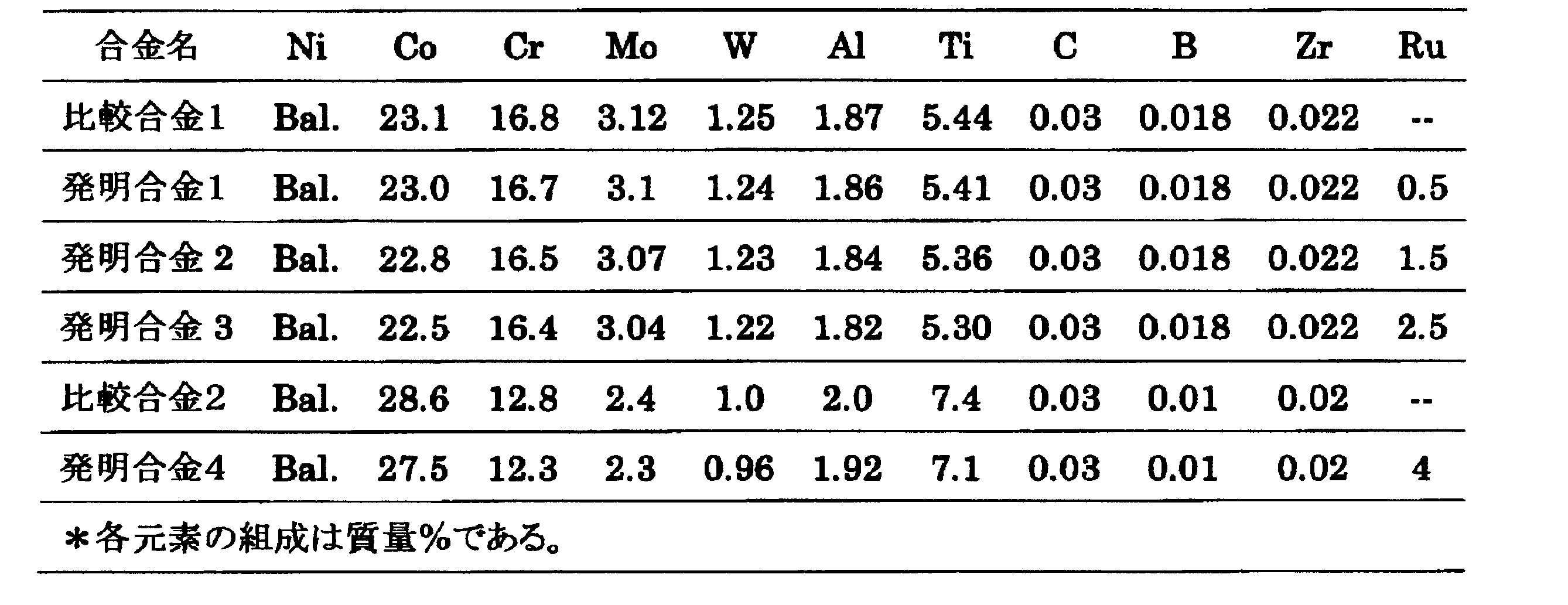
- this invention is not limited by the following examples.
- the generation of the TCP phase, which is a harmful phase, in particular, the generation of the ⁇ phase (Ni 3 Ti) was suppressed, and the effect of improving the microstructure stability by the addition of ruthenium was recognized.
- the formation of ⁇ phase is observed on the grain boundary, whereas the alloy 4 of the present invention in which 4% by mass of ruthenium is added to the comparative alloy 2 In (B), the formation of ⁇ phase was not observed.
- These two alloys were evaluated for microstructural stability upon heat treatment. That is, the two alloys were heat-treated at 1220 ° C.
- FIG. 2 shows the X-ray diffraction patterns of two alloys subjected to aging treatment at 1140 ° C. for 100 hours.
- the comparative alloy 2 after the aging treatment, diffraction peaks corresponding to the ⁇ phase were observed together with the ⁇ phase and the ⁇ ′ phase.
- the invention alloy 4 to which 4% by mass of ruthenium was added was ⁇ . A diffraction peak corresponding to the phase was not observed.
- FIG. 3 is a photomicrograph of the microstructure observed after the invention alloy 4 and the comparative alloy 2 were heat-treated at 1220 ° C. for 1 hour and then subjected to aging treatment at 1140 ° C. for 32 hours and 100 hours.
- the comparative alloys 2 (A) and (C) many plate-like ⁇ phases having a size of several hundred microns that are not observed in the invention alloys 4 (B) and (D) are observed. It was done.
- Table 2 shows the measurement results of compressive yield stress and compressive creep at 725 ° C./630 MPa for the inventive alloys and comparative alloys shown in Table 1.
- the measurement results shown in Table 2 are the measurement results of the invention alloy and the comparative alloy after heat treatment at 1100 ° C. for 4 hours, air cooling, and aging treatment at 650 ° C., 24 hours, and 760 ° C. for 16 hours. .
- the compression test was performed using a test apparatus (SHIMAZU AG50KNI) manufactured by Shimadzu Corporation at an apparent strain rate of 3 ⁇ 10 ⁇ 4 s ⁇ 1 in a temperature range from room temperature to 1000 ° C.
- the compressive yield stress of the inventive alloy is approximately the same magnitude as the comparative alloy, and these results indicate that the addition of ruthenium does not adversely affect the compressive yield stress.
- the effect that performance is improved by addition of ruthenium is also recognized.
- FIG. 4 shows the effect of suppressing the formation of ⁇ phase in the invention alloy to which ruthenium is added.
- 4A and 4C show the TTT curves (Time-Temperature-Transition-Curve) relating to the ⁇ phase generation for Comparative Alloys 1 and 2, respectively.
- the TTT curves of Comparative Alloys 1 and 2 indicate a C-type, and the temperature ranges in which the nose temperature and the presence of the ⁇ phase are recognized are about 1000 ° C., 1100 ° C. to 1150 ° C. for Comparative Alloy 1, respectively. In Comparative Alloy 2, the temperature was about 1170 ° C. and 850 ° C. to 1200 ° C.
- the heat-resistant superalloy of the present invention has a balance between excellent heat resistance and workability, and is reliable for heat-resistant members such as aircraft engines and power generation gas turbines, particularly turbine disks and turbine blades. Used as high.
Landscapes
- Chemical & Material Sciences (AREA)
- Engineering & Computer Science (AREA)
- Mechanical Engineering (AREA)
- Materials Engineering (AREA)
- Metallurgy (AREA)
- Organic Chemistry (AREA)
- Physics & Mathematics (AREA)
- Thermal Sciences (AREA)
- Crystallography & Structural Chemistry (AREA)
- General Engineering & Computer Science (AREA)
- Turbine Rotor Nozzle Sealing (AREA)
Abstract
Description
クロムの添加量が、2質量%以上25質量%以下、
アルミニウムの添加量が、0.2質量%以上7質量%以下、
コバルトの添加量が、19.5質量%以上55質量%以下、
チタンの添加量が、[0.17×(コバルトの質量%-23)+3]質量%以上[0.17×(コバルトの質量%-20)+7]質量%以下(ただし、5.1質量%以上)、および
ルテニウムの添加量が、0.1質量%以上10質量%以下、
であることを特徴としている。
モリブデンの添加量が、5質量%以下、
タングステンの添加量が、5質量%以下、
であることが好ましい。
ジルコニウムの添加量が、0.01質量%以上0.2質量%以下、
炭素の添加量が、0.01質量%以上0.15質量%以下、
ホウ素の添加量が、0.005質量%以上0.1質量%以下、
であることが好ましい。
モリブデンの添加量が、5質量%以下、
タングステンの添加量が、5質量%以下、
ジルコニウムの添加量が、0.01質量%以上0.2質量%以下、
炭素の添加量が、0.01質量%以上0.15質量%以下、
ホウ素の添加量が、0.005質量%以上0.1質量%以下、
であることが好ましい。
モリブデンの添加量が、5質量%以下、
タングステンの添加量が、5質量%以下、
タンタルの添加量が、2質量%以下、
ニオブの添加量が、2質量%以下、
ジルコニウムの添加量が、0.01質量%以上0.2質量%以下、
炭素の添加量が、0.01質量%以上0.15質量%以下、
ホウ素の添加量が、0.005質量%以上0.1質量%以下、
であることが好ましい。
0.17×(コバルトの質量%-23)+3以上0.17×(コバルトの質量%-20)+7以下。
以下に実施例を示す。なお、本発明は、以下の実施例によって発明が限定されるものではない。

Claims (12)
- クロム、アルミニウム、コバルト、チタンおよびルテニウムが、主成分として添加され、副成分の添加が許容され、主成分と副成分を除く残余がニッケルと不可避的不純物からなる耐熱超合金であって、
クロムの添加量が、2質量%以上25質量%以下、
アルミニウムの添加量が、0.2質量%以上7質量%以下、
コバルトの添加量が、19.5質量%以上55質量%以下、
チタンの添加量が、[0.17×(コバルトの質量%-23)+3]質量%以上[0.17×(コバルトの質量%-20)+7]質量%以下(ただし、5.1質量%以上)、および
ルテニウムの添加量が、0.1質量%以上10質量%以下、
であることを特徴とする耐熱超合金。 - チタンの添加量が、[0.17×(コバルトの質量%-23)+3]質量%以上[0.17×(コバルトの質量%-20)+7]質量%以下(ただし、5.3質量%以上11質量%以下)であり、前記副成分として、モリブデンまたはタングステンの少なくともいずれか一方が添加され、
モリブデンの添加量が、5質量%以下、
タングステンの添加量が、5質量%以下、
であることを特徴とする請求項1に記載の耐熱超合金。 - 前記副成分として、ジルコニウム、炭素、またはホウ素の少なくともいずれか一つが添加され、
ジルコニウムの添加量が、0.01質量%以上0.2質量%以下、
炭素の添加量が、0.01質量%以上0.15質量%以下、
ホウ素の添加量が、0.005質量%以上0.1質量%以下、
であることを特徴とする請求項1に記載の耐熱超合金。 - 前記副成分として、モリブデンまたはタングステンの少なくともいずれか一方と、ジルコニウム、炭素またはホウ素の少なくともいずれか一つとが添加され、
モリブデンの添加量が、5質量%以下、
タングステンの添加量が、5質量%以下、
ジルコニウムの添加量が、0.01質量%以上0.2質量%以下、
炭素の添加量が、0.01質量%以上0.15質量%以下、
ホウ素の添加量が、0.005質量%以上0.1質量%以下、
であることを特徴とする請求項1に記載の耐熱超合金。 - 前記副成分として、モリブデンまたはタングステンの少なくともいずれか一方と、タンタルまたはニオブの少なくともいずれか一方と、ジルコニウム、炭素またはホウ素の少なくともいずれか一つとが添加され、
モリブデンの添加量が、5質量%以下、
タングステンの添加量が、5質量%以下、
タンタルの添加量が、2質量%以下、
ニオブの添加量が、2質量%以下、
ジルコニウムの添加量が、0.01質量%以上0.2質量%以下、
炭素の添加量が、0.01質量%以上0.15質量%以下、
ホウ素の添加量が、0.005質量%以上0.1質量%以下、
であることを特徴とする請求項1に記載の耐熱超合金。 - コバルトの添加量が、23.1質量%以上55質量%以下であることを特徴とする請求項1から5のいずれか一項に記載の耐熱超合金。
- チタンの添加量が、[0.17×(コバルトの質量%-23)+3]質量%以上[0.17×(コバルトの質量%-20)+7]質量%以下(ただし、5.1質量%以上11質量%以下)であることを特徴とする請求項1、3、4、5または6に記載の耐熱超合金。
- ルテニウムの添加量が0.1質量%以上7質量%以下あることを特徴とする請求項1から7のいずれか一項に記載の耐熱超合金。
- チタンの添加量が、[0.17×(コバルトの質量%-23)+3]質量%以上[0.17×(コバルトの質量%-20)+7]質量%以下(ただし、5.3質量%以上10質量%以下)であり、ルテニウムの添加量が0.1質量%以上5質量%以下あることを特徴とする請求項1、3、4、5、6、7または8に記載の耐熱超合金。
- ジルコニウムの添加量が、0.01質量%以上0.15質量%以下、炭素の添加量が、0.01質量%以上0.1質量%以下、ホウ素の添加量が、0.005質量%以上0.05質量%以下であることを特徴とする請求項3から9のいずれか一項に記載の耐熱超合金。
- 請求項1から10のいずれか一項に記載された耐熱超合金であって、合金相にη相を含まないことを特徴とする耐熱超合金。
- 請求項1から11のいずれか一項に記載された耐熱超合金から、鋳造、鍛造または粉末冶金の少なくとも一つにより製造されたものであることを特徴とする耐熱超合金部材。
Priority Applications (4)
| Application Number | Priority Date | Filing Date | Title |
|---|---|---|---|
| JP2011541951A JP5696995B2 (ja) | 2009-11-19 | 2010-11-18 | 耐熱超合金 |
| EP10831624.1A EP2503013B1 (en) | 2009-11-19 | 2010-11-18 | Heat-resistant superalloy |
| US13/510,630 US20120279351A1 (en) | 2009-11-19 | 2010-11-18 | Heat-resistant superalloy |
| US15/079,601 US20160201166A1 (en) | 2009-11-19 | 2016-03-24 | Heat-resistant superalloy |
Applications Claiming Priority (2)
| Application Number | Priority Date | Filing Date | Title |
|---|---|---|---|
| JP2009263703 | 2009-11-19 | ||
| JP2009-263703 | 2009-11-19 |
Related Child Applications (2)
| Application Number | Title | Priority Date | Filing Date |
|---|---|---|---|
| US13/510,630 A-371-Of-International US20120279351A1 (en) | 2009-11-19 | 2010-11-18 | Heat-resistant superalloy |
| US15/079,601 Continuation US20160201166A1 (en) | 2009-11-19 | 2016-03-24 | Heat-resistant superalloy |
Publications (1)
| Publication Number | Publication Date |
|---|---|
| WO2011062231A1 true WO2011062231A1 (ja) | 2011-05-26 |
Family
ID=44059704
Family Applications (1)
| Application Number | Title | Priority Date | Filing Date |
|---|---|---|---|
| PCT/JP2010/070583 Ceased WO2011062231A1 (ja) | 2009-11-19 | 2010-11-18 | 耐熱超合金 |
Country Status (4)
| Country | Link |
|---|---|
| US (2) | US20120279351A1 (ja) |
| EP (1) | EP2503013B1 (ja) |
| JP (1) | JP5696995B2 (ja) |
| WO (1) | WO2011062231A1 (ja) |
Cited By (6)
| Publication number | Priority date | Publication date | Assignee | Title |
|---|---|---|---|---|
| JP2013133505A (ja) * | 2011-12-27 | 2013-07-08 | Ihi Corp | ニッケル基単結晶超合金熱処理方法及びニッケル基単結晶超合金 |
| US20140234652A1 (en) * | 2011-10-20 | 2014-08-21 | Siemens Aktiengesellschaft | Coating, coating layer system, coated superalloy component |
| WO2014157144A1 (ja) * | 2013-03-28 | 2014-10-02 | 日立金属株式会社 | Ni基超耐熱合金及びその製造方法 |
| JP2020528967A (ja) * | 2017-07-28 | 2020-10-01 | オックスメット テクノロジーズ リミテッド | ニッケル基合金 |
| US12241144B2 (en) | 2019-06-07 | 2025-03-04 | Alloyed Limited | Nickel-based alloy |
| US12319985B2 (en) | 2019-10-02 | 2025-06-03 | Alloyed Limited | Nickel-based alloy |
Families Citing this family (39)
| Publication number | Priority date | Publication date | Assignee | Title |
|---|---|---|---|---|
| US20040221929A1 (en) | 2003-05-09 | 2004-11-11 | Hebda John J. | Processing of titanium-aluminum-vanadium alloys and products made thereby |
| US7837812B2 (en) | 2004-05-21 | 2010-11-23 | Ati Properties, Inc. | Metastable beta-titanium alloys and methods of processing the same by direct aging |
| US10053758B2 (en) | 2010-01-22 | 2018-08-21 | Ati Properties Llc | Production of high strength titanium |
| US9255316B2 (en) | 2010-07-19 | 2016-02-09 | Ati Properties, Inc. | Processing of α+β titanium alloys |
| US8613818B2 (en) | 2010-09-15 | 2013-12-24 | Ati Properties, Inc. | Processing routes for titanium and titanium alloys |
| US9206497B2 (en) | 2010-09-15 | 2015-12-08 | Ati Properties, Inc. | Methods for processing titanium alloys |
| US10513755B2 (en) | 2010-09-23 | 2019-12-24 | Ati Properties Llc | High strength alpha/beta titanium alloy fasteners and fastener stock |
| US8652400B2 (en) | 2011-06-01 | 2014-02-18 | Ati Properties, Inc. | Thermo-mechanical processing of nickel-base alloys |
| US9869003B2 (en) | 2013-02-26 | 2018-01-16 | Ati Properties Llc | Methods for processing alloys |
| US9192981B2 (en) | 2013-03-11 | 2015-11-24 | Ati Properties, Inc. | Thermomechanical processing of high strength non-magnetic corrosion resistant material |
| US9777361B2 (en) | 2013-03-15 | 2017-10-03 | Ati Properties Llc | Thermomechanical processing of alpha-beta titanium alloys |
| US9540714B2 (en) | 2013-03-15 | 2017-01-10 | Ut-Battelle, Llc | High strength alloys for high temperature service in liquid-salt cooled energy systems |
| US9377245B2 (en) | 2013-03-15 | 2016-06-28 | Ut-Battelle, Llc | Heat exchanger life extension via in-situ reconditioning |
| US10017842B2 (en) | 2013-08-05 | 2018-07-10 | Ut-Battelle, Llc | Creep-resistant, cobalt-containing alloys for high temperature, liquid-salt heat exchanger systems |
| US9435011B2 (en) | 2013-08-08 | 2016-09-06 | Ut-Battelle, Llc | Creep-resistant, cobalt-free alloys for high temperature, liquid-salt heat exchanger systems |
| US11111552B2 (en) | 2013-11-12 | 2021-09-07 | Ati Properties Llc | Methods for processing metal alloys |
| EP2886225B1 (en) * | 2013-12-23 | 2017-06-07 | Ansaldo Energia IP UK Limited | Gamma prime precipitation strengthened nickel-base superalloy for use in powder based additive manufacturing process |
| GB201400352D0 (en) | 2014-01-09 | 2014-02-26 | Rolls Royce Plc | A nickel based alloy composition |
| US9683280B2 (en) | 2014-01-10 | 2017-06-20 | Ut-Battelle, Llc | Intermediate strength alloys for high temperature service in liquid-salt cooled energy systems |
| US9683279B2 (en) | 2014-05-15 | 2017-06-20 | Ut-Battelle, Llc | Intermediate strength alloys for high temperature service in liquid-salt cooled energy systems |
| US9605565B2 (en) | 2014-06-18 | 2017-03-28 | Ut-Battelle, Llc | Low-cost Fe—Ni—Cr alloys for high temperature valve applications |
| EP3042973B1 (en) | 2015-01-07 | 2017-08-16 | Rolls-Royce plc | A nickel alloy |
| US10094003B2 (en) | 2015-01-12 | 2018-10-09 | Ati Properties Llc | Titanium alloy |
| GB2539957B (en) | 2015-07-03 | 2017-12-27 | Rolls Royce Plc | A nickel-base superalloy |
| US10502252B2 (en) | 2015-11-23 | 2019-12-10 | Ati Properties Llc | Processing of alpha-beta titanium alloys |
| US10968744B2 (en) | 2017-05-04 | 2021-04-06 | Rolls-Royce Corporation | Turbine rotor assembly having a retaining collar for a bayonet mount |
| US20180320601A1 (en) * | 2017-05-04 | 2018-11-08 | Rolls-Royce Corporation | Turbine assembly with auxiliary wheel |
| US10865646B2 (en) | 2017-05-04 | 2020-12-15 | Rolls-Royce Corporation | Turbine assembly with auxiliary wheel |
| US10774678B2 (en) | 2017-05-04 | 2020-09-15 | Rolls-Royce Corporation | Turbine assembly with auxiliary wheel |
| JP6509290B2 (ja) * | 2017-09-08 | 2019-05-08 | 三菱日立パワーシステムズ株式会社 | コバルト基合金積層造形体、コバルト基合金製造物、およびそれらの製造方法 |
| US11613795B2 (en) | 2019-03-07 | 2023-03-28 | Mitsubishi Heavy Industries, Ltd. | Cobalt based alloy product and method for manufacturing same |
| JP6935578B2 (ja) | 2019-03-07 | 2021-09-15 | 三菱パワー株式会社 | コバルト基合金製造物 |
| WO2020179082A1 (ja) | 2019-03-07 | 2020-09-10 | 三菱日立パワーシステムズ株式会社 | コバルト基合金粉末、コバルト基合金焼結体およびコバルト基合金焼結体の製造方法 |
| US11414728B2 (en) | 2019-03-07 | 2022-08-16 | Mitsubishi Heavy Industries, Ltd. | Cobalt based alloy product, method for manufacturing same, and cobalt based alloy article |
| WO2020179085A1 (ja) | 2019-03-07 | 2020-09-10 | 三菱日立パワーシステムズ株式会社 | 熱交換器 |
| DE102019208666A1 (de) * | 2019-06-14 | 2020-12-17 | MTU Aero Engines AG | Rotoren für hochdruckverdichter und niederdruckturbine eines getriebefantriebwerks sowie verfahren zu ihrer herstellung |
| CN112981186B (zh) * | 2021-04-22 | 2021-08-24 | 北京钢研高纳科技股份有限公司 | 低层错能的高温合金、结构件及其应用 |
| CN114086049B (zh) * | 2021-11-17 | 2022-08-23 | 沈阳航空航天大学 | 2.0GPa级超高屈服强度塑性CoCrNi基中熵合金及其制备方法 |
| US12344918B2 (en) | 2023-07-12 | 2025-07-01 | Ati Properties Llc | Titanium alloys |
Citations (11)
| Publication number | Priority date | Publication date | Assignee | Title |
|---|---|---|---|---|
| JPS5379722A (en) * | 1976-12-22 | 1978-07-14 | Special Metals Corp | Nickellbased alloy |
| JPS5635742A (en) * | 1979-08-29 | 1981-04-08 | Special Metals Corp | Nickel base alloy |
| JPS5635741A (en) * | 1979-08-29 | 1981-04-08 | Special Metals Corp | Nickel base alloy |
| JPH0426883B2 (ja) | 1988-01-19 | 1992-05-08 | Nissen Corp | |
| JP2666911B2 (ja) | 1989-10-04 | 1997-10-22 | ゼネラル・エレクトリック・カンパニイ | ニッケル基超合金及びその製法 |
| JP3145091B2 (ja) | 1988-07-05 | 2001-03-12 | ゼネラル・エレクトリック・カンパニイ | 耐疲れき裂ニッケル基超合金 |
| JP3233361B2 (ja) | 1988-12-29 | 2001-11-26 | ゼネラル・エレクトリック・カンパニイ | 耐疲労亀裂性のrene′95型超合金 |
| JP2003193161A (ja) * | 2001-12-13 | 2003-07-09 | Siemens Ag | 耐熱性構造部材 |
| JP2003527480A (ja) * | 1999-05-07 | 2003-09-16 | ロールス−ロイス・コーポレーション | コバルト基組成物および超合金物品を拡散ろう付け補修するための方法 |
| JP2005097650A (ja) * | 2003-09-22 | 2005-04-14 | National Institute For Materials Science | Ni基超合金 |
| WO2006059805A1 (ja) | 2004-12-02 | 2006-06-08 | National Institute For Materials Science | 耐熱超合金 |
Family Cites Families (6)
| Publication number | Priority date | Publication date | Assignee | Title |
|---|---|---|---|---|
| GB1520630A (en) * | 1974-07-08 | 1978-08-09 | Johnson Matthey Co Ltd | Platinum group metal-containing alloys |
| US5916518A (en) * | 1997-04-08 | 1999-06-29 | Allison Engine Company | Cobalt-base composition |
| US7156932B2 (en) * | 2003-10-06 | 2007-01-02 | Ati Properties, Inc. | Nickel-base alloys and methods of heat treating nickel-base alloys |
| US20100008790A1 (en) * | 2005-03-30 | 2010-01-14 | United Technologies Corporation | Superalloy compositions, articles, and methods of manufacture |
| US7924182B2 (en) * | 2006-07-21 | 2011-04-12 | Cap Epsilon, Inc. | Typeless representation of alphanumeric symbols |
| GB0719195D0 (en) * | 2007-10-02 | 2007-11-14 | Rolls Royce Plc | A nickel base superalloy |
-
2010
- 2010-11-18 US US13/510,630 patent/US20120279351A1/en not_active Abandoned
- 2010-11-18 WO PCT/JP2010/070583 patent/WO2011062231A1/ja not_active Ceased
- 2010-11-18 JP JP2011541951A patent/JP5696995B2/ja active Active
- 2010-11-18 EP EP10831624.1A patent/EP2503013B1/en active Active
-
2016
- 2016-03-24 US US15/079,601 patent/US20160201166A1/en not_active Abandoned
Patent Citations (11)
| Publication number | Priority date | Publication date | Assignee | Title |
|---|---|---|---|---|
| JPS5379722A (en) * | 1976-12-22 | 1978-07-14 | Special Metals Corp | Nickellbased alloy |
| JPS5635742A (en) * | 1979-08-29 | 1981-04-08 | Special Metals Corp | Nickel base alloy |
| JPS5635741A (en) * | 1979-08-29 | 1981-04-08 | Special Metals Corp | Nickel base alloy |
| JPH0426883B2 (ja) | 1988-01-19 | 1992-05-08 | Nissen Corp | |
| JP3145091B2 (ja) | 1988-07-05 | 2001-03-12 | ゼネラル・エレクトリック・カンパニイ | 耐疲れき裂ニッケル基超合金 |
| JP3233361B2 (ja) | 1988-12-29 | 2001-11-26 | ゼネラル・エレクトリック・カンパニイ | 耐疲労亀裂性のrene′95型超合金 |
| JP2666911B2 (ja) | 1989-10-04 | 1997-10-22 | ゼネラル・エレクトリック・カンパニイ | ニッケル基超合金及びその製法 |
| JP2003527480A (ja) * | 1999-05-07 | 2003-09-16 | ロールス−ロイス・コーポレーション | コバルト基組成物および超合金物品を拡散ろう付け補修するための方法 |
| JP2003193161A (ja) * | 2001-12-13 | 2003-07-09 | Siemens Ag | 耐熱性構造部材 |
| JP2005097650A (ja) * | 2003-09-22 | 2005-04-14 | National Institute For Materials Science | Ni基超合金 |
| WO2006059805A1 (ja) | 2004-12-02 | 2006-06-08 | National Institute For Materials Science | 耐熱超合金 |
Non-Patent Citations (1)
| Title |
|---|
| See also references of EP2503013A4 |
Cited By (12)
| Publication number | Priority date | Publication date | Assignee | Title |
|---|---|---|---|---|
| US20140234652A1 (en) * | 2011-10-20 | 2014-08-21 | Siemens Aktiengesellschaft | Coating, coating layer system, coated superalloy component |
| US9309780B2 (en) * | 2011-10-20 | 2016-04-12 | Siemens Aktiengesellschaft | Coating, coating layer system, coated superalloy component |
| JP2013133505A (ja) * | 2011-12-27 | 2013-07-08 | Ihi Corp | ニッケル基単結晶超合金熱処理方法及びニッケル基単結晶超合金 |
| WO2014157144A1 (ja) * | 2013-03-28 | 2014-10-02 | 日立金属株式会社 | Ni基超耐熱合金及びその製造方法 |
| JP5652730B1 (ja) * | 2013-03-28 | 2015-01-14 | 日立金属株式会社 | Ni基超耐熱合金及びその製造方法 |
| US9903011B2 (en) | 2013-03-28 | 2018-02-27 | Hitachi Metals, Ltd. | Ni-based heat-resistant superalloy and method for producing the same |
| JP2020528967A (ja) * | 2017-07-28 | 2020-10-01 | オックスメット テクノロジーズ リミテッド | ニッケル基合金 |
| US11634792B2 (en) | 2017-07-28 | 2023-04-25 | Alloyed Limited | Nickel-based alloy |
| US12258655B2 (en) | 2017-07-28 | 2025-03-25 | Alloyed Limited | Nickel-based alloy |
| JP7670484B2 (ja) | 2017-07-28 | 2025-04-30 | アロイド リミテッド | ニッケル基合金 |
| US12241144B2 (en) | 2019-06-07 | 2025-03-04 | Alloyed Limited | Nickel-based alloy |
| US12319985B2 (en) | 2019-10-02 | 2025-06-03 | Alloyed Limited | Nickel-based alloy |
Also Published As
| Publication number | Publication date |
|---|---|
| US20120279351A1 (en) | 2012-11-08 |
| EP2503013A1 (en) | 2012-09-26 |
| EP2503013B1 (en) | 2017-09-06 |
| EP2503013A4 (en) | 2016-04-06 |
| US20160201166A1 (en) | 2016-07-14 |
| JPWO2011062231A1 (ja) | 2013-04-11 |
| JP5696995B2 (ja) | 2015-04-08 |
Similar Documents
| Publication | Publication Date | Title |
|---|---|---|
| JP5696995B2 (ja) | 耐熱超合金 | |
| JP5278936B2 (ja) | 耐熱超合金 | |
| US9945019B2 (en) | Nickel-based heat-resistant superalloy | |
| JP5684261B2 (ja) | ニッケル超合金およびニッケル超合金から製造された部品 | |
| JP6826235B2 (ja) | Ni基合金軟化粉末および該軟化粉末の製造方法 | |
| JP5721189B2 (ja) | 耐熱性Ni基合金及びその製造方法 | |
| JP6965364B2 (ja) | 析出硬化型コバルト−ニッケル基超合金およびそれから製造された物品 | |
| JP5995158B2 (ja) | Ni基超耐熱合金 | |
| JP5323162B2 (ja) | 高温での機械的特性に優れた多結晶ニッケル基超耐熱合金 | |
| JP5645054B2 (ja) | アニーリングツインを含有するニッケル基耐熱超合金と耐熱超合金部材 | |
| JP2017514998A (ja) | 析出硬化ニッケル合金、前記合金でできた部品、及びその製造方法 | |
| JP2004256840A (ja) | 複合強化型Ni基超合金とその製造方法 | |
| US11162165B2 (en) | Nickel-based heat-resistant material with improved cyclic oxidation properties and method of preparing the same |
Legal Events
| Date | Code | Title | Description |
|---|---|---|---|
| 121 | Ep: the epo has been informed by wipo that ep was designated in this application |
Ref document number: 10831624 Country of ref document: EP Kind code of ref document: A1 |
|
| WWE | Wipo information: entry into national phase |
Ref document number: 2011541951 Country of ref document: JP |
|
| NENP | Non-entry into the national phase |
Ref country code: DE |
|
| REEP | Request for entry into the european phase |
Ref document number: 2010831624 Country of ref document: EP |
|
| WWE | Wipo information: entry into national phase |
Ref document number: 2010831624 Country of ref document: EP |
|
| WWE | Wipo information: entry into national phase |
Ref document number: 13510630 Country of ref document: US |