WO2011068255A1 - ピロリン酸塩化合物およびその製造方法 - Google Patents
ピロリン酸塩化合物およびその製造方法 Download PDFInfo
- Publication number
- WO2011068255A1 WO2011068255A1 PCT/JP2010/072183 JP2010072183W WO2011068255A1 WO 2011068255 A1 WO2011068255 A1 WO 2011068255A1 JP 2010072183 W JP2010072183 W JP 2010072183W WO 2011068255 A1 WO2011068255 A1 WO 2011068255A1
- Authority
- WO
- WIPO (PCT)
- Prior art keywords
- positive electrode
- pyrophosphate compound
- active material
- electrode active
- pyrophosphate
- Prior art date
- Legal status (The legal status is an assumption and is not a legal conclusion. Google has not performed a legal analysis and makes no representation as to the accuracy of the status listed.)
- Ceased
Links
Images


Classifications
-
- H—ELECTRICITY
- H01—ELECTRIC ELEMENTS
- H01M—PROCESSES OR MEANS, e.g. BATTERIES, FOR THE DIRECT CONVERSION OF CHEMICAL ENERGY INTO ELECTRICAL ENERGY
- H01M10/00—Secondary cells; Manufacture thereof
- H01M10/05—Accumulators with non-aqueous electrolyte
- H01M10/052—Li-accumulators
- H01M10/0525—Rocking-chair batteries, i.e. batteries with lithium insertion or intercalation in both electrodes; Lithium-ion batteries
-
- C—CHEMISTRY; METALLURGY
- C01—INORGANIC CHEMISTRY
- C01B—NON-METALLIC ELEMENTS; COMPOUNDS THEREOF; METALLOIDS OR COMPOUNDS THEREOF NOT COVERED BY SUBCLASS C01C
- C01B25/00—Phosphorus; Compounds thereof
- C01B25/16—Oxyacids of phosphorus; Salts thereof
- C01B25/26—Phosphates
- C01B25/38—Condensed phosphates
- C01B25/42—Pyrophosphates
-
- H—ELECTRICITY
- H01—ELECTRIC ELEMENTS
- H01M—PROCESSES OR MEANS, e.g. BATTERIES, FOR THE DIRECT CONVERSION OF CHEMICAL ENERGY INTO ELECTRICAL ENERGY
- H01M4/00—Electrodes
- H01M4/02—Electrodes composed of, or comprising, active material
- H01M4/36—Selection of substances as active materials, active masses, active liquids
- H01M4/58—Selection of substances as active materials, active masses, active liquids of inorganic compounds other than oxides or hydroxides, e.g. sulfides, selenides, tellurides, halogenides or LiCoFy; of polyanionic structures, e.g. phosphates, silicates or borates
- H01M4/5825—Oxygenated metallic salts or polyanionic structures, e.g. borates, phosphates, silicates, olivines
-
- Y—GENERAL TAGGING OF NEW TECHNOLOGICAL DEVELOPMENTS; GENERAL TAGGING OF CROSS-SECTIONAL TECHNOLOGIES SPANNING OVER SEVERAL SECTIONS OF THE IPC; TECHNICAL SUBJECTS COVERED BY FORMER USPC CROSS-REFERENCE ART COLLECTIONS [XRACs] AND DIGESTS
- Y02—TECHNOLOGIES OR APPLICATIONS FOR MITIGATION OR ADAPTATION AGAINST CLIMATE CHANGE
- Y02E—REDUCTION OF GREENHOUSE GAS [GHG] EMISSIONS, RELATED TO ENERGY GENERATION, TRANSMISSION OR DISTRIBUTION
- Y02E60/00—Enabling technologies; Technologies with a potential or indirect contribution to GHG emissions mitigation
- Y02E60/10—Energy storage using batteries
-
- Y—GENERAL TAGGING OF NEW TECHNOLOGICAL DEVELOPMENTS; GENERAL TAGGING OF CROSS-SECTIONAL TECHNOLOGIES SPANNING OVER SEVERAL SECTIONS OF THE IPC; TECHNICAL SUBJECTS COVERED BY FORMER USPC CROSS-REFERENCE ART COLLECTIONS [XRACs] AND DIGESTS
- Y02—TECHNOLOGIES OR APPLICATIONS FOR MITIGATION OR ADAPTATION AGAINST CLIMATE CHANGE
- Y02P—CLIMATE CHANGE MITIGATION TECHNOLOGIES IN THE PRODUCTION OR PROCESSING OF GOODS
- Y02P70/00—Climate change mitigation technologies in the production process for final industrial or consumer products
- Y02P70/50—Manufacturing or production processes characterised by the final manufactured product
Definitions
- the present invention relates to a pyrophosphate compound, a method for producing the pyrophosphate compound, and a positive electrode active material using the pyrophosphate compound.
- the positive electrode and the negative electrode each have an active material capable of reversibly removing and inserting lithium ions, and a non-aqueous electrolyte.
- the positive electrode active material of the lithium ion battery metal oxide, metal sulfide, polymer, or the like is used.
- a battery constructed using LiMn 2 O 4 has a high battery capacity, but has sufficient stability and cycle characteristics in terms of capacity degradation during high-temperature storage, dissolution of Mn in the electrolyte, and the like. The problem of not being left is left.
- LiFePO 4 has also been proposed, but cannot be said to have a sufficient capacity, and there is a problem that the discharge voltage is not high.
- phosphoric acid compounds having a basic composition of LiMnPO 4 are difficult to generate Mn redox.
- an example of Mn-based phosphate compounds capable of Mn redox generation is LiMn having a structure in which part of Mn is substituted with Fe. is that only X Fe 1-X PO 4.
- an electrode active material based on an oligophosphate represented by the following general formula has also been proposed (Japanese Patent Publication No. 2006-523930).
- a a M b X c O (3c + 1) (Where (a) A is at least one alkali metal, 0 ⁇ a ⁇ 6; (b) M is at least one redox active element, 1 ⁇ b ⁇ 4; (c) X is P, As, Selected from the group consisting of Sb, Si, Ge, V, S and combinations thereof; (d) 2 ⁇ c ⁇ 5, where A, M, X, a, b and c are the electrical properties of the compound Selected to retain target neutrality.) Specifically, Li 2 FeP 2 O 7 , Na 2 CoP 2 O 7 , Na 2 NiP 2 O 7 , Na 2 MnP 2 O 7 , Li 2 Co 0.5 Ni 0.5 P 2 O 7 , Li 2 MnP 2 O 7 , Li 2 CoP 2 O 7 , Li 2 NiP 2 O 7 , Na 2 CuP 2 O 7 , Li 2 VP 2 O 7 , Li 0.5 Na 0.5 FeP 2 O 7 , etc. It is
- the present invention solves such problems, and can easily suppress the mixing of impurities, so that the synthesis is easy, and a positive electrode active material containing a pyrophosphate compound capable of obtaining a high battery capacity, and the positive electrode active material thereof.
- An object of the present invention is to provide a lithium ion battery using a substance.
- the present invention provides the following inventions in order to solve the above problems.
- (1) In formula Li 2 M 1-X Fe X P 2 O 7 (where, M represents Mn, Zr, Mg, Co, Ni, one or more metals selected from V and Cu, 0. 3 ⁇ x ⁇ 0.9)) (2) The pyrophosphate compound according to (1), wherein x is 0.7 ⁇ x ⁇ 0.9; (3) The pyrophosphate compound according to (1) or (2) above, wherein M is Mn; (4) The pyrophosphate compound according to any one of the above (1) to (3), which has a low-temperature phase crystal structure or a high-temperature phase crystal structure; (5) A pyrroline characterized by mixing the pyrophosphate compound starting material according to any one of (1) to (4) above and calcining the resulting material mixture at a temperature of 350 ° C.
- a positive electrode active material containing a pyrophosphate compound that is easy to synthesize due to easy suppression of impurities and high battery capacity, and lithium ion using the positive electrode active material A battery may be provided.
- Figure 1 shows a charge-discharge test results of Li 2 M 1-X Fe X P 2 O 7 obtained in Examples and Comparative Examples.
- Figure 2 shows a charge-discharge test results of Li 2 M 1-X Fe X P 2 O 7 obtained in Examples and Comparative Examples.
- FIG. 3 shows a powder X-ray diffraction pattern of Li 2 Mn 0.5 Fe 0.5 P 2 O 7 obtained in Examples and Comparative Examples.
- FIG. 4 shows the charge / discharge test results of Li 2 Mn 0.3 Fe 0.7 P 2 O 7 obtained in Examples and Comparative Examples.
- Pyrophosphate compounds of the present invention is represented by the general formula Li 2 M 1-X Fe X P 2 O 7.
- M represents one or more metals selected from Mn, Zr, Mg, Co, Ni, V, and Cu, and 0.7 ⁇ x ⁇ 0.9.
- Li 2 M 1-X Fe X P 2 O 7 specifically, Li 2 Mn 1-X Fe X P 2 O 7, Li 2 (Mn, Zr) 1-X Fe X P 2 O 7, Li 2 Mg 1-X Fe X P 2 O 7, Li 2 Zr 1-X Fe X P 2 O 7, Li 2 Ni 1-X Fe X P 2 O 7, Li 2 Co 1 -X Fe X P 2 O 7, Li 2 V 1-X Fe X P 2 O 7, Li 2 Cu 1-X Fe X P 2 O 7, Li 2 (Mn, Co) 1-X Fe X P 2 O 7, Li 2 (Co, Ni ) 1-X Fe X P 2 O 7, Li 2 (Mn, Zr, Ni) 1-X Fe X P 2 O 7, but and the like, stability and discharge capacity, etc.
- Li 2 in terms of Mn 1-X Fe X P 2 O 7, Li 2 Ni 1-X Fe X P 2 O 7, Li 2 Co 1 -X Fe X P 2 O 7 are preferable, Li 2 Mn 1-X Fe X P 2 O 7 being most preferred.
- Such pyrophosphate compounds can be easily synthesized because impurities can be easily mixed, and 0.3 ⁇ x ⁇ 0.9 in order to obtain a high battery capacity. Is preferably 0.5 ⁇ x 0.9, and most preferably 0.7 ⁇ x ⁇ 0.9. When x is less than 0.3, a high battery capacity cannot be obtained. On the other hand, when x exceeds 0.9, a high battery capacity is obtained, but there is a difficulty in synthesis.
- the BET specific surface area of the pyrophosphate compound is preferably 0.5 m 2 / g or more in order to rapidly diffuse lithium when used as a positive electrode active material and to obtain a sufficient capacity even under a large current. From this viewpoint, the particle size is adjusted to be relatively small.
- the pyrophosphate compound of the present invention can be obtained by mixing pyrophosphate compound starting materials and then firing the resulting material mixture at a temperature of 350 ° C. to 900 ° C., preferably 400 ° C. to 700 ° C. If the firing temperature is lower than 350 ° C., the starting material is not decomposed and the target product cannot be obtained, while if it is higher than 900 ° C., excessive grain growth may occur.
- the starting material is not particularly limited, but as the Li source, lithium carbonate (Li 2 CO 3 ), etc., as the M source, manganese carbonate (MnCO 3 ), titania (TiO 2 ), magnesium oxalate (MgC 2 O 4 .2H) 2 O), zinc oxide (ZnO), cobalt oxalate (CoC 2 O 4 .2H 2 O), etc.
- iron oxalate FeC 2 O 4 .2H 2 O
- iron acetate Fe (CH 3 COO) 2
- P 2 O 7 source ammonium dihydrogen phosphate (NH 4 H 2 PO 4 ) and the like are preferably used.
- a specific ratio of a compound containing a metal element M such as Mn, manganese carbonate (MnCO 3 ), ammonium dihydrogen phosphate (NH 4 H 2 PO 4 ), and lithium carbonate (Li 2 CO 3 ) To make a starting material.
- the pyrophosphate compound of the present invention is obtained by heating and baking at a predetermined temperature in an inert gas atmosphere such as argon or nitrogen.
- the pyrophosphate compound of the present invention is suitable as a positive electrode active material, and it is particularly preferable to use a positive electrode having this positive electrode active material for a lithium ion battery.
- a lithium ion battery includes a positive electrode and a negative electrode having an active material capable of reversibly removing and inserting lithium ions, and a non-aqueous electrolyte.
- such a lithium ion battery includes a negative electrode, a negative electrode can containing a negative electrode, a positive electrode, a positive electrode can containing a positive electrode, a separator and an insulating gasket disposed between the positive electrode and the negative electrode, and the negative electrode can and the positive electrode The can is filled with a non-aqueous electrolyte.
- the negative electrode is formed by forming a negative electrode active material layer containing a negative electrode active material on a negative electrode current collector, and as the negative electrode current collector, for example, nickel foil, copper foil or the like is used.
- the negative electrode active material a material that can be doped / undoped with lithium is used, and specifically, metallic lithium, a lithium alloy, a conductive polymer doped with lithium, a layered compound, or the like is used.
- As the binder contained in the negative electrode active material layer a resin material or the like known in this field can be used.
- the positive electrode is obtained by forming a positive electrode active material layer containing the pyrophosphate compound positive electrode active material of the present invention on a positive electrode current collector such as an aluminum foil.
- a resin material or the like can be used as the binder contained in the positive electrode active material layer.
- the separator separates the positive electrode and the negative electrode.
- a polymer film such as polypropylene is used, and the thickness of the separator is preferably 50 ⁇ m or less, for example.
- the insulating gasket is integrated into the negative electrode can. This insulating gasket is for preventing leakage of the nonaqueous electrolyte filled in the negative electrode can and the positive electrode can.
- the non-aqueous electrolyte a solution in which an electrolyte is dissolved in an aprotic non-aqueous solvent is used.
- non-aqueous solvent examples include propylene carbonate, ethylene carbonate, butylene carbonate, vinylene carbonate, ⁇ -butyl lactone, sulfolane, 1,2-dimethoxyethane, 1,2-diethoxyethane, 2-methyltetrahydrofuran, 3-methyl 1 , 3-dioxolane, methyl propionate, methyl butyrate, dimethyl carbonate, diethyl carbonate, dipropyl carbonate, etc. can be used. It is preferable to use chain carbonates such as dimethyl carbonate, diethyl carbonate, and dipropyl carbonate. Moreover, such a non-aqueous solvent may be used individually by 1 type, and may be used in mixture of 2 or more types.
- a lithium salt such as LiPF 6 , LiClO 4 , LiAsF 6 , LiBF 4 , LiCF 3 SO 3 , LiN (CF 3 SO 2 ) 2 can be used.
- LiPF 6 or LiBF 4 it is preferable to use LiPF 6 or LiBF 4 .
- the assembly itself of these lithium ion batteries can be performed by a conventional method, and the shape thereof is not particularly limited, such as a cylindrical shape, a square shape, a coin shape, a button shape or the like.
- Examples 1 to 4 and Comparative Examples 1 to 3 Lithium carbonate (Li 2 CO 3 ), manganese oxalate hydrate (MnC 2 O 4 .0.5H 2 O), iron oxalate hydrate (FeC 2 O 4 .2H 2 O), ammonium hydrogen phosphate [ (NH 4) a 2 HPO 4] Li 2 Mn 1 -X Fe X P 2 O 7 (0 ⁇ x ⁇ 1) were weighed so that the stoichiometric ratio shown in Table 1, a ball mill acetone as solvent Wet grinding and mixing were performed at 240 rpm for 30 minutes and at 480 rpm for 2 hours. The slurry after mixing was dried under reduced pressure at room temperature to obtain a precursor.
- the electrolyte was 1M LiPF 6 / EC + DEC, and a porous cell guard was used as the separator, but the cells were all assembled in a glove box in an Ar atmosphere.
- the cut-off of the charge / discharge test is 2.0 to 4.5 V vs. Li / Li + was used, charging was performed in the CCCV mode, and discharging was performed in the CC mode. The rate at this time was C / 20 for both charging and discharging, and the measurement temperature was 25 ° C. (result)
- the obtained powder X-ray diffraction results are shown in FIG. It can be seen that a single phase is formed in the high temperature phase regardless of the composition. This is described in Adam et al. [J. Solid State Chem.
- the measurement temperature is changed from 25 ° C. to 60 ° C., and HT-Li 2 Mn 0.5 Fe 0.5 P 2 O 7 and HT-Li 2 Mn 0.3 Fe 0. 7 P 2 O 7 was subjected to a charge / discharge test.
- the results are shown in FIGS. 3 and 4, respectively. It can be seen that both show significantly improved charge / discharge characteristics.
- a pyrophosphate compound that is easy to synthesize and has a high battery capacity is obtained.
- the pyrophosphate compound exhibits excellent repetitive charge / discharge characteristics by an electron transfer reaction utilizing oxidation and reduction of Fe.
- a positive electrode active material containing a pyrophosphate compound that is easy to synthesize due to easy suppression of impurities and high battery capacity, and lithium ion using the positive electrode active material A battery may be provided.
Landscapes
- Chemical & Material Sciences (AREA)
- Engineering & Computer Science (AREA)
- Chemical Kinetics & Catalysis (AREA)
- Electrochemistry (AREA)
- General Chemical & Material Sciences (AREA)
- Inorganic Chemistry (AREA)
- Organic Chemistry (AREA)
- Materials Engineering (AREA)
- Manufacturing & Machinery (AREA)
- Crystallography & Structural Chemistry (AREA)
- Battery Electrode And Active Subsutance (AREA)
- Secondary Cells (AREA)
Abstract
Description
このリチウムイオン電池の正極活物質としては、金属酸化物、金属硫化物またはポリマー等が用いられ、たとえばTiS2、MoS2、NbSe2、V2O5等のリチウム非含有化合物や、LiMO2(M=Co、Ni、Mn、Fe等)、LiMn2O4等のようなリチウム複合酸化物等が知られている。このなかで、LiMn2O4を用いて構成された電池は高い電池容量を有するが、高温保存時における容量劣化、Mnの電解液中への溶解等の点から、安定性やサイクル特性が十分でないという課題が残されている。
また、LiFePO4も提案されているが、十分な容量を有しているとはいえず、放電電圧が高くないという課題がある。
そこで、Feよりも酸化還元電位の高い元素である、Mnを主体としたLiMnPO4を、リチウムイオン電池の正極に用いることが提案されている。しかしながら、LiMnPO4を基本組成とするリン酸化合物は、Mnのレドックス発生が困難であった。Journal of the Electrochemical Society,144,1188(1997)によれば、Mnを主体とするリン酸化合物のうち、Mnのレドックス発生が可能な例は、Mnの一部をFeで置換した構造を有するLiMnXFe1−XPO4のみであるとされている。
そしてさらに、下記の一般式で表されるオリゴリン酸塩をベースとした電極活物質も提案されている(特表2006−523930号公報)。
AaMbXcO(3c+1)
(ここで、(a)Aは少なくとも1つのアルカリ金属で、0<a≦6;(b)Mは少なくとも1つのレドックス活性元素で、1≦b≦4;(c)XはP、As、Sb、Si、Ge、V、Sおよびそれらの組み合わせよりなる群から選択され;(d)2≦c≦5であり、ここで、A、M、X、a、bおよびcは前記化合物の電気的中性を保持するように選択される。)
そして、具体的には、Li2FeP2O7、Na2CoP2O7、Na2NiP2O7、Na2MnP2O7、Li2Co0.5Ni0.5P2O7、Li2MnP2O7、Li2CoP2O7、Li2NiP2O7、Na2CuP2O7、Li2VP2O7、Li0.5Na0.5FeP2O7、等が開示されている。
しかしながら、本発明者の知見によれば、Li2FeP2O7のようにFeの量を増加させると高い電池容量が得られるが、不純物の混入がないように合成するのが困難となる。
(1)一般式 Li2M1−XFeXP2O7(ここで、Mは、Mn、Zr、Mg、Co、Ni、VおよびCuから選ばれる1種以上の金属を表わし、0.3≦x≦0.9である。)で示されるピロリン酸塩化合物;
(2)xが0.7≦x≦0.9である上記(1)に記載のピロリン酸塩化合物;
(3)MがMnである上記(1)または(2)に記載のピロリン酸塩化合物;
(4)低温相結晶構造または高温相結晶構造を有する上記(1)~(3)のいずれかに記載のピロリン酸塩化合物;
(5)上記(1)~(4)のいずれかに記載のピロリン酸塩化合物の出発原料を混合し、ついで得られる原料混合物を350℃~900℃の温度で焼成することを特徴とするピロリン酸塩化合物の製造方法;
(6)400℃~700℃の温度で焼成する上記(5)に記載のピロリン酸塩化合物の製造方法;
(7)上記(1)~(4)のいずれかに記載のピロリン酸塩化合物を含有する正極活物質;ならびに
(8)上記(7)記載の正極活物質を有する正極を用いてなるリチウムイオン電池、
である。
図2は、実施例および比較例で得られたLi2M1−XFeXP2O7の充放電試験結果を示す。
図3は、実施例および比較例で得られたLi2Mn0.5Fe0.5P2O7の粉末X線回折図を示す。
図4は、実施例および比較例で得られたLi2Mn0.3Fe0.7P2O7の充放電試験結果を示す。
ピロリン酸塩化合物のBET比表面積は、正極活物質として使用した場合にリチウムの拡散を速やかにし、大電流下でも十分な容量を得るために0.5m2/g以上であるのが好適であり、この観点から粒径が比較的小さくなるように調節される。
本発明のピロリン酸塩化合物は、ピロリン酸塩化合物の出発原料を混合し、ついで得られる原料混合物を350℃~900℃、好ましくは400℃~700℃、の温度で焼成することにより得られる。焼成温度が350℃よりも低いと、出発原料が分解せず、目的物を得ることができず、一方900℃よりも高いと、過度の粒成長が生じるおそれがある。
ここで、500℃程度未満の温度で焼成すると後述する低温相結晶構造が得られ、500℃程度以上で焼成すると後述する高温相結晶構造を有するピロリン酸塩化合物が得られる。
出発原料は特に制限されないが、Li源としては炭酸リチウム(Li2CO3)、等、M源としては炭酸マンガン(MnCO3)、チタニア(TiO2)、シュウ酸マグネシウム(MgC2O4・2H2O)、酸化亜鉛(ZnO)、シュウ酸コバルト(CoC2O4・2H2O)、等、Fe源としてはシュウ酸鉄(FeC2O4・2H2O)、酢酸鉄(Fe(CH3COO)2)等、P2O7源としてはリン酸二水素アンモニウム(NH4H2PO4)、等、が好適に用いられる。
たとえば、具体的には、Mn等の金属元素Mを含む化合物、炭酸マンガン(MnCO3)、リン酸二水素アンモニウム(NH4H2PO4)、および炭酸リチウム(Li2CO3)を所定比で均一に混合して出発原料とする。ついで、アルゴン、窒素等の不活性ガス雰囲気中で、所定の温度で加熱して焼成することにより、本発明のピロリン酸塩化合物が得られる。
本発明のピロリン酸塩化合物は正極活物質として好適であり、特にリチウムイオン電池にこの正極活物質を有する正極を用いるのが好ましい。リチウムイオン電池は、リチウムイオンを可逆的に脱挿入可能な活物質を有する正極と負極と、非水電解質とから構成される。たとえば、このようなリチウムイオン電池は、負極、負極を収容する負極缶、正極、正極を収容する正極缶、正極と負極との間に配置されたセパレータおよび絶縁ガスケットとを備え、負極缶および正極缶内には非水電解液が充填されてなる。負極は、負極集電体上に、負極活物質を含有する負極活物質層が形成されてなり、負極集電体としては、たとえばニッケル箔、銅箔等が用いられる。負極活物質としては、リチウムをドープ/脱ドープ可能なものを用い、具体的には、金属リチウム、リチウム合金、リチウムがドープされた導電性高分子もしくは層状化合物等が用いられる。負極活物質層に含有される結合剤としては、この分野で公知の樹脂材料等を用いることができる。正極は、アルミニウム箔等の正極集電体上に、本発明のピロリン酸塩化合物正極活物質を含有する正極活物質層が形成されてなる。正極活物質層に含有される結合剤としては、樹脂材料等を用いることができる。
セパレータは、正極と負極とを離間させるものであり、たとえばポリプロピレンなどの高分子フィルムが用いられ、セパレータの厚みはたとえば50μm以下が好ましい。
絶縁ガスケットは、負極缶に組み込まれ一体化されている。この絶縁ガスケットは、負極缶及び正極缶内に充填された非水電解液の漏出を防止するためのものである。
非水電解液としては、非プロトン性非水溶媒に電解質を溶解させた溶液を用いる。非水溶媒としては、例えばプロピレンカーボネート、エチレンカーボネート、ブチレンカーボネート、ビニレンカーボネート、γ−ブチルラクトン、スルホラン、1,2−ジメトキシエタン、1,2−ジエトキシエタン、2−メチルテトラヒドロフラン、3−メチル1,3−ジオキソラン、プロピオン酸メチル、酪酸メチル、ジメチルカーボネート、ジエチルカーボネート、ジプロピルカーボネート等を使用することができるが、特に、電圧安定性の点からは、プロピレンカーボネート、ビニレンカーボネート等の環状カーボネート類、ジメチルカーボネート、ジエチルカーボネート、ジプロピルカーボネート等の鎖状カーボネート類を使用することが好ましい。また、このような非水溶媒は、1種類を単独で用いてもよいし、2種類以上を混合して用いてもよい。
また、非水溶媒に溶解させる電解質としては、例えば、LiPF6、LiClO4、LiAsF6、LiBF4、LiCF3SO3、LiN(CF3SO2)2等のリチウム塩を使用することができる。これらのリチウム塩の中でも、LiPF6、LiBF4を使用することが好ましい。
これらのリチウムイオン電池の組み立て自体は常法によることができ、その形状も円筒型、角型、コイン型、ボタン型等、特に限定されない。
炭酸リチウム(Li2CO3),シュウ酸マンガン水和物(MnC2O4・0.5H2O),シュウ酸鉄水和物(FeC2O4・2H2O),リン酸水素アンモニウム[(NH4)2HPO4]をLi2Mn1−XFeXP2O7(0≦x≦1)が表1に示す量論比になるように秤量し、アセトンを溶媒としてボールミルにて240rpmで30分、480rpmで2時間、湿式粉砕混合を行った。混合後のスラリーを室温にて減圧乾燥し、前駆体を得た。これをAr雰囲気下において600℃で6時間焼成することにより高温相のHT−Li2Mn1−XFeXP2O7(0≦x≦1)を、450℃で24時間焼成することにより低温相のLT−Li2Mn1−XFeXP2O7(0≦x≦1)をそれぞれ得た。

粉末X線回折測定は線源としてCuKαを用いた。Rietveld/Pawley解析によって生成物の構造解析および不純物の同定、分解の有無を確認した。
(電気化学測定)
HT−Li2Mn1−XFeXP2O7(0≦x≦1)を活物質とした電極を以下の手順で作製した。
活物質:アセチレンブラック(導電助剤):ポリフッ化ビニルデン(粘結剤)=80:20:2(weight)の組成のものを乳鉢でよく混合した。そしてAl箔上に塗布した後120℃で30分加熱減圧乾燥させたものを電極として用いた。充放電試験はこのHT−Li2Mn1−XFeXP2O7を正極とし、対極をLi metalとした2032型コインセルにて行った。電解質は1M LiPF6/EC+DECとし、セパレータには多孔質のセルガードを用いたが、セルの組み立てはすべてAr雰囲気のグローブボックス中で行った。充放電試験のカットオフは2.0~4.5V vs.Li/Li+とし、CCCVモードで充電、CCモードで放電を行った。この時のレートは充電・放電共にC/20、測定温度は25℃とした。
(結果)
得られた粉末X線回折の結果を図1に示した。高温相では組成に関係なく、単一の相が形成されていることが分かる。これはAdam et al.[J.Solid State Chem.181(11),3110(2008)]によって最近報告された構造と良い一致が得られた。
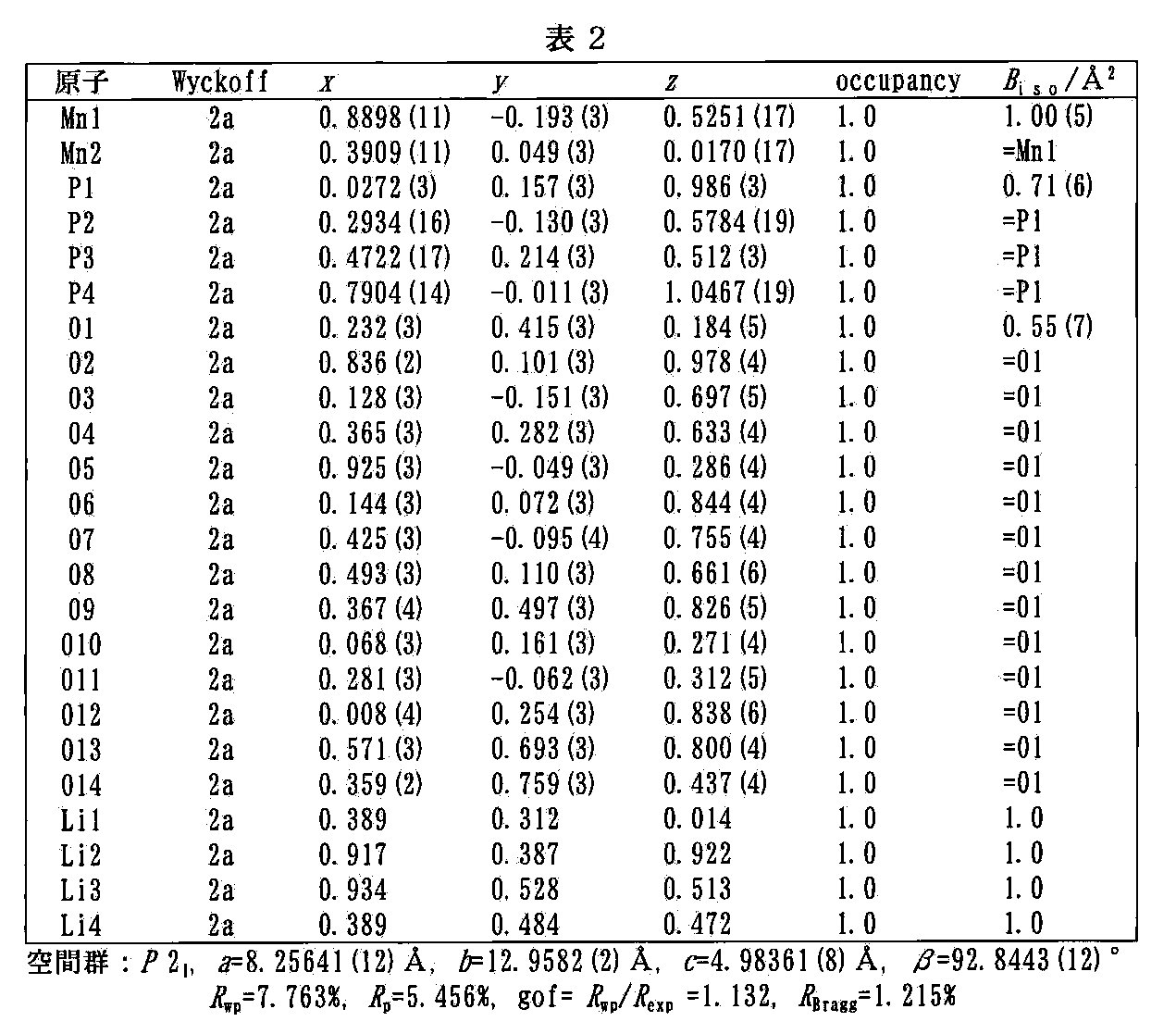
低温相のXRDパターンは高温相とは異なる新規なものであることが発見された。この詳細を表2に示す。
MnとFeの組成の違いによるそれぞれの充放電試験の結果を図2に示す。Mnの量が減り、Feの量が増えるに従って平坦電位領域が観測されるようになり、放電容量も向上した。理論容量が220mAh/gであるのに対して、実際の得られた放電容量は、x=0:初期放電容量19.2mAh/g,5サイクル目の放電容量16.7mAh/g,x=0.1:初期放電容量13.7mAh/g,5サイクル目の放電容量12.5mAh/g,x=0.3:初期放電容量40.0mAh/g,5サイクル目の放電容量36.0mAh/g,x=0.5:初期放電容量58.6mAh/g,5サイクル目の放電容量54.2mAh/g,x=0.7:初期放電容量63.4mAh/g,5サイクル目の放電容量62.1mAh/g,x=0.9:初期放電容量90.2mAh/g,5サイクル目の放電容量88.2mAh/gであった。
さらに、上記の電気化学測定において、測定温度を25℃から60℃に変更して、HT−Li2Mn0.5Fe0.5P2O7およびHT−Li2Mn0.3Fe0.7P2O7について充放電試験を行なった。その結果を、それぞれ図3および図4に示す。いずれも著しく向上した充放電特性を示すことがわかる。
本発明によれば、0.3≦x≦0.9、特に好ましくは0.7≦x≦0.9、のときに、合成が容易であり、かつ高い電池容量のピロリン酸塩化合物を得ることができ、そのピロリン酸塩化合物はFeの酸化還元を利用した電子授受反応によって、優れた繰り返し充放電特性を示す。
Claims (8)
- 一般式 Li2M1−XFeXP2O7
(ここで、Mは、Mn、Zr、Mg、Co、Ni、VおよびCuから選ばれる1種以上の金属を表わし、0.3≦x≦0.9である。)
で示されるピロリン酸塩化合物。 - xが0.7≦x≦0.9である請求項1に記載のピロリン酸塩化合物。
- MがMnである請求項1または2に記載のピロリン酸塩化合物。
- 低温相結晶構造または高温相結晶構造を有する請求項1~3のいずれかに記載のピロリン酸塩化合物。
- 請求項1~4のいずれかに記載のピロリン酸塩化合物の出発原料を混合し、ついで得られる原料混合物を350℃~900℃の温度で焼成することを特徴とするピロリン酸塩化合物の製造方法。
- 400℃~700℃の温度で焼成する請求項5に記載のピロリン酸塩化合物の製造方法。
- 請求項1~4のいずれかに記載のピロリン酸塩化合物を含有する正極活物質。
- 請求項7記載の正極活物質を有する正極を用いてなるリチウムイオン電池。
Priority Applications (4)
| Application Number | Priority Date | Filing Date | Title |
|---|---|---|---|
| CN201080054830.2A CN102803134B (zh) | 2009-12-04 | 2010-12-03 | 焦磷酸盐化合物及其制造方法 |
| US13/513,563 US9112241B2 (en) | 2009-12-04 | 2010-12-03 | Pyrophosphate compound and production process thereof |
| JP2011544348A JP5682040B2 (ja) | 2009-12-04 | 2010-12-03 | ピロリン酸塩化合物およびその製造方法 |
| EP10834694.1A EP2508476A4 (en) | 2009-12-04 | 2010-12-03 | PYROPHOSPHATE COMPOUND AND METHOD FOR THE PRODUCTION THEREOF |
Applications Claiming Priority (2)
| Application Number | Priority Date | Filing Date | Title |
|---|---|---|---|
| JP2009-276513 | 2009-12-04 | ||
| JP2009276513 | 2009-12-04 |
Publications (1)
| Publication Number | Publication Date |
|---|---|
| WO2011068255A1 true WO2011068255A1 (ja) | 2011-06-09 |
Family
ID=44115087
Family Applications (1)
| Application Number | Title | Priority Date | Filing Date |
|---|---|---|---|
| PCT/JP2010/072183 Ceased WO2011068255A1 (ja) | 2009-12-04 | 2010-12-03 | ピロリン酸塩化合物およびその製造方法 |
Country Status (5)
| Country | Link |
|---|---|
| US (1) | US9112241B2 (ja) |
| EP (1) | EP2508476A4 (ja) |
| JP (1) | JP5682040B2 (ja) |
| CN (1) | CN102803134B (ja) |
| WO (1) | WO2011068255A1 (ja) |
Cited By (12)
| Publication number | Priority date | Publication date | Assignee | Title |
|---|---|---|---|---|
| JP2014086195A (ja) * | 2012-10-22 | 2014-05-12 | Fujitsu Ltd | 化合物、及びリチウムイオン電池 |
| JP2014194846A (ja) * | 2013-03-28 | 2014-10-09 | Fdk Corp | リチウム二次電池用正極活物質およびリチウム二次電池 |
| JP2014197462A (ja) * | 2013-03-29 | 2014-10-16 | Fdk株式会社 | リチウム二次電池用電極活物質、リチウム二次電池およびリチウム二次電池用電極活物質の製造方法 |
| WO2014181436A1 (ja) * | 2013-05-09 | 2014-11-13 | 株式会社日立製作所 | 二次電池用正極活物質およびそれを用いた二次電池 |
| JP2016038996A (ja) * | 2014-08-06 | 2016-03-22 | Fdk株式会社 | リチウム二次電池用正極活物質およびリチウム二次電池 |
| JP2017041393A (ja) * | 2015-08-21 | 2017-02-23 | トヨタ自動車株式会社 | ニッケル水素電池 |
| JP2017228453A (ja) * | 2016-06-23 | 2017-12-28 | 富士通株式会社 | 全固体電池 |
| JPWO2018003071A1 (ja) * | 2016-06-30 | 2019-01-24 | 富士通株式会社 | 二次電池用正極材料、及びその製造方法、並びにリチウムイオン二次電池 |
| WO2019159262A1 (ja) * | 2018-02-14 | 2019-08-22 | 富士通株式会社 | 正極材料、及びその製造方法、前記正極材料を用いた電池及びその製造方法、並びに前記電池を用いた電子機器 |
| JP2019149302A (ja) * | 2018-02-27 | 2019-09-05 | Fdk株式会社 | 正極活物質の製造方法 |
| WO2020031690A1 (ja) * | 2018-08-10 | 2020-02-13 | 日本化学工業株式会社 | ピロリン酸コバルトリチウムの製造方法及びピロリン酸コバルトリチウム炭素複合体の製造方法 |
| CN117401660A (zh) * | 2023-10-16 | 2024-01-16 | 百杰瑞(荆门)新材料有限公司 | 一种焦磷酸锂的固相合成方法和应用 |
Families Citing this family (9)
| Publication number | Priority date | Publication date | Assignee | Title |
|---|---|---|---|---|
| EP2508476A4 (en) * | 2009-12-04 | 2014-11-26 | Univ Tokyo | PYROPHOSPHATE COMPOUND AND METHOD FOR THE PRODUCTION THEREOF |
| CN103107332B (zh) * | 2013-01-24 | 2015-10-14 | 北大先行科技产业有限公司 | 一种磷酸铁锂正极材料及其制备方法 |
| CN103825026B (zh) * | 2014-03-19 | 2016-03-02 | 中南大学 | 一种制备锂离子电池正极材料焦磷酸铁锂的方法 |
| CN109980186B (zh) * | 2017-12-27 | 2021-12-03 | 中国电子科技集团公司第十八研究所 | 一种掺杂改性型金属焦磷酸盐正极材料 |
| CN112909232A (zh) * | 2021-01-21 | 2021-06-04 | 合肥工业大学 | 一种氟化钠浸渍包覆钒掺杂多孔结构焦磷酸铁钠正极材料及其制备方法 |
| KR20220144697A (ko) | 2021-04-20 | 2022-10-27 | 삼성전자주식회사 | 양극활물질, 그 제조방법, 이를 포함하는 양극, 및 이차전지 |
| WO2023240603A1 (zh) * | 2022-06-17 | 2023-12-21 | 宁德时代新能源科技股份有限公司 | 正极活性材料及其制备方法、正极极片、二次电池、电池模块、电池包和用电装置 |
| CN114695870A (zh) * | 2022-03-21 | 2022-07-01 | 上海电力大学 | 改性铁基焦磷酸盐化合物正极材料、制备方法及其在钠离子电池中的应用 |
| CN118414724B (zh) * | 2022-06-17 | 2026-02-03 | 宁德时代新能源科技股份有限公司 | 正极活性材料及制备方法、正极极片、二次电池、电池模块、电池包及用电装置 |
Citations (3)
| Publication number | Priority date | Publication date | Assignee | Title |
|---|---|---|---|---|
| JP2006523930A (ja) | 2003-04-08 | 2006-10-19 | ヴァレンス テクノロジー インコーポレーテッド | オリゴリン酸塩をベースとした電極活物質およびその製造方法 |
| JP2007214120A (ja) * | 2006-01-13 | 2007-08-23 | Mitsubishi Chemicals Corp | リチウムイオン二次電池 |
| JP2009518262A (ja) * | 2005-12-02 | 2009-05-07 | エイ 123 システムズ,インク. | アモルファスおよび部分的にアモルファスからなるナノスケールイオン貯蔵材料 |
Family Cites Families (10)
| Publication number | Priority date | Publication date | Assignee | Title |
|---|---|---|---|---|
| FR2864348B1 (fr) * | 2003-12-18 | 2006-03-10 | Commissariat Energie Atomique | Accumulateur au lithium presentant a la fois un potentiel electrique et une capacite d'insertion du lthium eleves. |
| US8158090B2 (en) * | 2005-08-08 | 2012-04-17 | A123 Systems, Inc. | Amorphous and partially amorphous nanoscale ion storage materials |
| US9112236B2 (en) * | 2005-10-20 | 2015-08-18 | Mitsubishi Chemical Corporation | Lithium secondary batteries and nonaqueous electrolyte for use in the same |
| CA2566906A1 (en) * | 2006-10-30 | 2008-04-30 | Nathalie Ravet | Carbon-coated lifepo4 storage and handling |
| EP2262047B1 (en) * | 2008-03-05 | 2015-04-29 | GS Yuasa International Ltd. | Non-aqueous electrolyte battery |
| TW201004012A (en) * | 2008-04-28 | 2010-01-16 | Asahi Glass Co Ltd | Secondary cell non-aqueous electrolyte and secondary cell |
| TW201114733A (en) * | 2009-06-30 | 2011-05-01 | Asahi Glass Co Ltd | Electrolytic solution for chargeable device, electrolytic solution for lithium ion secondary battery, and secondary battery |
| US20110129732A1 (en) * | 2009-12-01 | 2011-06-02 | Applied Materials, Inc. | Compressed powder 3d battery electrode manufacturing |
| EP2508476A4 (en) * | 2009-12-04 | 2014-11-26 | Univ Tokyo | PYROPHOSPHATE COMPOUND AND METHOD FOR THE PRODUCTION THEREOF |
| WO2014110412A2 (en) * | 2013-01-11 | 2014-07-17 | Massachusetts Institute Of Technology | Design of multi-electron li-ion phosphate cathodes by mixing transition metals |
-
2010
- 2010-12-03 EP EP10834694.1A patent/EP2508476A4/en not_active Withdrawn
- 2010-12-03 US US13/513,563 patent/US9112241B2/en not_active Expired - Fee Related
- 2010-12-03 CN CN201080054830.2A patent/CN102803134B/zh not_active Expired - Fee Related
- 2010-12-03 JP JP2011544348A patent/JP5682040B2/ja not_active Expired - Fee Related
- 2010-12-03 WO PCT/JP2010/072183 patent/WO2011068255A1/ja not_active Ceased
Patent Citations (3)
| Publication number | Priority date | Publication date | Assignee | Title |
|---|---|---|---|---|
| JP2006523930A (ja) | 2003-04-08 | 2006-10-19 | ヴァレンス テクノロジー インコーポレーテッド | オリゴリン酸塩をベースとした電極活物質およびその製造方法 |
| JP2009518262A (ja) * | 2005-12-02 | 2009-05-07 | エイ 123 システムズ,インク. | アモルファスおよび部分的にアモルファスからなるナノスケールイオン貯蔵材料 |
| JP2007214120A (ja) * | 2006-01-13 | 2007-08-23 | Mitsubishi Chemicals Corp | リチウムイオン二次電池 |
Non-Patent Citations (3)
| Title |
|---|
| ADAM ET AL., J. SOLID STATE CHEM., vol. 181, no. 11, 2008, pages 3110 |
| JOURNAL OF THE ELECTROCHEMICAL SOCIETY, vol. 144, 1997, pages 1188 |
| See also references of EP2508476A4 * |
Cited By (18)
| Publication number | Priority date | Publication date | Assignee | Title |
|---|---|---|---|---|
| JP2014086195A (ja) * | 2012-10-22 | 2014-05-12 | Fujitsu Ltd | 化合物、及びリチウムイオン電池 |
| JP2014194846A (ja) * | 2013-03-28 | 2014-10-09 | Fdk Corp | リチウム二次電池用正極活物質およびリチウム二次電池 |
| JP2014197462A (ja) * | 2013-03-29 | 2014-10-16 | Fdk株式会社 | リチウム二次電池用電極活物質、リチウム二次電池およびリチウム二次電池用電極活物質の製造方法 |
| WO2014181436A1 (ja) * | 2013-05-09 | 2014-11-13 | 株式会社日立製作所 | 二次電池用正極活物質およびそれを用いた二次電池 |
| JP2016038996A (ja) * | 2014-08-06 | 2016-03-22 | Fdk株式会社 | リチウム二次電池用正極活物質およびリチウム二次電池 |
| JP2017041393A (ja) * | 2015-08-21 | 2017-02-23 | トヨタ自動車株式会社 | ニッケル水素電池 |
| JP2017228453A (ja) * | 2016-06-23 | 2017-12-28 | 富士通株式会社 | 全固体電池 |
| JPWO2018003071A1 (ja) * | 2016-06-30 | 2019-01-24 | 富士通株式会社 | 二次電池用正極材料、及びその製造方法、並びにリチウムイオン二次電池 |
| WO2019159262A1 (ja) * | 2018-02-14 | 2019-08-22 | 富士通株式会社 | 正極材料、及びその製造方法、前記正極材料を用いた電池及びその製造方法、並びに前記電池を用いた電子機器 |
| JPWO2019159262A1 (ja) * | 2018-02-14 | 2021-03-04 | 富士通株式会社 | 正極材料、及びその製造方法、前記正極材料を用いた電池及びその製造方法、並びに前記電池を用いた電子機器 |
| US12512473B2 (en) | 2018-02-14 | 2025-12-30 | Fujitsu Limited | Method of manufacturing positive electrode material |
| JP2019149302A (ja) * | 2018-02-27 | 2019-09-05 | Fdk株式会社 | 正極活物質の製造方法 |
| JP7022616B2 (ja) | 2018-02-27 | 2022-02-18 | Fdk株式会社 | 正極活物質の製造方法 |
| WO2020031690A1 (ja) * | 2018-08-10 | 2020-02-13 | 日本化学工業株式会社 | ピロリン酸コバルトリチウムの製造方法及びピロリン酸コバルトリチウム炭素複合体の製造方法 |
| JPWO2020031690A1 (ja) * | 2018-08-10 | 2021-04-01 | 日本化学工業株式会社 | ピロリン酸コバルトリチウムの製造方法及びピロリン酸コバルトリチウム炭素複合体の製造方法 |
| KR20210039462A (ko) * | 2018-08-10 | 2021-04-09 | 니폰 가가쿠 고교 가부시키가이샤 | 피로인산코발트리튬의 제조 방법 및 피로인산코발트리튬 탄소 복합체의 제조 방법 |
| KR102700307B1 (ko) | 2018-08-10 | 2024-08-30 | 니폰 가가쿠 고교 가부시키가이샤 | 피로인산코발트리튬의 제조 방법 및 피로인산코발트리튬 탄소 복합체의 제조 방법 |
| CN117401660A (zh) * | 2023-10-16 | 2024-01-16 | 百杰瑞(荆门)新材料有限公司 | 一种焦磷酸锂的固相合成方法和应用 |
Also Published As
| Publication number | Publication date |
|---|---|
| CN102803134A (zh) | 2012-11-28 |
| JPWO2011068255A1 (ja) | 2013-04-22 |
| CN102803134B (zh) | 2015-09-30 |
| JP5682040B2 (ja) | 2015-03-11 |
| EP2508476A4 (en) | 2014-11-26 |
| EP2508476A1 (en) | 2012-10-10 |
| US20120235082A1 (en) | 2012-09-20 |
| US9112241B2 (en) | 2015-08-18 |
Similar Documents
| Publication | Publication Date | Title |
|---|---|---|
| JP5682040B2 (ja) | ピロリン酸塩化合物およびその製造方法 | |
| US8741485B2 (en) | Layer-layer lithium rich complex metal oxides with high specific capacity and excellent cycling | |
| US9070489B2 (en) | Mixed phase lithium metal oxide compositions with desirable battery performance | |
| JP5110565B2 (ja) | リチウム二次電池、正極活物質被覆用粒子の製造方法およびリチウム二次電池の製造方法 | |
| JP4431064B2 (ja) | リチウム二次電池用正極活物質とその製造方法及びそれを含むリチウム二次電池 | |
| US20100112448A1 (en) | Positive electrode active material for lithium secondary battery and method of manufacturing the same | |
| KR20190059115A (ko) | 리튬 이차전지용 양극재에 포함되는 비가역 첨가제, 이의 제조방법, 및 이 및 포함하는 양극재 | |
| KR20120099375A (ko) | 금속 산화물이 코팅된 리튬 기반 배터리용 양극 물질 | |
| JPWO2000060679A1 (ja) | 正極活物質の製造方法及び非水電解質二次電池の製造方法 | |
| US10205168B2 (en) | Sodium transition metal silicates | |
| WO2009142283A1 (ja) | リチウム二次電池用正極活物質及びリチウム二次電池 | |
| JP3624205B2 (ja) | 非水電解質二次電池用電極活物質、それを含む電極及び電池 | |
| JP4461566B2 (ja) | 正極活物質及び非水電解質電池 | |
| KR101676687B1 (ko) | 리튬 이차전지용 양극 활물질, 이의 제조방법, 및 이를 포함하는 리튬 이차전지 | |
| JP2009259853A (ja) | 正極活物質及び非水電解質電池 | |
| JP5445912B2 (ja) | リチウム二次電池用正極活物質及びリチウム二次電池 | |
| KR101100029B1 (ko) | 리튬 이차전지용 양극 활물질의 제조 방법 및 리튬 이차 전지 | |
| KR101681545B1 (ko) | 리튬 이차 전지용 양극 활물질, 이의 제조 방법, 및 이를 포함하는 리튬 이차 전지 | |
| JP5446036B2 (ja) | リチウム二次電池用正極活物質およびリチウム二次電池 | |
| KR101426148B1 (ko) | 리튬금속산화물 및 이를 이용한 리튬이차전지 | |
| JP2006024414A (ja) | 電池 |
Legal Events
| Date | Code | Title | Description |
|---|---|---|---|
| WWE | Wipo information: entry into national phase |
Ref document number: 201080054830.2 Country of ref document: CN |
|
| 121 | Ep: the epo has been informed by wipo that ep was designated in this application |
Ref document number: 10834694 Country of ref document: EP Kind code of ref document: A1 |
|
| WWE | Wipo information: entry into national phase |
Ref document number: 2011544348 Country of ref document: JP |
|
| WWE | Wipo information: entry into national phase |
Ref document number: 13513563 Country of ref document: US |
|
| NENP | Non-entry into the national phase |
Ref country code: DE |
|
| WWE | Wipo information: entry into national phase |
Ref document number: 4910/CHENP/2012 Country of ref document: IN |
|
| WWE | Wipo information: entry into national phase |
Ref document number: 2010834694 Country of ref document: EP |