WO2011077839A1 - 機器冷却用基油、該基油を配合してなる機器冷却油、該冷却油により冷却される機器、および該冷却油による機器冷却方法 - Google Patents
機器冷却用基油、該基油を配合してなる機器冷却油、該冷却油により冷却される機器、および該冷却油による機器冷却方法 Download PDFInfo
- Publication number
- WO2011077839A1 WO2011077839A1 PCT/JP2010/069664 JP2010069664W WO2011077839A1 WO 2011077839 A1 WO2011077839 A1 WO 2011077839A1 JP 2010069664 W JP2010069664 W JP 2010069664W WO 2011077839 A1 WO2011077839 A1 WO 2011077839A1
- Authority
- WO
- WIPO (PCT)
- Prior art keywords
- cooling
- oil
- base oil
- equipment
- equipment cooling
- Prior art date
- Legal status (The legal status is an assumption and is not a legal conclusion. Google has not performed a legal analysis and makes no representation as to the accuracy of the status listed.)
- Ceased
Links
Images

Classifications
-
- C—CHEMISTRY; METALLURGY
- C10—PETROLEUM, GAS OR COKE INDUSTRIES; TECHNICAL GASES CONTAINING CARBON MONOXIDE; FUELS; LUBRICANTS; PEAT
- C10M—LUBRICATING COMPOSITIONS; USE OF CHEMICAL SUBSTANCES EITHER ALONE OR AS LUBRICATING INGREDIENTS IN A LUBRICATING COMPOSITION
- C10M105/00—Lubricating compositions characterised by the base-material being a non-macromolecular organic compound
- C10M105/02—Well-defined hydrocarbons
- C10M105/04—Well-defined hydrocarbons aliphatic
-
- C—CHEMISTRY; METALLURGY
- C10—PETROLEUM, GAS OR COKE INDUSTRIES; TECHNICAL GASES CONTAINING CARBON MONOXIDE; FUELS; LUBRICANTS; PEAT
- C10M—LUBRICATING COMPOSITIONS; USE OF CHEMICAL SUBSTANCES EITHER ALONE OR AS LUBRICATING INGREDIENTS IN A LUBRICATING COMPOSITION
- C10M107/00—Lubricating compositions characterised by the base-material being a macromolecular compound
- C10M107/02—Hydrocarbon polymers; Hydrocarbon polymers modified by oxidation
- C10M107/10—Hydrocarbon polymers; Hydrocarbon polymers modified by oxidation containing aliphatic monomer having more than 4 carbon atoms
-
- C—CHEMISTRY; METALLURGY
- C10—PETROLEUM, GAS OR COKE INDUSTRIES; TECHNICAL GASES CONTAINING CARBON MONOXIDE; FUELS; LUBRICANTS; PEAT
- C10M—LUBRICATING COMPOSITIONS; USE OF CHEMICAL SUBSTANCES EITHER ALONE OR AS LUBRICATING INGREDIENTS IN A LUBRICATING COMPOSITION
- C10M171/00—Lubricating compositions characterised by purely physical criteria, e.g. containing as base-material, thickener or additive, ingredients which are characterised exclusively by their numerically specified physical properties, i.e. containing ingredients which are physically well-defined but for which the chemical nature is either unspecified or only very vaguely indicated
- C10M171/02—Specified values of viscosity or viscosity index
-
- C—CHEMISTRY; METALLURGY
- C10—PETROLEUM, GAS OR COKE INDUSTRIES; TECHNICAL GASES CONTAINING CARBON MONOXIDE; FUELS; LUBRICANTS; PEAT
- C10M—LUBRICATING COMPOSITIONS; USE OF CHEMICAL SUBSTANCES EITHER ALONE OR AS LUBRICATING INGREDIENTS IN A LUBRICATING COMPOSITION
- C10M2203/00—Organic non-macromolecular hydrocarbon compounds and hydrocarbon fractions as ingredients in lubricant compositions
- C10M2203/02—Well-defined aliphatic compounds
- C10M2203/0206—Well-defined aliphatic compounds used as base material
-
- C—CHEMISTRY; METALLURGY
- C10—PETROLEUM, GAS OR COKE INDUSTRIES; TECHNICAL GASES CONTAINING CARBON MONOXIDE; FUELS; LUBRICANTS; PEAT
- C10M—LUBRICATING COMPOSITIONS; USE OF CHEMICAL SUBSTANCES EITHER ALONE OR AS LUBRICATING INGREDIENTS IN A LUBRICATING COMPOSITION
- C10M2203/00—Organic non-macromolecular hydrocarbon compounds and hydrocarbon fractions as ingredients in lubricant compositions
- C10M2203/06—Well-defined aromatic compounds
- C10M2203/065—Well-defined aromatic compounds used as base material
-
- C—CHEMISTRY; METALLURGY
- C10—PETROLEUM, GAS OR COKE INDUSTRIES; TECHNICAL GASES CONTAINING CARBON MONOXIDE; FUELS; LUBRICANTS; PEAT
- C10M—LUBRICATING COMPOSITIONS; USE OF CHEMICAL SUBSTANCES EITHER ALONE OR AS LUBRICATING INGREDIENTS IN A LUBRICATING COMPOSITION
- C10M2203/00—Organic non-macromolecular hydrocarbon compounds and hydrocarbon fractions as ingredients in lubricant compositions
- C10M2203/10—Petroleum or coal fractions, e.g. tars, solvents, bitumen
- C10M2203/102—Aliphatic fractions
- C10M2203/1025—Aliphatic fractions used as base material
-
- C—CHEMISTRY; METALLURGY
- C10—PETROLEUM, GAS OR COKE INDUSTRIES; TECHNICAL GASES CONTAINING CARBON MONOXIDE; FUELS; LUBRICANTS; PEAT
- C10M—LUBRICATING COMPOSITIONS; USE OF CHEMICAL SUBSTANCES EITHER ALONE OR AS LUBRICATING INGREDIENTS IN A LUBRICATING COMPOSITION
- C10M2205/00—Organic macromolecular hydrocarbon compounds or fractions, whether or not modified by oxidation as ingredients in lubricant compositions
- C10M2205/02—Organic macromolecular hydrocarbon compounds or fractions, whether or not modified by oxidation as ingredients in lubricant compositions containing acyclic monomers
- C10M2205/028—Organic macromolecular hydrocarbon compounds or fractions, whether or not modified by oxidation as ingredients in lubricant compositions containing acyclic monomers containing aliphatic monomers having more than four carbon atoms
- C10M2205/0285—Organic macromolecular hydrocarbon compounds or fractions, whether or not modified by oxidation as ingredients in lubricant compositions containing acyclic monomers containing aliphatic monomers having more than four carbon atoms used as base material
-
- C—CHEMISTRY; METALLURGY
- C10—PETROLEUM, GAS OR COKE INDUSTRIES; TECHNICAL GASES CONTAINING CARBON MONOXIDE; FUELS; LUBRICANTS; PEAT
- C10M—LUBRICATING COMPOSITIONS; USE OF CHEMICAL SUBSTANCES EITHER ALONE OR AS LUBRICATING INGREDIENTS IN A LUBRICATING COMPOSITION
- C10M2207/00—Organic non-macromolecular hydrocarbon compounds containing hydrogen, carbon and oxygen as ingredients in lubricant compositions
- C10M2207/28—Esters
- C10M2207/283—Esters of polyhydroxy compounds
- C10M2207/2835—Esters of polyhydroxy compounds used as base material
-
- C—CHEMISTRY; METALLURGY
- C10—PETROLEUM, GAS OR COKE INDUSTRIES; TECHNICAL GASES CONTAINING CARBON MONOXIDE; FUELS; LUBRICANTS; PEAT
- C10N—INDEXING SCHEME ASSOCIATED WITH SUBCLASS C10M RELATING TO LUBRICATING COMPOSITIONS
- C10N2020/00—Specified physical or chemical properties or characteristics, i.e. function, of component of lubricating compositions
- C10N2020/01—Physico-chemical properties
- C10N2020/017—Specific gravity or density
-
- C—CHEMISTRY; METALLURGY
- C10—PETROLEUM, GAS OR COKE INDUSTRIES; TECHNICAL GASES CONTAINING CARBON MONOXIDE; FUELS; LUBRICANTS; PEAT
- C10N—INDEXING SCHEME ASSOCIATED WITH SUBCLASS C10M RELATING TO LUBRICATING COMPOSITIONS
- C10N2020/00—Specified physical or chemical properties or characteristics, i.e. function, of component of lubricating compositions
- C10N2020/01—Physico-chemical properties
- C10N2020/02—Viscosity; Viscosity index
-
- C—CHEMISTRY; METALLURGY
- C10—PETROLEUM, GAS OR COKE INDUSTRIES; TECHNICAL GASES CONTAINING CARBON MONOXIDE; FUELS; LUBRICANTS; PEAT
- C10N—INDEXING SCHEME ASSOCIATED WITH SUBCLASS C10M RELATING TO LUBRICATING COMPOSITIONS
- C10N2020/00—Specified physical or chemical properties or characteristics, i.e. function, of component of lubricating compositions
- C10N2020/01—Physico-chemical properties
- C10N2020/065—Saturated Compounds
-
- C—CHEMISTRY; METALLURGY
- C10—PETROLEUM, GAS OR COKE INDUSTRIES; TECHNICAL GASES CONTAINING CARBON MONOXIDE; FUELS; LUBRICANTS; PEAT
- C10N—INDEXING SCHEME ASSOCIATED WITH SUBCLASS C10M RELATING TO LUBRICATING COMPOSITIONS
- C10N2020/00—Specified physical or chemical properties or characteristics, i.e. function, of component of lubricating compositions
- C10N2020/01—Physico-chemical properties
- C10N2020/067—Unsaturated Compounds
-
- C—CHEMISTRY; METALLURGY
- C10—PETROLEUM, GAS OR COKE INDUSTRIES; TECHNICAL GASES CONTAINING CARBON MONOXIDE; FUELS; LUBRICANTS; PEAT
- C10N—INDEXING SCHEME ASSOCIATED WITH SUBCLASS C10M RELATING TO LUBRICATING COMPOSITIONS
- C10N2020/00—Specified physical or chemical properties or characteristics, i.e. function, of component of lubricating compositions
- C10N2020/01—Physico-chemical properties
- C10N2020/071—Branched chain compounds
-
- C—CHEMISTRY; METALLURGY
- C10—PETROLEUM, GAS OR COKE INDUSTRIES; TECHNICAL GASES CONTAINING CARBON MONOXIDE; FUELS; LUBRICANTS; PEAT
- C10N—INDEXING SCHEME ASSOCIATED WITH SUBCLASS C10M RELATING TO LUBRICATING COMPOSITIONS
- C10N2040/00—Specified use or application for which the lubricating composition is intended
- C10N2040/06—Instruments or other precision apparatus, e.g. damping fluids
-
- C—CHEMISTRY; METALLURGY
- C10—PETROLEUM, GAS OR COKE INDUSTRIES; TECHNICAL GASES CONTAINING CARBON MONOXIDE; FUELS; LUBRICANTS; PEAT
- C10N—INDEXING SCHEME ASSOCIATED WITH SUBCLASS C10M RELATING TO LUBRICATING COMPOSITIONS
- C10N2040/00—Specified use or application for which the lubricating composition is intended
- C10N2040/14—Electric or magnetic purposes
-
- C—CHEMISTRY; METALLURGY
- C10—PETROLEUM, GAS OR COKE INDUSTRIES; TECHNICAL GASES CONTAINING CARBON MONOXIDE; FUELS; LUBRICANTS; PEAT
- C10N—INDEXING SCHEME ASSOCIATED WITH SUBCLASS C10M RELATING TO LUBRICATING COMPOSITIONS
- C10N2040/00—Specified use or application for which the lubricating composition is intended
- C10N2040/14—Electric or magnetic purposes
- C10N2040/16—Dielectric; Insulating oil or insulators
-
- C—CHEMISTRY; METALLURGY
- C10—PETROLEUM, GAS OR COKE INDUSTRIES; TECHNICAL GASES CONTAINING CARBON MONOXIDE; FUELS; LUBRICANTS; PEAT
- C10N—INDEXING SCHEME ASSOCIATED WITH SUBCLASS C10M RELATING TO LUBRICATING COMPOSITIONS
- C10N2040/00—Specified use or application for which the lubricating composition is intended
- C10N2040/14—Electric or magnetic purposes
- C10N2040/17—Electric or magnetic purposes for electric contacts
Definitions
- the present invention relates to an equipment cooling base oil, equipment cooling oil obtained by blending the base oil, equipment cooled by the cooling oil, and equipment cooling method using the cooling oil.
- Motor cooling methods can be broadly divided into air cooling, water cooling and oil cooling.
- the air cooling method is excellent in that it is not necessary to prepare a cooling medium, but it is difficult to ensure a large cooling capacity.
- the water-cooling method is excellent in cooling because of the high thermal conductivity of water, but because of the conductivity, the motor coil cannot be directly cooled, and the necessity to stretch the cooling pipes arises, so the cooling device becomes large There is.
- the oil cooling system has excellent cooling efficiency and low electrical conductivity, so that the motor can be directly cooled and a compact design can be achieved. Therefore, if it is necessary to lubricate the rotating member at the same time, the motor cooling oil can be used as the dual-purpose oil by forming the same package.
- a mechanism for circulating a transmission oil and simultaneously cooling a motor has been put into practical use.
- the wheel drive motor of an electric vehicle has been devised in a design that serves as both lubrication of a planetary gear and motor coil cooling by circulating lubricating oil.
- a lubricating oil composition (see Patent Document 2) having a temperature of °C or higher or an ester-based synthetic oil in an amount of 10% by mass to 100% by mass based on the total amount of the base oil, a kinematic viscosity at 40 ° C of less than 15 mm 2 / s, a viscosity
- Patent Document 3 having a heat transfer coefficient of 780 W / m 2 ⁇ ° C. or higher using a lubricating base oil having an index of 120 or higher and a density of 0.85 g / cm 3 or higher at 15 ° C. It has been proposed as a combined oil.
- the proposed lubricating oil composition is excellent in electric insulation, cooling and lubricity, and can be suitably used for an electric motor-equipped vehicle such as an electric vehicle or a hybrid vehicle. is there.
- Patent Document 1 mentions only that the viscosity of the lubricating oil composition is low, and does not disclose any data regarding the cooling performance. Also, neopentyl glycol 2-ethylhexanoic acid diester and alkylbenzene described as base oils in the examples cannot be said to have low thermal conductivity and good cooling properties. Patent Document 2 describes in paragraph [0020] of the specification that “as a urea adduct, a component that deteriorates thermal conductivity is collected accurately and reliably”. .
- Patent Document 2 discloses a lubricating oil composition having excellent cooling performance.
- the base oil specifically disclosed in Patent Document 3 is an ester compound and has a low volume resistivity, so that it is inferior in electrical insulation and not necessarily preferable as a motor cooling oil.
- an object of the present invention is to provide a base oil for equipment cooling excellent in electrical insulation and thermal conductivity, equipment cooling oil blended with the base oil, equipment cooled by the cooling oil, and equipment using the cooling oil It is to provide a cooling method.
- heat transfer coefficient unit area, unit temperature, amount of heat transfer per unit time
- the heat transfer coefficient is not a physical property value but a value that changes depending on conditions such as a flow velocity and a material
- a design device has been devised to increase this value.
- the Nusselt number, Reynolds number, and Prandtl number are related, so the physical properties of the fluid are kinematic viscosity, thermal conductivity, specific heat, and density. Affect.
- the cooling performance improves when the viscosity is lowered, but a sufficient oil film thickness cannot be secured, resulting in poor lubrication. Therefore, the necessary minimum limit viscosity is determined by the condition of the lubrication part such as a transmission. Therefore, even with the same kinematic viscosity, a lubricating oil with higher thermal conductivity, specific heat, and density has better cooling performance.
- the heat transfer coefficient due to forced convection of a plate with uniform temperature is proportional to the thermal conductivity of 2/3, specific heat of 1/3, and density of 1/3. Is the largest.
- a base oil with high thermal conductivity is desired as a cooling oil used in equipment such as motors.
- Basic low molecular weight compounds are listed in the chemical handbook, that is, are known to have high thermal conductivity of alcohols such as glycerin, ethylene glycol, and methanol.
- polar compounds such as alcohol have a low volume resistivity (poor electrical insulation) and cannot be used as a cooling oil for directly cooling devices such as motors.
- lubricity as a lubricating oil cannot be expected.
- the present inventor has intensively studied from the viewpoint of molecular design and found that a hydrocarbon compound having a predetermined molecular structure is excellent in cooling property, electrical insulation property and lubricity. That is, the present invention provides the following equipment cooling base oil, equipment cooling oil obtained by blending the base oil, equipment cooled by the cooling oil, and equipment cooling method using the cooling oil. .
- (1) Contains 30% by mass or more of a hydrocarbon compound in which the total number of terminal methyl groups and methylene groups in the main chain is 16 or more, and the total number of methyl branches and ethyl branches in the molecule is 1 or less;
- a base oil for equipment cooling having a viscosity of 4 mm 2 / s or more and 30 mm 2 / s or less.
- (2) The equipment cooling base oil as set forth in (1) above, wherein the total number of methylene groups in the main chain is 16 or more.
- (4) The base oil for equipment cooling according to any one of (1) to (3) above, wherein the hydrocarbon compound has a saturated structure.
- the device described in (9) above is for an electric vehicle or a hybrid vehicle.
- the device described in (9) or (10) above is at least one of a motor, a battery, an inverter, an engine, and a battery.
- the equipment cooling oil obtained by blending the equipment cooling base oil of the present invention is excellent in electrical insulation and thermal conductivity, so that motors, batteries, inverters, engines, batteries, etc. mounted on electric cars, hybrid cars, etc. Suitable for cooling.
- the base oil for equipment cooling of the present invention (hereinafter also simply referred to as “base oil”) has a total number of terminal methyl groups and methylene groups in the main chain of 16 or more, and the total number of methyl branches and ethyl branches in the molecule. Is characterized by containing 30% by mass or more of a hydrocarbon compound having an A of 1 or less and a 40 ° C. kinematic viscosity of 4 mm 2 / s or more and 30 mm 2 / s or less.
- the main chain refers to the longest chain structure in the molecule. The present invention is described in detail below.
- a hydrocarbon compound in which the total number of terminal methyl groups and methylene groups in the main chain is 16 or more and the total number of methyl branches and ethyl branches in the molecule is 1 or less is used as the main component of the base oil.
- the total number of methylene groups in the hydrocarbon compound is preferably 16 or more from the viewpoint of improving the cooling performance.
- the above-described hydrocarbon compound preferably has a chain structure from the viewpoint of improving the cooling performance as a base oil, and more preferably has a linear structure.
- the hydrocarbon compound may be a saturated structure or an unsaturated structure.
- a known alpha olefin oligomer can be used as it is, or further hydrogenated.
- alpha olefin 1-octene, 1-decene, 1-dodecene, 1-tetradecene and the like can be used.
- oligomerization catalyst a commonly used BF 3 complex catalyst or a solid acid catalyst may be used.
- a metallocene complex catalyst that hardly causes skeletal isomerization.
- nickel catalysts such as ordinary sponge nickel and nickel diatomaceous earth, noble metal catalysts such as palladium activated carbon and ruthenium activated carbon are suitable.
- noble metal catalysts such as palladium activated carbon and ruthenium activated carbon are suitable.
- the base oil of the present invention contains 30% by mass or more of the above-described hydrocarbon compound, but the content as the base oil is preferably 50% or more, more preferably 60% by mass or more, and 70% by mass. More preferably, it is more preferably 80% by mass or more. If a base oil having a content of the hydrocarbon compound of less than 30% by mass is used, the cooling performance may not be exhibited sufficiently. Of course, you may use the base oil of this invention independently (100 mass%) as a base oil for apparatus cooling.
- the base oil of the present invention has a kinematic viscosity at 40 ° C. of 4 mm 2 / s or more and 30 mm 2 / s or less, preferably 4 mm 2 / s or more and 20 mm 2 / s or less.
- the 40 ° C. kinematic viscosity is less than 4 mm 2 / s, for example, when used as a combined oil for a motor and a transmission, the lubricity may be insufficient.
- the 40 ° C. kinematic viscosity exceeds 30 mm 2 / s, the cooling performance may be insufficient, and there may be a problem in the system circulation as cooling oil for motors and the like.
- the base oil of the present invention preferably has a thermal conductivity at 25 ° C. of 0.138 W / (m ⁇ K) or more from the viewpoint of cooling properties, and more preferably 0.139 W / (m ⁇ K) or more. is there.
- the base oil of the present invention preferably has a volume resistivity at 25 ° C. of 10 13 ⁇ ⁇ cm or more from the viewpoint of insulation, and more preferably 10 14 ⁇ ⁇ cm or more.
- base oils can be mixed with the above-described hydrocarbon compounds.
- other components base oils
- Preferred examples of such other components include mineral oil and synthetic oil.
- the mineral oil include naphthenic mineral oil, paraffinic mineral oil, GTL mineral oil, WAX isomerized mineral oil, and the like. Specific examples include light neutral oil, medium neutral oil, heavy neutral oil, bright stock and the like by solvent refining or hydrogenation refining.
- Synthetic oils include polybutene or its hydride, poly ⁇ -olefin (1-octene oligomer, 1-decene oligomer, etc.) or its hydride, ⁇ -olefin copolymer, alkylbenzene, polyol ester, dibasic acid ester, poly Examples thereof include oxyalkylene glycol, polyoxyalkylene glycol ester, polyoxyalkylene glycol ether, hindered ester, and silicone oil.
- the above-described equipment cooling oil comprising the base oil of the present invention can be suitably used for cooling motors, batteries, inverters, engines, batteries, and the like of electric vehicles and hybrid vehicles. Further, since the 40 ° C. viscosity of the base oil is also in a predetermined range, it is excellent in lubricity and is preferable as a dual-purpose oil that also lubricates planetary gears, transmissions, and the like. In addition, various additives can be mix
- viscosity index improvers For example, viscosity index improvers, antioxidants, detergent dispersants, friction modifiers (oiliness agents, extreme pressure agents), antiwear agents, metal deactivators, pour point depressants, and antifoaming agents are required It can be blended accordingly.
- equipment cooling oil when equipment cooling oil is used as a dual-purpose oil, care should be taken so as to have a blended formulation that exhibits lubricating performance without impairing electrical insulation. Therefore, as equipment cooling oil, the thermal conductivity at 25 ° C. is 0.138 W / (m ⁇ K) or more, the volume resistivity at 25 ° C. is 10 13 ⁇ ⁇ cm or more, and the kinematic viscosity at 40 ° C. It is desirable that the formulation is determined so that it is 4 mm 2 / s or more and 30 mm 2 / s or less.
- viscosity index improver examples include non-dispersed polymethacrylate, dispersed polymethacrylate, olefin copolymer (eg, ethylene-propylene copolymer), dispersed olefin copolymer, styrene copolymer. (For example, styrene-diene hydrogenated copolymer).
- the mass average molecular weight of these viscosity index improvers is preferably 5,000 or more and 300,000 or less for, for example, dispersed and non-dispersed polymethacrylates. In the case of an olefin copolymer, about 800 or more and 100,000 or less are preferable.
- These viscosity index improvers can be blended alone or in any combination of two or more, but the blending amount is preferably in the range of 0.1% by mass or more and 20% by mass or less based on the total amount of cooling oil. .
- Antioxidants include amine-based antioxidants such as alkylated diphenylamine, phenyl- ⁇ -naphthylamine, alkylated phenyl- ⁇ -naphthylamine, 2,6-di-t-butylphenol, 4,4′-methylenebis (2, 6-di-t-butylphenol), isooctyl-3- (3,5-di-t-butyl-4-hydroxyphenyl) propionate, n-octadecyl-3- (3,5-di-t-butyl-4- Phenol antioxidants such as hydroxyphenyl) propionate, sulfur antioxidants such as dilauryl-3,3′-thiodipropionate, phosphorus antioxidants such as phosphite, and molybdenum antioxidants. . These antioxidants can be contained alone or in any combination of two or more, but usually two or more combinations are preferable, and the blending amount is 0.01% by mass or
- cleaning dispersants include metal detergents such as alkaline earth metal sulfonates, alkaline earth metal phenates, alkaline earth metal salicylates, alkaline earth metal phosphonates, alkenyl succinimides, benzyl amines, alkyl polyamines, alkenyl succinates.
- metal detergents such as alkaline earth metal sulfonates, alkaline earth metal phenates, alkaline earth metal salicylates, alkaline earth metal phosphonates, alkenyl succinimides, benzyl amines, alkyl polyamines, alkenyl succinates.
- ashless dispersants such as acid esters.
- friction modifiers and antiwear agents include sulfur compounds such as sulfurized olefins, dialkyl polysulfides, diarylalkyl polysulfides, diaryl polysulfides, phosphate esters, thiophosphate esters, phosphite esters, alkyl hydrogen phosphites, phosphate esters.
- sulfur compounds such as sulfurized olefins, dialkyl polysulfides, diarylalkyl polysulfides, diaryl polysulfides, phosphate esters, thiophosphate esters, phosphite esters, alkyl hydrogen phosphites, phosphate esters.
- Phosphorus compounds such as amine salts and phosphite amine salts, chlorinated oils and fats, chlorinated paraffins, chlorinated fatty acid esters, chlorinated fatty acid and other chlorinated compounds, alkyl or alkenyl maleic acid esters, alkyl or alkenyl succinic acid esters Ester compounds such as alkyl, alkenyl maleic acid, organic acid compounds such as alkyl or alkenyl succinic acid, naphthenate, zinc dithiophosphate (ZnDTP), dithiocarbamine Zinc (ZnDTC), sulfurized oxymolybdenum organo phosphorodithioate (MoDTP), and an organic metal-based compounds such as sulfurized oxymolybdenum dithiocarbamate (MoDTC).
- the blending amount is preferably 0.1% by mass or more and 5% by mass or less based on the total amount of cooling oil.
- the metal deactivator examples include benzotriazole, triazole derivatives, benzotriazole derivatives, thiadiazole derivatives, and the like, and the blending amount is preferably 0.01% by mass or less and 3% by mass or less based on the total amount of the cooling oil.
- the pour point depressant examples include ethylene-vinyl acetate copolymer, condensate of chlorinated paraffin and naphthalene, condensate of chlorinated paraffin and phenol, polymethacrylate, polyalkylstyrene, etc. Methacrylate is preferably used. These blending amounts are preferably 0.01% by mass or more and 5% by mass or less based on the total amount of the cooling oil.
- liquid silicone is suitable, for example, methyl silicone, fluorosilicone, polyacrylate and the like are suitable.
- a preferable blending amount of these antifoaming agents is 0.0005% by mass or more and 0.01% by mass or less based on the total amount of cooling oil.
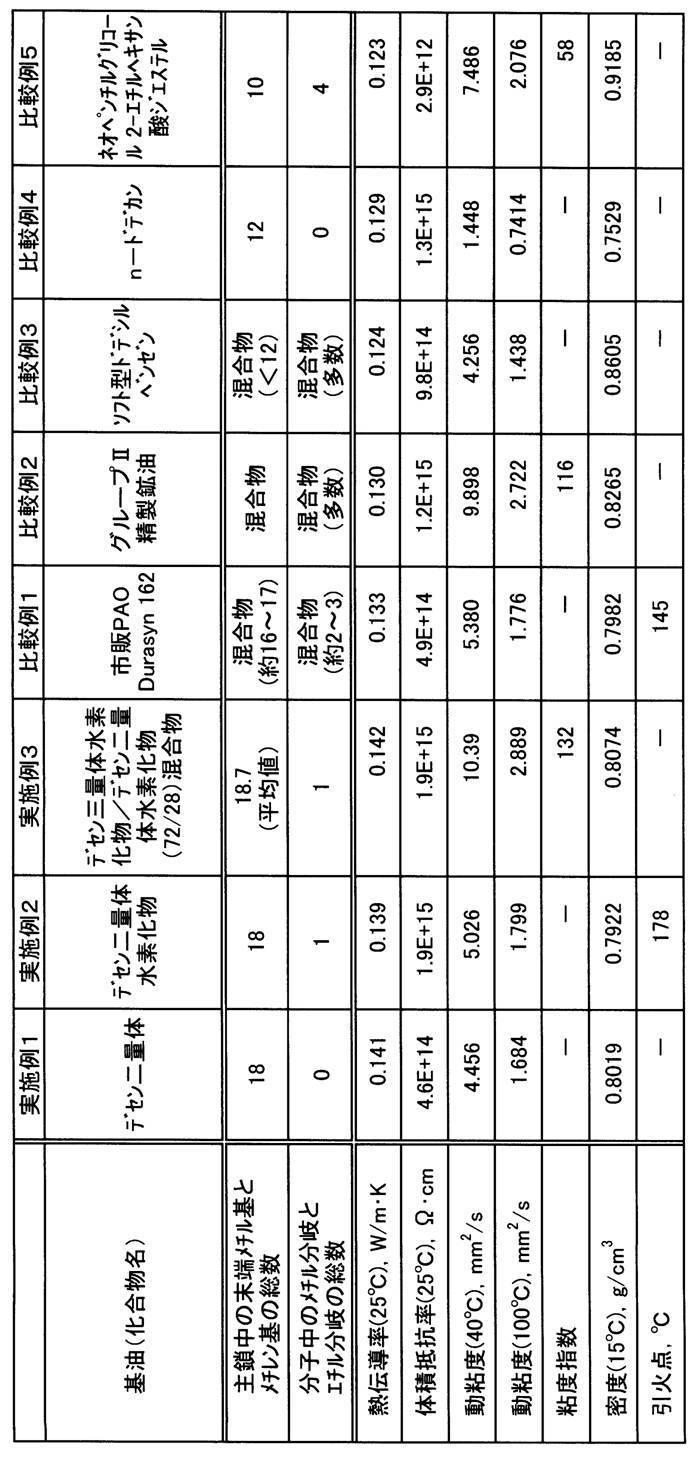
- Example 1 Various properties (thermal conductivity, kinematic viscosity, density, volume resistivity) of 1-decene dimer (trade name: Linear Rendimer A-20, manufactured by Idemitsu Kosan Co., Ltd.) produced with a metallocene catalyst were measured.
- Example 2 Various physical properties (thermal conductivity, kinematic viscosity, density, volume resistivity, flash point) of 1-decene dimer hydride manufactured by metallocene catalyst (trade name: Linearene PAO A-20H manufactured by Idemitsu Kosan Co., Ltd.) was measured.
- FIG. 1 shows a gas chromatogram. It turns out that it is a single composition of high purity.
- Example 3 1-decene dimer hydride (product name: Linearlene PAO A-20H manufactured by Idemitsu Kosan Co., Ltd.) and 1-decene trimer hydride (product name: Linearlene PAO manufactured by Idemitsu Kosan Co., Ltd.) manufactured with metallocene catalyst A-30H) was mixed at a mass ratio of 28/72, and various physical properties (thermal conductivity, kinematic viscosity, viscosity index, density, volume resistivity) were measured.
- trimer hydride has a total number of terminal methyl groups and methylene groups in the main chain of 19 and a total number of methyl branch and ethyl branch groups of 1, and the dimer hydride has a terminal methyl group in the main chain.
- the total number of groups and methylene groups is 18, and the total number of methyl and ethyl branches is 1.
- the base oils (compounds) of the present invention shown in Examples 1 to 3 each have a total number of terminal methyl groups and methylene groups in the main chain of 16 or more. Since the total number of methyl branches and ethyl branches is 1 or less, both thermal conductivity (coolability) and electrical insulation are excellent. Furthermore, since the kinematic viscosity is within a predetermined range, the lubricating performance is excellent. Therefore, the cooling oil using the base oil of the present invention can be used for cooling motors, batteries, inverters, engines and batteries for electric vehicles and hybrid vehicles, and also as a combined oil that also serves as lubrication for transmissions, etc. It can be understood that it is preferable.
- Comparative Example 1 is a case where commercially available PAO was used, but as shown in FIG. 2, there are many isomers, and the total number of methyl branches and ethyl branches obtained from 1 H-NMR is also large. It is inferior in nature and has a low flash point.
- Comparative Example 2 is a case where refined mineral oil is used, since it is many mixtures, it is inferior to thermal conductivity.
- Comparative Example 3 is a case where soft-type dodecylbenzene is used, but it is a mixture of many isomers, has a short main chain, and has a large total number of methyl branches and ethyl branches in the molecule, and is inferior in thermal conductivity.
- Comparative Example 4 is a case where n-dodecane is used. However, although there is no methyl branch or ethyl branch, the thermal conductivity is inferior because the main chain is short. Comparative Example 5 is an ester of a polyhydric alcohol, but is inferior in thermal conductivity because the total number of methyl branches and ethyl branches in the molecule is large. Moreover, it is inferior also in electrical insulation.
- the base oils (compounds) used in Comparative Examples 1, 3, and 5 are all base oils used in the examples of Patent Document 1 cited as the prior art.
- the present invention can be used for equipment cooling base oil, equipment cooling oil blended with the base oil, equipment cooled by the cooling oil, and equipment cooling method using the cooling oil.
Landscapes
- Chemical & Material Sciences (AREA)
- Oil, Petroleum & Natural Gas (AREA)
- Chemical Kinetics & Catalysis (AREA)
- General Chemical & Material Sciences (AREA)
- Organic Chemistry (AREA)
- Engineering & Computer Science (AREA)
- Lubricants (AREA)
Abstract
Description
モーターの冷却法としては、大きく分けて空冷、水冷および油冷の3方式がある。これらの中で、空冷方式は、冷却媒体を特に準備する必要がないという点では優れるが、大きな冷却容量を確保することが難しい。水冷方式は、水の熱伝導率が高いので冷却性には優れるが、導電性があるためモーターコイルを直接冷却できず冷却パイプを張り巡らせる必要性が生じるので冷却装置が大きくなってしまうという問題がある。
これらの冷却方式に対し、油冷方式では、用いられる油が冷却効率に優れるとともに導電性も低いのでモーターを直接冷却できコンパクトな設計が可能となる。それ故、回転部材の潤滑も同時に必要な場合、同一パッケージ化によりモーター冷却油を兼用油として使用することも可能になる。例えば、ハイブリッド車では、変速機油を循環させてモーターの冷却を同時に行う機構が実用化されている。また、電気自動車のホイール駆動モーターでは、潤滑油を循環させて遊星歯車の潤滑とモーターコイル冷却とを兼ねる設計上の工夫もなされている。
一方、流体側の工夫で熱伝達係数を増大させるには、ヌッセルト数、レイノルズ数およびプラントル数が関係するので、流体の物性値としては、動粘度、熱伝導率、比熱および密度が冷却性に影響する。具体的には、動粘度は小さいほど、熱伝導率、比熱および密度は大きいほど流体としての冷却性に優れる。それ故、従来は流体(潤滑油等)の低粘度化により冷却性能を上げることが検討されてきた。しかしながら、潤滑油の場合、低粘度化すると冷却性能は向上するが、十分な油膜厚さを確保できず潤滑不良となる。そのため、必要最低限の限界粘度は変速機等の潤滑部分の条件により決まることになる。よって、同じ動粘度でも、熱伝導率、比熱および密度の大きい潤滑油ほど冷却性能に優れる。例えば、温度が均一な板の強制対流による熱伝達係数は、熱伝導率の3分の2乗、比熱の3分の1乗、密度の3分の1乗に比例するので熱伝導率の影響が最も大きい。
これに対して、本発明者は、分子設計の観点より鋭意検討を行い、所定の分子構造を有する炭化水素化合物が冷却性、電気絶縁性および潤滑性に優れることを見出した。
すなわち、本発明は以下のような機器冷却用基油、該基油を配合してなる機器冷却油、該冷却油により冷却される機器、および該冷却油による機器冷却方法を提供するものである。
(2)上述の(1)に記載の機器冷却用基油において、前記主鎖中のメチレン基の総数が16以上であることを特徴とする機器冷却用基油。
(3)上述の(1)または(2)に記載の機器冷却用基油において、前記炭化水素化合物が鎖状構造であることを特徴とする機器冷却用基油。
(4)上述の(1)から(3)までのいずれか1つに記載の機器冷却用基油において、前記炭化水素化合物が飽和構造であることを特徴とする機器冷却用基油。
(5)上述の(1)から(3)までのいずれか1つに記載の機器冷却用基油において、前記炭化水素化合物が不飽和構造を有することを特徴とする機器冷却用基油。
(6)上述の(1)から(5)までのいずれか1つに記載の機器冷却用基油において、25℃における熱伝導率が0.138W/(m・K)以上であることを特徴とする機器冷却用基油。
(7)上述の(1)から(6)までのいずれか1つに記載の機器冷却用基油において、25℃における体積抵抗率が1013Ω・cm以上であることを特徴とする機器冷却用基油。
(8)上述の(1)から(7)までのいずれか1つに記載の機器冷却用基油を配合してなることを特徴とする機器冷却油。
(9)上述の(8)に記載の機器冷却油により冷却されることを特徴とする機器。
(10)上述の(9)に記載の機器が電気自動車用またはハイブリッド車用であることを特徴とする機器。
(11)上述の(9)または(10)に記載の機器がモーター、バッテリー、インバーター、エンジンおよび電池の少なくともいずれかであることを特徴とする機器。
(12)上述の(8)に記載の機器冷却油を用いることを特徴とする機器冷却方法。
以下に、本発明を詳細に説明する。
オリゴマー化触媒としては、一般に使用されるBF3錯体触媒や固体酸触媒などを用いてもよいが、分岐の多い骨格異性体が生成しやすいため、目的とする構造の生成物が得られにくいおそれがある。それ故、骨格異性化が起こりにくいメタロセン錯体触媒を用いることが好ましい。
オリゴマーの水素化には、通常のスポンジニッケルやニッケル珪藻土などのニッケル触媒、パラジウム活性炭、あるいはルテニウム活性炭などの貴金属触媒等が好適である。また、担持触媒や錯体触媒など、用いる触媒の種類に制限はない。
また、本発明の基油は、25℃における体積抵抗率が1013Ω・cm以上であることが絶縁性の観点より好ましく、より好ましくは1014Ω・cm以上である。
このような他の成分としては、鉱油あるいは合成油が好ましく挙げられる。鉱油としては、例えばナフテン系鉱油、パラフィン系鉱油、GTL鉱油 WAX異性化鉱油などが挙げられる。具体的には、溶剤精製あるいは水添精製による軽質ニュートラル油、中質ニュートラル油、重質ニュートラル油、ブライトストックなどが例示できる。
一方、合成油としては、ポリブテンまたはその水素化物、ポリα-オレフィン(1-オクテンオリゴマー、1-デセンオリゴマー等)またはその水素化物、α-オレフィンコポリマー、アルキルベンゼン、ポリオールエステル、二塩基酸エステル、ポリオキシアルキレングリコール、ポリオキシアルキレングリコールエステル、ポリオキシアルキレングリコールエーテル、ヒンダードエステル、シリコーンオイルなどが挙げられる。
なお、本発明の機器冷却油に対しては、本発明の目的を阻害しない範囲で種々の添加剤を配合することができる。例えば、粘度指数向上剤、酸化防止剤、清浄分散剤、摩擦調整剤(油性剤、極圧剤)、耐摩耗剤、金属不活性化剤、流動点降下剤、および消泡剤などを必要に応じて配合することができる。ただし、機器冷却油を兼用油として用いる場合は、電気絶縁性を損なわずに潤滑性能を発揮させるような配合処方とするよう留意すべきである。それ故、機器冷却油として、25℃における熱伝導率が0.138W/(m・K)以上であり、25℃における体積抵抗率が1013Ω・cm以上であって、さらに40℃動粘度も4mm2/s以上、30mm2/s以下であるように配合処方を決定することが望ましい。
流動点降下剤としては、例えばエチレン-酢酸ビニル共重合体、塩素化パラフィンとナフタレンとの縮合物、塩素化パラフィンとフェノールとの縮合物、ポリメタクリレート、ポリアルキルスチレン等が挙げられ、特に、ポリメタクリレートが好ましく用いられる。これらの配合量は、冷却油全量基準で0.01質量%以上、5質量%以下が好ましい。
消泡剤としては、液状シリコーンが適しており、例えば、メチルシリコーン、フルオロシリコーン、ポリアクリレートなどが好適である。これら消泡剤の好ましい配合量は、冷却油全量基準で0.0005質量%以上、0.01質量%以下である。
具体的には、表1に示すような各基油を調製して、各種の評価を行った。基油の調製方法および評価方法(物性測定方法)は以下の通りである。
メタロセン触媒で製造した1-デセン二量体(出光興産(株)製 商品名:リニアレンダイマー A-20)について各種の物性(熱伝導率、動粘度、密度、体積抵抗率)を測定した。
メタロセン触媒で製造した1-デセン二量体水素化物(出光興産(株)製 商品名:リニアレンPAO A-20H)について各種の物性(熱伝導率、動粘度、密度、体積抵抗率、引火点)を測定した。なお、図1に、ガスクロマトグラムを示す。高純度の単一組成物であることが分る。
メタロセン触媒で製造した1-デセン二量体水素化物(出光興産(株)製 商品名:リニアレンPAO A-20H)と1-デセン三量体水素化物(出光興産(株)製 商品名:リニアレンPAO A-30H)を28/72の質量比で混合し、各種の物性(熱伝導率、動粘度、粘度指数、密度、体積抵抗率)を測定した。前記した三量体水素化物は主鎖中の末端メチル基およびメチレン基の総数が19、メチル分岐およびエチル分岐基の総数は1であり、前記した二量体水素化物は主鎖中の末端メチル基およびメチレン基総数が18、メチル分岐およびエチル分岐基の総数は1である。
市販ポリアルファオレフィン(INEOS社製 商品名;Durasyn 162)について各種の物性(熱伝導率、動粘度、密度、体積抵抗率、引火点)を測定した。なお、図2にガスクロマトグラムを示す。
グループII精製鉱油(出光興産(株)製)について各種の物性(熱伝導率、動粘度、粘度指数、密度、体積抵抗率)を測定した。
ソフト型ドデシルベンゼン(東京化成工業株式会社製 試薬)について、各種の物性(熱伝導率、動粘度、密度、体積抵抗率)を測定した。
n-ドデカン(東京化成工業株式会社製 試薬)について、各種の物性(熱伝導率、動粘度、密度、体積抵抗率)を測定した。
500ミリリットルのDean-Stark装置付き四つ口フラスコに2-エチルヘキサン酸(東京化成工業株式会社製 試薬)173g、ネオペンチルグリコール(東京化成工業株式会社製 試薬)52g、チタンテトライソプロポキシド(東京化成工業株式会社製 試薬)0.1g、キシレン(東京化成工業株式会社製 試薬)100ccを入れ,窒素気流攪拌下に水を留去しながら160℃で4時間反応させた。その後、飽和食塩水洗浄、0.1規定水酸化ナトリウム水溶液洗浄を各3回行った後、無水硫酸マグネシウムで乾燥させた。硫酸マグネシウムを濾過した後、減圧下に未反応2-エチルヘキサン酸を留去して、2-エチルヘキサン酸のネオペンチルグリコールジエステル155gを得た。この化合物について、各種の物性(熱伝導率、動粘度、粘度指数、密度、体積抵抗率)を測定した。
(1)熱伝導率
デカゴン社製 熱特性計KD2proを用い、シングルニードルセンサーにて室温(25℃)で測定した。
JIS C 2101の24(体積抵抗率試験)に準拠し,室温(25℃)で測定した。
(3)動粘度
JIS K 2283に規定される「石油製品動粘度試験方法」に準拠して測定した。
(4)粘度指数
JIS K 2283に規定される「石油製品動粘度試験方法」に準拠して測定した。
(5)密度
JIS K2249「原油および石油製品-密度試験方法」に準拠して測定した。
(6)引火点
JIS K2265に準拠し、C.O.C法により測定した。
(7)主鎖中の末端メチル基とメチレン基の総数、および分子中のメチル分岐とエチル分岐の総数
JEOL製AL-400型NMRを用い、該当する官能基に起因するプロトンシグナルの積分強度から求めた。
表1の結果からわかるように、実施例1から3までに示される本発明の基油(化合物)は、いずれも主鎖中の末端メチル基およびメチレン基の総数が16以上であり、分子中のメチル分岐およびエチル分岐の総数が1以下であるので、熱伝導性(冷却性)および電気絶縁性の双方に優れる。さらに、動粘度も所定の範囲内であるので潤滑性能にも優れる。それ故、本発明の基油を用いた冷却油は、電気自動車やハイブリッド車用のモーター、バッテリー、インバーター、エンジンおよび電池等の冷却用として、さらに変速機等の潤滑も兼ねた兼用油としても好適であることが理解できる。
一方、比較例1は、市販のPAOを用いた場合であるが、図2からもわかるように異性体が多く、1H-NMRから求めたメチル分岐とエチル分岐の総数も多いため、熱伝導性に劣り、また引火点も低い。比較例2は、精製鉱油を用いた場合であるが、多数の混合物のため、熱伝導性に劣る。比較例3は、ソフト型ドデシルベンゼンを用いた場合であるが、多数の異性体混合物であり、主鎖が短く、分子中のメチル分岐とエチル分岐の総数も多いため熱伝導性に劣る。比較例4は、n-ドデカンを用いた場合であるが、メチル分岐やエチル分岐は無いものの、主鎖が短いため熱伝導性に劣る。比較例5は、多価アルコールのエステルであるが、分子中のメチル分岐とエチル分岐の総数が多いため熱伝導性に劣る。また、電気絶縁性にも劣る。ちなみに、比較例1、3、5において使用した基油(化合物)は、いずれも先行技術として挙げた特許文献1の実施例で用いられた基油である。
Claims (12)
- 主鎖中の末端メチル基およびメチレン基の総数が16以上であり、分子中のメチル分岐およびエチル分岐の総数が1以下である炭化水素化合物を30質量%以上含有し、
40℃動粘度が4mm2/s以上、30mm2/s以下である
ことを特徴とする機器冷却用基油。 - 請求項1に記載の機器冷却用基油において、
前記主鎖中のメチレン基の総数が16以上である
ことを特徴とする機器冷却用基油。 - 請求項1または請求項2に記載の機器冷却用基油において、
前記炭化水素化合物が鎖状構造である
ことを特徴とする機器冷却用基油。 - 請求項1から請求項3までのいずれか1項に記載の機器冷却用基油において、
前記炭化水素化合物が飽和構造である
ことを特徴とする機器冷却用基油。 - 請求項1から請求項3までのいずれか1項に記載の機器冷却用基油において、
前記炭化水素化合物が不飽和構造を有する
ことを特徴とする機器冷却用基油。 - 請求項1から請求項5までのいずれか1項に記載の機器冷却用基油において、
25℃における熱伝導率が0.138W/(m・K)以上である
ことを特徴とする機器冷却用基油。 - 請求項1から請求項6までのいずれか1項に記載の機器冷却用基油において、
25℃における体積抵抗率が1013Ω・cm以上である
ことを特徴とする機器冷却用基油。 - 請求項1から請求項7までのいずれか1項に記載の機器冷却用基油を配合してなる
ことを特徴とする機器冷却油。 - 請求項8に記載の機器冷却油により冷却される
ことを特徴とする機器。 - 請求項9に記載の機器が電気自動車用またはハイブリッド車用である
ことを特徴とする機器。 - 請求項9または請求項10に記載の機器がモーター、バッテリー、インバーター、エンジンおよび電池の少なくともいずれかである
ことを特徴とする機器。 - 請求項8に記載の機器冷却油を用いる
ことを特徴とする機器冷却方法。
Priority Applications (3)
| Application Number | Priority Date | Filing Date | Title |
|---|---|---|---|
| US13/517,385 US20120264661A1 (en) | 2009-12-24 | 2010-11-05 | Base oil for cooling device, device-cooling oil containing the base oil, device to be cooled by the cooling oil, and device cooling method using the cooling oil |
| CN2010800593806A CN102666815A (zh) | 2009-12-24 | 2010-11-05 | 机器冷却用基础油、混合该基础油而成的机器冷却油、通过该冷却油冷却的机器以及用该冷却油进行的机器冷却方法 |
| EP10839075.8A EP2518131A4 (en) | 2009-12-24 | 2010-11-05 | BASE OIL FOR COOLING A DEVICE, EQUIPMENT COOLING OIL WITH BASE OIL, COOLING OIL TO COOLING DEVICE AND COOLING EQUIPMENT WITH COOLING OIL |
Applications Claiming Priority (4)
| Application Number | Priority Date | Filing Date | Title |
|---|---|---|---|
| JP2009-291778 | 2009-12-24 | ||
| JP2009291778 | 2009-12-24 | ||
| JP2010-178798 | 2010-08-09 | ||
| JP2010178798A JP2011148970A (ja) | 2009-12-24 | 2010-08-09 | 機器冷却用基油、該基油を配合してなる機器冷却油、該冷却油により冷却される機器、および該冷却油による機器冷却方法 |
Publications (1)
| Publication Number | Publication Date |
|---|---|
| WO2011077839A1 true WO2011077839A1 (ja) | 2011-06-30 |
Family
ID=44195384
Family Applications (1)
| Application Number | Title | Priority Date | Filing Date |
|---|---|---|---|
| PCT/JP2010/069664 Ceased WO2011077839A1 (ja) | 2009-12-24 | 2010-11-05 | 機器冷却用基油、該基油を配合してなる機器冷却油、該冷却油により冷却される機器、および該冷却油による機器冷却方法 |
Country Status (6)
| Country | Link |
|---|---|
| US (1) | US20120264661A1 (ja) |
| EP (1) | EP2518131A4 (ja) |
| JP (1) | JP2011148970A (ja) |
| KR (1) | KR20120108027A (ja) |
| CN (1) | CN102666815A (ja) |
| WO (1) | WO2011077839A1 (ja) |
Cited By (5)
| Publication number | Priority date | Publication date | Assignee | Title |
|---|---|---|---|---|
| JP2021529238A (ja) * | 2018-07-02 | 2021-10-28 | トタル マーケティング セルヴィス | 電気自動車又はハイブリッド車の推進システムを冷却し潤滑するための組成物 |
| JP2022087250A (ja) * | 2018-12-28 | 2022-06-09 | ディーエル ケミカル カンパニー リミテッド | 均一な構造を有するアルファオレフィンオリゴマーおよびその製造方法 |
| WO2022123834A1 (ja) | 2020-12-11 | 2022-06-16 | Eneos株式会社 | 冷却用液体組成物 |
| JP2022537933A (ja) * | 2019-06-12 | 2022-08-31 | ザ ルブリゾル コーポレイション | 有機熱伝達システム、方法、および流体 |
| WO2024122199A1 (ja) * | 2022-12-07 | 2024-06-13 | 出光興産株式会社 | 潤滑油組成物及び潤滑油組成物を用いる循環システム |
Families Citing this family (19)
| Publication number | Priority date | Publication date | Assignee | Title |
|---|---|---|---|---|
| JP6049522B2 (ja) * | 2013-03-29 | 2016-12-21 | Jxエネルギー株式会社 | 潤滑油基油及びその製造方法、電気絶縁油 |
| KR20150089464A (ko) * | 2014-01-28 | 2015-08-05 | 주식회사 엘지화학 | 전지모듈 |
| CA2980983C (en) | 2015-03-27 | 2020-05-19 | Jfe Steel Corporation | High-strength steel, method for manufacturing high-strength steel, steel pipe, and method for manufacturing steel pipe |
| JP6789615B2 (ja) | 2015-03-31 | 2020-11-25 | 出光興産株式会社 | 変速機用潤滑油組成物 |
| JP6693033B2 (ja) | 2015-03-31 | 2020-05-13 | 出光興産株式会社 | 電気自動車又はハイブリッド車用潤滑油組成物 |
| FR3037968A1 (fr) * | 2015-06-29 | 2016-12-30 | Total Marketing Services | Polyolefines comme fluide special |
| FR3037969B1 (fr) * | 2015-06-29 | 2017-08-11 | Total Marketing Services | Polyolefines lubrifiantes de basse viscosite |
| US20180100115A1 (en) * | 2016-10-07 | 2018-04-12 | Exxonmobil Research And Engineering Company | High conductivity lubricating oils for electric and hybrid vehicles |
| EP3315590A1 (en) * | 2016-10-27 | 2018-05-02 | Total Marketing Services | Use of hydrocarbon fluids in electric vehicles |
| FR3072685B1 (fr) * | 2017-10-20 | 2020-11-06 | Total Marketing Services | Composition pour refroidir et lubrifier un systeme de motorisation d'un vehicule |
| FR3075888A1 (fr) * | 2017-12-21 | 2019-06-28 | Ksb Sas | Groupe motopompe a moteur rempli d'huile |
| FR3088073B1 (fr) | 2018-11-05 | 2021-07-23 | Total Marketing Services | Utilisation d'un diester pour ameliorer les proprietes anti-usure d'une composition lubrifiante |
| FR3093729B1 (fr) * | 2019-03-13 | 2025-10-10 | Total Marketing Services | Utilisation d’un ester dans une composition de refroidissement |
| US12497551B2 (en) | 2019-06-27 | 2025-12-16 | Exxonmobil Chemical Patents Inc. | Heat transfer fluids comprising methyl paraffins derived from linear alpha olefin dimers and use thereof |
| EP4186967B1 (en) * | 2020-07-22 | 2026-04-01 | Idemitsu Kosan Co., Ltd | Use of a lubricating oil composition for cooling an electric vehicle device |
| US11753599B2 (en) | 2021-06-04 | 2023-09-12 | Afton Chemical Corporation | Lubricating compositions for a hybrid engine |
| CN118369408A (zh) * | 2021-12-16 | 2024-07-19 | 路博润公司 | 有机热传递系统、方法和流体 |
| CN121241115A (zh) * | 2023-04-28 | 2025-12-30 | 胜牌全球产品知识产权有限公司 | 基于合成酯的传热流体 |
| JP2025096133A (ja) * | 2023-12-15 | 2025-06-26 | ジーエス カルテックス コーポレイション | 液浸冷却システム用の冷却材、及びこれを含む液浸冷却システム |
Citations (7)
| Publication number | Priority date | Publication date | Assignee | Title |
|---|---|---|---|---|
| JPH04226511A (ja) * | 1990-07-19 | 1992-08-17 | Ethyl Corp | オレフインのオリゴマー化方法およびその生成物ならびに二量体生成物の使用 |
| JPH07507077A (ja) * | 1992-02-06 | 1995-08-03 | ビーピー・コーポレーシヨン・ノース・アメリカ・インコーポレーテツド | α−オレフィン二量体を有する合成潤滑剤組成物 |
| WO2002097017A1 (fr) * | 2001-05-28 | 2002-12-05 | Nissan Motor Co., Ltd. | Composition d'huile de transmission pour automobile |
| JP2007137951A (ja) * | 2005-11-15 | 2007-06-07 | Idemitsu Kosan Co Ltd | 潤滑油組成物、軸受油及びそれを用いた軸受 |
| JP2007137952A (ja) * | 2005-11-15 | 2007-06-07 | Idemitsu Kosan Co Ltd | 内燃機関用潤滑油組成物 |
| JP2009161604A (ja) * | 2007-12-28 | 2009-07-23 | Nippon Oil Corp | 自動車用変速機油組成物 |
| JP2009242547A (ja) * | 2008-03-31 | 2009-10-22 | Nippon Oil Corp | 自動車用変速機油組成物 |
Family Cites Families (4)
| Publication number | Priority date | Publication date | Assignee | Title |
|---|---|---|---|---|
| US5171905A (en) * | 1990-07-19 | 1992-12-15 | Ethyl Corporation | Olefin dimer products |
| JP4806176B2 (ja) * | 2004-09-03 | 2011-11-02 | 出光興産株式会社 | 内部オレフィン組成物及び該組成物を含む石油掘削基油 |
| EP1921126B1 (en) * | 2005-08-31 | 2012-05-16 | Idemitsu Kosan Co., Ltd. | Closed system refrigerator |
| EP2333034B1 (en) * | 2005-11-15 | 2016-01-27 | Idemitsu Kosan Co., Ltd. | Transmission fluid composition |
-
2010
- 2010-08-09 JP JP2010178798A patent/JP2011148970A/ja active Pending
- 2010-11-05 EP EP10839075.8A patent/EP2518131A4/en not_active Withdrawn
- 2010-11-05 KR KR1020127019414A patent/KR20120108027A/ko not_active Withdrawn
- 2010-11-05 US US13/517,385 patent/US20120264661A1/en not_active Abandoned
- 2010-11-05 WO PCT/JP2010/069664 patent/WO2011077839A1/ja not_active Ceased
- 2010-11-05 CN CN2010800593806A patent/CN102666815A/zh active Pending
Patent Citations (7)
| Publication number | Priority date | Publication date | Assignee | Title |
|---|---|---|---|---|
| JPH04226511A (ja) * | 1990-07-19 | 1992-08-17 | Ethyl Corp | オレフインのオリゴマー化方法およびその生成物ならびに二量体生成物の使用 |
| JPH07507077A (ja) * | 1992-02-06 | 1995-08-03 | ビーピー・コーポレーシヨン・ノース・アメリカ・インコーポレーテツド | α−オレフィン二量体を有する合成潤滑剤組成物 |
| WO2002097017A1 (fr) * | 2001-05-28 | 2002-12-05 | Nissan Motor Co., Ltd. | Composition d'huile de transmission pour automobile |
| JP2007137951A (ja) * | 2005-11-15 | 2007-06-07 | Idemitsu Kosan Co Ltd | 潤滑油組成物、軸受油及びそれを用いた軸受 |
| JP2007137952A (ja) * | 2005-11-15 | 2007-06-07 | Idemitsu Kosan Co Ltd | 内燃機関用潤滑油組成物 |
| JP2009161604A (ja) * | 2007-12-28 | 2009-07-23 | Nippon Oil Corp | 自動車用変速機油組成物 |
| JP2009242547A (ja) * | 2008-03-31 | 2009-10-22 | Nippon Oil Corp | 自動車用変速機油組成物 |
Cited By (7)
| Publication number | Priority date | Publication date | Assignee | Title |
|---|---|---|---|---|
| JP2021529238A (ja) * | 2018-07-02 | 2021-10-28 | トタル マーケティング セルヴィス | 電気自動車又はハイブリッド車の推進システムを冷却し潤滑するための組成物 |
| JP2022087250A (ja) * | 2018-12-28 | 2022-06-09 | ディーエル ケミカル カンパニー リミテッド | 均一な構造を有するアルファオレフィンオリゴマーおよびその製造方法 |
| JP2022537933A (ja) * | 2019-06-12 | 2022-08-31 | ザ ルブリゾル コーポレイション | 有機熱伝達システム、方法、および流体 |
| JP7566800B2 (ja) | 2019-06-12 | 2024-10-15 | ザ ルブリゾル コーポレイション | 有機熱伝達システム、方法、および流体 |
| WO2022123834A1 (ja) | 2020-12-11 | 2022-06-16 | Eneos株式会社 | 冷却用液体組成物 |
| US12024667B2 (en) | 2020-12-11 | 2024-07-02 | Eneos Corporation | Cooling liquid composition |
| WO2024122199A1 (ja) * | 2022-12-07 | 2024-06-13 | 出光興産株式会社 | 潤滑油組成物及び潤滑油組成物を用いる循環システム |
Also Published As
| Publication number | Publication date |
|---|---|
| JP2011148970A (ja) | 2011-08-04 |
| EP2518131A1 (en) | 2012-10-31 |
| KR20120108027A (ko) | 2012-10-04 |
| EP2518131A4 (en) | 2013-11-13 |
| US20120264661A1 (en) | 2012-10-18 |
| CN102666815A (zh) | 2012-09-12 |
Similar Documents
| Publication | Publication Date | Title |
|---|---|---|
| WO2011077839A1 (ja) | 機器冷却用基油、該基油を配合してなる機器冷却油、該冷却油により冷却される機器、および該冷却油による機器冷却方法 | |
| JP2012031359A (ja) | 機器冷却用基油、該基油を配合してなる機器冷却油、該冷却油により冷却される機器、および該冷却油による機器冷却方法 | |
| US20120283162A1 (en) | Base oil for cooling of device, device-cooling oil containing the base oil, device to be cooled by the cooling oil, and device cooling method using the cooling oil | |
| ES2444921T3 (es) | Proceso para fabricar productos oleosos oligoméricos de baja viscosidad | |
| WO2011080991A1 (ja) | 機器冷却用基油、該基油を配合してなる機器冷却油、該冷却油により冷却される機器、および該冷却油による機器冷却方法 | |
| JP5779376B2 (ja) | 潤滑油組成物 | |
| JP7757242B2 (ja) | イオン液体、及び潤滑剤組成物 | |
| US9206095B2 (en) | Low viscosity oligomer oil product, process and composition | |
| JP7373474B2 (ja) | 潤滑油組成物 | |
| TW201002814A (en) | Lubricant composition | |
| CN111032835B (zh) | 润滑油组合物、润滑油组合物的制造方法和无级变速器 | |
| WO2022258664A1 (en) | Lubricant composition comprising traction coefficient additive | |
| JP6047224B1 (ja) | 鉱油系基油、潤滑油組成物、内燃機関、及び内燃機関の潤滑方法 | |
| JP2011157540A (ja) | 機器冷却用基油、該基油を配合してなる機器冷却油、該冷却油により冷却される機器、および該冷却油による機器冷却方法 | |
| JP2012017391A (ja) | 冷却油および冷却方法 | |
| JP2011157542A (ja) | 機器冷却用基油、該基油を配合してなる機器冷却油、該冷却油により冷却される機器、および該冷却油による機器冷却方法 | |
| EP2597140A1 (en) | Lubricating oil composition and lubricating oil composition for continuously variable transmission | |
| JP5931250B2 (ja) | 潤滑油組成物 | |
| US11208606B2 (en) | Lubricating oil composition, method for producing lubricating oil composition, and continuously variable transmission | |
| CN112088205B (zh) | 润滑油组合物以及使用其的润滑剂 | |
| JP5325384B2 (ja) | 内燃機関用潤滑油組成物 | |
| WO2025094743A1 (ja) | 潤滑油基油 | |
| JP2011157541A (ja) | 機器冷却用基油、該基油を配合してなる機器冷却油、該冷却油により冷却される機器、および該冷却油による機器冷却方法 | |
| JP2018188549A (ja) | 潤滑油組成物 | |
| JP2012082398A (ja) | 無段変速機用潤滑油組成物 |
Legal Events
| Date | Code | Title | Description |
|---|---|---|---|
| 121 | Ep: the epo has been informed by wipo that ep was designated in this application |
Ref document number: 10839075 Country of ref document: EP Kind code of ref document: A1 |
|
| WWE | Wipo information: entry into national phase |
Ref document number: 13517385 Country of ref document: US |
|
| NENP | Non-entry into the national phase |
Ref country code: DE |
|
| WWE | Wipo information: entry into national phase |
Ref document number: 2010839075 Country of ref document: EP |
|
| ENP | Entry into the national phase |
Ref document number: 20127019414 Country of ref document: KR Kind code of ref document: A |
|
| WWE | Wipo information: entry into national phase |
Ref document number: 1854/KOLNP/2012 Country of ref document: IN |