WO2011078111A1 - 大型容器用プリフォーム及び大型容器並びに大型容器の製造方法 - Google Patents
大型容器用プリフォーム及び大型容器並びに大型容器の製造方法 Download PDFInfo
- Publication number
- WO2011078111A1 WO2011078111A1 PCT/JP2010/072875 JP2010072875W WO2011078111A1 WO 2011078111 A1 WO2011078111 A1 WO 2011078111A1 JP 2010072875 W JP2010072875 W JP 2010072875W WO 2011078111 A1 WO2011078111 A1 WO 2011078111A1
- Authority
- WO
- WIPO (PCT)
- Prior art keywords
- molded product
- large container
- preform
- blow
- primary blow
- Prior art date
- Legal status (The legal status is an assumption and is not a legal conclusion. Google has not performed a legal analysis and makes no representation as to the accuracy of the status listed.)
- Ceased
Links
Images


Classifications
-
- B—PERFORMING OPERATIONS; TRANSPORTING
- B65—CONVEYING; PACKING; STORING; HANDLING THIN OR FILAMENTARY MATERIAL
- B65D—CONTAINERS FOR STORAGE OR TRANSPORT OF ARTICLES OR MATERIALS, e.g. BAGS, BARRELS, BOTTLES, BOXES, CANS, CARTONS, CRATES, DRUMS, JARS, TANKS, HOPPERS, FORWARDING CONTAINERS; ACCESSORIES, CLOSURES, OR FITTINGS THEREFOR; PACKAGING ELEMENTS; PACKAGES
- B65D1/00—Rigid or semi-rigid containers having bodies formed in one piece, e.g. by casting metallic material, by moulding plastics, by blowing vitreous material, by throwing ceramic material, by moulding pulped fibrous material or by deep-drawing operations performed on sheet material
- B65D1/02—Bottles or similar containers with necks or like restricted apertures, designed for pouring contents
- B65D1/0223—Bottles or similar containers with necks or like restricted apertures, designed for pouring contents characterised by shape
- B65D1/023—Neck construction
-
- B—PERFORMING OPERATIONS; TRANSPORTING
- B29—WORKING OF PLASTICS; WORKING OF SUBSTANCES IN A PLASTIC STATE IN GENERAL
- B29C—SHAPING OR JOINING OF PLASTICS; SHAPING OF MATERIAL IN A PLASTIC STATE, NOT OTHERWISE PROVIDED FOR; AFTER-TREATMENT OF THE SHAPED PRODUCTS, e.g. REPAIRING
- B29C49/00—Blow-moulding, i.e. blowing a preform or parison to a desired shape within a mould; Apparatus therefor
- B29C49/18—Blow-moulding, i.e. blowing a preform or parison to a desired shape within a mould; Apparatus therefor using several blowing steps
-
- B—PERFORMING OPERATIONS; TRANSPORTING
- B29—WORKING OF PLASTICS; WORKING OF SUBSTANCES IN A PLASTIC STATE IN GENERAL
- B29C—SHAPING OR JOINING OF PLASTICS; SHAPING OF MATERIAL IN A PLASTIC STATE, NOT OTHERWISE PROVIDED FOR; AFTER-TREATMENT OF THE SHAPED PRODUCTS, e.g. REPAIRING
- B29C49/00—Blow-moulding, i.e. blowing a preform or parison to a desired shape within a mould; Apparatus therefor
- B29C49/02—Combined blow-moulding and manufacture of the preform or the parison
- B29C49/06905—Using combined techniques for making the preform
-
- B—PERFORMING OPERATIONS; TRANSPORTING
- B29—WORKING OF PLASTICS; WORKING OF SUBSTANCES IN A PLASTIC STATE IN GENERAL
- B29C—SHAPING OR JOINING OF PLASTICS; SHAPING OF MATERIAL IN A PLASTIC STATE, NOT OTHERWISE PROVIDED FOR; AFTER-TREATMENT OF THE SHAPED PRODUCTS, e.g. REPAIRING
- B29C49/00—Blow-moulding, i.e. blowing a preform or parison to a desired shape within a mould; Apparatus therefor
- B29C49/08—Biaxial stretching during blow-moulding
- B29C49/10—Biaxial stretching during blow-moulding using mechanical means for prestretching
- B29C49/12—Stretching rods
-
- B—PERFORMING OPERATIONS; TRANSPORTING
- B29—WORKING OF PLASTICS; WORKING OF SUBSTANCES IN A PLASTIC STATE IN GENERAL
- B29C—SHAPING OR JOINING OF PLASTICS; SHAPING OF MATERIAL IN A PLASTIC STATE, NOT OTHERWISE PROVIDED FOR; AFTER-TREATMENT OF THE SHAPED PRODUCTS, e.g. REPAIRING
- B29C49/00—Blow-moulding, i.e. blowing a preform or parison to a desired shape within a mould; Apparatus therefor
- B29C49/42—Component parts, details or accessories; Auxiliary operations
- B29C49/64—Heating or cooling preforms, parisons or blown articles
- B29C49/6409—Thermal conditioning of preforms
- B29C49/6418—Heating of preforms
- B29C49/642—Heating of preforms and shrinking of the preform
-
- B—PERFORMING OPERATIONS; TRANSPORTING
- B29—WORKING OF PLASTICS; WORKING OF SUBSTANCES IN A PLASTIC STATE IN GENERAL
- B29C—SHAPING OR JOINING OF PLASTICS; SHAPING OF MATERIAL IN A PLASTIC STATE, NOT OTHERWISE PROVIDED FOR; AFTER-TREATMENT OF THE SHAPED PRODUCTS, e.g. REPAIRING
- B29C49/00—Blow-moulding, i.e. blowing a preform or parison to a desired shape within a mould; Apparatus therefor
- B29C49/42—Component parts, details or accessories; Auxiliary operations
- B29C49/64—Heating or cooling preforms, parisons or blown articles
- B29C49/6472—Heating or cooling preforms, parisons or blown articles in several stages
-
- B—PERFORMING OPERATIONS; TRANSPORTING
- B29—WORKING OF PLASTICS; WORKING OF SUBSTANCES IN A PLASTIC STATE IN GENERAL
- B29C—SHAPING OR JOINING OF PLASTICS; SHAPING OF MATERIAL IN A PLASTIC STATE, NOT OTHERWISE PROVIDED FOR; AFTER-TREATMENT OF THE SHAPED PRODUCTS, e.g. REPAIRING
- B29C2949/00—Indexing scheme relating to blow-moulding
- B29C2949/07—Preforms or parisons characterised by their configuration
- B29C2949/0715—Preforms or parisons characterised by their configuration the preform having one end closed
-
- B—PERFORMING OPERATIONS; TRANSPORTING
- B29—WORKING OF PLASTICS; WORKING OF SUBSTANCES IN A PLASTIC STATE IN GENERAL
- B29C—SHAPING OR JOINING OF PLASTICS; SHAPING OF MATERIAL IN A PLASTIC STATE, NOT OTHERWISE PROVIDED FOR; AFTER-TREATMENT OF THE SHAPED PRODUCTS, e.g. REPAIRING
- B29C2949/00—Indexing scheme relating to blow-moulding
- B29C2949/07—Preforms or parisons characterised by their configuration
- B29C2949/081—Specified dimensions, e.g. values or ranges
- B29C2949/0811—Wall thickness
-
- B—PERFORMING OPERATIONS; TRANSPORTING
- B29—WORKING OF PLASTICS; WORKING OF SUBSTANCES IN A PLASTIC STATE IN GENERAL
- B29C—SHAPING OR JOINING OF PLASTICS; SHAPING OF MATERIAL IN A PLASTIC STATE, NOT OTHERWISE PROVIDED FOR; AFTER-TREATMENT OF THE SHAPED PRODUCTS, e.g. REPAIRING
- B29C2949/00—Indexing scheme relating to blow-moulding
- B29C2949/07—Preforms or parisons characterised by their configuration
- B29C2949/0861—Other specified values, e.g. values or ranges
- B29C2949/0872—Weight
-
- B—PERFORMING OPERATIONS; TRANSPORTING
- B29—WORKING OF PLASTICS; WORKING OF SUBSTANCES IN A PLASTIC STATE IN GENERAL
- B29C—SHAPING OR JOINING OF PLASTICS; SHAPING OF MATERIAL IN A PLASTIC STATE, NOT OTHERWISE PROVIDED FOR; AFTER-TREATMENT OF THE SHAPED PRODUCTS, e.g. REPAIRING
- B29C49/00—Blow-moulding, i.e. blowing a preform or parison to a desired shape within a mould; Apparatus therefor
- B29C49/02—Combined blow-moulding and manufacture of the preform or the parison
- B29C49/06—Injection blow-moulding
-
- B—PERFORMING OPERATIONS; TRANSPORTING
- B29—WORKING OF PLASTICS; WORKING OF SUBSTANCES IN A PLASTIC STATE IN GENERAL
- B29K—INDEXING SCHEME ASSOCIATED WITH SUBCLASSES B29B, B29C OR B29D, RELATING TO MOULDING MATERIALS OR TO MATERIALS FOR MOULDS, REINFORCEMENTS, FILLERS OR PREFORMED PARTS, e.g. INSERTS
- B29K2067/00—Use of polyesters or derivatives thereof, as moulding material
- B29K2067/003—PET, i.e. poylethylene terephthalate
-
- B—PERFORMING OPERATIONS; TRANSPORTING
- B29—WORKING OF PLASTICS; WORKING OF SUBSTANCES IN A PLASTIC STATE IN GENERAL
- B29L—INDEXING SCHEME ASSOCIATED WITH SUBCLASS B29C, RELATING TO PARTICULAR ARTICLES
- B29L2022/00—Hollow articles
-
- B—PERFORMING OPERATIONS; TRANSPORTING
- B29—WORKING OF PLASTICS; WORKING OF SUBSTANCES IN A PLASTIC STATE IN GENERAL
- B29L—INDEXING SCHEME ASSOCIATED WITH SUBCLASS B29C, RELATING TO PARTICULAR ARTICLES
- B29L2031/00—Other particular articles
- B29L2031/712—Containers; Packaging elements or accessories, Packages
- B29L2031/7126—Containers; Packaging elements or accessories, Packages large, e.g. for bulk storage
-
- B—PERFORMING OPERATIONS; TRANSPORTING
- B29—WORKING OF PLASTICS; WORKING OF SUBSTANCES IN A PLASTIC STATE IN GENERAL
- B29L—INDEXING SCHEME ASSOCIATED WITH SUBCLASS B29C, RELATING TO PARTICULAR ARTICLES
- B29L2031/00—Other particular articles
- B29L2031/712—Containers; Packaging elements or accessories, Packages
- B29L2031/7158—Bottles
-
- Y—GENERAL TAGGING OF NEW TECHNOLOGICAL DEVELOPMENTS; GENERAL TAGGING OF CROSS-SECTIONAL TECHNOLOGIES SPANNING OVER SEVERAL SECTIONS OF THE IPC; TECHNICAL SUBJECTS COVERED BY FORMER USPC CROSS-REFERENCE ART COLLECTIONS [XRACs] AND DIGESTS
- Y10—TECHNICAL SUBJECTS COVERED BY FORMER USPC
- Y10T—TECHNICAL SUBJECTS COVERED BY FORMER US CLASSIFICATION
- Y10T428/00—Stock material or miscellaneous articles
- Y10T428/13—Hollow or container type article [e.g., tube, vase, etc.]
- Y10T428/1352—Polymer or resin containing [i.e., natural or synthetic]
- Y10T428/1397—Single layer [continuous layer]
Definitions
- the present invention relates to a preform for a large container, a large container, and a method for producing the large container, which are made of a polyethylene terephthalate (hereinafter also referred to as PET) resin and have a capacity of 10 liters or more.
- PET polyethylene terephthalate
- a refillable bottle for mineral water for example, a 5 gallon (about 20 liter) large resin-made container has been adopted all over the world.
- a polycarbonate resin is generally used as a material for such a large container.
- PET resin container since a PET resin container generally has low heat resistance, there is a problem that the container is deformed (contracted) during the warm water cleaning described above. For this reason, the present condition is that PET resin has not been adopted as a material for a large container used as a refillable bottle for mineral water.
- the applicant of the present application uses a cleaning liquid for washing a molded product when a preformed injection molded preform is stretched biaxially by blow molding to produce a large container made of PET resin. It has been proposed to anneal at a temperature higher than that of (see, for example, Patent Document 1).
- a primary blow-molded product larger than the final molded product is formed by primary blow molding of a preform, the primary blow-molded product is contracted by heat treatment, and then subjected to secondary blow molding.
- a method for manufacturing a container to be a final molded product has been proposed (see, for example, Patent Document 2).
- the present invention has been made in view of such circumstances, and provides a large container preform, a large container, and a large container manufacturing method capable of improving the heat resistance of a large container and ensuring good transparency.
- the purpose is to provide.
- the present invention for solving the above-mentioned problems is a preform for a large container used for manufacturing a large container made of polyethylene terephthalate resin formed by stretch blow molding, and is formed by injection molding and has a thickness of 6 mm to 9 mm.
- the preform for a large container is characterized in that the length of the vertical axis is longer than that of the large container as a final molded product.
- the stretch ratio of the preform in the vertical axis direction is suppressed to be small, and the stretched crystal whitening of the PET resin occurring at that time is suppressed. Therefore, it is possible to produce a large container having excellent heat resistance and excellent transparency.
- the weight of the large container preform is preferably 550 to 800 g. Thereby, the heat resistance and transparency can be improved, and a large container with sufficient rigidity can be manufactured.
- the present invention is also a large container manufactured using the preform for a large container, wherein the neck portion that opens, a cylindrical body portion, a bottom portion that seals one end of the body portion, and the neck portion And a shoulder portion connecting the trunk portion, and the thickness of the shoulder portion is larger than the thickness of the trunk portion.
- Such a large container of the present invention is excellent in heat resistance, so that deformation due to hot water washing is suppressed, and since it has good transparency, it can be suitably used as, for example, a refillable bottle for mineral water.
- the present invention provides an injection process in which a polyethylene terephthalate resin is injection-molded to form a preform whose longitudinal axis is longer than the large-sized container that is the final molded product; An intermediate molding step of forming a large size primary blow molded product, heating the primary blow molded product and shrinking to a size smaller than the large container, and heating the intermediate molded product to a predetermined temperature And a final molding step of obtaining the large container having a predetermined shape by blow molding in the final blow mold.
- the intermediate molding step crystallization of the PET resin is promoted by heating the primary blow-molded product, and residual strain is removed when the primary molded product is contracted to form an intermediate molded product.
- the heat resistance of the large container that is the final molded product can be increased.
- shaft direction can be restrained small, and the stretched crystal whitening of PET resin which arises in that case can be suppressed. Therefore, it is possible to produce a large container having excellent heat resistance and excellent transparency.
- the intermediate molded product has a neck portion that is open, a cylindrical barrel portion, a bottom portion that seals one end of the barrel portion, and the neck portion and the barrel portion that are thicker than the barrel portion. It is preferable to heat the shoulder part of the primary blow-molded product at a temperature lower than that of the body part when the primary blow-molded product is heated in the intermediate molding step. As a result, whitening due to sphere crystallization of the PET resin at the relatively thick shoulder portion that occurs when the intermediate molded product is slowly cooled is suppressed. Therefore, the transparency can be further improved while maintaining the heat resistance of the large container well.
- the body temperature is preferably 140 ° C. to 180 ° C.
- the shoulder temperature is preferably 80 ° C. to 110 ° C. .
- a primary blow molding step in which the preform is blow-molded in a primary blow molding die kept at room temperature to form the primary blow-molded product, and the primary blow-molded product is predetermined.
- a heat treatment step in which the heat treatment mold is heated by being brought into contact with the inner wall surface of the heat treatment mold heated to a temperature and contracted by discharging the gas inside the heat treatment mold.
- the preform is blow-molded in a primary blow mold heated to a predetermined temperature to form the primary blow-molded product, and the primary blow-molded product is included in the primary blow mold.
- the intermediate molded product is heated by contact with the wall surface and contracted by discharging the gas inside.
- the heat resistance of a large container made of PET resin can be improved and the transparency can be improved. Therefore, for example, a large container suitable for use as a large mineral water refillable bottle having a capacity of about 5 gallons (about 20 liters) can be realized.
- FIG. 1 is a partial cross-sectional view showing a large container according to an embodiment of the present invention.
- the large container 10 has a mouth portion 11 at the upper end, for example, a neck portion 12 having an outer diameter of about 55 mm, a cylindrical body portion 13 having a maximum diameter of about 270 mm, a neck portion 12 and a body portion. 13, a shoulder portion 14 that gradually expands from the neck portion 12 side, a bottom portion 15 that seals one end of the body portion 13, and a heel portion 16 that connects the body portion 13 and the bottom portion 15.
- the body portion 13 is formed with a reinforcing portion 18 composed of a plurality of annular inclined portions 17.
- the bottom 15 is formed with an upper bottom 19 projecting inward of the container.
- the rigidity (buckling strength) of the large container 10 is enhanced by the reinforcing part 18 and the upper bottom part 19, and when the contents such as mineral water are put into the large container 10, the body part 13 or the bottom part 15 is deformed. Is prevented.
- the shoulder portion 14 of the large container 10 is formed to be thicker than the wall thickness of the trunk portion 13, and this also increases the rigidity of the large container 10.
- the thickness of the shoulder portion 14 is increased in this way, whitening of the PET resin is likely to occur in the manufacturing process, but in the present invention, the transparency of the shoulder portion 14 can be ensured satisfactorily as described later.
- the large container 10 is formed via a large container preform (hereinafter simply referred to as a preform) 20, a primary blow-molded product 30 and an intermediate molded product 40.
- a preform a large container preform
- a primary blow-molded product 30 a primary blow-molded product
- an intermediate molded product 40 an intermediate molded product
- a preform 20 is formed by injection molding using an injection mold 100 (injection process).
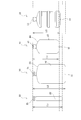
- the preform 20 is a cylindrical body composed of a neck portion 21 and a bottomed cylindrical body portion 22, the wall thickness of which is about 6 mm to 9 mm, and the vertical axis length L 1 is a final molded product 10. It is formed so as to be longer than the longitudinal length L2 (see FIG. 2).
- the vertical axis length L2 in the large container 10 is the length at the center of the large container 10, and is the length from the mouth 11 to the upper bottom 19 of the large container 10 as shown in FIG.
- the longitudinal length L1 of the preform 20 is formed to be longer than the longitudinal length L2 of the large container 10, and as will be described in detail later, the preform 20 is manufactured by stretch blow molding.
- the heat resistance of the large container 10 to be performed can be improved, and transparency can be secured satisfactorily.
- the rigidity of the large container 10 can be increased while ensuring good transparency of the large container 10.
- the thickness of the preform 20 that is, by increasing the weight of the preform 20 (the amount of PET resin used)
- the rigidity of the large container 10 can be increased.
- the thickness of the preform 20 is too thick, there is a problem that whitening due to sphere crystallization occurs in the manufacturing process of the preform 20.
- the thickness of the preform 20 is approximately the same as that of the conventional one (from 6 mm to It is possible to increase the weight of the preform 20 while suppressing the weight to about 9 mm.
- the weight of a conventional preform for a large container having a capacity of about 5 gallons could only be increased up to about 650 g in consideration of the thickness.
- the preform 20 according to the present invention can increase the weight to 700 g or more in consideration of the thickness, and can increase up to about 800 g. Therefore, by manufacturing the large container 10 using the preform 20, a large size with improved rigidity (buckling strength) while ensuring good transparency without causing whitening due to crystallization of the PET resin.
- the container 10 can be manufactured.
- the weight of the preform 20 is preferably about 550 to 800 g. If the weight of the preform 20 is too light, the rigidity (buckling strength) of the large container 10 that is the final molded product may not be secured satisfactorily. On the other hand, if the weight of the preform 20 is too heavy, that is, if the wall thickness is too thick, whitening associated with stretched crystallization of PET resin and whitening associated with sphere crystallization are likely to occur during blow molding as described above. Absent.
- the weight of the conventional large-sized container preform can be changed only within a relatively narrow range of about 550 g to 650 g.
- the weight of the preform 20 according to the present invention is 550 g to 800 g. And can be changed in a fairly wide range.
- a wide variety of large-sized containers can be manufactured in accordance with the use mode of the user, from containers having relatively low rigidity but extremely light weight to containers having heavy weight but extremely high rigidity. Even when the weight is reduced, a preform longer than the large container 10 can be used. In this case, the preform 20 becomes thin and the risk of whitening due to sphere crystallization is further reduced, so that molding is stable, and the cooling time during injection molding can be shortened, and the manufacturing cycle is also improved.
- the longitudinal length L1 of the preform 20 is set in a range that is longer than the longitudinal length L2 of the large container 10 and shorter than the longitudinal length L3 (see FIG. 2) of the primary blow-molded product 30. Although it is good, it is desirable to make it as long as possible within the range.
- the vertical length L3 of the primary blow-molded product 30 is formed to be about 10% larger than the vertical length L2 of the large container 10, the vertical length L1 of the preform 20 is also large. It is preferable that the length is about 10% longer than the vertical length L2.
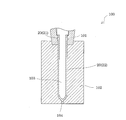
- An injection mold 100 for molding such a preform 20 includes a neck mold 101 that is a split mold that can be opened and closed in a horizontal direction that defines the outer wall surface of the neck portion 21, and an injection cavity that defines the outer wall surface of the body portion 22.
- the mold 102 is composed of a core mold 103 that defines the inner wall surface of the preform 20.
- the PET resin is filled from the gate 104 below the center of the injection cavity mold 102, and the preform 20 is injection molded.
- the preform 20 is transported to a heating unit (not shown) and heated to a predetermined suitable stretching temperature, and then placed in the primary blow mold 110 as shown in FIG.
- a primary blow-molded product 30 having a size larger than that of the large container 10 that is the final molded product is formed (primary blow-molding step).
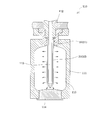
- the primary blow molding die 110 includes a primary blow molding split die 111 that can be opened and closed, a blow core die 112 into which the neck portion 21 of the preform 20 is inserted, a stretching rod 113 that can be moved up and down through the blow core die 112, and a primary A blow bottom mold 114.
- the primary blow molding die 110 has an inner wall surface 115 along the outer shape of the primary blow molded product 30.
- the preform 20 is stretched in the vertical axis direction by the stretching rod 113 and is stretched in the horizontal axis direction by high-pressure air and pressed against the inner wall surface 115 of the primary blow molding die 110, thereby A molded product 30 is molded.
- the primary blow molding die 110 is maintained at room temperature without being heated, the primary blow molding product 30 taken out from the primary blow molding die 110 has a shape along the inner wall surface 115 of the primary blow molding die 110. It becomes.
- the primary blow-molded product 30 is formed by blow-molding the preform 20 in the primary blow-molding step, but the preform 20 is slightly stretched in the radial direction before the primary blow-molding step. You may make it implement what is called a preliminary
- the primary blow-molded product 30 molded in this way includes a neck portion 31 (21) molded in the injection process, a cylindrical body portion 32, a shoulder portion 33 that connects the body portion 32 and the neck portion 31, and It is comprised from the bottom part 34 which plugs up the end of the trunk
- the vertical length L3 including the neck portion 31 is longer than the vertical length L2 of the large container 10 (see FIG. 2).
- the stretching temperature of the preform 20 it is preferable to adjust the stretching temperature of the preform 20 appropriately so that the thickness of the shoulder portion 33 of the primary blow molded product 30 is larger than the thickness of the trunk portion 32.
- the draw ratio of the shoulder portion 33 can be kept small, and the whitening associated with the stretched crystallization of the PET resin in the shoulder portion 33 can be further reliably suppressed.
- the thickness of the shoulder portion 33 is ensured to be relatively thick, the rigidity of the large container 10 that is the final molded product can be increased.
- the primary blow molded product 30 cooled to room temperature is placed in a heat treatment blow mold 120 and heat treated, the primary blow molded product 30 is reduced to a size smaller than the large container 10.
- the intermediate molded product 40 is contracted (heat treatment step).
- the primary blow molded product 30 may be subjected to a heat treatment step immediately, but in practice, the above-described injection step and primary blow molding step are repeated.
- a heat treatment step is performed on the plurality of primary blow-molded products 30.
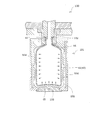
- the heat treatment blow molding die 120 includes a heat treatment die 121 composed of a split mold in which the primary blow molded product 30 is accommodated, a heat treatment core die 122 into which the neck portion 31 of the primary blow molded product 30 is inserted, and a primary blow molding. And an upper bottom heating die 123 corresponding to the bottom 34 of the product 30.
- the molding space of the heat treatment mold 121 is formed in substantially the same shape as the outer shape of the primary blow-molded product 30.
- the heat treatment mold 121 is provided with a plurality of, for example, twelve rod-shaped heaters 124 at portions corresponding to the body portion 32 of the primary blow-molded product 30. These heaters 124 are built around the molding space of the heat treatment mold 121 at substantially equal intervals, and the body portion 32 of the primary blow molded product 30 is heated to a predetermined temperature by these heaters 124. Yes.
- a supply path 125 through which a temperature control medium such as heated oil is supplied is formed in a portion corresponding to the shoulder 33 of the primary blow-molded product 30. Accordingly, the body portion 32 and the shoulder portion 33 of the primary blow-molded product 30 can be heated to different temperatures by the heat treatment mold 121.
- the heat treatment core mold 122 can supply and exhaust air from the tip.
- the heat treatment blow mold 120 is preheated to a predetermined temperature.
- high-pressure air is sent into the primary blow molded product 30, and the primary blow molded product 30 is brought into contact with the inner wall surface 126 in the heat treatment mold 121 for a predetermined time to perform heat treatment (heat set treatment).
- heat treatment heat set treatment
- the gas in the primary blow-molded product 30 is exhausted and the primary blow-molded product 30 is taken out of the heat treatment mold 121 to form the intermediate molded product 40. That is, when the gas in the primary blow-molded product 30 is exhausted and the primary blow-molded product 30 is taken out from the heat treatment mold 121, the primary blow-molded product 30 contracts and the vertical axis length L3 is the final molded product.
- the intermediate molded product 40 is shorter than the vertical axis length L2 of 10.
- the heat treatment step at least the body portion 32 of the primary blow-molded product 30 is heated at a temperature higher than the heating temperature in the final molding step described later, for example, 140 ° C. to 180 ° C. preferable.
- the heating temperature of the heat treatment mold 121 by the plurality of heaters 124 is set to 140 ° C. to 180 ° C., for example.
- the heat treatment (heat set) time is preferably set between 8 s and 16 s.
- the shoulder portion 33 of the primary blow-molded product 30 is formed thicker than the trunk portion 32 as described above, if the shoulder portion 33 is heated at a temperature equivalent to that of the trunk portion 32 in the heat treatment step, the PET is cooled during cooling. There is a risk of whitening due to sphere crystallization of the resin. Therefore, it is preferable to heat the shoulder portion 33 at a temperature lower than the temperature of the body portion 32, for example, a temperature of 80 ° C. to 110 ° C. In this embodiment, the shoulder 33 is heated at a temperature of 80 ° C. to 110 ° C. by supplying a temperature control medium into the supply path 125 of the heat treatment mold 121.
- the bottom 34 of the primary blow-molded product 30 is also heated to a relatively low temperature with a temperature control medium.
- the intermediate molded product 40 formed in this way is formed in a size smaller than the large container 10 that is the final molded product, and includes a neck portion 41, a cylindrical body portion 42, a body portion 42, and a neck portion 41. And a bottom portion 45 that closes one end of the body portion 42.
- the vertical length L4 including the neck portion 41 is also shorter than the vertical length L2 of the large container 10 (see FIG. 2).
- the intermediate molded product 40 is placed in a final blow mold 130 heated to a predetermined temperature, as shown in FIG.
- a final blow mold 130 heated to a predetermined temperature
- the final blow mold 130 includes a final blow split mold 131 that accommodates the intermediate molded product 40 and is divided into two in the vertical direction, and a final processing core mold 132 into which the neck portion 41 of the intermediate molded product 40 is inserted. And an upper bottom mold 133 corresponding to the bottom 45 of the intermediate molded product 40.
- a plurality of supply paths 134 for supplying the temperature control medium are provided around the molding space of the final blow split mold 131 along the vertical axis direction. The intermediate molded product 40 in the molding space is heated to a predetermined temperature by the temperature control medium circulating in the plurality of supply paths 134.
- the intermediate molded product 40 disposed in the final blow mold 130 is stretched in the vertical axis direction and the horizontal axis direction by the high-pressure air supplied to the interior, and the inner wall surface 135 of the final blow mold 131 is drawn.
- the large container 10 as the final molded product is molded (see FIG. 1).
- the final blow mold 130 is preheated to a predetermined temperature, for example, 80 ° C. to 110 ° C., and the intermediate molded product 40 is heat set at this temperature for a predetermined time, for example, 25 s to 30 s.
- the large container 10 is formed.
- a large container made of PET resin By manufacturing a large container made of PET resin by the method described above, a large container having excellent heat resistance and increased transparency can be realized.
- crystallization of the PET resin is promoted, and when the primary molded product is contracted by the heat treatment process to form an intermediate molded product, the residual strain is removed.
- the heat resistance of the large container which is a molded product can be improved.
- the stretch ratio of the preform in the primary blow molding process can be kept small, and the stretched crystal whitening of the PET resin that occurs at that time is suppressed. can do.
- the longitudinal length of the preform is longer than that of the large container, the weight of the preform can be significantly increased and the rigidity of the large container can be increased.
- the intermediate molded product 40 is heat set not only in the intermediate molding process but also in the final molding process, the rigidity of the large container 10 that is the final molded product can be improved more reliably. it can.
- the large container 10 that has excellent heat resistance and excellent transparency.
- heat resistance can be greatly improved as compared with a conventional large container formed by single blow molding, and transparency equal to or higher than that of a conventional large container can be obtained.
- the large container 10 does not deform (shrink) even if it is washed with alkaline hot water at 60 ° C. to 70 ° C. a plurality of times (about 20 times), and cracks can be substantially prevented. Therefore, for example, it can be suitably used for applications that require hot water cleaning, such as mineral water refillable bottles.
- the primary blow molded product is formed and the intermediate molding process using the primary blow molded product as the intermediate molded product includes the primary blow molding process and the heat treatment process
- the molding process is not limited to this.
- the primary blow molding process and the heat treatment process may be performed substantially simultaneously.
- a preform is placed inside the above-described heat treatment blow molding die 120 and the like, and the preform is blow-molded in this heat treatment blow molding die heated to a predetermined temperature in advance to form a primary blow molded product.
- the primary blow-molded product may be heat-treated (heat set) by contacting the inner wall surface of the heat treatment blow mold. Even in this case, after that, the gas in the primary blow-molded product is discharged and the primary blow-molded product is taken out from the heat-treated blow mold, so that the primary blow-molded product contracts to become an intermediate molded product.
Landscapes
- Engineering & Computer Science (AREA)
- Mechanical Engineering (AREA)
- Manufacturing & Machinery (AREA)
- Physics & Mathematics (AREA)
- Thermal Sciences (AREA)
- Ceramic Engineering (AREA)
- Blow-Moulding Or Thermoforming Of Plastics Or The Like (AREA)
Abstract
Description
11 口部
12 ネック部
13 胴部
14 肩部
15 底部
16 ヒール部
17 傾斜部
18 補強部
19 上底部
20 プリフォーム
21 ネック部
22 胴部
30 一次ブロー成形品
31 ネック部
32 胴部
33 肩部
34 底部
40 中間成形品
41 ネック部
42 胴部
44 肩部
45 底部
Claims (8)
- 延伸ブロー成形により形成されるポリエチレンテレフタレート樹脂からなる大型容器の製造に用いられる大型容器用プリフォームであって、
射出成形によって形成されて肉厚が6mm~9mmであり且つ縦軸長さが最終成形品である前記大型容器よりも長いことを特徴とする大型容器用プリフォーム。 - 重量が550g~800gであることを特徴とする請求項1に記載の大型容器用プリフォーム。
- 請求項1又は2に記載の大型容器用プリフォームを用いて製造された大型容器であって、
開口するネック部と、筒状の胴部と、該胴部の一端を密封する底部と、前記ネック部と前記胴部とを繋ぐ肩部とを有し、前記肩部の肉厚が前記胴部の肉厚よりも厚いことを特徴とする大型容器。 - ポリエチレンテレフタレート樹脂を射出成形して縦軸長さが最終成形品である大型容器よりも長いプリフォームを形成する射出工程と、
前記プリフォームをブロー成形して前記大型容器よりも大きいサイズの一次ブロー成形品を形成し、該一次ブロー成形品を加熱すると共に前記大型容器よりも小さいサイズまで収縮させた中間成形品とする中間成形工程と、
前記中間成形品を所定温度に加熱した最終ブロー成形型内でブロー成形して所定形状の前記大型容器を得る最終成形工程と、
を備えることを特徴とする大型容器の製造方法。 - 前記中間成形品は、開口するネック部と、筒状の胴部と、該胴部の一端を密封する底部と、前記ネック部と前記胴部とを繋ぎ前記胴部よりも肉厚の肩部とを有し、
前記中間成形工程では、前記一次ブロー成形品を加熱する際に、前記一次ブロー成形品の肩部を、前記胴部よりも低い温度で加熱することを特徴とする請求項4に記載の大型容器の製造方法。 - 前記中間成形工程では、前記一次ブロー成形品を加熱する際に、前記胴部の温度が140℃~180℃となり、前記肩部の温度が80℃~110℃となるようにすることを特徴とする請求項5に記載の大型容器の製造方法。
- 前記中間成形工程には、
常温に保持した一次ブロー成形型内で前記プリフォームをブロー成形して前記一次ブロー成形品を形成する一次ブロー成形工程と、
前記一次ブロー成形品を、所定温度に加熱した熱処理型の内壁面に接触させて加熱すると共にその内部の気体を排出することで収縮させて前記中間成形品とする熱処理工程と、
が含まれることを特徴とする請求項4~6の何れか一項に記載の大型容器の製造方法。 - 前記中間成形工程では、
所定温度に加熱した一次ブロー成形型内で前記プリフォームをブロー成形して前記一次ブロー成形品を形成すると共に当該一次ブロー成形品が前記一次ブロー成形型の内壁面に接触することで加熱されるようにすると共にその内部の気体を排出することで収縮させて前記中間成形品とすることを特徴とする請求項4~6の何れか一項に記載の大型容器の製造方法。
Priority Applications (5)
| Application Number | Priority Date | Filing Date | Title |
|---|---|---|---|
| CN201080059124.7A CN102656001B (zh) | 2009-12-25 | 2010-12-20 | 大型容器用预塑形坯以及大型容器以及大型容器的制造方法 |
| JP2011547533A JP5491527B2 (ja) | 2009-12-25 | 2010-12-20 | 大型容器の製造方法 |
| EP10839341.4A EP2517862B1 (en) | 2009-12-25 | 2010-12-20 | Method for producing large container |
| US13/518,891 US8968635B2 (en) | 2009-12-25 | 2012-06-24 | Preform for large container, large container, and method for producing large container |
| US14/628,759 US9327860B2 (en) | 2009-12-25 | 2015-02-23 | Preform for large container, large container, and method for producing large container |
Applications Claiming Priority (2)
| Application Number | Priority Date | Filing Date | Title |
|---|---|---|---|
| JP2009-296196 | 2009-12-25 | ||
| JP2009296196 | 2009-12-25 |
Related Child Applications (1)
| Application Number | Title | Priority Date | Filing Date |
|---|---|---|---|
| US13/518,891 Continuation US8968635B2 (en) | 2009-12-25 | 2012-06-24 | Preform for large container, large container, and method for producing large container |
Publications (1)
| Publication Number | Publication Date |
|---|---|
| WO2011078111A1 true WO2011078111A1 (ja) | 2011-06-30 |
Family
ID=44195637
Family Applications (1)
| Application Number | Title | Priority Date | Filing Date |
|---|---|---|---|
| PCT/JP2010/072875 Ceased WO2011078111A1 (ja) | 2009-12-25 | 2010-12-20 | 大型容器用プリフォーム及び大型容器並びに大型容器の製造方法 |
Country Status (5)
| Country | Link |
|---|---|
| US (2) | US8968635B2 (ja) |
| EP (1) | EP2517862B1 (ja) |
| JP (1) | JP5491527B2 (ja) |
| CN (1) | CN102656001B (ja) |
| WO (1) | WO2011078111A1 (ja) |
Cited By (1)
| Publication number | Priority date | Publication date | Assignee | Title |
|---|---|---|---|---|
| JP2014534920A (ja) * | 2011-11-15 | 2014-12-25 | アムコー リミテッド | 複数回のブロー成形における、逆延伸ロッドおよび/または底部押上部材の利用 |
Families Citing this family (10)
| Publication number | Priority date | Publication date | Assignee | Title |
|---|---|---|---|---|
| US7959844B1 (en) * | 2007-08-16 | 2011-06-14 | Maxi-Life, Inc. | Plastic injection molding process |
| ITRM20130218A1 (it) * | 2013-04-10 | 2014-10-11 | Siapi S R L A Socio Unico | Procedimento ed apparecchiatura per la formazione di contenitori di grandi dimensioni a partire da una preforma |
| MX389174B (es) * | 2013-08-21 | 2025-03-20 | Nissei Asb Machine Co Ltd | Metodo para fabricar un recipiente con asa, aparato para fabricar el recipiente con asa, y el recipiente con asa. |
| CN107530946B (zh) * | 2015-04-30 | 2019-12-31 | 大日本印刷株式会社 | 无菌容器的成型方法以及装置和无菌填充方法以及装置 |
| US11130271B2 (en) | 2016-02-19 | 2021-09-28 | Nissei Asb Machine Co., Ltd. | Blow molding device and blow molding method |
| CN109070429B (zh) * | 2016-03-30 | 2021-11-02 | 日精Asb机械株式会社 | 吹塑成形装置 |
| USD870559S1 (en) * | 2016-11-04 | 2019-12-24 | Owens-Brockway Glass Container Inc. | Container |
| US10486891B2 (en) | 2016-12-02 | 2019-11-26 | S.C. Johnson & Son, Inc. | Plastic bottle for a pressurized dispensing system |
| KR102047106B1 (ko) * | 2019-04-05 | 2019-11-20 | (주)케이아이비 | 용기성형 프리폼구조 |
| DE102022103564A1 (de) * | 2022-02-16 | 2023-08-17 | Khs Gmbh | Verfahren und Vorrichtung zur Herstellung von Behältern aus Vorformlingen |
Citations (4)
| Publication number | Priority date | Publication date | Assignee | Title |
|---|---|---|---|---|
| JPH03205124A (ja) | 1989-10-23 | 1991-09-06 | Nissei Ee S B Kikai Kk | 二軸延伸ブロー容器の製造方法 |
| JPH06143392A (ja) * | 1992-02-29 | 1994-05-24 | Nissei Asb Mach Co Ltd | 耐熱性容器の成形方法 |
| JPH0890642A (ja) * | 1994-09-26 | 1996-04-09 | Aokiko Kenkyusho:Kk | 大型容器の延伸吹込成形方法及び装置 |
| JPH1134152A (ja) | 1997-07-22 | 1999-02-09 | Nissei Asb Mach Co Ltd | 大型容器及びその成形方法 |
Family Cites Families (13)
| Publication number | Priority date | Publication date | Assignee | Title |
|---|---|---|---|---|
| US4364721A (en) * | 1979-04-17 | 1982-12-21 | Rainville Company, Inc. | Apparatus for blowing oriented containers |
| NL8102376A (nl) | 1980-05-29 | 1981-12-16 | Plm Ab | Werkwijze en inrichting voor het vormen van een houder. |
| US4414175A (en) * | 1980-10-07 | 1983-11-08 | Rainville Co., Inc. | Method for blowing oriented containers |
| JPS58123029U (ja) * | 1982-02-15 | 1983-08-22 | 株式会社吉野工業所 | 2軸延伸ブロ−成形機における底部金型装置 |
| FR2595294B1 (fr) | 1986-03-04 | 1988-07-08 | Sidel Sa | Procede et installation pour fabriquer des recipients, tels que des bouteilles, en polyethyleneterephtalate, resistant a des conditions thermiques relativement severes au cours de leur utilisation |
| JPH0688315B2 (ja) * | 1990-10-25 | 1994-11-09 | 日精エー・エス・ビー機械株式会社 | 耐熱性中空容器のための一次ブロー成形品 |
| FR2714631B1 (fr) * | 1993-12-30 | 1996-03-01 | Sidel Sa | Procédé et installation pour la fabrication de récipients, notamment de bouteilles, en matériau thermoplastique. |
| JP3777204B2 (ja) | 1994-11-11 | 2006-05-24 | 日精エー・エス・ビー機械株式会社 | 耐熱容器の成形装置及び成形方法 |
| JP3677690B2 (ja) * | 1996-07-31 | 2005-08-03 | 株式会社青木固研究所 | 照明用グローブ等の中空成形品の延伸ブロー成形方法 |
| JP3760045B2 (ja) | 1997-02-17 | 2006-03-29 | 日精エー・エス・ビー機械株式会社 | 耐熱容器の成形方法 |
| JP4019308B2 (ja) * | 2002-01-22 | 2007-12-12 | 株式会社吉野工業所 | 2軸延伸ブロー成形方法 |
| CN101541509B (zh) * | 2007-05-31 | 2013-11-27 | 株式会社吉野工业所 | 合成树脂制瓶体的成形方法 |
| BE1017972A6 (nl) * | 2008-01-29 | 2010-02-02 | Delta Engineering Bvba | Pet container met top cup. |
-
2010
- 2010-12-20 CN CN201080059124.7A patent/CN102656001B/zh active Active
- 2010-12-20 WO PCT/JP2010/072875 patent/WO2011078111A1/ja not_active Ceased
- 2010-12-20 JP JP2011547533A patent/JP5491527B2/ja active Active
- 2010-12-20 EP EP10839341.4A patent/EP2517862B1/en active Active
-
2012
- 2012-06-24 US US13/518,891 patent/US8968635B2/en active Active
-
2015
- 2015-02-23 US US14/628,759 patent/US9327860B2/en active Active
Patent Citations (4)
| Publication number | Priority date | Publication date | Assignee | Title |
|---|---|---|---|---|
| JPH03205124A (ja) | 1989-10-23 | 1991-09-06 | Nissei Ee S B Kikai Kk | 二軸延伸ブロー容器の製造方法 |
| JPH06143392A (ja) * | 1992-02-29 | 1994-05-24 | Nissei Asb Mach Co Ltd | 耐熱性容器の成形方法 |
| JPH0890642A (ja) * | 1994-09-26 | 1996-04-09 | Aokiko Kenkyusho:Kk | 大型容器の延伸吹込成形方法及び装置 |
| JPH1134152A (ja) | 1997-07-22 | 1999-02-09 | Nissei Asb Mach Co Ltd | 大型容器及びその成形方法 |
Non-Patent Citations (1)
| Title |
|---|
| See also references of EP2517862A4 |
Cited By (3)
| Publication number | Priority date | Publication date | Assignee | Title |
|---|---|---|---|---|
| JP2014534920A (ja) * | 2011-11-15 | 2014-12-25 | アムコー リミテッド | 複数回のブロー成形における、逆延伸ロッドおよび/または底部押上部材の利用 |
| EP2780146A4 (en) * | 2011-11-15 | 2015-04-22 | Amcor Ltd | USING MULTIPLE BLOW-OUTS FOR A COUNTERBAR AND / OR A BASE PUSHUP |
| US9522508B2 (en) | 2011-11-15 | 2016-12-20 | Amcor Limited | Plural blow utilization of counter stretch rod and/or base pushup |
Also Published As
| Publication number | Publication date |
|---|---|
| EP2517862A1 (en) | 2012-10-31 |
| US9327860B2 (en) | 2016-05-03 |
| US8968635B2 (en) | 2015-03-03 |
| CN102656001A (zh) | 2012-09-05 |
| JP5491527B2 (ja) | 2014-05-14 |
| JPWO2011078111A1 (ja) | 2013-05-09 |
| US20150166211A1 (en) | 2015-06-18 |
| EP2517862A4 (en) | 2013-07-24 |
| US20130037507A1 (en) | 2013-02-14 |
| CN102656001B (zh) | 2015-09-02 |
| EP2517862B1 (en) | 2015-03-25 |
Similar Documents
| Publication | Publication Date | Title |
|---|---|---|
| JP5491527B2 (ja) | 大型容器の製造方法 | |
| CN103687713B (zh) | 预成形件的温度调整装置及预成形件的温度调整方法、树脂制容器及树脂制容器的制造方法 | |
| JPH0688315B2 (ja) | 耐熱性中空容器のための一次ブロー成形品 | |
| US20060177615A1 (en) | Process for forming a container by stretch blow molding and container formed thereby | |
| JP7604429B2 (ja) | ブロー成形方法及びブロー成形装置 | |
| JP2021119056A (ja) | 樹脂製容器の製造方法 | |
| CN101360600B (zh) | 纵横拉伸聚酯瓶的制造方法 | |
| JP4210901B2 (ja) | ボトル状容器の製造方法 | |
| EP2633977B1 (en) | Production method for hollow container | |
| US4235837A (en) | Method of making oriented containers | |
| JP4222462B2 (ja) | 耐熱petボトル用プリフォーム | |
| JPS5892535A (ja) | プラスチツクびん | |
| KR101093671B1 (ko) | 저면 후부를 갖는 보틀 성형장치 | |
| US20070222123A1 (en) | Method for Producing Containers Comprising a Narrow Opening and a Long Body by Means of Below Molding or Stretch Below Molding Polypropylene Preforms | |
| EP3352966A1 (en) | Apparatus and method for the manufacture of a large-size container | |
| JP2002067130A (ja) | 耐熱性首曲がり容器の製造方法 | |
| JP2003103607A (ja) | 耐熱性ボトルの底部構造 | |
| JPS60189418A (ja) | 耐熱性ポリエステルボトルの製造法 | |
| JP2010042546A (ja) | プリフォームおよびプラスチックボトル | |
| JP2010036357A (ja) | 合成樹脂製ブローボトル及びその成形方法 | |
| JPS6357220A (ja) | 熱間充填用ポリエステルボトルの製法 |
Legal Events
| Date | Code | Title | Description |
|---|---|---|---|
| WWE | Wipo information: entry into national phase |
Ref document number: 201080059124.7 Country of ref document: CN |
|
| 121 | Ep: the epo has been informed by wipo that ep was designated in this application |
Ref document number: 10839341 Country of ref document: EP Kind code of ref document: A1 |
|
| WWE | Wipo information: entry into national phase |
Ref document number: 2011547533 Country of ref document: JP |
|
| WWE | Wipo information: entry into national phase |
Ref document number: 1517/KOLNP/2012 Country of ref document: IN |
|
| WWE | Wipo information: entry into national phase |
Ref document number: 2010839341 Country of ref document: EP |
|
| NENP | Non-entry into the national phase |
Ref country code: DE |