WO2011096122A1 - アロエパウダーの製造方法 - Google Patents
アロエパウダーの製造方法 Download PDFInfo
- Publication number
- WO2011096122A1 WO2011096122A1 PCT/JP2010/070129 JP2010070129W WO2011096122A1 WO 2011096122 A1 WO2011096122 A1 WO 2011096122A1 JP 2010070129 W JP2010070129 W JP 2010070129W WO 2011096122 A1 WO2011096122 A1 WO 2011096122A1
- Authority
- WO
- WIPO (PCT)
- Prior art keywords
- aloe
- powder
- less
- extraction
- mesophyll
- Prior art date
- Legal status (The legal status is an assumption and is not a legal conclusion. Google has not performed a legal analysis and makes no representation as to the accuracy of the status listed.)
- Ceased
Links
Images


Classifications
-
- A—HUMAN NECESSITIES
- A23—FOODS OR FOODSTUFFS; TREATMENT THEREOF, NOT COVERED BY OTHER CLASSES
- A23L—FOODS, FOODSTUFFS OR NON-ALCOHOLIC BEVERAGES, NOT OTHERWISE PROVIDED FOR; PREPARATION OR TREATMENT THEREOF
- A23L19/00—Products from fruits or vegetables; Preparation or treatment thereof
-
- A—HUMAN NECESSITIES
- A23—FOODS OR FOODSTUFFS; TREATMENT THEREOF, NOT COVERED BY OTHER CLASSES
- A23L—FOODS, FOODSTUFFS OR NON-ALCOHOLIC BEVERAGES, NOT OTHERWISE PROVIDED FOR; PREPARATION OR TREATMENT THEREOF
- A23L2/00—Non-alcoholic beverages; Dry compositions or concentrates therefor; Preparation or treatment thereof
- A23L2/52—Adding ingredients
-
- A—HUMAN NECESSITIES
- A23—FOODS OR FOODSTUFFS; TREATMENT THEREOF, NOT COVERED BY OTHER CLASSES
- A23K—FODDER
- A23K10/00—Animal feeding-stuffs
- A23K10/30—Animal feeding-stuffs from material of plant origin, e.g. roots, seeds or hay; from material of fungal origin, e.g. mushrooms
-
- A—HUMAN NECESSITIES
- A23—FOODS OR FOODSTUFFS; TREATMENT THEREOF, NOT COVERED BY OTHER CLASSES
- A23K—FODDER
- A23K20/00—Accessory food factors for animal feeding-stuffs
- A23K20/10—Organic substances
-
- A—HUMAN NECESSITIES
- A23—FOODS OR FOODSTUFFS; TREATMENT THEREOF, NOT COVERED BY OTHER CLASSES
- A23L—FOODS, FOODSTUFFS OR NON-ALCOHOLIC BEVERAGES, NOT OTHERWISE PROVIDED FOR; PREPARATION OR TREATMENT THEREOF
- A23L19/00—Products from fruits or vegetables; Preparation or treatment thereof
- A23L19/01—Instant products; Powders; Flakes; Granules
-
- A—HUMAN NECESSITIES
- A23—FOODS OR FOODSTUFFS; TREATMENT THEREOF, NOT COVERED BY OTHER CLASSES
- A23L—FOODS, FOODSTUFFS OR NON-ALCOHOLIC BEVERAGES, NOT OTHERWISE PROVIDED FOR; PREPARATION OR TREATMENT THEREOF
- A23L33/00—Modifying nutritive qualities of foods; Dietetic products; Preparation or treatment thereof
-
- A—HUMAN NECESSITIES
- A23—FOODS OR FOODSTUFFS; TREATMENT THEREOF, NOT COVERED BY OTHER CLASSES
- A23L—FOODS, FOODSTUFFS OR NON-ALCOHOLIC BEVERAGES, NOT OTHERWISE PROVIDED FOR; PREPARATION OR TREATMENT THEREOF
- A23L33/00—Modifying nutritive qualities of foods; Dietetic products; Preparation or treatment thereof
- A23L33/10—Modifying nutritive qualities of foods; Dietetic products; Preparation or treatment thereof using additives
- A23L33/105—Plant extracts, their artificial duplicates or their derivatives
-
- A—HUMAN NECESSITIES
- A61—MEDICAL OR VETERINARY SCIENCE; HYGIENE
- A61K—PREPARATIONS FOR MEDICAL, DENTAL OR TOILETRY PURPOSES
- A61K36/00—Medicinal preparations of undetermined constitution containing material from algae, lichens, fungi or plants, or derivatives thereof, e.g. traditional herbal medicines
- A61K36/18—Magnoliophyta (angiosperms)
- A61K36/88—Liliopsida (monocotyledons)
- A61K36/886—Aloeaceae (Aloe family), e.g. aloe vera
-
- A—HUMAN NECESSITIES
- A61—MEDICAL OR VETERINARY SCIENCE; HYGIENE
- A61K—PREPARATIONS FOR MEDICAL, DENTAL OR TOILETRY PURPOSES
- A61K8/00—Cosmetics or similar toiletry preparations
- A61K8/02—Cosmetics or similar toiletry preparations characterised by special physical form
- A61K8/0216—Solid or semisolid forms
- A61K8/022—Powders; Compacted Powders
-
- A—HUMAN NECESSITIES
- A61—MEDICAL OR VETERINARY SCIENCE; HYGIENE
- A61K—PREPARATIONS FOR MEDICAL, DENTAL OR TOILETRY PURPOSES
- A61K8/00—Cosmetics or similar toiletry preparations
- A61K8/18—Cosmetics or similar toiletry preparations characterised by the composition
- A61K8/96—Cosmetics or similar toiletry preparations characterised by the composition containing materials, or derivatives thereof of undetermined constitution
- A61K8/97—Cosmetics or similar toiletry preparations characterised by the composition containing materials, or derivatives thereof of undetermined constitution from algae, fungi, lichens or plants; from derivatives thereof
- A61K8/9783—Angiosperms [Magnoliophyta]
- A61K8/9794—Liliopsida [monocotyledons]
-
- A—HUMAN NECESSITIES
- A61—MEDICAL OR VETERINARY SCIENCE; HYGIENE
- A61Q—SPECIFIC USE OF COSMETICS OR SIMILAR TOILETRY PREPARATIONS
- A61Q19/00—Preparations for care of the skin
Definitions
- the present invention relates to an aloe powder using dried aloe mesophyll as a raw material and a method for producing the same.
- Aloe The plant of the genus Aloe is a kind of succulent plant, and includes aloe vera (Aloe barbadensis Miller), yellow aloe (Aloe arborescen Miller var. Natalensis Berger) and the like. Aloe plants are known to have various effects, and are widely used as ingredients in foods and drinks and pharmaceuticals.
- Succulent plants such as Aloe genus contain a large amount of moisture inside the plant.
- Aloe vera gel Aloe vera mesophyll
- Aloe vera mesophyll Aloe vera mesophyll
- a method for processing plants of the genus Aloe having such characteristics a method of drying aloe mesophyll into powder is known.
- a method is known in which aloe mesophyll is crushed and the crushed material is dried and then crushed.
- an aloe mesophyll dry powder produced by such a method with an average particle size of 100 ⁇ m or less and 70% or more of the total particle weight within the range of the average particle size ⁇ 30 ⁇ m (Patent Document 1).
- the pulverization method include a jet mill method and a freeze pulverization method.
- the airflow type pulverizer is a fine pulverizer that entrains raw materials in air (gas) or steam ejected from a nozzle at a high pressure and advances the pulverization by collision between particles or particles and a collision plate. This is particularly suitable for pulverizing raw materials for foods, drinks, medicines, cosmetics, and feeds.
- Patent Document 3 it has been conventionally known that a jet mill pulverizer is used for pulverizing eggshells, and it has been reported that fine eggshell powder having an average particle diameter of 20 ⁇ m or less can be obtained by this method.
- Patent Document 5 there is an example using a jet mill pulverizer for pulverization of dried green cocoon leaves.
- plants belonging to the genus Aloe are divided into an outer wall of the epidermis covered with a thick cuticle layer, a green tissue cell below the epidermis, and a thin cell cell known as a soft tissue. It consists of differentiated mesophyll.
- Aloe genus Aloe
- Patent Document 6 a method for producing an aloe vera extract by supercritical extraction of dried aloe vera mesophyll is known (Patent Document 6).
- Patent Document 6 a method for producing an aloe vera extract by supercritical extraction of dried aloe vera mesophyll is known (Patent Document 6).
- Patent Document 6 a method for producing an aloe vera extract by supercritical extraction of dried aloe vera mesophyll is known.
- Non-patent Document 1 it is known that supercritical extraction is performed on an aloe epidermis portion from which aloe vera mesophyll has been removed.
- Patent Document 1 the aloe mesophyll dry powder of Patent Document 1 was not sufficiently small in average particle size.
- the manufacturing method of the aloe powder of patent document 2 did not solve the problem about having an odor peculiar to aloe. Further, in order to reduce the average particle size of the aloe powder by this method to 5 ⁇ m or less, the moisture had to be reduced to 2% or less.
- Patent Documents 3 to 5 do not describe a method for producing aloe powder.
- a conventional method for producing aloe powder is generally a method in which aloe mesophyll is dried and then pulverized as it is.
- the dry aloe mesophyll which is a raw material, has low hardness, and the energy in the particles or the collision energy between the particles and the collision plate is absorbed by the particles. There is a problem that the collision energy cannot be efficiently used for grinding.
- the conventional method it is difficult to produce a uniform aloe powder having a small particle size even if an airflow type pulverizer is used. Moreover, the conventional aloe powder manufactured by the conventional manufacturing method did not have sufficient fluidity. For this reason, the aloe powder produced by such a method has a problem that it feels rough when it is put in the mouth or when it is applied to the skin, or it settles in a beverage or the like.
- the aloe powder that does not have sufficient fluidity is liable to cause clogging of the apparatus in the production line and is not easy to handle.
- the conventional aloe powder produced by the conventional production method has a problem that it has an odor peculiar to aloe.
- this invention makes it a subject to provide the technique for performing the grinding
- Another object of the present invention is to provide an aloe powder having a sharp and fine particle size distribution and sufficient fluidity, and a method for producing the same. Furthermore, this invention makes it a subject to provide the aloe powder which has favorable flavor, and its manufacturing method.
- the extraction residue obtained by treating the dried aloe mesophyll by the supercritical extraction method is It has been found that it has good physical properties suitable for pulverization by an airflow pulverizer. And, the present inventors can efficiently perform pulverization by treating the dried aloe mesophyll by the supercritical extraction method and removing the extract before pulverizing using an airflow pulverizer, Furthermore, the present inventors have found that the aloe powder produced by such a method has a good flavor and completed the present invention.
- the inventors have found that an aloe powder having a sharp particle size distribution, a fine particle size, and sufficient fluidity can be produced by adjusting the amount of pulverized air in the airflow pulverizer, and the present invention has been completed. That is, the present invention is as follows.
- the first present invention is a method for producing an aloe powder, and includes the following steps 1) and 2) (hereinafter also referred to as “the method for producing an aloe powder of the present invention”). 1) A process of treating dried aloe mesophyll by a supercritical extraction method, removing the extract from the dried aloe mesophyll, and obtaining an extraction residue; 2) A step of producing an aloe powder by pulverizing the extraction residue obtained in 1) with an airflow pulverizer. Each process of the manufacturing method of the aloe powder of this invention is shown in FIG. By using such a method, it is possible to efficiently produce aloe powder using an airflow pulverizer. In addition, it is possible to produce an aloe powder having a good flavor.
- the airflow pulverizer is preferably a fluidized bed jet blown airflow pulverizer. Since this type of pulverizer has a large solid-gas mixing ratio, the pulverization efficiency can be increased, which contributes to the efficient production of aloe powder. Further, since this type of pulverizer uses collision energy between particles in the pulverized material, it is possible to eliminate the risk of mixing impurities due to wear of machine parts.
- the amount of pulverized air is preferably 30 m 3 or more per 1 kg of the extraction residue.
- the processing by the supercritical extraction method of 1) is performed, for example, under the following conditions a) to d).
- the extraction solvent is carbon dioxide;
- the extraction temperature is 31-80 ° C.,
- the pressure is 7 to 60 MPa, d)
- the extraction time is 30 seconds to 7 hours.
- the first aspect of the present invention is preferably an aloe powder production method that satisfies the following conditions e) and f).
- e) The median diameter is 5.4 ⁇ m or less and the 90% particle diameter is 13.4 ⁇ m or less.
- f) The angle of repose is 56.0 degrees or less.
- the first aspect of the present invention is preferably a method for producing an aloe powder satisfying the following condition g).
- g) 2,4-Heptadienal is 383 mass ppb or less.
- the aloe is preferably aloe vera or kitachi aloe.
- the second aspect of the present invention is an aloe powder produced by the method for producing an aloe powder of the first aspect of the present invention.
- the aloe powder preferably satisfies the following conditions e) and f).
- e) The median diameter is 5.4 ⁇ m or less and the 90% particle diameter is 13.4 ⁇ m or less.
- the angle of repose is 56.0 degrees or less.
- Such an aloe powder has a very smooth texture or touch and has sufficient fluidity.
- the aloe powder preferably satisfies the following condition g).
- g) 2,4-Heptadienal is 383 mass ppb or less.
- Such an aloe powder further has a small odor characteristic of aloe and is small and has a good flavor.
- the aloe is preferably aloe vera or kidachi aloe.
- the third aspect of the present invention is an aloe powder that satisfies the following conditions e) and f).
- Such an aloe powder has a very smooth texture or touch and has sufficient fluidity.
- the aloe powder preferably satisfies the following condition g).
- g) 2,4-Heptadienal is 383 mass ppb or less.
- Such an aloe powder has a very small odor peculiar to aloe and a good flavor.
- the molecular weight of the polysaccharide contained in the aloe powder is preferably 100,000 daltons or more, more preferably 400,000 daltons or more, and 1,000,000 daltons or more. More preferably.
- Aloe powder can be efficiently produced using an airflow pulverizer.
- An aloe powder comprising fine and highly uniform particles and having a smooth texture and touch is provided.
- Aloe powder having sufficient fluidity and easy to handle in the production process is provided.
- An aloe powder from which a bad odor component peculiar to aloe is removed is provided.
- the aloe powder of the second invention and the aloe powder of the third invention (collectively also referred to as “the aloe powder of the invention”) have a smooth texture and a good taste and aroma. Therefore, it is suitable for ingredients of food and drink, medicine, cosmetics and feed. (Vii) Since the aloe powder of the present invention is easy to handle in the production process, various uses are expected.
- the manufacturing method of the aloe powder of this invention > 1) The process of obtaining the supercritical extraction residue of dry aloe mesophyll This process is a process of performing the process by a supercritical extraction method with respect to dry aloe mesophyll, removing an extract, and obtaining an extraction residue.
- the “dried aloe mesophyll” is a dried product of mesophyll of a plant belonging to the genus Aloe family (referred to herein as “aloe mesophyll”).
- aloe mesophyll examples of the plant belonging to the genus Aloe include Aloe vera (Aloe barbadensis Miller), Kidachi aloe (Aloe arborescen Miller var. Natalensis Berger), Cape Aloe (Aloe ferox Miller) and the like. Of these, aloe vera and yellow aloe are preferably used. When aloe is sliced horizontally, the outer wall of the epidermis covered with a thick cuticle layer appears.
- aloe Below the epidermis is mesophyll differentiated into green tissue cells and cells with thin cell walls known as parenchyma.
- the parenchyma cells accumulate a transparent mucus-like jelly.
- Vascular bundles with internal vascular sheath cells contain yellow juice with laxative properties and are sandwiched between two large cells. That is, aloe has two main liquid sources, yellow juice (leachate) and transparent gel (mucus).
- the transparent gel (mucus) is called aloe mesophyll (aloe gel).
- the aloe leaves can be divided into three parts: (A) yellow juice, (B) aloe mesophyll, (C) leaf skin consisting of the outer skin, tip, base and spines.
- the “dried aloe mesophyll” in the present invention refers to a dried product of (B) aloe mesophyll (aloe gel).
- the dried aloe mesophyll used in the present invention may contain (A) yellow juice or (C) leaf skin in addition to the (B) aloe mesophyll.
- aloe vera when aloe vera is used as aloe, it preferably does not contain (A) yellow juice or (C) leaf skin.
- Dried aloe mesophyll can be prepared by conventional methods. For example, it can be prepared through the following steps.
- the aloe mesophyll can be dried using a hot air drier or a freeze drier (for example, manufactured by Kyowa Vacuum Co.), but is not particularly limited.
- the aloe mesophyll from which moisture has been removed becomes a coarse powder.
- dried aloe mesophyll can be prepared by drying commercially available aloe mesophyll. Moreover, you may use the commercial item of dry aloe mesophyll.
- the extract is separated from the dried aloe mesophyll.
- the separated extract is removed.
- the dried aloe mesophyll is divided into an extract and an extraction residue from which the extract has been removed.
- the extraction residue is used as a raw material in the step 2) described later.
- the extraction solvent used for the supercritical extraction is not particularly limited, but extracts components that are responsible for aloe's unique raw odor, such as butyric acid, 2,4-heptadienal, 2-ethylhexanol, particularly 2,4-heptadienal.
- it is a solvent that can be used.
- carbon dioxide gas, supercritical propane, supercritical ethylene, supercritical 1,1,1,2-tetrafluoroethane or the like can be used.
- carbon dioxide when the aloe powder produced by the production method of the present invention is used as a component of food, drink, medicine, cosmetics, and feed, it is preferable to use carbon dioxide as an extraction solvent from the viewpoint of emphasizing safety.
- butyric acid is a colorless liquid having an unpleasant buttery acid odor.
- 2,4-heptadienal is an irritating green aroma and is a colorless liquid with a blue odor.
- 2-Ethylhexanol is a colorless liquid with a rose-like floral fragrance, but it can cause an undesirable odor depending on the amount.
- the extraction temperature can be appropriately selected according to the type of extraction solvent and other conditions, and can be, for example, 28 to 120 ° C. as a guide. From the viewpoint of sufficiently extracting the odor components peculiar to aloe or obtaining physical properties suitable for pulverization described later, the extraction temperature is preferably 31 to 80 ° C., more preferably 50 to 69 ° C., more preferably 50 A guideline of ⁇ 59 ° C can be used.
- the pressure can be appropriately selected according to the type of extraction solvent and other conditions, and can be, for example, 5.5 to 60 MPa. From the viewpoint of sufficiently extracting the odor components peculiar to aloe or obtaining physical properties suitable for pulverization described later, the pressure is preferably 7 to 60 MPa, more preferably 15 to 60 MPa, and more preferably 15 to 24 MPa. It can be used as a guide.
- the extraction time can be appropriately selected according to the type of extraction solvent and other conditions, and can be, for example, 30 seconds to 7 hours.
- extraction conditions include the following conditions a) to d). a) the extraction solvent is carbon dioxide; b) the extraction temperature is 31-80 ° C., c) the pressure is 7 to 60 MPa, d) The extraction time is 30 seconds to 7 hours.
- an entrainer such as ethanol can be used from the viewpoint of sufficiently extracting the odor components peculiar to aloe.
- pulverizing an extraction residue with an airflow-type grinder This process is a process of grind
- the airflow type pulverizer includes fluidized bed jet blowing type (counter jet mill, cross jet mill, etc.), airflow suction type (jetmizer, micronizer, etc.), nozzle passing type (supersonic jet pulverizer PJM, etc.), There are collision types (majack mill, type I jet mill, etc.).
- a fluidized bed jet blown airflow pulverizer is particularly preferably used.
- a fluidized-bed jet-injection type airflow crusher injects compressed air of several atmospheres or more from an injection nozzle, accelerates the raw material particles by the jet stream jetted from the nozzle, and collides the accelerated particles at the intersection of the jet stream The pulverization is advanced by causing Such a type of airflow type pulverizer can increase the pulverization efficiency because of a large solid-gas mixing ratio. Further, since this type of airflow type pulverizer uses the collision energy between the raw material particles, it is possible to eliminate the risk of mixing impurities due to wear of the machine.
- a counter jet mill 100AFG manufactured by Hosokawa Micron Corporation can be used as the fluidized bed jet blow type airflow type pulverizer.
- the extraction residue obtained in the above step 1) is continuously charged into an airflow pulverizer, and compressed air is blown from a nozzle installed inside the pulverizer from the start of charging.
- the compressed air blown into the pulverizer is defined as “crushed air”, and the volume thereof is defined as “crushed air amount”.
- the pressure of the pulverizing air is preferably higher than atmospheric pressure in order to create a strong air flow in the pulverizer, but can be appropriately changed depending on the type and size of the pulverizer.
- the pressure of the pulverized air is preferably 3 MPa or more, more preferably 4 MPa or more.
- the amount of pulverization air can be appropriately determined according to the type of pulverizer, the internal capacity and the internal shape in consideration of the intended degree of pulverization.
- the amount of pulverized air is generally 30 to 3000 m 3 / hour.
- the speed at which the extraction residue is charged into the pulverizer can be appropriately determined according to the type of pulverizer, the internal volume of the pulverizer, and the size of the pulverizer, as with the amount of pulverization air.
- the in-machine concentration of the raw material volume (raw material volume / crusher internal volume) affects the pulverization efficiency, and the preferable in-machine concentration varies depending on the type of pulverizer.
- the input rate of the extraction residue is usually 1 to 100 kg / hour.
- the preferable range of the amount of pulverization air relative to the amount of the extracted residue is constant regardless of the size of the pulverizer.
- the amount of pulverized air used for 1 kg of extraction residue is 30 m. preferably 3 or more, further preferably 37m 3 or more, and more preferably 50 m 3 or more.
- the airflow type pulverizer used in the present invention has a control means for controlling the amount of pulverized air according to the concentration of the extraction residue in the apparatus.
- the control means preferably includes a function of automatically controlling the amount of pulverized air based on a control program.
- Control means extracting pulverized air amount relative residue 1kg of preferably 30 m 3 or more, more preferably 37m 3 or more, more preferably to be 50 m 3 or more, controlling the degree of opening of the injection nozzle.
- the aloe powder intended for production by the production method of the first present invention has a median diameter of preferably 5.5 ⁇ m or less, more preferably 5.4 ⁇ m or less, still more preferably 5.0 ⁇ m or less, more preferably 4. 8 ⁇ m or less.
- the aloe powder has a 90% particle size of preferably 13.5 ⁇ m or less, more preferably 13.4 ⁇ m or less, still more preferably 13.0 ⁇ m or less, more preferably 12.0 ⁇ m or less.
- the aloe powder has an angle of repose of preferably 56.3 degrees or less, more preferably 56.0 degrees or less, still more preferably 55.0 degrees or less, more preferably 50.0 degrees or less, and particularly preferably 47. .4 degrees or less. A method for measuring these physical properties will be described later.
- the aloe powder targeted by the production method of the first present invention preferably satisfies the following conditions e) and f).
- e) The median diameter is 5.4 ⁇ m or less and the 90% particle diameter is 13.4 ⁇ m or less.
- f) The angle of repose is 56.0 degrees or less.
- the aloe powder intended for production by the production method of the first aspect of the invention has a content of 2,4-heptadienal in the aloe powder of preferably 383 mass ppb or less, more preferably 380 mass ppb or less, Preferably it is 350 mass ppb or less, More preferably, it is 300 mass ppb or less, More preferably, it is 250 mass ppb or less, More preferably, it is 233 mass ppb or less, More preferably, it is 200 mass ppb or less, More preferably, it is 100 mass ppb or less, More preferably It is 50 mass ppb or less, More preferably, it is 10 mass ppb or less.
- the aloe powder of the second present invention is an aloe powder produced by the method for producing an aloe powder of the present invention.
- the aloe powder of the invention has the following properties. First, the aloe powder of the present invention has a higher density and higher particle hardness than an aloe powder produced in the same manner without being treated by the supercritical extraction method. This is because the tissue of the dried aloe mesophyll is consolidated by the treatment by the supercritical extraction method, as shown in the examples described later.
- the aloe powder of the second aspect of the present invention has a median diameter of preferably 5.5 ⁇ m or less, more preferably 5.4 ⁇ m or less, further preferably 5.0 ⁇ m or less, more preferably 4.8 ⁇ m or less.
- the aloe powder has a 90% particle size of preferably 13.5 ⁇ m or less, more preferably 13.4 ⁇ m or less, still more preferably 13.0 ⁇ m or less, more preferably 12.0 ⁇ m or less.
- the aloe powder has an angle of repose of preferably 56.3 degrees or less, more preferably 56 degrees or less, still more preferably 55.0 degrees or less, more preferably 50.0 degrees or less, and particularly preferably 47.4 degrees. Less than or equal to degrees. A method for measuring these physical properties will be described later.
- the aloe powder of the second present invention preferably satisfies the following conditions e) and f).
- the content of 2,4-heptadienal is preferably 383 mass ppb or less, more preferably 380 mass ppb or less, further preferably 350 mass ppb or less, more preferably 300 mass ppb. Or less, more preferably 250 mass ppb or less, more preferably 233 mass ppb or less, more preferably 200 mass ppb or less, further preferably 100 mass ppb or less, still more preferably 50 mass ppb or less, more preferably 10 mass ppb or less. is there.
- the aloe is preferably aloe vera or yellow aloe.
- the aloe powder of the third aspect of the present invention is an aloe powder that satisfies the following conditions e) and f).
- the aloe powder having such physical properties has a smooth texture or touch. In addition, handling in processing is easy.
- the aloe powder of the third aspect of the present invention has a median diameter of preferably 5.0 ⁇ m or less, more preferably 4.8 ⁇ m or less.
- the 90% particle size is preferably 12.0 ⁇ m or less.
- the angle of repose is preferably 47.4 degrees or less.
- the content of 2,4-heptadienal is preferably 383 mass ppb or less, more preferably 380 mass ppb or less, further preferably 350 mass ppb or less, more preferably 300 mass ppb. Or less, more preferably 250 mass ppb or less, more preferably 233 mass ppb or less, more preferably 200 mass ppb or less, further preferably 100 mass ppb or less, still more preferably 50 mass ppb or less, more preferably 10 mass ppb or less. is there.
- the molecular weight of the polysaccharide contained in the aloe powder is preferably 100,000 daltons or more, more preferably 400,000 daltons or more, and 1,000,000 daltons or more. More preferably.
- the aloe powder of the third aspect of the present invention can be manufactured by the method for manufacturing the aloe powder of the first aspect of the present invention, but is not limited to that manufactured by the method.
- ⁇ Method for measuring physical properties of aloe powder > [1] Median diameter and 90% particle diameter The median diameter is a particle diameter indicating 50% in the measured volume-based cumulative particle diameter distribution, which can be restated as 50% particle diameter or D50. It may be used as It means that the smaller the median diameter, the smaller the particle diameter as a whole.
- the 90% particle size is a numerical value indicating 90% in the cumulative particle size distribution, and can be paraphrased as 90% particle size or D90. It means that the smaller the difference between the median diameter and the 90% particle diameter is, the more constant the particle diameter is and the smaller the particle diameter between the particles is.
- the median size and 90% particle size in the present invention can be determined from the particle size distribution measured with a particle size measuring device “Mastersizer 2000 dry method” (manufactured by Horiba, Ltd.).
- the refractive index of the particles is set to 1.520.
- This device uses the principle of the laser diffraction / scattering method, and the volume-based particle size distribution is obtained by detecting the size of each particle from the scattering pattern of the laser beam.
- the angle of repose is an angle formed by the free surface of the deposited powder layer and a horizontal plane, and is known to be used as an index indicating the fluidity of the powder (for example, powder engineering manual) 2nd edition, Society of Powder Engineering, 1998, page 237).
- the smaller the angle of repose the higher the fluidity and the lower the possibility of staying in the production line, so it is easier to handle.
- the repose angle measurement method is roughly classified into three methods, ie, an injection method, a discharge method, and a tilt method, and the repose angle in the present invention is preferably a value measured by the injection method.
- the injection method powder is allowed to flow out from above onto a horizontal plane and deposited in a conical shape, and the inclination angle of the surface is measured.
- the inclination angle of the powder pile formed when the aloe powder is naturally dropped is automatically measured by image analysis.
- the angle of repose referred to in the present invention can be measured using, for example, “powder property evaluation apparatus PT-S” (manufactured by Hosokawa Micron).
- Odor component amount The odor component can be measured by measuring the odor generated when the sample is suspended in temperature-adjusted water. A solid-phase microextraction gas chromatograph mass spectrometer (GC / MS) Etc. can be analyzed. In the present invention, the amount of 2,4-heptadienal can be determined by quantifying the area on the measured chromatogram. At this time, each odor component can be quantified by creating a calibration curve using a standard substance.
- GC / MS solid-phase microextraction gas chromatograph mass spectrometer
- the analysis conditions for the odor component are as follows. [measuring equipment] GC: AGILENT, 6890 type MS: AGILENT, 5973A type Column: INNOWAX (trade name, manufactured by AGILENT) Inner diameter: 0.25 mm Length: 30 m Film thickness: 0.25 ⁇ m SPME fiber: manufactured by SUPELCO [Method of separating and concentrating odor components] Solid phase microextraction method (SPME): 35 ° C., 30 minutes headspace method [measurement conditions] -GC inlet temperature: 265 ° C ⁇ Gas flow rate: 1.2 ml / min ⁇ Helium gas oven temperature rising condition: 40 ° C., 2 min, 4 ° C./min (up to 120 min), 6 ° C./min (up to 240 min), 10 min hold ⁇ MS measurement mode : Scan 2.32 (SCAN / sec)
- 2,4-heptadienal can also be quantified by the HPLC method.
- the aloe powder of the present invention is suitable as a raw material for food and drink, medicine, cosmetics or feed. That is, the present invention also provides a food, beverage, medicine, cosmetic or feed containing the aloe powder of the present invention.
- the prepared sample was pulverized under various conditions.
- a fluidized bed jet blow type airflow type pulverizer “Counter Jet Mill 100AFG” manufactured by Hosokawa Micron
- a high-speed rotating mill with built-in classifier “trade name: Pulverizer ACM-15” (manufactured by Hosokawa Micron)
- fluidized A “counter jet mill 200AFG” manufactured by Hosokawa Micron Co., Ltd.
- the pressure of the pulverization air used for pulverization was 0.6 MPa when “Counter Jet Mill 100AFG” was used, and 0.4 MPa when “Counter Jet Mill 200AFG” was used.
- the amount of pulverized air is set to 22 m 3 , 30 m 3 or 37 m 3 with respect to 1 kg of dried aloe vera mesophyll continuously supplied at a substantially constant amount per unit time.
- the amount of pulverized air was set to 30 m 3 with respect to 1 kg of dried aloe vera mesophyll continuously supplied at a substantially constant amount per unit time.
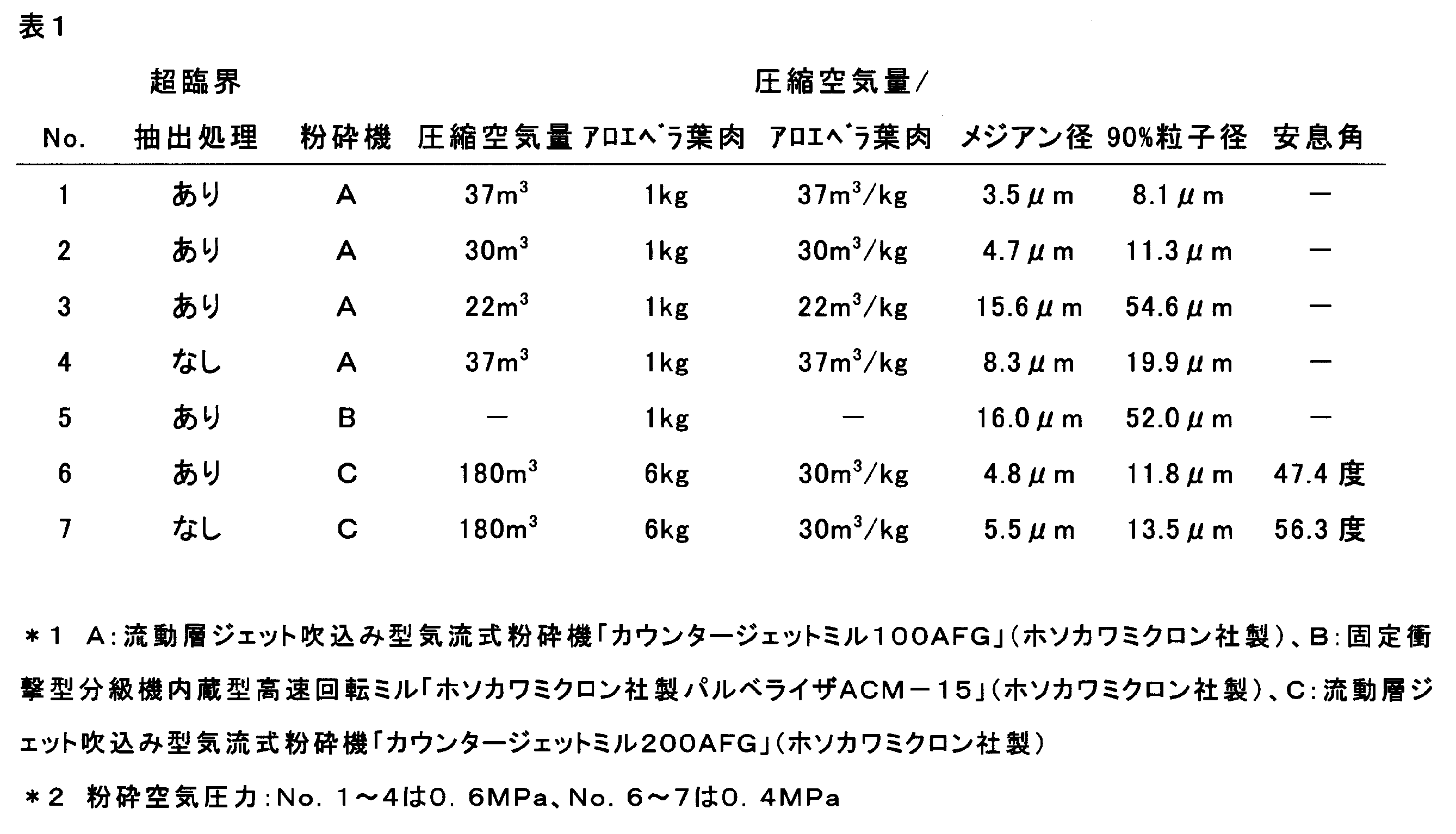
- Test results Table 1 shows the measurement results of presence / absence of supercritical extraction treatment, amount of pulverized air, median diameter, 90% particle diameter and angle of repose of the prepared aloe vera powder.
- the sample (No. 1) pulverized after the supercritical extraction treatment and the sample (No. 4) crushed without the supercritical extraction treatment were subjected to the supercritical extraction treatment even if the pulverization conditions were the same.
- the post-ground sample (No. 1) had a smaller particle size and higher particle uniformity. Further, the larger the amount of pulverized air, the smaller the particle size (No. 1 to No. 3).
- Test Example 2 The purpose of this test was to examine the texture and flavor of the aloe vera powder obtained by the production method of the present invention.
- Test Example 3 The purpose of this test was to quantify the odor components of Aloe vera powder obtained by the production method of the present invention.
- sample No. 1 of Test Example 1 obtained by the production method of the present invention was used.
- Sample No. 1 of Test Example 1 obtained by the same production method as Test Example 1 except that supercritical extraction is not performed. 4 was used.
- the purpose of this test is also to perform a comparative test between the sample (No. 1) manufactured by the manufacturing method of the present invention and the sample (No. 4) manufactured by the manufacturing method of Patent Document 2.
- Test Example 4 The purpose of this test was to clarify that the decrease in concentration in Test Example 3 greatly improves the flavor of aloe powder.
- Test results Table 4 shows the results. No one felt the odor of 2,4-heptadienal when the concentration was 100 ppb or less. On the other hand, when the concentration was 500 ppb or more, 90% or more people felt the odor of 2,4-heptadienal. Furthermore, when the concentration was 400 ppb, 70% of people felt the odor of 2,4-heptadienal. When the concentration was 300 ppb, 60% of people felt the odor of 2,4-heptadienal. When the concentration was 200 ppb, 30% of people felt the odor of 2,4-heptadienal.
- the concentration of 2,4-heptadienal in the sample not subjected to the supercritical extraction treatment (No. 4) was 384 mass ppb.
- the fact that the concentration of 2,4-heptadienal in the sample (No. 1) subjected to the critical extraction treatment was reduced to 233 mass ppb indicates that the aloe powder produced by the method of the present invention has an odor based on 2,4-heptadienal. This means that the aloe powder has changed from an aloe powder that feels odorless to an aloe powder that doesn't have an odor that does not exist in the past.
- the aloe powder produced by the method of the present invention has a flavor by making the 2,4-heptadienal content at least lower than 384 mass ppb, preferably 383 mass ppb or less, particularly preferably 233 mass ppb. Became clear.
- Test Example 5 The purpose of this study was to elucidate changes in the structure of dried aloe mesophyll before and after supercritical extraction. (1) Preparation of sample The dried aloe vera mesophyll prepared in Test Example 1 and the dried aloe vera mesophyll were subjected to supercritical extraction treatment to prepare an extraction residue from which the extract was removed.
- Test method CT images (XZ cross-section, YZ cross-section, XY cross-section) of cross sections of particles having the same maximum particle diameter contained in each of the two types of samples of (1) above and A three-dimensional CT image of the particles was acquired and the structure of the particles in the coarse powder was observed.
- a measuring apparatus a three-dimensional measuring X-ray CT apparatus “TDM1000-IS” (manufactured by Yamato Scientific Co., Ltd.) was used. The measurement conditions are shown below.
- FIG. 2 shows a cross-sectional CT image and a three-dimensional CT image of dried aloe vera mesophyll (before the supercritical extraction process).
- FIG. 3 shows a cross-sectional CT image and a three-dimensional CT image of the extraction residue (after the supercritical extraction process) obtained by processing by the supercritical extraction method.
- the gray portion of the cross-sectional CT image is aloe vera mesophyll tissue, and the black portion is a void.
- the three-dimensional CT image shows the appearance of dried aloe vera mesophyll particles.
- the X-axis, Y-axis, and Z-axis directions of dried aloe vera mesophyll particles are shown to the right of the three-dimensional CT images of FIGS.
- the intersection of the X axis, Y axis, and Z axis generally corresponds to the center of gravity of the particle.
- the thickness of one side of the Aloe vera mesophyll particle is about halved by the supercritical extraction process. This is thought to be because the dried aloe vera mesophyll was consolidated by the pressure received in the supercritical extraction process.
- the gaps are finely arranged in FIG. 2, but in FIG. 3, the gaps are largely gathered.
- the aloe vera 120t was peeled off and washed, and then the mesophyll portion was collected, and the collected mesophyll portion was dried to prepare 200 kg of dried aloe vera mesophyll.
- 100 kg of the prepared dried aloe vera mesophyll was used for processing by the supercritical extraction method using a “supercritical fluid carbon dioxide extraction device” (manufactured by Uhde High Pressure Technology Co., Ltd.).
- the extraction conditions were a) solvent: carbon dioxide, b) extraction temperature: 50 ° C., c) pressure: 15 MPa, d) extraction time: 60 minutes.
- the extract was removed by this treatment to obtain 95 kg of an extraction residue (crude powder).
- the sensory test by ten panelists was implemented about the manufactured aloe vera powder by said method.
- 8 out of 10 panelists felt “smooth” in terms of texture.
- 9 out of 10 panelists felt “freshness” regarding odor.
- the texture and flavor were both judged good ( ⁇ ).
- the aloe vera powder of the present invention having good physical properties and flavor was produced.
- Example except that 30 kg of aloe vera powder of the present invention produced in Example 1 and 30 kg of lactulose (manufactured by Morinaga Milk Industry Co., Ltd.) were previously mixed and granulated using a fluidized granulator (Okawara Seisakusho). The same method as in No. 3 was carried out to obtain 195,000 triangular tablets of 0.5 g per tablet.
- the aloe powder produced by using the method for producing aloe powder of the present invention can be widely used for foods and drinks, pharmaceuticals, cosmetics, feeds and the like.
Landscapes
- Life Sciences & Earth Sciences (AREA)
- Health & Medical Sciences (AREA)
- Engineering & Computer Science (AREA)
- Chemical & Material Sciences (AREA)
- Polymers & Plastics (AREA)
- Food Science & Technology (AREA)
- Mycology (AREA)
- Veterinary Medicine (AREA)
- Animal Behavior & Ethology (AREA)
- General Health & Medical Sciences (AREA)
- Public Health (AREA)
- Nutrition Science (AREA)
- Natural Medicines & Medicinal Plants (AREA)
- Botany (AREA)
- Epidemiology (AREA)
- Biotechnology (AREA)
- Zoology (AREA)
- Birds (AREA)
- Animal Husbandry (AREA)
- Microbiology (AREA)
- Medicinal Chemistry (AREA)
- Dermatology (AREA)
- Molecular Biology (AREA)
- Alternative & Traditional Medicine (AREA)
- Medical Informatics (AREA)
- Physiology (AREA)
- Pharmacology & Pharmacy (AREA)
- Medicines Containing Plant Substances (AREA)
- Coloring Foods And Improving Nutritive Qualities (AREA)
- Cosmetics (AREA)
- Preparation Of Fruits And Vegetables (AREA)
- Compounds Of Unknown Constitution (AREA)
- Fodder In General (AREA)
Abstract
Description
このような特徴を有するアロエ属の植物の加工法として、アロエ葉肉を乾燥させて粉末にする方法が知られている。
このうち乾燥アロエベラ葉肉について超臨界抽出を行い、アロエベラ抽出物を製造する方法が知られている(特許文献6)。
また、アロエベラ葉肉を除去したアロエ表皮部分について超臨界抽出を行うことが知られている(非特許文献1)。しかしながら、従来、乾燥アロエ葉肉を超臨界抽出して得られる抽出残渣については全く着目されてこなかった。
特許文献3~5にはアロエパウダーの製造方法は記載されていない。
上述したように、従来アロエパウダーの製造方法としては、アロエ葉肉を乾燥した後、そのまま粉砕する方法が一般的であった。
しかしながら、気流式粉砕機を用いてアロエパウダーを製造しようとすると、原料である乾燥アロエ葉肉の硬度が低く、原料中の粒子どうし、又は粒子と衝突板との衝突エネルギーが粒子に吸収されてしまい、衝突エネルギーを粉砕に効率良く利用できないという問題があった。
また、本発明は、粒子径分布がシャープで微細な粒子径を有し、十分な流動性を有するアロエパウダー及びその製造方法を提供することを課題とする。
さらに、本発明は、良好な風味を有するアロエパウダー及びその製造方法を提供することを課題とする。
そして、本発明者らは、気流式粉砕機を用いて粉砕を行う前に、乾燥アロエ葉肉を超臨界抽出法により処理して抽出物を除去することにより、効率良く粉砕を行うことができること、さらに、このような方法によって製造されたアロエパウダーは良好な風味を有することを知見し、本発明を完成させた。
更に、気流式粉砕機の粉砕空気量を調節することにより、シャープな粒子径分布及び微細な粒子径並びに十分な流動性を有するアロエパウダーが製造できることを知見し、本発明を完成させた。
すなわち、本発明は以下のとおりである。
1)乾燥アロエ葉肉を超臨界抽出法により処理し、乾燥アロエ葉肉から抽出物を除去し、抽出残渣を得る工程、
2)前記1)で得られた抽出残渣を気流式粉砕機で粉砕してアロエパウダーを製造する工程。
本発明のアロエパウダーの製造方法の各工程を図1に示す。
このような方法を用いることにより、気流式粉砕機を用いてアロエパウダーを効率良く製造することが可能となる。また、良好な風味を有するアロエパウダーを製造することが可能となる。
このような型の粉砕機は固気混合比が大きく取れるため粉砕効率を上げることができ、アロエパウダーの効率よい製造に資する。また、このような型の粉砕機は、砕料中の粒子どうしの衝突エネルギーを利用するものであるため、機械部品の磨耗などによる不純物混合などのリスクを排除することができる。
粉砕空気量を上記の範囲とすることで、シャープな粒子径分布及び微細な粒子径並びに十分な流動性を有するアロエパウダーを製造することが可能となる。
a)抽出溶媒が炭酸ガスであること、
b)抽出温度が31~80℃であること、
c)圧力が7~60MPaであること、
d)抽出時間が30秒~7時間であること。
このような条件で超臨界抽出をすることにより、アロエ独特の生臭い臭気の原因となる成分(臭気成分)である2,4-ヘプタジエナール等を十分に除去することができる。また、気流式粉砕機に適した物性を有する原料(試料)を得ることができる。
e)メジアン径が5.4μm以下であって、かつ、90%粒子径が13.4μm以下であること、
f)安息角が56.0度以下であること。
g)2,4-ヘプタジエナールが383質量ppb以下であること。
第二の本発明において、アロエパウダーは、好ましくは以下のe)及びf)の条件を満たす。
e)メジアン径が5.4μm以下であって、かつ、90%粒子径が13.4μm以下であること、
f)安息角が56.0度以下であること。
このようなアロエパウダーは、極めて滑らかな食感又は触感を有し、十分な流動性を有する。
g)2,4-ヘプタジエナールが383質量ppb以下であること。
このようなアロエパウダーは、さらにアロエ独特の臭気が極めて少なく小さく、良好な風味を有する。
e)メジアン径が5.4μm以下であって、かつ、90%粒子径が13.4μm以下であること、
f)安息角が56.0度以下であること。
このようなアロエパウダーは、極めて滑らかな食感又は触感を有し、十分な流動性を有する。
g)2,4-ヘプタジエナールが383質量ppb以下であること。
このようなアロエパウダーは、さらにアロエ独特の臭気が極めて小さく、良好な風味を有する。
(i)アロエパウダーを、気流式粉砕機を用いて効率良く製造することが可能となる。
(ii)微細で均一性の高い粒子からなる、食感や触感が滑らかなアロエパウダーが提供される。
(iii)十分な流動性を有し、製造工程での取り扱いが容易なアロエパウダーが提供される。
(iv)微細で均一性の高い粒子からなる、組成物中で沈降しにくい(分散安定性の高い)アロエパウダーが提供される。
(v)アロエ独特の不良な臭気成分が除去されたアロエパウダーが提供される。
(vi)第二の本発明のアロエパウダー及び第三の本発明のアロエパウダー(まとめて「本発明のアロエパウダー」ともいう。)は、食感や触感が滑らかであるか風味や香りが良好であるため、飲食品、医薬、化粧品、飼料の成分に好適である。
(vii)本発明のアロエパウダーは製造工程での取り扱いが容易であるため、種々の用途が期待される。
1)乾燥アロエ葉肉の超臨界抽出残渣を得る工程
本工程は、乾燥アロエ葉肉に対して超臨界抽出法による処理を行い、抽出物を除去して、抽出残渣を得る工程である。
アロエは、葉を横にスライスすると、厚いクチクラ層に覆われた表皮の外壁が現れる。表皮の下方には、緑色組織細胞と、柔組織として知られる細胞壁の薄い細胞とに分化した葉肉がある。柔組織細胞は、透明な粘液のようなゼリーをためている。内部維管束鞘細胞を持つ維管束は緩下薬の性質を持つ黄色い液汁を含み、2つの大きな細胞の間に挟まれている。すなわち、アロエは2種類の主要な液源、黄色液汁(浸出液)及び透明ゲル(粘液)を有している。尚、透明ゲル(粘液)はアロエ葉肉(アロエゲル)と呼ばれる。このように、アロエの葉は、(A)黄色液汁、(B)アロエ葉肉、(C)外皮、先端、基部及び棘からなる葉皮の3つの部分に分けることができる。
本発明における「乾燥アロエ葉肉」とは、(B)アロエ葉肉(アロエゲル)の乾燥物をいう。
もちろん、本発明において用いられる乾燥アロエ葉肉は、上記(B)アロエ葉肉以外に、(A)黄色液汁や(C)葉皮を含んでいてもよい。但し、アロエとしてアロエベラを用いる場合は、好ましくは(A)黄色液汁や(C)葉皮は含まない。
(i)アロエの葉肉を回収する工程
アロエの葉から葉皮を剥き取り、さらに黄色液汁を洗浄して除去する。
(ii)乾燥アロエ葉肉を調製する工程
(i)で回収したアロエ葉肉を乾燥し、水分を除去する。このアロエ葉肉の乾燥方法として、熱風乾燥機や凍結乾燥機(例えば、共和真空社製)を用いて乾燥することができるが、特に限定されない。水分が除去されたアロエ葉肉は、粗い粉末状となる。
このような処理によって、乾燥アロエ葉肉は、抽出物と、抽出物が除去された抽出残渣とに分けられる。このうち抽出残渣を、後述する2)の工程の原料とする。
本発明の製造方法により製造されたアロエパウダーを飲食品、医薬、化粧品、飼料の成分として利用する場合には、安全性を重視する観点から、抽出溶媒として炭酸ガスを使用することが好ましい。
a)抽出溶媒が炭酸ガスであること、
b)抽出温度が31~80℃であること、
c)圧力が7~60MPaであること、
d)抽出時間が30秒~7時間であること。
本工程は、上記1)の工程で得られた抽出残渣を、気流式粉砕機で粉砕する工程である。
気流式粉砕機には、流動層ジェット吹込み型(カウンタージェットミル、クロスジェットミルなど)、気流吸込み型(ジェットマイザー、マイクロナイザーなど)、ノズル内通過型(超音速ジェット粉砕機PJMなど)、衝突型(マジャックミル、I型ジェットミルなど)がある。
流動層ジェット吹込み型気流式粉砕機は、数気圧以上の圧縮空気を噴射ノズルより噴射し、ノズルから噴射するジェット気流によって原料粒子を加速し、加速された粒子どうしをジェット気流の交差点で衝突させることにより粉砕を進めるものである。このような型の気流式粉砕機は、固気混合比が大きく取れるため粉砕効率を上げることができる。また、このような型の気流式粉砕機は、原料粒子どうしの衝突エネルギーを利用するものであるため、機械の磨耗などによる不純物混合などのリスクを排除することができる。
ここで流動層ジェット吹込み型気流式粉砕機として、例えば、ホソカワミクロン社製のカウンタージェットミル100AFGを用いることができる。
また、抽出残渣が粉砕機内に投入される速度は、粉砕空気量と同様に粉砕機の種類、機内容量や粉砕機の大きさに応じて適宜決定することができる。粉砕機内では、原料容積の機内濃度(原料容積/粉砕機内部容積)が粉砕効率に影響し、好ましい機内濃度は粉砕機の種類によって異なる。抽出残渣の投入速度は、通常は1~100kg/hourを目安とする。
制御手段は、抽出残渣1kgに対して粉砕空気量が好ましくは30m3以上、更に好ましくは37m3以上、より好ましくは50m3以上なるように、噴射ノズルの開度などを制御する。
これらの物性の測定方法は後述する。
e)メジアン径が5.4μm以下であって、かつ、90%粒子径が13.4μm以下であること、
f)安息角が56.0度以下であること。
第二の本発明のアロエパウダーは、前記本発明のアロエパウダーの製造方法によって製造されるアロエパウダーである。
同発明のアロエパウダーは、以下のような性質を有する。
まず、同発明のアロエパウダーは、超臨界抽出法による処理を行わないで同様に製造したアロエパウダーに比して密度が大きく粒子の硬度も高い。これは、後述の実施例で示すように、超臨界抽出法による処理によって乾燥アロエ葉肉の組織が圧密されるためである。
これらの物性の測定方法は後述する。
e)メジアン径が5.4μm以下であって、かつ、90%粒子径が13.4μm以下であること、
f)安息角が56.0度以下であること。
e)メジアン径が5.4μm以下であって、かつ、90%粒子径が13.4μm以下であること、
f)安息角が56.0度以下であること。
このような物性を有するアロエパウダーは、滑らかな食感又は触感を有する。また、加工における取り扱いも容易である。
各物性を上記の範囲とすることにより、アロエパウダーの食感や触感がより滑らかなものとなり、加工における取り扱いもさらに容易になる。
〔1〕メジアン径及び90%粒子径
メジアン径とは、測定された体積基準の累積粒子径分布で50%を示す粒子径であり、50%粒子径またはD50と言い換えることができ、平均粒子径として用いられることがある。メジアン径が小さいほど、粒子全体として粒子径が小さいことを意味する。
本装置は、レーザー回折・散乱法の原理を利用した装置であって、レーザー光の散乱パターンから個々の粒子の大きさを検出することで、体積基準の粒子径分布が求められる。
安息角とは、堆積した粉体層の自由表面と水平面のなす角度をいい、粉体の流動性を示す指標として用いられることが知られている(例えば、粉体工学便覧第2版、粉体工学会、1998年、237頁)。安息角が小さいほど流動性が高く、製造ライン中に滞留する可能性が低いため、取り扱いが容易である。
安息角の測定法は、注入法、排出法、傾斜法の3つに大別されるが、本発明でいう安息角は、注入法によって測定される値が好ましい。注入法では、水平面上に上方から粉体を流出させて円錐状に堆積させ、その表面の傾斜角を測定する。
本発明では、アロエパウダーを自然落下した際に形成される粉体の山の傾斜角度を画像解析で自動測定する。本発明でいう安息角は、例えば「粉体特性評価装置PT-S」(ホソカワミクロン社製)を用いて測定することができる。
臭気成分の測定は、試料を温度調整した水に懸濁した際に発生する臭気を測定することが可能であり、固相マイクロ抽出ガスクロマトグラフ質量分析計(GC/MS)等で分析することができる。
尚、本発明において、2,4-ヘプタジエナールの量は、測定されたクロマトグラム上の面積を数値化することによって求めることができる。このとき、標準物質を用いた検量線を作成することにより、各臭気成分を定量化することができる。
[測定機器]
・GC:AGILENT社製、6890型
・MS:AGILENT社製、5973A型
・カラム:INNOWAX(商品名、AGILENT社製)
内径:0.25mm 長さ:30m 膜厚:0.25μm
・SPMEファイバー:SUPELCO社製
[臭気成分の分離濃縮方法]
・固相マイクロ抽出法(SPME):35℃、30分ヘッドスペース法
[測定条件]
・GC注入口温度:265℃
・ガス流量:1.2ml/分
・ヘリウムガスオーブン昇温条件:40℃,2分、4℃/分(120分まで)、6℃/分(240分まで)、10分保持
・MS測定モード:スキャン 2.32(SCAN/秒)
[試験例1]
本試験は、本発明のアロエパウダーの製造方法の最適条件を検討することを目的とした。また、本試験は、本発明の製造方法で製造された試料(No.1)と特許文献2の製造方法で製造された試料(No.4)との比較試験をすることも目的としている。
(1)試料の調製
アロエベラ120tの葉皮を剥き取って洗浄することにより葉肉部分を回収し、さらに乾燥し、乾燥アロエベラ葉肉(粗粉末)200kgを調製した。次いで、調製した乾燥アロエベラ葉肉のうち、100kgについて超臨界抽出処理装置(ウーデ高圧技術社製)を用いて超臨界抽出処理をして、抽出物を除去し抽出残渣を得た。処理条件は、a)溶媒:炭酸ガス、b)抽出温度:50℃、c)抽出圧力:15MPa、d)抽出時間:60分であった。一方、残りのアロエベラパウダー100kgは超臨界抽出処理をしなかった。
このように、超臨界抽出法による処理の有無のみ相違する2種類の試料を調製した。試料を構成する粒子のメジアン径はいずれも490μmであり、超臨界抽出処理による粒子径の大きな変化は見られなかった。
粉砕に使用する粉砕空気の圧力は、「カウンタージェットミル100AFG」を用いた場合は0.6MPa、「カウンタージェットミル200AFG」を用いた場合は、0.4MPaとした。
また、「カウンタージェットミル100AFG」を用いた場合は、粉砕空気量を、単位時間当りほぼ一定の量で連続的に供給される乾燥アロエベラ葉肉1kgに対し、22m3、30m3又は37m3とした。また、「カウンタージェットミル200AFG」を用いた場合は、粉砕空気量を、単位時間当りほぼ一定の量で連続的に供給される乾燥アロエベラ葉肉1kgに対し、30m3とした。
粉砕した試料について、上述した方法により粒子径分布の測定を行った。粒子径の測定には、「Mastersizer 2000乾式法」(Malvern Instruments社製)を使用した。本装置は、レーザー回折・散乱法の原理を利用した装置で、粒子の屈折率を1.520に設定し、レーザー光の散乱パターンから粒子の大きさを検出して体積基準の粒子径分布を求めた。
一部の試料については安息角の測定を行った。安息角は、粉体特性評価装置PT-S(ホソカワミクロン社製)を用い、上述した方法により、試料を自然落下させた状態で形成される粉体の山の角度を画像解析により自動測定した。
表1に超臨界抽出処理の有無、粉砕空気量、調製されたアロエベラパウダーのメジアン径、90%粒子径及び安息角の測定結果を示す。
超臨界抽出処理をした後粉砕した試料(No.1)と、超臨界抽出処理をせずに粉砕した試料(No.4)では、粉砕条件が同じであっても、超臨界抽出処理をした後粉砕した試料(No.1)の方が粒子径が小さく、粒子の均一性も高かった。
また、粉砕空気量が多い程、粒子径が小さくなる傾向となった(No.1~No.3)。
一方、粉砕機として高速回転ミルを用いて粉砕した試料(No.5)は、超臨界抽出処理をした後粉砕した場合でも、No.1、No.2の試料に比べて粒子径が大きかった。
また、No.6及びNo.7の試料については安息角を測定した。No.6の試料は、No.7の試料と比較して安息角が小さかった。
(i)粉砕前に乾燥アロエ葉肉を超臨界抽出法で処理し抽出物を除去することにより、気流式粉砕機による粉砕を効率良く行うことができる。これは、大量の抽出残渣を処理する場合でも有効であり、実用性が高い。
(ii)気流式粉砕機の抽出残渣の単位量当たりの粉砕空気量を大きくするほど、粒子径が小さくなり、粒子の均一性も向上する。
(iii)粉砕空気量を、抽出残渣1kg当たり30m3以上とすると、極めて微細で均一性に優れたアロエパウダーを製造することができる。
(iv)乾燥アロエ葉肉を超臨界抽出法で処理し、抽出物を除去した後、抽出残渣を気流式粉砕機により粉砕することにより、高い流動性のアロエパウダーを製造することができる。
本試験は、本発明の製造方法で得られたアロエベラパウダーの食感や風味について検討することを目的とした。
(1)試料の調製
試験例1で製造した試料(No.1~No.7)の1質量%懸濁液を調製した。
官能試験は、10人のパネラーが、各試料の1質量%懸濁液について、食感及び臭気について評価した。
食感の評価については、各試料の1質量%懸濁液を口に含んだ際の舌上での「滑らかさ」と「ざらつき」を10人のパネラーが官能検査した。パネラー7人以上が「滑らかさ」を感じた場合、食感が良好(表2で○と表記)であると判定した。また、パネラー7人以上が「ざらつき」を感じたら食感が不良(表2で×と表記)であると判定した。
臭気の評価については、各試料の1質量%懸濁液を口に含んだ際に鼻に抜ける臭気を10人のパネラーが官能検査し、パネラー7人以上が「新鮮さ」を感じたら、臭気が良好(○)であると判定した。また、パネラー7人以上が「生臭さ」を感じたら、臭気が不良(×)であると判定した。
食感の評価については、超臨界抽出処理をした後30m3/kg以上の粉砕空気量で粉砕した試料(No.1、2、6)については、「滑らかさ」を感じたパネラーが多く、食感が良好と判定された。しかし、超臨界抽出処理をせずに粉砕した試料については「ざらつき」を感じたパネラーが比較的多かった(No.4、7)。また、超臨界抽出処理をした後粉砕した試料であっても、用いた粉砕空気量が22m3と少ない試料については「ざらつき」を感じたパネラーが比較的多かった(No.3)。さらに、超臨界抽出処理した後固定衝撃型分級機内蔵型高速回転ミルで粉砕した試料についても「ざらつき」を感じたパネラーが比較的多かった(No.5)。
また、臭気の評価については、超臨界抽出処理をした後粉砕した試料はすべて「新鮮さ」を感じたパネラーが多く、臭気は良好であると判定された(No.1~3、5、6)。一方、超臨界抽出処理せずに粉砕した試料は「生臭さ」を感じたパネラーが比較的多かった(No.4、7)。
(i)粉砕の前に、乾燥アロエ葉肉を超臨界抽出法で処理し、抽出物を除去することにより、アロエ独特の臭気が小さくなる。
(ii)1)乾燥アロエ葉肉を超臨界抽出法により処理し、乾燥アロエ葉肉から抽出物を除去すること、2)前記1)で得られた抽出残渣を流動層ジェット吹込み型気流式粉砕機を用いて、前記抽出残渣1kgに対して30m3以上の粉砕空気で粉砕することで、食感に優れ、かつ風味にも優れた極めて良好なアロエパウダーが製造できる。

本試験は、本発明の製造方法で得られたアロエベラパウダーの臭気成分を定量することを目的とした。試料として、本発明の製造方法で得られた試験例1の試料No.1と、超臨界抽出をしないことを除いて試験例1と同じ製造方法で得られた試験例1の試料No.4を用いた。
また、本試験は、本発明の製造方法で製造された試料(No.1)と特許文献2の製造方法で製造された試料(No.4)との比較試験をすることも目的としている。
(1)試料の調製
試験例1で製造したNo.1及びNo.4のアロエベラパウダー1gを分取して水199gに加え、30分間攪拌し膨潤させた。これに食塩(和光純薬工業社製)20gを添加し、混合した。最後に11gを分取してバイアル管に分注し、試験試料とした。
下記の条件にて臭気成分の2,4-へプタジエナールの測定を実施した。
[測定機器]
・GC:AGILENT社製、6890型
・MS:AGILENT社製、5973A型
・カラム:INNOWAX(商品名、AGILENT社製)
内径:0.25mm 長さ:30m 膜厚:0.25μm
・SPMEファイバー:SUPELCO社製
[臭気成分の分離濃縮方法]
・固相マイクロ抽出法(SPME):35℃、30分ヘッドスペース法
[測定条件]
・GC注入口温度:265℃
・ガス流量:1.2ml/分
・ヘリウムガスオーブン昇温条件:40℃,2分、4℃/分(120分まで)、6℃/分(240分まで)、10分保持
・MS測定モード:スキャン 2.32(SCAN/秒)
測定結果を表3に示す。
超臨界抽出したNo.1の試料では2,4-ヘプタジエナールが233ppbであった。一方、超臨界抽出をしなかったNo.4の試料では2,4-ヘプタジエナールが384ppbと高かった。
この結果から、超臨界抽出することにより、2,4-ヘプタジエナールが減少することが明らかとなった。
また、2,4-ヘプタジエナールの他、酪酸及び2-エチルヘキサノールについても超臨界抽出による減少傾向が確認された。

本試験は、試験例3における濃度の減少が、アロエパウダーの風味を大きく改善するものであることを明らかにすることを目的とした。
2,4-ヘプタジエナール(東京化成工業社製)を精製水に溶解し、10ppbから1000ppbの濃度に希釈し、バイアル瓶に分注し、試験試料とした。これと同様に、コントロールとして2,4-ヘプタジエナールが1000ppmの濃度の試料を作成し、バイアル瓶に分注した。
(1)で調製した0ppbから1000ppbの濃度の試料について10人のパネラーによる官能試験による臭気の評価を行った。
臭気の評価は、バイアル瓶中の各濃度の試料を試香紙(におい紙)に染み込ませた後、これを鼻に近づけて、臭気を感じたかを評価した。
臭気のコントロールとして初めに1000ppmの試料を試香紙に染み込ませたものの臭いを嗅いだ後、官能試験を開始した。評価は、2、4-ヘプタジエナールの臭気を感じる(○)、臭気を感じるが2、4-ヘプタジエナールとは特定できない、又は臭気を感じない(×)の2段階評価とした。
結果を表4に示す。濃度が100ppb以下の場合、2,4-ヘプタジエナールの臭気を感じた人はいなかった。
一方、濃度が500ppb以上の場合、90%以上の人が2,4-ヘプタジエナールの臭気を感じた。
さらに、濃度が400ppbのときには70%の人が2,4-ヘプタジエナールの臭気を感じた。濃度が300ppbのときには60%の人が2,4-ヘプタジエナールの臭気を感じた。
濃度が200ppbのときには30%の人が2,4-ヘプタジエナールの臭気を感じた。

そして、本発明の方法によって製造されるアロエパウダーは、2,4-ヘプタジエナール含有量を、少なくとも384質量ppbより下回ること、好ましくは383質量ppb以下、特に好ましくは233質量ppbにすることによって、風味が良好になることが明らかとなった。
本試験は、超臨界抽出処理前後での乾燥アロエ葉肉の構造の変化を解明することを目的とした。
(1)試料の調製
試験例1で調製した乾燥アロエベラ葉肉、及び乾燥アロエベラ葉肉を超臨界抽出処理して抽出物を除去した抽出残渣を準備した。
上記(1)の2種類の試料にそれぞれ含まれる、最大粒子径がほぼ同一の粒子の断面のCT画像(X-Z断面、Y-Z断面、X-Y断面)及び該粒子の三次元CT画像を取得し、粗粉末中の粒子の構造を観測した。
測定装置は、三次元計測X線CT装置「TDM1000-IS」(ヤマト科学社製)を用いた。測定条件を下記に示す。
(i)X線条件
X線管電圧:65(KV)
電流:0.07(mA)
(ii)スキャンパラメータ
ビュー数:1200
フレーム数/ビュー:12
(iii)再構成情報
マトリックスサイズ X,Y,Z:各512
視野 X,Y,Z:各0.80(mm)
図2に乾燥アロエベラ葉肉(超臨界抽出処理前)の断面CT画像及び三次元CT画像を示す。また、図3に超臨界抽出法により処理して得られた抽出残渣(超臨界抽出処理後)の断面CT画像及び三次元CT画像を示す。断面CT画像の灰色の部分はアロエベラ葉肉組織であり、黒い部分は空隙である。また、三次元CT画像は乾燥アロエベラ葉肉の粒子の外観を示したものである。図2及び図3の三次元CT画像の右に、乾燥アロエベラ葉肉の粒子におけるX軸、Y軸、Z軸の方向を示す。X軸、Y軸、Z軸の交点が粒子の重心に概ね対応する。
図2及び図3のX-Y断面CT画像及びY-Z断面CT画像から明らかなように、アロエベラ葉肉粒子の1辺の厚さは、超臨界抽出処理により約半分となっている。これは、乾燥アロエベラ葉肉が超臨界抽出処理で受ける圧力により、圧密されたためと考えられる。
また、図2及び図3のX-Z断面CT画像の対比から判るように、図2では空隙が細かく配置しているが、図3では空隙が大きくまとまった状態になっている。
これは、超臨界抽出処理により、圧密された乾燥アロエベラ葉肉の内部に超臨界状態のCO2(二酸化炭素)が通ることで、大きな空洞が発生したものと推定される。断面CT画像より、超臨界抽出法により処理された本発明のアロエベラパウダーは、硬くもろい構造となり、そのために粉砕効率が向上することが推定される。
次いで、調製した乾燥アロエベラ葉肉100kgを用いて「超臨界流体炭酸ガス抽出装置」(ウーデ高圧技術社製)にて、超臨界抽出法による処理を行った。抽出条件は、a)溶媒:炭酸ガス、b)抽出温度:50℃、c)圧力:15MPa、d)抽出時間:60分であった。該処理により抽出物を除去し、抽出残渣(粗粉末)95kgを得た。
次いで、抽出残渣90kgを気流式流動層ジェット吹込み型粉砕機(ホソカワミクロン社製)にて、粉砕した。粉砕は、抽出残渣1kg当り、圧力0.4MPaの粉砕空気を30m3吹き込んで行った。抽出残渣の粉砕機への投入時間は15時間であり、粉砕は15時間で終了した。粉砕されたアロエベラパウダー85kgが得られた。
製造されたアロエベラパウダーは、メジアン径が4.8μmであり、90%粒子径が11.8μmであった。また、安息角は47.4度であり、流動性も良好であった。
さらに製造されたアロエベラパウダーについて、上記の方法でパネラー10名による官能試験を実施した。その結果、食感についてパネラー10人中8人が「滑らか」さを感じた。また、臭気についてパネラー10人中9人が「新鮮さ」を感じた。上記の官能試験の判定基準では、食感、風味はいずれも良好(○)と判定された。
このように、物性、風味共に良好な本発明のアロエベラパウダーが製造された。
Claims (9)
- アロエパウダーの製造方法であって、以下の1)及び2)の工程を含む方法:
1)乾燥アロエ葉肉を超臨界抽出法により処理し、乾燥アロエ葉肉から抽出物を除去し、抽出残渣を得る工程、
2)前記1)で得られた抽出残渣を気流式粉砕機で粉砕してアロエパウダーを製造する工程。 - 気流式粉砕機が、流動層ジェット吹込み型気流式粉砕機である請求項1に記載の方法。
- 粉砕空気量が、前記抽出残渣1kgに対して30m3以上である請求項2に記載の方法。
- 前記1)の超臨界抽出法による処理が、以下のa)~d)の条件で行われる請求項1~3のいずれか一項に記載の方法:
a)抽出溶媒が炭酸ガスであること、
b)抽出温度が31~80℃であること、
c)圧力が7~60MPaであること、
d)抽出時間が30秒~7時間であること。 - アロエパウダーが、以下のe)及びf)の条件を満たす請求項1~4のいずれか一項に記載の方法:
e)メジアン径が5.4μm以下であって、かつ、90%粒子径が13.4μm以下であること、
f)安息角が56.0度以下であること。 - アロエパウダーが、以下のg)の条件を満たす請求項1~5のいずれか一項に記載の方法:
g)2,4-ヘプタジエナールが383質量ppb以下であること。 - アロエがアロエベラ又はキダチアロエである請求項1~6のいずれか一項に記載の方法。
- 請求項1~7の何れか一項に記載の方法によって製造されるアロエパウダー。
- アロエがアロエベラ又はキダチアロエである請求項8に記載のアロエパウダー。
Priority Applications (7)
| Application Number | Priority Date | Filing Date | Title |
|---|---|---|---|
| EP10845253.3A EP2532250A4 (en) | 2010-02-03 | 2010-11-11 | METHOD FOR PRODUCING AN ALOE POWDER |
| CA2782712A CA2782712A1 (en) | 2010-02-03 | 2010-11-11 | Method for manufacturing aloe powder |
| US13/514,150 US20120294913A1 (en) | 2010-02-03 | 2010-11-11 | Method for manufacturing aloe powder |
| JP2011552660A JPWO2011096122A1 (ja) | 2010-02-03 | 2010-11-11 | アロエパウダーの製造方法 |
| MX2012008982A MX2012008982A (es) | 2010-02-03 | 2010-11-11 | Metodo para fabricar polvo de aloe. |
| CN2010800622584A CN102711519A (zh) | 2010-02-03 | 2010-11-11 | 芦荟粉的制造方法 |
| ZA2012/03982A ZA201203982B (en) | 2010-02-03 | 2012-05-31 | Method for manufacturing aloe powder |
Applications Claiming Priority (2)
| Application Number | Priority Date | Filing Date | Title |
|---|---|---|---|
| JP2010-022227 | 2010-02-03 | ||
| JP2010022227 | 2010-02-03 |
Publications (1)
| Publication Number | Publication Date |
|---|---|
| WO2011096122A1 true WO2011096122A1 (ja) | 2011-08-11 |
Family
ID=44355144
Family Applications (1)
| Application Number | Title | Priority Date | Filing Date |
|---|---|---|---|
| PCT/JP2010/070129 Ceased WO2011096122A1 (ja) | 2010-02-03 | 2010-11-11 | アロエパウダーの製造方法 |
Country Status (9)
| Country | Link |
|---|---|
| US (1) | US20120294913A1 (ja) |
| EP (1) | EP2532250A4 (ja) |
| JP (1) | JPWO2011096122A1 (ja) |
| KR (1) | KR20120098804A (ja) |
| CN (1) | CN102711519A (ja) |
| CA (1) | CA2782712A1 (ja) |
| MX (1) | MX2012008982A (ja) |
| WO (1) | WO2011096122A1 (ja) |
| ZA (1) | ZA201203982B (ja) |
Cited By (11)
| Publication number | Priority date | Publication date | Assignee | Title |
|---|---|---|---|---|
| US8257710B2 (en) | 2003-12-24 | 2012-09-04 | Abbott Research, B.V. | Method for the treatment of pain with humanized anti-nerve growth factor antibodies |
| JP2015503577A (ja) * | 2012-01-04 | 2015-02-02 | エルブイエムエイチ レシェルシェ | クニフォフィア・ウバリア種子の抽出物、それを含有する化粧用又は皮膚用組成物、並びにそれらの使用 |
| JP2016059380A (ja) * | 2015-06-12 | 2016-04-25 | 株式会社東洋新薬 | 飲食品用の緑葉粉末及び飲食品の摂飲の改善方法 |
| JP2016059334A (ja) * | 2014-09-18 | 2016-04-25 | 株式会社東洋新薬 | 飲食品用の緑葉粉末及び飲食品の摂飲の改善方法 |
| JP2016059384A (ja) * | 2015-11-12 | 2016-04-25 | 株式会社東洋新薬 | 飲食品用の緑葉粉末及び飲食品の摂飲の改善方法 |
| JP2017012177A (ja) * | 2016-07-28 | 2017-01-19 | 株式会社東洋新薬 | 飲食品用の緑葉粉末及び飲食品の摂飲の改善方法 |
| US9688749B2 (en) | 2005-06-07 | 2017-06-27 | Abbvie Inc. | Molecules that are able to inhibit the binding between NGF and the TrkA receptor as analgesics with prolonged effect |
| JP2019201650A (ja) * | 2019-07-12 | 2019-11-28 | 株式会社東洋新薬 | 飲食品用の緑葉粉末及び飲食品の摂飲の改善方法 |
| JP2020083851A (ja) * | 2018-11-30 | 2020-06-04 | 森永乳業株式会社 | アロエ抽出物の製造方法 |
| JP2021137733A (ja) * | 2020-03-05 | 2021-09-16 | 株式会社東洋新薬 | 大麦緑葉粉末の製造方法 |
| JP2022113871A (ja) * | 2018-03-19 | 2022-08-04 | 森永乳業株式会社 | アロエ入り発酵乳 |
Families Citing this family (7)
| Publication number | Priority date | Publication date | Assignee | Title |
|---|---|---|---|---|
| FR3007837B1 (fr) * | 2013-06-26 | 2015-07-17 | Roquette Freres | Compositions de farine de microalgues de qualite sensorielle optimisee |
| CN111491524A (zh) * | 2017-12-19 | 2020-08-04 | 森永乳业株式会社 | 芦荟粉末的制造方法 |
| BR112021001191B1 (pt) * | 2019-01-23 | 2022-04-12 | Mizkan Holdings Co., Ltd | Pó seco de planta comestível, alimento e bebida que compreende o mesmo e método para a produção do dito pó |
| EP4206214A4 (en) * | 2020-08-31 | 2024-10-16 | Morinaga Milk Industry Co., Ltd. | Method for producing phytosterol starting material |
| CN112741777B (zh) * | 2020-12-29 | 2023-06-02 | 山东爱维德生物科技有限公司 | 一种适用于婴儿的木立芦荟提取物-留兰香精油-壳聚糖-海藻酸钠凝胶的制备方法 |
| CN114814020B (zh) * | 2022-04-20 | 2023-08-29 | 安康市农产品质量安全检验监测中心 | 一种农产品中残留有机磷农药的分析方法 |
| CN120788963A (zh) * | 2025-07-01 | 2025-10-17 | 北京三友汇智生物技术有限公司 | 一种低电导率芦荟提取物的制备方法、应用 |
Citations (10)
| Publication number | Priority date | Publication date | Assignee | Title |
|---|---|---|---|---|
| JPH02203747A (ja) * | 1989-01-31 | 1990-08-13 | San Ei Chem Ind Ltd | 焙煎粉砕コーヒー豆の超臨界流体抽出残漬を利用した吸着剤及びコーヒー液用香味安定剤 |
| JPH1075733A (ja) | 1996-09-02 | 1998-03-24 | Asuto:Kk | 高崩壊性緑色杜仲葉粉末顆粒の製造方法及び同顆粒 |
| JPH11192054A (ja) | 1997-10-30 | 1999-07-21 | Morinaga Milk Ind Co Ltd | アロエ葉肉乾燥粉末及びその製造方法 |
| US5929051A (en) * | 1998-05-13 | 1999-07-27 | Carrington Laboratories, Inc. | Aloe pectins |
| JP2001519657A (ja) * | 1997-03-14 | 2001-10-23 | キャリングタン、ラバラトーリズ、インク | アロエ全葉を加工するための二分岐方法 |
| JP2002101857A (ja) | 2000-07-26 | 2002-04-09 | Taiyo Kagaku Co Ltd | たこ焼き、お好み焼き用品質改良剤及び製造方法 |
| JP2007043986A (ja) * | 2005-08-11 | 2007-02-22 | Shoichi Onoe | 農水産物の有効成分から栄養食材の製法 |
| WO2007060911A1 (ja) | 2005-11-25 | 2007-05-31 | Morinaga Milk Industry Co., Ltd. | アロエベラ抽出物、アロエベラ抽出物の製造方法、高血糖改善剤 |
| JP2008500023A (ja) | 2004-05-21 | 2008-01-10 | 俊一 八木 | アロエパウダーおよびアロエジュース並びにその製造方法 |
| JP2009089678A (ja) | 2007-10-11 | 2009-04-30 | Q P Corp | 加熱殺菌済みパスタソース |
Family Cites Families (5)
| Publication number | Priority date | Publication date | Assignee | Title |
|---|---|---|---|---|
| FR2472934A1 (fr) * | 1980-01-04 | 1981-07-10 | Oreal | Compositions cosmetiques a base d'une poudre d'origine vegetale |
| US6083508A (en) * | 1998-05-19 | 2000-07-04 | Avalos; Ramiro Estrada | Method of processing aloe leaves |
| GB0113348D0 (en) * | 2001-06-01 | 2001-07-25 | Mars Uk Ltd | Skin diet |
| EP1454530A1 (de) * | 2003-03-03 | 2004-09-08 | Alfred Wolf | Gemisch aus einem Träger und Aloe Vera, Lebensmittel, umfassend ein Aloe Vera Gel, ein Aloe Vera Pulver und/oder das Gemisch, sowie die Verwendung von Aloe Vera Gel, Aloe Vera Pulver und/oder des Gemischs bei der Herstellung von Lebensmitteln |
| CN1800134A (zh) * | 2006-01-19 | 2006-07-12 | 台州海辰医药化工有限公司 | 一种制备二乙酰大黄酸的方法 |
-
2010
- 2010-11-11 WO PCT/JP2010/070129 patent/WO2011096122A1/ja not_active Ceased
- 2010-11-11 EP EP10845253.3A patent/EP2532250A4/en not_active Withdrawn
- 2010-11-11 JP JP2011552660A patent/JPWO2011096122A1/ja active Pending
- 2010-11-11 CA CA2782712A patent/CA2782712A1/en not_active Abandoned
- 2010-11-11 KR KR1020127016483A patent/KR20120098804A/ko not_active Ceased
- 2010-11-11 CN CN2010800622584A patent/CN102711519A/zh active Pending
- 2010-11-11 MX MX2012008982A patent/MX2012008982A/es not_active Application Discontinuation
- 2010-11-11 US US13/514,150 patent/US20120294913A1/en not_active Abandoned
-
2012
- 2012-05-31 ZA ZA2012/03982A patent/ZA201203982B/en unknown
Patent Citations (11)
| Publication number | Priority date | Publication date | Assignee | Title |
|---|---|---|---|---|
| JPH02203747A (ja) * | 1989-01-31 | 1990-08-13 | San Ei Chem Ind Ltd | 焙煎粉砕コーヒー豆の超臨界流体抽出残漬を利用した吸着剤及びコーヒー液用香味安定剤 |
| JPH1075733A (ja) | 1996-09-02 | 1998-03-24 | Asuto:Kk | 高崩壊性緑色杜仲葉粉末顆粒の製造方法及び同顆粒 |
| JP2001519657A (ja) * | 1997-03-14 | 2001-10-23 | キャリングタン、ラバラトーリズ、インク | アロエ全葉を加工するための二分岐方法 |
| JPH11192054A (ja) | 1997-10-30 | 1999-07-21 | Morinaga Milk Ind Co Ltd | アロエ葉肉乾燥粉末及びその製造方法 |
| US5929051A (en) * | 1998-05-13 | 1999-07-27 | Carrington Laboratories, Inc. | Aloe pectins |
| JP2002101857A (ja) | 2000-07-26 | 2002-04-09 | Taiyo Kagaku Co Ltd | たこ焼き、お好み焼き用品質改良剤及び製造方法 |
| JP2008500023A (ja) | 2004-05-21 | 2008-01-10 | 俊一 八木 | アロエパウダーおよびアロエジュース並びにその製造方法 |
| US20080063675A1 (en) * | 2004-05-21 | 2008-03-13 | Shunichi Yagi | Aloe Powder, Aloe Juice, and Method for Producing the Same |
| JP2007043986A (ja) * | 2005-08-11 | 2007-02-22 | Shoichi Onoe | 農水産物の有効成分から栄養食材の製法 |
| WO2007060911A1 (ja) | 2005-11-25 | 2007-05-31 | Morinaga Milk Industry Co., Ltd. | アロエベラ抽出物、アロエベラ抽出物の製造方法、高血糖改善剤 |
| JP2009089678A (ja) | 2007-10-11 | 2009-04-30 | Q P Corp | 加熱殺菌済みパスタソース |
Non-Patent Citations (7)
| Title |
|---|
| "Mastersizer 2000 Dry System", MALVERN INSTRUMENTS LTD. |
| "Powder Technology Handbook", 1998, THE SOCIETY OF POWDER TECHNOLOGY, pages: 237 |
| HU Q. ET AL., FOOD CHEMISTRY, vol. 91, 2005, pages 85 - 90 |
| KATSUYA TAKESHIMA ET AL.: "Kiryushiki Bifunsaiki 'Dream Mill' ni yoru Shokuhin Haikibutsu no Teigen", ENVIRONMENTAL SOLUTION TECHNOLOGY, vol. 8, no. 1, 1 January 2009 (2009-01-01), pages 44 - 47, XP008156357 * |
| QIUHUI HU ET AL.: "Free radical-scavenging activity of Aloe vera (Aloe barbadensis Miller) extracts by supercritical carbon dioxide extraction", FOOD CHEMISTRY, vol. 91, no. 1, 5 January 2005 (2005-01-05), pages 85 - 90, XP008153635 * |
| See also references of EP2532250A4 * |
| WARUNA KIRIDENA ET AL.: "Determination of Aloin and Aloe-Emodin in Aloe Consumable Products by Thin Layer Chromatography", JOURNAL OF PLANAR CHROMATOGRAPHY, vol. 8, no. 6, November 1995 (1995-11-01), pages 416 - 419, XP008153625 * |
Cited By (12)
| Publication number | Priority date | Publication date | Assignee | Title |
|---|---|---|---|---|
| US8257710B2 (en) | 2003-12-24 | 2012-09-04 | Abbott Research, B.V. | Method for the treatment of pain with humanized anti-nerve growth factor antibodies |
| US9688749B2 (en) | 2005-06-07 | 2017-06-27 | Abbvie Inc. | Molecules that are able to inhibit the binding between NGF and the TrkA receptor as analgesics with prolonged effect |
| JP2015503577A (ja) * | 2012-01-04 | 2015-02-02 | エルブイエムエイチ レシェルシェ | クニフォフィア・ウバリア種子の抽出物、それを含有する化粧用又は皮膚用組成物、並びにそれらの使用 |
| JP2016059334A (ja) * | 2014-09-18 | 2016-04-25 | 株式会社東洋新薬 | 飲食品用の緑葉粉末及び飲食品の摂飲の改善方法 |
| JP2016059380A (ja) * | 2015-06-12 | 2016-04-25 | 株式会社東洋新薬 | 飲食品用の緑葉粉末及び飲食品の摂飲の改善方法 |
| JP2016059384A (ja) * | 2015-11-12 | 2016-04-25 | 株式会社東洋新薬 | 飲食品用の緑葉粉末及び飲食品の摂飲の改善方法 |
| JP2017012177A (ja) * | 2016-07-28 | 2017-01-19 | 株式会社東洋新薬 | 飲食品用の緑葉粉末及び飲食品の摂飲の改善方法 |
| JP2022113871A (ja) * | 2018-03-19 | 2022-08-04 | 森永乳業株式会社 | アロエ入り発酵乳 |
| JP2020083851A (ja) * | 2018-11-30 | 2020-06-04 | 森永乳業株式会社 | アロエ抽出物の製造方法 |
| JP7245637B2 (ja) | 2018-11-30 | 2023-03-24 | 森永乳業株式会社 | アロエ抽出物の製造方法 |
| JP2019201650A (ja) * | 2019-07-12 | 2019-11-28 | 株式会社東洋新薬 | 飲食品用の緑葉粉末及び飲食品の摂飲の改善方法 |
| JP2021137733A (ja) * | 2020-03-05 | 2021-09-16 | 株式会社東洋新薬 | 大麦緑葉粉末の製造方法 |
Also Published As
| Publication number | Publication date |
|---|---|
| JPWO2011096122A1 (ja) | 2013-06-10 |
| EP2532250A1 (en) | 2012-12-12 |
| EP2532250A4 (en) | 2013-08-21 |
| CA2782712A1 (en) | 2011-08-11 |
| CN102711519A (zh) | 2012-10-03 |
| US20120294913A1 (en) | 2012-11-22 |
| KR20120098804A (ko) | 2012-09-05 |
| ZA201203982B (en) | 2013-08-28 |
| MX2012008982A (es) | 2012-08-23 |
Similar Documents
| Publication | Publication Date | Title |
|---|---|---|
| WO2011096122A1 (ja) | アロエパウダーの製造方法 | |
| EP1873196B1 (en) | Porous cellulose aggregate and molding composition thereof | |
| EP2287234B1 (en) | Cellulose powder having excellent segregation preventive effect, and compositions thereof | |
| EP1712583B1 (en) | Porous cellulose aggregate and formed product composition comprising the same | |
| EP3385306B1 (en) | Composite particles including cellulose, inorganic compound, and hydroxypropyl cellulose | |
| JP2021004358A (ja) | セルロース粉末、その使用および錠剤 | |
| JP6170331B2 (ja) | 微粉ふすまの製造方法 | |
| EP3599901B1 (de) | Verfahren zur desintegration/separation sowie aufschluss von pflanzlichen hüllmaterialien und konstituenten zur gewinnung und herstellung von pflanzeninhaltsstoffen und pflanzlichen faserprodukten | |
| CN108703340A (zh) | 一种杜仲籽油粉末冲剂及其制备方法 | |
| Mucsi et al. | Grinding kinetics of red grape seed residue in stirred media mill | |
| CN102006879A (zh) | 生产七叶树科植物种子提取物的方法 | |
| JP2025090491A (ja) | 水性分散体組成物およびその製造方法、食品、化粧料ならびに医薬品 | |
| KR20170082289A (ko) | 물리적 초미세분쇄로 홍삼 전체의 섭취를 가능하게한 제조장치와 생화학적 발효, 효소분해를 통한 홍삼 유효성분의 소화 흡수 극대화를 위한 통홍삼액 제조 방법 | |
| JP2024121821A (ja) | 抗肥満剤、筋力向上剤、脂肪性肝炎改善剤、及び脂質代謝改善剤 | |
| JP2014208613A (ja) | 皮膚におけるセラミド及びヒアルロン酸含量増加剤 | |
| JP2023129332A (ja) | 柑橘類果皮含有液状組成物及びその製造方法 | |
| CN112890172B (zh) | 一种高级烷醇微胶囊、制备方法及其在泡腾片中的应用 | |
| Lee et al. | Ultrafine powderization using low temperature turbo mill to improve water solubility of red ginseng powder | |
| KR20150073649A (ko) | 밀기울 분쇄 및 분급 처리방법 | |
| EP4309647A1 (en) | Granulation active fractions of pine nut skin, methods and uses thereof | |
| CN120771180A (zh) | 一种用于缓解肥胖和/或促进肠道健康的组合物及用途 | |
| JP2024179997A (ja) | 水性分散体組成物およびその製造方法、食品、化粧料ならびに医薬品 | |
| JP2026054312A (ja) | 水分散性粉末組成物およびその製造方法、食品、化粧料ならびに医薬品 | |
| JP2012504662A (ja) | パンデュラチン誘導体を含む口臭防止組成物 | |
| CN1763091A (zh) | 蛹蛋白及其生产工艺 |
Legal Events
| Date | Code | Title | Description |
|---|---|---|---|
| WWE | Wipo information: entry into national phase |
Ref document number: 201080062258.4 Country of ref document: CN |
|
| 121 | Ep: the epo has been informed by wipo that ep was designated in this application |
Ref document number: 10845253 Country of ref document: EP Kind code of ref document: A1 |
|
| WWE | Wipo information: entry into national phase |
Ref document number: 2011552660 Country of ref document: JP |
|
| ENP | Entry into the national phase |
Ref document number: 2782712 Country of ref document: CA |
|
| WWE | Wipo information: entry into national phase |
Ref document number: 13514150 Country of ref document: US |
|
| WWE | Wipo information: entry into national phase |
Ref document number: 2010845253 Country of ref document: EP |
|
| ENP | Entry into the national phase |
Ref document number: 20127016483 Country of ref document: KR Kind code of ref document: A |
|
| WWE | Wipo information: entry into national phase |
Ref document number: MX/A/2012/008982 Country of ref document: MX |
|
| NENP | Non-entry into the national phase |
Ref country code: DE |
|
| WWE | Wipo information: entry into national phase |
Ref document number: 1201003908 Country of ref document: TH |
|
| WWE | Wipo information: entry into national phase |
Ref document number: 7470/CHENP/2012 Country of ref document: IN |
|
| WWE | Wipo information: entry into national phase |
Ref document number: 2012137213 Country of ref document: RU |