WO2011097496A1 - Selective androgen receptor modulators - Google Patents

Selective androgen receptor modulators Download PDF

Info

Publication number
WO2011097496A1
WO2011097496A1 PCT/US2011/023768 US2011023768W WO2011097496A1 WO 2011097496 A1 WO2011097496 A1 WO 2011097496A1 US 2011023768 W US2011023768 W US 2011023768W WO 2011097496 A1 WO2011097496 A1 WO 2011097496A1
Authority
WO
WIPO (PCT)
Prior art keywords
compound
tetrahydro
carbazol
dichloro
alkyl
Prior art date
Legal status (The legal status is an assumption and is not a legal conclusion. Google has not performed a legal analysis and makes no representation as to the accuracy of the status listed.)
Ceased
Application number
PCT/US2011/023768
Other languages
French (fr)
Inventor
Chris P. Miller
Current Assignee (The listed assignees may be inaccurate. Google has not performed a legal analysis and makes no representation or warranty as to the accuracy of the list.)
Radius Health Inc
Original Assignee
Radius Health Inc
Priority date (The priority date is an assumption and is not a legal conclusion. Google has not performed a legal analysis and makes no representation as to the accuracy of the date listed.)
Filing date
Publication date
Priority to US13/576,754 priority Critical patent/US8987319B2/en
Priority to MX2012008995A priority patent/MX338831B/en
Priority to BR112012019551A priority patent/BR112012019551A2/en
Priority to JP2012552115A priority patent/JP5964756B2/en
Priority to EP11740437.6A priority patent/EP2531029B1/en
Priority to CA2788907A priority patent/CA2788907A1/en
Application filed by Radius Health Inc filed Critical Radius Health Inc
Priority to AU2011212813A priority patent/AU2011212813B2/en
Publication of WO2011097496A1 publication Critical patent/WO2011097496A1/en
Anticipated expiration legal-status Critical
Priority to US14/665,849 priority patent/US20150266821A1/en
Priority to US15/330,845 priority patent/US20170121285A1/en
Ceased legal-status Critical Current

Links

Classifications

    • CCHEMISTRY; METALLURGY
    • C07ORGANIC CHEMISTRY
    • C07DHETEROCYCLIC COMPOUNDS
    • C07D209/00Heterocyclic compounds containing five-membered rings, condensed with other rings, with one nitrogen atom as the only ring hetero atom
    • C07D209/56Ring systems containing three or more rings
    • C07D209/80[b, c]- or [b, d]-condensed
    • C07D209/82Carbazoles; Hydrogenated carbazoles
    • C07D209/88Carbazoles; Hydrogenated carbazoles with hetero atoms or with carbon atoms having three bonds to hetero atoms with at the most one bond to halogen, e.g. ester or nitrile radicals, directly attached to carbon atoms of the ring system
    • AHUMAN NECESSITIES
    • A61MEDICAL OR VETERINARY SCIENCE; HYGIENE
    • A61PSPECIFIC THERAPEUTIC ACTIVITY OF CHEMICAL COMPOUNDS OR MEDICINAL PREPARATIONS
    • A61P1/00Drugs for disorders of the alimentary tract or the digestive system
    • AHUMAN NECESSITIES
    • A61MEDICAL OR VETERINARY SCIENCE; HYGIENE
    • A61PSPECIFIC THERAPEUTIC ACTIVITY OF CHEMICAL COMPOUNDS OR MEDICINAL PREPARATIONS
    • A61P1/00Drugs for disorders of the alimentary tract or the digestive system
    • A61P1/02Stomatological preparations, e.g. drugs for caries, aphtae, periodontitis
    • AHUMAN NECESSITIES
    • A61MEDICAL OR VETERINARY SCIENCE; HYGIENE
    • A61PSPECIFIC THERAPEUTIC ACTIVITY OF CHEMICAL COMPOUNDS OR MEDICINAL PREPARATIONS
    • A61P1/00Drugs for disorders of the alimentary tract or the digestive system
    • A61P1/14Prodigestives, e.g. acids, enzymes, appetite stimulants, antidyspeptics, tonics, antiflatulents
    • AHUMAN NECESSITIES
    • A61MEDICAL OR VETERINARY SCIENCE; HYGIENE
    • A61PSPECIFIC THERAPEUTIC ACTIVITY OF CHEMICAL COMPOUNDS OR MEDICINAL PREPARATIONS
    • A61P1/00Drugs for disorders of the alimentary tract or the digestive system
    • A61P1/16Drugs for disorders of the alimentary tract or the digestive system for liver or gallbladder disorders, e.g. hepatoprotective agents, cholagogues, litholytics
    • AHUMAN NECESSITIES
    • A61MEDICAL OR VETERINARY SCIENCE; HYGIENE
    • A61PSPECIFIC THERAPEUTIC ACTIVITY OF CHEMICAL COMPOUNDS OR MEDICINAL PREPARATIONS
    • A61P13/00Drugs for disorders of the urinary system
    • A61P13/08Drugs for disorders of the urinary system of the prostate
    • AHUMAN NECESSITIES
    • A61MEDICAL OR VETERINARY SCIENCE; HYGIENE
    • A61PSPECIFIC THERAPEUTIC ACTIVITY OF CHEMICAL COMPOUNDS OR MEDICINAL PREPARATIONS
    • A61P13/00Drugs for disorders of the urinary system
    • A61P13/12Drugs for disorders of the urinary system of the kidneys
    • AHUMAN NECESSITIES
    • A61MEDICAL OR VETERINARY SCIENCE; HYGIENE
    • A61PSPECIFIC THERAPEUTIC ACTIVITY OF CHEMICAL COMPOUNDS OR MEDICINAL PREPARATIONS
    • A61P15/00Drugs for genital or sexual disorders; Contraceptives
    • AHUMAN NECESSITIES
    • A61MEDICAL OR VETERINARY SCIENCE; HYGIENE
    • A61PSPECIFIC THERAPEUTIC ACTIVITY OF CHEMICAL COMPOUNDS OR MEDICINAL PREPARATIONS
    • A61P15/00Drugs for genital or sexual disorders; Contraceptives
    • A61P15/02Drugs for genital or sexual disorders; Contraceptives for disorders of the vagina
    • AHUMAN NECESSITIES
    • A61MEDICAL OR VETERINARY SCIENCE; HYGIENE
    • A61PSPECIFIC THERAPEUTIC ACTIVITY OF CHEMICAL COMPOUNDS OR MEDICINAL PREPARATIONS
    • A61P15/00Drugs for genital or sexual disorders; Contraceptives
    • A61P15/08Drugs for genital or sexual disorders; Contraceptives for gonadal disorders or for enhancing fertility, e.g. inducers of ovulation or of spermatogenesis
    • AHUMAN NECESSITIES
    • A61MEDICAL OR VETERINARY SCIENCE; HYGIENE
    • A61PSPECIFIC THERAPEUTIC ACTIVITY OF CHEMICAL COMPOUNDS OR MEDICINAL PREPARATIONS
    • A61P15/00Drugs for genital or sexual disorders; Contraceptives
    • A61P15/10Drugs for genital or sexual disorders; Contraceptives for impotence
    • AHUMAN NECESSITIES
    • A61MEDICAL OR VETERINARY SCIENCE; HYGIENE
    • A61PSPECIFIC THERAPEUTIC ACTIVITY OF CHEMICAL COMPOUNDS OR MEDICINAL PREPARATIONS
    • A61P15/00Drugs for genital or sexual disorders; Contraceptives
    • A61P15/12Drugs for genital or sexual disorders; Contraceptives for climacteric disorders
    • AHUMAN NECESSITIES
    • A61MEDICAL OR VETERINARY SCIENCE; HYGIENE
    • A61PSPECIFIC THERAPEUTIC ACTIVITY OF CHEMICAL COMPOUNDS OR MEDICINAL PREPARATIONS
    • A61P17/00Drugs for dermatological disorders
    • AHUMAN NECESSITIES
    • A61MEDICAL OR VETERINARY SCIENCE; HYGIENE
    • A61PSPECIFIC THERAPEUTIC ACTIVITY OF CHEMICAL COMPOUNDS OR MEDICINAL PREPARATIONS
    • A61P17/00Drugs for dermatological disorders
    • A61P17/02Drugs for dermatological disorders for treating wounds, ulcers, burns, scars, keloids, or the like
    • AHUMAN NECESSITIES
    • A61MEDICAL OR VETERINARY SCIENCE; HYGIENE
    • A61PSPECIFIC THERAPEUTIC ACTIVITY OF CHEMICAL COMPOUNDS OR MEDICINAL PREPARATIONS
    • A61P17/00Drugs for dermatological disorders
    • A61P17/08Antiseborrheics
    • AHUMAN NECESSITIES
    • A61MEDICAL OR VETERINARY SCIENCE; HYGIENE
    • A61PSPECIFIC THERAPEUTIC ACTIVITY OF CHEMICAL COMPOUNDS OR MEDICINAL PREPARATIONS
    • A61P17/00Drugs for dermatological disorders
    • A61P17/10Anti-acne agents
    • AHUMAN NECESSITIES
    • A61MEDICAL OR VETERINARY SCIENCE; HYGIENE
    • A61PSPECIFIC THERAPEUTIC ACTIVITY OF CHEMICAL COMPOUNDS OR MEDICINAL PREPARATIONS
    • A61P17/00Drugs for dermatological disorders
    • A61P17/14Drugs for dermatological disorders for baldness or alopecia
    • AHUMAN NECESSITIES
    • A61MEDICAL OR VETERINARY SCIENCE; HYGIENE
    • A61PSPECIFIC THERAPEUTIC ACTIVITY OF CHEMICAL COMPOUNDS OR MEDICINAL PREPARATIONS
    • A61P19/00Drugs for skeletal disorders
    • A61P19/02Drugs for skeletal disorders for joint disorders, e.g. arthritis, arthrosis
    • AHUMAN NECESSITIES
    • A61MEDICAL OR VETERINARY SCIENCE; HYGIENE
    • A61PSPECIFIC THERAPEUTIC ACTIVITY OF CHEMICAL COMPOUNDS OR MEDICINAL PREPARATIONS
    • A61P19/00Drugs for skeletal disorders
    • A61P19/04Drugs for skeletal disorders for non-specific disorders of the connective tissue
    • AHUMAN NECESSITIES
    • A61MEDICAL OR VETERINARY SCIENCE; HYGIENE
    • A61PSPECIFIC THERAPEUTIC ACTIVITY OF CHEMICAL COMPOUNDS OR MEDICINAL PREPARATIONS
    • A61P19/00Drugs for skeletal disorders
    • A61P19/08Drugs for skeletal disorders for bone diseases, e.g. rachitism, Paget's disease
    • AHUMAN NECESSITIES
    • A61MEDICAL OR VETERINARY SCIENCE; HYGIENE
    • A61PSPECIFIC THERAPEUTIC ACTIVITY OF CHEMICAL COMPOUNDS OR MEDICINAL PREPARATIONS
    • A61P19/00Drugs for skeletal disorders
    • A61P19/08Drugs for skeletal disorders for bone diseases, e.g. rachitism, Paget's disease
    • A61P19/10Drugs for skeletal disorders for bone diseases, e.g. rachitism, Paget's disease for osteoporosis
    • AHUMAN NECESSITIES
    • A61MEDICAL OR VETERINARY SCIENCE; HYGIENE
    • A61PSPECIFIC THERAPEUTIC ACTIVITY OF CHEMICAL COMPOUNDS OR MEDICINAL PREPARATIONS
    • A61P21/00Drugs for disorders of the muscular or neuromuscular system
    • AHUMAN NECESSITIES
    • A61MEDICAL OR VETERINARY SCIENCE; HYGIENE
    • A61PSPECIFIC THERAPEUTIC ACTIVITY OF CHEMICAL COMPOUNDS OR MEDICINAL PREPARATIONS
    • A61P21/00Drugs for disorders of the muscular or neuromuscular system
    • A61P21/04Drugs for disorders of the muscular or neuromuscular system for myasthenia gravis
    • AHUMAN NECESSITIES
    • A61MEDICAL OR VETERINARY SCIENCE; HYGIENE
    • A61PSPECIFIC THERAPEUTIC ACTIVITY OF CHEMICAL COMPOUNDS OR MEDICINAL PREPARATIONS
    • A61P25/00Drugs for disorders of the nervous system
    • AHUMAN NECESSITIES
    • A61MEDICAL OR VETERINARY SCIENCE; HYGIENE
    • A61PSPECIFIC THERAPEUTIC ACTIVITY OF CHEMICAL COMPOUNDS OR MEDICINAL PREPARATIONS
    • A61P25/00Drugs for disorders of the nervous system
    • A61P25/04Centrally acting analgesics, e.g. opioids
    • AHUMAN NECESSITIES
    • A61MEDICAL OR VETERINARY SCIENCE; HYGIENE
    • A61PSPECIFIC THERAPEUTIC ACTIVITY OF CHEMICAL COMPOUNDS OR MEDICINAL PREPARATIONS
    • A61P25/00Drugs for disorders of the nervous system
    • A61P25/18Antipsychotics, i.e. neuroleptics; Drugs for mania or schizophrenia
    • AHUMAN NECESSITIES
    • A61MEDICAL OR VETERINARY SCIENCE; HYGIENE
    • A61PSPECIFIC THERAPEUTIC ACTIVITY OF CHEMICAL COMPOUNDS OR MEDICINAL PREPARATIONS
    • A61P25/00Drugs for disorders of the nervous system
    • A61P25/20Hypnotics; Sedatives
    • AHUMAN NECESSITIES
    • A61MEDICAL OR VETERINARY SCIENCE; HYGIENE
    • A61PSPECIFIC THERAPEUTIC ACTIVITY OF CHEMICAL COMPOUNDS OR MEDICINAL PREPARATIONS
    • A61P25/00Drugs for disorders of the nervous system
    • A61P25/24Antidepressants
    • AHUMAN NECESSITIES
    • A61MEDICAL OR VETERINARY SCIENCE; HYGIENE
    • A61PSPECIFIC THERAPEUTIC ACTIVITY OF CHEMICAL COMPOUNDS OR MEDICINAL PREPARATIONS
    • A61P25/00Drugs for disorders of the nervous system
    • A61P25/28Drugs for disorders of the nervous system for treating neurodegenerative disorders of the central nervous system, e.g. nootropic agents, cognition enhancers, drugs for treating Alzheimer's disease or other forms of dementia
    • AHUMAN NECESSITIES
    • A61MEDICAL OR VETERINARY SCIENCE; HYGIENE
    • A61PSPECIFIC THERAPEUTIC ACTIVITY OF CHEMICAL COMPOUNDS OR MEDICINAL PREPARATIONS
    • A61P29/00Non-central analgesic, antipyretic or antiinflammatory agents, e.g. antirheumatic agents; Non-steroidal antiinflammatory drugs [NSAID]
    • AHUMAN NECESSITIES
    • A61MEDICAL OR VETERINARY SCIENCE; HYGIENE
    • A61PSPECIFIC THERAPEUTIC ACTIVITY OF CHEMICAL COMPOUNDS OR MEDICINAL PREPARATIONS
    • A61P3/00Drugs for disorders of the metabolism
    • AHUMAN NECESSITIES
    • A61MEDICAL OR VETERINARY SCIENCE; HYGIENE
    • A61PSPECIFIC THERAPEUTIC ACTIVITY OF CHEMICAL COMPOUNDS OR MEDICINAL PREPARATIONS
    • A61P3/00Drugs for disorders of the metabolism
    • A61P3/04Anorexiants; Antiobesity agents
    • AHUMAN NECESSITIES
    • A61MEDICAL OR VETERINARY SCIENCE; HYGIENE
    • A61PSPECIFIC THERAPEUTIC ACTIVITY OF CHEMICAL COMPOUNDS OR MEDICINAL PREPARATIONS
    • A61P3/00Drugs for disorders of the metabolism
    • A61P3/06Antihyperlipidemics
    • AHUMAN NECESSITIES
    • A61MEDICAL OR VETERINARY SCIENCE; HYGIENE
    • A61PSPECIFIC THERAPEUTIC ACTIVITY OF CHEMICAL COMPOUNDS OR MEDICINAL PREPARATIONS
    • A61P3/00Drugs for disorders of the metabolism
    • A61P3/08Drugs for disorders of the metabolism for glucose homeostasis
    • AHUMAN NECESSITIES
    • A61MEDICAL OR VETERINARY SCIENCE; HYGIENE
    • A61PSPECIFIC THERAPEUTIC ACTIVITY OF CHEMICAL COMPOUNDS OR MEDICINAL PREPARATIONS
    • A61P3/00Drugs for disorders of the metabolism
    • A61P3/08Drugs for disorders of the metabolism for glucose homeostasis
    • A61P3/10Drugs for disorders of the metabolism for glucose homeostasis for hyperglycaemia, e.g. antidiabetics
    • AHUMAN NECESSITIES
    • A61MEDICAL OR VETERINARY SCIENCE; HYGIENE
    • A61PSPECIFIC THERAPEUTIC ACTIVITY OF CHEMICAL COMPOUNDS OR MEDICINAL PREPARATIONS
    • A61P35/00Antineoplastic agents
    • AHUMAN NECESSITIES
    • A61MEDICAL OR VETERINARY SCIENCE; HYGIENE
    • A61PSPECIFIC THERAPEUTIC ACTIVITY OF CHEMICAL COMPOUNDS OR MEDICINAL PREPARATIONS
    • A61P35/00Antineoplastic agents
    • A61P35/02Antineoplastic agents specific for leukemia
    • AHUMAN NECESSITIES
    • A61MEDICAL OR VETERINARY SCIENCE; HYGIENE
    • A61PSPECIFIC THERAPEUTIC ACTIVITY OF CHEMICAL COMPOUNDS OR MEDICINAL PREPARATIONS
    • A61P43/00Drugs for specific purposes, not provided for in groups A61P1/00-A61P41/00
    • AHUMAN NECESSITIES
    • A61MEDICAL OR VETERINARY SCIENCE; HYGIENE
    • A61PSPECIFIC THERAPEUTIC ACTIVITY OF CHEMICAL COMPOUNDS OR MEDICINAL PREPARATIONS
    • A61P5/00Drugs for disorders of the endocrine system
    • AHUMAN NECESSITIES
    • A61MEDICAL OR VETERINARY SCIENCE; HYGIENE
    • A61PSPECIFIC THERAPEUTIC ACTIVITY OF CHEMICAL COMPOUNDS OR MEDICINAL PREPARATIONS
    • A61P5/00Drugs for disorders of the endocrine system
    • A61P5/24Drugs for disorders of the endocrine system of the sex hormones
    • AHUMAN NECESSITIES
    • A61MEDICAL OR VETERINARY SCIENCE; HYGIENE
    • A61PSPECIFIC THERAPEUTIC ACTIVITY OF CHEMICAL COMPOUNDS OR MEDICINAL PREPARATIONS
    • A61P5/00Drugs for disorders of the endocrine system
    • A61P5/24Drugs for disorders of the endocrine system of the sex hormones
    • A61P5/26Androgens
    • AHUMAN NECESSITIES
    • A61MEDICAL OR VETERINARY SCIENCE; HYGIENE
    • A61PSPECIFIC THERAPEUTIC ACTIVITY OF CHEMICAL COMPOUNDS OR MEDICINAL PREPARATIONS
    • A61P5/00Drugs for disorders of the endocrine system
    • A61P5/48Drugs for disorders of the endocrine system of the pancreatic hormones
    • A61P5/50Drugs for disorders of the endocrine system of the pancreatic hormones for increasing or potentiating the activity of insulin
    • AHUMAN NECESSITIES
    • A61MEDICAL OR VETERINARY SCIENCE; HYGIENE
    • A61PSPECIFIC THERAPEUTIC ACTIVITY OF CHEMICAL COMPOUNDS OR MEDICINAL PREPARATIONS
    • A61P7/00Drugs for disorders of the blood or the extracellular fluid
    • AHUMAN NECESSITIES
    • A61MEDICAL OR VETERINARY SCIENCE; HYGIENE
    • A61PSPECIFIC THERAPEUTIC ACTIVITY OF CHEMICAL COMPOUNDS OR MEDICINAL PREPARATIONS
    • A61P7/00Drugs for disorders of the blood or the extracellular fluid
    • A61P7/02Antithrombotic agents; Anticoagulants; Platelet aggregation inhibitors
    • AHUMAN NECESSITIES
    • A61MEDICAL OR VETERINARY SCIENCE; HYGIENE
    • A61PSPECIFIC THERAPEUTIC ACTIVITY OF CHEMICAL COMPOUNDS OR MEDICINAL PREPARATIONS
    • A61P7/00Drugs for disorders of the blood or the extracellular fluid
    • A61P7/06Antianaemics
    • AHUMAN NECESSITIES
    • A61MEDICAL OR VETERINARY SCIENCE; HYGIENE
    • A61PSPECIFIC THERAPEUTIC ACTIVITY OF CHEMICAL COMPOUNDS OR MEDICINAL PREPARATIONS
    • A61P9/00Drugs for disorders of the cardiovascular system
    • AHUMAN NECESSITIES
    • A61MEDICAL OR VETERINARY SCIENCE; HYGIENE
    • A61PSPECIFIC THERAPEUTIC ACTIVITY OF CHEMICAL COMPOUNDS OR MEDICINAL PREPARATIONS
    • A61P9/00Drugs for disorders of the cardiovascular system
    • A61P9/10Drugs for disorders of the cardiovascular system for treating ischaemic or atherosclerotic diseases, e.g. antianginal drugs, coronary vasodilators, drugs for myocardial infarction, retinopathy, cerebrovascula insufficiency, renal arteriosclerosis
    • CCHEMISTRY; METALLURGY
    • C07ORGANIC CHEMISTRY
    • C07DHETEROCYCLIC COMPOUNDS
    • C07D209/00Heterocyclic compounds containing five-membered rings, condensed with other rings, with one nitrogen atom as the only ring hetero atom
    • C07D209/56Ring systems containing three or more rings
    • C07D209/80[b, c]- or [b, d]-condensed
    • C07D209/94[b, c]- or [b, d]-condensed containing carbocyclic rings other than six-membered
    • GPHYSICS
    • G01MEASURING; TESTING
    • G01NINVESTIGATING OR ANALYSING MATERIALS BY DETERMINING THEIR CHEMICAL OR PHYSICAL PROPERTIES
    • G01N33/00Investigating or analysing materials by specific methods not covered by groups G01N1/00 - G01N31/00
    • G01N33/48Biological material, e.g. blood, urine; Haemocytometers
    • G01N33/50Chemical analysis of biological material, e.g. blood, urine; Testing involving biospecific ligand binding methods; Immunological testing
    • G01N33/74Chemical analysis of biological material, e.g. blood, urine; Testing involving biospecific ligand binding methods; Immunological testing involving hormones or other non-cytokine intercellular protein regulatory factors such as growth factors, including receptors to hormones and growth factors
    • G01N33/743Steroid hormones
    • GPHYSICS
    • G01MEASURING; TESTING
    • G01NINVESTIGATING OR ANALYSING MATERIALS BY DETERMINING THEIR CHEMICAL OR PHYSICAL PROPERTIES
    • G01N2333/00Assays involving biological materials from specific organisms or of a specific nature
    • G01N2333/435Assays involving biological materials from specific organisms or of a specific nature from animals; from humans
    • G01N2333/705Assays involving receptors, cell surface antigens or cell surface determinants
    • G01N2333/72Assays involving receptors, cell surface antigens or cell surface determinants for hormones
    • G01N2333/723Steroid/thyroid hormone superfamily, e.g. GR, EcR, androgen receptor, oestrogen receptor
    • GPHYSICS
    • G01MEASURING; TESTING
    • G01NINVESTIGATING OR ANALYSING MATERIALS BY DETERMINING THEIR CHEMICAL OR PHYSICAL PROPERTIES
    • G01N2500/00Screening for compounds of potential therapeutic value
    • G01N2500/04Screening involving studying the effect of compounds C directly on molecule A (e.g. C are potential ligands for a receptor A, or potential substrates for an enzyme A)
    • GPHYSICS
    • G01MEASURING; TESTING
    • G01NINVESTIGATING OR ANALYSING MATERIALS BY DETERMINING THEIR CHEMICAL OR PHYSICAL PROPERTIES
    • G01N2500/00Screening for compounds of potential therapeutic value
    • G01N2500/10Screening for compounds of potential therapeutic value involving cells

Definitions

  • Androgen signaling is mediated through the androgen receptor (AR) and is a nuclear signaling pathway of tremendous importance in mammals.
  • AR androgen receptor
  • this critical hormone signaling pathway affects a large number of non-sexual tissues including, bone, muscle, CNS, liver, etc.
  • testosterone and dihydrotestosterone are the primary ligands that mediate AR- signaling. Both are high affinity ligands for AR, with dihydrotestosterone having somewhat higher affinity.
  • Testosterone is converted to dihydrotestosterone through the action of 5ot-reductase enzymes and is converted to 17p-estradiol (potent endogenous estrogen) through the action of P-450 aromatase enzymes.
  • AR signaling is mediated by binding of an AR ligand to AR in the cellular cytosol, homodimerization of two AR receptors and nuclear location of the ligand bound dimer to the cell nucleus where the complex associates with various coactivators as well as Androgen Response Elements (palindrome-like sequences of DNA) which serve as activation sites for certain AR-mediated genes.
  • both sexual and non-sexual, androgens such as testosterone and dihydrotestosterone have a number of potentially desirable actions as well as non-desirable actions depending on the particular individual's age, sex, therapeutic need, etc.
  • certain positive consequences of AR-agonist signaling can be generalized as including increased bone mineral density and a corresponding reduction of risk of bone fractures.
  • androgen supplementation can be very valuable in the prevention or treatment of osteoporosis where the osteoporosis might originate from any number of different causes, such as corticosteroid induced osteoporosis and age-related osteoporosis (e.g. postmenopausal).
  • males and females respond to agonist supplementation with an increase in muscle mass and very often a decrease in fat mass.
  • This is beneficial in a very large number of treatment modalities.
  • Other muscle- wasting disorders such as muscular dystrophy in its many forms as well as related disorders might be treated to advantage with androgens.
  • the increase in muscle mass with concomitant reduction in fat mass associated with anabolic androgen action has additional health benefits for many men and women including potentially increased sensitivity to insulin.
  • Androgen supplementation is also associated with reduction of high triglycerides, though there is a general correlation with androgen use and decreased HDL levels and in some cases, increased LDL levels.
  • numerous laudatory benefits have been associated with androgen supplementation including improved sexual desire and functioning, increased cognition, memory, sense of well being and possible decrease in risk of Alzheimer's disease.
  • Androgen antagonists have been used in treating prostate cancer, where blockade of androgen signaling is desired whereas some androgens agonists (e.g. dihydrotestosterone) stimulate the hypertrophy of prostate tissue and may be a causative factor in prostate cancer. Androgen agonist activity is often associated with stimulation of benign prostate hyperplasia, a disease characterized by an enlarged prostate often accompanied by discomfort and difficulty in urination due to blockage of the urethra. As a result, androgen antagonists have efficacy in the reduction of the size of the prostate and the corresponding symptoms of benign prostate hyperplasia, though it is much more common to use a 5oc-reductase inhibitor (e.g.
  • finasteride as such inhibitors do not decrease androgen signaling systemically to the same extent as a typical anti-androgen (e.g. bicalutamide), but rather reduce androgen drive more site specifically to where testosterone to DHT conversion occurs such as the prostate and scalp.
  • Androgen antagonists also find utility in the treatment of hirsutism in women as well as the treatment of acne. Androgens are generally contraindicated in conditions that are treated with androgen antagonists since they can exacerbate the symptoms that are being treated.
  • an androgen would retain the benefits of androgen agonists while minimizing the stimulatory effects on the prostate in males as well as some of the other untoward effects of androgens including masculinization of women and increase in acne in both sexes.
  • Androgens that demonstrate tissue selective effects compared to the benchmarks testosterone and/or dihydrotestosterone are typically referred to as androgen receptor modulators or more often, selective androgen receptor modulators (SARMs).
  • SARMs selective androgen receptor modulators
  • this invention describes a compound of Formula (I) or a pharmaceutically acceptable salt thereof:
  • X, Y and Z are independently selected from the group consisting of hydrogen, halogen, CN, Ci -4 alkyl, C 1-3 hydroxyalkyl, C 1-3 haloalkyl, N0 2 , N3 ⁇ 4, OCi -3 alkyl and OH; with the proviso that at least one of X, Y and Z is not hydrogen; each R a is independently selected from the group consisting of halogen, OH, NH(CO)C 1-6 alkyl, C 4 alkyl (wherein said C 1-4 alkyl is optionally substituted with from 1-2 substituents each independently selected from the group consisting of CN, OH and OCi -3 alkyl), Ci-s haloalkyl, monocyclic aryl (wherein said monocyclic aryl is optionally substituted with from 1-3 substituents each independently selected from the group consisting of C 1-3 alkyl, Ci-s haloalkyl, CN, halogen, OH and OC 1-3
  • R b is independently selected from the group consisting of C 1-4 alkyl (wherein said C 1-4 alkyl is optionally substituted with from 1-2 substituents each
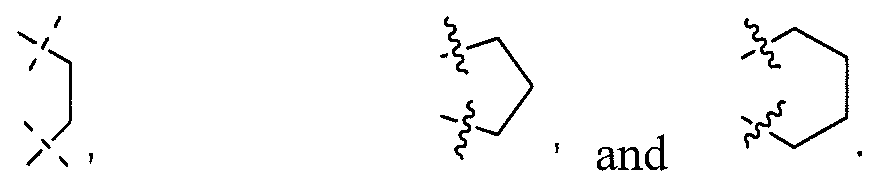
  • A is a 2-5 membered carbon alkyl linker selected from the group consisting of
  • n 0, 1, 2 or 3.
  • this invention describes a compound of Formula (II) a pharmaceutically acceptable salt thereof:
  • c 0, 1, 2, or 3;
  • R a , X, Y and Z are as defined herein;
  • This invention also provides methods of treating a disease, syndrome, illness, or symptom associated with insufficient androgen levels in a mammal in need thereof, wherein said method comprises the administration to said mammal of an effective amount of a compound of the invention or a pharmaceutically acceptable salt thereof.
  • this invention describes a compound of Formula (I) or a pharmaceutically acceptable salt thereof:
  • X, Y and Z are independently selected from hydrogen, halogen, CN, Ci- 4 alkyl, C 1-3 hydroxyalkyl, C 1-3 haloalkyl, N0 2 , NH 2 , Ci -3 alkyl and OH; with the proviso that at least one of X, Y and Z is not hydrogen;
  • each R a is independently selected from halogen, OH, NH(CO)C 1-6 alkyl, C 4 alkyl (wherein said C 1-4 alkyl is optionally substituted with from 1-2 substituents each independently selected from CN, OH and OC 1-3 alkyl), C1-5 haloalkyl, monocyclic aryl (wherein said monocyclic aryl is optionally substituted with from 1- 3 substituents each independently selected from Cj -3 alkyl, C 1-5 haloalkyl, CN, halogen, OH and OC 1-3 alkyl), benzyl (wherein the phenyl group of said benzyl is optionally substituted with from 1-3 substituents each independently selected from halogen, d -3 alkyl, S(O) 0-2 Ci -3 alkyl, S(O) 0-2 phenyl, 0-C 1-6 alkyl, and OCF 3 ), C(O)- Ci.io alk l, S0
  • R b is independently selected from C 1-4 alkyl (wherein said Ci -4 alkyl is optionally substituted with from 1 -2 substituents each independently selected from CN, OH, OPh (wherein said Ph is optionally substituted with 1 -2 substituents each mdependently selected from the group consisting of halogen, OH, CN and OC 1-3 alkyl), C 1-5 haloalkyl, monocyclic aryl (wherein said monocyclic aryl is optionally substituted with from 1-3 substituents each independently selected from the group consisting of C 1-3 alkyl, 0 1-5 haloalkyl, CN, halogen, OH and OC 1-3 alkyl), and benzyl (wherein the phenyl group of said benzyl is optionally substituted with from 1-3 substituents each independently selected from the group consisting of halogen, C1.3 alkyl, CN, S(O) 0-2 C 1-3 alkyl, S(O) 0-2
  • A is a 2-5 membered carbon alkyl linker selected from the group consisting of
  • X, Y and Z are independently selected from hydrogen, halogen, Ci -3 haloalkyl and CN; with the proviso that at least one of X, Y and Z is not hydrogen.
  • X, Y and Z are independently selected from hydrogen, chlorine, fluorine, CF 3 and CN; with the proviso that at least one of X, Y and Z is not hydrogen.
  • each R a is independently selected from halogen, C 4 alkyl and Ci -5 haloalkyl.
  • each R a is independently selected from halogen, C 2 alkyl and C 1-2 haloalkyl.
  • each R a is independently selected from chlorine, fluorine, CH 3 , CH 3 CH 2 , CF 3 , and CF 3 CF 2 . In other embodiments of this invention, for the compound of Formula (I), each R a is independently selected from fluorine, CH 3 , and CF 3 .
  • R b is C -2 alkyl or Ci ⁇ haloalkyl.
  • Rb is CH 3 , CH 3 CH 2 , CF 3 , or CF 3 CF 2 .
  • Rb is CH 3 , CF 3 , or CF 3 CF 2 .
  • A is a carbon linker selected from the group consisting of:
  • n is 0, 1 or 2.
  • X and Y are hydrogen; Z is CN; each R a is independently selected from the group consisting of fluorine, CH 3 and CF 3 ; Rb is CH 3 , CF 3 , or CF 3 CF 2 ;
  • A is a carbon linker selected from the group consisting of: n is 0, 1 or 2.
  • X is hydrogen; Y is CF 3 ; Z is CN; each R a is independently selected from the group consisting of fluorine, CH 3 and CF 3 ; R b is selected from the group consisting of CH 3 , CF 3 , and CF 3 CF 2 ;
  • A is:
  • n 0, 1 or 2.
  • X is hydrogen; Y and Z are chlorine; each R a is independently selected from the group consisting of fluorine, CH 3 and CF 3 ; R b is selected from the group consisting of CH 3 , CF 3 , and CF 3 CF 2 ;
  • n 0, 1 or 2.
  • X is hydrogen; Y is chlorine; Z is fluorine; each R a is independently selected from
  • A is:
  • n 0, 1 or 2.
  • X, Y and Z are chlorine; each R a is independently selected from fluorine, CH 3 or CF 3 ;
  • n 0, 1 or 2.
  • this invention describes a compound of Formula (la) or a pharmaceutically acceptable salt thereof:
  • X, Y and Z are independently selected from hydrogen, halogen, C 1-3 haloalkyl and CN; with the proviso that at least one of X, Y and Z is not hydrogen.
  • X, Y and Z are independently selected from hydrogen, chlorine, fluorine, CF 3 and CN; with the proviso that at least one of X, Y and Z is not hydrogen.
  • each R a is independently selected from halogen, C1-4 alkyl and C 1-5 haloalkyl.
  • each R a is independently selected from halogen, C 2 alkyl and Ci -2 haloalkyl.
  • each R a is independently selected from chlorine, fluorine, CH 3 , CH 3 CH 2 , CF 3 , and CF 3 CF 2 .
  • each R a is independently selected from fluorine, CH 3 , and CF 3 .
  • R b is Cj- 2 alkyl or C 1-2 haloalkyl.
  • R b is CH 3 , CH 3 CH 2 , CF 3 , or CF 3 CF 2 .
  • R b is CH 3 , CF 3 , or CF 3 CF 2 .
  • n is 0, 1 or 2.
  • X and Y are hydrogen; Z is CN; each R a is independently selected from fluorine, CH 3 and CF 3 ; R b is CH 3 , CF 3 , or CF 3 CF 2 ; and n is 0, 1 or 2.
  • X is hydrogen; Y is CF 3 ; Z is CN; each R a is independently selected from fluorine, CH 3 and CF 3 ; R b is CH 3 , CF 3 , or CF 3 CF 2 ; and n is 0, 1 or 2.
  • X is hydrogen; Y and Z are chlorine; each R a is independently selected from fluorine, CH 3 or CF 3 ; R b is CH 3 , CF 3 , or CF 3 CF 2 ; and n is 0, 1 or 2.
  • X is hydrogen; Y is chlorine; Z is fluorine; each R a is independently selected from fluorine, CH 3 and CF 3 ; R b is CH 3 , CF 3 , or CF 3 CF 2 ; and n is 0, 1 or 2.
  • X, Y and Z are chlorine; each R a is independently selected from fluorine, CH 3 or CF 3 ; R b is CH 3 , CF 3 , and CF 3 CF 2 ; and n is 0, 1 or 2.
  • this invention describes a compound of Formula (lb) or a pharmaceutically acceptable salt thereof;
  • X, Y, Z, R a , R b and n are as defined for formula I.
  • X, Y and Z are independently selected from hydrogen, halogen, C 1-3 haloalkyl and CN; with the proviso that at least one of X, Y and Z is not hydrogen.
  • X, Y and Z are independently selected from hydrogen, chlorine, fluorine, CF 3 and CN; with the proviso that at least one of X, Y and Z is not hydrogen.
  • each R a is independently selected from halogen, Ci- 4 alkyl and C 1-5 haloalkyl.
  • each R a is independently selected from halogen, Cj- 2 alkyl and Ci -2 haloalkyl.
  • each R a is independently selected from chlorine, fluorine, CH 3 , CH 3 CH 2 , CF 3 , and CF 3 CF 2 .
  • each R a is independently selected from fluorine, CH 3 , and CF 3 .
  • R b is Ci- 2 alkyl or Ci -2 haloalkyl.
  • R b is CH 3 , CH 3 CH 2 , CF 3 , or CF 3 CF 2 .
  • R b is CH 3 , CF 3 , or CF 3 CF 2 .
  • n is 0, 1 or 2.
  • X and Y are hydrogen; Z is CN; each R a is independently selected from fluorine, CH 3 or CF 3 ; R b is CH 3 , CF 3 , and CF 3 CF 2 ; and n is 0, 1 or 2.
  • X is hydrogen; Y is CF 3 ; Z is CN; each R a is independently selected from fluorine, CH 3 and CF 3 ; R b is CH 3 , CF 3 , or CF 3 CF 2 ; and n is 0, 1 or 2.
  • X is hydrogen; Y and Z are chlorine; each R a is independently selected from fluorine, CH 3 and CF 3 ; R b is CH 3 , CF 3 , or CF 3 CF 2 ; and n is 0, 1 or 2.
  • X is hydrogen; Y is chlorine; Z is fluorine; each R a is independently selected from fluorine, CH 3 and CF 3 ; R b is CH 3 , CF 3 , or CF 3 CF 2 ; and n is 0, 1 or 2.
  • X, Y and Z are chlorine; each R a is independently selected from fluorine, CH 3 and CF 3 ; R b is CH 3 , CF 3 , or CF 3 CF 2 ; and n is 0, 1 or 2.
  • this invention describes a compound of Formula (Ic) or a pharmaceutically acceptable salt thereof:
  • X, Y, Z, R a , R b and n are as defined for formula I .
  • X, Y and Z are independently selected from hydrogen, halogen, C 1-3 haloalkyl and CN; with the proviso that at least one of X, Y and Z is not hydrogen.
  • X, Y and Z are independently selected from hydrogen, chlorine, fluorine, CF 3 and CN; with the proviso that at least one of X, Y and Z is not hydrogen.
  • each R a is independently selected from halogen, Ci- 4 alkyl and C 1-5 haloalkyl.
  • each R a is independently selected from halogen, C 2 alkyl and C 1-2 haloalkyl.
  • each R a is independently selected from chlorine, fluorine, CH 3 , CH 3 CH 2 , CF 3 , and CF 3 CF 2 .
  • each R a is independently selected from fluorine, CH 3 , and CF 3 .
  • R b is Ci-2 alkyl or C 1-2 haloalkyl.
  • R b is CH 3 , CH 3 CH 2 , CF 3 , or CF 3 CF 2 .
  • R b is CH 3 , CF 3 , or CF 3 CF 2 .
  • n is 0, 1 or 2.
  • X and Y are hydrogen; Z is CN; each R a is independently selected from fluorine, CH 3 and CF 3 ; R b is CH 3 , CF 3 , or CF 3 CF 2 ; and n is 0, 1 or 2.
  • X is hydrogen; Y is CF 3 ; Z is CN; each R a is independently selected from fluorine, CH 3 and CF 3 ; R b is CH 3 , CF 3 , or CF 3 CF 2 ; and n is 0, 1 or 2.
  • X is hydrogen; Y and Z are chlorine; each R a is independently selected from fluorine, CH 3 or CF 3 ; R b is CH 3 , CF 3 , and CF 3 CF 2 ; and n is 0, 1 or 2.
  • X is hydrogen; Y is chlorine; Z is fluorine; each R a is independently selected from fluorine, CH 3 and CF 3 ; R b is CH 3 , CF 3 , or CF 3 CF 2 ; and n is 0, 1 or 2.
  • X, Y and Z are chlorine; each R a is independently selected from fluorine, CH 3 and CF 3 ; R b is CH 3 , CF 3 , or CF 3 CF 2 ; and n is 0, 1 or 2.
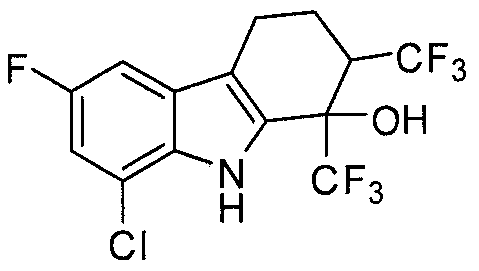
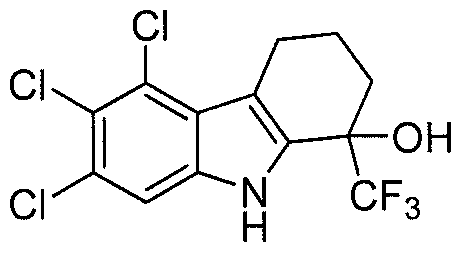
  • selected compound of this invention is selected from the following list.
  • the compound names in the list were generated with the assistance of ChemDraw ® versions 8.0, 9.0 and/or 11.0 (CambridgeSoft Corporation, 100 CambridgePark Drive, Cambridge, MA 02140 USA)).
  • ChemDraw ® versions 8.0, 9.0 and/or 11.0 (CambridgeSoft Corporation, 100 CambridgePark Drive, Cambridge, MA 02140 USA)
  • the stereochemistry at a chiral center is not defined in the compound name this indicates that the sample prepared contained a mixture of isomers at this center.
  • this invention describes a compound of Formula (II), or a pharmaceutically acceptable salt thereof:
  • c 0, 1, 2, or 3;
  • R a , X, Y and Z are as defined for formula I;
  • X, Y and Z are independently selected from hydrogen, halogen, C 1-3 haloalkyl and CN; with the proviso that at least two of X, Y and Z are each independently halogen or CN; and provided that two of X, Y and Z are not both Br.
  • X, Y and Z are independently selected from hydrogen, chlorine, bromine, CF 3 and CN; with the proviso that at least two of X, Y and Z are each independently halogen, or CN; and provided that two of X, Y and Z are not both Br.
  • each R a is independently selected from halogen, Ci- 4 alkyl, C 1-5 haloalkyl and benzyl.
  • each R a is independently selected from halogen, Ci- 2 alkyl, Cj -2 haloalkyl and benzyl.
  • each R a is independently selected from chlorine, fluorine, bromine, CH 3 and benzyl.
  • each R a is independently selected from bromine, CH 3 and benzyl.
  • c is 0, or 1.
  • this invention describes a compound of Formula (Ila), or a pharmaceutically acceptable salt thereof:
  • c 0, 1, 2, or 3;
  • R a , X, Y and Z are as defined for formula I;
  • X, Y and Z are independently selected from hydrogen, halogen, C 1-3 haloalkyl and CN; with the proviso that at least two of X, Y and Z are each independently halogen or CN; and provided that two of X, Y and Z are not both Br.
  • X, Y and Z are independently selected from hydrogen, chlorine, bromine, CF 3 and CN; with the proviso that at least two of X, Y and Z are each independently halogen, or CN; and provided that two of X, Y and Z are not both Br;
  • each R a is independently selected from halogen, Q- 4 alkyl, C 1-5 haloalkyl and benzyl.
  • each R a is independently selected from halogen, Ci- 2 alkyl, Ci -2 haloalkyl and benzyl.
  • each R a is independently selected from chlorine, fluorine, bromine, CH 3 and benzyl.
  • each R a is independently selected from bromine, CH 3 and benzyl.
  • c is 0, or 1.
  • X and Y are hydrogen; Z is CN; each R a is independently selected from bromine and benzyl; c is 0 or 1.
  • X and Y are hydrogen; Z is bromine; each R a is independently selected from bromine and benzyl; c is 0 or 1.
  • X and Y are chlorine; Z is hydrogen; each R a is independently selected from bromine and benzyl; c is 0 or 1.
  • III X and Y are hydrogen; Z is CN; each R a is independently selected from bromine and benzyl; and c is 0 or 1.
  • X and Y are hydrogen; Z is bromine; each R a is independently selected from bromine and benzyl; and c is 0 or 1.
  • X and Y are chlorine; Z is hydrogen; each R a is independently selected from bromine and benzyl; and c is 0 or 1.
  • a compound of this invention is selected from the group below.
  • the compound names in the list were generated with the assistance of ChemDraw ® versions 8.0, 9.0 and/or 1 1.0 (CambridgeSoft Corporation, 100 CambridgePark Drive, Cambridge, MA 02140 USA)).
  • the invention also relates to pharmaceutical compositions comprising a compound of Formula (I), (la), (lb), (Ic), (II), (Ila) or (III) or any of the structural embodiments described herein and at least one pharmaceutically acceptable excipient.
  • the invention also provides a method of modulating an androgen receptor in a cell, comprising the administration of a compound to said cell wherein said compound has structural Formula (I), (la), (lb), (Ic), (II), (Ila) or (III) or any of the structural embodiments described herein, or a pharmaceutically acceptable salt thereof.
  • This invention provides a method of identifying a compound capable of modulating an androgen receptor comprising contacting a cell expressing an androgen receptor with a compound according to Formula (I), (la), (lb), (Ic), (II), (Ila) or (III) and monitoring the effect of the compound on the cell.
  • This invention also provides a method of treating (e.g., preventing, or ameliorating the symptoms associated with, or reducing the incidence of, reducing the pathogenesis of, facilitating the recovery from or delaying the onset of) a disease, syndrome, illness, or symptom associated with insufficient androgen levels in a mammal in need thereof, wherein said method comprises the administration to said mammal of an effective amount of a compound of Formula (I), (la), (lb), (Ic), (II), (Ila) or (III), or any one of the structural embodiments described herein or a pharmaceutically acceptable salt thereof, or a pharmaceutical composition comprising a compound of Formula (I), (la), (lb), (Ic), (II), (Ila) or (III), or one of the structural embodiments described herein, or a pharmaceutically acceptable salt thereof and a pharmaceutically acceptable excipient.
  • the mammal is a human.
  • this invention provides a method of treating (e.g., preventing, or ameliorating the symptoms associated with, or reducing the incidence of, reducing the pathogenesis of, facilitating the recovery from or delaying the onset of) sarcopenia, frailty, multiple sclerosis, osteoporosis, anemia, cognitive impairment, cachexia, muscular dystrophy, weak appetite, low body weight, anorexia nervosa, acne, seborrhea, polycystic ovarian syndrome, hair loss, AIDs wasting, chronic fatigue syndrome, short stature, low testosterone levels, diminished libido, benign prostate hypertrophy, infertility, erectile dysfunction, vaginal dryness, premenstrual syndrome, postmenopausal symptoms, female hormone replacement therapy, male hormone replacement therapy, depression, Type II diabetes, mood disorders, sleep disorders, memory disorders, neurodegenerative disorders,
  • Alzheimer's dementia attention deficit disorder, senile dementia, coronary artery disease, hirsutism, pain, myalgia, myocardial infarction, stroke, clotting disorders, thromboembolisms, congestive heart disorder, low insulin sensitivity, low glucose utilization, high blood sugar, organ transplant, metabolic syndrome, diabetes, glucose intolerance, hyperinsulinemia, insulin resistance, tooth injury, tooth disease, periodontal disease, liver disease, thrombocytopenia, fatty liver conditions, endometriosis, hot flushes, hot flashes, vasomotor disturbance, stress disorders, dwarfism, dyslipidemia, cardiovascular disease, coronary artery disease, renal disease, thin skin disorders, lethargy, osteopenia, dialysis, irritable bowel syndrome, Crohn's disease, Paget's disease, osteoarthritis, connective tissue disease or disorders, injury, burns, trauma, wounds, bone fracture, atherosclerosis, cachexia, cancer cachexia, and obesity, in a mammal in
  • this invention describes a method of treating (e.g., preventing, or ameliorating the symptoms associated with, or reducing the incidence of, reducing the pathogenesis of, facilitating the recovery from or delaying the onset of) prostate cancer, breast cancer, endometrial cancer, hepatocellular cancer, lymphoma, multiple endocrine neoplasia, vaginal cancer, renal cancer, thyroid cancer, testicular cancer, leukemia, and ovarian cancer in a mammal in need thereof comprising the administration to said mammal of a compound according to a structure of Formula (I), (la), (lb), (Ic), (II), (Ila) or (III), or one of the structural embodiments described herein, or a pharmaceutically acceptable salt thereof, or a pharmaceutical composition comprising a compound of structural Formula (I), (la), (lb), (Ic), (II), (Ila) or (III), or one of the structural embodiments described herein including pharmaceutically acceptable salts thereof and a pharmaceutically
  • alkyl refers to both straight and branch chain hydrocarbon radicals, having the number of carbon atoms falling within the specified range.
  • C alkyl means that a hydrocarbon radical is attached that may contain anywhere from 1 to 4 carbon atoms with the remaining valence filled in by hydrogen atoms.
  • the definition also includes separately each permutation as though it were separately listed.
  • C 1- alkyl includes methyl and ethyl.
  • C 1-3 alkyl includes methyl, ethyl, propyl and 2-propyl.
  • C ⁇ .
  • C 4 alkyl includes methyl, ethyl, n-propyl, 2-propyl, n-butyl, 2-butyl, iso-butyl and tert- butyl.
  • C 1-5 alkyl includes methyl, ethyl, 2-propyl, n-butyl, 2-methylbutyl, tert-butyl, n-pentyl, pentan-2-yl, pentan-3-yl, and tert-pentyl, iso-pentyl.
  • halogen refers to a fluorine, chlorine, bromine or iodine radical.
  • haloalkyl refers to an alkyl radical wherein said alkyl radical is the same as defined for the term “alkyl” except that the alkyl radical additionally has from 1 to 5 halogen atoms attached to the alkyl chain.
  • C ⁇ haloalkyl includes
  • Ci -2 haloalkyl includes -CH 2 F, CHF 2 , CF 3 ,
  • C 1-3 haloalkyl is defined to include -CH 2 F, -CHF 2 , -CF 3 , -CH 2 CF 3 , -CHFCF 3 , -CF 2 CF 3 , -CHC1CH 3 , -CH2CH2CI, -CH 2 CH 2 CF 3 , and the like.
  • CM haloalkyl is defined to include -CH 2 F, -CHF 2 , -CF 3 , -CH 2 CF 3 , -CHFCF 3 , -CF 2 CF 3 , -CHC1CH 3 , -CH 2 CH 2 C1, -CH 2 CH 2 CF 3 , -CH 2 CH 2 CH 2 CF 3 , CHC1CF 2 CH 2 CH 3 , CF 2 CH 2 CH 2 CHF 2 , CH 2 CH 2 CH 2 CH 2 F, CH2CH2CH2CH2CI, and the like.
  • hydroxyalkyl refers to an alkyl radical wherein said alkyl radical is the same as defined for the term “alkyl” except that the alkyl radical additionally has from 1 or 2 hydroxyl groups attached to the alkyl chain.
  • C 2 - 4 hydroxyalkyl includes 2-hydroxyethyl, 2-hydroxypropyl, 2,4-dihydroxybutyl and the like.
  • the compounds of this invention may be present as solids and when so present, may be in an amorphous form or they may be crystalline. When the compounds of this invention are in the crystalline form, they might be present as a single polymorph or a mixture of polymorphs or even as a mixture of amorphous material together with one or more distinct polymorphs - the invention is not limited according to any particular solid or liquid state form.
  • the compounds of this invention contain at least one stereocenter and therefore, exist in various stereoisomeric forms.
  • Stereoisomers are compounds which differ only in their spatial arrangement.
  • Enantiomers are pairs of
  • the stereochemistry of a disclosed compound is named or depicted by structure
  • the named or depicted stereoisomer is at least 60%, 70%, 80%, 90%, 99% or 99.9% by weight pure relative to the other stereoisomers.
  • the depicted or named enantiomer is at least 60%, 70%, 80%, 90%, 99% or 99.9% by weight optically pure. Percent optical purity by weight is the ratio of the weight of the enantiomer over the weight of the enantiomer plus the weight of its optical isomer.
  • the compounds of the invention may be prepared as individual isomers by incorporating or starting with a specific isomer, isomer-specific synthesis or resolution from an isomeric mixture.
  • Conventional resolution techniques include forming the salt of a free base of each isomer of an isomeric pair using an optically active acid (followed by fractional crystallization and regeneration of the free base), forming the salt of the acid form of each isomer of an isomeric pair using an optically active amine (followed by fractional crystallization and regeneration of the free acid), forming an ester or amide of each of the isomers of an isomeric pair using an optically pure acid, amine or alcohol (followed by chromatographic separation and removal of the chiral auxiliary), or resolving an isomeric mixture of either a starting material or a final product using various well known
  • acid addition salts can be made and this invention includes such acid addition salts.
  • Some representative (non-limiting) acid addition salts include hydrochloride, hydrobromide, hydroiodide, acetate, benzenesulfonate, mesylate, besylate, benzoate, tosylate, citrate, tartrate, sulfate, bisulfate, lactate, maleate, mandelate, valerate, laurate, caprylate, propionate, succinate, phosphate, salicylate, napsylate, nitrate, tannate, resorcinate and the like, including multiprotic salts as well as mixtures of the acid addition salts.
  • this invention also embraces quaternized ammonium salts of those amines. It should be appreciated that N-oxides of amines are also embraced within the definition of the compounds of this invention.
  • compounds of this invention include one or more acid sites such as carboxylic acids, phenols and the like, basic addition salts can be made and this invention includes such basic addition salts.
  • some representative (non-limiting) acidic compounds of this invention may be present as their lithium, sodium, potassium, ammonium, trialkyammonium, calcium, magnesium, barium and the like.
  • solvates can also be present as solvates and such solvates are embraced within the scope of this invention even where not explicitly described.
  • Such solvates are preferably hydrates but can be solvates comprised of other solvents, preferably where those solvents are considered to be non-toxic or at least acceptable for administration to mammals, preferably humans.
  • the solvates can be stoichiometric or non-stoichiometric, singular or in combination.
  • Some exemplary solvates include water, ethanol, acetic acid and the like.
  • deuterium is optionally included - either at the normal hydrogen to deuterium isotope ratio or, possibly enriched in deuterium up to 100% deuterium at any given position.
  • some embodiments of this invention can be prepared so as to include high levels of deuterium (>90%) at one or more positions.
  • a structure of Formula (I) is provided wherein A is defined as including cyclohexyl.
  • A when A is a cyclohexyl ring, the cyclohexyl will have one or more specified "hydrogens".
  • one or more of the hydrogens may be optionally substituted by deuterium and that substitution may range from a very low incorporation to >90% depending on the method used for incorporating the deuterium if a specifc method was used.
  • the therapeutic utility of these compounds includes "treating" a mammal, preferably a human where treating is understood to include treating, preventing, or ameliorating the symptoms associated with, or reducing the incidence of, reducing the pathogenesis of, facilitating the recovery from or delaying the onset of the syndrome, illness, malady or condition being considered.
  • the compounds of this invention can also be useful in states or conditions where no clear deficit, illness or malady per se is perceived but rather, where a preferred condition, sensation, performance, capability or state is obtainable through therapeutic intervention with a compound of this invention.
  • the compounds of this invention when used as therapeutics can be administered by any method known to one of skill in the art such as orally, bucally, intravenously, subcutaneously, intramuscularly, transdermally, intradermally, intravascularly, intranasally, sublingually, intracranially, rectally, intratumorally, intravaginally, intraperitonealy, pulmonary, ocularly and intratumorally.
  • the term "effective amount” refers to an amount which, when administered in a proper dosing regimen, is sufficient to treat (therapeutically or prophylactically) the target disorder. For example, and effective amount is sufficient to reduce or ameliorate the severity, duration or progression of the disorder being treated, prevent the advancement of the disorder being treated, cause the regression of the disorder being treated, or enhance or improve the prophylactic or therapeutic effect(s) of another therapy.
  • the compounds and compositions of this invention maybe given once daily or with multiple daily doses such as twice per day, three times per day and four times per day.
  • a Pharmaceutical composition refers to one or more of the compounds of this invention with one or more pharmaceutically acceptable excipients.
  • the compound is administered orally where it can be Formulated for solid dosage administration or liquid dosage administration.
  • Solid dosage administration can be in the form of a tablet, granule, capsule, pill, pellet, powder and the like.
  • Liquid dosage Formulations include syrups, solutions, gels, suspensions, elixirs, emulsions, colloids, oils, and the like.
  • the compounds of this invention may be solids and when present as solids, they maybe of defined particle size. Where the compound of this invention is not particularly water soluble, it is sometimes preferable to administer the compound with a certain particle size - a particle size with a preferred range where the average mean particle size diameter is under 100 microns, or 75 microns, or 50 microns, or 35 microns, or 10 microns or 5 microns.
  • Solid dosage Formulations will comprise at least one compound of this invention together with one or more pharmaceutical excipients.
  • excipients include, by way of non-limiting example diluents (monosaccharides, disaccharides and polyhydric alcohols including starch, mannitol, dextrose, sucrose, microcrystallme cellulose, maltodextrin, sorbitol, xylitol, fructose and the like), binders (starch, gelatin, natural sugars, gums, waxes and the like), disintegrants (alginic acid, carboxymethylcellulose (calcium or sodium), cellulose, crocarmellose, crospovidone, microcrystallme cellulose, sodium starch glycolate, agar and the like), acidic or basic buffering agents (citrates, phoshphates, gluconates, acetates, carbonates, bicarbonates and the like), chelating agents (edetic), arates, phos
  • preservatives benzoic acid, chlorhexidine gluconate, potassium benzoate, potassium sorbate, sorbic acid, sodium benzoate and the like
  • glidants and lubricants calcium stearate, oils, magnesium stearate, magnesium trisilicate, sodium fumarate, colloidal silica, zinc stearate, sodium oleate, stearic acid, and the like
  • antioxidants and/or preservatives tocopherols, ascorabtes, phenols, and the like
  • acidifying agents citric acid, fumaric acid, malic acid, tartaric acid and the like
  • coloring agents citric acid, fumaric acid, malic acid, tartaric acid and the like
  • the solid dosage Formulations of this invention can be prepared in different forms including most commonly, tablets and capsules.
  • the tablets can be
  • Formulated by a wide variety of methods known to one of skill in the art including, for example, preparing a dry powder mixture of the drug substance in combination with one or more of the excipients granulating the mixture and pressing to together into a tablet and optionally coating the tablet with an enteric or non-enteric coating.
  • the final coat typically includes a light protective pigment such as titanium oxide and a shellac or wax to keep the tablet dry and stable. While not intending to be limited by theory or example, in some instances it might be preferred to prepare the tablets by wet granulating the drug with one or more of the excipients and then extruding the granulated material.
  • the solid dosage forms of this invention also include capsules wherein the drug is enclosed inside the capsule either as a powder together with optional excipients or as granules containing usually including one or more excipients together with the drug and wherein the granule in turn can be optionally coated, for example, enterically or non-enterically.
  • the solid dosage Formulations of this invention are Formulated in a sustained release Formulation.
  • Formulations are known to those of skill in the art and generally rely on the co- Formulation of the drug with one or more matrix forming substances that slow the release of the androgen receptor modulator thus extending the compound's lifetime in the digestive track and thereby extend the compounds half-life.
  • matrix forming substances include hydroxypropyl methylcellulose, carbopol, sodium carboxymethylcellulose and the like.
  • the compounds are Formulated for delivery other than via a solid oral dosage form.
  • a pulmonary route of administration typically means that the compound of this invention is inhaled into the lung where it is absorbed into the circulation.
  • Such a route of administration has the advantage of avoiding a first pass liver effect thereby possibly increasing bioavailability as well as decreasing or eliminating undesirable androgen agonist effects on the liver such as increasing liver enzymes and/or decreasing HDL.
  • Formulating a compound of the invention for pulmonary delivery can be accomplished by micronizing the compound of the invention to a very fine size particle, typically with a mean average diameter of less than 20 microns, or less than 10 microns or between 2 and 5 microns.
  • the powder may then be inhaled by itself or more likely mixed with one or more excipients such as lactose or maltose.
  • the powder can then be inhaled in a dry powder inhaling device either once or multiple times per day depending on the particular compound and the patients need.
  • Other types of pulmonary dosage forms are also embraced by this invention.
  • the compound of this invention may be suspended in an aerosolizing medium and inhaled as a suspension through a meter dosed inhaler or a nebulizer.
  • the compounds of this invention can be Formulated for transdermal delivery. Effective advantage of these compounds can be taken through a wide variety of transdermal options.
  • the compounds of this invention maybe Formulated for passive diffusion patches where they are preferably embedded in a matrix that allows for slow diffusion of the compound into the treated subject's circulation.
  • the compound is preferably dissolved or suspended in solvents including by way of non-limiting examples one or more of ethanol, water, propylene glycol, and Klucel HF.
  • a polymer matrix e.g. acrylate adhesive
  • the transdermal Formulations maybe designed to be compatible with alternate transdermal delivery technologies.
  • some transdermal technologies achieve greater and/or more consistent delivery by creating micropores in the skin using radio frequency, heat, ultrasound or electricity.
  • the compounds of this invention can be used with microneedle technology wherein the compound is loaded into very small needles which due not need to penetrate the dermis to be effective.
  • the compounds of this invention may be employed alone or in combination with other therapeutic agents.
  • the compounds of this invention can be used in combination with anti-lipidemics (statins, fibrates, omega-3 oils, niacinates and the like), bone anti-resorptives (bisphosponates, estrogens, selective estrogen receptor modulators (SERMs), calcitonin, and the like), bone anabolic agents (PTH and fragments e.g teriparatide, PTHRP and analogues e.g. Ba058), anti-diabetics (e.g. insulin sensitizers, glucose absorption and synthesis inhibitors (e.g.
  • the compounds of this invention may be co- Formulated or co-administered wherein said co-administration does not require dosing at exactly the same time but rather indicates that the patient is undergoing treatment with one or more of the additional agents during the timeframe of treatment with the selective androgen modulators of this invention.
  • the additional drug(s) for combination treatment can be administered concomitantly, sequentially or separately from the compounds of this invention.
  • the compounds of this invention may be administered according to different dosage scheduling and the dosage may be adjusted as deemed necessary by the subject or preferably by the subject in consultation with a qualified practitioner of medicine. Dosing of the compounds of this invention can take place by multiple routes and consequently, the dosing schedule and amounts are dependent not only on the particular subject's weight, sex, age, therapy contemplated, etc but also by the route of the drug chosen.
  • the compounds of this invention may be dosed by the oral route in a once daily, twice daily, three times daily or more than three times per day depending on the particular needs of that subject, the
  • the dosage will typically be from about 0.01 mg to 500 mg of drug per daily dosage, for example from about 0.1 mg to about 10 mg, such as from about 0.1 mg to about 3 mg, or from about 0.1 mg to about 250 mg of drug per daily dosage, or from about 1 mg to about 150 mg of drug per daily dosage, or from about 5 mg to about 100 mg of drug per daily dosage., or from about 0.1 mg to about 5 mg of drug per daily dosage.
  • the amount of compound dosed per day can be administered every day, every other day, every 2 days, every 3 days, every 4 days, every 5 days, etc.
  • a 5 mg per day dose can be initiated on Monday with a first subsequent 5 mg per day dose administered on Wednesday, a second subsequent 5 mg per day dose administered on Friday, etc.
  • a compound of this invention is dosed once every seven days.
  • the compounds of this invention can also be dosed on a monthly basis meaning that administration is done once per month.
  • the compounds of this invention can be dosed on a weekly basis (once a week), every other week, every three weeks or every four weeks for a single day or multiple days.
  • the compounds of this invention can also be dosed on an as needed or "pro re nata" "prn" schedule, and "on demand".
  • the compounds of this invention are administered in a therapeutically effective dose at some time prior to commencement of an activity wherein the therapeutic effect of the compounds of this invention is desirable.
  • Administration can be immediately prior to such an activity, including about 0 minutes, about 10 minutes, about 20 minutes, about 30 minutes, about 1 hour, about 2 hours, about 3 hours, about 4 hours, about 5 hours, about 6 hours, about 7 hours, about 8 hours, about 9 hours, or about 10 hours prior to such an activity, depending on the Formulation.
  • the compounds of this invention can be prepared by a variety of synthetic routes and techniques known to those of skill in the art.
  • the processes disclosed herein should not be construed as limiting the examples or scope of the invention in any way but rather are provided as just some of the representative ways that the compounds of this invention can be or were prepared.
  • protective groups are employed in the synthesis of the compounds of this invention and it should be appreciated that there are a diverse array of protective groups and strategies that can be employed in organic synthesis (T.W.Green and P.G.M. Wuts (2006) Greene's Protective Groups in Organic Synthesis, herein incorporated by reference in its entirety) and that where a protective group is referred to generically, any appropriate protective group should be considered.
  • leaving groups are employed in the synthesis of compounds of this invention. Where a specific leaving group is referred to, it should be appreciated that other leaving groups might also be used. Leaving groups typically include those groups that can stabilize an anion. In the case of nucleophilic aromatic substitutions, the leaving group may be an anion or a neutrally charged group. In some cases, the leaving group for nucleophilic aromatic substitution may be a group that is not typically considered to be a stabilized anion (e.g. fluoride or hydride).
  • nucleophilic leaving groups include halogens, sulfonates (O-mesylates, O-tosylates, etc), hydrides, quaternized amines, nitro, and the like. Additional discussion and examples can be found in leading textbooks on organic chemistry including, for example, March's Advanced Organic Chemistry: Reactions, Mechanisms, and Structure, 5 th Edition, which is herein incorporated in its entirety.
  • Scheme 1 gives one embodiment of a general method for preparing compounds of this invention, such as, for example, the mono-substituted compound of Formula E, wherein X, Y, Z and 3 ⁇ 4 are as defined herein and m is 1, 2 or 3.
  • the starting material an aryl hydrazine of Formula A
  • a 1 ,2,cyclodione of Formula B is coupled with a 1 ,2,cyclodione of Formula B to give the tricyclic keto compound of Formula C using standard coupling reaction conditions known to those of skill in the art.
  • a solvent is chosen that can dissolve at least some of each of the components of the reaction.
  • EtOH or MeOH can be a very good solvent for these reactions but other solvents such as DMSO, DMF, HMPA, etc, should be considered as well.
  • the product C is isolated and carried to the next step. Isolation techniques are well-known to those of skill in the art and include chromatography and/or crystallization.
  • the keto product C is converted to the alcohol F using a number of potential reagents well-known to those of skill in the art.
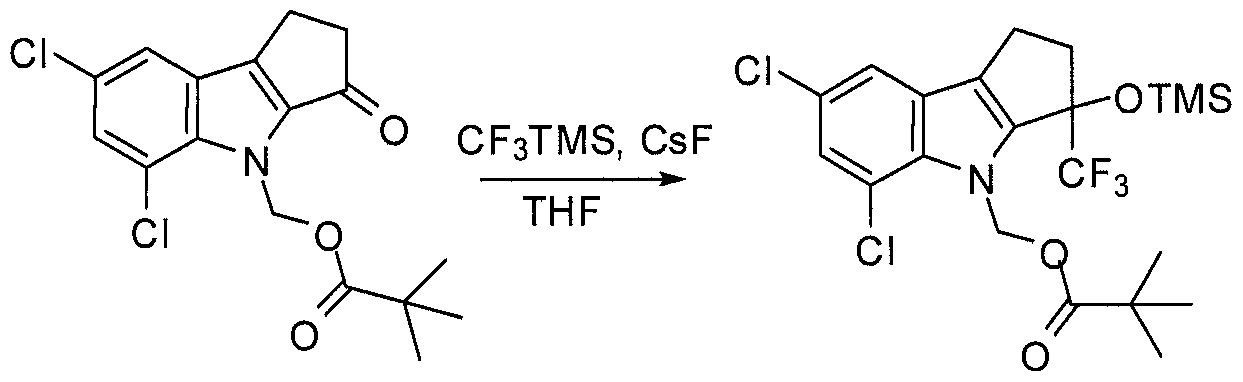
  • the keto compound C is converted directly to the product F by reduction of the ketone, such as for example, by reaction with a Grignard reagent, CF 3 TMS or CF 3 CF 3 TMS.
  • a Grignard reagent such as for example, by reaction with a Grignard reagent, CF 3 TMS or CF 3 CF 3 TMS.
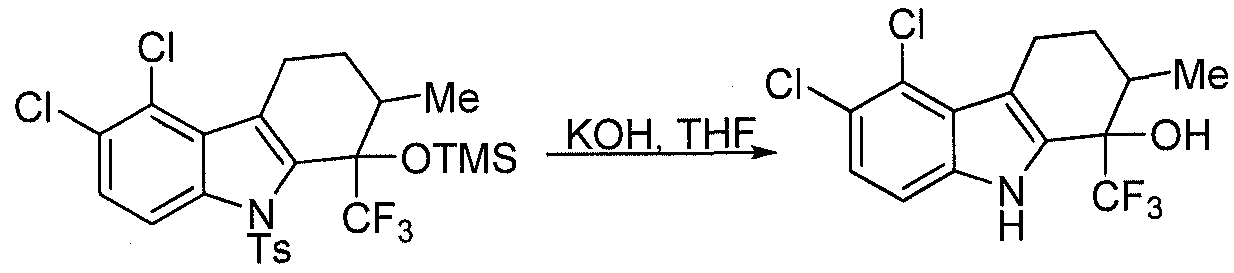
  • the compound D is converted to the substituted alcohol E, wherein P 2 is any alcohol protecting group, known to one skilled in the art, such as, for example, a silyl ether, such as, trimethylsilyl group, a tert-butyldimethylsilyl ether, or a tert-butyldiphenylsilyl ether, but other protecting groups could be useful as well. Removal of the protecting groups Pi and P 2 results in the product F.
  • P 2 is any alcohol protecting group, known to one skilled in the art, such as, for example, a silyl ether, such as, trimethylsilyl group, a tert-butyldimethylsilyl ether, or a tert-butyldiphenylsilyl ether, but other protecting groups could be useful as well. Removal of the protecting groups Pi and P 2 results in the product F.
  • Scheme 3 shows the modification of Scheme 1 for the preparation of the di- substituted compounds of Formula L wherein X, Y, 3 ⁇ 4 and m are as defined herein.
  • the regioisomers for the keto compound of Formula K (corresponding to the compound of Formula C in Scheme 1) are separated using a number of potential methods well-known to those of skill in the art.
  • the carbazole amine is converted to the t-butyl carbamate followed by chromatography. Each regioisomer is then separately converted to the compound of Formula L as described in Scheme 1
  • an androgen receptor binding assay was performed wherein many of the compounds of this invention are shown to demonstrate significant affinity for the androgen receptor.
  • the assay was performed as specified by the manufacturer (Invitrogen, Madison, WI). Briefly, ⁇ of lOmM compound was added to 500 ⁇ 1 of AR screening buffer in a 1.5ml eppendorf tube to make a 2xl0 "5 M stock. 10-fold serial dilutions of the test compounds were prepared ranging in concentration from 10 "5 M to 10 "12 M. Each dilution was added in triplicate to a black 384-microtiter plate. The test compounds will be diluted 2-fold in the final reaction.
  • 2x AR-FluormoneTM complex was prepared with 2nM Flourmone AL GreenTM and 30nM AR. 25 ⁇ of 2x complex was aliquoted to each reaction well, such that the final reaction volume was 50 ⁇ 1 per well. The plate was sealed with a foil cover and incubated in the dark at room temperature for 4 h. Polarization values for each well were measured. The polarization values were plotted against the concentration of the test compound. The concentration of the test compound that results in half-maximum shift equals the IC 5 0 of the test compound. As a control, a competition curve for
  • R1881(methyltrienolone) was performed for each assay. Curve Fitting was performed using GraphPad Prism® software from GraphPadTM Software Inc.
  • Binding data are reported as a single determination if the experiment was run once only and as the average of experiments if the binding experiment was performed two or more times with that compound. Results are set forth in Table 1.
  • H and C NMR spectra were typically determined in CDC1 3 or DMSO- ⁇ 3 ⁇ 4, using either a Varian Inova 500 MHz spectrometer or a Varian Gemini 2000 200 MHz spectrometer. Proton chemical shifts ( ⁇ ) are relative to the residual solvent peaks for each deuterated solvent and expressed in ppm. Coupling constants (J) are expressed in hertz. Infra red spectra were obtained in Jasco 460 plus using KBr pellets. Mass Spectra was recorded in ESI & APCI source using AGILENT 6310 Iontrap or Shimadzu LCMS-2010 EV. Chemical reagents were generally commercially available and were used without further purification unless stated otherwise. Chemical reagents were generally commercially available and were used without further purification unless stated otherwise.
  • methyl 2-oxocyclopentanecarboxylate (2.5 g, 17.5 mmol) in 5N NaOH (0.75 g, 18.8 mmol) was stirred for 16 h, cooled to 0 °C, acidified with cone. HC1 (1.1 mL) and added slowly to the diazonium salt prepared above. The reaction mixture was stirred at 0 °C for 10 min. during which time a yellow solid
  • reaction mixture was heated to 110 °C for 2 h, cooled to room temperature and quenched with saturated NH 4 C1 (10 mL), extracted with EtOAc (2 x 15 mL) and the combined organic extracts were concentrated in vacuo to give the crude compound which was purified by silica gel chromatography [EtOAc-hexane (1 :9) as eluant] to provide the title compound as light red solid (30 mg, 37%).
  • reaction mixture was stirred at 60 °C for 12 h, filtered through a pad of Celite® and the filtrate was concentrated under reduced pressure to give the crude material which was purified by silica gel chromatography [EtOAc-hexane (1 :9) as eluant] to obtain the title compound as a yellow solid (0.48 g, 92%).
  • the binding data shown in Table 1 (below) is from the result of a single or multiple determinations based on the same compound. Where multiple data points have been taken, the value reported is the average of the multiple determinations.
  • Table 1 Compound AR-Binding Affinity

Landscapes

  • Health & Medical Sciences (AREA)
  • Chemical & Material Sciences (AREA)
  • Organic Chemistry (AREA)
  • Life Sciences & Earth Sciences (AREA)
  • Engineering & Computer Science (AREA)
  • Medicinal Chemistry (AREA)
  • General Health & Medical Sciences (AREA)
  • Veterinary Medicine (AREA)
  • Bioinformatics & Cheminformatics (AREA)
  • Chemical Kinetics & Catalysis (AREA)
  • General Chemical & Material Sciences (AREA)
  • Nuclear Medicine, Radiotherapy & Molecular Imaging (AREA)
  • Pharmacology & Pharmacy (AREA)
  • Animal Behavior & Ethology (AREA)
  • Public Health (AREA)
  • Diabetes (AREA)
  • Endocrinology (AREA)
  • Hematology (AREA)
  • Biomedical Technology (AREA)
  • Neurology (AREA)
  • Physical Education & Sports Medicine (AREA)
  • Neurosurgery (AREA)
  • Orthopedic Medicine & Surgery (AREA)
  • Reproductive Health (AREA)
  • Urology & Nephrology (AREA)
  • Dermatology (AREA)
  • Obesity (AREA)
  • Rheumatology (AREA)
  • Molecular Biology (AREA)
  • Immunology (AREA)
  • Gynecology & Obstetrics (AREA)
  • Pain & Pain Management (AREA)
  • Psychiatry (AREA)
  • Emergency Medicine (AREA)
  • Heart & Thoracic Surgery (AREA)
  • Cardiology (AREA)
  • Biotechnology (AREA)
  • Analytical Chemistry (AREA)
  • Pathology (AREA)
  • General Physics & Mathematics (AREA)

Abstract

This invention provides compounds of Formula (I), (Ia), (Ib), (Ic), (II), (IIa) or (III) and or salts thereof, pharmaceutical compositions comprising a compound of Formula (I), (Ia), (Ib), (Ic), (II), (IIa) or (III) and a pharmaceutically acceptable excipient, methods of modulating the androgen receptor, methods of treating diseases beneficially treated by an androgen receptor modulator (e.g., sarcopenia, prostate cancer, contraception, type II diabetes related disorders or diseases, anemia, depression, and renal disease) and processes for making compounds of Formula (I), (Ia), (Ib), (Ic), (II), (IIa) or (III) and intermediates useful in the preparation of same.

Description

SELECTIVE ANDROGEN RECEPTOR MODULATORS
RELATED APPLICATION
This application claims the benefit of U.S. Provisional Application No. 61/301,492, filed on February 4, 2010. The entire teachings of the above application is incorporated herein by reference.
BACKGROUND OF THE INVENTION
Androgen signaling is mediated through the androgen receptor (AR) and is a nuclear signaling pathway of tremendous importance in mammals. In addition to its primary role in sexual development, maturation and maintenance of sexual function in both males and females, this critical hormone signaling pathway affects a large number of non-sexual tissues including, bone, muscle, CNS, liver, etc. In humans, testosterone and dihydrotestosterone are the primary ligands that mediate AR- signaling. Both are high affinity ligands for AR, with dihydrotestosterone having somewhat higher affinity. Testosterone is converted to dihydrotestosterone through the action of 5ot-reductase enzymes and is converted to 17p-estradiol (potent endogenous estrogen) through the action of P-450 aromatase enzymes. AR signaling is mediated by binding of an AR ligand to AR in the cellular cytosol, homodimerization of two AR receptors and nuclear location of the ligand bound dimer to the cell nucleus where the complex associates with various coactivators as well as Androgen Response Elements (palindrome-like sequences of DNA) which serve as activation sites for certain AR-mediated genes. Due to the very large number of AR target tissues, both sexual and non-sexual, androgens such as testosterone and dihydrotestosterone have a number of potentially desirable actions as well as non-desirable actions depending on the particular individual's age, sex, therapeutic need, etc. In the adult male and female, certain positive consequences of AR-agonist signaling can be generalized as including increased bone mineral density and a corresponding reduction of risk of bone fractures. Accordingly, androgen supplementation can be very valuable in the prevention or treatment of osteoporosis where the osteoporosis might originate from any number of different causes, such as corticosteroid induced osteoporosis and age-related osteoporosis (e.g. postmenopausal). Likewise, males and females respond to agonist supplementation with an increase in muscle mass and very often a decrease in fat mass. This is beneficial in a very large number of treatment modalities. For example, there are many wasting syndromes associated with different disease states where the therapeutic goal is for a patient to maintain weight and function, such as the treatment of cancer associated cachexia, AIDs-related cachexia, anorexia and many more. Other muscle- wasting disorders such as muscular dystrophy in its many forms as well as related disorders might be treated to advantage with androgens. The increase in muscle mass with concomitant reduction in fat mass associated with anabolic androgen action has additional health benefits for many men and women including potentially increased sensitivity to insulin. Androgen supplementation is also associated with reduction of high triglycerides, though there is a general correlation with androgen use and decreased HDL levels and in some cases, increased LDL levels. In the CNS, numerous laudatory benefits have been associated with androgen supplementation including improved sexual desire and functioning, increased cognition, memory, sense of well being and possible decrease in risk of Alzheimer's disease.
Androgen antagonists have been used in treating prostate cancer, where blockade of androgen signaling is desired whereas some androgens agonists (e.g. dihydrotestosterone) stimulate the hypertrophy of prostate tissue and may be a causative factor in prostate cancer. Androgen agonist activity is often associated with stimulation of benign prostate hyperplasia, a disease characterized by an enlarged prostate often accompanied by discomfort and difficulty in urination due to blockage of the urethra. As a result, androgen antagonists have efficacy in the reduction of the size of the prostate and the corresponding symptoms of benign prostate hyperplasia, though it is much more common to use a 5oc-reductase inhibitor (e.g. finasteride) as such inhibitors do not decrease androgen signaling systemically to the same extent as a typical anti-androgen (e.g. bicalutamide), but rather reduce androgen drive more site specifically to where testosterone to DHT conversion occurs such as the prostate and scalp. Androgen antagonists also find utility in the treatment of hirsutism in women as well as the treatment of acne. Androgens are generally contraindicated in conditions that are treated with androgen antagonists since they can exacerbate the symptoms that are being treated.
Ideally, an androgen would retain the benefits of androgen agonists while minimizing the stimulatory effects on the prostate in males as well as some of the other untoward effects of androgens including masculinization of women and increase in acne in both sexes. Androgens that demonstrate tissue selective effects compared to the benchmarks testosterone and/or dihydrotestosterone are typically referred to as androgen receptor modulators or more often, selective androgen receptor modulators (SARMs). At the far end of potential selectivity, an ideal S ARM would demonstrate no prostate stimulation while maintaining or growing muscle sufficient to effectively mimic the effects of testosterone or
dihydrotestosterone. The growing appreciation of the positive contribution that SARMs can make in the many therapeutic areas where androgen activity is desirable has led to a large amount of research into this important area. Due to a compelling need for novel and effective androgen therapies with potentially reduced side effects, novel and effective SARM compounds are urgently needed.
SUMMARY OF THE INVENTION
In certain embodiments, this invention describes a compound of Formula (I) or a pharmaceutically acceptable salt thereof:
Figure imgf000004_0001
(I)
wherein:
X, Y and Z are independently selected from the group consisting of hydrogen, halogen, CN, Ci-4 alkyl, C1-3 hydroxyalkyl, C1-3 haloalkyl, N02, N¾, OCi-3alkyl and OH; with the proviso that at least one of X, Y and Z is not hydrogen; each Ra is independently selected from the group consisting of halogen, OH, NH(CO)C1-6 alkyl, C 4 alkyl (wherein said C1-4 alkyl is optionally substituted with from 1-2 substituents each independently selected from the group consisting of CN, OH and OCi-3 alkyl), Ci-s haloalkyl, monocyclic aryl (wherein said monocyclic aryl is optionally substituted with from 1-3 substituents each independently selected from the group consisting of C1-3 alkyl, Ci-s haloalkyl, CN, halogen, OH and OC1-3 alkyl), benzyl (wherein the phenyl group of said benzyl is optionally substituted with from 1-3 substituents each independently selected from the group consisting of halogen, Ci.3 alkyl, S(O)0-2Ci-3 alkyl, S(O)0-2phenyl, 0-Ci-6 alkyl, and OCF3), C(O)-C1-10 alkyl, S03-, P03-, S02NRbRb' and C(0)phenyl;
Rb is independently selected from the group consisting of C1-4 alkyl (wherein said C1-4 alkyl is optionally substituted with from 1-2 substituents each
independently selected from the group consisting of CN, OH and OPh (wherein said Ph is optionally substituted with 1 -2 substituents each independently selected from the group consisting of halogen, OH, CN and OCi-3 alkyl)), C1-5 haloalkyl, monocyclic aryl (wherein said monocyclic aryl is optionally substituted with from 1 - 3 substituents each independently selected from the group consisting of C1-3 alkyl, C^s haloalkyl, CN, halogen, OH and OC1-3 alkyl), and benzyl (wherein the phenyl group of said benzyl is optionally substituted with from 1-3 substituents each independently selected from the group consisting of halogen, C1-3 alkyl, CN, S(O)0- 2C1.3 alkyl, S(O)0-2phenyl, 0-C1-6 alkyl, and OCF3);
A is a 2-5 membered carbon alkyl linker selected from the group consisting of
Figure imgf000005_0001
n is 0, 1, 2 or 3.
In certain embodiments, this invention describes a compound of Formula (II) a pharmaceutically acceptable salt thereof:
Figure imgf000005_0002
(Π)
wherein:
c is 0, 1, 2, or 3; and
Ra, X, Y and Z are as defined herein;
with the proviso that at least two of X, Y and Z are each independently halogen, N02 or CN; provided that two of X, Y and Z are not both Br.
This invention also provides methods of treating a disease, syndrome, illness, or symptom associated with insufficient androgen levels in a mammal in need thereof, wherein said method comprises the administration to said mammal of an effective amount of a compound of the invention or a pharmaceutically acceptable salt thereof.
These and other aspects of the invention are described in detail herein.
DETAILED DESCRIPTION OF THE INVENTION
In certain embodiments, this invention describes a compound of Formula (I) or a pharmaceutically acceptable salt thereof:
Figure imgf000006_0001
I
wherein:
X, Y and Z are independently selected from hydrogen, halogen, CN, Ci-4 alkyl, C1-3 hydroxyalkyl, C1-3 haloalkyl, N02, NH2, Ci-3alkyl and OH; with the proviso that at least one of X, Y and Z is not hydrogen;
each Ra is independently selected from halogen, OH, NH(CO)C1-6 alkyl, C 4 alkyl (wherein said C1-4 alkyl is optionally substituted with from 1-2 substituents each independently selected from CN, OH and OC1-3 alkyl), C1-5 haloalkyl, monocyclic aryl (wherein said monocyclic aryl is optionally substituted with from 1- 3 substituents each independently selected from Cj-3 alkyl, C1-5 haloalkyl, CN, halogen, OH and OC1-3 alkyl), benzyl (wherein the phenyl group of said benzyl is optionally substituted with from 1-3 substituents each independently selected from halogen, d-3 alkyl, S(O)0-2Ci-3 alkyl, S(O)0-2phenyl, 0-C1-6 alkyl, and OCF3), C(O)- Ci.io alk l, S03-, P03-, S02NRbRb> and C(0)phenyl;
Rb is independently selected from C1-4 alkyl (wherein said Ci-4 alkyl is optionally substituted with from 1 -2 substituents each independently selected from CN, OH, OPh (wherein said Ph is optionally substituted with 1 -2 substituents each mdependently selected from the group consisting of halogen, OH, CN and OC1-3 alkyl), C1-5 haloalkyl, monocyclic aryl (wherein said monocyclic aryl is optionally substituted with from 1-3 substituents each independently selected from the group consisting of C1-3 alkyl, 01-5 haloalkyl, CN, halogen, OH and OC1-3 alkyl), and benzyl (wherein the phenyl group of said benzyl is optionally substituted with from 1-3 substituents each independently selected from the group consisting of halogen, C1.3 alkyl, CN, S(O)0-2C1-3 alkyl, S(O)0-2phenyl, 0-C1-6 alkyl, and OCF3);
A is a 2-5 membered carbon alkyl linker selected from the group consisting
Figure imgf000007_0001
In certain embodiments of this invention, for the compound of Formula (I), X, Y and Z are independently selected from hydrogen, halogen, Ci-3 haloalkyl and CN; with the proviso that at least one of X, Y and Z is not hydrogen.
In some embodiments of this invention, for the compound of Formula (I), X, Y and Z are independently selected from hydrogen, chlorine, fluorine, CF3 and CN; with the proviso that at least one of X, Y and Z is not hydrogen.
In certain embodiments of this invention, for the compound of Formula (I), each Ra is independently selected from halogen, C 4 alkyl and Ci-5 haloalkyl.
In some embodiments of this invention, for the compound of Formula (I), each Ra is independently selected from halogen, C 2 alkyl and C1-2 haloalkyl.
In other embodiments of this invention, for the compound of Formula (I), each Ra is independently selected from chlorine, fluorine, CH3, CH3CH2, CF3, and CF3CF2. In other embodiments of this invention, for the compound of Formula (I), each Ra is independently selected from fluorine, CH3, and CF3.
In certain embodiments of this invention, for the compound of Formula (I), Rb is C -2 alkyl or Ci^ haloalkyl.
In some embodiments of this invention, for the compound of Formula (I), Rb is CH3, CH3CH2, CF3, or CF3CF2.
In some embodiments of this invention, for the compound of Formula (I), Rb is CH3, CF3, or CF3CF2.
In certain embodiments of this invention, for the compound of Formula (I), A is a carbon linker selected from the group consisting of:
Figure imgf000008_0001
In certain embodiments of this invention, for the compound of Formula (I), n is 0, 1 or 2.
In some embodiments of the invention, for the compounds of Formula (I), X and Y are hydrogen; Z is CN; each Ra is independently selected from the group consisting of fluorine, CH3 and CF3; Rb is CH3, CF3, or CF3CF2;
A is a carbon linker selected from the group consisting of:
Figure imgf000008_0002
n is 0, 1 or 2.
In some embodiments of the invention, for the compounds of Formula (I), X is hydrogen; Y is CF3; Z is CN; each Ra is independently selected from the group consisting of fluorine, CH3 and CF3; Rb is selected from the group consisting of CH3, CF3, and CF3CF2;
A is:
Figure imgf000009_0001
n is 0, 1 or 2.
In some embodiments of the invention, for the compounds of Formula (I), X is hydrogen; Y and Z are chlorine; each Ra is independently selected from the group consisting of fluorine, CH3 and CF3; Rb is selected from the group consisting of CH3, CF3, and CF3CF2;
Figure imgf000009_0002
n is 0, 1 or 2.
In some embodiments of the invention, for the compounds of Formula (I), X is hydrogen; Y is chlorine; Z is fluorine; each Ra is independently selected from
CF3, and CF3CF2; A is:
Figure imgf000009_0003
n is 0, 1 or 2.
In some embodiments of the invention, for the compounds of Formula (I), X, Y and Z are chlorine; each Ra is independently selected from fluorine, CH3 or CF3;
Figure imgf000009_0004
n is 0, 1 or 2.
In some embodiments, this invention describes a compound of Formula (la) or a pharmaceutically acceptable salt thereof:
Figure imgf000009_0005
(la)
wherein: X, Y, Z, Ra, Rb and n are as defined for formula I.
In certain embodiments of this invention, for the compound of Formula (la), X, Y and Z are independently selected from hydrogen, halogen, C1-3 haloalkyl and CN; with the proviso that at least one of X, Y and Z is not hydrogen.
In some embodiments of this invention, for the compound of Formula (la),
X, Y and Z are independently selected from hydrogen, chlorine, fluorine, CF3 and CN; with the proviso that at least one of X, Y and Z is not hydrogen.
In certain embodiments of this invention, for the compound of Formula (la), each Ra is independently selected from halogen, C1-4 alkyl and C1-5 haloalkyl.
In some embodiments of this invention, for the compound of Formula (la), each Ra is independently selected from halogen, C 2 alkyl and Ci-2 haloalkyl.
In other embodiments of this invention, for the compound of Formula (la), each Ra is independently selected from chlorine, fluorine, CH3, CH3CH2, CF3, and CF3CF2.
In other embodiments of this invention, for the compound of Formula (la), each Ra is independently selected from fluorine, CH3, and CF3.
In certain embodiments of this invention, for the compound of Formula (la), Rb is Cj-2 alkyl or C1-2 haloalkyl.
In some embodiments of this invention, for the compound of Formula (la), Rb is CH3, CH3CH2, CF3, or CF3CF2.
In some embodiments of this invention, for the compound of Formula (la), Rb is CH3, CF3, or CF3CF2.
In certain embodiments of this invention, for the compound of Formula (la), n is 0, 1 or 2.
In some embodiments of the invention, for the compounds of Formula (la),
X and Y are hydrogen; Z is CN; each Ra is independently selected from fluorine, CH3 and CF3; Rb is CH3, CF3, or CF3CF2; and n is 0, 1 or 2.
In some embodiments of the invention, for the compounds of Formula (la), X is hydrogen; Y is CF3; Z is CN; each Ra is independently selected from fluorine, CH3 and CF3; Rb is CH3, CF3, or CF3CF2; and n is 0, 1 or 2. In some embodiments of the invention, for the compounds of Formula (la), X is hydrogen; Y and Z are chlorine; each Ra is independently selected from fluorine, CH3 or CF3; Rb is CH3, CF3, or CF3CF2; and n is 0, 1 or 2.
In some embodiments of the invention, for the compounds of Formula (la), X is hydrogen; Y is chlorine; Z is fluorine; each Ra is independently selected from fluorine, CH3 and CF3; Rb is CH3, CF3, or CF3CF2; and n is 0, 1 or 2.
In some embodiments of the invention, for the compounds of Formula (la), X, Y and Z are chlorine; each Ra is independently selected from fluorine, CH3 or CF3; Rb is CH3, CF3, and CF3CF2; and n is 0, 1 or 2.
In some embodiments, this invention describes a compound of Formula (lb) or a pharmaceutically acceptable salt thereof;
Figure imgf000011_0001
(lb)
wherein:
X, Y, Z, Ra, Rb and n are as defined for formula I.
In certain embodiments of this invention, for the compound of Formula (lb), X, Y and Z are independently selected from hydrogen, halogen, C1-3 haloalkyl and CN; with the proviso that at least one of X, Y and Z is not hydrogen.
In some embodiments of this invention, for the compound of Formula (lb), X, Y and Z are independently selected from hydrogen, chlorine, fluorine, CF3 and CN; with the proviso that at least one of X, Y and Z is not hydrogen.
In certain embodiments of this invention, for the compound of Formula (lb), each Ra is independently selected from halogen, Ci-4 alkyl and C1-5 haloalkyl.
In some embodiments of this invention, for the compound of Formula (lb), each Ra is independently selected from halogen, Cj-2 alkyl and Ci-2 haloalkyl.
In other embodiments of this invention, for the compound of Formula (lb), h each Ra is independently selected from chlorine, fluorine, CH3, CH3CH2, CF3, and CF3CF2.
In other embodiments of this invention, for the compound of Formula (lb), each Ra is independently selected from fluorine, CH3, and CF3. In certain embodiments of this invention, for the compound of Formula (lb), Rb is Ci-2 alkyl or Ci-2 haloalkyl.
In some embodiments of this invention, for the compound of Formula (lb), Rb is CH3, CH3CH2, CF3, or CF3CF2.
In some embodiments of this invention, for the compound of Formula (lb), Rb is CH3, CF3, or CF3CF2.
In certain embodiments of this invention, for the compound of Formula (lb), n is 0, 1 or 2.
In some embodiments of the invention, for the compounds of Formula (lb), X and Y are hydrogen; Z is CN; each Ra is independently selected from fluorine, CH3 or CF3; Rb is CH3, CF3, and CF3CF2; and n is 0, 1 or 2.
In some embodiments of the invention, for the compounds of Formula (lb), X is hydrogen; Y is CF3; Z is CN; each Ra is independently selected from fluorine, CH3 and CF3; Rb is CH3, CF3, or CF3CF2; and n is 0, 1 or 2.
In some embodiments of the invention, for the compounds of Formula (lb), X is hydrogen; Y and Z are chlorine; each Ra is independently selected from fluorine, CH3 and CF3; Rb is CH3, CF3, or CF3CF2; and n is 0, 1 or 2.
In some embodiments of the invention, for the compounds of Formula (lb), X is hydrogen; Y is chlorine; Z is fluorine; each Ra is independently selected from fluorine, CH3 and CF3; Rb is CH3, CF3, or CF3CF2; and n is 0, 1 or 2.
In some embodiments of the invention, for the compounds of Formula lb, X, Y and Z are chlorine; each Ra is independently selected from fluorine, CH3 and CF3; Rb is CH3, CF3, or CF3CF2; and n is 0, 1 or 2.
In some embodiments, this invention describes a compound of Formula (Ic) or a pharmaceutically acceptable salt thereof:
Figure imgf000012_0001
(Ic)
wherein:
X, Y, Z, Ra, Rb and n are as defined for formula I . In certain embodiments of this invention, for the compound of Formula (Ic), X, Y and Z are independently selected from hydrogen, halogen, C1-3 haloalkyl and CN; with the proviso that at least one of X, Y and Z is not hydrogen.
In some embodiments of this invention, for the compound of Formula (Ic), X, Y and Z are independently selected from hydrogen, chlorine, fluorine, CF3 and CN; with the proviso that at least one of X, Y and Z is not hydrogen.
In certain embodiments of this invention, for the compound of Formula (Ic), each Ra is independently selected from halogen, Ci-4 alkyl and C1-5 haloalkyl.
In some embodiments of this invention, for the compound of Formula (Ic), each Ra is independently selected from halogen, C 2 alkyl and C1-2 haloalkyl.
In other embodiments of this invention, for the compound of Formula (Ic), each Ra is independently selected from chlorine, fluorine, CH3, CH3CH2, CF3, and CF3CF2.
In other embodiments of this invention, for the compound of Formula (Ic), each Ra is independently selected from fluorine, CH3, and CF3.
In certain embodiments of this invention, for the compound of Formula (Ic), Rb is Ci-2 alkyl or C1-2 haloalkyl.
In some embodiments of this invention, for the compound of Formula (Ic), Rb is CH3, CH3CH2, CF3, or CF3CF2.
In some embodiments of this invention, for the compound of Formula (Ic),
Rb is CH3, CF3, or CF3CF2.
In certain embodiments of this invention, for the compound of Formula (Ic), n is 0, 1 or 2.
In some embodiments of the invention, for the compounds of Formula (Ic), X and Y are hydrogen; Z is CN; each Ra is independently selected from fluorine, CH3 and CF3; Rb is CH3, CF3, or CF3CF2; and n is 0, 1 or 2.
In some embodiments of the invention, for the compounds of Formula (Ic), X is hydrogen; Y is CF3; Z is CN; each Ra is independently selected from fluorine, CH3 and CF3; Rb is CH3, CF3, or CF3CF2; and n is 0, 1 or 2.
In some embodiments of the invention, for the compounds of Formula (Ic),
X is hydrogen; Y and Z are chlorine; each Ra is independently selected from fluorine, CH3 or CF3; Rb is CH3, CF3, and CF3CF2; and n is 0, 1 or 2. In some embodiments of the invention, for the compounds of Formula (Ic), X is hydrogen; Y is chlorine; Z is fluorine; each Ra is independently selected from fluorine, CH3 and CF3; Rb is CH3, CF3, or CF3CF2; and n is 0, 1 or 2.
In some embodiments of the invention, for the compounds of Formula (Ic), X, Y and Z are chlorine; each Ra is independently selected from fluorine, CH3 and CF3; Rb is CH3, CF3, or CF3CF2; and n is 0, 1 or 2.
In some embodiments of this invention, selected compound of this invention is selected from the following list. (The compound names in the list were generated with the assistance of ChemDraw® versions 8.0, 9.0 and/or 11.0 (CambridgeSoft Corporation, 100 CambridgePark Drive, Cambridge, MA 02140 USA)). When the stereochemistry at a chiral center is not defined in the compound name this indicates that the sample prepared contained a mixture of isomers at this center.
6,7-Dichloro-l-methyl-2,3,4,9-tetrahydro-lH-carbazol-l-ol;
1 -Hydroxy- 1 -methyl-2,3 ,4,9-tetrahydro- 1 H-carbazole-6-carbonitrile;
6,7-Dichloro- 1 -(trifluoromethyl)-2,3 ,4,9-tetrahydro- lH-carbazol- 1 -ol;
l-Hydroxy-l-(trifluoromethyl)-2,3,4,9-tetrahydro-lH-carbazole-6-carbonitrile;
5.6- Dichloro- 1 (trifluoromethyl)-2,3 ,4,9-tetrahydro- lH-carbazol- 1 ol;
6.7- Dichloro- l-(perfluoroethyl)-2,3,4,9-tetrahydro-lH-carbazol-l-ol;
1 -Hydroxy- 1 -(perfluoroethyl)-2,3 ,4,9-tetrahydro- 1 H-carbazole-6-carbonitrile;
6.8- Dichloro- 1 -(trifluoromethyl)-2,3 ,4,9-tetrahydro- 1 H-carbazol- 1 -ol;
(S)-6,7-Dichloro- 1 -(trifluoromethyl)-2,3,4,9-tetrahydro-lH-carbazol- 1 -ol;
(R)-6,7-dichloro- 1 -(trifluoromethyl)-2,3 ,4,9-tetrahydro- 1 H-carbazol- 1 -ol;
(R)-6,8-Dichloro- 1 -(trifluoromethyl)-2,3,4,9-tetrahydro- 1 H-carbazol- 1 -ol;
2,4-Dichloro-6-(trifluoromethyl)-5,6,7,8,9, 10-hexahydrocyclohept[b]indol-6-ol;
6.7- Dichloro-2-fluoro- 1 -(trifluoromethyl)-2,3 ,4,9-tetrahydro- 1 H-carbazol- 1 -ol;
5.8- Dichloro- 1 -(trifluoromethyl)-2,3 ,4,9-tetrahydro- 1 H-carbazol- 1 -ol;
5-Chloro-6-fluoro-l-(trifluoromethyl)-2,3,4,9-tetrahydro-l H-carbazol- l-ol;
5,6-Dichloro-2-fluoro-l-(trifluoromethyl)-2,3,4,9-tetrahydro-lH-carbazol-l-ol; 7-Chloro-6-fluoro- 1 -(trifluoromethyl)-2,3 ,4,9-tetrahydro- 1 H-carbazol- 1 -ol;
8-Chloro-6-fluoro- 1 -(trifluoromethyl)-2,3 ,4,9-tetrahydro- 1 H-carbazol- 1 -ol;
8-Chloro-6-fluoro-l,2-bis (trifluoromethyl)-2,3,4,9-tetrahydro-l H-carbazol- l-ol; 6.7- Dichloro-2,2-difluoro-l-(trifluoromethyl)-2,3,4,9-tetrahydro-lH-carbazol-l-ol;
6.8- Dichloro-2,2-difluoro-l-(trifluoromethyl)-2,3,4,9-tetrahydro-lH-carbazol-l-ol; 5,6,8-Trichloro- 1 -(trifluoromethyl)-2, 3 ,4,9-tetrahydro- 1 H-carbazol- 1 -ol;
5.7- Dichloro-3-(trifluorornethyl)-l,2,3,4-tetrahydrocyclopenta[b]indol-3-ol;
5,6-Dichloro-2-methyl-l-(trifluoromethyl)-2,3,4,9-tetrahydro-lH-carbazol-l-ol; 5,6,7-Trichloro-l-(trifluoromethyl)-2,3,4,9-tetrahydro-lH-carbazol-l-ol;
7.8- Dichloro- 1 -(trifluoromethyl)-2,3 ,4,9-tetrahydro- 1 H-carbazol- 1 -ol;
6,7-Dichloro-2-methyl- 1 -(trifluoromethyl)-2,3 ,4,9-tetrahydro- 1 H-carbazol- 1 -ol;
6.7- Dichloro-3 -(trifluoromethyl)- 1 ,2,3 ,4-tetrahydrocyclopenta[b]indol-3 -ol;
6-Chloro-8-fluoro- 1 -(trifluoromethyl)-2,3,4,9-tetrahydro-l H-carbazol- 1 -ol;
7.8- Dichloro-3-(trifluoromethyl)-l,2,3,4-tetrahydrocyclopenta[b]indol-3-ol; and
1 -Hydroxy- 1 ,8-bis (trifluoromethyl)-2,3 ,4,9-tetrahydro- 1 H-carbazole-6-carbonitrile, or a pharmaceutically acceptable salt of any of the foregoing.
In certain embodiments, this invention describes a compound of Formula (II), or a pharmaceutically acceptable salt thereof:
Figure imgf000015_0001
wherein:
c is 0, 1, 2, or 3; and
Ra, X, Y and Z are as defined for formula I;
with the proviso that at least two of X, Y and Z are each independently halogen, N02 or CN; and provided that two of X, Y and Z are not both Br.
In certain embodiments of this invention, for the compound of Formula (II), X, Y and Z are independently selected from hydrogen, halogen, C1-3 haloalkyl and CN; with the proviso that at least two of X, Y and Z are each independently halogen or CN; and provided that two of X, Y and Z are not both Br.
In some embodiments of this invention, for the compound of Formula (II), X, Y and Z are independently selected from hydrogen, chlorine, bromine, CF3 and CN; with the proviso that at least two of X, Y and Z are each independently halogen, or CN; and provided that two of X, Y and Z are not both Br.
In certain embodiments of this invention, for the compound of Formula (II), each Ra is independently selected from halogen, Ci-4 alkyl, C1-5 haloalkyl and benzyl.
In some embodiments of this invention, for the compound of Formula (II), each Ra is independently selected from halogen, Ci-2 alkyl, Cj-2 haloalkyl and benzyl.
In other embodiments of this invention, for the compound of Formula (II), each Ra is independently selected from chlorine, fluorine, bromine, CH3 and benzyl.
In other embodiments of this invention, for the compound of Formula (II), each Ra is independently selected from bromine, CH3 and benzyl.
In certain embodiments of this invention, for the compound of Formula (II), c is 0, or 1.
In some embodiments, this invention describes a compound of Formula (Ila), or a pharmaceutically acceptable salt thereof:
Figure imgf000016_0001
wherein:
c is 0, 1, 2, or 3; and
Ra, X, Y and Z are as defined for formula I;
with the proviso that at least two of X, Y and Z are each independently halogen, N02 or CN; and provided that two of X, Y and Z are not both Br.
In certain embodiments of this invention, for the compound of Formula (Ila), X, Y and Z are independently selected from hydrogen, halogen, C1-3 haloalkyl and CN; with the proviso that at least two of X, Y and Z are each independently halogen or CN; and provided that two of X, Y and Z are not both Br. In some embodiments of this invention, for the compound of Formula (Ha), X, Y and Z are independently selected from hydrogen, chlorine, bromine, CF3 and CN; with the proviso that at least two of X, Y and Z are each independently halogen, or CN; and provided that two of X, Y and Z are not both Br;
In certain embodiments of this invention, for the compound of Formula (Ha), each Ra is independently selected from halogen, Q-4 alkyl, C1-5 haloalkyl and benzyl.
In some embodiments of this invention, for the compound of Formula (Ha), each Ra is independently selected from halogen, Ci-2 alkyl, Ci-2 haloalkyl and benzyl.
In other embodiments of this invention, for the compound of Formula (Ha), each Ra is independently selected from chlorine, fluorine, bromine, CH3 and benzyl.
In other embodiments of this invention, for the compound of Formula (Ha), each Ra is independently selected from bromine, CH3 and benzyl.
In certain embodiments of this invention, for the compound of Formula (Ha), c is 0, or 1.
In some embodiments of the invention, for the compounds of Formula (Ha), X and Y are hydrogen; Z is CN; each Ra is independently selected from bromine and benzyl; c is 0 or 1.
In some embodiments of the invention, for the compounds of Formula (Ila),
X and Y are hydrogen; Z is bromine; each Ra is independently selected from bromine and benzyl; c is 0 or 1.
In some embodiments of the invention, for the compounds of Formula (Ila), X and Y are chlorine; Z is hydrogen; each Ra is independently selected from bromine and benzyl; c is 0 or 1.
In some embodiments of the invention, a compound of Formula (III) or pharmaceutically acceptable salt is described,
Figure imgf000017_0001
III X and Y are hydrogen; Z is CN; each Ra is independently selected from bromine and benzyl; and c is 0 or 1.
In some embodiments of the invention, for the compounds of Formula (III), X and Y are hydrogen; Z is bromine; each Ra is independently selected from bromine and benzyl; and c is 0 or 1.
In some embodiments of the invention, for the compounds of Formula (III), X and Y are chlorine; Z is hydrogen; each Ra is independently selected from bromine and benzyl; and c is 0 or 1.
In some embodiments of this invention, a compound of this invention is selected from the group below. (The compound names in the list were generated with the assistance of ChemDraw® versions 8.0, 9.0 and/or 1 1.0 (CambridgeSoft Corporation, 100 CambridgePark Drive, Cambridge, MA 02140 USA)).
6-Bromo-9H-carbzol-l-ol;
8-Hydroxy-9H-carbazole-3-carbonitrile;
5,6-Dichloro-9H-carbazol-l-ol;
2-Bromo-6,7-dichloro-9H-carbazol-l-ol;
2-Benzyl-5,6-dichloro-9H-carbazol- 1 -ol;
2-Benzyl-6, 7-dichloro-9H-carbazol-l-ol; or a pharamaceutically acceptable salt of any of the following.
The invention also relates to pharmaceutical compositions comprising a compound of Formula (I), (la), (lb), (Ic), (II), (Ila) or (III) or any of the structural embodiments described herein and at least one pharmaceutically acceptable excipient.
The invention also provides a method of modulating an androgen receptor in a cell, comprising the administration of a compound to said cell wherein said compound has structural Formula (I), (la), (lb), (Ic), (II), (Ila) or (III) or any of the structural embodiments described herein, or a pharmaceutically acceptable salt thereof.
This invention provides a method of identifying a compound capable of modulating an androgen receptor comprising contacting a cell expressing an androgen receptor with a compound according to Formula (I), (la), (lb), (Ic), (II), (Ila) or (III) and monitoring the effect of the compound on the cell.
This invention also provides a method of treating (e.g., preventing, or ameliorating the symptoms associated with, or reducing the incidence of, reducing the pathogenesis of, facilitating the recovery from or delaying the onset of) a disease, syndrome, illness, or symptom associated with insufficient androgen levels in a mammal in need thereof, wherein said method comprises the administration to said mammal of an effective amount of a compound of Formula (I), (la), (lb), (Ic), (II), (Ila) or (III), or any one of the structural embodiments described herein or a pharmaceutically acceptable salt thereof, or a pharmaceutical composition comprising a compound of Formula (I), (la), (lb), (Ic), (II), (Ila) or (III), or one of the structural embodiments described herein, or a pharmaceutically acceptable salt thereof and a pharmaceutically acceptable excipient. In a particular embodiment, the mammal is a human.
In some embodiments, this invention provides a method of treating (e.g., preventing, or ameliorating the symptoms associated with, or reducing the incidence of, reducing the pathogenesis of, facilitating the recovery from or delaying the onset of) sarcopenia, frailty, multiple sclerosis, osteoporosis, anemia, cognitive impairment, cachexia, muscular dystrophy, weak appetite, low body weight, anorexia nervosa, acne, seborrhea, polycystic ovarian syndrome, hair loss, AIDs wasting, chronic fatigue syndrome, short stature, low testosterone levels, diminished libido, benign prostate hypertrophy, infertility, erectile dysfunction, vaginal dryness, premenstrual syndrome, postmenopausal symptoms, female hormone replacement therapy, male hormone replacement therapy, depression, Type II diabetes, mood disorders, sleep disorders, memory disorders, neurodegenerative disorders,
Alzheimer's dementia, attention deficit disorder, senile dementia, coronary artery disease, hirsutism, pain, myalgia, myocardial infarction, stroke, clotting disorders, thromboembolisms, congestive heart disorder, low insulin sensitivity, low glucose utilization, high blood sugar, organ transplant, metabolic syndrome, diabetes, glucose intolerance, hyperinsulinemia, insulin resistance, tooth injury, tooth disease, periodontal disease, liver disease, thrombocytopenia, fatty liver conditions, endometriosis, hot flushes, hot flashes, vasomotor disturbance, stress disorders, dwarfism, dyslipidemia, cardiovascular disease, coronary artery disease, renal disease, thin skin disorders, lethargy, osteopenia, dialysis, irritable bowel syndrome, Crohn's disease, Paget's disease, osteoarthritis, connective tissue disease or disorders, injury, burns, trauma, wounds, bone fracture, atherosclerosis, cachexia, cancer cachexia, and obesity, in a mammal in need thereof comprising the administration to said mammal of an effective amount of a compound according to a structure of Formula (I), (la), (lb), (Ic), (II), (Ila) or (III), or one of the structural embodiments described herein, or a pharmaceutically acceptable salt thereof, or a pharmaceutical composition comprising a compound of structural Formula (I), (la), (lb), (Ic), (II), (Ila) or (III) or one of the structural embodiments described herein including pharmaceutically acceptable salts thereof and a pharmaceutically acceptable excipient. In a particular embodiment, the mammal is a human.
In certain aspects, this invention describes a method of treating (e.g., preventing, or ameliorating the symptoms associated with, or reducing the incidence of, reducing the pathogenesis of, facilitating the recovery from or delaying the onset of) prostate cancer, breast cancer, endometrial cancer, hepatocellular cancer, lymphoma, multiple endocrine neoplasia, vaginal cancer, renal cancer, thyroid cancer, testicular cancer, leukemia, and ovarian cancer in a mammal in need thereof comprising the administration to said mammal of a compound according to a structure of Formula (I), (la), (lb), (Ic), (II), (Ila) or (III), or one of the structural embodiments described herein, or a pharmaceutically acceptable salt thereof, or a pharmaceutical composition comprising a compound of structural Formula (I), (la), (lb), (Ic), (II), (Ila) or (III), or one of the structural embodiments described herein including pharmaceutically acceptable salts thereof and a pharmaceutically acceptable excipient. In a particular embodiment, the mammal is a human.
The term "alkyl" as used herein refers to both straight and branch chain hydrocarbon radicals, having the number of carbon atoms falling within the specified range. For example, C alkyl means that a hydrocarbon radical is attached that may contain anywhere from 1 to 4 carbon atoms with the remaining valence filled in by hydrogen atoms. The definition also includes separately each permutation as though it were separately listed. Thus, C1- alkyl includes methyl and ethyl. The term C1-3 alkyl includes methyl, ethyl, propyl and 2-propyl. The term C\. 4 alkyl includes methyl, ethyl, n-propyl, 2-propyl, n-butyl, 2-butyl, iso-butyl and tert- butyl. The term C1-5 alkyl includes methyl, ethyl, 2-propyl, n-butyl, 2-methylbutyl, tert-butyl, n-pentyl, pentan-2-yl, pentan-3-yl, and tert-pentyl, iso-pentyl.
The term "halogen" as used herein refers to a fluorine, chlorine, bromine or iodine radical.
The term "haloalkyl" refers to an alkyl radical wherein said alkyl radical is the same as defined for the term "alkyl" except that the alkyl radical additionally has from 1 to 5 halogen atoms attached to the alkyl chain. For example, C\ haloalkyl includes
-CH2F, -CHF2, -CF3 and the like, Ci-2 haloalkyl includes -CH2F, CHF2, CF3,
-CH2CH2F, -CH2CHF2, -CH2CF3, -CF2CHF2, -CF2CF3 and the like. C1-3 haloalkyl is defined to include -CH2F, -CHF2, -CF3, -CH2CF3, -CHFCF3, -CF2CF3, -CHC1CH3, -CH2CH2CI, -CH2CH2CF3, and the like. CM haloalkyl is defined to include -CH2F, -CHF2, -CF3, -CH2CF3, -CHFCF3, -CF2CF3, -CHC1CH3, -CH2CH2C1, -CH2CH2CF3, -CH2CH2CH2CF3, CHC1CF2CH2CH3, CF2CH2CH2CHF2, CH2CH2CH2CH2F, CH2CH2CH2CH2CI, and the like.
The term "hydroxyalkyl" refers to an alkyl radical wherein said alkyl radical is the same as defined for the term "alkyl" except that the alkyl radical additionally has from 1 or 2 hydroxyl groups attached to the alkyl chain. For example, C2- 4hydroxyalkyl includes 2-hydroxyethyl, 2-hydroxypropyl, 2,4-dihydroxybutyl and the like.
The compounds of this invention may be present as solids and when so present, may be in an amorphous form or they may be crystalline. When the compounds of this invention are in the crystalline form, they might be present as a single polymorph or a mixture of polymorphs or even as a mixture of amorphous material together with one or more distinct polymorphs - the invention is not limited according to any particular solid or liquid state form.
The compounds of this invention contain at least one stereocenter and therefore, exist in various stereoisomeric forms. Stereoisomers are compounds which differ only in their spatial arrangement. Enantiomers are pairs of
stereoisomers whose mirror images are not superimposable, most commonly because they contain an asymmetrically substituted carbon atom that acts as a chiral center. "Enantiomer" means one of a pair of molecules that are mirror images of each other and are not superimposable. Diastereomers are stereoisomers that are not related as mirror images, most commonly because they contain two or more asymmetrically substituted carbon atoms. "i?" and "S" represent the configuration of substituents around one or more chiral carbon atoms. Thus, "i?" and "5"' denote the relative configurations of substituents around one or more chiral carbon atoms. When the stereochemistry of a disclosed compound is named or depicted by structure, the named or depicted stereoisomer is at least 60%, 70%, 80%, 90%, 99% or 99.9% by weight pure relative to the other stereoisomers. When a single enantiomer is named or depicted by structure, the depicted or named enantiomer is at least 60%, 70%, 80%, 90%, 99% or 99.9% by weight optically pure. Percent optical purity by weight is the ratio of the weight of the enantiomer over the weight of the enantiomer plus the weight of its optical isomer.
The compounds of the invention may be prepared as individual isomers by incorporating or starting with a specific isomer, isomer-specific synthesis or resolution from an isomeric mixture. Conventional resolution techniques include forming the salt of a free base of each isomer of an isomeric pair using an optically active acid (followed by fractional crystallization and regeneration of the free base), forming the salt of the acid form of each isomer of an isomeric pair using an optically active amine (followed by fractional crystallization and regeneration of the free acid), forming an ester or amide of each of the isomers of an isomeric pair using an optically pure acid, amine or alcohol (followed by chromatographic separation and removal of the chiral auxiliary), or resolving an isomeric mixture of either a starting material or a final product using various well known
chromatographic methods.
Where compounds of this invention include one or more basic sites such as amines, acid addition salts can be made and this invention includes such acid addition salts. Some representative (non-limiting) acid addition salts include hydrochloride, hydrobromide, hydroiodide, acetate, benzenesulfonate, mesylate, besylate, benzoate, tosylate, citrate, tartrate, sulfate, bisulfate, lactate, maleate, mandelate, valerate, laurate, caprylate, propionate, succinate, phosphate, salicylate, napsylate, nitrate, tannate, resorcinate and the like, including multiprotic salts as well as mixtures of the acid addition salts. In cases where an amine is present, this invention also embraces quaternized ammonium salts of those amines. It should be appreciated that N-oxides of amines are also embraced within the definition of the compounds of this invention. Likewise, where compounds of this invention include one or more acid sites such as carboxylic acids, phenols and the like, basic addition salts can be made and this invention includes such basic addition salts. For example, some representative (non-limiting) acidic compounds of this invention may be present as their lithium, sodium, potassium, ammonium, trialkyammonium, calcium, magnesium, barium and the like.
The compounds of this invention can also be present as solvates and such solvates are embraced within the scope of this invention even where not explicitly described. Such solvates are preferably hydrates but can be solvates comprised of other solvents, preferably where those solvents are considered to be non-toxic or at least acceptable for administration to mammals, preferably humans. The solvates can be stoichiometric or non-stoichiometric, singular or in combination. Some exemplary solvates include water, ethanol, acetic acid and the like.
It should be understood that where hydrogen is specifically described or implied, deuterium is optionally included - either at the normal hydrogen to deuterium isotope ratio or, possibly enriched in deuterium up to 100% deuterium at any given position. In particular, some embodiments of this invention can be prepared so as to include high levels of deuterium (>90%) at one or more positions. In a particular embodiment of this invention, a structure of Formula (I) is provided wherein A is defined as including cyclohexyl. In many embodiments of this invention, when A is a cyclohexyl ring, the cyclohexyl will have one or more specified "hydrogens". In accordance, with the explanation in this paragraph, one or more of the hydrogens may be optionally substituted by deuterium and that substitution may range from a very low incorporation to >90% depending on the method used for incorporating the deuterium if a specifc method was used.
The therapeutic utility of these compounds includes "treating" a mammal, preferably a human where treating is understood to include treating, preventing, or ameliorating the symptoms associated with, or reducing the incidence of, reducing the pathogenesis of, facilitating the recovery from or delaying the onset of the syndrome, illness, malady or condition being considered. The compounds of this invention can also be useful in states or conditions where no clear deficit, illness or malady per se is perceived but rather, where a preferred condition, sensation, performance, capability or state is obtainable through therapeutic intervention with a compound of this invention.
The compounds of this invention, when used as therapeutics can be administered by any method known to one of skill in the art such as orally, bucally, intravenously, subcutaneously, intramuscularly, transdermally, intradermally, intravascularly, intranasally, sublingually, intracranially, rectally, intratumorally, intravaginally, intraperitonealy, pulmonary, ocularly and intratumorally.
As used herein, the term "effective amount" refers to an amount which, when administered in a proper dosing regimen, is sufficient to treat (therapeutically or prophylactically) the target disorder. For example, and effective amount is sufficient to reduce or ameliorate the severity, duration or progression of the disorder being treated, prevent the advancement of the disorder being treated, cause the regression of the disorder being treated, or enhance or improve the prophylactic or therapeutic effect(s) of another therapy.
When administered, the compounds and compositions of this invention maybe given once daily or with multiple daily doses such as twice per day, three times per day and four times per day.
In some embodiments of this invention, a Pharmaceutical composition is referred to and such a Pharmaceutical composition refers to one or more of the compounds of this invention with one or more pharmaceutically acceptable excipients.
In one embodiment of this invention, the compound is administered orally where it can be Formulated for solid dosage administration or liquid dosage administration. Solid dosage administration can be in the form of a tablet, granule, capsule, pill, pellet, powder and the like. Liquid dosage Formulations include syrups, solutions, gels, suspensions, elixirs, emulsions, colloids, oils, and the like.
As mentioned previously, the compounds of this invention may be solids and when present as solids, they maybe of defined particle size. Where the compound of this invention is not particularly water soluble, it is sometimes preferable to administer the compound with a certain particle size - a particle size with a preferred range where the average mean particle size diameter is under 100 microns, or 75 microns, or 50 microns, or 35 microns, or 10 microns or 5 microns.
Solid dosage Formulations will comprise at least one compound of this invention together with one or more pharmaceutical excipients. Those excipients are known to one of skill in the art and include, by way of non-limiting example diluents (monosaccharides, disaccharides and polyhydric alcohols including starch, mannitol, dextrose, sucrose, microcrystallme cellulose, maltodextrin, sorbitol, xylitol, fructose and the like), binders (starch, gelatin, natural sugars, gums, waxes and the like), disintegrants (alginic acid, carboxymethylcellulose (calcium or sodium), cellulose, crocarmellose, crospovidone, microcrystallme cellulose, sodium starch glycolate, agar and the like), acidic or basic buffering agents (citrates, phoshphates, gluconates, acetates, carbonates, bicarbonates and the like), chelating agents (edetic acid, dentate calcium, dentate disodium and the like),
preservatives (benzoic acid, chlorhexidine gluconate, potassium benzoate, potassium sorbate, sorbic acid, sodium benzoate and the like), glidants and lubricants (calcium stearate, oils, magnesium stearate, magnesium trisilicate, sodium fumarate, colloidal silica, zinc stearate, sodium oleate, stearic acid, and the like), antioxidants and/or preservatives (tocopherols, ascorabtes, phenols, and the like) and acidifying agents (citric acid, fumaric acid, malic acid, tartaric acid and the like) as well as coloring agents, coating agents, flavoring agents, suspending agents, dessicants, humectants and other excipients known to those of skill in the art.
The solid dosage Formulations of this invention can be prepared in different forms including most commonly, tablets and capsules. The tablets can be
Formulated by a wide variety of methods known to one of skill in the art including, for example, preparing a dry powder mixture of the drug substance in combination with one or more of the excipients granulating the mixture and pressing to together into a tablet and optionally coating the tablet with an enteric or non-enteric coating. The final coat typically includes a light protective pigment such as titanium oxide and a shellac or wax to keep the tablet dry and stable. While not intending to be limited by theory or example, in some instances it might be preferred to prepare the tablets by wet granulating the drug with one or more of the excipients and then extruding the granulated material.
The solid dosage forms of this invention also include capsules wherein the drug is enclosed inside the capsule either as a powder together with optional excipients or as granules containing usually including one or more excipients together with the drug and wherein the granule in turn can be optionally coated, for example, enterically or non-enterically.
In certain embodiments of this invention, the solid dosage Formulations of this invention are Formulated in a sustained release Formulation. Such
Formulations are known to those of skill in the art and generally rely on the co- Formulation of the drug with one or more matrix forming substances that slow the release of the androgen receptor modulator thus extending the compound's lifetime in the digestive track and thereby extend the compounds half-life. Some non- limiting matrix forming substances include hydroxypropyl methylcellulose, carbopol, sodium carboxymethylcellulose and the like.
In some embodiments of this invention, the compounds are Formulated for delivery other than via a solid oral dosage form. For example, in certain instances it might be preferable to deliver a compound of this invention by a pulmonary route. A pulmonary route of administration typically means that the compound of this invention is inhaled into the lung where it is absorbed into the circulation. Such a route of administration has the advantage of avoiding a first pass liver effect thereby possibly increasing bioavailability as well as decreasing or eliminating undesirable androgen agonist effects on the liver such as increasing liver enzymes and/or decreasing HDL. Formulating a compound of the invention for pulmonary delivery can be accomplished by micronizing the compound of the invention to a very fine size particle, typically with a mean average diameter of less than 20 microns, or less than 10 microns or between 2 and 5 microns. The powder may then be inhaled by itself or more likely mixed with one or more excipients such as lactose or maltose. The powder can then be inhaled in a dry powder inhaling device either once or multiple times per day depending on the particular compound and the patients need. Other types of pulmonary dosage forms are also embraced by this invention. In an alternative to the dry powder delivery, the compound of this invention may be suspended in an aerosolizing medium and inhaled as a suspension through a meter dosed inhaler or a nebulizer.
The compounds of this invention can be Formulated for transdermal delivery. Effective advantage of these compounds can be taken through a wide variety of transdermal options. For example, the compounds of this invention maybe Formulated for passive diffusion patches where they are preferably embedded in a matrix that allows for slow diffusion of the compound into the treated subject's circulation. For this purpose, the compound is preferably dissolved or suspended in solvents including by way of non-limiting examples one or more of ethanol, water, propylene glycol, and Klucel HF. In some instances, a polymer matrix (e.g. acrylate adhesive) will comprise the bulk of the transdermal
Formulation. In some instances, the transdermal Formulations maybe designed to be compatible with alternate transdermal delivery technologies. For example, some transdermal technologies achieve greater and/or more consistent delivery by creating micropores in the skin using radio frequency, heat, ultrasound or electricity. In some cases, the compounds of this invention can be used with microneedle technology wherein the compound is loaded into very small needles which due not need to penetrate the dermis to be effective.
The compounds of this invention may be employed alone or in combination with other therapeutic agents. By way of non-limiting example, the compounds of this invention can be used in combination with anti-lipidemics (statins, fibrates, omega-3 oils, niacinates and the like), bone anti-resorptives (bisphosponates, estrogens, selective estrogen receptor modulators (SERMs), calcitonin, and the like), bone anabolic agents (PTH and fragments e.g teriparatide, PTHRP and analogues e.g. Ba058), anti-diabetics (e.g. insulin sensitizers, glucose absorption and synthesis inhibitors (e.g. metformin)), anti-anxiety agents, antidepressants, anti-obesity agents, contraceptive agents, anti-cancer agents, PPARy agonists (e.g. pioglitazone), and the like. When used in combination, the compounds of this invention may be co- Formulated or co-administered wherein said co-administration does not require dosing at exactly the same time but rather indicates that the patient is undergoing treatment with one or more of the additional agents during the timeframe of treatment with the selective androgen modulators of this invention. Thus, the additional drug(s) for combination treatment can be administered concomitantly, sequentially or separately from the compounds of this invention.
The compounds of this invention may be administered according to different dosage scheduling and the dosage may be adjusted as deemed necessary by the subject or preferably by the subject in consultation with a qualified practitioner of medicine. Dosing of the compounds of this invention can take place by multiple routes and consequently, the dosing schedule and amounts are dependent not only on the particular subject's weight, sex, age, therapy contemplated, etc but also by the route of the drug chosen.
By way of non-limiting example, the compounds of this invention may be dosed by the oral route in a once daily, twice daily, three times daily or more than three times per day depending on the particular needs of that subject, the
Formulation of the drug, etc. The dosage will typically be from about 0.01 mg to 500 mg of drug per daily dosage, for example from about 0.1 mg to about 10 mg, such as from about 0.1 mg to about 3 mg, or from about 0.1 mg to about 250 mg of drug per daily dosage, or from about 1 mg to about 150 mg of drug per daily dosage, or from about 5 mg to about 100 mg of drug per daily dosage., or from about 0.1 mg to about 5 mg of drug per daily dosage.
It is understood that the amount of compound dosed per day can be administered every day, every other day, every 2 days, every 3 days, every 4 days, every 5 days, etc. For example, with every other day administration, a 5 mg per day dose can be initiated on Monday with a first subsequent 5 mg per day dose administered on Wednesday, a second subsequent 5 mg per day dose administered on Friday, etc. In one embodiment, a compound of this invention is dosed once every seven days.
The compounds of this invention can also be dosed on a monthly basis meaning that administration is done once per month. In addition, the compounds of this invention can be dosed on a weekly basis (once a week), every other week, every three weeks or every four weeks for a single day or multiple days.
The compounds of this invention can also be dosed on an as needed or "pro re nata" "prn" schedule, and "on demand". In this type of dosing, the compounds of this invention are administered in a therapeutically effective dose at some time prior to commencement of an activity wherein the therapeutic effect of the compounds of this invention is desirable. Administration can be immediately prior to such an activity, including about 0 minutes, about 10 minutes, about 20 minutes, about 30 minutes, about 1 hour, about 2 hours, about 3 hours, about 4 hours, about 5 hours, about 6 hours, about 7 hours, about 8 hours, about 9 hours, or about 10 hours prior to such an activity, depending on the Formulation.
The compounds of this invention can be prepared by a variety of synthetic routes and techniques known to those of skill in the art. The processes disclosed herein should not be construed as limiting the examples or scope of the invention in any way but rather are provided as just some of the representative ways that the compounds of this invention can be or were prepared.
In some cases, protective groups are employed in the synthesis of the compounds of this invention and it should be appreciated that there are a diverse array of protective groups and strategies that can be employed in organic synthesis (T.W.Green and P.G.M. Wuts (2006) Greene's Protective Groups in Organic Synthesis, herein incorporated by reference in its entirety) and that where a protective group is referred to generically, any appropriate protective group should be considered.
In some instances, leaving groups are employed in the synthesis of compounds of this invention. Where a specific leaving group is referred to, it should be appreciated that other leaving groups might also be used. Leaving groups typically include those groups that can stabilize an anion. In the case of nucleophilic aromatic substitutions, the leaving group may be an anion or a neutrally charged group. In some cases, the leaving group for nucleophilic aromatic substitution may be a group that is not typically considered to be a stabilized anion (e.g. fluoride or hydride). While not intending to be bound by theory or the examples, some typical nucleophilic leaving groups include halogens, sulfonates (O-mesylates, O-tosylates, etc), hydrides, quaternized amines, nitro, and the like. Additional discussion and examples can be found in leading textbooks on organic chemistry including, for example, March's Advanced Organic Chemistry: Reactions, Mechanisms, and Structure, 5th Edition, which is herein incorporated in its entirety. Scheme 1 gives one embodiment of a general method for preparing compounds of this invention, such as, for example, the mono-substituted compound of Formula E, wherein X, Y, Z and ¾ are as defined herein and m is 1, 2 or 3. The starting material, an aryl hydrazine of Formula A, is coupled with a 1 ,2,cyclodione of Formula B to give the tricyclic keto compound of Formula C using standard coupling reaction conditions known to those of skill in the art. Normally, a solvent is chosen that can dissolve at least some of each of the components of the reaction. EtOH or MeOH can be a very good solvent for these reactions but other solvents such as DMSO, DMF, HMPA, etc, should be considered as well. The product C is isolated and carried to the next step. Isolation techniques are well-known to those of skill in the art and include chromatography and/or crystallization. The keto product C is converted to the alcohol F using a number of potential reagents well-known to those of skill in the art. In one embodiment the keto compound C is converted directly to the product F by reduction of the ketone, such as for example, by reaction with a Grignard reagent, CF3TMS or CF3CF3TMS. In another embodiment it might be preferable to protect the carbazole amine prior to the reduction of the ketone to form the compound of Formula D, wherein Pj is any amine protecting group, known to one skilled in the art, such as, for example a trialkyl silyl groups or a tosyl group, but other protecting groups could be useful as well. The compound D is converted to the substituted alcohol E, wherein P2 is any alcohol protecting group, known to one skilled in the art, such as, for example, a silyl ether, such as, trimethylsilyl group, a tert-butyldimethylsilyl ether, or a tert-butyldiphenylsilyl ether, but other protecting groups could be useful as well. Removal of the protecting groups Pi and P2 results in the product F.
Scheme 1
Figure imgf000031_0001
Figure imgf000031_0002
Alternatively the compound of Formula C can be prepared as shown in
Scheme 2. The monosubstituted aniline compound of Formula G, wherein X, Y and Z are as defined herein and m is as defined for Scheme I, is converted in to the corresponding diazonium salt of Formula H using a number of potential reagents well-known to those of skill in the art. In one embodiment the compound G is converted to H by reaction with NaN02 in HC1 at reduced temperatures. The product H is typically not isolated and converted directly to the compound of Formula C by reaction with a cyclic beta keto acid. The keto product C can then be taken onto the final product F as demonstrated previously in Scheme 1.
Scheme 2
Figure imgf000031_0003
Scheme 3 shows the modification of Scheme 1 for the preparation of the di- substituted compounds of Formula L wherein X, Y, ¾ and m are as defined herein. The regioisomers for the keto compound of Formula K (corresponding to the compound of Formula C in Scheme 1) are separated using a number of potential methods well-known to those of skill in the art. In one embodiment the carbazole amine is converted to the t-butyl carbamate followed by chromatography. Each regioisomer is then separately converted to the compound of Formula L as described in Scheme 1
Scheme 3
Figure imgf000032_0001
DETERMINATION OF BIOLOGICAL ACTIVITY
In order to demonstrate the utility of the compounds of this invention, an androgen receptor binding assay was performed wherein many of the compounds of this invention are shown to demonstrate significant affinity for the androgen receptor. The assay was performed as specified by the manufacturer (Invitrogen, Madison, WI). Briefly, Ιμΐ of lOmM compound was added to 500μ1 of AR screening buffer in a 1.5ml eppendorf tube to make a 2xl0"5M stock. 10-fold serial dilutions of the test compounds were prepared ranging in concentration from 10"5M to 10"12M. Each dilution was added in triplicate to a black 384-microtiter plate. The test compounds will be diluted 2-fold in the final reaction. 2x AR-Fluormone™ complex was prepared with 2nM Flourmone AL Green™ and 30nM AR. 25 μΐ of 2x complex was aliquoted to each reaction well, such that the final reaction volume was 50μ1 per well. The plate was sealed with a foil cover and incubated in the dark at room temperature for 4 h. Polarization values for each well were measured. The polarization values were plotted against the concentration of the test compound. The concentration of the test compound that results in half-maximum shift equals the IC50 of the test compound. As a control, a competition curve for
R1881(methyltrienolone) was performed for each assay. Curve Fitting was performed using GraphPad Prism® software from GraphPad™ Software Inc.
Binding data are reported as a single determination if the experiment was run once only and as the average of experiments if the binding experiment was performed two or more times with that compound. Results are set forth in Table 1.
COMPOUND CHARACTERIZATION
All solvents were commercially available and used without further purification. Reactions were monitored by thin-layer chromatography (TLC) on silica gel plates (60 F254; MERCK) which were visualized using ultraviolet light, iodine vapor, or ninhydrin stain. Column chromatography was performed on silica gel (60-120 mesh, ACME Synthetic Chemicals, Mumbai) using commercially
1 1 ^
available high purity solvents. H and C NMR spectra were typically determined in CDC13 or DMSO-<¾, using either a Varian Inova 500 MHz spectrometer or a Varian Gemini 2000 200 MHz spectrometer. Proton chemical shifts (δ) are relative to the residual solvent peaks for each deuterated solvent and expressed in ppm. Coupling constants (J) are expressed in hertz. Infra red spectra were obtained in Jasco 460 plus using KBr pellets. Mass Spectra was recorded in ESI & APCI source using AGILENT 6310 Iontrap or Shimadzu LCMS-2010 EV. Chemical reagents were generally commercially available and were used without further purification unless stated otherwise. Chemical reagents were generally commercially available and were used without further purification unless stated otherwise.
Example 1
6,7-Dichloro-l-methyl-2,3,4,9-tetrahydro-lH-carbazol-l-oI
Figure imgf000033_0001
Intermediate la
6,7-DichIoro-2,3j4,9-tetrahydro-lH-carbazol-l-one and 5,6-dichloro-2,3j4,9- - 1 H-carbazoI- 1 -one
Figure imgf000034_0001
To a solution of (3,4-dichlorophenyl) hydrazine hydrochloride (2 g, 9.3 mmol) in EtOH (20 mL), heated to 60 °C, was added cyclohexane-l,2-dione (1.1 g, 9.8 mmol) in AcOH (21 mL) and cone. HC1 (9 mL). The reaction mixture was stirred at 60 °C for 16 h, then neutralized with saturated NaHC03 (20 mL) and extracted with EtOAc (2 x 20 mL). The combined organic extracts were dried over Na2S04 and concentrated under reduced pressure to give the crude title compound (1.2 g, 60%, mixture of regioisomers) which was passed through a short silica column [EtOAc-hexane (1 :9) as eluant] and used directly in the next step.
Intermediate lb
tert-Butyl 6,7-dichIoro-l-oxo-3,4-dihydro-lH-carbazole-9(2H)-carboxylate and tert-butyl 5,6-dichloro-l-oxo-3,4 dihydro-lH-carbazole-9(2H)-carbox late
Figure imgf000034_0002
The mixture of 6,7-dichloro-2,3,4,9-tetrahydro-lH-carbazol-l-one and 5,6- dichloro-2,3,4,9-tetrahydro-lH-carbazol-l-one (7.5 g, 29.7 mmol) was dissolved in THF (130 mL), cooled to 0 °C, and DMAP (5.4 g, 44.2 mmol) followed by Boc anhydride (7.7 g, 35.3 mmol) were added. After 1 h at 0 °C, the volatiles were removed under reduced pressure and the crude residue was diluted with water (50 mL) and extracted with EtOAc (3 x 30 mL). The combined organic extracts were concentrated under reduced pressure to give the crude compound which was purified by chromatography using EtOAc-hexane (1 :49) as eluant to give tert-butyl 5,6- dichloro-l-oxo-3,4 dihydro-lH-carbazole-9(2H)-carboxylate (2 g) and EtOAc- hexane (1 : 19) as eluant to give tert-butyl 6,7-dichloro-l-oxo-3,4-dihydro-lH- carbazole-9(2H)-carboxylate (1.7 g) both as white solids. 1H NMR (500 MHz, CDC13, δ in ppm) (tert-butyl 5,6-dichloro-l-oxo-3,4 dihydro-lH-carbazole-9(2H)- carboxylate) 7.91 (d, J= 8.5 Hz, 1H), 7.48 (d, J= 9.5 Hz, 1H), 3.34 (t, J= 5.5 Hz, 2H), 2.66 (t, J= 6.5 Hz, 2H), 2.27-2.22 (m, 2H), 1.62 (s, 9H). 1H NMR (500 MHz, CDC13, δ in ppm) (tert-butyl 6,7-dichloro-l-oxo-3,4-dihydro-lH-carbazole-9(2H)- carboxylate) 8.24 (s, 1H), 7.68 (s, 1H), 2.93 (t, J= 7.0 Hz, 2H), 2.69 (t, J= 7.0 Hz, 2H), 221 -22 (m, 2H), 1.63 (s, 9H).
Intermediate lc
6,7-DichIoro-2,354,9-tetrahydro-lH-carbazol-l-
Figure imgf000035_0001
To a solution of tert-butyl 6,7-dichloro-l-oxo-3,4-dihydro-lH-carbazole-
9(2H)-carboxylate (1.4 g, 3.9 mmol) in DCM (20 mL), cooled to 0 °C, was added TFA (2 mL). The reaction mixture was stirred at 0 °C for 1 h, neutralized with saturated NaHC03 (15 mL) and extracted with DCM (2 x 15 mL). The combined organic extracts were dried over Na2S04 and concentrated under reduced pressure to afford the title compound as a white solid (850 mg, 85%). 1H NMR (500 MHz, CDC13, δ in ppm) 8.87 (bs, 1H), 7.75 (s, 1H), 7.55 (s, 1H), 2.98 (t, J= 6.0 Hz, 2H), 2.68 (t, J= 6.0 Hz, 2H), 2.30-2.25 (m, 2H).
Example 1
6,7-Dichloro-l-methyl-2,354,9-tetrahydro-lH-carbazol-l-ol
Figure imgf000035_0002
To a solution of 6,7-dichloro-2,3,4,9-tetrahydro-lH-carbazol-l-one (0.1 g, 0.4 mmol) in anhydrous THF (5 mL) cooled to 0 °C, MeMgCl (1.3 niL, 3.95 mmol, 3M in THF) was added dropwise. The reaction mixture was slowly warmed to room temperature and stirred for 5 h, cooled to 0 °C, and then quenched with saturated NH4C1 (10 mL) and extracted with EtOAc (3 x 20 mL). The combined organic extracts were dried over Na2S04 and the solvent was removed under reduced pressure to give the crude material which was purified by column chromatography [EtOAc-hexane (1 :9) as eluant] to give the title compound as a pale brown solid (0.01 g, 10%). 1H NMR (500 MHz. DMSO-c/6, δ in ppm) 7.75 (s, 1H), 7.60 (s, 1H), 5.96 (s, 1H), 5.15 (s, 1H), 2.19-2.17 (m, 1H), 2.0-1.82 (m, 2H), 1.62-1.59 (m, 1H), 1.45 (s, 3H), 1.43-1.41 (m, 1H), 0.98-1.11 (m, 1H).
Example 2
l-Hydroxy-l-methyl-2,3,4,9-tetrahydro-lH-carbazole-6-carbonitrile
Figure imgf000036_0001
Intermediate 2a
l-Oxo-2,3?4,9-tetrahydro-lH-carbazole-6-carbonitriIe
Figure imgf000036_0002
4-Hydrazinylbenzonitrile hydrochloride (3 g, 17.6 mmol) dissolved in MeOH (30 mL), was heated to 60 °C, and 1,2-cyclo hexadione (1.98 g, 17.6 mmol) in AcOH (30 mL) and HC1 (12 mL) were added while maintaining the temperature at 60 °C. The reaction mixture was stirred at 60 °C for 12 h and then cooled to room temperature. The volatiles were removed in vacuo and the residue was diluted with water, neutralized with saturated NaHC03 solution and extracted with EtOAc (2 x 40 mL). The combined organic extracts were concentrated under reduced pressure to give the crude product which was purified by silica gel chromatography [EtOAc- hexane (1 :3) as eluant] to provide the title compound (3.3 g, 89%). 1H NMR (200 MHz, CDC13, δ in ppm) 8.80 (bs, IH), 7.80 (d, J= 2.0 Hz, IH), 7.45 (dd, J= 12.0, 2.0 Hz, IH), 7.30 (d, J= 12.5 Hz, IH), 2.90 (t, J= 9.0 Hz, 2H), 2.62 (t, J= 9.0 Hz, 2H), 2.25 (m, 2H).
Example 2
1 -H droxy- 1 -methy 1-2 ,3 ,4,9-tetrahy dro- 1 H-carb azole-6-carbonitrile
Figure imgf000037_0001
l-Oxo-2,3, 4,9-tetrahydro-lH-carbazole-6-carbonitrile (0.12 g, 0.57 mmol) was dissolved in anhydrous THF (5 mL), cooled to 0 °C, and methyl magnesium chloride (0.12 g, 1.71 mmol, 3M in THF) was added dropwise. The reaction mixture was warmed to room temperature and stirred for 3 h at room temperature then cooled to 0 °C, saturated NH4C1 (10 mL) was added and then extracted with EtOAc (4 x 25 mL). The combined organic extracts were dried over Na2S04 concentrated under reduced pressure to give the crude material which was purified by column chromatography [EtOAc-hexane (3:7) as eluant] to obtain the title compound (0.03 g, 23%). 1H NMR (500 MHz, DMSO-i¾, δ in ppm) 11.4 (s, IH), 7.9 (s, IH), 7.42 (d, J= 12.0 Hz, IH), 7.39 (d, J= 12.0 Hz, IH), 5.0 (s, IH), 2.64-2.61 (m, 2H), 2.0-1.7 (m, 4H), 1.4 (s, 3H). IR cm"1 2216 (CN).
Example 3
6,7-Dichloro-l-(trifluoromethyl)-2,3,4,9-tetrahydro-lH-carbazol-l-ol
Figure imgf000037_0002
Intermediate 3 a
6,7-Dichloro-9-tosyl-2,3j4,9-tetrahydro-lH-carbazol-l-one
Figure imgf000038_0001
6,7-Dichloro-2,3,4,9-tetrahydro-lH-carbazol-l-one (intermediate lc) (600 mg, 2.3 mmol) in DCM (30 mL), was cooled to 0 °C, then 5N NaOH (2 mL) followed by a catalytic amount of benzene triethyl ammonium chloride and p-TSCl (1.8 g, 9.4 mmol) were added. The reaction mixture was stirred at room temperature for 6 h, diluted with water (30 mL) and then extracted with EtOAc (4 x 50 mL). The combined organic extracts were dried over Na2S04 and concentrated under reduced pressure to provide the crude material which was purified by column
chromatography [EtOAc-hexane (3: 17)] to afford the title compound (500 mg, 52%). 1H NMR (200 MHz, CDC13, δ in ppm) 8.54 (s, 1H), 8.03 (d, J= 8.4 Hz, 2H), 7.71 (s, 1H), 7.35 (d, J= 8.0 Hz, 2H), 2.93 (t, J= 5.8 Hz, 2H), 2.64 (t, J= 6.0 Hz, 2H), 2.42 (s, 3H), 2.21-2.15 (m, 2H).
Intermediate 3b
6,7-Dichloro-9-tosyl-l-(trifluoromethyl)-l-(trimethylsilyloxy)-2,3,4,9- -lH-carbazole
Figure imgf000038_0002
To a solution of 6,7-dichloro-9-tosyl-2,3,4,9-tetrahydro-lH-carbazol-l-one (0.3 g, 0.73 mmol) in anhydrous THF (10 mL), cooled to 0 °C, CF3TMS (1.16 mL, 7.4 mmol) and CsF (0.05 g, 0.37 mmol) were added. The reaction mixture was slowly warmed to room temperature, stirred for 30 min. and then quenched with saturated aqueous NH4C1 (10 mL) and extracted with EtOAc (3 x 30 mL). The combined organic extracts were dried over Na2S04 and concentrated in vacuo to obtain the crude compound which was quickly passed through a short pad of silica gel [EtOAc-hexanes (1 :49) as eluant] to give the title compound (390 mg, 56 was used immediately in the next step without any spectroscopic analysis.
Example 3
6,7-Dichloro-l-(trifluoromethyl)-2,3,4,9-tetrahydro-lH-carbazol-l-ol
Figure imgf000039_0001
6,7-Dichloro-9-tosyl-l-(trifluoromethyl)-l-(trimethylsilyloxy)-2, 3,4,9- tetrahydro-lH-carbazole (220 mg, 0.41 mmol) was dissolved in anhydrous THF- EtOH (10 mL, 1 : 1). KOH (117 mg, 2.06 mmol) in ¾0 (7 mL) was added and then stirred at room temperature for 30 min. and then at 55 °C for 20 h. The reaction mixture was diluted with water (30 mL) and extracted with EtOAc (3 x 20 mL). The combined organic extracts were dried over Na2S04 and the solvent was removed under reduced pressure to provide the crude compound which was purified by column chromatography [EtOAc-hexane (1 :9) as eluant] to afford the title compound as a white solid (130 mg, 76 %). Ή NMR (500 MHz. DMSO- 6, δ in ppm) 8.17 (bs, 1H), 7.61 (s, 1H), 7.48 (s, 1H), 2.82-2.78 (m, 1H), 2.70-2.64 (m, 1H), 2.42 (s, 1H), 2.28-2.20 (m, 1H), 2.12-2.01 (m, 3H). l-Hydroxy-l-(trifluorometh -2,3,4,9-tetrahydro-lH-carbazole-6-carbonitrile
Figure imgf000039_0002
Intermediate 4a
l-Oxo-9-tosyl-2,3,4,9-tetrahydro-lH-carbazole-6-carbonitrile
Figure imgf000039_0003
To a solution of l-oxo-2,3,4,9-tetrahydro-lH-carbazole-6-carbonitrile (intermediate 2a) (0.20 g, 0.95 mmol) in THF (2.0 mL), KOH (0.27g, 4.8mmol) in water was added followed by TsCl (0.27g, 1.4 mmol). The reaction mixture was stirred at room temperature for 12 h and then extracted with EtOAc (3 x 15 mL). The combined organic extracts were dried over Na2S04 and concentrated in vacuo to give the crude compound which was purified by column chromatography [EtOAc- hexane (1 :4) as eluant] to obtain the title compound as an off-white solid (0.23 g, 65 %). 1H NMR (200 MHz, CDC13, δ in ppm) 8.0 (d, J= 8.4Hz, 2H), 7.82 (d, J= 2.0Hz, 1H), 7.43 (dd, J= 12.0, 2.0 Hz, 1H), 7.39 (d, J= 8.4 Hz, 2H), 7.30 (d, J= 12.5 Hz, 1H), 2.95 (t, J= 9.0 Hz, 2H), 2.66 (t, J= 9.0 Hz, 2H), 2.40 (s, 3H), 2.30 (m, 2H).
Intermediate 4b
9-Tosyl-l-(trifluoromethyl)-l-(trimethylsilyloxy)-2,3)4,9-tetrahyd
-6-carbonitriIe
Figure imgf000040_0001
l-Oxo-9-tosyl-2,3,4,9-tetrahydro-lH-carbazole-6-carbonitrile (0.2 g, 0.5 mmol) was dissolved in anhydrous THF (5 mL), cooled to 0 °C and CF3TMS (0.87 mL, 5.5 mmol) followed by CsF (0.41 g, 0.2 mmol) were added. The reaction mixture was stirred at 0 °C for 10 min., quenched with saturated NH4C1 (10 mL) and extracted with EtOAc (3 x 20 mL). The combined organic extracts were dried over Na2S04 concentrated in vacuo to afford the crude title compound as a white solid (250 mg, 92%) which was used directly in the next step. Example 4
l-Hydroxy-l-(trifluoromethyl)-2,3,4,9-tetrahydro-lH-carbazole-6-carbonitrile
Figure imgf000040_0002
9-Tosyl- 1 -(trifluoromethyl)- 1 -(trimethylsilyloxy)-2,3 ,4,9-tetrahydro- 1 H- carbazole-6-carbonitrile (0.03 g, 0.06 mmol) was dissolved in THF (2 n L) and KOH (11 mg, 0.2 mmol), in H20 (2 mL) was added. The reaction mixture was heated to 55 °C for 24 h, then cooled to room temperature, diluted with water (5 mL) and extracted with EtOAc (3 x 5 mL). The combined organic extracts were dried over Na2S04 and concentrated under reduced pressure to give the crude compound which was purified by column chromatography [EtOAc-hexane (1 :9) as eluant] to afford the title compound as a white solid (15 mg, 79 %). 1H NMR (500 MHz, CDC13, δ in ppm) 8.4 (bs, 1H), 7.9 (s, 1H), 7.49 (d, J= 9.0 Hz, 1H), 7.44 (d, J= 8.0 Hz, 1H), 2.89-2.85 (m, 1H), 2.76-2.74 (m, 1H), 2.45 (s, 1H), 2.32-2.28 (m, 1H), 2.14-2.12 (m, 2H), 2.05-2.03 (m, 1H).
Example 5
5 6-Dichloro-l(trifluoromethyl)-2,354,9-tetrahydro-lH-carbazol-lol
Figure imgf000041_0001
Intermediate 5 a
-Dichloro-2,3,4,9-tetrahydro-lH-carbazol-l-
Figure imgf000041_0002
fert-Butyl 5 ,6-dichloro- 1 -oxo-3 ,4-dihydro- 1 H-carbazole-9(2H)-carboxylate (intermediate lb) (0.9 g, 2.5 mmol) was dissolved in DCM (15 mL), cooled to 0 °C, and TFA (1.6 mL) was added. The reaction mixture was stirred at 0 °C for 1 h, neutralized with saturated NaHC03 (20 mL) and extracted with DCM (2 x 20 mL). The combined organic extracts were dried over Na2S04 and concentrated in vacuo to give the title compound as a white solid (450 mg, 70 %) which was directly in the next step without further purification. 1H NMR (500 MHz, CDC13, δ in ppm) 9.18 (bs, 1H), 7.38 (d, J= 9.0 Hz, 1H), 7.28 (d, J= 9.5 Hz, 1H), 3.37 (t, J= 6.0 Hz, 2H), 2.67 (t, J= 7.0 Hz, 2H), 2.30-2.25 (m, 2H). Intermediate 5b
5,6-Dichloro-9-tosyl-2,3?4,9-tetrahydro-lH-carbazol-l-one
Figure imgf000042_0001
To a solution of 5,6-dichloro-2,3,4,9-tetrahydro-lH-carbazol-l-one (600 mg,
2.3 mmol) in DCM (10 mL), cooled to 0 °C, 5N NaOH (5 mL) followed by a catalytic amount of benzene triethyl ammonium chloride and p-TSCl (1.8 g, 9.4 mmol) were added. The reaction mixture was slowly warmed to room temperature, stirred for 4 h, then quenched with NH4C1 and extracted with EtOAc (2 x 100 mL). The combined organic extracts were dried over Na2S04 and concentrated under reduced pressure to obtain the crude material which was purified by column chromatography [EtOAc-hexane (3:17) as eluant] to afford the title compound (800 mg, 88%). 1H NMR (200 MHz, CDC13, δ in ppm) 8.54 (s, 1H), 8.03 (d, J= 8.4 Hz, 2H), 7.71 (s, 1H), 7.35 (d, J= 8.0 Hz, 2H), 2.93 (t, J= 5.8 Hz, 2H), 2.64 (t, J= 6.0 Hz, 2H), 2.42 (s, 3H), 2.21-2.15 (m, 2H).
Intermediate 5 c
5,6-Dichloro-9-tosyl-l(trifluoromethyI)-l-(trimethylsilyIoxy)-2,3,4,9-tetrahydro- lH-carbazol
Figure imgf000042_0002
5,6-Dichloro-9-tosyl-2,3,4,9-tetrahydro-lH-carbazol-l-one (0.1 g, 0.24 mmol) was dissolved in dry THF (10 mL), cooled to 0 °C and CsF (0.037 g, 0.24 mmol) followed by CF3TMS (0.39 mL, 2.45 mmol) was added dropwise. The resulting mixture was stirred at 0 °C for 1 h, then quenched with saturated NH4C1 (20 mL) and extracted with EtOAc (2 x 25 mL). The combined organic extracts were dried over Na2S04, concentrated in vacuo to obtain the crude product which was purified by column chromatography [EtOAc-hexane (1 : 19) as eluant] to give the title compound (0.110 g, 82%). 1H NMR (500 MHz, CDC13, δ in ppm) 8.08- 8.06 (d, J= 9.5 Hz, IH), 7.52-7.50 (d, J= 8.0 Hz, 2H), 7.34-7.32 (d, J= 9.5 Hz, IH), 7.06-7.04 (d, J= 8.0Hz, 2H) 3.11-3.07 (m, IH), 2.97-2.90 (m, IH), 2.29 (s, 3H), 2.26 (bs, IH), 2.03-1.98 (m, 2H), 1.94-1.92 (m, IH), 0.30 (s, 9H).
Example 5
5,6-Dichloro-l(trifluoromethyl)-2,354,9-tetrahydro-lH-carbazol-lol
Figure imgf000043_0001
To a solution of 5,6-dichloro-9-tosyl-l(trifluoromethyl)-l- (trimethylsilyloxy)-2,3,4,9-tetrahydro-H-carbazole (0.110 g, 0.2 mmol) in a mixture of THF (10 mL) and EtOH (2 mL), KOH (0.125 g, 2.2 mmol) dissolved in water (2 mL) was added. The reaction mixture was stirred at room temperature for 1 h and then for an additional 3 h at 60 °C. The reaction mixture was diluted with water (20 mL) and extracted with EtOAc (2 x 25 mL). The combined organic extracts were dried over Na2S04 and concentrated under reduced pressure. The crude product was purified by column chromatography [EtOAc-hexane (1 :9) as eluant] to afford the title compound as a white solid (0.040 g, 62 %) (HPLC 99.6%). 1H NMR (500 MHz, CDCI3, δ in ppm) 8.30 (bs, IH), 7.27-7.26 (d, J= 8.5 Hz, IH), 7.20-7.18 (d, J= 8.5 Hz, IH), 3.32-3.27 (m, IH), 3.04-2.97 (m, IH), 2.42 (s, IH), 2.27-2.2 (m, IH), 2.09- 2.06 (m, 2H), 2.02-1.98 (m, IH). Example 6
6,7-Dichloro-l-(perfluoroethyl)-2,3,4,9-tetrahydro-lH-carbazol-l-ol
Figure imgf000044_0001
Intermediate 6a
6,7-Dichloro-l-(perfluoroethyl)-9-tosyl-l-(trimethylsilyloxy)-2,3,4,9-tetrahydro- -carbazole
Figure imgf000044_0002
To a solution of 6,7-dichloro-9-tosyl-2,3,4,9-tetrahydro-lH-carbazol-l-one
(intermediate 3a) (0.05 g, 0.12 mmol) in anhydrous THF (3 mL), cooled to 0 °C, CsF (9 mg, 0.06 mmol) and (pentafluoro ethyl) trimethyl silane (0.25 g, 1.30 mmol) were added. The reaction mixture was stirred at 0 °C for 15 min., quenched with saturated NH4C1 and extracted with EtOAc (2 x 20 mL). The combined organic extracts were dried over Na2S04 and concentrated in vacuo to provide the residue which was quickly passed through a short pad of silica [EtOAc-hexane (1 :9) as eluant] to give the title compound as a light yellow solid (0.06 g, 81%), which was used immediately in the next step without any spectroscopic analysis.
Example 6
6,7-Dichloro-l-(perfluoroethyl)-2,354,9-tetrahydro-lH-carbazol-l-ol
Figure imgf000044_0003
To 6,7-Dichloro-l-(perfluoroethyl)-9-tosyl-l-(trimethylsilyloxy)-2,3,4,9- tetrahydro-lH-carbazole (0.25 g, 0.47 mmol) in THF (5 mL) was added 6N KOH (6 niL). The reaction mixture was stirred at room temperature for 10 min. and then refluxed for 36 h, diluted with water and extracted with EtOAc (3 x 20 mL). The combined organic extracts were dried over Na2S04 and concentrated under reduced pressure to give the crude product which was purified by silica gel chromatography [EtOAc-hexane (3 :22) as eluant] to give the title compound as a white solid (0.06 g, 34%). 1H NMR (500 MHz, CDC13, δ in ppm) 8.21 (bs, 1H), 7.62 (s, 1H), 7.49 (s, 1H), 2.82-2.80 (m, 1H), 2.68-2.62 (m, 1H), 2.45 (s, 1H), 2.28-2.23 (m, 1H), 2.18- 2.15 (m, 1H), 2.12-2.06 (m 1H), 2.03-2.0 (m, 1H). Example 7
l-Hydroxy-l-(perfluoroethyl)-2,3?4,9-tetrahydro-lH-carbazole-6-carbonitrile
Figure imgf000045_0001
Intermediate 7a
l-(Perfluoroethyl)-9-tosyl-l-(trimethylsilyloxy)-2,354,9-tetrahyd:
-6-carbonitrile
Figure imgf000045_0002
To l-oxo-9-tosyl-2,3,4,9-tetrahydro-lH-carbazole-6-carbonitrile
(intermediate 2a) (0.2 g, 0.5 mmol) in anhydrous THF (10 mL), cooled to 0 °C, CF3CF2TMS (1.05 g, 5.5 mmol) followed by CsF (0.04 g, 0.2 mmol) were added. The reaction mixture was stirred at 0 °C for 30 min., then quenched with saturated NH4CI (10 mL) and extracted with EtOAc (3 x 10 mL). The combined organic extracts were dried over Na2S04, concentrated in vacuo to obtain the crude compound (180 mg) which was used immediately in the next step without further purification. Example 7
l-Hydroxy-l-(perfluoroethyI)-2,3?4,9-tetrahydro-lH-carbazole-6-carbonitrile
Figure imgf000046_0001
To a solution of l-(perfluoroethyl)-9-tosyl-l-(trimethylsilyloxy)-2,3,4,9- tetrahydro-lH-carbazole-6-carbonitrile (180 mg, 0.3 mmol) in THF (5 mL), KOH (90 mg, 1.6 mmol) in H20 (1 mL) was added. The reaction mixture was refluxed for 20 h, diluted with water and extracted with EtOAc (3 x 20 mL). The combined organic extracts were dried over Na2S04 and concentrated under reduced pressure to give the crude residue which was purified by column chromatography [EtOAc- hexane (1 : 19) as eluant] to afford the title compound as a white solid (40 mg, 40 %). 1H NMR (500 MHz, CDC13, δ in ppm) 8.5 (bs, 1H), 7.9 (s, 1H), 7.49 (d, J= 7.5 Hz, 1H), 7.44 (d, J- 7.5 Hz, 1H), 2.90-2.86 (m, 1H), 2.74-2.56 (m, 1H), 2.56 (s, 1H), 2.33-2.29 (m, 1H), 2.20-2.12 (m, 2H), 2.04-2.03 (m, 1H).
Example 8
6,8-Dichloro-l-(trifluoromethyl)-2,3?4,9-tetrahydro-lH-carbazol-l-ol
Figure imgf000046_0002
Intermediate 8 a
6,8-Dichloro-2,3,4,9-tetrahydro-lH-carbazol-l-one
Figure imgf000046_0003
To a solution of 2,4-Dichlorophenyl) hydrazine (4 g, 18.7 mmol) in MeOH (40 mL) at 60 °C, was added cyclohexane-l,2-dione (2 g, 18.7 mmol) in AcOH (56 mL) and HC1 (18 mL) while maintaining the temperature at 60 °C. The reaction mixture was stirred for 18 h at 60 °C then allowed to cool to room temperature. MeOH was removed in vacuo and the reaction mixture basified with saturated NaHC03 (pH-8) and extracted with EtOAc (3 x 100 mL). The combined organic extracts were dried over Na2S04 and concentrated under reduced pressure to give the crude product which was purified by silica gel chromatograph [EtOAc-hexane (3 :17) as eluant] to provide the title compound (0.6 g, 13%). 1H NMR (200 MHz, CDC13, δ in ppm) 8.86 (bs, 1H), 7.56 (d, J= 1.8 Hz, 1H), 7.37 (d, J= 1.6 Hz, 1H), 2.99 (t, J= 6.0 Hz, 2H), 2.71 (dd, J= 7.6, 6.0 Hz, 2H), 2.34-2.22 (m, 2H).
Intermediate 8b
-Dichloro-l-(trifluoromethyl)-l-(trimethylsilyloxy)-2,354,9-tetrahyd;
Figure imgf000047_0001
To a solution of 6,8-dichloro-9-tosyl-2,3,4,9-tetrahydro-lH-carbazol-l-one (0.3 g, 1.1 mmol) in anhydrous THF (10 mL), cooled to 0 °C, CF3TMS (1.87 mL, 11.8 mmol) and CsF (0.36 g, 2.3 mmol) were added. The reaction mixture was stirred at 0 °C for 45 min. and then quenched with saturated NH4C1 (20 mL) and extracted with EtOAc (3 x 50 mL). The combined organic extracts were dried over Na2S04 and the solvent removed under reduced pressure to provide the crude compound which was passed through a short silica pad [EtOAc-hexane (1 :19) as eluant] to give the title compound (400 mg) that was immediately in the next step without any characterization. Example 8
6,8-Dichloro-l-(trifluoromethyl)-2,3j4,9-tetrahydro-lH-carbazol-l-oI
Figure imgf000048_0001
6,8-Dichloro-l-(trifluoromethyl)-l-(trimethylsilyloxy)-2,3,4,9-tetrahydro- lH-carbazole (0.4 g, 1.0 mmol) was dissolved in THF (5 mL) and KOH (280 mg, 5.0 mmol) in H20 (5 mL), was added. The resulting mixture stirred at room temperature for 2 h, diluted with water (20 mL) and extracted with EtOAc (3 x 20 mL). The combined organic extracts were then dried over Na2S04 and concentrated under reduced pressure to give the crude residue which was purified by column chromatography [EtOAc-hexane (1 : 19) as eluant] to provide the title compound as a white solid (100 mg, 26%). 1H NMR (500 MHz, DMSO-t¼, δ in ppm) 11.03 (s, 1H), 7.57 (d, J= 1.5 Hz, 1H), 7.32 (d, J= 1.5 Hz, 1H), 6.6 (s, 1H), 2.72-2.64 (m, 2H), 2.23-2.19 (m, 1H), 2.0-1.9 (m, 3H).
Example 9
(S)-6,7-Dichloro-l-(trifluoromethyl)-2,3,4,9-tetrahydro-lH-carbazol-l-ol and (R)-6,7-dichloro-l-(trifluoromethyl)-2,3,4,9-tetrahydro-lH-carbazol-l-ol
Figure imgf000048_0002
A racemic mixture of 6,7-dichloro-l-(trifluoromethyl)-2,3,4,9-tetrahydro- lH-carbazol-l-ol (Example 3) was separated by chiral HPLC using the following conditions:
Chiral HPLC method:
Chiral column: Chiralpak AD-H, 250 x 4.6 mm, 5 μ Mobile phase A: 0.1% TFA n-Hexane
Mobile phase B: Ethanol
Isocratic A: B (70:30)
Flow rate: 1.00 mL/min.
Detection: λ 225 nm
The retention times for the two chiral isomers, (S)-6,7-dichloro-l- (trifluoromethyl)-2,3 ,4,9-tetrahydro- 1 H-carbazol- 1 -ol and (R)-6,7-dichloro- 1 - (trifluoromethyl)-2,3, 4,9-tetrahydro-l H-carbazol- l-ol were 5.36 min. and 11.69 min. respectively. The ee for each enantiomer was greater than 99%. The absolute stereochemistry for each enantiomer was not determined.
Example 10
(R)-6,8-Dichloro-l-(trifluoromethyl)-2,3,4,9-tetrahydro-lH-carbazol-l-oI
Figure imgf000049_0001
A racemic mixture of 6,8-dichloro-l-(trifluoromethyl)-2,3,4,9-tetrahydro-
1 H-carbazol- l-ol (Example 8) was separated by chiral HPLC using the following conditions:
Chiral HPLC method:
Chiral column: CHIRALPAK IA 250 x 4.6 mm, 5 μ
Mobile phase A: n-Heptane
Mobile phase B: Isopropanol
Isocratic: A:B (95:5)
Flow rate: 1.00 mL/min.
Detection: λ 230 nm
Retention time: 9.49 min.
The ee was >98%; the absolute stereochemistry was not determined. Example 1 1
2,4-Dichloro-6-(trifluorome hydrocyclohept[b]indol-6-ol
Figure imgf000050_0001
Intermediate 11a
Cycloheptane-l,2-dione
Figure imgf000050_0002
To cyclohepatanone (10 g, 89.1 mmol) in EtOH (20 mL) mixed Se02 (9.88 g, 89.15 mmol) was added. The resulting mixture was stirred at 88 °C for 5 h and then cooled to room temperature. The volatiles were removed in vacuo to give the crude compound which was purified by silica gel chromatography (2% EtOAc- hexane) to give the title compound (1.2 g, 10.6%). 1H NMR (200 MHz, CDC13, δ in ppm) 3.60-3.36 (m, 2H), 2.61 (t, J=13.6 Hz, 1H), 1.82-1.70 (m, 2H), 1.54-1.50 (m, 2H), 1.26 (t, J= 14.0 Hz, 3H).
Intermediate l ib
2,4-Dichloro-7,8, -tetrahydrocyclohepta[b]indol-6(5H)-one
Figure imgf000050_0003
Cycloheptane-l,2-dione (1 g, 7.9 mmol) was dissolved in MeOH (25 mL) and (2,4-dichlorophenyl) hydrazine hydrochloride (1.86 g, 8.7 mmol) in AcOH-HCl (3.5: 1, 45 mL) was added and heated to 60 °C for 18 h. MeOH was removed in vacuo, the reaction mixture was basified with aqueous NaHC03 (pH-8) and then extracted with EtOAc (3 x 25mL), The combined organic extracts were dried over Na2S04 and concentrated under reduced pressure to give the crude product which was purified by silica gel chromato graph [EtOAc-hexane (9: 1) as eluant] to give the title compound (0.2 g, 9.4%). 1H NMR (200 MHz, CDC13, δ in ppm) 9.0 (br s, 1H), 7.54 (d, J= 1.6 Hz, 1H), 7.33 (d, J= 1.8 Hz, 1H), 3.11 (t, J= 12.0 Hz, 2H), 2.90 (t, J= 11.8 Hz, 2H), 2.13-2.20 (m, 4H).
Intermediate 11c
2,4-Dichloro-6-(trifluoromethyI)-6-(trimethylsilyloxy)-5,6,7,8,9,10- hexahydrocyclohepta[b]indole
Figure imgf000051_0001
2,4-Dichloro-7,8,9,10-tetrahydrocyclohepta[b]indol-6(5H)-one (0.24 g, 0.8 mmol) was dissolved in THF (10 mL), cooled to 0 °C and CF3TMS (1.41 mL, 8.9 mmol) followed by CsF (0.4 g, 2.6 mmol) were added. The reaction mixture was stirred at 0 °C for 2 h and then quenched with saturated NH4C1 (20 mL) and extracted with EtOAc (3 x 25 mL). The combined organic extracts were dried over Na2S04 and concentrated under reduced pressure to give the crude product which was passed through a short silica pad [EtOAc-hexane (1 :49) as eluant] to give the purified product (0.3 g) which was immediately in the next step.
Example 11
2,4-Dichlo -6-(trifluoromethyl)-5,6,7,8,9,10-hexahydrocycIohepta[b]indol-6-ol
Figure imgf000051_0002
2,4-Dichloro-6-(trifluoromethyl)-6-(trimethylsilyloxy)-5,6,7,8,9, 10- hexahydrocyclohepta[b] indole (0.3 g, 7.0 mmol) was dissolved in THF (5 mL) and KOH (0.2 g, 3.6 mmol) in water (5 mL) was added to the mixture. The reaction mixture was refluxed for 1 h and then cooled to room temperature, diluted with water and extracted with EtOAc (3 x 20 mL). The combined organic extracts were dried over Na2S04 and concentrated under reduced pressure. The crude residue was purified by silica gel chromatography [EtOAc-hexane (1 :17) as eluant] to furnish the title compound as a pale yellow solid (0.05 g, 21%). 1H NMR (500 MHz, CDC13, δ in ppm) 8.67 (br s, 1H), 7.43 (d, J = 1.5 Hz, 1H), 7.41 (d, J = 1.5 Hz, 1H), 2.9 (m, 1H), 2.73 (m, 1H), 2.49 (s, 1H) 2.43-2.4 (m, 1H), 2.08-2.03 (m, 4H), 1.16-1.54 (m, 1H)
Example 12
6,7-Dichloro-2-fluoro-l-(trifluoromethyl)-2,3?4,9-tetrahydro-lH-carbazoI-l-ol
Figure imgf000052_0001
Intermediate 12a
6,7-Dichloro-2-fluoro-9-tosyl-2,3?4 9-tetrahydro-lH-carbazol-l-one
Figure imgf000052_0002
6,7-Dichloro-9-tosyl-2,3 ,4,9-tetrahydro- 1 H-carbazol- 1 -one (intermediate 1 c) (420 mg, 1.02 mmol) dissolved in anhydrous THF (10 mL) and cooled to -78°C was mixed with LiHMDS (1.13 mL, 1.1 mmol, 1M solution in THF). The reaction mixture was slowly warmed to 0 °C, stirred for an additional 30 min. at 0 °C, then cooled to -78 °C and N-fluoro benzene sulfonamide (0.31 g, 1.3 mmol) was added. The resulting mixture was slowly warmed to room temperature and stirred for 15 min., quenched with saturated NH4C1 and extracted with EtOAc (3 x 20 mL). The combined organic extracts were dried over Na2S04, the solvent was removed under reduced pressure to give the crude compound which was purified by column chromatography [EtOAc-hexane (7:93) as eluant] to obtain the title compound (160 mg, 37%). 1H NMR (500 MHz, CDC13, δ in ppm) 8.53 (s, 1H), 8.082 (d, J= 8.0 Hz, 2H), 7.69 (s, 1H), 7.35 (d, J= 8.5 Hz, 2H), 5.26-5.13 (m, 1H), 3.14-3.11 (m, 1H), 3.01-2.95 (m, 1H), 2.62-2.55 (m, 1H), 2.42 (s, 3H), 2.38-2.41 (m, 1H).
Intermediate 12b
6,7-Dichloro-2-fluoro-9-tosyl-l-(trifluoromethyl)-l-(trimethylsilyloxy)-2,3?4,9- tetrahydro-lH-carbazole
Figure imgf000053_0001
To a solution of 6,7-dichloro-2-fluoro-9-tosyl-2,3,4,9-tetrahydro-lH- carbazol-l-one (0.13 g, 0.3 mmol) in dry THF (10 mL), cooled to 0 °C, CF3TMS (0.46 mL, 2.9 mmol) followed by CsF (0.04 g, 0.2 mmol) were added. The reaction mixture was stirred at 0 °C for 2 h and then quenched with saturated NH4C1 (20 mL) and extracted with EtOAc (3 x 20 mL). The combined organic extracts were dried over Na2S04 and concentrated under reduced pressure to give the crude residue that was purified by passing it through a short silica pad [EtOAc-hexane (1 : 19) as eluant] to give the title compound (140 mg, 84%) which was used immediately in the next step without any characterization. Example 12
6,7-Dichloro-2-fluoro-l-(trifluoromethyl)-2,3,4,9-tetrahydro-lH-carbazol-l-ol
Figure imgf000053_0002
To 6,7-dichloro-2-fluoro-9-tosyl- 1 -(trifluoromethyl)- 1 -(trimethylsilyloxy)- 2,3,4,9-tetrahydro-lH-carbazole (0.2 g, 0.35 mmol) in THF (10 mL), KOH (98 mg, 1.7 mmol) in H20 (10 mL) was added and the resulting mixture was refluxed for 6 h. The reaction mixture was diluted with water (20 mL) and extracted with EtOAc (3 x 30 mL). The combined organic extracts were dried over Na2S04 and concentrated in vacuo. The crude residue was purified by column chromatography [EtOAc- hexane (1 :9) as eluant] and the solid obtained was washed with cold pentane to give the title compound (58 mg, 40 %). 1H NMR (500 MHz, CDC13, δ in ppm) 8.25 (bs, 1H), 7.62 (s, 1H), 7.5 (s, 1H), 5.25-5.14 (m, 1H), 3.25 (d, J= 6.5 Hz, 1H), 2.94-2.89 (m, 1H), 2.80-2.74 (m, 1H), 2.44-2.39 (m, 1H), 2.35-2.29 (m, 1H).
Example 13
5,8-Dichloro-l-(trifluoromethyl)-2,3,4,9-tetrahydro-lH-carbazol-l-ol
Figure imgf000054_0001
Intermediate 13a
5,8-Dichloro-2,3?4,9-tetrahydro-lH-carbazol-l-
Figure imgf000054_0002
(2,5-Dichlorophenyl)hydrazine hydrochloride (0.3 g, 1.40 mmol) was dissolved in MeOH (3 mL) and 1,2-cyclo hexadione (0.15 g, 1.40 mmol) was added and the mixture heated to 60 °C for 24 h. The reaction mixture was cooled to room temperature and the volatiles were removed in vacuo. The residue was diluted with water, neutralized with NaHC03 solution and extracted with EtOAc (3 x 15 mL). The combined organic extracts were concentrated in vacuo to give the crude compound which was purified by silica gel chromatography [EtO Ac-hexane (3 :17) as eluant] to provide the title compound (0.35 g, 11.8%). 1H NMR (200 MHz, CDCI3, δ in ppm) 8.92 (bs, 1H), 7.26 (d, J= 8.2 Hz, 1H), 7.06 (d, J= 8.0 Hz, 1H), 3.36 (t, J= 6.2 Hz, 2H), 2.69 (t, J= 6.0 Hz, 2H), 2.34-2.21 (m, 2H).
Example 13
5,8-Dichloro-l- trifluoromethyl)-2,3,4,9-tetrahydro-lH-carbazol-l-ol
Figure imgf000055_0001
To a solution of 5,8-dichloro-2,3,4,9-tetrahydro-lH-carbazol-l-one (0.1 g, 0.39 mmol) in anhydrous THF (8 mL) at 0 °C, CsF (59 mg, 0.39 mmol) and CF3TMS (0.56 g, 3.93 mmol) were added. The reaction mixture was slowly warmed to room temperature and stirred for 18 h. After the volatiles were removed in vacuo, the residue was diluted with water and extracted with EtOAc (2 x 15 mL) to give the crude compound which was purified by silica gel chromatography [EtOAc-hexane (1 :4) as eluant] to give the title compound (0.127 g, 16%). 1H NMR (500 MHz,
DMSO-c/6, δ in ppm) 11.07 (s, 1H), 7.21 (d, J= 8.0Hz, 1H), 7.06 (d, J= 8.5Hz, 1H), 6.62 (s, 1H), 3.01-3.0 (m, 2H), 2.22-2.19 (m, 1H), 1.97-1.92 (m, 3H).
Example 14
5-Chloro-6-fluoro-l-(trifluoromethyl)-2,3,4,9-tetrahydro-lH-carbazol-l-oI
Figure imgf000055_0002
Intermediate 14a
5-Chloro-6-fluoro-2,354,9-tetrahydro-lH-carbazol-l-one
Figure imgf000055_0003
To tert-bntyl 5-chloro-6-fluoro-l-oxo-3,4-dihydro-lH-carbazole-9(2H)- carboxylate (0.4 g, 1.1 mmol) in DCM (10 mL), cooled to 0 °C, was added TFA (1 mL). The reaction mixture was stirred at room temperature for 4 h, quenched with saturated NaHC03 (pH-8) and then extracted with DCM (4 x 40 mL). The combined organic extracts were dried over Na2S04 and concentrated in vacuo to give the crude compound which was washed with hexane (2 x 5 mL) to provide the title compound (0.20 g, 71%). 1H NMR (200 MHz, DMSO-i¾, δ in ppm) 12.04 (bs, 1H), 7.41-7.26 (m, 2H), 3.33 (t, J= 6.0 Hz, 2H), 2.60 (t, J= 5.8 Hz, 2H), 2.22-2.13 (m, 2H).
Intermediate 14b
5-Chloro-6-fluoro-9-tosyl-2,3,4,9-tetrahydro-lH-carbazol-l-one
Figure imgf000056_0001
To a solution of 5-chloro-6-fluoro-2,3,4,9-tetrahydro-lH-carbazol-l-one (0.2 g, 0.8 mmol) in DCM (15 mL), cooled to 0 °C, 5N NaOH (1 mL) followed by benzyl triethyl ammonium chloride (0.020 g) were added. The reaction mixture was stirred at 0 °C for 10 min. and -TsCl (0.64 g, 3.3 mmol) was added. The reaction mixture was warmed to room temperature, stirred for 24 h at room temperature, diluted with water (10 mL) and extracted with DCM (4 x 30 mL). The combined organic extracts were dried over Na2S04 and concentrated in vacuo to give the crude compound which was purified by chromatography [EtOAc-hexane (1 :9) as eluant] to provide the title compound (0.27 g, 84%). 1H NMR (200 MHz, CDC13, δ in ppm) 8.29 (dd, J= 9.6, 4.0 Hz, 1H), 8.02 (d, J= 8.4 Hz, 2H), 7.36-7.27 (m, 3H), 3.35-3.29 (m, 2H), 2.62-2.55 (m, 2H), 2.42 (s, 3H), 2.24-2.14 (m, 2H). Intermediate 14c
5-Chloro-6-fluoro-9-tosyl-l-(trifluoromethyl)-l-(trimethylsilyloxy)-2,3,4,9- tetrah dro-lH-carbazole
Figure imgf000057_0001
To 5-chloro-6-fluoro-9-tosyl-2,3,4,9-tetrahydro-lH-carbazol-l-one (0.12 g, 0.3 mmol) dissolved in THF (5 mL), cooled to 0 °C, CF3TMS (0.43 g, 3.0 mmol) and CsF (0.023 g, 0.16 mmol) were added. The reaction mixture was slowly warmed to room temperature and then stirred for 1 h at room temperature, quenched with saturated NH4C1 (10 mL) and extracted with EtOAc (3 x 10 mL). The combined organic extracts were dried over Na2S04 and concentrated under reduced pressure to obtain the crude compound which was quickly purified by column chromatography [EtOAc-hexane (1 :9) as eluant] to give the title compound (0.080 mg, 50%) that was used immediately in the next step.
Example 14
5-Chloro-6-fluoro-l-(trifluoromethyl)-2,3,4,9-tetrahydro-lH-carbazol-l-ol
Figure imgf000057_0002
To a solution of 5-chloro-6-fluoro-9-tosyl-l-(trifluoromethyl)-l- (trimethylsilyloxy)-2,3, 4,9-tetrahydro-lH-carbazole (0.08 g, 0.15 mmol) in THF (5 mL), cooled to 0 °C, KOH (0.042 g, 0.7 mmol) in ¾0 (1 mL) was added and the resulting mixture was stirred for 30 min. EtOH (4 mL) was added to the reaction mixture and heated to 60 °C for 3 h, diluted with water (10 mL) and extracted with EtOAc (4 15 mL). The combined organic extracts were dried over Na2S04 and concentrated under reduced pressure to obtain the crude compound which was purified by column chromatography [EtOAc-hexane (3:17) as eluant] to give the title compound (0.025 g, 55 %). 1H NMR (500 MHz, DMSO-< , δ in ppm) 11.22 (s, 1H), 7.34 (dd, J= 9.0, 4.5 Hz, 1H), 7.14 (t, J= 9.0 Hz, 1H), 6.70 (s, 1H), 3.09 (t, J= 11.0 Hz, 1H), 2.94-2.89 (m, 1H), 2.10 (t, J= 6.5 Hz, 1H), 2.00-1.92 (m, 3H).
Example 15
5,6-Dichloro-2-fluoro-l-(trifluoromethyl)-2,3,4,9-tetrahydro-lH-carbazol-l-ol
Figure imgf000058_0001
Intermediate 15a
5,6-DichIoro-2-fluoro-9-tosyI-2,3,4,9-tetrahydro-lH-carbazoI-l-one
Figure imgf000058_0002
To a solution of 5,6-dichloro-9-tosyl-2,3,4,9-tetrahydro-lH-carbazol-l-one (300 mg, 0.7 mmol) in anhydrous THF (10 mL), cooled to -78 °C, LiHMDS (1.47 mL, 1.4 mmol, 1M solution in THF) was added slowly. The reaction mixture was slowly warmed to 0 °C and stirred for an additional 30 min. while maintaining the temperature at 0 °C. The reaction mixture was then cooled to -78 °C and N-fluoro benzene sulfonamide (0.22 g, 0.9 mmol), dissolved in THF (3 mL), was added drop wise. The reaction mixture was slowly warmed to 0 °C and stirred for 15 min. during which time the reaction was complete. The reaction was quenched with saturated NH4C1 and extracted with EtOAc (3 x 25 mL). The combined organic extracts were dried over Na2S04 and concentrated under reduced pressure to give the crude compound which was purified by column chromatography [EtOAc-hexane (1 :9) as eluant] to give the title compound (100 mg, 32%). 1H NMR (500 MHz, CDC13, δ in ppm) 8.27 (d, J= 9.5 Hz, 1H), 8.07 (d, J= 8.5 Hz, 2H), 7.59 (d, J= 9.5 Hz, 1H), 7.35 (d, J= 8.5 Hz, 2H), 5.30-5.13 (m, 1H), 3.71-3.66 (m, 1H), 3.35-3.28 (m, 1H), 2.58-2.55 (m, 1H), 2.43 (s, 3H), 2.40-2.38 (m, 1H)
Intermediate 15b
5,6-Dichloro-2-fluoro-9-tosyl-l-(trifluoromethyI)-l-(trimethylsilyloxy)-2,3j4,9- tetrahydro-lH-carbazole
Figure imgf000059_0001
5 ,6-Dichloro-2-fiuoro-9-tosyl-2,3 ,4,9-tetrahydro- 1 H-carbazol- 1 -one (120 mg, 0.2 mmol) was dissolved in anhydrous THF (10 mL), cooled to 0 °C and CF3TMS (0.44 mL, 2.8 mmol) followed by CsF (0.08 g, 0.5 mmol) were added. The reaction mixture was stirred at 0 °C for 30 min., quenched with saturated NH4C1 (20 mL) and extracted with EtOAc (3 x 20 mL). The combined organic extracts were dried over Na2S04 and the solvent was removed under reduced pressure to give crude compound. The crude residue was quickly purified by chromatography
[EtOAc-hexane (1 :49) as eluant] to give the title compound (100 mg, 63%) which was used immediately in the next step without any spectroscopic analysis.
Example 15
5,6-DichIoro-2-fluoro-l-(trifluoromethyl)-2,3,4,9-tetrahydro-lH-carbazol-l-ol
Figure imgf000059_0002
To a solution of 5,6-dichloro-2-fluoro-9-tosyl-l-(trifluoromethyl)-l- (trimethylsilyloxy)-2,3,4,9-tetrahydro-lH-carbazole (120 g, 0.24 mmol) dissolved in THF (10 mL), KOH (135 mg, 2.4 mmol) in H20 (10 mL) was added. The reaction mixture was heated to 60 °C for 6 h, then diluted with water (25 mL) and extracted with EtOAc (2 x 25 mL). The combined organic extracts were dried over Na2S04 and the solvent was then removed in vacuo to give the crude compound which was purified by column chromatography [EtOAc-hexane (1 : 19) as eluant] to give the title compound (50 mg, 61 %). 1H NMR (500 MHz, DMSO-<¼, δ in ppm) 11.51 (s, 1H), 7.41 (d, J= 9.0 Hz, 1H), 7.32-7.30 (d, J= 9.0 Hz, 1H), 7.22 (s, 1H), 5.21-5.09 (m, 1H), 3.17-3.09 (m, 1H), 3.08-3.03 (m, 1H), 2.36-2.29 (m, 1H), 2.18-2.10 (m, 1H).
Example 16
7-Chloro-6-fluoro-l-(trifluoromethyI)-2,3,4,9-tetrahydro-lH-carbazol-l-oI
Figure imgf000060_0001
Intermediate 16a
7-Chloro-6-fluoro-2,3,4,9-tetrahydro-lH-carbazol-l-one and 5-chloro-6-fluoro- 2,3,4,9-tetrahydro-lH-carbazol-l-one
Figure imgf000060_0002
(3-Chloro-4-fluorophenyl) hydrazine hydrochloride (1.5 g, 7.6 mmol) was dissolved in MeOH (12.5 mL), heated to 60 °C, and 1,2-cyclo hexadione (0.85 g, 7.6 mmol) in AcOH-conc. HCI (3:1, 16 mL) was added. The reaction mixture was stirred at 60 °C for 24 h, cooled to room temperature and the volatiles were removed in vacuo. The residue was basified with saturated NaHC03 solution and extracted with EtOAc (4 x 40 mL) to give the crude compound which was purified by silica gel chromatography [EtOAc-hexane (3: 17) as eluant] to give the title compound (1 g, 55%) as a mixture of regioisomers which was used directly in the next step without any purification.
Intermediate 16b
tert-Butyl 7-chloro-6-fluoro-l-oxo-3,4-dihydro-lH-carbazole-9(2H)-carboxylate and tert-butyl 5-chloro-6-fluoro-l-oxo-3,4-dihydro-lH-carbazoIe-9(2H)- carboxylate
Figure imgf000061_0001
The mixture of 7-chloro-6-fluoro-2,3,4,9-tetrahydro-lH-carbazol-l-one and 5-chloro-6-fluoro-2,3,4,9-tetrahydro-lH-carbazol-l-one (0.1 g, 0.4 mmol) were dissolved in THF (10 mL), cooled to 0 °C, and DMAP (0.07 g, 0.6 mmol) followed by Boc anhydride (0.11 g, 0.5 mmol) were added. The reaction was continued at 0 °C for 5 h, diluted with water (10 mL) and extracted with EtOAc (3 x 50 mL). The combined organic extracts were dried over Na2S04, concentrated in vacuo and the crude residue was purified by chromatography using EtOAc-hexane (1 :49) as eluant to give tert-butyl 5-chloro-6-fluoro-l -oxo-3,4-dihydro-lH-carbazole-9(2H)- carboxylate (0.004 g) followed by EtOAc-hexane (1 : 19) as eluant to give tert-butyl 7-chloro-6-fluoro- 1 -oxo-3 ,4- dihydro-lH-carbazole-9(2H)-carboxylate (0.005 g). 1H NMR (500 MHz, CDC13, δ in ppm) (tert-Butyl 5-chloro-6-fluoro-l -oxo-3, 4- dihydro-lH-carbazole-9(2H)-carboxylate) 7.94 (dd, J= 4.0Hz, 1H), 7.26 (d, J= 9.5 Hz, 1H), 3.33 (t, J= 6.0 Hz, 2H), 2.66 (t, J= 6.0 Hz, 2H), 2.27 (m, 2H), 1.6 (s, 9H). 1H NMR (500 MHz, CDC13, δ in ppm) (tert-Butyl 7-chloro-6-fluoro-l-oxo-3,4- dihydro-lH-carbazole-9(2H)-carboxylate) 8.18 (d, J= 7.0 Hz, 1H), 7.32 (d, J= 8.5 Hz, 1H), 2.91 (t, J= 6.0 Hz, 2H), 2.68 (t, J= 6.5 Hz, 2H), 2.28 (m, 2H), 1.62 (s, 9H). Intermediate 16c
7-ChIoro-6-fluoro-2,3,4,9-tetrahydro-lH-carbazol-l-
Figure imgf000062_0001
tert-Butyl 7-chloro-6-fluoro- 1 -oxo-3 ,4-dihydro- 1 H-carbazole-9(2H)- carboxylate (0.55 g, 1.6 mmol) was dissolved in DCM (10 mL), cooled to 0 °C, and TFA (1 mL) was added slowly. The reaction mixture was brought to room temperature and stirred for 5 h, neutralized with saturated NaHC03 (10 mL) and extracted with DCM (3 x 10 mL). The combined organic extracts were dried over Na2S04 and concentrated under reduced pressure to obtain the title compound (0.35 mg, 92%) which was used in the next step with out any purification. 1H NMR (200 MHz, DMSO-i¾, δ in ppm) 11.84 (bs, 1H), 7.76 (d, J= 9.8 Hz, 1H), 7.52 (d, J= 6.2 Hz, 1H), 2.95 (t, J= 6.0 Hz, 2H), 2.60 (t, J= 5.8 Hz, 2H), 2.20 (m, 2H).
Intermediate 16d
7-Chloro-6-fluoro-9-tosyl-2,3)4,9-tetrahydro-lH-carbazol-l-
Figure imgf000062_0002
To a solution of 7-chloro-6-fluoro-2,3,4,9-tetrahydro-lH-carbazol-l-one
(0.35 g, 1.4 mmol) in DCM (10 mL), cooled to 0 °C, 5N NaOH (1 mL), a catalytic amount of benzene triethyl ammonium chloride (0.020 g), followed by p-TsCl (1.1 g, 5.9 mmol) were added. The reaction mixture was stirred at room temperature for 40 h, diluted with water (10 mL) and extracted with DCM (4 x 40 mL). The combined organic extracts were dried over Na2S04 and concentrated under reduced pressure to give the crude compound which was washed with hexane (2 x 5 mL) to afford the title compound (0.43 g, 75%). 1H NMR (200 MHz, CDC13, δ in ppm) 8.49 (d, J= 6.4 Hz, 1Η), 8.03 (d, J= 8.6 Hz, 2H), 7.37-7.26 (m, 3H), 2.91 (t, J= 6.0 Hz, 2H), 2.64 (t, J= 6.0 Hz, 2H), 2.42 (s, 3H), 2.24-2.14 (m, 2H).
Intermediate 16e
7-Chloro-6-fluoro-9-tosyl-l-(trifluoromethyl)-l-(trimethylsilyloxy)-2,354,9- tetrahydro-lH-carbazole
Figure imgf000063_0001
To a solution of 7-chloro-6-fluoro-9-tosyl-2,3,4,9-tetrahydro-lH-carbazol-l- one (0.1 g, 0.25 mmol) in THF (5 mL), cooled to 0 °C, CF3TMS (0.36 g, 2.5 mmol) followed by CsF (0.019 g, 0.12 mmol) were added. The reaction mixture was slowly warmed to room temperature and stirred for 1 h, quenched with saturated NH4C1 (10 mL) and extracted with EtOAc (4 x 20 mL). The combined organic extracts were dried over Na2S04 and concentrated under reduced pressure to provide the crude compound which was passed through a short silica pad [EtOAc-hexane (1 : 19) as eluant] to furnish the title compound (0.12g, 92%) which was used immediately in the next step.
Example 16
7-Chloro-6-fluoro-l-(trifluoromethyl)-2,3,4,9-tetrahydro-lH-carbazol-l-ol
Figure imgf000063_0002
7-Chloro-6-fluoro-9-tosyl- 1 -(trifluoromethyl)- 1 -(trimethylsilyloxy)-2,3 ,4,9- tetrahydro-lH-carbazole (0.12 g, 0.22 mmol) was dissolved in THF (5 mL) and KOH (0.064 g, 1.0 mmol), in H20 (2 mL), was added. The reaction mixture was stirred at room temperature for 30 min., followed by the addition of EtOH (2 mL) and then heated to 60 °C for 8 h., diluted with water (10 mL) and extracted with EtOAc (2 x 10 mL). The combined organic extracts were dried over Na2S0 and concentrated under reduced pressure to give the crude compound which was purified by column chromatography [EtOAc-hexane (1 :9) as eluant] to afford the title compound as an off-white solid (0.030 g, 37 %). 1H NMR (500 MHz, DMSO-^, δ in ppm) 11.01 (s, 1H), 7.50-7.47 (m, 2H), 6.68 (s, 1H), 2.72-2.68 (m, 1H), 2.62-2.57 (m, 1H), 2.12-2.2.08 (m, 1H), 2.01-1.98 (m, 1H), 1.92-1.90 (m, 2H). Example 17
8-Chloro-6-fluoro-l-(trifluoromethyl)-2,3,4,9-tetrahydro-lH-carbazol-l-ol
Figure imgf000064_0001
Intermediate 17a
8-Chloro-6-fluoro-2,354,9-tetrahydro-lH-carbazol-l-
Figure imgf000064_0002
To 2-chloro-4-fluoro phenyl hydrazine hydrochloride (0.3 g, 1.5 mmol) in MeOH (2.5 mL), a solution of 1 ,2-cyclohexadione (0.17 g, 1.5 mmol) in AcOH (2.5 mL) and cone. HCI (1 mL) were added. The resulting mixture was stirred at 60 °C for 12 h, then cooled to room temperature and MeOH was removed in vacuo. Water (25 mL) was added and the reaction mixture was basified with NaHC03 (pH 8). The crude residue was extracted with EtOAc (2 30 mL). The combined organic extracts were washed with water (50 mL), dried over Na2S04 and concentrated in vacuo to give the crude material which was purified by silica gel chromatography [EtOAc-hexane (1 : 19) as eluant] to afford the title compound (0.2 g, 55%). 1H NMR (200 MHz, CDC13, δ in ppm) 8.84 (bs, 1H), 7.26-7.17 (m, 2H), 2.99-2.93 (t, J= 6.0 Hz, 2H), 2.70-2.64 (q, J= 7.4, 5.8 Hz, 2H), 2.34-2.21 (m, 2H).
Intermediate 17b
8-Chloro-6-fluoro-l-(trifluoromethyl)-l-(trimethylsilyloxy)-2,3?4,9-tetrahydro- -carbazole
Figure imgf000065_0001
8-Chloro-6-fluoro-2,3,4,9-tetrahydro-lH-carbazol-l-one (0.075 g, 0.316 mmol) was dissolved in dry THF (5 mL), cooled to 0 °C, and CsF (0.144 g, 0.94 mmol) followed by CF3TMS (0.5 mL, 3.16 mmol) were added. The resulting mixture was warmed to room temperature and then stirred for 20 min., saturated NH4C1 (25 mL) was added followed by extracted with EtOAc (2 x 25 mL). The combined organic extracts were dried over Na2S04, concentrated under reduced pressure and the crude residue (0.1 g) was used immediate in the next step without purification.
Example 17
8-Chloro-6-fluoro-l-(trifluoromethyl)-2,3,4,9-tetrahydro-lH-carbazol-l-ol
Figure imgf000065_0002
8-Chloro-6-fluoro- 1 -(trifluoromethyl)- 1 -(trimethylsilyloxy)-2,3 ,4,9- tetrahydro-lH-carbazole (0.1 g, 0.26 mmol) was dissolved in THF (10 mL) and KOH (0.073 g, 1.3 mmol), in water (2 mL), was added. The reaction mixture was stirred at room temperature for 2 h, diluted with water (25 mL) and extracted with EtOAc (2 x 25 mL). The combined organic extracts were dried over Na2S04, concentrated in vacuo to give the crude compound which was purified by silica gel chromatography [EtOAc-hexane (1 :4) as eluant] to provide the title compound (0.02 g, 24 %) (HPLC 96%). 1H NMR (500 MHz, CDC13, δ in ppm) 8.27 (bs, 1H), 7.12- 7.1 1 (d, J= 9.0 Hz, IH), 7.08-7.0 (d, J= 8.5Hz, 1H), 2.82-2.77 (m, 1H), 2.71-2.65 (m, IH), 2.49 (s, IH), 2.29-2.23 (m, IH), 2.12-2.09 (m, IH), 2.05-2.02 (m, 2H).
Example 18
8-Chloro-6-fluoro-l,2-bis (trifluoromethyl)-2,3,4,9-tetrahydro-lH-carbazol-l-ol
Figure imgf000066_0001
Intermediate 18a
8-Chloro-6-fluoro-l,2-bis (trifluoromethyl)-l-(trimethylsilyloxy)-2,3,4,9- -lH-carbazole
Figure imgf000066_0002
8-Chloro-6-fluoro-2,3 ,4, 9-tetrahydro- 1 H-carbazol- 1 -one (intermediate 17a) (0.2 g, 0.84 mmol) was dissolved in dry THF (10 mL), cooled to 0 °C, and
CsF(0.128 g, 0.84 mmol) followed by CF3TMS (1.33 mL, 8.4 mmol) were added. The resulting mixture was brought to room temperature and then stirred for an additional 2 h, saturated NH4C1 (20 mL) was added and extracted with EtO Ac (2 x 25 mL). The combined organic extracts were dried over Na2S04, concentrated in vacuo to provide the crude compound which was purified by silica gel
chromatography [EtOAc-hexane (1 :19) as eluant] to give the title compound (0.2 g, 53%). 1H NMR (500 MHz, CDC13, δ in ppm) 8.39 (bs, IH), 7.25-7.24 (d, J= 9.5Hz, IH), 7.13-7.09 (m, IH), 3.68-3.64 (t, J= 10Hz, IH), 2.52-2.33 (m, 2H), 2.22-2.09 (m, 2H). Example 18
8-Chloro-6-fluoro-l,2-bis (trifluoromethyl)-2,3>4,9-tetrahydro-lH-carbazol-l-ol
Figure imgf000067_0001
8-Chloro-6-fluoro- 1 ,2-bis(trifluoromethyl)- 1 -(trimethylsilyloxy)-2,3,4,9- tetrahydro-lH-carbazole (0.2 g, 0.44 mmol) was dissolved in THF (10 mL) and KOH (0.125 g, 2.2 mmol), water (2 mL), was added. The reaction mixture was stirred at room temperature for 2 h, diluted with water (25 mL) and extracted with EtOAc (2 x 25 mL). The combined organic extracts were dried over Na2S04, concentrated in vacuo and purified by column chromatography [EtOAc-hexane (1 :19) as eluant] to obtain the title compound (0.070 g, 42%) (HPLC 99%). 1H NMR (500 MHz, CDC13, δ in ppm) 8.49 (br s, 1H), 7.26-7.23 (d, J= 11.0 Hz, 1H), 7.14- 7.11 (dd, J= 8.5, 2.0 Hz, 1H), 3.71-3.67 (m, 1H), 2.60-2.57 (m, 1H), 5.54 (s, 1H), 2.40-2.37 (m, 1H), 2.30-2.24 (m, 1H), 2.10-2.07 (m, 1H).
Example 19
6,7-Dichloro-2,2-difluoro-l-(trifluoromethyl)-2,3,4,9-tetrahydro-lH-carbazol-l-
Figure imgf000067_0002
Intermediate 19a
6,7-DichIoro-2,2-difluoro-9-tosyl-2,3j4,9-tetrahydro-lH-carbazol-l-one
Figure imgf000067_0003
To a solution of 6,7-dichloro-9-tosyl-2,3,4,9-tetrahydro-lH-carbazol-l-one (intermediate 3a) (0.35 g, 0.8 mmol) in dry THF (10 mL), cooled to -78 °C, LiHMDS (2.5 mL, 2.6 mmol, 1M solution in THF) was added and the reaction mixture was slowly warmed to 0 °C and stirred for an additional 30 min. The reaction mixture was cooled to -78 °C and N-fluoro benzene sulfonamide (0.61 g, 2.6 mmol) was added. The reaction mixture was slowly warmed to room
temperature, stirred for 1 h, quenched with saturated NH4C1 and extracted with EtOAc (3 x 20 mL). The combined organic extracts were dried over Na2S04 and concentrated under reduced pressure to give the crude compound which was purified by column chromatography [EtOAc-hexane (1 :9) as eluant] to give the title compound (0.20g, 54%). 1H NMR (500 MHz, CDC13, in pm) 8.57 (s, 1H), 8.05 (d, J= 8.0 Hz, 2H), 7.73 (s, 1H), 7.35 (d, J= 8.5 Hz, 2H), 3.12 (t, J= 6.0 Hz, 2H), 2.63- 2.57 (m, 2H), 2.43 (s, 3H).
Intermediate 19b
6,7-Dichloro-2,2-difluoro-9-tosyl-l-(trifluoromethyl)-l-(trimethylsilyloxy)- 2,3,4,9-tetrahydro-lH-carbazole
Figure imgf000068_0001
6,7-Dichloro-2,2-difluoro-9-tosyl-2,3,4,9-tetrahydro-lH-carbazol-l-one (0.12 g, 0.2 mmol) was dissolved in dry THF (10 mL), cooled to 0 °C, and CF3TMS (0.46 mL, 2.9 mmol) followed by CsF (0.13 g, 0.9 mmol) were added. The reaction mixture was stirred at 0 °C for 2 h, quenched with saturated NH4C1 (20 mL), then extracted with EtOAc (3 x 10 mL). The combined organic extracts were dried over Na2S04 and concentrated under reduced pressure to provide the crude title compound (0.060 g) which was used immediately in the next step without any purification. Example 19c
6,7-Dichloro-2,2-difluoro-l-(trifluoromethyl)-2,3,4,9-tetrahydro-lH-carbazol-l- ol
Figure imgf000069_0001
To a solution of 6,7-dichloro-2,2-difluoro-9-tosyl- 1 -(trifluoromethyl)- 1 -
(trimethylsilyloxy)-2,3,4,9-tetrahydro-lH-carbazole (0.090 g, 0.2 mmol) in THF (5 mL), cooled to 0 °C, KOH (0.064 g, 1.0 mmol) in H20 (2 mL), was added and the reaction mixture was slowly cooled to room temperature and stirred for an additional 30 min. EtOH (2 mL) was added to the reaction mixture and stirred at 80 °C for 4 h, diluted with water (20 mL) and extracted with EtOAc (3 x 30 mL). The combined organic extracts were dried over Na2S04 and concentrated under reduced pressure to give the crude compound which was purified by column chromatography [EtOAc- hexane (3 : 17) as eluant] to give the title compound (0.025 g, 31 %). 1H NMR (500 MHz, CDC13, in ppm) 8.26 (bs, 1H), 7.63 (s, 1H), 7.52 (s, 1H), 3.31 (d, J= 3.5 Hz, 1H), 2.97-2.94 (m, 2H), 2.61-2.52 (m, 2H).
Example 20
6,8-Dichloro-2,2-difluoro-l-(trifluoromethyI)-2,3j4,9-tetrahydro-lH-carbazol-l- ol
Figure imgf000069_0002
Intermediate 20a
6,8-Dichloro-2,2-difluoro-2,3?4,9-tetrahydro-lH-carbazoI-l-one
Figure imgf000069_0003
6,8-Dichloro-2,3,4,9-tetrahydro-lH-carbazol-l-one (0.5g, 1.9 mmol) was dissolved in dry THF (10 mL), cooled to -78 °C, and LiHMDS (8.0 mL, 7.9 mmol, 1M solution in THF) was added. The reaction mixture was slowly cooled to 0 °C, stirred for 30 min. and then cooled to -78 °C. N-fluoro benzene sulfonamide (1.4 g, 5.9 mmol) in THF (3 mL) was added dropwise while maintaining the temperature at -78 °C. The reaction mixture was warmed to room temperature and stirred for an additional 8 h, cooled to 0 °C, quenched with saturated NH4C1 (10 mL) solution and extracted with EtOAc (2 x 50 mL). The combined organic extracts were dried over Na2S04 concentrated under reduced pressure to give the crude residue which was purified by column chromatography [EtOAc-hexane (1 : 19) as eluant] to furnish the title compound (0.15 g, 33%). 1H NMR (500 MHz, CDC13, δ in ppm) 8.99 (br s, 1H), 7.58 (s, 1H), 7.45 (d, J= 1.5 Hz, 1H), 3.19 (t, J= 12.0 Hz, 2H), 2.73-2.65 (m,2H).
Intermediate 20b
6,8-Dichloro-2,2-difluoro-l-(trifluoromethyl)-l-(trimethylsilyloxy)-2,3,4,9- etrahydro-lH-carbazole
Figure imgf000070_0001
6,8-Dichloro-2,2-difluoro-2,3,4,9-tetrahydro-lH-carbazol-l-one (0.15 g, 0.28 mmol) was dissolved in dry THF (10 mL), cooled to 0 °C, and CsF (0.24 g, 1.5 mmol) followed by CF3TMS (0.9 mL, 5.1 mmol) was added while maintaining the temperature at 0 °C. The reaction was quenched with saturated NH4C1, extracted with EtOAc (2 x 50 mL) and the combined organic extracts were dried over Na2S04 and concentrated in vacuo to give the crude title compound (0.12 g) which was used immediately in the next step without any purification. Example 20
6,8-Dichloro-2,2-difluoro-l-(trifluoromethyl)-2,354,9-tetrahydro-lH-carbazol-l- ol
Figure imgf000071_0001
6,8-Dichloro-2,2-di¾oro-l-(trifluoromethyl)-l-(trimethylsilyloxy)-2,3,4,9- tetrahydro-lH-carbazole (0.12 g, 0.27 mmol) was dissolved in THF (5 mL) and KOH (0.055 g, 1.1 mmol) in water (5 mL) was added. The reaction mixture was stirred at room temperature for 2 h, diluted with water (10 mL) and extracted with EtOAc (2 x 50 mL). The combined organic extracts were dried over Na2S04, concentrated under reduced pressure to give the crude material which was purified by column chromatography [EtOAc-hexane (1 :9) as eluant] to furnish the title compound.(0.012 g, 12%). 1H NMR (500 MHz, CDC13, δ in ppm) 8.41 (br s, 1H), 7.44 (s, 1H), 7.3 (s, 1H), 3.35 (br s, 1H), 2.97 (t, J= 12.0 Hz, 2H), 2.61-2.54 (m, 2H).
Example 21
5,6,8-Trichloro-l-(trifluoromethyl)-2,3!4,9-tetrahydro-lH-carbazol-l-ol
Figure imgf000071_0002
Intermediate 21a
2-(2-(2,4,5-Trichlorophenyl) hydrazono) cyclohexanone
Figure imgf000072_0001
To a solution of 2,4,5-trichloroaniline (2.48 g, 12.6 mmol) in H20 (5 mL), cooled to 0 °C, cone. HC1 (7.5 mL) was added, and then stirred for 20 min. NaN02 (0.87 g, 12.0 mmol) dissolved in water (5 mL), was added slowly and the reaction was continued at 0 °C for 1 h, filtered and the filtrate was used further. In another setup, ethyl 2-oxocyclohexanecarboxylate (2.0 g, 12.0 mmol) was added to 5N
NaOH (0.56 g) and stirred for 16 h. The reaction mixture was cooled to 0 °C, cone. HC1 (1.2 mL) was added slowly, stirred for another 45 min. to obtain 2- oxocyclohexanecarboxylic acid which was added to the filtrate (prepared above) at 0 °C. The resulting yellow solid precipitate was filtered, air dried to give the title compound (1.7 g, 44%) which was used in the next step without any spectroscopic analysis.
Intermediate 21b
5,6,8-Trichloro-2,3,4,9-tetrahydro-lH-carbazol-l-one
Figure imgf000072_0002
2-(2-(2,4,5-Trichlorophenyl) hydrazono) cyclohexanone (0.3 g, 0.98 mmol) was dissolved in MeCN (6 mL) and H2S04 (0.1 mL, 1.8 M solution) was added. The reaction mixture was heated to 80 °C for 4 h and slowly cooled to room temperture. Saturated NaHC03 was added to the reaction mixture until pH 5-6 was obtained and then extracted with EtOAc (3 x 20 mL). The combined organic extracts were dried over Na2S04 and concentrated in vacuo to obtain the crude compound which was purified by silica gel chromatography [EtOAc-hexane (1 :4) as eluant] to furnish the title compound as a brown solid (0.1 g, 35 %). 1H NMR (200 MHz, DMSO-i¾, δ in ppm) 12.55 (bs, 1H), 7.68 (s, 1H), 3.27 (t, J= 5.6 Hz, 2H), 2.63 (t, J= 6.0 Hz, 2H), 2.19 (m, 2H).
Example 21
5,6,8-Trichloro-l-(trifluoromethyl)-2,3,4,9-tetrahydro-lH-carbazol-l-ol
Figure imgf000073_0001
To a solution of 5,6,8-trichloro-2,3,4,9-tetrahydro-lH-carbazol-l-one (0.1 g, 0.3 mmol) in anhydrous THF (5 mL), cooled to 0 °C, CF3TMS (0.5 mL) followed by CsF (0.026 g, 0.17 mmol) were added. The reaction mixture was stirred at 0 °C for 1 h, cooled to room temperature and stirred for an additional 16 h, quenched with saturated NH4C1 (20 mL) and extracted with EtOAc (3 x 10 mL). The combined organic extracts were dried over Na2S04 and concentrated under reduced pressure to give the crude compound which was purified by column chromatography [EtOAc- hexane (3: 17) as eluant] to afford the title compound as a yellow solid (0.042 g, 32 %). 1H NMR (500 MHz, OM$>0-d6, δ in ppm) 11.42 (s, 1H), 7.52 (s, 1H), 6.69 (s, 1H), 3.02 (m, 2H), 2.21 (m, 1H), 1.96 (m, 3H). Example 22
5,7-Dichloro-3-(trifluoromethyl)-l,2,3j4-tetrahydrocyclopenta[b]indol-3-ol
Figure imgf000074_0001
To 2,4-dichloroaniline (2.7 g, 16.6 mmol) in H20 (10 mL), cooled to 0 °C, cone. HC1 (7 mL) was added and stirred for 20 min. NaN02 (1.29 g, 18.6 mmol), dissolved in water (10 mL) was added slowly to the reaction mixture and stirred for 30 min. while maintaining the temperature at 0 °C. The reaction mixture was filtered and the filtrate was used further.
In another setup, methyl 2-oxocyclopentanecarboxylate (2.5 g, 17.5 mmol) in 5N NaOH (0.75 g, 18.8 mmol) was stirred for 16 h, cooled to 0 °C, acidified with cone. HC1 (1.1 mL) and added slowly to the diazonium salt prepared above. The reaction mixture was stirred at 0 °C for 10 min. during which time a yellow solid
precipitated. The solid was filtered, air dried to give the title compound (2.2 g, 52%). 1H NMR (200 MHz, CDC13, δ in ppm) 13.11 (bs, 1H), 7.66 (d, J= 9.0 Hz, 1H), 7.32 (d, J= 2.0 Hz, 1H), 7.23 (dd, J= 8.8, 2.2 Hz, 1H), 2.83 (t, J= 7.2 Hz, 2H), 2.55 (t, J= 7.8 Hz, 2H), 2.19 (m, 2H). Intermediate 22b
5,7-dichloro-l,2-dihydrocyclopenta[b]indol-3(4H)-one
Figure imgf000075_0001
To a solution of 2-(2-(2,4-dichlorophenyl) hydrazono) cyclopentanone (2.2 g, 8.59 mmol) in MeCN (10 mL), H2S04 (1.4 mL, 1.8M solution) was added and the mixture stirred at 80 °C for 16 h. The reaction mixture was cooled to room temperature, basified with saturated NaHC03 and extracted with EtOAc (3 x 30 mL). The combined organic extracts were dried over Na2S04 and concentrated in vacuo to give the crude title compound as an off-white solid (800 mg) which was used in the next step without purification.
Intermediate 22c
(5,7-Dichlo -3-oxo-2,3-dihydrocyclopenta[b]indol-4(lH)-yl) methyl pivalate
Figure imgf000075_0002
To a solution of 5,7-dichloro-l,2-dihydrocyclopenta[b]indol-3(4H)-one (0.1 g, 0.41 mmol) in anhydrous DMF (5 mL), K2C03 (80 mg, 0.62 mmol) was added followed by chloro methyl pivalate (0.07 mL, 0.51 mmol) and the resulting mixture stirred at room temperature for 3 h. The reaction mixture was diluted with water (10 mL) and extracted with EtOAc (3 x 10 mL). The combined organic extracts were dried over Na2S04 and concentrated under reduced pressure to give the crude compound which was purified by silica gel chromatography [EtOAc-hexane (3: 17) as eluant] to provide the title compound as a yellow solid (0.10 g, 68 %). 1H NMR (500 MHz, CDC13, δ in ppm) 7.61 (s, 1H), 7.41 (s, 1H), 6.56 (s, 2H), 3.04 (s, 4H), 1.14 (s, 9H).
Intermediate 22d
(5,7-Dichloro-3-(trifluoromethyl)-3-(trimethylsilyloxy)-2,3- dihydrocyclopenta[b]indol-4(lH)-yl)methyI pivalate
Figure imgf000076_0001
(5,7-Dichloro-3-oxo-2,3-dihydrocyclopenta[b]indol-4(lH)-yl) methyl pivalate (0.30 g, 0.8 mmol) was dissolved in dry THF (10 mL), cooled to 0 °C and CF3TMS (1.4 mL, 8.0 mmol) followed by CsF (0.13 g, 0.8 mmol) were added. The reaction mixture was stirred at 0 °C for 15 min., quenched with saturated NH4C1 and extracted with EtOAc (2 x 20 mL). The combined organic extracts were dried over Na2S04 and concentrated in vacuo to give the crude title compound which was quickly passed through a short silica gel pad and used immediately in the next step.
Example 22
5 7-Dichloro-3-(trifluoromethyl)-l,2,3,4-tetrahydrocyclopenta[b]mdol-3-ol
Figure imgf000076_0002
To (5,7-Dichloro-3-(trifluoromethyl)-3-(trimethylsilyloxy)-2,3- dihydrocyclopenta [b]indole-4(lH)-yl)methyl pivalate (0.32 g, 0.6 mmol) in THF (6.0 mL), cooled to 0 °C, KOH (0.18 g, 3.2 mmol), in H20 (6.0 mL) was added. The reaction mixture was slowly warmed to room temperature and stirred for 16 h, diluted with water (10 mL) and extracted with CH2C12 (3 x 10 mL). The combined organic extracts were dried over Na2S04 and concentrated under reduced pressure to give the crude compound which was purified by silica gel chromatography [EtOAc- hexane (3 :17) as eluant] to afford the title compound as a white solid (0.80 g, 40%). 1H NMR (500 MHz, DMSO-c¾, δ in ppm) 11.75 (s, 1H), 7.55 (s, 1H), 7.30 (d, J= 1.5 Hz, 1H), 6.83 (s, 1H), 2.93-2.88 (m, 2H), 2.78-2.74 (m, 1H), 2.53-2.50 (m, 1H).
Example 23
5,6-Dichloro-2-methyl-l-(trifluoromethyl)-2,3j4,9-tetrahydro-lH-carbazol-l-ol
Figure imgf000077_0001
Intermediate 23 a
5,6-Dichloro-2-methyI-9-tosyl-2,3?4,9-tetrahydro-lH-carbazol-l-one
Figure imgf000077_0002
5,6-Dichloro-9-tosyl-2,3,4,9-tetrahydro-lH-carbazol-l-one (intermediate 5b) (0.15g, 0.036mmol) was dissolved in dry THF, cooled to -78°C and LiHMDS (0.8 mL, 0.88 mmol, 1M solution in THF) was added dropwise. The reaction mixture was slowly warmed to 0 °C and stirred for an additional 30 min. The reaction mixture was cooled to -78 °C and Mel (0.05ml, 0.88 mmol) was added slowly, and the reaction mixture was slowly, warmed to room temperature and stirred for 4 h. The reaction was cooled to 0 °C and quenched with saturated NH4C1 (10 mL) and extracted with EtOAc (2 x 50ml). The combined organic extracts were dried over Na2S04 and concentrated under reduced pressure. The crude material obtained was purified by column chromatography using [EtOAc-hexane (1 :9) as eluant] to afford the title compound (0.05 g, 32%). 1H NMR (500 MHz, CDC13, δ in ppm) 8.22 (d, J=8.5Hz, IH), 8.02 (d, J=8.5Hz, 2H), 7.54 (d, J=9Hz, IH), 7.34 (d, J=8.5Hz, 2H), 3.55-3.49 (m, IH), 3.22-3.15 (m, IH), 2.68-2.64 (m, IH), 2.42 (s, 3H), 2.27-2.22 (m, IH), 1.95-1.87 (m, IH), 1.25-1.17 (m, 3H).
m/z = 422 (M+l)
Intermediate 23b
5,6-Dichloro-2-methyI-l-(trifluoromethyl)-l-(trimethylsiIyloxy)-2,3,4,9- tetrahydro-lH-carbazole
Figure imgf000078_0001
5,6-Dichloro-2-methyl-9-tosyl-2,3,4,9-tetrahydro-lH-carbazol-l-one (0.15 g, 0.35 mmol) was dissolved in dry THF (lOmL), cooled to 0 °C and CsF (0.16 g, 1.06 mmol) followed by CF3TMS (0.6 mL, 3.5mmol) was added. The reaction mixture was stirred at 0 °C for 1 h, quenched with sat.NH4Cl (10 mL) and extracted into EtOAc (2 x 50ml). The combined organic extracts were dried (Na2S04) and concentrated under reduced pressure to give crude product which was used in the next step without purification (0.15 g).
Example 23
5,6-Dichloro-2-methyl-l-(trifluoromethyl)-2,3,4,9-tetrahydro-lH-carbazol-l-ol
Figure imgf000078_0002
5,6-Dichloro-2-methyl-l-(trifluoromethyl)-l-(trimethylsilyloxy)-2,3,4,9- tetrahydro-lH-carbazole (0.15 g, 0.3 mmol) was dissolved in THF (5 mL) and a solution of KOH (0.068g, 1.2 mmol) in water (5 mL) was added followed by EtOH (2 mL). The reaction mixture was heated at 60 °C for 6 h, diluted with water (10 mL) and extracted into EtOAc (2 x 50 mL). The combined organic extracts were dried over Na2S04 and concentrated under reduced pressure to give the crude residue which was purified by column chromatography [EtOAc-hexane (1 :4) as eluant] to provide the title compound (0.02 g, 20%). 1H NMR (500 MHz, CDC13, δ in ppm) (mixture of two diastereomers) 8.35 (br s, 1H), 8.28 (br s, 1H), 7.26 (d, J=8.5Hz, 2H), 7.19 (d, J=8Hz, 2H), 3.26-2.98 (m, 4H), 2.51 (s, 1H), 2.46-2.42 (m, 1H), 2.35 (s, 1H), 2.26 (m, 1H), 2.12-1.97 (m, 3H), 1.84-1.78 (m, 1H), 1.21-1.18 (m, 5H). Eample 24
5,6,7-Trichloro-l-(trifluoromethyl)-2,3,4,9-tetrahydro-lH-carbazol-l-ol
Figure imgf000079_0001
Intermediate 24a
-Oxocyclohexanecarboxylic acid
Figure imgf000079_0002
Ethyl 2-oxocyclohexanecarboxylate (2 g, 11.7 mmol) was dissolved in water (2 mL), cooled to 0 °C and 5N aqueous .NaOH (5 mL) was added, cooled to room temperature and stirred for 12 h. The reaction mixture was cooled to 0 °C, acidified with cone. (pH=2) and used in the next step without any purification.
Intermediate 24b
2-(2-(3,4,5-Trichlorophenyl) hydrazono) cyclohexanone
Figure imgf000079_0003
3,4,5-Trichloroaniline (1 ,6 g, 11.2 mmol) was dissolved in water (4 mL), cooled to 0 °C, cone. HC1 (1.5 ml) followed by a solution of NaN02 (0.7 g, 11.2 mmol) in water (4 mL), was added dropwise and the resulting mixture was stirred for 30 min. followed by the addition of a solution of 2-oxocyclohexanecarboxylic acid. The reaction mixture was warmed to room temperature and stirred for 1 h during which time a solid precipitated out which was filtered and air dried to give the title compound (1.0 g, 29%). 1H NMR (500 MHz, CDC13, δ in ppm) 13.5 (bs, 1H), 7.26 (s, 2H), 2.70 (s, 2H), 2.53 (s, 2H), 1.87 (s, 4H).
Intermediate 24c
5,6,7-Trichloro-2,3,4,9-tetrahydro-lH-carbazol-l-one
Figure imgf000080_0001
2-(2-(3,4,5-Trichlorophenyl) hydrazono) cyclohexanone (1 g, 3.2 mmol) was dissolved in MeCN (10 mL) and aqueous H2SO4 (0.5 mL, 1.8M solution) was added. The reaction mixture was heated to 80 °C for 6 h, basified with saturated Na2C03 and extracted with EtOAc (2 x 100 mL). The combined organic extracts were dried over Na2S04 and concentrated under reduced pressure to give the crude material which was purified by silica gel column chromatography [EtOAc-hexane (1 :9) as eluant] to give the title compound (0.15 g, 16%). 1H NMR (500 MHz, DMSO-t¾, δ in ppm) 12.3(bs, 1H), 7.58 (s, 1H), 3.24(t, J= 12.0 Hz, 2H), 2.59 (t, J= 13.0 Hz, 2H), 2.19 (m, 2H). Intermediate 24d
5,6,7-Trichloro-l-(trifluoromethyl)-l-(trimethylsilyloxy)-2,3j4,9-tetrahydro-lH- carbazole
Figure imgf000081_0001
5,6,7-Trichloro-2,3,4,9-tetrahydro-lH-carbazol-l-one (0.15 g, 0.52 mmol) was dissolved in dry THF (5 mL), cooled to 0 °C, and CsF (0.217 g, 1.43 mmol) followed by CF3TMS (0.7 mL, 4.7 mmol) were added. The reaction mixture was warmed to room temperatur and stirred for 1 h, quenched with saturated NH4C1 and extracted with EtOAc (3 x 20 mL). The combined organic extracts were dried over Na2S04 and concentrated under vacuum to give the crude title compound (0.11 g) which was used in the next step without any purification. Example 24
5,6,7-Trichloro-l-(trifluoromethyl)-2,3j4,9-tetrahydro-lH-carbazol-l-ol
Figure imgf000081_0002
5,6,7-Trichloro-l-(trifluoromethyl)-l-(trimethylsilyloxy)-2,3,4,9-tetrahydro- lH-carbazole (0.11 g, 0.25 mmol) was dissolved in THF (5 mL) and a solution of KOH (0.050 g, lmmol) in water (5 mL) was added. The reaction mixture was stirred at room temperature for 1 h, diluted with water (10 mL) and extracted with EtOAc (2 x 50 mL). The combined organic extracts were dried over Na2S04, concentrated under reduced pressure. The crude residue was purified by silica gel column chromatography [EtOAc-hexane (1 :9) as eluant] to furnish the title compound (0.09g, 44%). 1H NMR (500 MHz, CDC13, δ in pm) 8.28 (bs, 1H), 7.42 (s, 1H), 3.29-3.23 (m, 1H), 3.02-2.95 (m, 1H), 2.44(s, 1H), 2.26-2.22 (m, 1H), 2.09-1.98 (m, 3H).
Example 25
7,8-Dichloro-l-(trifluoromethyI)-2,354,9-tetrahydro-lH-carbazol-l-ol
Figure imgf000082_0001
Intermediate 25a
2-(2-(2,3-DichlorophenyI) hydrazono) cyclohexanone
Figure imgf000082_0002
To ethyl 2-oxocyclohexanecarboxylate (2.0 g, 0.01 mmol), 5N NaOH (0.56 g, 0.014 mmol) dissolved in water (3.0 mL) was added at room temperature and stirred for 16 h. The reaction mixture was cooled to 0 °C, cone. HC1 (1.2 mL) was added and stirred for 45 min. to give 2-oxocyclohexanecarboxylic acid. In another setup, 2,3-dichloroaniline (1.8 g, 11.0 mmol), dissolved in H20 (10 mL) was cooled to 0 °C, cone. HC1 (6 mL) was added slowly and stirred for 20 min. NaN02 (0.77 g, 1 1.0 mmol) in water (5.0 mL) was added and stirred at 0 °C for 30 min., filtered, the filtrate was cooled to 0 °C and 2-oxocyclohexanecarboxylic acid (prepared above) (1.6 g, 11.6 mmol) was added dropwise. The reaction mixture was warmed to room temperature and stirred for 30 min. during which time a yellow solid was precipitated. The solid was filtered and air dried to give the title compound as a yellow solid (1.7g, 56 %). 1H NMR (200 MHz, CDC13, δ in ppm) 13.87 (bs, 1H), 7.65 (dd, J=8.4, 1 ,8Hz, 1H), 7.26-7.04 (m, 2H), 2.77-2.71 (m, 2H), 2.61-2.54 (m, 2H), 1.91-1.85 (m, 4H).
Intermediate 25b
7,8-Dichloro-2,3?4,9-tetrahydro-lH-carbazol-l-one
Figure imgf000083_0001
To a solution of 2-(2-(2,3-dichlorophenyl) hydrazono) cyclohexanone (1.6 g, 5.9 mmol) in MeCN (10 mL), H2S04 (0.6 mL, 0.01 mmol, 1.6M solution) was added and the reaction mixture was stirred at 80 °C for 16 h, cooled to room temperature, basified with NaHC03 and extracted with EtOAc (2 x 20 mL). The combined organic extracts were dried over Na2S04 and concentrated in vacuo to give the crude compound which was purified by silica gel chromatography [EtOAc- hexane (1 :4) as eluant] to provide the title compound as a solid (0.90 g, 60 %). 1H NMR (200 MHz, DMSO-^, δ in ppm) 12.13 (bs, 1H), 7.72 (d, J= 8.8 Hz, 1H), 7.31 (d, J= 8.8 Hz, 1H), 2.99 (t, J= 8.4 Hz, 2H), 2.62-2.2.56 (m, 2H), 2.21-2.12 (m, 2H).
Example 25
7,8-Dichloro-l-(trifluoromethyl)-2,354,9-tetrahydro-lH-carbazol-l-ol
Figure imgf000083_0002
7,8-Dichloro-2,3,4,9-tetrahydro-lH-carbazol-l-one (0.2 g, 0.78 mmol) was dissolved in anhydrous THF (5 niL), cooled to 0 °C, and CF3TMS (1.2 niL, 8.7 mmol) followed by CsF (0.36 mg, 2.3 mmol) were added and stirred for 30 min. at 0 °C. The reaction mixture was slowly warmed to room temperature and stirred for an additional 2 h, quenched with saturated NH4C1 and extracted with EtOAc (3 x 20 mL). The combined organic extracts were dried over Na2S04 and concentrated in vacuo to give the crude compound which was purified by column chromatography [EtOAc-hexane (1 :4) as eluant] to provide the title compound as a yellow syrup (0.05 g, 19%). 1H NMR (500 MHz, CDC13, δ in ppm) 8.32 (bs, 1H), 7.38 (d, J= 8.5 Hz, 1H), 7.21 (d, J= 8.5 Hz, 1H), 2.85-2.81 (m, 1H), 2.73-2.70 (m, 1H), 2.68 (s, 1H), 2.29-2.24 (m, 1H), 2.13-2.11 (m, 2H), 2.03-2.01 (m, 1H).
Example 26
6,7-Dichloro-2-methyl-l-(trifluoromethyl)-2,3,4,9-tetrahydro-lH-carbazol-l-ol
Figure imgf000084_0001
Intermediate 26a
6,7-Dichloro-2-methyl-9-tosyl-2,3,4,9-tetrahydro-lH-carbazol-l-one
Figure imgf000084_0002
6,7-Dichloro-9-tosyl-2,3,4,9-tetrahydro-lH-carbazol-l-one 0.1 g, 0.024 mmol) was dissolved in dry THF, cooled to -78 °C and LiHMDS (0.6 mL, 0.61 mmol) was added dropwise. The reaction mixture was slowly warmed to 0 °C and stirred for an additional 30 min. The reaction mixture was cooled to -78 °C and Mel (0.040 mL, 0.61 mmol) was added slowly, warmed to room temperature and stirred for 4 h. Saturated NH4C1 (10 mL) was added to the reaction mixture and extracted with EtOAc (2 x 50 mL). The combined organic extracts were dried over Na2S04 and concentrated under reduced pressure. The crude residue was purified by column chromatography [EtOAc-hexane (1 :9) as eluant] to obtain the title compound (0.04 g, 40%). 1H NMR (500 MHz, CDC13, δ in ppm) 8.49 (s, 1H), 8.03 (d, J= 8.0 Hz, 2H), 7.67 (s, 1H), 7.32 (d, J= 8.0 Hz, 2H), 2.98-2.85 (m, 2H), 2.71-2.66 (m, 1H), 2.43 (s, 3H), 2.27-2.23 (m, 1H), 1.96-1.89 (m, 1H), 1.25-1.17 (m, 3H).
Intermediate 26b
6,7-Dichloro-2-methyl-9-tosyI-l-(trifluoromethyl)-l-(trimethylsilyloxy)-2,3,4,9- tetrahydro-lH-carbazole
Figure imgf000085_0001
6,7-Dichloro-2-methyl-9-tosyl-2,3,4,9-tetrahydro-lH-carbazol-l-one (0.12 g, 0.28 mmol) was dissolved in dry THF (lOmL), cooled to 0 °C and CsF (0.13 g, 0.85 mmol) followed by CF3TMS (0.45 mL, 2.8 mmol) were added. The reaction mixture was stirred at 0 °C for 1 h, quenched with saturated NH4C1 and extracted with EtOAc (3 x 20 mL). The combined organic extracts were dried over Na2S04 and concentrated in vacuo to give the crude title compound (0.11 g) which was used in the next step without purification.
Example 26
6,7-DichIoro-2-methyl-l-(trifluoromethyl)-2,3,4,9-tetrahydro-lH-carbazol-l-ol
Figure imgf000085_0002
6,7-Dichloro-2-methyl-9-tosyl- 1 -(trifluoromethyl)- 1 -(trimethylsilyloxy)- 2,3,4,9-tetrahydro-lH-carbazole (0.13 g, 0.26 mmol) was dissolved in THF (10 mL) and KOH (0.070 g, 1 mmol) in water (10 mL) was added followed by EtOH (3 mL). The reaction mixture was heated to 60 °C for 4 h, diluted with water (10 mL) and extracted with EtOAc (2 x 50 mL). The combined organic extracts were dried over Na2S04 and concentrated under reduced pressure. The crude material was purified by column chromatography [EtOAc-hexane (1 :4) as eluant] to give the title compound (0.025 g, 28%) 1H NMR (500 MHz, CDC13, δ in ppm) (mixture of two diastereomers) 8.22 (br s, 1H), 8.15 (bs, 1H), 7.60 (s, 1H), 7.47 (s, 1H), 2.82-2.63 (m, 2H), 2.51 (s, 1H), 2.46-2.43 (m, 1H), 2.33 (s, 1H), 2.28 (s, 1H), 2.14-2.10 (m, 2H), 2.03-1.98 (m, 1H), 1.82-1.79 (m, 1H), 1.22-1.20 (m, 3H).
Example 27
6,7-Dichloro-3-(trifluoromethyI)-l,2,3j4-tetrahydrocycIopenta[b]indol-3-ol
Figure imgf000086_0001
Intermediate 27a
-(2-(3,4-Dichlorophenyl) hydrazono) cyclopentanone
Figure imgf000086_0002
To methyl 2-oxocyclopentanecarboxylate (5 g, 35.1 mmol) in H20 (7.5 mL),
NaOH (1.5 g) was added. The reaction mixture was stirred at room temperature for 40 h, then cooled to 0 °C and cone. HC1 (3 mL) was added, then stirred for an additional 30 min. at 0 °C to give 2-oxocyclopentanecarboxylic acid (4.5 g, crude). In another set up, 3,4-dichloroaniline (5.5 g, 33.9 mmol) was dissolved in H20 (22 mL), cooled to 0 °C and cone. HC1 (8.3 mL) was added and stirred for 20 min. while maintaining the temperature at 0 °C. NaN02 (2.3 g, 33.9 mmol) in water was added to the reaction mixture and stirred at 0 °C for another 30 min. The reaction mixture was filtered and to the filtrate 2-oxocyclopentanecarboxylic acid (4.5 g, crude) (prepared above) was added slowly. The reaction mixture was slowly warmed to room temperature and stirred for 1 h during which time a solid precipitated out which was filtered to provide the title compound as a yellow solid (5 g, 58%). 1H NMR (200 MHz, CDC13, δ in ppm) 7.59 (bs, 1H), 7.40-7.30 (m, 2H), 7.09-6.94 (m, 1H), 2.80 (t, J= 7.4 Hz, 1H), 2.68 (t, J= 7.4 Hz, 1H), 2.55-2.45 (m, 2H), 2.24-2.06 (m, 2H).
Intermediate 27b
6,7-Dichloro-l ,2-dih drocyclopenta [b] indol-3(4H)-one and 7,8-dichloro-l ,2- dihydrocyclopenta[b]indol-3(4H)-one
Figure imgf000087_0001
2-(2-(3,4-Dichlorophenyl) hydrazono) cyclopentanone (1 g, 3.9 mmol) was dissolved in MeCN (9 mL) and H2S04 (1.14 g, 11.7 mmol, 1.8M solution in H20) was added slowly then heated to 80 °C for 12 h. After the reaction was complete, the reaction mixture was cooled to room temperature, diluted with water (50 mL), basified with saturated aqueous NaHC03 (pH-8) and extracted with EtOAc (3 x 50 mL). The combined organic extracts were dried over Na2S04 and concentrated in vacuo to give the crude compound which was purified by silica gel chromatography [EtOAc-hexane (1 :9) as eluant] to provide title compound as a mixture of regioisomers (1 :3) (200 mg, 21 %). 1H NMR (200 MHz, DMSO-i¾, δ in ppm) (mixture of regioisomers) 12.19 (bs, 3/4H), 11.99 (bs, 1/4H), 8.08 (s, 1/4H), 7.66 (s, 1/4H), 7.51 (d, J= 8.8 Hz, 3/4H), 7.43 (d, j= 8.8 Hz, 3/4H), 3.22-3.17 (m, 3/2H), 3.04-2.99 (m, 1/2H), 2.93-2.89 (m, 2H). Intermediate 27c
tert-Butyl 6,7-dichloro-3-oxo-2,3-dihydrocyclopenta[b]indole-4(lH)-carboxylate and tert-butyl 7,8-dichloro-3-oxo-2,3-dihydrocyclopenta[b]indole-4(lH)- carboxylate
Figure imgf000088_0001
A mixture of 6,7-dichloro-l,2-dihydrocyclopenta[b]indol-3(4H)-one and 7,8- dichloro-l,2-dihydrocyclopenta[b]indol-3(4H)-one (0.2 g, 0.8 mmol) were dissolved in THF (5 mL), cooled to 0 °C and DMAP (0.14 g, 1.2 mmol) followed by Boc anhydride (0.21 mL, 0.9 mmol) were added. The reaction mixture was stirred at 0 °C for 1 h, diluted with water (50 mL) and extracted with EtOAc (3 x 20 mL). The combined organic extracts were dried over Na2S04 and concentrated in vacuo to give the crude compound. The mixture of regioisomers were separate by column chromatography using EtOAc-hexane (1 :49) as eluant to provide tert-butyl 7,8- dichloro-3-oxo-2,3-dihydrocyclopenta[b]indole-4(lH)-carboxylate (120 mg) followed by EtOAc-hexane (1 :19) as eluant to give tert-Butyl 6,7-dichloro-3-oxo- 2,3-dihydrocyclopenta [b]indole-4(lH)-carboxylate both as off-white solids (80 mg, combined yield of 71%). 1H NMR (200 MHz, CDC13, δ in ppm) (tert-butyl 7,8- dichloro-3-oxo-2,3-dihydrocyclopenta[b]indole-4(lH)-carboxylate) 8.19 (d, J= 9.0 Hz, 1H), 7.52 (d, J= 9.0 Hz, 1H), 3.28-3.24 (m, 2H), 3.04-2.99 (m, 2H), 8.14 (s, 9H). 1H NMR (200 MHz, CDC13, δ in ppm) (tert-butyl 6,7-dichloro-3-oxo-2,3- dihydrocyclopenta[b]indole-4(lH)-carboxylate) 8.49 (s, 1H), 7.75 (s, 1H), 3.02-3.02 (m, 4H), 1.69 (s, 9H).
Intermediate 27d
6,7-Dichloro-l,2-dihydrocyclopenta[b]indol-3(4H)-one
Figure imgf000088_0002
To a solution of tert-butyl 6,7-dichloro-3-oxo-2,3- dihydrocyclopenta[b]indole-4(lH)-carboxylate (0.34 g, 1.0 mmol) in CH2C12 (10 mL), cooled to 0 °C, TFA (1 mL) was added. The reaction mixture was slowly warmed to room temperature and stirred for 90 min., quenched with saturated NaHC03 (pH-8) and extracted with DCM (3 x 100 mL). The combined organic extracts were dried over Na2S04 and concentrated in vacuo to give the crude compound which was purified by washing with 5% EtOAc-hexane (3 x 20 mL) to provide the title compound (200 mg, 83 %). 1H NMR (500 MHz, OMSO-d6, δ in ppm) 1 1.96 (s, 1H), 8.06 (s, 1H), 7.65 (s, 1H), 3.03 (t, J= 3.5 Hz, 2H), 2.92 (t, J= 4.0 Hz, 2H).
Intermediate 27e
6,7-DichIoro-4-tosyl-l,2-dihydrocyclopenta[b]indol-3(4H)-one
Figure imgf000089_0001
To a solution of 6,7-dichloro-l,2-dihydrocyclopenta[b]indol-3(4H)-one (0.25 g, 1.0 mmol) in DCM (30 mL), cooled to 0 °C, 5N NaOH (3 mL) followed by benzyl triethyl ammonium chloride (50 mg) were added. The reaction mixture was stirred at 0 °C for 10 min. and p-TsCl (0.59 g, 3.1 mmol) was added. The reaction mixture was warmed to room temperature, stirred for 5 h, diluted with water (20 mL) and extracted with DCM (3 x 30 mL). The combined organic extracts were dried over Na2S04 and concentrated in vacuo to give the crude compound which was purified by washing with 50% EtOAc-hexane (2 x 20 mL) to provide the title compound (330 mg, 80 %). 1H NMR (500 MHz, CDC13, δ in ppm) 8.50 (s, 1H),
8.03 (d, J= 8.0 Hz, 2H), 7.73 (s, 1H), 7.29 (d, J= 8.5 Hz, 2H), 3.00 (m, 2H), 2.96 (m, 2H), 2.38 (s, 3H). Intermediate 27f
6,7-Dichloro-4-tosyl-3-(trifluoromethyl)-3-(trimethylsilyloxy)-l,2,3,4- tetrahy drocy clopenta [b] indole
Figure imgf000090_0001
To a suspension of 6,7-dichloro-4-tosyl-l,2-dihydrocyclopenta[b]indol- 3(4H)-one (0.15 g, 0.3 mmol) in anhydrous THF (10 mL), cooled to 0 °C, CF3TMS (0.6 mL, 3.8 mmol) and CsF (0.11 g, 0.7 mmol) were added. The reaction mixture was stirred at 0 °C for 20 min., quenched with saturated NH4C1 (20 mL) and extracted with EtOAc (3 x 10 mL). The combined organic extracts were dried over Na2S04 and concentrated in vacuo to provide the crude compound (200 mg, crude) which was used immediately in the next step without purification.
Example 27
6,7-Dichloro-3-(trifluoromethyl)-l,2,3,4-tetrahydrocyclopenta[b]indol-3-ol
Figure imgf000090_0002
6,7-Dichloro-4-tosyl-3 -(trifluoromethyl)-3 -(trimethylsilyloxy)- 1 ,2,3,4- tetrahydrocyclopenta[b]indole (0.2 g, 0.37 mmol) was dissolved in THF (10 mL) and KOH (104 mg, 1.8 mmol), in H20 (10 mL), was added and the resulting mixture was refluxed for 18 h. The reaction mixture was diluted with water (10 mL) and extracted with EtOAc (3 x 20 mL). The combined organic extracts were dried over Na2S04 and concentrated in vacuo to give the crude compound which was purified by column chromatography [EtOAc-hexane (3: 17) as eluant] to afford the title compound (58 mg, 52 %). 1H NMR (500 MHz, CDC13, δ in ppm) 8.05 (bs, 1H),
7.62 (s, 1H), 7.49 (s, 1H), 3.12-3.07 (m, 1H), 3.04-2.99 (m, 1H), 2.91-2.86 (m, 1H), 2.57-2.55 (m, 1H), 2.51 (s, 1H). Example 28
6-Chloro-8-fluoro-l-(trifluoromethyl)-2,3,4,9-tetrahydro-lH-carbazol-l-oI
Figure imgf000091_0001
Intermediate 28a
2-(2-(4-Chloro-2-fluorophenyl) hydrazono) cyclohexanone
Figure imgf000091_0002
To 4-chloro-2-fluoroaniline (2.7 g, 19.0 mmol) in H20 (12 mL), cooled to 0 °C, cone. HCl (4.5 mL) was added and stirred for 10 min. NaN02 (1.3 g, 18.8 mmol), dissolved in water (13 mL), was added slowly to the reaction mixture and stirred at 0 °C for an additional 30 min., the solids were filtered to give the diazonium salt. In another set up, to ethyl 2-oxocyclohexanecarboxylate (3 g, 19.3 mmol) in H20 (10 mL), 5N NaOH (5 mL) was added. The reaction mixture was stirred at room temperature for 24 h and washed with EtOAc (15 mL). The aqueous layer was separated, cooled to 0 °C and cone. HCl (5 mL) was added dropwise to obtain 2-oxocyclohexanecarboxylic acid (2.7 g, crude). 2- oxocyclohexanecarboxylic acid (2.7 g, 19.0 mmol) and diazonium salt (prepared above) were mixed together at 0 °C and the reaction mixture was slowly warmed to room temperature and stirred for 1 h during which time a solid precipitated out which was filtered, washed with hexane (20 mL) and air dried to give the title compound as a yellow solid (2.2 g, 45%). 1H NMR (200 MHz, CDC13, δ in ppm) 13.64 (bs, IH), 7.684 (t, J= 8.8Hz, IH), 7.10 (t, J=10.0 Hz, 2H), 2.74-2.67 (m, 2H), 2.56-2.50 (m, 2H), 1.90-1.83 (m, 4H).
Intermediate 28b
6-Chloro-8-fluoro-2,3j4,9-tetrahydro-lH-carbazol-l-one
Figure imgf000092_0001
To a solution of 2-(2-(4-chloro-2-fluorophenyl) hydrazono) cyclohexanone (0.5 g, 1.9 mmol) in MeCN (5 mL), H2S04 (0.31 mL, 5.9 mmol, 1.8M solution) was added slowly and the resulting mixture was heated to 80 °C for 12 h. The reaction mixture was cooled to room temperature, basified with saturated NaHC03 (pH-8) and extracted with EtOAc (2 x 30 mL). The combined organic extracts were dried over sodium Na2S04 and concentrated in vacuo to give the crude compound which was purified by silica gel chromatography [EtOAc-hexane (1 :9) as eluant] to provide the title compound (120 mg, 25%). 1H NMR (200 MHz, CDC13, δ in ppm): 8.96 (bs, IH), 7.43 (d, J=1.0 Hz, IH), 7.12 (dd, IH, J= 10.2, 1.60 Hz, IH), 2.99 (t, J= 5.8 Hz, 2H), 2.71 (t, J= 6.0 Hz, 2H), 2.34-2.21 (m, 2H).
Example 28
6-Chloro-8-fluoro-l-(trifluoromethyl)-2,3,4,9-tetrahydro-lH-carbazol-l-oI
Figure imgf000092_0002
To a solution of 6-chloro-8-fluoro-2,3,4,9-tetrahydro-lH-carbazol-l-one (0.15 g, 0.63 mmol) in anhydrous THF (12 mL), cooled to 0 °C, CF3TMS (1 mL, 6.3 mmol) followed by CsF (0.28 g, 1.8 mmol) were added. The reaction mixture was stirred at 0 °C for 6 h, quenched with saturated NH4C1 (10 mL) and extracted with EtOAc (2 x 15 mL). The combined organic extracts were dried over Na2S04 and concentrated under reduced pressure to obtain the crude material which was purified by column chromatography [EtOAc-hexanes (3:22) as eluant] to give the title compound (0.016g, 8 %). 1H NMR (200 MHz, CDC13, δ in ppm) 8.35 (bs, 1H), 7.30 (s, 1H), 7.00 (d, J= 4.2Hz, 1H), 2.82-2.79 (m, 1H), 2.70-2.68 (m, 1H), 2.47 (s, 1H), 2.28-2.24 (m, 1H), 2.12-2.10 (m, 2H), 2.03-2.02 (m, 1H).
Example 29
7,8-Dichloro-3-(trifluoromethyl)-l,2,354-tetrahydrocyclopenta[b]indol-3-ol
Figure imgf000093_0001
Intermediate 29a
7,8-Dichloro-l,2-dihydrocyclopenta[b]indol-3(4H)-one
Figure imgf000093_0002
To a solution of tert-buty\ 7,8-dichloro-3-oxo-2,3- dihydrocyclopenta[b]indole-4(lH)-carboxylate (intermediate 27c) (0.4 g, 1.1 mmol) in CH2C12 (10 mL), cooled to 0 °C, TFA (1 mL) mL) was added. The reaction mixture was warmed to room temperature and stirred for 90 min., quenched with saturated NaHC03 (pH-8) and extracted with CH2CI2 (3 x 100 mL). The combined organic extracts were dried over Na2S04 and concentrated in vacuo to give the crude compound. The crude material was purified by washing with 5% EtOAc-hexane (3 x 20 mL) to provide the title compound (250 mg, 89 %). lH NMR (500 MHz, DMSO- d6, δ in ppm) 12.16 (s, 1H), 7.48 (d, J= 15.0 Hz, 1H), 7.42 (d, J= 15.0 Hz, 1H), 3.19 (m, 2H), 2.92 (m, 2H). Intermediate 29b
7,8-Dichloro-4-tosyl-l,2-dihydrocyclopenta[b]indol-3(4H)-one
Figure imgf000094_0001
7,8-Dichloro-l,2-dihydrocyclopenta[b]indol-3(4H)-one (0.25 g, 1.0 mmol) was dissolved in DCM (30 mL), cooled to 0 °C and 5N NaOH (3 mL) followed by benzyl triethyl ammonium chloride (50 mg) were added. The reaction mixture was stirred at 0 °C for 10 min. and p-TsC\ (0.59 g, 3.1 mmol) was added and stirred for 5 h at room temperature. The reaction mixture was diluted with water (50 mL) and extracted with CH2CI2 (3 x 50 mL). The combined organic extracts were dried over Na2S04 and concentrated in vacuo to give the crude compound which was purified by washing with 50% EtOAc-hexane (2 x 20 mL) and 50% DCM-hexane (3 x 20 mL) to provide the title compound (250 mg, 61 %). 1H NMR (500 MHz, CDC13, δ in ppm) 8.22 (d, J= 9.0 Hz, IH), 8.02 (d, J= 8.5 Hz, 2H), 7.57 (d, J= 9.5 Hz, IH), 7.28 (d, J= 10.5 Hz, 2H), 3.22-3.21 (m, 2H), 2.99-2.97 (m, 2H), 2.38 (s, 3H).
Intermediate 29c
7,8-Dichloro-4-tosyl-3-(trifluoromethyl)-3-(trimethylsilyloxy)-l,2,3?4- tetrahydrocyclopenta[b] indole
Figure imgf000094_0002
To a solution of 7,8-dichloro-4-tosyl-l,2-dihydrocyclopenta[b]indol-3(4H)- one (0.15 g, 0.3 mmol) in anhydrous THF (10 mL), cooled to 0 °C, CF3TMS (0.6 mL, 3.8 mmol) followed by CsF (0.11 g, 0.7 mmol) were added. The reaction mixture was stirred at 0 °C for 1 h., quenched with saturated NH4C1 (20 mL) and extracted with EtOAc (3 x 20 mL). The combined organic extracts were dried over Na2S04 and concentrated in vacuo to provide the crude compound (200 mg) which was used in the next step without purification. Example 29
7,8-Dichloro-3-(trifluoromethyl)-l,2,354-tetrahydrocyclopenta[b]indol-3-ol
Figure imgf000095_0001
To 7,8-dichloro-4-tosyl-3-(trifluoromethyl)-3-(trimethylsilyloxy)-l,2,3,4- tetrahydrocyclopenta[b]indole (0.2 g, 0.3 mmol) in THF (10 mL), KOH (104 mg, 1.8 mmol) in H20 (10 mL) was added and the resulting mixture was refluxed for 18 h. The reaction mixture was diluted with water (20 mL) and extracted with EtOAc (3 x 10 mL). The combined organic extracts were dried over Na2S04 and concentrated in vacuo to give the crude compound which was purified by column
chromatography (10% EtOAc-hexane) to afford the title compound as a white solid (58 mg, 53 %). 1H NMR (500 MHz, DMSO-<¾, δ in ppm) 11.70 (s, 1H), 7.35 (d, J= 8.5Hz, 1H), 7.28 (d, J= 9.0 Hz, 1H), 6.90 (s, 1H), 3.12-3.07 (m, 1H), 2.97-2.88 (m, 2H), 2.88-2.50 (m, 1H).
Example 30
l-Hydroxy-l,8-bis (trifluoromethyl)-2,3,4,9-tetrahydro-lH-carbazole-6- carbonitrile
Figure imgf000095_0002
Intermediate 30a
2-OxocyclohexanecarboxyIic acid
Figure imgf000096_0001
To ethyl 2-oxocyclohexanecarboxylate (3 g, 19.2 mmol) in H20 (10 mL), 5N NaOH (4.5 mL) was added. The reaction mixture was stirred at room temperature for 12 h. The reaction mixture was washed with EtOAc ( 3 x 20 mL), the aqueous layer was cooled to 0 °C, acidified with cone. HC1 (5 mL) (pH-2) to give the crude acid (2.46 g) which was used in the next step without purification.
Intermediate 30b
(2-(2-(4-Bromo-2-(trifluoromethyl) phenyl) hydrazono) cyclohexanone
Figure imgf000096_0002
To 4-bromo-2-(trifluoromethyl) aniline (4.61 g, 19.21 mmol) in H20 (24 mL), cone. HC1 (4 mL) was added and stirred at 0 °C for 10 min. NaN02 (1.32 g, 19.21 mmol), dissolved in water (10 mL), was added to the reaction mixture and allowed to stir at 0 °C for 30 min. The solid obtained was filtered, the filtrate was cooled to 0 °C and 2-oxocyclohexanecarboxylic acid (2.46 g, 19.21 mmol) was added while maintaining the temperature at 0 °C. The reaction mixture was slowly warmed to room temperature and stirred for an additional 1 h. The solid obtained was filtered and air dried to afford the title compound (2 g, 30%). 1H NMR (200 MHz, CDC13 5 in ppm) 14.05 (br s, 1H), 7.80-7.75 (d, J= 8.8 Hz, 1H), 7.64-7.54 (m, 2 H), 2.76-2.69 (m, 2H), 2.60-2.53 (m, 2H), 1.91-1.84 (m, 4H). Intermediate 30c
6-Bromo-8-(trifluoromethyl)-2,3j4,9-tetrahydro-lH-carbazoI-l-one
Figure imgf000097_0001
2-(2-(4-Bromo-2-(trifluoromethyl) phenyl) hydrazono) cyclohexanone (2 g, 5.73 mmol) was dissolved in MeCN (18 mL) and H2S04 (1.68 g, 17.19 mmol) was added. The reaction mixture was heated to 80 °C for 32 h, cooled to room
temperature, basified with saturated aqueous NaHC03 (pH-8) and extracted with EtO Ac (2 x 30 mL). The combined organic extracts were dried over Na2S04 and concentrated in vacuo to give the crude compound which was purified by silica gel chromatography [EtO Ac-hexane (19:1) as eluant] to provide the title compound as a pale green solid (750 mg, 39%). 1H NMR (200 MHz, CDC13, δ in ppm) 9.0 (bs, 1H), 7.9 (s, 1H),7.72 (d,lH, J= 0.8 Hz), 2.96 (t, J= 12.0 Hz, 2H), 2.66 (t, J= 12.8 Hz, 2H), 2.33-2.27 (m,2H).
Intermediate 30d
-Oxo-8-(trifluoromethyI)-2,3,4,9-tetrahydro-lH-carbazole-6-carbonitriIe
Figure imgf000097_0002
6-Bromo-8-(trifluoromethyl)-2,3,4,9-tetrahydro- 1 H-carbazol- 1 -one (600 mg, 1.8 mmol) and CuCN (480 mg, 5.4 mmol) were mixed together in NMP (6 mL) and stirred at 210 °C under N2 atmosphere for 15 h. The reaction mixture was cooled to room temperature, diluted with water (20 mL) and filtered through a pad of Celite®. The aqueous layer was extracted with EtO Ac (3 x 50 mL). The combined organic extracts were dried over Na2S04 and concentrated in vacuo to obtain the crude material which was purified by washing with 10% EtO Ac-hexane to afford the title compound as a pale brown solid (400 mg, 80 %). 1H NMR (200 MHz, CDC13, δ in ppm) 9.26 (bs, 1H), 8.22 (s, 1H), 7.86-7.90 (m, 1H), 3.09 (t, J= 12.0 Hz, 2H), 2.77- 2.70 (m, 2H), 2.40-2.31 (m, 2H). IR cm-1 2240 (CN)
Intermediate 30e
1,8-bis (Trifluoromethyl)-l-(trimethylsilyIoxy)-2,354,9-tetrahyd
-6-carbonitrile
Figure imgf000098_0001
1 -Oxo-8-(trifluoromethyl)-2,3 ,4,9-tetrahydro- 1 H-carbazole-6-carbonitrile (0.1 g, 0.35 mmol) was dissolved in anhydrous THF (5 mL), cooled to 0 °C and CF3TMS (0.56 mL, 3.5 mmol) followed by CsF (0.2 g, 0.7 mmol) were added. The reaction mixture was stirred at 0 °C for 1 h, quenched with saturated aqueous NH4C1 (20 mL) and extracted with EtOAc (3 x 10 mL). The combined organic extracts were dried over Na2S04 and concentrated in vacuo to give the crude residue which was purified by silica gel chromatography [EtOAc-hexane (9: 1) as eluant] to give the title compound (100 mg, 60 %) which was used immediately in the next step without purification.
Example 30
l-Hydroxy-l,8-bis (trifluoromethyl)-2,3?4,9-tetrahydro-lH-carbazole-6- carbonitrile
Figure imgf000098_0002
1,8-bis (Trifluoromethyl)- 1 -(trimethylsilyloxy)-2,3 ,4,9-tetrahydro- 1 H- carbazole-6-carbonitrile (100 mg, 0.23 mmol) was dissolved in THF (5 mL) and KOH (66 mg, 1.19 mmol), in H20 (5 mL), was added. The reaction mixture was stirred at room temperature for 1 h, diluted with water (10 mL) and extracted with EtOAc (3 x 20 mL). The combined organic extracts were dried over Na2S04 and concentrated in vacuo to give the crude compound which was purified by column chromatography [EtOAc-hexane (17:3) as eluant] to afford the title compound as a white solid (30 mg, 36.58 %). 1H NMR (500 MHz, CDC13, δ in ppm) 8.75 (br s, 1H), 8.067 (s, 1H), 7.75 (s, 1H), 2.91-2.86 (m, 1H), 2.80-2.74 (m, 1H), 2.55 (s, 1H), 2.37-2.32 (m, 1H), 2.16-2.05 (m, 3H).
Example 31
6-Bromo-9H-carbazol-l-ol
Figure imgf000099_0001
Intermediate 31a
6-Bromo-2,3,4,9-tetrahydro-lH-carbazol-l-
Figure imgf000099_0002
4-Bromophenyl hydrazine hydrochloride (0.3 g, 1.3 mmol) in MeOH (3 mL) was heated to 60 °C and 1, 2-cyclohexanedione (0.16 g, 1.4 mmol), dissolved in AcOH (4 mL) and cone. HCI (1.5 mL) were added while maintaining the temperature at 60 °C. After the addition was completed, the reaction mixture was cooled to room temperature and stirred for 12 h during time a solid precipitated out. The mixture was basified with aq NaHC03 and extracted with EtOAc (3 x 25 mL). The combined organic extracts were washed with water, dried over Na S04 and concentrated in vacuo to give the crude product which was purified by column chromatography to give the title compound as a pale yellow solid (0.080 g, 22%). 1H NMR (500 MHz, CDC13, δ in ppm) 8.8 (bs, 1H), 7.8 (s, 1H), 7.43 (dd, J= 10.0, 2.0 Hz, 1H), 7.24 (d, J= 9.5 Hz, 1H), 2.98 (t, J= 8.0 Hz, 2H), 2.63 (t, J= 8.0 Hz, 2H), 2.24 (m, 2H).
Intermediate 31b
-Dibromo-2,354,9-tetrahydro-lH-carbazol-l-one
Figure imgf000100_0001
CuBr2 (0.50 g, 2.26 mmol) in EtOAc (3 mL) was heated to 60 UC and 6- bromo-2,3,4,9-tetrahydro-lH-carbazol-l-one (0.3 g, 1.14 mmol) dissolved in CHC13 (5 mL) was added slowly while maintaining the temperature at 60 °C. The reaction mixture was refluxed for 12 h, cooled to room temperture and filtered through a pad of Celite®. The filtrate was concentrated under reduced pressure and purified by column chromatography [EtOAc-hexane (3 :17) as eluant] to give the title compound as a light brown solid (0.180 mg, 47%). 1H NMR (500 MHz, CDC13, δ in ppm) 8.9 (bs, 1H), 7.81 (s, 1H), 7.45 (dd, J= 9.0, 2.0 Hz, 1H), 7.36 (d, J= 8.5 Hz, 1H), 4.8 (s, 1H), 3.21-3.18 (m, 1H), 3.10-3.00 (m, 1H), 2.0 (s, 2H).
Example 31
6-Bromo-9H-carbazoI-l-ol
Figure imgf000100_0002
To a solution of 2,6-dibromo-2,3,4,9-tetrahydro-lH-carbazol-l-one (0.35 g, 1.02 mmol) in anhydrous DMF (10 mL), LiBr (0. 097g, 1.11 mmol) followed by Li2C03 (0.082 g, 1.11 mmol) were added and the resulting mixture was heated at 150 °C for 4 h. The reaction mixture was poured into ice cold water and extracted with EtOAc (2 x 20 mL). The combined organic extracts were dried over Na2S04, concentrated in vacuo and purified by column chromatography [EtOAc/hexane (3:17) as eluant] to give the title compound as a brown-colored solid (0.180 g, 69%). 1H NMR (500 MHz, CDC13, δ in ppm) 8.23 (bs, 1H), 8.17 (s, 1H), 7.61 (d, J= 8.0 Hz, 1H), 7.50 (d, J= 8.5 Hz, 1H), 7.32 (d, J= 9.5 Hz, 1H), 7.08 (m, 1H), 6.80 (d, J= 7.5 Hz, 1H), 5.01 (bs, 1H).
Example 32
8-Hydrox -9H-carbazole-3-carbonitrile
Figure imgf000101_0001
Intermediate 32a
2-Bromo-l-oxo-2,3,4,9-tetrahydro-lH-carbazole-6-carbonitriIe
Figure imgf000101_0002
To a solution of CuBr2 (0.38 g, 1.7 mmol) in EtOAc (2 mL), heated to 60 °C, l-oxo-2,3,4,9-tetrahydro-lH-carbazole-6-carbonitrile (intermediate 2a) (0.3 g, 1.4 mmol) dissolved in CHC13 (4 mL) was added dropwise. The reaction was continued at 60 °C for 12 h and then filtered through a pad of Celite®. The Celite® pad was washed with EtOAc (2 x 20 mL). The combined organic extracts were concentrated in vacuo to obtain the crude compound which was purified by silica gel
chromatography [EtOAc-hexane (3: 17) as eluant] to afford the title compound as a brown solid (0.2 g, 50%). 1H NMR (500 MHz, CDC13, δ in ppm) 9.20 (bs, 1H), 8.15
(s, IH), 7.22 (d, J= 12.5Hz, 1H), 7.18 (d, J= 12.5Hz, 1H), 4.80-4.78 (m, 1H), 3.19-
3.22 (m, IH), 3.07-3.12 (m, IH), 2.63 (2, 2H).
Example 32
8-Hydroxy-9H-carbazole-3-carbonitrile
Figure imgf000101_0003
2-Bromo-l-oxo-2,3,4,9-tetrahydro-lH-carbazole-6-carbonitrile (0.1 g, 0.5 mmol) was dissolved in DMF (5 mL) and LiBr (49 mg, 0.5 mmol) followed by L12CO3 (42 mg, 0.5 mmol) were added. The reaction mixture was heated to 150 °C for 3 h, poured into ice cold water and extracted with EtOAc (3 x 30 mL). The combined organic extracts were concentrated under reduced pressure to obtain the crude compound which was purified by column chromatography [EtOAc-hexane (3 : 17) as eluant] to furnish the title compound as a white solid (0.04 g, 40%). 1H NMR (500 MHz, CDC13, δ in ppm) 11.71 (s, IH), 10.03 (s, IH), 8.61 (s, IH), 7.70- 7.66 (m, 2H), 7.58 (d, J= 8.0Hz, IH), 7.05 (d, J= 7.5Hz, IH), 6.91 (d, J= 7.5Hz, IH).
Example 33
5,6-Dichloro-9H-carbazol-l-ol
Figure imgf000102_0001
Intermediate 33a
2-Bromo-5,6-dichloro-2,3,4,9-tetrahydro-lH-carbazol-l-one
Figure imgf000102_0002
To a suspension of CuBr2 (0.1 g, 0.47 mmol) in EtOAc (2 mL), heated to 60 °C, 5,6-dichloro-2,3,4,9-tetrahydro-lH-carbazol-l-one (intermediate 5a) (0.1 g, 0.39 mmol) dissolved in CHC13 (3 mL) was added slowly. The reaction was continued at 60 °C for an additional 6 h. The reaction mixture was filtered through a Celite® bed and the filtrate was concentrated in vacuo to give the crude compound which was purified by silica gel chromatography [EtOAc-hexane (1 :9) as eluant] to provide the title compound as a white solid (0.1 g, 83%). 1H NMR (500 MHz, CDC13, δ in ppm) 8.8 (bs, IH), 7.80 (d, J= 9.0 Hz, IH), 7.40 (d, J= 9.5 Hz, IH), 4.70 (m, IH), 3.20-3.0 (m, 2H), 2.68-2.2.60 (m, 2H). Example 33
5,6-Dichloro-9H-carbazol-l-ol
Figure imgf000103_0001
2-Bromo-5,6-dichloro-2,3,4,9-tetrahydro-lH-carbazol-l-one (0.1 g, 0.33 mmol) was dissolved in anhydrous DMF (4 mL) and LiBr (0.031 g, 0.35 mmol) followed by Li2C03 (26 mg, 0.35 mmol) were added. The reaction mixture was heated to 150 °C for 30 min, then cooled to room temperature, poured into ice water and extracted with EtOAc (3 x 20 mL). The combined organic extracts were concentrated in vacuo to obtain the crude compound which was purified by column chromatography [EtOAc-hexane (1 :9) as eluant] to give the title compound as an ash solid (0.04 g, 40%). 1H NMR (500 MHz, CDC13, δ in ppm) 8.38 (bs, 1H), 8.20 (d, J= 9.0 Hz, 1H), 7.48 (d, J= 8.5 Hz, 1H), 7.33 (d, J= 9.0 Hz, 1H), 7.16 (m, 1H), 6.91 (d, J= 8.0 Hz, 1H), 5.10 (bs, 1H).
Example 34
2-Bromo-6,7-dichloro-9H-carbazol-l-ol
Figure imgf000103_0002
Figure imgf000103_0003
To a solution of 6,7-dichloro-2,3,4,9-tetrahydro-lH-carbazol-l-one
(intermediate lc) (0.2 g, 0.79 mmol) in EtOAc (4 mL), copper bromide (1.2 g, 5.38 mmol) was added. The reaction mixture was heated to 80 °C for 18 h and filtered through Celite®. The Celite® pad was washed with EtOAc (2 x 10 mL). The combined organic extracts were concentrated under reduced pressure to give the title compound as an off-white solid (0.13 g, 40%). 1H NMR (500 MHz, CDC13, δ in ppm): 8.82 (bs, 1H), 7.76 (s, 1H), 7.58 (s, 1H), 3.22 (t, J= 6.0 Hz, 2H), 3.06 (t, J= 5.0 Hz, 2H).
Example 34
2-Bromo-6, 7-dichloro-9H-carbazol-l-ol
Figure imgf000104_0001
2,2-Dibromo-6,7-dichloro-2,3,4,9-tetrahydro-lH-carbazol-l-one (0.1 g, 0.24 mmol) was dissolved in DMF (2 mL) and LiBr (0.02 g, 0.26 mmol) followed by Li2C03 (0.01 g, 0.25 mmol) were added. The reaction mixture was heated to 110 °C for 2 h, cooled to room temperature and quenched with saturated NH4C1 (10 mL), extracted with EtOAc (2 x 15 mL) and the combined organic extracts were concentrated in vacuo to give the crude compound which was purified by silica gel chromatography [EtOAc-hexane (1 :9) as eluant] to provide the title compound as light red solid (30 mg, 37%). 1H NMR (500 MHz, CDC13, δ in ppm): 8.28 (bs, 1H), 8.07 (s, 1H), 7.57 (s, 1H), 7.46 (d, J= 8.0 Hz, 1H), 7.31 (d, J= 8.5 Hz, 1H), 5.72 (s, 1H).
Example 35
LzyI-5,6-dichIoro-9H-carbazol-l-ol
Figure imgf000104_0002
Intermediate 35a
2-Benzylidene-5,6-dichloro-2,3,4,9-tetrahydro-lH-carbazol-l-one
Figure imgf000105_0001
To a solution of 5,6-dichloro-2,3,4,9-tetrahydro-lH-carbazol-l-one
(intermediate 5a) (0.8 g, 1.97 mmol) in MeOH (10 mL), KOH (0.055 g, 0.98 mmol) followed by PhCHO (1.0 g, 9.42 mmol) were added. The reaction mixture was heated to 80 °C for 12 h cooled to room temperature during which a solid
precipitated out which was filtered and dried in vacuo to give the title compound as a light yellow solid (0.7 g, 70%). !H NMR (500 MHz, CDC13, δ in ppm) 9.25 (bs, IH), 7.80 (s, IH), 7.45-7.42 (m, 4H), 7.39-7.35 (m, 2H), 7.31 (d, J= 9.0 Hz, IH), 3.44 (t, J= 6.0 Hz, 2H), 3.28 (t, J= 6.0 Hz, 2H).
Intermediate 35b
2-Benzyl-5,6-dichloro-2,3,4,9-tetrahydro-lH-carbazol-l-one
Figure imgf000105_0002
2-Benzylidene-5,6-dichloro-2,3,4,9-tetrahydro-lH-carbazol-l-one (0.7 g,
2.05 mmol) was dissolved in EtOAc (150 mL) and 10% Pd/C (0.070 g) was added under N2 atmosphere. The reaction mixture was stirred under H2 atmosphere at room temperature for 12 h then filtered through a Celite® pad. The Celite® pad was washed with EtOAc (2 x 20 mL) and the filtrate was concentrated in vacuo to provide the crude material which was purified by silica gel chromatography [EtOAc- hexane (1 :9) as eluant] to obtain the title compound as a light green solid (0.43 g, 61%). 1H NMR (500 MHz, CDC13, δ in ppm) 9.03 (bs, IH), 7.37 (d, J= 9.0 Hz, IH), 7.34-7.30 (m, 3H), 7 '.25-7.22 (m, 3H), 3.50-3.42 (m, 2H), 3.17-3.10 (m, IH), 2.87- 2.82 (m, IH), 2.72-2.67 (m, IH), 2.25-2.21 (m, IH), 1.97-1.90 (m, IH).
Intermediate 35c
2-Benzyl-2-bromo-5,6-dichloro-2,3,4,9-tetrahydro-lH-carbazol-l-one
Figure imgf000106_0001
To a solution of CuBr2 (0.3 g, 1.50 rnmol) in EtOAc (5 niL), heated to 60 °C, benzyl-5,6-dichloro-2,3,4,9-tetrahydro-lH-carbazol-l-one (0.43 g, 1.25 mmol) dissolved in CHC13 (8 niL) was added. The reaction mixture was stirred at 60 °C for 12 h, filtered through a pad of Celite® and the filtrate was concentrated under reduced pressure to give the crude material which was purified by silica gel chromatography [EtOAc-hexane (1 :9) as eluant] to obtain the title compound as a yellow solid (0.48 g, 92%). 1H NMR (500 MHz, CDC13, δ in ppm) 9.0 (bs, IH), 7.38 (d, J= 9.0 Hz, IH), 7.32-7.28 (m, 4H), 7.27-7.24 (m, 2H), 3.92 (d, J= 14.5 Hz, IH), 3.57 (d, J= 14.0 Hz, IH), 3.53-3.49 (m, IH), 3.25-3.18 (m, IH), 2.48-2.43 (m, IH), 2.30-2.24 (m, IH).
Example 35
-Benzyl-5,6-dichloro-9H-carbazol-l-ol
Figure imgf000106_0002
2-Benzyl-2-bromo-5,6-dichloro-2,3,4,9-tetrahydro-lH-carbazol-l-one (0.48 g, 1.14 mmol) was dissolved in DMF (4 mL) and LiBr (0.1 g, 1.25 mmol) followed by Li2C03 (0.09 g, 1.25 mmol) were added. The reaction mixture was heated to 90 °C for 1 h, then cooled to room temperature, diluted with water and extracted with EtOAc (3 x 20 mL). The combined organic extracts were dried over Na2S04 and concentrated in vacuo to give the crude compound which was purified by column chromatography [EtO Ac-hexane (3 : 17) as eluant] to provide the title compound as a light green solid (0.215 g, 56%). Ή NMR (500 MHz, DMSO-d6, δ in ppm) 11.31 (s, 1H), 9.22 (s, 1H), 7.88 (d, J= 8.5 Hz, 1H), 7.52 (s, 2H), 7.26-7.23 (m, 4H), 7.18- 7.20 (m, 1H), 6.97 (d, J= 8.0 Hz, 1H), 4.14 (s, 2H).
Example 36
2-Benzyl-6, 7-dichloro-9H-carbazol-l-ol
Figure imgf000107_0001
Intermediate 36a
2-Benzylidene-6, 7-dichloro-2,3,4,9-tetrahydro-lH-carbazol-l-one
Figure imgf000107_0002
To a solution of 6,7-dichloro-2,3,4,9-tetrahydro-lH-carbazol-l-one
(intermediate lc) (0.8 g, 3.16 mmol) in MeOH (15 mL), KOH (53 mg, 0.94 mmol) followed by PhCHO (2.6 g, 24.5 mmol) were added. The reaction mixture was heated to 70-80 °C for 12 h. The solids were filtered and dried in vacuo to afford the title compound as a light yellow solid (0.75 g, 70%). 1H NMR (500 MHz, DMSO- d6, δ in ppm) 12.07 (s, 1H), 8.05 (s, 1H), 7.64 (d, J= 13.0 Hz, 2H), 7.54 (d, J= 7.0 Hz, 2H), 7.49-7.46 (m, 2H), 7.41 (d, J= 7.5 Hz, 1H), 3.21-3.18 (m, 2H), 3.05-3.02 (m, 2H). Intermediate 36b
2-Benzyl-6, 7-dichloro-2,3,4,9-tetrahydro-lH-carbazol-l-one
Figure imgf000108_0001
To a solution of 2-benzylidene-6, 7-dichloro-2,3,4,9-tetrahydro-lH-carbazol- 1-one (0.07 g, 0.20 mmol) in EtOAc (10 mL), 10% Pd/C (10 mg) was added under N2 atmosphere. The reaction mixture was stirred under H2 atmosphere at room temperature for 12 h. The reaction mixture was filtered through a Celite® pad. The Celite® pad was washed with EtOAc (2 x 20 mL) and the filtrate was concentrated in vacuo to provide the crude material which was purified by silica gel
chromatography [EtOAc-hexane (1 :9) as eluant] to furnish the title compound as a yellow solid (0.04 g, 57%). 1H NMR (500 MHz, CDC13, δ in ppm) 8.79 (s, 1H), 7.73 (s, 1H), 7.54 (s, 1H), 7.34-7.31 (m, 2H), 7.25-7.22 (m, 3H), 3.48-3.45 (m, 1H), 3.02- 2.97 (m, 1H), 2.86-2.81 (m, 2H), 2.80-2.66 (m, 1H), 2.25-2.21 (m, 1H), 1.95-1.92 (m, 1H).
Intermediate 36c
2-Benz l-2-bromo-6, 7-dichloro-2,3>4,9-tetrahydro-lH-carbazoI-l-one
Figure imgf000108_0002
To the suspension of CuBr2 (0.35 g, 1.57 mmol) in EtOAc (5 mL), heated to 60 °C, 2-benzyl-6, 7-dichloro-2,3,4,9-tetrahydro-lH-carbazol-l-one (0.45 g, 1.31 mmol), dissolved in CHC13 (8 mL), was added. The reaction was continued at 60 °C for 24 h, the reaction mixture was filtered through a pad of Celite®. The Celite® pad was washed with EtOAc (2 x 10 mL) and the combined organic extracts were dried (Na2S04) and concentrated in vacuo to give the crude material which was purified by column chromatography [EtOAc-hexane (1 :9) as eluant] to give the title compound as a white solid (0.3 g, 54%). 1H NMR (500 MHz, CDC13, δ in ppm) 8.76 (bs, 1H), 7.72 (s, 1H), 7.53 (s, 1H), 7.31-7.27 (m, 5H), 3.90 (d, J= 14.0 Hz, 1H), 3.58 (d, J= 14.5 Hz, 1H), 3.03-2.99 (m, 1H), 2.95-2.93 (m, 1H), 2.48-2.44 (m, 1H), 2.30-2.26 (m, 1H).
Example 36
2-Benzyl-6, 7-dichloro-9H-carbazol-l-ol
Figure imgf000109_0001
To a stirred solution of 2-benzyl-2-bromo-6,7-dichloro-2,3,4,9-tetrahydro- lH-carbazol-l-one (0.3 g, 0.71 mmol) in anhydrous DMF (5 mL), LiBr (68 mg, 0.78 mmol) followed by Li2C03 (52 mg, 0.71 mmol) were added. The reaction mixture was heated to 90 °C for 1 h, cooled to room temperature and diluted with water. The reaction mixture was extracted with EtOAc (3 x 20 mL) to obtain the crude material which was purified by silica gel chromatography [EtOAc-hexane (3: 17) as eluant] to give the title compound as a light brown solid (0.07 g, 30%). 1H NMR (500 MHz, DMSO-d6, δ in ppm) 10.98 (s, 1H), 9.18 (s, 1H), 8.29 (s, 1H), 7.74 (s, 1H), 7.59 (d, J= 8.0 Hz, 1H), 7.26-7.25 (m, 4H), 7.24-7.23 (m, 1H), 6.92 (d, J= 8.0 Hz, 1H), 4.11 (s, 2H).
Example 37
The binding data shown in Table 1 (below) is from the result of a single or multiple determinations based on the same compound. Where multiple data points have been taken, the value reported is the average of the multiple determinations. Table 1 Compound AR-Binding Affinity
Figure imgf000110_0001
While this invention has been particularly shown and described with references to example embodiments thereof, it will be understood by those skilled the art that various changes in form and details may be made therein without departing from the scope of the invention encompassed by the appended claims.

Claims

- I l l -
claimed is:
A compound according to Formula (I) or (II), or a pharmaceutically acceptable salt thereof;
wherein the compound of Formula (I) is:
Figure imgf000112_0001
(I)
wherein:
X, Y and Z are independently selected from the group consisting of hydrogen, halogen, CN, Ci-4 alkyl, C1-3 hydroxy alkyl, Ci-3 haloalkyl, N02, NH2, C1-3alkyl and OH; with the proviso that at least one of X, Y and Z is not hydrogen;
each Ra is independently selected from halogen, OH, NH(CO)Ci-6 alkyl, d-4 alkyl (wherein said C1-4 alkyl is optionally substituted with from 1-2 substituents each independently selected from CN, OH and OCi-3 alkyl), Ci-5 haloalkyl, monocyclic aryl (wherein said monocyclic aryl is optionally substituted with from 1-3 substituents each independently selected from Ci-3 alkyl, C1-5 haloalkyl, CN, halogen, OH and OC1-3 alkyl), benzyl (wherein the phenyl group of said benzyl is optionally substituted with from 1-3 substituents each independently selected from halogen, C1-3 alkyl, S(0)o-2Ci-3 alkyl, S(O)0-2phenyl, 0-Ci.6 alkyl, and OCF3), C(O)-CM0 alkyl, S03-, P03-, S02NRbRb' and C(0)phenyl;
Rb is independently selected from Ci-4 alkyl (wherein said C1-4 alkyl is optionally substituted with from 1-2 substituents each independently selected from the group consisting of CN, OH and OPh (wherein said Ph is optionally substituted with 1-2 substituents each independently selected from the group consisting of halogen, OH, CN and OC1-3 alkyl)), Ci-5 haloalkyl, monocyclic aryl (wherein said monocyclic aryl is optionally substituted with from 1-3 substituents each independently selected from the group consisting of C1-3 alkyl, C1-5 haloalkyl, CN, halogen, OH and OCi-3 alkyl), and benzyl (wherein the phenyl group of said benzyl is optionally substituted with from 1-3 substituents each independently selected from the group consisting of halogen, CM alkyl, CN, S(O)0-2Ci-3 alkyl, S(O)0-2phenyl, 0-Ci-6 alkyl, and
OCF3);
A is a 2-5 membered carbon alkyl linker selected from the
Figure imgf000113_0001
n is 0, 1, 2 or 3; and wherein the compound of Formula (II) is:
Figure imgf000113_0002
(Π)
wherein:
c is 0, 1, 2, or 3; and
X, Y and Z are independently selected from the group consisting of hydrogen, halogen, CN, Ci-4 alkyl, Ci-3 hydroxyalkyl, C1-3 haloalkyl, N02, NH2, Ci-3alkyl and OH;
each Ra is independently selected from halogen, OH, NH(CO)C1-6 alkyl, Ci-4 alkyl (wherein said C1-4 alkyl is optionally substituted with from
1-2 substituents each independently selected from CN, OH and OCi-3 alkyl), Ci-5 haloalkyl, monocyclic aryl (wherein said monocyclic aryl is optionally substituted with from 1-3 substituents each independently selected from C1-3 alkyl, Q-5 haloalkyl, CN, halogen, OH and OC1-3 alkyl), benzyl (wherein the phenyl group of said benzyl is optionally substituted with from 1-3 substituents each independently selected from halogen, Ci-3 alkyl, S(O)0-2C 1 -3 alkyl, S(O)0-2phenyl, 0-Ci-6 alkyl, and OCF3), C(O)-C1-i0 alkyl, S03-, P03-, S02NRbRbj and C(0)phenyl;
with the proviso that at least two of X, Y and Z are each independently halogen, N02 or CN; and provided that two of X, Y and Z are not both Br.
A compound according to claim 1, wherein in the compound of Formula (I), or pharmaceutically acceptable salts thereof:
X, Y and Z are independently selected from hydrogen, chlorine, fluorine, CF3 and CN; with the proviso that at least one of X, Y and Z is not hydrogen.
A compound according to claim 1, wherein in the compound of Formula (I), or pharmaceutically acceptable salts thereof:
each Ra is independently selected from chlorine, fluorine, CH3, CH3CH2, CF3, and CF3CF2.
A compound according to claim 1, wherein in the compound of Formula (I), or pharmaceutically acceptable salts thereof:
each Ra is independently selected from fluorine, CH3, and CF3.
A compound according to claim 1, wherein in the compound of Formula (I), or pharmaceutically acceptable salts thereof:
Rb is CH3, CH3CH2, CF3, or CF3CF2.
6. A compound according to claim 1, wherein in the compound of Formula (I), or pharmaceutically acceptable salts thereof:
A is selected from the group of C2-C4 alkyl linkers consisting of:
Figure imgf000115_0001
and
A compound according to claim 1, wherein in the compound of Formula (I), or pharmaceutically acceptable salts thereof:
n is 0, 1 or 2.
A compound according to claim 1, wherein in the compound of Formula (I), or pharmaceutically acceptable salts thereof:
X and Y are hydrogen;
Z is CN;
each Ra is independently selected from fluorine, CH3 and CF3;
Rb is CH3, CF3, or CF3CF2;
A is selected from the group of C2-C4 alkyl linkers consisting of:
Figure imgf000115_0002
and
n is 0, 1 or 2.
9. A compound according to claim 1, wherein in the compound of Formula (I), or pharmaceutically acceptable salts thereof:
X is hydrogen;
Y is CF3;
Z is CN;
each Ra is independently selected from fluorine, CH3 and CF3;
Rb is CH3, CF3, or CF3CF2;
A is selected from the group of C2-C4 alkyl linkers consisting of:
Figure imgf000115_0003
and
n is 0, 1 or 2.
A compound according to claim 1, wherein in the compound of Formula (I), or pharmaceutically acceptable salts thereof:
X is hydrogen;
Y and Z are chlorine;
each Ra is independently selected from fluorine, CH3 and CF3;
Rb is CH3, CF3, or CF3CF2;
A is selected from the group of C2-C4 alkyl linkers consisting of:
Figure imgf000116_0001
and;
n is 0, 1 or 2.
A compound according to claim 1, wherein in the compound of Formula (I), or pharmaceutically acceptable salts thereof:
X is hydrogen;
Y is chlorine; Z is fluorine;
each Ra is independently selected from fluorine, CH3 and CF3;
Rb is CH3, CF3, or CF3CF2;
A is selected from the group of C2-C4 alkyl linkers consisting of:
Figure imgf000116_0002
and n is 0, 1 or 2. A compound according to claim 1, wherein in the compound of Formula (I), or pharmaceutically acceptable salts thereof:
X, Y and Z are chlorine; each Ra is independently selected from fluorine,
CH3 and CF3;
Rb is CH3, CF3, or CF3CF2;
A is selected from the group of C2-C4 alkyl linkers consisting of:
Figure imgf000117_0001
and
n is 0, 1 or 2.
13. A compound according to claim 1, wherein in the compound of Formula (II), or pharmaceutically acceptable salts thereof:
X, Y and Z are independently selected from hydrogen, chlorine, bromine, CF3 and CN; with the proviso that at least two of X, Y and Z are each independently halogen, or CN; and provided that two of X, Y and Z are not both Br.
14. A compound according to claim 1 , wherein in the compound of Formula (II), or pharmaceutically acceptable salts thereof:
each Ra is independently selected from chlorine, fluorine, bromine, CH3 and benzyl.
15. A compound according to claim 1, wherein in the compound of Formula (II), or pharmaceutically acceptable salts thereof:
c is 0, or 1.
16. A compound according to claim 1 , wherein in the compound of Formula (II), or pharmaceutically acceptable salts thereof:
X and Y are hydrogen;
Z is CN; each Ra is independently selected from bromine and benzyl; and
c is 0 or 1.
17. A compound according to claim 1, wherein in the compound of Formula (II), or pharmaceutically acceptable salts thereof:
X and Y are hydrogen; Z is bromine;
Each Ra is independently selected from bromine and benzyl; and
c is 0 or 1.
18. A compound according to claim 1, wherein in the compound of Formula (II), or pharmaceutically acceptable salts thereof:
X and Y are chlorine;
Z is hydrogen;
each Ra is independently selected from bromine and benzyl; and
c is 0 or 1.
19. A compound according to claim 1 , wherein the compound of Formula (I) is a compound of Formula (la), (lb) or (Ic); and the compound of Formula (II) is a compound of Formula (Ila); or a pharmaceutically acceptable salt thereof; wherein the compound of Formula la) is:
Figure imgf000118_0001
(la)
wherein:
X, Y, Z, Ra, Rb and n are as defined in claim 1 ;
wherein the compound of Formula (lb) is:
Figure imgf000118_0002
(lb) wherein:
X, Y, Z, Ra, ¾ and n are as defined in claim 1 ;
wherein the compound of Formula (Ic) is:
Figure imgf000119_0001
wherein:
X, Y, Z, Ra, Rb and n are as defined in claim 1 ;
wherein the compound of Formula (Ila) is:
Figure imgf000119_0002
(Ila) wherein:
c is 0, 1, 2, or 3; and
Ra, X, Y and Z are as defined in claim 1 ;
with the proviso that at least two of X, Y and Z are each independently halogen, N02 or CN; and provided that two of X, Y and Z are not both Br.
A compound selected from the following:
6,7-Dichloro- 1 -methyl-2,3, 4, 9-tetrahydro-l H-carbazol- l-ol,
1 -Hydroxy- 1 -methyl-2,3 ,4,9-tetrahydro- 1 H-carbazole-6-carbonitrile,
6,7-Dichloro- 1 -(trifluoromethyl)-2,3 ,4,9-tetrahydro- 1 H-carbazol- 1 -ol,
1 -Hydroxy- 1 -(trifluoromethyl)-2,3 ,4,9-tetrahydro- 1 H-carbazole-6- carbonitrile, 5 ,6-Dichloro- 1 (trifluoromethyl)-2,3 ,4,9-tetrahydro- 1 H-carbazol- lol, 6, 7-Dichloro-l-(perfluoroethyl)-2,3,4,9-tetrahydro-l H-carbazol- l-ol,
1 -Hydroxy- 1 -(perfluoroethyl)-2,3 ,4,9-tetrahydro- 1 H-carbazole-6- carbonitrile, 6,8-Dichloro- 1 -(trifluoromethyl)-2,3 ,4,9-tetrahydro- 1 H- carbazol- 1 -ol, (S)-6,7-Dichloro- 1 -(trifluoromethyl)-2,3,4,9-tetraliydro- 1 H- carbazol- 1 -ol, (R)-6,7-dichloro- 1 -(trifluoromethyl)-2,3 ,4,9-tetrahydro- 1 H- carbazol- 1 -ol, (R)-6, 8-Dichloro- 1 -(trifluoromethyl)-2,3 ,4,9-tetrahydro- 1 H- carbazol-l-ol, 2,4-Dichloro-6-(trifluoromethyl)-5, 6,7,8,9, 10- hexahydrocyclohept[b]indol-6-ol, 6,7-Dichloro-2-fluoro- 1 -(trifluoromethyl)- 2,3 ,4,9-tetrahydro- 1 H-carbazol- 1 -ol, 5, 8-Dichloro- 1 -(trifluoromethyl) - 2,3,4, 9-tetrahydro-l H-carbazol- l-ol, 5-Chloro-6-fluoro-l-(trifluoromethyl)- 2, 3, 4,9-tetrahydro-l H-carbazol- l-ol, 5,6-Dichloro-2-fluoro-l- (trifluoromethyl)-2,3 ,4,9-tetrahydro- 1 H-carbazol- 1 -ol,
7- Chloro-6-fluoro- 1 -(trifluoromethyl)-2,3 ,4,9-tetrahydro- 1 H-carbazol- 1 -ol, 8 -Chloro-6-fluoro- 1 -(trifluoromethyl)-2,3 ,4,9-tetrahydro- 1 H-carbazol- 1 -ol,
8- Chloro-6-fluoro-l,2-bis (trifluoromethyl)-2,3,4,9-tetrahydro-lH-carbazol-
1- ol, 6, 7-Dichloro-2,2-difluoro-l-(trifluoromethyl)-2,3, 4,9-tetrahydro-l H- carbazol-l-ol, 6,8-Dichloro-2,2-difluoro-l-(trifluoromethyl)-2,3,4,9- tetrahydro- 1 H-carbazol- 1 -ol, 5 ,6, 8-Trichloro- 1 -(trifluoromethyl)-2, 3 ,4,9- tetrahydro- 1 H-carbazol- 1 -ol, 5,7-Dichloro-3 -(trifluoromethyl)- 1 ,2,3,4- tetrahydrocyclopenta[b]indol-3 -ol, 5 ,6-Dichloro-2-methyl- 1 - (trifluoromethyl)-2,3 ,4,9-tetrahydro- 1 H-carbazol- 1 -ol,
5 ,6,7-Trichloro- 1 -(trifluoromethyl)-2,3 ,4,9-tetrahydro- 1 H-carbazol- 1 -ol, 7,8-Dichloro-l-(trifluoromethyl)-2,3,4,9-tetrahydro-lH-carbazol-l-ol, 6,7-Dichloro-2-methyl- 1 -(trifluoromethyl)-2, 3 ,4,9-tetrahydro- 1 H-carbazol- 1 - ol, 6,7-Dichloro-3-(trifluoromethyl)-l,2,3,4-tetrahydrocyclopenta[b]indol-3- ol, 6-Chloro-8-fluoro-l-(trifluoromethyl)-2, 3, 4,9-tetrahydro-l H-carbazol- 1- ol, 7,8-Dichloro-3-(trifluoromethyl)-l,2,3,4-tetrahydrocyclopenta[b]indol-3- ol, 1 -Hydroxy- 1 ,8-bis (trifluoromethyl)-2,3 ,4,9-tetrahydro- 1 H-carbazole-6- carbonitrile, 6-Bromo-9H-carbzol-l-ol, 8-Hydroxy-9H-carbazole-3- carbonitrile, 5,6-Dichloro-9H-carbazol- 1 -ol,
2- Bromo-6,7-dichloro-9H-carbazol-l-ol,
2-Benzyl-5,6-dichloro-9H-carbazol-l-ol, and
2-Benzyl-6,7-dichloro-9H-carbazol- 1 -ol,
or a pharamaceutically acceptable salt of any of the foregoing.
21. A pharmaceutical composition comprising a compound according to any one of claims 1 - 20 or a pharmaceutically acceptable salt thereo, and at least one pharmaceutically acceptable excipient.
A method of modulating an androgen receptor in a cell, comprising the administration of a compound according to any one of claims 1-20 or the composition of claim 21, or a pharmaceutically acceptable salt thereof.
A method of identifying a compound capable of modulating an androgen receptor comprising contacting a cell expressing an androgen receptor with a compound according to any one of the claims 1-20, and monitoring the effect of the compound on the cell.
24. A method of treating sarcopenia, frailty, multiple sclerosis, osteoporosis, anemia, cognitive impairment, cachexia, muscular dystrophy, weak appetite, low body weight, anorexia nervosa, acne, seborrhea, polycystic ovarian syndrome, hair loss, AIDs wasting, chronic fatigue syndrome, short stature, low testosterone levels, diminished libido, benign prostate hypertrophy, infertility, erectile dysfunction, vaginal dryness, premenstrual syndrome, postmenopausal symptoms, female hormone replacement therapy, male hormone replacement therapy, depression, Type II diabetes, mood disorders, sleep disorders, memory disorders, neurodegenerative disorders, Alzheimer's dementia, attention deficit disorder, senile dementia, coronary artery disease, hirsutism, pain, myalgia, myocardial infarction, stroke, clotting disorders, thromboembolisms, congestive heart disorder, low insulin sensitivity, low glucose utilization, high blood sugar, organ transplant, metabolic syndrome, diabetes, glucose intolerance, hyperinsulinemia, insulin resistance, tooth injury, tooth disease, periodontal disease, liver disease, thrombocytopenia, fatty liver conditions, endometriosis, hot flushes, hot flashes, vasomotor disturbance, stress disorders, dwarfism, dyslipidemia, cardiovascular disease, coronary artery disease, renal disease, thin skin disorders, lethargy, osteopenia, dialysis, irritable bowel syndrome, Crohn's disease, Paget' s disease, osteoarthritis, connective tissue disease or disorders, injury, burns, trauma, wounds, bone fracture, atherosclerosis, cachexia, cancer cachexia, and obesity in a mammal in need thereof, comprising the administration to said mammal of an effective amount of a compound, or a pharmaceutically acceptable salt thereof, according to any one of claims 1 through 20, or a pharmaceutical composition of claim 21.
A method of treating prostate cancer, breast cancer, endometrial cancer, hepatocellular cancer, lymphoma, multiple endocrine neoplasia, vaginal cancer, renal cancer, thyroid cancer, testicular cancer, leukemia, and ovarian cancer in a mammal in need thereof, comprising the administration to said mammal of an effective amount of a compound, or a pharmaceutically acceptable salt thereof, according to any one of claims 1 through 20, or a pharmaceutical composition of claim 21.
The use of a compound according to claims 1-20 or the composition of claim 21, in the manufacture of a medicament for the treating sarcopenia, frailty, multiple sclerosis, osteoporosis, anemia, cognitive impairment, cachexia, muscular dystrophy, weak appetite, low body weight, anorexia nervosa, acne, seborrhea, polycystic ovarian syndrome, hair loss, AIDs wasting, chronic fatigue syndrome, short stature, low testosterone levels, diminished libido, benign prostate hypertrophy, infertility, erectile dysfunction, vaginal dryness, premenstrual syndrome, postmenopausal symptoms, female hormone replacement therapy, male hormone replacement therapy, depression, Type II diabetes, mood disorders, sleep disorders, memory disorders, neurodegenerative disorders, Alzheimer's dementia, attention deficit disorder, senile dementia, coronary artery disease, hirsutism, pain, myalgia, myocardial infarction, stroke, clotting disorders,
thromboembolisms, congestive heart disorder, low insulin sensitivity, low glucose utilization, high blood sugar, hypercholesterolemia, organ transplant, metabolic syndrome, diabetes, glucose intolerance, hyperinsulinemia, insulin resistance, tooth injury, tooth disease, periodontal disease, liver disease, thrombocytopenia, fatty liver conditions, endometriosis, hot flushes, hot flashes, vasomotor disturbance, stress disorders, dwarfism, dyslipidemia, cardiovascular disease, coronary artery disease, renal disease, thin skin disorders, lethargy, osteopenia, dialysis, irritable bowel syndrome, Crohn's disease, Paget' s disease, osteoarthritis, connective tissue disease or disorders, injury, burns, trauma, wounds, bone fracture, atherosclerosis, cachexia, cancer cachexia, and obesity.
The use of a compound according to claims 1-20 or the composition of claim 21, in the manufacture of a medicament for the treating prostate cancer, breast cancer, endometrial cancer, hepatocellular cancer, lymphoma, multiple endocrine neoplasia, vaginal cancer, renal cancer, thyroid cancer, testicular cancer, leukemia, and ovarian cancer.
A compound useful for the production of an androgen receptor modulator, said compound having the Formula (lb), or a pharmaceutically acceptable salt thereof:
Figure imgf000123_0001
(lb)
wherein:
X, Y, Z, Ra, ¾ and n are as defined in claim 1.
29. A compound useful for the production of an androgen receptor modulator, said compound having the Formula (Ila), or a pharmaceutically acceptable salt thereof:
Figure imgf000124_0001
wherein:
c is 0, 1, 2, or 3; and
Ra, X, Y, Z and c are as defined in claim 1
with the proviso that at least two of X, Y and Z are each independently halogen, N02 or CN; and provided that two of X, Y and Z not both Br.
PCT/US2011/023768 2010-02-04 2011-02-04 Selective androgen receptor modulators Ceased WO2011097496A1 (en)

Priority Applications (9)

Application Number Priority Date Filing Date Title
MX2012008995A MX338831B (en) 2010-02-04 2011-02-04 Selective androgen receptor modulators.
BR112012019551A BR112012019551A2 (en) 2010-02-04 2011-02-04 selective androgen receptor modulators.
JP2012552115A JP5964756B2 (en) 2010-02-04 2011-02-04 Selective androgen receptor modulator
EP11740437.6A EP2531029B1 (en) 2010-02-04 2011-02-04 Selective androgen receptor modulators
CA2788907A CA2788907A1 (en) 2010-02-04 2011-02-04 Selective androgen receptor modulators
US13/576,754 US8987319B2 (en) 2010-02-04 2011-02-04 Selective androgen receptor modulators
AU2011212813A AU2011212813B2 (en) 2010-02-04 2011-02-04 Selective androgen receptor modulators
US14/665,849 US20150266821A1 (en) 2010-02-04 2015-03-23 Selective androgen receptor modulators
US15/330,845 US20170121285A1 (en) 2010-02-04 2016-11-07 Selective androgen receptor modulators

Applications Claiming Priority (2)

Application Number Priority Date Filing Date Title
US30149210P 2010-02-04 2010-02-04
US61/301,492 2010-02-04

Related Child Applications (2)

Application Number Title Priority Date Filing Date
US13/576,754 A-371-Of-International US8987319B2 (en) 2010-02-04 2011-02-04 Selective androgen receptor modulators
US14/665,849 Continuation US20150266821A1 (en) 2010-02-04 2015-03-23 Selective androgen receptor modulators

Publications (1)

Publication Number Publication Date
WO2011097496A1 true WO2011097496A1 (en) 2011-08-11

Family

ID=44355809

Family Applications (1)

Application Number Title Priority Date Filing Date
PCT/US2011/023768 Ceased WO2011097496A1 (en) 2010-02-04 2011-02-04 Selective androgen receptor modulators

Country Status (8)

Country Link
US (3) US8987319B2 (en)
EP (1) EP2531029B1 (en)
JP (2) JP5964756B2 (en)
AU (1) AU2011212813B2 (en)
BR (1) BR112012019551A2 (en)
CA (1) CA2788907A1 (en)
MX (1) MX338831B (en)
WO (1) WO2011097496A1 (en)

Cited By (9)

* Cited by examiner, † Cited by third party
Publication number Priority date Publication date Assignee Title
CN103172643A (en) * 2011-12-26 2013-06-26 中国医学科学院药物研究所 Carbazole alkaloids of clausena lansium and preparation method thereof and medical composition and use thereof
US8987319B2 (en) 2010-02-04 2015-03-24 Radius Health, Inc. Selective androgen receptor modulators
US9133182B2 (en) 2010-09-28 2015-09-15 Radius Health, Inc. Selective androgen receptor modulators
US9555014B2 (en) 2010-05-12 2017-01-31 Radius Health, Inc. Therapeutic regimens
US10071066B2 (en) 2014-03-28 2018-09-11 Duke University Method of treating cancer using selective estrogen receptor modulators
US10385008B2 (en) 2017-01-05 2019-08-20 Radius Pharmaceuticals, Inc. Polymorphic forms of RAD1901-2HCL
US10420734B2 (en) 2014-03-28 2019-09-24 Duke University Method of treating cancer using selective estrogen receptor modulators
WO2023088388A1 (en) * 2021-11-19 2023-05-25 杭州拿因生物科技有限责任公司 Tetrahydrocarbazole compound, and pharmaceutical composition and use thereof
US11771682B2 (en) 2016-06-22 2023-10-03 Ellipses Pharma Ltd. AR+ breast cancer treatment methods

Families Citing this family (13)

* Cited by examiner, † Cited by third party
Publication number Priority date Publication date Assignee Title
EP4464384A3 (en) 2007-08-17 2025-01-08 Purdue Research Foundation Psma binding ligand-linker conjugates and methods for using
US9951324B2 (en) 2010-02-25 2018-04-24 Purdue Research Foundation PSMA binding ligand-linker conjugates and methods for using
BR112015011118B1 (en) 2012-11-15 2022-12-13 Endocyte, Inc CONJUGATE; PHARMACEUTICAL COMPOSITION; AND USE OF A CONJUGATE
LT4095130T (en) 2013-10-18 2024-04-25 Novartis Ag Labeled inhibitors of prostate specific membrane antigen (psma), their use as imaging agents and pharmaceutical agents for the treatment of prostate cancer
BR112016010927A2 (en) 2013-11-14 2017-08-08 Endocyte Inc FORMULA CONJUGATE
US9682960B2 (en) 2013-12-19 2017-06-20 Endorecherche, Inc. Non-steroidal antiandrogens and selective androgen receptor modulators with a pyridyl moiety
US10188759B2 (en) 2015-01-07 2019-01-29 Endocyte, Inc. Conjugates for imaging
JP6757037B2 (en) * 2016-02-15 2020-09-16 学校法人近畿大学 Stress evaluation method
US12208102B2 (en) 2018-04-17 2025-01-28 Endocyte, Inc. Methods of treating cancer
IL279853B2 (en) 2018-07-04 2025-01-01 Radius Pharmaceuticals Inc Polymorphic forms of rad 1901-2hcl
CN109239214B (en) * 2018-09-19 2020-01-31 珠海润都制药股份有限公司 Method for detecting Shakubiqu isomers in Shakubiqu sodium
CN113348163B (en) 2019-02-12 2024-10-08 雷迪厄斯制药公司 Methods and compounds
CN114096264B (en) 2019-05-20 2025-03-14 因多塞特股份有限公司 Method for preparing PSMA conjugates

Citations (3)

* Cited by examiner, † Cited by third party
Publication number Priority date Publication date Assignee Title
WO1994027989A1 (en) * 1993-05-21 1994-12-08 Glaxo Group Limited Carbazole derivatives with 17,20-lyase-inhibiting activity
US6159959A (en) * 1999-05-06 2000-12-12 American Home Products Corporation Combined estrogen and antiestrogen therapy
US20090042866A1 (en) * 2004-11-23 2009-02-12 Lennox William Tetrahydrocarbazoles as Active Agents for Inhibiting VEGF Production by Translational Control

Family Cites Families (92)

* Cited by examiner, † Cited by third party
Publication number Priority date Publication date Assignee Title
GB1547758A (en) 1975-07-29 1979-06-27 Shell Int Research Herbicidal composition
JPH01261381A (en) 1988-04-12 1989-10-18 Nippon Soda Co Ltd Oxa(thia)diazole derivative, its production and miticide
US5411981A (en) 1991-01-09 1995-05-02 Roussel Uclaf Phenylimidazolidines having antiandrogenic activity
FR2693461B1 (en) 1992-07-08 1994-09-02 Roussel Uclaf New substituted phenylimidazolidines, process for their preparation, their use as medicaments and the pharmaceutical compositions containing them.
UA51652C2 (en) 1995-06-08 2002-12-16 Новартіс Аг A method of hydrogenation of imines
JP2000513362A (en) 1996-06-27 2000-10-10 リガンド・ファーマスーティカルス・インコーポレーテッド Androgen receptor modulator compounds and methods
US20090264534A1 (en) 1996-11-27 2009-10-22 Dalton James T Selective androgen receptor modulators
FR2770842B1 (en) 1997-11-13 1999-12-17 Oreal NOVEL COMPOUNDS DERIVED FROM N-ARYL 2-HYDROXY ALKYLAMIDES
BR0111298A (en) 2000-06-28 2005-05-10 Bristol Myers Squibb Co Selective androgen receptor modulators and methods for their identification, design and use
EP1401801B1 (en) 2000-08-24 2006-11-02 The University Of Tennessee Research Corporation Selective androgen receptor modulators and methods of use thereof
WO2003011824A1 (en) 2001-07-31 2003-02-13 Bristol-Myers Squibb Company Bicyclic modulators of androgen receptor function
US8853266B2 (en) 2001-12-06 2014-10-07 University Of Tennessee Research Foundation Selective androgen receptor modulators for treating diabetes
MXPA04007870A (en) 2002-02-15 2005-06-20 Endorech Inc Biphenil derivatives and their use as antiandrogenic agents.
US7772433B2 (en) 2002-02-28 2010-08-10 University Of Tennessee Research Foundation SARMS and method of use thereof
TW200407324A (en) 2002-05-17 2004-05-16 Bristol Myers Squibb Co Bicyclic modulators of androgen receptor function
AU2003248052A1 (en) 2002-07-12 2004-02-02 Yamanouchi Pharmaceutical Co., Ltd. N-phenyl-(2r,5s)dimethylpiperadine derivative
BR0313405A (en) 2002-08-12 2005-07-12 Takeda Pharmaceutical Compounds, methods for preparing a compound and for preventing and / or treating cancer, prodrug, drug, androgen receptor modulator, agent for preventing and / or treating male hypogonadism or climatic disorder, osteoporosis and cancer, and use of a compound.
EP1581217A4 (en) 2002-11-01 2007-07-11 Merck & Co Inc CARBONYLAMINO-BENZIMIDAZOLE DERIVATIVES AS MODULATORS OF THE ANDROGEN RECEPTOR
UA79504C2 (en) 2002-11-07 2007-06-25 Organon Nv Indols for treating diseases associated with androgen receptors
US7632858B2 (en) 2002-11-15 2009-12-15 Bristol-Myers Squibb Company Open chain prolyl urea-related modulators of androgen receptor function
EP1603858A2 (en) 2003-03-11 2005-12-14 NeuroSearch A/S Kcnq channel modulating compounds and their pharmaceutical use
US20060142387A1 (en) 2003-06-10 2006-06-29 Rodolfo Cadilla Chemical compounds
JP2007500245A (en) 2003-06-10 2007-01-11 スミスクライン ビーチャム コーポレーション Compound
FI20030958A0 (en) 2003-06-27 2003-06-27 Orion Corp New compounds
WO2005000309A2 (en) 2003-06-27 2005-01-06 Ionix Pharmaceuticals Limited Chemical compounds
AU2004272007B2 (en) 2003-09-10 2009-05-28 Merck Sharp & Dohme Corp. 17-heterocyclic-4-azasteroid derivatives as androgen receptor modulators
US20050124625A1 (en) 2003-10-21 2005-06-09 Salvati Mark E. Piperazine derivatives and their use as modulators of nuclear hormone receptor function
GB0324551D0 (en) 2003-10-21 2003-11-26 Karobio Ab Novel compounds
US7256208B2 (en) 2003-11-13 2007-08-14 Bristol-Myers Squibb Company Monocyclic N-Aryl hydantoin modulators of androgen receptor function
CA2545048A1 (en) 2003-11-20 2005-06-02 Warner-Lambert Company Llc Androgen receptor modulators
WO2005060956A1 (en) 2003-12-12 2005-07-07 University Of Maryland, Baltimore IMMUNOMODULATORY COMPOUNDS THAT TARGET AND INHIBIT THE pY+3 BINDING SITE OF TYROSENE KINASE p56 LCK SH2 DOMAIN
KR101536701B1 (en) 2004-01-07 2015-07-14 앙도르쉐르슈 인코포레이티드 Helix 12-oriented type steroid pharmaceutical product
US20050182105A1 (en) 2004-02-04 2005-08-18 Nirschl Alexandra A. Method of using 3-cyano-4-arylpyridine derivatives as modulators of androgen receptor function
US7820702B2 (en) 2004-02-04 2010-10-26 Bristol-Myers Squibb Company Sulfonylpyrrolidine modulators of androgen receptor function and method
JP4805909B2 (en) 2004-03-03 2011-11-02 スミスクライン ビーチャム コーポレーション Aniline derivatives as selective androgen receptor modulators
US7696241B2 (en) 2004-03-04 2010-04-13 Bristol-Myers Squibb Company Bicyclic compounds as modulators of androgen receptor function and method
US7388027B2 (en) 2004-03-04 2008-06-17 Bristol-Myers Squibb Company Bicyclic compounds as modulators of androgen receptor function and method
US7625923B2 (en) 2004-03-04 2009-12-01 Bristol-Myers Squibb Company Bicyclic modulators of androgen receptor function
GB0405033D0 (en) 2004-03-05 2004-04-07 Karobio Ab Novel pharmaceutical compositions
US8519158B2 (en) * 2004-03-12 2013-08-27 Ligand Pharmaceuticals Incorporated Androgen receptor modulator compounds and methods
JP2007223901A (en) 2004-03-24 2007-09-06 Takeda Chem Ind Ltd Heterocyclic compound and use thereof
CA2562132A1 (en) 2004-04-08 2005-10-27 Merck & Co., Inc. 17 beta-acetamide-4-azasteroids as androgen receptor modulators
TW200602317A (en) 2004-04-23 2006-01-16 Akzo Nobel Nv Novel androgens
CN1980917B (en) 2004-05-03 2014-02-12 詹森药业有限公司 Novel indole derivatives as selective androgen receptor modulators (SARMS)
CN1980891B (en) * 2004-05-03 2011-03-09 詹森药业有限公司 Indole, benzofuran and benzothiophene derivatives as selective androgen receptor modulators (SARMS)
EP1747193A1 (en) 2004-05-11 2007-01-31 Pfizer Products Incorporated Benzonitrile derivatives to treat musculoskeletal frailty
CA2566942A1 (en) 2004-05-17 2005-12-08 Acadia Pharmaceuticals Inc. Androgen receptor modulators and method of treating disease using the same
US20080119456A1 (en) 2004-05-29 2008-05-22 Trond Ulven Substituted Thiazoleacetic Acid as Crth2 Ligands
ATE552235T1 (en) 2004-06-07 2012-04-15 Univ Tennessee Res Foundation SELECTIVE ANDROGEN RECEPTOR MODULATOR AND METHOD OF USE THEREOF
EP1791821B1 (en) 2004-09-10 2013-06-05 Janssen Pharmaceutica NV Novel imidazolidin-2-one derivatives as selective androgen receptor modulators (sarms)
ATE514700T1 (en) 2004-09-20 2011-07-15 Janssen Pharmaceutica Nv NEW TETRACYCLIC HETEROATOME WITH DERIVATIVES SUITABLE AS SEXUAL STEROID HORMONE RECEPTOR MODULATORS
EP1805147B1 (en) 2004-09-30 2014-08-13 Janssen Pharmaceutica NV Novel benzimidazole derivatives useful as selective androgen receptor modulators (sarms)
US8143425B2 (en) 2004-10-12 2012-03-27 Bristol-Myers Squibb Company Heterocyclic aromatic compounds useful as growth hormone secretagogues
EP1809275A1 (en) 2004-10-13 2007-07-25 Smithkline Beecham Corporation Chemical compounds
JP2008518968A (en) 2004-10-29 2008-06-05 メルク エンド カムパニー インコーポレーテッド N- (pyridin-3-yl) -2-phenylbutanamide as an androgen receptor modulator
CN104803916B (en) 2004-11-16 2017-08-11 詹森药业有限公司 Hete rocyclic derivatives as SARM (SARMS)
NZ555974A (en) 2005-01-10 2010-11-26 Acadia Pharm Inc Aminophenyl derivatives as selective androgen receptor modulators
WO2006113552A2 (en) 2005-04-15 2006-10-26 Smithkline Beecham Corporation Cyanoarylamines
DK1891038T3 (en) 2005-05-13 2009-01-19 Lilly Co Eli Substituted n-arylpyrrolidines as selective androgen receptor modulators
EP1888512A2 (en) 2005-06-06 2008-02-20 Smithkline Beecham Corporation Chemical compounds
US7829589B2 (en) 2005-06-10 2010-11-09 Elixir Pharmaceuticals, Inc. Sulfonamide compounds and uses thereof
US7709516B2 (en) 2005-06-17 2010-05-04 Endorecherche, Inc. Helix 12 directed non-steroidal antiandrogens
CN101203491A (en) 2005-06-24 2008-06-18 伊莱利利公司 Tetrahydrocarbazole derivatives (SARMs) useful as androgen receptor modulators
WO2007005887A2 (en) 2005-07-01 2007-01-11 Ligand Pharmaceuticals Incorporated Androgen receptor modulator compounds, compositions and uses thereof
EP1911743B8 (en) 2005-08-01 2013-01-16 Takeda Pharmaceutical Company Limited Cyclic amine compound
JP2008303145A (en) 2005-09-22 2008-12-18 Takeda Chem Ind Ltd Cardiotonic comprising grk inhibitor
US7776859B2 (en) 2005-10-14 2010-08-17 Bristol-Myers Squibb Company Hexahydroimidazopyrazin-3-one compounds useful as modulators of androgen receptor function
TW200730505A (en) 2005-12-07 2007-08-16 Merck & Co Inc Polymorphs of an androgen receptor modulator
ES2402305T3 (en) 2006-01-24 2013-04-30 Janssen Pharmaceutica N.V. New 2-substituted benzimidazoles as selective androgen receptor modulators (SARMS)
CA2642598C (en) 2006-03-03 2014-05-27 Orion Corporation Selective androgen receptor modulators
PT2038252T (en) 2006-07-12 2016-12-16 Univ Tennessee Res Found Substituted acylanilides and methods of use thereof
CA2658098A1 (en) 2006-07-19 2008-01-24 Osurf Selective androgen receptor modulators, analogs and derivatives thereof and uses thereof
CN101528214B (en) 2006-08-24 2013-06-05 田纳西大学研究基金会 Substituted N-acylanilides and methods of use thereof
ES2452343T3 (en) 2006-09-29 2014-04-01 Glaxosmithkline Llc Indole Compounds Substituted
WO2008044033A1 (en) 2006-10-11 2008-04-17 Astrazeneca Ab Amide derivatives
UA98777C2 (en) 2006-11-20 2012-06-25 Эли Лилли Энд Компани Tetrahydrocyclopenta[b]indole compounds as androgen receptor modulators
WO2008121602A1 (en) 2007-03-29 2008-10-09 Smithkline Beecham Corporation Chemical compounds
WO2008124000A2 (en) 2007-04-02 2008-10-16 Ligand Pharmaceuticals Incorporated Thiazole derivatives as androgen receptor modulator compounds
US9284345B2 (en) 2007-04-12 2016-03-15 Endorecherche, Inc. 17alpha-substituted steroids as systemic antiandrogens and selective androgen receptor modulators
WO2008128100A1 (en) 2007-04-13 2008-10-23 The Regents Of The University Of California Small-molecule inhibitors of the androgen receptor
PL2176220T3 (en) 2007-08-07 2013-08-30 Takeda Pharmaceuticals Co Pyrrolidin-2-one derivatives as androgen receptor modulators
WO2009065600A2 (en) 2007-11-21 2009-05-28 Technische Universität Dresden Means for treating myosin-related diseases
KR101595238B1 (en) 2007-12-21 2016-02-18 리간드 파마슈티칼스 인코포레이티드 Selective androgen receptor modulators(SARMs) and uses thereof
BRPI0821676A2 (en) 2007-12-21 2015-06-16 Astrazeneca Ab Compound, pharmaceutical composition, and process for preparing the compounds.
ES2488990T3 (en) 2008-02-22 2014-09-01 Radius Health, Inc. Selective androgen receptor modulators
US8268872B2 (en) 2008-02-22 2012-09-18 Radius Health, Inc. Selective androgen receptor modulators
WO2009133861A1 (en) 2008-04-28 2009-11-05 武田薬品工業株式会社 Cyclic amine compound
BRPI0912394A2 (en) 2008-05-16 2016-07-26 Lilly Co Eli androgen receptor modulators based on tetrahydrocyclopenta [b] indole
WO2010118287A1 (en) 2009-04-10 2010-10-14 Radius Health, Inc. Selective androgen receptor modulators
MX338831B (en) 2010-02-04 2016-05-03 Radius Health Inc Selective androgen receptor modulators.
US8642632B2 (en) 2010-07-02 2014-02-04 Radius Health, Inc. Selective androgen receptor modulators
US9133182B2 (en) 2010-09-28 2015-09-15 Radius Health, Inc. Selective androgen receptor modulators

Patent Citations (3)

* Cited by examiner, † Cited by third party
Publication number Priority date Publication date Assignee Title
WO1994027989A1 (en) * 1993-05-21 1994-12-08 Glaxo Group Limited Carbazole derivatives with 17,20-lyase-inhibiting activity
US6159959A (en) * 1999-05-06 2000-12-12 American Home Products Corporation Combined estrogen and antiestrogen therapy
US20090042866A1 (en) * 2004-11-23 2009-02-12 Lennox William Tetrahydrocarbazoles as Active Agents for Inhibiting VEGF Production by Translational Control

Cited By (16)

* Cited by examiner, † Cited by third party
Publication number Priority date Publication date Assignee Title
US8987319B2 (en) 2010-02-04 2015-03-24 Radius Health, Inc. Selective androgen receptor modulators
US9555014B2 (en) 2010-05-12 2017-01-31 Radius Health, Inc. Therapeutic regimens
US9133182B2 (en) 2010-09-28 2015-09-15 Radius Health, Inc. Selective androgen receptor modulators
US9920044B2 (en) 2010-09-28 2018-03-20 Radius Pharmaceuticals, Inc. Selective androgen receptor modulators
CN103172643A (en) * 2011-12-26 2013-06-26 中国医学科学院药物研究所 Carbazole alkaloids of clausena lansium and preparation method thereof and medical composition and use thereof
US11779552B2 (en) 2014-03-28 2023-10-10 Duke University Method of treating cancer using selective estrogen receptor modulators
US10071066B2 (en) 2014-03-28 2018-09-11 Duke University Method of treating cancer using selective estrogen receptor modulators
US11951080B2 (en) 2014-03-28 2024-04-09 Duke University Method of treating cancer using selective estrogen receptor modulators
US10420734B2 (en) 2014-03-28 2019-09-24 Duke University Method of treating cancer using selective estrogen receptor modulators
US12263142B2 (en) 2014-03-28 2025-04-01 Duke University Method of treating cancer using selective estrogen receptor modulators
US11771682B2 (en) 2016-06-22 2023-10-03 Ellipses Pharma Ltd. AR+ breast cancer treatment methods
US12329746B2 (en) 2016-06-22 2025-06-17 Ellipses Pharma Ltd AR+breast cancer treatment methods
US10385008B2 (en) 2017-01-05 2019-08-20 Radius Pharmaceuticals, Inc. Polymorphic forms of RAD1901-2HCL
WO2023088388A1 (en) * 2021-11-19 2023-05-25 杭州拿因生物科技有限责任公司 Tetrahydrocarbazole compound, and pharmaceutical composition and use thereof
CN118284598A (en) * 2021-11-19 2024-07-02 杭州拿因生物科技有限责任公司 Tetrahydrocarbazole compounds, pharmaceutical compositions and uses thereof
CN118284598B (en) * 2021-11-19 2025-06-24 杭州拿因生物科技有限责任公司 Tetrahydrocarbazole compound, pharmaceutical composition and application thereof

Also Published As

Publication number Publication date
JP2016138118A (en) 2016-08-04
AU2011212813A1 (en) 2012-09-06
JP2013518902A (en) 2013-05-23
EP2531029A4 (en) 2013-05-29
US20170121285A1 (en) 2017-05-04
EP2531029B1 (en) 2016-10-19
US8987319B2 (en) 2015-03-24
MX2012008995A (en) 2012-11-22
US20130041007A1 (en) 2013-02-14
JP5964756B2 (en) 2016-08-03
EP2531029A1 (en) 2012-12-12
AU2011212813B2 (en) 2014-10-23
BR112012019551A2 (en) 2016-08-09
MX338831B (en) 2016-05-03
CA2788907A1 (en) 2011-08-11
US20150266821A1 (en) 2015-09-24

Similar Documents

Publication Publication Date Title
EP2531029B1 (en) Selective androgen receptor modulators
JP7299382B2 (en) Fused pentacyclic imidazole derivatives as modulators of TNF activity
JP5828848B2 (en) Beta-secretase inhibitor
WO2010118287A1 (en) Selective androgen receptor modulators
JP7660040B2 (en) Solid forms of 3-((1R,3R)-1-(2,6-difluoro-4-((1-(3-fluoropropyl)azetidin-3-yl)amino)phenyl)-3-methyl-1,3,4,9-tetrahydro-2H-pyrido[3,4-b]indol-2-yl)-2,2-difluoropropan-1-ol and methods for preparing fused tricyclic compounds containing substituted phenyl or pyridinyl moieties and methods of using them
AU2006275870B2 (en) Novel 1-aryl-3-azabicyclo[3.1.0]hexanes: preparation and use to treat neuropsychiatric disorders
JP4377942B2 (en) Tetrahydroindolone and tetrahydroindazolone derivatives
US20120004270A1 (en) Selective Androgen Receptor Modulators
JP2022503942A (en) Isoindoline compounds, methods of preparation thereof, pharmaceutical compositions and uses
EP1902026A2 (en) Tetrahydrocarbazole derivatives useful as androgen receptor modulators (sarm)
TWI846350B (en) Tetrahydro-imidazo quinoline compounds as cbp/p300 inhibitors
EP1891038A2 (en) Substituted n-arylpyrrolidines as selective androgen receptor modulators
TW201406728A (en) Substituted tricyclic compounds with activity towards EP1 receptors
BG63874B1 (en) Derivatives of indol-2,3-dion-3-oxime
EP3394050A1 (en) Fused (hetero)cyclic compounds as s1p modulators
CN102137857A (en) Process for the preparation of benzimidazol-2-ylpyrimidine derivatives
CN120712253A (en) Hydroquinazoline derivatives for treating diseases or disorders
CN103429587B (en) As the azaspiro decanone compound of HSL inhibitor
CN102548996B (en) Automated radio synthesizes
EP3687533A1 (en) Novel salts
JP2025521119A (en) AT2R antagonists and uses thereof
HK1149748A (en) Azaindole compounds for treatment of central nervous system disorders
HK1143159A (en) Polycyclic compound

Legal Events

Date Code Title Description
121 Ep: the epo has been informed by wipo that ep was designated in this application

Ref document number: 11740437

Country of ref document: EP

Kind code of ref document: A1

WWE Wipo information: entry into national phase

Ref document number: 2012552115

Country of ref document: JP

Ref document number: MX/A/2012/008995

Country of ref document: MX

ENP Entry into the national phase

Ref document number: 2788907

Country of ref document: CA

NENP Non-entry into the national phase

Ref country code: DE

WWE Wipo information: entry into national phase

Ref document number: 2011212813

Country of ref document: AU

WWE Wipo information: entry into national phase

Ref document number: 7188/DELNP/2012

Country of ref document: IN

REEP Request for entry into the european phase

Ref document number: 2011740437

Country of ref document: EP

WWE Wipo information: entry into national phase

Ref document number: 2011740437

Country of ref document: EP

ENP Entry into the national phase

Ref document number: 2011212813

Country of ref document: AU

Date of ref document: 20110204

Kind code of ref document: A

WWE Wipo information: entry into national phase

Ref document number: 13576754

Country of ref document: US

REG Reference to national code

Ref country code: BR

Ref legal event code: B01A

Ref document number: 112012019551

Country of ref document: BR

ENP Entry into the national phase

Ref document number: 112012019551

Country of ref document: BR

Kind code of ref document: A2

Effective date: 20120803