WO2011105088A1 - 新規ジアミン化合物とその製造方法 - Google Patents
新規ジアミン化合物とその製造方法 Download PDFInfo
- Publication number
- WO2011105088A1 WO2011105088A1 PCT/JP2011/001066 JP2011001066W WO2011105088A1 WO 2011105088 A1 WO2011105088 A1 WO 2011105088A1 JP 2011001066 W JP2011001066 W JP 2011001066W WO 2011105088 A1 WO2011105088 A1 WO 2011105088A1
- Authority
- WO
- WIPO (PCT)
- Prior art keywords
- group
- substituent
- formula
- fluorene
- compound
- Prior art date
- Legal status (The legal status is an assumption and is not a legal conclusion. Google has not performed a legal analysis and makes no representation as to the accuracy of the status listed.)
- Ceased
Links
- 0 N*Oc(cc1C2)ccc1-c(cc1)c2cc1O*N Chemical compound N*Oc(cc1C2)ccc1-c(cc1)c2cc1O*N 0.000 description 4
- JFKDUQFNJAXYRW-UHFFFAOYSA-N CNOc1ccc(-c(c(C2=O)c3)ccc3ON[N+]([O-])=O)c2c1 Chemical compound CNOc1ccc(-c(c(C2=O)c3)ccc3ON[N+]([O-])=O)c2c1 JFKDUQFNJAXYRW-UHFFFAOYSA-N 0.000 description 1
Images

Classifications
-
- C—CHEMISTRY; METALLURGY
- C07—ORGANIC CHEMISTRY
- C07C—ACYCLIC OR CARBOCYCLIC COMPOUNDS
- C07C217/00—Compounds containing amino and etherified hydroxy groups bound to the same carbon skeleton
- C07C217/78—Compounds containing amino and etherified hydroxy groups bound to the same carbon skeleton having amino groups and etherified hydroxy groups bound to carbon atoms of six-membered aromatic rings of the same carbon skeleton
- C07C217/80—Compounds containing amino and etherified hydroxy groups bound to the same carbon skeleton having amino groups and etherified hydroxy groups bound to carbon atoms of six-membered aromatic rings of the same carbon skeleton having amino groups and etherified hydroxy groups bound to carbon atoms of non-condensed six-membered aromatic rings
- C07C217/82—Compounds containing amino and etherified hydroxy groups bound to the same carbon skeleton having amino groups and etherified hydroxy groups bound to carbon atoms of six-membered aromatic rings of the same carbon skeleton having amino groups and etherified hydroxy groups bound to carbon atoms of non-condensed six-membered aromatic rings of the same non-condensed six-membered aromatic ring
- C07C217/92—Compounds containing amino and etherified hydroxy groups bound to the same carbon skeleton having amino groups and etherified hydroxy groups bound to carbon atoms of six-membered aromatic rings of the same carbon skeleton having amino groups and etherified hydroxy groups bound to carbon atoms of non-condensed six-membered aromatic rings of the same non-condensed six-membered aromatic ring the nitrogen atom of at least one of the amino groups being further bound to a carbon atom of a six-membered aromatic ring
-
- C—CHEMISTRY; METALLURGY
- C07—ORGANIC CHEMISTRY
- C07C—ACYCLIC OR CARBOCYCLIC COMPOUNDS
- C07C217/00—Compounds containing amino and etherified hydroxy groups bound to the same carbon skeleton
- C07C217/78—Compounds containing amino and etherified hydroxy groups bound to the same carbon skeleton having amino groups and etherified hydroxy groups bound to carbon atoms of six-membered aromatic rings of the same carbon skeleton
- C07C217/80—Compounds containing amino and etherified hydroxy groups bound to the same carbon skeleton having amino groups and etherified hydroxy groups bound to carbon atoms of six-membered aromatic rings of the same carbon skeleton having amino groups and etherified hydroxy groups bound to carbon atoms of non-condensed six-membered aromatic rings
- C07C217/82—Compounds containing amino and etherified hydroxy groups bound to the same carbon skeleton having amino groups and etherified hydroxy groups bound to carbon atoms of six-membered aromatic rings of the same carbon skeleton having amino groups and etherified hydroxy groups bound to carbon atoms of non-condensed six-membered aromatic rings of the same non-condensed six-membered aromatic ring
- C07C217/90—Compounds containing amino and etherified hydroxy groups bound to the same carbon skeleton having amino groups and etherified hydroxy groups bound to carbon atoms of six-membered aromatic rings of the same carbon skeleton having amino groups and etherified hydroxy groups bound to carbon atoms of non-condensed six-membered aromatic rings of the same non-condensed six-membered aromatic ring the oxygen atom of at least one of the etherified hydroxy groups being further bound to a carbon atom of a six-membered aromatic ring, e.g. amino-diphenylethers
-
- C—CHEMISTRY; METALLURGY
- C07—ORGANIC CHEMISTRY
- C07C—ACYCLIC OR CARBOCYCLIC COMPOUNDS
- C07C2603/00—Systems containing at least three condensed rings
- C07C2603/02—Ortho- or ortho- and peri-condensed systems
- C07C2603/04—Ortho- or ortho- and peri-condensed systems containing three rings
- C07C2603/06—Ortho- or ortho- and peri-condensed systems containing three rings containing at least one ring with less than six ring members
- C07C2603/10—Ortho- or ortho- and peri-condensed systems containing three rings containing at least one ring with less than six ring members containing five-membered rings
- C07C2603/12—Ortho- or ortho- and peri-condensed systems containing three rings containing at least one ring with less than six ring members containing five-membered rings only one five-membered ring
- C07C2603/18—Fluorenes; Hydrogenated fluorenes
Definitions
- the present invention relates to a novel diamine compound having a fluorene skeleton and a method for producing the same.
- Diamine compounds are widely used as raw materials for polycondensation polymers or thermosetting polymers such as polyamide, polyimide, epoxy resin, and polyurethane, or as crosslinking agents.
- fluorene has a condensed ring structure composed of three rings, and has high planarity in terms of molecular structure.
- a diamine compound having a fluorene skeleton is used, it is expected that a polymer derived from the compound as a raw material or a crosslinking agent is imparted with characteristics derived from high planarity of the fluorene skeleton.
- the 9-position carbon atom in the fluorene skeleton is a carbon atom of a methylene group, and has a higher reactivity than other carbon atoms in the skeleton. Therefore, conventionally, 9,9-bis (4-aminophenyl) fluorene, 9,9-bis (4-amino-3-methylphenyl) fluorene, 9,9-bis (4-amino-3-fluorophenyl) A diamine compound having a fluorene skeleton, such as fluorene and 9,9-bis [4- (4-aminophenoxy) phenyl] fluorene, wherein a diamine having a fluorene skeleton is bonded to the 9th carbon atom in the skeleton Many compounds (see Patent Documents 1 and 2) are synthesized and marketed. Hereinafter, the 9th, 2nd and 7th positions in the fluorene skeleton may be simply referred to as “9th position”, “2nd position” and “7th position”,
- JP 2005-187661 A Japanese Patent Laid-Open No. 2004-506775
- a diamine compound having a fluorene skeleton but having an amino group-substituted substituent bonded to the carbon atom at the 9-position for example, when a polycondensation polymer is obtained using the compound, the fluorene skeleton is perpendicular to the polymer main chain. Because of the coordination, it is difficult to obtain characteristics derived from the high planarity of the skeleton. In order to obtain a polymer using the planarity of the fluorene skeleton, it is necessary that at least a substituent having an amino group is bonded to carbon atoms at the 2nd and 7th positions, not the 9th position of the skeleton. Furthermore, in order not to impair the planarity of the fluorene skeleton itself, a diamine compound in which a substituent is not bonded to the 9th carbon atom is desired.
- Such a diamine compound cannot be synthesized by conventional methods because of the high reactivity of the 9-position carbon atom in the fluorene skeleton. Even if it can be synthesized, many by-products are formed in which a substituent is bonded to the carbon atom at the 9-position. Therefore, a great amount of labor is required for purification of the desired diamine compound, and the yield of the compound is remarkably low. Become.
- a substituent having a fluorene skeleton and having an amino group is bonded to the 2nd and 7th carbon atoms in the skeleton, and the substituent is not bonded to the 9th carbon atom in the skeleton.
- the diamine compound of the present invention is a compound represented by the following formula (1).
- a in the formula (1) may have a substituent, a divalent aliphatic group R 1 having 1 to 10 carbon atoms; a ring structure having a ring structure of 1 to 4; A good divalent aromatic group Ar 1 ; a formula [—Ar 2 —Ar composed of a divalent aromatic group Ar 2 and Ar 3 which has a ring structure of 1 to 4 and may have a substituent; A group represented by 3— ] (Ar 2 and Ar 3 may be the same or different from each other); a divalent fragrance having a ring structure of 1 to 4 and optionally having a substituent
- the group [—Ar 4 —Z—Ar 5 ] composed of the group Ar 4 and Ar 5 and Z which is an ether group (—O—), a thioether group (—S—) or a sulfone group (—SO 2 —)
- a group represented by —] (Ar 4 and Ar 5 may be the same or different from each other); a substituent having a ring structure
- the substituents that the aliphatic groups R 1 , R 2 and R 3 and the aromatic groups Ar 1 to Ar 8 may have are methyl, ethyl, propyl, butyl, trifluoromethyl, phenyl And at least one selected from a group, a phenoxy group, a phenylthio group, and a benzenesulfonyl group.
- the inventors of the present invention (1) As a starting material, the 9-position carbon atom in the fluorene skeleton forms a ketone group (> C ⁇ O) (in the fluorene skeleton).
- (9) is a ketone group) 2,7-dihydroxy-9-fluorenone having a hydroxy group bonded to the 2nd and 7th carbon atoms and (2) the 9th carbon atom is protected by the ketone group
- a substituent having a nitro group is introduced at the 2-position and 7-position by a condensation reaction with a hydroxy group, and (3) the 9-position carbon atom is hydroxylated After the reduction to the bonded state, the hydroxy group is once acetylated to form an acetoxy group (-OAc), and (4) the 9th carbon atom to which the acetoxy group is bonded is reduced to reduce the Len group (-CH 2 -) with a, a nitro group contained in 2-position and 7-position substituents attached to a carbon atom of the reduced to the amino group, by, a substituent on the carbon atom at the 9-position bond It was found that the production of the by-product was suppress
- the method for producing a diamine compound of the present invention is a method for producing the above-described diamine compound of the present invention, which comprises 2,7-dihydroxy-9-fluorenone represented by formula (2) and a compound represented by formula (3) ( A step of obtaining a compound (B) represented by formula (4) by a condensation reaction with A); A compound represented by the formula (5) by reducing the 9-position ketone group in the fluorene skeleton of the compound (B) to form a hydroxy group bonded to the 9-position carbon atom, and then acetylating the hydroxy group.
- X in Formula (3) is a halogen group.
- a in formulas (1) and (3) to (5) is a divalent aliphatic group R 1 having 1 to 10 carbon atoms which may have a substituent; a substituent having a ring structure of 1 to 4 Divalent aromatic group Ar 1 which may have a group; composed of divalent aromatic groups Ar 2 and Ar 3 which have a ring structure of 1 to 4 and which may have a substituent A group represented by the formula [—Ar 2 —Ar 3 —] (Ar 2 and Ar 3 may be the same or different from each other); have a substituent having 1 to 4 ring structures; The divalent aromatic groups Ar 4 and Ar 5 and the Z which is an ether group (—O—), a thioether group (—S—) or a sulfone group (—SO 2 —) A group represented by Ar 4 —Z—Ar 5 —] (Ar 4 and Ar 5 may be the same or different from each other); It is composed of a divalent aromatic group
- the substituents that the aliphatic groups R 1 , R 2 and R 3 and the aromatic groups Ar 1 to Ar 8 may have are methyl, ethyl, propyl, butyl, trifluoromethyl, phenyl And at least one selected from a group, a phenoxy group, a phenylthio group, and a benzenesulfonyl group.
- the diamine compound of the present invention has a fluorene skeleton, and a substituent having an amino group is bonded to carbon atoms at the 2nd and 7th positions in the skeleton. In addition, a substituent is not bonded to the 9th carbon atom in the skeleton. According to such a diamine compound, for example, formation of a polycondensation polymer and a thermosetting polymer imparted with characteristics derived from high planarity of the fluorene skeleton is expected.
- 2,7-dihydroxy-9-fluorenone is used as a starting material, and introduction of a nitro group-containing substituent into carbon atoms at the 2nd and 7th positions using a condensation reaction of a hydroxy group
- the 9-position carbon atom is protected by the ketone group, the 9-position ketone group is reduced to the methylene group after passing through the hydroxy group and then the acetoxy group bonded to the carbon atom, and in the nitro group-containing substituent.
- Reduction of the nitro group to an amino group introduces a substituent having an amino group at the 2nd and 7th carbon atoms in the fluorene skeleton, while preventing binding of the substituent to the 9th carbon atom.
- a diamine compound can be produced efficiently.
- FIG. 1 is a diagram showing the results of proton nuclear magnetic resonance spectroscopy ( 1 H-NMR) measurement in which 2,7-bis (4-aminophenoxy) fluorene synthesized in Examples was identified.
- the diamine compound of the present invention is a compound represented by the following formula (1).
- a in Formula (1) is as described above.
- Ar 1 to Ar 8 have a plurality of (2 to 4) ring structures, Ar 1 to Ar 8 are condensed rings composed of the plurality of ring structures.
- a in the formula (1) is, for example, a divalent hydrocarbon group having 1 to 10 carbon atoms which may have a substituent.
- the formula (1) is a compound represented by the following formula (6), (7), (8), (9), (10) or (11).
- R 1 in the formula (6) is a divalent aliphatic group having 1 to 10 carbon atoms which may have a substituent.
- Ar 1 in the formula (7) is a divalent aromatic group having a ring structure of 1 to 4 which may have a substituent.
- Ar 2 and Ar 3 in the formula (8) are each independently a divalent aromatic group having a ring structure of 1 to 4 and optionally having a substituent.
- Ar 4 and Ar 5 in the formula (9) are each independently a divalent aromatic group having a ring structure of 1 to 4 and optionally having a substituent, and Z is an ether group ( —O—), a thioether group (—S—) or a sulfone group (—SO 2 —).
- Ar 6 in the formula (10) is a divalent aromatic group which may have a substituent having a ring structure of 1 to 4, and R 2 may have a substituent. It is a divalent aliphatic group having 1 to 10 carbon atoms.
- Ar 7 and Ar 8 are each independently a divalent aromatic group having a ring structure of 1 to 4 and optionally having a substituent, and R 3 is a substituent.
- a divalent aliphatic group having 1 to 10 carbon atoms which may have When Ar 1 to Ar 8 have a plurality of (2 to 4) ring structures, Ar 1 to Ar 8 are condensed rings composed of the plurality of ring structures.
- the aliphatic groups R 1 , R 2 and R 3 in formulas (1), (6), (10) and (11) are preferably saturated aliphatic groups.
- the aliphatic groups R 1 , R 2, and R 3 are, for example, a methyl group, an ethyl group, and a propyl group, and a methyl group and an ethyl group are preferable.
- Aromatic groups Ar 1 , Ar 2 , Ar 3 , Ar 4 , Ar 5 , Ar 6 , Ar 7 and Ar in formulas (1), (7), (8), (9), (10) and (11) 8 is, for example, a phenylene group, a naphthalene group, a phenanthrene group, or a pyrene group, and a phenylene group or a naphthalene group is preferable.
- Z in the formulas (1) and (9) is preferably an ether group (—O—).
- a in Formula (1) is preferably an aliphatic group R 1 or an aromatic group Ar 1 , and more preferably an aromatic group Ar 1 .
- Examples of the diamine compound of the present invention include 2,7-bis (aminomethoxy) fluorene, 2,7-bis (aminoethoxy) fluorene, 2,7-bis (3-aminopropoxy) fluorene, 2,7-bis ( 2-aminopropoxy) fluorene, 2,7-bis (4-aminobutoxy) fluorene, 2,7-bis (3-aminobutoxy) fluorene, 2,7-bis (2-aminobutoxy) fluorene, 2,7- Bis (5-aminopentoxy) fluorene, 2,7-bis (4-aminopentoxy) fluorene, 2,7-bis (3-aminopentoxy) fluorene, 2,7-bis (2-aminopentoxy) Fluorene, 2,7-bis (6-aminohexyloxy) fluorene, 2,7-bis (5-aminohexyloxy) fluorene, 2,7-bis (4-a Nohexyloxy) fluoren
- the substituent having an amino group is bonded to the 2nd and 7th carbon atoms via an ether bond (—O—). Since the ether bond is excellent in the rotation of the molecular chain, when the polymer is formed by using the diamine compound, a film having high flexibility and flexibility can be obtained by the polymer.
- the diamine compound of the present invention can be used in the same applications as conventional diamine compounds such as polycondensation polymers such as polyamide, polyimide, epoxy resin, polyurethane, raw materials for thermosetting polymers, or crosslinking agents.
- polycondensation polymers such as polyamide, polyimide, epoxy resin, polyurethane, raw materials for thermosetting polymers, or crosslinking agents.
- X in the formula (3) is a halogen group (F, Cl, Br or I, preferably F, Cl or Br, more preferably F or Cl).
- a in Formula (3) is, for example, a divalent hydrocarbon group having 1 to 10 carbon atoms which may have a substituent.
- A is preferably a divalent aliphatic group R 1 having 1 to 10 carbon atoms which may have a substituent; a substituent having a ring structure of 1 to 4; Divalent aromatic group Ar 1 which may have a ring structure of 1 to 4 and a group composed of divalent aromatic groups Ar 2 and Ar 3 which may have a substituent [- A group represented by Ar 2 —Ar 3 —] (Ar 2 and Ar 3 may be the same or different from each other); may have a substituent having 1 to 4 ring structures A divalent aromatic group Ar 4 and Ar 5, and an ether group (—O—), a thioether group (—S—) or a sulfone group (—SO 2 —), Z, are represented by the formula [—Ar 4 — A group represented by Z—Ar 5 —] (Ar 4 and Ar 5 may be the same or different from each other); And a divalent aromatic group Ar 6 which may have a substituent and a divalent aliphatic group R 1 having 1 to
- the above substituents that the aliphatic groups R 1 , R 2 and R 3 and the aromatic groups Ar 1 , Ar 2 , Ar 3 , Ar 4 , Ar 5 , Ar 6 , Ar 7 and Ar 8 may have are: It is at least one selected from methyl group, ethyl group, propyl group, butyl group, trifluoromethyl group, phenyl group, phenoxy group, phenylthio group and benzenesulfonyl group.
- a in formula (3) may be selected according to the substituent having an amino group in the diamine compound to be obtained.
- the formula (1) It may be the same as A in FIG. A shown in the following formulas (4) and (5) is the same as A in formula (3) as long as the molecular structure does not change during the reaction.
- Specific A in Formula (3) is, for example, a phenylene group, a naphthalene group, a methyl group, or an ethyl group.
- Reaction 1 is a dehydrohalogenation condensation reaction and an etherification reaction between the hydroxy group of 2,7-dihydroxy-9-fluorenone and the compound (A), and proceeds efficiently in the presence of a basic catalyst.
- Examples of the basic catalyst include alkali metal oxides, hydroxides, carbonates, hydrogencarbonates, hydrides, and alkoxides. Specific examples are sodium oxide, lithium oxide, potassium hydroxide, sodium hydroxide, lithium hydroxide, potassium carbonate, sodium carbonate, potassium hydrogen carbonate, sodium hydrogen carbonate, sodium hydride, potassium t-butoxide, sodium methoxy. And sodium ethoxide. Two or more kinds of catalysts may be used. The amount of the catalyst used is, for example, 1.0 to 5.0 equivalents, preferably 2.0 to 4.0 equivalents, relative to 2,7-dihydroxy-9-fluorenone.
- the reaction solvent in reaction 1 is not particularly limited as long as reaction 1 proceeds, but an aprotic polar solvent is preferable.
- the reaction solvent in Reaction 1 is, for example, N-methylformamide, N, N-dimethylformamide, N, N-dimethylacetamide, dimethylsulfoxide, dimethylsulfone, sulfolane, N-methyl-2-pyrrolidinone, N-methylpyrrolidone (NMP ), 1,3-dimethyl-2-imidazolidinone, N, N, N ′, N′-tetramethylurea, hexamethylphosphotriamide, 1,3-dimethyl-3,4,5,6-tetrahydro- 2 (1H) -pyrimidinone, tetrahydrofuran, acetonitrile, acetone.
- the amount of the reaction solvent used is not particularly limited, but is usually 1 to 20 times by weight based on the total amount of the reactants.
- the aprotic polar solvent can continue to
- reaction accelerators as reaction accelerators, quaternary ammonium salts, quaternary phosphates, macrocyclic polyethers such as crown ethers, nitrogen-containing macrocyclic polyethers such as cribate, nitrogen-containing chain polyethers, polyethylene glycols and their A phase transfer catalyst such as alkyl ether, copper powder, copper salt and the like may be used in combination.
- reaction conditions such as reaction temperature and reaction time can be adjusted as appropriate.
- reaction 1 since fluorenone having a ketone group at the 9th position in the fluorene skeleton is used as a starting material, the binding of the substituent to the carbon atom at the 9th position is suppressed.
- the diamine compound of the present invention can be produced efficiently.
- the present inventors proceeded with the same reaction as reaction 1 using 2,7-dihydroxy-9-fluorene as a starting material instead of 2,7-dihydroxy-9-fluorenone. It was confirmed that the substituent was bonded to the atom.
- reaction 2 After reducing the 9-position ketone group of the compound (B) obtained through the reaction 1 so that the hydroxy group is bonded to the 9-position carbon atom, the hydroxy group is acetylated to obtain the formula
- the compound (C) shown in (5) is obtained (reaction 2).
- the reduction reaction for the ketone group of compound (B) proceeds only to the state in which the hydroxy group is bonded to the 9th carbon atom. Therefore, after the reduction reaction proceeds to a state in which the hydroxy group is bonded, the hydroxy group is once acetylated so that an acetoxy group (—OAc) is bonded to the carbon atom at the 9-position. Only in this state (compound (C)) can the 9-position ketone group in the fluorene skeleton be reduced to a methylene group.
- the reduction reaction of the ketone group in the reaction 2 may be advanced by techniques such as hydrogenation, hydride reduction, metal reduction and the like.
- the reducing agent and / or catalyst used in each method is not particularly limited.
- a fine powder of a metal such as nickel, copper-chromium oxide, ruthenium, rhodium, platinum or the like, a catalyst, an organic substance, and the like adsorbed on an insoluble carrier such as activated carbon, alumina, diatomaceous earth
- an insoluble carrier such as activated carbon, alumina, diatomaceous earth
- hydride reduction for example, diborane, sodium borohydride (NaBH 4 ), sodium cyanoborohydride, lithium triethylborohydride, lithium tri (sec-butyl) borohydride, tri (sec-butyl) borohydride Potassium, diisobutylaluminum hydride, lithium aluminum hydride, sodium bis (2-methoxyethoxy) aluminum hydride, tributyltin hydride and the like can be used.
- reaction solvent used for the reduction reaction of the ketone group any solvent can be used as long as the reaction proceeds.
- an aprotic polar solvent is used as the reaction solvent in Reaction 1, the solvent can be used subsequently.
- reaction conditions such as reaction temperature and reaction time can be adjusted as appropriate.
- the acetylation in the reaction 2 may proceed using acetic anhydride or acetyl chloride.
- reaction solvent used for acetylation any solvent can be used as long as the reaction proceeds.
- an aprotic polar solvent is used as the reaction solvent in Reaction 1, the solvent can be used subsequently.
- reaction conditions such as reaction temperature and reaction time can be adjusted as appropriate.
- the reduction reaction in the reaction 3 may be advanced by techniques such as hydrogenation, hydride reduction, metal reduction, and the like.
- the reducing agent and / or catalyst used in each method may be the same as that used in the reduction reaction of the ketone group in Reaction 2. Details of reaction conditions such as reaction temperature and reaction time can be adjusted as appropriate.
- reaction solvent used in the reaction 3 any solvent can be used as long as the reaction proceeds.
- an aprotic polar solvent is used as the reaction solvent in Reaction 1, the solvent can be used subsequently.
- the reduction of the 9-position carbon atom and the reduction of the nitro group in reaction 3 may be performed simultaneously or separately.
- any reaction other than Reactions 1, 2, and 3 and an optional step may be performed as necessary.
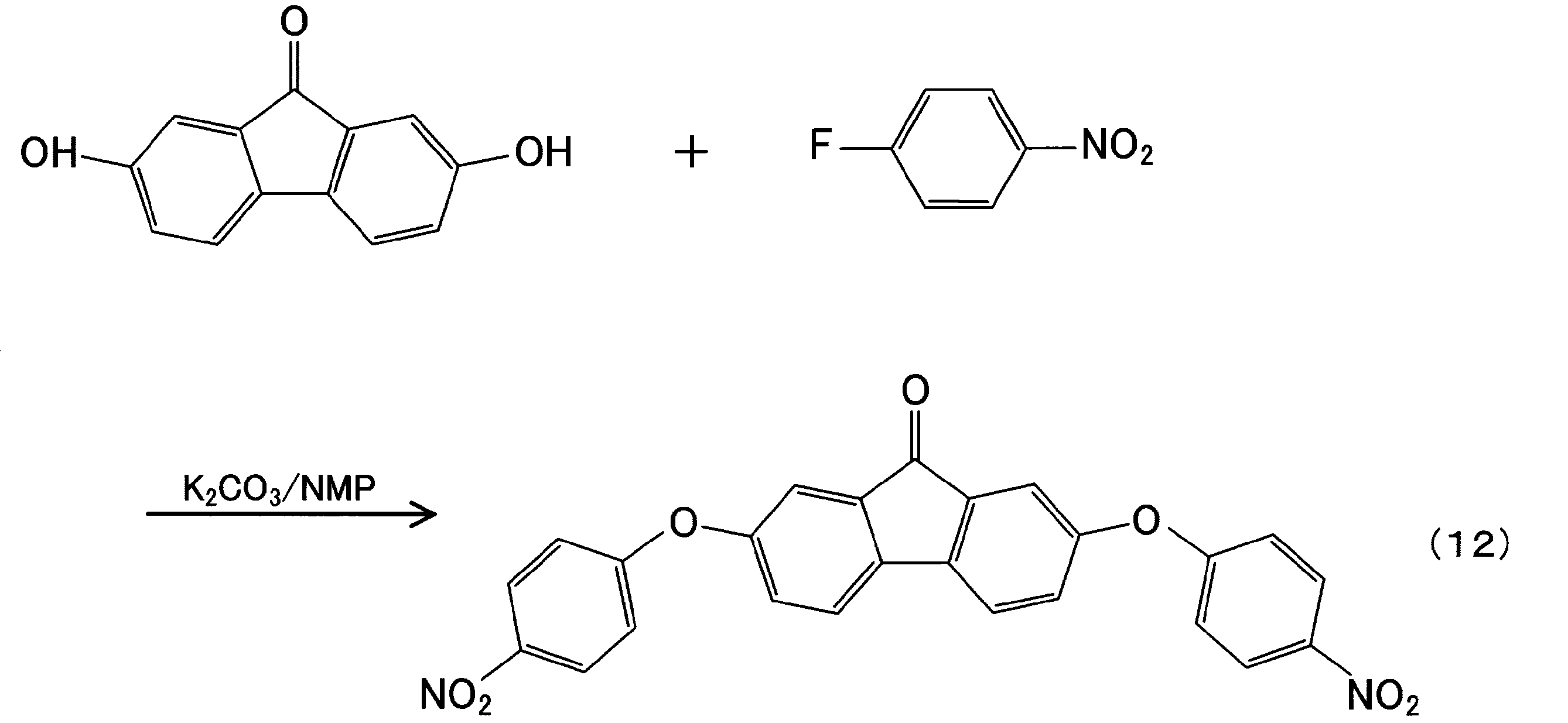
- the crystals collected by filtration were washed successively with water and ethanol and then dried under reduced pressure to obtain 197.4 g (yield 92.2%) of the compound (B) shown on the right side of the formula (12) as ocher crystals. It was.
- the compound (B) shown on the right side of the formula (12) is 2,7-bis (4-nitrophenoxy) -9-fluorenone.
- reaction 3 15 neck (319.0 mmol) of the compound (C) obtained in the reaction 2, 15.9 g of 10 wt% palladium-activated carbon ethylenediamine complex as a reducing agent, and 3 L of THF as a reaction solvent, a four-necked separable flask having an internal volume of 5 L The flask contents were continuously stirred at room temperature for 2 days while keeping the inside of the flask in a hydrogen atmosphere, and the reaction represented by the following formula (15) was allowed to proceed. After completion of the reaction, the catalyst was removed from the flask contents by Celite filtration, and then the filtrate was concentrated under reduced pressure and crystallized with heptane.
- the obtained 2,7-bis (4-aminophenoxy) fluorene was obtained by proton nuclear magnetic resonance spectroscopy ( 1 H-NMR, AVANCE II 300 manufactured by Bruker BioSpin, frequency 300 MHz, measurement solvent was dimethyl sulfoxide-d6). Identified. The NMR measurement results are shown in FIG. As shown in FIG.
- the diamine compound of the present invention can be used in the same applications as conventional diamine compounds such as polycondensation polymers such as polyamide, polyimide, epoxy resin, polyurethane, raw materials for thermosetting polymers, or crosslinking agents.
- polycondensation polymers such as polyamide, polyimide, epoxy resin, polyurethane, raw materials for thermosetting polymers, or crosslinking agents.
Landscapes
- Chemical & Material Sciences (AREA)
- Organic Chemistry (AREA)
- Organic Low-Molecular-Weight Compounds And Preparation Thereof (AREA)
- Catalysts (AREA)
- Low-Molecular Organic Synthesis Reactions Using Catalysts (AREA)
Abstract
Description






本発明のジアミン化合物は、以下の式(1)に示す化合物である。式(1)におけるAは、上述したとおりである。Ar1~Ar8が複数の(2~4の)環構造を有する場合、Ar1~Ar8は、当該複数の環構造からなる縮合環である。







本発明のジアミン化合物の製造方法では、まず、式(2)に示す2,7-ジヒドロキシ-9-フルオレノンと、式(3)に示す化合物(A)とを縮合させて、式(4)に示す化合物(B)を得る(反応1)。





2,7-ジヒドロキシ-9-フルオレノン100.0g(471.3mmol)、化合物(A)として4-フルオロニトロベンゼン146.3g(1036.8mmol)、触媒として炭酸カリウム260.5g(1885.0mmol)および反応溶媒としてN-メチルピロリドン(NMP)1000mLを内容積2Lの四つ口セパラブルフラスコに収容し、フラスコ内の混合物を攪拌しながら、窒素雰囲気下、90℃にて3時間、以下の式(12)に示す反応を進行させた。反応終了後、フラスコの内容物を室温に冷却し、その後、氷水10L中に注入して析出した結晶を濾取した。濾取した結晶を、水およびエタノールで順次洗浄した後、減圧乾燥して、式(12)の右辺に示す化合物(B)197.4g(収率92.2%)を、黄土色結晶として得た。式(12)の右辺に示す化合物(B)は、2,7-ビス(4-ニトロフェノキシ)-9-フルオレノンである。
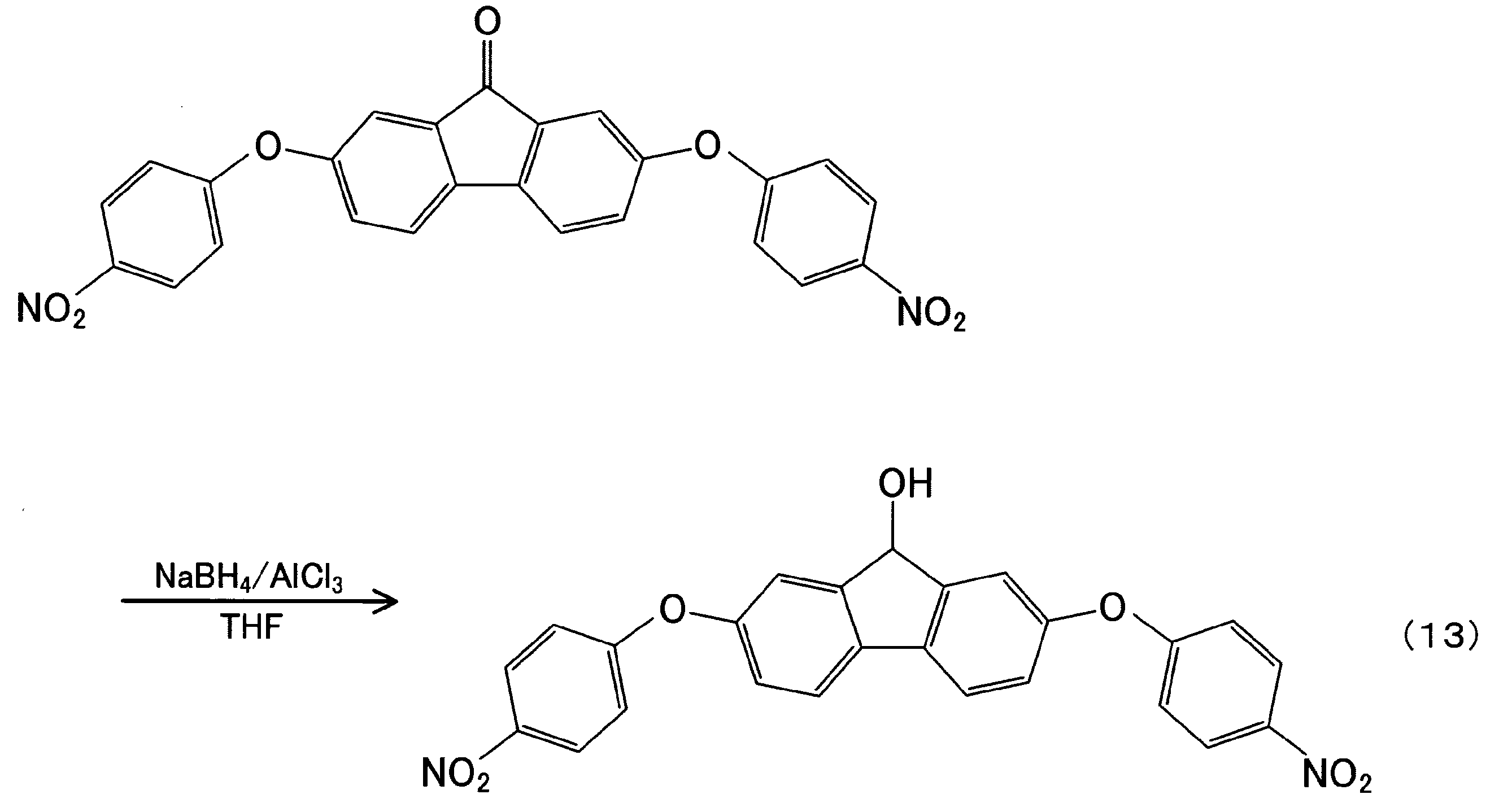
反応1で得た化合物(B)150.0g(330.1mmol)、還元剤として水素化ホウ素ナトリウム61.2g(1617.6mmol)および塩化アルミニウム(III)123.3g(924.3mmol)ならびに反応溶媒としてテトラヒドロフラン(THF)2.3Lを内容積5Lの四つ口セパラブルフラスコに収容し、フラスコ内の混合物を窒素雰囲気下にて一晩環流させ、以下の式(13)に示す反応を進行させた。次に、アイスバスで冷却しながらフラスコ内に水1Lを滴下し、クエンチした。次に、酢酸エチルによる反応生成物の抽出を行い、抽出物を硫酸ナトリウムにより乾燥した後、減圧濃縮し、ヘプタンによる晶析を経て、式(13)の右辺に示す化合物(2,7-ビス(4-ニトロフェノキシ)-9-ヒドロキシフルオレン)154.1g(収率102.3%)を黄色結晶として得た。

反応2で得た化合物(C)159.0g(319.0mmol)、還元剤として10重量%パラジウム-活性炭素エチレンジアミン複合体15.9gおよび反応溶媒としてTHF3Lを内容積5Lの四つ口セパラブルフラスコに収容し、フラスコ内を水素雰囲気に保ちながら、室温で二日間、フラスコ内容物の攪拌を続け、以下の式(15)に示す反応を進行させた。反応終了後、セライト濾過により、フラスコ内容物から触媒を取り除いた後、濾液を減圧濃縮し、ヘプタンで晶析させた。晶析させた結晶をさらに少量のTHFに溶解させ、THF/エタノールで晶析させて、式(15)の右辺に示す2,7-ビス(4-アミノフェノキシ)フルオレン101.1g(収率83.3%)を得た。

Claims (2)
- 以下の式(1)に示すジアミン化合物。

置換基を有していてもよい炭素数1~10の2価の脂肪族基R1;
1~4の環構造を有する、置換基を有していてもよい2価の芳香族基Ar1;
1~4の環構造を有する、置換基を有していてもよい2価の芳香族基Ar2およびAr3により構成される式[-Ar2-Ar3-]で示される基(Ar2およびAr3は、同一であっても互いに異なっていてもよい);
1~4の環構造を有する、置換基を有していてもよい2価の芳香族基Ar4およびAr5ならびにエーテル基(-O-)、チオエーテル基(-S-)またはスルホン基(-SO2-)であるZにより構成される、式[-Ar4-Z-Ar5-]で示される基(Ar4およびAr5は、同一であっても互いに異なっていてもよい);
1~4の環構造を有する、置換基を有していてもよい2価の芳香族基Ar6、および、置換基を有していてもよい炭素数1~10の2価の脂肪族基R2により構成される、式[-Ar6-R2-]で示される基;または、
1~4の環構造を有する、置換基を有していてもよい2価の芳香族基Ar7およびAr8、ならびに、置換基を有していてもよい炭素数1~10の2価の脂肪族基R3により構成される、式[-Ar7-R3-Ar8-]で示される基(Ar7およびAr8は、同一であっても互いに異なっていてもよい);である。
前記置換基は、メチル基、エチル基、プロピル基、ブチル基、トリフルオロメチル基、フェニル基、フェノキシ基、フェニルチオ基およびベンゼンスルホニル基から選ばれる少なくとも1種である。 - 請求項1に記載のジアミン化合物の製造方法であって、
式(2)に示す2,7-ジヒドロキシ-9-フルオレノンと、式(3)に示す化合物(A)との縮合反応により、式(4)に示す化合物(B)を得る工程と、





式(1)、(3)~(5)におけるAは、
置換基を有していてもよい炭素数1~10の2価の脂肪族基R1;
1~4の環構造を有する、置換基を有していてもよい2価の芳香族基Ar1;
1~4の環構造を有する、置換基を有していてもよい2価の芳香族基Ar2およびAr3により構成される式[-Ar2-Ar3-]で示される基(Ar2およびAr3は、同一であっても互いに異なっていてもよい);
1~4の環構造を有する、置換基を有していてもよい2価の芳香族基Ar4およびAr5ならびにエーテル基(-O-)、チオエーテル基(-S-)またはスルホン基(-SO2-)であるZにより構成される、式[-Ar4-Z-Ar5-]で示される基(Ar4およびAr5は、同一であっても互いに異なっていてもよい);
1~4の環構造を有する、置換基を有していてもよい2価の芳香族基Ar6、および、置換基を有していてもよい炭素数1~10の2価の脂肪族基R2により構成される、式[-Ar6-R2-]で示される基;または、
1~4の環構造を有する、置換基を有していてもよい2価の芳香族基Ar7およびAr8、ならびに、置換基を有していてもよい炭素数1~10の2価の脂肪族基R3により構成される、式[-Ar7-R3-Ar8-]で示される基(Ar7およびAr8は、同一であっても互いに異なっていてもよい);である。
前記置換基は、メチル基、エチル基、プロピル基、ブチル基、トリフルオロメチル基、フェニル基、フェノキシ基、フェニルチオ基およびベンゼンスルホニル基から選ばれる少なくとも1種である。
Priority Applications (4)
| Application Number | Priority Date | Filing Date | Title |
|---|---|---|---|
| CN201180011107.0A CN102770408B (zh) | 2010-02-24 | 2011-02-24 | 新型二胺化合物及其制造方法 |
| US13/579,168 US8748664B2 (en) | 2010-02-24 | 2011-02-24 | Diamine compound and production method thereof |
| EP11747055.9A EP2540699A4 (en) | 2010-02-24 | 2011-02-24 | NOVEL DIAMINE COMPOUND AND PROCESS FOR PRODUCING THE SAME |
| US14/264,613 US20140235896A1 (en) | 2010-02-24 | 2014-04-29 | Novel diamine compound |
Applications Claiming Priority (2)
| Application Number | Priority Date | Filing Date | Title |
|---|---|---|---|
| JP2010038661 | 2010-02-24 | ||
| JP2010-038661 | 2010-02-24 |
Related Child Applications (2)
| Application Number | Title | Priority Date | Filing Date |
|---|---|---|---|
| US13/579,168 A-371-Of-International US8748664B2 (en) | 2010-02-24 | 2011-02-24 | Diamine compound and production method thereof |
| US14/264,613 Division US20140235896A1 (en) | 2010-02-24 | 2014-04-29 | Novel diamine compound |
Publications (1)
| Publication Number | Publication Date |
|---|---|
| WO2011105088A1 true WO2011105088A1 (ja) | 2011-09-01 |
Family
ID=44506515
Family Applications (1)
| Application Number | Title | Priority Date | Filing Date |
|---|---|---|---|
| PCT/JP2011/001066 Ceased WO2011105088A1 (ja) | 2010-02-24 | 2011-02-24 | 新規ジアミン化合物とその製造方法 |
Country Status (5)
| Country | Link |
|---|---|
| US (2) | US8748664B2 (ja) |
| EP (1) | EP2540699A4 (ja) |
| JP (1) | JP5788192B2 (ja) |
| CN (1) | CN102770408B (ja) |
| WO (1) | WO2011105088A1 (ja) |
Families Citing this family (5)
| Publication number | Priority date | Publication date | Assignee | Title |
|---|---|---|---|---|
| JP5732292B2 (ja) * | 2011-03-28 | 2015-06-10 | 日東電工株式会社 | スルホン酸基含有ジアミン化合物とその製造方法 |
| WO2012132441A1 (ja) * | 2011-03-30 | 2012-10-04 | 日東電工株式会社 | ポリイミド、ポリイミド系高分子電解質膜、膜-電極接合体および固体高分子型燃料電池 |
| EP2692775B1 (en) * | 2011-03-30 | 2015-04-08 | Nitto Denko Corporation | Polyimide, polyimide-based polymer electrolyte membrane, membrane- electrode assembly, and polymer electrolyte fuel cell |
| CN105693539B (zh) * | 2016-01-12 | 2019-01-25 | 湖南工业大学 | 一种含芴或芴酮结构的具有高平面性二胺单体及其合成方法和应用 |
| CN110998421A (zh) | 2017-09-05 | 2020-04-10 | 索尼公司 | 发光装置和显示装置 |
Citations (2)
| Publication number | Priority date | Publication date | Assignee | Title |
|---|---|---|---|---|
| US20050171079A1 (en) * | 2004-02-04 | 2005-08-04 | Schrimpf Michael R. | Amino-substituted tricyclic derivatives and methods of use |
| US20050234031A1 (en) * | 2004-02-04 | 2005-10-20 | Schrimpf Michael R | Amino-substituted tricyclic derivatives and methods of use |
Family Cites Families (8)
| Publication number | Priority date | Publication date | Assignee | Title |
|---|---|---|---|---|
| IL33573A (en) * | 1968-12-30 | 1973-10-25 | Richardson Merrell Inc | Bis-basic ethers and thioethers of fluorenone,fluorenol and fluorene |
| JP3927630B2 (ja) * | 1996-09-27 | 2007-06-13 | エーザイ・アール・アンド・ディー・マネジメント株式会社 | ウイルス感染症の予防・治療剤 |
| US6417321B1 (en) | 2000-08-21 | 2002-07-09 | 3M Innovative Properties Company | Cured fluorenyl polyimides |
| KR100424073B1 (ko) * | 2001-05-22 | 2004-03-22 | 한국과학기술연구원 | 관능기를 함유한 플로렌계 화합물, 그 중합체 및 이들을이용한 el 소자 |
| JP2004059761A (ja) * | 2002-07-30 | 2004-02-26 | Sumitomo Bakelite Co Ltd | ポリベンゾオキサゾール樹脂、その前駆体及びこれらを用いた光導波路材料並びに光導波路 |
| US6919422B2 (en) * | 2003-06-20 | 2005-07-19 | General Electric Company | Polyimide resin with reduced mold deposit |
| JP4369741B2 (ja) | 2003-12-25 | 2009-11-25 | 大阪瓦斯株式会社 | フルオレン系樹脂組成物およびその成形体 |
| CN101591521A (zh) * | 2009-07-08 | 2009-12-02 | 北京航空航天大学 | 一种含芴聚酰亚胺胶粘剂及其制备方法 |
-
2011
- 2011-02-24 CN CN201180011107.0A patent/CN102770408B/zh not_active Expired - Fee Related
- 2011-02-24 EP EP11747055.9A patent/EP2540699A4/en not_active Withdrawn
- 2011-02-24 WO PCT/JP2011/001066 patent/WO2011105088A1/ja not_active Ceased
- 2011-02-24 JP JP2011038417A patent/JP5788192B2/ja not_active Expired - Fee Related
- 2011-02-24 US US13/579,168 patent/US8748664B2/en not_active Expired - Fee Related
-
2014
- 2014-04-29 US US14/264,613 patent/US20140235896A1/en not_active Abandoned
Patent Citations (2)
| Publication number | Priority date | Publication date | Assignee | Title |
|---|---|---|---|---|
| US20050171079A1 (en) * | 2004-02-04 | 2005-08-04 | Schrimpf Michael R. | Amino-substituted tricyclic derivatives and methods of use |
| US20050234031A1 (en) * | 2004-02-04 | 2005-10-20 | Schrimpf Michael R | Amino-substituted tricyclic derivatives and methods of use |
Non-Patent Citations (1)
| Title |
|---|
| See also references of EP2540699A4 * |
Also Published As
| Publication number | Publication date |
|---|---|
| US20130006017A1 (en) | 2013-01-03 |
| US8748664B2 (en) | 2014-06-10 |
| CN102770408B (zh) | 2015-05-13 |
| US20140235896A1 (en) | 2014-08-21 |
| JP5788192B2 (ja) | 2015-09-30 |
| CN102770408A (zh) | 2012-11-07 |
| JP2011195580A (ja) | 2011-10-06 |
| EP2540699A1 (en) | 2013-01-02 |
| EP2540699A4 (en) | 2014-01-08 |
Similar Documents
| Publication | Publication Date | Title |
|---|---|---|
| JP5788192B2 (ja) | 新規ジアミン化合物とその製造方法 | |
| US20080045688A1 (en) | Processes of synthesizing aromatic amine-based benzoxazine resins | |
| JP5732292B2 (ja) | スルホン酸基含有ジアミン化合物とその製造方法 | |
| JPWO2017164260A1 (ja) | ベンゾオキサジン化合物、その製造方法及びベンゾオキサジン樹脂 | |
| JP5546210B2 (ja) | 芳香族ジアミン化合物及びその製造方法並びに合成樹脂 | |
| JP2011173827A (ja) | ビスイミドフェノール誘導体及びその製造方法並びに高分子化合物 | |
| JP5408415B2 (ja) | 1位置換3,5−ジアミノベンゼンの製造方法 | |
| CN105111199B (zh) | 单酚‑单胺型喹喔啉基苯并噁嗪及其制备方法 | |
| JP2020070255A (ja) | ビス(アミノ又はニトロフェノキシ)ベンゼン化合物、およびその製造方法、並びにポリイミド | |
| US20040049081A1 (en) | Bis-o-aminophenols and processes for producing bis-o-aminophenols | |
| JP2012214763A (ja) | ポリイミド、ポリイミド系高分子電解質膜、膜−電極接合体および固体高分子型燃料電池 | |
| JPS61221158A (ja) | 4,4′−ビス(アミノフエノキシ)ベンゾフエノンの製造方法 | |
| CN119528743B (zh) | 二胺化合物及聚酰亚胺薄膜 | |
| JP2009256306A (ja) | 重合性不飽和基を有するアダマンタン誘導体とその製造法 | |
| JP6896245B2 (ja) | ベンゾオキサジン化合物及びベンゾオキサジン樹脂 | |
| JPH07278070A (ja) | 芳香族ジアミン化合物 | |
| JP2018062493A (ja) | 化合物及び該化合物からなる光塩基発生剤 | |
| JPWO2016143748A1 (ja) | ジアミン化合物及びその中間体の製造方法 | |
| JP2014047216A (ja) | 新規ポリオキサゾリドン樹脂及びその製造法 | |
| JP3186414B2 (ja) | 芳香族ジアミン化合物 | |
| JPH083124A (ja) | 芳香族ジアミン化合物 | |
| CN111978235A (zh) | 一种3-胺基-4-甲巯基马来酰亚胺化合物的制备方法 | |
| EP1031555A1 (en) | N-cyclopropyl-2-difluoromethoxy-3-halogenoanilines and intermediates for the preparation thereof | |
| JPH06100508A (ja) | 芳香族アミン化合物および芳香族不飽和イミド化合物 | |
| CN101863852A (zh) | 含1,3,4-噁二唑杂环结构芳香二元胺及其制备方法 |
Legal Events
| Date | Code | Title | Description |
|---|---|---|---|
| WWE | Wipo information: entry into national phase |
Ref document number: 201180011107.0 Country of ref document: CN |
|
| 121 | Ep: the epo has been informed by wipo that ep was designated in this application |
Ref document number: 11747055 Country of ref document: EP Kind code of ref document: A1 |
|
| WWE | Wipo information: entry into national phase |
Ref document number: 13579168 Country of ref document: US |
|
| NENP | Non-entry into the national phase |
Ref country code: DE |
|
| REEP | Request for entry into the european phase |
Ref document number: 2011747055 Country of ref document: EP |
|
| WWE | Wipo information: entry into national phase |
Ref document number: 2011747055 Country of ref document: EP |