WO2011120903A2 - A fast dissolving pharmaceutical composition - Google Patents
A fast dissolving pharmaceutical composition Download PDFInfo
- Publication number
- WO2011120903A2 WO2011120903A2 PCT/EP2011/054698 EP2011054698W WO2011120903A2 WO 2011120903 A2 WO2011120903 A2 WO 2011120903A2 EP 2011054698 W EP2011054698 W EP 2011054698W WO 2011120903 A2 WO2011120903 A2 WO 2011120903A2
- Authority
- WO
- WIPO (PCT)
- Prior art keywords
- pharmaceutical composition
- active ingredient
- composition according
- matrix
- solvent
- Prior art date
- Legal status (The legal status is an assumption and is not a legal conclusion. Google has not performed a legal analysis and makes no representation as to the accuracy of the status listed.)
- Ceased
Links
Classifications
-
- A—HUMAN NECESSITIES
- A61—MEDICAL OR VETERINARY SCIENCE; HYGIENE
- A61K—PREPARATIONS FOR MEDICAL, DENTAL OR TOILETRY PURPOSES
- A61K31/00—Medicinal preparations containing organic active ingredients
- A61K31/33—Heterocyclic compounds
- A61K31/395—Heterocyclic compounds having nitrogen as a ring hetero atom, e.g. guanethidine or rifamycins
- A61K31/41—Heterocyclic compounds having nitrogen as a ring hetero atom, e.g. guanethidine or rifamycins having five-membered rings with two or more ring hetero atoms, at least one of which being nitrogen, e.g. tetrazole
- A61K31/425—Thiazoles
- A61K31/426—1,3-Thiazoles
-
- A—HUMAN NECESSITIES
- A61—MEDICAL OR VETERINARY SCIENCE; HYGIENE
- A61K—PREPARATIONS FOR MEDICAL, DENTAL OR TOILETRY PURPOSES
- A61K31/00—Medicinal preparations containing organic active ingredients
- A61K31/33—Heterocyclic compounds
- A61K31/395—Heterocyclic compounds having nitrogen as a ring hetero atom, e.g. guanethidine or rifamycins
- A61K31/435—Heterocyclic compounds having nitrogen as a ring hetero atom, e.g. guanethidine or rifamycins having six-membered rings with one nitrogen as the only ring hetero atom
- A61K31/44—Non condensed pyridines; Hydrogenated derivatives thereof
- A61K31/445—Non condensed piperidines, e.g. piperocaine
- A61K31/4523—Non condensed piperidines, e.g. piperocaine containing further heterocyclic ring systems
- A61K31/4545—Non condensed piperidines, e.g. piperocaine containing further heterocyclic ring systems containing a six-membered ring with nitrogen as a ring hetero atom, e.g. pipamperone, anabasine
-
- A—HUMAN NECESSITIES
- A61—MEDICAL OR VETERINARY SCIENCE; HYGIENE
- A61K—PREPARATIONS FOR MEDICAL, DENTAL OR TOILETRY PURPOSES
- A61K31/00—Medicinal preparations containing organic active ingredients
- A61K31/33—Heterocyclic compounds
- A61K31/395—Heterocyclic compounds having nitrogen as a ring hetero atom, e.g. guanethidine or rifamycins
- A61K31/435—Heterocyclic compounds having nitrogen as a ring hetero atom, e.g. guanethidine or rifamycins having six-membered rings with one nitrogen as the only ring hetero atom
- A61K31/47—Quinolines; Isoquinolines
-
- A—HUMAN NECESSITIES
- A61—MEDICAL OR VETERINARY SCIENCE; HYGIENE
- A61K—PREPARATIONS FOR MEDICAL, DENTAL OR TOILETRY PURPOSES
- A61K38/00—Medicinal preparations containing peptides
- A61K38/04—Peptides having up to 20 amino acids in a fully defined sequence; Derivatives thereof
- A61K38/08—Peptides having 5 to 11 amino acids
- A61K38/095—Oxytocins; Vasopressins; Related peptides
-
- A—HUMAN NECESSITIES
- A61—MEDICAL OR VETERINARY SCIENCE; HYGIENE
- A61K—PREPARATIONS FOR MEDICAL, DENTAL OR TOILETRY PURPOSES
- A61K47/00—Medicinal preparations characterised by the non-active ingredients used, e.g. carriers or inert additives; Targeting or modifying agents chemically bound to the active ingredient
- A61K47/30—Macromolecular organic or inorganic compounds, e.g. inorganic polyphosphates
- A61K47/36—Polysaccharides; Derivatives thereof, e.g. gums, starch, alginate, dextrin, hyaluronic acid, chitosan, inulin, agar or pectin
-
- A—HUMAN NECESSITIES
- A61—MEDICAL OR VETERINARY SCIENCE; HYGIENE
- A61K—PREPARATIONS FOR MEDICAL, DENTAL OR TOILETRY PURPOSES
- A61K9/00—Medicinal preparations characterised by special physical form
- A61K9/0012—Galenical forms characterised by the site of application
- A61K9/0053—Mouth and digestive tract, i.e. intraoral and peroral administration
- A61K9/0056—Mouth soluble or dispersible forms; Suckable, eatable, chewable coherent forms; Forms rapidly disintegrating in the mouth; Lozenges; Lollipops; Bite capsules; Baked products; Baits or other oral forms for animals
-
- A—HUMAN NECESSITIES
- A61—MEDICAL OR VETERINARY SCIENCE; HYGIENE
- A61K—PREPARATIONS FOR MEDICAL, DENTAL OR TOILETRY PURPOSES
- A61K9/00—Medicinal preparations characterised by special physical form
- A61K9/14—Particulate form, e.g. powders, Processes for size reducing of pure drugs or the resulting products, Pure drug nanoparticles
- A61K9/19—Particulate form, e.g. powders, Processes for size reducing of pure drugs or the resulting products, Pure drug nanoparticles lyophilised, i.e. freeze-dried, solutions or dispersions
-
- A—HUMAN NECESSITIES
- A61—MEDICAL OR VETERINARY SCIENCE; HYGIENE
- A61P—SPECIFIC THERAPEUTIC ACTIVITY OF CHEMICAL COMPOUNDS OR MEDICINAL PREPARATIONS
- A61P1/00—Drugs for disorders of the alimentary tract or the digestive system
- A61P1/04—Drugs for disorders of the alimentary tract or the digestive system for ulcers, gastritis or reflux esophagitis, e.g. antacids, inhibitors of acid secretion, mucosal protectants
-
- A—HUMAN NECESSITIES
- A61—MEDICAL OR VETERINARY SCIENCE; HYGIENE
- A61P—SPECIFIC THERAPEUTIC ACTIVITY OF CHEMICAL COMPOUNDS OR MEDICINAL PREPARATIONS
- A61P11/00—Drugs for disorders of the respiratory system
- A61P11/02—Nasal agents, e.g. decongestants
-
- A—HUMAN NECESSITIES
- A61—MEDICAL OR VETERINARY SCIENCE; HYGIENE
- A61P—SPECIFIC THERAPEUTIC ACTIVITY OF CHEMICAL COMPOUNDS OR MEDICINAL PREPARATIONS
- A61P11/00—Drugs for disorders of the respiratory system
- A61P11/06—Antiasthmatics
-
- A—HUMAN NECESSITIES
- A61—MEDICAL OR VETERINARY SCIENCE; HYGIENE
- A61P—SPECIFIC THERAPEUTIC ACTIVITY OF CHEMICAL COMPOUNDS OR MEDICINAL PREPARATIONS
- A61P13/00—Drugs for disorders of the urinary system
-
- A—HUMAN NECESSITIES
- A23—FOODS OR FOODSTUFFS; TREATMENT THEREOF, NOT COVERED BY OTHER CLASSES
- A23V—INDEXING SCHEME RELATING TO FOODS, FOODSTUFFS OR NON-ALCOHOLIC BEVERAGES AND LACTIC OR PROPIONIC ACID BACTERIA USED IN FOODSTUFFS OR FOOD PREPARATION
- A23V2250/00—Food ingredients
- A23V2250/50—Polysaccharides, gums
- A23V2250/502—Gums
- A23V2250/5062—Inulin
-
- C—CHEMISTRY; METALLURGY
- C07—ORGANIC CHEMISTRY
- C07K—PEPTIDES
- C07K7/00—Peptides having 5 to 20 amino acids in a fully defined sequence; Derivatives thereof
- C07K7/50—Cyclic peptides containing at least one abnormal peptide link
Definitions
- the subject invention relates to fast dissolving pharmaceutical compositions, to methods of making them and to their use in the treatment and prophylaxis of diseases in mammals, particularly humans.
- a drug may physically be trapped in a matrix composed of e.g. mannitol and fish gelatin (EP 1501534; EP1165053), modified starch (US6509040), pullulan in combination with an amino acid (EP1803446), or maltodextrin in combination with sorbitol (US2004/0228919).
- the solution, suspension or dispersion of the drug and the carrier material may be filled into blister cavities, frozen and thereafter lyophilized. As any product of technology at all times, also the latter can still be improved upon.
- the subject invention provides an improved fast-dispersing dosage form.
- the subject invention provides a new fast dissolving oral pharmaceutical composition typically in a unit dosage form, typically an oral lyophilisate (also named orally disintegrating tablet).
- the present invention provides a pharmaceutical composition comprising an open matrix network carrying a pharmaceutically active ingredient, wherein the open matrix network is comprised of inulin.
- the present invention provides a pharmaceutical composition comprising a matrix carrying a pharmaceutically active ingredient, the matrix rapidly disintegrating upon contact with an aqueous solution or with saliva, said matrix comprising inulin.
- the pharmaceutical composition of the invention is unique in that it has a rapid dissolution in aqueous medium or in saliva, in particular the composition rapidly disintegrates when taken orally.
- the disintegration in an aqueous medium or in the oral cavity upon consumption is typically within less than 10 seconds, and at times less than 9, 8, 7, 6, 5, 4, 3, 2 or even 1 seconds.
- the subject invention provides a pharmaceutical composition
- a pharmaceutical composition comprising a pharmaceutically active ingredient, having a rapid dissolution rate such that at least 80% of the composition is disintegrated in an aqueous medium or in saliva in less than 10 seconds.
- 90% of the composition is disintegrated in an aqueous medium or in saliva in less than 10 seconds.
- 100% of the composition is disintegrated in an aqueous medium or in saliva in less than 10 seconds.
- the pharmaceutical composition of the invention may be obtained by subliming a solvent (e.g. water), for example in a freeze drying process, from a liquid preparation that comprises the active ingredient and the matrix forming agent(s) in solution.
- a solvent e.g. water
- unit dosage quantities of the liquid preparation that contain a defined amount of active ingredient are introduced into depressions and sublimation is then carried out thereby obtaining (after sublimation) a pharmaceutical composition in a unit dosage form.
- the depressions may be those of an open blister pack and following the sublimation step, and thereby the formation of the solid unit dosage form of the composition in the depression, a sealing film or foil is placed over the depressions to form a sealed blister pack.
- the invention thus provides a process for preparing a pharmaceutical composition that comprises subliming a solvent from a liquid preparation comprising a pharmaceutically active ingredient and inulin in the solvent.
- the invention further provides a process for the preparation of a pharmaceutical composition
- a process for the preparation of a pharmaceutical composition comprising (a) preparing a solution comprising inuiin and an active ingredient in a solvent; (b) freezing said solution; (c) subliming the solvent from the frozen solution, wherein the pharmaceutical composition so obtained is in fast- dispersing dosage form which disintegrates within 10 seconds upon contact with an aqueous solution or with saliva.
- the subject invention provides a fast-dissolving, typically orodispersible, pharmaceutical composition, usually prepared and provided in unit dosage form, typically an oral lyophilisate, comprising an active ingredient and one or more excipients. At least one of the excipients, normally the main matrix forming agent, is the polysaccharide inulin.
- active ingredient or “pharmaceutically active ingredient” will be used interchangeably herein.
- composition and “composition” are interchangeably used herein to refer to a pharmaceutical composition of the invention.
- unit dosage form or “dosage form” will be used herein to refer to said composition which is formulated with an amount of an active pharmaceutical ingredient (API) in a dose for administration as a single dose to a target individual.
- API active pharmaceutical ingredient
- the unit dosage form may be adapted, depending on the nature of the active ingredient, the indication, the disease stage and various other factors known per se for once, twice, thrice or any other number of daily administrations.
- carrier should be understood to encompass any form of interaction between an active ingredient and the matrix that allows the matrix to hold and/or contain an amount of active ingredient and release it to the medium upon disintegration of the matrix.
- matrix should be understood to denote a solid carrier medium for an active ingredient.
- the matrix comprises one or more excipients.
- the excipients that form the matrix may be referred to herein, at times, as “matrix forming agents” and each of said agents as “matrix forming agent”.
- an open matrix network should be understood to encompass a matrix of water-soluble or water-dispersible carrier material having interstices dispersed throughout. The matrix rapidly disintegrates upon contact with an aqueous solution or with saliva.
- inulin is the sole matrix forming agent in the composition.
- one or more secondary matrix forming agents may be present in the composition.
- Non-limiting examples of sugars, sugar alcohols, monosaccharides, disaccharides, trisaccharides, polysaccharides, proteins, amino acids, gums and the like, which are useful as secondary matrix forming agents include without limitation, mannitol, trehalose, raffmose, pullulan, inositol, sucrose, lactose, dextrose, erythritol, xylitol, lactitol, maltitol, isomalt, alanine, arginine, threonine, glycine, cysteine, serine, histidine, valine, proline, lysine, asparagine, glutamine, ribose, glucose, galactose, fructose, maltose, maltotriose, guargum, xanthan gum, tragacanth gum, veegum and so forth.
- the balance of the formulation can be matrix.
- the percentage of the inulin matrix can approach 100%
- the amount of the secondary matrix forming agent useful in accordance with the present invention may range from about 0 to about 90%.
- inulin is the main matrix forming agent.
- the composition further comprises mannitol or raffinose or trehalose or combinations thereof as secondary matrix forming agent.
- inulin is the matrix forming agent, comprising 10 - 99.99% out of the entire weight of the composition. In another embodiment, inulin comprises 30- 80% out of the entire weight of the composition. In yet another embodiment, inulin comprises 40-75% out of the entire weight of the composition. In yet another embodiment, inulin comprises 50-65% out of the entire weight of the composition.
- mannitol or trehalose or raffinose or combinations thereof are used as secondary matrix forming agents, comprising 0 - 89.99% out of the entire weight of the composition.
- these secondary matrix forming agents comprise 4-50% out of the entire weight of the composition, in another embodiment, these secondary matrix forming agents comprise 25-50% out of the entire weight of the composition.
- a composition of the invention can be one comprising inulin as the main matrix- forming agent and mannitol or trehalose or raffinose (or combinations thereof) as a secondary matrix-forming agent, with inulin constituting 10 - 99.99% (all % of ingredient are w/w, meaning weight of mentioned ingredient out of the weight of all constituents of the composition combined), and the secondary matrix forming agent constituting 0 - 89.99%, typically 4-50%.
- the content of the active ingredient may typically (but not exclusively) be up to 90% of the entire composition, typically in the range of about 0.01-80%) depending on the nature of the active ingredient. In one embodiment, the active ingredient comprises 0.01-1% out of the entire weight of the composition.
- the active ingredient comprises 0.4-2% out of the entire weight of the composition. In yet another embodiment, the active ingredient comprises 10-25% out of the entire weight of the composition. In other embodiments, the active ingredient comprises 18-40% out of the entire weight of the composition. In yet other embodiments, the active ingredient comprises 60-90%» out of the entire weight of the composition.
- the composition of the invention does not contain fish gelatin. In another embodiment, the composition of the invention does not contain a modified starch. In another embodiment, the composition of the invention does not contain pullulan in combination with an amino acid. In another embodiment, the composition of the invention does not contain maltodcxtrin in combination with sorbitol.
- Disintegration Time and “Dissolution Time” are used interchangeably herein and should be understood to mean the time needed to dissolve or disintegrate the composition of the invention in an aqueous solution or with saliva within the oral cavity.
- Oral dissolving Time as used herein should be understood to mean the time needed to dissolve the composition of the invention in the oral cavity.
- Rapid/Fast disintegration/dissolution should be understood to encompass disintegration of at least 80% of the composition of the invention, typically 90% and more typically 100% of the composition in an aqueous medium or in saliva (in the oral cavity) within 10 seconds and at times even within 9, 8, 7, 6, 5, 4, 3, 2 or 1 second.
- aqueous medium examples include water or a buffer (e.g. potassium dihydrogen phosphate, dipotassium hydrogen phosphate, sodium hydrogen phosphate) or artificial saliva as described by Morjaria et. al (May 2004), Dissolution Technologies 12 - 15.
- a buffer e.g. potassium dihydrogen phosphate, dipotassium hydrogen phosphate, sodium hydrogen phosphate
- artificial saliva as described by Morjaria et. al (May 2004), Dissolution Technologies 12 - 15.
- Saliva refers to the saliva in the oral cavity of a mammal, in particular a human.
- a pharmaceutical composition of the invention has a rapid dissolution rate such that at least 80% of the composition is dissolved in an aqueous medium or in saliva within 10 seconds. In another embodiment, a pharmaceutical composition of the invention has a rapid dissolution rate such that at least 90% of the composition is dissolved in an aqueous medium or in saliva within 10 seconds. In yet another embodiment, a pharmaceutical composition of the invention has a rapid dissolution rate such that 100% of the composition is dissolved in an aqueous medium or in saliva within 10 seconds.
- the open matrix network enables a liquid to enter the dosage form through the interstices and permeate through its interior.
- Permeation by aqueous media (such as saliva, water, etc.) exposes the carrier material of both the interior and exterior of the dosage form to the action of the aqueous media whereby the network of carrier material is rapidly disintegrated.
- the open matrix structure is of a porous nature and enhances disintegration of the dosage form as compared with ordinary solid shaped pharmaceutical dosage forms such as (granulated and compressed) tablets, pills, capsules, suppositories and pessaries. Rapid disintegration results in rapid release of the active ingredient carried by the matrix.
- the carrier material of the open matrix network is inulin or a derivative thereof.
- Inulin is a polymer of fructose C 6 H 12 O 6 typically having a terminal glucose.
- Inulin is a polysaccharide with ⁇ -(2->1) linkages between the fructose rings where the numbers describe the carbon atoms in the fructose ring which are linked and the ⁇ describes the stereochemical relationship.
- the inulins are produced by many type of plants.
- Inulin as used herein should be understood to encompass inulin derived from any source such as but not limited to plants that contain high concentrations of inulin which include, but are not limited to Elecampane (Inula helenium); Dandelion (Taraxacum officinale) Wild Yam (Dioscorea spp.); Jerusalem artichokes (Helianthus tuberosus); Chicory (Cichorium iniybus); Jicama (Pachyrhizus erosus);Burdock (Arctium lappa);Omon (Allium cepa);Garlic (Allium sativum); Agave (Agave spp.); Yacon (Smallanthus sonchifolius spp.); and Camas (Camassia spp.).
- the Inulin is obtained from Chicory (Cichorium inlybus).
- the pharmaceutically active ingredient may encompass any pharmaceutical ingredient such as a drug, a compound, a peptide, a nucleotide, and so forth.
- drugs which can be carried by the open matrix network of the subject invention are analgesics, alpha blockers, anti-allergy, anti-asthma, (allergic rhinitis, chronic uticaria), anti- inflammatory, antacids, anthelmintics, anti-arrhythmic agents, anti-arthritis, anti -bacterial, anti-anxiety, anti-coagulants, anti -depressants, anti-diabetics, anti-diarrheals, anti-diuretics, anti-epileptics, anti-fungal, anti-gout, anti-hypertensive, anti-incontinence, anti-insomnia, anti-malarials, anti -migraine, anti- muscarinic, anti -neoplastic and immunosuppressants, anti-prot
- Analgesics and anti-inflammatory agents aspirin, aloxiprin, auranofm, azapropazone, benorylate, diflunisal, etodolac, fenbufen, fenoprofen calcium, flurbiprofen, ibuprofen, indomethacin, ketoprofen, meclofenamic acid, mefenamic acid, nabumetone, naproxen, oxaprozin, oxyphenbutazone, phenylbutazone, piroxicam, sulindac, paracetamol.
- Antacids aluminum hydroxide, magnesium carbonate, magnesium trisilicate, hydrotalcite, dimethicone.
- Antihelmintics albendazole, bephenium hydroxynaphthoate, cambendazole, dichlorophen, ivermectin, mebendazole, oxamniquine, oxfendazole, oxantel embonate, praziquantel, pyrantel embonate, thiabendazole.
- Anti-allergic des loratidine, loratidine, Montelukast ,Montelukast sodium, Cetirizin, Fexofenadin, Ebastine.
- Anti-arrhythmic agents amiodarone HCl, disopyramide, flecainide acetate, quinidine sulphate.
- Anti-bacterial agents benethamine penicillin, cinoxacin, ciprofloxacin HCl, clarithromycin, clofazimine, cloxacillin, demeclocycline, doxycycline, erythromycin, ethionamide, imipenem, nalidixic acid, nitrofurantoin, rifampicin, spiramycin, sulphabenzamide, sulphadoxine, sulphamerazine, sulphacetamide, sulphadiazine, sulphafurazole, sulphamethoxazole, sulphapyridine, tetracycline, trimethoprim.
- Anti-coagulants dicoumarol, dipyridamole, nicoumalone, phenindione.
- Anti -depressants amoxapine, ciclazindol, maprotiline HCl, mianserin HCl, nortriptyline HCl, trazodone HCl, trimipramine maleate.
- Anti-diabetics acetohexamide, chlorpropamide, glibenclamide, gliclazide, glipizide, tolazamide, tolbutamide.
- Anti-diarrheals atropine sulphate, codeine phosphate, co-phenotrope, difenoxin, loperamide hydrochloride, suphasolazine, mesalazine, oisaiazine, corticosteroids, prednisolone.
- Anti-diuretics desmopressin, desmopressin acetate.
- Anti-epileptics beclamide, carbamazepine, clonazepam, ethotoin, methoin, methsuximide, methylphenobarbitone, oxcarbazepine, paramethadione, phenacemide, phenobarbitone, phenytoin, phensuximide, primidone, sulthiame, valproic acid.
- Anti-fungal agents amphotericin, butoconazole nitrate, clotrimazole, econazole nitrate, fluconazole, flucytosine, griseofulvin, itraconazole, ketoconazole, miconazole, natamycin, nystatin, sulconazole nitrate, terbinafine HCl, terconazole, tioconazole, undecenoic acid.
- Anti-gout agents allopurinol, probenecid, sulphinpyrazone.
- Anti -hypertensive agents amlopidine, benidipine, darodipine, dilitazem HCl, diazoxide, felodipine, guanabenz acetate, indoramin, isradipine, minoxidil, nicardipine HCl, nifedipine, nimodipine, phenoxybenzamine HCl, prazosin HCl, reserpine, terazosin HCl.
- Anti-malaria amodiaquine, chloroquine, chloroproguanil HCl, halofantrine HCl, mefloquine HCl, proguanil HCl, pyrimethamine, quinine sulphate.
- Anti-migraine agents rizatriptan, dihydroergotamine mesylate, ergotamine tartrate, methysergide maleate, pizotifen maleate, sumatriptan succinate, caffeine.
- Anti-muscarinic agents oxybutinin, tolterodin, atropine, benzhexol HCl, biperiden, ethopropazine HCl, hyoscine butyl bromide, hyoscyamine, mepenzolate bromide, orphenadrine, oxyphencylcimine HCl, tropicamide.
- Anti-neoplastic agents and Immunosuppressants aminoglutethimide, amsacrine, azathioprene, busulphan, chlorambucil, cyclosporin, dacarbazine, estramustine, etoposide, lomustine, melphalan, mercaptopurine, methotrexate, mitomycin, mitotane, mitozantrone, procarbazine HCl, tamoxifen citrate, testolactone.
- Anti-protozoal agents benznidazole, clioquinol, decoquinate, diiodohydroxyquinoline, diloxanide furcate, dinitolmide, furzolidone, metronidazole, nimorazole, nitrofurazone, ornidazole, tinidazole.
- Anti-rheumatics ibuprofen, aceclofenac, acemetacin, azapropazone, diclofenac sodium, diflunisal, etodolac, ketoprofen, indomethacin, mefenamic acid, naproxen, piroxicam, aspirin, benorylate, auranofm, penicillamine.
- Anti-rhinitis, anti-uticaria Cetirizin, fexofenadin, ebastine, loratidin, montelukast
- Anti-thyroid agents carbimazole, propylthiouracil.
- Antivirals acyclovir, amantadine hydrochloride, famciclovir, zidovadine, didanosine, zalcitabine, foscarnet sodium.
- Anxiolytic, sedatives, hypnotics and neuroleptics alprazolam, amylobarbitone, barbitone, bentazepam, bromazepam, bromperidol, brotizolam, butobarbitone, carbromal, chlordiazepoxide, Chlorpheniramine, chlormethiazoie, chlorpromazine, clobazam, clonazepan, clotiazepam, clozapine, diazepam, droperidol, ethinamate, flunanisone, fiunitrazepam, fluopromazine, flupenthixol decanoate, fluphenazine decanoate, flurazepam, haloperidol, lorazepam, lormetazepam, medazepam, meprobamate, methaqualone, midazolam, nitrazepam, oxazepam,
- ⁇ -Blockers acebutolol, alprenolol, atenolol, labetalol, metoprolol, nadolol, oxprenolol, pindolol, propanolol.
- Cardiac inotropic agents amrinone, digitoxin, digoxin, enoximone, lanatoside C, medigoxin.
- Corticosteroids beclomethasone, betamethasone, budesonide, cortisone acetate, desoxymethasone, dexamethasone, fludrocortisone acetate, flunisolide, flucortolone, fluticasone propionate, hydrocortisone, methylpredm ' solone, prednisolone, prednisone, triamcinolone.
- Cough suppressants codeine phosphate dexomethorphan, ,guaifenesin, pholcodine, diamorphine, methadone.
- Cytotoxics ifosfamide, chlorambucil, melphalan, busulphan, cytotoxic antibodies, doxorubicin, epirublcin, plicamycin, bleomycin, methotrexate, cytarabine, fludarabine, gencitabine, fluorouracil, mercaptopurine, thioguanine, vincristine, vinblastine, vindesine, etoposide.
- Decongestants pseudoephedrine hydrochloride.
- Diuretics acetazolamide, amiloride, bendrofluazide, bumetanide, chlorothiazide, chlorthalidone, ethacrynic acid, frusemide, metoiazone, spironolactone, triamterene.
- Enzymes pancreatin, pepsin, lipase.
- Anti-parkinsonian agents bromocriptine mesylate, lysuride maleate, selegiline, para-fluoroselegiline, lazabemide, rasagiline, 2-BUMP [N-(2-butyl)-N- methylpropargylamine], M-2-PP [N-methyl-N-(2-pentyl)-propargylamine], MDL- 72145 [beta-(fluoromethyIene)-3,4-dimethoxy-benzeneethanamine] , mofegiline, apomorphine, N-propylnoraporphine, cabergolme, metergoline, naxagolide, pergolide, piribedil, ropinirole, terguride, quinagolide.
- Gastro-intestinal agents bisacodyl, cimetidine, cisapride, diphenoxylate HCl, domperidone, metoclopr amide, famotidine, loperamide, mesalazine, nizatidine, esomeprazole, metopimazine, pantoprazole, ondansetron HCl, Granisetron, tropisetron, dolasetron, ranitidine HCl, sulphasalazine.
- Lanzoprazole
- Histamine Receptor Antagonists acrivastine, astemizole, cinnarizine, cyclizine, cyproheptadine HCl, dimenhydrinate, flunarizine HCl, loratadine, meclozine HCl, oxatomide, terfenadine, triprolidine.
- Lipid regulating agents bezafibrate, clofibrate, fenofibrate, gemfibrozil, probucol.
- Local anaesthetics amethocaine, amylocaine, benzocaine, bucricaine, bupivacaine, butacaine, butanilicaine, butoxycaine, butyl aminobenzoate, carticaine, chloroprocaine, cinchocaine, clibucaine, clormecaine, coca, cocaine, cyclomethycaine, dimethisoquin, diperodon, dyclocaine, ethyl chloride, ethyl p- piperidinoacetylaminobenzoate, etidocaine, hexylcaine, isobutamben, ketocaine, lignocaine, mepivacaine, meprylcaine, myrtecaine, octacaine, oxethazaine, oxybu
- Neuro-muscular agents pyridostigmine.
- Nitrates and other anti-anginal agents amyl nitrate, glyceryl trinitrate, isosorbide dinitrate, isosorbide mononitrate, pentaerythritol tetranitrate.
- Nutritional agents betacarotene, vitamins, such as vitamin A, vitamin B 2 , vitamin D, vitamin E, vitamin K, minerals.
- Opioid analgesics codeine, dextropropyoxyphene, diamorphine, dihydrocodeine, meptazinol, methadone, morphine, nalbuphine, pentazocine.
- Oral vaccines to prevent or reduce the symptoms of diseases such as Influenza, Tuberculosis, Meningitis, Hepatitis, Whooping Cough, Polio, Tetanus, Diphtheria, Malaria, Cholera, Herpes, Typhoid, HIV, AIDS, Measles, Lyme disease, Traveller's Diarrhea, Hepatitis A, B and C, Otitis Media, Dengue Fever, Rabies, Parainfluenza, Rubella, Yellow Fever, Dysentery, Legionnaires Disease, Toxoplasmosis, Q-Fever, Haemorrhegic Fever, Argentina Haeraorrhegic Fever, Caries, Chagas Disease, Urinary Tract Infection caused by E.
- diseases such as Influenza, Tuberculosis, Meningitis, Hepatitis, Whooping Cough, Polio, Tetanus, Diphtheria, Malaria, Cholera, Herpes, Typhoid, HIV, AIDS
- Voiding dysfunctions Tamsuiosine, trospium chloride, tolterodine , oxybutinin Proteins, peptides and recombinant drugs: recombinant hormones and iso- hormones, recombinant cytokines, recombinant plasminogens, TNF receptor fusion protein, monoclonal antibodies, nucleic acids, antisense oligonucleotides, oligonucleotides, glycoproteins and adhesion molecules.
- Sex hormones and Contraceptives clomiphene citrate, danazol, desogestrel, ethinyloestradiol, ethynodiol, ethynodiol diacetate, levonorgestrel, medroxyprogesterone acetate, mestranol, methylte sto sterone , norethisterone, norethisterone enanthate, norgestrel, estradiol, conjugated estrogens, dydrogesterone, progesterone, stanozolol, stilboestrol, testosterone, tibolone.
- Stimulants amphetamine, dexamphetamine, dexfenfluramine, fenfluramine, mazindol, pemoline.
- the active ingredient is desmopressin acetate.
- the dosage form can be used in voiding postponement or in the treatment or prevention of incontinence, primary nocturnal enuresis (PNE), nocturia or central diabetes insipidus.
- PNE primary nocturnal enuresis
- the amount of desmopressin acetate in the composition comprises 0.01 ⁇ 2.75 %w/w. In another embodiment, the amount of desmopressin acetate in the composition comprises 0.06 - 2.00 %w/w.
- the active ingredient is loratidine.
- the dosage form can e.g. be used for the relief of nasal or non-nasal symptoms of allergic rhinitis and chronic idiopathic urticaria.
- the amount of loratidine in the composition comprises 15-20 %w/w. In another embodiment, the amount of loratidine in the composition comprises about 19 %w/w.
- the active ingredient is famotidine.
- the dosage form can e.g. be used in the treatment of gastroesophageal reflux disease, duodenal and gastric ulcer, pathological hypersecretory conditions (e.g. Zollinger-Ellison syndrome and multiple endocrine adenomas).
- the amount of famotidine in the composition comprises 20-90 %w/w. In another embodiment, the amount of famotidine in the composition comprises 30 - 85 %w/w.
- the active ingredient is monteiukast sodium.
- the dosage form can e.g. be used in prophylaxis and chronic treatment of asthma, allergic rhinitis and exercise-induced bronchoconstriction.
- the amount of monteiukast sodium in the composition comprises 5-30 %w/w. in another embodiment, the amount of monteiukast sodium in the composition comprises 10-25 %w/w.
- a pharmaceutical dosage form of the invention disintegrates, thereby releasing the active ingredient, upon contact with a fluid (an aqueous medium or saliva).
- a pharmaceutical dosage form of the invention is an orodispersibie pharmaceutical dosage form which disintegrates in the mouth within 10 seconds or less.
- orodispersibie as used herein should be understood to encompass a solid dosage form which disintegrates or dissolves in the mouth within (at most) 10 seconds, in further embodiments, the orodispersibie dosage form disperses in the mouth within 9, 8, 7, 6, 5, 4, 3, 2, or even within 1 second.
- Suitable route of administration for the dosage form of the subject invention is oral administration including buccal and sublingual administration.
- the dosage form is administered sublingually.
- Dosage forms of the invention may also be placed on the tongue or against the cheek or gingiva.
- Pharmaceutical dosage forms of the present invention are adapted to supply the active ingredient to e.g. the oral cavity.
- the active may be absorbed across the mucosa at the site of administration, e.g. sublingual mucosa, and/or otherwise, in the case of oral administration, from the oral cavity (e.g. across the buccal and/or gingival mucosa) and/or from the gastrointestinal tract for systemic distribution.
- the exact dose and regimen of administration of the dosage form will necessarily be dependent upon the therapeutic effect to be achieved and may vary with the particular active ingredient, the route of administration, and the age and condition of the individual subject to whom the medicament is to be administered. At times patients may be instructed to take two or any other number of unit dosage forms in a single administration or at times only a portion, such as half or a quarter of the unit dosage form in a single administration.
- the dosage form of the invention achieves a balance of performance: stability and fast disintegration. It may be produced by known lyophilisate technology. It can be stored (and packed) in blisters. The invention achieves these results in a single processing step, without the need to resort to multiple steps including granulation.
- the matrix may also include other excipients (auxiliary agents, accessory agents) such as, but not limited to fillers, matrix-forming agents, thickeners (including but not limited to guar gum and xanthum gum),binders, diluents, lubricants, pH adjusting agents, protecting agents, viscosity enhancers, wicking agents, non-effervescent disintegrants, effervescent disintegrants, surfactants, anti-oxidants, wetting agents, colorants, flavouring agents, taste-masking agents, sweeteners, preservatives and so forth.
- excipients auxiliary agents, accessory agents
- auxiliary agents such as, but not limited to fillers, matrix-forming agents, thickeners (including but not limited to guar gum and xanthum gum),binders, diluents, lubricants, pH adjusting agents, protecting agents, viscosity enhancers, wicking agents, non-effervescent disintegrants, effervescent disintegrants, surfact
- a composition of the invention is obtainable by subliming solvent from a liquid preparation comprising an active ingredient, inulin and optionally secondary matrix forming agent(s) in a solvent.
- the liquid preparation is placed in a mould, e.g. such that following sublimation a solid composition, typically in a dosage unit, is formed within the mould.
- a mould can be an open blister pack whereby the solid dosage unit is formed within the blister pack's depression which is thereafter sealed by a sealing film or foil.
- the process comprises introducing unit dosage quantities of said preparation into depressions of an open blister pack; and then subliming the preparation to obtain solid dosage forms within said depressions.
- the sublimation can be carried out by freeze drying the preparation comprising the active ingredient, inulin and optionally secondary matrix forming agent(s) in a solvent.
- the solvent is water.
- the invention thus discloses a process for preparing fast-dispersing dosage forms by lyophilizing a combination of an active ingredient, inulin and optionally secondary matrix forming agent(s).
- the fast-dispersing dosage form contains a network of the active ingredient and the carrier inulin, the network having been obtained by subliming solvent from liquid preparation that contains the active ingredient, inulin and other optional matrix forming agents.
- Said preparation may be a solution, suspension or dispersion.
- an initial preparation comprising an active ingredient, inulin and optionally secondary matrix forming agent(s) in a solvent is prepared followed by sublimation.
- the sublimation can be carried out by freeze drying the preparation
- the preparation in liquid form
- the preparation that comprises an active ingredient, inulin and any other optional matrix forming agent in a solvent
- moulds typically contains a defined amount of such solution with a defined amount of active ingredient.
- the preparation in the mould is then frozen, for example by passing gaseous cooling medium over the mould.
- the solvent is sublimed therefrom.
- the sublimation is carried out in a freeze dryer. In consequence an open matrix network of inulin optionally together with other matrix forming agents included in the solution, carrying the active ingredient, is thereby formed.
- the preparation is contained in a mould during the freeze-drying process to produce a solid form in any desired shape.
- the mould Prior to the lyophilization, the mould may be cooled and frozen (e.g. in a fast-freeze tunnel or on the shelves of the lyophilizer), for example using liquid nitrogen or solid carbon dioxide.
- freeze dried compositions can either be removed from the mould if desired or stored therein until later use.
- each mould is so designed so to produce a unit dosage form of the composition.
- the composition so obtained is fast-dispersing and disintegrates within 10 seconds upon contact with fluid.
- the solvent can be water but can optionally contain a co-solvent (such as an alcohol e.g. tert-butyl alcohol) to improve the solubility of the chemical.
- a co-solvent such as an alcohol e.g. tert-butyl alcohol
- the composition may contain a pH adjusting agent to adjust the pH of a solution from which the dosage form is prepared within the range of from 2 to 10, typically from 3.5 to 9.5 or from 4.5 to 8.
- a pH adjusting agent to adjust the pH of a solution from which the dosage form is prepared within the range of from 2 to 10, typically from 3.5 to 9.5 or from 4.5 to 8.
- Citric acid, sodium hydroxide, and sodium carbonate are used as pH adjusting agent, but others including hydrochloric acid and malic acid can also be used.
- Non-volatile pH adjusting agents will not be removed by freeze drying or other sublimation processes and so may be present in the final product.
- the mould may comprise a series of cylindrical or other shape depressions in it, each of a size corresponding to a desired size of a dosage form to be formed.
- the mould is a depression in a sheet of filmic material.
- the filmic material may contain more than one depression.
- the filmic material may be similar to that employed in conventional blister packs which are used for packaging oral contraceptive tablets and like medicament forms.
- the filmic material may be made of thermoplastic material with the depressions formed by thermoforming or coldforming. Polyvinyl chloride film can be used as filmic material. Laminates of filmic material may also be used.
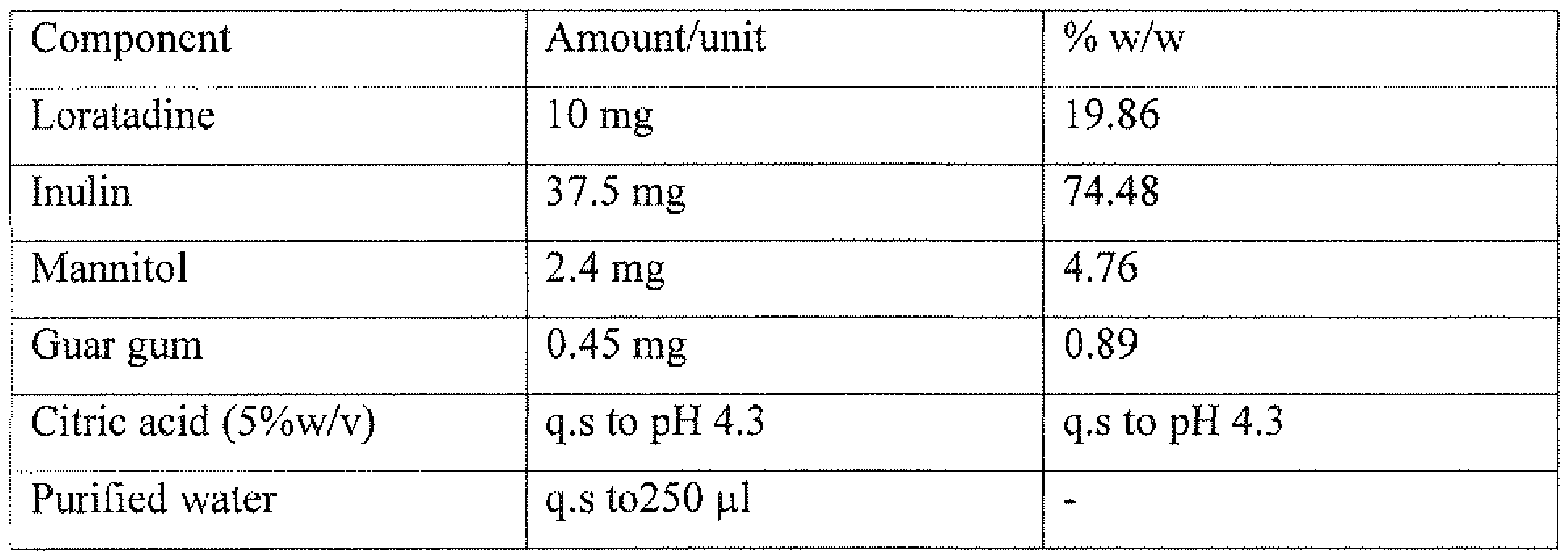
- step 3 Add loratadine to the solution obtained in step 2 under continuous stirring to obtain a suspension.
- step 2 1) Dissolve inulin and other excipients in the solution obtained in step 1 under stirring at 200 - 500 rpm.
- step 3 Add Famotidine to the solution of step 2 under continuous stirring till proper suspension is formed.
- Famotidine lyophilisate formulations were prepared using the method described in "II" herein above.
- step 2 1) Dissolve Inulin and other excipients in the Montelukast solution of step 1 under stirring at 200 - 500 rpm.
- Comparative lyophilisates were prepared according to the method described in "B" herein above, but using Pullulan in place of inulin.
- Comparative lyophilisates were prepared according to the method described in "B" herein above, but using fish gelatin in place of inulin.
- This test measures the expected disintegration time of a composition of the invention in an aqueous medium which is an indication of its disintegration time in saliva.
- the disintegration rate of the lyophilisates on a wet filter paper was determined according to the method described in WO2009002084 page 12 paragraph 129, wherein the test was performed at a temperature of about 25 ⁇ 2°C.
- the dissolving time of the placebo lyophilisates in the oral cavity was determined according to the method described in PCT application WO2009002084, page 12 paragraph 132, wherein the lyophilisate was placed on the tongue of a healthy human adult and then measuring the time for it to completely dissolve while rubbing the lyophilisates between the tongue and the upper palate.
- the mean ODT was calculated from the data obtained from 5 healthy human adults.
- This test measures the disintegration time of the compositions of the invention in aqueous medium which is an indication of their disintegration time in saliva.
- This test measures the dissolution (%) of an active ingredient from a composition of the invention in aqueous medium which is an indication of the release rate of the active ingredient from the composition.
- Dissolution media (0.1N HC1, Phosphate buffer pH 6.8, Acetate buffer pH 4.5, or 0.5% SLS in water) was selected on the basis of the active ingredient in the composition.
- Dissolution bowls were filled with appropriate media volume (500mL and 900mL) on the basis of the active ingredient in the composition and the temperature of the media was maintained at 37°C ⁇ 0.5°C using water bath.
- the apparatus used was USP type II (Paddle) and set at the required rpm (50rpm) as per the test procedure. Samples were withdrawn as per the time point (5 min, 10min, 15min, and 30min) defined in the test procedure. Samples were analysed
Landscapes
- Health & Medical Sciences (AREA)
- Life Sciences & Earth Sciences (AREA)
- Chemical & Material Sciences (AREA)
- Veterinary Medicine (AREA)
- Public Health (AREA)
- Animal Behavior & Ethology (AREA)
- Medicinal Chemistry (AREA)
- Pharmacology & Pharmacy (AREA)
- General Health & Medical Sciences (AREA)
- Epidemiology (AREA)
- Engineering & Computer Science (AREA)
- Bioinformatics & Cheminformatics (AREA)
- Organic Chemistry (AREA)
- Chemical Kinetics & Catalysis (AREA)
- Nuclear Medicine, Radiotherapy & Molecular Imaging (AREA)
- General Chemical & Material Sciences (AREA)
- Inorganic Chemistry (AREA)
- Nutrition Science (AREA)
- Physiology (AREA)
- Zoology (AREA)
- Gastroenterology & Hepatology (AREA)
- Immunology (AREA)
- Proteomics, Peptides & Aminoacids (AREA)
- Pulmonology (AREA)
- Urology & Nephrology (AREA)
- Otolaryngology (AREA)
- Pharmaceuticals Containing Other Organic And Inorganic Compounds (AREA)
- Medicinal Preparation (AREA)
- Medicines That Contain Protein Lipid Enzymes And Other Medicines (AREA)
Abstract
Description




Claims
Priority Applications (18)
| Application Number | Priority Date | Filing Date | Title |
|---|---|---|---|
| KR1020127027215A KR101725173B1 (en) | 2010-03-29 | 2011-03-28 | A fast dissolving pharmaceutical composition |
| US13/638,121 US10086078B2 (en) | 2010-03-29 | 2011-03-28 | Fast dissolving pharmaceutical composition |
| HK13108936.5A HK1181649B (en) | 2010-03-29 | 2011-03-28 | A fast dissolving pharmaceutical composition |
| MX2012011204A MX2012011204A (en) | 2010-03-29 | 2011-03-28 | A fast dissolving pharmaceutical composition. |
| PL11711526T PL2552403T3 (en) | 2010-03-29 | 2011-03-28 | A fast dissolving pharmaceutical composition |
| JP2013501779A JP5907945B2 (en) | 2010-03-29 | 2011-03-28 | Fast-dissolving pharmaceutical composition |
| RU2012141141/15A RU2566270C2 (en) | 2010-03-29 | 2011-03-28 | Fast-dissolving pharmaceutical composition |
| CA2793405A CA2793405A1 (en) | 2010-03-29 | 2011-03-28 | A fast dissolving pharmaceutical composition |
| EP11711526.1A EP2552403B1 (en) | 2010-03-29 | 2011-03-28 | A fast dissolving pharmaceutical composition |
| ES11711526.1T ES2553568T3 (en) | 2010-03-29 | 2011-03-28 | A fast dissolving pharmaceutical composition |
| BR112012024428A BR112012024428A2 (en) | 2010-03-29 | 2011-03-28 | fast dissolving pharmaceutical composition |
| DK11711526.1T DK2552403T3 (en) | 2010-03-29 | 2011-03-28 | A fast-PHARMACEUTICAL COMPOSITION |
| CN2011800171635A CN102821755A (en) | 2010-03-29 | 2011-03-28 | Fast dissolving pharmaceutical composition |
| NZ602441A NZ602441A (en) | 2010-03-29 | 2011-03-28 | A fast dissolving pharmaceutical composition |
| AU2011234636A AU2011234636B2 (en) | 2010-03-29 | 2011-03-28 | A fast dissolving pharmaceutical composition |
| IL222086A IL222086A (en) | 2010-03-29 | 2012-09-23 | Fast dissolving pharmaceutical composition |
| ZA2012/07176A ZA201207176B (en) | 2010-03-29 | 2012-09-25 | A fast dissolving pharmaceutical composition |
| US16/115,650 US10512695B2 (en) | 2010-03-29 | 2018-08-29 | Fast dissolving pharmaceutical composition |
Applications Claiming Priority (2)
| Application Number | Priority Date | Filing Date | Title |
|---|---|---|---|
| IN742/DEL/2010 | 2010-03-29 | ||
| IN742DE2010 | 2010-03-29 |
Related Child Applications (2)
| Application Number | Title | Priority Date | Filing Date |
|---|---|---|---|
| US13/638,121 A-371-Of-International US10086078B2 (en) | 2010-03-29 | 2011-03-28 | Fast dissolving pharmaceutical composition |
| US16/115,650 Continuation US10512695B2 (en) | 2010-03-29 | 2018-08-29 | Fast dissolving pharmaceutical composition |
Publications (2)
| Publication Number | Publication Date |
|---|---|
| WO2011120903A2 true WO2011120903A2 (en) | 2011-10-06 |
| WO2011120903A3 WO2011120903A3 (en) | 2012-05-03 |
Family
ID=54241475
Family Applications (1)
| Application Number | Title | Priority Date | Filing Date |
|---|---|---|---|
| PCT/EP2011/054698 Ceased WO2011120903A2 (en) | 2010-03-29 | 2011-03-28 | A fast dissolving pharmaceutical composition |
Country Status (23)
| Country | Link |
|---|---|
| US (2) | US10086078B2 (en) |
| EP (1) | EP2552403B1 (en) |
| JP (1) | JP5907945B2 (en) |
| KR (1) | KR101725173B1 (en) |
| CN (1) | CN102821755A (en) |
| AR (1) | AR080736A1 (en) |
| AU (1) | AU2011234636B2 (en) |
| BR (1) | BR112012024428A2 (en) |
| CA (1) | CA2793405A1 (en) |
| DK (1) | DK2552403T3 (en) |
| ES (1) | ES2553568T3 (en) |
| HU (1) | HUE026213T2 (en) |
| IL (1) | IL222086A (en) |
| JO (1) | JO3112B1 (en) |
| MX (1) | MX2012011204A (en) |
| NZ (1) | NZ602441A (en) |
| PL (1) | PL2552403T3 (en) |
| PT (1) | PT2552403E (en) |
| RU (1) | RU2566270C2 (en) |
| SA (1) | SA111320317B1 (en) |
| TW (1) | TWI513477B (en) |
| WO (1) | WO2011120903A2 (en) |
| ZA (1) | ZA201207176B (en) |
Cited By (7)
| Publication number | Priority date | Publication date | Assignee | Title |
|---|---|---|---|---|
| WO2013037708A1 (en) * | 2011-09-16 | 2013-03-21 | Ferring B.V. | A fast dissolving pharmaceutical composition |
| WO2014079922A1 (en) | 2012-11-21 | 2014-05-30 | Ferring B.V. | Composition for immediate and extended release |
| US9717684B2 (en) | 2014-04-25 | 2017-08-01 | R.P. Scherer Technologies, Llc | Stable montelukast solution |
| CN111904936A (en) * | 2020-08-28 | 2020-11-10 | 开封康诺药业有限公司 | Famotidine freeze-dried powder injection |
| US10952959B2 (en) | 2017-01-11 | 2021-03-23 | Ferring B.V. | Fast disintegrating pharmaceutical composition |
| US11975097B2 (en) | 2009-10-30 | 2024-05-07 | Ix Biopharma Ltd. | Fast dissolving solid dosage form |
| US12186426B2 (en) | 2009-10-30 | 2025-01-07 | Ix Biopharma Ltd. | Solid dosage form |
Families Citing this family (5)
| Publication number | Priority date | Publication date | Assignee | Title |
|---|---|---|---|---|
| JO3112B1 (en) * | 2010-03-29 | 2017-09-20 | Ferring Bv | A fast dissolving pharmaceutical composition |
| US20230346695A1 (en) | 2020-09-29 | 2023-11-02 | Millicent Pharma Limited | Orodispersible formulations |
| WO2022103639A1 (en) | 2020-11-16 | 2022-05-19 | Orcosa Inc. | Methods of treating autoimmune or inflammatory conditions with cannabidiol or its derivatives/analogs |
| US11672761B2 (en) | 2020-11-16 | 2023-06-13 | Orcosa Inc. | Rapidly infusing platform and compositions for therapeutic treatment in humans |
| GB2644313A (en) * | 2024-09-27 | 2026-04-01 | Novumgen Ltd | An orodispersible tablet of Famotidine and its process of preparation |
Citations (6)
| Publication number | Priority date | Publication date | Assignee | Title |
|---|---|---|---|---|
| EP1165053A1 (en) | 1999-04-08 | 2002-01-02 | R.P. Scherer Corporation | Fast-dispersing dosage forms containing fish gelatin |
| US6509040B1 (en) | 2001-06-22 | 2003-01-21 | R.P. Scherer Corporation | Fast dispersing dosage forms essentially free of mammalian gelatin |
| US20040228919A1 (en) | 2003-02-28 | 2004-11-18 | Alk-Abello A/S | Dosage form having a saccharide matrix |
| EP1501534A2 (en) | 2002-05-07 | 2005-02-02 | Ferring BV | Desmopressin in an orodispersible dosage form |
| EP1803446A1 (en) | 2004-04-30 | 2007-07-04 | Quantum Hi-Tech (Beijing) Research Institute | Orally disintegrating tablet and method of preparation |
| WO2009002084A2 (en) | 2007-06-27 | 2008-12-31 | Hanmi Pharm. Co., Ltd. | Method for preparing rapidly disintegrating formulation for oral administration and apparatus for preparing and packing the same |
Family Cites Families (43)
| Publication number | Priority date | Publication date | Assignee | Title |
|---|---|---|---|---|
| CA251629A (en) | 1925-07-14 | T. Hanna William | Coal cutting knife | |
| GB1548022A (en) | 1976-10-06 | 1979-07-04 | Wyeth John & Brother Ltd | Pharmaceutial dosage forms |
| CA1114812A (en) | 1977-08-16 | 1981-12-22 | Carlos Moreno | Hapten polysaccharide conjugates |
| CN1053808C (en) | 1993-04-24 | 2000-06-28 | 章修纲 | Nedepine quick releasing and slow releasing agent |
| EP0879600A1 (en) | 1997-05-20 | 1998-11-25 | Tiense Suikerraffinaderij N.V. (Raffinerie Tirlemontoise S.A.) | Fructan containing composition for the prevention and treatment of colon cancer |
| EP0958825A1 (en) * | 1998-05-18 | 1999-11-24 | Tiense Suikerraffinaderij N.V. (Raffinerie Tirlemontoise S.A.) | Synergistic composition of a non-digestible carbohydrate and an anti-cancer drug for use in the treatment of cancer |
| SE9803871D0 (en) | 1998-11-11 | 1998-11-11 | Pharmacia & Upjohn Ab | Therapeutic method and formulation |
| AU1453600A (en) | 1998-11-04 | 2000-05-22 | Mcneil-Ppc, Inc. | Solid oral dosage forms containing alginic acid and famotidine |
| GB9901819D0 (en) | 1999-01-27 | 1999-03-17 | Scherer Corp R P | Pharmaceutical compositions |
| NL1012300C2 (en) * | 1999-06-11 | 2000-12-12 | Rijksuniversiteit | Stabilizer for pharmaceuticals. |
| EP1064938A1 (en) | 1999-06-28 | 2001-01-03 | Sanofi-Synthelabo | Pharmaceutical dosage forms for controlled release producing at least a timed pulse |
| CA2380449A1 (en) * | 1999-08-17 | 2001-02-22 | Novartis Consumer Health S.A. | Rapidly dissolving dosage form and process for making same |
| AU2001271784A1 (en) | 2000-07-06 | 2002-01-21 | Wyeth | Therapy for prosthesis-related bone degeneration |
| AU2001271037A1 (en) | 2000-07-13 | 2002-01-30 | Daiichi Pharmaceutical Co., Ltd. | Pharmaceutical compositions containing dds compounds |
| IT1319664B1 (en) * | 2000-11-17 | 2003-10-23 | Pharma Biotech Ltd | ADDINTS OF QUINOLONIC ANTIBACTERIALS WITH POLYSACCHARIDICINATURAL POLYMERS. |
| MY148466A (en) | 2001-10-26 | 2013-04-30 | Merck Frosst Canada Ltd | Granule formulation |
| PL209134B1 (en) * | 2002-04-03 | 2011-07-29 | Solvay Pharm Bv | Stabilized natural cannabinoid formulation |
| HRP20041152B1 (en) | 2002-05-07 | 2008-01-31 | Ferring B.V. | PHARMACEUTICAL FORMULATIONS |
| WO2003099040A1 (en) * | 2002-05-27 | 2003-12-04 | Advance Holdings Limited | Dietary supplements from wine vinasses and relevant production process |
| US20040096569A1 (en) | 2002-11-15 | 2004-05-20 | Barkalow David G. | Edible film products and methods of making same |
| EP1428526A1 (en) * | 2002-12-13 | 2004-06-16 | Rijksuniversiteit Groningen | Formulation for fast dissolution of lipophilic compounds |
| EP1599185A1 (en) | 2003-02-28 | 2005-11-30 | Alk-Abello A/S | Dosage form having a saccharide matrix |
| DK1514553T3 (en) | 2003-09-05 | 2008-06-23 | Myung-Jun Chung | Lactic acid bacterial powder which is double coated using protein and polysaccharide and process for preparing the same as well as dosage form thereof. |
| EP1597978A1 (en) | 2004-05-17 | 2005-11-23 | Nutricia N.V. | Synergism of GOS and polyfructose |
| MY191349A (en) * | 2004-08-27 | 2022-06-17 | Bayer Pharmaceuticals Corp | New pharmaceutical compositions for the treatment of hyper-proliferative disorders |
| US20060088593A1 (en) | 2004-10-27 | 2006-04-27 | Bunick Frank J | Dosage forms having a microreliefed surface and methods and apparatus for their production |
| TW200621310A (en) * | 2004-11-10 | 2006-07-01 | Univ Groningen | A process for preparing formulations of lypophilic active substances by spray freeze drying |
| CN100339081C (en) * | 2004-11-10 | 2007-09-26 | 范敏华 | Oral loratadine disintegrating tablet and its prepn |
| CA2591747A1 (en) * | 2004-12-23 | 2006-06-29 | Mcneil-Ppc, Inc. | Orally disintegrating pharmaceutical compositions with sensory cue agents |
| US20070042023A1 (en) | 2005-08-22 | 2007-02-22 | National Starch And Chemical Investment Holding Corporation | Dissolvable film |
| US8158152B2 (en) | 2005-11-18 | 2012-04-17 | Scidose Llc | Lyophilization process and products obtained thereby |
| WO2007070660A2 (en) | 2005-12-13 | 2007-06-21 | President And Fellows Of Harvard College | Scaffolds for cell transplantation |
| US20070293582A1 (en) | 2006-06-05 | 2007-12-20 | Malcolm Hill | Epinephrine dosing regimens comprising buccal, lingual or sublingual and injectable dosage forms |
| FR2910812B1 (en) * | 2006-12-29 | 2009-03-20 | Pierre Fabre Medicament Sa | LYOPHILIZED INJECTABLE PHARMACEUTICAL COMPOSITIONS OF HEMI-SYNTHETIC STABLE VINCA ALKALOID DERIVATIVES AT AMBIENT TEMPERATURE |
| US20080241226A1 (en) | 2007-03-27 | 2008-10-02 | Abeln Susan L | Methods and Kits For Administering Probiotics |
| KR100930427B1 (en) | 2008-01-25 | 2009-12-08 | 정명준 | Method for producing tri-coated lactic acid bacteria and nano-particle coating method, tri-coated lactic acid bacteria prepared by the method and products comprising the same |
| US8623401B2 (en) | 2008-03-27 | 2014-01-07 | Fenwafe Inc. | Wafer formulation |
| BRPI0917172A2 (en) * | 2008-08-28 | 2015-08-04 | Chr Hansen As | Bacterial composition |
| NZ706991A (en) | 2010-03-29 | 2016-08-26 | Ferring Bv | A fast dissolving pharmaceutical composition |
| JO3112B1 (en) * | 2010-03-29 | 2017-09-20 | Ferring Bv | A fast dissolving pharmaceutical composition |
| US20120135050A1 (en) | 2010-07-08 | 2012-05-31 | Wellesley Pharmaceuticals, Llc | Extended-release formulation for reducing the frequency of urination and method of use thereof |
| RU2633640C2 (en) | 2011-09-16 | 2017-10-16 | Ферринг Б.В. | Quick-soluble pharmaceutical composition |
| US20150306170A1 (en) | 2012-11-21 | 2015-10-29 | Ferring B.V. | Composition for immediate and extended release |
-
2011
- 2011-03-22 JO JOP/2011/0100A patent/JO3112B1/en active
- 2011-03-28 US US13/638,121 patent/US10086078B2/en active Active
- 2011-03-28 PL PL11711526T patent/PL2552403T3/en unknown
- 2011-03-28 TW TW100110569A patent/TWI513477B/en not_active IP Right Cessation
- 2011-03-28 BR BR112012024428A patent/BR112012024428A2/en not_active IP Right Cessation
- 2011-03-28 MX MX2012011204A patent/MX2012011204A/en unknown
- 2011-03-28 DK DK11711526.1T patent/DK2552403T3/en active
- 2011-03-28 CN CN2011800171635A patent/CN102821755A/en active Pending
- 2011-03-28 EP EP11711526.1A patent/EP2552403B1/en active Active
- 2011-03-28 AU AU2011234636A patent/AU2011234636B2/en not_active Ceased
- 2011-03-28 WO PCT/EP2011/054698 patent/WO2011120903A2/en not_active Ceased
- 2011-03-28 CA CA2793405A patent/CA2793405A1/en not_active Abandoned
- 2011-03-28 RU RU2012141141/15A patent/RU2566270C2/en not_active IP Right Cessation
- 2011-03-28 ES ES11711526.1T patent/ES2553568T3/en active Active
- 2011-03-28 HU HUE11711526A patent/HUE026213T2/en unknown
- 2011-03-28 NZ NZ602441A patent/NZ602441A/en not_active IP Right Cessation
- 2011-03-28 KR KR1020127027215A patent/KR101725173B1/en not_active Expired - Fee Related
- 2011-03-28 JP JP2013501779A patent/JP5907945B2/en active Active
- 2011-03-28 PT PT117115261T patent/PT2552403E/en unknown
- 2011-03-29 AR ARP110101023A patent/AR080736A1/en unknown
- 2011-03-29 SA SA111320317A patent/SA111320317B1/en unknown
-
2012
- 2012-09-23 IL IL222086A patent/IL222086A/en not_active IP Right Cessation
- 2012-09-25 ZA ZA2012/07176A patent/ZA201207176B/en unknown
-
2018
- 2018-08-29 US US16/115,650 patent/US10512695B2/en active Active
Patent Citations (6)
| Publication number | Priority date | Publication date | Assignee | Title |
|---|---|---|---|---|
| EP1165053A1 (en) | 1999-04-08 | 2002-01-02 | R.P. Scherer Corporation | Fast-dispersing dosage forms containing fish gelatin |
| US6509040B1 (en) | 2001-06-22 | 2003-01-21 | R.P. Scherer Corporation | Fast dispersing dosage forms essentially free of mammalian gelatin |
| EP1501534A2 (en) | 2002-05-07 | 2005-02-02 | Ferring BV | Desmopressin in an orodispersible dosage form |
| US20040228919A1 (en) | 2003-02-28 | 2004-11-18 | Alk-Abello A/S | Dosage form having a saccharide matrix |
| EP1803446A1 (en) | 2004-04-30 | 2007-07-04 | Quantum Hi-Tech (Beijing) Research Institute | Orally disintegrating tablet and method of preparation |
| WO2009002084A2 (en) | 2007-06-27 | 2008-12-31 | Hanmi Pharm. Co., Ltd. | Method for preparing rapidly disintegrating formulation for oral administration and apparatus for preparing and packing the same |
Non-Patent Citations (5)
| Title |
|---|
| BANDARI ET AL., ASIAN JOURNAL OF PHARMACEUTICS, January 2008 (2008-01-01), pages 2 - 11 |
| CRITICAL REVIEWS IN THERAPEUTIC DRUG CARRIER SYSTEMS, vol. 21, no. 6, 2004, pages 433 - 475 |
| MORJARIA, DISSOLUTION TECHNOLOGIES, May 2004 (2004-05-01), pages 12 - 15 |
| PH EUR., 1997 |
| SEAGER H., J. PHAR, PHARMACOL, vol. 50, 1998, pages 375 - 382 |
Cited By (12)
| Publication number | Priority date | Publication date | Assignee | Title |
|---|---|---|---|---|
| US11975097B2 (en) | 2009-10-30 | 2024-05-07 | Ix Biopharma Ltd. | Fast dissolving solid dosage form |
| US12186426B2 (en) | 2009-10-30 | 2025-01-07 | Ix Biopharma Ltd. | Solid dosage form |
| WO2013037708A1 (en) * | 2011-09-16 | 2013-03-21 | Ferring B.V. | A fast dissolving pharmaceutical composition |
| CN103781467A (en) * | 2011-09-16 | 2014-05-07 | 辉凌公司 | Fast dissolving pharmaceutical composition |
| CN103781467B (en) * | 2011-09-16 | 2016-08-31 | 辉凌公司 | A fast-dissolving pharmaceutical composition |
| WO2014079922A1 (en) | 2012-11-21 | 2014-05-30 | Ferring B.V. | Composition for immediate and extended release |
| CN104797240A (en) * | 2012-11-21 | 2015-07-22 | 辉凌公司 | Composition for immediate and extended release |
| JP2016500088A (en) * | 2012-11-21 | 2016-01-07 | フェリング ベスローテン フェンノートシャップ | Composition for immediate and sustained release |
| US9717684B2 (en) | 2014-04-25 | 2017-08-01 | R.P. Scherer Technologies, Llc | Stable montelukast solution |
| EP3134076A4 (en) * | 2014-04-25 | 2017-12-20 | R.P. Scherer Technologies, LLC | A stable montelukast solution |
| US10952959B2 (en) | 2017-01-11 | 2021-03-23 | Ferring B.V. | Fast disintegrating pharmaceutical composition |
| CN111904936A (en) * | 2020-08-28 | 2020-11-10 | 开封康诺药业有限公司 | Famotidine freeze-dried powder injection |
Also Published As
| Publication number | Publication date |
|---|---|
| CA2793405A1 (en) | 2011-10-06 |
| NZ602441A (en) | 2014-01-31 |
| SA111320317B1 (en) | 2015-05-11 |
| AU2011234636B2 (en) | 2015-01-15 |
| DK2552403T3 (en) | 2015-10-05 |
| JP2013523676A (en) | 2013-06-17 |
| EP2552403A2 (en) | 2013-02-06 |
| US20130123180A1 (en) | 2013-05-16 |
| US20180369392A1 (en) | 2018-12-27 |
| TW201138830A (en) | 2011-11-16 |
| ZA201207176B (en) | 2013-05-29 |
| JO3112B1 (en) | 2017-09-20 |
| WO2011120903A3 (en) | 2012-05-03 |
| BR112012024428A2 (en) | 2016-05-31 |
| RU2566270C2 (en) | 2015-10-20 |
| KR20130008588A (en) | 2013-01-22 |
| AR080736A1 (en) | 2012-05-02 |
| CN102821755A (en) | 2012-12-12 |
| IL222086A (en) | 2017-01-31 |
| AU2011234636A1 (en) | 2012-10-11 |
| PT2552403E (en) | 2015-10-30 |
| US10086078B2 (en) | 2018-10-02 |
| HK1181649A1 (en) | 2013-11-15 |
| ES2553568T3 (en) | 2015-12-10 |
| TWI513477B (en) | 2015-12-21 |
| RU2012141141A (en) | 2014-05-10 |
| KR101725173B1 (en) | 2017-04-10 |
| EP2552403B1 (en) | 2015-09-09 |
| HUE026213T2 (en) | 2016-05-30 |
| MX2012011204A (en) | 2012-11-23 |
| US10512695B2 (en) | 2019-12-24 |
| JP5907945B2 (en) | 2016-04-26 |
| PL2552403T3 (en) | 2016-01-29 |
Similar Documents
| Publication | Publication Date | Title |
|---|---|---|
| US10512695B2 (en) | Fast dissolving pharmaceutical composition | |
| US9731018B2 (en) | Fast dissolving pharmaceutical composition | |
| US10023335B2 (en) | Fast dissolving pharmaceutical composition | |
| US10952959B2 (en) | Fast disintegrating pharmaceutical composition | |
| HK1181649B (en) | A fast dissolving pharmaceutical composition |
Legal Events
| Date | Code | Title | Description |
|---|---|---|---|
| WWE | Wipo information: entry into national phase |
Ref document number: 201180017163.5 Country of ref document: CN |
|
| 121 | Ep: the epo has been informed by wipo that ep was designated in this application |
Ref document number: 11711526 Country of ref document: EP Kind code of ref document: A2 |
|
| ENP | Entry into the national phase |
Ref document number: 2793405 Country of ref document: CA |
|
| WWE | Wipo information: entry into national phase |
Ref document number: DZP2012000653 Country of ref document: DZ Ref document number: 2011234636 Country of ref document: AU Ref document number: 2011711526 Country of ref document: EP |
|
| WWE | Wipo information: entry into national phase |
Ref document number: 222086 Country of ref document: IL |
|
| WWE | Wipo information: entry into national phase |
Ref document number: 8433/DELNP/2012 Country of ref document: IN |
|
| WWE | Wipo information: entry into national phase |
Ref document number: MX/A/2012/011204 Country of ref document: MX |
|
| WWE | Wipo information: entry into national phase |
Ref document number: 2013501779 Country of ref document: JP |
|
| NENP | Non-entry into the national phase |
Ref country code: DE |
|
| ENP | Entry into the national phase |
Ref document number: 2011234636 Country of ref document: AU Date of ref document: 20110328 Kind code of ref document: A |
|
| ENP | Entry into the national phase |
Ref document number: 20127027215 Country of ref document: KR Kind code of ref document: A |
|
| WWE | Wipo information: entry into national phase |
Ref document number: 2012141141 Country of ref document: RU |
|
| WWE | Wipo information: entry into national phase |
Ref document number: 13638121 Country of ref document: US |
|
| REG | Reference to national code |
Ref country code: BR Ref legal event code: B01A Ref document number: 112012024428 Country of ref document: BR |
|
| ENP | Entry into the national phase |
Ref document number: 112012024428 Country of ref document: BR Kind code of ref document: A2 Effective date: 20120926 |