WO2011121129A2 - Utilisation d'une silice precipitee contenant de l'aluminium et de 3-acryloxy-propyltriethoxysilane dans une composition d'elastomere(s) isoprenique(s) - Google Patents
Utilisation d'une silice precipitee contenant de l'aluminium et de 3-acryloxy-propyltriethoxysilane dans une composition d'elastomere(s) isoprenique(s) Download PDFInfo
- Publication number
- WO2011121129A2 WO2011121129A2 PCT/EP2011/055141 EP2011055141W WO2011121129A2 WO 2011121129 A2 WO2011121129 A2 WO 2011121129A2 EP 2011055141 W EP2011055141 W EP 2011055141W WO 2011121129 A2 WO2011121129 A2 WO 2011121129A2
- Authority
- WO
- WIPO (PCT)
- Prior art keywords
- elastomer
- isoprene
- composition
- weight
- precipitated silica
- Prior art date
- Legal status (The legal status is an assumption and is not a legal conclusion. Google has not performed a legal analysis and makes no representation as to the accuracy of the status listed.)
- Ceased
Links
Classifications
-
- C—CHEMISTRY; METALLURGY
- C08—ORGANIC MACROMOLECULAR COMPOUNDS; THEIR PREPARATION OR CHEMICAL WORKING-UP; COMPOSITIONS BASED THEREON
- C08K—Use of inorganic or non-macromolecular organic substances as compounding ingredients
- C08K3/00—Use of inorganic substances as compounding ingredients
- C08K3/34—Silicon-containing compounds
- C08K3/36—Silica
-
- B—PERFORMING OPERATIONS; TRANSPORTING
- B60—VEHICLES IN GENERAL
- B60C—VEHICLE TYRES; TYRE INFLATION; TYRE CHANGING; CONNECTING VALVES TO INFLATABLE ELASTIC BODIES IN GENERAL; DEVICES OR ARRANGEMENTS RELATED TO TYRES
- B60C1/00—Tyres characterised by the chemical composition or the physical arrangement or mixture of the composition
-
- C—CHEMISTRY; METALLURGY
- C08—ORGANIC MACROMOLECULAR COMPOUNDS; THEIR PREPARATION OR CHEMICAL WORKING-UP; COMPOSITIONS BASED THEREON
- C08K—Use of inorganic or non-macromolecular organic substances as compounding ingredients
- C08K9/00—Use of pretreated ingredients
- C08K9/04—Ingredients treated with organic substances
- C08K9/06—Ingredients treated with organic substances with silicon-containing compounds
-
- C—CHEMISTRY; METALLURGY
- C08—ORGANIC MACROMOLECULAR COMPOUNDS; THEIR PREPARATION OR CHEMICAL WORKING-UP; COMPOSITIONS BASED THEREON
- C08L—COMPOSITIONS OF MACROMOLECULAR COMPOUNDS
- C08L9/00—Compositions of homopolymers or copolymers of conjugated diene hydrocarbons
-
- C—CHEMISTRY; METALLURGY
- C09—DYES; PAINTS; POLISHES; NATURAL RESINS; ADHESIVES; COMPOSITIONS NOT OTHERWISE PROVIDED FOR; APPLICATIONS OF MATERIALS NOT OTHERWISE PROVIDED FOR
- C09C—TREATMENT OF INORGANIC MATERIALS, OTHER THAN FIBROUS FILLERS, TO ENHANCE THEIR PIGMENTING OR FILLING PROPERTIES ; PREPARATION OF CARBON BLACK ; PREPARATION OF INORGANIC MATERIALS WHICH ARE NO SINGLE CHEMICAL COMPOUNDS AND WHICH ARE MAINLY USED AS PIGMENTS OR FILLERS
- C09C1/00—Treatment of specific inorganic materials other than fibrous fillers; Preparation of carbon black
- C09C1/28—Compounds of silicon
- C09C1/30—Silicic acid
- C09C1/3081—Treatment with organo-silicon compounds
-
- C—CHEMISTRY; METALLURGY
- C09—DYES; PAINTS; POLISHES; NATURAL RESINS; ADHESIVES; COMPOSITIONS NOT OTHERWISE PROVIDED FOR; APPLICATIONS OF MATERIALS NOT OTHERWISE PROVIDED FOR
- C09C—TREATMENT OF INORGANIC MATERIALS, OTHER THAN FIBROUS FILLERS, TO ENHANCE THEIR PIGMENTING OR FILLING PROPERTIES ; PREPARATION OF CARBON BLACK ; PREPARATION OF INORGANIC MATERIALS WHICH ARE NO SINGLE CHEMICAL COMPOUNDS AND WHICH ARE MAINLY USED AS PIGMENTS OR FILLERS
- C09C3/00—Treatment in general of inorganic materials, other than fibrous fillers, to enhance their pigmenting or filling properties
- C09C3/12—Treatment with organosilicon compounds
-
- C—CHEMISTRY; METALLURGY
- C01—INORGANIC CHEMISTRY
- C01P—INDEXING SCHEME RELATING TO STRUCTURAL AND PHYSICAL ASPECTS OF SOLID INORGANIC COMPOUNDS
- C01P2002/00—Crystal-structural characteristics
- C01P2002/80—Crystal-structural characteristics defined by measured data other than those specified in group C01P2002/70
-
- C—CHEMISTRY; METALLURGY
- C01—INORGANIC CHEMISTRY
- C01P—INDEXING SCHEME RELATING TO STRUCTURAL AND PHYSICAL ASPECTS OF SOLID INORGANIC COMPOUNDS
- C01P2004/00—Particle morphology
- C01P2004/60—Particles characterised by their size
- C01P2004/61—Micrometer sized, i.e. from 1-100 micrometer
-
- C—CHEMISTRY; METALLURGY
- C01—INORGANIC CHEMISTRY
- C01P—INDEXING SCHEME RELATING TO STRUCTURAL AND PHYSICAL ASPECTS OF SOLID INORGANIC COMPOUNDS
- C01P2006/00—Physical properties of inorganic compounds
- C01P2006/12—Surface area
-
- C—CHEMISTRY; METALLURGY
- C01—INORGANIC CHEMISTRY
- C01P—INDEXING SCHEME RELATING TO STRUCTURAL AND PHYSICAL ASPECTS OF SOLID INORGANIC COMPOUNDS
- C01P2006/00—Physical properties of inorganic compounds
- C01P2006/22—Rheological behaviour as dispersion, e.g. viscosity, sedimentation stability
-
- C—CHEMISTRY; METALLURGY
- C08—ORGANIC MACROMOLECULAR COMPOUNDS; THEIR PREPARATION OR CHEMICAL WORKING-UP; COMPOSITIONS BASED THEREON
- C08L—COMPOSITIONS OF MACROMOLECULAR COMPOUNDS
- C08L21/00—Compositions of unspecified rubbers
Definitions
- the invention relates to the joint use, in elastomer compositions (s) comprising an isoprene elastomer, such as natural rubber, of a particular reinforcing inorganic filler and a particular inorganic filler - elastomer coupling agent.
- elastomer compositions comprising an isoprene elastomer, such as natural rubber, of a particular reinforcing inorganic filler and a particular inorganic filler - elastomer coupling agent.
- the elastomeric articles are generally subjected to various constraints, for example such as a temperature variation, a significant frequency stress variation in dynamic regime, a significant static stress and / or fatigue in significant bending in dynamic mode.
- Such articles are, for example, tires, shoe soles, floor coverings, conveyor belts, power transmission belts, hoses, seals, especially appliance seals, role of engine vibration extractors either with metal reinforcements or with a hydraulic fluid inside the elastomer, cable sheaths, cables, ropeway rollers.
- a coupling agent also called a binding agent
- a binding agent whose function is, in particular, to providing the connection between the surface of the inorganic filler particles (for example a precipitated silica) and the elastomer (s), while facilitating the dispersion of this inorganic filler within the elastomeric matrix.
- inorganic filler-elastomer coupling agent is understood to mean an agent capable of establishing a sufficient chemical and / or physical connection between the inorganic filler and the elastomer.
- Such a coupling agent at least bifunctional, has for example as simplified general formula "N-V-M", in which:
- N represents a functional group ("N" function) capable of binding physically and / or chemically to the inorganic filler, such a bond being able to be established, for example, between a silicon atom of the coupling agent and the groups hydroxyl (OH) on the surface of the inorganic filler (for example surface silanols when it is silica);
- M represents a functional group ("M" function) capable of binding physically and / or chemically to the elastomer, in particular via a suitable atom or group of atoms (for example an atom of sulfur);
- - V represents a group (divalent / hydrocarbon) for connecting "N" and "M”.
- the coupling agents should not be confused with simple inorganic filler agents which, in a known manner, may have the "N" function active with respect to the inorganic filler but lack the "M” function. active with respect to the elastomer.
- Coupling agents in particular (silica-elastomer), have been described in numerous documents of the state of the art, the best known being (poly) sulphide silanes, in particular (poly) sulphidized alkoxysilanes.
- (Poly) sulfurized silanes mention may in particular be made of bis-triethoxysilylpropyl tetrasulfide (abbreviated to TESPT), which is generally still considered today as a product providing, for vulcanizates comprising an inorganic filler as a reinforcing filler, such as silica, a very good, or even the best, compromised in terms of safety roasting, ease of implementation and strengthening power.
- TESPT bis-triethoxysilylpropyl tetrasulfide
- precipitated silica in particular highly dispersible silica and a silane (or organosilic compound functionalized) polysulfide in a modified elastomer composition (s) allowed the development of the "green tire” for passenger vehicles (Light vehicles).
- This combination achieved a wear resistance performance comparable to that of carbon black-reinforced elastomer blends, while significantly improving rolling resistance (resulting in lower fuel consumption). fuel), and grip on wet ground.
- an inorganic filler such as silica in tires for trucks, tires which are obtained from compositions based on isoprene elastomer (s), mainly natural rubber.
- the object of the present invention is to propose in particular the combination for elastomer compositions comprising a diene elastomer, such as natural rubber, with a particular coupling agent with a particular reinforcing inorganic filler, this combination consisting of as an alternative to the use of known coupling agents with known reinforcing inorganic fillers, this combination further providing said elastomer compositions with a very favorable property compromise. satisfactory, especially in terms of their rheological properties, mechanical and / or dynamic, including hysteresis.
- it allows an improvement in the wear resistance and hysteresis / reinforcement compromise.
- the elastomer compositions obtained preferably have very good adhesion to both the reinforcing inorganic filler used and the substrates to which they are subsequently applied.
- the invention relates in its first object to the use in an elastomer composition (s), comprising at least one isoprene elastomer:
- 3-acryloxypropyltriethoxysilane (or ⁇ -acryloxypropyltriethoxysilane), as an inorganic filler-elastomer coupling agent.
- Said precipitated silica used generally has an aluminum content of at most 7.0% by weight, preferably at most 5.0% by weight, in particular at most 3.5% by weight, for example at most 3.0% by weight.
- its aluminum content is between 0.75 and 4.0% by weight, even more preferably between 0.8 and 3.5% by weight, in particular between 0.9 and 3.2% by weight. weight, especially between 0.9 and 2.5% by weight or between 1.0 and 3.1% by weight. It is for example between 1.0 and 3.0% by weight, or even between 1.0 and 2.0% by weight.
- the amount of aluminum can be measured by any suitable method, for example by ICP-AES ("Inductively Coupled Plasma - Atomic Emission Spectroscopy") after dissolution in water in the presence of hydrofluoric acid.
- ICP-AES Inductively Coupled Plasma - Atomic Emission Spectroscopy
- Aluminum is, in general, essentially on the surface of the precipitated silica.
- aluminum may be present in both tetrahedral, octahedral and pentahedral form, particularly in the form of tetrahedral and in octahedral form, in the precipitated silica used in the invention, it is preferably essentially in tetrahedral form (more than 50%, in particular at least 90%, especially at least 95% by number, of the aluminum species are then in tetrahedral form); the links are then rather essentially of the SiOAI type.
- Said precipitated silica containing aluminum used in the invention is advantageously highly dispersible, that is to say that in particular it has an ability to deagglomerate and to disperse in a very important polymeric matrix, in particular observable by electron or optical microscopy, on thin sections.
- the precipitated silica used according to the invention has a CTAB specific surface area of between 70 and 240 m 2 / g.
- This may be between 70 and 100 m 2 / g, for example between 75 and 95 m 2 / g.
- its CTAB surface area is between 100 and 240 m 2 / g, in particular between 140 and 200 m 2 / g.
- the precipitated silica used according to the invention has a BET specific surface area of between 70 and 240 m 2 / g.
- This can be between 70 and 100 m 2 / g, for example between 75 and
- its BET surface area is between 100 and 240 m 2 / g, in particular between 140 and 200 m 2 / g.
- the CTAB specific surface area is the external surface, which can be determined according to the NF T 45007 method (November 1987).
- the BET surface area can be measured according to the method of BRUNAUER - EMMETT - TELLER described in "The Journal of the American Chemical Society", vol. 60, page 309 (1938) and corresponding to standard NF T 45007 (November 1987).
- the dispersibility (and disagglomeration) ability of the precipitated silica implemented according to the invention can be assessed by means of the following test, by a granulometric measurement (by laser diffraction) carried out on a Silica suspension previously deagglomerated by ultra-sonification (breaking objects from 0.1 to a few tens of microns).
- Ultrasonic deagglomeration is carried out using a VIBRACELL BIOBLOCK (750 W) sonicator equipped with a 19 mm diameter probe.
- the particle size measurement is carried out by laser diffraction on a SYMPATEC granulomer, using the Fraunhofer theory.
- a pillbox (height: 6 cm and diameter: 4 cm)
- 2 grams of silica are weighed and the mixture is made up to 50 grams by addition of deionized water: a 4% aqueous suspension of silica is thus obtained which is homogenized during 2 minutes by magnetic stirring.
- the deagglomeration is then carried out under ultrasound as follows: the probe being immersed over a length of 4 cm, it is put into action for 5 minutes and 30 seconds at 80% of its nominal power (amplitude).
- the particle size measurement is then carried out by introducing into the vat of the granulometer a volume V (expressed in ml) of the homogenized suspension necessary to obtain an optical density of about 20.
- the value of the median diameter 050 obtained according to this test is even lower than the silica has a high ability to deagglomerate.
- a disaggregation factor F D is given by the equation:
- This disaggregation factor F D is indicative of the rate of particles smaller than 0.1 ⁇ which are not detected by the granulometer. This factor is all the higher as the silica has a high deagglomeration ability.
- the precipitated silica containing aluminum used according to the invention has a median diameter ⁇ 50 , after deagglomeration with ultrasound, less than 5 ⁇ , in particular less than 4 ⁇ , in particular less than 3.5. ⁇ , for example less than 3 ⁇ .
- the DOP oil uptake of the precipitated aluminum-containing silica used according to the invention may be less than 300 ml / 100 g, for example between 200 and 295 ml / 100 g. DOP oil uptake can be determined according to ISO 787/5 by using dioctylphthalate.
- One of the parameters of the precipitated silica implemented in the invention may reside in the distribution, or distribution, of its pore volume, and in particular in the distribution of the pore volume which is generated by pores with diameters less than or equal to 400 ⁇ . .
- This latter volume corresponds to the useful pore volume of the charges used in the reinforcement of the elastomers.
- this precipitated silica may have, in a first variant, a porous distribution (and this may be illustrated by the analysis of porograms) such as the pore volume generated by the pores whose diameter is between 175 and 275 ⁇ (V2) represents less than 50% of the pore volume generated by pores with diameters less than or equal to 400 ⁇ (V1), it may also be advantageous to use, in a second variant, a precipitated silica having a porous distribution such as the porous volume generated by the pores whose diameter is between 175 and 275 ⁇ (V2) represents at least 50% (for example between 50 and 60%) of the pore volume generated by pores with diameters less than or equal to 400 ⁇ (V1).
- a porous distribution such as the porous volume generated by the pores whose diameter is between 175 and 275 ⁇ (V2) represents at least 50% (for example between 50 and 60%) of the pore volume generated by pores with diameters less than or equal to 400 ⁇ (V1).
- porous volumes and pore diameters are measured by mercury porosimetry (Hg), using a MICROMERITICS Autopore 9520 porosimeter, and are calculated by the WASHBURN relation with a theta contact angle of 130 ° and a voltage.
- superficial gamma equal to 484 Dynes / cm (DIN 66133 standard).
- the pH of the precipitated silica used according to the invention is generally between 6.3 and 8.0, for example between 6.3 and 7.6.
- the pH is measured according to the following method deriving from the ISO 787/9 standard (pH of a suspension at 5% in water):
- Apparatus - calibrated pH meter (reading accuracy at 1 / 100th)
- the physical state in which the precipitated silica to be used according to the invention is present may be arbitrary, that is to say that it may be, for example, in the form of microbeads (substantially spherical beads), powder or granules.
- substantially spherical beads of average size of at least 80 ⁇ m, preferably at least 150 ⁇ m, in particular between 150 and 270 ⁇ m; this average size is determined according to standard NF X 1 1507 (December 1970) by dry sieving and determination of the diameter corresponding to a cumulative refusal of 50%.
- It may be in the form of a powder of average size of at least 3 ⁇ , in particular at least 10 ⁇ , preferably at least 15 ⁇ .
- the precipitated silica having an aluminum content greater than 0.5% by weight, used according to the invention may have:
- CTAB specific surface area of between 140 and 200 m 2 / g
- the precipitated silica may for example have a porous distribution such that the pore volume generated by the pores whose diameter is between 175 and 275 ⁇ (V 2) represents at least 50%, for example between 50 and 60% of the pore volume generated by pores with diameters less than or equal to 400 ⁇ (V1).
- the precipitated silica having an aluminum content greater than 0.5% by weight, used according to the invention may exhibit:
- CTAB specific surface area of between 140 and 200 m 2 / g
- V 2 a porous distribution such that the pore volume constituted by the pores whose diameter is between 175 and 275 ⁇ (V 2) represents less than 50% of the pore volume constituted by pores with diameters less than or equal to 400 ⁇ (V 1), and
- ⁇ 50 a median diameter ⁇ 50 , after deagglomeration with ultrasound, less than 5 ⁇ .
- the precipitated silica having an aluminum content greater than 0.5% by weight, used according to the invention may exhibit:
- CTAB specific surface area of between 140 and 200 m 2 / g
- the pore volume constituted by the pores whose diameter is between 175 and 275 ⁇ (V 2) represents at least 50%, for example between 50 and 60%, of the pore volume constituted by pores with diameters less than or equal to 400 ⁇ (V1), and
- ⁇ 50 a median diameter ⁇ 50 , after deagglomeration with ultrasound, less than 5 ⁇ .
- the precipitated silica implemented in the context of the invention may be prepared for example by a process as described in patent applications EP-A-0762992, EP-A-0762993, EP-A-0983966, EP-A -1355856.
- the precipitated silica employed in the invention can be obtained by a preparation process comprising the precipitation reaction between a silicate and an acidifying agent whereby a suspension of precipitated silica is obtained, followed by separation and drying. of this suspension, in which:
- said method comprising one of the following three operations (a), (b) or (c):
- step (iii) is carried out by simultaneously adding to the reaction medium acidifying agent, a silicate and at least one compound B of aluminum.
- this preparation process is a precipitation silica synthesis process, that is to say that it is made to act, under particular conditions, an acidifying agent with a silicate.
- the acidifying agent used is a strong mineral acid such as sulfuric acid, nitric acid or hydrochloric acid, or an organic acid such as acetic acid, formic acid or carbonic acid.
- the acidifying agent may be diluted or concentrated; its normality can be between 0.4 and 36 N, for example between 0.6 and 1.5 N.
- the acidifying agent is sulfuric acid
- its concentration may be between 40 and 180 g / l, for example between 60 and 130 g / l.
- silicate any current form of silicates such as metasilicates, disilicates and advantageously an alkali metal silicate, in particular sodium or potassium silicate.
- the silicate may have a concentration (expressed as SiO 2 ) of between 40 and 330 g / l, for example between 60 and 300 g / l.
- sulfuric acid is used as acidifying agent and sodium silicate as silicate.
- sodium silicate In the case where sodium silicate is used, it generally has a weight ratio SiO 2 / Na 2 O of between 2.5 and 4, for example between 3.1 and 3.8.
- reaction of the silicate with the acidifying agent is in a specific manner according to the following steps.
- a stock which comprises silicate and an electrolyte (step (i)).
- the amount of silicate present in the initial stock is advantageously only a part of the total amount of silicate involved in the reaction.
- electrolyte is understood here in its normal acceptation, that is to say that it means any ionic or molecular substance which, when in solution, decomposes or dissociates to form ions or particles. loaded.
- electrolyte mention may be made of a salt of the group of alkali and alkaline earth metal salts, in particular the salt of the starting silicate metal and of the acidifying agent, for example sodium chloride in the case of the reaction of a sodium silicate with hydrochloric acid or, preferably, sodium sulfate in the case of the reaction of a sodium silicate with sulfuric acid.
- the concentration of electrolyte in the initial stock is (greater than 0 g / L and) less than 17 g / l, for example less than 14 g / l.
- the silicate concentration (expressed in SiO 2 ) in the initial stock is (greater than 0 g / L and) less than 100 g / L; preferably, this concentration is less than 90 g / l, especially less than 85 g / l.
- the second step consists in adding the acidifying agent to the stock base composition described above (step (ii)).
- This addition which causes a correlative drop in the pH of the reaction medium, is carried out until a pH value of at least 7, generally between 7 and 8, is reached.
- step (Ni)) of acidifying agent and silicate is carried out.
- This preparation method comprises one of the three operations (a), (b) or (c) mentioned above, that is to say:
- a basic agent is added to the reaction medium, preferably until a pH value of the reaction medium of between 6.5 and 10 is obtained, in particular between 7.2 and 8.6, and then
- acidifying agent is added to the reaction medium, preferably until a pH value of the reaction medium of between 3 and 5, in particular between 3.4 and 4.5, is obtained.
- Step (v) may be performed simultaneously or, preferably, after step (iv).
- the reaction medium may be cured, this curing may for example last from 1 to 60 minutes, in particular from 3 to 30 minutes.
- step (iii) and step (iv) it may be desirable, between step (iii) and step (iv), and in particular before said optional maturing, to add to the reaction medium an additional amount of acidifying agent.
- This addition is generally carried out until a pH value of the reaction medium of between 3 and 6.5, in particular between 4 and 6, is obtained.
- the acidifying agent used during this addition is generally identical to that used in steps (ii), (iii) and (vi) of the first variant of the process.
- Ripening of the reaction medium is usually carried out between step (v) and step (vi), for example for 2 to 60 minutes, in particular for 5 to 45 minutes.
- a ripening of the reaction medium is most often carried out after step (vi), for example for 2 to 60 minutes, in particular for 5 to 30 minutes.
- the basic agent used in step (v) may be an ammonia solution or, preferably, a solution of sodium hydroxide (or sodium hydroxide).
- a step (iv) which consists in adding to the reaction medium simultaneously a silicate and at least one compound A of aluminum.
- step (iii) by step (iv), which in fact means that step (iii) and step (iv) then form only one step, the compound A of aluminum then playing the role of acidifying agent.
- step (iv) is generally carried out in such a way that the pH value of the reaction medium is constantly equal (within +/- 0.1) to that reached at the end of the step ( iii) or step (ii).
- step (iv) it is possible, after the simultaneous addition of step (iv), to ripen the reaction medium, which curing may for example last from 2 to 60 minutes, in particular from 5 to 30 minutes.
- step (iv) it may be desirable, after step (iv), and in particular after this optional ripening, to add to the reaction medium an additional quantity of acidifying agent.
- This addition is generally carried out until a pH value of the reaction medium of between 3 and 6.5, in particular between 4 and 6, is obtained.
- the acidifying agent used during this addition is generally identical to that used in step (ii) of the second variant of the process. Ripening of the reaction medium is usually carried out after this addition of acidifying agent, for example for 1 to 60 minutes, in particular for 3 to 30 minutes.
- the aluminum compound A used in the preparation process is generally an organic or inorganic salt of aluminum.
- organic salt mention may be made in particular of carboxylic or polycarboxylic acid salts, such as the salts of acetic, citric, tartaric or oxalic acid.
- inorganic salt mention may in particular be made of halides and oxyhalides (such as chlorides, oxychlorides), nitrates, phosphates, sulphates and oxysulphates.
- compound A of aluminum may be used in the form of a solution, generally aqueous.
- Aluminum compound A is preferably used as aluminum compound A.
- a step (iii) which consists in adding to the reaction medium simultaneously with the acidifying agent, a silicate and at least one compound B of aluminum.
- step (iii) it may be desirable, after step (iii), to add to the reaction medium an additional amount of acidifying agent. This addition is generally done until a pH value of the reaction medium of between 3 and 6.9, in particular between 4 and 6.6, is obtained.
- the acidifying agent used during this addition is generally identical to that used in steps (ii) and (iii). Ripening of the reaction medium is usually carried out after this addition of acidifying agent, for example for 1 to 60 minutes, in particular for 3 to 30 minutes.
- the compound B of the aluminum employed in the third variant is, in general, an alkali metal aluminate, in particular potassium or, preferably, sodium.
- the temperature of the reaction medium is generally between 70 and 98 ° C.
- the reaction is carried out at a constant temperature of between 75 and 96 ° C.
- the end-of-reaction temperature is higher than the reaction start temperature: thus, the temperature at the start of the reaction is preferably maintained between 70 and 96 ° C., and then the temperature is raised. in a few minutes, preferably to a value between 80 and 98 ° C, the value at which it is maintained until the end of the reaction; the operations (a) or (b) are thus usually performed at this constant temperature value.
- this separation comprises a filtration (followed by a washing if necessary) and a disintegration, said disintegration can be then (preferably in the case of the first two variants mentioned, possibly in the case of the third variant) carried out in the presence at least one aluminum compound B and, optionally, in the presence of an acidifying agent as described above (in the latter case, the compound B of the aluminum and the acidifying agent are advantageously added simultaneously ).
- the disintegration operation which can be carried out mechanically, for example by passing the filter cake in a colloidal or ball mill, notably makes it possible to lower the viscosity of the suspension to be dried (in particular to be atomized) subsequently.
- the aluminum compound B is usually different from the aluminum compound A mentioned above and generally consists of an alkali metal aluminate, especially potassium or, preferably, sodium aluminate.
- the amounts of aluminum compounds A and B used in this preparation process are such that the precipitated silica obtained has more than 0.5% by weight of aluminum, and in particular a preferred amount of aluminum as mentioned above. high.
- the separation carried out in this process usually comprises filtration (with washing if necessary) carried out using any suitable method, for example by means of a belt filter, a vacuum filter or, preferably, a filter. a filter press.
- the precipitated silica suspension thus recovered (filter cake) is then dried.
- this suspension must present immediately before drying a dry matter content of at most 24% by weight, preferably at most 22% by weight.
- This drying can be done by any means known per se.
- the drying is done by atomization.
- any suitable type of atomizer may be used, such as a turbine, nozzle, liquid pressure or two-fluid atomizer.
- a turbine nozzle
- liquid pressure two-fluid atomizer.
- the precipitated silica that can then be obtained is usually in the form of substantially spherical beads.
- the precipitated silica that can then be obtained is generally in the form of a powder.
- the precipitated silica that may then be obtained may be in the form of a powder.
- the dried product in particular by a turbine atomizer or milled as indicated above may optionally be subjected to an agglomeration step, which consists, for example, of a direct compression, a wet-path granulation (that is, with the use of a binder such as water, silica suspension, etc.), extrusion or, preferably, dry compaction.
- agglomeration step which consists, for example, of a direct compression, a wet-path granulation (that is, with the use of a binder such as water, silica suspension, etc.), extrusion or, preferably, dry compaction.
- deaerate operation also called pre-densification or degassing
- the precipitated silica that can then be obtained by this agglomeration step is generally in the form of granules.
- the 3-acryloxypropyltriethoxysilane (or ⁇ -acryloxypropyltriethoxysilane) used in the invention as an inorganic filler-elastomer coupling agent can be prepared by a process as described in US-A-3179612, starting from US Pat. allyl acrylate and triethoxysilane.
- the aluminum-containing precipitated silica used according to the present invention as the reinforcing inorganic filler and the 3-acryloxypropyltriethoxysilane used according to the present invention as the reinforcing inorganic filler-elastomer coupling agent may be mixed together prior to their use.
- a first variant is that the 3-acryloxypropyltriethoxysilane is not grafted onto said precipitated silica;
- a second variant is that the 3-acryloxypropyltriethoxysilane is grafted onto said precipitated silica which will thus be "pre-coupled” before mixing with the elastomer composition (s).
- this solid support that can be for example, carbon black or, preferably, precipitated aluminum-containing silica used in accordance with the present invention.
- the elastomer compositions in which 3-acryloxypropyltriethoxysilane is used according to the invention may contain at least one precipitated silica covering agent used as a reinforcing filler.
- This covering agent is capable, in a known manner, of improving the processability of the elastomer compositions in the green state.
- Such a coating agent may consist, for example, of an alkylalkoxysilane (in particular an alkyltriethoxysilane), a polyol, a polyether (in particular a polyethylene glycol), a polyetheramine, a primary, secondary or tertiary amine (in particular a trialkanol amine), a ⁇ , ⁇ -dihydroxylated polydimethylsiloxane or an ⁇ , ⁇ -diamine polydimethylsiloxane.
- an alkylalkoxysilane in particular an alkyltriethoxysilane
- a polyol in particular a polyethylene glycol
- a polyetheramine in particular a polyethylene glycol
- a polyetheramine in particular a primary, secondary or tertiary amine (in particular a trialkanol amine)
- This coating agent may optionally be mixed with said precipitated silica and 3-acryloxypropyltriethoxysilane prior to their use.
- the elastomer compositions in which the 3-acryloxypropyltriethoxysilane and the precipitated silica described above are used according to the invention may optionally comprise at least one other inorganic filler-elastomer coupling agent, in particular a sulphurised silane. or polysulfide.
- TESPD bis-triethoxysilylpropyl disulphide
- TESPT bis-triethoxysilylpropyl tetrasulfide
- MESPD bis-monoethoxydimethylsilylpropyl disulfide
- MESPT bis-monoethoxydinethylsilylpropyl tetrasulfide
- MESiPrT bis-monoethoxydimethylsilylisopropyl tetrasulfide
- said elastomer compositions (s) do not contain any other inorganic filler-elastomer coupling agent other than 3-acryloxypropyltriethoxysilane.
- the use according to the invention may optionally be carried out in the presence of a free radical initiator (for example from 0.02 to 5%, in particular from 0.05 to 0.5%, by weight relative to the amount in question. weight of elastomer (s)), that is to say of a compound (especially organic compound) susceptible, in particular following energetic activation, to generate free radicals in situ, in its surrounding environment, in this case in the elastomer (s).
- a free radical initiator for example from 0.02 to 5%, in particular from 0.05 to 0.5%, by weight relative to the amount in question. weight of elastomer (s)
- the initiator of free radicals is here an initiator of the type with thermal initiation, that is to say that the energy supply, for the creation of free radicals, is in thermal form. Its decomposition temperature should generally be below 180 ° C, in particular below 160 ° C.
- organic peroxides for example chosen from the group consisting of organic peroxides, organic hydroperoxides, azido compounds, bis (azo) compounds, peracids, peresters or a mixture of at least two of these compounds.
- organic peroxide for example benzoyl peroxide, acetyl peroxide, lauryl peroxide, peroxide of 1, 1 bis (t-butyl) -3,3,5-trimethylcyclohexane, peroxide optionally being placed on a solid support, such as calcium carbonate.
- the invention is implemented in the absence of any free radical initiator.
- the elastomer composition (s) employed in the invention may advantageously not comprise other elastomers than the isoprene elastomer (s) it contains.
- it may optionally comprise at least one isoprene elastomer (for example natural rubber) and at least one diene elastomer other than isoprene, the amount of isoprene elastomer (s) relative to the total amount of elastomer (s) then being preferably greater than 50% (generally less than 99.5%, and for example between 70 and 99%) by weight.
- the elastomer composition (s) used according to the invention generally comprises at least one isoprene elastomer (natural or synthetic) chosen from:
- conjugated diene monomers other than isoprene, having from 4 to 22 carbon atoms, such as, for example, butadiene-1,3, 2,3-dimethyl-1,3-butadiene, 2-chloro butadiene-1,3 (or chloroprene), 1-phenyl-1,3-butadiene, 1,3-pentadiene, 2,4-hexadiene;
- aromatic vinyl monomers having 8 to 20 carbon atoms, such as, for example, styrene, ortho-, meta- or paramethylstyrene, the commercial "vinyl-toluene" mixture, paratertiobutylstyrene, methoxystyrenes, chlorostyrenes vinylmesitylene, divinylbenzene, vinylnaphthalene;
- vinyl nitrile monomers having 3 to 12 carbon atoms, such as, for example, acrylonitrile, methacrylonitrile;
- acrylic ester monomers derived from acrylic acid or methacrylic acid with alkanols having from 1 to 12 carbon atoms such as, for example, methyl acrylate, ethyl acrylate, propyl acrylate, n-butyl acrylate, isobutyl acrylate, 2-ethylhexyl acrylate, methyl methacrylate, ethyl methacrylate, n-butyl methacrylate, isobutyl methacrylate;
- copolymeric polyisoprenes containing between 20 and 99% by weight of isoprenic units and between 80 and 1% by weight of diene units, aromatic vinyls, vinyl nitriles and / or acrylic esters, and consisting, for example, in poly (isoprene-butadiene) ), poly (isoprene-styrene) and poly (isoprene-butadiene-styrene);
- (6) a mixture containing more than 50% (preferably less than 99.5%, and for example 70-99%) by weight of the aforementioned elastomer (1) or (3) and less than 50% (preferably more than 0.5%, and for example between 1 and 30% by weight of one or more diene elastomers other than isoprenic.
- diene elastomer other than isoprene is meant in a manner known per se including: homopolymers obtained by polymerization of one of the conjugated diene monomers defined above in (2.1), such as polybutadiene and polychloroprene; copolymers obtained by copolymerization of at least two of the abovementioned conjugated dienes (2.1) with one another or by copolymerization of one or more of the abovementioned conjugated dienes (2.1) with one or more unsaturated monomers mentioned above (2.2), (2.3) and / or or (2.4), such as poly (butadiene-styrene) and poly (butadiene-acrylonitrile); ternary copolymers obtained by copolymerization of ethylene, a ⁇ -olefin having from 3 to 6 carbon atoms with a non-conjugated diene monomer containing from 6 to 12 carbon atoms, for example elastomers obtained from ethylene propylene
- the elastomer composition (s) comprises at least one isoprene elastomer chosen from:
- (6) a mixture containing more than 50% (preferably less than 99.5%, and for example 70-99%) by weight of the aforementioned elastomer (1) or (3) and less than 50% (preferably more than 0.5%, and for example from 1 to 30% by weight of non-isoprene diene elastomer consisting of polybutadiene, polychloroprene, polybutadiene-styrene, polybutadiene-acrylonitrile or a terpolymer (ethylene - propylene - nonconjugated monomeric diene).
- non-isoprene diene elastomer consisting of polybutadiene, polychloroprene, polybutadiene-styrene, polybutadiene-acrylonitrile or a terpolymer (ethylene - propylene - nonconjugated monomeric diene).
- the elastomer composition (s) comprises at least one isoprene elastomer chosen from: (1) homopolymeric synthetic polyisoprenes; (3) natural rubber; (5) a mixture of the aforementioned elastomers (1) and (3); (6) a mixture containing more than 50% (preferably less than 99.5%, and for example 70-99%) by weight of the aforementioned elastomer (1) or (3) and less than 50% (preferably more than 0.5%, for example from 1 to 30% by weight of diene elastomer other than isoprene, consisting of polybutadiene or polybutadiene-styrene.
- isoprene elastomer chosen from: (1) homopolymeric synthetic polyisoprenes; (3) natural rubber; (5) a mixture of the aforementioned elastomers (1) and (3); (6) a mixture containing more than 50% (preferably less than 99.5%, and for example 70-99%) by weight of the aforementioned elastomer (1) or (3) and less than 50% (
- the elastomer composition (s) comprises as isoprene elastomer at least natural rubber, or even only natural rubber.
- the elastomer composition (s) comprises as elastomer (s) only natural rubber.
- the elastomer composition (s) used according to the invention also comprises all or part of the other constituents and auxiliary additives usually employed in the field of elastomeric compositions.
- vulcanizing agents for example sulfur or a sulfur-donor compound (such as a thiuram derivative)
- vulcanization accelerators for example a guanidine derivative or a thiazole derivative
- vulcanization activators for example, stearic acid, zinc stearate and zinc oxide, which may optionally be introduced in a fractional manner during the preparation of the composition
- carbon protective agents (especially antioxidants and / or antiozonants, such as, for example, N-phenyl-N '- (1,3-dimethylbutyl) -p-phenylenediamine), antireversions (such as for example hexamethylene-1,6-bis (thiosulfate), 1,3-bis (citraconimidomethyl) benzene), plasticizers.
- vulcanizing agents for example sulfur or a sulfur-donor compound (such as a thiuram derivative)
- vulcanization accelerators for example a guanidine derivative or a thiazo
- the combined use according to the invention of the aluminum-containing precipitated silica described in the preceding discussion and of 3-acryloxypropyltriethoxysilane can be done more particularly in shoe soles, floor coverings, gas barriers. , fire-retardant materials, ropeway rollers, appliance joints, liquid or gas line joints, braking system joints, hoses, ducts (especially cable ducts), cables, engine supports, conveyor belts, transmission belts or, preferably, tires (in particular tire treads), advantageously in tires for heavy goods vehicles, in particular for trucks.
- the elastomer composition (s) obtained according to the use according to the invention contains an effective amount of 3-acryloxypropyltriethoxysilane.
- the elastomer compositions resulting from the invention may comprise (parts by weight), per 100 parts of isoprene elastomer (s): 10 to 200 parts, in particular 20 to 150 parts, especially 30 to 10 parts, for example 30 to 75 parts, of precipitated silica containing aluminum as described above and used as reinforcing inorganic filler;
- 1 to 20 parts in particular 2 to 20 parts, especially 2 to 12 parts, for example 2 to 10 parts, of 3-acryloxypropyltriethoxysilane used as reinforcing inorganic filler-elastomer coupling agent.
- the amount of 3-acryloxypropyltriethoxysilane used is determined so that it generally represents 1 to 20%, in particular 2 to 15%, for example 4 to 12%, by weight relative to the amount used of the precipitated silica containing aluminum as described above.
- the total amounts of coupling agents + optional coating agent are identical to those mentioned above when using, in addition to the coupling agent (3-acryloxypropyltriethoxysilane) used according to the invention.
- another coupling agent especially sulphide or polysulfide
- a covering agent especially sulphide or polysulfide
- the present invention has the second object the elastomer compositions (s) described above, and thus comprising:
- reinforcing inorganic filler and said inorganic filler-elastomer coupling agent are as defined above according to the first subject of the invention, that is to say that said reinforcing inorganic filler is precipitated silica containing aluminum as described in the above discussion and said inorganic filler-elastomer coupling agent is 3-acryloxypropyltriethoxysilane.
- the elastomer compositions according to the invention may be prepared according to any conventional two-phase procedure.
- a first phase (called non-productive) is a thermomechanical work phase at high temperature. It is followed by a second mechanical working phase (so-called productive) at temperatures generally below 110 ° C. in which the vulcanization system is introduced.
- the invention taken in its second subject, relates to elastomer compositions (s) both in the raw state (that is to say before cooking) and in the cooked state (that is to say before cooking). say after crosslinking or vulcanization).
- the elastomer compositions according to the invention can be used to manufacture finished or semi-finished articles comprising said compositions.
- the present invention thus has for third object articles comprising at least one elastomer composition (s) as defined above, these articles consisting of shoe soles, floor coverings, gas barriers, flame retardant materials , ropeway rollers, appliance gaskets, liquid or gas line joints, braking system seals, hoses (hoses), ducts (especially cable ducts), cables, motor mounts, conveyor belts, transmission belts, or, preferably, tires (especially tire treads), advantageously tires for heavy goods vehicles, in particular for trucks.
- elastomer composition s
- these articles consisting of shoe soles, floor coverings, gas barriers, flame retardant materials , ropeway rollers, appliance gaskets, liquid or gas line joints, braking system seals, hoses (hoses), ducts (especially cable ducts), cables, motor mounts, conveyor belts, transmission belts, or, preferably, tires (especially tire treads), advantageously tires for heavy goods vehicles, in particular for trucks.
- compositions comprising at least one reinforcing inorganic filler for elastomer and at least one inorganic filler-elastomer coupling agent, characterized in that said reinforcing inorganic filler and said coupling agent charge inorganic - elastomer are as defined above according to the first subject of the invention, that is to say that said reinforcing inorganic filler is precipitated silica containing aluminum as described in the above disclosure and said inorganic filler-elastomer coupling agent is 3-acryloxypropyltriethoxysilane.
- compositions or kits
- compositions may further comprise at least one covering agent for said precipitated silica used as a reinforcing filler.
- compositions find a particularly advantageous application in elastomer compositions (s) comprising at least one isoprene elastomer, especially in those comprising (for example as sole elastomer) natural rubber.
- a preferred application lies in their use in tires (especially tire treads), advantageously in tires for heavy goods vehicles, in particular for trucks.
- aqueous sodium silicate having a weight ratio SiO 2 / Na 2 O equal to 3.47 and a density at 20 ° C. equal to 1. 230.
- the silicate concentration (expressed as SiO 2 ) in the initial stock is then 76.5 g / l.
- the mixture is then heated to a temperature of 83 ° C while maintaining stirring. 17470 g of dilute sulfuric acid having a density at 20 ° C. of 1.050 are then introduced in order to obtain a pH value (measured at its temperature) of 8.
- the temperature of the reaction is 83 ° C for the first 20 minutes; it is then increased from 83 to 92 ° C. in approximately 30 minutes, which corresponds to the end of the acidification.
- the total reaction time is 85 minutes.
- a slurry or suspension of precipitated silica is thus obtained which is then filtered and washed by means of a plane filter.
- the cake obtained is then fluidized by mechanical and chemical action (simultaneous addition of sulfuric acid and a quantity of sodium aluminate corresponding to an Al / SiO 2 weight ratio of 0.3%). After this disintegration operation, the resulting slurry, with a pH equal to 6.5 and a loss on ignition equal to 85.5% (thus a solids content of 14.5% by weight), is spray-dried.
- the characteristics of the silica obtained A1 in the form of powder are then as follows:
- SiO 2 / Na 2 O equal to 3.47 and a density at 20 ° C equal to 1. 230.
- the silicate concentration (expressed as SiO 2 ) in the initial stock is then 76.5 g / l.
- the mixture is then heated to a temperature of 83 ° C while maintaining stirring.
- 18050 g of dilute sulfuric acid having a density at 20 ° C. of 1.050 are then introduced in order to obtain in the reaction medium a pH value (measured at its temperature) equal to 8.
- the temperature of the reaction is 83 ° C for the first 20 minutes; it is then increased from 83 to 92 ° C. in approximately 30 minutes, which corresponds to the end of the acidification.
- This step is followed by a simultaneous addition of 4520 g of a solution of aluminum sulphate with a density of 20 ° C. equal to 1.056 and of 2260 g of aqueous sodium silicate of the type described above in such a way that the pH of the reaction medium, during the period of introduction, is constantly equal to 8.0 ⁇ 0.1.
- the total reaction time is 85 minutes.
- a slurry or suspension of precipitated silica is thus obtained which is then filtered and washed by means of a plane filter.
- the cake obtained is then fluidized by mechanical and chemical action (simultaneous addition of sulfuric acid and a quantity of sodium aluminate corresponding to an Al / SiO 2 weight ratio of 0.3%). After this disintegration operation, the resulting slurry, with a pH equal to 6.5 and a loss on ignition equal to 86.0% (thus a solids content of 14.0% by weight), is spray-dried.
- the characteristics of the silica obtained P1 in powder form are then as follows:
- the silica P1 is subjected to the disagglomeration test as defined above in the description.
- the silicate concentration (expressed as SiO 2 ) in the initial stock is then 76.5 g / l.
- the mixture is then heated to a temperature of 83 ° C while maintaining stirring. 17180 g of dilute sulfuric acid having a density at 20 ° C. of 1.050 are then introduced in order to obtain in the reaction medium a pH value (measured at its temperature) equal to 8.
- the temperature of the reaction is 83 ° C for the first 20 minutes; it is then increased from 83 to 92 ° C. in approximately 30 minutes, which corresponds to the end of the acidification.
- the total reaction time is 85 minutes.
- a slurry or suspension of precipitated silica is thus obtained which is then filtered and washed by means of a plane filter.
- the cake obtained is then fluidized by mechanical and chemical action (simultaneous addition of sulfuric acid and a quantity of sodium aluminate corresponding to an Al / SiO 2 weight ratio of 0.3%). After this disintegration operation, the resulting slurry, with a pH equal to 6.5 and a loss on ignition equal to 85.0% (thus a solids content of 15.0% by weight), is spray-dried.
- the characteristics of the silica obtained P2 in powder form are then as follows:
- Silica P2 is subjected to the disagglomeration test as defined previously in the description.
- aqueous sodium silicate having a weight ratio SiO 2 / Na 2 O equal to 3.44 and a density at 20 ° C. equal to 1. 230.
- the silicate concentration (expressed as SiO 2 ) in the initial stock is then 76.5 g / l.
- the mixture is then heated to a temperature of 83 ° C while maintaining stirring. It then introduces 16900 g of dilute sulfuric acid of density at 20 ° C equal to 1.050 in order to obtain in the reaction medium a pH value (measured at its temperature) equal to 8.
- the temperature of the reaction is 83 ° C for the first 20 minutes; it is then increased from 83 to 92 ° C. in approximately 30 minutes, which corresponds to the end of the acidification.
- the total reaction time is 87 minutes.
- a slurry or suspension of precipitated silica is thus obtained which is then filtered and washed by means of a plane filter.
- the cake obtained is then fluidified by mechanical action. After this disintegration operation, the resulting slurry, with a loss on ignition equal to 84.5% (thus a solids content of 15.5% by weight), is spray-dried.
- the characteristics of the silica obtained P3 in powder form are then as follows:
- the silica P3 is subjected to the disagglomeration test as defined previously in the description.
- a first phase consists in a thermomechanical work phase at high temperature. It is followed by a second phase of mechanical work at temperatures below 110 ° C; this phase allows the introduction of the vulcanization system.
- the first phase is carried out in a Haake type internal mixer (capacity of 300 mL).
- the fill factor is 0.75.
- the initial temperature and the speed of the rotors are fixed each time so as to reach mixing drop temperatures of about 140-160 ° C.
- the first phase is decomposed here in two passes.
- the elastomer natural rubber
- the reinforcing inorganic filler consisting of silica (fractional introduction) with the coupling agent and stearic acid
- the duration of this pass is between 4 and 10 minutes.
- a second pass makes it possible to incorporate the zinc oxide and the protective / antioxidant agents (6-PPD in particular); the duration of this pass is between 2 and 5 minutes.
- the second phase allows the introduction of the vulcanization system (sulfur and accelerators, such as CBS). It is carried out on a roll mill, preheated to 50 ° C. The duration of this phase is between 2 and 6 minutes.
- sulfur and accelerators such as CBS
- the Mooney consistency is measured on the compositions in the uncured state at 100 ° C. by means of a MV 2000 rheometer according to the NF ISO 289 standard.
- composition 1 has a satisfactory viscosity at raw water, and especially lower than that of the reference composition (reference 1) containing the same coupling agent but associated with a precipitated silica having an aluminum content that does not conform to that required by the invention. - Rheometry of the compositions
- the composition to be tested is placed in the controlled test chamber at a temperature of 150 ° C. for 30 minutes, and the resistive torque opposed by the composition is measured at a low amplitude oscillation (3 °).
- a biconical rotor included in the test chamber the composition completely filling the chamber in question.
- the roasting time TS2 corresponding to the time required to have a rise of 2 points above the minimum torque at the temperature in question (150 ° C.) and reflecting the time during which it is possible to use the raw mixtures with this temperature without initiation of vulcanization (the mixture cures from TS2).
- compositions Witness 1 Reference 1 Composition 1 Cmin (dNm) 12.8 13.5 13.0
- composition 1 has a very satisfactory set of rheological properties, and especially with respect to the reference composition (reference 1) containing the same coupling agent but associated with a precipitated silica exhibiting aluminum content not in accordance with that required by the invention.
- composition 1 has a good vulcanization kinetics (TS2, T98), especially with respect to the reference composition (reference 1) and even compared to the control composition (control 1) , without penalizing the viscosity of the raw mixture (illustrated in particular by the minimum torque).
- TS2, T98 good vulcanization kinetics
- the measurements are carried out on the optimally vulcanized compositions (T98) for a temperature of 150 ° C.
- the uniaxial tensile tests are carried out in accordance with the NF ISO 37 standard with type H2 specimens at a speed of 500 mm / min on an INSTRON 5564 device.
- the x% modules correspond to the stress measured at x% deformation. in tensile and are expressed, as the breaking strength in MPa. It is possible to determine a reinforcement index (IR) which is equal to the ratio between the 300% deformation modulus and the 100% deformation modulus.
- IR reinforcement index
- composition 1 has a very good compromise of mechanical properties, at least comparable to, or better than, what is obtained with the reference composition (reference 1) or even the control composition (witness 1). Dynamic properties of vulcanisais
- Dynamic properties are measured on a viscoanalyzer (Metravib VA3000) according to ASTM D5992.
- the values of the loss factor (tan ⁇ ) and elastic modulus in dynamic shear (G ') are recorded on vulcanized samples (parallelepipedal specimen of section 8 mm 2 and height 7 mm).
- the sample is subjected to alternating double shear sine wave deformation at a temperature of 40 ° C and a frequency of 10 Hz.
- the scanning processes in amplitude of deformations are carried out according to a round-trip cycle, ranging from 0.1 to 50% and then from 50 to 0.1%.
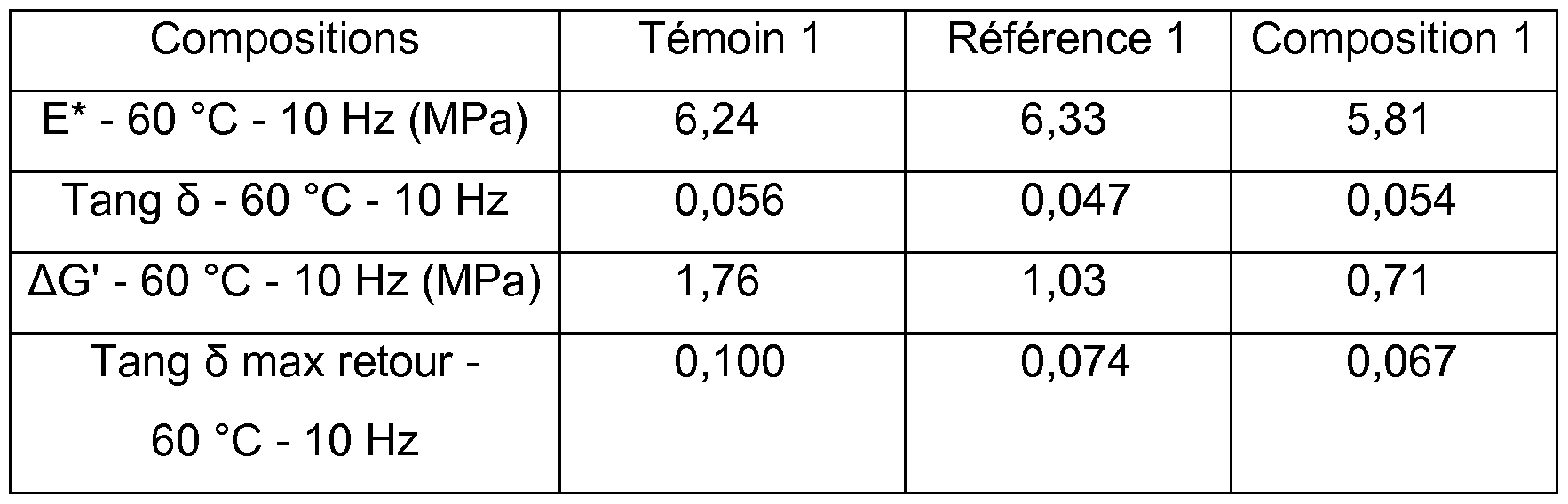
- composition 1 has very good dynamic properties (hysteretic properties at 60 ° C.), especially with respect to the reference composition (reference 1) and also with respect to the control composition (control 1) .
- composition 1 has a very good compromise of properties.
- Example 2 This example illustrates the use and behavior of the aluminum-containing precipitated silica prepared in Example 2 with 3-acryloxypropyltriethoxysilane in an elastomeric composition.
- elastomeric compositions are prepared whose constitution, expressed in part by weight per 100 parts of elastomers (phr), is given in Table VI below.
- a first phase consists in a thermomechanical work phase at high temperature. It is followed by a second phase of mechanical work at temperatures below 110 ° C; this phase allows the introduction of the vulcanization system.
- the first phase is carried out in a Haake type internal mixer (capacity of 300 mL).
- the fill factor is 0.75.
- the initial temperature and the speed of the rotors are fixed each time so as to reach mixing drop temperatures of about 140-160 ° C.
- the first phase is decomposed here in two passes.
- the elastomer natural rubber
- the reinforcing inorganic filler consisting of silica (fractional introduction) with the coupling agent and stearic acid; the duration of this pass is between 4 and 10 minutes.
- a second pass After cooling the mixture (temperature below 100 ° C.), a second pass makes it possible to incorporate the zinc oxide and the protective / antioxidant agents (6-PPD in particular); the duration of this pass is between 2 and 5 minutes.
- the second phase allows the introduction of the vulcanization system (sulfur and accelerators, such as CBS). It is carried out on a roll mill, preheated to 50 ° C. The duration of this phase is between 2 and 6 minutes.
- sulfur and accelerators such as CBS
- the Mooney consistency is measured as in Example 5.
- composition 2 has a very good flood viscosity, lower than that of the reference composition (reference 2) containing the same coupling agent but associated with a precipitated silica having a content aluminum not conforming to that required by the invention, or that of the control composition (control 2) containing the same silica precipitated but associated with another coupling agent.
- compositions witness 2 Reference 2 Composition 2 Cmin (dNm) 13.0 1 1, 2 10.8
- composition 1 has a very satisfactory set of rheological properties, and especially with respect to the reference composition (reference 2) containing the same coupling agent but associated with a precipitated silica exhibiting aluminum content not in accordance with that required by the invention.
- composition 2 has a good vulcanization kinetics (TS2), especially with respect to the reference composition (reference 2) and with respect to the control composition (control 2), and without penalizing the viscosity of the raw mixture (illustrated in particular by the minimum torque).
- TS2 good vulcanization kinetics
- compositions vulcanized at the optimum that is to say at a state of vulcanization corresponding to 98% of the complete vulcanization
- the uniaxial tensile tests are carried out in accordance with the NF ISO 37 standard with type H2 specimens at a speed of 500 mm / min on an INSTRON 5564 device.
- the x% modules correspond to the stress measured at x% deformation. in tensile and are expressed, as the breaking strength in MPa. It is possible to determine a reinforcement index (IR) which is equal to the ratio between the 300% deformation modulus and the 100% deformation modulus.
- IR reinforcement index
- composition 2 has a very good compromise of mechanical properties, at least comparable to, or better than, that obtained with the reference composition (reference 2) or the control composition ( witness 2). Dynamic properties of vulcanisais
- composition 2 has very good dynamic properties (hysteretic properties at 60 ° C.), especially with respect to the reference composition (reference 2) and to the control composition (control 2).
- composition 2 has a very good compromise of properties.
- This example illustrates the use and behavior of a precipitated silica S, containing more than 0.5% by weight of aluminum and having the following characteristics, and 3-acryloxypropyltriethoxysilane in an elastomeric composition.
- the precipitated silica S has the following characteristics:
- elastomeric compositions are prepared whose constitution, expressed in part by weight per 100 parts of elastomers (phr), is shown in Table I below.
- a first phase consists in a thermomechanical work phase at high temperature. It is followed by a second phase of mechanical work at temperatures below 110 ° C; this phase allows the introduction of the vulcanization system.
- the first phase is carried out in a Haake-type internal mixer
- the initial temperature and the speed of the rotors are fixed each time so as to reach mixing temperatures of the vicinity of 150-170 ° C.
- the first phase is decomposed here in two passes. It allows to incorporate, in a first pass, the elastomer (natural rubber), then the reinforcing inorganic filler consisting of silica (fractional introduction) with the coupling agent and stearic acid; the duration of this pass is between 4 and 10 minutes.
- a second pass After cooling the mixture (temperature below 100 ° C.), a second pass makes it possible to incorporate the zinc oxide and the protective / antioxidant agents (6-PPD in particular); the duration of this pass is between 2 and 5 minutes.
- the second phase allows the introduction of the vulcanization system (sulfur and accelerators, such as CBS). It is carried out on a roll mill, preheated to 50 ° C. The duration of this phase is between 2 and 6 minutes.
- sulfur and accelerators such as CBS
- the Mooney consistency is measured on the compositions in the uncured state at 100 ° C. by means of a MV 2000 rheometer according to the NF ISO 289 standard.
- the composition to be tested is placed in the controlled test chamber at a temperature of 150 ° C. for 30 minutes, and the resistive torque opposed by the composition is measured at a low amplitude oscillation (3 °).
- a biconical rotor included in the test chamber the composition completely filling the chamber in question.
- the roasting time TS2 corresponding to the time required to have a rise of 2 points above the minimum torque at the temperature in question (150 ° C.) and reflecting the time during which it is possible to use the raw mixtures with this temperature without initiation of vulcanization (the mixture cures from TS2).
- composition 3 The composition resulting from the invention (composition 3) leads to rather low values of Mooney consistency and minimum torque.
- the composition resulting from the invention has a satisfactory raw viscosity (Mooney consistency), lower than that of the control composition (control 3).
- this composition according to the invention has satisfactory rheological properties. She presents a good vulcanization kinetics (TS2), particularly with respect to the control composition, and without penalizing the viscosity of the raw mixture (illustrated by the minimum torque). Mechanical properties of vulcanisais
- compositions vulcanized at the optimum that is to say at a state of vulcanization corresponding to 98% of the complete vulcanization
- the uniaxial tensile tests are carried out in accordance with the NF ISO 37 standard with type H2 specimens at a speed of 500 mm / min on an INSTRON 5564 device.
- the x% modules correspond to the stress measured at x% deformation. in tension and are expressed, as the breaking strength, in MPa. It is possible to determine a reinforcement index (I.R.) which is equal to the ratio between the 300% deformation modulus and the 100% deformation modulus.
- the measurement of loss of mass by abrasion is carried out according to the indications of standard NF ISO 4649, using a Zwick abraser where the cylindrical specimen is subjected to the action of an abrasive cloth of grains P60 and fixed on the surface of a drum rotating under a contact pressure of 10 N and a stroke of 40 m.
- the measured value is a volume of loss of substance (in mm 3 ) after wear by abrasion; the lower it is, the better the resistance to abrasion.
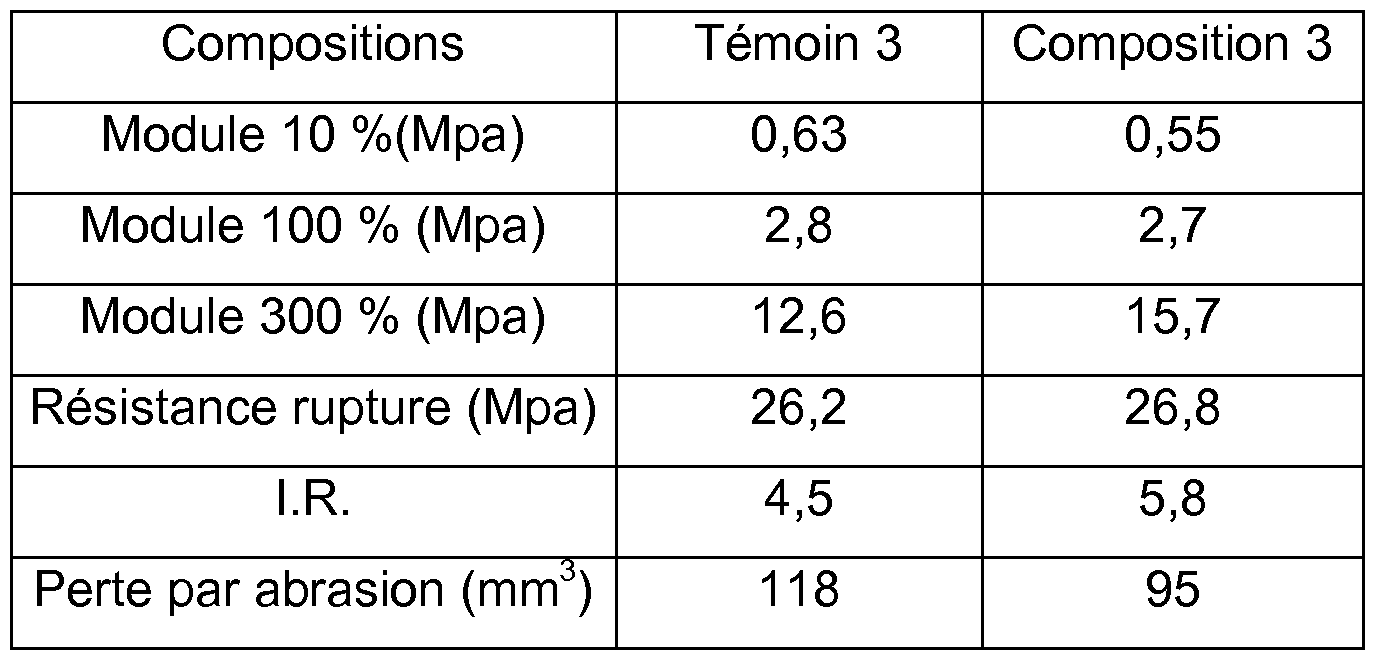
- composition 3 the composition resulting from the invention (composition 3) has a very good compromise of mechanical properties, especially with respect to what is obtained with the control composition (control 3).
- composition resulting from the invention thus has relatively low 10% and 100% moduli and a 300% high modulus, hence a higher reinforcement index.
- this composition 3 has, in addition to a satisfactory breaking strength, a lower abrasion loss, that is to say a better resistance to abrasion, resulting in a gain in resistance to abrasion. wear, which is important in pneumatic applications, especially for heavy goods vehicles.
- Dynamic properties are measured on a viscoanalyzer (Metravib VA3000) according to ASTM D5992.
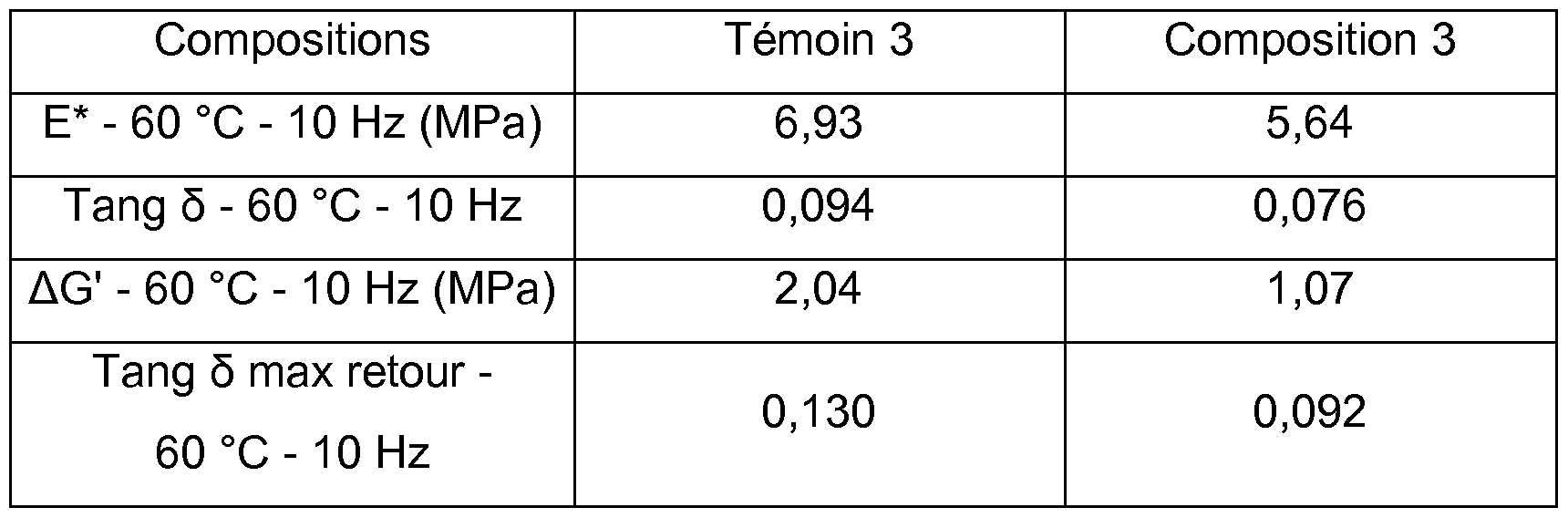
- composition 3 The composition resulting from the invention (composition 3) has very good dynamic properties (hysteretic properties at 60 ° C.), especially with respect to the control composition (control 3).
- composition 3 has a very good compromise of properties.
Landscapes
- Chemical & Material Sciences (AREA)
- Organic Chemistry (AREA)
- Health & Medical Sciences (AREA)
- Chemical Kinetics & Catalysis (AREA)
- Medicinal Chemistry (AREA)
- Polymers & Plastics (AREA)
- Engineering & Computer Science (AREA)
- Mechanical Engineering (AREA)
- Compositions Of Macromolecular Compounds (AREA)
- Silicon Compounds (AREA)
Abstract
Description




Claims
Priority Applications (6)
| Application Number | Priority Date | Filing Date | Title |
|---|---|---|---|
| EP11712249A EP2552713A2 (fr) | 2010-04-01 | 2011-04-01 | Utilisation d'une silice precipitee contenant de l'aluminium et de 3-acryloxy-propyltriethoxysilane dans une composition d'elastomere(s) isoprenique(s) |
| JP2013501868A JP2013523934A (ja) | 2010-04-01 | 2011-04-01 | イソプレン系エラストマー組成物中におけるアルミニウム含有沈降シリカ及び3−アクリルオキシプロピルトリエトキシシランの使用 |
| RU2012146510/05A RU2541066C2 (ru) | 2010-04-01 | 2011-04-01 | Применение осажденного диоксида кремния, содержащего алюминий, и 3-акрилоксипропилтриэтоксисилана в композиции одного или нескольких изопреновых эластомеров |
| US13/638,861 US20130178569A1 (en) | 2010-04-01 | 2011-04-01 | Use of precipitated silica containing aluminium and 3-acryloxy-propyltriethoxysilane in an isoprenic elastomer composition |
| KR1020127025669A KR20120130241A (ko) | 2010-04-01 | 2011-04-01 | 이소프렌산 엘라스토머 조성물에서 알루미늄 함유 침전 실리카 및 3-아크릴옥시프로필트리에톡시실란의 용도 |
| CN2011800165583A CN102869521A (zh) | 2010-04-01 | 2011-04-01 | 含有铝的沉淀二氧化硅和3-丙烯酰氧基丙基三乙氧基硅烷在异戊二烯弹性体组合物中的用途 |
Applications Claiming Priority (4)
| Application Number | Priority Date | Filing Date | Title |
|---|---|---|---|
| FR1001368A FR2958294B1 (fr) | 2010-04-01 | 2010-04-01 | Utilisation d'une silice precipitee contenant de l'aluminium et de 3-acryloxy-propyltriethoxysilane dans une composition d'elastomere(s) isoprenique(s) |
| FR1001368 | 2010-04-01 | ||
| FR1004309 | 2010-11-03 | ||
| FR1004309A FR2966829B1 (fr) | 2010-11-03 | 2010-11-03 | Utilisation d'une silice precipitee contenant de l'aluminium et ayant une distribution poreuse particuliere et de 3-acryloxy-propyltriethoxysilane dans une compostion d'elastomere(s) isoprenique(s) |
Publications (2)
| Publication Number | Publication Date |
|---|---|
| WO2011121129A2 true WO2011121129A2 (fr) | 2011-10-06 |
| WO2011121129A3 WO2011121129A3 (fr) | 2012-10-26 |
Family
ID=44712685
Family Applications (1)
| Application Number | Title | Priority Date | Filing Date |
|---|---|---|---|
| PCT/EP2011/055141 Ceased WO2011121129A2 (fr) | 2010-04-01 | 2011-04-01 | Utilisation d'une silice precipitee contenant de l'aluminium et de 3-acryloxy-propyltriethoxysilane dans une composition d'elastomere(s) isoprenique(s) |
Country Status (7)
| Country | Link |
|---|---|
| US (1) | US20130178569A1 (fr) |
| EP (1) | EP2552713A2 (fr) |
| JP (1) | JP2013523934A (fr) |
| KR (1) | KR20120130241A (fr) |
| CN (1) | CN102869521A (fr) |
| RU (1) | RU2541066C2 (fr) |
| WO (1) | WO2011121129A2 (fr) |
Cited By (5)
| Publication number | Priority date | Publication date | Assignee | Title |
|---|---|---|---|---|
| WO2015121330A1 (fr) * | 2014-02-14 | 2015-08-20 | Rhodia Operations | Procédé pour la préparation de silice précipitée, silice précipitée et ses utilisations, notamment pour le renforcement de polymères |
| FR3018070A1 (fr) * | 2014-02-28 | 2015-09-04 | Rhodia Operations | Nouveau procede de preparation de silices precipitees, nouvelles silices precipitees et leurs utilisations, notamment pour le renforcement de polymeres |
| FR3018072A1 (fr) * | 2014-02-28 | 2015-09-04 | Rhodia Operations | Nouveau procede de preparation de silices precipitees, nouvelles silices precipitees et leurs utilisations, notamment pour le renforcement de polymeres |
| CN106061899A (zh) * | 2014-02-28 | 2016-10-26 | 罗地亚经营管理公司 | 制备沉淀二氧化硅的新颖的方法,新颖的沉淀二氧化硅及其用途,尤其是用于增强聚合物 |
| WO2018202755A1 (fr) * | 2017-05-05 | 2018-11-08 | Rhodia Operations | Silice précipitée et procédé pour sa fabrication |
Families Citing this family (15)
| Publication number | Priority date | Publication date | Assignee | Title |
|---|---|---|---|---|
| FR2997405B1 (fr) * | 2012-10-29 | 2015-11-13 | Rhodia Operations | Utilisation d'une silice precipitee contenant du titane et d'un agent de couplage specifique dans une composition d'elastomere(s) |
| ES2688532T3 (es) | 2013-01-18 | 2018-11-05 | Basf Se | Composiciones de recubrimiento a base de dispersión acrílica |
| FR3001971B1 (fr) * | 2013-02-14 | 2016-05-27 | Rhodia Operations | Utilisation d'un acide polycarboxylique lors de la preparation d'une composition d'elastomere(s) |
| CN103613896B (zh) * | 2013-12-04 | 2016-01-20 | 国家电网公司 | 一种电缆填充材料及其制备方法 |
| EP3105179B1 (fr) * | 2014-02-14 | 2018-05-02 | Rhodia Operations | Procédé de préparation de silices précipitées, silices précipitées et leurs utilisations, notamment pour le renforcement de polymères |
| FR3017609B1 (fr) * | 2014-02-14 | 2016-03-18 | Rhodia Operations | Nouveau procede de preparation de silices precipitees, nouvelles silices precipitees et leurs utilisations, notamment pour le renforcement de polymeres |
| TWI658004B (zh) * | 2014-02-28 | 2019-05-01 | 法商隆迪亞營運公司 | 製備沈澱二氧化矽之方法、沈澱二氧化矽及其用途,特別是用於增強聚合物 |
| EP3110756B1 (fr) * | 2014-02-28 | 2019-04-10 | Rhodia Operations | Procédé de préparation de silice modifiée, silice modifiée et ses utilisations, notamment pour le renforcement de polymères |
| IT201600073305A1 (it) * | 2015-07-15 | 2018-01-13 | Cabot Corp | Composito di elastomero rinforzato con silice e prodotti che lo contengono. |
| CA2992259C (fr) | 2015-07-15 | 2020-06-02 | Cabot Corporation | Procedes de fabrication d'un composite d'elastomere renforce de silice et produits le contenant |
| EP3330294B1 (fr) * | 2016-12-05 | 2020-08-26 | Dayco Europe S.R.L. | Courroie de transmission de puissance |
| WO2018202752A1 (fr) * | 2017-05-05 | 2018-11-08 | Rhodia Operations | Silice précipitée et procédé pour sa fabrication |
| WO2018202756A1 (fr) * | 2017-05-05 | 2018-11-08 | Rhodia Operations | Silice précipitée et procédé pour sa fabrication |
| WO2020094714A1 (fr) * | 2018-11-08 | 2020-05-14 | Rhodia Operations | Silice précipitée et son procédé de fabrication |
| WO2023118281A1 (fr) * | 2021-12-23 | 2023-06-29 | Rhodia Operations | Silice précipitée et son procédé de fabrication |
Citations (5)
| Publication number | Priority date | Publication date | Assignee | Title |
|---|---|---|---|---|
| US3179612A (en) | 1962-02-02 | 1965-04-20 | Dow Corning | alpha, beta-unsaturated carboxylicester-substituted organosilicon compounds |
| EP0762992A1 (fr) | 1995-03-29 | 1997-03-19 | Rhone-Poulenc Chimie | Nouveau procede de preparation de silice precipitee, nouvelles silices precipitees contenant de l'aluminium et leur utilisation au renforcement des elastomeres |
| EP0762993A1 (fr) | 1995-03-29 | 1997-03-19 | Rhone-Poulenc Chimie | Nouveau procede de preparation de silice precipitee, nouvelles silices precipitees contenant de l'aluminium et leur utilisation au renforcement des elastomeres |
| EP0983966A1 (fr) | 1998-09-03 | 2000-03-08 | Degussa-Hüls Aktiengesellschaft | Silice de précipitation |
| EP1355856A1 (fr) | 2000-12-28 | 2003-10-29 | Rhodia Chimie | Procede de preparation de silice precipitee contenant de l'aluminium |
Family Cites Families (9)
| Publication number | Priority date | Publication date | Assignee | Title |
|---|---|---|---|---|
| US3376188A (en) * | 1965-01-04 | 1968-04-02 | Exxon Research Engineering Co | Terpolymer compositions and process of producing same |
| FR2732351B1 (fr) * | 1995-03-29 | 1998-08-21 | Michelin & Cie | Composition de caoutchouc pour enveloppe de pneumatique renfermant de la silice dopee aluminium a titre de charge renforcante |
| JP3966601B2 (ja) * | 1998-03-20 | 2007-08-29 | 株式会社ブリヂストン | シリカ配合ゴム組成物及びその製造方法 |
| ATE252614T1 (de) * | 1999-12-30 | 2003-11-15 | Michelin Soc Tech | Kautschukzusammensetzung für reifen mit einem kupplungsmittel (wesiser füllstoff/dienelastomer),das durch einen thermisch initierbaren radikalstarter aktiviert wird |
| JP3678627B2 (ja) * | 2000-04-11 | 2005-08-03 | 横浜ゴム株式会社 | ゴム組成物 |
| US6753374B1 (en) * | 2000-06-08 | 2004-06-22 | Uniroyal Chemical Company, Inc. | Rubber compositions and method for increasing the Mooney Scorch value |
| CN100334135C (zh) * | 2000-06-16 | 2007-08-29 | 米其林技术公司 | 含有多官能聚有机硅氧烷作为偶联剂的轮胎橡胶组合物 |
| US7138537B2 (en) * | 2003-04-02 | 2006-11-21 | General Electric Company | Coupling agents for mineral-filled elastomer compositions |
| US7595360B2 (en) * | 2006-11-30 | 2009-09-29 | The Goodyear Tire & Rubber Company | Rubber composition containing diene-based elastomer, precipitated silica, coupling agent and alcohol-adsorbing activated carbon and pneumatic tire with component |
-
2011
- 2011-04-01 JP JP2013501868A patent/JP2013523934A/ja not_active Ceased
- 2011-04-01 KR KR1020127025669A patent/KR20120130241A/ko not_active Ceased
- 2011-04-01 EP EP11712249A patent/EP2552713A2/fr not_active Withdrawn
- 2011-04-01 WO PCT/EP2011/055141 patent/WO2011121129A2/fr not_active Ceased
- 2011-04-01 US US13/638,861 patent/US20130178569A1/en not_active Abandoned
- 2011-04-01 CN CN2011800165583A patent/CN102869521A/zh active Pending
- 2011-04-01 RU RU2012146510/05A patent/RU2541066C2/ru not_active IP Right Cessation
Patent Citations (5)
| Publication number | Priority date | Publication date | Assignee | Title |
|---|---|---|---|---|
| US3179612A (en) | 1962-02-02 | 1965-04-20 | Dow Corning | alpha, beta-unsaturated carboxylicester-substituted organosilicon compounds |
| EP0762992A1 (fr) | 1995-03-29 | 1997-03-19 | Rhone-Poulenc Chimie | Nouveau procede de preparation de silice precipitee, nouvelles silices precipitees contenant de l'aluminium et leur utilisation au renforcement des elastomeres |
| EP0762993A1 (fr) | 1995-03-29 | 1997-03-19 | Rhone-Poulenc Chimie | Nouveau procede de preparation de silice precipitee, nouvelles silices precipitees contenant de l'aluminium et leur utilisation au renforcement des elastomeres |
| EP0983966A1 (fr) | 1998-09-03 | 2000-03-08 | Degussa-Hüls Aktiengesellschaft | Silice de précipitation |
| EP1355856A1 (fr) | 2000-12-28 | 2003-10-29 | Rhodia Chimie | Procede de preparation de silice precipitee contenant de l'aluminium |
Non-Patent Citations (1)
| Title |
|---|
| BRUNAUER, EMMETT, TELLER, THE JOURNAL OF THE AMERICAN CHEMICAL SOCIETY, vol. 60, 1938, pages 309 |
Cited By (12)
| Publication number | Priority date | Publication date | Assignee | Title |
|---|---|---|---|---|
| WO2015121330A1 (fr) * | 2014-02-14 | 2015-08-20 | Rhodia Operations | Procédé pour la préparation de silice précipitée, silice précipitée et ses utilisations, notamment pour le renforcement de polymères |
| FR3018070A1 (fr) * | 2014-02-28 | 2015-09-04 | Rhodia Operations | Nouveau procede de preparation de silices precipitees, nouvelles silices precipitees et leurs utilisations, notamment pour le renforcement de polymeres |
| FR3018072A1 (fr) * | 2014-02-28 | 2015-09-04 | Rhodia Operations | Nouveau procede de preparation de silices precipitees, nouvelles silices precipitees et leurs utilisations, notamment pour le renforcement de polymeres |
| WO2015135758A1 (fr) * | 2014-02-28 | 2015-09-17 | Rhodia Operations | Nouveau procede de preparation de silices precipitees, nouvelles silices precipitees et leurs utilisations, notamment pour le renforcement de polymeres |
| WO2015154914A1 (fr) * | 2014-02-28 | 2015-10-15 | Rhodia Operations | Nouveau procede de preparation de silices precipitees, nouvelles silices precipitees et leurs utilisations, notamment pour le renforcement de polymeres |
| CN106061899A (zh) * | 2014-02-28 | 2016-10-26 | 罗地亚经营管理公司 | 制备沉淀二氧化硅的新颖的方法,新颖的沉淀二氧化硅及其用途,尤其是用于增强聚合物 |
| CN106061897A (zh) * | 2014-02-28 | 2016-10-26 | 罗地亚经营管理公司 | 制备沉淀二氧化硅的新颖的方法,新颖的沉淀二氧化硅及其用途,尤其是用于增强聚合物 |
| CN106061899B (zh) * | 2014-02-28 | 2018-11-20 | 罗地亚经营管理公司 | 制备沉淀二氧化硅的新颖的方法,新颖的沉淀二氧化硅及其用途,尤其是用于增强聚合物 |
| CN106061897B (zh) * | 2014-02-28 | 2018-11-20 | 罗地亚经营管理公司 | 制备沉淀二氧化硅的新颖的方法,新颖的沉淀二氧化硅及其用途,尤其是用于增强聚合物 |
| US11084729B2 (en) | 2014-02-28 | 2021-08-10 | Rhodia Operations | Method for preparing precipitated silicas, novel precipitated silicas and uses thereof, particularly for the reinforcement of polymers |
| WO2018202755A1 (fr) * | 2017-05-05 | 2018-11-08 | Rhodia Operations | Silice précipitée et procédé pour sa fabrication |
| US11554963B2 (en) | 2017-05-05 | 2023-01-17 | Rhodia Operations | Precipitated silica and process for its manufacture |
Also Published As
| Publication number | Publication date |
|---|---|
| WO2011121129A3 (fr) | 2012-10-26 |
| RU2541066C2 (ru) | 2015-02-10 |
| US20130178569A1 (en) | 2013-07-11 |
| KR20120130241A (ko) | 2012-11-29 |
| JP2013523934A (ja) | 2013-06-17 |
| CN102869521A (zh) | 2013-01-09 |
| EP2552713A2 (fr) | 2013-02-06 |
| RU2012146510A (ru) | 2014-05-10 |
Similar Documents
| Publication | Publication Date | Title |
|---|---|---|
| EP2552713A2 (fr) | Utilisation d'une silice precipitee contenant de l'aluminium et de 3-acryloxy-propyltriethoxysilane dans une composition d'elastomere(s) isoprenique(s) | |
| EP2890637B1 (fr) | Nouveau procede de preparation de silices precipitees, nouvelles silices precipitees et leurs utilisations, notamment pour le renforcement de polymeres | |
| EP3105181B1 (fr) | Nouveau procede de preparation de silices precipitees, nouvelles silices precipitees et leurs utilisations, notamment pour le renforcement de polymeres | |
| EP2956504A1 (fr) | Utilisation d'un acide polycarboxylique lors de la preparation d'une composition d'élastomère(s) | |
| EP2890638B1 (fr) | Nouveau procede de preparation de silices precipitees, nouvelles silices precipitees et leurs utilisations, notamment pour le renforcement de polymeres | |
| FR3017609A1 (fr) | Nouveau procede de preparation de silices precipitees, nouvelles silices precipitees et leurs utilisations, notamment pour le renforcement de polymeres | |
| WO2014033303A1 (fr) | Nouveau procede de preparation de silices precipitees, nouvelles silices precipitees et leurs utilisations, notamment pour le renforcement de polymeres | |
| EP3110759A1 (fr) | Nouveau procede de preparation de silices precipitees, nouvelles silices precipitees et leurs utilisations, notamment pour le renforcement de polymeres | |
| WO2012059230A1 (fr) | Utilisation d'une silice precipitee contenant de l'aluminium, d'une silice precipitee et de 3-acryloxy-propyltriethoxysilane dans une composition d'elastomere(s) isoprenique(s) | |
| EP2912111A1 (fr) | Utilisation d'une silice precipitee contenant du titane et d'un agent de couplage specifique dans une composition d'elastomere(s) | |
| EP3110630A1 (fr) | Nouveau procede de preparation de silices precipitees, nouvelles silices precipitees et leurs utilisations, notamment pour le renforcement de polymeres | |
| EP1976799A1 (fr) | Procédé de préparation de mélanges de caoutchouc renfermant du dioxyde de silicium | |
| FR2958294A1 (fr) | Utilisation d'une silice precipitee contenant de l'aluminium et de 3-acryloxy-propyltriethoxysilane dans une composition d'elastomere(s) isoprenique(s) | |
| WO2012059234A1 (fr) | Utilisation d'une silice a distribution granulometrique et/ou repartition poreuse particulieres et de 3-acryloxy-propyltriethoxysilane dans une composition d'elastomere(s) isoprenique(s) | |
| WO2012059220A1 (fr) | Utilisation d'une silice precipitee a surface specifique elevee et de 3-acryloxy-propyltriethoxysilane dans une composition d'elastomere(s) isoprenique(s) | |
| FR2966829A1 (fr) | Utilisation d'une silice precipitee contenant de l'aluminium et ayant une distribution poreuse particuliere et de 3-acryloxy-propyltriethoxysilane dans une compostion d'elastomere(s) isoprenique(s) | |
| WO2012059219A1 (fr) | Utilisation d'une silice precipitee sous forme de granules, ayant une distribution poreuse particuliere, et de 3-acryloxy-propyltriethoxysilane dans une composition d'elastomere(s) isoprenique(s) |
Legal Events
| Date | Code | Title | Description |
|---|---|---|---|
| WWE | Wipo information: entry into national phase |
Ref document number: 201180016558.3 Country of ref document: CN |
|
| 121 | Ep: the epo has been informed by wipo that ep was designated in this application |
Ref document number: 11712249 Country of ref document: EP Kind code of ref document: A2 |
|
| ENP | Entry into the national phase |
Ref document number: 20127025669 Country of ref document: KR Kind code of ref document: A |
|
| NENP | Non-entry into the national phase |
Ref country code: DE |
|
| WWE | Wipo information: entry into national phase |
Ref document number: 2013501868 Country of ref document: JP |
|
| REEP | Request for entry into the european phase |
Ref document number: 2011712249 Country of ref document: EP |
|
| WWE | Wipo information: entry into national phase |
Ref document number: 2011712249 Country of ref document: EP |
|
| ENP | Entry into the national phase |
Ref document number: 2012146510 Country of ref document: RU Kind code of ref document: A |
|
| WWE | Wipo information: entry into national phase |
Ref document number: 13638861 Country of ref document: US |
|
| REG | Reference to national code |
Ref country code: BR Ref legal event code: B01A Ref document number: 112012024913 Country of ref document: BR |
|
| ENP | Entry into the national phase |
Ref document number: 112012024913 Country of ref document: BR Kind code of ref document: A2 Effective date: 20120928 |