WO2011123031A1 - Branched, compact polyethyleneglycol derivatives - Google Patents

Branched, compact polyethyleneglycol derivatives Download PDF

Info

Publication number
WO2011123031A1
WO2011123031A1 PCT/SE2011/050346 SE2011050346W WO2011123031A1 WO 2011123031 A1 WO2011123031 A1 WO 2011123031A1 SE 2011050346 W SE2011050346 W SE 2011050346W WO 2011123031 A1 WO2011123031 A1 WO 2011123031A1
Authority
WO
WIPO (PCT)
Prior art keywords
group
branched peg
och
hydrocarbon
derivative according
Prior art date
Legal status (The legal status is an assumption and is not a legal conclusion. Google has not performed a legal analysis and makes no representation as to the accuracy of the status listed.)
Ceased
Application number
PCT/SE2011/050346
Other languages
French (fr)
Inventor
Oskar Axelsson
Fredrik Ek
Current Assignee (The listed assignees may be inaccurate. Google has not performed a legal analysis and makes no representation or warranty as to the accuracy of the list.)
Spago Nanomedical AB
Original Assignee
SPAGO IMAGING AB
Priority date (The priority date is an assumption and is not a legal conclusion. Google has not performed a legal analysis and makes no representation as to the accuracy of the date listed.)
Filing date
Publication date
Application filed by SPAGO IMAGING AB filed Critical SPAGO IMAGING AB
Priority to US13/636,771 priority Critical patent/US20130022669A1/en
Priority to JP2013502531A priority patent/JP2013523943A/en
Priority to CN201180017015.3A priority patent/CN102834435B/en
Priority to BR112012024655A priority patent/BR112012024655A2/en
Priority to EP11763144.0A priority patent/EP2552998A4/en
Publication of WO2011123031A1 publication Critical patent/WO2011123031A1/en
Anticipated expiration legal-status Critical
Ceased legal-status Critical Current

Links

Classifications

    • CCHEMISTRY; METALLURGY
    • C08ORGANIC MACROMOLECULAR COMPOUNDS; THEIR PREPARATION OR CHEMICAL WORKING-UP; COMPOSITIONS BASED THEREON
    • C08GMACROMOLECULAR COMPOUNDS OBTAINED OTHERWISE THAN BY REACTIONS ONLY INVOLVING UNSATURATED CARBON-TO-CARBON BONDS
    • C08G65/00Macromolecular compounds obtained by reactions forming an ether link in the main chain of the macromolecule
    • C08G65/02Macromolecular compounds obtained by reactions forming an ether link in the main chain of the macromolecule from cyclic ethers by opening of the heterocyclic ring
    • C08G65/32Polymers modified by chemical after-treatment
    • C08G65/329Polymers modified by chemical after-treatment with organic compounds
    • CCHEMISTRY; METALLURGY
    • C08ORGANIC MACROMOLECULAR COMPOUNDS; THEIR PREPARATION OR CHEMICAL WORKING-UP; COMPOSITIONS BASED THEREON
    • C08GMACROMOLECULAR COMPOUNDS OBTAINED OTHERWISE THAN BY REACTIONS ONLY INVOLVING UNSATURATED CARBON-TO-CARBON BONDS
    • C08G65/00Macromolecular compounds obtained by reactions forming an ether link in the main chain of the macromolecule
    • C08G65/02Macromolecular compounds obtained by reactions forming an ether link in the main chain of the macromolecule from cyclic ethers by opening of the heterocyclic ring
    • C08G65/32Polymers modified by chemical after-treatment
    • C08G65/329Polymers modified by chemical after-treatment with organic compounds
    • C08G65/336Polymers modified by chemical after-treatment with organic compounds containing silicon
    • CCHEMISTRY; METALLURGY
    • C08ORGANIC MACROMOLECULAR COMPOUNDS; THEIR PREPARATION OR CHEMICAL WORKING-UP; COMPOSITIONS BASED THEREON
    • C08GMACROMOLECULAR COMPOUNDS OBTAINED OTHERWISE THAN BY REACTIONS ONLY INVOLVING UNSATURATED CARBON-TO-CARBON BONDS
    • C08G65/00Macromolecular compounds obtained by reactions forming an ether link in the main chain of the macromolecule
    • C08G65/02Macromolecular compounds obtained by reactions forming an ether link in the main chain of the macromolecule from cyclic ethers by opening of the heterocyclic ring
    • C08G65/32Polymers modified by chemical after-treatment
    • C08G65/329Polymers modified by chemical after-treatment with organic compounds
    • C08G65/337Polymers modified by chemical after-treatment with organic compounds containing other elements
    • CCHEMISTRY; METALLURGY
    • C08ORGANIC MACROMOLECULAR COMPOUNDS; THEIR PREPARATION OR CHEMICAL WORKING-UP; COMPOSITIONS BASED THEREON
    • C08LCOMPOSITIONS OF MACROMOLECULAR COMPOUNDS
    • C08L2203/00Applications
    • C08L2203/02Applications for biomedical use

Definitions

  • the present invention relates to branched polyethyleneglycol (PEG) derivatives with advantages over currently available PEG derivatives. They are especially applicable for conjugation with nanoparticles, proteins, pep- tides, pharmaceutically active small molecules, liposomes, homogenous catalysts and bio-inert surfaces.
  • PEG polyethyleneglycol
  • Bio-inert polar polymers and in particular polyethyleneglycol
  • PEG also called polyethyleneoxide; PEO
  • Lately covalent grafting with PEG have been used to modify proteins, peptides, oligonucleotides, antibody fragments, small molecule drugs, catalysts, surfaces and particles. These modified conjugates often obtain superior properties such as decreased immunogenicity or antigenicity, improved pharmacokinetic and pharmadynamic properties, enhanced solubility in aqueous media, increased stability and reduced clearance rate from the body.
  • PEG-adenosine deaminase for treatment of adenosine deaminase deficiency (ADA deficiency).
  • Organic catalysts have also been covalently modified with PEG- derivatives to allow reactions in water (Hong and Grubbs, J. Am. Chem. Soc. 2006, 128, 3508).
  • Branched PEG characterized by two or more PEG chains linked to a common center, has been developed as an alternative to the more common linear PEG derivatives.
  • Monfardini et al. (Bioconj. Chem. 1995, 6, 62-69) reported that surface modification of proteins using branched PEG derivatives resulted in increased biocompatibility and better stability. These PEGs allows for a better masking and protection of the connected surface/molecule.
  • the modification of protein using branched PEG provides a more efficient usage of amino acids/amino acid side chains available for chemical linking, thus more PEG polymer per modification. Fewer chemical modifications of the protein increase the probability of retaining the native structure of the biomolecule and hence the biological activity.
  • Large macromolecules are commonly modified using PEG polymer of molecular weights ranging from 5 kDa to 90 kDa to obtain reduced clearance from the blood, better specificity while preserving biologi- cal activity.
  • large PEG molecules are not suitable for modifications of small organic molecules.
  • Conjugates of pharmaceutically active small molecules and large PEG polymers prevents, in most cases, the conjugate to interact with receptors or binding pockets due to sterical hindrance or even alter the ability of the molecule to diffuse through membranes to reach their target.
  • Conjugates with large PEG moieties have low diffusion rates, just like any large molecules.
  • PEG derivatives with molecular weights of less than 2 kDa are generally used for modification of small organic molecules.
  • macromolecules tol- erate attachment of PEG to several positions using smaller PEG although it is normally beneficial to have as few as possible.
  • small organic compounds have few points for the attachment of PEG and it is much more difficult to obtain conjugates that retain the unmodified molecule's bioac- tive properties.
  • branched PEG-like structures (as part of a larger structure) which have a superficial likeness to the structures present invention but lack the essential feature of being discrete and useful for the applications disclosed here.
  • branched PEG derivatives of defined character differs from the present invention in the following non-beneficial ways; They utilize 2,2,2-tris(hydroxymethyl)methyl- amine as the core structure so the detailed structures are more complex and thus more expensive to produce.
  • the core is based on amides and hence more sensitive to hydrolysis, and the individual branched PEG derivatives contain thioethers, a functionality known for being notoriously sensitive to oxi- dization, which can be a further source of heterogeneity of the product.
  • the core structure is not compact and thus not useful for some of the applications disclosed here.
  • nanoparticle is used to describe a particle of any shape with a longest measure from 1 -100 nm.
  • Bio-inert refers to a material that is bio-compatible, i.e. harmless to a living organism and at the same time stable to degradation in-vivo.
  • “Monolayer” refers to a one molecule thick layer.
  • Oriented in the context of coatings refers to a layer of coating molecules where all the heads and tails (as arbitrarily defined from case to case but as intended in the present invention we consistently refer to the silane, where present, as the head) of the coating molecules are oriented in the same way in relation to the particle core surface.
  • Activated silane refers to a silane of the following type R n Si(X) 4-n , where X is an alkoxy group, aryloxy group, a halogen, a dialkylamino group, a nitrogen containing heterocycle or an acyloxy group and R is an organic group.
  • Oxysilane refers to any organic compounds with one or more oxygen atoms attached to the silicon atom. Non-limiting examples thereof are:
  • Organicsilane refers to organic compounds containing one or more carbon silicon bonds.
  • Organic residue refers to organic compounds covalently bond to a molecular entity.
  • Organic-oxysilane refers to organic compounds containing one or more carbon atoms and one or more oxygen atoms attached to the silicon atom. Non-limiting examples thereof are:
  • Hydrocarbon or “hydrocarbon chain” is an organic residue consisting of hydrogen and carbon.
  • a hydrocarbon may, when indicated, comprise heteroatoms selected from O, S and N. This means that one or more of the carbon atoms have been replaced by a heteroatom selected from O, S or N.
  • the hydrocarbon may be fully saturated or it may comprise one or more unsaturations. Unless otherwise specified, the hydrocarbon may contain any number of carbon atoms between 1 and 50.
  • the hydrocarbon group of the compounds may then be designated as "Ci-s hydrocarbon” or similar designations.
  • Typical hydrocarbon groups include, but are in no way limited to, methyl, ethyl, propyl, isopropyl, butyl, isobutyl, tertiary butyl, pentyl, hexyl, ethenyl, propenyl, butenyl, phenyl, benzyl.
  • Alkyl refers to a straight or branched hydrocarbon chain fully saturated (no double or triple bonds) hydrocarbon group.
  • the alkyl group may have 1 to 8 carbon atoms.
  • the alkyl group of the compounds may be designated as "C-1-8 alkyl” or similar designations.
  • Typical alkyl groups include, but are in no way limited to, methyl, ethyl, propyl, isopropyl, butyl, isobutyl, tertiary butyl, pentyl, hexyl, and the like.
  • “1 -8” refer to each integer in the given range; e.g., "from 1 to 8 carbon atoms” means that the alkyl group may consist of 1 carbon atom, 2 carbon atoms, 3 carbon atoms, etc., up to and including 8 carbon atoms.
  • alkoxy refers to the formula -OR wherein R is a Ci-s alkyl, e.g. methoxy, ethoxy, n-propoxy, 1 -methylethoxy (isopropoxy), n- butoxy, iso-butoxy, sec-butoxy, tert-butoxy, amyloxy, iso-amyloxy and the like.
  • R is a Ci-s alkyl, e.g. methoxy, ethoxy, n-propoxy, 1 -methylethoxy (isopropoxy), n- butoxy, iso-butoxy, sec-butoxy, tert-butoxy, amyloxy, iso-amyloxy and the like.
  • An alkoxy may be optionally substituted.
  • aryloxy refers to RO- in which R is an aryl wherein, “aryl” refers to a carbocyclic (all carbon) ring or two or more fused rings (rings that share two adjacent carbon atoms) that have a fully delocalized pi- electron system.
  • aryl groups include, but are not limited to, benzene, naphthalene and azulene.
  • An aryl group may be optionally substituted, e.g., phenoxy, naphthalenyloxy, azulenyloxy, anthracenyloxy, naphthalenyl- thio, phenylthio and the like.
  • An aryloxy may be optionally substituted
  • heterocycle refers to a stable 3- to 18 membered ring which consists of carbon atoms and from one to five heteroatoms selected from the group consisting of nitrogen, oxygen and sulfur.
  • the heterocycle may be monocyclic, bicyclic or tricyclic.
  • “Strong base” refers in the current context to bases that are stronger than hydroxide and not compatible with aqueous environments.
  • Conjugate refers to a molecular entity that is a fluorescence marker, dye, spin-label, radioactive marker, ligand to a biological receptor, chelate, enzyme inhibitor, enzyme substrate, antibody or anti-body related structure. See e.g. "Bioconjugate Techniques", Greg T. Hermanson second edition, Elsevier 2008, ISBN 978-0-12-370501 -3 for background on the subject.
  • “Handle for conjugation” or “attachment point” refers to a bifunctional molecule that can bind to, or be incorporated in, the silane coating but leaving one reactive group that can be linked to a conjugate, as defined above.
  • a typical, but not exclusive, example would be (EtO)3SiCH 2 CH 2 CH 2 NH 2 .
  • m-PEG refers to structures CH3-(OCH 2 CH 2 )n-OH where n depends on the circumstances.
  • Aprotic solvent refers to solvents which have no protons that can be removed or rapidly exchanged in an aqueous environment.
  • solvents Typical, but not limiting, examples of such solvents are tetrahydrofuran (THF), diethyl ether, glyme, diglyme, dimethyl formamide (DMF), dimethylsulfoxide, or N-methyl pyrrolidinone (NMP).
  • DCM is an acronym for dichloromethane.
  • a first aspect of the present invention is a branched polyethyleneglycol (PEG) derivative comprising three PEG chains attached to a common quaternary carbon atom. It may be preferred that all three PEG chains are of equal length and each comprises 1 -30 -OCH 2 CH 2 - units
  • the fourth group attached to said quaternary carbon atom can be any of a large number of different organic groups. This forth group shall contain a carbon atom, which is attached to the quaternary carbon atom.
  • R 1 A non-limiting list of examples of the fourth group attached to the quaternary carbon atom is given in the list describing group R 1 below.
  • the branched polyethyleneglycol (PEG) derivative according to the invention may have formula I or formula II:
  • n is selected from 1 -30;
  • R 1 is selected from the list given in Table 1 below;
  • A, B and C are independently selected from -Ci-Cs hydrocarbon, - (CH 2 ) 2 N 3 , -(CH 2 ) 2 NR 5 2, CH 2 COOR 4 ;
  • R 2 is selected from Ci-Cs hydrocarbon
  • R 3 is selected from d-s alkoxy group, aryloxy group, a halogen, a di- Ci-s-alkylamino group, a nitrogen containing heterocyde or an acyloxy group;
  • R 4 is selected from H, OH, OR 2 , NHR 2 , N(R 2 ) 2 , halogen, N- hydroxysuccinimidyl (NHS ester) and perfluorophenolate, wherein R 2 is as above;
  • Table 1 Different options for R 1
  • R 1 in formula I is O(CH 2 )3Si(R 3 )3, and R 3 may then be selected from the group consisting of Ci-s alkoxy, acy- loxy, dialkylamino and aryloxy.
  • R 1 in formula I is CH 2 NH 2 or OCH 2 COOH.
  • n is 3-20. In some embodiments m is 3-10.
  • m is 3-5.
  • A, B and C are all equal.
  • A, B and C are all -CH 3 .
  • branched polyethyleneglycol (PEG) derivative may have formula:
  • Biomolecule denotes a peptide or an antibody fragment or a ribonucleic acid or a carbohydrate and X is a residue of the functionality used for coupling and Y is a spacer group with structure -(OCH2CH2) n O- where n is selected from 1 -50 and m is selected from 2-30 and A, B and C are independently selected from -Ci-Cs hydrocarbon, -(CH 2 )2N3, -(CH 2 )2NR 5 2 and -CH2COOR 4 ; and; R 2 is selected from Ci-Cs hydrocarbon; and R 3 is selected from Ci alkoxy group, aryloxy group, a halogen, a di-Ci-s-alkylamino group, a nitrogen containing heterocycle or an acyloxy group and; R 4 is selected from H, OH, OR 2 , NHR 2 , N(R 2 ) 2 , halogen, N-hydroxysuccinimidyl (NHS ester
  • the compound according to the invention may have one of the two formulas:
  • Drug denotes a pharmaceutically active drug of molecular weight less than 1000 g/mol and X is a residue of the functionality used for coupling and Y is a spacer group with structure -(OCH2CH2) n O- where n is selected from 1 -50 and m is selected from 2-30 and A, B and C are independently selected from -Ci-C 8 hydrocarbon, -(CH 2 ) 2 N 3 , -(CH 2 ) 2 NR 5 2 and -CH 2 COOR 4 ; and; R 2 is selected from Ci-Cs hydrocarbon; and R 3 is selected from d-s alkoxy group, aryloxy group, a halogen, a di-Ci-s-alkylamino group, a nitrogen containing heterocycle or an acyloxy group and; R 4 is selected from H, OH, OR 2 , NHR 2 , N(R 2 ) 2 , halogen, N-hydroxysuccinimidyl (NHS ester
  • the compound according to the invention may have formula Va
  • m 1 -30 and A, B, and C independently are selected from the group consisting of H and methyl.
  • the compound according to the invention may have formula IXa
  • R 6 and R 7 are independently selected from the group consisting of Cs- C25 hydrocarbons
  • n is selected from 2-30;
  • A, B and C are independently selected from the group consisting of -
  • Ci-C 8 hydrocarbon -(CH 2 ) 2 N 3 , -(CH 2 ) 2 NR 5 2 and -CH 2 COOR 4 ;
  • R 2 is selected from Ci-Cs hydrocarbon
  • R 3 is selected from d-s alkoxy group, aryloxy group, a halogen, a di- Ci-s-alkylamino group, a nitrogen containing heterocycle or an acyloxy group
  • R 4 is selected from H, OH, OR 2 , NHR 2 , N(R 2 ) 2 , halogen, N- hydroxysuccinimidyl (NHS ester) and perfluorophenolate;
  • X is a bond, a chain or a ring structure with 0-10 linear atoms chosen independently from C, O, N, P and S to form chemical compounds according to normal valency rules;
  • the composition is essentially free from molecules where any of the chain lengths m have a dif- ferent value than the desired one, i.e. the product is of defined molecular weight or, synonymously, monodisperse; so that the purity of the product is more than 50%. Suitable purities are for example more than 80% , more than 90%, more than 95%, more than 99%. In one embodiment of the present invention the purity is above 95%.
  • a typical example is m-PEG with 1 1 repeating ethylene glycol units, which is available at a cost of $ 240/g (Polypure, Norway).
  • a branched amide based monodisperse PEG analog is available from Quanta Biodesign at $1300/g.
  • the present invention thus enables formation of PEG derivatives based on low cost starting materials.
  • PEG alcohols of defined molecular weight are commercially available up to lengths of about 30 monomer units so the present invention relates to generic structures I wherein m is 1 -30, or for example 2-20, 3-12; 3-6 and 3- 4. In one embodiment m is 3-4.
  • the final product will have a spectrum of minor impurities. Some of those impurities may not have m in general structure I or II equal and are thus not a desired material but considered as impurities. In general, it is advisable to use pure starting materials. Suitable purities of the starting materials are higher than 70% or higher than 90% or higher than 95% or higher than 99%. There may also be resi- dues from incomplete reaction of the intermediates which can be minimized on a case by case basis by optimizing reaction time, reaction temperature, amount of solvent, identity of the solvent, or identity of the base.
  • a second aspect of the present invention relates to the process of producing molecules according to the first aspect.
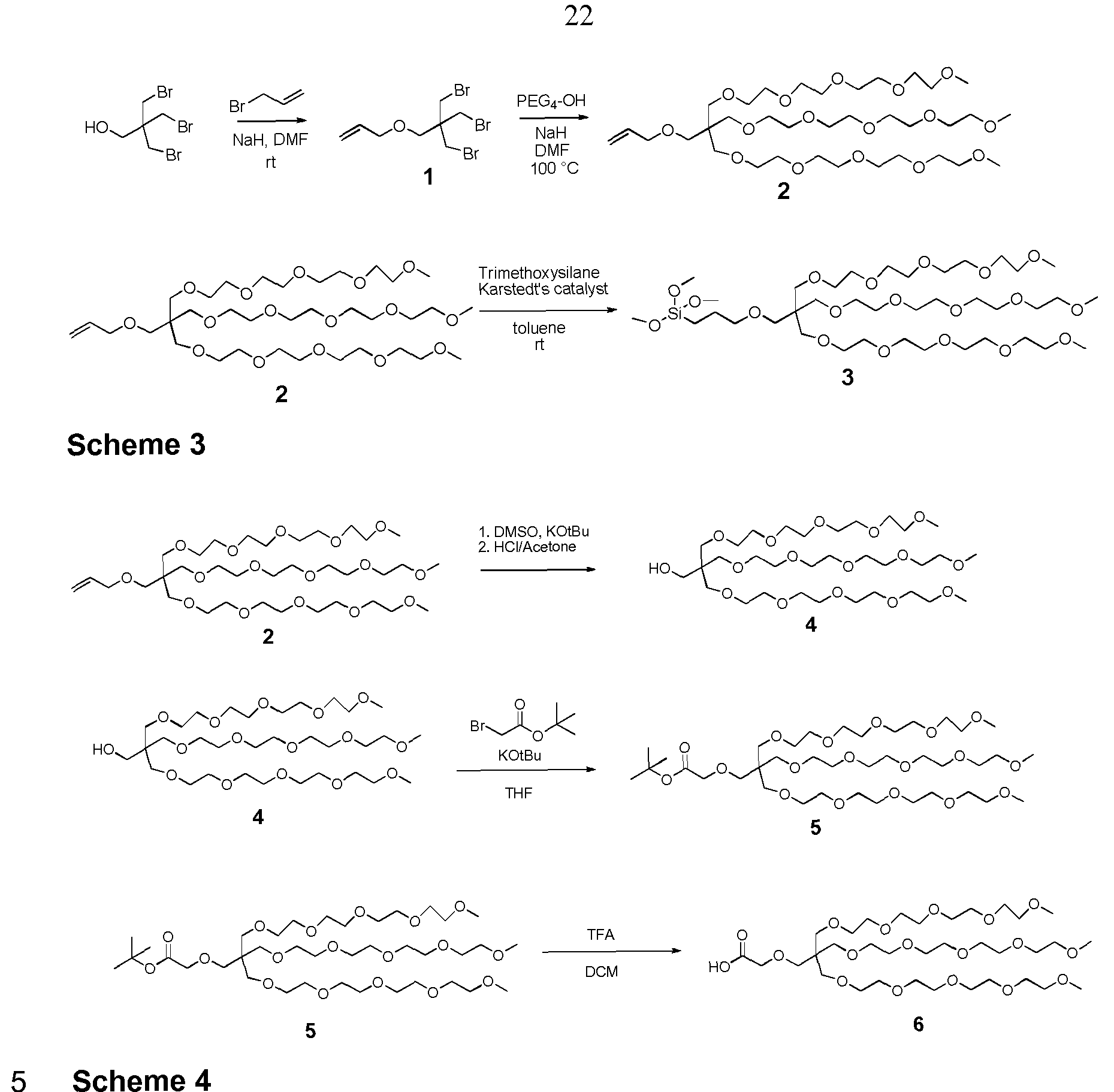
  • Products I or II are possible to produce by several routes obvious to the one skilled in the art but the process that is described here as a second aspect of this invention has the advantage of using a cheap, commercially available trihaloalcohol as a key intermediate and source of the quaternary carbon as outlined in scheme 3.
  • the process comprises the steps of:
  • the temperature in this step may advantageously be above room temperature such as between 30 and 150 °C or between 70 and 120 °C or preferably between 90 and 1 10 °C.
  • the resulting branched PEG intermediate may be isolated by any standard technique described in organic chemistry textbooks (Advanced practical organic chemistry, Leonard, Lygo and Procter 1998, 2 nd ed, Stanley Thornes Publishers, Cheltenham).
  • step b is then transformed into the actual derivatizing agent by any of the many methods obvious to one skilled in the art and some but not limiting examples are discussed below and further elaborated in examples 3-6.
  • allyl group of Id is removed by a standard protective group manipulation, e.g. DMSO/ KOt-Bu (Potassium tert-butoxide), followed by HCI (hydrochloric acid) (example 4)
  • DMSO/ KOt-Bu Potassium tert-butoxide
  • HCI hydrochloric acid
  • the ensuing alcohol la can be elaborated into several other functional groups.
  • the carboxylic acid can in turn be activated and derivatized in a multitude of ways. If the aldehyde is subjected to reductive amination conditions i.e. NaCNBH 3 /NH 3 the amine Ig is obtained. If the alcohol instead it treated with a halogenation reagent such as SOCI 2 or PBr 3 , the halogencompound lu is obtained. This can in turn be used to produce the thiol Iq, for example, by reaction with thiourea followed by hydrolysis in NaOH/EtOH. The thiol can in turn be alkylated to Ir or oxidized to the sulfonic acid Is.
  • branched PEG-derivative is free from labile bonds.
  • the commercially available branched PEG derivatives are based on amides and hence more sensitive to hydrolysis, which can be a further source of heterogeneity of the product and hence lead to regulatory complications during development for clinical use.
  • a composition comprising the general structures I or II covalently linked to a nanosized material, such as a nanoparticle, to enhance its properties with regard to solubility, viscosity, stability, biological compatibility, or pharmacokinetics or pharmacodynamics, is contemplated.
  • nanoparticles designed for renal clearance For the purpose of derivatizing nanoparticles designed for renal clearance, it is imperative to use coatings that give the best compromise between, on one hand, the best protection and stabilization of the core and, on the other hand, the smallest size, or the material will not be filtered through the kidneys, and the branched PEG described in the present invention is emi- nently suited for this purpose. In particular would this be important in the context of nanoparticles containing materials foreign to the body, like transition metals, heavy metals, or lanthanides. These materials are of interest as diagnostics or therapeutics or both of the previous in combination.
  • Linear PEG-derivatives with terminal alkylsilanoxy groups are suitable for surface modification of nanoparticles with a core of metal oxide.
  • These siloxanes connect with hydroxyl groups present on the surface with the PEG tails oriented into the surrounding solution.
  • an ideal coating molecule should contain one surface reactive group e.g. siloxane and two or more tails e.g. PEG producing a cone shaped structure. This type of branched PEG-siloxanes would lead to a denser PEG layer exposing less of the metal oxide core.
  • Luminescent nanoparticles often called nanodots, based on various semiconductor materials like CdS, ZnS or InS, also need to be eliminated from the body through the kidneys and will benefit from being coated with a monolayer of I or II.
  • I or II with Z selected from
  • X is a residue of the group used for coupling
  • Y is a bond or a linker such as - NH
  • the purpose of this derivatization of the biomolecule is to enhance its properties with regard to solubility, reconstitutability after lyophilization, viscosity, stability to processing, stability in formulation, stability in-vivo, biological compatibility, immunogenicity, antigenicity, or pharmacokinetics or pharmacodynamics.
  • the viscosity aspect is of considerable importance for prod- ucts for injection and these more compact PEG derivatives give lower viscosities than the corresponding linear derivatives.
  • scheme 1 below is shown some methods to derivatize biomolecules in one or more positions.
  • the generic structures I or II is linked to a pharmaceutically active small molecule to enhance its properties with regard to solubility, viscosity, stability in formulation, stability in-vivo, biological compatibility, pharmacokinetics, or pharmacodynamics.
  • a pharmaceutically active small molecule to enhance its properties with regard to solubility, viscosity, stability in formulation, stability in-vivo, biological compatibility, pharmacokinetics, or pharmacodynamics.
  • PEG derivatives lowers the ability of a drug to pass the blood brain barrier.
  • the larger molecular size can also give slower clearance from the bloodstream and thus a more even drug concentration over time.
  • WO20081 12288 A non-limiting example where this concept has been used with polydisperse materials and where it would be beneficial to use the branched PEG derivative of the present invention can be found in WO20081 12288 where opioids are directed to peripheral organs but not to the central nervous system.
  • opioids are directed to peripheral organs but not to the central nervous system.
  • the branched structures of the present invention confer advantages since three PEG chains are introduced instead of one. The shorter chain length also lessens the likelihood of unwanted interference with the biological effect of the drug.
  • link betweeen the artemisinin moiety and the PEG can be envisioned.
  • a spacer group may be inserted and/or the link may contain an ester, amide or sulfonamide. It is also possible to substitute the hemiacetal oxygen with a sulfur, carbon or nitrogen atom.
  • the catalyst would normally be a homogenous catalyst, to enhance its solubility in various solvents, particularly in water, improve stability in solid form or in solution, to modify solubility properties to facilitate removal from the product, or to enhance the activity of the catalyst. In particular this is of interest in the context of olefin metathesis catalysts, catalytic hydrogenation catalysts and cross- coupling catalysts.
  • the general structures I or II is linked to a surface of a device.
  • a device for medical use and in particular when such a device is in contact with body fluids like a prostetic device or screw, a device through which body fluids are circulated and returned to the body, or an implant or an electrode implant.
  • the surfaces of such devices may benefit from being coated with I or II to reduce the interaction with proteins of the body with the device. In particular this may reduce the formation of scar tissue around the device, reduce the formation of biofilms on the device, reduce the risk of infections around the device, reduce the risk of inflammation around the device, reduce the risk of corrosion of the device or reduce the risk of an immune response to the device.
  • the linking of the branched PEG derivative depends on the material of the device and there are a number of standard methods in the field. One is to use an oxy-silane like lam in the presence of aqueous ammonia to attach the PEG derivative to the surface. Another is to use a phopsphonate like lab, where the phosphonate has a high affinity for the surface.
  • branched PEG grafted to macromolecular frame- general structures I and II are combined with a nonpolar moiety to yield amphiphilic molecules.
  • liposomes as vehicles for drug delivery and to suppress the immune response towards such products they are often derivatized with PEG on their surface.
  • One aspect of the present invention is to use the molecules of general formula I or II linked to a lipid as part of the liposome. This has the advantage of giving a more uniform product and thus simplifying the regulatory process for approval.
  • R 6 and R 7 are independently selected from C 8- 25 hydrocarbon.
  • A. B, and C are as previously defined.
  • Other lamellar structures than liposomes may also ce considered.
  • Non-limiting examples are micells, inverted micells, vesicles and liquid crystals.
  • m is 3-4.
  • Structure IXa is a generic structure of compounds suitable for the for- mation of liposomes according to the current invention. Structures IXb and 10 are non-limiting example suitable for the incorporation into liposomes or other lamellar structures.
  • X is a bond, a chain or a ring structure with 0-10 linear atoms chosen independently from C, O, N, P and S to form chemical compounds according to normal valency rules.
  • Structure IXb, m, A, B, and C are defined as for compounds I and II.
  • Example 1 3-(3-bromo-2,2-bis(bromomethyl)propoxy)prop-1-ene (1).
  • Sodium hydride (1 .68 g, 42 mmol) was portion-wise added to 3-Bromo- 2,2-bis(bromomethyl)propanol (9.75g, 30 mmol) and allyl bromide (12.9 ml, 150 mmol) in dry and degassed (by vacuum) DMF (40 ml, 4A MS for 24h) under nitrogen at 0 °C. The temperature was then increased to room temperature (22 °C) and the reaction mixture was stirred for another 3h. The re- action mixture was then carefully added to aqueous saturated NH CI (50 ml).
  • Tetraethyleneglycol monomethyl ether (1 .91 ml, 9 mmol) dissolved in dry and degassed DMF (3.5 ml, dried 24h, 4A MS) was added carefully to sodium hydride (365 mg, 9 mmol) in dry and degassed DMF (15 ml, dried 24h, 4A MS) under nitrogen at 0 °C using a syringe. The temperature was then raised to room temperature and the reaction mixture was stirred for another 30 min. Tribromide 1 (730 mg, 2.0 mmol) was then added and the temperature was raised to 100 °C.
  • Example 4 16,16-di-2, 5,8,11 , 14-pentaoxapentadecyl-2, 5,8,11 , 14- pentaoxaheptadecan-17-ol (4).
  • Potassium tert-butoxide (74 mg, 0.66 mmol) was added to 2 (500 mg, 0.66 mmol) in DMSO (3 ml).
  • the reaction mixture was shaken at 100 °C for 15 min.
  • HPLC analysis HPLC-ELSD-C18, 95:5 to 5:95 H 2 O/ACN in 25 min
  • Brine (20 ml) was added at room temperature and the aqueous phase was extracted with ethyl acetate (3 x 20 ml).
  • Example 5 ferf-butyl 16,16-di-2, 5,8, 11 ,14-pentaoxapentadecyl- 2, 5,8,11 , 14,18-hexaoxaicosan-20-oate (5).
  • Potassium terf-Butoxide 32 mg, 0.28 mmol was added to 4 (100 mg, 0.14 mmol) and teff-butyl-2-bromo acetate (105 mg, 0.54 mmol) in dry THF (3 ml). The reaction mixture was shaken for 30 min. Diethyl ether (10 ml and brine (5 ml) were added and the aqueous phase was extracted with ethyl acetate (3 x 20 ml).
  • Example 6a 16,16-di-2, 5,8,11 , 14-pentaoxapentadecyl- 2, 5,8,11 , 14,18-hexaoxaicosan-20-oic acid (6).
  • Trifluoroacetic acid (TFA, 0.5 ml) and dichloromethane (DCM, 0.5 ml) was added to 20 mg of 5. The mixture was shaken at room temperature for 1 h and the volatile materials was then removed at reduced pressure to give 18 mg of 6 as a yellow oil.
  • Example 6b Alternative synthesis of 6,16-di-2, 5,8,11 ,14- pentaoxapentadecyl-2, 5,8,11 , 14,18-hexaoxaicosan-20-oic acid (6).
  • Hydrogen peroxide 145 mg, 4.26 mmol
  • mono sodium phosphate 588 mg, 3.87 mmol
  • This mixture was then transferred to PEG aldehyde 8 (example 8, 2.20 g, 2.94 mmol) dissolved in ace- tonitrile (7 ml).
  • the reaction mixture was cooled to 0 °C and sodium chlorite (898 mg, 7.94 mmol) in H 2 O (9 ml) was added.
  • Example 7 16-(2-peroxypropoxymethyl)-16-2,5,8,11 ,14- pentaoxapentadecyl-2, 5,8,11 ,14,18,21 , 24,27, 30-decaoxahentriacontane (7).
  • 3-chloroperoxy bensoic acid (247 mg, 1 .0 mmol) was added to 6- (allyloxymethyl)-l 6-2,5,8,1 1 ,14-pentaoxapentadecyl- 2,5,8,1 1 ,14,18,21 ,24,27,30-decaoxahentriacontane (example 2) (374 mg, 0.50 mmol) dissolved in DCM (10 ml) at room temperature.
  • Example 8 16,16-di-2, 5,8, 11 ,14-pentaoxapentadecyl- 2,5,8,11 , 14,18-hexaoxaicosan-20-al (8): 2,6 Lutidine (1 .15 g, 10.7 mmol), osmiumtetraoxide (1 .36 ml of 2% aqueous solution, 0.1 1 mmol) and sodi- umperiodinate (4.58 g, 21 .4 mmol) were consecutively added to 16- (allyloxymethyl)-l 6-2,5,8,1 1 ,14-pentaoxapentadecyl- 2,5,8,1 1 ,14,18,21 ,24,27,30-decaoxahentriacontane (2) (4.0 g, 5.35 mmol) dissolved in dioxane/H 2 O (3:1 , 65 ml) at room temperature.
  • Example 9 16-(2,3-dihydroxypropoxymethyl)-16-2,5,8,11 ,14- pentaoxapentadecyl-2, 5,8,11 ,14,18,21 , 24,27, 30-decaoxahentriacontane
  • Example 10 16-(2,3-dioleyloxypropoxymethyl)-16-2,5,8,11 ,14- pentaoxapentadecyl-2, 5,8,11 ,14,18,21 , 24,27, 30-decaoxahentriacontane
  • Example 11 Liposomes of 10: PEG-glyceryldioleate 10 (20 mg) was dissolved in H 2 O (1 ml). The mixture was shaken for 30 min at 37 °C and 30 min at room temperature. The clear solution was filtered (0.2 um syringe filter) and the size of the generated nanostructure was determined by DLS (Malvern Zetasizer) to have a typical hydrodynamic diameter of30 nm (volume average).

Landscapes

  • Chemical & Material Sciences (AREA)
  • General Chemical & Material Sciences (AREA)
  • Health & Medical Sciences (AREA)
  • Chemical Kinetics & Catalysis (AREA)
  • Medicinal Chemistry (AREA)
  • Polymers & Plastics (AREA)
  • Organic Chemistry (AREA)
  • Medicinal Preparation (AREA)
  • Heterocyclic Carbon Compounds Containing A Hetero Ring Having Oxygen Or Sulfur (AREA)
  • Materials For Medical Uses (AREA)
  • Polyethers (AREA)
  • Other Resins Obtained By Reactions Not Involving Carbon-To-Carbon Unsaturated Bonds (AREA)

Abstract

The present invention relates to branched polyethyleneglycol (PEG) derivatives consisting of a molecule with a quaternary carbon connected to three PEG chains, wherein all three PEG chains are of equal length and each comprises 1 -30 -OCH2CH2- units, and one group with at least one carbon atom, wherein said at least one carbon atom is attached to the quaternary carbon. Also compositions containing such derivatives and use of such derivatives are disclosed.

Description

BRANCHED, COMPACT POLYETHYLENEGLYCOL DERIVATIVES
Filed of the invention
The present invention relates to branched polyethyleneglycol (PEG) derivatives with advantages over currently available PEG derivatives. They are especially applicable for conjugation with nanoparticles, proteins, pep- tides, pharmaceutically active small molecules, liposomes, homogenous catalysts and bio-inert surfaces.
Background
Bio-inert polar polymers, and in particular polyethyleneglycol
(HO(CH2CH2O)H, PEG, also called polyethyleneoxide; PEO), have found extensive technical use, notably in the area of pharmaceuticals and medical devices. Lately covalent grafting with PEG have been used to modify proteins, peptides, oligonucleotides, antibody fragments, small molecule drugs, catalysts, surfaces and particles. These modified conjugates often obtain superior properties such as decreased immunogenicity or antigenicity, improved pharmacokinetic and pharmadynamic properties, enhanced solubility in aqueous media, increased stability and reduced clearance rate from the body.
Several PEG-derivatives of macromolecules have now been approved for pharmaceutical use. The first one was PEG-adenosine deaminase for treatment of adenosine deaminase deficiency (ADA deficiency).
Organic catalysts have also been covalently modified with PEG- derivatives to allow reactions in water (Hong and Grubbs, J. Am. Chem. Soc. 2006, 128, 3508).
Traditionally, polydisperse linear PEG-derivatives have been used for PEG grafting but recently monodisperse PEG derivatives or PEG derivatives of defined mass have been applied to obtain homogeneous products, simplifying characterization of the PEG-derivatives, thus facilitating the regulatory process.
Branched PEG, characterized by two or more PEG chains linked to a common center, has been developed as an alternative to the more common linear PEG derivatives. Monfardini et al. (Bioconj. Chem. 1995, 6, 62-69) reported that surface modification of proteins using branched PEG derivatives resulted in increased biocompatibility and better stability. These PEGs allows for a better masking and protection of the connected surface/molecule. In ad- dition, the modification of protein using branched PEG provides a more efficient usage of amino acids/amino acid side chains available for chemical linking, thus more PEG polymer per modification. Fewer chemical modifications of the protein increase the probability of retaining the native structure of the biomolecule and hence the biological activity.
The strategies for attaching PEG to macromolecules and small organic molecules, respectively, differ in terms of size and number of PEG molecules that can be attached. Large macromolecules are commonly modified using PEG polymer of molecular weights ranging from 5 kDa to 90 kDa to obtain reduced clearance from the blood, better specificity while preserving biologi- cal activity. However, large PEG molecules are not suitable for modifications of small organic molecules. Conjugates of pharmaceutically active small molecules and large PEG polymers prevents, in most cases, the conjugate to interact with receptors or binding pockets due to sterical hindrance or even alter the ability of the molecule to diffuse through membranes to reach their target. Conjugates with large PEG moieties have low diffusion rates, just like any large molecules. Therefore, PEG derivatives with molecular weights of less than 2 kDa are generally used for modification of small organic molecules. (Ouchi, T. in Poly(ethylene glycol): Chemistry and biological applications, Harris and Zalipsky Eds, Chapter 19). In general, macromolecules tol- erate attachment of PEG to several positions using smaller PEG although it is normally beneficial to have as few as possible. On the other hand, small organic compounds have few points for the attachment of PEG and it is much more difficult to obtain conjugates that retain the unmodified molecule's bioac- tive properties.
In WO 95/025763 is disclosed branched PEG-like structures (as part of a larger structure) which have a superficial likeness to the structures present invention but lack the essential feature of being discrete and useful for the applications disclosed here.
In WO 2007/025763 is disclosed branched PEG derivatives of defined character. However, their structure differs from the present invention in the following non-beneficial ways; They utilize 2,2,2-tris(hydroxymethyl)methyl- amine as the core structure so the detailed structures are more complex and thus more expensive to produce. The core is based on amides and hence more sensitive to hydrolysis, and the individual branched PEG derivatives contain thioethers, a functionality known for being notoriously sensitive to oxi- dization, which can be a further source of heterogeneity of the product. The core structure is not compact and thus not useful for some of the applications disclosed here.
Definitions of terms
The term "nanoparticle" is used to describe a particle of any shape with a longest measure from 1 -100 nm.
"Bio-inert" refers to a material that is bio-compatible, i.e. harmless to a living organism and at the same time stable to degradation in-vivo.
"Monolayer" refers to a one molecule thick layer.
"Oriented" in the context of coatings refers to a layer of coating molecules where all the heads and tails (as arbitrarily defined from case to case but as intended in the present invention we consistently refer to the silane, where present, as the head) of the coating molecules are oriented in the same way in relation to the particle core surface.
"Activated silane" refers to a silane of the following type RnSi(X)4-n, where X is an alkoxy group, aryloxy group, a halogen, a dialkylamino group, a nitrogen containing heterocycle or an acyloxy group and R is an organic group.
"Oxysilane" refers to any organic compounds with one or more oxygen atoms attached to the silicon atom. Non-limiting examples thereof are:
Figure imgf000005_0001
"Organosilane" refers to organic compounds containing one or more carbon silicon bonds.
Organic residue" refers to organic compounds covalently bond to a molecular entity.
"Organo-oxysilane" refers to organic compounds containing one or more carbon atoms and one or more oxygen atoms attached to the silicon atom. Non-limiting examples thereof are:
Figure imgf000005_0002
"Hydrocarbon" or "hydrocarbon chain" is an organic residue consisting of hydrogen and carbon. As used in the present invention a hydrocarbon may, when indicated, comprise heteroatoms selected from O, S and N. This means that one or more of the carbon atoms have been replaced by a heteroatom selected from O, S or N. The hydrocarbon may be fully saturated or it may comprise one or more unsaturations. Unless otherwise specified, the hydrocarbon may contain any number of carbon atoms between 1 and 50. The hydrocarbon group of the compounds may then be designated as "Ci-s hydrocarbon" or similar designations. Typical hydrocarbon groups include, but are in no way limited to, methyl, ethyl, propyl, isopropyl, butyl, isobutyl, tertiary butyl, pentyl, hexyl, ethenyl, propenyl, butenyl, phenyl, benzyl.
"Alkyl" refers to a straight or branched hydrocarbon chain fully saturated (no double or triple bonds) hydrocarbon group. The alkyl group may have 1 to 8 carbon atoms. The alkyl group of the compounds may be designated as "C-1-8 alkyl" or similar designations. Typical alkyl groups include, but are in no way limited to, methyl, ethyl, propyl, isopropyl, butyl, isobutyl, tertiary butyl, pentyl, hexyl, and the like.
Whenever it appears herein, a numerical range such as "from 1 to 8" or
"1 -8" refer to each integer in the given range; e.g., "from 1 to 8 carbon atoms" means that the alkyl group may consist of 1 carbon atom, 2 carbon atoms, 3 carbon atoms, etc., up to and including 8 carbon atoms.
As used herein, "alkoxy" refers to the formula -OR wherein R is a Ci-s alkyl, e.g. methoxy, ethoxy, n-propoxy, 1 -methylethoxy (isopropoxy), n- butoxy, iso-butoxy, sec-butoxy, tert-butoxy, amyloxy, iso-amyloxy and the like. An alkoxy may be optionally substituted.
As used herein, "aryloxy" refers to RO- in which R is an aryl wherein, "aryl" refers to a carbocyclic (all carbon) ring or two or more fused rings (rings that share two adjacent carbon atoms) that have a fully delocalized pi- electron system. Examples of aryl groups include, but are not limited to, benzene, naphthalene and azulene. An aryl group may be optionally substituted, e.g., phenoxy, naphthalenyloxy, azulenyloxy, anthracenyloxy, naphthalenyl- thio, phenylthio and the like. An aryloxy may be optionally substituted
As used herein, "acyl" refers to a carbonyl group, i.e. -C(=O)-.
As used herein, "acyloxy" refers to an oxygen atom connected via a carbonyl group, i.e. -C(=O)-O-.
As used herein, "heterocycle" refers to a stable 3- to 18 membered ring which consists of carbon atoms and from one to five heteroatoms selected from the group consisting of nitrogen, oxygen and sulfur. The heterocycle may be monocyclic, bicyclic or tricyclic.
"Strong base" refers in the current context to bases that are stronger than hydroxide and not compatible with aqueous environments.
"Conjugate" refers to a molecular entity that is a fluorescence marker, dye, spin-label, radioactive marker, ligand to a biological receptor, chelate, enzyme inhibitor, enzyme substrate, antibody or anti-body related structure. See e.g. "Bioconjugate Techniques", Greg T. Hermanson second edition, Elsevier 2008, ISBN 978-0-12-370501 -3 for background on the subject.
"Handle for conjugation" or "attachment point" refers to a bifunctional molecule that can bind to, or be incorporated in, the silane coating but leaving one reactive group that can be linked to a conjugate, as defined above. A typical, but not exclusive, example would be (EtO)3SiCH2CH2CH2NH2.
"m-PEG" refers to structures CH3-(OCH2CH2)n-OH where n depends on the circumstances.
"Aprotic solvent" refers to solvents which have no protons that can be removed or rapidly exchanged in an aqueous environment. Typical, but not limiting, examples of such solvents are tetrahydrofuran (THF), diethyl ether, glyme, diglyme, dimethyl formamide (DMF), dimethylsulfoxide, or N-methyl pyrrolidinone (NMP).
DCM is an acronym for dichloromethane.
Detailed description of the invention
A first aspect of the present invention is a branched polyethyleneglycol (PEG) derivative comprising three PEG chains attached to a common quaternary carbon atom. It may be preferred that all three PEG chains are of equal length and each comprises 1 -30 -OCH2CH2- units The fourth group attached to said quaternary carbon atom can be any of a large number of different organic groups. This forth group shall contain a carbon atom, which is attached to the quaternary carbon atom. A non-limiting list of examples of the fourth group attached to the quaternary carbon atom is given in the list describing group R1 below.
The branched polyethyleneglycol (PEG) derivative according to the invention may have formula I or formula II:
Figure imgf000007_0001
II wherein:
m is selected from 1 -30;
R1 is selected from the list given in Table 1 below;
A, B and C are independently selected from -Ci-Cs hydrocarbon, - (CH2)2N3, -(CH2)2NR52, CH2COOR4;
R2 is selected from Ci-Cs hydrocarbon;
R3 is selected from d-s alkoxy group, aryloxy group, a halogen, a di- Ci-s-alkylamino group, a nitrogen containing heterocyde or an acyloxy group;
R4 is selected from H, OH, OR2, NHR2, N(R2)2, halogen, N- hydroxysuccinimidyl (NHS ester) and perfluorophenolate, wherein R2 is as above;
R5 is independently selected from -H, -Ci-Cs hydrocarbon, -(C=O)NH2, -(C=O)-OCH3, -(C=O)OCH2CH3. Table 1: Different options for R1
Figure imgf000008_0001
Figure imgf000009_0001
In some embodiments R1 in formula I is O(CH2)3Si(R3)3, and R3 may then be selected from the group consisting of Ci-s alkoxy, acy- loxy, dialkylamino and aryloxy.
In some embodiments R1 in formula I is CH2NH2 or OCH2COOH.
In some embodiments m is 3-20. In some embodiments m is 3-10.
In some embodiments m is 3-5.
In some embodiments A, B and C are all equal.
In some embodiments A, B and C are all -CH3.
Alternatively, the branched polyethyleneglycol (PEG) derivative accord to the invention may have formula:
Figure imgf000010_0001
where "Biomolecule" denotes a peptide or an antibody fragment or a ribonucleic acid or a carbohydrate and X is a residue of the functionality used for coupling and Y is a spacer group with structure -(OCH2CH2)nO- where n is selected from 1 -50 and m is selected from 2-30 and A, B and C are independently selected from -Ci-Cs hydrocarbon, -(CH2)2N3, -(CH2)2NR52 and -CH2COOR4; and; R2 is selected from Ci-Cs hydrocarbon; and R3 is selected from Ci alkoxy group, aryloxy group, a halogen, a di-Ci-s-alkylamino group, a nitrogen containing heterocycle or an acyloxy group and; R4 is selected from H, OH, OR2, NHR2, N(R2)2, halogen, N-hydroxysuccinimidyl (NHS ester) and perfluorophenolate; and R5 is independently selected from -H, -Ci-Cs hydrocarbon, -(C=O)NH2, -(C=O)-OCH3, or -OCH2CH3.
Alternatively, the compound according to the invention may have one of the two formulas:
Figure imgf000010_0002
wherein "Drug" denotes a pharmaceutically active drug of molecular weight less than 1000 g/mol and X is a residue of the functionality used for coupling and Y is a spacer group with structure -(OCH2CH2)nO- where n is selected from 1 -50 and m is selected from 2-30 and A, B and C are independently selected from -Ci-C8 hydrocarbon, -(CH2)2N3, -(CH2)2NR5 2 and -CH2COOR4; and; R2 is selected from Ci-Cs hydrocarbon; and R3 is selected from d-s alkoxy group, aryloxy group, a halogen, a di-Ci-s-alkylamino group, a nitrogen containing heterocycle or an acyloxy group and; R4 is selected from H, OH, OR2, NHR2, N(R2)2, halogen, N-hydroxysuccinimidyl (NHS ester) and per- fluorophenolate; and R5 is independently selected from -H, -Ci-Cs hydrocarbon, -(C=O)NH2, or -(C=O)-OCH3.
Alternatively, the compound according to the invention may have formula Va
Figure imgf000011_0001
Va
wherein m=1 -30 and A, B, and C independently are selected from the group consisting of H and methyl.
Alternatively, the compound according to the invention may have formula IXa
Figure imgf000011_0002
IXa
wherein:
R6 and R7 are independently selected from the group consisting of Cs- C25 hydrocarbons;
m is selected from 2-30;
A, B and C are independently selected from the group consisting of -
Ci-C8 hydrocarbon, -(CH2)2N3, -(CH2)2NR5 2 and -CH2COOR4;
R2 is selected from Ci-Cs hydrocarbon;
R3 is selected from d-s alkoxy group, aryloxy group, a halogen, a di- Ci-s-alkylamino group, a nitrogen containing heterocycle or an acyloxy group; R4 is selected from H, OH, OR2, NHR2, N(R2)2, halogen, N- hydroxysuccinimidyl (NHS ester) and perfluorophenolate;
R5 is independently selected from -H, -Ci-Cs hydrocarbon, -(C=O)NH2, -(C=O)-OCH3, or -OCH2CH3;
X is a bond, a chain or a ring structure with 0-10 linear atoms chosen independently from C, O, N, P and S to form chemical compounds according to normal valency rules; and
Crucial to some embodiments of the invention is that the composition is essentially free from molecules where any of the chain lengths m have a dif- ferent value than the desired one, i.e. the product is of defined molecular weight or, synonymously, monodisperse; so that the purity of the product is more than 50%. Suitable purities are for example more than 80% , more than 90%, more than 95%, more than 99%. In one embodiment of the present invention the purity is above 95%.
This type of PEG derivatives are readily produced from inexpensive starting materials using a concise synthetic strategy outlined in scheme 3. Compounds according to formula I also has the advantage of being economically viable. In particular are the starting materials for I with m= 3 or 4 favour- able. The following calculation shows the economical advantage of the present invention: If Ri in structure I is -OH and m= 4, the molecular weight of the product is 707 g/mol. The cost of the starting materials are 20 $/g product when bought on a small scale. Commercially available linear m-PEGs with a similar molecular weight are isolated from PEG mixtures using expensive and time consuming chromatography. A typical example is m-PEG with 1 1 repeating ethylene glycol units, which is available at a cost of $ 240/g (Polypure, Norway). A branched amide based monodisperse PEG analog is available from Quanta Biodesign at $1300/g.
The present invention thus enables formation of PEG derivatives based on low cost starting materials.
PEG alcohols of defined molecular weight are commercially available up to lengths of about 30 monomer units so the present invention relates to generic structures I wherein m is 1 -30, or for example 2-20, 3-12; 3-6 and 3- 4. In one embodiment m is 3-4.
Depending on the origin of the PEG alcohol used in the synthesis of the branched PEG derivatives of the present invention, the final product will have a spectrum of minor impurities. Some of those impurities may not have m in general structure I or II equal and are thus not a desired material but considered as impurities. In general, it is advisable to use pure starting materials. Suitable purities of the starting materials are higher than 70% or higher than 90% or higher than 95% or higher than 99%. There may also be resi- dues from incomplete reaction of the intermediates which can be minimized on a case by case basis by optimizing reaction time, reaction temperature, amount of solvent, identity of the solvent, or identity of the base.
A second aspect of the present invention relates to the process of producing molecules according to the first aspect. Products I or II are possible to produce by several routes obvious to the one skilled in the art but the process that is described here as a second aspect of this invention has the advantage of using a cheap, commercially available trihaloalcohol as a key intermediate and source of the quaternary carbon as outlined in scheme 3.
The process comprises the steps of:
a. Contacting the key starting material 3-halo-2,2- bis(halomethyl)propanol, preferably in the form of 3-bromo- 2,2-bis(bromomethyl)propanol, with an allylation reagent such as, allyl chloride, allyl mesylate, or allyl tosylate or, preferably, allyl bromide, optionally in a solvent inert to the reaction conditions, in the presence of a strong base, for example sodium hydride. The intermediate may then be isolated by any standard technique described in organic chemistry textbooks (Advanced practical organic chemistry, Leonard, Lygo and Proc- ter 1998, 2na ed, Stanley Thornes Publishers, Cheltenham). It is also conceivable to proceed with the next step without isolating the intermediate 3-(3-bromo-2,2- bis(bromomethyl)propoxy)prop-1 -ene. b. Contacting the intermediate product with a PEG-oligomer of structure A-(OCH2CH2)mO- ; or base and A-(OCH2CH2)mOH; where A is selected from -Ci-Cs hydrocarbon, -(CH2)2N3, - (CH2)2NR5 2 and -CH2COOR4; and; R2 is selected from Ci-C8 hydrocarbon; and R3 is selected from d-s alkoxy group, ary- loxy group, a halogen, a di-Ci-s-alkylamino group, a nitrogen containing heterocycle or an acyloxy group and; R4 is selected from H, OH, OR2, NHR2, N(R2)2, halogen, N- hydroxysuccinimidyl (NHS ester) and perfluorophenolate; and R5 is independently selected from -H, -Ci-Cs hydrocarbon, - (C=O)NH2, -(C=O)-OCH3, -OCH2CH3 and m is selected from 1 -30, with a defined molecular weight, optionally in a solvent inert to the reaction conditions, in the presence of a strong base, such as sodium hydride. The temperature in this step may advantageously be above room temperature such as between 30 and 150 °C or between 70 and 120 °C or preferably between 90 and 1 10 °C. Optionally the resulting branched PEG intermediate may be isolated by any standard technique described in organic chemistry textbooks (Advanced practical organic chemistry, Leonard, Lygo and Procter 1998, 2nd ed, Stanley Thornes Publishers, Cheltenham).
c. The intermediate of step b is then transformed into the actual derivatizing agent by any of the many methods obvious to one skilled in the art and some but not limiting examples are discussed below and further elaborated in examples 3-6.
In one embodiment an extractive procedure or vacuum distillation was found to be favourable to use in a).
In one embodiment an extractive procedure followed by a simple chromatography was found to be favourable to use in b).
If the allyl group of Id is removed by a standard protective group manipulation, e.g. DMSO/ KOt-Bu (Potassium tert-butoxide), followed by HCI (hydrochloric acid) (example 4) the ensuing alcohol la can be elaborated into several other functional groups. Some, non limiting, examples are given here: mild oxidation of the hydroxyl group of la with e.g. pyridinium chloro chromate or Dess-Martin periodinane gives the aldehyde II (R4 = H) whereas stronger oxidizing conditions like fuming nitric acid or potassium permanganate give the corresponding carboxylic acid II (R4 = OH). The carboxylic acid can in turn be activated and derivatized in a multitude of ways. If the aldehyde is subjected to reductive amination conditions i.e. NaCNBH3/NH3 the amine Ig is obtained. If the alcohol instead it treated with a halogenation reagent such as SOCI2 or PBr3, the halogencompound lu is obtained. This can in turn be used to produce the thiol Iq, for example, by reaction with thiourea followed by hydrolysis in NaOH/EtOH. The thiol can in turn be alkylated to Ir or oxidized to the sulfonic acid Is. It can then be oxidized to the sulfoxide lu or the sulfone Iv. Alternatively can lu be converted to the phosphonate lac by reaction with dimethyl or diethyl phosphite. This can be hydrolyzed to the corresponding phosphonic acid lab by treatment with trimethyl silylbromide.
To obtain lam with Z= (R3)3Si(CH2)3O-, where R3 is as defined in table 1 ,from the intermediate Id, the method of hydrosilylation is preferred. This involves adding a trialkoxy silane across the double bond in the presence of a catalyst. Preferred are catalysts based on platinum and, in particular, Karstedt's catalyst has been found to be effective.
Directly accessible from Id is the aldehyde lae (R4 = H) by means of two alternative procedures. On a small scale ozonization followed by a reductive work up can be contemplated. On a larger scale, reaction with osmium tetroxide to give the vicinal dialcohol followed by cleavage with periodic acid, is preferred.
Further advantages of the above process are that it is short and that the branched PEG-derivative is free from labile bonds. The commercially available branched PEG derivatives are based on amides and hence more sensitive to hydrolysis, which can be a further source of heterogeneity of the product and hence lead to regulatory complications during development for clinical use. In a third aspect of the present invention, a composition comprising the general structures I or II covalently linked to a nanosized material, such as a nanoparticle, to enhance its properties with regard to solubility, viscosity, stability, biological compatibility, or pharmacokinetics or pharmacodynamics, is contemplated. For the purpose of derivatizing nanoparticles designed for renal clearance, it is imperative to use coatings that give the best compromise between, on one hand, the best protection and stabilization of the core and, on the other hand, the smallest size, or the material will not be filtered through the kidneys, and the branched PEG described in the present invention is emi- nently suited for this purpose. In particular would this be important in the context of nanoparticles containing materials foreign to the body, like transition metals, heavy metals, or lanthanides. These materials are of interest as diagnostics or therapeutics or both of the previous in combination. In particular, it is of interest to use heavy elements like gold, tantalum or tungsten incorpo- rated in nanoparticles as contrast agents for CT (computed tomography) and they would benefit from being coated with a monolayer of the materials the general structures I or II. The efficacy of those materials is tightly correlated with the volume fraction of the heavy element in the nanoparticle and a coating with a monolayer of I or II will give materials with very good properties since the protective layer will be very thin while still achieving stabilization.
Linear PEG-derivatives with terminal alkylsilanoxy groups are suitable for surface modification of nanoparticles with a core of metal oxide. These siloxanes connect with hydroxyl groups present on the surface with the PEG tails oriented into the surrounding solution. Although, improved solubility and stability properties, there are still gaps in the PEG-coating exposing the core metal oxide due to the curvature of the particle surface and the folding of PEG-tails. Therefore an ideal coating molecule should contain one surface reactive group e.g. siloxane and two or more tails e.g. PEG producing a cone shaped structure. This type of branched PEG-siloxanes would lead to a denser PEG layer exposing less of the metal oxide core. In line with this reasoning, although not directly dealing with nanoparticles, Monfardini et al. (Bio- conj. Chem. 1995, 6, 62-9) have shown that surface modification of proteins using branched PEG derivatives results in increase biocompability and better stability.
In particular would lam with R1= (R3)3Si(CH2)3O- where R3 is as defined in table 1 , lae (R4 = OH) with R1= HO2CCH2O-, Is with R1=
HO3S(CH2)3O-, lab with R1= (HO)2PO(CH2)3O-, Iq with R1= HS(CH2)3O-, Iz with R1= HSCH2(HS)CHCH2O- or Ian R1= - O(CH2)2NHCO(CH2)4
CH(SH)CH2CH2SH be favourable for the stabilization of such particles. To our knowledge, no branched PEG-siloxanes are commercially available and have not been described in literature.
Luminescent nanoparticles, often called nanodots, based on various semiconductor materials like CdS, ZnS or InS, also need to be eliminated from the body through the kidneys and will benefit from being coated with a monolayer of I or II. In particular would I or II with Z selected from
HS(CH2)3O-, HSCH(HS)(CH2)2O- or R1 = -O(CH2)2NHCO(CH2)4
CH(SH)CH2CH2SH be favourable for the stabilization of such particles.
In a fourth aspect of the present invention the molecules of general structures I or II are linked to a biomolecule like a protein, a peptide, a ribonucleic acid or a carbohydrate, forming structure III, or IV, where X is a residue of the group used for coupling and Y is a bond or a linker such as - NH(C=O)CH2(OCH2CH2)n- where n is selected from1 -50 and m is selected from 1 -30 and A, B, and C are independently selected from -Ci-Cs hydrocarbon, -(CH2)2N3, -(CH2)2NH2 and derivatives thereof such as, but not limited to amides, carbamates and ureas, CH2COOH and derivatives thereof such as, but not limited to, esters, anhydrides, acid chlorides, amides, carbamates.
The purpose of this derivatization of the biomolecule is to enhance its properties with regard to solubility, reconstitutability after lyophilization, viscosity, stability to processing, stability in formulation, stability in-vivo, biological compatibility, immunogenicity, antigenicity, or pharmacokinetics or pharmacodynamics. The viscosity aspect is of considerable importance for prod- ucts for injection and these more compact PEG derivatives give lower viscosities than the corresponding linear derivatives. In scheme 1 below is shown some methods to derivatize biomolecules in one or more positions.
Figure imgf000018_0001
Biomolecule-COOH O
»
H,N Biomolecule N
H
Biomolecule-CONH, O
H,N
Biomolecule Λ
Scheme 1
In a fifth aspect of the present invention the generic structures I or II is linked to a pharmaceutically active small molecule to enhance its properties with regard to solubility, viscosity, stability in formulation, stability in-vivo, biological compatibility, pharmacokinetics, or pharmacodynamics. Of particular importance is the effect to keep a drug out of the CNS since PEG derivatives lowers the ability of a drug to pass the blood brain barrier. The larger molecular size can also give slower clearance from the bloodstream and thus a more even drug concentration over time.
A non-limiting example where this concept has been used with polydisperse materials and where it would be beneficial to use the branched PEG derivative of the present invention can be found in WO20081 12288 where opioids are directed to peripheral organs but not to the central nervous system. For small molecules there is usually only one site of modification available so the branched structures of the present invention confer advantages since three PEG chains are introduced instead of one. The shorter chain length also lessens the likelihood of unwanted interference with the biological effect of the drug.
Figure imgf000019_0001
VI
where X is a residue of the group used for coupling as outlined for the deri- vatization in scheme 1 and Y is a bond or a linker such as - NH(C=O)CH2(OCH2CH2)n- where n is selected from 1 -50. A non-limiting example is structure Va where m=1 -30 and A, B, and C are H or methyl. In one aspect m=1 -10 and A,B, and C are methyl. In one aspect m=1 -5 and A,B, and C are methyl.
Figure imgf000019_0002
Va
A number of trivial variations of the link betweeen the artemisinin moiety and the PEG can be envisioned. For example, a spacer group may be inserted and/or the link may contain an ester, amide or sulfonamide. It is also possible to substitute the hemiacetal oxygen with a sulfur, carbon or nitrogen atom.
In a sixth aspect of the present invention the molecules of general formula I or II is linked to a catalytically active molecule to form compounds VII or VIII, where X is a residue of the group used for coupling as outlined for the derivatization in scheme 1 and Y is a bond or a linker such as - NH(C=O)CH2(OCH2CH2)n- where n is selected from 1 -50. The catalyst would normally be a homogenous catalyst, to enhance its solubility in various solvents, particularly in water, improve stability in solid form or in solution, to modify solubility properties to facilitate removal from the product, or to enhance the activity of the catalyst. In particular this is of interest in the context of olefin metathesis catalysts, catalytic hydrogenation catalysts and cross- coupling catalysts.
Figure imgf000020_0001
VII VIII
In Hong and Grubbs, J. Am. Chem. Soc. 2006, 128, 3508 is described a catalyst made water soluble by the derivatization with a polydisperse linear m-PEG through several synthetic steps and this material would be more tractable and hence cheaper to produce with a monodisperse PEG such as a PEG of general formula I or II instead.
Most homogenous catalysts have a phosphine as an integral part of the structure and it is often convenient to incorporate the solubilizing group I via the phosphine. There are many possibilities for this but if an aromatic phosphine is desired I or II can be linked via an ether oxygen. If an aliphatic phosphine is desired it is often possible to use I or II as a group linked directly to the phosphorous atom, introduced via alkylation.
It is also of importance that the more compact structure of the branched PEG derivatives of the present invention lowers the risk of interference with the catalytic process.
In a seventh aspect of the present invention, the general structures I or II is linked to a surface of a device. Of interest is a device for medical use and in particular when such a device is in contact with body fluids like a prostetic device or screw, a device through which body fluids are circulated and returned to the body, or an implant or an electrode implant. The surfaces of such devices may benefit from being coated with I or II to reduce the interaction with proteins of the body with the device. In particular this may reduce the formation of scar tissue around the device, reduce the formation of biofilms on the device, reduce the risk of infections around the device, reduce the risk of inflammation around the device, reduce the risk of corrosion of the device or reduce the risk of an immune response to the device.
The linking of the branched PEG derivative depends on the material of the device and there are a number of standard methods in the field. One is to use an oxy-silane like lam in the presence of aqueous ammonia to attach the PEG derivative to the surface. Another is to use a phopsphonate like lab, where the phosphonate has a high affinity for the surface.
In an eighth aspect of the present invention, the generic structures I or
II is grafted to a polymeric structure (macromolecular framework) , preferably of defined molecular weight or of low polydispersity. This has the advantage of creating materials of high but well defined molecular weight which may be of particular benefit when derivatizing proteins as mentioned above where relatively few attachment points are available. In scheme 2 is shown some representative structures according to this aspect.
In one aspect the fourth and the eighth aspect are combined.
In one aspect the seventh and the eighth aspect are combined.
Figure imgf000021_0001
2. Examples of branched PEG grafted to macromolecular frame- In a ninth aspect of the present invention general structures I and II are combined with a nonpolar moiety to yield amphiphilic molecules. There is an interest in using liposomes as vehicles for drug delivery and to suppress the immune response towards such products they are often derivatized with PEG on their surface. One aspect of the present invention is to use the molecules of general formula I or II linked to a lipid as part of the liposome. This has the advantage of giving a more uniform product and thus simplifying the regulatory process for approval. Structure IX with m selected from 1 -30, for example 2-20, or, 3-12 or, 3-6 or 3-4.. R6 and R7 are independently selected from C8-25 hydrocarbon. A. B, and C are as previously defined. Other lamellar structures than liposomes may also ce considered. Non-limiting examples are micells, inverted micells, vesicles and liquid crystals.
In one aspect of the invention m is 3-4.
Structure IXa is a generic structure of compounds suitable for the for- mation of liposomes according to the current invention. Structures IXb and 10 are non-limiting example suitable for the incorporation into liposomes or other lamellar structures.
Figure imgf000022_0001
Structure IXa , X is a bond, a chain or a ring structure with 0-10 linear atoms chosen independently from C, O, N, P and S to form chemical compounds according to normal valency rules.
Figure imgf000022_0002
Structure IXb, m, A, B, and C are defined as for compounds I and II.
Figure imgf000023_0001
Figure imgf000024_0001
Brief description of the drawing
In the examples below reference is made to the drawing on which Fig. illustrates DLS analysis of material from Example 1 1 . Examples
Example 1 : 3-(3-bromo-2,2-bis(bromomethyl)propoxy)prop-1-ene (1). Sodium hydride (1 .68 g, 42 mmol) was portion-wise added to 3-Bromo- 2,2-bis(bromomethyl)propanol (9.75g, 30 mmol) and allyl bromide (12.9 ml, 150 mmol) in dry and degassed (by vacuum) DMF (40 ml, 4A MS for 24h) under nitrogen at 0 °C. The temperature was then increased to room temperature (22 °C) and the reaction mixture was stirred for another 3h. The re- action mixture was then carefully added to aqueous saturated NH CI (50 ml). The H2O-phase was then extracted with diethyl ether (2 x 50 ml) and the combined organic phases were washed with H2O (5 x 50 ml) and the brine (50 ml). The organic phase was dried with Na2SO4 followed by filtration. The volatile materials were removed at reduced pressure to give a pale yellow oil (9.7 g). Column chromatography (heptane:EtOAc 9:1 ) gave 6.6 g (62%) of 1 as a clear oil. The product could also be isolated using distillation at reduced pressure, boiling point 85-87 °C at 0.05 mbar. 1H-NMR (CDCI3); 5.93 (m, 1 H), 5.28 (m, 2H), 4.05 (d, 2H), 3.58 (s, 6H), 3.52 (s, 2H). Example 2: 16-(allyloxymethyl)-16-2,5,8,11,14- pentaoxapentadecyl-2, 5,8,11 ,14,18,21 , 24,27, 30-decaoxahentriacontane (2). Tetraethyleneglycol monomethyl ether (1 .91 ml, 9 mmol) dissolved in dry and degassed DMF (3.5 ml, dried 24h, 4A MS) was added carefully to sodium hydride (365 mg, 9 mmol) in dry and degassed DMF (15 ml, dried 24h, 4A MS) under nitrogen at 0 °C using a syringe. The temperature was then raised to room temperature and the reaction mixture was stirred for another 30 min. Tribromide 1 (730 mg, 2.0 mmol) was then added and the temperature was raised to 100 °C. After 14h the reaction was completed (HPLC-ELSD-C18, 95:5 to 5:95 H2O/ACN in 25 min, Rt product = 19.5 min) the temperature was decreased to room temperature and the reaction mixture was carefully added to H2O (150 ml) and the H2O-phase was washed with diethyl ether (2x 50 ml). Sodium chloride was then added to the H2O-phase until saturation. The H2O- phase was extracted with EtOAc (4x50 ml) and the combined organic phases were washed with brine (2x30 ml). Sodium sulfate and charcoal was added to the organic phase. The clear organic phase was filtered and the volatile material was removed at reduced pressure (8 mmHg, 40 °C then 0.1 mmHg (oil pump) and 40 °C to remove residual DMF). Column chromatography
(EtOAc:MeOH 9:1 ) gave 1 .05 g (70%) of 2. 1H-NMR (CDCI3); 5.90 (m, 1 H), 5.20 (m, 2H), 3.94 (dt, 2H), 3.70-3.55 (m, 48H), 3.45 (s, 6H), 3.43 (s, 2H), 3.40 (s, 9H). Example 3: 3,3-dimethoxy-9,9-di-2,5,8,11,14-pentaoxapentadecyl-
2,7,11 , 14,17,20,23-heptaoxa-3-silatetracosane (3). Platinum(0)-1 ,3-divinyl- 1 ,1 ,3,3-tetramethylsiloxane (20 μΙ, 2% in xylene) was added to 2 (0.75g, 1 .0 mmol) and trimethoxysilane (255 μΙ, 2.0 mmol) in dry toluene (6 ml) under nitrogen at room temperature. The reaction mixture was shaken at room tem- perature for 24 h. Charcoal was then added and the reaction mixture was filtered after 2 minutes. The volatile material was removed at reduced pressure, which gave 830 mg (96%) of the title product containing 35% of 16- 2,5,8,1 1 ,14-pentaoxapentadecyl-16-((prop-1 -enyloxy)methyl)- 2,5,8,1 1 ,14,18,21 ,24,27,-30-decaoxahentriacontane (HPLC-ELSD-C18, 95:5 to 5:95 H2O/ACN in 25 min).
Example 4: 16,16-di-2, 5,8,11 , 14-pentaoxapentadecyl-2, 5,8,11 , 14- pentaoxaheptadecan-17-ol (4). Potassium tert-butoxide (74 mg, 0.66 mmol) was added to 2 (500 mg, 0.66 mmol) in DMSO (3 ml). The reaction mixture was shaken at 100 °C for 15 min. HPLC analysis (HPLC-ELSD-C18, 95:5 to 5:95 H2O/ACN in 25 min) indicated complete conversion to the product. Brine (20 ml) was added at room temperature and the aqueous phase was extracted with ethyl acetate (3 x 20 ml). The combined organic phases were washed with brine (3 x 20 ml) and the dried with sodium sulfate. Filtration and removal of volatile material at reduced pressure gave 16-2,5,8,1 1 ,14- pentaoxapentadecyl-16-((prop-1 -enyloxy)methyl)-2,5,8,1 1 ,14,18,21 ,24,27,30- decaoxahentriacontane as a clear oil. HCI (0.1 M) was then added to the oil dissolved in acetone (4 ml) and the mixture was shaken at 55 °C for 30 min. The volatile material was then removed at reduced pressure, which gave 420 mg (89%) of 4 as a clear oil. 1H-NMR (CDCI3); 3.66-3.52 (m, 48H), 3.47 (s, 6H), 3.37 (s, 9H).
Example 5: ferf-butyl 16,16-di-2, 5,8, 11 ,14-pentaoxapentadecyl- 2, 5,8,11 , 14,18-hexaoxaicosan-20-oate (5). Potassium terf-Butoxide (32 mg, 0.28 mmol) was added to 4 (100 mg, 0.14 mmol) and teff-butyl-2-bromo acetate (105 mg, 0.54 mmol) in dry THF (3 ml). The reaction mixture was shaken for 30 min. Diethyl ether (10 ml and brine (5 ml) were added and the aqueous phase was extracted with ethyl acetate (3 x 20 ml). The combined organic phases were washed with brine and then dried with sodium sulfate. The volatile material was removed at reduced pressure and the crude product was purified by column chromatography (ethyl acetate/methanol 9:1 ), which gave 60 mg (52%) of 5. 1H-NMR (CDCI3); 3.91 (s, 2H), 3.66-3.52 (m, 48H), 3.51 (s, 2H), 3.45 (s, 6H), 3.37 (s, 9H), 1 .46 (s, 9H).
Example 6a: 16,16-di-2, 5,8,11 , 14-pentaoxapentadecyl- 2, 5,8,11 , 14,18-hexaoxaicosan-20-oic acid (6).Trifluoroacetic acid (TFA, 0.5 ml) and dichloromethane (DCM, 0.5 ml) was added to 20 mg of 5. The mixture was shaken at room temperature for 1 h and the volatile materials was then removed at reduced pressure to give 18 mg of 6 as a yellow oil.
Example 6b: Alternative synthesis of 6,16-di-2, 5,8,11 ,14- pentaoxapentadecyl-2, 5,8,11 , 14,18-hexaoxaicosan-20-oic acid (6). Hydrogen peroxide (145 mg, 4.26 mmol) dissolved in H2O (9.5 ml) was added to mono sodium phosphate (588 mg, 3.87 mmol). This mixture was then transferred to PEG aldehyde 8 (example 8, 2.20 g, 2.94 mmol) dissolved in ace- tonitrile (7 ml). The reaction mixture was cooled to 0 °C and sodium chlorite (898 mg, 7.94 mmol) in H2O (9 ml) was added. The reaction mixture was stirred at room temperature for 4.5 h. Aqueous, ice cooled sodium metabisul- fite (12 ml of 1 M) was added and the mixture was stirred for another 25 min. The reaction mixture was then saturated with sodium chloride and the pH was raised to 7 by the addition of sodium hydroxide (1 M). The mixture was extracted twice by EtOAc and then the pH of the aqueous phase was adjusted to 2 with HCI (6 M). The mixture was extracted with DCM (4 x 25 ml) and the combined organic phases were washed with brine and dried with sodium sulphate. Filtration followed by removal of the solvent at reduced pressure afforded 1 .30 g of the product as an oil. HPLC analysis (HPLC-ELSD-C18, 90:10 to 10:90 H2O/ACN in 20 min) displayed a single peak at 10.2 min.
Example 7: 16-(2-peroxypropoxymethyl)-16-2,5,8,11 ,14- pentaoxapentadecyl-2, 5,8,11 ,14,18,21 , 24,27, 30-decaoxahentriacontane (7). To 3-chloroperoxy bensoic acid (247 mg, 1 .0 mmol) was added to 6- (allyloxymethyl)-l 6-2,5,8,1 1 ,14-pentaoxapentadecyl- 2,5,8,1 1 ,14,18,21 ,24,27,30-decaoxahentriacontane (example 2) (374 mg, 0.50 mmol) dissolved in DCM (10 ml) at room temperature. The reaction mixture was stirred for 72 h at room temperature and then washed with aqueous sodium bisulphite saturated with sodium chloride, aqueous saturated sodium bicarbonate, and finally, brine and then filtered. The solvent was removed at reduced pressure and toluene was added to the residue. The mixture was filtered and the solvent was removed from the filtrate at reduced pressure to give 320 mg of the product. HPLC analysis (HPLC-ELSD-C18, 90:10 to 10:90 H2O/ACN in 20 min) displayed a single peak at 15 min.
Example 8: 16,16-di-2, 5,8, 11 ,14-pentaoxapentadecyl- 2,5,8,11 , 14,18-hexaoxaicosan-20-al (8): 2,6 Lutidine (1 .15 g, 10.7 mmol), osmiumtetraoxide (1 .36 ml of 2% aqueous solution, 0.1 1 mmol) and sodi- umperiodinate (4.58 g, 21 .4 mmol) were consecutively added to 16- (allyloxymethyl)-l 6-2,5,8,1 1 ,14-pentaoxapentadecyl- 2,5,8,1 1 ,14,18,21 ,24,27,30-decaoxahentriacontane (2) (4.0 g, 5.35 mmol) dissolved in dioxane/H2O (3:1 , 65 ml) at room temperature. The reaction mixture was stirred for 4.5 h and the volatile material was removed at reduced pressure. Brine (20 ml) was added to the residue and the aqueous phase was extracted with DCM (5 x 25 ml). The combined organic phases were washed twice with brine (20 ml) and then dried with sodium sulfate. Filtration and removal of the solvent at reduced pressure followed by column chromatography (DCM/methanol 95:5) of the crude product gave 2.65 g of the final product. HPLC analysis (HPLC-ELSD-C18, 90:10 to 10:90 H2O/ACN in 20 min) displayed a single peak at 13.5 min. 1H-NMR (CDCI3); 9.70 (s, 1 H), 4.01 (s, 2H), 3.7-3.4 (m, 56H), 3.37 (9H).
Example 9: 16-(2,3-dihydroxypropoxymethyl)-16-2,5,8,11 ,14- pentaoxapentadecyl-2, 5,8,11 ,14,18,21 , 24,27, 30-decaoxahentriacontane
(9) : Osmium tetroxide (127 μΙ of a 2% aqueous solution, 0.01 mmol) followed by 4-methylmorpholine N-oxide (176 mg, 1 ,5 mmol) were added to 6- (allyloxymethyl)-l 6-2,5,8,1 1 ,14-pentaoxapentadecyl- 2,5,8,1 1 ,14,18,21 ,24,27,30-decaoxahentriacontane (2) (747 mg, 1 .0 mmol) in t-BuOH/H2O 4:1 (5 ml). The reaction was stirred for 20 h at room temperature. Sodium bisulphate (100 mg) was added and the reaction mixture was stirred for another 10 min. The volatile materials were removed at reduced pressure and the residue was purified by column chromatography (DCM 100% to DCM/MeOH 9:1 ) which gave 600 mg of the product as a clear oil. HPLC analysis (HPLC-ELSD-C18, 90:10 to 10:90 H2O/ACN in 20 min) displayed a single peak at 12 min. 1H-NMR (CDCI3); 3.66-3.52 (m, 48H), 3.47 (s, 6H), 3.37 (s, 9H).
Example 10: 16-(2,3-dioleyloxypropoxymethyl)-16-2,5,8,11 ,14- pentaoxapentadecyl-2, 5,8,11 ,14,18,21 , 24,27, 30-decaoxahentriacontane
(10) : Oleic anhydride (492 mg, 0.9 mmol) dissolved in dry pyridine (0.5 ml, dried with 4A MS) was added to PEG diol 9 (234 mg, 0.3 mmol) dissolved in dry pyridine (1 ml) at room temperature. N,N-dimethylaminopyridine (0.5 mg) was then added to the reaction mixture and the stirring was continued for 4h at room temperature. More oleic anhydride (246 mg, 0.45 mmol) was then added and the reaction mixture was stirred for another 20 h. The volatiles were removed at reduced pressure and the residue was purified by column chromatography (DCM 100% to DCM/MeOH 95:5) which afforded 360 mg of the product as a clear oil. 1H-NMR (CDCI3); 5.36 (m, 4H), 5.20 (m, 1 H), 4.33 (dd, 1 H, J = 12.0 and 3.2 Hz), 4.14 (dd, 1 H, J = 12 and 6.4 Hz), 3.70-3.50 (m, 50H), 3.44 (s, 2H), 3.42 (6H), 3.40 (9H), 2.31 (m, 4H), 2.03 (m, 8H), 1 .62 (m, 4H), 1 .30 (m, 44H), 0.90 (t, 6H, J = 7.2 Hz).
Example 11 : Liposomes of 10: PEG-glyceryldioleate 10 (20 mg) was dissolved in H2O (1 ml). The mixture was shaken for 30 min at 37 °C and 30 min at room temperature. The clear solution was filtered (0.2 um syringe filter) and the size of the generated nanostructure was determined by DLS (Malvern Zetasizer) to have a typical hydrodynamic diameter of30 nm (volume average).
The results of DLS analysis of material from example 1 1 are shown in Figure 1 .
Example 12: Dihydroartemisinin-PEG conjugate 12:Bortrifluoride etherate (104 μΙ, 1 .0 mmol) was added to 16-(hydroxymethyl)-16-2,5,8,1 1 ,14- pentaoxapentadecyl-2, 5,8,1 1 ,14, 18, 21 ,24, 27,30-decaoxahentriacontane (la with m = 4; A, B, C = Me)(707 mg, 1 .0 mmol) and dihydroartemisinin (426 mg, 1 .5 mmol) in dry diethyl ether (20 ml) at room temperature. After 4 h, more bortrifluoride etherate (31 μΙ, 0.25 mmol) was added and the reaction mixture was stirred for another 20 h. Dilute aqueous sodium bicarbonate (2%) was added and the reaction mixture was stirred for another 30 min. The reaction mixture was extracted with EtOAc (3 x 30 ml) followed by DCM (2 x 25 ml). The combined organic phases were dried with sodium sulphate. Filtration and removal of the solvent at reduced pressure followed by column chromatography (EtOAc/heptane 1 :1 then DCM/MeOH 9:1 ) of the crude product gave 780 mg of the product. HPLC analysis (HPLC-ELSD-C18, 90:10 to 5:95 H2O/ACN in 20 min, then 5 min 5:95 H2O/ACN) displayed the product peak at 23.5 min. MS (ESP+) [M+Na+]: 995.6.

Claims

1 . A branched polyethyleneglycol (PEG) derivative consisting of a molecule with a quaternary carbon connected to three PEG chains, wherein all three PEG chains are of equal length and each comprises 1 -30 - OCH2CH2- units, and one group with at least one carbon atom, wherein said at least one carbon atom is attached to the quaternary carbon.
2. A branched PEG derivative according to claim 1 , having the general formula I or I
Figure imgf000031_0001
wherein:
R1 is selected from the group consisting of -OH, -OSO2CH3, -OSO2PhCH3, - OCH2CH=CH2, -OBenzyl, -halogen, -NH2, -NHCO2R2, -NHCONHR2, - NHCON(R2)2, -NCO, -NHCO(CH2)4 CH(SH)CH2CH2SH, -NHCOCH2SH, -SH, -SR2, -SO3H, -O(CH2)3SH, -OCH2CH(SH)CH2SH, -OCO(CH2)4
CH(SH)CH2CH2SH, -PO3H2, -PO3(R2)2, -OCH2COOH, -OCH2COR4, - O(CH2)2NH2, -O(CH2)2NHR2, -O(CH2)2N(R2)2, -O(CH2)2NHCO2R2,
-O(CH2)2NHCONHR2, -O(CH2)2NHCON(R2)2, -O(CH2)2NCO, -O(CH2)3Si(R3)3, -O(CH2)2NHCO(CH2)4 and CH(SH)CH2CH2SH;
A, B and C are independently selected from the group consisting of - Ci-C8 hydrocarbon, -(CH2)2N3, -(CH2)2NR5 2 and -CH2COOR4;
R2 is selected from the group consisting of Ci-C3 hydrocarbons;
R3 is selected from the group consisting of Ci-3 alkoxy groups, aryloxy group, a halogen, a di-Ci-s-alkylamino group, a nitrogen containing heterocy- cle or an acyloxy group;
R4 is selected from the group consisting of H, OH, OR2, NHR2, N(R2)2, halogen, N-hydroxysuccinimidyl (NHS ester) and perfluorophenolate; and R5 is independently selected from the group consisting of -H, -Ci-Cs hydrocarbon, -(C=O)NH2, -(C=O)-OCH3, -OCH2CH3 and m is selected from 1 - 30.
3. A branched PEG derivative according to claim 1 or 2, wherein m is
3-20.
4. A branched PEG derivative according to any one of the claims 1 -3, wherein m is 3-10.
5. A branched PEG derivative according to any one of the claims 1 -4, wherein m is 3-5.
6. A branched PEG derivative according to any one of the claims 2-5, wherein A, B and C all are the same.
7. A branched PEG derivative according to claim 6, wherein A, B and C all are -CH3.
8. A branched PEG derivative according to any one of the claims 2-7, wherein said compound has formula I and wherein R1 is O(CH2)3Si(R3)3, wherein R3 is selected from the group consisting of Ci-s alkoxy, acy- loxy, dialkylamino and aryloxy.
9. A branched PEG derivative according to any one of the claims 2-7, wherein said compound has formula I and wherein R1 is CH2NH2 or
OCH2COOH.
10. A branched PEG derivative according to claim 1 having one of the following two general formulas:
Figure imgf000033_0001
wherein:
"Biomolecule" denotes a peptide or an antibody fragment or a ribonucleic acid or a carbohydrate;
X is a residue of the functionality used for coup
Y is a spacer group with the structure -(OCH2CH2)nO-, wherein n is 1 -
50;
m is 2-30;
A, B and C are independently selected from the group consisting of - Ci-C8 hydrocarbon, -(CH2)2N3, -(CH2)2NR5 2 and -CH2COOR4;
R2 is selected from the group consisting of Ci-C3 hydrocarbons;
R3 is selected from the group consisting of from Ci-s alkoxy groups, aryloxy group, halogens, di-Ci-s-alkylamino groups, nitrogen containing het- erocycles or acyloxy groups;
R4 is selected from the group consisting of H, OH, OR2, NHR2, N(R2)2, halogen, N-hydroxysuccinimidyl (NHS ester) and perfluorophenolate;
and R5 is independently selected from the group consisting of -H, -Ci- C8 hydrocarbon, -(C=O)NH2, -(C=O)-OCH3, and -OCH2CH3.
11. A branched PEG derivative according to claim 1 having one of the following two general formulas:
Figure imgf000033_0002
wherein:
"Drug" denotes a pharmaceutically active drug of molecular weight I than 1000 g/mol;
X is a residue of the functionality used for coupling; Y is a spacer group with the structure -(OCH2CH2)nO-, wherein n is 1 -
50,
m is 2-30;
A, B and C are independently selected from the group consisting of - Ci-C8 hydrocarbon, -(CH2)2N3, -(CH2)2NR5 2 and -CH2COOR4;
R2 is selected from the group consisting of Ci-Cs hydrocarbons;
R3 is selected from the group consisting of Ci-s alkoxy groups, aryloxy groups, halogens, di-Ci-s-alkylamino groups, nitrogen containing heterocycles and acyloxy groups;
R4 is selected from the group consisting of H, OH, OR2, NHR2, N(R2)2, halogen, N-hydroxysuccinimidyl (NHS ester) and perfluorophenolate;
and R5 is independently selected from the group consisting of -H, -Ci- C8 hydrocarbon, -(C=O)NH2, and -(C=O)-OCH3.
12. A branched PEG derivative according to claim 1 , having the general formula Va
Figure imgf000034_0001
Va
wherein m=1 -30 and A, B, and C independently are selected from the group consisting of H and methyl.
13. A branched PEG derivative according to claim 1 , having the general formula IXa
Figure imgf000034_0002
IXa
wherein: R6 and R7 are independently selected from the group consisting of Cs- C25 hydrocarbons;
m is selected from 2-30;
A, B and C are independently selected from the group consisting of - Ci-C8 hydrocarbon, -(CH2)2N3, -(CH2)2NR5 2 and -CH2COOR4;
R2 is selected from Ci-Cs hydrocarbon;
R3 is selected from d-s alkoxy group, aryloxy group, a halogen, a di- Ci-s-alkylamino group, a nitrogen containing heterocycle or an acyloxy group;
R4 is selected from H, OH, OR2, NHR2, N(R2)2, halogen, N- hydroxysuccinimidyl (NHS ester) and perfluorophenolate;
R5 is independently selected from -H, -Ci-Cs hydrocarbon, -(C=O)NH2, -(C=O)-OCH3, or -OCH2CH3;
X is a bond, a chain or a ring structure with 0-10 linear atoms chosen independently from C, O, N, P and S to form chemical compounds according to normal valency rules;
14. A branched PEG derivatives according to any one of the claims 1 - 13 where the quaternary central carbon originates from 3-halo-2,2- bis(halomethyl)propanol.
15. A branched PEG derivative according to claim 14, wherein the 3- halo-2,2-bis(halomethyl)propanol is 3-bromo-2,2-bis(bromomethyl)propanol.
16. A composition comprising branched PEG derivatives according to any one of the claims 1 -15.
17. A composition comprising nanoparticles with a surface coating comprising branched PEG derivatives according to any one of the claims 1 - 15.
18. A composition comprising branched PEG derivatives according to claim 13, according to claim 14 when dependent on claim 13 or according to claim 15 when dependent on claim 13, wherein said composition comprises liposomes comprising said branched PEG derivatives.
19. A composition according to any one of the claims 16-18, wherein major part of the composition consists of branched PEG derivatives according to any one of the claims 1 -15.
20. A composition according to any one of the claims 16-19, wherein the branched PEG derivatives are of defined molecular weight or monodis- perse so that the purity of the product is more than 50%.
21 . A composition according to claim 20, wherein the purity is more than 80%.
22. A composition according to claim 20 or 21 , wherein the purity is more than 90%.
23. A composition according to any one of the claims 20-22, wherein the purity is more than 95%.
24. A composition according to any one of the claims 20-23, wherein the purity is more than 99%.
25. A method for producing branched PEG derivatives according to any one of the claims 1 -15, wherein a solution of (3-halo-2,2- bis(halomethyl)propanol ) in an aprotic solvent is contacted with A- (OCH2CH2)nO" ; or a base and A-(OCH2CH2)nOH wherein A is selected from Ci-8 hydrocarbon, benzyl, N3CH2, -(CH2)2NH2, or CH2COOR wherein R is a Ci-8 hydrocarbon, and wherein said solution is heated at temperature of 30- 150 °C for a duration from 30 minutes to 30 hours.
26. A method according to claim 25, wherein said solution is heated at a temperature of 70-120 °C for a duration from 30 minutes to 30 hours.
27. A method according to claim 25, wherein said solution is heated at a temperature of 90-110 °C for a duration from 30 minutes to 30 hours.
28. Use of a branched PEG derivative according to any one of the claims 1-15 or a composition according to any one of the claims 16-24 for structural modification of a biomolecule selected from the group consisting of proteins, peptides, antibodies, antibody fragments, carbohydrates, and nucleic acids or small molecule drugs.
29. Use of a branched PEG derivative according to any one of the claims 1-15 or a composition according to any one of the claims 16-24 in a nanoparticle.
30. Use of a branched PEG derivative according to any one of the claims 1-15 or a composition according to any one of the claims 16-24 in a homogeneous catalyst.
31. Use of a branched PEG derivative according to any one of the claims 1-15 or a composition according to any one of the claims 16-24 in a medical device.
32. A medical device, or a prostetic device or a screw, or a device through which body fluids are circulated and returned to the body, or an implant or an electrode implant with a surface coating comprising a branched PEG derivative according to any one of the claims 1-15 or a composition according to any one of the claims 16-24.
PCT/SE2011/050346 2010-03-30 2011-03-29 Branched, compact polyethyleneglycol derivatives Ceased WO2011123031A1 (en)

Priority Applications (5)

Application Number Priority Date Filing Date Title
US13/636,771 US20130022669A1 (en) 2010-03-30 2011-03-29 Branched, compact polyethyleneglycol derivatives
JP2013502531A JP2013523943A (en) 2010-03-30 2011-03-29 Branched compact polyethylene glycol derivatives
CN201180017015.3A CN102834435B (en) 2010-03-30 2011-03-29 Branched compact polyethylene glycol derivatives
BR112012024655A BR112012024655A2 (en) 2010-03-30 2011-03-29 branched polyethylene glycol derivative, composition, method for producing branched peg derivatives, use of a branched peg derivative and medical device or prosthetic device or screw or device through which body fluids circulate and return to the body, or implant or implant. electrode with a surface coating
EP11763144.0A EP2552998A4 (en) 2010-03-30 2011-03-29 COMPACT RAMIFIED POLYETHYLENE GLYCOL DERIVATIVES

Applications Claiming Priority (2)

Application Number Priority Date Filing Date Title
SE1050301-9 2010-03-30
SE1050301 2010-03-30

Publications (1)

Publication Number Publication Date
WO2011123031A1 true WO2011123031A1 (en) 2011-10-06

Family

ID=44712482

Family Applications (1)

Application Number Title Priority Date Filing Date
PCT/SE2011/050346 Ceased WO2011123031A1 (en) 2010-03-30 2011-03-29 Branched, compact polyethyleneglycol derivatives

Country Status (6)

Country Link
US (1) US20130022669A1 (en)
EP (1) EP2552998A4 (en)
JP (1) JP2013523943A (en)
CN (1) CN102834435B (en)
BR (1) BR112012024655A2 (en)
WO (1) WO2011123031A1 (en)

Cited By (2)

* Cited by examiner, † Cited by third party
Publication number Priority date Publication date Assignee Title
WO2016050210A1 (en) * 2014-10-01 2016-04-07 厦门赛诺邦格生物科技有限公司 Multifunctionalized polyethylene glycol derivative and preparation method therefor
WO2016050208A1 (en) * 2014-10-01 2016-04-07 厦门赛诺邦格生物科技有限公司 Bio-related substance modified by multifunctionalized polyethylene glycol derivative

Families Citing this family (5)

* Cited by examiner, † Cited by third party
Publication number Priority date Publication date Assignee Title
US20170213242A1 (en) * 2014-07-23 2017-07-27 Communikate Digital Channel Group Pte Ltd Computer-implemented method of and system for running a marketing campaign
CN104530413B (en) * 2014-10-01 2017-08-25 厦门赛诺邦格生物科技股份有限公司 A kind of bio-related substance of multiple functionalized H types polyethyleneglycol derivative modification
CN104530417B (en) * 2014-10-01 2017-09-08 厦门赛诺邦格生物科技股份有限公司 A kind of multiple functionalized H types polyethyleneglycol derivative and preparation method thereof
EP3604385B1 (en) * 2017-03-30 2024-05-01 NOF Corporation Heterobifunctional monodispersed polyethylene glycol and conjugate using the same
CA3093645A1 (en) 2018-03-13 2019-09-19 Nof Corporation Heterobifunctional compound having monodispersed polyethylene glycol in main chain and side chain

Citations (2)

* Cited by examiner, † Cited by third party
Publication number Priority date Publication date Assignee Title
JPH05331039A (en) * 1992-05-26 1993-12-14 Kose Corp Cosmetic
US20090286878A1 (en) * 2008-05-14 2009-11-19 Stewart Todd Elder Polyol derived anti-microbial agents and compositions

Family Cites Families (9)

* Cited by examiner, † Cited by third party
Publication number Priority date Publication date Assignee Title
JP3000488B2 (en) * 1991-03-07 2000-01-17 株式会社コーセー Cosmetics
JP3035675B2 (en) * 1991-08-21 2000-04-24 株式会社コーセー Modified superoxide dismutase
JP3106265B2 (en) * 1992-05-26 2000-11-06 株式会社コーセー Modified lysozyme
IT1270994B (en) * 1994-03-18 1997-05-26 Bracco Spa POLYOXYKYLIC STRUCTURE MACROMOLECULES WITH THEIR USE
US6270806B1 (en) * 1999-03-03 2001-08-07 Elan Pharma International Limited Use of peg-derivatized lipids as surface stabilizers for nanoparticulate compositions
WO2002060978A1 (en) * 2001-01-30 2002-08-08 Kyowa Hakko Kogyo Co., Ltd. Branched polyalkylene glycols
DE102005041570A1 (en) * 2005-09-01 2007-03-22 Celares Gmbh Highly branched reagents for modifaction of biopharmaceuticals, their preparation and use
MX2008014358A (en) * 2006-05-12 2008-11-24 Dong A Pharm Co Ltd Polyethylene glycol-interferon alpha conjugate.
CA2679479C (en) * 2007-03-12 2015-10-06 Nektar Therapeutics Oligomer-opioid agonist conjugates

Patent Citations (2)

* Cited by examiner, † Cited by third party
Publication number Priority date Publication date Assignee Title
JPH05331039A (en) * 1992-05-26 1993-12-14 Kose Corp Cosmetic
US20090286878A1 (en) * 2008-05-14 2009-11-19 Stewart Todd Elder Polyol derived anti-microbial agents and compositions

Non-Patent Citations (3)

* Cited by examiner, † Cited by third party
Title
KIM S.H. ET AL: "Magnetoresponsive Microparticles with Nanoscopic Surface Structures for Remote-Controlled Locomotion", ANGEWANDTE CHEMIE-INTERNATIONAL EDITION, vol. 49, no. 22, 2010, pages 3786 - 3790, XP008159607 *
LI K. ET AL: "Synthesis and characterization of pentaerythritol- derived oligoglycol and their application to catalytic Wittig-type reactions", JOURNAL OF ORGANIC CHEMISTRY, vol. 69, no. 11, May 2004 (2004-05-01), pages 3986 - 3989, XP055035589 *
See also references of EP2552998A4 *

Cited By (3)

* Cited by examiner, † Cited by third party
Publication number Priority date Publication date Assignee Title
WO2016050210A1 (en) * 2014-10-01 2016-04-07 厦门赛诺邦格生物科技有限公司 Multifunctionalized polyethylene glycol derivative and preparation method therefor
WO2016050208A1 (en) * 2014-10-01 2016-04-07 厦门赛诺邦格生物科技有限公司 Bio-related substance modified by multifunctionalized polyethylene glycol derivative
US11324827B2 (en) 2014-10-01 2022-05-10 Xiamen Sinopeg Biotech Co., Ltd. Multifunctionalized polyethylene glycol derivative and preparation method therefor

Also Published As

Publication number Publication date
US20130022669A1 (en) 2013-01-24
EP2552998A4 (en) 2013-11-06
CN102834435A (en) 2012-12-19
JP2013523943A (en) 2013-06-17
EP2552998A1 (en) 2013-02-06
BR112012024655A2 (en) 2018-05-15
CN102834435B (en) 2015-04-22

Similar Documents

Publication Publication Date Title
EP2552998A1 (en) Branched, compact polyethyleneglycol derivatives
Yang et al. Structure-directing star-shaped block copolymers: supramolecular vesicles for the delivery of anticancer drugs
EP2576655B1 (en) Membrane enhanced polymer synthesis
US6294697B1 (en) Discrete-length polyethylene glycols
EP2586811B1 (en) Branched hetero-polyethylene glycol and intermediate
KR20120039564A (en) Pure peg-lipid conjugates
Dosio et al. Poly (ethylene glycol)–human serum albumin–paclitaxel conjugates: preparation, characterization and pharmacokinetics
EP2947111B1 (en) Monofunctional branched polyethyleneglycol and bio-related substance modified by same
EA024533B1 (en) Acid salt forms of polymer-drug conjugates
WO2004083259A2 (en) Activated forms of water-soluble polymers
Li et al. Synthesis of linear polyether polyol derivatives as new materials for bioconjugation
CA2661289A1 (en) Dendrimers and methods of making and using thereof
Johnson et al. Glutathione and endosomal pH-responsive hybrid vesicles fabricated by zwitterionic polymer block poly (L-aspartic acid) as a smart anticancer delivery platform
JP2019517591A (en) Non-cleavable polymers conjugated to .ALPHA.v.BETA.3 integrin thyroid antagonist
WO2013111801A1 (en) Triblock copolymer and use thereof
WO2017006279A1 (en) Cyclodextrin-polymer complexes and compostions and methods of making and using the same
CN117157101A (en) Unsaturated dendrimer compositions, related formulations, and methods of use thereof
JP4614198B2 (en) Cationic block copolymer
EP3283549B1 (en) Polyglycerol derivative and a method for manufacturing the same
AU2006268736B2 (en) Modified poly(propylene-imine) dendrimers and their use as transfection agents for anionic bioactive factors
Fleige et al. Dendronized core-multishell nanocarriers for solubilization of guest molecules
US20260007786A1 (en) Compounds for coating of nanostructures
WO2014036566A1 (en) Clickable polyoxetane carrier for drug delivery
Mohd Sabri et al. Preparation and characterization of conjugated polyamidoamine-MPEG-methotrexate for potential drug delivery system
HK40103161A (en) Unsaturated dendrimers compositions, related formulations, and methods of use thereof

Legal Events

Date Code Title Description
WWE Wipo information: entry into national phase

Ref document number: 201180017015.3

Country of ref document: CN

121 Ep: the epo has been informed by wipo that ep was designated in this application

Ref document number: 11763144

Country of ref document: EP

Kind code of ref document: A1

WWE Wipo information: entry into national phase

Ref document number: 2646/KOLNP/2012

Country of ref document: IN

WWE Wipo information: entry into national phase

Ref document number: 2013502531

Country of ref document: JP

NENP Non-entry into the national phase

Ref country code: DE

WWE Wipo information: entry into national phase

Ref document number: 13636771

Country of ref document: US

WWE Wipo information: entry into national phase

Ref document number: 2011763144

Country of ref document: EP

REG Reference to national code

Ref country code: BR

Ref legal event code: B01A

Ref document number: 112012024655

Country of ref document: BR

ENP Entry into the national phase

Ref document number: 112012024655

Country of ref document: BR

Kind code of ref document: A2

Effective date: 20120927