WO2011125536A1 - 厚肉鱗状黒鉛含有耐火物 - Google Patents
厚肉鱗状黒鉛含有耐火物 Download PDFInfo
- Publication number
- WO2011125536A1 WO2011125536A1 PCT/JP2011/057307 JP2011057307W WO2011125536A1 WO 2011125536 A1 WO2011125536 A1 WO 2011125536A1 JP 2011057307 W JP2011057307 W JP 2011057307W WO 2011125536 A1 WO2011125536 A1 WO 2011125536A1
- Authority
- WO
- WIPO (PCT)
- Prior art keywords
- graphite
- refractory
- thickness
- thick
- aspect ratio
- Prior art date
- Legal status (The legal status is an assumption and is not a legal conclusion. Google has not performed a legal analysis and makes no representation as to the accuracy of the status listed.)
- Ceased
Links
Images
Classifications
-
- F—MECHANICAL ENGINEERING; LIGHTING; HEATING; WEAPONS; BLASTING
- F27—FURNACES; KILNS; OVENS; RETORTS
- F27D—DETAILS OR ACCESSORIES OF FURNACES, KILNS, OVENS OR RETORTS, IN SO FAR AS THEY ARE OF KINDS OCCURRING IN MORE THAN ONE KIND OF FURNACE
- F27D1/00—Casings; Linings; Walls; Roofs
- F27D1/0003—Linings or walls
- F27D1/0006—Linings or walls formed from bricks or layers with a particular composition or specific characteristics
-
- C—CHEMISTRY; METALLURGY
- C04—CEMENTS; CONCRETE; ARTIFICIAL STONE; CERAMICS; REFRACTORIES
- C04B—LIME, MAGNESIA; SLAG; CEMENTS; COMPOSITIONS THEREOF, e.g. MORTARS, CONCRETE OR LIKE BUILDING MATERIALS; ARTIFICIAL STONE; CERAMICS; REFRACTORIES; TREATMENT OF NATURAL STONE
- C04B35/00—Shaped ceramic products characterised by their composition; Ceramics compositions; Processing powders of inorganic compounds preparatory to the manufacturing of ceramic products
- C04B35/01—Shaped ceramic products characterised by their composition; Ceramics compositions; Processing powders of inorganic compounds preparatory to the manufacturing of ceramic products based on oxide ceramics
- C04B35/013—Shaped ceramic products characterised by their composition; Ceramics compositions; Processing powders of inorganic compounds preparatory to the manufacturing of ceramic products based on oxide ceramics containing carbon
-
- C—CHEMISTRY; METALLURGY
- C04—CEMENTS; CONCRETE; ARTIFICIAL STONE; CERAMICS; REFRACTORIES
- C04B—LIME, MAGNESIA; SLAG; CEMENTS; COMPOSITIONS THEREOF, e.g. MORTARS, CONCRETE OR LIKE BUILDING MATERIALS; ARTIFICIAL STONE; CERAMICS; REFRACTORIES; TREATMENT OF NATURAL STONE
- C04B35/00—Shaped ceramic products characterised by their composition; Ceramics compositions; Processing powders of inorganic compounds preparatory to the manufacturing of ceramic products
- C04B35/01—Shaped ceramic products characterised by their composition; Ceramics compositions; Processing powders of inorganic compounds preparatory to the manufacturing of ceramic products based on oxide ceramics
- C04B35/03—Shaped ceramic products characterised by their composition; Ceramics compositions; Processing powders of inorganic compounds preparatory to the manufacturing of ceramic products based on oxide ceramics based on magnesium oxide, calcium oxide or oxide mixtures derived from dolomite
- C04B35/04—Shaped ceramic products characterised by their composition; Ceramics compositions; Processing powders of inorganic compounds preparatory to the manufacturing of ceramic products based on oxide ceramics based on magnesium oxide, calcium oxide or oxide mixtures derived from dolomite based on magnesium oxide
- C04B35/043—Refractories from grain sized mixtures
-
- C—CHEMISTRY; METALLURGY
- C04—CEMENTS; CONCRETE; ARTIFICIAL STONE; CERAMICS; REFRACTORIES
- C04B—LIME, MAGNESIA; SLAG; CEMENTS; COMPOSITIONS THEREOF, e.g. MORTARS, CONCRETE OR LIKE BUILDING MATERIALS; ARTIFICIAL STONE; CERAMICS; REFRACTORIES; TREATMENT OF NATURAL STONE
- C04B35/00—Shaped ceramic products characterised by their composition; Ceramics compositions; Processing powders of inorganic compounds preparatory to the manufacturing of ceramic products
- C04B35/01—Shaped ceramic products characterised by their composition; Ceramics compositions; Processing powders of inorganic compounds preparatory to the manufacturing of ceramic products based on oxide ceramics
- C04B35/10—Shaped ceramic products characterised by their composition; Ceramics compositions; Processing powders of inorganic compounds preparatory to the manufacturing of ceramic products based on oxide ceramics based on aluminium oxide
- C04B35/101—Refractories from grain sized mixtures
- C04B35/103—Refractories from grain sized mixtures containing non-oxide refractory materials, e.g. carbon
-
- C—CHEMISTRY; METALLURGY
- C04—CEMENTS; CONCRETE; ARTIFICIAL STONE; CERAMICS; REFRACTORIES
- C04B—LIME, MAGNESIA; SLAG; CEMENTS; COMPOSITIONS THEREOF, e.g. MORTARS, CONCRETE OR LIKE BUILDING MATERIALS; ARTIFICIAL STONE; CERAMICS; REFRACTORIES; TREATMENT OF NATURAL STONE
- C04B35/00—Shaped ceramic products characterised by their composition; Ceramics compositions; Processing powders of inorganic compounds preparatory to the manufacturing of ceramic products
- C04B35/01—Shaped ceramic products characterised by their composition; Ceramics compositions; Processing powders of inorganic compounds preparatory to the manufacturing of ceramic products based on oxide ceramics
- C04B35/16—Shaped ceramic products characterised by their composition; Ceramics compositions; Processing powders of inorganic compounds preparatory to the manufacturing of ceramic products based on oxide ceramics based on silicates other than clay
- C04B35/18—Shaped ceramic products characterised by their composition; Ceramics compositions; Processing powders of inorganic compounds preparatory to the manufacturing of ceramic products based on oxide ceramics based on silicates other than clay rich in aluminium oxide
-
- C—CHEMISTRY; METALLURGY
- C04—CEMENTS; CONCRETE; ARTIFICIAL STONE; CERAMICS; REFRACTORIES
- C04B—LIME, MAGNESIA; SLAG; CEMENTS; COMPOSITIONS THEREOF, e.g. MORTARS, CONCRETE OR LIKE BUILDING MATERIALS; ARTIFICIAL STONE; CERAMICS; REFRACTORIES; TREATMENT OF NATURAL STONE
- C04B35/00—Shaped ceramic products characterised by their composition; Ceramics compositions; Processing powders of inorganic compounds preparatory to the manufacturing of ceramic products
- C04B35/01—Shaped ceramic products characterised by their composition; Ceramics compositions; Processing powders of inorganic compounds preparatory to the manufacturing of ceramic products based on oxide ceramics
- C04B35/48—Shaped ceramic products characterised by their composition; Ceramics compositions; Processing powders of inorganic compounds preparatory to the manufacturing of ceramic products based on oxide ceramics based on zirconium or hafnium oxides, zirconates, zircon or hafnates
- C04B35/482—Refractories from grain sized mixtures
-
- C—CHEMISTRY; METALLURGY
- C04—CEMENTS; CONCRETE; ARTIFICIAL STONE; CERAMICS; REFRACTORIES
- C04B—LIME, MAGNESIA; SLAG; CEMENTS; COMPOSITIONS THEREOF, e.g. MORTARS, CONCRETE OR LIKE BUILDING MATERIALS; ARTIFICIAL STONE; CERAMICS; REFRACTORIES; TREATMENT OF NATURAL STONE
- C04B35/00—Shaped ceramic products characterised by their composition; Ceramics compositions; Processing powders of inorganic compounds preparatory to the manufacturing of ceramic products
- C04B35/515—Shaped ceramic products characterised by their composition; Ceramics compositions; Processing powders of inorganic compounds preparatory to the manufacturing of ceramic products based on non-oxide ceramics
- C04B35/52—Shaped ceramic products characterised by their composition; Ceramics compositions; Processing powders of inorganic compounds preparatory to the manufacturing of ceramic products based on non-oxide ceramics based on carbon, e.g. graphite
- C04B35/528—Shaped ceramic products characterised by their composition; Ceramics compositions; Processing powders of inorganic compounds preparatory to the manufacturing of ceramic products based on non-oxide ceramics based on carbon, e.g. graphite obtained from carbonaceous particles with or without other non-organic components
-
- C—CHEMISTRY; METALLURGY
- C04—CEMENTS; CONCRETE; ARTIFICIAL STONE; CERAMICS; REFRACTORIES
- C04B—LIME, MAGNESIA; SLAG; CEMENTS; COMPOSITIONS THEREOF, e.g. MORTARS, CONCRETE OR LIKE BUILDING MATERIALS; ARTIFICIAL STONE; CERAMICS; REFRACTORIES; TREATMENT OF NATURAL STONE
- C04B35/00—Shaped ceramic products characterised by their composition; Ceramics compositions; Processing powders of inorganic compounds preparatory to the manufacturing of ceramic products
- C04B35/622—Forming processes; Processing powders of inorganic compounds preparatory to the manufacturing of ceramic products
- C04B35/626—Preparing or treating the powders individually or as batches ; preparing or treating macroscopic reinforcing agents for ceramic products, e.g. fibres; mechanical aspects section B
- C04B35/62605—Treating the starting powders individually or as mixtures
- C04B35/62645—Thermal treatment of powders or mixtures thereof other than sintering
- C04B35/62665—Flame, plasma or melting treatment
-
- C—CHEMISTRY; METALLURGY
- C04—CEMENTS; CONCRETE; ARTIFICIAL STONE; CERAMICS; REFRACTORIES
- C04B—LIME, MAGNESIA; SLAG; CEMENTS; COMPOSITIONS THEREOF, e.g. MORTARS, CONCRETE OR LIKE BUILDING MATERIALS; ARTIFICIAL STONE; CERAMICS; REFRACTORIES; TREATMENT OF NATURAL STONE
- C04B35/00—Shaped ceramic products characterised by their composition; Ceramics compositions; Processing powders of inorganic compounds preparatory to the manufacturing of ceramic products
- C04B35/622—Forming processes; Processing powders of inorganic compounds preparatory to the manufacturing of ceramic products
- C04B35/626—Preparing or treating the powders individually or as batches ; preparing or treating macroscopic reinforcing agents for ceramic products, e.g. fibres; mechanical aspects section B
- C04B35/63—Preparing or treating the powders individually or as batches ; preparing or treating macroscopic reinforcing agents for ceramic products, e.g. fibres; mechanical aspects section B using additives specially adapted for forming the products, e.g.. binder binders
- C04B35/632—Organic additives
- C04B35/634—Polymers
- C04B35/63448—Polymers obtained otherwise than by reactions only involving carbon-to-carbon unsaturated bonds
- C04B35/63472—Condensation polymers of aldehydes or ketones
- C04B35/63476—Phenol-formaldehyde condensation polymers
-
- C—CHEMISTRY; METALLURGY
- C04—CEMENTS; CONCRETE; ARTIFICIAL STONE; CERAMICS; REFRACTORIES
- C04B—LIME, MAGNESIA; SLAG; CEMENTS; COMPOSITIONS THEREOF, e.g. MORTARS, CONCRETE OR LIKE BUILDING MATERIALS; ARTIFICIAL STONE; CERAMICS; REFRACTORIES; TREATMENT OF NATURAL STONE
- C04B2235/00—Aspects relating to ceramic starting mixtures or sintered ceramic products
- C04B2235/02—Composition of constituents of the starting material or of secondary phases of the final product
- C04B2235/30—Constituents and secondary phases not being of a fibrous nature
- C04B2235/34—Non-metal oxides, non-metal mixed oxides, or salts thereof that form the non-metal oxides upon heating, e.g. carbonates, nitrates, (oxy)hydroxides, chlorides
- C04B2235/3418—Silicon oxide, silicic acids or oxide forming salts thereof, e.g. silica sol, fused silica, silica fume, cristobalite, quartz or flint
-
- C—CHEMISTRY; METALLURGY
- C04—CEMENTS; CONCRETE; ARTIFICIAL STONE; CERAMICS; REFRACTORIES
- C04B—LIME, MAGNESIA; SLAG; CEMENTS; COMPOSITIONS THEREOF, e.g. MORTARS, CONCRETE OR LIKE BUILDING MATERIALS; ARTIFICIAL STONE; CERAMICS; REFRACTORIES; TREATMENT OF NATURAL STONE
- C04B2235/00—Aspects relating to ceramic starting mixtures or sintered ceramic products
- C04B2235/02—Composition of constituents of the starting material or of secondary phases of the final product
- C04B2235/30—Constituents and secondary phases not being of a fibrous nature
- C04B2235/34—Non-metal oxides, non-metal mixed oxides, or salts thereof that form the non-metal oxides upon heating, e.g. carbonates, nitrates, (oxy)hydroxides, chlorides
- C04B2235/3427—Silicates other than clay, e.g. water glass
- C04B2235/3463—Alumino-silicates other than clay, e.g. mullite
-
- C—CHEMISTRY; METALLURGY
- C04—CEMENTS; CONCRETE; ARTIFICIAL STONE; CERAMICS; REFRACTORIES
- C04B—LIME, MAGNESIA; SLAG; CEMENTS; COMPOSITIONS THEREOF, e.g. MORTARS, CONCRETE OR LIKE BUILDING MATERIALS; ARTIFICIAL STONE; CERAMICS; REFRACTORIES; TREATMENT OF NATURAL STONE
- C04B2235/00—Aspects relating to ceramic starting mixtures or sintered ceramic products
- C04B2235/02—Composition of constituents of the starting material or of secondary phases of the final product
- C04B2235/30—Constituents and secondary phases not being of a fibrous nature
- C04B2235/38—Non-oxide ceramic constituents or additives
- C04B2235/3817—Carbides
- C04B2235/3826—Silicon carbides
-
- C—CHEMISTRY; METALLURGY
- C04—CEMENTS; CONCRETE; ARTIFICIAL STONE; CERAMICS; REFRACTORIES
- C04B—LIME, MAGNESIA; SLAG; CEMENTS; COMPOSITIONS THEREOF, e.g. MORTARS, CONCRETE OR LIKE BUILDING MATERIALS; ARTIFICIAL STONE; CERAMICS; REFRACTORIES; TREATMENT OF NATURAL STONE
- C04B2235/00—Aspects relating to ceramic starting mixtures or sintered ceramic products
- C04B2235/02—Composition of constituents of the starting material or of secondary phases of the final product
- C04B2235/30—Constituents and secondary phases not being of a fibrous nature
- C04B2235/40—Metallic constituents or additives not added as binding phase
- C04B2235/402—Aluminium
-
- C—CHEMISTRY; METALLURGY
- C04—CEMENTS; CONCRETE; ARTIFICIAL STONE; CERAMICS; REFRACTORIES
- C04B—LIME, MAGNESIA; SLAG; CEMENTS; COMPOSITIONS THEREOF, e.g. MORTARS, CONCRETE OR LIKE BUILDING MATERIALS; ARTIFICIAL STONE; CERAMICS; REFRACTORIES; TREATMENT OF NATURAL STONE
- C04B2235/00—Aspects relating to ceramic starting mixtures or sintered ceramic products
- C04B2235/02—Composition of constituents of the starting material or of secondary phases of the final product
- C04B2235/30—Constituents and secondary phases not being of a fibrous nature
- C04B2235/42—Non metallic elements added as constituents or additives, e.g. sulfur, phosphor, selenium or tellurium
- C04B2235/422—Carbon
- C04B2235/425—Graphite
-
- C—CHEMISTRY; METALLURGY
- C04—CEMENTS; CONCRETE; ARTIFICIAL STONE; CERAMICS; REFRACTORIES
- C04B—LIME, MAGNESIA; SLAG; CEMENTS; COMPOSITIONS THEREOF, e.g. MORTARS, CONCRETE OR LIKE BUILDING MATERIALS; ARTIFICIAL STONE; CERAMICS; REFRACTORIES; TREATMENT OF NATURAL STONE
- C04B2235/00—Aspects relating to ceramic starting mixtures or sintered ceramic products
- C04B2235/02—Composition of constituents of the starting material or of secondary phases of the final product
- C04B2235/50—Constituents or additives of the starting mixture chosen for their shape or used because of their shape or their physical appearance
- C04B2235/52—Constituents or additives characterised by their shapes
- C04B2235/5292—Flakes, platelets or plates
-
- C—CHEMISTRY; METALLURGY
- C04—CEMENTS; CONCRETE; ARTIFICIAL STONE; CERAMICS; REFRACTORIES
- C04B—LIME, MAGNESIA; SLAG; CEMENTS; COMPOSITIONS THEREOF, e.g. MORTARS, CONCRETE OR LIKE BUILDING MATERIALS; ARTIFICIAL STONE; CERAMICS; REFRACTORIES; TREATMENT OF NATURAL STONE
- C04B2235/00—Aspects relating to ceramic starting mixtures or sintered ceramic products
- C04B2235/02—Composition of constituents of the starting material or of secondary phases of the final product
- C04B2235/50—Constituents or additives of the starting mixture chosen for their shape or used because of their shape or their physical appearance
- C04B2235/52—Constituents or additives characterised by their shapes
- C04B2235/5296—Constituents or additives characterised by their shapes with a defined aspect ratio, e.g. indicating sphericity
-
- C—CHEMISTRY; METALLURGY
- C04—CEMENTS; CONCRETE; ARTIFICIAL STONE; CERAMICS; REFRACTORIES
- C04B—LIME, MAGNESIA; SLAG; CEMENTS; COMPOSITIONS THEREOF, e.g. MORTARS, CONCRETE OR LIKE BUILDING MATERIALS; ARTIFICIAL STONE; CERAMICS; REFRACTORIES; TREATMENT OF NATURAL STONE
- C04B2235/00—Aspects relating to ceramic starting mixtures or sintered ceramic products
- C04B2235/02—Composition of constituents of the starting material or of secondary phases of the final product
- C04B2235/50—Constituents or additives of the starting mixture chosen for their shape or used because of their shape or their physical appearance
- C04B2235/54—Particle size related information
- C04B2235/5418—Particle size related information expressed by the size of the particles or aggregates thereof
- C04B2235/5427—Particle size related information expressed by the size of the particles or aggregates thereof millimeter or submillimeter sized, i.e. larger than 0,1 mm
-
- C—CHEMISTRY; METALLURGY
- C04—CEMENTS; CONCRETE; ARTIFICIAL STONE; CERAMICS; REFRACTORIES
- C04B—LIME, MAGNESIA; SLAG; CEMENTS; COMPOSITIONS THEREOF, e.g. MORTARS, CONCRETE OR LIKE BUILDING MATERIALS; ARTIFICIAL STONE; CERAMICS; REFRACTORIES; TREATMENT OF NATURAL STONE
- C04B2235/00—Aspects relating to ceramic starting mixtures or sintered ceramic products
- C04B2235/02—Composition of constituents of the starting material or of secondary phases of the final product
- C04B2235/50—Constituents or additives of the starting mixture chosen for their shape or used because of their shape or their physical appearance
- C04B2235/54—Particle size related information
- C04B2235/5418—Particle size related information expressed by the size of the particles or aggregates thereof
- C04B2235/5436—Particle size related information expressed by the size of the particles or aggregates thereof micrometer sized, i.e. from 1 to 100 micron
-
- C—CHEMISTRY; METALLURGY
- C04—CEMENTS; CONCRETE; ARTIFICIAL STONE; CERAMICS; REFRACTORIES
- C04B—LIME, MAGNESIA; SLAG; CEMENTS; COMPOSITIONS THEREOF, e.g. MORTARS, CONCRETE OR LIKE BUILDING MATERIALS; ARTIFICIAL STONE; CERAMICS; REFRACTORIES; TREATMENT OF NATURAL STONE
- C04B2235/00—Aspects relating to ceramic starting mixtures or sintered ceramic products
- C04B2235/65—Aspects relating to heat treatments of ceramic bodies such as green ceramics or pre-sintered ceramics, e.g. burning, sintering or melting processes
- C04B2235/652—Reduction treatment
-
- C—CHEMISTRY; METALLURGY
- C04—CEMENTS; CONCRETE; ARTIFICIAL STONE; CERAMICS; REFRACTORIES
- C04B—LIME, MAGNESIA; SLAG; CEMENTS; COMPOSITIONS THEREOF, e.g. MORTARS, CONCRETE OR LIKE BUILDING MATERIALS; ARTIFICIAL STONE; CERAMICS; REFRACTORIES; TREATMENT OF NATURAL STONE
- C04B2235/00—Aspects relating to ceramic starting mixtures or sintered ceramic products
- C04B2235/65—Aspects relating to heat treatments of ceramic bodies such as green ceramics or pre-sintered ceramics, e.g. burning, sintering or melting processes
- C04B2235/656—Aspects relating to heat treatments of ceramic bodies such as green ceramics or pre-sintered ceramics, e.g. burning, sintering or melting processes characterised by specific heating conditions during heat treatment
- C04B2235/6567—Treatment time
-
- C—CHEMISTRY; METALLURGY
- C04—CEMENTS; CONCRETE; ARTIFICIAL STONE; CERAMICS; REFRACTORIES
- C04B—LIME, MAGNESIA; SLAG; CEMENTS; COMPOSITIONS THEREOF, e.g. MORTARS, CONCRETE OR LIKE BUILDING MATERIALS; ARTIFICIAL STONE; CERAMICS; REFRACTORIES; TREATMENT OF NATURAL STONE
- C04B2235/00—Aspects relating to ceramic starting mixtures or sintered ceramic products
- C04B2235/65—Aspects relating to heat treatments of ceramic bodies such as green ceramics or pre-sintered ceramics, e.g. burning, sintering or melting processes
- C04B2235/658—Atmosphere during thermal treatment
- C04B2235/6587—Influencing the atmosphere by vaporising a solid material, e.g. by using a burying of sacrificial powder
-
- C—CHEMISTRY; METALLURGY
- C04—CEMENTS; CONCRETE; ARTIFICIAL STONE; CERAMICS; REFRACTORIES
- C04B—LIME, MAGNESIA; SLAG; CEMENTS; COMPOSITIONS THEREOF, e.g. MORTARS, CONCRETE OR LIKE BUILDING MATERIALS; ARTIFICIAL STONE; CERAMICS; REFRACTORIES; TREATMENT OF NATURAL STONE
- C04B2235/00—Aspects relating to ceramic starting mixtures or sintered ceramic products
- C04B2235/70—Aspects relating to sintered or melt-casted ceramic products
- C04B2235/96—Properties of ceramic products, e.g. mechanical properties such as strength, toughness, wear resistance
Definitions
- the present invention relates to a refractory containing graphite.
- Refractory materials such as magnesia, alumina, zirconia, spinel, etc. for refractories for linings such as converters, pans, secondary smelting furnaces, blast furnaces, kneading vehicles, continuous casting nozzles, press-fitting materials, stamp materials, etc. in the steelmaking process
- a refractory blended with graphite is widely used.
- the use of graphite is very useful in improving the corrosion resistance and spall resistance of refractories because it can impart properties such as properties that make it difficult to wet slag, reduced elastic modulus and thermal expansion, and increased thermal conductivity. .
- Patent Literature 1 discloses a graphite-containing refractory containing a thin flake graphite raw material having a layer surface spread of 0.105 mm or more and a scale thickness of 20 ⁇ m or less.
- Patent Document 2 discloses a magnesia-carbonaceous unfired brick using a thin expanded graphite having a thickness of 12 ⁇ m or less.
- Patent Document 3 discloses a method for dry-mixing graphite by dry mixing refractory aggregate and graphite.
- Non-Patent Document 1 describes that the characteristics are improved by thin graphite having a thickness of 9 ⁇ m or 10 ⁇ m, whereas the thickness of graphite generally used is 36 ⁇ m or 25 ⁇ m. Since graphite in these documents is thin, the aspect ratio defined by the particle size / thickness has a large aspect ratio of about 15 to 40.
- Patent Document 4 discloses a refractory containing granular graphite having a particle size of 50 ⁇ m or more and an aspect ratio of 0.5 or more and less than 5.
- Patent Document 5 discloses a massive graphite-containing refractory having a cross section of 0.1 to 1 mm in the longitudinal direction and 0.1 mm or more in a direction orthogonal to the longitudinal direction. All of the refractories in these documents are characterized by the use of graphite having a nearly spherical shape, that is, a small aspect ratio.
- graphite Unlike the general shape of refractory aggregates, graphite has a unique shape such as scaly and has a property that the layers are easy to peel off. There is an effect of absorbing crack propagation energy by peeling between layers.
- graphite having a small aspect ratio is dispersed in a refractory, cracks easily propagate in refractory aggregates other than graphite, and the effect of absorbing crack propagation energy due to the addition of graphite is reduced.
- the probability of the cracks coming into contact with graphite decreases due to the decrease in the number of graphite per mass, so that the improvement effect is further reduced.
- JP-B-2-43698 JP 2000-319063 A Japanese Patent No. 3077742 Japanese Patent No. 3327884 Japanese Patent No. 3327883
- the problem to be solved by the present invention is to provide a graphite-containing refractory material that exhibits stable durability by having the characteristics that the variation in strength is small and cracks are difficult to progress.
- the inventors of the present invention have considered the shape of graphite to be used, considering that the characteristic that the variation in strength is small and the crack is difficult to progress greatly contributes to the durability of the graphite-containing refractory.
- large graphite having an aspect ratio of about 15 to 40 defined by particle size / thickness and small graphite having an aspect ratio of less than 5 have been studied. It has become clear that each of the above-mentioned problems has the above-mentioned problems.
- the present inventors can solve the above-mentioned problems by using graphite with a specific thickness in graphite having an intermediate aspect ratio. As a result, the present invention has been completed.
- the present invention relates to a refractory containing a refractory raw material and graphite, wherein a thick-scaled graphite having a thickness of 50 ⁇ m or more and less than 100 ⁇ m and an aspect ratio defined by particle size / thickness of 5 or more and 12 or less is contained in the refractory. It is characterized by containing 20% by mass or more of the entire graphite.
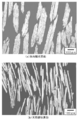
- the shape of graphite in the present invention is such that graphite alone or a kneaded mixture of graphite and refractory aggregate is molded with a uniaxial press, embedded in resin, and polished in parallel to the pressing direction, and reflected. It becomes clear by observing the cross section of graphite with a microscope.
- the particle size of the graphite is the size of the observed graphite in the longitudinal direction
- the thickness of the graphite is the size in the direction perpendicular to the longitudinal direction. Since the particle diameter and thickness of each graphite are not necessarily constant, if necessary, several points are measured and averaged.
- the aspect ratio was defined as the particle size / thickness measured by observation.
- Fig. 1 shows a reflection micrograph of graphite embedded in resin by this method. It is clear that the thick scaly graphite of the present invention is thicker than natural scaly graphite generally used for graphite-containing refractories.
- graphite used for graphite-containing refractories graphite having an aspect ratio of about 15 to 40 is difficult to uniformly disperse, resulting in a large variation in strength of the refractory.
- graphite with a small aspect ratio such as an aspect ratio of less than 5 has a poor effect of absorbing crack propagation energy.
- graphite having an intermediate aspect ratio of 5 to 12 eliminates these problems.
- this improvement effect is remarkably exhibited only in the graphite having a specific thickness range, and the thickness is 50 ⁇ m or more and less than 100 ⁇ m. If the thickness is less than 50 ⁇ m, the number of graphites per same mass increases, so the dispersibility deteriorates and the intensity variation is promoted.
- Non-Patent Document 1 natural scaly graphite having a thickness of 36 ⁇ m or 25 ⁇ m as described in Non-Patent Document 1 has a marked improvement in reducing variation in strength even when the aspect ratio is 5 or more and 12 or less. There is no effect.
- the thickness is 100 ⁇ m or more, as described above, the probability that the crack comes into contact with graphite is reduced, and the effect of absorbing the crack propagation energy due to graphite is reduced.
- the content of thick-scaled graphite having a thickness of 50 ⁇ m or more and less than 100 ⁇ m and an aspect ratio of 5 or more and 12 or less needs to be 20% by mass or more of the total amount of graphite contained in the graphite-containing refractory. If it is less than 20 mass%, the remarkable improvement effect by this invention will no longer be acquired.
- it is so preferable that there is much content of thick flake graphite Preferably it is 40 mass% or more, More preferably, it is 60 mass% or more, and the whole graphite may be thick flake graphite.
- graphite other than thick-walled graphite but natural scale-like graphite is most preferable from the viewpoint of cost.
- the method for producing thick-walled scaly graphite of the present invention may be selected from natural scaly graphite, but since the graphite corresponding to the thick-walled scaly graphite has a small amount of naturally produced, general natural scaly graphite is used. It is preferable to manufacture it artificially. For example, by adding a binder such as a phenol resin to scaly graphite and mixing it with a mixer, the graphite is laminated to increase the thickness. By pulverizing and classifying this into a desired shape, thick-walled graphite can be obtained. Alternatively, it is also possible to manufacture by laminating natural scaly graphite in the thickness direction by applying a compressive force.
- a binder such as a phenol resin
- the present invention is characterized in that it contains 20% by mass or more of thick scaly graphite based on the whole graphite, and other raw materials other than graphite can be used in combination.
- the refractory aggregate include magnesia, alumina, silica, mullite, zirconia, zircon, spinel, wax, titania and the like.
- other additives include metals such as aluminum, silicon and magnesium and alloys thereof, boron compounds such as boron carbide, carbon raw materials such as carbon black, pitch and anthracite, carbides such as silicon carbide, and phenol resin as a binder. Examples include furan resin, pitch, and tar.
- raw materials can be made into a regular refractory through processes such as kneading, molding, drying, and firing, or can be used as an amorphous refractory through processes such as kneading, construction, and drying by known techniques. .
- graphite-containing refractories include magnesia-graphite refractories used in converters, secondary refining furnaces, steel pans, electric furnaces, etc., and alumina used in continuous casting nozzles.
- pyroxene-silicon carbide-graphitic refractory There are pyroxene-silicon carbide-graphitic refractory, and pyroxene-silicon carbide-graphitic refractory.
- Non-standard refractories include: feldspar-silicon carbide-carbon refractory for blast furnace outlet filling material, alumina-graphite refractory for blast furnace pouring material, carbonaceous injection material for blast furnace, electric furnace furnace There are magnesia-graphite stamp material for floors, casting material for slag lines such as hot metal ladle, kneading car, molten steel pan.
- the graphite-containing refractory of the present invention is stable in durability because it has small variations in strength and is excellent in the ability to prevent the growth of cracks, so when used in refractories for various steelmaking processes, it improves productivity and stabilizes operation. Contributes to
- a reflection micrograph of graphite embedded in resin is shown.
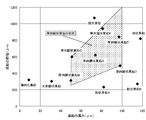
- (A) is the thick scaly graphite of the present invention, and (b) natural scaly graphite generally used for graphite-containing refractories. It is the figure which plotted the average thickness and average particle diameter of each graphite, and also shows the range of the thick-scaled graphite applicable to this invention.
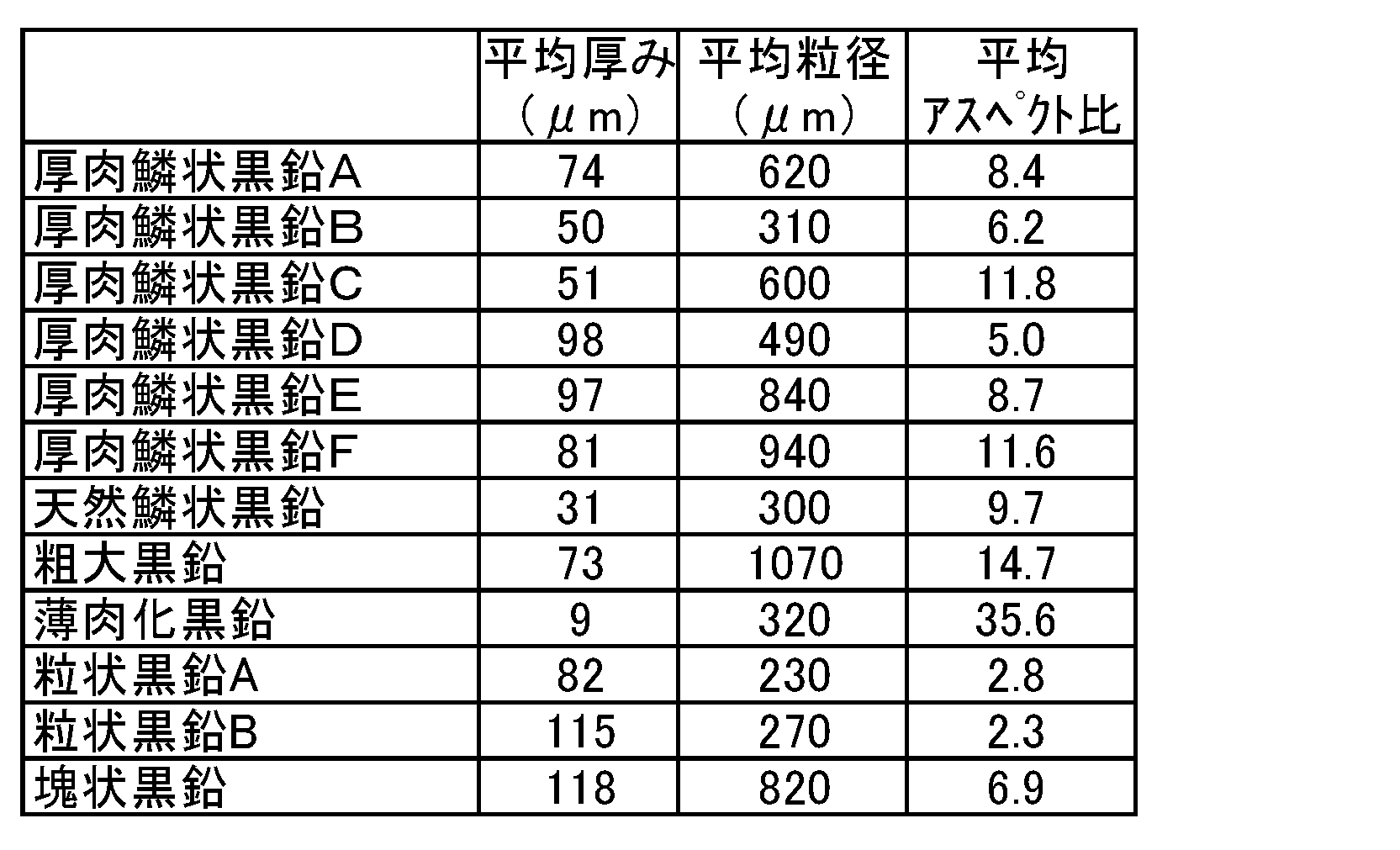
- Thick scaly graphite, coarse graphite, granular graphite, and lump graphite were prepared by adding a liquid phenol resin to natural scaly graphite, granulating with a Henschel mixer, pulverizing and classifying.
- the thickness and particle size were adjusted to the desired size depending on the amount of resin added, granulation time, pulverization method, and the like. For example, graphite with a large thickness can be obtained by increasing the amount of resin added, and graphite with a small particle size can be obtained by increasing the crushing time.
- a commercially available product was used for the thinned graphite.
- each graphite was embedded in the resin as described above, and the cross section of the graphite was observed with a reflection microscope, and the aspect ratio calculated by the thickness, the particle diameter, and the particle diameter / thickness was investigated.
- the purity of each graphite is about the same at about 98% by mass.
- FIG. 2 plots the average thickness and average particle diameter of each graphite, and also shows the range of thick-scale graphite corresponding to the present invention having a thickness of 50 ⁇ m or more and less than 100 ⁇ m and an aspect ratio of 5 or more and 12 or less.
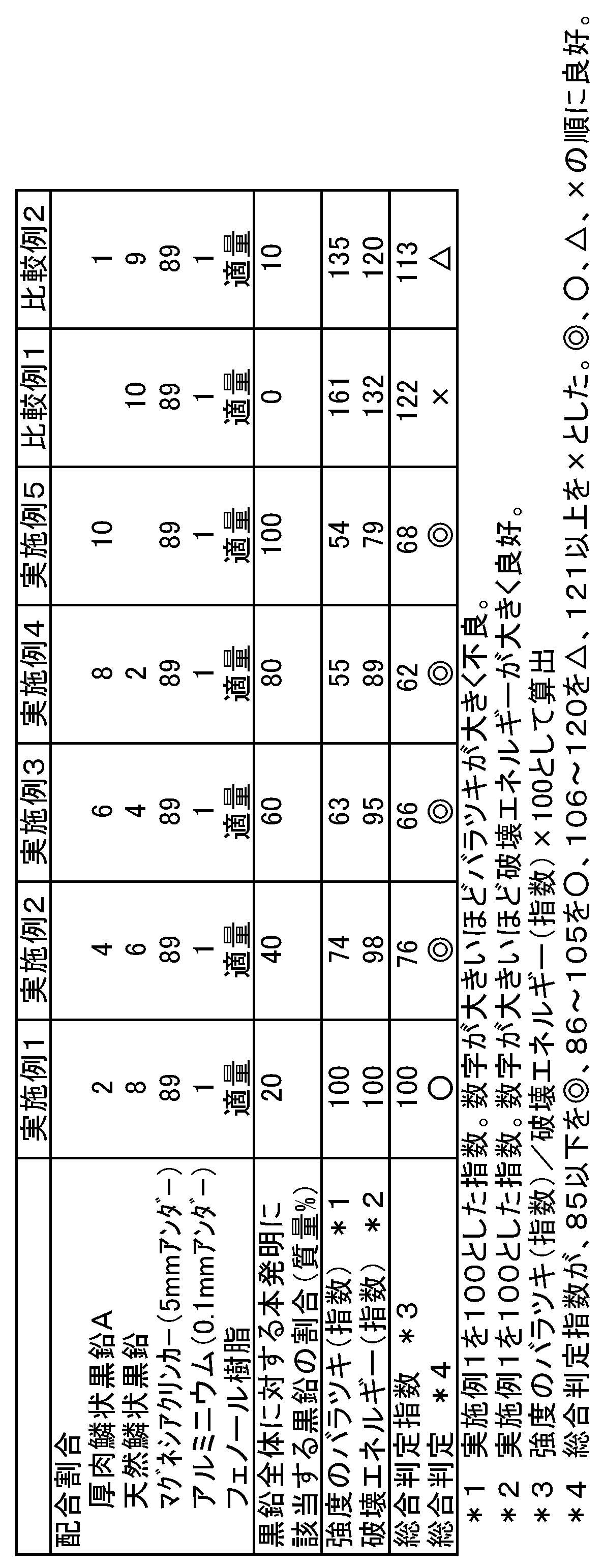
- the ratio of graphite corresponding to the present invention to the entire graphite was changed by combining thick scaly graphite A and natural scaly graphite.
- the ratio of the graphite corresponding to the present invention is the thickness of the entire graphite. It becomes the same as the proportion of fleshy graphite A.
- Evaluation of the test refractories was made by cutting 10 rectangular parallelepiped measurement samples 160 mm long, 25 mm wide and 16 mm thick from each test refractory under the conditions of span 140 mm and crosshead speed 0.2 mm / min.
- a stress-strain curve from the start of loading to failure was obtained by the three-point bending method, and the fracture energy was calculated from the bending strength calculated from the maximum stress and the integrated value in the curve.
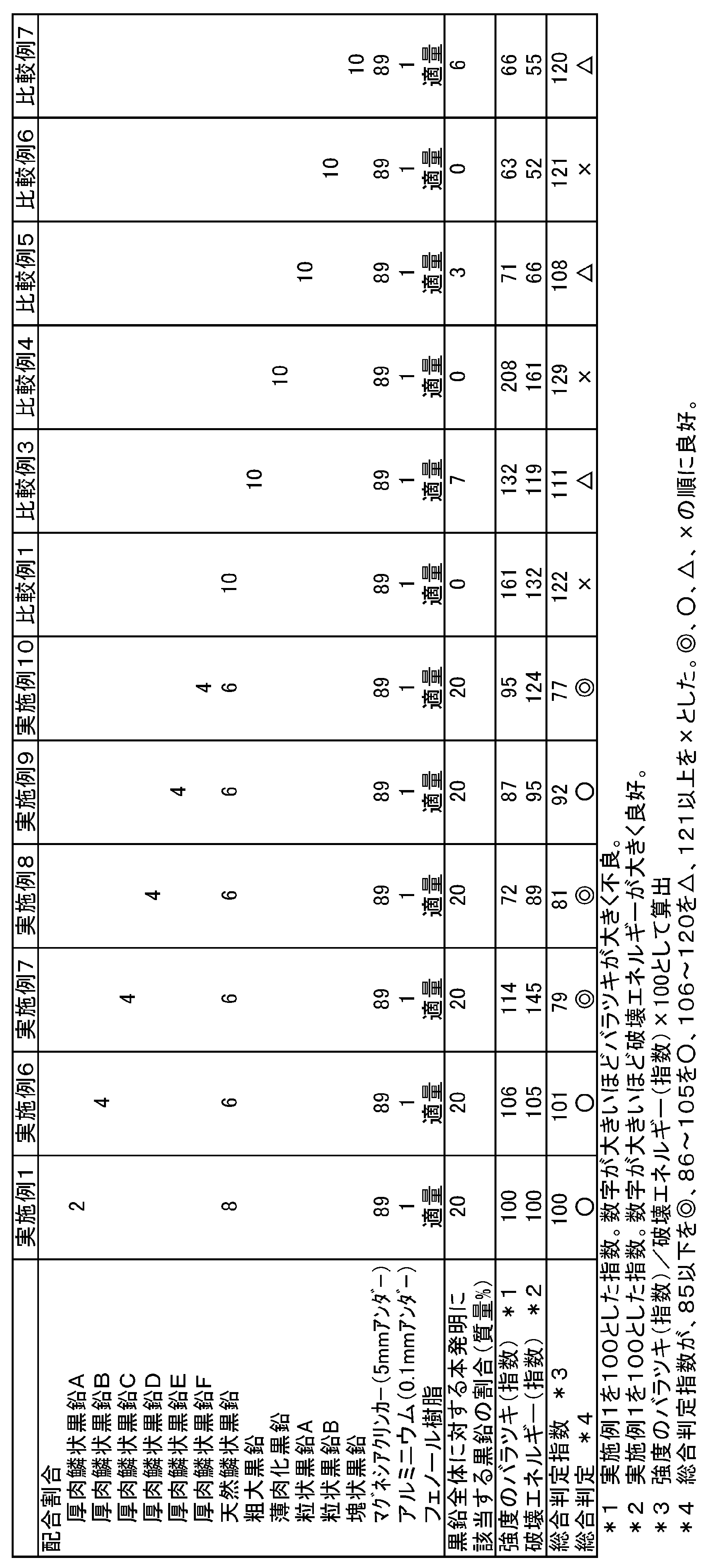
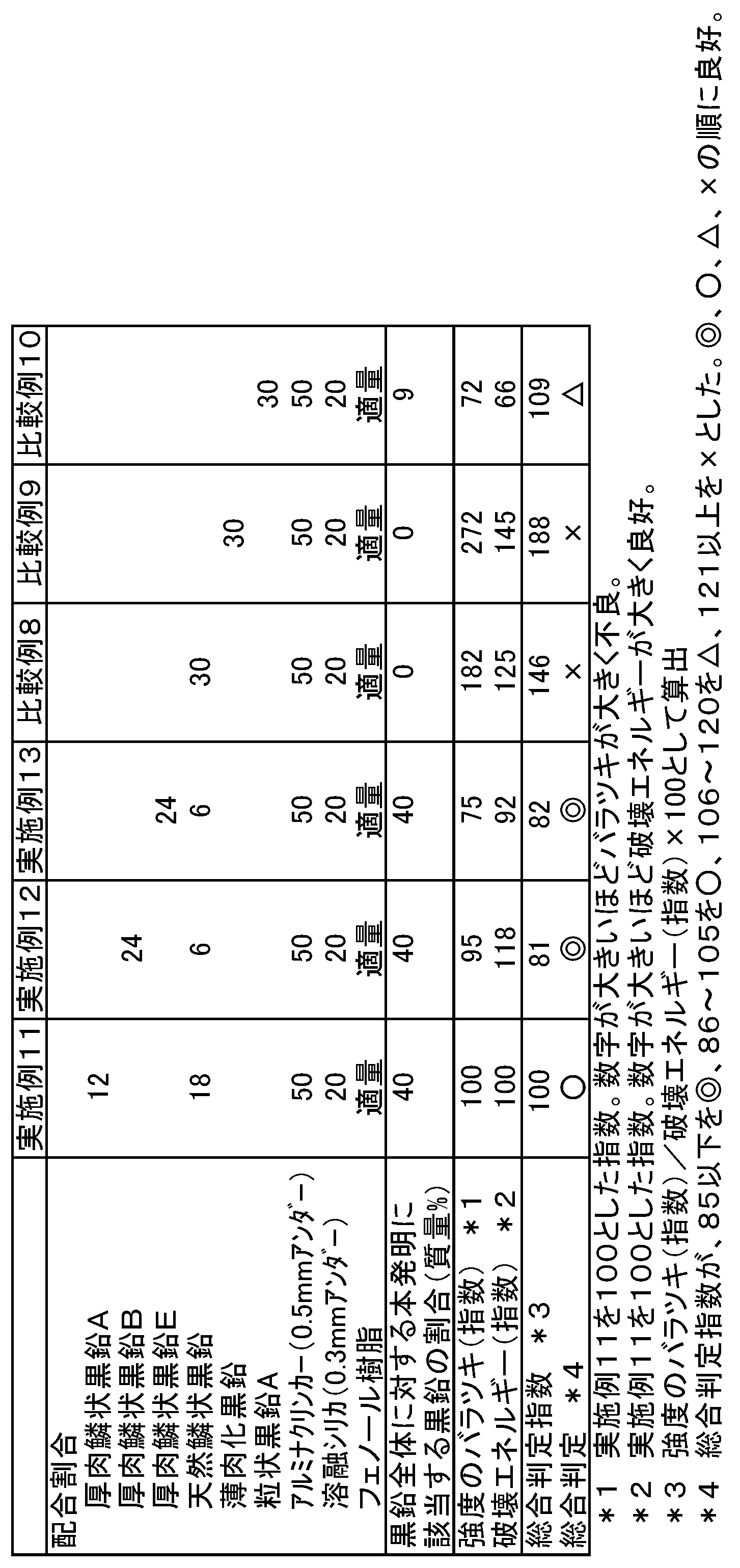
- Table 2 shows the results expressed as indices with the measured value of Example 1 as 100.
- an overall judgment index defined by a strength variation index / destructive energy index ⁇ 100 was calculated. As the overall judgment, the overall judgment index was evaluated as ⁇ , 85 to 86, ⁇ from 86 to 105, ⁇ from 106 to 120, and x from 121 or more. Good in order of ⁇ , ⁇ , ⁇ , ⁇ .
- the evaluation was performed using graphite having various shapes shown in Table 1. Since 50% by mass of the thick scale graphite B to F corresponds to the present invention, when 4% by mass is added, the ratio of the graphite corresponding to the present invention to the total graphite becomes 20% by mass. .
- the manufacturing method and evaluation method of the test refractory are exactly the same as those described above.
- a refractory having an excellent balance can be obtained by containing 20% by mass of thick graphite having a thickness of 50 ⁇ m or more and less than 100 ⁇ m and an aspect ratio of 5 or more and 12 or less. It is clear. Coarse graphite with a large aspect ratio or thin graphite has a very large variation in strength. Granular graphite A and granular graphite B with a small aspect ratio and massive graphite with a large thickness are not suitable because the fracture energy is very small.
- the thick-scaled graphite of the present invention it is possible to obtain a stable refractory material in which cracks do not easily propagate. This means that the degree of freedom in material design is expanded as compared with the prior art, and the corrosion resistance, wear resistance, and oxidation resistance can be greatly improved.
Landscapes
- Engineering & Computer Science (AREA)
- Chemical & Material Sciences (AREA)
- Ceramic Engineering (AREA)
- Manufacturing & Machinery (AREA)
- Materials Engineering (AREA)
- Structural Engineering (AREA)
- Organic Chemistry (AREA)
- Physics & Mathematics (AREA)
- Inorganic Chemistry (AREA)
- Composite Materials (AREA)
- Plasma & Fusion (AREA)
- Thermal Sciences (AREA)
- Mechanical Engineering (AREA)
- General Engineering & Computer Science (AREA)
- Chemical Kinetics & Catalysis (AREA)
- Compositions Of Oxide Ceramics (AREA)
- Ceramic Products (AREA)
- Furnace Housings, Linings, Walls, And Ceilings (AREA)
- Carbon And Carbon Compounds (AREA)
Abstract
Description
Claims (1)
- 耐火性原料および黒鉛を含む耐火物において、厚みが50μm以上100μm未満、粒径/厚みによって定義するアスペクト比が5以上12以下である厚肉鱗状黒鉛が、当該耐火物中の黒鉛全体の20質量%以上含有されていることを特徴とする厚肉鱗状黒鉛含有耐火物。
Priority Applications (1)
| Application Number | Priority Date | Filing Date | Title |
|---|---|---|---|
| CN201180017189XA CN102858712A (zh) | 2010-03-31 | 2011-03-25 | 含厚鳞状石墨耐火物 |
Applications Claiming Priority (2)
| Application Number | Priority Date | Filing Date | Title |
|---|---|---|---|
| JP2010081959A JP2011213519A (ja) | 2010-03-31 | 2010-03-31 | 厚肉鱗状黒鉛含有耐火物 |
| JP2010-081959 | 2010-03-31 |
Publications (1)
| Publication Number | Publication Date |
|---|---|
| WO2011125536A1 true WO2011125536A1 (ja) | 2011-10-13 |
Family
ID=44762490
Family Applications (1)
| Application Number | Title | Priority Date | Filing Date |
|---|---|---|---|
| PCT/JP2011/057307 Ceased WO2011125536A1 (ja) | 2010-03-31 | 2011-03-25 | 厚肉鱗状黒鉛含有耐火物 |
Country Status (4)
| Country | Link |
|---|---|
| JP (1) | JP2011213519A (ja) |
| CN (1) | CN102858712A (ja) |
| TW (1) | TW201144219A (ja) |
| WO (1) | WO2011125536A1 (ja) |
Cited By (4)
| Publication number | Priority date | Publication date | Assignee | Title |
|---|---|---|---|---|
| WO2014187644A1 (de) * | 2013-05-23 | 2014-11-27 | Refratechnik Holding Gmbh | Graphitpulvergemisch und verfahren zu seiner herstellung |
| WO2014187643A1 (de) * | 2013-05-23 | 2014-11-27 | Refratechnik Holding Gmbh | Graphiterzeugnis und verfahren zu seiner herstellung |
| WO2014187653A1 (de) * | 2013-05-23 | 2014-11-27 | Refratechnik Holding Gmbh | Graphit haltiges feuerfestes erzeugnis, verfahren zu seiner herstellung und seine verwendung |
| WO2025115538A1 (ja) * | 2023-11-29 | 2025-06-05 | 黒崎播磨株式会社 | 耐火物及びその製造方法 |
Families Citing this family (3)
| Publication number | Priority date | Publication date | Assignee | Title |
|---|---|---|---|---|
| CN105016742B (zh) * | 2014-04-24 | 2017-04-26 | 宝山钢铁股份有限公司 | 一种连铸水口密封涂料、其制备方法及用途 |
| CN110352183B (zh) * | 2017-02-24 | 2022-03-25 | 杰富意钢铁株式会社 | 含石墨的耐火物及含石墨的耐火物的制造方法 |
| JP7096692B2 (ja) * | 2018-04-11 | 2022-07-06 | 黒崎播磨株式会社 | マグネシアれんがの製造方法及びカーボンピックアップ抑制精錬方法 |
Citations (8)
| Publication number | Priority date | Publication date | Assignee | Title |
|---|---|---|---|---|
| JPS59169968A (ja) * | 1983-03-12 | 1984-09-26 | 黒崎窯業株式会社 | 黒鉛含有耐火物 |
| JPH04209743A (ja) * | 1990-12-04 | 1992-07-31 | Kawasaki Refract Co Ltd | 黒鉛含有耐火物の製造方法 |
| JPH07291710A (ja) * | 1994-04-15 | 1995-11-07 | Nippon Steel Corp | 黒鉛含有耐火れんが |
| JPH08301667A (ja) * | 1995-03-06 | 1996-11-19 | Kawasaki Steel Corp | 黒鉛含有不定形耐火物 |
| JPH1179825A (ja) * | 1997-09-02 | 1999-03-23 | Kawasaki Refract Co Ltd | 黒鉛含有耐火物 |
| JP2001146464A (ja) * | 1999-11-17 | 2001-05-29 | Kurosaki Harima Corp | 塊状黒鉛含有耐火物 |
| JP2001146466A (ja) * | 1999-11-17 | 2001-05-29 | Kurosaki Harima Corp | 粒状黒鉛含有耐火物 |
| JP2001254117A (ja) * | 2000-03-13 | 2001-09-18 | Kawasaki Steel Corp | 金属精錬炉 |
Family Cites Families (2)
| Publication number | Priority date | Publication date | Assignee | Title |
|---|---|---|---|---|
| JPH05217663A (ja) * | 1992-01-31 | 1993-08-27 | Mitsui Mining Co Ltd | セラミック質発熱体およびその製造方法 |
| JPH06116009A (ja) * | 1992-10-06 | 1994-04-26 | Mitsui Mining Co Ltd | セラミック質発熱体の製造方法 |
-
2010
- 2010-03-31 JP JP2010081959A patent/JP2011213519A/ja active Pending
-
2011
- 2011-03-25 WO PCT/JP2011/057307 patent/WO2011125536A1/ja not_active Ceased
- 2011-03-25 CN CN201180017189XA patent/CN102858712A/zh active Pending
- 2011-03-30 TW TW100110990A patent/TW201144219A/zh unknown
Patent Citations (8)
| Publication number | Priority date | Publication date | Assignee | Title |
|---|---|---|---|---|
| JPS59169968A (ja) * | 1983-03-12 | 1984-09-26 | 黒崎窯業株式会社 | 黒鉛含有耐火物 |
| JPH04209743A (ja) * | 1990-12-04 | 1992-07-31 | Kawasaki Refract Co Ltd | 黒鉛含有耐火物の製造方法 |
| JPH07291710A (ja) * | 1994-04-15 | 1995-11-07 | Nippon Steel Corp | 黒鉛含有耐火れんが |
| JPH08301667A (ja) * | 1995-03-06 | 1996-11-19 | Kawasaki Steel Corp | 黒鉛含有不定形耐火物 |
| JPH1179825A (ja) * | 1997-09-02 | 1999-03-23 | Kawasaki Refract Co Ltd | 黒鉛含有耐火物 |
| JP2001146464A (ja) * | 1999-11-17 | 2001-05-29 | Kurosaki Harima Corp | 塊状黒鉛含有耐火物 |
| JP2001146466A (ja) * | 1999-11-17 | 2001-05-29 | Kurosaki Harima Corp | 粒状黒鉛含有耐火物 |
| JP2001254117A (ja) * | 2000-03-13 | 2001-09-18 | Kawasaki Steel Corp | 金属精錬炉 |
Cited By (5)
| Publication number | Priority date | Publication date | Assignee | Title |
|---|---|---|---|---|
| WO2014187644A1 (de) * | 2013-05-23 | 2014-11-27 | Refratechnik Holding Gmbh | Graphitpulvergemisch und verfahren zu seiner herstellung |
| WO2014187643A1 (de) * | 2013-05-23 | 2014-11-27 | Refratechnik Holding Gmbh | Graphiterzeugnis und verfahren zu seiner herstellung |
| WO2014187653A1 (de) * | 2013-05-23 | 2014-11-27 | Refratechnik Holding Gmbh | Graphit haltiges feuerfestes erzeugnis, verfahren zu seiner herstellung und seine verwendung |
| US9862645B2 (en) | 2013-05-23 | 2018-01-09 | Refratechnik Holding Gmbh | Fireproof product containing graphite, method for producing said product, and use of said product |
| WO2025115538A1 (ja) * | 2023-11-29 | 2025-06-05 | 黒崎播磨株式会社 | 耐火物及びその製造方法 |
Also Published As
| Publication number | Publication date |
|---|---|
| JP2011213519A (ja) | 2011-10-27 |
| TW201144219A (en) | 2011-12-16 |
| CN102858712A (zh) | 2013-01-02 |
Similar Documents
| Publication | Publication Date | Title |
|---|---|---|
| KR100967408B1 (ko) | 카본-함유 친환경 내화재 조성물 | |
| JP2011213519A (ja) | 厚肉鱗状黒鉛含有耐火物 | |
| CN110563476A (zh) | 纤维增强耐火砖及其制备方法 | |
| CN102656129B (zh) | 具有SiAlON基质的掺硼耐火材料 | |
| JP5943032B2 (ja) | 軽量断熱アルミナ・マグネシア質耐火物の製造方法 | |
| Otroj et al. | Microstructure and phase evolution of alumina–spinel self-flowing refractory castables containing nano-alumina particles | |
| CN111732419B (zh) | 一种性能优良的超低碳镁碳砖及其制备方法 | |
| JP4681456B2 (ja) | 低カーボン質マグネシアカーボンれんが | |
| EP4624440A1 (en) | Method for manufacturing unfired basic brick | |
| CN102775171B (zh) | 树脂结合铝镁质耐火材料 | |
| CN108585797A (zh) | 一种添加氮化硼的自润滑镁质挡渣滑板砖及其制备方法 | |
| TW201604167A (zh) | 鑄造用耐火物、使用其之鑄造用嘴以及滑動嘴用板 | |
| JP2016527083A (ja) | 炭素結合又は樹脂結合定形耐火製品を製造するためのバッチ、当該製品を製造するための方法、当該製品、及び、マグネシアスピネル‐酸化ジルコニウムの使用 | |
| JP5995315B2 (ja) | 不定形耐火物 | |
| CN1950313A (zh) | 陶瓷配料及适于耐火应用的相关产品 | |
| WO2007011038A1 (ja) | カーボン含有耐火物及びその製造方法並びにピッチ含有耐火原料 | |
| JP6361705B2 (ja) | 転炉装入壁のライニング方法 | |
| JP6432869B2 (ja) | 耐火れんがの製造方法 | |
| US20170081244A1 (en) | Unshaped refractory material | |
| JP2012192430A (ja) | アルミナ−カーボン質スライドゲートプレート | |
| JP2003171184A (ja) | 耐食性、耐スポーリング性、乾燥性に優れた不定形耐火物用SiC、その製造方法及び不定形耐火物原料 | |
| JP6419555B2 (ja) | 流し込み耐火物 | |
| JP4703087B2 (ja) | 水系キャスタブル耐火物 | |
| JP2013249241A (ja) | 不焼成れんが | |
| JP3327883B2 (ja) | 塊状黒鉛含有耐火物 |
Legal Events
| Date | Code | Title | Description |
|---|---|---|---|
| WWE | Wipo information: entry into national phase |
Ref document number: 201180017189.X Country of ref document: CN |
|
| 121 | Ep: the epo has been informed by wipo that ep was designated in this application |
Ref document number: 11765437 Country of ref document: EP Kind code of ref document: A1 |
|
| WWE | Wipo information: entry into national phase |
Ref document number: 1644/KOLNP/2012 Country of ref document: IN |
|
| NENP | Non-entry into the national phase |
Ref country code: DE |
|
| 122 | Ep: pct application non-entry in european phase |
Ref document number: 11765437 Country of ref document: EP Kind code of ref document: A1 |