WO2011126035A1 - サイアロン系酸窒化物蛍光体の製造方法及びサイアロン系酸窒化物蛍光体 - Google Patents
サイアロン系酸窒化物蛍光体の製造方法及びサイアロン系酸窒化物蛍光体 Download PDFInfo
- Publication number
- WO2011126035A1 WO2011126035A1 PCT/JP2011/058664 JP2011058664W WO2011126035A1 WO 2011126035 A1 WO2011126035 A1 WO 2011126035A1 JP 2011058664 W JP2011058664 W JP 2011058664W WO 2011126035 A1 WO2011126035 A1 WO 2011126035A1
- Authority
- WO
- WIPO (PCT)
- Prior art keywords
- sialon
- powder
- oxide
- producing
- nitrogen
- Prior art date
- Legal status (The legal status is an assumption and is not a legal conclusion. Google has not performed a legal analysis and makes no representation as to the accuracy of the status listed.)
- Ceased
Links
Classifications
-
- C—CHEMISTRY; METALLURGY
- C09—DYES; PAINTS; POLISHES; NATURAL RESINS; ADHESIVES; COMPOSITIONS NOT OTHERWISE PROVIDED FOR; APPLICATIONS OF MATERIALS NOT OTHERWISE PROVIDED FOR
- C09K—MATERIALS FOR MISCELLANEOUS APPLICATIONS, NOT PROVIDED FOR ELSEWHERE
- C09K11/00—Luminescent materials, e.g. electroluminescent or chemiluminescent
- C09K11/08—Luminescent materials, e.g. electroluminescent or chemiluminescent containing inorganic luminescent materials
- C09K11/0883—Arsenides; Nitrides; Phosphides
-
- C—CHEMISTRY; METALLURGY
- C09—DYES; PAINTS; POLISHES; NATURAL RESINS; ADHESIVES; COMPOSITIONS NOT OTHERWISE PROVIDED FOR; APPLICATIONS OF MATERIALS NOT OTHERWISE PROVIDED FOR
- C09K—MATERIALS FOR MISCELLANEOUS APPLICATIONS, NOT PROVIDED FOR ELSEWHERE
- C09K11/00—Luminescent materials, e.g. electroluminescent or chemiluminescent
- C09K11/08—Luminescent materials, e.g. electroluminescent or chemiluminescent containing inorganic luminescent materials
-
- C—CHEMISTRY; METALLURGY
- C09—DYES; PAINTS; POLISHES; NATURAL RESINS; ADHESIVES; COMPOSITIONS NOT OTHERWISE PROVIDED FOR; APPLICATIONS OF MATERIALS NOT OTHERWISE PROVIDED FOR
- C09K—MATERIALS FOR MISCELLANEOUS APPLICATIONS, NOT PROVIDED FOR ELSEWHERE
- C09K11/00—Luminescent materials, e.g. electroluminescent or chemiluminescent
- C09K11/08—Luminescent materials, e.g. electroluminescent or chemiluminescent containing inorganic luminescent materials
- C09K11/64—Luminescent materials, e.g. electroluminescent or chemiluminescent containing inorganic luminescent materials containing aluminium
-
- C—CHEMISTRY; METALLURGY
- C09—DYES; PAINTS; POLISHES; NATURAL RESINS; ADHESIVES; COMPOSITIONS NOT OTHERWISE PROVIDED FOR; APPLICATIONS OF MATERIALS NOT OTHERWISE PROVIDED FOR
- C09K—MATERIALS FOR MISCELLANEOUS APPLICATIONS, NOT PROVIDED FOR ELSEWHERE
- C09K11/00—Luminescent materials, e.g. electroluminescent or chemiluminescent
- C09K11/08—Luminescent materials, e.g. electroluminescent or chemiluminescent containing inorganic luminescent materials
- C09K11/77—Luminescent materials, e.g. electroluminescent or chemiluminescent containing inorganic luminescent materials containing rare earth metals
- C09K11/7728—Luminescent materials, e.g. electroluminescent or chemiluminescent containing inorganic luminescent materials containing rare earth metals containing europium
- C09K11/77348—Silicon Aluminium Nitrides or Silicon Aluminium Oxynitrides
Definitions
- the present invention relates to a method for producing an ⁇ -sialon oxynitride phosphor and a sialon oxynitride phosphor.
- an ⁇ -sialon-based oxynitride phosphor activated with a rare earth metal element in a powder state that realizes high brightness of a white light emitting diode (white LED) using a blue light emitting diode (blue LED) as a light source
- a sialon-based oxynitride phosphor activated with a rare earth metal element in a powder state that realizes high brightness of a white light emitting diode (white LED) using a blue light emitting diode (blue LED) as a light source
- a sialon-based oxynitride phosphor activated with a rare earth metal element in a powder state that realizes high brightness of a white light emitting diode (white LED) using a blue light emitting diode (blue LED
- a phosphor in which silicate, phosphate (for example, apatite, etc.), and aluminate are used as a base material, and transition metals or rare earth metals are added to these base materials as an activator is widely known.
- silicate, phosphate for example, apatite, etc.
- aluminate for example, apatite, etc.
- transition metals or rare earth metals are added to these base materials as an activator.
- the white LED currently being developed is a blue LED surface coated with a YAG (yttrium, aluminum, garnet) phosphor.
- the YAG phosphor activated by Ce yellows the blue LED blue light. Convert to light. Part of the blue light with a wavelength of 450 nm emitted from the blue LED passes through the phosphor layer, and the rest hits the phosphor and is converted into yellow light. The blue and yellow light will be mixed and appear white.
- the YAG phosphor does not only have a bluish white light because the spectrum intensity decreases, but the excitation energy of the blue LED does not match the excitation energy of the YAG phosphor. Therefore, there is a problem that the luminous efficiency is low. There is also a problem that the durability of the coated phosphor layer is insufficient. For this reason, the performance improvement of the fluorescent substance itself used for wavelength conversion is calculated
- M is at least one metal selected from Li, Ca, Mg, Y, or a lanthanide metal excluding La, Ce
- Disclosed is an ⁇ -sialon-based oxynitride phosphor substituted with a lanthanide metal Ln (Ln is at least one lanthanide metal selected from Eu, Dy, Er, Tb, and Yb) that is the center of light emission.
- the ⁇ -sialon oxynitride phosphor disclosed in Patent Document 1 is a certain excellent phosphor, but it is desirable to further improve the emission intensity of the phosphor.
- An object of the present invention is to provide a method for producing a photoluminescence phosphor capable of realizing a high brightness of a white LED having a blue LED as a light source in the oxynitride phosphor mainly composed of.
- the present applicant obtains a photoluminescence phosphor that can realize high brightness of white LEDs using blue LEDs as a light source by using amorphous silicon nitride powder with a high light packing density as a raw material.
- the present invention has been completed.
- the present invention includes an amorphous silicon nitride powder having a light packing density of 0.1 to 0.3 g / cm 3 , and typically further includes an AlN and / or Al powder, an oxide of metal M, or thermal decomposition.
- the product has the formula M x Si 12- (m + n ) Al (m + n) O n n 16 -n: Ln y (In the formula, M is at least one metal selected from Li, Ca, Mg, Y, or a lanthanide metal excluding La, Ce, and Ln is at least selected from Eu, Dy, Er, Tb, Yb.
- the present invention also relates to a method for producing a powdered ⁇ -sialon-based oxynitride phosphor, wherein the amorphous silicon nitride powder has a specific surface area of more than 600 to 800 m 2 / g.
- the oxynitride phosphor mainly composed of ⁇ -sialon of the present invention has high emission intensity and an appropriate spectrum, it is a high-brightness and highly reliable white LED using a blue LED as a light source. Can be used.
- the method for producing a powdered ⁇ -sialon-based oxynitride phosphor of the present invention includes an amorphous silicon nitride powder having a light weight density of 0.1 to 0.3 g / cm 3 , typically AlN and / or Alternatively, an Al powder, an oxide of metal M or a precursor material that becomes an oxide by thermal decomposition, and an oxide of lanthanide metal Ln or a precursor material that becomes an oxide by thermal decomposition, a product of formula M x Si 12- (m + n) Al ( m + n) O n n 16-n: in Ln y (wherein, M is, Li, Ca, Mg, Y or La, at least one metal selected from the lanthanide metal excluding Ce, Ln is at least one lanthanide metal selected from Eu, Dy, Er, Tb, and Yb, and 0.3 ⁇ x + y ⁇ 1.5, 0 ⁇ y ⁇ 0.7, 0.3 ⁇ m
- This following general formula M x Si represent the ⁇ - sialon-based oxynitride phosphor produced by the method of the invention 12- (m + n) Al ( m + n) O n N 16-n: Ln y
- the metal M penetrating into ⁇ -sialon and the lanthanide metal Ln serving as the center of light emission are one large unit cell of ⁇ -sialon containing four formulas of (Si, Al) 3 (N, O) 4
- a white LED having a blue LED as a light source is produced. It is possible to obtain a photoluminescence phosphor that can achieve brightness.
- the light packing density of the amorphous silicon nitride powder is 0.1 to 0.3 g / cm 3 , preferably 0.16 to 0.22 g / cm 3 .
- the light weight density of the powder is measured in accordance with JIS R9301-2-3. Specifically, it is a value calculated from the weight and volume of the sample by slowly dropping the sample through the chute into the measuring container. .
- the specific surface area of the silicon amorphous nitride powder is a 600 super ⁇ 800 cm 2 / g, preferably 650 ⁇ 800cm 2 / g.
- the specific surface area is 600 cm 2 / g or less, the crystallinity of ⁇ -sialon is lowered and the fluorescence characteristics are not improved.
- the specific surface area is larger than 800 cm 2 / g, a crystal phase other than ⁇ -sialon is generated, and the fluorescence characteristics are deteriorated.
- the amorphous silicon nitride powder having a light weight density of 0.16 to 0.22 g / cm 3 used in the present invention is not limited, but a nitrogen-containing silane compound powder having a light weight density of 0.10 to 0.30 g / cm 3 is used. It can be manufactured by heat treatment. Further, a powder of a nitrogen-containing silane compound having a light packing density of 0.10 to 0.30 g / cm 3 can be obtained by the manufacturing method disclosed by the present applicant in Japanese Patent Application Nos. 2009-82730 and 2009-82747. . The manufacturing method will be described below.
- the nitrogen-containing silane compound powder having a light weight density of 0.10 to 0.30 g / cm 3 is obtained by mixing the halogenated silane compound with liquid ammonia and reacting the halogenated silane compound with no solvent or halogenated silane. It can be manufactured by a manufacturing method characterized in that a solution of an inert organic solvent having a compound concentration of 50 vol% or more is supplied by being discharged from a supply port into liquid ammonia.
- halogenated silane used in the method for producing the nitrogen-containing silane compound powder examples include fluorinated silanes such as SiF 4 , H 2 SiF 6 , HSiF 3 , H 3 SiF 5 H 3 SiF, and H 5 SiF 3 , SiCl 4 , Silane chloride such as HSiCl 3 , H 2 SiCl 2 , H 3 SiCl, bromide silane such as SiBr 4 , HSiBr 3 , H 2 SiBr 2 , H 3 SiBr, SiI 4 , HSiI 3 , H 2 SiI 2 , H 3 SiI Silane iodide silanes can be used.
- RSiX 3, R 2 SiX 2 , R 3 SiX R is an alkyl or alkoxy group, X is a halogen
- halogenated silane such as SiF 4 , H 2 SiF 6 , HSiF 3 , H 3 SiF 5 H 3 SiF, and H 5
- the halogenated silane can be supplied as a solvent-free solution or a solution diluted with a small amount of an organic solvent.
- the filtrate obtained by filtering the produced nitrogen-containing silane compound powder from the reaction slurry is composed of only two components, liquid ammonia and ammonium halide dissolved in the ammonia. .
- the organic solvent used for diluting the halogenated silane can be appropriately selected from those which dissolve the halogenated silane and do not react with the halogenated silane or liquid ammonia.
- chain aliphatic hydrocarbons having 5 to 12 carbon atoms such as n-pentane, n-hexane, n-heptane, n-octane, cyclic aliphatic hydrocarbons such as cyclohexane and cyclooctane, toluene And aromatic hydrocarbons such as xylene.
- the preferable halogenated silane concentration in the mixed solution of the organic solvent and the halogenated silane is 50 vol% or more, more preferably 66 vol% or more. If the concentration is less than 50 vol%, a sufficient increase in apparent density cannot be obtained for the produced nitrogen-containing silane compound powder.
- a discharge port for supplying the halogenated silane as a solution without solvent or diluted with a small amount of an organic solvent is installed in liquid ammonia in the reactor.
- the discharge linear velocity from the supply port is preferably maintained at 5 cm / sec or more. If the linear velocity is not sufficient, a small amount of ammonia tends to enter from the discharge port into the supply pipe by diffusion. As a result, the supply pipe is likely to be clogged due to the formation of a nitrogen silane compound in the vicinity of the discharge port or the precipitation of by-product ammonium halide, which is not practical. More preferably, the discharge linear velocity from the supply port is maintained at 8 cm / sec or more.
- the discharge pressure of the supply pump when supplying the halogenated silane as a solution without solvent or diluted with a small amount of organic solvent should be such that a sufficient pressure difference can be produced.
- the above mixing ratio refers to the ratio of the total amount of halogenated silane and liquid ammonia supplied to the reactor per batch when the reaction is carried out in a batch mode. Refers to the ratio of the volume flow rate of the halogenated silane and liquid ammonia.
- reaction temperature for carrying out the production of this nitrogen-containing silane compound, and it can be selected in the range from low temperature to room temperature depending on the equipment specifications. However, if the reaction temperature is increased, the vapor pressure of liquid ammonia will increase. It is necessary to increase the pressure specification of the vessel. On the other hand, if the reaction temperature is too low, an excessive load is applied to the cooling facility.
- a suitable reaction temperature range is ⁇ 10 to 40 ° C., more preferably 0 to 30 ° C.
- the pressure at the time of producing this nitrogen-containing silane compound is substantially defined by the vapor pressure of liquid ammonia occupying most of the reaction slurry. Since the vapor pressure of liquid ammonia in the reaction slurry depends on the reaction temperature, the pressure at which the reaction is performed is a value corresponding to the reaction temperature.
- the preferred range of pressure is 0.3 to 1.6 MPa, more preferably 0.4 to 1.6 MPa (absolute pressure). Under the pressure conditions set in this way, liquid ammonia exists at a temperature close to the boiling point, and the large reaction heat generated when synthesizing the nitrogen-containing silane compound is caused by evaporation of ammonia present in the vicinity. Can be absorbed.
- This nitrogen-containing silane compound is a compound generally called silicon diimide, but it easily absorbs or releases NH 3 even near room temperature, and Si 6 N 13 H 15 , Si 6 N 12 H 12 , Si 6 N 11 H 9.
- Si—N—H compounds that can exist in various composition formulas such as This nitrogen-containing silane compound or silicon diimide is often represented by the formula Si (NH) 2 , but is considered to be a compound having an imino group or amino group bonded to silicon, and has the chemical formula Si (NH x ) y (Wherein x is 1 or 2, and y is 2 to 4).
- the nitrogen-containing silane compound has a light weight density after production of 0.10 to 0.30 g / cm 3 , preferably 0.16 to 0.22 g / cm 3.
- the true density is 1.4 to 1.9 g / cm 3 , more preferably 1.5 to 1.7 g / cm 3
- the specific surface area is 700 to 700 for nitrogen-containing silane compounds. It can be set to 1100 m 2 / g, more preferably 800 to 1000 m 2 / g.
- the diatomaceous density by heat treatment of the nitrogen-containing silane compound of 0.10 ⁇ 0.30g / cm 3, can be loosed density obtained amorphous silicon nitride 0.10 ⁇ 0.30g / cm 3.
- a heat treatment for obtaining amorphous silicon nitride having a light packing density of 0.10 to 0.30 g / cm 3 from a nitrogen-containing silane compound having a light packing density of 0.10 to 0.30 g / cm 3 for example, an inert gas or a nitrogen atmosphere Among them, it can be obtained by baking at 600 to 1200 ° C.
- AlN and / or Al powder is used as an aluminum source used as a raw material together with the amorphous silicon nitride.
- Each of the powders may be used alone or in combination.
- the aluminum nitride powder a general powder having an oxygen content of 0.1 to 8% by mass and a specific surface area of 1 to 100 m 2 / g can be used.
- an oxide of metal M or a precursor substance that generates an oxide of metal M by thermal decomposition and an oxide of lanthanide metal Ln
- a precursor material that generates an oxide of lanthanide metal Ln by thermal decomposition can be used.
- Metal salts that generate an oxide of metal M or lanthanide metal Ln by thermal decomposition include respective carbonates and oxalates. Citrate, basic carbonate, hydroxide and the like.
- the product was calcined as described above general formula M x Si 12- (m + n ) Al (m + n) O n N 16-n: Ln y (wherein, M is, Li, Ca, It is at least one metal selected from lanthanide metals excluding Mg, Y, or La and Ce, and Ln is at least one lanthanide metal selected from Eu, Dy, Er, Tb, Yb, and 0.3 ⁇ x + y ⁇ 1.5, 0 ⁇ y ⁇ 0.7, 0.3 ⁇ m ⁇ 4.5, 0 ⁇ n ⁇ 2.25)).
- M x Si 12- (m + n ) Al (m + n) O n n 16-n a mixture obtained by adding ⁇ - sialon powder represented by Ln y can be performed deformation such as a starting material.
- the method for mixing each of the starting materials is not particularly limited.
- a method known per se for example, a dry mixing method, a wet mixing in an inert solvent that does not substantially react with each component of the starting material, and then the solvent is added.
- a removal method or the like can be employed.
- a V-type mixer, a rocking mixer, a ball mill, a vibration mill, a medium stirring mill, or the like is preferably used.
- the nitrogen-containing silane compound and / or amorphous silicon nitride powder is extremely sensitive to moisture and moisture, it is necessary to mix the starting materials in a controlled inert gas atmosphere.
- the mixture of starting materials is calcined at 1400 to 2000 ° C., preferably 1500 to 1800 ° C. in a nitrogen-containing inert gas atmosphere at 1 atm to obtain the desired ⁇ -sialon powder.
- the firing temperature is lower than 1400 ° C., it takes a long time to produce the desired ⁇ -sialon powder, which is not practical.
- generation powder also falls.
- the firing temperature exceeds 2000 ° C. an undesirable situation occurs in which silicon nitride and sialon undergo sublimation decomposition and free silicon is generated.
- ⁇ -sialon and Li compound can be mixed and then reheated at 1000 to 1400 ° C. in a nitrogen-containing inert gas atmosphere.
- the starting raw material mixed powder can be fired in a temperature range of 1600 to 2000 ° C., preferably 1600 to 1900 ° C., under a pressurized nitrogen gas atmosphere.
- nitrogen gas pressurization suppresses sublimation decomposition of silicon nitride and sialon at a high temperature, and a desired ⁇ -sialon-based oxynitride phosphor can be obtained in a short time.
- the firing temperature can be increased by increasing the nitrogen gas pressure. For example, firing can be performed at 1600 to 1850 ° C. under a nitrogen gas pressure of 5 atm and 1600 to 2000 ° C. under a nitrogen gas pressure of 10 atm.
- ⁇ -sialon and Li compound can be mixed and then reheated at 1000 to 1400 ° C. in a nitrogen-containing inert gas atmosphere.
- heating furnace used for firing the powder mixture.
- a batch-type electric furnace, rotary kiln, fluidized firing furnace, pusher-type electric furnace, or the like using a high-frequency induction heating system or a resistance heating system is used. be able to.
- the powdery ⁇ -sialon-based oxynitride phosphor manufactured by the manufacturing method of the present invention is composed of the ⁇ -sialon-based oxynitride represented by the above general formula, but the fluorescence emission intensity is the conventional ⁇ . -Improved from sialon-based oxynitride phosphors.
- the median diameter in the particle size distribution curve of the ⁇ -sialon-based oxynitride phosphor is preferably 8 ⁇ m or less, particularly preferably 1 to 6 ⁇ m.
- the ⁇ -sialon oxynitride phosphor activated with rare earth elements of the present invention is kneaded with a transparent resin such as an epoxy resin or an acrylic resin by a known method to produce a coating agent, and the surface is coated with the coating agent.
- a transparent resin such as an epoxy resin or an acrylic resin
- the coated light emitting diode is used as a light conversion element.
- Examples 1-5 Silicon diimide having a specific surface area of 1104 m 2 / g obtained by reacting liquid ammonia in the absence of solvent or in a solution of an inert organic solvent having a silicon tetrachloride concentration of 50 vol% or more is thermally decomposed at 600 to 1200 ° C.
- an amorphous silicon nitride powder having a light packing density of 0.18 to 0.22 g / cm 3 and a specific surface area of 689 to 782 m 2 / g was obtained.
- the metal impurities mixed in the amorphous silicon nitride powder are reduced to 10 ppm or less by a known method for improving the friction state between the powder and the metal in the reaction vessel material and the powder handling device. Further, the oxygen concentration in the nitrogen gas circulated in the heating furnace can be controlled in the range of 20 ppm to 1000 ppm.
- nitrogen gas is added to the aluminum nitride powder, lithium carbonate powder, lithium nitride powder, and europium oxide powder so as to have the composition shown in Table 1.
- the mixture was mixed with a vibration mill in a nitrogen gas atmosphere for 1 hour.
- the powder is taken out in a nitrogen-purged glow box, filled in a crucible, set in a resistance heating electric furnace, and from room temperature to 1200 ° C for 2 hours in a normal pressure nitrogen atmosphere, 1200 ° C to 1440 ° C.
- the temperature was raised for 4 hours and further from 1440 ° C. to 1725 ° C. on a schedule of 2 hours and held for 12 hours for crystallization to obtain ⁇ -sialon powder.
- ⁇ -sialon and lithium oxide were mixed and then heat-treated at 1400 ° C. in a nitrogen atmosphere at normal pressure.
- the obtained powder was pulverized using an agate mortar, dry pulverizer, and wet pulverizer.
- fluorescence characteristics were evaluated using an FP-6500 with an integrating sphere manufactured by JASCO Corporation at an excitation wavelength of 450 nm.
- the intensity of the dominant wavelength is shown in Tables 1 and 2).
- the light packing density of the powder in the present invention was determined by a method based on JIS R9301-2-3.
- the specific surface area was measured by a BET method using a nitrogen gas adsorption method.
- a silicon diimide having a light packing density of 0.08 g / cm 2 and a specific surface area of 869 m 2 / g obtained by reacting a toluene solution having a silicon tetrachloride concentration of 33 vol% with liquid ammonia is thermally decomposed at 600 to 1200 ° C.
- an amorphous silicon nitride powder having a light packing density of 0.09 g / cm 2 and a specific surface area of 463 m 2 / g was obtained.
- ⁇ -sialon was prepared and evaluated in the same manner as in Example 1, but with the blending ratios shown in Comparative Examples 1 to 4 in Table 1.
- Comparative Example 5 As in Example 1, however, ⁇ -sialon was prepared and evaluated at the blending ratio shown in Comparative Example 5 in Table 1.
- Examples 6 to 9 Silicon diimide having a specific surface area of 1104 m 2 / g obtained by reacting liquid ammonia in the absence of solvent or in a solution of an inert organic solvent having a silicon tetrachloride concentration of 50 vol% or more is thermally decomposed at 600 to 1200 ° C.
- an amorphous silicon nitride powder having a light packing density of 0.18 to 0.22 g / cm 3 and a specific surface area of 689 to 782 m 2 / g was obtained.
- the metal impurities mixed in the amorphous silicon nitride powder are reduced to 10 ppm or less by a known method for improving the friction state between the powder and the metal in the reaction vessel material and the powder handling device. Further, the oxygen concentration in the nitrogen gas circulated in the heating furnace can be controlled in the range of 20 ppm to 1000 ppm.
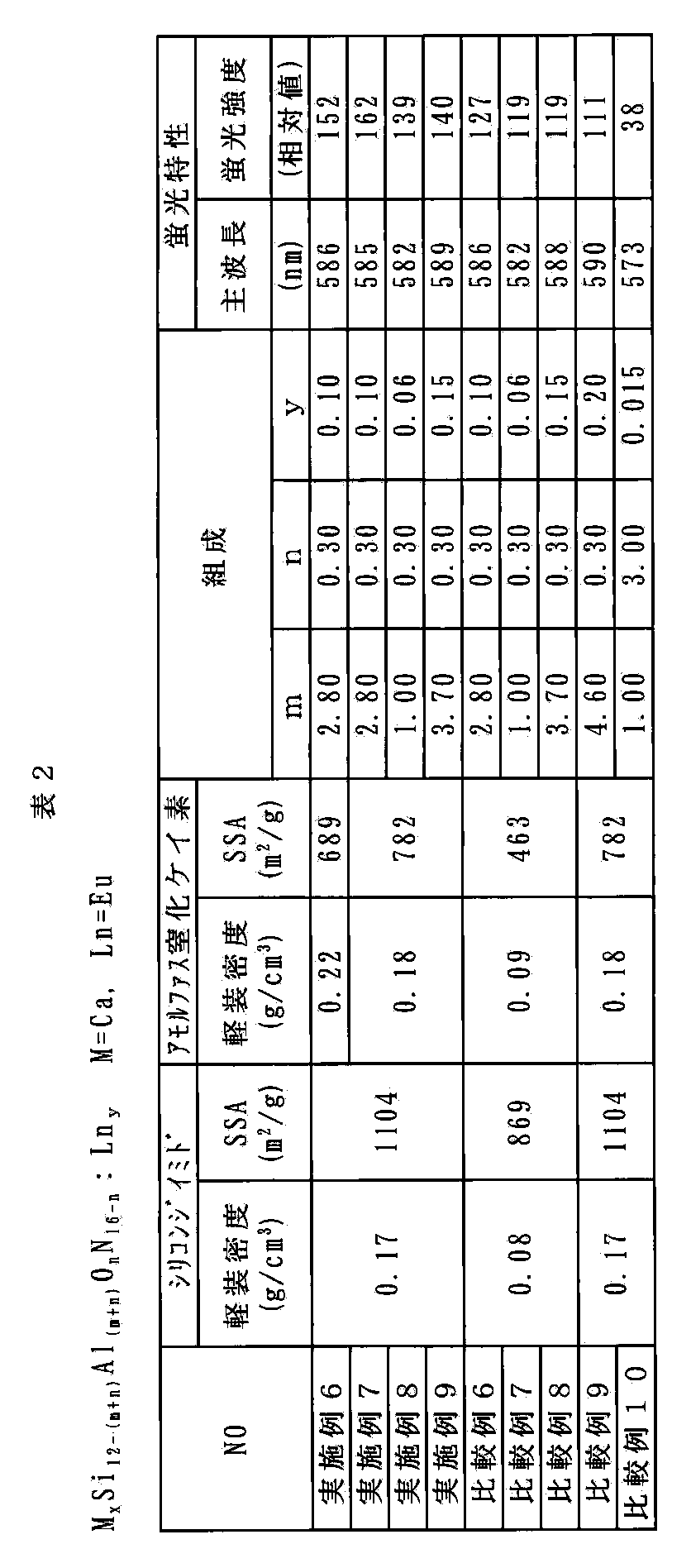
- nitrogen gas is added to the aluminum nitride powder, calcium carbonate powder, calcium nitride powder, and europium oxide powder so as to have the composition shown in Table 2.
- the mixture was mixed with a vibration mill in a nitrogen gas atmosphere for 1 hour.
- the powder is taken out in a nitrogen-purged glow box, filled in a crucible, set in a resistance heating electric furnace, and from room temperature to 1200 ° C for 2 hours in a normal pressure nitrogen atmosphere, 1200 ° C to 1440 ° C.
- the temperature was raised for 4 hours and further from 1440 ° C. to 1725 ° C. on a schedule of 2 hours and held for 12 hours for crystallization to obtain ⁇ -sialon powder.
- the obtained powder was pulverized using an agate mortar, dry pulverizer, and wet pulverizer. After setting to a predetermined particle size, fluorescence characteristics were measured using an FP-6500 with an integrating sphere manufactured by JASCO Corporation.
- ⁇ -sialon was prepared and evaluated in the same manner as in Example 6, but with the blending ratios shown in Comparative Examples 6 to 8 in Table 1.
- Comparative Examples 9 and 10 As in Example 6, however, ⁇ -sialon was prepared and evaluated at the blending ratios shown in Comparative Examples 9 and 10 in Table 2.
Landscapes
- Chemical & Material Sciences (AREA)
- Inorganic Chemistry (AREA)
- Engineering & Computer Science (AREA)
- Materials Engineering (AREA)
- Organic Chemistry (AREA)
- Luminescent Compositions (AREA)
Abstract
Description
MxSi12−(m+n)Al(m+n)OnN16−n:Lny
(式中、Mは、Li,Ca,Mg,Y、またはLa,Ceを除くランタニド金属から選ばれる少なくとも1種の金属であり、Lnは、Eu,Dy,Er,Tb,Ybから選ばれる少なくとも1種のランタニド金属であり、0.3≦x+y<1.5、0<y<0.7、0.3≦m<4.5、0<n<2.25である。)
で表わされるとして計算した配合割合で組合せた混合粉末を、窒素を含有する不活性ガス雰囲気中1400~2000℃で焼成することを特徴とする、粉末状態のα−サイアロン系酸窒化物蛍光体の製造方法に関する。
MxSi12−(m+n)Al(m+n)OnN16−n:Lny
において、α−サイアロンに侵入固溶する金属M及び発光の中心となるランタニド金属Lnは、(Si,Al)3(N,O)4の4式量を含むα−サイアロンの大きな単位胞1個当たり最高2個まで固溶するので、固溶限界の観点から、前記の一般式において、0.3≦x+y<1.5,0<y<0.7,0.3≦m<4.5、0<n<2.25となり、金属Mの原子価をa、ランタニド金属Lnの原子価をbとするとき、m=ax+byである。例えば、侵入金属M、Lnが総て2価のときは、0.6≦m<3.0かつ0<n<1.5であり、侵入金属M、Lnが総て3価のときは、0.9≦m<4.5かつ0<n<2.25である。
ここで、粉末の軽装密度はJIS R9301−2−3に準拠して測定するが、具体的には、サンプルをシュートを通じてゆっくりと測定容器に落下させて、その重さと体積から算出した値である。
有機溶媒とハロゲン化シランとの混合溶液における好ましいハロゲン化シラン濃度は、50vol%以上、より好ましくは66vol%以上である。50vol%未満の濃度では、生成する含窒素シラン化合物粉末について見掛け密度の充分な増加が得られない。
更に、α−サイアロンとLi化合物を混合後、窒素含有不活性ガス雰囲気中1000~1400℃で再加熱することが出来る。
更に、α−サイアロンとLi化合物を混合後、窒素含有不活性ガス雰囲気中1000~1400℃で再加熱することが出来る。
四塩化ケイ素を無溶媒あるいは四塩化ケイ素濃度が50vol%以上の不活性有機溶媒の溶液として液体アンモニアを反応させることにより得られた比表面積1104m2/gのシリコンジイミドを600~1200℃で加熱分解して、軽装密度0.18~0.22g/cm3 比表面積689~782m2/gのアモルファス窒化ケイ素粉末を得た。本材料は、反応容器材質および粉末取り扱い機器における粉体と金属との擦れ合い状態を改良する公知の方法により、アモルファス窒化ケイ素粉末に混入する金属不純物は10ppm以下に低減される。また、加熱炉に流通させる窒素ガス中の酸素濃度を20ppm~1000ppmの範囲で制御できる。
測定した蛍光特性は、蛍光の主波長(CIE色度図における、白色点の座標:x=0.33,y=0.33と試料の発光スペクトルの座標の二つの点を通る直線と、単色軌跡との交点から求められる波長)及びその主波長の強度(表1,2には相対強度を示す。)である。
先ず四塩化ケイ素濃度が33vol%のトルエン溶液と液体アンモニアを反応させることにより得られた、軽装密度0.08g/cm2、比表面積869m2/gのシリコンジイミドを600~1200℃で加熱分解して、軽装密度0.09g/cm2、比表面積463m2/gのアモルファス窒化ケイ素粉末を得た。
以下、実施例1と同様に、しかし表1の比較例1~4に示した配合割合でα−サイアロンを作製して評価した。
実施例1と同様に、しかし表1の比較例5に示した配合割合でα−サイアロンを作製して評価した。

四塩化ケイ素を無溶媒あるいは四塩化ケイ素濃度が50vol%以上の不活性有機溶媒の溶液として液体アンモニアを反応させることにより得られた比表面積1104m2/gのシリコンジイミドを600~1200℃で加熱分解して、軽装密度0.18~0.22g/cm3、比表面積689~782m2/gのアモルファス窒化ケイ素粉末を得た。本材料は、反応容器材質および粉末取り扱い機器における粉体と金属との擦れ合い状態を改良する公知の方法により、アモルファス窒化ケイ素粉末に混入する金属不純物は10ppm以下に低減される。また、加熱炉に流通させる窒素ガス中の酸素濃度を20ppm~1000ppmの範囲で制御できる。
先ず四塩化ケイ素濃度が33vol%のトルエン溶液と液体アンモニアを反応させることにより得られた、軽装密度0.08g/cm2、比表面積869m2/gのシリコンジイミドを600~1200℃で加熱分解して、軽装密度0.09g/cm2、比表面積463m2/gのアモルファス窒化ケイ素粉末を得た。
実施例6と同様に、しかし表2の比較例9,10に示した配合割合でα−サイアロンを作製して評価した。
Claims (9)
- 生成物が式MxSi12−(m+n)Al(m+n)OnN16−n:Lny(Mは、Li,Ca,Mg,Y、またはLa,Ceを除くランタニド金属から選ばれる少なくとも1種の金属であり、Lnは、Eu,Dy,Er,Tb,Ybから選ばれる少なくとも1種のランタニド金属である。)で表わされる様に配合された混合粉末であって、軽装密度が0.1~0.3g/cm3のアモルファス窒化ケイ素粉末を含む混合粉末を、窒素を含有する不活性ガス雰囲気中1400~2000℃で焼成することを特徴とするα−サイアロン系酸窒化物蛍光体の製造方法。
- 前記混合粉末が、前記アモルファス窒化ケイ素粉末と、AlNおよび/またはAl粉末と、金属Mの酸化物または熱分解により酸化物となる前駆体物質と、ランタニド金属Lnの酸化物または熱分解により酸化物となる前駆体物質を含むことを特徴とする請求項1に記載のα−サイアロン系酸窒化物蛍光体の製造方法。
- 前記混合粉末が、アモルファス窒化ケイ素粉末と、AlNおよび/またはAl粉末と、金属Mの酸化物または熱分解により酸化物となる前駆体物質と、ランタニド金属Lnの酸化物または熱分解により酸化物となる前駆体物質とを組合わせた混合粉末に、予め合成した一般式MxSi12−(m+n)Al(m+n)OnN16−nまたは一般式MxSi12−(m+n)Al(m+n)OnN16−n:Lny(式中の記号は上記式中と同じである。)で表わされるα−サイアロン粉末を添加した混合物であることを特徴とする請求項1又は2に記載のα−サイアロン系酸窒化物蛍光体の製造方法。
- 前記アモルファス窒化ケイ素粉末の比表面積が600超~800cm2/gであることを特徴とする、請求項1~3のいずれか1項に記載のα−サイアロン系酸窒化物蛍光体の製造方法。
- アモルファス窒化ケイ素粉末が、0.1~0.3g/cm3の軽装密度と、650~800cm2/gの比表面積を有することを特徴とする、請求項1~4のいずれか1項に記載のα−サイアロン系酸窒化物蛍光体の製造方法。
- 1気圧の窒素含有不活性ガス雰囲気中1400~1800℃で焼成することを特徴とする、請求項1~5のいずれか1項に記載のα−サイアロン系酸窒化物蛍光体の製造方法。
- 軽装密度が0.16~0.22g/cm3である前記アモルファス窒化ケイ素粉末を、軽装密度が0.10~0.30g/cm3である含窒素シラン化合物粉末を加熱処理して製造することを特徴とする、請求項1~6のいずれか1項に記載のα−サイアロン系酸窒化物蛍光体の製造方法。
- 軽装密度が0.10~0.30g/cm3である前記含窒素シラン化合物粉末を、ハロゲン化シラン化合物を液体アンモニアと混合して反応させるに際し、ハロゲン化シラン化合物を無溶媒かあるいはハロゲン化シラン化合物濃度が50vol%以上の不活性有機溶媒の溶液として液体アンモニア中に供給口から吐出させて供給する製造方法によって製造することを特徴とする、請求項7に記載のα−サイアロン系酸窒化物蛍光体の製造方法。
- 請求項1~8のいずれか1項に記載のα−サイアロン系酸窒化物蛍光体の製造方法で製造されたことを特徴とするα−サイアロン系酸窒化物蛍光体。
Priority Applications (5)
| Application Number | Priority Date | Filing Date | Title |
|---|---|---|---|
| EP11765935.9A EP2554629B1 (en) | 2010-03-31 | 2011-03-30 | Method for producing sialon-based acid nitride phosphor, and sialon-based acid nitride phosphor |
| JP2012509679A JP5170344B2 (ja) | 2010-03-31 | 2011-03-30 | サイアロン系酸窒化物蛍光体の製造方法及びサイアロン系酸窒化物蛍光体 |
| CN201180011395.XA CN102782085B (zh) | 2010-03-31 | 2011-03-30 | 赛隆系氧氮化物荧光体的制造方法以及赛隆系氧氮化物荧光体 |
| US13/637,109 US8974698B2 (en) | 2010-03-31 | 2011-03-30 | Production method of sialon-based oxynitride phosphor, and sialon-based oxynitride phosphor |
| KR1020127023910A KR101455486B1 (ko) | 2010-03-31 | 2011-03-30 | 사이알론계 산질화물 형광체의 제조 방법 및 사이알론계 산질화물 형광체 |
Applications Claiming Priority (2)
| Application Number | Priority Date | Filing Date | Title |
|---|---|---|---|
| JP2010082067 | 2010-03-31 | ||
| JP2010-082067 | 2010-03-31 |
Publications (1)
| Publication Number | Publication Date |
|---|---|
| WO2011126035A1 true WO2011126035A1 (ja) | 2011-10-13 |
Family
ID=44762969
Family Applications (1)
| Application Number | Title | Priority Date | Filing Date |
|---|---|---|---|
| PCT/JP2011/058664 Ceased WO2011126035A1 (ja) | 2010-03-31 | 2011-03-30 | サイアロン系酸窒化物蛍光体の製造方法及びサイアロン系酸窒化物蛍光体 |
Country Status (7)
| Country | Link |
|---|---|
| US (1) | US8974698B2 (ja) |
| EP (1) | EP2554629B1 (ja) |
| JP (1) | JP5170344B2 (ja) |
| KR (1) | KR101455486B1 (ja) |
| CN (2) | CN104087291B (ja) |
| MY (1) | MY160855A (ja) |
| WO (1) | WO2011126035A1 (ja) |
Cited By (3)
| Publication number | Priority date | Publication date | Assignee | Title |
|---|---|---|---|---|
| CN102559184A (zh) * | 2011-12-31 | 2012-07-11 | 河北大学 | 一种硅基氮氧化物荧光粉及其制备方法 |
| KR20140140050A (ko) * | 2012-03-29 | 2014-12-08 | 우베 고산 가부시키가이샤 | 산질화물 형광체 분말 |
| JP2018197355A (ja) * | 2014-02-03 | 2018-12-13 | 宇部興産株式会社 | 酸窒化物蛍光体粉末およびそれを用いた発光装置 |
Families Citing this family (16)
| Publication number | Priority date | Publication date | Assignee | Title |
|---|---|---|---|---|
| TWI513798B (zh) * | 2010-03-01 | 2015-12-21 | Ube Industries | Lithium-α-sialon-based phosphor particles, a method for manufacturing the same, a lighting fixture, and an image display device |
| EP2767572A4 (en) * | 2011-10-12 | 2015-09-30 | Ube Industries | FLUORESCENT OXYNITRIDE POWDER, SILICON-NITRIDE POWDER FOR ITS MANUFACTURE AND METHOD FOR THE PRODUCTION THEREOF |
| DE102013100429B4 (de) | 2013-01-16 | 2023-12-07 | Osram Gmbh | Verfahren zur Herstellung eines pulverförmigen Precursormaterials und Verwendung eines mit dem Verfahren hergestellten pulverförmigen Precursormaterials |
| CN103173214A (zh) * | 2013-03-06 | 2013-06-26 | 浙江理工大学 | 一种球形硅基氮化合物荧光材料的合成方法 |
| US10644206B2 (en) | 2016-08-12 | 2020-05-05 | Osram Oled Gmbh | Lighting device |
| KR102436381B1 (ko) | 2016-08-12 | 2022-08-24 | 에이엠에스-오스람 인터내셔널 게엠베하 | 조명 장치 |
| US10711192B2 (en) | 2016-08-12 | 2020-07-14 | Osram Oled Gmbh | Lighting device |
| DE102016121692A1 (de) | 2016-08-12 | 2018-02-15 | Osram Gmbh | Leuchtstoff und Verfahren zur Herstellung eines Leuchtstoffs |
| JP7050774B2 (ja) | 2016-11-11 | 2022-04-08 | オスラム オプト セミコンダクターズ ゲゼルシャフト ミット ベシュレンクテル ハフツング | 蛍光体、照明装置および照明装置の使用 |
| US10519371B2 (en) * | 2016-11-11 | 2019-12-31 | Osram Opto Semiconductors Gmbh | Phosphor, illumination device and use of an illumination device |
| WO2019029849A1 (de) | 2016-11-11 | 2019-02-14 | Osram Opto Semiconductors Gmbh | Dimmbare lichtquelle |
| DE102018205464A1 (de) | 2017-11-10 | 2019-05-16 | Osram Opto Semiconductors Gmbh | Beleuchtungsvorrichtung und verwendung einer beleuchtungsvorrichtung |
| KR102674932B1 (ko) * | 2018-03-29 | 2024-06-14 | 덴카 주식회사 | α형 사이알론 형광체 및 발광 장치 |
| CN109020558B (zh) * | 2018-09-07 | 2021-11-12 | 安徽理工大学 | 一种大功率暖白光固态照明用SiAlON荧光透明陶瓷及其制备方法 |
| CN110655920A (zh) * | 2019-09-20 | 2020-01-07 | 北京科技大学 | 一种二价铕掺杂的α-sialon基长余辉发光材料及制备方法 |
| CN112480924B (zh) * | 2020-11-25 | 2022-02-15 | 华南理工大学 | 镓酸盐红光荧光材料及制备方法和白光led发光装置 |
Citations (9)
| Publication number | Priority date | Publication date | Assignee | Title |
|---|---|---|---|---|
| JPS5855316A (ja) * | 1981-09-24 | 1983-04-01 | Toyo Soda Mfg Co Ltd | 窒化珪素粉末の製造法 |
| JPH09221308A (ja) * | 1995-12-12 | 1997-08-26 | Ube Ind Ltd | 含窒素シラン化合物 |
| JP2004238505A (ja) | 2003-02-06 | 2004-08-26 | Ube Ind Ltd | サイアロン系酸窒化物蛍光体およびその製造方法 |
| JP2005036038A (ja) * | 2003-07-16 | 2005-02-10 | Ube Ind Ltd | サイアロン系蛍光体およびその製造方法 |
| JP2005162808A (ja) * | 2003-12-01 | 2005-06-23 | Ube Ind Ltd | サイアロン系蛍光体の製造方法およびサイアロン系蛍光体 |
| WO2008004640A1 (en) * | 2006-07-05 | 2008-01-10 | Ube Industries, Ltd. | Sialon-base oxynitride phosphors and process for production thereof |
| JP2009082747A (ja) | 2009-01-28 | 2009-04-23 | Heiwa Corp | 遊技機 |
| JP2009082730A (ja) | 2003-08-22 | 2009-04-23 | Ykk Corp | ファスナー及び同ファスナーを被着した被着体 |
| WO2010018873A1 (ja) * | 2008-08-13 | 2010-02-18 | 宇部興産株式会社 | Li含有α-サイアロン系蛍光体とその製造方法、照明器具ならびに画像表示装置 |
Family Cites Families (27)
| Publication number | Priority date | Publication date | Assignee | Title |
|---|---|---|---|---|
| US6632379B2 (en) | 2001-06-07 | 2003-10-14 | National Institute For Materials Science | Oxynitride phosphor activated by a rare earth element, and sialon type phosphor |
| JP3726131B2 (ja) | 2002-05-23 | 2005-12-14 | 独立行政法人物質・材料研究機構 | サイアロン系蛍光体 |
| JP4072632B2 (ja) | 2002-11-29 | 2008-04-09 | 豊田合成株式会社 | 発光装置及び発光方法 |
| US7074346B2 (en) * | 2003-02-06 | 2006-07-11 | Ube Industries, Ltd. | Sialon-based oxynitride phosphor, process for its production, and use thereof |
| JP2005286312A (ja) | 2004-03-02 | 2005-10-13 | Fujikura Ltd | 発光デバイス及び照明装置 |
| TW200604325A (en) | 2004-03-22 | 2006-02-01 | Fujikura Ltd | Light-emitting device and illuminating device |
| KR100806243B1 (ko) | 2004-03-22 | 2008-02-22 | 가부시키가이샤후지쿠라 | 산질화물 형광체 및 발광 디바이스 |
| KR100900282B1 (ko) | 2004-06-18 | 2009-05-29 | 도쿠리츠교세이호징 붓시쯔 자이료 겐큐키코 | α형 사이알론 및 α형 사이알론 형광체 및 그 제조 방법 |
| KR100841676B1 (ko) | 2004-07-13 | 2008-06-26 | 가부시키가이샤후지쿠라 | 형광체 및 그 형광체를 이용한 전구색광을 발하는 전구색광발광 다이오드 램프 |
| JP4888624B2 (ja) | 2004-07-30 | 2012-02-29 | 独立行政法人物質・材料研究機構 | α型サイアロン粉末の製造方法 |
| JP4524470B2 (ja) | 2004-08-20 | 2010-08-18 | Dowaエレクトロニクス株式会社 | 蛍光体およびその製造方法、並びに当該蛍光体を用いた光源 |
| EP1785465B1 (en) | 2004-08-30 | 2013-03-27 | Fujikura, Ltd. | Oxynitride phosphor and light-emitting device |
| CN102585810A (zh) * | 2005-02-28 | 2012-07-18 | 电气化学工业株式会社 | 荧光体及其制造方法及使用了该荧光体的发光元件 |
| JP4788944B2 (ja) | 2005-03-18 | 2011-10-05 | 株式会社フジクラ | 粉末状蛍光体とその製造方法、発光デバイス及び照明装置 |
| JP5110518B2 (ja) | 2005-07-01 | 2012-12-26 | 独立行政法人物質・材料研究機構 | 蛍光体とその製造方法および照明器具 |
| US8883039B2 (en) | 2005-07-01 | 2014-11-11 | National Institute For Materials Science | Fluorophor and method for production thereof and illuminator |
| JP2007332324A (ja) | 2006-06-19 | 2007-12-27 | Denki Kagaku Kogyo Kk | サイアロン蛍光体とその製造方法、およびそれを用いた発光素子 |
| JP5124101B2 (ja) * | 2006-05-10 | 2013-01-23 | 電気化学工業株式会社 | α型サイアロン蛍光体及びその製造方法、並びに照明器具 |
| WO2007129713A1 (ja) * | 2006-05-10 | 2007-11-15 | Denki Kagaku Kogyo Kabushiki Kaisha | サイアロン蛍光体及びその製造方法並びにそれを用いた照明器具及び発光素子 |
| JP5229770B2 (ja) | 2007-03-22 | 2013-07-03 | 株式会社フジクラ | サイアロン蛍光体 |
| JP5941243B2 (ja) | 2007-10-17 | 2016-06-29 | スタンレー電気株式会社 | 発光装置、それを用いた車両用灯具、およびヘッドランプ |
| JP2009096882A (ja) * | 2007-10-17 | 2009-05-07 | Denki Kagaku Kogyo Kk | 蛍光体とその製造方法 |
| EP2383324A4 (en) | 2009-01-27 | 2012-08-15 | Denki Kagaku Kogyo Kk | SINGLE-BASED LUMINOPHORE, METHOD FOR PRODUCING SAME, AND LIGHT EMITTING DEVICE |
| JP5589294B2 (ja) | 2009-03-30 | 2014-09-17 | 宇部興産株式会社 | 含窒素シラン化合物粉末及びその製造方法 |
| WO2010114141A1 (ja) | 2009-03-30 | 2010-10-07 | 宇部興産株式会社 | 含窒素シラン化合物粉末及びその製造方法 |
| JP5589295B2 (ja) | 2009-03-30 | 2014-09-17 | 宇部興産株式会社 | 含窒素シラン化合物粉末及びその製造方法 |
| JP2010116564A (ja) | 2009-11-16 | 2010-05-27 | Denki Kagaku Kogyo Kk | α型サイアロン蛍光体とそれを用いた照明器具 |
-
2011
- 2011-03-30 MY MYPI2012700624A patent/MY160855A/en unknown
- 2011-03-30 CN CN201410206550.9A patent/CN104087291B/zh not_active Expired - Fee Related
- 2011-03-30 US US13/637,109 patent/US8974698B2/en not_active Expired - Fee Related
- 2011-03-30 EP EP11765935.9A patent/EP2554629B1/en not_active Not-in-force
- 2011-03-30 KR KR1020127023910A patent/KR101455486B1/ko not_active Expired - Fee Related
- 2011-03-30 WO PCT/JP2011/058664 patent/WO2011126035A1/ja not_active Ceased
- 2011-03-30 JP JP2012509679A patent/JP5170344B2/ja not_active Expired - Fee Related
- 2011-03-30 CN CN201180011395.XA patent/CN102782085B/zh not_active Expired - Fee Related
Patent Citations (9)
| Publication number | Priority date | Publication date | Assignee | Title |
|---|---|---|---|---|
| JPS5855316A (ja) * | 1981-09-24 | 1983-04-01 | Toyo Soda Mfg Co Ltd | 窒化珪素粉末の製造法 |
| JPH09221308A (ja) * | 1995-12-12 | 1997-08-26 | Ube Ind Ltd | 含窒素シラン化合物 |
| JP2004238505A (ja) | 2003-02-06 | 2004-08-26 | Ube Ind Ltd | サイアロン系酸窒化物蛍光体およびその製造方法 |
| JP2005036038A (ja) * | 2003-07-16 | 2005-02-10 | Ube Ind Ltd | サイアロン系蛍光体およびその製造方法 |
| JP2009082730A (ja) | 2003-08-22 | 2009-04-23 | Ykk Corp | ファスナー及び同ファスナーを被着した被着体 |
| JP2005162808A (ja) * | 2003-12-01 | 2005-06-23 | Ube Ind Ltd | サイアロン系蛍光体の製造方法およびサイアロン系蛍光体 |
| WO2008004640A1 (en) * | 2006-07-05 | 2008-01-10 | Ube Industries, Ltd. | Sialon-base oxynitride phosphors and process for production thereof |
| WO2010018873A1 (ja) * | 2008-08-13 | 2010-02-18 | 宇部興産株式会社 | Li含有α-サイアロン系蛍光体とその製造方法、照明器具ならびに画像表示装置 |
| JP2009082747A (ja) | 2009-01-28 | 2009-04-23 | Heiwa Corp | 遊技機 |
Non-Patent Citations (1)
| Title |
|---|
| See also references of EP2554629A4 |
Cited By (8)
| Publication number | Priority date | Publication date | Assignee | Title |
|---|---|---|---|---|
| CN102559184A (zh) * | 2011-12-31 | 2012-07-11 | 河北大学 | 一种硅基氮氧化物荧光粉及其制备方法 |
| KR20140140050A (ko) * | 2012-03-29 | 2014-12-08 | 우베 고산 가부시키가이샤 | 산질화물 형광체 분말 |
| US20150044471A1 (en) * | 2012-03-29 | 2015-02-12 | Ube Industries, Ltd. | Oxynitride phosphor powder |
| EP2832817A4 (en) * | 2012-03-29 | 2015-12-09 | Ube Industries | OXYNITRIDPHOSPHORPULVER |
| US9382477B2 (en) | 2012-03-29 | 2016-07-05 | Ube Industries, Ltd. | Oxynitride phosphor powder |
| KR101660618B1 (ko) * | 2012-03-29 | 2016-09-27 | 우베 고산 가부시키가이샤 | 산질화물 형광체 분말 |
| TWI571502B (zh) * | 2012-03-29 | 2017-02-21 | Ube Industries | Oxynitride phosphor powder |
| JP2018197355A (ja) * | 2014-02-03 | 2018-12-13 | 宇部興産株式会社 | 酸窒化物蛍光体粉末およびそれを用いた発光装置 |
Also Published As
| Publication number | Publication date |
|---|---|
| CN104087291B (zh) | 2017-04-12 |
| JP5170344B2 (ja) | 2013-03-27 |
| US8974698B2 (en) | 2015-03-10 |
| KR101455486B1 (ko) | 2014-10-27 |
| JPWO2011126035A1 (ja) | 2013-07-11 |
| KR20120123555A (ko) | 2012-11-08 |
| CN104087291A (zh) | 2014-10-08 |
| US20130020533A1 (en) | 2013-01-24 |
| EP2554629A1 (en) | 2013-02-06 |
| EP2554629B1 (en) | 2016-03-09 |
| CN102782085B (zh) | 2014-06-25 |
| MY160855A (en) | 2017-03-31 |
| EP2554629A4 (en) | 2014-05-07 |
| CN102782085A (zh) | 2012-11-14 |
Similar Documents
| Publication | Publication Date | Title |
|---|---|---|
| JP5170344B2 (ja) | サイアロン系酸窒化物蛍光体の製造方法及びサイアロン系酸窒化物蛍光体 | |
| JP5910498B2 (ja) | 珪窒化物蛍光体用窒化珪素粉末並びにそれを用いたCaAlSiN3系蛍光体、Sr2Si5N8系蛍光体、(Sr,Ca)AlSiN3系蛍光体及びLa3Si6N11系蛍光体、及びその製造方法 | |
| JP4165318B2 (ja) | サイアロン系蛍光体およびその製造方法 | |
| JP4277666B2 (ja) | サイアロン系蛍光体の製造方法およびサイアロン系蛍光体 | |
| JP6610739B2 (ja) | 酸窒化物蛍光体粉末およびそれを用いた発光装置 | |
| JP5874635B2 (ja) | 珪窒化物蛍光体用窒化珪素粉末並びにそれを用いたSr3Al3Si13O2N21系蛍光体、β−サイアロン蛍光体及びそれらの製造方法 | |
| JP5741177B2 (ja) | Ca含有α型サイアロン蛍光体およびその製造方法 | |
| JP5854051B2 (ja) | 酸窒化物蛍光体粉末及びその製造方法 | |
| CN102917978A (zh) | 基于碳氮化物的磷光体及使用该材料的发光器件 | |
| CN106164218B (zh) | 用于固态照明的超四面体磷光体 | |
| WO2014136961A1 (ja) | 窒化物蛍光体の製造方法および窒化物蛍光体用窒化ケイ素粉末、ならびに窒化物蛍光体 | |
| JP6036987B2 (ja) | 酸窒化物蛍光体粉末およびその製造方法 | |
| JP6015851B2 (ja) | 酸窒化物蛍光体粉末およびその製造方法 | |
| JP4165412B2 (ja) | 窒化物蛍光体、窒化物蛍光体の製造方法、白色発光素子及び顔料 | |
| CN103347979B (zh) | 荧光体、其制备方法以及发光装置 | |
| JP6028858B2 (ja) | 酸窒化物蛍光体粉末 | |
| JP2017186459A (ja) | 窒化物蛍光体粉末およびその製造方法 | |
| JP2008045080A (ja) | 無機化合物の製造方法 | |
| CN101967374A (zh) | 碱土金属氧氮化硅发光材料及其制备方法和应用 |
Legal Events
| Date | Code | Title | Description |
|---|---|---|---|
| WWE | Wipo information: entry into national phase |
Ref document number: 201180011395.X Country of ref document: CN |
|
| 121 | Ep: the epo has been informed by wipo that ep was designated in this application |
Ref document number: 11765935 Country of ref document: EP Kind code of ref document: A1 |
|
| WWE | Wipo information: entry into national phase |
Ref document number: 2012509679 Country of ref document: JP |
|
| ENP | Entry into the national phase |
Ref document number: 20127023910 Country of ref document: KR Kind code of ref document: A |
|
| WWE | Wipo information: entry into national phase |
Ref document number: 13637109 Country of ref document: US |
|
| WWE | Wipo information: entry into national phase |
Ref document number: 2011765935 Country of ref document: EP |
|
| NENP | Non-entry into the national phase |
Ref country code: DE |