WO2011135832A1 - Pesticidal composition and its use - Google Patents
Pesticidal composition and its use Download PDFInfo
- Publication number
- WO2011135832A1 WO2011135832A1 PCT/JP2011/002415 JP2011002415W WO2011135832A1 WO 2011135832 A1 WO2011135832 A1 WO 2011135832A1 JP 2011002415 W JP2011002415 W JP 2011002415W WO 2011135832 A1 WO2011135832 A1 WO 2011135832A1
- Authority
- WO
- WIPO (PCT)
- Prior art keywords
- carboxamide compound
- parts
- composition
- compound
- pyrethroid
- Prior art date
- Legal status (The legal status is an assumption and is not a legal conclusion. Google has not performed a legal analysis and makes no representation as to the accuracy of the status listed.)
- Ceased
Links
Classifications
-
- A—HUMAN NECESSITIES
- A01—AGRICULTURE; FORESTRY; ANIMAL HUSBANDRY; HUNTING; TRAPPING; FISHING
- A01N—PRESERVATION OF BODIES OF HUMANS OR ANIMALS OR PLANTS OR PARTS THEREOF; BIOCIDES, e.g. AS DISINFECTANTS, AS PESTICIDES OR AS HERBICIDES; PEST REPELLANTS OR ATTRACTANTS; PLANT GROWTH REGULATORS
- A01N43/00—Biocides, pest repellants or attractants, or plant growth regulators containing heterocyclic compounds
- A01N43/48—Biocides, pest repellants or attractants, or plant growth regulators containing heterocyclic compounds having rings with two nitrogen atoms as the only ring hetero atoms
- A01N43/56—1,2-Diazoles; Hydrogenated 1,2-diazoles
Definitions
- the present invention relates to a pesticidal composition and its use.
- An object of the present invention is to provide a composition having an excellent pesticidal effect.
- the inventor of the present invention studied for seeking a composition having an excellent pesticidal effect and found that a composition comprising a carboxamide compound represented by following formula (I) and one or more pyrethroid compounds selected from following group (A) has an excellent pesticidal effect and then completed the present invention.
- the present invention provides the following [1] to [7].
- a pesticidal composition comprising a carboxamide compound represented by formula (I): wherein R 1 represents a hydrogen atom or a methyl group, and R 2 represents a methyl group, a difluoromethyl group or a trifluoromethyl group, and one or more pyrethroid compounds selected from group (A) consisting of tefluthrin, lambda-cyhalothrin, cypermethrin, beta-cyfluthrin, permethrin, deltamethrin and bifenthrin.
- group (A) consisting of tefluthrin, lambda-cyhalothrin, cypermethrin, beta-cyfluthrin, permethrin, deltamethrin and bifenthrin.
- a method of controlling pest which comprises a step of treating a plant or the soil where a plant grows with an effective amount of a carboxamide compound represented by formula (I): wherein R 1 represents a hydrogen atom or a methyl group, and R 2 represents a methyl group, a difluoromethyl group or a trifluoromethyl group, and one or more pyrethroid compounds selected from group (A) consisting of tefluthrin, lambda-cyhalothrin, cypermethrin, beta-cyfluthrin, permethrin, deltamethrin and bifenthrin.
- group (A) consisting of tefluthrin, lambda-cyhalothrin, cypermethrin, beta-cyfluthrin, permethrin, deltamethrin and bifenthrin.
- various pests can be controlled.
- composition comprises a carboxamide compound represented by formula (I): wherein R 1 and R 2 represent the same meanings as defined in the above (hereinafter referred to as “carboxamide compound”), and one or more pyrethroid compounds selected from group (A) consisting of tefluthrin, lambda-cyhalothrin, cypermethrin, beta-cyfluthrin, permethrin, deltamethrin and bifenthrin (hereinafter referred to as "pyrethroid compound”).
- group (A) consisting of tefluthrin, lambda-cyhalothrin, cypermethrin, beta-cyfluthrin, permethrin, deltamethrin and bifenthrin
- the “carboxamide compounds” are those as described in, for example, WO86/02641 or WO92/12970, and can be prepared by the method described therein.
- carboxamide compound represented by formula (1) (hereinafter referred to as “carboxamide compound (1) "); carboxamide compound represented by formula (2): (hereinafter referred to as “carboxamide compound (2)”); carboxamide compound represented by formula (3): (hereinafter referred to as “carboxamide compound (3)”): carboxamide compound represented by formula (4): (hereinafter referred to as “carboxamide compound (4)”); carboxamide compound represented by formula (5): (hereinafter referred to as "carboxamide compound (5)”).
- the "pyrethroid compounds” are known compounds and described in, for example, "THE PESTICIDE MANUAL - 14 th EDITION (published by BCPC) ISBN 1901396142. These compounds can be obtained from the products containing said "pyrethroid compound” in the market or can be synthesized by publicly known methods.
- the weight ratio of the "carboxamide compound” to the "pyrethroid compound(s)" in the “composition” is usually from 0.01/1 to 500/1, and preferably from 0.01/1 to 4/1 of "carboxamide compound” / " pyrethroid compound(s)"
- composition may be a mixture itself of a “carboxamide compound” and “pyrethroid compound(s)"
- the “composition” is usually prepared by mixing a “carboxamide compound”, “pyrethroid compound(s)” and an inert carrier, and if necessary, by adding a surfactant and/or another auxiliary for formulation and by formulating the mixture into oil formulation, emulsifiable concentrate, flowable formulation, wettable powder, water disperbible granules, powder, granules, or the like.
- the formulation which is used alone or by adding another inert component, can be used as a pesticide.
- the total content of a "carboxamide compound” and “pyrethroid compound(s)” in a “composition” is usually from 0.1 to 99% by weight, preferably from 0.2 to 90% by weight, and more preferably from 1 to 80% by weight.
- solid carriers used for the formulation include fine powder or granules of, for example, mineral materials such as kaolin clay, attapulgite, bentonite, montmorillonite, acid clay, pyrophillite, talc, diatomaceous earth and calcite; natural organic materials such as corncob powder and walnut powder; synthesized organic materials such as urea; salts such as potassium carbonate and ammonium sulfate; synthetic inorganic materials such as synthesized hydrous silicon oxide.
- mineral materials such as kaolin clay, attapulgite, bentonite, montmorillonite, acid clay, pyrophillite, talc, diatomaceous earth and calcite
- natural organic materials such as corncob powder and walnut powder
- synthesized organic materials such as urea
- salts such as potassium carbonate and ammonium sulfate
- synthetic inorganic materials such as synthesized hydrous silicon oxide.
- liquid carriers examples include aromatic hydrocarbons such as xylene, alkylbenzene and methylnaphthalene; alcohols such as 2-propanol, ethylene glycol, propylene glycol and ethylene glycol mono-ethyl ether; ketones such as acetone, cyclohexanone and isophorone; vegetable oils such as soybean oil and cotton seed oil; petrolic aliphatic hydrocarbons; esters; dimethylsulfoxide; acetonitrile; and water.
- aromatic hydrocarbons such as xylene, alkylbenzene and methylnaphthalene
- alcohols such as 2-propanol, ethylene glycol, propylene glycol and ethylene glycol mono-ethyl ether
- ketones such as acetone, cyclohexanone and isophorone
- vegetable oils such as soybean oil and cotton seed oil
- petrolic aliphatic hydrocarbons esters
- dimethylsulfoxide acetonitrile
- surfactants examples include anionic surfactants such as alkyl sulfate ester salts, alkylarylsulfonate salts, dialkylsulfosuccinate salts, polyoxyethylene alkylaryl ether phosphoric acid ester salts, lignin sulfonate and naphthalene sulfonate formaldehyde polycondensed products; non-ionic surfactants such as polyoxyethylene alkyl aryl ethers, polyoxyethylene alkyl polyoxypropylene block copolymers and sorbitan fatty acid esters; and cationic surfactants such as alkyl trimethyl ammonium salts.
- anionic surfactants such as alkyl sulfate ester salts, alkylarylsulfonate salts, dialkylsulfosuccinate salts, polyoxyethylene alkylaryl ether phosphoric acid ester salts, lignin sulfonate and naphthalene
- auxiliaries for formulation examples include water-soluble polymers such as polyvinyl alcohol and polyvinylpyrrolidone; polysaccharides such as gum arabic, alginic acid and its salt, CMC (carboxymethylcellulose) and xanthan gum; inorganic materials such as aluminum magnesium silicate and alumina sol; preservatives; coloring agents;, and stabilizers such as PAP (acidic isopropyl phosphate) and BHT.
- water-soluble polymers such as polyvinyl alcohol and polyvinylpyrrolidone
- polysaccharides such as gum arabic, alginic acid and its salt, CMC (carboxymethylcellulose) and xanthan gum
- inorganic materials such as aluminum magnesium silicate and alumina sol
- preservatives coloring agents
- coloring agents coloring agents
- stabilizers such as PAP (acidic isopropyl phosphate) and BHT.
- composition can be also prepared by formulating a "carboxamide compound” and “pyrethroid compound(s)” according to the method as described in the above, and then making the formulations or their diluents.
- composition can be used for protecting plants from damage by pest (for example, arthropod pest such as insect pest and acarine pests, nematode pest such as Nematoda, as well as plant disease) which gives damage to the plant by feeding, sucking, or the like.
- pest for example, arthropod pest such as insect pest and acarine pests, nematode pest such as Nematoda, as well as plant disease
- pest for example, arthropod pest such as insect pest and acarine pests, nematode pest such as Nematoda, as well as plant disease
- arthropod pest and nematode pest which can be controlled by the "composition” include the followings.
- Planthoppers such as small brown planthopper (Laodelphax striatellus), brown rice planthopper (Nilaparvata lugens) and white-backed rice planthopper (Sogatella furcifera); leafhoppers (Deltocephalidae) such as green rice leafhopper (Nephotettix cincticeps), green rice leafhopper (Nephotettix virescens); aphids (Aphididae) such as cotton aphid (Aphis gossypii), green peach aphid (Myzus persicae), cabbage aphid (Brevicoryne brassicae), potato aphid (Macrosiphum euphorbiae), foxglove aphid (Aulacorthum solani), oat bird-cherry aphid (Rhopalosiphum padi), tropical citrus aphid (Toxoptera cit
- Lepidoptera Pyralid moths (Pyralidae) such as rice stem borer (Chilo suppressalis), yellow rice borer (Tryporyza incertulas), rice leafroller (Cnaphalocrocis medinalis), cotton leafroller (Notarcha derogate), Indian meal moth (Plodia interpunctella), oriental corn borer (Ostrinia furnacalis), cabbage webworm (Hellula undalis) and bluegrass webworm (Pediasia teterrellus); owlet moths (Noctuidae) such as common cutworm (Spodoptera litura), beet armyworm (Spodoptera exigua), armyworm (Pseudaletia separate), cabbage armyworm (Mamestra brassicae), black cutworm (Agrotis ipsilon), beet semi-looper (Plusia nigrisigna), Thoricoplusia spp., Heliothis spp.
- yponomeutid moths such as diamondback moth (Plutella xylostella); gelechiid moths (Gelechiidae) such as pink bollworm (Pectinophora gossypiella) and potato tuberworm (Phthorimaea operculella); tiger moths and allies (Arctiidae) such as fall webworm (Hyphantria cunea); tineid moths (Tineidae) such as casemaking clothes moth (Tinea translucens) and webbing clothes moth (Tineola bisselliella); and the like, Thysanoptera: Thrips (Thripidae) such as western flower thrips (Frankliniella occidentalis), melon thrips (Thrips mbo), yellow tea thrips (Scirtothrips do
- Nematoda Pratylenchus coffeae, Pratylenchus fallax, Heterodera glycines, Globodera rostochiensis, Meloidogyne hapla, Meloidogyne incognita, Aphelenchoides besseyi, Nothotylenchus acris, and the like.
- Examples of the plant diseases which can be controlled by the "composition” include the followings. Rice diseases: Magnaporthe grisea, Cochliobolus miyabeanus, Rhizoctonia solani, Gibberella fujikuroi; Wheat diseases: Erysiphe graminis, Fusarium graminearum, F. avenaceum, F. culmorum, Microdochium nivale, Puccinia striiformis, P. graminis, P.
- Ustilago nuda, Rhynchosporium secalis, Pyrenophora teres, Cochliobolus sativus, Pyrenophora graminea, Rhizoctonia solani; Maize diseases: Ustilago maydis, Cochliobolus heterostrophus, Gloeocercospora sorghi, Puccinia polysora, Cercospora zeae-maydis, Rhizoctonia solani;
- Citrus diseases Diaporthe citri, Elsinoe fawcetti, Penicillium digitatum, P. italicum, Phytophthora parasitica, Phytophthora citrophthora; Apple diseases: Monilinia mali, Valsa ceratosperma, Podosphaera leucotricha, Alternaria alternata apple pathotype, Venturia inaequalis, Colletotrichum acutatum, Phytophtora cactorum; Pear diseases: Venturia nashicola, V.
- pirina Alternaria alternata Japanese pear pathotype, Gymnosporangium haraeanum, Phytophtora cactorum; Peach diseases: Monilinia fructicola, Cladosporium carpophilum, Phomopsis sp.; Grape diseases: Elsinoe ampelina, Glomerella cingulata, Uninula necator, Phakopsora ampelopsidis, Guignardia bidwellii, Plasmopara viticola; Persimmon diseases: Gloesporium kaki, Cercospora kaki, Mycosphaerela nawae; Gourd diseases: Colletotrichum lagenarium, Sphaerotheca fuliginea, Mycosphaerella melonis, Fusarium oxysporum, Pseudoperonospora cubensis, Phytophthora sp., Pythium sp.; Tomato diseases: Alter
- Soybean diseases Cercospora kikuchii, Elsinoe glycines, Diaporthe phaseolorum var. sojae, Septoria glycines, Cercospora sojina, Phakopsora pachyrhizi, Phytophthora sojae, Rhizoctonia solani, Corynespora casiicola, Sclerotinia sclerotiorum; Kidney bean diseases: Colletrichum lindemthianum; Peanut diseases: Cercospora personata, Cercospora arachidicola, Sclerotium rolfsii; Pea diseases: Erysiphe pisi; Potato diseases: Alternaria solani, Phytophthora infestans, Phytophthora erythroseptica, Spongospora subterranean, f.
- Agricultural crops maize, rice, wheat, barley, rye, oat, sorghum, cotton, soybean, peanut, buckwheat, sugar beet, rapeseed, sunflower, sugar cane, tobacco, and the like;
- Vegetables Solanaceous vegetables (eggplant, tomato, green pepper, hot pepper, potato, etc.), Cucurbitaceous vegetables (cucumber, pumpkin, zucchini, watermelon, melon, squash, etc.);
- Cruciferous vegetables (radish, turnip, horseradish, kohlrabi, Chinese cabbage, cabbage, brown mustard, broccoli, cauliflower, etc.), Asteraceous vegetables (burdock, garland chrysanthemum, artichoke, lettuce, etc.), Liliaceous vegetables (Welsh onion, onion, garlic, asparagus, etc.), Umbelliferous vegetables (carrot, parsley, celery, parsnip, etc.), Chenopodiaceous vegetables (spinach, char
- the above-described plants may be those having resistance imparted by genetic engineering technique.
- the “composition” is expected to have excellent controlling effect particularly to plant disease caused in soybean.
- soybean diseases to which especially excellent effect of the "composition” can be expected are Rhizoctonia solani, Cercospora kikuchii, Septoria glycines, Corynespora casiicola, Phakopsora pachyrizi, Sclerotinia sclerotiorum, Cercospora sojina, and the like.
- compositions exemplify an embodiment of the "composition”: a composition comprising "carboxamide compound (1)” and lambda-cyhalothrin; a composition comprising "carboxamide compound (1)” and beta-cyfluthrin; a composition comprising "carboxamide compound (1)” and bifenthrin; a composition comprising "carboxamide compound (2)” and lambda-cyhalothrin; a composition comprising "carboxamide compound (2)” and beta-cyfluthrin; a composition comprising "carboxamide compound (2)” and bifenthrin; a composition comprising "carboxamide compound (3)” and lambda-cyhalothrin; a composition comprising "carboxamide compound (3)” and beta-cyfluthrin; a composition comprising "carboxamide compound (3)” and beta-cyfluthrin; a composition comprising "carboxamide compound (3)” and beta-cyfluthrin; a composition comprising "carboxamide compound (3)
- compositions comprising "carboxamide compound (1)” and lambda-cyhalothrin in which the weight ratio of "carboxamide compound (1)” to lambda-cyhalothrin is 0.01/1 to 4/1; a composition comprising "carboxamide compound (1)” and beta-cyfluthrin in which the weight ratio of "carboxamide compound (1)” to beta-cyfluthrin is 0.01/1 to 4/1; a composition comprising "carboxamide compound (1)” and bifenthrin in which the weight ratio of “carboxamide compound (1)” to bifenthrin is 0.01/1 to 4/1; a composition comprising "carboxamide compound (2)” and lambda-cyhalothrin in which the weight ratio of "carboxamide compound (2)” to lambda-cyhalothrin is 0.01/1 to 4/1; a composition comprising "carboxamide compound (2)” and beta-cyfluthrin in which the weight ratio of "carboxamide compound (2)” to beta-cyfluth
- controlling method can be carried out by treating a plant or the soil where a plant grows with an effective amount of a "carboxamide compound” and “pyrethroid compound(s) ".
- the part of plant to be treated is stem and leaf of a plant, seed or bulb of a plant, and the bulb means bulb, corm, rootstock, tuber, tuberous root and rhizophore.
- the treatment of a plant or the soil where a plant grows with a "carboxamide compound” and “pyrethroid compound(s)” can be carried out separately at the same timing, but the treatment is usually carried out by using a "composition” in light of convenience.
- the treatment with a carboxamide compound” and “pyrethroid compound(s)” is, for example, stems and leaves application, soil application, roots application or seeds application.
- Examples of the stems and leaves application include a treatment for surface of cultivated plant by a stem and leaves spray or a stem and tree spray.
- Examples of the root application include a method of dipping a whole plant or the root of a plant into a liquid containing a "carboxamide compound” and “pyrethroid compound(s)” and a method of sticking a solid preparation comprising a "carboxamide compound", "pyrethroid compound(s)” and a solid carrier onto the root of a plant.
- Examples of the soil application include a method of spraying a "composition" onto a soil, a method of mixing a "composition” with a soil and a method of irrigating a "composition” into the soil.
- Examples of the seed application include a method of treating seeds or bulbs of a plant to be protected from a plant disease with a "composition". Particularly, the application can be carried out by spraying a suspension of a "composition" to the surface of seeds or bulbs, or by spreading wettable powder, emulsifiable concentrate or flowable formulation itself or a mixture thereof with a small amount of water on the seeds or the bulbs, or by dipping the seeds into a solution of a "composition” for a prescribed time, by film coating application or pellet coating application.
- the amount of a "carboxamide compound” and “pyrethroid compound(s)" used in the “controlling method” is different depending on the kind of a plant to be treated, the kind of a plant disease to be controlled and its frequency, the kind of a formulation, timing of treatment, method of treatment, place of treatment, weather condition, and the like.
- the total amount of a "carboxamide compound” and “pyrethroid compound(s)” is usually from 1g to 500g / 1000m 2 , preferably from 2g to 200g / 1000m 2 and more preferably from 10g to 100g / 1000m 2 .
- the total amount of a "carboxamide compound” and “pyrethroid compound(s)” is usually from 0.001g to 10g / 1kg of the seeds, and preferably from 0.01g to 1g / 1kg of the seeds.
- An emulsifiable concentrate, wettable powder or flowable formulation is usually used by diluting the formulation with a small amount of water and spraying the diluted formulation.
- the concentration of a "carboxamide compound” and “pyrethroid compound(s)” in total of the diluted formulation is usually from 0.0005% to 2% by weight and preferably from 0.005% to 1% by weight.
- a powder formulation or granule formulation and the like is usually used without dilution.
- Formulation Example 8 One of the "carboxamide compound” (1) to (5) (2 parts), bifenthrin (8 parts), a mixture of white carbon and polyoxyethylene alkyl ether sulfate ammonium salt (weight ratio 1:1) (35 parts) and water (55 parts) are mixed and the mixture is milled by wet-milling method to give each of formulations, respectively.
- Formulation Example 14 One of the "carboxamide compound” (1) to (5) (2 parts), beta-cyfluthrin (8 parts), a mixture of white carbon and polyoxyethylene alkyl ether sulfate ammonium salt (weight ratio 1:1) (35 parts) and water (55 parts) are mixed and the mixture is milled by wet-milling method to give each of formulations, respectively.
- Formulation Example 15 One of the "carboxamide compound” (1) to (5) (5 parts), beta-cyfluthrin (10 parts), sorbitan trioleate (1.5 parts), and an aqueous solution (28.5 parts) containing polyvinyl alcohol (2 parts) are mixed and the mixture is milled by wet-milling method. An aqueous solution (45 parts) containing xanthan gum (0.05 part) and aluminum magnesium silicate (0.1 part) is added to the milled mixture. To the mixture is added propylene glycol (10 parts) and the resultant mixture is mixed by stirring to give each of formulations, respectively.
- plastic pot was filled with soil contaminated by Rhizoctonia solani, and the seeds treated with the test compounds were seeded in the soil and cultivated in a glass-greenhouse for 20 days (hereinafter referred to as "treated plot"). Thereafter, the presence of disease caused by Rhizoctonia solani in the young plants which germinated from each seed was observed and disease severity was calculated according to the following calculation formula (1).
- non-treated plot seeds of soybean which were not treated as above were cultivated in the same way as above (hereinafter referred to as "non-treated plot") and the disease severity in the "non-treated plot” was calculated in the same way as the above “treated plot”.
- efficacy in "treated plot” was evaluated according to the following calculation formula (2). The results are shown in Table to Table 4.
- a pesticidal composition comprising a "carboxamide compound” represented by formula (I) and one or more pyrethroid compounds selected from group (A) is useful for controlling pests.
Landscapes
- Life Sciences & Earth Sciences (AREA)
- Agronomy & Crop Science (AREA)
- Pest Control & Pesticides (AREA)
- Plant Pathology (AREA)
- Health & Medical Sciences (AREA)
- Engineering & Computer Science (AREA)
- Dentistry (AREA)
- General Health & Medical Sciences (AREA)
- Wood Science & Technology (AREA)
- Zoology (AREA)
- Environmental Sciences (AREA)
- Agricultural Chemicals And Associated Chemicals (AREA)
Abstract
Description
[PTL 2] : WO92/12970
The present invention provides the following [1] to [7].
[1] A pesticidal composition comprising a carboxamide compound represented by formula (I):

R1 represents a hydrogen atom or a methyl group, and
R2 represents a methyl group, a difluoromethyl group or a trifluoromethyl group,
and one or more pyrethroid compounds selected from group (A) consisting of tefluthrin, lambda-cyhalothrin, cypermethrin, beta-cyfluthrin, permethrin, deltamethrin and bifenthrin.
[2] The pesticidal composition according to above [1], wherein the weight ratio of the carboxamide compound to the pyrethroid compound(s) is from 0.01/1 to 4/1 of the carboxamide compound / the pyrethroid compound(s).
[3] The pesticidal composition according to above [1] or [2], wherein the pyrethroid compound is lambda-cyhalothrin.
[4] A method of controlling pest which comprises a step of treating a plant or the soil where a plant grows with an effective amount of a carboxamide compound represented by formula (I):

R1 represents a hydrogen atom or a methyl group, and
R2 represents a methyl group, a difluoromethyl group or a trifluoromethyl group,
and one or more pyrethroid compounds selected from group (A) consisting of tefluthrin, lambda-cyhalothrin, cypermethrin, beta-cyfluthrin, permethrin, deltamethrin and bifenthrin.
[5] The method of controlling pest according to above [4], wherein the weight ratio of the carboxamide compound to the pyrethroid compound(s) is from 0.01/1 to 4/1 of the carboxamide compound / the phenylpyrazole compound(s).
[6] The method of controlling pest according to above [4] or [5], wherein the pyrethroid compound is lambda-cyhalothrin.
[7] The method of controlling pest according to any one of above [4] to [6], wherein the plant or the soil where a plant grows is soybean or the soil where soybean grows, respectively.

R1 and R2 represent the same meanings as defined in the above
(hereinafter referred to as "carboxamide compound"),
and one or more pyrethroid compounds selected from group (A) consisting of tefluthrin, lambda-cyhalothrin, cypermethrin, beta-cyfluthrin, permethrin, deltamethrin and bifenthrin (hereinafter referred to as "pyrethroid compound").
carboxamide compound represented by formula (1):

carboxamide compound represented by formula (2):

carboxamide compound represented by formula (3):

carboxamide compound represented by formula (4):

carboxamide compound represented by formula (5):

The total content of a "carboxamide compound" and "pyrethroid compound(s)" in a "composition" is usually from 0.1 to 99% by weight, preferably from 0.2 to 90% by weight, and more preferably from 1 to 80% by weight.
Examples of the liquid carriers include aromatic hydrocarbons such as xylene, alkylbenzene and methylnaphthalene; alcohols such as 2-propanol, ethylene glycol, propylene glycol and ethylene glycol mono-ethyl ether; ketones such as acetone, cyclohexanone and isophorone; vegetable oils such as soybean oil and cotton seed oil; petrolic aliphatic hydrocarbons; esters; dimethylsulfoxide; acetonitrile; and water.
Examples of the surfactants include anionic surfactants such as alkyl sulfate ester salts, alkylarylsulfonate salts, dialkylsulfosuccinate salts, polyoxyethylene alkylaryl ether phosphoric acid ester salts, lignin sulfonate and naphthalene sulfonate formaldehyde polycondensed products; non-ionic surfactants such as polyoxyethylene alkyl aryl ethers, polyoxyethylene alkyl polyoxypropylene block copolymers and sorbitan fatty acid esters; and cationic surfactants such as alkyl trimethyl ammonium salts.
Examples of the other auxiliaries for formulation include water-soluble polymers such as polyvinyl alcohol and polyvinylpyrrolidone; polysaccharides such as gum arabic, alginic acid and its salt, CMC (carboxymethylcellulose) and xanthan gum; inorganic materials such as aluminum magnesium silicate and alumina sol; preservatives; coloring agents;, and stabilizers such as PAP (acidic isopropyl phosphate) and BHT.
Lepidoptera: Pyralid moths (Pyralidae) such as rice stem borer (Chilo suppressalis), yellow rice borer (Tryporyza incertulas), rice leafroller (Cnaphalocrocis medinalis), cotton leafroller (Notarcha derogate), Indian meal moth (Plodia interpunctella), oriental corn borer (Ostrinia furnacalis), cabbage webworm (Hellula undalis) and bluegrass webworm (Pediasia teterrellus); owlet moths (Noctuidae) such as common cutworm (Spodoptera litura), beet armyworm (Spodoptera exigua), armyworm (Pseudaletia separate), cabbage armyworm (Mamestra brassicae), black cutworm (Agrotis ipsilon), beet semi-looper (Plusia nigrisigna), Thoricoplusia spp., Heliothis spp., and Helicoverpa spp.; white butterflies (Pieridae) such as common white (Pieris rapae); tortricid moths (Tortricidae) such as Adoxophyes spp., oriental fruit moth (Grapholita molesta), soybean pod borer (Leguminivora glycinivorella), azuki bean podworm (Matsumuraeses azukivora), summer fruit tortrix (Adoxophyes orana fasciata), smaller tea tortrix (Adoxophyes honmai.), oriental tea tortrix (Homona magnanima), apple tortrix (Archips fuscocupreanus) and codling moth (Cydia pomonella); leafblotch miners (Gracillariidae) such as tea leafroller (Caloptilia theivora) and apple leafminer (Phyllonorycter ringoneella); Carposinidae such as peach fruit moth (Carposina niponensis); lyonetiid moths (Lyonetiidae) such as Lyonetia spp.; tussock moths (Lymantriidae) such as Lymantria spp. and Euproctis spp.; yponomeutid moths (Yponomeutidae) such as diamondback moth (Plutella xylostella); gelechiid moths (Gelechiidae) such as pink bollworm (Pectinophora gossypiella) and potato tuberworm (Phthorimaea operculella); tiger moths and allies (Arctiidae) such as fall webworm (Hyphantria cunea); tineid moths (Tineidae) such as casemaking clothes moth (Tinea translucens) and webbing clothes moth (Tineola bisselliella); and the like,
Thysanoptera: Thrips (Thripidae) such as western flower thrips (Frankliniella occidentalis), melon thrips (Thrips parmi), yellow tea thrips (Scirtothrips dorsalis), onion thrips (Thrips tabaci), flower thrips (Frankliniella intonsa), tobacco thrips (Frankliniella fusca);
Diptera: housefly (Musca domestica), common mosquito (Culex pipiens pallens), Tabanus (Tabanus trigonus), onion fly (Hylemya antiqua), seed-corn fly (Hylemya platura), Chinese anopheles (Anopheles sinensis), Japanese leaf miner (Agromyza oryzae), rice leafminer (Hydrellia griseola), rice stem maggot (Chlorops oryzae), melon fly (Dacus cucurbitae), mediterranean fruit fly (Ceratitis capitata) and Liriomyza tritrifolii;
Coleoptera: 28-spotted ladybird (Epilachna vigintioctopunctata), cucurbit leaf beetle (Aulacophora femoralis), Phyllotreta striolata, rice leaf beetle (Oulema oryzae), rice plant weevil (Echinocnemus squameus), rice water weevil (Lissorhoptrus oryzophilus), boll weevil (Anthonomus grandis), adzuki bean weevil (Callosobruchus chinensis), zoysia billbug (Sphenophorus venatus), Japanese beetle (Popillia japonica), cupreous chafer (Anomala cuprea), corn rootworm families (Diabrotica spp.), Colorado potato beetle (Letinotarsa decemlineata), beetle of family Elateridae (Agriotes spp.), tobacco beetle (Lasioderma serricorne), Anthrenus (Anthrenus verbasci), rust-red flour beetle (Tribolium castaneum), power post beetle (Lyctus brunneus), white-spotted longicorn beetle (Anoplophora malasiaca), common pine shoot beetle (Tomicus piniperda), and the like;
Orthoptera: grasshoppers (Locusta migratoria), mole cricket (Gryllotalpa Africana), Oxya yezoensis, Oxya japonica, and the like;
Hymenoptera: turnip sawfly (Athalia rosae), leafcutter ant (Acromyrmex spp.), fire ants (Solenopsis spp.), and the like;
Blattaria: German cockroach (Blattella germanica), smokybrown cockroach (Periplaneta fuliginosa), American cockroach (Periplaneta Americana), black Mississippi cockroach (Periplaneta brunnea), Oriental cockroach (Blatta orientalis);
Acarina:Tetranychidae such as twospotted spider mite(Tetranychus urticae), citrus red mite(Panonychus citri) and Oligonychus spp., Eriophyidae such as Aculops pelekassi, Tarsonemidae such as Polyphagotarsonemus latus; Tenuipalpidae; Tuckerellidae; Acaridae such as Tyrophagus putrescentiae, Epidermoptidae such as Dermatophagoides farinae, Dermatophagoides ptrenyssnus, Cheyletidae such as Cheyletus eruditus, Cheyletus malaccensis, Cheyletus moorei, and the like.
Rice diseases: Magnaporthe grisea, Cochliobolus miyabeanus, Rhizoctonia solani, Gibberella fujikuroi;
Wheat diseases: Erysiphe graminis, Fusarium graminearum, F. avenaceum, F. culmorum, Microdochium nivale, Puccinia striiformis, P. graminis, P. recondita, Micronectriella nivale, Typhula sp., Ustilago tritici, Tilletia caries, Pseudocercosporella herpotrichoides, Mycosphaerella graminicola, Stagonospora nodorum, Pyrenophora tritici-repentis;
Barley diseases: Erysiphe graminis, Fusarium graminearum, F. avenaceum, F. culmorum, Microdochium nivale, Puccinia striiformis, P. graminis, P. hordei, Ustilago nuda, Rhynchosporium secalis, Pyrenophora teres, Cochliobolus sativus, Pyrenophora graminea, Rhizoctonia solani;
Maize diseases: Ustilago maydis, Cochliobolus heterostrophus, Gloeocercospora sorghi, Puccinia polysora, Cercospora zeae-maydis, Rhizoctonia solani;
Apple diseases: Monilinia mali, Valsa ceratosperma, Podosphaera leucotricha, Alternaria alternata apple pathotype, Venturia inaequalis, Colletotrichum acutatum, Phytophtora cactorum;
Pear diseases: Venturia nashicola, V. pirina, Alternaria alternata Japanese pear pathotype, Gymnosporangium haraeanum, Phytophtora cactorum;
Peach diseases: Monilinia fructicola, Cladosporium carpophilum, Phomopsis sp.;
Grape diseases: Elsinoe ampelina, Glomerella cingulata, Uninula necator, Phakopsora ampelopsidis, Guignardia bidwellii, Plasmopara viticola;
Persimmon diseases: Gloesporium kaki, Cercospora kaki, Mycosphaerela nawae;
Gourd diseases: Colletotrichum lagenarium, Sphaerotheca fuliginea, Mycosphaerella melonis, Fusarium oxysporum, Pseudoperonospora cubensis, Phytophthora sp., Pythium sp.;
Tomato diseases: Alternaria solani, Cladosporium fulvum, Phytophthora infestans;
Eggplant diseases: Phomopsis vexans, Erysiphe cichoracearum;
Brassicaceous vegetable diseases: Alternaria japonica, Cercosporella brassicae, Plasmodiophora brassicae, Peronospora parasitica;
Welsh onion diseases: Puccinia allii, Peronospora destructor;
Kidney bean diseases: Colletrichum lindemthianum;
Peanut diseases: Cercospora personata, Cercospora arachidicola, Sclerotium rolfsii;
Pea diseases: Erysiphe pisi;
Potato diseases: Alternaria solani, Phytophthora infestans, Phytophthora erythroseptica, Spongospora subterranean, f. sp. Subterranean;
Strawberry diseases: Sphaerotheca humuli, Glomerella cingulata;
Tea diseases: Exobasidium reticulatum, Elsinoe leucospila, Pestalotiopsis sp., Colletotrichum theae-sinensis;
Tobacco diseases: Alternaria longipes, Erysiphe cichoracearum, Colletotrichum tabacum, Peronospora tabacina, Phytophthora nicotianae;
Rapeseed diseases: Sclerotinia sclerotiorum, Rhizoctonia solani;
Cotton diseases: Rhizoctonia solani;
Beet diseases: Cercospora beticola, Thanatephorus cucumeris, Thanatephorus cucumeris, Aphanomyces cochlioides;
Rose diseases: Diplocarpon rosae, Sphaerotheca pannosa, Peronospora sparsa;
Diseases of chrysanthemum andasteraceae: Bremia lactuca, Septoria chrysanthemi-indici, Puccinia horiana;
Diseases of various plants: Pythium aphanidermatum, Pythium debarianum, Pythium graminicola, Pythium irregulare, Pythium ultimum, Botrytis cinerea, Sclerotinia sclerotiorum;
Radish diseases: Alternaria brassicicola;
Zoysia diseases: Sclerotinia homeocarpa, Rhizoctonia solani;
Banana diseases: Mycosphaerella fijiensis, Mycosphaerella musicola;
Sunflower diseases: Plasmopara halstedii;
Seed diseases or diseases in the initial stage of growth of various plants caused by Aspergillus spp., Penicillium spp., Fusarium spp., Gibberella spp., Tricoderma spp., Thielaviopsis spp., Rhizopus spp., Mucor spp., Corticium spp., Rhoma spp., Rhizoctonia spp., Diplodia spp., or the like;
Virus diseases of various plants mediated by Polymixa spp., Olpidium spp. or the like.
Agricultural crops: maize, rice, wheat, barley, rye, oat, sorghum, cotton, soybean, peanut, buckwheat, sugar beet, rapeseed, sunflower, sugar cane, tobacco, and the like;
Vegetables: Solanaceous vegetables (eggplant, tomato, green pepper, hot pepper, potato, etc.), Cucurbitaceous vegetables (cucumber, pumpkin, zucchini, watermelon, melon, squash, etc.); Cruciferous vegetables (radish, turnip, horseradish, kohlrabi, Chinese cabbage, cabbage, brown mustard, broccoli, cauliflower, etc.), Asteraceous vegetables (burdock, garland chrysanthemum, artichoke, lettuce, etc.), Liliaceous vegetables (Welsh onion, onion, garlic, asparagus, etc.), Umbelliferous vegetables (carrot, parsley, celery, parsnip, etc.), Chenopodiaceous vegetables (spinach, chard, etc.), Lamiaceous vegetables (Japanese basil, mint, basil, etc.), strawberry, sweet potato, yam, aroid, and the like;
Flowering plants;
Ornamental foliage plants;
Turf;
Fruit trees: pome fruits (apple, common pear, Japanese pear, Chinese quince, quince, etc.), stone fruits (peach, plum, nectarine, Japanese plum, cherry, apricot, prune, etc.), citrus (mandarin, orange, lemon, lime, grapefruit, etc.), nuts (chestnut, walnut, hazel nut, almond, pistachio, cashew nut, macadamia nut, etc.), berry fruits (blueberry, cranberry, blackberry, raspberry, etc.), grape, persimmon, olive, loquat, banana, coffee, date, coconut palm, and the like;
Trees other than fruit trees: tea, mulberry, flowering trees, street trees (ash tree, birch, dogwood, eucalyptus, ginkgo, lilac, maple tree, oak, poplar, cercis, Chinese sweet gum, plane tree, zelkova, Japanese arborvitae, fir tree, Japanese hemlock, needle juniper, pine, spruce, yew), and the like.
Among the above plant diseases, soybean diseases to which especially excellent effect of the "composition" can be expected are Rhizoctonia solani, Cercospora kikuchii, Septoria glycines, Corynespora casiicola, Phakopsora pachyrizi, Sclerotinia sclerotiorum, Cercospora sojina, and the like.
a composition comprising "carboxamide compound (1)" and lambda-cyhalothrin;
a composition comprising "carboxamide compound (1)" and beta-cyfluthrin;
a composition comprising "carboxamide compound (1)" and bifenthrin;
a composition comprising "carboxamide compound (2)" and lambda-cyhalothrin;
a composition comprising "carboxamide compound (2)" and beta-cyfluthrin;
a composition comprising "carboxamide compound (2)" and bifenthrin;
a composition comprising "carboxamide compound (3)" and lambda-cyhalothrin;
a composition comprising "carboxamide compound (3)" and beta-cyfluthrin;
a composition comprising "carboxamide compound (3)" and bifenthrin;
a composition comprising "carboxamide compound (4)" and lambda-cyhalothrin;
a composition comprising "carboxamide compound (4)" and beta-cyfluthrin;
a composition comprising "carboxamide compound (4)" and bifenthrin;
a composition comprising "carboxamide compound (5)" and lambda-cyhalothrin;
a composition comprising "carboxamide compound (5)" and beta-cyfluthrin;
a composition comprising "carboxamide compound (5)" and bifenthrin;
a composition comprising "carboxamide compound (1)" and beta-cyfluthrin in which the weight ratio of "carboxamide compound (1)" to beta-cyfluthrin is 0.01/1 to 4/1;
a composition comprising "carboxamide compound (1)" and bifenthrin in which the weight ratio of "carboxamide compound (1)" to bifenthrin is 0.01/1 to 4/1;
a composition comprising "carboxamide compound (2)" and lambda-cyhalothrin in which the weight ratio of "carboxamide compound (2)" to lambda-cyhalothrin is 0.01/1 to 4/1;
a composition comprising "carboxamide compound (2)" and beta-cyfluthrin in which the weight ratio of "carboxamide compound (2)" to beta-cyfluthrin is 0.01/1 to 4/1;
a composition comprising "carboxamide compound (2)" and bifenthrin in which the weight ratio of "carboxamide compound (2)" to bifenthrin is 0.01/1 to 4/1;
a composition comprising "carboxamide compound (3)" and lambda-cyhalothrin in which the weight ratio of "carboxamide compound (3)" to lambda-cyhalothrin is 0.01/1 to 4/1;
a composition comprising "carboxamide compound (3)" and beta-cyfluthrin in which the weight ratio of "carboxamide compound (3)" to beta-cyfluthrin is 0.01/1 to 4/1;
a composition comprising "carboxamide compound (3)" and bifenthrin in which the weight ratio of "carboxamide compound (3)" to bifenthrin is 0.01/1 to 4/1;
a composition comprising "carboxamide compound (4)" and lambda-cyhalothrin in which the weight ratio of "carboxamide compound (4)" to lambda-cyhalothrin is 0.01/1 to 4/1;
a composition comprising "carboxamide compound (4)" and beta-cyfluthrin in which the weight ratio of "carboxamide compound (4)" to beta-cyfluthrin is 0.01/1 to 4/1;
a composition comprising "carboxamide compound (4)" and bifenthrin in which the weight ratio of "carboxamide compound (4)" to bifenthrin is 0.01/1 to 4/1;
a composition comprising "carboxamide compound (5)" and lambda-cyhalothrin in which the weight ratio of "carboxamide compound (5)" to lambda-cyhalothrin is 0.01/1 to 4/1;
a composition comprising "carboxamide compound (5)" and beta-cyfluthrin in which the weight ratio of "carboxamide compound (5)" to beta-cyfluthrin is 0.01/1 to 4/1;
a composition comprising "carboxamide compound (5)" and bifenthrin in which the weight ratio of "carboxamide compound (5)" to bifenthrin is 0.01/1 to 4/1;
The part of plant to be treated is stem and leaf of a plant, seed or bulb of a plant, and the bulb means bulb, corm, rootstock, tuber, tuberous root and rhizophore.
Examples of the root application include a method of dipping a whole plant or the root of a plant into a liquid containing a "carboxamide compound" and "pyrethroid compound(s)" and a method of sticking a solid preparation comprising a "carboxamide compound", "pyrethroid compound(s)" and a solid carrier onto the root of a plant.
Examples of the soil application include a method of spraying a "composition" onto a soil, a method of mixing a "composition" with a soil and a method of irrigating a "composition" into the soil.
Examples of the seed application include a method of treating seeds or bulbs of a plant to be protected from a plant disease with a "composition". Particularly, the application can be carried out by spraying a suspension of a "composition" to the surface of seeds or bulbs, or by spreading wettable powder, emulsifiable concentrate or flowable formulation itself or a mixture thereof with a small amount of water on the seeds or the bulbs, or by dipping the seeds into a solution of a "composition" for a prescribed time, by film coating application or pellet coating application.
When a "composition" is applied to stems and/or leaves of a plant or to the soil where a plant grows, the total amount of a "carboxamide compound" and "pyrethroid compound(s)" is usually from 1g to 500g / 1000m2, preferably from 2g to 200g / 1000m2 and more preferably from 10g to 100g / 1000m2.
When a "composition" is applied to seeds of a plant, the total amount of a "carboxamide compound" and "pyrethroid compound(s)" is usually from 0.001g to 10g / 1kg of the seeds, and preferably from 0.01g to 1g / 1kg of the seeds.
An emulsifiable concentrate, wettable powder or flowable formulation is usually used by diluting the formulation with a small amount of water and spraying the diluted formulation. In this case, the concentration of a "carboxamide compound" and "pyrethroid compound(s)" in total of the diluted formulation is usually from 0.0005% to 2% by weight and preferably from 0.005% to 1% by weight.
A powder formulation or granule formulation and the like is usually used without dilution.
In the following Examples, "part" means "part by weight" unless otherwise provided.
One of the "carboxamide compound" (1) to (5) (2.5 parts), lambda-cyhalothrin (1.25 parts), polyoxyethylene styryl phenyl ether (14 parts), calcium dodecylbenzene sulfonate (6 parts) and xylene (76.25 parts) are thoroughly mixed to give each of formulations, respectively.
One of the "carboxamide compound" (1) to (5) (2 parts), lambda-cyhalothrin (8 parts), a mixture of white carbon and polyoxyethylene alkyl ether sulfate ammonium salt (weight ratio 1:1) (35 parts) and water (55 parts) are mixed and the mixture is milled by wet-milling method to give each of formulations, respectively.
One of the "carboxamide compound" (1) to (5) (5 parts), lambda-cyhalothrin (10 parts), sorbitan trioleate (1.5 parts), and an aqueous solution (28.5 parts) containing polyvinyl alcohol (2 parts) are mixed and the mixture is milled by wet-milling method. An aqueous solution (45 parts) containing xanthan gum (0.05 part) and aluminum magnesium silicate (0.1 part) is added to the milled mixture. To the mixture is added propylene glycol (10 parts) and the resultant mixture is mixed by stirring to give each of formulations, respectively.
One of the "carboxamide compound" (1) to (5) (1 part), lambda-cyhalothrin (4 parts), synthesized hydrous silicon oxide (1 part), calcium lignin sulfonate (2 parts), bentonite (30 parts) and kaolin clay (62 parts) are thoroughly mixed and milled. Water is added to the mixture and the mixture is sufficiently kneaded, granulated and then dried to give each of formulations, respectively.
One of the "carboxamide compound" (1) to (5) (12.5 parts), lambda-cyhalothrin (37.5 parts), calcium lignin sulfonate (3 parts), sodium lauryl sulfate (2 parts) and synthesized hydrous silicon oxide (45 parts) are thoroughly mixed and milled to give each of formulations, respectively.
One of the "carboxamide compound" (1) to (5) (3 parts), lambda-cyhalothrin (2 parts), kaolin clay (85 parts) and talc (10 parts) are thoroughly mixed and milled to give each of formulations, respectively.
One of the "carboxamide compound" (1) to (5) (2.5 parts), bifenthrin (1.25 parts), polyoxyethylene styryl phenyl ether (14 parts), calcium dodecylbenzene sulfonate (6 parts) and xylene (76.25 parts) are thoroughly mixed to give each of formulations, respectively.
One of the "carboxamide compound" (1) to (5) (2 parts), bifenthrin (8 parts), a mixture of white carbon and polyoxyethylene alkyl ether sulfate ammonium salt (weight ratio 1:1) (35 parts) and water (55 parts) are mixed and the mixture is milled by wet-milling method to give each of formulations, respectively.
One of the "carboxamide compound" (1) to (5) (5 parts), bifenthrin (10 parts), sorbitan trioleate (1.5 parts), and an aqueous solution (28.5 parts) containing polyvinyl alcohol (2 parts) are mixed and the mixture is milled by wet-milling method. An aqueous solution (45 parts) containing xanthan gum (0.05 part) and aluminum magnesium silicate (0.1 part) is added to the milled mixture. To the mixture is added propylene glycol (10 parts) and the resultant mixture is mixed by stirring to give each of formulations, respectively.
One of the "carboxamide compound" (1) to (5) (1 part), bifenthrin (4 parts), synthesized hydrous silicon oxide (1 part), calcium lignin sulfonate (2 parts), bentonite (30 parts) and kaolin clay (62 parts) are thoroughly mixed and milled. Water is added to the mixture and the mixture is sufficiently kneaded, granulated and then dried to give each of formulations, respectively.
One of the "carboxamide compound" (1) to (5) (12.5 parts), bifenthrin (37.5 parts), calcium lignin sulfonate (3 parts), sodium lauryl sulfate (2 parts) and synthesized hydrous silicon oxide (45 parts) are thoroughly mixed and milled to give each of formulations, respectively.
One of the "carboxamide compound" (1) to (5) (3 parts), bifenthrin (2 parts), kaolin clay (85 parts) and talc (10 parts) are thoroughly mixed and milled to give each of formulations, respectively.
One of the "carboxamide compound" (1) to (5) (2.5 parts), beta-cyfluthrin (1.25 parts), polyoxyethylene styryl phenyl ether (14 parts), calcium dodecylbenzene sulfonate (6 parts) and xylene (76.25 parts) are thoroughly mixed to give each of formulations, respectively.
One of the "carboxamide compound" (1) to (5) (2 parts), beta-cyfluthrin (8 parts), a mixture of white carbon and polyoxyethylene alkyl ether sulfate ammonium salt (weight ratio 1:1) (35 parts) and water (55 parts) are mixed and the mixture is milled by wet-milling method to give each of formulations, respectively.
One of the "carboxamide compound" (1) to (5) (5 parts), beta-cyfluthrin (10 parts), sorbitan trioleate (1.5 parts), and an aqueous solution (28.5 parts) containing polyvinyl alcohol (2 parts) are mixed and the mixture is milled by wet-milling method. An aqueous solution (45 parts) containing xanthan gum (0.05 part) and aluminum magnesium silicate (0.1 part) is added to the milled mixture. To the mixture is added propylene glycol (10 parts) and the resultant mixture is mixed by stirring to give each of formulations, respectively.
One of the "carboxamide compound" (1) to (5) (1 part), beta-cyfluthrin (4 parts), synthesized hydrous silicon oxide (1 part), calcium lignin sulfonate (2 parts), bentonite (30 parts) and kaolin clay (62 parts) are thoroughly mixed and milled. Water is added to the mixture and the mixture is sufficiently kneaded, granulated and then dried to give each of formulations, respectively.
One of the "carboxamide compound" (1) to (5) (12.5 parts), beta-cyfluthrin (37.5 parts), calcium lignin sulfonate (3 parts), sodium lauryl sulfate (2 parts) and synthesized hydrous silicon oxide (45 parts) are thoroughly mixed and milled to give each of formulations, respectively.
One of the "carboxamide compound" (1) to (5) (3 parts), beta-cyfluthrin (2 parts), kaolin clay (85 parts) and talc (10 parts) are thoroughly mixed and milled to give each of formulations, respectively.
A cyclohexanone solution (100microL) containing prescribed amount (weight) of a test compound was applied on seeds of soybean (variety:Natto shoryu) (10g) by using a rotary apparatus for seed treatment (Seed dresser, manufactured by Hans-Ulrich Hege GmbH).
One day after the application, plastic pot was filled with soil contaminated by Rhizoctonia solani, and the seeds treated with the test compounds were seeded in the soil and cultivated in a glass-greenhouse for 20 days (hereinafter referred to as "treated plot").
Thereafter, the presence of disease caused by Rhizoctonia solani in the young plants which germinated from each seed was observed and disease severity was calculated according to the following calculation formula (1).
On the other hand, seeds of soybean which were not treated as above were cultivated in the same way as above (hereinafter referred to as "non-treated plot") and the disease severity in the "non-treated plot" was calculated in the same way as the above "treated plot". On the basis of the above disease severity in "treated plot" and "non-treated plot", efficacy in "treated plot" was evaluated according to the following calculation formula (2).
The results are shown in Table to Table 4.
Disease severity (%) =
(number of infected young plants / total number of young plants) x 100
Calculation formula (2):
Efficacy (%) =
[1 - (disease severity in "treated plot" / disease severity in "non-treated plot")] x 100




Claims (7)
- A pesticidal composition comprising a carboxamide compound represented by formula (I):
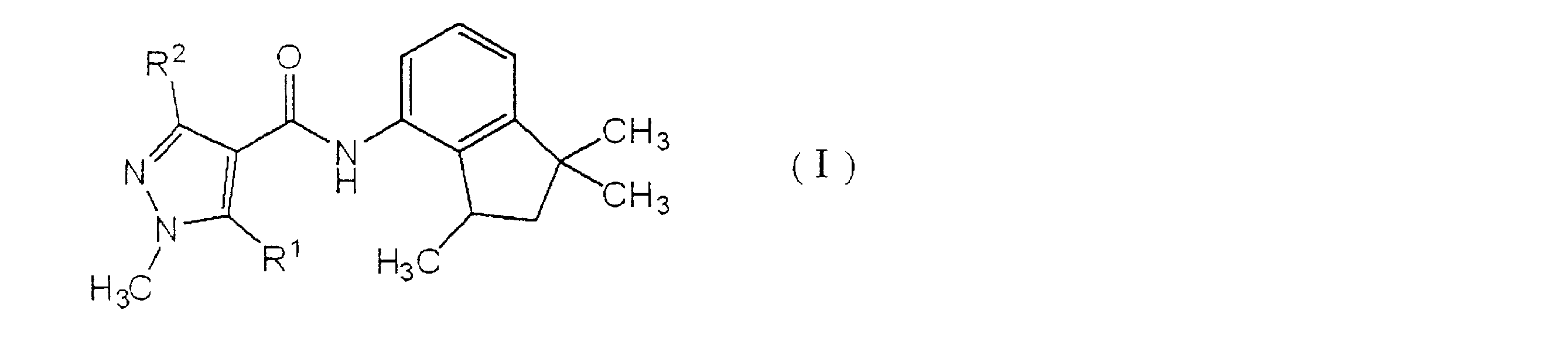
R1 represents a hydrogen atom or a methyl group, and
R2 represents a methyl group, a difluoromethyl group or a trifluoromethyl group,
and one or more pyrethroid compounds selected from group (A) consisting of tefluthrin, lambda-cyhalothrin, cypermethrin, beta-cyfluthrin, permethrin, deltamethrin and bifenthrin. - The pesticidal composition according to claim 1, wherein the weight ratio of the carboxamide compound to the pyrethroid compound(s) is from 0.01/1 to 4/1 of the carboxamide compound / the pyrethroid compound(s).
- The pesticidal composition according to claim 1 or claim 2, wherein the pyrethroid compound is lambda-cyhalothrin.
- A method of controlling pest which comprises a step of treating a plant or the soil where a plant grows with an effective amount of a carboxamide compound represented by formula (I):

R1 represents a hydrogen atom or a methyl group, and
R2 represents a methyl group, a difluoromethyl group or a trifluoromethyl group,
and one or more pyrethroid compounds selected from group (A) consisting of tefluthrin, lambda-cyhalothrin, cypermethrin, beta-cyfluthrin, permethrin, deltamethrin and bifenthrin. - The method of controlling pest according to claim 4, wherein the weight ratio of the carboxamide compound to the pyrethroid compound(s) is from 0.01/1 to 4/1 of the carboxamide compound / the pyrethroid compound(s).
- The method of controlling pest according to claim 4 or claim 5, wherein the pyrethroid compound is lambda-cyhalothrin.
- The method of controlling pest according to any one of claims 4 to 6, wherein the plant or the soil where a plant grows is soybean or the soil where soybean grows, respectively.
Priority Applications (13)
| Application Number | Priority Date | Filing Date | Title |
|---|---|---|---|
| CN201180020851.7A CN102858168B (en) | 2010-04-27 | 2011-04-25 | Pesticide composition and use thereof |
| EP11774618.0A EP2563134B1 (en) | 2010-04-27 | 2011-04-25 | Pesticidal composition and its use |
| AU2011246797A AU2011246797B2 (en) | 2010-04-27 | 2011-04-25 | Pesticidal composition and its use |
| KR1020127028106A KR101849792B1 (en) | 2010-04-27 | 2011-04-25 | Pesticidal composition and its use |
| CA2797292A CA2797292C (en) | 2010-04-27 | 2011-04-25 | Compositions for controlling plant diseases comprising carboxamide compound and pyrethroid compound |
| US13/643,822 US8940781B2 (en) | 2010-04-27 | 2011-04-25 | Pesticidal composition and its use |
| MX2012012301A MX2012012301A (en) | 2010-04-27 | 2011-04-25 | Pesticidal composition and its use. |
| UAA201213558A UA109900C2 (en) | 2010-04-27 | 2011-04-25 | PESTICIDIC COMPOSITION AND ITS APPLICATIONS |
| ES11774618.0T ES2603614T3 (en) | 2010-04-27 | 2011-04-25 | Pesticide composition and its use |
| PH1/2012/502034A PH12012502034A1 (en) | 2010-04-27 | 2011-04-25 | Pesticidal composition and its use |
| RU2012150664/13A RU2555405C2 (en) | 2010-04-27 | 2011-04-25 | Pesticidal composition and pest control method |
| BR112012027377A BR112012027377A2 (en) | 2010-04-27 | 2011-04-25 | pesticide compound and its use |
| NZ603845A NZ603845A (en) | 2010-04-27 | 2011-04-25 | Pesticidal composition and its use |
Applications Claiming Priority (2)
| Application Number | Priority Date | Filing Date | Title |
|---|---|---|---|
| JP2010101852 | 2010-04-27 | ||
| JP2010-101852 | 2010-04-27 |
Publications (1)
| Publication Number | Publication Date |
|---|---|
| WO2011135832A1 true WO2011135832A1 (en) | 2011-11-03 |
Family
ID=44861154
Family Applications (1)
| Application Number | Title | Priority Date | Filing Date |
|---|---|---|---|
| PCT/JP2011/002415 Ceased WO2011135832A1 (en) | 2010-04-27 | 2011-04-25 | Pesticidal composition and its use |
Country Status (18)
| Country | Link |
|---|---|
| US (1) | US8940781B2 (en) |
| EP (1) | EP2563134B1 (en) |
| JP (1) | JP2011246457A (en) |
| KR (1) | KR101849792B1 (en) |
| CN (1) | CN102858168B (en) |
| AU (1) | AU2011246797B2 (en) |
| BR (1) | BR112012027377A2 (en) |
| CA (1) | CA2797292C (en) |
| CL (1) | CL2012002988A1 (en) |
| ES (1) | ES2603614T3 (en) |
| MX (1) | MX2012012301A (en) |
| MY (1) | MY159777A (en) |
| NZ (1) | NZ603845A (en) |
| PH (1) | PH12012502034A1 (en) |
| PL (1) | PL2563134T3 (en) |
| RU (1) | RU2555405C2 (en) |
| UA (1) | UA109900C2 (en) |
| WO (1) | WO2011135832A1 (en) |
Cited By (7)
| Publication number | Priority date | Publication date | Assignee | Title |
|---|---|---|---|---|
| WO2013186325A1 (en) | 2012-06-15 | 2013-12-19 | Stichting I-F Product Collaboration | Synergistic compositions for the protection of agrarian crops and the use thereof |
| WO2014083033A1 (en) | 2012-11-30 | 2014-06-05 | Bayer Cropsience Ag | Binary fungicidal or pesticidal mixture |
| WO2014083088A2 (en) | 2012-11-30 | 2014-06-05 | Bayer Cropscience Ag | Binary fungicidal mixtures |
| WO2014082950A1 (en) | 2012-11-30 | 2014-06-05 | Bayer Cropscience Ag | Ternary fungicidal mixtures |
| WO2014083031A2 (en) | 2012-11-30 | 2014-06-05 | Bayer Cropscience Ag | Binary pesticidal and fungicidal mixtures |
| WO2014083089A1 (en) | 2012-11-30 | 2014-06-05 | Bayer Cropscience Ag | Ternary fungicidal and pesticidal mixtures |
| WO2019195591A1 (en) | 2018-04-04 | 2019-10-10 | Fmc Corporation | Emulsifiable concentrate formulations of sdhi fungicides |
Families Citing this family (1)
| Publication number | Priority date | Publication date | Assignee | Title |
|---|---|---|---|---|
| CN106689185A (en) * | 2016-12-28 | 2017-05-24 | 山东润博生物科技有限公司 | Pesticide composition containing tefluthrin and sedaxane and preparation method and application thereof |
Citations (5)
| Publication number | Priority date | Publication date | Assignee | Title |
|---|---|---|---|---|
| WO1986002641A1 (en) | 1984-10-29 | 1986-05-09 | Sumitomo Chemical Company, Limited | Pyrazolecarboxamide derivatives, process for their preparation, and bactericides containing them as effective ingredients |
| WO1992012970A1 (en) | 1991-01-28 | 1992-08-06 | Monsanto Company | 3-difluoromethylpyrazolecarboxamide fungicides |
| WO2008000377A2 (en) | 2006-06-30 | 2008-01-03 | Bayer Cropscience Ag | Synergistic insecticide and fungicide mixtures |
| DE102006030710A1 (en) | 2006-07-03 | 2008-01-10 | Bayer Cropscience Ag | Synergistic insecticidal and fungicidal mixtures |
| WO2010021404A2 (en) * | 2008-08-19 | 2010-02-25 | Ishihara Sangyo Kaisha, Ltd. | Method for controlling degradation of agricultural chemical active ingredient |
Family Cites Families (26)
| Publication number | Priority date | Publication date | Assignee | Title |
|---|---|---|---|---|
| FR2517176A1 (en) | 1981-12-01 | 1983-06-03 | Rhone Poulenc Agrochimie | INSECTICIDE AND ACARICIDE ASSOCIATION OF PYRETHROID |
| JPH064594B2 (en) | 1985-10-22 | 1994-01-19 | 住友化学工業株式会社 | Pyrazolcarboxamide derivative and fungicide containing the same as an active ingredient |
| JP3077381B2 (en) * | 1992-05-14 | 2000-08-14 | 住友化学工業株式会社 | Wood preservatives |
| JP3875263B2 (en) | 1994-04-06 | 2007-01-31 | 塩野義製薬株式会社 | α-Substituted phenylacetic acid derivative, process for producing the same, and agricultural fungicide containing the same |
| AR036872A1 (en) | 2001-08-13 | 2004-10-13 | Du Pont | ANTRANILAMIDE COMPOSITE, COMPOSITION THAT INCLUDES IT AND METHOD FOR CONTROLLING AN INVERTEBRATE PEST |
| ES2424840T3 (en) | 2003-01-28 | 2013-10-09 | E.I. Du Pont De Nemours And Company | Cyano anthranilamide insecticides |
| HRP20110021T1 (en) | 2004-02-18 | 2011-03-31 | Ishihara Sangyo Kaisha | ANTRANYLAMIDES, THE PREPARATION OF THEIR PREPARATION AND THE CONTROLLERS OF THE DAMAGES CONTAINING THEM |
| JP4150379B2 (en) | 2004-02-18 | 2008-09-17 | 石原産業株式会社 | Anthranilamides, production methods thereof, and pest control agents containing them |
| GB0422401D0 (en) * | 2004-10-08 | 2004-11-10 | Syngenta Participations Ag | Fungicidal compositions |
| WO2007006806A2 (en) | 2005-07-14 | 2007-01-18 | Basf Aktiengesellschaft | Fungicide mixtures based on 1-methyl-pyrazol-4-yl carboxylic acid anilides |
| JP5186751B2 (en) | 2005-10-14 | 2013-04-24 | 住友化学株式会社 | Hydrazide compounds and their pest control applications |
| PL1937664T3 (en) | 2005-10-14 | 2011-11-30 | Sumitomo Chemical Co | Hydrazide compound and pesticidal use of the same |
| WO2007090623A2 (en) * | 2006-02-09 | 2007-08-16 | Syngenta Participations Ag | Fungicidal compositions |
| TW201309635A (en) | 2006-02-10 | 2013-03-01 | Dow Agrosciences Llc | Insecticidal N-substituted (6-haloalkylpyridin-3-yl)alkyl sulfoximines |
| TWI435863B (en) | 2006-03-20 | 2014-05-01 | Nihon Nohyaku Co Ltd | N-2-(hetero) arylethylcarboxamide derivative and pest controlling |
| JP2008100946A (en) | 2006-10-19 | 2008-05-01 | Bayer Cropscience Ag | Bactericidal insecticidal composition |
| CL2008000979A1 (en) | 2007-04-11 | 2008-10-17 | Sumitomo Chemical Co | PROCESS TO PRODUCE A COMPOUND DERIVED FROM 2-PIRIDIN-2-IL-2H-PIRAZOL-3-PHENYLAMIDE; INTERMEDIARY COMPOUNDS; THE COMPOUND IN YES; PESTICIDE COMPOSITION CONTAINING SUCH COMPOUND; USE OF SUCH COMPOUND AS A PESTICIDE; AND METHOD FOR CONTROL |
| CA2687496A1 (en) * | 2007-05-31 | 2008-12-04 | Syngenta Participations Ag | A method of protecting a plant propagation material, a plant, and/or plant organs |
| JP5365047B2 (en) | 2008-03-28 | 2013-12-11 | 住友化学株式会社 | Plant disease control composition and plant disease control method |
| JP2010013389A (en) | 2008-07-03 | 2010-01-21 | Nissan Chem Ind Ltd | Agrochemical composition exhibiting promoted elution into water |
| UA101382C2 (en) * | 2008-07-04 | 2013-03-25 | Басф Се | Fungicidal mixtures comprising substituted 1-methylpyrazol-4-ylcarboxanilides |
| AR073109A1 (en) | 2008-08-26 | 2010-10-13 | Sumitomo Chemical Co | DERIVATIVES OF N-BENZOTIAZOL ACETAMIDE USEFUL TO CONTROL PHYTO-DISEASES AND COMPOSITIONS THAT CONTAIN THEM. |
| WO2010024365A1 (en) | 2008-08-26 | 2010-03-04 | Sumitomo Chemical Company, Limited | Amide compounds and use thereof |
| JP2010083883A (en) | 2008-09-08 | 2010-04-15 | Nissan Chem Ind Ltd | Isoxazoline-substituted benzamide compound and harmful organism-controlling agent |
| JP2010083869A (en) | 2008-09-08 | 2010-04-15 | Nissan Chem Ind Ltd | Agrochemical packaged bag for applying to paddy field water inlet |
| WO2010040623A1 (en) | 2008-10-08 | 2010-04-15 | Syngenta Participations Ag | Pesticidal combinations containing sulfoxaflor |
-
2011
- 2011-04-25 CA CA2797292A patent/CA2797292C/en not_active Expired - Fee Related
- 2011-04-25 CN CN201180020851.7A patent/CN102858168B/en not_active Expired - Fee Related
- 2011-04-25 PH PH1/2012/502034A patent/PH12012502034A1/en unknown
- 2011-04-25 BR BR112012027377A patent/BR112012027377A2/en not_active IP Right Cessation
- 2011-04-25 ES ES11774618.0T patent/ES2603614T3/en active Active
- 2011-04-25 AU AU2011246797A patent/AU2011246797B2/en not_active Ceased
- 2011-04-25 US US13/643,822 patent/US8940781B2/en not_active Expired - Fee Related
- 2011-04-25 MX MX2012012301A patent/MX2012012301A/en unknown
- 2011-04-25 MY MYPI2012004305A patent/MY159777A/en unknown
- 2011-04-25 RU RU2012150664/13A patent/RU2555405C2/en active
- 2011-04-25 WO PCT/JP2011/002415 patent/WO2011135832A1/en not_active Ceased
- 2011-04-25 NZ NZ603845A patent/NZ603845A/en not_active IP Right Cessation
- 2011-04-25 KR KR1020127028106A patent/KR101849792B1/en not_active Expired - Fee Related
- 2011-04-25 EP EP11774618.0A patent/EP2563134B1/en not_active Not-in-force
- 2011-04-25 UA UAA201213558A patent/UA109900C2/en unknown
- 2011-04-25 PL PL11774618T patent/PL2563134T3/en unknown
- 2011-04-26 JP JP2011097980A patent/JP2011246457A/en active Pending
-
2012
- 2012-10-25 CL CL2012002988A patent/CL2012002988A1/en unknown
Patent Citations (6)
| Publication number | Priority date | Publication date | Assignee | Title |
|---|---|---|---|---|
| WO1986002641A1 (en) | 1984-10-29 | 1986-05-09 | Sumitomo Chemical Company, Limited | Pyrazolecarboxamide derivatives, process for their preparation, and bactericides containing them as effective ingredients |
| WO1992012970A1 (en) | 1991-01-28 | 1992-08-06 | Monsanto Company | 3-difluoromethylpyrazolecarboxamide fungicides |
| WO2008000377A2 (en) | 2006-06-30 | 2008-01-03 | Bayer Cropscience Ag | Synergistic insecticide and fungicide mixtures |
| DE102006030739A1 (en) | 2006-06-30 | 2008-01-03 | Bayer Cropscience Ag | Synergistic insecticidal and fungicidal mixtures |
| DE102006030710A1 (en) | 2006-07-03 | 2008-01-10 | Bayer Cropscience Ag | Synergistic insecticidal and fungicidal mixtures |
| WO2010021404A2 (en) * | 2008-08-19 | 2010-02-25 | Ishihara Sangyo Kaisha, Ltd. | Method for controlling degradation of agricultural chemical active ingredient |
Non-Patent Citations (2)
| Title |
|---|
| "THE PESTICIDE MANUAL", BCPC |
| See also references of EP2563134A4 |
Cited By (16)
| Publication number | Priority date | Publication date | Assignee | Title |
|---|---|---|---|---|
| WO2013186325A1 (en) | 2012-06-15 | 2013-12-19 | Stichting I-F Product Collaboration | Synergistic compositions for the protection of agrarian crops and the use thereof |
| US11477983B2 (en) | 2012-06-15 | 2022-10-25 | Stichting I-F Product Collaboration | Synergistic compositions for the protection of agrarian crops and the use thereof |
| EP3788875A1 (en) | 2012-06-15 | 2021-03-10 | Stichting I-F Product Collaboration | Synergistic compositions for the protection of agrarian crops and the use thereof |
| US9775349B2 (en) | 2012-11-30 | 2017-10-03 | Bayer Cropscience Ag | Binary fungicidal or pesticidal mixture |
| WO2014083031A2 (en) | 2012-11-30 | 2014-06-05 | Bayer Cropscience Ag | Binary pesticidal and fungicidal mixtures |
| WO2014083089A1 (en) | 2012-11-30 | 2014-06-05 | Bayer Cropscience Ag | Ternary fungicidal and pesticidal mixtures |
| US9510596B2 (en) | 2012-11-30 | 2016-12-06 | Bayer Cropscience Ag | Binary pesticidal and fungicidal mixtures |
| US9615578B2 (en) | 2012-11-30 | 2017-04-11 | Bayer Cropscience Ag | Binary fungicidal mixtures |
| WO2014082950A1 (en) | 2012-11-30 | 2014-06-05 | Bayer Cropscience Ag | Ternary fungicidal mixtures |
| US9775351B2 (en) | 2012-11-30 | 2017-10-03 | Bayer Cropscience Ag | Ternary fungicidal and pesticidal mixtures |
| US9943082B2 (en) | 2012-11-30 | 2018-04-17 | Bayer Cropscience Ag | Ternary fungicidal mixtures |
| US10111434B2 (en) | 2012-11-30 | 2018-10-30 | Bayer Cropscience Ag | Binary fungicidal mixtures |
| US10575522B2 (en) | 2012-11-30 | 2020-03-03 | Bayer Cropscience Ag | Ternary fungicidal mixtures |
| WO2014083088A2 (en) | 2012-11-30 | 2014-06-05 | Bayer Cropscience Ag | Binary fungicidal mixtures |
| WO2014083033A1 (en) | 2012-11-30 | 2014-06-05 | Bayer Cropsience Ag | Binary fungicidal or pesticidal mixture |
| WO2019195591A1 (en) | 2018-04-04 | 2019-10-10 | Fmc Corporation | Emulsifiable concentrate formulations of sdhi fungicides |
Also Published As
| Publication number | Publication date |
|---|---|
| EP2563134A1 (en) | 2013-03-06 |
| CA2797292C (en) | 2018-07-17 |
| KR20130064058A (en) | 2013-06-17 |
| NZ603845A (en) | 2014-09-26 |
| PH12012502034A1 (en) | 2013-01-21 |
| RU2555405C2 (en) | 2015-07-10 |
| CA2797292A1 (en) | 2011-11-03 |
| RU2012150664A (en) | 2014-06-10 |
| MX2012012301A (en) | 2012-11-23 |
| KR101849792B1 (en) | 2018-04-17 |
| EP2563134B1 (en) | 2016-09-07 |
| US8940781B2 (en) | 2015-01-27 |
| CL2012002988A1 (en) | 2013-04-05 |
| JP2011246457A (en) | 2011-12-08 |
| AU2011246797B2 (en) | 2015-09-17 |
| EP2563134A4 (en) | 2013-09-25 |
| BR112012027377A2 (en) | 2015-09-15 |
| CN102858168A (en) | 2013-01-02 |
| ES2603614T3 (en) | 2017-02-28 |
| CN102858168B (en) | 2018-04-03 |
| US20130102648A1 (en) | 2013-04-25 |
| PL2563134T3 (en) | 2017-09-29 |
| AU2011246797A1 (en) | 2012-10-18 |
| MY159777A (en) | 2017-01-31 |
| UA109900C2 (en) | 2015-10-26 |
Similar Documents
| Publication | Publication Date | Title |
|---|---|---|
| US8895517B2 (en) | Pesticidal composition and its use | |
| US9363998B2 (en) | Pesticidal composition and its use | |
| CA2797371C (en) | Pesticidal compositions comprising a carboxamide compound and sulfoxaflor | |
| CA2797218C (en) | Pesticidal compositions comprising a carboxamide and neonicotinoid compound | |
| EP2563131A1 (en) | Pesticidal composition and its use | |
| US8940781B2 (en) | Pesticidal composition and its use | |
| US9232798B2 (en) | Pesticidal composition and its use |
Legal Events
| Date | Code | Title | Description |
|---|---|---|---|
| WWE | Wipo information: entry into national phase |
Ref document number: 201180020851.7 Country of ref document: CN |
|
| 121 | Ep: the epo has been informed by wipo that ep was designated in this application |
Ref document number: 11774618 Country of ref document: EP Kind code of ref document: A1 |
|
| WWE | Wipo information: entry into national phase |
Ref document number: 12012502034 Country of ref document: PH |
|
| ENP | Entry into the national phase |
Ref document number: 2011246797 Country of ref document: AU Date of ref document: 20110425 Kind code of ref document: A |
|
| WWE | Wipo information: entry into national phase |
Ref document number: MX/A/2012/012301 Country of ref document: MX |
|
| ENP | Entry into the national phase |
Ref document number: 2797292 Country of ref document: CA |
|
| WWE | Wipo information: entry into national phase |
Ref document number: 2012002988 Country of ref document: CL |
|
| ENP | Entry into the national phase |
Ref document number: 20127028106 Country of ref document: KR Kind code of ref document: A |
|
| WWE | Wipo information: entry into national phase |
Ref document number: 1201005612 Country of ref document: TH |
|
| NENP | Non-entry into the national phase |
Ref country code: DE |
|
| WWE | Wipo information: entry into national phase |
Ref document number: 12196475 Country of ref document: CO |
|
| WWE | Wipo information: entry into national phase |
Ref document number: 3524/KOLNP/2012 Country of ref document: IN |
|
| REEP | Request for entry into the european phase |
Ref document number: 2011774618 Country of ref document: EP |
|
| WWE | Wipo information: entry into national phase |
Ref document number: 2011774618 Country of ref document: EP |
|
| WWE | Wipo information: entry into national phase |
Ref document number: A201213558 Country of ref document: UA |
|
| ENP | Entry into the national phase |
Ref document number: 2012150664 Country of ref document: RU Kind code of ref document: A |
|
| WWE | Wipo information: entry into national phase |
Ref document number: 13643822 Country of ref document: US |
|
| REG | Reference to national code |
Ref country code: BR Ref legal event code: B01A Ref document number: 112012027377 Country of ref document: BR |
|
| ENP | Entry into the national phase |
Ref document number: 112012027377 Country of ref document: BR Kind code of ref document: A2 Effective date: 20121025 |