WO2011145341A1 - 爆破処理用耐圧容器内の浄化方法 - Google Patents
爆破処理用耐圧容器内の浄化方法 Download PDFInfo
- Publication number
- WO2011145341A1 WO2011145341A1 PCT/JP2011/002760 JP2011002760W WO2011145341A1 WO 2011145341 A1 WO2011145341 A1 WO 2011145341A1 JP 2011002760 W JP2011002760 W JP 2011002760W WO 2011145341 A1 WO2011145341 A1 WO 2011145341A1
- Authority
- WO
- WIPO (PCT)
- Prior art keywords
- explosive
- pressure
- container
- pressure vessel
- purification
- Prior art date
- Legal status (The legal status is an assumption and is not a legal conclusion. Google has not performed a legal analysis and makes no representation as to the accuracy of the status listed.)
- Ceased
Links
Images




Classifications
-
- F—MECHANICAL ENGINEERING; LIGHTING; HEATING; WEAPONS; BLASTING
- F42—AMMUNITION; BLASTING
- F42D—BLASTING
- F42D3/00—Particular applications of blasting techniques
-
- B—PERFORMING OPERATIONS; TRANSPORTING
- B08—CLEANING
- B08B—CLEANING IN GENERAL; PREVENTION OF FOULING IN GENERAL
- B08B7/00—Cleaning by methods not provided for in a single other subclass or a single group in this subclass
- B08B7/0007—Cleaning by methods not provided for in a single other subclass or a single group in this subclass by explosions
-
- B—PERFORMING OPERATIONS; TRANSPORTING
- B08—CLEANING
- B08B—CLEANING IN GENERAL; PREVENTION OF FOULING IN GENERAL
- B08B7/00—Cleaning by methods not provided for in a single other subclass or a single group in this subclass
- B08B7/02—Cleaning by methods not provided for in a single other subclass or a single group in this subclass by distortion, beating, or vibration of the surface to be cleaned
-
- B—PERFORMING OPERATIONS; TRANSPORTING
- B08—CLEANING
- B08B—CLEANING IN GENERAL; PREVENTION OF FOULING IN GENERAL
- B08B9/00—Cleaning hollow articles by methods or apparatus specially adapted thereto
- B08B9/08—Cleaning containers, e.g. tanks
-
- F—MECHANICAL ENGINEERING; LIGHTING; HEATING; WEAPONS; BLASTING
- F42—AMMUNITION; BLASTING
- F42B—EXPLOSIVE CHARGES, e.g. FOR BLASTING, FIREWORKS, AMMUNITION
- F42B12/00—Projectiles, missiles or mines characterised by the warhead, the intended effect, or the material
- F42B12/02—Projectiles, missiles or mines characterised by the warhead, the intended effect, or the material characterised by the warhead or the intended effect
- F42B12/20—Projectiles, missiles or mines characterised by the warhead, the intended effect, or the material characterised by the warhead or the intended effect of high-explosive type
- F42B12/201—Projectiles, missiles or mines characterised by the warhead, the intended effect, or the material characterised by the warhead or the intended effect of high-explosive type characterised by target class
- F42B12/202—Projectiles, missiles or mines characterised by the warhead, the intended effect, or the material characterised by the warhead or the intended effect of high-explosive type characterised by target class for attacking land area or area targets, e.g. airburst
-
- F—MECHANICAL ENGINEERING; LIGHTING; HEATING; WEAPONS; BLASTING
- F42—AMMUNITION; BLASTING
- F42D—BLASTING
- F42D5/00—Safety arrangements
- F42D5/04—Rendering explosive charges harmless, e.g. destroying ammunition; Rendering detonation of explosive charges harmless
- F42D5/045—Detonation-wave absorbing or damping means
Definitions
- the present invention relates to a method for purifying the inside of a pressure vessel after a blast treatment step in which a blasting object such as an explosive and a blasting explosive are set in the pressure vessel.
- This explosive material has, for example, a steel shell, a glaze filled in the shell, and a chemical agent harmful to the human body.
- the chemical agent include mustard and lewisite that are harmful to the human body.
- a treatment method by blasting is known.
- Such a blasting treatment method does not require dismantling work. Therefore, if this processing method is used, not only explosives in a good storage state but also explosives that have become difficult to disassemble due to aging or deformation can be processed.
- Most of the treatment by blasting is performed in a sealed pressure vessel from the viewpoint of preventing external leakage of the chemical agent and reducing the environmental impact such as sound and vibration caused by the blasting treatment.
- the shell of the explosive material is not sufficiently destroyed, and a chemical agent harmful to the human body may remain in the pressure vessel after the blasting treatment.
- neutralization takes time depending on the type of the residue, and in order to neutralize a plurality of types of residues, the neutralization treatment must be performed a plurality of times, which increases the treatment time. There is a problem that it takes time.
- the method of decomposing the residue by detonating the purification explosive a plurality of types of residue are decomposed simultaneously by the shock wave and extremely high temperature gas generated by the explosion, so the processing time is shortened. be able to.
- the residue may contain a substance that cannot be decomposed by shock waves and high-temperature gas, and this residue may adhere to the inner wall surface of the pressure vessel as rust or the like. . And when a residue adheres to the inner wall surface of a pressure vessel in this way, since an operator must scrape off this adhering matter, the effect of shortening processing time cannot fully be acquired.
- an object of the present invention is to provide a purification method for a blast treatment pressure vessel that can shorten the treatment time of the purification treatment in the pressure vessel.
- the method for purifying a blast treatment pressure vessel according to the present invention is carried out after a blast treatment step in which a blast object and a blasting explosive are set in the pressure vessel and blasted.
- a method of purifying the inside of a pressure vessel wherein after the blast treatment step, a purification explosive different from the blasting explosive is set inside the pressure vessel, and after the blast treatment step, A solid release material capable of peeling the fixed object from the inner wall surface of the pressure vessel by colliding with the fixed object fixed to the inner wall surface, and the release material is inside the pressure vessel and the release material is the explosive for purification.
- a peeling step including scattering and colliding with each part of the wall surface to peel off the fixed matter.
- a part of the residue can be decomposed by the shock wave and high-temperature gas generated by the explosion of the purification explosive, and the release material is pressure-resistant using the explosive energy of the purification explosive. It is possible to detach and peel off the fixed matter fixed to the inner wall surface of the pressure vessel by scattering and colliding with the inner wall surface of the container. That is, it is possible to simultaneously decompose the residue in the pressure vessel and peel off the fixed matter fixed to the inner wall surface of the pressure vessel simply by detonating the purifying explosive. Therefore, it is possible to perform the purification process including the peeling process in a short time without using any special equipment for peeling off the fixed matter.
- FIG. 1 is a schematic cross-sectional view showing a state in which a chemical bomb 100 as an example of a blasting object is contained in a pressure vessel 10.
- the pressure vessel 10 has a double structure including an outer vessel 31 and an inner vessel 32.
- the outer container 31 is a strong pressure resistant container made of iron or the like having sufficient strength to hold the pressure at the time of blasting.
- the inner container 32 is made of a strong material such as iron in order to withstand collision with the flying chemical bomb 100 fragments.
- the outer container 31 has a cylindrical shape. One end of the outer container 31 in the axial direction is closed and the other end is opened. A pressure-resistant lid 11 is detachably provided at the other open end of the outer container 31.
- the inner container 32 has a cylindrical shape. One end of the inner container 32 in the axial direction is closed and the other end is opened. The inner container 32 is arranged inside the outer container 31 so that the other open end faces the pressure-resistant lid 11 side. An inner lid 33 is detachably provided at the other open end of the inner container 32.
- the inner container 32 is not tightly fixed to the outer container 31 but is loosely mounted in the outer container 31. That is, the inner container 32 is installed in the outer container 31 so that the relative displacement with respect to the outer container 31 is possible.
- Such loose mounting of the inner container 32 prevents explosion shocks and impacts caused by flying object collisions from being directly transmitted to the outer container 31, and an excessive force is applied to the connecting portion between the inner container 32 and the outer container 31. This prevents the connection portion from being damaged and improves the durability of the pressure vessel 10.
- the purification method according to the present invention using this pressure vessel 10 is carried out after a blast treatment step of blasting an object to be blasted such as a chemical bomb in the pressure vessel 10, and the inside of the pressure vessel 10 after the blast treatment is carried out. It is a purification method.
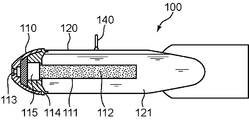
- FIG. 2 is a schematic sectional view of the chemical bomb 100.
- the chemical bomb 100 includes a warhead 110, a glaze cylinder 111, a bomb shell 120, and an explosive cylinder 114.
- reference numeral 140 in FIG. 2 denotes a hanging ring used for lifting the chemical bomb 100.
- the glaze cylinder 111 extends rearward from the warhead 110.
- a glaze (explosive) 112 is accommodated in the glaze cylinder 111.
- the explosive charge cylinder 114 is disposed in front of the glaze cylinder 111. In this explosive charge cylinder 114, explosive charge (explosive) 115 is accommodated.
- the warhead 110 is provided with a fusible tube 113 for bursting the glaze 112 in the glaze cylinder 111.
- the bomb shell 120 is connected to the warhead 110 in a state in which the glaze cylinder 111 and the explosive cylinder 114 are accommodated therein.
- This bomb shell 120 is filled with a chemical agent (hazardous substance) 121.
- the glaze (explosive) 112 for example, military explosives such as TNT, picric acid, RDX and the like are used.
- the chemical agent (hazardous substance) 121 for example, erosion agents such as mustard and leucite, sneezing agents such as DC (diphenylcyanoarsine) and DA (diphenylchloroarsine), phosgene, sarin, hydrocyanic acid and the like are used. Liquid and solid materials are also included.
- a chemical bomb 100 surrounded by a blasting explosive 101 is set inside the pressure vessel 10 by a fixing device (not shown). After the inner lid 33 and the pressure-resistant lid 11 are attached and closed, the blasting explosive 101 is blasted by an unillustrated detonator and the chemical bomb 100 is also blasted.
- the purification method according to the present invention is performed when the blast treatment process is performed once or twice or more, and a residue remains in the pressure vessel 10.
- the residue remains in the inner container 32 in the pressure vessel 10 in various forms depending on the type of the chemical bomb 100 and the state of the blast treatment performed before the method of the present invention.
- the metal parts of the chemical bomb 100 such as the warhead 110, the glaze cylinder 111, the explosive cylinder 114, and the bomb shell 120, generally remain as solid metal pieces or metal powder, and the glaze 112, the explosive charge 115, and the chemical agent. 121 remains as a gas, liquid or solid depending on the material used.
- the gas in this residue is removed from the pressure vessel 10 by an off-gas treatment facility (not shown). Further, a large solid such as a metal piece is removed from the pressure vessel 10 by a removing means such as a scraping equipment (not shown). However, it is difficult to remove the minute liquid or solid residue adhered to the surface of the inner container 32 of the pressure vessel 10 by these means.
- the residue includes substances that are decomposed and rendered harmless by exposure to shock waves and high temperatures, and substances that are not decomposed even when exposed to high temperatures.
- trace amounts of chemical agents and chloroethyl ethyl sulfide contained in the residue are decomposed and rendered harmless when exposed to shock waves and high temperatures.
- elements such as arsenic contained in the chemical agent 121 such as DA, DC, and leucite are not decomposed even when exposed to shock waves or high temperatures. That is, by generating a shock wave in the inner container 32 or increasing the temperature of the inner container 32, the chemical agent 121 and the like are decomposed, but the arsenic and the like are not decomposed and the inner container 32 is decomposed. Remains as dust or rust on the inner wall.
- the purification method of the present invention decomposes and renders harmless substances that can be decomposed by being exposed to shock waves and high temperatures, and is also capable of decomposing and detoxifying the inner wall surface 32a of the inner container 32, that is, the pressure vessel 10 even when exposed to shock waves and high temperatures.
- This is a method of purifying the inside of the pressure resistant container 10 by peeling it from the inner wall surface 32a of the inner container 32 so that the fixed matter remaining on the inner wall surface can be easily removed.
- a purification explosive 1 capable of generating shock waves and high-temperature combustion gas by the explosion, and a plurality of granular materials by receiving the explosive energy of the purification explosive 1
- a solid release material 2 that can be dispersed and collide with the inner wall surface 32a of the inner container 32 is used.
- the purification explosive 1 include emulsion explosives and slurry explosives.
- the release material 2 include sand, ceramic powder, and iron powder.
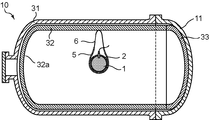
- the explosive 1 for purification is formed into a spherical shape, and the sand 2, that is, a plurality of sand particles, is accommodated in a flexible container (peeling container) 4 and the container 4 is made into a sheet shape.
- a bag made of vinyl or the like is used as the container 4.
- a sheet-like bag 4 in which the sand 2 is accommodated is wound around the purifying explosive 1.
- the amount of the explosive for purification 1 is determined to be a required amount that can analyze the components and amount of the residue inside the pressure vessel 10 and decompose the residue component to a target value level or less.
- the amount of the sand 2 is determined by analyzing the amount of the fixed matter that adheres to the inner wall surface 32a of the inner container 32 out of the residue based on the component and amount of the residue inside the pressure vessel 10. The required amount is determined so that almost all of the kimono can be peeled off.
- the inner lid 33 and the pressure-resistant lid 11 are opened, and the purification explosive 1 covered with the sand 2 is separated from the inner wall surface 32 a of the inner container 32, for example, preferably at the center of the inner container 32.
- the detonator 3 is attached to the purifying explosive 1 (setting step).
- the purifying explosive 1 is accommodated in a hanging bag 5 in a state covered with the sand 2, and the hanging bag 5 is accommodated by an inner string 32 by a hanging string 6. Hanging on the center of the.
- the inner lid 33 and the pressure-resistant lid 11 are closed to seal the pressure-resistant container 10.
- the operation of attaching the bag containing the sand 2 to the purifying explosive 1 may be performed in the inner container 32.
- the detonator 3 is connected to the detonator, and the detonator 3 is detonated by operating the detonator, thereby exploding the explosive 1 for purification, more specifically detonating (peeling step). ).
- the shock wave When the explosive 1 for decontamination detonates, the shock wave propagates and the air on the shock wave front is compressed and the temperature rises.
- the temperature of the collided portion reaches a high temperature of about 10000 ° C. or more due to an extreme pressure rise, although for a short time.
- the detonation gas of the explosive 1 for purification is a high temperature of several thousand degrees Celsius, and when this gas expands and reaches the inner wall surface 32a of the inner container 32 after the collision of the shock wave, the inner wall surface 32a further increases in number. Exposed to high temperature gas of 1000 °C.
- the sand 2 covering the purification explosive 1 is blown off by detonation energy of the purification explosive 1 and collides with the inner wall surface 32a of the inner container 32 at a high speed.
- the sand 2 accommodated in the bag 4 receives the detonation energy and is dispersed into a large number of sand particles constituting the sand 2, and the large number of sand particles are respectively in the inner wall surface 32 a of the inner container 32. Splashes and collides with each part at high speed.
- the sand 2 accommodated in the bag 4 is scattered as a plurality of sand particles, the sand particles peel off the fixed matter over a wide area of the inner wall surface 32a of the inner container 32. Further, since the weight of the individual sand particles is small, damage to the inner container 32 due to the collision of the sand particles is suppressed to a small level.
- the explosive 1 for purification is set at the center of the inner container 32 that is separated from the inner wall surface 32a of the inner container 32. Therefore, the shock wave, the hot gas, and the sand 2 are contained in the inner container 32 more than when the purification explosive 1 is set on the inner wall surface 32a of the inner container 32, that is, in contact with the inner wall surface 32a. It reaches each part of the inner wall surface 32a of 32 in a state with little bias. Therefore, the residue is decomposed or peeled throughout the inner container 32.
- the sand 2 is attached so as to cover the explosive 1 for purification. Therefore, energy is applied to the sand 2 in the outward direction of the purification explosive 1, that is, in the direction from the purification explosive 1 toward the inner wall surface 32a of the inner container 32. Rather than being attached to the inner side of the inner container 32, the inner container 32 collides at a higher speed toward the inner wall surface 32 a and more securely separates the fixed matter.
- the explosive 1 for cleaning and the release material 2 are set in the inner container 32 to explode the explosive 1 for purification. It is possible to peel off, from the inner wall surface 32a, the fixed matter that is the residue of the residue and fixed to the inner wall surface 32a of the inner container 32 while disassembling and detoxifying the part. That is, the residue can be decomposed and the fixed matter can be peeled off by a single treatment. Therefore, after decomposing the residue by the explosion of the explosive 1 for purification, it is necessary to perform an operation for separating the fixed matter still remaining in the state fixed to the inner wall surface 32a of the inner container 32 from the inner wall surface 32a.
- the inner container 32 that is, the inside of the pressure vessel 10 can be purified in a short processing time.
- the fixed substance peeled off from the inner wall surface 32a floats in the inner container 32 or accumulates at the bottom of the inner container 32, and can be easily removed from the inner container 32.
- an explosive for releasing the release material different from the explosive 1 for purification it is conceivable to use an explosive for releasing the release material different from the explosive 1 for purification.
- the explosive for release material scattering must be set in the inner container 32 separately.
- the peeling material 2 is scattered and collided with the said inner wall surface 32a using the explosive 1 for purification, and processing time becomes more reliable.
- the shape when the explosive 1 for purification and the sand 2 as the release material are set in the inner container 32 is not limited to the above.
- a bag-like bag 4 containing sand 2 may be put on the outer peripheral surface of a tube-shaped purification explosive 1 and accommodated in the hanging bag 5.
- the purifying explosive 1 and the sand 2 are accommodated in the bag 4 so that the sand 2 covers the periphery of the purifying explosive 1, and the opening of the bag 4 is made of vinyl.
- the bag 4 may be accommodated in the hanging bag 5 by closing with a tape made of plastic.
- the release material 2 a plurality of sand particles, ceramic powder, iron powder, or other granular material solidified into a sheet or the like is used, and this sheet of sand or the like is disposed around the purification explosive 1. May be.
- the release material 2 is composed of a plurality of granular materials and these granular materials are accommodated in a container such as a bag, the release material 2 is more reliably provided with the explosion of the purifying explosive 1. Disperse as granules. Therefore, these granular materials can be scattered over a wider range, and damage to the inner container 32 can be more reliably suppressed.
- the relative position of the release material 2 and the purification explosive 1 is a position where the release material 2 covers the periphery of the purification explosive 1, but the present invention is not limited to this, and the release material is not limited thereto.
- cleaning include the position which mutually spaces apart.
- the release material 2 is disposed at a position covering the purification explosive 1, the outward explosive energy of the purification explosive 1 is applied to the release material 2. It can be scattered toward the inner wall surface 32a of the inner container 32 at a high speed.
- the setting position of the explosive for purification is the central portion of the pressure vessel 10, but the present invention is not limited to this, and contacts the inner wall surface 32 a of the inner vessel 32, that is, the inner wall surface of the pressure vessel 10. Including the position and any position away from the inner wall surface.
- the purification explosive 1 with the sand 2 attached thereto is not set in one place, but may be set in two or more places. .
- the residue is decomposed in the double-structured pressure vessel, but the present invention is not limited to this.
- the present invention can be similarly applied to the case where the residue is processed in the pressure vessel.
- the blasting object is not limited to the above.
- at least one of the glaze (explosive) 112 and the chemical agent (hazardous substance) 121 is omitted, or a harmful substance such as organic halogen is put in a container.
- the present invention can be similarly applied to the purification in the pressure vessel 10 after the object is blown up as an object to be blown up.
- the present invention is a method for purifying the inside of a pressure vessel, which is performed after a blasting process in which a blasting object and a blasting explosive are set in a pressure vessel and blasted.
- a cleaning explosive different from the blasting explosive is set inside the pressure-resistant container, and after the blasting processing step, it collides with a fixed object fixed on the inner wall surface of the pressure-resistant container.
- a solid release material capable of peeling the fixed matter from the inner wall surface of the pressure vessel is scattered inside the pressure vessel toward the inner wall surface of the pressure vessel as the cleaning explosive explodes.
- a part of the residue can be decomposed by the shock wave and high-temperature gas generated by the explosion of the purifying explosive, and the release material is pressure-resistant using the explosive energy of the purifying explosive. It is possible to detach and peel off the fixed matter fixed to the inner wall surface of the pressure vessel by scattering and colliding with the inner wall surface of the container. That is, it is possible to simultaneously decompose the residue in the pressure vessel and peel off the fixed matter fixed to the inner wall surface of the pressure vessel simply by detonating the purifying explosive. Therefore, it is possible to perform the purification process including the peeling process in a short time without using any special equipment for peeling off the fixed matter.
- the release material is set at a position where the release material scatters and collides with the inner wall surface of the pressure vessel as the purification explosive explodes. Therefore, the explosion of the purifying explosive generates a shock wave and a high-temperature combustion gas of the purifying explosive in the pressure-resistant container, and the decomposable residue in the pressure-resistant container is decomposed by the shock wave and the high-temperature gas. Then, the release material collides with a fixed object fixed to the inner wall surface of the pressure vessel by the explosion of the purifying explosive, and the fixed object is separated from the inner wall surface of the pressure container by this collision.
- the release material receives the explosion energy of the purifying explosive, the release material scatters and collides with the inner wall surface of the pressure vessel at high speed, so that the fixed matter can be more reliably peeled off in a short processing time.
- the release material is a plurality of granular bodies scattered and collides with the inner wall surface of the pressure vessel, and the fixed matter on each part of the inner wall surface of the pressure vessel is peeled more uniformly, Damage to the inner wall surface of the pressure vessel due to the collision is suppressed.
- the release material is installed inside the pressure vessel so as to cover at least a part of the purification explosive.
- the release material is efficiently given explosive energy from the purification explosive of the purification explosive to the outside, that is, toward the inner wall surface of the pressure vessel. Scattered and collided with the inner wall surface.
- the purifying explosive and the release material are set at a position away from the inner wall surface of the pressure vessel.
- the setting step includes storing a plurality of granules constituting the release material in a release container different from the pressure resistant container, and a release container in which the plurality of granules are stored, It is preferable to include setting the peeling container inside the pressure-resistant container so that the plurality of granular materials are arranged around the purifying explosive.
- the release material is composed of a plurality of granular materials, the release material is more surely dispersed as granular materials, and the granular materials are outwardly explosive energy of the purification explosive. In response, it scatters and collides with each part of the inner wall surface of the pressure vessel at a higher speed, so that the damage to the inner wall surface can be more reliably suppressed and the fixed matter of each part of the inner wall surface can be more uniformly and It can be peeled off reliably.
- a plurality of granular materials constituting the release material are accommodated in the release container using a flexible release container and wound around the purification explosive, or the purification explosive is added to the purification explosive. If the plurality of granules constituting the release material are accommodated in the container so as to surround the purification explosive, the plurality of granules constituting the release material are surrounded by the purification explosive. And it can arrange
Landscapes
- Engineering & Computer Science (AREA)
- General Engineering & Computer Science (AREA)
- Chemical & Material Sciences (AREA)
- Combustion & Propulsion (AREA)
- Mechanical Engineering (AREA)
- Cleaning In General (AREA)
- Processing Of Solid Wastes (AREA)
Abstract
【課題】短い処理時間で爆破処理工程後の耐圧容器内を浄化することができる爆破処理用耐圧容器内の浄化方法を提供する。 【解決手段】耐圧容器10内に残留する残留物の一部を分解可能な浄化用爆薬1と、耐圧容器10の内壁面32aに固着している固着物に衝突することで当該固着物を耐圧容器10の内壁面32aから剥離可能な固体の剥離材2とを、耐圧容器10の内部にセットするセット工程と、耐圧容器10内で浄化用爆薬1を爆発させて、この爆発により耐圧容器10内の残留物の一部を分解するとともに、この爆発により剥離材2を複数の粒状体として分散させつつこれら粒状体を耐圧容器10の内壁面32aの各部に飛散、衝突させて前記固着物を剥離させる剥離工程とを含む。
Description
本発明は、耐圧容器内に爆発物などの爆破対象物と爆破用爆薬とをセットして爆破処理する爆破処理工程の後に、当該耐圧容器の内部を浄化する方法に関する。
前記爆発物の一つとして、化学兵器等(例えば、砲弾、爆弾、地雷、機雷)に用いられる軍事用の爆発物がある。この爆発物は、例えば、鋼製の弾殻と、この弾殻の内部に充填された炸薬と人体に有害な化学剤とを有している。前記化学剤の例としては、人体に有害なマスタードやルイサイト等が挙げられる。
前記のような爆発物を処理(例えば無害化処理)するための方法として、爆破による処理方法が知られている。このような爆破による処理方法は、解体作業を要しない。そのため、この処理方法を用いれば、保存状態が良好な爆発物のみならず、経年劣化・変形などにより解体が困難になった爆発物の処理も可能である。この爆破による処理の多くは、化学剤の外部漏洩防止の観点や、爆破処理による音や振動などの環境への影響を低減する観点から、密閉された耐圧容器内で行われる。
ここで、前記爆破による処理を行っても、爆発物の弾殻が十分に破壊されず、この爆破処理後に、耐圧容器内に人体に有害な化学剤が残留する場合がある。
これに対して、例えば、薬剤を用いて残留物を中和させる方法や、特許文献1に開示されているように浄化用爆薬を爆発させてその爆発エネルギーで残留物を分解する方法が知られている。
前記残留物を中和させる方法では、残留物の種類によっては中和に時間がかかるとともに、複数種類の残留物を中和させるために中和処理を複数回行なわねばならず、処理時間に長時間を要するという問題がある。これに対して、前記浄化用爆薬を爆発させて残留物を分解する方法では、爆発により発生した衝撃波および非常に高温のガスによって複数種類の残留物が同時に分解されるため、処理時間を短くすることができる。しかしながら、前記爆発物に含まれる化学剤等によっては、前記残留物に衝撃波および高温のガスでは分解されない物質が含まれ、この残留物が前記耐圧容器の内壁面に錆等として固着する場合がある。そして、このように耐圧容器の内壁面に残留物が固着した場合には、作業者がこの固着物をこそげ落とさねばならないため、処理時間の短縮効果を十分に得ることができない。
そこで、本発明の目的は、耐圧容器内の浄化処理の処理時間を短くすることができる爆破処理用耐圧容器内の浄化方法を提供する。
この目的を達成するために、本発明に係る爆破処理用耐圧容器内の浄化方法は、耐圧容器内に爆破対象物と爆破用爆薬とをセットして爆破する爆破処理工程の後に実施されて当該耐圧容器の内部を浄化する方法であって、前記爆破処理工程の後、前記爆破用爆薬とは別の浄化用爆薬を前記耐圧容器の内部にセットするとともに、前記爆破処理工程後に前記耐圧容器の内壁面に固着している固着物に衝突することで当該固着物をこの耐圧容器の内壁面から剥離可能な固体の剥離材を、前記耐圧容器の内部であって当該剥離材が前記浄化用爆薬の爆発に伴い前記耐圧容器の内壁面に向かって飛散してこの耐圧容器の内壁面に衝突する位置にセットするセット工程と、前記耐圧容器内で前記浄化用爆薬を爆発させることにより、前記爆破処理工程後に前記耐圧容器内に残存している前記爆破対象物の残留物の一部を分解することと、前記剥離材を複数の粒状体として分散させて、その分散した粒状体を前記耐圧容器の内壁面の各部に飛散、衝突させて前記固着物を剥離させることとを含む剥離工程とを含むことを特徴とする。
この方法によれば、浄化用爆薬の爆発に伴い発生する衝撃波および高温のガスによって残留物の一部を分解することができるとともに、この浄化用爆薬の爆発エネルギーを利用して前記剥離材を耐圧容器の内壁面に飛散、衝突させて、耐圧容器の内壁面に固着した固着物の剥離を行うことができる。すなわち、前記浄化用爆薬を爆発させるだけで耐圧容器内の残留物の分解と耐圧容器の内壁面に固着した固着物の剥離とを同時に行なうことができる。従って、固着物の剥離用の特別な装備を用いることなく短時間でこの剥離処理を含めた浄化処理を行うことができる。
以下、図面を参照しつつ、本発明に係る爆破処理用耐圧容器内の浄化方法を説明する。
まず、本発明に係る爆破処理用耐圧容器内の浄化方法に用いる耐圧容器について述べる。
図1は耐圧容器10内に爆破対象物の一例としての化学爆弾100が収容された状態を示した概略断面図である。この耐圧容器10は、外側容器31と内側容器32とを備える二重構造となっている。外側容器31は、爆破時の圧力を保持するのに十分な強度をもつ鉄等からなる強固な耐圧容器である。内側容器32は、飛来する前記化学爆弾100の破片との衝突に耐えるために鉄などの強固な材質で製造されている。
前記外側容器31は、円筒状を有している。この外側容器31の軸方向の一端は閉鎖されており、他端は開放されている。この外側容器31のの開放された他端には、耐圧蓋11が着脱可能に設けられている。前記内側容器32は、円筒状を有している。この内側容器32の軸方向の一端は閉鎖されており、他端は開放されている。この内側容器32は、その開放された他端が耐圧蓋11側を向くように、前記外側容器31の内側に配置されている。この内側容器32の開放された他端には、内蓋33が着脱自在に設けられている。
前記内側容器32は、前記外側容器31に対して緊密には固定されず、外側容器31内に緩装されている。すなわち、内側容器32は、前記外側容器31に対して若干の相対変位が可能となるようにこの外側容器31内に設置されている。このような内側容器32の緩装は、爆発の衝撃および飛散物衝突による衝撃が外側容器31に直接伝わるのを防ぎ、また、内側容器32と外側容器31との連結部分に過大な力が加わるのを防いで、当該連結部分の損傷を生じさせにくくし、耐圧容器10の耐久性を向上させる。
この耐圧容器10を用いる本発明に係る浄化方法は、当該耐圧容器10において化学爆弾などの爆破対象物を爆破処理する爆破処理工程の後に実施されて、この爆破処理後の耐圧容器10の内部を浄化する方法である。
図2は、前記化学爆弾100の概略断面図である。この図2に示すように、この化学爆弾100は、弾頭110と、炸薬筒111と、爆弾殻120と、伝爆薬筒114とから構成される。なお、図2中の140は、この化学爆弾100を吊り上げるのに用いられる吊り環である。
前記炸薬筒111は、前記弾頭110から後方に延びている。この炸薬筒111には、炸薬(爆薬)112が収容されている。前記伝爆薬筒114は、前記炸薬筒111の前方に配置されている。この伝爆薬筒114には、伝爆薬(爆薬)115が収容されている。前記弾頭110には、前記炸薬筒111内の炸薬112を炸裂させるための信管113が内設されている。
前記爆弾殻120は、その中に前記炸薬筒111および伝爆薬筒114を収容する状態で前記弾頭110に接続されている。この爆弾殻120の内部には、化学剤(有害物質)121が充填されている。
前記炸薬(爆薬)112として、例えばTNT、ピクリン酸、RDX等の軍事用爆薬が用いられる。また、前記化学剤(有害物質)121として、例えばマスタード、ルイサイト等のびらん剤、DC(ジフェニルシアノアルシン)、DA(ジフェニルクロロアルシン)等のくしゃみ剤、ホスゲン、サリン、青酸等が用いられ、液状のものや固体状のものも含まれる。
前記爆破処理工程では、例えば、図1に示すように、化学爆弾100の周りを爆破用爆薬101で囲ったものを、耐圧容器10の内部に図示しない固定装置によりセットする。そして、前記内蓋33及び耐圧蓋11を取り付けて閉鎖した後、前記爆破用爆薬101を図示しない起爆装置により爆破するとともに化学爆弾100も爆破する。前記本発明に係る浄化方法は、この爆破処理工程を1回又は2回以上行った後、耐圧容器10の内部に残留物が残留している場合に実施される。
前記残留物は、化学爆弾100の種類や、本発明方法よりも前に行った爆破処理の状況により、種々の形態で耐圧容器10における内側容器32の内部に残留する。化学爆弾100の金属部分、例えば弾頭110、炸薬筒111、伝爆薬筒114および爆弾殻120は一般的に固体の金属片や金属粉などとなって残留し、炸薬112、伝爆薬115および化学剤121は、用いた材料に応じて気体、液体または固体として残留する。
この残留物のうち気体は図示しないオフガス処理設備によって耐圧容器10内から除去される。また、金属片などの固体のうち大きなものは、図示しない掻き出し設備などの除去手段によって耐圧容器10内から除去される。しかし、耐圧容器10の内側容器32の表面に固着した微小な液体や固体の残留物は、これらの手段によって除去することが困難である。
また、前記残留物には、衝撃波や高温に晒されることで分解、無害化される物質と、高温に晒されても分解されない物質とが含まれている。例えば、残留物に含まれる微量の化学剤やクロロエチルエチルスルフィドなどは、衝撃波や高温に晒されることで分解、無害化する。一方、DAやDCやルイサイトといった化学剤121に含まれている砒素等の元素そのものは、衝撃波や高温に晒されても分解されない。すなわち、前記内側容器32の内部に衝撃波を発生させることやこの内側容器32の内部を高温化することで、前記化学剤121等は分解されるが、前記砒素等は分解されずに内側容器32の内壁面にダストあるいは錆として固着したまま残留する。
本発明の浄化方法は、このように衝撃波や高温に晒されることで分解可能な物質を分解、無害化するとともに、衝撃波や高温に晒されても前記内側容器32の内壁面32aすなわち耐圧容器10の内壁面に固着したまま残留する固着物を容易に除去できるように前記内側容器32の内壁面32aから剥離させることで、耐圧容器10の内部を浄化する方法である。
以下に、本発明の爆破処理用耐圧容器内の浄化方法を詳述する。
本発明の爆破処理用耐圧容器内の浄化方法では、その爆発により衝撃波および高温の燃焼ガスを発生可能な浄化用爆薬1と、前記浄化用爆薬1の爆発エネルギーを受けることで複数の粒状体として分散して前記内側容器32の内壁面32aに衝突可能な固体の剥離材2とを用いる。前記浄化用爆薬1としては、例えば、エマルジョン爆薬やスラリー爆薬が挙げられる。また、前記剥離材2としては、例えば、砂、セラミック粉、鉄粉等が挙げられる。ここでは、前記剥離材2として複数の砂粒からなる砂を用いた場合について説明する。
まず、浄化用爆薬1の周囲に砂2を取り付けたものを予め準備しておく。具体的には、前記浄化用爆薬1を球体状に成形するとともに、砂2すなわち複数の砂粒を可撓性を有する容器(剥離容器)4に収容してこの容器4をシート状にしておく。本実施形態では、ビニール製等の袋を容器4として用いている。そして、前記浄化用爆薬1の周囲に前記砂2が収容されたシート状の袋4をまきつける。なお、前記浄化用爆薬1の量は、前記耐圧容器10の内部の残留物の成分および量を分析し、その残留物の成分を目標値レベル以下に分解し得る必要量に決定されている。また、前記砂2の量は、前記耐圧容器10の内部の残留物の成分および量に基づきこの残留物のうち前記内側容器32の内壁面32aに固着する固着物の量を分析し、この固着物のほぼ全部を剥離し得る必要量に決定されている。
次に、前記内蓋33及び耐圧蓋11をあけて、前記砂2により覆われた前記浄化用爆薬1を例えば内側容器32の内壁面32aから離隔した位置、好ましくは内側容器32の中心部に取りつけるとともに、雷管3を前記浄化用爆薬1にとりつける(セット工程)。本実施形態では、図4に示すように、前記浄化用爆薬1を前記砂2で覆われた状態で吊り下げ袋5に収容し、この吊り下げ袋5を吊り下げ用紐6によって内側容器32の中心部に吊り下げる。続いて、前記内蓋33及び耐圧蓋11を閉めて耐圧容器10を密閉する。ここで、前記浄化用爆薬1に砂2が収容された袋を取り付ける作業は、内側容器32内で行ってもよい。
その後、前記雷管3と前記起爆装置とを接続して、この起爆装置を操作して前記雷管3を起爆させ、これにより前記浄化用爆薬1を爆発、より詳細には、爆轟させる(剥離工程)。
前記浄化用爆薬1が爆轟すると、衝撃波の伝播が起こり衝撃波面の空気が圧縮されて高温化する。この衝撃波が前記内側容器32の内壁面32aに衝突すると、衝突した部位の温度は短時間ではあるが極度の圧力上昇により約10000℃以上の高温に達する。また、浄化用爆薬1の爆轟生成ガスは数千℃の高温であり、このガスが膨張して前記衝撃波の衝突後に前記内側容器32の内壁面32aに到達すると、この内壁面32aはさらに数千℃の高温ガスに晒される。そして、前記浄化用爆薬1の爆轟エネルギーによりこの浄化用爆薬1を覆っていた砂2は吹き飛ばされ、前記内側容器32の内壁面32aに高速で衝突する。具体的には、前記袋4に収容されていた砂2は前記爆轟エネルギーを受けてこの砂2を構成する多数の砂粒に分散し、これら多数の砂粒がそれぞれ前記内側容器32の内壁面32aの各部に高速で飛散、衝突する。
前記内側容器32内に発生した衝撃波および高温のガスに晒されることで、前記内側容器32に残留していた残留物の一部は分解、無害化される。そして、前記残留物のうち内側容器32の内壁面32aの各部に固着している錆や砒素等の固着物は、前記高速で飛散してきた各砂粒によって弾き飛ばされてこの内壁面32aから剥離する。
特に、前記袋4に収容されていた砂2が複数の砂粒となって飛散するので、内側容器32の内壁面32aの広範囲にわたってこれら砂粒が前記固着物を剥離する。また、個々の砂粒の重量は小さいので、この砂粒の衝突により内側容器32に与えられる損傷は小さく抑えられる。
また、本実施形態では、前述のように浄化用爆薬1は、内側容器32の内壁面32aから離隔した内側容器32の中心部にセットされている。そのため、浄化用爆薬1がこの内側容器32の内壁面32a上に、つまりこの内壁面32aに接触するようにセットされている場合よりも、前記衝撃波、高温のガスおよび砂2は、前記内側容器32の内壁面32aの各部に対して偏りの少ない状態で到達する。従って、内側容器32内の全体にわたって前記残留物が分解あるいは剥離する。
また、砂2は、前記浄化用爆薬1を覆うように取付けられている。そのため、この砂2には、浄化用爆薬1の外向き、つまりこの浄化用爆薬1から前記内側容器32の内壁面32aに向かう方向のエネルギーが加えられるので、この砂2は、浄化用爆薬1の内側に取付けられる場合よりも、内側容器32の内壁面32aに向かってより高速で衝突し前記固着物をより確実に剥離させる。
以上のように、本発明によれば、浄化用爆薬1と剥離材2とを内側容器32の内部にセットしてこの浄化用爆薬1を爆発させるだけで、内側容器32内の残留物の一部を分解、無害化しつつこの残留物の残りであって前記内側容器32の内壁面32aに固着している固着物をこの内壁面32aから剥離させることができる。すなわち、一度の処理で残留物の分解と固着物の剥離を行なうことができる。そのため、前記残留物を浄化用爆薬1の爆発により分解させた後、内側容器32の内壁面32aに固着した状態でまだ残留している固着物を内壁面32aから剥離させるための作業を行う必要がなく、短い処理時間で、内側容器32すなわち耐圧容器10の内部を浄化することができる。なお、前記内壁面32aから剥離した固着物は、内側容器32内に浮遊している、あるいは、内側容器32の底部に溜まっており、内側容器32から容易に除去することができる。また、前記剥離材2を内側容器32の内壁面32aに飛散、衝突させるために前記浄化用爆薬1とは別の剥離材飛散用の爆薬を用いることが考えられるが、この場合には、この剥離材飛散用の爆薬を別途内側容器32内にセットせねばならない。これに対して、本発明では、浄化用爆薬1を利用して剥離材2を前記内壁面32aに飛散、衝突させており、処理時間がより確実に短くなる。
ここで、前記浄化用爆薬1と剥離材としての砂2を内側容器32内にセットする際の形状は前記に限らない。例えば、図5に示すように、チューブ状の浄化用爆薬1の外周面に砂2の入った袋4をシート状にしたものをまきつけて、これらを前記吊り下げ袋5に収容してもよい。また、図6に示すように、前記袋4に前記浄化用爆薬1と砂2とを、砂2が浄化用爆薬1の周囲を覆うようにして収容して、この袋4の開口部をビニール製のテープ等で閉じ、この袋4を前記吊り下げ袋5に収容してもよい。また、可撓性を有しない容器に前記砂2あるいは砂2と浄化用爆薬1とを収容してもよい。
また、前記剥離材2として、複数の前記砂粒や、セラミック粉や、鉄粉等の粒状体をシート状等に固めたものを用い、このシート状の砂等を浄化用爆薬1の周囲に配置してもよい。ただし、剥離材2を複数の粒状体で構成して、これら粒状体を袋等の容器に収容したものをセットすれば、前記浄化用爆薬1の爆発に伴い剥離材2がより確実に複数の粒状体として分散する。そのため、これら粒状体をより広範囲にわたって飛散させることができるとともに内側容器32の損傷をより確実に抑制することができる。
また、前述した実施形態では、前記剥離材2と前記浄化用爆薬1の相対位置が、剥離材2が浄化用爆薬1の周囲を覆う位置としているが、本発明はこれに限らず、剥離材2と浄化用爆薬1とが互いに離間する位置を含む。ただし、前述のように、剥離材2が浄化用爆薬1を覆う位置に配置されていれば、浄化用爆薬1の外向きの爆発エネルギーが剥離材2に付与されるので、剥離材2をより高速で前記内側容器32の内壁面32aに向かって飛散させることができる。
また、上述した実施形態では前記浄化用爆薬のセット位置を耐圧容器10の中心部としているが、本発明はこれに限らず、内側容器32の内壁面32aすなわち耐圧容器10の内壁面に接触する位置や、この内壁面から離れた任意の位置を含む。また、耐圧容器が軸心方向に長いものであるとき等では、1箇所だけに前記砂2が取付けられた浄化用爆薬1をセットするのではなく、2箇所以上に分散してセットしてもよい。
また、上述した実施形態では二重構造の耐圧容器で残留物を分解処理しているが、本発明はこれに限らず、一重構造または三重構造の耐圧容器または二重構造であっても別構成の耐圧容器で前記残留物を処理する場合にも同様に適用することができる。
また、前記爆破対象物は前記に限らず、例えば前記炸薬(爆薬)112および化学剤(有害物質)121の少なくとも一方が省略されたもの、或いは、例えば有機ハロゲン等の有害物質を容器に入れたものが爆破対象物として爆破された後の耐圧容器10内の浄化にも同様に適用することができる。
また、上述した実施形態では本発明方法を実施する前に行う爆破処理工程で複数回爆破させるときの爆破対象物が爆破毎で同一のものであるか、或いは異なるものであるかについて明言していないが、同一のものであっても異なるものであってもよい。
以上のように、本発明は、耐圧容器内に爆破対象物と爆破用爆薬とをセットして爆破する爆破処理工程の後に実施されて当該耐圧容器の内部を浄化する方法であって、前記爆破処理工程の後、前記爆破用爆薬とは別の浄化用爆薬を前記耐圧容器の内部にセットするとともに、前記爆破処理工程後に前記耐圧容器の内壁面に固着している固着物に衝突することで当該固着物をこの耐圧容器の内壁面から剥離可能な固体の剥離材を、前記耐圧容器の内部であって当該剥離材が前記浄化用爆薬の爆発に伴い前記耐圧容器の内壁面に向かって飛散してこの耐圧容器の内壁面に衝突する位置にセットするセット工程と、前記耐圧容器内で前記浄化用爆薬を爆発させることにより、前記爆破処理工程後に前記耐圧容器内に残存している前記爆破対象物の残留物の一部を分解することと、前記剥離材を複数の粒状体として分散させて、その分散した粒状体を前記耐圧容器の内壁面の各部に飛散、衝突させて前記固着物を剥離させることとを含む剥離工程とを含むことを特徴とする爆破処理用耐圧容器内の浄化方法を提供する。
この発明によれば、浄化用爆薬の爆発に伴い発生する衝撃波および高温のガスによって残留物の一部を分解することができるとともに、この浄化用爆薬の爆発エネルギーを利用して前記剥離材を耐圧容器の内壁面に飛散、衝突させて、耐圧容器の内壁面に固着した固着物の剥離を行うことができる。すなわち、前記浄化用爆薬を爆発させるだけで耐圧容器内の残留物の分解と耐圧容器の内壁面に固着した固着物の剥離とを同時に行なうことができる。従って、固着物の剥離用の特別な装備を用いることなく短時間でこの剥離処理を含めた浄化処理を行うことができる。
具体的には、この方法では、前記剥離材が前記浄化用爆薬の爆発に伴い前記耐圧容器の内壁面に向かって飛散、衝突する位置にセットされている。そのため、前記浄化用爆薬の爆発により衝撃波および浄化用爆薬の高温燃焼ガスが耐圧容器内に発生して、この衝撃波および高温のガスにより耐圧容器内の分解可能な残留物が分解される。そして、前記浄化用爆薬の爆発により前記剥離材が耐圧容器の内壁面に固着している固着物に衝突して、この衝突により前記固着物が耐圧容器の内壁面から剥離する。そのため、浄化用爆薬を爆発させた後、この爆発により分解されずに耐圧容器の内壁面に固着した固着物を、別途、作業者が剥離させる作業が不要となり、処理時間が短くなる。特に、前記剥離材は前記浄化用爆薬の爆発エネルギーを受けることで耐圧容器の内壁面に高速で飛散、衝突するので、短い処理時間で、前記固着物をより確実に剥離させることができる。
しかも、本方法では、前記剥離材は、複数の粒状体となって前記耐圧容器の内壁面に飛散、衝突しており、耐圧容器の内壁面の各部の固着物がより均一に剥離するとともに、前記衝突に伴う耐圧容器の内壁面への損傷が抑制される。
本発明において、前記セット工程では、前記剥離材を、前記浄化用爆薬の少なくとも一部を覆うように、前記耐圧容器の内部に設置するのが好ましい。
このようにすれば、前記剥離材に前記浄化用爆薬の当該浄化用爆薬から外向きすなわち前記耐圧容器の内壁面に向かう爆発エネルギーが効率よく付与されるので、この剥離材がより高速で耐圧容器の内壁面に飛散、衝突する。
また、本発明において、前記セット工程では、前記浄化用爆薬と前記剥離材とを前記耐圧容器の内壁面から離れた位置にセットするのが好ましい。
このようにすれば、前記浄化用爆薬と剥離材とを耐圧容器の内壁面に接触するようにセットする場合に比べて、浄化用爆薬の爆発に伴い発生する衝撃波、高温のガスおよび剥離材が耐圧容器の内壁面の各部に対して偏りの少ない状態で到達する。このことは、耐圧容器内のより均一な浄化を実現する。
また、本発明において、前記セット工程は、前記剥離材を構成する複数の粒状体を前記耐圧容器とは別の剥離容器に収容することと、これら複数の粒状体が収容された剥離容器を、前記複数の粒状体が前記浄化用爆薬の周囲に配置されるように、前記剥離容器を前記耐圧容器の内部にセットすることを含むのが好ましい。
この方法では、前記剥離材が複数の粒状体で構成されていることで前記剥離材がより確実に粒状体となって飛散する上に、これら粒状体が前記浄化用爆薬の外向きの爆発エネルギーを受けて、より高速で耐圧容器の内壁面の各部に飛散、衝突するので、前記内壁面の損傷をより確実に抑制することができるとともにこの内壁面の各部の固着物をより均一に、かつ、確実に剥離することができる。
この場合において、可撓性を有する剥離容器を用いて前記剥離材を構成する複数の粒状体をこの剥離容器に収容して前記浄化用爆薬の周囲に巻きつける、あるいは、前記浄化用爆薬を前記容器内に収容するとともに、剥離材を構成する前記複数の粒状体を当該容器内に前記浄化用爆薬を囲むように収容すれば、前記剥離材を構成する複数の粒状体を浄化用爆薬の周囲であってこの浄化用爆薬の外向きの爆発エネルギーが効率よく伝達される位置に容易に配置することができる。
以上のように、本発明によれば、爆発物の爆破処理後に耐圧容器内の残留物の分解と耐圧容器の内壁面からの剥離を一度に行うことができ、作業が容易になるとともに処理時間が短くなる。
Claims (6)
- 耐圧容器内に爆破対象物と爆破用爆薬とをセットして爆破する爆破処理工程の後に実施されて当該耐圧容器の内部を浄化する方法であって、
前記爆破処理工程の後、前記爆破用爆薬とは別の浄化用爆薬を前記耐圧容器の内部にセットするとともに、前記爆破処理工程後に前記耐圧容器の内壁面に固着している固着物に衝突することで当該固着物をこの耐圧容器の内壁面から剥離可能な固体の剥離材を、前記耐圧容器の内部であって当該剥離材が前記浄化用爆薬の爆発に伴い前記耐圧容器の内壁面に向かって飛散してこの耐圧容器の内壁面に衝突する位置にセットするセット工程と、
前記耐圧容器内で前記浄化用爆薬を爆発させることにより、前記爆破処理工程後に前記耐圧容器内に残存している前記爆破対象物の残留物の一部を分解することと、前記剥離材を複数の粒状体として分散させて、その分散した粒状体を前記耐圧容器の内壁面の各部に飛散、衝突させて前記固着物を剥離させることとを含む剥離工程とを含むことを特徴とする爆破処理用耐圧容器内の浄化方法。 - 請求項1に記載の爆破処理用耐圧容器内の浄化方法において、
前記セット工程では、前記剥離材を、前記浄化用爆薬の少なくとも一部を覆うように、前記耐圧容器の内部にセットすることを特徴とする爆破処理用耐圧容器内の浄化方法。 - 請求項1または2に記載の爆破処理用耐圧容器内の浄化方法において、
前記セット工程では、前記浄化用爆薬と前記剥離材とを前記耐圧容器の内壁面から離れた位置にセットすることを特徴とする爆破処理用耐圧容器内の浄化方法。 - 請求項1に記載の爆破処理用耐圧容器内の浄化方法において、
前記セット工程は、前記剥離材を構成する複数の粒状体を前記耐圧容器とは別の剥離容器に収容することと、これら複数の粒状体が収容された剥離容器を、前記複数の粒状体が前記浄化用爆薬の周囲に配置されるように、前記剥離容器を前記耐圧容器の内部にセットすることを含むことを特徴とする爆破処理用耐圧容器内の浄化方法。 - 請求項4に記載の爆破処理用耐圧容器内の浄化方法において、
前記セット工程では、前記剥離容器として可撓性を有するものを用い、当該容器に前記剥離材を構成する複数の粒状体を収容して、この容器を前記浄化用爆薬の周囲に巻きつけた状態で前記耐圧容器の内部にセットすることを特徴とする爆破処理用耐圧容器内の浄化方法。 - 請求項4に記載の爆破処理用耐圧容器内の浄化方法において、
前記セット工程は、前記剥離材を構成する前記複数の粒状体が前記浄化用爆薬を囲むように、前記剥離材に加えて前記浄化用爆薬を前記剥離容器内に収容することと、この剥離容器を前記耐圧容器の内部にセットすることとを含むことを特徴とする爆破処理用耐圧容器内の浄化方法。
Priority Applications (2)
| Application Number | Priority Date | Filing Date | Title |
|---|---|---|---|
| EP11783278.2A EP2573505B1 (en) | 2010-05-20 | 2011-05-18 | Method for cleaning inside of pressure tight container for blasting treatment |
| US13/695,791 US9028616B2 (en) | 2010-05-20 | 2011-05-18 | Method for cleaning inside of pressure tight container for blasting treatment |
Applications Claiming Priority (2)
| Application Number | Priority Date | Filing Date | Title |
|---|---|---|---|
| JP2010116047A JP5291046B2 (ja) | 2010-05-20 | 2010-05-20 | 爆破処理用耐圧容器内の浄化方法 |
| JP2010-116047 | 2010-05-20 |
Publications (1)
| Publication Number | Publication Date |
|---|---|
| WO2011145341A1 true WO2011145341A1 (ja) | 2011-11-24 |
Family
ID=44991459
Family Applications (1)
| Application Number | Title | Priority Date | Filing Date |
|---|---|---|---|
| PCT/JP2011/002760 Ceased WO2011145341A1 (ja) | 2010-05-20 | 2011-05-18 | 爆破処理用耐圧容器内の浄化方法 |
Country Status (4)
| Country | Link |
|---|---|
| US (1) | US9028616B2 (ja) |
| EP (1) | EP2573505B1 (ja) |
| JP (1) | JP5291046B2 (ja) |
| WO (1) | WO2011145341A1 (ja) |
Cited By (1)
| Publication number | Priority date | Publication date | Assignee | Title |
|---|---|---|---|---|
| WO2013082731A1 (de) * | 2011-12-07 | 2013-06-13 | Bang & Clean Gmbh | Vorrichtung und verfahren zum reinigen von verbrennungseinrichtungen |
Families Citing this family (3)
| Publication number | Priority date | Publication date | Assignee | Title |
|---|---|---|---|---|
| JP5781450B2 (ja) | 2012-02-06 | 2015-09-24 | 株式会社神戸製鋼所 | 爆破処理方法 |
| CN112439752B (zh) * | 2021-01-14 | 2021-08-17 | 湖州齐昕科技有限公司 | 一种斗式提升机内壁清理装置 |
| CN112709206B (zh) * | 2021-02-01 | 2022-04-12 | 江西赣州国泰特种化工有限责任公司 | 一种制造乳化炸药用冷却水池清污装置 |
Citations (6)
| Publication number | Priority date | Publication date | Assignee | Title |
|---|---|---|---|---|
| JPS5056374A (ja) * | 1973-09-20 | 1975-05-17 | ||
| JPS5298627A (en) * | 1976-02-16 | 1977-08-18 | Hitachi Shipbuilding Eng Co | Method of derusting steel material |
| JP2003185399A (ja) * | 2001-09-07 | 2003-07-03 | Kobe Steel Ltd | 老朽化学兵器における固体残渣の中和処理方法 |
| JP2003310792A (ja) * | 2002-04-25 | 2003-11-05 | Mitsubishi Heavy Ind Ltd | 毒性化合物処理装置及び処理方法 |
| JP3515755B2 (ja) * | 2000-12-26 | 2004-04-05 | 神鋼テクノ株式会社 | 化学弾解体システムおよび化学弾解体方法 |
| JP3987870B1 (ja) | 2006-05-02 | 2007-10-10 | 株式会社神戸製鋼所 | 爆破処理用耐圧容器内の浄化方法 |
Family Cites Families (6)
| Publication number | Priority date | Publication date | Assignee | Title |
|---|---|---|---|---|
| DE202357C (ja) * | ||||
| DE263772C (ja) * | ||||
| GB823353A (en) * | 1956-09-07 | 1959-11-11 | Du Pont | Improvements in or relating to the purging of electric furnaces |
| US3814016A (en) * | 1973-03-22 | 1974-06-04 | Burlington Industries Inc | Bomb suppression device |
| US5196648A (en) * | 1991-05-30 | 1993-03-23 | Jet Research Center, Inc. | Method for deslagging a cyclone furnace |
| EP1793166B1 (de) * | 2005-12-03 | 2008-06-04 | HNE Technologie AG | Verfahren zur Innenreinigung von Industrieöfen, Bunkern und dergleichen durch Beschuss mit Industriekanonen |
-
2010
- 2010-05-20 JP JP2010116047A patent/JP5291046B2/ja not_active Expired - Fee Related
-
2011
- 2011-05-18 WO PCT/JP2011/002760 patent/WO2011145341A1/ja not_active Ceased
- 2011-05-18 EP EP11783278.2A patent/EP2573505B1/en not_active Not-in-force
- 2011-05-18 US US13/695,791 patent/US9028616B2/en not_active Expired - Fee Related
Patent Citations (6)
| Publication number | Priority date | Publication date | Assignee | Title |
|---|---|---|---|---|
| JPS5056374A (ja) * | 1973-09-20 | 1975-05-17 | ||
| JPS5298627A (en) * | 1976-02-16 | 1977-08-18 | Hitachi Shipbuilding Eng Co | Method of derusting steel material |
| JP3515755B2 (ja) * | 2000-12-26 | 2004-04-05 | 神鋼テクノ株式会社 | 化学弾解体システムおよび化学弾解体方法 |
| JP2003185399A (ja) * | 2001-09-07 | 2003-07-03 | Kobe Steel Ltd | 老朽化学兵器における固体残渣の中和処理方法 |
| JP2003310792A (ja) * | 2002-04-25 | 2003-11-05 | Mitsubishi Heavy Ind Ltd | 毒性化合物処理装置及び処理方法 |
| JP3987870B1 (ja) | 2006-05-02 | 2007-10-10 | 株式会社神戸製鋼所 | 爆破処理用耐圧容器内の浄化方法 |
Cited By (1)
| Publication number | Priority date | Publication date | Assignee | Title |
|---|---|---|---|---|
| WO2013082731A1 (de) * | 2011-12-07 | 2013-06-13 | Bang & Clean Gmbh | Vorrichtung und verfahren zum reinigen von verbrennungseinrichtungen |
Also Published As
| Publication number | Publication date |
|---|---|
| JP2011242080A (ja) | 2011-12-01 |
| EP2573505A4 (en) | 2015-08-12 |
| EP2573505A1 (en) | 2013-03-27 |
| EP2573505B1 (en) | 2018-08-29 |
| US9028616B2 (en) | 2015-05-12 |
| US20130042890A1 (en) | 2013-02-21 |
| JP5291046B2 (ja) | 2013-09-18 |
Similar Documents
| Publication | Publication Date | Title |
|---|---|---|
| EP2023075B1 (en) | Pressure vessel | |
| CN100523706C (zh) | 爆破处理方法 | |
| JPH06323794A (ja) | 毒性薬剤を含む弾薬を破壊する方法及び装置 | |
| US8516937B2 (en) | Blast treatment method and blast treatment device | |
| JP5291046B2 (ja) | 爆破処理用耐圧容器内の浄化方法 | |
| JP3927126B2 (ja) | 軍需品に装備された信管を破壊するための方法及びプラント | |
| JP4691654B2 (ja) | 耐圧容器、及びそれを備える爆破処理施設 | |
| CN101438122B (zh) | 爆破处理用耐压容器内的净化方法 | |
| EP2410286B1 (en) | Blast treatment method and blast treatment device | |
| JP5781450B2 (ja) | 爆破処理方法 | |
| UA51755C2 (uk) | Спосіб утилізації виробів, які містять пальні та вибухові речовини та пристрій для його здійснення |
Legal Events
| Date | Code | Title | Description |
|---|---|---|---|
| 121 | Ep: the epo has been informed by wipo that ep was designated in this application |
Ref document number: 11783278 Country of ref document: EP Kind code of ref document: A1 |
|
| WWE | Wipo information: entry into national phase |
Ref document number: 13695791 Country of ref document: US |
|
| WWE | Wipo information: entry into national phase |
Ref document number: 2011783278 Country of ref document: EP |
|
| NENP | Non-entry into the national phase |
Ref country code: DE |