WO2011148853A1 - 液状凝固剤およびタイヤパンクシール材セット - Google Patents
液状凝固剤およびタイヤパンクシール材セット Download PDFInfo
- Publication number
- WO2011148853A1 WO2011148853A1 PCT/JP2011/061539 JP2011061539W WO2011148853A1 WO 2011148853 A1 WO2011148853 A1 WO 2011148853A1 JP 2011061539 W JP2011061539 W JP 2011061539W WO 2011148853 A1 WO2011148853 A1 WO 2011148853A1
- Authority
- WO
- WIPO (PCT)
- Prior art keywords
- emulsion
- liquid coagulant
- tire puncture
- tire
- liquid
- Prior art date
- Legal status (The legal status is an assumption and is not a legal conclusion. Google has not performed a legal analysis and makes no representation as to the accuracy of the status listed.)
- Ceased
Links
Classifications
-
- C—CHEMISTRY; METALLURGY
- C08—ORGANIC MACROMOLECULAR COMPOUNDS; THEIR PREPARATION OR CHEMICAL WORKING-UP; COMPOSITIONS BASED THEREON
- C08L—COMPOSITIONS OF MACROMOLECULAR COMPOUNDS
- C08L75/00—Compositions of polyureas or polyurethanes; Compositions of derivatives of such polymers
- C08L75/04—Polyurethanes
-
- B—PERFORMING OPERATIONS; TRANSPORTING
- B29—WORKING OF PLASTICS; WORKING OF SUBSTANCES IN A PLASTIC STATE IN GENERAL
- B29C—SHAPING OR JOINING OF PLASTICS; SHAPING OF MATERIAL IN A PLASTIC STATE, NOT OTHERWISE PROVIDED FOR; AFTER-TREATMENT OF THE SHAPED PRODUCTS, e.g. REPAIRING
- B29C73/00—Repairing of articles made from plastics or substances in a plastic state, e.g. of articles shaped or produced by using techniques covered by this subclass or subclass B29D
- B29C73/16—Auto-repairing or self-sealing arrangements or agents
- B29C73/163—Sealing compositions or agents, e.g. combined with propellant agents
-
- C—CHEMISTRY; METALLURGY
- C08—ORGANIC MACROMOLECULAR COMPOUNDS; THEIR PREPARATION OR CHEMICAL WORKING-UP; COMPOSITIONS BASED THEREON
- C08K—Use of inorganic or non-macromolecular organic substances as compounding ingredients
- C08K5/00—Use of organic ingredients
- C08K5/04—Oxygen-containing compounds
- C08K5/05—Alcohols; Metal alcoholates
-
- C—CHEMISTRY; METALLURGY
- C08—ORGANIC MACROMOLECULAR COMPOUNDS; THEIR PREPARATION OR CHEMICAL WORKING-UP; COMPOSITIONS BASED THEREON
- C08K—Use of inorganic or non-macromolecular organic substances as compounding ingredients
- C08K5/00—Use of organic ingredients
- C08K5/04—Oxygen-containing compounds
- C08K5/05—Alcohols; Metal alcoholates
- C08K5/053—Polyhydroxylic alcohols
-
- C—CHEMISTRY; METALLURGY
- C08—ORGANIC MACROMOLECULAR COMPOUNDS; THEIR PREPARATION OR CHEMICAL WORKING-UP; COMPOSITIONS BASED THEREON
- C08L—COMPOSITIONS OF MACROMOLECULAR COMPOUNDS
- C08L31/00—Compositions of homopolymers or copolymers of compounds having one or more unsaturated aliphatic radicals, each having only one carbon-to-carbon double bond, and at least one being terminated by an acyloxy radical of a saturated carboxylic acid, of carbonic acid or of a haloformic acid; Compositions of derivatives of such polymers
- C08L31/02—Homopolymers or copolymers of esters of monocarboxylic acids
- C08L31/04—Homopolymers or copolymers of vinyl acetate
-
- C—CHEMISTRY; METALLURGY
- C08—ORGANIC MACROMOLECULAR COMPOUNDS; THEIR PREPARATION OR CHEMICAL WORKING-UP; COMPOSITIONS BASED THEREON
- C08L—COMPOSITIONS OF MACROMOLECULAR COMPOUNDS
- C08L33/00—Compositions of homopolymers or copolymers of compounds having one or more unsaturated aliphatic radicals, each having only one carbon-to-carbon double bond, and only one being terminated by only one carboxyl radical, or of salts, anhydrides, esters, amides, imides or nitriles thereof; Compositions of derivatives of such polymers
- C08L33/24—Homopolymers or copolymers of amides or imides
- C08L33/26—Homopolymers or copolymers of acrylamide or methacrylamide
-
- C—CHEMISTRY; METALLURGY
- C08—ORGANIC MACROMOLECULAR COMPOUNDS; THEIR PREPARATION OR CHEMICAL WORKING-UP; COMPOSITIONS BASED THEREON
- C08L—COMPOSITIONS OF MACROMOLECULAR COMPOUNDS
- C08L7/00—Compositions of natural rubber
- C08L7/02—Latex
-
- B—PERFORMING OPERATIONS; TRANSPORTING
- B29—WORKING OF PLASTICS; WORKING OF SUBSTANCES IN A PLASTIC STATE IN GENERAL
- B29L—INDEXING SCHEME ASSOCIATED WITH SUBCLASS B29C, RELATING TO PARTICULAR ARTICLES
- B29L2030/00—Pneumatic or solid tyres or parts thereof
Definitions
- the present invention relates to a liquid coagulant and a tire puncture sealant set.
- Patent Documents 1 and 2 Conventionally, as a tire puncture sealant for repairing a punctured tire, a natural rubber latex blended with a tackifying resin emulsion and an antifreezing agent is known (see, for example, Patent Documents 1 and 2). The applicant has also proposed a synthetic resin emulsion blended with an antifreezing agent (see, for example, Patent Documents 3 to 6).
- Such a tire puncture sealant is usually injected into the tire from the air filling portion (valve) of the tire, filled with air up to a predetermined air pressure, and then driven to drive the tire puncture sealant. Reach the hole.
- the rubber particles in the tire puncture sealant form aggregates in the tire due to the compression force and shear force received when the tire rotates and contacts the ground, and the puncture hole is sealed, allowing the vehicle to travel. Become.
- a tire repaired with such a tire puncture sealant remains in the tire without aggregation of the tire puncture sealant (liquid), and this tire puncture sealant is generally made of ethylene glycol. Since such an antifreezing agent is included, it is necessary to collect the tire puncture sealant remaining in the tire when the tire is replaced or after use.
- an emulsion coagulant for coagulating a tire puncture sealant containing emulsion particles which weakens the surface charge of the emulsion particles and the emulsion.
- An emulsion coagulant containing a mineral that causes aggregation of the emulsion particles and a gelling agent by either or both of hydrogen bonding to the particles has been proposed (Patent Document 7).
- JP 2004-035867 A Japanese Patent No. 3210863 JP 2007-224245 A JP 2007-224246 A JP 2007-224248 A JP 2009-51893 A Japanese Patent No. 4245654
- the present invention provides a liquid coagulant that can be injected into a tire without removing the tire from the rim and can prevent the remaining tire puncture seal material from being scattered when the tire is removed from the rim. Objective.
- the present invention provides the following (1) to (13).
- a liquid coagulant for coagulating an emulsion containing natural rubber latex, pH is 2.0 to 4.0,
- a liquid coagulant containing a urethane resin and / or an acrylic resin having a cationic functional group is 2.0 to 4.0,
- a liquid coagulant containing a urethane resin and / or an acrylic resin having a cationic functional group is 2.0 to 4.0,
- a liquid coagulant containing a urethane resin and / or an acrylic resin having a cationic functional group is 2.0 to 4.0.
- liquid coagulant according to any one of (1) to (5), further comprising an antifreezing agent.
- liquid coagulant according to (6), wherein the antifreezing agent is at least one selected from the group consisting of ethylene glycol, propylene glycol, diethylene glycol, glycerin, methanol, ethanol and isopropyl alcohol.
- a tire puncture sealant set comprising a tire puncture sealant containing natural rubber latex, a synthetic resin emulsion and an antifreezing agent, and the liquid coagulant according to any one of (1) to (7) above.
- the liquid coagulation can be injected into the tire without removing the tire from the rim, and the remaining tire puncture sealant can be prevented from scattering when the tire is removed from the rim.
- An agent can be provided.
- the liquid coagulant of the present invention not only prevents the remaining tire puncture seal material from scattering when the tire is removed from the rim, but also prevents contamination due to the scattering and ensures the safety of the operator. Useful for.
- the liquid coagulant of the present invention is a liquid coagulant that coagulates an emulsion containing natural rubber latex, and has a pH of 2.0 to 4.0 and has a cationic functional group and / or an acrylic resin. It is a liquid coagulant containing
- the pH of the liquid coagulant is a value measured at 20 ° C. using a pH meter.
- the pH of the liquid coagulant can be adjusted as appropriate using an acid, but is preferably adjusted using an organic acid (eg, formic acid, acetic acid, oxalic acid, etc.).
- the liquid may be water-based or solvent-based, but from the viewpoint of compatibility between the liquid coagulant of the present invention and the emulsion to be solidified, etc. Is preferred.
- each component of the liquid coagulant of this invention is explained in full detail.
- the urethane resin used for the liquid coagulant of the present invention is not particularly limited as long as it has a cationic functional group.
- the cationic functional group means a functional group having a cation.
- Specific examples of the cation include ammonium ion, phosphonium ion, imidazolium ion, pyridinium ion, pyrrolidinium ion, and piperidinium ion. Of these, quaternary ammonium ions are preferable because of excellent handling.
- the urethane resin preferably has an alkylene oxide structure because the coagulation property with respect to an emulsion containing a natural rubber latex (for example, a tire puncture sealant described later) becomes better.
- the alkylene oxide structure refers to a structural unit represented by the following formula (1).
- the urethane resin has n in the following formula (1). It preferably has an ethylene oxide structure represented by 2.
- n an integer of 2 to 4.
- the method for synthesizing the urethane resin is not particularly limited.
- a polyisocyanate compound, a polyol compound and an amine compound are mixed with a polyol compound with respect to an isocyanate group (NCO group) of the polyisocyanate compound.
- NCO group isocyanate group
- the polyisocyanate compound used for the synthesis of the urethane resin is not particularly limited as long as it has two or more isocyanate groups in the molecule.
- Specific examples of the polyisocyanate compound include TDI (for example, 2,4-tolylene diisocyanate (2,4-TDI), 2,6-tolylene diisocyanate (2,6-TDI)), MDI.
- HDI
- Such polyisocyanate compounds can be used alone or in combination of two or more.
- tolylene diisocyanate (TDI) is preferred because the resulting urethane resin has a low viscosity and the liquid coagulant of the present invention containing this urethane resin is easy to handle.
- combination of the said urethane resin will not be specifically limited if it has 2 or more of hydroxyl groups.
- the polyol compound include polyether polyol and polyester polyol.
- polyether polyol examples include ethylene glycol, diethylene glycol, propylene glycol, dipropylene glycol, glycerin, 1,1,1-trimethylolpropane, 1,2,5-hexanetriol, 1,3-butanediol, 1, Polyols obtained by adding at least one selected from the group consisting of ethylene oxide, propylene oxide, butylene oxide and polyoxytetramethylene oxide to at least one selected from the group consisting of 4-butanediol and pentaerythritol, etc. Is mentioned.
- polyethylene glycol polyethylene oxide
- polypropylene glycol polypropylene oxide
- polypropylene triol ethylene oxide / propylene oxide copolymer
- PTMEG polytetramethylene ether glycol
- PTMEG polytetraethylene glycol
- sorbitol-based polyol sorbitol-based polyol
- the polyester polyol is selected from the group consisting of, for example, ethylene glycol, propylene glycol, butanediol, pentanediol, hexanediol, glycerin, 1,1,1-trimethylolpropane, and other low molecular polyols. And at least one selected from the group consisting of glutaric acid, adipic acid, pimelic acid, suberic acid, sebacic acid, dimer acid and other aliphatic carboxylic acids, castor oil and other hydroxycarboxylic acids and oligomeric acids Examples thereof include condensation polymers with seeds; ring-opening polymers such as propionlactone and valerolactone; and the like.
- the polyether resin is preferably a polyether polyol because the urethane resin obtained has an alkylene oxide structure.
- polyethylene glycol polyethylene oxide
- polypropylene glycol polypropylene oxide
- ethylene oxide / propylene oxide More preferably, it is a copolymer.
- the amine compound used for the synthesis of the urethane resin is not particularly limited, but a low molecular compound having a tertiary or secondary amine is used because a cation (quaternary ammonium ion) is easily generated.
- a cation quaternary ammonium ion
- Specific examples thereof include N-methyldiethanolamine, triethylamine, N, N-dimethylethanolamine, diethanolamine, dimethylamine, diethylamine and the like. Of these, a tertiary amine is preferred for the reason that cations are more easily generated, and specifically, N-methyldiethanolamine is more preferred.
- the pH of the liquid coagulant of the present invention is 2.0 to 4.0 as well as the formation of cations.
- organic acids such as formic acid, acetic acid, and oxalic acid are preferable.
- the acrylic resin used for the liquid coagulant of the present invention is not particularly limited as long as it has a cationic functional group.
- the cationic functional group is the same as that described in the urethane resin described above.
- the acrylic resin preferably has an acrylamide structure because the polymerization reactivity between the resins is good.
- the acrylamide structure may be a structural unit represented by any one of the following formulas (2) to (4) when the acrylic resin has another cationic functional group. It is preferably a structural unit represented by the following formula (5) that also corresponds to a functional functional group (group having quaternary ammonium).
- R 1 to R 3 each independently represents a monovalent aliphatic hydrocarbon group having 1 to 6 carbon atoms.
- the method for synthesizing the acrylic resin is not particularly limited, and examples thereof include a method for generating a quaternary ammonium ion by adding an acid to an acrylamide polymer having an amide group.
- acrylamide polymer used for the synthesis of the acrylic resin include poly-N-ethylacrylamide, poly-Nn-propylacrylamide, poly-N-isopropylacrylamide, and poly-N-cyclohexane.
- examples of the acid added to the above-mentioned acrylamide polymer include the same acids as those described above for the urethane resin.
- the liquid coagulant of the present invention containing such a urethane resin and / or acrylic resin (hereinafter abbreviated as “urethane resin etc.” in this paragraph) and having a pH adjusted to 2.0 to 4.0 is natural.
- the coagulability to an emulsion containing rubber latex (for example, a tire puncture sealant to be described later) is improved, can be injected from the valve into the tire, and the remaining tire puncture sealant is coagulated inside the tire. be able to.
- the urethane resin or the like has a cationic functional group, so that the stability of the emulsion to be coagulated is reduced, the aggregation tends to occur, and the pH is in the range of 2.0 to 4.0.
- the coagulation reaction proceeds after the liquid coagulant of the present invention dissolves and permeates in the emulsion to be coagulated.
- the effect that the liquid coagulant of the present invention can coagulate the remaining tire puncture sealant is that the general tire puncture sealant contains a water-soluble solvent such as ethylene glycol or propylene glycol as an antifreeze agent. This is a very surprising effect.
- the liquid coagulant of the present invention is water-based as needed from the viewpoints of injection properties (workability) from the valve into the tire and the cationic functional groups of the urethane resin and / or acrylic resin described above.
- the content of water is preferably 50 to 300 parts by mass, more preferably 100 to 200 parts by mass with respect to 100 parts by mass of the urethane resin and / or acrylic resin described above.
- the said content of water is content with respect to a total of 100 mass parts of a urethane resin and an acrylic resin, when using the urethane resin and acrylic resin mentioned above together.
- the liquid coagulant of the present invention can contain an antifreezing agent as necessary.
- the antifreeze agent is not particularly limited, and a conventionally known antifreeze agent can be used.
- Specific examples of the antifreezing agent include ethylene glycol, propylene glycol, diethylene glycol, glycerin, methanol, ethanol, isopropyl alcohol, and the like. These may be used alone or in combination of two or more. You may use together.
- propylene glycol for the reason that the viscosity of the liquid coagulant of the present invention can be designed low, and for the reason that the excellent coagulation performance of the liquid coagulant of the present invention can be maintained, propylene glycol and methanol are used. It is preferable to use together.
- the content of the antifreezing agent is preferably 50 to 500 parts by mass, preferably 100 to 300 parts by mass with respect to 100 parts by mass of the urethane resin and / or acrylic resin described above. More preferably.
- the said content of the said antifreezing agent is content with respect to a total of 100 mass parts of a urethane resin and an acrylic resin, when using the urethane resin and acrylic resin mentioned above together.
- the emulsion is not particularly limited as long as it contains natural rubber latex, but the tire puncture sealant containing a synthetic resin emulsion and an antifreezing agent is sufficient for the effect of the liquid coagulant of the present invention. It is preferable for the reason that it can be utilized.
- flocculant of this invention solidifies is explained in full detail.
- the natural rubber latex used for the emulsion and tire puncture sealant is not particularly limited, and conventionally known natural rubber latex can be used.
- Specific examples of the natural rubber latex include those collected by tapping Hevea brasiliensis trees, so-called “deproteinized natural rubber latex” obtained by removing proteins from natural rubber latex, and the like.
- the synthetic resin emulsion used for the tire puncture seal material is not particularly limited, and a conventionally known synthetic resin emulsion can be used.
- Specific examples of the synthetic resin emulsion include ethylene vinyl acetate emulsion, acrylic emulsion, urethane emulsion and the like. These may be used alone or in combination of two or more. .
- the synthetic resin emulsion those described in Patent Document 7 can be used.
- the content of the synthetic resin is such that the blend ratio of the natural rubber latex and the synthetic resin emulsion (natural rubber latex / synthetic resin emulsion) is 5/95 to 80/20. A content of 20/80 to 50/50 is more preferable.
- the antifreezing agent used for the tire puncture sealant is not particularly limited, and a conventionally known antifreezing agent can be used.
- Examples of the antifreezing agent include those described in the liquid coagulant of the present invention.
- the content of the antifreezing agent is preferably 20 to 300 parts by mass, more preferably 50 to 200 parts by mass, with respect to 100 parts by mass of the total solid content of the natural rubber latex and the synthetic resin emulsion. preferable.
- the tire puncture sealant to be solidified by the liquid coagulant of the present invention may contain a tackifier from the viewpoint of sealing properties.
- the tackifier is not particularly limited, and a conventionally known antifreezing agent can be used. Specific examples thereof include a rosin resin, a polymerized rosin resin, a rosin ester resin, a polymerized rosin ester resin, and a modified rosin.
- the content of the tackifier is preferably 10 to 150 parts by mass, more preferably 20 to 100 parts by mass with respect to 100 parts by mass of the total solid content of the natural rubber latex and the synthetic resin emulsion. preferable.
- the tire puncture sealant to be solidified by the liquid coagulant of the present invention includes, in addition to the above-described components, if necessary, for example, a filler, an antioxidant, an antioxidant, a pigment (dye), a plasticizer, Various additives such as a thixotropic agent, an ultraviolet absorber, a flame retardant, a surfactant (including a leveling agent), a dispersant, a dehydrating agent, and an antistatic agent can be contained. As said additive, what was described in patent document 7, respectively can be used.
- the tire puncture seal material set of the present invention is a tire puncture seal material set having a tire puncture seal material containing natural rubber latex, a synthetic resin emulsion and an antifreezing agent, and the above-described liquid coagulant of the present invention.
- the tire puncture seal material in the tire puncture seal material set of the present invention is the same as the tire puncture seal material described as an object to be solidified by the liquid coagulant of the present invention described above.
- the amount (solid content) of the liquid coagulant of the present invention is the content of the tire puncture sealant actually remaining in the tire. However, it is preferably about 50 to 200 parts by weight, preferably about 80 to 150 parts by weight with respect to 100 parts by weight of the solid content of the used tire puncture sealant. More preferred.
- the tire puncture sealant set of the present invention when a car tire is punctured, the tire puncture sealant can be used to quickly repair the puncture and continue running, and also affect the running performance.
- the tire puncture sealant remaining in the tire is solidified by using the liquid coagulant of the present invention at a nearby gas station or the like depending on the life of the tire or the like, so that the tire can be replaced quickly. .
- Emulsion 1 Natural rubber emulsion (HA Latex, solid content 60% by mass, manufactured by Golden Hope)
- Emulsion 2 Ethylene vinyl acetate emulsion (solid content 51% by mass, Sumikaflex S-408HQE, manufactured by Sumika Chemtex Co., Ltd.)
- Anti-freezing agent Propylene glycol (solid content: 100% by mass, manufactured by Wako Pure Chemical Industries)
- Surfactant A Sodium dodecyl sulfate (manufactured by Wako Pure Chemical Industries, Ltd.)
- Surfactant B polyoxyethylene alkyl ether (Emulgen 109, manufactured by Kao Corporation)
- an acid (formic acid) is added to the obtained urethane resin in an amount (unit: part by mass) shown in Table 2 below to convert the tertiary amino group to a cationic functional group (quaternary ammonium ion). Group).
- the amount of water shown in Table 2 below was added to the solids shown in Table 2 below while stirring the reaction vessel at a high speed of about 500 rpm. Minute and pH liquid coagulants were prepared.
- Example 3 shows the same procedure as in Example 1 except that polypropylene glycol (Mitsui Chemicals) was used as the polyol compound in the amounts shown in Table 3 below and a urethane resin having no ethylene oxide structure was used. A solid and pH liquid coagulant was prepared.
- polypropylene glycol Mitsubishi Chemicals
- Example 9 A liquid coagulant having the solid content and pH shown in Table 4 below was prepared in the same manner as in Example 1 except that diethanolamine was used in the amount shown in Table 4 below as the amine compound.
- Example 10 A liquid coagulant having a solid content and pH shown in Table 4 below was prepared in the same manner as in Example 1 except that oxalic acid was used in the amount shown in Table 4 below as the acid.
- Example 9 The urethane resin itself prepared in Example 1 was used as a liquid coagulant without adding an acid (formic acid).
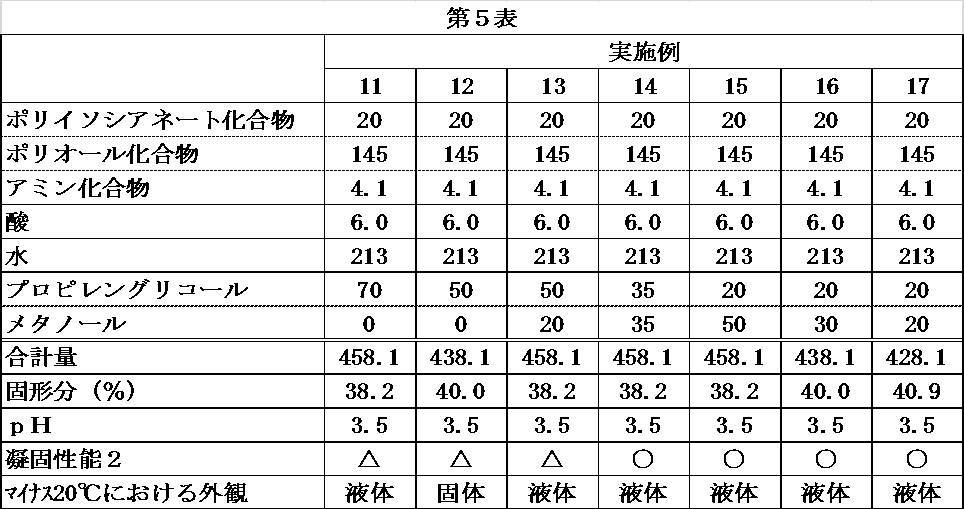
- Example 11 to 17 In addition to the liquid coagulant produced in Example 2, a liquid coagulant was produced by adding antifreeze agents (propylene glycol, methanol) shown in Table 5 below in the amounts shown in the same table.
- antifreeze agents propylene glycol, methanol
- Examples 18 and 19 and Comparative Examples 10 to 12 First, with respect to an acrylic resin emulsion (solid content: 45%, manufactured by Asahi Kasei Chemicals Corporation) having an acrylamide structure in an amount (unit: part by mass) shown in Table 6 below, the amount (unit: part by mass) shown in the same table. Then, an acid (formic acid) was added to make the amide group of the acrylic resin a cationic functional group (a group having a quaternary ammonium ion). Next, the antifreezing agent shown in the same table was added in the amount shown in the same table to produce a liquid coagulant having a solid content and pH shown in Table 6 below.
- the liquid coagulant having a pH outside the range of 2.0 to 4.0 has the presence or absence of a cationic functional group. Regardless, it turned out that it is inferior to coagulation.
- the manufactured liquid coagulants (Examples 1 to 19) having a pH in the range of 2.0 to 4.0 and having a cationic functional group are all excellent in coagulability. It was found that the remaining tire puncture sealant can be prevented from scattering.
- the liquid coagulants produced in Examples 11 and 13 to 19 were found to be liquid even at minus 20 ° C.
Landscapes
- Chemical & Material Sciences (AREA)
- Health & Medical Sciences (AREA)
- Chemical Kinetics & Catalysis (AREA)
- Medicinal Chemistry (AREA)
- Polymers & Plastics (AREA)
- Organic Chemistry (AREA)
- Engineering & Computer Science (AREA)
- Mechanical Engineering (AREA)
- Sealing Material Composition (AREA)
- Compositions Of Macromolecular Compounds (AREA)
- Adhesives Or Adhesive Processes (AREA)
Abstract
Description
また、本出願人により、合成樹脂エマルジョンに凍結防止剤を配合したものも提案されている(例えば、特許文献3~6等参照。)。
即ち、本発明は、下記(1)~(13)を提供する。
pHが2.0~4.0であり、
カチオン性官能基を有するウレタン樹脂および/またはアクリル樹脂を含有する液状凝固剤。
また、本発明の液状凝固剤は、タイヤをリムから取り外す際の残存タイヤパンクシール材の飛散を防止できるだけでなく、飛散による汚染を防止し、作業者の安全性も確保することができるため非常に有用である。
本発明の液状凝固剤は、天然ゴムラテックスを含有するエマルジョンを凝固させる液状凝固剤であって、pHが2.0~4.0であり、カチオン性官能基を有するウレタン樹脂および/またはアクリル樹脂を含有する液状の凝固剤である。
本発明においては、液状凝固剤のpHは、20℃でpHメーターを用いて測定した値をいう。なお、液状凝固剤のpHは、酸を用いて適宜調整することができるが、有機酸(例えば、ギ酸、酢酸、シュウ酸等)を用いて調整するのが好ましい。
また、液状とは、水系によるものであっても溶剤系によるものであってもよいが、本発明の液状凝固剤と、凝固対象である上記エマルジョンとの相溶性等の観点から、水系によるものであるのが好ましい。
次に、本発明の液状凝固剤の各成分について詳述する。
本発明の液状凝固剤に用いられるウレタン樹脂は、カチオン性官能基を有するものであれば特に限定されない。
ここで、カチオン性官能基とは、カチオンを有する官能基のことをいう。
また、上記カチオンとしては、具体的には、例えば、アンモニウムイオン、ホスホニウムイオン、イミダゾリウムイオン、ピリジニウムイオン、ピロリジニウムイオン、ピペリジニウムイオン等が挙げられる。これらのうち、取り扱いに優れる理由から、第4級アンモニウムイオンであるのが好ましい。
ここで、アルキレンオキサイド構造とは、下記式(1)で表される構造単位をいい、上記エマルジョンに対する凝固性が更に良好となる理由から、上記ウレタン樹脂は、下記式(1)中のnが2で表されるエチレンオキサイド構造を有しているのが好ましい。

(式中、nは2~4の整数を表す。)
上記ポリイソシアネート化合物としては、具体的には、例えば、TDI(例えば、2,4-トリレンジイソシアネート(2,4-TDI)、2,6-トリレンジイソシアネート(2,6-TDI))、MDI(例えば、4,4′-ジフェニルメタンジイソシアネート(4,4′-MDI)、2,4′-ジフェニルメタンジイソシアネート(2,4′-MDI))、1,4-フェニレンジイソシアネート、ポリメチレンポリフェニレンポリイソシアネート、キシリレンジイソシアネート(XDI)、テトラメチルキシリレンジイソシアネート(TMXDI)、トリジンジイソシアネート(TODI)、1,5-ナフタレンジイソシアネート(NDI)、トリフェニルメタントリイソシアネートのような芳香族ポリイソシアネート;ヘキサメチレンジイソシアネート(HDI)、トリメチルヘキサメチレンジイソシアネート(TMHDI)、リジンジイソシアネート、ノルボルナンジイソシアネート(NBDI)のような脂肪族ポリイソシアネート;トランスシクロヘキサン-1,4-ジイソシアネート、イソホロンジイソシアネート(IPDI)、ビス(イソシアネートメチル)シクロヘキサン(H6XDI)、ジシクロヘキシルメタンジイソシアネート(H12MDI)のような脂環式ポリイソシアネート;これらのカルボジイミド変性ポリイソシアネート;これらのイソシアヌレート変性ポリイソシアネート;等が挙げられる。
これらのうち、トリレンジイソシアネート(TDI)であるのが、得られるウレタン樹脂が低粘度となり、このウレタン樹脂を含む本発明の液状凝固剤の取り扱いが容易となる理由から好ましい。
上記ポリオール化合物としては、例えば、ポリエーテルポリオール、ポリエステルポリオール等が挙げられる。
具体的には、ポリエチレングリコール(ポリエチレンオキサイド)、ポリプロピレングリコール(ポリプロピレンオキサイド)、ポリプロピレントリオール、エチレンオキサイド/プロピレンオキサイド共重合体、ポリテトラメチレンエーテルグリコール(PTMEG)、ポリテトラエチレングリコール、ソルビトール系ポリオールが好適に例示される。
これらのうち、得られるウレタン樹脂がアルキレンオキサイド構造を有する理由から、ポリエーテルポリオールであるのが好ましく、具体的には、ポリエチレングリコール(ポリエチレンオキシド)、ポリプロピレングリコール(ポリプロピレンオキシド)、エチレンオキサイド/プロピレンオキサイド共重合体であるのがより好ましい。
これらのうち、カチオンがより生成しやすい理由から、第3級アミンを有しているのが好ましく、具体的には、N-メチルジエタノールアミンであるのがより好ましい。
本発明の液状凝固剤に用いられるアクリル樹脂は、カチオン性官能基を有するものであれば特に限定されない。
ここで、カチオン性官能基とは、上述したウレタン樹脂において説明したものと同様である。
ここで、アクリルアミド構造は、上記アクリル樹脂が他にカチオン性官能基を有している場合は下記式(2)~(4)のいずれかで表される構造単位であってもよいが、カチオン性官能基(第4級アンモニウムを有する基)にも該当する下記式(5)で表される構造単位であるのが好ましい。
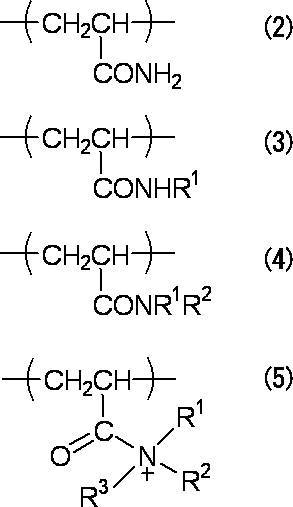
(式中、R1~R3は、それぞれ独立に炭素数1~6一価の脂肪族炭化水素基を表す。)
これは、ウレタン樹脂等がカチオン性官能基を有していることにより、凝固させるエマルジョンの安定性が低下し、凝集を起こしやすくなり、また、pHが2.0~4.0の範囲であることにより、本発明の液状凝固剤が凝固させるエマルジョンに対して溶解し、浸透した後に、凝固反応が進行するためであると考えられる。
そして、本発明の液状凝固剤が残存タイヤパンクシール材を凝固させることができる効果は、一般的なタイヤパンクシール材がエチレングリコールやプロピレングリコール等の水溶性の溶剤を凍結防止剤として含有していることを考慮すると、極めて意外な効果である。
本発明の液状凝固剤は、タイヤ内部へのバルブからの注入性(作業性)や、上述したウレタン樹脂および/またはアクリル樹脂のカチオン性官能基を安定性等の観点から、必要に応じて水を含有することができる。
水を含有する場合、水の含有量は、上述したウレタン樹脂および/またはアクリル樹脂100質量部に対して50~300質量部であるのが好ましく、100~200質量部であるのがより好ましい。
なお、水の上記含有量は、上述したウレタン樹脂およびアクリル樹脂を併用する場合は、ウレタン樹脂およびアクリル樹脂の合計100質量部に対する含有量である。
本発明の液状凝固剤は、必要に応じて凍結防止剤を含有することができる。
上記凍結防止剤は、特に限定されず、従来公知の凍結防止剤を用いることができる。
上記凍結防止剤としては、具体的には、例えば、エチレングリコール、プロピレングリコール、ジエチレングリコール、グリセリン、メタノール、エタノール、イソプロピルアルコール等が挙げられ、これらを1種単独で用いてもよく、2種以上を併用してもよい。
これらのうち、本発明の液状凝固剤の粘度を低く設計できる理由から、プロピレングリコールを用いるのが好ましく、本発明の液状凝固剤の優れた凝固性能を維持できる理由から、プロピレングリコールとメタノールとを併用するのが好ましい。
なお、上記凍結防止剤の上記含有量は、上述したウレタン樹脂およびアクリル樹脂を併用する場合は、ウレタン樹脂およびアクリル樹脂の合計100質量部に対する含有量である。
上記エマルジョンは、天然ゴムラテックスを含有するものであれば特に限定されないが、更に、合成樹脂エマルジョンおよび凍結防止剤を含有したタイヤパンクシール材であるのが、本発明の液状凝固剤の効果が十分に活かせる理由から好ましい。
以下に、本発明の液状凝固剤が凝固させるエマルジョン(タイヤパンクシール材)の各成分について詳述する。
エマルジョンおよびタイヤパンクシール材に用いられる天然ゴムラテックスは、特に限定されず、従来公知の天然ゴムラテックスを用いることができる。
上記天然ゴムラテックスとしては、具体的には、例えば、ヘベア・ブラジリエンシス樹をタッピングして採取されるもの、天然ゴムラテックスから蛋白質を除去した所謂「脱蛋白天然ゴムラテックス」等が挙げられる。
タイヤパンクシール材に用いられる合成樹脂エマルジョンは、特に限定されず、従来公知の合成樹脂エマルジョンを用いることができる。
上記合成樹脂エマルジョンとしては、具体的には、例えば、エチレン酢酸ビニル系エマルジョン、アクリルエマルジョン、ウレタンエマルジョン等が挙げられ、これらを1種単独で用いてもよく、2種以上を併用してもよい。
上記合成樹脂エマルジョンとしては、それぞれ特許文献7に記載されたものを用いることができる。
また、上記合成樹脂の含有量は、上記天然ゴムラテックスおよび上記合成樹脂エマルジョンの固形分配合比率(天然ゴムラテックス/合成樹脂エマルジョン)が、5/95~80/20となる含有量であるのが好ましく、20/80~50/50となる含有量であるのがより好ましい。
タイヤパンクシール材に用いられる凍結防止剤は、特に限定されず、従来公知の凍結防止剤を用いることができる。
上記凍結防止剤としては、本発明の液状凝固剤において説明したものと同様のものが挙げられる。
上記凍結防止剤の含有量は、上記天然ゴムラテックスおよび上記合成樹脂エマルジョンの合計固形分100質量部に対して、20~300質量部であるのが好ましく、50~200質量部であるのがより好ましい。
本発明の液状凝固剤が凝固させるタイヤパンクシール材は、シール性の観点から、粘着付与剤を含有していてもよい。
上記粘着付与剤は特に限定されず、従来公知の凍結防止剤を用いることができ、その具体例としては、ロジン系樹脂、重合ロジン系樹脂、ロジンエステル系樹脂、重合ロジンエステル系樹脂、変性ロジン等のロジン系樹脂;テルペンフェノール系樹脂;芳香族テルペン等のテルペン系樹脂;テルペン系樹脂を水素添加した水添テルペン系樹脂;フェノール樹脂;キシレン樹脂等が挙げられる。
上記粘着付与剤の含有量は、上記天然ゴムラテックスおよび上記合成樹脂エマルジョンの合計固形分100質量部に対して、10~150質量部であるのが好ましく、20~100質量部であるのがより好ましい。
本発明の液状凝固剤が凝固させるタイヤパンクシール材は、上述した各成分以外に、所望により必要に応じて、例えば、充填剤、老化防止剤、酸化防止剤、顔料(染料)、可塑剤、揺変性付与剤、紫外線吸収剤、難燃剤、界面活性剤(レベリング剤を含む)、分散剤、脱水剤、帯電防止剤のような各種添加剤を含有することができる。
上記添加剤としては、それぞれ特許文献7に記載されたものを用いることができる。
本発明のタイヤパンクシール材セットは、天然ゴムラテックス、合成樹脂エマルジョンおよび凍結防止剤を含有するタイヤパンクシール材と、上述した本発明の液状凝固剤とを有するタイヤパンクシール材セットである。
ここで、本発明のタイヤパンクシール材セットにおけるタイヤパンクシール材は、上述した本発明の液状凝固剤が凝固させる対象として説明したタイヤパンクシール材と同様である。
下記第1表に示すタイヤパンクシール材の成分を同表に示す量(単位:質量部)で撹拌機を用いて混合し、タイヤパンクシール材を製造した。
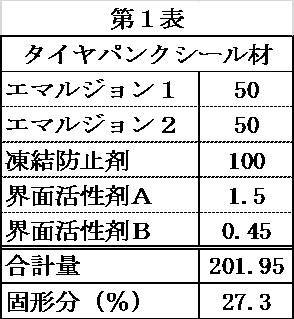
・エマルジョン1:天然ゴムエマルジョン(HA Latex、固形分60質量%、Golden Hope社製)
・エマルジョン2:エチレン酢酸ビニルエマルジョン(固形分51質量%、スミカフレックスS-408HQE、住化ケムテックス社製)
・凍結防止剤:プロピレングリコール(固形分100質量%、和光純薬工業社製)
・界面活性剤A:ドデシル硫酸ナトリウム(和光純薬工業社製)
・界面活性剤B:ポリオキシエチレンアルキルエーテル(エマルゲン109、花王社製)
(実施例1~4、比較例1~4)
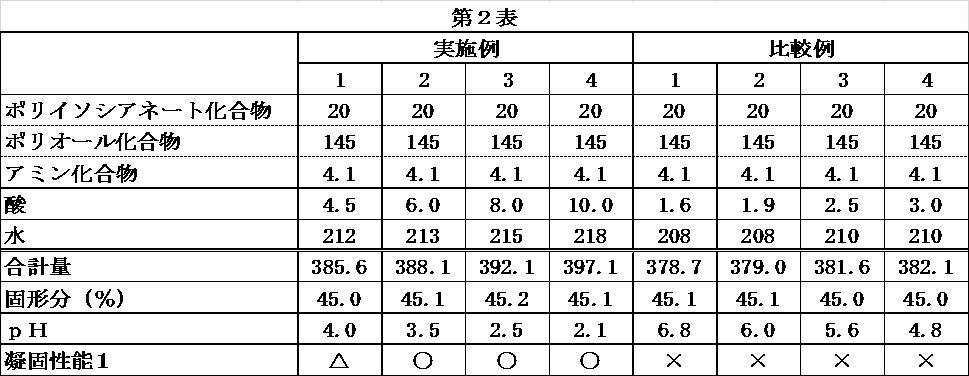
まず、ポリイソシアネート化合物(TDI、三井化学社製)と、ポリオール化合物(エチレンオキサイド末端ポリプロピレングリコール、CMC252、アデカ社製)およびアミン化合物(N-メチルジエタノールアミン)とを、下記第2表に示す量(単位:質量部)で混合して反応させ、エチレンオキサイド構造およびプロピレンオキサイド構造を有するウレタン樹脂を得た。
次いで、得られたウレタン樹脂に対して、下記第2表に示す量(単位:質量部)で酸(ギ酸)を添加して第3級アミノ基をカチオン性官能基(第4級アンモニウムイオンを有する基)とした。
次いで、得られたウレタン樹脂を10℃以下に冷却した後、反応容器内を500rpm程度に高速撹拌させながら、下記第2表に示す量の水を添加することで、下記第2表に示す固形分およびpHの液状凝固剤を製造した。
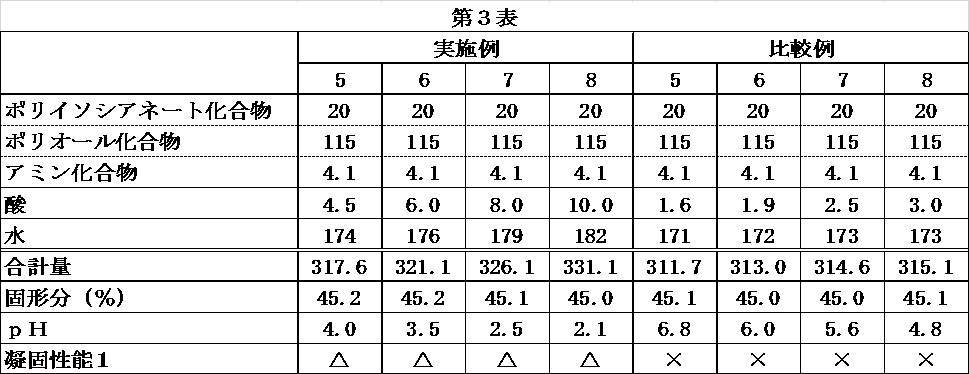
ポリオール化合物としてポリプロピレングリコール(三井化学社製)を下記第3表に示す量で用い、エチレンオキサイド構造を有しないウレタン樹脂を用いた以外は、実施例1と同様の方法により下記第3表に示す固形分およびpHの液状凝固剤を製造した。
アミン化合物として、ジエタノールアミンを下記第4表に示す量で用いた以外は、実施例1と同様の方法により下記第4表に示す固形分およびpHの液状凝固剤を製造した。
酸として、シュウ酸を下記第4表に示す量で用いた以外は、実施例1と同様の方法により下記第4表に示す固形分およびpHの液状凝固剤を製造した。
酸(ギ酸)を添加せずに、実施例1で調整したウレタン樹脂自体を液状凝固剤とした。

実施例2で製造した液状凝固剤に対し、更に、下記第5表に示す凍結防止剤(プロピレングリコール、メタノール)を同表に示す量で添加した液状凝固剤を製造した。
まず、下記第6表に示す量(単位:質量部)のアクリルアミド構造を有するアクリル樹脂エマルジョン(固形分:45%、旭化成ケミカルズ社製)に対して、同表に示す量(単位:質量部)で酸(ギ酸)を添加し、アクリル樹脂が有するアミド基をカチオン性官能基(第4級アンモニウムイオンを有する基)とした。
次いで、同表に示す凍結防止剤を同表に示す量で添加し、下記第6表に示す固形分およびpHの液状凝固剤を製造した。

(1)凝固性能1
上記のとおり製造したタイヤパンクシール材100gに対して、実施例1~10および比較例1~9で製造した液状凝固剤を10g添加し、20℃で5分間撹拌した後に、液状成分の有無を目視により確認した。
その結果、液状成分が確認できなかったものを凝固性に優れるものとして「○」と評価し、わずかに液状成分が確認できるものの残存タイヤパンクシール材の飛散防止の観点から実用上問題のないものを「△」と評価し、液状成分が多く確認できるものを凝固性に劣るものとして「×」と評価した。これらの結果を上記第2表~第4表に示した。
上記のとおり製造したタイヤパンクシール材600mlをリムなしのタイヤ内部に添加した後、実施例11~19および比較例10~12で製造した液状凝固剤を60ml添加した。
次いで、タイヤを転がり方向の前後に、それぞれ90度程度まで10回(前後に5回ずつ)揺り動かした。
その後、20℃で5分間静置した後に、液状成分の有無を目視により確認した。
その結果、液状成分が確認できなかったものを凝固性に優れるものとして「○」と評価し、わずかに液状成分が確認できるものの残存タイヤパンクシール材の飛散防止の観点から実用上問題のないものを「△」と評価し、液状成分が多く確認できるものを凝固性に劣るものとして「×」と評価した。これらの結果を上記第5表~第6表に示した。
実施例11~19および比較例10~12で製造した液状凝固剤のマイナス20℃における外観(固体・液体)を目視により観察した。この結果を上記第5表~第6表に示した。
これに対し、pHが2.0~4.0の範囲内であり、かつ、カチオン性官能基を有する製造した液状凝固剤(実施例1~19)は、いずれも凝固性に優れることが分かり、残存タイヤパンクシール材の飛散を防止することができることが分かった。
特に、凍結防止剤を添加した液状凝固剤のうち、実施例11および13~19で製造した液状凝固剤は、マイナス20℃においても液体であることが分かった。
Claims (13)
- 天然ゴムラテックスを含有するエマルジョンを凝固させる液状凝固剤であって、
pHが2.0~4.0であり、
カチオン性官能基を有するウレタン樹脂および/またはアクリル樹脂を含有する液状凝固剤。 - 前記カチオン性官能基が、第4級アンモニウムイオンを有する官能基である請求項1に記載の液状凝固剤。
- 前記ウレタン樹脂が、アルキレンオキサイド構造を有する請求項1または2に記載の液状凝固剤。
- 前記ウレタン樹脂が、エチレンオキサイド構造を有する請求項3に記載の液状凝固剤。
- 前記アクリル樹脂が、アクリルアミド構造を有する請求項1~4のいずれかに記載の液状凝固剤。
- 更に、凍結防止剤を含有する請求項1~5のいずれかに記載の液状凝固剤。
- 前記凍結防止剤が、エチレングリコール、プロピレングリコール、ジエチレングリコール、グリセリン、メタノール、エタノールおよびイソプロピルアルコールからなる群から選択される少なくとも1種である請求項6に記載の液状凝固剤。
- 前記エマルジョンが、更に、合成樹脂エマルジョンおよび凍結防止剤を含有するタイヤパンクシール材である請求項1~7のいずれかに記載の液状凝固剤。
- 前記合成樹脂エマルジョンが、エチレン酢酸ビニル系エマルジョン、アクリルエマルジョンおよびウレタンエマルジョンからなる群から選択される少なくとも1種である請求項8に記載の液状凝固剤。
- 前記凍結防止剤が、エチレングリコール、プロピレングリコール、ジエチレングリコール、グリセリン、メタノール、エタノールおよびイソプロピルアルコールからなる群から選択される少なくとも1種である請求項8または9に記載の液状凝固剤。
- 天然ゴムラテックス、合成樹脂エマルジョンおよび凍結防止剤を含有するタイヤパンクシール材と、請求項1~7のいずれかに記載の液状凝固剤とを有するタイヤパンクシール材セット。
- 前記合成樹脂エマルジョンが、エチレン酢酸ビニル系エマルジョン、アクリルエマルジョンおよびウレタンエマルジョンからなる群から選択される少なくとも1種である請求項11に記載のタイヤパンクシール材セット。
- 前記凍結防止剤が、エチレングリコール、プロピレングリコール、ジエチレングリコール、グリセリン、メタノール、エタノールおよびイソプロピルアルコールからなる群から選択される少なくとも1種である請求項11または12に記載のタイヤパンクシール材セット。
Priority Applications (3)
| Application Number | Priority Date | Filing Date | Title |
|---|---|---|---|
| US13/699,784 US8791175B2 (en) | 2010-05-27 | 2011-05-19 | Liquid coagulant and tire puncture sealing material set |
| CN201180026148.7A CN102906213B (zh) | 2010-05-27 | 2011-05-19 | 液态凝固剂及补胎材料套件 |
| DE112011101806.1T DE112011101806B4 (de) | 2010-05-27 | 2011-05-19 | Flüssiges Koagulierungsmittel und dessem Verwendung |
Applications Claiming Priority (2)
| Application Number | Priority Date | Filing Date | Title |
|---|---|---|---|
| JP2010-121355 | 2010-05-27 | ||
| JP2010121355A JP4784694B1 (ja) | 2010-05-27 | 2010-05-27 | 液状凝固剤およびタイヤパンクシール材セット |
Publications (1)
| Publication Number | Publication Date |
|---|---|
| WO2011148853A1 true WO2011148853A1 (ja) | 2011-12-01 |
Family
ID=44881895
Family Applications (1)
| Application Number | Title | Priority Date | Filing Date |
|---|---|---|---|
| PCT/JP2011/061539 Ceased WO2011148853A1 (ja) | 2010-05-27 | 2011-05-19 | 液状凝固剤およびタイヤパンクシール材セット |
Country Status (5)
| Country | Link |
|---|---|
| US (1) | US8791175B2 (ja) |
| JP (1) | JP4784694B1 (ja) |
| CN (1) | CN102906213B (ja) |
| DE (1) | DE112011101806B4 (ja) |
| WO (1) | WO2011148853A1 (ja) |
Cited By (5)
| Publication number | Priority date | Publication date | Assignee | Title |
|---|---|---|---|---|
| WO2014148629A1 (ja) * | 2013-03-22 | 2014-09-25 | 横浜ゴム株式会社 | エマルジョン凝固剤及びこれを用いるタイヤパンク修理キット |
| WO2015033796A1 (ja) * | 2013-09-09 | 2015-03-12 | 横浜ゴム株式会社 | 凝固剤及びこれを用いるタイヤパンク修理キット |
| WO2015133519A1 (ja) * | 2014-03-05 | 2015-09-11 | 横浜ゴム株式会社 | タイヤパンクシール剤 |
| JP6210135B1 (ja) * | 2016-06-29 | 2017-10-11 | 横浜ゴム株式会社 | タイヤパンクシール剤及びタイヤパンク修理キット |
| WO2018109305A1 (fr) | 2016-12-16 | 2018-06-21 | Compagnie Generale Des Etablissements Michelin | Ensemble de bandage pneumatique et de roue comprenant un produit auto-obturant ameliore |
Families Citing this family (11)
| Publication number | Priority date | Publication date | Assignee | Title |
|---|---|---|---|---|
| CN104736657B (zh) | 2012-10-09 | 2017-05-10 | 横滨橡胶株式会社 | 乳胶凝固剂及使用其的轮胎穿孔修补套件 |
| CN103998560B (zh) * | 2012-12-13 | 2015-11-25 | 横滨橡胶株式会社 | 乳胶凝固剂 |
| JP5472436B1 (ja) * | 2012-12-14 | 2014-04-16 | 横浜ゴム株式会社 | カチオン性天然ゴムラテックス及びこれを用いるタイヤパンクシール材 |
| DE112014001650B4 (de) * | 2013-03-27 | 2018-10-11 | The Yokohama Rubber Co., Ltd. | Dichtmittel für Reifenlöcher und Verwendung des Dichtmittels in einem Reifenloch-Reparatursatz |
| KR101610815B1 (ko) | 2013-08-01 | 2016-04-08 | 요코하마 고무 가부시키가이샤 | 응고제 및 타이어 펑크 수리 키트 |
| DE112015000813B4 (de) | 2014-02-13 | 2019-10-02 | The Yokohama Rubber Co., Ltd. | Emulsionskoagulans und Verwendung in einem Reparaturset für Reifenlöcher sowie zum Koagulieren einer Reifenloch-Reparaturflüssigkeit |
| US10414907B2 (en) * | 2015-04-02 | 2019-09-17 | The Yokohama Rubber Co., Ltd. | Tire puncture sealant |
| EP3130453A1 (en) * | 2015-08-13 | 2017-02-15 | Sika Technology AG | Tire filling based on acrylic hydrogels |
| JP6658380B2 (ja) * | 2016-07-25 | 2020-03-04 | 横浜ゴム株式会社 | タイヤパンクシール材及びタイヤパンク修理キット |
| JP2024110012A (ja) * | 2021-06-24 | 2024-08-15 | デンカ株式会社 | エマルジョン組成物及び土壌侵食防止剤 |
| CN114456773A (zh) * | 2022-03-30 | 2022-05-10 | 宁夏北极星化工有限公司 | 一种煤炭运输车车厢用防冻除雪剂及其制备方法 |
Citations (6)
| Publication number | Priority date | Publication date | Assignee | Title |
|---|---|---|---|---|
| JP2000017026A (ja) * | 1998-07-01 | 2000-01-18 | Sekisui Plastics Co Ltd | N−ビニルカルボン酸アミド系架橋共重合樹脂およびその製造方法 |
| JP2000272022A (ja) * | 1999-03-25 | 2000-10-03 | Sumitomo Rubber Ind Ltd | タイヤのパンクシーリング剤 |
| JP2007224246A (ja) * | 2006-02-27 | 2007-09-06 | Yokohama Rubber Co Ltd:The | タイヤパンクシール材 |
| JP2007224240A (ja) * | 2006-02-27 | 2007-09-06 | Yokohama Rubber Co Ltd:The | タイヤパンクシール材 |
| JP2009041006A (ja) * | 2007-07-17 | 2009-02-26 | Yokohama Rubber Co Ltd:The | エマルジョン凝固剤 |
| JP2009051893A (ja) * | 2007-08-24 | 2009-03-12 | Yokohama Rubber Co Ltd:The | タイヤパンクシール材 |
Family Cites Families (19)
| Publication number | Priority date | Publication date | Assignee | Title |
|---|---|---|---|---|
| US5046088A (en) | 1989-10-31 | 1991-09-03 | Dialogic Corporation | Converter for in-band routing and/or origination information |
| DE19549592C5 (de) | 1995-07-11 | 2006-12-14 | Sumitomo Rubber Industries Ltd., Kobe | Vorrichtung zum Abdichten und Aufpumpen von Reifen bei Pannen |
| US6310124B1 (en) * | 1996-10-03 | 2001-10-30 | Cytec Technology, Corp. | Aqueous dispersions |
| DE19758820C5 (de) * | 1997-12-03 | 2008-03-27 | Michael Stehle | Verfahren zur Aufbereitung eines aufblasbaren oder aufpumpbaren Gegenstandes |
| US6294622B1 (en) * | 1999-09-27 | 2001-09-25 | Ecole Polytechnique Federale De Lausanne (Epfl) | Polymer flocculants with improved dewatering characteristics |
| JP2002256257A (ja) * | 2001-03-05 | 2002-09-11 | Asahi Glass Co Ltd | 水分散型撥水撥油剤組成物および処理物品 |
| JP3854841B2 (ja) * | 2001-10-12 | 2006-12-06 | 横浜ゴム株式会社 | タイヤパンク修理剤の処理方法 |
| JP4173326B2 (ja) | 2002-07-08 | 2008-10-29 | 住友ゴム工業株式会社 | タイヤのパンクシーリング剤 |
| CN1215142C (zh) * | 2003-08-13 | 2005-08-17 | 河北科技大学 | 一种环保型车用密封胶 |
| JP2006339594A (ja) * | 2005-06-06 | 2006-12-14 | Seimi Chem Co Ltd | 半導体用研磨剤 |
| DE102005031267A1 (de) * | 2005-07-05 | 2007-01-18 | Continental Aktiengesellschaft | Verfahren zur Behandlung von aufblasbaren oder aufpumpbaren Gegenständen, die ein Abdichtmittel enthalten |
| JP4466586B2 (ja) * | 2006-02-27 | 2010-05-26 | 横浜ゴム株式会社 | タイヤパンクシール材 |
| JP2007224245A (ja) | 2006-02-27 | 2007-09-06 | Yokohama Rubber Co Ltd:The | タイヤパンクシール材 |
| EP1825991B1 (en) * | 2006-02-27 | 2014-04-02 | The Yokohama Rubber Co., Ltd. | Tire puncture sealant |
| JP4862427B2 (ja) * | 2006-02-27 | 2012-01-25 | 横浜ゴム株式会社 | タイヤパンクシール材 |
| DE102006037488B4 (de) * | 2006-08-10 | 2018-12-13 | Continental Reifen Deutschland Gmbh | Verfahren zur Herstellung eines Fahrzeugluftreifens mit einer Dichtlage und Fahrzeugluftreifen mit Dichtlage |
| CN100999654A (zh) * | 2007-01-25 | 2007-07-18 | 甘少白 | 充气橡胶轮胎护胎补胎剂 |
| CN101407624B (zh) * | 2007-10-11 | 2011-12-21 | 罗门哈斯公司 | 增稠剂混合组合物及使水性体系增稠的方法 |
| US20090162609A1 (en) * | 2007-12-21 | 2009-06-25 | Lee Jerry Hc | Cationic fiberglass size |
-
2010
- 2010-05-27 JP JP2010121355A patent/JP4784694B1/ja active Active
-
2011
- 2011-05-19 DE DE112011101806.1T patent/DE112011101806B4/de not_active Expired - Fee Related
- 2011-05-19 US US13/699,784 patent/US8791175B2/en active Active
- 2011-05-19 WO PCT/JP2011/061539 patent/WO2011148853A1/ja not_active Ceased
- 2011-05-19 CN CN201180026148.7A patent/CN102906213B/zh active Active
Patent Citations (6)
| Publication number | Priority date | Publication date | Assignee | Title |
|---|---|---|---|---|
| JP2000017026A (ja) * | 1998-07-01 | 2000-01-18 | Sekisui Plastics Co Ltd | N−ビニルカルボン酸アミド系架橋共重合樹脂およびその製造方法 |
| JP2000272022A (ja) * | 1999-03-25 | 2000-10-03 | Sumitomo Rubber Ind Ltd | タイヤのパンクシーリング剤 |
| JP2007224246A (ja) * | 2006-02-27 | 2007-09-06 | Yokohama Rubber Co Ltd:The | タイヤパンクシール材 |
| JP2007224240A (ja) * | 2006-02-27 | 2007-09-06 | Yokohama Rubber Co Ltd:The | タイヤパンクシール材 |
| JP2009041006A (ja) * | 2007-07-17 | 2009-02-26 | Yokohama Rubber Co Ltd:The | エマルジョン凝固剤 |
| JP2009051893A (ja) * | 2007-08-24 | 2009-03-12 | Yokohama Rubber Co Ltd:The | タイヤパンクシール材 |
Cited By (16)
| Publication number | Priority date | Publication date | Assignee | Title |
|---|---|---|---|---|
| RU2594017C1 (ru) * | 2013-03-22 | 2016-08-10 | Дзе Йокогама Раббер Ко., Лтд. | Эмульсионный коагулянт и набор для ремонта прокола в шине с его применением |
| US9657164B2 (en) | 2013-03-22 | 2017-05-23 | The Yokohama Rubber Co., Ltd. | Emulsion coagulant and tire puncture repair kit using same |
| WO2014148629A1 (ja) * | 2013-03-22 | 2014-09-25 | 横浜ゴム株式会社 | エマルジョン凝固剤及びこれを用いるタイヤパンク修理キット |
| JPWO2014148629A1 (ja) * | 2013-03-22 | 2017-02-16 | 横浜ゴム株式会社 | エマルジョン凝固剤及びこれを用いるタイヤパンク修理キット |
| JPWO2015033796A1 (ja) * | 2013-09-09 | 2017-03-02 | 横浜ゴム株式会社 | 凝固剤及びこれを用いるタイヤパンク修理キット |
| WO2015033796A1 (ja) * | 2013-09-09 | 2015-03-12 | 横浜ゴム株式会社 | 凝固剤及びこれを用いるタイヤパンク修理キット |
| KR101780494B1 (ko) | 2013-09-09 | 2017-09-21 | 요코하마 고무 가부시키가이샤 | 응고제 및 이것을 이용하는 타이어 펑크 수리 키트 |
| KR101721930B1 (ko) | 2014-03-05 | 2017-03-31 | 요코하마 고무 가부시키가이샤 | 타이어 펑크 실제 |
| CN106029816A (zh) * | 2014-03-05 | 2016-10-12 | 横滨橡胶株式会社 | 轮胎补胎剂 |
| KR20160106770A (ko) * | 2014-03-05 | 2016-09-12 | 요코하마 고무 가부시키가이샤 | 타이어 펑크 실제 |
| US9676152B2 (en) | 2014-03-05 | 2017-06-13 | The Yokohama Rubber Co., Ltd. | Tire puncture sealing agent |
| WO2015133519A1 (ja) * | 2014-03-05 | 2015-09-11 | 横浜ゴム株式会社 | タイヤパンクシール剤 |
| CN106029816B (zh) * | 2014-03-05 | 2018-01-05 | 横滨橡胶株式会社 | 轮胎补胎剂 |
| JP6210135B1 (ja) * | 2016-06-29 | 2017-10-11 | 横浜ゴム株式会社 | タイヤパンクシール剤及びタイヤパンク修理キット |
| WO2018003745A1 (ja) * | 2016-06-29 | 2018-01-04 | 横浜ゴム株式会社 | タイヤパンクシール剤及びタイヤパンク修理キット |
| WO2018109305A1 (fr) | 2016-12-16 | 2018-06-21 | Compagnie Generale Des Etablissements Michelin | Ensemble de bandage pneumatique et de roue comprenant un produit auto-obturant ameliore |
Also Published As
| Publication number | Publication date |
|---|---|
| CN102906213A (zh) | 2013-01-30 |
| DE112011101806T5 (de) | 2013-05-08 |
| JP2011246610A (ja) | 2011-12-08 |
| CN102906213B (zh) | 2015-10-14 |
| US20130172465A1 (en) | 2013-07-04 |
| US8791175B2 (en) | 2014-07-29 |
| DE112011101806B4 (de) | 2016-05-12 |
| JP4784694B1 (ja) | 2011-10-05 |
Similar Documents
| Publication | Publication Date | Title |
|---|---|---|
| JP4784694B1 (ja) | 液状凝固剤およびタイヤパンクシール材セット | |
| JP4862973B1 (ja) | 液状凝固剤およびタイヤパンクシール材セット | |
| US8148448B2 (en) | Tire puncture sealant | |
| JP4609598B1 (ja) | タイヤパンクシール材 | |
| JP4640494B2 (ja) | タイヤパンク補修材 | |
| US9067369B2 (en) | Tire puncture sealant | |
| US9254614B2 (en) | Tire puncture sealant | |
| US8513331B2 (en) | Puncture repair material recovery system | |
| WO2016159370A1 (ja) | タイヤパンクシール剤 | |
| JP2010043155A (ja) | タイヤパンクシール材 | |
| JP5871079B2 (ja) | タイヤパンクシール材 | |
| JP5472436B1 (ja) | カチオン性天然ゴムラテックス及びこれを用いるタイヤパンクシール材 | |
| JP5482402B2 (ja) | タイヤパンクシール材 | |
| CN109312210B (zh) | 轮胎刺穿用密封剂及轮胎刺穿用修理套件 |
Legal Events
| Date | Code | Title | Description |
|---|---|---|---|
| WWE | Wipo information: entry into national phase |
Ref document number: 201180026148.7 Country of ref document: CN |
|
| 121 | Ep: the epo has been informed by wipo that ep was designated in this application |
Ref document number: 11786552 Country of ref document: EP Kind code of ref document: A1 |
|
| WWE | Wipo information: entry into national phase |
Ref document number: 13699784 Country of ref document: US |
|
| WWE | Wipo information: entry into national phase |
Ref document number: 112011101806 Country of ref document: DE Ref document number: 1120111018061 Country of ref document: DE |
|
| 122 | Ep: pct application non-entry in european phase |
Ref document number: 11786552 Country of ref document: EP Kind code of ref document: A1 |