WO2011155140A1 - 耐硫化物応力割れ性に優れた鋼管用鋼 - Google Patents
耐硫化物応力割れ性に優れた鋼管用鋼 Download PDFInfo
- Publication number
- WO2011155140A1 WO2011155140A1 PCT/JP2011/002897 JP2011002897W WO2011155140A1 WO 2011155140 A1 WO2011155140 A1 WO 2011155140A1 JP 2011002897 W JP2011002897 W JP 2011002897W WO 2011155140 A1 WO2011155140 A1 WO 2011155140A1
- Authority
- WO
- WIPO (PCT)
- Prior art keywords
- steel
- content
- inclusions
- less
- slag
- Prior art date
- Legal status (The legal status is an assumption and is not a legal conclusion. Google has not performed a legal analysis and makes no representation as to the accuracy of the status listed.)
- Ceased
Links
Images

Classifications
-
- C—CHEMISTRY; METALLURGY
- C22—METALLURGY; FERROUS OR NON-FERROUS ALLOYS; TREATMENT OF ALLOYS OR NON-FERROUS METALS
- C22C—ALLOYS
- C22C38/00—Ferrous alloys, e.g. steel alloys
- C22C38/18—Ferrous alloys, e.g. steel alloys containing chromium
- C22C38/32—Ferrous alloys, e.g. steel alloys containing chromium with boron
-
- C—CHEMISTRY; METALLURGY
- C21—METALLURGY OF IRON
- C21D—MODIFYING THE PHYSICAL STRUCTURE OF FERROUS METALS; GENERAL DEVICES FOR HEAT TREATMENT OF FERROUS OR NON-FERROUS METALS OR ALLOYS; MAKING METAL MALLEABLE, e.g. BY DECARBURISATION OR TEMPERING
- C21D8/00—Modifying the physical properties of ferrous metals or ferrous alloys by deformation combined with, or followed by, heat treatment
- C21D8/02—Modifying the physical properties of ferrous metals or ferrous alloys by deformation combined with, or followed by, heat treatment during manufacturing of plates or strips
- C21D8/0247—Modifying the physical properties of ferrous metals or ferrous alloys by deformation combined with, or followed by, heat treatment during manufacturing of plates or strips characterised by the heat treatment
-
- C—CHEMISTRY; METALLURGY
- C22—METALLURGY; FERROUS OR NON-FERROUS ALLOYS; TREATMENT OF ALLOYS OR NON-FERROUS METALS
- C22C—ALLOYS
- C22C38/00—Ferrous alloys, e.g. steel alloys
- C22C38/001—Ferrous alloys, e.g. steel alloys containing N
-
- C—CHEMISTRY; METALLURGY
- C22—METALLURGY; FERROUS OR NON-FERROUS ALLOYS; TREATMENT OF ALLOYS OR NON-FERROUS METALS
- C22C—ALLOYS
- C22C38/00—Ferrous alloys, e.g. steel alloys
- C22C38/002—Ferrous alloys, e.g. steel alloys containing In, Mg, or other elements not provided for in one single group C22C38/001 - C22C38/60
-
- C—CHEMISTRY; METALLURGY
- C22—METALLURGY; FERROUS OR NON-FERROUS ALLOYS; TREATMENT OF ALLOYS OR NON-FERROUS METALS
- C22C—ALLOYS
- C22C38/00—Ferrous alloys, e.g. steel alloys
- C22C38/02—Ferrous alloys, e.g. steel alloys containing silicon
-
- C—CHEMISTRY; METALLURGY
- C22—METALLURGY; FERROUS OR NON-FERROUS ALLOYS; TREATMENT OF ALLOYS OR NON-FERROUS METALS
- C22C—ALLOYS
- C22C38/00—Ferrous alloys, e.g. steel alloys
- C22C38/04—Ferrous alloys, e.g. steel alloys containing manganese
-
- C—CHEMISTRY; METALLURGY
- C22—METALLURGY; FERROUS OR NON-FERROUS ALLOYS; TREATMENT OF ALLOYS OR NON-FERROUS METALS
- C22C—ALLOYS
- C22C38/00—Ferrous alloys, e.g. steel alloys
- C22C38/06—Ferrous alloys, e.g. steel alloys containing aluminium
-
- C—CHEMISTRY; METALLURGY
- C22—METALLURGY; FERROUS OR NON-FERROUS ALLOYS; TREATMENT OF ALLOYS OR NON-FERROUS METALS
- C22C—ALLOYS
- C22C38/00—Ferrous alloys, e.g. steel alloys
- C22C38/18—Ferrous alloys, e.g. steel alloys containing chromium
- C22C38/22—Ferrous alloys, e.g. steel alloys containing chromium with molybdenum or tungsten
-
- C—CHEMISTRY; METALLURGY
- C22—METALLURGY; FERROUS OR NON-FERROUS ALLOYS; TREATMENT OF ALLOYS OR NON-FERROUS METALS
- C22C—ALLOYS
- C22C38/00—Ferrous alloys, e.g. steel alloys
- C22C38/18—Ferrous alloys, e.g. steel alloys containing chromium
- C22C38/24—Ferrous alloys, e.g. steel alloys containing chromium with vanadium
-
- C—CHEMISTRY; METALLURGY
- C22—METALLURGY; FERROUS OR NON-FERROUS ALLOYS; TREATMENT OF ALLOYS OR NON-FERROUS METALS
- C22C—ALLOYS
- C22C38/00—Ferrous alloys, e.g. steel alloys
- C22C38/18—Ferrous alloys, e.g. steel alloys containing chromium
- C22C38/26—Ferrous alloys, e.g. steel alloys containing chromium with niobium or tantalum
-
- C—CHEMISTRY; METALLURGY
- C22—METALLURGY; FERROUS OR NON-FERROUS ALLOYS; TREATMENT OF ALLOYS OR NON-FERROUS METALS
- C22C—ALLOYS
- C22C38/00—Ferrous alloys, e.g. steel alloys
- C22C38/18—Ferrous alloys, e.g. steel alloys containing chromium
- C22C38/28—Ferrous alloys, e.g. steel alloys containing chromium with titanium or zirconium
Definitions
- the present invention relates to a steel for steel pipes with few coarse inclusions, excellent cleanliness, and excellent resistance to sulfide stress cracking (hereinafter also referred to as “SSC resistance”).
- SSC resistance sulfide stress cracking
- the present invention also relates to steel for steel pipes having excellent SSC resistance used for casings, tubing, drill pipes for drilling, drill collars and the like for oil wells and natural gas wells.
- inclusions Non-metallic inclusions in steel (hereinafter simply referred to as “inclusions”) cause defects and defects in steel materials, as well as a decrease in weldability, strength and ductility, and a decrease in corrosion resistance. The larger the is, the greater the adverse effect. For this reason, many methods for reducing the number and reforming have been developed around large inclusions.
- Patent Document 1 discloses a technique for improving pore expandability using MgO or MgO-containing inclusions.
- Patent Document 2 by controlling the Mg content in steel to a specific range, A technique for dispersing harmful oxygen as fine MgO is disclosed.
- the present applicant has proposed a technique for reducing coarse carbonitride inclusions by generating carbonitrides using Ca—Al-based oxysulfide inclusions as nuclei. is doing.
- the recent technology does not simply remove or reduce the inclusions as in the prior art, but instead uses the inclusions.
- the inclusion includes oxide, sulfide, oxysulfide, carbonitride, and the like.
- the cause of surface flaws in cold-rolled steel sheets is mainly coarse oxides
- the cause of weldability deterioration in structural materials such as steel frames is sulfides.
- the inclusion countermeasure a for satisfying the characteristic A and the inclusion countermeasure b for satisfying the characteristic B will be taken at the same time.
- the S content in the steel can be reduced.
- the interfacial tension between the molten iron and inclusions decreases, and the floatability of inclusions decreases. Therefore, oxide inclusions may increase.
- the N content in the steel is changed by increasing the speed of denitrification or nitrogen absorption of the molten iron, and as a result, the number of nitrides is likely to fluctuate. is there.
- the number of specific types of inclusions such as oxides or sulfides that affect each property, but oxides, sulfides, oxysulfides and carbons.
- the total number of a plurality of types of inclusions such as nitrides may be a problem.
- MnS is modified to be harmless with Ca or the like for the purpose of improving the corrosion resistance of the steel material
- the Ca-based inclusions after the modification may lower the surface quality of the steel material. In such a case, it is necessary to reduce the total number of inclusions after modification simultaneously with detoxification of MnS, and the countermeasure becomes more complicated.
- JP 2001-342543 A Japanese Patent Laid-Open No. 5-302112 WO03 / 083152 JP 2003-160838 A
- This invention is made
- Mg—Al—O-based oxide is present in the central portion of the inclusions
- the M -Ca-Al oxide and / or Ca-Al oxysulfide is present so as to enclose the -Al-O oxide
- the Ca-Al oxide and / or Ca-Al oxysulfide is present.
- Steel pipe steel excellent in SSC resistance hereinafter referred to as “the steel of the first invention”
- a carbonitride or carbide containing Ti is present in the whole or a part of the outer periphery of the steel. .
- mass% and “mass ppm” are simply expressed as “%” and “ppm” for the component composition of steel and slag.
- composition of steel is used in the meaning of “content ratio in steel pipe products” unless otherwise specified.
- Non-metallic inclusions in steel composed of two or more of Ca, Al, Mg, Ti and Nb, and two or more of O, S and N The maximum particle size in steel pipe products is Among coarse inclusions of 1 ⁇ m or more, those with a total content of Ca, Al, Mg, Ti and Nb, and O, S and N of 80% or more.
- Non-metallic inclusions in steel composed of two or more of Ca, Al, Mg, Ti and Nb, and two or more of O, S and N The maximum particle size in steel pipe products is Among coarse inclusions of 1 ⁇ m or more, each element contains at least 2% of Ca, Al, Mg, Ti, and Nb in an amount of 5% or more, and at least two elements of O, S, and N Each containing 5% or more, and the total content of Ca, Al, Mg, Ti, Nb, O, S and N is 80% or more.
- the non-metallic inclusions defined herein include the following “Mg—Al—O-based oxide”, “Ca—Al-based oxide” and / or “Ca—Al-based oxysulfide” and “Ti”.
- a plurality of inclusion elements (inclusion phases) of “containing carbonitride or carbide” form “aggregates”.
- Mg—Al—O-based oxide a non-metallic inclusion phase constituting the “aggregate”, containing 2.5% or more of Mg, Al, and O, and a total of 8 % Or more.
- “Ca—Al-based oxide” a non-metallic inclusion phase constituting the “aggregate”, containing 3% or more of Ca, Al and O, and a total of 15% or more of these.
- Carbonide or carbide containing Ti non-metallic inclusion phase constituting the “aggregate”, containing 1.2% or more of Ti, N and C, respectively, and a total of 5% More than that.
- the steel for steel pipes of the present invention has few coarse inclusions and is excellent in cleanliness.
- steel materials used for steel pipes casings for oil wells and natural gas wells, tubing, drill pipes for drilling, drill collars, etc. It can be used, has a predetermined strength and toughness, is particularly excellent in SSC resistance, and is easy to manufacture and manage.
- Si 0.01 to 0.8% Si is contained for the purpose of deoxidizing steel or improving strength. If the Si content is less than 0.01%, there is no effect of deoxidation or strength improvement of steel. On the other hand, when the Si content exceeds 0.8%, the activity of Ca and S is lowered, and the form of inclusions is affected. Therefore, the Si content is set to 0.01 to 0.8%.
- the Si content is preferably 0.10 to 0.85%.
- Mn 0.1 to 1.5% Mn is contained in an amount of 0.1% or more in order to improve the hardenability of the steel and increase the strength of the steel. However, if the content is too high, the toughness may be deteriorated, so the upper limit of the Mn content is 1.5%.
- the Mn content is preferably 0.20 to 1.40%, more preferably 0.25 to 0.80%.
- S 0.005% or less
- S is an impurity forming sulfide inclusions, and as the S content increases, the toughness and corrosion resistance of the steel deteriorate significantly. Therefore, the S content is set to 0.005% or less. The lower the S content, the better.
- P 0.03% or less
- P is an element mixed in the steel as an impurity, and lowers the toughness of the steel or deteriorates the corrosion resistance. Therefore, the upper limit of the P content is 0.03%.
- the preferable content rate of P is 0.02% or less, More preferably, it is 0.012% or less. It is desirable that the P content is as low as possible.
- Al 0.0005 to 0.1%
- Al is an element added for deoxidation of molten steel.
- the Al content is less than 0.0005%, deoxidation is insufficient, and coarse composite oxides such as Al—Si, Al—Ti, and Al—Ti—Si may be generated.
- the upper limit of the Al content is set to 0.1%.
- Additive element for improving SSC resistance Further, the SSC resistance of steel can be improved by adjusting the content of Ti, Ca, N, Cr and Mo within the following ranges.
- Ti 0.005 to 0.05%
- Ti has the effect of improving the strength of the steel by the effect of grain refinement and precipitation hardening.
- Ti contains B to improve the hardenability of the steel, it can suppress the nitriding of B and exert the effect of improving the hardenability.
- a Ti content of 0.005% or more is necessary.
- carbide precipitates increase and the toughness of the steel deteriorates, so the upper limit of the Ti content is 0.05%.
- a preferable Ti content is 0.008 to 0.035%.
- Ca 0.0004 to 0.005%
- Ca is an important element that improves the SSC resistance of steel by simultaneously modifying sulfides and oxides. To obtain this effect, a Ca content of 0.0004% or more is necessary. However, if the Ca content is too high, inclusions become coarse or the corrosion resistance of the steel deteriorates, so the upper limit of the Ca content is set to 0.005%.
- N 0.007% or less
- N is an impurity element mixed in the raw material or mixed during melting.
- the toughness of the steel, the corrosion resistance, the SSC resistance, the hardenability improving effect due to the addition of B, and the like are impaired. Therefore, the lower the N content, the better.
- elements such as Ti that form nitrides are added. As a result, nitride inclusions are generated. Therefore, if the N content is too high, inclusions cannot be controlled, so the upper limit of the N content is 0.007%.
- Cr 0.1 to 1.5% Cr has the effect of improving the corrosion resistance of the steel, improves the hardenability, improves the strength of the steel and increases the temper softening resistance to enable high-temperature tempering, thus improving the SSC resistance of the steel It also has an effect. In order to obtain such an effect, a Cr content of 0.1% or more is necessary. However, even if a large amount of Cr is contained, the effect of improving the temper softening resistance is saturated and the toughness of the steel may be lowered, so the upper limit of the Cr content is 1.5%. A preferable Cr content is 0.5 to 1.2%.
- Mo 0.2 to 1.0% Mo improves the hardenability and improves the strength of the steel, and also increases the temper softening resistance and enables high temperature tempering, thereby improving the SSC resistance of the steel. In order to obtain such an effect, a Mo content of 0.2% or more is necessary. However, even if Mo is excessively contained, the effect of improving the temper softening resistance is saturated and the toughness of the steel may be lowered, so the upper limit of the Mo content is 1.0%. A preferable Mo content is 0.25 to 0.85%.
- Additive element for further improving SSC resistance in addition to the above, the SSC resistance of steel can be further improved by controlling the contents of Nb, Zr, V and B within the following ranges.
- Nb 0.005 to 0.1%
- Zr 0.005 to 0.1%
- Nb and Zr may not be contained. However, if it is contained, the effect of refinement of crystal grains and precipitation hardening is exhibited, and the effect of improving the strength of steel is exhibited. If each content is less than 0.005%, such an effect cannot be obtained, and if it exceeds 0.1%, the toughness of steel deteriorates. Therefore, in the case of inclusion, the content is preferably 0.005 to 0.1%. More preferably, the content is 0.008 to 0.05% in any case.
- V 0.005 to 0.5%
- V may not be contained.
- V has actions such as precipitation hardening, hardenability improvement, temper softening resistance increase and the like, and if it is contained, effects of improving strength and improving SSC resistance can be expected.
- a V content of 0.005% or more is preferable.
- the upper limit of the V content is preferably 0.5%. More preferably, the V content is set to 0.01 to 0.25%.
- B 0.0003 to 0.005% B may not be contained.
- B has an effect of improving the hardenability of the steel in a small amount. If the B content is less than 0.0003%, such an effect cannot be obtained, and if it exceeds 0.005%, the toughness of the steel is lowered. Therefore, when B is contained, the content is preferably 0.0003 to 0.005%.
- Mg 1-4 Addition of Mg 1-4-1. Relationship between Mg content in steel and total number of inclusions
- the Mg content in steel is 1.0 to 5.0 ppm.
- the Mg content is preferably 1.2 to 4.8 ppm, more preferably 1.4 to 4.6 ppm.
- Mg will be described in detail. As described above, in order to secure a plurality of characteristics at the same time, it is only necessary to control a plurality of types of inclusions at the same time to control a plurality of elements and not to increase the total number. Furthermore, it is desirable that the number of factors to be controlled or managed is as small as possible.
- the relationship between the inclusion form, the number of inclusions and the steel composition was investigated in detail.
- 300 kg of molten steel with various steel components changed within the above range was solidified in a mold, and a test piece was cut out from the obtained steel ingot, and a 10 mm ⁇ 10 mm field of view was observed at a magnification of 1000 times using a scanning electron microscope.
- the number of inclusions having a size of 1 ⁇ m or more was measured.
- the total number of oxides, oxysulfides and carbonitrides was defined as “total number of inclusions”.
- the Mg content in steel is determined by dissolving chips obtained from steel ingots with nitric acid, diluting the resulting solution to 1/10 concentration, and using ICP-MS (Inductively Coupled Mass Spectrometry). did.
- FIG. 1 is a diagram showing the relationship between the Mg content in steel and the total number index of inclusions.
- the Mg content in the steel when the Mg content in the steel is 1.0 ppm or more and 5.0 ppm or less, the total number of inclusions of 1 ⁇ m or more targeted may be reduced by controlling the Mg content, but the Mg in the steel may be reduced.
- the content is less than 1.0 ppm or higher than 5.0 ppm, it can be seen that, under the same conditions, in addition to the Mg content, it is necessary to manage other elements.
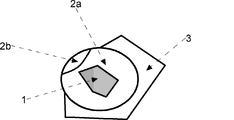
- FIG. 2 is a schematic diagram showing the form of inclusions of 1 ⁇ m or more present in the steel when the Mg content in the steel is 1.0 ppm or more and 5.0 ppm or less.
- this inclusion has a form in which a carbonitride or carbide 3 containing Ti is present in a part of the outer periphery of the Ca—Al-based oxide 2a and the Ca—Al-based oxysulfide 2b. It was. Since this inclusion can control O, S, C, and N by a single element, it does not require a process for controlling the inclusion for each impurity element.
- the present applicant has already clarified this inclusion form in the above-mentioned Patent Document 3.
- Mg—Al—O-based oxide 1 exists in the center of inclusions so as to be included in Ca—Al-based oxide 2a and Ca—Al-based oxysulfide 2b. It was. And when the inclusion form shown in FIG. 2 appeared, it investigated that the total number of inclusions decreased.
- This inclusion may be in a form in which Ti-containing carbonitride or carbide 3 is present on the entire outer periphery of Ca—Al-based oxide 2a and Ca—Al-based oxysulfide 2b. Further, only one of the Ca—Al-based oxide 2a and the Ca—Al-based oxysulfide 2b may be used.
- Mg is present in the steel
- Mg is a strong deoxidizing element
- the deoxidation reaction is started prior to Al and Ca.
- the Mg—Al—O-based oxide 1 is formed before the Ca—Al-based oxide 2a and the Ca—Al-based oxysulfide 2b.
- the deoxidation reaction is started even at a supersaturation level lower than that of other elements, so that inclusions become finer. That is, when the Mg content is within a predetermined range, fine Mg—Al—O-based oxide 1 is preferentially generated.
- Ca—Al-based oxide 2a and Ca—Al-based oxysulfide 2b are formed on the surface of the fine Mg—Al—O-based oxide 1 as a production nucleus, and then solidified by using this as a production nucleus. Further, carbonitride or carbide 3 containing Ti is formed on the surface. As a result, the form of inclusions as shown in FIG. 2 is completed. At this time, since the formation of inclusions starts from the fine Mg—Al—O-based oxide 1, the final inclusions also become fine, and as a result, coarse inclusions are reduced.
- the fine inclusions may be increased because the fine Mg—Al—O-based oxide 1 that is the starting point is not generated.
- the Mg deoxidation reaction proceeds excessively, so that the Mg—Al—O-based oxide 1 grows and becomes larger. In some cases, typical inclusions become large.
- the formation process of inclusions may change, resulting in a change in the inclusion form, which may reduce coarse inclusions.
- the first method is to add Mg directly to the molten steel.
- This method is a method of adding metal Mg or Mg alloy alone or a mixture thereof with a compound such as CaO or MgO to molten steel.
- the addition amount (per 1 ton of molten steel) is preferably 0.05 to 0.2 kg / ton in terms of pure Mg. If it is less than 0.05 kg / ton, the Mg content in the steel cannot be increased, and if it exceeds 0.2 kg / ton, the Mg content in the steel may be higher than 5.0 ppm. It is.
- Mg Addition of Mg is desirable at the end of secondary refining, more preferably just before casting. This is because Mg evaporates from the molten steel to reduce the change in the Mg content in the steel.
- an addition method immediately before casting for example, there is a method of adding to the molten steel in the tundish of a continuous casting machine.
- the second method is to supply Mg to the molten steel indirectly using slag and refractory.
- refractory or slag contains MgO, this MgO is utilized as a source of Mg for molten steel.
- MgO is not included in the refractory, only slag is used as the Mg source.
- the reduced Mg is supplied into the molten steel based on the principle that AlO and Ca in the molten steel reduce MgO contained in the refractory or slag. Further, since the deoxidizing power of Mg is strong and MgO is stable, this reduction reaction proceeds very slowly. Therefore, the second method is suitable for controlling the Mg content in a small amount of molten steel. Specifically, there is the following method as the second method.
- the refractory composition is controlled so that the MgO content in the slag is 5% or more. MgO in the slag increases even when the slag reacts with the refractory, but if it is insufficient, MgO may be added to the slag.
- This MgO addition treatment is desirably performed at an early stage in the steel making process, such as during steel output from the converter to the ladle or before the start of secondary refining. This is because the reaction between MgO and molten steel is slow as described above.
- the reaction between MgO and the molten steel starts, and the Mg content in the molten steel gradually increases.
- the rate of increase in the Mg content at this time depends on the content of the deoxidation elements such as Al and Ca in the molten steel and the slag component system, but if the content of the deoxidation element and the slag component system are constant, Since the rate of increase of the Mg content is also constant, the Mg content in the final molten steel depends only on the processing time.
- the steel of the present invention uses Mg-based inclusions as nuclei of inclusions, it is important that the inclusions serving as nuclei are uniform and homogeneous in the steel.
- the reaction between the molten steel and the inclusions must be balanced. Equilibration of this reaction can be achieved by increasing the processing time, but it is difficult industrially.
- various inclusions are formed by the concentration distribution that occurs until the added Mg is uniformly mixed in the molten steel. , The homogenization and homogenization of inclusions may be impaired.
- the second method uses a reaction between molten steel and slag, concentration distribution due to delay in uniform mixing of Mg does not occur. Further, since the slag is the same oxide as the Mg—Al—O-based oxide serving as a nucleus, the heterogeneity of inclusions can be suppressed by using the reaction equilibrium between molten steel, slag, and inclusions.
- Specific requirements for the second method consist of slag requirements and deoxidation requirements as follows.
- the slag to be used is required to have a CaO content of 40% or more, a MgO content of 5% or more, and a total content of Fe oxide and Mn oxide of 3% or less. Furthermore, by controlling the MgO content in the slag to 15% or less and the CaO content in the slag to 70% or less, the accuracy of controlling the Mg content in the steel is improved.
- the MgO content in the slag is less than 5%, the Mg content in the molten steel cannot be increased. If the MgO content exceeds 15%, the slag fluidity decreases and the reaction rate of the reaction between the molten steel and the slag increases. Since it falls, the controllability of Mg content in steel falls.
- the CaO content in the slag is less than 40%, the oxygen activity at the slag-metal interface cannot be reduced sufficiently, so that MgO in the slag cannot be reduced and supplied to the molten steel. If the CaO content in the slag is higher than 70%, the fluidity of the slag is lowered and the Mg content controllability in the steel is lowered.
- the amount of slag to be used (per 1 ton of molten steel) is desirably 10 kg / ton or more and 20 kg / ton or less. If the amount of slag is less than 10 kg / ton, the absolute amount of MgO is insufficient, and if it exceeds 20 kg / ton, the time required for homogenizing the slag composition becomes longer.
- the deoxidation requirement in the second method will be described.
- the inclusions can be controlled with higher accuracy by satisfying the slag requirement and satisfying the deoxidation requirement of the molten steel.
- the deoxidizing elements used for control here are Al and Ca.
- Al is sufficiently deoxidized if its content in the molten steel is 0.01% or more, so it is refined when the Al content in the molten steel is in the range of about 0.01 to 0.05%.
- Mg can be controlled if the Al content in the molten steel continues to be controlled within a narrow range even in this range of content, but the refining time becomes longer and the inclusion form control accuracy decreases. Therefore, as a method for avoiding these, a method of increasing the Al content in molten steel to 0.05% or more in one minute or more in secondary refining such as RH can be adopted.
- Ca is an important element that forms inclusions together with Mg. However, in order to make Mg-based inclusions the inner core, it is effective to use the following method.
- the Ca addition amount (per ton of molten steel) needs to be 0.02 kg / ton or more and 0.05 kg / ton or less. This amount of added Ca is very small compared to the usual amount of added Ca. This is because Ca may reduce the inner core if the amount of Ca added exceeds 0.05 kg / ton. On the other hand, when the Ca addition amount is less than 0.02 kg / ton, Ca-based inclusions sufficient to enclose the inner core are not generated.
- the Mg content in the steel intended by the present invention is 1.0 ppm or more and 5.0 ppm or less, and two or more of Ca, Al, Mg, Ti and Nb, and O,
- the Al content in the molten steel is temporarily increased to 0.05% or more, and a continuous casting machine 0.02 kg / ton or more in tundish 0. It is important to
- the control of sulfide will be described. If the S content in the steel is lowered, the amount of sulfide or oxysulfide produced is reduced, so that these inclusions are reduced and the number is reduced. In order to reduce these inclusions and reduce the number, the S content in the steel is preferably 0.002% or less, and more preferably 0.001% or less.
- desulfurization treatment in secondary refining may be required in addition to desulfurization treatment in hot metal pretreatment.
- desulfurization of secondary refining there are a method in which a slag having a desulfurization capacity is generated on molten steel and then a gas is blown into the molten steel, a desulfurized flux is blown into the molten steel, or a molten steel surface is sprayed.
- the treatment using the desulfurization flux includes a method performed under atmospheric pressure and a method performed under reduced pressure using RH or the like, and either method may be applied.
- the effect of reducing the number can be obtained as in the case of sulfide inclusion control by reducing the S content in steel.
- the O content in the steel is preferably 0.0015% or less, and more preferably 0.0010% or less.
- the slag refining method in which the CaO content in the slag is set to 40% or more, and Fe oxidation in the slag. There is a method of setting the total content of the product and Mn oxide to 3% or less.
- a method for removing inclusions there are a method of blowing an inert gas into the molten steel, a method of circulating the molten steel using a vacuum processing apparatus such as RH, and the like.
- a method of adding Ca there are a method of blowing metal Ca or Ca alloy or a material containing them into molten steel, or a method of adding with iron-coated wire, and any other method may be applied.
- the timing for adding Ca is preferably after desulfurization by secondary refining. This is to suppress the reaction between S and Ca.
- the Ca content is preferably 0.002% or less, and more preferably 0.0012% or less. This is because increasing the Ca content increases the deoxidation effect, but on the other hand, the production of CaS and the like is activated.
- the content of C and Ti may be reduced.
- these elements have the effect of improving the strength of the base material, so these The elemental content of cannot be reduced. Therefore, reduction of the N content is effective for controlling carbonitride.
- the N content is preferably 0.004% or less, and more preferably 0.003% or less.
- the O content in the steel is preferably 0.0015% or less, and more preferably 0.0010% or less.
- the inclusion form shown in FIG. 2 is easily obtained, and when it is 0.0010% or less, almost all inclusions have the form shown in the figure. Because.
- lanthanoids such as La, Ce, and Nd
- These elements have the effect of reducing the activity of O and S and at the same time stabilizing the Mg content.
- a desirable content of the lanthanoid is 0.001% or more and 0.05% or less in total. If it is less than 0.001%, the effect is insufficient, and if it exceeds 0.05%, inclusions change to lanthanoid oxysulfides such as Ce 2 O 2 S, and inclusions intended by the present invention Cannot be obtained.
- oxygen gas or a solid oxide may be added to the molten steel, and a reaction may be performed with Al and Si in the molten steel.
- a reaction may be performed with Al and Si in the molten steel.
- Test conditions After refining low-alloy steel in a converter, component adjustment and temperature adjustment were performed by RH vacuum treatment. MgO was put into the ladle at the time of steel output from the converter, and the MgO content in the slag was adjusted to 5 to 10%. The time from the converter steel to the RH treatment was 1 hour.
- Test Nos. 1 to 3 are examples of the present invention that satisfy the provisions of the steel of the first invention
- Test Nos. 4 to 6 are examples of the present invention that satisfy the provisions of the steel of the second invention
- Test Nos. 7 to 9 are the second examples. It is the example of this invention which satisfied the prescription
- Test numbers 10 to 15 are comparative examples that do not satisfy the specifications of the steel of the first invention and the steel of the second invention.
- test numbers 1 to 6, 10 to 12, 14 and 15 the metal Mg wire was added to the molten steel in the ladle after the RH treatment, and then the CaSi wire was further added.
- Test Nos. 7 to 9 indicate that CaO and MgO are added at the time of steel leaving the converter, the CaO content in the slag is 55 to 65%, the MgO content is 8 to 12%, and the Fe oxide and Mn oxide in the slag After controlling the total content of the steel to 1.5% or less, the Al content in the molten steel at the start of the RH treatment was set to 0.07%. In Test Nos. 7 to 9, no metallic Mg was added, and only Ca was added in a tundish of 0.03 kg / ton.
- Each molten steel was then made into a round billet having a diameter of 220 to 360 mm by a continuous casting method.
- the round billet after casting was subjected to the following rolling and heat treatment to evaluate the corrosion resistance.
- the round billet after casting was formed into a seamless steel pipe by subjecting a blank pipe forming by piercing rolling, hot rolling by a mandrel mill and a stretch reducer, and dimension adjustment under the conditions normally used. These steel pipes were heated to 920 ° C. and quenched, and then adjusted to tempering temperature to yield strength of 758 MPa or higher (less than 862 MPa) corresponding to 110 ksi class and yield strength of 862 MPa or higher corresponding to 125 ksi class. .
- a predetermined amount of strain was applied to the test piece by four-point bending according to the method specified in ASTM G39, and a stress of 90% of the yield stress was applied.
- a 5% saline solution at 25 ° C. saturated with 10 atm hydrogen sulfide the test piece together with the test jig was enclosed in an autoclave, and then 5% saline solution was left in the autoclave, leaving the gas phase part.
- hydrogen sulfide gas at a predetermined pressure was sealed in an autoclave and this high-pressure hydrogen sulfide gas was saturated in the liquid phase by stirring the liquid phase.
- the liquid was stirred at a speed of 100 revolutions per minute and held at 25 ° C. for 720 hours, and then the pressure was reduced and the test piece was taken out.
- test piece was 2.5% acetic acid at 25 ° C. + 0.41% Na acetate + 5 saturated with 0.1 atm hydrogen sulfide carbon dioxide gas by a method based on the NACE-TM-0177-A-2005 method.
- 90% saline 90% of the actual yield stress was applied and held for 720 hours, and the presence or absence of fracture after holding was examined.
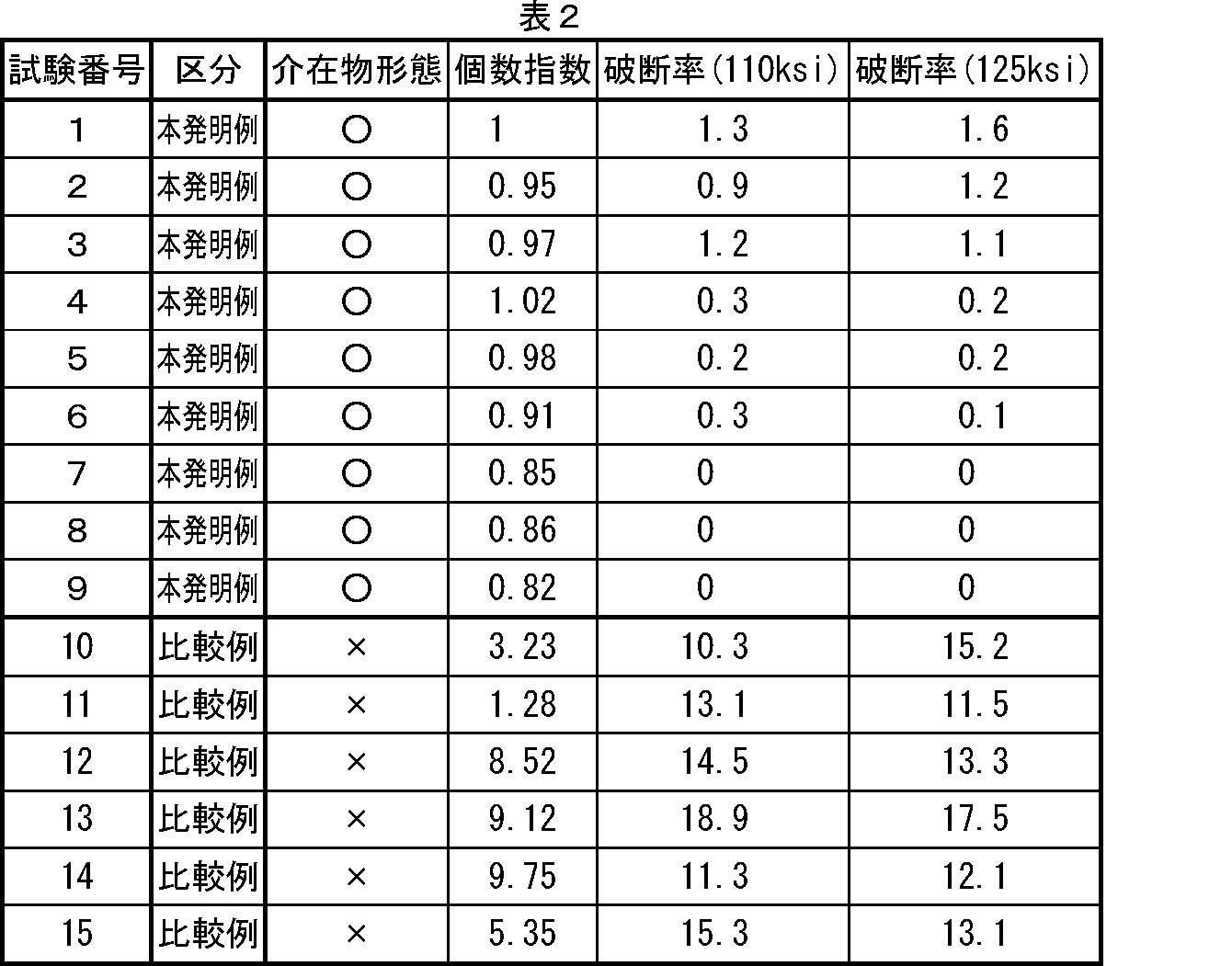
- Test result About the test piece tested on the said conditions, the inclusion form, the total number of inclusions, and the fracture
- the fracture rate was applied as an evaluation index of corrosion resistance.
- a similar test piece was observed with a scanning electron microscope at a magnification of 1000 using a 10 mm ⁇ 10 mm field of view, and the number of inclusions of 1 ⁇ m or more was counted.
- the total number of oxides, oxysulfides, and carbonitrides was defined as the total number of inclusions.
- Table 2 the total number of inclusions was indexed based on the total number of inclusions of test number 1, and arranged as a number index.
- the inclusion form is the form shown in FIG. 2, it is indicated by ⁇ in the column of the inclusion form in Table 2, and when it is a form other than the form shown in FIG. It was.
- the inclusion form was evaluated using SEM and EDS. Thirty inclusions having a size of 1 ⁇ m or more were selected at random, and the element distribution in the inclusions was measured by EDS. From the measurement results, the inclusion form was evaluated as ⁇ for samples in which 15 or more satisfied the form of FIG. 2, and the case of less than 15 was evaluated as ⁇ .
- the chemical composition including Mg content and the inclusion form satisfy the regulations of the steel of the first invention, test numbers 1, 2 and 3, the steel of the first invention and the second Comparing the test results of test numbers 10, 11 and 12 that do not satisfy any of the steel specifications of the invention, 0.95 to 1 for test numbers 1, 2 and 3, and 1.28 for test numbers 10, 11 and 12
- the number of inclusions was smaller in Test Nos. 1, 2 and 3 of ⁇ 8.52. From this, it was confirmed that the total number of inclusions can be reduced by satisfying the provisions of the present invention. Also, the fracture rates were 0.9 to 1.6 for test numbers 1, 2 and 3, and 10.3 to 15.2 for test numbers 10, 11 and 12, with test numbers 1, 2 and 3 being lower. It was.
- test results of test numbers 4, 5 and 6 are 0.1 to 0.3%
- test results of test numbers 13, 14 and 15 are 11.3 to 18.7.
- the breaking rate was 9%, which was two orders of magnitude higher.
- Test Nos. 4, 5 and 6 have a fracture rate of 0.1 to 0.3 due to the addition of alloy components, which is lower than Test Nos. 1, 2 and 3 with less alloy components, and excellent corrosion resistance. I understood it.
- Test Nos. 7, 8 and 9 in which the molten steel treatment method was appropriate had a smaller number of inclusions and a fracture rate of 0 compared with Test Nos. 1 to 6.
- the effect of the steel of the present invention can be stabilized at a high level.
- the steel for steel pipes of the present invention has few coarse inclusions and is excellent in cleanliness.
- steel materials used for steel pipes casings for oil wells and natural gas wells, tubing, drill pipes for drilling, drill collars, etc. It can be used and its characteristics can be improved simultaneously. Moreover, manufacture and management are also easy.
Landscapes
- Chemical & Material Sciences (AREA)
- Engineering & Computer Science (AREA)
- Materials Engineering (AREA)
- Mechanical Engineering (AREA)
- Metallurgy (AREA)
- Organic Chemistry (AREA)
- Physics & Mathematics (AREA)
- Thermal Sciences (AREA)
- Crystallography & Structural Chemistry (AREA)
- Treatment Of Steel In Its Molten State (AREA)
- Heat Treatment Of Articles (AREA)
- Heat Treatment Of Steel (AREA)
Abstract
Description
「Ca、Al、Mg、TiおよびNbのうちの二種以上、ならびにO、SおよびNのうちの二種以上の元素から構成される鋼中非金属介在物」:鋼管製品における最大粒径が1μm以上の粗大介在物のうち、Ca、Al、Mg、TiおよびNbのうち少なくとも2種以上の元素を各5%以上含有し、ならびにO、SおよびNのうちの少なくとも2種以上の元素を各5%以上含有し、かつ、Ca、Al、Mg、Ti、Nb、O、SおよびNの合計含有率が80%以上のもの。なお、ここで定義される非金属介在物は、以下の「Mg-Al-O系酸化物」、「Ca-Al系酸化物」および/または「Ca-Al系酸硫化物」並びに「Tiを含む炭窒化物または炭化物」の複数の介在物要素(介在物相)が「凝集体」を形成したものを言う。
「Mg-Al-O系酸化物」:上記「凝集体」を構成する非金属介在物相であって、Mg、AlおよびOを各2.5%以上含有し、かつ、これらの合計が8%以上のもの。
「Ca-Al系酸化物」:上記「凝集体」を構成する非金属介在物相であってCa、AlおよびOを各3%以上含有され、かつ、これらの合計が15%以上のもの。
「Ca-Al系酸硫化物」:上記「凝集体」を構成する非金属介在物相であってCa、Al、OおよびSを各2%以上含有し、かつ、これらの合計が15%以上のもの。
「Tiを含む炭窒化物または炭化物」:上記「凝集体」を構成する非金属介在物相であってTi、NおよびCを各1.2%以上含有し、かつ、これらの合計が5%以上のもの。
1-1.基本元素
C:0.2~0.7%
Cは、鋼管の強度を確保するために重要な元素であり、0.2%以上を含有させる必要がある。ただし、C含有率が高くなりすぎると、効果が飽和するばかりでなく非金属介在物の生成形態が変化して鋼の靱性を劣化させ、また焼割れ感受性を高めることになるのでC含有率の上限は0.7%とする。好ましいC含有率は0.22~0.65%であり、より好ましくは0.24~0.40%である。
Siは、鋼の脱酸または強度向上の目的で含有させる。Si含有率が0.01%未満では鋼の脱酸または強度向上の効果がない。一方、Si含有率が0.8%を超えると、CaやSの活量を低下させ、介在物の形態に影響を及ぼす。そのため、Si含有率は、0.01~0.8%とする。Si含有率は、好ましくは0.10~0.85%である。
Mnは、鋼の焼入れ性を向上させ、鋼の強度を増すために0.1%以上含有させる。しかし、含有率が高すぎると靱性を悪化させることがあるため、Mn含有率の上限は1.5%とする。Mn含有率は、好ましくは0.20~1.40%であり、より好ましくは0.25~0.80%である。
Sは、硫化物系介在物を形成する不純物であり、S含有率が増すと鋼の靱性や耐食性の劣化が著しくなる。そのため、S含有率は0.005%以下とする。S含有率は低ければ低いほどよい。
Pは、不純物として鋼中に混入する元素であり、鋼の靱性を低下させたり耐食性を悪化させたりする。そのため、P含有率の上限は0.03%とする。Pの好ましい含有率は0.02%以下であり、更に好ましくは0.012%以下である。P含有率はできるだけ低いことが望ましい。
Alは、溶鋼の脱酸のために添加する元素である。Al含有率が0.0005%未満では脱酸が不十分になり、Al-Si系、Al-Ti系、Al-Ti-Si系等の粗大な複合酸化物が生成することがある。一方、Al含有率を過剰に増しても効果が飽和し、無駄な固溶Alを増すだけなので、Al含有率の上限は0.1%とする。
さらに、Ti、Ca、N、CrおよびMoの含有率を下記範囲とすることで、鋼の耐SSC性を向上させることができる。
Tiは、結晶粒の微細化や析出硬化の作用により、鋼の強度を向上させる効果を有する。またTiは、Bを含有させて鋼の焼入れ性の向上をはかる場合、Bの窒化を抑制して焼入れ性向上の作用を発揮させることができる。これらの効果を得るには、0.005%以上のTi含有率が必要である。しかし、Tiを多く含有させすぎると、炭化物系の析出物が増加して鋼の靱性を劣化させるので、Ti含有率の上限は0.05%とする。好ましいTi含有率は0.008~0.035%である。
Caは、硫化物と酸化物を同時に改質し、鋼の耐SSC性を向上させる重要な元素である。この効果を得るには、0.0004%以上のCa含有率が必要である。しかし、Ca含有率が高すぎると介在物が粗大化したり、鋼の耐食性を劣化させたりするので、Ca含有率の上限は0.005%とする。
Nは、原料中に混入したり溶製時に混入したりする不純物元素である。N含有率が増すと、鋼の靱性の劣化、耐食性の劣化、耐SSC性の劣化、またはB添加による焼入れ性向上効果の阻害等を来す。そのため、N含有率は低ければ低いほどよい。この窒素の害を抑制するため窒化物を形成するTi等の元素を添加するが、その結果として窒化物系の介在物を生じる。したがって、N含有率が高すぎると、介在物の制御が不能となるので、N含有率の上限は0.007%とする。
Crは、鋼の耐食性を改善する効果を有し、焼入れ性を向上させて鋼の強度を向上させるとともに焼戻し軟化抵抗を高くして高温焼き戻しを可能にするので、鋼の耐SSC性の改善効果も有する。このような効果を得るには、0.1%以上のCr含有率が必要である。しかし、Crを多く含有させても焼戻し軟化抵抗向上効果は飽和し、鋼の靱性の低下を招くこともあるので、Cr含有率の上限は1.5%とする。好ましいCr含有率は0.5~1.2%である。
Moは、焼入れ性を向上させ鋼の強度を向上させるとともに、焼戻し軟化抵抗を高くして高温焼き戻しを可能するので、鋼の耐SSC性を改善する。このような効果を得るには、0.2%以上のMo含有率が必要である。しかし、Moを過剰に含有させても焼戻し軟化抵抗向上効果は飽和し、鋼の靱性の低下を招くこともあるので、Mo含有率の上限は1.0%とする。好ましいMo含有率は0.25~0.85%である。
上記に加え、Nb、Zr、VおよびBの含有率を下記範囲に制御することで、鋼の耐SSC性をさらに向上させることができる。
NbおよびZrは含有させなくてもよい。しかし、含有させれば結晶粒の微細化や析出硬化作用を発揮し、鋼の強度向上の効果を発揮する。それぞれの含有率が、0.005%未満ではこのような効果は得られず、0.1%を超えると鋼の靱性が劣化する。そのため、含有させる場合には、いずれも含有率を0.005~0.1%とするのがよい。より好ましくは、いずれも含有率を0.008~0.05%とする。
Vは含有させなくてもよい。しかし、Vは、析出硬化、焼入れ性向上、焼戻し軟化抵抗上昇等の作用を有し、含有させれば強度向上および耐SSC性の改善の効果が期待できる。この効果を得るには、0.005%以上のV含有率が好ましい。しかし、Vを多く含有させすぎると、鋼の靱性の劣化や耐食性の劣化を生じるので、V含有率の上限は0.5%とするのがよい。より好ましくはV含有率を0.01~0.25%とする。
Bは含有させなくてもよい。しかし、Bは、微量で鋼の焼入れ性を向上させる効果を有する。B含有率が、0.0003%未満ではこのような効果は得られず、0.005%を超えると鋼の靱性を低下させる。そのため、Bを含有させる場合は含有率を0.0003~0.005%とするのが好ましい。
1-4-1.鋼中のMg含有率と介在物総個数との関係
本発明においては、鋼中のMgの含有率を1.0~5.0ppmとする。Mg含有率は好ましくは1.2~4.8ppmであり、更に好ましくは1.4~4.6ppmである。次に、Mgについて詳細に説明する。先に述べたように、複数の特性を同時に確保するには、複数の元素を制御するべく複数種類の介在物を同時に制御し、かつ、合計個数を増加させないようにすればよい。さらに、制御または管理する因子は可能な限り少ない方が望ましい。
さらに、図1で鋼中のMg含有率が1.0ppm以上5.0ppm以下で介在物総個数が少ない場合の介在物形態を詳細に観察した結果、対象とした1μm以上の介在物の形態はその個数の平均78.3%(67.3~95.3%)以上が下記図2に示す構造となっていた。なお、21.7%の介在物は、炭窒化物を伴わない酸化物や酸硫化物または炭窒化物のみからなる介在物等であった。
図2に示すように、この介在物は、Ca-Al系酸化物2aおよびCa-Al系酸硫化物2bの外周部の一部にTiを含む炭窒化物または炭化物3が存在する形態であった。この介在物は、単一でO、S、CおよびNの制御を可能としているため、不純物元素毎に介在物を制御する処理を必要としない。この介在物形態に関しては、既に本出願人が上述の特許文献3にて明らかにしている。
以上の介在物形態に関する機構は以下のように説明される。
2-1.鋼中のMg含有率の制御方法
次に、鋼中のMg含有率と介在物の制御方法について説明する。はじめに鋼中のMg含有率の制御方法について説明する。
第二の方法の具体的要件は以下の通り、スラグ要件および脱酸要件からなる。
初めに第二の方法でのスラグ要件を述べる。用いるスラグは、スラグ中で、CaO含有率が40%以上、MgO含有率が5%以上であり、Fe酸化物とMn酸化物の含有率の合計が3%以下であることが必要である。さらに、スラグ中のMgO含有率を15%以下、スラグ中のCaO含有率を70%以下に制御することで、鋼中のMg含有率制御の精度が向上する。
次に第二の方法での脱酸要件を述べる。上記スラグ要件を満足した上で、溶鋼の脱酸要件を満足させることで溶鋼中のMg含有率に加え、介在物もより高精度に制御できる。ここで制御に用いる脱酸元素はAlとCaである。
初めにAlについて説明する。通常、Alはその溶鋼中における含有率が0.01%以上あれば十分に脱酸が行われるため、溶鋼中のAl含有率が0.01~0.05%程度の範囲で精錬されるのが一般的である。この含有率の範囲でも狭い範囲に溶鋼中のAl含有率を制御し続ければMgの制御が可能であるが、精錬時間の長時間化や介在物形態制御精度の低下が起こる。そこで、これらを回避する方法として、RH等の二次精錬において1分間以上で溶鋼中のAl含有率を0.05%以上に高める方法を採用することができる。
最後にCaについて説明する。CaはMgとともに介在物を形成する重要な元素であるが、Mg系介在物を内核とさせるためには以下の方法を用いると効果的である。
次に、このような介在物形態を実現するための鋼の好適な製造条件について、転炉、二次精錬、連続鋳造といった一般的な製造方法を例に挙げて説明する。
初めに硫化物の制御について説明する。鋼中のS含有率を低くすると、硫化物または酸硫化物の生成量が少なくなるため、これらの介在物は小さくなり、また個数も少なくなる。これらの介在物を小さくし、個数を少なくするためには、鋼中のS含有率は、0.002%以下が好ましく、0.001%以下がさらに好ましい。
酸化物についても、鋼中のO含有率を低減することで、鋼中のS含有率の低減による硫化物介在物制御と同様に、個数を少なくする効果を得ることができる。この効果を得るため、鋼中のO含有率は、0.0015%以下が好ましく、0.0010%以下がさらに好ましい。
炭窒化物の生成量を低減するにはCやTiの含有率を低減すればよいが、前述したようにこれらの元素は母材の強度を向上させる作用を有するため、これらの元素の含有率は低減できない。そこで、炭窒化物の制御にはN含有率の低減が有効である。特に、N含有率は0.004%以下であることが好ましく、0.003%以下がさらに好ましい。
前述のように、鋼中のO含有率は0.0015%以下が望ましく、0.0010%以下がさらに望ましい。鋼中のO含有率が0.0015%以下となると、前記図2に示す介在物形態が得やすくなり、0.0010%以下ではほぼ全ての介在物が同図に示す形態を呈するようになるからである。
低合金鋼を転炉にて精錬した後、RH真空処理にて成分調整および温度調整を行った。転炉からの出鋼時に取鍋内にMgOを投入し、スラグ中のMgO含有率を5~10%に調整した。転炉出鋼後からRH処理までの時間は1時間とした。

熱処理を施して、強度および硬さを確認した鋼管について、耐SSC性に関する評価試験を行った。
上記条件で試験を行った試験片について、介在物形態、介在物総個数および破断率を指標として評価した。試験結果を表2に示す。
破断率=(試験片のうち破断した試験片数)/(総試験片数)×100 …(1)
2b:Ca-Al系酸硫化物、 3:Tiを含む炭窒化物または炭化物
Claims (2)
- 質量%で、C:0.2~0.7%、Si:0.01~0.8%、Mn:0.1~1.5%、S:0.005%以下、P:0.03%以下、Al:0.0005~0.1%、Ti:0.005~0.05%、Ca:0.0004~0.005%、N:0.007%以下、Cr:0.1~1.5%およびMo:0.2~1.0%を含有し、残部はFeおよびMgならびに不純物からなる鋼であって、
前記鋼中のMg含有率が1.0ppm以上5.0ppm以下であり、かつ、
Ca、Al、Mg、TiおよびNbのうちの二種以上、ならびにO、SおよびNのうちの二種以上の元素から構成される最大粒径が1μm以上の鋼中非金属介在物個数のうちの50%以上において、当該介在物の中心部分にMg-Al-O系酸化物が存在し、前記Mg-Al-O系酸化物を内包するようにCa-Al系酸化物および/またはCa-Al系酸硫化物が存在し、さらに前記Ca-Al系酸化物および/またはCa-Al系酸硫化物の外周部の全体または一部に、Tiを含む炭窒化物または炭化物が存在する形態であることを特徴とする耐硫化物応力割れ性に優れた鋼管用鋼。 - 質量%で、C:0.2~0.7%、Si:0.01~0.8%、Mn:0.1~1.5%、S:0.005%以下、P:0.03%以下、Al:0.0005~0.1%、Ti:0.005~0.05%、Ca:0.0004~0.005%、N:0.007%以下、Cr:0.1~1.5%およびMo:0.2~1.0%を含有し、
さらにNb:0.005~0.1%、Zr:0.005~0.1%、V:0.005~0.5%およびB:0.0003~0.005%のうちの一種以上を含有し、残部はFeおよびMgならびに不純物からなる鋼であって、
前記鋼中のMg含有率が1.0ppm以上5.0ppm以下であり、かつ、
Ca、Al、Mg、TiおよびNbのうちの二種以上、ならびにO、SおよびNのうちの二種以上の元素から構成される最大粒径が1μm以上の鋼中非金属介在物個数のうちの50%以上において、当該介在物の中心部分にMg-Al-O系酸化物が存在し、前記Mg-Al-O系酸化物を内包するようにCa-Al系酸化物および/またはCa-Al系酸硫化物が存在し、さらに前記Ca-Al系酸化物および/またはCa-Al系酸硫化物の外周部の全体または一部に、Tiを含む炭窒化物または炭化物が存在する形態であることを特徴とする耐硫化物応力割れ性に優れた鋼管用鋼。
Priority Applications (11)
| Application Number | Priority Date | Filing Date | Title |
|---|---|---|---|
| ES11792102.3T ES2616107T3 (es) | 2010-06-08 | 2011-05-25 | Acero para tubo de acero con excelente resistencia a la fisuración bajo tensión por sulfuro |
| JP2011522724A JP4957872B2 (ja) | 2010-06-08 | 2011-05-25 | 耐硫化物応力割れ性に優れた鋼管用鋼 |
| CA2798852A CA2798852C (en) | 2010-06-08 | 2011-05-25 | Steel for steel tube with excellent sulfide stress cracking resistance |
| MX2012014433A MX336409B (es) | 2010-06-08 | 2011-05-25 | Acero para tubo de acero con excelente resistencia al fractura por tension azufrosa. |
| EA201291369A EA022968B1 (ru) | 2010-06-08 | 2011-05-25 | Сталь для стальной трубы с превосходной стойкостью к сульфидному растрескиванию под напряжением |
| BR112012030096-2A BR112012030096B1 (pt) | 2010-06-08 | 2011-05-25 | Aço para tubo de aço com excelente resistência ao craqueamento sob tensão por sulfeto |
| UAA201300235A UA106139C2 (uk) | 2010-06-08 | 2011-05-25 | Трубна сталь зі стійкістю до сульфідного розтріскування під напруженням (варіанти) |
| EP11792102.3A EP2581463B1 (en) | 2010-06-08 | 2011-05-25 | Steel for steel pipe having excellent sulfide stress cracking resistance |
| AU2011263254A AU2011263254B2 (en) | 2010-06-08 | 2011-05-25 | Steel for steel pipe having excellent sulfide stress cracking resistance |
| US13/702,763 US9175371B2 (en) | 2010-06-08 | 2011-05-25 | Steel for steel tube with excellent sulfide stress cracking resistance |
| CN201180028338.2A CN102985575B (zh) | 2010-06-08 | 2011-05-25 | 抗硫化物应力裂纹性优异的钢管用钢 |
Applications Claiming Priority (2)
| Application Number | Priority Date | Filing Date | Title |
|---|---|---|---|
| JP2010131276 | 2010-06-08 | ||
| JP2010-131276 | 2010-06-08 |
Publications (1)
| Publication Number | Publication Date |
|---|---|
| WO2011155140A1 true WO2011155140A1 (ja) | 2011-12-15 |
Family
ID=45097761
Family Applications (1)
| Application Number | Title | Priority Date | Filing Date |
|---|---|---|---|
| PCT/JP2011/002897 Ceased WO2011155140A1 (ja) | 2010-06-08 | 2011-05-25 | 耐硫化物応力割れ性に優れた鋼管用鋼 |
Country Status (14)
| Country | Link |
|---|---|
| US (1) | US9175371B2 (ja) |
| EP (1) | EP2581463B1 (ja) |
| JP (1) | JP4957872B2 (ja) |
| CN (1) | CN102985575B (ja) |
| AR (1) | AR081266A1 (ja) |
| AU (1) | AU2011263254B2 (ja) |
| BR (1) | BR112012030096B1 (ja) |
| CA (1) | CA2798852C (ja) |
| EA (1) | EA022968B1 (ja) |
| ES (1) | ES2616107T3 (ja) |
| MX (1) | MX336409B (ja) |
| MY (1) | MY156205A (ja) |
| UA (1) | UA106139C2 (ja) |
| WO (1) | WO2011155140A1 (ja) |
Cited By (5)
| Publication number | Priority date | Publication date | Assignee | Title |
|---|---|---|---|---|
| JP2016094649A (ja) * | 2014-11-14 | 2016-05-26 | Jfeスチール株式会社 | 継目無鋼管およびその製造方法 |
| WO2019131035A1 (ja) * | 2017-12-26 | 2019-07-04 | Jfeスチール株式会社 | 油井用低合金高強度継目無鋼管 |
| WO2019131036A1 (ja) * | 2017-12-26 | 2019-07-04 | Jfeスチール株式会社 | 油井用低合金高強度継目無鋼管 |
| WO2019131037A1 (ja) * | 2017-12-26 | 2019-07-04 | Jfeスチール株式会社 | 油井用低合金高強度継目無鋼管 |
| JP2020158873A (ja) * | 2019-03-28 | 2020-10-01 | Jfeスチール株式会社 | 耐サワー鋼材の製造方法 |
Families Citing this family (11)
| Publication number | Priority date | Publication date | Assignee | Title |
|---|---|---|---|---|
| AR088424A1 (es) * | 2011-08-22 | 2014-06-11 | Nippon Steel & Sumitomo Metal Corp | Tubo de acero para pozo de petroleo con excelente resistencia a la corrosion bajo tension por presencia de sulfuros |
| CA2851081C (en) * | 2011-10-25 | 2015-05-19 | Nippon Steel & Sumitomo Metal Corporation | Steel sheet containing ti-included carbonitride |
| CN102787274A (zh) | 2012-08-21 | 2012-11-21 | 宝山钢铁股份有限公司 | 一种超高韧性高强度钻杆及其制造方法 |
| MX372910B (es) * | 2012-11-05 | 2020-04-27 | Nippon Steel Corp | Acero de baja aleación para productos tubulares usados en la industria petrolera que tiene excelente resistencia a grietas por estrés de sulfuro y método de fabricación del mismo. |
| CN103499011B (zh) * | 2013-09-24 | 2015-10-28 | 中国石油集团工程设计有限责任公司 | 一种抗硫厚板及其焊接工艺 |
| US10272960B2 (en) | 2015-11-05 | 2019-04-30 | Caterpillar Inc. | Nitrided track pin for track chain assembly of machine |
| MX381462B (es) * | 2015-12-22 | 2025-03-12 | Jfe Steel Corp | Tubo de acero sin costura de alta resistencia para productos tubulares para la industria petrolera, y metodo de produccion para tubo de acero sin costura de alta resistencia para productos tubulares para la industria petrolera. |
| CN110651060B (zh) * | 2017-05-15 | 2021-09-07 | 日本制铁株式会社 | 钢和部件 |
| JP6652226B2 (ja) * | 2017-09-13 | 2020-02-19 | 日本製鉄株式会社 | 転動疲労特性に優れた鋼材 |
| CN113025915B (zh) * | 2021-03-04 | 2022-02-01 | 东北大学 | 一种高强韧性钒氮微合金化热轧钢管及其制造方法 |
| JP7480751B2 (ja) | 2021-06-11 | 2024-05-10 | Jfeスチール株式会社 | 溶鋼の脱窒方法および鋼の製造方法 |
Citations (6)
| Publication number | Priority date | Publication date | Assignee | Title |
|---|---|---|---|---|
| JPH05302112A (ja) | 1991-04-11 | 1993-11-16 | Nippon Steel Corp | マグネシウム脱酸による薄鋼板の溶製方法 |
| JP2001342543A (ja) | 2000-03-30 | 2001-12-14 | Nippon Steel Corp | 穴拡げ性と延性に優れた高強度熱延鋼板及びその製造方法 |
| JP2003160838A (ja) | 2001-11-27 | 2003-06-06 | Sumitomo Metal Ind Ltd | 継目無鋼管とその製造方法 |
| WO2003083152A1 (fr) | 2002-03-29 | 2003-10-09 | Sumitomo Metal Industries, Ltd. | Acier a alliage faible |
| JP2006265668A (ja) * | 2005-03-25 | 2006-10-05 | Sumitomo Metal Ind Ltd | 油井用継目無鋼管 |
| JP2006283117A (ja) * | 2005-03-31 | 2006-10-19 | Sumitomo Metal Ind Ltd | 冷間加工後の塑性変形能に優れた高張力鋼およびその製造方法 |
Family Cites Families (4)
| Publication number | Priority date | Publication date | Assignee | Title |
|---|---|---|---|---|
| JP2978038B2 (ja) | 1993-08-16 | 1999-11-15 | 新日本製鐵株式会社 | 酸化物系介在物超微細分散鋼 |
| JP4135691B2 (ja) | 2004-07-20 | 2008-08-20 | 住友金属工業株式会社 | 窒化物系介在物形態制御鋼 |
| CN101855377B (zh) | 2007-10-30 | 2013-01-23 | 住友金属工业株式会社 | 扩管性优异的钢管以及其制造方法 |
| AR075976A1 (es) * | 2009-03-30 | 2011-05-11 | Sumitomo Metal Ind | Metodo para la manufactura de tuberias sin costura |
-
2011
- 2011-05-25 CN CN201180028338.2A patent/CN102985575B/zh active Active
- 2011-05-25 EP EP11792102.3A patent/EP2581463B1/en active Active
- 2011-05-25 JP JP2011522724A patent/JP4957872B2/ja active Active
- 2011-05-25 UA UAA201300235A patent/UA106139C2/uk unknown
- 2011-05-25 WO PCT/JP2011/002897 patent/WO2011155140A1/ja not_active Ceased
- 2011-05-25 MX MX2012014433A patent/MX336409B/es unknown
- 2011-05-25 MY MYPI2012701014A patent/MY156205A/en unknown
- 2011-05-25 AU AU2011263254A patent/AU2011263254B2/en not_active Ceased
- 2011-05-25 ES ES11792102.3T patent/ES2616107T3/es active Active
- 2011-05-25 EA EA201291369A patent/EA022968B1/ru not_active IP Right Cessation
- 2011-05-25 BR BR112012030096-2A patent/BR112012030096B1/pt active IP Right Grant
- 2011-05-25 CA CA2798852A patent/CA2798852C/en not_active Expired - Fee Related
- 2011-05-25 US US13/702,763 patent/US9175371B2/en active Active
- 2011-05-31 AR ARP110101866A patent/AR081266A1/es active IP Right Grant
Patent Citations (6)
| Publication number | Priority date | Publication date | Assignee | Title |
|---|---|---|---|---|
| JPH05302112A (ja) | 1991-04-11 | 1993-11-16 | Nippon Steel Corp | マグネシウム脱酸による薄鋼板の溶製方法 |
| JP2001342543A (ja) | 2000-03-30 | 2001-12-14 | Nippon Steel Corp | 穴拡げ性と延性に優れた高強度熱延鋼板及びその製造方法 |
| JP2003160838A (ja) | 2001-11-27 | 2003-06-06 | Sumitomo Metal Ind Ltd | 継目無鋼管とその製造方法 |
| WO2003083152A1 (fr) | 2002-03-29 | 2003-10-09 | Sumitomo Metal Industries, Ltd. | Acier a alliage faible |
| JP2006265668A (ja) * | 2005-03-25 | 2006-10-05 | Sumitomo Metal Ind Ltd | 油井用継目無鋼管 |
| JP2006283117A (ja) * | 2005-03-31 | 2006-10-19 | Sumitomo Metal Ind Ltd | 冷間加工後の塑性変形能に優れた高張力鋼およびその製造方法 |
Non-Patent Citations (1)
| Title |
|---|
| See also references of EP2581463A4 * |
Cited By (14)
| Publication number | Priority date | Publication date | Assignee | Title |
|---|---|---|---|---|
| JP2016094649A (ja) * | 2014-11-14 | 2016-05-26 | Jfeスチール株式会社 | 継目無鋼管およびその製造方法 |
| JP6551633B1 (ja) * | 2017-12-26 | 2019-07-31 | Jfeスチール株式会社 | 油井用低合金高強度継目無鋼管 |
| WO2019131036A1 (ja) * | 2017-12-26 | 2019-07-04 | Jfeスチール株式会社 | 油井用低合金高強度継目無鋼管 |
| WO2019131037A1 (ja) * | 2017-12-26 | 2019-07-04 | Jfeスチール株式会社 | 油井用低合金高強度継目無鋼管 |
| JP6551631B1 (ja) * | 2017-12-26 | 2019-07-31 | Jfeスチール株式会社 | 油井用低合金高強度継目無鋼管 |
| JP6551632B1 (ja) * | 2017-12-26 | 2019-07-31 | Jfeスチール株式会社 | 油井用低合金高強度継目無鋼管 |
| WO2019131035A1 (ja) * | 2017-12-26 | 2019-07-04 | Jfeスチール株式会社 | 油井用低合金高強度継目無鋼管 |
| EP3733896A4 (en) * | 2017-12-26 | 2020-11-04 | JFE Steel Corporation | HIGH STRENGTH, LOW ALLOY, SEAMLESS STEEL PIPE, INTENDED FOR OIL WELLS |
| EP3733890A4 (en) * | 2017-12-26 | 2020-11-04 | JFE Steel Corporation | HIGH STRENGTH SEAMLESS LOW ALLOY STEEL TUBE FOR OIL WELLS |
| US11414733B2 (en) | 2017-12-26 | 2022-08-16 | Jfe Steel Corporation | Low-alloy high-strength seamless steel pipe for oil country tubular goods |
| US11453924B2 (en) | 2017-12-26 | 2022-09-27 | Jfe Steel Corporation | Low-alloy high-strength seamless steel pipe for oil country tubular goods |
| US11505842B2 (en) | 2017-12-26 | 2022-11-22 | Jfe Steel Corporation | Low-alloy high-strength seamless steel pipe for oil country tubular goods |
| JP2020158873A (ja) * | 2019-03-28 | 2020-10-01 | Jfeスチール株式会社 | 耐サワー鋼材の製造方法 |
| JP7031634B2 (ja) | 2019-03-28 | 2022-03-08 | Jfeスチール株式会社 | 耐サワー鋼材の製造方法 |
Also Published As
| Publication number | Publication date |
|---|---|
| US9175371B2 (en) | 2015-11-03 |
| JP4957872B2 (ja) | 2012-06-20 |
| EA201291369A1 (ru) | 2013-04-30 |
| JPWO2011155140A1 (ja) | 2013-08-01 |
| CN102985575A (zh) | 2013-03-20 |
| US20130084205A1 (en) | 2013-04-04 |
| MX2012014433A (es) | 2013-03-21 |
| MX336409B (es) | 2016-01-18 |
| BR112012030096A8 (pt) | 2017-11-14 |
| EP2581463A4 (en) | 2015-02-25 |
| EA022968B1 (ru) | 2016-03-31 |
| AU2011263254B2 (en) | 2014-02-13 |
| CA2798852A1 (en) | 2011-12-15 |
| BR112012030096B1 (pt) | 2018-06-19 |
| AR081266A1 (es) | 2012-07-18 |
| EP2581463A1 (en) | 2013-04-17 |
| UA106139C2 (uk) | 2014-07-25 |
| AU2011263254A1 (en) | 2012-12-20 |
| ES2616107T3 (es) | 2017-06-09 |
| CN102985575B (zh) | 2015-08-26 |
| CA2798852C (en) | 2015-11-03 |
| MY156205A (en) | 2016-01-29 |
| BR112012030096A2 (pt) | 2017-06-13 |
| EP2581463B1 (en) | 2017-01-18 |
Similar Documents
| Publication | Publication Date | Title |
|---|---|---|
| JP4957872B2 (ja) | 耐硫化物応力割れ性に優れた鋼管用鋼 | |
| US7264684B2 (en) | Steel for steel pipes | |
| JP4453843B2 (ja) | 耐食性に優れた低合金鋼の製造方法 | |
| US10350676B2 (en) | Spring steel with excellent fatigue resistance and method of manufacturing the same | |
| CN105940132B (zh) | 疲劳特性优异的弹簧用钢线材及弹簧 | |
| JP5316495B2 (ja) | 軸受鋼鋼材 | |
| JP5158272B2 (ja) | 伸びフランジ性と曲げ加工性に優れた高強度鋼板およびその溶鋼の溶製方法 | |
| WO2014061782A1 (ja) | 疲労特性に優れる高周波焼入れ用鋼 | |
| WO2012115181A1 (ja) | 伸びフランジ性と曲げ加工性に優れた高強度鋼板及びその溶鋼の溶製方法 | |
| WO2023157897A1 (ja) | サワー環境での使用に適した鋼材 | |
| WO2024209921A1 (ja) | 鋼材 | |
| JP5223706B2 (ja) | 大入熱溶接熱影響部の靱性に優れた鋼材およびその製造方法 | |
| KR101657792B1 (ko) | 흑연화 열처리용 강재 및 피삭성이 우수한 흑연강 | |
| CN119776736B (zh) | 一种高强韧抗硫化氢腐蚀钻采用无缝钢管用钢及其生产方法、无缝钢管及热处理工艺和应用 | |
| JP5583986B2 (ja) | 鍛造性に優れるオーステナイト系ステンレス快削鋼棒線 | |
| RU2480532C1 (ru) | Трубная заготовка из легированной стали | |
| RU2484172C1 (ru) | Сортовой прокат калиброванный, круглый, в прутках | |
| CN118222929A (zh) | 一种高氮热作模具钢及其制备方法 | |
| WO2025033003A1 (ja) | 鋼材 | |
| RU2479663C1 (ru) | Трубная заготовка из легированной стали | |
| RU2469107C1 (ru) | Трубная заготовка из легированной стали | |
| CN119876783A (zh) | 一种中碳低合金抗ssc钻采用钢及生产方法、钻采钢管及热处理方法和应用 | |
| RU2479644C1 (ru) | Прокат сортовой горячекатаный в прутках, круглый | |
| KR20160080123A (ko) | 열간압연성이 우수한 중탄소 쾌삭강 및 그 제조방법 |
Legal Events
| Date | Code | Title | Description |
|---|---|---|---|
| WWE | Wipo information: entry into national phase |
Ref document number: 2011522724 Country of ref document: JP Ref document number: 201180028338.2 Country of ref document: CN |
|
| 121 | Ep: the epo has been informed by wipo that ep was designated in this application |
Ref document number: 11792102 Country of ref document: EP Kind code of ref document: A1 |
|
| ENP | Entry into the national phase |
Ref document number: 2798852 Country of ref document: CA |
|
| WWE | Wipo information: entry into national phase |
Ref document number: 13702763 Country of ref document: US Ref document number: MX/A/2012/014433 Country of ref document: MX |
|
| WWE | Wipo information: entry into national phase |
Ref document number: 1201006332 Country of ref document: TH |
|
| NENP | Non-entry into the national phase |
Ref country code: DE |
|
| WWE | Wipo information: entry into national phase |
Ref document number: 10828/DELNP/2012 Country of ref document: IN |
|
| ENP | Entry into the national phase |
Ref document number: 2011263254 Country of ref document: AU Date of ref document: 20110525 Kind code of ref document: A |
|
| WWE | Wipo information: entry into national phase |
Ref document number: 201291369 Country of ref document: EA |
|
| WWE | Wipo information: entry into national phase |
Ref document number: A201300235 Country of ref document: UA |
|
| REEP | Request for entry into the european phase |
Ref document number: 2011792102 Country of ref document: EP |
|
| WWE | Wipo information: entry into national phase |
Ref document number: 2011792102 Country of ref document: EP |
|
| REG | Reference to national code |
Ref country code: BR Ref legal event code: B01A Ref document number: 112012030096 Country of ref document: BR |
|
| ENP | Entry into the national phase |
Ref document number: 112012030096 Country of ref document: BR Kind code of ref document: A2 Effective date: 20121127 |