WO2011159051A2 - 전기화학소자용 전해질, 그 제조방법 및 이를 구비한 전기화학소자 - Google Patents
전기화학소자용 전해질, 그 제조방법 및 이를 구비한 전기화학소자 Download PDFInfo
- Publication number
- WO2011159051A2 WO2011159051A2 PCT/KR2011/004139 KR2011004139W WO2011159051A2 WO 2011159051 A2 WO2011159051 A2 WO 2011159051A2 KR 2011004139 W KR2011004139 W KR 2011004139W WO 2011159051 A2 WO2011159051 A2 WO 2011159051A2
- Authority
- WO
- WIPO (PCT)
- Prior art keywords
- electrolyte
- electrochemical device
- polymer
- solid electrolyte
- lithium
- Prior art date
- Legal status (The legal status is an assumption and is not a legal conclusion. Google has not performed a legal analysis and makes no representation as to the accuracy of the status listed.)
- Ceased
Links
Images

Classifications
-
- H—ELECTRICITY
- H01—ELECTRIC ELEMENTS
- H01M—PROCESSES OR MEANS, e.g. BATTERIES, FOR THE DIRECT CONVERSION OF CHEMICAL ENERGY INTO ELECTRICAL ENERGY
- H01M10/00—Secondary cells; Manufacture thereof
- H01M10/05—Accumulators with non-aqueous electrolyte
- H01M10/052—Li-accumulators
- H01M10/0525—Rocking-chair batteries, i.e. batteries with lithium insertion or intercalation in both electrodes; Lithium-ion batteries
-
- C—CHEMISTRY; METALLURGY
- C08—ORGANIC MACROMOLECULAR COMPOUNDS; THEIR PREPARATION OR CHEMICAL WORKING-UP; COMPOSITIONS BASED THEREON
- C08J—WORKING-UP; GENERAL PROCESSES OF COMPOUNDING; AFTER-TREATMENT NOT COVERED BY SUBCLASSES C08B, C08C, C08F, C08G or C08H
- C08J5/00—Manufacture of articles or shaped materials containing macromolecular substances
- C08J5/20—Manufacture of shaped structures of ion-exchange resins
- C08J5/22—Films, membranes or diaphragms
- C08J5/2206—Films, membranes or diaphragms based on organic and/or inorganic macromolecular compounds
- C08J5/2218—Synthetic macromolecular compounds
- C08J5/2256—Synthetic macromolecular compounds based on macromolecular compounds obtained by reactions other than those involving carbon-to-carbon bonds, e.g. obtained by polycondensation
-
- H—ELECTRICITY
- H01—ELECTRIC ELEMENTS
- H01M—PROCESSES OR MEANS, e.g. BATTERIES, FOR THE DIRECT CONVERSION OF CHEMICAL ENERGY INTO ELECTRICAL ENERGY
- H01M10/00—Secondary cells; Manufacture thereof
- H01M10/05—Accumulators with non-aqueous electrolyte
- H01M10/056—Accumulators with non-aqueous electrolyte characterised by the materials used as electrolytes, e.g. mixed inorganic/organic electrolytes
- H01M10/0564—Accumulators with non-aqueous electrolyte characterised by the materials used as electrolytes, e.g. mixed inorganic/organic electrolytes the electrolyte being constituted of organic materials only
- H01M10/0565—Polymeric materials, e.g. gel-type or solid-type
-
- C—CHEMISTRY; METALLURGY
- C08—ORGANIC MACROMOLECULAR COMPOUNDS; THEIR PREPARATION OR CHEMICAL WORKING-UP; COMPOSITIONS BASED THEREON
- C08J—WORKING-UP; GENERAL PROCESSES OF COMPOUNDING; AFTER-TREATMENT NOT COVERED BY SUBCLASSES C08B, C08C, C08F, C08G or C08H
- C08J2371/00—Characterised by the use of polyethers obtained by reactions forming an ether link in the main chain; Derivatives of such polymers
- C08J2371/08—Polyethers derived from hydroxy compounds or from their metallic derivatives
- C08J2371/10—Polyethers derived from hydroxy compounds or from their metallic derivatives from phenols
- C08J2371/12—Polyphenylene oxides
-
- H—ELECTRICITY
- H01—ELECTRIC ELEMENTS
- H01M—PROCESSES OR MEANS, e.g. BATTERIES, FOR THE DIRECT CONVERSION OF CHEMICAL ENERGY INTO ELECTRICAL ENERGY
- H01M2300/00—Electrolytes
- H01M2300/0017—Non-aqueous electrolytes
- H01M2300/0065—Solid electrolytes
- H01M2300/0082—Organic polymers
-
- H—ELECTRICITY
- H01—ELECTRIC ELEMENTS
- H01M—PROCESSES OR MEANS, e.g. BATTERIES, FOR THE DIRECT CONVERSION OF CHEMICAL ENERGY INTO ELECTRICAL ENERGY
- H01M8/00—Fuel cells; Manufacture thereof
- H01M8/10—Fuel cells with solid electrolytes
- H01M8/1016—Fuel cells with solid electrolytes characterised by the electrolyte material
- H01M8/1018—Polymeric electrolyte materials
- H01M8/1041—Polymer electrolyte composites, mixtures or blends
- H01M8/1046—Mixtures of at least one polymer and at least one additive
- H01M8/1048—Ion-conducting additives, e.g. ion-conducting particles, heteropolyacids, metal phosphate or polybenzimidazole with phosphoric acid
-
- Y—GENERAL TAGGING OF NEW TECHNOLOGICAL DEVELOPMENTS; GENERAL TAGGING OF CROSS-SECTIONAL TECHNOLOGIES SPANNING OVER SEVERAL SECTIONS OF THE IPC; TECHNICAL SUBJECTS COVERED BY FORMER USPC CROSS-REFERENCE ART COLLECTIONS [XRACs] AND DIGESTS
- Y02—TECHNOLOGIES OR APPLICATIONS FOR MITIGATION OR ADAPTATION AGAINST CLIMATE CHANGE
- Y02E—REDUCTION OF GREENHOUSE GAS [GHG] EMISSIONS, RELATED TO ENERGY GENERATION, TRANSMISSION OR DISTRIBUTION
- Y02E60/00—Enabling technologies; Technologies with a potential or indirect contribution to GHG emissions mitigation
- Y02E60/10—Energy storage using batteries
-
- Y—GENERAL TAGGING OF NEW TECHNOLOGICAL DEVELOPMENTS; GENERAL TAGGING OF CROSS-SECTIONAL TECHNOLOGIES SPANNING OVER SEVERAL SECTIONS OF THE IPC; TECHNICAL SUBJECTS COVERED BY FORMER USPC CROSS-REFERENCE ART COLLECTIONS [XRACs] AND DIGESTS
- Y02—TECHNOLOGIES OR APPLICATIONS FOR MITIGATION OR ADAPTATION AGAINST CLIMATE CHANGE
- Y02E—REDUCTION OF GREENHOUSE GAS [GHG] EMISSIONS, RELATED TO ENERGY GENERATION, TRANSMISSION OR DISTRIBUTION
- Y02E60/00—Enabling technologies; Technologies with a potential or indirect contribution to GHG emissions mitigation
- Y02E60/30—Hydrogen technology
- Y02E60/50—Fuel cells
-
- Y—GENERAL TAGGING OF NEW TECHNOLOGICAL DEVELOPMENTS; GENERAL TAGGING OF CROSS-SECTIONAL TECHNOLOGIES SPANNING OVER SEVERAL SECTIONS OF THE IPC; TECHNICAL SUBJECTS COVERED BY FORMER USPC CROSS-REFERENCE ART COLLECTIONS [XRACs] AND DIGESTS
- Y02—TECHNOLOGIES OR APPLICATIONS FOR MITIGATION OR ADAPTATION AGAINST CLIMATE CHANGE
- Y02P—CLIMATE CHANGE MITIGATION TECHNOLOGIES IN THE PRODUCTION OR PROCESSING OF GOODS
- Y02P70/00—Climate change mitigation technologies in the production process for final industrial or consumer products
- Y02P70/50—Manufacturing or production processes characterised by the final manufactured product
Definitions
- the present invention relates to an electrolyte for an electrochemical device, a method of manufacturing the same, and an electrochemical device having the same.
- a secondary battery which is a typical case of an electrochemical device, refers to a device that converts external electrical energy into chemical energy and stores it and generates electricity when needed.
- the term “rechargeable battery” is also used to mean that it can be charged multiple times.
- Commonly used secondary batteries include lead storage batteries, nickel cadmium batteries (NiCd), nickel hydrogen storage batteries (NiMH), lithium ion batteries (Li-ion), and lithium ion polymer batteries (Li-ion polymer). Secondary batteries offer both economic and environmental advantages over primary batteries that are used once and discarded.
- Secondary batteries are currently used where low power is used. Examples are devices, handhelds, tools, and uninterruptible power supplies that help start up the car. Recently, the development of wireless communication technology has led to the popularization of portable devices, and there is also a tendency to wirelessize many kinds of conventional devices, and the demand for secondary batteries is exploding. In addition, hybrid vehicles and electric vehicles have been put to practical use in terms of preventing environmental pollution. These next-generation vehicles employ technologies that use secondary batteries to reduce value, weight, and increase lifespan.
- secondary batteries are cylindrical, rectangular or pouch type batteries. This is because the secondary battery is manufactured by mounting an electrode assembly composed of a negative electrode, a positive electrode, and a separator inside a pouch-shaped case of a cylindrical or rectangular metal can or an aluminum laminate sheet, and injecting an electrolyte into the electrode assembly. Therefore, since a certain space for mounting the secondary battery is essentially required, the cylindrical, square or pouch type of the secondary battery has a problem in that it acts as a limitation for the development of various types of portable devices. Accordingly, there is a need for a new type of secondary battery that is easy to deform, and in particular, an electrolyte requires a suitable material such as an electrolyte having excellent ion conductivity without fear of leakage.
- a liquid electrolyte which is an ion conductive organic liquid electrolyte in which salts are dissolved in a non-aqueous organic solvent, has been mainly used as an electrolyte for an electrochemical device using an electrochemical reaction.
- the use of a liquid electrolyte in this manner is not only highly likely to degenerate the electrode material and volatilize the organic solvent, but also may cause safety problems such as combustion caused by an increase in the ambient temperature and the temperature of the battery itself.
- a polymer electrolyte such as a gel polymer electrolyte or a solid polymer electrolyte has been proposed to overcome the safety problem of the liquid electrolyte.
- the safety of the electrochemical device is improved in the order of liquid electrolyte ⁇ gel polymer electrolyte ⁇ solid polymer electrolyte, while the performance of the electrochemical device is known to decrease. Due to the performance of such inferior electrochemical devices, batteries using a solid polymer electrolyte have not been commercialized.
- the gel polymer electrolyte is less ionic conductivity than the liquid electrolyte, there is a risk of leakage, there is a disadvantage that the mechanical properties are not excellent.
- Korean Patent Laid-Open Publication No. 2008-33421 discloses an electrolyte using a plastic crystal matrix instead of a liquid organic solvent, which shows an ion conductivity that is inferior to the liquid electrolyte.
- a plastic crystal matrix instead of a liquid organic solvent, which shows an ion conductivity that is inferior to the liquid electrolyte.
- a separator for short circuit prevention is required.
- a linear polymer matrix such as polyethylene oxide may be introduced to improve the mechanical strength of the plastic crystal matrix electrolyte.
- such an electrolyte may not have mechanical properties that can replace the role of a separator.
- an additional drying process is required because a solvent for dissolving the linear polymer is used in the manufacturing process.
- an object of the present invention is to provide a plastic crystal matrix electrolyte excellent in ion conductivity and capable of securing flexibility and mechanical strength, and a method of manufacturing the same.
- Plastic crystal matrix electrolyte doped with ionic salts to solve the above problems; And it provides a solid electrolyte for an electrochemical device comprising a composite consisting of a network of non-crosslinked polymer and polymer crosslinked structure.
- the ionic salt is preferably a lithium salt, but lithium bis-trifluoromethanesulfonylimide, lithium bis-perfluoroethylsulfonylimide, lithium tetrafluoroborate and the like can be used.
- Such non-crosslinked polymers include linear polymers such as polyethylene oxide, polyvinylidene fluoride-co-hexafluoropropylene, and polyacrylonitrile; And at least one compound selected from a branched polymer such as poly [methoxy polyethylene glycol methacrylate] and poly2-methoxy ethyl glycidyl ether Or mixtures of two or more thereof may be used.
- Such a polymer crosslinked structure may consist of a polymerized structure of monomers having two or more functional groups.
- Monomers having two or more functional groups include not only monomers but also oligomers having a repeating unit of 2 to 20. Trimethylolpropane ethoxylate triacrylate, polyethylene glycol dimethacrylate dimethacrylate) , trimethylolpropane trimethacrylate, ethoxylated bis phenol A dimethacrylate, and the like.
- a plastic crystal matrix electrolyte doped with an ionic salt of the present invention and a composite comprising a network of a non-crosslinked polymer and a polymer crosslinked structure comprising: a plastic crystal matrix electrolyte doped with ionic salts; Non-crosslinked polymer; And mixing the monomer having two or more functional groups to prepare a solution. And polymerizing monomers having two or more functional groups in the solution.
- the electrolyte of the present invention has excellent ionic conductivity corresponding to the liquid electrolyte using plastic crystals, has a mechanical strength corresponding to the solid electrolyte by introducing a polymer crosslinked structure, and is particularly excellent in flexibility.
- the electrolyte manufacturing method of the present invention does not necessarily require a solvent, so the drying process can be omitted, and thus there is a simple manufacturing process.
- Such electrolytes have high ionic conductivity and mechanical strength at the level of solid electrolytes, and thus are suitable for cable-type cells that are easily deformed.
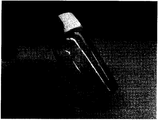
- FIG. 2 is a photograph showing physical properties of Comparative Example 1.
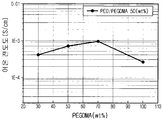
- Example 3 is a graph showing the ion conductivity of Example 1-3 and Comparative Example 2.
- the electrolyte of the present invention includes a plastic crystal matrix electrolyte doped with ionic salts; And a solid electrolyte for an electrochemical device comprising a composite consisting of a network of non-crosslinked polymer and polymer crosslinked structure.
- Plastic crystal matrix electrolyte doped with ionic salts may be 30:70 to 90:10, and the weight ratio of the noncrosslinked polymer and the polymer crosslinked structure may be 10:90 to 70:30.
- the electrolyte serves as a medium for transporting lithium ions in the positive electrode and the negative electrode, and plays an important role in the performance of the secondary battery.
- the electrolyte of the present invention includes a plastic crystal matrix electrolyte and a network of non-crosslinked polymer and polymer crosslinked structure. do.
- Plastic crystals are compounds in which molecules or ions exhibit rotational disorders, while the center of gravity occupies an aligned position in the crystal lattice structure.
- the rotating phase of plastic crystals usually occurs as a solid-solid transition below the melting point, often forming plastic properties and mechanical fluidity and high conductivity.
- the ionic salts when doped, it shows high ion conductivity and is suitable as an electrolyte for secondary batteries.
- the plastic crystal matrix electrolyte exhibits fluidity and thus has low mechanical properties, the present invention introduces a network of a non-crosslinked polymer and a polymer crosslinked structure in order to improve the plastic crystal matrix electrolyte.
- the electrolyte of the present invention is a composite of an ionic salt-doped plastic crystal matrix electrolyte and a non-crosslinked polymer and a polymer crosslinked structure network, and the complex is doped with a monomer and an ionic salt having two or more functional groups capable of crosslinking with the noncrosslinked polymer.
- the prepared plastic crystal matrix electrolyte may be mixed homogeneously and polymerized.
- the semi-interpenetrating network matrix formed thereby contributes to the improvement of the mechanical properties of the electrolyte, imparting the corresponding mechanical properties to the solid electrolyte, and the flexibility is excellent.
- the plastic crystal matrix electrolyte is uniformly distributed so that the ion conductivity is also excellent.
- a film may not be produced alone because it shows a form of a sticky solution or a gel-like state.
- the plastic crystal matrix electrolyte in which the network of the non-crosslinked polymer and the polymer crosslinked structure is formed therein the mechanical properties are improved, so even when a force is applied to the battery, there is little concern about short circuit and disconnection, and it is flexible because it has elasticity. It is suitable for battery systems requiring variability such as cable type secondary batteries required.
- linear polymer polyethylene oxide, polyvinylidene fluoride-co-hexafluoropropylene, polyacrylonitrile, or the like may be used.
- branched polymer poly [methoxy polyethylene glycol methacrylate], poly2-methoxy ethyl glycidyl ether, and the like can be used. .
- the polymer crosslinked structure is preferably a crosslinked monomer having two or more functional groups, and the monomer having two or more functional groups is meant to include not only monomers but also oligomers having 2 to 20 repeating units.
- the monomer having two or more functional groups is not limited in kind, but is not limited to trimethylolpropane ethoxylate triacrylate, polyethylene glycol dimethacrylate, and trimethylolpropane trimethacryl. Trimethylolpropane trimethacrylate and ethoxylated bis phenol A dimethacrylate may be used.
- the plastic crystal is not limited in its kind, but succinonitrile is preferably used.
- the ionic salts doped in the plastic crystal matrix electrolyte are preferably lithium salts, and lithium bis-trifluoromethanesulfonylimide, lithium bis-perfluoroethylsulfonylimide, lithium tetrafluoroborate, and the like can be used. Can be.
- a method for preparing an electrolyte including a composite of a network of an ionic salt-doped plastic crystal matrix electrolyte and a non-crosslinked polymer and a polymer crosslinked structure is as follows.
- a plastic crystal matrix electrolyte doped with ionic salts First, a plastic crystal matrix electrolyte doped with ionic salts; Non-crosslinked polymer; And by mixing a monomer having two or more functional groups to prepare a solution (step S1).
- the weight ratio of the non-crosslinked polymer and polymer crosslinked structure may be 10:90 to 70:30.
- the above-mentioned polymer may be used, and the monomer having two or more functional groups capable of crosslinking is meant to include not only monomers but also oligomers having 2 to 20 repeating units. Can be used.
- the above-mentioned plastic crystalline matrix electrolyte and ionic salt can also be used.
- the ionic salt may use a concentration of 0.1 to 3 moles relative to the plastic crystal matrix.
- a solvent may be added at the time of mixing, but the solvent is not necessarily essential. However, when a solvent is used, a drying step for removing the solvent is additionally required. And a photoinitiator, such as benzoin, can be added selectively for the superposition
- a photoinitiator such as benzoin
- a solid electrolyte is prepared by polymerizing monomers having two or more functional groups in the solution (step S2).
- polymerization is not specifically limited, The method of superposing
- the solid electrolyte of the present invention described above may be used in an electrochemical device including a positive electrode and a negative electrode.
- the electrochemical device of the present invention includes all devices that undergo an electrochemical reaction, and specific examples include capacitors such as all kinds of primary, secondary cells, fuel cells, solar cells, or supercapacitor elements.
- a lithium secondary battery including a lithium metal secondary battery, a lithium ion secondary battery, a lithium polymer secondary battery or a lithium ion polymer secondary battery among the secondary batteries is preferable.
- the solid electrolyte of the present invention is manufactured into a lithium secondary battery by injecting an electrode structure composed of a positive electrode, a negative electrode, and a separator interposed between the positive electrode and the negative electrode.
- the positive electrode, the negative electrode, and the separator constituting the electrode structure all those conventionally used for manufacturing a lithium secondary battery may be used.
- the electrolyte for a lithium secondary battery of the present invention is a solid electrolyte, the separator can be replaced.
- the positive electrode and the negative electrode are composed of a current collector and an active material.
- a lithium-containing transition metal oxide may be preferably used as the positive electrode active material.
- sulfides, selenides and halides may also be used.
- a carbon material capable of occluding and releasing lithium ions a lithium-containing titanium composite oxide (LTO); Metals (Me) which are Si, Sn, Li, Zn, Mg, Cd, Ce, Ni, Fe; Alloys composed of the metals (Me); Oxides of the metals (Me) (MeOx); And a complex of the metals (Me) and carbon; Etc.
- a carbon material may be used, and as the carbon material, both low crystalline carbon and high crystalline carbon may be used.
- the negative electrode may include a binder, and the binder may include vinylidene fluoride-hexafluoropropylene copolymer (PVDF-co-HFP), polyvinylidene fluoride, polyacrylonitrile, Various kinds of binder polymers such as polymethylmethacrylate may be used.
- porous polymer films conventionally used as separators for example, polyolefins such as ethylene homopolymer, propylene homopolymer, ethylene / butene copolymer, ethylene / hexene copolymer and ethylene / methacrylate copolymer, etc.
- the porous polymer film made of the polymer may be used alone or by laminating them, or a conventional porous nonwoven fabric, for example, a non-woven fabric made of high melting point glass fiber, polyethylene terephthalate fiber, or the like may be used. It is not.
- the external shape of the lithium secondary battery of the present invention is not particularly limited, but may be cylindrical, square, pouch type, or coin type using a can. In addition, it may be a cable type lithium secondary battery having a structure such as a linear wire.
- PEGDMA polyethylene glycol dimethacrylate
- Example 2-3 was prepared in the same manner as in Example 1 to prepare an electrolyte membrane by varying the mixing ratio of succinonitrile, polyethylene oxide, and polyethylene glycol dimethacrylate to 50:25:25, 50:35:15. .
- PEGDMA polyethylene glycol dimethacrylate
- Lithium bis-trifluoromethan sulfonylimide was added to the ethylene oxide unit of PEGDMA in an amount of 1/8 in molar ratio and then mixed to mix uniformly with each other.
- a mixture was prepared by adding 3% by weight of benzoin, an ultraviolet (UV) initiator, to PEGDMA.
- the mixture was cast on a glass plate and irradiated with ultraviolet rays for 1 minute to crosslink to prepare an electrolyte membrane.
- a tin plated copper was used as a working electrode, a lithium metal was used as a counter electrode, and the electrolyte membrane prepared in Example 3 was inserted between these electrodes to prepare a coin-shaped half cell. .
- the tensile strength of the electrolyte prepared in Examples 1-3 and Comparative Example 2 is measured and shown in FIG. 1.
- the comparative example 1 which cannot form a solid film is shown in FIG. In the case of Comparative Example 1 it can be seen that the mechanical properties are very poor.
- Example 1-3 the tensile strength of Comparative Example 2 was greater than that of Example 1-3 in comparison with the case of Example 1-3, but Example 1-3 was more in terms of elongation. Among them, it was observed that particularly the case of Example 3 was very good.
- the mechanical properties are improved compared to the pure crystal electrolyte, and there is less concern about short circuit and short circuit even when a force is applied to the battery.
- it since it has improved elasticity in terms of elongation as compared to a plastic crystal matrix electrolyte containing only a polymer cross-linked structure, it can be seen that it is suitable for battery systems requiring variability such as cable type secondary batteries requiring flexibility.
- Chemical affinity is similar between PEO and PEGDMA used in Examples 1-3 to prevent phase separation and to form a bulky amorphous structure by crosslinking reaction, thereby contributing to the improvement of ionic conductivity.
- Chemical affinity is similar between PEO and PEGDMA used in Examples 1-3 to prevent phase separation and to form a bulky amorphous structure by crosslinking reaction, thereby contributing to the improvement of ionic conductivity.
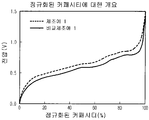
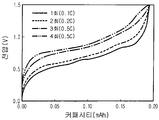
- the half cell according to Preparation Example 1 of the present invention has a higher battery resistance than the half cell of Comparative Preparation Example 1 using a liquid electrolyte / separation membrane, but shows a general half-cell performance, in particular 1.5v cut condition. According to FIG. 5 showing the discharge profile in, it can be seen that the cycle life characteristics are excellent.
Landscapes
- Chemical & Material Sciences (AREA)
- Engineering & Computer Science (AREA)
- Manufacturing & Machinery (AREA)
- Chemical Kinetics & Catalysis (AREA)
- Inorganic Chemistry (AREA)
- Materials Engineering (AREA)
- General Chemical & Material Sciences (AREA)
- Electrochemistry (AREA)
- Polymers & Plastics (AREA)
- Organic Chemistry (AREA)
- Medicinal Chemistry (AREA)
- Health & Medical Sciences (AREA)
- Physics & Mathematics (AREA)
- Condensed Matter Physics & Semiconductors (AREA)
- Dispersion Chemistry (AREA)
- General Physics & Mathematics (AREA)
- Secondary Cells (AREA)
- Conductive Materials (AREA)
- Primary Cells (AREA)
Abstract
Description
Claims (19)
- 이온성염이 도핑된 플라스틱 크리스탈 매트릭스 전해질; 및 비가교 고분자와 고분자 가교구조체의 네트워크로 이루어진 복합체를 포함하는 전기화학소자용 고체 전해질.
- 제 1항에 있어서,상기 이온성염이 도핑된 플라스틱 크리스탈 매트릭스 전해질; 및 비가교 고분자와 고분자 가교구조체의 네트워크의 중량비는 30: 70 내지 90: 10인 것을 특징으로 하는 전기화학소자용 고체 전해질.
- 제 1항에 있어서,상기 비가교 고분자 및 고분자 가교구조체의 중량비는 10: 90 내지 70: 30인 것을 특징으로 하는 전기화학소자용 고체 전해질.
- 제 1항에 있어서,상기 플라스틱 크리스탈 매트릭스 전해질은 숙시노니트릴을 포함하는 것을 특징으로 하는 전기화학소자용 고체 전해질.
- 제 1항에 있어서,상기 이온성염은 리튬염인 것을 특징으로 하는 전기화학소자용 고체 전해질.
- 제 5항에 있어서,상기 리튬염은 리튬 비스-트리플루오로메탄설포닐이미드, 리튬 비스-퍼플루오로에틸설포닐이미드 및 리튬 테트라플루오로보레이트 중에서 선택된 1종의 화합물 또는 2종 이상의 혼합물인 것을 특징으로 하는 전기화학소자용 고체 전해질.
- 제 1항에 있어서,상기 비가교 고분자는 폴리에틸렌옥사이드(polyethylene oxide), 폴리비닐리덴플로라이드-코-헥사플로로프로필렌(polyvinylidenefluoride-co-hexafluoropropylene) 및 폴리아크릴로니트릴(polyacrylonitrile)인 선형 고분자; 및 폴리메톡시 폴리에틸렌글리콜메타크릴레이트(poly[methoxy polyethylene glycol methacrylate]) 및 폴리2-메톡시 에틸 글리시딜 에테르(poly[2-methoxy ethyl glycidyl ether])인 가지형 고분자 중에서 선택된 1종의 화합물 또는 2종 이상의 혼합물인 것을 특징으로 하는 전기화학소자용 고체 전해질.
- 제 1항에 있어서,상기 고분자 가교구조체는 2개 이상의 관능기를 갖는 단량체가 중합된 것을 특징으로 하는 전기화학소자용 고체 전해질.
- 제 8항에 있어서,상기 2개 이상의 관능기를 갖는 단량체는 트리메틸올프로판 에톡실레이트 트리아크릴레이트(trimethylolpropane ethoxylate triacrylate), 폴리에틸렌 글리콜 디메타크릴레이트(polyethylene glycol dimethacrylate), 트리메틸올프로판트리메타크릴레이트(trimethylolpropane trimethacrylate) 또는 에톡실레이티드 비스 페놀 에이 디메타크릴레이트(ethoxylated bis phenol A dimethacrylate) 중에서 선택된 1종의 단량체 또는 2종 이상의 혼합물인 것을 특징으로 하는 전기화학소자용 고체 전해질.
- (S1) 이온성염이 도핑된 플라스틱 크리스탈 매트릭스 전해질; 비가교 고분자; 및 2개 이상의 관능기를 갖는 단량체를 혼합하여 용액을 제조하는 단계; 및(S2) 상기 용액 내의 2개 이상의 관능기를 갖는 단량체를 중합시키는 단계를 포함하는 제 1항 내지 제 9항 중에서 선택된 어느 한 항의 전기화학소자용 고체 전해질의 제조방법.
- 제 10항에 있어서,상기 비가교 고분자 및 2개 이상의 관능기를 갖는 단량체의 중량비는 10: 90 내지 70: 30인 것을 특징으로 하는 전기화학소자용 고체 전해질의 제조방법.
- 제 10항에 있어서,상기 플라스틱 크리스탈 매트릭스 전해질은 숙시노니트릴을 포함하는 것을 특징으로 하는 전기화학소자용 고체 전해질의 제조방법.
- 제 10항에 있어서,상기 이온성염은 플라스틱 크리스탈 매트릭스 전해질 대비 0.1 내지 3 몰농도인 것을 특징으로 하는 전기화학소자용 고체 전해질의 제조방법.
- 제 10항에 있어서,상기 이온성염은 리튬염인 것을 특징으로 하는 전기화학소자용 고체 전해질의 제조방법.
- 제 14항에 있어서,상기 리튬염은 리튬 비스-트리플루오로메탄설포닐이미드, 리튬 비스-퍼플루오로에틸설포닐이미드 및 리튬 테트라플루오로보레이트 중에서 선택된 1종의 화합물 또는 2종 이상의 혼합물인 것을 특징으로 하는 전기화학소자용 고체 전해질의 제조방법.
- 제 10항에 있어서,상기 비가교 고분자는 폴리에틸렌옥사이드(polyethylene oxide), 폴리비닐리덴플로라이드-코-헥사플로로프로필렌(polyvinylidenefluoride-co-hexafluoropropylene) 및 폴리아크릴로니트릴(polyacrylonitrile)인 선형 고분자; 및 폴리메톡시 폴리에틸렌글리콜메타크릴레이트(poly[methoxy polyethylene glycol methacrylate]) 및 폴리2-메톡시 에틸 글리시딜 에테르(poly[2-methoxy ethyl glycidyl ether])인 가지형 고분자 중에서 선택된 1종의 화합물 또는 2종 이상의 혼합물인 것을 특징으로 하는 전기화학소자용 고체 전해질의 제조방법.
- 제 10항에 있어서,상기 2개 이상의 관능기를 갖는 단량체는 트리메틸올프로판 에톡실레이트 트리아크릴레이트(trimethylolpropane ethoxylate triacrylate), 폴리에틸렌 글리콜 디메타크릴레이트(polyethylene glycol dimethacrylate), 트리메틸올프로판트리메타크릴레이트(trimethylolpropane trimethacrylate) 또는 에톡실레이티드 비스 페놀 에이 디메타크릴레이트(ethoxylated bis phenol A dimethacrylate) 중에서 선택된 1종의 단량체 또는 2종 이상의 혼합물인 것을 특징으로 하는 전기화학소자용 고체 전해질의 제조방법.
- 양극, 음극 및 전해질을 포함하는 전기화학소자에 있어서,상기 전해질은 제 1항 내지 제 9항 중 어느 한 항의 고체 전해질인 것을 특징으로 하는 전기화학소자.
- 제 18항에 있어서,상기 전기화학소자는 리튬 이차전지인 것을 특징으로 하는 전기화학소자.
Priority Applications (4)
| Application Number | Priority Date | Filing Date | Title |
|---|---|---|---|
| CN201180029471.XA CN102939681B (zh) | 2010-06-14 | 2011-06-07 | 电化学装置用电解质、制备所述电解质的方法以及包含所述电解质的电化学装置 |
| EP11795917.1A EP2581978B1 (en) | 2010-06-14 | 2011-06-07 | Electrolyte for electrochemical device, manufacturing method therefor, and electrochemical device including the electrolyte |
| JP2013514109A JP6005632B2 (ja) | 2010-06-14 | 2011-06-07 | 電気化学素子用電解質、その製造方法、及びそれを備える電気化学素子 |
| US13/315,528 US8945777B2 (en) | 2010-06-14 | 2011-12-09 | Electrolyte for electrochemical device, method for preparing the electrolyte and electrochemical device including the electrolyte |
Applications Claiming Priority (2)
| Application Number | Priority Date | Filing Date | Title |
|---|---|---|---|
| KR1020100056063A KR101311494B1 (ko) | 2010-06-14 | 2010-06-14 | 전기화학소자용 전해질, 그 제조방법 및 이를 구비한 전기화학소자 |
| KR10-2010-0056063 | 2010-06-14 |
Related Child Applications (1)
| Application Number | Title | Priority Date | Filing Date |
|---|---|---|---|
| US13/315,528 Continuation US8945777B2 (en) | 2010-06-14 | 2011-12-09 | Electrolyte for electrochemical device, method for preparing the electrolyte and electrochemical device including the electrolyte |
Publications (2)
| Publication Number | Publication Date |
|---|---|
| WO2011159051A2 true WO2011159051A2 (ko) | 2011-12-22 |
| WO2011159051A3 WO2011159051A3 (ko) | 2012-05-03 |
Family
ID=45348711
Family Applications (1)
| Application Number | Title | Priority Date | Filing Date |
|---|---|---|---|
| PCT/KR2011/004139 Ceased WO2011159051A2 (ko) | 2010-06-14 | 2011-06-07 | 전기화학소자용 전해질, 그 제조방법 및 이를 구비한 전기화학소자 |
Country Status (6)
| Country | Link |
|---|---|
| US (1) | US8945777B2 (ko) |
| EP (1) | EP2581978B1 (ko) |
| JP (1) | JP6005632B2 (ko) |
| KR (1) | KR101311494B1 (ko) |
| CN (1) | CN102939681B (ko) |
| WO (1) | WO2011159051A2 (ko) |
Cited By (1)
| Publication number | Priority date | Publication date | Assignee | Title |
|---|---|---|---|---|
| KR20190089693A (ko) * | 2018-01-23 | 2019-07-31 | 삼성전자주식회사 | 연신 고분자 전해질, 연신 전극, 연신 고분자, 전기화학 디바이스, 및 연신 고분자 제조 방법 |
Families Citing this family (27)
| Publication number | Priority date | Publication date | Assignee | Title |
|---|---|---|---|---|
| KR101351897B1 (ko) | 2011-01-20 | 2014-01-17 | 주식회사 엘지화학 | 전기화학소자용 전해질, 그 제조방법 및 이를 구비한 전기화학소자 |
| JP5734527B2 (ja) * | 2011-12-14 | 2015-06-17 | エルジー・ケム・リミテッド | ケーブル型二次電池 |
| KR101625707B1 (ko) | 2012-12-21 | 2016-06-14 | 주식회사 엘지화학 | 전기화학소자용 고체 전해질 및 이를 구비한 전기화학소자 |
| KR102034719B1 (ko) | 2012-12-21 | 2019-10-22 | 삼성전자주식회사 | 리튬공기전지용 보호음극 및 이를 포함한 리튬공기전지 |
| KR101527560B1 (ko) * | 2013-11-14 | 2015-06-10 | 주식회사 포스코 | 리튬 이차 전지용 고분자 전해질, 이의 제조 방법, 및 이를 포함하는 리튬 이차 전지 |
| CN105098233B (zh) * | 2014-05-22 | 2017-10-24 | 上海交通大学 | 半互穿网络聚合物凝胶电解质膜的制备方法 |
| KR20160034173A (ko) * | 2014-09-19 | 2016-03-29 | 삼성전자주식회사 | 전해질, 그 제조방법 및 이를 포함하는 리튬이차전지 |
| EP3001494B1 (en) | 2014-09-19 | 2018-08-15 | Samsung Electronics Co., Ltd. | Electrolyte, method of preparing the electrolyte, and lithium secondary battery comprising the electrolyte |
| US10446874B2 (en) | 2014-10-31 | 2019-10-15 | Lg Chem, Ltd. | Lithium sulfur battery and method for producing same |
| KR101922249B1 (ko) * | 2017-01-13 | 2018-11-26 | 한국생산기술연구원 | Lto 함유 음극소재를 갖는 전고체 전지 및 그 제조 방법 |
| KR102093970B1 (ko) | 2017-06-20 | 2020-04-23 | 주식회사 엘지화학 | 다층 구조 고분자 고체 전해질 및 이를 포함하는 전고체 전지 |
| FR3071360B1 (fr) | 2017-09-18 | 2019-09-13 | Blue Solutions | Electrolyte polymere solide comprenant un polymere solvatant, un sel de lithium et un polymere halogene selectionne et batterie le comprenant |
| CN107681193A (zh) * | 2017-09-29 | 2018-02-09 | 清华大学 | 固体电解质及其制备方法、电池 |
| US10978735B2 (en) * | 2018-01-23 | 2021-04-13 | Samsung Electronics Co., Ltd. | Stretchable polymer electrolyte, stretchable electrode, stretchable polymer, electrocheical device, and method of preparing stretchable polymer |
| KR102093129B1 (ko) * | 2018-07-09 | 2020-03-25 | 울산과학기술원 | 가교된 고분자를 포함하는 겔 전해질 및 그 제조방법 |
| US11302960B2 (en) * | 2018-11-07 | 2022-04-12 | Factorial Inc. | Polymer solid electrolytes, methods of making, and electrochemical cells comprising the same |
| CN113366683B (zh) | 2019-01-31 | 2025-06-13 | 大金工业株式会社 | 结构体、复合体、电池以及复合体的制造方法 |
| CN113508446B (zh) * | 2019-03-29 | 2022-09-27 | 日本贵弥功株式会社 | 固体电解质、蓄电设备及固体电解质的制造方法 |
| CN110492169B (zh) * | 2019-08-15 | 2022-12-23 | 中山大学 | 一种焊接式一体化全固态锂硫电池及其制备方法 |
| CN110556576B (zh) * | 2019-08-15 | 2022-12-23 | 中山大学 | 一种半互穿网络双盐固态电解质及其制备方法 |
| TWI719669B (zh) * | 2019-10-09 | 2021-02-21 | 國立成功大學 | 膠態電解質及其製作方法,以及鋰電池 |
| DE102019127616A1 (de) * | 2019-10-14 | 2021-04-15 | Forschungszentrum Jülich GmbH | Semi-interpenetrierende Polymernetzwerke als Separatoren für den Einsatz in Alkali-Metall-Batterien |
| KR102428263B1 (ko) * | 2019-11-25 | 2022-08-02 | 울산과학기술원 | 가교된 고분자를 포함하는 복합 고체 전해질 및 이의 제조방법 |
| WO2021112287A1 (ko) * | 2019-12-05 | 2021-06-10 | 울산과학기술원 | 가교된 고분자를 포함하는 겔 전해질 및 그 제조방법 |
| CN111554979A (zh) * | 2020-04-03 | 2020-08-18 | 浙江大学 | 一种全固态锂电池的制备方法 |
| US11955639B2 (en) * | 2021-05-04 | 2024-04-09 | GM Global Technology Operations LLC | Composite interlayer for lithium metal based solid state batteries and the method of making the same |
| CN113571764B (zh) * | 2021-07-14 | 2022-09-02 | 北京理工大学 | 一种复合固体电解质膜及其制备方法 |
Citations (1)
| Publication number | Priority date | Publication date | Assignee | Title |
|---|---|---|---|---|
| KR20080033421A (ko) | 2005-07-29 | 2008-04-16 | 내셔날 리서치 카운실 오브 캐나다 | 리튬계 전기화학 장치 내의 플라스틱 결정 전해질 |
Family Cites Families (10)
| Publication number | Priority date | Publication date | Assignee | Title |
|---|---|---|---|---|
| CA2163065C (en) * | 1994-11-22 | 2003-07-29 | Takaya Sato | Solid ion conductive polymer electrolyte and composition and production method therefor |
| JP3475595B2 (ja) * | 1995-08-03 | 2003-12-08 | 日清紡績株式会社 | イオン導電性高分子固体電解質電池 |
| KR100288617B1 (ko) * | 1995-11-15 | 2001-05-02 | 야마모토 카즈모토 | 복합고분자고체전해질및이를사용한비수계전기화학장치 |
| US5589295A (en) * | 1995-12-06 | 1996-12-31 | Derzon; Dora K. | Thin film polymeric gel electrolytes |
| US7771870B2 (en) * | 2006-03-22 | 2010-08-10 | Sion Power Corporation | Electrode protection in both aqueous and non-aqueous electrochemical cells, including rechargeable lithium batteries |
| JP4020296B2 (ja) * | 2000-12-21 | 2007-12-12 | キヤノン株式会社 | イオン伝導構造体、二次電池及びそれらの製造方法 |
| JP3974371B2 (ja) * | 2001-10-19 | 2007-09-12 | シロウマサイエンス株式会社 | ポリマーゲル電解質組成物およびその製造法 |
| US8182943B2 (en) * | 2005-12-19 | 2012-05-22 | Polyplus Battery Company | Composite solid electrolyte for protection of active metal anodes |
| EP1881024A1 (en) * | 2006-07-18 | 2008-01-23 | Nederlandse Organisatie voor toegepast- natuurwetenschappelijk onderzoek TNO | Use of a plasticizer in an electroactive polymer composition |
| KR101120434B1 (ko) * | 2006-10-16 | 2012-03-13 | 주식회사 엘지화학 | 폴리에스테르 아크릴레이트계 화합물의 공중합체를포함하는 이차전지용 바인더 |
-
2010
- 2010-06-14 KR KR1020100056063A patent/KR101311494B1/ko active Active
-
2011
- 2011-06-07 JP JP2013514109A patent/JP6005632B2/ja active Active
- 2011-06-07 WO PCT/KR2011/004139 patent/WO2011159051A2/ko not_active Ceased
- 2011-06-07 CN CN201180029471.XA patent/CN102939681B/zh active Active
- 2011-06-07 EP EP11795917.1A patent/EP2581978B1/en active Active
- 2011-12-09 US US13/315,528 patent/US8945777B2/en active Active
Patent Citations (1)
| Publication number | Priority date | Publication date | Assignee | Title |
|---|---|---|---|---|
| KR20080033421A (ko) | 2005-07-29 | 2008-04-16 | 내셔날 리서치 카운실 오브 캐나다 | 리튬계 전기화학 장치 내의 플라스틱 결정 전해질 |
Non-Patent Citations (1)
| Title |
|---|
| See also references of EP2581978A4 |
Cited By (2)
| Publication number | Priority date | Publication date | Assignee | Title |
|---|---|---|---|---|
| KR20190089693A (ko) * | 2018-01-23 | 2019-07-31 | 삼성전자주식회사 | 연신 고분자 전해질, 연신 전극, 연신 고분자, 전기화학 디바이스, 및 연신 고분자 제조 방법 |
| KR102618543B1 (ko) | 2018-01-23 | 2023-12-27 | 삼성전자주식회사 | 연신 고분자 전해질, 연신 전극, 연신 고분자, 전기화학 디바이스, 및 연신 고분자 제조 방법 |
Also Published As
| Publication number | Publication date |
|---|---|
| CN102939681B (zh) | 2015-12-02 |
| JP2013532360A (ja) | 2013-08-15 |
| US20120094187A1 (en) | 2012-04-19 |
| WO2011159051A3 (ko) | 2012-05-03 |
| KR101311494B1 (ko) | 2013-09-25 |
| JP6005632B2 (ja) | 2016-10-12 |
| EP2581978A2 (en) | 2013-04-17 |
| EP2581978B1 (en) | 2015-07-22 |
| KR20110136210A (ko) | 2011-12-21 |
| EP2581978A4 (en) | 2014-03-26 |
| CN102939681A (zh) | 2013-02-20 |
| US8945777B2 (en) | 2015-02-03 |
Similar Documents
| Publication | Publication Date | Title |
|---|---|---|
| KR101311494B1 (ko) | 전기화학소자용 전해질, 그 제조방법 및 이를 구비한 전기화학소자 | |
| EP2667443B1 (en) | Electrolyte for an electrochemical device, method for manufacturing same, and electrochemical device including same | |
| WO2011159083A2 (ko) | 전기화학소자용 전해질, 그 제조방법 및 이를 구비한 전기화학소자 | |
| WO2013002504A2 (ko) | 신규한 폴리머 전해질 및 이를 포함하는 리튬 이차전지 | |
| WO2012177016A2 (ko) | 신규 구조 전극조립체 및 이를 이용한 이차전지 | |
| WO2020214009A1 (ko) | 고체 전해질 복합체 및 이를 포함하는 전고체 전지용 전극 | |
| WO2021085798A1 (ko) | 가압 지그 및 이를 이용한 이차전지 제조 방법 | |
| WO2014168327A1 (ko) | 리튬 이차전지용 음극, 그 제조방법 및 이를 포함하는 리튬 이차전지 | |
| WO2017061807A1 (ko) | 전극조립체를 구성하는 분리막의 기공 내에 겔화 전해액 성분을 포함하고 있는 전지셀 | |
| WO2012118338A2 (ko) | 일체형 전극조립체 및 이를 이용한 이차전지 | |
| WO2020242095A1 (ko) | 전고체전지용 음극의 제조방법 | |
| WO2013089498A1 (ko) | 케이블형 이차전지 | |
| KR101625707B1 (ko) | 전기화학소자용 고체 전해질 및 이를 구비한 전기화학소자 | |
| WO2012053773A2 (ko) | 케이블형 이차전지용 음극 및 이의 제조방법 | |
| WO2012111935A2 (ko) | 일체형 전극조립체 및 이를 이용한 이차전지 | |
| WO2015012625A1 (ko) | 가교화 화합물 입자 및 이를 포함하는 이차전지 | |
| WO2023027253A1 (ko) | 부직포 형태의 유기전극 및 이를 이용한 스트레처블 전지 | |
| WO2026071484A1 (ko) | 이차 전지의 제조 방법 |
Legal Events
| Date | Code | Title | Description |
|---|---|---|---|
| WWE | Wipo information: entry into national phase |
Ref document number: 201180029471.X Country of ref document: CN |
|
| 121 | Ep: the epo has been informed by wipo that ep was designated in this application |
Ref document number: 11795917 Country of ref document: EP Kind code of ref document: A2 |
|
| ENP | Entry into the national phase |
Ref document number: 2013514109 Country of ref document: JP Kind code of ref document: A |
|
| NENP | Non-entry into the national phase |
Ref country code: DE |
|
| WWE | Wipo information: entry into national phase |
Ref document number: 2011795917 Country of ref document: EP |