WO2011162252A1 - 分岐型ヘテロポリエチレングリコールおよび中間体 - Google Patents
分岐型ヘテロポリエチレングリコールおよび中間体 Download PDFInfo
- Publication number
- WO2011162252A1 WO2011162252A1 PCT/JP2011/064154 JP2011064154W WO2011162252A1 WO 2011162252 A1 WO2011162252 A1 WO 2011162252A1 JP 2011064154 W JP2011064154 W JP 2011064154W WO 2011162252 A1 WO2011162252 A1 WO 2011162252A1
- Authority
- WO
- WIPO (PCT)
- Prior art keywords
- group
- polyethylene glycol
- branched
- functional
- bond
- Prior art date
- Legal status (The legal status is an assumption and is not a legal conclusion. Google has not performed a legal analysis and makes no representation as to the accuracy of the status listed.)
- Ceased
Links
- 0 CC(C*O)COCc1ccccc1 Chemical compound CC(C*O)COCc1ccccc1 0.000 description 1
Classifications
-
- C—CHEMISTRY; METALLURGY
- C08—ORGANIC MACROMOLECULAR COMPOUNDS; THEIR PREPARATION OR CHEMICAL WORKING-UP; COMPOSITIONS BASED THEREON
- C08G—MACROMOLECULAR COMPOUNDS OBTAINED OTHERWISE THAN BY REACTIONS ONLY INVOLVING UNSATURATED CARBON-TO-CARBON BONDS
- C08G65/00—Macromolecular compounds obtained by reactions forming an ether link in the main chain of the macromolecule
- C08G65/02—Macromolecular compounds obtained by reactions forming an ether link in the main chain of the macromolecule from cyclic ethers by opening of the heterocyclic ring
- C08G65/26—Macromolecular compounds obtained by reactions forming an ether link in the main chain of the macromolecule from cyclic ethers by opening of the heterocyclic ring from cyclic ethers and other compounds
- C08G65/2603—Macromolecular compounds obtained by reactions forming an ether link in the main chain of the macromolecule from cyclic ethers by opening of the heterocyclic ring from cyclic ethers and other compounds the other compounds containing oxygen
- C08G65/2606—Macromolecular compounds obtained by reactions forming an ether link in the main chain of the macromolecule from cyclic ethers by opening of the heterocyclic ring from cyclic ethers and other compounds the other compounds containing oxygen containing hydroxyl groups
- C08G65/2612—Macromolecular compounds obtained by reactions forming an ether link in the main chain of the macromolecule from cyclic ethers by opening of the heterocyclic ring from cyclic ethers and other compounds the other compounds containing oxygen containing hydroxyl groups containing aromatic or arylaliphatic hydroxyl groups
-
- C—CHEMISTRY; METALLURGY
- C08—ORGANIC MACROMOLECULAR COMPOUNDS; THEIR PREPARATION OR CHEMICAL WORKING-UP; COMPOSITIONS BASED THEREON
- C08G—MACROMOLECULAR COMPOUNDS OBTAINED OTHERWISE THAN BY REACTIONS ONLY INVOLVING UNSATURATED CARBON-TO-CARBON BONDS
- C08G65/00—Macromolecular compounds obtained by reactions forming an ether link in the main chain of the macromolecule
- C08G65/02—Macromolecular compounds obtained by reactions forming an ether link in the main chain of the macromolecule from cyclic ethers by opening of the heterocyclic ring
- C08G65/32—Polymers modified by chemical after-treatment
-
- A—HUMAN NECESSITIES
- A61—MEDICAL OR VETERINARY SCIENCE; HYGIENE
- A61K—PREPARATIONS FOR MEDICAL, DENTAL OR TOILETRY PURPOSES
- A61K47/00—Medicinal preparations characterised by the non-active ingredients used, e.g. carriers or inert additives; Targeting or modifying agents chemically bound to the active ingredient
- A61K47/50—Medicinal preparations characterised by the non-active ingredients used, e.g. carriers or inert additives; Targeting or modifying agents chemically bound to the active ingredient the non-active ingredient being chemically bound to the active ingredient, e.g. polymer-drug conjugates
-
- A—HUMAN NECESSITIES
- A61—MEDICAL OR VETERINARY SCIENCE; HYGIENE
- A61K—PREPARATIONS FOR MEDICAL, DENTAL OR TOILETRY PURPOSES
- A61K47/00—Medicinal preparations characterised by the non-active ingredients used, e.g. carriers or inert additives; Targeting or modifying agents chemically bound to the active ingredient
- A61K47/50—Medicinal preparations characterised by the non-active ingredients used, e.g. carriers or inert additives; Targeting or modifying agents chemically bound to the active ingredient the non-active ingredient being chemically bound to the active ingredient, e.g. polymer-drug conjugates
- A61K47/51—Medicinal preparations characterised by the non-active ingredients used, e.g. carriers or inert additives; Targeting or modifying agents chemically bound to the active ingredient the non-active ingredient being chemically bound to the active ingredient, e.g. polymer-drug conjugates the non-active ingredient being a modifying agent
- A61K47/56—Medicinal preparations characterised by the non-active ingredients used, e.g. carriers or inert additives; Targeting or modifying agents chemically bound to the active ingredient the non-active ingredient being chemically bound to the active ingredient, e.g. polymer-drug conjugates the non-active ingredient being a modifying agent the modifying agent being an organic macromolecular compound, e.g. an oligomeric, polymeric or dendrimeric molecule
- A61K47/59—Medicinal preparations characterised by the non-active ingredients used, e.g. carriers or inert additives; Targeting or modifying agents chemically bound to the active ingredient the non-active ingredient being chemically bound to the active ingredient, e.g. polymer-drug conjugates the non-active ingredient being a modifying agent the modifying agent being an organic macromolecular compound, e.g. an oligomeric, polymeric or dendrimeric molecule obtained otherwise than by reactions only involving carbon-to-carbon unsaturated bonds, e.g. polyureas or polyurethanes
- A61K47/60—Medicinal preparations characterised by the non-active ingredients used, e.g. carriers or inert additives; Targeting or modifying agents chemically bound to the active ingredient the non-active ingredient being chemically bound to the active ingredient, e.g. polymer-drug conjugates the non-active ingredient being a modifying agent the modifying agent being an organic macromolecular compound, e.g. an oligomeric, polymeric or dendrimeric molecule obtained otherwise than by reactions only involving carbon-to-carbon unsaturated bonds, e.g. polyureas or polyurethanes the organic macromolecular compound being a polyoxyalkylene oligomer, polymer or dendrimer, e.g. PEG, PPG, PEO or polyglycerol
-
- C—CHEMISTRY; METALLURGY
- C08—ORGANIC MACROMOLECULAR COMPOUNDS; THEIR PREPARATION OR CHEMICAL WORKING-UP; COMPOSITIONS BASED THEREON
- C08G—MACROMOLECULAR COMPOUNDS OBTAINED OTHERWISE THAN BY REACTIONS ONLY INVOLVING UNSATURATED CARBON-TO-CARBON BONDS
- C08G65/00—Macromolecular compounds obtained by reactions forming an ether link in the main chain of the macromolecule
- C08G65/02—Macromolecular compounds obtained by reactions forming an ether link in the main chain of the macromolecule from cyclic ethers by opening of the heterocyclic ring
- C08G65/32—Polymers modified by chemical after-treatment
- C08G65/321—Polymers modified by chemical after-treatment with inorganic compounds
- C08G65/325—Polymers modified by chemical after-treatment with inorganic compounds containing nitrogen
- C08G65/3255—Ammonia
-
- C—CHEMISTRY; METALLURGY
- C08—ORGANIC MACROMOLECULAR COMPOUNDS; THEIR PREPARATION OR CHEMICAL WORKING-UP; COMPOSITIONS BASED THEREON
- C08G—MACROMOLECULAR COMPOUNDS OBTAINED OTHERWISE THAN BY REACTIONS ONLY INVOLVING UNSATURATED CARBON-TO-CARBON BONDS
- C08G65/00—Macromolecular compounds obtained by reactions forming an ether link in the main chain of the macromolecule
- C08G65/02—Macromolecular compounds obtained by reactions forming an ether link in the main chain of the macromolecule from cyclic ethers by opening of the heterocyclic ring
- C08G65/32—Polymers modified by chemical after-treatment
- C08G65/329—Polymers modified by chemical after-treatment with organic compounds
- C08G65/331—Polymers modified by chemical after-treatment with organic compounds containing oxygen
- C08G65/3311—Polymers modified by chemical after-treatment with organic compounds containing oxygen containing a hydroxy group
- C08G65/3312—Polymers modified by chemical after-treatment with organic compounds containing oxygen containing a hydroxy group acyclic
-
- C—CHEMISTRY; METALLURGY
- C08—ORGANIC MACROMOLECULAR COMPOUNDS; THEIR PREPARATION OR CHEMICAL WORKING-UP; COMPOSITIONS BASED THEREON
- C08G—MACROMOLECULAR COMPOUNDS OBTAINED OTHERWISE THAN BY REACTIONS ONLY INVOLVING UNSATURATED CARBON-TO-CARBON BONDS
- C08G65/00—Macromolecular compounds obtained by reactions forming an ether link in the main chain of the macromolecule
- C08G65/02—Macromolecular compounds obtained by reactions forming an ether link in the main chain of the macromolecule from cyclic ethers by opening of the heterocyclic ring
- C08G65/32—Polymers modified by chemical after-treatment
- C08G65/329—Polymers modified by chemical after-treatment with organic compounds
- C08G65/333—Polymers modified by chemical after-treatment with organic compounds containing nitrogen
- C08G65/33331—Polymers modified by chemical after-treatment with organic compounds containing nitrogen containing imide group
- C08G65/33337—Polymers modified by chemical after-treatment with organic compounds containing nitrogen containing imide group cyclic
-
- C—CHEMISTRY; METALLURGY
- C08—ORGANIC MACROMOLECULAR COMPOUNDS; THEIR PREPARATION OR CHEMICAL WORKING-UP; COMPOSITIONS BASED THEREON
- C08G—MACROMOLECULAR COMPOUNDS OBTAINED OTHERWISE THAN BY REACTIONS ONLY INVOLVING UNSATURATED CARBON-TO-CARBON BONDS
- C08G65/00—Macromolecular compounds obtained by reactions forming an ether link in the main chain of the macromolecule
- C08G65/02—Macromolecular compounds obtained by reactions forming an ether link in the main chain of the macromolecule from cyclic ethers by opening of the heterocyclic ring
- C08G65/32—Polymers modified by chemical after-treatment
- C08G65/329—Polymers modified by chemical after-treatment with organic compounds
- C08G65/333—Polymers modified by chemical after-treatment with organic compounds containing nitrogen
- C08G65/33331—Polymers modified by chemical after-treatment with organic compounds containing nitrogen containing imide group
- C08G65/33337—Polymers modified by chemical after-treatment with organic compounds containing nitrogen containing imide group cyclic
- C08G65/33341—Polymers modified by chemical after-treatment with organic compounds containing nitrogen containing imide group cyclic aromatic
-
- C—CHEMISTRY; METALLURGY
- C08—ORGANIC MACROMOLECULAR COMPOUNDS; THEIR PREPARATION OR CHEMICAL WORKING-UP; COMPOSITIONS BASED THEREON
- C08G—MACROMOLECULAR COMPOUNDS OBTAINED OTHERWISE THAN BY REACTIONS ONLY INVOLVING UNSATURATED CARBON-TO-CARBON BONDS
- C08G65/00—Macromolecular compounds obtained by reactions forming an ether link in the main chain of the macromolecule
- C08G65/02—Macromolecular compounds obtained by reactions forming an ether link in the main chain of the macromolecule from cyclic ethers by opening of the heterocyclic ring
- C08G65/32—Polymers modified by chemical after-treatment
- C08G65/329—Polymers modified by chemical after-treatment with organic compounds
- C08G65/334—Polymers modified by chemical after-treatment with organic compounds containing sulfur
- C08G65/3344—Polymers modified by chemical after-treatment with organic compounds containing sulfur containing oxygen in addition to sulfur
-
- C—CHEMISTRY; METALLURGY
- C08—ORGANIC MACROMOLECULAR COMPOUNDS; THEIR PREPARATION OR CHEMICAL WORKING-UP; COMPOSITIONS BASED THEREON
- C08L—COMPOSITIONS OF MACROMOLECULAR COMPOUNDS
- C08L71/00—Compositions of polyethers obtained by reactions forming an ether link in the main chain; Compositions of derivatives of such polymers
-
- C—CHEMISTRY; METALLURGY
- C08—ORGANIC MACROMOLECULAR COMPOUNDS; THEIR PREPARATION OR CHEMICAL WORKING-UP; COMPOSITIONS BASED THEREON
- C08L—COMPOSITIONS OF MACROMOLECULAR COMPOUNDS
- C08L2203/00—Applications
- C08L2203/02—Applications for biomedical use
-
- Y—GENERAL TAGGING OF NEW TECHNOLOGICAL DEVELOPMENTS; GENERAL TAGGING OF CROSS-SECTIONAL TECHNOLOGIES SPANNING OVER SEVERAL SECTIONS OF THE IPC; TECHNICAL SUBJECTS COVERED BY FORMER USPC CROSS-REFERENCE ART COLLECTIONS [XRACs] AND DIGESTS
- Y02—TECHNOLOGIES OR APPLICATIONS FOR MITIGATION OR ADAPTATION AGAINST CLIMATE CHANGE
- Y02P—CLIMATE CHANGE MITIGATION TECHNOLOGIES IN THE PRODUCTION OR PROCESSING OF GOODS
- Y02P20/00—Technologies relating to chemical industry
- Y02P20/50—Improvements relating to the production of bulk chemicals
- Y02P20/55—Design of synthesis routes, e.g. reducing the use of auxiliary or protecting groups
Definitions
- the present invention relates to a branched heteropolyethylene glycol. More specifically, the present invention relates to a branched heteropolyethylene glycol compound used for modification of biofunctional molecules, drugs or drug carriers in drug delivery systems, or diagnostic materials and devices.
- Non-Patent Document 1 binds transferrin and ⁇ -lactoglobulin using heterobifunctional polyethylene glycol having an N-hydroxysuccinimide ester group and a maleimide group.
- Zhang et al. Non-Patent Document 2 used a heterobifunctional polyethylene glycol having an N-hydroxysuccinimide ester group and a maleimide group to form peptide decamer NLS (nuclear localization signal) and acridine. A dendrimer conjugate is bound.
- the heterobifunctional polyethylene glycol is a heterocrosslinker widely used in pharmaceutical related applications such as modification of biofunctional molecules, particularly in the field of DDS.
- either biofunctional molecule should be Multiple modifications may be desired.
- transport efficiency can be improved if a plurality of drugs can be bound.
- target-directing molecules can be bound, the targeting performance with the ligand can be improved.
- heteropolyethylene glycol derivatives having one or more of two types of functional groups on the premise that they are used for pharmaceutical-related applications such as modification of biofunctional molecules.
- modification of biofunctional molecules there has been no example so far with respect to those designed for the purpose of modifying biofunctional molecules having a relatively large molecular weight such as protein drugs and antibodies.
- X and Y are each an atomic group that includes at least a functional group that reacts with a functional group present in the biofunctional molecule to form a covalent bond, and the functional group included in the atomic group X and the functional group Y includes Groups are different from each other.
- s is an integer of 2 to 8 representing the number of polyethylene glycol chains.
- n is the average number of moles added of polyethylene glycol chains, and 20 ⁇ n ⁇ 2000.
- E is a branched linker moiety having an s-valent valence with respect to the polyethylene glycol chain and a monovalent valence with respect to the functional group Y.
- Branched heteropolyethylene glycol in which at least one of the functional group of atomic group X and the functional group of atomic group Y is selected from the group consisting of a carboxyl group, an amino group, an aminooxy group, and a thiol group.
- the present invention mainly involves chemical modification of other drugs such as protein drugs, polypeptides, enzymes, antibodies, antibody drugs, genes, oligonucleic acid compounds, nucleic acid drugs, anticancer drugs, low molecular drugs, etc.
- Branched heteropolyethylene glycol compounds with multiple functional groups, one of two functional groups, used in the functionalization of drug carriers in drug delivery systems such as liposomes and polymer micelles, and other diagnostic materials and devices provide.
- a polyethylene glycol conjugate having one or more of two types of biofunctional molecules can be used to inhibit the reaction due to steric repulsion during modification, or to the pharmacological activity after modification. It is possible to synthesize efficiently while suppressing the decline in the functions inherent in the.
- Heterobifunctional polyethylene glycol is a terminal-activated polyethylene glycol compound having functional groups showing different reactivity at both ends of a linear polyethylene glycol chain, and different biofunctional molecules or surfaces at both ends. Can be introduced.
- X ′ is a group selected from an acetal group, an aldehyde group, a maleimide group, an active ester group, an active carbonate group, an amino group, an aminooxy group, an acetylene group, and an azide group. is there.
- E is a branched linker site having a s-valent bond to the polyethylene glycol chain having the atomic group X at the end and a monovalent bond to the atomic group Y, and is not particularly limited as long as it is a covalent bond.
- E is preferably represented by Formula [12] or Formula [13].
- v is 0 or an integer from 1 to 6
- w is 0 or an integer from 1 to 3.
- n is preferably 20, more preferably 50, still more preferably 80, and most preferably 120.
- a method for introducing a polyethylene glycol chain by a coupling reaction there is a method of reacting a substrate having two amino groups such as lysine with a reactivity with this amino group, for example, methoxypolyethylene glycol having an active carbonate group at the end.
- a substrate having two amino groups such as lysine with a reactivity with this amino group, for example, methoxypolyethylene glycol having an active carbonate group at the end.
- the branched heteropolyethylene glycol of the present invention it is necessary to use a heterobifunctional polyethylene glycol instead of a methoxypolyethylene glycol derivative as the polyethylene glycol.
- the remaining end groups of the introduced heterobifunctional polyethylene glycol and the carboxylic acid of lysine are converted into functional groups.
- a conventionally known method can be used for the reaction used for this functional group conversion.
- the bond generated by this coupling is determined by the combination of functional groups used in the reaction, and is an ester bond, a urethane bond, an amide bond, a carbonate bond, or a secondary amino group.
- JNM-ECP400 or JNM-ECA600 manufactured by JEOL Datum was used. Measurement was performed using CDCl 3 as a heavy solvent, a ⁇ 5 mm tube, and TMS as an internal standard substance.
- Example 6 To a 100 mL three-necked flask equipped with a thermometer, nitrogen blowing tube, stirrer, Dean-stark tube, and condenser tube, 5.0 g (0.25 mmol) of the above compound (a5), 26 g of toluene, 4.0 g of acetonitrile, N-methylmorpholine ( 1.25 mmol) and N-Succinimidyl3-maleimidopropionate (0.375 mmol) were added and reacted at room temperature for 4 hours. After filtering this solution, crystallization was performed by adding 100 g of ethyl acetate and 50 g of hexane in a 300 mL beaker at room temperature.
Landscapes
- Chemical & Material Sciences (AREA)
- Health & Medical Sciences (AREA)
- Medicinal Chemistry (AREA)
- Organic Chemistry (AREA)
- Polymers & Plastics (AREA)
- Chemical Kinetics & Catalysis (AREA)
- General Chemical & Material Sciences (AREA)
- Pharmacology & Pharmacy (AREA)
- Animal Behavior & Ethology (AREA)
- General Health & Medical Sciences (AREA)
- Public Health (AREA)
- Veterinary Medicine (AREA)
- Life Sciences & Earth Sciences (AREA)
- Epidemiology (AREA)
- Engineering & Computer Science (AREA)
- Bioinformatics & Cheminformatics (AREA)
- Inorganic Chemistry (AREA)
- Medicinal Preparation (AREA)
- Polyethers (AREA)
- Pharmaceuticals Containing Other Organic And Inorganic Compounds (AREA)
Abstract
Description
また、標的指向性分子を複数結合させることができれば、リガンドとのターゲティング性能を向上することが可能となる。
この特許においては、ヘテロポリエチレングリコール誘導体への応用例はないが、メトキシ-ポリエチレングリコールの片末端に分岐点を持たせ、生体機能性分子を修飾するために、二つの官能基を一つのポリエチレングリコール末端に導入したForked-PEGを合成している。
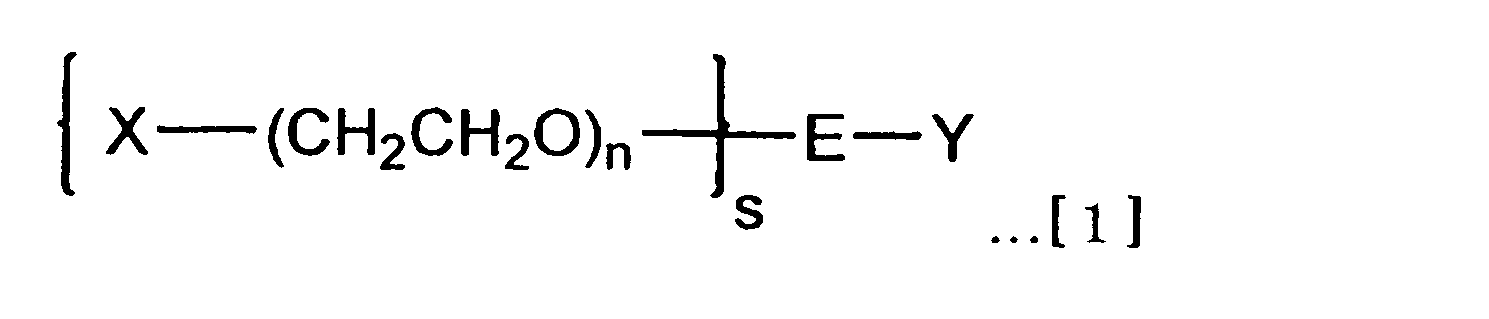
(1) 式[1]で示される分岐型ヘテロポリエチレングリコール。
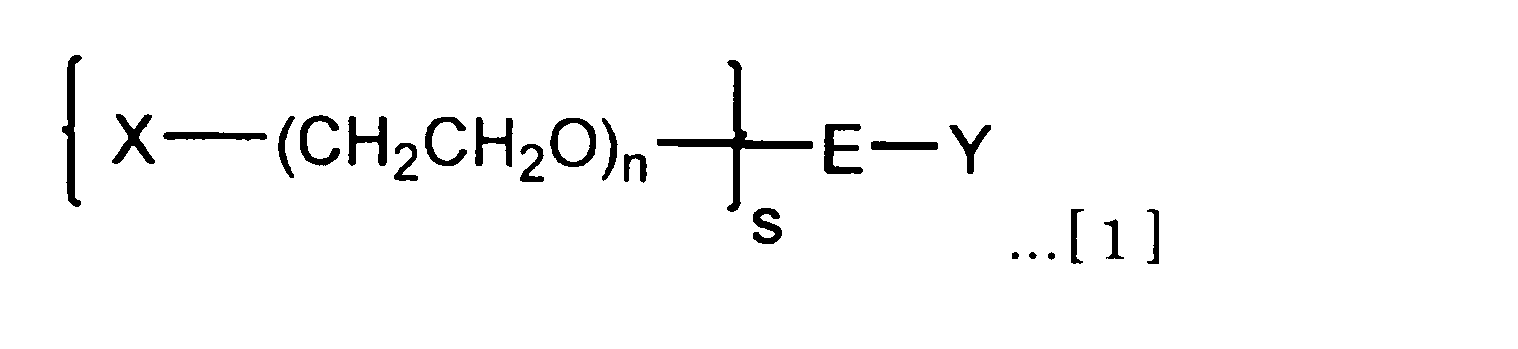
(X、Yは,それぞれ、生体機能性分子に存在する官能基と反応して共有結合を形成する官能基を少なくとも含む原子団であり、原子団Xが含む官能基と原子団Yが含む官能基とは互いに異なっている。
sは、ポリエチレングリコール鎖の本数を表す2~8の整数である。
nは、ポリエチレングリコール鎖の平均付加モル数であり、20≦n≦2000である。
Eは、ポリエチレングリコール鎖に対してs価の結合価数を有し、官能基Yに対して1価の結合価数を有する分岐リンカー部位である。)
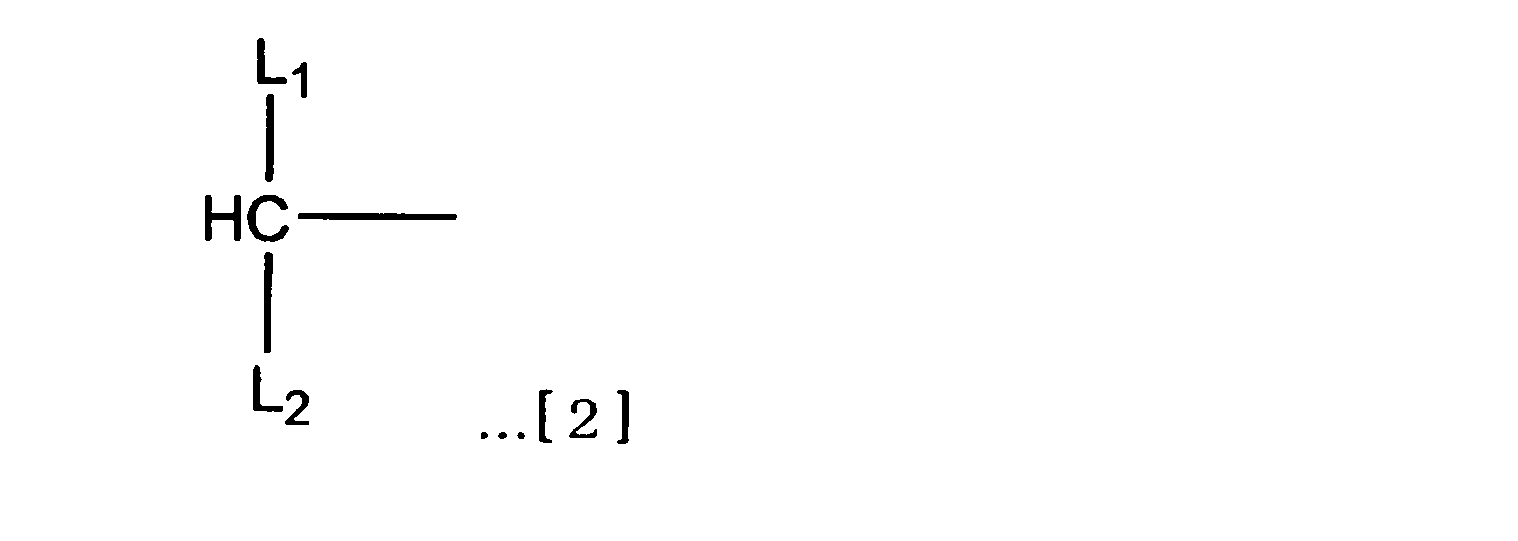
(CHは官能基Yに対して結合している。L1は、p本のポリエチレングリコール鎖に対して結合している結合部位であり、L2は、q本のポリエチレングリコール鎖に対して結合している結合部位であり、互いに同一でも異なっていても良く、それぞれ、エーテル結合、エステル結合、ウレタン結合、アミド結合、カーボネート結合、2級アミノ基、もしくはこれらを含む飽和炭化水素基、単結合または飽和炭化水素基である。
p、qはそれぞれ1~7の整数であり、p≧qであり、p+q=sである。)

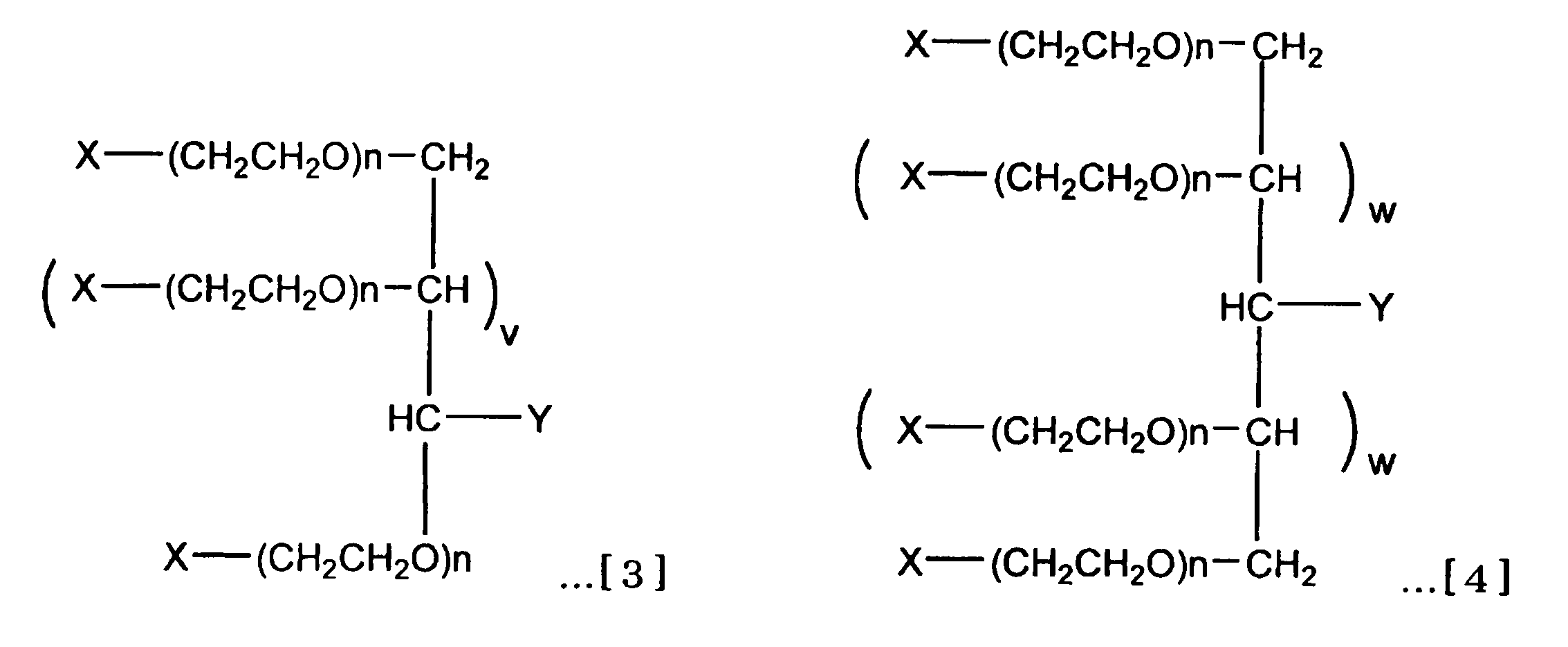
(v=0または2であり、w=0または1である。)
(CH2CH2O)nで表されるポリエチレングリコール鎖は、下記別途定義する繰り返しユニット数nを有する直線状のポリマー部位である。

Y- = Y’- W’- …[6]


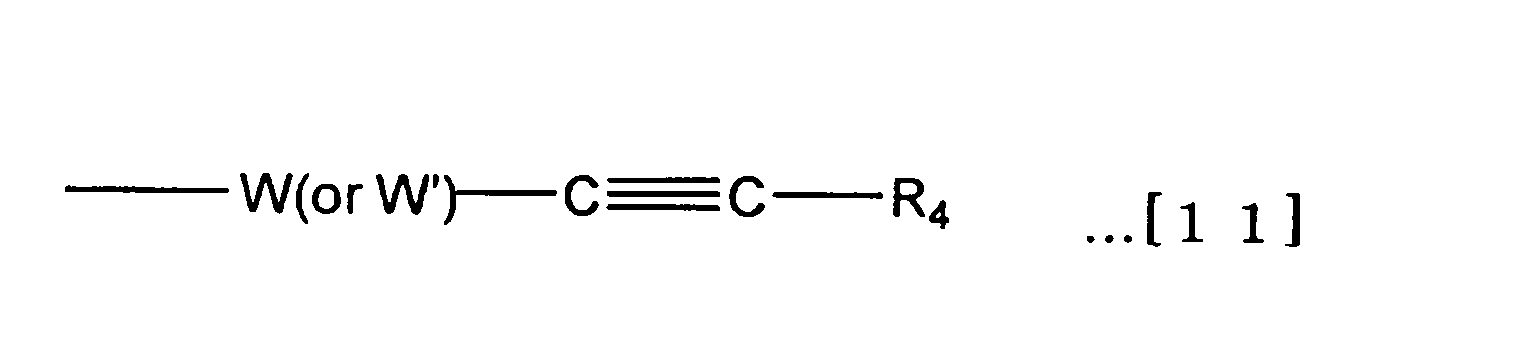
官能基X’と官能基Y’の組み合わせとして、X’がアセタール基のときはY’はマレイミド基、ビニルスルホン基、ヨードアセトアミド基、活性エステル基、活性カーボネート基、アミノ基、アミノオキシ基から選ばれる基であり、X’がアルデヒド基のときは、Y’はマレイミド基、ビニルスルホン基、アセチレン基、アジド基から選ばれる基であり、X’がマレイミド基、ビニルスルホン基、もしくはヨードアセトアミド基のときはY’はアセタール基、活性エステル基、活性カーボネート基、アセチレン基、アジド基から選ばれる基であり、X’が活性エステル基もしくは活性カーボネート基のときはY’はアセタール基、マレイミド基、ビニルスルホン基、ヨードアセトアミド基、アセチレン基、アジド基から選ばれる基であり、X’ がアミノ基もしくはアミノオキシ基のときはY’はアセタール基、アセチレン基、アジド基から選ばれる基であり、X’がアセチレン基、アジド基のときはY’ はアセタール基、アルデヒド基、マレイミド基、ビニルスルホン基、ヨードアセトアミド基、活性エステル基、活性カーボネート基、アミノ基、アミノオキシ基から選ばれる基である。最も好ましくは、X’がアセタール基のときはY’はマレイミド基、活性エステル基、活性カーボネート基、アミノ基、アミノオキシ基から選ばれる基であり、X’がマレイミド基のときはY’はアセタール基、活性エステル基、活性カーボネート基、アセチレン基、アジド基から選ばれる基であり、X’が活性エステル基もしくは活性カーボネート基のときはY’はアセタール基、マレイミド基、アセチレン基、アジド基から選ばれる基であり、X’ がアミノ基もしくはアミノオキシ基のときはY’はアセタール基、アセチレン基、アジド基から選ばれる基であり、X’がアセチレン基、アジド基のときはY’ はアセタール基、マレイミド基、活性エステル基、活性カーボネート基、アミノ基、アミノオキシ基から選ばれる基である。




続いて、式[15]の分岐型ポリエチレングリコール化合物に対して、トルエンを加え、常圧にて還流脱水した後、トリエチルアミンなど塩基の存在下に過剰量のメタンスルホニルクロリドを添加し、メシレート体とする。これに3,3-ジエトキシ-1-プロパノールのナトリウムアルコラート化物を反応させ、ジエトキシアセタール基を導入し、式[16]の化合物を得る。

次に、式[16]の化合物をPd/Cなどの還元触媒と、水素ガスやシクロヘキセンなどの水素供与体の存在下に接触還元を行い、脱ベンジル反応を行い、式[17]の化合物を得る。

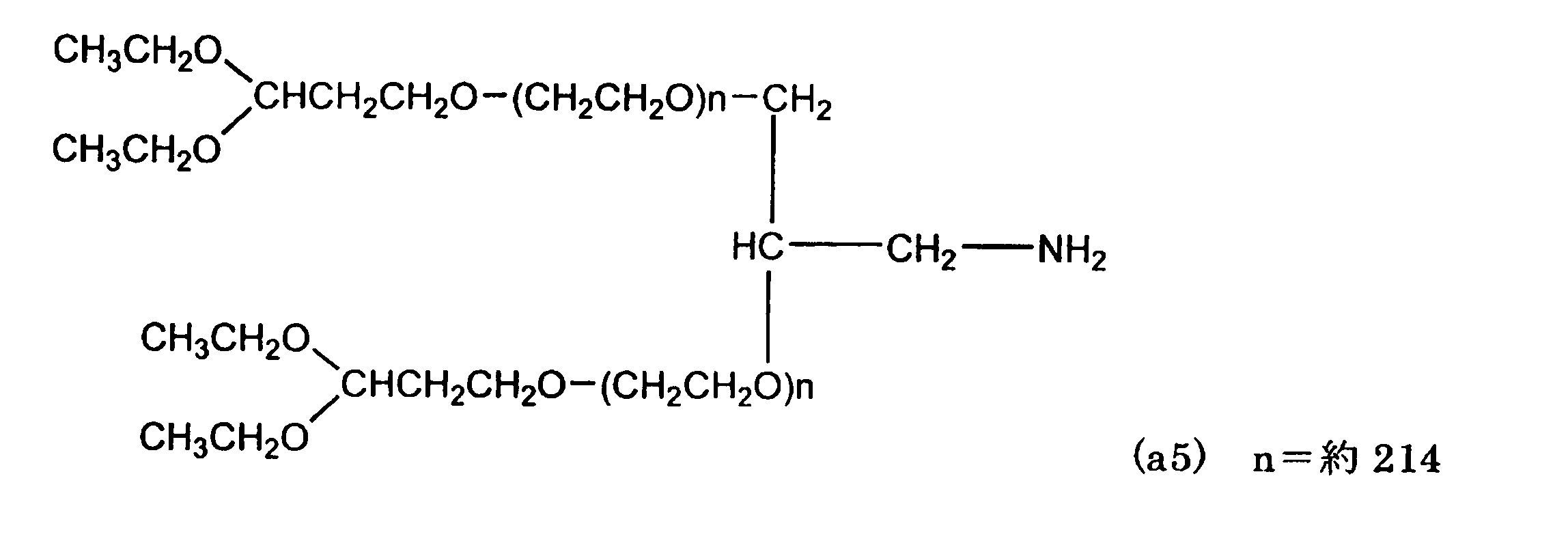
次に、式[17]の化合物を官能基変換して以下のように様々な官能基を導入する。トルエンを加え、常圧にて還流脱水した後、トリエチルアミン存在下に過剰量のメタンスルホニルクロリドを添加し、メシレート体とした後、これにアンモニアを反応させ、アミノ基を導入し、式[18]の化合物を得る。

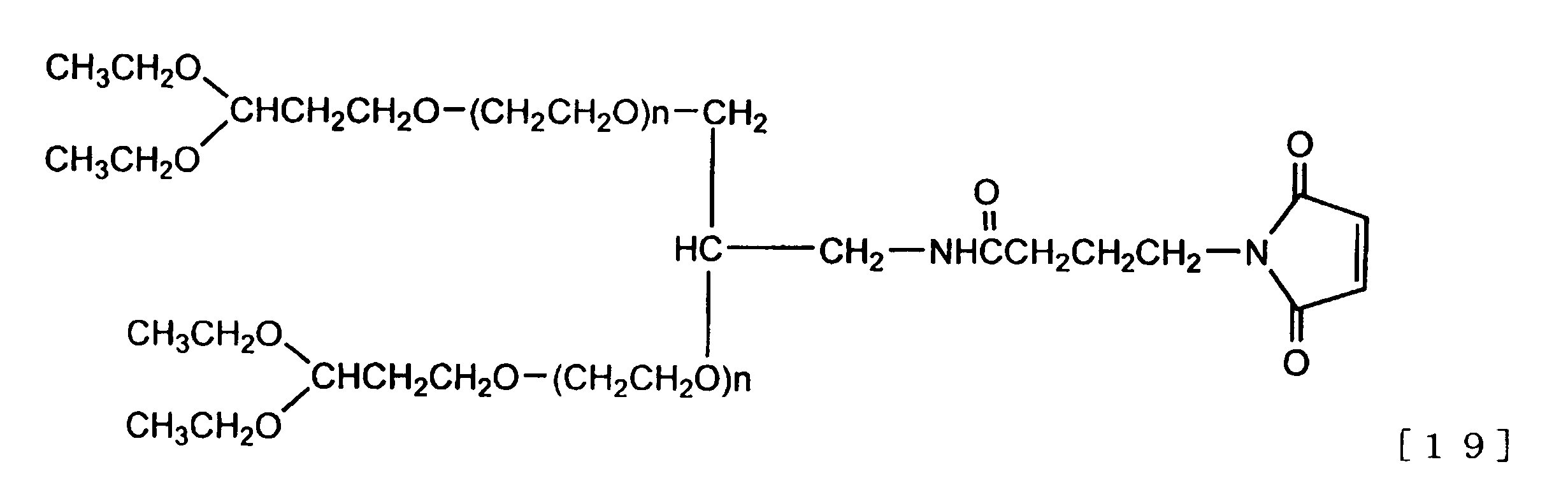
式[18]、式[19]で示される分岐型ヘテロポリエチレングリコールはこの状態で生体機能性分子との反応に用いることが可能であるが、例えば式[19]の化合物に関しては、適切な酸性条件を選択することによりマレイミド基を残存させたまま脱保護を行い、アセタール基をアルデヒド基へと変換することも可能である。

温度計、窒素吹き込み管、攪拌機を装備した300ml4つ口フラスコへ3-ベンジルオキシー1,2-プロパンジオール18.2g(0.1mol)、脱水トルエン150g、金属ナトリウム0.9g(39mmol:26mol%)を加え、窒素を吹き込みながら金属ナトリウムが溶解するまで室温で攪拌した。この溶液を5Lオートクレーブへ仕込み、系内を窒素置換後、100℃に昇温し、100~130℃、1MPa以下の圧力でエチレンオキシド1,982g(45mol)を加えた後、更に2時間反応を続けた。減圧にて未反応のエチレンオキシドガスを除去後、60℃に冷却して85%リン酸水溶液にてpHを7.5に調整し、下記化合物(a1)を得た。
1H-NMR; δ(ppm):
3.40-3.90(1785H、m、HO(CH 2 CH 2 O)n-CH 2 、HO(CH 2 CH 2 O)n-CH、CH 2 O-CH2Ph)、 4.54(2H、s、-CH 2 Ph)、 7.27-7.38(5H、m、-CH2 Ph)
GPC分析;
数平均分子量(Mn):19,654、重量平均分子量(Mw):20,285、多分散度(Mw/Mn):1.032

温度計、窒素吹き込み管、攪拌機、Dean-stark管、及び冷却管を付した3L4つ口フラスコへ上記化合物(a1)を372g(18.6mmol)、トルエン1,860gを仕込み、加熱還流させ、水分を共沸除去した。室温へ冷却後、トリエチルアミン6.02g(59.5mmol)、メタンスルホン酸クロリド5.54g(48.4mmol)を加え、40℃にて3時間反応させた。続いて、ナトリウムを2.58g(112mmol)溶解させた3,3-ジエトキシ-1-プロパノール85.6g(465mmol)のトルエン(256.8g)溶液を加え、70℃で5時間反応させた。反応液をろ過後、濾液を10Lステンレスポットへ移し、酢酸エチル1,488g、エタノール1,488g、ヘキサン2,976gを加えて晶析を行った。析出した結晶をろ過して溶剤を除去した後、結晶を10Lステンレスポットへ移し、酢酸エチル1,488g、エタノール1,488gを加えて40℃にて加温溶解後、20℃に冷却してヘキサン2,976gを加えて晶析を行った。以後同様の晶析を3回繰り返し、ヘキサンで洗浄した後、結晶を濾取、乾燥し、下記化合物(a2)を得た。
1H-NMR; δ(ppm):
1.16-1.24(12H、t、(CH 3 CH2O)2-CHCH2CH2-)、 1.85-1.95(4H、q、(CH3CH2O)2-CHCH 2 CH2-)、 3.40-3.90 (1725H、m, -(CH 2 CH 2O)n-CH 2、-(CH 2 CH 2O)n-CH、CH 2O-CH2Ph、(CH3 CH 2 O)2-CHCH2 CH 2-)、 4.54(2H、s、-CH 2Ph)、 4.60-4.68(2H、t、(CH3CH2O)2-CHCH2CH2-)、 7.27-7.38(5H、m、-CH2 Ph)
GPC分析;
数平均分子量(Mn):19,190、重量平均分子量(Mw):19,496、多分散度(Mw/Mn):1.016

温度計、窒素吹き込み管、攪拌機、及び冷却管を付した1L4つ口フラスコへ上記化合物(a2)を50g、5%パラジウムカーボン(50%含水品)25gを仕込み、窒素置換後、メタノール400g、シクロヘキセン67gを加えて昇温し、52~55℃で緩やかに還流させ、2時間反応させた。反応液を室温まで冷却後、パラジウムカーボンを濾別し、濾液を濃縮した。濃縮液にトルエン400g、ヘキサン200gを加えて晶析した。得られた結晶を濾取、乾燥し、下記化合物(a3)を得た。
1H-NMR; δ(ppm):
1.16-1.24(12H、t、(CH 3 CH2O)2-CHCH2CH2-)、 1.85-1.95(4H、q、(CH3CH2O)2-CHCH 2 CH2-)、 3.40-3.90 (1673H、m, -(CH 2 CH 2O)n-CH 2、-(CH 2 CH 2O)n-CH、CH 2OH、(CH3 CH 2 O)2-CHCH2 CH 2-)、 4.60-4.68(2H、t、(CH3CH2O)2-CHCH2CH2-)
GPC分析;
数平均分子量(Mn):18,573、重量平均分子量(Mw):19,123、多分散度(Mw/Mn):1.030

温度計、窒素吹き込み管、攪拌機、Dean-stark管、及び冷却管を付した200mL3つ口フラスコへ上記化合物(a3)を13.1g(0.66mmol)、トルエン79gを仕込み、加熱還流させ、水分を共沸除去した。室温へ冷却後、トリエチルアミン0.33g(3.3mmol)、メタンスルホン酸クロリド0.30g(2.6mmol)を加え、40℃にて3時間反応させた。反応液をろ過後、濾液を300mLビーカーへ移し、酢酸エチル100g、ヘキサン50gを加えて晶析を行った。析出した結晶をろ過して溶剤を除去した後、結晶を10Lステンレスポットへ移し、酢酸エチル1,488g、エタノール1,488gを加えて40℃にて加温溶解後、20℃に冷却してヘキサン2,976gを加えて晶析を行った。以後同様の晶析を3回繰り返し、ヘキサンで洗浄した後、結晶を濾取、乾燥し、下記化合物(a4)を得た。
1H-NMR; δ(ppm):
1.16-1.24(12H、t、(CH 3 CH2O)2-CHCH2CH2-)、 1.85-1.95(4H、q、(CH3CH2O)2-CHCH 2 CH2-)、 3.08(3H、s、-OSO2 CH 3)、 3.40-3.90 (1732H、m, -(CH 2 CH 2O)n-CH 2、-(CH 2 CH 2O)n-CH、CH 2OH、(CH3 CH 2 O)2-CHCH2 CH 2-)、 4.24-4.44(2H, m, -CH 2O-OSO2CH3)、 4.60-4.68(2H、t、(CH3CH2O)2-CHCH2CH2-)
GPC分析;
数平均分子量(Mn):19,274、重量平均分子量(Mw):20,046、多分散度(Mw/Mn):1.040

温度計、窒素吹き込み管、攪拌機、Dean-stark管、及び冷却管を付した100mL3つ口フラスコへ上記化合物(a4)を10.0g(0.50mmol)、アンモニア水80g、イオン交換水20gを仕込み、55℃にて8時間反応させた。55℃で10時間微減圧としてアンモニアを除去し、クロロホルム100gを加えて抽出した。このクロロホルム溶液を濃縮した後、トルエン52gを加えて40℃で溶解しろ過した後、200mLビーカーで室温においてヘキサン30gを加えて晶析を行った。析出した結晶をろ過して溶剤を除去した後、ヘキサンで洗浄、結晶を濾取、乾燥し、下記化合物(a5)を得た。
1H-NMR; δ(ppm):
1.16-1.24(12H、t、(CH 3 CH2O)2-CHCH2CH2-)、 1.85-1.95(4H、q、(CH3CH2O)2-CHCH 2 CH2-)、 2.70-2.95(2H、m、-CH 2NH2)、 3.40-3.90 (1730H、m, -(CH 2 CH 2O)n-CH 2、-(CH 2 CH 2O)n-CH、CH 2OH、(CH3 CH 2 O)2-CHCH2 CH 2-)、 4.60-4.68(2H、t、(CH3CH2O)2-CHCH2CH2-)
GPC分析;
数平均分子量(Mn):19,217、重量平均分子量(Mw):20,362、多分散度(Mw/Mn):1.060
温度計、窒素吹き込み管、攪拌機、Dean-stark管、及び冷却管を付した100mL3つ口フラスコへ上記化合物(a5)を5.0g(0.25mmol)、トルエン26g、アセトニトリル4.0g、N-メチルモルホリン(1.25mmol)、N-Succinimidyl3-maleimidopropionate(0.375mmol)を仕込み、室温にて4時間反応させた。この溶液をろ過した後、室温において300mLビーカーで酢酸エチル100g、ヘキサン50gを添加して晶析を行った。次に酢酸エチルを100gを添加し40℃で結晶を溶解させた後、室温に冷却してヘキサンを100g添加し析出した。この晶析をあと2回繰り返した後、ヘキサンで洗浄、結晶を濾取、乾燥し、下記化合物(a6)を得た。
1H-NMR; δ(ppm):
1.16-1.24(12H、t、(CH 3 CH2O)2-CHCH2CH2-)、 1.85-1.95(4H、q、(CH3CH2O)2-CHCH 2 CH2-)、 2.51(2H、t、NHCOCH 2CH2)、 3.40-3.90 (1736H、m, -(CH 2 CH 2 O)n-CH 2 、-(CH 2 CH 2 O)n-CH、CH 2 OH、(CH3 CH 2 O)2-CHCH2 CH 2 -、CH 2 NHCOCH2 CH 2 )、 4.60-4.68(2H、t、(CH3CH2O)2-CHCH2CH2-)、 6.70(2H, s, CH=CH )
GPC分析;
数平均分子量(Mn):19,395、重量平均分子量(Mw):20,600、多分散度(Mw/Mn):1.062
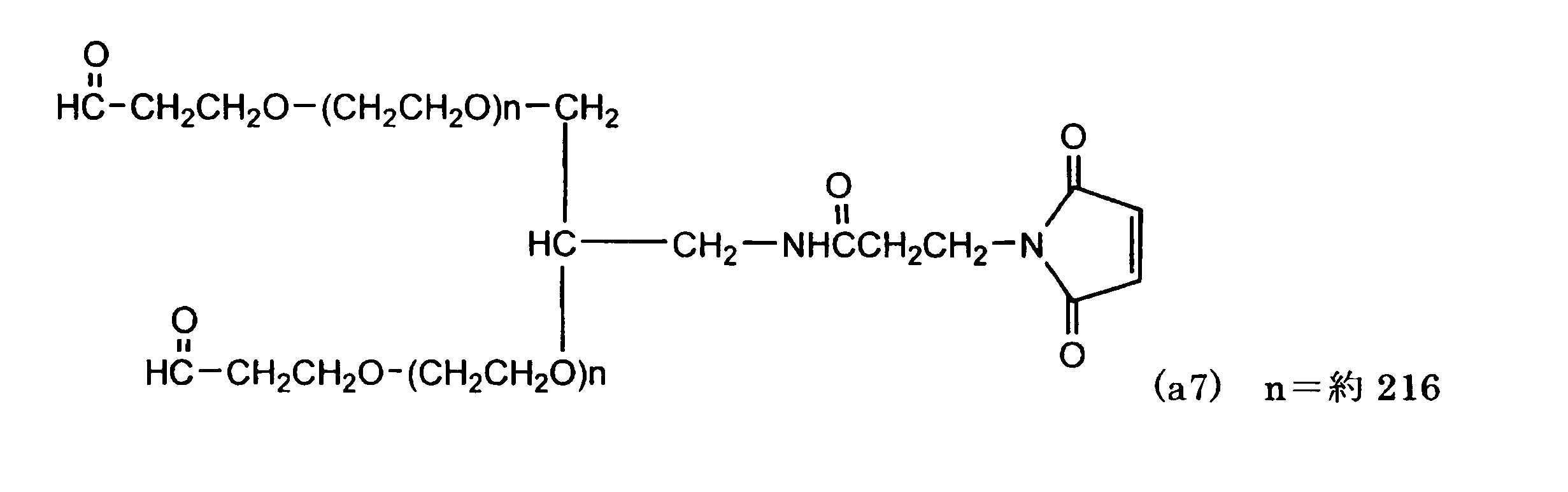
温度計、窒素吹き込み管、及び攪拌子を付した200mLビーカーへ上記化合物(a5)を2.0g(0.10mmol)、イオン交換水40gを仕込み溶解させた。塩酸でpH2に調製し、室温で2時間攪拌した後、水酸化ナトリウム水溶液でpH6に中和し、クロロホルム100gを加えて抽出した。このクロロホルム溶液を濃縮した後、トルエン40gを加えて40℃で溶解しろ過した後、200mLビーカーで室温においてヘキサン20gを加えて晶析を行った。析出した結晶をろ過して溶剤を除去した後、ヘキサンで洗浄、結晶を濾取、乾燥し、下記化合物(a7)を得た。
1H-NMR; δ(ppm):
2.51(2H、t、NHCOCH 2CH2)、 2.63-2.73(4H、HCO-CH 2 CH2-)、 3.40-3.90 (1735H、m, -(CH 2 CH 2 O)n-CH 2 、-(CH 2 CH 2 O)n-CH、HCO-CH2 CH 2 -、CH 2 NHCOCH2 CH 2 )、 6.70(2H,s, CH=CH )、 9.80(2H、HCO-CH2CH2-)
GPC分析;
数平均分子量(Mn):19,319、重量平均分子量(Mw):20,634、多分散度(Mw/Mn):1.068
温度計、窒素吹き込み管、攪拌機、Dean-stark管、及び冷却管を付した1L4つ口フラスコへ上記化合物(a1)を200g(10.0mmol)、トルエン600gを仕込み、加熱還流させ、水分を共沸除去した。40℃へ冷却後、脱水クロロホルム1,000g、フタルイミド8.83g(60.0mmol)、トリフェニホスフィン15.7g(60.0mmol)を加え攪拌溶解し、室温に冷却後ジイソプロピルアゾジカルボキシレート12.1g(60.0mmol)40度にて3時間反応させた。続いて、ナトリウムを2.58g(112mmol)溶解させた3,3-ジエトキシ-1-プロパノール85.6g(465mmol)のトルエン(256.8g)溶液を加え、70℃で5時間反応させた。反応液をろ過後、濾液を10Lステンレスポットへ移し、酢酸エチル1,488g、エタノール1,488g、ヘキサン2,976gを加えて晶析を行った。析出した結晶をろ過して溶剤を除去した後、結晶を10Lステンレスポットへ移し、酢酸エチル1,488g、エタノール1,488gを加えて40℃にて加温溶解後、20℃に冷却してヘキサン2,976gを加えて晶析を行った。以後同様の晶析を3回繰り返し、ヘキサンで洗浄した後、結晶を濾取、乾燥し、下記化合物(a8)を得た。
1H-NMR; δ(ppm):
3.40-3.90(1728H、m、 (CH 2 CH 2 O)n-CH 2 、 (CH 2 CH 2 O)n-CH、CH 2 O-CH2Ph)、 4.54(2H、s、-CH 2 Ph)、 7.27-7.38(5H、m、-CH2 Ph)、 7.65-7.95(4H、m、Ph(CO)2N-)
GPC分析;
数平均分子量(Mn):19,398、重量平均分子量(Mw):19,824、多分散度(Mw/Mn):1.022

温度計、窒素吹き込み管、攪拌機、及び冷却管を付した1L4つ口フラスコへ上記化合物(a8)を50g、5%パラジウムカーボン(50%含水品)25gを仕込み、窒素置換後、メタノール500g、シクロヘキセン68gを加えて昇温し、52~55℃で緩やかに還流させ、5時間反応させた。反応液を室温まで冷却後、パラジウムカーボンを濾別し、濾液を濃縮した。濃縮液にトルエン400g、ヘキサン200gを加えて晶析した。得られた結晶を濾取、乾燥し、下記化合物(a9)を得た。
1H-NMR; δ(ppm):
3.40-3.90 (1684H、m、-(CH 2 CH 2 O)n-CH 2 、-(CH 2 CH 2 O)n-CH、CH 2 OH)、 7.65-7.95(4H、m、Ph(CO)2N-)
GPC分析;
数平均分子量(Mn):18,817、重量平均分子量(Mw):19,171、多分散度(Mw/Mn):1.019

温度計、窒素吹き込み管、攪拌機、Dean-stark管、及び冷却管を付した1L4つ口フラスコへ上記化合物(a1)を200g(10.0mmol)、トルエン600gを仕込み、加熱還流させ、水分を共沸除去した。40℃へ冷却後、脱水クロロホルム1,000g、フタルイミド8.83g(60.0mmol)、トリフェニホスフィン15.7g(60.0mmol)を加え攪拌溶解し、室温に冷却後ジイソプロピルアゾジカルボキシレート12.1g(60.0mmol)40度にて3時間反応させた。続いて、ナトリウムを2.58g(112mmol)溶解させた3,3-ジエトキシ-1-プロパノール85.6g(465mmol)のトルエン(256.8g)溶液を加え、70℃で5時間反応させた。反応液をろ過後、濾液を10Lステンレスポットへ移し、酢酸エチル1,488g、エタノール1,488g、ヘキサン2,976gを加えて晶析を行った。析出した結晶をろ過して溶剤を除去した後、結晶を10Lステンレスポットへ移し、酢酸エチル1,488g、エタノール1,488gを加えて40℃にて加温溶解後、20℃に冷却してヘキサン2,976gを加えて晶析を行った。以後同様の晶析を3回繰り返し、ヘキサンで洗浄した後、結晶を濾取、乾燥し、下記化合物(a10)を得た。
1H-NMR; δ(ppm):
2.83-2.89(4H、t、NH2-CH 2 CH2-)、 3.40-3.90 (1676H、m、-(CH 2 CH 2 O)n-CH 2 、-(CH 2 CH 2 O)n-CH、CH 2 OH)
GPC分析;
数平均分子量(Mn):18,559、重量平均分子量(Mw):19,264、多分散度(Mw/Mn):1.038

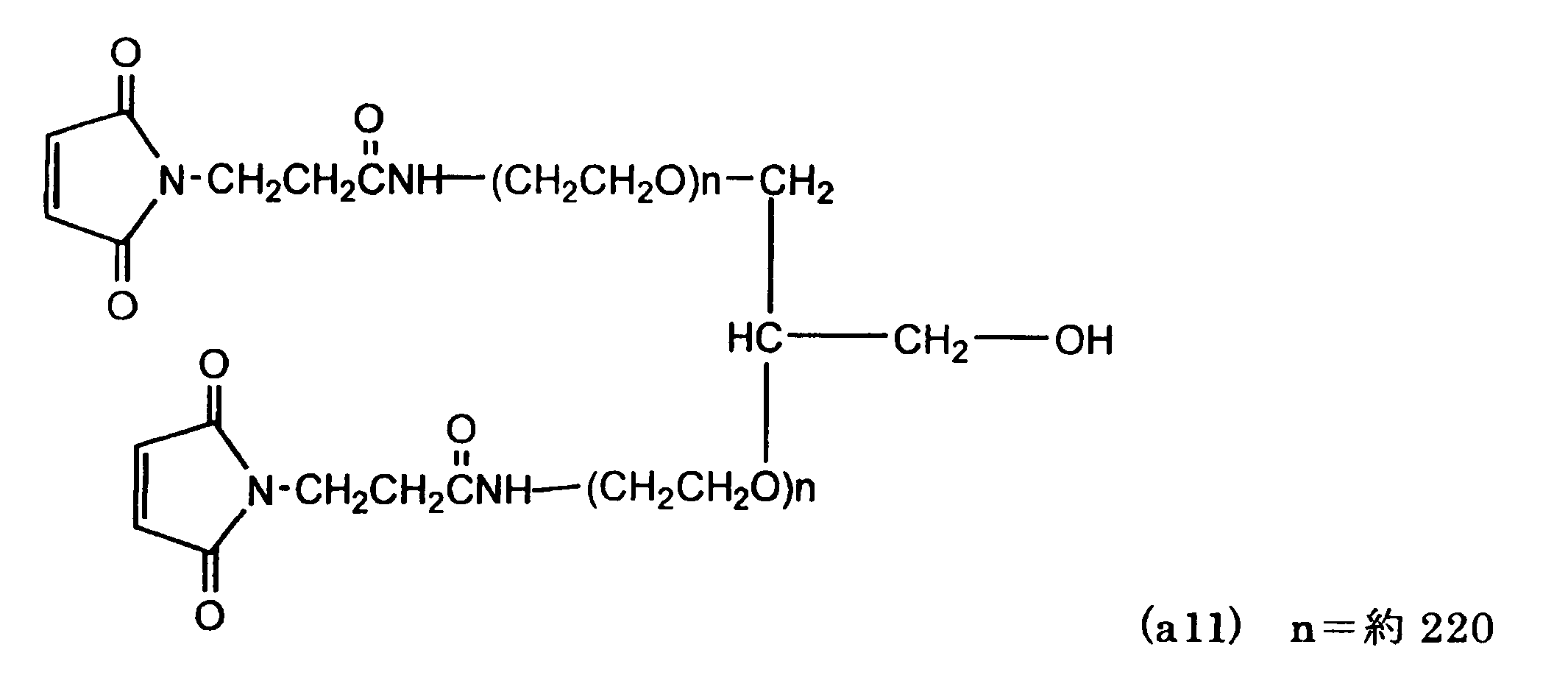
温度計、窒素吹き込み管、攪拌機、Dean-stark管、及び冷却管を付した100mL3つ口フラスコへ上記化合物(a5)を5.0g(0.25mmol)、トルエン26g、アセトニトリル4.0g、N-メチルモルホリン(2.50mmol)、N-Succinimidyl3-maleimidopropionate(0.75mmol)を仕込み、室温にて4時間反応させた。この溶液をろ過した後、室温において300mLビーカーで酢酸エチル100g、ヘキサン50gを添加して晶析を行った。次に酢酸エチルを100gを添加し40℃で結晶を溶解させた後、室温に冷却してヘキサンを100g添加し析出した。この晶析をあと2回繰り返した後、ヘキサンで洗浄、結晶を濾取、乾燥し、下記化合物(a11)を得た。
1H-NMR; δ(ppm):
2.51(2H、t、CH2 CH 2 CONH)、 3.40-3.90 (1767H、m, -(CH 2 CH 2 O)n-CH 2 、-(CH 2 CH 2 O)n-CH、CH 2 OH、CH 2 CH2CONH)、 6.50(1H、s、CH2CH2CONH)、 6.70(2H, s, CH=CH)
GPC分析;
数平均分子量(Mn):19,734、重量平均分子量(Mw):21,336、多分散度(Mw/Mn):1.081
温度計、窒素吹き込み管、攪拌機、Dean-stark管、及び冷却管を付した100mL3つ口フラスコへ上記化合物(a5)を4.0g(0.20mmol)、ジクロロメタン20g、トリエチルアミン(2.50mmol)、N,N-Disuccinimidyl carbonate(0.75mmol)を仕込み、室温にて4時間反応させた。この溶液をろ過、濃縮した後、300mLビーカーで酢酸エチル100g、ヘキサン50gを添加して晶析を行った。次に酢酸エチルを100gを添加し40℃で結晶を溶解させた後、室温に冷却してヘキサンを100g添加し析出した。この晶析をあと3回繰り返した後、ヘキサンで洗浄、結晶を濾取、乾燥し、下記化合物(a12)を得た。
1H-NMR; δ(ppm):
2.51(2H、t、CH2 CH 2 CONH)、 2.84(4H、s、-CH2O-COO-succinimide)、 3.40-3.90 (1751H、m, -(CH 2 CH 2 O)n-CH 2 、-(CH 2 CH 2 O)n-CH、-CH 2 O-COO-succinimide、CH 2 CH2CONH)、 4.36-4.52(2H, m, -CH 2O-COO-succinimide)、 6.37(1H、s、CH2CH2CONH)、 6.70(2H, s, CH=CH)
GPC分析;
数平均分子量(Mn):19,659、重量平均分子量(Mw):21,450、多分散度(Mw/Mn):1.091
10mMリン酸バッファー(pH=6.4)1mlに対してGRGDS(Gly -Arg -Gly -Asp -Ser、分子量:490.5)を2.5mg(5.1μmol)溶解させた。この溶液200μlに化合物(a12)を10mg(0.5μmol)を加え、室温にて1時間反応させ、化合物中の1つの活性カーボネート基にGRGDSを修飾した。続いて Humanin (Met -Ala -Pro -Arg -Gly -Phe -Ser -Cys -Leu -Leu -Leu -Leu -Thr -Ser -Glu -Ile - Asp -Leu -Pro -Val -Lys -Arg -Arg -Ala、分子量:2,687.2)20mg(7.4μmol)をこの溶液に加え、室温にて10時間反応させ、化合物中の2つのマレイミド基にHumaninを修飾した。反応液200μlを、SP-Sepharose FF(アマシャム社製)カラムにチャージし、20mM Tris-HClバッファー(pH8.2)で平衡化した。平衡化後、1Nとなる様NaClを加えたバッファーをカラムに通し、UVにて溶出液をモニターしながら、1つのGRGDSと、2つのHumaninが修飾されたPEG化合物の分画を得た。この分画20μlとトリスSDSサンプル処理液20μlを混合後、沸騰水浴中で2分30秒加温し、この溶液20μlを、ドデシル硫酸ナトリウムーポリアクリルアミドゲル電気泳動で分析した。染色はCBB染色で行った。この結果、各標準サンプルと比較を行なうことにより、1つのGRGDS、2つのHumaninが化合物(a12)に修飾されたものが得られたことが示された。
なお、本出願は、2010年6月25日付で出願された日本特許出願(特願2010-145383)および2011年3月28日付で出願された日本特許出願(特願2011-070735)に基づいており、その全体が引用により援用される。また、ここに引用されるすべての参照は全体として取り込まれる。
Claims (9)
- 式[1]で示される分岐型ヘテロポリエチレングリコール。

(X、Yは,それぞれ、生体機能性分子に存在する官能基と反応して共有結合を形成する官能基を少なくとも含む原子団であり、原子団Xが含む前記官能基と原子団Yが含む前記官能基とは互いに異なっている。
sは、ポリエチレングリコール鎖の本数を表す2~8の整数である。
nは、ポリエチレングリコール鎖の平均付加モル数であり、20≦n≦2000である。
Eは、ポリエチレングリコール鎖に対してs価の結合価数を有し、官能基Yに対して1価の結合価数を有する分岐リンカー部位である。) - 前記分岐リンカー部位Eが式[2]で表されることを特徴とする、請求項1記載の分岐型ヘテロポリエチレングリコール。

(CHは原子団Yに対して結合している。
L1は、p本のポリエチレングリコール鎖に対して結合している結合部位であり、L2は、q本のポリエチレングリコール鎖に対して結合している結合部位であり、互いに同一でも異なっていても良く、それぞれ、エーテル結合、エステル結合、ウレタン結合、アミド結合、カーボネート結合、2級アミノ基もしくはこれらを含む飽和炭化水素基、単結合または飽和炭化水素基である。
p、qはそれぞれ1~7の整数であり、p≧qであり、p+q=sである。) - L1、L2が、それぞれ、エーテル結合、ウレタン結合、アミド結合もしくはこれらを含む飽和炭化水素基、単結合または飽和炭化水素基である、請求項2記載の分岐型ヘテロポリエチレングリコール。
- L1、L2が、ともに、エーテル結合を含む飽和炭化水素基、単結合または飽和炭化水素基である、請求項3記載の分岐型ヘテロポリエチレングリコール。
- 式[3]または[4]で表される、請求項4記載の分岐型ヘテロポリエチレングリコール。

(v=0または2であり、w=0または1である。) - 前記原子団Xの前記官能基および前記原子団Yの前記官能基が、それぞれ、アセタール基、アルデヒド基、マレイミド基、ビニルスルホン基、ヨードアセトアミド基、活性エステル基、活性カーボネート基、カルボキシル基、アミノ基、アミノオキシ基、チオール基、アリル基、ビニル基、アセチレン基およびアジド基からなる群より選ばれる、請求項1~5のいずれか一つの請求項に記載の分岐型ヘテロポリエチレングリコール。
- 前記原子団Xの前記官能基と前記原子団Yの前記官能基との少なくとも一方が、カルボキシル基、アミノ基、アミノオキシ基およびチオール基からなる群より選ばれる、請求項6記載の分岐型ヘテロポリエチレングリコール。
- 請求項1~7のいずれか一つの請求項に記載の分岐型ヘテロポリエチレングリコールの中間体であって、前記原子団Xの前記官能基および前記原子団Yの前記官能基のうち少なくとも一つが保護基によって保護されていることを特徴とする、中間体。
- 請求項1~7のいずれか一つの請求項に記載の分岐型ヘテロポリエチレングリコールの末端に生体機能性分子が結合されている、ポリエチレングリコール結合体。
Priority Applications (4)
| Application Number | Priority Date | Filing Date | Title |
|---|---|---|---|
| CN201180031483.6A CN102985462B (zh) | 2010-06-25 | 2011-06-21 | 支链异聚乙二醇和中间体 |
| EP11798136.5A EP2586811B1 (en) | 2010-06-25 | 2011-06-21 | Branched hetero-polyethylene glycol and intermediate |
| CA2803556A CA2803556C (en) | 2010-06-25 | 2011-06-21 | Branched hetero polyethylene glycol and intermediate |
| KR1020127033512A KR101777437B1 (ko) | 2010-06-25 | 2011-06-21 | 분지형 헤테로―폴리에틸렌 글리콜 및 중간체 |
Applications Claiming Priority (4)
| Application Number | Priority Date | Filing Date | Title |
|---|---|---|---|
| JP2010145383 | 2010-06-25 | ||
| JP2010-145383 | 2010-06-25 | ||
| JP2011-070735 | 2011-03-28 | ||
| JP2011070735A JP5825507B2 (ja) | 2010-06-25 | 2011-03-28 | 分岐型ヘテロポリエチレングリコール |
Publications (1)
| Publication Number | Publication Date |
|---|---|
| WO2011162252A1 true WO2011162252A1 (ja) | 2011-12-29 |
Family
ID=45371434
Family Applications (1)
| Application Number | Title | Priority Date | Filing Date |
|---|---|---|---|
| PCT/JP2011/064154 Ceased WO2011162252A1 (ja) | 2010-06-25 | 2011-06-21 | 分岐型ヘテロポリエチレングリコールおよび中間体 |
Country Status (6)
| Country | Link |
|---|---|
| EP (1) | EP2586811B1 (ja) |
| JP (1) | JP5825507B2 (ja) |
| KR (1) | KR101777437B1 (ja) |
| CN (1) | CN102985462B (ja) |
| CA (1) | CA2803556C (ja) |
| WO (1) | WO2011162252A1 (ja) |
Cited By (3)
| Publication number | Priority date | Publication date | Assignee | Title |
|---|---|---|---|---|
| WO2013147015A1 (ja) * | 2012-03-30 | 2013-10-03 | 日油株式会社 | マルチアーム型ポリエチレングリコール誘導体、その中間体及び製造方法 |
| WO2018066692A1 (ja) * | 2016-10-07 | 2018-04-12 | 国立大学法人東京工業大学 | 分岐型ヘテロ単分散ポリエチレングリコール、その製造方法、及びその結合体 |
| JP2019507819A (ja) * | 2016-02-26 | 2019-03-22 | ハンミ・ファイン・ケミカル・カンパニー・リミテッドHanmi Fine Chemical Co., Ltd. | ポリエチレングリコールジアルデヒド誘導体の製造方法 |
Families Citing this family (16)
| Publication number | Priority date | Publication date | Assignee | Title |
|---|---|---|---|---|
| US10040761B2 (en) * | 2010-06-25 | 2018-08-07 | Nof Corporation | Branched hetero polyethylene glycol and intermediate |
| GB201210770D0 (en) * | 2012-06-18 | 2012-08-01 | Polytherics Ltd | Novel conjugation reagents |
| EP3078699B1 (en) * | 2013-12-02 | 2019-08-21 | Jenkem Technology Co. Ltd. (Tianjin) | Multi-arm polyethylene glycol-nitrine derivative |
| JP6106104B2 (ja) | 2014-01-16 | 2017-03-29 | 信越化学工業株式会社 | 末端にアミノ基を有する狭分散ポリアルキレングリコール誘導体の製造方法 |
| JP6106103B2 (ja) * | 2014-01-16 | 2017-03-29 | 信越化学工業株式会社 | 末端にアミノ基を有する狭分散ポリアルキレングリコール誘導体の製造方法、並びにこれに用いる新規なアセタール基含有アルコール化合物及びそのアルカリ金属塩 |
| CN104109235B (zh) * | 2014-05-30 | 2017-07-18 | 厦门赛诺邦格生物科技股份有限公司 | 一种具有氮原子支化中心的单一官能化聚乙二醇、制备方法及其生物相关物质 |
| CN104109238A (zh) * | 2014-07-13 | 2014-10-22 | 成都市绿科华通科技有限公司 | 六方孔状功能聚乙二醇的制备方法 |
| CN104530126B (zh) * | 2014-12-18 | 2016-08-24 | 江苏苏博特新材料股份有限公司 | 一种季磷盐及其应用 |
| EP3604385B1 (en) | 2017-03-30 | 2024-05-01 | NOF Corporation | Heterobifunctional monodispersed polyethylene glycol and conjugate using the same |
| JP7158143B2 (ja) * | 2017-04-13 | 2022-10-21 | 株式会社日本触媒 | 生体適合性医療用材料 |
| JP7216332B2 (ja) * | 2018-03-20 | 2023-02-01 | 日油株式会社 | 分岐型単分散ポリエチレングリコール、中間体およびその製造方法 |
| KR102580547B1 (ko) | 2018-03-27 | 2023-09-20 | 니치유 가부시키가이샤 | 멀티 암형 폴리에틸렌 글리콜 유도체의 제조 방법 |
| JP7249591B2 (ja) | 2018-03-29 | 2023-03-31 | 日油株式会社 | 分解性ポリエチレングリコール結合体 |
| US12187846B2 (en) | 2018-03-29 | 2025-01-07 | Nof Corporation | Degradable polyethylene glycol derivative |
| JP7593323B2 (ja) * | 2019-09-26 | 2024-12-03 | 日油株式会社 | ペプチドリンカーを有するヘテロ二官能性単分散ポリエチレングリコール |
| CN113429558B (zh) * | 2021-07-20 | 2022-09-30 | 上海益思妙医疗器械有限公司 | 一种高纯度聚乙二醇二丙烯酰胺的制备方法 |
Citations (7)
| Publication number | Priority date | Publication date | Assignee | Title |
|---|---|---|---|---|
| JPH05279469A (ja) * | 1992-02-07 | 1993-10-26 | Res Dev Corp Of Japan | 両末端ヘテロ官能性ポリエーテル並びに該ポリエーテ ルを製造する方法及び重合開始剤 |
| JPH0748449A (ja) * | 1993-08-05 | 1995-02-21 | Nippon Oil & Fats Co Ltd | ポリアルキレンオキシド誘導体および製造方法 |
| JPH0748450A (ja) * | 1993-08-05 | 1995-02-21 | Nippon Oil & Fats Co Ltd | ポリアルキレンオキシド誘導体および製造方法 |
| JPH11228685A (ja) * | 1998-02-12 | 1999-08-24 | Nof Corp | カルボキシル基含有ポリオキシアルキレン化合物 |
| JP2000001541A (ja) * | 1998-06-15 | 2000-01-07 | Nof Corp | アミノ基含有ポリオキシアルキレン化合物 |
| JP2001519784A (ja) * | 1997-03-20 | 2001-10-23 | エンゾン,インコーポレーテッド | 非抗原性分枝ポリマーコンジュゲート |
| WO2002060978A1 (en) * | 2001-01-30 | 2002-08-08 | Kyowa Hakko Kogyo Co., Ltd. | Branched polyalkylene glycols |
Family Cites Families (5)
| Publication number | Priority date | Publication date | Assignee | Title |
|---|---|---|---|---|
| US5643575A (en) * | 1993-10-27 | 1997-07-01 | Enzon, Inc. | Non-antigenic branched polymer conjugates |
| JP4123856B2 (ja) * | 2001-07-31 | 2008-07-23 | 日油株式会社 | 生体関連物質の修飾剤およびポリオキシアルキレン誘導体の製造方法 |
| EP1446438A2 (en) * | 2001-11-07 | 2004-08-18 | Nektar Therapeutics Al, Corporation | Branched polymers and their conjugates |
| US8012488B2 (en) * | 2005-02-18 | 2011-09-06 | Nof Corporation | Polyoxyalkylene derivative |
| TW201010732A (en) * | 2008-08-29 | 2010-03-16 | Enzon Pharmaceuticals Inc | Method of treating RAS associated cancer |
-
2011
- 2011-03-28 JP JP2011070735A patent/JP5825507B2/ja active Active
- 2011-06-21 WO PCT/JP2011/064154 patent/WO2011162252A1/ja not_active Ceased
- 2011-06-21 CN CN201180031483.6A patent/CN102985462B/zh active Active
- 2011-06-21 EP EP11798136.5A patent/EP2586811B1/en active Active
- 2011-06-21 CA CA2803556A patent/CA2803556C/en active Active
- 2011-06-21 KR KR1020127033512A patent/KR101777437B1/ko active Active
Patent Citations (7)
| Publication number | Priority date | Publication date | Assignee | Title |
|---|---|---|---|---|
| JPH05279469A (ja) * | 1992-02-07 | 1993-10-26 | Res Dev Corp Of Japan | 両末端ヘテロ官能性ポリエーテル並びに該ポリエーテ ルを製造する方法及び重合開始剤 |
| JPH0748449A (ja) * | 1993-08-05 | 1995-02-21 | Nippon Oil & Fats Co Ltd | ポリアルキレンオキシド誘導体および製造方法 |
| JPH0748450A (ja) * | 1993-08-05 | 1995-02-21 | Nippon Oil & Fats Co Ltd | ポリアルキレンオキシド誘導体および製造方法 |
| JP2001519784A (ja) * | 1997-03-20 | 2001-10-23 | エンゾン,インコーポレーテッド | 非抗原性分枝ポリマーコンジュゲート |
| JPH11228685A (ja) * | 1998-02-12 | 1999-08-24 | Nof Corp | カルボキシル基含有ポリオキシアルキレン化合物 |
| JP2000001541A (ja) * | 1998-06-15 | 2000-01-07 | Nof Corp | アミノ基含有ポリオキシアルキレン化合物 |
| WO2002060978A1 (en) * | 2001-01-30 | 2002-08-08 | Kyowa Hakko Kogyo Co., Ltd. | Branched polyalkylene glycols |
Cited By (7)
| Publication number | Priority date | Publication date | Assignee | Title |
|---|---|---|---|---|
| WO2013147015A1 (ja) * | 2012-03-30 | 2013-10-03 | 日油株式会社 | マルチアーム型ポリエチレングリコール誘導体、その中間体及び製造方法 |
| US9428609B2 (en) | 2012-03-30 | 2016-08-30 | Nof Corporation | Multi-arm polyethylene glycol derivative, intermediate thereof, and method for producing same |
| US9908971B2 (en) | 2012-03-30 | 2018-03-06 | Nof Corporation | Multi-arm polyethylene glycol derivative, intermediate thereof, and method for producing same |
| JP2019507819A (ja) * | 2016-02-26 | 2019-03-22 | ハンミ・ファイン・ケミカル・カンパニー・リミテッドHanmi Fine Chemical Co., Ltd. | ポリエチレングリコールジアルデヒド誘導体の製造方法 |
| WO2018066692A1 (ja) * | 2016-10-07 | 2018-04-12 | 国立大学法人東京工業大学 | 分岐型ヘテロ単分散ポリエチレングリコール、その製造方法、及びその結合体 |
| US11613607B2 (en) | 2016-10-07 | 2023-03-28 | Tokyo Institute Of Technology | Branched type hetero monodispersed polyethylene glycol, production method thereof, and conjugate thereof |
| US12583967B2 (en) | 2016-10-07 | 2026-03-24 | Tokyo Institute Of Technology | Branched type hetero monodispersed polyethylene glycol, production method thereof, and conjugate thereof |
Also Published As
| Publication number | Publication date |
|---|---|
| KR101777437B1 (ko) | 2017-09-11 |
| EP2586811A4 (en) | 2016-10-19 |
| CN102985462A (zh) | 2013-03-20 |
| KR20130112721A (ko) | 2013-10-14 |
| CA2803556A1 (en) | 2011-12-29 |
| JP5825507B2 (ja) | 2015-12-02 |
| EP2586811A1 (en) | 2013-05-01 |
| CA2803556C (en) | 2017-07-11 |
| CN102985462B (zh) | 2016-06-15 |
| EP2586811B1 (en) | 2019-11-20 |
| JP2012025932A (ja) | 2012-02-09 |
Similar Documents
| Publication | Publication Date | Title |
|---|---|---|
| JP5825507B2 (ja) | 分岐型ヘテロポリエチレングリコール | |
| KR100988733B1 (ko) | 개질된 생체 관련 물질, 이의 제조방법 및 중간체 | |
| Jäger et al. | Branched and linear poly (ethylene imine)-based conjugates: synthetic modification, characterization, and application | |
| JP5312050B2 (ja) | 分割型の分解性重合体とそれから生成される複合体 | |
| US10494340B2 (en) | Branched hetero polyethylene glycol and intermediate | |
| EP2800773B1 (en) | Polyoxazoline polymers and methods for their preparation, conjugates of these polymers and medical uses thereof | |
| JP4344110B2 (ja) | ヘテロ二官能性ポリエチレングリコール誘導体およびその調製方法 | |
| JP7042053B2 (ja) | 分岐型ヘテロ単分散ポリエチレングリコール、その製造方法、及びその結合体 | |
| CA2482458A1 (en) | Controllably degradable polymeric biomolecule or drug carrier and method of synthesizing said carrier | |
| WO2014110867A1 (zh) | 一种单一官能化的支化聚乙二醇及其修饰的生物相关物质 | |
| KR20140038377A (ko) | 폴리옥시에틸렌 유도체 말단에 복수 개의 하이드록실기를 포함하는 폴리옥시에틸렌 유도체 | |
| JP5199125B2 (ja) | ポリアルキレンオキシド・カルボン酸の高効率製法 | |
| JP5150297B2 (ja) | ヘテロ二官能性ポリエチレングリコール誘導体およびその調製方法 | |
| JP5953459B2 (ja) | ヘテロ二官能性ポリエチレングリコール誘導体およびその調製方法 | |
| Li et al. | Synthesis of X (Y)-(EO) n-OCH3 type heterobifunctional and X (Y)-(EO) n-Z type heterotrifunctional poly (ethylene glycol) s | |
| WO2018231323A9 (en) | Protein-templated self-assembly of a covalent polymer network for intracellular trafficking and traceless release | |
| JP6361083B2 (ja) | ヘテロ二官能性ポリエチレングリコール誘導体およびその調製方法 | |
| JP6500318B2 (ja) | ヘテロ二官能性ポリエチレングリコール誘導体およびその調製方法 | |
| JP6184462B2 (ja) | ヘテロ二官能性ポリエチレングリコール誘導体およびその調製方法 | |
| Fernandez-Megia | Synthesis of multi-functional dendrimers for targeted delivery of nucleic acids |
Legal Events
| Date | Code | Title | Description |
|---|---|---|---|
| WWE | Wipo information: entry into national phase |
Ref document number: 201180031483.6 Country of ref document: CN |
|
| 121 | Ep: the epo has been informed by wipo that ep was designated in this application |
Ref document number: 11798136 Country of ref document: EP Kind code of ref document: A1 |
|
| ENP | Entry into the national phase |
Ref document number: 2803556 Country of ref document: CA |
|
| ENP | Entry into the national phase |
Ref document number: 20127033512 Country of ref document: KR Kind code of ref document: A |
|
| WWE | Wipo information: entry into national phase |
Ref document number: 2011798136 Country of ref document: EP |
|
| WWE | Wipo information: entry into national phase |
Ref document number: 10743/CHENP/2012 Country of ref document: IN |
|
| NENP | Non-entry into the national phase |
Ref country code: DE |