WO2012000347A1 - 一种跨平台会议融合的方法、装置和系统 - Google Patents
一种跨平台会议融合的方法、装置和系统 Download PDFInfo
- Publication number
- WO2012000347A1 WO2012000347A1 PCT/CN2011/073736 CN2011073736W WO2012000347A1 WO 2012000347 A1 WO2012000347 A1 WO 2012000347A1 CN 2011073736 W CN2011073736 W CN 2011073736W WO 2012000347 A1 WO2012000347 A1 WO 2012000347A1
- Authority
- WO
- WIPO (PCT)
- Prior art keywords
- conference
- application server
- media
- media stream
- gateway
- Prior art date
- Legal status (The legal status is an assumption and is not a legal conclusion. Google has not performed a legal analysis and makes no representation as to the accuracy of the status listed.)
- Ceased
Links
Classifications
-
- H—ELECTRICITY
- H04—ELECTRIC COMMUNICATION TECHNIQUE
- H04L—TRANSMISSION OF DIGITAL INFORMATION, e.g. TELEGRAPHIC COMMUNICATION
- H04L65/00—Network arrangements, protocols or services for supporting real-time applications in data packet communication
- H04L65/40—Support for services or applications
- H04L65/403—Arrangements for multi-party communication, e.g. for conferences
-
- G—PHYSICS
- G06—COMPUTING OR CALCULATING; COUNTING
- G06F—ELECTRIC DIGITAL DATA PROCESSING
- G06F17/00—Digital computing or data processing equipment or methods, specially adapted for specific functions
-
- H—ELECTRICITY
- H04—ELECTRIC COMMUNICATION TECHNIQUE
- H04L—TRANSMISSION OF DIGITAL INFORMATION, e.g. TELEGRAPHIC COMMUNICATION
- H04L12/00—Data switching networks
- H04L12/02—Details
- H04L12/16—Arrangements for providing special services to substations
- H04L12/18—Arrangements for providing special services to substations for broadcast or conference, e.g. multicast
- H04L12/1813—Arrangements for providing special services to substations for broadcast or conference, e.g. multicast for computer conferences, e.g. chat rooms
- H04L12/1818—Conference organisation arrangements, e.g. handling schedules, setting up parameters needed by nodes to attend a conference, booking network resources, notifying involved parties
-
- H—ELECTRICITY
- H04—ELECTRIC COMMUNICATION TECHNIQUE
- H04L—TRANSMISSION OF DIGITAL INFORMATION, e.g. TELEGRAPHIC COMMUNICATION
- H04L65/00—Network arrangements, protocols or services for supporting real-time applications in data packet communication
- H04L65/10—Architectures or entities
- H04L65/102—Gateways
- H04L65/1023—Media gateways
- H04L65/1026—Media gateways at the edge
-
- H—ELECTRICITY
- H04—ELECTRIC COMMUNICATION TECHNIQUE
- H04L—TRANSMISSION OF DIGITAL INFORMATION, e.g. TELEGRAPHIC COMMUNICATION
- H04L65/00—Network arrangements, protocols or services for supporting real-time applications in data packet communication
- H04L65/10—Architectures or entities
- H04L65/102—Gateways
- H04L65/1023—Media gateways
- H04L65/103—Media gateways in the network
-
- H—ELECTRICITY
- H04—ELECTRIC COMMUNICATION TECHNIQUE
- H04L—TRANSMISSION OF DIGITAL INFORMATION, e.g. TELEGRAPHIC COMMUNICATION
- H04L65/00—Network arrangements, protocols or services for supporting real-time applications in data packet communication
- H04L65/10—Architectures or entities
- H04L65/1046—Call controllers; Call servers
-
- H—ELECTRICITY
- H04—ELECTRIC COMMUNICATION TECHNIQUE
- H04L—TRANSMISSION OF DIGITAL INFORMATION, e.g. TELEGRAPHIC COMMUNICATION
- H04L65/00—Network arrangements, protocols or services for supporting real-time applications in data packet communication
- H04L65/10—Architectures or entities
- H04L65/1063—Application servers providing network services
-
- H—ELECTRICITY
- H04—ELECTRIC COMMUNICATION TECHNIQUE
- H04L—TRANSMISSION OF DIGITAL INFORMATION, e.g. TELEGRAPHIC COMMUNICATION
- H04L65/00—Network arrangements, protocols or services for supporting real-time applications in data packet communication
- H04L65/1066—Session management
- H04L65/1069—Session establishment or de-establishment
-
- H—ELECTRICITY
- H04—ELECTRIC COMMUNICATION TECHNIQUE
- H04L—TRANSMISSION OF DIGITAL INFORMATION, e.g. TELEGRAPHIC COMMUNICATION
- H04L65/00—Network arrangements, protocols or services for supporting real-time applications in data packet communication
- H04L65/1066—Session management
- H04L65/1083—In-session procedures
- H04L65/1093—In-session procedures by adding participants; by removing participants
-
- H—ELECTRICITY
- H04—ELECTRIC COMMUNICATION TECHNIQUE
- H04L—TRANSMISSION OF DIGITAL INFORMATION, e.g. TELEGRAPHIC COMMUNICATION
- H04L65/00—Network arrangements, protocols or services for supporting real-time applications in data packet communication
- H04L65/40—Support for services or applications
- H04L65/403—Arrangements for multi-party communication, e.g. for conferences
- H04L65/4038—Arrangements for multi-party communication, e.g. for conferences with floor control
-
- H—ELECTRICITY
- H04—ELECTRIC COMMUNICATION TECHNIQUE
- H04L—TRANSMISSION OF DIGITAL INFORMATION, e.g. TELEGRAPHIC COMMUNICATION
- H04L12/00—Data switching networks
- H04L12/02—Details
- H04L12/16—Arrangements for providing special services to substations
- H04L12/18—Arrangements for providing special services to substations for broadcast or conference, e.g. multicast
- H04L12/1813—Arrangements for providing special services to substations for broadcast or conference, e.g. multicast for computer conferences, e.g. chat rooms
- H04L12/1822—Conducting the conference, e.g. admission, detection, selection or grouping of participants, correlating users to one or more conference sessions, prioritising transmission
-
- H—ELECTRICITY
- H04—ELECTRIC COMMUNICATION TECHNIQUE
- H04W—WIRELESS COMMUNICATION NETWORKS
- H04W4/00—Services specially adapted for wireless communication networks; Facilities therefor
Definitions
- the present invention relates to the field of communications technologies, and in particular, to a method, apparatus, and system for cross-platform session fusion.
- the conference service exists in multiple networking modes. Different networking modes, that is, different networks, can be called heterogeneous networks, such as a local area network in an enterprise and a telephone network on the carrier side.
- networks can be called heterogeneous networks, such as a local area network in an enterprise and a telephone network on the carrier side.
- IP Internet Protocol
- the IP terminal of the enterprise such as a Personal Computer (PC) terminal, can directly access the conference platform in the IP network of the enterprise.
- the conference system built by the operator can provide conference services for all network forms, and can access circuit domain terminals such as mobile phones and fixed lines.
- each terminal access requires a dedicated line, which results in high maintenance cost of the dedicated line between the enterprise and the operator, which is not conducive to promotion.
- the technical problem to be solved by the embodiments of the present invention is to provide a method, device and system for cross-platform conference convergence, which eliminates the use of private lines between enterprises and operators.
- the method embodiment of the cross-platform conference convergence provided by the present invention can be implemented by the following technical solutions:
- the invitation request is a request for inviting the second terminal under the second application server to enter the first conference
- a gateway including:
- a request receiving unit configured to receive an invitation request sent by the first application server after joining the first conference;
- the invitation request is a request for inviting the second terminal under the second application server to enter the first conference;
- An invitation sending unit configured to send an invitation call to the second application server, requesting to establish a second conference, where the invitation call carries parameters of the received media negotiated with the first conference;
- a success message receiving unit configured to receive a message that the conference created by the second application server is successfully created.
- the parameter obtaining unit is configured to: after receiving the information that the conference is successfully created by the second application server, acquire the parameter of the received media that is negotiated with the first conference carried by the second media resource server on the second application server side according to the invitation call Negotiated transmission related parameters;
- the inviting unit is configured to send an invitation to the second application server to invite the second terminal to enter the second conference.
- a cross-platform conference convergence system comprising: a conference platform of two or more heterogeneous networks, further comprising: the gateway according to any one of the embodiments of the present invention.
- the gateway device is used as a medium of the heterogeneous network to establish a second conference, and the transmission-related parameters of the second conference negotiated according to the parameters of the received media of the first conference are implemented between two different conference platforms.
- the cascading of conferences enables the convergence of heterogeneous networks through cascaded conferences. Achieve the goal of meeting across multiple conference platforms. Eliminate business and operations throughout the implementation process The use of dedicated lines between businesses.
- the gateway device is added only between the heterogeneous networks, the original equipment of the operator and the enterprise is retained, and the network transformation is small, which is favorable for promotion.
- FIG. 1 is a schematic flow chart of a method according to an embodiment of the present invention.
- FIG. 2 is a schematic structural diagram of a system according to Embodiment 2 of the present invention.
- FIG. 3 is a schematic flowchart of a method according to Embodiment 2 of the present invention.
- FIG. 4 is a schematic structural diagram of a gateway mixing system according to Embodiment 2 of the present invention.
- FIG. 5 is a schematic structural diagram of an MRS mixing system according to Embodiment 2 of the present invention.
- FIG. 6 is a schematic structural diagram of a gateway according to Embodiment 3 of the present invention.
- FIG. 7 is a schematic structural diagram of a gateway according to Embodiment 3 of the present invention.
- FIG. 8 is a schematic structural diagram of a gateway according to Embodiment 3 of the present invention.
- FIG. 9 is a schematic structural diagram of a gateway according to Embodiment 3 of the present invention.
- FIG. 10 is a schematic structural diagram of a gateway according to Embodiment 3 of the present invention.
- FIG. 11 is a schematic structural diagram of a system according to Embodiment 4 of the present invention.
- Embodiment 1 As shown in FIG. 1 , an embodiment of the present invention provides a method for cross-platform conference fusion, including:
- the invitation request is a request for inviting the second terminal under the second application server to enter the first conference;
- the gateway device receives an invitation (INVITE) request sent by the first application server to invite the second terminal to join the first conference created by the first application server, where
- the above invitation message may carry: an identifier of one or more second terminals.
- the parameters in the above invitation request may be carried in a format specified by a Session Description Protocol (SDP).
- SDP Session Description Protocol
- the gateway device acts as a device between the first network and the second network. Obtaining, according to the identifier of the second terminal (for example, the mobile phone number or the network address) in the INVITE request, the network to which the second terminal belongs, and obtaining the first according to the transmission parameter in the received invitation request, such as the sending address of the port.
- the network to which the application server belongs and thereby knowing that the invitation request invites the terminal in the second network to join the invitation request of the first conference for the application server of the first network.
- the first conference is a conference created by the first application server in the first network.
- the gateway determines, according to the identifier of the second terminal in the invitation request, the application server in the second network to which the second terminal belongs, that is, the second application server.
- the SDP is a format that describes streaming media initialization parameters, and media stream information is delivered in a media session.
- the SDP may contain one or more of the following information: 1) the name and purpose of the session, 2) session lifetime, 3) media information contained in the session, such as: media type, transport protocol, media format, multicast Or remote (unicast) address and port, 4) information required to receive media, 5) bandwidth information used, or 6) trusted contact information.
- first and second are devices for distinguishing two different conference platforms (or heterogeneous networks), which do not represent other special meanings, and should not be construed as limiting the embodiments of the present invention. Subsequent embodiments will not be described again.
- the second application server of the second terminal home network is obtained according to the identifier of the second terminal in the invitation request, and the invitation call for creating the second conference is sent to the second application server, and the second conference is requested to be established.
- the inviting call may carry the parameter of the receiving media negotiated by the gateway device with the first conference (the parameter of the receiving media may be the intersection of the parameter of the receiving device and the parameter of the first conference receiving media), and the gateway device serves as the first conference.
- the member After joining the first conference, the member has negotiated the parameters of the receiving media negotiated by the gateway device with the first conference.
- the gateway device as a conference initiating device in the second network, requests the second application server in the second network to create a second conference, which is not limited in this embodiment of the present invention.
- the second media resource server on the application server side After receiving the information that the second application server sends the conference successfully, obtain and the second The second media resource server on the application server side performs transmission-related parameters negotiated with the parameters of the received media negotiated with the first conference carried in the invitation call.
- the Media Resource Server may obtain the result of the foregoing negotiation transmission related parameter according to the intersection of the "parameters of the receiving media negotiated by the gateway device and the first conference to negotiate with the receiving media" carried in the above-mentioned invitation call.
- the result of the negotiation of the transmission-related parameter is specifically a transmission-related parameter.
- the media stream provided by the MRS in the embodiment of the present invention may be a voice media stream or a video media stream, which is not limited in this embodiment of the present invention.
- the media transmission related parameters may include: media information in the session, such as: media type, transport protocol, media format, multicast or remote (unicast) address and port; bandwidth used, specified mix during transmission The device and the like; wherein, the media transmission related parameter is specifically a transmission related parameter.
- the gateway device may forward the first media stream to the second media resource server if receiving the first media stream sent by the first application server; if the gateway device receives the second application server, The second media stream may forward the second media stream to the first media resource server.
- the foregoing protocol for forwarding the first media stream to the second media resource server and forwarding the second media stream to the first media resource server is: a session initiation protocol
- SIP Session Initial Protocol
- SOAP Simple Object Access Protocol
- TCP Transmission Control Protocol
- Etc. just need to define a private interface to support the media address of the conference when using other protocols.
- SOAP supports cross-hardware platform and cross-operating system interaction
- the above control interface can adopt S0AP.
- SIP interface which can comply with the RFC3261 and RFC3515 standards.
- the medium of the network establishes the conference and negotiates the communication parameters, realizes the cascading of the conferences between the two different conference platforms, and realizes the fusion of the heterogeneous networks through the cascade conference. Meeting meetings can span multiple conference platforms Purpose. Eliminate the use of dedicated lines between enterprises and operators throughout the implementation process.
- the gateway device is added only between heterogeneous networks, the original equipment of the operator and the enterprise is retained, and the network transformation is small, which is favorable for promotion.
- the heterogeneous network is composed of a second network, such as a carrier-side network, and
- the first network is a local area network of the enterprise;
- the terminal belonging to the second network is a mobile phone, a fixed telephone (Phone);
- the terminal belonging to the first network is a personal computer;
- the gateway is an Internet gateway (Inter-Gateway);
- the conference is voice
- the information may be specified by the device that sends the invitation according to the SDP in the invitation message.
- the first application server (Application Server, AS) invites the mobile phone.
- the invitation request to enter the first conference is routed to the Inter-Gateway.
- the Inter-Gateway initiates an invitation to create a conference to the second AS.
- the Inter-Gateway is created as a user of the second conference and joins the conference.
- Inter-Gateway can be added as a virtual mobile phone to the conference on the enterprise side.
- the conference can transmit the multi-party mix of the two conferences through the Real-time Transport Protocol (RTP) channel.
- RTP Real-time Transport Protocol
- the Inter-Gateway initiates an invitation call to the mobile phone user through the control interface, and the invitation call message may carry one or more mobile phone numbers, invite the mobile phone to join the operator conference, and the carrier side AS resolves the request, and Initiating a call to the mobile phone of the above mobile number, inviting it to join the conference; after the invitation is successful, returning the invitation result to Inter-Gateway through the control interface.
- Figure 2 shows the structure of the networking.
- Inter-Gateway serves as the boundary device of the heterogeneous network to connect two heterogeneous networks.
- the side part is the carrier network including: AS2, MRS2, Phone 1-3, and the right part is the local area network, including: AS1, MRS1, PC1 ⁇ 3;
- Figure 3 is a schematic diagram of the method flow, the specific process is as follows:
- the Inter-Gateway receives an invitation request sent by the enterprise-side application server (AS 1 ) to join the first conference, and invites one or more terminal identifiers carried in the request.
- This invitation request can be used
- the SDP protocol, and the port is an Internet Protocol (IP) port; after receiving the invitation request message sent by AS1, the Inter-Gateway may send a message of the response invitation to join the first conference; Sending a response to the AS 1 to carry the SDP information of the Inter-Gateway.
- the AS1 sends a request to join the user to the MRS1 and carries the SDP information of the Inter-Gateway.
- the MRS1 negotiates the transmission of the relevant parameters according to the SDP information of the Inter-Gateway, and then returns the MRS1 to the AS1.
- the address is related to the transmission related parameter; AS1 returns the confirmation response of the above confirmation request to the Inter-Gateway and sends the negotiated transmission related parameter to the Inter-Gateway, and the AS 1 can also return the above-mentioned "return MRS 1 address and the like to the MRS1.
- a confirmation response with the relevant parameter "Confirmed that the message has been received.
- sip con brain 0231 @test.com
- the URI is the same as the Request-URI.
- Session-Expi C expected session refresher in seconds
- Min-SE C allows the minimum unitless seconds
- Require M signaling initiator no timer: indicates that the session timer is supported.
- the message body M has no audio cascade, and includes an audio SDP; Video cascading, including audio and video
- ⁇ port>AS Video port requested from MRS
- ⁇ transport> transport protocol, value RTP/AVP
- Media c line 0 specifies the connected AS of the media: For distributed servers, services that do not receive the same information may use different IP addresses, and session c lines can only specify one IP address, so if a media uses an address different from the session For the connection information of line C, the error code in the conference flow using media C is as shown in Table 2:
- the Inter-Gateway determines the second application of the one or more terminal home networks according to the one or more terminal identifiers carried in the invitation request, such as one or more mobile phone numbers.
- the server sends a SIP Invite (INVITE) call to the second application server AS2, requesting to create a conference (MRS2 site request).
- the SIP invitation may carry the parameters related to the transmission negotiated in the 301, for example: media address, port, codec information; the specific carrying mode may be carried by the SDP of the SIP INVITE.
- One or more server servers corresponding to each network are configured in the Inter-Gateway. Therefore, the network corresponding to the one or more terminals may be determined according to the identifier of one or more terminals carried in step 301, thereby obtaining one according to the determined network. Or a second application server of the plurality of terminals belonging to the network.
- Inter-Gateway can also make the second application server know that the SIP invitation is an invitation originating from a heterogeneous network, such as filling in the SIP header field of the SIP INVITE (or the P-Assert-Identity header field).
- the terminal identifier of the conference creator of a conference AS2 can distinguish that the SIP invite call is initiated by the conference device of another network by pre-configuring the format of the calling number, and AS2 can know that the request for creating the conference in AS2 is one level.
- the request is the request of the conference where the AS2 is located and the conference where AS1 is located; for example: the mobile phone number is the mobile phone number, the enterprise side terminal is the IP address, and the AS2 learns that the SIP invitation is from the enterprise side according to the IP address in the SIP INVITE.
- the conference device was initiated.
- the AS2 after the SIP invitation call is configured to create a conference call, initiates a request for creating a conference to the MRS2, where the AS2 sends a request for creating a MRS2 site.
- the second media resource server creates a media conference success message, and returns an MRS2 conference request success message (200 OK) to the application server on the carrier side to AS2.
- AS2 can return to confirm the creation of the MRS2 site response (ACK) to MRS2, confirming that AS2 is aware that the MRS2 site is successfully established.
- the AS2 sends a message to the MRS2 requesting to join the cascading user, and is used to request the MRS2 to provide the media service for the site.
- the message that the request is added to the cascading user may use the SDP to carry the transmission-related parameters negotiated in the 301, for example: Address, port, codec information, etc. Number.
- the MRS2 joins the SDP information in the message of the cascading user and the media transmission parameter supported by the MRS2 according to the foregoing request, and determines a transmission-related parameter to be used by the second conference.
- the MRS2 can return a 200 OK response to the application server on the carrier side, and inform the AS2 that the transmission-related parameters are successfully negotiated, and can also inform the AS2 of the transmission-related parameters negotiated.
- the application server on the carrier side After receiving the 200 OK response, the application server on the carrier side returns an acknowledgment (ACK) message to the media resource server on the operator side to confirm that the transmission-related parameter negotiation success message is received, and the AS2 can be negotiated by the transmission-related parameter.
- the successful message is informed that the negotiation of the conference transmission has been completed and the media stream can be transmitted.
- Inter-Gateway returns a 200 OK response.
- the SDP is used to carry the above-mentioned negotiated transmission-related parameters to the Inter-Gateway.
- the AS2 may also send the conference of the second conference to the Inter-Gateway. number.
- Inter-Gateway can send an ACK to AS2 to confirm that the transmission related parameters have been received.
- the Inter-Gateway successfully initiates and creates a conference on the carrier side in the conference system on the carrier side, and can perform media stream transmission according to the learned transmission related parameters, that is, establish a media channel with the MRS2 ( After negotiation, MRS2 knows the IP and port of Inter-Gateway for MRS2. For Inter-Gateway, Inter-Gateway knows the IP and port of MRS1, and both can send and receive media streams on their respective known IPs and ports. That is, the media channel is established. Since the Inter-Gateway is connected as a network border device to the conference on the enterprise side and the conference on the carrier side, the connection between the two conferences is realized.
- the Request Uniform Resource Identifier (Request-URI) that sends the 200 OK response to the Inter-Gateway also carries the conference number of the second conference. Since multiple conferences may exist on the AS2 side, Inter- The conference control interface of the gateway may determine the second conference to which the Inter-Gateway belongs by using the conference number of the second conference.
- Request-URI Request Uniform Resource Identifier
- the Inter-Gateway initiates a request for the mobile phone user to join the second conference (REFER) to the AS2 through the control interface, where the request may carry the conference number that invites the mobile phone user to join, and the request for inviting the mobile phone user to join the second conference may carry the mobile phone.
- the number and the instructions to join the invitation can also send a request to kick out the mobile phone user, the request to kick out the mobile phone user can also be the number carrying the mobile phone
- the kick-out request is forwarded to the gateway device, and the gateway device finds that the mobile phone number is in the second conference according to the mobile phone number carried in the kick-out request, and then sends the mobile phone number to the AS2.
- the kick-out request asks AS2 to kick the phone with the above mobile number.
- the above request to invite the mobile phone user and the request to kick out the mobile phone user can use the SIP REFER method, which can comply with RFC3515; of course, the SOAP interface can also be used, and if the SOAP interface is used, the interface can be formulated at the time of implementation.
- the embodiment of the present invention further provides a definition of a control interface between the Inter-Gateway and the AS2.
- the conference control interface completes the control and status notification in the two conference systems, and is a bidirectional interface. You can use protocols such as TCP and SOAP.
- the main controls and events are shown in Table 3:
- AS2 parses the request for inviting the mobile phone user, and calls the mobile phone user to join the mobile phone user to the second conference (joining to MRS2;). After the join is successful, send a notification to the Inter-Gateway of the processing result.
- the specific message can be: Notify the invitation result (NOTIFY); Inter-Gateway You can return 200 OK to AS2 after the message to process the notification of the result.
- the Inter-Gateway may also receive the second site control command sent by the first application server, where the second site control command pushes the site control command, and the Inter-Gateway may send, according to the site control command, the second application server to carry the The message of the site control command requests the second application server to control the second site according to the site control command.
- the site control command can be: kicking out the member, muting the terminal, muting the site, locking the site, etc.
- the site control command can be transmitted to the AS2 through the conference control interface.
- AS2 has a request or status change event that is sent to Inter-Gateway through the conference control interface. It is recommended to use the SIP NOTIFY method, which can comply with RFC3515; if the SOAP interface is used, it can be formulated at the time of implementation.
- the media stream is transmitted
- the transmission of the media stream may be: the MRS2 receives the media stream sent by the mobile phone, and then forwards the media stream to the Inter-Gateway, and the Inter-Gateway forwards the media stream to the enterprise side media resource server MRS1; or: the MRS1 receives After the media stream sent by the enterprise side terminal, the media stream sent by the enterprise side terminal is sent to the Inter-Gateway, and the media stream sent by the enterprise side terminal is sent by the Inter-Gateway to the MRS2, and the MRS2 sends the media stream sent by the enterprise side terminal.
- the mobile phone sent to the operator side conference; during the transmission of the media stream, the MRS2, the Inter-Gateway, and the MRS 1 may perform the mixing process if the received media stream is greater than or equal to two channels; the enterprise side terminal or the mobile phone receives Mixing is required when the media stream is greater than or equal to two.
- the subsequent embodiments will be exemplified herein.
- AS2 sends a request message for disconnecting the second conference.
- SIP BYE gives MRS2, thereby disconnecting the cascaded user and ending the conference on the carrier side.
- the Call-ID header has the same value in the INVITE request.
- MRS2 ends the conference on the operator side, and sends a response disconnect request to AS2.
- 200 OK After the end of the carrier-side conference of AS2, the Inter-Gateway is sent to reply to the cascading request 200 OK. At this point, the meeting on the operator side ends.
- AS2 can also initiate an on-hook process to each mobile terminal (omitted in Figure 3).
- the mobile phone user of the enterprise side invites the mobile phone user of the enterprise side to join the enterprise side meeting
- the mobile phone user invites the member of the enterprise side to enter the operator side meeting
- the mobile phone sends an invitation to invite the enterprise side member to enter the operator side meeting.
- AS1 sends a SIP REFER message or a SOAP custom message to Inter-Gateway to invite the enterprise side member to enter the carrier side conference; then Inter-Gateway negotiates with the enterprise side network to transmit related information and can join the enterprise side conference. .
- Inter-Gateway mixing mixes all the terminals of the conference to the audio stream of the MRS, and outputs one voice media to the MRS on the other side.
- Figure 4 it is a schematic diagram of networking.
- the MRS in FIG. 4 does not support server mixing, MRS, and supports server mixing; the media streams of the terminals PC1, PC2, and PC3 are forwarded in the MRS, and finally the PCs mix the received media streams.
- the added Inter-Gateway can mix at least two received voice streams and then output one voice stream to the MRS.
- the inverse process is shown in the dotted line in Figure 4.
- the voice stream from the MRS that has been mixed is transmitted to the MRS via Inter-Gateway.
- the MRS sends each voice stream to each terminal.
- MRS2 has the function of mixing, Can be mixed by MRS, as shown in Figure 5; there are two mixing venues on the media level, MRS2 mixes UE'l to UE'n and cascaded users UE'k; MRS1 vs. UE" 1 to UE “m and cascade user UE'j for mixing.
- the two mixing venues are unified by cascading.
- the MRS2 accesses the UE'1 to the UE'n, and has a special UE (UE, j), which is a special terminal on the MRS1.
- UE, j special terminal on the MRS1.
- the voices of UE'l to UE'n are mixed on MRS2 and sent to UE, j.
- the UE'j as a user of MRS1, with UE "1 to UE” m - participates in the mixing of the MRS1 venue. Therefore, the UE "1 to UE” m can hear the sound of the UE "1 to UE” m and can hear the sound of the UE's to the UE'n. Similarly, the UE's to the UE'n can hear the sound of the UE's to the UE'n, and can also hear the sound of the UE "1 to UE".
- Inter-Gateway is used as a medium for heterogeneous networks to establish conferences and negotiate communication parameters, so as to realize the concatenation of voice conferences between two different conference platforms, and to realize the convergence of heterogeneous networks through cascade conferences. Achieve the goal of meeting across multiple conference platforms. Eliminate the use of dedicated lines between enterprises and operators throughout the implementation process. In addition, since the gateway device is added only between heterogeneous networks, the original equipment of the operator and the enterprise is retained, and the network transformation is small, which is favorable for promotion.
- the terminal on the operator side can join the second conference by referring to the joining manner of the general conference, specifically: the terminal on the operator side sends a request to join the conference to the AS2, thereby joining the first conference. In the second meeting.
- AS2 can send a message to Inter-Gateway to inform the new member of the second conference (for example, to inform the new conference number of the second conference), Inter-Gateway can join the new conference to the second conference.
- the member information is forwarded to AS 1.
- the AS2 can monitor whether the terminal participating in the conference has quit the conference.
- the specific monitoring mode can be that the terminal periodically sends an update (UPDATE) message to the AS. Then, after receiving the UPDATE, the AS2 sends a response message to the terminal. If the AS2 does not receive the received time threshold.
- the update message sent by the terminal can be determined that the terminal is abnormally exited. If the mobile phone is abnormally exited in this embodiment, the AS2 sends the abnormally-removed mobile phone number to the gateway device, and then the gateway device can also send the exited mobile phone number to the AS 1 to The cell phone number of the mobile phone number was withdrawn from the meeting. If the mobile phone participating in the second conference exits the second conference during the second conference, the second conference can still exist; the second conference can be ended by AS2, and the message of the second conference is sent to the gateway. The message that the second conference ends is sent by the gateway to AS1.
- Session-expir M Expecter Refresher (CW-MGW fill, in seconds. es session timer 0) : Session In this system, the refresher must be the refresh cycle Active refresh uac
- Embodiment 3 as shown in FIG. 6, the embodiment of the present invention further provides a gateway, which may be a computer, a processor, or another physical entity.
- the gateway includes:
- the request receiving unit 601 is configured to: after joining the first conference, receive an invitation request sent by the first application server; the invitation request is a request for inviting the second terminal under the second application server to enter the first conference;
- An inviting sending unit 602 configured to send an invitation call to the second application server, requesting to establish a second conference, where the invitation call carries parameters of the received media negotiated with the first conference;
- the success message receiving unit 603 is configured to receive information that the conference created by the second application server is successfully created
- the parameter obtaining unit 604 is configured to: after receiving the information that the conference is successfully created by the second application server, acquire the received media that is negotiated with the first conference carried by the second media resource server on the second application server side according to the invitation call. Transmission related parameters of parameter negotiation;
- the inviting unit 605 is configured to send an invitation to the second application server to invite the second terminal to enter the second conference.
- the gateway further includes:
- the media stream receiving unit 701 is configured to receive, by the first application server, a first media stream, and/or receive a second media stream sent by the second application server;
- the media stream sending unit 702 is configured to forward the first media stream to the second media resource server, and forward the second media stream to the first media resource server.
- the gateway further includes:
- a mixing unit 801 configured to: before forwarding the first media stream to the second media resource server, The first media stream is subjected to a mixing process; and or, the second media stream is subjected to a mixing process before being forwarded to the first media resource server;
- the media stream sending unit 702 is specifically configured to send the second media stream after the mixing process to the first media resource server, and send the second media stream after the mixing process to the first media resource server.
- the gateway further includes:
- a status report receiving unit 901 configured to receive status report information of the second terminal sent by the second application server;
- the status report sending unit 902 is configured to send the status report information to the first application server.
- the gateway further includes:
- the control command receiving unit 1001 is configured to receive a second site control command sent by the first application server, where the second site control command pushes the site control command;
- the control command sending unit 1002 is configured to send a message carrying the site control command to the second application server according to the site control command, and request the second application server to control the second site according to the site control command.
- Embodiment 4 As shown in FIG. 11, the embodiment of the present invention further provides a cross-platform conference convergence system, including two or more conference platforms 1101 of a heterogeneous network, and further includes: Any kind of gateway 1102.
- the gateway is used as the medium of the heterogeneous network to establish the conference and negotiate the communication parameters, so as to implement the concatenation of the voice conferences between the two different conference platforms, and realize the convergence of the heterogeneous networks through the cascade conference. Meeting the goal of being able to span multiple conference platforms. Eliminate the use of private lines between enterprises and operators throughout the implementation process. In addition, since the gateway device is added only between the heterogeneous networks, the original equipment of the operator and the enterprise is retained, and the network transformation is small, which is favorable for promotion.
Landscapes
- Engineering & Computer Science (AREA)
- Multimedia (AREA)
- Signal Processing (AREA)
- Computer Networks & Wireless Communication (AREA)
- General Business, Economics & Management (AREA)
- Business, Economics & Management (AREA)
- General Engineering & Computer Science (AREA)
- Theoretical Computer Science (AREA)
- Physics & Mathematics (AREA)
- General Physics & Mathematics (AREA)
- Software Systems (AREA)
- Mathematical Physics (AREA)
- Databases & Information Systems (AREA)
- Data Mining & Analysis (AREA)
- Telephonic Communication Services (AREA)
- Data Exchanges In Wide-Area Networks (AREA)
Description
一种跨平台^ i义融合的方法、 装置和系统 本申请要求于 2010 年 06 月 30 日提交中国专利局、 申请号为 201010218658.1 , 发明名称为 "一种跨平台会议融合的方法、 装置和系统" 的 中国专利申请的优先权, 其全部内容通过引用结合在本申请中。
技术领域
本发明涉及通信技术领域,特别涉及一种跨平台会话融合的方法、装置和 系统。
背景技术
会议业务存在于多种组网形态中,不同的组网形态即不同的网络可相互称 为异构网, 例如企业内的局域网, 运营商侧的电话网络等。 通常企业在企业的 互联网协议 ( Internet Protocol, IP ) 网络环境下建设会议系统, 本企业的 IP 终端, 如个人计算机 ( Personal Computer, PC )终端在本企业 IP网络可以直 接访问会议平台。运营商建设的会议系统则可以面向所有的网络形式提供会议 业务, 可以接入手机、 固话等电路域终端。
由于企业员工会离开其企业例如出差,但仍然具有接入企业的会议系统的 需求。 通常情况下, 企业员工通过手机、 固话等方式接入到企业的会议系统。 采用该方式, 需要企业向运营商租用专线, 以支持终端(手机、 固话)的接入。 企业租用运营商的专线外呼员工手机或固话时,由企业的会议系统直接发起呼 叫到员工的手机或固话上,企业会议系统对手机的呼叫通过专线路由到运营商 的电路域网络, 然后由电路域网络呼叫手机。 员工用手机主动加入会议时, 在 运营商处需要配置该企业专线的号码, 手机呼叫企业会议系统时, 由电路域网 络通过企业租用的专线将手机的呼叫路由到会议系统。
然而, 现有技术中, 每一个终端的接入, 需要一个专线通道, 导致企业与 运营商之间的专线的维护成本高, 不利于推广。 而且由于终端类型的多样化, 需要专线具有路由到所有运营商的网络的功能, 浪费专线资源。
发明内容
本发明实施例要解决的技术问题是提供一种跨平台会议融合的方法、装置 和系统, 消除企业与运营商之间专线的使用。
为解决上述技术问题,本发明所提供的跨平台会议融合的方法实施例可以 通过以下技术方案实现:
在加入第一会议后,接收第一应用服务器发送的邀请请求; 所述邀请请求 为邀请第二应用服务器下的第二终端进入第一会议的请求;
向第二应用服务器发送邀请呼叫 ,请求建立第二会议, 所述邀请呼叫中携 带与第一会议协商的接收媒体的参数;
接收到第二应用服务器发送的会议创建成功的信息后,获取与第二应用服 务器侧的第二媒体资源服务器根据邀请呼叫中携带的与第一会议协商的接收 媒体的参数协商的传输相关参数;
向第二应用服务器发送邀请, 邀请所述第二终端进入第二会议。
一种网关, 包括:
请求接收单元, 用于在加入第一会议后,接收第一应用服务器发送的邀请 请求; 所述邀请请求为邀请第二应用服务器下的第二终端进入第一会议的请 求;
邀请发送单元,用于向第二应用服务器发送邀请呼叫,请求建立第二会议, 所述邀请呼叫中携带与第一会议协商的接收媒体的参数;
成功消息接收单元,用于接收到第二应用服务器发送的会议创建成功的信 自 ·
参数获取单元, 用于接收到第二应用服务器发送的会议创建成功的信息 后,获取与第二应用服务器侧的第二媒体资源服务器根据邀请呼叫中携带的与 第一会议协商的接收媒体的参数协商的传输相关参数;
邀请单元, 用于向第二应用服务器发送邀请,邀请所述第二终端进入第二 会议。
一种跨平台会议融合的系统, 包括, 两个或两个以上的异构网络的会议平 台, 还包括: 本发明实施例提供的任意一项所述的网关。
上述技术方案具有如下有益效果:由网关设备作为异构网络的媒介来建立 第二会议并根据第一会议的接收媒体的参数协商的第二会议的传输相关参数, 实现两个不同会议平台之间会议的级联,通过级联会议,实现异构网络的融合。 达到会议能够跨越多个会议平台的目的。在整个实现过程中, 消除企业与运营
商之间专线的使用。 另外, 由于仅在异构网络间增加了网关设备, 保留了运营 商和企业原有设备, 对网络改造小, 利于推广。
附图说明
为了更清楚地说明本发明实施例的技术方案,下面将对实施例描述中所需 要使用的附图作简单地介绍,显而易见地, 下面描述中的附图仅仅是本发明的 一些实施例,对于本领域普通技术人员来讲,在不付出创造性劳动性的前提下, 还可以根据这些附图获得其他的附图。
图 1为本发明实施例一方法流程示意图;
图 2为本发明实施例二系统结构示意图;
图 3为本发明实施例二方法流程示意图;
图 4为本发明实施例二网关混音系统结构示意图;
图 5为本发明实施例二 MRS混音系统结构示意图;
图 6为本发明实施例三网关结构示意图;
图 7为本发明实施例三网关结构示意图;
图 8为本发明实施例三网关结构示意图;
图 9为本发明实施例三网关结构示意图;
图 10为本发明实施例三网关结构示意图;
图 11为本发明实施例四系统结构示意图。
具体实施方式
下面将结合本发明实施例中的附图,对本发明实施例中的技术方案进行清 楚、 完整地描述, 显然, 所描述的实施例仅仅是本发明一部分实施例, 而不是 全部的实施例。基于本发明中的实施例, 本领域普通技术人员在没有作出创造 性劳动前提下所获得的所有其他实施例, 都属于本发明保护的范围。
实施例一,如图 1所示, 本发明实施例提供了一种跨平台会议融合的方法, 包括:
101 : 接收第一应用服务器发送的邀请请求; 上述邀请请求为邀请第二应 用服务器下的第二终端进入第一会议的请求;
具体的, 网关设备加入第一会议后, 由网关设备接收第一应用服务器发送 的邀请第二终端加入第一应用服务器创建的第一会议的邀请(INVITE )请求,
上述邀请消息中可以携带: 一个或多个第二终端的标识。上述邀请请求中的参 数可以使用会话描述协议 ( Session Description Protocol, SDP )规定的格式来 携带。 在本步骤中, 网关设备作为第一网络和第二网络之间的设备。 根据上述 INVITE请求中的第二终端的标识(例如手机号码, 或者网络地址)获知第二 终端所归属的网络,根据接收的上述邀请请求中的传输参数,如端口等的发送 地址, 获知第一应用服务器所归属的网络, 并由此获知该邀请请求为第一网络 的应用服务器邀请第二网络中终端加入第一会议的邀请请求。上述第一会议为 第一应用服务器在第一网络中创建的会议。此外, 网关根据邀请请求中第二终 端的标识确定第二终端归属的第二网络中的应用服务器, 即第二应用服务器。
SDP是描述流媒体初始化参数的格式, 在媒体会话中, 传递媒体流信息。
SDP可以包含以下信息中一项或多项信息: 1 )会话的名称和目的, 2 )会话存 活时间, 3 ) 包含在会话中的媒体信息, 如: 媒体类型、 传输协议、 媒体格式、 多播或远端(单播)地址和端口, 4 )为接收媒体而需的信息, 5 )使用的带宽 信息, 或 6 )可信赖的接洽信息等。
需要说明的是, 上述第一和第二是为了区分两种不同的会议平台(或称异 构网)的设备, 其并不代表其他的特别含义, 不应理解为对本发明实施例的限 定, 后续实施例不再赘述。
102: 向第二应用服务器发送邀请呼叫, 请求建立第二会议, 上述邀请呼 叫中携带与第一会议协商的接收媒体的参数。
具体的,根据上述邀请请求中的第二终端的标识获取第二终端归属网络的 第二应用服务器, 并向第二应用服务器发送创建第二会议的邀请呼叫,请求建 立第二会议。
上述邀请呼叫可以携带网关设备与第一会议协商的接收媒体的参数(该接 收媒体的参数可以为网关设备接收媒体的参数与第一会议接收媒体的参数的 交集), 网关设备作为第一会议的成员, 其加入第一会议后已经协商获得了网 关设备与第一会议协商的接收媒体的参数。
本步骤中, 网关设备作为第二网络中的一个会议发起设备,请求第二网络 中的第二应用服务器创建第二会议, 对此本发明实施例不予限定。
103: 接收到第二应用服务器发送的会议创建成功的信息后, 获取与第二
应用服务器侧的第二媒体资源服务器根据邀请呼叫中携带的与第一会议协商 的接收媒体的参数协商的传输相关参数。
媒体资源服务器( Media Resource Server, MRS )可以根据上述邀请呼叫 中携带的 "网关设备与第一会议协商的接收媒体的参数"和自身支持的接收媒 体的参数的交集得到上述协商传输相关参数的结果, 其中,协商传输相关参数 的结果具体为传输相关参数,本发明实施例中 MRS提供的媒体流可以是语音媒 体流也可以是视频媒体流,对此本发明实施例不予限定。上述媒体传输相关参 数可以包括: 在会话中的媒体信息, 如: 媒体类型、 传输协议、 媒体格式、 多 播或远端 (单播)地址和端口; 使用的带宽, 传输过程中指定的混音设备等; 其中, 上述媒体传输相关参数具体为传输相关参数。
104: 向第二应用服务器发送邀请, 邀请上述第二终端进入第二会议; 在 103传输相关参数协商完成后可以根据该传输相关参数进行媒体流的传 输, 在传输相关参数协商完成后, 还可以向第一应用服务器加入成功的响应。
在第二终端进入第二会议后,网关设备如果接收到第一应用服务器发送的 第一媒体流, 可以将第一媒体流转发给第二媒体资源服务器; 网关设备如果接 收到第二应用服务器发送的第二媒体流 ,可以将第二媒体流转发给第一媒体资 源服务器。 更具体地, 上述将第一媒体流转发给第二媒体资源服务器和上述将 第二媒体流转发给第一媒体资源服务器所使用的协议为: 会话初始协议
( Session Initial Protocol, SIP )。 由于 SIP规范中定义了如何协商会议的媒体地 址, 可以直接遵从; 当然采用其他的协议也是可以的, 例如简单对象访问协议 ( Simple Object Access Protocol, SOAP )、传输控制协议 ( Transmission Control Protocol, TCP )等, 只是在使用其他协议时候需要定义私有接口来支持协商 会议的媒体地址。
更具体地, 由于 SOAP支持跨硬件平台、 跨操作系统间的交互, 适合两个 独立系统集成的接口; 上述控制接口可以采用 S0AP。 另外推荐使用 SIP接口, 可以遵从 RFC3261和 RFC3515标准。 络的媒介来建立会议并协商通信参数, 实现两个不同会议平台之间会议的级 联, 通过级联会议, 实现异构网络的融合。 达到会议能够跨越多个会议平台的
目的。 在整个实现过程中, 消除企业与运营商之间专线的使用。 另外, 由于仅 在异构网络间增加了网关设备,保留了运营商和企业原有设备,对网络改造小, 利于推广。
实施例二,本发明实施将举一个实例对本发明实施例提供的跨平台会议融 合的方法进行进一步的说明,在本实施例中, 异构网络的组成为第二网络如运 营商侧的网络以及第一网络如企业内部的局域网;其中归属于第二网络的终端 为手机、 固定电话(Phone ); 归属于第一网络的终端为个人计算机; 网关为互 联网网关 (Inter-Gateway ); 会议为语音会议(该信息可以由发送邀请的设备 在邀请消息中根据 SDP指定); 可以理解的是以上举例只是很多实例的一种, 因此以上举例不应理解为对本发明实施例的限定。
当第一网络中的应用服务器即第一应用服务器需要手机用户加入第一会 议时, 第一应用服务器在邀请 Inter-Gateway加入第一会议后, 第一应用服务器 ( Application Server , AS ) 将邀请手机进入第一会议的邀请请求路由到 Inter-Gateway上, 由 Inter-Gateway向第二 AS发起创建会议的邀请呼叫, Inter-Gateway作为第二会议的一个用户创建并加入到运营商会议中, 对于企业 侧的会议系统而言 Inter-Gateway可以作为虚拟的手机加入到企业侧的会议中。 在企业侧的会议系统和运营商的会议系统分别存在一个会议,两个会议之间可 以通过实时传输协议 ( Real-time Transport Protocol, RTP )通道传送两个会议 的多方混音。
Inter-Gateway通过控制接口向运营商侧的 AS发起邀请手机用户的邀请呼 叫, 该邀请呼叫消息可以携带邀请一个或多个手机号码,邀请手机加入运营商 会议, 运营商侧 AS解析该请求, 并向上述手机号码的手机发起呼叫, 邀请其 加入会议; 邀请成功后 , 通过控制接口返回邀请结果给 Inter-Gateway。
以下将就具体的流程进行说明, 请参阅图 2和图 3 , 其中图 2为组网的结构 示意图, 其中 Inter-Gateway作为异构网络的边界设备连接两个异构网络, 图 2 中网关左侧部分为运营商网络包括: AS2、 MRS2、 Phone 1-3 , 右侧部分为局 域网, 包括: AS1、 MRS1、 PC1〜3; 图 3为方法流程示意图, 具体流程如下:
301 : Inter-Gateway接收企业侧应用服务器(AS 1 )发送的邀请加入第一会 议的邀请请求,邀请请求中携带的一个或多个终端标识。该邀请请求可以使用
SDP协议,并且其端口为互联网协议 ( Internet Protocol, IP )端口; Inter-Gateway 接收到 AS1发送的邀请请求消息后, 可以先发送应答邀请的消息以加入第一会 议; 可以参考 PC加入局域网会议流程: 向 AS 1发送应答邀请携带 Inter-Gateway 的 SDP信息, AS1向 MRS1发送加入用户的请求并携带 Inter-Gateway的 SDP信 息, MRS1根据 Inter-Gateway的 SDP信息协商传输相关参数, 然后向 AS1返回 MRS1的地址等传输相关参数; AS1向 Inter-Gateway返回上述确认邀请的确认 应答并将协商的传输相关的参数发送给 Inter-Gateway , 另外 AS 1还可以向 MRS1返回上述 "返回 MRS 1的地址等传输相关的参数" 的确认应答以确认该 消息已经收到。
在网关加入第一会议的流程中, 可 用的命令参数如表 1所示

SIP head Cat Description Parameter Comment
Request-URI M 信令目的 URI 无 HW-AS的会议号 URI
例 如 : sip:con腦 0231 @test.com
From M 信令发起方 无 发起方的 URI,
URI 填 写 sip:
linkconfOOOO 1 @test.com 其中 linkconf标识是级联会议 标识。
00001表示会议号。
To M 信令接收方 无 HW-AS的会议号 URI。
URI 同 Request-URI。
Subject M 摘要 无 用户拟定的会话主题,可不填 写
supported C 信令发送方所 无 timer: 表示支持 session timer 支持的扩展 机制
如不支持任何扩展可不填该 头部
Session-Expi C 期望的 session refresher: 单位为秒
res timer刷新周 会话主动
期 刷新方,
可 置 为
uac或 ucs
Min-SE C 所允许的最小 无 单位为秒
session timer
刷新周期
Require M 信令发起方希 无 timer: 表示支持 session timer 望接收方为处 机制
理该请求而应 如不支持任何扩展可不填该 具有的能力 头部
User-Agent M UAC信息 无 CW-MGW填写
置为 Conf-serv/3GPP
Server M UAS信息 无 HW-AS填写
置为 Conf-serv/3GPP
Contact M 无 HW-AS填写
会议 URI
Cotent-type M 消息体类型 Boundary( 若消息体中含初始会话成员 content-ty 名 单 及 SDP , 即 为 pe=multip multipart/mixed
art/mixed 若消息体仅含 SDP , 即为 时必须:): application/sdp
消息体中
各部分间
的分隔符
Cotent-lengt M 消息体长度 无 消息体的长度
h
消息体 M 无 无 音频级联, 包含音频 SDP;
视频级联, 包含音频和视频
SDP;

rtpmap:8 PCMA/8000或 tpmap :<dynamic-PT>
PCMU/8000或
rtpmap:<dynamic-PT>
PCMA/8000
媒体流方向 M 无
m行 M <media>: video
<port>AS:向 MRS申请的视频 端口
UE: 终端的视频端口
<transport>: 传输协议, 取值 RTP/AVP
<fmt list
AS: MRS可支持的编码格式 UE: 终端可支持的编码格式 a=rtpma 行 M 编码格式的详细信息
媒体 c行 0 指定媒体的连 AS: 对于分布式服务器, 不 接信息 同的服务可能使用不同的 ip 地址, 而会话 c行只能指定一 个 ip地址, 所以如果某个媒体 使用的地址不同于会话 C行的 连接信息, 则使用媒体 C行 会议流程中的错误码如表 2所示:
Error Code Description Comment Sip Header
200 成功 SIP
401 密码错误 SIP
404 用户指定的会议 SIP
不存在
486 会议人数到达上 SIP
限
(会议级联时不
出现)
432 密码错误 dconf
433 会议尚未开始 dconf
434 会场被锁定 dconf
(会议级联时不
出现)
采用上述命令参数, 以下给出了消息示例:
注: 本发明实施例的消息示例只作格式参考, 不应理解为对本发明实施例 的限定。
邀请的消息示例:
INVITE sip:conference-factoryl@homel.net SIP/2.0
Max-Forwards: 70
P-Preferred-Identity: "John Doe" <sip:user 1 _public 1 @home 1.net>
From:<sip:userl_publicl@homel.net>; tag=171828
To: <sip:conference-factoryl @ homel .net>
Subject: "conference topic"
Server: Conf-serv/3GPP
Call-ID: cb03a0s09a2sdfglkj490333
Cseq: 127 INVITE
Supported: timer
Session-Expires: 4000
Min-SE: 3600
Allow: INVITE, ACK, CANCEL, BYE, PRACK, UPDATE, REFER MESSAGE, SUBSCRIBE, NOTIFY
Content-Type: application/sdp
Content-Length: (...)
v=0
o=- 2987933615 2987933615 IN IP4 10.70.139.111 s=- c=IN IP4 10.70.139.111
t=0 0
m=audio 10002 RTP/AVP 0
a=rtpmap:0 pcmu/8000
m=video 13578 RTP/AVP 31
c=IN IP4 10.71.139.111
应答的消息示例:
SIP/2.0 200 OK
P- Asserted-Identity: <sip:mrfc 1.home 1.net>
From: <si : user 1 _public 1 @home 1.net>; tag=171828 To: <sip:conference-factory 1 @.home 1.net>;tag=314159
Call-ID: cb03a0s09a2sdfglkj490333
CSeq: 127 INVITE
Contact: <confO00001 @.home2.net >;isfocus
Server: Conf- serv/3 GPP
Require: timer
Supported: timer
Session-Expires: 4000; refresher=uac
Content-Type: application/sdp
Content-Length: (...)
v=0
o=- 2987933615 2987933615 IN IP4 10.70.139.111 s=- c=IN IP4 10.70.139.121
t=0 0
m=audio 2046 RTP/AVP 0
a=rtpmap:0 pcmu/8000
m=video 13578 RTP/AVP 31
c=IN IP4 10.71.139.111
302: Inter-Gateway接收到 AS 1发送的邀请请求消息后, 根据上述邀请请 求中携带的一个或多个终端标识,如一个或多个手机号确定上述一个或多个终 端归属网络的第二应用服务器, 并向第二应用服务器 AS2 发送 SIP 邀请 ( INVITE )呼叫, 请求创建一个会议(MRS2会场请求)。
上述 SIP邀请可以携带 301中协商的传输相关的参数例如: 媒体地址、 端 口、编解码信息;具体携带方式可以通过 SIP INVITE的 SDP携带。 Inter-Gateway 中配置了各网络对应的一个或多个应服务器,因此可以根据步骤 301中携带的 一个或多个终端的标识确定上述一个或多个终端对应的网络,从而根据确定的 网络获得一个或多个终端归属网络的第二应用服务器。
另夕卜, Inter-Gateway还可以使第二应用服务器获知该 SIP邀请是一个源于 异构网络的邀请,如可以在 SIP INVITE的 from头域(或者是 P-Assert-Identity 头域)填写第一会议的会议创建者的终端标识, AS2可以通过预先配置主叫号 码的格式区分该 SIP邀请呼叫是由另一网络的会议设备发起的, 则 AS2可以 得知在 AS2创建会议的请求是一个级联请求, 即级联 AS2所在的会议与 AS1 所在会议的请求; 例如: 手机的号码为手机号, 企业侧终端为 IP地址, AS2 根据从 SIP INVITE中的 IP地址获知该 SIP邀请是由企业侧会议设备发起的。
303: AS2解析上述 SIP邀请呼叫为创建会议的呼叫后, 向 MRS2发起创 建会议的请求, 具体可以是发送创建 MRS2会场请求。
304: 第二媒体资源服务器 (Media Resource Server, MRS2)创建媒体会议 成功后,向运营商侧的应用服务器返回创建 MRS2会议请求成功消息( 200 OK ) 给 AS2。 AS2可以返回确认创建 MRS2会场应答( ACK )给 MRS2 , 确认 AS2 获知到 MRS2会场建立成功。
305: AS2向 MRS2发送请求加入级联用户的消息, 用于请求 MRS2为上 述会场提供媒体服务; 该请求加入级联用户的消息中可以采用 SDP携带 301 中协商的传输相关的参数, 例如: 媒体地址、 端口、 编解码信息等传输相关参
数。
306: MRS2根据上述请求加入级联用户的消息中的 SDP信息和 MRS2支 持的媒体传输参数,确定第二会议将要使用的传输相关参数。在传输相关参数 协商完成后 MRS2可以向运营商侧的应用服务器返回 200 OK响应,告知 AS2 传输相关参数协商成功, 另外还可以告知 AS2协商的传输相关参数。 运营商 侧的应用服务器在收到上述 200 OK响应后, 向运营商侧的媒体资源服务器返 回应答(ACK ) 消息, 以确认收到传输相关参数协商成功的消息, 并且 AS2 可以由传输相关参数协商成功的消息获知会议传输的协商已经完成,并且可以 进行媒体流的传输。
307: AS2 接收到携带协商后的传输相关参数的 200 OK 响应后, 向
Inter-Gateway返回 200 OK响应, 在上述 200 OK中采用 SDP携带上述协商的 传输相关参数给 Inter-Gateway; 另外在 AS2侧可能存在多个会议, AS2还可 以向 Inter-Gateway发送第二会议的会议号。 Inter-Gateway接收到传输相关参 数后可以给 AS2发 ACK以确认收到了传输相关参数。 此时 Inter-Gateway在 运营商侧的会议系统中成功地发起并创建了运营商侧的会议,可以根据获知的 传输相关参数进行媒体流的传输, 即建立起了与 MRS2之间的媒体通道(经过 协商后, 对于 MRS2 而言 MRS2获知了 Inter-Gateway的 IP和端口, 对于 Inter-Gateway而言 Inter-Gateway获知了 MRS1的 IP和端口, 两者可以在各自 获知的 IP和端口上收发媒体流, 即建立起媒体通道), 由于 Inter-Gateway作 为网络边界设备连接企业侧的会议与运营商侧的会议, 实现了两个会议的连 接。
另外, AS2向 Inter-Gateway发送 200 OK响应的统一资源标识符请求字段 ( Request Uniform Resource Identifier, Request-URI )还携带第二会议的会议 号, 由于在 AS2侧可能同时存在多个会议, Inter-Gateway的会议控制接口可 以使用上述第二会议的会议号确定 Inter-Gateway所属的第二会议。
308: Inter-Gateway通过控制接口向 AS2发起邀请手机用户加入第二会议 的请求( REFER ), 该请求中可以携带邀请手机用户加入的会议号, 上述邀请 手机用户加入第二会议的请求可以携带手机的号码以及邀请加入的指示;同理 也可以发送踢出手机用户的请求,踢出手机用户的请求也可以是携带手机的号
码以及踢出的指示; 在踢出的过程中, AS1接收到企业侧会议管理者(可以是 企业侧的具有会场管理权限的终端)发送的踢出请求, AS1判断踢出请求中携 带的踢出对象为异构网中的设备, 则向网关设备转发该踢出请求, 网关设备根 据踢出请求中携带的手机号码查找到该手机号码处于第二会议中,然后向 AS2 发送携带上述手机号码的踢出请求, 请求 AS2踢出上述手机号码的手机。 上 述邀请手机用户的请求和踢出手机用户的请求可以使用 SIP REFER方法, 这 样可遵从 RFC3515; 当然还可以使用 SOAP接口, 若使用 SOAP接口, 则可 以在实施时制定接口。
本发明实施例还提供了 Inter-Gateway和 AS2之间的控制接口的定义, 会 议控制接口在两个会议系统完成控制和状态通知,是双向接口。可以使用 TCP、 SOAP等协议。 主要的控制和事件举例如表 3所示:
Inter-Gateway和 AS2之间的 SOAP控制接口

309: AS2解析上述邀请手机用户的请求, 并呼叫手机用户, 将手机用户 加入到第二会议(加入到 MRS2中;)。 加入成功后, 向 Inter-Gateway发送处理 结果的通知, 具体消息可以为: 通知邀请结果(NOTIFY ); Inter-Gateway收
到处理结果的通知的消息后可以返回 200 OK给 AS2。 Inter-Gateway还可以接 收第一应用服务器发送的第二会场控制命令,上述第二会场控制命令推带会场 控制指令, Inter-Gateway可以根据所述会场控制指令, 向第二应用服务器发送 携带所述会场控制指令的消息 ,请求第二应用服务器根据所述会场控制指令控 制第二会场。 上述会场控制指令可以是: 踢出成员、 终端静音、 会场静音、 锁 定会场等操作, 会场控制指令可以通过会议控制接口传输给 AS2。 同样, AS2 有请求或者状态变更事件, 通过会议控制接口发给 Inter-Gateway。 推荐使用 SIP NOTIFY方法, 可遵从 RFC3515; 如果使用 SOAP接口, 则可以在实施时 制定。
在手机用户加入到运营商会议后, 开始媒体流的传输;
媒体流的传输可以是: MRS2接收手机发送的媒体流, 然后将该媒体流转 发给 Inter-Gateway, Inter-Gateway再将该媒体流转发给企业侧媒体资源服务器 MRS1 ; 也可以是: MRS1接收到企业侧终端发送的媒体流后, 将企业侧终端 发送的媒体流发送给 Inter-Gateway, 并由 Inter-Gateway将企业侧终端发送的 媒体流发送给 MRS2, MRS2再将企业侧终端发送的媒体流发送给运营商侧会 议的手机; 上述媒体流的传输过程中, MRS2、 Inter-Gateway以及 MRS 1如果 接收到的媒体流大于或等于两路, 则可以进行混音处理; 企业侧终端或者手机 接收到的媒体流大于或等于两路时需要进行混音处理。后续实施例将就此举例 说明。
310:企业侧的会议结束后结束级联, Inter-Gateway向 AS2发结束会议 SIP
BYE消息, 请求结束第二会议。
311 : AS2发送断开第二会议的的请求消息 SIP BYE给 MRS2, 从而断开 级联用户, 结束运营商侧的会议。
在结束流程中的命令参数如表 4所示
表 4
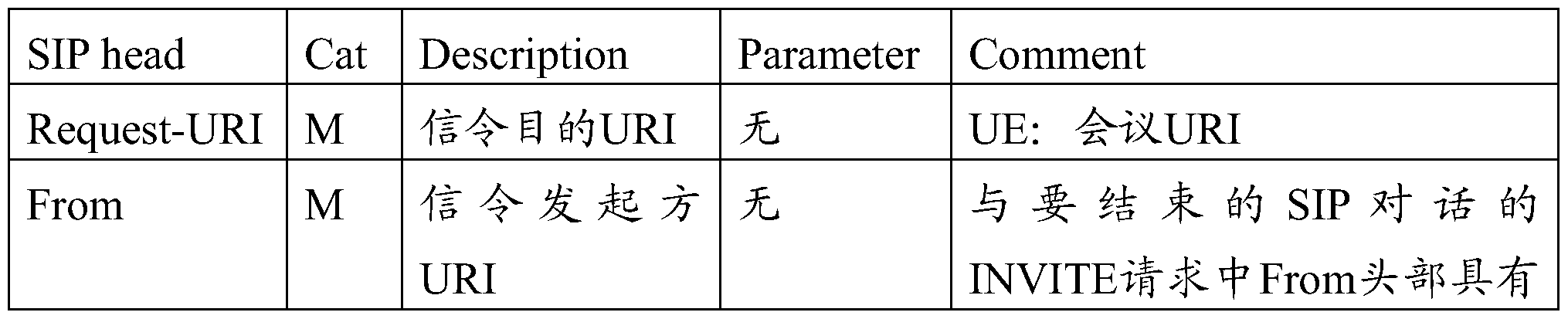
To M 信令接收方 无 与要结束的 SIP对话的
URI INVITE请求中 To头部具有相 同值
Call-ID M 无 无 与要结束的 SIP对话的
INVITE请求中 Call-ID头部具 有相同值
User-Agent M UAC信息 无 UE: 置为 Conf-serv/3GPP
Server M UAS信息 无 AS: 置为 Conf-serv/3GPP 在会议结束过程中的错误码如表 5所


BYE请求的消息示例:
BYE sip: conference 1 @mrfc 1.home 1.net SIP/2.0
Max-Forwards: 70
From: <si : user 1 _public 1 @home 1.net>; tag=171828
To: <si : conference-factory 1 @mrfc 1.home 1.net>; tag=314159
Call-ID: cb03a0s09a2sdfglkj490333
Cseq: 153 BYE
User- Agent Conf-serv/3 GPP
Content-Length: 0
返回的结果消息示例:
SIP/2.0 200 OK
From: <si : user 1 _public 1 @home 1.net>; tag=171828
To: <si : conference-factory 1 @mrfc 1.home 1.net>; tag=314159
Call-ID: cb03a0s09a2sdfglkj490333
Cseq: 153 BYE
Server: Conf- serv/3 GPP
Content-Length: 0
312: MRS2结束运营商侧的会议, 向 AS2发应答断开请求 200 OK:。 313: AS2结束运营商侧会议完成后, 向 Inter-Gateway发应答结束级联请 求 200 OK。 到此, 运营商侧的会议结束。 AS2还可以向每个手机终端发起挂 机流程 (图 3中省略)。
与上述企业侧用户邀请运营商侧的手机用户加入企业侧会议对应的,如果 手机用户要邀请企业侧的成员进入运营商侧会议, 这时, 手机发送邀请企业侧 成员进入运营商侧会议的邀请给 AS1 , 然后 AS1 向 Inter-Gateway发送 SIP REFER 消息或者是 SOAP 的自定义消息来邀请企业侧成员进入运营商侧会 议; 然后 Inter-Gateway与企业侧网络协商传输相关信息并可以加入到企业侧 会议。
以下对 Inter-Gateway混音的过程进行说明; 需要说明的是该功能并非必 须, 只有在一侧的会议 MRS 不支持服务器混音时才实现混音功能。 Inter-Gateway将本侧会议的所有终端发给 MRS的音频流进行混音, 输出一路 语音媒体到另一侧的 MRS上。 如图 4所示, 为组网的示意图。
假定图 4中 MRS不支持服务器混音, MRS,支持服务器混音; 终端 PC1 , PC2, PC3的媒体流在 MRS进行转发, 最终各 PC将收到的媒体流进行混音。 增加的 Inter-Gateway可以将收到的至少两路语音流进行混音, 然后输出一路 语音流给 MRS,。 逆过程如图 4中的虚线部分, 来自 MRS,的已经进行了混音 的语音流经过 Inter-Gateway传给 MRS , MRS将每一路语音流发给每个终端 如果 MRS具有混音的功能, 是可以由 MRS进行混音的, 如图 5所示的 场景; 媒体层面上存在两个混音会场, MRS2对 UE'l到 UE'n以及级联用户 UE'k进行混音; MRS1对 UE"1到 UE"m以及级联用户 UE'j进行混音。 这两 个混音会场通过级联方式,将两个会场统一起来。具体地, MRS2接入了 UE'l 到 UE'n, 同时有一个特殊的 UE(UE,j), 为 MRS1上一个特殊终端。 UE'l到 UE'n的话音在 MRS2上混音, 发给 UE,j。 UE'j作为 MRS1的一个用户, 与
UE"1到 UE"m—起参与 MRS1会场的混音。 因此, UE"1到 UE"m既能够听 到 UE"1到 UE"m的声音,也能够听到 UE' l到 UE'n上的声音。同样的, UE' l 到 UE'n既能够听到 UE' l到 UE'n的声音, 也能够听到 UE"1到 UE"m的声 音。
由 Inter-Gateway作为异构网络的媒介来建立会议并协商通信参数, 实现 两个不同会议平台之间语音会议的级联,通过级联会议,实现异构网络的融合。 达到会议能够跨越多个会议平台的目的。在整个实现过程中, 消除企业与运营 商之间专线的使用。 另外, 由于仅在异构网络间增加了网关设备, 保留了运营 商和企业原有设备, 对网络改造小, 利于推广。
另夕卜,在第二会议建立以后,运营商侧的终端可以参考一般会议的加入方 式加入到第二会议中, 具体地: 运营商侧的终端向 AS2发送加入会议的请求, 从而加入到第二会议中。 另外, AS2 在接收新会议成员后可以发送消息给 Inter-Gateway以告知新加入第二会议的成员信息(例如告知新加入第二会议的 手机号), Inter-Gateway可以将这个新加入第二会议的成员信息转发给 AS 1。
AS2可以监控参与会议的终端是否退出了会议,具体监控方式可以是终端 向 AS定期发送更新 ( UPDATE ) 消息, 然后 AS2接收到 UPDATE后向终端 发送响应消息; 若 AS2在设定时间门限内没有收到终端发送的更新消息则可 以判断该终端异常退出; 若本实施例中手机异常退出, AS2将异常退出的手机 号发送给网关设备, 然后网关设备还可以将退出的手机号发送给 AS 1 以告之 该手机号的手机退出了会议。若第二会议存续期间, 所有参与第二会议的手机 都退出了第二会议, 第二会议仍然可以继续存在; 也可以由 AS2结束第二会 议, 并将第二会议结束的消息发送给网关, 由网关将第二会议结束的消息发送 给 AS1。
在该监控流程中消息关键字段如表 6所示:
表 6
SIP head Cat Description Parameter Comment
Request-URI M 信 令 目 的 无 CW-MGW填写, 而会议 URI
URI
From M 信令发起方 无 CW-MGW填写, CW级联会议
URI URI
To M 信令接收方 无 而会议 URI
URI
Server M UAS信息 无 HW-AS 填 写 , 置 为
Conf-serv/3GPP
User-Agent M UAC信息 无 CW-MGW 填 写 , 置 为
Conf-serv/3GPP
session-expir M 期 望 的 Refresher( CW-MGW填写, 单位为秒。 es session timer 0) : 会话 在本系统中, 刷新方必须是 刷新周期 主动刷新 uac
方, 可置
为 uac或
UCS
Content-Len M 消息体长度 无 0
gth
UPDATE消息示例:
UPDATE sip:conf0000001@ homel .net SIP/2.0
From:<sip:userl_publicl@homel.net>;tag=212868d4
To:<sip:confO000001@ homel .net >;tag=7b5a8365
Cseq:2 UPDATE
Call-ID: cb03a0s09a2sdfglkj490333
User-Agent: Conf-serv/3GPP
Supported:timer
Max-Forwards:70
Session-Expires:240;refresher=uac
Content-Length: 0
应答消息示例:
SIP/2.0 200 OK
From: <si : user 1 _public 1 @home 1.net>; tag=171828
To: :<sip:confO000001@ homel .net >;tag=7b5a8365
Call-ID: cb03a0s09a2sdfglkj490333
Cseq: 153 INFO
Server: Conf- serv/3 GPP
Session-Expires:240;refresher=uac
Supported:timer,recipient-list-invite
Content-Length: (...) 实施例三, 如图 6所示, 本发明实施例还提供了一种网关,该网关可以是 计算机, 处理器, 也可以是其它的物理实体。 该网关包括:
请求接收单元 601 , 用于在加入第一会议后, 接收第一应用服务器发送的 邀请请求;所述邀请请求为邀请第二应用服务器下的第二终端进入第一会议的 请求;
邀请发送单元 602, 用于向第二应用服务器发送邀请呼叫, 请求建立第二 会议, 所述邀请呼叫中携带与第一会议协商的接收媒体的参数;
成功消息接收单元 603 , 用于接收到第二应用服务器发送的会议创建成功 的信息;
参数获取单元 604, 用于接收到第二应用服务器发送的会议创建成功的信 息后,获取与第二应用服务器侧的第二媒体资源服务器根据邀请呼叫中携带的 与第一会议协商的接收媒体的参数协商的传输相关参数;
邀请单元 605 , 用于向第二应用服务器发送邀请, 邀请所述第二终端进入 第二会议。
进一步地, 如图 7所示, 所述网关还包括:
媒体流接收单元 701 , 用于接收第一应用服务器发送第一媒体流; 和 /或, 接收第二应用服务器发送的第二媒体流;
媒体流发送单元 702, 用于将所述第一媒体流转发给第二媒体资源服务 器; 将所述第二媒体流转发给第一媒体资源服务器。
进一步地, 如图 8所示, 所述网关还包括:
混音单元 801 , 用于在将第一媒体流转发给第二媒体资源服务器之前, 对
所述第一媒体流进行混音处理; 和或,在将第二媒体流转发给第一媒体资源服 务器之前, 对所述第二媒体流进行混音处理;
所述媒体流发送单元 702, 具体用于将混音处理后的第二媒体流发送给第 一媒体资源服务器; 将混音处理后的第二媒体流发送给第一媒体资源服务器。
进一步地, 如图 9所示, 所述网关还包括:
状态报告接收单元 901 , 用于接收第二应用服务器发送的第二终端的状态 报告信息;
状态报告发送单元 902 , 用于将所述状态报告信息发送给第一应用服务 器。
进一步地, 如图 10所示, 所述网关还包括:
控制指令接收单元 1001 , 用于接收第一应用服务器发送的第二会场控制 命令, 所述第二会场控制命令推带会场控制指令;
控制指令发送单元 1002, 用于根据所述会场控制指令, 向第二应用服务 器发送携带所述会场控制指令的消息 ,请求第二应用服务器根据所述会场控制 指令控制第二会场。
实施例四, 如图 11所示, 本发明实施例还一种跨平台会议融合的系统, 包括, 两个或两个以上的异构网络的会议平台 1101 , 另外还包括: 实施例三 中的任意一种网关 1102。
由网关作为异构网络的媒介来建立会议并协商通信参数,实现两个不同会 议平台之间语音会议的级联, 通过级联会议, 实现异构网络的融合。 达到会议 能够跨越多个会议平台的目的。在整个实现过程中, 消除企业与运营商之间专 线的使用。 另外, 由于仅在异构网络间增加了网关设备, 保留了运营商和企业 原有设备, 对网络改造小, 利于推广。
本领域普通技术人员可以理解实现上述实施例方法中的全部或部分步骤 是可以通过程序来指令相关的硬件完成,上述的程序可以存储于一种计算机可 读存储介质中, 上述提到的存储介质可以是只读存储器, 磁盘或光盘等。
以上对本发明实施例所提供的一种跨平台会议融合的方法、装置和系统进 述, 以上实施例的说明只是用于帮助理解本发明的方法及其核心思想; 同时,
对于本领域的一般技术人员,依据本发明的思想,在具体实施方式及应用范围 上均会有改变之处, 综上, 本说明书内容不应理解为对本发明的限制。
Claims
1、 一种跨平台会议融合的方法, 其特征在于, 包括:
网关设备在加入第一会议后,接收第一应用服务器发送的邀请请求, 所述 邀请请求为邀请第二终端加入第一会议的请求,所述第二终端归属于第二应用 服务器;
所述网关设备向所述第二应用服务器发送邀请呼叫, 请求建立第二会议; 所述网关设备在接收到所述第二应用服务器发送的会议创建成功的信息 后所述网关设备向第二应用服务器发送邀请, 邀请所述第二终端进入第二会 议。
2、 根据权利要求 1所述方法, 其特征在于, 所述邀请呼叫中携带所述网关 设备与所述第一会议协商的接收媒体的参数;
在接收到所述第二应用服务器发送的会议创建成功的信息后进一步包括: 所述网关设备获取所述第二会议使用的传输相关参数,所述传输相关参数 由所述第二应用服务器侧的第二媒体资源服务器根据所述接收媒体的参数确 定。
3、 根据权利要求 1或 2所述方法, 其特征在于, 还包括:
所述网关设备接收第一应用服务器发送的第一媒体流,将所述第一媒体流 转发给所述第二媒体资源服务器; 和 /或还包括:
所述网关设备接收第二应用服务器发送的第二媒体流,将所述第二媒体流 转发给第一应用服务器侧的第一媒体资源服务器。
4、 根据权利要求 3所述方法, 其特征在于, 所述网关设备将第一媒体流转 发给第二媒体资源服务器之前还包括:
所述网关设备对所述第一媒体流进行混音处理;
所述将第一媒体流转发给第二媒体资源服务器包括:
将混音处理后的第一媒体流发送给第一媒体资源服务器; 和 /或, 所述网关设备将第二媒体流转发给第一媒体资源服务器之前还包括: 所述网关设备对所述第二媒体流进行混音处理;
所述将第二媒体流转发给第一媒体资源服务器包括:
将混音处理后的第二媒体流发送给第一媒体资源服务器。
5、 根据权利要求 1、 2和 4任意一项所述方法, 其特征在于, 还包括: 所述网关设备接收第二应用服务器发送的第二终端的状态报告信息;将所 述状态报告信息发送给第一应用服务器。
6、 根据权利要求 1、 2和 4任意一项所述方法, 其特征在于, 还包括: 所述网关设备接收第一应用服务器发送的第二会场控制命令,所述第二会 场控制命令携带会场控制指令;
所述网关设备根据所述会场控制指令,向第二应用服务器发送携带所述会 场控制指令的消息, 请求第二应用服务器根据所述会场控制指令控制第二会 场。
7、 一种网关, 其特征在于, 包括:
请求接收单元, 用于在加入第一会议后,接收第一应用服务器发送的邀请 请求; 所述邀请请求为邀请第二终端加入第一会议的请求, 所述第二终端归属 于第二应用服务器;
邀请发送单元,用于向第二应用服务器发送邀请呼叫 ,请求建立第二会议, 所述邀请呼叫中携带所述网关设备与第一会议协商的接收媒体的参数;
成功消息接收单元,用于接收所述第二应用服务器发送的会议创建成功的 信息;
参数获取单元,用于在所述成功消息接收单元接收到所述会议创建成功的 信息后, 获取所述第二会议使用的传输相关参数, 所述传输相关参数由所述第 二应用服务器侧的第二媒体资源服务器根据所述接收媒体的参数确定;
邀请单元, 用于向第二应用服务器发送邀请,邀请所述第二终端进入第二 会议。
8、 根据权利要求 7所述网关, 其特征在于, 还包括:
媒体流接收单元, 用于接收第一应用服务器发送的第一媒体流; 和 /或, 接收第二应用服务器发送的第二媒体流;
媒体流发送单元, 用于将所述第一媒体流转发给第二媒体资源服务器; 将 所述第二媒体流转发给第一媒体资源服务器。
9、 根据权利要求 8所述网关, 其特征在于, 还包括:
混音单元, 用于在将第一媒体流转发给第二媒体资源服务器之前,对所述 第一媒体流进行混音处理; 和或,在将第二媒体流转发给第一媒体资源服务器 之前, 对所述第二媒体流进行混音处理;
所述媒体流发送单元,具体用于将混音处理后的第二媒体流发送给第一媒 体资源服务器; 将混音处理后的第二媒体流发送给第一媒体资源服务器。
10、 根据权利邀请 7至 9任意一项所述网关, 其特征在于, 还包括: 状态报告接收单元,用于接收第二应用服务器发送的第二终端的状态报告 信息;
状态报告发送单元, 用于将所述状态报告信息发送给第一应用服务器。
11、 根据权利邀请 7至 9任意一项所述网关, 其特征在于, 还包括: 控制指令接收单元, 用于接收第一应用服务器发送的第二会场控制命令, 所述第二会场控制命令推带会场控制指令;
控制指令发送单元, 用于根据所述会场控制指令, 向第二应用服务器发送 携带所述会场控制指令的消息 ,请求第二应用服务器根据所述会场控制指令控 制第二会场。
12、 一种跨平台会议融合的系统, 包括, 两个或两个以上的异构网络的会 议平台, 其特征在于, 还包括: 权利要求 7至 11任意一项所述的网关。
Priority Applications (3)
| Application Number | Priority Date | Filing Date | Title |
|---|---|---|---|
| ES11800092T ES2531117T3 (es) | 2010-06-30 | 2011-05-06 | Método, aparato y sistema para convergencia de conferencia de multiplataforma |
| EP20110800092 EP2590376B1 (en) | 2010-06-30 | 2011-05-06 | Method, apparatus and system for cross-platform conference convergence |
| US13/705,987 US9106716B2 (en) | 2010-06-30 | 2012-12-05 | Method, apparatus, and system for cross-platform conference convergence |
Applications Claiming Priority (2)
| Application Number | Priority Date | Filing Date | Title |
|---|---|---|---|
| CN201010218658.1A CN102137080B (zh) | 2010-06-30 | 2010-06-30 | 一种跨平台会议融合的方法、装置和系统 |
| CN201010218658.1 | 2010-06-30 |
Related Child Applications (1)
| Application Number | Title | Priority Date | Filing Date |
|---|---|---|---|
| US13/705,987 Continuation US9106716B2 (en) | 2010-06-30 | 2012-12-05 | Method, apparatus, and system for cross-platform conference convergence |
Publications (1)
| Publication Number | Publication Date |
|---|---|
| WO2012000347A1 true WO2012000347A1 (zh) | 2012-01-05 |
Family
ID=44296738
Family Applications (1)
| Application Number | Title | Priority Date | Filing Date |
|---|---|---|---|
| PCT/CN2011/073736 Ceased WO2012000347A1 (zh) | 2010-06-30 | 2011-05-06 | 一种跨平台会议融合的方法、装置和系统 |
Country Status (5)
| Country | Link |
|---|---|
| US (1) | US9106716B2 (zh) |
| EP (1) | EP2590376B1 (zh) |
| CN (1) | CN102137080B (zh) |
| ES (1) | ES2531117T3 (zh) |
| WO (1) | WO2012000347A1 (zh) |
Cited By (2)
| Publication number | Priority date | Publication date | Assignee | Title |
|---|---|---|---|---|
| CN115052125A (zh) * | 2022-06-17 | 2022-09-13 | 浙江华创视讯科技有限公司 | 一种会议监控方法、会议系统及会议监控装置 |
| US20240179199A1 (en) * | 2014-11-10 | 2024-05-30 | The Mitre Corporation | Providing survivable calling and conferencing |
Families Citing this family (24)
| Publication number | Priority date | Publication date | Assignee | Title |
|---|---|---|---|---|
| US8199680B2 (en) * | 2007-02-09 | 2012-06-12 | Cisco Technology, Inc. | Correlating calls after a referral |
| CN102238196A (zh) * | 2011-08-17 | 2011-11-09 | 艾诺通信系统(苏州)有限责任公司 | 一种基于info消息的sip会议附流控制方法 |
| CN102427480B (zh) * | 2011-12-31 | 2015-01-14 | 北京新媒传信科技有限公司 | 一种多应用服务平台系统中的应用访问方法 |
| EP2739024B1 (en) * | 2012-11-30 | 2017-01-04 | Alcatel Lucent | A method and a module for shifting a call established through a first application server in order to route it through a second application server |
| EP3002905B1 (en) * | 2013-07-01 | 2020-03-25 | Huawei Technologies Co., Ltd. | Unified communication-based video conference call method, device and system |
| CN103369292B (zh) | 2013-07-03 | 2016-09-14 | 华为技术有限公司 | 一种呼叫处理方法及网关 |
| FR3014275A1 (fr) * | 2013-11-29 | 2015-06-05 | Orange | Procede et serveur de reservation de ressources materielles de visioconference |
| CN106301812B (zh) * | 2015-05-20 | 2019-08-20 | 华为技术有限公司 | 多媒体会议实现方法、装置及系统 |
| CN106331979A (zh) * | 2015-06-25 | 2017-01-11 | 中兴通讯股份有限公司 | 一种通信方法、装置及融合通信设备 |
| CN106559639B (zh) * | 2015-09-29 | 2020-08-14 | 深圳市潮流网络技术有限公司 | 一种电话会议中继视频处理方法及系统 |
| US10630835B2 (en) | 2016-03-08 | 2020-04-21 | T-Mobile Usa, Inc. | Content sharing between related devices |
| US10356745B2 (en) | 2016-06-08 | 2019-07-16 | T-Mobile Usa, Inc. | Device and/or line event awareness and smart synchronization |
| CN109565566A (zh) * | 2016-07-18 | 2019-04-02 | T移动美国公司 | 相关设备之间的跨平台视频对话 |
| CN108737480B (zh) * | 2017-04-24 | 2022-08-16 | 中兴通讯股份有限公司 | 基于软件媒体服务器的会议级联方法、服务器及存储介质 |
| CN108965773B (zh) * | 2017-05-23 | 2021-07-27 | 中兴通讯股份有限公司 | 会议控制方法和系统、icms及会议业务系统 |
| US10701310B2 (en) | 2017-06-23 | 2020-06-30 | T-Mobile Usa, Inc. | Video call continuity between devices via a telecommunications network |
| CN109788017B (zh) * | 2017-11-15 | 2022-12-06 | 中国移动通信集团终端有限公司 | 跨品牌儿童手表信息同步方法、装置、设备及介质 |
| CN109451265B (zh) * | 2018-11-27 | 2021-12-24 | 平安科技(深圳)有限公司 | 会议合并方法及系统、服务器、计算机可读存储介质 |
| CN112929595B (zh) * | 2021-01-21 | 2022-11-22 | 北京字节跳动网络技术有限公司 | 一种网络会议融合系统及方法 |
| CN113746808B (zh) * | 2021-08-12 | 2023-09-08 | 杭州网易智企科技有限公司 | 线上会议的融合通信方法、网关、电子设备及存储介质 |
| CN116743686B (zh) * | 2022-03-02 | 2026-02-10 | 腾讯科技(深圳)有限公司 | 会议数据处理方法、装置、设备及存储介质 |
| KR20240062201A (ko) * | 2022-10-28 | 2024-05-09 | 삼성에스디에스 주식회사 | 화상 회의 시스템 연동 방법, 장치, 시스템 및 컴퓨터 프로그램 |
| CN115988168A (zh) * | 2022-12-30 | 2023-04-18 | 杭州海康威视数字技术股份有限公司 | 视频通信系统、方法、电子设备及存储介质 |
| CN116980399A (zh) * | 2023-08-29 | 2023-10-31 | 好信云(北京)网络通信有限公司 | 一种建立实时通信连接中协商信息的方法和装置 |
Citations (3)
| Publication number | Priority date | Publication date | Assignee | Title |
|---|---|---|---|---|
| CN101047533A (zh) * | 2006-06-26 | 2007-10-03 | 华为技术有限公司 | 用于连接多个会议的方法和装置 |
| CN101247564A (zh) * | 2008-03-18 | 2008-08-20 | 中兴通讯股份有限公司 | 在呼叫前转业务基础上实现多媒体彩像业务的方法、装置、系统 |
| CN101291373A (zh) * | 2008-04-15 | 2008-10-22 | 中兴通讯股份有限公司 | 实现多方通话的方法及系统 |
Family Cites Families (3)
| Publication number | Priority date | Publication date | Assignee | Title |
|---|---|---|---|---|
| US20020078153A1 (en) * | 2000-11-02 | 2002-06-20 | Chit Chung | Providing secure, instantaneous, directory-integrated, multiparty, communications services |
| US7003086B1 (en) * | 2001-01-18 | 2006-02-21 | Cisco Technology, Inc. | Apparatus and method for allocating call resources during a conference call |
| US7590692B2 (en) * | 2001-07-09 | 2009-09-15 | Dialogic Corporation | Conferencing architecture employing media servers and enhanced session initiation protocol |
-
2010
- 2010-06-30 CN CN201010218658.1A patent/CN102137080B/zh active Active
-
2011
- 2011-05-06 ES ES11800092T patent/ES2531117T3/es active Active
- 2011-05-06 EP EP20110800092 patent/EP2590376B1/en active Active
- 2011-05-06 WO PCT/CN2011/073736 patent/WO2012000347A1/zh not_active Ceased
-
2012
- 2012-12-05 US US13/705,987 patent/US9106716B2/en active Active
Patent Citations (3)
| Publication number | Priority date | Publication date | Assignee | Title |
|---|---|---|---|---|
| CN101047533A (zh) * | 2006-06-26 | 2007-10-03 | 华为技术有限公司 | 用于连接多个会议的方法和装置 |
| CN101247564A (zh) * | 2008-03-18 | 2008-08-20 | 中兴通讯股份有限公司 | 在呼叫前转业务基础上实现多媒体彩像业务的方法、装置、系统 |
| CN101291373A (zh) * | 2008-04-15 | 2008-10-22 | 中兴通讯股份有限公司 | 实现多方通话的方法及系统 |
Non-Patent Citations (1)
| Title |
|---|
| See also references of EP2590376A4 * |
Cited By (3)
| Publication number | Priority date | Publication date | Assignee | Title |
|---|---|---|---|---|
| US20240179199A1 (en) * | 2014-11-10 | 2024-05-30 | The Mitre Corporation | Providing survivable calling and conferencing |
| US12580974B2 (en) * | 2014-11-10 | 2026-03-17 | The Mitre Corporation | Providing survivable calling and conferencing |
| CN115052125A (zh) * | 2022-06-17 | 2022-09-13 | 浙江华创视讯科技有限公司 | 一种会议监控方法、会议系统及会议监控装置 |
Also Published As
| Publication number | Publication date |
|---|---|
| CN102137080B (zh) | 2014-09-03 |
| EP2590376A4 (en) | 2013-05-08 |
| CN102137080A (zh) | 2011-07-27 |
| EP2590376B1 (en) | 2014-12-03 |
| ES2531117T3 (es) | 2015-03-10 |
| US20130094671A1 (en) | 2013-04-18 |
| US9106716B2 (en) | 2015-08-11 |
| EP2590376A1 (en) | 2013-05-08 |
Similar Documents
| Publication | Publication Date | Title |
|---|---|---|
| CN102137080B (zh) | 一种跨平台会议融合的方法、装置和系统 | |
| JP5478581B2 (ja) | 事前設定セッションを管理する方法及びそれを実現するためのPoCシステム及びPoC端末装置 | |
| JP5363461B2 (ja) | グループ呼機能の問い合わせ | |
| US20080281971A1 (en) | Network multimedia communication using multiple devices | |
| US20030014488A1 (en) | System and method for enabling multimedia conferencing services on a real-time communications platform | |
| RU2367115C2 (ru) | Способ и система выполнения услуги сохранения мультимедийных данных при полудуплексной радиосвязи в сотовой сети связи | |
| CN101360091B (zh) | 一种实现会话初始协议终端入会的装置、系统和方法 | |
| CN101453346B (zh) | Ims体系中的多点分层式会议的控制方法 | |
| EP4351102B1 (en) | Call processing method, apparatus and system | |
| KR20110050439A (ko) | 원격통신 네트워크에서 매체 속성들에 기초한 선택적 호 포워딩을 위한 방법 및 시스템 | |
| WO2009082945A1 (en) | Multi-terminal communication method, system and apparatus | |
| WO2009018755A1 (en) | Multi-terminal session method, communication system and related devices | |
| US20150295974A1 (en) | Method, User Equipment and Application Server for Adding Media Stream of Multimedia Session | |
| WO2012037790A1 (zh) | 数字电视终端进行即时通讯的方法和装置及系统 | |
| WO2011017889A1 (zh) | 一种多媒体会议的实现方法及系统 | |
| WO2010069176A1 (zh) | 实现pc客户端绑定硬终端时召开会议的方法、登录服务器、会议服务器及pc客户端 | |
| US9071690B2 (en) | Call transfer processing in SIP mode | |
| WO2007095855A1 (en) | A method and network entity for negotiating media type parameter | |
| CN103428208A (zh) | 分布式sip重定向服务器及其构建方法 | |
| WO2009033412A1 (en) | Management method, system and apparatus for specific apparatus in multimedia session | |
| WO2009036801A1 (en) | Methods and arrangements for a telecommunications system | |
| CN101159787A (zh) | 一种实现会议业务的软交换通信系统及其方法 | |
| WO2008101443A1 (fr) | Procédé, système et dispositif pour acquérir un flux multimédia | |
| US20080137647A1 (en) | VoIP terminal and method for providing multi-call service | |
| WO2011140744A1 (zh) | 一种下一代网络中的多媒体会议系统及实现方法 |
Legal Events
| Date | Code | Title | Description |
|---|---|---|---|
| 121 | Ep: the epo has been informed by wipo that ep was designated in this application |
Ref document number: 11800092 Country of ref document: EP Kind code of ref document: A1 |
|
| WWE | Wipo information: entry into national phase |
Ref document number: 2011800092 Country of ref document: EP |
|
| NENP | Non-entry into the national phase |
Ref country code: DE |