WO2012001842A1 - 圧縮機及びそれを用いた冷凍サイクル装置 - Google Patents
圧縮機及びそれを用いた冷凍サイクル装置 Download PDFInfo
- Publication number
- WO2012001842A1 WO2012001842A1 PCT/JP2011/001434 JP2011001434W WO2012001842A1 WO 2012001842 A1 WO2012001842 A1 WO 2012001842A1 JP 2011001434 W JP2011001434 W JP 2011001434W WO 2012001842 A1 WO2012001842 A1 WO 2012001842A1
- Authority
- WO
- WIPO (PCT)
- Prior art keywords
- refrigerant
- refrigerating machine
- machine oil
- compressor
- oil
- Prior art date
- Legal status (The legal status is an assumption and is not a legal conclusion. Google has not performed a legal analysis and makes no representation as to the accuracy of the status listed.)
- Ceased
Links
Images


Classifications
-
- C—CHEMISTRY; METALLURGY
- C09—DYES; PAINTS; POLISHES; NATURAL RESINS; ADHESIVES; COMPOSITIONS NOT OTHERWISE PROVIDED FOR; APPLICATIONS OF MATERIALS NOT OTHERWISE PROVIDED FOR
- C09K—MATERIALS FOR MISCELLANEOUS APPLICATIONS, NOT PROVIDED FOR ELSEWHERE
- C09K5/00—Heat-transfer, heat-exchange or heat-storage materials, e.g. refrigerants; Materials for the production of heat or cold by chemical reactions other than by combustion
- C09K5/02—Materials undergoing a change of physical state when used
- C09K5/04—Materials undergoing a change of physical state when used the change of state being from liquid to vapour or vice versa
- C09K5/041—Materials undergoing a change of physical state when used the change of state being from liquid to vapour or vice versa for compression-type refrigeration systems
- C09K5/044—Materials undergoing a change of physical state when used the change of state being from liquid to vapour or vice versa for compression-type refrigeration systems comprising halogenated compounds
- C09K5/045—Materials undergoing a change of physical state when used the change of state being from liquid to vapour or vice versa for compression-type refrigeration systems comprising halogenated compounds containing only fluorine as halogen
-
- C—CHEMISTRY; METALLURGY
- C09—DYES; PAINTS; POLISHES; NATURAL RESINS; ADHESIVES; COMPOSITIONS NOT OTHERWISE PROVIDED FOR; APPLICATIONS OF MATERIALS NOT OTHERWISE PROVIDED FOR
- C09K—MATERIALS FOR MISCELLANEOUS APPLICATIONS, NOT PROVIDED FOR ELSEWHERE
- C09K5/00—Heat-transfer, heat-exchange or heat-storage materials, e.g. refrigerants; Materials for the production of heat or cold by chemical reactions other than by combustion
- C09K5/02—Materials undergoing a change of physical state when used
- C09K5/04—Materials undergoing a change of physical state when used the change of state being from liquid to vapour or vice versa
-
- C—CHEMISTRY; METALLURGY
- C10—PETROLEUM, GAS OR COKE INDUSTRIES; TECHNICAL GASES CONTAINING CARBON MONOXIDE; FUELS; LUBRICANTS; PEAT
- C10M—LUBRICATING COMPOSITIONS; USE OF CHEMICAL SUBSTANCES EITHER ALONE OR AS LUBRICATING INGREDIENTS IN A LUBRICATING COMPOSITION
- C10M105/00—Lubricating compositions characterised by the base-material being a non-macromolecular organic compound
- C10M105/08—Lubricating compositions characterised by the base-material being a non-macromolecular organic compound containing oxygen
- C10M105/18—Ethers, e.g. epoxides
-
- C—CHEMISTRY; METALLURGY
- C10—PETROLEUM, GAS OR COKE INDUSTRIES; TECHNICAL GASES CONTAINING CARBON MONOXIDE; FUELS; LUBRICANTS; PEAT
- C10M—LUBRICATING COMPOSITIONS; USE OF CHEMICAL SUBSTANCES EITHER ALONE OR AS LUBRICATING INGREDIENTS IN A LUBRICATING COMPOSITION
- C10M105/00—Lubricating compositions characterised by the base-material being a non-macromolecular organic compound
- C10M105/08—Lubricating compositions characterised by the base-material being a non-macromolecular organic compound containing oxygen
- C10M105/32—Esters
- C10M105/38—Esters of polyhydroxy compounds
-
- C—CHEMISTRY; METALLURGY
- C10—PETROLEUM, GAS OR COKE INDUSTRIES; TECHNICAL GASES CONTAINING CARBON MONOXIDE; FUELS; LUBRICANTS; PEAT
- C10M—LUBRICATING COMPOSITIONS; USE OF CHEMICAL SUBSTANCES EITHER ALONE OR AS LUBRICATING INGREDIENTS IN A LUBRICATING COMPOSITION
- C10M107/00—Lubricating compositions characterised by the base-material being a macromolecular compound
- C10M107/20—Lubricating compositions characterised by the base-material being a macromolecular compound containing oxygen
- C10M107/22—Macromolecular compounds obtained by reactions only involving carbon-to-carbon unsaturated bonds
- C10M107/24—Macromolecular compounds obtained by reactions only involving carbon-to-carbon unsaturated bonds containing monomers having an unsaturated radical bound to an alcohol, aldehyde, ketonic, ether, ketal or acetal radical
-
- C—CHEMISTRY; METALLURGY
- C10—PETROLEUM, GAS OR COKE INDUSTRIES; TECHNICAL GASES CONTAINING CARBON MONOXIDE; FUELS; LUBRICANTS; PEAT
- C10M—LUBRICATING COMPOSITIONS; USE OF CHEMICAL SUBSTANCES EITHER ALONE OR AS LUBRICATING INGREDIENTS IN A LUBRICATING COMPOSITION
- C10M107/00—Lubricating compositions characterised by the base-material being a macromolecular compound
- C10M107/20—Lubricating compositions characterised by the base-material being a macromolecular compound containing oxygen
- C10M107/30—Macromolecular compounds obtained otherwise than by reactions only involving carbon-to-carbon unsaturated bonds
- C10M107/32—Condensation polymers of aldehydes or ketones; Polyesters; Polyethers
- C10M107/34—Polyoxyalkylenes
-
- C—CHEMISTRY; METALLURGY
- C10—PETROLEUM, GAS OR COKE INDUSTRIES; TECHNICAL GASES CONTAINING CARBON MONOXIDE; FUELS; LUBRICANTS; PEAT
- C10M—LUBRICATING COMPOSITIONS; USE OF CHEMICAL SUBSTANCES EITHER ALONE OR AS LUBRICATING INGREDIENTS IN A LUBRICATING COMPOSITION
- C10M129/00—Lubricating compositions characterised by the additive being an organic non-macromolecular compound containing oxygen
- C10M129/02—Lubricating compositions characterised by the additive being an organic non-macromolecular compound containing oxygen having a carbon chain of less than 30 atoms
- C10M129/04—Hydroxy compounds
- C10M129/10—Hydroxy compounds having hydroxy groups bound to a carbon atom of a six-membered aromatic ring
-
- C—CHEMISTRY; METALLURGY
- C10—PETROLEUM, GAS OR COKE INDUSTRIES; TECHNICAL GASES CONTAINING CARBON MONOXIDE; FUELS; LUBRICANTS; PEAT
- C10M—LUBRICATING COMPOSITIONS; USE OF CHEMICAL SUBSTANCES EITHER ALONE OR AS LUBRICATING INGREDIENTS IN A LUBRICATING COMPOSITION
- C10M133/00—Lubricating compositions characterised by the additive being an organic non-macromolecular compound containing nitrogen
- C10M133/02—Lubricating compositions characterised by the additive being an organic non-macromolecular compound containing nitrogen having a carbon chain of less than 30 atoms
- C10M133/04—Amines, e.g. polyalkylene polyamines; Quaternary amines
- C10M133/12—Amines, e.g. polyalkylene polyamines; Quaternary amines having amino groups bound to a carbon atom of a six-membered aromatic ring
-
- C—CHEMISTRY; METALLURGY
- C10—PETROLEUM, GAS OR COKE INDUSTRIES; TECHNICAL GASES CONTAINING CARBON MONOXIDE; FUELS; LUBRICANTS; PEAT
- C10M—LUBRICATING COMPOSITIONS; USE OF CHEMICAL SUBSTANCES EITHER ALONE OR AS LUBRICATING INGREDIENTS IN A LUBRICATING COMPOSITION
- C10M133/00—Lubricating compositions characterised by the additive being an organic non-macromolecular compound containing nitrogen
- C10M133/02—Lubricating compositions characterised by the additive being an organic non-macromolecular compound containing nitrogen having a carbon chain of less than 30 atoms
- C10M133/38—Heterocyclic nitrogen compounds
-
- C—CHEMISTRY; METALLURGY
- C10—PETROLEUM, GAS OR COKE INDUSTRIES; TECHNICAL GASES CONTAINING CARBON MONOXIDE; FUELS; LUBRICANTS; PEAT
- C10M—LUBRICATING COMPOSITIONS; USE OF CHEMICAL SUBSTANCES EITHER ALONE OR AS LUBRICATING INGREDIENTS IN A LUBRICATING COMPOSITION
- C10M135/00—Lubricating compositions characterised by the additive being an organic non-macromolecular compound containing sulfur, selenium or tellurium
-
- C—CHEMISTRY; METALLURGY
- C10—PETROLEUM, GAS OR COKE INDUSTRIES; TECHNICAL GASES CONTAINING CARBON MONOXIDE; FUELS; LUBRICANTS; PEAT
- C10M—LUBRICATING COMPOSITIONS; USE OF CHEMICAL SUBSTANCES EITHER ALONE OR AS LUBRICATING INGREDIENTS IN A LUBRICATING COMPOSITION
- C10M135/00—Lubricating compositions characterised by the additive being an organic non-macromolecular compound containing sulfur, selenium or tellurium
- C10M135/20—Thiols; Sulfides; Polysulfides
-
- C—CHEMISTRY; METALLURGY
- C10—PETROLEUM, GAS OR COKE INDUSTRIES; TECHNICAL GASES CONTAINING CARBON MONOXIDE; FUELS; LUBRICANTS; PEAT
- C10M—LUBRICATING COMPOSITIONS; USE OF CHEMICAL SUBSTANCES EITHER ALONE OR AS LUBRICATING INGREDIENTS IN A LUBRICATING COMPOSITION
- C10M137/00—Lubricating compositions characterised by the additive being an organic non-macromolecular compound containing phosphorus
- C10M137/02—Lubricating compositions characterised by the additive being an organic non-macromolecular compound containing phosphorus having no phosphorus-to-carbon bond
- C10M137/04—Phosphate esters
- C10M137/10—Thio derivatives
-
- C—CHEMISTRY; METALLURGY
- C10—PETROLEUM, GAS OR COKE INDUSTRIES; TECHNICAL GASES CONTAINING CARBON MONOXIDE; FUELS; LUBRICANTS; PEAT
- C10M—LUBRICATING COMPOSITIONS; USE OF CHEMICAL SUBSTANCES EITHER ALONE OR AS LUBRICATING INGREDIENTS IN A LUBRICATING COMPOSITION
- C10M159/00—Lubricating compositions characterised by the additive being of unknown or incompletely defined constitution
- C10M159/12—Reaction products
- C10M159/20—Reaction mixtures having an excess of neutralising base, e.g. so-called overbasic or highly basic products
- C10M159/22—Reaction mixtures having an excess of neutralising base, e.g. so-called overbasic or highly basic products containing phenol radicals
-
- C—CHEMISTRY; METALLURGY
- C10—PETROLEUM, GAS OR COKE INDUSTRIES; TECHNICAL GASES CONTAINING CARBON MONOXIDE; FUELS; LUBRICANTS; PEAT
- C10M—LUBRICATING COMPOSITIONS; USE OF CHEMICAL SUBSTANCES EITHER ALONE OR AS LUBRICATING INGREDIENTS IN A LUBRICATING COMPOSITION
- C10M169/00—Lubricating compositions characterised by containing as components a mixture of at least two types of ingredient selected from base-materials, thickeners or additives, covered by the preceding groups, each of these compounds being essential
- C10M169/04—Mixtures of base-materials and additives
-
- C—CHEMISTRY; METALLURGY
- C10—PETROLEUM, GAS OR COKE INDUSTRIES; TECHNICAL GASES CONTAINING CARBON MONOXIDE; FUELS; LUBRICANTS; PEAT
- C10M—LUBRICATING COMPOSITIONS; USE OF CHEMICAL SUBSTANCES EITHER ALONE OR AS LUBRICATING INGREDIENTS IN A LUBRICATING COMPOSITION
- C10M171/00—Lubricating compositions characterised by purely physical criteria, e.g. containing as base-material, thickener or additive, ingredients which are characterised exclusively by their numerically specified physical properties, i.e. containing ingredients which are physically well-defined but for which the chemical nature is either unspecified or only very vaguely indicated
- C10M171/008—Lubricant compositions compatible with refrigerants
-
- F—MECHANICAL ENGINEERING; LIGHTING; HEATING; WEAPONS; BLASTING
- F25—REFRIGERATION OR COOLING; COMBINED HEATING AND REFRIGERATION SYSTEMS; HEAT PUMP SYSTEMS; MANUFACTURE OR STORAGE OF ICE; LIQUEFACTION SOLIDIFICATION OF GASES
- F25B—REFRIGERATION MACHINES, PLANTS OR SYSTEMS; COMBINED HEATING AND REFRIGERATION SYSTEMS; HEAT PUMP SYSTEMS
- F25B1/00—Compression machines, plants or systems with non-reversible cycle
-
- F—MECHANICAL ENGINEERING; LIGHTING; HEATING; WEAPONS; BLASTING
- F25—REFRIGERATION OR COOLING; COMBINED HEATING AND REFRIGERATION SYSTEMS; HEAT PUMP SYSTEMS; MANUFACTURE OR STORAGE OF ICE; LIQUEFACTION SOLIDIFICATION OF GASES
- F25B—REFRIGERATION MACHINES, PLANTS OR SYSTEMS; COMBINED HEATING AND REFRIGERATION SYSTEMS; HEAT PUMP SYSTEMS
- F25B31/00—Compressor arrangements
- F25B31/02—Compressor arrangements of motor-compressor units
- F25B31/026—Compressor arrangements of motor-compressor units with compressor of rotary type
-
- C—CHEMISTRY; METALLURGY
- C09—DYES; PAINTS; POLISHES; NATURAL RESINS; ADHESIVES; COMPOSITIONS NOT OTHERWISE PROVIDED FOR; APPLICATIONS OF MATERIALS NOT OTHERWISE PROVIDED FOR
- C09K—MATERIALS FOR MISCELLANEOUS APPLICATIONS, NOT PROVIDED FOR ELSEWHERE
- C09K2205/00—Aspects relating to compounds used in compression type refrigeration systems
- C09K2205/10—Components
- C09K2205/12—Hydrocarbons
- C09K2205/126—Unsaturated fluorinated hydrocarbons
-
- C—CHEMISTRY; METALLURGY
- C09—DYES; PAINTS; POLISHES; NATURAL RESINS; ADHESIVES; COMPOSITIONS NOT OTHERWISE PROVIDED FOR; APPLICATIONS OF MATERIALS NOT OTHERWISE PROVIDED FOR
- C09K—MATERIALS FOR MISCELLANEOUS APPLICATIONS, NOT PROVIDED FOR ELSEWHERE
- C09K2205/00—Aspects relating to compounds used in compression type refrigeration systems
- C09K2205/22—All components of a mixture being fluoro compounds
-
- C—CHEMISTRY; METALLURGY
- C09—DYES; PAINTS; POLISHES; NATURAL RESINS; ADHESIVES; COMPOSITIONS NOT OTHERWISE PROVIDED FOR; APPLICATIONS OF MATERIALS NOT OTHERWISE PROVIDED FOR
- C09K—MATERIALS FOR MISCELLANEOUS APPLICATIONS, NOT PROVIDED FOR ELSEWHERE
- C09K2205/00—Aspects relating to compounds used in compression type refrigeration systems
- C09K2205/24—Only one single fluoro component present
-
- C—CHEMISTRY; METALLURGY
- C10—PETROLEUM, GAS OR COKE INDUSTRIES; TECHNICAL GASES CONTAINING CARBON MONOXIDE; FUELS; LUBRICANTS; PEAT
- C10M—LUBRICATING COMPOSITIONS; USE OF CHEMICAL SUBSTANCES EITHER ALONE OR AS LUBRICATING INGREDIENTS IN A LUBRICATING COMPOSITION
- C10M2207/00—Organic non-macromolecular hydrocarbon compounds containing hydrogen, carbon and oxygen as ingredients in lubricant compositions
- C10M2207/02—Hydroxy compounds
- C10M2207/023—Hydroxy compounds having hydroxy groups bound to carbon atoms of six-membered aromatic rings
- C10M2207/026—Hydroxy compounds having hydroxy groups bound to carbon atoms of six-membered aromatic rings with tertiary alkyl groups
-
- C—CHEMISTRY; METALLURGY
- C10—PETROLEUM, GAS OR COKE INDUSTRIES; TECHNICAL GASES CONTAINING CARBON MONOXIDE; FUELS; LUBRICANTS; PEAT
- C10M—LUBRICATING COMPOSITIONS; USE OF CHEMICAL SUBSTANCES EITHER ALONE OR AS LUBRICATING INGREDIENTS IN A LUBRICATING COMPOSITION
- C10M2207/00—Organic non-macromolecular hydrocarbon compounds containing hydrogen, carbon and oxygen as ingredients in lubricant compositions
- C10M2207/02—Hydroxy compounds
- C10M2207/023—Hydroxy compounds having hydroxy groups bound to carbon atoms of six-membered aromatic rings
- C10M2207/027—Neutral salts thereof
-
- C—CHEMISTRY; METALLURGY
- C10—PETROLEUM, GAS OR COKE INDUSTRIES; TECHNICAL GASES CONTAINING CARBON MONOXIDE; FUELS; LUBRICANTS; PEAT
- C10M—LUBRICATING COMPOSITIONS; USE OF CHEMICAL SUBSTANCES EITHER ALONE OR AS LUBRICATING INGREDIENTS IN A LUBRICATING COMPOSITION
- C10M2207/00—Organic non-macromolecular hydrocarbon compounds containing hydrogen, carbon and oxygen as ingredients in lubricant compositions
- C10M2207/02—Hydroxy compounds
- C10M2207/023—Hydroxy compounds having hydroxy groups bound to carbon atoms of six-membered aromatic rings
- C10M2207/028—Overbased salts thereof
-
- C—CHEMISTRY; METALLURGY
- C10—PETROLEUM, GAS OR COKE INDUSTRIES; TECHNICAL GASES CONTAINING CARBON MONOXIDE; FUELS; LUBRICANTS; PEAT
- C10M—LUBRICATING COMPOSITIONS; USE OF CHEMICAL SUBSTANCES EITHER ALONE OR AS LUBRICATING INGREDIENTS IN A LUBRICATING COMPOSITION
- C10M2207/00—Organic non-macromolecular hydrocarbon compounds containing hydrogen, carbon and oxygen as ingredients in lubricant compositions
- C10M2207/04—Ethers; Acetals; Ortho-esters; Ortho-carbonates
- C10M2207/044—Cyclic ethers having four or more ring atoms, e.g. furans, dioxolanes
-
- C—CHEMISTRY; METALLURGY
- C10—PETROLEUM, GAS OR COKE INDUSTRIES; TECHNICAL GASES CONTAINING CARBON MONOXIDE; FUELS; LUBRICANTS; PEAT
- C10M—LUBRICATING COMPOSITIONS; USE OF CHEMICAL SUBSTANCES EITHER ALONE OR AS LUBRICATING INGREDIENTS IN A LUBRICATING COMPOSITION
- C10M2207/00—Organic non-macromolecular hydrocarbon compounds containing hydrogen, carbon and oxygen as ingredients in lubricant compositions
- C10M2207/28—Esters
- C10M2207/283—Esters of polyhydroxy compounds
-
- C—CHEMISTRY; METALLURGY
- C10—PETROLEUM, GAS OR COKE INDUSTRIES; TECHNICAL GASES CONTAINING CARBON MONOXIDE; FUELS; LUBRICANTS; PEAT
- C10M—LUBRICATING COMPOSITIONS; USE OF CHEMICAL SUBSTANCES EITHER ALONE OR AS LUBRICATING INGREDIENTS IN A LUBRICATING COMPOSITION
- C10M2209/00—Organic macromolecular compounds containing oxygen as ingredients in lubricant compositions
- C10M2209/02—Macromolecular compounds obtained by reactions only involving carbon-to-carbon unsaturated bonds
- C10M2209/04—Macromolecular compounds obtained by reactions only involving carbon-to-carbon unsaturated bonds containing monomers having an unsaturated radical bound to an alcohol or ester thereof; bound to an aldehyde, ketonic, ether, ketal or acetal radical
-
- C—CHEMISTRY; METALLURGY
- C10—PETROLEUM, GAS OR COKE INDUSTRIES; TECHNICAL GASES CONTAINING CARBON MONOXIDE; FUELS; LUBRICANTS; PEAT
- C10M—LUBRICATING COMPOSITIONS; USE OF CHEMICAL SUBSTANCES EITHER ALONE OR AS LUBRICATING INGREDIENTS IN A LUBRICATING COMPOSITION
- C10M2209/00—Organic macromolecular compounds containing oxygen as ingredients in lubricant compositions
- C10M2209/02—Macromolecular compounds obtained by reactions only involving carbon-to-carbon unsaturated bonds
- C10M2209/04—Macromolecular compounds obtained by reactions only involving carbon-to-carbon unsaturated bonds containing monomers having an unsaturated radical bound to an alcohol or ester thereof; bound to an aldehyde, ketonic, ether, ketal or acetal radical
- C10M2209/043—Macromolecular compounds obtained by reactions only involving carbon-to-carbon unsaturated bonds containing monomers having an unsaturated radical bound to an alcohol or ester thereof; bound to an aldehyde, ketonic, ether, ketal or acetal radical used as base material
-
- C—CHEMISTRY; METALLURGY
- C10—PETROLEUM, GAS OR COKE INDUSTRIES; TECHNICAL GASES CONTAINING CARBON MONOXIDE; FUELS; LUBRICANTS; PEAT
- C10M—LUBRICATING COMPOSITIONS; USE OF CHEMICAL SUBSTANCES EITHER ALONE OR AS LUBRICATING INGREDIENTS IN A LUBRICATING COMPOSITION
- C10M2209/00—Organic macromolecular compounds containing oxygen as ingredients in lubricant compositions
- C10M2209/02—Macromolecular compounds obtained by reactions only involving carbon-to-carbon unsaturated bonds
- C10M2209/06—Macromolecular compounds obtained by reactions only involving carbon-to-carbon unsaturated bonds containing monomers having an unsaturated radical bound to an acyloxy radical of saturated carboxylic or carbonic acid
- C10M2209/062—Vinyl esters of saturated carboxylic or carbonic acids, e.g. vinyl acetate
-
- C—CHEMISTRY; METALLURGY
- C10—PETROLEUM, GAS OR COKE INDUSTRIES; TECHNICAL GASES CONTAINING CARBON MONOXIDE; FUELS; LUBRICANTS; PEAT
- C10M—LUBRICATING COMPOSITIONS; USE OF CHEMICAL SUBSTANCES EITHER ALONE OR AS LUBRICATING INGREDIENTS IN A LUBRICATING COMPOSITION
- C10M2209/00—Organic macromolecular compounds containing oxygen as ingredients in lubricant compositions
- C10M2209/10—Macromolecular compoundss obtained otherwise than by reactions only involving carbon-to-carbon unsaturated bonds
- C10M2209/102—Polyesters
-
- C—CHEMISTRY; METALLURGY
- C10—PETROLEUM, GAS OR COKE INDUSTRIES; TECHNICAL GASES CONTAINING CARBON MONOXIDE; FUELS; LUBRICANTS; PEAT
- C10M—LUBRICATING COMPOSITIONS; USE OF CHEMICAL SUBSTANCES EITHER ALONE OR AS LUBRICATING INGREDIENTS IN A LUBRICATING COMPOSITION
- C10M2209/00—Organic macromolecular compounds containing oxygen as ingredients in lubricant compositions
- C10M2209/10—Macromolecular compoundss obtained otherwise than by reactions only involving carbon-to-carbon unsaturated bonds
- C10M2209/103—Polyethers, i.e. containing di- or higher polyoxyalkylene groups
- C10M2209/1033—Polyethers, i.e. containing di- or higher polyoxyalkylene groups used as base material
-
- C—CHEMISTRY; METALLURGY
- C10—PETROLEUM, GAS OR COKE INDUSTRIES; TECHNICAL GASES CONTAINING CARBON MONOXIDE; FUELS; LUBRICANTS; PEAT
- C10M—LUBRICATING COMPOSITIONS; USE OF CHEMICAL SUBSTANCES EITHER ALONE OR AS LUBRICATING INGREDIENTS IN A LUBRICATING COMPOSITION
- C10M2215/00—Organic non-macromolecular compounds containing nitrogen as ingredients in lubricant Compositions
- C10M2215/02—Amines, e.g. polyalkylene polyamines; Quaternary amines
- C10M2215/06—Amines, e.g. polyalkylene polyamines; Quaternary amines having amino groups bound to carbon atoms of six-membered aromatic rings
- C10M2215/064—Di- and triaryl amines
-
- C—CHEMISTRY; METALLURGY
- C10—PETROLEUM, GAS OR COKE INDUSTRIES; TECHNICAL GASES CONTAINING CARBON MONOXIDE; FUELS; LUBRICANTS; PEAT
- C10M—LUBRICATING COMPOSITIONS; USE OF CHEMICAL SUBSTANCES EITHER ALONE OR AS LUBRICATING INGREDIENTS IN A LUBRICATING COMPOSITION
- C10M2215/00—Organic non-macromolecular compounds containing nitrogen as ingredients in lubricant Compositions
- C10M2215/02—Amines, e.g. polyalkylene polyamines; Quaternary amines
- C10M2215/06—Amines, e.g. polyalkylene polyamines; Quaternary amines having amino groups bound to carbon atoms of six-membered aromatic rings
- C10M2215/064—Di- and triaryl amines
- C10M2215/065—Phenyl-Naphthyl amines
-
- C—CHEMISTRY; METALLURGY
- C10—PETROLEUM, GAS OR COKE INDUSTRIES; TECHNICAL GASES CONTAINING CARBON MONOXIDE; FUELS; LUBRICANTS; PEAT
- C10M—LUBRICATING COMPOSITIONS; USE OF CHEMICAL SUBSTANCES EITHER ALONE OR AS LUBRICATING INGREDIENTS IN A LUBRICATING COMPOSITION
- C10M2215/00—Organic non-macromolecular compounds containing nitrogen as ingredients in lubricant Compositions
- C10M2215/22—Heterocyclic nitrogen compounds
- C10M2215/223—Five-membered rings containing nitrogen and carbon only
-
- C—CHEMISTRY; METALLURGY
- C10—PETROLEUM, GAS OR COKE INDUSTRIES; TECHNICAL GASES CONTAINING CARBON MONOXIDE; FUELS; LUBRICANTS; PEAT
- C10M—LUBRICATING COMPOSITIONS; USE OF CHEMICAL SUBSTANCES EITHER ALONE OR AS LUBRICATING INGREDIENTS IN A LUBRICATING COMPOSITION
- C10M2219/00—Organic non-macromolecular compounds containing sulfur, selenium or tellurium as ingredients in lubricant compositions
-
- C—CHEMISTRY; METALLURGY
- C10—PETROLEUM, GAS OR COKE INDUSTRIES; TECHNICAL GASES CONTAINING CARBON MONOXIDE; FUELS; LUBRICANTS; PEAT
- C10M—LUBRICATING COMPOSITIONS; USE OF CHEMICAL SUBSTANCES EITHER ALONE OR AS LUBRICATING INGREDIENTS IN A LUBRICATING COMPOSITION
- C10M2219/00—Organic non-macromolecular compounds containing sulfur, selenium or tellurium as ingredients in lubricant compositions
- C10M2219/08—Thiols; Sulfides; Polysulfides; Mercaptals
- C10M2219/082—Thiols; Sulfides; Polysulfides; Mercaptals containing sulfur atoms bound to acyclic or cycloaliphatic carbon atoms
-
- C—CHEMISTRY; METALLURGY
- C10—PETROLEUM, GAS OR COKE INDUSTRIES; TECHNICAL GASES CONTAINING CARBON MONOXIDE; FUELS; LUBRICANTS; PEAT
- C10M—LUBRICATING COMPOSITIONS; USE OF CHEMICAL SUBSTANCES EITHER ALONE OR AS LUBRICATING INGREDIENTS IN A LUBRICATING COMPOSITION
- C10M2219/00—Organic non-macromolecular compounds containing sulfur, selenium or tellurium as ingredients in lubricant compositions
- C10M2219/08—Thiols; Sulfides; Polysulfides; Mercaptals
- C10M2219/082—Thiols; Sulfides; Polysulfides; Mercaptals containing sulfur atoms bound to acyclic or cycloaliphatic carbon atoms
- C10M2219/083—Dibenzyl sulfide
-
- C—CHEMISTRY; METALLURGY
- C10—PETROLEUM, GAS OR COKE INDUSTRIES; TECHNICAL GASES CONTAINING CARBON MONOXIDE; FUELS; LUBRICANTS; PEAT
- C10M—LUBRICATING COMPOSITIONS; USE OF CHEMICAL SUBSTANCES EITHER ALONE OR AS LUBRICATING INGREDIENTS IN A LUBRICATING COMPOSITION
- C10M2223/00—Organic non-macromolecular compounds containing phosphorus as ingredients in lubricant compositions
- C10M2223/02—Organic non-macromolecular compounds containing phosphorus as ingredients in lubricant compositions having no phosphorus-to-carbon bonds
- C10M2223/04—Phosphate esters
- C10M2223/045—Metal containing thio derivatives
-
- C—CHEMISTRY; METALLURGY
- C10—PETROLEUM, GAS OR COKE INDUSTRIES; TECHNICAL GASES CONTAINING CARBON MONOXIDE; FUELS; LUBRICANTS; PEAT
- C10M—LUBRICATING COMPOSITIONS; USE OF CHEMICAL SUBSTANCES EITHER ALONE OR AS LUBRICATING INGREDIENTS IN A LUBRICATING COMPOSITION
- C10M2227/00—Organic non-macromolecular compounds containing atoms of elements not provided for in groups C10M2203/00, C10M2207/00, C10M2211/00, C10M2215/00, C10M2219/00 or C10M2223/00 as ingredients in lubricant compositions
- C10M2227/08—Organic non-macromolecular compounds containing atoms of elements not provided for in groups C10M2203/00, C10M2207/00, C10M2211/00, C10M2215/00, C10M2219/00 or C10M2223/00 as ingredients in lubricant compositions having metal-to-carbon bonds
-
- C—CHEMISTRY; METALLURGY
- C10—PETROLEUM, GAS OR COKE INDUSTRIES; TECHNICAL GASES CONTAINING CARBON MONOXIDE; FUELS; LUBRICANTS; PEAT
- C10N—INDEXING SCHEME ASSOCIATED WITH SUBCLASS C10M RELATING TO LUBRICATING COMPOSITIONS
- C10N2010/00—Metal present as such or in compounds
- C10N2010/12—Groups 6 or 16
-
- C—CHEMISTRY; METALLURGY
- C10—PETROLEUM, GAS OR COKE INDUSTRIES; TECHNICAL GASES CONTAINING CARBON MONOXIDE; FUELS; LUBRICANTS; PEAT
- C10N—INDEXING SCHEME ASSOCIATED WITH SUBCLASS C10M RELATING TO LUBRICATING COMPOSITIONS
- C10N2020/00—Specified physical or chemical properties or characteristics, i.e. function, of component of lubricating compositions
- C10N2020/09—Characteristics associated with water
- C10N2020/097—Refrigerants
- C10N2020/101—Containing Hydrofluorocarbons
-
- C—CHEMISTRY; METALLURGY
- C10—PETROLEUM, GAS OR COKE INDUSTRIES; TECHNICAL GASES CONTAINING CARBON MONOXIDE; FUELS; LUBRICANTS; PEAT
- C10N—INDEXING SCHEME ASSOCIATED WITH SUBCLASS C10M RELATING TO LUBRICATING COMPOSITIONS
- C10N2040/00—Specified use or application for which the lubricating composition is intended
- C10N2040/30—Refrigerators lubricants or compressors lubricants
-
- F—MECHANICAL ENGINEERING; LIGHTING; HEATING; WEAPONS; BLASTING
- F25—REFRIGERATION OR COOLING; COMBINED HEATING AND REFRIGERATION SYSTEMS; HEAT PUMP SYSTEMS; MANUFACTURE OR STORAGE OF ICE; LIQUEFACTION SOLIDIFICATION OF GASES
- F25B—REFRIGERATION MACHINES, PLANTS OR SYSTEMS; COMBINED HEATING AND REFRIGERATION SYSTEMS; HEAT PUMP SYSTEMS
- F25B2400/00—Component parts or details not otherwise provided for in this subclass
- F25B2400/12—Inflammable refrigerants
- F25B2400/121—Inflammable refrigerants using R1234
Definitions
- the present invention relates to a room air conditioner, a refrigerator, a compressor incorporated in an air conditioner using a refrigerant mainly composed of hydrofluoroolefin having a double bond between carbons having a low global warming potential, and a refrigeration using the same. It relates to improving the reliability of cycle equipment.
- HFC refrigerant hydrofluorocarbon refrigerant
- GWP global warming potential
- FIGS. 6 to 8 A conventional compressor and refrigeration cycle apparatus using an HFC refrigerant will be described with reference to FIGS. 6 to 8 (see, for example, Patent Documents 1 and 2).
- FIG. 6 is a longitudinal sectional view of a rotary compressor used under a conventional HFC refrigerant.
- a compression mechanism 5 having a shaft 4 driven by a rotor 2b and a stator 2a of a motor 2 fixed to the upper part of the sealed container 1 is fixed to the lower part of the sealed container 1.
- a main bearing 7 is fixed to the upper end of the cylinder 6 of the compression mechanism 5 and a sub-bearing 8 is fixed to the lower end with bolts or the like.
- a piston 9 is inserted into an eccentric portion 4 a of the shaft 4 to perform eccentric rotation.
- R410A (mixture of HFC32 and HFC125) is sealed as a refrigerant in the hermetic container 1, and a refrigerating machine oil 3 made of polyol ester compatible with the refrigerant is stored at the bottom of the hermetic container 1.
- FIG. 7 is a cross-sectional view of a rotary compressor used under a conventional HFC refrigerant.
- a piston 9 is inserted into the inner surface of the cylinder 6 and rotates with the rotation of the shaft 4, and the refrigerant is sucked and compressed in a suction chamber 13 and a compression chamber 14 partitioned by a vane 10.
- the refrigerant is sucked into the suction chamber 13 from the suction port 12 provided in the cylinder 6. Further, the refrigerant in the compression chamber 14 is compressed with the leftward rotation (in the direction of the arrow) of the piston 9, passes through the discharge notch 15, and is discharged into the sealed container 1 from the discharge port (not shown).
- the compressed refrigerant discharged into the hermetic container 1 passes through the gap of the motor 2 and is discharged from the discharge pipe 16 at the upper part of the hermetic container 1, and the mist of the refrigerating machine oil around that is also discharged together.
- the place where the sliding state is most severe due to the structure of the rotary compression mechanism is the contact portion between the tip of the vane 10 and the outer periphery of the piston 9. Since a high discharge pressure other than the vane spring 11 is applied to the back portion 10b of the vane 10 and a large force due to a differential pressure with respect to the pressure in the cylinder is acting, the contact state between the tip portion 10a of the vane 10 and the outer periphery of the piston 9 is It becomes boundary lubrication and is in a severe environment of high temperature.
- Patent Document 2 nitriding treatment is performed on the vane 10 or CrN (chromium nitride) or TiN (titanium nitride) ion plating is performed on the surface thereof to improve wear resistance and improve reliability. Secured.
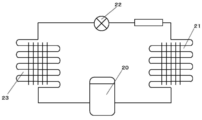
- the rotary compressor 20 compresses the low-temperature and low-pressure refrigerant gas, discharges the high-temperature and high-pressure refrigerant gas, and sends it to the condenser 21.
- the HFC-based refrigerant gas sent to the condenser 21 becomes a high-temperature and high-pressure refrigerant liquid while releasing its heat into the air, and is sent to the expansion mechanism 22 (for example, an expansion valve or a capillary tube).
- the high-temperature and high-pressure refrigerant liquid passing through the expansion mechanism 22 is sent to the evaporator 23 as low-temperature and low-pressure wet steam due to the throttling effect.
- the refrigerant that has entered the evaporator 23 absorbs heat from the surroundings and evaporates, and the low-temperature and low-pressure refrigerant gas that has exited the evaporator 23 is sucked into the rotary compressor 20, and the same cycle is repeated thereafter.
- a refrigerant mainly composed of a hydrofluoroolefin having a carbon double bond has a problem in stability.
- the decomposition and polymerization of the refrigeration oil and the refrigerant are accelerated to form sludge, and the refrigeration is caused by the refrigerant flow loss in the compressor failure or in the refrigeration cycle, for example, the expansion mechanism 22 (for example, capillary tube which is a thin tube).
- the expansion mechanism 22 for example, capillary tube which is a thin tube.
- the present invention has been made in view of such problems of the prior art, and ensures the reliability of a compressor and a refrigeration cycle apparatus using the compressor by suppressing decomposition and polymerization of refrigeration oil and refrigerant.
- the purpose is to do.
- the present invention seals a refrigerant and refrigerating machine oil
- the refrigerant is a hydrofluoroolefin having a carbon double bond in its composition, or a hydrofluoroolefin as a base component, and a double bond.
- an adsorption film is formed on the surface of the metal member constituting the refrigeration cycle, in particular, the sliding member of the compressor, and the direct contact between the refrigerant molecule consisting of refrigeration oil molecules or hydrofluoroolefin and the metal member is suppressed, Reacts with wear powder and leached metals present in refrigerating machine oil to form inert metal compounds Te by suppressing catalysis, it is possible to reduce the degradation rate of the refrigerant and the refrigerating machine oil.
- the present invention forms an adsorption film on the surface of a metal member constituting a refrigeration cycle, particularly a compressor sliding member, and suppresses direct contact between a refrigerant molecule composed of refrigeration oil molecules or hydrofluoroolefin and the metal member. Reducing the deterioration rate of refrigerant and refrigerating machine oil by reacting with wear powder floating in refrigerating machine oil and reacting with the eluted metal to form an inactive metal compound to suppress the catalytic action, The long-term reliability of the refrigeration cycle apparatus using can be ensured.
- the longitudinal cross-sectional view of the rotary compressor in Embodiment 1 of this invention 1 is a cross-sectional view of a rotary compressor according to Embodiment 1 of the present invention.
- Refrigeration cycle apparatus configuration diagram in Embodiment 1 of the present invention Characteristic correlation diagram of aging time and total acid value in Embodiment 1 of the present invention Characteristic correlation diagram of aging time and total acid number in Embodiment 2 of the present invention Longitudinal sectional view of a conventional rotary compressor Cross-sectional view of a conventional rotary compressor Configuration diagram of conventional refrigeration cycle equipment
- the 1st invention seals a refrigerant
- coolant is a hydrofluoroolefin which has a double bond of carbon in a composition, or a hydrofluorocarbon which has a hydrofluoroolefin as a base component and does not have a double bond
- the refrigeration cycle is constituted by containing at least one of benzotriazole, zinc dialkyldithiophosphates, dialkyl selenium, metal phenates, and organic nitrogen compounds in the refrigerating machine oil.
- an adsorbing film on the surface of the metal member, especially the compressor sliding member to suppress direct contact between the refrigerant molecule consisting of refrigeration oil molecules or hydrofluoroolefin and the metal member, or wear floating in the refrigeration oil Reacts with powder and eluted metal to form an inactive metal compound to suppress catalysis It is, it is possible to reduce the degradation rate of the refrigerant and the refrigerating machine oil, to ensure long-term reliability of the compressor and the refrigeration cycle apparatus using the same.
- the second invention by containing an amine-based antioxidant in the refrigerating machine oil of the first invention, the catalytic action by a metal member or the like is suppressed, and a highly active chain propagation that is a decomposition product of the refrigerating machine oil or the refrigerant.
- a highly active chain propagation that is a decomposition product of the refrigerating machine oil or the refrigerant.
- the amine-based antioxidant of the second invention is at least one of phenyl-alpha-naphthylamine and dialkyldiphenylamine, a highly versatile material is used, and the By suppressing the deterioration of the refrigerating machine oil, long-term reliability of the compressor and the refrigerating cycle apparatus using the compressor can be ensured.
- a phenolic antioxidant is contained in the refrigerating machine oil of the first invention, thereby suppressing the catalytic action of a metal member and the like, and having a high activity chain propagation that is a decomposition product of the refrigerating machine oil and the refrigerant.
- the fifth invention relates to the phenolic antioxidant of the fourth invention with 2,6-di-tert-butyl-paracresol (DBPC), 3-arylbenzofuran-2-one (hydroxycarboxylic acid intramolecular cyclic).
- DBPC 2,6-di-tert-butyl-paracresol
- 3-arylbenzofuran-2-one hydroxycarboxylic acid intramolecular cyclic.
- the refrigerating machine oil of the first aspect of the invention contains a sulfur / phosphorus antioxidant, thereby suppressing the catalytic action of the metal member and the like, and hydroperoxide produced during the oxidative degradation reaction.
- a sulfur / phosphorus antioxidant By suppressing the chain reaction of oxidative deterioration by decomposing to a stable compound, it is possible to ensure the long-term reliability of the compressor and the refrigeration cycle apparatus using the same in a synergistic manner.
- the sulfur-phosphorus antioxidant of the sixth aspect is at least one of dibenzyl disulfide, dicetyl sulfide, zinc dialkyldithiophosphate and zinc diallyldithiophosphate (ZnDTP). Since a highly versatile substance is used, it is reasonable and long-term reliability of the compressor and the refrigeration cycle apparatus using the compressor can be ensured by suppressing the deterioration of the refrigerating machine oil.
- the eighth invention is the invention according to any one of the first to seventh inventions, wherein the hydrofluoroolefin is tetrafluoropropene (HFO1234yf), and the hydrofluorocarbon is any of difluoromethane (HFC32) and pentafluoroethane (HFC125).
- HFO1234yf tetrafluoropropene
- HFC32 difluoromethane
- HFC125 pentafluoroethane
- a ninth invention is a refrigeration cycle apparatus that forms a refrigeration cycle that compresses, condenses, expands, and evaporates a refrigerant, and uses the compressor according to any one of the first to eighth inventions. It is a device that forms an adsorption film on the surface of metal members that make up the refrigeration cycle, especially compressor sliding members, and suppresses direct contact between the metal molecules and refrigerant molecules composed of refrigeration oil molecules and hydrofluoroolefins. By reacting with wear powder floating in the refrigerating machine oil and the eluted metal to form an inactive metal compound and suppressing the catalytic action, the deterioration rate of the refrigerant and refrigerating machine oil is reduced, and the refrigeration cycle apparatus Long-term reliability can be ensured.
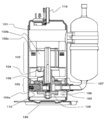
- FIG. 1 shows a longitudinal sectional view of a rotary compressor according to Embodiment 1 of the present invention.
- a compression mechanism 105 having a shaft 104 driven by a rotor 102b and a stator 102a of a motor 102 fixed to the upper part of the sealed container 101 is fixed to the lower part of the sealed container 101.
- a main bearing 107 is fixed to the upper end of the cylinder 106 of the compression mechanism 105, and a secondary bearing 108 is fixed to the lower end with bolts or the like.
- the piston 109 is inserted into the eccentric portion 104a of the shaft 104 to perform eccentric rotation.
- these members are formed from metal materials, such as iron, copper, and aluminum.
- hydrofluoroolefin tetrafluoropropene: HFO1234yf
- Refrigerating machine oil 103 made of a polyol ester compatible with the HFO 1234yf refrigerant is stored at the bottom of the sealed container 101. Further, an appropriate amount of benzotriazole is dispersed in the refrigerating machine oil 103.
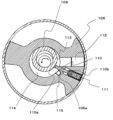
- FIG. 2 is a cross-sectional view of the rotary compressor according to Embodiment 1 of the present invention.
- a piston 109 is inserted into the inner surface of the cylinder 106 and rotates with the rotation of the shaft 104, and the refrigerant is sucked and compressed in the suction chamber 113 and the compression chamber 114 partitioned by the vane 110.
- the HFC refrigerant is sucked into the suction chamber 113 from the suction port 112 provided in the cylinder 106. Further, the refrigerant in the compression chamber 114 is compressed with the rotation of the piston 109 in the left direction (arrow direction), and is discharged into the sealed container 101 through the discharge notch 115 from the discharge port (not shown).
- the refrigerant gas discharged into the hermetic container 101 passes through the gap of the motor 102 and is discharged from the discharge pipe 116 at the top of the hermetic container 101, and the mist of the refrigerating machine oil around that is also discharged.
- Boundary lubrication is a state in which friction is performed across an adsorbed molecular film (boundary film) formed between two surfaces of a friction part under the condition that an oil film of sufficient thickness is not retained as in fluid lubrication.
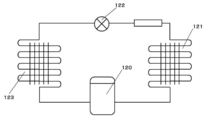
- this refrigeration cycle apparatus includes a compressor 120, a condenser 121, an expansion mechanism 122, and an evaporator 123.
- the compressor 120 compresses the low-temperature and low-pressure refrigerant gas, discharges the high-temperature and high-pressure refrigerant gas, and sends it to the condenser 121.
- the refrigerant gas sent to the condenser 121 becomes a high-temperature and high-pressure refrigerant liquid while releasing its heat into the air, and is sent to the expansion mechanism 122 (for example, an expansion valve or a capillary tube).
- the high-temperature and high-pressure refrigerant liquid that passes through the expansion mechanism 122 becomes low-temperature and low-pressure wet steam due to the throttling effect, and is sent to the evaporator 123.
- the refrigerant entering the evaporator 123 absorbs heat from the surroundings and evaporates, and the low-temperature and low-pressure refrigerant gas exiting the evaporator 123 is sucked into the rotary compressor 120, and the same cycle is repeated thereafter.
- most of the members used in the refrigeration cycle apparatus are formed from a metal material such as iron, copper, aluminum or the like.
- an autoclave test was first conducted in order to accelerate evaluation of the change over time in the deterioration of the refrigeration oil.
- a specific chemical reaction can proceed quickly inside the object placed inside the vessel. This is the principle of autoclave.
- Table 1 shows the combinations of refrigerant and refrigeration oil used in the test.
- Example 1 is a combination of a polyol ester oil in which a refrigerant is tetrafluoropropene (HFO1234yf) and a refrigerating machine oil is dispersed in an appropriate amount of benzotriazole.
- a refrigerant is tetrafluoropropene (HFO1234yf)
- a refrigerating machine oil is dispersed in an appropriate amount of benzotriazole.
- Comparative Example 1 Condition 1 is a combination of HFO1234yf as the refrigerant and polyol ester oil as the refrigerating machine oil.
- Comparative Example 1 Condition 2 is a combination of R410A (a mixture of HFC32 and HFC125), which is a conventional HFC refrigerant, and a refrigerator oil, which is a polyol ester oil.
- the total acid value is the number of milligrams (mg) of potassium hydroxide required to neutralize all acidic components contained in 1 g of the sample, and the acid value is an oxidation value during use of the lubricating oil. It is an index widely used for knowing the degree or for evaluation after oxidation test and practical test of lubricating oil.
- FIG. 4 shows a characteristic correlation diagram between the aging time and the total acid value in Embodiment 1 of the present invention.
- Refrigerating machine oil is thought to have gradually deteriorated due to exposure to high temperatures and stirring with mixed air and moisture.
- the constituent molecules of refrigerating machine oil are decomposed by mixed air and moisture in a high-temperature environment to form active free radicals.
- Free radicals react with air to generate peroxide radicals (hereinafter referred to as OH radicals).
- OH radicals peroxide radicals
- These free radicals and OH radicals are thought to have been oxidized one after another by oxidizing the constituent molecules of new refrigerating machine oil to hydroperoxide, creating new free radicals, and further propagating the chain.
- the encapsulated metal (copper, iron, aluminum) acts as a catalyst that accelerates the deterioration of the refrigerating machine oil and the oxidation chain reaction by activating its surface in a high temperature environment. Conceivable.
- HFO1234yf produced hydrogen fluoride (hydrofluoric acid) generated by being decomposed by air or a metal catalyst, which further promoted the decomposition of the refrigerating machine oil.
- sludge may cause a compressor failure or clogging in a capillary tube, which is a particularly thin tube in the refrigeration cycle device, leading to a reduction in refrigeration capacity.
- Example 1 which is the first embodiment, an appropriate amount of benzotriazole is dispersed in a polyol ester oil which is a refrigerating machine oil, thereby significantly suppressing an increase in the total acid value, and even at the final time.
- the increase is only about 50 times the total acid value before the test, and the total acid value is suppressed to a level almost equivalent to that of the conventional HFC refrigerant.
- the refrigerant, refrigerating machine oil, air, and moisture of the combination of the first embodiment are also enclosed in the sealed container 101 of the rotary compressor 120 described above to assemble the refrigeration cycle apparatus, and run for 1000 hours under overload conditions. Went.
- the refrigerant and the refrigerating machine oil are sealed, and the refrigerant is a hydrofluoroolefin having a carbon double bond in the composition or a mixture of hydrofluoroolefin having a base component of hydrofluoroolefin and having no double bond.
- the refrigerant is a hydrofluoroolefin having a carbon double bond in the composition or a mixture of hydrofluoroolefin having a base component of hydrofluoroolefin and having no double bond.
- benzotriazole is used, but the same effect can be obtained even if at least one selected from zinc dialkyldithiophosphates, dialkylselenium, metal phenates, and organic nitrogen compounds is used. .
- the tetrafluoropropene (HFO1234yf) used in this embodiment has a small temperature difference by mixing hydrofluorocarbons (HFC32, HFC125) that do not have a double bond, despite the non-azeotropic refrigerant mixture. Since the behavior approaches that of the pseudo-azeotropic refrigerant mixture, the cooling performance and the cooling performance coefficient (Coefficient Of Performance: COP) of the cooling cycle apparatus can be improved. In this embodiment, the HFO1234yf refrigerant is used alone, but the same effect can be obtained even if a mixed refrigerant is used.
- the GWP of the mixed refrigerant it is necessary to mix two components or three components so as to be 5 or more and 750 or less, and desirably 350 or less.
- HFO1234yf and HFC32 it is desirable that HFO1234yf be 49 wt% or more.
- HFO1234yf in order to mix HFO1234yf and HFC125 to make GWP750 or less, it is desirable that HFO1234yf be 78.7 wt% or more, and in order to make GWP350 or less, HFO1234yf is 91.1 wt% or more.
- a polyol ester oil compatible with HFO1234yf is used as the refrigerating machine oil.
- a refrigerating cycle can be used even when a refrigerating machine oil composed of polyvinyl ether or polyalkylene glycol having the same compatibility is used.
- the refrigerating machine oil that has gone out to the above can be recovered in the rotary compressor, and similarly a highly reliable rotary compressor can be obtained.
- the above refrigerating machine oil is compatible as a mixed refrigerant with the HFC refrigerant, the same effect can be obtained.
- the rotary compressor has been described as an example.
- other compression compressors such as other rotary compressors such as a sliding vane type, scroll compressor, reciprocating compression, etc. The same effect can be obtained when applied to a machine.
- Table 2 shows the combinations of refrigerant and refrigeration oil used in the test.
- Example 2 Condition 1 in the present embodiment is that tetrafluoropropene (HFO1234yf) whose refrigerant is hydrofluoroolefin, benzotriazole as a refrigerating machine oil, and phenyl-alpha-naphthylamine which is an amine antioxidant are dispersed in appropriate amounts.
- HFO1234yf tetrafluoropropene
- benzotriazole as a refrigerating machine oil
- phenyl-alpha-naphthylamine which is an amine antioxidant are dispersed in appropriate amounts.
- Example 2 Condition 2 is that HFO1234yf as the refrigerant, benzotriazole as the refrigerating machine oil, and 2,6-di-tert-butyl-paracresol (DBPC), which is a phenolic antioxidant, in an appropriate amount
- Example 2 Condition 3 is a combination of dispersed polyol ester oils, in which a refrigerant is HFO1234yf, a refrigerating machine oil is benzotriazole, and a sulfur / phosphorus antioxidant zinc diallyldithiophosphate (ZnDTP) is dispersed in appropriate amounts. It is a combination of ester oil
- Comparative Example 1 Condition 1 is a combination of tetrafluoropropene (HFO1234yf) whose refrigerant is hydrofluoroolefin, and refrigeration oil is polyol ester oil.
- Comparative Example 1 Condition 2 is R410A where the refrigerant is a conventional HFC refrigerant, refrigeration The machine oil is a combination of polyol ester oils.
- test conditions As test conditions, a test temperature of 175 ° C. and a maximum of 500 hours were prepared for each of five cylinders per combination, and one cylinder was opened every 100 hours, and the change over time in the total acid value of the refrigerating machine oil was evaluated. .
- FIG. 5 shows a characteristic correlation diagram between the aging time and the total acid value in Embodiment 2 of the present invention.
- the refrigeration oil gradually deteriorated due to exposure to high temperatures or stirring with mixed air or moisture.
- the constituent molecules of refrigerating machine oil are decomposed by mixed air and moisture to form active free radicals. Free radicals react with air to generate peroxide radicals (hereinafter referred to as OH radicals).
- OH radicals peroxide radicals
- These free radicals and OH radicals are thought to have been oxidized one after another by oxidizing the constituent molecules of new refrigerating machine oil to hydroperoxide, creating new free radicals, and further propagating the chain.
- the encapsulated metal copper, iron, aluminum
- Comparative Example 1 Condition 1 and Condition 2 the difference in the rate of increase between Comparative Example 1 Condition 1 and Condition 2 is considered as follows.
- R410A which is an HFC refrigerant
- HFO1234yf has a carbon double bond structurally. Therefore, it is considered that the substance is easily decomposed by air or the like. That is, it is considered that the increase in the total acid value in Comparative Example 1 Condition 2 is due to deterioration and oxidation of the refrigerating machine oil.
- HFO1234yf decomposes with air or a metal catalyst to generate hydrogen fluoride (hydrofluoric acid), which further promotes the decomposition of the refrigerating machine oil.
- the total acid value of Comparative Example 1 Condition 1 and Condition 2 It is thought that this is reflected in the difference in the rate of increase.
- sludge may cause a compressor failure or clogging in a capillary tube, which is a particularly thin tube in the refrigeration cycle device, leading to a reduction in refrigeration capacity.
- Example 2 Condition 1 which is the second embodiment
- the total acid value is increased by dispersing appropriate amounts of benzotriazole and phenyl-alpha-naphthylamine in the polyol ester oil which is a refrigerating machine oil. It is markedly suppressed, and it can be seen that even when the test time is 500 hours, it increases only to about 10 times the total acid value before the test.
- the amine antioxidant phenyl-alpha-naphthylamine is a highly active chain propagator (free radical) Or OH radicals) and the chain reaction is stopped to suppress oxidative degradation.
- the amine system is considered to be effective up to a relatively high temperature range, and it is considered that the effect is also taken into consideration.
- Example 2 Condition 2 which is the second embodiment, benzotriazole and 2,6-di-tert-butyl-paracresol (DBPC) are dispersed in appropriate amounts in the polyol ester oil that is a refrigerating machine oil.
- DBPC 2,6-di-tert-butyl-paracresol
- Example 2 Condition 3 which is the second embodiment, an increase in total acid value is remarkably achieved by dispersing appropriate amounts of benzotriazole and zinc diallyldithiophosphate (ZnDTP) in a polyol ester oil that is a refrigerating machine oil. It can be seen that even when the test time is 500 hours, it increases only to about 4 times the total acid value before the test.
- ZnDTP zinc diallyldithiophosphate
- three refrigerant cycle apparatuses are assembled by enclosing air and moisture together with the refrigerant and the refrigerating machine oil in the combination of the conditions 1 to 3 in the second embodiment.
- the operation was performed for 1000 hours under overload conditions.
- the benzotriazole dispersed in the refrigeration oil is adsorbed to various metal members constituting the refrigeration cycle apparatus assumed to act as a catalyst, particularly the sliding portion in the compressor 120 that is easily activated by friction.
- the benzotriazole dispersed in the refrigeration oil is adsorbed to various metal members constituting the refrigeration cycle apparatus assumed to act as a catalyst, particularly the sliding portion in the compressor 120 that is easily activated by friction.
- it reacts with the wear powder and dissolved metal in the refrigeration oil to form an inactive metal compound that catalyzes the action.
- phenyl-alpha-naphthylamine and 2,6-di-tert-butyl-paracresol are added to capture highly active chain propagators (OH radicals, etc.) This is because the chain reaction was stopped to suppress oxidative degradation, and in the case of zinc diallyldithiophosphate (ZnDTP), it was generated during the oxidative degradation reaction. Instead decomposing hydroperoxide in stable compounds are believed to be synergistic Additive effect of order to suppress a chain initiation.
- the refrigerant and refrigerating machine oil are sealed, and the refrigerant is a hydrofluoroolefin having a carbon double bond in the composition, or a mixture of hydrofluoroolefin having a base component of hydrofluoroolefin and no double bond.
- the refrigeration oil contains benzotriazole and an amine-based antioxidant phenyl-alpha-naphthylamine, so that the surface of the metal member, particularly the sliding member, constituting the rotary compressor A thin adsorbent film is formed, and direct contact between the refrigerant oil molecules and the refrigerant composed of hydrofluoroolefin having a carbon double bond in the composition and the metal member, or wear powder floating in the refrigerator oil, In addition to inhibiting the catalytic action by reacting with the eluted metal to form an inactive metal compound, it is highly active.
- Compressor and refrigeration cycle apparatus using the same by capturing chain propagators (OH radicals, etc.) and stopping the chain reaction to suppress oxidative deterioration, thereby reducing the deterioration rate of refrigerating machine oil synergistically Long-term reliability can be ensured.
- chain propagators OH radicals, etc.
- phenyl-alpha-naphthylamine is used as the amine-based antioxidant, but the same effect can be obtained by using dialkyldiphenylamine.
- the metal member constituting the rotary compressor, particularly the sliding member is included.
- a thin adsorption film is formed on the surface of the moving member to prevent direct contact between the refrigerant oil and the refrigerant composed of hydrofluoroolefin having a carbon double bond in the composition, and floating in the refrigerator oil.
- DBPC 2,6-di-tert-butyl-paracresol
- zinc diallyl dithiophosphate (ZnDTP) is used as the sulfur / phosphorus antioxidant, but the same effect can be obtained by using dibenzyl disulfide, dicetyl sulfide, or zinc dialkyldithiophosphate. can get.
- the compressor according to the present invention ensures the reliability of the compressor even in a refrigerant mixed with a hydrofluoroolefin having a double bond between carbons and a hydrofluorocarbon having no double bond. Therefore, the present invention can be applied to uses such as a compressor for a hot water heater, a compressor for a car air conditioner, a compressor for a refrigerator and a refrigerator, and a compressor for a dehumidifier.
Landscapes
- Chemical & Material Sciences (AREA)
- Chemical Kinetics & Catalysis (AREA)
- Organic Chemistry (AREA)
- General Chemical & Material Sciences (AREA)
- Oil, Petroleum & Natural Gas (AREA)
- Engineering & Computer Science (AREA)
- Physics & Mathematics (AREA)
- Thermal Sciences (AREA)
- Emergency Medicine (AREA)
- Health & Medical Sciences (AREA)
- Mechanical Engineering (AREA)
- General Engineering & Computer Science (AREA)
- Combustion & Propulsion (AREA)
- Materials Engineering (AREA)
- Lubricants (AREA)
- Applications Or Details Of Rotary Compressors (AREA)
Abstract
Description
図1は、本発明の実施の形態1におけるロータリ圧縮機の縦断面図を示している。

以下、図5に基づいて本実施の形態の説明を進めるが、実施の形態1と同一構成については、同一符号を付して詳細な説明を省略する。

102 モータ
102a 固定子
102b 回転子
103 冷凍機油
104 シャフト
104a 偏心部
105 圧縮機構部
106 シリンダー
107 主軸受
108 副軸受
109 ピストン
110 ベーン
110a 先端部
110b 背部
111 ベーンバネ
112 吸入口
113 吸入室
114 圧縮室
115 吐出切り欠き
116 吐出管
120 圧縮機
121 凝縮器
122 膨張機構
123 蒸発器
Claims (9)
- 冷媒と冷凍機油を密封し、前記冷媒は、組成中に炭素の二重結合を有するハイドロフルオロオレフィン、あるいはハイドロフルオロオレフィンをベース成分とし、二重結合を有しないハイドロフルオロカーボンとの混合物のいずれかとしたものであり、前記冷凍機油中にベンゾトリアゾール、ジアルキルジチオリン酸亜鉛類、ジアルキルセレン、金属フェネート類、有機窒素化合物類のうち少なくとも1種を含有した圧縮機。
- 前記冷凍機油中にアミン系酸化防止剤を含有させた請求項1に記載の圧縮機。
- 前記アミン系酸化防止剤は、フェニル-アルファ-ナフチルアミン、ジアルキルジフェニルアミンのうち少なくとも1種とした請求項2に記載の圧縮機。
- 前記冷凍機油中にフェノール系酸化防止剤を含有させた請求項1に記載の圧縮機。
- 前記フェノール系酸化防止剤は、2,6-ジ-ターシャリー-ブチル-パラクレゾール(DBPC)、3-アリールベンゾフラン-2-オン(ヒドロキシカルボン酸の分子内環状エステル)のうち少なくとも1種とした請求項4に記載の圧縮機。
- 前記冷凍機油中に硫黄・りん系酸化防止剤を含有させた請求項1に記載の圧縮機。
- 前記硫黄・りん系酸化防止剤は、ジベンジルジサルファイド、ジセチルサルファイド、ジアルキルジチオりん酸亜鉛、ジアリルジチオりん酸亜鉛(ZnDTP)のうち少なくとも1種とした請求項6に記載の圧縮機。
- 前記ハイドロフルオロオレフィンをテトラフルオロプロペン(HFO1234yf)とし、ハイドロフルオロカーボンをジフルオロメタン(HFC32)とペンタフルオロエタン(HFC125)とのいずれか一方又は両方とし、冷凍機油をポリビニルエーテル類、ポリオールエステル類あるいはポリアルキレングリコール類のいずれかとした請求項1~7のいずれか1項に記載の圧縮機。
- 冷媒を圧縮、凝縮、膨張、蒸発させる冷凍サイクルを形成する冷凍サイクル装置において、請求項1~8のいずれか1項に記載の圧縮機を用いることを特徴とする冷凍サイクル装置。
Priority Applications (4)
| Application Number | Priority Date | Filing Date | Title |
|---|---|---|---|
| CN201180032923XA CN102971591A (zh) | 2010-07-02 | 2011-03-11 | 压缩机和使用该压缩机的制冷循环装置 |
| EP11800321.9A EP2589895A4 (en) | 2010-07-02 | 2011-03-11 | COMPRESSOR AND COLD CIRCUIT DEVICE THEREFOR |
| AU2011272696A AU2011272696A1 (en) | 2010-07-02 | 2011-03-11 | Compressor and refrigeration cycle device using same |
| US13/806,809 US9005469B2 (en) | 2010-07-02 | 2011-03-11 | Compressor and refrigeration cycle device using same |
Applications Claiming Priority (2)
| Application Number | Priority Date | Filing Date | Title |
|---|---|---|---|
| JP2010151772A JP2012012532A (ja) | 2010-07-02 | 2010-07-02 | 圧縮機及びそれを用いた冷凍サイクル装置 |
| JP2010-151772 | 2010-07-02 |
Publications (1)
| Publication Number | Publication Date |
|---|---|
| WO2012001842A1 true WO2012001842A1 (ja) | 2012-01-05 |
Family
ID=45401594
Family Applications (1)
| Application Number | Title | Priority Date | Filing Date |
|---|---|---|---|
| PCT/JP2011/001434 Ceased WO2012001842A1 (ja) | 2010-07-02 | 2011-03-11 | 圧縮機及びそれを用いた冷凍サイクル装置 |
Country Status (6)
| Country | Link |
|---|---|
| US (1) | US9005469B2 (ja) |
| EP (1) | EP2589895A4 (ja) |
| JP (1) | JP2012012532A (ja) |
| CN (1) | CN102971591A (ja) |
| AU (1) | AU2011272696A1 (ja) |
| WO (1) | WO2012001842A1 (ja) |
Cited By (3)
| Publication number | Priority date | Publication date | Assignee | Title |
|---|---|---|---|---|
| WO2015060400A1 (ja) | 2013-10-25 | 2015-04-30 | 三菱重工業株式会社 | 冷媒循環装置、冷媒循環方法および異性化抑制方法 |
| US10443912B2 (en) | 2013-10-25 | 2019-10-15 | Mitsubishi Heavy Industries Thermal Systems, Ltd. | Refrigerant circulation device, method for circulating refrigerant and acid suppression method |
| WO2021167068A1 (ja) * | 2020-02-19 | 2021-08-26 | 出光興産株式会社 | 冷凍機油組成物及び冷凍機用混合組成物 |
Families Citing this family (14)
| Publication number | Priority date | Publication date | Assignee | Title |
|---|---|---|---|---|
| US9187682B2 (en) | 2011-06-24 | 2015-11-17 | Emerson Climate Technologies, Inc. | Refrigeration compressor lubricant |
| JP2015081726A (ja) * | 2013-10-23 | 2015-04-27 | 日立アプライアンス株式会社 | 冷凍サイクル装置、及び、空気調和装置 |
| US20150147012A1 (en) * | 2013-11-27 | 2015-05-28 | Emerson Climate Technologies, Inc. | Bearing performance for compressors using high energy refrigerants with sulfur-based oil additives |
| EP3112438B1 (en) * | 2014-02-24 | 2021-03-24 | AGC Inc. | Composition for heat cycle systems, and heat cycle system |
| WO2015136703A1 (ja) * | 2014-03-14 | 2015-09-17 | 三菱電機株式会社 | 冷凍サイクル装置 |
| CN107406798A (zh) * | 2015-03-30 | 2017-11-28 | 出光兴产株式会社 | 冷冻机润滑油和冷冻机用混合组合物 |
| EP3399189A4 (en) * | 2015-12-28 | 2019-08-28 | AGC Inc. | REFRIGERATION CIRCUIT DEVICE |
| US10634154B2 (en) * | 2016-07-25 | 2020-04-28 | Daikin Applied Americas Inc. | Centrifugal compressor and magnetic bearing backup system for centrifugal compressor |
| JP2018123717A (ja) * | 2017-01-30 | 2018-08-09 | 株式会社富士通ゼネラル | ロータリ圧縮機及び冷凍サイクル装置 |
| US11292987B2 (en) | 2017-03-29 | 2022-04-05 | Carrier Corporation | Active filter for oil-free refrigerant compressor |
| CN111237166A (zh) * | 2018-11-29 | 2020-06-05 | 安徽美芝精密制造有限公司 | 压缩机和制冷装置 |
| US12221591B2 (en) * | 2020-07-21 | 2025-02-11 | Mitsubishi Electric Corporation | Refrigeration cycle apparatus |
| JP7684553B2 (ja) * | 2021-03-31 | 2025-05-28 | ダイキン工業株式会社 | 自動車用冷凍サイクル装置 |
| CN119799389B (zh) * | 2025-03-12 | 2025-05-16 | 沈阳中大环新制冷技术有限公司 | 一种适用于汽车电动压缩机的制冷剂组合物 |
Citations (10)
| Publication number | Priority date | Publication date | Assignee | Title |
|---|---|---|---|---|
| JPH08240362A (ja) | 1996-02-20 | 1996-09-17 | Hitachi Ltd | 冷凍装置 |
| JPH11236890A (ja) | 1998-02-20 | 1999-08-31 | Sanyo Electric Co Ltd | ベーンおよびそれを使用した冷媒圧縮機 |
| WO2008061079A2 (en) * | 2006-11-14 | 2008-05-22 | Honeywell International Inc. | Fluorocarbon stabilizers |
| JP2009074021A (ja) * | 2007-03-06 | 2009-04-09 | Nippon Oil Corp | 冷凍機油および冷凍機用作動流体組成物 |
| WO2009057475A1 (ja) * | 2007-10-29 | 2009-05-07 | Nippon Oil Corporation | 冷凍機油および冷凍機用作動流体組成物 |
| JP2009126979A (ja) * | 2007-11-26 | 2009-06-11 | Nippon Oil Corp | 冷凍機油及び冷凍機用作動流体組成物 |
| JP2010265428A (ja) * | 2009-05-18 | 2010-11-25 | Japan Sun Oil Co Ltd | カーエアコン用作動流体 |
| JP2010265429A (ja) * | 2009-05-18 | 2010-11-25 | Japan Sun Oil Co Ltd | カーエアコン用作動流体 |
| WO2010146841A1 (ja) * | 2009-06-17 | 2010-12-23 | サンデン株式会社 | 冷凍回路及びその改良法 |
| WO2011024663A1 (ja) * | 2009-08-28 | 2011-03-03 | Jx日鉱日石エネルギー株式会社 | 冷凍機油および冷凍機用作動流体組成物 |
Family Cites Families (7)
| Publication number | Priority date | Publication date | Assignee | Title |
|---|---|---|---|---|
| US4755316A (en) * | 1987-10-23 | 1988-07-05 | Allied-Signal Inc. | Refrigeration lubricants |
| EP0638630B1 (en) * | 1990-01-31 | 1998-06-17 | Exxon Chemical Patents Inc. | Esters as lubricants for a haloalkane refrigerant |
| CA2137252A1 (en) * | 1992-06-03 | 1993-12-09 | Nicholas E. Schnur | Polyol ester lubricants for refrigerant heat transfer fluids |
| US6492565B2 (en) * | 1998-10-07 | 2002-12-10 | Bayer Aktiengesellschaft | Process for the preparation of polyether polyols |
| US20110114075A1 (en) * | 2008-07-30 | 2011-05-19 | Mills Randell L | Heterogeneous hydrogen-catalyst reactor |
| JP5390993B2 (ja) * | 2009-08-28 | 2014-01-15 | Jx日鉱日石エネルギー株式会社 | 冷凍機油および冷凍機用作動流体組成物 |
| JP5399819B2 (ja) * | 2009-08-28 | 2014-01-29 | Jx日鉱日石エネルギー株式会社 | 冷凍機油および冷凍機用作動流体組成物 |
-
2010
- 2010-07-02 JP JP2010151772A patent/JP2012012532A/ja active Pending
-
2011
- 2011-03-11 US US13/806,809 patent/US9005469B2/en active Active
- 2011-03-11 EP EP11800321.9A patent/EP2589895A4/en not_active Withdrawn
- 2011-03-11 AU AU2011272696A patent/AU2011272696A1/en not_active Abandoned
- 2011-03-11 WO PCT/JP2011/001434 patent/WO2012001842A1/ja not_active Ceased
- 2011-03-11 CN CN201180032923XA patent/CN102971591A/zh active Pending
Patent Citations (10)
| Publication number | Priority date | Publication date | Assignee | Title |
|---|---|---|---|---|
| JPH08240362A (ja) | 1996-02-20 | 1996-09-17 | Hitachi Ltd | 冷凍装置 |
| JPH11236890A (ja) | 1998-02-20 | 1999-08-31 | Sanyo Electric Co Ltd | ベーンおよびそれを使用した冷媒圧縮機 |
| WO2008061079A2 (en) * | 2006-11-14 | 2008-05-22 | Honeywell International Inc. | Fluorocarbon stabilizers |
| JP2009074021A (ja) * | 2007-03-06 | 2009-04-09 | Nippon Oil Corp | 冷凍機油および冷凍機用作動流体組成物 |
| WO2009057475A1 (ja) * | 2007-10-29 | 2009-05-07 | Nippon Oil Corporation | 冷凍機油および冷凍機用作動流体組成物 |
| JP2009126979A (ja) * | 2007-11-26 | 2009-06-11 | Nippon Oil Corp | 冷凍機油及び冷凍機用作動流体組成物 |
| JP2010265428A (ja) * | 2009-05-18 | 2010-11-25 | Japan Sun Oil Co Ltd | カーエアコン用作動流体 |
| JP2010265429A (ja) * | 2009-05-18 | 2010-11-25 | Japan Sun Oil Co Ltd | カーエアコン用作動流体 |
| WO2010146841A1 (ja) * | 2009-06-17 | 2010-12-23 | サンデン株式会社 | 冷凍回路及びその改良法 |
| WO2011024663A1 (ja) * | 2009-08-28 | 2011-03-03 | Jx日鉱日石エネルギー株式会社 | 冷凍機油および冷凍機用作動流体組成物 |
Non-Patent Citations (1)
| Title |
|---|
| See also references of EP2589895A4 * |
Cited By (7)
| Publication number | Priority date | Publication date | Assignee | Title |
|---|---|---|---|---|
| WO2015060400A1 (ja) | 2013-10-25 | 2015-04-30 | 三菱重工業株式会社 | 冷媒循環装置、冷媒循環方法および異性化抑制方法 |
| US10443912B2 (en) | 2013-10-25 | 2019-10-15 | Mitsubishi Heavy Industries Thermal Systems, Ltd. | Refrigerant circulation device, method for circulating refrigerant and acid suppression method |
| US10465959B2 (en) | 2013-10-25 | 2019-11-05 | Mitsubishi Heavy Industries Thermal Systems, Ltd. | Refrigerant circulation device, method for circulating refrigerant and method for suppressing isomerization |
| WO2021167068A1 (ja) * | 2020-02-19 | 2021-08-26 | 出光興産株式会社 | 冷凍機油組成物及び冷凍機用混合組成物 |
| JP2021130768A (ja) * | 2020-02-19 | 2021-09-09 | 出光興産株式会社 | 冷凍機油組成物及び冷凍機用混合組成物 |
| JP7490385B2 (ja) | 2020-02-19 | 2024-05-27 | 出光興産株式会社 | 冷凍機油組成物及び冷凍機用混合組成物 |
| US12534656B2 (en) | 2020-02-19 | 2026-01-27 | Idemitsu Kosan Co., Ltd. | Refrigerator oil composition and mixed composition for refrigerator |
Also Published As
| Publication number | Publication date |
|---|---|
| CN102971591A (zh) | 2013-03-13 |
| EP2589895A1 (en) | 2013-05-08 |
| JP2012012532A (ja) | 2012-01-19 |
| US20130098101A1 (en) | 2013-04-25 |
| AU2011272696A1 (en) | 2013-01-24 |
| US9005469B2 (en) | 2015-04-14 |
| EP2589895A4 (en) | 2016-03-02 |
Similar Documents
| Publication | Publication Date | Title |
|---|---|---|
| JP2012012532A (ja) | 圧縮機及びそれを用いた冷凍サイクル装置 | |
| US8939742B2 (en) | Compressor with steel and cast iron sliding materials | |
| CN111133259B (zh) | 制冷循环装置 | |
| JP6011861B2 (ja) | 圧縮機およびそれを用いた冷凍サイクル装置 | |
| EP2918948B1 (en) | Refrigeration device | |
| CN112088283A (zh) | 冷冻循环装置 | |
| JP5339788B2 (ja) | 圧縮機および冷凍サイクル装置 | |
| US20120131947A1 (en) | Refrigeration cycle apparatus | |
| WO2013051271A1 (ja) | 冷凍装置 | |
| JP5849233B2 (ja) | 回転式圧縮機 | |
| CN1107806C (zh) | 冷冻剂压缩机和致冷设备 | |
| KR100201207B1 (ko) | 냉동기용 압축기 | |
| WO2021166028A1 (ja) | 冷凍サイクル装置 | |
| CN102472282A (zh) | 具有氢氟烯烃制冷剂气体和高速工具钢叶片的旋转叶片式压缩机 | |
| JPWO2011155176A1 (ja) | 圧縮機 | |
| CN102472533A (zh) | 制冷循环装置 | |
| WO2017195397A1 (ja) | 空気調和装置 | |
| JP2010236542A (ja) | 圧縮機 |
Legal Events
| Date | Code | Title | Description |
|---|---|---|---|
| WWE | Wipo information: entry into national phase |
Ref document number: 201180032923.X Country of ref document: CN |
|
| 121 | Ep: the epo has been informed by wipo that ep was designated in this application |
Ref document number: 11800321 Country of ref document: EP Kind code of ref document: A1 |
|
| WWE | Wipo information: entry into national phase |
Ref document number: 13806809 Country of ref document: US |
|
| REEP | Request for entry into the european phase |
Ref document number: 2011800321 Country of ref document: EP |
|
| WWE | Wipo information: entry into national phase |
Ref document number: 2011800321 Country of ref document: EP |
|
| NENP | Non-entry into the national phase |
Ref country code: DE |
|
| ENP | Entry into the national phase |
Ref document number: 2011272696 Country of ref document: AU Date of ref document: 20110311 Kind code of ref document: A |