WO2012002028A1 - 硬化性樹脂組成物 - Google Patents
硬化性樹脂組成物 Download PDFInfo
- Publication number
- WO2012002028A1 WO2012002028A1 PCT/JP2011/059675 JP2011059675W WO2012002028A1 WO 2012002028 A1 WO2012002028 A1 WO 2012002028A1 JP 2011059675 W JP2011059675 W JP 2011059675W WO 2012002028 A1 WO2012002028 A1 WO 2012002028A1
- Authority
- WO
- WIPO (PCT)
- Prior art keywords
- group
- carbon atoms
- liquid crystal
- curable resin
- epoxy
- Prior art date
- Legal status (The legal status is an assumption and is not a legal conclusion. Google has not performed a legal analysis and makes no representation as to the accuracy of the status listed.)
- Ceased
Links
- SXAYBUADNBYKNH-WOJGMQOQSA-N C/C(/C(c(cc1)ccc1SC(CC1)=CC=C1O)=O)=N\OC(C)=O Chemical compound C/C(/C(c(cc1)ccc1SC(CC1)=CC=C1O)=O)=N\OC(C)=O SXAYBUADNBYKNH-WOJGMQOQSA-N 0.000 description 1
- AQNRNJDBTSFKII-LPYMAVHISA-N C/C(/C(c(cc1)ccc1Sc(cc1)cc(C#N)c1OCCO)=O)=N\OC(C)=O Chemical compound C/C(/C(c(cc1)ccc1Sc(cc1)cc(C#N)c1OCCO)=O)=N\OC(C)=O AQNRNJDBTSFKII-LPYMAVHISA-N 0.000 description 1
- BBASEKHCWSHGQP-LICLKQGHSA-N C/C(/C(c(cc1)ccc1Sc(cc1)ccc1C(O)=O)=O)=N\O Chemical compound C/C(/C(c(cc1)ccc1Sc(cc1)ccc1C(O)=O)=O)=N\O BBASEKHCWSHGQP-LICLKQGHSA-N 0.000 description 1
- VZTYULPZNQBCHO-RCPKOPEESA-N C/C(/C(c(cc1)ccc1Sc(cc1)ccc1C(OCCOCC[U]C(C)=[U])=O)=O)=N\OC(C)=O Chemical compound C/C(/C(c(cc1)ccc1Sc(cc1)ccc1C(OCCOCC[U]C(C)=[U])=O)=O)=N\OC(C)=O VZTYULPZNQBCHO-RCPKOPEESA-N 0.000 description 1
- OPNLRBDYKUPUQS-FYJGNVAPSA-N C/C(/C(c(cc1)ccc1Sc(cc1)ccc1OC(CCO)=S)=O)=N\OC(C)=O Chemical compound C/C(/C(c(cc1)ccc1Sc(cc1)ccc1OC(CCO)=S)=O)=N\OC(C)=O OPNLRBDYKUPUQS-FYJGNVAPSA-N 0.000 description 1
- KGBXGCGPOGYYCH-WGOQTCKBSA-N C/C(/C(c(cc1)ccc1Sc(ccc(/C(/OCCO)=[O]/CCSC)c1)c1C#N)=O)=N\OC(C)=O Chemical compound C/C(/C(c(cc1)ccc1Sc(ccc(/C(/OCCO)=[O]/CCSC)c1)c1C#N)=O)=N\OC(C)=O KGBXGCGPOGYYCH-WGOQTCKBSA-N 0.000 description 1
- BFCBIYABWCWKNJ-YDZHTSKRSA-N C/C(/C(c(ccc(Sc(cc1)ccc1C(OCCO)=O)c1)c1C(OC)=O)=O)=N\OC(C)=O Chemical compound C/C(/C(c(ccc(Sc(cc1)ccc1C(OCCO)=O)c1)c1C(OC)=O)=O)=N\OC(C)=O BFCBIYABWCWKNJ-YDZHTSKRSA-N 0.000 description 1
- 0 CC(C(c(cc1)ccc1Sc(cc1)ccc1C(OCCOCC*)=O)=O)=NOC(C)=O Chemical compound CC(C(c(cc1)ccc1Sc(cc1)ccc1C(OCCOCC*)=O)=O)=NOC(C)=O 0.000 description 1
- AZUQNBNGNBSQKK-KOEQRZSOSA-N CCCCC(OCCOc(cc1)ccc1Sc(cc1)ccc1C(/C(/C)=N/OC(C)=O)=O)=O Chemical compound CCCCC(OCCOc(cc1)ccc1Sc(cc1)ccc1C(/C(/C)=N/OC(C)=O)=O)=O AZUQNBNGNBSQKK-KOEQRZSOSA-N 0.000 description 1
Images

Classifications
-
- C—CHEMISTRY; METALLURGY
- C08—ORGANIC MACROMOLECULAR COMPOUNDS; THEIR PREPARATION OR CHEMICAL WORKING-UP; COMPOSITIONS BASED THEREON
- C08L—COMPOSITIONS OF MACROMOLECULAR COMPOUNDS
- C08L63/00—Compositions of epoxy resins; Compositions of derivatives of epoxy resins
-
- C—CHEMISTRY; METALLURGY
- C08—ORGANIC MACROMOLECULAR COMPOUNDS; THEIR PREPARATION OR CHEMICAL WORKING-UP; COMPOSITIONS BASED THEREON
- C08G—MACROMOLECULAR COMPOUNDS OBTAINED OTHERWISE THAN BY REACTIONS ONLY INVOLVING UNSATURATED CARBON-TO-CARBON BONDS
- C08G59/00—Polycondensates containing more than one epoxy group per molecule; Macromolecules obtained by polymerising compounds containing more than one epoxy group per molecule using curing agents or catalysts which react with the epoxy groups
- C08G59/18—Macromolecules obtained by polymerising compounds containing more than one epoxy group per molecule using curing agents or catalysts which react with the epoxy groups ; e.g. general methods of curing
- C08G59/68—Macromolecules obtained by polymerising compounds containing more than one epoxy group per molecule using curing agents or catalysts which react with the epoxy groups ; e.g. general methods of curing characterised by the catalysts used
- C08G59/686—Macromolecules obtained by polymerising compounds containing more than one epoxy group per molecule using curing agents or catalysts which react with the epoxy groups ; e.g. general methods of curing characterised by the catalysts used containing nitrogen
-
- C—CHEMISTRY; METALLURGY
- C08—ORGANIC MACROMOLECULAR COMPOUNDS; THEIR PREPARATION OR CHEMICAL WORKING-UP; COMPOSITIONS BASED THEREON
- C08L—COMPOSITIONS OF MACROMOLECULAR COMPOUNDS
- C08L33/00—Compositions of homopolymers or copolymers of compounds having one or more unsaturated aliphatic radicals, each having only one carbon-to-carbon double bond, and only one being terminated by only one carboxyl radical, or of salts, anhydrides, esters, amides, imides or nitriles thereof; Compositions of derivatives of such polymers
- C08L33/04—Homopolymers or copolymers of esters
- C08L33/06—Homopolymers or copolymers of esters of esters containing only carbon, hydrogen and oxygen, which oxygen atoms are present only as part of the carboxyl radical
- C08L33/08—Homopolymers or copolymers of acrylic acid esters
-
- C—CHEMISTRY; METALLURGY
- C08—ORGANIC MACROMOLECULAR COMPOUNDS; THEIR PREPARATION OR CHEMICAL WORKING-UP; COMPOSITIONS BASED THEREON
- C08L—COMPOSITIONS OF MACROMOLECULAR COMPOUNDS
- C08L33/00—Compositions of homopolymers or copolymers of compounds having one or more unsaturated aliphatic radicals, each having only one carbon-to-carbon double bond, and only one being terminated by only one carboxyl radical, or of salts, anhydrides, esters, amides, imides or nitriles thereof; Compositions of derivatives of such polymers
- C08L33/04—Homopolymers or copolymers of esters
- C08L33/06—Homopolymers or copolymers of esters of esters containing only carbon, hydrogen and oxygen, which oxygen atoms are present only as part of the carboxyl radical
- C08L33/10—Homopolymers or copolymers of methacrylic acid esters
- C08L33/12—Homopolymers or copolymers of methyl methacrylate
-
- G—PHYSICS
- G02—OPTICS
- G02F—OPTICAL DEVICES OR ARRANGEMENTS FOR THE CONTROL OF LIGHT BY MODIFICATION OF THE OPTICAL PROPERTIES OF THE MEDIA OF THE ELEMENTS INVOLVED THEREIN; NON-LINEAR OPTICS; FREQUENCY-CHANGING OF LIGHT; OPTICAL LOGIC ELEMENTS; OPTICAL ANALOGUE/DIGITAL CONVERTERS
- G02F1/00—Devices or arrangements for the control of the intensity, colour, phase, polarisation or direction of light arriving from an independent light source, e.g. switching, gating or modulating; Non-linear optics
- G02F1/01—Devices or arrangements for the control of the intensity, colour, phase, polarisation or direction of light arriving from an independent light source, e.g. switching, gating or modulating; Non-linear optics for the control of the intensity, phase, polarisation or colour
- G02F1/13—Devices or arrangements for the control of the intensity, colour, phase, polarisation or direction of light arriving from an independent light source, e.g. switching, gating or modulating; Non-linear optics for the control of the intensity, phase, polarisation or colour based on liquid crystals, e.g. single liquid crystal display cells
- G02F1/133—Constructional arrangements; Operation of liquid crystal cells; Circuit arrangements
- G02F1/1333—Constructional arrangements; Manufacturing methods
- G02F1/1339—Gaskets; Spacers; Sealing of cells
-
- G—PHYSICS
- G02—OPTICS
- G02F—OPTICAL DEVICES OR ARRANGEMENTS FOR THE CONTROL OF LIGHT BY MODIFICATION OF THE OPTICAL PROPERTIES OF THE MEDIA OF THE ELEMENTS INVOLVED THEREIN; NON-LINEAR OPTICS; FREQUENCY-CHANGING OF LIGHT; OPTICAL LOGIC ELEMENTS; OPTICAL ANALOGUE/DIGITAL CONVERTERS
- G02F1/00—Devices or arrangements for the control of the intensity, colour, phase, polarisation or direction of light arriving from an independent light source, e.g. switching, gating or modulating; Non-linear optics
- G02F1/01—Devices or arrangements for the control of the intensity, colour, phase, polarisation or direction of light arriving from an independent light source, e.g. switching, gating or modulating; Non-linear optics for the control of the intensity, phase, polarisation or colour
- G02F1/13—Devices or arrangements for the control of the intensity, colour, phase, polarisation or direction of light arriving from an independent light source, e.g. switching, gating or modulating; Non-linear optics for the control of the intensity, phase, polarisation or colour based on liquid crystals, e.g. single liquid crystal display cells
- G02F1/133—Constructional arrangements; Operation of liquid crystal cells; Circuit arrangements
- G02F1/1333—Constructional arrangements; Manufacturing methods
- G02F1/1341—Filling or closing of cells
- G02F1/13415—Drop filling process
-
- G—PHYSICS
- G02—OPTICS
- G02F—OPTICAL DEVICES OR ARRANGEMENTS FOR THE CONTROL OF LIGHT BY MODIFICATION OF THE OPTICAL PROPERTIES OF THE MEDIA OF THE ELEMENTS INVOLVED THEREIN; NON-LINEAR OPTICS; FREQUENCY-CHANGING OF LIGHT; OPTICAL LOGIC ELEMENTS; OPTICAL ANALOGUE/DIGITAL CONVERTERS
- G02F1/00—Devices or arrangements for the control of the intensity, colour, phase, polarisation or direction of light arriving from an independent light source, e.g. switching, gating or modulating; Non-linear optics
- G02F1/01—Devices or arrangements for the control of the intensity, colour, phase, polarisation or direction of light arriving from an independent light source, e.g. switching, gating or modulating; Non-linear optics for the control of the intensity, phase, polarisation or colour
- G02F1/13—Devices or arrangements for the control of the intensity, colour, phase, polarisation or direction of light arriving from an independent light source, e.g. switching, gating or modulating; Non-linear optics for the control of the intensity, phase, polarisation or colour based on liquid crystals, e.g. single liquid crystal display cells
- G02F1/137—Devices or arrangements for the control of the intensity, colour, phase, polarisation or direction of light arriving from an independent light source, e.g. switching, gating or modulating; Non-linear optics for the control of the intensity, phase, polarisation or colour based on liquid crystals, e.g. single liquid crystal display cells characterised by the electro-optical or magneto-optical effect, e.g. field-induced phase transition, orientation effect, guest-host interaction or dynamic scattering
- G02F1/13775—Polymer-stabilized liquid crystal layers
-
- G—PHYSICS
- G03—PHOTOGRAPHY; CINEMATOGRAPHY; ANALOGOUS TECHNIQUES USING WAVES OTHER THAN OPTICAL WAVES; ELECTROGRAPHY; HOLOGRAPHY
- G03F—PHOTOMECHANICAL PRODUCTION OF TEXTURED OR PATTERNED SURFACES, e.g. FOR PRINTING, FOR PROCESSING OF SEMICONDUCTOR DEVICES; MATERIALS THEREFOR; ORIGINALS THEREFOR; APPARATUS SPECIALLY ADAPTED THEREFOR
- G03F7/00—Photomechanical, e.g. photolithographic, production of textured or patterned surfaces, e.g. printing surfaces; Materials therefor, e.g. comprising photoresists; Apparatus specially adapted therefor
- G03F7/0005—Production of optical devices or components in so far as characterised by the lithographic processes or materials used therefor
- G03F7/0007—Filters, e.g. additive colour filters; Components for display devices
-
- G—PHYSICS
- G03—PHOTOGRAPHY; CINEMATOGRAPHY; ANALOGOUS TECHNIQUES USING WAVES OTHER THAN OPTICAL WAVES; ELECTROGRAPHY; HOLOGRAPHY
- G03F—PHOTOMECHANICAL PRODUCTION OF TEXTURED OR PATTERNED SURFACES, e.g. FOR PRINTING, FOR PROCESSING OF SEMICONDUCTOR DEVICES; MATERIALS THEREFOR; ORIGINALS THEREFOR; APPARATUS SPECIALLY ADAPTED THEREFOR
- G03F7/00—Photomechanical, e.g. photolithographic, production of textured or patterned surfaces, e.g. printing surfaces; Materials therefor, e.g. comprising photoresists; Apparatus specially adapted therefor
- G03F7/004—Photosensitive materials
- G03F7/027—Non-macromolecular photopolymerisable compounds having carbon-to-carbon double bonds, e.g. ethylenic compounds
- G03F7/028—Non-macromolecular photopolymerisable compounds having carbon-to-carbon double bonds, e.g. ethylenic compounds with photosensitivity-increasing substances, e.g. photoinitiators
- G03F7/031—Organic compounds not covered by group G03F7/029
-
- C—CHEMISTRY; METALLURGY
- C08—ORGANIC MACROMOLECULAR COMPOUNDS; THEIR PREPARATION OR CHEMICAL WORKING-UP; COMPOSITIONS BASED THEREON
- C08L—COMPOSITIONS OF MACROMOLECULAR COMPOUNDS
- C08L2205/00—Polymer mixtures characterised by other features
- C08L2205/02—Polymer mixtures characterised by other features containing two or more polymers of the same C08L -group
Definitions
- the present invention relates to a curable resin composition. Specifically, the present invention relates to a sealant that seals liquid or liquid crystal. More specifically, the present invention relates to a liquid crystal dropping method sealing agent for sealing a polymerizable liquid crystal composition and a liquid crystal display device using the same.
- seal liquids or liquid crystals are used in liquid crystal display elements, dye-sensitized solar cells, organic EL elements, and the like.
- a liquid crystal material sealant for liquid crystal display elements as an organic solvent electrolyte such as acetonitrile or propylene carbonate for dye-sensitized solar cells, or as an ionic liquid sealant, for organic EL elements, It is used as a dam material for sealing a liquid sealant in solid sealing.
- Conventional sealants (sealants) come into contact with liquid or liquid crystal in an uncured state, so that the resin components of the sealant are eluted and contaminated, thereby reducing the performance and reliability of the device. There is a problem. Moreover, there exists a problem that a sealing agent becomes weak by elution and it becomes easy to break. Thus, there is a need for a sealant that has low elution to liquid or liquid crystal.
- a liquid crystal dropping method is mainly used as a manufacturing method of the liquid crystal display element from the conventional vacuum injection method for the purpose of shortening the manufacturing process.
- a display element frame is dispensed on a substrate with electrodes by a sealant, and after the liquid crystal is dropped into the drawing frame, the other substrate with electrodes is bonded under vacuum.
- it is a method of manufacturing a liquid crystal display element by irradiating the seal portion with ultraviolet rays to perform temporary curing, and then performing main curing by heating that combines liquid crystal annealing and thermal curing.
- this construction method by adopting two-stage curing by photocuring and thermal curing, the curing time can be shortened and the manufacturing process of the liquid crystal display element can be shortened.
- Liquid crystal panels display as much information as possible on one screen, and therefore tend to have higher definition and higher speed. Furthermore, in recent years, as many liquid crystal panels as possible are cut out from a single glass substrate (mother glass). Accordingly, the material for sealing the liquid crystal has been applied on the black matrix in the substrate having the color filter, and has been applied over the TFT wiring in the counter substrate (TFT substrate). . Therefore, when UV curing is performed, a shadow is generated that is not irradiated to the sealant even if UV is irradiated from either the color filter or the TFT substrate. If the sealant component is uncured at this shadow, the sealant component is thermally cured.
- Liquid crystal compounds having an alkenyl group having a low rotational viscosity coefficient are often blended in nematic liquid crystal materials for TFTs such as TN, VA, and IPS-LCD modes in order to increase the response speed for moving images.
- TFTs such as TN, VA, and IPS-LCD modes
- the photoradical initiator migrates from the sealant to the liquid crystal, thereby causing photodegradation of the alkenyl group.
- Patent Documents 1 to 7 disclose liquid crystal sealing agents using a photo radical initiator having an oxime ester structure.
- the photoradical initiator having a conventional oxime ester structure has insufficient sensitivity, the curing of the sealing agent is weak, the resin component and the initiator itself are eluted in the liquid crystal composition, and the electrical characteristics are deteriorated.
- Even in a highly sensitive oxime ester compound there is a problem in that the decomposition product of the initiator is eluted in the liquid crystal composition and the electrical characteristics are deteriorated.
- the object of the present invention is characterized by two-stage curing of photocuring and thermal curing, a curable resin composition having low contamination and high adhesive strength when in contact with a liquid or liquid crystal, particularly TFT wiring during photocuring.
- a curable resin composition that can be sufficiently photocured even in a shadowed portion (shadow portion) by a black matrix or the like, a sealing agent using the same, a sealing agent for liquid crystal dropping method, and a liquid crystal display element are provided. There is.
- the present inventors have intensively studied, and as a photocurable resin component, an oxime ester-based photoradical initiator having a specific structure and a radical curable resin, and as a thermosetting resin component, a latent epoxy curing agent and It has been found that the above object can be achieved by using an epoxy resin as an active ingredient of the curable resin composition.
- the present invention has been made on the basis of the above findings, and is a curable resin composition containing the following components (A) to (D), preferably further the following (1) to (4): Any of the above, it is particularly preferable to provide a curable resin composition having all of the following (1) to (4).
- A Oxime ester photoradical initiator represented by the following general formula (I)
- B Radical curable resin
- C Latent epoxy curing agent
- D Epoxy resin
- R 1 and R 2 each independently represent R 11 , OR 11 , COR 11 , SR 11 , CONR 12 R 13 or CN;
- R 11 , R 12 and R 13 are each independently a hydrogen atom, an alkyl group having 1 to 20 carbon atoms, an aryl group having 6 to 30 carbon atoms, an arylalkyl group having 7 to 30 carbon atoms or a carbon atom.
- the hydrogen atom of the substituent represented by R 11 , R 12 and R 13 is further OR 21 , COR 21 , SR 21 , NR 22 R 23 , CONR 22 R 23 , —NR 22 —OR 23 , —NCOR 22 —OCOR.
- R 21 , R 22 and R 23 are each independently a hydrogen atom, an alkyl group having 1 to 20 carbon atoms, an aryl group having 6 to 30 carbon atoms, an arylalkyl group having 7 to 30 carbon atoms or a carbon atom.
- the hydrogen atom of the substituent represented by R 21 , R 22 and R 23 may be further substituted with CN, a halogen atom, a hydroxyl group or a carboxyl group
- the alkylene part of the substituent represented by R 11 , R 12 , R 13 , R 21 , R 22 and R 23 is —O—, —S—, —COO—, —OCO—, —NR 24 —, — May be interrupted 1 to 5 times by NR 24 COO—, —OCONR 24 —, —SCO—, —COS—, —OCS— or —CSO—
- R 24 represents a hydrogen atom, an alkyl group having 1 to 20 carbon atoms, an aryl group having 6 to 30 carbon atoms, an arylalkyl group having 7 to 30 carbon atoms, or a heterocyclic group having 2 to 20 carbon atoms.
- R 11 , R 12, R 13 , R 21, R 22 and R 23, there may be branched side chain, may be a cyclic alkyl, and the R 12 R 13 and R 22 and R 23 may be combined to form a ring
- R 3 and R 4 are each independently R 11 , OR 11 , SR 11 , COR 11 , CONR 12 R 13 , NR 12 COR 11 , OCOR 11 , COOR 11 , SCOR 11 , OCSR 11 , COSR 11 , CSOR 11 , CN or a halogen atom, a and b each independently represents an integer of 0 to 4;
- X represents an oxygen atom, a sulfur atom, a selenium atom, CR 31 R 32 , CO, NR 33 or PR 34 , and
- R 31 , R 32 , R 33 and R 34 are each independently a hydrogen atom or a carbon atom number
- R 31 , R 32 , R 33 and R 34 Each independently may form a ring together with one of the adjacent benzene rings, R 5 represents OH, COOH or a group represented by the following general formula (II). ) (Wherein Z 1 is a bond, and —O—, —S—, —NR 22 —, —NR 22 CO—, —SO 2 —, —CS—, —OCO— or —COO— Represent, Z 2 is a bond, an aliphatic hydrocarbon group having 1 to 20 carbon atoms substituted with 1 to 3 R 6 , an aromatic hydrocarbon group having 6 to 30 carbon atoms, or 7 carbon atoms.
- the alkylene part of the bond represented by Z 2 is —O—, —S—, —COO—, —OCO—, —NR 22 —, —NR 22 COO—, —OCONR 22 —, —SCO—, — It may be interrupted 1 to 5 times by COS-, -OCS- or -CSO-, and the alkylene part of the bond represented by Z 2 may have a branched side chain or a cyclic alkylene , R 6 represents OR 41 , SR 41 , CONR 42 R 43 , NR 42 COR 43 , OCOR 41 , COOR 41 , SCOR 41 , OCSR 41 , COSR 41 , CSOR 41 , CN or a halogen atom, R 41 , R 42 and R 43 each independently represent a hydrogen atom, an alkyl
- the melting point of the (C) latent epoxy curing agent is 50 to 110 ° C.
- the (B) radical curable resin is a monomer and / or oligomer having two or more (meth) acryl groups in the molecule.
- the ratio of the (B) radical curable resin is 40 to 90 parts by weight when the total of the (B) radical curable resin and the (D) epoxy resin is 100 parts by weight.
- the present invention provides a sealing agent and a sealing agent for liquid crystal dropping method using the curable resin composition, Moreover, this invention provides the liquid crystal display element formed using the said sealing compound for liquid crystal dropping methods. Moreover, this invention provides the sealing compound for liquid crystal dropping methods containing the oxime ester system radical initiator represented by the said general formula (I).
- the curable resin composition of the present invention is a curable resin composition suitable for a sealant characterized by two-stage curing of photocuring and thermosetting, particularly a sealing agent for liquid crystal dropping method, and a photocurable resin component
- a sealant characterized by two-stage curing of photocuring and thermosetting, particularly a sealing agent for liquid crystal dropping method, and a photocurable resin component
- an active ingredient an oxime ester photo radical initiator and a radical curable resin, and a latent epoxy curing agent and an epoxy resin as thermosetting resin components
- the contamination to liquid or liquid crystal is low, and the sealing strength is also low. Even if it is a part (shadow part) that is shaded by TFT wiring or black matrix at the time of photocuring, it is sensitive enough to obtain sufficient photocuring properties, has high productivity, and is particularly polymerizable.
- FIG. 1 (a) to 1 (c) are diagrams showing test pieces used in the evaluation of shadow reaction rates in Examples, and FIG. 1 (a) is a glass substrate partially deposited with aluminum.
- FIG. 1 (b) shows a state in which a sealing agent is applied on the boundary line between the aluminum non-deposited portion / aluminum deposited portion of the test piece of FIG. 1 (a), and FIG. 1 (c). Shows an enlarged view of the sealant part after irradiation with active energy rays.
- the curable resin composition of the present invention contains the following components (A) to (D). Of the following components, components (A) and (B) are photocurable resin components, and components (C) and (D) below are thermosetting resin components. Hereinafter, each component will be described in order.
- (B) Radical curable resin (C) Latent epoxy curing agent (D) Epoxy resin
- the (A) photoradical initiator used in the present invention is an oxime ester compound represented by the above general formula (I).
- Examples of the alkyl group having 1 to 20 carbon atoms represented by R 22 , R 41 , R 42 and R 43 include methyl, ethyl, propyl, isopropyl, butyl, isobutyl, s-butyl, t -Butyl, amyl, isoamyl, t-amyl, hexyl, heptyl, octyl, isooctyl, 2-ethylhexyl, t-octyl, nonyl, isononyl, decyl, isodecyl, undecyl, dodecyl, tetradecyl, hexadecyl, octa
- Examples of the aryl group having 6 to 30 carbon atoms represented by R 22 , R 41 , R 42 and R 43 include phenyl, tolyl, xylyl, ethylphenyl, naphthyl, anthryl, phenanthrenyl and the above alkyls. And phenyl, biphenylyl, naphthyl, anthryl and the like, which are substituted with one or more groups.
- Examples of the arylalkyl group having 7 to 30 carbon atoms represented by R 22 , R 41 , R 42 , and R 43 include benzyl, ⁇ -methylbenzyl, ⁇ , ⁇ -dimethylbenzyl, and phenylethyl. Etc.
- heterocyclic group having 2 to 20 carbon atoms represented by R 11 , R 12 , R 13 , R 21 , R 22 , R 23 , and R 24 in the general formula (I) include, for example, pyridyl , Pyrimidyl, furyl, thienyl, tetrahydrofuryl, dioxolanyl, benzoxazol-2-yl, tetrahydropyranyl, pyrrolidyl, imidazolidyl, pyrazolidyl, thiazolidyl, isothiazolidyl, oxazolidyl, isoxazolidyl, piperidyl, piperazyl, morpholinyl, etc.
- a membered heterocyclic ring is preferred.
- R 12 and R 13 , R 22 and R 23 , and in the general formula (II), R 42 and R 43 may be formed together, and R 31 , R
- R Examples of the ring that R 32 , R 33 and R 34 can form together with the adjacent benzene ring include, for example, a cyclopentane ring, cyclohexane ring, cyclopentene ring, benzene ring, piperidine ring, morpholine ring, lactone ring, and lactam ring.
- Preferred examples thereof include 5- to 7-membered rings such as
- R 13 , R 21 , R 22 and R 23 may be substituted with fluorine, chlorine, bromine and iodine.
- Examples of the aliphatic hydrocarbon group having 1 to 20 carbon atoms substituted with 1 to 3 R 6 represented by Z 2 in the general formula (II) include, for example, hydroxymethyl, 2-hydroxy Ethyl, 1-hydroxypropyl, 2-hydroxypropyl, 3-hydroxypropyl, 4-hydroxybutyl, 5-hydroxypentyl, 6-hydroxyhexyl, 7-hydroxyheptyl, 8-hydroxyoctyl, 9-hydroxynonyl, 10-hydroxy Decyl, 2,2-dihydroxymethyl-3-hydroxypropyl, carboxymethyl, 2-carboxyethyl, 1-carboxypropyl, 2-carboxypropyl, 3-carboxypropyl, 4-carboxybutyl, 5-carboxypentyl, 6-carboxy Hexyl, sulfanylmethyl, 2-sulfanylethyl 1-sulfanylpropyl, 2-sulfanylpropyl, 3-sulfanylpropyl, trifluoromethyl, 2,2,
- Examples of the aromatic hydrocarbon group having 6 to 30 carbon atoms substituted by 1 to 3 R 6 represented by Z 2 in the general formula (II) include 2-hydroxyphenyl, 4 -Hydroxyphenyl, 4-ethoxyphenyl, 2-carboxyphenyl, 4-carboxyphenyl, 2,4-dihydroxyphenyl, 2,4-dicarboxyphenyl, 2-sulfanylphenyl, 4-sulfanylphenyl, 4-methylsulfanylphenyl, 4-cyanophenyl, 4- (4′-hydroxyphenyl) benzene-1-yl, 6-hydroxynaphthalen-2-yl, 4-hydroxynaphthalen-1-yl, 4-fluorophenyl, 2,4,6-tri And fluorophenyl.
- the aliphatic hydrocarbon group substituted with an aromatic hydrocarbon having 7 to 30 carbon atoms substituted with 1 to 3 R 6 represented by Z 2 includes: For example, 2-hydroxy-2-phenylethyl, 2- (4′-hydroxyphenyl) ethyl, 2- (4′-hydroxymethylphenyl) ethyl, 9- (4′-hydroxyphenyl) nonyl and the like can be mentioned.
- heterocyclic group having 2 to 20 carbon atoms substituted with 1 to 3 R 6 represented by Z 2 in the general formula (II) include, for example, 5-hydroxyfuran-2-yl. 4-hydroxyfuran-2-yl, 5-hydroxythiophen-2-yl, 5-ethoxyfuran-2-yl, 5- (3′-hydroxypropylsulfanyl) thiophen-2-yl, N-methoxymethylpyrrole 2-yl and the like can be mentioned.
- the alkylene portion of the hand is —O—, —S—, —COO—, —OCO—, —NR 22 —, —NR 22 CO—, —NR 22 COO—, —OCONR 22 —, —SCO—, —COS. It may be interrupted 1 to 5 times by —, —OCS— or —CSO—, and the linking group interrupted at this time may be one or two or more groups. Two or more may be interrupted continuously.
- the group represented by Z 2 and the alkyl (alkylene) moiety of the substituent represented by R 41 , R 42 and R 43 may have a branched side chain, There may be.
- X in the general formula (I) may be a sulfur atom or NR 33 , and R 33 in the formula may have a branched side chain.
- R 5 in the general formula (I) is a group represented by the general formula (II) and Z 1 in the formula is —O— or —OCO— has high sensitivity and is easy to produce. Therefore, it is preferable.
- R 5 in the general formula (I) is a group represented by the general formula (II), and R 6 in the formula is Z.
- a compound in which hydrogen at the terminal 2 is substituted is preferable because it is easy to produce.
- the terminal hydrogen atom is (1) when the substituent is an alkyl group, the hydrogen atom of the methyl group at the terminal of the alkyl chain having the largest number of carbon atoms from the bond, and (2) the substituent is When it is an unsubstituted ring structure, it is all hydrogen bonded to the ring, and (3) when the substituent is a ring structure further substituted with an alkyl group, the alkyl chain further substitutes the ring It means the hydrogen atom of the terminal methyl group.
- a compound in which R 1 in the above general formula (I) is an alkyl group having 1 to 20 carbon atoms, particularly an alkyl group having 1 to 10 carbon atoms is easy to produce, and the curable resin composition It is preferable because of its excellent solubility in water.
- a compound in which R 2 in the above general formula (I) is an alkyl group having 1 to 20 carbon atoms, particularly an alkyl group having 1 to 5 carbon atoms is easy to produce and can be used as a photo radical initiator. This is preferable because of its high sensitivity.
- Z 2 in the formula is an alkyl group having 1 to 20 carbon atoms, —O—, —
- a compound having an alkyl group having 1 to 20 carbon atoms, particularly an alkyl group having 1 to 20 carbon atoms, interrupted 1 to 5 times by COO— or —OCO— is excellent in solubility in the curable resin composition. Therefore, it is preferable.
- a compound in which R 6 in the formula is OH, SH, CONH 2 , COOH, particularly OH or COOH is preferable because of low contamination of liquid crystals.
- oxime ester compound represented by the general formula (I) include the following compound Nos. 1-No. 108.
- the present invention is not limited by the following compounds.
- the oxime ester compound represented by the general formula (I) is not particularly limited, it can be produced, for example, by the method described in JP-A-2000-80068. As one of the methods, a method of producing by the following method according to the reaction formula shown in the following [Chemical Formula 19] can be mentioned. That is, oxime compound 2 is obtained by reacting ketone body 1 and nitrite in the presence of hydrochloric acid. Subsequently, the oxime compound 2 is reacted with an acid anhydride 3 or an acid chloride 3 ′ to obtain an oxime ester compound represented by the above general formula (I).
- the (A) photoradical initiator is preferably blended in an amount of 0.5 to 8 parts by weight, preferably 1 to 4 parts by weight, based on 100 parts by weight of the (B) radical curable resin. Is more preferable.
- the blending amount of the photo radical initiator (A) is less than 0.5 parts by weight, curing is insufficient, the moisture and heat resistance and adhesive strength are lowered, and when it exceeds 8 parts by weight, the initiator residue is liquid crystal. This is undesirable because it contaminates the composition and causes display defects.
- the (B) radical curable resin used in the present invention is a photocurable resin that has a radical polymerizable functional group and is polymerized and cured by irradiation with light such as ultraviolet rays.
- the radical polymerizable functional group means a functional group that can be polymerized by active energy rays such as ultraviolet rays, and examples thereof include a (meth) acryl group and an allyl group.
- Examples of (B) radical curable resins include (meth) acrylates and unsaturated polyester resins. These resins may be used alone or in combination of two or more. Among these, (meth) acrylate, in particular, (B ′) a monomer and / or oligomer having two or more (meth) acryl groups in the molecule from the viewpoint of rapid reaction and good adhesiveness. Is preferred.
- the (meth) acrylate is not particularly limited, and examples thereof include urethane (meth) acrylate having a urethane bond, epoxy (meth) acrylate derived from a compound having a glycidyl group and (meth) acrylic acid.
- the urethane (meth) acrylate is not particularly limited, and examples thereof include a derivative of a diisocyanate such as isophorone diisocyanate and a reactive compound that undergoes an addition reaction with an isocyanate such as acrylic acid or hydroxyethyl acrylate. These derivatives may be chain-extended with caprolactone or polyol.
- Commercially available products include, for example, U-122P, U-3,40P, U-4HA, U-1084A (manufactured by Shin-Nakamura Chemical Co., Ltd.); KRM7595, KRM7610, KRM7619 (manufactured by Daicel Cytec). Can be mentioned.
- the epoxy (meth) acrylate is not particularly limited, and examples thereof include an epoxy (meth) acrylate derived from an epoxy resin such as bisphenol A type epoxy resin or propylene glycol diglycidyl ether, and (meth) acrylic acid. It is done. Examples of commercially available products include EA-1020, EA-6320, EA-5520 (above, Shin-Nakamura Chemical Co., Ltd.); Epoxy ester 70PA, Epoxy ester 3002A (above, Kyoeisha Chemical Co., Ltd.) and the like. .
- acrylates include, for example, methyl methacrylate, tetrahydrofurfuryl methacrylate, benzyl methacrylate, isobornyl methacrylate, 2-hydroxyethyl methacrylate, glycidyl methacrylate, (poly) ethylene glycol dimethacrylate, 1,4- Examples include butanediol dimethacrylate, 1,6-hexanediol dimethacrylate, trimethylolpropane triacrylate, pentaerythritol triacrylate, and glycerin dimethacrylate.
- an epoxy / (meth) acrylic resin having at least one (meth) acrylic group and epoxy group in one molecule can be suitably used.
- the epoxy / (meth) acrylic resin is, for example, a compound obtained by reacting a part of the epoxy group of the epoxy resin with (meth) acrylic acid in the presence of a basic catalyst according to a conventional method.
- UVAC1561 made by Daicel Cytec
- 4HBAGE made by Nippon Kasei Co., Ltd.
- bifunctional or polyfunctional glycidyl ether acrylate-modified resins in particular, radical curable resins containing bisphenol A glycidyl ether acrylate-modified resins were used for the liquid crystal dropping method sealing agent.
- the elution from the sealant to the liquid crystal is low and the contamination is low, which is preferable.
- the ratio of the bifunctional or polyfunctional glycidyl ether acrylate-modified resin in the (B) radical curable resin is preferably 60 to 100 parts by weight when the total amount of the (B) radical curable resin is 100 parts by weight. When the ratio is less than 60% by weight, the elution into the liquid crystal is large and the alignment is disturbed.
- the ratio of the (B) radical curable resin is 40 to 90 parts by weight, particularly 50 to 85 parts by weight, when the total of the (B) radical curable resin and the (D) epoxy resin is 100 parts by weight. It is preferable because the adhesive strength is improved. If the amount used is less than 40 parts by weight, the resin is eluted into the liquid crystal, which is not desirable. On the other hand, if the amount used exceeds 90 parts by weight, the adhesive strength is lowered, which is not desirable.
- Latent epoxy curing agent examples include dicyandiamide, modified polyamine, hydrazides, 4,4′-diaminodiphenylsulfone, boron trifluoride amine complex salt, imidazoles, guanamines, imidazoles, and ureas. And melamine.
- modified polyamine examples include epoxy addition-modified products, amidation-modified products, and Mannich-modified products of polyamines.
- Polyamines used for the modified polyamine are not particularly limited, and examples thereof include ethylenediamine, diethylenetriamine, triethylenetetramine, tetraethylenepentamine, 1,2-diaminopropane, polyoxypropylenediamine, and polyoxypropylenetriamine.
- Aliphatic polyamines isophoronediamine, mensendiamine, bis (4-amino-3-methyldicyclohexyl) methane, diaminodicyclohexylmethane, bis (aminomethyl) cyclohexane, N-aminoethylpiperazine, 3,9-bis (3-amino) Propyl) -2,4,8,10-tetraoxaspiro (5.5) undecane and other alicyclic polyamines; m-phenylenediamine, p-phenylenediamine, tolylene-2,4-diamine, tolylene- , 6-diamine, mesitylene-2,4-diamine, mesitylene-2,6-diamine, 3,5-diethyltolylene-2,4-diamine, 3,5-diethyltolylene-2,6-diamine, etc.
- Mononuclear polyamines Mononuclear polyamines; aromatic polyamines such as biphenylenediamine, 4,4-diaminodiphenylmethane, 2,5-naphthylenediamine, 2,6-naphthylenediamine; 2-methylimidazole, 2-ethyl-4-methylimidazole, 2 -Imidazoles such as isopropylimidazole, 2-undecylimidazole, 2-heptadecylimidazole, 2-phenylimidazole, 2-phenyl-4-methylimidazole, 2-aminopropylimidazole and the like.
- the epoxy addition-modified product can be produced by subjecting the polyamines and the epoxy compound to an addition reaction by a conventional method.
- an alicyclic epoxy compound, an aromatic epoxy compound, an aliphatic epoxy compound and the like are suitable. These epoxy compounds are used alone or in combination.
- alicyclic epoxy compound examples include cyclohexene oxide obtained by epoxidizing a polyglycidyl ether of polyhydric alcohol having at least one alicyclic ring or a cyclohexene or cyclopentene ring-containing compound with an oxidizing agent.
- a cyclopentene oxide containing compound is mentioned.
- Examples of commercially available products that can be suitably used as the alicyclic epoxy compound include UVR-6100, UVR-6105, UVR-6110, UVR-6128, UVR-6200 (manufactured by Union Carbide), Celoxide 2021, Celoxide 2021P, Celoxide 2081, Celoxide 2083, Celoxide 2085, Celoxide 2000, Celoxide 3000, Cyclomer A200, Cyclomer M100, Cyclomer M101, Epolide GT-301, Epolide GT-302, Epolide 401, Epolide 403, ETHB, Epolide HD300 (above, Daicel Chemical Industries, Ltd.), KRM-2110, KRM-2199 (above, manufactured by ADEKA), and the like.
- UVR-6100, UVR-6105, UVR-6110, UVR-6128, UVR-6200 manufactured by Union Carbide
- Celoxide 2021, Celoxide 2021P Celoxide 2081, Celoxide 2083, Celoxide 2085, Celoxid
- an epoxy compound having a cyclohexene oxide structure is preferable in terms of curability (curing speed).
- aromatic epoxy compound examples include polyhydric phenol having at least one aromatic ring, or polyglycidyl ether of an alkylene oxide adduct thereof, such as bisphenol A, bisphenol F, or further alkylene oxide. And glycidyl ethers of epoxy compounds and epoxy novolac resins.
- aliphatic epoxy compound examples include polyglycidyl ether of an aliphatic polyhydric alcohol or an alkylene oxide adduct thereof, polyglycidyl ester of an aliphatic long-chain polybasic acid, vinyl polymerization of glycidyl acrylate or glycidyl methacrylate. And a copolymer synthesized by vinyl polymerization of glycidyl acrylate or glycidyl methacrylate and other vinyl monomers.
- Typical compounds include 1,4-butanediol diglycidyl ether, 1,6-hexanediol diglycidyl ether, triglycidyl ether of glycerin, triglycidyl ether of trimethylolpropane, tetraglycidyl ether of sorbitol, dipentaerythritol
- glycidyl ethers of polyhydric alcohols such as hexaglycidyl ether, diglycidyl ether of polyethylene glycol, diglycidyl ether of polypropylene glycol, and aliphatic polyhydric alcohols such as propylene glycol, trimethylolpropane and glycerin
- Polyglycidyl ether of polyether polyol obtained by adding alkylene oxide, diglycidyl ester of aliphatic long-chain dibasic acid It is.
- monoglycidyl ethers of higher aliphatic alcohols phenols, cresols, butylphenols, polyether alcohol monoglycidyl ethers obtained by adding alkylene oxides to these, glycidyl esters of higher fatty acids, epoxidized soybean oil, epoxy Examples include octyl stearate, butyl epoxy stearate, and epoxidized polybutadiene.
- Examples of commercially available products that can be suitably used as the aromatic epoxy compound and the aliphatic epoxy compound include Epicoat 801, Epicoat 828 (above, manufactured by Yuka Shell Epoxy Co., Ltd.), PY-306, 0163, DY-022 (above, Ciba Specialty Chemicals), KRM-2720, EP-4100, EP-4000, EP-4901, EP-4010, EP-4080, EP-4900, ED-505, ED-506 (above, manufactured by ADEKA), Epolite M-1230, Epolite EHDG-L, Epolite 40E, Epolite 100E, Epolite 200E, Epolite 400E, Epolite 70P, Epolite 200P, Epolite 400P, Epolite 1500NP, Epolite 1600, Epolite 80MF, Epolite 1 0MF, Epolite 4000, Epolite 3002, Epolite FR-1500 (above, Kyoeisha Chemical Co.,
- the amidation-modified product can be produced by reacting the polyamines with carboxylic acids such as adipic acid, sebacic acid, phthalic acid, isophthalic acid, and dimer acid by a conventional method.
- carboxylic acids such as adipic acid, sebacic acid, phthalic acid, isophthalic acid, and dimer acid
- the Mannich modified product is usually composed of the polyamines, aldehydes such as formaldehyde, and phenols having at least one aldehyde-reactive site in the nucleus such as phenol, cresol, xylenol, tert-butylphenol, and resorcin. It can be produced by reacting by a method.
- hydrazides examples include oxalic acid dihydrazide, malonic acid dihydrazide, succinic acid dihydrazide, glutaric acid dihydrazide, adipic acid dihydrazide, suberic acid dihydrazide, azelaic acid dihydrazide, sebacic acid dihydrazide, and the like.
- ureas examples include 3- (3,4-dichlorophenyl) -1,1-dimethylurea, isophorone diisocyanate-dimethylurea, and tolylene diisocyanate-dimethylurea.
- (C) latent epoxy curing agents dicyandiamide, modified polyamines and hydrazides, particularly modified polyamines and hydrazides are preferably used from the viewpoint of storage stability (pot life) and low liquid crystal contamination.
- (C) latent epoxy curing agents those having a melting point of 50 to 110 ° C. are preferable because the process can be further simplified. More preferably, the melting point is 60 ° C to 80 ° C. Also, if the melting point of the curing agent is less than 40 ° C., it will be hardened when blended with the sealing agent, which is not preferable because there is a problem in stability. Raising the heating temperature is not preferable because damage to the liquid crystal composition increases.
- the latent epoxy curing agent (C) is preferably blended in an amount of 0.3 to 100 parts by weight, preferably 60 to 100 parts by weight, based on 100 parts by weight of the epoxy resin (D). More preferred.
- the blending amount of the (C) latent curing agent is less than 0.3 parts by weight, curing is insufficient and the moisture and heat resistance and adhesive strength are reduced. This is not preferable because it causes liquid crystal contamination and display failure.
- Examples of the (D) epoxy resin used in the present invention include polyglycidyl ether compounds of mononuclear polyhydric phenol compounds such as hydroquinone, resorcin, pyrocatechol, and phloroglucinol; dihydroxynaphthalene, biphenol, methylene bisphenol (bisphenol F) ), Methylene bis (orthocresol), ethylidene bisphenol, isopropylidene bisphenol (bisphenol A), 4,4′-dihydroxybenzophenone, isopropylidene bis (orthocresol), tetrabromobisphenol A, 1,3-bis (4-hydroxyc) Milbenzene), 1,4-bis (4-hydroxycumylbenzene), 1,1,3-tris (4-hydroxyphenyl) butane, 1,1,2,2-tetra (4-hydroxyphene) Nyl) ethane, thiobisphenol, sulfobisphenol, oxybisphenol,
- these epoxy resins may be those internally crosslinked by a prepolymer of a terminal isocyanate or those having a high molecular weight with a polyvalent active hydrogen compound (polyhydric phenol, polyamine, carbonyl group-containing compound, polyphosphate ester, etc.).
- a polyvalent active hydrogen compound polyhydric phenol, polyamine, carbonyl group-containing compound, polyphosphate ester, etc.
- bisphenol A type epoxy resin bisphenol F type epoxy resin
- benzophenone type epoxy resin hydrogenated bisphenol A type epoxy resin
- bisphenol A-propylene oxide modified epoxy resin phenol novolac type epoxy resin
- cresol novolak Type epoxy resin epoxidized conjugated diene polymer
- naphthalene type epoxy resin and the like, and those that are liquid at 25 ° C.
- the curable resin composition of the present invention is particularly preferable because it is difficult to mix the epoxy resin uniformly. Moreover, it is preferable to have two or more epoxy groups in the molecule because of excellent reactivity and excellent adhesiveness of the sealant.
- the liquid state by supercooling means that the solvent diluted with a solvent or a solvent is heated and dissolved, then cooled in the case of no solvent, and the one diluted with a solvent is cooled after the solvent is distilled off. And the state which does not have a precipitate in 25 degreeC.
- (D) the epoxy resin may not be used when the (B) radical curable resin has an epoxy group.
- the curable resin composition of the present invention described above includes the (A) oxime ester photoradical initiator represented by the general formula (I), the (B) radical curable resin, and the (C) latency.
- the epoxy curing agent and the (D) epoxy resin are contained, and the content of each of these components in the curable resin composition is preferably 0.05 to 5% by weight of the (A) oxime ester photoradical initiator. %, More preferably 0.1 to 3% by weight, the (B) photocurable resin is preferably 20 to 90% by weight, more preferably 30 to 60% by weight, and the (C) latent epoxy curing agent is preferable. Is 4 to 60% by weight, more preferably 6 to 30% by weight, and the above (D) epoxy resin is preferably 5 to 60% by weight, more preferably 8 to 40% by weight.
- a filler may be added to the curable resin composition of the present invention as necessary.
- the filler (E) fused silica, crystalline silica, silicon carbide, silicon nitride, boron nitride, calcium carbonate, magnesium carbonate, barium sulfate, calcium sulfate, mica, talc, clay, activated carbon, core shell rubber, block copolymer Polymer, glass filler, alumina, titania, magnesium oxide, zirconium oxide, aluminum hydroxide, magnesium hydroxide, calcium silicate, aluminum silicate, lithium aluminum silicate, zirconium silicate, barium titanate, glass fiber, carbon fiber, molybdenum disulfide , Silica powder, bituminous material, fiber, clay, mica, aluminum powder, erosile, bentonite, etc.
- fused silica, crystalline silica, silicon nitride, nitriding Boron, charcoal Calcium, barium sulfate, calcium sulfate, mica, talc, clay, alumina, aluminum hydroxide, calcium silicate, aluminum silicate are preferred, fused silica, crystalline silica, alumina, more preferably talc. Two or more kinds of these fillers may be mixed and used.
- the content of the filler (E) is preferably about 0 to 50% by weight, more preferably 20 to 40% by weight in the curable resin composition of the present invention.
- the curable resin composition of the present invention preferably contains (F) a silane coupling agent in order to improve the adhesive strength and to obtain a sealing agent for liquid crystal dropping method with excellent moisture resistance reliability.
- a silane coupling agent examples include 3-glycidoxypropyltrimethoxysilane, 3-glycidoxypropylmethyldimethoxysilane, 3-glycidoxypropylmethyldimethoxysilane, and 2- (3,4-epoxycyclohexyl).
- silane coupling agents having a polymerizable functional group are preferable from the viewpoint of adhesive strength. It is more preferable that the polymerizable functional group is an epoxy group and / or a (meth) acryl group. These silane coupling agents may be used in combination of two or more.
- the content of the (F) silane coupling agent is preferably 0 to 5.0% by weight, more preferably 0.3 to 3.0% by weight in the curable resin composition of the present invention.
- Other additives may be further added to the curable resin composition of the present invention as necessary.
- examples of such (G) other additives may include organic solvents, pigments, leveling agents, antifoaming agents, conductive materials, diluents, flame retardants, and the like.
- the content of the above (G) other additives is preferably 30% by weight or less in total in the curable resin composition of the present invention.
- the curable resin composition of the present invention is, for example, added with the above-mentioned photo-curing resin component, the above-mentioned thermosetting resin component, and, if necessary, predetermined amounts of various additives and dissolved and mixed.
- this mixture can be produced by uniformly mixing with a known mixing apparatus, for example, a three roll, sand mill, ball mill or the like.
- the curable resin composition of the present invention can be used as a single cured product such as a film or a molded article in addition to the sealant described below.
- the sealant of the present invention uses the curable resin composition of the present invention, and is preferably used as a sealant for sealing a liquid or liquid crystal compound or composition, particularly as a sealant for a liquid crystal dropping method. It can seal, without being restrict
- the liquid or liquid crystal compound or composition include a liquid crystal composition, an organic EL material, an organic semiconductor material used for a solar cell, and the like, but a liquid crystal compound having a polymerizable functional group and / or polymerization.
- a polymerizable liquid crystal composition containing a polymerizable compound particularly a liquid crystal compound having a carbon-carbon unsaturated double bond and / or a polymerizable liquid crystal composition containing a polymerizable compound.
- the liquid crystal compound and / or polymerizable compound having a carbon-carbon unsaturated double bond include alkenyl groups, styryl groups, allyl groups, vinyloxy groups, (meth) acryl groups, maleimides that are not conjugated or conjugated to the side chain.
- examples thereof include a liquid crystal compound having a group and / or a polymerizable compound, and a liquid crystal compound and / or polymerizable compound having a (meth) acryl group is preferable.
- the viscosity at 25 ° C. is preferably 100 to 800 Pa ⁇ s, preferably 200 to 600 Pa ⁇ s, and 250 to 350 Pa ⁇ s. It is particularly preferred.
- the viscosity at 25 ° C. is less than 100 Pa ⁇ s, the shape of the sealant cannot be maintained and spreads on the substrate, and when it exceeds 800 Pa ⁇ s, it is difficult to apply the sealant and productivity is also high. Since it is low, it is not preferable.
- the liquid crystal display element of the present invention uses the sealant for liquid crystal dropping method of the present invention as a sealing agent (sealant).
- a sealing agent for liquid crystal dropping method of the present invention
- a pair of substrates on which predetermined electrodes are formed are opposed to each other at a predetermined interval. It is arranged, and the periphery thereof is sealed with the sealing agent for liquid crystal dropping method of the present invention, and the liquid crystal is sealed in the gap.
- the type of liquid crystal to be encapsulated is not limited, but is more effective for the polymerizable liquid crystal composition described above.
- the substrate to be used is composed of a combination of substrates made of glass, quartz, plastic, silicon, etc. and having light transparency in at least one of them.
- the liquid crystal dropping method sealing agent is applied to one of a pair of substrates by a dispenser or the like. Then, the liquid crystal is dropped inside the liquid crystal dropping method sealing agent, and the other glass substrate is overlaid in a vacuum to create a gap. After forming the gap, the liquid crystal seal portion is irradiated with ultraviolet rays by an ultraviolet irradiator to be photocured.
- Ultraviolet irradiation amount is preferably 500mJ / cm 2 ⁇ 6000mJ / cm 2, more preferably the dose of 1000mJ / cm 2 ⁇ 4000mJ / cm 2 is preferred.
- the liquid crystal display element of the present invention can be obtained by curing at 90 to 130 ° C. for 0.5 to 2 hours.
- the liquid crystal display element of the present invention thus obtained does not have a display defect due to liquid crystal contamination, and has excellent adhesion and moisture resistance reliability.
- the spacer include glass fiber, silica beads, and polymer beads.
- the diameter varies depending on the purpose, but is usually 2 to 8 ⁇ m, preferably 4 to 7 ⁇ m.
- the amount used is usually 0.1 to 4 parts by weight, preferably 0.5 to 2 parts by weight, more preferably 0.9 to 1.5 parts by weight, based on 100 parts by weight of the sealing agent for liquid crystal dropping method of the present invention. About a part.
- Production Examples 1 to 5 are (A) Compound No. 1 which is an oxime ester photoradical initiator represented by the above general formula (I). 2, No. 26, no. 44, no. 45 and no.
- Production Examples 6 and 7 show production examples of (B) bisphenol A epoxy acrylate modified resin and bisphenol F epoxy methacrylate modified resin, which are radical curable resins, and Production Examples 8 and 9 are ( C) Production examples of latent epoxy curing agents are shown.
- Examples 1 to 9 and Comparative Examples 1 to 9 are sealing agents made of the curable resin composition of the present invention and sealing agents made of a comparative curable resin composition. Production examples and evaluation examples are shown.
- ⁇ Step 2> Oximation To a solution of 10.0 g (35 mmol) of the acyl compound a obtained in ⁇ Step 1> above, 3.6 g (35 mmol) of concentrated hydrochloric acid and 30 g of dimethylformamide, 5.4 g of isobutyl nitrite ( 52 mmol) was added and stirred at room temperature for 3.5 hours. After stirring, ethyl acetate and water were added to the reaction solution to separate oil and water, and the organic layer was washed with water. Hexane was added to the organic layer where the solid was deposited, and the mixture was filtered. The obtained solid was dried under reduced pressure to obtain 8.6 g of oxime a shown in the following [Chemical Formula 21].
- ⁇ Step 3> Oxime Esterification A solution comprising 4.0 g (13 mmol) of the oxime body a obtained in ⁇ Step 2> above, 2.1 g (27 mmol) of pyridine and 12 g of dimethylformamide is kept at ⁇ 10 ° C. or lower. Then, 1.6 g (15 mmol) of acetic anhydride was added dropwise, followed by stirring at 5 ° C. for 2 hours. After stirring, ethyl acetate and water were added to the reaction solution to separate oil and water, and the organic layer was washed with water. The organic layer was dried over anhydrous magnesium sulfate and then the solvent was removed. 4.5 g of 2 was obtained.
- the reaction rate at points away from 4, in the shadow direction by 0, 10, 20, 50, and 80 ⁇ m was measured.
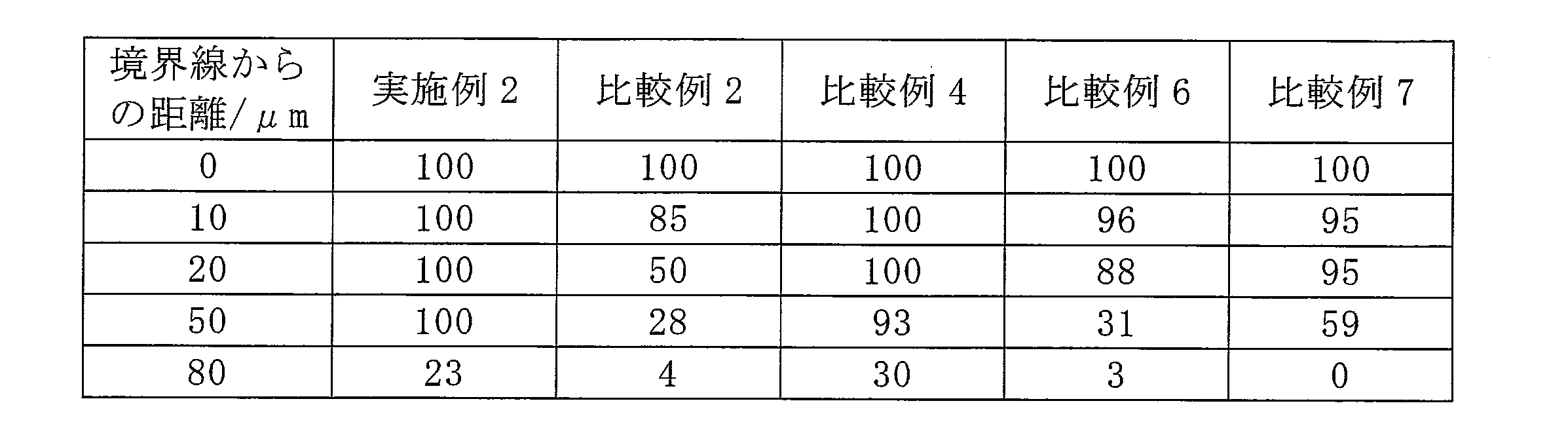
- the calculation of the reaction rate is the same as the method for calculating the reaction rate, and the following [Table 3] shows the reaction rate on the boundary line (point separated by 0 ⁇ m) as 100 as a relative ratio.
- the sealing agent of the present invention has high photocurability, low liquid crystal contamination, and can be photocured to shadows, and is useful for liquid crystal display elements. It is.
Landscapes
- Physics & Mathematics (AREA)
- Chemical & Material Sciences (AREA)
- General Physics & Mathematics (AREA)
- Polymers & Plastics (AREA)
- Health & Medical Sciences (AREA)
- Organic Chemistry (AREA)
- Medicinal Chemistry (AREA)
- Chemical Kinetics & Catalysis (AREA)
- Nonlinear Science (AREA)
- Crystallography & Structural Chemistry (AREA)
- Spectroscopy & Molecular Physics (AREA)
- Optics & Photonics (AREA)
- Mathematical Physics (AREA)
- Epoxy Resins (AREA)
- Polymerisation Methods In General (AREA)
- Sealing Material Composition (AREA)
- Liquid Crystal (AREA)
- Compositions Of Macromolecular Compounds (AREA)
- Materials For Photolithography (AREA)
Abstract
Description
更に近年では、一枚のガラス基板(マザーガラス)から出来るだけ多くの液晶パネルを切り出す設計がなされている。これに伴い、液晶を封止する材料は、カラーフィルターを有する基板においてはブラックマトリクス上に塗工され、対向基板(TFT基板)においてはTFT配線上に懸かって塗工されるようになってきた。よって、UV硬化時にカラーフィルター、TFT基板どちらの面からUV照射してもシール剤に照射されない影部が生じ、この影部にてシール剤成分が未硬化であると、シール剤成分が熱硬化時に液晶へ染み出すためシール周辺部の表示特性を低下させてしまうという問題があった。
このため、上記影部の出来るだけ深部まで光硬化でき、液晶への溶出物が少ない光ラジカル開始剤及びシール剤が求められてきた。
(B)ラジカル硬化性樹脂
(C)潜在性エポキシ硬化剤
(D)エポキシ樹脂

R11、R12及びR13は、それぞれ独立に、水素原子、炭素原子数1~20のアルキル基、炭素原子数6~30のアリール基、炭素原子数7~30のアリールアルキル基又は炭素原子数2~20の複素環基を表し、
R11、R12及びR13で表わされる置換基の水素原子は、更にOR21、COR21、SR21、NR22R23、CONR22R23、-NR22-OR23、-NCOR22-OCOR23、-C(=N-OR21)-R22、-C(=N-OCOR21)-R22、CN、ハロゲン原子、-CR21=CR22R23、-CO-CR21=CR22R23、COOR21又はエポキシ基で置換されていてもよく、
R21、R22及びR23は、それぞれ独立に、水素原子、炭素原子数1~20のアルキル基、炭素原子数6~30のアリール基、炭素原子数7~30のアリールアルキル基又は炭素原子数2~20の複素環基を表し、
R21、R22及びR23で表される置換基の水素原子は、更にCN、ハロゲン原子、水酸基又はカルボキシル基で置換されていてもよく、
R11、R12、R13、R21、R22及びR23で表される置換基のアルキレン部分は、-O-、-S-、-COO-、-OCO-、-NR24-、-NR24COO-、-OCONR24-、-SCO-、-COS-、-OCS-又は-CSO-により1~5回中断されていてもよく、
R24は、水素原子、炭素原子数1~20のアルキル基、炭素原子数6~30のアリール基、炭素原子数7~30のアリールアルキル基又は炭素原子数2~20の複素環基を表し、
R11、R12、R13、R21、R22及びR23で表される置換基のアルキル部分は、分岐側鎖があってもよく、環状アルキルであってもよく、また、R12とR13及びR22とR23はそれぞれ一緒になって環を形成していてもよく、
R3及びR4は、それぞれ独立に、R11、OR11、SR11、COR11、CONR12R13、NR12COR11、OCOR11、COOR11、SCOR11、OCSR11、COSR11、CSOR11、CN又はハロゲン原子を表し、
a及びbは、それぞれ独立に、0~4の整数を表し、
Xは、酸素原子、硫黄原子、セレン原子、CR31R32、CO、NR33又はPR34を表し、 R31、R32、R33及びR34は、それぞれ独立に、水素原子、炭素原子数1~20のアルキル基、炭素原子数6~30のアリール基又は炭素原子数7~30のアリールアルキル基を表し、
R31、R32、R33及びR34で表される置換基のアルキル部分は、分岐側鎖があってもよく、環状アルキルであってもよく、R31、R32、R33及びR34は、それぞれ独立に、隣接するどちらかのベンゼン環と一緒になって環を形成していてもよく、
R5はOH,COOH又は下記一般式(II)で表される基を表す。)

Z2は、結合手であって、1~3のR6で置換された炭素原子数1~20の脂肪族炭化水素基、炭素原子数6~30の芳香族炭化水素基、炭素原子数7~30の芳香族炭化水素で置換された脂肪族炭化水素基又は炭素原子数2~20の複素環基を表し、
Z2で表される結合手のアルキレン部分は、-O-、-S-、-COO-、-OCO-、-NR22-、-NR22COO-、-OCONR22-、-SCO-、-COS-、-OCS-又は-CSO-により1~5回中断されていてもよく、Z2で表される結合手のアルキレン部分は分岐側鎖があってもよく、環状アルキレンであってもよく、
R6は、OR41、SR41、CONR42R43、NR42COR43、OCOR41、COOR41、SCOR41、OCSR41、COSR41、CSOR41、CN又はハロゲン原子を表し、
R41、R42及びR43は、それぞれ独立に、水素原子、炭素原子数1~20のアルキル基、炭素原子数6~30のアリール基又は炭素原子数7~30のアリールアルキル基を表し、R41、R42及びR43で表される置換基のアルキル部分は分岐側鎖があってもよく、環状アルキルであってもよく、R42とR43は、一緒になって環を形成していてもよく、
cは1~3の整数を表す。)
(2)上記(B)ラジカル硬化性樹脂が、分子内に2個以上の(メタ)アクリル基を有するモノマー及び/又はオリゴマーである。
(3)上記(B)ラジカル硬化性樹脂の比率が、上記(B)ラジカル硬化性樹脂と(D)エポキシ樹脂の合計を100重量部としたとき、40~90重量部である。
(4)上記(A)上記一般式(I)で表されるオキシムエステル系ラジカル開始剤0.05~5重量%、上記(B)ラジカル硬化性樹脂20~90重量%、上記(C)潜在性エポキシ硬化剤4~60重量%、及び上記(D)エポキシ樹脂5~60重量を含有する。
また、本発明は、上記液晶滴下工法用シール剤を用いてなる液晶表示素子を提供するものである。
また、本発明は、上記一般式(I)で表わされるオキシムエステル系ラジカル開始剤を含有する液晶滴下工法用シール剤を提供するものである。
本発明の硬化性樹脂組成物は、下記(A)~(D)成分を含有する。下記成分のうち(A)及び(B)成分は、光硬化性樹脂成分であり、下記(C)及び(D)成分は、熱硬化性樹脂成分である。以下、各成分について順に説明する。
(A)上記一般式(I)で表されるオキシムエステル系光ラジカル開始剤
(B)ラジカル硬化性樹脂
(C)潜在性エポキシ硬化剤
(D)エポキシ樹脂
本発明に用いられる(A)光ラジカル開始剤は、上記一般式(I)で表されるオキシムエステル化合物である。
また、上記一般式(I)中の、R11、R12、R13、R21、R22、R23、R31、R32、R33及びR34で表される置換基、並びに上記一般式(II)中の、Z2で表される基、及びR41、R42及びR43で表される置換基のアルキル(アルキレン)部分は、分岐側鎖があってもよく、環状アルキルであってもよい。

上記一般式(I)中のR5が上記一般式(II)で表わされる基であり、同式中のZ1が-O-又は-OCO-である化合物は、感度が高く、製造が容易であるため好ましい。
また、上記一般式(I)中のR2が、炭素原子数1~20のアルキル基、特に炭素原子数1~5のアルキル基である化合物は、製造が容易であり、光ラジカル開始剤としての感度が高いため好ましい。
また同式中のR6が、OH、SH、CONH2、COOH、特にOH、COOHである化合物は、液晶の汚染性が低いため好ましい。


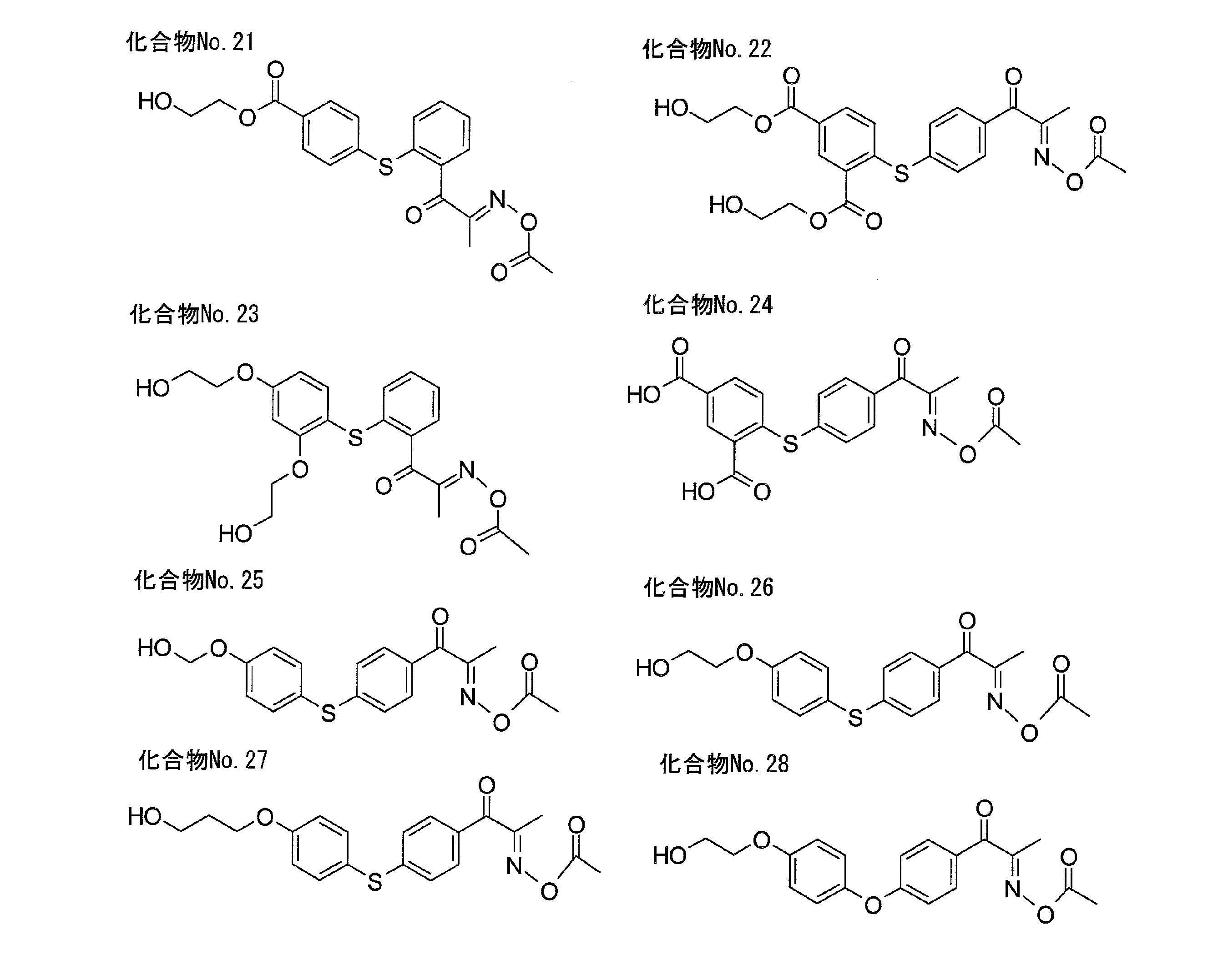

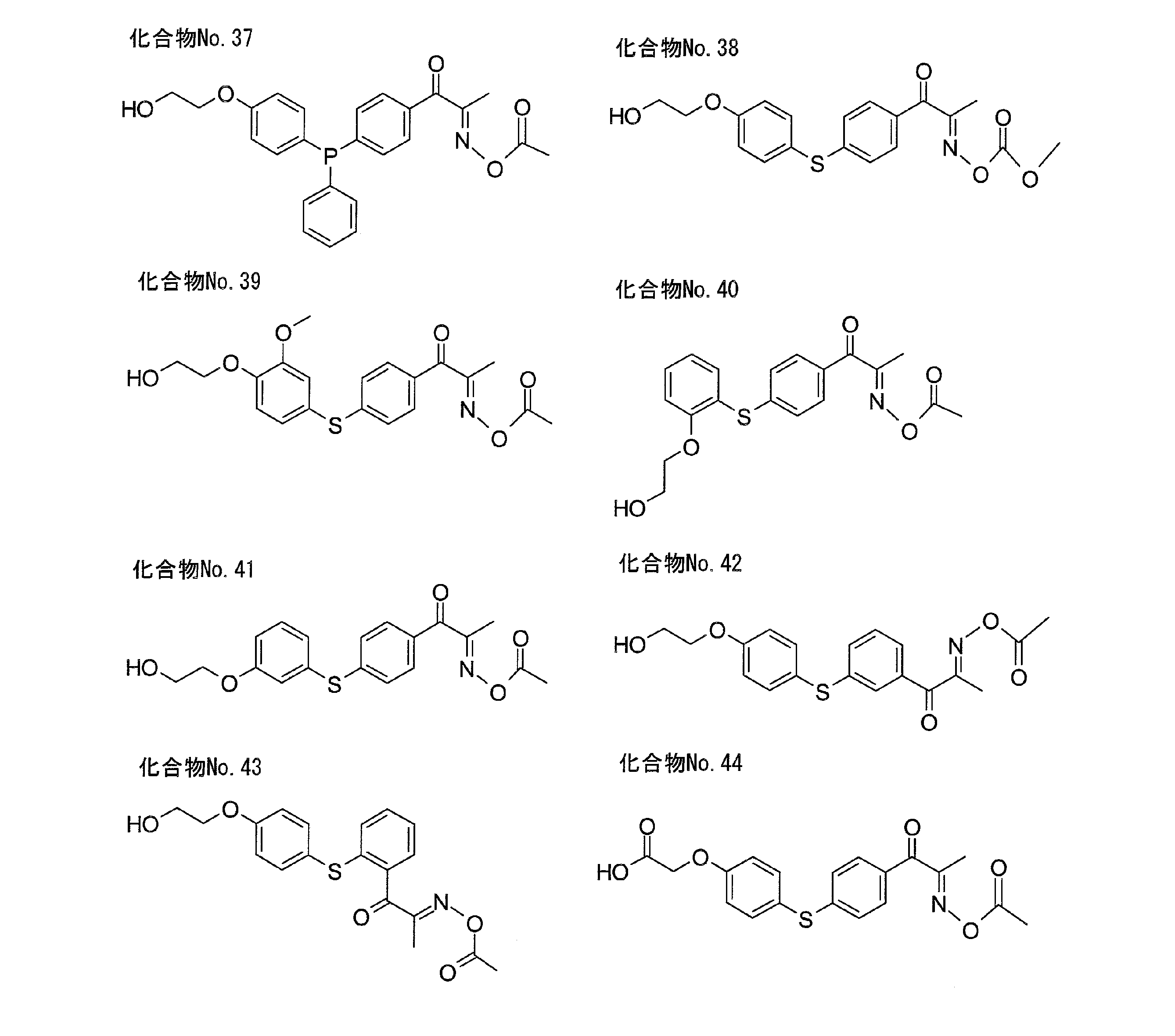


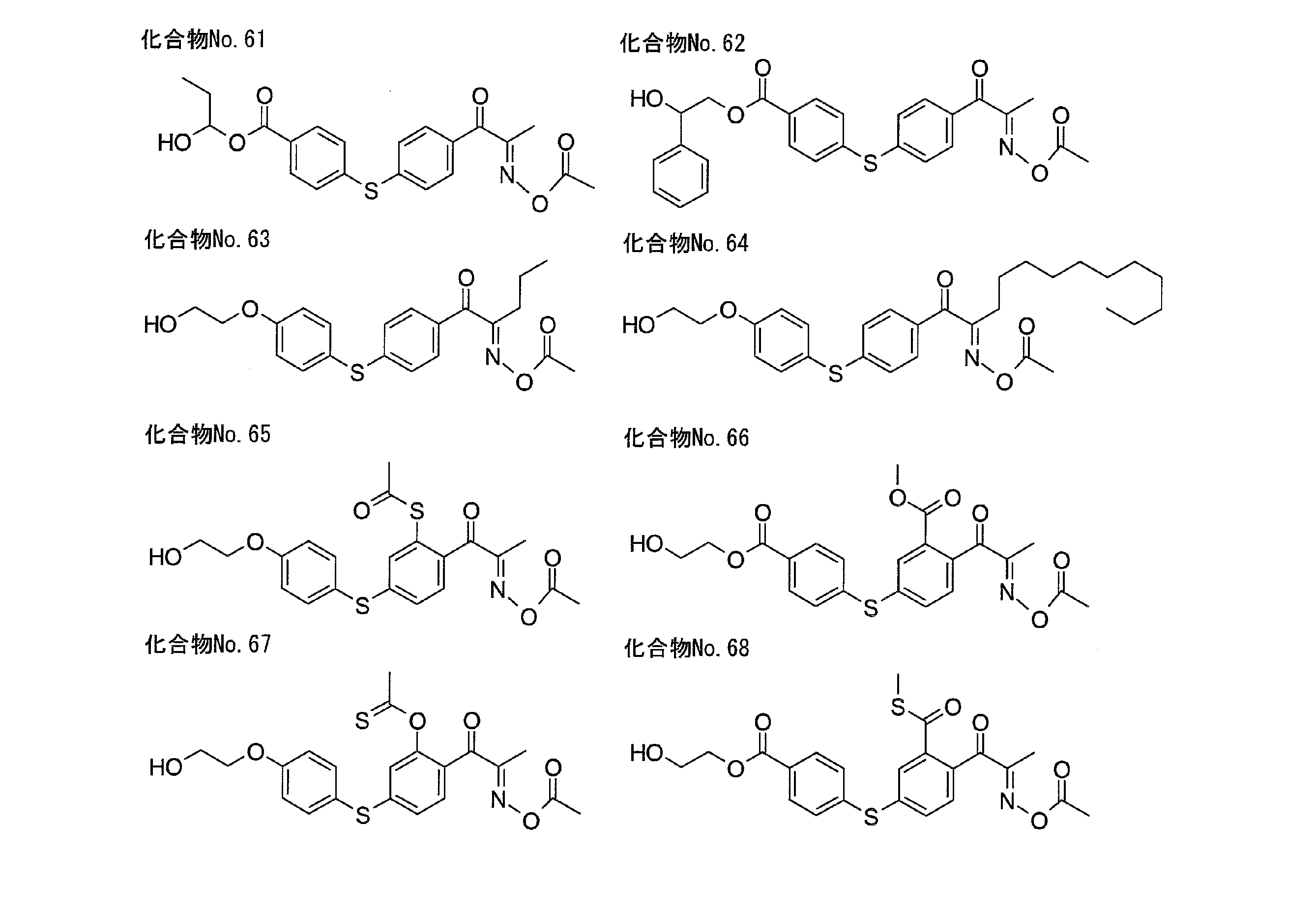


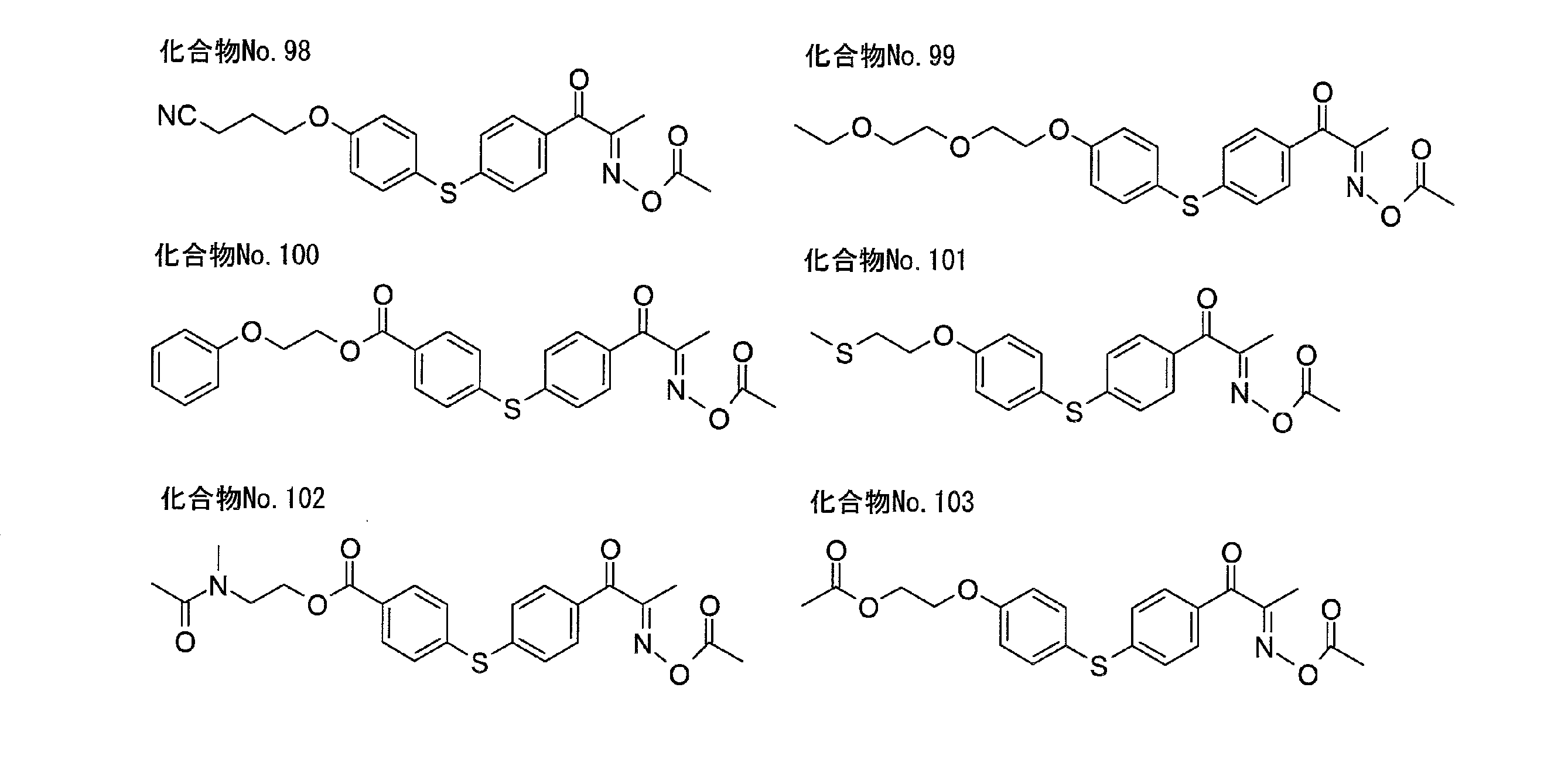

即ち、ケトン体1と亜硝酸エステルを塩酸存在下で反応させることにより、オキシム化合物2を得る。続いて、該オキシム化合物2に、酸無水物3又は酸クロリド3'を反応させることにより、上記一般式(I)で表されるオキシムエステル化合物を得る。下記反応式では、上記一般式(I)中のXが硫黄原子の場合を記載しているが、同式中のXが酸素原子、セレン原子、CR31R32、CO、NR33又はPR34であるものも、上記の方法に準じて製造することができる。

本発明で用いられる(B)ラジカル硬化性樹脂は、ラジカル重合性官能基を有し、紫外線等の光を照射することにより重合して硬化する光硬化性樹脂である。上記ラジカル重合性官能基とは、紫外線等の活性エネルギー線によって重合しうる官能基を意味し、例えば、(メタ)アクリル基、アリル基等が挙げられる。(B)ラジカル硬化性樹脂としては、例えば、(メタ)アクリレート、不飽和ポリエステル樹脂等が挙げられる。これらの樹脂は単独で用いてもよく、2種以上を併用してもよい。中でも、速やかに反応が進行することや接着性が良好であるという点から、(メタ)アクリレート、特に、(B’)分子内に2個以上の(メタ)アクリル基を有するモノマー及び/又はオリゴマーが好適である。
また、市販品としては、例えば、EA-1020、EA-6320、EA-5520(以上、新中村化学工業社製);エポキシエステル70PA、エポキシエステル3002A(以上、共栄社化学社製)等が挙げられる。
また、その他の(メタ)アクリレートとしては、例えば、メチルメタクリレート、テトラヒドロフルフリルメタクリレート、ベンジルメタクリレート、イソボルニルメタクリレート、2-ヒドロキシエチルメタクリレート、グリシジルメタクリレート、(ポリ)エチレングリコールジメタクリレート、1,4-ブタンジオールジメタクリレート、1,6-ヘキサンジオールジメタクリレート、トリメチロールプロパントリアクリレート、ペンタエリストールトリアクリレート、グリセリンジメタクリレート等が挙げられる。
上記エポキシ/(メタ)アクリル樹脂としては、例えば、上記エポキシ樹脂のエポキシ基の一部分を常法に従って、塩基性触媒の存在下(メタ)アクリル酸と反応させることにより得られる化合物、2官能以上のイソシアネート1モルに水酸基を有する(メタ)アクリルモノマーを1/2モル、続いてグリシドールを1/2モル反応させて得られる化合物、イソシアネート基を有する(メタ)アクリレートにグリシドールを反応させて得られる化合物等が挙げられる。上記エポキシ/(メタ)アクリル樹脂の市販品としては、例えば、UVAC1561(ダイセルサイテック社製)、4HBAGE(日本化成社製)等が挙げられる。
本発明に用いられる潜在性エポキシ硬化剤としては、例えば、ジシアンジアミド、変性ポリアミン、ヒドラジド類、4,4'-ジアミノジフェニルスルホン、三フッ化ホウ素アミン錯塩、イミダゾール類、グアナミン類、イミダゾール類、ウレア類及びメラミン等が挙げられる。
上記エポキシ付加変性物に用いられる上記エポキシ化合物としては、脂環族エポキシ化合物、芳香族エポキシ化合物、脂肪族エポキシ化合物等が適している。これらエポキシ化合物は1種類又は2種類以上混合して使用される。
本発明に用いられる(D)エポキシ樹脂としては、例えば、ハイドロキノン、レゾルシン、ピロカテコール、フロログルクシノール等の単核多価フェノール化合物のポリグリシジルエーテル化合物;ジヒドロキシナフタレン、ビフェノール、メチレンビスフェノール(ビスフェノールF)、メチレンビス(オルトクレゾール)、エチリデンビスフェノール、イソプロピリデンビスフェノール(ビスフェノールA)、4,4’-ジヒドロキシベンゾフェノン、イソプロピリデンビス(オルトクレゾール)、テトラブロモビスフェノールA、1,3-ビス(4-ヒドロキシクミルベンゼン)、1,4-ビス(4-ヒドロキシクミルベンゼン)、1,1,3-トリス(4-ヒドロキシフェニル)ブタン、1,1,2,2-テトラ(4-ヒドロキシフェニル)エタン、チオビスフェノール、スルホビスフェノール、オキシビスフェノール、フェノールノボラック、オルソクレゾールノボラック、エチルフェノールノボラック、ブチルフェノールノボラック、オクチルフェノールノボラック、レゾルシンノボラック、テルペンフェノール等の多核多価フェノール化合物のポリグリジルエーテル化合物;エチレングリコール、プロピレングリコール、ブチレングリコール、ヘキサンジオール、ポリグリコール、チオジグリコール、グリセリン、トリメチロールプロパン、ペンタエリスリトール、ソルビトール、ビスフェノールA-エチレンオキシド付加物等の多価アルコール類のポリグリシジルエーテル;マレイン酸、フマル酸、イタコン酸、コハク酸、グルタル酸、スベリン酸、アジピン酸、アゼライン酸、セバシン酸、ダイマー酸、トリマー酸、フタル酸、イソフタル酸、テレフタル酸、トリメリット酸、トリメシン酸、ピロメリット酸、テトラヒドロフタル酸、ヘキサヒドロフタル酸、エンドメチレンテトラヒドロフタル酸等の脂肪族、芳香族又は脂環族多塩基酸のグリシジルエステル類、及びグリシジルメタクリレートの単独重合体又は共重合体;N,N-ジグリシジルアニリン、ビス(4-(N-メチル-N-グリシジルアミノ)フェニル)メタン、ジグリシジルオルトトルイジン等のグリシジルアミノ基を有するエポキシ化合物;ビニルシクロヘキセンジエポキシド、ジシクロペンタンジエンジエポキサイド、3,4-エポキシシクロヘキシルメチル-3,4-エポキシシクロヘキサンカルボキシレート、3,4-エポキシ-6-メチルシクロヘキシルメチル-6-メチルシクロヘキサンカルボキシレート、ビス(3,4-エポキシ-6-メチルシクロヘキシルメチル)アジペート等の環状オレフィン化合物のエポキシ化物;エポキシ化ポリブタジエン、エポキシ化アクリロニトリル-ブタジエン共重合物、エポキシ化スチレン-ブタジエン共重合物等のエポキシ化共役ジエン重合体、トリグリシジルイソシアヌレート等の複素環化合物が挙げられる。また、これらのエポキシ樹脂は末端イソシアネートのプレポリマーによって内部架橋されたもの或いは多価の活性水素化合物(多価フェノール、ポリアミン、カルボニル基含有化合物、ポリリン酸エステル等)で高分子量化したものでもよい。中でも好ましく用いられるものとしては、ビスフェノールA型エポキシ樹脂、ビスフェノールF型エポキシ樹脂、ベンゾフェノン型エポキシ樹脂、水添ビスフェノールA型エポキシ樹脂、ビスフェノールA-プロピレンオキシド変性エポキシ樹脂、フェノールノボラック型エポキシ樹脂、クレゾールノボラック型エポキシ樹脂、エポキシ化共役ジエン重合体、ナフタレン型エポキシ樹脂等が挙げられ、更に25℃にて、液体又は過冷却にて液状であるものは本発明の硬化性樹脂組成物中において析出が起こりにくく、エポキシ樹脂が均一に混ざりやすいため特に好ましい。また、分子内にエポキシ基を2個以上有する場合、反応性に優れ、シール剤の接着性にも優れるため好ましい。尚、過冷却にて液状とは、無溶剤又は溶剤で希釈した状態のものを、加熱して溶解させた後、無溶剤の場合は冷却、溶剤にて希釈したものは溶剤を留去後に冷却し、25℃において析出物が無い状態を言う。
本発明の液晶表示素子は、封止剤(シール剤)として、本発明の液晶滴下工法用シール剤を用いたものであり、例えば、所定の電極を形成した一対の基板を所定の間隔に対向配置し、その周囲を本発明の液晶滴下工法用シール剤でシールし、その間隙に液晶が封入されるという構造を有する。封入される液晶としては、その種類は限定されないが、上述した重合性液晶組成物に対してより効果が大きい。また使用される基板としては、ガラス、石英、プラスチック、シリコン等からなる少なくとも一方に光透過性がある組み合わせの基板から構成される。
その製法としては、例えば本発明の液晶滴下工法用シール剤に、グラスファイバー等のスペーサー(間隙制御材)を添加後、一対の基板の一方にディスペンサ等により液晶滴下工法用シール剤を塗布した後、該液晶滴下工法用シール剤の内側に液晶を滴下し、真空中にてもう一方のガラス基板を重ね合わせ、ギャップ出しを行う。ギャップ形成後、紫外線照射機により液晶シール部に紫外線を照射させて光硬化させる。紫外線照射量は、好ましくは500mJ/cm2~6000mJ/cm2、より好ましくは1000mJ/cm2~4000mJ/cm2の照射量が好ましい。その後、90~130℃で0.5~2時間硬化することにより本発明の液晶表示素子を得ることができる。このようにして得られた本発明の液晶表示素子は、液晶汚染による表示不良が無く、接着性、耐湿信頼性に優れたものである。上記スペーサーとしては、例えばグラスファイバー、シリカビーズ、ポリマービーズ等が挙げられる。その直径は、目的に応じ異なるが、通常2~8μm、好ましくは4~7μmである。その使用量は、本発明の液晶滴下工法用シール剤100重量部に対し通常0.1~4重量部、好ましくは0.5~2重量部、更に、好ましくは0.9~1.5重量部程度である。
<ステップ1>アシル化
ジクロロエタン92gと塩化アルミ21.7g(163 mmol)からなる溶液に、4-(フェニルチオ)安息香酸15g(65mmol)を加え、次いで、6℃以下でプロピオニルクロライド9.0g(97mmol)を滴下した。1時間攪拌後、反応液を氷水に注ぎ、酢酸エチルを加え油水分離し、有機層を水で洗浄した。更に有機層を無水硫酸マグネシウムで乾燥後、脱溶媒し、下記[化20]に示すアシル体aを18.7g得た。
上記<ステップ1>で得られたアシル体aの10.0g(35mmol)と濃塩酸3.6g(35mmol)とジメチルホルムアミド30gからなる溶液に、亜硝酸イソブチル5.4g(52mmol)を加え、室温で3.5時間攪拌した。攪拌後、反応液に、酢酸エチルと水を加え油水分離し、有機層を水で洗浄した。固体の析出した有機層にヘキサンを加え、ろ過した。得られた固体を減圧乾燥し、下記[化21]に示すオキシム体aを8.6g得た。
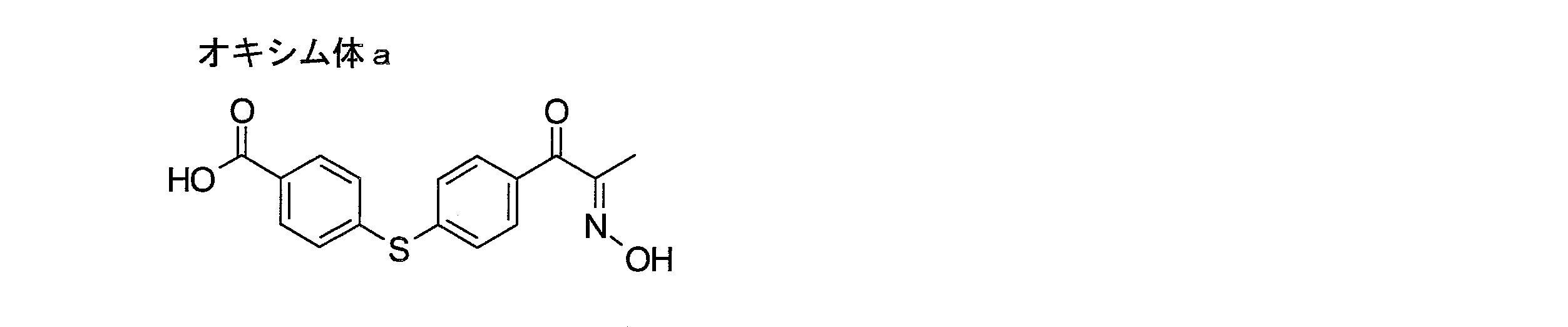
上記<ステップ2>で得られたオキシム体aの4.0g(13mmol)と、ピリジン2.1g(27mmol)とジメチルホルムアミド12gからなる溶液を、-10℃以下の状態にし、無水酢酸1.6g(15mmol)を滴下し、滴下後5℃で2時間攪拌した。攪拌後、反応液に、酢酸エチルと水を加え油水分離し、有機層を水で洗浄した。有機層を無水硫酸マグネシウムで乾燥後、脱溶媒し、化合物No.2を4.5g得た。
反応フラスコにビスフェノールA型エポキシ樹脂であるアデカレジンEP-4100(ADEKA社製、エポキシ価185g/eq)90g、及びトルエン133gを加え撹拌した。そこにトリエチルアミン1g、メトキシフェノール0.55g、及びアクリル酸51.7gを加え95℃まで加熱し、その温度で22時間撹拌した。反応はエポキシ価測定による残量が1%以下になるまで行った。70℃まで冷却しトルエン400gを加え、水250gで1回洗浄し、NaOH水溶液(0.1N)250gで3回洗浄し、更に、純水250gで、水層の電気伝導度が1μS/cmになるまで洗浄した。エバポレーターで脱溶媒(60℃)し、収量125.1g(収率94.1%)、粘度(25℃)911Pa・s、及び酸価0mgKOH/gのビスフェノールAエポキシアクリレート変性樹脂を得た。尚、粘度はE型回転粘度計にて25℃、1.5rpm/minにおける値を示す。
ビスフェノールA型エポキシ樹脂であるアデカレジンEP-4100をビスフェノールF型エポキシ樹脂であるアデカレジンEP-4900(ADEKA社製、エポキシ価170g/eq)に変更し、アクリル酸をメタクリル酸に変更した以外は製造例6と同様の手法で、収量127g(収率94%)、粘度(25℃)120Pa・S、及び酸価0mgKOH/gのビスフェノールFエポキシメタクリレート変性樹脂を得た。
反応フラスコ中の1,3-ビスアミノシクロヘキサン140gに、アデカレジンEP-4100の250gを100℃で添加した。その後140℃に上げ、2時間付加反応を行い、ポリアミンNo.1を得た。このポリアミンNo.1の25gに、融点100℃のフェノールノボラック樹脂であるMP-800K(旭有機材工業製、軟化点73℃)3gを加え、150℃にて1時間溶融マスキング反応を行い、潜在性エポキシ硬化剤No.1を得た。得られた潜在性エポキシ硬化剤No.1をジェットミルにて5μm以下の粒径に粉砕した。融点は78℃であった。
反応フラスコ中のプロピレンジアミン100gを60℃に加温し、これにアデカレジンEP-4100の340gを温度90~100℃に保ち攪拌しながら少しずつ加え反応を行った。添加終了後、フラスコの温度を140℃に上げ、1.5時間付加反応を行い、ポリアミンNo.2を得た。ポリアミンNo.2の25gに、MP-800Kの8gを加え150℃にて1時間溶融マスキング反応を行い、潜在性エポキシ硬化剤No.2を得た。得られた潜在性エポキシ硬化剤No.2をジェットミルにて5μm以下の粒径に粉砕した。融点は80℃であった。
以下に示す<原料>を下記[表1]又は[表2]の割合で配合し、三本ロールミルにて分散、混練を行った後、更に遊星式撹拌脱泡装置にて脱泡し、実施例1~9及び比較例1~9のシール剤を得た。尚、潜在性エポキシ硬化剤とエポキシ樹脂の配合は、対応する原料の反応基のモル比を合わせることで決定した。得られたシール剤を用いたテストセルの硬化性(反応率)及び溶出性を評価した。結果を下記[表1]及び[表2]に示す。実施例2並びに比較例2、4、6及び7のシール剤については影部反応率を評価した。結果を[表3]に示す。
(A-1)製造例1で得られた化合物No.2
(A-2)製造例2で得られた化合物No.26
(A-3)製造例3で得られた化合物No.44
(A-4)製造例4で得られた化合物No.45
(A-5)製造例5で得られた化合物No.46
(A'-1)ビス(2,4,6-トリメチルベンゾイル)-フェニルフォスフィンオキサイド
(A'-2)2-メチル-1-(4-メチルチオフェニル)-2-モルフォリノプロパン-1-オン
(A'-3)1.2-オクタンジオン,1-[4-(フェニルチオ)-,2-(O-ベンゾイルオキシム)]
(A'-4)エタノン,1-[9-エチル-6-(2-メチルベンゾイル)-9H-カルバゾール-3-イル]-,1-(O-アセチルオキシム)
(A'-5)2,2-ジメトキシ-1,2-ジフェニルエタン-1-オン
(B-1)製造例6で得られたビスフェノールFエポキシメタクリレート変性樹脂
(B-2)製造例7で得られたビスフェノールAエポキシアクリレート変性樹脂
(C-1)製造例8で得られた潜在性エポキシ硬化剤No.1
(C-2)製造例9で得られた潜在性エポキシ硬化剤No.2
(C-3)アミキュアVDH(味の素ファインテクノ社製):ヒドラジド系硬化剤、融点120℃
(D-1)EP-4000(ADEKA社製):ビスフェノールA-プロピレンオキシド変性グリシジルエーテル型エポキシ樹脂
(D-2)EPR-4030(ADEKA社製):NBR変性型エポキシ樹脂
(E-1)SE-2500(アドマテック社製:シリカゲル):平均粒径0.5μm:充填剤
(E-2)F.351(ガンツ化成社製:コアシェルゴムフィラー):平均粒径0.3μm:充填剤
(F)Z-6040(東レ・ダウコーニング社製):シランカップリング剤
1.1mm厚のガラス板に、実施例1~9及び比較例1~9の各シール剤をディスペンサで塗布し、同様のガラス板にて貼り合わせ、直径3mm程度の円形に押し伸ばし、試験片を作製した。超高圧水銀灯にて、300nm以下の波長をカットしたUV(3000mJ/cm2)を照射した。ラマン分光測定装置にて、照射前後のアクリル基ピーク面積(1635cm-1)及びREFピーク面積(1607cm-1)から反応率を算出した。
実施例1~9及び比較例1~9の各シール剤0.15gと下記[化22]に示す組成よりなる液晶組成物0.5gとをバイアル瓶の中で6時間接触させた。その後上澄みの液晶組成物を抜き取り、液体クロマトグラフィーで光ラジカル開始剤が検出されなかったものを○、検出されたものを×とした。
図1(a)に示すように、ガラス基板の一部にアルミを蒸着させた。次に図1(b)に示すように、上記ガラス基板のアルミ非蒸着部1/アルミ蒸着部2の境界線上に、実施例2並びに比較例2、4、6及び7のシール剤3をディスペンサで塗布した。このガラス基板と、あらかじめ離型剤が塗工されたブラックマトリクス基板とを貼り合わせ試験片とした。該試験片のガラス基板側から、超高圧水銀灯にて、300nm以下の波長をカットしたUV(3000mJ/cm2)を照射した後、貼り合わせた試験片を剥がし、図1(c)の境界線4から影部方向に0、10、20、50、80μm離れた地点の反応率を測定した。反応率の算出は上記反応率の算出方法と同じであり、下記[表3]には境界線上(0μm離れた地点)の反応率を100として相対比として示した。


2 アルミ蒸着部
3 シール剤
4 境界線(照射部/影部)
5 影部
Claims (11)
- 下記の(A)~(D)成分を含有する硬化性樹脂組成物。
(A)下記一般式(I)で表されるオキシムエステル系光ラジカル開始剤
(B)ラジカル硬化性樹脂
(C)潜在性エポキシ硬化剤
(D)エポキシ樹脂

R11、R12及びR13は、それぞれ独立に、水素原子、炭素原子数1~20のアルキル基、炭素原子数6~30のアリール基、炭素原子数7~30のアリールアルキル基又は炭素原子数2~20の複素環基を表し、
R11、R12及びR13で表わされる置換基の水素原子は、更にOR21、COR21、SR21、NR22R23、CONR22R23、-NR22-OR23、-NCOR22-OCOR23、-C(=N-OR21)-R22、-C(=N-OCOR21)-R22、CN、ハロゲン原子、-CR21=CR22R23、-CO-CR21=CR22R23、COOR21又はエポキシ基で置換されていてもよく、
R21、R22及びR23は、それぞれ独立に、水素原子、炭素原子数1~20のアルキル基、炭素原子数6~30のアリール基、炭素原子数7~30のアリールアルキル基又は炭素原子数2~20の複素環基を表し、
R21、R22及びR23で表される置換基の水素原子は、更にCN、ハロゲン原子、水酸基又はカルボキシル基で置換されていてもよく、
R11、R12、R13、R21、R22及びR23で表される置換基のアルキレン部分は、-O-、-S-、-COO-、-OCO-、-NR24-、-NR24COO-、-OCONR24-、-SCO-、-COS-、-OCS-又は-CSO-により1~5回中断されていてもよく、
R24は、水素原子、炭素原子数1~20のアルキル基、炭素原子数6~30のアリール基、炭素原子数7~30のアリールアルキル基又は炭素原子数2~20の複素環基を表し、 R11、R12、R13、R21、R22及びR23で表される置換基のアルキル部分は、分岐側鎖があってもよく、環状アルキルであってもよく、また、R12とR13及びR22とR23はそれぞれ一緒になって環を形成していてもよく、
R3及びR4は、それぞれ独立に、R11、OR11、SR11、COR11、CONR12R13、NR12COR11、OCOR11、COOR11、SCOR11、OCSR11、COSR11、CSOR11、CN又はハロゲン原子を表し、
a及びbは、それぞれ独立に、0~4の整数を表し、
Xは、酸素原子、硫黄原子、セレン原子、CR31R32、CO、NR33又はPR34を表し、
R31、R32、R33及びR34は、それぞれ独立に、水素原子、炭素原子数1~20のアルキル基、炭素原子数6~30のアリール基又は炭素原子数7~30のアリールアルキル基を表し、
R31、R32、R33及びR34で表される置換基のアルキル部分は、分岐側鎖があってもよく、環状アルキルであってもよく、R31、R32、R33及びR34は、それぞれ独立に、隣接するどちらかのベンゼン環と一緒になって環を形成していてもよく、
R5はOH,COOH又は下記一般式(II)で表される基を表す。)

Z2は、結合手であって、1~3のR6で置換された炭素原子数1~20の脂肪族炭化水素基、炭素原子数6~30の芳香族炭化水素基、炭素原子数7~30の芳香族炭化水素で置換された脂肪族炭化水素基又は炭素原子数2~20の複素環基を表し、
Z2で表される結合手のアルキレン部分は、-O-、-S-、-COO-、-OCO-、-NR22-、-NR22COO-、-OCONR22-、-SCO-、-COS-、-OCS-又は-CSO-により1~5回中断されていてもよく、Z2で表される結合手のアルキレン部分は分岐側鎖があってもよく、環状アルキレンであってもよく。
R6は、OR41、SR41、CONR42R43、NR42COR43、OCOR41、COOR41、SCOR41、OCSR41、COSR41、CSOR41、CN又はハロゲン原子を表し、
R41、R42及びR43は、それぞれ独立に、水素原子、炭素原子数1~20のアルキル基、炭素原子数6~30のアリール基又は炭素原子数7~30のアリールアルキル基を表し、R41、R42及びR43で表される置換基のアルキル部分は分岐側鎖があってもよく、環状アルキルであってもよく、R42とR43は、一緒になって環を形成していてもよく、
cは1~3の整数を表す。) - 上記(C)潜在性エポキシ硬化剤の融点が、50~110℃である請求項1に記載の硬化性樹脂組成物。
- 上記(B)ラジカル硬化性樹脂が、分子内に2個以上の(メタ)アクリル基を有するモノマー及び/又はオリゴマーである請求項1又は2に記載の硬化性樹脂組成物。
- 上記(B)ラジカル硬化性樹脂の比率が、上記(B)ラジカル硬化性樹脂と上記(D)エポキシ樹脂の合計を100重量部としたとき、40~90重量部である請求項1~3の何れか1項に記載の硬化性樹脂組成物。
- 上記(A)上記一般式(I)で表されるオキシムエステル系ラジカル開始剤0.05~5重量%、上記(B)ラジカル硬化性樹脂20~90重量%、上記(C)潜在性エポキシ硬化剤4~60重量%、及び上記(D)エポキシ樹脂5~60重量を含有する請求項1~4の何れか1項に記載の硬化性樹脂組成物。
- 請求項1~5の何れか1項に記載の硬化性樹脂組成物を用いてなる封止剤。
- 請求項1~5の何れか1項に記載の硬化性樹脂組成物を用いてなる液晶滴下工法用シール剤。
- 液晶滴下工法に用いられる液晶組成物が、重合性官能基を有する液晶化合物を含有することを特徴とする請求項7に記載の液晶滴下工法用シール剤。
- 上記重合性官能基が、(メタ)アクリル基である請求項8に記載の液晶滴下工法用シール剤。
- 請求項7~9の何れか1項に記載の液晶滴下工法用シール剤を用いてなる液晶表示素子。
- 上記一般式(I)で表されるオキシムエステル系光ラジカル開始剤を含有する液晶滴下工法用シール剤。
Priority Applications (5)
| Application Number | Priority Date | Filing Date | Title |
|---|---|---|---|
| US13/319,788 US8735511B2 (en) | 2010-06-28 | 2011-04-20 | Curing resin composition |
| EP11800498.5A EP2586827B1 (en) | 2010-06-28 | 2011-04-20 | Curable resin composition |
| JP2011544304A JP5778038B2 (ja) | 2010-06-28 | 2011-04-20 | 硬化性樹脂組成物 |
| KR1020117024224A KR101736126B1 (ko) | 2010-06-28 | 2011-04-20 | 경화성 수지 조성물 |
| CN201180001808.6A CN102439089B (zh) | 2010-06-28 | 2011-04-20 | 固化性树脂组合物 |
Applications Claiming Priority (2)
| Application Number | Priority Date | Filing Date | Title |
|---|---|---|---|
| JP2010-146273 | 2010-06-28 | ||
| JP2010146273 | 2010-06-28 |
Publications (1)
| Publication Number | Publication Date |
|---|---|
| WO2012002028A1 true WO2012002028A1 (ja) | 2012-01-05 |
Family
ID=45401765
Family Applications (1)
| Application Number | Title | Priority Date | Filing Date |
|---|---|---|---|
| PCT/JP2011/059675 Ceased WO2012002028A1 (ja) | 2010-06-28 | 2011-04-20 | 硬化性樹脂組成物 |
Country Status (7)
| Country | Link |
|---|---|
| US (1) | US8735511B2 (ja) |
| EP (1) | EP2586827B1 (ja) |
| JP (1) | JP5778038B2 (ja) |
| KR (1) | KR101736126B1 (ja) |
| CN (1) | CN102439089B (ja) |
| TW (1) | TWI503626B (ja) |
| WO (1) | WO2012002028A1 (ja) |
Cited By (17)
| Publication number | Priority date | Publication date | Assignee | Title |
|---|---|---|---|---|
| JP2013142129A (ja) * | 2012-01-11 | 2013-07-22 | Adeka Corp | 硬化性樹脂組成物 |
| JP5337318B1 (ja) * | 2012-11-22 | 2013-11-06 | 積水化学工業株式会社 | 液晶滴下工法用シール剤、上下導通材料、及び、液晶表示素子 |
| JP5337294B1 (ja) * | 2012-12-03 | 2013-11-06 | 積水化学工業株式会社 | 液晶滴下工法用シール剤、上下導通材料、及び、液晶表示素子 |
| WO2014136667A1 (ja) * | 2013-03-06 | 2014-09-12 | 積水化学工業株式会社 | 液晶滴下工法用シール剤、上下導通材料、及び、液晶表示素子 |
| JP2014208725A (ja) * | 2013-04-16 | 2014-11-06 | 積水化学工業株式会社 | オキシムエステル開始剤、硬化性樹脂組成物、液晶表示素子用シール剤、上下導通材料、及び、液晶表示素子 |
| JP6031215B1 (ja) * | 2015-06-02 | 2016-11-24 | 積水化学工業株式会社 | 液晶表示素子用シール剤、上下導通材料、及び、液晶表示素子 |
| JP2016196437A (ja) * | 2015-04-06 | 2016-11-24 | 株式会社Adeka | オキシムエステル化合物及び該化合物を含有する光重合開始剤 |
| KR20160137944A (ko) | 2014-03-31 | 2016-12-02 | 세키스이가가쿠 고교가부시키가이샤 | 액정 적하 공법용 시일제, 상하 도통 재료 및 액정 표시 소자 |
| WO2016194871A1 (ja) * | 2015-06-02 | 2016-12-08 | 積水化学工業株式会社 | 液晶表示素子用シール剤、上下導通材料、及び、液晶表示素子 |
| JP6114893B1 (ja) * | 2015-10-26 | 2017-04-12 | 積水化学工業株式会社 | 液晶表示素子用シール剤、上下導通材料及び液晶表示素子 |
| JP2017214462A (ja) * | 2016-05-30 | 2017-12-07 | 協立化学産業株式会社 | エポキシ樹脂、完全変性エポキシ樹脂及びそれらを含む硬化性組成物 |
| KR20180101166A (ko) | 2016-01-26 | 2018-09-12 | 세키스이가가쿠 고교가부시키가이샤 | 액정 표시 소자용 시일제, 상하 도통 재료, 및, 액정 표시 소자 |
| JP2018184531A (ja) * | 2017-04-26 | 2018-11-22 | 信越化学工業株式会社 | 熱硬化性エポキシ樹脂組成物 |
| JP2018184525A (ja) * | 2017-04-26 | 2018-11-22 | 信越化学工業株式会社 | 低温硬化型液状エポキシ樹脂組成物 |
| KR20190053132A (ko) | 2016-09-29 | 2019-05-17 | 세키스이가가쿠 고교가부시키가이샤 | 액정 표시 소자용 시일제, 상하 도통 재료 및 액정 표시 소자 |
| KR20200016199A (ko) | 2017-06-05 | 2020-02-14 | 세키스이가가쿠 고교가부시키가이샤 | 액정 표시 소자용 시일제, 상하 도통 재료, 및, 액정 표시 소자 |
| WO2020196139A1 (ja) | 2019-03-27 | 2020-10-01 | 東レ株式会社 | 感光性樹脂組成物、感光性樹脂シート、中空構造の製造方法および電子部品 |
Families Citing this family (12)
| Publication number | Priority date | Publication date | Assignee | Title |
|---|---|---|---|---|
| DE102012015729A1 (de) * | 2012-08-09 | 2014-05-15 | Delo Industrie Klebstoffe Gmbh & Co. Kgaa | Dualhärtende lösungsmittelfreie Einkomponenten-Massen und ihre Verwendung |
| CN102898785B (zh) * | 2012-09-05 | 2014-10-22 | 烟台德邦科技有限公司 | 一种用于智能卡的包封胶及其制备方法 |
| JP6157111B2 (ja) * | 2012-12-26 | 2017-07-05 | 東京応化工業株式会社 | 着色感光性樹脂組成物、カラーフィルタ及びカラー液晶表示素子 |
| KR20180072776A (ko) | 2015-10-23 | 2018-06-29 | 메르크 파텐트 게엠베하 | 벤질 모노케탈 및 그의 용도 |
| WO2017141824A1 (ja) * | 2016-02-17 | 2017-08-24 | シャープ株式会社 | 液晶表示装置 |
| KR102499044B1 (ko) | 2016-03-08 | 2023-02-13 | 삼성디스플레이 주식회사 | 액정표시장치 |
| CN108885398B (zh) * | 2016-03-28 | 2022-11-29 | 日本瑞翁株式会社 | 放射线敏感性树脂组合物和电子部件 |
| CN107163478B (zh) * | 2017-06-27 | 2022-03-08 | 江门盈骅光电科技有限公司 | 可先热固化、再光照射固化的不饱和树脂组合物及其制备方法和用途 |
| KR102159493B1 (ko) * | 2017-11-28 | 2020-09-25 | 주식회사 엘지화학 | 접착제 조성물 |
| CN113444017B (zh) * | 2020-03-26 | 2022-05-13 | 优禘股份有限公司 | 一种二苯硫醚酮肟酯化合物、制备方法、组合物及用途 |
| CN114525139B (zh) | 2020-10-07 | 2025-07-25 | 默克专利股份有限公司 | 液晶介质 |
| KR102786121B1 (ko) * | 2021-05-10 | 2025-03-24 | 주식회사 엘지화학 | 감광성 수지 조성물, 이를 포함하는 감광재, 이를 포함하는 디스플레이 장치 및 감광성 수지 조성물의 저온 경화 방법 |
Citations (9)
| Publication number | Priority date | Publication date | Assignee | Title |
|---|---|---|---|---|
| JP2000080068A (ja) | 1998-06-26 | 2000-03-21 | Ciba Specialty Chem Holding Inc | 新規o―アシルオキシム光開始剤 |
| JP2008179797A (ja) | 2006-12-28 | 2008-08-07 | Jsr Corp | 液晶表示素子用シール剤及び液晶表示素子 |
| JP2008231347A (ja) | 2007-03-23 | 2008-10-02 | Jsr Corp | 硬化性組成物、液晶シール剤及び液晶表示素子 |
| WO2009054276A1 (ja) * | 2007-10-25 | 2009-04-30 | Sekisui Chemical Co., Ltd. | 液晶滴下工法用シール剤、上下導通材料及び液晶表示素子 |
| JP2009114424A (ja) | 2007-10-19 | 2009-05-28 | Jsr Corp | 液晶表示素子用シール剤及び液晶表示素子 |
| JP2009162842A (ja) | 2007-12-28 | 2009-07-23 | Jsr Corp | 液晶表示素子用シール剤及び液晶表示素子 |
| JP2009227955A (ja) | 2008-02-25 | 2009-10-08 | Jsr Corp | 硬化性組成物、液晶シール剤及び液晶表示素子 |
| JP2009275166A (ja) | 2008-05-16 | 2009-11-26 | Jsr Corp | 液晶表示素子用シール剤及び液晶表示素子 |
| JP2010156879A (ja) * | 2008-12-29 | 2010-07-15 | Fujifilm Corp | 感光性組成物、カラーフィルタ、及び液晶表示装置 |
Family Cites Families (4)
| Publication number | Priority date | Publication date | Assignee | Title |
|---|---|---|---|---|
| WO2004027502A1 (ja) * | 2002-09-19 | 2004-04-01 | Mitsui Chemicals, Inc. | 液晶シール剤組成物及びそれを用いた液晶表示パネルの製造方法 |
| JP5030527B2 (ja) * | 2006-10-20 | 2012-09-19 | 株式会社Adeka | オキシムエステル化合物及び該化合物を含有する光重合開始剤 |
| KR101471644B1 (ko) * | 2006-12-27 | 2014-12-10 | 가부시키가이샤 아데카 | 옥심에스테르화합물 및 상기 화합물을 함유하는 광중합 개시제 |
| JP4818458B2 (ja) * | 2009-11-27 | 2011-11-16 | 株式会社Adeka | オキシムエステル化合物及び該化合物を含有する光重合開始剤 |
-
2011
- 2011-04-20 CN CN201180001808.6A patent/CN102439089B/zh active Active
- 2011-04-20 EP EP11800498.5A patent/EP2586827B1/en not_active Not-in-force
- 2011-04-20 US US13/319,788 patent/US8735511B2/en not_active Expired - Fee Related
- 2011-04-20 KR KR1020117024224A patent/KR101736126B1/ko active Active
- 2011-04-20 JP JP2011544304A patent/JP5778038B2/ja active Active
- 2011-04-20 WO PCT/JP2011/059675 patent/WO2012002028A1/ja not_active Ceased
- 2011-04-27 TW TW100114743A patent/TWI503626B/zh active
Patent Citations (10)
| Publication number | Priority date | Publication date | Assignee | Title |
|---|---|---|---|---|
| JP2000080068A (ja) | 1998-06-26 | 2000-03-21 | Ciba Specialty Chem Holding Inc | 新規o―アシルオキシム光開始剤 |
| JP2008179797A (ja) | 2006-12-28 | 2008-08-07 | Jsr Corp | 液晶表示素子用シール剤及び液晶表示素子 |
| JP2008231347A (ja) | 2007-03-23 | 2008-10-02 | Jsr Corp | 硬化性組成物、液晶シール剤及び液晶表示素子 |
| JP2009114424A (ja) | 2007-10-19 | 2009-05-28 | Jsr Corp | 液晶表示素子用シール剤及び液晶表示素子 |
| WO2009054276A1 (ja) * | 2007-10-25 | 2009-04-30 | Sekisui Chemical Co., Ltd. | 液晶滴下工法用シール剤、上下導通材料及び液晶表示素子 |
| JP2009162842A (ja) | 2007-12-28 | 2009-07-23 | Jsr Corp | 液晶表示素子用シール剤及び液晶表示素子 |
| JP2009227955A (ja) | 2008-02-25 | 2009-10-08 | Jsr Corp | 硬化性組成物、液晶シール剤及び液晶表示素子 |
| JP2009230095A (ja) | 2008-02-25 | 2009-10-08 | Jsr Corp | 硬化性組成物、液晶シール剤及び液晶表示素子 |
| JP2009275166A (ja) | 2008-05-16 | 2009-11-26 | Jsr Corp | 液晶表示素子用シール剤及び液晶表示素子 |
| JP2010156879A (ja) * | 2008-12-29 | 2010-07-15 | Fujifilm Corp | 感光性組成物、カラーフィルタ、及び液晶表示装置 |
Cited By (27)
| Publication number | Priority date | Publication date | Assignee | Title |
|---|---|---|---|---|
| JP2013142129A (ja) * | 2012-01-11 | 2013-07-22 | Adeka Corp | 硬化性樹脂組成物 |
| JP5337318B1 (ja) * | 2012-11-22 | 2013-11-06 | 積水化学工業株式会社 | 液晶滴下工法用シール剤、上下導通材料、及び、液晶表示素子 |
| JP5337294B1 (ja) * | 2012-12-03 | 2013-11-06 | 積水化学工業株式会社 | 液晶滴下工法用シール剤、上下導通材料、及び、液晶表示素子 |
| WO2014136667A1 (ja) * | 2013-03-06 | 2014-09-12 | 積水化学工業株式会社 | 液晶滴下工法用シール剤、上下導通材料、及び、液晶表示素子 |
| JP5736096B1 (ja) * | 2013-03-06 | 2015-06-17 | 積水化学工業株式会社 | 液晶滴下工法用シール剤 |
| JP5735704B2 (ja) * | 2013-03-06 | 2015-06-17 | 積水化学工業株式会社 | 液晶滴下工法用シール剤 |
| KR101569333B1 (ko) | 2013-03-06 | 2015-11-13 | 세키스이가가쿠 고교가부시키가이샤 | 액정 적하 공법용 시일제, 상하 도통 재료, 및, 액정 표시 소자 |
| KR101569332B1 (ko) | 2013-03-06 | 2015-11-13 | 세키스이가가쿠 고교가부시키가이샤 | 액정 적하 공법용 시일제, 상하 도통 재료, 및, 액정 표시 소자 |
| TWI509059B (zh) * | 2013-03-06 | 2015-11-21 | Sekisui Chemical Co Ltd | Liquid crystal drop method sealant, upper and lower conductive material and liquid crystal display element |
| JP2014208725A (ja) * | 2013-04-16 | 2014-11-06 | 積水化学工業株式会社 | オキシムエステル開始剤、硬化性樹脂組成物、液晶表示素子用シール剤、上下導通材料、及び、液晶表示素子 |
| KR20160137944A (ko) | 2014-03-31 | 2016-12-02 | 세키스이가가쿠 고교가부시키가이샤 | 액정 적하 공법용 시일제, 상하 도통 재료 및 액정 표시 소자 |
| JP2016196437A (ja) * | 2015-04-06 | 2016-11-24 | 株式会社Adeka | オキシムエステル化合物及び該化合物を含有する光重合開始剤 |
| CN107111194B (zh) * | 2015-06-02 | 2020-12-11 | 积水化学工业株式会社 | 液晶显示元件用密封剂、上下导通材料及液晶显示元件 |
| JP6031215B1 (ja) * | 2015-06-02 | 2016-11-24 | 積水化学工業株式会社 | 液晶表示素子用シール剤、上下導通材料、及び、液晶表示素子 |
| WO2016194871A1 (ja) * | 2015-06-02 | 2016-12-08 | 積水化学工業株式会社 | 液晶表示素子用シール剤、上下導通材料、及び、液晶表示素子 |
| CN107111194A (zh) * | 2015-06-02 | 2017-08-29 | 积水化学工业株式会社 | 液晶显示元件用密封剂、上下导通材料及液晶显示元件 |
| KR102588717B1 (ko) | 2015-06-02 | 2023-10-12 | 세키스이가가쿠 고교가부시키가이샤 | 액정 표시 소자용 시일제, 상하 도통 재료 및 액정 표시 소자 |
| KR20180015106A (ko) * | 2015-06-02 | 2018-02-12 | 세키스이가가쿠 고교가부시키가이샤 | 액정 표시 소자용 시일제, 상하 도통 재료 및 액정 표시 소자 |
| JP6114893B1 (ja) * | 2015-10-26 | 2017-04-12 | 積水化学工業株式会社 | 液晶表示素子用シール剤、上下導通材料及び液晶表示素子 |
| WO2017073548A1 (ja) * | 2015-10-26 | 2017-05-04 | 積水化学工業株式会社 | 液晶表示素子用シール剤、上下導通材料及び液晶表示素子 |
| KR20180101166A (ko) | 2016-01-26 | 2018-09-12 | 세키스이가가쿠 고교가부시키가이샤 | 액정 표시 소자용 시일제, 상하 도통 재료, 및, 액정 표시 소자 |
| JP2017214462A (ja) * | 2016-05-30 | 2017-12-07 | 協立化学産業株式会社 | エポキシ樹脂、完全変性エポキシ樹脂及びそれらを含む硬化性組成物 |
| KR20190053132A (ko) | 2016-09-29 | 2019-05-17 | 세키스이가가쿠 고교가부시키가이샤 | 액정 표시 소자용 시일제, 상하 도통 재료 및 액정 표시 소자 |
| JP2018184525A (ja) * | 2017-04-26 | 2018-11-22 | 信越化学工業株式会社 | 低温硬化型液状エポキシ樹脂組成物 |
| JP2018184531A (ja) * | 2017-04-26 | 2018-11-22 | 信越化学工業株式会社 | 熱硬化性エポキシ樹脂組成物 |
| KR20200016199A (ko) | 2017-06-05 | 2020-02-14 | 세키스이가가쿠 고교가부시키가이샤 | 액정 표시 소자용 시일제, 상하 도통 재료, 및, 액정 표시 소자 |
| WO2020196139A1 (ja) | 2019-03-27 | 2020-10-01 | 東レ株式会社 | 感光性樹脂組成物、感光性樹脂シート、中空構造の製造方法および電子部品 |
Also Published As
| Publication number | Publication date |
|---|---|
| US20120115972A1 (en) | 2012-05-10 |
| CN102439089B (zh) | 2015-05-06 |
| EP2586827A1 (en) | 2013-05-01 |
| EP2586827A4 (en) | 2016-09-28 |
| EP2586827B1 (en) | 2017-12-27 |
| US8735511B2 (en) | 2014-05-27 |
| TWI503626B (zh) | 2015-10-11 |
| JPWO2012002028A1 (ja) | 2013-08-22 |
| JP5778038B2 (ja) | 2015-09-16 |
| KR101736126B1 (ko) | 2017-05-16 |
| TW201207565A (en) | 2012-02-16 |
| KR20130033260A (ko) | 2013-04-03 |
| CN102439089A (zh) | 2012-05-02 |
Similar Documents
| Publication | Publication Date | Title |
|---|---|---|
| JP5778038B2 (ja) | 硬化性樹脂組成物 | |
| JP5490726B2 (ja) | 液晶滴下工法用シール剤 | |
| JP4211942B2 (ja) | 液晶シール剤およびそれを用いた液晶表示セル | |
| KR101666387B1 (ko) | 광경화성 수지와 열경화성 수지를 함유하는 액정 적하 공법용 밀봉제 | |
| TWI532759B (zh) | 液晶密封劑、使用其的液晶顯示面板的製造方法以及液晶顯示面板 | |
| KR20120085855A (ko) | 신규 열래디컬 발생제, 그 제조방법, 액정 실링제 및 액정 표시셀 | |
| JP4815027B1 (ja) | 液晶シール剤、それを用いた液晶表示パネルの製造方法、および液晶表示パネル | |
| JP6058890B2 (ja) | 硬化性樹脂組成物 | |
| TWI717470B (zh) | 液晶密封劑及其硬化物以及液晶顯示面板及其製造方法 | |
| JP2011219682A (ja) | 硬化性樹脂組成物 | |
| JP2013018810A (ja) | 硬化性樹脂組成物 | |
| KR20140039314A (ko) | 액정 시일제 및 그것을 사용한 액정 표시 셀 | |
| KR20140043789A (ko) | 신규 (메트)아크릴 수지 및 그것을 사용한 수지 조성물 | |
| JP6554040B2 (ja) | 液晶表示パネル及び液晶表示パネルの製造方法 | |
| TW202244241A (zh) | 光硬化性樹脂組成物、液晶密封劑、暨使用其之液晶顯示面板及其製造方法 | |
| TW202134388A (zh) | 液晶滴下工法用密封劑及液晶顯示面板的製造方法 |
Legal Events
| Date | Code | Title | Description |
|---|---|---|---|
| WWE | Wipo information: entry into national phase |
Ref document number: 201180001808.6 Country of ref document: CN |
|
| WWE | Wipo information: entry into national phase |
Ref document number: 2011544304 Country of ref document: JP |
|
| ENP | Entry into the national phase |
Ref document number: 20117024224 Country of ref document: KR Kind code of ref document: A |
|
| WWE | Wipo information: entry into national phase |
Ref document number: 13319788 Country of ref document: US |
|
| WWE | Wipo information: entry into national phase |
Ref document number: 2011800498 Country of ref document: EP |
|
| 121 | Ep: the epo has been informed by wipo that ep was designated in this application |
Ref document number: 11800498 Country of ref document: EP Kind code of ref document: A1 |
|
| NENP | Non-entry into the national phase |
Ref country code: DE |