WO2012002394A1 - 排ガス中の二酸化炭素を効率的に吸収及び回収する水溶液 - Google Patents
排ガス中の二酸化炭素を効率的に吸収及び回収する水溶液 Download PDFInfo
- Publication number
- WO2012002394A1 WO2012002394A1 PCT/JP2011/064820 JP2011064820W WO2012002394A1 WO 2012002394 A1 WO2012002394 A1 WO 2012002394A1 JP 2011064820 W JP2011064820 W JP 2011064820W WO 2012002394 A1 WO2012002394 A1 WO 2012002394A1
- Authority
- WO
- WIPO (PCT)
- Prior art keywords
- carbon dioxide
- aqueous solution
- absorption
- surfactant
- amount
- Prior art date
- Legal status (The legal status is an assumption and is not a legal conclusion. Google has not performed a legal analysis and makes no representation as to the accuracy of the status listed.)
- Ceased
Links
Classifications
-
- B—PERFORMING OPERATIONS; TRANSPORTING
- B01—PHYSICAL OR CHEMICAL PROCESSES OR APPARATUS IN GENERAL
- B01D—SEPARATION
- B01D53/00—Separation of gases or vapours; Recovering vapours of volatile solvents from gases; Chemical or biological purification of waste gases, e.g. engine exhaust gases, smoke, fumes, flue gases, aerosols
- B01D53/14—Separation of gases or vapours; Recovering vapours of volatile solvents from gases; Chemical or biological purification of waste gases, e.g. engine exhaust gases, smoke, fumes, flue gases, aerosols by absorption
-
- B—PERFORMING OPERATIONS; TRANSPORTING
- B01—PHYSICAL OR CHEMICAL PROCESSES OR APPARATUS IN GENERAL
- B01D—SEPARATION
- B01D53/00—Separation of gases or vapours; Recovering vapours of volatile solvents from gases; Chemical or biological purification of waste gases, e.g. engine exhaust gases, smoke, fumes, flue gases, aerosols
- B01D53/14—Separation of gases or vapours; Recovering vapours of volatile solvents from gases; Chemical or biological purification of waste gases, e.g. engine exhaust gases, smoke, fumes, flue gases, aerosols by absorption
- B01D53/1493—Selection of liquid materials for use as absorbents
-
- B—PERFORMING OPERATIONS; TRANSPORTING
- B01—PHYSICAL OR CHEMICAL PROCESSES OR APPARATUS IN GENERAL
- B01D—SEPARATION
- B01D53/00—Separation of gases or vapours; Recovering vapours of volatile solvents from gases; Chemical or biological purification of waste gases, e.g. engine exhaust gases, smoke, fumes, flue gases, aerosols
- B01D53/14—Separation of gases or vapours; Recovering vapours of volatile solvents from gases; Chemical or biological purification of waste gases, e.g. engine exhaust gases, smoke, fumes, flue gases, aerosols by absorption
- B01D53/1456—Removing acid components
- B01D53/1475—Removing carbon dioxide
-
- B—PERFORMING OPERATIONS; TRANSPORTING
- B01—PHYSICAL OR CHEMICAL PROCESSES OR APPARATUS IN GENERAL
- B01D—SEPARATION
- B01D53/00—Separation of gases or vapours; Recovering vapours of volatile solvents from gases; Chemical or biological purification of waste gases, e.g. engine exhaust gases, smoke, fumes, flue gases, aerosols
- B01D53/34—Chemical or biological purification of waste gases
- B01D53/96—Regeneration, reactivation or recycling of reactants
-
- C—CHEMISTRY; METALLURGY
- C01—INORGANIC CHEMISTRY
- C01B—NON-METALLIC ELEMENTS; COMPOUNDS THEREOF; METALLOIDS OR COMPOUNDS THEREOF NOT COVERED BY SUBCLASS C01C
- C01B32/00—Carbon; Compounds thereof
- C01B32/50—Carbon dioxide
-
- B—PERFORMING OPERATIONS; TRANSPORTING
- B01—PHYSICAL OR CHEMICAL PROCESSES OR APPARATUS IN GENERAL
- B01D—SEPARATION
- B01D2252/00—Absorbents, i.e. solvents and liquid materials for gas absorption
- B01D2252/20—Organic absorbents
- B01D2252/204—Amines
- B01D2252/20405—Monoamines
-
- B—PERFORMING OPERATIONS; TRANSPORTING
- B01—PHYSICAL OR CHEMICAL PROCESSES OR APPARATUS IN GENERAL
- B01D—SEPARATION
- B01D2252/00—Absorbents, i.e. solvents and liquid materials for gas absorption
- B01D2252/20—Organic absorbents
- B01D2252/204—Amines
- B01D2252/20426—Secondary amines
-
- B—PERFORMING OPERATIONS; TRANSPORTING
- B01—PHYSICAL OR CHEMICAL PROCESSES OR APPARATUS IN GENERAL
- B01D—SEPARATION
- B01D2252/00—Absorbents, i.e. solvents and liquid materials for gas absorption
- B01D2252/20—Organic absorbents
- B01D2252/204—Amines
- B01D2252/20478—Alkanolamines
- B01D2252/20484—Alkanolamines with one hydroxyl group
-
- B—PERFORMING OPERATIONS; TRANSPORTING
- B01—PHYSICAL OR CHEMICAL PROCESSES OR APPARATUS IN GENERAL
- B01D—SEPARATION
- B01D2252/00—Absorbents, i.e. solvents and liquid materials for gas absorption
- B01D2252/60—Additives
-
- B—PERFORMING OPERATIONS; TRANSPORTING
- B01—PHYSICAL OR CHEMICAL PROCESSES OR APPARATUS IN GENERAL
- B01D—SEPARATION
- B01D2257/00—Components to be removed
- B01D2257/50—Carbon oxides
- B01D2257/504—Carbon dioxide
-
- B—PERFORMING OPERATIONS; TRANSPORTING
- B01—PHYSICAL OR CHEMICAL PROCESSES OR APPARATUS IN GENERAL
- B01D—SEPARATION
- B01D53/00—Separation of gases or vapours; Recovering vapours of volatile solvents from gases; Chemical or biological purification of waste gases, e.g. engine exhaust gases, smoke, fumes, flue gases, aerosols
- B01D53/34—Chemical or biological purification of waste gases
- B01D53/46—Removing components of defined structure
- B01D53/62—Carbon oxides
-
- Y—GENERAL TAGGING OF NEW TECHNOLOGICAL DEVELOPMENTS; GENERAL TAGGING OF CROSS-SECTIONAL TECHNOLOGIES SPANNING OVER SEVERAL SECTIONS OF THE IPC; TECHNICAL SUBJECTS COVERED BY FORMER USPC CROSS-REFERENCE ART COLLECTIONS [XRACs] AND DIGESTS
- Y02—TECHNOLOGIES OR APPLICATIONS FOR MITIGATION OR ADAPTATION AGAINST CLIMATE CHANGE
- Y02C—CAPTURE, STORAGE, SEQUESTRATION OR DISPOSAL OF GREENHOUSE GASES [GHG]
- Y02C20/00—Capture or disposal of greenhouse gases
- Y02C20/40—Capture or disposal of greenhouse gases of CO2
Definitions
- the present invention relates to an aqueous solution for absorbing and recovering carbon dioxide (CO 2 ) contained in a gas. Furthermore, the present invention relates to a method for absorbing and recovering carbon dioxide using the aqueous solution.
- CO 2 carbon dioxide
- Sources of carbon dioxide include thermal power plants that use coal, heavy oil and natural gas as fuels, boilers at factories, kilns at cement plants, blast furnaces at ironworks that reduce iron oxide with coke, and gasoline, heavy oil,
- transportation equipment such as automobiles, ships, and aircraft that use light oil as fuel. Of these, those other than transportation equipment are fixed facilities, and are expected to be easy to implement measures to reduce carbon dioxide emissions.
- alkanolamine monoethanolamine (hereinafter sometimes referred to as MEA), diethanolamine (DEA), triethanolamine (TEA), methyldiethanolamine (MDEA), diisopropanolamine (DIPA), diglycolamine ( DGA) is known, but MEA is usually used.
- MEA monoethanolamine
- DEA diethanolamine
- TEA triethanolamine
- MDEA methyldiethanolamine
- DIPA diisopropanolamine
- DGA diglycolamine
- Patent Document 1 a so-called hindered amine aqueous solution having a steric hindrance such as an alkyl group around an amino group is brought into contact with combustion exhaust gas under atmospheric pressure, and carbon dioxide is absorbed in the aqueous solution.
- a method for removing carbon dioxide is described.
- Patent Document 1 describes examples of 2-methylaminoethanol (hereinafter sometimes referred to as MAE) and 2-ethylaminoethanol (hereinafter sometimes referred to as EAE) as hindered amines, and MAE and EAE30.
- MAE 2-methylaminoethanol
- EAE 2-ethylaminoethanol
- a weight percent aqueous solution is used in the examples.
- amines such as 2-isopropylaminoethanol (hereinafter sometimes referred to as IPAE) are described as other hindered amines which are not described in Examples.
- Patent Document 2 describes an absorption liquid containing only 2-hindered aminoethanol (IPAE), which is also a hindered amine, and features high absorption performance and desorption performance. Comparative Examples 1 and 2 As shown in Fig. 4, if the concentration is increased to 60% by weight in order to make carbon dioxide recovery more efficient, the absorption rate will decrease and the amount of desorption will decrease greatly, and the properties of the hindered amine will not be utilized. The result that performance falls is indicated.
- IPAE 2-hindered aminoethanol
- the amine component that is the active ingredient of the carbon dioxide absorption liquid is usually 3-5 mol / L in terms of molar concentration and 35-50% in weight concentration, which is shown in many examples. It is known to reduce performance. As the cause of this, when the concentration of the amine component in the absorption liquid increases, the viscosity of the absorption liquid increases, and particularly the absorption rate performance decreases, and the heat transfer performance decreases due to the improvement in viscosity.
- Patent Document 3 when carbon dioxide gas is recovered by microbubble formation and stored on the sea floor or in the ground, a surfactant can be mixed to prevent bonding between microbubbles and to extend the lifetime of microbubbles.
- the effect of the surfactant is different from the purpose and effect of application with an aqueous alkanolamine solution as in the present invention.
- the present invention can not only absorb carbon dioxide in a gas with high efficiency, but also efficiently remove carbon dioxide from an aqueous solution that has absorbed carbon dioxide.
- An object of the present invention is to provide an aqueous solution capable of recovering high purity carbon dioxide with low energy consumption. Specifically, it is the use of an aqueous solution containing a high concentration of hindered amine as an absorbing solution with superior performance than before, and it has a large amount of carbon dioxide absorption and desorption per unit amount and is necessary for carbon dioxide desorption.
- An object of the present invention is to provide an aqueous solution that can efficiently absorb and desorb carbon dioxide and recover high-purity carbon dioxide because of its low energy.
- the present inventors performed an absorption process of carbon dioxide with an absorption liquid containing various alkanolamines of a hindered amine type at a high concentration, desorbing carbon dioxide from each absorption liquid, We have eagerly studied the absorbing solution for recovering carbon dioxide.
- the present invention comprises the following items 1 to 7.
- Item 1 An aqueous solution for absorbing and recovering carbon dioxide from a gas containing carbon dioxide, comprising 50 to 70% by weight of a secondary amine compound represented by the general formula [1] and a surfactant Aqueous solution.
- R represents a linear or branched alkyl group having 3 to 5 carbon atoms.
- Item 2. The aqueous solution according to Item 1, wherein the surfactant has a weight concentration of 10 to 1500 ppm.
- Item 3 The aqueous solution according to Item 1 or 2, wherein R is an isopropyl group or an n-butyl group, and the surfactant is a compound having a nonionic perfluoroalkyl group.
- Item 4. The aqueous solution according to Item 1 or 2, wherein R is an isopropyl group or an n-butyl group, and the surfactant is a compound having an amphoteric perfluoroalkyl group.
- Item 5 The aqueous solution according to Item 1 or 2, wherein R is an isopropyl group or an n-butyl group, and the surfactant is a nonionic polyoxyethylene alkyl ether compound.
- Item 6 The aqueous solution according to any one of Items 1 to 5, wherein the surface tension at 25 ° C. is 30 ⁇ mN / m or less.
- Item 7. (1) contacting the aqueous solution according to any one of Items 1 to 6 with a gas containing carbon dioxide, and absorbing carbon dioxide from the gas; and (2) carbon dioxide obtained in (1) above is absorbed. Heating the aqueous solution to desorb and recover carbon dioxide, Carbon dioxide absorption and recovery method comprising:
- the high-concentration alkanolamine aqueous solution containing the surfactant of the present invention not only the amount of carbon dioxide recovered per cycle of absorption / desorption increases, but also when a high-concentration absorbent is used, low-concentration absorption Compared with the liquid, there is an effect that the calorific value per mole of carbon dioxide is reduced, and the recovered energy of carbon dioxide per unit weight is lowered.
- the aqueous solution of the present invention carbon dioxide in the gas can be absorbed and desorbed efficiently and with low energy consumption, and high-purity carbon dioxide can be recovered.
- the efficiency of absorption and desorption of carbon dioxide leads to a reduction in the circulation flow rate in the absorption and desorption cycle, and the absorption tower, desorption, etc. and the devices associated therewith can be downsized. In addition, there is an effect of reducing the operating cost.
- monoethanolamine used for carbon dioxide absorption is generally highly corrosive to metal materials such as carbon steel, and is said to increase corrosivity particularly at high concentrations.
- An aqueous solution of alkylamines is advantageous in that it is low in corrosivity and does not increase corrosivity even at high concentrations, and it is not necessary to use expensive high-grade corrosion-resistant steel in plant construction.
- Aqueous solution for absorbing and recovering carbon dioxide contains 50 to 70 weight percent of the secondary amine compound represented by the general formula [1]. %, And a surfactant.
- R represents a linear or branched alkyl group having 3 to 5 carbon atoms.
- R examples include n-propyl, isopropyl, n-butyl, isobutyl, sec-butyl, n-pentyl, isopentyl, and the like.
- R is preferably isopropyl, n-butyl and isobutyl, and more. Preferred are isopropyl and n-butyl.
- Compound [1] may be contained singly or in combination in the aqueous solution of the present invention.
- the concentration of the secondary amine compound represented by the general formula [1] in the aqueous solution of the present invention is usually 50 to 70% by weight, preferably 52 to 70% by weight, more preferably 54 to 66% by weight.
- the content was 71% by weight or more, the effect of decreasing the surface tension was small, and the effect of improving the absorption rate was difficult to achieve.
- hindered amine is an excellent amine exhibiting a low calorific value and high desorption, unlike monoethanolamine, because of the difference in reaction with carbon dioxide.
- the reaction of monoethanol with carbon dioxide is mostly accompanied by carbamate bonds, but the hindered amine of general formula [1], which does not limit the carbon number of R, is carbamate and bicarbonate bonds. Both are known to produce.
- ethylaminoethanolamine in which R is an ethyl group has a carbamate bond as high as about 30%, but the compound of the present invention wherein R is a linear or branched alkyl group having 3 to 5 carbon atoms [ In 1], as for the bonding mode of carbon dioxide and the amine compound, the carbamate bond is a trace amount, and most of the reaction with carbon dioxide is a low exothermic carbonate bond. This leads to an excellent performance for the problem of reducing the recovered energy.
- the aqueous solution of the present invention has a feature that the calorific value at the time of carbon dioxide absorption is small as compared with the aqueous solution having a low concentration as described above.
- the calorific value per mole when absorbing carbon dioxide to 0.6 mole ratio with respect to amine from the beginning of the absorption reaction is 76.6 kJ / mole CO 2 at 30 wt% IPAE concentration, whereas high concentration When the IPAE concentration is 60 wt%, the value is as low as 70.2 kJ / mol CO 2 .
- the reaction between carbon dioxide and amine is mainly a bicarbonate bond as described above, and what constitutes the calorific value is an ion of bicarbonate ion and protonated amine. This is due to the formation of the pair and the solvation with water as the solvent. In this case, it is presumed that the stabilization structure of each ion in the aqueous solution including the solvation changes due to the high concentration, and the calorific value is reduced.
- the calorific value of carbon dioxide absorption corresponds to the heat necessary for carbon dioxide desorption
- the reduction in the calorific value can reduce the energy consumption necessary for desorbing carbon dioxide, It also brings about the effect of reducing the carbon recovery energy.
- the concentration of the aqueous amine solution is increased, the amount of absorption and release per unit weight of the absorbing solution increases in one cycle, which is effective in reducing the recovery efficiency and energy recovery. It is as described above that the absorption rate is lowered and a predetermined amount of carbon dioxide absorption cannot be achieved because the contact efficiency of the liquid is lowered.
- the hindered amine of the present invention has an amino group substituted with an alkyl group, and the longer the carbon chain of the alkyl group, the higher the degree of branching, and the lower the hydrophilicity and the lower the solubility in water.
- IPAE in which the R group is isopropyl is used, it is said that the speed reduction occurs in the absorbent having a high concentration up to 60% by weight.
- the absorption rate of a 30 wt% aqueous solution is 5.0 g / l / min, but at 60 wt%, it decreases to 2.9 g / l / min. did.
- the absorption rate of the high-concentration absorption solution when a nonionic surfactant is added to the absorption solution in an amount of 100 ppm by weight, the absorption rate increases to 5.2% g / l / min at 30% by weight.
- the absorption rate represents the amount of carbon dioxide absorbed per minute at the time of absorbing up to 1/2 of the saturated amount when carbon dioxide is absorbed to the saturated amount at 40 ° C in the absorbing solution, 4.5 g If it is more than / l / min, it can be said that the absorption rate can be adopted industrially.
- the effect of the surfactant in the above high-concentration amine aqueous solution is estimated as follows.
- the surface tension at room temperature when the above surfactant is added to an aqueous solution of 30 to 60% by weight containing IPAE is 45 mN / m at 30% by weight (the surface tension of water not containing IPAE is 78 mN / m.
- the surface tension was 24 mN / m, and a large decrease in surface tension was observed, which led to an improvement in the absorption rate. This is presumed to be due to the improvement of the “wetting property” that promotes the contact efficiency between carbon dioxide and the absorbing solution on the surface of the absorbing solution in the gas-liquid reaction.
- surfactants are classified into anionic, cationic, amphoteric, and nonionic depending on the structure of the compound that exhibits surface activity, and any of them can be used in the present invention.
- alkylbenzene sulfonic acid, monoalkyl phosphoric acid, etc. as anionic ones
- alkyl trimethylammonium salt, etc. as cationic ones
- PEG polyoxyethylene alkyl ether
- nonionic ones such as dimethylamine oxide.
- a surfactant having a fluorine atom in the compound can also be used in the present invention, and in that case, the above four types are classified according to the nature of the portion exhibiting the surface activity, and any type of surfactant. Can also be used.
- the fluorine-based surfactant include various commercially available surfactants containing perfluoroalkyl alcohol, perfluoroalkylsulfonic acid and the like as components.
- the surfactant used in the present invention is selected according to the amine species in the aqueous solution, the amine concentration, the temperature at the time of use, etc., but preferably a fluorine-containing compound and a polyoxyethylene alkyl ether compound are selected. Is done.
- a fluorine-containing compound a compound having a nonionic or amphoteric perfluoroalkyl group is particularly preferable.
- the compound having a nonionic perfluoroalkyl group include Surflon S-141 (manufactured by AGC Seimi Chemical Co., Ltd.), and examples of the compound having an amphoteric type perfluoroalkyl group include Surflon S-131 (AGC Seimi Chemical Co., Ltd.). Manufactured).
- the optimum content of the surfactant in the aqueous solution of the present invention is selected depending on the type of amine used, the type of surfactant, and the like, but generally it may be a small amount, and preferably 10 to 1500 on a weight basis with respect to the aqueous solution.
- a range of ppm, more preferably 20 to 1000 ppm, still more preferably 20 to 800 ppm, particularly preferably 30 to 700 ppm is selected.
- the optimum amount of the surfactant is determined by a test in which the addition amount is changed with respect to the absorption liquids having different kinds and concentrations of amines. However, if it is added more than necessary, problems such as foaming occur.
- the surfactant may be added as it is, but may also be added as a solvent such as an alcohol that does not affect absorption and desorption.
- the secondary amine compound represented by the general formula [1] and the surfactant described above can be obtained commercially or can be produced by known methods.
- the surface tension of the aqueous solution of the present invention at 25 ° C. is preferably 30 ⁇ mN / m or less, more preferably 28 ⁇ mN / m or less, and further preferably 20 to 27 ⁇ mN / m.
- the surface tension in the present invention is a value measured at 25 ° C. by the hanging drop method (pendant drop method) using Kyowa Interface Science Co., Ltd., Drop Master 300.
- Gases containing carbon dioxide include, for example, thermal power plants fueled with heavy oil and natural gas, boilers at factories, kilns at cement factories, blast furnaces at ironworks that reduce iron oxide with coke, carbon in pig iron Exhaust gas from a converter of the same steel mill that burns steel to produce steel, and the concentration of carbon dioxide in the gas is usually about 5 to 30% by volume, particularly about 6 to 25% by volume. In such a carbon dioxide concentration range, the effects of the present invention are suitably exhibited.
- the gas containing carbon dioxide may contain a gas such as water vapor, CO, H 2 S, COS, SO 2 , and hydrogen in addition to carbon dioxide.
- Carbon dioxide absorption and recovery method comprises the following steps: (1) bringing the aqueous solution into contact with a gas containing carbon dioxide, and absorbing the carbon dioxide from the gas; and (2) heating the aqueous solution in which the carbon dioxide obtained in (1) is absorbed, Detach and recover.
- Carbon dioxide absorption step The method of the present invention includes a step of bringing the aqueous solution into contact with a gas containing carbon dioxide and absorbing carbon dioxide from the gas.
- the gas containing carbon dioxide is represented by the general formula [1].
- a method of bubbling and absorbing a gas containing carbon dioxide in the aqueous solution For example, a method of bubbling and absorbing a gas containing carbon dioxide in the aqueous solution, a method of spraying the aqueous solution in a gas stream containing carbon dioxide (spraying or spraying method), packing made of magnetic or metal mesh This is performed by a method in which a gas containing carbon dioxide and the aqueous solution are brought into countercurrent contact in an absorption tower containing materials.
- the temperature at which the gas containing carbon dioxide is absorbed in the aqueous solution is usually 60 ° C. or lower, preferably 50 ° C. or lower, more preferably about 20 to 45 ° C. Although the amount of absorption increases as the temperature decreases, the extent to which the temperature is lowered is determined by the gas temperature of the exhaust gas, the heat recovery target, and the like.
- the pressure during carbon dioxide absorption is usually about atmospheric pressure. Although it is possible to pressurize to a higher pressure in order to enhance the absorption performance, it is preferable to carry out under atmospheric pressure in order to suppress energy consumption required for compression.
- the gas containing carbon dioxide is the same as described above.
- Carbon dioxide desorption step The method of the present invention includes a step of heating and recovering the carbon dioxide by heating the aqueous solution obtained in the carbon dioxide absorption step.
- Carbon dioxide is desorbed from an aqueous solution that has absorbed carbon dioxide, and pure or high-concentration carbon dioxide is recovered by heating the aqueous solution and bubbling with a kettle in the same manner as distillation.
- Examples include a method in which a liquid interface is widened and heated in a tower and a desorption tower containing a magnetic or metal mesh filler. Thereby, carbon dioxide is liberated and released from bicarbonate ions.
- the liquid temperature during carbon dioxide desorption is usually 70 ° C. or higher, preferably 80 ° C. or higher, more preferably about 90 to 120 ° C.
- the amine aqueous solution from which carbon dioxide has been eliminated is sent again to the carbon dioxide absorption step and recycled (recycled). During this time, the heat applied in the carbon dioxide desorption process is effectively used to raise the temperature of the aqueous solution by heat exchange with the aqueous solution going to the carbon dioxide desorption process in the circulation process, thereby reducing the energy of the entire recovery process. Can be measured.
- the purity of carbon dioxide recovered in this way is usually 98 to 99% by volume, and 99.0 to 99.9% by volume when it is carried out more appropriately and stably. Used as a raw material for synthesis of molecular substances, as a cooling agent for food freezing. In addition, it is possible to sequester and store the recovered carbon dioxide in the underground, where technology is currently being developed.
- Example 1 A glass gas cleaning bottle is immersed in a constant temperature water bath set so that the temperature of the liquid becomes 40 ° C., and this is made up of 55% by weight of IPAE (Tokyo Chemicals Reagent) and a nonionic perfluoro compound as a surfactant. 50 ml of an aqueous solution (absorbing solution) containing 100 ppm by weight of certain Surflon S-141 (manufactured by AGC Seimi Chemical Co., Ltd.) was filled. The surface tension at 25 ° C. of the absorbing solution before the absorption operation was 25 mN / m as a result of measurement with Kyowa Interface Science Co., Ltd. Drop Master 300.
- IPAE Tokyo Chemicals Reagent
- a nonionic perfluoro compound as a surfactant.
- a mixed gas containing 20% by volume of carbon dioxide and 80% by volume of nitrogen at a pressure of 0.7 L / min was dispersed in a foamed form through a glass filter with a coarseness of 100 ⁇ m and a diameter of 13 mm in this liquid. Absorbed for minutes.
- the carbon dioxide concentration in the gas at the absorption inlet and the absorption liquid outlet is continuously measured with an infrared carbon dioxide meter (HORIBA GAS ANALYZER VA-3000). The amount was measured. If necessary, the amount of inorganic carbon in the absorbing solution was measured with a gas chromatographic total organic carbon meter (SHIMADZU-TOC-VCSH) and compared with the value calculated from the infrared carbon dioxide meter. The saturated absorption amount was the amount at the time when the carbon dioxide concentration at the outlet of the absorbing liquid coincided with the carbon dioxide concentration at the inlet. Although the absorption rate varies depending on the absorption amount, the absorption rate at the time when 1/2 of the saturated absorption amount was absorbed was measured and compared.
- the liquid temperature was raised to 70 ° C. in several minutes in the same gas stream, and the amount of carbon dioxide desorbed was measured under the same conditions for 60 minutes.
- the saturated absorption of carbon dioxide at 40 ° C was 145.5 g / L, and the absorption rate at half absorption of the saturated absorption was 4.8 g / L / min.
- Carbon dioxide desorption at 70 ° C. was 78.5 ⁇ g / L.
- the purity of the recovered carbon dioxide was 99.8%.
- the calorific value was determined by using a differential calorimeter (SETARAM DRC Evolution) with two absorbers with the same shape of a stirrer and blowing a predetermined amount of carbon dioxide into only one reactor at 40 ° C. It measured by the difference in the calorific value inside.
- SETARAM DRC Evolution differential calorimeter
- Examples 2 and 3 Instead of an aqueous solution containing 55% by weight of IPAE and 100 ppm of S-141, an aqueous solution containing 60% by weight and 70% by weight of IPAE and 100% and 150 ppm of Surflon S-141 as a surfactant by weight, respectively.
- the saturated absorption amount, absorption speed, calorific value, and desorption amount of carbon dioxide were measured in the same manner as in Example 1 except that it was used.
- the surface tension of the absorbing solution containing the surfactant was 24 and 23 mN / m, respectively.
- the saturated absorption of carbon dioxide at 40 ° C is 158.5 g / l and 162.7 g / l, the absorption rates are 4.7 g / l / min and 4.4 g / l / min, respectively, and the desorption amount of carbon dioxide at 70 ° C is 87.5 g / L, 89.5 g / L.
- Examples 4-6 In the same manner as in Example 2, except that the alkyl group of the alkylamino alcohol was changed to a normal butyl group (n-BAE), an isobutyl group (IBAE), or a normal pentyl group (n-PEAE) instead of the isopropyl group, The saturated absorption amount, absorption rate, calorific value and desorption amount of carbon dioxide were measured.
- n-BAE normal butyl group
- IBAE isobutyl group
- n-PEAE normal pentyl group
- Example 7 amphoteric surflon S-131 was added in place of S-141 100 ppm, and in Example 8, nonionic polyoxyethylene alkyl ether was added at 150 ppm and 250 ppm by weight. Except for the above, the saturated absorption amount, absorption rate, calorific value and desorption amount of carbon dioxide were measured in the same manner as in Example 2. The respective surface tensions were 26 and 24 mN / m.
- Example 9 The saturated absorption amount, absorption rate, calorific value and desorption amount of carbon dioxide were measured in the same manner as in Example 2 except that the addition amount of the surfactant was changed to 100 ppm and the weight concentration was 1500 ppm. It was. The surface tension in this case was 22 mN / m.
- Example 10 The saturated absorption amount, absorption rate, calorific value and desorption amount of carbon dioxide were measured in the same manner as in Example 2 except that the addition amount of the surfactant was changed to 100 ppm and the weight concentration was 20 ppm. It was. The surface tension in this case was 30 mN / m.
- Comparative Examples 1 to 3 Saturated absorption and absorption of carbon dioxide in the same manner as in Example 1 except that an aqueous solution containing only IPAE 30, 55, and 60% by weight was used instead of the aqueous solution containing 55% by weight of IPAE and 100 ppm of S-141. The speed, calorific value and desorption amount were measured. The surface tensions in this case were 55, 48, and 40 mN / m, respectively.
- Comparative Examples 4-6 In the same manner as in Examples 4 to 6 except that an aqueous solution to which no surfactant was added was used, the saturated absorption amount, absorption rate, calorific value, and desorption amount of carbon dioxide were measured for Comparative Examples 4 to 6, respectively. went. In this case, the surface tensions were 45, 49, and 43 mN / m, respectively.
- Comparative Example 7 Example except that an aqueous solution containing 55% by weight of IPAE and 100 ppm of S-141 was added to an aqueous solution containing 52% by weight of IPAE and 3% by weight of piperazine was added to make the total weight of amine 55% by weight.
- the saturated absorption amount, absorption rate, calorific value, and desorption amount of carbon dioxide were measured.
- Piperazine is known as a reaction activator in absorption of carbon dioxide in an aqueous solution of alkanolamines, and has an effect of improving the saturated absorption amount and absorption rate.
- Tables 1 and 2 show the results obtained in Examples 1 to 10 and Comparative Examples 1 to 7.
- surface represents weight%.
- Example 1 From the above results, in Example 1, the saturated absorption amount and the desorption amount per unit absorption liquid are increased by increasing the concentration as compared with Comparative Example 1 in which IPAE is 30% by weight. Further, the addition of the surfactant also increased the absorption rate to 4.8 g / L, which was higher than 3.2 g / l of Comparative Example 2 having the same IPAE concentration, confirming the effect of the addition of the surfactant. Further, the calorific value per mole of carbon dioxide was lower than that of Comparative Example 1, and the effect of high concentration was confirmed.
- Example 2 From the above results, although the absorption rate is slightly decreased at 70% by weight of IPAE in Example 3, the saturated absorption amount and the desorption amount are also increased as compared with Example 2, and the effect of performance improvement by increasing the concentration is effective. It could be confirmed.
- the concentrated absorption liquids of Examples 2 and 3 have a larger amount of desorption under the same desorption conditions at 70 ° C. as compared with Comparative Example 3, and the amount of carbon dioxide per cycle of absorption and desorption is large. Recovery is high. As a result, it has the effect of reducing the recovered energy.
- Example 7 Compared to Example 2 (Surflon S-141), the saturated absorption amount slightly decreases, but the absorption rate and the desorption amount are almost the same, and the same effect as S-141 is exhibited. Further, the calorific value was at the same level as in Example 2, and no particular increase was observed.
- Example 9 Compared with Example 2, the saturated absorption amount and absorption rate were slightly reduced, but the performance was higher than that of Comparative Example 3 in which no surfactant was added, and the effect could be confirmed. However, with this addition amount, foaming was observed with the progress of absorption of carbon dioxide, and in terms of operability, it was difficult to increase the addition amount further.
- Example 10 Compared with Example 2, the saturated absorption amount and absorption rate were slightly reduced, but the performance was higher than that of Comparative Example 3 in which no surfactant was added, and the effect could be confirmed.
- Comparative Examples 4 to 6 are conditions in which the surfactant is not added in the absorbing solution corresponding to Examples 4 to 6, but inferior to the corresponding examples in the saturated absorption amount, the absorption rate, and the desorption amount. Yes. From these facts, the effect of adding a surfactant was observed even with hindered amines other than IPAE.
Landscapes
- Chemical & Material Sciences (AREA)
- Engineering & Computer Science (AREA)
- Chemical Kinetics & Catalysis (AREA)
- Oil, Petroleum & Natural Gas (AREA)
- General Chemical & Material Sciences (AREA)
- Analytical Chemistry (AREA)
- Biomedical Technology (AREA)
- Environmental & Geological Engineering (AREA)
- Health & Medical Sciences (AREA)
- Organic Chemistry (AREA)
- Life Sciences & Earth Sciences (AREA)
- Sustainable Development (AREA)
- Inorganic Chemistry (AREA)
- Gas Separation By Absorption (AREA)
- Treating Waste Gases (AREA)
- Carbon And Carbon Compounds (AREA)
Abstract
Description

(2)上記(1)で得られた二酸化炭素が吸収された水溶液を加熱して、二酸化炭素を脱離して回収する工程、
を含む二酸化炭素の吸収及び回収方法。
本発明の二酸化炭素を含むガスから二酸化炭素を吸収及び回収するための水溶液は、一般式〔1〕で表される第2級アミン化合物を50~70重量%、及び界面活性剤を含むことを特徴とする。

本発明の二酸化炭素の吸収及び回収方法は、以下の工程を含むことを特徴とする:
(1)上記水溶液を二酸化炭素を含むガスと接触させ、ガスから二酸化炭素を吸収する工程及び
(2)上記(1)で得られた二酸化炭素が吸収された水溶液を加熱して、二酸化炭素を脱離して回収する工程。
本発明の方法は、上記水溶液を二酸化炭素を含むガスと接触させ、ガスから二酸化炭素を吸収する工程を含むが、二酸化炭素を含むガスを一般式〔1〕で表されるヒンダードアミンであるN-アルキルアミノエタノールを含む水溶液に接触吸収させる方法は特に限定はない。例えば、該水溶液中に二酸化炭素を含むガスをバブリングさせて吸収する方法、二酸化炭素を含むガス気流中に該水溶液を霧状に降らす方法(噴霧又はスプレー方式)、磁製や金属網製の充填材の入った吸収塔内で二酸化炭素を含むガスと該水溶液を向流接触させる方法などによって行われる。
本発明の方法は、二酸化炭素吸収工程で得られた水溶液を加熱して二酸化炭素を脱離して回収する工程を含む。
液の温度が40℃になるように設定した恒温水槽内に、ガラス製のガス洗浄ビンを浸し、これにIPAE(東京化成品試薬)55重量%と、界面活性剤としてノニオン型パーフルオロ化合物であるサーフロンS-141(AGCセイミケミカル社製)を重量濃度で100 ppm含む水溶液(吸収液)50 mlを充填した。吸収操作前の吸収液の25℃での表面張力は、協和界面科学(株)Drop Master 300で測定した結果、25 mN/mであった。この液の中に、目の粗さ100μm、直径13 mmのガラスフィルターを通して、大気圧、0.7 L/minで二酸化炭素20体積%及び窒素80体積%を含む混合ガスを泡状に分散させて60分間吸収させた。
IPAE 55重量%とS-141 100 ppmを含む水溶液に代えて、IPAEをそれぞれ60重量%、70重量%含み、界面活性剤としてサーフロンS-141を重量濃度で100 ppm、150 ppmを含む水溶液を使用した以外は実施例1と同様にして、二酸化炭素の飽和吸収量、吸収速度、発熱量及び脱離量の測定を行った。界面活性剤を含む吸収液の表面張力は、それぞれ24、23 mN/mであった。40℃の二酸化炭素飽和吸収量はそれぞれ158.5 g/l、162.7 g/lで、吸収速度は4.7 g/l/min、4.4 g/l/minであり、70℃の二酸化炭素脱離量は87.5 g/L、89.5 g/Lであった。
アルキルアミノアルコールのアルキル基の種類をイソプロピル基に代えて、ノルマルブチル基(n-BAE)、イソブチル基(IBAE)、ノルマルペンチル基(n-PEAE)とした以外は実施例2と同様にして、二酸化炭素の飽和吸収量、吸収速度、発熱量及び脱離量の測定を行った。尚、IBAEを使用した実施例5の場合は、界面活性剤として非イオン性のポリオキシエチレンアルキルエーテルであるTriton Xを重量濃度で200 ppm使用した。それぞれの吸収液の表面張力は、22、25、23 mN/mであった。
界面活性剤をS-141 100 ppmに代えて、実施例7では両性型のサーフロンS-131を、実施例8では非イオン性のポリオキシエチレンアルキルエーテルをそれぞれ重量濃度で150 ppm、250 ppm添加した以外は実施例2と同様にして、二酸化炭素の飽和吸収量、吸収速度、発熱量及び脱離量の測定を行った。それぞれの表面張力は、26、24 mN/mであった。
界面活性剤の添加量を100 ppmに代えて、重量濃度で1500 ppmとした以外は実施例2と同様にして、二酸化炭素の飽和吸収量、吸収速度、発熱量及び脱離量の測定を行った。この場合の表面張力は、22 mN/mであった。
界面活性剤の添加量を100 ppmに代えて、重量濃度で20 ppmとした以外は実施例2と同様にして、二酸化炭素の飽和吸収量、吸収速度、発熱量及び脱離量の測定を行った。この場合の表面張力は、30 mN/mであった。
IPAE 55重量%とS-141 100 ppmを含む水溶液に代えて、IPAE 30、55、60重量%のみを含む水溶液を使用した以外は実施例1と同様にして、二酸化炭素の飽和吸収量、吸収速度、発熱量及び脱離量の測定を行った。この場合の表面張力は、それぞれ55、48、40 mN/mであった。
界面活性剤を添加していない水溶液を使用した以外はそれぞれ実施例4~6と同様にして、比較例4~6について二酸化炭素の飽和吸収量、吸収速度、発熱量及び脱離量の測定を行った。この場合、表面張力は、それぞれ45、49、43 mN/mであった。
IPAE 55重量%とS-141 100 ppmを含む水溶液に代えて、IPAE 52重量%を含む水溶液にピペラジン 3重量%を添加してアミン総重量を55重量%とした水溶液を使用した以外は実施例1と同様にして、二酸化炭素の飽和吸収量、吸収速度、発熱量及び脱離量の測定を行った。ピペラジンは、アルカノールアミン類水溶液での二酸化炭素の吸収において反応活性剤として知られており、飽和吸収量及び吸収速度を向上させる効果があるものである。
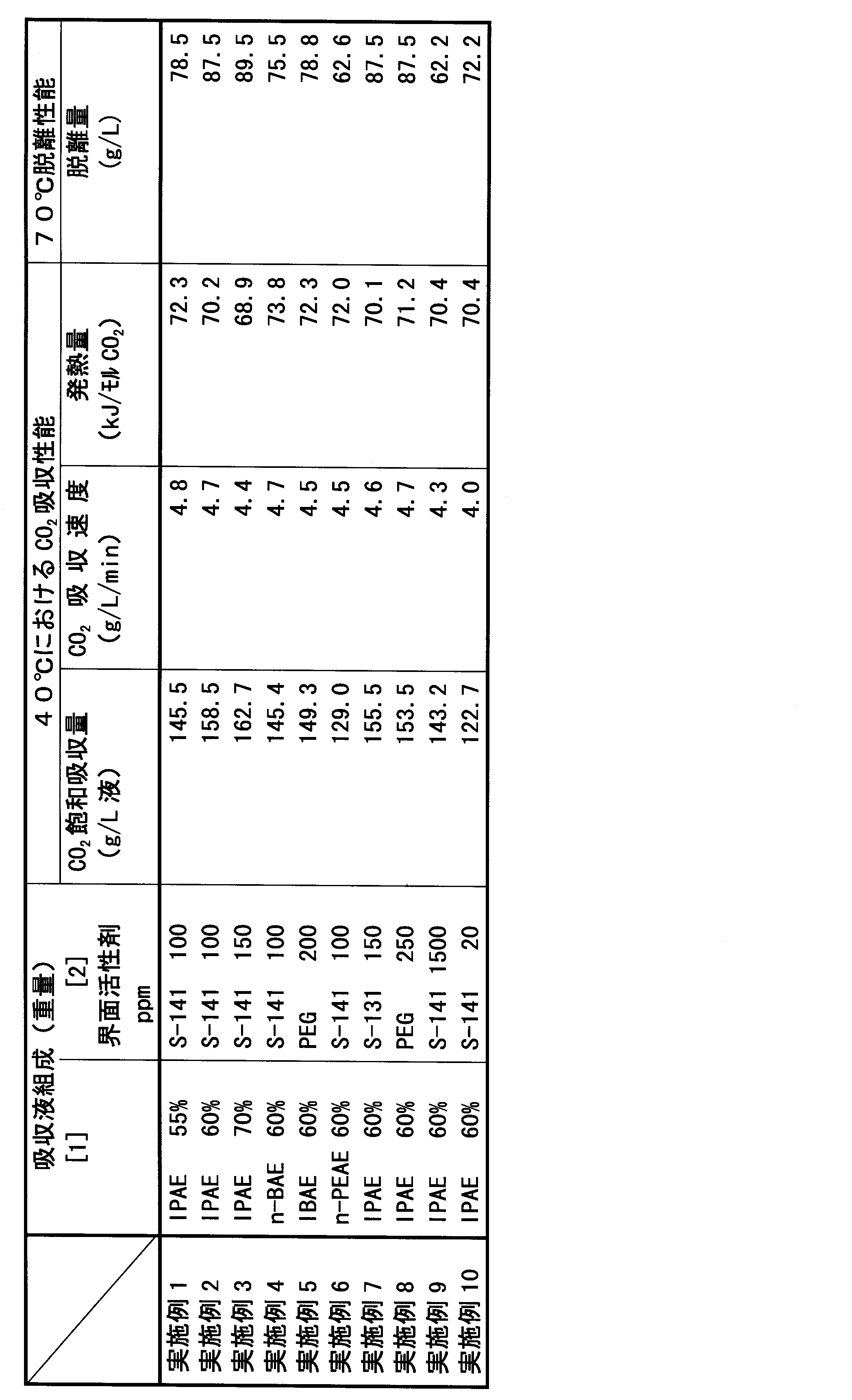
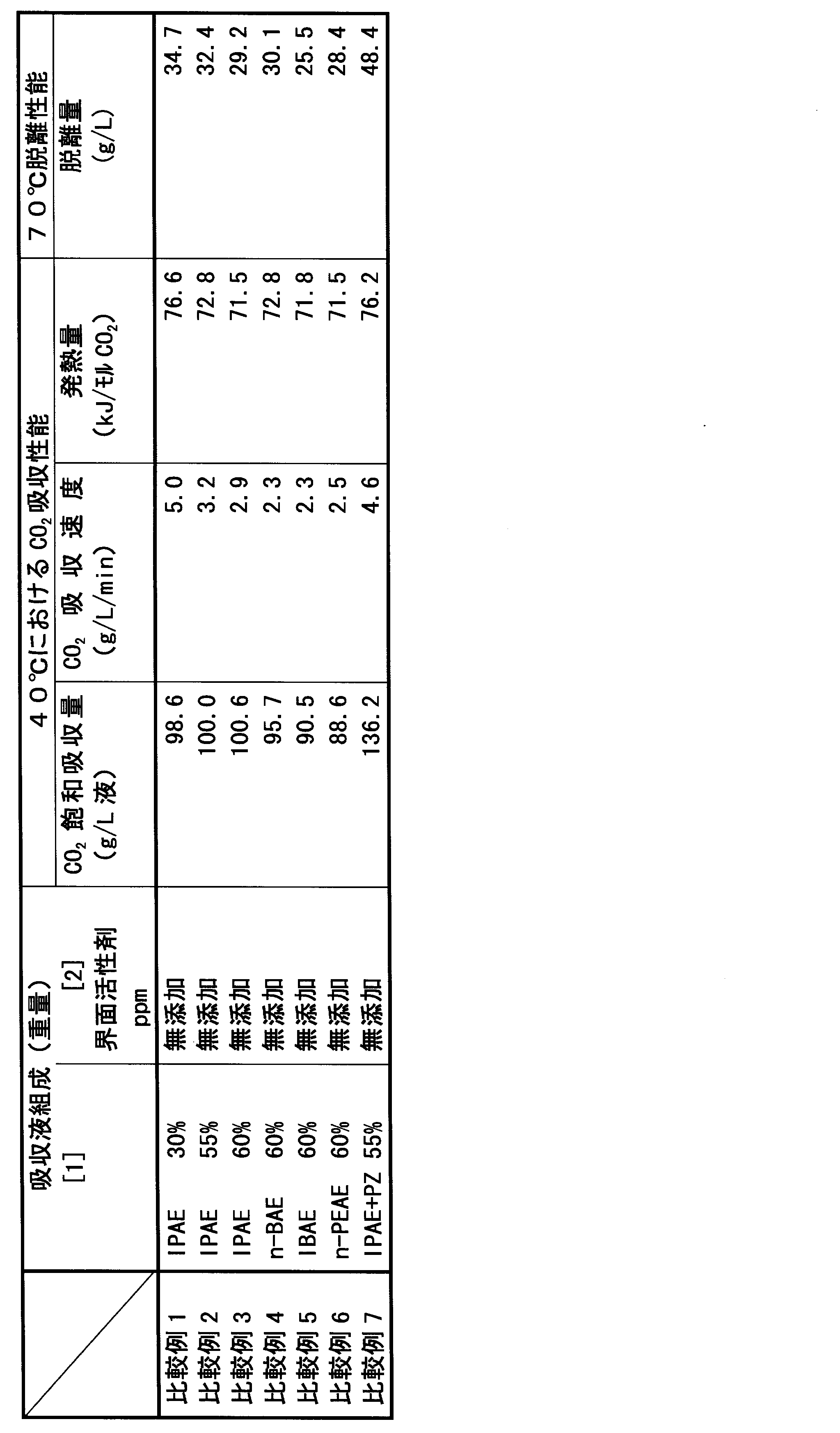
上記の結果より、実施例1は、IPAE 30重量%の比較例1と比べて高濃度化により単位吸収液当たりの飽和吸収量及び脱離量が増大している。また、界面活性剤の添加により、吸収速度も4.8 g/Lと同一IPAE濃度の比較例2の3.2 g/lより高くなっており界面活性剤の添加による効果が確認された。又、比較例1と比べて二酸化炭素1モル当りの発熱量は低下しており高濃度による効果が確認された。
上記の結果より、実施例3のIPAE 70重量%ではやや吸収速度が低下するが、飽和吸収量及び脱離量も、実施例2と比べて増加しており高濃度化による性能向上の効果が確認できた。
アルキル基の炭素鎖長を4、5とした場合、単位吸収液当たりの飽和吸収量は分子量の影響で低下はするものの、分子量補正をしたアミン当たりの吸収量のモル比率は、IPAE、n-BAE、IBAE、n-PEAEはそれぞれ0.62、0.63、0.62、0.64とほぼ同一でイソプロピル基と同等の効果が得られることがわかった。又、吸収速度及び脱離量についても対応する比較例4~6に対して高い性能を示すことが確認された。
実施例2(サーフロンS-141)と比べると、飽和吸収量は僅かに低下するが、吸収速度及び脱離量はほぼ同一で、S-141と同等の効果を示す。又、発熱量も実施例2と同等のレベルであり特に高くなることも観察されなかった。
実施例2と比較すると、飽和吸収量及び吸収速度はやや低下するが、界面活性剤を添加しない比較例3よりは高い性能を示しており、効果は確認できた。しかしながら、本添加量では二酸化炭素の吸収の進行に伴い発泡が観察され操作性の点では、添加量をこれ以上増加させることは難しいとの結果であった。
実施例2と比較すると、飽和吸収量及び吸収速度はやや低下するが、界面活性剤を添加しない比較例3よりは高い性能を示しており、効果は確認できた。
低濃度の30重量%では吸収速度は速いが、60重量%では吸収速度の大幅な低下が観察され結果として飽和吸収量及び脱離量いずれもが低い値を示すことが分かり、単純な高濃度化では吸収液の性能向上は難しいことが分かる。
比較例4~6は、実施例4~6に対応する吸収液で界面活性剤を添加していない条件であるが、飽和吸収量、吸収速度及び脱離量において対応する実施例に比べ劣っている。これらのことより、IPAE以外のヒンダードアミンでも界面活性剤の添加効果が観察された。
上記の結果より、比較例2との比較より反応活性剤の添加によりIPAE単独での水溶液より飽和吸収量及び吸収速度は向上効果が見られるものの、25℃での表面張力は45 mN/mであり反応活性剤の添加の効果は表面張力の低下による効果とは別の効果といえる。一方、ピペラジンのような反応活性剤を含む吸収液では発熱量は高くなっており、二酸化炭素の回収エネルギーの低減には繋がらず、上記実施例による方法が飽和吸収量、反応速度、発熱量及び脱離量のすべての点において有利であることが分かった。
Claims (7)
- 二酸化炭素を含むガスから二酸化炭素を吸収及び回収するための水溶液であって、一般式〔1〕で表される第2級アミン化合物を50~70重量%、及び界面活性剤を含むことを特徴とする水溶液。

- 前記界面活性剤の重量濃度が10~1500 ppmであることを特徴とする、請求項1に記載の水溶液。
- Rがイソプロピル基又はn-ブチル基であり、前記界面活性剤がノニオン型のパーフルオルロアルキル基を持つ化合物であることを特徴とする、請求項1に記載の水溶液。
- Rがイソプロピル基又はn-ブチル基であり、前記界面活性剤が両性型のパーフルオロアルキル基を持つ化合物であることを特徴とする、請求項1に記載の水溶液。
- Rがイソプロピル基又はn-ブチル基であり、前記界面活性剤がノニオン型のポリオキシエチレンアルキルエーテル系化合物であることを特徴とする、請求項1に記載の水溶液。
- 25℃における表面張力が30 mN/m以下であることを特徴とする、請求項1に記載の水溶液。
- (1)請求項1に記載の水溶液を二酸化炭素を含むガスと接触させ、ガスから二酸化炭素を吸収する工程、及び
(2)上記(1)で得られた二酸化炭素が吸収された水溶液を加熱して、二酸化炭素を脱離して回収する工程、
を含む二酸化炭素の吸収及び回収方法。
Priority Applications (6)
| Application Number | Priority Date | Filing Date | Title |
|---|---|---|---|
| EP11800858.0A EP2589424B1 (en) | 2010-06-30 | 2011-06-28 | Aqueous solution capable of absorbing and collecting carbon dioxide in exhaust gas with high efficiency |
| AU2011271893A AU2011271893B2 (en) | 2010-06-30 | 2011-06-28 | Aqueous solution capable of absorbing and collecting carbon dioxide in exhaust gas with high efficiency |
| CN201180032296.XA CN103002971B (zh) | 2010-06-30 | 2011-06-28 | 高效吸收和回收废气中的二氧化碳的水溶液 |
| US13/806,253 US20130101493A1 (en) | 2010-06-30 | 2011-06-28 | Aqueous solution capable of absorbing and collecting carbon dioxide in exhaust gas with high efficiency |
| KR1020137002361A KR101432951B1 (ko) | 2010-06-30 | 2011-06-28 | 배기 가스 중의 이산화탄소를 효율적으로 흡수 및 회수하는 수용액 |
| BR112012033680A BR112012033680B1 (pt) | 2010-06-30 | 2011-06-28 | solução aquosa capaz de absorver e coletar dióxido de carbono em gás de exaustão com eficiência alta e recuperação de dióxido de carbono |
Applications Claiming Priority (2)
| Application Number | Priority Date | Filing Date | Title |
|---|---|---|---|
| JP2010-150304 | 2010-06-30 | ||
| JP2010150304A JP5449059B2 (ja) | 2010-06-30 | 2010-06-30 | 排ガス中の二酸化炭素を効率的に吸収及び回収する水溶液 |
Publications (1)
| Publication Number | Publication Date |
|---|---|
| WO2012002394A1 true WO2012002394A1 (ja) | 2012-01-05 |
Family
ID=45402101
Family Applications (1)
| Application Number | Title | Priority Date | Filing Date |
|---|---|---|---|
| PCT/JP2011/064820 Ceased WO2012002394A1 (ja) | 2010-06-30 | 2011-06-28 | 排ガス中の二酸化炭素を効率的に吸収及び回収する水溶液 |
Country Status (8)
| Country | Link |
|---|---|
| US (1) | US20130101493A1 (ja) |
| EP (1) | EP2589424B1 (ja) |
| JP (1) | JP5449059B2 (ja) |
| KR (1) | KR101432951B1 (ja) |
| CN (1) | CN103002971B (ja) |
| AU (1) | AU2011271893B2 (ja) |
| BR (1) | BR112012033680B1 (ja) |
| WO (1) | WO2012002394A1 (ja) |
Cited By (1)
| Publication number | Priority date | Publication date | Assignee | Title |
|---|---|---|---|---|
| WO2014129400A1 (ja) | 2013-02-25 | 2014-08-28 | 公益財団法人地球環境産業技術研究機構 | ガス中の二酸化炭素を吸収及び回収するための液体、並びにそれを用いた二酸化炭素の回収方法 |
Families Citing this family (13)
| Publication number | Priority date | Publication date | Assignee | Title |
|---|---|---|---|---|
| JP6385059B2 (ja) | 2010-09-03 | 2018-09-05 | リサーチ・トライアングル・インスティチュート | 酸‐ガス分離のための再生可能なイオン液体溶媒 |
| US12146130B2 (en) | 2012-09-04 | 2024-11-19 | Blue Planet Systems Corporation | Carbon sequestration methods and systems, and compositions produced thereby |
| CA2883816C (en) | 2012-09-04 | 2020-12-29 | Blue Planet, Ltd. | Carbon sequestration methods and systems, and compositions produced thereby |
| WO2014144848A1 (en) | 2013-03-15 | 2014-09-18 | Blue Planet, Ltd. | Highly reflective microcrystalline/amorphous materials, and methods for making and using the same |
| US20150367281A1 (en) * | 2013-08-29 | 2015-12-24 | Commonwealth Scientific And Industrial Research Organisation | Absorbent solution for absorption of acid gas and process for absorption of acid gas |
| JP2015054279A (ja) * | 2013-09-11 | 2015-03-23 | 旭化成株式会社 | 二酸化炭素吸収剤及び該吸収剤を用いた二酸化炭素の分離回収方法 |
| FR3011747B1 (fr) * | 2013-10-15 | 2016-12-23 | Ifp Energies Now | Utilisation d'une solution absorbante dans un procede de desacidification d'un gaz pour limiter la corrosion d'equipements en acier faiblement allie |
| CN104190210A (zh) * | 2014-08-26 | 2014-12-10 | 中国船舶重工集团公司第七一八研究所 | 一种复合有机醇胺二氧化碳吸收剂 |
| US10252216B2 (en) | 2014-09-24 | 2019-04-09 | University Of Kentucky Research Foundation | Reduction of amine emissions from an aqueous amine carbon dioxide capture system using charged colloidal gas aphrons |
| CN105032123B (zh) * | 2015-06-30 | 2018-07-06 | 中国华能集团清洁能源技术研究院有限公司 | 一种中低温再生二氧化碳捕集吸收剂的使用方法 |
| JP6607596B2 (ja) * | 2015-07-29 | 2019-11-20 | 学校法人神戸学院 | 2−オキサゾリジノン誘導体の製造方法 |
| JP7490596B2 (ja) | 2020-09-15 | 2024-05-27 | 株式会社東芝 | 酸性ガス吸収剤、酸性ガスの除去方法および酸性ガス除去装置 |
| JP7637524B2 (ja) * | 2021-02-04 | 2025-02-28 | 株式会社トクヤマ | 吸収液および分離回収方法 |
Citations (5)
| Publication number | Priority date | Publication date | Assignee | Title |
|---|---|---|---|---|
| JP2871334B2 (ja) | 1992-02-27 | 1999-03-17 | 関西電力株式会社 | 燃焼排ガス中の二酸化炭素の除去方法 |
| JP2004050167A (ja) | 2002-05-27 | 2004-02-19 | Kenichi Suzuki | 炭酸ガスの隔離方法及びその装置 |
| WO2004048642A1 (ja) * | 2002-11-27 | 2004-06-10 | Teikoku Oil Co., Ltd. | 粗ガスから酸性ガスを除去する方法及び酸性ガス除去用アミン溶液に添加される腐食抑制作用及び消泡作用を有する添加剤 |
| JP2008013400A (ja) * | 2006-07-05 | 2008-01-24 | Research Institute Of Innovative Technology For The Earth | 排ガス中の二酸化炭素を吸収及び脱離して回収する方法 |
| JP2009006275A (ja) | 2007-06-28 | 2009-01-15 | Research Institute Of Innovative Technology For The Earth | 排ガス中の二酸化炭素を効率的に回収する方法 |
Family Cites Families (11)
| Publication number | Priority date | Publication date | Assignee | Title |
|---|---|---|---|---|
| US4541946A (en) * | 1981-03-12 | 1985-09-17 | Standard Oil Company | Corrosion inhibitor for amine gas sweetening systems |
| US5618506A (en) * | 1994-10-06 | 1997-04-08 | The Kansai Electric Power Co., Inc. | Process for removing carbon dioxide from gases |
| JP3771708B2 (ja) * | 1998-03-23 | 2006-04-26 | 三菱重工業株式会社 | ガス中の二酸化炭素の除去方法 |
| WO2006023743A2 (en) * | 2004-08-20 | 2006-03-02 | The Trustees Of Columbia University In The City Of New York | Laminar scrubber apparatus for capturing carbon dioxide from air and methods of use |
| US7547732B2 (en) * | 2005-08-30 | 2009-06-16 | 3M Innovative Properties Company | Compositions of fluorochemical surfactants |
| US7678835B2 (en) * | 2006-04-10 | 2010-03-16 | Momentive Performance Materials Inc. | Low-foaming gas processing compositions and uses thereof |
| JP5215595B2 (ja) * | 2007-06-18 | 2013-06-19 | 三菱重工業株式会社 | 吸収液、吸収液を用いたco2又はh2s除去装置及び方法 |
| WO2009001804A1 (ja) * | 2007-06-28 | 2008-12-31 | Research Institute Of Innovative Technology For The Earth | ガス中の二酸化炭素を効率的に回収する方法 |
| KR100920116B1 (ko) | 2007-09-27 | 2009-10-05 | 한국전력공사 | 산성가스 분리용 고효율 흡수제 |
| KR101094328B1 (ko) * | 2009-06-30 | 2011-12-19 | 한국전력공사 | 산성가스 분리용 흡수제 |
| KR101350902B1 (ko) * | 2011-10-13 | 2014-01-16 | 한국에너지기술연구원 | 반응증진제를 포함하는 이산화탄소 흡수제 |
-
2010
- 2010-06-30 JP JP2010150304A patent/JP5449059B2/ja active Active
-
2011
- 2011-06-28 CN CN201180032296.XA patent/CN103002971B/zh not_active Expired - Fee Related
- 2011-06-28 AU AU2011271893A patent/AU2011271893B2/en active Active
- 2011-06-28 BR BR112012033680A patent/BR112012033680B1/pt not_active IP Right Cessation
- 2011-06-28 US US13/806,253 patent/US20130101493A1/en not_active Abandoned
- 2011-06-28 EP EP11800858.0A patent/EP2589424B1/en not_active Not-in-force
- 2011-06-28 WO PCT/JP2011/064820 patent/WO2012002394A1/ja not_active Ceased
- 2011-06-28 KR KR1020137002361A patent/KR101432951B1/ko not_active Expired - Fee Related
Patent Citations (5)
| Publication number | Priority date | Publication date | Assignee | Title |
|---|---|---|---|---|
| JP2871334B2 (ja) | 1992-02-27 | 1999-03-17 | 関西電力株式会社 | 燃焼排ガス中の二酸化炭素の除去方法 |
| JP2004050167A (ja) | 2002-05-27 | 2004-02-19 | Kenichi Suzuki | 炭酸ガスの隔離方法及びその装置 |
| WO2004048642A1 (ja) * | 2002-11-27 | 2004-06-10 | Teikoku Oil Co., Ltd. | 粗ガスから酸性ガスを除去する方法及び酸性ガス除去用アミン溶液に添加される腐食抑制作用及び消泡作用を有する添加剤 |
| JP2008013400A (ja) * | 2006-07-05 | 2008-01-24 | Research Institute Of Innovative Technology For The Earth | 排ガス中の二酸化炭素を吸収及び脱離して回収する方法 |
| JP2009006275A (ja) | 2007-06-28 | 2009-01-15 | Research Institute Of Innovative Technology For The Earth | 排ガス中の二酸化炭素を効率的に回収する方法 |
Non-Patent Citations (1)
| Title |
|---|
| See also references of EP2589424A4 |
Cited By (6)
| Publication number | Priority date | Publication date | Assignee | Title |
|---|---|---|---|---|
| WO2014129400A1 (ja) | 2013-02-25 | 2014-08-28 | 公益財団法人地球環境産業技術研究機構 | ガス中の二酸化炭素を吸収及び回収するための液体、並びにそれを用いた二酸化炭素の回収方法 |
| KR20150121152A (ko) | 2013-02-25 | 2015-10-28 | 신닛테츠스미킨 카부시키카이샤 | 가스 중의 이산화탄소를 흡수 및 회수하기 위한 액체, 및 그것을 사용한 이산화탄소의 회수 방법 |
| CN105008022A (zh) * | 2013-02-25 | 2015-10-28 | 新日铁住金株式会社 | 用于吸收和回收气体中的二氧化碳的液体、及使用该液体的二氧化碳的回收方法 |
| JPWO2014129400A1 (ja) * | 2013-02-25 | 2017-02-02 | 公益財団法人地球環境産業技術研究機構 | ガス中の二酸化炭素を吸収及び回収するための液体、並びにそれを用いた二酸化炭素の回収方法 |
| CN105008022B (zh) * | 2013-02-25 | 2018-06-05 | 新日铁住金株式会社 | 用于吸收和回收气体中的二氧化碳的液体、及使用该液体的二氧化碳的回收方法 |
| KR101955752B1 (ko) * | 2013-02-25 | 2019-03-07 | 신닛테츠스미킨 카부시키카이샤 | 가스 중의 이산화탄소를 흡수 및 회수하기 위한 액체, 및 그것을 사용한 이산화탄소의 회수 방법 |
Also Published As
| Publication number | Publication date |
|---|---|
| CN103002971A (zh) | 2013-03-27 |
| EP2589424A4 (en) | 2014-10-01 |
| JP5449059B2 (ja) | 2014-03-19 |
| EP2589424A1 (en) | 2013-05-08 |
| AU2011271893B2 (en) | 2015-04-09 |
| AU2011271893A1 (en) | 2013-01-10 |
| JP2012011309A (ja) | 2012-01-19 |
| CN103002971B (zh) | 2015-11-25 |
| KR101432951B1 (ko) | 2014-09-22 |
| BR112012033680A2 (pt) | 2016-11-29 |
| KR20130032377A (ko) | 2013-04-01 |
| EP2589424B1 (en) | 2016-04-06 |
| BR112012033680B1 (pt) | 2019-12-10 |
| US20130101493A1 (en) | 2013-04-25 |
Similar Documents
| Publication | Publication Date | Title |
|---|---|---|
| JP5449059B2 (ja) | 排ガス中の二酸化炭素を効率的に吸収及び回収する水溶液 | |
| JP6095579B2 (ja) | 排ガス中の二酸化炭素を効率的に吸収及び回収する水溶液、及びそれを用いた二酸化炭素の回収方法 | |
| JP5452222B2 (ja) | ガス中の二酸化炭素を効率的に回収する方法 | |
| JP6377602B2 (ja) | ガス中の二酸化炭素を吸収及び回収するための液体、並びにそれを用いた二酸化炭素の回収方法 | |
| JP5557426B2 (ja) | ガス中の二酸化炭素を効率的に吸収及び回収する水溶液及び方法 | |
| JP5506486B2 (ja) | ガス中に含まれる二酸化炭素を効果的に吸収及び回収する水溶液 | |
| WO2012169634A1 (ja) | 二酸化炭素吸収剤及び該吸収剤を用いた二酸化炭素の分離回収方法 | |
| JP2009006275A (ja) | 排ガス中の二酸化炭素を効率的に回収する方法 | |
| US11872519B2 (en) | Carbon dioxide absorbent and method for separating out carbon dioxide by using same | |
| JP2009213974A (ja) | ガス中の二酸化炭素を効率的に吸収、脱離回収する水溶液及び方法 | |
| US10717038B2 (en) | Absorbing solution for separating and capturing carbon dioxide, and method for separating and capturing carbon dioxide in which same is used | |
| JP2008168227A (ja) | 排ガス中の二酸化炭素の吸収液 | |
| JP2008013400A (ja) | 排ガス中の二酸化炭素を吸収及び脱離して回収する方法 |
Legal Events
| Date | Code | Title | Description |
|---|---|---|---|
| 121 | Ep: the epo has been informed by wipo that ep was designated in this application |
Ref document number: 11800858 Country of ref document: EP Kind code of ref document: A1 |
|
| WWE | Wipo information: entry into national phase |
Ref document number: 13806253 Country of ref document: US |
|
| NENP | Non-entry into the national phase |
Ref country code: DE |
|
| ENP | Entry into the national phase |
Ref document number: 2011271893 Country of ref document: AU Date of ref document: 20110628 Kind code of ref document: A |
|
| WWE | Wipo information: entry into national phase |
Ref document number: 2011800858 Country of ref document: EP |
|
| ENP | Entry into the national phase |
Ref document number: 20137002361 Country of ref document: KR Kind code of ref document: A |
|
| REG | Reference to national code |
Ref country code: BR Ref legal event code: B01A Ref document number: 112012033680 Country of ref document: BR |
|
| ENP | Entry into the national phase |
Ref document number: 112012033680 Country of ref document: BR Kind code of ref document: A2 Effective date: 20121228 |