WO2012005109A1 - 芳香族ジホスフェートの製造方法 - Google Patents
芳香族ジホスフェートの製造方法 Download PDFInfo
- Publication number
- WO2012005109A1 WO2012005109A1 PCT/JP2011/064147 JP2011064147W WO2012005109A1 WO 2012005109 A1 WO2012005109 A1 WO 2012005109A1 JP 2011064147 W JP2011064147 W JP 2011064147W WO 2012005109 A1 WO2012005109 A1 WO 2012005109A1
- Authority
- WO
- WIPO (PCT)
- Prior art keywords
- aromatic
- general formula
- compound
- aromatic diphosphate
- dimethylphenyl
- Prior art date
- Legal status (The legal status is an assumption and is not a legal conclusion. Google has not performed a legal analysis and makes no representation as to the accuracy of the status listed.)
- Ceased
Links
Classifications
-
- C—CHEMISTRY; METALLURGY
- C07—ORGANIC CHEMISTRY
- C07F—ACYCLIC, CARBOCYCLIC OR HETEROCYCLIC COMPOUNDS CONTAINING ELEMENTS OTHER THAN CARBON, HYDROGEN, HALOGEN, OXYGEN, NITROGEN, SULFUR, SELENIUM OR TELLURIUM
- C07F9/00—Compounds containing elements of Groups 5 or 15 of the Periodic Table
- C07F9/02—Phosphorus compounds
- C07F9/06—Phosphorus compounds without P—C bonds
- C07F9/08—Esters of oxyacids of phosphorus
- C07F9/09—Esters of phosphoric acids
- C07F9/12—Esters of phosphoric acids with hydroxyaryl compounds
-
- B—PERFORMING OPERATIONS; TRANSPORTING
- B01—PHYSICAL OR CHEMICAL PROCESSES OR APPARATUS IN GENERAL
- B01J—CHEMICAL OR PHYSICAL PROCESSES, e.g. CATALYSIS OR COLLOID CHEMISTRY; THEIR RELEVANT APPARATUS
- B01J27/00—Catalysts comprising the elements or compounds of halogens, sulfur, selenium, tellurium, phosphorus or nitrogen; Catalysts comprising carbon compounds
- B01J27/06—Halogens; Compounds thereof
- B01J27/125—Halogens; Compounds thereof with scandium, yttrium, aluminium, gallium, indium or thallium
-
- B—PERFORMING OPERATIONS; TRANSPORTING
- B01—PHYSICAL OR CHEMICAL PROCESSES OR APPARATUS IN GENERAL
- B01J—CHEMICAL OR PHYSICAL PROCESSES, e.g. CATALYSIS OR COLLOID CHEMISTRY; THEIR RELEVANT APPARATUS
- B01J27/00—Catalysts comprising the elements or compounds of halogens, sulfur, selenium, tellurium, phosphorus or nitrogen; Catalysts comprising carbon compounds
- B01J27/06—Halogens; Compounds thereof
- B01J27/138—Halogens; Compounds thereof with alkaline earth metals, magnesium, beryllium, zinc, cadmium or mercury
-
- B—PERFORMING OPERATIONS; TRANSPORTING
- B01—PHYSICAL OR CHEMICAL PROCESSES OR APPARATUS IN GENERAL
- B01J—CHEMICAL OR PHYSICAL PROCESSES, e.g. CATALYSIS OR COLLOID CHEMISTRY; THEIR RELEVANT APPARATUS
- B01J27/00—Catalysts comprising the elements or compounds of halogens, sulfur, selenium, tellurium, phosphorus or nitrogen; Catalysts comprising carbon compounds
- B01J27/14—Phosphorus; Compounds thereof
- B01J27/16—Phosphorus; Compounds thereof containing oxygen, i.e. acids, anhydrides and their derivates with N, S, B or halogens without carriers or on carriers based on C, Si, Al or Zr; also salts of Si, Al and Zr
-
- C—CHEMISTRY; METALLURGY
- C07—ORGANIC CHEMISTRY
- C07B—GENERAL METHODS OF ORGANIC CHEMISTRY; APPARATUS THEREFOR
- C07B61/00—Other general methods
-
- C—CHEMISTRY; METALLURGY
- C07—ORGANIC CHEMISTRY
- C07F—ACYCLIC, CARBOCYCLIC OR HETEROCYCLIC COMPOUNDS CONTAINING ELEMENTS OTHER THAN CARBON, HYDROGEN, HALOGEN, OXYGEN, NITROGEN, SULFUR, SELENIUM OR TELLURIUM
- C07F9/00—Compounds containing elements of Groups 5 or 15 of the Periodic Table
- C07F9/02—Phosphorus compounds
- C07F9/06—Phosphorus compounds without P—C bonds
- C07F9/08—Esters of oxyacids of phosphorus
- C07F9/09—Esters of phosphoric acids
- C07F9/14—Esters of phosphoric acids containing P(=O)-halide groups
-
- C—CHEMISTRY; METALLURGY
- C08—ORGANIC MACROMOLECULAR COMPOUNDS; THEIR PREPARATION OR CHEMICAL WORKING-UP; COMPOSITIONS BASED THEREON
- C08L—COMPOSITIONS OF MACROMOLECULAR COMPOUNDS
- C08L63/00—Compositions of epoxy resins; Compositions of derivatives of epoxy resins
-
- C—CHEMISTRY; METALLURGY
- C09—DYES; PAINTS; POLISHES; NATURAL RESINS; ADHESIVES; COMPOSITIONS NOT OTHERWISE PROVIDED FOR; APPLICATIONS OF MATERIALS NOT OTHERWISE PROVIDED FOR
- C09K—MATERIALS FOR MISCELLANEOUS APPLICATIONS, NOT PROVIDED FOR ELSEWHERE
- C09K21/00—Fireproofing materials
- C09K21/06—Organic materials
- C09K21/12—Organic materials containing phosphorus
Definitions
- the present invention relates to a method for producing an aromatic diphosphate useful as a phosphorus-based flame retardant. More specifically, the present invention provides an aromatic diphosphate that can reduce the formation of by-products that reduce the physical properties of the phosphorus-based flame retardant without subjecting it to a purification treatment such as recrystallization using a solvent. Regarding the method.
- a method of adding a flame retardant during the preparation of a resin molded product is employed.
- the flame retardant include an inorganic compound, an organic phosphorus compound, an organic halogen compound, and a halogen-containing organic phosphorus compound.
- organohalogen compounds and halogen-containing organophosphorus compounds exhibit excellent flame retardant effects.
- these halogen-containing compounds have the problem that they generate hydrogen halide by thermal decomposition during resin molding, corrode the mold, deteriorate the resin itself, cause coloring, and deteriorate the working environment.
- toxic gases such as hydrogen halide harmful to the human body are generated in the event of fire or incineration.
- Such flame retardants include inorganic compounds such as magnesium hydroxide and aluminum hydroxide, and nitrogen compounds such as melamine cyanurate, melamine phosphate and melamine polyphosphate.
- inorganic compounds and nitrogen compounds have a remarkably low flame retardant effect, and in order to obtain a sufficient effect, they need to be added in a large amount, whereby the original physical properties of the resin are impaired.
- Triphenyl phosphate (TPP) is well known as a typical organic phosphate ester.
- TPP is inferior in heat resistance and has high volatility. Therefore, engineering plastics that have been developed in recent years, and high-performance plastics such as super engineering plastics, require a high temperature of about 300 ° C. for molding and the like, and cannot withstand such high temperatures.
- Patent Document 2 proposes a method of solidifying and powdering the obtained aromatic diphosphate without subjecting it to purification treatment.
- R 1 and R 2 are each independently an alkyl group having 1 to 5 carbon atoms
- R 3 and R 4 are each independently a hydrogen atom or an alkyl group having 1 to 5 carbon atoms
- Is a bond —CH 2 —, —C (CH 3 ) 2 —, —S—, —SO 2 —, —O—, —CO— or —N ⁇ N— group
- k is 0 or 1 Yes
- m is an integer from 0 to 4
- a phosphorus compound having a hydroxyphenyl group represented by the formula is present in an aromatic diphosphate.
- Patent Document 3 describes a flame retardant composition mainly composed of a phosphorus compound having a hydroxyphenyl group represented by the general formula (II) of the present invention.
- Patent Document 3 using the functional group (hydroxyphenyl group) which the compound of general formula (II) has is examined using this phosphorus compound as a reactive flame retardant of an epoxy resin.
- the additive-type flame retardant mainly composed of the aromatic diphosphate represented by the general formula (I) of the present invention the compound having a hydroxyphenyl group represented by the general formula (II) of the present invention is This is not preferable because it causes problems such as
- the present invention provides a method for producing aromatic diphosphate useful as a phosphorus-based flame retardant with high purity, high yield, and low cost without subjecting it to a purification treatment such as recrystallization using a solvent. This is the issue. That is, the present invention can reduce the production of by-products that lower the physical properties of the phosphorus-based flame retardant, and in particular, a phosphorus compound having a hydroxyphenyl group represented by the general formula (II) is subjected to gel permeation chromatography (GPC). It is an object of the present invention to provide a method for producing an aromatic diphosphate of the general formula (I), which can be measured to 1% by area or less.
- the present inventors have found that the above problems can be solved by the following method, and based on this, the present invention has been completed. That is, according to the present invention, the first step: the following general formula (III)
- R 1 and R 2 are each independently an alkyl group having 1 to 5 carbon atoms, and R 3 is a hydrogen atom or an alkyl group having 1 to 5 carbon atoms
- An aromatic monohydroxy compound having a sterically hindered group at the ortho position represented by the above is reacted with phosphorus oxyhalide in the presence of a Lewis acid catalyst, and then unreacted phosphorus oxyhalide is removed under reduced pressure.
- R 4 is a hydrogen atom or an alkyl group having 1 to 5 carbon atoms
- Y is a bond, —CH 2 —, —C (CH 3 ) 2 —, —S—, —SO 2 —, — O—, —CO— or —N ⁇ N— group
- k is 0 or 1
- m is an integer of 0 to 4.
- a method for producing aromatic diphosphate useful as a phosphorus-based flame retardant with high purity, high yield, and low cost without subjecting to purification treatment such as recrystallization using a solvent can be provided. That is, according to the present invention, in the production of the aromatic diphosphate of the general formula (I) by the two-step reaction, the physical properties of the phosphorus-based flame retardant are reduced by adjusting the amount of the reaction raw material used in the second step.
- the phosphorus compound having a hydroxyphenyl group represented by the general formula (II) which reduces the production of by-products, can be reduced to 1 area% or less as measured by gel permeation chromatography (GPC).
- the aromatic diphosphate obtained by the production method of the present invention is hardly deteriorated as a flame retardant even when exposed to high temperatures during molding of a thermoplastic resin or during long-term use of a molded article, and the mechanical properties of the resin It is possible to minimize the decrease and to impart excellent durability and flame retardancy to the resin.
- phosphorus compounds having an aromatic diphosphate of the general formula (I) and a hydroxyphenyl group of the general formula (II) are tetrakis (2,6-dimethylphenyl) -m-phenylene-bisphosphate and bis (2,6 -Dimethylphenyl) -3-hydroxyphenyl phosphate; tetrakis (2,6-dimethylphenyl) -p-phenylene-bisphosphate and bis (2,6-dimethylphenyl) -4-hydroxyphenyl phosphate; or tetrakis (2,6 -Dimethylphenyl) -4,4'-diphenylene bisphosphate and bis (2,6-dimethylphenyl) 4'-hydroxyphenyl-4-phenyl phosphate, further adding tetrakis (2,6-dimethyl) Phenyl) -m-phenylene-bisphosphate and bi (2,6-dimethylphenyl) -3-hydroxyphenyl
- the catalyst is 0.1 to 3.0% by weight of magnesium chloride with respect to phosphorus oxyhalide, and phosphorus oxyhalide is added to 1 mol of the aromatic monohydroxy compound of the general formula (III). And the reaction is carried out at 50 to 250 ° C. under reduced pressure. Further, in the second step, the catalyst is 0.1% based on the phosphorus oxyhalide used in the first step. When the reaction is carried out at 50 to 250 ° C. under reduced pressure, the above effect can be obtained more excellently.
- aromatic diphosphate (I) obtained by the production method of the present invention
- aromatic diphosphate (I) is 1% by area or less by GPC measurement as a by-product.
- a phosphorus compound having a hydroxyphenyl group represented by the general formula (II) (hereinafter, also referred to as “phosphorus compound (II) having a hydroxyphenyl group”).
- the content of the phosphorus compound (II) having a hydroxyphenyl group is “1 area% or less” in GPC measurement, which means that the content is “over 0 area% and 1 area% or less”. Means.
- the lower limit in the content of the phosphorus compound (II) having a hydroxyphenyl group is preferably 0.01 area%, more preferably 0.001 area%, and still more preferably 0.0001 area%, and the upper limit is preferably It is 0.9 area%, More preferably, it is 0.8 area%, More preferably, it is 0.7 area%.
- the aromatic diphosphate (I) is preferably contained in an area of 95 area% or more, more preferably 96 area% or more, as measured by GPC.
- the upper limit of the content of aromatic diphosphate (I) is theoretically 100%, but is preferably 99 area%, more preferably 99.5 area%, and even more preferably 99.9 area%.
- the reaction in the production method of the present invention is mainly based on the following reaction scheme.
- First step (Wherein R 1 and R 2 are each independently an alkyl group having 1 to 5 carbon atoms, R 3 is a hydrogen atom or an alkyl group having 1 to 5 carbon atoms, and X is a halogen atom)
- the “alkyl group having 1 to 5 carbon atoms” of R 1 , R 2 and R 3 is a linear or branched alkyl group having 1 to 5 carbon atoms, such as methyl, ethyl, propyl, isopropyl, n-butyl. , Isobutyl, tert-butyl, n-pentyl, isopentyl, neo-pentyl, and the like.
- the methyl group is more preferable because the phosphorus content in the finally obtained aromatic diphosphate (I) is increased. Particularly preferred.
- aromatic monohydroxy compound (III) having a sterically hindered group at the ortho position examples include 2,6-xylenol, 2,3,6-trimethylphenol, 2,4,6-trimethylphenol and the like.
- 2,6-xylenol is particularly preferred because it is easily available and the phosphorus content in the finally obtained aromatic diphosphate (I) is high.
- examples of phosphorus oxyhalide include phosphorus oxychloride and phosphorus oxybromide, and phosphorus oxychloride is particularly preferable from the viewpoint of cost and availability.
- Examples of the Lewis acid catalyst used in the reaction in the first step include aluminum chloride, magnesium chloride, titanium tetrachloride, antimony pentachloride, zinc chloride, and tin chloride. Among these, magnesium chloride is particularly preferable. Moreover, you may use these compounds in mixture of 2 or more types.
- the amount of the catalyst used in the first step is preferably from 0.1 to 3.0% by weight, more preferably from 0.5 to 2.0% by weight based on the phosphorus oxyhalide.
- the phosphorus oxyhalide is basically used at a ratio of usually 0.5 mol per 1 mol of the aromatic monohydroxy compound (III). If phosphorus oxyhalide is excessive, the by-product ratio of aryl phosphorodihalidate increases, and there are 3 or more phosphorus atoms in one molecule with the aromatic dihydroxy compound (V) in the second step. Higher-order condensates are produced as by-products. If the amount of phosphorus oxyhalide is too small, the by-product ratio of triaryl phosphate increases, and in any case, the purity of the main component decreases.
- the reaction temperature is 50 to 250 ° C., preferably 100 to 200 ° C.
- the inside of the reaction system may be depressurized.
- a reaction solvent is not necessarily required, but it can be arbitrarily used.
- the solvent include organic solvents such as xylene, toluene, chlorobenzene, and dichlorobenzene.
- the phosphorus oxyhalide is removed under reduced pressure of 30 kPa or less. When an organic solvent is used, it is removed at the same time when the pressure is reduced.
- the reduced pressure is intended to remove phosphorus oxyhalide, and is preferably 20 kPa or less, more preferably 10 kPa or less. Moreover, you may remove an aromatic monohydroxy compound simultaneously.
- R 4 is a hydrogen atom or an alkyl group having 1 to 5 carbon atoms
- Y is a bond, —CH 2 —, —C (CH 3 ) 2 —, —S—, —SO 2 —, —O—, —CO— or —N ⁇ N— group
- k is 0 or 1
- m is an integer of 0 to 4 Is
- alkyl group having 1 to 5 carbon atoms a linear or branched alkyl group having 1 to 5 carbon atoms such as methyl, ethyl, propyl, isopropyl, n-butyl, isobutyl, tert-butyl , N-pentyl, isopentyl, neo-pentyl and the like.
- aromatic dihydroxy compound (V) examples include hydroquinone, resorcinol, pyrocatechol, 4,4′-biphenol, 2,2 ′, 6,6′-tetramethyl-4,4′-biphenol, bisphenol.
- A bisphenol S, bisphenol F, tetramethyl bisphenol A, tetramethyl bisphenol F, 4,4′-dihydroxydiphenyl ether, 4,4′-thiodiphenol, etc.
- Hydroquinone, resorcinol and 4,4′-biphenol are particularly preferred in that the phosphorus content in the resulting aromatic diphosphate (I) is high.
- Examples of the Lewis acid catalyst used in the reaction in the second step include the Lewis acid catalyst in the first step.
- the Lewis acid catalyst used in the first step can be removed without removing after the reaction in the first step.
- the reaction may be used as it is, but may be further added.
- As the Lewis acid catalyst to be added aluminum chloride is particularly preferable.
- an amine such as triethylamine or tributylamine may be used.
- the amount of catalyst used in the second step is preferably from 0.1 to 5.0% by weight, more preferably from 0.5 to 5.0% by weight, based on the phosphorus oxyhalide used in the first step. % Range.
- the theoretical amount necessary to convert all of the diaryl phosphorohalidate (IV) to the aromatic diphosphate (I) which is a condensed phosphate ester, that is, the diarylphosphonate It is necessary to react a stoichiometric amount of the aromatic dihydroxy compound (V) with the diaryl phosphorohalidate (IV) relative to the lohalidate (IV).
- “Theoretical amount (stoichiometric amount) necessary to convert all of the diaryl phosphorohalidate (IV) to aromatic diphosphate (I)” means the halogen atom contained in the diaryl phosphorohalidate (IV). Is the amount necessary to replace all of the above with an aryl ester group, specifically, 0.5 mol of the aromatic dihydroxy compound (V) per 1 mol of the diaryl phosphorohalidate (IV).
- the “reaction product obtained in the first step” is diaryl phosphorohalidate ( In addition to IV), by-products such as aryl phosphorodihalidates are included. Therefore, the content of the phosphorus compound (II) having an aromatic diphosphate (I) of 95 area% or more by GPC measurement and having a hydroxyphenyl group as a by-product is preferably 1 area% or less by GPC measurement.
- the amount of the aromatic dihydroxy compound (V) used in the second step is approximately determined as follows.
- the aromatic diphosphate (I) of the present invention can be obtained by adjusting the amount of the aromatic dihydroxy compound (V) used in the second step.
- the reaction temperature is 50 to 250 ° C., preferably 100 to 200 ° C.
- the inside of the reaction system may be depressurized.
- an organic solvent may be added in order to prevent the aromatic diphosphate (I) from solidifying.
- the organic solvent those having high solubility of aromatic diphosphate (I) at high temperature and low at low temperature are preferable. Examples of such an organic solvent include, but are not limited to, toluene, xylene, chlorobenzene, dichlorobenzene, and a mixed solvent of two or more thereof.
- the processing temperature is from room temperature to the boiling point of the solution, and the amount of the organic solvent used may be an amount that does not cause precipitation of aromatic diphosphate (I) at the processing temperature.
- the second step is affected by the reaction of the first step. That is, the amount of the aromatic dihydroxy compound (V) in the second step is theoretically 1/4 mol equivalent of the amount of the aromatic monohydroxy compound (III), but actually 1/4 mol or the like. The molar equivalent is less than the amount. Therefore, when the aromatic dihydroxy compound (V) is used in the second step in an amount equal to 1 ⁇ 4 mol equivalent to the amount of the aromatic monohydroxy compound (III) used in the first step, the stoichiometry is excessive. It is not completely consumed and remains unreacted. That is, some hydroxy groups of the aromatic dihydroxy compound (V) remain in the reaction system. As a result, the phosphorus compound (II) having a hydroxyphenyl group is contained in the aromatic diphosphate (I).
- “industrial scale” means that the total amount of raw materials including organic solvents and the like, which are charged into a reaction vessel when the aromatic dihydroxy compound (V) and diaryl phosphorohalidate (IV) are reacted, is usually The scale of industrial production.
- the scale is preferably 5 liters or more, more preferably 30 liters or more, still more preferably 100 liters or more, and particularly preferably 300 liters or more.
- the total amount of these raw materials is specifically preferably 20000 liters or less, more preferably 10000 liters or less, due to limitations of the reaction apparatus.
- a phosphorus compound (II) having an aromatic diphosphate (I) and a hydroxyphenyl group includes tetrakis (2,6-dimethylphenyl) -m-phenylene-bisphosphate and bis (2,6-dimethylphenyl) -3-hydroxy.
- a combination of '-diphenylenebisphosphate and bis (2,6-dimethylphenyl) -4'-hydroxyphenyl-4-phenylphosphate is preferred, and tetrakis (2,6-dimethylphenyl) -m-phenylene-bis Phosphate and bis (2,6-dimethylpheny Or tetrakis (2,6-dimethylphenyl) -4,4′-diphenylenebisphosphate and bis (2,6-dimethylphenyl) -4′-hydroxyphenyl-4-phenylphosphate
- a combination of the above is particularly preferable.
- the aromatic diphosphate (I) of the present invention has a general formula (VI):
- aromatic triphosphate (VII) Is also produced simultaneously (hereinafter also referred to as “aromatic triphosphate (VII)”).
- aromatic monophosphates (VI) and aromatic triphosphates (VII) have no hydroxyphenyl group, they do not have any influence as described above.
- Powdering step The oily substance obtained in the second step is subjected to stress application using a kneader generally used for kneading plastic materials at a temperature 5 to 100 ° C. lower than the melting point of the aromatic diphosphate (I). It can be pulverized.
- Kneading means that when several kinds of additives are mixed with a plastic material, a shearing force is simultaneously applied to the material and the additives to uniformly disperse the additives within the material.
- stressing is synonymous with “kneading” in that the temperature of the material supplied to the kneader is made uniform and at the same time a shearing force, that is, stress is applied to the material.
- kneaders are classified into batch types such as mixing rolls, ⁇ blade type kneaders, and intensive mixers, and continuous types such as high-speed biaxial continuous mixers and extruder type kneaders.
- batch types such as mixing rolls, ⁇ blade type kneaders, and intensive mixers
- continuous types such as high-speed biaxial continuous mixers and extruder type kneaders.
- a continuous kneader capable of simultaneously pressing the produced solidified product is preferable.
- the continuous type has a high processing capacity and is advantageous from the industrial use aspect.
- the kneader As a particularly suitable kneader, there is a Kneader type kneader that is a kind of extruder type kneader, has a strong shearing force, has a high kneading effect, and can be continuously solidified powdered,
- the model is not particularly limited as long as the model has the same effect.
- the kneader has a heating mechanism such as an electric resistance type band heater, an aluminum casting heater or a dielectric heating method, and a heating or cooling mechanism such as circulating water or oil through a jacket provided in the cylinder or a pipe provided in the screw. The temperature inside the kneader can be controlled.
- the optimum temperature range is not only the thermal physical properties of the oil to be solidified, but also the viscosity, fluidity, frictional heat during kneading, and the equipment used. Varies with characteristics.
- the temperature is generally 5 to 100 ° C., preferably 10 to 70 ° C., more preferably 10 to 50 ° C. lower than the melting point of the aromatic diphosphates. When the temperature is within this range, an appropriate stress is applied to the compound in the kneader, and complete solidification and shortening of the solidification time can be achieved. Since this method does not use a solvent in pulverization, there is no powder drying step, and there is no need to consider the purification and reuse of the solvent, which is advantageous for industrial production.
- Other methods for pulverizing the oily substance obtained in the second step include purification processes such as a recrystallization method using an organic solvent and a fractional distillation method.
- the organic solvent used in the recrystallization method include alcohols such as methanol, ethanol, n-propanol, isopropanol, n-butanol and isobutanol, ketones such as acetone, methyl ethyl ketone and methyl isobutol ketone, benzene, Examples thereof include aromatic hydrocarbons such as toluene, xylene, and ethylbenzene, halogenated aromatic hydrocarbons such as chlorobenzene and dichlorobenzene, and organic compounds that are generally used as solvents.
- the content of the phosphorus compound having a hydroxyphenyl group of the general formula (II) can be reduced to 1 area% or less by GPC measurement, and no purification treatment is required.
- the main purpose is to make oily powder.
- the content of the phosphorus compound (II) having a hydroxyphenyl group can be further reduced, and the purification efficiency is higher than the powdering using a kneader. Good.
- the aromatic diphosphate (I) obtained by the production method of the present invention is of high quality and can be used as a flame retardant for various thermoplastic resins and thermosetting resins.
- the thermoplastic resin include polyethylene resin, chlorinated polyethylene, polypropylene resin, polybutadiene resin, polystyrene resin, polyvinyl chloride resin, polyphenylene ether resin, polyphenylene sulfide resin, polycarbonate resin, ABS ( Acrylonitrile-butadiene-styrene) resin, impact-resistant styrene resin, SAN (styrene-acrylonitrile) resin, ACS resin, polyamide resin, polyimide resin, PET (polyethylene terephthalate) resin and PBT (polybutylene terephthalate) resin Polyester resin, polyacrylic resin, polymethacrylic resin, polyetheretherketone, polyethersulfone, polysulfone, polyarylate, polyetherketone , Polyether nitrile, poly
- Thermosetting resins include epoxy resins, polyurethane resins, polyimide resins, phenolic resins, novolak resins, polyetherimide resins, melamine resins, urea resins, unsaturated polyesters, diallyl phthalate resins. These can be used, and these can be used alone or in admixture of two or more.
- polyphenylene ether resins polyphenylene sulfide resins
- polycarbonate resins polycarbonate resins
- ABS resins which can sufficiently exhibit the function of the aromatic diphosphate (I) obtained by the production method of the present invention.
- the aromatic diphosphate (I) obtained by the production method of the present invention is usually 0.1 to 100 parts by weight, preferably 0.5 to 50 parts by weight, more preferably 100 parts by weight of the resin. Is used in an amount of 1 to 40 parts by weight, particularly preferably 3 to 30 parts by weight.
- the flame-retardant resin composition containing the aromatic diphosphate (I) obtained by the production method of the present invention is a range that does not impair the original effect of the resin, if necessary, with other components that are usually added to the resin. May be included.
- examples of such components include other flame retardants, anti-drip agents, antioxidants, fillers, lubricants, modifiers, fragrances, antibacterial agents, pigments, dyes, heat-resistant agents, weathering agents, charged anti-blocking agents, and ultraviolet rays.
- Absorbers, stabilizers, reinforcing agents, anti-blocking agents, wood flour, starch and the like can be mentioned.
- each component is a single screw extruder, a twin screw extruder, a Banbury mixer, a kneader, a mixer. And a known method such as melt kneading using a general kneading apparatus such as a roll.
- Resin having a high molding temperature for example, in one embodiment, a resin molded at 160 ° C. or higher, in a more preferable embodiment, a resin molded at 180 ° C. or higher, and in a particularly preferable embodiment, molded at 200 ° C. or higher.
- the aromatic diphosphate (I) obtained by the production method of the present invention can be advantageously used.
- the aromatic diphosphate (I) obtained by the production method of the present invention is added to a resin as a flame retardant and processed by a molding machine, it does not generate gas at its high processing temperature, and has heat resistance and resistance. A high-quality molded product excellent in colorability can be provided.
- the aromatic diphosphate (I) obtained by the production method of the present invention can be added to a resin and molded to provide a desired molded product.
- the ratio of each component in the obtained product is expressed as a percentage (area%) of the area of each component measured by gel permeation chromatography (GPC).
- GPC gel permeation chromatography
- Solvent Tetrahydrofuran (for industrial use)
- Solvent flow rate 0.8 ml / min
- Detector RI (Built-in main body, polarization type differential refractometer) Range: 16
- Sample solution injection volume 100 ⁇ l (loop tube)
- Sample solution solution obtained by dissolving about 0.05 g of sample in 10 ml of tetrahydrofuran
- Data processing device manufactured by Tosoh Corporation, model: SC-8010
- Data processing conditions START TIME 10.0min
- Example 1 First Step Into a 1-liter four-flask equipped with a stirrer, thermometer, dropping device (funnel) and hydrochloric acid recovery device (condenser connected with water scrubber), 2,6- 244 g of xylenol, 20 g of xylene as a solvent and 1.5 g of magnesium chloride as a catalyst were charged. The obtained mixed solution was heated with stirring, and when the temperature of the mixed solution reached 120 ° C., 153 g of phosphorus oxychloride was added dropwise over about 2 hours. After completion of the addition, the temperature of the mixed solution was gradually heated to 180 ° C.
- the oil phase of the obtained mixed solution was washed with 130 g of water at a liquid temperature of 85 ° C. to obtain 430 g of an oil phase (the concentration of aromatic diphosphate (I) was about 80% by weight).
- Xylene was removed from the obtained oil phase under reduced pressure, and then reduced-pressure steam distillation was performed at a temperature of 140 ° C. and a pressure of 6 kPa to obtain 330 g of an oily substance containing aromatic diphosphate (I).
- Powdering process Oily substance containing aromatic diphosphate (I) in a 1-liter four-necked flask equipped with a stirrer with rotation speed display function (manufactured by Shinto Kagaku Co., Ltd., model: HEIDON TYPE 3000H) and thermometer The mixture was charged with 320 g, allowed to cool to a temperature of 60 ° C. while stirring at a low rotation (rotation speed of about 100 rpm), and kept at the same temperature (60 ° C.) using a hot water bath. Next, 0.1% by weight of crystalline aromatic diphosphate (I) as a crystal nucleus was added to the solidified object (oil) and stirred at a rotational speed of 200 rpm. Completely solidified.
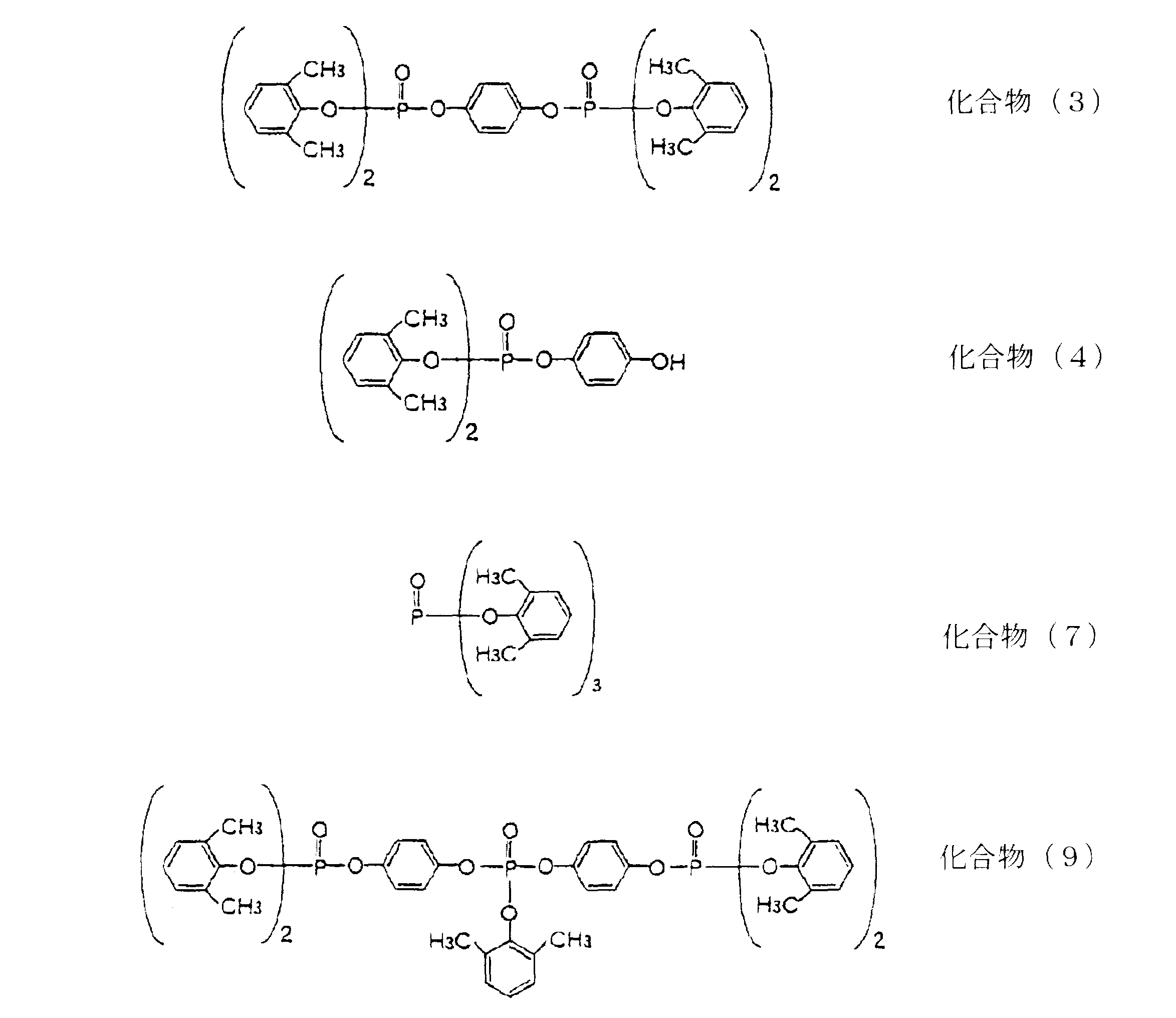
- the obtained solidified product 320 g was a white powder and had a melting point of 98 to 101 ° C. Moreover, when the composition was measured by gel permeation chromatography (GPC), the aromatic diphosphate (I) represented by the compound (1) was 96.6 area%, and the hydroxyphenyl represented by the compound (2). The phosphorus compound (II) having a group is 0.7 area%, the aromatic monophosphate (VI) represented by the compound (7) is 2.1 area%, and the aromatic triphosphate represented by the compound (8) (VII) was 0.6 area% (see the following structural formula). The obtained results are shown in Table 1 together with the raw materials used.
- Example 2 Except that a 20-liter four-flask was used as a reaction vessel, 5856 g of 2,6-xylenol as an aromatic monohydroxy compound (III), 480 g of xylene as a solvent, 36 g of magnesium chloride as a catalyst, and 3672 g of phosphorus oxychloride were used.
- a reaction mixture containing di (2,6-xylyl) phosphorochloridate as diaryl phosphorohalidate (IV) was obtained.
- the chlorine content of the reaction mixture was 10.6% by weight.
- Example 2 Except for adding 2160 g of xylene, 216 g of 35% aqueous hydrochloric acid, 3360 g of water, 120 g of 28% aqueous sodium hydroxide and 3120 g of water to the obtained crude product, and using 3120 g of washing water, the same procedure as in Example 1 was performed. Purification was carried out to obtain 7960 g of an oily substance containing aromatic diphosphate (I). Further, a powdering step was performed in the same manner as in Example 1 except that a 20-liter four-flask was used and 7920 g of an oily substance containing aromatic diphosphate (I) was used to obtain 7920 g of a white powder. It was.
- the obtained white powder had a melting point of 98-101 ° C.
- the aromatic diphosphate (I) represented by the compound (1) has 96.2 area%, and has a hydroxyphenyl group represented by the compound (2).
- the phosphorus compound (II) is 0.8 area%
- the aromatic monophosphate (VI) represented by the compound (7) is 2.3 area%
- the aromatic triphosphate (VII) represented by the compound (8) is It was 0.7 area%.
- Table 1 The obtained results are shown in Table 1 together with the raw materials used.
- Example 3 320 g of white powder was obtained in the same manner as in Example 1 except that hydroquinone was used instead of resorcinol.
- the obtained white powder had a melting point of 171 to 173 ° C.
- the chlorine content of the reaction mixture in the first step was 10.6% by weight.
- the aromatic diphosphate (I) represented by the compound (3) has 96.6 area%, and has a hydroxyphenyl group represented by the compound (4).
- Phosphorus compound (II) is 0.7 area%
- aromatic monophosphate (VI) represented by compound (7) is 2.1 area%
- aromatic triphosphate (VII) represented by compound (9) is It was 0.6 area% (see the following structural formula).
- the obtained results are shown in Table 1 together with the raw materials used.
- Example 4 7920 g of white powder was obtained in the same manner as in Example 2 except that hydroquinone was used instead of resorcinol.
- the obtained white powder had a melting point of 171 to 173 ° C.
- the chlorine content of the reaction mixture in the first step was 10.6% by weight.
- the aromatic diphosphate (I) represented by the compound (3) has 96.4 area%, and has a hydroxyphenyl group represented by the compound (4).
- the phosphorus compound (II) is 0.7 area%
- the aromatic monophosphate (VI) represented by the compound (7) is 2.2 area%
- the aromatic triphosphate (VII) represented by the compound (9) is It was 0.7 area%.
- Table 1 The obtained results are shown in Table 1 together with the raw materials used.
- Example 5 354 g of white powder was obtained in the same manner as in Example 1 except that 90 g of 4,4′-biphenol was used in place of resorcinol and dichlorobenzene was used in place of xylene.
- the obtained white powder had a melting point of 187 ° -189 ° C.
- the chlorine content of the reaction mixture in the first step was 10.4% by weight.
- the aromatic diphosphate (I) represented by the compound (5) has 96.6 area%, and has a hydroxyphenyl group represented by the compound (6).
- the phosphorus compound (II) is 0.7 area%
- the aromatic monophosphate (VI) represented by the compound (7) is 2.1 area%
- the aromatic triphosphate (VII) represented by the compound (10) is It was 0.6 area% (see the following structural formula).
- the obtained results are shown in Table 1 together with the raw materials used.
- Example 6 8800 g of white powder was obtained in the same manner as in Example 2 except that 2,150 g of 4,4′-biphenol was used in place of resorcinol and dichlorobenzene was used in place of xylene.
- the obtained white powder had a melting point of 187 ° -189 ° C.
- the chlorine content of the reaction mixture in the first step was 10.4% by weight.
- the aromatic diphosphate (I) represented by the compound (5) has 96.2 area%, and has a hydroxyphenyl group represented by the compound (6).
- the phosphorus compound (II) is 0.7 area%
- the aromatic monophosphate (VI) represented by the compound (7) is 2.4 area%
- the aromatic triphosphate (VII) represented by the compound (10) is It was 0.7 area%.
- the obtained results are shown in Table 1 together with the raw materials used.
- Phosphorus compound (II) is 1.2 area%, aromatic monophosphate (VI) represented by compound (7) is 1.8 area% and aromatic triphosphate (VII) represented by compound (8) is It was 0.4 area%.
- the obtained results are shown in Table 1 together with the raw materials used.
- the phosphorus compound (II) is 2.5 area%
- the aromatic monophosphate (VI) represented by the compound (7) is 2.0 area%
- the aromatic triphosphate (VII) represented by the compound (8) is It was 0.5 area%.
- the obtained results are shown in Table 1 together with the raw materials used.
- the phosphorus compound (II) is 1.5 area%
- the aromatic monophosphate (VI) represented by the compound (7) is 1.8 area%
- the aromatic triphosphate (VII) represented by the compound (9) is It was 0.4 area%.
- the obtained results are shown in Table 1 together with the raw materials used.
- Phosphorus compound (II) is 1.2 area%
- aromatic monophosphate (VI) represented by compound (7) is 2.0 area%
- aromatic triphosphate (VII) represented by compound (10) was 0.4 area%.
- the obtained results are shown in Table 1 together with the raw materials used.
- aromatic diphosphate (I) obtained by the production method of the present invention are shown below for reference in the form of examples and comparative examples.
- resin modified PPE resin (manufactured by Nippon GE Plastics, trade name: Noryl 731), PC / ABS alloy resin (manufactured by Daicel Polymer Co., Ltd., trade name: Novalloy S-1500) and ABS resin (manufactured by Daicel Polymer Co., Ltd.) (Trade name: Sebian V-500), and fluororesin (trade name: Teflon (registered trademark) 6-J, manufactured by Mitsui DuPont Fluoro Chemical Co., Ltd.) was used as an additive for the anti-drip.
- the durability test was performed using the following testing machine.
- Tables 2 to 4 “After Rainbow 6HR treatment” and “After Rainbow 24HR treatment” are described, respectively, and the ratio to the initial value is added as a maintenance rate (%).
- the molded article of the flame retardant resin composition containing the aromatic diphosphate (I) of the present invention is excellent in Izod impact strength and melt flow rate, and particularly excellent in durability to temperature and humidity.
Landscapes
- Chemical & Material Sciences (AREA)
- Organic Chemistry (AREA)
- Engineering & Computer Science (AREA)
- Materials Engineering (AREA)
- Chemical Kinetics & Catalysis (AREA)
- Health & Medical Sciences (AREA)
- Life Sciences & Earth Sciences (AREA)
- Biochemistry (AREA)
- General Health & Medical Sciences (AREA)
- Molecular Biology (AREA)
- Medicinal Chemistry (AREA)
- Polymers & Plastics (AREA)
- Low-Molecular Organic Synthesis Reactions Using Catalysts (AREA)
- Compositions Of Macromolecular Compounds (AREA)
Abstract
Description
このような難燃剤としては、水酸化マグネシウムや水酸化アルミニウムなどの無機系化合物、メラミンシアヌレート、メラミンホスフェートやメラミンポリホスフェートなどの窒素系化合物がある。しかし、これらの無機系化合物や窒素系化合物は難燃効果が著しく低く、充分な効果を得るためには多量に添加する必要があり、それによって樹脂本来の物性が損なわれるという問題がある。
したがって、近年、開発が進んでいるエンジニアリングプラスチック、さらにはスーパーエンジニアリングプラスチックなどの高機能プラスチックでは成形加工などに300℃前後の高い温度が必要とされ、このような高温には耐えられない。
そこで、特許文献2では、得られた芳香族ジホスフェートを精製処理に付することなく固化させ粉末化する方法が提案された。

で表されるヒドロキシフェニル基を有するリン化合物が芳香族ジホスフェート中に存在する。
また、この副生成物は、成形加工などの高温条件において、主成分である芳香族ジホスフェートとエステル交換を起こし、さらなる副生成物の増加を引き起こし、主成分の純度が低下するという問題もある。
しかしながら、本発明の一般式(I)で表される芳香族ジホスフェートを主成分とする添加型難燃剤では、本発明の一般式(II)で表されるヒドロキシフェニル基を有する化合物は、上記のような問題を引き起こす原因となり好ましくない。
すなわち、本発明は、リン系難燃剤の物性を低下させる副生成物の生成を低減し得る、特に一般式(II)で表されるヒドロキシフェニル基を有するリン化合物をゲル透過クロマトグラフィー(GPC)により測定して1面積%以下とし得る、一般式(I)の芳香族ジホスフェートの製造方法を提供することを課題とする。
すなわち、本発明によれば、第1工程:下記一般式(III)

で表されるオルト位に立体障害基を有する芳香族モノヒドロキシ化合物とオキシハロゲン化リンとをルイス酸触媒の存在下に反応させて、次いで減圧下で未反応のオキシハロゲン化リンを除去して、下記一般式(IV)

で表されるジアリールホスホロハリデートを得る工程、
第2工程:前記工程で得られた反応生成物と、該反応生成物に含まれるハロゲン1モルに対して0.5モルの下記一般式(V)

で表される芳香族ジヒドロキシ化合物とをルイス酸触媒の存在下に反応させて、下記一般式(I)

で表される芳香族ジホスフェートを得る工程
を含む芳香族ジホスフェートの製造方法が提供される。
すなわち、本発明によれば、2段階反応による一般式(I)の芳香族ジホスフェートの製造において、第2工程における反応原料の使用量を調節することにより、リン系難燃剤の物性を低下させる副生成物の生成を低減する、特に一般式(II)で表されるヒドロキシフェニル基を有するリン化合物をゲル透過クロマトグラフィー(GPC)により測定して1面積%以下とすることができる。
したがって、本発明の製造方法で得られる芳香族ジホスフェートは、熱可塑性樹脂の成形時や成形品の長期間の使用時に高温に曝されても難燃剤として劣化し難く、樹脂の機械的物性の低下を最小限に抑え、かつ優れた耐久性、難燃性を樹脂に付与することができる。

で表されるヒドロキシフェニル基を有するリン化合物を含む芳香族ジホスフェートの製造方法、GPC測定で95面積%以上の芳香族ジホスフェートの製造方法を提供することができる。
ここで、ヒドロキシフェニル基を有するリン化合物(II)の含有率がGPC測定で「1面積%以下である」とは、その含有率が「0面積%を超えかつ1面積%以下である」ことを意味する。ヒドロキシフェニル基を有するリン化合物(II)の含有率における下限は、好ましくは0.01面積%、より好ましくは0.001面積%、さらに好ましくは0.0001面積%であり、その上限は好ましくは0.9面積%、より好ましくは0.8面積%、さらに好ましくは0.7面積%である。
芳香族ジホスフェート(I)は、GPC測定で95面積%以上含まれるのが好ましく、96面積%以上含まれるのがさらに好ましい。芳香族ジホスフェート(I)の含有率における上限値は、理論上100%であるが、好ましくは99面積%、より好ましくは99.5面積%、さらに好ましくは99.9面積%である。
1.第1工程

第1工程の触媒の使用量は、オキシハロゲン化リンに対して0.1~3.0重量であるのが好ましく、より好ましくは0.5~2.0重量%の範囲である。
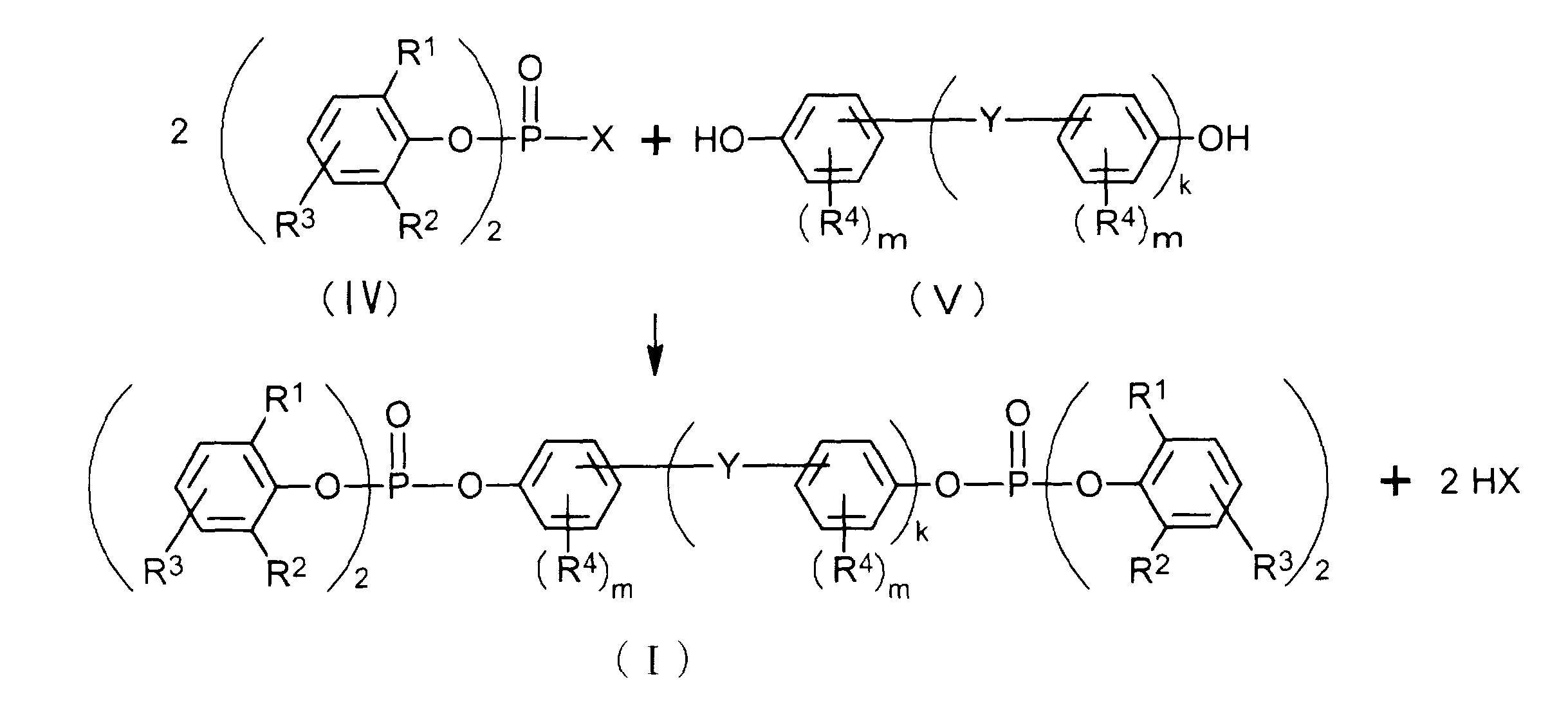
R4の「炭素数1~5のアルキル基」としては、直鎖または分枝状の炭素数1~5のアルキル基、例えばメチル、エチル、プロピル、イソプロピル、n-ブチル、イソブチル、tert-ブチル、n-ペンチル、イソペンチル、neo-ペンチルなどが挙げられる。
第2工程の触媒の使用量は、第1工程で使用されたオキシハロゲン化リンに対して0.1~5.0重量%であるのが好ましく、より好ましくは0.5~5.0重量%の範囲である。
「ジアリールホスホロハリデート(IV)のすべてを芳香族ジホスフェート(I)とするのに必要な理論量(化学量論量)」とは、ジアリールホスホロハリデート(IV)に含まれるハロゲン原子の全てをアリールエステル基に置換するのに必要な量を指し、具体的にはジアリールホスホロハリデート(IV)1モルに対して芳香族ジヒドロキシ化合物(V)0.5モルである。
そこで、好ましくはGPC測定で95面積%以上の芳香族ジホスフェート(I)を含みかつ副生成物としてのヒドロキシフェニル基を有するリン化合物(II)の含有量がGPC測定で1面積%以下であるような、本発明の芳香族ジホスフェート(I)を得るために、本発明では、次のようにして近似的に第2工程において使用する芳香族ジヒドロキシ化合物(V)の量を決定する。
M=A×(B/100)/C×(1/2)
このように、第2工程における芳香族ジヒドロキシ化合物(V)の使用量を調節することにより、本発明の芳香族ジホスフェート(I)を得ることができる。
この時、芳香族ジホスフェート(I)が固体化することを防止するために、有機溶剤を添加してもよい。
有機溶剤としては、高温での芳香族ジホスフェート(I)の溶解度が高く、低温で低いものが好ましい。このような有機溶剤としては、例えば、トルエン、キシレン、クロロベンゼン、ジクロロベンゼンおよびこれらの2種以上の混合溶剤が挙げられるが、これらに限定されるものではない。
また、処理温度は、室温から前記溶液の沸点以下までであり、有機溶剤の使用量は処理温度において、少なくとも芳香族ジホスフェート(I)の析出が起こらない量であればよい。
また、それらの原材料の合計量は、反応装置の制約などから、具体的には、好ましくは20000リットル以下、より好ましくは10000リットル以下である。

で表される芳香族モノホスフェート(以下、「芳香族モノホスフェート(VI)」ともいう)および、一般式(VII):
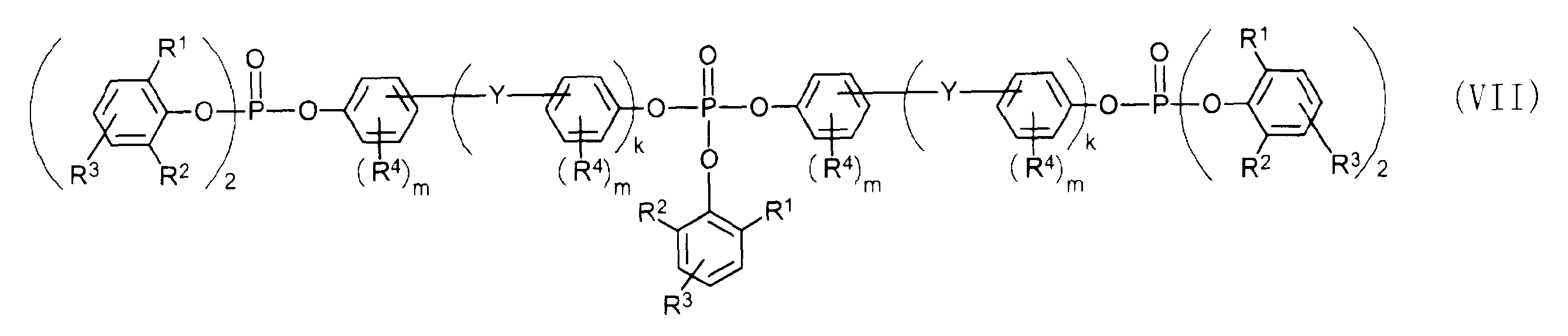
で表される芳香族トリホスフェート(以下、「芳香族トリホスフェート(VII)」ともいう)も同時に生成する。
しかしながら、これらの芳香族モノホスフェート(VI)および芳香族トリホスフェート(VII)はヒドロキシフェニル基を有さないので、樹脂には前述のような影響を何ら及ぼさない。
第2工程において得られた油状物を、芳香族ジホスフェート(I)の融点より5~100℃低い温度で、一般にプラスチック材料の混練に使用されるニーダーを用いて応力付加を行って粉末化することができる。
「混練」とは、プラスチック材料に数種の添加剤を混ぜ合わせる場合、材料と添加剤に同時に剪断力を与え、添加剤を材料内部に均一に分散させることをいう。
また、「応力付加」とは、ニーダーに供給される材料の温度を均一にすると同時に、材料に剪断力、すなわち応力を付与する点で「混練」と同義である。
また、ニーダーは電気抵抗型バンドヒーター、アルミニウム鋳込みヒーターまたは誘電加熱方式などの加熱機構、およびシリンダに設けたジャケット部やスクリュー内に設けたパイプに水または油を流通させるなどの加熱または冷却機構を備え、ニーダー内部の温度を制御することができる。
再結晶法で使用する有機溶剤としては、例えば、メタノール、エタノール、n-プロパノール、イソプロパノール、n-ブタノール、イソブタノールなどのアルコール類、アセトン、メチルエチルケトン、メチルイソブトルケトンなどのケトン類、ベンゼン、トルエン、キシレン、エチルベンゼンなどの芳香族炭化水素、クロロベンゼン、ジクロロベンゼンなどのハロゲン化芳香族炭化水素、一般的に溶剤として用いられる有機化合物が挙げられる。
しかしながら、再結晶法では、ヒドロキシフェニル基を有するリン化合物(II)の含有率をさらに低減でき、しかもニーダーを用いた粉末化よりも精製効率が高いので、任意に再結晶法を採用してもよい。
熱可塑性樹脂としては、例えば、ポリエチレン系樹脂、塩素化ポリエチレン、ポリプロピレン系樹脂、ポリブタジエン系樹脂、ポリスチレン系樹脂、ポリ塩化ビニル系樹脂、ポリフェニレンエーテル系樹脂、ポリフェニレンスルフィド系樹脂、ポリカーボネート系樹脂、ABS(アクリロニトリル-ブタジエン-スチレン)系樹脂、耐衝撃性スチレン系樹脂、SAN(スチレン-アクリロニトリル)系樹脂、ACS樹脂、ポリアミド系樹脂、ポリイミド系樹脂、PET(ポリエチレンテレフタレート)樹脂およびPBT(ポリブチレンテレフタレート)樹脂などのポリエステル系樹脂、ポリアクリル系樹脂、ポリメタクリル系樹脂、ポリエーテルエーテルケトン、ポリエーテルスルホン、ポリスルホン、ポリアリレート、ポリエーテルケトン類、ポリエーテルニトリル、ポリチオエーテルスルホン、ポリベンズイミダゾール、ポリカルボジイミド、液晶ポリマー、複合化プラスチックなどが挙げられ、これらは1種を単独で、または2種以上を混合して用いることができる。
本発明の製造方法により得られた芳香族ジホスフェート(I)は、難燃剤として樹脂に添加して成形機で加工する際に、その高い処理温度でガスを発生することなく、耐熱性、耐着色性に優れた高品質な成形品を提供することができる。
本発明の製造方法により得られた芳香族ジホスフェート(I)は、樹脂に添加され、成形されて、所望の成形品を提供することができる。
分析装置:東ソー株式会社製、型式:HLC-8020
カラム:東ソー株式会社製、型式:TSKGEL G1000HXL(30cm)2本
カラム槽温度:40℃
溶剤:テトラヒドロフラン(工業用)
溶剤流量:0.8ml/分
検出器:RI(本体内蔵、偏光型示差屈折計)
レンジ:16
試料溶液注入量:100μl(ループ管)
試料溶液:試料約0.05gをテトラヒドロフラン10mlに溶解した溶液
データ処理装置:東ソー株式会社製、型式:SC-8010
データ処理条件:START TIME 10.0min
STOP TIME 25.0min
WIDTH 10
SENSITIVITY 0.8
DRIFT 0.1
MINIMUM AREA 0.0
MINIMUM HEIGHT 0.0
1.第1工程
撹拌機、温度計、滴下装置(ロート)および塩酸回収装置(水スクラバーを連結したコンデンサー)を備えた1リットルの4つロフラスコに、芳香族モノヒドロキシ化合物(III)として2,6-キシレノール244g、溶剤としてキシレン20gおよび触媒として塩化マグネシウム1.5gを充填した。得られた混合溶液を撹拌しながら加熱し、混合溶液の温度が120℃に達した時点で、オキシ塩化リン153gを約2時間かけて滴下により添加した。添加終了後、混合溶液の温度を180℃まで2時間かけて徐々に加熱昇温し、反応させて、発生する塩化水素(塩酸ガス)68gを水スクラバーから回収した。その後、同温度(180℃)でフラスコ内の圧力を徐々に20kPaまで減圧し、1時間かけて未反応のオキシ塩化リンおよびキシレンを除去し、ジアリールホスホロハリデート(IV)としてジ(2,6-キシリル)ホスホロクロリデートを含む反応混合物322gを得た。また、反応混合物の塩素含有率は10.7重量%であった。
次に、第1工程で得られた反応混合物に、芳香族ジヒドロキシ化合物(V)としてレゾルシノール53.5g(ジ(2,6-キシリル)ホスホロクロリデートに対して化学量論的に等量である量)、追加触媒として塩化アルミニウム4.2gを加えた。得られた混合溶液を撹拌しながら加熱し、混合溶液の温度を180℃まで2時間かけて徐々に加熱昇温し、脱塩酸反応を行なった。同温度(180℃)で2時間反応させ、フラスコ内の圧力を徐々に20kPaまで減圧し、その減圧下でさらに2時間反応させ、芳香族ジホスフェート(I)の粗製物を得た。
得られた粗製物を85℃に加熱し、キシレン90g、35%塩酸水9gおよび水140gを加え、同温度(85℃)で1時間撹拌し、静置後に水相を分離した。
得られた粗製物と溶剤(キシレン)との混合物(粗製物濃度は約80重量%)に、28%水酸化ナトリウム水溶液5gおよび水130gを加えた。得られた混合溶液を85℃で1時間撹拌し、静置後に水相を分離した。
次いで、得られた混合溶液の油相を、液温85℃において水130gで洗浄し、油相430g(芳香族ジホスフェート(I)の濃度は約80重量%)を得た。得られた油相から減圧下でキシレンを除去し、その後温度140℃、圧力6kPaで減圧水蒸気蒸留を行い、芳香族ジホスフェート(I)を含む油状物330gを得た。
回転数表示機能付き撹拌機(新東科学株式会社製、型式:HEIDON TYPE3000H型)および温度計を備えた1リットルの4つ口フラスコに、芳香族ジホスフェート(I)を含む油状物320gを充填し、低回転(回転数100rpm程度)で撹拌しながら温度60℃まで放冷し、湯浴を用いて同温度(60℃)に保持した。
次いで、結晶核として結晶状の芳香族ジホスフェート(I)を固化対象物(油状物)に対して0.1重量%を添加し、回転数200rpmで撹拌したところ、所要時間8分で油状物が完全に固化した。
また、ゲル透過クロマトグラフィー(GPC)により、その組成を測定したところ、化合物(1)で表される芳香族ジホスフェート(I)が96.6面積%、化合物(2)で表されるヒドロキシフェニル基を有するリン化合物(II)が0.7面積%、化合物(7)で表される芳香族モノホスフェート(VI)が2.1面積%、および化合物(8)で表される芳香族トリホスフェート(VII)が0.6面積%であった(下記構造式参照)。
得られた結果を使用した原料と共に表1に示す。

反応容器として20リットルの4つロフラスコを用い、芳香族モノヒドロキシ化合物(III)として2,6-キシレノール5856g、溶剤としてキシレン480g、触媒として塩化マグネシウム36g、およびオキシ塩化リン3672gを用いたこと以外は実施例1の第1工程と同様にして、ジアリールホスホロハリデート(IV)としてジ(2,6-キシリル)ホスホロクロリデートを含む反応混合物7741gを得た。また、反応混合物の塩素含有率は10.6重量%であった。
また、芳香族ジヒドロキシ化合物(V)としてレゾルシノール1273gおよび追加触媒として塩化アルミニウム101gを用いたこと以外は実施例1の第2工程と同様にして、芳香族ジホスフェート(I)の粗製物8200gを得た。
また、20リットルの4つロフラスコを用いたこと、および芳香族ジホスフェート(I)を含む油状物7920gを用いたこと以外は実施例1と同様にして粉末化工程を行い、白色粉末7920gを得た。
GPCにより、得られた白色粉末の組成を測定したところ、化合物(1)で表される芳香族ジホスフェート(I)が96.2面積%、化合物(2)で表されるヒドロキシフェニル基を有するリン化合物(II)が0.8面積%、化合物(7)で表される芳香族モノホスフェート(VI)が2.3面積%および化合物(8)で表される芳香族トリホスフェート(VII)が0.7面積%であった。
得られた結果を使用した原料と共に表1に示す。
レゾルシノールの代わりにハイドロキノンを用いたこと以外は実施例1と同様にして、白色粉末320gを得た。
得られた白色粉末は、融点171~173℃であった。
なお、第1工程の反応混合物の塩素含有率は10.6重量%であった。
GPCにより、得られた白色粉末の組成を測定したところ、化合物(3)で表される芳香族ジホスフェート(I)が96.6面積%、化合物(4)で表されるヒドロキシフェニル基を有するリン化合物(II)が0.7面積%、化合物(7)で表される芳香族モノホスフェート(VI)が2.1面積%および化合物(9)で表される芳香族トリホスフェート(VII)が0.6面積%であった(下記構造式参照)。
得られた結果を使用した原料と共に表1に示す。
レゾルシノールの代わりにハイドロキノンを用いたこと以外は実施例2と同様にして、白色粉末7920gを得た。
得られた白色粉末は、融点171~173℃であった。
なお、第1工程の反応混合物の塩素含有率は10.6重量%であった。
GPCにより、得られた白色粉末の組成を測定したところ、化合物(3)で表される芳香族ジホスフェート(I)が96.4面積%、化合物(4)で表されるヒドロキシフェニル基を有するリン化合物(II)が0.7面積%、化合物(7)で表される芳香族モノホスフェート(VI)が2.2面積%および化合物(9)で表される芳香族トリホスフェート(VII)が0.7面積%であった。
得られた結果を使用した原料と共に表1に示す。
レゾルシノールの代わりに4,4’-ビフェノール90gを用い、キシレンの代わりにジクロルベンゼンを用いたこと以外は実施例1と同様にして、白色粉末354gを得た。
得られた白色粉末は、融点187~189℃であった。
なお、第1工程の反応混合物の塩素含有率は10.4重量%であった。
GPCにより、得られた白色粉末の組成を測定したところ、化合物(5)で表される芳香族ジホスフェート(I)が96.6面積%、化合物(6)で表されるヒドロキシフェニル基を有するリン化合物(II)が0.7面積%、化合物(7)で表される芳香族モノホスフェート(VI)が2.1面積%および化合物(10)で表される芳香族トリホスフェート(VII)が0.6面積%であった(下記構造式参照)。
得られた結果を使用した原料と共に表1に示す。

レゾルシノールの代わりに4,4’-ビフェノール2150gを用い、キシレンの代わりにジクロロベンゼンを用いたこと以外は実施例2と同様にして、白色粉末8800gを得た。
得られた白色粉末は、融点187~189℃であった。
なお、第1工程の反応混合物の塩素含有率は10.4重量%であった。
GPCにより、得られた白色粉末の組成を測定したところ、化合物(5)で表される芳香族ジホスフェート(I)が96.2面積%、化合物(6)で表されるヒドロキシフェニル基を有するリン化合物(II)が0.7面積%、化合物(7)で表される芳香族モノホスフェート(VI)が2.4面積%および化合物(10)で表される芳香族トリホスフェート(VII)が0.7面積%であった。
得られた結果を使用した原料と共に表1に示す。
芳香族ジヒドロキシ化合物(V)としてレゾルシノール55g(芳香族モノヒドロキシ化合物(III)としての2,6-キシレノールのモル数に対して4分の1モル量)を用いたこと以外は実施例1と同様にして、白色粉末322gを得た。
得られた白色粉末は、融点98~101℃であった。
なお、第1工程の反応混合物の塩素含有率は10.7重量%であった。
GPCにより、得られた白色粉末の組成を測定したところ、化合物(1)で表される芳香族ジホスフェート(I)が96.6面積%、化合物(2)で表されるヒドロキシフェニル基を有するリン化合物(II)が1.2面積%、化合物(7)で表される芳香族モノホスフェート(VI)が1.8面積%および化合物(8)で表される芳香族トリホスフェート(VII)が0.4面積%であった。
得られた結果を使用した原料と共に表1に示す。
芳香族ジヒドロキシ化合物(V)としてレゾルシノール1320g(芳香族モノヒドロキシ化合物(III)としての2,6-キシレノールのモル数に対して4分の1モル量)用いたこと以外は実施例2と同様にして、白色粉末8000gを得た。
得られた白色粉末は、融点98~101℃であった。
なお、第1工程の反応混合物の塩素含有率は10.6重量%であった。
GPCにより、得られた白色粉末の組成を測定したところ、化合物(1)で表される芳香族ジホスフェート(I)が95.0面積%、化合物(2)で表されるヒドロキシフェニル基を有するリン化合物(II)が2.5面積%、化合物(7)で表される芳香族モノホスフェート(VI)が2.0面積%および化合物(8)で表される芳香族トリホスフェート(VII)が0.5面積%であった。
得られた結果を使用した原料と共に表1に示す。
芳香族ジヒドロキシ化合物(V)としてハイドロキノン55g(芳香族モノヒドロキシ化合物(III)としての2,6-キシレノールのモル数に対して4分の1モル量)を用いたこと以外は実施例3と同様にして、白色粉末322gを得た。
得られた白色粉末は、融点171~173℃であった。
なお、第1工程の反応混合物の塩素含有率は10.6重量%であった。
GPCにより、得られた白色粉末の組成を測定したところ、化合物(3)で表される芳香族ジホスフェート(I)が96.3面積%、化合物(4)で表されるヒドロキシフェニル基を有するリン化合物(II)が1.5面積%、化合物(7)で表される芳香族モノホスフェート(VI)が1.8面積%および化合物(9)で表される芳香族トリホスフェート(VII)が0.4面積%であった。
得られた結果を使用した原料と共に表1に示す。
芳香族ジヒドロキシ化合物(V)として4,4’-ビフェノール93g(芳香族モノヒドロキシ化合物(III)としての2,6-キシレノールのモル数に対して4分の1モル量)を用いたこと以外は実施例5と同様にして、白色粉末357gを得た。
得られた白色粉末は、融点187~189℃であった。
なお、第1工程の反応混合物の塩素含有率は10.4重量%であった。
GPCにより、得られた白色粉末の組成を測定したところ、化合物(5)で表される芳香族ジホスフェート(I)が96.4面積%、化合物(6)で表されるヒドロキシフェニル基を有するリン化合物(II)が1.2面積%、化合物(7)で表される芳香族モノホスフェート(VI)が2.0面積%、および化合物(10)で表される芳香族トリホスフェート(VII)が0.4面積%であった。
得られた結果を使用した原料と共に表1に示す。
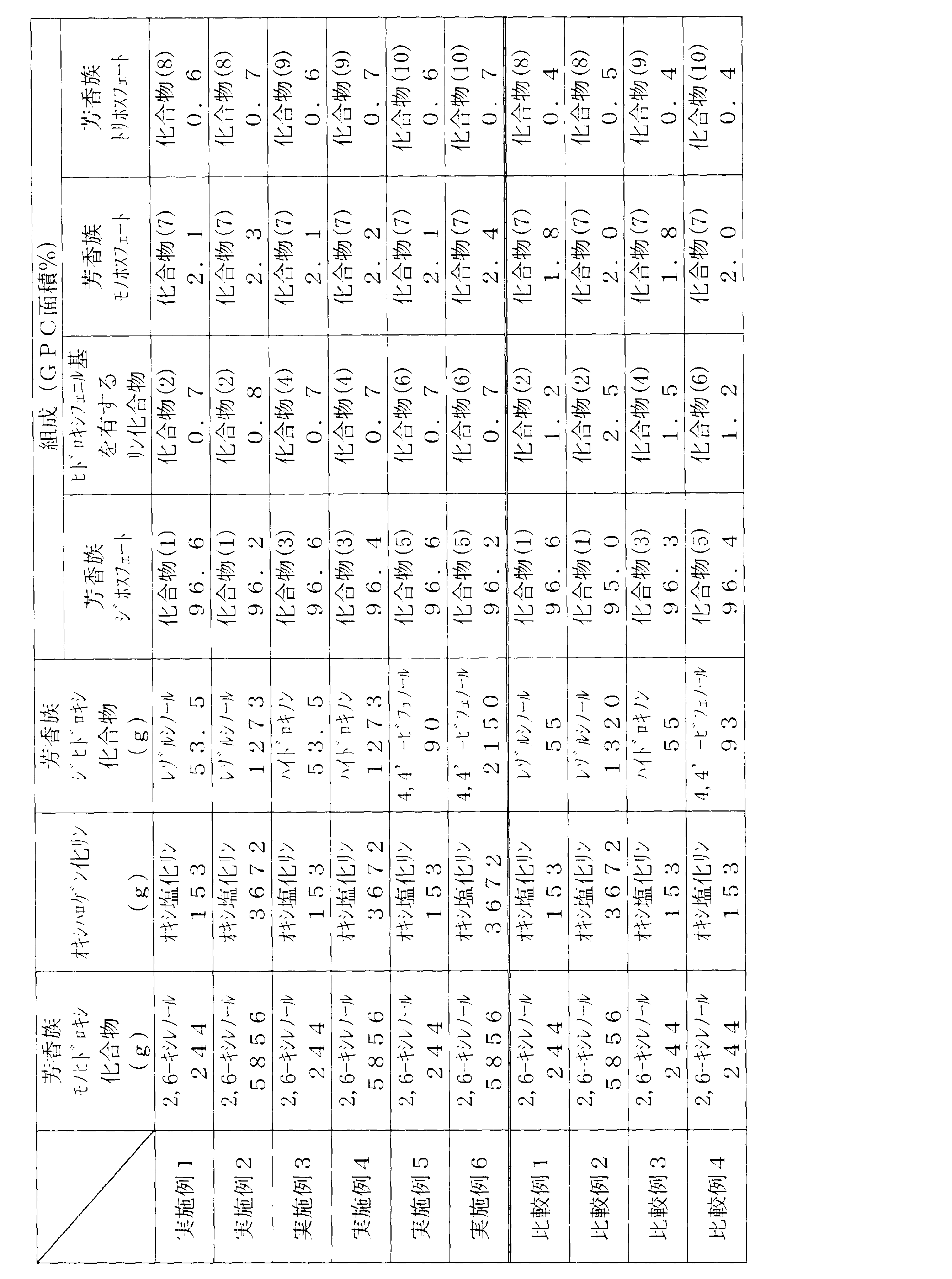
一方、第2工程における芳香族ジヒドロキシ化合物(V)の使用量を調整しない場合には、反応スケールを大きくすると、ヒドロキシフェニル基を有するリン化合物(II)の生成量が増加する傾向にあることがわかる(例えば、比較例1と2との対比)。
(実施例7~15)
樹脂として、変性PPE樹脂(日本ジーイープラスチックス社製、商品名:ノリル731)、PC/ABSアロイ樹脂(ダイセルポリマー株式会社製、商品名:ノバロイS-1500)およびABS樹脂(ダイセルポリマー株式会社製、商品名:セビアンV-500)、添加剤にドリップ防止剤としてフッ素樹脂(三井デュポンフロロケミカル株式会社製、商品名:テフロン(登録商標)6-J)を用いた。
表2~4に示す配合をミキサーで混合後、250~300℃に保持した押出機を通してコンパウンディングペレットを得た。得られたペレットを射出成形機にいれ、250~300℃で成形し、試験片を得た。
また、下記の耐久性試験として、恒温恒湿器または耐候光試験機で処理した後の試験片について、アイゾット衝撃強度およびメルトフローレートを測定した。
得られた結果を樹脂組成物の配合と共に表2~4に示す。
試験方法:UL-94に準拠(5検体の平均消炎時間)
試験片:厚さ1.6mm
評価:規定によるランク V-0、V-1およびV-2
(2)アイゾット衝撃強度
試験方法:ASTM D-256に準拠
試験片:厚さ3.2mm
単位:J/m
試験方法:JIS K7210、操作Aに準拠
温度:変性PPE樹脂275℃、PC/ABSアロイ樹脂230℃、ABS樹脂 200℃
荷重:変性PPE樹脂2.16kg、PC/ABSアロイ樹脂5kg、ABS樹脂5kg
単位:g/10分(min)
熱と荷重により、樹脂や難燃剤の分子結合が切れて分子量が低下すると、樹脂組成物の流動性が大きくなるので、これを測定することにより、樹脂組成物の安定性の目安とすることができる。
試験方法:ASTM D-648に準拠
試験片:厚さ6.4mm
荷重:曲げ応力1.8MPa
単位:℃
(5)曲げ強さ
試験方法:ASTM D-790に準拠
試験片:厚さ6.4mm
単位:MPa
(6)恒温恒湿器
試験機:タバイエスペック株式会社製、商品名:プラチナスレインボーPR-1G
試験槽温度:80℃
試験槽湿度:80%RH
6時間および24時間処理した試験片について、それぞれアイゾット衝撃強度およびメルトフローレートを測定した。表2~4中、それぞれレインボー6HR処理後およびレインボー24HR処理後と記載し、初期値に対する割合を維持率(%)として付記する。
試験機:スガ試験機株式会社製、商品名:デューパネルウェザーメーターDPWL-5
試験槽温度:60℃
照射波長:ピーク波長313nm(紫外線蛍光ランプ)
照射強度:2.0mW/cm2
100時間処理した試験片について、アイゾット衝撃強度を測定した。表2~4中、デューパネル100HR処理後と記載し、初期値に対する割合を維持率(%)として付記する。
表2~4に示した配合を用いて、実施例7~15と同様にして試験片を得、物性を測定した。
得られた結果を表2~4に示す。


一方、耐久性試験後のアイゾット衝撃強度およびメルトフローレートについては、両者の差は非常に大きく、その差は歴然としており、前者が耐久性試験前の物性の低下を抑制し、優れていることがわかる。
すなわち、本発明の芳香族ジホスフェート(I)を含有する難燃性樹脂組成物の成形体は、アイゾット衝撃強度およびメルトフローレートに優れ、特に温度および湿度への耐久性に優れることがわかる。
Claims (11)
- 第1工程:下記一般式(III)

で表されるオルト位に立体障害基を有する芳香族モノヒドロキシ化合物とオキシハロゲン化リンとをルイス酸触媒の存在下に反応させて、次いで減圧下で未反応のオキシハロゲン化リンを除去して、下記一般式(IV)

で表されるジアリールホスホロハリデートを得る工程、
第2工程:前記工程で得られた反応生成物と、該反応生成物に含まれるハロゲン1モルに対して0.5モルの下記一般式(V)

で表される芳香族ジヒドロキシ化合物とをルイス酸触媒の存在下に反応させて、下記一般式(I)

で表される芳香族ジホスフェートを得る工程
を含む芳香族ジホスフェートの製造方法。 - 前記芳香族ジホスフェートが、副生成物として、ゲル透過クロマトグラフィー(GPC)測定で1面積%以下の下記一般式(II)

で表されるヒドロキシフェニル基を有するリン化合物を含む請求項1に記載の芳香族ジホスフェートの製造方法。 - 前記芳香族ジホスフェートが、GPC測定で95面積%以上である請求項1に記載の芳香族ジホスフェートの製造方法。
- 前記一般式(II)のヒドロキシフェニル基を有するリン化合物が、GPC測定で0.01~0.9面積%の範囲である請求項1に記載の芳香族ジホスフェートの製造方法。
- 前記一般式(III)の芳香族モノヒドロキシ化合物が2,6-キシレノールであり、前記一般式(V)の芳香族ジヒドロキシ化合物がハイドロキノン、レゾルシノールまたは4,4’-ビフェノールである請求項1に記載の芳香族ジホスフェートの製造方法。
- 前記一般式(I)の芳香族ジホスフェートと前記一般式(II)のヒドロキシフェニル基を有するリン化合物が、テトラキス(2,6-ジメチルフェニル)-m-フェニレン-ビスホスフェートとビス(2,6-ジメチルフェニル)-3-ヒドロキシフェニルホスフェート;テトラキス(2,6-ジメチルフェニル)-p-フェニレン-ビスホスフェートとビス(2,6-ジメチルフェニル)-4-ヒドロキシフェニルホスフェート;またはテトラキス(2,6-ジメチルフェニル)-4,4'-ジフェニレンビスホスフェートとビス(2,6-ジメチルフェニル)4'-ヒドロキシフェニル-4-フェニルホスフェートの組み合わせである請求項1に記載の芳香族ジホスフェートの製造方法。
- 前記一般式(I)の芳香族ジホスフェートと前記一般式(II)のヒドロキシフェニル基を有するリン化合物が、テトラキス(2,6-ジメチルフェニル)-m-フェニレン-ビスホスフェートとビス(2,6-ジメチルフェニル)-3-ヒドロキシフェニルホスフェート;またはテトラキス(2,6-ジメチルフェニル)-4,4'-ジフェニレンビスホスフェートとビス(2,6-ジメチルフェニル)4'-ヒドロキシフェニル-4-フェニルホスフェートの組み合わせである請求項6に記載の芳香族ジホスフェートの製造方法。
- 前記第1工程において、触媒がオキシハロゲン化リンに対して0.1~3.0重量%の塩化マグネシウムであり、オキシハロゲン化リンが一般式(III)の芳香族モノヒドロキシ化合物1モルに対して0.5モルであり、反応が減圧下、50~250℃で行われる請求項1に記載の芳香族ジホスフェートの製造方法。
- 前記第2工程において、触媒が第1工程で使用されたオキシハロゲン化リンに対して0.1~5.0重量%の塩化アルミニウムであり、反応が減圧下、50~250℃で行われる請求項1に記載の芳香族ジホスフェートの製造方法。
- 前記第1工程で得られた反応混合物を、第2工程の前に、30kPa以下の減圧により未反応のオキシハロゲン化リンを除去する工程をさらに含む請求項1に記載の芳香族ジホスフェートの製造方法。
- 前記第2工程で得られた一般式(I)の芳香族ジホスフェートが油状物であるとき、前記芳香族ジホスフェートの融点より5~100℃低い温度で、前記油状物に応力付加を行って粉末化する工程をさらに含む請求項1に記載の芳香族ジホスフェートの製造方法。
Priority Applications (5)
| Application Number | Priority Date | Filing Date | Title |
|---|---|---|---|
| EP11803445.3A EP2592087A4 (en) | 2010-07-06 | 2011-06-21 | PROCESS FOR PRODUCING AROMATIC DIPHOSPHATES |
| CN2011800335067A CN102985430A (zh) | 2010-07-06 | 2011-06-21 | 芳香族二磷酸酯的制造方法 |
| KR1020137000544A KR101813478B1 (ko) | 2010-07-06 | 2011-06-21 | 방향족 디포스페이트의 제조방법 |
| US13/703,185 US8822715B2 (en) | 2010-07-06 | 2011-06-21 | Method for producing aromatic diphosphates |
| JP2012523810A JP5816175B2 (ja) | 2010-07-06 | 2011-06-21 | 芳香族ジホスフェートの製造方法 |
Applications Claiming Priority (2)
| Application Number | Priority Date | Filing Date | Title |
|---|---|---|---|
| JP2010-153871 | 2010-07-06 | ||
| JP2010153871 | 2010-07-06 |
Publications (1)
| Publication Number | Publication Date |
|---|---|
| WO2012005109A1 true WO2012005109A1 (ja) | 2012-01-12 |
Family
ID=45441095
Family Applications (1)
| Application Number | Title | Priority Date | Filing Date |
|---|---|---|---|
| PCT/JP2011/064147 Ceased WO2012005109A1 (ja) | 2010-07-06 | 2011-06-21 | 芳香族ジホスフェートの製造方法 |
Country Status (7)
| Country | Link |
|---|---|
| US (1) | US8822715B2 (ja) |
| EP (1) | EP2592087A4 (ja) |
| JP (1) | JP5816175B2 (ja) |
| KR (1) | KR101813478B1 (ja) |
| CN (1) | CN102985430A (ja) |
| TW (1) | TWI511975B (ja) |
| WO (1) | WO2012005109A1 (ja) |
Cited By (1)
| Publication number | Priority date | Publication date | Assignee | Title |
|---|---|---|---|---|
| WO2014171358A1 (ja) | 2013-04-15 | 2014-10-23 | 大八化学工業株式会社 | 難燃剤組成物ならびにそれを含有する難燃性樹脂組成物および成形体 |
Families Citing this family (5)
| Publication number | Priority date | Publication date | Assignee | Title |
|---|---|---|---|---|
| EP3753998B1 (en) * | 2018-02-16 | 2023-01-18 | Daihachi Chemical Industry Co., Ltd. | Flame retardant containing aromatic phosphoric acid ester, and thermoplastic resin composition containing same |
| CN110845905B (zh) * | 2019-12-23 | 2022-08-05 | 嘉纳尔科技(北京)有限公司 | 一种脱漆剂及其生产方法 |
| CN114057788A (zh) * | 2021-12-08 | 2022-02-18 | 浙江万盛股份有限公司 | 一种高纯度4,4’-联苯二酚双(二(2,6-二甲基苯基)磷酸酯)的制备方法 |
| CN115490722A (zh) * | 2022-08-02 | 2022-12-20 | 南通江山农药化工股份有限公司 | 一种间苯二酚双(二-2,6-二甲基苯基磷酸酯)的后处理提纯方法 |
| CN116196868B (zh) * | 2022-12-30 | 2025-07-11 | 浙江万盛股份有限公司 | 一种连续化生产装置、二芳基氯代磷酸酯的连续化制备方法 |
Citations (5)
| Publication number | Priority date | Publication date | Assignee | Title |
|---|---|---|---|---|
| JPH051079A (ja) | 1991-04-16 | 1993-01-08 | Daihachi Chem Ind Co Ltd | 芳香族ジホスフエートの製造方法と用途 |
| JPH0987290A (ja) | 1995-09-22 | 1997-03-31 | Daihachi Chem Ind Co Ltd | 芳香族ホスフェート類の粉末化方法 |
| JP2001151787A (ja) * | 1999-11-26 | 2001-06-05 | Asahi Denka Kogyo Kk | リン酸エステル化合物の製造方法 |
| WO2002100868A1 (en) * | 2001-06-08 | 2002-12-19 | Daihachi Chemical Industry Co., Ltd. | Process for preparation of phosphoric esters |
| JP2003160712A (ja) | 2001-11-27 | 2003-06-06 | Daihachi Chemical Industry Co Ltd | 難燃性エポキシ樹脂組成物 |
Family Cites Families (2)
| Publication number | Priority date | Publication date | Assignee | Title |
|---|---|---|---|---|
| US5728859A (en) * | 1996-10-31 | 1998-03-17 | Akzo Nobel N.V. | Process for making monohydroxy-terminated phosphate compositions |
| JP3793867B2 (ja) * | 1999-02-16 | 2006-07-05 | 大八化学工業株式会社 | ホスホロハリデートの製造方法 |
-
2011
- 2011-06-21 WO PCT/JP2011/064147 patent/WO2012005109A1/ja not_active Ceased
- 2011-06-21 CN CN2011800335067A patent/CN102985430A/zh active Pending
- 2011-06-21 US US13/703,185 patent/US8822715B2/en active Active
- 2011-06-21 KR KR1020137000544A patent/KR101813478B1/ko active Active
- 2011-06-21 EP EP11803445.3A patent/EP2592087A4/en not_active Withdrawn
- 2011-06-21 JP JP2012523810A patent/JP5816175B2/ja active Active
- 2011-06-27 TW TW100122411A patent/TWI511975B/zh active
Patent Citations (5)
| Publication number | Priority date | Publication date | Assignee | Title |
|---|---|---|---|---|
| JPH051079A (ja) | 1991-04-16 | 1993-01-08 | Daihachi Chem Ind Co Ltd | 芳香族ジホスフエートの製造方法と用途 |
| JPH0987290A (ja) | 1995-09-22 | 1997-03-31 | Daihachi Chem Ind Co Ltd | 芳香族ホスフェート類の粉末化方法 |
| JP2001151787A (ja) * | 1999-11-26 | 2001-06-05 | Asahi Denka Kogyo Kk | リン酸エステル化合物の製造方法 |
| WO2002100868A1 (en) * | 2001-06-08 | 2002-12-19 | Daihachi Chemical Industry Co., Ltd. | Process for preparation of phosphoric esters |
| JP2003160712A (ja) | 2001-11-27 | 2003-06-06 | Daihachi Chemical Industry Co Ltd | 難燃性エポキシ樹脂組成物 |
Non-Patent Citations (1)
| Title |
|---|
| See also references of EP2592087A4 * |
Cited By (2)
| Publication number | Priority date | Publication date | Assignee | Title |
|---|---|---|---|---|
| WO2014171358A1 (ja) | 2013-04-15 | 2014-10-23 | 大八化学工業株式会社 | 難燃剤組成物ならびにそれを含有する難燃性樹脂組成物および成形体 |
| KR20150143520A (ko) | 2013-04-15 | 2015-12-23 | 다이하치 카가쿠 고교 가부시키가이샤 | 난연제 조성물 및 그것을 함유하는 난연성 수지 조성물 및 성형체 |
Also Published As
| Publication number | Publication date |
|---|---|
| US8822715B2 (en) | 2014-09-02 |
| JPWO2012005109A1 (ja) | 2013-09-02 |
| EP2592087A1 (en) | 2013-05-15 |
| TW201219410A (en) | 2012-05-16 |
| EP2592087A4 (en) | 2015-10-21 |
| KR20140003369A (ko) | 2014-01-09 |
| US20130090490A1 (en) | 2013-04-11 |
| JP5816175B2 (ja) | 2015-11-18 |
| CN102985430A (zh) | 2013-03-20 |
| TWI511975B (zh) | 2015-12-11 |
| KR101813478B1 (ko) | 2017-12-29 |
Similar Documents
| Publication | Publication Date | Title |
|---|---|---|
| JP5700789B2 (ja) | リン系難燃剤組成物およびそれを含有する難燃性樹脂組成物、成形体 | |
| JP2552780B2 (ja) | 芳香族ジホスフェートの製造方法と用途 | |
| JP5816175B2 (ja) | 芳香族ジホスフェートの製造方法 | |
| US20080221241A1 (en) | Flame Retardant Polycarbonate Compositions | |
| EP1403272B1 (en) | Process for preparation of phosphoric esters | |
| US11898082B1 (en) | Fire resistant phosphate cyanate esters | |
| US20160039996A1 (en) | Flame-retardant agent composition and flame-retardant resin composition containing same, and molded article | |
| JP2003261711A (ja) | 樹脂用難燃剤、それを配合した難燃性樹脂組成物および難燃性樹脂成形品 | |
| JP2003020399A (ja) | 難燃性ポリフェニレンエーテル系樹脂組成物 | |
| US20080281024A1 (en) | Flame Retardant Bromobenzyl Systems | |
| JP2825466B2 (ja) | 芳香族ジホスフェート含有難燃性熱安定性樹脂組成物 | |
| JP2003206350A (ja) | 含リンポリカーボネート、その製造方法及び樹脂組成物 | |
| WO2002090439A1 (en) | Flame-retardant resin composition |
Legal Events
| Date | Code | Title | Description |
|---|---|---|---|
| WWE | Wipo information: entry into national phase |
Ref document number: 201180033506.7 Country of ref document: CN |
|
| 121 | Ep: the epo has been informed by wipo that ep was designated in this application |
Ref document number: 11803445 Country of ref document: EP Kind code of ref document: A1 |
|
| WWE | Wipo information: entry into national phase |
Ref document number: 2012523810 Country of ref document: JP |
|
| WWE | Wipo information: entry into national phase |
Ref document number: 13703185 Country of ref document: US |
|
| NENP | Non-entry into the national phase |
Ref country code: DE |
|
| ENP | Entry into the national phase |
Ref document number: 20137000544 Country of ref document: KR Kind code of ref document: A |
|
| REEP | Request for entry into the european phase |
Ref document number: 2011803445 Country of ref document: EP |
|
| WWE | Wipo information: entry into national phase |
Ref document number: 2011803445 Country of ref document: EP |