WO2012011356A1 - 高熱伝導性ポリカーボネート系樹脂組成物及び成形体 - Google Patents
高熱伝導性ポリカーボネート系樹脂組成物及び成形体 Download PDFInfo
- Publication number
- WO2012011356A1 WO2012011356A1 PCT/JP2011/064362 JP2011064362W WO2012011356A1 WO 2012011356 A1 WO2012011356 A1 WO 2012011356A1 JP 2011064362 W JP2011064362 W JP 2011064362W WO 2012011356 A1 WO2012011356 A1 WO 2012011356A1
- Authority
- WO
- WIPO (PCT)
- Prior art keywords
- mass
- parts
- polycarbonate resin
- resin composition
- resin
- Prior art date
- Legal status (The legal status is an assumption and is not a legal conclusion. Google has not performed a legal analysis and makes no representation as to the accuracy of the status listed.)
- Ceased
Links
Classifications
-
- C—CHEMISTRY; METALLURGY
- C08—ORGANIC MACROMOLECULAR COMPOUNDS; THEIR PREPARATION OR CHEMICAL WORKING-UP; COMPOSITIONS BASED THEREON
- C08L—COMPOSITIONS OF MACROMOLECULAR COMPOUNDS
- C08L69/00—Compositions of polycarbonates; Compositions of derivatives of polycarbonates
-
- C—CHEMISTRY; METALLURGY
- C08—ORGANIC MACROMOLECULAR COMPOUNDS; THEIR PREPARATION OR CHEMICAL WORKING-UP; COMPOSITIONS BASED THEREON
- C08K—Use of inorganic or non-macromolecular organic substances as compounding ingredients
- C08K2201/00—Specific properties of additives
- C08K2201/016—Additives defined by their aspect ratio
-
- C—CHEMISTRY; METALLURGY
- C08—ORGANIC MACROMOLECULAR COMPOUNDS; THEIR PREPARATION OR CHEMICAL WORKING-UP; COMPOSITIONS BASED THEREON
- C08K—Use of inorganic or non-macromolecular organic substances as compounding ingredients
- C08K5/00—Use of organic ingredients
- C08K5/49—Phosphorus-containing compounds
- C08K5/51—Phosphorus bound to oxygen
- C08K5/52—Phosphorus bound to oxygen only
- C08K5/521—Esters of phosphoric acids, e.g. of H3PO4
- C08K5/523—Esters of phosphoric acids, e.g. of H3PO4 with hydroxyaryl compounds
-
- C—CHEMISTRY; METALLURGY
- C08—ORGANIC MACROMOLECULAR COMPOUNDS; THEIR PREPARATION OR CHEMICAL WORKING-UP; COMPOSITIONS BASED THEREON
- C08K—Use of inorganic or non-macromolecular organic substances as compounding ingredients
- C08K7/00—Use of ingredients characterised by shape
- C08K7/02—Fibres or whiskers
-
- C—CHEMISTRY; METALLURGY
- C08—ORGANIC MACROMOLECULAR COMPOUNDS; THEIR PREPARATION OR CHEMICAL WORKING-UP; COMPOSITIONS BASED THEREON
- C08K—Use of inorganic or non-macromolecular organic substances as compounding ingredients
- C08K7/00—Use of ingredients characterised by shape
- C08K7/16—Solid spheres
- C08K7/18—Solid spheres inorganic
- C08K7/20—Glass
-
- C—CHEMISTRY; METALLURGY
- C08—ORGANIC MACROMOLECULAR COMPOUNDS; THEIR PREPARATION OR CHEMICAL WORKING-UP; COMPOSITIONS BASED THEREON
- C08L—COMPOSITIONS OF MACROMOLECULAR COMPOUNDS
- C08L25/00—Compositions of, homopolymers or copolymers of compounds having one or more unsaturated aliphatic radicals, each having only one carbon-to-carbon double bond, and at least one being terminated by an aromatic carbocyclic ring; Compositions of derivatives of such polymers
- C08L25/02—Homopolymers or copolymers of hydrocarbons
- C08L25/04—Homopolymers or copolymers of styrene
-
- C—CHEMISTRY; METALLURGY
- C08—ORGANIC MACROMOLECULAR COMPOUNDS; THEIR PREPARATION OR CHEMICAL WORKING-UP; COMPOSITIONS BASED THEREON
- C08L—COMPOSITIONS OF MACROMOLECULAR COMPOUNDS
- C08L67/00—Compositions of polyesters obtained by reactions forming a carboxylic ester link in the main chain; Compositions of derivatives of such polymers
- C08L67/02—Polyesters derived from dicarboxylic acids and dihydroxy compounds
Definitions
- the present invention relates to a highly heat-conductive polycarbonate resin composition and a molded product thereof. Specifically, by including specific carbon fibers and glass beads, the polycarbonate resin composition showing remarkably excellent heat conductivity, or further including glass flakes, while maintaining excellent heat conductivity and insulation.
- the present invention relates to a polycarbonate resin composition having excellent properties, and a highly heat conductive polycarbonate resin molded product formed by molding this highly heat conductive polycarbonate resin composition.
- OA equipment and electronic devices have become smaller and lighter and more accurate, and the Internet has spread rapidly and the IT revolution has progressed rapidly.
- mobile phones are carried around these OA devices and electronic devices.
- the spread of terminals (mobile) is remarkable.
- Typical examples of the portable terminal include a notebook personal computer, an electronic notebook, a mobile phone, and a PDA, and it is expected that diversification, multifunction, and performance will be further increased in the future.
- thermoplastic resins are frequently used in casings such as electrical / electronic / OA equipment parts, machine parts, and vehicle parts other than portable terminals.
- the resin material for the housing includes materials with high strength, high rigidity, high impact resistance, high heat resistance, and high fluidity.
- flame resistance there has been an increasing demand for flame resistance in response to the fire of a laptop computer due to battery failure.
- Patent Document 1 discloses (A) graphitized carbon fiber (A) with respect to 100 parts by weight of a polycarbonate-based resin, and has a thermal conductivity in the length direction of 100 W / m ⁇ K or more, and 5 to less than 40 parts by weight of carbon fiber having an average fiber diameter of 5 to 20 ⁇ m, and (C) a heat conductive powder having a thermal conductivity of 10 W / m ⁇ K or more and an average particle diameter of 1 to 500 ⁇ m (excluding boron nitride) )
- a thermally conductive polycarbonate resin composition containing 5 to 100 parts by weight or less is described.
- the thermal conductivity provision effect by graphitized carbon fiber is blended by blending highly heat conductive graphitized carbon fiber and heat conductive powder. It can be further increased to obtain a good heat conductive polycarbonate resin composition, but further improvements are desired in its formulation and composition design.
- the present invention has been made in view of the above-described conventional situation, and provides a highly thermally conductive polycarbonate resin composition and a molded product thereof in which thermal conductivity, further insulation, and flame retardancy are further improved. For the purpose.
- the inventors of the present invention incorporated glass beads having a predetermined size and shape in place of the heat conductive powder compounded in Patent Document 1, and thereby the glass beads themselves.
- it is not a thermally conductive material
- the effect of imparting thermal conductivity by graphitized carbon fiber blending can be further enhanced, and by adding glass flakes of a specific size and shape, glass flakes
- it itself is not a heat conductive material
- the effect of imparting thermal conductivity by graphitized carbon fiber blending can be further enhanced and the insulation can be improved.
- certain phosphorus flame retardants, silicone-based flame retardants It has been found that by using a flame retardant or a metal salt flame retardant, it is possible to increase the flame conductivity and the thermal conductivity.
- the present invention has been achieved on the basis of such knowledge, and the gist thereof is as follows.
- A Carbon fiber formed by graphitization with respect to 100 parts by mass of a resin component mainly composed of a polycarbonate resin, and having a thermal conductivity in the length direction of 100 W / m ⁇ K or more, And 5 to 100 parts by mass of carbon fiber having an average fiber diameter of 5 to 20 ⁇ m, and (C) 5 to 200 parts by mass of glass beads having an average particle diameter of 1 to 100 ⁇ m and sphericity of 1 to 2.
- a highly heat-conductive polycarbonate resin composition characterized by comprising:
- (A) 100 parts by mass of the resin component includes (D) 5 to 200 parts by mass of glass flakes having an average particle diameter of 10 to 4000 ⁇ m and an aspect ratio of 2 to 200.
- a highly heat-conductive polycarbonate resin composition includes (D) 5 to 200 parts by mass of glass flakes having an average particle diameter of 10 to 4000 ⁇ m and an aspect ratio of 2 to 200.
- (B) graphitized carbon fiber is contained in an amount of 15 parts by mass to 35 parts by mass with respect to 100 parts by mass of (A) resin component.
- High thermal conductive polycarbonate resin composition is provided.
- the amount of (B) graphitized carbon fiber ((B) / (C) (mass ratio)) with respect to (C) glass beads is 0.1 or more.
- a highly heat-conductive polycarbonate resin composition characterized by being less than 1.
- the amount of (D) glass flakes relative to the glass beads ((D) / (C) (mass ratio)) is 0.1 or more and less than 1.
- a highly heat-conductive polycarbonate resin composition characterized by the above.
- (E) 100 parts by mass of the resin component includes (E) a phosphorus flame retardant in an amount of 5 parts by mass to 30 parts by mass.
- Polycarbonate resin composition includes (E) a phosphorus flame retardant in an amount of 5 parts by mass to 30 parts by mass.
- a silicone flame retardant is contained in an amount of 0.1 to 10 parts by mass with respect to 100 parts by mass of the resin component.
- High thermal conductive polycarbonate resin composition is contained in any one of [1] to [7].
- a metal salt flame retardant is contained in an amount of 0.02 parts by mass to 0.3 parts by mass with respect to 100 parts by mass of the resin component.
- a highly heat-conductive polycarbonate resin composition is contained in any one of [1] to [7].
- (H) fluoric resin is contained in an amount of 0.01 parts by mass to 1 part by mass with respect to 100 parts by mass of the resin component (A).
- Conductive polycarbonate resin composition is contained in any one of [1] to [11].
- high heat is characterized by containing (I) a release agent in an amount of 0.001 parts by mass to 2 parts by mass with respect to 100 parts by mass of the resin component (A).
- Conductive polycarbonate resin composition is characterized by containing (I) a release agent in an amount of 0.001 parts by mass to 2 parts by mass with respect to 100 parts by mass of the resin component (A).
- the highly heat-conductive polycarbonate resin composition of the present invention contains extremely high thermal conductivity by containing spherical glass beads having a specific average particle size together with high thermal conductivity graphitized carbon fibers having a specific average fiber size. It will be shown.
- the graphitized carbon fiber used in the present invention is a component that imparts high thermal conductivity to the composition.
- the graphitized carbon fiber is graphitized by the exclusion action by the glass beads.
- the carbon fibers are localized in the composition, a good thermal conductivity network of graphitized carbon fibers is formed, and as a result, excellent thermal conductivity is obtained.
- glass beads with high sphericity do not increase the viscosity of the composition by blending, the surface area is small, the surface is curved and has no corners, and the glass itself is not so hard. It is difficult to damage the graphitized carbon fiber during kneading of the composition.
- particles such as alumina and magnesia themselves have thermal conductivity, and the thermal conductivity can be increased by blending.
- these particles are high in hardness, they collide with the particles.
- the carbon fiber breaks and it becomes difficult to form a network of the carbon fiber, and further, there is a possibility that the manufacturing equipment (screw or mold) is deteriorated early due to wear with the high hardness particles. If glass beads are used, such a problem is solved.
- the highly heat-conductive polycarbonate resin composition of the present invention further comprises (D) glass flakes having an average particle diameter of 10 to 4000 ⁇ m and an aspect ratio of 2 to 200, and 5 parts by mass or more to 200 parts by mass with respect to 100 parts by mass of (A) resin component. It may contain up to parts by mass, and contains high thermal conductivity graphitized carbon fiber having a specific average fiber diameter, and spherical glass beads having a specific average particle diameter and glass flakes having a specific average particle diameter and aspect ratio. As a result, while maintaining high thermal conductivity, it exhibits insulation properties (claim 2).
- the resin component (A) is preferably a polycarbonate resin alone, a polycarbonate resin / thermoplastic polyester resin alloy, or a polycarbonate resin / styrene resin alloy. (Claims 3 and 4).
- the high thermal conductive polycarbonate resin composition of the present invention preferably contains 15 parts by mass or more and 35 parts by mass or less of (B) graphitized carbon fiber with respect to 100 parts by mass of (A) resin component ( Claim 5).
- the amount of (B) graphitized carbon fiber ((B) / (C) (mass ratio)) with respect to (C) glass beads is 0.1 or more. If it is less than 1, it is suitable for the balance between moldability and heat conduction properties, and (C) the amount of (B) graphitized carbon fiber to glass beads ((B) / (C) (mass ratio) )) Is 0.1 or more and less than 1, and (C) the amount of (D) glass flakes relative to glass beads ((D) / (C) (mass ratio)) is 0.1 or more and less than 1. Preferred (claims 6 and 7).
- the highly heat-conductive polycarbonate resin composition of the present invention preferably further contains a flame retardant, and 5 to 30 parts by mass of (E) a phosphorus flame retardant as a flame retardant with respect to 100 parts by mass of (A) resin component.
- the (E) phosphoric flame retardant is preferably a phosphoric ester compound (claims 8 and 9).
- the highly heat-conductive polycarbonate resin composition of the present invention may contain 0.1 to 10 parts by mass of (F) silicone flame retardant as a flame retardant with respect to 100 parts by mass of (A) resin component. Good (claim 10).
- the highly heat-conductive polycarbonate resin composition of the present invention contains 0.02 to 0.3 parts by mass of (G) a metal salt flame retardant as a flame retardant with respect to 100 parts by mass of the (A) resin component. (Claim 11).
- the highly heat-conductive polycarbonate-based resin composition of the present invention preferably further comprises (H) a fluorine-based resin in an amount of 0.01 to 1 part by weight with respect to 100 parts by weight of the (A) resin component. .
- the highly heat-conductive polycarbonate resin composition of the present invention preferably further comprises (I) a release agent in an amount of 0.001 to 2 parts by weight with respect to 100 parts by weight of the resin component (A). .
- the highly heat-conductive polycarbonate resin molded body of the present invention is formed by molding such a highly heat-conductive polycarbonate resin composition of the present invention, and with a shearing force applied to the polycarbonate resin resin composition in the molding step, ( B) Graphitized carbon fibers are oriented in the molding direction (substantially parallel to the resin flow direction) while being rejected by (C) glass beads to form a good network, so that extremely high thermal conductivity is obtained. Furthermore, by blending (D) glass flakes, the glass flakes are oriented so as to enter the gaps between the carbon fibers due to the shear stress generated in the mold during injection molding, and the formation of the conductive path is hindered. Even if it uses the carbon fiber which has, the insulation of a composition can be ensured.
- the highly heat-conductive polycarbonate resin composition of the present invention comprises (A) a resin component mainly composed of a polycarbonate resin, specific (B) graphitized carbon fibers, and (C) glass beads, and (D) glass. And (F) a flame retardant such as a phosphorus flame retardant, (F) a silicone flame retardant, (G) a metal salt flame retardant, and (H) a fluorine-based flame retardant.
- a resin is included, and (I) various additives such as a release agent are further included as necessary.
- the highly heat-conductive polycarbonate resin composition of the present invention containing three components (A) resin component, (B) graphite-based carbon fiber, and (C) glass beads exhibits extremely excellent heat conductivity.
- the reason is that when the resin composition containing the three components is injection-molded, (B) graphitized carbon fiber becomes (C) glass beads by the shearing force applied to the polycarbonate-based resin composition in the molding step. And forming a good network by orientation in the molding direction (substantially parallel to the resin flow direction).
- the highly heat-conductive polycarbonate resin composition of the present invention further contains (D) glass flakes in addition to the three components (A), (B), and (C), (D) glass flakes Further, by containing, it is possible to exhibit the effect of improving the insulating properties while maintaining the thermal conductivity.
- the reason why the insulation is improved is that the glass flakes, which are insulating materials, are placed in the gaps between the carbon fibers due to the shear stress generated in the mold during injection molding.
- the insulating property of the composition can be ensured even when conductive carbon fibers are used.
- the resin component used in the highly heat-conductive polycarbonate resin composition of the present invention is mainly composed of a polycarbonate resin.
- the “main component” refers to a component that occupies 50% by mass or more of the resin component.
- the resin component (A) according to the present invention is not limited to a polycarbonate resin alone (a polycarbonate resin alone is an embodiment containing only one type of polycarbonate resin, for example, a plurality of types of polycarbonates having different monomer compositions and molecular weights). It is also used in the sense of including an embodiment including a resin) or an alloy (mixture) of a polycarbonate resin and another thermoplastic resin.
- the alloy contains other thermoplastic resin in a proportion of 100 parts by mass or less, preferably 70 parts by mass or less, with respect to 100 parts by mass of the polycarbonate resin.
- thermoplastic resins examples include polyamide resins such as polyamide-6 and polyamide-6,6; thermoplastic polyester resins; polystyrene resins, high impact polystyrene resins (HIPS), acrylonitrile-styrene copolymers (AS resins), Heat of styrene resins such as acrylonitrile-butadiene-styrene copolymer (ABS resin), acrylonitrile-styrene-acrylic rubber copolymer (ASA resin), acrylonitrile-ethylenepropylene rubber-styrene copolymer (AES resin), etc.
- One type or two or more types of plastic resins may be mentioned.
- a thermoplastic polyester resin or a styrene resin is preferable.
- thermoplastic polyester resins a polybutylene terephthalate resin or a polyethylene terephthalate resin is more preferable, and a polycarbonate containing the polybutylene terephthalate resin or the polyethylene terephthalate resin in a ratio of 10 to 70 parts by mass with respect to 100 parts by mass of the polycarbonate resin is more preferable.
- a resin-based alloy particularly preferably a polycarbonate resin-based alloy containing 20 to 50 parts by mass of a polybutylene terephthalate resin or a polyethylene terephthalate resin with respect to 100 parts by mass of the polycarbonate resin.
- the ABS resin is preferable, more preferably a polycarbonate resin alloy containing 10 to 70 parts by mass of the ABS resin with respect to 100 parts by mass of the polycarbonate resin, and particularly preferably 100 parts by mass of the polycarbonate resin.
- polycarbonate resin an aromatic polycarbonate resin, an aliphatic polycarbonate resin, or an aromatic-aliphatic polycarbonate resin can be used, and among them, an aromatic polycarbonate resin is preferable. These polycarbonate resins may be used alone or in combination of two or more.
- aromatic polycarbonate resin examples include a thermoplastic aromatic polycarbonate polymer or copolymer obtained by reacting an aromatic dihydroxy compound with phosgene or a diester of carbonic acid.
- a compound in which one or more tetraalkylphosphonium sulfonates are bonded to the above aromatic dihydroxy compound, or a polymer or oligomer having a siloxane structure and containing both terminal phenolic OH groups is used. You can also.
- the aromatic polycarbonate resin used in the present invention is preferably a polycarbonate resin derived from 2,2-bis (4-hydroxyphenyl) propane, or 2,2-bis (4-hydroxyphenyl) propane and other aromatics. And a polycarbonate copolymer derived from an aromatic dihydroxy compound.
- the molecular weight of the polycarbonate resin is a viscosity average molecular weight converted from the solution viscosity measured at a temperature of 25 ° C. using methylene chloride as a solvent, and is usually in the range of 14,000 to 30,000, preferably 15,000 to 28. 16,000, more preferably 16,000 to 26,000. If the viscosity average molecular weight is less than 14,000, the mechanical strength is insufficient, and if it exceeds 30,000, the moldability is likely to be difficult.
- the production method of such an aromatic polycarbonate resin is not limited, and can be produced by a phosgene method (interfacial polymerization method), a melting method (transesterification method), or the like. Furthermore, the aromatic polycarbonate resin which adjusted the amount of OH groups of the terminal group manufactured by the melting method can be used.
- aromatic polycarbonate resin not only virgin raw materials but also aromatic polycarbonate resins regenerated from used products, so-called material recycled aromatic polycarbonate resins can be used.
- Used products include optical recording media such as optical disks, light guide plates, automobile window glass and automobile headlamp lenses, vehicle transparent members such as windshields, containers such as water bottles, glasses lenses, soundproof walls and glass windows, waves A building member such as a plate is preferred.
- recycled aromatic polycarbonate resin non-conforming product, pulverized product obtained from sprue or runner or pellets obtained by melting them can be used.
- thermoplastic polyester resin used in the present invention is a polyethylene terephthalate resin (PET) produced by either a transesterification reaction between dimethyl terephthalate and ethylene glycol or a direct esterification reaction between terephthalic acid and ethylene glycol. But it ’s okay.
- PET polyethylene terephthalate resin
- PBT polybutylene terephthalate resin
- the polybutylene terephthalate resin (PBT) used in the present invention can be produced by either a DMT method by transesterification of dimethyl terephthalate and 1,4-butanediol, or a direct polymerization method of terephthalic acid and 1,4-butanediol. It may be good.
- phthalic acid isophthalic acid, naphthalenedicarboxylic acid, diphenyldicarboxylic acid, adipic acid, sebacic acid, trimellitic acid, and the like together with terephthalic acid or a dialkyl ester thereof during the polycondensation reaction
- Dibasic acids such as dialkyl esters, tribasic acids and the like, and dialkyl esters thereof can be used.
- the amount of these used is preferably in the range of 40 parts by weight or less with respect to 100 parts by weight of terephthalic acid or a dialkyl ester thereof.
- ethylene glycol or 1,4-butanediol together with the ethylene glycol or 1,4-butanediol, other aliphatic glycols such as ethylene glycol, propylene glycol, 1,4-butanediol, hexamethylene glycol, etc.
- other diols such as cyclohexanediol, cyclohexanedimethanol, xylene glycol, 2,2-bis (4-hydroxyphenyl) propane, glycerin, pentaerythritol, and polyhydric alcohols can be used in combination.
- the amount of these diols or polyhydric alcohols used is preferably in the range of 40 parts by weight or less with respect to 100 parts by weight of the aliphatic glycol.
- polyester resin it is possible to use not only virgin raw materials but also PET and PBT regenerated from used products, so-called material recycled PET and PBT.
- Spent products include mainly containers, films, sheets, fibers, etc., but more suitable are containers such as PET bottles.
- recycled PET and PBT non-conforming products, pulverized products obtained from sprues, runners, etc., or pellets obtained by melting them can be used.
- a styrene resin is also mentioned as another preferable thermoplastic resin used in the present invention.
- the styrene resin include acrylonitrile-styrene copolymer, acrylonitrile-styrene-butadiene copolymer, acrylonitrile-ethylenepropylene rubber-styrene copolymer, acrylonitrile-styrene-acrylic rubber copolymer, and the like.
- a bulk polymerization method or an emulsion polymerization method can be exemplified as a polymerization method of these styrene resins, and a resin polymerized by the bulk polymerization method is desirable.
- styrene resin used in the present invention not only virgin raw materials but also styrene resins regenerated from used products, so-called material recycled styrene resins can be used.
- a used product a housing etc. are mainly mentioned.
- regenerated styrene resin non-conforming products, pulverized products obtained from sprues, runners, etc., or pellets obtained by melting them can be used.
- the (B) graphitized carbon fiber used in the present invention is a carbon fiber having a thermal conductivity in the length direction of 100 W / m ⁇ K or more, preferably 400 W / m ⁇ K, and an average fiber diameter of 5 to 20 ⁇ m. is there.
- the (B) graphitized carbon fiber is obtained by converging carbon short fibers (chopped strands) cut to 2 to 20 mm as described in JP-A No. 2000-143826 with a bulk density of 450 to 800 g / l.
- the carbon short fiber converging body which is then graphitized is preferred.
- the carbon short fiber converging body is obtained by converging carbon fibers with a sizing agent, cutting to a predetermined length, and graphitizing to reduce the content of the sizing agent to 0.1% by mass or less. It is.
- Examples of the conditions for the graphitization treatment include a method of heating at 2800 to 3300 ° C. in an inert gas atmosphere.
- continuous fibers (rovings) can be graphitized and then cut into a predetermined length for use.
- the average fiber diameter of the (B) graphitized carbon fiber is less than 5 ⁇ m, problems such as a decrease in thermal conductivity when the resin component is mixed and filled, or a warp of the molded body is likely to occur, and 20 ⁇ m If it exceeds, the dimensional stability will be reduced, and a good appearance will be difficult. Therefore, the average fiber diameter of the (B) graphitized carbon fiber is 5 to 20 ⁇ m, preferably 7 to 15 ⁇ m.
- the fiber length of the (B) graphitized carbon fiber is in the range of 1 to 30 mm, particularly 2 to 20 mm. Is preferred.
- the average fiber diameter and fiber length of (B) graphitized carbon fiber are values before kneading into the resin component, and generally the product catalog value is adopted.
- the blending amount of such (B) graphitized carbon fiber is 5 to 100 parts by mass, preferably 10 to 40 parts by mass, more preferably 15 to 35 parts by mass with respect to 100 parts by mass of (A) resin component.
- the average particle diameter of (C) glass beads is 1 to 100 ⁇ m, preferably 1 to 80 ⁇ m.
- the sphericity of (C) the glass beads exceeds 2
- (B) the graphitized carbon fibers are easily damaged when the composition is kneaded, and the effect of the present invention by using spherical glass beads cannot be obtained.
- the glass beads are preferably closer to the true sphere. Therefore, the sphericity of the (C) glass beads is preferably 1 to 1.7, particularly 1 to 1.5, and more preferably 1 to 1.2.
- the average particle diameter of the glass beads is the maximum particle diameter of 100 samples in SEM (scanning electron microscope) observation (here, the maximum particle diameter is the parallel number of two glass beads). This is an average value of values obtained by measuring the diameter (the length of the interval between the plates) of the portion where the interval between the parallel plates is the largest when sandwiched between the plates.
- the sphericity of glass beads is the minimum particle diameter of 100 samples in SEM (scanning electron microscope) observation (here, the minimum particle diameter is when glass beads are sandwiched between two parallel plates)
- the average value of the values obtained by measuring the diameter of the portion where the interval between the parallel plates is the smallest (the length of the interval between the plates) is the average minimum particle size, and the above average particle size (average It is obtained by calculating a ratio of average particle diameter (average maximum particle diameter) / average minimum particle diameter to (maximum particle diameter).
- Said average particle diameter and sphericity can also be measured using a particle size distribution measuring machine.
- Such (C) glass beads may be surface-treated with a surface treatment agent such as a coupling agent, and the surface treatment improves the adhesion with the (A) resin component, resulting in a highly thermally conductive polycarbonate.
- a surface treatment agent such as a coupling agent
- Examples of coupling agents that can be used for the surface treatment of glass beads include silane, titanate, aluminum, chromium, zirconium, or borane. Among these, silane coupling agents Is preferred.
- silane coupling agents include ⁇ -glycidoxypropyltrimethoxysilane, ⁇ - (3,4-epoxycyclohexyl) ethyltrimethoxysilane, vinyltriethoxysilane, vinyl-tris (2-methoxyethoxy) silane, ⁇ - Methacryloxypropyltrimethoxysilane, ⁇ -aminopropyltrimethoxysilane, N- ⁇ - (aminoethyl) - ⁇ -aminopropyltrimethoxysilane, N- ⁇ - (aminoethyl) - ⁇ -aminopropylmethyldimethoxysilane, ⁇ -Mercaptopropyltrimethoxysilane, ⁇ -chloropropyltrimethoxysilane, etc., among which ⁇ -aminopropyltrimethoxysilane, N- ⁇ - (aminoethyl) - ⁇ -amin
- the method for treating (C) glass beads using these coupling agents is not particularly limited, and conventionally used methods such as dip coating, roller coating, spray coating, flow coating, spray coating, etc. Can be used.
- the content of (C) glass beads is 5 to 200 parts by weight, preferably 10 to 150 parts by weight, more preferably 100 parts by weight of (A) resin component. Is 20 to 100 parts by mass.
- the content of (C) glass beads is less than the above lower limit, the effect of improving thermal conductivity due to the incorporation of (C) glass beads cannot be sufficiently obtained, and when the content exceeds the above upper limit, a composition can be obtained. Therefore, there are cases where the molding process cannot be performed.
- the amount of (B) graphitized carbon fiber ((B) / (C) (mass ratio)) with respect to (C) glass beads in the highly heat-conductive polycarbonate resin composition of the present invention is 0.1 or more. It is preferably less than 1, more preferably from 0.2 to less than 0.9, particularly preferably from 0.3 to less than 0.8.
- (B) / (C) (mass ratio) is less than 0.1, the amount of carbon fibers is insufficient, so that a network of carbon fibers is not formed. The effect cannot be sufficiently obtained, and the effect of improving the thermal conductivity cannot be obtained sufficiently.
- the ratio (B) / (C) (average diameter ratio) of the average fiber diameter of (B) graphitized carbon fiber to the average particle diameter of (C) glass beads is preferably 0.05 to 20.
- (B) / (C) (average diameter ratio) is more preferably 0.1 to 15, particularly preferably 0.2 to 10. If the (B) / (C) (average diameter ratio) is less than 0.05, the glass beads will not have a sufficient effect of exclusion, and if it is 20 or more, the glass beads will interfere with the orientation of the carbon fibers and a network will be formed. Therefore, the effect of improving the thermal conductivity cannot be obtained sufficiently.
- the highly heat-conductive polycarbonate resin composition of the present invention includes the following (A) resin component, (B) graphitized carbon fiber, and (C) glass beads, as long as the object of the present invention is not impaired. Other components may be contained.
- the highly heat-conductive polycarbonate resin composition of the present invention may contain (D) glass flakes having an average particle diameter of 10 to 4000 ⁇ m and an aspect ratio of 2 to 200, and contains a predetermined amount of such glass flakes. Thereby, insulating property can be provided to the resin composition while maintaining high thermal conductivity.
- the (D) glass flake used in the present invention is usually a plate-shaped amorphous glass having a thickness of 3 to 7 ⁇ m and an average particle diameter of 10 to 4000 ⁇ m. Depending on the characteristics of the glass as an inorganic substance and the characteristics obtained from the shape, A unique effect is produced. There are C glass and E glass in the glass used, but since E glass has less content such as Na 2 O or K 2 O than C glass, glass flakes using E glass are preferably used. Is done.
- the average particle size of the glass flakes is 10 to 4000 ⁇ m, more preferably 100 to 2000 ⁇ m, and further preferably 300 to 1000 ⁇ m. If the average particle size is less than 10 ⁇ m, (D) the effect of improving the insulation due to the addition of glass flakes cannot be sufficiently obtained, and if the average particle size is greater than 4000 ⁇ m, (B) graphitization during kneading of the composition It becomes easy to damage carbon fiber, and neither is preferable.
- the aspect ratio (average particle diameter / average thickness) of (D) glass flakes is 2 to 200, preferably 10 to 180, and particularly preferably 50 to 150.
- glass flakes for example, commercially available product REFG-101 of Nippon Electric Glass Co., Ltd. is used, and the average particle diameter is 600 ⁇ m and the aspect ratio is 120. Glass flakes having a larger average particle size than other additives cause an appearance defect when the amount added is increased, so the amount to be blended must be adjusted.
- the content of (D) glass flakes is 5 to 200 parts by weight, preferably 10 to 150 parts by weight, more preferably 100 parts by weight of the resin component (A). Is 20 to 100 parts by mass. If the content of (D) glass flakes is less than the above lower limit, the effect of improving insulation by blending (C) glass flakes cannot be sufficiently obtained, and if the content exceeds the above upper limit, it cannot be made into a composition. In some cases, the molding process cannot be performed.
- the highly heat conductive polycarbonate resin composition of the present invention contains (D) glass flakes together with the above-mentioned (C) glass beads, the total content of (C) glass beads and (D) glass flakes is large. If it is too much, it cannot be formed into a composition and molding processing becomes difficult, so the total content of (C) glass beads and (D) glass flakes is 200 masses per 100 mass parts of (A) resin component. Part or less, for example, 10 to 150 parts by mass is preferred.
- the amount of (D) glass flakes ((D) / (C) (mass ratio)) to (C) glass beads in the high thermal conductive polycarbonate resin composition of the present invention is preferably 0.1 or more and less than 1. More preferably, it is 0.2 or more and 0.8 or less, and particularly preferably 0.2 or more and 0.6 or less. If (D) / (C) (mass ratio) is less than 0.1, the insulation of the composition cannot be secured, and if it is 1 or more, the glass flakes inhibit the formation of the carbon fiber network, and the thermal conductivity. Decreases.
- a flame retardant can be blended with the high thermal conductivity polycarbonate resin composition of the present invention in order to impart flame retardancy.
- flame retardancy In use as a casing of an electric / electronic device or the like, in many cases, flame retardancy is also required. Therefore, it is preferable to add a flame retardant to a highly heat conductive polycarbonate resin composition.
- the flame retardant is not particularly limited as long as it improves the flame retardancy of the composition.
- polycarbonate of halogenated bisphenol A brominated bisphenol epoxy resin, brominated bisphenol phenoxy resin, brominated polystyrene, etc.
- halogenated flame retardants phosphate ester flame retardants, metal salt flame retardants such as organic sulfonic acid metal salt flame retardants, and silicone flame retardants. These may be used alone or in combination of two or more at any ratio.
- (E) a phosphorus-based flame retardant, (F) a silicone-based flame retardant, or (G) a metal salt-based flame retardant is preferable because the flame retardant effect is high and mold corrosion hardly occurs.
- (E) phosphorus-based flame retardants phosphate ester-based compounds are preferable because they have an effect of improving fluidity.
- Two or more of (E) a phosphorus flame retardant, (F) a silicone flame retardant, and (G) a metal salt flame retardant may be used in combination.
- R 1 , R 2 , R 3 and R 4 each independently represents an alkyl group having 1 to 6 carbon atoms or an aryl group having 6 to 20 carbon atoms which may be substituted with an alkyl group; p, q, r and s are each independently 0 or 1, t is an integer of 1 to 5, and X represents an arylene group.
- examples of the aryl group represented by R 1 to R 4 include a phenyl group and a naphthyl group.
- examples of the arylene group for X include a phenylene group and a naphthylene group.
- the compound represented by the general formula (1) is a phosphate ester, and when t is greater than 0, it is a condensed phosphate ester (including a mixture).
- condensed phosphate esters are preferably used.
- phosphate ester flame retardant represented by the general formula (1) examples include trimethyl phosphate, triethyl phosphate, tributyl phosphate, trioctyl phosphate, tributoxyethyl phosphate, triphenyl phosphate.
- triphenyl phosphate bisphenol A tetraphenyl phosphate, resorcinol tetraphenyl phosphate, resorcinol tetra-2,6-xylenol phosphate and the like are preferable.
- These phosphoric ester-based flame retardants improve the flame retardancy of the composition by blending this, reduce the viscosity, and (B) the graphitized carbon fiber is added in the kneading step at the time of preparing the resin composition. By being crushed, it is possible to prevent that the effect of imparting the original thermal conductivity of the (B) graphitized carbon fiber can be prevented, which is preferable.
- the high thermal conductivity polycarbonate resin composition of the present invention is a viscosity reduction by blending a phosphate ester flame retardant, and has an MVR value of 5. as an index of fluidity measured in the section of Examples described later. 0 ⁇ 30.0cm 3 / 10min, it is particularly preferably 5.0 ⁇ 25.0cm 3 / 10min. If this MVR value is too large, the impact resistance may decrease, and if it is too small, the mold may be poorly filled during molding, and the product may not be obtained.
- the amount of the phosphorus-based flame retardant blended may be selected and determined as appropriate. However, if the amount is too small, the flame-retardant effect is insufficient, and conversely if too large, the heat resistance and mechanical properties may be reduced. Therefore, the content of the (E) phosphorus flame retardant in the polycarbonate resin composition is usually 5 to 30 parts by mass, preferably 5 to 20 parts by mass with respect to 100 parts by mass of the (A) resin component.
- the (F) silicone-based flame retardant in the present invention is preferably a silicone powder, and the silicone powder preferably has a polyorganosiloxane polymer (f2) supported on the surface of silica (f1).
- Silica (f1) functions so as to impart remarkable flame retardancy to the polycarbonate resin composition by a synergistic action with (H) fluorine-based resin such as polytetrafluoroethylene described later.
- Silica (f1) includes finely pulverized silica (silica powder) obtained from fume, precipitation or mining form. As the fume and precipitated silica, those having a surface area in the range of 50 to 400 m 2 / g are preferable.
- the silica (f1) is easily supported when the polyorganosiloxane polymer (f2) is supported (absorbed, adsorbed or retained) on the surface according to a preferred embodiment of the present invention described later.
- mined silica it is preferable to combine at least an equal mass of fume or precipitated silica and adjust the surface area of the mixture to be in the range of 50 to 400 m 2 / g.
- Silica (f1) can be treated with a surface treatment agent.
- the surface treating agent include polyorganosiloxane having a low molecular weight hydroxy or alkoxy other than the polyorganosiloxane polymer (f2) described later, hexaorganodisiloxane, hexaorganodisilazane and the like.
- polydimethylsiloxane which is a liquid or viscous oil at room temperature, having a hydroxyl group of an oligomer having an average degree of polymerization of 2 to 100 as a terminal group.
- the polyorganosiloxane polymer (f2) in the present invention functions so as to impart remarkable flame retardancy to the polycarbonate resin composition by a synergistic action with silica (f1).
- the organic group of the polyorganosiloxane polymer (f2) is a hydrocarbon or halogenated hydrocarbon group such as an alkyl having 1 to 20 carbon atoms and a substituted alkyl group, an alkenyl group such as vinyl and 5-hexenyl, cyclohexyl, and the like. Are selected from cycloalkyl groups such as, aromatic hydrocarbon groups such as phenyl, benzyl and tolyl.
- a halogen-substituted alkyl such as a lower alkyl group having 1 to 4 carbon atoms, a phenyl group, or 3,3,3-trifluoropropyl.
- the polyorganosiloxane polymer (f2) may be linear or have a branched group, but linear polydimethylsiloxane having no branched group is more preferable.
- the polyorganosiloxane polymer (f2) may be a polyorganosiloxane polymer (f21) having no functional group in the molecular chain or a polyorganosiloxane polymer (f22) having a functional group in the molecular chain.
- the functional group is preferably a methacryl group or an epoxy group.
- the amount of the functional group in the molecular chain of the polyorganosiloxane polymer (f22) having a functional group is usually about 0.01 to 1 mol%, preferably 0.03 to 0.5 mol%, Among these, 0.05 to 0.3 mol% is preferable.
- the silicone powder may be any of the following (1) to (3).
- the blending ratio of silica (f1) and polyorganosiloxane polymer (f2) in the silicone powder is selected in the range of 10 to 90% by mass of silica (f1) and 90 to 10% by mass of polyorganosiloxane polymer (f2). Is preferred.
- the amount of silica (f1) constituting the silicone powder is less than 10% by mass, it is difficult to support the polyorganosiloxane polymer (f2), and it is difficult to form a smooth powder, and when it exceeds 90% by mass, The amount of the polyorganosiloxane polymer (f2) becomes too small, and the appearance defect of the molded product tends to occur. More preferably, the blending ratio is 20 to 80% by mass of silica (f1) and 80 to 20% by mass of the polyorganosiloxane polymer (f2).
- the high thermal conductivity polycarbonate resin composition of the present invention contains (F) silicone flame retardant as a flame retardant
- the content of (F) silicone flame retardant is 100 parts by mass of resin component (A), It is in the range of 0.1 to 10 parts by mass.
- (F) When the content of the silicone-based flame retardant is less than 0.1 parts by mass with respect to 100 parts by mass of the resin component (A), flame retardancy, mechanical strength, and heat resistance of a molded product obtained from the resin composition When the amount exceeds 10 parts by mass, the impact resistance and fluidity of the resin composition tend to be insufficient.
- the more preferable content of the silicone-based flame retardant is 0.2 to 8 parts by mass, more preferably 0.3 to 5 parts by mass, and particularly preferably 0 to 100 parts by mass of the resin component (A). .3 to 3 parts by mass, particularly preferably 0.5 to 2 parts by mass.
- silica (f1) is preferably in the range of 0.01 to 9 parts by mass with respect to 100 parts by mass of the resin component (A).
- the content of silica (f1) is less than 0.01 parts by mass with respect to 100 parts by mass of the resin component (A)
- the flame retardancy, mechanical strength, and heat resistance of the molded product obtained from the resin composition are poor. If it exceeds 9 parts by mass, the impact resistance and fluidity of the resin composition will be insufficient.
- the more preferable content of silica (f1) is 0.02 to 7.2 parts by weight, more preferably 0.03 to 4.5 parts by weight, and particularly preferably 0.05 to 1 part with respect to 100 parts by weight of the resin component. 8 parts by mass.
- the mass of a silica (f1) means the mass also including a processing agent, when surface-treating with the above-mentioned surface treating agent.
- the content of the polyorganosiloxane polymer (f2) is preferably in the range of 0.01 to 9 parts by mass with respect to 100 parts by mass of the resin component (A).
- the more preferable content of the polyorganosiloxane polymer (f2) is 0.02 to 7.2 parts by weight, more preferably 0.03 to 4.5 parts by weight, and particularly preferably 0 to 100 parts by weight of the resin component. .05 to 1.8 parts by mass.
- (G) Metal salt flame retardant As a metal salt flame retardant, an organic sulfonic acid metal salt is preferable. By blending a (G) metal salt flame retardant such as an organic sulfonic acid metal salt, the formation of a carbonized layer at the time of combustion can be promoted, the flame retardancy can be further enhanced, and the impact resistance of the polycarbonate resin, etc. The properties such as the mechanical properties, heat resistance, and electrical characteristics of can be maintained well.
- the types of metals possessed by organic sulfonic acid metal salts include alkali metals such as lithium (Li), sodium (Na), potassium (K), rubidium (Rb), and cesium (Cs); magnesium (Mg), calcium (Ca ), Alkaline earth metals such as strontium (Sr), barium (Ba); and aluminum (Al), titanium (Ti), iron (Fe), cobalt (Co), nickel (Ni), copper (Cu), Zinc (Zn), zirconium (Zr), molybdenum (Mo), etc. are mentioned. Among these, alkali metals or alkaline earth metals are preferable.
- alkali metals or alkaline earth metals are more preferred, sodium, potassium, cesium or lithium are more preferred, sodium, potassium and cesium are more preferred, and sodium and potassium are particularly preferred.
- Examples of preferred organic sulfonic acid metal salts include organic sulfonic acid lithium (Li) salts, organic sulfonic acid sodium (Na) salts, organic sulfonic acid potassium (K) salts, organic sulfonic acid rubidium (Rb) salts, organic sulfonic acid salts.
- Examples thereof include cesium acid (Cs) salt, organic magnesium sulfonate (Mg) salt, organic calcium sulfonate (Ca) salt, organic strontium strontium (Sr) salt, and organic sulfonic acid barium (Ba) salt.
- organic sulfonic acid alkali metal salts such as organic sulfonic acid sodium (Na) salt, organic sulfonic acid potassium (K) salt, and organic sulfonic acid cesium (Cs) salt are particularly preferable.
- organic sulfonic acid metal salts preferred are fluorine-containing aliphatic sulfonic acid metal salts, fluorine-containing aliphatic sulfonic acid imide metal salts, aromatic sulfonic acid metal salts, and aromatic sulfonamide metal salts. Can be mentioned.
- preferable ones include potassium nonafluorobutanesulfonate, lithium nonafluorobutanesulfonate, sodium nonafluorobutanesulfonate, cesium nonafluorobutanesulfonate, lithium trifluoromethanesulfonate, sodium trifluoromethanesulfonate, Containing at least one C—F bond in the molecule, such as potassium trifluoromethanesulfonate, potassium pentafluoroethanesulfonate, potassium heptafluoropropanesulfonate, potassium decafluoro-4- (pentafluoroethyl) cyclohexanesulfonate; Alkali metal salts of fluoroaliphatic sulfonic acids;
- At least one C—F in the molecule such as magnesium nonafluorobutanesulfonate, calcium nonafluorobutanesulfonate, barium nonafluorobutanesulfonate, magnesium trifluoromethanesulfonate, calcium trifluoromethanesulfonate, barium trifluoromethanesulfonate, etc.
- metal salts of aromatic sulfonamides such as alkali metal salts of aromatic sulfonamides having at least one aromatic group in the molecule, such as salts.
- fluorine-containing aliphatic sulfonic acid metal salts are preferable.
- an alkali metal salt of a fluorine-containing aliphatic sulfonic acid having at least one C—F bond in the molecule is more preferable, and an alkali metal salt of perfluoroalkanesulfonic acid is particularly preferable.
- potassium nonafluorobutanesulfonate is preferred.
- an alkali metal salt of an aromatic sulfonic acid is more preferable, and an alkali of diphenylsulfone-sulfonic acid such as dipotassium diphenylsulfone-3,3′-dipotassium disulfonate or potassium diphenylsulfone-3-sulfonate.
- Metal salts; sodium paratoluenesulfonate, and alkali metal salts of paratoluenesulfonic acid such as potassium paratoluenesulfonate and cesium paratoluenesulfonate are particularly preferable, and alkali metal salts of paratoluenesulfonic acid are more preferable.
- 1 type may be used for a metal salt flame retardant, and 2 or more types may be used together by arbitrary combinations and a ratio.
- the blending amount of (G) metal salt flame retardant may be appropriately selected and determined. Since the heat resistance and mechanical properties may decrease even if the amount is too large, the content of the (G) metal salt flame retardant in the polycarbonate resin composition is usually based on 100 parts by mass of the resin component (A). 0.02 to 0.3 parts by mass, preferably 0.05 to 0.2 parts by mass.
- An anti-dripping agent can be blended with the highly heat-conductive polycarbonate resin composition of the present invention for the purpose of preventing dripping during combustion.
- (H) fluorine-based resin can be preferably used as the anti-dripping agent.
- the (H) fluorine-based resin is a polymer or copolymer containing a fluoroethylene structure, such as a difluoroethylene polymer, a tetrafluoroethylene polymer, a tetrafluoroethylene-hexafluoropropylene copolymer, a tetra Examples thereof include copolymers of fluoroethylene and fluorine-free ethylene monomers, preferably polytetrafluoroethylene (PTFE), preferably having an average molecular weight of 500,000 or more, particularly preferably. 500,000 to 10,000,000.
- PTFE polytetrafluoroethylene
- polytetrafluoroethylene that can be used in the present invention
- all types of polytetrafluoroethylene that are currently known can be used.
- polytetrafluoroethylene having a fibril-forming ability it is even higher. Melting dripping prevention property can be provided.
- PTFE polytetrafluoroethylene
- Teflon registered trademark
- 6-J manufactured by Mitsui DuPont Fluorochemical Co., Ltd.
- Polyflon D-1 Polyflon F-103
- Polyflon F201 produced by Daikin Industries, Ltd.
- CD076 Asahi IC Fluoropolymers Co., Ltd.
- Argoflon F5 manufactured by Montefluos Co., Ltd.
- polyflon MPA polyflon FA-100 (manufactured by Daikin Industries, Ltd.) and the like can be mentioned.
- Polytetrafluoroethylene (PTFE) may be used independently and may combine 2 or more types.
- Polytetrafluoroethylene (PTFE) having the fibril-forming ability as described above is prepared by, for example, using tetrafluoroethylene in an aqueous solvent in the presence of sodium, potassium, ammonium peroxydisulfide, at a pressure of 1 to 100 psi, at a temperature of 0 It can be obtained by polymerizing at ⁇ 200 ° C., preferably 20 ⁇ 100 ° C.
- Teflon (registered trademark) 30-J or 31-JR both manufactured by Mitsui & DuPont Fluorochemical Co., Ltd.) dispersed in a solvent may be used.
- the anti-dripping agent may be a polytetrafluoroethylene-containing mixed powder composed of polytetrafluoroethylene particles and organic polymer particles.
- monomers for producing organic polymer particles include styrene, p-methylstyrene, o-methylstyrene, p-chlorostyrene, o-chlorostyrene, p-methoxystyrene, o-methoxystyrene.
- Styrene monomers such as 2,4-dimethylstyrene and ⁇ -methylstyrene, methyl acrylate, methyl methacrylate, ethyl acrylate, ethyl methacrylate, butyl acrylate, butyl methacrylate, 2-ethylhexyl acrylate (Meth) acrylic acid ester-based monomers such as 2-ethylhexyl methacrylate, dodecyl acrylate, dodecyl methacrylate, tridodecyl acrylate, tridodecyl methacrylate, octadecyl acrylate, octadecyl methacrylate, cyclohexyl acrylate, cyclohexyl methacrylate , Vinyl cyanide monomers such as acrylonitrile and methacrylonitrile, vinyl ether monomers such as vinyl methyl ether and vinyl ethyl ether, vinyl
- the blending amount of the anti-drip agent such as (H) fluorine-based resin is preferably 0.01 to 1 part by weight, more preferably 0.1 to 0.7 part per 100 parts by weight of the resin component (A). Part by mass.
- a mold release agent can be mix
- Examples of the release agent include aliphatic carboxylic acids and alcohol esters thereof, aliphatic hydrocarbon compounds having a number average molecular weight of 200 to 15000, polysiloxane silicone oil, and the like.
- Examples of the aliphatic carboxylic acid include saturated or unsaturated, linear or cyclic, aliphatic monovalent to trivalent carboxylic acids. Among these, monovalent or divalent carboxylic acids having 6 to 36 carbon atoms are preferable, and aliphatic saturated monovalent carboxylic acids having 6 to 36 carbon atoms are particularly preferable. Specific examples of such aliphatic carboxylic acids include palmitic acid, stearic acid, caproic acid, capric acid, lauric acid, arachidic acid, behenic acid, lignoceric acid, serotic acid, mellicic acid, tetrariacontanoic acid, and montan. An acid, adipic acid, azelaic acid, etc. are mentioned.
- the aliphatic carboxylic acid component in the aliphatic carboxylic acid ester has the same meaning as the above-mentioned aliphatic carboxylic acid.
- the alcohol component of the aliphatic carboxylic acid ester includes a saturated or unsaturated, linear or cyclic monovalent or polyhydric alcohol. These may have a substituent such as a fluorine atom or an aryl group.
- the alcohol component of the aliphatic carboxylic acid ester is preferably a monovalent or polyvalent saturated alcohol having 30 or less carbon atoms, and particularly preferably a monovalent or polyhydric alcohol having 30 or less carbon atoms and a saturated aliphatic group.
- alcohol components include octanol, decanol, dodecanol, stearyl alcohol, behenyl alcohol, ethylene glycol, diethylene glycol, glycerin, pentaerythritol, 2,2-dihydroxyperfluoropropanol, neopentylene glycol, ditrimethylolpropane, And dipentaerythritol.
- the aliphatic carboxylic acid ester may contain an aliphatic carboxylic acid and / or alcohol as an impurity, and may be a mixture of a plurality of aliphatic carboxylic acid esters.
- aliphatic carboxylic acid ester examples include beeswax (a mixture based on myricyl palmitate), stearyl stearate, behenyl behenate, stearyl behenate, glycerin monopalmitate, glycerin monostearate, glycerin di Examples thereof include stearate, glycerin tristearate, pentaerythritol monopalmitate, pentaerythritol monostearate, pentaerythritol distearate, pentaerythritol tristearate, pentaerythritol tetrastearate and the like.
- Examples of the aliphatic hydrocarbon having a number average molecular weight of 200 to 15000 include liquid paraffin, paraffin wax, microwax, polyethylene wax, Fischer-Tropsch wax, and ⁇ -olefin oligomer having 3 to 12 carbon atoms.
- the aliphatic hydrocarbon includes alicyclic hydrocarbons.
- these hydrocarbon compounds may be partially oxidized.
- paraffin wax polyethylene wax, or partial oxides of polyethylene wax are preferable, and paraffin wax and polyethylene wax are particularly preferable.
- the number average molecular weight is preferably 200 to 5,000.
- These aliphatic hydrocarbons may be used alone or in combination of two or more at any ratio as long as the main component is within the above range.
- polysiloxane silicone oil examples include dimethyl silicone oil, phenylmethyl silicone oil, diphenyl silicone oil, fluorinated alkyl silicone, etc., and these may be used alone or in any proportion of two or more. You may use together.
- the content of the (I) mold release agent in the high thermal conductive polycarbonate resin composition of the present invention may be selected and determined as appropriate, but if it is too small, the release effect is not sufficiently exhibited, and conversely, it is too much. In some cases, however, the hydrolysis resistance of the resin is lowered, and mold contamination during injection molding occurs. Therefore, the compounding amount of (I) the release agent is 0.001 to 2 parts by mass with respect to 100 parts by mass of the resin component (A), and preferably 0.01 to 1 part by mass.
- thermoplastic resin composition of the present invention an elastomer can be blended as an impact resistance improver in order to improve impact strength.
- the elastomer is not particularly limited, but a multilayer structure polymer is preferable.
- the multilayer structure polymer include those containing an alkyl (meth) acrylate polymer.
- These multi-layered polymers include, for example, polymers produced by continuous multi-stage seed polymerization in which a polymer in a previous stage is sequentially coated with a polymer in a subsequent stage, and a basic polymer.
- As a structure it is a polymer having an outermost core layer made of a polymer compound that improves the adhesion between the inner core layer, which is a crosslinking component having a low glass transition temperature, and the matrix of the composition.
- rubber components include rubber components such as butadiene, rubber components such as styrene / butadiene, rubber components of alkyl (meth) acrylate polymers, polyorganosiloxane polymers and alkyl (meth) acrylate polymers. Or a rubber component in which these are used in combination.
- examples of the component forming the outermost core layer include an aromatic vinyl monomer, a non-aromatic monomer, or a copolymer of two or more thereof.
- aromatic vinyl monomer examples include styrene, vinyl toluene, ⁇ -methyl styrene, monochloro styrene, dichloro styrene, bromo styrene and the like. Of these, styrene is particularly preferably used.
- non-aromatic monomers include alkyl (meth) acrylates such as ethyl (meth) acrylate and butyl (meth) acrylate, vinyl cyanide such as acrylonitrile and methacrylonitrile, and vinylidene cyanide. These may be used alone or in combination of two or more.
- the blending amount of the impact resistance improver is preferably 1 to 10 parts by mass, more preferably 2 to 5 parts by mass with respect to 100 parts by mass of the resin component (A).
- the highly heat-conductive polycarbonate resin composition of the present invention includes, as necessary, additives such as stabilizers such as ultraviolet absorbers and antioxidants, pigments, dyes, lubricants, and the like. You may mix.
- the method for obtaining the highly heat-conductive polycarbonate resin composition of the present invention is not particularly limited, and various kneaders such as a uniaxial or multiaxial kneader, a Banbury mixer, a roll, a Brabender plastogram, etc. After kneading the components with a predetermined composition, cooling and solidifying, adding the above components to a suitable solvent, for example, hydrocarbons such as hexane, heptane, benzene, toluene, xylene and their derivatives, Or the solution mixing method etc. which mix the component to melt
- a suitable solvent for example, hydrocarbons such as hexane, heptane, benzene, toluene, xylene and their derivatives, Or the solution mixing method etc. which mix the component to melt
- melt-kneading method is preferable from the industrial cost, but is not limited thereto.
- melt kneading it is preferable to use a single-screw or twin-screw extruder. More preferably, a twin screw extruder is used.
- the length of (B) graphitized carbon fiber is longer in terms of improvement in thermal conductivity, warpage of the molded article, and the like.
- a method of feeding (B) the graphitized carbon fiber from the middle of the extruder during kneading is preferable.
- the method of feeding a graphitized carbon fiber from the middle of an extruder using a twin-screw extruder is preferable.
- blending with the remaining (A) resin component is also mentioned.
- the method for obtaining a polycarbonate resin molded product using the highly heat conductive polycarbonate resin composition of the present invention is not particularly limited, and a molding method generally used for thermoplastic resin compositions, for example, injection molding. , Hollow molding, extrusion molding, sheet molding, thermoforming, rotational molding, lamination molding, and the like can be applied.
- the high thermal conductivity polycarbonate resin composition of the present invention includes an injection molding method, an extrusion molding method, etc.
- the highly heat-conductive polycarbonate resin molded product of the present invention is formed by molding the above-described high heat-conductive polycarbonate resin composition of the present invention by an injection molding method or the like.
- the highly heat-conductive polycarbonate resin molding of the present invention is widely used for OA (Office Automation) equipment parts, electrical / electronic parts, and precision equipment parts, and is particularly suitable for OA equipment casings and electrical / electronic equipment casings.
- OA Office Automation
- Examples of applicable devices include notebook computers, electronic notebooks, mobile phones, tablet terminals (PDA: Personal Digital Assistant), smartphones, digital cameras, projectors, LED lighting fixtures, and the like.
- Applications that can make the most of the high thermal conductivity that is a feature of the present invention include a case of a notebook personal computer and a heat dissipation member of an LED lighting apparatus.
- composition ingredients In the following Examples and Comparative Examples, those used as the blending component of the polycarbonate resin composition are as follows.
- Polycarbonate resin product name “Iupilon (registered trademark) S-3000N” manufactured by Mitsubishi Engineering Plastics Co., Ltd., viscosity average molecular weight: 21,000
- Thermoplastic polyester resin polybutylene terephthalate resin
- Styrene resin ABS resin
- Graphitized carbon fiber manufactured by Mitsubishi Plastics Co., Ltd.
- Trade name “DIALEAD K223HE” average fiber diameter 11 ⁇ m, fiber length 6 mm, lengthwise thermal conductivity 600 W / m ⁇ K
- Glass flake Nippon Sheet Glass Co., Ltd. trade name “Glass Flake REFG101”, average particle size 600 ⁇ m, aspect ratio 120
- Glass fiber manufactured by Nippon Electric Glass Co., Ltd. Trade name “T-571”, average fiber diameter 13 ⁇ m, fiber length 3 mm
- Phosphorus flame retardant Product name “PX-200” (resorcinol (dixylenyl phosphate)) manufactured by Daihachi Chemical Industry Co., Ltd.
- Silicone-based flame retardant-1 Toray Dow Corning Silicone Co., Ltd., trade name “Trefil F202”, 60% by mass of linear polydimethylsiloxane having a viscosity of 60,000 centistokes supported on 40% by mass of silica Powdered silicone powder Silicone-based flame retardant-2: Toray Dow Corning Silicone Co., Ltd., trade name “DC4-7081”, 60% by mass of polydimethylsiloxane having a methacryl group supported on 40% by mass of silica powder Silicone powder Metal salt flame retardant: Lanxess product name “Biowet C4” (potassium perfluorobutane sulfonate) Fluorine resin: Product name “Teflon (registered trademark) 6-J” (polytetrafluoro
- Fluidity After the pellets of the obtained resin composition were dried at 80 ° C. or 120 ° C. for 4 hours or more, using a capillary rheometer in accordance with JIS K7210, Examples 1 to 18 and Comparative Examples 1 to 9 were 300 ° C. under the conditions of a load 1.20Kgf, examples 19 ⁇ 22, 260 ° C. Comparative examples 10-11, under the conditions of load 2.16 kgf, per unit time for each composition MVR (unit: cm 3 / 10min) was measured to evaluate the fluidity. A die having a diameter of 2.095 mm and a length of 8.0 mm was used. The larger the MVR value, the better the fluidity.
- V-0 Combustion time after flame contact for 10 seconds is 10 seconds or less, total combustion time of 5 tubes is 50 seconds or less, and all specimens do not drop fine flames that ignite absorbent cotton.
- V-1 Combustion time after flame contact for 10 seconds is 30 seconds or less, 5 total combustion times are 250 seconds or less, and all test specimens do not drop fine flames that ignite absorbent cotton.
- V-2 Combustion time after flame contact for 10 seconds is 30 seconds or less, total combustion time of 5 tubes is 250 seconds or less, and absorbent cotton is ignited from fine flames dropped from these test pieces.
- NG When it does not correspond to any of the above burning times and continues to burn.
- the thermal conductivity can be further increased by using the glass beads having high sphericity together with the graphitized carbon fiber. That is, when Comparative Example 1 in which glass beads are not blended is compared with Examples 1 and 2 in which glass beads are blended, Examples 1 and 2 in which glass beads are blended with the same amount of graphitized carbon fiber. Is clearly superior in thermal conductivity. The same applies to the comparison between Comparative Examples 10 and 11 in which glass beads were not blended and Examples 19 and 21 in which glass beads were blended. From the comparison between Comparative Example 2 containing flame retardant and Examples 3 to 7 and the comparison between Comparative Example 3 and Examples 8 and 9, glass beads were also compounded with the same amount of graphitized carbon fiber.
- Examples 10 and 11 were obtained by using a metal salt flame retardant instead of the phosphorus flame retardant, and Example 12 was obtained by using a silicone flame retardant instead of the phosphorus flame retardant.
- the phosphorus flame retardant is more effective in improving the fluidity than the metal salt flame retardant and the silicone flame retardant, which prevents the carbon fiber from breaking during kneading. It can be seen that there is an effect of increasing the thermal conductivity by forming a simple thermal conductive network.
- Examples 13 to 18, 20, and 22 high thermal conductivity is maintained by using graphitized carbon fiber and glass flakes having a specific aspect ratio together with glass beads having high sphericity. However, it can be seen that the insulation can be further improved. Comparing insulation and thermal conductivity, in Examples 1 and 4 that do not contain glass flakes, although the insulation (surface resistivity) is high, the thermal conductivity is lower than in Examples 13 to 18, 20, and 22. In Examples 2, 5, 6, 19, and 21, the thermal conductivity shows the same value as in Examples 13 to 18, 20, and 22, but the insulation (surface resistivity) is in Examples 13 to The results were inferior to those of 18, 20, and 22.
Landscapes
- Chemical & Material Sciences (AREA)
- Health & Medical Sciences (AREA)
- Chemical Kinetics & Catalysis (AREA)
- Medicinal Chemistry (AREA)
- Polymers & Plastics (AREA)
- Organic Chemistry (AREA)
- Compositions Of Macromolecular Compounds (AREA)
Abstract
Description
例えば、特許文献1には、(A)ポリカーボネート系樹脂100重量部に対し、(B)黒鉛化されてなる炭素繊維であって、長さ方向の熱伝導率が100W/m・K以上、かつ繊維平均径5~20μmの炭素繊維5~40重量部未満、及び(C)熱伝導率が10W/m・K以上で平均粒子径が1~500μmの熱伝導性粉体(但し窒化ホウ素を除く)5~100重量部以下含有してなる熱伝導性ポリカーボネート系樹脂組成物が記載されている。
しかも、真球度の高いガラスビーズは、配合により組成物の粘性を高めることがなく、また、表面積が小さく、表面が曲面で角がない上に、ガラス自体、それほど高硬度なものではないため、組成物の混練時に黒鉛化炭素繊維を傷付け難い。このため、混練時に黒鉛化炭素繊維が折れて繊維長が短くなることが防止される点においても、黒鉛化炭素繊維のネットワークを形成し易く、熱伝導性が高められる要因となる。
本発明の高熱伝導性ポリカーボネート系樹脂組成物は、(A)ポリカーボネート樹脂を主成分とする樹脂成分と特定の(B)黒鉛化炭素繊維と(C)ガラスビーズとを含み、更に(D)ガラスフレークとを含むものであってもよく、好ましくは更に、(E)リン系難燃剤、(F)シリコーン系難燃剤、(G)金属塩系難燃剤等の難燃剤や、(H)フッ素系樹脂を含み、必要に応じて更に(I)離型剤等の各種の添加剤を含むものである。
向し、導電パスの形成を阻害するため、導電性を有する炭素繊維を用いても組成物の絶縁性を確保することが出来るためである。
本発明の高熱伝導性ポリカーボネート系樹脂組成物に用いられる樹脂成分は、ポリカーボネート樹脂を主成分とするものである。ここで「主成分」とは、樹脂成分中50質量%以上を占める成分をさす。
ポリカーボネート樹脂としては、芳香族ポリカーボネート樹脂、脂肪族ポリカーボネート樹脂、芳香族-脂肪族ポリカーボネート樹脂を用いることができるが、中でも芳香族ポリカーボネート樹脂が好ましい。これらのポリカーボネート樹脂は1種を単独で用いても良く、2種以上を併用しても良い。
本発明で用いられる好ましい他の熱可塑性ポリエステル樹脂のポリエチレンテレフタレート樹脂(PET)としては、ジメチルテレフタレートとエチレングリコールのエステル交換反応、又はテレフタル酸とエチレングリコールの直接エステル化反応のいずれで製造されたものでも良い。
本発明で用いられるポリブチレンテレフタレート樹脂(PBT)としては、ジメチルテレフタレートと1,4-ブタンジオールのエステル交換反応によるDMT法、テレフタル酸と1,4-ブタンジオールの直接重合法のいずれで製造されたものでも良い。
また、本発明で用いられる好ましい他の熱可塑性樹脂として、スチレン系樹脂も挙げられる。スチレン系樹脂としてはアクリロニトリル-スチレン共重合体、アクリロニトリル-スチレン-ブタジエン共重合体、アクリロニトリル-エチレンプロピレンゴム-スチレン共重合体、アクリロニトリル-スチレン-アクリルゴム共重合体等が例示できる。これらスチレン系樹脂の重合方法として塊状重合法や乳化重合法が例示できるが、塊状重合法により重合された樹脂が望ましい。
本発明で用いる(B)黒鉛化されてなる炭素繊維は、長さ方向の熱伝導率が100W/m・K以上、好ましくは400W/m・Kで、繊維平均径5~20μmの炭素繊維である。
従って、(B)黒鉛化炭素繊維の平均繊維径は5~20μm、好ましくは7~15μmである。
本発明では組成物中に上記の(B)黒鉛化炭素繊維の熱伝導性の良好なネットワークを形成させて、組成物の熱伝導率をより一層高めるために(C)平均粒子径1~100μmで真球度1~2のガラスビーズを配合する。なお、(C)ガラスビーズ自体は熱伝導性材料ではなく、その熱伝導率は通常1.0W/m・K以下である。
上記の平均粒子径や真球度は、粒度分布測定機を用いて測定することもできる。
(B)/(C)(質量比)が0.1未満であると、炭素繊維の量が不十分であるため炭素繊維同士のネットワークが形成されず、1以上であると、ガラスビーズによる排斥効果が充分に得られず、熱伝導率向上効果が充分に得られない。
(B)/(C)(平均径比)が0.05未満であるとガラスビーズによる排斥効果が充分に得られず、20以上になるとガラスビーズが炭素繊維の配向を妨げ、ネットワークが形成されず熱伝導率向上効果が充分に得られない。
本発明の高熱伝導性ポリカーボネート系樹脂組成物は、上記(A)樹脂成分及び(B)黒鉛化炭素繊維、(C)ガラスビーズの他、本発明の目的を損なわない範囲で、以下のようなその他の成分を含有していても良い。
本発明の高熱伝導性ポリカーボネート系樹脂組成物は、(D)平均粒子径10~4000μm、アスペクト比2~200のガラスフレークを含有していてもよく、このようなガラスフレークの所定量を含有することにより、高い熱伝導性を保持しつつ、樹脂組成物に絶縁性を付与することができる。
また、(D)ガラスフレークのアスペクト比(平均粒子径/平均厚み)は2~200であり、10~180が好ましく、50~150が特に好ましい。アスペクト比が2より小さいと(D)ガラスフレークを添加したことによる絶縁性の向上効果を十分に得ることが出来ず、200より大きいと組成物の混練時に(B)黒鉛化炭素繊維を傷付け易くなり、いずれも好ましくない。
平均粒子径が他の添加剤と比べて大きいガラスフレークは、その添加量が増えると外観不良の原因となることから、配合量を調整する必要がある。
本発明の高熱伝導性ポリカーボネート系樹脂組成物には、難燃性を付与するために難燃剤を配合することができる。
電気・電子機器の筐体等としての用途においては、多くの場合、難燃性も要求されることから、高熱伝導性ポリカーボネート系樹脂組成物に難燃剤を配合することは好ましい。
これらは単独で、又は2種以上を任意の割合で併用してもよい。
中でも(E)リン系難燃剤のうち、リン酸エステル系化合物は、流動性向上効果もあり、好ましい。
なお、(E)リン系難燃剤、(F)シリコーン系難燃剤及び(G)金属塩系難燃剤のうちの2種以上を併用してもよい。
(E)リン系難燃剤としては、下記の一般式(1)で表されるリン酸エステル系化合物(リン酸エステル系難燃剤)が好ましい。

tが0の場合、一般式(1)で表される化合物はリン酸エステルであり、tが0より大きい場合は縮合リン酸エステル(混合物を含む)である。本目的には縮合リン酸エステルが好適に用いられる。
このMVR値が大き過ぎると耐衝撃性が低下する事があり、小さ過ぎると成形時に金型充填不良となり製品が得られないことがある。
本発明における(F)シリコーン系難燃剤は、好ましくはシリコーン粉末であり、該シリコーン粉末は、好ましくはシリカ(f1)の表面にポリオルガノシロキサン重合体(f2)が担持されているものである。
(1) シリカ(f1)の表面に、官能基を有しないポリオルガノシロキサン重合体(f21)を担持したシリコーン粉末
(2) シリカ(f1)の表面に、メタクリル基またはエポキシ基の官能基を有するポリオルガノシロキサン(f22)を担持したシリコーン粉末
(3) 上記(1)および(2)の混合物
(G)金属塩系難燃剤としては、有機スルホン酸金属塩が好ましい。有機スルホン酸金属塩等の(G)金属塩系難燃剤を配合することにより、燃焼時の炭化層形成を促進し、難燃性をより高めることができると共に、ポリカーボネート樹脂が有する耐衝撃性等の機械的物性、耐熱性、電気的特性などの性質を良好に維持することができる。
アルカリ金属又はアルカリ土類金属のうち、アルカリ金属がさらに好ましく、ナトリウム、カリウム、セシウムまたはリチウムがより好ましく、さらにはナトリウム、カリウム、セシウムが、特にはナトリウム、カリウムが好ましい。
芳香族スルホン酸金属塩としては、芳香族スルホン酸のアルカリ金属塩がより好ましく、ジフェニルスルホン-3,3’-ジスルホン酸ジカリウム、ジフェニルスルホン-3-スルホン酸カリウム等のジフェニルスルホン-スルホン酸のアルカリ金属塩;パラトルエンスルホン酸ナトリウム、及びパラトルエンスルホン酸カリウム、パラトルエンスルホン酸セシウム等のパラトルエンスルホン酸のアルカリ金属塩;が特に好ましく、パラトルエンスルホン酸のアルカリ金属塩がさらに好ましい。
本発明の高熱伝導性ポリカーボネート系樹脂組成物には、燃焼時の滴下防止を目的として、滴下防止剤を配合することができる。滴下防止剤としては好ましくは(H)フッ素系樹脂を用いることができる。
本発明の高熱伝導性ポリカーボネート系樹脂組成物には、成形時の金型離型性を良好なものとするために(I)離型剤を配合することができる。
本発明の熱可塑性樹脂組成物には、衝撃強度向上のために、耐衝撃性改良剤としてエラストマーを配合することができる。
本発明の高熱伝導性ポリカーボネート系樹脂組成物には、上記の成分以外に、必要に応じて、紫外線吸収剤、酸化防止剤等の安定剤、顔料、染料、滑剤等の添加剤をそれぞれ必要量配合しても良い。
本発明の高熱伝導性ポリカーボネート系樹脂組成物を得るための方法としては、特に限定されず、各種混練機、例えば、一軸又は多軸混練機、バンバリーミキサー、ロール、ブラベンダープラストグラム等で、上記成分を所定の配合で混練した後、冷却固化する方法や、適当な溶媒、例えば、ヘキサン、ヘプタン、ベンゼン、トルエン、キシレン等の炭化水素及びその誘導体に上記成分を添加し、溶解する成分同士、あるいは溶解する成分と不溶解成分を懸濁状態で混ぜる溶液混合法等が用いられる。工業的コストからは溶融混練法が好ましいが、これに限定されるものではない。溶融混練においては、単軸や二軸の押出機を用いることが好ましい。より好ましくは、二軸の押出機を用いるのが良い。
(A)樹脂成分がポリカーボネート樹脂以外の種類の樹脂を含む場合には、該(A)樹脂成分の一部とは、ポリカーボネート樹脂以外の樹脂であっても、ポリカーボネート樹脂とそれ以外の樹脂のアロイであっても良く、ポリカーボネート樹脂単独であっても良い。アロイの場合は、目的の樹脂組成物の比率と異なっていても良い。また、ポリカーボネート樹脂と他の樹脂とで、(B)黒鉛化炭素繊維の分散性に差がある場合は、(B)黒鉛化炭素繊維が良く分散する樹脂で、マスターバッチを調製するのが良い。
本発明の高熱伝導性ポリカーボネート系樹脂組成物を用いてポリカーボネート系樹脂成形体を得る方法は、特に限定されるものでなく、熱可塑性樹脂組成物について一般に用いられている成形法、例えば、射出成形、中空成形、押出成形、シート成形、熱成形、回転成形、積層成形等の成形方法を適用できるが、特に、本発明の高熱伝導性ポリカーボネート系樹脂組成物は、射出成形法、押出成形法等のように、成形中に樹脂組成物に剪断力が付与され、この結果、組成物中の(B)黒鉛化炭素繊維が配向するような成形法を採用するのが好ましい。
本発明の高熱伝導性ポリカーボネート系樹脂成形体は、上述の本発明の高熱伝導性ポリカーボネート系樹脂組成物を射出成形法等により成形してなるものである。
本発明の高熱伝導性ポリカーボネート系樹脂成形体は、OA(Office Automation)機器部品や電気電子部品、精密機器部品に幅広く用いられるが、特にOA機器の筐体や電気電子機器の筐体に好適であり、適用される機器としては、例えば、ノート型パソコン、電子手帳、携帯電話、タブレット端末(PDA:Personal Digital Assistant)、スマートフォン、デジタルカメラ、プロジェクター、LED照明器具の放熱部材等が挙げられるが、本発明の特徴である高熱伝導性能を最も活かせる用途として、ノート型パソコンの筐体やLED照明器具の放熱部材が挙げられる。
以下の実施例及び比較例において、ポリカーボネート系樹脂組成物の配合成分として用いたものは次の通りである。
熱可塑性ポリエステル樹脂(ポリブチレンテレフタレート樹脂):三菱エンジニアリングプラスチックス(株)製 商品名「ノバレックス(登録商標)5008」
スチレン系樹脂(ABS樹脂):日本エイアンドエル(株)製 商品名「サンタック(登録商標)AT-08」
黒鉛化炭素繊維:三菱樹脂(株)製 商品名「ダイアリードK223HE」、平均繊維径11μm、繊維長さ6mm、長さ方向の熱伝導率600W/m・K
((B)/(C)(平均径比)=0.55)
ガラスフレーク:日本板硝子(株)製 商品名「ガラスフレークREFG101」、平均粒子径600μm、アスペクト比120
ガラス繊維:日本電気硝子(株)製 商品名「T-571」、平均繊維径13μm、繊維長さ3mm
シリコーン系難燃剤-1:東レ・ダウコーニング・シリコーン社製、商品名「トレフィルF202」、粘度が60,000センチストークスの直鎖のポリジメチルシロキサン60質量%を、シリカ40質量%に担持させて粉末化したシリコーン粉末
シリコーン系難燃剤-2:東レ・ダウコーニング・シリコーン社製、商品名「DC4-7081」、メタクリル基を有するポリジメチルシロキサン60質量%を、シリカ40質量%に担持させて粉末化したシリコーン粉末
金属塩系難燃剤:ランクセス社製 商品名「バイオウエットC4」(パーフルオロブタンスルホン酸カリウム)
フッ素系樹脂:三井デュポンクロロケミカル(株)製 商品名「テフロン(登録商標)6-J」(ポリテトラフルオロエチレン)
離型剤:クラリアントジャパン(株)製 商品名「LICOWAX PE520POWDER」(ポリエチレンワックス)
表1~4に示す割合にて各成分を配合し、タンブラーミキサーにて均一に混合した後、各例毎に以下の押出機を用いて、押出機上流部のバレルより押出機にフィードし、以下の条件で溶融混練させて樹脂組成物のペレットを得た。
実施例1~18、比較例1~9(ポリカーボネート樹脂単独)
押出機:単軸押出機(田辺プラスチックス機械VS-40-28、
L/D=28)
シリンダー温度:290℃
スクリュー回転数:60rpm
実施例19~20、比較例10(ポリカーボネート樹脂/熱可塑性ポリエステル樹脂のアロイ)
押出機:二軸押出機(日本製鋼所TEX30HSST、L/D=42)
シリンダー温度:280℃
スクリュー回転数:250rpm
実施例21~22、比較例11(ポリカーボネート樹脂/スチレン系樹脂のアロイ)
押出機:二軸押出機(日本製鋼所TEX30HSST、L/D=42)
シリンダー温度:270℃
スクリュー回転数:250rpm
なお、表1~4中、評価結果の欄における「-」は未測定であることを示す。
得られた樹脂組成物のペレットを80℃または120℃で4時間以上乾燥した後、JISK7210に準拠した方法で、キャピラリーレオメータを用いて、実施例1~18、比較例1~9では300℃、荷重1.20kgfの条件下で、実施例19~22、比較例10~11では260℃、荷重2.16kgfの条件下で、それぞれ組成物の単位時間あたりのMVR(単位:cm3/10min)を測定し、流動性を評価した。なお、ダイは、直径2.095mm×長さ8.0mmのものを使用した。MVR値が大きいほど、流動性に優れていることを示す。
射出成形機(住友重機械工業製、SH100、型締め力100T)を用いて、シリンダー温度:300℃、金型温度:80℃にて、金型:縦100mm、横100mm、厚み3mmの成形品を、射出圧力:147MPaの条件で射出成形し、得られた射出成形品を3枚重ねて、迅速熱伝導率測定装置(京都電子工業製、Kemtherm QTM-D3)を用いてプローブの電熱線の方向を、3枚重ねた最上部の成形品の流動方向に合うように押し当てて熱伝導率を測定し、この値をλXとする。同様に流動方向と直角方向にプローブの電熱線の方向が合うように押し当てて熱伝導率を測定し、この値をλYとする。また、得られた射出成形品10枚をジクロロメタンで貼り合わせた後に、流動方向とは垂直方向に20mmの間隔で5等分に切削し、得られた切削品を全て断面が観察できる向きでジクロロメタンを用いて貼り合わせる。その後、貼り合わせた切削品の表面をベルトサンダーで滑らかに加工した後、加工面にプローブの電熱線を押し当てて熱伝導率を測定し、この値をλZとする。得られた3つの測定値から、「熱物性値測定法 その進歩と工学的応用」(日本機械学会編、養賢堂発行)にて紹介されている、xyz軸方向の熱伝導率から算出する方法を参考に、下式を用いてλM及びλTを算出する。
λM = λY × λZ/λX
λT = λX × λY/λZ
得られた樹脂組成物のペレットを、日本製鋼製射出成形機J50を用いて樹脂温度(パージ樹脂の実測温度):290℃、金型温度:90℃、射出圧力:147MPaの条件で厚さが1.58mmの試験片を射出成形した。
この試験片の各5本について、アンダーライターズラボラトリーズインコーポレーションのUL-94「材料分類のための燃焼試験」(以下、UL-94)に示される試験方法に従って試験し、その結果に基づいてUL-94規格のV-0、V-1及びV-2のいずれかの等級に評価した。
UL-94についての各Vの等級基準は、概略以下のとおりである。
V-0:10秒接炎後の燃焼時間が10秒以下であり、5本のトータル
燃焼時間が50秒以下かつ、全試験片とも脱脂綿に着火するよ
うな微粒炎を落下しない。
V-1:10秒接炎後の燃焼時間が30秒以下であり、5本のトータル
燃焼時間が250秒以下、かつ、全試験片とも脱脂綿に着火す
るような微粒炎を落下しない。
V-2:10秒接炎後の燃焼時間が30秒以下であり、5本のトータル
燃焼時間が250秒以下、かつ、これらの試験片から落下した
微粒炎から脱脂綿に着火する。
NG:上記いずれの燃焼時間にも該当せず、燃焼し続けた場合。
射出成形機(住友重機械工業製、SH100、型締め力100T)を用いて、シリンダー温度:300℃、金型温度:80℃にて、金型:縦100mm、横100mm、厚み3mmの成形品を、射出圧力:147MPaの条件で射出成形し、得られた射出成形品について、アドバンテスト社製ULTRA HIGH RESISTANCE METER R8340を用いて表面抵抗の測定を行なった。表面抵抗率の値が高いほど絶縁性が高いことを示す。
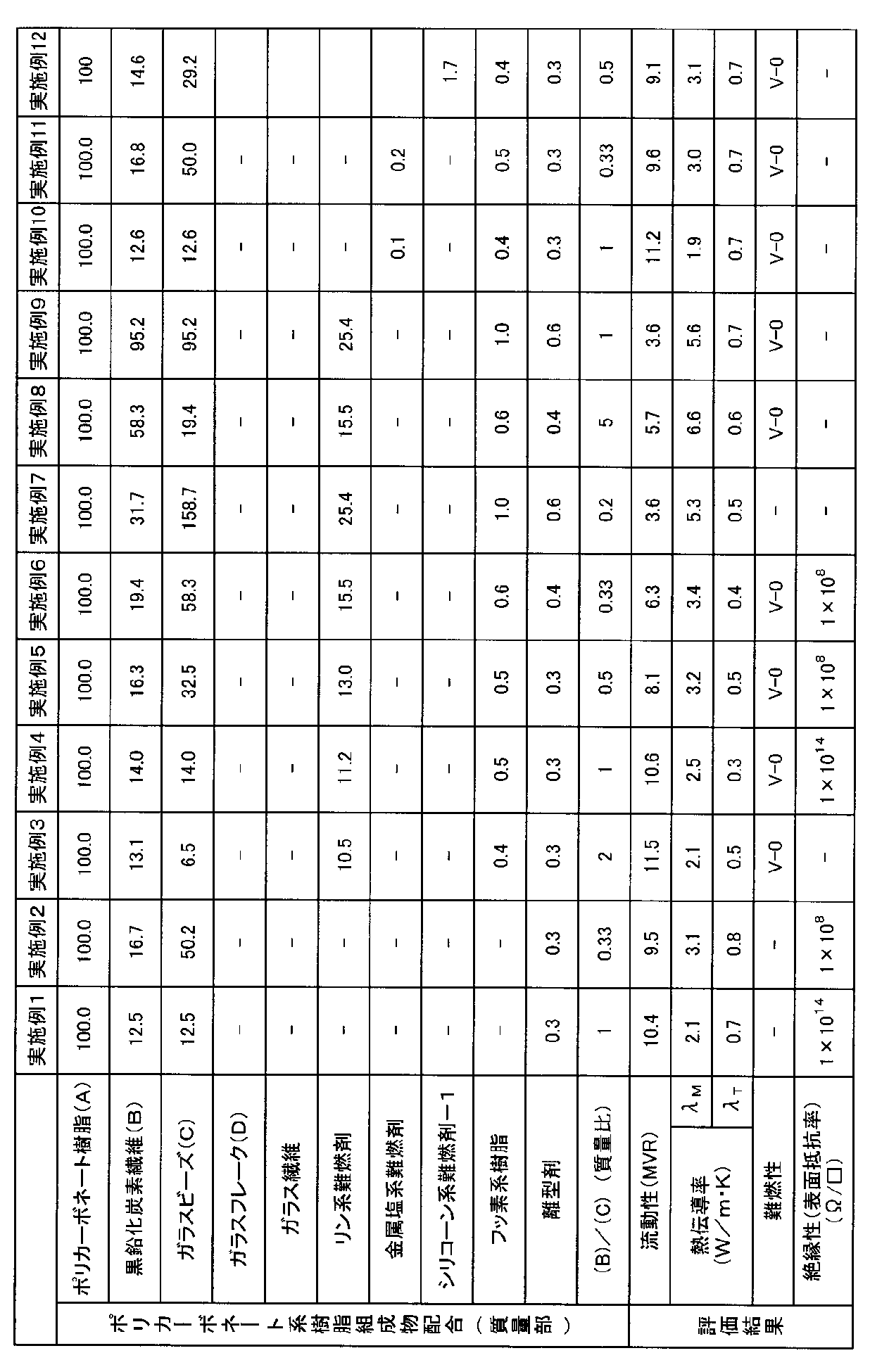
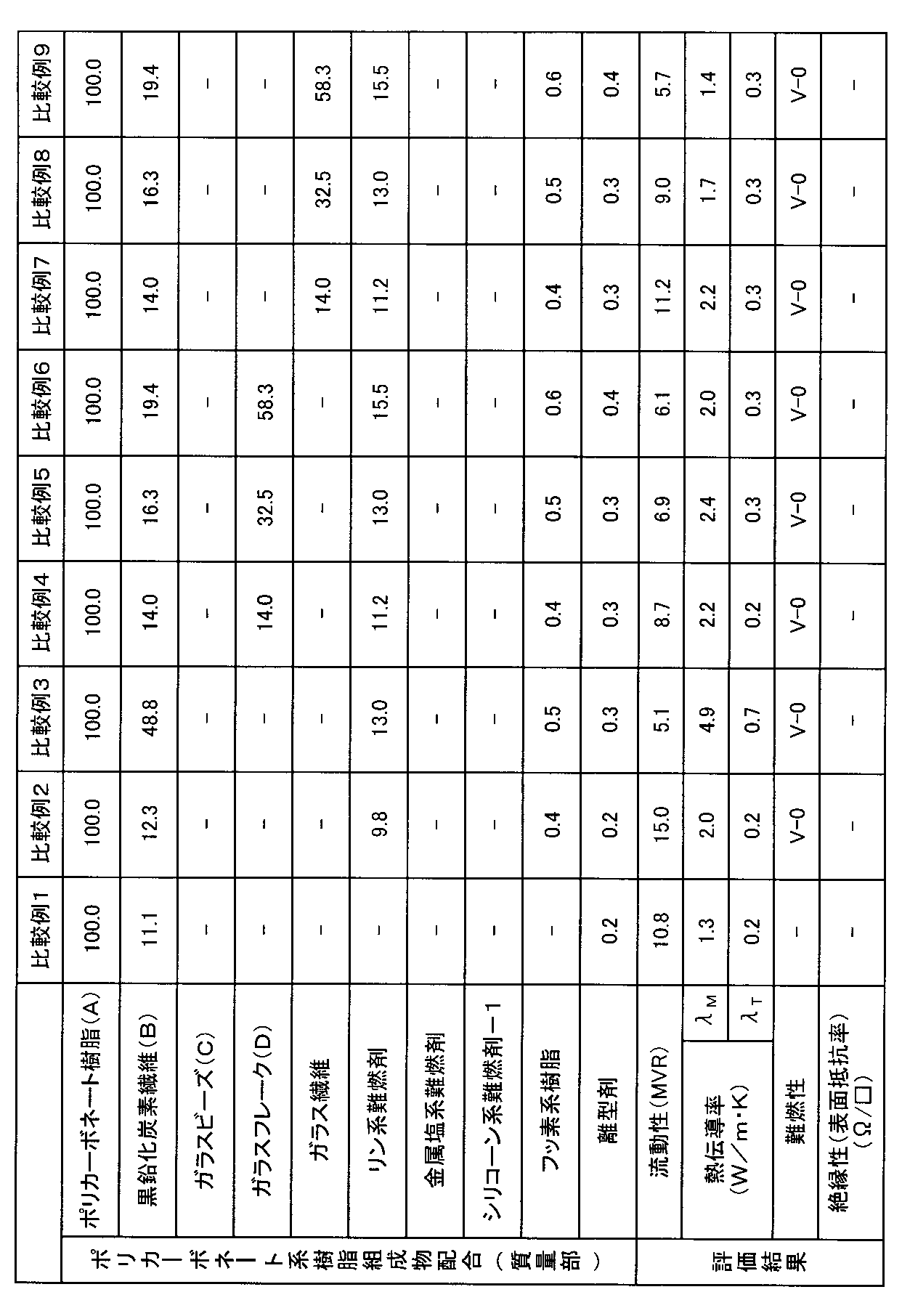
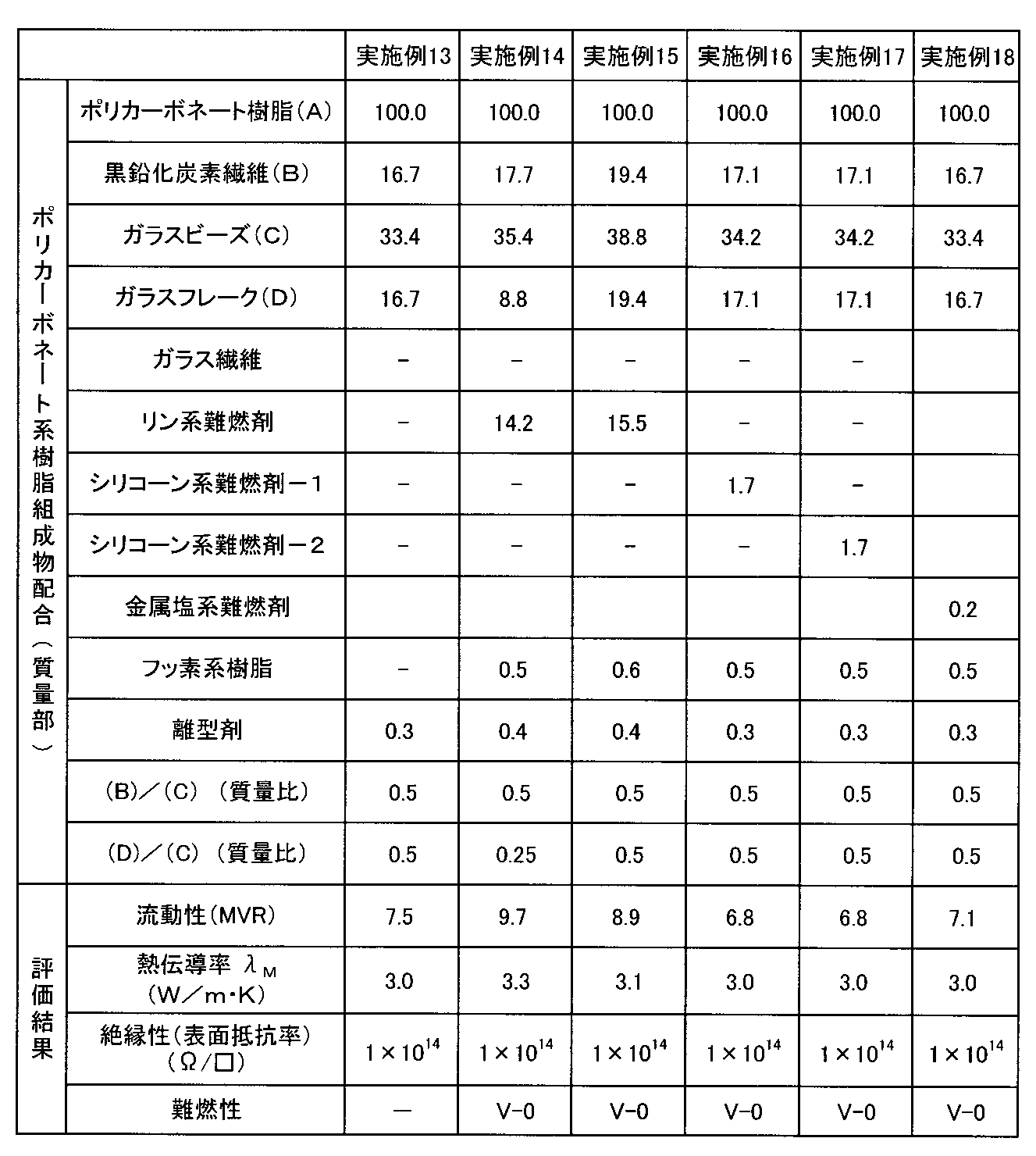
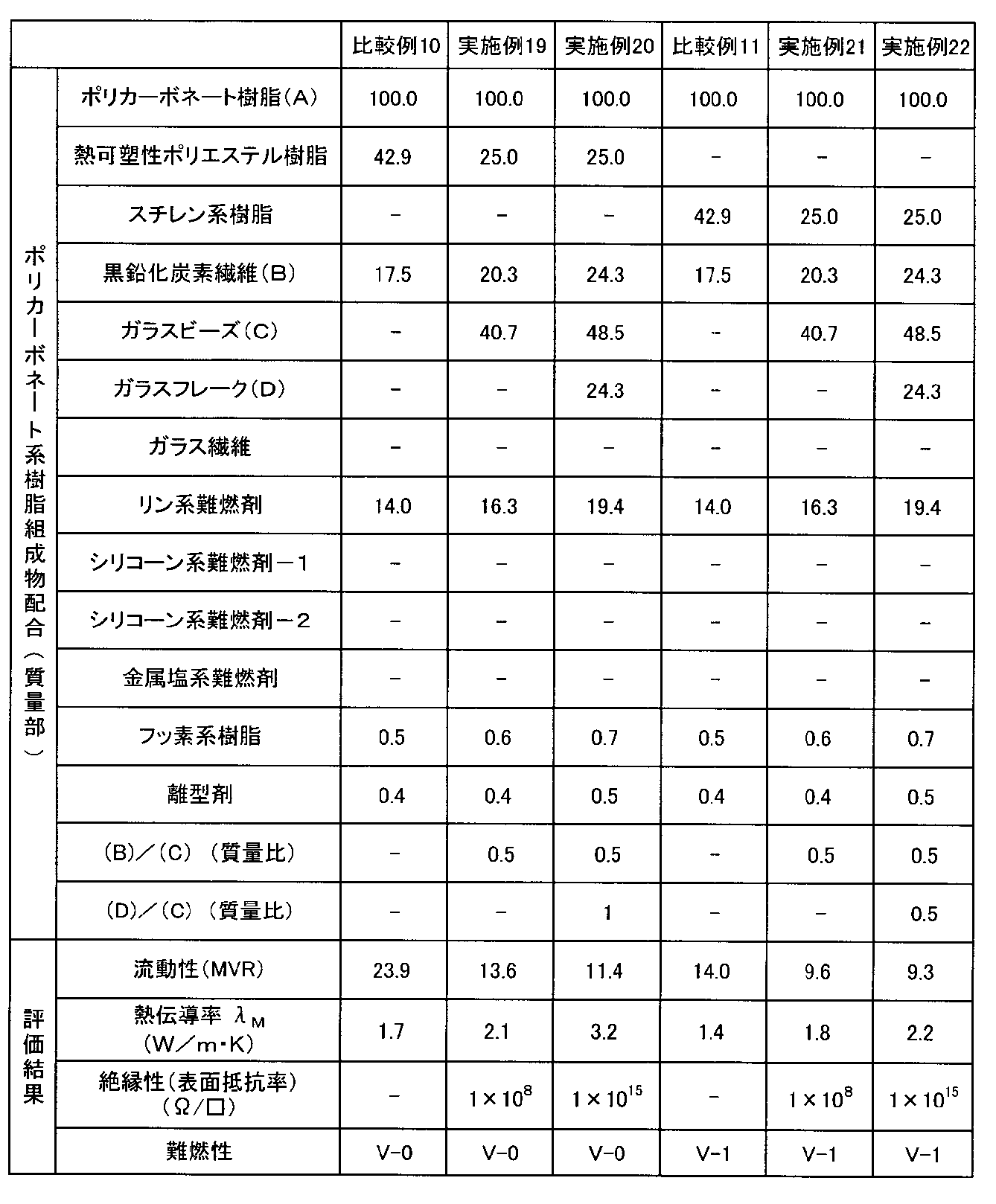
黒鉛化炭素繊維と共に真球度の高いガラスビーズを併用することにより、熱伝導性を更に高めることができることが分かる。
即ち、ガラスビーズを配合していない比較例1とガラスビーズを配合した実施例1,2とを対比すると、同等の黒鉛化炭素繊維の配合量でガラスビーズを配合した実施例1,2の方が明らかに熱伝導性に優れることが分かる。ガラスビーズを配合していない比較例10,11とガラスビーズを配合した実施例19、21との対比でも同様である。
難燃剤を配合した比較例2と実施例3~7との対比、比較例3と実施例8,9との対比からも、やはり、同等の黒鉛化炭素繊維の配合量でガラスビーズを配合した実施例の方が明らかに熱伝導性に優れることが分かる。
また、実施例3~6と比較例4~9との対比で、ガラスビーズの代りにガラスフレークやガラス繊維を配合しても熱伝導性の向上効果は得られないことが分かる。
絶縁性と熱伝導性を比較すると、ガラスフレークを含まない実施例1、4では、絶縁性(表面抵抗率)は高いものの、熱伝導率が実施例13~18、20、22に比べて低く、また実施例2,5,6、19、21では、熱伝導性は実施例13~18、20,22と同等の値を示しているが、絶縁性(表面抵抗率)が実施例13~18、20、22に比べて劣る結果となった。
なお、本出願は、2010年7月21日付で出願された日本特許出願(特願2010-164082)及び2010年8月4日付で出願された日本特許出願(特願2010-174978)に基づいており、その全体が引用により援用される。
Claims (14)
- (A)ポリカーボネート樹脂を主成分とする樹脂成分100質量部に対し、(B)黒鉛化されてなる炭素繊維であって、長さ方向の熱伝導率が100W/m・K以上、かつ平均繊維径5~20μmの炭素繊維5質量部以上100質量部以下、及び(C)平均粒子径1~100μm、真球度1~2のガラスビーズ5質量部以上200質量部以下を含有してなることを特徴とする高熱伝導性ポリカーボネート系樹脂組成物。
- 請求項1において、(A)樹脂成分100質量部に対し、(D)平均粒子径10~4000μm、アスペクト比2~200のガラスフレークを5質量部以上200質量部以下含むことを特徴とする高熱伝導性ポリカーボネート系樹脂組成物。
- 請求項1又は2において、(A)樹脂成分がポリカーボネート樹脂単独であることを特徴とする高熱伝導性ポリカーボネート樹脂組成物。
- 請求項1又は2において、(A)樹脂成分がポリカーボネート樹脂/熱可塑性ポリエステル樹脂のアロイ、またはポリカーボネート樹脂/スチレン系樹脂のアロイであることを特徴とする高熱伝導性ポリカーボネート樹脂組成物。
- 請求項1ないし4のいずれか1項において、(A)樹脂成分100質量部に対し、(B)黒鉛化された炭素繊維を15質量部以上35質量部以下含むことを特徴とする高熱伝導性ポリカーボネート樹脂組成物。
- 請求項1ないし5のいずれか1項において、(C)ガラスビーズに対する(B)黒鉛化された炭素繊維の量((B)/(C)(質量比))が0.1以上1未満であることを特徴とする高熱伝導性ポリカーボネート樹脂組成物。
- 請求項2ないし6のいずれか1項において、(C)ガラスビーズに対する(D)ガラスフレークの量((D)/(C)(質量比))が0.1以上1未満であることを特徴とする高熱伝導性ポリカーボネート樹脂組成物。
- 請求項1ないし7のいずれか1項において、(A)樹脂成分100質量部に対し、(E)リン系難燃剤を5質量部以上30質量部以下含むことを特徴とする高熱伝導性ポリカーボネート系樹脂組成物。
- 請求項8において、該(E)リン系難燃剤がリン酸エステル系化合物であることを特徴とする高熱伝導性ポリカーボネート系樹脂組成物。
- 請求項1ないし7のいずれか1項において、(A)樹脂成分100質量部に対し、(F)シリコーン系難燃剤を0.1質量部以上10質量部以下含むことを特徴とする高熱伝導性ポリカーボネート系樹脂組成物。
- 請求項1ないし7のいずれか1項において、(A)樹脂成分100質量部に対し、(G)金属塩系難燃剤を0.02質量部以上0.3質量部以下含むことを特徴とする高熱伝導性ポリカーボネート系樹脂組成物。
- 請求項1ないし11のいずれか1項において、(A)樹脂成分100質量部に対し、(H)フッ素系樹脂を0.01質量部以上1質量部以下含むことを特徴とする高熱伝導性ポリカーボネート系樹脂組成物。
- 請求項1ないし12のいずれか1項において、(A)樹脂成分100質量部に対し、(I)離型剤を0.001質量部以上2質量部以下含むことを特徴とする高熱伝導性ポリカーボネート系樹脂組成物。
- 請求項1ないし13のいずれか1項に記載の高熱伝導性ポリカーボネート系樹脂組成物を成形してなることを特徴とする高熱伝導性ポリカーボネート系樹脂成形体。
Priority Applications (4)
| Application Number | Priority Date | Filing Date | Title |
|---|---|---|---|
| EP11809530.6A EP2597120B1 (en) | 2010-07-21 | 2011-06-23 | Highly-thermally-conductive polycarbonate resin composition and molded body |
| JP2011532065A JP4849196B1 (ja) | 2010-07-21 | 2011-06-23 | 高熱伝導性ポリカーボネート系樹脂組成物及び成形体 |
| US13/387,401 US20120129990A1 (en) | 2010-07-21 | 2011-06-23 | High-thermal-conductivity polycarbonate resin composition and formed product |
| CN2011800031856A CN102482485B (zh) | 2010-07-21 | 2011-06-23 | 高热传导性聚碳酸酯系树脂组合物和成型体 |
Applications Claiming Priority (4)
| Application Number | Priority Date | Filing Date | Title |
|---|---|---|---|
| JP2010164082 | 2010-07-21 | ||
| JP2010-164082 | 2010-07-21 | ||
| JP2010174978 | 2010-08-04 | ||
| JP2010-174978 | 2010-08-04 |
Publications (1)
| Publication Number | Publication Date |
|---|---|
| WO2012011356A1 true WO2012011356A1 (ja) | 2012-01-26 |
Family
ID=45496784
Family Applications (1)
| Application Number | Title | Priority Date | Filing Date |
|---|---|---|---|
| PCT/JP2011/064362 Ceased WO2012011356A1 (ja) | 2010-07-21 | 2011-06-23 | 高熱伝導性ポリカーボネート系樹脂組成物及び成形体 |
Country Status (5)
| Country | Link |
|---|---|
| US (1) | US20120129990A1 (ja) |
| EP (1) | EP2597120B1 (ja) |
| JP (1) | JP4849196B1 (ja) |
| CN (1) | CN102482485B (ja) |
| WO (1) | WO2012011356A1 (ja) |
Cited By (7)
| Publication number | Priority date | Publication date | Assignee | Title |
|---|---|---|---|---|
| JP2013199608A (ja) * | 2012-03-26 | 2013-10-03 | Yokoi Seisakusho:Kk | 攪拌部材 |
| WO2013174782A1 (en) * | 2012-05-22 | 2013-11-28 | Total Research & Technology Feluy | Process for preparing a polymeric product |
| JP2015168811A (ja) * | 2014-03-11 | 2015-09-28 | 三菱エンジニアリングプラスチックス株式会社 | 熱伝導性ポリカーボネート樹脂組成物及び成形品 |
| JP2018087294A (ja) * | 2016-11-29 | 2018-06-07 | ダイセルポリマー株式会社 | ポリカーボネート樹脂組成物 |
| KR20180084773A (ko) * | 2015-10-05 | 2018-07-25 | 알바니 인터내셔널 코포레이션 | 폴리머성 성분들의 개선된 내마모성을 위한 조성물들 및 방법들 |
| WO2020179394A1 (ja) * | 2019-03-04 | 2020-09-10 | 帝人株式会社 | ポリカーボネート樹脂組成物 |
| WO2024085324A1 (ko) * | 2022-10-21 | 2024-04-25 | 부산대학교 산학협력단 | 방열용 피커링 에멀젼 조성물, 이를 이용한 방열 페이스트 및 이의 제조방법 |
Families Citing this family (20)
| Publication number | Priority date | Publication date | Assignee | Title |
|---|---|---|---|---|
| MY184009A (en) * | 2011-07-04 | 2021-03-17 | Toyo Boseki | Reverse osmosis membrane for wastewater treatment |
| ES2603277T3 (es) * | 2011-11-30 | 2017-02-24 | Covestro Deutschland Ag | Cuerpo multicapa metalizado de policarbonatos especiales con reducido coeficiente de dilatación térmica |
| EP2806419A4 (en) * | 2012-01-16 | 2015-12-23 | Nec Corp | MOBILE TERMINAL DEVICE |
| US9206313B2 (en) * | 2012-01-31 | 2015-12-08 | Mitsubishi Engineering-Plastics Corporation | Polycarbonate resin composition |
| EP2826810B1 (en) * | 2012-03-14 | 2016-12-07 | Teijin Limited | Molding material, molded product thereof, and method for producing said molded product |
| CN102863767A (zh) * | 2012-09-21 | 2013-01-09 | 常熟市凯力达蜂窝包装材料有限公司 | 一种透明的聚碳酸酯合金材料的制备方法 |
| KR102050411B1 (ko) | 2013-06-04 | 2019-11-29 | 사빅 글로벌 테크놀러지스 비.브이. | 폴리카보네이트 기반의 열 전도성 난연제 폴리머 조성물들 |
| US9611414B2 (en) | 2014-07-11 | 2017-04-04 | Henkel IP & Holding GmbH | Thermal interface material with mixed aspect ratio particle dispersions |
| CN107206711A (zh) * | 2015-02-12 | 2017-09-26 | 贝卡尔特公司 | 传导塑料制品 |
| MX2017014919A (es) * | 2015-05-18 | 2018-03-23 | Albany Int Corp | Uso de aditivos con contenido de silicona y fluoropolimero para mejorar las propiedades de las composiciones polimericas. |
| KR101752093B1 (ko) | 2016-04-01 | 2017-06-28 | 롯데첨단소재(주) | 공중합 폴리카보네이트 수지, 그 제조방법 및 이를 포함하는 성형품 |
| EP4559963A3 (en) * | 2016-09-09 | 2025-08-13 | Mitsubishi Chemical Corporation | Polycarbonate resin composition |
| EP3352290B1 (en) * | 2017-01-19 | 2024-07-17 | 3M Innovative Properties Company | Aziridino-functional polyether thermally-conductive gap filler |
| DE102017125438A1 (de) * | 2017-10-30 | 2019-05-02 | Neue Materialien Fürth GmbH | Faserverstärktes Verbundmaterial und Verfahren zur Herstellung eines faserverstärkten Verbundmaterials |
| EP3570296A1 (en) * | 2018-05-14 | 2019-11-20 | 3M Innovative Properties Company | Thermally-conductive gap filler |
| CN113646385B (zh) * | 2019-03-26 | 2024-02-27 | 日商Mcc先进成型股份有限公司 | 树脂组合物 |
| EP3943552A1 (en) | 2020-07-24 | 2022-01-26 | SHPP Global Technologies B.V. | Flame retardant compositions including recycled polycarbonate and polybutylene terephthalate blends |
| US12345273B2 (en) * | 2021-09-08 | 2025-07-01 | Dell Products L.P. | Fan covering with high recycle content and high thermal conductivity |
| WO2025074362A1 (en) | 2023-10-01 | 2025-04-10 | Bromine Compounds Ltd. | Flame-retarded reinforced polycarbonate compositions |
| CN119081333B (zh) * | 2024-09-12 | 2025-10-21 | 金发科技股份有限公司 | 一种hips合金材料及其制备方法和应用 |
Citations (9)
| Publication number | Priority date | Publication date | Assignee | Title |
|---|---|---|---|---|
| JPH07324143A (ja) * | 1994-04-04 | 1995-12-12 | Mitsubishi Gas Chem Co Inc | 異形押出成形用熱可塑性樹脂組成物 |
| JPH1149937A (ja) * | 1997-07-30 | 1999-02-23 | Polyplastics Co | ガスアシスト射出成形用樹脂組成物および成形方法 |
| JP2000143826A (ja) | 1998-11-17 | 2000-05-26 | Mitsubishi Chemicals Corp | 炭素短繊維集合体及びその製造方法並びに繊維強化樹脂組成物 |
| JP2005320515A (ja) | 2004-04-06 | 2005-11-17 | Mitsubishi Engineering Plastics Corp | 熱伝導性ポリカーボネート系樹脂組成物および成形体 |
| JP2007031611A (ja) * | 2005-07-28 | 2007-02-08 | Teijin Chem Ltd | 熱可塑性樹脂組成物 |
| JP2007099799A (ja) * | 2005-09-30 | 2007-04-19 | Mitsubishi Engineering Plastics Corp | 高熱伝導絶縁性ポリカーボネート系樹脂組成物および成形体 |
| JP2010164082A (ja) | 2009-01-13 | 2010-07-29 | Honda Motor Co Ltd | 駆動力配分装置 |
| JP2010174978A (ja) | 2009-01-29 | 2010-08-12 | Showa Bussan Kk | 管およびチューブの接続用継手。 |
| JP2011016936A (ja) * | 2009-07-09 | 2011-01-27 | Mitsubishi Engineering Plastics Corp | 高熱伝導絶縁性樹脂組成物及び成形体 |
Family Cites Families (7)
| Publication number | Priority date | Publication date | Assignee | Title |
|---|---|---|---|---|
| US4243575A (en) * | 1979-07-25 | 1981-01-06 | General Electric Company | Filled thermoplastic resin compositions |
| NL8902460A (nl) * | 1989-10-04 | 1991-05-01 | Stamicarbon | Aromatisch polycarbonaathars bevattende een vormlosmiddel. |
| DE69504118T2 (de) * | 1994-04-04 | 1998-12-24 | Mitsubishi Gas Chemical Co., Inc., Tokio/Tokyo | Thermoplastische Harzzusammensetzung für Profilextrusion |
| JP3892527B2 (ja) * | 1997-05-02 | 2007-03-14 | 帝人化成株式会社 | 芳香族ポリカーボネート樹脂組成物及びそれからなる成形品 |
| JP5054259B2 (ja) * | 2001-01-25 | 2012-10-24 | 出光興産株式会社 | 難燃性ポリカーボネート樹脂組成物及びその成形品 |
| JP4951835B2 (ja) * | 2001-09-27 | 2012-06-13 | 三菱エンジニアリングプラスチックス株式会社 | ポリカーボネート樹脂組成物 |
| JP4008253B2 (ja) * | 2002-02-06 | 2007-11-14 | 三菱エンジニアリングプラスチックス株式会社 | ポリカーボネート樹脂組成物 |
-
2011
- 2011-06-23 CN CN2011800031856A patent/CN102482485B/zh active Active
- 2011-06-23 WO PCT/JP2011/064362 patent/WO2012011356A1/ja not_active Ceased
- 2011-06-23 EP EP11809530.6A patent/EP2597120B1/en active Active
- 2011-06-23 US US13/387,401 patent/US20120129990A1/en not_active Abandoned
- 2011-06-23 JP JP2011532065A patent/JP4849196B1/ja active Active
Patent Citations (9)
| Publication number | Priority date | Publication date | Assignee | Title |
|---|---|---|---|---|
| JPH07324143A (ja) * | 1994-04-04 | 1995-12-12 | Mitsubishi Gas Chem Co Inc | 異形押出成形用熱可塑性樹脂組成物 |
| JPH1149937A (ja) * | 1997-07-30 | 1999-02-23 | Polyplastics Co | ガスアシスト射出成形用樹脂組成物および成形方法 |
| JP2000143826A (ja) | 1998-11-17 | 2000-05-26 | Mitsubishi Chemicals Corp | 炭素短繊維集合体及びその製造方法並びに繊維強化樹脂組成物 |
| JP2005320515A (ja) | 2004-04-06 | 2005-11-17 | Mitsubishi Engineering Plastics Corp | 熱伝導性ポリカーボネート系樹脂組成物および成形体 |
| JP2007031611A (ja) * | 2005-07-28 | 2007-02-08 | Teijin Chem Ltd | 熱可塑性樹脂組成物 |
| JP2007099799A (ja) * | 2005-09-30 | 2007-04-19 | Mitsubishi Engineering Plastics Corp | 高熱伝導絶縁性ポリカーボネート系樹脂組成物および成形体 |
| JP2010164082A (ja) | 2009-01-13 | 2010-07-29 | Honda Motor Co Ltd | 駆動力配分装置 |
| JP2010174978A (ja) | 2009-01-29 | 2010-08-12 | Showa Bussan Kk | 管およびチューブの接続用継手。 |
| JP2011016936A (ja) * | 2009-07-09 | 2011-01-27 | Mitsubishi Engineering Plastics Corp | 高熱伝導絶縁性樹脂組成物及び成形体 |
Non-Patent Citations (1)
| Title |
|---|
| See also references of EP2597120A4 |
Cited By (11)
| Publication number | Priority date | Publication date | Assignee | Title |
|---|---|---|---|---|
| JP2013199608A (ja) * | 2012-03-26 | 2013-10-03 | Yokoi Seisakusho:Kk | 攪拌部材 |
| WO2013174782A1 (en) * | 2012-05-22 | 2013-11-28 | Total Research & Technology Feluy | Process for preparing a polymeric product |
| JP2015168811A (ja) * | 2014-03-11 | 2015-09-28 | 三菱エンジニアリングプラスチックス株式会社 | 熱伝導性ポリカーボネート樹脂組成物及び成形品 |
| KR20180084773A (ko) * | 2015-10-05 | 2018-07-25 | 알바니 인터내셔널 코포레이션 | 폴리머성 성분들의 개선된 내마모성을 위한 조성물들 및 방법들 |
| KR102225991B1 (ko) * | 2015-10-05 | 2021-03-09 | 알바니 인터내셔널 코포레이션 | 폴리머성 성분들의 개선된 내마모성을 위한 조성물들 및 방법들 |
| JP2018087294A (ja) * | 2016-11-29 | 2018-06-07 | ダイセルポリマー株式会社 | ポリカーボネート樹脂組成物 |
| WO2018101338A1 (ja) * | 2016-11-29 | 2018-06-07 | ダイセルポリマー株式会社 | ポリカーボネート樹脂組成物 |
| WO2020179394A1 (ja) * | 2019-03-04 | 2020-09-10 | 帝人株式会社 | ポリカーボネート樹脂組成物 |
| JPWO2020179394A1 (ja) * | 2019-03-04 | 2021-10-14 | 帝人株式会社 | ポリカーボネート樹脂組成物 |
| JP7219332B2 (ja) | 2019-03-04 | 2023-02-07 | 帝人株式会社 | ポリカーボネート樹脂組成物 |
| WO2024085324A1 (ko) * | 2022-10-21 | 2024-04-25 | 부산대학교 산학협력단 | 방열용 피커링 에멀젼 조성물, 이를 이용한 방열 페이스트 및 이의 제조방법 |
Also Published As
| Publication number | Publication date |
|---|---|
| JP4849196B1 (ja) | 2012-01-11 |
| EP2597120B1 (en) | 2020-12-09 |
| CN102482485B (zh) | 2013-08-21 |
| US20120129990A1 (en) | 2012-05-24 |
| CN102482485A (zh) | 2012-05-30 |
| EP2597120A4 (en) | 2016-11-23 |
| EP2597120A1 (en) | 2013-05-29 |
| JPWO2012011356A1 (ja) | 2013-09-09 |
Similar Documents
| Publication | Publication Date | Title |
|---|---|---|
| JP4849196B1 (ja) | 高熱伝導性ポリカーボネート系樹脂組成物及び成形体 | |
| JP5419916B2 (ja) | 熱伝導性ポリカーボネート系樹脂組成物および成形体 | |
| JP4817785B2 (ja) | 高熱伝導絶縁性ポリカーボネート系樹脂組成物および成形体 | |
| JP5555588B2 (ja) | ポリカーボネート樹脂組成物およびそれからなる成形品 | |
| JP5629916B2 (ja) | 電磁波シールド用繊維/樹脂複合組成物ペレット、電磁波シールド用樹脂組成物及びその成形体 | |
| JP2011016937A (ja) | 高熱伝導性熱可塑性樹脂組成物及び成形品 | |
| JP4817784B2 (ja) | 熱伝導性ポリカーボネート系樹脂組成物および成形体 | |
| JP5327024B2 (ja) | 放熱部付き二色成形品及び発熱体付き機器 | |
| JP2007091985A (ja) | 熱伝導性ポリカーボネート系樹脂組成物および成形体 | |
| JP2011016936A (ja) | 高熱伝導絶縁性樹脂組成物及び成形体 | |
| JP5256644B2 (ja) | 難燃性芳香族ポリカーボネート樹脂組成物および成形品 | |
| JP2005298552A (ja) | 熱伝導性ポリカーボネート系樹脂組成物および成形体 | |
| JP5369052B2 (ja) | ポリカーボネート樹脂組成物 | |
| JP2011168633A (ja) | ポリカーボネート樹脂組成物の製造方法、およびそれからなる成形品 | |
| JP4964020B2 (ja) | 薄肉成形用難燃性芳香族ポリカーボネート樹脂組成物及び薄肉成形品 | |
| JP5353832B2 (ja) | ポリカーボネート樹脂成形体 | |
| JP2005320515A (ja) | 熱伝導性ポリカーボネート系樹脂組成物および成形体 | |
| JP4768302B2 (ja) | 高熱伝導絶縁性ポリカーボネート系樹脂組成物からなる成形体 | |
| JP2011168682A (ja) | ポリカーボネート樹脂組成物の製造方法およびそれからなる成形品 | |
| JP5312437B2 (ja) | 熱伝導性ポリカーボネート系樹脂組成物および成形体 | |
| JP2006028276A (ja) | 熱伝導性ポリカーボネート系樹脂組成物および成形体 | |
| JP2007100023A (ja) | 難燃性芳香族ポリカーボネート樹脂組成物 | |
| JP2011018680A (ja) | ポリカーボネート樹脂組成物、ポリカーボネート樹脂成形品及び電磁波吸収体 | |
| JP7793357B2 (ja) | 熱伝導性ポリカーボネート樹脂組成物及び成形品 | |
| JP4863627B2 (ja) | 熱安定性に優れた光反射性難燃ポリカーボネート樹脂組成物 |
Legal Events
| Date | Code | Title | Description |
|---|---|---|---|
| WWE | Wipo information: entry into national phase |
Ref document number: 201180003185.6 Country of ref document: CN |
|
| WWE | Wipo information: entry into national phase |
Ref document number: 2011532065 Country of ref document: JP |
|
| WWE | Wipo information: entry into national phase |
Ref document number: 13387401 Country of ref document: US |
|
| WWE | Wipo information: entry into national phase |
Ref document number: 2011809530 Country of ref document: EP |
|
| 121 | Ep: the epo has been informed by wipo that ep was designated in this application |
Ref document number: 11809530 Country of ref document: EP Kind code of ref document: A1 |
|
| WWE | Wipo information: entry into national phase |
Ref document number: 2210/MUMNP/2012 Country of ref document: IN |
|
| NENP | Non-entry into the national phase |
Ref country code: DE |