WO2012017328A2 - Combination pharmaceutical composition and methods of treating and preventing the infectious diseases - Google Patents

Combination pharmaceutical composition and methods of treating and preventing the infectious diseases Download PDF

Info

Publication number
WO2012017328A2
WO2012017328A2 PCT/IB2011/002470 IB2011002470W WO2012017328A2 WO 2012017328 A2 WO2012017328 A2 WO 2012017328A2 IB 2011002470 W IB2011002470 W IB 2011002470W WO 2012017328 A2 WO2012017328 A2 WO 2012017328A2
Authority
WO
WIPO (PCT)
Prior art keywords
leu
ser
lys
gin
glu
Prior art date
Legal status (The legal status is an assumption and is not a legal conclusion. Google has not performed a legal analysis and makes no representation as to the accuracy of the status listed.)
Ceased
Application number
PCT/IB2011/002470
Other languages
French (fr)
Other versions
WO2012017328A3 (en
Inventor
Oleg Iliich Epshtein
Sergey Alexandrovich Tarasov
Current Assignee (The listed assignees may be inaccurate. Google has not performed a legal analysis and makes no representation or warranty as to the accuracy of the list.)
Individual
Original Assignee
Individual
Priority date (The priority date is an assumption and is not a legal conclusion. Google has not performed a legal analysis and makes no representation as to the accuracy of the date listed.)
Filing date
Publication date
Family has litigation
First worldwide family litigation filed litigation Critical https://patents.darts-ip.com/?family=45507292&utm_source=google_patent&utm_medium=platform_link&utm_campaign=public_patent_search&patent=WO2012017328(A2) "Global patent litigation dataset” by Darts-ip is licensed under a Creative Commons Attribution 4.0 International License.
Priority claimed from RU2010133051/15A external-priority patent/RU2505312C2/en
Priority claimed from RU2010133043/15A external-priority patent/RU2519862C2/en
Priority claimed from RU2010133053/15A external-priority patent/RU2521392C2/en
Priority claimed from RU2010133041/15A external-priority patent/RU2010133041A/en
Priority claimed from RU2010133050/15A external-priority patent/RU2502521C2/en
Priority claimed from RU2010133047/15A external-priority patent/RU2517085C2/en
Priority claimed from RU2010133052/15A external-priority patent/RU2500422C2/en
Priority claimed from RU2011127226/15A external-priority patent/RU2577299C2/en
Priority to JP2013522318A priority Critical patent/JP2013537532A/en
Priority to PH1/2013/500232A priority patent/PH12013500232A1/en
Priority to BR112013002296A priority patent/BR112013002296A2/en
Priority to SG2013008974A priority patent/SG187732A1/en
Priority to EA201300135A priority patent/EA030513B1/en
Priority to DE112011102640T priority patent/DE112011102640T5/en
Priority to UAA201300103A priority patent/UA112748C2/en
Priority to AU2011287292A priority patent/AU2011287292B2/en
Priority to EP11778688.9A priority patent/EP2601219A2/en
Priority to CA2807529A priority patent/CA2807529A1/en
Priority to MX2013001451A priority patent/MX368313B/en
Priority to KR1020137005740A priority patent/KR20140012021A/en
Priority to ES201390022A priority patent/ES2510940R1/en
Application filed by Individual filed Critical Individual
Priority to NZ606993A priority patent/NZ606993A/en
Priority to CN201180048456XA priority patent/CN103154030A/en
Priority to GB1303867.4A priority patent/GB2503066B8/en
Publication of WO2012017328A2 publication Critical patent/WO2012017328A2/en
Publication of WO2012017328A3 publication Critical patent/WO2012017328A3/en
Priority to IL224545A priority patent/IL224545A/en
Anticipated expiration legal-status Critical
Ceased legal-status Critical Current

Links

Classifications

    • CCHEMISTRY; METALLURGY
    • C07ORGANIC CHEMISTRY
    • C07KPEPTIDES
    • C07K16/00Immunoglobulins [IG], e.g. monoclonal or polyclonal antibodies
    • C07K16/18Immunoglobulins [IG], e.g. monoclonal or polyclonal antibodies against material from animals or humans
    • C07K16/28Immunoglobulins [IG], e.g. monoclonal or polyclonal antibodies against material from animals or humans against receptors, cell surface antigens or cell surface determinants
    • C07K16/2803Immunoglobulins [IG], e.g. monoclonal or polyclonal antibodies against material from animals or humans against receptors, cell surface antigens or cell surface determinants against the immunoglobulin superfamily
    • C07K16/2815Immunoglobulins [IG], e.g. monoclonal or polyclonal antibodies against material from animals or humans against receptors, cell surface antigens or cell surface determinants against the immunoglobulin superfamily against CD8
    • AHUMAN NECESSITIES
    • A61MEDICAL OR VETERINARY SCIENCE; HYGIENE
    • A61KPREPARATIONS FOR MEDICAL, DENTAL OR TOILETRY PURPOSES
    • A61K39/00Medicinal preparations containing antigens or antibodies
    • A61K39/395Antibodies; Immunoglobulins; Immune serum, e.g. antilymphocytic serum
    • AHUMAN NECESSITIES
    • A61MEDICAL OR VETERINARY SCIENCE; HYGIENE
    • A61KPREPARATIONS FOR MEDICAL, DENTAL OR TOILETRY PURPOSES
    • A61K39/00Medicinal preparations containing antigens or antibodies
    • A61K39/395Antibodies; Immunoglobulins; Immune serum, e.g. antilymphocytic serum
    • A61K39/39533Antibodies; Immunoglobulins; Immune serum, e.g. antilymphocytic serum against materials from animals
    • A61K39/3955Antibodies; Immunoglobulins; Immune serum, e.g. antilymphocytic serum against materials from animals against proteinaceous materials, e.g. enzymes, hormones, lymphokines
    • AHUMAN NECESSITIES
    • A61MEDICAL OR VETERINARY SCIENCE; HYGIENE
    • A61KPREPARATIONS FOR MEDICAL, DENTAL OR TOILETRY PURPOSES
    • A61K39/00Medicinal preparations containing antigens or antibodies
    • A61K39/395Antibodies; Immunoglobulins; Immune serum, e.g. antilymphocytic serum
    • A61K39/40Antibodies; Immunoglobulins; Immune serum, e.g. antilymphocytic serum bacterial
    • AHUMAN NECESSITIES
    • A61MEDICAL OR VETERINARY SCIENCE; HYGIENE
    • A61KPREPARATIONS FOR MEDICAL, DENTAL OR TOILETRY PURPOSES
    • A61K39/00Medicinal preparations containing antigens or antibodies
    • A61K39/395Antibodies; Immunoglobulins; Immune serum, e.g. antilymphocytic serum
    • A61K39/42Antibodies; Immunoglobulins; Immune serum, e.g. antilymphocytic serum viral
    • AHUMAN NECESSITIES
    • A61MEDICAL OR VETERINARY SCIENCE; HYGIENE
    • A61KPREPARATIONS FOR MEDICAL, DENTAL OR TOILETRY PURPOSES
    • A61K41/00Medicinal preparations obtained by treating materials with wave energy or particle radiation ; Therapies using these preparations
    • A61K41/0004Homeopathy; Vitalisation; Resonance; Dynamisation, e.g. esoteric applications; Oxygenation of blood
    • AHUMAN NECESSITIES
    • A61MEDICAL OR VETERINARY SCIENCE; HYGIENE
    • A61PSPECIFIC THERAPEUTIC ACTIVITY OF CHEMICAL COMPOUNDS OR MEDICINAL PREPARATIONS
    • A61P1/00Drugs for disorders of the alimentary tract or the digestive system
    • A61P1/16Drugs for disorders of the alimentary tract or the digestive system for liver or gallbladder disorders, e.g. hepatoprotective agents, cholagogues, litholytics
    • AHUMAN NECESSITIES
    • A61MEDICAL OR VETERINARY SCIENCE; HYGIENE
    • A61PSPECIFIC THERAPEUTIC ACTIVITY OF CHEMICAL COMPOUNDS OR MEDICINAL PREPARATIONS
    • A61P11/00Drugs for disorders of the respiratory system
    • A61P11/04Drugs for disorders of the respiratory system for throat disorders
    • AHUMAN NECESSITIES
    • A61MEDICAL OR VETERINARY SCIENCE; HYGIENE
    • A61PSPECIFIC THERAPEUTIC ACTIVITY OF CHEMICAL COMPOUNDS OR MEDICINAL PREPARATIONS
    • A61P31/00Antiinfectives, i.e. antibiotics, antiseptics, chemotherapeutics
    • AHUMAN NECESSITIES
    • A61MEDICAL OR VETERINARY SCIENCE; HYGIENE
    • A61PSPECIFIC THERAPEUTIC ACTIVITY OF CHEMICAL COMPOUNDS OR MEDICINAL PREPARATIONS
    • A61P31/00Antiinfectives, i.e. antibiotics, antiseptics, chemotherapeutics
    • A61P31/04Antibacterial agents
    • AHUMAN NECESSITIES
    • A61MEDICAL OR VETERINARY SCIENCE; HYGIENE
    • A61PSPECIFIC THERAPEUTIC ACTIVITY OF CHEMICAL COMPOUNDS OR MEDICINAL PREPARATIONS
    • A61P31/00Antiinfectives, i.e. antibiotics, antiseptics, chemotherapeutics
    • A61P31/12Antivirals
    • AHUMAN NECESSITIES
    • A61MEDICAL OR VETERINARY SCIENCE; HYGIENE
    • A61PSPECIFIC THERAPEUTIC ACTIVITY OF CHEMICAL COMPOUNDS OR MEDICINAL PREPARATIONS
    • A61P31/00Antiinfectives, i.e. antibiotics, antiseptics, chemotherapeutics
    • A61P31/12Antivirals
    • A61P31/14Antivirals for RNA viruses
    • AHUMAN NECESSITIES
    • A61MEDICAL OR VETERINARY SCIENCE; HYGIENE
    • A61PSPECIFIC THERAPEUTIC ACTIVITY OF CHEMICAL COMPOUNDS OR MEDICINAL PREPARATIONS
    • A61P31/00Antiinfectives, i.e. antibiotics, antiseptics, chemotherapeutics
    • A61P31/12Antivirals
    • A61P31/14Antivirals for RNA viruses
    • A61P31/16Antivirals for RNA viruses for influenza or rhinoviruses
    • AHUMAN NECESSITIES
    • A61MEDICAL OR VETERINARY SCIENCE; HYGIENE
    • A61PSPECIFIC THERAPEUTIC ACTIVITY OF CHEMICAL COMPOUNDS OR MEDICINAL PREPARATIONS
    • A61P31/00Antiinfectives, i.e. antibiotics, antiseptics, chemotherapeutics
    • A61P31/12Antivirals
    • A61P31/14Antivirals for RNA viruses
    • A61P31/18Antivirals for RNA viruses for HIV
    • AHUMAN NECESSITIES
    • A61MEDICAL OR VETERINARY SCIENCE; HYGIENE
    • A61PSPECIFIC THERAPEUTIC ACTIVITY OF CHEMICAL COMPOUNDS OR MEDICINAL PREPARATIONS
    • A61P31/00Antiinfectives, i.e. antibiotics, antiseptics, chemotherapeutics
    • A61P31/12Antivirals
    • A61P31/20Antivirals for DNA viruses
    • AHUMAN NECESSITIES
    • A61MEDICAL OR VETERINARY SCIENCE; HYGIENE
    • A61PSPECIFIC THERAPEUTIC ACTIVITY OF CHEMICAL COMPOUNDS OR MEDICINAL PREPARATIONS
    • A61P37/00Drugs for immunological or allergic disorders
    • CCHEMISTRY; METALLURGY
    • C07ORGANIC CHEMISTRY
    • C07KPEPTIDES
    • C07K16/00Immunoglobulins [IG], e.g. monoclonal or polyclonal antibodies
    • C07K16/18Immunoglobulins [IG], e.g. monoclonal or polyclonal antibodies against material from animals or humans
    • C07K16/24Immunoglobulins [IG], e.g. monoclonal or polyclonal antibodies against material from animals or humans against cytokines, lymphokines or interferons
    • CCHEMISTRY; METALLURGY
    • C07ORGANIC CHEMISTRY
    • C07KPEPTIDES
    • C07K16/00Immunoglobulins [IG], e.g. monoclonal or polyclonal antibodies
    • C07K16/18Immunoglobulins [IG], e.g. monoclonal or polyclonal antibodies against material from animals or humans
    • C07K16/24Immunoglobulins [IG], e.g. monoclonal or polyclonal antibodies against material from animals or humans against cytokines, lymphokines or interferons
    • C07K16/241Tumor Necrosis Factors
    • CCHEMISTRY; METALLURGY
    • C07ORGANIC CHEMISTRY
    • C07KPEPTIDES
    • C07K16/00Immunoglobulins [IG], e.g. monoclonal or polyclonal antibodies
    • C07K16/18Immunoglobulins [IG], e.g. monoclonal or polyclonal antibodies against material from animals or humans
    • C07K16/24Immunoglobulins [IG], e.g. monoclonal or polyclonal antibodies against material from animals or humans against cytokines, lymphokines or interferons
    • C07K16/249Interferons
    • CCHEMISTRY; METALLURGY
    • C07ORGANIC CHEMISTRY
    • C07KPEPTIDES
    • C07K16/00Immunoglobulins [IG], e.g. monoclonal or polyclonal antibodies
    • C07K16/18Immunoglobulins [IG], e.g. monoclonal or polyclonal antibodies against material from animals or humans
    • C07K16/28Immunoglobulins [IG], e.g. monoclonal or polyclonal antibodies against material from animals or humans against receptors, cell surface antigens or cell surface determinants
    • CCHEMISTRY; METALLURGY
    • C07ORGANIC CHEMISTRY
    • C07KPEPTIDES
    • C07K16/00Immunoglobulins [IG], e.g. monoclonal or polyclonal antibodies
    • C07K16/18Immunoglobulins [IG], e.g. monoclonal or polyclonal antibodies against material from animals or humans
    • C07K16/28Immunoglobulins [IG], e.g. monoclonal or polyclonal antibodies against material from animals or humans against receptors, cell surface antigens or cell surface determinants
    • C07K16/2803Immunoglobulins [IG], e.g. monoclonal or polyclonal antibodies against material from animals or humans against receptors, cell surface antigens or cell surface determinants against the immunoglobulin superfamily
    • C07K16/2812Immunoglobulins [IG], e.g. monoclonal or polyclonal antibodies against material from animals or humans against receptors, cell surface antigens or cell surface determinants against the immunoglobulin superfamily against CD4
    • AHUMAN NECESSITIES
    • A61MEDICAL OR VETERINARY SCIENCE; HYGIENE
    • A61KPREPARATIONS FOR MEDICAL, DENTAL OR TOILETRY PURPOSES
    • A61K39/00Medicinal preparations containing antigens or antibodies
    • A61K2039/505Medicinal preparations containing antigens or antibodies comprising antibodies
    • A61K2039/507Comprising a combination of two or more separate antibodies
    • CCHEMISTRY; METALLURGY
    • C07ORGANIC CHEMISTRY
    • C07KPEPTIDES
    • C07K2317/00Immunoglobulins specific features
    • C07K2317/70Immunoglobulins specific features characterized by effect upon binding to a cell or to an antigen
    • C07K2317/76Antagonist effect on antigen, e.g. neutralization or inhibition of binding

Definitions

  • the present invention relates to a pharmaceutical composition and method of treating and preventing the infectious diseases, including bacterial infections caused by different infectious agents such as pseudotuberculosis, whooping cough, yersiniosis, pneumonitis of different etiology, and acute and chronic viral infections such as acute respiratory tract infections, influenza of different types, acute viral hepatitis A, B, C and other types of hepatitis, the diseases and conditions caused by HIV or associated with HIV, including AIDS.
  • infectious diseases including bacterial infections caused by different infectious agents such as pseudotuberculosis, whooping cough, yersiniosis, pneumonitis of different etiology, and acute and chronic viral infections such as acute respiratory tract infections, influenza of different types, acute viral hepatitis A, B, C and other types of hepatitis, the diseases and conditions caused by HIV or associated with HIV, including AIDS.
  • the invention relates to the area of medicine and may be used for the treatment and preventing the infectious diseases, including bacterial infections caused by different infectious agents such as pseudotuberculosis, whooping cough, yersiniosis, pneumonitis of different etiology, and acute and chronic viral infections such as acute respiratory tract infections, influenza of different types, acute viral hepatitis A, B, C and other types of hepatitis, the diseases and conditions caused by HIV or associated with HIV, including AIDS.
  • infectious diseases including bacterial infections caused by different infectious agents such as pseudotuberculosis, whooping cough, yersiniosis, pneumonitis of different etiology, and acute and chronic viral infections such as acute respiratory tract infections, influenza of different types, acute viral hepatitis A, B, C and other types of hepatitis, the diseases and conditions caused by HIV or associated with HIV, including AIDS.
  • U.S. Patent No. 7,582,294 discloses a medicament for treating Benign Prostatic Hyperplasia or prostatitis by administration of a homeopathically activated form of antibodies to prostate specific antigen (PSA).
  • PSA prostate specific antigen
  • Ultra-low doses of antibodies to gamma interferon have been shown to be useful in the treatment and prophylaxis of diseases of viral etiology. See U.S. Patent No. 7,572,441 , which is incorporated herein by reference in its entirety.
  • the present invention is directed to a pharmaceutical composition and methods of its use in treatment and preventing of the infectious diseases , including bacterial infections caused by different infectious agents such as pseudotuberculosis, whooping cough, yersiniosis, pneumonitis of different etiology, and acute and chronic viral infections such as acute respiratory tract infections, influenza of different types, acute viral hepatitis A, B, C and other types of hepatitis, the diseases and conditions caused by HIV or associated with HIV, including AIDS.
  • infectious diseases including bacterial infections caused by different infectious agents such as pseudotuberculosis, whooping cough, yersiniosis, pneumonitis of different etiology, and acute and chronic viral infections such as acute respiratory tract infections, influenza of different types, acute viral hepatitis A, B, C and other types of hepatitis, the diseases and conditions caused by HIV or associated with HIV, including AIDS.
  • the solution to the existing problem is presented in form of a combination pharmaceutical composition for treatment and prophylaxis (prevetion) of infectious diseases, which comprises a) an activated-potentiated form of antibodies to cytokine and b) an activated-potentiated form of antibodies to receptor.
  • the invention provides a combination pharmaceutical composition
  • a combination pharmaceutical composition comprising a) an activated-potentiated form of an antibody to at least one cytokine and b) an activated-potentiated form of an antibody to at least one receptor.
  • the pharmaceutical composition further comprises a solid carrier, wherein said activated-potentiated forms of antibodies are impregnated onto said solid carrier.
  • the pharmaceutical composition is in the form of a tablet.
  • the pharmaceutical composition including said activated- potentiated forms of antibodies is in the form of a mixture of C12, C30, and C200 homeopathic dilutions. It is specifically contemplated that said mixture of C12, C30, and C200 homeopathic dilutions is impregnated onto a solid carrier.
  • the activated-potentiated forms of said antibodies may be activated- potentiated forms of a monoclonal, polyclonal or natural antibody. It is specifically contemplated that the activated-potentiated form of said antibodies is activated- potentiated form of a polyclonal antibody.
  • the invention provides activated- potentiated forms of antibodies to antigen(s) having sequences described in the specification and claimed in the appended claims.
  • the pharmaceutical composition includes activated-potentiated forms of antibodies prepared by successive centesimal dilutions coupled with shaking of every dilution. Vertical shaking is specifically contemplated.
  • the invention provides a method of treating and preventing the infectious diseases, said method comprising administering to a patient in need thereof a) an activated-potentiated form of an antibody to at least one cytokine and b) an activated-potentiated form of an antibody to at least one receptor.
  • the activated-potentiated forms of antibodies are administered in the form of pharmaceutical composition.
  • the pharmaceutical composition is administered in the form of a solid oral dosage form which comprises a pharmaceutically acceptable carrier and an activated-potentiated form of an antibody to at least one cytokine and activated-potentiated form of an antibody to at least one receptor, said activated- potentiated forms impregnated onto said carrier.
  • said solid oral dosage form is a tablet.
  • the pharmaceutical composition may be administered in one to three unit dosage forms, each of the dosage form being administered from once daily to six times daily.
  • the pharmaceutical composition is administered twice daily, each administration consisting of two oral dosage forms.
  • the pharmaceutical composition is administered in one to two unit dosage forms, each of the dosage forms being administered twice daily.
  • the pharmaceutical composition is administered in one to two unit dosage forms, each of the dosage forms being administered four times daily. All variants and embodiments described with respect to the composition aspect of the invention may be used with the method aspect of the invention.
  • antibody as used herein shall mean an immunoglobulin that specifically binds to, and is thereby defined as complementary with, a particular spatial and polar organization of another molecule.
  • Antibodies as recited in the claims may include a complete immunoglobulin or fragment thereof, may be natural, polyclonal or monoclonal, and may include various classes and isotypes, such as IgA, IgD, IgE, lgG1 , lgG2a, lgG2b and lgG3, IgM, etc. Fragments thereof may include Fab, Fv and F(ab')2, Fab', and the like.
  • the singular "antibody” includes plural “antibodies.”
  • activated-potentiated form or “potentiated form” respectively, with respect to antibodies recited herein is used to denote a product of homeopathic potentization of any initial solution of antibodies.
  • Homeopathic potentization denotes the use of methods of homeopathy to impart homeopathic potency to an initial solution of relevant substance.
  • 'homeopathic potentization may involve, for example, repeated consecutive dilutions combined with external treatment, particularly vertical (mechanical) shaking. In other words, an initial solution of antibody is subjected to consecutive repeated dilution and multiple vertical shaking of each obtained solution in accordance with homeopathic technology.
  • the preferred concentration of the initial solution of antibody in the solvent ranges from about 0.5 to about 5.0 mg/ml.
  • the preferred procedure for preparing each component, i.e. antibody solution is the use of the mixture of three aqueous or aqueous-alcohol dilutions of the primary matrix solution (mother tincture) of antibodies diluted 100 12 , 100 30 and 100 200 times, respectively, which is equivalent to centesimal homeopathic dilutions (C12, C30, and C200) or the use of the mixture of three aqueous or aqueous-alcohol dilutions of the primary matrix solution of antibodies diluted 100 12 , 100 30 and 100 50 times, respectively, which is equivalent to centesimal homeopathic dilutions (C12, C30 and C50).
  • an antibody is in the "activated-potentiated” or “potentiated” form when three factors are present.
  • the "activated-potentiated” form of the antibody is a product of a preparation process well accepted in the homeopathic art.
  • the "activated-potentiated” form of antibody must have biological activity determined by methods well accepted in modern pharmacology.
  • the biological activity exhibited by the "activated potentiated” form of the antibody cannot be explained by the presence of the molecular form of the antibody in the final product of the homeopathic process.
  • the activated potentiated form of antibodies may be prepared by subjecting an initial, isolated antibody in a molecular form to consecutive multiple dilutions coupled with an external impact, such as mechanical shaking.
  • the external treatment in the course of concentration reduction may also be accomplished, for example, by exposure to ultrasonic, electromagnetic, or other physical factors.
  • V. Schwabe "Homeopathic medicines", M., 1967, U.S. Patents Nos. 7,229,648 and 4,311 ,897 which are incorporated by reference in their entirety and for the purpose stated, describe such processes that are well-accepted methods of homeopathic potentiation in the homeopathic art. This procedure gives rise to a uniform decrease in molecular concentration of the initial molecular form of the antibody.
  • the required homeopathic potency can be determined by subjecting the intermediate dilutions to biological testing in the desired pharmacological model.
  • 'homeopathic potentization may involve, for example, repeated consecutive dilutions combined with external treatment, particularly vertical (mechanical) shaking.
  • an initial solution of antibody is subjected to consecutive repeated dilution and multiple vertical shaking of each obtained solution in accordance with homeopathic technology.
  • the preferred concentration of the initial solution of antibody in the solvent preferably, water or a water-ethyl alcohol mixture, ranges from about 0.5 to about 5.0 mg/ml.
  • the preferred procedure for preparing each component i.e.
  • antibody solution is the use of the mixture of three aqueous or aqueous-alcohol dilutions of the primary matrix solution (mother tincture) of antibodies diluted 100 12 , 100 30 and 100 200 times, respectively, which is equivalent to centesimal homeopathic dilutions C12, C30 and C200 or the mixture of three aqueous or aqueous-alcohol dilutions of the primary matrix solution (mother tincture) of antibodies diluted 100 12 , 100 30 and 100 50 times, respectively, which is equivalent to centesimal homeopathic dilutions C12, C30 and C50.
  • Examples of how to obtain the desired potency are also provided, for example, in U.S. Patent Nos.
  • the claimed "activated-potentiated” form of antibody encompasses only solutions or solid preparations the biological activity of which cannot be explained by the presence of the molecular form of the antibody remaining from the initial, starting solution.
  • the "activated-potentiated” form of the antibody may contain traces of the initial molecular form of the antibody, one skilled in the art could not attribute the observed biological activity in the accepted pharmacological models to the remaining molecular form of the antibody with any degree of plausibility due to the extremely low concentrations of the molecular form of the antibody remaining after the consecutive dilutions.
  • the biological activity of the "activated-potentiated' form of the antibodies of the present invention is not attributable to the initial molecular form of the antibody.
  • Preferred is the "activated-potentiated” form of antibody in liquid or solid form in which the concentration of the molecular form of the antibody is below the limit of detection of the accepted analytical techniques, such as capillary electrophoresis and High Performance Liquid Chromatography.
  • Particularly preferred is the "activated-potentiated” form of antibody in liquid or solid form in which the concentration of the molecular form of the antibody is below the Avogadro number.
  • the "activated-potentiated" form of the antibodies contains molecular antibody, if any, at a concentration below the threshold dose for the molecular form of the antibody in the given biological model.
  • the present invention provides a combination pharmaceutical composition that includes activated-potentiated form of antibodies to cytokine and activated- potentiated form of antibodies to receptor, prepared according to the homeopathic technology of potentiation by repeated, consistent dilution and intermediate external action of shaking as described in more detail herein below.
  • the pharmaceutical composition of the invention is particularly useful in the treatment and prophylaxis of the infectious diseases, including bacterial infections caused by different infectious agents such as pseudotuberculosis, whooping cough, yersiniosis, pneumonitis of different etiology, and acute and chronic viral infections such as acute respiratory tract infections, flu of different types, acute viral hepatitis A, B, C and other types of hepatitis, the diseases and conditions caused by HIV or associated with HIV, including AIDS.
  • infectious diseases including bacterial infections caused by different infectious agents such as pseudotuberculosis, whooping cough, yersiniosis, pneumonitis of different etiology, and acute and chronic viral infections such as acute respiratory tract infections, flu of different types, acute viral hepatitis A, B, C and other types of hepatitis, the diseases and conditions caused by HIV or associated with HIV, including AIDS.
  • the pharmaceutical composition of the invention possesses unexpected synergetic therapeutic effect, which manifest itself in particular therapeutic effectiveness in treating and preventing the infectious diseases, including bacterial infections caused by different infectious agents such as pseudotuberculosis, whooping cough, yersiniosis, pneumonitis of different etiology, and acute and chronic viral infections such as acute respiratory tract infections, influenza of different types, acute viral hepatitis A, B, C and other types of hepatitis, the diseases and conditions caused by HIV or associated with HIV, including AIDS.
  • infectious diseases including bacterial infections caused by different infectious agents such as pseudotuberculosis, whooping cough, yersiniosis, pneumonitis of different etiology, and acute and chronic viral infections such as acute respiratory tract infections, influenza of different types, acute viral hepatitis A, B, C and other types of hepatitis, the diseases and conditions caused by HIV or associated with HIV, including AIDS.
  • the pharmaceutical composition of the invention expands the arsenal of preparations available for the treatment prophylaxis of the infectious diseases, including bacterial infections and acute and chronic viral infections.
  • the combination pharmaceutical composition in accordance with this aspect of the invention may be in the liquid form or in solid form.
  • Activated- potentiated form of the antibodies included in the pharmaceutical composition is prepared from an initial molecular form of the antibody via a process accepted in homeopathic art.
  • the starting antibodies may be monoclonal, or polyclonal antibodies prepared in accordance with known processes, for example, as described in Immunotechniques, G. Frimel, M., "Meditsyna", 1987, p. 9-33; "Hum. Antibodies. Monoclonal and recombinant antibodies, 30 years after" by Laffly E., Sodoyer R. - 2005 - Vol. 14. - N 1-2. P.33-55, both incorporated herein by reference.
  • Monoclonal antibodies may be obtained, e.g., by means of hybridoma technology.
  • the initial stage of the process includes immunization based on the principles already developed in the course of polyclonal antisera preparation. Further stages of work involve the production of hybrid cells generating clones of antibodies with identical specificity. Their separate isolation is performed using the same methods as in the case of polyclonal antisera preparation.
  • Polyclonal antibodies may be obtained via active immunization of animals.
  • suitable animals e.g. rabbits
  • the animals' immune system generates corresponding antibodies, which are collected from the animals in a known manner. This procedure enables preparation of a monospecific antibody-rich serum.
  • the serum containing antibodies may be purified, for example by using affine chromatography, fractionation by salt precipitation, or ion-exchange chromatography.
  • the resulting purified, antibody-enriched serum may be used as a starting material for the preparation of the activated-potentiated form of the antibodies.
  • the preferred concentration of the resulting initial solution of antibody in the solvent preferably water or a water-ethyl alcohol mixture, ranges from about 0.5 to about 5.0 mg/ml.
  • the preferred procedure for preparing each component of the combination drug according to the present invention is the use of the mixture of three aqueous- alcohol dilutions of the primary matrix solution of antibodies diluted 100 12 , 100 30 and 100 50 times, respectively, which is equivalent to centesimal homeopathic dilutions C12, C30, and C50 or diluted 100 12 , 100 30 and 100 200 times, respectively, which is equivalent to centesimal homeopathic dilutions C12, C30 and C200.
  • a solid carrier is treated with the desired dilution obtained via thehomeopathic process.
  • the carrier mass is impregnated with each of the dilutions.
  • the starting material for the preparation of the activated potentiated form that comprise the combination pharmaceutical composition of the invention is polyclonal, animal-raised antibody to the corresponding antigen.
  • the desired antigen may be injected as immunogen into a laboratory animal, preferably, rabbits.
  • Polyclonal antibodies to CD4 receptor may be obtained using the whole molecule of human CD4 receptor of the following sequence:
  • polypeptide fragment of CD4 receptor chosen, for example, from the following amino-acid sequences:
  • Lys lie Asp lie Val Val Leu Ala Phe Gin Lys Ala Ser Ser lie
  • the exemplary procedure for preparation of the starting polyclonal antibodies to CD4 receptor may be described as follows. In 7-9 days before blood sampling, 1 -3 intravenous injections of the desired antigen are made to the rabbits to increase the level of polyclonal antibodies in the rabbit blood stream. Upon immunization, blood samples are taken to test the antibody level. Typically, the maximum level of immune reaction of the soluble antigen is achieved within 40 to 60 days after the first injection of the antigen. Upon completion of the first immunization cycle, rabbits have a 30-day rehabilitation period, after which re-immunization is performed with another 1 -3 intravenous injections.
  • the immunized rabbits' blood is collected from rabbits and placed in a 50ml centrifuge tube.
  • Product clots formed on the tube sides are removed with a wooden spatula, and a rod is placed into the clot in the tube center.
  • the blood is then placed in a refrigerator for one night at the temperature of about 40°C.
  • the clot on the spatula is removed, and the remaining liquid is centrifuged for 10 min at 13,000 rotations per minute. Supernatant fluid is the target antiserum.
  • the obtained antiserum is typically yellow.
  • 10 ml of the antiserum of rabbits is diluted twofold with 0.15 M NaCI, after which 6.26g Na 2 S0 4 is added, mixed and incubated for 12-16 hours at 4°C.
  • the sediment is removed by centrifugation, diluted in 10ml of phosphate buffer and dialyzed against the same buffer during one night at ambient temperature. After the sediment is removed, the solution is applied to a DEAE-cellulose column balanced by phosphate buffer.
  • the antibody fraction is determined by measuring the optical density of the eluate at 280 nm.
  • the isolated crude antibodies are purified using affine chromatography method by attaching the obtained antibodies to CD4 antigen located on the insoluble matrix of the chromatography media, with subsequent elution by concentrated aqueous salt solutions.
  • the resulting buffer solution is used as the initial solution for the homeopathic dilution process used to prepare the activated potentiated form of the antibodies.
  • the preferred concentration of the initial matrix solution of the antigen-purified polyclonal rabbit antibodies to CD4 receptor is 0.5 to 5.0 mg/ml, preferably, 2.0 to 3.0 mg/ml.
  • polyclonal antibodies to gamma interferon may also be obtained by a similar methodology to the methodology described for CD4 receptor antibodies using an adjuvant.
  • Polyclonal antibodies to gamma interferon may be obtained using the whole molecule of gamma interferon of the following sequence:
  • Polyclonal antibodies to gamma interferon may be obtained using the whole molecule of gamma interferon of the following sequence:
  • gamma interferon fragments as antigen is also contemplated.
  • the suitable sequence for such antigen is as follow:
  • Polyclonal antibodies to gamma interferon may be obtained using the molecule of recombinant gamma interferon of one of the following sequences: SEQ ID NO: 18
  • polyclonal antibodies to alpha interferon may also be obtained by a similar methodology to the methodology described for CD4 receptor antibodies using an adjuvant.
  • Polyclonal antibodies to alpha interferon may be obtained using the whole molecule of human alpha interferon type 8 of the following sequence:
  • Polyclonal antibodies to alpha interferon may be obtained using the whole molecule of human alpha interferon type 2 of the following sequence: SEQ ID NO: 21
  • Polyclonal antibodies to alpha interferon may be obtained using the whole molecule of human alpha interferon type 1 7 of the following sequence: SEQ ID NO: 22
  • Polyclonal antibodies to alpha interferon may be obtained using the whole molecule of human alpha interferon type 4 of the following sequence: SEQ ID NO: 23
  • Polyclonal antibodies to alpha interferon may be obtained using the whole molecule of human alpha interferon type 21 of the following sequence: SEQ ID NO: 24
  • Polyclonal antibodies to alpha interferon may be obtained using the whole molecule of human alpha interferon type1/13 of the following sequence: SEQ ID NO: 25
  • Polyclonal antibodies to alpha interferon may be obtained using the whole molecule of human alpha interferon type 10 of the following sequence: SEQ ID NO: 26
  • Polyclonal antibodies to alpha interferon may be obtained using the whole molecule of human alpha interferon type 5 of the following sequence: SEQ ID NO: 27
  • Polyclonal antibodies to alpha interferon may be obtained using the whole molecule of human alpha interferon type 7 of the following sequence: SEQ ID NO: 28
  • Polyclonal antibodies to alpha interferon may be obtained using the whole molecule of human alpha interferon type 14 of the following sequence: SEQ ID NO: 29
  • polyclonal antibodies to CD8 receptor may also be obtained by a similar methodology to the methodology described for CD4 receptor antibodies using an adjuvant.
  • Polyclonal antibodies to CD8 receptor may be obtained using the whole molecule of CD8 receptor of the following sequence:
  • CD8 receptor fragments as antigen is also contemplated.
  • suitable sequences for such antigen are as follow:
  • Polyclonal antibodies to tumor necrosis factor alpha may be obtained by the above-mentioned method of obtaining antibodies to CD4 receptor using a whole molecule of tumor necrosis factor alpha of the following sequence:
  • tumor necrosis factor alpha TNF-a
  • a polypeptide fragment of the tumor necrosis factor selected, for example, from the following sequences:
  • polyclonal antibodies to histamine which is a biogenic amine (4(2- aminoethyl)-imidazole or beta-imidazolylethylamine with the chemical formula C5H9N3), may be obtained by the above-mentioned method of obtaining antibodies to CD4 using adjuvant and industrially produced histamine dihydrochloride as immunogen (antigen) for immunization of rabbits.
  • the activated-potentiated form of an antibody to cytokine or receptor may be prepared from an initial solution by homeopathic potentization, preferably using the method of proportional concentration decrease by serial dilution of 1 part of each preceding solution (beginning with the initial solution) in 9 parts (for decimal dilution), or in 99 parts (for centesimal dilution), or in 999 parts (for millesimal dilution) of a neutral solvent, starting with a concentration of the initial solution of antibody in the solvent, preferably, water or a water- ethyl alcohol mixture, in the range from about 0.5 to about 5.0 mg/ml, coupled with external impact.
  • the external impact involves multiple vertical shaking (dynamization) of each dilution.
  • a 12-centesimal dilution (denoted C12) one part of the initial matrix solution of antibodies to CD4 receptor with the concentration of 3.0 mg/ml is diluted in 99 parts of neutral aqueous or aqueous-alcohol solvent (preferably, 15%-ethyl alcohol) and then vertically shaked many times (10 and more) to create the 1st centesimal dilution (denoted as C1 ).
  • the 2nd centesimal dilution (C2) is prepared from the 1st centesimal dilution C1. This procedure is repeated 1 1 times to prepare the 12th centesimal dilution C12.
  • the 12th centesimal dilution C12 represents a solution obtained by 12 serial dilutions of one part of the initial matrix solution of antibodies to gamma interferon with the concentration of 3.0 mg/ml in 99 parts of a neutral solvent in different containers, which is equivalent to the centesimal homeopathic dilution C12. Similar procedures with the relevant dilution factor are performed to obtain dilutions C30, C50 and C 200. The intermediate dilutions may be tested in a desired biological model to check activity.
  • the preferred activated-potentiated form for the composition of the invention are a mixture of C12, C30, and C50 dilutions or C12, C30 and C200 dilutions.
  • each component of the composition e.g., C12, C30, C50, C200
  • the next-to-last dilution is obtained (e.g., until C1 1 , C29, and C199 respectively)
  • one part of each component is added in one container according to the mixture composition and mixed with the required quantity of the solvent (e.g. with 97 parts for centesimal dilution).
  • the active substance is possible to use as mixture of various homeopathic dilutions, e.g. decimal and/or centesimal (D20, C30, C100 or C 2, C30, C50 or C12, C30, C200, etc.), the efficiency of which is determined experimentally by testing the dilution in a suitable biological model, for example, in models described in the examples herein.
  • various homeopathic dilutions e.g. decimal and/or centesimal (D20, C30, C100 or C 2, C30, C50 or C12, C30, C200, etc.
  • the vertical shaking may be substituted for external exposure to ultrasound, electromagnetic field or any similar external impact procedure accepted in the homeopathic art.
  • the pharmaceutical composition of the invention may be in the form of a liquid or in the solid unit dosage form.
  • the preferred liquid carrier is water or water-ethyl alcohol mixture.
  • the solid unit dosage form of the pharmaceutical composition of the invention may be prepared by impregnating a solid, pharmaceutically acceptable carrier with the mixture of the activated potentiated form aqueous or aqueous-alcohol solutions of active component.
  • the carrier may be impregnated consecutively with each requisite dilution. Both orders of impregnation are acceptable.
  • the pharmaceutical composition in the solid unit dosage form is prepared from granules of the pharmaceutically acceptable carrier which was previously saturated with the aqueous or aqueous-alcoholic dilutions of the activated potentiated form of antibodies to at least one cytokine and activated potentiated form of antibodies to at least one receptor.
  • the solid dosage form may be in any form known in the pharmaceutical art, including a tablet, a capsule, a lozenge, and others.
  • an inactive pharmaceutical ingredients one can use glucose, sucrose, maltose, amylum, isomaltose, isomalt and other mono- olygo- and polysaccharides used in manufacturing of pharmaceuticals as well as technological mixtures of the above mentioned inactive pharmaceutical ingredients with other pharmaceutically acceptable excipients, for example isomalt, crospovidone, sodium cyclamate, sodium saccharine, anhydrous citric acid etc), including lubricants, disintegrants, binders and coloring agents.
  • the preferred carriers are lactose and isomalt.
  • the pharmaceutical dosage form may further include standard pharmaceutical excipients, for example, microcrystalline cellulose, magnesium stearate and citric acid.
  • lactose 100-300 m granules of lactose are impregnated with aqueous or aqueous-alcoholic solutions of the activated-potentiated forms of antibodies in the ratio of 1 kg of antibody solution to 5 or 10 kg of lactose (1 :5 to 1 :10).
  • the lactose granules are exposed to saturation irrigation in the fluidized boiling bed in a boiling bed plant (e.g. "Huttlin Pilotlab" by Huttlin GmbH) with subsequent drying via heated air flow at a temperature below 40"C.
  • the estimated quantity of the dried granules (10 to 34 weight parts) saturated with the activated potentiated form of antibodies is placed in the mixer, and mixed with 25 to 45 weight parts of "non-saturated" pure lactose (used for the purposes of cost reduction and simplification and acceleration of the technological process without decreasing the treatment efficiency), together with 0.1 to 1 weight parts of magnesium stearate, and 3 to 10 weight parts of microcrystalline cellulose.
  • the obtained tablet mass is uniformly mixed, and tableted by direct dry pressing (e.g., in a Korsch - XL 400 tablet press) to form 150 to 500 mg round pills, preferably, 300 mg.
  • aqueous-alcohol solution (3.0-6.0 mg/pill) of the activated-potentiated form of antibodies in the form of a mixture of centesimal homeopathic dilutions C12, C30, and C50 or a mixture of centesimal homeopathic dilutions C12, C30 and C200. While the invention is not limited to any specific theory, it is believed that the activated potentiated form of the antibodies described herein do not contain the molecular form of the antibody in an amount sufficient to have biological activity attributed to such molecular form.
  • the biological activity of the combination drug (pharmaceutical composition) of the invention is amply demonstrated in the appended examples.
  • the combination of the invention is administered from once daily to six times daily, preferably twice daily or four times daily, each administration including one or three combination unit dosage forms.
  • the sigma-1 (o 1 ) receptor - an intracellular one which is localized in the cells of central nervous system, the cells of the most of peripheral tissues and immune competent cells.
  • This receptor via control of homeostasis of intracellular calcium regulates intracellular signaling events leading to activation of the corresponding transcription factors and transcription of a whole gene family coding in particular the factors of resistance to infectious agents and cytokines.
  • the ability of drugs to influence to the efficiency of interaction of ligands with sigma-1 receptor indicates the presence of antiviral and immunomodulating components in the spectrum of its pharmacological activity that allows to consider these preparations as effective ones for the treatment and prophylaxis of various infectious diseases.
  • Results are represented as percentage of specific binding inhibition in control (distilled water was used as control) (Table 1 ).
  • % of specific binding inhibition in control 100% - (specific binding during the test/specific binding in control) * 100%).
  • TCID50 50% Tissue Culture Infective Dose
  • Mononuclear cells of peripheral blood of a human being were separated from blood of healthy seronegative donor through centrifugation in density gradient ficcol-gipaque.
  • the cells were activated during 3 days with use of 1 mkg/ml phytohemagglutinin P and 5 ME/ml of recombinant interleukine-2 of a human being in medium RPMI 1640 (DIFCO) with 10% fetal calf serum (complement was removed through heating during 45 minutes within temperature of 56°C), 1 % solution of antibiotics (PSN Gibco containing 50 pg/ml penicillin, 50 pg/ml streptomycin and 100 ⁇ /ml neomycin).
  • combination medications were introduced to well 15-30 minutes after contamination of cells with strain HIV-1 - LAI with dose of 100 TCID50 (50 mkl inoculums of strain HIV-1 -LAI). On the 7 th day after infection of cells supernatant used for evaluation of influence of medications to inhibition of HIV replication was selected.
  • Efficiency medications was defined on inhibition of HIV replication that was evaluated on enzymatic activity of HIV-reverse transcriptase in supernatants of macrophages of peripheral blood of a human being with use of HIV RT RetroSys production set INNOVAGEN (lot 10-059C). For calculation of % of inhibition of HIV replication as control supernatant of cells was used to which tested medications were not introduced (see Table 2).
  • Macrophages of donor peripheral blood received from mononuclear cells of human peripheral blood were isolated from blood of two healthy seronegative donors through centrifugation in density gradient ficcol-gipaque. Mononuclear cells of human peripheral blood were grown for 3 days in medium RPMI1640 (DIFCO) that was added with 10% fetal calf serum (complement was removed through heating during 45 minutes within temperature of 56°C), 1 % solution of antibiotics (PSN Gibco containing 50 pg /ml penicillin, 50 pg/ml streptomycin and 100 pg /ml neomycin), 15 ng/ml GM-CSF (granulocyte macrophagal colony-stimulating factor).
  • DIFCO medium RPMI1640
  • antibiotics PSN Gibco containing 50 pg /ml penicillin, 50 pg/ml streptomycin and 100 pg /ml neomycin
  • 15 ng/ml GM-CSF gran
  • GM-CSF granulocyte macrophagal colony-stimulating factor
  • M-CSF macrophagal colony-stimulating factor
  • combination medications were introduced to well 24 hours before contamination of cells with strain HIV-1 -LAI with dose of 1000 TCID50 (100 mkl inoculums of strain HIV-1 -Ba-L) and on the 3 rd , 7 th , 10 ,h , 14 ,h , 17 th day after contamination. On the 3 rd , 7 th , 10 th , 14 th , 17 th day after infection of cells supernatant used for evaluation of influence of medications to inhibition of HIV replication was selected.
  • ULD AB to IFN gamma tested as mono-component that allows to make comparison of efficiency of complex drug with its separate components.
  • Azidothymidine was diluted with medium RPMI 1640 (DIFCO) till concentration of 8 nM was achieved.
  • Efficiency medications was defined by inhibition of HIV replication that was evaluated on enzymatic activity of HIV-reverse transcriptase in supernatants of supernatant macrophages of peripheral blood of a human being with use of HIV RT RetroSys production set INNOVAGEN (lot 10-059C).
  • Antiretroviral activity of complex medication exceeds antiretroviral activity of its separate components (ULD AB to IFN gamma and ULD AB to CD4).
  • Antiretroviral activity of complex medication is lasted during the whole experiment period in contrast to antiretroviral activity of its separate components (ULD AB to IFN gamma and ULD AB to CD4).
  • Example 4 (mononuclear cells; reverse transcriptase; therapy regimen)
  • TCID50 50% Tissue Culture Infective Dose.
  • the assessment of antiretroviral activity of a complex product consisting of ultra low-dose rabbit polyclonal antibodies to interferon alpha, ultra low-dose rabbit polyclonal antibodies to interferon gamma, ultra low-dose rabbit polyclonal antibodies to CD4 and ultra low-dose rabbit polyclonal antibodies to CD8 as 1 : 1 : 1 : 1 ratio (a mixture of homoeopathic dilutions C 12+C30+C50) (hereinafter referred to as the Complex product), was carried out using human peripheral blood mononuclear cells infected with the strain HIV-1 LAI in vitro. Azidothymidine (Sigma - AZ169-100 mg, Lot 107 K1578) was used as a comparator product.
  • Human peripheral blood mononuclear cells were isolated from blood of a seronegative healthy donor by centrifugation on a Ficoll-Hypaque density gradient. The cells were stimulated for 3 days with 1 pg/mL of phytohemagglutinin P and 5 l U/mL of recombinant human interleukin-2 in RPMI 1640 (DIFCO) medium supplemented with 10% fetal calf serum (the complement was removed by heating for 45 minutes at 56°C), 1 % antibiotic solution (PSN Gibco containing 50 pg/mL of penicillin, 50 pg/mL of streptomycin and 100 pg/mL of neomycin).
  • the products were placed in a well 15-30 minutes after cells infection with the strain HIV-1 - LAI at the dose of 100 TCID50 (50 pL inoculum of the strain HIV-1 -LAI). Supernatant fluids used to assess the effect of products on the inhibition of HIV replication were also collected on day 7 after infection of cells.
  • the complex product was diluted with RPMI 1640 (DIFCO) medium at a 4-fold dilution (at a 1/4 dilution) to a final volume of 50 pL.
  • Azidothymidine was diluted with RPMI 1640 (DIFCO) medium to yield a 8 nM concentration.
  • the products' efficiency was established by the inhibition of HIV replication which was assessed by HIV-reverse transcriptase activity in the supernatant fluid from human peripheral blood mononuclear cells using the H IV RT RetroSys kit made by INNOVAGEN (Lot 10-059C).
  • this experimental model demonstrated the antiretroviral activity of the complex product comprising ultra low-dose rabbit polyclonal antibodies to interferon alpha, ultra low-dose rabbit polyclonal antibodies to interferon gamma, ultra low-dose rabbit polyclonal antibodies to CD4 and ultra low-dose rabbit polyclonal antibodies to CD8 as 1 : 1 : 1 : 1 ratio (a mixture of homoeopathic dilutions C12+C30+C50).
  • Example 5 (mononuclear cells; nucleocapsid protein p24; prevention and therapy regimen)
  • the assessment of antiretroviral activity of ultra low-dose of rabbit polyclonal antibodies to interferon-alpha (a mixture of homoeopathic dilutions C12+C30+C50), ultra low-dose of rabbit polyclonal antibodies to interferon- gamma (a mixture of homoeopathic dilutions C12+C30+C50) ⁇ ULD /F/V-y)
  • ultra low-dose of rabbit polyclonal antibodies to CD4 receptor a mixture of homoeopathic dilutions C1 2+C30+C50
  • ultra low-dose of rabbit polyclonal antibodies to CD8 receptor (ULD Ab IFN-a+ IFN-y+CD4+CD8) was carried out using human peripheral blood mononuclear cells infected with the strain HIV-1 LAI in vitro.
  • Human peripheral blood mononuclear cells were isolated from blood of a seronegative healthy donor by centrifugation on a Ficoll-Hypaque density gradient. The cells were stimulated for 3 days with 1 pg/mL of phytohemagglutinin P and 5 lU/mL of recombinant human interleukin-2.
  • the products were placed in a well containing 100 pL of activated mononuclears 24 hours before or 15 min after cell infection with the strain HIV-1 - LAI at the dose of 100 TCID50 (50 pL inoculum of the strain HIV-1 -LAI).
  • ULD Ab IFN-a+ IFN- y+CD4+CD8 ( 12.5 pL) or reference azidotimidine ( 1000 nM) were mixed with RPMI 1640 medium (DIFCO) to achive a final probe volume of 50 pL
  • the supernatant fluids were collected on day 7 after infection of cells.
  • the products' activity was measured by the inhibition of HIV replication which was assessed by the level of core nucleocapsid protein p24 in the supernatant fluid from human peripheral blood mononuclear cells using Retrotek Elisa kit.
  • ULD Ab IFN-a+ IFN-y+CD4+CD8 inhibited HIV replication by 94 ⁇ 6% when added to a well 24 hours before the infection, a and by 46 ⁇ 13 % when added to a well 15 min after the infection of cells with the strain HIV-1 LAI.
  • Azidotimidine at a dose of 1000 nM inhibited HIV replication by 99 ⁇ 0 and 99 ⁇ 1 % added to a well 24 hours before and 15 min after the infection of cells with the strain HIV-1 LAI, respectively.
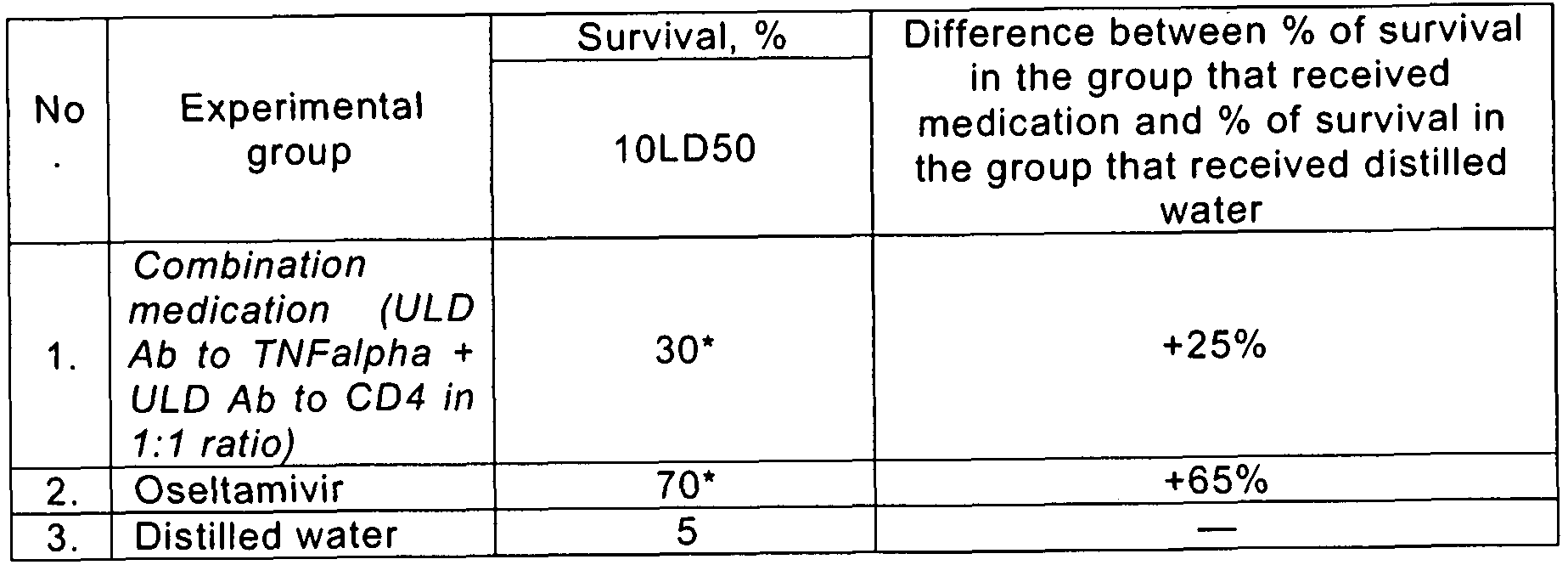
  • Infectious process was simulated through intranasal introduction of influenza virus A/California/07/2009swl (H 1 N 1 ) with a dose 10LD50.
  • Antiviral activity combination medication containing ULD AB to IFNalpha and ULD AB to CD4 in the model of influenza infection at female Balb/c mice infected through intranasal introduction of influenza virus A/California/07/2009swl (H 1 N 1 ) with a dose of 10LD50 (10 th day after infection).
  • combination medication increased in 25% survival of experimental animals infected with influenza virus A/California/07/2009swl (H 1 N 1 ) with a dose of 10LD50 as compared with control.
  • survival in the group that received ULD AB to IFNalpha was only 5% higher than the survival in control group
  • survival rate in the group received ULD AB to CD4 was only 10% higher than the survival in control group.
  • ULD AB to IFNalpha and ULD AB to CD4 provides more pronounced antiviral effect than separate components, in spite of the fact that the dose of ULD AB to IFNalpha and ULD AB to CD4 as part of combination medication is twice lower than the dose of ULD AB to IFNalpha and ULD AB to CD4 tested as separate medications.
  • Infectious process was simulated through intranasal introduction of influenza virus A/California/07/2009swl (H 1 N 1 ) with a dose 10LD50.
  • ULD AB to TNFalpha, ULD AB to CD4 and combination medication were added to drinking bowls of animals of corresponding experimental groups (free access was allowed).
  • Antiviral activity combination medication containing ULD Ab to TNFalpha and ULD Ab to CD4 in the model of influenza infection at female Balb/c mice infected through intranasal introduction of influenza virus A/California/07/2009swl (H1 N 1 ) with a dose of 10LD50 (10 th day after infection).
  • combination medication increased in 25% survival of experimental animals infected with influenza virus A/California/07/2009swl (H 1 N 1 ) with a dose of 10LD50 as compared with control.
  • survival in the group that received ULD Ab to TNFalpha was only 5% higher than the survival in control group
  • survival rate in the group received ULD Ab to CD4 was only 1 0% higher than the survival in control group.
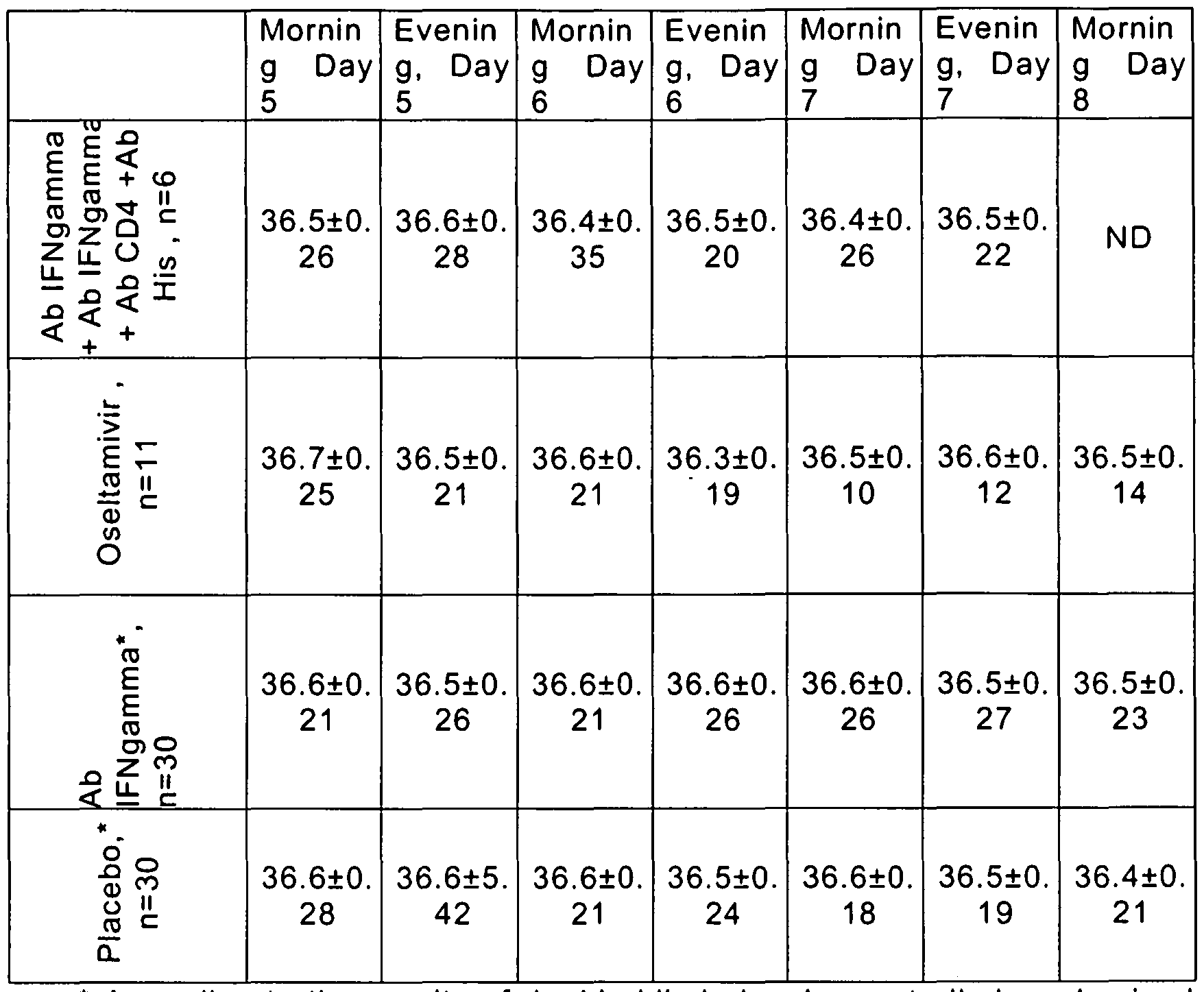
  • compositions containing activated potentiated form of ultra-low doses (ULD) antibodies to interferon gamma (Ab IFNgamma), antibodies to CD4 (Ab CD4), antibodies to histamine (Ab His), impregnated onto lactose in the form of aqueous alcoholic solution of mixture of homeopathic dilutions C12, C30, C200 of each (Ab IFNgamma + Ab CD4 +Ab to His) was used in the study.
  • ULD ultra-low doses
  • Ab IFNgamma antibodies to interferon gamma
  • Ab CD4 antibodies to CD4
  • Ab His antibodies to histamine
  • catarrh signs are enrolled. Patients with body temperature 37.8 °C and higher (provided that the temperature is registered at the onset of the disease), with the duration of the disease not exceeding 48 hours by the time of the therapy onset, not having severe complications were included in the study. Express test to detect influenza virus antigens was conducted. Patients with positive test results were not included in the study. Prior to the beginning of all the procedures the patients sign Informed consent to participate in the study. The patients were given diaries, in which body temperature twice daily, concomitant therapy, etc were registered.
  • the patients receive Ab IFNgamma + Ab CD4 +Ab His or placebo at a dose of 8 tablets daily on Day 1 and at a dose of 3 tablets daily on Days 2-5. If required the patients were allowed to take antipyretics. The intake of antiviral, immunomodulating, antihistamines and antibiotics is not allowed. Prior to start of therapy and at the last visit blood and urine samples are collected for assessment of laboratory parameters aimed at monitoring the safety of the conducted therapy. The overall therapy duration is 5 days, the duration of follow-up observation period is 2 days. Thus the duration of each patient's participation in the study is 7 days.
  • Time to reducing body temperature down to 37.0 °C and lower was considered as the therapy efficacy criterion; besides the number of antipyretics intakes was compared.
  • Table 1 Mean values of body temperature in patients depending on
  • Day 4 Day 5 , Day 5 Day 6 , Day 6 Day 7 , evening morning evening morning evening morning
  • compositions containing activated potentiated forms of ultra-low doses (ULD) antibodies to interferon - gamma (Ab IFNgamma), antibodies to CD4 (Ab to CD4), antibodies to histamine (Ab to His), impregnated onto lactose in the form of aqueous alcoholic mixture of homeopathic dilutions C12, C30, C200 of each (Ab IFNgamma + Ab CD4 +Ab His) was used in the study.
  • ULD ultra-low doses
  • CD4 antibodies to CD4
  • Ab to His antibodies to histamine
  • the patients were given diaries, in which body temperature twice daily, concomitant therapy, etc were registered.
  • the patients receive Ab IFNgamma + Ab CD4 +Ab His at a dose of 8 tablets daily on Day 1 and at a dose of 3 tablets daily on Days 2-5 or or Tamiflu at a dose of 75 mg 2 TID according to patient's information leaflet. If required the patients were allowed to take antipyretics. The intake of antiviral, immunomodulating, antihistamines and antibiotics is not allowed.
  • blood and urine samples Prior to start of therapy and at the last visit blood and urine samples are collected for assessment of laboratory parameters aimed at monitoring the safety of the conducted therapy.
  • the overall therapy duration is 5 days, the duration of follow-up observation period is 2 days. Thus the duration of each patient's participation in the study is 7 days.
  • Time to reducing body temperature down to 37.0 °C and lower was considered as the therapy efficacy criterion; besides the number of antipyretics intakes was compared.
  • Proportions of patients with the body temperature reduced down to 37.0°C and lower in the groups did not significantly differ in the course of therapy. As early as by Day 4 of the treatment patients of both groups practically recovered (see Figure 2). As early as by Day 2 of the treatment in 1/3 of patients of both groups normalization of body temperature was registered. The difference in mean number of antipyretic intakes also was not significant and by the morning of Day 4 of the therapy was 7.6 ⁇ 0.8 in the group receiving Ab IFNgamma + Ab CD4 +Ab His and 7.4 ⁇ 0.90 in Oseltamivir group respectively.
  • Table 1 Mean values of body temperatu re in patients depending on treatment groups, °C, M ⁇ SD
  • ⁇ i 38.1 ⁇ 37.3 ⁇ 37.3 ⁇ 36.9 ⁇ 36.9 ⁇ 36.7 ⁇ 36.8 ⁇ 36.5 ⁇ jS ii 0.82 0.71 0.72 0.53 0.47 0.46 0.37 0.38 % c
  • compositions containing activated potentiated forms of ultra-low doses (ULD) antibodies to interferon - gamma (Ab IFNgamma), antibodies to CD4 (Ab to CD4), antibodies to histamine (Ab to His), impregnated onto lactose in the form of aqueous alcoholic mixture of homeopathic dilutions C12, C30, C200 of each (Ab IFNgamma + Ab CD4 +Ab His) was used in the study.
  • ULD ultra-low doses
  • CD4 antibodies to CD4
  • Ab to His antibodies to histamine
  • ULD anti-IFN- ⁇ + anti-CD4 and ULD anti-IFN- ⁇ + anti-CD4 + anti-His has been evaluated in the course of the open-label comparative clinical trial with participation of the human immunodeficiency virus (HIV) infected patients at Local Centre for Prevention and Fight against AIDS and Infectious Diseases.
  • HIV human immunodeficiency virus
  • ART antiretroviral therapy
  • CD4 M CD8 lymphocytes counts, CD4/CD8 immunoregulatory index were assayed in all the patients.
  • COBAS AMPLICOR HIV-1 MONITOR Kit version 1 ,5 for automatic PCR-analyzer COBAS AMPLICOR, Roche, Switzerland
  • Phenotyping of peripheral blood circulating lymphocytes was carried out on flow cytofluorometer FACSCount (Becton Dickinson, USA) using FACSCount Reagent Kit, which contain FITC PE fluorochrome-labeled antibodies to CD3, CD4, CD8.
  • ULD anti-IFN- ⁇ monotherapy for 6 weeks decreased the number of HIV-1 RNA copies in 36% treatment naive patients (in 4 out of 1 1 people in 3A subgroup), the average viral load decrease was 9.5%.
  • the combination of ULD anti-IFN- ⁇ and ART improved the efficacy of therapy: the viral load decrease was registered in 50% of patients (in 8 out of 16 people in 3B subgroup), the average viral load decrease was 14.2%. In patients taking only ART (group No 4) the decrease in viral load were detected in 32% of patients (in 7 out of 22 patients) and an average viral load decrease 13.3%.
  • the present study demonstrated antiretroviral activity of ULD anti- IFN- Y + anti-CD4 and ULD anti-IFN- ⁇ + anti-CD4 + anti-His pharmaceutical compositions, possibly mediated by the change in functional activity of CD4 receptors, which blocks HIV penetration into the cells, and also suppresses HIV replication inside the cell due to activation of transcription of mRNA of antiviral proteins.
  • compositions containing ULD anti-IFN- ⁇ + anti-CD4 and ULD anti-IFN- ⁇ + anti-CD4 + anti- His makes it possible to use them for the treatment and prophylaxis of HIV infection both in treatment naive HIV-infected patients and in patients taking ART.
  • Control group consisted of 5 patients with persistent viremia and stable normal levels of aminotransferases ( ⁇ 20 U/l) received no specific therapy. During the study course regular examinations, control of viral load and laboratory rates were carried out, concomitant therapy was registered as well as undesirable adverse events. Therapy efficacy was assessed on week 24 by viral load with HCV RNA and activity of alanine-aminotransferase (ALT).
  • ALT alanine-aminotransferase
  • Antiviral activity of the studies pharmaceutical compositions was accompanied with positive changes in ALT level registered in patients of groups 1 -3 by the end of 24-week therapy. Normalization of ALT level was found in 2 patients of ULD anti- IFN-Y+anti-CD4 group, in 1 patient of ULD anti- IFN-Y+anti-CD4+anti-His group and in 1 patient ULD anti- IFN- ⁇ group. In 1 patient of control group ALT level exceeded upper border of norm (>20 U/l) due to an increase of viral load at the end of 24-week study period. No drugs-related adverse events were registered during the study, which evidences of their good tolerance. Absence of pathological variations in blood and urine analysis including markers of renal and hepatic insufficiency confirmed safety of the treatment.
  • ULD anti- IFN-y+anti-CD4 ULD anti- IFN-y+anti-CD4+anti- His and ULD anti- IFN- ⁇ was accompanied with a reduction of activity of chronic hepatitis C, which was confirmed by the reduction and even normaluzation of ALT level in some patients at the end of 24-week course of treatment.

Landscapes

  • Health & Medical Sciences (AREA)
  • Chemical & Material Sciences (AREA)
  • Life Sciences & Earth Sciences (AREA)
  • Medicinal Chemistry (AREA)
  • Immunology (AREA)
  • Organic Chemistry (AREA)
  • General Health & Medical Sciences (AREA)
  • Veterinary Medicine (AREA)
  • Animal Behavior & Ethology (AREA)
  • Pharmacology & Pharmacy (AREA)
  • Public Health (AREA)
  • Molecular Biology (AREA)
  • Proteomics, Peptides & Aminoacids (AREA)
  • Genetics & Genomics (AREA)
  • Biophysics (AREA)
  • Biochemistry (AREA)
  • Engineering & Computer Science (AREA)
  • Virology (AREA)
  • Bioinformatics & Cheminformatics (AREA)
  • Epidemiology (AREA)
  • Chemical Kinetics & Catalysis (AREA)
  • Nuclear Medicine, Radiotherapy & Molecular Imaging (AREA)
  • General Chemical & Material Sciences (AREA)
  • Microbiology (AREA)
  • Mycology (AREA)
  • Communicable Diseases (AREA)
  • Oncology (AREA)
  • Endocrinology (AREA)
  • Hematology (AREA)
  • Pulmonology (AREA)
  • Alternative & Traditional Medicine (AREA)
  • Tropical Medicine & Parasitology (AREA)
  • AIDS & HIV (AREA)
  • Biotechnology (AREA)
  • Gastroenterology & Hepatology (AREA)
  • Otolaryngology (AREA)
  • Medicines Containing Antibodies Or Antigens For Use As Internal Diagnostic Agents (AREA)
  • Medicines That Contain Protein Lipid Enzymes And Other Medicines (AREA)
  • Peptides Or Proteins (AREA)

Abstract

A combination pharmaceutical composition comprising a) an activated-potentiated form of an antibody to at least one cytokine and b) an activated-potentiated form of an antibody to at least one receptor, and methods of treating and preventing the infectious diseases, including bacterial infections caused by different infectious agents such as pseudotuberculosis, whooping cough, yersiniosis, pneumonitis of different etiology, and acute and chronic viral infections such as acute respiratory tract infections, influenza of different types, acute viral hepatitis A, B, C and other types of hepatitis, the diseases and conditions caused by HIV or associated with HIV, including AIDS.

Description

COMBINATION PHARMACEUTICAL COMPOSITION AND
METHODS OF TREATING AND PREVENTING THE INFECTIOUS DISEASES FIELD
The present invention relates to a pharmaceutical composition and method of treating and preventing the infectious diseases, including bacterial infections caused by different infectious agents such as pseudotuberculosis, whooping cough, yersiniosis, pneumonitis of different etiology, and acute and chronic viral infections such as acute respiratory tract infections, influenza of different types, acute viral hepatitis A, B, C and other types of hepatitis, the diseases and conditions caused by HIV or associated with HIV, including AIDS.
BACKGROUND
The invention relates to the area of medicine and may be used for the treatment and preventing the infectious diseases, including bacterial infections caused by different infectious agents such as pseudotuberculosis, whooping cough, yersiniosis, pneumonitis of different etiology, and acute and chronic viral infections such as acute respiratory tract infections, influenza of different types, acute viral hepatitis A, B, C and other types of hepatitis, the diseases and conditions caused by HIV or associated with HIV, including AIDS.
Treatment of viral diseases based on ultra-low doses of antibodies to interferon is known in the art (RU 2192888 C1 , A61 K39/395, 11/20/2002). However, the given medical product can be not effective enough for treatment of the diseases associated with HIV.
The therapeutic effect of an extremely diluted form (or ultra-low form) of antibodies potentized by homeopathic technology (activated-potentiated form) has been discovered by Dr. Oleg I. Epshtein. For example, U.S. Patent No. 7,582,294 discloses a medicament for treating Benign Prostatic Hyperplasia or prostatitis by administration of a homeopathically activated form of antibodies to prostate specific antigen (PSA). Ultra-low doses of antibodies to gamma interferon have been shown to be useful in the treatment and prophylaxis of diseases of viral etiology. See U.S. Patent No. 7,572,441 , which is incorporated herein by reference in its entirety. The present invention is directed to a pharmaceutical composition and methods of its use in treatment and preventing of the infectious diseases , including bacterial infections caused by different infectious agents such as pseudotuberculosis, whooping cough, yersiniosis, pneumonitis of different etiology, and acute and chronic viral infections such as acute respiratory tract infections, influenza of different types, acute viral hepatitis A, B, C and other types of hepatitis, the diseases and conditions caused by HIV or associated with HIV, including AIDS.
The solution to the existing problem is presented in form of a combination pharmaceutical composition for treatment and prophylaxis (prevetion) of infectious diseases, which comprises a) an activated-potentiated form of antibodies to cytokine and b) an activated-potentiated form of antibodies to receptor.
SUMMARY
In one aspect, the invention provides a combination pharmaceutical composition comprising a) an activated-potentiated form of an antibody to at least one cytokine and b) an activated-potentiated form of an antibody to at least one receptor. In an embodiment, the pharmaceutical composition further comprises a solid carrier, wherein said activated-potentiated forms of antibodies are impregnated onto said solid carrier. In a variant, the pharmaceutical composition is in the form of a tablet.
Preferably, the pharmaceutical composition including said activated- potentiated forms of antibodies is in the form of a mixture of C12, C30, and C200 homeopathic dilutions. It is specifically contemplated that said mixture of C12, C30, and C200 homeopathic dilutions is impregnated onto a solid carrier.
The activated-potentiated forms of said antibodies may be activated- potentiated forms of a monoclonal, polyclonal or natural antibody. It is specifically contemplated that the activated-potentiated form of said antibodies is activated- potentiated form of a polyclonal antibody. The invention provides activated- potentiated forms of antibodies to antigen(s) having sequences described in the specification and claimed in the appended claims.
In a variant, the pharmaceutical composition includes activated-potentiated forms of antibodies prepared by successive centesimal dilutions coupled with shaking of every dilution. Vertical shaking is specifically contemplated. In another aspect, the invention provides a method of treating and preventing the infectious diseases, said method comprising administering to a patient in need thereof a) an activated-potentiated form of an antibody to at least one cytokine and b) an activated-potentiated form of an antibody to at least one receptor. Preferably, the activated-potentiated forms of antibodies are administered in the form of pharmaceutical composition.
In an embodiment, the pharmaceutical composition is administered in the form of a solid oral dosage form which comprises a pharmaceutically acceptable carrier and an activated-potentiated form of an antibody to at least one cytokine and activated-potentiated form of an antibody to at least one receptor, said activated- potentiated forms impregnated onto said carrier. In a variant, said solid oral dosage form is a tablet. Variants and embodiments are provided.
In accordance with the method aspect of the invention, the pharmaceutical composition may be administered in one to three unit dosage forms, each of the dosage form being administered from once daily to six times daily. In a variant, the pharmaceutical composition is administered twice daily, each administration consisting of two oral dosage forms. In a variant, the pharmaceutical composition is administered in one to two unit dosage forms, each of the dosage forms being administered twice daily. In a variant, the pharmaceutical composition is administered in one to two unit dosage forms, each of the dosage forms being administered four times daily. All variants and embodiments described with respect to the composition aspect of the invention may be used with the method aspect of the invention. DETAILED DESCRIPTION
The invention is defined with reference to the appended claims. With respect to the claims, the glossary that follows provides the relevant definitions.
The term "antibody" as used herein shall mean an immunoglobulin that specifically binds to, and is thereby defined as complementary with, a particular spatial and polar organization of another molecule. Antibodies as recited in the claims may include a complete immunoglobulin or fragment thereof, may be natural, polyclonal or monoclonal, and may include various classes and isotypes, such as IgA, IgD, IgE, lgG1 , lgG2a, lgG2b and lgG3, IgM, etc. Fragments thereof may include Fab, Fv and F(ab')2, Fab', and the like. The singular "antibody" includes plural "antibodies."
The term "activated-potentiated form" or "potentiated form" respectively, with respect to antibodies recited herein is used to denote a product of homeopathic potentization of any initial solution of antibodies. "Homeopathic potentization" denotes the use of methods of homeopathy to impart homeopathic potency to an initial solution of relevant substance. Although not so limited, 'homeopathic potentization" may involve, for example, repeated consecutive dilutions combined with external treatment, particularly vertical (mechanical) shaking. In other words, an initial solution of antibody is subjected to consecutive repeated dilution and multiple vertical shaking of each obtained solution in accordance with homeopathic technology. The preferred concentration of the initial solution of antibody in the solvent, preferably water or a water-ethyl alcohol mixture, ranges from about 0.5 to about 5.0 mg/ml. The preferred procedure for preparing each component, i.e. antibody solution, is the use of the mixture of three aqueous or aqueous-alcohol dilutions of the primary matrix solution (mother tincture) of antibodies diluted 10012, 10030 and 100200 times, respectively, which is equivalent to centesimal homeopathic dilutions (C12, C30, and C200) or the use of the mixture of three aqueous or aqueous-alcohol dilutions of the primary matrix solution of antibodies diluted 10012, 10030 and 10050 times, respectively, which is equivalent to centesimal homeopathic dilutions (C12, C30 and C50). Examples of homeopathic potentization are described in U.S. Patent. Nos. 7,572,441 and 7,582,294, which are incorporated herein by reference in their entirety and for the purpose stated. While the term "activated-potentiated form" is used in the claims, the term "ultra-low doses" is used in the examples. The term "ultra-low doses" became a term of art in the field of art created by study and use of homeopathically diluted and potentized form of substance. The term "ultra-low dose" or "ultra-low doses" is meant as fully supportive and primarily synonymous with the term 'activated-potentiated" form used in the claims.
In other words, an antibody is in the "activated-potentiated" or "potentiated" form when three factors are present. First, the "activated-potentiated" form of the antibody is a product of a preparation process well accepted in the homeopathic art. Second, the "activated-potentiated" form of antibody must have biological activity determined by methods well accepted in modern pharmacology. And third, the biological activity exhibited by the "activated potentiated" form of the antibody cannot be explained by the presence of the molecular form of the antibody in the final product of the homeopathic process.
For example, the activated potentiated form of antibodies may be prepared by subjecting an initial, isolated antibody in a molecular form to consecutive multiple dilutions coupled with an external impact, such as mechanical shaking. The external treatment in the course of concentration reduction may also be accomplished, for example, by exposure to ultrasonic, electromagnetic, or other physical factors. V. Schwabe "Homeopathic medicines", M., 1967, U.S. Patents Nos. 7,229,648 and 4,311 ,897, which are incorporated by reference in their entirety and for the purpose stated, describe such processes that are well-accepted methods of homeopathic potentiation in the homeopathic art. This procedure gives rise to a uniform decrease in molecular concentration of the initial molecular form of the antibody. This procedure is repeated until the desired homeopathic potency is obtained. For the individual antibody, the required homeopathic potency can be determined by subjecting the intermediate dilutions to biological testing in the desired pharmacological model. Although not so limited, 'homeopathic potentization" may involve, for example, repeated consecutive dilutions combined with external treatment, particularly vertical (mechanical) shaking. In other words, an initial solution of antibody is subjected to consecutive repeated dilution and multiple vertical shaking of each obtained solution in accordance with homeopathic technology. The preferred concentration of the initial solution of antibody in the solvent, preferably, water or a water-ethyl alcohol mixture, ranges from about 0.5 to about 5.0 mg/ml. The preferred procedure for preparing each component, i.e. antibody solution, is the use of the mixture of three aqueous or aqueous-alcohol dilutions of the primary matrix solution (mother tincture) of antibodies diluted 10012, 10030 and 100200 times, respectively, which is equivalent to centesimal homeopathic dilutions C12, C30 and C200 or the mixture of three aqueous or aqueous-alcohol dilutions of the primary matrix solution (mother tincture) of antibodies diluted 10012, 10030 and 10050 times, respectively, which is equivalent to centesimal homeopathic dilutions C12, C30 and C50. Examples of how to obtain the desired potency are also provided, for example, in U.S. Patent Nos. 7,229,648 and 4,311 ,897, which are incorporated by reference for the purpose stated. The procedure applicable to the "activated-potentiated" form of the antibodies described herein is described in more detail below. There has been a considerable amount of controversy regarding homeopathic treatment of human subjects. While the present invention relies on accepted homeopathic processes to obtain the "activated-potentiated" form of antibodies, it does not rely solely on homeopathy in human subjects for evidence of activity. It has been surprisingly discovered by the inventor of the present application and amply demonstrated in the accepted pharmacological models that the solvent ultimately obtained from consecutive multiple dilution of a starting molecular form of an antibody has definitive activity unrelated to the presence of the traces of the molecular form of the antibody in the target dilution. The "activated-potentiated" form of the antibody provided herein are tested for biological activity in well accepted pharmacological models of activity, either in appropriate in vitro experiments, or in vivo in suitable animal models. The experiments provided further below provide evidence of biological activity in such models. Human clinical studies also provide evidence that the activity observed in the animal model is well translated to human therapy. Human studies have also provided evidence of availability of the "activated potentiated" forms described herein to treat specified human diseases or disorders well accepted as pathological conditions in the medical science.
Also, the claimed "activated-potentiated" form of antibody encompasses only solutions or solid preparations the biological activity of which cannot be explained by the presence of the molecular form of the antibody remaining from the initial, starting solution. In other words, while it is contemplated that the "activated-potentiated" form of the antibody may contain traces of the initial molecular form of the antibody, one skilled in the art could not attribute the observed biological activity in the accepted pharmacological models to the remaining molecular form of the antibody with any degree of plausibility due to the extremely low concentrations of the molecular form of the antibody remaining after the consecutive dilutions. While the invention is not limited by any specific theory, the biological activity of the "activated-potentiated' form of the antibodies of the present invention is not attributable to the initial molecular form of the antibody. Preferred is the "activated-potentiated" form of antibody in liquid or solid form in which the concentration of the molecular form of the antibody is below the limit of detection of the accepted analytical techniques, such as capillary electrophoresis and High Performance Liquid Chromatography. Particularly preferred is the "activated-potentiated" form of antibody in liquid or solid form in which the concentration of the molecular form of the antibody is below the Avogadro number. In the pharmacology of molecular forms of therapeutic substances, it is common practice to create a dose-response curve in which the level of pharmacological response is plotted against the concentration of the active drug administered to the subject or tested in vitro. The minimal level of the drug which produces any detectable response is known as a threshold dose. It is specifically contemplated and preferred that the "activated-potentiated" form of the antibodies contains molecular antibody, if any, at a concentration below the threshold dose for the molecular form of the antibody in the given biological model.
The present invention provides a combination pharmaceutical composition that includes activated-potentiated form of antibodies to cytokine and activated- potentiated form of antibodies to receptor, prepared according to the homeopathic technology of potentiation by repeated, consistent dilution and intermediate external action of shaking as described in more detail herein below. The pharmaceutical composition of the invention is particularly useful in the treatment and prophylaxis of the infectious diseases, including bacterial infections caused by different infectious agents such as pseudotuberculosis, whooping cough, yersiniosis, pneumonitis of different etiology, and acute and chronic viral infections such as acute respiratory tract infections, flu of different types, acute viral hepatitis A, B, C and other types of hepatitis, the diseases and conditions caused by HIV or associated with HIV, including AIDS. As shown in the Examples, the pharmaceutical composition of the invention possesses unexpected synergetic therapeutic effect, which manifest itself in particular therapeutic effectiveness in treating and preventing the infectious diseases, including bacterial infections caused by different infectious agents such as pseudotuberculosis, whooping cough, yersiniosis, pneumonitis of different etiology, and acute and chronic viral infections such as acute respiratory tract infections, influenza of different types, acute viral hepatitis A, B, C and other types of hepatitis, the diseases and conditions caused by HIV or associated with HIV, including AIDS.
The pharmaceutical composition of the invention expands the arsenal of preparations available for the treatment prophylaxis of the infectious diseases, including bacterial infections and acute and chronic viral infections.
The combination pharmaceutical composition in accordance with this aspect of the invention may be in the liquid form or in solid form. Activated- potentiated form of the antibodies included in the pharmaceutical composition is prepared from an initial molecular form of the antibody via a process accepted in homeopathic art. The starting antibodies may be monoclonal, or polyclonal antibodies prepared in accordance with known processes, for example, as described in Immunotechniques, G. Frimel, M., "Meditsyna", 1987, p. 9-33; "Hum. Antibodies. Monoclonal and recombinant antibodies, 30 years after" by Laffly E., Sodoyer R. - 2005 - Vol. 14. - N 1-2. P.33-55, both incorporated herein by reference.
Monoclonal antibodies may be obtained, e.g., by means of hybridoma technology. The initial stage of the process includes immunization based on the principles already developed in the course of polyclonal antisera preparation. Further stages of work involve the production of hybrid cells generating clones of antibodies with identical specificity. Their separate isolation is performed using the same methods as in the case of polyclonal antisera preparation.
Polyclonal antibodies may be obtained via active immunization of animals. For this purpose, for example, suitable animals (e.g. rabbits) receive a series of injections of the appropriate antigen (cytokine and receptor). The animals' immune system generates corresponding antibodies, which are collected from the animals in a known manner. This procedure enables preparation of a monospecific antibody-rich serum.
If desired, the serum containing antibodies may be purified, for example by using affine chromatography, fractionation by salt precipitation, or ion-exchange chromatography. The resulting purified, antibody-enriched serum may be used as a starting material for the preparation of the activated-potentiated form of the antibodies. The preferred concentration of the resulting initial solution of antibody in the solvent, preferably water or a water-ethyl alcohol mixture, ranges from about 0.5 to about 5.0 mg/ml.
The preferred procedure for preparing each component of the combination drug according to the present invention is the use of the mixture of three aqueous- alcohol dilutions of the primary matrix solution of antibodies diluted 10012, 10030 and 10050 times, respectively, which is equivalent to centesimal homeopathic dilutions C12, C30, and C50 or diluted 10012, 10030 and 100200 times, respectively, which is equivalent to centesimal homeopathic dilutions C12, C30 and C200. To prepare a solid dosage form, a solid carrier is treated with the desired dilution obtained via thehomeopathic process. To obtain a solid unit dosage form of the combination of the invention, the carrier mass is impregnated with each of the dilutions. Both orders of impregnation are suitable to prepare the desired combination dosage form. In a preferred embodiment, the starting material for the preparation of the activated potentiated form that comprise the combination pharmaceutical composition of the invention is polyclonal, animal-raised antibody to the corresponding antigen. To obtain the activated-potentiated form of polyclonal antibodies to cytokine or receptor, the desired antigen may be injected as immunogen into a laboratory animal, preferably, rabbits.
Polyclonal antibodies to CD4 receptor may be obtained using the whole molecule of human CD4 receptor of the following sequence:
SEQ. ID. NO. 1
Met Asn Arg Gly Val Pro Phe Arg His Leu Leu Leu Val Leu Gin
1 5 10 15
Leu Ala Leu Leu Pro Ala Ala Thr Gin Gly Lys Lys Val Val Leu
16 20 25 30
Gly Lys Lys Gly Asp Thr Val Glu Leu Thr Cys Thr Ala Ser Gin
31 35 40 45
Lys Lys Ser He Gin Phe His Trp Lys Asn Ser Asn Gin He Lys
46 50 55 60
He Leu Gly Asn Gin Gly Ser Phe Leu Thr Lys Gly Pro Ser Lys
61 65 70 75
Leu Asn Asp Arg Ala Asp Ser Arg Arg Ser Leu rp Asp Gin Gly
76 80 85 90
Asn Phe Pro Leu He He Lys Asn Leu Lys He Glu Asp Ser Asp
91 95 100 105
Thr Tyr He Cys Glu Val Glu Asp Gin Lys Glu Glu Val Gin Leu
106 110 115 120
Leu Val Phe Gly Leu Thr Ala Asn Ser Asp Thr His Leu Leu Gin
121 125 130 135
Gly Gin Ser Leu Thr Leu Thr Leu Glu Ser Pro Pro Gly Ser Ser
136 140 145 150
Pro Ser Val Gin Cys Arg Ser Pro Arg Gly Lys Asn He Gin Gly
151 155 160 165
Gly Lys Thr Leu Ser Val Ser Gin Leu Glu Leu Gin Asp Ser Gly
166 170 175 180
Thr Trp Thr Cys Thr Val Leu Gin Asn Gin Lys Lys Val Glu Phe
181 185 190 195
Lys He Asp He Val Val Leu Ala Phe Gin Lys Ala Ser Ser He
196 200 205 210
Val Tyr Lys Lys Glu Gly Glu Gin Val Glu Phe Ser Phe Pro Leu
211 215 220 225
Ala Phe Thr Val Glu Lys Leu Thr Gly Ser Gly Glu Leu Trp Trp
226 230 235 240
Gin Ala Glu Arg Ala Ser Ser Ser Lys Ser Trp He Thr Phe Asp
241 245 250 255
Leu Lys Asn Lys Glu Val Ser Val Lys Arg Val Thr Gin Asp Pro
256 260 265 270 Lys Leu Gin Met Gly Lys Lys Leu Pro Leu His Leu Thr Leu Pro 271 275 280 285 Gin Ala Leu Pro Gin Tyr Ala Gly Ser Gly Asn Leu Thr Leu Ala 286 290 295 300 Leu Glu Ala Lys Thr Gly Lys Leu His Gin Glu Val Asn Leu Val 301 305 310 315 Val Met Arg Ala Thr Gin Leu Gin Lys Asn Leu Thr Cys Glu Val 316 320 325 330 Trp Gly Pro Thr Ser Pro Lys Leu Met Leu Ser Leu Lys Leu Glu 331 335 340 345 Asn Lys Glu Ala Lys Val Ser Lys Arg Glu Lys Ala Val Trp Val 346 350 355 360 Leu Asn Pro Glu Ala Gly Met Trp Gin Cys Leu Leu Ser Asp Ser 361 365 370 375 Gly Gin Val Leu Leu Glu Ser Asn He Lys Val Leu Pro Thr Trp 376 380 385 390 Ser Thr Pro Val Gin Pro Met Ala Leu He Val Leu Gly Gly Val 391 395 400 405 Ala Gly Leu Leu Leu Phe He Gly Leu Gly He Phe Phe Cys Val 406 410 415 420 Arg Cys Arg His Arg Arg Arg Gin Ala Glu Arg Met Ser Gin He 421 425 430 435 Lys Arg Leu Leu Ser Glu Lys Lys Thr Cys Gin Cys Pro His Arg 436 440 445 450 Phe Gin Lys Thr Cys Ser Pro He
451 445 458
The polyclonal antibodies to CD4 receptor can be obtained using a polypeptide fragment of CD4 receptor chosen, for example, from the following amino-acid sequences:
SEQ. ID. NO. 2
Gly Lys Lys Val Val Leu
26 30
Gly Lys Lys Gly Asp Thr Val Glu Leu Thr Cys Thr Ala Ser Gin
31 35 40 45
Lys Lys Ser He Gin Phe His Trp Lys Asn Ser Asn Gin He Lys
46 50 55 60
He Leu Gly Asn Gin Gly Ser Phe Leu Thr Lys Gly Pro Ser Lys
61 65 70 75
Leu Asn Asp Arg Ala Asp Ser Arg Arg Ser Leu Trp Asp Gin Gly
76 80 85 90
Asn Phe Pro Leu He He Lys Asn Leu Lys He Glu Asp Ser Asp
91 95 100 105
Thr Tyr He Cys Glu Val Glu Asp Gin Lys Glu Glu Val Gin Leu
106 110 115 120
Leu Val Phe Gly Leu Thr Ala Asn Ser Asp Thr His Leu Leu Gin
121 125 130 135
Gly Gin Ser Leu Thr Leu Thr Leu Glu Ser Pro Pro Gly Ser Ser 136 140 145 150
Pro Ser Val Gin Cys Arg Ser Pro Arg Gly Lys Asn lie Gin Gly
151 155 160 165
Gly Lys Thr Leu Ser Val Ser Gin Leu Glu Leu Gin Asp Ser Gly 166 170 175 180
Thr Trp Thr Cys Thr Val Leu Gin Asn Gin Lys Lys Val Glu Phe
181 185 190 195
Lys lie Asp lie Val Val Leu Ala Phe Gin Lys Ala Ser Ser lie
196 200 205 210 Val Tyr Lys Lys Glu Gly Glu Gin Val Glu Phe Ser Phe Pro Leu
211 215 220 225
Ala Phe Thr Val Glu Lys Leu Thr Gly Ser Gly Glu Leu Trp Trp
226 230 235 240
Gin Ala Glu Arg Ala Ser Ser Ser Lys Ser Trp lie Thr Phe Asp 241 245 250 255
Leu Lys Asn Lys Glu Val Ser Val Lys Arg Val Thr Gin Asp Pro
256 260 265 270
Lys Leu Gin Met Gly Lys Lys Leu Pro Leu His Leu Thr Leu Pro
271 275 280 285 Gin Ala Leu Pro Gin Tyr Ala Gly Ser Gly Asn Leu Thr Leu Ala
286 290 295 300
Leu Glu Ala Lys Thr Gly Lys Leu His Gin Glu Val Asn Leu Val
301 305 310 315
Val Met Arg Ala Thr Gin Leu Gin Lys Asn Leu Thr Cys Glu Val 316 320 325 330
Trp Gly Pro Thr Ser Pro Lys Leu Met Leu Ser Leu Lys Leu Glu
331 335 340 345
Asn Lys Glu Ala Lys Val Ser Lys Arg Glu Lys Ala Val Trp Val
346 350 355 360 Leu Asn Pro Glu Ala Gly Met Trp Gin Cys Leu Leu Ser Asp Ser
361 365 370 375
Gly Gin Val Leu Leu Glu Ser Asn lie Lys Val Leu Pro Thr Trp
376 380 385 390
Ser Thr Pro Val Gin Pro Met Ala Leu He Val Leu Gly Gly Val 391 395 400 405
Ala Gly Leu Leu Leu Phe He Gly Leu Gly He Phe Phe Cys Val
406 410 415 420
Arg Cys Arg His Arg Arg Arg Gin Ala Glu Arg Met Ser Gin He
421 425 430 435 Lys Arg Leu Leu Ser Glu Lys Lys Thr Cys Gin Cys Pro His Arg
436 440 445 450 Phe Gin Lys Thr Cys Ser Pro He
451 445 458 SEQ. ID. NO.3
He Gly Leu Gly He Phe Phe Cys Val
412 415 420
Arg Cys Arg His Arg Arg Arg Gin Ala Glu Arg Met Ser Gin He
421 425 430 435 Lys Arg Leu Leu Ser Glu Lys Lys Thr Cys Gin Cys Pro His Arg 436 440 445 450 Phe Gin Lys Thr Cys Ser Pro He
451 445 458
SEQ. ID. NO. 4
Gly Lys Lys Val Val Leu
26 30
Gly Lys Lys Gly Asp Thr Val Glu Leu Thr Cys Thr Ala Ser Gin
31 35 40 45
Lys Lys Ser He Gin Phe His Trp Lys Asn Ser Asn Gin He Lys
46 50 55 60
SEQ. ID. NO. 5
Asp
91 95 100 105 Thr Tyr He Cys Glu Val Glu Asp Gin Lys Glu Glu Val Gin 106 110 115 119
SEQ. ID. NO. 6
Lys Glu Glu Val Gin Leu 115 120
Leu Val Phe Leu Thr Ala Asn Ser Asp Thr His Leu Leu Gin 121 125 130 135
Gly Gin Ser
136
The exemplary procedure for preparation of the starting polyclonal antibodies to CD4 receptor may be described as follows. In 7-9 days before blood sampling, 1 -3 intravenous injections of the desired antigen are made to the rabbits to increase the level of polyclonal antibodies in the rabbit blood stream. Upon immunization, blood samples are taken to test the antibody level. Typically, the maximum level of immune reaction of the soluble antigen is achieved within 40 to 60 days after the first injection of the antigen. Upon completion of the first immunization cycle, rabbits have a 30-day rehabilitation period, after which re-immunization is performed with another 1 -3 intravenous injections.
To obtain antiserum containing the desired antibodies, the immunized rabbits' blood is collected from rabbits and placed in a 50ml centrifuge tube. Product clots formed on the tube sides are removed with a wooden spatula, and a rod is placed into the clot in the tube center. The blood is then placed in a refrigerator for one night at the temperature of about 40°C. On the following day, the clot on the spatula is removed, and the remaining liquid is centrifuged for 10 min at 13,000 rotations per minute. Supernatant fluid is the target antiserum. The obtained antiserum is typically yellow. 20% of NaN3 (weight concentration) is added in the antiserum to a final concentration of 0.02% and stored before use in frozen state at the temperature of - 20°C or without NaN3 at the temperature of -70°C. To separate the target antibodies to gamma interferon from the antiserum, the following solid phase absorption sequence is suitable:
10 ml of the antiserum of rabbits is diluted twofold with 0.15 M NaCI, after which 6.26g Na2S04 is added, mixed and incubated for 12-16 hours at 4°C. The sediment is removed by centrifugation, diluted in 10ml of phosphate buffer and dialyzed against the same buffer during one night at ambient temperature. After the sediment is removed, the solution is applied to a DEAE-cellulose column balanced by phosphate buffer. The antibody fraction is determined by measuring the optical density of the eluate at 280 nm.
The isolated crude antibodies are purified using affine chromatography method by attaching the obtained antibodies to CD4 antigen located on the insoluble matrix of the chromatography media, with subsequent elution by concentrated aqueous salt solutions.
The resulting buffer solution is used as the initial solution for the homeopathic dilution process used to prepare the activated potentiated form of the antibodies. The preferred concentration of the initial matrix solution of the antigen-purified polyclonal rabbit antibodies to CD4 receptor is 0.5 to 5.0 mg/ml, preferably, 2.0 to 3.0 mg/ml.
The polyclonal antibodies to gamma interferon may also be obtained by a similar methodology to the methodology described for CD4 receptor antibodies using an adjuvant. Polyclonal antibodies to gamma interferon may be obtained using the whole molecule of gamma interferon of the following sequence:
SEQ ID NO: 7
Met Lys Tyr Th r Se r Tyr l i e Leu Al a Phe Gi n Leu Cys l ie Va l
1 5 10 1 5 Leu Gl y Se r Leu Gl y Cys Tyr Cys Gi n Asp Pro Tyr Va l Lys Gl u
1 6 20 25 30 Ala Gl u As n Leu Lys Lys Tyr Phe As n Al a Gl y Hi s Se r Asp Va l 31 35 40 4 5
Ala Asp As n Gl y Th r Leu Phe Leu Gl y l ie Leu Lys Asn Trp Lys 4 6 50 55 60 Glu Glu Ser Asp Arg Lys He Met Gin Ser Gin He Val Ser Phe
61 65 70 75
Tyr Phe Lys Leu Phe Lys Asn Phe Lys Asp Asp Gin Ser He Gin
76 80 85 90
Lys Ser Val Glu Thr He Lys Glu Asp Met Asn Val Lys Phe Phe
91 95 100 105
Asn Ser Asn Lys Lys Lys Arg Asp Asp Phe Glu Lys Leu Thr Asn
106 110 115 120
Tyr Ser Val Thr Asp Leu Asn Val Gin Arg Lys Ala He His Glu
121 125 130 135
Leu He Gin Val Met Ala Glu Leu Ser Pro Ala Ala Lys Thr Gly
136 140 145 150
Lys Arg Lys Arg Ser Gin Met Leu Phe Arg Gly Arg Arg Ala Ser
151 155 160 165 Gin
166
Polyclonal antibodies to gamma interferon may be obtained using the whole molecule of gamma interferon of the following sequence:
SEQ ID NO: 8
Met Lys Tyr Thr Ser Tyr He Leu Ala Phe Gin Leu Cys He Val
1 5 10 15
Leu Gly Ser Leu Gly Cys Tyr Cys Gin Asp Pro Tyr Val Lys Glu
16 20 25 30
Ala Glu Asn Leu Lys Lys Tyr Phe Asn Ala Gly His Ser Asp Val
31 35 40 45
Ala Asp Asn Gly Thr Leu Phe Leu Gly He Leu Lys Asn Trp Lys
46 50 55 60
Glu Glu Ser Asp Arg Lys He Met Gin Ser Gin He Val Ser Phe
61 65 70 75
Tyr Phe Lys Leu Phe Lys Asn Phe Lys Asp Asp Gin Ser He Gin
76 80 85 90
Lys Ser Val Glu Thr He Lys Glu Asp Met Asn Val Lys Phe Phe
91 95 100 105
Asn Ser Asn Lys Lys Lys Arg Asp Asp Phe Glu Lys Leu Thr Asn
106 110 115 120
Tyr Ser Val Thr Asp Leu Asn Val Gin Arg Lys Ala He His Glu
121 125 130 135
Leu He Gin Val Met Ala Glu Leu Ser Pro Ala Ala Lys Thr Gly
136 140 145 150
Lys Arg Lys Arg Ser Gin Met Leu Phe Gin Gly Arg Arg Ala Ser
151 155 160 165
Gin
166
The use of gamma interferon fragments as antigen is also contemplated. The suitable sequence for such antigen is as follow:
SEQ ID NO: 9
He Leu Ala Phe Gin Leu Cys He Val 7 10 15
Leu Gly Ser Leu Gly Cys Tyr Cys Gin Asp Pro Tyr Val Lys Glu 16 20 25 30
Ala Glu Asn Leu Lys Lys Tyr Phe Asn Ala Gly His Ser Asp Val 31 35 40 45
Ala Asp Asn Gly Thr Leu Phe Leu Gly He
46 50 55
SEQ ID NO: 10
Gin Asp Pro Tyr Val Lys Glu
24 30
Ala Glu Asn Leu Lys Lys Tyr Phe Asn Ala Gly His Ser Asp Val
31 35 40 45
Ala Asp Asn Gly Thr Leu Phe Leu Gly He Leu Lys Asn Trp Lys
46 50 55 60
Glu Glu Ser Asp Arg Lys He Met Gin Ser Gin He Val Ser Phe
61 65 70 75
Tyr Phe Lys Leu Phe Lys Asn Phe Lys Asp Asp Gin Ser He Gin
76 80 85 90
Lys Ser Val Glu Thr He Lys Glu Asp Met Asn Val Lys Phe Phe
91 95 100 105
Asn Ser Asn Lys Lys Lys Arg Asp Asp Phe Glu Lys Leu Thr Asn
106 110 115 120
Tyr Ser Val Thr Asp Leu Asn Val Gin Arg Lys Ala He His Glu
121 125 130 135
Leu He Gin Val Met Ala Glu Leu Ser Pro Ala Ala Lys Thr Gly
136 140 145 150
Lys Arg Lys Arg Ser Gin Met Leu Phe Arg Gly Arg Arg Ala Ser
151 155 160 165
Gin
166
SEQ ID NO: 1 1
Gin Asp Pro Tyr Val Lys Glu
24 30
Ala Glu Asn Leu Lys Lys Tyr Phe Asn Ala Gly His Ser Asp Val 31 35 40 45
Ala Asp Asn Gly Thr Leu Phe Leu Gly He Leu Lys Asn Trp Lys 46 50 55 60
Glu Glu Ser Asp Arg Lys He Met Gin Ser Gin He Val Ser Phe 61 65 70 75
Tyr Phe Lys Leu Phe Lys Asn Phe Lys Asp Asp Gin Ser He Gin 76 80 85 90
Lys Ser Val Glu Thr He Lys Glu Asp Met Asn Val Lys Phe Phe 91 95 100 105
Asn Ser Asn Lys Lys Lys Arg Asp Asp Phe Glu Lys Leu Thr Asn 106 110 115 120
Tyr Ser Val Thr Asp Leu Asn Val Gin Arg Lys Ala He His Glu 121 125 130 135
Leu He Gin Val Met Ala Glu Leu Ser Pro Ala Ala Lys Thr Gly 136 140 145 150
Lys Arg Lys Arg Ser Gin Met Leu Phe Gin Gly Arg Arg Ala Ser 151 155 160 165 Gin
166
SEQ ID NO: 12
Gin Ser Gin He Val Ser Phe
69 75
Tyr Phe Lys Leu Phe Lys Asn Phe Lys Asp Asp Gin Ser He Gin
76 80 85 90
Lys Ser Val Glu Thr He Lys Glu Asp Met Asn Val Lys Phe Phe
91 95 100 105
Asn Ser Asn Lys Lys Lys Arg Asp Asp Phe Glu Lys Leu Thr Asn
106 110 115 120
Tyr Ser Val
121 123
SEQ ID NO: 1 3
Met Asn Val Lys Phe Phe
100 105 Asn Ser Asn Lys Lys Lys Arg Asp Asp Phe Glu Lys Leu Thr Asn
106 110 115 120
Tyr Ser Val Thr Asp Leu Asn Val Gin Arg Lys Ala He His Glu
121 125 130 135 Leu He Gin Val Met Ala Glu Leu Ser Pro
136 140 145
SEQ ID NO: 14
Ser Val Glu Thr He Lys Glu Asp Met Asn Val Lys Phe Phe
92 95 100 105
Asn Ser Asn Lys Lys Lys Arg Asp Asp Phe Glu Lys Leu Thr Asn
106 110 115 120
Tyr Ser Val Thr Asp Leu Asn Val Gin Arg
121 125 130 SEQ ID NO: 1 5 ,
Val Thr Asp Leu Asn Val Gin Arg Lys Ala He His Glu 123 125 130 135
Leu He Gin Val Met Ala Glu Leu Ser Pro Ala Ala
136 140 145 147
SEQ ID NO: 16
Ser Tyr He Leu Ala Phe Gin Leu Cys He Val 5 10 15
Leu Gly Ser Leu Gly Cys Tyr Cys Gin Asp Pro Tyr Val Lys Glu 16 20 25 30
Ala Glu Asn Leu Lys Lys Tyr Phe Asn Ala Gly His Ser Asp Val 31 35 40 45
SEQ ID NO: 1 7 Glu Thr lie Lys Glu Asp Met Asn Val Lys Phe Phe 94 100 105
Asn Ser Asn Lys Lys Lys Arg Asp Asp
106 110 114
Polyclonal antibodies to gamma interferon may be obtained using the molecule of recombinant gamma interferon of one of the following sequences: SEQ ID NO: 18
Met Gin Asp Pro Tyr Val Lys Glu
24 30
Ala Glu Asn Leu Lys Lys Tyr Phe Asn Ala Gly His Ser Asp Val
31 35 40 45
Ala Asp Asn Gly Thr Leu Phe Leu Gly He Leu Lys Asn Trp Lys
46 50 55 60
Glu Glu Ser Asp Arg Lys He Met Gin Ser Gin He Val Ser Phe
61 65 70 75
Tyr Phe Lys Leu Phe Lys Asn Phe Lys Asp Asp Gin Ser He Gin
76 80 85 90
Lys Ser Val Glu Thr He Lys Glu Asp Met Asn Val Lys Phe Phe
91 95 100 105
Asn Ser Asn Lys Lys Lys Arg Asp Asp Phe Glu Lys Leu Thr Asn
106 110 115 120
Tyr Ser Val Thr Asp Leu Asn Val Gin Arg Lys Ala He His Glu
121 125 130 135
Leu He Gin Val Met Ala Glu Leu Ser Pro Ala Ala Lys Thr Gly
136 140 145 150
Lys Arg Lys Arg Ser Gin Met Leu Phe Gin Gly Arg Arg Ala Ser
151 155 160 165
Gin
166
SEQ ID NO: 19
Met Gin Asp Pro Tyr Val Lys Glu
24 30
Ala Glu Asn Leu Lys Lys Tyr Phe Asn Ala Gly His Ser Asp Val
31 35 40 45
Ala Asp Asn Gly Thr Leu Phe Leu Gly He Leu Lys Asn Trp Lys
46 50 55 60
Glu Glu Ser Asp Arg Lys He Met Gin Ser Gin He Val Ser Phe
61 65 70 75
Tyr Phe Lys Leu Phe Lys Asn Phe Lys Asp Asp Gin Ser He Gin
76 80 85 90
Lys Ser Val Glu Thr He Lys Glu Asp Met Asn Val Lys Phe Phe
91 95 100 105
Asn Ser Asn Lys Lys Lys Arg Asp Asp Phe Glu Lys Leu Thr Asn
106 110 115 120
Tyr Ser Val Thr Asp Leu Asn Val Gin Arg Lys Ala He His Glu
121 125 130 135
Leu He Gin Val Met Ala Glu Leu Ser Pro Ala Ala Lys Thr Gly
136 140 145 150 Lys Arg Lys Arg Ser Gin Met Leu Phe Arg Gly Arg Arg Ala Ser 151 155 160 165
Gin
166
The polyclonal antibodies to alpha interferon may also be obtained by a similar methodology to the methodology described for CD4 receptor antibodies using an adjuvant. Polyclonal antibodies to alpha interferon may be obtained using the whole molecule of human alpha interferon type 8 of the following sequence:
SEQ ID NO: 20
Met Ala Leu Thr Phe Tyr Leu Leu Val Ala Leu Val Val Leu Ser
1 5 10 15
Tyr Lys Ser Phe Ser Ser Leu Gly Cys Asp Leu Pro Gin Thr His
16 20 25 30
Ser Leu Gly Asn Arg Arg Ala Leu He Leu Leu Ala Gin Met Arg
31 35 40 45
Arg He Ser Pro Phe Ser Cys Leu Lys Asp Arg His Asp Phe Glu
46 50 55 60
Phe Pro Gin Glu Glu Phe Asp Asp Lys Gin Phe Gin Lys Ala Gin 61 65 70 75
Ala He Ser Val Leu His Glu Met He Gin Gin Thr Phe Asn Leu
76 80 85 90
Phe Ser Thr Lys Asp Ser Ser Ala Ala Leu Asp Glu Thr Leu Leu
91 95 100 105
Asp Glu Phe Tyr He Glu Leu Asp Gin Gin Leu Asn Asp Leu Glu
106 110 115 120
Ser Cys Val Met Gin Glu Val Gly Val He Glu Ser Pro Leu Met
121 125 130 135
Tyr Glu Asp Ser He Leu Ala Val Arg Lys Tyr Phe Gin Arg He 136 140 145 150
Thr Leu Tyr Leu Thr Glu Lys Lys Tyr Ser Ser Cys Ala Trp Glu
151 155 160 165
Val Val Arg Ala Glu He Met Arg Ser Phe Ser Leu Ser He Asn
166 170 175 180
Leu Gin Lys Arg Leu Lys Ser Lys Glu
181 185 189
Polyclonal antibodies to alpha interferon may be obtained using the whole molecule of human alpha interferon type 2 of the following sequence: SEQ ID NO: 21
Met Ala Leu Thr Phe Ala Leu Leu Val Ala Leu Leu Val Leu Ser
1 5 10 15
Cys Lys Ser Ser Cys Ser Val Gly Cys Asp Leu Pro Gin Thr His
16 20 25 30
Ser Leu Gly Ser Arg Arg Thr Leu Met Leu Leu Ala Gin Met Arg
31 35 40 45
Lys He Ser Leu Phe Ser Cys Leu Lys Asp Arg His Asp Phe Gly
46 50 55 60 Phe Pro Gin Glu Glu Phe Gly Asn Gin Phe Gin Lys Ala Glu Thr
61 65 70 75
He Pro Val Leu His Glu Met He Gin Gin He Phe Asn Leu Phe
76 80 85 90
Ser Thr Lys Asp Ser Ser Ala Ala Trp Asp Glu Thr Leu Leu Asp
91 95 100 105
Lys Phe Tyr Thr Glu Leu Tyr Gin Gin Leu Asn Asp Leu Glu Ala
106 110 115 120
Cys Val He Gin Gly Val Gly Val Thr Glu Thr Pro Leu Met Lys
121 125 130 135
Glu Asp Ser He Leu Ala Val Arg Lys Tyr Phe Gin Arg He Thr
136 140 145 150
Leu Tyr Leu Lys Glu Lys Lys Tyr Ser Pro Cys Ala Trp Glu Val
151 155 160 165
Val Arg Ala Glu He Met Arg Ser Phe Ser Leu Ser Thr Asn Leu
166 170 175 180
Gin Glu Ser Leu Arg Ser Lys Glu
181 185 188
Polyclonal antibodies to alpha interferon may be obtained using the whole molecule of human alpha interferon type 1 7 of the following sequence: SEQ ID NO: 22
Met Ala Leu Ser Phe Ser Leu Leu Met Ala Val Leu Val Leu Ser
1 5 10 15
Tyr Lys Ser He Cys Ser Leu Gly Cys Asp Leu Pro Gin Thr His
16 20 25 30
Ser Leu Gly Asn Arg Arg Ala Leu He Leu Leu Ala Gin Met Gly
31 35 40 45
Arg He Ser Pro Phe Ser Cys Leu Lys Asp Arg His Asp Phe Gly
46 50 55 60
Leu Pro Gin Glu Glu Phe Asp Gly Asn Gin Phe Gin Lys Thr Gin
61 65 70 75
Ala He Ser Val Leu His Glu Met He Gin Gin Thr Phe Asn Leu
76 80 85 90
Phe Ser Thr Glu Asp Ser Ser Ala Ala Trp Glu Gin Ser Leu Leu
91 95 100 105
Glu Lys Phe Ser Thr Glu Leu Tyr Gin Gin Leu Asn Asn Leu Glu
106 110 115 120
Ala Cys Val He Gin Glu Val Gly Met Glu Glu Thr Pro Leu Met
121 125 130 135
Asn Glu Asp Ser He Leu Ala Val Arg Lys Tyr Phe Gin Arg He
136 140 145 150
Thr Leu Tyr Leu Thr Glu Lys Lys Tyr Ser Pro Cys Ala Trp Glu
151 155 160 165
Val Val Arg Ala Glu He Met Arg Ser Leu Ser Phe Ser Thr Asn
166 170 175 180
Leu Gin Lys He Leu Arg Arg Lys Asp
181 185 189
Polyclonal antibodies to alpha interferon may be obtained using the whole molecule of human alpha interferon type 4 of the following sequence: SEQ ID NO: 23
Met Ala Leu Ser Phe Ser Leu Leu Met Ala Val Leu Val Leu Ser
1 5 10 15
Tyr Lys Ser He Cys Ser Leu Gly Cys Asp Leu Pro Gin Thr His
16 20 25 30
Ser Leu Gly Asn Arg Arg Ala Leu He Leu Leu Ala Gin Met Gly
31 35 40 45
Arg He Ser His Phe Ser Cys Leu Lys Asp Arg His Asp Phe Gly
46 50 55 60
Phe Pro Glu Glu Glu Phe Asp Gly His Gin Phe Gin Lys Ala Gin 61 65 70 75
Ala He Ser Val Leu His Glu Met He Gin Gin Thr Phe Asn Leu
76 80 85 90
Phe Ser Thr Glu Asp Ser Ser Ala Ala Trp Glu Gin Ser Leu Leu
91 95 100 105
Glu Lys Phe Ser Thr Glu Leu Tyr Gin Gin Leu Asn Asp Leu Glu
106 110 115 120
Ala Cys Val He Gin Glu Val Gly Val Glu Glu Thr Pro Leu Met
121 125 130 135
Asn Glu Asp Ser He Leu Ala Val Arg Lys Tyr Phe Gin Arg He 136 140 145 150
Thr Leu Tyr Leu Thr Glu Lys Lys Tyr Ser Pro Cys Ala Trp Glu
151 155 160 165
Val Val Arg Ala Glu He Met Arg Ser Leu Ser Phe Ser Thr Asn
166 170 175 180
Leu Gin Lys Arg Leu Arg Arg Lys Asp
181 185 189
Polyclonal antibodies to alpha interferon may be obtained using the whole molecule of human alpha interferon type 21 of the following sequence: SEQ ID NO: 24
Met Ala Leu Ser Phe Ser Leu Leu Met Ala Val Leu Val Leu Ser
1 5 10 15
Tyr Lys Ser He Cys Ser Leu Gly Cys Asp Leu Pro Gin Thr His
16 20 25 30
Ser Leu Gly Asn Arg Arg Ala Leu He Leu Leu Ala Gin Met Gly
31 35 40 45
Arg He Ser Pro Phe Ser Cys Leu Lys Asp Arg His Asp Phe Gly
46 50 55 60
Phe Pro Gin Glu Glu Phe Asp Gly Asn Gin Phe Gin Lys Ala Gin
61 65 70 75
Ala He Ser Val Leu His Glu Met He Gin Gin Thr Phe Asn Leu
76 80 85 90
Phe Ser Thr Lys Asp Ser Ser Ala Thr Trp Glu Gin Ser Leu Leu
91 95 100 105
Glu Lys Phe Ser Thr Glu Leu Asn Gin Gin Leu Asn Asp Leu Glu
106 110 115 120
Ala Cys Val He Gin Glu Val Gly Val Glu Glu Thr Pro Leu Met
121 125 130 135
Asn Val Asp Ser He Leu Ala Val Lys Lys Tyr Phe Gin Arg He
136 140 145 150
Thr Leu Tyr Leu Thr Glu Lys Lys Tyr Ser Pro Cys Ala Trp Glu 151 155 160 165
Val Val Arg Ala Glu lie Met Arg Ser Phe Ser Leu Ser Lys lie
166 170 175 180
Phe Gin Glu Arg Leu Arg Arg Lys Glu
181 185 189
Polyclonal antibodies to alpha interferon may be obtained using the whole molecule of human alpha interferon type1/13 of the following sequence: SEQ ID NO: 25
Met Ala Ser Pro Phe Ala Leu Leu Met Val Leu Val Val Leu Ser
1 5 10 15
Cys Lys Ser Ser Cys Ser Leu Gly Cys Asp Leu Pro Glu Thr His
16 20 . 25 30
Ser Leu Asp Asn Arg Arg Thr Leu Met Leu Leu Ala Gin Met Ser
31 35 40 45
Arg He Ser Pro Ser Ser Cys Leu Met Asp Arg His Asp Phe Gly
46 50 55 60
Phe Pro Gin Glu Glu Phe Asp Gly Asn Gin Phe Gin Lys Ala Pro
61 65 70 75
Ala He Ser Val Leu His Glu Leu He Gin Gin He Phe Asn Leu
76 80 85 90
Phe Thr Thr Lys Asp Ser Ser Ala Ala Trp Asp Glu Asp Leu Leu
91 95 100 105
Asp Lys Phe Cys Thr Glu Leu Tyr Gin Gin Leu Asn Asp Leu Glu
106 110 115 120
Ala Cys Val Met Gin Glu Glu Arg Val Gly Glu Thr Pro Leu Met
121 125 130 135
Asn Ala Asp Ser He Leu Ala Val Lys Lys Tyr Phe Arg Arg He
136 140 145 150
Thr Leu Tyr Leu Thr Glu Lys Lys Tyr Ser Pro Cys Ala Trp Glu
151 155 160 165
Val Val Arg Ala Glu He Met Arg Ser Leu Ser Leu Ser Thr Asn
166 170 175 180
Leu Gin Glu Arg Leu Arg Arg Lys Glu
181 185 189
Polyclonal antibodies to alpha interferon may be obtained using the whole molecule of human alpha interferon type 10 of the following sequence: SEQ ID NO: 26
Met Ala Leu Ser Phe Ser Leu Leu Met Ala Val Leu Val Leu Ser
1 5 10 15
Tyr Lys Ser He Cys Ser Leu Gly Cys Asp Leu Pro Gin Thr His
16 20 25 30
Ser Leu Gly Asn Arg Arg Ala Leu He Leu Leu Gly Gin Met Gly
31 35 40 45
Arg He Ser Pro Phe Ser Cys Leu Lys Asp Arg His Asp Phe Arg
46 50 55 60
He Pro Gin Glu Glu Phe Asp Gly Asn Gin Phe Gin Lys Ala Gin
61 65 70 75
Ala He Ser Val Leu His Glu Met He Gin Gin Thr Phe Asn Leu
76 80 85 90
Phe Ser Thr Glu Asp Ser Ser Ala Ala Trp Glu Gin Ser Leu Leu 91 95 100 105
Glu Lys Phe Ser Thr Glu Leu Tyr Gin Gin Leu Asn Asp Leu Glu
106 110 115 120
Ala Cys Val He Gin Glu Val Gly Val Glu Glu Thr Pro Leu Met
121 125 130 135
Asn Glu Asp Ser He Leu Ala Val Arg Lys Tyr Phe Gin Arg He
136 140 145 150
Thr Leu Tyr Leu He Glu Arg Lys Tyr Ser Pro Cys Ala Trp Glu
151 155 160 165
Val Val Arg Ala Glu He Met Arg Ser Leu Ser Phe Ser Thr Asn
166 170 175 180
Leu Gin Lys Arg Leu Arg Arg Lys Asp
181 185 189
Polyclonal antibodies to alpha interferon may be obtained using the whole molecule of human alpha interferon type 5 of the following sequence: SEQ ID NO: 27
Met Ala Leu Pro Phe Val Leu Leu Met Ala Leu Val Val Leu Asn 1 5 10 15
Cys Lys Ser He Cys Ser Leu Gly Cys Asp Leu Pro Gin Thr His
16 20 25 30
Ser Leu Ser Asn Arg Arg Thr Leu Met He Met Ala Gin Met Gly
31 35 40 45
Arg He Ser Pro Phe Ser Cys Leu Lys Asp Arg His Asp Phe Gly
46 50 55 60
Phe Pro Gin Glu Glu Phe Asp Gly Asn Gin Phe Gin Lys Ala Gin
61 65 70 75
Ala He Ser Val Leu His Glu Met He Gin Gin Thr Phe Asn Leu
76 80 85 90
Phe Ser Thr Lys Asp Ser Ser Ala Thr Trp Asp Glu Thr Leu Leu
91 95 100 105
Asp Lys Phe Tyr Thr Glu Leu Tyr Gin Gin Leu Asn Asp Leu Glu
106 110 115 120
Ala Cys Met Met Gin Glu Val Gly Val Glu Asp Thr Pro Leu Met
121 125 130 135
Asn Val Asp Ser He Leu Thr Val Arg Lys Tyr Phe Gin Arg He
136 140 145 150
Thr Leu Tyr Leu Thr Glu Lys Lys Tyr Ser Pro Cys Ala Trp Glu
151 155 160 165
Val Val Arg Ala Glu He Met Arg Ser Phe Ser Leu Ser Ala Asn
166 170 175 180
Leu Gin Glu Arg Leu Arg Arg Lys Glu
181 185 189
Polyclonal antibodies to alpha interferon may be obtained using the whole molecule of human alpha interferon type 7 of the following sequence: SEQ ID NO: 28
Met Ala Arg Ser Phe Ser Leu Leu Met Val Val Leu Val Leu Ser
1 5 10 15 Tyr Lys Ser He Cys Ser Leu Gly Cys Asp Leu Pro Gin Thr His
16 20 25 30 Ser Leu Arg Asn Arg Arg Ala Leu He Leu Leu Ala Gin Met Gly 31 35 40 45
Arg He Ser Pro Phe Ser Cys Leu Lys Asp Arg His Glu Phe Arg
46 50 55 60
Phe Pro Glu Glu Glu Phe Asp Gly His Gin Phe Gin Lys Thr
61 65 70
Ala He Ser Val Leu His Glu Met He Gin Gin Thr Phe Asn
76 80 85
Phe Ser Thr Glu Asp Ser Ser Ala Ala Trp Glu Gin Ser Leu Leu
91 95 100 105
Glu Lys Phe Ser Thr Glu Leu Tyr Gin Gin Leu Asn Asp Leu Glu
106 110 115 120
Ala Cys Val He Gin Glu Val Gly Val Glu Glu Thr Pro Leu Met
121 125 130 135
Asn Glu Asp Phe He Leu Ala Val Arg Lys Tyr Phe Gin Arg He
136 140 145 150
Thr Leu Tyr Leu Met Glu Lys Lys Tyr Ser Pro Cys Ala Trp Glu
151 155 160 165
Val Val Arg Ala Glu He Met Arg Ser Phe Ser Phe Ser Thr Asn
166 170 175 180
Leu Lys Lys Gly Leu Arg Arg Lys Asp
181 185 189
Polyclonal antibodies to alpha interferon may be obtained using the whole molecule of human alpha interferon type 14 of the following sequence: SEQ ID NO: 29
Met Ala Leu Pro Phe Ala Leu Met Met Ala Leu Val Val Leu Ser
1 5 10 15 Cys Lys Ser Ser Cys Ser Leu Gly Cys Asn Leu Ser Gin Thr His
16 20 25 30 Ser Leu Asn Asn Arg Arg Thr Leu Met Leu Met Ala Gin Met Arg
31 35 40 45
Arg He Ser Pro Phe Ser Cys Leu Lys Asp Arg His Asp Phe Glu
46 50 55 60
Phe Pro Gin Glu Glu Phe Asp Gly Asn Gin Phe Gin Lys Ala Gin 61 65 70 75
Ala He Ser Val Leu His Glu Met Met Gin Gin Thr Phe Asn Leu
76 80 85 90
Phe Ser Thr Lys Asn Ser Ser Ala Ala Trp Asp Glu Thr Leu Leu
91 95 100 105 Glu Lys Phe Tyr He Glu Leu Phe Gin Gin Met Asn Asp Leu Glu
106 110 115 120
Ala Cys Val He Gin Glu Val Gly Val Glu Glu Thr Pro Leu Met
121 125 130 135
Asn Glu Asp Ser He Leu Ala Val Lys Lys Tyr Phe Gin Arg He 136 140 145 150
Thr Leu Tyr Leu Met Glu Lys Lys Tyr Ser Pro Cys Ala Trp Glu
151 155 160 165
Val Val Arg Ala Glu He Met Arg Ser Leu Ser Phe Ser Thr Asn
166 170 175 180 Leu Gin Lys Arg Leu Arg Arg Lys Asp
181 185 189 The polyclonal antibodies to CD8 receptor may also be obtained by a similar methodology to the methodology described for CD4 receptor antibodies using an adjuvant. Polyclonal antibodies to CD8 receptor may be obtained using the whole molecule of CD8 receptor of the following sequence:
SEQ ID NO: 30
Met Ala Leu Pro Val Thr Ala Leu Leu Leu Pro Leu Ala Leu Leu
1 5 10 15
Leu His Ala Ala Arg Pro Ser Gin Phe Arg Val Ser Pro Leu Asp
16 20 25 30
Arg Thr Trp Asn Leu Gly Glu Thr Val Glu Leu Lys Cys Gin Val
31 35 40 45
Leu Leu Ser Asn Pro Thr Ser Gly Cys Ser Trp Leu Phe Gin Pro
46 50 55 60
Arg Gly Ala Ala Ala Ser Pro Thr Phe Leu Leu Tyr Leu Ser Gin
61 65 70 75
Asn Lys Pro Lys Ala Ala Glu Gly Leu Asp Thr Gin Arg Phe Ser
76 80 85 90
Gly Lys Arg Leu Gly Asp Thr Phe Val Leu Thr Leu Ser Asp Phe
91 95 100 105
Arg Arg Glu Asn Glu Gly Tyr Tyr Phe Cys Ser Ala Leu Ser Asn
106 110 115 120
Ser He Met Tyr Phe Ser His Phe Val Pro Val Phe Leu Pro Ala
121 125 130 135
Lys Pro Thr Thr Thr Pro Ala Pro Arg Pro Pro Thr Pro Ala Pro
136 140 145 150
Thr He Ala Ser Gin Pro Leu Ser Leu Arg Pro Glu Ala Cys Arg
151 155 160 165
Pro Ala Ala Gly. Gly Ala Val His Thr Arg Gly Leu Asp Phe Ala
166 170 175 180
Cys Asp lie Tyr He Trp Ala Pro Leu Ala Gly Thr Cys Gly Val
181 185 190 195
Leu Leu Leu Ser Leu Val He Thr Leu Tyr Cys Asn His Arg Asn
196 200 205 210
Arg Arg Arg Val Cys Lys Cys Pro Arg Pro Val Val Lys Ser Gly
211 215 220 225
Asp Lys Pro Ser Leu Ser Ala Arg Tyr Val
226 230 235
The use of CD8 receptor fragments as antigen is also contemplated. The suitable sequences for such antigen are as follow:
SEQ ID NO: 31
Pro Leu Ala Leu Leu
11 15
Leu His Ala Ala Arg Pro Ser Gin Phe Arg Val Ser Pro Leu Asp
16 20 25 30
SEQ ID NO: 32
Ala Glu Gly Leu Asp Thr Gin Arg Phe Ser 81 85
Gly Lys Arg Leu Gly Asp Thr Phe Val Leu
91 95 100 SEQ ID NO: 33
Ser He Met Tyr Phe Ser His Phe Val Pro Val Phe Leu Pro Ala 121 125 130 135
Lys Pro Thr Thr Thr
136 140
SEQ ID NO: 34
Val He Thr Leu Tyr Cys Asn His Arg Asn 201 205 210 SEQ ID NO: 35
Val Val Lys Ser Gly 221 225
Asp Lys Pro Ser Leu Ser Ala Arg Tyr Val
226 230 235
Polyclonal antibodies to tumor necrosis factor alpha (TNF-a) may be obtained by the above-mentioned method of obtaining antibodies to CD4 receptor using a whole molecule of tumor necrosis factor alpha of the following sequence:
SEQ ID NO: 36
Met Ser Thr Glu Ser Met He Arg Asp Val Glu Leu Ala Glu Glu
1 5 10 15
Ala Leu Pro Lys Lys Thr Gly Gly Pro Gin Gly Ser Arg Arg Cys
16 20 25 30
Leu Phe Leu Ser Leu Phe Ser Phe Leu He Val Ala Gly Ala Thr 31 35 40 45
Thr Leu Phe Cys Leu Leu His Phe Gly Val He Gly Pro Gin Arg
46 50 55 60
Glu Glu Phe Pro Arg Asp Leu Ser Leu He Ser Pro Leu Ala Gin
61 65 70 75
Ala Val Arg Ser Ser Ser Arg Thr Pro Ser Asp Lys Pro Val Ala
76 80 85 90
His Val Val Ala Asn Pro Gin Ala Glu Gly Gin Leu Gin Trp Leu
91 95 100 105
Asn Arg Arg Ala Asn Ala Leu Leu Ala Asn Gly Val Glu Leu Arg 106 110 115 120
Asp Asn Gin Leu Val Val Pro Ser Glu Gly Leu Tyr Leu He Tyr
121 125 130 135
Ser Gin Val Leu Phe Lys Gly. Gin Gly Cys Pro Ser Thr His Val
136 140 145 150
Leu Leu Thr His Thr He Ser Arg He Ala Val Ser Tyr Gin Thr
151 155 160 165
Lys Val Asn Leu Leu Ser Ala He Lys Ser Pro Cys Gin Arg Glu
166 170 175 180 Thr Pro Glu Gly Ala Glu Ala Lys Pro Trp Tyr Glu Pro He Tyr
181 185 190 195
Leu Gly Gly Val Phe Gin Leu Glu Lys Gly Asp Arg Leu Ser Ala
196 200 205 210
Glu lie Asn Arg Pro Asp Tyr Leu Asp Phe Ala Glu Ser Gly Gin
211 215 220 225
Val Tyr Phe Gly He He Ala Leu
226 230 233 To obtain polyclonal antibodies to tumor necrosis factor alpha (TNF-a), it is also possible to use a polypeptide fragment of the tumor necrosis factor, selected, for example, from the following sequences:
SEQ ID NO: 37
Pro Ser Asp Lys Pro
84 88
SEQ ID NO: 38
Val Ala Asn Pro Gin
93 97
SEQ ID NO: 39
Arg Asp Leu Ser Leu He Ser Pro Leu Ala Gin
65 70 75
Ala Val Arg Ser Ser Ser Arg Thr Pro Ser Asp Lys Pro Val Ala
76 80 85 90
His Val Val Ala Asn Pro Gin Ala Glu Gly Gin Leu Gin Trp Leu
91 95 100 105
Asn Arg Arg Ala Asn Ala Leu Leu Ala Asn Gly Val Glu Leu Arg
106 110 115 120
Asp Asn Gin Leu Val Val Pro Ser Glu Gly Leu Tyr Leu He Tyr
121 125 130 135
Ser Gin Val Leu Phe Lys Gly Gin Gly Cys Pro Ser Thr His Val
136 140 145 150
Leu Leu Thr His Thr He Ser Arg lie Ala Val Ser Tyr Gin Thr
151 155 160 165
Lys Val Asn Leu Leu Ser Ala He Lys Ser Pro Cys Gin Arg Glu
166 170 175 180
Thr Pro Glu Gly Ala Glu Ala Lys Pro Trp Tyr Glu Pro He Tyr
181 185 190 195
Leu Gly Gly Val
196 199
SEQ ID NO: 40
Val Arg Ser Ser Ser Arg Thr Pro Ser Asp Lys Pro Val Ala
77 80 85 90
His Val Val
91 93
SEQ ID NO: 41 Phe Leu Ser Leu Phe Ser Phe Leu lie Val Ala Gly Ala Thr 32 35 40 45
Thr Leu Phe Cys Leu Leu His Phe Gly
46 50 54
SEQ ID NO: 42
lie Gly Pro Gin Arg 56 60
Glu Glu Phe Pro Arg Asp Leu Ser Leu lie Ser Pro Leu
61 65 70
SEQ ID NO: 43
Gin Leu Val Val Pro Ser Glu Gly Leu Tyr Leu lie Tyr
123 125 130 135 Ser Gin Val Leu Phe Lys Gly Gin Gly Cys Pro Ser Thr His Val
136 140 145 150
Leu Leu Thr His Thr lie Ser Arg lie Ala
151 155 160
SEQ ID NO: 44
Pro Cys Gin Arg Glu 176 180
Thr Pro Glu Gly Ala Glu Ala Lys Pro Trp
181 185 190
SEQ ID NO: 45
Ser Met lie Arg Asp Val Glu Leu Ala Glu Glu
5 10 15
Ala Leu Pro Lys Lys Thr Gly Gly Pro Gin Gly Ser Arg Arg Cys
16 20 25 30
Leu Phe Leu Ser Leu Phe Ser Phe Leu lie Val Ala Gly Ala Thr
31 35 40 45
SEQ ID NO: 46
Val
150
Leu Leu Thr His Thr lie Ser Arg lie Ala Val Ser Tyr Gin Thr 151 155 160 165
Lys Val Asn Leu Leu Ser Ala lie Lys Ser Pro Cys Gin Arg Glu 166 170 175 180
Thr Pro Glu Gly
181 184
SEQ ID NO 47
Val Arg Ser Ser Ser Arg Thr Pro Ser Asp Lys Pro Val Ala
77 80 85 90
His Val Val Ala Asn Pro Gin Ala Glu Gly Gin Leu Gin Trp Leu
91 95 100 105
Asn Arg Arg Ala Asn Ala Leu Leu Ala Asn Gly Val Glu Leu Arg 106 110 115 120
Asp Asn Gin Leu Val Val Pro Ser Glu Gly Leu Tyr Leu lie Tyr
121 125 130 135
Ser Gin Val Leu Phe Lys Gly Gin Gly Cys Pro Ser Thr His Val
136 140 145 150 Leu Leu Thr His Thr He Ser Arg He Ala Val Ser Tyr Gin Thr
151 155 160 165
Lys Val Asn Leu Leu Ser Ala He Lys Ser Pro Cys Gin Arg Glu
166 170 175 180
Thr Pro Glu Gly Ala Glu Ala Lys Pro Trp Tyr Glu Pro He Tyr
181 185 190 195
Leu Gly Gly Val Phe Gin Leu Glu Lys Gly Asp Arg Leu Ser Ala
196 200 205 210
Glu He Asn Arg Pro Asp Tyr Leu Asp Phe Ala Glu Ser Gly Gin
211 215 220 225
Val Tyr Phe Gly He He Ala Leu
226 230 233
Polyclonal antibodies to histamine, which is a biogenic amine (4(2- aminoethyl)-imidazole or beta-imidazolylethylamine with the chemical formula C5H9N3), may be obtained by the above-mentioned method of obtaining antibodies to CD4 using adjuvant and industrially produced histamine dihydrochloride as immunogen (antigen) for immunization of rabbits. The activated-potentiated form of an antibody to cytokine or receptor may be prepared from an initial solution by homeopathic potentization, preferably using the method of proportional concentration decrease by serial dilution of 1 part of each preceding solution (beginning with the initial solution) in 9 parts (for decimal dilution), or in 99 parts (for centesimal dilution), or in 999 parts (for millesimal dilution) of a neutral solvent, starting with a concentration of the initial solution of antibody in the solvent, preferably, water or a water- ethyl alcohol mixture, in the range from about 0.5 to about 5.0 mg/ml, coupled with external impact. Preferably, the external impact involves multiple vertical shaking (dynamization) of each dilution. Preferably, separate containers are used for each subsequent dilution up to the required potency level, or the dilution factor. This method is well-accepted in the homeopathic art. See, e.g. V. Schwabe "Homeopathic medicines", M., 1967, p. 14-29, incorporated herein by reference for the purpose stated.
For example, to prepare a 12-centesimal dilution (denoted C12), one part of the initial matrix solution of antibodies to CD4 receptor with the concentration of 3.0 mg/ml is diluted in 99 parts of neutral aqueous or aqueous-alcohol solvent (preferably, 15%-ethyl alcohol) and then vertically shaked many times (10 and more) to create the 1st centesimal dilution (denoted as C1 ). The 2nd centesimal dilution (C2) is prepared from the 1st centesimal dilution C1. This procedure is repeated 1 1 times to prepare the 12th centesimal dilution C12. Thus, the 12th centesimal dilution C12 represents a solution obtained by 12 serial dilutions of one part of the initial matrix solution of antibodies to gamma interferon with the concentration of 3.0 mg/ml in 99 parts of a neutral solvent in different containers, which is equivalent to the centesimal homeopathic dilution C12. Similar procedures with the relevant dilution factor are performed to obtain dilutions C30, C50 and C 200.The intermediate dilutions may be tested in a desired biological model to check activity. The preferred activated-potentiated form for the composition of the invention are a mixture of C12, C30, and C50 dilutions or C12, C30 and C200 dilutions. When using the mixture of various homeopathic dilutions (primarily centesimal) of the active substance as biologically active liquid component, each component of the composition (e.g., C12, C30, C50, C200) is prepared separately according to the above-described procedure until the next-to-last dilution is obtained (e.g., until C1 1 , C29, and C199 respectively), and then one part of each component is added in one container according to the mixture composition and mixed with the required quantity of the solvent (e.g. with 97 parts for centesimal dilution).
It is possible to use the active substance as mixture of various homeopathic dilutions, e.g. decimal and/or centesimal (D20, C30, C100 or C 2, C30, C50 or C12, C30, C200, etc.), the efficiency of which is determined experimentally by testing the dilution in a suitable biological model, for example, in models described in the examples herein.
In the course of potentiation and concentration decrease, the vertical shaking may be substituted for external exposure to ultrasound, electromagnetic field or any similar external impact procedure accepted in the homeopathic art.
Preferably, the pharmaceutical composition of the invention may be in the form of a liquid or in the solid unit dosage form. The preferred liquid carrier is water or water-ethyl alcohol mixture.
The solid unit dosage form of the pharmaceutical composition of the invention may be prepared by impregnating a solid, pharmaceutically acceptable carrier with the mixture of the activated potentiated form aqueous or aqueous-alcohol solutions of active component. Alternatively, the carrier may be impregnated consecutively with each requisite dilution. Both orders of impregnation are acceptable. Preferably, the pharmaceutical composition in the solid unit dosage form is prepared from granules of the pharmaceutically acceptable carrier which was previously saturated with the aqueous or aqueous-alcoholic dilutions of the activated potentiated form of antibodies to at least one cytokine and activated potentiated form of antibodies to at least one receptor. The solid dosage form may be in any form known in the pharmaceutical art, including a tablet, a capsule, a lozenge, and others. As an inactive pharmaceutical ingredients one can use glucose, sucrose, maltose, amylum, isomaltose, isomalt and other mono- olygo- and polysaccharides used in manufacturing of pharmaceuticals as well as technological mixtures of the above mentioned inactive pharmaceutical ingredients with other pharmaceutically acceptable excipients, for example isomalt, crospovidone, sodium cyclamate, sodium saccharine, anhydrous citric acid etc), including lubricants, disintegrants, binders and coloring agents. The preferred carriers are lactose and isomalt. The pharmaceutical dosage form may further include standard pharmaceutical excipients, for example, microcrystalline cellulose, magnesium stearate and citric acid.
To prepare the solid oral form, 100-300 m granules of lactose are impregnated with aqueous or aqueous-alcoholic solutions of the activated-potentiated forms of antibodies in the ratio of 1 kg of antibody solution to 5 or 10 kg of lactose (1 :5 to 1 :10). To effect impregnation, the lactose granules are exposed to saturation irrigation in the fluidized boiling bed in a boiling bed plant (e.g. "Huttlin Pilotlab" by Huttlin GmbH) with subsequent drying via heated air flow at a temperature below 40"C. The estimated quantity of the dried granules (10 to 34 weight parts) saturated with the activated potentiated form of antibodies is placed in the mixer, and mixed with 25 to 45 weight parts of "non-saturated" pure lactose (used for the purposes of cost reduction and simplification and acceleration of the technological process without decreasing the treatment efficiency), together with 0.1 to 1 weight parts of magnesium stearate, and 3 to 10 weight parts of microcrystalline cellulose. The obtained tablet mass is uniformly mixed, and tableted by direct dry pressing (e.g., in a Korsch - XL 400 tablet press) to form 150 to 500 mg round pills, preferably, 300 mg. After tableting, 300mg pills are obtained that are saturated with aqueous-alcohol solution (3.0-6.0 mg/pill) of the activated-potentiated form of antibodies in the form of a mixture of centesimal homeopathic dilutions C12, C30, and C50 or a mixture of centesimal homeopathic dilutions C12, C30 and C200. While the invention is not limited to any specific theory, it is believed that the activated potentiated form of the antibodies described herein do not contain the molecular form of the antibody in an amount sufficient to have biological activity attributed to such molecular form. The biological activity of the combination drug (pharmaceutical composition) of the invention is amply demonstrated in the appended examples.
Preferably, for the purpose of treatment, the combination of the invention is administered from once daily to six times daily, preferably twice daily or four times daily, each administration including one or three combination unit dosage forms.
The invention is further illustrated with reference to the appended non-limiting examples. EXAMPLES
Example 1.
Study of the effect of a complex preparation containing ultralow doses of activated-potentiated forms of polyclonal affinity purified rabbit antibodies to CD4 receptor (anti-CD4) and gamma interferon (anti-I FN-γ), obtained by super- dilution of initial matrix solution (concentration: 2.5 mg/ml) (10012, 10030, 10050 times), equivalent to a mixture of centesimal homeopathic dilutions C12, C30, C50 (ratio: 1 : 1 ) («anti-CD4+anti-IFN-Y»), as well as its components: activated- potentiated form of polyclonal affinity purified rabbit antibodies to CD4 receptor, purified on antigen, obtained by super-dilution of initial matrix solution (10012, 10030, 10050 times, equivalent to a mixture of centesimal homeopathic dilution C12, C30, C50 ("anti-CD4"), and activated-potentiated form of polyclonal rabbit antibodies to gamma interferon, obtained by super-dilution of initial matrix solution (10012, 10030, 10050 times), equivalent to a mixture of centesimal homeopathic dilution C12, C30, C50 ("anti-IFN-γ") on in vitro on binding of standard ligand [3H]pentazocine to human recombinant σ1 receptor was evaluated using radioligand method. Potentiated distilled water (mixture of homeopathic dilutions C12+C30+C50) was used as test preparations control.
The sigma-1 (o 1 ) receptor - an intracellular one which is localized in the cells of central nervous system, the cells of the most of peripheral tissues and immune competent cells. This receptor via control of homeostasis of intracellular calcium regulates intracellular signaling events leading to activation of the corresponding transcription factors and transcription of a whole gene family coding in particular the factors of resistance to infectious agents and cytokines. In this regard, the ability of drugs to influence to the efficiency of interaction of ligands with sigma-1 receptor indicates the presence of antiviral and immunomodulating components in the spectrum of its pharmacological activity that allows to consider these preparations as effective ones for the treatment and prophylaxis of various infectious diseases.
During the test (to measure total binding) 20 μΙ of the complex preparation anti-CD4+anti-IFN-Y or 10 μΙ of anti-CD4 or 10 μΙ of anti-IFN-γ were added to the incubation medium. Thus, the quantity of ULD of anti-CD4+anti-IFN-Y transferred into the test basin when testing the complex preparation was identical to that of anti-CD4 and ULD of anti-IFN-γ tested as monopreparations, which allows for a comparison of the efficiency of the preparation to its separate components. 20 μΙ and 10 μΙ of potentiated water were transferred into the incubation medium.
Further, 160 μΙ (about 200pg of protein) of Jurkat cell line membranes homogenate (human leukemic T-lymphocyte line), and finally, 20 μΙ of tritium- labeled radioligand [3H]pentazocine (15 nm) were transferred.
In order to measure non-specific binding, 20 μΙ of non-labeled ligand- haloperidol (10 μΜ) were transferred in the incubation medium instead of the preparations or potentiated water.
Radioactivity was measured using a scintillometer (Topcount, Packard) and scintillation blend (Microscint 0, Packard) following the incubation within 120 minutes at 22°C in 50 mM Tris-HCI buffer (pH = 7.4) and filtration using fiberglass filters (GF/B, Packard). Specific binding (during the test or control) was calculated as a difference between total (during the test or control) and non-specific binding.
Results are represented as percentage of specific binding inhibition in control (distilled water was used as control) (Table 1 ). Table 1
Figure imgf000034_0001
Effect of the preparations and potentiated water on binding of standard ligand [3H]pentazocine to human recombinant σ 1 receptor
Note: % of specific binding in control = (specific binding during the test/ specific binding in control)* 100%;
% of specific binding inhibition in control = 100% - (specific binding during the test/specific binding in control) * 100%).
The results reflecting inhibition above 50% represents significant effects of the tested compounds; inhibition from 25% to 50% confirms mild to moderate effects; inhibition less than 25% is considered to be insignificant effect of the tested compound and is within background level.
Therefore, this test model showed that the complex preparation of anti- CD4+anti-IFN-Y is more efficient than its separate components (anti-CD4 and anti-IFN-γ) in inhibiting the binding of standard radioligand [3H]pentazocine to human recombinant σ1 receptor; anti-CD4, transferred into the test basin, namely 10 μΙ, inhibit the binding of standard radioligand [3H]pentazocine to human recombinant σ1 receptor, but the effect intensity is inferior to that of the complex preparation of anti-CD4+anti-IFN-Y; anti-IFN-γ, transferred into the test well, namely 10 μΙ, had no effect on the binding of standard radioligand [3H]pentazocine to human recombinant σ1 receptor; potentiated water, transferred into the test basin, namely 10 μΙ or 20 μΙ, had no effect on the binding of standard radioligand [3H]pentazocine to human recombinant σ1 receptor. Example 2 (mononuclear cells; reverse transcriptase; mode "treatment")
List of acronyms:
• TCID50 stands for 50% Tissue Culture Infective Dose
Evaluation of antiretroviral activity of complex medication that contains ultra-low doses of rabbit polyclonal antibodies to CD4 (mixture of homeopathic dilutions C 12+C30+C50) and ultra-low doses of rabbit polyclonal antibodies to interferon gamma (mixture of homeopathic dilutions C12+C30+C50) in 1 : 1 ratio(hereinafter referred to as Complex drug) and components that form part of it (ultra-low doses of rabbit polyclonal antibodies to CD4 (mixture of homeopathic dilutions C12+C30+C50) (hereinafter referred to as ULD AB to CD4) and ultra-low doses of rabbit polyclonal antibodies to interferon gamma (mixture of homeopathic dilutions C12+C30+C50 (hereinafter referred to as ULD AB to IFN gamma)) was performed with use of mononuclear cells of peripheral blood of a human being infected with in vitro strain HIV-1 -LAI. As comparative drug azidothymidine was used (Sigma - AZ169-100mg, lot 107 K1578).
Mononuclear cells of peripheral blood of a human being were separated from blood of healthy seronegative donor through centrifugation in density gradient ficcol-gipaque. The cells were activated during 3 days with use of 1 mkg/ml phytohemagglutinin P and 5 ME/ml of recombinant interleukine-2 of a human being in medium RPMI 1640 (DIFCO) with 10% fetal calf serum (complement was removed through heating during 45 minutes within temperature of 56°C), 1 % solution of antibiotics (PSN Gibco containing 50 pg/ml penicillin, 50 pg/ml streptomycin and 100 μ/ml neomycin).
For evaluation of antiretroviral activity combination medications were introduced to well 15-30 minutes after contamination of cells with strain HIV-1 - LAI with dose of 100 TCID50 (50 mkl inoculums of strain HIV-1 -LAI). On the 7th day after infection of cells supernatant used for evaluation of influence of medications to inhibition of HIV replication was selected.
Before introduction to well containing 150 pi of cell culture medications were diluted with medium RPMI 1640 (DIFCO) till final volume of 50 μΙ was reached. ULD AB to CD4 and ULD AB to IFN gamma were diluted in medium RPMI 1640 (DIFCO) in 8 times (degree of dilution 1 /4). So quantity of ULD AB to CD4 and ULD AB to IFN gamma being introduced to experimental well during testing of complex drug similar to the quantity of ULD AB to CD4 and ULD AB to IFN gamma tested as mono-component that allows to make comparison of efficiency of complex drug with its separate components. Azidothymidine was diluted with medium RPMI 1640 (DIFCO) up to concentration of 8 n was achieved.
Efficiency medications was defined on inhibition of HIV replication that was evaluated on enzymatic activity of HIV-reverse transcriptase in supernatants of macrophages of peripheral blood of a human being with use of HIV RT RetroSys production set INNOVAGEN (lot 10-059C). For calculation of % of inhibition of HIV replication as control supernatant of cells was used to which tested medications were not introduced (see Table 2).
Table 2.
Antiretroviral activity of medications with use of mononuclear cells of peripheral blood of a human being infected in vitro with strain HIV-1 -LAI
Figure imgf000036_0001
Thus, in conditions of this experimental model it is shown that antiretroviral activity of complex drug exceeds antiretroviral activity of its separate components (ULD AB to IFN gamma and ULD AB to CD4). Example 3 (macrophages; reverse transcriptase; mode "prophylaxis")
List of acronyms:
• TCID50 - dose infecting 50% cells of tissue culture. Evaluation of antiretroviral activity of complex medication that contains ultra-low doses of rabbit polyclonal antibodies to CD4 (mixture of homeopathic dilutions C12+C30+C50) and ultra-low doses of rabbit polyclonal antibodies to interferon gamma (mixture of homeopathic dilutions C12+C30+C50) in 1 : 1 ratio(hereinafter referred to as Complex drug) and components that form part of it (ultra-low doses of rabbit polyclonal antibodies to CD4 (mixture of homeopathic dilutions C12+C30+C50) (hereinafter referred to as ULD AB to CD4) and ultra-low doses of rabbit polyclonal antibodies to interferon gamma (mixture of homeopathic dilutions C12+C30+C50 (hereinafter referred to as ULD AB to IFN gamma)) was performed with use of macrophages that were received from mononuclear cells of peripheral blood of a human being infected with in vitro strain HIV-1 -LAI. As comparative drug azidothymidine was used (Sigma - AZ169-100mg, lot 107 K1578).
Macrophages of donor peripheral blood received from mononuclear cells of human peripheral blood were isolated from blood of two healthy seronegative donors through centrifugation in density gradient ficcol-gipaque. Mononuclear cells of human peripheral blood were grown for 3 days in medium RPMI1640 (DIFCO) that was added with 10% fetal calf serum (complement was removed through heating during 45 minutes within temperature of 56°C), 1 % solution of antibiotics (PSN Gibco containing 50 pg /ml penicillin, 50 pg/ml streptomycin and 100 pg /ml neomycin), 15 ng/ml GM-CSF (granulocyte macrophagal colony-stimulating factor). Then the cells were placed to culture plates (150000 cells/well in 48-well plate), grown during 7 days together with 1 ng/ml GM-CSF (granulocyte macrophagal colony-stimulating factor) and 10 ng/ml M-CSF (macrophagal colony-stimulating factor) so that the cells could be completely differentiated to macrophages.
For evaluation of antiretroviral activity combination medications were introduced to well 24 hours before contamination of cells with strain HIV-1 -LAI with dose of 1000 TCID50 (100 mkl inoculums of strain HIV-1 -Ba-L) and on the 3rd, 7th, 10,h, 14,h, 17th day after contamination. On the 3rd, 7th, 10th, 14th, 17th day after infection of cells supernatant used for evaluation of influence of medications to inhibition of HIV replication was selected.
Before introduction to well containing 750 μΙ of cell culture medications were diluted with medium RPMI 1640 (DIFCO) up to final volume of 250 μΙ was reached. ULD AB to CD4 and ULD AB to IFN gamma were diluted in medium
RPMI 1640 (DIFCO) in 8 times (degree of dilution 1/4). So quantity of ULD AB to CD4 and ULD AB to IFN gamma being introduced to experimental well during testing of complex drug similar to the quantity of ULD AB to CD4 and
ULD AB to IFN gamma tested as mono-component that allows to make comparison of efficiency of complex drug with its separate components.
Azidothymidine was diluted with medium RPMI 1640 (DIFCO) till concentration of 8 nM was achieved.
Efficiency medications was defined by inhibition of HIV replication that was evaluated on enzymatic activity of HIV-reverse transcriptase in supernatants of supernatant macrophages of peripheral blood of a human being with use of HIV RT RetroSys production set INNOVAGEN (lot 10-059C).
For calculation of % of inhibition of HIV replication as control supernatant of cells was used to which tested medications or azidothymidine were not introduced (see table 3 and 4).
Table 3.
Antiretroviral activity of medications with use of macrophages of human peripheral blood (donor No. 1 ) infected in vitro with strain HIV-1 -Ba-L
Degree of Inhibition of enzymatic activity of HIV- dilution in reverse transcriptase (% from control)
Medication media
RPMI 1640 14th day 17th day 21 st day (DIFCO)
ULD AB to IFN
1/8 24±4 24±4 0±0 gamma
ULD AB to CD4 53+1
1/8 37±7 0±0
3
Complex drug (ULD
AB to IFN gamma and
1/4 69+1 74±9 37±3 ULD AB to CD4 in 1: 1
ratio)
Azidothymidine (8 nM) — 97+1 97±0 98±2 Table 4.
Antiretroviral activity of medications with use of macrophages of human peripheral blood (donor No. 2) infected in vitro with strain HIV-1 -Ba-L
Figure imgf000039_0001
So in conditions of this experimental model it is shown that:
1. Antiretroviral activity of complex medication exceeds antiretroviral activity of its separate components (ULD AB to IFN gamma and ULD AB to CD4).
2. Antiretroviral activity of complex medication is lasted during the whole experiment period in contrast to antiretroviral activity of its separate components (ULD AB to IFN gamma and ULD AB to CD4).
3. Only complex medication showed antiretroviral activity in in vitro model of infected macrophages of human peripheral blood received from different seronegative donors, which is the evidence of more pronounced antiretroviral effect of complex medication in comparison with its components (ULD AB to IFN gamma and ULD AB to CD4), antiretroviral activity of which was registered in in vitro model of infected macrophages of human peripheral blood received only from one seronegative donor.
Example 4 (mononuclear cells; reverse transcriptase; therapy regimen)
List of abbreviations: • TCID50 stands for 50% Tissue Culture Infective Dose.
The assessment of antiretroviral activity of a complex product consisting of ultra low-dose rabbit polyclonal antibodies to interferon alpha, ultra low-dose rabbit polyclonal antibodies to interferon gamma, ultra low-dose rabbit polyclonal antibodies to CD4 and ultra low-dose rabbit polyclonal antibodies to CD8 as 1 : 1 : 1 : 1 ratio (a mixture of homoeopathic dilutions C 12+C30+C50) (hereinafter referred to as the Complex product), was carried out using human peripheral blood mononuclear cells infected with the strain HIV-1 LAI in vitro. Azidothymidine (Sigma - AZ169-100 mg, Lot 107 K1578) was used as a comparator product.
Human peripheral blood mononuclear cells were isolated from blood of a seronegative healthy donor by centrifugation on a Ficoll-Hypaque density gradient. The cells were stimulated for 3 days with 1 pg/mL of phytohemagglutinin P and 5 l U/mL of recombinant human interleukin-2 in RPMI 1640 (DIFCO) medium supplemented with 10% fetal calf serum (the complement was removed by heating for 45 minutes at 56°C), 1 % antibiotic solution (PSN Gibco containing 50 pg/mL of penicillin, 50 pg/mL of streptomycin and 100 pg/mL of neomycin).
In order to assess antiretroviral activity the products were placed in a well 15-30 minutes after cells infection with the strain HIV-1 - LAI at the dose of 100 TCID50 (50 pL inoculum of the strain HIV-1 -LAI). Supernatant fluids used to assess the effect of products on the inhibition of HIV replication were also collected on day 7 after infection of cells.
Before placing in a well, which contained 150 pL of cell culture, the complex product was diluted with RPMI 1640 (DIFCO) medium at a 4-fold dilution (at a 1/4 dilution) to a final volume of 50 pL. Azidothymidine was diluted with RPMI 1640 (DIFCO) medium to yield a 8 nM concentration.
The products' efficiency was established by the inhibition of HIV replication which was assessed by HIV-reverse transcriptase activity in the supernatant fluid from human peripheral blood mononuclear cells using the H IV RT RetroSys kit made by INNOVAGEN (Lot 10-059C). The supernatant fluid of cells, to which test products or azidothymidine were not inoculated, was used as control to calculate the percentage of inhibition of HIV replication (see Table 5). Table 5.
Antiretroviral activity of the complex product using human peripheral blood mononuclear cells infected with the strain HIV-1 -LAI in vitro
Figure imgf000041_0001
Thus, this experimental model demonstrated the antiretroviral activity of the complex product comprising ultra low-dose rabbit polyclonal antibodies to interferon alpha, ultra low-dose rabbit polyclonal antibodies to interferon gamma, ultra low-dose rabbit polyclonal antibodies to CD4 and ultra low-dose rabbit polyclonal antibodies to CD8 as 1 : 1 : 1 : 1 ratio (a mixture of homoeopathic dilutions C12+C30+C50).
Example 5 (mononuclear cells; nucleocapsid protein p24; prevention and therapy regimen)
The assessment of antiretroviral activity of ultra low-dose of rabbit polyclonal antibodies to interferon-alpha (a mixture of homoeopathic dilutions C12+C30+C50), ultra low-dose of rabbit polyclonal antibodies to interferon- gamma (a mixture of homoeopathic dilutions C12+C30+C50) {ULD /F/V-y)), ultra low-dose of rabbit polyclonal antibodies to CD4 receptor (a mixture of homoeopathic dilutions C1 2+C30+C50) and ultra low-dose of rabbit polyclonal antibodies to CD8 receptor (a mixture of homoeopathic dilutions C 12+C30+C50) (ULD Ab IFN-a+ IFN-y+CD4+CD8)was carried out using human peripheral blood mononuclear cells infected with the strain HIV-1 LAI in vitro. Human peripheral blood mononuclear cells were isolated from blood of a seronegative healthy donor by centrifugation on a Ficoll-Hypaque density gradient. The cells were stimulated for 3 days with 1 pg/mL of phytohemagglutinin P and 5 lU/mL of recombinant human interleukin-2.
In order to assess antiretroviral activity the products were placed in a well containing 100 pL of activated mononuclears 24 hours before or 15 min after cell infection with the strain HIV-1 - LAI at the dose of 100 TCID50 (50 pL inoculum of the strain HIV-1 -LAI). Before adding to a well, ULD Ab IFN-a+ IFN- y+CD4+CD8 ( 12.5 pL) or reference azidotimidine ( 1000 nM) were mixed with RPMI 1640 medium (DIFCO) to achive a final probe volume of 50 pL
The supernatant fluids were collected on day 7 after infection of cells. The products' activity was measured by the inhibition of HIV replication which was assessed by the level of core nucleocapsid protein p24 in the supernatant fluid from human peripheral blood mononuclear cells using Retrotek Elisa kit.
It was shown that ULD Ab IFN-a+ IFN-y+CD4+CD8 inhibited HIV replication by 94 ± 6% when added to a well 24 hours before the infection, a and by 46 ± 13 % when added to a well 15 min after the infection of cells with the strain HIV-1 LAI. Azidotimidine at a dose of 1000 nM inhibited HIV replication by 99 ± 0 and 99 ± 1 % added to a well 24 hours before and 15 min after the infection of cells with the strain HIV-1 LAI, respectively.
Thus, this experimental model demonstrated the antiretroviral activity of ultra low-doses of rabbit polyclonal antibodies to ULD Ab IFN-a+ IFN- y+CD4+CD8 (a mixture of homoeopathic dilutions C 12+C30+C50. Example 6
Investigation of efficiency of combined use of ultra-low doses of antibodies to interferon alpha (mixture of homeopathic dilutions C12+C30+C50) (hereinafter referred to as ULD AB to IFNalpha) and ultra-low doses of antibodies to CD4 (mixture of homeopathic dilutions C 12+C30+C50) (hereinafter referred to as ULD AB to CD4) and ULD AB to IFNalpha and ULD AB to CD4 separately in the context of influenza infection at mice-female of the line Balb/c was performed on the basis of FSBI "SRI of influenza" Ministry of health of social development of Russia (Saint Petersburg) in two stages. At the first stage efficiency of ULD AB to IFNalpha and ULD AB to CD4 was investigated, at the second stage efficiency of combined use of ULD AB to IFNalpha and ULD AB to CD4 (in 1 : 1 ratio) (hereinafter referred to as combination medication) was investigated. Both during testing of combination medication and during testing of ULD AB to IFNalpha and ULD AB to CD4 oseltamivir was used as comparative drug.
Infectious process was simulated through intranasal introduction of influenza virus A/California/07/2009swl (H 1 N 1 ) with a dose 10LD50.
ULD AB to IFNalpha, ULD AB to CD4 and combination medication was intragastrically introduced to mice (n=20 in each group) at 0.2 ml/mouse twice a day (daily dose 0.4 ml/mouse) during 5 days before infection and during 10 days after infection. Additionally ULD AB to IFNalpha, ULD AB to CD4 and combination medication were added to drinking bowls of animals of corresponding experimental groups (free access was allowed).
Reference drug oseltamivir was intragastrically introduced to mice (n=20) twice a day with a dose of 10 mg/kg (daily dose 20 mg/kg) starting 1 hour before infection. Oseltamivir was introduced during 5 days after infection. During 4 days before infection and starting 6 days after infection distilled water at a dose of 0,2 ml/mouse twice a day (daily dose 0,4 ml/mouse) was intragastrically introduced instead of oseltamivir to mice of this experimental group. Distilled water was intragastrically introduced to mice of control group (n=20) twice a day at a dose of 0,2 ml/mouse (daily dose 0,4 ml/mouse). During the whole experiment period drinking bowls of animals of these two experimental groups contained distilled water (free access was allowed).
Efficacy of medications was evaluated by survival rate of animals.
Results of study of antiviral activity of ULD AB to IFNalpha and ULD AB to CD4 (stage 1 ) see in Table 6, results of study of antiviral activity of combination medication (stage 2) see in Table 7. Statistical significance of differences between experimental groups and control (distilled water) was calculated with use of non-parametric chi-square criterion.
Table 6.
Antiviral activity of ULD AB to IFNalpha and ULD AB to CD4 in the model of influenza infection at female Balb/c mice infected through intranasal introduction of influenza virus A/California/07/2009swl (H 1 N 1 ) with a dose of 10LD50 (10lh day after infection).
Figure imgf000044_0001
* - p < 0.05 vs control Table 7.
Antiviral activity combination medication containing ULD AB to IFNalpha and ULD AB to CD4 in the model of influenza infection at female Balb/c mice infected through intranasal introduction of influenza virus A/California/07/2009swl (H 1 N 1 ) with a dose of 10LD50 (10th day after infection).
Figure imgf000044_0002
* - p < 0.05 vs control.
It is shown that survival of mice infected with influenza A/California/07/2009swl (H 1 N 1 ) with a dose of 10LD50 was higher at the stage 1 than at the stage 2: survival in the group that received distilled water was 20% and 5% respectively; survival in the group of comparative drug oseltamivir was 80% and 70% respectively. It is the evidence of more expressed lethal effect induced through intranasal introduction of influenza virus A/California/07/2009swl (H 1 N 1 ) with a dose of 10LD50, at the stage 2 of the study.
However, combination medication increased in 25% survival of experimental animals infected with influenza virus A/California/07/2009swl (H 1 N 1 ) with a dose of 10LD50 as compared with control. Whereas survival in the group that received ULD AB to IFNalpha was only 5% higher than the survival in control group, and survival rate in the group received ULD AB to CD4 was only 10% higher than the survival in control group.
So as the result of performed study it was shown that combined use of
ULD AB to IFNalpha and ULD AB to CD4 (combination medication) provides more pronounced antiviral effect than separate components, in spite of the fact that the dose of ULD AB to IFNalpha and ULD AB to CD4 as part of combination medication is twice lower than the dose of ULD AB to IFNalpha and ULD AB to CD4 tested as separate medications.
Example 7.
Investigation of efficiency of combined use of ultra-low doses of antibodies to tumor necrosis factor alpha (mixture of homeopathic dilutions C12+C30+C50) (hereinafter referred to as ULD Ab to TNFalpha) and ultra-low doses of antibodies to CD4 (mixture of homeopathic dilutions C 12+C30+C50) (hereinafter referred to as ULD Ab to CD4) and ULD AB to TNFalpha and ULD AB to CD4 separately in the context of influenza infection at mice-female of the line Balb/c was performed on the basis of FSBI "SRI of influenza" Ministry of health of social development of Russia (Saint Petersburg) in two stages. At the first stage efficiency of ULD Ab to TNFalpha and ULD Ab to CD4 was investigated, at the second stage efficiency of combined use of ULD AB to TNFalpha and ULD Ab to CD4 (in 1 : 1 ratio) (hereinafter referred to as combination medication) was investigated. Both during testing of combination medication and during testing of ULD AB to TNFalpha and ULD AB to CD4 oseltamivir was used as comparative drug.
Infectious process was simulated through intranasal introduction of influenza virus A/California/07/2009swl (H 1 N 1 ) with a dose 10LD50. ULD Ab to TNFalpha, ULD Ab to CD4 and combination medication was intragastrically introduced to mice (n=20 in each group) at 0.2 ml/mouse twice a day (daily dose 0.4 ml/mouse) during 5 days before infection and during 10 days after infection. Additionally ULD AB to TNFalpha, ULD AB to CD4 and combination medication were added to drinking bowls of animals of corresponding experimental groups (free access was allowed).
Reference drug oseltamivir was intragastrically introduced to mice (n=20) twice a day with a dose of 10 mg/kg (daily dose 20 mg/kg) starting 1 hour before infection. Oseltamivir was introduced during 5 days after infection. During 4 days before infection and starting 6 days after infection distilled water at a dose of 0,2 ml/mouse twice a day (daily dose 0,4 ml/mouse) was intragastrically introduced instead of oseltamivir to mice of this experimental group. Distilled water was intragastrically introduced to mice of control group (n=20) twice a day at a dose of 0,2 ml/mouse (daily dose 0,4 ml/mouse). During the whole experiment period drinking bowls of animals of these two experimental groups contained distilled water (free access was allowed).
Efficacy of medications was evaluated by survival rate of animals. Results of study of antiviral activity of ULD Ab to TNFalpha and ULD Ab to CD4 (stage 1 ) see in table 8, results of study of antiviral activity of combination medication (stage 2) see in table 9. Statistical significance of differences between experimental groups and control (distilled water) was calculated with use of non-parametric chi-square criterion.
Table 8.
Antiviral activity of ULD Ab to TNFalpha and ULD Ab to CD4 in the model of influenza infection at female Balb/c mice infected through intranasal introduction of influenza virus A/California/07/2009swl (H1 N 1 ) with a dose of 10LD50 (10th day after infection).
Survival, % Difference between % of survival in the group that received
Experimental
No. medication and % of survival in group 10LD50
the group that received distilled water
ULD Ab to
1. 25 +5%
TNFalpha
2. ULD Ab to CD4 30 + 10% 3. Oseltamivir 80* +60%
Distilled water
4. 20 —
* - p < 0.05 vs control
Table 9.
Antiviral activity combination medication containing ULD Ab to TNFalpha and ULD Ab to CD4 in the model of influenza infection at female Balb/c mice infected through intranasal introduction of influenza virus A/California/07/2009swl (H1 N 1 ) with a dose of 10LD50 (10th day after infection).
Figure imgf000047_0001
* - p < 0.05 vs control.
It is shown that survival of mice infected with influenza A/California/07/2009swl (H 1 N 1 ) with a dose of 10LD50 was higher at the stage 1 than at the stage 2: survival in the group that received distilled water was 20% and 5% respectively; survival in the group of comparative drug oseltamivir was 80% and 70% respectively. It is the evidence of more expressed lethal effect induced through intranasal introduction of influenza virus A/Califo'rnia/07/2009swl (H 1 1 ) with a dose of 10LD50, at the stage 2 of the study.
However, combination medication increased in 25% survival of experimental animals infected with influenza virus A/California/07/2009swl (H 1 N 1 ) with a dose of 10LD50 as compared with control. Whereas survival in the group that received ULD Ab to TNFalpha was only 5% higher than the survival in control group, and survival rate in the group received ULD Ab to CD4 was only 1 0% higher than the survival in control group.
So as the result of performed study it was shown that combined use of ULD Ab to TNFalpha and ULD Ab to CD4 (combination medication) provides more pronounced antiviral effect than separate components, in spite of the fact that the dose of ULD Ab to TNFalpha and ULD AB to CD4 as part of combination medication is twice lower than the dose of ULD Ab to TNFalpha and ULD AB to CD4 tested as separate medications. Example 8.
Pharmaceutical composition (tablets) containing activated potentiated form of ultra-low doses (ULD) antibodies to interferon gamma (Ab IFNgamma), antibodies to CD4 (Ab CD4), antibodies to histamine (Ab His), impregnated onto lactose in the form of aqueous alcoholic solution of mixture of homeopathic dilutions C12, C30, C200 of each (Ab IFNgamma + Ab CD4 +Ab to His) was used in the study.
In the double blind placebo-controlled study being conducted at present both men and women aged 18-60 years with viral URI's accompanied with intoxication, catarrh signs are enrolled. Patients with body temperature 37.8 °C and higher (provided that the temperature is registered at the onset of the disease), with the duration of the disease not exceeding 48 hours by the time of the therapy onset, not having severe complications were included in the study. Express test to detect influenza virus antigens was conducted. Patients with positive test results were not included in the study. Prior to the beginning of all the procedures the patients sign Informed consent to participate in the study. The patients were given diaries, in which body temperature twice daily, concomitant therapy, etc were registered. The patients receive Ab IFNgamma + Ab CD4 +Ab His or placebo at a dose of 8 tablets daily on Day 1 and at a dose of 3 tablets daily on Days 2-5. If required the patients were allowed to take antipyretics. The intake of antiviral, immunomodulating, antihistamines and antibiotics is not allowed. Prior to start of therapy and at the last visit blood and urine samples are collected for assessment of laboratory parameters aimed at monitoring the safety of the conducted therapy. The overall therapy duration is 5 days, the duration of follow-up observation period is 2 days. Thus the duration of each patient's participation in the study is 7 days.
Time to reducing body temperature down to 37.0 °C and lower was considered as the therapy efficacy criterion; besides the number of antipyretics intakes was compared.
By the time when the analysis was conducted 78 patients finished the therapy (40 patients received Ab IFNgamma + Ab CD4 +Ab His, 38 patients received placebo). The proportion of patients with the body temperature reduced down to 37.0 °C and lower are represented on Figure 1. The Figure shows that Ab IFNgamma + Ab CD4 +Ab His administration by the end of Day 2 from onset of the therapy resulted in 17.4% reduction in the patients' body temperature as compared to placebo group (p<0.05). At that the number of antipyretics intakes in the groups was significantly lower than in anti- Ab IFNgamma + Ab CD4 +Ab His group (3.5±0.25 intake of antipyretics by the end of Day 2 of the treatment vs 3.9±0.32 in placebo group, p<0.05). Ab IFNgamma + Ab CD4 +Ab His superiority over placebo group was seen as early as in the morning of Day 2 of the treatment and maintained all over therapy period.
Data of ail 78 patients involved in the study and having finished the treatment in due terms were included in safety analysis; no discharge of patients were registered. Good drug tolerability was seen during the whole observation period. No adverse events related to Ab IFNgamma + Ab CD4 +Ab His administration was registered. Blood tests conducted at the onset of the treatment and at the end of it did not show any pathologic deviations from norm. Urine analysis made on Day 1 and the last day of the study also did not reveal pathological changes in all patients.
When comparing the data with the results obtained during double blind placebo controlled randomized study of clinical efficacy and safety of Ab IFNgamma administration in influenza and other viral URI's conducted in 2005 (Influenza Rl, RAMS, Saint- Petersburg, 2005) it was revealed that Ab IFNgamma + Ab CD4 +Ab His reduces body temperature more effectively than Ab IFNgamma (Figure"! , Table 10 and Table 1 1 ). Table 10. Proportion of patients with body temperature reduced down to 7,0 °C and lower on the background Ab IFNgamma + Ab CD4 +Ab His
/placebo administration
Figure imgf000050_0001
Table 10 - Continue
Figure imgf000051_0001
* According to the results of double blind placebo controlled randomized study of clinical efficacy and safety of Ab IFNgamma administration in influenza and other viral URI's conducted in 2005 (Influenza Rl, RAMS , Saint- Petersburg, 2005) Ab
Table 1 1. Mean values of body temperature in patients depending
Ab IFNg +amma
treatment groups, °C, M ± SD
CDF IN Ab4Ab +ammag
0i3 H40s n n==, ,
Figure imgf000052_0001
Table 11 Continue
Day 4 Day 5 , Day 5 Day 6 , Day 6 Day 7 , evening morning evening morning evening morning
36.6±0. 36.6±0. 36.6±0. 36.6± 36.6± 36.6± 33 25 23 0.22 0.15 0.18 d
o ∞ 36.7±0. 36.6±0. 36.6±0. 36.6± 36.5± 36.5± ro M
37 32 21 0.28 0.18 0.18
36.6±0. 36.6±0. 36.5±0. 36.6± 36.6± 36.6± 32 21 26 0.21 0.26 0.26 «
o
Pl tace 36.6±0. 36.6±0. 36.6±5. 36.6± 36.5± 36.6± 30 n= 34 28 42 0.21 0.24 0.18
* According to the results of double blind placebo controlled randomized study of clinical efficacy and safety of Ab IFNgamma administration in influenza and other viral URI's (Influenza Rl, RAMS, Saint- Petersburg, 2005)
Example 9.
Pharmaceutical composition (tablets) containing activated potentiated forms of ultra-low doses (ULD) antibodies to interferon - gamma (Ab IFNgamma), antibodies to CD4 (Ab to CD4), antibodies to histamine (Ab to His), impregnated onto lactose in the form of aqueous alcoholic mixture of homeopathic dilutions C12, C30, C200 of each (Ab IFNgamma + Ab CD4 +Ab His) was used in the study.
In the open- label comparative controlled clinical study of Ab IFNgamma + Ab CD4 +Ab His and Tamiflu® (F.Hoffmann-La Roche Ltd - Switzerland, Oseltamivir) study being conducted at present both men and women aged 18- 60 years with influenza accompanied by intoxication, catarrh signs are enrolled. Patients with body temperature 37.8 °C and higher (provided that the temperature is registered at the onset of the disease), with the duration of the disease not exceeding 48 hours by the time of the therapy onset, not having severe complications were included in the study. Express test to detect influenza virus antigens was conducted. Patients with positive test results were included in the study. Prior to the beginning of all the procedures the patients sign Informed consent to participate in the study. The patients were given diaries, in which body temperature twice daily, concomitant therapy, etc were registered. The patients receive Ab IFNgamma + Ab CD4 +Ab His at a dose of 8 tablets daily on Day 1 and at a dose of 3 tablets daily on Days 2-5 or or Tamiflu at a dose of 75 mg 2 TID according to patient's information leaflet. If required the patients were allowed to take antipyretics. The intake of antiviral, immunomodulating, antihistamines and antibiotics is not allowed. Prior to start of therapy and at the last visit blood and urine samples are collected for assessment of laboratory parameters aimed at monitoring the safety of the conducted therapy. The overall therapy duration is 5 days, the duration of follow-up observation period is 2 days. Thus the duration of each patient's participation in the study is 7 days.
Time to reducing body temperature down to 37.0 °C and lower was considered as the therapy efficacy criterion; besides the number of antipyretics intakes was compared.
By the time when the analysis was conducted 17 patients have finished the therapy (6 patients in Ab IFNgamma + Ab CD4 +Ab His group and 1 1 patient in Oseltamivir group).
Proportions of patients with the body temperature reduced down to 37.0°C and lower in the groups did not significantly differ in the course of therapy. As early as by Day 4 of the treatment patients of both groups practically recovered (see Figure 2). As early as by Day 2 of the treatment in 1/3 of patients of both groups normalization of body temperature was registered. The difference in mean number of antipyretic intakes also was not significant and by the morning of Day 4 of the therapy was 7.6±0.8 in the group receiving Ab IFNgamma + Ab CD4 +Ab His and 7.4±0.90 in Oseltamivir group respectively.
Data of all 17 patients involved in the study and having terminated the treatment in due terms were included in safety analysis; no discharge of patients were registered. Good drug tolerability was seen during the whole observation period. No adverse events related to Ab IFNgamma + Ab CD4 +Ab His administration was registered. Blood tests conducted at the onset of the treatment and at the end of it did not show any pathologic deviations from norm. Urine analysis made on Day 1 and the last day of the study also did not reveal pathology in all patients.
When comparing the data with the results obtained during double blind placebo controlled randomized study of clinical efficacy and safety of Ab IFNgamma administration in influenza and other viral URI's conducted in 2005 (Influenza Rl, RAMS, Saint- Petersburg, 2005) it was revealed that Ab IFNgamma + Ab CD4 +Ab His reduces body temperature more effectively than Ab IFNgamma (Figure 2, Table 12 and Table 13). Table 12. Proportion of patients with body temperature reduced to 37.0 and lower values on the background of Ab IFNgamma + Ab CD4 +Ab His
/Oseltamivir administration
Figure imgf000055_0001
Figure imgf000056_0001
Ab IFNmagam
Ab IFN * +gmmae According to the results of double blind placebo controlled randomized A CbDAb4 + +
study of clinical efficacy and safety of Ab IFNgamma administration in influenza and other viral URI's (Influenza Rl , RAMS, Saint- Petersburg, 2005)
Table 1 3. Mean values of body temperatu re in patients depending on treatment groups, °C, M ± SD
Morni Eveni Morni Eveni Morni Eveni Morni Eveni ng ng, ng ng, ng ng, ng ng,
Day 1 Day 1 Day 2 Day 2 Day 3 Day 3 Day 4 Day 4
38.5± 38.1 ± 37.2± 37.2± 36.5± 36.8± 36.5± 36.6± 0.49 0.62 1 .01 0.67 0.61 0.47 0.37 0.46
Figure imgf000057_0001
>
Έ i= 38.1 ± 37.3± 37.3± 36.9± 36.9± 36.7± 36.8± 36.5± jS ii 0.82 0.71 0.72 0.53 0.47 0.46 0.37 0.38 % c
O
*
E 38. 1 ± 38.0± 37.4± 37.3± 37.1 ± 37.0± 36.8± 36.6+ E
0.62 0.58 0.80 0.61 0.50 0.47 0.35 0.32
O) o
«
38.0± 38.0± 37.4± 37.4± 37.0± 37.0± 36.8± 36.6± c 0.48 0.50 0.60 0.47 0.37 0.42 0.23 0.34 Q.
Table 13. Continue
Figure imgf000058_0001
* According to the results of double blind placebo controlled randomized study of clinical efficacy and safety of Ab IFNgamma administration in influenza and other viral URI's (Influenza Rl, RAMS, Saint- Petersburg, 2005)
Example 10.
Pharmaceutical composition (tablets) containing activated potentiated forms of ultra-low doses (ULD) antibodies to interferon - gamma (Ab IFNgamma), antibodies to CD4 (Ab to CD4), antibodies to histamine (Ab to His), impregnated onto lactose in the form of aqueous alcoholic mixture of homeopathic dilutions C12, C30, C200 of each (Ab IFNgamma + Ab CD4 +Ab His) was used in the study.
In the present double blind placebo controlled study of efficacy and safety of Ab IFNgamma + Ab CD4 +Ab His in viral URI's (Example 8) and in the present open-label comparative study of Ab IFNgamma + Ab CD4 +Ab His efficacy and safety in influenza (Example 9) the number of complications including bacterial ones (bacterial pneumonia, tracheitis, otitis, glomerulonephritis, etc) developed on the background of acute infectious process were assessed in addition.
If the body defense system works properly infectious process can be arrested or localized, thus does not lead to the development of evident clinical symptoms, i.e. adequate defense reaction causes quick infectious agent inactivation, restoration of the body impaired functions and the recovery. Different situation can be seen in the subjects highly sensitive to infectious agent and lacking the proper mechanism of specific and non- specific defense (immunocompromized patients). In such cases increasingly replicated infectious agents and products of their interaction with epithelial and immune cells as well as damaged cells penetrate into blood causing the development of severe disease course, development of complications and potential poor outcome.
The use of Ab IFNgamma + Ab CD4 +Ab His both in influenza and viral
URI's caused considerable reduction in the frequency of bacterial complications as compared to placebo (Table 14) and therefore to reduction in antibacterial therapy. It seems that the drug inhibits the development of secondary immune deficit at the stage of recovery exerting immunomodulating effect and enhancing the body natural defense. The ability of Ab IFNgamma + Ab CD4 +Ab His to reduce the frequency of bacterial complications development exceeded that of Ab IFNgamma.
Table 14. The frequency of bacterial complications
Figure imgf000059_0001
Figure imgf000060_0001
study of clinical efficacy and safety of Ab IFNgamma administration in influenza and other viral URI's (Influenza Rl, RAMS, Saint- Petersburg, 2005) Example 11.
To study the activity of pharmaceutical compositions for the treatment of patients of the group No.1 tablets 300 mg impregnated onto pharmaceutical composition containing aqueous-alcoholic solutions (6 mg/tablet) of activated- potentiated forms of rabbit polyclonal affinity purified antibodies to human interferon gamma (anti-IFN-γ) and CD4 (anti-CD4) in ultra-low doses (ULD) obtained by means of ultra dilution of initial matrix solution in 10012, 10030, 10050 times equal to mixture of centesimal homeopathic dilutions C12, C30, C50 were used; for treatment of patients of group No. 2 300 mg impregnated onto pharmaceutical composition containing aqueous-alcoholic solutions (6 mg/tablet) of activated-potentiated forms of rabbit polyclonal affinity purified antibodies to human interferon gamma (anti-IFN-γ) and CD4 (anti-CD4) and histamine (anti-His) in ultra-low doses (ULD) obtained by means of ultra dilution of initial matrix solution in 10012, 10030, 10050 times equal to mixture of centesimal homeopathic dilutions C12, C30, C50 were used; for treatment of patients of group No. 3 tablets 300 mg impregnated onto pharmaceutical composition containing aqueous-alcoholic solutions (3 mg/tablet) of activated- potentiated forms of rabbit polyclonal affinity purified antibodies to human interferon gamma (anti-IFN-γ) in ultra-low doses (ULD) obtained by means of ultra dilution of initial matrix solution in 10012, 10030, 10050 times equal to mixture of centesimal homeopathic dilutions C12, C30, C50 were used.
Antiretroviral activity of pharmaceutical compositions ULD anti-IFN- γ + anti-CD4 and ULD anti-IFN- γ + anti-CD4 + anti-His has been evaluated in the course of the open-label comparative clinical trial with participation of the human immunodeficiency virus (HIV) infected patients at Local Centre for Prevention and Fight Against AIDS and Infectious Diseases. The study included 97 patients (65 men and 32 women) aged 18 - 48 years old, with viral load of HIV-1 RNA ≥150 copies/ml in blood plasma and CD-4 lymphocyte counts≥250 cells/μΙ (or >0,25* 109/l). Thirty four out of 97 study participants were treatment naive patients. Sixty three out of 97 patients have been receiving antiretroviral therapy (ART) for one or two years. Patients with liver cirrhosis, viral hepatitis C, severe concomitant diseases in exacerbation period, pregnant women, as well as ones taking narcotic substances intravenously were not included in the study. The trial was carried out during autumn winter period when seasonal rise in influenza and acute respiratory viral infection is common.
Seventy five study participants were randomized into three groups prescribed either the study pharmaceutical compositions (groups No 1 and No 2) or reference pharmaceutical composition (group No 3) in a regimen corresponding to ARVI prophylaxis - 1 tablet once a day for 6 weeks:
· patients of group No 1 (n=25) were prescribed with ULD anti-IFN-
Y + anti-CD4 (subgroup 1 A: treatment naive patients, n=12) or prescribed with ULD anti-IFN- γ + anti-CD4 + ART (subgroup 1 B, n=13);
• patients of group No 2 (n=23) were prescribed with ULD anti-IFN-
Y + anti-CD4 + anti-His (subgroup 2A: treatment naive patients, n= 1 1 ) or prescribed with ULD anti-IFN- γ + anti-CD4 + anti-His + ART (subgroup 2B, n=12);
• patients of group No 3 (n=27) were prescribed with ULD anti-IFN-
Y (subgroup 3A: treatment naive patients, n=1 1 ) or prescribed with ULD anti- IFN- Y + ART (subgroup 3B, n=16).
The control group (group No 4, n=22) included patients who continued receiving ART alone in accordance with the earlier prescription (ART group).
At a baseline and after 6-week therapy viral load, CD4 M CD8 lymphocytes counts, CD4/CD8 immunoregulatory index were assayed in all the patients. To detect HIV-1 RNA copies in blood plasma the COBAS AMPLICOR HIV-1 MONITOR Kit (version 1 ,5 for automatic PCR-analyzer COBAS AMPLICOR, Roche, Switzerland) were used. Phenotyping of peripheral blood circulating lymphocytes was carried out on flow cytofluorometer FACSCount (Becton Dickinson, USA) using FACSCount Reagent Kit, which contain FITC PE fluorochrome-labeled antibodies to CD3, CD4, CD8. Date on viral load (the number of copies of HCV RNA) presented in the table 15 as median (Me) and the range between first and third quartiles [Q 1 - Q3]. The study results indicate that 6-week treatment with ULD anti-IFN- γ + anti-CD4 decreased the number of RNA HIV-1 copies in 58% treatment naive patients (in 7 out of 12 people of 1A subgroup), the average viral load decrease was 16.9%. Combination of ULD anti-IFN- γ + anti-CD4 and ART showed comparable efficacy, the number of HIV-1 RNA copies decreased in 62% of patients (in 8 out of 13 people in 1 B subgroup), and the average viral load decrease from the baseline was 18.2%. Similar results were obtained in patients received ULD anti-IFN- γ + anti-CD4 + anti-His: antiviral activity was registered in 55% HIV-infected treatment naive patients (in 6 out of 1 1 people in 2A subgroup) and in 67% of patients receiving combination of ULD anti-IFN-
Y + anti-CD4 + anti-His and ART (in 8 out of 12 people in 2B subgroup); the average viral load decrease was 17.3% and 18.9% respectively. Antiretroviral activity observed in the first two groups was somewhat higher compared with the treatment outcome in control group. ULD anti-IFN- γ monotherapy for 6 weeks decreased the number of HIV-1 RNA copies in 36% treatment naive patients (in 4 out of 1 1 people in 3A subgroup), the average viral load decrease was 9.5%. The combination of ULD anti-IFN- γ and ART improved the efficacy of therapy: the viral load decrease was registered in 50% of patients (in 8 out of 16 people in 3B subgroup), the average viral load decrease was 14.2%. In patients taking only ART (group No 4) the decrease in viral load were detected in 32% of patients (in 7 out of 22 patients) and an average viral load decrease 13.3%.
An assessment of circulating lymphocytes subpopulations during the study (Table 16) revealed more pronounced as compared to the control group increase in number of CD4 lymphocytes after 6-week therapy in ULD anti-IFN-
Y + anti-CD4, ULD anti-IFN- γ + anti-CD4 + anti-His and ULD anti-IFN-γ as a monotherapy in treatment naive patients (groups 1A, 2A and 3A) or in combination with ART (subgroups 1 B, 2B M 3B). The number of CD8 lymphocytes after 6-week therapy (without or in combination with ART) remained unchanged in all study groups. The positive dynamics in CD4- lymphocytes count in the course of the treatment resulted in increase in CD4/CD8 immunoregulatory index, which was most significant in the subgroups of patients taking ULD anti-IFN- γ + anti-CD4 and ULD anti-IFN- γ + anti-CD4 + anti-His (without or in combination with ART, i.e. groups 1 and 2) and ULD anti- IFN- Y +ART (subgroup 3B).
No drugs-related adverse events were registered during the study, which evidences of their good tolerance. Absence of pathological variations in blood and urine analysis including markers of renal and hepatic insufficiency confirmed safety of the treatment.
Thus, the present study demonstrated antiretroviral activity of ULD anti- IFN- Y + anti-CD4 and ULD anti-IFN- γ + anti-CD4 + anti-His pharmaceutical compositions, possibly mediated by the change in functional activity of CD4 receptors, which blocks HIV penetration into the cells, and also suppresses HIV replication inside the cell due to activation of transcription of mRNA of antiviral proteins. It was shown that the viral load decrease at the end 6-week course of ULD anti-IFN- γ + anti-CD4 and ULD anti-IFN- γ + anti-CD4 + anti-His in the dose of 1 tablet a day was more pronounced compared to that of 6-week treatment with ULD anti-IFN- γ in the same dose or in patients continued receiving ART alone in accordance with the earlier prescription. The combination of ULD anti-IFN- γ + anti-CD4, ULD anti-IFN- γ + anti-CD4 + anti- His or ULD anti-IFN- γ medication with ART somewhat increases the antiviral activity of the latter, which was revealed as the decrease of average viral load after 6 weeks in a larger proportion of patients.
The influence of ULD anti-IFN- γ + anti-CD4 and ULD anti-IFN- γ + anti- CD4 + anti-His on CD4/CD8 lymphocytes ratio in HIV-infected patients (due to a decrease in the number of CD4 cells) was shown, which was most evident when combined with ART,. Taking into consideration a simultaneous viral load decrease in patients taking ULD anti-IFN- γ + anti-CD4 and ULD anti-IFN- γ + anti-CD4 + anti-His, one can assume that the increase in the number of CD4 cells is associated with population recruitment at the expense of healthy (non- infected) cells. Combination of ART with ULD anti-IFN- γ + anti-CD4, ULD anti- IFN- Y + anti-CD4 + anti-His or ULD anti-IFN- γ more effectively recovers CD4/CD8 immunoregulatory index than ART alone does.
The observed antiretroviral activity of pharmaceutical compositions containing ULD anti-IFN-γ + anti-CD4 and ULD anti-IFN- γ + anti-CD4 + anti- His makes it possible to use them for the treatment and prophylaxis of HIV infection both in treatment naive HIV-infected patients and in patients taking ART.
Table 15
Viral Load Dynamics Depending on Therapy
Average Decrease of
Viral Load, copies/ml
Viral Load. %
ULD anti-IFN- Y + anti-CD4 (Me [Q1-Q3])
Baseline 5769 [368-62584]
16.9
After 6 weeks of treatment 4575 [337-58526]
ART and ULD anti-IFN- γ + anti-CD4 (Me [Q1 -Q3])
Baseline 5238 [385-59695]
18.2
After 6 weeks of treatment 4408 [320-50197]
ULD anti-IFN- γ + anti-CD4 + anti-H (Me [Q1 -Q3])
Baseline 5638 [385-61742]
17.3
After 6 weeks of treatment 4754 [278-57426]
ART and ULD anti-IFN- γ + anti-CD4 + anti-H (Me [Q1 -Q3])
Baseline 5189 [350-59798]
18.9
After 6 weeks of treatment 46108 [269-47987]
ULD anti-IFN- Y (Me [Q1 -Q3])
Baseline 5813 [150-33356]
9.5
After 6 weeks of treatment 5786 [150-38359]
ART and ULD anti-IFN- Y (Me [Q1 -Q3])
Baseline 4680 [274-9838]
14.2
After 6 weeks of treatment 4652 [272-8874]
ART (Me [Q1 -Q3])
Baseline 5547 [385-58996]
13.3
After 6 weeks of treatment 5308 [338-57709] Table 16
Circulating Lymphocytes Subpopulation level in Patients of Study Groups
Figure imgf000065_0001
* difference is significant vs baseline at p<0,05 Example 12.
To study the activity of pharmaceutical compositions for the treatment of patients of the group No.1 tablets 300 mg impregnated onto pharmaceutical composition containing aqueous-alcoholic solutions (6 mg/tablet) of activated- potentiated forms of rabbit polyclonal affinity purified antibodies to human interferon gamma (anti-IFN-γ) and CD4 (anti-CD4) in ultra-low doses (ULD) obtained by means of ultra dilution of initial matrix solution in 10012, 10030, 10050 times equal to mixture of centesimal homeopathic dilutions C12, C30, C50 were used; for treatment of patients of group No. 2 300 mg impregnated onto pharmaceutical composition containing aqueous-alcoholic solutions (6 mg/tablet) of activated-potentiated forms of rabbit polyclonal affinity purified antibodies to human interferon gamma (anti-IFN-γ) and CD4 (anti-CD4) and histamine (anti-His) in ultra-low doses (ULD) obtained by means of ultra dilution of initial matrix solution in 10012, 10030, 10050 times equal to mixture of centesimal homeopathic dilutions C12, C30, C50 were used; for treatment of patients of group No. 3 tablets 300 mg impregnated onto pharmaceutical composition containing aqueous-alcoholic solutions (3 mg/tablet) of activated- potentiated forms of rabbit polyclonal affinity purified antibodies to human interferon gamma (anti-IFN-γ) in ultra-low doses (ULD) obtained by means of ultra dilution of initial matrix solution in 10012, 10030, 10050 times equal to mixture of centesimal homeopathic dilutions C12, C30, C50 were used.
Evaluation of efficacy of three pharmaceutical compositions containing ULD anti- IFN-Y+anti-CD4, ULD anti- IFN-Y+anti-CD4+anti-His and ULD anti- IFN-γ in the treatment of chronic viral hepatitis C was performed in the course of comparative parallel group study. Eighteen patients (14 men and 4 women) at the age of 27-52 were enrolled. Diagnosis of hepatitis C was confirmed by serum markers (anti-HVC and HCV RNA). All patients included to the study had 2nd or 3rd genotype HCV, mild slowly progressive course of chronic hepatitis C with low disease activity (serum aminotransferases < 3-fold normal values or <100 U/l); none of the patients receive specific antiviral therapy before. The patients with positive result of serologic analysis for HIV, RW, anti-HCA, HBsAg or HBcorAg Ab, with cirrhosis, severe concomitant diseases at the stage of exacerbation, thalassemia or other hemoglobinopathy, alcoholic and\or medication/drug dependence, patients after transplantation of organs who constantly took immunosuppressive medications as well as pregnant women and lactating women were not included in the study. The patients of three study groups were given the pharmaceutical compositions according to the following regimen: 1 tablet three times a day for 24 weeks: patients of the 1st group (n=5) -ULD anti- IFN-Y+anti-CD4; patients of the 2nd group (n=4) -ULD anti- IFN- Y+anti-CD4+anti-His; patients of the 3rd group (n=4) - ULD anti- IFN-γ. Control group consisted of 5 patients with persistent viremia and stable normal levels of aminotransferases (<20 U/l) received no specific therapy. During the study course regular examinations, control of viral load and laboratory rates were carried out, concomitant therapy was registered as well as undesirable adverse events. Therapy efficacy was assessed on week 24 by viral load with HCV RNA and activity of alanine-aminotransferase (ALT).
Date on viral load (the number of copies of HCV RNA) presented in the table as median (Me) and the range between first and third quartiles [Q1 -Q3], evidenced positive effect of therapy in patients of groups 1 -3 by the end of 24- week treatment. Intake of pharmaceutical composition of ULD anti- IFN-y+anti- CD4 caused a reduction in the number of copies of HCV RNA in 2 out of 5 persons of the 1 st group and an average reduction of viral load was 75%. Similar results were obtained in patients administered with pharmaceutical composition of ULD anti- IFN-Y+anti-CD4+anti-His: its antiviral activity was registered in all patients (4 out of 4 subjects of the group 2), average reduction of viral load was 70%. Moreover, complete virus clearance was registered in 2 patients (one of group 1 and one of group 2) by the end of therapy. Antiviral activity of monocomponent ULD anti- IFN-γ was somewhat lower and a reduction in the number of copies of HCV RNA was recorded in 3 out of 4 patients of 3rd group, an average reduction of viral load was 55%. In control group, no positive changes in viral load were revealed.
Antiviral activity of the studies pharmaceutical compositions was accompanied with positive changes in ALT level registered in patients of groups 1 -3 by the end of 24-week therapy. Normalization of ALT level was found in 2 patients of ULD anti- IFN-Y+anti-CD4 group, in 1 patient of ULD anti- IFN-Y+anti-CD4+anti-His group and in 1 patient ULD anti- IFN-γ group. In 1 patient of control group ALT level exceeded upper border of norm (>20 U/l) due to an increase of viral load at the end of 24-week study period. No drugs-related adverse events were registered during the study, which evidences of their good tolerance. Absence of pathological variations in blood and urine analysis including markers of renal and hepatic insufficiency confirmed safety of the treatment.
Thus, the study of efficacy and safety of pharmaceutical compositions containing ULD anti- IFN-y+anti-CD4, ULD anti- IFN-y+anti-CD4+anti-His and ULD anti- IFN-γ in patients with chronic hepatitis C were carried out. The strongest antiviral effect was registered for ULD anti- IFN-Y+anti-CD4, ULD anti- IFN-y+anti-CD4+anti-His, which was confirmed by positive dynamics of viral load and viral clearance by the end of 24-week therapy in 2 patients. Antiviral efficacy of ULD anti- IFN-y+anti-CD4, ULD anti- IFN-y+anti-CD4+anti- His and ULD anti- IFN-γ was accompanied with a reduction of activity of chronic hepatitis C, which was confirmed by the reduction and even normaluzation of ALT level in some patients at the end of 24-week course of treatment.
Table 17
Dynamics of viral load in the study groups
Average reduction
HCV RNA, copies/ml
of viral load, %
ULD anti- IFN-Y+anti-CD4 (Me [Q1 -Q3])
Baseline 66200 [450-181400]
75
24-week treatment 12500 [50-30560]
ULD anti- IFN-Y+anti-CD4+anti-His (Me [Q1 -Q3])
Baseline 58900 [600-124500]
70
24-week treatment 15600 [50-45700]
ULD anti- IFN-Y (Me [Q1 -Q3])
Baseline 84700 [350-172800]
55
24-week treatment 22400 [150-58500]
Control group (Me [Q1 -Q3])
Baseline 79500 [300-155600]
-
24-week treatment 87900 [450-164300]

Claims

What is claimed is:
1. A combination pharmaceutical composition comprising a) an activated-potentiated form of an antibody to at least one cytokine and b) an activated-potentiated form of an antibody to at least one receptor.
2. The combination pharmaceutical composition of claim 1 , wherein the activated-potentiated form of an antibody to at least one cytokine is prepared by successive centesimal dilutions coupled with shaking of every dilution.
3. The combination pharmaceutical composition of claim 1 , wherein the activated-potentiated form of an antibody to at least one receptor is prepared by successive centesimal dilutions coupled with shaking of every dilution.
4. The combination pharmaceutical composition of claim 1 , wherein the activated- potentiated form of an antibody to at least one cytokine is in the form of a mixture of C12, C30, and C50 homeopathic dilutions impregnated onto a solid carrier and the activated-potentiated form of an antibodies to at least one receptor is in the form of mixture of C12, C30, and C50 homeopathic dilutions impregnated onto said solid carrier.
5. The combination pharmaceutical composition of claim 1 , wherein the activated- potentiated form of an antibody to at least one cytokine is in the form of a mixture of C12, C30, and C200 homeopathic dilutions impregnated onto a solid carrier and the activated-potentiated form of an antibodies to at least one receptor is in the form of mixture of C12, C30, and C200 homeopathic dilutions impregnated onto said solid carrier.
6. The combination pharmaceutical composition of claim 5, wherein said carrier is impregnated with a mixture of said dilutions.
7. The combination pharmaceutical composition of claim 1 , wherein said antibody is a monoclonal, polyclonal or natural antibody.
8. The combination pharmaceutical composition of claim 7, wherein said antibody is a polyclonal antibody.
9. The combination pharmaceutical composition of claim 1 , wherein said at least one cytokine is gamma interferon and wherein said at least one receptor is CD4 receptor.
10. The combination pharmaceutical composition of claim 9, further comprising an activated-potentiated form of an antibody to histamin.
11. The combination pharmaceutical composition of claim 1 , wherein said at least one cytokine is gamma interferon and alpha interferon, and wherein said at least one receptor is CD4 receptor and CD8 receptor.
12. The combination pharmaceutical composition of claim 1 , wherein said at least one cytokine is alpha interferon and wherein said at least one receptor is CD4 receptor.
13. The combination pharmaceutical composition of claim 1 , wherein said at least one cytokine is tumor necrosis factor alpha and wherein said at least one receptor is CD4 receptor.
14. A method of treating infectious disease, said method comprising administering to a patient in need thereof, substantially at the same time a) an activated-potentiated form of an antibody to at least one cytokine and b) an activated-potentiated form of an antibody to at least one receptor.
15. The method of claim 14, wherein said activated-potentiated forms of antibodies are administered in the form of a combination pharmaceutical composition.
16. The method of claim 14, wherein said infectious disease is viral infectious disease.
17. The method of claim 16, wherein said viral infectious disease is a disease or condition caused by HIV or associated with HIV.
18. The method of claim 17, wherein said disease and condition caused by HIV or associated with HIV is AIDS.
19. The method of claim 16, wherein said viral infectious disease is viral hepatitis.
20. The method of claim 19, wherein said viral hepatitis is chronic hepatitis C.
21. The method of claim 16, wherein said viral infectious disease is influenza.
22. The method of claim 16, wherein said viral infectious disease is acute respiratory tract infection.
23. The method of claim 14, wherein said infectious disease is bacterial infectious disease.
24. The method of claim 14, 15, 16, 17, 18, 19, 20, 21 , 22 or 23, wherein said patient is administered the pharmaceutical composition of claim 9.
25. The method of claim 14, 15, 16, 17, 18, 19, 20, 21 , 22 or 23, wherein said patient is administered the pharmaceutical composition of claim 10.
26. The method of claim 14, 15, 16, 17, 18, 19, 20, 21 , 22 or 23, wherein said patient is administered the pharmaceutical composition of claim 1 1.
27. The method of claim 14, 15, 16, 17, 18, 19, 20, 21 , 22 or 23, wherein said patient is administered the pharmaceutical composition of claim 12.
28. The method of claim 14, 15, 16, 17, 18, 19, 20, 21 , 22 or 23, wherein said patient is administered the pharmaceutical composition of claim 13.
29. The method of claim 15, wherein the combination pharmaceutical composition is administered in one to three unit dosage forms, each of the dosage form being administered from once daily to six times daily.
30. A pharmaceutical composition for use in treating a patient suffering from infectious disease, said composition having been obtained by providing a) an activated-potentiated form of an antibody toat least one cytokine and b) an activated-potentiated form of an antibody toat least one receptor, each prepared by consecutive repeated dilution and multiple shaking of each obtained solution in accordance with homeopathic technology, and then either combining the potentiated solutions by mixing them, or, alternatively, impregnating a carrier mass with said combined solution or with the solutions separately.
PCT/IB2011/002470 2010-08-06 2011-07-15 Combination pharmaceutical composition and methods of treating and preventing the infectious diseases Ceased WO2012017328A2 (en)

Priority Applications (17)

Application Number Priority Date Filing Date Title
EP11778688.9A EP2601219A2 (en) 2010-08-06 2011-07-15 Combination pharmaceutical composition and methods of treating and preventing the infectious diseases
CA2807529A CA2807529A1 (en) 2011-07-15 2011-07-15 Combination pharmaceutical composition and methods of treating and preventing the infectious diseases
MX2013001451A MX368313B (en) 2010-08-06 2011-07-15 Combination pharmaceutical composition and methods of treating and preventing the infectious diseases.
GB1303867.4A GB2503066B8 (en) 2010-08-06 2011-07-15 Combination pharmaceutical composition and methods of treating and preventing the infectious diseases
CN201180048456XA CN103154030A (en) 2010-08-06 2011-07-15 Compound pharmaceutical composition and method for treating and preventing infectious diseases
NZ606993A NZ606993A (en) 2010-08-06 2011-07-15 Combination pharmaceutical composition and methods of treating and preventing the infectious diseases
JP2013522318A JP2013537532A (en) 2010-08-06 2011-07-15 Combination pharmaceutical composition and method for treating and preventing infectious diseases
ES201390022A ES2510940R1 (en) 2010-08-06 2011-07-15 Combined pharmaceutical composition and its use to prepare a medicine for the treatment and prevention of infectious diseases
PH1/2013/500232A PH12013500232A1 (en) 2010-08-06 2011-07-15 Combination pharmaceutical composition and methods of treating and preventing the infectious diseases
KR1020137005740A KR20140012021A (en) 2010-08-06 2011-07-15 Combination pharmaceutical composition and methods of treating and preventing the infectious diseases
BR112013002296A BR112013002296A2 (en) 2010-08-06 2011-07-15 pharmaceutical composition and its use and method for treating infectious disease
SG2013008974A SG187732A1 (en) 2010-08-06 2011-07-15 Combination pharmaceutical composition and methods of treating and preventing the infectious diseases
EA201300135A EA030513B1 (en) 2010-08-06 2011-07-15 Combination pharmaceutical composition and method of treating and preventing infectious diseases
DE112011102640T DE112011102640T5 (en) 2010-08-06 2011-07-15 Pharmaceutical combination composition and methods for the treatment and prevention of infectious diseases
UAA201300103A UA112748C2 (en) 2010-08-06 2011-07-15 Combination pharmaceutical composition and methods of treating and preventing the infectious diseases
AU2011287292A AU2011287292B2 (en) 2010-08-06 2011-07-15 Combination pharmaceutical composition and methods of treating and preventing the infectious diseases
IL224545A IL224545A (en) 2010-08-06 2013-02-03 Combination pharmaceutical composition for treating and preventing infectious diseases

Applications Claiming Priority (16)

Application Number Priority Date Filing Date Title
RU2010133050 2010-08-06
RU2010133051/15A RU2505312C2 (en) 2010-08-06 2010-08-06 Combined therapeutic agent for treating various types of influenza
RU2010133052/15A RU2500422C2 (en) 2010-08-06 2010-08-06 Combined drug for treating viral infections and method of treating viral infections
RU2010133047/15A RU2517085C2 (en) 2010-08-06 2010-08-06 Complex medication and method of preventing hiv infection, prevention and treatment of hiv-induced and hiv-associated diseases, including aids
RU2010133050/15A RU2502521C2 (en) 2010-08-06 2010-08-06 Combined drug for treating bacterial infections and method of treating bacterial infections
RU2010133041 2010-08-06
RU2010133053 2010-08-06
RU2010133041/15A RU2010133041A (en) 2010-08-06 2010-08-06 INTEGRATED MEDICINE AND METHOD FOR PREVENTION OF HIV INFECTION, PREVENTION AND TREATMENT OF DISEASES CAUSED BY HIV OR ASSOCIATED WITH HIV, INCLUDING AIDS
RU2010133053/15A RU2521392C2 (en) 2010-08-06 2010-08-06 Combined drug for treating viral infections and method of treating viral infections
RU2010133052 2010-08-06
RU2010133051 2010-08-06
RU2010133043/15A RU2519862C2 (en) 2010-08-06 2010-08-06 Complex medication and method of prevention and treatment of infectious viral diseases
RU2010133047 2010-08-06
RU2010133043 2010-08-06
RU2011127226/15A RU2577299C2 (en) 2011-07-04 2011-07-04 Method for treating infectious diseases and complex medication for treatment of infectious diseases
RU2011127226 2011-07-04

Publications (2)

Publication Number Publication Date
WO2012017328A2 true WO2012017328A2 (en) 2012-02-09
WO2012017328A3 WO2012017328A3 (en) 2012-04-05

Family

ID=45507292

Family Applications (1)

Application Number Title Priority Date Filing Date
PCT/IB2011/002470 Ceased WO2012017328A2 (en) 2010-08-06 2011-07-15 Combination pharmaceutical composition and methods of treating and preventing the infectious diseases

Country Status (20)

Country Link
US (3) US20130045237A1 (en)
EP (1) EP2601219A2 (en)
JP (3) JP2013537532A (en)
KR (1) KR20140012021A (en)
CN (1) CN103154030A (en)
AU (1) AU2011287292B2 (en)
BR (1) BR112013002296A2 (en)
CZ (1) CZ2013159A3 (en)
DE (1) DE112011102640T5 (en)
EA (1) EA030513B1 (en)
ES (1) ES2510940R1 (en)
FR (1) FR2963563A1 (en)
GB (2) GB2548034B (en)
IL (1) IL224545A (en)
MX (1) MX368313B (en)
NZ (1) NZ606993A (en)
PE (1) PE20131185A1 (en)
PH (1) PH12013500232A1 (en)
SG (2) SG10201403870XA (en)
WO (1) WO2012017328A2 (en)

Cited By (3)

* Cited by examiner, † Cited by third party
Publication number Priority date Publication date Assignee Title
WO2015189711A3 (en) * 2014-06-06 2016-02-18 Oleg Iliich Epshtein Veterinary composition and method of improving livability of animals, promoting live weight gain in mammals and birds, enhancing the effectiveness of immunization, and preventing and/or treating infectious diseases (variants)
GB2498276B (en) * 2010-08-06 2018-05-23 Iliich Epshtein Oleg Medicinal agent and mode of prevention of HIV contamination, prevention and treatment of diseases caused by HIV and HIV-associated diseases including AIDS.
WO2021040570A1 (en) * 2019-08-29 2021-03-04 Oleg Iliich Epshtein Medicament and method for treating infectious diseases

Families Citing this family (14)

* Cited by examiner, † Cited by third party
Publication number Priority date Publication date Assignee Title
RU2181297C2 (en) 2000-06-20 2002-04-20 Эпштейн Олег Ильич Method of treatment of pathological syndrome and medicinal agent
UA76638C2 (en) * 2002-08-02 2006-08-15 Oleh Illich Epshtein Homeopathic medication based on anti-interferon antibodies and method for treating a pathological syndrome associated with interferon
RU2309732C1 (en) * 2006-03-13 2007-11-10 Олег Ильич Эпштейн Pressed solid oral formulation of medicinal preparation and method for preparing solid oral formulation of medicinal preparation
PH12013500107A1 (en) 2010-07-15 2013-03-11 Oleg Iliich Epshtein A method of increasing the effect of an activated-potentiated form of an antibody
EP2593474A2 (en) 2010-07-15 2013-05-22 Oleg Iliich Epshtein Combination pharmaceutical composition and methods of treating diseases or conditions associated with neurodegenerative diseases
EA029199B1 (en) 2010-07-21 2018-02-28 Олег Ильич Эпштейн Combination pharmaceutical composition for treating attention deficit hyperactivity disorder and methods of treating attention deficit hyperactivity disorder
PH12013500142A1 (en) * 2010-07-21 2013-03-11 Oleg Iliich Epshtein Combination pharmaceutical composition and methods of treating diseases or conditions associated with respiratory disease or condition
WO2012017328A2 (en) * 2010-08-06 2012-02-09 Oleg Iliich Epshtein Combination pharmaceutical composition and methods of treating and preventing the infectious diseases
RU2013111962A (en) 2013-03-18 2014-09-27 Олег Ильич Эпштейн METHOD FOR DETERMINING THE EXPRESSION OF MODIFICATION ACTIVITY ASSOCIATED WITH A CARRIER
RU2013111961A (en) 2013-03-18 2014-09-27 Олег Ильич Эпштейн METHOD FOR DETERMINING THE EXPRESSION OF MODIFICATION ACTIVITY ASSOCIATED WITH A CARRIER
DE102020007979A1 (en) 2020-12-29 2022-06-30 Charité Universitätsmedizin Institut für Mikrobiologie und Infektionsimmunologie Composition for treating coronavirus infections
US20250319115A1 (en) * 2022-05-25 2025-10-16 Flagship Pioneering Innovations Vii, Llc Compositions and Methods for Modulating Cytokines
WO2023230249A1 (en) * 2022-05-25 2023-11-30 Baruch S. Blumberg Institute Novel hepatoselective polyadenylating polymerases inhibitors and their method of use
WO2025088452A1 (en) * 2023-10-24 2025-05-01 Epshtein Oleg Ilyich Artificial substance and method of its preparation

Citations (5)

* Cited by examiner, † Cited by third party
Publication number Priority date Publication date Assignee Title
US4311897A (en) 1979-08-28 1982-01-19 Union Carbide Corporation Plasma arc torch and nozzle assembly
RU2192888C1 (en) 2001-02-15 2002-11-20 Эпштейн Олег Ильич Medicinal agent and method of treatment of pathological syndrome
US7229648B2 (en) 2003-03-14 2007-06-12 Dreyer Lee R Homeopathic formulations useful for treating pain and/or inflammation
US7572441B2 (en) 2002-08-02 2009-08-11 Oleg Iliich Epshtein Media and method for treating pathological syndrome
US7582294B2 (en) 2002-08-02 2009-09-01 Oleg Oliich Epshtein Medicament for treating prostate diseases

Family Cites Families (13)

* Cited by examiner, † Cited by third party
Publication number Priority date Publication date Assignee Title
RU2181297C2 (en) * 2000-06-20 2002-04-20 Эпштейн Олег Ильич Method of treatment of pathological syndrome and medicinal agent
RU2001134982A (en) * 2001-12-26 2004-02-20 Олег Ильич Эпштейн METHOD OF IMMUNE RESPONSE CORRECTION AND MEDICINE
UA76640C2 (en) * 2002-08-02 2006-08-15 Олєг Ільіч Епштєйн Method for correcting pathological immune responses and homeopathic medicinal agent
RU2309732C1 (en) * 2006-03-13 2007-11-10 Олег Ильич Эпштейн Pressed solid oral formulation of medicinal preparation and method for preparing solid oral formulation of medicinal preparation
BRPI0712540A2 (en) * 2006-06-06 2012-10-16 Oleg Iliich Epshtein medicinal agent for treating adiposity, diabetes, and diseases associated with glucose intolerance
WO2008078331A1 (en) * 2006-12-22 2008-07-03 Rajesh Shah Medicinal formulation for the treatment for hepatitis c
RU2332236C1 (en) * 2007-02-02 2008-08-27 Олег Ильич Эпштейн Medicine for bird influenza treatment
EP2593474A2 (en) * 2010-07-15 2013-05-22 Oleg Iliich Epshtein Combination pharmaceutical composition and methods of treating diseases or conditions associated with neurodegenerative diseases
EP2593477A2 (en) * 2010-07-15 2013-05-22 Oleg Iliich Epshtein Pharmaceutical compositions and methods of treatment
JP2013536174A (en) * 2010-07-21 2013-09-19 イリイチ・エプシテイン オレグ Combination pharmaceutical composition and method of treating rotational dizziness, motion sickness and autonomic neurovascular dystonia
KR20180127515A (en) * 2010-07-21 2018-11-28 올레그 일리치 엡쉬테인 A combination pharmaceutical composition and methods of treating diabetes and metabolic disorders
PH12013500142A1 (en) * 2010-07-21 2013-03-11 Oleg Iliich Epshtein Combination pharmaceutical composition and methods of treating diseases or conditions associated with respiratory disease or condition
WO2012017328A2 (en) * 2010-08-06 2012-02-09 Oleg Iliich Epshtein Combination pharmaceutical composition and methods of treating and preventing the infectious diseases

Patent Citations (5)

* Cited by examiner, † Cited by third party
Publication number Priority date Publication date Assignee Title
US4311897A (en) 1979-08-28 1982-01-19 Union Carbide Corporation Plasma arc torch and nozzle assembly
RU2192888C1 (en) 2001-02-15 2002-11-20 Эпштейн Олег Ильич Medicinal agent and method of treatment of pathological syndrome
US7572441B2 (en) 2002-08-02 2009-08-11 Oleg Iliich Epshtein Media and method for treating pathological syndrome
US7582294B2 (en) 2002-08-02 2009-09-01 Oleg Oliich Epshtein Medicament for treating prostate diseases
US7229648B2 (en) 2003-03-14 2007-06-12 Dreyer Lee R Homeopathic formulations useful for treating pain and/or inflammation

Non-Patent Citations (3)

* Cited by examiner, † Cited by third party
Title
G. FRIMEL, M: "Meditsyna", IMMUNOTECHNIQUES, 1987, pages 9 - 33
LAFFLY E., SODOYER R., HUM. ANTIBODIES. MONOCLONAL AND RECOMBINANT ANTIBODIES, vol. 14, no. 1-2., 2005, pages 33 - 55
V. SCHWABE, HOMEOPATHIC MEDICINES, 1967, pages 14 - 29

Cited By (3)

* Cited by examiner, † Cited by third party
Publication number Priority date Publication date Assignee Title
GB2498276B (en) * 2010-08-06 2018-05-23 Iliich Epshtein Oleg Medicinal agent and mode of prevention of HIV contamination, prevention and treatment of diseases caused by HIV and HIV-associated diseases including AIDS.
WO2015189711A3 (en) * 2014-06-06 2016-02-18 Oleg Iliich Epshtein Veterinary composition and method of improving livability of animals, promoting live weight gain in mammals and birds, enhancing the effectiveness of immunization, and preventing and/or treating infectious diseases (variants)
WO2021040570A1 (en) * 2019-08-29 2021-03-04 Oleg Iliich Epshtein Medicament and method for treating infectious diseases

Also Published As

Publication number Publication date
EP2601219A2 (en) 2013-06-12
AU2011287292B2 (en) 2017-02-02
PH12013500232A1 (en) 2019-09-02
SG187732A1 (en) 2013-03-28
GB2548034B (en) 2018-05-23
IL224545A (en) 2017-11-30
ES2510940A2 (en) 2014-10-21
JP2013537532A (en) 2013-10-03
FR2963563A1 (en) 2012-02-10
CN103154030A (en) 2013-06-12
CZ2013159A3 (en) 2013-06-12
PE20131185A1 (en) 2013-10-05
WO2012017328A3 (en) 2012-04-05
MX2013001451A (en) 2013-09-26
EA201300135A1 (en) 2014-03-31
GB2503066B8 (en) 2019-03-13
GB2503066B (en) 2017-09-06
MX368313B (en) 2019-09-27
US20150023972A1 (en) 2015-01-22
KR20140012021A (en) 2014-01-29
DE112011102640T5 (en) 2013-07-11
ES2510940R1 (en) 2015-03-27
JP2018135370A (en) 2018-08-30
AU2011287292A1 (en) 2013-03-14
BR112013002296A2 (en) 2018-01-30
US20130045237A1 (en) 2013-02-21
SG10201403870XA (en) 2014-08-28
US20150023980A1 (en) 2015-01-22
JP2016216478A (en) 2016-12-22
GB2503066A (en) 2013-12-18
GB2548034A (en) 2017-09-06
EA030513B1 (en) 2018-08-31
GB201303867D0 (en) 2013-04-17
GB2503066A8 (en) 2019-03-13
NZ606993A (en) 2015-11-27
GB201707875D0 (en) 2017-06-28

Similar Documents

Publication Publication Date Title
AU2011287292B2 (en) Combination pharmaceutical composition and methods of treating and preventing the infectious diseases
US8637034B2 (en) Pharmaceutical compositions comprising activated-potentiated antibodies to interferon-gamma and S100 protein
RU2577299C2 (en) Method for treating infectious diseases and complex medication for treatment of infectious diseases
US20120294899A1 (en) Pharmaceutical composition and methods of treating and preventing the diseases caused by HIV or associated with HIV
AU2011286486B9 (en) Drug and method for the prophylaxis of HIV infection and for the prophylaxis and treatment of diseases caused by or associated with HIV, including aids
US20120263725A1 (en) Pharmaceutical composition and methods of treating and preventing the diseases caused by HIV or associated with HIV
US20120263726A1 (en) Pharmaceutical composition and method of inhibiting of production or amplifying of elimination of P24 protein
RU2517085C2 (en) Complex medication and method of preventing hiv infection, prevention and treatment of hiv-induced and hiv-associated diseases, including aids
CA2807529A1 (en) Combination pharmaceutical composition and methods of treating and preventing the infectious diseases
WO2012017327A2 (en) Pharmaceutical composition and methods of treating and preventing the diseases caused by hiv or associated with hiv

Legal Events

Date Code Title Description
WWE Wipo information: entry into national phase

Ref document number: 201180048456.X

Country of ref document: CN

121 Ep: the epo has been informed by wipo that ep was designated in this application

Ref document number: 11778688

Country of ref document: EP

Kind code of ref document: A2

DPE1 Request for preliminary examination filed after expiration of 19th month from priority date (pct application filed from 20040101)
WWE Wipo information: entry into national phase

Ref document number: 2013000323

Country of ref document: CL

WWE Wipo information: entry into national phase

Ref document number: 12013500232

Country of ref document: PH

ENP Entry into the national phase

Ref document number: 2807529

Country of ref document: CA

Ref document number: 2013522318

Country of ref document: JP

Kind code of ref document: A

WWE Wipo information: entry into national phase

Ref document number: 000216-2013

Country of ref document: PE

Ref document number: 1120111026404

Country of ref document: DE

Ref document number: 112011102640

Country of ref document: DE

Ref document number: MX/A/2013/001451

Country of ref document: MX

Ref document number: P201390022

Country of ref document: ES

WWE Wipo information: entry into national phase

Ref document number: 201300135

Country of ref document: EA

WWE Wipo information: entry into national phase

Ref document number: 2011778688

Country of ref document: EP

ENP Entry into the national phase

Ref country code: GE

Ref document number: GE P

WWE Wipo information: entry into national phase

Ref document number: 13009

Country of ref document: GE

ENP Entry into the national phase

Ref document number: 1303867

Country of ref document: GB

Kind code of ref document: A

Free format text: PCT FILING DATE = 20110715

WWE Wipo information: entry into national phase

Ref document number: A201300103

Country of ref document: UA

Ref document number: 1303867.4

Country of ref document: GB

Ref document number: PV2013-159

Country of ref document: CZ

ENP Entry into the national phase

Ref document number: 20137005740

Country of ref document: KR

Kind code of ref document: A

ENP Entry into the national phase

Ref document number: 2011287292

Country of ref document: AU

Date of ref document: 20110715

Kind code of ref document: A

WWE Wipo information: entry into national phase

Ref document number: 2013/03364

Country of ref document: TR

WWE Wipo information: entry into national phase

Ref document number: 13404

Country of ref document: GE

REG Reference to national code

Ref country code: BR

Ref legal event code: B01A

Ref document number: 112013002296

Country of ref document: BR

ENP Entry into the national phase

Ref document number: 112013002296

Country of ref document: BR

Kind code of ref document: A2

Effective date: 20130130