WO2012023482A1 - 抗菌性分散液 - Google Patents
抗菌性分散液 Download PDFInfo
- Publication number
- WO2012023482A1 WO2012023482A1 PCT/JP2011/068345 JP2011068345W WO2012023482A1 WO 2012023482 A1 WO2012023482 A1 WO 2012023482A1 JP 2011068345 W JP2011068345 W JP 2011068345W WO 2012023482 A1 WO2012023482 A1 WO 2012023482A1
- Authority
- WO
- WIPO (PCT)
- Prior art keywords
- cationic polymer
- dispersion
- weight
- group
- antibacterial
- Prior art date
- Legal status (The legal status is an assumption and is not a legal conclusion. Google has not performed a legal analysis and makes no representation as to the accuracy of the status listed.)
- Ceased
Links
Classifications
-
- C—CHEMISTRY; METALLURGY
- C08—ORGANIC MACROMOLECULAR COMPOUNDS; THEIR PREPARATION OR CHEMICAL WORKING-UP; COMPOSITIONS BASED THEREON
- C08F—MACROMOLECULAR COMPOUNDS OBTAINED BY REACTIONS ONLY INVOLVING CARBON-TO-CARBON UNSATURATED BONDS
- C08F220/00—Copolymers of compounds having one or more unsaturated aliphatic radicals, each having only one carbon-to-carbon double bond, and only one being terminated by only one carboxyl radical or a salt, anhydride ester, amide, imide or nitrile thereof
- C08F220/02—Monocarboxylic acids having less than ten carbon atoms; Derivatives thereof
- C08F220/10—Esters
- C08F220/34—Esters containing nitrogen, e.g. N,N-dimethylaminoethyl (meth)acrylate
-
- A—HUMAN NECESSITIES
- A61—MEDICAL OR VETERINARY SCIENCE; HYGIENE
- A61K—PREPARATIONS FOR MEDICAL, DENTAL OR TOILETRY PURPOSES
- A61K8/00—Cosmetics or similar toiletry preparations
- A61K8/02—Cosmetics or similar toiletry preparations characterised by special physical form
- A61K8/04—Dispersions; Emulsions
-
- A—HUMAN NECESSITIES
- A61—MEDICAL OR VETERINARY SCIENCE; HYGIENE
- A61K—PREPARATIONS FOR MEDICAL, DENTAL OR TOILETRY PURPOSES
- A61K8/00—Cosmetics or similar toiletry preparations
- A61K8/18—Cosmetics or similar toiletry preparations characterised by the composition
- A61K8/19—Cosmetics or similar toiletry preparations characterised by the composition containing inorganic ingredients
- A61K8/27—Zinc; Compounds thereof
-
- A—HUMAN NECESSITIES
- A61—MEDICAL OR VETERINARY SCIENCE; HYGIENE
- A61K—PREPARATIONS FOR MEDICAL, DENTAL OR TOILETRY PURPOSES
- A61K8/00—Cosmetics or similar toiletry preparations
- A61K8/18—Cosmetics or similar toiletry preparations characterised by the composition
- A61K8/30—Cosmetics or similar toiletry preparations characterised by the composition containing organic compounds
- A61K8/49—Cosmetics or similar toiletry preparations characterised by the composition containing organic compounds containing heterocyclic compounds
- A61K8/4906—Cosmetics or similar toiletry preparations characterised by the composition containing organic compounds containing heterocyclic compounds with one nitrogen as the only hetero atom
- A61K8/4933—Cosmetics or similar toiletry preparations characterised by the composition containing organic compounds containing heterocyclic compounds with one nitrogen as the only hetero atom having sulfur as an exocyclic substituent, e.g. pyridinethione
-
- A—HUMAN NECESSITIES
- A61—MEDICAL OR VETERINARY SCIENCE; HYGIENE
- A61K—PREPARATIONS FOR MEDICAL, DENTAL OR TOILETRY PURPOSES
- A61K8/00—Cosmetics or similar toiletry preparations
- A61K8/18—Cosmetics or similar toiletry preparations characterised by the composition
- A61K8/72—Cosmetics or similar toiletry preparations characterised by the composition containing organic macromolecular compounds
- A61K8/73—Polysaccharides
- A61K8/731—Cellulose; Quaternized cellulose derivatives
-
- A—HUMAN NECESSITIES
- A61—MEDICAL OR VETERINARY SCIENCE; HYGIENE
- A61K—PREPARATIONS FOR MEDICAL, DENTAL OR TOILETRY PURPOSES
- A61K8/00—Cosmetics or similar toiletry preparations
- A61K8/18—Cosmetics or similar toiletry preparations characterised by the composition
- A61K8/72—Cosmetics or similar toiletry preparations characterised by the composition containing organic macromolecular compounds
- A61K8/81—Cosmetics or similar toiletry preparations characterised by the composition containing organic macromolecular compounds obtained by reactions involving only carbon-to-carbon unsaturated bonds
- A61K8/8141—Compositions of homopolymers or copolymers of compounds having one or more unsaturated aliphatic radicals, each having only one carbon-to-carbon double bond, and at least one being terminated by only one carboxyl radical, or of salts, anhydrides, esters, amides, imides or nitriles thereof; Compositions of derivatives of such polymers
- A61K8/8147—Homopolymers or copolymers of acids; Metal or ammonium salts thereof, e.g. crotonic acid, (meth)acrylic acid; Compositions of derivatives of such polymers
-
- A—HUMAN NECESSITIES
- A61—MEDICAL OR VETERINARY SCIENCE; HYGIENE
- A61K—PREPARATIONS FOR MEDICAL, DENTAL OR TOILETRY PURPOSES
- A61K8/00—Cosmetics or similar toiletry preparations
- A61K8/18—Cosmetics or similar toiletry preparations characterised by the composition
- A61K8/72—Cosmetics or similar toiletry preparations characterised by the composition containing organic macromolecular compounds
- A61K8/81—Cosmetics or similar toiletry preparations characterised by the composition containing organic macromolecular compounds obtained by reactions involving only carbon-to-carbon unsaturated bonds
- A61K8/8141—Compositions of homopolymers or copolymers of compounds having one or more unsaturated aliphatic radicals, each having only one carbon-to-carbon double bond, and at least one being terminated by only one carboxyl radical, or of salts, anhydrides, esters, amides, imides or nitriles thereof; Compositions of derivatives of such polymers
- A61K8/8158—Homopolymers or copolymers of amides or imides, e.g. (meth) acrylamide; Compositions of derivatives of such polymers
-
- A—HUMAN NECESSITIES
- A61—MEDICAL OR VETERINARY SCIENCE; HYGIENE
- A61K—PREPARATIONS FOR MEDICAL, DENTAL OR TOILETRY PURPOSES
- A61K8/00—Cosmetics or similar toiletry preparations
- A61K8/18—Cosmetics or similar toiletry preparations characterised by the composition
- A61K8/72—Cosmetics or similar toiletry preparations characterised by the composition containing organic macromolecular compounds
- A61K8/81—Cosmetics or similar toiletry preparations characterised by the composition containing organic macromolecular compounds obtained by reactions involving only carbon-to-carbon unsaturated bonds
- A61K8/817—Compositions of homopolymers or copolymers of compounds having one or more unsaturated aliphatic radicals, each having only one carbon-to-carbon double bond, and at least one being terminated by a single or double bond to nitrogen or by a heterocyclic ring containing nitrogen; Compositions or derivatives of such polymers, e.g. vinylimidazol, vinylcaprolactame, allylamines (Polyquaternium 6)
- A61K8/8176—Homopolymers of N-vinyl-pyrrolidones. Compositions of derivatives of such polymers
-
- A—HUMAN NECESSITIES
- A61—MEDICAL OR VETERINARY SCIENCE; HYGIENE
- A61K—PREPARATIONS FOR MEDICAL, DENTAL OR TOILETRY PURPOSES
- A61K8/00—Cosmetics or similar toiletry preparations
- A61K8/18—Cosmetics or similar toiletry preparations characterised by the composition
- A61K8/72—Cosmetics or similar toiletry preparations characterised by the composition containing organic macromolecular compounds
- A61K8/84—Cosmetics or similar toiletry preparations characterised by the composition containing organic macromolecular compounds obtained by reactions otherwise than those involving only carbon-carbon unsaturated bonds
- A61K8/86—Polyethers
-
- A—HUMAN NECESSITIES
- A61—MEDICAL OR VETERINARY SCIENCE; HYGIENE
- A61Q—SPECIFIC USE OF COSMETICS OR SIMILAR TOILETRY PREPARATIONS
- A61Q5/00—Preparations for care of the hair
- A61Q5/006—Antidandruff preparations
-
- A—HUMAN NECESSITIES
- A61—MEDICAL OR VETERINARY SCIENCE; HYGIENE
- A61Q—SPECIFIC USE OF COSMETICS OR SIMILAR TOILETRY PREPARATIONS
- A61Q5/00—Preparations for care of the hair
- A61Q5/12—Preparations containing hair conditioners
-
- C—CHEMISTRY; METALLURGY
- C08—ORGANIC MACROMOLECULAR COMPOUNDS; THEIR PREPARATION OR CHEMICAL WORKING-UP; COMPOSITIONS BASED THEREON
- C08K—Use of inorganic or non-macromolecular organic substances as compounding ingredients
- C08K5/00—Use of organic ingredients
- C08K5/56—Organo-metallic compounds, i.e. organic compounds containing a metal-to-carbon bond
-
- C—CHEMISTRY; METALLURGY
- C08—ORGANIC MACROMOLECULAR COMPOUNDS; THEIR PREPARATION OR CHEMICAL WORKING-UP; COMPOSITIONS BASED THEREON
- C08K—Use of inorganic or non-macromolecular organic substances as compounding ingredients
- C08K7/00—Use of ingredients characterised by shape
- C08K7/02—Fibres or whiskers
- C08K7/04—Fibres or whiskers inorganic
- C08K7/14—Glass
-
- C—CHEMISTRY; METALLURGY
- C08—ORGANIC MACROMOLECULAR COMPOUNDS; THEIR PREPARATION OR CHEMICAL WORKING-UP; COMPOSITIONS BASED THEREON
- C08L—COMPOSITIONS OF MACROMOLECULAR COMPOUNDS
- C08L33/00—Compositions of homopolymers or copolymers of compounds having one or more unsaturated aliphatic radicals, each having only one carbon-to-carbon double bond, and only one being terminated by only one carboxyl radical, or of salts, anhydrides, esters, amides, imides or nitriles thereof; Compositions of derivatives of such polymers
- C08L33/04—Homopolymers or copolymers of esters
- C08L33/14—Homopolymers or copolymers of esters of esters containing halogen, nitrogen, sulfur, or oxygen atoms in addition to the carboxy oxygen
-
- C—CHEMISTRY; METALLURGY
- C08—ORGANIC MACROMOLECULAR COMPOUNDS; THEIR PREPARATION OR CHEMICAL WORKING-UP; COMPOSITIONS BASED THEREON
- C08L—COMPOSITIONS OF MACROMOLECULAR COMPOUNDS
- C08L71/00—Compositions of polyethers obtained by reactions forming an ether link in the main chain; Compositions of derivatives of such polymers
- C08L71/02—Polyalkylene oxides
-
- C—CHEMISTRY; METALLURGY
- C08—ORGANIC MACROMOLECULAR COMPOUNDS; THEIR PREPARATION OR CHEMICAL WORKING-UP; COMPOSITIONS BASED THEREON
- C08L—COMPOSITIONS OF MACROMOLECULAR COMPOUNDS
- C08L79/00—Compositions of macromolecular compounds obtained by reactions forming in the main chain of the macromolecule a linkage containing nitrogen with or without oxygen or carbon only, not provided for in groups C08L61/00 - C08L77/00
- C08L79/02—Polyamines
-
- A—HUMAN NECESSITIES
- A61—MEDICAL OR VETERINARY SCIENCE; HYGIENE
- A61K—PREPARATIONS FOR MEDICAL, DENTAL OR TOILETRY PURPOSES
- A61K2800/00—Properties of cosmetic compositions or active ingredients thereof or formulation aids used therein and process related aspects
- A61K2800/40—Chemical, physico-chemical or functional or structural properties of particular ingredients
- A61K2800/58—Metal complex; Coordination compounds
-
- A—HUMAN NECESSITIES
- A61—MEDICAL OR VETERINARY SCIENCE; HYGIENE
- A61Q—SPECIFIC USE OF COSMETICS OR SIMILAR TOILETRY PREPARATIONS
- A61Q17/00—Barrier preparations; Preparations brought into direct contact with the skin for affording protection against external influences, e.g. sunlight, X-rays or other harmful rays, corrosive materials, bacteria or insect stings
- A61Q17/005—Antimicrobial preparations
-
- C—CHEMISTRY; METALLURGY
- C08—ORGANIC MACROMOLECULAR COMPOUNDS; THEIR PREPARATION OR CHEMICAL WORKING-UP; COMPOSITIONS BASED THEREON
- C08K—Use of inorganic or non-macromolecular organic substances as compounding ingredients
- C08K5/00—Use of organic ingredients
- C08K5/16—Nitrogen-containing compounds
- C08K5/32—Compounds containing nitrogen bound to oxygen
Definitions
- the present invention relates to an aqueous antibacterial dispersion liquid containing a metal pyrithione salt and a cationic polymer, which can maintain a stable dispersion state.
- Valence metal salts are known as effective biocides, and are used as antifouling agents, antidandruff agents, antibacterial agents, antibacterial agents, fungicides in applications such as antifouling paints, antidandruff shampoos, and antibacterial resins. It has been used.
- Commonly used pyrithione polyvalent metal salts include zinc pyrithione (ZPT) and copper pyrithione (CPT).
- Zinc pyrithione is used in hair treatment agents such as anti-dandruff shampoos for the purpose of preventing dandruff.
- Zinc pyrithione and / or copper pyrithione are used as antifouling components in antifouling paints typified by ship bottom paints.
- the polyvalent metal salt of pyrithione is generally very poor in solubility in water. For this reason, for example, zinc pyrithione is often distributed as an aqueous dispersion in which fine particles of zinc pyrithione are dispersed in water. To maintain the dispersion stability, an anionic dispersant or thickener is often used. There are many examples using the above (for example, Patent Document 1).
- hair treatment agents having both an anti-dandruff effect and a conditioning effect have been developed.
- zinc pyrithione as an antidandruff agent and a cationic polymer as a conditioning agent are blended.
- a cationic polymer is blended with an aqueous dispersion of zinc pyrithione containing an anionic component to maintain dispersion stability, and a special technique is required for the blending procedure and the like. . Therefore, it is not always easy for a hair treatment agent manufacturer to industrially produce a hair treatment agent excellent in dispersion stability by blending a cationic polymer in a zinc pyrithione dispersion.
- Patent Documents 2 to 5 a method of coating a surface of zinc pyrithione by adding a water-soluble polymer together with zinc pyrithione
- Patent Documents 2 to 5 a method of coating a surface of zinc pyrithione by adding a water-soluble polymer together with zinc pyrithione
- Patent Document 6 an aqueous antibacterial dispersion that uses polyvinylpyrrolidone, which is a water-soluble polymer, has been proposed.
- these are not necessarily cationic polymers. It is not intended to stabilize when blended.
- An object of the present invention is to provide an aqueous antibacterial dispersion liquid containing a metal pyrithione salt and a cationic polymer, and capable of maintaining a stable dispersion state.
- a metal pyrithione salt particularly a zinc pyrithione aqueous dispersion, which has not always been compatible with a cationic polymer, has not been successfully used. It has been found that good dispersion stability can be maintained in an aqueous antibacterial dispersion containing a cationic polymer by blending an anionic surfactant.
- the present invention has been achieved on the basis of such knowledge, and the gist thereof is as follows.
- the antibacterial dispersion of the first aspect includes at least one cationic polymer and at least one metal pyrithione salt, and contains at least one non-anionic surfactant. to.
- the antibacterial dispersion of the second aspect is characterized in that, in the antibacterial dispersion of the first aspect, the non-anionic surfactant is a nonionic surfactant and / or an amphoteric surfactant.
- the antimicrobial dispersion of the third aspect is the antimicrobial dispersion of the second aspect, wherein the nonionic surfactant is a polyoxyethylene alkyl ether, a polyoxyethylene alkylene derivative, a polyoxyethylene fatty acid ester, a polyoxyethylene sorbitan. It is characterized by comprising one or more selected from the group consisting of fatty acid esters, polyoxyethylene sorbitol fatty acid esters, polyethylene glycol, alkyl alkanolamides, and nonionic water-soluble polymers.
- the nonionic surfactant is a polyoxyethylene alkyl ether, a polyoxyethylene alkylene derivative, a polyoxyethylene fatty acid ester, a polyoxyethylene sorbitan. It is characterized by comprising one or more selected from the group consisting of fatty acid esters, polyoxyethylene sorbitol fatty acid esters, polyethylene glycol, alkyl alkanolamides, and nonionic water-soluble polymers.
- the antibacterial dispersion of the fourth aspect is characterized in that, in the antibacterial dispersion of the third aspect, the HLB of the nonionic surfactant is in the range of 10-20.
- the antibacterial dispersion liquid according to the fifth aspect is the antibacterial dispersion liquid according to any one of the first to fourth aspects, wherein the metal pyrithione salt is any one of Zn, Cu, Fe, Al, and Mg.
- the antibacterial dispersion of the sixth aspect is characterized in that in the antibacterial dispersion of the fifth aspect, the metal pyrithione salt is a Zn salt.
- the antibacterial dispersion liquid of the seventh aspect is characterized in that, in the antibacterial dispersion liquid of any one of the first to sixth aspects, the cationic polymer is a hair conditioning agent.
- the antibacterial dispersion of the eighth aspect is the structural unit in which the cationic polymer corresponds to the cationic vinyl monomer (A) represented by the following general formula (I) in the antibacterial dispersion of the seventh aspect. And a structural unit corresponding to the nonionic vinyl monomer (B) represented by the following general formula (II) and / or (III), and a cationic vinyl for all the structural units
- the proportion of the structural unit corresponding to the system monomer (A) is 10 to 80% by weight, and the weight average molecular weight of the copolymer is 10,000 to 2,000,000.
- R 1 represents a hydrogen atom or a methyl group
- R 2 and R 3 each independently represents an alkyl group having 1 to 24 carbon atoms, an aryl group having 1 to 24 carbon atoms, or an aralkyl having 1 to 24 carbon atoms
- R 4 represents a hydrogen atom, an alkyl group having 1 to 24 carbon atoms, an aryl group having 1 to 24 carbon atoms, an aralkyl group having 1 to 24 carbon atoms, or —CH 2 —CH— (OH) —CH 2 N + R 5 R 6 R 7 • Y — , wherein R 5 , R 6 and R 7 are each independently an alkyl group having 1 to 24 carbon atoms, an aryl group having 1 to 24 carbon atoms, or an alkyl
- the antibacterial dispersion according to the ninth aspect is the antibacterial dispersion according to any one of the first to eighth aspects, wherein a blending ratio of the metal pyrithione salt to the cationic polymer is 1/1 to 50/1. It is characterized by being.
- the antibacterial dispersion according to the tenth aspect is the antibacterial dispersion according to any one of the first to ninth aspects, wherein the content of the metal pyrithione salt is 5 to 70% by weight and the content of the cationic polymer is 0%.
- the content of the non-anionic surfactant is 0.01 to 25% by weight at 1 to 40% by weight.
- the antibacterial dispersion of the eleventh aspect is the antibacterial dispersion of any one of the first to tenth aspects, wherein the content ratio of the metal pyrithione salt to the non-anionic surfactant is a metal pyrithione salt / non-weight ratio.
- Anionic surfactant 10000/1 to 1/1.
- the antibacterial dispersion of the twelfth aspect is characterized in that it is produced through the dispersion precursor of the following (i) or (ii) in the antibacterial dispersion of any of the first to eleventh aspects.
- Dispersion precursor having a metal pyrithione salt concentration of 30 to 80% by weight obtained by grinding and mixing powder metal pyrithione salt, cationic polymer and water
- ii Powder metal pyrithione salt and non-anionic Dispersion precursor having a metal pyrithione salt concentration of 30 to 80% by weight obtained by pulverizing and mixing a surfactant, a cationic polymer and water
- the antibacterial dispersion which is a metal pyrithione salt-containing aqueous dispersion of the present invention is pre-mixed with a cationic polymer and is high even when it contains a high concentration of metal pyrithione salts such as zinc pyrithione. Dispersion stability can be maintained over a long period of time.
- manufacturers of hair treatment agents should make full use of special techniques by preparing necessary ingredients by preparing the antibacterial dispersion of the present invention containing zinc pyrithione as a metal pyrithione salt, for example.
- zinc pyrithione as a metal pyrithione salt
- manufacturers of hair treatment agents should make full use of special techniques by preparing necessary ingredients by preparing the antibacterial dispersion of the present invention containing zinc pyrithione as a metal pyrithione salt, for example.
- the anti-dandruff effect it is possible to easily produce a hair treatment agent that can also provide a rinse / conditioning effect, and its technical burden is greatly reduced.
- the manufactured hair treatment agent is expected to have an effect of improving the persistence of zinc pyrithione, which is an anti-dandruff agent, on the hair or scalp by using a cationic polymer in combination.
- the antibacterial dispersion which is a metal pyrithione salt-containing aqueous dispersion of the present invention can maintain high dispersion stability over a long period of time, so that the antibacterial fiber, the antibacterial nonwoven fabric, the antibacterial clothing, the antibacterial resin It can also be used for antibacterial films, antibacterial paints, agricultural chemicals, cosmetics and the like.
- the antibacterial dispersion of the present invention is characterized by containing at least one cationic polymer, at least one metal pyrithione salt, and at least one non-anionic surfactant.
- Metal pyrithione salt used in the present invention is not particularly limited. However, the present invention has a particularly low pyrexion (also called 1-hydroxy-2-pyridinethione), which has low water solubility and requires improved dispersion stability in water. , 2-pyridinethiol-1-oxide, 2-pyridinethione, 2-mercaptopyridine-N-oxide, pyridinethione, or pyridinethione-N-oxide), that is, effective for polyvalent metal pyrithione salts It is.
- Suitable polyvalent metal pyrithione salts for the present invention include pyrithione Zn (zinc), Cu (copper), Fe (iron), Al (aluminum) and Mg (magnesium) salts.
- pyrithione Zn zinc salt
- Cu copper
- Fe iron
- Al aluminum
- Mg magnesium
- the antibacterial dispersion liquid of this invention only 1 type of metal pyrithione salt may be contained, and 2 or more types may be contained.
- a general cationic polymer used for the purpose of rinsing and conditioning effects is preferably used as a hair treatment agent such as a hair conditioning agent.
- a hair treatment agent such as a hair conditioning agent.
- general-purpose cationic polymers include cationized cellulose generally referred to as polyquaternium 10, and those generally referred to as cathigua (cationized guar gum).
- Polyquaternium-4 hydroxyethylcellulose / dimethyldiallylammonium copolymer: Celquat L-200, Celquat H-100 (above, manufactured by SSC Japan), etc.
- Polyquaternium-6 polydimethylmethylenepiperidinium chloride: Salcare SC30 (above, Ciba Specialty Chemicals product), Marcote 100 (above, Nalco Japan product), Adeka Cioace PD-50 (above, Asahi Denka Kogyo product), Cosmoto VG (above, Senca product) , Lipoflow KY Conch (above, Lion product), ME Polymer H40W (above, Toho Chemical Industries product), etc.
- Polyquaternium-7 (dimethyldiallylammonium chloride / acrylamide copolymer): Marcote 2200, Marcote 550, Marcote 740, Marcote S (Narco Japan), Lipoflow MN-S, Lipoflow MN (Lion), ME Polymer 09W (Toho Chemical)
- Polyquaternium-22 (dimethylallylammonium chloride / acrylic acid copolymer, same solution): Marcote 280, Marcote 295 (and above, products of Nalco Japan) etc.
- Polyquaternium-24 O- [2-hydroxy-3- (lauryldimethylammonio) propyl] hydroxyethylcellulose chloride: Quatrisoft Polymer LM-200 (above, Dow Chemical Japan / Amerchol product), etc.
- Guar hydroxypropyltrimonium chloride O- [2-hydroxy-3- (trimethylammonio) propyl] guar gum, cationized guar gum: Jaguar C-13S, Jaguar 14S, Jaguar 17 (above, Sansho / Rodia products), Neovisco CS series (above, Sansho products), Kachinal CG-100, Kachinar S (above, Toho Chemical Industries products), etc.
- a structural unit corresponding to the cationic vinyl monomer (A) represented by the following general formula (I) that is, represented by the following general formula (I): (A structural unit derived from the cationic vinyl monomer (A)) and a structural unit corresponding to the nonionic vinyl monomer (B) represented by the following general formula (II) and / or (III) (that is, A nonionic vinyl monomer (B) -derived structural unit represented by the following general formula (II) and / or (III)
- a cationic polymer in which the proportion of the structural unit corresponding to the monomer (A) is 10 to 80% by weight and the weight average molecular weight of the copolymer is 10,000 to 2,000,000 (hereinafter referred to as this cation)
- a functional polymer May be referred to as "cationic polymer A / B").
- R 1 represents a hydrogen atom or a methyl group
- R 2 and R 3 each independently represents an alkyl group having 1 to 24 carbon atoms, an aryl group having 1 to 24 carbon atoms, or an aralkyl having 1 to 24 carbon atoms
- R 4 represents a hydrogen atom, an alkyl group having 1 to 24 carbon atoms, an aryl group having 1 to 24 carbon atoms, an aralkyl group having 1 to 24 carbon atoms, or —CH 2 —CH— (OH) —CH 2 N + R 5 R 6 R 7 • Y — , wherein R 5 , R 6 and R 7 are each independently an alkyl group having 1 to 24 carbon atoms, an aryl group having 1 to 24 carbon atoms, or an alkyl
- R 8 represents a hydrogen atom or a methyl group
- Z represents a divalent linking group containing two or more hydroxyl groups.
- R 9 represents a hydrogen atom or a methyl group
- R 10 and R 11 each independently represent a hydrogen atom, an alkyl group having 1 to 4 carbon atoms, or a hydroxyalkyl group having 1 to 4 carbon atoms).
- the “cationic group” means a functional group containing a positively charged atom such as a nitrogen atom of a quaternary amine, and is in a state of being ionized in a solution even if it is a salt. It doesn't matter.
- cationic monomer and cationic polymer mean a monomer and a polymer (including a copolymer) containing a positively charged atom, respectively.
- nonionic monomer means an electrically neutral monomer that does not contain a charged atom.
- the “cationic” used in the “cationic group”, “cationic polymer”, “cationic monomer” and the like is a so-called “amphoteric” atom having a positive charge and an atom having a negative charge. It does not include what has both.
- the “polymer” includes a polymer derived from a natural product.
- (meth) acrylate is a general term for acrylate and methacrylate. The same applies to (meth) acrylamide, (meth) acryloyl, and (meth) acrylic acid.
- the cationic vinyl monomer (A) is not particularly limited as long as it is a (meth) acrylic quaternary ammonium salt represented by the general formula (I).
- a (meth) acrylic quaternary ammonium salt represented by the general formula (I) For example, N-methacryloyloxyethyl-N (Meth) acrylic acid ester quaternary ammonium salts such as N, N, N-trimethylammonium chloride and (meth) acrylamide quaternary ammonium salts such as N-methacryloylaminopropyl-N, N, N-trimethylammonium chloride Can be mentioned.
- R 1 is preferably a methyl group.
- R 2 and R 3 are each independently preferably an alkyl group having 1 to 24 carbon atoms, more preferably a methyl group or an ethyl group, and particularly preferably a methyl group.
- R 4 is preferably an alkyl group having 1 to 24 carbon atoms, more preferably a methyl group, an ethyl group or a butyl group, and particularly preferably a methyl group.
- R 5 to R 7 are each independently preferably an alkyl group having 1 to 24 carbon atoms, more preferably a methyl group or an ethyl group, and particularly preferably a methyl group.
- X - and Y - as the anion represented by the halogen ion is preferable independently, a chlorine ion, an iodine ion or a bromine ion is more preferable.
- b is preferably an integer of 1 to 5, more preferably 2 or 3.
- N- (meth) acryloyloxyethyl-N, N, N-trimethylammonium chloride N- (meth) acryloylaminopropyl-N, N, N— Trimethylammonium chloride is preferably used, and N- (meth) acryloyloxyethyl-N, N, N-trimethylammonium chloride is particularly preferable.
- the structural unit corresponding to the cationic vinyl monomer (A) in the cationic polymer A / B can be obtained, for example, by polymerizing the cationic vinyl monomer (A) as described above. After copolymerizing a precursor of a cationic vinyl monomer represented by the following general formula (IV), the copolymer is cationized with a cationizing agent to give a corresponding cation. It can also be obtained by converting to a structure having a group.
- Examples of the precursor of the cationic vinyl monomer represented by the general formula (IV) include N- (meth) acryloyloxyethyl-N, N-dimethylamine, N- (meth) acryloyloxyethyl- (Meth) acrylic acid esters having a tertiary amine structure such as N, N-diethylamine; N- (meth) acryloylaminopropyl-N, N-dimethylamine, N- (meth) acryloylaminopropyl-N, N— Examples include (meth) acrylamides having a tertiary amine structure such as diethylamine.
- the cationizing agent examples include alkyl halides such as methyl chloride and cation group-containing cationizing agents such as 3-chloro-2-hydroxypropyl-N, N, N-trimethylammonium chloride.
- the cationization reaction can be carried out, for example, by adding a cationizing agent to the copolymer solution and at 20 to 100 ° C. for 1 to 20 hours.
- cationic vinyl monomer (A) or a precursor thereof may be used alone or in combination of two or more.
- the content of the structural unit corresponding to the cationic vinyl monomer (A) in the cationic polymer A / B is preferably 10% by weight or more, more preferably 20% by weight or more, and further preferably 25% by weight or more. It is preferably 80% by weight or less, more preferably 70% by weight or less, and still more preferably 60% by weight or less.
- the structural unit corresponding to the cationic vinyl monomer (A) forms a complex with an anionic surfactant in the hair treatment agent, and the cationic polymer A / B is added to the hair. It is thought that it adheres easily.
- the structural unit corresponding to the cationic vinyl monomer (A) 10% by weight or more, a more sufficient complex can be formed with the anionic surfactant, and the adsorption power to the hair etc. can be maintained more sufficiently.
- the content of 80% by weight or less is preferable because it can be added to the hair treatment agent without causing aggregation.
- the nonionic vinyl monomer (B) is not particularly limited as long as it is represented by the general formula (II) or (III).
- the nonionic vinyl monomer (B) has an effect of imparting hydrophilicity to the cationic polymer A / B due to the hydrophilicity derived from the nonionic vinyl monomer (B). It is considered that the water solubility of the cationic polymer A / B is maintained even when the cationic polymer A / B forms a complex with the surfactant.
- nonionic vinyl monomer (B) represented by the general formula (II) (hereinafter sometimes referred to as “nonionic vinyl monomer (B-II)”) is included in this formula.
- Z is not particularly limited as long as it is Z, but Z is a divalent linking group having 2 to 9 carbon atoms and containing two or more hydroxyl groups which may contain an oxygen atom and / or a nitrogen atom. Preferably there is. More preferably, Z is represented by ⁇ — (CH 2 ) c — (CR 12 R 13 ) d — (CHOH) e — (CH 2 O) f — ⁇ , and each of R 12 and R 13 independently represents the number of carbon atoms.
- the order of the four linking groups of — (CH 2 ) —, — (CR 12 R 13 ) —, — (CHOH) —, and (CH 2 O) — in ⁇ is arbitrary, and is randomly selected. May exist.
- Z is ⁇ — (CH 2 ) c — (CHOH) e — ⁇ , ⁇ — (CH 2 ) c — (CR 12 R 13 ) — (CHOH) — ⁇ , or ⁇ — [(CH 2 ) — (CHOH) — (CH 2 O)] g — ⁇ , R 12 , R 13 , and c, e are the same as above, and g is an integer of 1 to 3, A divalent linking group containing a hydroxyl group.
- nonionic vinyl monomer (B-II) examples include 2,3-dihydroxypropyl (meth) acrylate, 2,3,4-trihydroxybutyl (meth) acrylate, 2,3,4,5, Examples include 6-pentahydroxyhexyl (meth) acrylate, pentaerythritol (meth) acrylate, diglycerin (meth) acrylate, and triglycerin (meth) acrylate, most preferably 2,3-dihydroxypropyl (meth) acrylate. is there.
- nonionic vinyl monomer (B) represented by the general formula (III) (hereinafter sometimes referred to as “nonionic vinyl monomer (B-III)”) is included in this formula. It is not particularly limited as long as, preferably a hydrogen atom R 9. Alkyl group having 1 to 4 carbon atoms of R 10 and R 11 or as the hydroxyalkyl group having 1 to 4 carbon atoms, such as methyl group, ethyl group, propyl group, isopropyl group, butyl group, isobutyl group, hydroxymethyl group And 2-hydroxyethyl group. The sum of the carbon number of R 10 and R 11 is preferably 2 or more and 4 or less, and most preferably 2.
- Nonionic vinyl monomers (B-III) include, for example, N-methyl (meth) acrylamide, N-ethyl (meth) acrylamide, N-propyl (meth) acrylamide, N-isopropyl (meth) acrylamide and the like.
- Alkyl acrylamides such as N, N-dimethyl (meth) acrylamide and N, N-diethyl (meth) acrylamide; N-hydroxymethyl (meth) acrylamide, N- (2-hydroxyethyl) (meth) acrylamide N, N-bis (hydroxymethyl) (meth) acrylamide, hydroxyalkyl (meth) acrylamides such as N, N-bis (2-hydroxyethyl) (meth) acrylamide; -Hydroxyethyl) (meth) acrylic Soil is preferred.
- the nonionic vinyl monomer (B) may be used alone or in combination of two or more. Specifically, any of the nonionic vinyl monomer (B-II) represented by the general formula (II) and the nonionic vinyl monomer (B-III) represented by the general formula (III) Two or more of these may be used in combination, or one or more types of nonionic vinyl monomers (B-II) and one or more types of nonionic vinyl monomers (B-III) may be used in combination. Also good. One or more types of nonionic vinyl monomers (B-II) and one type of nonionic vinyl monomers (B-III) because the persistence of metal pyrithione salts in hair treatment agents is further improved. It is preferable to use the above in combination.
- the content of the structural unit corresponding to the nonionic vinyl monomer (B) in the cationic polymer A / B is preferably 20% by weight or more, more preferably 30% by weight or more, and further preferably 40% by weight or more. It is preferably 90% by weight or less, more preferably 80% by weight or less, and still more preferably 75% by weight or less.
- the structural unit corresponding to this nonionic vinyl monomer (B) 20% by weight or more, the water-solubility of the cationic polymer A / B is increased, for example, when a complex with an anionic surfactant is formed. Even so, it is possible to maintain sufficient water solubility, and it is preferable to maintain the complex with an anionic surfactant by making it 90% by weight or less.
- a structural unit derived from another vinyl monomer may be further contained.
- an anionic functional group in the cationic polymer A / B may be an obstacle to complex formation, particularly when an anionic surfactant is used.
- 10 mol% or less of all functional groups and those that do not substantially contain this are more preferred.
- substantially free means, for example, that which does not exhibit anionic property at pH 3-8.
- Examples of the other vinyl monomers include esters of alcohols having 1 to 22 carbon atoms and (meth) acrylic acid, amides of alkylamines having 1 to 22 carbon atoms and (meth) acrylic acid, ethylene glycol, Monoesters of 1,3-propylene glycol and the like with (meth) acrylic acid, further esters in which the hydroxyl groups of the monoester are etherified with methanol, ethanol, etc., (meth) acryloylmorpholine, hydroxymethylacrylamide, hydroxyethyl Nonionic monomers such as acrylamide; cationic monomers of amino acids such as diallyl quaternary ammonium salts such as N, N-dimethyl-N, N-diallylammonium chloride and the reaction product of L-arginine and glycidyl methacrylate Body: Betaine group-containing (meth) acrylic ester, betai Amphoteric monomers such as group-containing (meth) acrylamide; amine oxide group-
- the content of structural units derived from other vinyl monomers in the cationic polymer A / B can be appropriately determined within a range not departing from the gist of the present invention.
- the solubility as a water-soluble resin and, when used in a hair treatment agent can be appropriately determined within a range that does not impair the conditioning effect and the like. Generally, it is preferably 30% by weight or less, more preferably 20% by weight or less in the cationic polymer A / B.
- the content of the structural unit can be determined from the amount of each monomer used in the production of the cationic polymer A / B, but the IR absorption of the hydroxyl group or amide bond site, the hydroxyl group or amide bond site, the cation It can be measured by 1 H-NMR of a methyl group adjacent to the group or by their 13 C-NMR.
- the cationic polymer A / B contains a structural unit corresponding to the cationic vinyl monomer (A), thereby having a cationic group and a nonionic vinyl monomer having a hydroxyl group (B- II) and / or an amide group having only a hydroxyl group and a nonionic substituent by including a structural unit corresponding to a nonionic vinyl monomer (B-III) which may have a hydroxylalkyl group or an amide group Among them, at least one functional group is included.
- the upper limit of the amount of the cationic group that the cationic polymer A / B has is usually 10.0 meq / g, preferably 5.0 meq / g, and the lower limit is usually 0.1 meq / g, preferably 0.4 meq / g. it is.
- the amount of the cationic group is 10.0 meq / g or less, aggregates are difficult to be formed when blended in the hair treatment agent, the blendability is good, and when it is 0.1 meq / g or more, the hair treatment agent When used, the adsorptivity to hair is good.
- the upper limit of the amount of the hydroxyl group possessed by the cationic polymer A / B is usually 20.0 meq / g, preferably 15.0 meq / g, particularly preferably 10.0 meq / g, and the lower limit is usually 1.5 meq / g, preferably 2.0 meq / g, particularly preferably 2.5 meq / g.
- the upper limit of the amount of the amide group having only a nonionic substituent is usually 10.0 meq / g, preferably 8.0 meq / g, more preferably 6.0 meq / g, and the lower limit is usually 1.5 meq / g. , Preferably 2.0 meq / g, and more preferably 2.5 meq / g.
- the cationic polymer A / B satisfies at least one of the amount of the hydroxyl group and the amount of the amide group having only the nonionic substituent.
- the amount of the hydroxyl group is 4.2 meq / g or more. preferred in order to increase.
- the amount of the hydroxyl group is 20.0 meq / g or less, the hydrophilicity of the cationic polymer A / B is suppressed, and precipitates at the time of rinsing are easily generated.
- the adsorptivity of the metal pyrithione salt is improved.
- the cationic polymer A / B includes at least one of an amide group having only a hydroxyl group and a nonionic substituent, and the amount of the hydroxyl group is 1.5 to 20.0 meq / g,
- the amount of amide groups having only groups is preferably 1.5 to 10.0 meq / g, and the amount of cationic groups is preferably 0.1 to 10 meq / g.
- the amount of each functional group represents the milligram equivalent of the functional group per gram of the cationic polymer A / B, and can be determined and analyzed by various methods.
- the synthesis of the cationic polymer A / B It is easy to consider it as the value of the amount of charge at the time, and this method is also used in the examples described later.
- the cationic polymer A / B used in the present invention preferably has a solubility in water that can form an aqueous solution having a concentration of 5% by weight or more at room temperature, that is, 25 ° C. That is, the water-soluble resin is preferably such that the aqueous solution having a concentration of 5% by weight or more has a water transmittance of 80% or more at a wavelength of 550 nm, and the aqueous solution is uniform and stable. More preferred is an aqueous solution having a concentration of 20% by weight or more.
- the cationic polymer A / B according to the present invention is obtained by, for example, mixing monomers that give respective structural units or precursors thereof and copolymerizing them by a polymerization reaction such as solution polymerization, suspension polymerization, or emulsion polymerization. If necessary, it can be produced by performing a cationization reaction.
- a polymerization reaction such as solution polymerization, suspension polymerization, or emulsion polymerization. If necessary, it can be produced by performing a cationization reaction.
- the polymerization reaction is preferably performed in water and / or a hydrophilic organic solvent.
- hydrophilic organic solvents include ketone solvents such as acetone, methyl ethyl ketone, and methyl isobutyl ketone; alcohol solvents such as methanol, ethanol, n-propanol, i-propanol, n-butanol, i-butanol, and sec-butanol; and the like.
- This water and / or hydrophilic organic solvent may be used alone or in combination of two or more. Among them, it is preferable to use an alcohol solvent and / or water.
- a polymerization initiator may be used for the polymerization reaction.
- the polymerization initiator include 2,2′-azobisisobutyronitrile, 2,2′-azobis (2-methyl-N- (2-hydroxyethyl) -Pripionamide), 2,2'-azobis (2,4-dimethylvaleronitrile), 2,2'-azobis (4-methoxy-2,4-dimethylvaleronitrile), dimethyl-2,2'-azo Bisisobutyrate, 2,2'-azobis (2-methylbutyronitrile), 1,1'-azobis (1-cyclohexanecarbonitrile), 2,2'-azobis (2-methyl-N- (2- Hydroxyethyl) -propionamide), azo compounds such as 2,2′-azobis (2-amidinopropane) dihydrochloride, benzoyl peroxide, dicumyl peroxide, di-t-butyl peroxide De, peroxides such as lauroyl peroxide, persul
- the polymerization reaction can be performed, for example, in an inert gas atmosphere such as nitrogen or argon, preferably at 30 to 120 ° C., more preferably at 40 to 100 ° C., usually for 1 to 30 hours.
- the produced copolymer may be isolated from the reaction solution by an appropriate means such as solvent distillation or addition of a poor solvent.
- the cationic polymer A / B thus obtained can be used as it is or after further purification to produce the antibacterial dispersion of the present invention. Purification can be performed by combining appropriate means such as reprecipitation, solvent washing, and membrane separation as required.
- Random copolymer is a method of adding an initiator to a state where all monomers used for polymerization are mixed and reacting at once, a method of gradually reacting while dropping a part or all of the monomer, etc. it can be synthesized. It can also be dropped and polymerized while changing the monomer composition.
- the block copolymer can be synthesized using a known radical initiator or a catalyst.
- the graft copolymer can be synthesized by a method using a macromer having a vinyl functional group, a method of reacting polymers having a reactive functional group, or the like.
- those that can be synthesized from inexpensive raw materials without requiring a special process are desirable because they have high industrial utility value, and random copolymers that are most easily produced using ordinary raw materials are most preferable.
- the cationic polymer A / B when the cationic polymer A / B is blended in the antibacterial dispersion, a plurality of types of copolymers can be used in combination.
- the cationic polymers A / B may be synthesized separately and then mixed.
- first, one type of cationic polymer A / B is produced, and the monomer component constituting the other type of cationic polymer A / B is added to the reaction solution and polymerized, so that two types of A mixture of cationic polymers A / B can be obtained.
- the addition of the monomer component and the polymerization are repeated, a mixture of more kinds of cationic polymers A / B can be obtained.
- the latter method which can be easily produced, is preferred.
- the weight average molecular weight of the cationic polymer A / B is preferably 10,000 to 2,000,000. By setting the weight average molecular weight to 10,000 or more, the polyvalent metal pyrithione salt in the antibacterial dispersion can be stably dispersed.
- the weight average molecular weight of the cationic polymer A / B is more preferably 100,000 or more, and further preferably 200,000 or more.
- the solution viscosity of the cationic polymer A / B can be maintained moderately, the compoundability is improved, and handling in manufacturing is also possible. It becomes easier.
- the weight average molecular weight of the cationic polymer A / B is more preferably 1,000,000 or less, and still more preferably 700,000 or less.
- the weight average molecular weight of the cationic polymer A / B is measured by gel permeation chromatography (for example, using water / methanol / acetic acid / sodium acetate as a developing solvent) and determined by using polyethylene glycol as a standard substance. be able to.
- the solution viscosity of the cationic polymer A / B is preferably in an appropriate range, for example, preferably such that a low-viscosity aqueous solution can be prepared at a concentration of 20% by weight or more. More preferably, the viscosity of a 20% by weight aqueous solution of the cationic polymer A / B at 25 ° C. is 100,000 mPa ⁇ s or less, more preferably 50,000 mPa ⁇ s or less, and still more preferably 20,000 mPa ⁇ s or less. And most preferably 5,000 mPa ⁇ s or less. However, this viscosity is usually 10 mPa ⁇ s or more.
- the concentration of the antibacterial component is not diluted more than necessary when the cationic polymer A / B is added to the antibacterial dispersion, and a high concentration of the antibacterial dispersion is unnecessary. This is because preparation can be performed without increasing the viscosity of the product, and as a result, the product as the antibacterial dispersion can be easily transported, and it is preferable that a solution having a high concentration and a low viscosity can be obtained.
- the viscosity can be adjusted, for example, by controlling the degree of polymerization of the cationic polymer A / B.
- the molecular weight and viscosity can also be controlled by adding a cross-linking agent such as a polyfunctional acrylate, or by increasing or decreasing the amount added.
- a cross-linking agent such as a polyfunctional acrylate
- the addition amount when using the crosslinking agent is an amount within a range in which the molecular weight does not increase during the polymerization.
- it is 0.1% by weight or less, more preferably 0.01% by weight or less, based on the amount of the cationic polymer A / B.
- no crosslinking agent is used in the polymerization of the cationic polymer A / B, and no crosslinking agent is contained as a constituent of the cationic polymer A / B.
- a method of controlling the molecular weight of the cationic polymer A / B there is a method of using a chain transfer agent in the polymerization.
- a chain transfer agent When a chain transfer agent is added, the molecular weight can be reduced. However, if the amount added is too large, the molecular weight becomes too small, and thus there are aspects that are difficult to control in industrial production.
- thiols generally used as chain transfer agents such as thioglycol, alkylthiol, and thioglycolic acid, have a drawback that causes environmental deterioration due to odor. Therefore, it is preferable not to use a chain transfer agent.
- Non-anionic surfactant used in the present invention functions as a wetting dispersant, an emulsifier, and a thickener for the antibacterial dispersion, and a surfactant other than anionic, that is, nonionic, amphoteric, or Examples include cationic surfactants and special surfactants such as silicone-based and fluorine-containing surfactants such as polyether-modified silicone. Preferred are nonionic or amphoteric surfactants, and more preferred are nonionic surfactants from the viewpoint of the effects of mixed phase with a cationic polymer and dispersion stability.
- the surfactant is usually water-soluble, and its molecular weight is usually about several tens to 150,000, preferably about several hundred to 100,000.
- nonionic surfactant preferably, polyoxyethylene alkyl ether, polyoxyethylene alkylene derivative, polyoxyethylene fatty acid ester, polyoxyethylene sorbitan fatty acid ester, polyoxyethylene sorbitol fatty acid ester, polyethylene glycol, alkyl alkanolamide, and nonionic water-soluble polymers which are water-soluble cellulose derivatives such as polyoxyethylene / polyoxypropylene copolymer, polyvinyl pyrrolidone, polyvinyl alcohol, hydroxyethyl cellulose, hydroxypropyl cellulose, hydroxypropyl methylcellulose, and methylcellulose.
- nonionic water-soluble polymers which are water-soluble cellulose derivatives such as polyoxyethylene / polyoxypropylene copolymer, polyvinyl pyrrolidone, polyvinyl alcohol, hydroxyethyl cellulose, hydroxypropyl cellulose, hydroxypropyl methylcellulose, and methylcellulose.
- coconut oil fatty acid diethanolamide (cocamide DEA), coconut oil fatty acid monoethanolamide (cocamide MEA), lauric acid diethanolamide (lauramide DEA), coconut oil fatty acid N-methylethanolamide and the like are preferable.
- cocamide DEA coconut oil fatty acid diethanolamide
- cocamide MEA coconut oil fatty acid monoethanolamide
- lauric acid diethanolamide lauramide DEA
- coconut oil fatty acid N-methylethanolamide coconut oil fatty acid N-methylethanolamide
- a polyoxyethylene alkyl ether having a HLB of 10 to 20 a polyoxyethylene alkylene derivative, a polyoxyethylene fatty acid ester, a polyoxyethylene sorbitan fatty acid ester, a polyoxyethylene sorbitol fatty acid ester, polyethylene glycol, an alkyl alkanolamide, and nonionic water-soluble polymers that are water-soluble cellulose derivatives such as polyoxyethylene / polyoxypropylene copolymer, polyvinyl pyrrolidone, polyvinyl alcohol, and hydroxyethyl cellulose.
- polyoxyethylene alkyl ethers Particularly preferred are polyoxyethylene alkyl ethers, polyoxyethylene alkylene derivatives, polyoxyethylene fatty acid esters, polyoxyethylene sorbitan fatty acid esters, polyethylene glycol, polyvinyl pyrrolidone, and hydroxyethyl cellulose having an HLB of 10 to 20.
- the amphoteric surfactant is preferably an amphoteric acrylic resin or lauryl hydroxysulfobetaine.
- the nonionic surfactant When the nonionic surfactant has an HLB of 10 or more, it usually forms hydrophilic micelles with the hydrophilic group facing outward, and has surface active effects such as O / W emulsification and wet dispersion / solubilization in aqueous systems. It is preferable because it is expressed.
- the upper limit of HLB is 20 by definition. Accordingly, the HLB of the nonionic surfactant is preferably 10-20.
- non-anionic surfactant that can be used in the present invention are listed below, but the non-anionic surfactant used in the present invention is not limited to these.
- PEG4000 polyethylene glycol 4000 manufactured by Daiichi Kogyo Seiyaku Co., Ltd.
- PEG6000 polyethylene glycol 6000 manufactured by Daiichi Kogyo Seiyaku Co., Ltd.
- HEC hydroxyethylcellulose
- HEC Daicel SE400 manufactured by Daicel Finechem Co., Ltd.
- HEC Daicel SE500 manufactured by Daicel Finechem Co., Ltd.
- HEC Daicel SE600 manufactured by Daicel Finechem Co., Ltd.
- HEC Daicel SE900 manufactured by Daicel Finechem Co., Ltd.
- non-anionic surfactant such as the above-mentioned nonionic surfactant may be contained, or two or more kinds may be contained.
- nonionic surfactants selected from the group consisting of polyoxyethylene alkyl ethers having an HLB of 10 to 20, polyoxyethylene sorbitan fatty acid ester, polyethylene glycol, and hydroxyethyl cellulose, metal pyrithione It is excellent in the salt aggregation inhibiting effect and the sedimentation preventing effect.
- the content of the metal pyrithione salt in the antibacterial dispersion of the present invention is preferably 5% by weight or more, more preferably 10% by weight or more, preferably 70% by weight or less, more preferably 60% by weight or less, particularly preferably. 50% by weight or less.
- the content of the metal pyrithione salt is not less than the above lower limit, the necessary amount of the metal pyrithione salt as the antibacterial dispersion can be satisfied, and by being not more than the above upper limit, the dispersion stability and function by other components Sex can be obtained.
- the content of the cationic polymer in the antibacterial dispersion of the present invention is preferably 0.1% by weight or more, more preferably 0.5% by weight or more, particularly preferably 1% by weight or more, preferably 40% by weight or less. More preferably, it is 30% by weight or less, particularly preferably 25% by weight or less.
- the content of the cationic polymer is not less than the above lower limit, the functionality by blending the cationic polymer can be obtained, and by being not more than the above upper limit, the metal pyrithione salt and the non-anionic surfactant can be obtained.
- An antibacterial dispersion having excellent dispersion stability and antibacterial properties can be obtained with a sufficient content.
- the content of the non-anionic surfactant in the antibacterial dispersion of the present invention is preferably 0.01% by weight or more, more preferably 0.05% by weight or more, and particularly preferably 0.1% by weight or more. Preferably it is 25 weight% or less, More preferably, it is 15 weight% or less, Most preferably, it is 10 weight% or less.
- the content of the non-anionic surfactant is not less than the above lower limit, the effect of improving the dispersion stability by blending the non-anionic surfactant can be sufficiently obtained, and the content is not more than the above upper limit.
- an antibacterial dispersion excellent in antibacterial properties and functionality can be obtained with sufficient content of the metal pyrithione salt and the cationic polymer.
- the content ratio of the metal pyrithione salt and the cationic polymer contained in the antibacterial dispersion of the present invention is preferably such that the metal pyrithione salt / cationic polymer is 1/1 to 50/1 by weight. / 1 to 25/1 is more preferable, and 1/1 to 10/1 is particularly preferable.
- metal pyrithione salt / non-anionic surfactant 10000/1 to 1/1 / Is preferably 1, more preferably 1000/1 to 2/1, and particularly preferably 100/1 to 3/1.
- the antibacterial dispersion of the present invention is generally an aqueous dispersion containing a metal pyrithione salt, a cationic polymer, and a non-anionic surfactant, preferably in the above range, and the remainder of the above component content. minute the water.
- the water content of the antibacterial dispersion of the present invention is about 10 to 80% by weight.
- the antibacterial dispersion of the present invention contains other components other than metal pyrithione salts, cationic polymers and non-anionic surfactants, for example, antibacterial components other than metal pyrithione salts (for example, preservatives), NaCl, etc. May contain an inorganic salt, a pH adjuster, a fragrance, an anionic surfactant, and the like within a range not impairing the object of the present invention.
- the method for producing the antibacterial dispersion of the present invention is not particularly limited, but when a powdered metal pyrithione salt is used, the metal pyrithione salt, the cationic polymer, and water are pulverized and mixed to obtain a metal pyrithione salt concentration of 30.
- a dispersion precursor of about 80% by weight is obtained, and if necessary, a cationic polymer or a non-anionic surfactant is further added to and mixed with the dispersion precursor, and water is added as necessary.
- a method for obtaining an antibacterial dispersion by adjusting the concentration is mentioned.
- a metal pyrithione salt, a non-anionic surfactant, a cationic polymer, and water are pulverized and mixed to obtain a dispersion precursor having a metal pyrithione salt concentration of about 30 to 80% by weight.
- a method may be mentioned in which a cationic polymer or a non-anionic surfactant is further added to and mixed with the liquid precursor, and water is added as necessary to adjust the concentration to obtain an antibacterial dispersion.
- the metal pyrithione salt is supplied as an aqueous dispersion, a predetermined amount of non-anionic surfactant and cationic polymer are added to the aqueous dispersion of the metal pyrithione salt, and water is added as necessary. In addition, the concentration may be adjusted and mixed.
- the metal pyrithione salt contained in the antibacterial dispersion of the present invention preferably has a D 50 of about 0.1 to 5 ⁇ m, for example, when the particle size distribution is measured by the method described in the Examples section below. More preferably, D 50 is about 0.1 to 2 ⁇ m.
- ZPT-100 “Tomiside ZPT-100” manufactured by APIC (powdered ZPT)
- Cationic polymer A / B An aqueous solution of the cationic polymer A / B produced in Production Example 1 below (solid content concentration 40% by weight)
- Production Example 1 Production of Cationic Polymer A / B 200 parts by weight of distilled water was charged into a reactor equipped with a reflux condenser, a dropping funnel, a thermometer, a nitrogen gas introduction pipe and a stirring device, and a cationic vinyl monomer ( A) 47 parts by weight of N-methacryloyloxyethyl-N, N, N-trimethylammonium chloride (DMC), 2,3-dihydroxypropyl (meth) acrylate (GLM) as nonionic vinyl monomer (B-II) A monomer mixture composed of 40 parts by weight, 13 parts by weight of N- (2-hydroxyethyl) acrylamide (HEAA) as a nonionic vinyl monomer (B-III), and 10 parts by weight of distilled water was charged into a dropping funnel.
- DMC N-methacryloyloxyethyl-N, N, N-trimethylammonium chloride
- GLM 2,3-dihydroxypropyl (meth)
- the reactor was purged with nitrogen and heated to 90 ° C.
- Into this reactor 0.5 part by weight of 2,2′-azobis (2-methyl-N- (2-hydroxyethyl) -propionamide) was added, and the monomer mixture was added from the dropping funnel over 4 hours. It was dripped. After completion of the dropwise addition, the mixture was reacted at 90 ° C. for 20 hours and then cooled to obtain a cationic polymer A / B.
- the viscosity of the 20 wt% aqueous solution was 645 mPa ⁇ s
- the amount of cationic groups was 1.93 meq / g
- the amount of hydroxyl groups was 5.78 meq / g.
- the weight average molecular weight and viscosity of the cationic polymer A / B were measured as follows.
- Production Example 2 Preparation of Dispersion Precursor 1 48 g of powdered ZPT “ZPT-100” was added to a vessel of a batch grinder (“Ready Mill RMB-02” manufactured by Imex Co., Ltd.), a cationic polymer A / 60 g of B (an aqueous solution having a solid content of 40% by weight produced in Production Example 1) and 12 g of distilled water were added, and about 223 g of 0.5 mm zirconia beads were further added. The sample was set in the batch pulverizer together with a dedicated rotor and pulverized at a rotation speed of 1701 rpm (circumferential speed of about 4 m / s) for about 16 hours.
- Distilled water was added to dilute and wash to separate the zirconia beads to obtain 145.9 g of ZPT dispersion precursor.
- Distilled water was added to the zirconia beads while diluting and washing to obtain 135.7 g of a ZPT temporary dispersion. Further, similarly, 50 g of ZPT “ZPT-100”, 62.5 g of cationic polymer A / B (40 wt% solid aqueous solution produced in Production Example 1), provisional after the above-described pulverization and bead separation 7.5 g of the dispersion was added, and about 223 g of 0.5 mm zirconia beads was further added. The batch rotor was set together with a dedicated rotor and pulverized at a rotational speed of 2549 rpm (circumferential speed of about 6 m / s) for about 22 hours.
- the provisional dispersion after pulverization and bead separation described above was added, and the zirconia beads were separated while being diluted and washed to obtain 289.4 g of a ZPT dispersion precursor in a total of two batches.
- Production Example 4 Preparation of Dispersion Precursor 3
- a vessel of a batch grinder (“Ready Mill RMB-02” manufactured by Imex Co., Ltd.)
- 50 g of powdered ZPT “ZPT-100” and cationic polymer A 12.5 g of / B (40 wt% solid solution prepared in Production Example 1) and 37.5 g of distilled water were added, and about 186 g of 0.5 mm zirconia beads were further added. It was set in the batch pulverizer together with a dedicated rotor and pulverized for about 11 hours at a rotation speed of 2124 rpm (circumferential speed of about 5 m / s).
- Production Example 5 Preparation of Dispersion Precursor 4 In an approximately 200 ml wide-mouth glass bottle, 50 g of powdered ZPT “ZPT-100” and a cationic polymer A / B (an aqueous solution having a solid content of 40% by weight produced in Production Example 1) ) And 72.5 g of distilled water were added, and about 188 g of 0.7-1 mm glass beads were further added. A stirring rod equipped with three turbine blades with a diameter of 80 mm was set and pulverized at 500 to 600 rpm for about 13 hours. The glass beads were separated to obtain 59.7 g of a ZPT dispersion precursor.
- a cationic polymer A / B an aqueous solution having a solid content of 40% by weight produced in Production Example 1
- a ZPT dispersion precursor was prepared. This dispersion liquid precursor is referred to as “dispersion liquid precursor 4”.
- Dispersion Precursor 5 In a 100 ml glass beaker, 12.5 g of powdered ZPT “ZPT-100”, 0.25 g of polyvinylpyrrolidone (PVP K30) (manufactured by ISP), and distilled water 18 0.5 g was added, and about 40 g of 0.7 to 1 mm glass beads were further added. A stirring rod equipped with two turbine blades having a diameter of 40 mm was set and pulverized at 1100 rpm for about 10 hours. The glass beads were separated to obtain 21.5 g of a ZPT dispersion precursor.
- PVP K30 polyvinylpyrrolidone
- a cationic polymer A / B (an aqueous solution with a solid content of 40% by weight produced in Production Example 1) was added to this and mixed with a vibration mixer, so that a ZPT dispersion precursor having an arbitrary ZPT and cationic polymer ratio was obtained. The body was prepared. This dispersion liquid precursor is referred to as “dispersion liquid precursor 5”.
- Examples 1 to 28 In the same manner as the preparation method of the dispersion precursor 1 in Production Example 2, or in the preparation method of the dispersion precursor 1, the ratio of the cationic polymer A / B is further changed as shown in Table 3. Surfactants shown in Tables 1, 2, and 3 were added to the obtained ZPT dispersion precursors, and the concentrations of ZPT and cationic polymer A / B were adjusted to obtain various ZPT dispersions. The contents of ZPT, cationic polymer A / B, and surfactant in the obtained dispersion are as shown in Tables 1, 2 and 3.
- a ZPT dispersion was obtained by adjusting only the concentration of ZPT without adding a surfactant to the ZPT dispersion precursor obtained by the same method as the preparation of the dispersion precursor 1 in Production Example 2.
- the content ratios of ZPT and cationic polymer A / B in the obtained dispersion are as shown in Table 1.
- Example 29 3. 50 g of ZPT 50 wt% aqueous dispersion (ZPT-50), 3.75 g of nonionic surfactant, Emulgen 420 (manufactured by Kao Corporation, polyoxyethylene (13) oleyl ether, HLB 13.6) was added. Thereafter, 31.25 g of cationic polymer A / B (aqueous solution having a solid content of 40% by weight produced in Production Example 1) and 15 g of distilled water were added to adjust the ZPT concentration to 25% by weight. The content ratio in the obtained dispersion was 25% by weight of ZPT, 3.75% by weight of the nonionic surfactant, and 12.5% by weight of the cationic polymer A / B.
- each component content rate of the dispersion liquid of Table 1, 2, and 3 is a value of solid content conversion,
- cationic polymer A / B Solid content 40 weight% aqueous solution manufactured by manufacture example 1.
- Table 4 only, the actual amounts used are shown, “ZPT-50” and “cationic polymer A / B” are values of the solution, and distilled water is the added value.
- the sedimentation prevention effect was evaluated according to the following criteria from the value after holding at 50 ° C. for 2 weeks.
Landscapes
- Health & Medical Sciences (AREA)
- Chemical & Material Sciences (AREA)
- Life Sciences & Earth Sciences (AREA)
- Animal Behavior & Ethology (AREA)
- General Health & Medical Sciences (AREA)
- Public Health (AREA)
- Veterinary Medicine (AREA)
- Medicinal Chemistry (AREA)
- Chemical Kinetics & Catalysis (AREA)
- Polymers & Plastics (AREA)
- Organic Chemistry (AREA)
- Epidemiology (AREA)
- Birds (AREA)
- Dispersion Chemistry (AREA)
- Dermatology (AREA)
- Inorganic Chemistry (AREA)
- Cosmetics (AREA)
- Compositions Of Macromolecular Compounds (AREA)
Abstract
Description
CH2=C(R1)-CO(O)a-(NH)1-a-(CH2)b-
N+R2R3R4・X- ・・・(I)
(式中、R1は水素原子またはメチル基を表し、R2およびR3はそれぞれ独立して炭素数1~24のアルキル基、炭素数1~24のアリール基または炭素数1~24のアラルキル基を表し、R4は水素原子、炭素数1~24のアルキル基、炭素数1~24のアリール基、炭素数1~24のアラルキル基または-CH2-CH-(OH)-CH2N+R5R6R7・Y-を表し、R5、R6およびR7はそれぞれ独立して炭素数1~24のアルキル基、炭素数1~24のアリール基または炭素数1~24のアラルキル基を表し、X-およびY-はそれぞれ独立してアニオンを表し、aは0または1を表し、bは1~10の整数を表す。)
CH2=C(R8)-CO(O)-Z-H ・・・(II)
(式中、R8は水素原子またはメチル基を表し、Zは2個以上のヒドロキシル基を含む2価の連結基を表す。)
CH2=C(R9)-CO-NR10R11 ・・・(III)
(式中、R9は水素原子またはメチル基を表し、R10およびR11はそれぞれ独立して水素原子、炭素数1~4のアルキル基、または炭素数1~4のヒドロキシアルキル基を表す。)
(i) 粉体の金属ピリチオン塩とカチオン性ポリマーと水とを粉砕混合して得られる金属ピリチオン塩濃度30~80重量%の分散液前駆体
(ii) 粉体の金属ピリチオン塩と非アニオン性の界面活性剤とカチオン性ポリマーと水とを粉砕混合して得られる金属ピリチオン塩濃度30~80重量%の分散液前駆体
本発明で用いる金属ピリチオン塩としては特に制限はないが、本発明は特に水溶性が低く、水への分散安定性の改良が必要とされるピリチオン(別名として、1-ヒドロキシ-2-ピリジンチオン、2-ピリジンチオール-1-オキシド、2-ピリジンチオン、2-メルカプトピリジン-N-オキシド、ピリジンチオン、またはピリジンチオン-N-オキシド)の多価金属塩、即ち、多価金属ピリチオン塩に有効である。
本発明に係るカチオン性ポリマーについて特に制限はないが、好ましくは通常、毛髪用コンディショニング剤等の毛髪処理剤として、リンスおよびコンディショニング効果を目的として使用される汎用のカチオン性ポリマーが挙げられ、このような汎用のカチオン性ポリマーとしては、一般にポリクオタニウム10と称されるカチオン化セルロース、一般にカチグア(カチオン化グアーガム)と称されるものなどが挙げられる。
Celquat L-200、Celquat H-100(以上、日本エスエスシー社製品)等
マーコート10(以上、ナルコジャパン社製品)、カチナールHC-100、カチナール-200、カチナールLC-200(以上、東邦化学工業社製品)、レオガードG、レオガードGP、レオガードKGP、レオガードMGP、レオガードMLP、レオガードLP(以上、ライオン社製品)、Celquat SC230M、Celquat 240C(以上、日本エヌエスシー社製品)、NKポリマー(以上、日東化学工業社製品)、ポイズC-60M、ポイズC-80M、ポイズC-150L(以上、花王社製品)、Ucare Polymer JR-125、Ucare Polymer JR-30M、Ucare Polymer JR-400(以上、ダウ・ケミカル日本/Amerchol社製品)等
Salcare SC30(以上、チバ・スペシャルティ・ケミカルズ社製品)、マーコート100(以上、ナルコジャパン社製品)、アデカカチオエースPD-50(以上、旭電化工業社製品)、コスモートVG(以上、センカ社製品)、リポフローKYコンク(以上、ライオン社製品)、MEポリマーH40W(以上、東邦化学工業社製品)等
マーコート2200、マーコート550、マーコート740、マーコートS(以上、ナルコジャパン社製品)、リポフローMN-S、リポフローMN(以上、ライオン社製品)、MEポリマー09W(以上、東邦化学工業社製品)等
マーコート280、マーコート295(以上、ナルコジャパン社製品)等
Quatrisoft Polymer LM-200(以上、ダウ・ケミカル日本/Amerchol社製品)等
マーコート2001(以上、ナルコジャパン社製品)
マーコート2003、マーコート5300(以上、ナルコジャパン社製品)
ジャガーC-13S、ジャガー14S、ジャガー17(以上、三晶/Rodia社製品)、ネオビスコCSシリーズ(以上、三晶社製品)、カチナールCG-100、カチナールS(以上、東邦化学工業社製品)等
CDC、CDC-L、CDC-H(以上、名糖産業社製品)等
SENSOMER CI-50(以上、ナルコジャパン社製品)
N+R2R3R4・X- ・・・(I)
(式中、R1は水素原子またはメチル基を表し、R2およびR3はそれぞれ独立して炭素数1~24のアルキル基、炭素数1~24のアリール基または炭素数1~24のアラルキル基を表し、R4は水素原子、炭素数1~24のアルキル基、炭素数1~24のアリール基、炭素数1~24のアラルキル基または-CH2-CH-(OH)-CH2N+R5R6R7・Y-を表し、R5、R6およびR7はそれぞれ独立して炭素数1~24のアルキル基、炭素数1~24のアリール基または炭素数1~24のアラルキル基を表し、X-およびY-はそれぞれ独立してアニオンを表し、aは0または1を表し、bは1~10の整数を表す。)
(式中、R8は水素原子またはメチル基を表し、Zは2個以上のヒドロキシル基を含む2価の連結基を表す。)
(式中、R9は水素原子またはメチル基を表し、R10およびR11はそれぞれ独立して水素原子、炭素数1~4のアルキル基、または炭素数1~4のヒドロキシアルキル基を表す。)
また、本明細書において「ポリマー」とは天然物由来のポリマーをも含むものとする。また、(メタ)アクリレートとはアクリレートとメタクリレートとの総称である。(メタ)アクリルアミド、(メタ)アクリロイル、(メタ)アクリル酸についても同様である。
(CH2)b-NR2R3 ・・・(IV)
(式中、R1~R3、a、bは前記一般式(I)におけると同義であり、好ましいものも同様である。)
なお、ここで、各官能基の量はカチオン性ポリマーA/Bの1gあたりの官能基のミリグラム当量を表し、種々の方法により決定・分析可能であるが、当該カチオン性ポリマーA/Bの合成時の仕込量の値と見なすことが簡便であり、後述の実施例においてもこの方法を用いている。
カチオン性ポリマーA/Bの重量平均分子量はゲルパーミエーションクロマトグラフィー(例えば、展開溶媒として、水/メタノール/酢酸/酢酸ナトリウムを用いる)により測定し、標準物質としてポリエチレングリコールを使用することにより決定することができる。
本発明で用いる非アニオン性の界面活性剤は、抗菌性分散液の湿潤分散剤、乳化剤、増粘剤として機能するものであり、アニオン性以外の界面活性剤、即ち、ノニオン性、両性、またはカチオン性の界面活性剤、ポリエーテル変性シリコーン等のシリコーン系や含フッ素系などの特殊な界面活性剤が挙げられる。好ましくは、ノニオン性、または両性の界面活性剤であり、カチオン性ポリマーとの混合相性および分散安定性の効果の面から、さらに好ましくはノニオン性界面活性剤である。なお、界面活性剤は通常、水溶性のものであり、その分子量は、通常、数十~15万程度、好ましくは数百~10万程度である。
また、アルキルアルカノールアミドとしては、ヤシ油脂肪酸ジエタノールアミド(コカミドDEA)、ヤシ油脂肪酸モノエタノールアミド(コカミドMEA)、ラウリン酸ジエタノールアミド(ラウラミドDEA)、ヤシ油脂肪酸N-メチルエタノールアミド等が好適に挙げられる。
特に好ましくは、HLBが10~20であるポリオキシエチレンアルキルエーテル、ポリオキシエチレンアルキレン誘導体、ポリオキシエチレン脂肪酸エステル、ポリオキシエチレンソルビタン脂肪酸エステル、ポリオキシエチレンソルビトール脂肪酸エステル、ポリエチレングリコール、アルキルアルカノールアミド、および、ポリオキシエチレン/ポリオキシプロピレンのコポリマー、ポリビニルピロリドン、ポリビニルアルコール、ヒドロキシエチルセルロース等の水溶性セルロース誘導体であるノニオン性の水溶性ポリマーが挙げられる。とりわけ好ましくは、HLBが10~20であるポリオキシエチレンアルキルエーテル、ポリオキシエチレンアルキレン誘導体、ポリオキシエチレン脂肪酸エステル、ポリオキシエチレンソルビタン脂肪酸エステル、ポリエチレングリコール、ポリビニルピロリドン、およびヒドロキシエチルセルロースが挙げられる。
また、両性の界面活性剤としては、好ましくは、両性系アクリル樹脂又はラウリルヒドロキシスルホベタインが挙げられる。
花王(株)製「エマルゲン420」(ポリオキシエチレン(13)オレイルエーテル、HLB=13.6)
東邦化学工業(株)製「ペグノールO-16A」(ポリオキシエチレンオレイルエーテル、HLB=14.5)
花王(株)製「エマルゲン409V」(ポリオキシエチレン(9)オレイルエーテル、HLB=12.0)
花王(株)製「エマルゲン109P」(ポリオキシエチレン(9)ラウリルエーテル、HLB=13.6
花王(株)製「エマルゲン123P」(ポリオキシエチレン(23)ラウリルエーテル、HLB=16.9
花王(株)製「エマルゲン709」(ポリオキシエチレン高級アルコールエーテル、HLB=13.3
花王(株)製「エマルゲン1135S-70」(ポリオキシエチレンアルキルエーテル、HLB=17.9)
花王(株)製「エマルゲンA-60」(ポリオキシエチレンジスチレン化フェニルエーテル、HLB12.8)
第一工業製薬(株)「ノイゲンEA-137」(同上)
<ポリオキシエチレン脂肪酸エステル>
花王(株)製「エマノーン3199V」(ポリオキシエチレンモノステアレート、HLB=19.4)
花王(株)製「エマノーン4110」(ポリオキシエチレン(10)モノオレエート、HLB=11.6)
花王(株)製「エマノーン1112」(ポリオキシエチレン(12)モノラウレート、HLB=13.7)
三洋化成(株)製「イオネットT-80V」(ポリオキシエチレン(20)ソルビタンモノオレエート、HLB=15.0)
第一工業製薬(株)製「ソルゲンTW-80」(同上)
花王(株)製「レオドールTW-O120」(同上)
花王(株)製「レオドールTW-L120」(ポリオキシエチレン(20)ソルビタンモノラウレート、HLB-16.7)
花王(株)製「レオドール460V」(テトラオレイン酸ポリオキシエチレンソルビット(60E.O.)、HLB=13.8)
和光純薬工業(株)製「PEG1000」(ポリエチレングリコール1000)
東邦化学工業(株)製「トーホーポリエチレングリコール1000」(同上)
東邦化学工業(株)製「トーホーポリエチレングリコール6000」(ポリエチレングリコール6000)
東邦化学工業(株)「トーホーポリエチレングリコール1500」(ポリエチレングリコール1500)
第一工業製薬(株)製「PEG1540」(ポリエチレングリコール1540)
第一工業製薬(株)製「PEG2000」(ポリエチレングリコール2000)
第一工業製薬(株)製「PEG4000」(ポリエチレングリコール4000)
第一工業製薬(株)製「PEG6000」(ポリエチレングリコール6000)
・ヤシ油脂肪酸ジエタノールアミド(コカミドDEA)
第一工業製薬(株)製「ダイヤノールCDE」
東邦化学工業(株)製「トーホールN-220XM」
・ヤシ油脂肪酸モノエタノールアミド(コカミドMEA)
第一工業製薬(株)製「ダイヤノールCME」
東邦化学工業(株)製「トーホールN-120」
・ラウリン酸ジエタノールアミド(ラウラミドDEA)
花王(株)製「アミノーンL-02」
東邦化学工業(株)製「トーホールN-230X」
・ヤシ油脂肪酸N-メチルエタノールアミド
花王(株)製「アミノーンC-11S」
花王(株)製「エマルゲンPP-290」(ポリオキシエチレン/ポリオキシプロピレン=160/30、コポリマー)
第一工業製薬(株)「エパン680」(同上)
ISP社製「PVP K15」、「PVP K30」、「PVP K60」、「PVP K90」、「PVP K120」
第一製薬工業(株)製「PVP K15」、「PVP K30」、「PVP K60」、「PVP K90」
クラレ(株)製「クラレポバールPVA-120」
日本合成化学工業(株)製「ゴーセノールNL-05」
日本合成化学工業(株)製「ゴーセノールGL-03」
和光純薬工業(株)製「HEC」(ヒドロキシエチルセルロース)
ダイセルファインケム(株)製「HECダイセルSE400」
ダイセルファインケム(株)製「HECダイセルSE500」
ダイセルファインケム(株)製「HECダイセルSE600」
ダイセルファインケム(株)製「HECダイセルSE900」
三菱化学(株)製「ユカフォーマー204W」(両性系アクリル樹脂)
花王(株)製「アンヒトール20HD」(ラウリルヒドロキシスルホベタイン)
特に、HLBが10~20であるポリオキシエチレンアルキルエーテル、ポリオキシエチレンソルビタン脂肪酸エステル、ポリエチレングリコール、およびヒドロキシエチルセルロースからなる群より選ばれる2種以上のノニオン性界面活性剤を含む場合は、金属ピリチオン塩の凝集抑制効果及び沈降防止効果に優れている。
本発明の抗菌性分散液の金属ピリチオン塩の含有量は、好ましくは5重量%以上、より好ましくは10重量%以上で、好ましくは70重量%以下、より好ましくは60重量%以下、特に好ましくは50重量%以下である。
金属ピリチオン塩の含有量が上記下限以上であることにより、抗菌性分散液としての金属ピリチオン塩の必要量を満たすことができ、上記上限以下であることにより、他の成分による分散安定性、機能性を得ることができる。
カチオン性ポリマーの含有量が上記下限以上であることによりカチオン性ポリマーを配合することによる機能性を得ることができ、上記上限以下であることにより、金属ピリチオン塩や非アニオン性の界面活性剤の含有量を十分量として分散安定性、抗菌性に優れた抗菌性分散液とすることができる。
非アニオン性の界面活性剤の含有量が上記下限以上であることにより非アニオン性の界面活性剤を配合することによる分散安定性の向上効果を十分に得ることができ、上記上限以下であることにより、金属ピリチオン塩やカチオン性ポリマーの含有量を十分量として抗菌性、機能性に優れた抗菌性分散液とすることができる。
本発明の抗菌性分散液の製造方法には特に制限はないが、粉体の金属ピリチオン塩を用いる場合には、金属ピリチオン塩とカチオン性ポリマーと水とを粉砕混合して金属ピリチオン塩濃度30~80重量%程度の分散液前駆体を得、必要に応じて、この分散液前駆体に更にカチオン性ポリマーや非アニオン性の界面活性剤を添加混合し、必要に応じて水を添加して濃度調整を行って、抗菌性分散液を得る方法が挙げられる。
または、金属ピリチオン塩と非アニオン性の界面活性剤とカチオン性ポリマーと水とを粉砕混合して金属ピリチオン塩濃度30~80重量%程度の分散液前駆体を得、必要に応じて、この分散液前駆体に更にカチオン性ポリマーや非アニオン性の界面活性剤を添加混合し、必要に応じて水を添加して濃度調整を行って、抗菌性分散液を得る方法が挙げられる。
ZPT-100:(株)APIC製「トミサイドZPT-100」(粉末状ZPT)
ZPT-50:(株)APIC製「トミサイドZPT-50」(ZPTの50重量%水分散液,D50=0.2~0.4μm)
カチオン性ポリマーA/B:以下の製造例1で製造したカチオン性ポリマーA/Bの水溶液(固形分濃度40重量%)
エマルゲン420:花王(株)製、ポリオキシエチレン(13)オレイルエーテル、HLB=13.6
イオネットT-80V:三洋化成(株)製、ポリオキシエチレン(20)ソルビタンモノオレイン酸エステル、HLB=15.0
ユカフォーマー204W:三菱化学(株)製、両性系アクリル樹脂(固形分17重量%)
PVP K30:ISP社製、ポリビニルピロリドン、K値26~34
エマノーン3199V:花王(株)製、ポリオキシエチレン(12)モノラウレート、HLB=19.4
エマノーン4110:花王(株)製、ポリオキシエチレン(10)モノオレエート、HLB=11.6
HEC:和光純薬工業(株)製、ヒドロキシエチルセルロース
SE600:ダイセルファインケム(株)製、HECダイセルSE600
PEG1000:和光純薬工業(株)製、ポリエチレングリコール1000
PEG6000:第一工業製薬(株)製、ポリエチレングリコール6000
ダイヤノールCDE:第一工業製薬(株)製、ヤシ油脂肪酸ジエタノールアミド(コカミドDEA)
還流冷却器、滴下ロート、温度計、窒素ガス導入管および撹拌装置を備えた反応器に蒸留水200重量部を仕込み、カチオン性ビニル単量体(A)としてN-メタクリロイルオキシエチル-N,N,N-トリメチルアンモニウムクロライド(DMC)47重量部、ノニオン性ビニル単量体(B-II)として2,3-ジヒドロキシプロピル(メタ)アクリレート(GLM)40重量部、ノニオン性ビニル単量体(B-III)としてN-(2-ヒドロキシエチル)アクリルアミド(HEAA)13重量部、および蒸留水10重量部からなる単量体混合液を滴下ロートに仕込み、反応器を窒素置換した後90℃まで加熱した。この反応器に、2,2’-アゾビス(2-メチル-N-(2-ヒドロキシエチル)-プロピオンアミド)0.5重量部を投入後、滴下ロートから単量体混合液を4時間かけて滴下した。滴下終了後から90℃で20時間反応させた後冷却し、カチオン性ポリマーA/Bを得た。
ゲルパーミエーションクロマトグラフィー(装置:東ソー株式会社製、SC8010,SD8022,RI8020,CO8011,PS8010、カラム:和光純薬工業株式会社
Wakopak(Wakobeads G-50)、展開溶媒:水/メタノール/酢酸/酢酸ナトリウム=6/4/0.3/0.41(重量比))を用いて、ポリエチレングリコールを標準物質として重量平均分子量を求めた。
カチオン性ポリマーA/Bの20重量%水溶液について、B型粘度計を用い、ローターNo.2を使用して30rpm、25℃で測定した。
バッチ式粉砕機(アイメックス(株)社製「レディミルRMB-02」)のベッセルに粉体のZPT「ZPT-100」を48gと、カチオン性ポリマーA/B(製造例1で製造した固形分40重量%の水溶液)を60gと、蒸留水12gを加え、さらに、0.5mmのジルコニアビーズを約223g加えた。専用のローターと共に前述のバッチ式粉砕機にセットし、回転数1701rpm(周速約4m/s)で約16時間粉砕した。蒸留水を加えて、希釈および洗浄しつつ、ジルコニアビーズを分離し、ZPTの分散液前駆体145.9g得た。
得られたZPT分散液前駆体の粒度分布を日機装(株)製「マイクロトラックMT3300EX」により測定した結果、D50=0.400μm、D95=1.082μmであった。
また、HPLC-UV法にて分散液前駆体中のZPT含有量を定量した結果、34.4重量%であった。
この分散液前駆体を「分散液前駆体1」とする。
バッチ式粉砕機(アイメックス(株)社製「レディミルRMB-02」)のベッセルに、粉体のZPT「ZPT-100」を50gと、カチオン性ポリマーA/B(製造例1で製造した固形分40重量%の水溶液)を62.5gと、蒸留水7.5gを加え、さらに、0.5mmのジルコニアビーズを約223g加えた。専用のローターと共に前述のバッチ式粉砕機にセットし、回転数2549rpm(周速約6m/s)で約20時間粉砕した。蒸留水を加えて、希釈および洗浄しつつ、ジルコニアビーズを分離し、ZPTの暫定分散液135.7gを得た。さらに、同様にして、ZPT「ZPT-100」を50g、カチオン性ポリマーA/B(製造例1で製造した固形分40重量%の水溶液)を62.5g、前述の粉砕、ビーズ分離後の暫定分散液7.5gを加え、さらに、0.5mmのジルコニアビーズを約223g加えた。専用のローターと共に前述のバッチ式粉砕機にセットし、回転数2549rpm(周速約6m/s)で約22時間粉砕した。前述の粉砕、ビーズ分離後の暫定分散液を加えて、希釈および洗浄しつつ、ジルコニアビーズを分離し、2バッチ粉砕合計でZPTの分散液前駆体289.4gを得た。
得られたZPTの分散液前駆体の粒度分布を日機装(株)製「マイクロトラックMT3300EX」により測定した結果、D50=0.411μm、D95=1.034μmであった。
また、HPLC-UV法にて分散液前駆体中のZPT含有量を定量した結果、29.0重量%であった。
この分散液前駆体を「分散液前駆体2」とする。
バッチ式粉砕機(アイメックス(株)社製「レディミルRMB-02」)のベッセルに、粉体のZPT「ZPT-100」を50gと、カチオン性ポリマーA/B(製造例1で製造した固形分40重量%の水溶液)を12.5gと、蒸留水37.5gを加え、さらに、0.5mmのジルコニアビーズを約186g加えた。専用のローターと共に前述のバッチ式粉砕機にセットし、回転数2124rpm(周速約5m/s)で約11時間粉砕した。蒸留水を加えて、希釈および洗浄しつつ、ジルコニアビーズを分離し、ZPTの暫定分散液84.5gを得た。さらに、同様にして、暫定分散液を60g、カチオン性ポリマーA/B(製造例1で製造した固形分40重量%の水溶液)を15g、前述の粉砕、ビーズ分離後の暫定分散液25gを加え、さらに、0.5mmのジルコニアビーズを約186g加えた。専用のローターと共に前述のバッチ式粉砕機にセットし、回転数2124rpm(周速約5m/s)で約16時間粉砕した。前述の粉砕、ビーズ分離後の暫定分散液を加えて、希釈および洗浄しつつ、ジルコニアビーズを分離し、2バッチ粉砕合計でZPTの分散液前駆体195.2gを得た。
得られたZPTの分散液前駆体の粒度分布を日機装(株)製「マイクロトラックMT3300EX」により測定した結果、D50=0.410μm、D95=1.088μmであった。
また、HPLC-UV法にて分散液前駆体中のZPT含有量を定量した結果、49.8重量%であった。
この分散液前駆体を「分散液前駆体3」とする。
約200mlの広口ガラス瓶に粉体のZPT「ZPT-100」を50gと、カチオン性ポリマーA/B(製造例1で製造した固形分40重量%の水溶液)を2.5gと、蒸留水72.5gを加え、さらに、0.7~1mmのガラスビーズを約188g加えた。直径80mmのタービン翼3枚を取り付けた攪拌棒をセットし、500~600rpmで約13時間粉砕した。ガラスビーズを分離し、ZPTの分散液前駆体59.7gを得た。
得られたZPTの分散液前駆体の粒度分布を日機装(株)製「マイクロトラックMT3300EX」により測定した結果、D50=0.415μm、D95=1.238μmであった。
また、HPLC-UV法にて分散液前駆体中のZPT含有量を定量した結果、39.3重量%であった。
この分散液前駆体に、更にカチオン性ポリマーA/B(製造例1で製造した固形分40重量%の水溶液)を加えて振動式混合機で混合することで、任意のZPTとカチオン性ポリマー比のZPT分散液前駆体を調製した。
この分散液前駆体を「分散液前駆体4」とする。
100mlのガラスビーカーに粉体のZPT「ZPT-100」を12.5gと、ポリビニルピロリドン(PVP K30)(ISP社製)0.25gと、蒸留水18.5gを加え、さらに、0.7~1mmのガラスビーズを約40g加えた。直径40mmのタービン翼2枚を取り付けた攪拌棒をセットし、1100rpmで約10時間粉砕した。ガラスビーズを分離し、ZPTの分散液前駆体21.5gを得た。
得られたZPTの分散液前駆体の粒度分布を日機装(株)製「マイクロトラックMT3300EX」により測定した結果、D50=0.504μm、D95=1.048μmであった。
また、HPLC-UV法にて分散液前駆体中のZPT含有量を定量した結果、32.6重量%であった。
これに、カチオン性ポリマーA/B(製造例1で製造した固形分40重量%の水溶液)を加えて振動式混合機で混合することで、任意のZPTとカチオン性ポリマー比のZPT分散液前駆体を調製した。
この分散液前駆体を「分散液前駆体5」とする。
製造例2における分散液前駆体1の調製方法と同様の方法で、または、分散液前駆体1の調製方法において更にカチオン性ポリマーA/Bの配合比率を表3に示すように変更した方法で得られたZPTの分散液前駆体に、表1、2および3に示す界面活性剤を加え、ZPTおよびカチオン性ポリマーA/Bの濃度調整を行って、種々のZPT分散液を得た。得られた分散液中のZPT、カチオン性ポリマーA/Bおよび界面活性剤の含有割合は表1、2および3に示す通りである。
製造例2における分散液前駆体1の調製方法と同様の方法で得られたZPTの分散液前駆体に、界面活性剤を加えることなく、ZPTの濃度調整のみ行い、ZPT分散液を得た。得られた分散液中のZPTおよびカチオン性ポリマーA/Bの含有割合は表1に示す通りである。
ZPTの50重量%水分散液(ZPT-50)50gにノニオン系界面活性剤である、エマルゲン420(花王(株)製、ポリオキシエチレン(13)オレイルエーテル、HLB13.6)を3.75g加えた後、カチオン性ポリマーA/B(製造例1で製造した固形分40重量%の水溶液)を31.25gと、蒸留水15gとを加え、ZPT濃度25重量%に調整した。得られた分散液中の含有割合は、ZPTが25重量%、ノニオン系界面活性剤が3.75重量%およびカチオン性ポリマーA/Bが12.5重量%であった。
ZPTの50重量%水分散液(ZPT-50)10gに、カチオン性ポリマーA/B(製造例1で製造した固形分40重量%の水溶液)を6.25gと、蒸留水3.75gとを加え、ZPT濃度25重量%に調整したが、そのままではZPTが凝集してしまい、安定な分散液を得ることは出来なかった。
得られた分散液中の含有割合は、ZPTが25重量%、カチオン性ポリマーA/Bが12.5重量%であった。
<ZPTの凝集抑制効果>
実施例1~24,26,29および比較例1,2で得られたZPT分散液のZPTの凝集抑制効果を評価するために、各分散液を50℃の恒温器に静置し、ZPTの粒度D50を測定(日機装(株)製「マイクロトラックMT3300EX」)し、その経時変化を調べた。初期(調製直後)、50℃で1週間保持した後、および50℃で2週間保持した後のD50をそれぞれ測定し、初期値(調製直後)のD50を100とした場合に対するそれぞれの値の増加率で示した。50℃で2週間保持した後のD50の増加率から、以下の基準で凝集抑制効果を評価した。
◎:初期値に対する指数の増加が10%以下(凝集抑制効果非常に良好)
○:初期値に対する指数の増加が10%を超え15%以下(凝集抑制効果良好)
△:初期値に対する指数の増加が15%を超え20%以下(凝集抑制効果あり)
×:初期値に対する指数の増加が20%を超える(凝集抑制効果がなくZPTが凝集し易い)
実施例8~19,21~28においては、更に、ZPT分散液のZPTの沈降抑制効果(耐相分離性)を評価するために、上記の50℃における保持時において、全体の液層高さに対する上澄層の高さ(厚さ)の割合(=(上澄層の厚さ/全体液層高さ)×100(%))を求め、その経時変化を調べた。
◎:5%以下(沈降防止効果非常に良好)
○:5%を超え10%以下(沈降防止効果良好)
△:10%を超え15%以下(沈降防止効果若干あり)
×:15%を超える(沈降防止効果がなく相分離し易い)

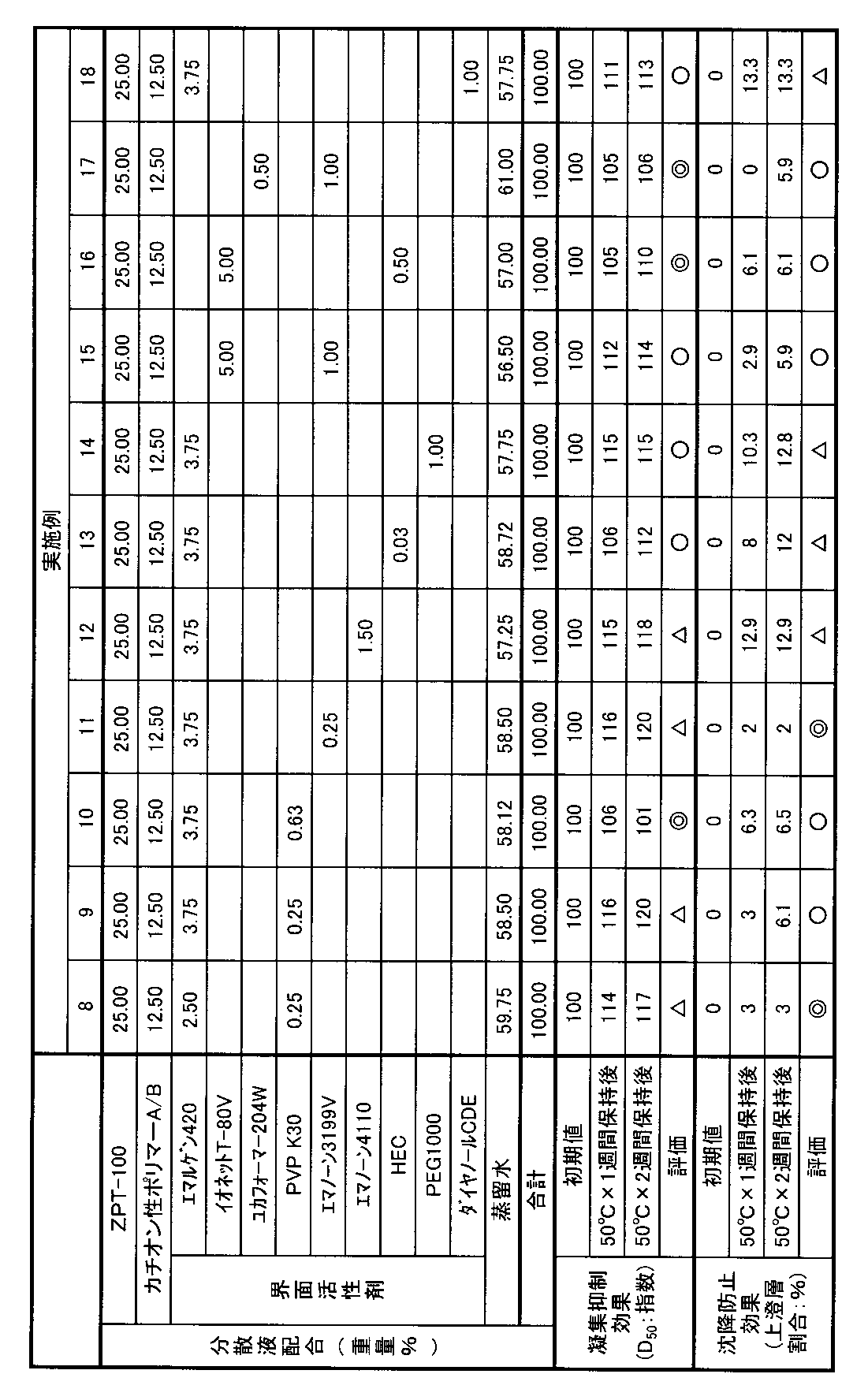
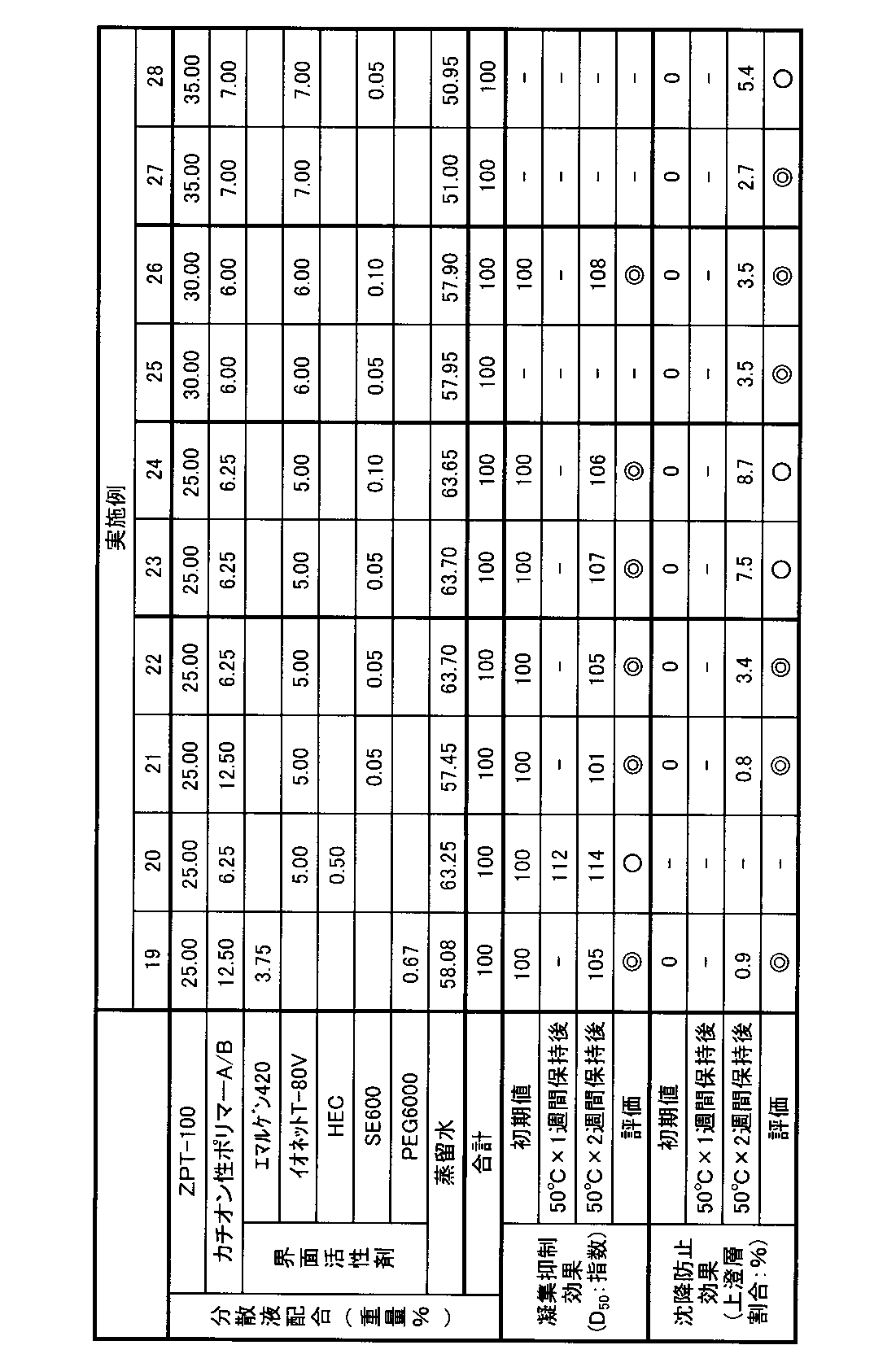

なお、本出願は、2010年8月19日付で出願された日本特許出願(特願2010-183745)及び2010年12月21日付で出願された日本特許出願(特願2010-284772)に基づいており、その全体が引用により援用される。
Claims (12)
- 少なくとも1種のカチオン性ポリマーと、少なくとも1種の金属ピリチオン塩とを含み、かつ、少なくとも1種の非アニオン性の界面活性剤を含有することを特徴とする抗菌性分散液。
- 前記非アニオン性の界面活性剤が、ノニオン性界面活性剤および/または両性界面活性剤である請求項1に記載の抗菌性分散液。
- 前記ノニオン性界面活性剤が、ポリオキシエチレンアルキルエーテル、ポリオキシエチレンアルキレン誘導体、ポリオキシエチレン脂肪酸エステル、ポリオキシエチレンソルビタン脂肪酸エステル、ポリオキシエチレンソルビトール脂肪酸エステル、ポリエチレングリコール、アルキルアルカノールアミド、およびノニオン性の水溶性ポリマーよりなる群から選ばれる1種または2種以上を含むものである請求項2に記載の抗菌性分散液。
- 前記ノニオン性界面活性剤のHLBが10~20の範囲である請求項3に記載の抗菌性分散液。
- 前記金属ピリチオン塩が、Zn、Cu、Fe、Al、およびMgのいずれかの塩である請求項1ないし4のいずれか1項に記載の抗菌性分散液。
- 前記金属ピリチオン塩がZn塩である請求項5に記載の抗菌性分散液。
- 前記カチオン性ポリマーが、毛髪用コンディショニング剤である請求項1ないし6のいずれか1項に記載の抗菌性分散液。
- 前記カチオン性ポリマーが、下記一般式(I)で表されるカチオン性ビニル単量体(A)に相当する構成単位と、下記一般式(II)および/または(III)で表されるノニオン性ビニル系単量体(B)に相当する構成単位とを含む共重合体であり、その全構成単位に対するカチオン性ビニル系単量体(A)に相当する構成単位の割合が10~80重量%であり、かつ当該共重合体の重量平均分子量が10,000~2,000,000であることを特徴とする請求項7に記載の抗菌性分散液。
CH2=C(R1)-CO(O)a-(NH)1-a-(CH2)b-
N+R2R3R4・X- ・・・(I)
(式中、R1は水素原子またはメチル基を表し、R2およびR3はそれぞれ独立して炭素数1~24のアルキル基、炭素数1~24のアリール基または炭素数1~24のアラルキル基を表し、R4は水素原子、炭素数1~24のアルキル基、炭素数1~24のアリール基、炭素数1~24のアラルキル基または-CH2-CH-(OH)-CH2N+R5R6R7・Y-を表し、R5、R6およびR7はそれぞれ独立して炭素数1~24のアルキル基、炭素数1~24のアリール基または炭素数1~24のアラルキル基を表し、X-およびY-はそれぞれ独立してアニオンを表し、aは0または1を表し、bは1~10の整数を表す。)
CH2=C(R8)-CO(O)-Z-H ・・・(II)
(式中、R8は水素原子またはメチル基を表し、Zは2個以上のヒドロキシル基を含む2価の連結基を表す。)
CH2=C(R9)-CO-NR10R11 ・・・(III)
(式中、R9は水素原子またはメチル基を表し、R10およびR11はそれぞれ独立して水素原子、炭素数1~4のアルキル基、または炭素数1~4のヒドロキシアルキル基を表す。) - 前記金属ピリチオン塩とカチオン性ポリマーとの配合比が、重量比として、1/1~50/1である請求項1ないし8のいずれか1項に記載の抗菌性分散液。
- 前記金属ピリチオン塩の含有量が5~70重量%で、前記カチオン性ポリマーの含有量が、0.1~40重量%で、前記非アニオン性の界面活性剤の含有量が、0.01~25重量%である請求項1ないし9のいずれか1項に記載の抗菌性分散液。
- 金属ピリチオン塩と非アニオン性の界面活性剤の含有量比が、重量比で金属ピリチオン塩/非アニオン性の界面活性剤=10000/1~1/1である請求項1ないし10のいずれか1項に記載の抗菌性分散液。
- 下記(i)または(ii)の分散液前駆体を経て製造される請求項1ないし11のいずれか1項に記載の抗菌性分散液。
(i) 粉体の金属ピリチオン塩とカチオン性ポリマーと水とを粉砕混合して得られる金属ピリチオン塩濃度30~80重量%の分散液前駆体
(ii) 粉体の金属ピリチオン塩と非アニオン性の界面活性剤とカチオン性ポリマーと水とを粉砕混合して得られる金属ピリチオン塩濃度30~80重量%の分散液前駆体
Priority Applications (4)
| Application Number | Priority Date | Filing Date | Title |
|---|---|---|---|
| EP11818124.7A EP2607430A1 (en) | 2010-08-19 | 2011-08-11 | Antibacterial dispersion |
| JP2011534433A JPWO2012023482A1 (ja) | 2010-08-19 | 2011-08-11 | 抗菌性分散液 |
| US13/817,672 US20130289011A1 (en) | 2010-08-19 | 2011-08-11 | Antibacterial dispersion |
| CN2011800379667A CN103154149A (zh) | 2010-08-19 | 2011-08-11 | 抗菌性分散液 |
Applications Claiming Priority (4)
| Application Number | Priority Date | Filing Date | Title |
|---|---|---|---|
| JP2010183745 | 2010-08-19 | ||
| JP2010-183745 | 2010-08-19 | ||
| JP2010284772 | 2010-12-21 | ||
| JP2010-284772 | 2010-12-21 |
Publications (1)
| Publication Number | Publication Date |
|---|---|
| WO2012023482A1 true WO2012023482A1 (ja) | 2012-02-23 |
Family
ID=45605136
Family Applications (1)
| Application Number | Title | Priority Date | Filing Date |
|---|---|---|---|
| PCT/JP2011/068345 Ceased WO2012023482A1 (ja) | 2010-08-19 | 2011-08-11 | 抗菌性分散液 |
Country Status (5)
| Country | Link |
|---|---|
| US (1) | US20130289011A1 (ja) |
| EP (1) | EP2607430A1 (ja) |
| JP (1) | JPWO2012023482A1 (ja) |
| CN (1) | CN103154149A (ja) |
| WO (1) | WO2012023482A1 (ja) |
Cited By (3)
| Publication number | Priority date | Publication date | Assignee | Title |
|---|---|---|---|---|
| WO2016056591A1 (ja) * | 2014-10-10 | 2016-04-14 | 住友精化株式会社 | カルボキシル基含有重合体組成物 |
| JP2017518331A (ja) * | 2014-06-20 | 2017-07-06 | ザ プロクター アンド ギャンブル カンパニー | ジンクピリチオンの分散液の安定性 |
| JP2022131965A (ja) * | 2021-02-26 | 2022-09-07 | キヤノン株式会社 | ポリマー粒子の製造方法 |
Families Citing this family (4)
| Publication number | Priority date | Publication date | Assignee | Title |
|---|---|---|---|---|
| JP5933424B2 (ja) * | 2012-12-17 | 2016-06-08 | 日華化学株式会社 | 繊維用抗菌剤及び抗菌性繊維製品 |
| CN108203484B (zh) * | 2016-12-20 | 2022-03-01 | 罗门哈斯公司 | 用精氨酸官能化单体结构单元官能化的乳胶 |
| CN111793382A (zh) * | 2020-08-25 | 2020-10-20 | 南京天诗蓝盾生物科技有限公司 | 一种油墨专用抗菌防霉剂及其制备方法 |
| CN113509435A (zh) * | 2021-07-23 | 2021-10-19 | 天津华源化工有限公司 | 牛乳头护理的配方及其生产方法 |
Citations (10)
| Publication number | Priority date | Publication date | Assignee | Title |
|---|---|---|---|---|
| JPS60224676A (ja) | 1984-04-24 | 1985-11-09 | Kao Corp | 微粒子化2−メルカプトピリジン−n−オキシド多価金属塩、その製造方法及びそれを含有する抗菌性組成物 |
| JPS6157503A (ja) | 1984-08-29 | 1986-03-24 | Kao Corp | 抗菌剤懸濁液および抗菌性毛髪処理剤組成物 |
| JPS61151111A (ja) | 1984-12-24 | 1986-07-09 | Kao Corp | 抗菌性毛髪処理剤組成物 |
| JPS61152627A (ja) | 1984-12-27 | 1986-07-11 | Kao Corp | 抗菌剤およびそれを含有する抗菌性毛髪処理剤組成物 |
| JPH06234618A (ja) * | 1993-02-09 | 1994-08-23 | Kao Corp | 頭皮・毛髪化粧料 |
| KR20020009096A (ko) | 2000-07-24 | 2002-02-01 | 구광시 | 안정한 아연 피리치온 분산액의 조성물 |
| JP3459833B2 (ja) | 1997-05-15 | 2003-10-27 | 株式会社エーピーアイ コーポレーション | 水性抗菌剤分散液 |
| JP2005504812A (ja) * | 2001-09-28 | 2005-02-17 | アーチ ケミカルズ,インコーポレイテッド | 無粉塵性銅ピリチオン分散系 |
| JP2010183745A (ja) | 2009-02-05 | 2010-08-19 | Chugoku Electric Power Co Inc:The | 短絡保護装置 |
| JP2010284772A (ja) | 2009-06-15 | 2010-12-24 | Central Glass Co Ltd | シート材の切断方法および装置 |
Family Cites Families (1)
| Publication number | Priority date | Publication date | Assignee | Title |
|---|---|---|---|---|
| ES2648997T3 (es) * | 2005-12-28 | 2018-01-09 | Kao Corporation | Composición de lavado de la piel o del cabello |
-
2011
- 2011-08-11 EP EP11818124.7A patent/EP2607430A1/en not_active Withdrawn
- 2011-08-11 WO PCT/JP2011/068345 patent/WO2012023482A1/ja not_active Ceased
- 2011-08-11 JP JP2011534433A patent/JPWO2012023482A1/ja not_active Withdrawn
- 2011-08-11 CN CN2011800379667A patent/CN103154149A/zh active Pending
- 2011-08-11 US US13/817,672 patent/US20130289011A1/en not_active Abandoned
Patent Citations (10)
| Publication number | Priority date | Publication date | Assignee | Title |
|---|---|---|---|---|
| JPS60224676A (ja) | 1984-04-24 | 1985-11-09 | Kao Corp | 微粒子化2−メルカプトピリジン−n−オキシド多価金属塩、その製造方法及びそれを含有する抗菌性組成物 |
| JPS6157503A (ja) | 1984-08-29 | 1986-03-24 | Kao Corp | 抗菌剤懸濁液および抗菌性毛髪処理剤組成物 |
| JPS61151111A (ja) | 1984-12-24 | 1986-07-09 | Kao Corp | 抗菌性毛髪処理剤組成物 |
| JPS61152627A (ja) | 1984-12-27 | 1986-07-11 | Kao Corp | 抗菌剤およびそれを含有する抗菌性毛髪処理剤組成物 |
| JPH06234618A (ja) * | 1993-02-09 | 1994-08-23 | Kao Corp | 頭皮・毛髪化粧料 |
| JP3459833B2 (ja) | 1997-05-15 | 2003-10-27 | 株式会社エーピーアイ コーポレーション | 水性抗菌剤分散液 |
| KR20020009096A (ko) | 2000-07-24 | 2002-02-01 | 구광시 | 안정한 아연 피리치온 분산액의 조성물 |
| JP2005504812A (ja) * | 2001-09-28 | 2005-02-17 | アーチ ケミカルズ,インコーポレイテッド | 無粉塵性銅ピリチオン分散系 |
| JP2010183745A (ja) | 2009-02-05 | 2010-08-19 | Chugoku Electric Power Co Inc:The | 短絡保護装置 |
| JP2010284772A (ja) | 2009-06-15 | 2010-12-24 | Central Glass Co Ltd | シート材の切断方法および装置 |
Cited By (5)
| Publication number | Priority date | Publication date | Assignee | Title |
|---|---|---|---|---|
| JP2017518331A (ja) * | 2014-06-20 | 2017-07-06 | ザ プロクター アンド ギャンブル カンパニー | ジンクピリチオンの分散液の安定性 |
| WO2016056591A1 (ja) * | 2014-10-10 | 2016-04-14 | 住友精化株式会社 | カルボキシル基含有重合体組成物 |
| US9896528B2 (en) | 2014-10-10 | 2018-02-20 | Sumitomo Seika Chemicals Co., Ltd. | Carboxyl-group-containing polymer composition |
| JP2022131965A (ja) * | 2021-02-26 | 2022-09-07 | キヤノン株式会社 | ポリマー粒子の製造方法 |
| JP7693331B2 (ja) | 2021-02-26 | 2025-06-17 | キヤノン株式会社 | ポリマー粒子の製造方法 |
Also Published As
| Publication number | Publication date |
|---|---|
| EP2607430A1 (en) | 2013-06-26 |
| US20130289011A1 (en) | 2013-10-31 |
| JPWO2012023482A1 (ja) | 2013-10-28 |
| CN103154149A (zh) | 2013-06-12 |
Similar Documents
| Publication | Publication Date | Title |
|---|---|---|
| JPWO2012023482A1 (ja) | 抗菌性分散液 | |
| Williams et al. | Bespoke cationic nano-objects via RAFT aqueous dispersion polymerisation | |
| CN103370049B (zh) | 用具有amps且富含丙烯酸的聚合物的碱可溶胀乳液增稠化妆品制剂的方法 | |
| JP2016522267A (ja) | パーソナルケア組成物で用いる両性ターポリマー | |
| JP2018150310A (ja) | 抗菌剤 | |
| CN102300553B (zh) | 化妆品用组合物及毛发洗净剂 | |
| CN102781983A (zh) | 阴离子性缔合流变改性剂 | |
| JP2020152700A (ja) | 抗菌剤 | |
| WO2017057571A1 (ja) | 抗菌剤 | |
| JP5022722B2 (ja) | 化粧料 | |
| KR20160025018A (ko) | 친수성 증점제 및 화장료 조성물 | |
| CN1340061A (zh) | 共聚体 | |
| JP6340520B2 (ja) | 有機無機複合ヒドロゲルの製造方法 | |
| EP3437630B1 (en) | Gel composition, cosmetic and manufacturing method for gel composition | |
| JP5262091B2 (ja) | 高分子分散剤及び分散化用溶液 | |
| JP2015172028A (ja) | 化粧料 | |
| CN101193927A (zh) | 共聚物及应用该共聚物的清洗剂组合物 | |
| JP4784102B2 (ja) | 水溶性樹脂及びこれを含有する毛髪化粧料、ならびにシリコンオイル吸着助剤 | |
| CN106659667B (zh) | 吡啶硫酮锌分散体的稳定性 | |
| JP5168841B2 (ja) | 毛髪洗浄剤組成物 | |
| JP4952120B2 (ja) | 洗浄剤組成物 | |
| JP5953182B2 (ja) | アルカリ可溶性樹脂及びそれを用いた粘度調整剤 | |
| JP5366581B2 (ja) | ポリマー組成物 | |
| CN1890358A (zh) | 作为酸性含水组合物增稠剂的疏水改性的双季铵盐单体和聚合物 | |
| JP5239132B2 (ja) | 洗浄剤組成物 |
Legal Events
| Date | Code | Title | Description |
|---|---|---|---|
| WWE | Wipo information: entry into national phase |
Ref document number: 2011534433 Country of ref document: JP Ref document number: 201180037966.7 Country of ref document: CN |
|
| 121 | Ep: the epo has been informed by wipo that ep was designated in this application |
Ref document number: 11818124 Country of ref document: EP Kind code of ref document: A1 |
|
| NENP | Non-entry into the national phase |
Ref country code: DE |
|
| WWE | Wipo information: entry into national phase |
Ref document number: 2011818124 Country of ref document: EP |
|
| WWE | Wipo information: entry into national phase |
Ref document number: 13817672 Country of ref document: US |