WO2012025638A1 - Selective 17beta-hydroxysteroid dehydrogenase type 1 inhibitors - Google Patents
Selective 17beta-hydroxysteroid dehydrogenase type 1 inhibitors Download PDFInfo
- Publication number
- WO2012025638A1 WO2012025638A1 PCT/EP2011/064842 EP2011064842W WO2012025638A1 WO 2012025638 A1 WO2012025638 A1 WO 2012025638A1 EP 2011064842 W EP2011064842 W EP 2011064842W WO 2012025638 A1 WO2012025638 A1 WO 2012025638A1
- Authority
- WO
- WIPO (PCT)
- Prior art keywords
- hydroxy
- methanone
- hydroxyphenyl
- benzothiazol
- thienyl
- Prior art date
- Legal status (The legal status is an assumption and is not a legal conclusion. Google has not performed a legal analysis and makes no representation as to the accuracy of the status listed.)
- Ceased
Links
- 0 CCC(*C1C)C1C(C)(CC(C)(CC)CCC(CC)C1)CC1(C(C)C1*C2C3C2C3C1)C(C)(C)C Chemical compound CCC(*C1C)C1C(C)(CC(C)(CC)CCC(CC)C1)CC1(C(C)C1*C2C3C2C3C1)C(C)(C)C 0.000 description 5
- NRWYNZCPPPXSSZ-UHFFFAOYSA-N CCOc1cc(-c2ccc(C(c3cccc(O)c3)=O)[s]2)ccc1 Chemical compound CCOc1cc(-c2ccc(C(c3cccc(O)c3)=O)[s]2)ccc1 NRWYNZCPPPXSSZ-UHFFFAOYSA-N 0.000 description 1
- PKFJPFABNDZIRG-UHFFFAOYSA-N COc(cc1)cc2c1nc(C(c(cc1)cc(O)c1F)=O)[s]2 Chemical compound COc(cc1)cc2c1nc(C(c(cc1)cc(O)c1F)=O)[s]2 PKFJPFABNDZIRG-UHFFFAOYSA-N 0.000 description 1
- BIJQFKQYDPVIHM-UHFFFAOYSA-N COc(cc1)cc2c1nc(NC(c1cc(OC)cc(OC)c1)=O)[s]2 Chemical compound COc(cc1)cc2c1nc(NC(c1cc(OC)cc(OC)c1)=O)[s]2 BIJQFKQYDPVIHM-UHFFFAOYSA-N 0.000 description 1
- AHOIGFLSEXUWNV-UHFFFAOYSA-N COc(cc1)cc2c1nc[s]2 Chemical compound COc(cc1)cc2c1nc[s]2 AHOIGFLSEXUWNV-UHFFFAOYSA-N 0.000 description 1
- JZRSXHTUPODMNO-UHFFFAOYSA-N COc(cc1)ccc1C(c1ccc(-c2cc(OC)ccc2)[s]1)=O Chemical compound COc(cc1)ccc1C(c1ccc(-c2cc(OC)ccc2)[s]1)=O JZRSXHTUPODMNO-UHFFFAOYSA-N 0.000 description 1
- DLMVTVBYIOBLPW-UHFFFAOYSA-N COc1cc(-c2ccc(C(c3cccc(O)c3)=O)[s]2)cc(OC)c1OC Chemical compound COc1cc(-c2ccc(C(c3cccc(O)c3)=O)[s]2)cc(OC)c1OC DLMVTVBYIOBLPW-UHFFFAOYSA-N 0.000 description 1
- UVLWAAFGNGAJNC-UHFFFAOYSA-N COc1ccc2nc(NC(Nc3cc(OC)ccc3)=O)[s]c2c1 Chemical compound COc1ccc2nc(NC(Nc3cc(OC)ccc3)=O)[s]c2c1 UVLWAAFGNGAJNC-UHFFFAOYSA-N 0.000 description 1
- OXTCSNZIUIFCOT-UHFFFAOYSA-N COc1cccc(C(c2ccc(-c3cc(CNS(C)(=O)=O)ccc3)[s]2)=O)c1 Chemical compound COc1cccc(C(c2ccc(-c3cc(CNS(C)(=O)=O)ccc3)[s]2)=O)c1 OXTCSNZIUIFCOT-UHFFFAOYSA-N 0.000 description 1
- SHMWBFSCYSEXIS-UHFFFAOYSA-N Cc(cc(cc1)-c2ccc(C(c3cc(O)ccc3)=O)[s]2)c1O Chemical compound Cc(cc(cc1)-c2ccc(C(c3cc(O)ccc3)=O)[s]2)c1O SHMWBFSCYSEXIS-UHFFFAOYSA-N 0.000 description 1
- UOBOJVVAQWOAJS-UHFFFAOYSA-N Oc(cc(cc1)C(c2nc(cccc3)c3[s]2)=O)c1F Chemical compound Oc(cc(cc1)C(c2nc(cccc3)c3[s]2)=O)c1F UOBOJVVAQWOAJS-UHFFFAOYSA-N 0.000 description 1
- IRWLRRFQPKSUGH-UHFFFAOYSA-N Oc(cc1)cc2c1nc(NC(c(cc1)cc(O)c1F)=O)[s]2 Chemical compound Oc(cc1)cc2c1nc(NC(c(cc1)cc(O)c1F)=O)[s]2 IRWLRRFQPKSUGH-UHFFFAOYSA-N 0.000 description 1
- VPSVVDJLZSPBNI-UHFFFAOYSA-N Oc1cc(C(c2ccc(-c3cc(OCc4cccc(Cl)c4)ccc3)[s]2)=O)ccc1 Chemical compound Oc1cc(C(c2ccc(-c3cc(OCc4cccc(Cl)c4)ccc3)[s]2)=O)ccc1 VPSVVDJLZSPBNI-UHFFFAOYSA-N 0.000 description 1
- UDWIACZONBOQSR-UHFFFAOYSA-N Oc1ccc2nc(NC(c(c(F)ccc3O)c3Cl)=O)[s]c2c1 Chemical compound Oc1ccc2nc(NC(c(c(F)ccc3O)c3Cl)=O)[s]c2c1 UDWIACZONBOQSR-UHFFFAOYSA-N 0.000 description 1
- UFBYJINGGRNSFO-UHFFFAOYSA-N Oc1ccc2nc(NC(c3cc(O)ccc3F)=O)[s]c2c1 Chemical compound Oc1ccc2nc(NC(c3cc(O)ccc3F)=O)[s]c2c1 UFBYJINGGRNSFO-UHFFFAOYSA-N 0.000 description 1
- KEJQMTAEAKWJLB-UHFFFAOYSA-N Oc1cccc(C(c2ccc(-c(cc3C(F)(F)F)ccc3O)[s]2)=O)c1 Chemical compound Oc1cccc(C(c2ccc(-c(cc3C(F)(F)F)ccc3O)[s]2)=O)c1 KEJQMTAEAKWJLB-UHFFFAOYSA-N 0.000 description 1
Classifications
-
- C—CHEMISTRY; METALLURGY
- C07—ORGANIC CHEMISTRY
- C07D—HETEROCYCLIC COMPOUNDS
- C07D277/00—Heterocyclic compounds containing 1,3-thiazole or hydrogenated 1,3-thiazole rings
- C07D277/02—Heterocyclic compounds containing 1,3-thiazole or hydrogenated 1,3-thiazole rings not condensed with other rings
- C07D277/20—Heterocyclic compounds containing 1,3-thiazole or hydrogenated 1,3-thiazole rings not condensed with other rings having two or three double bonds between ring members or between ring members and non-ring members
- C07D277/22—Heterocyclic compounds containing 1,3-thiazole or hydrogenated 1,3-thiazole rings not condensed with other rings having two or three double bonds between ring members or between ring members and non-ring members with only hydrogen atoms, hydrocarbon or substituted hydrocarbon radicals, directly attached to ring carbon atoms
- C07D277/24—Radicals substituted by oxygen atoms
-
- A—HUMAN NECESSITIES
- A61—MEDICAL OR VETERINARY SCIENCE; HYGIENE
- A61P—SPECIFIC THERAPEUTIC ACTIVITY OF CHEMICAL COMPOUNDS OR MEDICINAL PREPARATIONS
- A61P5/00—Drugs for disorders of the endocrine system
- A61P5/24—Drugs for disorders of the endocrine system of the sex hormones
-
- C—CHEMISTRY; METALLURGY
- C07—ORGANIC CHEMISTRY
- C07D—HETEROCYCLIC COMPOUNDS
- C07D285/00—Heterocyclic compounds containing rings having nitrogen and sulfur atoms as the only ring hetero atoms, not provided for by groups C07D275/00 - C07D283/00
- C07D285/01—Five-membered rings
- C07D285/02—Thiadiazoles; Hydrogenated thiadiazoles
- C07D285/14—Thiadiazoles; Hydrogenated thiadiazoles condensed with carbocyclic rings or ring systems
-
- C—CHEMISTRY; METALLURGY
- C07—ORGANIC CHEMISTRY
- C07D—HETEROCYCLIC COMPOUNDS
- C07D333/00—Heterocyclic compounds containing five-membered rings having one sulfur atom as the only ring hetero atom
- C07D333/02—Heterocyclic compounds containing five-membered rings having one sulfur atom as the only ring hetero atom not condensed with other rings
- C07D333/04—Heterocyclic compounds containing five-membered rings having one sulfur atom as the only ring hetero atom not condensed with other rings not substituted on the ring sulphur atom
- C07D333/06—Heterocyclic compounds containing five-membered rings having one sulfur atom as the only ring hetero atom not condensed with other rings not substituted on the ring sulphur atom with only hydrogen atoms, hydrocarbon or substituted hydrocarbon radicals, directly attached to the ring carbon atoms
- C07D333/22—Radicals substituted by doubly bound hetero atoms, or by two hetero atoms other than halogen singly bound to the same carbon atom
-
- C—CHEMISTRY; METALLURGY
- C07—ORGANIC CHEMISTRY
- C07D—HETEROCYCLIC COMPOUNDS
- C07D409/00—Heterocyclic compounds containing two or more hetero rings, at least one ring having sulfur atoms as the only ring hetero atoms
- C07D409/02—Heterocyclic compounds containing two or more hetero rings, at least one ring having sulfur atoms as the only ring hetero atoms containing two hetero rings
- C07D409/04—Heterocyclic compounds containing two or more hetero rings, at least one ring having sulfur atoms as the only ring hetero atoms containing two hetero rings directly linked by a ring-member-to-ring-member bond
Definitions
- the invention relates to selective, non-steroidal 17beta-hydroxysteroid dehydrogenase type 1 (17p-HSDl) inhibitors their production and use, especially for the treatment and/or prophylaxis of hormone-related diseases.
- Steroid hormones are important chemical carriers of information serving for the longterm and global control of cellular functions. They control the growth and the differentiation and function of many organs. On the other hand, they may also have negative effects and favor the pathogenesis and proliferation of diseases in the organism, such as mammary and prostate cancers (Deroo, B.J. et al ., J. Clin. Invest., 116 : 561-570 (2006); Fernandez, S.V. et al., Int. J. Cancer, 118 : 1862- 1868 (2006)).
- 17p-hydroxysteroid dehydrogenase type 1 which catalyzes the conversion of estrone (El) to estradiol (E2)
- 17p-HSD type 2 which catalyzes the reverse reaction
- estrogens A major class of steroid hormones is formed by the estrogens, the female sex hormones, whose biosynthesis takes place mainly in the ovaries and reaches its maximum immediately before ovulation.
- estrogens also occur in the adipose tissue, muscles and some tumors. Their main functions include a genital activity, i .e., the development and maintenance of the female sexual characteristics as well as an extragenital lipid-anabolic activity leading to the development of subcutaneous adipose tissue.
- they are involved in the pathogenesis and proliferation of estrogen- related diseases, such as endometriosis, endometrial carcinoma, adenomyosis, breast cancer and endometrial hyperplasia (Bulun, S. E.
- E2 The most potent estrogen is E2, which is formed in premenopausal females, mainly in the ovaries. On an endocrine route, it arrives at the target tissues, where it displays its action by means of an interaction with the estrogen receptor (ER) a. After the menopause, the plasma E2 level decreases to 1/10 of the E2 level found in premenopausal females (Santner, S.J. et al., J. Clin. Endocrinol. Metab., 59 : 29- 33 (1984)).
- ER estrogen receptor
- E2 is mainly produced in the peripheral tissue, e.g., breast tissue, endometrium, adipose tissue and skin, from inactive precursors, such as estrone sulfate -El-S), dehydroepiandrosterone (DHEA) and DHEA-S.
- inactive precursors such as estrone sulfate -El-S
- DHEA dehydroepiandrosterone
- DHEA-S DHEA-S
- steroidogenic enzymes hydroxysteroid dehydrogenases, aromatase
- the growth of many breast cancer cell lines is stimulated by a locally increased -E2 concentration. Further, the occurrence and progress of diseases such as endometriosis, leiomyosis, adenomyosis, menorrhagia, metrorrhagia and dysmenorrhea is dependent on a significantly increased -E2 level in accordingly diseased tissue.
- Endometriosis is an estrogen-related disease afflicting about 5 to 10% of all females of childbearing age (Kitawaki, J., Journal of Steroid Biochemistry & Molecular Biology, 83 : 149-155 (2003)). From 35 to 50% of the females suffering from abdominal pain and/or sterility show signs of endometriosis (Urdl, W., J. Resorbsmed. Endokrinol., 3 : 24-30 (2006)). This disease is defined as a histologically detected ectopic endometrial glandular and stromal tissue. In correspondingly severe cases, this chronic disease, which tends to relapse, leads to pain of different intensities and variable character and possibly to sterility.
- peritoneal endometriosis retroperitoneal deep-infiltrating endometriosis including adenomyosis uteri, and cystic ovarial endometriosis.
- endometriosis e.g., the metaplasia theory, the transplantation theory and the theory of autotraumatization of the uterus as established by Leyendecker (Leyendecker, G. et al ., Hum . Reprod., 17 : 2725-2736 (2002)).
- pluripotent coelomic epithelium is supposed to have the ability to differentiate and form endometriotic foci even in adults under certain conditions.
- This theory is supported by the observation that endometrioses, in part severe ones, can occur in females with lacking uterus and gynastresy. Even in males who were treated with high estrogen doses due to a prostate carcinoma, an endometriosis could be detected in singular cases.
- Retrograde menstruation results in the discharge of normal endometrial cells or fragments of the eutopic endometrium into the abdominal cavity with potential implantation of such cells in the peritoneal space and further development to form endometriotic foci . Retrograde menstruation could be detected as a physiological event. However, not all females with retrograde menstruation become ill with endometriosis, but various factors, such as cytokines, enzymes, growth factors (e.g., matrix metallo- proteinases), play a critical role.
- the enhanced autonomous non-cyclical estrogen production and activity as well as the reduced estrogen inactivation are typical peculiarities of endometriotic tissue.
- This enhanced local estrogen production and activity is caused by a significant overexpression of aromatase, expression of 17p-HSDl and reduced inactivation of potent E2 due to a lack of 17p-HSD2, as compared to the normal endometrium (Bulun, S. E. et al., J. Steroid Biochem . Mol. Biol ., 79 : 19-25 (2001); Kitawaki, J., Journal of Steroid Biochemistry & Molecular Biology, 83 : 149-155 (2003); Karaer, 0. et al., Acta. Obstet. Gynecol . Scand., 83 : 699-706 (2004); Zeitoun, K. et al ., J. Clin. Endocrinol . Metab., 83 : 4474-4480 (1998)).
- the polymorphic symptoms caused by endometriosis include any pain symptoms in the minor pelvis, back pain, dyspareunia, dysuria and defecation complaints.
- NSAID non-steroidal anti-inflammatory drugs
- the side effect profile of the GnRH analogues includes hot flushes, amenorrhea, loss of libido and osteoporosis, the latter mainly within the scope of a long term treatment.
- Another therapeutic approach involves the steroidal and non-steroidal aromatase inhibitors. It could be shown that the use of the non-steroidal aromatase inhibitor letrozole leads to a significant reduction of the frequency and severity of dysmenorrhea and dyspareunia and to a reduction of the endometriosis marker CA125 level (Soysal, S. et al., Hum . Reprod., 19 : 160-167 (2004)).
- the side effect profile of aromatase inhibitors ranges from hot flushes, nausea, fatigue to osteoporosis and cardiac diseases. Long term effects cannot be excluded.
- ER+ Coulson, C, Steroid biosynthesis and action, 2nd edition, 95-122 (1994); Lower, E. et al., Breast Cancer Res. Treat., 58 : 205-211 (1999)
- the growth of the tumor is promoted by as low as physiological concentrations of estrogens in the diseased tissue.
- the therapy of choice at an early stage of breast cancer is surgical measures, if possible, breast-preserving surgery. Only in a minor number of cases, mastectomy is performed. In order to avoid relapses, the surgery is followed by radiotherapy, or else radiotherapy is performed first in order to reduce a larger tumor to an operable size. In an advanced state, or when metastases occur in the lymph nodes, skin or brain, the objective is no longer to heal the disease, but to achieve a palliative control thereof.
- the therapy of the mammary carcinoma is dependent on the hormone receptor status of the tumor, on the patient's hormone status and on the status of the tumor (Paepke, S. et al ., Onkologie, 26 Suppl ., 7 : 4-10 (2003)).
- Various therapeutical approaches are available, but all are based on hormone deprivation (deprivation of growth-promoting endogenous hormones) or hormone interference (supply of exogenous hormones).
- a precondition of such responsiveness is the endocrine sensitivity of the tumors, which exists with HDBC ER+ tumors.
- the drugs employed in endocrine therapy include GnRH analogues, anti-estrogens and aromatase inhibitors.
- GnRH analogues such as gosereline
- gosereline will bind to specific membrane receptors in the target organ, the pituitary gland, which results in an increased secretion of FSH and LH.
- FSH and LH These two hormones in turn lead to a reduction of GnRH receptors in a negative feedback loop in the pituitary cells.
- the resulting desensitization of the pituitary cells towards GnRH leads to an inhibition of FSH and LH secretion, so that the steroid hormone feedback loop is interrupted.
- the side effects of such therapeutic agents include hot flushes, sweats and osteoporosis.
- Another therapeutic option is the use of anti-estrogens, antagonists at the estrogen receptor.
- SERM selective estrogen receptor modulators
- these compounds are not only effective in combatting breast cancer, but also increase the bone density and reduce the risk of osteoporosis in postmenopausal females.
- the use of the SERM tamoxifen is most widely spread. However, after about 12-18 months of treatment, there is development of resistance, an increased risk of endometrial cancers and thrombo-embolic diseases due to the partial agonistic activity at the ER (Goss, P.E. et al ., Clin. Cancer Res., 10 : 5717-5723 (2004); Nunez, N . P. et al ., Clin. Cancer Res., 10 : 5375-5380 (2004)).
- the enzymatically catalyzed estrogen biosynthesis may also be influenced by selective enzyme inhibitors.
- the enzyme aromatase which converts C19 steroids to C18 steroids, was one of the first targets for lowering the E2 level.
- This enzyme complex which belongs to the cytochrome P-450 enzymes, catalyzes the aromatic- zation of the androgenic A ring to form estrogens. The methyl group at position 10 of the steroid is thereby cleaved off.
- the first aromatase inhibitor employed for the therapy of breast cancer was aminogluthetimide. However, aminogluthetimide affects several enzymes of the cytochrome P-450 superfamily and thus inhibits a number of other biochemical conversions.
- the compound interferes with the steroid production of the adrenal glands so heavily that a substitution of both glucocorticoids and mineral corticoids may be necessary.
- more potent and more selective aromatase inhibitors which can be subdivided into steroidal and non-steroidal compounds, are on the market.
- the steroidal inhibitors include, for example, exemestane, which has a positive effect on the bone density, which is associated with its affinity for the androgen receptor (Goss, P.E. et al ., Clin. Cancer Res., 10 : 5717-5723 (2004)).
- this type of compounds is an irreversible inhibitor that also has a substantial number of side effects, such as hot flushes, nausea, fatigue.
- the estrogen biosynthesis in the peripheral tissue also includes other pathways for the production of El and the more potent E2 by avoiding the enzyme aromatase that is locally present in the target tissue, for example, breast tumors.
- Two pathways for the production of estrogens in breast cancer tissue are postulated (Pasqualini, J.R., Biochim . Biophys. Acta., 1654: 123-143 (2004)), the aromatase pathway (Abul-Hajj, Y.J. et al ., Steroids, 33 : 205-222 (1979); Lipton, A. et al ., Cancer, 59 : 779-782 (1987)) and the sulfatase pathway (Perel, E.
- the aromatase pathway includes the production of estrogens from androgens with participation of the enzyme aromatase.
- the sulfatase pathway is the pathway for the production of E1/E2 by means of the enzyme steroid sulfatase, an enzyme that catalyzes the conversion of El sulfate and DHEA-S to estrone and DHEA. In this way, 10 times as much El is formed in the target tissue as compared to the aromatase pathway (Santner, S.J. et al., J. Clin. Endocrinol. Metab., 59 : 29-33 (1984)).
- E2 the most potent estrogen.
- Steroid sulfatase and 17p-HSDl are new targets in the battle against estrogen-related diseases, especially for the development of therapeutic agents for mammary carcinomas (Pasqualini, J. R., Biochim . Biophys. Acta., 1654: 123-143 (2004)).
- steroidal sulfatase inhibitors could be found, including the potent irreversible inhibitor EMATE, which exhibited an agonistic activity at the estrogen receptor, however (Ciobanu, L.C. et al., Cancer Res., 63 : 6442-6446 (2003); Hanson, S. R. et al ., Angew. Chem . Int. Ed. Engl., 43 : 5736-5763 (2004)).
- Some potent non-steroidal sulfatase inhibitors could also be found, such as COUMATE and derivatives as well as numerous sulfamate derivatives of tetrahydronaphthalene, indanone and tetralone (Hanson, S.R.
- Hydroxysteroid dehydrogenases can be subdivided into different classes.
- the l ip-HSD modulate the activity of glucocorticoids
- 3p-HSD catalyzes the reaction of A5-3p-hydroxysteroids (DHEA or 5-androstene-3p,17p-diol) to form ⁇ 5-3 ⁇ - ketosteroids (androstenedione or testosterone).
- 17p-HSDs convert the less active 17-ketosteroids to the corresponding highly active 17-hydroxy compounds (androstenedione to testosterone and El to E2) or conversely (Payne, A.H . et al., Endocr. Rev., 25 : 947-970 (2004); Peltoketo, H.
- El is converted to the highly potent E2 by means of 17p-HSDl, while E2 is converted to the less potent El by means of 17p-HSD2; 17p-HSD2 inactivates E2 while 17p-HSDl activates El .
- the 17p-HSDs are NAD(H)-dependent and NADP(H)-dependent enzymes. They play a critical role in the hormonal regulation in humans. The enzymes are distinguished by their tissue distribution, catalytic preference (oxidation or reduction), substrate specificity and subcellular localization. The same HSD subtype was found in different tissues. It is likely that all 17p-HSDs are expressed in the different estrogen-dependent tissues, but in different concentrations.
- the ratio between the different subtypes is altered as compared to healthy tissue, some subtypes being overexpressed while others may be absent. This may cause an increase or decrease of the concentration of the corresponding steroid.
- the 17p-HSDs play an extremely important role in the regulation of the activity of the sex hormones. Further, they are involved in the development of estrogen-sensitive diseases, such as breast cancer, ovarian, uterine and endometrial carcinomas, as well as androgen-related diseases, such as prostate carcinoma, benign prostate hyperplasia, acne, hirsutism etc.
- 17p-HSDs are also involved in the development of further diseases, e.g., pseudohermaphrodism (17p-HSD3 (Geissler, W.M . et al ., Nat. Genet., 7 : 34-39 (1994))), bifunctional enzyme deficiency (17p-HSD4 (van Grunsven, E.G. et al ., Proc. Natl . Acad. Sci . USA, 95 : 2128-2133 (1998))), polycystic kidney diseases (17p-HSD8 (Maxwell, M . M. et al ., J. Biol.
- the best characterized member of the 17p-HSDs is the type 1 17p-HSD.
- the 17p- HSD1 is an enzyme from the SDR family, also referred to as human placenta E2 dehydrogenase (Gangloff, A. et al ., Biochem. J., 356 269-276 (2001); Jornvall, H . et al ., Biochemistry, 34 6003-6013 (1995)). Its designation as assigned by the enzyme commission is E.C. I .1.1.62.
- Engel et al. (Langer, L.J. et al., J. Biol . Chem ., 233 : 583-588 (1958)) were the first to describe this enzyme in the 1950's. In the 1990's, first crystallization attempts were made, so that a total of 20 crystallographic structures can be recurred to today in the development of inhibitors ( Negri, M . et al . PLoS ON E 5(8) : el2026. doi : 10.1371/journal. pone.0012026 (2010)). Available are X-ray stuctures of the enzyme alone, but also of binary and ternary complexes of the enzyme with its substrate and other ligands or substrate/ligand and cofactor.
- 17p-HSDl is a soluble cytosolic enzyme. NADPH serves as a cofactor. 17p-HSDl is encoded by a 3.2 kb gene consisting of 6 exons and 5 introns that is converted to a 2.2 kb transcript (Luu-The, V., J. Steroid Biochem. Mol. Biol ., 76 : 143-151 (2001); Labrie, F. et al ., J. Mol. Endocrinol ., 25 : 1-16 (2000)). It is constituted by 327 amino acids. The molecular weight of the monomer is 34.9 kDa (Penning, T.M ., Endocr. Rev., 18 : 281-305 (1997)).
- 17p-HSDl is expressed in the placenta, liver, ovaries, endometrium, prostate gland, peripheral tissue, such as adipose tissue and breast cancer cells (Penning, T. M., Endocr. Rev., 18 : 281-305 (1997)). It was isolated for the first time from human placenta (Jarabak, J. et al ., J. Biol. Chem ., 237 : 345-357 (1962)). The main function of 17p-HSDl is the conversion of the less active El to the highly potent E2.
- DHEA dehydroepiandrosterone
- 5-androstene-3p,17p-diol an andro- gen showing estrogenic activity
- DHEA dehydroepiandrosterone
- 5-androstene-3p,17p-diol an andro- gen showing estrogenic activity
- the enzyme catalyzes the reduction and oxidation between El and E2 while it catalyzes only the reduction under physiological conditions.
- bisubstrate reactions proceed according to a random catalytic mechanism, i.e., either the steroid or the cofactor is first to bind to the enzyme (Negri, et al. PLoS ONE 5(8) : el2026. doi : 10.1371/journal . pone.0012026 (2010)).
- the enzyme consists of a substrate binding site and a channel that opens into the cofactor binding site.
- the substrate binding site is a hydrophobic tunnel having a high complementarity to the steroid.
- the 3-hydroxy and 17-hydroxy groups in the steroid form four hydrogen bonds to the amino acid residues His221, Glu282, Serl42 and Tyrl55.
- the gene encoding 17 ⁇ - ⁇ 5 ⁇ 1 is linked with the gene for mammary and ovarian carcinomas that is very susceptible to mutations and can be inherited, the BRCA1 gene, on chromosome 17ql l-q21 (Labrie, F. et al ., J. Mol . Endocrinol ., 25 : 1-16
- Another class of compounds which has been described is the so-called hybrid inhibitors (Berube, M . et al., Can. J. Chem . 87 1180-1199 (2009)), compounds that, due to their molecular structure, not only attack at the substrate binding site, but also undergo interactions with the cofactor binding site.
- the inhibitors have the following structure: adenosine moiety or simplified derivatives that can interact with the cofactor binding site;
- E2 or El moiety which interacts with the substrate binding site; and a spacer of varying length as a linking element between the two moieties.
- inhibitors have been synthesized that exhibit a good inhibition of the enzyme and a good selectivity for 17p-HSD2 (compound B (Lawrence, H. R. et al., J. Med. Chem ., 48 : 2759-2762 (2005)).
- compound B Lawrence, H. R. et al., J. Med. Chem ., 48 : 2759-2762 (2005).
- the inventors consider that a small estrogenic effect can be achieved by a substitution at the C2 of the steroid skeleton (Cushman, M . et al., J. Med. Chem ., 38 : 2041- 2049 (1995); Leese, M . P. et al., J. Med. Chem ., 48 : 5243-5256 (2005)); however, this effect has not yet been demonstrated in tests.
- a drawback of these steroidal compounds may be a low selectivity. With steroids, there is a risk that the compounds will also interfere with other enzymes of the steroid biosynthesis, which would lead to side effects. In addition, due to their steroidal structure, they may have an affinity for steroid receptors and function as agonists or antagonists.
- Coumestrol was found to be particularly potent, but of course showed estrogenic activity (Nogowski, L, J. Nutr. Biochem ., 10 : 664-669 (1999)). Gossypol derivatives were also synthesized as inhibitors (US2005/0228038). In this case, however, the cofactor binding site rather than the substrate binding site is chosen as the target site (Brown, W. M. et al., Chem. Biol . Interact., 143-144, 481- 491 (2003)), which might entail problems in selectivity with respect to other enzymes utilizing NAD(H) or NADP(H).
- suicide inhibitors were also tested. However, these were found not to be therapeutically utilizable since the oxidation rate of the alcohols to the corresponding reactive form, namely the ketones, was too weak (Poirier, D., Curr. Med. Chem., 10: 453-477 (2003)).
- Biphenyl ethanones (Allan, G.M. et al. Bioorg. Med. Chem. 16 4438-4456 (2008)); 3. Hydroxyphenylnaphtols (WO/08EP/53672; Marchais-Oberwinkler S. et al., J. Med. Chem., 51, 4685-4698 (2008)) Marchais-Oberwinkler, S. et al. J. Med. Chem., submitted (2010)); 4. Heterocyclic substituted biphenylols (Oster, A. et al., Bioorg. Med. Chem., 18(10), 3494-3505 (2010)); 5. Bis(hydroxyphenyl) arenes (WO2009/02746; Bey, E. et al., J. Med. Chem., 52, 6724-6743 (2009)).
- 2-benzoylbenzothiazole derivatives having lipid lowering activity are known from EP-A-735029,and /V-(benzothiazol-2-yl)arylcarboxamide and l-(benzothiazol- 2-yl)-3-(aryl)urea derivatives and their use for the inhibition of ubiquitination are known from WO2005/037845.
- a 17beta-hydroxysteroid dehydrogenase type 1 (hereinafter shortly)
- Rl represents H, OH, alkoxy or acyloxy
- R2, R3, R5 and R6 independently represent -H, -R, haloalkyl, halogen, -N0 2 , -OR', -SR', -COR', -NR'R', -CN, -COOR', -N HS0 2 R, -S0 2 NR'R', -SON R'R', -NHSOR, -NHCOR', -CONR'R', -OC(0)R', -CH 2 NR'R',-CH 2 OR', -S0 2 R or -SOR (wherein R is an alkyl group, a homoaromatic group that may be condensed with a 5- or 6- membered, aliphatic or aromatic heterocyclic ring, a benzyl group, or an aliphatic or aromatic heterocyclic group that may be condensed with a benzene ring, each of said groups may be substituted with up to 5 substituents independently selected from
- X represents:
- Y if present, represents an 0 or S atom
- R7 and R8 independently represent -H or lower alkyl
- the aryl ring is a 5-membered heteroaromatic ring which carries up to 3 heteroatoms independently selected from N, S and 0 and may be condensed with a benzene ring, said benzene ring may then carry said substituents R4 and/or R5;
- R4 represents -H, -OH, an alkyl or an alkoxy group (each of which may carry phenyl and halogen substituents, wherein said phenyl substituent may carry up to 3 substituents independently selected from -OH, alkyl, haloalkyl, alkoxy, halogen, amino, -CN and -N0 2 ), a 6-membered aromatic group (which may carry 1 to 3 substituents independently selected from -R, haloalkyl, halogen, -N0 2 , -OR', -SR', - COR', -NR'R', -CN, -COOR', -NHS0
- the third substituent may be located on the 6-membered aromatic group or on the ring condensed thereto), or a 5- or 6-membered aliphatic or aromatic heterocyclic group (which carries up to 3 heteroatoms independently selected from N, S and 0 and may carry 1 to 3 substituents independently selected from -R, haloalkyl, halogen, -N0 2 , -OR', -SR', - COR', -NR'HR', -CN, -COOR', -NHS0 2 R, -S0 2 NR'R', -SONR'R', -NHSOR, -NHCOR', -CONR'R', -OC(0)R', -CH 2 NR'R', -CH 2 OR', -S0 2 R and -SOR (wherein R and R' is as defined above) or two of said substituents, together with the adjacent carbon atoms of the
- the above defined 17p-HSDl inhibitor includes inhibitors of the formula (I) wherein R3 is -H and X represents
- the inhibitor has the formula (la)
- Rl, R2, R4, R5, R6 and X have the same meaning as in (1) above, or R4 and R5, together with the adjacent carbon atoms of the 6-membered aromatic group, may form a 5- or 6-membered, aliphatic or aromatic, homocyclic or heterocyclic ring condensed to said 6-membered aromatic group, wherein the heterocyclic ring carries up to 3 heteroatoms independently selected from N, S and 0, and wherein the substituent R6 may be located on the 6-membered aromatic group or on the ring condensed thereto, the aryl ring is a 5-membered heteroaromatic ring, which carries up to 3 heteroatoms independently selected from N, S and 0, and
- W is C or N
- the inhibitor has the formula (Ila)
- the inhibitor has the formula (Ilia)
- the inhibitor has the formula (IVa)
- the inhibitor has the formula (lb) or (Ic),
- Rl, R2, R3, R4, R5 and X have the same meaning as in (1) above, and the aryl ring is a 5-membered heteroaromatic ring, which carries up to 3 heteroatoms independently selected from N, S and 0, preferably the inhibitor has the formulas
- Rl represents -H, OH, alkoxy or acyloxy
- R2, R3, R5 and R6 independently represent-H, -R, haloalkyl, halogen, -N0 2 , -OR', -SR', -COR', -NR'R', -CN, -COOR', -NHS0 2 R, -S0 2 NR'R', -SON R'R', -NHSOR, -NHCOR', -CONR'R', -OC(0)R', -CH 2 NR'R',-CH 2 OR', -S0 2 R or -SOR (wherein R is an alkyl group, a homoaromatic group that may be condensed with a 5- or 6- membered, aliphatic or aromatic heterocyclic ring, a benzyl group, or an aliphatic or aromatic heterocyclic group that may be condensed with a benzene ring, each of said groups may be substituted with up to 5 substituents independently selected from halogen
- Y if present, represents a 0 or S atom
- R7 and R8 independently represent -H or lower alkyl
- the aryl ring is a 5-membered heteroaromatic ring which carries up to 3 heteroatoms independently selected from N, S and 0;
- R4 represents -H, -OH, an alkyl or an alkoxy group (each of which may carry phenyl and halogen substituents, wherein said phenyl substituents may carry up to 3 substituents independently selected from -OH, alkyl, haloalkyl, alkoxy, halogen, amino, -CN and -N0 2 ), a 6-membered aromatic group (which may carry 1 to 3 substituents independently selected from -R, haloalkyl, halogen, -N0 2 , -OR', -SR', - COR', -NR'R', -CN, -COOR', -NHS0 2 R, -S0 2 NR'R', -SONR'R', -NHSOR, -NHCOR', -CONR'R', -OC(0)R', -CH 2 NR'R', -CH 2 OR', -S0 2 R and -
- the third substituent may be located on the 6-membered aromatic group or on the ring condensed thereto), or a 5- or 6-membered aliphatic or aromatic heterocyclic group (which carries up to 3 heteroatoms independently selected from N, S and 0 and may carry 1 to 3 substituents independently selected from -R, haloalkyl, halogen, -N0 2 , -OR', -SR', - COR', -N R'HR', -CN, -COOR', -NHS0 2 R, -S0 2 NR'R', -SONR'R', -NHSOR, -NHCOR', -CONR'R', -OC(0)R', -CH 2 NR'R', -CH 2 OR', -S0 2 R and -SOR (wherein R and R' is as defined above) or two of said substituents, together with the adjacent carbon atoms of
- the above defined compound with 17p-HSDl inhibitor activity includes inhibitors of the formula (I) wherein R3 is -H and X represents
- a pharmaceutical composition or medicament comprising at least one compound of aspect (5) above, or a pharmaceutically acceptable salt thereof or a prodrug thereof, and optionally a suitable carrier or excipient.
- a method for the treatment and/or prophylaxis of hormone-related diseases in a patient which comprises administering the patient a suitable amount of the inhibitor of aspects (1) to (4) above or a compound of aspect (5) above, or a pharmaceutically acceptable salt thereof or a prodrug thereof.
- AlkyI and "alkoxy" residues within the meaning of the invention may be straight- chain, branched-chain or cyclic, and saturated or (partially) unsaturated. Preferable alkyl residues and alkoxy residues are saturated or have one or more double and/or triple bonds. Of straight-chain or branched-chain alkyl residues, preferred are those having from 1 to 10 carbon atoms, more preferably those having from 1 to 6 carbon atoms, even more preferably those having from 1 to 3 carbon atoms. Of the cyclic alkyl residues, more preferred are mono- or bicyclic alkyl residues having from 3 to 15 carbon atoms, especially monocyclic alkyl residues having from 3 to 8 carbon atoms.
- “Lower alkyl” and “lower alkoxy” residues within the meaning of the invention are straight-chain, branched-chain or cyclic saturated lower alkyl residues and lower alkoxy residues or those having a double or triple bond. Of the straight-chain ones, those having from 1 to 6 carbon atoms, especially 1 to 3 carbon atoms, are particularly preferred.
- Aryls and “homocyclic aromatic groups” within the meaning of the present invention include, if not specified otherwise, mono-, bi- and tricyclic aryl residues having from 3 to 18 ring atoms, which may optionally be anellated with one or more saturated rings. Particularly preferred are anthracenyl, dihydronaphthyl, fluorenyl, hydrindanyl, indanyl, indenyl, naphthyl, naphthenyl, phenanthrenyl, phenyl and tetralinyl .
- heteroaryl residues and “heterocyclic groups” are mono- or bicyclic heteroaryl residues having from 3 to 12 ring atoms and preferably having from 1 to 5 heteroatoms selected from nitrogen, oxygen and sulfur, which may be anellated with one or more saturated rings.
- the preferred monocyclic and bicyclic heteroaryls include benzimidazolyl, benzothiazolyl, benzoxazolyl, benzisoxazolyl, quinazolinyl, quinolyl, quinoxalinyl, cinnolinyl, dihydroindolyl, dihydroisoindolyl, dihydropyranyl, dithiazolyl, furyl, homopiperidinyl, imidazolidinyl, imidazolinyl, imidazolyl, indazolyl, indolyl, isoquinolyl, isoindolyl, isothiazolidinyl, isothiazolyl, isoxazolidinyl, isoxazolyl, morpholinyl, oxadiazolyl, oxazolidinyl, oxazolyl, phthalazinyl, piperazinyl, piperidyl, pteridinyl, purin
- Halogen includes fluorine, chlorine, bromine and iodine.
- Halo-, halogenated or “optionally halogenated” residues within the meaning of the present invention include any residues in which one to all H atoms have been replaced by the above mentioned halogen atoms or combinations of such halogen atoms.
- Prodrugs within the meaning of thepresent invention refers to compounds of the invention in which certain functional groups are protected to increase its bioavailability or stability, to avoid degradation or to increase its transport to the site of action and the like. It specifically refers to compounds of the invention bearing phenolic hydroxyl group(s) (i.e., compounds of the invention wherein one or more of R1-R6 or one or more of its substituents is a phenolic hydroxyl or bears an aromatic substituent that is a phenol), in which the phenolic hydroxy group(s) are coupled with carboxylic acid derivatives, carbamic acid derivatives or carbonic acid derivatives to form more metabolic stable esters, carbamates and carbonates, respectively. Examples of the carbonic acid derivatives suitable to protect the phenolic hydroxyl group functions from metabolism include the following :
- “Pharmaceutically acceptable salts” and “salts” within the meaning of the present invention include salts of the compounds with organic acids (such as lactic acid, acetic acid, amino acids, oxalic acid etc.), inorganic acids (such as HCI, HBr, phosphoric acid etc.), and, if the compounds have acid substituents, also with organic or inorganic bases including amino acids. Preferred are salts with HCI.
- “Pharmacologically suitable carriers” within the meaning of the present invention are selected by the skilled person, depending on the desired dosage form .
- the aryl ring if present, is a thiadiazole, triazole, oxadiazole, oxathiadiazole, isothiadiazole, isooxadiazole, thiazole, oxazole, imidazole, pyrazole, isoxazole, isothiazole, furane, pyrrole or thiophene;
- Rl is -H, -OH or lower alkoxy
- R2 and R5 independently represent -H, -R, haloalkyl, halogen, -N0 2 , -OR', -N R'R', - CN, -NHS0 2 R, -S0 2 NR'R', -NHCOR' or -CONR'R', (wherein R is alkyl, aryl, benzyl, an aliphatic or aromatic heterocyclic group, each of which may be substituted with up to 3 substituents independently selected from halogen, lower alkyl, lower haloalkyl, -OH, -N0 2 , lower alkoxy, -NH 2 , phenyl, -CN, -N HCOR", -CON HR", -NHS0 2 R” and S0 2 NHR” (wherein R" is -H, lower alkyl, lower haloalkyl or phenyl); and R' is R or -H);
- R3, if present, is -H
- R6, if present, is selected from -H, -OH, lower alkyl, lower alkoxy, and halogen;
- R4 represents -H, -OH, an alkyl or an alkoxy group (each of which may carry phenyl and halogen substituents, wherein said phenyl substituent may carry up to 3 substituents independently selected from -OH, alkyl, haloalkyl, alkoxy, halogen, amino, -CN and -N0 2 ), a 6-membered aromatic group (which may carry 1 to 3 substituents independently selected from -R, haloalkyl, halogen, -N0 2 , -OR', -NR'R', -CN, -NHS0 2 R, -S0 2 NR'R',-NHCOR', -CONR'R' (wherein R and R' is as defined above) or two of said substituents, together with the adjacent carbon atoms of the 6-membere
- Rl is -OH
- R2 is selected from -H, -OH, alkoxy, alkyl, haloalkyl, halogen and -N0 2 ;
- R4 represents -H, -OH, an alkyl or an alkoxy group (each of which may carry phenyl and halogen substituents, wherein said phenyl substituent may carry up to 3 substituents independently selected from -OH, alkyl, haloalkyl, alkoxy, halogen, amino, -CN and -N0 2 ), a 6-membered aromatic group (which may carry 1 to 2 substituents independently selected from -R, haloalkyl, halogen, -OR', -N HS0 2 R and -NHCOR', (wherein R and R' is as defined above) or two of said substituents, together with the adjacent carbon atoms of the 6-membered aromatic group, may form a 5- membered, aliphatic or aromatic, homocyclic or heterocyclic ring condensed to said 6-membered aromatic group, wherein the heterocyclic ring carries up to 3 heteroatoms independently selected from N, S and 0);
- R5 is selected from -H, -OH and alkoxy
- R6, if present, is selected from -H, -OH and halogen.
- Rl is a hydroxy group in meta position relative to the -X- or -CO- junction.
- Particular preferred embodiments of the inhibitor for use in the treatment and/or prophylaxis of hormone-related diseases of aspects (1) to (3) above are the following compounds (1) to (53) :
- aryl with the benzene moiety condensed thereto is a benzimidazole, benzo- thiazole, benzoxazole, benzisoxazole, benzothiophene, indole, isoindole, indazole, benzofurane, benzotriazole or benzisothiazole;
- Rl is -H, -OH or lower alkoxy
- R4 represents -H, -OH, an alkyl or an alkoxy group (each of which may carry phenyl and halogen substituents, wherein said phenyl substituent may carry up to 3 substituents independently selected from -OH, alkyl, haloalkyl, alkoxy, halogen, amino, -CN and -N0 2 ), a 6-membered aromatic group (which may carry 1 to 3 substituents independently selected from -R, haloalkyl, halogen, -N0 2 , -OR', -NR'R', -CN, -NHS0 2 R, -S0 2 NR'R',-NHCOR', -CONR'R' (wherein R and R' is as defined above) or two of said substituents, together with the adjacent carbon atoms of the 6-membered aromatic group, may form a 5- or 6-membered, aliphatic or aromatic, homocyclic or heterocyclic ring
- 5- or 6-membered aliphatic or aromatic heterocyclic group (which carries up to 3 heteroatoms independently selected from N, S and 0 and may carry 1 to 3 substituents independently selected from -R, haloalkyl, halogen, -N0 2 , -OR', -NR'R', -CN,-NHS0 2 R, -S0 2 NR'R', -NHCOR', -CON R'R', (wherein R and R' is as defined above) or two of said substituents, together with the adjacent carbon atoms of the 5- or 6-membered aliphatic or aromatic heterocyclic group, may form a 5- or 6- membered, aliphatic or aromatic ring condensed to said 5- or 6-membered aliphatic or aromatic heterocyclic group, wherein the third substituent may be present on the 5- or 6-membered aliphatic or aromatic heterocyclic group or on the ring condensed thereto); and/or
- R5, if present, represents -H, -OH, halogen, alkyl, haloalkyl, benzyloxy or alkoxy.
- Rl is -OH
- R2 is selected from -H, -OH, alkoxy, alkyl, haloalkyl and halogen
- R4 and R5, if present, are independently selected from -H, -OH, halogen, alkoxy, benzyloxy and haloalkyl.
- Rl is a hydroxy group in meta position relative to the -X-, -CO- or -CONH- junction and/or R4 is a -OH or lower alkoxy.
- Particular preferred embodiments of the inhibitor for use in the treatment and/or prophylaxis of hormone-related diseases of aspect (4) above are the following compounds (101) to (128) : l,3-Benzothiazol-2-yl(3-hydroxyphenyl)methanone (101), (6-methoxy-l,3-benzothiazol-2-yl)(3-methoxyphenyl)methanone (102), (6- hydroxy-l,3-benzothiazol-2-yl)(3-hydroxyphenyl)methanone (103), (6-hydroxy- l,3-benzothiazol-2-yl)(4-hydroxyphenyl)methanone (104), (6-hydroxy-l,3-benzo- thiazol-2-yl)(4-methoxyphenyl)methanone (105), l,3-benzothiazol-2-yl(4-fluoro-3- hydroxyphenyl)methanone (106), (4-fluoro-3-hydroxyphenyl)(
- Preferred embodiments of the compound of aspect (5) above includes the preferred compounds of formula (I) is as defined for aspects (2) and (3) above.
- the inhibitor for use in the treatment and/or prophylaxis of hormone-related diseases of aspects (1) to (4) above, the pharmaceutical composition or medicament of aspect (7) above, the medicament of aspect (8) above and the method for the treatment and/or prophylaxis of hormone-related diseases of aspect (9) above is particularly suitable for the propylaxis and/or treatment of estrogen-related diseases, notably diseases in which a modulation of the estradiol level is required, such as the treatment and/or prophylaxis of endometriosis, endometrial carcinoma, endometrial hyperplasia, adenomyosis, breast cancer, and ovarian carcinoma.
- the variables W and Z represent "functional groups capable of being condensed to form X", wherein the meaning of W and Z strongly depend of the type of X to be formed.
- W and Z can be donor molecules (including amines and derivatives thereof, metalorganic compounds such as Grignard reagents, etc) and acceptor molecules (such as carbonyl compounds, activated carbonyl compounds, alkyl halogenides, etc).
- W and Z can be donor molecules (including amines and derivatives thereof, metalorganic compounds such as Grignard reagents, etc) and acceptor molecules (such as carbonyl compounds, activated carbonyl compounds, alkyl halogenides, etc).
- Particular classes of compounds that can to be used as compounds of formula (V) are
- the condensation reaction is performed according to the following reaction scheme 1 :
- Z H, CHO or NH 2 ;
- Method A AICI 3 , anhydrous CH 2 CI 2 , 0 °C, 0.5 h and then rt, 1 h
- Method H anhydrous THF, 80 °C, 3 h
- Method I 2-iodoxybenzoic acid, anhydrous THF, 0 °C, 10 min and 60 °C, 18 h
- Method O 1) nBuLi, anhydrous THF, -70 to -20 °C, 1 h, 2) anhydrous THF, -15 °C, 90 min; 3) Method I: 2-iodoxybenzoic acid, anhydrous THF, 0 °C, 10 min and 60 °C, 18 h
- Method P pyridine, rt to 100 ° C, 4h.
- Method N 1) NaN0 2 , H 3 P0 4 (85%), -10 °C, 20 min, 2) H 3 P0 2 , H 3 P0 4 (85%), -10 °C to rt, overnight;
- Method A AICI 3 , anhydrous CH 2 CI 2 , 0 °C, 0.5 h and then rt, 1 h;
- Method H anhydrous THF, 80 °C, 3 h, 2) Method I: 2- iodoxybenzoic acid, anhydrous THF, 0 °C, 10 min and 60 °C, 18 h;
- Method B Cs 2 C0 3 , Pd(PPh 3 ) 4 , DME/water (1 : 1), reflux, 2 h;
- Method C Cs 2 C0 3 , Pd(PPh 3 ) 4 , DME/EtOH/water (1 : 1 : 1), microwave conditions (150
- Method A AICI 3 , anhydrous CH 2 CI 2 , 0 °C, 0.5 h and then rt, 1 h, for compounds la-3a. 4b, 6a-10a: (b) Method Bl : Cs 2 C0 3 , Pd(PPh 3 ) 4 , DME/water (1 : 1), reflux, 2 h, for compounds 14a-16a.
- Method C Cs 2 C0 3 , Pd(PPh 3 ) 4 , DME/EtOH/water (1 : 1 : 1), microwave conditions (150 W, 15 bar, 150 °C, 15 min), for compounds 4a, 5a, l la-13a, 18a :
- Method D BBr 3 , CH 2 CI 2 , -78 °C, 20 h, for compounds 1-16.
- Method H anhydrous THF, 80 °C, 3 h, for compounds 21c- 24c
- Method I 2-iodoxybenzoic acid, anhydrous THF, 0 °C, 10 min and 60 °C, 18 h, for compounds 21 ⁇ 23 ⁇ 4 and 24a
- Method Bl Cs 2 C0 3 , Pd(PPh 3 ) 4 , DME/water (1 : 1), reflux 2 h, for compounds 21a-23a
- Method D BBr 3 , CH 2 CI 2 , -78 °C, 20 h, for compounds 21 and 23
- Method E pyridinium hydrochloride, 220 °C, 18 h, for compounds 22 24-
- Method B2 Cs 2 C0 3 , Pd(PPh 3 ) 4 , DME/water (1 : 1), reflux, 4 h, for compound 24b.
- Method A AICI 3 , anhydrous CH 2 CI 2 , 0 °C, 0.5 h followed by rt, 1 h for compound 4b;
- Method D BBr 3 , CH 2 CI 2 , -78 °C, 18 h for compounds 17a, 26 a nd 44-46:
- Method C Cs 2 C0 3 , Pd(PPh 3 ) 4 , DME/EtOH/water (1 : 1 : 1), microwave conditions (150 W, 15 bar, 150 °C, 15 min) for compound 26a;
- Method B2 Cs 2 C0 3 , Pd(PPh 3 ) 4 , DME/water (1 : 1) reflux, 4 h for compounds 44a -46a and 53;
- Method Bl Cs 2 C0 3 , Pd(PPh 3 ) 4 , DME/water (1 : 1) reflux, 2 h
- Method A AICI 3 , anhydrous CH 2 CI 2 , 0 °C, 0.5 h and then rt, lh.
- Method Bl Cs 2 C0 3 , Pd(PPh 3 ) 4 , DME/water (1 : 1), reflux, 2h.
- Method D BBr 3 , CH 2 CI 2 , -78°C to rt, overnight, d) Method Q: Pyridine, ArS0 2 CI, rt, overnight.
- Method N 1) NaN0 2 , H 3 P0 4 (85%), -10 °C, 20 min, 2) H3PO2, H 3 P0 4 (85%), -10 °C to rt, overnight;
- Method O 1) nBuLi, anhydrous THF, -70 °C to -20 °C, 1 h, 2) anhydrous THF, -15 °C, 90 min;
- Method I 2-iodoxybenzoic acid, anhydrous THF, 0 °C to 60 °C, overnight;
- Method F BF 3 S(CH 3 ) 2 , anhydrous CH 2 CI 2 , rt, overnight for compounds 101-104;
- Method E pyridinium hydrochloride, 220 °C, 4 h for compound 105.
- Method M benzylbromide, potassium carbonate, reflux, overnight
- Method L tert-butyldimethylsilyl chloride, imidazole, DMF, 0 °C for lh followed by rt for 6h
- Method O 1) nBuLi, anhydrous THF, -70 °C to -20 °C, 1 h, 2) anhydrous THF, -15 °C, 90 min
- Method I 2-iodoxybenzoic acid, anhydrous THF, 0 °C to 60 °C, overnight
- Method G TBAF, anhydrous THF, rt, 2h for compounds 108b.
- Method D BBr 3 , CH 2 CI 2 , -78 °C, 18 h for compound 112;
- benzene boronic acid copper (II) acetate, molecular sieves (4 A), anhydrous CH 2 CI 2 , triethylamine, rt, 18 h for compound 108a :
- Method F BBr 3 , CH 2 CI 2 , -78 °C, 18 h for compound 108.
- Method P pyridine, rt to 100 0 C, 4h;
- Method F BF 3 S(CH 3 ) 2 , anhydrous CH 2 CI 2 , rt, 18h for compounds 113-115;
- Method D BBr 3 , CH 2 CI 2 , -78 °C, 18 h for compound 116-128.
- Signals are described as s, d, t, dd, ddd, m, dt, td and q for singlet, doublet, triplet, doublet of doublets, doublet of doublets of doublets, multiplet, doublet of triplets, triplet of doublets and quadruplet, respectively. All coupling constants (J) are given in hertz (Hz).
- Tested compounds have > 95 % chemical purity as measured by HPLC.
- Several final compounds were purified via an Agilent Technologies Series 1200-preparative HPLC using a linear gradient run (solvents: acetonitrile, water) starting from 20% acetonitrile up to 100% in 36 min.
- Method A general procedure for Friedel-Crafts acylation : A mixture of mono- substituted thiophene derivative (1 eq), arylcarbonyl chloride (1 eq) and alumi- niumtrichloride (1 eq) in anhydrous dichloromethane was stirred at 0 °C for 0.5 h. The reaction mixture was warmed to room temperature (rt) and stirred for 1 h. 1M HCI was used to quench the reaction. The aqueous layer was extracted with ethyl acetate. The combined organic layers were washed with brine, dried over magnesium sulfate, filtered and concentrated to dryness. The product was purified by CC.
- Method B general procedures for Suzuki coupling : A mixture of arylbromide (1 eq), boronic acid derivative (1.2 eq), caesium carbonate (4 eq) and tetrakis(tri- phenylphosphine) palladium (0.01 eq) in an oxygen free DME/water (1 : 1) solution was refluxed under nitrogen atmosphere for 2h (method Bl) or for 4 h (method B2). The reaction mixture was cooled to room temperature. The aqueous layer was extracted with ethyl acetate. The combined organic layers were washed with brine, dried over magnesium sulfate, filtered and concentrated to dryness. The product was purified by CC followed by preparative TLC or preparative HPLC, respectively.
- Method E general procedure for ether cleavage: A mixture of methoxybenzene derivative (1 eq) and pyridinium hydrochloride (37 eq per methoxy function) was heated to 220 °C for 18 h. After cooling to rt, water, 1 M HCI and ethyl acetate were added. The aqueous layer was extracted with ethyl acetate. The combined organic layers were washed with brine, dried over sodium sulfate, filtered and concentrated to dryness. The product was purified by CC followed by preparative TLC or preparative HPLC, respectively.
- Method F general procedure for ether cleavage : To a solution of methoxybenzene derivative (1 eq) in dry dichloromethane at rt, boron trifluoride methyl sulfide complex in dichloromethane (1 M, 75 eq per methoxy function) was added dropwise. The reaction mixture was stirred for 18 h at rt under nitrogen atmosphere. Water was added to quench the reaction, and the aqueous layer was extracted with ethyl acetate. The combined organic layers were washed with brine, dried over magnesium sulfate, filtered and concentrated to dryness. The product was purified by CC, preparative TLC, preparative HPLC or recrystallisation, respectively.
- Method G general procedure for ether cleavage : To a solution of tert butyl dimethyl silane ether derivative (1 eq) in THF at 0 °C tetra-n-butylammonium fluoride (TBAF) in THF (1 M, 1.3 eq per ether function) was added dropwise. The reaction mixture was stirred for 2 h at rt under nitrogen atmosphere. Water was added to quench the reaction, and the aqueous layer was extracted with ethyl acetate. The combined organic layers were washed with brine, dried over magnesium sulfate, filtered and concentrated to dryness. The product was purified by CC, preparative TLC, preparative HPLC or recrystallisation, respectively.
- TBAF tetra-n-butylammonium fluoride
- Method I general procedure for oxidation : A mixture of aliphatic alcohol-derivative (1 eq) and 2-iodoxybenzoic acid (2 eq) in anhydrous THF was stirred at 0 °C. After 10 min, the reaction mixture was stirred and heated to 60 °C for 18 h. After cooling to rt, saturated sodium thiosulfate solution was added to quench the reaction and the aqueous layer was extracted with ethyl acetate. The combined organic layers were washed successiveively with 1 M NaOH and brine, dried over magnesium sulfate, filtered and concentrated to dryness. The product was purified by CC.
- Method N general procedure for diazotation : A solution of 6-methoxy-benzothiazol- 2-ylamine (1 eq) in 40 ml of aqueous H 3 P0 4 (85 %) was warmed up to 60 °C to form a homogeneous solution . The reaction mixture was then cooled to -8 °C and a concentrated aqueous solution of NaN0 2 (6 eq) was added slowly and carefully under vigorous stirring in order to not rise a temperature of -4 °C. The resultant thick yellow syrup was added to 15 ml of prechilled (0 °C) H 3 P0 2 (50 %) dropwise with stirring and then allowed to warm to rt overnight.
- the solution was diluted with cold water, neutralized with sodium carbonate and extracted (3x) with ethyl acetate. The combined organic layers were washed with brine, dried over magnesium sulfate, filtered and concentrated to dryness. The product was purified by CC or recrystallisation.
- Method P general procedure for nucleophilic substitution : To a solution of 6-meth- oxy-benzothiazol-2ylamine (1 eq) in anhydrous pyridine arylcarbonyl chloride, aryl- isocyanate or arylisothiocyanate (1 eq) was added. The reaction mixture was stirred for 4 h at 100 °C. A solution of water was added to quench the reaction at rt and the aqueous layer was extracted (3x) with ethyl acetate. The combined organic layers were washed with brine, dried over magnesium sulfate, filtered and concentrated to dryness. The product was purified by CC or recrystallisation.
- the title compound was prepared by reaction of 2-(4-methoxyphenyl)thiophene (6b) (150 mg, 0.79 mmol), 3-methoxy-4-methylbenzoyl chloride (146 mg, 0.79 mmol) and aluminum chloride (105 mg, 0.79 mmol) according to method A.
- the title compound was prepared by reaction of (5-bromo-2-thienyl)(3- methoxyphenyl)methanone (4b) (200 mg, 0.67 mmol), 3,4-dimethoxybenzene boronic acid (146 mg, 0.80 mmol), caesium carbonate (873 mg, 2.68 mmol) and tetrakis(triphenylphosphine) palladium (8 mg, 7 ⁇ ) according to method C.
- the title compound was prepared by reaction of (5-bromo-2-thienyl)(3- hydroxyphenyl)methanone (17a) (150 mg, 0.53 mmol), 4-hydroxy-3- methoxybenzene boronic acid pinacol ester (160 mg, 0.64 mmol), caesium carbonate (691 mg, 2.12 mmol) and tetrakis(triphenylphosphine) palladium (6 mg, 5 ⁇ ) according to method Bl .
- r4-f4-Methoxy-3-methylphenv0-2-thienyl1f3-methoxyphenv0methanone (21a).
- the title compound was prepared by reaction of (4-bromo-2-thienyl)(3- methoxyphenyl)methanone (21b) (200 mg, 0.67 mmol), 4-methoxy-3- methylbenzeneboronic acid (133 mg, 0.80 mmol), caesium carbonate (873 mg, 2.68 mmol) and tetrakis(triphenylphosphine) palladium (8 mg, 7 ⁇ ) according to method Bl .
- the title compound was prepared by reaction of (5-bromo-2-thienyl)(3- hydroxyphenyl)methanone (IZa) (150 mg, 0.53 mmol), 3-methoxybenzene boronic acid (97 mg, 0.64 mmol), caesium carbonate (691 mg, 2.12 mmol) and tetrakis(triphenylphosphine) palladium (6 mg, 5 ⁇ ) according to method Bl .
- the title compound was prepared by reaction of (5-bromo-2-thienyl)(3- hydroxyphenyl)methanone (17a) (150 mg, 0.53 mmol), 4-methoxybenzene boronic acid (97 mg, 0.64 mmol), caesium carbonate (691 mg, 2.12 mmol) and tetrakis(triphenylphosphine) palladium (6 mg, 5 ⁇ ) according to method Bl .
- the title compound was prepared by reaction of (5-bromo-2-thienyl)(3- hydroxyphenyl)methanone (17a) (150 mg, 0.53 mmol), 6-methoxypyridine-3- boronic acid (98 mg, 0.64 mmol), caesium carbonate (691 mg, 2.12 mmol) and tetrakis(triphenylphosphine) palladium (6 mg, 5 ⁇ ) according to method Bl .
- the title compound was prepared by reaction of (5-bromo-2-thienyl)(3- hydroxyphenyl)methanone (17a) (150 mg, 0.53 mmol), 3,4-dimethoxybenzene boronic acid (117 mg, 0.64 mmol), caesium carbonate (691 mg, 2.12 mmol) and tetrakis(triphenylphosphine) palladium (6 mg, 5 ⁇ ) according to method Bl .
- the title compound was prepared by reaction of (5-bromo-2-thienyl)(3- hydroxyphenyl)methanone (17a) (150 mg, 0.53 mmol), 2,3,4-trimethoxybenzene boronic acid (136 mg, 0.64 mmol), caesium carbonate (691 mg, 2.12 mmol) and tetrakis(triphenylphosphine) palladium (6 mg, 5 ⁇ ) according to method Bl .
- the title compound was prepared by reaction of (5-bromo-2-thienyl)(3- hydroxyphenyl)methanone (17a) (150 mg, 0.53 mmol), 2-ethoxybenzene boronic acid (106 mg, 0.64 mmol), caesium carbonate (691 mg, 2.12 mmol) and tetrakis(triphenylphosphine) palladium (6 mg, 5 ⁇ ) according to method Bl .
- the title compound was prepared by reaction of (5-bromo-2-thienyl)(3- hydroxyphenyl)methanone (17a) (150 mg, 0.53 mmol), 3-ethoxybenzene boronic acid (106 mg, 0.64 mmol), caesium carbonate (691 mg, 2.12 mmol) and tetrakis(triphenylphosphine) palladium (6 mg, 5 ⁇ ) according to method Bl .
- the title compound was prepared by reaction of (5-bromo-2-thienyl)(3- hydroxyphenyl)methanone (17a) (150 mg, 0.53 mmol), 4-ethoxybenzene boronic acid (106 mg, 0.64 mmol), caesium carbonate (691 mg, 2.12 mmol) and tetrakis(triphenylphosphine) palladium (6 mg, 5 ⁇ ) according to method Bl .
- the title compound was prepared by reaction of (5-bromo-2-thienyl)(3- hydroxyphenyl)methanone (17a ' ) (150 mg, 0.53 mmol), 3-(benzyloxy)benzene boronic acid (146 mg, 0.64 mmol), caesium carbonate (691 mg, 2.12 mmol) and tetrakis(triphenylphosphine) palladium (6 mg, 5 ⁇ ) according to method Bl .
- the title compound was prepared by reaction of (5-bromo-2-thienyl)(3- hydroxyphenyl)methanone (17a) (150 mg, 0.53 mmol), 3-[(2-methoxy- benzyl)oxy]benzene boronic acid (165 mg, 0.64 mmol), caesium carbonate (691 mg, 2.12 mmol) and tetrakis(triphenylphosphine) palladium (6 mg, 5 ⁇ ) according to method Bl .
- the title compound was prepared by reaction of (5-bromo-2-thienyl)(3- hydroxyphenyl)methanone (!Za) (150 mg, 0.53 mmol), 3-[(3-methoxy- benzyl)oxy]benzene boronic acid (165 mg, 0.64 mmol), caesium carbonate (691 mg, 2.12 mmol) and tetrakis(triphenylphosphine) palladium (6 mg, 5 ⁇ ) according to method Bl .
- the title compound was prepared by reaction of (5-bromo-2-thienyl)(3- hydroxyphenyl)methanone (17a) (150 mg, 0.53 mmol), 3-[(4- methoxybenzyl)oxy]benzene boronic acid (165 mg, 0.64 mmol), caesium carbonate (691 mg, 2.12 mmol) and tetrakis(triphenylphosphine) palladium (6 mg, 5 ⁇ ) according to method Bl .
- the title compound was prepared by reaction of (5-bromo-2-thienyl)(3- hydroxyphenyl)methanone (IZa) (150 mg, 0.53 mmol), 3-[(3,5- dimethoxybenzyl)oxy]benzene boronic acid (184 mg, 0.64 mmol), caesium carbonate (691 mg, 2.12 mmol) and tetrakis(triphenylphosphine) palladium (6 mg, 5 ⁇ ) according to method Bl .
- the title compound was prepared by reaction of (5-bromo-2-thienyl)(3- hydroxyphenyl)methanone (17a) (150 mg, 0.53 mmol), 3-[(2-chloro- benzyl)oxy]benzene boronic acid (168 mg, 0.64 mmol), caesium carbonate (691 mg, 2.12 mmol) and tetrakis(triphenylphosphine) palladium (6 mg, 5 ⁇ ) according to method Bl .
- the title compound was prepared by reaction of (5-bromo-2-thienyl)(3- hydroxyphenyl)methanone (17a) (150 mg, 0.53 mmol), 3-[(3-chloro- benzyl)oxy]benzene boronic acid (168 mg, 0.64 mmol), caesium carbonate (691 mg, 2.12 mmol) and tetrakis(triphenylphosphine) palladium (6 mg, 5 ⁇ ) according to method Bl .
- the title compound was prepared by reaction of (5-bromo-2-thienyl)(3- hydroxyphenyl)methanone (17a) (150 mg, 0.53 mmol), 3-[(4-chloro- benzyl)oxy]benzene boronic acid (168 mg, 0.64 mmol), caesium carbonate (691 mg, 2.12 mmol) and tetrakis(triphenylphosphine) palladium (6 mg, 5 ⁇ ) according to method Bl .
- the title compound was prepared by reaction of (5-bromo-2-thienyl)(3-methoxy- phenyl)methanone (4b) (300 mg, 1.01 mmol), 3-[(methylsulfonyl)amino]boronic acid (178 mg, 1.21 mmol), caesium carbonate (1.32 g, 4.04 mmol) and tetrakis(triphenylphosphine) palladium (12 mg, 10 ⁇ ) according to method B2.
- the title compound was prepared by reaction of /V- ⁇ 3-[5-(3-methoxybenzoyl)-2- thienyl]phenyl ⁇ methanesulfonamide (45a) (200 mg, 0.52 mmol) and boron tribromide (1.56 mmol) according to method D. The crude mixture was washed with MeOH.
- the title compound was prepared by reaction of (5-bromo-2-thienyl)(3-methoxyphen- yl)methanone (4b) (200 mg, 0.67 mmol), 3- ⁇ [(methylsulfonyl)amino]methyl ⁇ boro- nic acid (183 mg, 0.80 mmol), caesium carbonate (1.32 g, 4.04 mmol) and tetra- kis(triphenylphosphine) palladium (12 mg, 10 ⁇ ) according to method B2.
- the title compound was prepared by reaction of /V- ⁇ 3-[5-(3-methoxyphenyl)-2- thienyl]benzyl ⁇ methanesulfonamide (46a) (253 mg, 0.63 mmol) and boron tribromide (1.89 mmol) according to method D. The crude mixture was washed with MeOH . The resulted suspension was filtered and the precipitated product was evaporated to dryness.
- the title compound was prepared by reaction of (5-bromo-2-thienyl)(3- hydroxyphenyl)methanone (17a) (150 mg, 0.53 mmol), 3- ⁇ [(4- methylphenyl)sulfonyl]amino ⁇ benzene boronic acid (239 mg, 0.64 mmol), caesium carbonate (691 mg, 2.12 mmol) and tetrakis(triphenylphosphine) palladium (6 mg, 5 ⁇ ) according to method Bl . The crude mixture was washed with MeOH . The resulted suspension was filtered and the precipitated product was evaporated to dryness.
- the title compound was prepared by reaction of (5-bromo-2-thienyl)(3- hydroxyphenyl)methanone (17a) (150 mg, 0.53 mmol), 2-naphthaleneboronic acid (110 mg, 0.64 mmol), caesium carbonate (691 mg, 2.12 mmol) and tetrakis(triphenylphosphine) palladium (6 mg, 5 ⁇ ) according to method Bl .
- the title compound was prepared by reaction of (5-bromo-2-thienyl)(3- hydroxyphenyl)methanone (17a) (150 mg, 0.53 mmol), 2,3-dihydro-l-benzofuran- 5-boronic acid (105 mg, 0.64 mmol), caesium carbonate (691 mg, 2.12 mmol) and tetrakis(triphenylphosphine) palladium (6 mg, 5 ⁇ ) according to method Bl .
- the title compound was prepared by reaction of (5-bromo-2-thienyl)(3- hydroxyphenyl)methanone (17a) (150 mg, 0.53 mmol), l,3-benzodioxole-5- boronic acid (106 mg, 0.64 mmol), caesium carbonate (691 mg, 2.12 mmol) and tetrakis(triphenylphosphine) palladium (6 mg, 5 ⁇ ) according to method Bl.
- the title compound was prepared by reaction of (5-bromo-2-thienyl)(3- hydroxyphenyl)methanone (17a) (150 mg, 0.53 mmol), indol-5-boronic acid (103 mg, 0.64 mmol), caesium carbonate (691 mg, 2.12 mmol) and tetrakis(tri- phenylphosphine) palladium (6 mg, 5 ⁇ ) according to method Bl.
- the title compound was prepared by reaction of (5-bromo-2-thienyl)(3- hydroxyphenyl)methanone (17a) (150 mg, 0.53 mmol), indol-6-boronic acid (103 mg, 0.64 mmol), caesium carbonate (691 mg, 2.12 mmol) and tetrakis(tri- phenylphosphine) palladium (6 mg, 5 ⁇ ) according to method Bl .
- the title compound was prepared by reaction of (5-bromo-2-thienyl)(3- hydroxyphenyl)methanone (17a) (150 mg, 0.53 mmol), 2H-indazole-5-boronic acid (104 mg, 0.64 mmol), caesium carbonate (691 mg, 2.12 mmol) and tetrakis(tri- phenylphosphine) palladium (6 mg, 5 ⁇ ) according to method B2 refluxing the mixture for 14 h instead of 4 h.
- the title compound was prepared by reaction of (5-bromo-2-thienyl)(3- hydroxyphenyl)methanone (17a) (150 mg, 0.53 mmol), 3-aminobenzeneboronic acid (86 mg, 0.64 mmol), caesium carbonate (691 mg, 2.12 mmol) and tetrakis(triphenylphosphine) palladium (6 mg, 5 ⁇ ) according to method Bl .
- the crude reaction product was subjected to ether cleavage according to method D.
- the purified product was the subjected to a sulfonamide coupling according to method Q.
- 102a (6-Methoxy-l,3-benzothiazol-2-yl)(3-methoxyphenyl)methanol (102a).
- the title compound was prepared by reaction of 6-methoxy-l,3-benzothiazole (102b) (0.5 g, 3.03 mmol), nBuLi (1.6 ml, 3.94 mmol) and 3-methoxy-benzaldehyde (0.19 ml, 3.03 mmol) according to method O.
- 106a l,3-Benzothiazol-2-yl(4-fluoro-3-methoxyphenyl)methanone
- 106b The title compound was prepared by reaction of l,3-benzothiazol-2-yl(4-fluoro-3- methoxyphenyl)methanol (106b) (0.25 g, 0.86 mmol) and 2-iodoxybenzoic acid (0.48 g, 1.72 mmol) was according to method I.
- l,3-Benzothiazol-2-yl(4-fluoro-3-hvdroxyphenv0methanone (106).
- the title compound was prepared by reaction of l,3-benzothiazol-2-yl(4-fluoro-3- methoxyphenyl)methanone (106a) (0.25 g, 0.87 mmol) and pyridinium hydrochloride (3.72 g, 32.2 mmol) according to method E.
- phenyllmethanone (108c) .
- the title compound was prepared by reaction of (6- methoxy-l,3-benzothiazol-2-yl)[3-methoxy-4-(tert-butyl-di methyl-si lanyloxy)phen- yijmethanol (108d) (0.34 g, 0.78 mmol) and 2-iodoxybenzoic acid (0.44 g, 1.56 mmol) according to method I.
- Triethylamine (0.22 ml, 1.58 mmol) was added dropwise and the reaction mixture was stirred for 18 h at room temperature under nitrogen atmosphere. After completion, water was added to quench the reaction and the aqueous layer was extracted with ethyl acetate. The combined organic layers were washed with brine, dried over magnesium sulfate, filtered and concentrated to dryness.
- 6-Hvdroxy-benzothiazole ⁇ 109 ⁇ The compound was synthesised following the procedure of Hiroyuki O. et al., Chem . & Pharm . Bull. 26(5), 1443-1452 (1978).
- 6-Benzyloxy-benzothiazole (109e).
- the title compound was prepared by reaction of 6-hydroxy-benzothiazole (109 ⁇ (0.82 g, 5.42 mmol), benzyl bromide (0.71 ml, 5.97 mmol) and potassium carbonate (3.25 g, 38.0 mmol) according to method M .
- the title compound was prepared by reaction of 4-methoxy-/V-(6-methoxy-l,3- benzothiazol-2-yl)benzamide (113a) (0.5 g, 1.59 mmol) and boron trifluoride methyl sulfide complex in dichloromethane (1 M, 25.1 ml, 239.00 mmol) according to method F.
- the product was purified by preparative HPLC; yield : 13 % (0.06 g).
- 2,6-difluoro-3-hvdroxy-A/-(6-hvdroxy-l,3-benzothiazol-2-yl)benzamide (124).
- the title compound was prepared by reaction of 2,6-difluoro-3-methoxy-/V-(6-methoxy- l,3-benzothiazol-2-yl)benzamide (124a) (0.18 g, 0.51 mmol) and boron tribromide (3.1 mmol) according to method D.
- Inhibition of 17p-HSDl Inhibitory activities were evaluated by an established method with minor modifications [Kruchten P. et al ., Mol. Cell . Endocrinol. 301, 154-157 (2009)] . Briefly, the enzyme preparation was incubated with NADH [500 ⁇ ] in the presence of potential inhibitors at 37 °C in a phosphate buffer (50 mM) supplemented with 20 % of glycerol and EDTA (1 mM). Inhibitor stock solutions were prepared in DMSO. The final concentration of DMSO was adjusted to 1 % in all samples.
- the enzymatic reaction was started by addition of a mixture of unlabelled- and [2, 4, 6, 7- 3 H]-El (final concentration : 500 nM, 0.15 ⁇ ). After 10 min, the incubation was stopped with HgCI 2 and the mixture was extracted with diethylether. After evaporation, the steroids were dissolved in acetonitrile. El and E2 were separated using acetonitrile/water (45 : 55) as mobile phase in a C18 reverse phase chromatography column (Nucleodur C18 Gravity, 3 ⁇ , Macherey-Nagel, Duren) connected to a HPLC-system (Agilent 1100 Series, Agilent Technologies, Waldbronn). Detection and quantification of the steroids were performed using a radioflow detector (Berthold Technologies, Bad Wildbad). The conversion rate was calculated after analysis of the resulting chromatograms according to the following
- T47D cells A stock culture of T47D cells was grown in RPMI 1640 medium supplemented with 10 % FCS, L-glutamine (2 mM), penicillin (100 IU/ml), streptomycin (100 g/ml), insulin-zinc-salt (10 pg/ml) and sodium pyruvate (1 mM) at 37 °C under 5 % C0 2 humidified atmosphere.
- the cells were seeded into a 24-well plate at lxlO 6 cells/well in DMEM medium with FCS, L- glutamine and the antibiotics added in the same concentrations as mentioned above.
- Table 2 Inhibition of 17p-HSDl in cellular assay.
Landscapes
- Chemical & Material Sciences (AREA)
- Organic Chemistry (AREA)
- Health & Medical Sciences (AREA)
- Engineering & Computer Science (AREA)
- Bioinformatics & Cheminformatics (AREA)
- Diabetes (AREA)
- Endocrinology (AREA)
- Chemical Kinetics & Catalysis (AREA)
- General Chemical & Material Sciences (AREA)
- Medicinal Chemistry (AREA)
- Nuclear Medicine, Radiotherapy & Molecular Imaging (AREA)
- Pharmacology & Pharmacy (AREA)
- Life Sciences & Earth Sciences (AREA)
- Animal Behavior & Ethology (AREA)
- General Health & Medical Sciences (AREA)
- Public Health (AREA)
- Veterinary Medicine (AREA)
- Pharmaceuticals Containing Other Organic And Inorganic Compounds (AREA)
Abstract
The invention relates to selective, non-steroidal 17beta-hydroxysteroid dehydrogenase type 1 (17β-HSD1) inhibitors their production and use, especially for the treatment and/or prophylaxis of hormone-related diseases.
Description
Selective 17Beta-Hydroxysteroid Dehydrogenase Type 1 Inhibitors
The invention relates to selective, non-steroidal 17beta-hydroxysteroid dehydrogenase type 1 (17p-HSDl) inhibitors their production and use, especially for the treatment and/or prophylaxis of hormone-related diseases.
Background of the invention
Steroid hormones are important chemical carriers of information serving for the longterm and global control of cellular functions. They control the growth and the differentiation and function of many organs. On the other hand, they may also have negative effects and favor the pathogenesis and proliferation of diseases in the organism, such as mammary and prostate cancers (Deroo, B.J. et al ., J. Clin. Invest., 116 : 561-570 (2006); Fernandez, S.V. et al., Int. J. Cancer, 118 : 1862- 1868 (2006)).
The biosynthesis of steroids takes place in the testes or ovaries, where sex hormones are produced. In addition, the production of glucocorticoids and mineral corticoids takes place in the adrenal glands. Moreover, individual synthetic steps also occur outside the glands, namely in the brain or in the peripheral tissue, e.g., adipose tissue (Bulun, S. E. et al ., J. Steroid Biochem. Mol . Biol ., 79 : 19-25 (2001); Gangloff, A. et al ., Biochem. J., 356 : 269-276 (2001)). In this context, Labrie coined the term "intracrinology" in 1988 (Labrie, C. et al ., Endocrinology, 123 : 1412-1417 (1988); Labrie, F. et al., Ann. Endocrinol. (Paris), 56 : 23-29 (1995); Labrie, F. et al ., Horm . Res., 54 : 218-229 (2000)). Attention was thus focused on the synthesis of steroids that are formed locally in peripheral tissues and also display their action there without getting into the blood circulation. The intensity of the activity of the hormones is modulated in the target tissue by means of various enzymes.
Thus, it could be shown that the 17p-hydroxysteroid dehydrogenase type 1 (17β- HSD1), which catalyzes the conversion of estrone (El) to estradiol (E2), is more abundant in endometriotic tissue and breast cancer cells while there is a deficiency in 17p-HSD type 2, which catalyzes the reverse reaction (Bulun, S.E. et al., J. Steroid Biochem . Mol. Biol ., 79 : 19-25 (2001); Miyoshi, Y. et al., Int. J. Cancer, 94: 685- 689 (2001)).
A major class of steroid hormones is formed by the estrogens, the female sex hormones, whose biosynthesis takes place mainly in the ovaries and reaches its
maximum immediately before ovulation. However, estrogens also occur in the adipose tissue, muscles and some tumors. Their main functions include a genital activity, i .e., the development and maintenance of the female sexual characteristics as well as an extragenital lipid-anabolic activity leading to the development of subcutaneous adipose tissue. In addition, they are involved in the pathogenesis and proliferation of estrogen- related diseases, such as endometriosis, endometrial carcinoma, adenomyosis, breast cancer and endometrial hyperplasia (Bulun, S. E. et al., J. Steroid Biochem . Mol . Biol ., 79 : 19-25 (2001); Miyoshi, Y. et al ., Int. J. Cancer, 94: 685-689 (2001); Gunnarsson, C. et al., Cancer Res., 61 : 8448-8451 (2001); Kitawaki, J., Journal of Steroid Biochemistry & Molecular Biology, 83 : 149- 155 (2003); Vihko, P. et al ., J. Steroid. Biochem. Mol. Biol., 83 : 119-122 (2002); Vihko, P. et al., Mol . Cell . Endocrinol ., 215 : 83-88 (2004); Saloniemi T. et al ., Am . J. Pathol. 176(3) : 1443-1451 (2010)).
The most potent estrogen is E2, which is formed in premenopausal females, mainly in the ovaries. On an endocrine route, it arrives at the target tissues, where it displays its action by means of an interaction with the estrogen receptor (ER) a. After the menopause, the plasma E2 level decreases to 1/10 of the E2 level found in premenopausal females (Santner, S.J. et al., J. Clin. Endocrinol. Metab., 59 : 29- 33 (1984)). E2 is mainly produced in the peripheral tissue, e.g., breast tissue, endometrium, adipose tissue and skin, from inactive precursors, such as estrone sulfate -El-S), dehydroepiandrosterone (DHEA) and DHEA-S. These reactions occur with the participation of various steroidogenic enzymes (hydroxysteroid dehydrogenases, aromatase), which are in part more abundantly produced in the peripheral tissue, where these active estrogens display their action. As a consequence of such intracrine mechanism for the formation of E2-, its concentration in the peripheral tissue, especially in estrogen-related diseases, is higher than that in the healthy tissue. Above all, the growth of many breast cancer cell lines is stimulated by a locally increased -E2 concentration. Further, the occurrence and progress of diseases such as endometriosis, leiomyosis, adenomyosis, menorrhagia, metrorrhagia and dysmenorrhea is dependent on a significantly increased -E2 level in accordingly diseased tissue.
Endometriosis is an estrogen-related disease afflicting about 5 to 10% of all females of childbearing age (Kitawaki, J., Journal of Steroid Biochemistry & Molecular Biology, 83 : 149-155 (2003)). From 35 to 50% of the females suffering from abdominal pain and/or sterility show signs of endometriosis (Urdl, W., J.
Reproduktionsmed. Endokrinol., 3 : 24-30 (2006)). This disease is defined as a histologically detected ectopic endometrial glandular and stromal tissue. In correspondingly severe cases, this chronic disease, which tends to relapse, leads to pain of different intensities and variable character and possibly to sterility. Three macroscopic clinical pictures are distinguished : peritoneal endometriosis, retroperitoneal deep-infiltrating endometriosis including adenomyosis uteri, and cystic ovarial endometriosis. There are various explanatory theories for the pathogenesis of endometriosis, e.g., the metaplasia theory, the transplantation theory and the theory of autotraumatization of the uterus as established by Leyendecker (Leyendecker, G. et al ., Hum . Reprod., 17 : 2725-2736 (2002)).
According to the metaplasia theory (Meyer, R., Zentralbl. Gynakol., 43 : 745-750 (1919); Nap, A.W. et al., Best Pract. Res. Clin. Obstet. Gynaecol., 18 : 233-244 (2004)), pluripotent coelomic epithelium is supposed to have the ability to differentiate and form endometriotic foci even in adults under certain conditions. This theory is supported by the observation that endometrioses, in part severe ones, can occur in females with lacking uterus and gynastresy. Even in males who were treated with high estrogen doses due to a prostate carcinoma, an endometriosis could be detected in singular cases.
According to the theory postulated by Sampson (Halme, J. et al., Obstet. Gynecol., 64: 151-154 (1984); Sampson, J., Boston Med. Surg. J., 186 : 445-473 (1922); Sampson, J., Am . J. Obstet. Gynecol., 14: 422-469 (1927)), retrograde menstruation results in the discharge of normal endometrial cells or fragments of the eutopic endometrium into the abdominal cavity with potential implantation of such cells in the peritoneal space and further development to form endometriotic foci . Retrograde menstruation could be detected as a physiological event. However, not all females with retrograde menstruation become ill with endometriosis, but various factors, such as cytokines, enzymes, growth factors (e.g., matrix metallo- proteinases), play a critical role.
The enhanced autonomous non-cyclical estrogen production and activity as well as the reduced estrogen inactivation are typical peculiarities of endometriotic tissue. This enhanced local estrogen production and activity is caused by a significant overexpression of aromatase, expression of 17p-HSDl and reduced inactivation of potent E2 due to a lack of 17p-HSD2, as compared to the normal endometrium (Bulun, S. E. et al., J. Steroid Biochem . Mol. Biol ., 79 : 19-25 (2001); Kitawaki, J., Journal of Steroid Biochemistry & Molecular Biology, 83 : 149-155 (2003); Karaer,
0. et al., Acta. Obstet. Gynecol . Scand., 83 : 699-706 (2004); Zeitoun, K. et al ., J. Clin. Endocrinol . Metab., 83 : 4474-4480 (1998)).
The polymorphic symptoms caused by endometriosis include any pain symptoms in the minor pelvis, back pain, dyspareunia, dysuria and defecation complaints.
One of the therapeutic measures employed most frequently in endometriosis is the surgical removal of the endometriotic foci (Urdl, W., J. Reproduktionsmed. Endo- krinol ., 3 : 24-30 (2006)). Despite new therapeutic concepts, medicamental treatment remains in need of improvement. The purely symptomatic treatment of dysmenorrhea is effected by means of non-steroidal anti-inflammatory drugs (NSAID), such as acetylsalicylic acid, indomethacine, ibuprofen and diclofenac. Since a COX2 overexpression could be observed both in malignant tumors and in the eutopic endometrium of females with endometriosis, a therapy with the selective COX2 inhibitors, such as celecoxib, suggests itself (Fagotti, A. et al., Hum . Reprod. 19 : 393-397 (2004); Hayes, E.C. et al., Obstet. Gynecol . Surv., 57 : 768- 780 (2002)). Although they have a better gastro-intestinal side effect profile as compared to the NSAID, the risk of cardiovascular diseases, infarction and stroke is increases, especially for patients with a predamaged cardiovascular system (Dogne, J.M . et al., Curr. Pharm. Des., 12 : 971-975 (2006)). The causal medicamental theory is based on estrogen deprivation with related variable side effects and a generally contraceptive character. The gestagens with their anti-estrogenic and antiproliferative effect on the endometrium have great therapeutic significance. The most frequently employed substances include medroxyprogesterone acetate, nor- ethisterone, cyproterone acetate. The use of danazole is declining due to its androgenic side effect profile with potential gain of weight, hirsutism and acne. The treatment with GnRH analogues is of key importance in the treatment of endometriosis (Rice, V.; Ann. NY Acad. Sci ., 955 : 343-359 (2001)); however, the duration of the therapy should not exceed a period of 6 months since a longer term application is associated with irreversible damage and an increased risk of fracture. The side effect profile of the GnRH analogues includes hot flushes, amenorrhea, loss of libido and osteoporosis, the latter mainly within the scope of a long term treatment.
Another therapeutic approach involves the steroidal and non-steroidal aromatase inhibitors. It could be shown that the use of the non-steroidal aromatase inhibitor letrozole leads to a significant reduction of the frequency and severity of dysmenorrhea and dyspareunia and to a reduction of the endometriosis marker CA125 level (Soysal, S. et al., Hum . Reprod., 19 : 160-167 (2004)). The side effect profile
of aromatase inhibitors ranges from hot flushes, nausea, fatigue to osteoporosis and cardiac diseases. Long term effects cannot be excluded.
All the possible therapies mentioned herein are also employed in the combatting of diseases such as leiomyosis, adenomyosis, menorrhagia, metrorrhagia and dysmenorrhea.
Every fourth cancer disease in the female population falls under the category of mammary cancers. This disease is the main cause of death in the Western female population at the age of from 35 to 54 years (Nicholls, P. J., Pharm . J., 259 : 459- 470 (1997)). Many of these tumors exhibit an estrogen-dependent growth and are referred to as so-called HDBC (hormone dependent breast cancer). A distinction is made between ER+ and ER- tumors. The classification criteria are important to the choice of a suitable therapy. About 50% of the breast cancer cases in premenopausal females and 75% of the breast cancer cases in postmenopausal females are ER+ (Coulson, C, Steroid biosynthesis and action, 2nd edition, 95-122 (1994); Lower, E. et al., Breast Cancer Res. Treat., 58 : 205-211 (1999)), i .e., the growth of the tumor is promoted by as low as physiological concentrations of estrogens in the diseased tissue.
The therapy of choice at an early stage of breast cancer is surgical measures, if possible, breast-preserving surgery. Only in a minor number of cases, mastectomy is performed. In order to avoid relapses, the surgery is followed by radiotherapy, or else radiotherapy is performed first in order to reduce a larger tumor to an operable size. In an advanced state, or when metastases occur in the lymph nodes, skin or brain, the objective is no longer to heal the disease, but to achieve a palliative control thereof.
The therapy of the mammary carcinoma is dependent on the hormone receptor status of the tumor, on the patient's hormone status and on the status of the tumor (Paepke, S. et al ., Onkologie, 26 Suppl ., 7 : 4-10 (2003)). Various therapeutical approaches are available, but all are based on hormone deprivation (deprivation of growth-promoting endogenous hormones) or hormone interference (supply of exogenous hormones). However, a precondition of such responsiveness is the endocrine sensitivity of the tumors, which exists with HDBC ER+ tumors. The drugs employed in endocrine therapy include GnRH analogues, anti-estrogens and aromatase inhibitors. GnRH analogues, such as gosereline, will bind to specific membrane receptors in the target organ, the pituitary gland, which results in an increased secretion of FSH and LH. These two hormones in turn lead to a reduction
of GnRH receptors in a negative feedback loop in the pituitary cells. The resulting desensitization of the pituitary cells towards GnRH leads to an inhibition of FSH and LH secretion, so that the steroid hormone feedback loop is interrupted. The side effects of such therapeutic agents include hot flushes, sweats and osteoporosis. Another therapeutic option is the use of anti-estrogens, antagonists at the estrogen receptor. Their activity is based on the ability to competitively bind to the ER and thus avoid the specific binding of the endogenous estrogen. Thus, the natural hormone is no longer able to promote tumor growth. Today, therapeutic use involves so-called SERM (selective estrogen receptor modulators), which develop estrogen agonism in tissues such as bones or liver, but have antagonistic and/or minimal agonistic effects in breast tissue or uterus (Holzgrabe, U., Pharm. Unserer Zeit, 33 : 357-359 (2004); Pasqualini, J. R., Biochim . Biophys. Acta., 1654: 123-143 (2004); Sexton, M .J. et al., Prim Care Update Ob Gyns, 8 : 25-30 (2001)). Thus, these compounds are not only effective in combatting breast cancer, but also increase the bone density and reduce the risk of osteoporosis in postmenopausal females. The use of the SERM tamoxifen is most widely spread. However, after about 12-18 months of treatment, there is development of resistance, an increased risk of endometrial cancers and thrombo-embolic diseases due to the partial agonistic activity at the ER (Goss, P.E. et al ., Clin. Cancer Res., 10 : 5717-5723 (2004); Nunez, N . P. et al ., Clin. Cancer Res., 10 : 5375-5380 (2004)).
The enzymatically catalyzed estrogen biosynthesis may also be influenced by selective enzyme inhibitors. The enzyme aromatase, which converts C19 steroids to C18 steroids, was one of the first targets for lowering the E2 level. This enzyme complex, which belongs to the cytochrome P-450 enzymes, catalyzes the aromatic- zation of the androgenic A ring to form estrogens. The methyl group at position 10 of the steroid is thereby cleaved off. The first aromatase inhibitor employed for the therapy of breast cancer was aminogluthetimide. However, aminogluthetimide affects several enzymes of the cytochrome P-450 superfamily and thus inhibits a number of other biochemical conversions. For example, among others, the compound interferes with the steroid production of the adrenal glands so heavily that a substitution of both glucocorticoids and mineral corticoids may be necessary. In the meantime, more potent and more selective aromatase inhibitors, which can be subdivided into steroidal and non-steroidal compounds, are on the market. The steroidal inhibitors include, for example, exemestane, which has a positive effect on the bone density, which is associated with its affinity for the androgen receptor (Goss,
P.E. et al ., Clin. Cancer Res., 10 : 5717-5723 (2004)). However, this type of compounds is an irreversible inhibitor that also has a substantial number of side effects, such as hot flushes, nausea, fatigue. However, there are also non steroidal compounds that are employed therapeutically, for example, letrozole. The advantage of these compounds resides in the lesser side effects, they do not cause uterine hypertrophy, but have no positive effect on the bone density and result in an increase of LDL (low density lipoprotein), cholesterol and triglyceride levels (Goss, P.E. et al., Clin. Cancer Res., 10 : 5717-5723 (2004); Nunez, N . P. et al ., Clin. Cancer Res., 10 : 5375-5380 (2004)). Today, aromatase inhibitors are predominantly employed as second-line therapeutic agents. In the meantime, however, the equivalence or even superiority of aromatase inhibitors to SERM, such as tamoxifene, has been proven in clinical studies (Geisler, J. et al., Crit. Rev. Oncol. Hematol., 57 : 53-61 (2006); Howell, A. et al., Lancet, 365 : 60-62 (2005)). Thus, the use of aromatase inhibitors also as first-line therapeutical agents is substantiated.
However, the estrogen biosynthesis in the peripheral tissue also includes other pathways for the production of El and the more potent E2 by avoiding the enzyme aromatase that is locally present in the target tissue, for example, breast tumors. Two pathways for the production of estrogens in breast cancer tissue are postulated (Pasqualini, J.R., Biochim . Biophys. Acta., 1654: 123-143 (2004)), the aromatase pathway (Abul-Hajj, Y.J. et al ., Steroids, 33 : 205-222 (1979); Lipton, A. et al ., Cancer, 59 : 779-782 (1987)) and the sulfatase pathway (Perel, E. et al., J. Steroid. Biochem ., 29 : 393-399 (1988)). The aromatase pathway includes the production of estrogens from androgens with participation of the enzyme aromatase. The sulfatase pathway is the pathway for the production of E1/E2 by means of the enzyme steroid sulfatase, an enzyme that catalyzes the conversion of El sulfate and DHEA-S to estrone and DHEA. In this way, 10 times as much El is formed in the target tissue as compared to the aromatase pathway (Santner, S.J. et al., J. Clin. Endocrinol. Metab., 59 : 29-33 (1984)). The El is then reduced by means of the enzyme 17p-HSDl to form E2, the most potent estrogen. Steroid sulfatase and 17p-HSDl are new targets in the battle against estrogen-related diseases, especially for the development of therapeutic agents for mammary carcinomas (Pasqualini, J. R., Biochim . Biophys. Acta., 1654: 123-143 (2004)).
Numerous steroidal sulfatase inhibitors could be found, including the potent irreversible inhibitor EMATE, which exhibited an agonistic activity at the estrogen receptor, however (Ciobanu, L.C. et al., Cancer Res., 63 : 6442-6446 (2003);
Hanson, S. R. et al ., Angew. Chem . Int. Ed. Engl., 43 : 5736-5763 (2004)). Some potent non-steroidal sulfatase inhibitors could also be found, such as COUMATE and derivatives as well as numerous sulfamate derivatives of tetrahydronaphthalene, indanone and tetralone (Hanson, S.R. et al ., Angew. Chem . Int. Ed. Engl., 43 : 5736-5763 (2004)). Recently, one sulfatase inhibitor has completed a phase I clinical trial in postmenopausal women with breast cancer (Foster, P. A. et al., Anticancer Agents Med Chem . 8(7) :732-8 (2008).
The inhibition of 17p-HSDl, a key enzyme in the biosynthesis of E2, the most potent estrogen, could suggest itself as an option in the therapy of estrogen-related diseases in both premenopausal and postmenopausal females (Kitawaki, J., Journal of Steroid Biochemistry & Molecular Biology, 83 : 149-155 (2003); Allan, G.M . et al ., Mol . Cell Endocrinol ., 248 : 204-207 (2006); Penning, T.M ., Endocr. Rev., 18 : 281-305 (1997); Sawicki, M.W. et al., Proc. Natl. Acad. Sci . USA, 96 : 840-845 (1999); Vihko, P. et al ., Mol . Cell . Endocrinol., 171 : 71-76 (2001)). An advantage of this approach is the fact that the intervention is effected in the last step of estrogen biosynthesis, i .e., the conversion of El to the highly potent E2 is inhibited. The intervention is effected in the biosynthetic step occurring in the peripheral tissue, so that a reduction of E2 production takes place locally in the diseased tissue. The use of correspondingly selective inhibitors would probably be associated with little side effects since the synthesis of other steroids would remain unaffected. To achieve a selective effect, it would be important that such inhibitors exhibit no or only very little agonistic activity at the ER, especially at the ER a, since agonistic binding is accompanied by an activation and thus proliferation and differentiation of the target cell. In contrast, an antagonistic activity of such compounds at the ER would be tolerated since the inhibitor would prevent the natural substrates from binding at the receptor which in turn will result in a further reduction of the proliferation of the target cells. The use of selective 17p-HSDl inhibitors for the therapy of numerous estrogen-dependent diseases is discussed, for example, for breast cancer, tumors of the ovaries, prostate carcinoma, endometrial carcinoma, endometriosis, adenomyosis and endometrial hyperplasia. Highly interesting and completely novel is the proposal to employ selective inhibitors of 17p-HSDl for prevention when there is a genetic disposition for breast cancer (Miettinen, M . et al., J. Mammary Gland. Biol. Neoplasia, 5 : 259-270 (2000)).
Hydroxysteroid dehydrogenases (HSD) can be subdivided into different classes. The l ip-HSD modulate the activity of glucocorticoids, 3p-HSD catalyzes the reaction of
A5-3p-hydroxysteroids (DHEA or 5-androstene-3p,17p-diol) to form Δ5-3ρ- ketosteroids (androstenedione or testosterone). 17p-HSDs convert the less active 17-ketosteroids to the corresponding highly active 17-hydroxy compounds (androstenedione to testosterone and El to E2) or conversely (Payne, A.H . et al., Endocr. Rev., 25 : 947-970 (2004); Peltoketo, H. et al., J. Mol. Endocrinol ., 23 : 1- 11 (1999); Suzuki, T. et al ., Endocr. Relat. Cancer, 12 : 701-720 (2005)). Thus, the HSD play a critical role in both the activation and the inactivation of steroid hormones. Depending on the cell's need for steroid hormones, they alter the potency of the sex hormones (Penning, T.M ., Endocr. Rev., 18 : 281-305 (1997)), for example, El is converted to the highly potent E2 by means of 17p-HSDl, while E2 is converted to the less potent El by means of 17p-HSD2; 17p-HSD2 inactivates E2 while 17p-HSDl activates El .
To date, fourteen different mammalian 17p-HSDs have been identified ( Haller, F. et al ., J. Mol . Biol , doi : 10.1016/j.jmb.2010.04.002 (2010); Zhongyi, S. et al., Endocrinology 148 3827-3836 (2007); Miyoshi, T. et al . , Int. J. Cancer 94 (2001) 685- 689), and twelve of these enzymes could be cloned (Suzuki, T. et al ., Endocr. Relat. Cancer, 12 : 701-720 (2005)). They all belong to the so-called short chain dehydrogenase/reductase (SDR) family, with the exception of 17p-HSD5, which is a ketore- ductase. The amino acid identity between the different 17p-HSDs is as low as 20- 30% (Luu-The, V., J. Steroid Biochem . Mol. Biol., 76 : 143-151 (2001)), and they are membrane-bound or soluble enzymes. The X-ray structure of 6 human subtypes is known (Ghosh, D. et al ., Structure, 3 : 503-513 (1995); Kissinger, C. R. et al., J. Mol . Biol., 342 : 943-952 (2004); Zhou, M . et al., Acta Crystallogr. D. Biol. Crystallogr., 58 : 1048-1050 (2002). The 17p-HSDs are NAD(H)-dependent and NADP(H)-dependent enzymes. They play a critical role in the hormonal regulation in humans. The enzymes are distinguished by their tissue distribution, catalytic preference (oxidation or reduction), substrate specificity and subcellular localization. The same HSD subtype was found in different tissues. It is likely that all 17p-HSDs are expressed in the different estrogen-dependent tissues, but in different concentrations. In diseased tissue, the ratio between the different subtypes is altered as compared to healthy tissue, some subtypes being overexpressed while others may be absent. This may cause an increase or decrease of the concentration of the corresponding steroid. Thus, the 17p-HSDs play an extremely important role in the regulation of the activity of the sex hormones. Further, they are involved in the development of estrogen-sensitive diseases, such as breast cancer, ovarian, uterine
and endometrial carcinomas, as well as androgen-related diseases, such as prostate carcinoma, benign prostate hyperplasia, acne, hirsutism etc. It has been shown that some 17p-HSDs are also involved in the development of further diseases, e.g., pseudohermaphrodism (17p-HSD3 (Geissler, W.M . et al ., Nat. Genet., 7 : 34-39 (1994))), bifunctional enzyme deficiency (17p-HSD4 (van Grunsven, E.G. et al ., Proc. Natl . Acad. Sci . USA, 95 : 2128-2133 (1998))), polycystic kidney diseases (17p-HSD8 (Maxwell, M . M. et al ., J. Biol. Chem ., 270 : 25213-25219 (1995))) and Alzheimer's (17p-HSD10 (Kissinger, C. R. et al ., J. Mol. Biol., 342 : 943-952 (2004); He, X.Y. et al ., J. Biol . Chem ., 274: 15014-15019 (1999); He, X.Y. et al., Mol . Cell Endocrinol., 229 : 111-117 (2005); He, X.Y. et al ., J. Steroid Biochem. Mol . Biol ., 87 : 191-198 (2003); Yan, S. D. et al., Nature, 389 : 689-695 (1997))).
The best characterized member of the 17p-HSDs is the type 1 17p-HSD. The 17p- HSD1 is an enzyme from the SDR family, also referred to as human placenta E2 dehydrogenase (Gangloff, A. et al ., Biochem. J., 356 269-276 (2001); Jornvall, H . et al ., Biochemistry, 34 6003-6013 (1995)). Its designation as assigned by the enzyme commission is E.C. I .1.1.62.
Engel et al. (Langer, L.J. et al., J. Biol . Chem ., 233 : 583-588 (1958)) were the first to describe this enzyme in the 1950's. In the 1990's, first crystallization attempts were made, so that a total of 20 crystallographic structures can be recurred to today in the development of inhibitors ( Negri, M . et al . PLoS ON E 5(8) : el2026. doi : 10.1371/journal. pone.0012026 (2010)). Available are X-ray stuctures of the enzyme alone, but also of binary and ternary complexes of the enzyme with its substrate and other ligands or substrate/ligand and cofactor.
17p-HSDl is a soluble cytosolic enzyme. NADPH serves as a cofactor. 17p-HSDl is encoded by a 3.2 kb gene consisting of 6 exons and 5 introns that is converted to a 2.2 kb transcript (Luu-The, V., J. Steroid Biochem. Mol. Biol ., 76 : 143-151 (2001); Labrie, F. et al ., J. Mol. Endocrinol ., 25 : 1-16 (2000)). It is constituted by 327 amino acids. The molecular weight of the monomer is 34.9 kDa (Penning, T.M ., Endocr. Rev., 18 : 281-305 (1997)). 17p-HSDl is expressed in the placenta, liver, ovaries, endometrium, prostate gland, peripheral tissue, such as adipose tissue and breast cancer cells (Penning, T. M., Endocr. Rev., 18 : 281-305 (1997)). It was isolated for the first time from human placenta (Jarabak, J. et al ., J. Biol. Chem ., 237 : 345-357 (1962)). The main function of 17p-HSDl is the conversion of the less active El to the highly potent E2. However, it also catalyzes to a lesser extent the reaction of dehydroepiandrosterone (DHEA) to 5-androstene-3p,17p-diol, an andro-
gen showing estrogenic activity (Labrie, F., Mol. Cell . Endocrinol ., 78 : C113-118 (1991); Poirier, D., Curr. Med. Chem ., 10 : 453-477 (2003); Poulin, R. et al ., Cancer Res., 46 : 4933-4937 (1986)). In vitro, the enzyme catalyzes the reduction and oxidation between El and E2 while it catalyzes only the reduction under physiological conditions. These bisubstrate reactions proceed according to a random catalytic mechanism, i.e., either the steroid or the cofactor is first to bind to the enzyme (Negri, et al. PLoS ONE 5(8) : el2026. doi : 10.1371/journal . pone.0012026 (2010)). The enzyme consists of a substrate binding site and a channel that opens into the cofactor binding site. The substrate binding site is a hydrophobic tunnel having a high complementarity to the steroid. The 3-hydroxy and 17-hydroxy groups in the steroid form four hydrogen bonds to the amino acid residues His221, Glu282, Serl42 and Tyrl55. The hydrophobic van der Waals interactions seem to form the main interactions with the steroid while the hydrogen bonds are responsible for the specificity of the steroid for the enzyme (Labrie, F. et al ., Steroids, 62 : 148-158 (1997)). Like with all the other enzymes of this family, what is present as a cofactor binding site is the Rossmann fold, which is a region consisting of a-helices and β-sheets (β-α-β-α-β)2, a generally ocurring motif Gly-Xaa-Xaa-Xaa-Gly-Xaa-Gly, and a nonsense region Tyr-Xaa-Xaa-Xaa-Lys within the active site. What is important to the activity is a catalytic tetrade consisting of Tyrl55-Lysl59-Serl42- Asnl l4, which stabilize the steroid and the ribose in the nicotinamide during the hydride transfer (Alho-Richmond, S. et al ., Mol . Cell Endocrinol., 248 : 208-213 (2006); Labrie, F. et al ., Steroids, 62 : 148-158 (1997); Nahoum, V. et al ., Faseb. J., 17 : 1334-1336 (2003)).
The gene encoding 17β-Η5ϋ1 is linked with the gene for mammary and ovarian carcinomas that is very susceptible to mutations and can be inherited, the BRCA1 gene, on chromosome 17ql l-q21 (Labrie, F. et al ., J. Mol . Endocrinol ., 25 : 1-16
(2000) ). As has been demonstrated, the activity of 17β-Η5ϋ1 is higher in endometrial tissue and breast cancer cells as compared to healthy tissue, which entails high intracellular E2 levels, which in turn cause proliferation and differentiation of the diseased tissue (Bulun, S.E. et al., J. Steroid Biochem . Mol . Biol ., 79 : 19-25
(2001) ; Miyoshi, Y. et al., Int. J. Cancer, 94 : 685-689 (2001); Kitawaki, J., Journal of Steroid Biochemistry & Molecular Biology, 83 : 149-155 (2003); Pasqualini, J.R., Biochim . Biophys. Acta., 1654: 123-143 (2004); Vihko, P. et al., Mol. Cell . Endocrinol., 171 : 71-76 (2001); Miettinen, M . et al ., Breast Cancer Res. Treat., 57 : 175- 182 (1999); Sasano, H. et al., J. Clin. Endocrinol. Metab., 81 : 4042-4046 (1996);
Yoshimura, N . et al ., Breast Cancer Res., 6 : R46-55 (2004)). An inhibition of 17β- HSD1 could result in the E2 level being lowered and thus lead to a regression of the estrogen-related diseases. Further, selective inhibitors of 17p-HSDl could be used for prevention when there is a genetic disposition for breast cancer (Miettinen, M . et al ., J. Mammary Gland. Biol . Neoplasia, 5 : 259-270 (2000)).
Therefore, this enzyme would suggest itself as a target for the development of novel selective and non-steroidal inhibitors as therapeutic agents in the battle against estrogen-related diseases. Recently in vivo efficacy of 17 -HSD1 inhibitors has been reported in two animal models. Immunodeficient mice were inoculated either with MCF-7 cells over-expressing human recombinant 17 -HSD1 enzyme (Husen, B. et al ., Mol. Cell. Endocrinol., 248, 109-113 (2006); Husen, B.et al ., Endocrinology, 147, 5333-5339 (2006)) or with T47D cells naturally expressing 17 -HSD1 (Day, J. M . et al .; Int. J. Cancer, 122, 1931-1940 (2008). In both models, the El induced tumor growth was reduced by 17 -HSD1 inhibitors, validating 17 -HSD1 as a novel target for the treatment of estrogen dependent diseases. Up to date however, no 17 -HSD1 inhibitor has entered clinical trials. In the literature, only a few compounds have been described as inhibitors of 17β- HSD1 ( D. Poirier, Anticancer Agents Med. Chem . 9 642-660 (2009); Day, J.M . et al., Minerva Endocrinol ., 35(2), 87-108 (2010); D. Poirier, Expert Opin Ther Pat., doi : 10.1517/13543776.2010.505604 (2010)). Most inhibitors are steroidal compounds obtained by different variations of the estrogen skeleton ( Rouillard, F. et al ., Open Enzyme Inhib. J., 1 61-71 (2008); D. Poirier, Anticancer Agents Med. Chem. 9 642-660 (2009); Mazumdar M . et al. ; Biochem J., 424(3) : 357-366 (2009); Moller G et al . Bioorg Med Chem Lett. ,19(23) : 6740-6744 (2009); Berube
-1631 (2010)).

Another class of compounds which has been described is the so-called hybrid inhibitors (Berube, M . et al., Can. J. Chem . 87 1180-1199 (2009)), compounds that, due to their molecular structure, not only attack at the substrate binding site, but also undergo interactions with the cofactor binding site. The inhibitors have the following structure:
adenosine moiety or simplified derivatives that can interact with the cofactor binding site;
E2 or El moiety, which interacts with the substrate binding site; and a spacer of varying length as a linking element between the two moieties.

(A) (B)
EM 1745 Ki = 3.0 ± 0.8 nM ICso = 27nM
Among these compounds, inhibitors have been synthesized that exhibit a good inhibition of the enzyme and a good selectivity for 17p-HSD2 (compound B (Lawrence, H. R. et al., J. Med. Chem ., 48 : 2759-2762 (2005)). In addition, the inventors consider that a small estrogenic effect can be achieved by a substitution at the C2 of the steroid skeleton (Cushman, M . et al., J. Med. Chem ., 38 : 2041- 2049 (1995); Leese, M . P. et al., J. Med. Chem ., 48 : 5243-5256 (2005)); however, this effect has not yet been demonstrated in tests.
However, a drawback of these steroidal compounds may be a low selectivity. With steroids, there is a risk that the compounds will also interfere with other enzymes of the steroid biosynthesis, which would lead to side effects. In addition, due to their steroidal structure, they may have an affinity for steroid receptors and function as agonists or antagonists.
Among the phytoestrogens, which have affinity for the estrogen receptor and act as estrogens or anti-estrogens depending on the physiological conditions, flavones, isoflavones and lignans have been tested for an inhibitory activity (Makela, S. et al ., Proc. Soc. Exp. Biol . Med., 217 : 310-316 (1998); Makela, S. et al., Proc. Soc. Exp. Biol. Med., 208 : 51-59 (1995); Brooks, J. D. et al ., J. Steroid Biochem . Mol . Biol., 94: 461-467 (2005)). Coumestrol was found to be particularly potent, but of course showed estrogenic activity (Nogowski, L, J. Nutr. Biochem ., 10 : 664-669 (1999)). Gossypol derivatives were also synthesized as inhibitors (US2005/0228038). In this case, however, the cofactor binding site rather than the substrate binding site is chosen as the target site (Brown, W. M. et al., Chem. Biol . Interact., 143-144, 481- 491 (2003)), which might entail problems in selectivity with respect to other enzymes utilizing NAD(H) or NADP(H).

Coumestrol IC50 = 0.2 μΜ
In addition to diketones, such as 2,3-butanedione and glyoxal, which were used for studies on the enzyme, suicide inhibitors were also tested. However, these were found not to be therapeutically utilizable since the oxidation rate of the alcohols to the corresponding reactive form, namely the ketones, was too weak (Poirier, D., Curr. Med. Chem., 10: 453-477 (2003)).
In other studies, Jarabak et al. (Jarabak, J. et al., Biochemistry, 8: 2203-2212 (1969)) examined various non-steroidal inhibitors for their inhibitory effect, U-ll- 100A having been found as the most potent compound in this group. However, as compared to other non steroidal compounds, U-11-100A is a weak inhibitor of 17β-

U-11-100A Ki = 0.61 μΜ
Recently, using a pharmacophore model for lip-HSDl inhibitors Schuster et al. identified some compounds with 17p-HSDl inhibitory activity in the micromolar range (Schuster, D. et al., J Med Chem. 51(14):4188-4199 (2008)). Regarding additional non steroidal 17p-HSDl inhibitors, 5 templates reveal interesting biological activities: 1. Thiophenepyrimidinones (US2005/038053; Messinger, J. et al., Mol. Cell. Endocrinol., 248: 192-198 (2006); WO2004/110459; Lilienkampf, A. et al., J. Med. Chem. 52 6660-6671(2009)); 2. Biphenyl ethanones (Allan, G.M. et al. Bioorg. Med. Chem. 16 4438-4456 (2008)); 3. Hydroxyphenylnaphtols (WO/08EP/53672; Marchais-Oberwinkler S. et al., J. Med. Chem., 51, 4685-4698 (2008)) Marchais-Oberwinkler, S. et al. J. Med. Chem., submitted (2010)); 4. Heterocyclic substituted biphenylols (Oster, A. et al., Bioorg. Med. Chem., 18(10), 3494-3505 (2010)); 5. Bis(hydroxyphenyl) arenes (WO2009/02746; Bey, E. et al., J. Med. Chem., 52, 6724-6743 (2009)).

Most of those classes showed high potency at the protein level (IC50 < 20 nM; WO2004/53424) but a limited inhibitory activity (IC50 > 200 nM) in cell-based 17p-HSDl assays (Messinger J. et al., Mol. Cell. Endocrinol., 248, 192-198 (2006) and Bey E. et al ., J. Med. Chem., 52, 6724-6743 (2009)), which might be due to poor cell membrane permeability.
Further, 2-benzoylbenzothiazole derivatives having lipid lowering activity are known from EP-A-735029,and /V-(benzothiazol-2-yl)arylcarboxamide and l-(benzothiazol- 2-yl)-3-(aryl)urea derivatives and their use for the inhibition of ubiquitination are known from WO2005/037845. Similar /V-(benzothiazol-2-yl)arylcarboxamide and l-(benzothiazol-2-yl)-3-(aryl)urea derivatives including frentizole (l-(6-methoxy- l,3-benzothiazol-2-yl)-3-phenylurea) are also known to interact with amyloid beta (Αβ) peptide and/or (Ap)-binding alcohol dehydrogenase and are potential anti- Alzheimer agent (Xie, Y. et al., Bioorg. & Med. Chem . Lett. 16,4657-60 (2006).
Short Description of the Invention
It was now found an improved series of new non-steroidal inhibitors which show, besides a high potency at the protein level (17p-HSDl : IC50 < 20 nM, selectivity factor toward 17p-HSD2 of up to > 140 and very weak binding affinity to the estrogen receptors a and β : RBA < 0.1 % compared to E2 = 100 %), also a very high cellular activity in T47D cells (IC50 < 30 nM). The invention thus provides:
(1) A 17beta-hydroxysteroid dehydrogenase type 1 (hereinafter shortly
"17p-HSDl") inhibitor having formula (I)

wherein
Rl represents H, OH, alkoxy or acyloxy;
R2, R3, R5 and R6 independently represent -H, -R, haloalkyl, halogen, -N02, -OR', -SR', -COR', -NR'R', -CN, -COOR', -N HS02R, -S02NR'R', -SON R'R', -NHSOR, -NHCOR', -CONR'R', -OC(0)R', -CH2NR'R',-CH2OR', -S02R or -SOR (wherein R is an alkyl group, a homoaromatic group that may be condensed with a 5- or 6- membered, aliphatic or aromatic heterocyclic ring, a benzyl group, or an aliphatic or aromatic heterocyclic group that may be condensed with a benzene ring, each of said groups may be substituted with up to 5 substituents independently selected from halogen, lower alkyl, lower haloalkyl, -OH, -N02, lower alkoxy, -NH2, phenyl, - CN, -N HCOR", -CONHR", -NHS02R" and S02NHR" (wherein R" is -H, lower alkyl, lower haloalkyl or phenyl); and R' at each occurrence is independently selected from the groups of R above and -H);
X represents:

Y, if present, represents an 0 or S atom;
R7 and R8 independently represent -H or lower alkyl;
the aryl ring is a 5-membered heteroaromatic ring which carries up to 3 heteroatoms independently selected from N, S and 0 and may be condensed with a benzene ring, said benzene ring may then carry said substituents R4 and/or R5; R4 represents -H, -OH, an alkyl or an alkoxy group (each of which may carry phenyl and halogen substituents, wherein said phenyl substituent may carry up to 3 substituents independently selected from -OH, alkyl, haloalkyl, alkoxy, halogen, amino, -CN and -N02), a 6-membered aromatic group (which may carry 1 to 3 substituents independently selected from -R, haloalkyl, halogen, -N02, -OR', -SR', - COR', -NR'R', -CN, -COOR', -NHS02R, -S02NR'R', -SONR'R', -NHSOR, -NHCOR', -CONR'R', -OC(0)R', -CH2NR'R', -CH2OR', -S02R and -SOR (wherein R and R' is as defined above) or two of said substituents, together with the adjacent carbon atoms of the 6-membered aromatic group, may form a 5- or 6-membered, aliphatic or aromatic, homocyclic or heterocyclic ring condensed to said 6-membered aromatic group, wherein the heterocyclic ring carries up to 3 heteroatoms
independently selected from N, S and 0, and wherein the third substituent may be located on the 6-membered aromatic group or on the ring condensed thereto), or a
5- or 6-membered aliphatic or aromatic heterocyclic group (which carries up to 3 heteroatoms independently selected from N, S and 0 and may carry 1 to 3 substituents independently selected from -R, haloalkyl, halogen, -N02, -OR', -SR', - COR', -NR'HR', -CN, -COOR', -NHS02R, -S02NR'R', -SONR'R', -NHSOR, -NHCOR', -CONR'R', -OC(0)R', -CH2NR'R', -CH2OR', -S02R and -SOR (wherein R and R' is as defined above) or two of said substituents, together with the adjacent carbon atoms of the 5 or 6-membered aliphatic or aromatic heterocyclic group, may form a 5- or 6-membered, aliphatic or aromatic ring condensed to said 5- or 6-membered aliphatic or aromatic heterocyclic group, wherein the third substituent may be present on the 5- or 6-membered aliphatic or aromatic heterocyclic group or on the ring condensed thereto), said substituent R4 being directly or through a phenylen group bound to the aryl ring;
or a pharmaceutically acceptable salt thereof or a prodrug thereof, for use in the treatment and/or prophylaxis of hormone-related diseases.
The above defined 17p-HSDl inhibitor includes inhibitors of the formula (I) wherein R3 is -H and X represents

(2) In a preferred embodiment of the inhibitor for use in the treatment and/or prophylaxis of hormone-related diseases of aspect (1) above, the inhibitor has the formula (la)

wherein
Rl, R2, R4, R5, R6 and X have the same meaning as in (1) above, or R4 and R5, together with the adjacent carbon atoms of the 6-membered aromatic group, may form a 5- or 6-membered, aliphatic or aromatic, homocyclic or heterocyclic ring condensed to said 6-membered aromatic group, wherein the heterocyclic ring carries up to 3 heteroatoms independently selected from N, S and 0, and wherein the substituent R6 may be located on the 6-membered aromatic group or on the ring condensed thereto,
the aryl ring is a 5-membered heteroaromatic ring, which carries up to 3 heteroatoms independently selected from N, S and 0, and
W is C or N,
preferably the inhibitor has the formula (Ila)

wherein all the variables are as defined for formula (la) above.
(3) In a preferred embodiment of the inhibitor for use in the treatment and/or prophylaxis of hormone-related diseases of aspect (2) above, the inhibitor has the formula (Ilia)

wherein all the variables are as defined in (2) above, preferably the inhibitor has the formula (IVa)
wherein all the variables are as defined in (2) above.
(4) In a preferred embodiment of the inhibitor for use in the treatment and/or prophylaxis of hormone-related diseases of aspect (1) above, the inhibitor has the formula (lb) or (Ic),

wherein Rl, R2, R3, R4, R5 and X have the same meaning as in (1) above, and the aryl ring is a 5-membered heteroaromatic ring, which carries up to 3 heteroatoms independently selected from N, S and 0, preferably the inhibitor has the formulas

wherein all the variables are as defined for formula (lb) above.
(5) A compound with 17beta-hydroxysteroid dehydrogenase type 1 (17pHSDl) inhibitor activity
(i) having the formula (I)

wherein
Rl represents -H, OH, alkoxy or acyloxy;
R2, R3, R5 and R6 independently represent-H, -R, haloalkyl, halogen, -N02, -OR', -SR', -COR', -NR'R', -CN, -COOR', -NHS02R, -S02NR'R', -SON R'R', -NHSOR, -NHCOR', -CONR'R', -OC(0)R', -CH2NR'R',-CH2OR', -S02R or -SOR (wherein R is an alkyl group, a homoaromatic group that may be condensed with a 5- or 6- membered, aliphatic or aromatic heterocyclic ring, a benzyl group, or an aliphatic or aromatic heterocyclic group that may be condensed with a benzene ring, each of said groups may be substituted with up to 5 substituents independently selected from halogen, lower alkyl, lower haloalkyl, -OH, -N02, lower alkoxy, -NH2, phenyl, - CN, -N HCOR", -CONHR", -NHS02R" and S02NHR" (wherein R" is -H, lower alkyl,
lower haloalkyl or phenyl); and R' at each occurrence is independently selected from the groups of R above and -H);

Y, if present, represents a 0 or S atom;
R7 and R8 independently represent -H or lower alkyl;
the aryl ring is a 5-membered heteroaromatic ring which carries up to 3 heteroatoms independently selected from N, S and 0;
R4 represents -H, -OH, an alkyl or an alkoxy group (each of which may carry phenyl and halogen substituents, wherein said phenyl substituents may carry up to 3 substituents independently selected from -OH, alkyl, haloalkyl, alkoxy, halogen, amino, -CN and -N02), a 6-membered aromatic group (which may carry 1 to 3 substituents independently selected from -R, haloalkyl, halogen, -N02, -OR', -SR', - COR', -NR'R', -CN, -COOR', -NHS02R, -S02NR'R', -SONR'R', -NHSOR, -NHCOR', -CONR'R', -OC(0)R', -CH2NR'R', -CH2OR', -S02R and -SOR (wherein R and R' is as defined above) or two of said substituents, together with the adjacent carbon atoms of the 6-membered aromatic group, may form a 5- or 6-membered, aliphatic or aromatic, homocyclic or heterocyclic ring condensed to said 6-membered aromatic group, wherein the heterocyclic ring carries up to 3 heteroatoms
independently selected from N, S and 0, and wherein the third substituent may be located on the 6-membered aromatic group or on the ring condensed thereto), or a 5- or 6-membered aliphatic or aromatic heterocyclic group (which carries up to 3 heteroatoms independently selected from N, S and 0 and may carry 1 to 3 substituents independently selected from -R, haloalkyl, halogen, -N02, -OR', -SR', - COR', -N R'HR', -CN, -COOR', -NHS02R, -S02NR'R', -SONR'R', -NHSOR, -NHCOR', -CONR'R', -OC(0)R', -CH2NR'R', -CH2OR', -S02R and -SOR (wherein R and R' is as defined above) or two of said substituents, together with the adjacent carbon atoms of the 5- or 6-membered aliphatic or aromatic heterocyclic group, may form a 5- or 6-membered, aliphatic or aromatic ring condensed to said 5- or 6- membered aliphatic or aromatic heterocyclic group, wherein the third substituent may be present on the 5 or 6-membered aliphatic or aromatic heterocyclic group or
on the ring condensed thereto), said substituent R4 being directly or through a phenylen group bound to the aryl ring; or
(ii) being selected from
l,3-benzothiazol-2-yl(3-hydroxyphenyl)methanone (101),
1.3- benzothiazol-2-yl(4-fluoro-3-hydroxyphenyl)methanone (106),
(4-fluoro-3-hydroxyphenyl)(6-methoxy-l,3-benzothiazol-2-yl)methanone (107), (6-hydroxy-l,3-benzothiazol-2-yl)(3-hydroxy-4-phenoxyphenyl)methanone (108), (6-benzyloxy-benzothiazol-2-yl)(3-hydroxy-4-methylphenyl)methanone (109), (4-fluoro-3-hydroxyphenyl)(6-hydroxy-l,3-benzothiazol-2-yl)methanone (110), (6-hydroxy-l,3-benzothiazol-2-yl)(3-hydroxy-4-methylphenyl)methanone (111) (2,5-dihydroxyphenyl)(6-hydroxy-l,3-benzothiazol-2-yl)methanone (112),
3- hydroxy-/V-(6-hydroxy-l,3-benzothiazol-2-yl)benzamide (115),
4- fluoro-3-hydroxy-/V-(6-hydroxy-l,3-benzothiazol-2-yl)benzamide (117),
4-f I uoro-3-hydroxy-N-(6-hydroxy-l,3-benzothiazol-2-yl)-N -methyl benzamide (118),
2-chloro-6-fluoro-3-hydroxy-4-methyl-/V-(6-hydroxy-l,3-benzothiazol-2- yl)benzamide (121),
2-fluoro-3-hydroxy-N-(6-hydroxy-l,3-benzothiazol-2-yl)benzamide (123),
2,6-difluoro-3-hydroxy-N-(6-hydroxy-l,3-benzothiazol-2-yl)benzamide (124),
2.4- difluoro-3-hydroxy-N-(6-hydroxy-l,3-benzothiazol-2-yl)benzamide (125), 2-fluoro-5-hydroxy-N-(6-hydroxy-l,3-benzothiazol-2-yl)benzamide (126), and l-(6-hydroxy-benzothiazol-2-yl)-3-(3-hydroxy-phenyl)-thiourea (128);
or a salt thereof or a prodrug thereof.
The above defined compound with 17p-HSDl inhibitor activity includes inhibitors of the formula (I) wherein R3 is -H and X represents

(6) A method for the production of the inhibitor of aspect (5) above or a salt thereof or a prodrug thereof, which comprises condensing aromatic precursor compounds of formula (I), which comprises condensing precursor compounds of formula (I), preferably the method comprises condensing a compound of the formula (V)
with a compound of the formula (

wherein all the variables are as defined in (5) above and W and Z are functional groups capable of being condensed to form X.
(7) A pharmaceutical composition or medicament comprising at least one compound of aspect (5) above, or a pharmaceutically acceptable salt thereof or a prodrug thereof, and optionally a suitable carrier or excipient.
(8) The use of an inhibitor of aspects (1) to (4) above or a compound of aspect (5) above, or a pharmaceutically acceptable salt thereof, or a prodrug thereof for preparing a medicament for the treatment and/or prophylaxis of hormone-related diseases.
(9) A method for the treatment and/or prophylaxis of hormone-related diseases in a patient which comprises administering the patient a suitable amount of the inhibitor of aspects (1) to (4) above or a compound of aspect (5) above, or a pharmaceutically acceptable salt thereof or a prodrug thereof.
Detained Description of the Invention
In the compounds of formula (I) of as defined hereinbefore (hereinafter shortly referred to as the "compounds of the invention"), the variables and the terms used for their characterization have the following meanings:
"AlkyI" and "alkoxy" residues within the meaning of the invention may be straight- chain, branched-chain or cyclic, and saturated or (partially) unsaturated. Preferable alkyl residues and alkoxy residues are saturated or have one or more double and/or triple bonds. Of straight-chain or branched-chain alkyl residues, preferred are those having from 1 to 10 carbon atoms, more preferably those having from 1 to 6 carbon atoms, even more preferably those having from 1 to 3 carbon atoms. Of the cyclic alkyl residues, more preferred are mono- or bicyclic alkyl residues having from 3 to 15 carbon atoms, especially monocyclic alkyl residues having from 3 to 8 carbon atoms.
"Lower alkyl" and "lower alkoxy" residues within the meaning of the invention are straight-chain, branched-chain or cyclic saturated lower alkyl residues and lower alkoxy residues or those having a double or triple bond. Of the straight-chain ones, those having from 1 to 6 carbon atoms, especially 1 to 3 carbon atoms, are particularly preferred.
"Aryls" and "homocyclic aromatic groups" within the meaning of the present invention include, if not specified otherwise, mono-, bi- and tricyclic aryl residues having from 3 to 18 ring atoms, which may optionally be anellated with one or more saturated rings. Particularly preferred are anthracenyl, dihydronaphthyl, fluorenyl, hydrindanyl, indanyl, indenyl, naphthyl, naphthenyl, phenanthrenyl, phenyl and tetralinyl .
Unless stated otherwise, "heteroaryl" residues and "heterocyclic groups" are mono- or bicyclic heteroaryl residues having from 3 to 12 ring atoms and preferably having from 1 to 5 heteroatoms selected from nitrogen, oxygen and sulfur, which may be anellated with one or more saturated rings. The preferred monocyclic and bicyclic heteroaryls include benzimidazolyl, benzothiazolyl, benzoxazolyl, benzisoxazolyl, quinazolinyl, quinolyl, quinoxalinyl, cinnolinyl, dihydroindolyl, dihydroisoindolyl, dihydropyranyl, dithiazolyl, furyl, homopiperidinyl, imidazolidinyl, imidazolinyl, imidazolyl, indazolyl, indolyl, isoquinolyl, isoindolyl, isothiazolidinyl, isothiazolyl, isoxazolidinyl, isoxazolyl, morpholinyl, oxadiazolyl, oxazolidinyl, oxazolyl, phthalazinyl, piperazinyl, piperidyl, pteridinyl, purinyl, pyrazolidinyl, pyrazinyl, pyrazolyl, pyrazolinyl, pyridazinyl, pyridyl, pyrimidyl, pyrrolidinyl, pyrrolidin-2-onyl, pyrrolinyl, pyrrolyl, tetrazinyl, tetrazolyl, tetrahydropyrrolyl, thiadiazolyl, thiazinyl, thiazolidinyl, thiazolyl, triazinyl, triazolyl and thiophenyl.
"Arylenes" and "phenylenes" within the meaning of this invention include the bivalent equivalents of the above defined aryl residues.
"Halogen" includes fluorine, chlorine, bromine and iodine.
"Halo-", "halogenated" or "optionally halogenated" residues within the meaning of the present invention include any residues in which one to all H atoms have been replaced by the above mentioned halogen atoms or combinations of such halogen atoms.
"Prodrugs" within the meaning of thepresent invention refers to compounds of the invention in which certain functional groups are protected to increase its bioavailability or stability, to avoid degradation or to increase its transport to the site of action and the like. It specifically refers to compounds of the invention bearing phenolic hydroxyl group(s) (i.e., compounds of the invention wherein one or more of R1-R6 or one or more of its substituents is a phenolic hydroxyl or bears
an aromatic substituent that is a phenol), in which the phenolic hydroxy group(s) are coupled with carboxylic acid derivatives, carbamic acid derivatives or carbonic acid derivatives to form more metabolic stable esters, carbamates and carbonates, respectively. Examples of the carbonic acid derivatives suitable to protect the phenolic hydroxyl group functions from metabolism include the following :

2,2-dimethyl-propionic acid dimethyl-carbamic acid carbonic acid monoethyl ester
"Pharmaceutically acceptable salts" and "salts" within the meaning of the present invention include salts of the compounds with organic acids (such as lactic acid, acetic acid, amino acids, oxalic acid etc.), inorganic acids (such as HCI, HBr, phosphoric acid etc.), and, if the compounds have acid substituents, also with organic or inorganic bases including amino acids. Preferred are salts with HCI.
"Pharmacologically suitable carriers" within the meaning of the present invention are selected by the skilled person, depending on the desired dosage form .
In a preferred embodiment of the inhibitor for use in the treatment and/or prophylaxis of hormone-related diseases of aspects (1) to (3) above,
the aryl ring, if present, is a thiadiazole, triazole, oxadiazole, oxathiadiazole, isothiadiazole, isooxadiazole, thiazole, oxazole, imidazole, pyrazole, isoxazole, isothiazole, furane, pyrrole or thiophene;
Rl is -H, -OH or lower alkoxy;
R2 and R5 independently represent -H, -R, haloalkyl, halogen, -N02, -OR', -N R'R', - CN, -NHS02R, -S02NR'R', -NHCOR' or -CONR'R', (wherein R is alkyl, aryl, benzyl, an aliphatic or aromatic heterocyclic group, each of which may be substituted with up to 3 substituents independently selected from halogen, lower alkyl, lower haloalkyl, -OH, -N02, lower alkoxy, -NH2, phenyl, -CN, -N HCOR", -CON HR", -NHS02R" and S02NHR" (wherein R" is -H, lower alkyl, lower haloalkyl or phenyl); and R' is R or -H);
R3, if present, is -H;
R6, if present, is selected from -H, -OH, lower alkyl, lower alkoxy, and halogen; R4 represents -H, -OH, an alkyl or an alkoxy group (each of which may carry phenyl and halogen substituents, wherein said phenyl substituent may carry up to 3
substituents independently selected from -OH, alkyl, haloalkyl, alkoxy, halogen, amino, -CN and -N02), a 6-membered aromatic group (which may carry 1 to 3 substituents independently selected from -R, haloalkyl, halogen, -N02, -OR', -NR'R', -CN, -NHS02R, -S02NR'R',-NHCOR', -CONR'R' (wherein R and R' is as defined above) or two of said substituents, together with the adjacent carbon atoms of the 6-membered aromatic group, may form a 5- or 6-membered, aliphatic or aromatic, homocyclic or heterocyclic ring condensed to said 6-membered aromatic group, wherein the heterocyclic ring carries up to 3 heteroatoms independently selected from N, S and 0, and wherein the third substituent may be located on the 6- membered aromatic group or on the ring condensed thereto), or a 5- or 6- membered aliphatic or aromatic heterocyclic group (which carries up to 3 heteroatoms independently selected from N, S and 0 and may carry 1 to 3 substituents independently selected from -R, haloalkyl, halogen, -N02, -OR', -NR'R', -CN,-NHS02R, -S02NR'R', -NHCOR', -CON R'R', (wherein R and R' is as defined above) or two of said substituents, together with the adjacent carbon atoms of the 5- or 6-membered aliphatic or aromatic heterocyclic group, may form a 5- or 6- membered, aliphatic or aromatic ring condensed to said 5- or 6-membered aliphatic or aromatic heterocyclic group, wherein the third substituent may be present on the 5- or 6-membered aliphatic or aromatic heterocyclic group or on the ring condensed thereto); and/or

In a particularly preferred embodiment of aspects (1) to (3) above
Rl is -OH;
R2 is selected from -H, -OH, alkoxy, alkyl, haloalkyl, halogen and -N02;
R4 represents -H, -OH, an alkyl or an alkoxy group (each of which may carry phenyl and halogen substituents, wherein said phenyl substituent may carry up to 3 substituents independently selected from -OH, alkyl, haloalkyl, alkoxy, halogen, amino, -CN and -N02), a 6-membered aromatic group (which may carry 1 to 2 substituents independently selected from -R, haloalkyl, halogen, -OR', -N HS02R and -NHCOR', (wherein R and R' is as defined above) or two of said substituents, together with the adjacent carbon atoms of the 6-membered aromatic group, may form a 5- membered, aliphatic or aromatic, homocyclic or heterocyclic ring
condensed to said 6-membered aromatic group, wherein the heterocyclic ring carries up to 3 heteroatoms independently selected from N, S and 0);
R5 is selected from -H, -OH and alkoxy; and
R6, if present, is selected from -H, -OH and halogen.
In a further preferred embodiment of the inhibitor for use in the treatment and/or prophylaxis of hormone-related diseases of aspects (1) to (3) above Rl is a hydroxy group in meta position relative to the -X- or -CO- junction.
Particular preferred embodiments of the inhibitor for use in the treatment and/or prophylaxis of hormone-related diseases of aspects (1) to (3) above are the following compounds (1) to (53) :
(3-Hydroxyphenyl)[5-(3-hydroxyphenyl)-2-thienyl]methanone (1),
(4-hydroxyphenyl)[5-(3-hydroxyphenyl)-2-thienyl]methanone (2),
(2-hydroxyphenyl)[5-(3-hydroxyphenyl)-2-thienyl]methanone (3),
(3-hydroxyphenyl)[5-(4-hydroxyphenyl)-2-thienyl]methanone (4),
(3-hydroxyphenyl)[5-(2-hydroxyphenyl)-2-thienyl]methanone (5),
(3-hydroxy-4-methyl phenyl) [5-(4-hydroxyphenyl)-2-thienyl]methanone (6) (4-fluoro-3-hydroxyphenyl)[5-(4-hydroxyphenyl)-2-thienyl]methanone (7), 3-hydroxy-4-methylphenyl)[5-(3-hydroxyphenyl)-2-thienyl]methanone (8), (4-fluoro-3-hydroxyphenyl)[5-(3-hydroxyphenyl)-2-thienyl]methanone (9), 3-hydroxy-4-nitrophenyl)[5-(3-hydroxyphenyl)-2-thienyl]methanone (10),
5-(3-hydroxy-4-methylphenyl)-2-thienyl](3-hydroxyphenyl)methanone (11),
[5-(4-fluoro-3-hydroxyphenyl)-2-thienyl](3-hydroxyphenyl)methanone (12),
[5-(2-fluoro-3-hydroxyphenyl)-2-thienyl](3-hydroxyphenyl)methanone (13),
[5-(4-hydroxy-3-methylphenyl)-2-thienyl](3-hydroxyphenyl)methanone (14), [5-(3-fluoro-4-hydroxyphenyl)-2-thienyl](3-hydroxyphenyl)methanone (15), (3-hydroxyphenyl){5-[4-hydroxy-3-(trifluoromethyl)phenyl]-2-thienyl}methanone (16),
[5-(3-chloro-4-hydroxyphenyl)-2-thienyl](3-hydroxyphenyl)methanone (17),
[5-(3,4-dihydroxyphenyl)-2-thienyl](3-hydroxyphenyl)methanone (18),
[5-(4-hydroxy-3-methoxyphenyl)-2-thienyl](3-hydroxyphenyl)methanone (19), [5-(3-ethyl-4-hydroxyphenyl)-2-thienyl](3-hydroxyphenyl)methanone (20),
[4-(4-hydroxy-3-methylphenyl)-2-thienyl](3-hydroxyphenyl)methanone (21), [2-(4-hydroxy-3-methylphenyl)-l,3-thiazol-5-yl](3-hydroxyphenyl)methanone (22),
[4-(4-hydroxy-3-methylphenyl)-l,3-thiazol-2-yl](3-hydroxyphenyl)methanone
(23) ,
[2-(4-hydroxy-3-methylphenyl)-l,3-thiazol-4-yl](3-hydroxyphenyl)methanone
(24) ,
(3-hydroxyphenyl)(5-phenyl-2-thienyl)methanone (25),
(3-hydroxyphenyl)[5-(2-methoxyphenyl)-2-thienyl]methanone (26),
(3-hydroxyphenyl)[5-(3-methoxyphenyl)-2-thienyl]methanone (27),
(3-hydroxyphenyl)[5-(4-methoxyphenyl)-2-thienyl]methanone (28)
(3-hydroxyphenyl)[5-(6-methoxypyridin-3-yl)-2-thienyl]methanone (29),
[5-(3,4-dimethoxyphenyl)-2-thienyl](3-hydroxyphenyl)methanone (30),
(3-hydroxyphenyl)[5-(3,4,5-trimethoxyphenyl)-2-thienyl]methanone (31)
(3-hydroxyphenyl)[5-(2,3,4-trimethoxyphenyl)-2-thienyl]methanone (32),
5-(2-ethoxyphenyl)-2-thienyl](3-hydroxyphenyl)methanone (33),
[5-(3-ethoxyphenyl)-2-thienyl](3-hydroxyphenyl)methanone (34),
[5-(4-ethoxyphenyl)-2-thienyl](3-hydroxyphenyl)methanone (35),
{5-[3-(benzyloxy)phenyl]-2-thienyl}(3-hydroxyphenyl)methanone (36),
(3-hydroxyphenyl)(5-{3-[(2-methoxybenzyl)oxy] phenyl }-2-thienyl)methanone
(37) ,
(3-hydroxyphenyl)(5-{3-[(3-methoxybenzyl)oxy]phenyl}-2-thienyl)methanone
(38) ,
(3-hydroxyphenyl)(5-{3-[(4-methoxybenzyl)oxy] phenyl }-2-thienyl)methanone
(39) ,
(3-hydroxyphenyl)(5-{3-[(3,5-dimethoxybenzyl)oxy]phenyl}-2-thienyl)methanone
(40) ,
(3-hydroxyphenyl)(5-{3-[(2-chlorobenzyl)oxy]phenyl}-2-thienyl)methanone (41), (3-hydroxyphenyl)(5-{3-[(3-chlorobenzyl)oxy]phenyl}-2-thienyl)methanone (42), (3-hydroxyphenyl)(5-{3-[(4-chlorobenzyl)oxy]phenyl}-2-thienyl)methanone (43), 3-[5-(3-hydroxybenzoyl)-2-thienyl]benzonitrile (44),
/V-{3-[5-(3-hydroxybenzoyl)-2-thienyl]phenyl}methanesulfonamide (45),
/V-{3-[5-(3-hydroxybenzoyl)-2-thienyl] benzyl }methanesulfonamide (46),
/V-{3-[5-(3-hydroxybenzoyl)-2-thienyl] phenyl }-4-methylbenzenesulfonamide (47), (3-hydroxyphenyl)[5-(2-naphthyl)-2-thienyl]methanone (48),
[5-(2,3-dihydro-l-benzofuran-5-yl)-2-thienyl](3-hydroxyphenyl)methanone (49), [5-(l,3-benzodioxol-5-yl)-2-thienyl](3-hydroxyphenyl)methanone (50),
(3-hydroxyphenyl)[5-(lH-indol-5-yl)-2-thlenyl]methanone (51),
(3-hydroxyphenyl)[5-(lH-indol-6-yl)-2-thienyl]methanone (52) and
(3-hydroxyphenyl)[5-(2H-indazoh5-yl)-2-thienyl]methanone (53),
4- Bromo-N--r3-r5-r3-hvdroxy-benzovn-thiophen-2-yl1-phenyl>-2-trifluoromethoxy- benzenesulfonamide (54),
and pharmaceutically acceptable a salts thereof and prodrugs thereof.
In a preferred embodiment of the inhibitor for use in the treatment and/or prophylaxis of hormone-related diseases of aspect (4) above,
the aryl with the benzene moiety condensed thereto is a benzimidazole, benzo- thiazole, benzoxazole, benzisoxazole, benzothiophene, indole, isoindole, indazole, benzofurane, benzotriazole or benzisothiazole;
Rl is -H, -OH or lower alkoxy;
R2 and R3, if present, independently represent -H, -R, haloalkyl, halogen, -N02, -OR', -NR'R', -CN, -NHS02R, -S02NR'R', -N HCOR', or -CON R'R', (wherein R is alkyl, aryl, benzyl, an aliphatic or aromatic heterocyclic group, each of which may be substituted with up to 3 substituents independently selected from halogen, lower alkyl, lower haloalkyl, -OH, -N02, lower alkoxy, -NH2, phenyl, -CN, -NHCOR", - CONHR", -NHS02R" and S02NHR" (wherein R" is -H, lower alkyl, lower haloalkyl or phenyl); and R' is R or -H); and/or
R4, if present, represents -H, -OH, an alkyl or an alkoxy group (each of which may carry phenyl and halogen substituents, wherein said phenyl substituent may carry up to 3 substituents independently selected from -OH, alkyl, haloalkyl, alkoxy, halogen, amino, -CN and -N02), a 6-membered aromatic group (which may carry 1 to 3 substituents independently selected from -R, haloalkyl, halogen, -N02, -OR', -NR'R', -CN, -NHS02R, -S02NR'R',-NHCOR', -CONR'R' (wherein R and R' is as defined above) or two of said substituents, together with the adjacent carbon atoms of the 6-membered aromatic group, may form a 5- or 6-membered, aliphatic or aromatic, homocyclic or heterocyclic ring condensed to said 6-membered aromatic group, wherein the heterocyclic ring carries up to 3 heteroatoms independently selected from N, S and 0, and wherein the third substituent may be located on the 6-membered aromatic group or on the ring condensed thereto), or a
5- or 6-membered aliphatic or aromatic heterocyclic group (which carries up to 3 heteroatoms independently selected from N, S and 0 and may carry 1 to 3 substituents independently selected from -R, haloalkyl, halogen, -N02, -OR', -NR'R', -CN,-NHS02R, -S02NR'R', -NHCOR', -CON R'R', (wherein R and R' is as defined above) or two of said substituents, together with the adjacent carbon atoms of the
5- or 6-membered aliphatic or aromatic heterocyclic group, may form a 5- or 6- membered, aliphatic or aromatic ring condensed to said 5- or 6-membered aliphatic or aromatic heterocyclic group, wherein the third substituent may be present on the 5- or 6-membered aliphatic or aromatic heterocyclic group or on the ring condensed thereto); and/or
R5, if present, represents -H, -OH, halogen, alkyl, haloalkyl, benzyloxy or alkoxy. In a particularly preferred embodiment of aspect (4) above, Rl is -OH, R2 is selected from -H, -OH, alkoxy, alkyl, haloalkyl and halogen, and R4 and R5, if present, are independently selected from -H, -OH, halogen, alkoxy, benzyloxy and haloalkyl.
In a further preferred embodiment of aspect (4) above, Rl is a hydroxy group in meta position relative to the -X-, -CO- or -CONH- junction and/or R4 is a -OH or lower alkoxy.
Particular preferred embodiments of the inhibitor for use in the treatment and/or prophylaxis of hormone-related diseases of aspect (4) above are the following compounds (101) to (128) : l,3-Benzothiazol-2-yl(3-hydroxyphenyl)methanone (101), (6-methoxy-l,3-benzothiazol-2-yl)(3-methoxyphenyl)methanone (102), (6- hydroxy-l,3-benzothiazol-2-yl)(3-hydroxyphenyl)methanone (103), (6-hydroxy- l,3-benzothiazol-2-yl)(4-hydroxyphenyl)methanone (104), (6-hydroxy-l,3-benzo- thiazol-2-yl)(4-methoxyphenyl)methanone (105), l,3-benzothiazol-2-yl(4-fluoro-3- hydroxyphenyl)methanone (106), (4-fluoro-3-hydroxyphenyl)(6-methoxy-l,3- benzothiazol-2-yl)methanone (107), (6-hydroxy-l,3-benzothiazol-2-yl)(3-hydroxy- 4-phenoxyphenyl)methanone (108), (6-benzyloxy-benzothiazol-2-yl)(3-hydroxy-4- methylphenyl)methanone (109), (4-fluoro-3-hydroxyphenyl)(6-hydroxy-l,3-benzo- thiazol-2-yl)methanone (110), (6-hydroxy-l,3-benzothiazol-2-yl)(3-hydroxy-4- methylphenyl)methanone (111), (2,5-dihydroxyphenyl)(6-hydroxy-l,3-benzothia- zol-2-yl)methanone (112), 4-methoxy-/V-(6-hydroxy-l,3-benzothiazol-2-yl)benz- amide (113), 4-hydroxy-/V-(6-hydroxy-l,3-benzothiazol-2-yl)benzamide (114), 3- hydroxy-/V-(6-hydroxy-l,3-benzothiazol-2-yl)benzamide (115), 3,5-dihydroxy-/V- (6-hydroxy-l,3-benzothiazol-2-yl)benzamide (116), 4-fluoro-3-hydroxy-/V-(6- hydroxy-l,3-benzothiazol-2-yl)benzamide (117), 4-fluoro-3-hydroxy-N-(6-hydroxy- l,3-benzothiazol-2-yl)-N-methylbenzamide (118), 3-hydroxy-4-methyl-/V-(6- hydroxy-l,3-benzothiazol-2-yl)benzamide (119), 2,5-dihydroxy-/V-(6-hydroxy-l,3- benzothiazol-2-yl)benzamide (120), 2-chloro-6-fluoro-3-hydroxy-4-methyl-/V-(6- hydroxy-l,3-benzothiazol-2-yl)benzamide (121), 3-fluoro-2-hydroxy-N-(6-hydroxy-
l,3-benzothiazol-2-yl)benzamide (122), 2-fluoro-3-hydroxy-N-(6-hydroxy-l,3- benzothiazol-2-yl)benzamide (123), 2,6-difluoro-3-hydroxy-N-(6-hydroxy-l,3- benzothiazol-2-yl)benzamide (124), 2,4-difluoro-3-hydroxy-N-(6-hydroxy-l,3- benzothiazol-2-yl)benzamide (125), 2-fluoro-5-hydroxy-N-(6-hydroxy-l,3-benzo- thiazol-2-yl)benzamide (126), l-(6-hydroxy-benzothiazol-2-yl)-3-(3-hydroxy- phenyl)-urea (127), and l-(6-hydroxy-benzothiazol-2-yl)-3-(3-hydroxy-phenyl)- thiourea (128), or a pharmaceutically acceptable salt thereof or a prodrug thereof. In the following the chemical structures of the particularly preferred inhibitors (1) to (53) and (101) to (128) of the invention (hereinafter also "title compounds") are shown.

Cmpd R3 R4
i OH
4 OH
5 OH
6 CH.3 OH
7 F OH
8 CH3 OH
9 F OH
10 N02 OH
11 OH CH3
12 OH F
13 OH
14 CH3 OH
15 F OH
16 CF3 OH
17 CI OH
18 OH OH
19 OCH3 OH
20 CH2CH3 OH



101-105 105 4-OCH3 OH

110 4-F OH
106-112 111 4-CH3 OH
112 6-OH OH

X Ri

122 2-OH 3-F H
o
123 3-OH 2-F H
0
124 3-OH 2-F 6-F
o
125 3-OH 2-F 4-F
o
126 3-F 6-OH H
o
127 3-OH H H
H H
128 3-OH H H
H H
Preferred embodiments of the compound of aspect (5) above includes the preferred compounds of formula (I) is as defined for aspects (2) and (3) above.
The inhibitor for use in the treatment and/or prophylaxis of hormone-related diseases of aspects (1) to (4) above, the pharmaceutical composition or medicament of aspect (7) above, the medicament of aspect (8) above and the method for the treatment and/or prophylaxis of hormone-related diseases of aspect (9) above is particularly suitable for the propylaxis and/or treatment of estrogen-related diseases, notably diseases in which a modulation of the estradiol level is required, such as the treatment and/or prophylaxis of endometriosis, endometrial carcinoma, endometrial hyperplasia, adenomyosis, breast cancer, and ovarian carcinoma.
In the synthesis according to aspect (6) of the invention, which comprises condensing a compound of the formula (V) with a compound of the formula (VI), the variables W and Z represent "functional groups capable of being condensed to form X", wherein the meaning of W and Z strongly depend of the type of X to be formed. W and Z can be donor molecules (including amines and derivatives thereof, metalorganic compounds such as Grignard reagents, etc) and acceptor molecules (such as carbonyl compounds, activated carbonyl compounds, alkyl halogenides, etc). Particular classes of compounds that can to be used as compounds of formula (V) are

benzaldehyde benzoyl chloride phenylmagnesium bromide isocyanatobenzerie isothiocyanatobenzene and as compounds of formula (VI) are

benzo[d]thiazole thiophene thiophene-2-carbaldehyde benzo[d]thiazol-2-amine
In a particular embodiment of aspect (6), the condensation reaction is performed according to the following reaction scheme 1 :
Scheme 1 : General synthesis of compounds having formula I a

Z = H, CHO or NH2;
a Reagents and conditions: (a) Method A: AICI3, anhydrous CH2CI2, 0 °C, 0.5 h and then rt, 1 h; (b) 1) Method H: anhydrous THF, 80 °C, 3 h, 2) Method I: 2-iodoxybenzoic acid, anhydrous THF, 0 °C, 10 min and 60 °C, 18 h; (c) Method O: 1) nBuLi, anhydrous THF, -70 to -20 °C, 1 h, 2) anhydrous THF, -15 °C, 90 min; 3) Method I: 2-iodoxybenzoic acid, anhydrous THF, 0 °C, 10 min and 60 °C, 18 h; (d) Method P: pyridine, rt to 100 ° C, 4h.
Preferred embodiments of said reaction are shown in the following schemes 2-10 :
Scheme 2 : General synthesis of compounds having formula I a

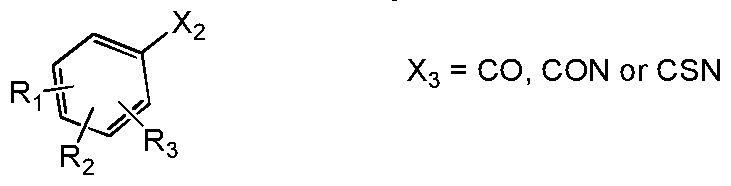
X2 = COCI, NCO or NCS
a Reagents and conditions: (a) Method N : 1) NaN02, H3P04 (85%), -10 °C, 20 min, 2) H3P02, H3P04 (85%), -10 °C to rt, overnight; (b) Method A: AICI3, anhydrous CH2CI2, 0 °C, 0.5 h and then rt, 1 h; (c) 1) Method H: anhydrous THF, 80 °C, 3 h, 2) Method I: 2- iodoxybenzoic acid, anhydrous THF, 0 °C, 10 min and 60 °C, 18 h; (d) Method B: Cs2C03, Pd(PPh3)4, DME/water (1 : 1), reflux, 2 h; (e) Method C: Cs2C03, Pd(PPh3)4, DME/EtOH/water (1 : 1 : 1), microwave conditions (150 W, 15 bar, 150 °C, 15 min); (f) Na2C03, Pd(PPh3)4, THF/water (1 : 1), reflux, 18 h; (g) Method P: pyridine, rt to 100 ° C, 4h. The remaining variables are as defined hereinbefore.
Scheme 3 : Synthesis of compounds l-20a

a Reagents and conditions: (a) Method A: AICI3, anhydrous CH2CI2, 0 °C, 0.5 h and then rt, 1 h, for compounds la-3a. 4b, 6a-10a: (b) Method Bl : Cs2C03, Pd(PPh3)4, DME/water (1 : 1), reflux, 2 h, for compounds 14a-16a. 17, 19, 20a: (c) Method C: Cs2C03, Pd(PPh3)4, DME/EtOH/water (1 : 1 : 1), microwave conditions (150 W, 15 bar, 150 °C, 15 min), for compounds 4a, 5a, l la-13a, 18a : (d) Method D: BBr3, CH2CI2, -78 °C, 20 h, for compounds 1-16. 17a, 18; (e) Method E: pyridinium hydrochloride, 220 °C, 18 h, for compound 20; (f) Na2C03, Pd(PPh3)4, THF/water (1 : 1), reflux, 18 h, for compound lb.

a reagents and conditions: (a) Method H: anhydrous THF, 80 °C, 3 h, for compounds 21c- 24c; (b) Method I: 2-iodoxybenzoic acid, anhydrous THF, 0 °C, 10 min and 60 °C, 18 h, for compounds 21^2¾ and 24a; (c) Method Bl : Cs2C03, Pd(PPh3)4, DME/water (1 : 1), reflux 2 h, for compounds 21a-23a; (d) Method D: BBr3, CH2CI2, -78 °C, 20 h, for compounds 21 and 23; (e) Method E: pyridinium hydrochloride, 220 °C, 18 h, for compounds 22 24- (f) Method B2: Cs2C03, Pd(PPh3)4, DME/water (1 : 1), reflux, 4 h, for compound 24b.
Scheme 5 : Synthesis of compounds 25-53a

17a 25-53 a Reagents and conditions: (a) Method A: AICI3, anhydrous CH2CI2, 0 °C, 0.5 h followed by rt, 1 h for compound 4b; (b) Method D: BBr3, CH2CI2, -78 °C, 18 h for compounds 17a, 26 a nd 44-46: (c) Method C: Cs2C03, Pd(PPh3)4, DME/EtOH/water (1 : 1 : 1), microwave conditions (150 W, 15 bar, 150 °C, 15 min) for compound 26a; (d) Method B2: Cs2C03, Pd(PPh3)4, DME/water (1 : 1) reflux, 4 h for compounds 44a -46a and 53; (e) Method Bl : Cs2C03, Pd(PPh3)4, DME/water (1 : 1) reflux, 2 h for compounds 25, Z7i43 and 47-52.

a Reagents and conditions: (a) Method A: AICI3, anhydrous CH2CI2, 0 °C, 0.5 h and then rt, lh. (b) Method Bl : Cs2C03, Pd(PPh3)4, DME/water (1 : 1), reflux, 2h. (c) Method D : BBr3, CH2CI2, -78°C to rt, overnight, d) Method Q: Pyridine, ArS02CI, rt, overnight.
Scheme 7 : Synthesis of compounds 101-10 a
3
OH
OH
a Reagents and conditions: (a) Method N : 1) NaN02, H3P04 (85%), -10 °C, 20 min, 2) H3PO2, H3P04 (85%), -10 °C to rt, overnight; (b) Method O: 1) nBuLi, anhydrous THF, -70 °C to -20 °C, 1 h, 2) anhydrous THF, -15 °C, 90 min; c) Method I: 2-iodoxybenzoic acid, anhydrous THF, 0 °C to 60 °C, overnight; d) Method F: BF3S(CH3)2, anhydrous CH2CI2, rt, overnight for compounds 101-104; e) Method E: pyridinium hydrochloride, 220 °C, 4 h for compound 105.
Scheme 8 : Synthesis of compounds 106, 1 3

111 b R, : 4-CH3; R2: OCH3 -CH3; R2: OCH3

106 R, : H
107 R, : OCH3
110 R, OH
111 R, 4-CH3; R2: OH a Reagents and conditions: (a) Method N : 1) NaN02, H3P04 (85%), -10 °C, 20 min, 2) H3P02, H3P04 (85%), -10 °C to rt, overnight, (b) Method O: 1) nBuLi, anhydrous THF, - 70 to - 20 °C, 1 h, 2) anhydrous THF, -15 °C, 90 min; (c) Method I : 2-iodoxybenzoic acid, anhydrous THF, 0 to 60 °C, overnight; (d) Method E: pyridinium hydrochloride, 220 °C, 4 h.
Scheme 9 : S nthesis of com ounds 108 109 and 112a

a Reagents and conditions: (a) Method M : benzylbromide, potassium carbonate, reflux, overnight; (b) Method L: tert-butyldimethylsilyl chloride, imidazole, DMF, 0 °C for lh followed by rt for 6h; (c) Method O: 1) nBuLi, anhydrous THF, -70 °C to -20 °C, 1 h, 2) anhydrous THF, -15 °C, 90 min; (d) Method I: 2-iodoxybenzoic acid, anhydrous THF, 0 °C to 60 °C, overnight; (e) Method G: TBAF, anhydrous THF, rt, 2h for compounds 108b. 109 and 112a ; (f) Method D: BBr3, CH2CI2, -78 °C, 18 h for compound 112; (g) benzene boronic acid, copper (II) acetate, molecular sieves (4 A), anhydrous CH2CI2, triethylamine, rt, 18 h for compound 108a : (h) Method F: BBr3, CH2CI2, -78 °C, 18 h for compound 108.
Scheme 10 : Synthesis of compounds 113-1283

Examples
Materials and Methods
Chemical names follow IUPAC nomenclature. Starting materials were purchased from Aldrich, Acros, Lancaster, Maybridge, Combi Blocks, Merck, Fluka or Ricci Chimica and were used without purification.
Column chromatography (CC) was performed on silica gel (70-200 μΓη) coated with silica, preparative thin layer chromatography (TLC) on 1 mm SIL G-100 UV254 glass plates (Macherey-Nagel) and reaction progress was monitored by TLC on Alugram SIL G UV254 (Macherey-Nagel).
All microwave irradiation experiments were carried out in a CEM-Discover monomode microwave apparatus.
^-NMR and 13C-NMR spectra were measured on a Bruker AM500 spectrometer (500 MHz) at 300 K. Chemical shifts are reported in δ (parts per million : ppm), by reference to the hydrogenated residues of deuteriated solvent as internal standard (CDCI3: δ = 7.24 ppm ^H-N MR) and δ = 77 ppm (13C-NMR), CD3OD : δ = 5.84 ppm (1H-N MR) and δ = 49.3 ppm (13C-NMR), CD3COCD3: δ = 2.05 ppm (1H-N MR) and δ = 30.8 ppm (13C-NMR), CD3SOCD3 δ = 2.50 ppm (1H-N MR) and δ = 39.5 ppm (13C- NMR)). Signals are described as s, d, t, dd, ddd, m, dt, td and q for singlet, doublet, triplet, doublet of doublets, doublet of doublets of doublets, multiplet, doublet of triplets, triplet of doublets and quadruplet, respectively. All coupling constants (J) are given in hertz (Hz).
Mass spectra (ESI) were recorded on a TSQ Quantum (Thermo Finnigan) instrument.
Tested compounds have > 95 % chemical purity as measured by HPLC. Several final compounds were purified via an Agilent Technologies Series 1200-preparative HPLC using a linear gradient run (solvents: acetonitrile, water) starting from 20% acetonitrile up to 100% in 36 min.
Example 1. Preparation of title compounds 1-53 and compounds 101-128.
The following compounds were prepared according to previously described procedures: 4-fluoro-3-methoxybenzoyl chloride (7b) [Czaplewski L. G. et al ., Bioorg. Med. Chem . Lett. 19, 524-527 (2009)]; 4-nitro-3-methoxybenzoyl chloride (10b) [Czaplewski L. G. et al ., Bioorg. Med. Chem . Lett. 19, 524-527 (2009)]; 2-(4-me-
thoxyphenyl)thiophene (6b) [Morgan B. P. et al ., Dalton Trans 2020-2028 (2009)]; Benzothiazole (101c) [Blomquist, A. et al ., J. Org. Chem. 12(5), 718-725 (1947)]; l,3-benzothiazol-2-yl(3-hydroxyphenyl)methanone (101) £Susanna M . et al., J. Med. Chem . 50(17), 4236-4242 (2007)]; 6-methoxy-l,3-benzothiazole (102b) [Hiroyuki O. et al ., Chem . & Pharm . Bull . 26(5), 1443-1452 (1978)]; (6-hydroxy- l,3-benzothiazol-2-yl)(3-hydroxyphenyl)methanone (103) [Hiroki M ., EP-A- 0735029 (1996)]; (6-hydroxy-l,3-benzothiazol-2-yl)(4-hydroxyphenyl)methanone (104) [Hiroki M ., EP-A-0735029 (1996)]; 3-methoxy-4-(tert-butyl-dimethyl- silanyloxy)benzaldehyde (108e) [Yuji T. et al., J. Org. Chem . 74(16), 5920-5926 (2009)]; 4-hydroxy-3-methoxybenzaldehyde (108f) [Challis A. A. L. et al., J. Chem . Soc. 1692-1697 (1947)]; 3-methoxy-4-methylbenzaldehyde (109c) [Campaigne E. et al. ; J. Het Chem 12(5), 889-892 (1975)]; [3-(tert-butyl-dimethyl-silanyloxy)-4- methyl]benzaldehyde (109c) [Davis P. D., WO 2001/012579]; 6-hydroxy-benzo- thiazole (109e) [Hiroyuki O. et al., Chem. & Pharm . Bull. 26(5), 1443-1452 (1978)]; [2-(tert-butyl-dimethyl-silanyloxy)-5-methoxy]benzaldehyde (112d) [Liou J. -P. et al., J. Med. Chem . 45(12), 2556-2562 (2002)] .
Method A, general procedure for Friedel-Crafts acylation : A mixture of mono- substituted thiophene derivative (1 eq), arylcarbonyl chloride (1 eq) and alumi- niumtrichloride (1 eq) in anhydrous dichloromethane was stirred at 0 °C for 0.5 h. The reaction mixture was warmed to room temperature (rt) and stirred for 1 h. 1M HCI was used to quench the reaction. The aqueous layer was extracted with ethyl acetate. The combined organic layers were washed with brine, dried over magnesium sulfate, filtered and concentrated to dryness. The product was purified by CC. Method B, general procedures for Suzuki coupling : A mixture of arylbromide (1 eq), boronic acid derivative (1.2 eq), caesium carbonate (4 eq) and tetrakis(tri- phenylphosphine) palladium (0.01 eq) in an oxygen free DME/water (1 : 1) solution was refluxed under nitrogen atmosphere for 2h (method Bl) or for 4 h (method B2). The reaction mixture was cooled to room temperature. The aqueous layer was extracted with ethyl acetate. The combined organic layers were washed with brine, dried over magnesium sulfate, filtered and concentrated to dryness. The product was purified by CC followed by preparative TLC or preparative HPLC, respectively. Method C, general procedures for Suzuki coupling : A mixture of arylbromide (1 eq), boronic acid derivative (1.2 eq), caesium carbonate (4 eq) and tetrakis(triphenyl- phosphine) palladium (0.01 eq) was suspended in an oxygen free DME/EtOH/water (1 : 1 : 1) solution. The reaction mixture was exposed to microwave irradiation (15
min, 150 W, 150 °C, 15 bar). After reaching rt, water was added and the aqueous layer was extracted with ethyl acetate. The combined organic layers were washed with brine, dried over magnesium sulfate, filtered and concentrated to dryness. The product was purified by CC.
Method D, general procedure for ether cleavage: To a solution of methoxybenzene derivative (1 eq) in anhydrous dichloromethane at -78 °C (dry ice/acetone bath), boron tribromide in dichloromethane (1 M, 3 eq per methoxy function) was added dropwise. The reaction mixture was stirred for 18 h at rt under nitrogen atmosphere. Water was added to quench the reaction, and the aqueous layer was extracted with ethyl acetate. The combined organic layers were washed with brine, dried over sodium sulfate, filtered and concentrated to dryness. The product was purified by CC followed by preparative TLC or preparative HPLC, respectively.
Method E, general procedure for ether cleavage: A mixture of methoxybenzene derivative (1 eq) and pyridinium hydrochloride (37 eq per methoxy function) was heated to 220 °C for 18 h. After cooling to rt, water, 1 M HCI and ethyl acetate were added. The aqueous layer was extracted with ethyl acetate. The combined organic layers were washed with brine, dried over sodium sulfate, filtered and concentrated to dryness. The product was purified by CC followed by preparative TLC or preparative HPLC, respectively.
Method F, general procedure for ether cleavage : To a solution of methoxybenzene derivative (1 eq) in dry dichloromethane at rt, boron trifluoride methyl sulfide complex in dichloromethane (1 M, 75 eq per methoxy function) was added dropwise. The reaction mixture was stirred for 18 h at rt under nitrogen atmosphere. Water was added to quench the reaction, and the aqueous layer was extracted with ethyl acetate. The combined organic layers were washed with brine, dried over magnesium sulfate, filtered and concentrated to dryness. The product was purified by CC, preparative TLC, preparative HPLC or recrystallisation, respectively.
Method G, general procedure for ether cleavage : To a solution of tert butyl dimethyl silane ether derivative (1 eq) in THF at 0 °C tetra-n-butylammonium fluoride (TBAF) in THF (1 M, 1.3 eq per ether function) was added dropwise. The reaction mixture was stirred for 2 h at rt under nitrogen atmosphere. Water was added to quench the reaction, and the aqueous layer was extracted with ethyl acetate. The combined organic layers were washed with brine, dried over magnesium sulfate, filtered and concentrated to dryness. The product was purified by CC, preparative TLC, preparative HPLC or recrystallisation, respectively.
Method H, general procedure for Grignard-reaction : To a solution of carbaldehyde derivative (1 eq) in anhydrous THF, 3-methoxyphenylmagnesium bromide (1.0 M in THF/toluene, 2.2 eq) was added dropwise. The reaction mixture was stirred for 3 h at 80 °C under nitrogen atmosphere. Brine was added to quench the reaction, and the aqueous layer was extracted with ethyl acetate. The combined organic layers were washed with brine, dried over magnesium sulfate, filtered and concentrated to dryness. The product was purified by CC.
Method I, general procedure for oxidation : A mixture of aliphatic alcohol-derivative (1 eq) and 2-iodoxybenzoic acid (2 eq) in anhydrous THF was stirred at 0 °C. After 10 min, the reaction mixture was stirred and heated to 60 °C for 18 h. After cooling to rt, saturated sodium thiosulfate solution was added to quench the reaction and the aqueous layer was extracted with ethyl acetate. The combined organic layers were washed succesively with 1 M NaOH and brine, dried over magnesium sulfate, filtered and concentrated to dryness. The product was purified by CC.
Method L, general procedure for OH protection : To a cold (0 °C) solution of alcohol derivative (1 eq) and tert-Butyldimethylsilyl chloride (1.5 eq) in DMF, imidazole (1.7 eq) was added and stirred at 0 °C for 1 h. After heating the reaction mixture to rt, the crude material was additionally stirred for 6 h. Water was added to quench the reaction and the aqueous solution was then extracted (3x) with ethyl acetate. The combined organic layers were washed with brine, dried over magnesium sulfate, filtered and concentrated to dryness. The product was purified by CC or recrystallisation.
Method M, general procedure for OH protection : To a solution of alcohol derivative (1 eq) and benzyl bromide (1.1 eq) in acetone, K2C03 (7 eq) was added. The reaction mixture was refluxed overnight. A solution of water and saturated ammonium chloride (1 : 2) was added to quench the reaction and the aqueous solution was then extracted (3x) with ethyl acetate. The combined organic layers were washed with brine, dried over magnesium sulfate, filtered and concentrated to dryness. The product was purified by CC or recrystallisation.
Method N, general procedure for diazotation : A solution of 6-methoxy-benzothiazol- 2-ylamine (1 eq) in 40 ml of aqueous H3P04 (85 %) was warmed up to 60 °C to form a homogeneous solution . The reaction mixture was then cooled to -8 °C and a concentrated aqueous solution of NaN02 (6 eq) was added slowly and carefully under vigorous stirring in order to not rise a temperature of -4 °C. The resultant thick yellow syrup was added to 15 ml of prechilled (0 °C) H3P02 (50 %) dropwise
with stirring and then allowed to warm to rt overnight. The solution was diluted with cold water, neutralized with sodium carbonate and extracted (3x) with ethyl acetate. The combined organic layers were washed with brine, dried over magnesium sulfate, filtered and concentrated to dryness. The product was purified by CC or recrystallisation.
Method 0, general procedure for nucleophilic addition : To a solution of benzothia- zole derivative unsubstituted in position 2 (1 eq) in anhydrous THF a 2.5 M solution of nBuLi (1.3 eq) in hexane was added dropwise at -78 °C (dry ice/acetone bath) under anhydrous conditions. The reaction mixture was stirred for 1 h at -78 °C to form the formyl anion in situ. To the former reaction mixture a solution of electro- phile (1 eq) in anhydrous THF was added dropwise at -78 °C (dry ice/acetone bath) and additionally stirred for 30 min. The temperature was then warmed up to -20 °C (NaCI/ice/dry ice/acetone bath) and the reaction mixture was stirred for 2 h. A solution of water and saturated NH4CI (1 : 2) was added to quench the reaction at -20 °C, and the aqueous layer was extracted (3x) with ethyl acetate. The combined organic layers were washed with brine, dried over magnesium sulfate, filtered and concentrated to dryness. The product was purified by CC or recrystallisation.
Method P, general procedure for nucleophilic substitution : To a solution of 6-meth- oxy-benzothiazol-2ylamine (1 eq) in anhydrous pyridine arylcarbonyl chloride, aryl- isocyanate or arylisothiocyanate (1 eq) was added. The reaction mixture was stirred for 4 h at 100 °C. A solution of water was added to quench the reaction at rt and the aqueous layer was extracted (3x) with ethyl acetate. The combined organic layers were washed with brine, dried over magnesium sulfate, filtered and concentrated to dryness. The product was purified by CC or recrystallisation.
Method Q, general procedure for sulfonamide coupling : Amino phenyl derivative (1 equiv) was dissolved in pyridine abs. and was spiked with sulfonyl chloride (1.5 equiv). The reaction mixture was stirred overnight by rt. The reaction was quenched by adding 10 mL of 2N HCI and extracted with ethyl acetate. The organic layers were washed with saturated NaHC03 and brine, dried over magnesium sulfate, filtered and concentrated to dryness. The product was purified by CC.
1.1. (3-HvdroxyphenvDr5-(3-hvdroxyphenvD-2-thienyl1methanone (1)
 2-(3-Methoxyphenyl)thiophene (lb). A mixture of 2-bromothiophene (2.00 g, 12.27 mmol), 3-methoxybenzene boronic acid (2.24 g, 14.72 mmol), sodium carbonate (2.73 g, 25.76 mmol) and tetrakis(triphenylphosphine) palladium (142 mg, 123 pmol) in an oxygen free THF/water (1 : 1) solution was stirred at 100 °C for 18 h under nitrogen atmosphere. The reaction mixture was cooled to rt. The aqueous layer was extracted with ethyl acetate. The combined organic layers were washed with brine, dried over magnesium sulfate, filtered and concentrated to dryness. The product was purified by CC (hexane/ethyl acetate 95 : 5); yield : 96 % (2.24 g); 1 NMR (CD3COCD3) : 7.45 (dd, J= 0.9 Hz and J= 3.5 Hz, 1H), 7.44 (dd, J= 0.9 Hz and J= 5.0 Hz, 1H), 7.32 (t, J= 8.2 Hz, 1H), 7.23 (ddd, J= 0.9 Hz and J= 1.6 Hz and J= 7.6 Hz, 1H), 7.21 (t, J= 2.1 Hz, 1H), 7.11 (t, J= 3.8 Hz, 1H), 6.88 (ddd, J= 0.9 Hz and J= 2.5 Hz and J= 8.2 Hz, 1H), 3.85 (s, 3H); 13C NMR (CD3COCD3) : 162.20,
0.00, 126.95, 125.40, 119.95, 114.90, 113.05, 56.60.

(3-Methoxyphenyl)r5-(3-methoxyphenyl)-2-thienvnmethanQne (la). The title compound was prepared by reaction of 2-(3-methoxyphenyl)thiophene (lb) (100 mg, 0.53 mmol), 3-methoxybenzoyl chloride (90 mg, 0.53 mmol) and aluminum chloride (71 mg, 0.53 mmol) according to method A. The product was purified by CC (hexane/ethyl acetate 97 : 3); yield : 81 % (138 mg); ^ NMR (CD3COCD3) : 7.70 (d, J= 4.1 Hz, 1H), 7.57 (d, J= 4.1 Hz, 1H), 7.49-7.44 (m, 2H), 7.40-7.34 (m, 3H), 7.31 (t, J= 2.1 Hz, 1H), 7.21 (ddd, J= 1.9 Hz and J= 2.5 Hz and J= 7.6 Hz, 1H), 6.99 (ddd, J= 1.3 Hz and J= 2.5 Hz and J= 7.9 Hz, 1H), 3.89 (s, 3H), 3.88 (s, 3H); 13C N MR (CD3COCD3) : 188.65, 162.30, 161.70, 154.30, 144.10, 141.25, 137.85, 136.40, 132.25, 131.50, 126.55, 123.05, 120.40, 120.05, 116.75, 115.50, 113.35,

(3-Hvdroxyphenyl)r5-(3-hvdroxyphenyl)-2-thienyl1methanone (1). The title compound was prepared by reaction of (3-methoxyphenyl)[5-(3-methoxyphenyl)- 2-thienyl]methanone (la) (138 mg, 0.43 mmol) and boron tribromide (2.58 mmol) according to method D. The product was purified by CC (hexane/ethyl acetate 8 : 2) followed by preparative HPLC; yield : 75 % (95 mg); MS (ESI) : 297 (M + H)+; 1H
NMR (CD3OD) : 7.64 (d, J= 4.1 Hz, 1H), 7.42 (d, J= 4.1 Hz, 1H), 7.33 (t, J= 7.9 Hz, 1H), 7.27 (dt, J= 1.3 Hz and J= 7.6 Hz, 1H), 7.24-7.17 (m, 3H), 7.12 (t, J= 2.1 Hz, 1H), 7.03 (ddd, J= 0.9 Hz and J= 2.5 Hz and J= 7.9 Hz, 1H), 6.80 (ddd, J= 0.9 Hz and J= 2.5 Hz and J= 7.9 Hz, 1H); 13C NMR (CD3OD) : 189.90, 159.40, 159.00, 155.05, 140.60, 139.10, 137.90, 131.45, 130.80, 125.40, 121.30, 120.70, 118.60, 117.50, 116.55, 114.00.
-Hvdroxyphenv0r5-f3-hvdroxyphenyl)-2-thienyl"lmethanone (2)

f4-Methoxyphenyl)r5-f3-methoxyphenyl)-2-thienyl1methanone (2a). The title compound was prepared by reaction of 2-(3-methoxyphenyl)thiophene (lb) (100 mg, 0.53 mmol), 4-methoxybenzoyl chloride (90 mg, 0.53 mmol) and aluminum chloride (71 mg, 0.53 mmol) according to method A. The product was purified by CC (hexane/ethyl acetate 9 : 1); yield : 96 % (165 mg); ^ NMR (CD3COCD3) : 7.93 (d, J= 9.1 Hz, 2H), 7.70 (d, J= 4.1 Hz, 1 H), 7.59 (d, J= 4.1 Hz, 1H), 7.39 (t, J= 7.6 Hz, 1H), 7.36 (td, J= 1.3 Hz and J= 7.9 Hz, 1H), 7.32 (t, J= 2.1 Hz, 1H), 7.10 (d, J= 9.1 Hz, 2H), 7.00 (ddd, J= 0.9 Hz and J= 2.5 Hz and J= 7.9 Hz, 1H), 3.92 (s, 3H), 3.89 (s, 3H); 13C NMR (CD3COCD3) : 187.45, 165.20, 162.35, 153.45, 144.55, 136.95, 136.55, 133.15, 132.25, 126.40, 120.40, 116.60, 115.70, 113.35,

(4-Hvdroxyphenyl)r5-(3-hvdroxyphenyl)-2-thienyl1methanone (2). The title compound was prepared by reaction of (4-methoxyphenyl)[5-(3-methoxyphenyl)- 2-thienyl]methanone (2a) (147 mg, 0.45 mmol) and boron tribromide (2.70 mmol) according to method D. The product was purified by CC (hexane/ethyl acetate 8 : 2) followed by preparative HPLC; yield : 56 % (74 mg); MS (ESI) : 297 (M + H)+; 1H NMR (CD3COCD3) : 7.87 (d, J= 8.8 Hz, 2H), 7.69 (d, J= 3.8 Hz, 1H), 7.52 (d, J= 3.8 Hz, 1H), 7.31 (t, J= 7.6 Hz, 1H), 7.28-7.26 (m, 1H), 7.25-7.24 (m, 1H), 7.01 (d, J= 8.8 Hz, 2H), 6.90 (ddd, J= 0.9 Hz and J= 2.5 Hz and J= 7.9 Hz, 1H); 13C NMR (CD3COCD3) : 187.40, 159.95, 144.50, 136.80, 136.55, 133.45, 132.25, 131.45, 126.00, 119.35, 118.00, 117.15, 114.70.
-HvdroxyphenvOr5-f3-hvdroxyphenvO-2-thienyl1methanone (3) .

(2-Methoxyphenv0r5-(3-methoxyphenv0-2-thienyl1methanone (3a). The title compound was prepared by reaction of 2-(3-methoxyphenyl)thiophene (lb) (100 mg, 0.53 mmol), 2-methoxybenzoyl chloride (90 mg, 0.53 mmol) and aluminum chloride (71 mg, 0.53 mmol) according to method A. The product was purified by CC (hexane/ethyl acetate 9 : 1); yield : 79 % (136 mg); ^ N MR (CD3COCD3) : 7.55- 7.51 (m, 2H), 7.42 (d, J= 4.1 Hz, 1 H), 7.39 (t, J= 7.9 Hz, 2H), 7.35-7.33 (m, 1 H), 7.30 (t, J= 2.1 Hz, 1 H), 7.19 (d, J= 8.2 Hz, 1 H), 7.10-7.07 (m, 1 H), 6.99 (ddd, J= 0.9 Hz and J= 2.5 Hz and J= 8.2 Hz, 1 H), 3.88 (s, 3H), 3.81 (s, 3H); 13C N M R (CD3COCD3) : 189.10, 162.35, 158.85, 154.20, 145.50, 137.70, 136.60, 133.70, 132.25, 130.90, 130.60, 126.55, 122.25, 120.40, 116.75, 113.80, 113.35, 57.05,

f2-HvdroxyphenvOr5-f3-hvdroxyphenvO-2-thienyl1methanone (3) . The title compound was prepared by reaction of (2-methoxyphenyl)[5-(3-methoxyphenyl)- 2-thienyl]methanone (3a) (136 mg, 0.42 mmol) and boron tribromide (2.52 mmol) according to method D. The product was purified by CC (hexane/ethyl acetate 8 : 2) followed by preparative H PLC; yield : 95 % (118 mg); MS (ESI) : 297 (M + H)+; 1H N M R (CD3COCD3) : 8.03 (dd, J= 1.2 Hz and J= 7.9 Hz, 1 H), 7.84 (d, J= 4.3 Hz, 1 H), 7.59-7.56 (m, 1 H), 7.56 (d, J= 4.3 Hz, 1 H), 7.31 (t, J= 7.6 Hz, 1 H), 7.29-7.26 (m, 2H), 7.05-7.02 (m, 2H), 6.93 (ddd, J= 1.3 Hz and J= 2.4 Hz and J= 7.9 Hz, 1 H); 13C N MR (CD3COCD3) : 192.00, 163.55, 159.95, 154.80, 142.70, 138.30, 137.60, 136.10, 133.45, 132.35, 126.35, 121.70, 121.05, 119.85, 119.40, 118.35, 114.75.
1.4. f3-HvdroxyphenvOr5-f4-hvdroxyphenvO-2-thienyl"lmethanone (4)

(5-Bromo-2-thienyn(3-methoxyphenyl)methanone (4b). The title compound was prepared by reaction of 2-bromothiophene (145 mg, 0.89 mmol), 3- methoxybenzoyi chloride (152 mg, 0.89 mmol) and aluminum chloride (119 mg, 0.89 mmol) according to method A. The product was purified by CC (hexane/ethyl
acetate 97 : 3); yield : 77 % (204 mg); 1H NMR (CD3COCD3) : 7.55 (d, J= 4.1 Hz, 1H), 7.47 (t, J= 7.9 Hz, 1H), 7.42 (td, J= 1.5 Hz and J= 7.9 Hz, 1H), 7.35-7.34 (m, 1H), 7.33 (d, J= 4.1 Hz, 1H), 7.22 (ddd, J= 0.9 Hz and J= 2.5 Hz and J= 8.2 Hz, 1H), 3.88 (s, 3H); 13C NMR (CD3COCD3) : 187.90, 161.75, 140.45, 137.40, 133.85,
.05, 120.45, 115.45, 56.85.

f3-MethoxyphenvOr5-f4-methoxyphenvO-2-thienyl"lmethanone (4a). The title compound was prepared by reaction of (5-bromo-2-thienyl)(3- methoxyphenyl)methanone (4b) (204 mg, 0.69 mmol), 4-methoxybenzene boronic acid (126 mg, 0.83 mmol), caesium carbonate (899 mg, 2.76 mmol) and tetrakis(triphenylphosphine) palladium (8 mg, 7 μηιοΙ) according to method C. The product was purified by CC (hexane/ethyl acetate 95 : 5); yield : 80 % (178 mg); 1 NMR (CD3COCD3) : 7.72 (d, J= 8.8 Hz, 2H), 7.66 (d, J= 4.1 Hz, 1 H), 7.48-7.43 (m, 3H), 7.38-7.37 (m, 1H), 7.20 (ddd, J= 1.6 Hz and J= 2.5 Hz and J= 7.9 Hz, 1H), 7.02 (d, J= 8.8 Hz, 2H), 3.88 (s, 3H), 3.85 (s, 3H); 13C N MR (CD3COCD3) : 188.50, 162.65, 161.70, 154.80, 143.05, 141.45, 138.15, 131.45, 129.45, 127.70, 125.15, 123.00, 119.90, 116.50, 115.50, 56.80, 56.75.

(3-HvdroxyphenvDr5-(4-hvdroxyphenvD-2-thienyl1methanone (4). The title compound was prepared by reaction of (3-methoxyphenyl)[5-(4-methoxyphenyl)- 2-thienyl]methanone (4a) (178 mg, 0.55 mmol) and boron tribromide (3.30 mmol) according to method D. The product was purified by CC (hexane/ethyl acetate 8 : 2) followed by preparative TLC (hexane/ethyl acetate 1 : 1); yield : 51 % (83 mg); MS (ESI) : 297 (M + H)+; ^ N MR (CD3COCD3) : 8.79 (s, 1H), 8.72 (s, 1 H), 7.67-7.64 (m, 3H), 7.42 (d, J= 4.1 Hz, 1H), 7.37 (t, J= 7.9 Hz, 1H), 7.35 (td, J= 1.3 Hz and J= 7.6 Hz, 1H), 7.33-7.32 (m, 1H), 7.11 (ddd, J= 0.9 Hz and J= 2.5 Hz and J= 7.9 Hz, 1H), 6.95 (d, J= 8.8 Hz, 1H); 13C NMR (CD3COCD3) : 188.60, 160.60, 159.35, 155.20, 142.80, 141.50, 138.05, 131.50, 129.60, 126.80, 124.70, 122.00, 121.05, 117.95, 117.25.
1.5. (3-HvdroxyphenvDr5-(2-hvdroxyphenvD-2-thienyl1methanone (5)

(3-Methoxyphenv0r5-(2-methoxyphenv0-2-thienyl1methanone (5a). The title compound was prepared by reaction of (5-bromo-2-thienyl)(3- methoxyphenyl)methanone (4b) (200 mg, 0.67 mmol), 2-methoxybenzene boronic acid (122 mg, 0.80 mmol), caesium carbonate (873 mg, 2.68 mmol) and tetrakis(triphenylphosphine) palladium (8 mg, 7 μηιοΙ) according to method C. The product was purified by CC (hexane/ethyl acetate 9 : 1); yield : 67 % (145 mg); 1 NMR (CD3COCD3) : 7.85 (dd, J= 1.9 Hz and J= 7.9 Hz, 2H), 7.69 (d, J= 1.3 Hz, 1H), 7.49-7.44 (m, 2H), 7.42-7.38 (m, 2H), 7.21-7.18 (m, 2H), 7.07 (dt, J= 0.9 Hz and J= 7.9 Hz, 1H), 4.01 (s, 3H), 3.89 (s, 3H); 13C NMR (CD3COCD3) : 189.10, 161.70, 158.10, 149.85, 144.05, 141.70, 136.50, 132.15, 131.45, 130.15, 127.80, 123.75,
9.90, 115.50, 114.05, 57.10, 56.80.

f3-HvdroxyphenvOr5-f2-hvdroxyphenvO-2-thienyl1methanone (5). The title compound was prepared by reaction of (3-methoxyphenyl)[5-(2-methoxyphenyl)- 2-thienyl]methanone (5a) (145 mg, 0.45 mmol) and boron tribromide (2.7 mmol) according to method D. The product was purified by CC (hexane/ethyl acetate 8 : 2) followed by preparative HPLC; yield : 25 % (33 mg); MS (ESI) : 297 (M + H)+; 1H NMR (CD3COCD3) : 7.80 (dd, J= 1.6 Hz and J= 7.9 Hz, 1H), 7.75 (d, J= 4.1 Hz, 1H), 7.69 (d, J= 4.1 Hz, 1H), 7.39 (t, J= 7.6 Hz, 1H), 7.36 (dt, J= 1.6 Hz and J= 7.6 Hz, 1H), 7.34-7.33 (m, 1 H), 7.27-7.23 (m, 1H), 7.11 (ddd, J= 1.6 Hz and J= 2.5 Hz and J= 7.9 Hz, 1H), 7.08 (dd, J= 1.3 Hz and J= 8.2 Hz, 1H), 6.97 (td, J= 1.3 Hz and J= 7.9 Hz, 1H); 13C N MR (CD3COCD3) : 189.10, 159.35, 156.05, 150.55, 143.75, 141.80, 136.55, 131.85, 131.50, 130.20, 127.55, 122.10, 122.05, 120.95, 118.45, 117.30.
1.6. f3-Hvdroxy-4-methylphenv0r5-f4-hvdroxyphenv0-2-thienyl1methanone (6) 2-(4-methoxyphenyl)thiophene (6b) was prepared according to Morgan B. P., Dalton Trans, 2020-2028 (2009).
 f3-Methoxy-4-methylphenv0r5-f4-methoxyphenv0-2-thienyl1methanone (6a). The title compound was prepared by reaction of 2-(4-methoxyphenyl)thiophene (6b) (150 mg, 0.79 mmol), 3-methoxy-4-methylbenzoyl chloride (146 mg, 0.79 mmol) and aluminum chloride (105 mg, 0.79 mmol) according to method A. The product was purified by CC (hexane/ethyl acetate 9 : 1); yield : 63 % (168 mg); *Η N MR (CD3COCD3) : 7.73 (d, J= 8.8 Hz, 2H), 7.71 (d, J= 4.1 Hz, 1H), 7.45 (d, J= 4.1 Hz, 1H), 7.41 (dd, J= 0.9 Hz and J= 7.6 Hz, 1H), 7.38-7.37 (m, 1 H), 7.31 (d, J= 7.6 Hz, 1H), 7.03 (d, J= 8.8 Hz, 2H), 3.93 (s, 3H), 3.86 (s, 3H), 2.27 (s, 3H); 13C NMR (CD3COCD3) : 188.35, 162.60, 159.70, 154.35, 143.35, 137.80, 133.15, 132.15,
10, 123.25, 116.50, 111.90, 56.85, 56.80, 17.50.

(3- Hvdroxy-4-methyl phenyl) r5-f4-hvdroxyphenyl)-2-thienyl1methanone (6). The title compound was prepared by reaction of (3-methoxy-4-methylphenyl)[5-(4- methoxyphenyl)-2-thienyl]methanone (6a) (168 mg, 0.50 mmol) and boron tribromide (3.00 mmol) according to method D. The crude mixture was washed with MeOH . The resulting suspension was filtered and the precipitated product was dried under reduced pressure. ; yield : 88 % (137 mg); MS (ESI) : 311 (M + H)+; 1H NMR (CD3COCD3) : 8.80 (s, 1H), 8.63 (s, 1H), 7.67-7.64 (m, 3H), 7.41 (d, J= 4.1 Hz, 1H), 7.36 (d, J= 1.6 Hz, 1H), 7.31 (dd, J= 1.6 Hz and J= 7.6 Hz, 1H), 7.27 (d, J= 7.6 Hz, 1H), 6.94 (d, J= 8.8 Hz, 2H), 2.29 (s, 3H); 13C NMR (CD3COCD3) : 188.25, 160.55, 157.25, 154.80, 143.05, 138.95, 137.65, 132.55, 131.35, 129.60, 126.85, 124.60, 122.35, 117.95, 116.65, 17.30.
1.7. f4-Fluoro-3-hvdroxyphenyl)r5-f4-hvdroxyphenyl)-2-thienyl1methanone (7) 4-fluoro-3-methoxybenzoyl chloride (7b) was prepared according to Czaplewski L.
Chem . Lett., 524-527 (2009).

(4-Fluoro-3-methoxyphenyl)r5-(4-methoxyphenyl)-2-thienyl1methanone (7a). The title compound was prepared by reaction of 2-(4-methoxyphenyl)thiophene (6b) (150 mg, 0.79 mmol), 4-fluoro-3-methoxybenzoyl chloride (7b) (149 mg, 0.79 mmol) and aluminum chloride (105 mg, 0.79 mmol) according to method A. The
product was purified by CC (hexane/ethyl acetate 9 : 1); yield : 88 % (237 mg); 1H NMR (CD3SOCD3) : 7.76-7.73 (m, 3H), 7.56-7.53 (m, 2H), 7.48-7.45 (m, 1H), 7.41- 7.37 (m, 1H), 7.04 (d, J= 8.8 Hz, 2H), 3.92 (s, 3H), 3.80 (s, 3H); 13C NMR (CD3SOCD3) : 185.60, 171.25, 170.10, 163.20, 160.35, 152.70, 147.25, 140.15,
, 125.20, 124.05, 122.30, 114.75, 114.05, 51.00, 47.90.
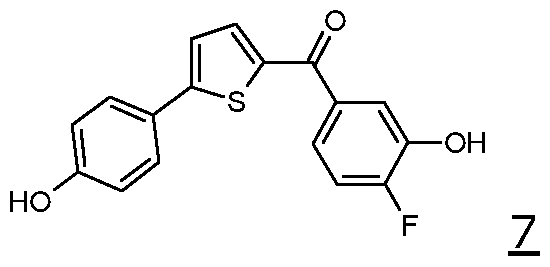
(4-Fluoro-3-hvdroxyphenyl)r5-(4-hvdroxyphenyl)-2-thienyl1methanone (7). The title compound was prepared by reaction of (4-fluoro-3-methoxyphenyl)[5-(4- methoxyphenyl)-2-thienyl]methanone (7a) (237 mg, 0.69 mmol) and boron tribromide (4.14 mmol) according to method D. The product was purified by CC (hexane/ethyl acetate 8 : 2) followed by preparative TLC (hexane/ethyl acetate 6 :4); yield : 86 % (187 mg); MS (ESI) : 315 (M + H)+; ^ N MR (CD3COCD3) : 9.23 (s, 1H), 8.93 (s, 1 H), 7.66-7.63 (m, 3H), 7.52 (dd, J= 2.2 Hz and J= 8.5 Hz, 1H), 7.41- 7.39 (m, 2H), 7.29-7.25 (m, 1H), 6.93 (d, J= 8.8 Hz, 2H); 13C NMR (CD3COCD3) : 187.40, 160.60, 156.85, 155.25, 154.85, 146.95, 146.85, 142.45, 138.10, 136.75, 129.55, 126.65, 124.70, 123.20, 120.25, 117.95, 117.80.
- Hvdroxy-4-methyl phenyl) r5-(3-hvdroxyphenvD-2-thienyl"lmethanone (8)
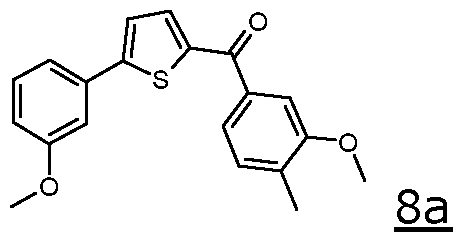
(3-Methoxy-4-methylphenyl)r5-(3-methoxyphenyl)-2-thienyl1methanone (8a). The title compound was prepared by reaction of 2-(3-methoxyphenyl)thiophene (lb) (300 mg, 1.58 mmol), 3-methoxy-4-methylbenzoyl chloride (292 mg, 1.58 mmol) and aluminum chloride (211 mg, 1.58 mmol) according to method A. The product was purified by CC (hexane/ethyl acetate 95 : 5); yield : 58 % (310 mg); *Η NMR (CD3COCD3) : 7.75 (d, J= 4.1 Hz, 1H), 7.60 (d, J= 4.1 Hz, 1H), 7.43 (dd, J= 1.6 Hz and J= 7.6 Hz, 1H), 7.41-7.39 (m, 2H), 7.37 (dt, J= 1.3 Hz and J= 7.6 Hz, 1H), 7.34-7.32 (m, 2H), 7.01 (ddd, J= 1.6 Hz and J= 2.5 Hz and J= 7.9 Hz, 1 H), 3.94 (s, 3H), 3.89 (s, 3H); 13C NMR (CD3COCD3) : 192.65, 162.35, 132.25, 132.20, 126.55, 123.35, 120.40, 119.75, 113.35, 111.95, 56.90, 17.50.

3-Hvdroxy-4-methylphenv0r5-(3-hvdroxyphenyl)-2-thienyl1methanone (8). The title compound was prepared by reaction of (3-methoxy-4-methylphenyl)[5-(3- methoxyphenyl)-2-thienyl]methanone (8a) (310 mg, 0.92 mmol) and boron tribromide (5.52 mmol) according to method D. The product was purified by CC (hexane/ethyl acetate 8 : 2); yield : 23 % (65 mg); MS (ESI) : 311 (M + H)+; ^ N MR (CD3COCD3) : 7.71 (d, J= 4.1 Hz, 1H), 7.53 (d, J= 4.1 Hz, 1H), 7.38-7.37 (m, 1H), 7.33 (dd, J= 1.6 Hz and J= 7.6 Hz, 1H), 7.31-7.24 (m, 4H), 6.90 (ddd, J= 1.3 Hz and J= 2.5 Hz and J= 7.9 Hz, 1H), 2.30 (s, 3H); 13C NMR (CD3COCD3) : 188.35, 159.95, 138.75, 137.35, 136.50, 132.60, 132.30, 129.55, 126.10, 122.40, 119.35, 116.70, 114.75, 114.45, 111.85, 17.35.
-Fluoro-3-hvdroxyphenv0r5-(3-hvdroxyphenyl)-2-thienyl1methanone (9)

(4-Fluoro-3-methoxyphenyl)r5-(3-methoxyphenyl)-2-thienyl1methanone (9a). The title compound was prepared by reaction of 2-(3-methoxyphenyl)thiophene (lb) (300 mg, 1.58 mmol), 4-fluoro-3-methoxybenzoyl chloride (7b) (298 mg, 1.58 mmol) and aluminum chloride (211 mg, 1.58 mmol) according to method A. The product was purified by CC (hexane/ethyl acetate 95 : 5); yield : 91 % (492 mg); 1 NMR (CD3COCD3) : 7.76 (d, J= 3.9 Hz, 1H), 7.62-7.59 (m, 2H), 7.55-7.52 (m, 1H), 7.40 (t, J= 7.8 Hz, 1 H), 7.37-7.36 (m, 1H), 7.34-7.30 (m, 2H), 7.01 (ddd, J= 1.2 and J= 7.6 Hz, 1H), 4.00 (s, 3H), 3.89 (s, 3H).

(4-Fluoro-3-hvdroxyphenyl)r5-(3-hvdroxyphenyl)-2-thienyl1methanone (9). The title compound was prepared by reaction of (4-fluoro-3-methoxyphenyl)[5-(3- methoxyphenyl)-2-thienyl]methanone (9a) (492 mg, 1.44 mmol) and boron tribromide (8.64 mmol) according to method D. The product was purified by CC (hexane/ethyl acetate 85 : 15) and washed with MeOH . The resulting suspension was filtered and the precipitated product was dried under reduced pressure. ; yield : 50 % (225 mg); MS (ESI) : 315 (M + H)+; 1H N MR (CD3SOCD3) : 7.69 (d, J= 4.1 Hz,
1H), 7.58 (d, J= 4.1 Hz, 1H), 7.44-7.42 (m, 1H), 7.33-7.31 (m, 2H), 7.27 (t, J= 7.9 Hz, 1H), 7.22-7.21 (m, 1H), 7.15-7.14 (m, 1H), 6.84-6.82 (m, 1 H); 13C NMR (CD3SOCD3) : 185.65, 158.00, 154.75, 152.80, 152.25, 145.25, 141.00, 136.55, 133.70, 130.55, 124.95, 120.85, 118.15, 116.95, 116.55, 116.30, 112.65.
1.10. 3-Hvdroxy-4-nitrophenv0r5-f3-hvdroxyphenyl)-2-thienyl1methanone (10) 3-methoxy-4-nitrobenzoyl chloride (10b) was prepared according to Czaplewski L.
d. Chem . Lett. 19, 524-527 (2009).

(3-Methoxy-4-nitrophenyl)r5-(3-methoxyphenyl)-2-thienyl1methanone (10a). The title compound was prepared by reaction of 2-(3-methoxyphenyl)thiophene (lb) (200 mg, 1.05 mmol), 3-methoxy-4-nitrobenzoyl chloride (10b) (226 mg, 1.05 mmol) and aluminum chloride (140 mg, 1.05 mmol) according to method A. The product was purified by CC (hexane/ethyl acetate 9 : 1) followed by preparative HPLC; yield : 41 % (160 mg); ^ NMR (CD3COCD3) : 7.98 (d, J= 8.2 Hz, 1H), 7.80 (d, J= 4.3 Hz, 1 H), 7.71 (d, J= 1.5 Hz, 1H), 7.63 (d, J= 4.0 Hz, 1H), 7.57 (dd, J= 1.5 Hz and J= 8.2 Hz, 1H), 7.41 (t, J= 7.8 Hz, 1H), 7.37 (dt, J= 1.5 Hz and J= 7.6 Hz, 1H), 7.33 (t, J= 1.9 Hz, 1H), 7.02 (ddd, J= 1.5 Hz and J= 2.4 Hz and J= 7.9 Hz, 1H), 4.09 (s, 3H), 3.89 (s, 3H); 13C NMR (CD3COCD3) : 187.45, 162.30, 155.45, 154.05, 144.45, 143.25, 139.00, 136.15, 132.30, 126.90, 126.80, 122.50, 120.50,
3.40, 58.35, 56.75.

3-Hvdroxy-4-nitrophenyl)r5-(3-hvdroxyphenyl)-2-thienyl1methanone (10). The title compound was prepared by reaction of (3-methoxy-4-nitrophenyl)[5-(3- methoxyphenyl)-2-thienyl]methanone (10a) (160 mg, 0.43 mmol) and boron tribromide (2.58 mmol) according to method D. The product was purified by CC (hexane/ethyl acetate 8 : 2) followed by preparative HPLC; yield : 29 % (42 mg); MS (ESI) : 342 (M + H)+; ^ NMR (CD3COCD3) : 8.25 (d, J= 8.5 Hz, 1H), 7.75 (d, J= 4.1 Hz, 1H), 7.59 (d, J= 1.9 Hz, 1H), 7.57 (d, J= 4.1 Hz, 1H), 7.46 (dd, J= 1.9 Hz and J= 8.5 Hz, 1H), 7.32 (t, J= 7.8 Hz, 1H), 7.28 (dt, J= 1.5 Hz and J= 7.9 Hz, 1H), 7.25 (t, J= 2.1 Hz, 1H), 6.93 (ddd, J= 1.3 Hz and J= 2.2 Hz and J= 7.6 Hz, 1H);
13C N MR (CD3COCD3) : 187.30, 160.00, 156.15, 155.90, 146.95, 142.90, 139.00, 132.40, 127.55, 126.65, 122.10, 121.30, 119.50, 118.50, 114.85.
-f3-Hvdroxy-4-methylphenv0-2-thienyl1(3-hvdroxyphenv0methanone fi ll

r5-(3-Methoxy-4-methylphenv0-2-thienyl1(3-methoxyphenv0methanone (11a). The title compound was prepared by reaction of (5-bromo-2-thienyl)(3- methoxyphenyl)methanone (4b) (200 mg, 0.67 mmol), 3-methoxy-4- methylbenzene boronic acid (133 mg, 0.80 mmol), caesium carbonate (873 mg, 2.68 mmol) and tetrakis(triphenylphosphine) palladium (8 mg, 7 μηιοΙ) according to method C. The product was purified by CC (hexane/ethyl acetate 9 : 1); yield : 45 % (102 mg); ^ NMR (CD3COCD3) : 7.70 (d, J= 4.1 Hz, 1H), 7.56 (d, J= 4.1 Hz, 1H), 7.48 (t, J= 7.6 Hz, 1H), 7.45 (dt, J= 1.6 Hz and J= 7.6 Hz, 1H), 7.38-7.37 (m, 1 H), 7.30-7.27 (m, 2H), 7.23-7.20 (m, 2H), 3.95 (s, 3H), 3.89 (s, 3H), 2.21 (s, 3H); 13C NMR (CD3COCD3) : 188.65, 161.70, 160.25, 155.00, 143.55, 141.35, 137.95, 134.10, 133.00, 131.50, 129.75, 126.00, 123.05, 120.10, 120.00, 115.50, 109.70,
5.

5-(3-Hvdroxy-4-methylphenyl)-2-thienyl1(3-hvdroxyphenyl)methanone (11). The title compound was prepared by reaction of [5-(3-methoxy-4-methylphenyl)-2- thienyl](3-methoxyphenyl)methanone (11a) (90 mg, 0.27 mmol) and boron tribromide (1.62 mmol) according to method D. The product was purified by CC (hexane/ethyl acetate 7 : 3) followed by preparative HPLC; yield : 49 % (41 mg); MS (ESI) : 311 (M + H)+; 1H NMR (CD3COCD3) : 7.68 (d, J= 4.1 Hz, 1H), 7.46 (d, J= 4.1 Hz, 1H), 7.40 (t, J= 7.6 Hz, 1H), 7.35 (dt, J= 1.6 Hz and J= 7.6 Hz, 1 H), 7.33-7.32 (m, 1 H), 7.25-7.24 (m, 1H), 7.20 (d, J= 1.3 Hz, 1H), 7.12 (ddd, J= 1.3 Hz and J= 2.5 Hz and J= 7.9 Hz, 1H), 2.24 (s, 3H); 13C NMR (CD3COCD3) : 187.55, 157.80, 154.80, 137.85, 133.85, 133.45, 131.55, 127.95, 125.60, 124.60, 122.00, 121.15, 119.30, 118.40, 117.25, 114.05, 108.95, 17.05.
1.12. r5-(4-Fluoro-3-hvdroxyphenyl)-2-thienyl1(3-hvdroxyphenyl)methanone (12)

r5-f4-Fluoro-3-methoxyphenv0-2-thienyl1(3-methoxyphenv0methanone (12a). The title compound was prepared by reaction of (5-bromo-2-thienyl)(3- methoxyphenyl)methanone (4b) (200 mg, 0.67 mmol), 4-fluoro-3-methoxybenzene boronic acid (136 mg, 0.80 mmol), caesium carbonate (873 mg, 2.68 mmol) and tetrakis(triphenylphosphine) palladium (8 mg, 7 μηιοΙ) according to method C. The product was purified by CC (hexane/ethyl acetate 9 : 1); yield : 69 % (159 mg); 1 N M R (CD3COCD3) : 7.70 (d, J= 4.1 Hz, 1 H), 7.56 (d, J= 4.1 Hz, 1 H), 7.51 (dd, J= 2.2 Hz and J= 8.2 Hz, 1 H), 7.48 (t, J= 7.6 Hz, 1 H), 7.45 (td, J= 1.6 Hz and J= 7.6 Hz, 1 H), 7.38-7.34 (m, 2H), 7.25-7.20 (m, 2H), 4.00 (s, 3H), 3.89 (s, 3H); 13C N MR (CD3COCD3) : 188.65, 161.75, 155.75, 153.75, 150.25, 144.20, 141.25, 137.90, 132.10, 131.50, 126.65, 123.05, 120.85, 120.10, 118.50, 115.50, 113.55,

r5-f4-Fluoro-3-hvdroxyphenv0-2-thienyl1(3-hvdroxyphenv0methanone (12) . The title compound was prepared by reaction of [5-(4-fluoro-3-methoxyphenyl)-2- thienyl](3-methoxyphenyl)methanone (12a) (159 mg, 0.46 mmol) and boron tribromide (2.76 mmol) according to method D . The product was purified by CC (hexane/ethyl acetate 7 : 3) followed by preparative HPLC; yield : 84 % (121 mg); MS (ESI) : 315 (M + H)+; ^ N M R (CD3COCD3) : 8.85 (s, 1 H), 7.68 (d, J= 4.1 Hz, 1 H), 7.48 (d, J= 4.1 Hz, 1 H), 7.42-7.33 (m, 4H), 7.29-7.26 (m, 1 H), 7.22-7.18 (m, 1 H), 7.13 (ddd, J= 1.3 Hz and J= 2.5 Hz and J= 7.6 Hz, 1 H); 13C N M R (CD3COCD3) : 188.70, 159.40, 155.00, 153.40, 147.40, 144.15, 141.30, 137.80, 132.10, 131.55, 126.30, 122.10, 121.25, 119.95, 118.75, 117.30.
-f2-Fluoro-3-hvdroxyphenvO-2-thienyl1(3-hvdroxyphenvOmethanone (13)

r5-(2-Fluoro-3-methoxyphenyl)-2-thienyl1(3-methoxyphenyl)methanone (13a). The title compound was prepared by reaction of (5-bromo-2-thienyl)(3- methoxyphenyl)methanone (4b) (200 mg, 0.67 mmol), 2-fluoro-3-methoxybenzene
boronic acid (136 mg, 0.80 mmol), caesium carbonate (873 mg, 2.68 mmol) and tetrakis(triphenylphosphine) palladium (8 mg, 7 μηιοΙ) according to method C. The product was purified by CC (hexane/ethyl acetate 9 : 1); yield : 33 % (76 mg); 1 NMR (CDCI3) : 7.66 (d, J= 4.0 Hz, 1H), 7.51 (dd, J= 1.2 Hz and J= 4.0 Hz, 1H), 7.47 (dt, J= 1.2 Hz and J= 7.6 Hz, 1H), 7.42-7.39 (m, 2H), 7.25 (td, J= 1.5 Hz and J= 7.9 Hz, 1H), 7.14-7.11 (m, 2H), 6.98 (dt, J= 1.5 Hz and J= 8.2 Hz, 1H), 3.93 (s, 3H), 3.87 (s, 3H); 13C NMR (CDCI3) : 187.80, 159.60, 150.45, 148.45, 145.75, 142.75, 139.25, 135.35, 129.40, 127.35, 124.35, 124.30, 122.00, 121.90, 120.20,
.40, 55.45.

r5-(2-Fluoro-3-hvdroxyphenyl)-2-thienyl1(3-hvdroxyphenyl)methanone (13). The title compound was prepared by reaction of [5-(2-fluoro-3-methoxyphenyl)-2- thienyl](3-methoxyphenyl)methanone (13a) (76 mg, 0.22 mmol) and boron tribromide (1.32 mmol) according to method D. The product was purified by CC (hexane/ethyl acetate 7 : 3) followed by preparative HPLC; yield : 77 % (53 mg); MS (ESI) : 315 (M + H)+; ^ NMR (CD3COCD3) : 8.89 (s, 1H), 7.74 (dd, J= 1.3 Hz and J= 4.1 Hz, 1H), 7.63 (dd, J= 0.9 Hz and J= 4.0 Hz, 1H), 7.42-7.37 (m, 2H), 7.36.7.35 (m, 1H), 7.31-7.28 (m, 1 H), 7.15-7.11 (m, 2H), 7.07 (td, J= 1.9 Hz and J= 8.2 Hz, 1H); 13C NMR (CD3COCD3) : 188.90, 159.35, 151.40, 149.45, 147.80, 147.05, 144.90, 141.25, 137.00, 131.60, 129.20, 126.80, 123.70, 122.10, 121.30, 120.15, 117.30.
-(4-Hvdroxy-3-methylphenyl)-2-thienyl1(3-hvdroxyphenyl)methanone (14)

r5-(4-Methoxy-3-methylphenvn-2-thienyl1(3-methoxyphenyl)methanone (14a). The title compound was prepared by reaction of (5-bromo-2-thienyl)(3- methoxyphenyl)methanone (4b) (200 mg, 0.67 mmol), 4-methoxy-3- methylbenzene boronic acid (133 mg, 0.80 mmol), caesium carbonate (873 mg, 2.68 mmol) and tetrakis(triphenylphosphine) palladium (8 mg, 7 μηιοΙ) according to method Bl . The product was purified by CC (hexane/ethyl acetate 9 : 1); yield : 79 % (180 mg); NMR (CD3COCD3) : 7.68 (d, J= 4.1 Hz, 1H), 7.64-7.60 (m, 2H), 7.48 (t, J= 7.8 Hz, 1H), 7.46-7.43 (m, 2H), 7.37-7.36 (m, 1H), 7.21 (ddd, J= 1.3
Hz and J= 2.5 Hz and J= 7.9 Hz, 1H), 7.02 (d, J= 8.2 Hz, 1H), 3.90 (s, 3H), 3.89 (s, 3H), 2.24 (s, 3H); 13C NMR (CD3COCD3) : 188.55, 161.70, 160.85, 155.20, 142.90, 141.50, 138.20, 131.45, 130.25, 129.10, 127.35, 127.05, 125.00, 123.00,
50, 56.95, 56.80, 17.25.

r5-(4-Hvdroxy-3-methylphenyl)-2-thienyl1(3-hvdroxyphenyl)methanone (14) . The title compound was prepared by reaction of [5-(4-methoxy-3-methylphenyl)-2- thienyl](3-methoxyphenyl)methanone (14a) (180 mg, 0.53 mmol) and boron tribromide (3.18 mmol) according to method D. The product was purified by CC (hexane/ethyl acetate 7 : 3); yield : 90 % (148 mg); MS (ESI) : 311 (M + H)+; 1H N MR (CD3COCD3) : 8.68 (s, 1H), 8.66 (s, 1H), 7.65 (d, J= 4.1 Hz, 1 H), 7.57-7.56 (m, 1H), 7.47 (dd, J= 2.2 Hz and J= 8.2 Hz, 1H), 7.41 (d, J= 4.1 Hz, 1H), 7.39 (t, J= 7.8 Hz, 1H), 7.35 (dt, J= 1.3 Hz and J= 7.6 Hz, 1 H), 7.32-7.31 (m, 1H), 7.11 (ddd, J= 1.3 Hz and J= 2.5 Hz and J= 7.9 Hz, 1H), 6.92 (d, J= 8.2 Hz, 1H), 2.27 (s, 3H); 13C N MR (CD3COCD3) : 188.55, 159.35, 158.65, 155.50, 142.65, 141.60, 138.05, 131.50, 130.70, 127.25, 126.90, 126.75, 124.55, 122.00, 121.00, 117.25, 117.20, 17.10.
-(3-Fluoro-4-hvdroxyphenyl)-2-thienyl1(3-hvdroxyphenyl)methanone (15)

r5-(3-Fluoro-4-methoxyphenyl)-2-thienyl1(3-methoxyphenyl)methanone (15a). The title compound was prepared by reaction of (5-bromo-2-thienyl)(3- methoxyphenyl)methanone (4b) (200 mg, 0.67 mmol), 3-fluoro-4-methoxybenzene boronic acid (136 mg, 0.80 mmol), caesium carbonate (873 mg, 2.68 mmol) and tetrakis(triphenylphosphine) palladium (8 mg, 7 μηιοΙ) according to method Bl . The product was purified by CC (hexane/ethyl acetate 9 : 1); yield : 93 % (213 mg); 1 NMR (CD3COCD3) : 7.70 (d, J= 4.1 Hz, 1H), 7.61-7.56 (m, 2H), 7.53 (d, J= 4.1 Hz, 1H), 7.48 (t, J= 7.8 Hz, 1H), 7.45 (dt, J= 1.3 Hz and J= 7.6 Hz, 1H), 7.38-7.37 (m, 1H), 7.26-7.20 (m, 2H), 3.95 (s, 3H), 3.89 (s, 3H); 13C NMR (CD3COCD3) : 188.60, 161.75, 155.20, 153.25, 150.50, 143.75, 141.30, 138.05, 131.50, 128.20, 126.05, 124.55, 123.05, 120.10, 116.10, 115.60, 115.45, 57.70, 56.85.

r5-(3-Fluoro-4-hvdroxyphenvO-2-thienyl1(3-hvdroxyphenyl)methanone (IS). The title compound was prepared by reaction of [5-(3-fluoro-4-methoxyphenyl)-2- thienyl](3-methoxyphenyl)methanone (15a) (200 mg, 0.58 mmol) and boron tribromide (3.48 mmol) according to method D. The product was purified by CC (hexane/ethyl acetate 7 : 3) followed by preparative TLC (hexane/ethyl acetate 6 :4); yield : 90 % (164 mg); MS (ESI) : 315 (M + H)+; ^ N MR (CD3COCD3) : 9.09 (s, 1H), 8.74 (s, 1H), 7.66 (d, J= 4.1 Hz, 1H), 7.56 (dd, J= 2.2 Hz and J= 12.3 Hz, 1H), 7.47-7.44 (m, 2H), 7.39 (t, J= 7.8 Hz, 1H), 7.35 (dt, J= 1.5 Hz and J= 7.6 Hz, 1H), 7.34-7.32 (m, 1H), 7.13 (ddd, J= 1.3 Hz and J= 2.5 Hz and J= 7.8 Hz, 1 H), 7.09 (t, J= 8.8 Hz, 1H); 13C NMR (CD3COCD3) : 188.65, 159.35, 154.45, 153.45, 147.80, 143.50, 141.30, 137.95, 131.55, 127.50, 125.65, 124.70, 122.05, 121.15, 120.35, 117.25, 115.60.
1.16. (,3-Hvdroxyphenvn-r5-r4-hvdroxy-3-(trifluoromethvnphenyl1-2-thienyl> methanone (16)

(3-Methoxyphenvn-r5-r4-methoxy-3-(trifluoromethvnphenyl1-2-thienyl>methanone (16a). The title compound was prepared by reaction of (5-bromo-2-thienyl)(3- methoxyphenyl)methanone (4b) (150 mg, 0.51 mmol), 4-methoxy-3- trifluoromethylbenzene boronic acid (134 mg, 0.61 mmol), caesium carbonate (665 mg, 2.04 mmol) and tetrakis(triphenylphosphine) palladium (6 mg, 5 μΓηοΙ) according to method Bl . The product was purified by CC (hexane/ethyl acetate 8 : 2); yield : 98 % (196 mg); 1H N MR (CD3COCD3) : 8.04 (ddd, J= 0.6 Hz and J= 2.5 Hz and J= 8.5 Hz, 1H), 8.00 (d, J= 2.2 Hz, 1H), 7.73 (d, J= 4.1 Hz, 1H), 7.62 (d, J= 4.1 Hz, 1H), 7.49 (t, J= 7.9 Hz, 1H), 7.46 (dt, J= 1.5 Hz and J= 7.6 Hz, 1H), 7.39-7.37 (m, 2H), 7.22 (ddd, J= 1.3 Hz and J= 2.5 Hz and J= 7.9 Hz, 1 H), 4.02 (s, 3H), 3.90 (s, 3H); 13C NMR (CD3COCD3) : 188.60, 161.75, 152.70, 144.05, 141.25, 138.10, 133.60, 131.55, 127.55, 126.40, 123.05, 120.15, 115.50, 115.45, 57.85, 56.85.

r3-HvdroxyphenylH5-r4-hvdroxy-3-rtrifluoromethvnphenyl1-2-thienyl>methanone (16). The title compound was prepared by reaction of (3-methoxyphenyl){5-[4- methoxy-3-(trifluoromethyl)phenyl]-2-thienyl}methanone (16a) (196 mg, 0.50 mmol) and boron tribromide (3.00 mmol) according to method D. The product was purified by CC (hexane/ethyl acetate 6 :4) followed by preparative HPLC; yield : 42 % (77 mg); MS (ESI) : 365 (M + H)+; ^ N MR (CD3COCD3) : 7.94 (d, J= 2.2 Hz, 1H), 7.88 (ddd, J= 0.6 Hz and J= 2.5 Hz and J= 8.5 Hz, 1H), 7.70 (d, J= 4.1 Hz, 1H), 7.56 (d, J= 4.1 Hz, 1H), 7.40 (td, J= 0.6 Hz and J= 7.6 Hz, 1H), 7.36 (dt, J= 1.5 Hz and J= 7.6 Hz, 1H), 7.34-7.33 (m, 1H), 7.23 (d, J= 8.5 Hz, 1 H), 7.13 (ddd, J= 1.3 Hz and J= 2.5 Hz and J= 7.9 Hz, 1H); 13C N MR (CD3COCD3) : 188.65, 159.40, 158.35, 153.10, 143.80, 141.30, 137.95, 133.30, 131.55, 126.75, 126.45, 125.90, 122.05, 121.20, 119.90, 119.25, 117.25.
-(3-Chloro-4-hvdroxyphenyl)-2-thienyl1(3-hvdroxyphenyl)methanone (17)

(5-Bromo-2-thienyl)(3-hvdroxyphenvnmethanone (17a). The title compound was prepared by reaction of (5-bromo-2-thienyl)(3-methoxyphenyl)methanone (4b) (650 mg, 2.19 mmol) and boron tribromide (6.57 mmol) according to method D. The product was used in the next step without purification; yield : 100 % (620 mg); 1H NMR (CD3COCD3) : 8.76 (s, 1H), 7.54 (d, J= 4.1 Hz, 1H), 7.39 (t, J= 7.8 Hz, 1H), 7.34-7.32 (m, 2H), 7.30 (t, J= 2.1 Hz, 1H), 7.13 (ddd, J= 1.3 Hz and J= 2.5 Hz and J= 8.2 Hz, 1H); 13C NMR (CD3COCD3) : 187.90, 159.45, 147.25, 140.45,
70, 123.80, 122.10, 121.60, 117.25.

r5-(3-Chloro-4-hvdroxyphenyl)-2-thienyl1(3-hvdroxyphenyl)methanone (17). The title compound was prepared by reaction of (5-bromo-2-thienyl)(3- hydroxyphenyl)methanone (17a) (150 mg, 0.53 mmol), 3-chloro-4- hydroxybenzene boronic acid (110 mg, 0.64 mmol), caesium carbonate (691 mg, 2.12 mmol) and tetrakis(triphenylphosphine) palladium (6 mg, 5 μηιοΙ) according to method Bl . The product was purified by CC (hexane/ethyl acetate 8 : 2) followed by
preparative HPLC; yield : 42 % (73 mg); MS (ESI) : 331 (M + H)+; ^ N MR (CD3COCD3) : 7.79 (d, J= 2.2 Hz, 1H), 7.68 (d, J= 4.1 Hz, 1H), 7.60 (dd, J= 2.2 Hz and J= 8.5 Hz, 1 H), 7.51 (d, J= 4.1 Hz, 1H), 7.39 (td, J= 0.6 Hz and J= 7.8 Hz, 1H), 7.35 (dt, J= 1.5 Hz and J= 7.8 Hz, 1H), 7.33-7.32 (m, 1H), 7.13-7.11 (m, 2H); 13C NMR (CD3COCD3) : 188.60, 159.40, 156.05, 153.20, 143.55, 141.35, 137.95, 131.55, 129.40, 128.10, 128.00, 125.65, 123.10, 122.00, 121.15, 119.30, 117.25.
-(3^-Dihvdroxyphenyl)-2-thienyl1(3-hvdroxyphenyl)methanone (18)

r5-(3,4-Dimethoxyphenyl)-2-thienyl1(3-methoxyphenyl)methanone (18a). The title compound was prepared by reaction of (5-bromo-2-thienyl)(3- methoxyphenyl)methanone (4b) (200 mg, 0.67 mmol), 3,4-dimethoxybenzene boronic acid (146 mg, 0.80 mmol), caesium carbonate (873 mg, 2.68 mmol) and tetrakis(triphenylphosphine) palladium (8 mg, 7 μηιοΙ) according to method C. The product was purified by CC (hexane/ethyl acetate 8 : 2); yield : 97 % (230 mg); 1 NMR (CD3COCD3) : 7.67 (d, J= 4.1 Hz, 1H), 7.48-7.43 (m, 3H), 7.37-7.36 (m, 1H), 7.35-7.33 (m, 2H), 7.20 (ddd, J= 1.3 Hz and J= 2.5 Hz and J= 7.9 Hz, 1 H), 7.03 (d, J= 8.8 Hz, 1H), 3.91 (s, 3H), 3.88 (s, 3H), 3.86 (s, 3H); 13C NMR (CD3COCD3) : 188.55, 161.75, 152.70, 151.85, 143.10, 141.50, 138.05, 131.45, 128.05, 125.40,
9.95, 115.50, 114.15, 111.85, 57.35, 57.25, 56.85.

r5-(3,4-Dihvdroxyphenyl)-2-thienyl1(3-hvdroxyphenyl)methanone (18). The title compound was prepared by reaction of [5-(3,4-dimethoxyphenyl)-2-thienyl](3- methoxyphenyl)methanone (18a) (230 mg, 0.65 mmol) and boron tribromide (5.85 mmol) according to method D. The product was purified by CC (hexane/ethyl acetate 6 :4) followed by preparative HPLC; yield : 28 % (56 mg); MS (ESI) : 313 (M + H)+; ^ NMR (CD3COCD3) : 8.47 (s, 1H), 8.45 (s, 1H), 7.64 (d, J= 4.1 Hz, 1H), 7.40-7.37 (m, 2H), 7.33 (dt, J= 1.6 Hz and J= 7.6 Hz, 1H), 7.32-7.31 (m, 1H), 7.27 (d, J= 2.2 Hz, 1H), 7.17 (dd, J= 1.9 Hz and J= 8.2 Hz, 1H), 7.11 (ddd, J= 0.9 Hz and J= 2.5 Hz and J= 7.9 Hz, 1H), 6.92, (d, J= 8.2 Hz, 1H); 13C NMR
(CD3COCD3) : 188.60, 159.35, 155.35, 148.60, 147.50, 142.75, 141.50, 138.05, 131.50, 127.30, 124.75, 122.00, 121.00, 120.30, 117.80, 117.20, 115.05.
1.19. r5-(4-Hvdroxy-3-methoxyphenyl)-2-thienyl1(3-hvdroxyphenyl)methanone

The title compound was prepared by reaction of (5-bromo-2-thienyl)(3- hydroxyphenyl)methanone (17a) (150 mg, 0.53 mmol), 4-hydroxy-3- methoxybenzene boronic acid pinacol ester (160 mg, 0.64 mmol), caesium carbonate (691 mg, 2.12 mmol) and tetrakis(triphenylphosphine) palladium (6 mg, 5 μΓηοΙ) according to method Bl . The product was purified by CC (hexane/ethyl acetate 8 : 2) followed by preparative TLC (hexane/ethyl acetate 6 : 4); yield : 73 % (126 mg); MS (ESI) : 327 (M + H)+; N M R (CD3COCD3) : 7.66 (d, J= 4.1 Hz, 1 H), 7.47 (d, J= 4.1 Hz, 1 H), 7.39 (t, J= 7.8 Hz, 1 H), 7.36-7.34 (m, 2H), 7.32-7.31 (m, 1 H), 7.29 (dd, J= 2.2 Hz and J= 8.2 Hz, 1 H), 7.11 (ddd, J= 0.9 Hz and J= 2.5 Hz and J= 7.8 Hz, 1 H), 6.93 (d, J= 8.2 Hz, 1 H), 3.96 (s, 3H); 13C N M R (CD3COCD3) : 188.60, 159.40, 155.35, 149.95, 142.90, 141.55, 137.95, 131.50, 127.15, 125.00, 122.00, 121.50, 121.05, 117.55, 117.25, 111.55, 57.50.
-(3-Ethyl-4-hvdroxyphenyl)-2-thienyl1(3-hvdroxyphenyl)methanone (20)

r5-(3-Ethyl-4-methoxyphenvn-2-thienyl1(3-hvdroxyphenyl)methanone (20a) . The title compound was prepared by reaction of (5-bromo-2-thienyl)(3- hydroxyphenyl)methanone (17a) (200 mg, 0.71 mmol), 3-ethyl-4-methoxybenzene boronic acid (153 mg, 0.85 mmol), caesium carbonate (925 mg, 2.84 mmol) and tetrakis(triphenylphosphine) palladium (8 mg, 7 μηιοΙ) according to method Bl . The product was purified by CC (hexane/ethyl acetate 9 : 1); yield : 65 % (155 mg); 1 N M R (CD3COCD3) : 8.71 (s, 1 H), 7.67 (d, J= 4.1 Hz, 1 H), 7.62 (dd, J= 2.5 Hz and J= 8.2 Hz, 1 H), 7.60-7.59 (m, 1 H), 7.47 (d, J= 4.1 Hz, 1 H), 7.40 (td, J= 0.6 Hz and J= 7.9 Hz, 1 H), 7.35 (dt, J= 1.5 Hz and J= 7.6 Hz, 1 H), 7.33-7.32 (m, 1 H), 7.12 (ddd, J= 1.3 Hz and J= 2.5 Hz and J= 7.9 Hz, 1 H), 7.05 (d, J= 8.2 Hz, 1 H), 3.91 (s, 3H), 2.68 (q, J= 7.6 Hz, 2H), 1.21 (t, J= 7.6 Hz, 3H); 13C N M R
(CD3COCD3): 188.60, 159.35, 138.00, 131.55, 128.80, 127.55, 127.05, 125.00, 19.95, 117.20, 112.85, 56.95, 24.95, 15.55.

r5-(3-Ethyl-4-hvdroxyphenyl)-2-thienyl1(3-hvdroxyphenyl)methanone (20). The title compound was prepared by reaction of [5-(3-ethyl-4-methoxyphenyl)-2- thienyl](3-hydroxyphenyl)methanone (20a) (116 mg, 0.34 mmol) and pyridinium hydrochloride (1.45 g, 12.58 mmol) according to method E. The product was purified by CC (hexane/ethyl acetate 6:4) followed by preparative TLC (hexane/ethyl acetate 6:4); yield: 47 % (52 mg); MS (ESI): 325 (M + H)+; ^ NMR (CD3COCD3): 8.72 (s, 1H), 8.68 (s, 1H), 7.66 (d, J= 4.1 Hz, 1H), 7.57 (d, J= 2.5 Hz, 1H), 7.47 (d, J= 2.5 Hz and J= 8.2 Hz, 1H), 7.42 (d, J= 4.1 Hz, 1H), 7.39 (t, J= 7.9 Hz, 1H), 7.34 (dt, J= 1.5 Hz and J= 7.6 Hz, 1H), 7.32-7.31 (m, 1H), 7.11 (ddd, J= 1.3 Hz and J= 2.5 Hz and J= 7.9 Hz, 1H), 6.93 (d, J= 8.2 Hz, 1H), 2.70 (q, J= 7.6 Hz, 2H), 1.24 (t, J= 7.6 Hz, 3H); 13C NMR (CD3COCD3): 187.60, 158.35, 157.30, 154.65, 149.55, 141.65, 140.60, 137.05, 132.35, 130.50, 128.25, 125.90, 123.60, 121.00, 120.00, 116.50, 116.25, 23.90, 14.50.
1.21. r4-(4-Hvdroxy-3-methylphenyl)-2-thienyl1(3-hvdroxyphenyl)methanone (21)

(4-Bromo-2-thienvD(3-methoxyphenyl)methanol (21c). The title compound was prepared by reaction of 4-bromothiophene-2-carbaldehyde (450 mg, 2.35 mmol) and 3-methoxyphenylmagnesium bromide (5.17 mmol) according to method H. The product was purified by CC (hexane/ethyl acetate 9:1); yield: 90 % (630 mg); 1 NMR (CD3COCD3): 7.32 (d, J= 0.9 Hz, 1H), 7.28 (t, J= 7.9 Hz, 1H), 7.13 (t, J= 2.2 Hz, 1H), 7.08-7.06 (m, 1H), 6.90 (t, J= 1.3 Hz, 1H), 6.87 (ddd, J= 0.9 Hz and J= 2.5 Hz and J= 8.2 Hz, 1H), 6.05 (s, 1H), 5.42 (s, 1H), 3.77 (s, 3H); 13C NMR (CD3COCD3): 161.45, 153.15, 147.00, 131.10, 128.10, 123.95, 120.15, 114.65, 113.50, 110.00, 72.85, 56.35.

(4-Bromo-2-thienyl)(3-methoxyphenyl)methanone (21b). The title compound was prepared by reaction of (4-bromo-2-thienyl)(3-methoxyphenyl)methanol (21c)
(630 mg, 2.11 mmol) and 2-iodoxybenzoic acid (1.19 g, 4.22 mmol) according to method I. The product was purified by CC (hexane/ethyl acetate 9 : 1); yield : 79 % (498 mg); ^ NMR (CD3COCD3) : 7.95 (d, J= 1.5 Hz, 1H), 7.65 (d, J= 1.5 Hz, 1H), 7.48-7.44 (m, 2H), 7.38-7.37 (m, 1H), 7.22-7.19 (m, 1H), 3.87 (s, 3H); 13C NMR (CD3COCD3) : 187.70, 161.65, 145.75, 140.25, 138.00, 133.80, 131.55, 123.20,
1.95, 56.80.

r4-f4-Methoxy-3-methylphenv0-2-thienyl1f3-methoxyphenv0methanone (21a). The title compound was prepared by reaction of (4-bromo-2-thienyl)(3- methoxyphenyl)methanone (21b) (200 mg, 0.67 mmol), 4-methoxy-3- methylbenzeneboronic acid (133 mg, 0.80 mmol), caesium carbonate (873 mg, 2.68 mmol) and tetrakis(triphenylphosphine) palladium (8 mg, 7 μηιοΙ) according to method Bl . The product was purified by CC (hexane/ethyl acetate 9 : 1); yield : 71 % (160 mg); ^ NMR (CD3COCD3) : 8.00 (d, J= 1.5 Hz, 1H), 7.97 (d, J= 1.5 Hz, 1H), 7.51-7.46 (m, 4H), 7.43-7.42 (m, 1H), 7.20 (ddd, J= 0.9 Hz and J= 2.5 Hz and J= 8.2 Hz, 1H), 6.90 (d, J= 8.2 Hz; 1H), 3.87 (s, 3H), 3.83 (s, 3H), 2.20 (s, 3H); 13C NMR (CD3COCD3) : 188.85, 161.65, 159.45, 145.55, 144.95, 141.25, 134.80, 131.45, 130.35, 129.30, 128.75, 128.45, 126.75, 123.25, 120.10, 115.55, 112.15, 56.75, 56.70, 17.40.
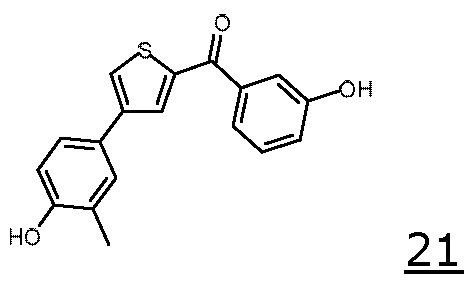
r4-f4-Hvdroxy-3-methylphenv0-2-thienyl1f3-hvdroxyphenv0methanone (21). The title compound was prepared by reaction of [4-(4-methoxy-3-methylphenyl)-2- thienyl](3-methoxyphenyl)methanone (21a) (160 mg, 0.47 mmol) and boron tribromide (2.82 mmol) according to method D. The product was purified by CC (hexane/ethyl acetate 8 : 2); yield : 87 % (127 mg); MS (ESI) : 311 (M + H)+; 1H N MR (CD3COCD3) : 8.76 (s, 1H), 8.36 (s, 1H), 7.98 (dd, J= 1.2 Hz and J= 4.4 Hz, 2H), 7.49 (d, J= 1.5 Hz, 1H), 7.43-7.37 (m, 4H), 7.15-7.13 (m, 1H), 6.87 (d, J= 8.2 Hz, 1H), 2.25 (s, 3H); 13C NMR (CD3COCD3) : 189.00, 159.30, 157.15, 145.25, 141.30, 134.75, 131.60, 130.70, 128.85, 128.25, 126.70, 122.25, 121.30, 117.40, 116.90, 17.20.
1.22. r2-(4-Hvdroxy-3-methylphenyl)-1 -thiazol-5-yl1(3-hvdroxyphenyl) methanone (22)

(2-Bromo-l,3-thiazol-5-yl)(3-methoxyphenyl)methanol (22c). The title compound was prepared by reaction of 2-bromo-l,3-thiazole-5-carbaldehyde (500 mg, 2.60 mmol) and 3-methoxyphenylmagnesium bromide (5.72 mmol) according to method H. The product was purified by CC (hexane/ethyl acetate 8 : 2); yield : 43 % (335 mg); 1H N MR (CD3COCD3) : 7.40 (s, 1H), 7.28 (t, J= 7.9 Hz, 1H), 7.08 (s, 1 H), 7.03 (d, J= 7.9 Hz, 1H), 6.87-6.85 (m, 1H), 6.10 (d, J= 4.4 Hz, 1H), 5.55 (d, J= 4.4 Hz, 1H), 3.78 (s, 3H); 13C NMR (CD3COCD3) : 161.80, 151.05, 146.80, 140.90, 136.60, 131.40, 120.00, 115.05, 113.35, 71.20, 56.50.

(2-Bromo-l,3-thiazol-5-yl)(3-methoxyphenyl)methanone (22b). The title compound was prepared by reaction of (2-bromo-l,3-thiazol-5-yl)(3- methoxyphenyl)methanol (22c) (335 mg, 1.12 mmol) and 2-iodoxybenzoic acid (632 mg, 2.24 mmol) according to method I. The product was purified by CC (hexane/ethyl acetate 9 : 1); yield : 74 % (247 mg); ^ N MR (CD3COCD3) : 8.17 (s, 1H), 7.51-7.50 (m, 2H), 7.41 (s, 1H), 7.28-7.26 (m, 1H), 3.90 (s, 3H); 13C NMR (CD3COCD3) : 187.35, 161.90, 150.15, 145.10, 144.80, 140.10, 131.90, 123.25, 121.30 115.35, 56.90.

r2-(4-Methoxy-3-methyl phenyl)- l,3-thiazol-5-yl1(3-methoxyphenyl)methanone (22a). The title compound was prepared by reaction of (2-bromo-l,3-thiazol-5- yl)(3-methoxyphenyl)methanone (22b) (247 mg, 0.83 mmol), 4-methoxy-3- methylbenzeneboronic acid (166 mg, 1.00 mmol), caesium carbonate (1.08 g, 3.32 mmol) and tetrakis(triphenylphosphine) palladium (9 mg, 8 μηιοΙ) according to method Bl . The product was purified by CC (hexane/ethyl acetate 9 : 1); yield : 23 % (65 mg); ^ N MR (CDCI3) : 8.24 (s, 1H), 7.86 (dd, J= 2.2 Hz and J= 8.2 Hz, 1H), 7.84-7.83 (m, 1H), 7.48 (dt, J= 1.2 Hz and J= 7.6 Hz, 1H), 7.43 (t, J= 7.9 Hz, 1H),
7.41-7.40 (m, 1H), 7.16 (ddd, J= 0.9 Hz and J= 2.5 Hz and J= 8.2 Hz, 1 H), 6.89 (d, J= 8.5 Hz, 1H), 3.91 (s, 3H), 3.88 (s, 3H), 2.29 (s, 3H); 13C NMR (CDCI3) : 187.05, 174.90, 160.65, 159.80, 149.95, 137.75, 129.65, 129.35, 127.70, 126.40, 125.25 121.55, 119.20, 113.40, 110.10, 55.55, 55.50, 16.20.

r2-r4-Hvdroxy-3-methylphenvn-l,3-thiazol-5-ylir3-hvdroxyphenvnmethanone (22). The title compound was prepared by reaction of [2-(4-methoxy-3- methylphenyl)-l,3-thiazol-5-yl](3-methoxyphenyl)methanone (22a) (65 mg, 0.19 mmol) and pyridinium hydrochloride (1.63 g, 14.06 mmol) according to method E. The product was purified by CC (hexane/ethyl acetate 8 : 2) followed by preparative TLC (hexane/ethyl acetate 6 :4); yield : 46 % (27 mg); MS (ESI) : 312 (M + H)+; 1H NMR (CD3COCD3) : 8.26 (s, 1H), 7.87-7.86 (m, 1H), 7.78 (dd, J= 2.2 Hz and J= 8.5 Hz, 1H), 7.43-7.40 (m, 2H), 7.38-7.37 (m, 1H), 7.16-7.14 (m, 1H), 6.97 (d, J= 8.2 Hz, 1H), 2.29 (s, 3H); 13C NMR (CD3COCD3) : 188.25, 176.30, 161.20, 159.65, 151.65, 141.25, 131.75, 131.60, 128.20, 127.40, 126.35, 121.90, 121.65, 117.20, 17.15.
1.23. r4-(4-Hvdroxy-3-methylphenyl)-1 -thiazol-2-yl1(3-hvdroxyphenyl)
methanone (23)

(4-Bromo-l,3-thiazol-2-yl)(3-methoxyphenyl)methanol (23c). The title compound was prepared by reaction of 4-bromo-l,3-thiazole-2-carbaldehyde (500 mg, 2.60 mmol) and 3-methoxyphenylmagnesium bromide (5.72 mmol) according to method H. The product was purified by CC (hexane/ethyl acetate 9 : 1); yield : 74 % (580 mg); 1H NMR (CD3COCD3) : 7.53 (s, 1 H), 7.27 (t, J= 7.9 Hz, 1H), 7.10-7.09 (m, 1H), 7.09-7.06 (m, 1H), 6.86 (ddd, J= 0.9 Hz and J= 2.5 Hz and J= 8.2 Hz, 1H), 6.03 (s, 1 H), 5.91 (s, 1H), 3.78 (s, 3H); 13C NMR (CD3COCD3) : 178.85, 161.70, 145.40, 131.25, 125.60, 120.55, 119.45, 115.00, 114.05, 74.90, 56.50.

(4-Bromo-l,3-thiazol-2-yl)(3-methoxyphenyl)methanone (23b). The title compound was prepared by reaction of (4-bromo-l,3-thiazol-2-yl)(3- methoxyphenyl)methanol (23c) (580 mg, 1.93 mmol) and 2-iodoxybenzoic acid
(1.09 g, 3.86 mmol) according to method I . The product was purified by CC (hexane/ethyl acetate 9 : 1); yield : 52 % (301 mg); 1H N MR (CD3COCD3) : 8.13 (s, 1H), 8.09-8.07 (m, 1H), 7.98-7.97 (m, 1 H), 7.49 (t, J= 7.9 Hz, 1H), 7.27 (ddd, J= 0.9 Hz and J= 2.5 Hz and J= 8.2 Hz, 1 H), 3.89 (s, 3H); 13C NMR (CD3COCD3) :
1.55, 137.50, 131.45, 128.10, 125.30, 121.80, 117.45, 56.80.

r4-(4-Methoxy-3-methyl phenyl)- l,3-thiazol-2-ylK3-methoxyphenvDmethanone (23a). The title compound was prepared by reaction of (4-bromo-l,3-thiazol-2- yl)(3-methoxyphenyl)methanone (23b) (200 mg, 0.67 mmol), 4-methoxy-3- methylbenzeneboronic acid (133 mg, 0.80 mmol), caesium carbonate (873 mg, 2.68 mmol) and tetrakis(triphenylphosphine) palladium (8 mg, 7 μηιοΙ) according to method Bl . The product was purified by CC (hexane/ethyl acetate 9 : 1); yield : 66 % (150 mg); 1H N MR (CD3COCD3) : 8.23 (q, J= 1.5 Hz, 1H), 8.18 (ddd, J= 0.9 Hz and J= 1.5 Hz and J= 7.6 Hz, 1H), 8.12 (s, 1 H), 7.83 (dd, J= 2.2 Hz and J= 8.2 Hz, 1H), 7.81-7.80 (m, 1H), 7.49 (t, J= 7.9 Hz, 1H), 7.26 (ddd, J= 0.9 Hz and J= 2.5 Hz and J= 8.2 Hz, 1H), 6.97 (d, J= 8.2 Hz; 1H), 3.92 (s, 3H), 3.86 (s, 3H), 2.23 (s, 3H); 13C NMR (CD3COCD3) : 184.50, 168.85, 161.50, 160.20, 159.40, 138.25, 131.30, 130.45, 128.40, 128.05, 127.15, 125.30, 121.85, 120.70, 117.40, 112.10,

r4-(4-Hvdroxy-3-methyl phenyl)- 1, 3-th iazol-2-yl1(3-hvdroxyphenvnmethanone (23). The title compound was prepared by reaction of [4-(4-methoxy-3- methylphenyl)-l,3-thiazol-2-yl](3-methoxyphenyl)methanone (23a) (80 mg, 0.24 mmol) and boron tribromide (1.44 mmol) according to method D. The product was purified by CC (hexane/ethyl acetate 8 : 2); yield : 38 % (28 mg); MS (ESI) : 312 (M + H)+; 1H N MR (CD3COCD3) : 8.17 (s, 1H), 8.13 (ddd, J= 0.9 Hz and J= 1.5 Hz and J= 7.6 Hz, 1H), 8.09-8.08 (m, 1H), 7.84-7.83 (m, 1 H), 7.78-7.75 (m, 1H), 7.45 (t, J= 8.2 Hz, 1H), 7.20 (ddd, J= 0.9 Hz and J= 2.5 Hz and J= 8.2 Hz, 1H), 6.93 (d, J= 8.2 Hz; 1H), 2.28 (s, 3H); 13C NMR (CD3COCD3) : 185.00, 168.85,
159.80, 159.15, 157.95, 138.45, 131.45, 130.95, 127.55, 127.25, 126.55, 124.40, 122.60, 120.20, 119.20, 116.75, 17.30.
1.24. r2-f4-Hvdroxy-3-methylphenyl)-1 -thiazol-4-yl1f3-hvdroxyphenyl)
methanone (24).

f2-Bromo-l,3-thiazol-4-yl)f3-methoxyphenyl)methanol (24c). The title compound was prepared by reaction of 2-bromo-l,3-thiazole-4-carbaldehyde (450 mg, 2.34 mmol) and 3-methoxyphenylmagnesium bromide (5.15 mmol) according to method H. The product was purified by CC (hexane/ethyl acetate 8 : 2); yield : 30 % (210 mg); 1H N MR (CD3COCD3) : 7.48 (d, J= 0.9 Hz, 1H), 7.23 (t, J= 7.9 Hz, 1 H), 7.05- 7.04 (m, 1H), 7.02-7.00 (m, 1H), 6.82 (ddd, J= 0.9 Hz and J= 2.5 Hz and J= 8.2 Hz, 1H), 5.87 (d, J= 4.4 Hz, 1H), 5.06 (d, J= 4.4 Hz, 1H), 3.77 (s, 3H); 13C NMR (CD3COCD3) : 171.90, 162.55, 161.65, 146.55, 131.00, 120.90, 120.40, 114.50,

r2-(4-Methoxy-3-methyl phenyl)- l,3-thiazol-4-yl1f3-methoxyphenyl)methanol (24b). The title compound was prepared by reaction of (2-bromo-l,3-thiazol-4- yl)(3-methoxyphenyl)methanol (24c) (210 mg, 0.70 mmol), 4-methoxy-3- methylbenzeneboronic acid (139 mg, 0.84 mmol), caesium carbonate (684 mg, 2.10 mmol) and tetrakis(triphenylphosphine) palladium (8 mg, 7 μηιοΙ) according to method B2. The product was purified by CC (hexane/ethyl acetate 8 : 2); yield : 67 % (160 mg); ^ NMR (CD3COCD3) : 7.76-7.73 (m, 2H), 7.28 (d, J= 0.9 Hz, 1H), 7.23 (t, J= 7.9 Hz, 1H), 7.15-7.14 (m, 1H), 7.10-7.09 (m, 1H), 6.96 (d, J= 8.5 Hz, 1H), 6.81 (ddd, J= 0.9 Hz and J= 2.5 Hz and J= 8.2 Hz, 1H), 5.95 (d, J= 4.7 Hz, 1H), 4.97 (d, J= 4.7 Hz, 1H), 3.86 (s, 3H), 3.77 (s, 3H), 2.22 (s, 3H); 13C NMR (CD3COCD3) : 169.45, 162.95, 161.55, 161.30, 147.25, 130.85, 130.20, 128.65, 128.05, 127.25, 120.90, 114.70, 114.35, 114.30, 112.05, 74.40, 56.90, 56.40, 17.25.

r2-(4-Methoxy-3-methyl phenyl)- l,3-thiazol-4-yl1f3-methoxyphenyl)methanone (24a). The title compound was prepared by reaction of [2-(4-methoxy-3- methylphenyl)-l,3-thiazol-4-yl](3-methoxyphenyl)methanol (24b) (160 mg, 0.47 mmol) and 2-iodoxybenzoic acid (265 mg, 0.94 mmol) according to method I. The product was purified by CC (hexane/ethyl acetate 95:5); yield: 68 % (109 mg); 1 NMR (CDCI3): 8.11 (s, 1H), 7.90-7.88 (m, 1H), 7.84-7.83 (m, 1H), 7.83-7.79 (m, 2H), 7.41 (t, J= 7.9 Hz, 1H), 7.15 (ddd, J= 0.9 Hz and J= 2.5 Hz and J= 8.2 Hz, 1H), 6.87 (d, J= 8.5 Hz, 1H), 3.89 (s, 3H), 3.88 (s, 3H), 2.27 (s, 3H); 13C NMR (CDCI3): 186.75, 168.35, 159.85, 159.40, 154.90, 138.60, 129.15, 129.05, 127.40, 127.10, 125.85, 125.35, 123.30, 119.50, 114.70, 109.95, 55.45, 55.40,
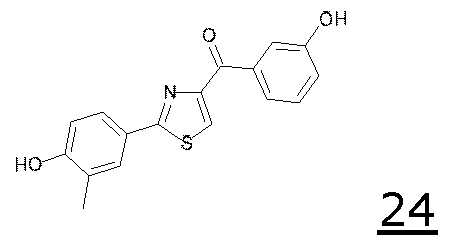
r2-(4-Hvdroxy-3-methyl phenyl)- 1, 3-th iazol-4-yl1(3-hvdroxyphenvnmethanone (24). The title compound was prepared by reaction of [2-(4-methoxy-3- methylphenyl)-l,3-thiazol-4-yl](3-methoxyphenyl)methanone (24a) (109 mg, 0.32 mmol) and pyridinium hydrochloride (2.75 g, 23.68 mmol) according to method E. The product was purified by CC (hexane/ethyl acetate 7:3); yield: 44 % (44 mg); MS (ESI): 312 (M + H)+; 1H NMR (CD3COCD3): 8.76 (s, 1H), 8.73 (s, 1H), 8.29 (s, 1H), 7.81-7.78 (m, 3H), 7.74 (dd, J= 2.2 Hz and J= 8.5 Hz, 1H), 7.39 (t, J= 7.9 Hz, 1H), 7.13 (ddd, J= 0.9 Hz and J= 2.5 Hz and J= 8.2 Hz, 1H), 6.96 (d, J= 8.5 Hz, 1H), 2.28 (s, 3H); 13C NMR (CD3COCD3): 188.05, 171.95, 170.10, 159.85, 159.10, 156.85, 140.75, 131.20, 128.70, 127.65, 127.20, 126.80, 123.75, 121.80, 118.80, 117.05, 17.10.
1.25. (3-Hvdroxyphenyl)(5-phenyl-2-thienyl)methanone (25)
 The title compound was prepared by reaction of (5-bromo-2-thienyl)(3- hydroxyphenyl)methanone (17a) (150 mg, 0.53 mmol), benzene boronic acid (78 mg, 0.64 mmol), caesium carbonate (691 mg, 2.12 mmol) and tetrakis(triphenylphosphine) palladium (6 mg, 5 μηιοΙ) according to method Bl . The product was purified by CC (hexane/ethyl acetate 8 : 2); yield : 28 % (42 mg); MS (ESI) : 281 (M + H)+; ^ N M R (CD3COCD3) : 8.81 (s, 1 H), 7.81-7.80 (m, 2H), 7.72 (d, J= 4.1 Hz, 1 H), 7.60 (d, J= 4.1 Hz, 1 H), 7.49 (t, J= 7.9 Hz, 2H), 7.44-7.39 (m, 2H), 7.37 (dt, J= 1.5 Hz and J= 7.6 Hz, 1 H), 7.34-7.33 (m, 1 H), 7.13 (ddd, J= 1.5 Hz and J= 2.5 Hz and J= 7.9 Hz, 1 H); 13C N M R (CD3COCD3) : 188.75, 159.40, 154.30, 144.20, 141.30, 137.85, 135.15, 131.55, 131.15, 131.05, 128.05, 126.30, 122.05, 121.25, 117.30.
-Hvdroxyphenyl)r5-(2-methoxyphenyl)-2-thienyl1methanone (26)

(3-Methoxyphenyl)r5-(2-methoxyphenvD-2-thienyl1methanone (26a) . The title compound was prepared by reaction of (5-bromo-2-thienyl)(3- methoxyphenyl)methanone (4b) (200 mg, 0.67 mmol), 2-methoxybenzene boronic acid (122 mg, 0.80 mmol), caesium carbonate (873 mg, 2.68 mmol) and tetrakis(triphenylphosphine) palladium (8 mg, 7 μηιοΙ) according to method C. The product was purified by CC (hexane/ethyl acetate 9 : 1); yield : 67 % (145 mg); 1 N M R (CD3COCD3) : 7.85 (dd, J= 1.9 Hz and J= 7.9 Hz, 2H), 7.69 (d, J= 1.3 Hz, 1 H), 7.49-7.44 (m, 2H), 7.42-7.38 (m, 2H), 7.21-7.18 (m, 2H), 7.07 (dt, J= 0.9 Hz and J= 7.9 Hz, 1 H), 4.01 (s, 3H), 3.89 (s, 3H); 13C N M R (CD3COCD3) : 189.10, 161.70, 158.10, 149.85, 144.05, 141.70, 136.50, 132.15, 131.45, 130. 15, 127.80, 123.75,
.90, 115.50, 114.05, 57.10, 56.80.

(3-Hvdroxyphenyl)r5-(2-methoxyphenyl)-2-thienyl1methanone (26). The title compound was obtained by reaction of (3-methoxyphenyl)[5-(2-methoxyphenyl)-2- thienyl]methanone (26a) (145 mg, 0.45 mmol) and boron tribromide (2.70 mmol) according to method D. The product was purified by CC (hexane/ethyl acetate 8 : 2) followed by preparative H PLC; yield : 55 % (76 mg); MS (ESI) : 311 (M + H)+; ^ N M R (CD3COCD3) : 7.83 (dd, J= 1.6 Hz and J= 7.9 Hz, 1 H), 7.69 (d, J= 4.1 Hz, 1 H),
7.67 (d, J= 4.1 Hz, 1H), 7.41-7.35 (m, 4H), 7.18 (d, J= 7.9 Hz, 1H), 7.14-7.12 (m, 1H), 7.07-7.04 (m, 1 H), 4.00 (s, 3H); 13C NMR (CD3COCD3) : 189.20, 159.30, 158.05, 149.70, 144.10, 141.70, 136.40, 132.10, 131.45, 130.10, 127.70, 123.75, 122.90, 122.05, 120.95, 117.25, 114.00, 57.10.
-HvdroxyphenvOr5-f3-methoxyphenvO-2-thienyl1methanone (27)

The title compound was prepared by reaction of (5-bromo-2-thienyl)(3- hydroxyphenyl)methanone (IZa) (150 mg, 0.53 mmol), 3-methoxybenzene boronic acid (97 mg, 0.64 mmol), caesium carbonate (691 mg, 2.12 mmol) and tetrakis(triphenylphosphine) palladium (6 mg, 5 μηιοΙ) according to method Bl . The product was purified by CC (hexane/ethyl acetate 9 : 1); yield : 94 % (154 mg); MS (ESI) : 311 (M + H)+; 1H NMR (CD3COCD3) : 7.71 (d, J= 4.1 Hz, 1H), 7.60 (d, J= 4.1 Hz, 1H), 7.42-7.35 (m, 4H), 7.34 (t, J= 1.9 Hz, 1 H), 7.32 (t, J= 1.9 Hz, 1H), 7.13 (ddd, J= 1.3 Hz and J= 2.2 Hz and J= 7.6 Hz, 1H), 7.00 (ddd, J= 1.3 Hz and J= 2.2 Hz and J= 7.6 Hz, 1H), 3.89 (s, 3H); 13C NMR (CD3COCD3) : 188.75, 162.35, 159.45, 154.20, 144.25, 141.30, 137.75, 136.45, 132.25, 131.60, 126.55, 122.10, 121.25, 120.45, 117.30, 116.75, 113.35, 56.80.
-Hvdroxyphenyl)r5-(4-methoxyphenyl)-2-thienyl1methanone (28)

The title compound was prepared by reaction of (5-bromo-2-thienyl)(3- hydroxyphenyl)methanone (17a) (150 mg, 0.53 mmol), 4-methoxybenzene boronic acid (97 mg, 0.64 mmol), caesium carbonate (691 mg, 2.12 mmol) and tetrakis(triphenylphosphine) palladium (6 mg, 5 μηιοΙ) according to method Bl . The product was purified by CC (hexane/ethyl acetate 8 : 2) followed by preparative TLC (hexane/ethyl acetate 7 : 3); yield : 96 % (158 mg); MS (ESI) : 311 (M + H)VH N MR (CD3COCD3) : 8.72 (s, 1H), 7.72 (d, J= 8.8 Hz, 2H), 7.66 (d, J= 4.1 Hz, 1H), 7.45 (d, J= 4.1 Hz, 1H), 7.39 (t, J= 7.8 Hz, 1H), 7.35 (dt, J= 1.3 Hz and J= 7.8 Hz, 1H), 7.34 (t, J= 2.1 Hz, 1H), 7.12 (ddd, J= 1.3 Hz and J= 2.5 Hz and J= 7.9 Hz, 1H), 7.02 (d, J= 8.8 Hz, 2H), 3.85 (s, 3H); 13C NMR (CD3COCD3) : 188.60, 162.65, 159.35, 154.65, 143.15, 141.45, 138.00, 131.50, 129.45, 127.75, 125.05, 122.05, 121.05, 117.25, 116.50, 56.80.
-Hvdroxyphenv0r5-(6-methoxypyridin-3-yl)-2-thienyl1methanone (29)

The title compound was prepared by reaction of (5-bromo-2-thienyl)(3- hydroxyphenyl)methanone (17a) (150 mg, 0.53 mmol), 6-methoxypyridine-3- boronic acid (98 mg, 0.64 mmol), caesium carbonate (691 mg, 2.12 mmol) and tetrakis(triphenylphosphine) palladium (6 mg, 5 μηιοΙ) according to method Bl . The product was purified by CC (hexane/ethyl acetate 85 : 15); yield : 63 % (104 mg); MS (ESI) : 312 (M + H)+; ^ NMR (CD3COCD3) : 8.86 (s, 1H), 8.60 (dd, J= 0.6 Hz and J= 2.4 Hz, 1H), 8.06 (dd, J= 2.5 Hz and J= 8.5 Hz, 1 H), 7.71 (d, J= 4.1 Hz, 1H), 7.55 (d, J= 4.1 Hz, 1H), 7.40 (t, J= 7.8 Hz, 1H), 7.36 (dt, J= 1.3 Hz and J= 7.6 Hz, 1H), 7.33-7.32 (m, 1H), 7.12 (ddd, J= 1.3 Hz and J= 2.5 Hz and J= 7.8 Hz, 1H), 6.88 (dd, J= 0.6 Hz and J= 8.5 Hz, 1 H), 3.94 (s, 3H); 13C NMR (CD3COCD3) : 188.65, 166.40, 159.45, 150.95, 146.40, 141.25, 138.55, 137.90, 131.55, 126.10, 122.05, 121.25, 117.25, 113.05, 54.95.
-(3,4-Dimethoxyphenyl)-2-thienyl1(3-hvdroxyphenyl)methanone (30)

The title compound was prepared by reaction of (5-bromo-2-thienyl)(3- hydroxyphenyl)methanone (17a) (150 mg, 0.53 mmol), 3,4-dimethoxybenzene boronic acid (117 mg, 0.64 mmol), caesium carbonate (691 mg, 2.12 mmol) and tetrakis(triphenylphosphine) palladium (6 mg, 5 μηιοΙ) according to method Bl . The product was purified by CC (hexane/ethyl acetate 8 : 2); yield : 73 % (132 mg); MS (ESI) : 341 (M + H)+; ^ NMR (CD3COCD3) : 8.78 (s, 1H), 7.68 (d, J= 4.1 Hz, 1H), 7.51 (d, J= 4.1 Hz, 1H), 7.39 (t, J= 7.8 Hz, 1H), 7.38-7.34 (m, 3H), 7.32-7.31 (m, 1H), 7.12 (ddd, J= 1.3 Hz and J= 2.5 Hz and J= 7.9 Hz, 1H), 7.06-7.04 (m, 1H), 3.92 (s, 3H), 3.87 (s, 3H); 13C NMR (CD3COCD3) : 189.65, 159.40, 152.60, 151.80, 141.50, 137.95, 131.55, 128.05, 125.35, 122.00, 121.10, 120.95, 117.25, 114.05, 111.70, 57.25, 57.20.
1.31. (3-Hvdroxyphenvnr5-(3,4,5-trimethoxyphenyl)-2-thienyl1methanone (31)
 The title compound was prepared by reaction of (5-bromo-2-thienyl)(3- hydroxyphenyl)methanone (17a) (150 mg, 0.53 mmol), 3,4,5-trimethoxybenzene boronic acid (136 mg, 0.64 mmol), caesium carbonate (691 mg, 2.12 mmol) and tetrakis(triphenylphosphine) palladium (6 mg, 5 μηιοΙ) according to method Bl . The product was purified by CC (hexane/ethyl acetate 8 : 2); yield : 71 % (140 mg); MS (ESI) : 371 (M + H)+; 1H NMR (CD3COCD3) : 8.76 (s, 1H), 7.68 (d, J= 4.1 Hz, 1H), 7.56 (d, J= 4.1 Hz, 1H), 7.40 (t, J= 7.8 Hz, 1H), 7.35 (dt, J= 1.3 Hz and J= 7.6 Hz, 1H), 7.33-7.32 (m, 1H), 7.12 (ddd, J= 1.3 Hz and J= 2.5 Hz and J= 7.9 Hz, 1H), 7.07 (s, 2H), 3.93 (s, 6H), 3.78 (s, 3H); 13C NMR (CD3COCD3) : 188.70, 159.40, 155.95, 154.75, 143.80, 141.35, 137.75, 131.55, 130.70, 126.20, 122.05, 121.15, 117.25, 105.85, 61.70, 57.65.
-Hvdroxyphenyl)r5-(2,3^-trimethoxyphenyl)-2-thienyl1methanone (32)

The title compound was prepared by reaction of (5-bromo-2-thienyl)(3- hydroxyphenyl)methanone (17a) (150 mg, 0.53 mmol), 2,3,4-trimethoxybenzene boronic acid (136 mg, 0.64 mmol), caesium carbonate (691 mg, 2.12 mmol) and tetrakis(triphenylphosphine) palladium (6 mg, 5 μηιοΙ) according to method Bl . The product was purified by CC (hexane/ethyl acetate 8 : 2); yield : 62 % (122 mg); MS (ESI) : 371 (M + H)+; 1H NMR (CD3COCD3) : 8.80 (s, 1H), 7.66 (d, J= 4.1 Hz, 1H), 7.59-7.56 (m, 2H) 7.39 (t, J= 7.8 Hz, 1H), 7.35 (dt, J= 1.3 Hz and J= 7.6 Hz, 1H), 7.33-7.32 (m, 1H), 7.11 (ddd, J= 1.3 Hz and J= 2.5 Hz and J= 7.9 Hz, 1 H), 6.92 (d, J= 9.1 Hz, 1H), 3.95 (s, 3H), 3.91 (s, 3H), 3.87 (s, 3H); 13C NMR (CD3COCD3) : 189.10, 159.40, 156.60, 152.85, 149.65, 143.70, 141.80, 136.60, 131.45, 126.65, 124.40, 122.00, 121.65, 121.00, 117.25, 110.35, 62.05, 62.00, 57.50.
-(2-Ethoxyphenyl)-2-thienyl1(3-hvdroxyphenyl)methanone (33)

The title compound was prepared by reaction of (5-bromo-2-thienyl)(3- hydroxyphenyl)methanone (17a) (150 mg, 0.53 mmol), 2-ethoxybenzene boronic acid (106 mg, 0.64 mmol), caesium carbonate (691 mg, 2.12 mmol) and tetrakis(triphenylphosphine) palladium (6 mg, 5 μηιοΙ) according to method Bl . The
product was purified by CC (hexane/ethyl acetate 85 : 15); yield : 88 % (151 mg); MS (ESI) : 325 (M + H)+; NMR (CD3COCD3) : 7.87 (dd, J= 1.5 Hz and J= 7.9 Hz, 1H), 7.74 (d, J= 4.1 Hz, 1H), 7.69 (d, J= 4.1 Hz, 1H), 7.41-7.35 (m, 3H), 7.34 (t, J= 2.1 Hz, 1H), 7.18-7.16 (m, 1H), 7.12 (ddd, J= 1.3 Hz and J= 2.5 Hz and J= 7.6 Hz, 1H), 7.06 (td, J= 1.3 Hz and J= 7.6 Hz, 1H), 4.28 (q, J= 6.9 Hz, 2H), 1.55 (t, J= 6.9 Hz, 3H); 13C NMR (CD3COCD3) : 189.15, 157.30, 144.00, 141.75, 138.40, 136.30, 132.05, 131.45, 130.05, 127.55, 123.80, 122.80, 122.10, 121.00, 117.30, 114.75, 113.00, 66.35, 16.10.
-(3-Ethoxyphenyl)-2-thienyl1(3-hvdroxyphenyl)methanone (34)

The title compound was prepared by reaction of (5-bromo-2-thienyl)(3- hydroxyphenyl)methanone (17a) (150 mg, 0.53 mmol), 3-ethoxybenzene boronic acid (106 mg, 0.64 mmol), caesium carbonate (691 mg, 2.12 mmol) and tetrakis(triphenylphosphine) palladium (6 mg, 5 μηιοΙ) according to method Bl . The product was purified by CC (hexane/ethyl acetate 8 : 2) followed by preparative TLC (hexane/ethyl acetate 7 : 3); yield : 91 % (157 mg); MS (ESI) : 325 (M + H)+; 1H N MR (CD3COCD3) : 8.80 (s, 1H), 7.69 (d, J= 4.1 Hz, 1H), 7.56 (d, J= 4.1 Hz, 1H), 7.41- 7.34 (m, 4H), 7.32 (dt, J= 1.3 Hz and J= 7.6 Hz, 1H), 7.28 (t, J= 2.1 Hz, 1H), 7.13 (ddd, J= 1.3 Hz and J= 2.5 Hz and J= 7.6 Hz, 1H), 6.96 (ddd, J= 1.3 Hz and J= 2.5 Hz and J= 7.9 Hz, 1H), 4.11 (q, J= 6.9 Hz, 2H), 1.38 (t, J= 6.9 Hz, 3H); 13C NMR (CD3COCD3) : 188.70, 161.55, 159.35, 154.20, 144.10, 141.25, 137.70, 136.35, 132.20, 131.55, 126.40, 122.05, 121.20, 120.25, 117.25, 117.15, 113.90, 65.25, 16.05.
-(4-Ethoxyphenyl)-2-thienyl1(3-hvdroxyphenyl)methanone (35)

The title compound was prepared by reaction of (5-bromo-2-thienyl)(3- hydroxyphenyl)methanone (17a) (150 mg, 0.53 mmol), 4-ethoxybenzene boronic acid (106 mg, 0.64 mmol), caesium carbonate (691 mg, 2.12 mmol) and tetrakis(triphenylphosphine) palladium (6 mg, 5 μηιοΙ) according to method Bl . The product was purified by CC (hexane/ethyl acetate 8 : 2); yield : 71 % (122 mg); MS (ESI) : 325 (M + H)+; 1H NMR (CD3COCD3) : 8.76 (s, 1H), 7.72 (d, J= 8.8 Hz, 2H),
7.67 (d, J= 4.1 Hz, 1H), 7.45 (d, J= 4.1 Hz, 1H), 7.39 (t, J= 7.8 Hz, 1H), 7.35 (dt, J= 1.3 Hz and J= 7.8 Hz, 1H), 7.33-7.32 (m, 1H), 7.11 (ddd, J= 0.9 Hz and J= 2.5 Hz and J= 7.8 Hz, 1H), 7.01 (d, J= 8.8 Hz, 2H), 4.11 (q, J= 6.9 Hz, 2H), 1.38 (t, J= 6.9 Hz, 3H); 13C NMR (CD3COCD3) : 188.60, 162.00, 159.40, 154.75, 143.10, 141.45, 138.05, 131.50, 129.45, 127.60, 125.00, 122.00, 121.05, 117.25, 117.00, 65.30, 16.00.
-r3-(Benzyloxy)phenyl1-2-thienylH3-hvdroxyphenyl)methanone (36)

The title compound was prepared by reaction of (5-bromo-2-thienyl)(3- hydroxyphenyl)methanone (17a') (150 mg, 0.53 mmol), 3-(benzyloxy)benzene boronic acid (146 mg, 0.64 mmol), caesium carbonate (691 mg, 2.12 mmol) and tetrakis(triphenylphosphine) palladium (6 mg, 5 μηιοΙ) according to method Bl . The product was purified by CC (hexane/ethyl acetate 8 : 2); yield : 71 % (146 mg); MS (ESI) : 387 (M + H)+; 1H NMR (CD3COCD3) : 8.76 (s, 1H), 7.70 (d, J= 4.1 Hz, 1H), 7.58 (d, J= 4.1 Hz, 1H), 7.52-7.51 (m, 2H), 7.43-7.32 (m, 9H), 7.13 (ddd, J= 1.3 Hz and J= 2.5 Hz and J= 7.6 Hz, 1H), 7.08 (ddd, J= 1.3 Hz and J= 2.5 Hz and J= 7.6 Hz, 1H), 5.22 (s, 2H); 13C NMR (CD3COCD3) : 188.70, 161.40, 159.40, 154.10, 144.20, 141.25, 139.10, 137.75, 136.45, 132.30, 131.55, 130.30, 129.70, 129.50, 126.50, 122.10, 121.25, 120.65, 117.65, 117.30, 114.35, 71.65.
1.37. (3-Hvdroxyphenyl)(5-l3-r(2-methoxybenzyl)oxylphenyl>-2-thienyl)methan- one (37)

The title compound was prepared by reaction of (5-bromo-2-thienyl)(3- hydroxyphenyl)methanone (17a) (150 mg, 0.53 mmol), 3-[(2-methoxy- benzyl)oxy]benzene boronic acid (165 mg, 0.64 mmol), caesium carbonate (691 mg, 2.12 mmol) and tetrakis(triphenylphosphine) palladium (6 mg, 5 μηιοΙ) according to method Bl . The product was purified by CC (hexane/ethyl acetate 7 : 3); yield : 64 % (142 mg); MS (ESI) : 417 (M + H)+; ^ NMR (CD3COCD3) : 8.74 (s, 1H), 7.71 (d, J= 4.1 Hz, 1H), 7.60 (d, J= 4.1 Hz, 1 H), 7.48 (m, 1H), 7.42-7.36 (m, 5H), 7.34-7.31 (m, 2H), 7.13 (ddd, J= 1.3 Hz and J= 2.5 Hz and J= 7.9 Hz, 1H),
7.08-7.04 (m, 2H), 6.97 (td, J= 1.3 Hz and J= 7.6 Hz, 1H), 5.21 (s, 2H), 3.90 (s, 3H); 13C NMR (CD3COCD3) : 188.75, 161.55, 159.40, 159.15, 154.20, 144.20, 141.30, 137.75, 136.45, 132.30, 131.60, 131.15, 130.85, 126.95, 126.50, 122.30, 122.10, 121.25, 120.55, 117.60, 117.30, 114.25, 112.55, 66.70, 56.95.
1.38. r3-Hvdroxyphenvnr5--r3-rr3-methoxybenzvnoxylphenyl>-2-thienvnmethan- one (38)

The title compound was prepared by reaction of (5-bromo-2-thienyl)(3- hydroxyphenyl)methanone (!Za) (150 mg, 0.53 mmol), 3-[(3-methoxy- benzyl)oxy]benzene boronic acid (165 mg, 0.64 mmol), caesium carbonate (691 mg, 2.12 mmol) and tetrakis(triphenylphosphine) palladium (6 mg, 5 μηιοΙ) according to method Bl . The product was purified by CC (hexane/ethyl acetate 8 : 2); yield : 74 % (163 mg); MS (ESI) : 417 (M + H)+; ^ NMR (CD3COCD3) : 8.75 (s, 1H), 7.71 (d, J= 4.1 Hz, 1H), 7.60 (d, J= 4.1 Hz, 1H), 7.44-7.36 (m, 5H), 7.34- 7.30 (m, 2H), 7.13 (ddd, J= 1.3 Hz and J= 2.5 Hz and J= 7.9 Hz, 1 H), 7.10-7.08 (m, 3H), 6.91-6.89 (m, 1H), 5.21 (s, 2H), 3.81 (s, 3H); 13C NMR (CD3COCD3) : 188.75, 161.95, 161.40, 159.45, 154.10, 141.30, 140.70, 137.75, 136.50, 132.30, 131.60, 131.40, 126.55, 122.10, 121.55, 121.25, 120.70, 117.70, 117.30, 115.15, 115.00, 114.40, 71.55, 56.55.
1.39. (,3-Hvdroxyphenvn(5--r3-r(4-methoxybenzvnoxylphenyl>-2-thienvnmethan- one (39)

The title compound was prepared by reaction of (5-bromo-2-thienyl)(3- hydroxyphenyl)methanone (17a) (150 mg, 0.53 mmol), 3-[(4- methoxybenzyl)oxy]benzene boronic acid (165 mg, 0.64 mmol), caesium carbonate (691 mg, 2.12 mmol) and tetrakis(triphenylphosphine) palladium (6 mg, 5 μηιοΙ) according to method Bl . The product was purified by CC (hexane/ethyl acetate 8 : 2); yield : 59 % (131 mg); MS (ESI) : 417 (M + H)+; ^ NMR (CD3COCD3) : 8.83 (s, 1H), 7.71 (d, J= 4.1 Hz, 1H), 7.60 (d, J= 4.1 Hz, 1H), 7.44 (d, J= 8.5 Hz, 2H),
7.41-7.36 (m, 5H), 7.34-7.33 (m, 1H), 7.13 (ddd, J= 1.3 Hz and J= 2.5 Hz and J= 7.9 Hz, 1H), 7.07 (ddd, J= 1.3 Hz and J= 2.5 Hz and J= 7.9 Hz, 1H), 6.96 (d, J= 8.5 Hz, 2H), 5.14 (s, 2H), 3.80 (s, 3H); 13C NMR (CD3COCD3) : 186.90, 181.65, 161.60, 161.50, 159.40, 144.25, 141.30, 137.75, 136.45, 132.30, 131.60, 131.30, 131.00, 126.50, 122.10, 121.25, 120.55, 117.75, 117.30, 115.75, 114.35, 71.50, 56.55.
1.40. r3-Hvdroxyphenvnr5--r3-rr3,5-dimethoxybenzvnoxylphenyl>-2-thienvnme- thanone (40

The title compound was prepared by reaction of (5-bromo-2-thienyl)(3- hydroxyphenyl)methanone (IZa) (150 mg, 0.53 mmol), 3-[(3,5- dimethoxybenzyl)oxy]benzene boronic acid (184 mg, 0.64 mmol), caesium carbonate (691 mg, 2.12 mmol) and tetrakis(triphenylphosphine) palladium (6 mg, 5 μΓηοΙ) according to method Bl . The product was purified by CC (hexane/ethyl acetate 8 : 2) followed by preparative HPLC; yield : 47 % (112 mg); MS (ESI) : 447 (M + H)+; 1H NMR (CD3COCD3) : 7.71 (d, J= 4.1 Hz, 1H), 7.59 (d, J= 4.1 Hz, 1H), 7.42-7.35 (m, 5H), 7.33-7.32 (m, 1H), 7.12 (ddd, J= 1.3 Hz and J= 2.5 Hz and J= 7.9 Hz, 1H), 7.09-7.06 (m, 1H), 6.68 (d, J= 2.2 Hz, 2H), 6.44 (t, J= 2.2 Hz, 1H), 5.17 (s, 2H), 3.79 (s, 6H); 13C NMR (CD3COCD3) : 188.80, 163.10, 161.35, 159.50, 154.10, 144.25, 141.50, 141.25, 137.75, 136.45, 132.30, 131.55, 126.55, 122.00, 121.25, 120.65, 117.70, 117.30, 114.40, 107.20, 101.35, 71.55, 56.65.
1.41. (3-HvdroxyphenvD(5--r3-r(2-chlorobenzvDoxy1 phenyl >-2-thienyl)methanone

The title compound was prepared by reaction of (5-bromo-2-thienyl)(3- hydroxyphenyl)methanone (17a) (150 mg, 0.53 mmol), 3-[(2-chloro- benzyl)oxy]benzene boronic acid (168 mg, 0.64 mmol), caesium carbonate (691 mg, 2.12 mmol) and tetrakis(triphenylphosphine) palladium (6 mg, 5 μηιοΙ) according to method Bl . The product was purified by CC (hexane/ethyl acetate 8 : 2); yield : 51 % (113 mg); MS (ESI) : 421 (M + H)+; ^ NMR (CD3COCD3) : 8.78 (s,
I H), 7.71 (d, J= 4.1 Hz, I H), 7.68-7.66 (m, I H), 7.61 (d, J= 4.1 Hz, I H), 7.50- 7.48 (m, I H), 7.46-7.45 (m, I H), 7.43-7.36 (m, 6H), 7.34-7.33 (m, I H), 7.14-7.10 (m, 2H), 5.31 (s, 2H); 13C N M R (CD3COCD3) : 188.75, 161.20, 159.40, 153.95, 144.30, 141.25, 137.75, 136.60, 136.55, 134.80, 132.40, 131.70, 131.55, 131.50, 131.30, 129.15, 126.65, 122.10, 121.25, 121.00, 117.55, 117.30, 114.40, 69.10.
1.42. (3-Hvdroxyphenv0(5--r3-r(3-chlorobenzv0oxy1 phenyl >-2-thienv0methanone

The title compound was prepared by reaction of (5-bromo-2-thienyl)(3- hydroxyphenyl)methanone (17a) (150 mg, 0.53 mmol), 3-[(3-chloro- benzyl)oxy]benzene boronic acid (168 mg, 0.64 mmol), caesium carbonate (691 mg, 2.12 mmol) and tetrakis(triphenylphosphine) palladium (6 mg, 5 μΓηοΙ) according to method Bl . The product was purified by CC (hexane/ethyl acetate 8 : 2); yield : 55 % (122 mg); MS (ESI) : 421 (M + H)+; ^ N M R (CD3COCD3) : 8.80 (s, I H), 7.70 (d, J= 4.1 Hz, I H), 7.58 (d, J= 4.1 Hz, I H), 7.57-7.56 (m, I H), 7.48- 7.46 (m, I H), 7.43-7.34 (m, 8H), 7.13 (ddd, J= 1.3 Hz and J= 2.5 Hz and J= 7.9 Hz, I H), 7.10-7.08 (m, I H), 5.24 (s, 2H); 13C N M R (CD3COCD3) : 188.75, 161.10, 159.40, 153.95, 144.25, 141.65, 141.25, 137.70, 136.50, 135.75, 132.35, 132.05, 131.55, 129.70, 129.25, 127.75, 126.55, 122.05, 121.25, 120.85, 117.60, 117.30, 114.35, 70.70.
1.43. f3-Hvdroxyphenv0(5--r3-rf4-chlorobenzv0oxy1 phenyl >-2-thienv0methanone
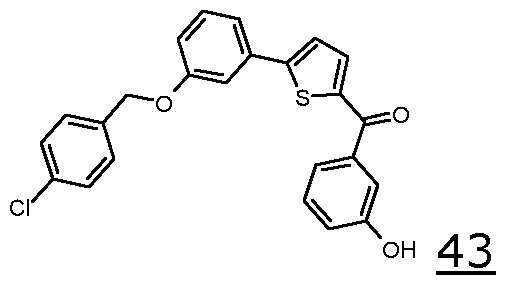
The title compound was prepared by reaction of (5-bromo-2-thienyl)(3- hydroxyphenyl)methanone (17a) (150 mg, 0.53 mmol), 3-[(4-chloro- benzyl)oxy]benzene boronic acid (168 mg, 0.64 mmol), caesium carbonate (691 mg, 2.12 mmol) and tetrakis(triphenylphosphine) palladium (6 mg, 5 μηιοΙ) according to method Bl . The product was purified by CC (hexane/ethyl acetate 8 : 2); yield : 63 % (141 mg); MS (ESI) : 421 (M + H)+; ^ N M R (CD3COCD3) : 8.76 (s,
1H), 7.71 (d, J= 4.1 Hz, 1H), 7.60 (d, J= 4.1 Hz, 1H), 7.54 (d, J= 8.8 Hz, 2H), 7.45-7.38 (m, 6H), 7.37 (dt, J= 1.3 Hz and J= 7.6 Hz, 1H), 7.34-7.33 (m, 1H), 7.13 (ddd, J= 1.3 Hz and J= 2.5 Hz and J= 7.9 Hz, 1 H), 7.09-7.08 (m, 1H), 5.24 (s, 2H); 13C NMR (CD3COCD3) : 188.75, 161.20, 159.40, 154.00, 144.30, 141.25, 138.15, 137.75, 136.50, 135.05, 132.35, 131.55, 131.20, 130.40, 126.55, 122.10, 121.25, 120.85, 117.65, 117.30, 114.35, 70.85.
-r5-f3-Hvdroxybenzoyl>2-thienyl1benzonitrile (44)

3-r5-(3-Methoxybenzoyl>2-thienyl1benzonitrile (44a1) . The title compound was prepared by reaction of (5-bromo-2-thienyl)(3-methoxyphenyl)methanone (4b) (300 mg, 1.01 mmol), 3-cyanobenzene boronic acid (178 mg, 1.21 mmol), caesium carbonate (1.32 g, 4.04 mmol) and tetrakis(triphenylphosphine) palladium (12 mg, 10 μΓηοΙ) according to method B2. The product was purified by CC (hexane/ethyl acetate 9 : 1); yield : 88 % (282 mg); ^ NMR (CDCI3) : 7.95 (t, J= 1.6 Hz, 1H), 7.90-7.88 (m, 1H), 7.67-7.64 (m, 2H), 7.55 (t, J= 7.9 Hz, 1 H), 7.47 (dt, J= 1.3 Hz and J= 7.6 Hz, 1H), 7.42 (t, J= 7.9 Hz, 1H), 7.40-7.39 (m, 2H), 7.15 (ddd, J= 1.3 Hz and J= 2.8 Hz and J= 8.2 Hz, 1 H), 3.88 (s, 3H); 13C NMR (CDCI3) : 187.50, 159.70, 149.70, 138.95, 135.65, 134.70, 132.05, 130.45, 130.10, 129.55, 129.50,
8.80, 118.15, 113.80, 113.60, 55.50.

3-r5-r3-Hvdroxybenzovn-2-thienyl1benzonitrile (44). The title compound was prepared by reaction of 3-[5-(3-methoxybenzoyl)-2-thienyl]benzonitrile (44a) (282 mg, 0.88 mmol) and boron tribromide (2.64 mmol) according to method D. The product was purified by recrystallization (EtOH/acetonitrile); yield : 66 % (176 mg); MS (ESI) : 306 (M + H)+; 1H NMR (CD3COCD3) : 8.78 (s, 1H), 8.23 (t, J= 1.6 Hz, 1H), 8.12 (ddd, J= 0.9 Hz and J= 1.9 Hz and J= 7.9 Hz, 1H), 7.83-7.81 (m, 1 H), 7.78- 7.76 (m, 2H), 7.72 (td, J= 0.7 Hz and J= 7.9 Hz, 1H), 7.41 (t, J= 7.6 Hz, 1H), 7.40-7.38 (m, 1 H), 7.36-7.35 (m, 1H), 7.14 (ddd, J= 1.6 Hz and J= 2.5 Hz and J= 7.6 Hz, 1H); 13C NMR (CD3COCD3) : 188.75, 151.25, 145.50, 141.00, 140.70, 137.75, 136.45, 134.15, 132.40, 131.65, 131.30, 127.85, 122.15, 121.45, 117.30, 115.35, 110.30.
-l3-r5-f3-Hvdroxybenzoyl>2-thienyl1 phenyl >methanesulfonamide (45)

A/- 3-r5-(3-Methoxybenzoyl)-2-thienyl1 phenyl >methanesulfonamide (45a) . The title compound was prepared by reaction of (5-bromo-2-thienyl)(3-methoxy- phenyl)methanone (4b) (300 mg, 1.01 mmol), 3-[(methylsulfonyl)amino]boronic acid (178 mg, 1.21 mmol), caesium carbonate (1.32 g, 4.04 mmol) and tetrakis(triphenylphosphine) palladium (12 mg, 10 μηιοΙ) according to method B2. The product was used in the next step without further purification; yield : 96 % (376 mg); ^ N MR (CD3COCD3) : 7.76 (t, J= 1.9 Hz, 1 H), 7.70 (d, J= 4.1 Hz, 1H), 7.55-7.52 (m, 2H), 7.48-7.43 (m, 3H), 7.41 (ddd, J= 0.9 Hz and J= 1.9 Hz and J= 7.9 Hz, 1H), 7.38-7.37 (m, 1H), 7.21-7.19 (m, 1H), 3.87 (s, 3H), 3.07 (s, 3H); 13C NMR (CD3COCD3) : 188.60, 161.60, 153.60, 144.30, 141.40, 141.05, 137.90, 136.15, 131.45, 126.70, 123.70, 123.05, 122.35, 120.05, 119.30, 115.50, 59.70,

A/- 3-r5-(3-Hvdroxybenzoyl)-2-thienyl1phenyl>methanesulfonamide (45). The title compound was prepared by reaction of /V-{3-[5-(3-methoxybenzoyl)-2- thienyl]phenyl}methanesulfonamide (45a) (200 mg, 0.52 mmol) and boron tribromide (1.56 mmol) according to method D. The crude mixture was washed with MeOH. The resulted suspension was filtered and the precipitated product was evaporated to dryness.; yield : 87 % (168 mg); MS (ESI) : 374 (M + H)+; 1H N MR (CD3COCD3) : 8.79 (s, 1H), 8.76 (s, 1H), 7.76 (t, J= 1.9 Hz, 1H), 7.73 (d, J= 4.1 Hz, 1 H), 7.60-7.57 (m, 2H), 7.48 (t, J= 7.9 Hz, 1H), 7.42-7.36 (m, 3H), 7.34 (t, J= 1.9 Hz, 1H), 7.13 (ddd, J= 1.2 Hz and J= 2.5 Hz and J= 7.6 Hz, 1 H), 3.07 (s, 3H); 13C N MR (CD3COCD3) : 188.75, 159.45, 153.50, 144.50, 141.45, 137.80, 132.30, 131.65, 126.70, 122.35, 122.10, 121.30, 119.30, 117.30, 40.65.
1.46. A/-l3-r5-f3-Hvdroxybenzoyl)-2-thienyl1benzyl>methanesulfonamide (46)
 A/-l3-r5-f3-Methoxyphenv0-2-thienyl1benzyl>methanesulfonamide (46a). The title compound was prepared by reaction of (5-bromo-2-thienyl)(3-methoxyphen- yl)methanone (4b) (200 mg, 0.67 mmol), 3-{ [(methylsulfonyl)amino]methyl}boro- nic acid (183 mg, 0.80 mmol), caesium carbonate (1.32 g, 4.04 mmol) and tetra- kis(triphenylphosphine) palladium (12 mg, 10 μηιοΙ) according to method B2. The product was purified by CC (hexane/ethyl acetate 9 : 1); yield : 94 % (253 mg); 1 N M R (CD3COCD3) : 7.87-7.86 (m, 1 H), 7.75-7.72 (m, 1 H), 7.61 (d, J= 4.1 Hz, 1 H), 7.51-7.45 (m, 4H), 7.39-7.38 (m, 1 H), 7.22 (ddd, J= 1.6 Hz and J= 2.5 Hz and J= 7.6 Hz, 1 H), 7.42 (s, 1 H), 7.41 (s, 1 H), 3.90 (s, 3H), 2.92 (s, 3H); 13C N M R (CD3COCD3) : 188.70, 161.75, 154.15, 144.20, 141.65, 138.00, 135.35, 131.55, 131.40, 130.55, 127.45, 127.05, 126.55, 123.05, 120.10, 115.50, 56.85, 48.30,

A/-l3-r5-f3-Hvdroxybenzov0-2-thienyl1benzyl>methanesulfonamide (46) . The title compound was prepared by reaction of /V-{3-[5-(3-methoxyphenyl)-2- thienyl]benzyl}methanesulfonamide (46a) (253 mg, 0.63 mmol) and boron tribromide (1.89 mmol) according to method D. The crude mixture was washed with MeOH . The resulted suspension was filtered and the precipitated product was evaporated to dryness. ; yield : 81 % (197 mg); MS (ESI) : 388 (M + H)+; ^ N MR (CD3COCD3) : 8.76 (s, 1 H), 7.86 (s, 1 H), 7.75-7.72 (m, 2H), 7.62 (d, J= 4.0 Hz, 4H), 7.50-7.48 (m, 2H), 7.41 (t, J= 7.8 Hz, 1 H), 7.37 (dt, J= 1.4 Hz and J= 7.6 Hz, 1 H), 7.34-7.33 (m, 1 H), 7.13 (ddd, J= 1.2 Hz and J= 2.4 Hz and J= 7.6 Hz, 1 H), 6.61 (s, 1 H), 4.41 (s, 1 H), 4.40 (s, 1 H), 2.92 (s, 3H); 13C N M R (CD3COCD3) : 188.75, 159.45, 154.00, 144.30, 141.65, 141.25, 137.85, 135.35, 131.60, 131.40, 130.50, 127.45, 127.05, 126.50, 122.10, 121.25, 117.25, 48.30, 41.55.
1.47./V--r3-r5-(3-HvdroxybenzovD-2-thienvn phenyl >-4-methylbenzenesulfonamide

The title compound was prepared by reaction of (5-bromo-2-thienyl)(3- hydroxyphenyl)methanone (17a) (150 mg, 0.53 mmol), 3-{[(4-
methylphenyl)sulfonyl]amino}benzene boronic acid (239 mg, 0.64 mmol), caesium carbonate (691 mg, 2.12 mmol) and tetrakis(triphenylphosphine) palladium (6 mg, 5 μΓηοΙ) according to method Bl . The crude mixture was washed with MeOH . The resulted suspension was filtered and the precipitated product was evaporated to dryness. ; yield : 53 % (126 mg); MS (ESI) : 450 (M + H)+; NMR (CD3COCD3) : 7.75 (d, J= 8.2 Hz, 2H), 7.70 (d, J= 4.1 Hz, 1H), 7.62 (t, J= 1.8 Hz, 1H), 7.50-7.48 (m, 2H), 7.40 (t, J= 7.6 Hz, 1H), 7.38-7.32 (m, 5H), 7.27 (ddd, J= 0.9 Hz and J= 2.2 Hz and J= 8.2 Hz, 1H), 7.13 (ddd, J= 1.3 Hz and J= 2.5 Hz and J= 7.9 Hz, 1H), 2.35 (s, 3H); 13C NMR (CD3COCD3) : 188.70, 159.45, 153.40, 145.75, 144.45, 141.20, 140.95, 138.85, 137.80, 136.05, 132.10, 131.60, 131.55, 129.05, 126.60, 123.80, 122.70, 122.05, 121.30, 119.55, 117.30, 22.35.
-Hvdroxyphenyl)r5-(2-naphthyl)-2-thienyl1methanone (48)

The title compound was prepared by reaction of (5-bromo-2-thienyl)(3- hydroxyphenyl)methanone (17a) (150 mg, 0.53 mmol), 2-naphthaleneboronic acid (110 mg, 0.64 mmol), caesium carbonate (691 mg, 2.12 mmol) and tetrakis(triphenylphosphine) palladium (6 mg, 5 μηιοΙ) according to method Bl . The product was purified by CC (hexane/ethyl acetate 8 : 2); yield : 57 % (100 mg); MS (ESI) : 331 (M + H)+; ^ NMR (CD3COCD3) : 8.86 (s, 1H), 8.36 (s, 1H), 8.03-8.00 (m, 2H), 7.95-7.91 (m, 2H), 7.76 (d, J= 4.1 Hz, 1H), 7.74 (d, J= 4.1 Hz, 1H), 7.59- 7.54 (m, 2H), 7.42 (t, J= 7.6 Hz, 1H), 7.39 (dt, J= 1.5 Hz and J= 7.6 Hz, 1H), 7.37-7.36 (m, 1H), 7.15-7.13 (m, 1H); 13C NMR (CD3COCD3) : 188.75, 159.45, 154.30, 144.35, 141.30, 137.95, 135.55, 131.60, 130.90, 130.30, 129.65, 128.85, 128.80, 127.05, 126.70, 125.80, 122.05, 121.25, 117.30.
1.49. r5-(2,3-Dihvdro-l-benzofuran-5-yl)-2-thienyl1(3-hvdroxyphenyl)methanone

The title compound was prepared by reaction of (5-bromo-2-thienyl)(3- hydroxyphenyl)methanone (17a) (150 mg, 0.53 mmol), 2,3-dihydro-l-benzofuran- 5-boronic acid (105 mg, 0.64 mmol), caesium carbonate (691 mg, 2.12 mmol) and tetrakis(triphenylphosphine) palladium (6 mg, 5 μηιοΙ) according to method Bl . The
product was purified by CC (hexane/ethyl acetate 7:3); yield: 65 % (111 mg); MS (ESI): 323 (M + H)+; 1H NMR (CD3COCD3): 7.67-7.66 (m, 2H), 7.57-7.55 (m, 1H), 7.44 (d, J= 4.1 Hz, 1H), 7.39 (t, J= 7.8 Hz, 1H), 7.35 (dt, J= 1.3 Hz and J= 7.6 Hz, 1H), 7.32-7.31 (m, 1H), 7.11 (ddd, J= 1.3 Hz and J= 2.5 Hz and J= 7.9 Hz, 1H), 6.82 (d, J= 8.5 Hz, 1H), 4.63 (t, J= 8.8 Hz, 2H), 3.29 (t, J= 8.8 Hz, 2H); 13C NMR (CD3COCD3): 188.55, 159.35, 141.55, 138.05, 131.50, 130.85, 128.40, 127.80, 125.05, 124.80, 122.00, 121.00, 117.20, 111.45, 73.55, 73.50.
-(l,3-Benzodioxol-5-yl)-2-thienyl1(3-hvdroxyphenyl)methanone (50)

The title compound was prepared by reaction of (5-bromo-2-thienyl)(3- hydroxyphenyl)methanone (17a) (150 mg, 0.53 mmol), l,3-benzodioxole-5- boronic acid (106 mg, 0.64 mmol), caesium carbonate (691 mg, 2.12 mmol) and tetrakis(triphenylphosphine) palladium (6 mg, 5 μηιοΙ) according to method Bl. The product was purified by CC (hexane/ethyl acetate 8:2); yield: 70 % (120 mg); MS (ESI): 325 (M + H)+; 1H NMR (CD3COCD3): 8.76 (s, 1H), 7.66 (d, J= 4.1 Hz, 1H), 7.46 (d, J= 4.1 Hz, 1H), 7.39 (t, J= 7.8 Hz, 1H), 7.35 (dt, J= 1.3 Hz and J= 7.6 Hz, 1H), 7.33-7.32 (m, 1H), 7.30 (ddd, J= 0.6 Hz and J= 1.9 Hz and J= 8.2 Hz, 1H), 7.28-7.27 (m, 1H), 7.12 (ddd, J= 1.3 Hz and J= 2.5 Hz and J= 7.9 Hz, 1H), 6.93 (d, J= 7.9 Hz, 1H), 6.08 (s, 2H); 13C NMR (CD3COCD3): 188.60, 159.40, 154.40, 150.55, 143.35, 141.35, 137.90, 131.55, 129.35, 125.60, 122.35, 122.05, 121.15, 117.25, 110.65, 108.15, 103.70.
-HydroxyphenyD[5-(l/-Hndol-5-yD-2-thienyl]methanQne (51)

The title compound was prepared by reaction of (5-bromo-2-thienyl)(3- hydroxyphenyl)methanone (17a) (150 mg, 0.53 mmol), indol-5-boronic acid (103 mg, 0.64 mmol), caesium carbonate (691 mg, 2.12 mmol) and tetrakis(tri- phenylphosphine) palladium (6 mg, 5 μΓηοΙ) according to method Bl. The product was purified by CC (hexane/ethyl acetate 7:3); yield: 47 % (80 mg); MS (ESI): 320 (M + H)+; ^ NMR (CD3COCD3): 10.46 (s, 1H), 8.70 (s, 1H), 7.90-7.89 (m, 1H), 7.69 (d, J= 4.1 Hz, 1H), 7.67 (d, J= 8.2 Hz, 1H), 7.53 (d, J= 4.1 Hz, 1H), 7.49 (dd, J= 1.5 Hz and J= 8.2 Hz, 1H), 7.46-7.45 (m, 1H), 7.40 (t, J= 7.6 Hz, 1H), 7.36 (dt,
J= 1.5 Hz and J= 7.6 Hz, 1H), 7.34-7.33 (m, 1H), 7.12 (ddd, J= 1.3 Hz and J= 2.5 Hz and J= 7.9 Hz, 1H), 6.54-6.53 (m, 1H); 13C NMR (CD3COCD3) : 186.40, 159.40, 138.10, 137.50, 131.50, 128.95, 125.05, 122.85, 122.00, 121.00, 119.80, 117.25, 111.10, 103.85.
-Hvdroxyphenvi)r5-fl Tf-indol-6-vn-2-thlenvnmethanone (52)

The title compound was prepared by reaction of (5-bromo-2-thienyl)(3- hydroxyphenyl)methanone (17a) (150 mg, 0.53 mmol), indol-6-boronic acid (103 mg, 0.64 mmol), caesium carbonate (691 mg, 2.12 mmol) and tetrakis(tri- phenylphosphine) palladium (6 mg, 5 μΓηοΙ) according to method Bl . The product was purified by CC (hexane/ethyl acetate 7 : 3); yield : 49 % (83 mg); MS (ESI) : 320 (M + H)+; ^ NMR (CD3COCD3) : 10.48 (s, 1H), 8.77 (s, 1H), 7.90-7.89 (m, 1 H), 7.69 (d, J= 4.1 Hz, 1H), 7.66 (d, J= 8.2 Hz, 1H), 7.53 (d, J= 4.1 Hz, 1H), 7.49 (dd, J= 1.5 Hz and J= 8.2 Hz, 1H), 7.45-7.44 (m, 1H), 7.40 (td, J= 0.6 Hz and J= 7.6 Hz, 1H), 7.36 (dt, J= 1.5 Hz and J= 7.6 Hz, 1H), 7.34-7.33 (m, 1H), 7.12 (ddd, J= 1.3 Hz and J= 2.5 Hz and J= 7.9 Hz, 1H), 6.54-6.53 (m, 1H); 13C NMR (CD3COCD3) : 188.60, 159.40, 156.90, 142.85, 141.60, 138.50, 138.10, 131.50, 131.15, 128.95, 128.45, 125.05, 122.85, 122.00, 121.00, 119.80, 117.25, 111.10, 103.80.
-Hvdroxyphenvnr5-f2H-indazol-5-vn-2-thienvnmethanone (53)

The title compound was prepared by reaction of (5-bromo-2-thienyl)(3- hydroxyphenyl)methanone (17a) (150 mg, 0.53 mmol), 2H-indazole-5-boronic acid (104 mg, 0.64 mmol), caesium carbonate (691 mg, 2.12 mmol) and tetrakis(tri- phenylphosphine) palladium (6 mg, 5 μηιοΙ) according to method B2 refluxing the mixture for 14 h instead of 4 h. The product was purified by CC (hexane/ethyl acetate 6 :4); yield : 75 % (127 mg); MS (ESI) : 321 (M + H)+; 1H NMR (CD3SOCD3) : 13.27 (s, 1H), 9.87 (s, 1H), 8.24 (s, 1H), 8.17 (s, 1H), 7.79 (dd, J= 1.5 Hz and J= 8.5 Hz, 1H), 7.71 (d, J= 4.1 Hz, 1H), 7.66-7.63 (m, 2H), 7.38 (t, J= 7.9 Hz, 1H), 7.28 (dt, J= 1.3 Hz and J= 7.9 Hz, 1H), 7.22-7.21 (m, 1H), 7.06 (ddd, J= 0.9 Hz and J= 2.5 Hz and J= 7.9 Hz, 1H); 13C NMR (CD3SOCD3) : 186.60, 179.45, 157.35,
153.20, 140.45, 139.85, 138.65, 136.65, 134.35, 129.70, 125.10, 124.65, 124.15, 123.25, 119.50, 118.35, 115.05, 111.05.
1.54. 4-Bromo-N--r3-r5-r3-hvdroxy-benzovn-thiophen-2-yl1-phenyl>-2-trifluoro- methoxy-benzenesulfonamide (54)

The title compound was prepared by reaction of (5-bromo-2-thienyl)(3- hydroxyphenyl)methanone (17a) (150 mg, 0.53 mmol), 3-aminobenzeneboronic acid (86 mg, 0.64 mmol), caesium carbonate (691 mg, 2.12 mmol) and tetrakis(triphenylphosphine) palladium (6 mg, 5 μηιοΙ) according to method Bl . The crude reaction product was subjected to ether cleavage according to method D. The purified product was the subjected to a sulfonamide coupling according to method Q. The product was purified by CC (DCM / MOH (0.25%)); Rf: 0.63 (DCM/MOH (24: 1)); yield : 65.00 mg (33.00%); purity: 96.36; RT: 13.69; MS (ESI) (Positive), m/z: 597.80 (M-H) + ; ^-NMR: (500MHz, CD3COCD3) δ -[ppm] = 8.03 (d, 1 H, J= 8.50 Hz), 7.74-7.71 (m, 2H), 7.67 (d, 1H, J= 4.00 Hz), 7.66 (t, 1H, J= 2.00 Hz), 7.50 (ddd, 1H, = 1.00 Hz, J2= 1.50 Hz, J3= 7.50 Hz), 7.47 (d, 1H, J= 4.00 Hz), 7.41 - 7.34 (m, 4H), 7.29 (ddd, 1H, = 1.00 Hz, J2= 2.00 Hz, J3= 8.00 Hz), 7.13 (ddd, 1H, Jt = 1.50 Hz, J2= 3.00 Hz, J3= 8.00 Hz); 13C-NMR: (125MHz, CD3COCD3) δ -[ppm] = 187.78, 158.48, 152.18, 150.38, 143.62, 140.17, 138.80, 136.83, 135.24, 133.83, 131.87, 131.44, 131.26, 130.63, 129.13, 125.72, 124.90, 124.83, 123.43, 121.76, 121.14, 120.41, 118.72, 116.38.
1.55. l,3-Benzothiazol-2-yl(3-hvdroxyphenv0methanone (101)

101b
l,3-Benzothiazol-2-yl(3-methoxyphenv0methanol (101b). The title compound was prepared by reaction of benzothiazole (0.20 ml, 1.85 mmol), nBuLi (0.96 ml, 2.40
mmol) and 3-methoxy-benzaldehyde (0.22 ml, 1.85 mmol) according to method 0. The product was purified by CC (hexane/ethyl acetate 80 : 20); yield : 70 % (0.35 g); ^ NMR (CDCI3) : 3.92 (s, 3H), 6.26 (s, 1H), 6.97-7.03 (m, 1H), 7.24-7.26 (m, 2H), 7.42 (t, J= 8.2 Hz, 1H), 7.48-7.51 (m, 1H), 7.57-7.60 (m, 1H), 7.96 (d, J= 8.5 Hz, 1H), 8.10 (d, J= 8.2 Hz, 1H); 13C NMR (CDCI3) : 55.2, 74.1, 112.0, 114.3, 119.0, 121.7, 123.0, 125.1, 126.1, 129.8, 135.2, 142.4, 152.4, 159.9, 175.1.

101a
l,3-Benzothiazol-2-yl(3-methoxyphenv0methanone (101a). The title compound was prepared by reaction of l,3-benzothiazol-2-yl(3-methoxyphenyl)methanol (101b) (0.35 g, 1.29 mmol) and 2-iodoxybenzoic acid (0.72 g, 2.58 mmol) according to method I. The product was purified by CC (hexane/ethyl acetate 90 : 10); yield : 61 % (0.21 g); ^ NMR (CDCI3) : 3.92 (s, 3H), 7.23 (dd, J= 8.2 Hz and J= 2.8 Hz, 1H), 7.48 (t, J= 8.2 Hz, 1H), 7.54-7.61 (m, 2H), 8.02-8.06 (m, 2H), 8.24 (t, J= 8.2 Hz, 2H); 13C NMR (CDCI3) : 55.5, 115.3, 120.6, 122.2, 124.2, 125.8, 126.9, 127.6, 129.5, 136.2, 137.0, 153.9, 159.6, 167.1, 185.1.

101
l,3-Benzothiazol-2-yl(3-hvdroxyphenv0methanone (101). The title compound was synthesised following the procedure of Susanna M . et al ., J. Med. Chem . 50(17), 4236-4242 (2007).
1.56 f6-Methoxy-1 -benzothiazol-2-v0f3-methoxyphenv0methanone (102)

The compound was synthesised following the procedure of Hiroyuki O. et al ., Chem . & Pharm . Bull. 26(5), 1443-1452 (1978).


(6-Methoxy-l,3-benzothiazol-2-yl)(3-methoxyphenyl)methanone (102). The title compound was prepared by reaction of (6-methoxy-l,3-benzothiazol-2-yl)(3- methoxyphenyl)methanol (102a) (0.35 g, 1.16 mmol) and 2-iodoxybenzoic acid (0.65 g, 2.3 mmol) according to method I. The product was purified by CC (hexane/ethyl acetate 95 : 5); yield : quantitative (0.35 g); Η NMR (CD3OD) : 3.91 (s, 3H), 3.93 (s, 3H), 7.17-7.22 (m, 2H), 7.41 (d, J= 2.5 Hz, 1 H), 7.46 (t, J= 7.8 Hz, 1 H), 8.03-8.04 (m, 1H), 8.10 (d, J= 9.1 Hz, 1H), 8.19-8.22 (m, 1H); 13C NMR (CD3OD) : 55.5, 55.9, 103.4, 115.2, 117.6, 120.3, 124.1, 126.5, 129.5, 136.4, 139.1, 148.5, 159.6, 159.8, 164.6, 184.9.
1.57. (6- Hydroxy- l,3-benzothiazol-2-yl)(3-hvdroxyphenyl)methanone (103)

(6-Hvdroxy-l,3-benzothiazol-2-yl)(3-hvdroxyphenyl)methanone (103). The title compound was synthesised following the procedure of Hiroki M . et al ., EP-A- 0735029 (1996).
1.58. (6- Hydroxy- l,3-benzothiazol-2-yl)(4-hvdroxyphenyl)methanone (104)

(6-Methoxy-1 -benzothiazol-2-yl)(4-methoxyphenyl)methanol (104b). The title compound was prepared by reaction of 6-methoxy-l,3-benzothiazole (0.5 g, 3.03 mmol), nBuLi (1.6 ml, 3.93 mmol) and 4-methoxy-benzaldehyde (0.37 ml, 3.03 mmol) according to method O. The product was purified first by CC (chloroform/ ethyl acetate 70 : 30); yield : quantitative (0.90 g); 1H NMR (CDCI3) : 3.79 (s, 3H), 3.85 (s, 3H), 6.06 (s, 1H), 6.88-6.90 (m, 2H), 7.04 (dd, J= 9.1 Hz and J= 2.5 Hz, 1H), 7.26 (d, J= 2.5 Hz, 1H), 7.42 (d, J= 8.8 Hz, 2H), 7.84 (d, J= 9.1 Hz, 1H); 13C NMR (CDCI3) : 55.3, 55.8, 73.9, 104.3, 114.2, 115.5, 116.5, 117.0, 123.4, 128.1,
159.8, 172.6.

(6-Methoxy-l,3-benzothiazol-2-yl)(4-methoxyphenyl)methanone (104a). The title compound was prepared by reaction of (6-methoxy-l,3-benzothiazol-2-yl) (4- methoxyphenyl)methanol (104b) (0.22 g, 0.73 mmol) and 2-iodoxybenzoic acid (0.41 g, 1.46 mmol) according to method I . The product was purified by recrystallisation (hexane/ethyl acetate 90 : 10); yield : quantitative (0.22 g); H N MR (CDCI3) : 3.92 (s, 3H), 3.93 (s, 3H), 7.02-7.05 (m, 2H), 7.18 (dd, J= 8.8 Hz and J= 2.5 Hz, 1H), 7.41 (d, J= 2.5 Hz, 1H), 8.09 (d, J= 8.8 Hz, 1H), 8.64 (d, J= 9.1 Hz, 2H); 13C NMR (CDCI3) : 55.5, 55.8, 103.4, 113.8, 117.4, 125.6, 126.2, 128.0, 133.7, 138.9, 148.6, 159.6, 164.2, 165.4, 183.2.

(6- Hydroxy- l,3-benzothiazol-2-yl)(4-hvdroxyphenyl)methanone( 104). The title compound was synthesised following the procedure of Hiroki M., EP-A-0735029 (1996).
1.59. (6-Hvdroxy-l,3-benzothiazol-2-yl)(4-methoxyphenyl)methanone (105)

(6- Hydroxy- l,3-benzothiazol-2-yl)(4-methoxyphenyl)methanone (105). The title compound was prepared by reaction of (6-methoxy-l,3-benzothiazol-2-yl)(4-meth- oxyphenyl)methanone (!Q4a_) (0.07 g, 0.23 mmol) and pyridinium hydrochloride (1.96 g, 17.02 mmol) according to method E. The product was purified by CC (chloroform/ethyl acetate 80 : 20); yield : 38 % (0.023 g); ^ NMR (CD3OD) : 3.83 (s, 3H), 7.00-7.05 (m, 3H), 7.30 (t, J= 2.1 Hz, IH), 7.67 (d, J= 8.8 Hz, IH), 8.20 (dd, J= 8.8 Hz and J= 1.8 Hz, 2H); 13C NMR (CD3OD) : 55.1, 107.8, 114.2, 117.2, 118.5, 123.0, 128.9, 132.1, 141.6, 145.1, 156.6, 165.1, 166.9, 172.0, 184.6.
1 -Benzothiazol-2-yl(4-fluoro-3-hvdroxyphenyl)methanone (106)

l,3-Benzothiazol-2-yl(4-fluoro-3-methoxyphenyl)methanol (106b). The title compound was prepared by reaction of benzothiazole (0.20 ml, 1.85 mmol), nBuLi (0.96 ml, 2.40 mmol) and 4-fluoro-3-methoxy-benzaldehyde (0.28 g, 1.85 mmol) according to method O. The product was purified by CC (hexane/ethyl acetate 70 : 30); yield : 61 % (0.32 g); 1H N MR (CDCI3) : 4.04 (s, 3H), 6.33 (s, IH), 7.20- 7.26 (m, 2H), 7.35-7.41 (m, IH), 7.53-7.58 (m, IH), 7.61-7.65 (m, I H), 7.99-8.04 (m, IH), 8.08-8.13 (m, IH); 13C NMR (CDCI3) : 56.1, 73.5, 111.7, 115.9, 116.0, 119.0, 121.7, 122.8, 125.2, 126.1, 134.9, 137.1, 137.2, 147.7, 147.8, 151.3, 1

l,3-Benzothiazol-2-yl(4-fluoro-3-methoxyphenyl)methanone (106a). The title compound was prepared by reaction of l,3-benzothiazol-2-yl(4-fluoro-3- methoxyphenyl)methanol (106b) (0.25 g, 0.86 mmol) and 2-iodoxybenzoic acid (0.48 g, 1.72 mmol) was according to method I. The product was purified by CC (hexane/ethyl acetate 90 : 10); yield : 73 % (0.18 g); 1H NMR (CDCI3) : 4.01 (s, 3H), 7.23-7.27 (m, 2H), 7.55-7.62 (m, 2H), 8.02-8.04 (m, IH), 8.20 (dd, J= 8.2 Hz and
J= 2.2 Hz, 1H), 8.23-8.25 (m, 1H); 13C NMR (CDCI3) : 56.4, 115.7, 115.8, 116.0,
116.1, 122.2, 125.7, 126.0, 126.1, 126.6, 127.0, 127.7, 131.4, 136.9, 137.0, 147.8, 166.4, 167.1, 183.4.

l,3-Benzothiazol-2-yl(4-fluoro-3-hvdroxyphenv0methanone (106). The title compound was prepared by reaction of l,3-benzothiazol-2-yl(4-fluoro-3- methoxyphenyl)methanone (106a) (0.25 g, 0.87 mmol) and pyridinium hydrochloride (3.72 g, 32.2 mmol) according to method E. The product was purified by CC (hexane/ethyl acetate 60 :40); yield : 75 % (0.18 g); ^ NMR (CD3COCD3) : 7.36 (dd, J= 8.5 Hz and J= 2.2 Hz, 1H), 7.64-7.70 (m, 2H), 8.22-8.30 (m, 4H), 9.19 (s, 1H); 13C NMR (CD3COCD3) : 118.0, 118.1, 122.5, 124.4, 126.1, 126.2, 127.3, 129.1, 129.8, 133.6, 138.7, 147.0, 155.7, 158.3, 169.1, 184.9.
(4-Fluoro-3-hvdroxyphenv0(6-methoxy-l,3-benzothiazol-2-v0methanone

f4-Fluoro-3-methoxyphenv0f6-methoxy-l,3-benzothiazol-2-v0methanol (107b). The title compound was prepared by reaction of 6-methoxy-l,3-benzothiazole (0.25 g, 1.51 mmol), nBuLi (0.78 ml, 1.96 mmol) and 4-fluoro-3-methoxy-benzaldehyde (0.23 g, 1.51 mmol) according to method O. The product was purified by CC (hexane/ethyl acetate 80 : 20); yield : 24 % (0.11 g); 1H N MR (CDCI3) : 3.85 (s, 3H), 3.86 (s, 3H), 6.07 (s, 1H), 7.02-7.07 (m, 3H), 7.15 (dd, J= 8.2 Hz and J= 1.9 Hz, 1H), 7.24-7.26 (m, 1H), 7.83 (d, J= 8.8 Hz, 1H); 13C NMR (CDCI3) : 55.8, 56.2, 73.6, 104.2, 111.7, 115.6, 116.0, 116.1, 119.1, 123.4, 136.5, 137.2, 146.7, 147.9, 148.0, 151.3, 151.4, 153.4, 157.8, 172.1.

f4-Fluoro-3-methoxyphenv0f6-methoxy-1 -benzothiazol-2-v0methanone (107a). The title compound was prepared by reaction of (4-fluoro-3-methoxyphenyl)(6-
methoxy-l,3-benzothiazol-2-yl)methanol (107b) (0.09 g, 0.28 mmol) and 2- iodoxybenzoic acid (0.16 g, 0.56 mmol) according to method I. The product was purified by CC (chloroform); yield : quantitative (0.09 g); Η N MR (CDCI3) : 3.93 (s,
3H), 4.02 (s, 3H), 7.30-7.32 (m, 1H), 7.35-7.39 (m, 1H), 8.00-8.04 (m, 1H), 8.06-
8.09 (m, 1H), 8.12-8.16 (m, 1H); 13C NMR (CDCI3) : 56.0, 56.2, 104.4, 115.8,
115.9, 118.4, 120.6, 125.2, 125.5, 125.9, 126.5, 132.1, 139.1, 142.4, 149.2,
160.9, 184.4.

f4-Fluoro-3-hvdroxyphenv0(6-methoxy-l,3-benzothiazol-2-v0methanone (107). The title compound was prepared by reaction of (4-fluoro-3-methoxyphenyl)(6- methoxy-l,3-benzothiazol-2-yl)methanone (107a) (0.10 g, 0.31 mmol) and pyridinium hydrochloride (3.64 g, 31.5 mmol) according to method E. The product was directly purified by preparative HPLC; yield : 21 % (0.02 g); 1H NMR (CDCI3) : 3.93 (s, 3H), 7.16-7.24 (m, 2H), 7.31 (d, J= 2.7 Hz, 1H), 8.10 (d, J= 9.1 Hz, 1H), 8.15-8.18 (m, 1 H), 8.29 (dd, J= 8.5 Hz and J= 2.1 Hz, 1H); 13C NMR (CDCI3) : 55.9, 103.4, 115.6, 115.8, 117.8, 120.5, 124.9, 125.0, 125.6, 126.5, 132.1, 139.1, 143.4, 148.4, 159.9, 184.4.
1.62.(6-Hvdroxy-l,3-benzothiazol-2-v0(3-hvdroxy-4-phenoxyphenv0methanone (108)

3-Methoxy-4-ftert-butyl-dimethyi-silanyloxy)benzaldehvde (108e). The title compound was synthesised following the procedure of Yuji T. et al., J. Org. Chem .
-5926 (2009).

(6-Methoxy-l,3-benzothiazol-2-vnr3-methoxy-4-ftert-butyl-dimethyl-silanylQxy) phenyllmethanol fl08d). The title compound was prepared by reaction of 6- methoxy-l,3-benzothiazole (102c) (0.20 g, 1.21 mmol), nBuLi (0.62 ml, 1.6 mmol)
and 3-methoxy-4-(tert-butyl-dimethy!-silanyloxy)benzaldehyde (108e) (0.32 g, 1.21 mmol) according to method 0. The product was purified by CC (hexane/ ethyl acetate 90 : 10); yield : 65 % (0.34 g); ^ NMR (CDCI3) : 0.14 (s, 6H), 0.99 (s, 9H), 3.77 (s, 3H), 3.84 (s, 3H), 6.03 (s, 1H), 6.83 (d, J= 7.9 Hz, 1H), 6.94 (dd, J= 7.9 Hz and J= 1.8 Hz, 1H), 7.02-7.04 (m, 2H), 7.26 (t, J= 1.8 Hz, 1H), 7.83 (d, J= 9.2 Hz, 1H); 13C NMR (CDCI3) : -4.7, 18.4, 25.6, 55.4, 55.7, 74.0, 104.2, 110.4, 115.4,
119.3, 120.8, 123.4, 134.4, 136.6, 145.3, 146.8, 151.2, 157.6, 172.9.

f6-Methoxy-l,3-benzothiazol-2-v0r3-methoxy-4-ftert
phenyllmethanone (108c) . The title compound was prepared by reaction of (6- methoxy-l,3-benzothiazol-2-yl)[3-methoxy-4-(tert-butyl-di methyl-si lanyloxy)phen- yijmethanol (108d) (0.34 g, 0.78 mmol) and 2-iodoxybenzoic acid (0.44 g, 1.56 mmol) according to method I. The product was purified by CC (hexane/ ethyl acetate 95 : 5); yield : quantitative (0.34 g); NMR (CDCI3) : 0.22 (s, 6H), 1.00 (s, 9H), 3.92 (s, 6H), 6.98 (d, J= 8.5 Hz, 1H), 7.17 (dd, J= 8.8 Hz and J= 2.5 Hz, 1H), 7.40 (d, J= 2.5 Hz, 1H), 8.06 (d, J= 2.2 Hz, 1H), 8.08 (d, J= 8.8 Hz, 1H), 8.38 (dd, J= 8.2 Hz and J= 1.9 Hz, 1H); 13C NMR (CDCI3) : -4.5, 18.5, 25.6, 55.5, 55.8, 103.4, 114.0, 117.3, 120.4, 126.2, 126.5, 128.8, 130.2, 148.5, 150.9, 151.1, 159.6, 165.4, 183.2.

f6-Methoxy-1 -benzothiazol-2-yl)(3-methoxy-4-hvdroxyphenyl)methanone
(108b). The title compound was prepared by reaction of (6-methoxy-l,3- benzothiazol-2-yl)[3-methoxy-4-(tert-butyl-dimethyl-silanyloxy)phenyl] methanone (108c) (0.34 g, 0.78 mmol) and tetra-n-butylammonium fluoride (1.01 ml, 1.01 mmol) according to method G. The product was purified by CC (hexane/ethyl acetate 80 : 20); yield : 81 % (0.2 g); the compound was used for the next step without characterisation .

(6-Methoxy-l,3-benzothiazol-2-v0(3-methoxy-4-phenoxyphenv0methanone f 108a). A mixture of (6-methoxy-l,3-benzothiazol-2-yl)(3-methoxy-4-hydroxy- phenyl)methanone (108b) (0.2 g, 0.63 mmol), molecular sives (4 A), benzeneboronic acid (0.23 g, 1.9 mmol) and copper(II) acetate (0.11 g, 0.63 mmol) in anhydrous dichloromethane was stirred for 5 min. Triethylamine (0.22 ml, 1.58 mmol) was added dropwise and the reaction mixture was stirred for 18 h at room temperature under nitrogen atmosphere. After completion, water was added to quench the reaction and the aqueous layer was extracted with ethyl acetate. The combined organic layers were washed with brine, dried over magnesium sulfate, filtered and concentrated to dryness. The product was purified by preparative CC (hexane/ethyl acetate 80 : 20); yield : quantitative (0.25 g); ^ NMR (CDCI3) : 3.92 (s, 3H), 4.00 (s, 3H), 6.95 (d, J= 8.5 Hz, 1H), 7.08-7.10 (m, 2H), 7.16-7.19 (m, 2H), 7.36-7.41 (m, 3H), 8.06 (d, J= 9.1 Hz, 1H), 8.17 (d, J= 1.9 Hz, 1H), 8.36 (dd, J= 8.5 Hz and J= 1.9 Hz, 1H); 13C NMR (CDCI3) : 55.8, 56.2, 103.4, 114.5, 117.5, 117.6, 118.2, 119.3, 119.4, 124.1, 126.0, 126.3, 129.8, 130.0, 139.0, 148.5, 150.3, 151.6, 156.0, 159.7, 165.0, 183.2.

(6- Hydroxy- l,3-benzothiazol-2-yl)(3-hvdroxy-4-phenoxyphenyl)methanone (108). The title compound was prepared by reaction of (6-methoxy-l,3-benzothiazol-2- yl)(3-methoxy-4-phenoxyphenyl)methanone (108a) (0.1 g, 0.26 mmol) and boron tribromide (1.56 mmol) according to method D. The product was directly purified by preparative HPLC; yield : 84 % (0.08 g); 1H N MR (CD3COCD3) : 7.02 (d, J= 8.5 Hz, 1H), 7.09 (d, J= 8.5 Hz, 2H), 7.17-7.22 (m, 2H), 7.42 (t, J= 7.5 Hz, 2H), 7.55 (d, J= 2.5 Hz, 1 H), 8.08 (d, J= 9.1 Hz, 1H), 8.19 (dd, J= 8.5 Hz and J= 2.2 Hz, 1H), 8.28 (d, J= 1.9 Hz, 1 H), 8.71 (s, 1H), 9.21 (s, 1H); 13C NMR (CD3COCD3) :
108.3, 119.5, 119.7, 119.8, 119.9, 120.4, 121.3, 125.7, 125.9, 128.4, 131.8, 133.1, 140.8, 149.8, 150.1, 151.4, 158.4, 159.9, 184.7.
1.63. f6-Benzyloxy-benzothiazol-2-v0f3-hvdroxy-4-methylphenv0methanone (109)
{ S ^X OH lQ9f
6-Hvdroxy-benzothiazole Γ109Π. The compound was synthesised following the procedure of Hiroyuki O. et al., Chem . & Pharm . Bull. 26(5), 1443-1452 (1978).

109e
6-Benzyloxy-benzothiazole (109e). The title compound was prepared by reaction of 6-hydroxy-benzothiazole (109Π (0.82 g, 5.42 mmol), benzyl bromide (0.71 ml, 5.97 mmol) and potassium carbonate (3.25 g, 38.0 mmol) according to method M . The product was purified by CC (hexane/ethyl acetate 80 : 20); yield : quantitative (1.31 g); 1H NMR (CDCI3) : 5.15 (s, 2H), 7.21 (dd, J= 8.8 Hz and J= 2.4 Hz, 1H), 7.33-7.36 (m, 1H), 7.39-7.42 (m, 2H), 7.45-7.47 (m, 3H), 8.03 (d, J= 9.1 Hz, 1H), 8.84 (s, 1H); 13C NMR (CDCI3) : 70.7, 105.4, 116.5, 124.0, 127.5, 128.2, 128.7, 136.5, 138.1, 139.1, 151.6, 157.2, 176.3, 180.0.

109c
r3-fTert-butyl-dimethyl-silanyloxy)-4-methyl1benzaldehvde (109c). The title compound was synthesised following the procedure of Davis, WO 2001/012579.

(,6-Benzyloxy-benzothiazol-2-vnr3-(tert-butyl-dimethyl-silanyloxy)-4-methylphen- yllmethanol (109b). The title compound was prepared by reaction of 6-benzyloxy- benzothiazole (109e) (0.3 g, 1.24 mmol), nBuLi (0.65 ml, 1.61 mmol) and [3-(tert- butyl-dimethyl-silanyloxy)-4-methyl]benzaldehyde (109c) (0.31 g, 1.24 mmol) according to method O. The product was purified by CC (hexane/ethyl acetate
80 : 20); yield : 74 % (0.44 g); ^ NMR (CDCI3) : 0.15 (s, 6H), 0.96 (s, 9H), 2.35 (s, 3H), 5.42 (s, 2H), 6.04 (s, 1 H), 7.38-7.40 (m, 3H), 7.40-7.44 (m, 2H), 7.50-7.53 (m, 1H), 7.8 (d, J= 2.5 Hz, 1H), 8.11 (d, J= 1.6 Hz, 1H), 8.12 (dd, J= 7.5 Hz and J= 1.6 Hz, 1H), 8.15 (d, J= 8.8 Hz, 1H), 8.75 (s, 1H); 13C NMR (CDCI3) : -4.6, 17.5, 18.2, 25.6, 72.2, 74.4, 106.3, 117.5, 119.3, 124.0, 128.0, 128.1, 128.3, 129.0, 130.9, 131.0, 132.2, 133.5, 136.0, 138.7, 141.3, 150.5, 158.0, 161.0, 167.5.

(,6-Benzyloxy-benzothiazol-2-vnr3-(tert-butyl-dimethyl-silanyloxy)-4-methyl phenyllmethanone (109a). The title compound was prepared by reaction of (6- benzyloxy-benzothiazol-2-yl)[3-(tert-butyl-dimethyl-silanyloxy)-4-methyl phenyl] methanol (109b) (0.35 g, 0.71 mmol) and 2-iodoxybenzoic acid (0.4 g, 1.42 mmol) according to method I. The product was purified by CC (hexane/ethyl acetate 85 : 15); yield : 72 % (0.25 g); the compound was used in the next step without characterisation .

(6-Benzyloxy-benzothiazol-2-yl)(3-hvdroxy-4-methylphenyl)methanone (109). The title compound was prepared by reaction of (6-benzyloxy-benzothiazol-2-yl) [3- (tert-butyl-dimethyi-siianyioxy)-4-methylphenyl]methanone (109a) (0.26 g, 0.53 mmol) and tetra-n-butylammonium fluoride (0.68 ml, 0.68 mmol) according to method G. The product was purified by CC (hexane/ethyl acetate 80 : 20) followed by preparative HPLC; yield : 50 % (0.10 g); ^ NMR (CD3COCD3) 2.32 (s, 3H), 5.28 (s, 2H), 7.32-7.37 (m, 3H), 7.41-7.44 (m, 2H), 7.53-7.54 (m, 2H), 7.81 (d, J= 2.5 Hz, 1H), 8.03 (d, J= 1.6 Hz, 1H), 8.10 (dd, J= 7.5 Hz and J= 1.6 Hz, 1H), 8.12 (d, J= 8.8 Hz, 1H), 8.76 (s, 1H); 13C NMR (CD3COCD3) : 17.5, 72.2, 107.0, 118.2, 120.0, 124.8, 127.7, 128.1, 129.6, 129.9, 130.4, 130.6, 132.6, 133.6, 135.9, 138.7, 140.7, 150.4, 157.3, 160.9, 167.0, 185.6.
(4-Fluoro-3-hvdroxyphenyl)(6-hvdroxy-1 -benzothiazol-2-yl)methanone

(4-Fluoro-3-hvdroxyphenyl)(6-hvdroxy-l,3-benzothiazol-2-yl)methanone (110). The title compound was prepared by reaction of (4-fluoro-3-methoxyphenyl)(6- methoxy-l,3-benzothiazol-2-yl)methanone (107a) (0.10 g, 0.32 mmol) and pyridinium hydrochloride (2.74 g, 23.7 mmol) according to method E. The product was directly purified by preparative HPLC; yield : 22 % (0.02 g); *Η N MR (CD3COCD3) 7.11 (dd, J= 8.8 Hz and J= 2.2 Hz, 1H), 7.23 (dd, J= 8.5 Hz and J= 2.2 Hz, 1H), 7.38 (d, J= 2.2 Hz, 1H), 8.02 (d, J= 8.8 Hz, 1H), 7.97-8.00 (m, 1H), 8.15 (dd, J= 8.5 Hz and J= 2.2 Hz, 1H); 13C NMR (CD3COCD3) : 107.2, 116.9, 117.1, 118.8, 121.6, 124.8, 124.9, 127.5, 133.2, 146.4, 146.5, 149.0, 155.8, 157.8, 159.7, 164.9, 184.7.
(6-Hvdroxy-l,3-benzothiazol-2-vn(3-hvdroxy-4-methylphenvnmethanone

(6-Methoxy-l,3-benzothiazol-2-vn(3-methoxy-4-methylphenvnmethanol (111b). The title compound was prepared by reaction of 6-methoxy-benzothiazole (102c) (0.25 g, 1.5 mmol), nBuLi (0.78 ml, 1.95 mmol) and 3-methoxy-4-methyl- benzaldehyde (0.22 g, 1.5 mmol) according to method O. The product was purified by CC (hexane/ethyl acetate 60 :40); yield : 89 % (0.42 g); 1H N MR (CDCI3) : 2.2 (s, 3H), 3.79 (s, 3H), 3.84 (s, 3H), 6.07 (s, 1H), 6.98-7.05 (m, 2H), 7.03 (dd, J= 9.1 Hz and J= 2.7 Hz, 1H), 7.11 (d, J= 7.6 Hz, 1H), 7.24 (d, J= 2.4 Hz, 1H), 7.82 (d, J= 9.1 Hz, 1H); 13C NMR (CDCI3) : 16.0, 55.3, 55.7, 74.2, 104.2, 115.4, 118.1,
118.4, 123.4, 127.1, 130.7, 136.5, 139.8, 146.8, 157.6, 158.0, 172.7.


(6- Hydroxy- l,3-benzothiazol-2-yl)(3-hvdroxy-4-methylphenyl)methanone (111). The title compound was prepared by reaction of (6-methoxy-l,3-benzothiazol-2- yl)(3-methoxy-4-methylphenyl)methanone (I l ia) (0.33 g, 1.05 mmol) and pyridinium hydrochloride (8.98 g, 77.7 mmol) according to method E. The product was purified by preparative HPLC; yield : 42 % (0.12 g); 1H NMR (CD3COCD3) : 2.32 (s, 3H), 7.21 (dd, J= 8.8 Hz and J= 2.4 Hz, 1 H), 7.32 (d, J= 7.6 Hz, 1H), 7.55 (d, J= 2.1 Hz, 1H), 8.02 (d, J= 1.5 Hz, 1H), 8.06 (d, J= 8.8 Hz, 1H), 8.10 (dd, J= 7.6 Hz and J= 1.5 Hz, 1H), 8.70 (s, 1H), 9.22 (s, 1H); 13C NMR (CD3COCD3) : 17.1, 107.9, 113.7, 117.7, 119.0, 124.3, 127.8, 132.1, 135.5, 140.3, 142.7, 156.7, 159.3, 185.2.
1.66. (2,5-Dihvdroxyphenyl)(6-hvdroxy-l,3-benzothiazol-2-yl)methanone (112)

r2-(Tert-butyl-dimethvi-silanyloxy)-5-methoxy1benzaldehvde (112d). The title compound was synthesised following the procedure of Liou J. -P. et al ., J. Med. Chem . 45(12), 2556-2562 (2002).

r2-(Tert-butyl-dimethyl-silanyloxy>5-(methoxyphenyl^(6-methoxy-l,3-benzothia- zol-2-vnmethanol (112c). The title compound was prepared by reaction of 6-meth- oxy-benzothiazole (1020 (2.0 g, 12.1 mmol), nBuLi (7.56 ml, 15.7 mmol) and 3- methoxy-4-methylbenzaldehyde (112d) (1.81 g, 12.1 mmol) according to method 0. The product was purified by CC (hexane/ethyl acetate 80 : 20); yield : 50 % (2.0 g); the compound was used in the next step without characterisation.

r2-(Tert-butyl-dimethyl-silanyloxy)-5-(methoxyphenvni(6-methoxy-l,3-benzothia- zol-2-vnmethanone (112b). The title compound was prepared by reaction of [2- (tert-butyl-dimethyl-silanyloxy)-5-(methoxyphenyl)](6-methoxy-l,3-benzothiazol- 2-yl)methanol (112c) (2.0 g, 4.63 mmol) and 2-iodoxybenzoic acid (2.6 g, 9.26 mmol) according to method I. The product was purified by CC (hexane/ ethyl acetate 85 : 15); yield : quantitative (2.0 g); ^ N MR (CDCI3) : 0.19 (s, 6H), 0.82 (s, 9H), 3.89 (s, 3H), 4.01 (s, 3H), 7.04-7.06 (m, 1 H), 7.14-7.16 (m, 1H), 7.28-7.33 (m, 2H), 7.74-7.76 (m, 1H), 8.06-8.08 (m, 1H); 13C NMR (CDCI3) : -3.3, 19.4, 26.8, 57.0, 57.2, 105.7, 116.5, 119.4, 119.8, 122.4, 127.9, 131.9, 141.0, 149.4, 150.2, 155.3, 161.8, 165.9, 190.1.

(2-Hvdroxy-5-methoxyphenvn(6-methoxy-l ,3-benzothiazol-2-vnmethanone
(112a). The title compound was prepared by reaction of [2-(tert-butyl-dimethyl- silanyloxy)-5-(methoxyphenyl)](6-methoxy-l,3-benzothiazol-2-yl)methanone (112b) (1.7 g, 3.96 mmol) and tetra-n-butylammonium fluoride (5.15 ml, 5.15 mmol) according to method G. The product was purified by CC (hexane/di- chloromethane 70 : 30); yield : 30 % (0.38 g); 1H NMR (CD3COCD3) : 3.88 (s, 3H), 3.93 (s, 3H), 6.99 (d, J= 9.1 Hz, 1H), 7.19-7.23 (m, 2H), 7.41 (d, J= 2.4 Hz, 1H),
8.08 (d, J= 8.8 Hz, 1 H), 8.86 (d, J= 3.0 Hz, 1H), 11.94 (s, 1H); 13C NMR (CD3COCD3) : 55.9, 103.2, 115.1, 117.7, 117.9, 119.3, 126.2, 126.4, 138.9, 148.2, 152.1, 158.8, 160.0, 164.8, 186.5.

(2,5-Dihvdroxyphenyl)(6-hvdroxy-l,3-benzothiazol-2-yl)methanone (112). The title compound was prepared by reaction of (2-hydroxy-5-methoxyphenyl)(6-methoxy- l,3-benzothiazol-2-yl)methanone (112a') (0.10 g, 0.32 mmol) and boron tribromide (1.92 mmol) according to method D. The product was directly purified by preparative HPLC; yield : 36 % (0.03 g); 1H NMR (CD3COCD3) : 3.03 (s, 2H), 6.92 (d, J= 9.1 Hz, 1H), 7.21-7.25 (m, 2H), 7.57 (d, J= 2.5 Hz, 1H), 8.09 (d, J= 8.8 Hz, 1H), 8.82 (d, J= 3.2 Hz, 1H), 11.67 (s, 1H); 13C NMR (CD3COCD3) : 108.2, 119.5, 119.8, 119.9, 120.6, 128.1, 128.4, 140.8, 149.5, 151.5, 159.4, 160.3, 165.8, 188.7.
-methoxy-A/-(6-hvdroxy-l,3-benzothiazol-2-yl)benzamide (113).

4-methoxy-/V-(6-methoxy-l ,3-benzothiazol-2-vnbenzamide (113a). The title compound was synthesised following the procedure of Parlati et al ., WO2005/037845.

4-methoxy-/V-(6-hvdroxy-l,3-benzothiazol-2-yl)benzamide (113). The title compound was prepared by reaction of 4-methoxy-/V-(6-methoxy-l,3-benzothiazol-2- yl)benzamide (113a) (0.5 g, 1.59 mmol) and boron trifluoride methyl sulfide complex in dichloromethane (1 M, 25.1 ml, 239.00 mmol) according to method F. The product was purified by preparative HPLC; yield : 23 % (0.11 g). 1 NMR (CD3OD) : 3.94 (s, 3H), 7.12-7.16 (m, 3H), 7.40 (d, 5J= 2.5 Hz, 1 H), 7.78 (d, 3J= 9.1 Hz, 1H), 8.30-8.32 (m, 2H); 13C NMR (CD3OD) : 56.4, 109.2, 115.5, 118.4, 118.5, 118.6, 119.8, 124.4, 130.2, 134.2, 133.4, 158.0, 166.4, 168.2, 173.3.
1.68. 4-hvdroxy-/V-(6-hvdroxy-l,3-benzothiazol-2-yl)benzamide (114).
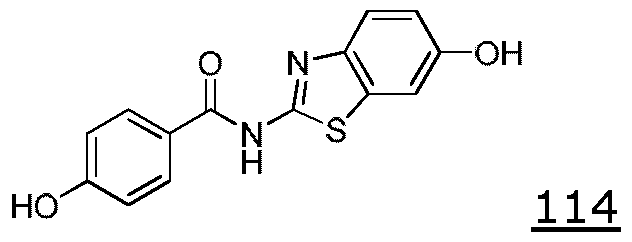
The title compound was prepared by reaction of 4-methoxy-/V-(6-methoxy-l,3- benzothiazol-2-yl)benzamide (113a) (0.5 g, 1.59 mmol) and boron trifluoride methyl sulfide complex in dichloromethane (1 M, 25.1 ml, 239.00 mmol) according to method F. The product was purified by preparative HPLC; yield : 13 % (0.06 g). 1H N MR (CD3OD) : 6.80-6.83 (m, 2H), 6.98 (dd, 3J= 8.8 Hz, 5J= 2.5 Hz, 1H), 7.22 (d, 5J= 2.2 Hz, 1H), 7.64 (d, 3J= 9.1 Hz, 1H), 8.10-8.12 (m, 2H); 13C NMR (CD3OD) : 107.7, 115.9, 118.3, 120.8, 120.9, 125.6, 126.1, 126.9, 139.9, 147.3, 147.7, 158.1, 158.3, 161.6.
-hvdroxy-/V-(6-hvdroxy-l,3-benzothiazol-2-vnbenzamide (115).

3-methoxy-A/-f6-methoxy-l ,3-benzothiazol-2-v0benzamide (115a). The title compound was synthesised following the procedure of Parlati et al., WO2005/037845.

3-hvdroxy-/V-(6-hvdroxy-l,3-benzothiazol-2-vnbenzamide (115). The title compound was prepared by reaction of 3-methoxy-/V-(6-methoxy-l,3-benzothiazol-2- yl)benzamide (115a) (0.5 g, 1.59 mmol) and boron trifluoride methyl sulfide complex in dichloromethane (1 M, 25.1 ml, 239.00 mmol) according to method F. The product was purified by recrystallisation (ethyl acetate); yield : 100 % (0.46 g). 1H N MR (CD3OD) : 6.83 (dd, 3J= 8.5 Hz, 5J= 2.5 Hz, 1H), 6.95 (dd, 5J= 2.5 Hz, 7J= 0.9 Hz, 1 H), 7.14 (d, 5J= 2.2 Hz, 1H), 7.26 (t, 3J= 8.2 Hz, 1H), 7.32 (t, 5J= 2.2 Hz, 1H), 7.37-7.39 (m, 1H), 7.48 (d, 3J= 8.8 Hz, 1H); 13C NMR (CD3OD) : 107.2, 112.3, 115.9, 116.5, 119.9, 121.0, 122.4, 127.5, 131.0, 134.7, 135.2, 155.9, 159.2, 163,1.
1.70. 3,5-dihvdroxy-A/-f6-hvdroxy-l,3-benzothiazol-2-vnbenzamide (116).

3,5-dimethoxy-/V-r6-methoxy-l ,3-benzothiazol-2-vnbenzamide (116a). The title compound was prepared by reaction of 6-methoxy-benzothiazol-2ylamine (0.3 g, 1.66 mmol) and 3,5-dimethoxy-benzoyl chloride (0.3 g, 1.66 mmol) according to method P. The product was recrystalized in ethyl acetate; yield : 100 % (0.57 g); 1 NMR (CD3OD) : 3.88 (s, 3H), 3.90 (s, 6H), 6.75 (t, 5J= 2.5 Hz, 5J= 2.2 Hz, 1H), 7.05 (dd, 3J= 8.8 Hz, 5J= 2.5 Hz, 1H), 7.18 (d, 5J= 2.2 Hz, 1H), 7.38 (d, 5J= 2.2 Hz, 1H), 7.53 (d, 5J= 2.5 Hz, 1H), 7.65 (d, 3J= 8.8 Hz, 1H); 13C NMR (CD3OD) : 56.8; 57.1; 57.1; 106.1; 107.0; 107.6; 109.1; 117.0; 123.3; 133.4; 135.4; 136.2; 144.5; 158.2; 158.9; 163.1 ; 166.9.

3,5-dihvdroxy-A/-f6-hvdroxy-l,3-benzothiazol-2-vnbenzamide (116). The title compound was prepared by reaction of 3,5-dimethoxy-/V-(6-methoxy-l,3-benzothiazol- 2-yl)benzamide (116a) (0.57 g, 1.66 mmol) and boron tribromide (15.0 mmol) according to method D. The product was recrystalized in methanol/water; yield : 80 % (0.40 g); 1H NMR (CD3SOCD3) : 6.47-6.49 (m, 2H), 6.90-6.92 (m, 2H), 7.30 (d, 5J= 1.9 Hz, 1H), 7.56 (d, 3J= 8.8 Hz, 1H), 9.55 (s, 1H); 9.64 (s, 2H), 12.4 (s, 1 H); 13C NMR (CD3SOCD3) : 106.3; 115.3; 116.0; 116.6; 117.1; 117.2; 121.0; 130.1; 130.4; 133.9; 135.9; 154.2; 158.4; 165.7.
-fluoro-3-hvdroxy-/V-r6-hvdroxy-l,3-benzothiazol-2-vnbenzamide (117).

117a
4-fluoro-3-methoxy-/V-r6-methoxy-l,3-benzothiazol-2-vnbenzamide (117a). The title compound was prepared by reaction of 6-methoxy-benzothiazol-2ylamine (0.3 g, 1.66 mmol) and 4-fluoro-3-methoxy-benzoyl chloride (0.3 g, 1.66 mmol) according to method P. The product was recrystalized in ethyl acetate; yield : 100 % (0.55 g); 1H NMR (CD3COCD3) : 3.88 (s, 3H), 4.03 (s, 3H), 7.05 (dd, 3J= 8.8 Hz, 5J=
2.5 Hz, 1H), 7.33-7.37 (m, 1H), 7.54 (d, 5J= 2.5 Hz, 1H), 7.65 (d, 3J= 8.8 Hz, 1H), 7.83-7.86 (m, 1H), 8.00 (dd, 3J= 8.2 Hz, 5J= 1.9 Hz, 1H); 13C NMR (CD3COCD3) : 56.2; 56.8; 105.1 ; 109.0; 114.3; 116.0; 116.9; 117.1; 117.4; 117.7; 117.9;
57.9; 165.2.

117
4-fluoro-3-hvdroxy-A/-(6-hvdroxy-l,3-benzothiazol-2-yl)benzamide (117). The title compound was prepared by reaction of 4-fluoro-3-methoxy-/V-(6-methoxy-l,3- benzothiazol-2-yl)benzamide (117a') (0.25 g, 0.75 mmol) and boron tribromide (4.5 mmol) according to method D. The product was directly purified by preparative HPLC; yield : 22 % (0.05 g); 1H NMR (CD3SOCD3) : 6.92 (dd, 5J= 2.5 Hz, 3J= 8.5 Hz, 1H), 7.28-7.32 (m, 2H); 7.58 (d, 3J= 8.8 Hz, 1H), 7.61-7.64 (m, 1H), 7.67 (dd, 5J= 2.2 Hz, 3J= 8.5 Hz, 1H), 9.55 (s, 1H), 10.31 (s, 1H), 12.56 (s, 1H); 13C NMR (CD3SOCD3) : 106.3; 115.3; 116.2; 118.1; 119.8; 119.9; 122.3; 125.8; 132.7; 137.2; 144.5; 144.9; 145.0; 145.0; 145.2; 145.3; 152.1; 154.3; 164.3.
1.72. 4-fluoro-3-hvdroxy-/V-(6-hvdroxy-l,3-benzothiazol-2-vn-N-methyl-benz- amide (118)

118a
4-fluoro-3-methoxy-/V-(6-methoxy-l,3-benzothiazol-2-yl)-N-methyl-benzamide (118a). To a solution of 4-fluoro-3-methoxy-/V-(6-methoxy-l,3-benzothiazol-2- yl)benzamide (117a) (0.28 g, 0.83 mmol) in DMF, NaH (0.02 g, 0.91 mmol) was added and the mixture cooled to 0 ° C for 30 min. Methyl iodide (0.1 ml, 1.66 mmol) was added and the reaction mixture was stirred for 3 h at rt. Water was added to quench the reaction and the aqueous solution was then extracted (3x) with ethyl acetate. The combined organic layers were washed with brine, dried over magnesium sulfate, filtered and concentrated to dryness. The product was purified by CC (hexane/ethyl acetate 50 : 50); yield : 70 % (0.20 g); ^ NMR (CD3COCD3) : 3.88 (s, 3H), 3.99 (s, 3H), 4.00 (s, 3H), 7.11-7.13 (m, 1H), 7.20-7.23 (m, 1H), 7.45-7.54 (m, 2H), 8.00-8.04 (m, 2H); 13C NMR (CD3COCD3) : 32.8; 56.3; 56.5;
107.5; 113.6; 115.2; 115.7; 116.1; 116.2; 123.4; 123.5; 128.6; 132.3; 134.8;
67.8.

118
4-fluoro-3-hvdroxy-A/-r6-hvdroxy-1 -benzothiazol-2-vn-N-methyl-benzamide (118). The title compound was prepared by reaction of 4-fluoro-3-methoxy-/V-(6- methoxy-l,3-benzothiazol-2-yl)-N-methyl-benzamide (118a) (0.20 g, 0.58 mmol) and boron tribromide (3.5 mmol) according to method D. The product was purified by CC (dichloromethane/methanol 90 : 10); yield : 22 % (0.04 g); 1H N MR (CD3SOCD3) : 3.91 (s, 3H), 6.92 (dd, 5J= 2.4 Hz, 3J= 8.8 Hz, 1H), 7.19-7.28 (m, 2H); 7.49 (d, 3J= 8.8 Hz, 1H), 7.71-7.74 (m, 1H), 7.89 (dd, 5J= 2.1 Hz, 3J= 9.1 Hz, 1H), 9.81 (s, 1H), 10.14 (s, 1H); 13C NMR (CD3SOCD3) : 32.3; 108.5; 113.1 ; 115.4; 115.7; 115.8; 118.4; 118.4; 120.7; 120.8; 126.7; 129.8; 133.2; 144.5; 144.6; 152.4; 154.4; 154.6; 165.8.
-hvdroxy-4-methyl-AH6-hvdroxy-l,3-benzothiazol-2-yl)benzamide (119).

119a
3-methoxy-4-methyl-AH6-methoxy-l,3-benzothiazol-2-yl)benzamide (119a). The title compound was prepared by reaction of 6-methoxy-benzothiazol-2ylamine (0.3 g, 1.66 mmol) and 3-methoxy-4-methyl-benzoyl chloride (0.3 g, 1.66 mmol) according to method P. The product was recrystalized in ethyl acetate; yield : 100 % (0.55 g); ^ NMR (CDCI3) : 2.27 (s, 3H), 3.87 (s, 3H), 3.88 (s, 3H), 7.00 (dd, 3J= 8.8 Hz, 5J= 2.5 Hz, 1H), 7.22 (d, 3J= 8.5 Hz, 1H), 7.31 (d, 5J= 2.2 Hz, 1H), 7.49 (dd, 3J= 7.6 Hz, 5J= 1.6 Hz, 1 H), 7.52-7.54 (m, 2H); 13C NMR (CDCI3) : 16.5; 55.5; 55.9; 104.2; 109.2; 110.7; 113.6; 115.4; 119.4; 121.2; 130.5; 130.9; 132.9; 133.0; 157.0; 158.2; 165.2.
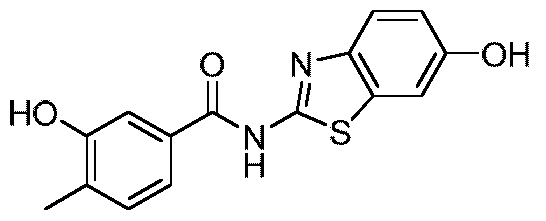
119
3-hvdroxy-4-methyl-A/-f6-hvdroxy-1 -benzothiazol-2-yl)benzamide (119). The title compound was prepared by reaction of 3-methoxy-4-methyl-/V-(6-methoxy- l,3-benzothiazol-2-yl)benzamide (119a) (0.25 g, 0.76 mmol) and boron tribromide (4.6 mmol) according to method D. The product was purified by CC (dichloromethane/methanol 90 : 10); yield : 13 % (0.03 g); 1H NMR (CD3SOCD3) : 2.20 (s, 3H), 6.91 (dd, 5J= 2.5 Hz, 3J= 8.8 Hz, 1 H), 7.22 (d, 3J= 8.5 Hz, 1H), 7.31 (d, 5J= 2.5 Hz, 1H), 7.46 (d, 5J= 1.6 Hz, 1H), 7.53 (dd, 5J= 1.6 Hz, 3J= 7.6 Hz, 1H), 7.57 (d, 3J= 8.5 Hz, 1H), 9.73 (s, 1H); 13C NMR (CD3SOCD3) : 15.9; 106.3; 114.2; 115.2; 118.5; 120.7; 120.8; 129.5; 130.4; 132.7; 138.3; 141.4; 146.3; 154.1; 165.5.
-dihvdroxy-A/-f6-hvdroxy-l,3-benzothiazol-2-vnbenzamide (120).

2,5-dimethoxy-A/-(6-methoxy-l ,3-benzothiazol-2-yl)benzamide (120a). The title compound was prepared by reaction of 6-methoxy-benzothiazol-2ylamine (0.3 g, 1.66 mmol) and 2,5-dimethoxy-benzoyl chloride (0.3 g, 1.66 mmol) according to method P. The product was recrystalized in ethyl acetate; yield : 100 % (0.55 g); The product was purified by CC (dichloromethane/methanol 95 : 05); yield : 100 % (0.57 g); the compound was used in the next step without characterisation.

2,5-dihvdroxy-/V-(6-hvdroxy-l,3-benzothiazol-2-yl)benzamide (120). The title compound was prepared by reaction of 2,5-dimethoxy-/V-(6-methoxy-l,3-benzothiazol- 2-yl)benzamide (120a) (0.48 g, 1.39 mmol) and boron tribromide (12.5 mmol) according to method D. The product was purified by CC (dichloromethane/methanol 90 : 10); yield : 25 % (0.15 g); ^ N MR (CD3SOCD3) : 6.74 (dd, 5J= 2.5 Hz, 3J= 8.8 Hz, 1H), 7.07 (s, 1H), 7.12 (d, 5J= 2.2 Hz, 1 H), 9.22 (s, 1H), 9.61 (s, 1H), 11.29 (s, 1H), 11.91 (s, 1H); 13C NMR (CD3SOCD3) : 107.7; 114.3; 115.2; 116.6; 117.1 ; 117.6; 118.1; 122.2; 137.8; 141.0; 145.7; 154.4; 155.3; 164.5.
1.75. 2-chloro-6-fluoro-3-hvdroxy-/V-(6-hvdroxy-l,3-benzothiazol-2-yl)benzamide (121).

121a
2-chloro-6-fluoro-3-methoxy-A/-(6-methoxy-l,3-benzothiazol-2-vnbenzamide f 121a). The title compound was prepared by reaction of 6-methoxy-benzothiazol- 2ylamine (0.3 g, 1.66 mmol) and 2-chloro-6-fluoro-3-methoxy-benzoyl chloride (0.4 g, 1.66 mmol) according to method P. The product was purified by CC (hexan/ethyl acetate 60 :40); yield : 83 % (0.51 g); ^ N MR (CDCI3) : 3.72 (s, 3H), 3.85 (s, 3H), 6.73 (dd, 5J= 4.4 Hz, 3J= 9.1 Hz, 1H), 6.79 (dd, 5J= 2.5 Hz, 3J= 8.8 Hz, 1H), 6.84 (t, 3J= 8.5 Hz, 1H), 7.06 (d, 3J= 8.8 Hz, 1H), 7.25 (d, 5J= 2.5 Hz, 1H); 13C NMR (CDCI3) : 55.8; 56.6; 108.4; 103.8; 112.0; 114.0; 114.1; 114.4;
33.1 ; 141.8; 143.4; 156.8; 160.5.

121
2-chloro-6-fluoro-3-hvdroxy-/V-(6-hvdroxy-l,3-benzothiazol-2-vnbenzamide (121). The title compound was prepared by reaction of 2-chloro-6-fluoro-3-methoxy-/V-(6- methoxy-l,3-benzothiazol-2-yl)benzamide (121a) (0.25 g, 0.68 mmol) and boron tribromide (4.1 mmol) according to method D. The product was purified by CC (dichloromethane/methanol 90 : 10); yield : 43 % (0.10 g); ^ NMR (CD3SOCD3) : 6.14 (dd, 5J= 2.5 Hz, 3J= 8.8 Hz, 1H), 6.22-6.28 (m, 2H); 6.46 (d, 5J= 2.5 Hz, 1H), 6.78 (d, 3J= 8.8 Hz, 1H); 13C NMR (CD3SOCD3) : 104.6; 110.1; 113.2; 113.3; 114.0; 116.6; 116.6; 119.9; 122.7; 122.9; 132.0; 140.5; 149.0; 149.0; 150.0; 151.9; 153.4; 153.4; 153.4; 153.9; 160.6.
1 -fluoro-2-hvdroxy-/V-(6-hvdroxy-l,3-benzothiazol-2-vnbenzamide (122).

3-fluoro-2-methoxy-AH6-methoxy-l,3-benzothiazol-2-yl)benzamide (122a). The title compound was prepared by reaction of 6-methoxy-benzothiazol-2ylamine (0.3 g, 1.66 mmol) and 3-fluoro-2-methoxy-benzoyl chloride (0.3 g, 1.66 mmol) according to method P. The product was purified by CC (hexan/ethyl acetate 60 :40); yield : 67 % (0.37 g); ^ NMR (CD3SOCD3) : 3.88 (s, 3H), 4.23 (d, 5J= 2.4
Hz, 3H), 7.07 (dd, 5J= 2.4 Hz, 3J= 8.8 Hz, 1 H), 7.30-7.34 (m, 3H), 7.68 (d, 3J= 8.8 H 3J= 7.9 Hz, 1H), 11.18 (s, 1H).

3-fluoro-2-hvdroxy-A/-(6-hvdroxy-l,3-benzothiazol-2-v0benzamide (122). The title compound was prepared by reaction of 3-fluoro-2-methoxy-/V-(6-methoxy-l,3- benzothiazol-2-yl)benzamide (122a) (0.25 g, 0.75 mmol) and boron tribromide (4.5 mmol) according to method D. The product was purified by CC (dichloro- methane/methanol 90 : 10); yield : 48 % (0.11 g); 1H N MR (CD3SOCD3) : 6.71-6.75 (m, 1H), 6.85 (dd, 5J= 2.5 Hz, 3J= 8.5 Hz, 1H), 7.14-7.20 (m, 2H), 7.41 (d, 3J= 8.5 Hz, 1H), 7.71 (d, 3J= 7.9 Hz, 1H); 13C NMR (CD3SOCD3) : 106.9; 108.0; 117.0; 121.0; 126.6; 129.3; 131.4; 138.0; 140.7; 145.7; 146.0; 147.9; 156.2; 165.2.
-fluoro-3-hvdroxy-/V-r6-hvdroxy-l,3-benzothiazol-2-vnbenzamide (123).

2-fluoro-3-methoxy-AH6-methoxy-l,3-benzothiazol-2-v0benzamide (123a). The title compound was prepared by reaction of 6-methoxy-benzothiazol-2ylamine (0.4 g, 1.96 mmol) and 2-fluoro-3-methoxy-benzoyl chloride (0.4 g, 1.96 mmol) according to method P. The product was recrystallized in ethyl acetate; yield : 30 % (0.18 g); 1H NMR (CDCI3) : 3.83 (s, 3H), 3.89 (s, 3H), 7.07 (dd, 5J= 2.5 Hz, 3J= 8.8 Hz, 1H), 7.31 (dt, 5J= 1.9 Hz, 3J= 8.8 Hz, 3J= 9.1, Hz 1H), 7.50-7.55 (m, 2H), 7.62 5J= 2.5 Hz, 1 H), 7.68 (d, 3J= 8.8 Hz, 1H), 12.69 (s, 1H).

2-fluoro-3-hvdroxy-/V-(6-hvdroxy-l,3-benzothiazol-2-vnbenzamide (123). The title compound was prepared by reaction of 2-fluoro-3-methoxy-/V-(6-methoxy-l,3- benzothiazol-2-yl)benzamide (123a) (0.13 g, 0.40 mmol) and boron tribromide (2.3 mmol) according to method D. The product was purified by CC (dichloromethane/ methanol 90 : 10); yield : 33 % (0.04 g); 1H N MR (CD3SOCD3) : 6.91 (dd, 5J= 2.5 Hz, 3J= 8.8 Hz, 1H), 7.09-7.18 (m, 3H); 7.32 (d, 5J= 2.5 Hz, 1H), 7.58 (d, 3J= 8.5 Hz, 1H), 9.58 (s, 1H), 10.21 (s, 1H), 12.51 (s, 1H); 13C NMR (CD3SOCD3) : 106.5;
110.1; 115.4; 119.2; 120.7; 120.7; 121.2; 123.2; 123.3; 124.4; 124.4; 132.8; 145.4; 145.4; 147.5; 149.5; 154.3; 163.3.
-difluoro-3-hvdroxy-A/-(6-hvdroxy-1 -benzothiazol-2-yl)benzamide (124).

2,6-difluoro-3-methoxy-AH6-methoxy-l,3-benzothiazol-2-yl)benzamide (124a'). The title compound was prepared by reaction of 6-methoxy-benzothiazol-2ylamine (0.3 g, 1.79 mmol) and 2,6-difluoro-3-methoxy-benzoyl chloride (0.4 g, 1.79 mmol) according to method P. The product was purified by CC (dichloromethane/ methanol 95 : 05); yield : 29 % (0.18 g); ^ NMR (CDCI3) : 3.83 (s, 3H), 3.89 (s, 3H), 7.07 (dd, 5J= 2.5 Hz, 3J= 8.8 Hz, 1 H), 7.21 (dt, 5J= 1.9 Hz, 3J= 8.8 Hz, 3J= 9.1, Hz 1H), 7.36-7.40 (m, 1H), 7.63 (d, 5J= 2.5 Hz, 1H), 7.70 (d, 3J= 8.8 Hz, 1H), 13.07 (s, 1H); 13C NMR (CDCI3) : 55.6; 56.8; 104.8; 111.4; 115.3; 116.1 ; 116.2;
; 150.7; 150.8; 150.8; 156.5; 164.6.

2,6-difluoro-3-hvdroxy-A/-(6-hvdroxy-l,3-benzothiazol-2-yl)benzamide (124). The title compound was prepared by reaction of 2,6-difluoro-3-methoxy-/V-(6-methoxy- l,3-benzothiazol-2-yl)benzamide (124a) (0.18 g, 0.51 mmol) and boron tribromide (3.1 mmol) according to method D. The product was purified by CC (dichloro- methane/methanol 90 : 10); yield : 30 % (0.05 g); 1H N MR (CD3SOCD3) : 6.97-7.01 (m, 2H), 7.17-7.22 (m, 1H); 7.41 (d, 5J= 2.5 Hz, 1H), 7.59 (d, 3J= 8.2 Hz, 1H); 13C NMR (CD3SOCD3) : 107.2; 112.2; 112.3; 116.4; 120.6; 120.7; 122.7; 134.4; 142.6; 142.7; 142.7; 142.8; 143.3; 147.9; 147.9; 151.9; 151.9; 155.3; 155.6; 159.8; 167.1.
-difluoro-3-hvdroxy-/V-(6-hvdroxy-l,3-benzothiazol-2-yl)benzamide (125).

2,4-difluoro-3-methoxy-/V-(6-methoxy-l,3-benzothiazol-2-yl)benzamide (125a). The title compound was prepared by reaction of 6-methoxy-benzothiazol-2ylamine (0.3 g, 1.79 mmol) and 2,4-difluoro-3-methoxy-benzoyl chloride (0.4 g, 1.79
mmol) according to method P. The product was purified by CC (dichloromethane/ methanol 95 : 05); yield : 20 % (0.13 g); the compound was used in the next step without characterisation .

2,4-difluoro-3-hvdroxy-A/-(6-hvdroxy-l,3-benzothiazol-2-v0benzamide (125). The title compound was prepared by reaction of 2,4-difluoro-3-methoxy-/V-(6-methoxy- l,3-benzothiazol-2-yl)benzamide (125a) (0.13 g, 0.36 mmol) and boron tribromide (2.1 mmol) according to method D. The product was purified by CC (dichloro- methane/methanol 90 : 10); yield : 30 % (0.04 g); ^ N MR (CD3SOCD3) : 6.92 (dd, 5J= 2.5 Hz, 3J= 8.8 Hz, 1H), 7.15-7.23 (m, 2H); 7.32 (d, 5J= 2.5 Hz, 1H), 7.59 (d, 3J= 8.8 Hz, 1H), 9.61 (s, 1H), 10.61 (s, 1H), 12.54 (s, 1H); 13C NMR (CD3SOCD3) : 106.5; 111.7; 111.8; 115.4; 118.8; 118.9; 121.2; 132.7; 134.2; 134.4; 135.2; 138.6; 139.0; 141.0; 149.4; 154.4; 166.5.
-fluoro-5-hvdroxy-/V-r6-hvdroxy-l,3-benzothiazol-2-vnbenzamide (126).

2-fluoro-5-methoxy-/V-r6-methoxy-l,3-benzothiazol-2-vnbenzamide (126a). The title compound was prepared by reaction of 6-methoxy-benzothiazol-2ylamine (0.4 g, 1.96 mmol) and 2-fluoro-5-methoxy-benzoyl chloride (0.4 g, 1.96 mmol) according to method P. The product was purified by CC (dichloromethane/methanol 95 : 05); yield : 35 % (0.23 g); 1H NMR (CDCI3) : 3.36 (s, 3H), 3.38 (s, 3H), 6.62 (dd, 5J= 2.7 Hz, 3J= 8.8 Hz, 1H), 6.71-6.74 (m, 2H), 6.85-6.87 (m, 2H), 7.25 (d, 3 = 8.8 Hz, 1H).

2-fluoro-5-hvdroxy-/V-(6-hvdroxy-l,3-benzothiazol-2-vnbenzamide (126). The title compound was prepared by reaction of 2-fluoro-5-methoxy-/V-(6-methoxy-l,3- benzothiazol-2-yl)benzamide (126a) (0.23 g, 0.68 mmol) and boron tribromide (4.1 mmol) according to method D. The product was purified by CC (dichloromethane/ methanol 90 : 10); yield : 30 % (0.06 g); ^ N MR (CD3SOCD3) : 6.92 (dd, 5J= 2.5 Hz,
3J= 8.5 Hz, 1H), 6.95-6.99 (m, 1 H); 7.06-7.07 (m, 1H), 7.17 (t, 3J= 8.5 Hz, 1H), 7.33 (d, 5J= 2.5 Hz, 1 H), 7.58 (d, 3J= 8.8 Hz, 1 H), 9.62 (s, 1H), 9.83 (s, 1 H), 12.44 (s, 1H); 13C NMR (CD3SOCD3) : 106.5; 115.4; 115.5; 116.7; 117.2; 119.8; 119.9; 121.2; 122.3; 122.3; 122.5; 132.8; 132.8; 151.6; 153.5; 153.5; 154.4; 154.8; 166.1.
-(6-hvdroxy-benzothiazol-2-v0-3-(3-hvdroxy-phenyl)-urea (127).

l-(6-methoxy-benzothiazol-2-v0-3-(3-methoxy-phenyl)-urea (127a ). The title compound was prepared by reaction of 6-methoxy-benzothiazol-2ylamine (0.3 g, 1.85 mmol) and 3-methoxy-phenyl isocyanate (0.24 ml, 1.85 mmol) according to method P. The product was purified by CC (dichloromethane/methanol 95 :05); yield : 98 % (0.60 g); 1H N MR (CD3COCD3) : 3.78 (s, 3H), 3.82 (s, 3H), 6.64 (dd, 3J= 8.2 Hz, 5J= 2.2 Hz, 1H), 6.99 (dd, 3J= 8.8 Hz, 5J= 2.5 Hz, 1H), 7.03-7.05 (m, 1H), 7.21-7.25 (m, 2H), 7.50 (d, 5J= 2.5 Hz, 1H), 7.56 (d, 3J= 8.8 Hz, 1H); 13C NMR (CD3COCD3) : 56.2; 56.8; 105.9; 106.1; 109.5; 112.3; 115.6; 121.5; 121.5;
157.2; 161.3; 206.2.

l-(6-hvdroxy-benzothiazol-2-yl)-3-(3-hvdroxy-phenyl)-urea (127). The title compound was prepared by reaction of l-(6-methoxy-benzothiazol-2-yl)-3-(3-methoxy- phenyl)-urea (127a) (0.60 g, 1.82 mmol) and boron tribromide (10.9 mmol) according to method D. The product was purified by CC (dichloromethane/methanol 90 : 10); yield : 25 % (0.15 g); ^ N MR (CD3SOCD3) : 6.46 (dd, 5J= 1.5 Hz, 3J= 8.2 Hz, 1H), 6.84-6.87 (m, 2H), 7.08 (t, 3J= 7.9 Hz, 1H), 7.14 (t, 5J= 2.1 Hz, 1H), 7.24 (d, 5J= 2.4 Hz, 1H), 7.46 (d, 3J= 8.8 Hz, 1H), 9.01 (s, 1H), 9.39 (s, 1H), 9.41 (s, 1H), 10.48 (s, 1H); 13C NMR (CD3SOCD3) : 105.8; 106.5; 109.3; 110.0; 114.8; 120.1; 120.2; 129.6; 132.6; 139.7; 140.9; 153.9; 158.0; 206.5.
1.82. l-(6-hvdroxy-benzothiazol-2-vD-3-(3-hvdroxy-phenyl)-thiourea (128).

l-(6-methoxy-benzothiazol-2-v0-3-(3-methoxy-phenv0-thiourea (128a). The title compound was prepared by reaction of 6-methoxy-benzothiazol-2ylamine (0.3 g, 1.66 mmol) and 3-methoxy-phenyl isothiocyanate (0.23 ml, 1.66 mmol) according to method P. The product was purified by CC (dichloromethane/methanol 95 : 05); yield : 30 % (0.17 g); the compound was used in the next step without characterisation .

128
l-(6-hvdroxy-benzothiazol-2-vn-3-(3-hvdroxy-phenvn-thiourea (128). The title compound was prepared by reaction of l-(6-methoxy-benzothiazol-2-yl)-3-(3- methoxy-phenyl)-thiourea (128a) (0.17 g, 0.49 mmol) and boron tribromide (2.9 mmol) according to method D. The product was purified by CC (dichloromethane/ methanol 90 : 10); yield : 13 % (0.02 g); ^ N MR (CD3SOCD3) : 6.51-6.62 (m, 1H), 6.87 (dd, 5J= 2.2 Hz, 3J= 8.5 Hz, 1H), 7.07-7.26 (m, 4H), 8.30 (s, 1H), 9.41 (s, 1H), 9.48 (s, 1H), 9.58 (m, 1H), 9.65 (s, 1H); 13C NMR (CD3SOCD3) : 103.6; 111.1; 115.2; 115.8; 116.1; 116.7; 117.0; 117.4; 117.7; 125.6; 157.3; 171.8; 174.0; 199.5.
Example 2. Biological Methods.
[2, 4, 6, 7-3H]-E2 and [2, 4, 6, 7-3H]-El were bought from Perkin Elmer, Boston. Quickszint Flow 302 scintillator fluid was bought from Zinsser Analytic, Frankfurt. 17p-HSDl and 17p-HSD2, if not indicated otherwise, were obtained from human placenta according to previously described procedures. [Kruchten P. et al., Mol . Cell. Endocrinol. 301, 154-157 (2009)] Fresh human placenta was homogenized and cytosolic fraction and microsomes were separated by centrifugation. For the partial purification of 17p-HSDl, the cytosolic fraction was precipitated with ammonium sulfate. 17p-HSD2 was obtained from the microsomal fraction.
2.1. Inhibition of 17p-HSDl : Inhibitory activities were evaluated by an established method with minor modifications [Kruchten P. et al ., Mol. Cell . Endocrinol. 301, 154-157 (2009)] . Briefly, the enzyme preparation was incubated with NADH [500 μΜ] in the presence of potential inhibitors at 37 °C in a phosphate buffer (50 mM)
supplemented with 20 % of glycerol and EDTA (1 mM). Inhibitor stock solutions were prepared in DMSO. The final concentration of DMSO was adjusted to 1 % in all samples. The enzymatic reaction was started by addition of a mixture of unlabelled- and [2, 4, 6, 7-3H]-El (final concentration : 500 nM, 0.15 μϋ). After 10 min, the incubation was stopped with HgCI2 and the mixture was extracted with diethylether. After evaporation, the steroids were dissolved in acetonitrile. El and E2 were separated using acetonitrile/water (45 : 55) as mobile phase in a C18 reverse phase chromatography column (Nucleodur C18 Gravity, 3 μιη, Macherey-Nagel, Duren) connected to a HPLC-system (Agilent 1100 Series, Agilent Technologies, Waldbronn). Detection and quantification of the steroids were performed using a radioflow detector (Berthold Technologies, Bad Wildbad). The conversion rate was calculated after analysis of the resulting chromatograms according to the following
°/oE2.
equation : %conversion = - x lOO . Each value was calculated from at least
%E2 + %E\
three independent experiments.
2.2. Inhibition of 17B-HSD2 : The 17 -HSD2 inhibition assay was performed similarly to the 17 -HSD1 procedure. The microsomal fraction was incubated with NAD+ [1500 μΜ], test compound and a mixture of unlabelled- and [2, 4, 6, 7-3H]- E2 (final concentration : 500 nM, 0.11 μϋ) for 20 min at 37 °C. Further treatment of the samples and HPLC separation was carried out as mentioned above.
The conversion rate was calculated after analysis of the resulting chromatograms
°/oE\
according to the following equation : %conversion = x lOO .
%E\ + %E2
2.3. Inhibition of 17P-HSD1 in T47D cells: A stock culture of T47D cells was grown in RPMI 1640 medium supplemented with 10 % FCS, L-glutamine (2 mM), penicillin (100 IU/ml), streptomycin (100 g/ml), insulin-zinc-salt (10 pg/ml) and sodium pyruvate (1 mM) at 37 °C under 5 % C02 humidified atmosphere. The cells were seeded into a 24-well plate at lxlO6 cells/well in DMEM medium with FCS, L- glutamine and the antibiotics added in the same concentrations as mentioned above. After 24 h the medium was changed for fresh serum free DMEM and a solution of test compound in DMSO was added. Final concentration of DMSO was adjusted to 1 % in all samples. After a pre-incubation of 30 min at 37 °C with 5 % C02, the incubation was started by addition of a mixture of unlabelled- and [2, 4, 6, 7-3H]-El (final concentration : 50 nM, 0.15 μϋ). After 0.5 h incubation, the
enzymatic reaction was stopped by removing of the supernatant medium . The steroids were extracted with diethylether. Further treatment of the samples was carried out as mentioned for the 17p-HSDl assay.
2.4. Inhibition of marmoset fCallithrix iacchus) 17B-HSD1 and 17B-HSD2 : 17β- HSD1 and 17p-HSD2 were obtained from marmoset placenta. The inhibition assays were performed similarly to the ones carried out using human enzymes as set forth under 2.1 and 2.2 above.
The results with title compounds 1-54 and 101-128 are shown in the tables 1, 2 and 3 below.
Table 1 : Inhibition of human 17p-HSDl and 17p-HSD2 by compounds 1-53 and
101-128
compound selectivity factord
17p-HSDlb 17P-HSD2C
1 22 109 5
2 368 376 1
3 945 567 0.6
4 33 478 14
5 95 18 0.2
6 52%e 13%e
7 21 69 3
8 64%e 31%e
9 18 49 3
10 594 240 0.4
11 207 465 2
12 30 57 2
13 6 19 3
14 8 382 48
15 19 588 31
16 14 95 6
17 5 246 49
18 86 590 7
19 108 793 7
20 20 786 39
21 199 719 4
22 35 485 14
23 32%e 51%e
24 19%e 57%e
25 155 128 0.8
26 86 196 2
27 95 342 4
28 220 507 2
29 510 1036 2
30 44%e 44%e
31 54%e 26%e
32 515 915 2
33 94 195 2
34 78 502 6
35 498 586 1
36 62 797 13
37 35 1065 30
38 47 768 16
39 60 702 12
40 31 789 26
41 54 1197 22
42 40 1034 26
43 36 1003 28
44 225 354 2
45 150 563 4
46 125 559 4
47 12 169 14
48 300 253 0.8
49 55 319 6
50 66 299 5
51 151 173 1
52 192 283 2
53 107 410 4
54 8 199 24
101 365 1356 4
102 n.i. n.i.
103 44 1035 23
104 243 2300 9
105 27%e 33%e
106 136 104 1
107 38 59 2
108 863 1457 2
109 13%e 7%e
110 13 130 10
111 27 4003 148
112 77 1538 20
113 n.i. n.i.
114 39%e n.i.
115 243 9264 38
116 25% e 15%e
117 171 1480 9
118 60%e 27%e
119 n.i. n.i.
120 n.i. 38%
121 87%e 61%e
122 n.i. n.i.
123 99%e 48%e
124 13 1773 134
125 99 541 6
126 112 3803 34
127 n.i. n.i.
128 62%e 18%e
a Mean value of three determinations, standard deviation less than 26%
b Human placenta, cytosolic fraction, substrate El, 500 nM, cofactor NADH, 500μΜ
c Human placenta, microsomal fraction, substrate E2, 500 nM, cofactor NAD+, 1500μΜ
d ICso (17P-HSD2) / IC50 (17p-HSDl)
e % inhibition at inhibitor concentration of 1 μΜ
n.i. = no inhibition
Table 2 : Inhibition of 17p-HSDl in cellular assay.
ICso [nM]a
compounu
cellular assay
4 30
14 27
15 17
17 126
20 367
22 107
34 154
36 53%c
37 441
38 565
39 526
40 40%c
41 34%c
42 49%c
43 47%c
47 78
49 357
110 11
111 258
112 26
115 245
a Mean values of three determinations, standard deviation less then 26% b T47-D cells, substrate El, 50 nM
c % inhibition at inhibitor concentration of 1 μΜ
Table 3 : Inhibition of Callithrix jacchus 17p-HSDl and 17-pHSD2
Compound rnHSDl3 mHSD2b
% inhibition
5 nM
nM 50 n M
14 57 48
15 50 46
17 68 55
20 38 50
22 52 39
37 47 47
38 41 46
110 80 34
111 83 40
123 67 48
124 87 51
aMarmoset placenta, cytosolic fraction, substrate [3H]E1 + El [500 nM], cofactor NADH [500 μΜ];
"Marmoset placenta, microsomal fraction, substrate [3H]E2 + E2 [500 nM], cofactor NAD+ [1500 μΜ];
Claims
1. A 17beta-hydroxysteroid dehydrogenase type 1 (17pHSDl) inhibitor having the formula (I)

wherein
Rl represents H, OH, alkoxy or acyloxy;
R2, R3, R5 and R6 independently represent -H, -R, haloalkyl, halogen, -N02, -OR', -SR', -COR', -NR'R', -CN, -COOR', -N HS02R, -S02NR'R', -SON R'R', -NHSOR, -NHCOR', -CONR'R', -OC(0)R', -CH2NR'R',-CH2OR', -S02R or -SOR (wherein R is an alkyl group, a homoaromatic group that may be condensed with a 5- or 6- membered, aliphatic or aromatic heterocyclic ring, a benzyl group, or an aliphatic or aromatic heterocyclic group that may be condensed with a benzene ring, each of said groups may be substituted with up to 5 substituents independently selected from halogen, lower alkyl, lower haloalkyl, -OH, -N02, lower alkoxy, -NH2, phenyl, -CN, -NHCOR", -CONHR", -NHS02R" and S02NHR" (wherein R" is -H, lower alkyl, lower haloalkyl or phenyl); and R' at each occurrence is independently selected from the groups of R above and -H);
X represents:

Y, if present, represents an 0 or S atom;
R7 and R8 independently represent -H or lower alkyl;
the aryl ring is a 5-membered heteroaromatic ring which carries up to 3 heteroatoms independently selected from N, S and 0 and may be condensed with a benzene ring, said benzene ring may then carry said substituents R4 and/or R5; R4 represents -H, -OH, an alkyl or an alkoxy group (each of which may carry phenyl and halogen substituents, wherein said phenyl substituent may carry up to 3 substituents independently selected from -OH, alkyl, haloalkyl, alkoxy, halogen, amino, -CN and -N02), a 6-membered aromatic group (which may carry 1 to 3
substituents independently selected from -R, haloalkyl, halogen, -N02, -OR', -SR', - COR', -NR'R', -CN, -COOR', -NHS02R, -S02NR'R', -SONR'R', -NHSOR, -NHCOR', -CONR'R', -OC(0)R', -CH2NR'R', -CH2OR', -S02R and -SOR (wherein R and R' is as defined above) or two of said substituents, together with the adjacent carbon atoms of the 6-membered aromatic group, may form a 5- or 6-membered, aliphatic or aromatic, homocyclic or heterocyclic ring condensed to said 6-membered aromatic group, wherein the heterocyclic ring carries up to 3 heteroatoms independently selected from N, S and 0, and wherein the third substituent may be located on the 6-membered aromatic group or on the ring condensed thereto), or a 5- or 6-membered aliphatic or aromatic heterocyclic group (which carries up to 3 heteroatoms independently selected from N, S and 0 and may carry 1 to 3 substituents independently selected from -R, haloalkyl, halogen, -N02, -OR', -SR', -COR', -NR'HR', -CN, -COOR', -NHS02R, -S02NR'R', -SON R'R', -NHSOR, -N HCOR', -CONR'R', -OC(0)R', -CH2NR'R', -CH2OR', -S02R and -SOR (wherein R and R' is as defined above) or two of said substituents, together with the adjacent carbon atoms of the 5 or 6-membered aliphatic or aromatic heterocyclic group, may form a 5- or 6-membered, aliphatic or aromatic ring condensed to said 5- or 6-membered aliphatic or aromatic heterocyclic group, wherein the third substituent may be present on the 5- or 6-membered aliphatic or aromatic heterocyclic group or on the ring condensed thereto), said substituent R4 being directly or through a phenylen group bound to the aryl ring;
or a pharmaceutically acceptable salt thereof or a prodrug thereof, for use in the treatment and/or prophylaxis of hormone-related diseases.
2. The inhibitor for use in the treatment and/or prophylaxis of hormone-related diseases of claim 1, which has the formula la)

wherein
Rl, R2, R4, R5, R6 and X have the same meaning as in claim 1, or R4 and R5, together with the adjacent carbon atoms of the 6-membered aromatic group, may form a 5- or 6-membered, aliphatic or aromatic, homocyclic or heterocyclic ring condensed to said 6-membered aromatic group, wherein the heterocyclic ring carries up to 3 heteroatoms independently selected from N, S and 0, and wherein
the substituent R6 may be located on the 6-membered aromatic group or on the ring condensed thereto,
the aryl ring is a 5-membered heteroaromatic ring, which carries up to 3 heteroatoms independently selected from N, S and 0, and
W is C or N,
preferably the inhibitor has the formula (Ila)

wherein all the variables are as defined for formula (la) above.
3. The inhibitor for use in the treatment and/or prophylaxis of hormone-related diseases of claim 2, which has the formula (Ilia)

wherein all the variables are as defined in claim 2, preferably the inhibitor has the formula (IVa)

wherein all the variables are as defined in claim 2.
4. The inhibitor for use in the treatment and/or prophylaxis of hormone-related diseases of any one of claims 1 to 3, wherein
the aryl ring, if present, is a thiadiazole, triazole, oxadiazole, oxathiadiazole, isothiadiazole, isooxadiazole, thiazole, oxazole, imidazole, pyrazole, isoxazole, isothiazole, furane, pyrrole or thiophene;
Rl is -H, -OH or lower alkoxy;
R2 and R5 independently represent -H, -R, haloalkyl, halogen, -N02, -OR', -NR'R', -CN, -NHS02R, -S02NR'R', -NHCOR' or -CONR'R', (wherein R is alkyl, aryl, benzyl, an aliphatic or aromatic heterocyclic group, each of which may be substituted with up to 3 substituents independently selected from halogen, lower alkyl, lower haloalkyl, -OH, -N02, lower alkoxy, -NH2, phenyl, -CN, -N HCOR", -CON HR", -NHS02R" and S02NHR" (wherein R" is -H, lower alkyl, lower haloalkyl or phenyl); and R' is R or -H);
R3, if present, is -H;
R6, if present, is selected from -H, -OH, lower alkyl, lower alkoxy, and halogen; R4 represents -H, -OH, an alkyl or an alkoxy group (each of which may carry phenyl and halogen substituents, wherein said phenyl substituent may carry up to 3 substituents independently selected from -OH, alkyl, haloalkyl, alkoxy, halogen, amino, -CN and -N02), a 6-membered aromatic group (which may carry 1 to 3 substituents independently selected from -R, haloalkyl, halogen, -N02, -OR', -NR'R', -CN, -NHS02R, -S02NR'R',-NHCOR', -CONR'R' (wherein R and R' is as defined above) or two of said substituents, together with the adjacent carbon atoms of the 6-membered aromatic group, may form a 5- or 6-membered, aliphatic or aromatic, homocyclic or heterocyclic ring condensed to said 6-membered aromatic group, wherein the heterocyclic ring carries up to 3 heteroatoms independently selected from N, S and 0, and wherein the third substituent may be located on the 6- membered aromatic group or on the ring condensed thereto), or a 5- or 6- membered aliphatic or aromatic heterocyclic group (which carries up to 3 heteroatoms independently selected from N, S and 0 and may carry 1 to 3 substituents independently selected from -R, haloalkyl, halogen, -N02, -OR', -NR'R', -CN,-NHS02R, -S02NR'R', -NHCOR', -CON R'R', (wherein R and R' is as defined above) or two of said substituents, together with the adjacent carbon atoms of the 5- or 6-membered aliphatic or aromatic heterocyclic group, may form a 5- or 6- membered, aliphatic or aromatic ring condensed to said 5- or 6-membered aliphatic or aromatic heterocyclic group, wherein the third substituent may be present on the 5- or 6-membered aliphatic or aromatic heterocyclic group or on the ring condensed thereto); and
X, if present, represents
 or
or
preferably
Rl is -OH;
R2 is selected from -H, -OH, alkoxy, alkyl, haloalkyl, halogen and -N02;
R4 represents -H, -OH, an alkyl or an alkoxy group (each of which may carry phenyl and halogen substituents, wherein said phenyl substituent may carry up to 3 substituents independently selected from -OH, alkyl, haloalkyl, alkoxy, halogen, amino, -CN and -N02), a 6-membered aromatic group (which may carry 1 to 2 substituents independently selected from -R, haloalkyl, halogen, -OR', -N HS02R and -N HCOR', (wherein R and R' is as defined above) or two of said substituents, together with the adjacent carbon atoms of the 6-membered aromatic group, may form a 5- membered, aliphatic or aromatic, homocyclic or heterocyclic ring condensed to said 6-membered aromatic group, wherein the heterocyclic ring carries up to 3 heteroatoms independently selected from N, S and 0);
R5 is selected from -H, -OH and alkoxy; and
R6, if present, is selected from -H, -OH and halogen.
5. The inhibitor for use in the treatment and/or prophylaxis of hormone-related diseases of any one of claims 1 to 4, wherein Rl is a hydroxy group in meta position relative to the -X- or -CO- junction.
6. The inhibitor for use in the treatment and/or prophylaxis of hormone-related diseases of any one of claims 1 to 5, which is a compound selected from (3-hy- droxyphenyl)[5-(3-hydroxyphenyl)-2-thienyl]methanone (1), (4-hydroxyphenyl)[5- (3-hydroxyphenyl)-2-thienyl]methanone (2), (2-hydroxyphenyl)[5-(3-hydroxy- phenyl)-2-thienyl]methanone (3), (3-hydroxyphenyl)[5-(4-hydroxyphenyl)-2- thienyl]methanone (4), (3-hydroxyphenyl)[5-(2-hydroxyphenyl)-2-thienyl]me- thanone (5), (3-hydroxy-4-methylphenyl)[5-(4-hydroxyphenyl)-2-thienyl]me- thanone (6), (4-fluoro-3-hydroxyphenyl)[5-(4-hydroxyphenyl)-2-thienyl]methan- one
(7), 3-hydroxy-4-methylphenyl)[5-(3-hydroxyphenyl)-2-thienyl]methanone
(8), (4-fluoro-3-hydroxyphenyl)[5-(3-hydroxyphenyl)-2-thienyl]methanone
(9), 3- hydroxy-4-nitrophenyl)[5-(3-hydroxyphenyl)-2-thienyl]methanone
(10), 5-(3- hydroxy-4-methylphenyl)-2-thienyl](3-hydroxyphenyl)methanone
(11), [5-(4- fluoro-3-hydroxyphenyl)-2-thienyl](3-hydroxyphenyl)methanone
(12), [5-(2-fluoro- 3-hydroxyphenyl)-2-thienyl](3-hydroxyphenyl)methanone
(13), [5-(4-hydroxy-3- methylphenyl)-2-thienyl](3-hydroxyphenyl)methanone
(14), [5-(3-fluoro-4-hy- droxyphenyl)-2-thienyl](3-hydroxyphenyl)methanone
(15), (3-hydroxyphenyl){5- [4-hydroxy-3-(trifluoromethyl)phenyl]-2-thienyl}methanone
(16), [5-(3-chloro-4-
hydroxyphenyl)-2-thienyl](3-hydroxyphenyl)methanone
(17), [5-(3,4-dihydroxy- phenyl)-2-thienyl](3-hydroxyphenyl)methanone
(18), [5-(4-hydroxy-3-methoxy- phenyl)-2-thienyl](3-hydroxyphenyl)methanone
(19), [5-(3-ethyl-4-hydroxy- phenyl)-2-thienyl](3-hydroxyphenyl)methanone
(20), [4-(4-hydroxy-3-methyl- phenyl)-2-thienyl](3-hydroxyphenyl)methanone
(21), [2-(4-hydroxy-3-methyl- phenyl)- l,3-thiazol-5-yl](3-hydroxyphenyl)methanone
(22), [4-(4-hydroxy-3-me- thylphenyl)- l,3-thiazol-2-yl](3-hydroxyphenyl)methanone
(23), [2-(4-hydroxy-3- methyl phenyl)- l,3-thiazol-4-yl](3-hydroxyphenyl)methanone
(24), (3-hydroxy- phenyl)(5-phenyl-2-thienyl)methanone
(25), (3-hydroxyphenyl)[5-(2-methoxy- phenyl)-2-thienyl]methanone
(26), (3-hydroxyphenyl)[5-(3-methoxyphenyl)-2- thienyl]methanone
(27), (3-hydroxyphenyl)[5-(4-methoxyphenyl)-2-thienyl]me- thanone
(28), (3-hydroxyphenyl)[5-(6-methoxypyridin-3-yl)-2-thienyl]methanone
(29), [5-(3,4-dimethoxyphenyl)-2-thienyl](3-hydroxyphenyl)methanone
(30), (3- Hydroxyphenyl)[5-(3,4,5-trimethoxyphenyl)-2-thienyl]methanone
(31), (3-hy- droxyphenyl)[5-(2,3,4-trimethoxyphenyl)-2-thienyl]methanone
(32), 5-(2-ethoxy- phenyl)-2-thienyl](3-hydroxyphenyl)methanone
(33), [5-(3-ethoxyphenyl)-2-thien- yl](3-hydroxyphenyl)methanone
(34), [5-(4-ethoxyphenyl)-2-thienyl](3-hydroxy- phenyl)methanone
(35), {5-[3-(benzyloxy)phenyl]-2-thienyl}(3-hydroxyphen- yl)methanone
(36), (3-hydroxyphenyl)(5-{3-[(2-methoxybenzyl)oxy]phenyl}-2- thienyl)methanone
(37), (3-hydroxyphenyl)(5-{3-[(3-methoxybenzyl)oxy]phenyl}- 2-thienyl)methanone
(38), (3-hydroxyphenyl)(5-{3-[(4-methoxybenzyl)oxy]phen- yl}-2-thienyl)methanone
(39), (3-hydroxyphenyl)(5-{3-[(3,5-dimethoxybenzyl) oxy]phenyl}-2-thienyl)methanone
(40), (3-hydroxyphenyl)(5-{3-[(2-chlorobenz- yl)oxy]phenyl}-2-thienyl)methanone
(41), (3-hydroxyphenyl)(5-{3-[(3-chlorobenz- yl)oxy]phenyl}-2-thienyl)methanone
(42), (3-hydroxyphenyl)(5-{3-[(4-chlorobenz- yl)oxy]phenyl}-2-thienyl)methanone
(43), 3-[5-(3-hydroxybenzoyl)-2-thien- yl]benzonitrile
(44), /V-{3-[5-(3-hydroxybenzoyl)-2-thienyl] phenyl }methanesulfon- amide
(45), N-{3- [5-(3-hydroxybenzoy l)-2-thieny I] benzyl} methanesulfonamide
(46) , N-{3- [5-(3-hydroxybenzoy l)-2-thieny I] phenyl }-4-methylbenzenesulfonamide
(47) , (3-hydroxyphenyl)[5-(2-naphthyl)-2-thienyl]methanone (48), [5-(2,3-dihy- dro- l-benzofuran-5-yl)-2-thienyl](3-hydroxyphenyl)methanone (49), [5-(l,3-ben- zodioxol-5-yl)-2-thienyl](3-hydroxyphenyl)methanone (50), (3-hydroxyphenyl)[5- (l -lndol-5-yl)-2-thienyl]methanone (51), (3-hydroxyphenyl)[5-(lH-indol-6-yl)-2- thienyljmethanone (52), (3-hydroxyphenyl)[5-(2H-indazol-5-yl)-2-thienyl]me- thanone (53) and 4-Bromo-N-{3-[5-(3-hydroxy-benzoyl)-thiophen-2-yl]-phenyl}-
2-trifluoromethoxy-benzenesulfonamide (54), or a pharmaceutically acceptable a salt thereof or a prodrug thereof.
7. The inhibitor for use in the treatment and/or prophylaxis of hormone-related diseases of claim 1, which has the formula (lb) or (Ic),

wherein Rl, R2, R3, R4, R5 and X have the same meaning as in claim 1, and the aryl ring is a 5-membered heteroaromatic ring, which carries up to 3 heteroatoms independently selected from N, S and 0, preferably the inhibitor has the formulas

wherein all the variables are as defined for formula (lb) above.
8. The inhibitor for use in the treatment and/or prophylaxis of hormone-related diseases of claim 7, wherein
the aryl with the benzene moiety condensed thereto is a benzimidazole, benzo- thiazole, benzoxazole, benzisoxazole, benzothiophene, indole, isoindole, indazole, benzofurane, benzotriazole or benzisothiazole;
Rl is -H, -OH or lower alkoxy;
R2 and R3, if present, independently represent -H, -R, haloalkyl, halogen, -N02, -OR', -NR'R', -CN, -NHS02R, -S02NR'R', -N HCOR', or -CON R'R', (wherein R is alkyl, aryl, benzyl, an aliphatic or aromatic heterocyclic group, each of which may be substituted with up to 3 substituents independently selected from halogen, lower alkyl, lower haloalkyl, -OH, -N02, lower alkoxy, -NH2, phenyl, -CN, -NHCOR", -CONHR", -NHS02R" and S02NHR" (wherein R" is -H, lower alkyl, lower haloalkyl or phenyl); and R' is R or -H);
R4, if present, represents -H, -OH, an alkyl or an alkoxy group (each of which may carry phenyl and halogen substituents, wherein said phenyl substituent may carry up to 3 substituents independently selected from -OH, alkyl, haloalkyl, alkoxy, halogen, amino, -CN and -N02), a 6-membered aromatic group (which may carry 1 to 3 substituents independently selected from -R, haloalkyl, halogen, -N02, -OR', -NR'R', -CN, -NHS02R, -S02NR'R',-NHCOR', -CONR'R' (wherein R and R' is as defined above) or two of said substituents, together with the adjacent carbon atoms of the 6-membered aromatic group, may form a 5- or 6-membered, aliphatic or aromatic, homocyclic or heterocyclic ring condensed to said 6-membered aromatic group, wherein the heterocyclic ring carries up to 3 heteroatoms independently selected from N, S and 0, and wherein the third substituent may be located on the 6-membered aromatic group or on the ring condensed thereto), or a 5- or 6-membered aliphatic or aromatic heterocyclic group (which carries up to 3 heteroatoms independently selected from N, S and 0 and may carry 1 to 3 substituents independently selected from -R, haloalkyl, halogen, -N02, -OR', -NR'R', -CN,-NHS02R, -S02NR'R', -NHCOR', -CON R'R', (wherein R and R' is as defined above) or two of said substituents, together with the adjacent carbon atoms of the 5- or 6-membered aliphatic or aromatic heterocyclic group, may form a 5- or 6- membered, aliphatic or aromatic ring condensed to said 5- or 6-membered aliphatic or aromatic heterocyclic group, wherein the third substituent may be present on the 5- or 6-membered aliphatic or aromatic heterocyclic group or on the ring condensed thereto); and/or
R5, if present, represents -H, -OH, halogen, alkyl, haloalkyl, benzyloxy or alkoxy; preferably Rl is -OH, R2 is selected from -H, -OH, alkoxy, alkyl, haloalkyl and halogen, and R4 and R5, if present, are independently selected from -H, -OH, halogen, alkoxy, benzyloxy and haloalkyl .
9. The inhibitor for use in the treatment and/or prophylaxis of hormone-related diseases of claim 7 or 8, wherein Rl is a hydroxy group in meta position relative to the -X-, -CO- or -CONH- junction and/or R4 is a -OH or lower alkoxy.
10. The inhibitor for use in the treatment and/or prophylaxis of hormone-related diseases of claim 7, which is a compound selected from l,3-benzothiazol-2-yl(3-hy- droxyphenyl)methanone (101), (6-methoxy-l,3-benzothiazol-2-yl)(3-methoxy- phenyl)methanone (102), (6-hydroxy-l,3-benzothiazol-2-yl)(3-hydroxyphenyl)me- thanone (103), (6-hydroxy-l,3-benzothiazol-2-yl)(4-hydroxyphenyl)methanone
(104), (6-hydroxy-l,3-benzothiazol-2-yl)(4-methoxyphenyl)methanone (105), 1,3- benzothiazol-2-yl(4-fluoro-3-hydroxyphenyl)methanone (106), (4-fluoro-3-hy- droxyphenyl)(6-methoxy-l,3-benzothiazol-2-yl)methanone (107), (6-hydroxy-l,3- benzothiazol-2-yl)(3-hydroxy-4-phenoxyphenyl)methanone (108), (6-benzyloxy- benzothiazol-2-yl)(3-hydroxy-4-methylphenyl)methanone (109), (4-fluoro-3- hydroxyphenyl)(6-hydroxy-l,3-benzothiazol-2-yl)methanone (110), (6-hydroxy-
I, 3-benzothiazol-2-yl)(3-hydroxy-4-methylphenyl)methanone (111), (2,5-dihy- droxyphenyl)(6-hydroxy-l,3-benzothiazol-2-yl)methanone (112), 4-methoxy-/V-(6- hydroxy-l,3-benzothiazol-2-yl)benzamide (113), 4-hydroxy-/V-(6-hydroxy-l,3- benzothiazol-2-yl)benzamide (114), 3-hydroxy-/V-(6-hydroxy-l,3-benzothiazol-2- yl)benzamide (115), 3,5-dihydroxy-/V-(6-hydroxy-l,3-benzothiazol-2-yl)benzamide (116), 4-fluoro-3-hydroxy-/V-(6-hydroxy-l,3-benzothiazol-2-yl)benzamide (117), 4- fluoro-3-hydroxy-N-(6-hydroxy-l,3-benzothiazol-2-yl)-N -methyl benzamide (118), 3-hydroxy-4-methyl-/V-(6-hydroxy-l,3-benzothiazol-2-yl)benzamide (119), 2,5- dihydroxy-/V-(6-hydroxy-l,3-benzothiazol-2-yl)benzamide (120), 2-chloro-6-fluoro- 3-hydroxy-4-methyl-/V-(6-hydroxy-l,3-benzothiazol-2-yl)benzamide (121), 3- fluoro-2-hydroxy-N-(6-hydroxy-l,3-benzothiazol-2-yl)benzamide (122), 2-fluoro-3- hydroxy-N-(6-hydroxy-l,3-benzothiazol-2-yl)benzamide (123), 2,6-difluoro-3- hydroxy-N-(6-hydroxy-l,3-benzothiazol-2-yl)benzamide (124), 2,4-difluoro-3- hydroxy-N-(6-hydroxy-l,3-benzothiazol-2-yl)benzamide (125), 2-fluoro-5-hydroxy- N-(6-hydroxy-l,3-benzothiazol-2-yl)benzamide (126), l-(6-hydroxy-benzothiazol- 2-yl)-3-(3-hydroxy-phenyl)-urea (127), and l-(6-hydroxy-benzothiazol-2-yl)-3-(3- hydroxy-phenyl)-thiourea (128), or a pharmaceutically acceptable salt thereof or a prodrug thereof.
I I . A compound with 17beta-hydroxysteroid dehydrogenase type 1 (17pHSDl) inhibitor activity
(i) having the formula (I)

wherein
Rl represents -H, OH, alkoxy or acyloxy;
R2, R3, R5 and R6 independently represent-H, -R, haloalkyl, halogen, -N02, -OR', -SR', -COR', -NR'R', -CN, -COOR', -NHS02R, -S02NR'R', -SON R'R', -NHSOR, -NHCOR', -CONR'R', -OC(0)R', -CH2NR'R',-CH2OR', -S02R or -SOR (wherein R is an alkyl group, a homoaromatic group that may be condensed with a 5- or 6- membered, aliphatic or aromatic heterocyclic ring, a benzyl group, or an aliphatic or aromatic heterocyclic group that may be condensed with a benzene ring, each of said groups may be substituted with up to 5 substituents independently selected from halogen, lower alkyl, lower haloalkyl, -OH, -N02, lower alkoxy, -NH2, phenyl, -CN, -NHCOR", -CONHR", -NHS02R" and S02NHR" (wherein R" is -H, lower alkyl, lower haloalkyl or phenyl); and R' at each occurrence is independently selected from the groups of R above and -H);
X represents:

Y, if present, represents a 0 or S atom;
R7 and R8 independently represent -H or lower alkyl;
the aryl ring is a 5-membered heteroaromatic ring which carries up to 3 heteroatoms independently selected from N, S and 0;
R4 represents -H, -OH, an alkyl or an alkoxy group (each of which may carry phenyl and halogen substituents, wherein said phenyl substituents may carry up to 3 substituents independently selected from -OH, alkyl, haloalkyl, alkoxy, halogen, amino, -CN and -N02), a 6-membered aromatic group (which may carry 1 to 3 substituents independently selected from -R, haloalkyl, halogen, -N02, -OR', -SR', -COR', -NR'R', -CN, -COOR', -NHS02R, -S02NR'R', -SONR'R', -NHSOR, -NHCOR', -CONR'R', -OC(0)R', -CH2NR'R', -CH2OR', -S02R and -SOR (wherein R and R' is as defined above) or two of said substituents, together with the adjacent carbon atoms of the 6-membered aromatic group, may form a 5- or 6-membered, aliphatic or aromatic, homocyclic or heterocyclic ring condensed to said 6-membered aromatic group, wherein the heterocyclic ring carries up to 3 heteroatoms independently selected from N, S and 0, and wherein the third substituent may be located on the 6-membered aromatic group or on the ring condensed thereto), or a 5- or 6-membered aliphatic or aromatic heterocyclic group (which carries up to 3 heteroatoms independently selected from N, S and 0 and may carry 1 to 3
substituents independently selected from -R, haloalkyl, halogen, -N02, -OR', -SR', -COR', -NR'HR', -CN, -COOR', -NHS02R, -S02NR'R', -SON R'R', -NHSOR, -N HCOR', -CONR'R', -OC(0)R', -CH2NR'R', -CH2OR', -S02R and -SOR (wherein R and R' is as defined above) or two of said substituents, together with the adjacent carbon atoms of the 5- or 6-membered aliphatic or aromatic heterocyclic group, may form a 5- or 6-membered, aliphatic or aromatic ring condensed to said 5- or 6- membered aliphatic or aromatic heterocyclic group, wherein the third substituent may be present on the 5 or 6-membered aliphatic or aromatic heterocyclic group or on the ring condensed thereto), said substituent R4 being directly or through a phenylen group bound to the aryl ring; or
(ii) being selected from l,3-benzothiazol-2-yl(3-hydroxyphenyl)methanone (101), l,3-benzothiazol-2-yl(4-fluoro-3-hydroxyphenyl)methanone (106), (4-fluoro-3-hy- droxyphenyl)(6-methoxy-l,3-benzothiazol-2-yl)methanone (107), (6-hydroxy-l,3- benzothiazol-2-yl)(3-hydroxy-4-phenoxyphenyl)methanone (108), (6-benzyloxy- benzothiazol-2-yl)(3-hydroxy-4-methylphenyl)methanone (109), (4-fluoro-3-hy- droxyphenyl)(6-hydroxy-l,3-benzothiazol-2-yl)methanone (110), (6-hydroxy-l,3- benzothiazol-2-yl)(3-hydroxy-4-methylphenyl)methanone (111), (2,5-dihydroxy- phenyl)(6-hydroxy-l,3-benzothiazol-2-yl)methanone (112), 3- hydroxy-/V- (6- hydroxy- l,3-benzothiazol-2-yl)benzamide (115), 4-fluoro-3-hydroxy-/V-(6-hydroxy- l,3-benzothiazol-2-yl)benzamide (117), 4-fluoro-3-hydroxy-N-(6-hydroxy-l,3- benzothiazol-2-yl)-N-methylbenzamide (118), 2-chloro-6-fluoro-3-hydroxy-4-meth- yl-/V-(6-hydroxy-l,3-benzothiazol-2-yl)benzamide (121), 2-fluoro-3-hydroxy-N-(6- hydroxy-l,3-benzothiazol-2-yl)benzamide (123), 2,6-difluoro-3-hydroxy-N-(6-hy- droxy-l,3-benzothiazol-2-yl)benzamide (124), 2,4-difluoro-3-hydroxy-N-(6-hy- droxy-l,3-benzothiazol-2-yl)benzamide (125), 2-fluoro-5-hydroxy-N-(6-hydroxy- l,3-benzothiazol-2-yl)benzamide (126), and l-(6-hydroxy-benzothiazol-2-yl)-3-(3- hydroxy-phenyl)-thiourea (128);
or a salt thereof or a prodrug thereof.
12. The compound of claim 11, which is a compound of formula (I) is as defined in any one of claims 2 to 6.
13. A method for the production of the compound of claim 11 or 12 or a salt thereof, which comprises condensing precursor compounds of formula (I), preferably the method comprises condensing a compound of the formula (V)
with a compound of the formula (

wherein all the variables are as defined in claim 11 and W and Z are functional groups capable of being condensed to form X.
14. A pharmaceutical composition or medicament comprising at least one compound of claims 11 to 12, or a pharmaceutically acceptable salt thereof or a prodrug thereof, and optionally a suitable carrier or excipient.
15. The pharmaceutical composition or medicament of claim 14, which is for the treatment and/or prophylaxis of hormone-related diseases, such as estrogen- related diseases.
16. Use of an inhibitor of claims 1 to 10, or a compound of claim 11 to 12, or a pharmaceutically acceptable salt thereof, or a prodrug thereof for preparing a medicament for the treatment and/or prophylaxis of hormone-related diseases.
17. A method for the treatment and/or prophylaxis of hormone-related diseases in a patient which comprises administering the patient a suitable amount of the inhibitor of claims 1 to 10 or a compound of claim 11 to 12, or a pharmaceutically acceptable salt thereof or a prodrug thereof.
Priority Applications (1)
| Application Number | Priority Date | Filing Date | Title |
|---|---|---|---|
| EP11748434.5A EP2609089A1 (en) | 2010-08-27 | 2011-08-29 | Selective 17beta-hydroxysteroid dehydrogenase type 1 inhibitors |
Applications Claiming Priority (4)
| Application Number | Priority Date | Filing Date | Title |
|---|---|---|---|
| EP10174408.4 | 2010-08-27 | ||
| EP10174408 | 2010-08-27 | ||
| EP11158310 | 2011-03-15 | ||
| EP11158310.0 | 2011-03-15 |
Publications (1)
| Publication Number | Publication Date |
|---|---|
| WO2012025638A1 true WO2012025638A1 (en) | 2012-03-01 |
Family
ID=45722931
Family Applications (1)
| Application Number | Title | Priority Date | Filing Date |
|---|---|---|---|
| PCT/EP2011/064842 Ceased WO2012025638A1 (en) | 2010-08-27 | 2011-08-29 | Selective 17beta-hydroxysteroid dehydrogenase type 1 inhibitors |
Country Status (2)
| Country | Link |
|---|---|
| EP (1) | EP2609089A1 (en) |
| WO (1) | WO2012025638A1 (en) |
Cited By (14)
| Publication number | Priority date | Publication date | Assignee | Title |
|---|---|---|---|---|
| WO2014086704A1 (en) | 2012-12-03 | 2014-06-12 | F. Hoffmann-La Roche Ag | Substituted isoxazole amide compounds as inhibitors of stearoyl-coa desaturase 1 (scd1) |
| WO2015101670A3 (en) * | 2014-01-03 | 2015-12-03 | Elexopharm Gmbh | Inhibitors of 17beta-hydroxysteroid dehydrogenases type 1 and type 2 |
| WO2017201313A1 (en) | 2016-05-18 | 2017-11-23 | Shengkan Jin | Novel mitochondrial uncouplers for treatment of metabolic diseases and cancer |
| JP2018500388A (en) * | 2014-11-18 | 2018-01-11 | ラットガーズ、ザ ステート ユニバーシティ オブ ニュージャージー | A novel mitochondrial uncoupler for the treatment of metabolic diseases and cancer |
| US20180251472A1 (en) * | 2015-09-04 | 2018-09-06 | Shin Poong Pharmaceutical Co., Ltd. | Compound Having Effect Of Inhibiting Platelet Aggregation And Salt Thereof, And Composition For Preventing Or Treating Thrombotic Diseases, Containing Same |
| US10899710B2 (en) | 2015-08-07 | 2021-01-26 | The United States Of America, As Represented By The Secretary, Department Of Health And Human Services | Pyridines and their use in the treatment of cancer |
| US11028067B2 (en) | 2017-02-07 | 2021-06-08 | Oblique Therapeutics Ab | Heteroarylsulfonyl-substituted pyridines and their use in the treatment of cancer |
| US11161815B2 (en) | 2017-02-07 | 2021-11-02 | Oblique Therapeutics Ab | Hydrocarbylsulfonyl-substituted pyridines and their use in the treatment of cancer |
| US11168069B2 (en) | 2017-02-07 | 2021-11-09 | Oblique Therapeutics Ab | Heterocyclylsulfonyl-substituted pyridines and their use in the treatment of cancer |
| US11208384B2 (en) | 2017-02-07 | 2021-12-28 | Oblique Therapeutics Ab | Sulfinylpyridines and their use in the treatment of cancer |
| JP2022505439A (en) * | 2018-10-17 | 2022-01-14 | サントル ナショナル ドゥ ラ ルシェルシュ シアンティフィック | Urea derivatives to treat and / or prevent cancer |
| US11427558B1 (en) | 2019-07-11 | 2022-08-30 | ESCAPE Bio, Inc. | Indazoles and azaindazoles as LRRK2 inhibitors |
| CN117285455A (en) * | 2022-06-17 | 2023-12-26 | 江苏开元药业有限公司 | 2-Benzoylindole compounds and their applications |
| WO2024022546A1 (en) * | 2022-07-25 | 2024-02-01 | Univerzita Hradec Kralove | 2-arylbenzothiazole derivatives, method of preparation and use thereof |
Citations (13)
| Publication number | Priority date | Publication date | Assignee | Title |
|---|---|---|---|---|
| US4046770A (en) * | 1974-08-30 | 1977-09-06 | Eli Lilly And Company | N-(6-acyloxybenzothiazol-2-yl)-N'-phenyl (or substituted phenyl)ureas |
| EP0735029A1 (en) | 1995-03-28 | 1996-10-02 | Nippon Zoki Pharmaceutical Co., Ltd. | Benzothiazole derivatives |
| WO2001012579A2 (en) | 1999-08-12 | 2001-02-22 | Angiogene Pharmaceuticals Ltd. | New stilbenes with vascular damaging activity |
| WO2004053424A2 (en) | 2002-12-03 | 2004-06-24 | Digital Surf | Device which is used to detect and correct measurement errors produced by an apparatus |
| WO2004110459A1 (en) | 2003-06-10 | 2004-12-23 | Solvay Pharmaceuticals B.V. | Thiophenepyrimidinones as 17-beta-hydroxysteroid dehydrogenase inhibitors |
| US20050038053A1 (en) | 2003-06-10 | 2005-02-17 | Solvay Pharmaceuticals B.V. | Novel compounds and their use in therapy |
| WO2005037845A1 (en) | 2003-10-17 | 2005-04-28 | Rigel Pharmaceuticals, Inc. | Benzothiazole and thiazole[5,5-b] pyridine compositions and their use as ubiquitin ligase inhibitors |
| US20050228038A1 (en) | 2004-04-08 | 2005-10-13 | Vander Jagt David L | 11-Beta hydroxysteroid dehydrogenase type 1 inhibitors as anti-obesity/anti-diabetes compounds and 17-beta hydrosteroid dehydrogenase type I inhibitors as useful agents for the treatment of cancers, especially breast cancer |
| WO2005110980A2 (en) * | 2004-04-14 | 2005-11-24 | Amgen, Inc. | Aryl sulfones and uses related thereto |
| WO2006097337A2 (en) * | 2005-03-18 | 2006-09-21 | Onepharm Gmbh | 11β-HYDROXYSTEROID DEHYDROGENASES |
| EP1894919A1 (en) * | 2005-06-07 | 2008-03-05 | Shionogi & Co., Ltd. | Heterocyclic compound having type i 11 beta hydroxysteroid dehydrogenase inhibitory activity |
| EP1990335A1 (en) * | 2006-03-02 | 2008-11-12 | Astellas Pharma Inc. | 17 beta hsd type 5 inhibitor |
| WO2009002746A1 (en) | 2007-06-22 | 2008-12-31 | Decode Genetics Ehf. | Dosing schedules of leukotriene synthesis inhibitors for human therapy |
-
2011
- 2011-08-29 WO PCT/EP2011/064842 patent/WO2012025638A1/en not_active Ceased
- 2011-08-29 EP EP11748434.5A patent/EP2609089A1/en not_active Withdrawn
Patent Citations (13)
| Publication number | Priority date | Publication date | Assignee | Title |
|---|---|---|---|---|
| US4046770A (en) * | 1974-08-30 | 1977-09-06 | Eli Lilly And Company | N-(6-acyloxybenzothiazol-2-yl)-N'-phenyl (or substituted phenyl)ureas |
| EP0735029A1 (en) | 1995-03-28 | 1996-10-02 | Nippon Zoki Pharmaceutical Co., Ltd. | Benzothiazole derivatives |
| WO2001012579A2 (en) | 1999-08-12 | 2001-02-22 | Angiogene Pharmaceuticals Ltd. | New stilbenes with vascular damaging activity |
| WO2004053424A2 (en) | 2002-12-03 | 2004-06-24 | Digital Surf | Device which is used to detect and correct measurement errors produced by an apparatus |
| WO2004110459A1 (en) | 2003-06-10 | 2004-12-23 | Solvay Pharmaceuticals B.V. | Thiophenepyrimidinones as 17-beta-hydroxysteroid dehydrogenase inhibitors |
| US20050038053A1 (en) | 2003-06-10 | 2005-02-17 | Solvay Pharmaceuticals B.V. | Novel compounds and their use in therapy |
| WO2005037845A1 (en) | 2003-10-17 | 2005-04-28 | Rigel Pharmaceuticals, Inc. | Benzothiazole and thiazole[5,5-b] pyridine compositions and their use as ubiquitin ligase inhibitors |
| US20050228038A1 (en) | 2004-04-08 | 2005-10-13 | Vander Jagt David L | 11-Beta hydroxysteroid dehydrogenase type 1 inhibitors as anti-obesity/anti-diabetes compounds and 17-beta hydrosteroid dehydrogenase type I inhibitors as useful agents for the treatment of cancers, especially breast cancer |
| WO2005110980A2 (en) * | 2004-04-14 | 2005-11-24 | Amgen, Inc. | Aryl sulfones and uses related thereto |
| WO2006097337A2 (en) * | 2005-03-18 | 2006-09-21 | Onepharm Gmbh | 11β-HYDROXYSTEROID DEHYDROGENASES |
| EP1894919A1 (en) * | 2005-06-07 | 2008-03-05 | Shionogi & Co., Ltd. | Heterocyclic compound having type i 11 beta hydroxysteroid dehydrogenase inhibitory activity |
| EP1990335A1 (en) * | 2006-03-02 | 2008-11-12 | Astellas Pharma Inc. | 17 beta hsd type 5 inhibitor |
| WO2009002746A1 (en) | 2007-06-22 | 2008-12-31 | Decode Genetics Ehf. | Dosing schedules of leukotriene synthesis inhibitors for human therapy |
Non-Patent Citations (130)
| Title |
|---|
| ABUL-HAJJ, Y.J. ET AL., STEROIDS, vol. 33, 1979, pages 205 - 222 |
| ALEXANDER OSTER ET AL: "Bicyclic Substituted Hydroxyphenylmethanones as Novel Inhibitors of 17beta-Hydroxysteroid Dehydrogenase Type 1 (17beta-HSD1) for the Treatment of Estrogen-Dependent Diseases", JOURNAL OF MEDICINAL CHEMISTRY, AMERICAN CHEMICAL SOCIETY, US, vol. 53, no. 22, 25 November 2010 (2010-11-25), pages 8176 - 8186, XP002629582, ISSN: 0022-2623, [retrieved on 20101026], DOI: 10.1021/JM101073Q * |
| ALHO-RICHMOND, S. ET AL., MOL. CELL ENDOCRINOL., vol. 248, 2006, pages 208 - 213 |
| ALLAN, G.M. ET AL., BIOORG. MED. CHEM., vol. 16, 2008, pages 4438 - 4456 |
| ALLAN, G.M. ET AL., MOL. CELL ENDOCRINOL., vol. 248, 2006, pages 204 - 207 |
| BERUBE M. ET AL., MOLECULES, vol. 15, 2010, pages 1590 - 1631 |
| BERUBE, M. ET AL., CAN. J. CHEM., vol. 87, 2009, pages 1180 - 1199 |
| BEY E. ET AL., J. MED. CHEM., vol. 52, 2009, pages 6724 - 6743 |
| BEY, E. ET AL., J. MED. CHEM., vol. 52, 2009, pages 6724 - 6743 |
| BLOMQUIST, A. ET AL., J. ORG. CHEM., vol. 12, no. 5, 1947, pages 718 - 725 |
| BROOKS, J.D. ET AL., J. STEROID BIOCHEM. MOL. BIOL., vol. 94, 2005, pages 461 - 467 |
| BROWN, W.M. ET AL., CHEM. BIOL. INTERACT., vol. 143-144, 2003, pages 481 - 491 |
| BULUN, S.E. ET AL., J. STEROID BIOCHEM. MOL. BIOL., vol. 79, 2001, pages 19 - 25 |
| CAMPAIGNE E. ET AL., J. HET CHEM, vol. 12, no. 5, 1975, pages 889 - 892 |
| CHALLIS A. A. L. ET AL., J. CHEM. SOC., 1947, pages 1692 - 1697 |
| CIOBANU, L.C. ET AL., CANCER RES., vol. 63, 2003, pages 6442 - 6446 |
| COULSON, C.: "Steroid biosynthesis and action, 2nd edition", 1994, pages: 95 - 122 |
| CUSHMAN, M. ET AL., J. MED. CHEM., vol. 38, 1995, pages 2041 - 2049 |
| CZAPLEWSKI L. G. ET AL., BIOORG. MED. CHEM. LETT., 2009, pages 524 - 527 |
| CZAPLEWSKI L. G. ET AL., BIOORG. MED. CHEM. LETT., vol. 19, 2009, pages 524 - 527 |
| D. POIRIER, ANTICANCER AGENTS MED. CHEM., vol. 9, 2009, pages 642 - 660 |
| D. POIRIER, EXPERT OPIN THER PAT., 2010 |
| DAY, J. M. ET AL., INT. J. CANCER, vol. 122, 2008, pages 1931 - 1940 |
| DAY, J.M. ET AL., MINERVA ENDOCRINOL., vol. 35, no. 2, 2010, pages 87 - 108 |
| DEROO, B.J. ET AL., J. CLIN. INVEST., vol. 116, 2006, pages 561 - 570 |
| DOGNE, J.M. ET AL., CURR. PHARM. DES., vol. 12, 2006, pages 971 - 975 |
| FAGOTTI, A. ET AL., HUM. REPROD., vol. 19, 2004, pages 393 - 397 |
| FERNANDEZ, S.V. ET AL., INT. J. CANCER, vol. 118, 2006, pages 1862 - 1868 |
| FOSTER, P.A. ET AL., ANTICANCER AGENTS MED CHEM., vol. 8, no. 7, 2008, pages 732 - 8 |
| GANGLOFF, A. ET AL., BIOCHEM. J., vol. 356, 2001, pages 269 - 276 |
| GEISLER, J. ET AL., CRIT. REV. ONCOL. HEMATOL., vol. 57, 2006, pages 53 - 61 |
| GEISSLER, W.M. ET AL., NAT. GENET., vol. 7, 1994, pages 34 - 39 |
| GHOSH, D. ET AL., STRUCTURE, vol. 3, 1995, pages 503 - 513 |
| GOSS, P.E. ET AL., CLIN. CANCER RES., vol. 10, 2004, pages 5717 - 5723 |
| GUNNARSSON, C. ET AL., CANCER RES., vol. 61, 2001, pages 8448 - 8451 |
| HALLER, F. ET AL., J. MOL. BIOL., 2010 |
| HALME, J. ET AL., OBSTET. GYNECOL., vol. 64, 1984, pages 151 - 154 |
| HANSON, S.R. ET AL., ANGEW. CHEM. INT. ED. ENGL., vol. 43, 2004, pages 5736 - 5763 |
| HAYES, E.C. ET AL., OBSTET. GYNECOL. SURV., vol. 57, 2002, pages 768 - 780 |
| HE, X.Y. ET AL., J. BIOL. CHEM., vol. 274, 1999, pages 15014 - 15019 |
| HE, X.Y. ET AL., J. STEROID BIOCHEM. MOL. BIOL., vol. 87, 2003, pages 191 - 198 |
| HE, X.Y. ET AL., MOL. CELL ENDOCRINOL., vol. 229, 2005, pages 111 - 117 |
| HIROYUKI O. ET AL., CHEM. & PHARM. BULL., vol. 26, no. 5, 1978, pages 1443 - 1452 |
| HOLZGRABE, U., PHARM. UNSERER ZEIT, vol. 33, 2004, pages 357 - 359 |
| HOWELL, A. ET AL., LANCET, vol. 365, 2005, pages 60 - 62 |
| HUSEN, B. ET AL., ENDOCRINOLOGY, vol. 147, 2006, pages 5333 - 5339 |
| HUSEN, B. ET AL., MOL. CELL. ENDOCRINOL., vol. 248, 2006, pages 109 - 113 |
| JARABAK, J. ET AL., BIOCHEMISTRY, vol. 8, 1969, pages 2203 - 2212 |
| JARABAK, J. ET AL., J. BIOL. CHEM., vol. 237, 1962, pages 345 - 357 |
| JORNVALL, H. ET AL., BIOCHEMISTRY, vol. 34, 1995, pages 6003 - 6013 |
| KARAER, O. ET AL., ACTA. OBSTET. GYNECOL. SCAND., vol. 83, 2004, pages 699 - 706 |
| KISSINGER, C.R. ET AL., J. MOL. BIOL., vol. 342, 2004, pages 943 - 952 |
| KITAWAKI, J., JOURNAL OF STEROID BIOCHEMISTRY & MOLECULAR BIOLOGY, vol. 83, 2003, pages 149 - 155 |
| KRUCHTEN P. ET AL., MOL. CELL. ENDOCRINOL., vol. 301, 2009, pages 154 - 157 |
| LABRIE, C. ET AL., ENDOCRINOLOGY, vol. 123, 1988, pages 1412 - 1417 |
| LABRIE, F. ET AL., ANN. ENDOCRINOL. (PARIS, vol. 56, 1995, pages 23 - 29 |
| LABRIE, F. ET AL., HORM. RES., vol. 54, 2000, pages 218 - 229 |
| LABRIE, F. ET AL., J. MOL. ENDOCRINOL., vol. 25, 2000, pages 1 - 16 |
| LABRIE, F. ET AL., STEROIDS, vol. 62, 1997, pages 148 - 158 |
| LABRIE, F., MOL. CELL. ENDOCRINOL., vol. 78, 1991, pages C113 - 118 |
| LANGER, L.J. ET AL., J. BIOL. CHEM., vol. 233, 1958, pages 583 - 588 |
| LAWRENCE, H.R. ET AL., J. MED. CHEM., vol. 48, 2005, pages 2759 - 2762 |
| LEESE, M.P. ET AL., J. MED. CHEM., vol. 48, 2005, pages 5243 - 5256 |
| LEYENDECKER, G. ET AL., HUM. REPROD., vol. 17, 2002, pages 2725 - 2736 |
| LILIENKAMPF, A. ET AL., J. MED. CHEM., vol. 52, 2009, pages 6660 - 6671 |
| LIOU J.-P. ET AL., J. MED. CHEM., vol. 45, no. 12, 2002, pages 2556 - 2562 |
| LIPTON, A. ET AL., CANCER, vol. 59, 1987, pages 779 - 782 |
| LOWER, E. ET AL., BREAST CANCER RES. TREAT., vol. 58, 1999, pages 205 - 211 |
| LU, YAN ET AL: "Discovery of 4-Substituted Methoxybenzoyl-aryl-thiazole as Novel Anticancer Agents: Synthesis, Biological Evaluation, and Structure-Activity Relationships", JOURNAL OF MEDICINAL CHEMISTRY , 52(6), 1701-1711 CODEN: JMCMAR; ISSN: 0022-2623, 2009, XP002616124 * |
| LUU-THE, V., J. STEROID BIOCHEM. MOL. BIOL., vol. 76, 2001, pages 143 - 151 |
| MAKELA, S. ET AL., PROC. SOC. EXP. BIOL. MED., vol. 208, 1995, pages 51 - 59 |
| MAKELA, S. ET AL., PROC. SOC. EXP. BIOL. MED., vol. 217, 1998, pages 310 - 316 |
| MARCHAIS-OBERWINKLER S. ET AL., J. MED. CHEM., vol. 51, 2008, pages 4685 - 4698 |
| MARCHAIS-OBERWINKLER, S. ET AL., J. MED. CHEM., 2010 |
| MAXWELL, M.M. ET AL., J. BIOL. CHEM., vol. 270, 1995, pages 25213 - 25219 |
| MAZUMDAR M. ET AL., BIOCHEM J., vol. 424, no. 3, 2009, pages 357 - 366 |
| MBLLER G ET AL., BIOORG MED CHEM LETT., vol. 19, no. 23, 2009, pages 6740 - 6744 |
| MESSINGER J. ET AL., MOL. CELL. ENDOCRINOL., vol. 248, 2006, pages 192 - 198 |
| MESSINGER, J. ET AL., MOL. CELL. ENDOCRINOL., vol. 248, 2006, pages 192 - 198 |
| MEYER, R., ZENTRALBL. GYNÄKOL., vol. 43, 1919, pages 745 - 750 |
| MIETTINEN, M. ET AL., BREAST CANCER RES. TREAT., vol. 57, 1999, pages 175 - 182 |
| MIETTINEN, M. ET AL., J. MAMMARY GLAND. BIOL. NEOPLASIA, vol. 5, 2000, pages 259 - 270 |
| MIYOSHI, T. ET AL., INT. J. CANCER, vol. 94, 2001, pages 685 - 689 |
| MIYOSHI, Y. ET AL., INT. J. CANCER, vol. 94, 2001, pages 685 - 689 |
| MORGAN B. P. ET AL., DALTON TRANS, 2009, pages 2020 - 2028 |
| MYLLYMAEKI, MIKKO J. ET AL: "Design, Synthesis, and In Vitro Evaluation of Carbamate Derivatives of 2-Benzoxazolyl- and 2-Benzothiazolyl-(3-hydroxyphenyl)-methanones as Novel Fatty Acid Amide Hydrolase Inhibitors", JOURNAL OF MEDICINAL CHEMISTRY , 50(17), 4236-4242 CODEN: JMCMAR; ISSN: 0022-2623, 2007, XP002616125 * |
| NAHOUM, V. ET AL., FASEB. J., vol. 17, 2003, pages 1334 - 1336 |
| NAP, A.W. ET AL., BEST PRACT. RES. CLIN. OBSTET. GYNAECOL., vol. 18, 2004, pages 233 - 244 |
| NEGRI ET AL., PLOS ONE, vol. 5, no. 8, 2010, pages E12026 |
| NEGRI, M. ET AL., PLOS ONE, vol. 5, no. 8, 2010, pages E12026 |
| NICHOLLS, P.J., PHARM. J., vol. 259, 1997, pages 459 - 470 |
| NOGOWSKI, L., J. NUTR. BIOCHEM., vol. 10, 1999, pages 664 - 669 |
| NUNEZ, N.P. ET AL., CLIN. CANCER RES., vol. 10, 2004, pages 5375 - 5380 |
| OSTER, A. ET AL., BIOORG. MED. CHEM., vol. 18, no. 10, 2010, pages 3494 - 3505 |
| PAEPKE, S. ET AL., ONKOLOGIE, vol. 26, no. 7, 2003, pages 4 - 10 |
| PASQUALINI, J.R., BIOCHIM. BIOPHYS. ACTA., vol. 1654, 2004, pages 123 - 143 |
| PAYNE, A.H. ET AL., ENDOCR. REV., vol. 25, 2004, pages 947 - 970 |
| PELTOKETO, H. ET AL., J. MOL. ENDOCRINOL., vol. 23, 1999, pages 1 - 11 |
| PENNING, T.M., ENDOCR. REV., vol. 18, 1997, pages 281 - 305 |
| PEREL, E. ET AL., J. STEROID. BIOCHEM., vol. 29, 1988, pages 393 - 399 |
| POIRIER, D., CURR. MED. CHEM., vol. 10, 2003, pages 453 - 477 |
| POULIN, R. ET AL., CANCER RES., vol. 46, 1986, pages 4933 - 4937 |
| POWERS J P ET AL: "Discovery and initial SAR of inhibitors of interleukin-1 receptor-associated kinase-4", BIOORGANIC & MEDICINAL CHEMISTRY LETTERS, PERGAMON, ELSEVIER SCIENCE, GB, vol. 16, no. 11, 1 June 2006 (2006-06-01), pages 2842 - 2845, XP025106130, ISSN: 0960-894X, [retrieved on 20060601], DOI: 10.1016/J.BMCL.2006.03.020 * |
| RICE, V., ANN. NY ACAD. SCI., vol. 955, 2001, pages 343 - 359 |
| ROUILLARD, F. ET AL., OPEN ENZYME INHIB. J., vol. 1, 2008, pages 61 - 71 |
| SALONIEMI T. ET AL., AM. J. PATHOL., vol. 176, no. 3, 2010, pages 1443 - 1451 |
| SAMPSON, J., AM. J. OBSTET. GYNECOL., vol. 14, 1927, pages 422 - 469 |
| SAMPSON, J., BOSTON MED. SURG. J., vol. 186, 1922, pages 445 - 473 |
| SANTNER, S.J. ET AL., J. CLIN. ENDOCRINOL. METAB., vol. 59, 1984, pages 29 - 33 |
| SASANO, H. ET AL., J. CLIN. ENDOCRINOL. METAB., vol. 81, 1996, pages 4042 - 4046 |
| SAWICKI, M.W. ET AL., PROC. NATL. ACAD. SCI. USA, vol. 96, 1999, pages 840 - 845 |
| SCHUSTER, D. ET AL., J MED CHEM., vol. 51, no. 14, 2008, pages 4188 - 4199 |
| SEAN K. HAMILTON ET AL: "Microwave-Assisted Synthesis of N , N ' -Diaryl Cyanoguanidines", ORGANIC LETTERS, vol. 7, no. 12, 1 June 2005 (2005-06-01), pages 2429 - 2431, XP055012173, ISSN: 1523-7060, DOI: 10.1021/ol050728q * |
| SEXTON, M.J. ET AL., PRIM CARE UPDATE OB GYNS, vol. 8, 2001, pages 25 - 30 |
| SOYSAL, S. ET AL., HUM. REPROD., vol. 19, 2004, pages 160 - 167 |
| SUSANNA M. ET AL., J. MED. CHEM., vol. 50, no. 17, 2007, pages 4236 - 4242 |
| SUZUKI, T. ET AL., ENDOCR. RELAT. CANCER, vol. 12, 2005, pages 701 - 720 |
| URDL, W., J. REPRODUKTIONSMED. ENDOKRINOL., vol. 3, 2006, pages 24 - 30 |
| VAN GRUNSVEN, E.G. ET AL., PROC. NATL. ACAD. SCI. USA, vol. 95, 1998, pages 2128 - 2133 |
| VIHKO, P. ET AL., MOL. CELL. ENDOCRINOL., vol. 171, 2001, pages 71 - 76 |
| VIHKO, P. ET AL., MOL. CELL. ENDOCRINOL., vol. 215, 2004, pages 83 - 88 |
| VIHKO, P. ET AL., STEROID. BIOCHEM. MOL. BIOL., vol. 83, 2002, pages 119 - 122 |
| XIE Y ET AL: "Identification of small-molecule inhibitors of the Abeta-ABAD interaction", BIOORGANIC & MEDICINAL CHEMISTRY LETTERS, PERGAMON, ELSEVIER SCIENCE, GB, vol. 16, no. 17, 1 September 2006 (2006-09-01), pages 4657 - 4660, XP027966727, ISSN: 0960-894X, [retrieved on 20060901] * |
| XIE, Y. ET AL., BIOORG. & MED. CHEM. LETT., vol. 16, 2006, pages 4657 - 60 |
| YAN, S.D. ET AL., NATURE, vol. 389, 1997, pages 689 - 695 |
| YOSHIMURA, N. ET AL., BREAST CANCER RES., vol. 6, 2004, pages R46 - 55 |
| YUJI T. ET AL., J. ORG. CHEM., vol. 74, no. 16, 2009, pages 5920 - 5926 |
| ZEITOUN, K. ET AL., J. CLIN. ENDOCRINOL. METAB., vol. 83, 1998, pages 4474 - 4480 |
| ZHONGYI, S. ET AL., ENDOCRINOLOGY, vol. 148, 2007, pages 3827 - 3836 |
| ZHOU, M. ET AL., ACTA CRYSTALLOGR. D. BIOL. CRYSTALLOGR., vol. 58, 2002, pages 1048 - 1050 |
Cited By (21)
| Publication number | Priority date | Publication date | Assignee | Title |
|---|---|---|---|---|
| WO2014086704A1 (en) | 2012-12-03 | 2014-06-12 | F. Hoffmann-La Roche Ag | Substituted isoxazole amide compounds as inhibitors of stearoyl-coa desaturase 1 (scd1) |
| WO2015101670A3 (en) * | 2014-01-03 | 2015-12-03 | Elexopharm Gmbh | Inhibitors of 17beta-hydroxysteroid dehydrogenases type 1 and type 2 |
| US9884839B2 (en) | 2014-01-03 | 2018-02-06 | Elexopharm Gmbh | Inhibitors of 17Beta-hydroxysteroid dehydrogenases type 1 and type 2 |
| US10525021B2 (en) | 2014-11-18 | 2020-01-07 | Rutgers, The State University Of New Jersey | Mitochondrial uncouplers for treatment of metabolic diseases and cancer |
| JP2018500388A (en) * | 2014-11-18 | 2018-01-11 | ラットガーズ、ザ ステート ユニバーシティ オブ ニュージャージー | A novel mitochondrial uncoupler for the treatment of metabolic diseases and cancer |
| US10899710B2 (en) | 2015-08-07 | 2021-01-26 | The United States Of America, As Represented By The Secretary, Department Of Health And Human Services | Pyridines and their use in the treatment of cancer |
| US20180251472A1 (en) * | 2015-09-04 | 2018-09-06 | Shin Poong Pharmaceutical Co., Ltd. | Compound Having Effect Of Inhibiting Platelet Aggregation And Salt Thereof, And Composition For Preventing Or Treating Thrombotic Diseases, Containing Same |
| CN108602837A (en) * | 2015-09-04 | 2018-09-28 | 新丰制药株式会社 | With the compound and its salt for inhibiting platelet aggregation effect and include its composition for preventing or treating thrombotic diseases |
| US10730886B2 (en) * | 2015-09-04 | 2020-08-04 | Shin Poong Pharmaceutical Co., Ltd. | Compound having effect of inhibiting platelet aggregation and salt thereof, and composition for preventing or treating thrombotic diseases, containing same |
| US10227315B2 (en) | 2016-05-18 | 2019-03-12 | Rutgers, The State University Of New Jersey | Mitochondrial uncouplers for treatment of metabolic diseases and cancer |
| WO2017201313A1 (en) | 2016-05-18 | 2017-11-23 | Shengkan Jin | Novel mitochondrial uncouplers for treatment of metabolic diseases and cancer |
| US11168069B2 (en) | 2017-02-07 | 2021-11-09 | Oblique Therapeutics Ab | Heterocyclylsulfonyl-substituted pyridines and their use in the treatment of cancer |
| US11161815B2 (en) | 2017-02-07 | 2021-11-02 | Oblique Therapeutics Ab | Hydrocarbylsulfonyl-substituted pyridines and their use in the treatment of cancer |
| US11028067B2 (en) | 2017-02-07 | 2021-06-08 | Oblique Therapeutics Ab | Heteroarylsulfonyl-substituted pyridines and their use in the treatment of cancer |
| US11208384B2 (en) | 2017-02-07 | 2021-12-28 | Oblique Therapeutics Ab | Sulfinylpyridines and their use in the treatment of cancer |
| JP2022505439A (en) * | 2018-10-17 | 2022-01-14 | サントル ナショナル ドゥ ラ ルシェルシュ シアンティフィック | Urea derivatives to treat and / or prevent cancer |
| JP7518068B2 (en) | 2018-10-17 | 2024-07-17 | サントル ナショナル ドゥ ラ ルシェルシュ シアンティフィック | Urea Derivatives for Treating and/or Preventing Cancer - Patent application |
| US11427558B1 (en) | 2019-07-11 | 2022-08-30 | ESCAPE Bio, Inc. | Indazoles and azaindazoles as LRRK2 inhibitors |
| CN117285455A (en) * | 2022-06-17 | 2023-12-26 | 江苏开元药业有限公司 | 2-Benzoylindole compounds and their applications |
| WO2024022546A1 (en) * | 2022-07-25 | 2024-02-01 | Univerzita Hradec Kralove | 2-arylbenzothiazole derivatives, method of preparation and use thereof |
| CZ310144B6 (en) * | 2022-07-25 | 2024-10-02 | Univerzita Hradec Králové | Derivatives of 2-arylbenzothiazole, a method of their preparation and their use |
Also Published As
| Publication number | Publication date |
|---|---|
| EP2609089A1 (en) | 2013-07-03 |
Similar Documents
| Publication | Publication Date | Title |
|---|---|---|
| EP2609089A1 (en) | Selective 17beta-hydroxysteroid dehydrogenase type 1 inhibitors | |
| US20110046147A1 (en) | 17beta-hydroxysteroid dehydrogenase type 1 inhibitors for the treatment of hormone-related diseases | |
| US8546392B2 (en) | 17Beta-hydroxysteroid dehydrogenase type 1 inhibitors for the treatment of hormone-related diseases | |
| JP5844376B2 (en) | Development of potent urate transporter inhibitors: compounds designed for their uric acid excretion effect | |
| Bey et al. | Design, synthesis, biological evaluation and pharmacokinetics of bis (hydroxyphenyl) substituted azoles, thiophenes, benzenes, and aza-benzenes as potent and selective nonsteroidal inhibitors of 17β-hydroxysteroid dehydrogenase type 1 (17β-HSD1) | |
| Wrobel et al. | PTP1B inhibition and antihyperglycemic activity in the ob/ob mouse model of novel 11-arylbenzo [b] naphtho [2, 3-d] furans and 11-arylbenzo [b] naphtho [2, 3-d] thiophenes | |
| EP2681205B1 (en) | Biaryl derivatives as selective 17beta-hydroxysteroid dehydrogenase type 2 inhibitors | |
| Frotscher et al. | Design, synthesis, and biological evaluation of (hydroxyphenyl) naphthalene and-quinoline derivatives: potent and selective nonsteroidal inhibitors of 17β-hydroxysteroid dehydrogenase type 1 (17β-HSD1) for the treatment of estrogen-dependent diseases | |
| Marchais-Oberwinkler et al. | Substituted 6-phenyl-2-naphthols. Potent and selective nonsteroidal inhibitors of 17β-hydroxysteroid dehydrogenase type 1 (17β-HSD1): design, synthesis, biological evaluation, and pharmacokinetics | |
| WO2003103665A1 (en) | Antiallergic | |
| EP2911660B1 (en) | Compositions and methods for treating estrogen-related medical disorders | |
| Oster et al. | Bicyclic substituted hydroxyphenylmethanones as novel inhibitors of 17β-hydroxysteroid dehydrogenase type 1 (17β-HSD1) for the treatment of estrogen-dependent diseases | |
| US9884839B2 (en) | Inhibitors of 17Beta-hydroxysteroid dehydrogenases type 1 and type 2 | |
| CN107207488A (en) | It is used as the bicyclic heteroaryl heteroaryl benzoic acid compounds of retinoic acid receptors β (RAR β) activator | |
| Siebenbuerger et al. | Highly potent 17β-HSD2 inhibitors with a promising pharmacokinetic profile for targeted osteoporosis therapy | |
| Abdelsamie et al. | Inhibition of 17β-HSD1: SAR of bicyclic substituted hydroxyphenylmethanones and discovery of new potent inhibitors with thioether linker | |
| Ticona et al. | Novel 1, 2, 4-oxadiazole compounds as PPAR-α ligand agonists: a new strategy for the design of antitumour compounds | |
| CN111094262B (en) | 1,3-dioxane-4,6-diketone compound, its preparation method, pharmaceutical composition and application thereof | |
| Spadaro | Pharmacophore aided hit identification, structural optimization and biological evaluation of benzothiazole derivatives as new potent and selective non-steroidal inhibitors of 17beta-hydroxysteroid dehydrogenase type 1 | |
| Ahmed | Inhibition of 17β-HSD1: SAR of bicyclic substituted hydroxyphenylmethanones and discovery of highly potent inhibitors enabling a proof of principle study in rodents | |
| Bey et al. | 3. III Design, Synthesis, Biological Evaluation and Pharmacokinetics of Bis (hydroxyphenyl) substituted Azoles, Thiophenes, Benzenes and Aza-Benzenes as Potent and Selective Non-Steroidal Inhibitors of 17β-Hydroxysteroid Dehydrogenase Type 1 (17β-HSD1) | |
| Gargano | Development of 17β-hydroxysteroid dehydrogenase type 2 and type 1 inhibitors for the treatment of osteoporosis and estrogen dependent diseases | |
| Oster | 3.3 Bicyclic substituted Hydroxyphenylmethanone Type Inhibitors of 17β-Hydroxysteroid Dehydrogenase Type 1 (17β-HSD1): The Role of the Bicyclic Moiety |
Legal Events
| Date | Code | Title | Description |
|---|---|---|---|
| 121 | Ep: the epo has been informed by wipo that ep was designated in this application |
Ref document number: 11748434 Country of ref document: EP Kind code of ref document: A1 |
|
| NENP | Non-entry into the national phase |
Ref country code: DE |
|
| WWE | Wipo information: entry into national phase |
Ref document number: 2011748434 Country of ref document: EP |