WO2012028164A2 - A combined projection method and an apparatus for improving accuracy of map projections - Google Patents
A combined projection method and an apparatus for improving accuracy of map projections Download PDFInfo
- Publication number
- WO2012028164A2 WO2012028164A2 PCT/EP2010/005391 EP2010005391W WO2012028164A2 WO 2012028164 A2 WO2012028164 A2 WO 2012028164A2 EP 2010005391 W EP2010005391 W EP 2010005391W WO 2012028164 A2 WO2012028164 A2 WO 2012028164A2
- Authority
- WO
- WIPO (PCT)
- Prior art keywords
- oblique
- data
- projection
- ellipsoid
- map
- Prior art date
- Legal status (The legal status is an assumption and is not a legal conclusion. Google has not performed a legal analysis and makes no representation as to the accuracy of the status listed.)
- Ceased
Links
Classifications
-
- G—PHYSICS
- G06—COMPUTING OR CALCULATING; COUNTING
- G06T—IMAGE DATA PROCESSING OR GENERATION, IN GENERAL
- G06T17/00—Three-dimensional [3D] modelling for computer graphics
- G06T17/05—Geographic models
-
- G—PHYSICS
- G06—COMPUTING OR CALCULATING; COUNTING
- G06T—IMAGE DATA PROCESSING OR GENERATION, IN GENERAL
- G06T15/00—Three-dimensional [3D] image rendering
- G06T15/10—Geometric effects
-
- G—PHYSICS
- G09—EDUCATION; CRYPTOGRAPHY; DISPLAY; ADVERTISING; SEALS
- G09B—EDUCATIONAL OR DEMONSTRATION APPLIANCES; APPLIANCES FOR TEACHING, OR COMMUNICATING WITH, THE BLIND, DEAF OR MUTE; MODELS; PLANETARIA; GLOBES; MAPS; DIAGRAMS
- G09B29/00—Maps; Plans; Charts; Diagrams, e.g. route diagram
- G09B29/003—Maps
- G09B29/005—Map projections or methods associated specifically therewith
Definitions
- the present invention refers to a map projection method combining first intermediate data obtained by a first projection method for projecting surface data and second intermediate data obtained by a second projection method for projecting surface data to generate a projected map.
- the present invention further refers to an apparatus for map projections and to a geographic system comprising said apparatus.
- Map projections are essential tools for generating maps for civil engineering, urban planning and various navigational tasks for technical applications. Errors and distortions in these maps greatly influence the resulting quality and accuracy of the performed task. For example, in civil engineering projects, like the construction of roads or tunnels, in which long distances of hundreds of meters have to be bridged at an accuracy in the range of centimetres, the errors induced by distorted maps may lead to significant follow-up costs.
- map projections allow to represent the surface of a three dimensional object, like a sphere or an ellipsoid, on a plain. Basically any mathematical function that transforms coordinates from the curved surface to the plain is regarded as a projection. Since each map projection of a curved surface causes certain distortions, map projections have been classified in terms of metrics or properties that are preserved well and/or impose distortions in the projected map, for example, size of the projected area, distortion of shape, accuracy of directions, and preservation of bearing, distance or scale. Typically, map projections preserve one or more of these properties though not all of them simultaneously. Among these criteria the preservation of local angles and accuracy of the projected area are important projection properties in the application areas of civil engineering and urban planning.
- Map projections that preserve angles locally are also called conformal.
- conical projections and UTM projections are commonly used to represent the surface of the earth.
- the former is based on the principle that a cone is superimposed over the ellipsoid representing the earth and the surface is thereafter projected on the cone.
- the final planar map is generated by unfolding the cone.
- the UTM projection is based on a sub-division of the surface of the earth into sixty zones, each covering six degrees of longitude. For each zone a map is generated using the transverse Mercator projection, which maps the surface of the earth on a cylinder, which is thereafter unfolded to form a plain.
- a map projection method comprises the steps of projecting surface data using a first projection method, thereby generating first intermediate data, projecting the surface data using a second projection method, thereby generating second intermediate data, and combining the first and second intermediate data to generate a projected map.
- the surface data to be projected are independently subjected to a first projection method and a second projection method leading to two independent intermediate data sets, which in combination form the desired projected map.
- the surface data are related to locations on a surface, which is to be represented on the projected map.
- Each location of the surface is defined by a set of coordinates related to a one-, two-, three- or multi-dimensional coordinate system, such as a Cartesian coordinate system, polar coordinate system, cylindrical or spherical coordinate system, preferably a geographic coordinate system.
- a position is given by its longitude ⁇ and latitude ⁇ .
- the surface data may include a set of data elements related to spatiotemporal characteristics of the surface, such as systematic, regional, descriptive and analytical data for each location or area of the surface, for example geographic information comprising statistical data of features and population, surface structure, vegetation, economy, heat, pressure, rainfall, and others.
- the surface data may be represented as a digital data set of data elements or may comprise analogue values.
- the first and the second intermediate data are directly related to the surface data and preferably comprise a set of data elements related to the data elements of the surface data.
- the data elements of the first and the second intermediated data projected using the first projection method and the second projection method, respectively are related to a location on a projection object, for example a plain, defined by the respective projection method.
- Each location on the respective projection object can be defined by a set of coordinates related to a one-, two-, three- or multi-dimensional coordinate system, such as a Cartesian coordinate sys- tem, polar coordinate system, cylindrical or spherical coordinate system.
- a location on a plain is defined as two values (x, y) defining its position in relation to an origin.
- the first and second projection methods use the location specified by each data element of the surface data to compute the location of a corresponding data element of the first intermediate data and the second intermediate data, respectively.
- each data element of the surface data is processed into two independent, yet related data elements of the first and second intermediate data.
- the first and second projection methods may take into account the spatiotemporal characteristics represented by each data element.
- the corresponding data elements of the first and second intermediate data are combined to generate a projected map.
- the projected map is represented by a set of data elements each related to a position (x, y) on a plain.
- the combining step is not restricted to a particular function or transformation.
- the combining may further comprise a spatiotemporal post-processing of the resulting data elements, such as smoothing, averaging, classification, thresholding, interpolation and other methods.
- two distinct source data elements of the surface data may result in two target data elements referring to two proximate locations or even the same location on the projected map.
- both target data elements may be used to generate one single data element of the projected map combining or averaging the spatiotemporal characteristics of the two source data elements of the surface data.
- each projecting step can be performed sequentially or in parallel on one or more computing resources.
- each projecting step is preformed on a dedicated computing resource, such as a processor, core, or hardware logic.
- the inventive map projection method greatly improves the accuracy of the projected map by reducing distortions and enhancing the quality of the project map. It is also a flexible approach, which enables a selection of appropriate projection methods for particular regions of the earth and allows for adjustment of factors influencing the combination of the intermediate data sets.
- the method further comprises the step of deriving the surface data from an ellipsoid.
- the surface data is derived from the ellipsoid by analyzing the surface of said ellipsoid and constructing a set of data elements for each location on the ellipsoid.
- said deriving the surface data comprises transforming the ellipsoid into an oblique spherical representation.
- the ellipsoid surface data is transformed into a normal spherical representation and subsequently, the normal spherical representation is transformed into an oblique spherical representation.
- each position on the surface of the ellipsoid is defined in terms of longitude ⁇ and latitude ⁇ , which are transformed into auxiliary coordinates , used to generate the oblique spherical representation defined by oblique spherical coordinates with respect to an
- oblique pole on a sphere that may vary from the poles characterizing the ellipsoid.
- said transforming the ellipsoid into an oblique spherical representation comprises selecting reference points on the ellipsoid, calculating an oblique pole using said reference points, calculating oblique spherical coordinates for each data element on the ellipsoid and using the oblique pole and the oblique spherical coordinates to derive the surface data.
- the auxiliary coordinates are thereafter transformed to the oblique spherical coordi
- said choosing reference points comprises choosing at least four reference points.
- a first reference point is chosen in the centre of a region and at least three reference points are chosen at the periphery of the region, preferably, as farthest on the border as possible.
- each reference point Pi is defined by its coordinates .
- the oblique pole may be derived by selecting three reference points.
- reference points comprising a central point po and two additional points p ⁇ and pi, and transforming their coordinates to respective auxiliary coordinates .
- auxiliary coordinates For example, for a coni
- the oblique pole is preferably computed as
- the oblique pole is preferably derived
- said deriving the surface data comprises sampling a map representing the surface of said ellipsoid.
- the map itself is a UTM projected map, however, any other projection of a surface can be used to generate the map.
- the map may be an analogous map, such as a printed map, or a digital map comprising surface data.
- the invention does not rely on a particular map type or content.
- the map can be coded according to a colour pattern and may comprise spatial data related to individual locations on the map.
- the continuous data of the map is subdivided according to a two-dimensional rectangular pattern or grid and for each grid element a sample of the map is taken.
- the samples may correspond to colour values representing geographic information.
- the sampling is done at a resolution which is capable of sufficiently representing the relevant data on the map.
- the map may be a standard map of a country of the earth depicting each province in a different colour and comprising data related to roads as lines and data related to cities showing their expansion in a particular colour.
- the sampling may be preferably done at an accuracy of at least 150 dots per inch (dpi) for a map of a size of 10 x 10 cm 2 , and preferably at an accuracy of 200 to 2400 dpi.
- Each sample may be classified according to its colour and position to represent the data of the map, such as a political region, roads or cities.
- adjoined samples defining an area belonging to the same class can be analyzed and used to define an additional data element representing said area.
- the final location of such additional data elements can be defined as a midpoint of the area, such a the centre of a political region or a city.
- Roads may be represented by a plurality of additional data elements representing start and end points as well as connecting points defining straight segments of the roads.
- the ellipsoid comprises geographic data representing a surface of the earth.
- a portion of the ellipsoid comprises data for a continent or large geopolitical regions, like the Arabic peninsula, Europe or Northern America.
- the portion may also represent a particular country, like the Kingdom of Saudi Arabia, European countries, or the United States of America.
- a portion of the ellipsoid represents one or more UTM zones, preferably four UTM zones wherein said portion is used to derive the surface data.
- the UTM zones are preferably selected from a group consisting of UTM zones 36 to 39 preferably comprising latitude bands Q to S for the Kingdom of Saudi Arabia, UTM zones 29 to 37 preferably comprising latitude bands S to W for Europe, UTM zones 28 to 39 preferably comprising latitude bands H to S for Africa, UTM zones 10 to 20 preferably comprising latitude bands Q to U for Northern America, UTM zones 15 to 25 preferably comprising latitude bands E to Q for Southern America, UTM zones 49 to 56 preferably comprising latitude bands G to L for Australia, UTM zones 43 to 52 preferably comprising latitude bands Q to U for East Asia, and UTM zones 34 to 02 preferably comprising latitude bands S to X for the Russian Federation.
- a portion of the ellipsoid represents a surface of the earth in the range of 10° to 40° N latitude and 20° to 60° E longitude, preferably 15° to 35° N latitude and 25° to 60° E longitude, wherein said portion is used to derive the surface data.
- the first projection method is one of an oblique Lambert projection and an oblique Mercator projection
- the second projection method is an oblique stereographic projection.
- the oblique Lambert projection transforms a data element represented as oblique spherical coordinates into a data element of the first intermediate data with coordinates (XL, y£) on a plain
- an oblique Mercator projection transforms a data element of the surface data into a data element of the first intermediate data. Given the representation of a data element in oblique spherical coordinates , the oblique Mercator projections delivers the location of the resulting data element as coordinates (XM, yM) on a plain with a scale % according to the following equations:
- the oblique stereographic projection which is preferably used as the second projection method, transforms the location of each data element into coordinates (xs, ys) on a plain with scale ms, such that
- said combining the first and second intermediate data comprises selecting a weighting factor and applying the weighting factor to a weighted sum of the first and second intermediate data.
- the selection of k may be a result of an error analysis based on projections of a plurality of reference points p t .
- the weighting factor k is applied to a weighted sum of a data element of the first intermediate data given as (xj, yi) and a data element of the second intermediate data given as ( ?, yi), which results in a location (x, y) and scale m of a data element on the projected map, such that
- (x/, yi) is preferably one of (XL, J3 ⁇ 4) and (XM, 3 ⁇ 4/), and ( » yi) - (Xs .ys)- R denotes the radius of the sphere of the spherical representation, which is given as: wherein 3 ⁇ 4 is the standard parallel passing through the centre point the projection
- the inventive method further comprises displaying the projected map.
- the coordinates (x, y) and the scale m of each data element are used to generate a graphical representation.
- a spatiotemporal post-processing similar to the processing techniques used during the combining step, could be used, such as smoothing, averaging, classification, thresholding, interpolation and other methods, if two distinct projected data elements refer to two proximate locations (for example within a neighbourhood of a pre-defined size) or even to the same location on the projected map. These data elements may be processed to form one single graphical representation.
- post-processing techniques such as averaging and interpolation, could be applied, to quickly compute graphical representations for missing values in-between of the projected data elements. All graphical representations may thereafter be displayed on a digital screen or could be printed on a carrier, such as paper, plastic or other synthetic material, to display the projected map.
- a computer readable medium stores computer-executable instructions for causing a computer system to perform the inventive method.
- An apparatus for map projections comprises storage means for storing surface data, and one or more processing units connected to the storage means for projecting the surface data using a first projection method to generate first intermediate data, for projecting the surface data using a second projection method to generate second intermediate data, and for combining the first and second intermediate data to generate a projected map.
- the storage means may comprise one or more volatile or non-volatile storage units.
- One or more processing units may be directly connected to the storage means or may communicate with the storage means via a bus.
- the one or more processing units may comprise one or more processors and/or one or more cores and/or may be represented by one or more virtual machines running on one or more physical processing units.
- the one or more processing units are further configured to derive the surface data from an ellipsoid.
- the one or more processing units are configured to derive the surface data by transforming the ellipsoid into an oblique spherical representation.
- the inventive apparatus further comprises input means for selecting reference points on the ellipsoid, wherein the one or more processing units are configured to transform the ellipsoid by calculating an oblique pole using said reference points, calculating oblique spherical coordinates for each data element on the ellipsoid and using the oblique pole and the oblique spherical coordinates to derive the surface data.
- the input means may comprise any direct or indirect input devices, such as a keyboard, mouse, joystick, devices based on accelerometers and other sensors, or any other pointing device.
- the storage means further stores a map representing the surface of said ellipsoid and the one of more processing units are further configured to derive the surface data by sampling the map.
- the map stored in said storage means is a digital representation of the surface.
- the one or more processing units are also configured to drive a scanning device that samples a printed map and delivers the digital representation, such as a digital image of the printed map, wherein the digital image preferably comprises picture elements (pixels) arranged in a rectangular, equally spaced grid or pattern.
- the ellipsoid comprises geographic data representing a surface of the earth.
- the first projection method is one of an oblique Lambert projection and an oblique Mercator projection
- the second projection method is an oblique stereographic projection.
- the one or more processing units are configured to combine the first and second intermediate data by selecting a weighting factor and applying said weighting factor to a weighted sum of the first and second intermediate data.
- the apparatus further comprises display means for displaying the projected map.
- the display means may comprise any output means or an interface providing digital or analogue data signals for displaying the projected map.
- the output means preferably comprise an electronic visual display, such as liquid crystal displays (LCD), plasma display panels and light-emitting diode (LED) displays, or any flexible or rollable display device.
- LCD liquid crystal displays
- LED light-emitting diode
- the input means and the display means are integrated to form a touchscreen.
- the touchscreen may be operated directly with a finger or hand, or indirectly by using a stylus or a light pen, or the like.
- the touchscreen is used for selection of the reference points on a displayed surface of the ellipsoid or a map and for selection of an appropriate weighting factor according to visual feedback denoting the current distortion of the projected map.
- a geographic information system according to the present invention comprises the inventive apparatus.
- Figure 1 shows a schematic illustration of the earth depicting lines of longitude
- Figure 2 outlines a division of the earth into 60 UTM zones
- Figure 3 shows a schematic view of the central meridian of zone 36
- Figure 4 is a map of the Arabic Peninsula with selected reference points
- FIG. 5 illustrates the selection of reference points
- Figure 6 illustrates a spherical representation used to calculate oblique spherical coordinates in a geometrical diagram
- Figure 7 is a graph showing the dependency of weighting factor k and scale m
- Figure 8 is a bar chart showing the accuracy of maps generated according to the present invention in comparison with state of the art approaches.
- Figure 1 shows a schematic view of the earth showing lines of longitude or meridians that are abstract equidistant arcs on the surface of the earth running from the north pole 1 to the south pole 3.
- the lines of longitude range from 180° west (W) to 180° east (E).
- the line of longitude 5 denoted with 0° is called central meridian or prime meridian.
- the position of a location on the surface of the earth is given by the line of longitude running through it.
- the position of said location on the line of longitude is given by the latitude.
- Circles of latitude or parallels are arranged perpendicular to the lines of longitude ranging from 90° south (S) to 90° north (N) with a central circle of latitude called the equator 7. Therefore, as well known in the art, each point on the surface of the earth can be conveniently located by its longitude ⁇ and latitude ⁇ .
- FIGS 2 and 3 show a commonly used subdivision of the earth into 60 zones, each zone 9 spanning over 6° of longitude and having a central meridian 1 1 in its centre.
- Such zones 9 are conveniently used in the universal transverse Mercator (UTM) coordinate system as a grid for specifying locations on the surface of the earth.
- UTM universal transverse Mercator
- maps are projected in each zone 9 following a specifically configured transverse Mercator projection.
- each UTM zone 9 may be subdivided into 20 latitude bands each spanning 8° of latitude, wherein each latitude band is denoted by a letter of the Latin alphabet, leaving out letters I and O, starting from the south pole 3 to the north pole 1.
- zones 9 and bands most regions of the earth, like the Arabic peninsula, Europe or Northern America, or even large countries, like the Kingdom of Saudi Arabia, may span over multiple zones 9.
- the Kingdom of Saudi Arabia is mapped on four zones 9 of the UTM system, in particular zones 36, 37, 38, and 39.
- the maps displaying large countries spanning over multiple zones 9 reveal distortions and irregularities on the boundaries of adjoined zones 9.
- the common approach using parameters for a projection of a zone 9 also beyond the covered 6° of longitude leads to undesirable distortions and errors at the periphery of the resulting projected map.
- Figure 4 shows a map of the Arabic Peninsula and the Kingdom of Saudi Arabia being generated using a Lambert projection. This map shows a region that extends beyond a single UTM zone. Figure 4 also shows the selection of a central point po which serves as the centre of the projected map. Further reference points p ⁇ ,pi, and p are selected for calculation of an oblique pole and for calculation of distortions in order to determine a suitable weighting
- Figure 5 shows another selection of reference points comprising one central point po and four additional reference points p ⁇ , pi, p ⁇ , and /? 4 , wherein the central point po is preferably selected at the centre of an area, e.g. a geographic area, which is in Figure 5 circumscribed by a continuous line, and the other four reference points p ⁇ , P4 are preferably selected equally distributed at the farthest distances from the centre on the area boundary, i.e., on the continuous line.
- three reference points po, P ⁇ , and /? 2 are used to calculate the oblique pole Q and are preferably distributed over the elongated area, indicated as a dashed line.
- Figure 6 shows a geometric representation of a sphere with two poles P, P the central point o, oblique poles Q, Q as well as a plain spanned by two axes x and y used for the projection by the first projection method, the second projection method and the final combination that generates the resulting projected map.
- the projected map can be generated by first selecting a plurality of reference points on an input map, for example the reference points po, p ⁇ , pi, and ? 3 of Figure 4 or the reference points po, pi, P2, P3, and p 4 of Figure 5.
- Each reference point p t can be represented by two coordinates specifying the longitude ⁇ and latitude ⁇ , thus ) . These coordinates may be transformed into auxiliary coordinates that are subsequently used for calcula
- the calculation of the oblique pole Q is to a certain extent determined by the projection method used during further processing.
- at least two types can be identified: projections based on a cone, used for example in the oblique Lambert projection, and projections based on a cylinder, as used for example in the oblique Mercator projection. If a projection technique based on a cone is to be used, for example as a first projection method, the oblique pole is given as
- the oblique pole can be computed, such that
- the oblique spherical coordinates can be calculated for each position on the input map.
- the data represented in spherical coordinates may be used as the input of two independent projections, either following a first projection method, preferably an oblique Lambert projection or an oblique Mercator projection, most preferably an oblique Lambert projection, or following a second projection method, which is preferably an oblique stereographic projection.
- the two independent projections result in two intermediate data sets, comprising data elements represented as coordinates (xi, yi) with a scale mi and (x2, yi) with a scale m 2 , respectively, for each location on the input map.
- k is a weighting factor
- R denotes the
- Figure 7 shows a graph illustrating the dependency of the weighting factor k and the scale m.
- the weighting factor k can be a pre-defined value or can be selected from a pre-defined range following any suitable error analysis of the resulting projected map.
- a preferred method for selecting the weighting factor k analyzes the function m p (k) for a set of reference points
- sponding value of k is selected as a candidate for the weighting factor.
- Such analysis can be performed, for example, by existing differentiation techniques or by determining the function m p (k) for a plurality of sample values and either choosing the minimal sample or finding the minimum using interpolation techniques.
- the weighting factor k is selected to be the maximal minimal value.
- each data element of the surface data can be projected on the plain of the resulting map. Since all calculations so far are related to the oblique pole Q, the resulting coordinates (x, y) are preferably rotated in a final step, in order to generate a map that is aligned according to the central point po and the pole P. This can be done by calculating an angle ⁇ , such that
- the invention can be automated using traditional programming techniques and integrated into existing geographic information systems.
- the inventive method can also be implemented in dedicated logical hardware connected to such systems.
- FIG. 8 shows a bar chart comparing the critical distortion in m/km of state of the art projection techniques with the inventive combined projection method.
- the present invention is not restricted to a particular projection technique used as the first or second projection method, a combination of the oblique Lambert projection with an oblique stereographic projection, as well as the combination of an oblique Mercator projection with the oblique stereographic projection have been found to suit most relevant areas of the world.
- the critical distortion can be decreased by 72% in relation to state of the art projection techniques.
- the critical distortion for an UTM projected map may be at 12.75 m/km in one zone and for the Lambert projection 15.75 m/km in the whole area.
- the inventive combined projection method using a combination of the oblique Lambert projection as the first projection method and the oblique stereographic projection as the second projection method results in a critical distortion of 5.13 m/km in the whole area.
- an application of the oblique Mercator projection leads to significant improvements in the critical distortion.
- the UTM projection results in a critical distortion of 12.75 m km in one zone and the oblique Mercator projection to a critical distortion of 12.59 m/km in the whole area.
- the inventive combined projection method employing a combination of the oblique Mercator projection as the first projection method and the oblique stereographic projection as the second projection method leads to a critical distortion of 9.3 m/km in the whole area.
- the invention is applicable to any surface of an object that is to be projected on a plain and, consequently, to any geographic area on the surface of the earth.
- the invention is not restricted to a certain range of latitude or longitude. It is to be understood that for different geographic regions and areas with varying latitude and longitude the weighting factor k and the reference points must be adjusted to produce reliable and accurately projected maps.
- an appropriate selection of the reference points po, p , as well as the shape and orientation of the desired region have also to be taken into consideration, to define the location of the oblique pole Q and other parameters that may influence further processing.
Landscapes
- Engineering & Computer Science (AREA)
- Physics & Mathematics (AREA)
- Theoretical Computer Science (AREA)
- Geometry (AREA)
- General Physics & Mathematics (AREA)
- Software Systems (AREA)
- Computer Graphics (AREA)
- Mathematical Physics (AREA)
- Remote Sensing (AREA)
- Business, Economics & Management (AREA)
- Educational Administration (AREA)
- Educational Technology (AREA)
- Processing Or Creating Images (AREA)
- Instructional Devices (AREA)
- Image Generation (AREA)
- Image Processing (AREA)
Abstract
A map projection method is disclosed comprising the steps of projecting surface data using a first projection method, thereby generating first intermediate data, projecting the surface data using a second projection method, thereby generating second intermediate data, and combining the first and second intermediate data to generate a projected map. Furthermore, an apparatus for map projections comprising storage means for storing surface data, and one or more processing units connected to the storage means for projecting the surface data using a first projection method to generate first intermediate data, for projecting the surface data using a second projection method to generate second intermediate data, and for combining the first and second intermediate data to generate the projected map is disclosed.
Description
A COMBINED PROJECTION METHOD AND AN APPARATUS FOR IMPROVING
ACCURACY OF MAP PROJECTIONS
The present invention refers to a map projection method combining first intermediate data obtained by a first projection method for projecting surface data and second intermediate data obtained by a second projection method for projecting surface data to generate a projected map. The present invention further refers to an apparatus for map projections and to a geographic system comprising said apparatus.
Background of the invention
Map projections are essential tools for generating maps for civil engineering, urban planning and various navigational tasks for technical applications. Errors and distortions in these maps greatly influence the resulting quality and accuracy of the performed task. For example, in civil engineering projects, like the construction of roads or tunnels, in which long distances of hundreds of meters have to be bridged at an accuracy in the range of centimetres, the errors induced by distorted maps may lead to significant follow-up costs.
In general, map projections allow to represent the surface of a three dimensional object, like a sphere or an ellipsoid, on a plain. Basically any mathematical function that transforms coordinates from the curved surface to the plain is regarded as a projection. Since each map projection of a curved surface causes certain distortions, map projections have been classified in terms of metrics or properties that are preserved well and/or impose distortions in the projected map, for example, size of the projected area, distortion of shape, accuracy of directions, and preservation of bearing, distance or scale. Typically, map projections preserve one or more of these properties though not all of them simultaneously. Among these criteria the preservation of local angles and accuracy of the projected area are important projection properties in the application areas of civil engineering and urban planning. Map projections, that preserve angles locally are also called conformal.
Among other projection techniques, conical projections and UTM projections are commonly used to represent the surface of the earth. The former is based on the principle that a cone is superimposed over the ellipsoid representing the earth and the surface is thereafter projected on the cone. The final planar map is generated by unfolding the cone. The UTM projection is based on a sub-division of the surface of the earth into sixty zones, each covering six degrees of longitude. For each zone a map is generated using the transverse Mercator projection, which maps the surface of the earth on a cylinder, which is thereafter unfolded to form a plain.
Apart from the already mentioned errors inherent to each projection technique, conventional maps are error-prone when they are used at their boundaries or even outside of their projection scopes. However, since most areas considered in civil engineering and urban planning are usually not located in the centre of a projection and may even span more than one projection zone, the projection parameters of one central zone typically have to be used also at the boundaries and even for generating maps for the adjacent zones, which therefore leads to the abovementioned errors and distortions. Moreover, these errors and distortions accumulate over the borders of zones and greatly degrade the quality of the results of the particular planning tasks. Similarly, for most applications focused on large areas the use of a conformal conical projection does not fulfil the required accuracy requirements.
Since traditional projection techniques require the application of methods that induce high distortions and result in poor accuracy, for example of larger areas, maps produced today using UTM projections and conical projections do not achieve a precision and reliability required in civil engineering and urban planning tasks.
Therefore, it is an object of the present invention to overcome these disadvantages and to provide a method for improving accuracy of map projections, in particular to minimize distortions related to angular and areal metrics. It is also an object of the present invention to provide reliable projection techniques that allow for generation of maps with an improved accuracy for regions located at map boundaries and for large areas.
Summary of the invention
This problem is solved by the map projection method and the apparatus for map projections as defined in the claims.
A map projection method according to the present invention comprises the steps of projecting surface data using a first projection method, thereby generating first intermediate data, projecting the surface data using a second projection method, thereby generating second intermediate data, and combining the first and second intermediate data to generate a projected map. Thus, the surface data to be projected are independently subjected to a first projection method and a second projection method leading to two independent intermediate data sets, which in combination form the desired projected map.
The surface data are related to locations on a surface, which is to be represented on the projected map. Each location of the surface is defined by a set of coordinates related to a one-, two-, three- or multi-dimensional coordinate system, such as a Cartesian coordinate system, polar coordinate system, cylindrical or spherical coordinate system, preferably a geographic coordinate system. Preferably, for a spherical object a position is given by its longitude λ and latitude φ. The surface data may include a set of data elements related to spatiotemporal characteristics of the surface, such as systematic, regional, descriptive and analytical data for each location or area of the surface, for example geographic information comprising statistical data of features and population, surface structure, vegetation, economy, heat, pressure, rainfall, and others. Furthermore, the surface data may be represented as a digital data set of data elements or may comprise analogue values.
The first and the second intermediate data are directly related to the surface data and preferably comprise a set of data elements related to the data elements of the surface data. Similarly, the data elements of the first and the second intermediated data projected using the first projection method and the second projection method, respectively, are related to a location on a projection object, for example a plain, defined by the respective projection method. Each location on the respective projection object can be defined by a set of coordinates related to a one-, two-, three- or multi-dimensional coordinate system, such as a Cartesian coordinate sys-
tem, polar coordinate system, cylindrical or spherical coordinate system. For example, a location on a plain is defined as two values (x, y) defining its position in relation to an origin.
According to the inventive method, the first and second projection methods use the location specified by each data element of the surface data to compute the location of a corresponding data element of the first intermediate data and the second intermediate data, respectively. Thus, each data element of the surface data is processed into two independent, yet related data elements of the first and second intermediate data. Also, the first and second projection methods may take into account the spatiotemporal characteristics represented by each data element.
In the final processing step of the inventive method, the corresponding data elements of the first and second intermediate data are combined to generate a projected map. Preferably, the projected map is represented by a set of data elements each related to a position (x, y) on a plain. The combining step is not restricted to a particular function or transformation. The combining may further comprise a spatiotemporal post-processing of the resulting data elements, such as smoothing, averaging, classification, thresholding, interpolation and other methods. For example two distinct source data elements of the surface data may result in two target data elements referring to two proximate locations or even the same location on the projected map. During post-processing both target data elements may be used to generate one single data element of the projected map combining or averaging the spatiotemporal characteristics of the two source data elements of the surface data.
The projecting steps can be performed sequentially or in parallel on one or more computing resources. Preferably, each projecting step is preformed on a dedicated computing resource, such as a processor, core, or hardware logic.
The inventive map projection method greatly improves the accuracy of the projected map by reducing distortions and enhancing the quality of the project map. It is also a flexible approach, which enables a selection of appropriate projection methods for particular regions of the earth and allows for adjustment of factors influencing the combination of the intermediate data sets.
According to a preferred embodiment of the present invention the method further comprises the step of deriving the surface data from an ellipsoid. The surface data is derived from the ellipsoid by analyzing the surface of said ellipsoid and constructing a set of data elements for each location on the ellipsoid.
In another embodiment of the present invention said deriving the surface data comprises transforming the ellipsoid into an oblique spherical representation. Preferably, the ellipsoid surface data is transformed into a normal spherical representation and subsequently, the normal spherical representation is transformed into an oblique spherical representation. Preferably, each position on the surface of the ellipsoid is defined in terms of longitude λ and latitude φ, which are transformed into auxiliary coordinates
 , used to generate the oblique spherical representation defined by oblique spherical coordinates with respect to an

oblique pole on a sphere that may vary from the poles characterizing the ellipsoid.
In a preferred embodiment said transforming the ellipsoid into an oblique spherical representation comprises selecting reference points on the ellipsoid, calculating an oblique pole using said reference points, calculating oblique spherical coordinates for each data element on the ellipsoid and using the oblique pole and the oblique spherical coordinates to derive the surface data. Preferably, each location (λ,φ) on the ellipsoid is transformed by first computing the auxiliary coordinates {λ', φ') for the normal spherical representation, wherein λ' = λ and φ ' is derived as


The auxiliary coordinates are thereafter transformed to the oblique spherical coordi

nates , such that


can be calculated based on the selected reference points.
According to another preferred embodiment of the present invention said choosing reference points comprises choosing at least four reference points. Preferably, a first reference point is chosen in the centre of a region and at least three reference points are chosen at the periphery of the region, preferably, as farthest on the border as possible. Preferably, each reference point Pi is defined by its coordinates . The oblique pole may be derived by selecting three

reference points, comprising a central point po and two additional points p\ and pi, and transforming their coordinates to respective auxiliary coordinates . For example, for a coni

cal projection method the oblique pole is preferably computed as


Similarly, for cylindrical projection methods the oblique pole is preferably derived

as

According to yet another embodiment of the present invention said deriving the surface data comprises sampling a map representing the surface of said ellipsoid. Preferably, the map itself is a UTM projected map, however, any other projection of a surface can be used to generate the map. The map may be an analogous map, such as a printed map, or a digital map comprising surface data. The invention does not rely on a particular map type or content. For example the map can be coded according to a colour pattern and may comprise spatial data related to
individual locations on the map. During said processing the continuous data of the map is subdivided according to a two-dimensional rectangular pattern or grid and for each grid element a sample of the map is taken. The samples may correspond to colour values representing geographic information. Preferably, the sampling is done at a resolution which is capable of sufficiently representing the relevant data on the map. For example, the map may be a standard map of a country of the earth depicting each province in a different colour and comprising data related to roads as lines and data related to cities showing their expansion in a particular colour. The sampling may be preferably done at an accuracy of at least 150 dots per inch (dpi) for a map of a size of 10 x 10 cm2, and preferably at an accuracy of 200 to 2400 dpi. Each sample may be classified according to its colour and position to represent the data of the map, such as a political region, roads or cities. Moreover, adjoined samples defining an area belonging to the same class can be analyzed and used to define an additional data element representing said area. The final location of such additional data elements can be defined as a midpoint of the area, such a the centre of a political region or a city. Roads may be represented by a plurality of additional data elements representing start and end points as well as connecting points defining straight segments of the roads.
In a preferred embodiment of the present invention the ellipsoid comprises geographic data representing a surface of the earth. Preferably, a portion of the ellipsoid comprises data for a continent or large geopolitical regions, like the Arabic peninsula, Europe or Northern America. The portion may also represent a particular country, like the Kingdom of Saudi Arabia, European countries, or the United States of America.
In a particular preferred embodiment of the present invention a portion of the ellipsoid represents one or more UTM zones, preferably four UTM zones wherein said portion is used to derive the surface data. Even though the invention is not limited by a particular UTM zone or latitude band, the UTM zones are preferably selected from a group consisting of UTM zones 36 to 39 preferably comprising latitude bands Q to S for the Kingdom of Saudi Arabia, UTM zones 29 to 37 preferably comprising latitude bands S to W for Europe, UTM zones 28 to 39 preferably comprising latitude bands H to S for Africa, UTM zones 10 to 20 preferably comprising latitude bands Q to U for Northern America, UTM zones 15 to 25 preferably comprising latitude bands E to Q for Southern America, UTM zones 49 to 56 preferably comprising latitude bands G to L for Australia, UTM zones 43 to 52 preferably comprising latitude bands
Q to U for East Asia, and UTM zones 34 to 02 preferably comprising latitude bands S to X for the Russian Federation.
In yet another preferred embodiment of the present invention a portion of the ellipsoid represents a surface of the earth in the range of 10° to 40° N latitude and 20° to 60° E longitude, preferably 15° to 35° N latitude and 25° to 60° E longitude, wherein said portion is used to derive the surface data.
According to a particularly preferred embodiment of the present invention the first projection method is one of an oblique Lambert projection and an oblique Mercator projection, and the second projection method is an oblique stereographic projection. Preferably, the oblique Lambert projection transforms a data element represented as oblique spherical coordinates into a data element of the first intermediate data with coordinates (XL, y£) on a plain

with a scale mi, such that

Likewise, an oblique Mercator projection transforms a data element of the surface data into a data element of the first intermediate data. Given the representation of a data element in oblique spherical coordinates
 , the oblique Mercator projections delivers the location of the resulting data element as coordinates (XM, yM) on a plain with a scale % according to the following equations:


In another embodiment of the present invention said combining the first and second intermediate data comprises selecting a weighting factor and applying the weighting factor to a weighted sum of the first and second intermediate data. The weighting factor k is preferably selected in the range of 0.1 to 0.9, preferably in the range of 0.2 to 0.5, and most preferably k = 0.35. The selection of k may be a result of an error analysis based on projections of a plurality of reference points pt. The weighting factor k is applied to a weighted sum of a data element of the first intermediate data given as (xj, yi) and a data element of the second intermediate data given as ( ?, yi), which results in a location (x, y) and scale m of a data element on the projected map, such that


of the standard parallel on the sphere in the spherical representation. For each combination of data elements the weighted scale m is computed as
.
m case of using the oblique

Lambert projection, and
in case of using the oblique Mercator

projection.
According to a particularly preferred embodiment, the inventive method further comprises displaying the projected map. The coordinates (x, y) and the scale m of each data element are used to generate a graphical representation. Also, a spatiotemporal post-processing, similar to the processing techniques used during the combining step, could be used, such as smoothing, averaging, classification, thresholding, interpolation and other methods, if two distinct projected data elements refer to two proximate locations (for example within a neighbourhood of a pre-defined size) or even to the same location on the projected map. These data elements may be processed to form one single graphical representation. Also, post-processing techniques, such as averaging and interpolation, could be applied, to quickly compute graphical representations for missing values in-between of the projected data elements. All graphical representations may thereafter be displayed on a digital screen or could be printed on a carrier, such as paper, plastic or other synthetic material, to display the projected map.
Furthermore, a computer readable medium according to the present invention stores computer-executable instructions for causing a computer system to perform the inventive method.
An apparatus for map projections according to the present invention comprises storage means for storing surface data, and one or more processing units connected to the storage means for projecting the surface data using a first projection method to generate first intermediate data, for projecting the surface data using a second projection method to generate second intermediate data, and for combining the first and second intermediate data to generate a projected map. The storage means may comprise one or more volatile or non-volatile storage units. One or more processing units may be directly connected to the storage means or may communicate with the storage means via a bus. The one or more processing units may comprise one or
more processors and/or one or more cores and/or may be represented by one or more virtual machines running on one or more physical processing units.
In a particularly preferred embodiment the one or more processing units are further configured to derive the surface data from an ellipsoid.
According to another embodiment of the present invention the one or more processing units are configured to derive the surface data by transforming the ellipsoid into an oblique spherical representation.
In another preferred embodiment, the inventive apparatus further comprises input means for selecting reference points on the ellipsoid, wherein the one or more processing units are configured to transform the ellipsoid by calculating an oblique pole using said reference points, calculating oblique spherical coordinates for each data element on the ellipsoid and using the oblique pole and the oblique spherical coordinates to derive the surface data. The input means may comprise any direct or indirect input devices, such as a keyboard, mouse, joystick, devices based on accelerometers and other sensors, or any other pointing device.
In yet another embodiment of the present invention the storage means further stores a map representing the surface of said ellipsoid and the one of more processing units are further configured to derive the surface data by sampling the map. Preferably, the map stored in said storage means is a digital representation of the surface. Preferably, the one or more processing units are also configured to drive a scanning device that samples a printed map and delivers the digital representation, such as a digital image of the printed map, wherein the digital image preferably comprises picture elements (pixels) arranged in a rectangular, equally spaced grid or pattern.
According to another embodiment of the invention the ellipsoid comprises geographic data representing a surface of the earth.
In another particularly preferred embodiment of the present invention the first projection method is one of an oblique Lambert projection and an oblique Mercator projection, and the second projection method is an oblique stereographic projection.
Furthermore, according to a preferred embodiment of the present invention the one or more processing units are configured to combine the first and second intermediate data by selecting a weighting factor and applying said weighting factor to a weighted sum of the first and second intermediate data.
In yet another preferred embodiment of the present invention the apparatus further comprises display means for displaying the projected map. The display means may comprise any output means or an interface providing digital or analogue data signals for displaying the projected map. The output means preferably comprise an electronic visual display, such as liquid crystal displays (LCD), plasma display panels and light-emitting diode (LED) displays, or any flexible or rollable display device.
Also, according to a preferred embodiment of the present invention the input means and the display means are integrated to form a touchscreen. The touchscreen may be operated directly with a finger or hand, or indirectly by using a stylus or a light pen, or the like. Preferably, the touchscreen is used for selection of the reference points on a displayed surface of the ellipsoid or a map and for selection of an appropriate weighting factor according to visual feedback denoting the current distortion of the projected map.
Furthermore, a geographic information system according to the present invention comprises the inventive apparatus.
Detailed description of the invention
Further details and characteristics of the invention are described below in an exemplifying example of the invention in conjunction with the drawings in which:
Figure 1 shows a schematic illustration of the earth depicting lines of longitude;
Figure 2 outlines a division of the earth into 60 UTM zones;
Figure 3 shows a schematic view of the central meridian of zone 36;
Figure 4 is a map of the Arabic Peninsula with selected reference points;
Figure 5 illustrates the selection of reference points;
Figure 6 illustrates a spherical representation used to calculate oblique spherical coordinates in a geometrical diagram;
Figure 7 is a graph showing the dependency of weighting factor k and scale m; and Figure 8 is a bar chart showing the accuracy of maps generated according to the present invention in comparison with state of the art approaches.
Figure 1 shows a schematic view of the earth showing lines of longitude or meridians that are abstract equidistant arcs on the surface of the earth running from the north pole 1 to the south pole 3. The lines of longitude range from 180° west (W) to 180° east (E). The line of longitude 5 denoted with 0° is called central meridian or prime meridian. The position of a location on the surface of the earth is given by the line of longitude running through it. Furthermore, the position of said location on the line of longitude is given by the latitude. Circles of latitude or parallels are arranged perpendicular to the lines of longitude ranging from 90° south (S) to 90° north (N) with a central circle of latitude called the equator 7. Therefore, as well known in the art, each point on the surface of the earth can be conveniently located by its longitude λ and latitude φ.
Figures 2 and 3 show a commonly used subdivision of the earth into 60 zones, each zone 9 spanning over 6° of longitude and having a central meridian 1 1 in its centre. Such zones 9 are conveniently used in the universal transverse Mercator (UTM) coordinate system as a grid for specifying locations on the surface of the earth. According to the UTM system maps are projected in each zone 9 following a specifically configured transverse Mercator projection. In addition, each UTM zone 9 may be subdivided into 20 latitude bands each spanning 8° of latitude, wherein each latitude band is denoted by a letter of the Latin alphabet, leaving out letters I and O, starting from the south pole 3 to the north pole 1. As a result of the artificial definition of the zones 9 and bands most regions of the earth, like the Arabic peninsula, Europe or Northern America, or even large countries, like the Kingdom of Saudi Arabia, may span over multiple zones 9. For example, the Kingdom of Saudi Arabia is mapped on four zones 9 of the UTM system, in particular zones 36, 37, 38, and 39. Obviously, since each zone 9 has its own mapping parameters for the UTM projection, the maps displaying large countries spanning over multiple zones 9 reveal distortions and irregularities on the boundaries of adjoined zones 9. Also, the common approach using parameters for a projection of a zone 9 also beyond the covered 6° of longitude leads to undesirable distortions and errors at the periphery of the resulting projected map.
Figure 4 shows a map of the Arabic Peninsula and the Kingdom of Saudi Arabia being generated using a Lambert projection. This map shows a region that extends beyond a single UTM zone. Figure 4 also shows the selection of a central point po which serves as the centre of the projected map. Further reference points p\,pi, and p are selected for calculation of an oblique pole and for calculation of distortions in order to determine a suitable weighting

factor k.
Figure 5 shows another selection of reference points comprising one central point po and four additional reference points p\, pi, p^, and /?4, wherein the central point po is preferably selected at the centre of an area, e.g. a geographic area, which is in Figure 5 circumscribed by a continuous line, and the other four reference points p\, P4 are preferably selected equally distributed at the farthest distances from the centre on the area boundary, i.e., on the continuous line. In the preferred embodiment of Figure 5, three reference points po, P\, and /?2 are used to calculate the oblique pole Q and are preferably distributed over the elongated area, indicated as a dashed line. Since in Figure 5 an oblique Lambert projection is used as the map projection, three reference points po, P\, and p are used to determine the coordinates of the oblique pole Q and furthermore are used to determine the distortions in the area. Given the fact, that distortions are proportional to the distance from the centre of the projection and given the fact that one of the remaining reference points p3 and p is farther from the centre than the other remaining reference point, the distortion is preferably tested at the farthest remaining reference point and the other remaining reference point is ignored. Thus, reference point p could be used to test the distortion and reference point j¾ could be ignored, since /?4 is farther away from the centre than /?3. Therefore, in a preferred embodiment, four reference points ρο, Ρχ, Ρι, and p\ are used to calculate the oblique pole Q and the distortions in order to determine a suitable weighting factor k.
Figure 6 shows a geometric representation of a sphere with two poles P, P the central point o, oblique poles Q, Q as well as a plain spanned by two axes x and y used for the projection by the first projection method, the second projection method and the final combination that generates the resulting projected map.
The projected map can be generated by first selecting a plurality of reference points on an input map, for example the reference points po, p\, pi, and ?3 of Figure 4 or the reference points po, pi, P2, P3, and p4 of Figure 5. Each reference point pt can be represented by two coordinates specifying the longitude λ and latitude φ, thus
 ) . These coordinates may be transformed into auxiliary coordinates that are subsequently used for calcula

tion of the oblique pole

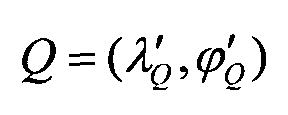
The calculation of the oblique pole Q is to a certain extent determined by the projection method used during further processing. In particular, at least two types can be identified: projections based on a cone, used for example in the oblique Lambert projection, and projections based on a cylinder, as used for example in the oblique Mercator projection. If a projection technique based on a cone is to be used, for example as a first projection method, the oblique pole is given as

For a projection technique based on a cylinder the oblique pole can be computed, such that

After calculation of the oblique pole, the oblique spherical coordinates
 can be calculated for each position on the input map. The data represented in spherical coordinates
 may be used as the input of two independent projections, either following a first projection method, preferably an oblique Lambert projection or an oblique Mercator projection, most preferably an oblique Lambert projection, or following a second projection method, which is
preferably an oblique stereographic projection. The two independent projections result in two intermediate data sets, comprising data elements represented as coordinates (xi, yi) with a scale mi and (x2, yi) with a scale m2, respectively, for each location on the input map.
may be used as the input of two independent projections, either following a first projection method, preferably an oblique Lambert projection or an oblique Mercator projection, most preferably an oblique Lambert projection, or following a second projection method, which is
preferably an oblique stereographic projection. The two independent projections result in two intermediate data sets, comprising data elements represented as coordinates (xi, yi) with a scale mi and (x2, yi) with a scale m2, respectively, for each location on the input map.
Thus, for a combination of the oblique Lambert projection with an oblique stereographic projection the projected coordinates (x, y) with a scale m are combined, such that


radius of the sphere of the spherical representation.
Due to the fact, that for an oblique Mercator projection the spherical coordinate 0 of the
 centre point po equals to 0, the computation of the projected coordinates (x, y) with scale m can be simplified for a combination of the oblique Mercator projection with an oblique stereographic projection to:

In detail, the oblique Mercator projection is given as , and

, and, due to , the oblique stereographic projection is simplified to:


Figure 7 shows a graph illustrating the dependency of the weighting factor k and the scale m. The weighting factor k can be a pre-defined value or can be selected from a pre-defined range following any suitable error analysis of the resulting projected map. A preferred method for selecting the weighting factor k analyzes the function mp (k) for a set of reference points
P m particular, the minimum of each function mp (k) is determined and the corre

sponding value of k is selected as a candidate for the weighting factor. Such analysis can be performed, for example, by existing differentiation techniques or by determining the function mp (k) for a plurality of sample values and either choosing the minimal sample or finding the
minimum using interpolation techniques. The weighting factor k is selected to be the maximal minimal value.
Figure 7 shows several functions mp (k) for the central point po and the reference points p\, P2, and pi as continuous lines, as well as corresponding functions m(k) for the Mercator projection and the stereographic projection as dashed lines. Since the maximal minimal value of functions mp (k) is to be determined, the minimum of the uppermost parabola is selected as the optimal weighting factor k. In other words, k reflects the minimum value of m in the highest curve in order to obtain the best accuracy of the combined projection. According to the example of Figure 6, a value of k = 0.4 would be chosen as the weighting factor.
Having chosen the optimal weighting factor k each data element of the surface data can be projected on the plain of the resulting map. Since all calculations so far are related to the oblique pole Q, the resulting coordinates (x, y) are preferably rotated in a final step, in order to generate a map that is aligned according to the central point po and the pole P. This can be done by calculating an angle τ, such that

and by rotating the X and F axes:

The invention can be automated using traditional programming techniques and integrated into existing geographic information systems. The inventive method can also be implemented in dedicated logical hardware connected to such systems.
The inventive method has a large impact on the quality and accuracy of the projected map. Figure 8 shows a bar chart comparing the critical distortion in m/km of state of the art projection techniques with the inventive combined projection method. Even though the present invention is not restricted to a particular projection technique used as the first or second projection method, a combination of the oblique Lambert projection with an oblique stereographic
projection, as well as the combination of an oblique Mercator projection with the oblique stereographic projection have been found to suit most relevant areas of the world.
On average, it was found that the critical distortion can be decreased by 72% in relation to state of the art projection techniques. As an example, the critical distortion for an UTM projected map may be at 12.75 m/km in one zone and for the Lambert projection 15.75 m/km in the whole area. In contrast, the inventive combined projection method using a combination of the oblique Lambert projection as the first projection method and the oblique stereographic projection as the second projection method results in a critical distortion of 5.13 m/km in the whole area.
Similarly, an application of the oblique Mercator projection leads to significant improvements in the critical distortion. As an example, the UTM projection results in a critical distortion of 12.75 m km in one zone and the oblique Mercator projection to a critical distortion of 12.59 m/km in the whole area. In contrast, the inventive combined projection method employing a combination of the oblique Mercator projection as the first projection method and the oblique stereographic projection as the second projection method leads to a critical distortion of 9.3 m/km in the whole area.
The invention is applicable to any surface of an object that is to be projected on a plain and, consequently, to any geographic area on the surface of the earth. Particularly, the invention is not restricted to a certain range of latitude or longitude. It is to be understood that for different geographic regions and areas with varying latitude and longitude the weighting factor k and the reference points must be adjusted to produce reliable and accurately projected maps. For a particular geographic area, an appropriate selection of the reference points po, p , as well as the shape and orientation of the desired region have also to be taken into consideration, to define the location of the oblique pole Q and other parameters that may influence further processing.
It is to be understood, that many modifications may be provided to the method or apparatus without leaving the scope of the invention. For example, different projection techniques can be used as the first and the second projection method and the combination can be done according to any other function that is capable of suitably combining the two intermediate results, such as any weighted sum, weighted mean, weighted average, and the like. Also the
selection of the reference points can be different from the examples described, which could also be chosen in the periphery or around the centre of the source map. However, certain spatial configurations of the reference points could be avoided to inhibit singularities during computation.
It is to be understood that the invention may be practiced within the scope of the claims differently from the examples describes.
Claims
1. A map projection method comprising the following steps:
projecting surface data using a first projection method, thereby generating first intermediate data;
projecting the surface data using a second projection method, thereby generating second intermediate data; and
combining the first and second intermediate data to generate a projected map.
2. The method according to claim 1, further comprising deriving the surface data from an ellipsoid.
3. The method according to claim 2, wherein said deriving the surface data comprises transforming the ellipsoid into an oblique spherical representation.
4. The method according to claim 3, wherein said transforming the ellipsoid into an oblique spherical representation comprises selecting reference points on the ellipsoid, calculating an oblique pole using said reference points, calculating oblique spherical coordinates for each data element on the ellipsoid and using the oblique pole and the oblique spherical coordinates to derive the surface data.
5. The method according to claim 4, wherein said choosing reference points comprises choosing at least four reference points.
6. The method according to one of the claims 2 to 5, wherein said deriving the surface data comprises sampling a map representing the surface of said ellipsoid.
7. The method according to one of the claims 2 to 6, wherein the ellipsoid comprises geographic data representing a surface of the earth.
8. The method according to claim 7, wherein a portion of the ellipsoid represents one or more UTM zones, preferably four UTM zones, wherein said portion is used to derive the surface data.
9. The method according to claim 7, wherein a portion of the ellipsoid represents a surface of the earth in the range of 10° to 40° N latitude and 20° to 60° E longitude, preferably 15° to 35° N latitude and 25° to 60° E longitude, wherein said portion is used to derive the surface data.
10. The method according to one of the preceding claims, wherein the first projection method is one of an oblique Lambert projection and an oblique Mercator projection, and the second projection method is an oblique stereographic projection.
1 1. The method according to one of the preceding claims, wherein said combining the first and second intermediate data comprises selecting a weighting factor and applying the weighting factor to a weighted sum of the first and second intermediate data.
12. The method according to one of the preceding claims, further comprising displaying the projected map.
13. A computer-readable medium storing computer-executable instructions for causing a computer system to perform the method according to one of the preceding claims.
14. An apparatus for map projections, comprising:
storage means for storing surface data; and
one or more processing units connected to the storage means for projecting the surface data using a first projection method to generate first intermediate data, for projecting the surface data using a second projection method to generate second intermediate data, and for combining the first and second intermediate data to generate a projected map.
15. The apparatus of claim 14, wherein the one or more processing units are further configured to derive the surface data from an ellipsoid.
16. The apparatus according to claim 15, wherein the one or more processing units are configured to derive the surface data by transforming the ellipsoid into an oblique spherical representation.
17. The apparatus according to claim 16, further comprising input means for selecting reference points on the ellipsoid, wherein the one or more processing units are configured to transform the ellipsoid by calculating an oblique pole using said reference points, calculating oblique spherical coordinates for each data element on the ellipsoid and using the oblique pole and the oblique spherical coordinates to derive the surface data.
18. The apparatus according to one of the claims 15 to 17, wherein the storage means further stores a map representing the surface of said ellipsoid and the one or more processing units are further configured to derive the surface data by sampling the map.
19. The apparatus according to one of the claims 15 to 18, wherein the ellipsoid comprises geographic data representing a surface of the earth.
20. The apparatus according to one of the claims 14 to 19, wherein the first projection method is one of an oblique Lambert projection and an oblique Mercator projection, and the second projection method is an oblique stereographic projection.
21. The apparatus according to one of the claims 14 to 20, wherein the one or more processing units are configured to combine the first and second intermediate data by selecting a weighting factor and applying the weighting factor to a weighted sum of the first and second intermediate data.
22. The apparatus according to one of the claims 14 to 21, further comprising display means for displaying the projected map.
23. The apparatus according to claim 22, wherein the input means and the display means are integrated to form a touchscreen.
24. A geographic information system comprising an apparatus according to one of the claims 14 to 23.
Priority Applications (2)
| Application Number | Priority Date | Filing Date | Title |
|---|---|---|---|
| PCT/EP2010/005391 WO2012028164A2 (en) | 2010-09-02 | 2010-09-02 | A combined projection method and an apparatus for improving accuracy of map projections |
| EP10849614.2A EP2612302B1 (en) | 2010-09-02 | 2010-09-02 | A combined projection method and an apparatus for improving accuracy of map projections |
Applications Claiming Priority (1)
| Application Number | Priority Date | Filing Date | Title |
|---|---|---|---|
| PCT/EP2010/005391 WO2012028164A2 (en) | 2010-09-02 | 2010-09-02 | A combined projection method and an apparatus for improving accuracy of map projections |
Related Child Applications (1)
| Application Number | Title | Priority Date | Filing Date |
|---|---|---|---|
| US13/248,247 Continuation US20120128593A1 (en) | 2009-04-02 | 2011-09-29 | Use of a magnetic resonance imaging medium comprising hyperpolarized 13c pyruvate for the detection of inflammation or infection |
Publications (2)
| Publication Number | Publication Date |
|---|---|
| WO2012028164A2 true WO2012028164A2 (en) | 2012-03-08 |
| WO2012028164A3 WO2012028164A3 (en) | 2012-05-31 |
Family
ID=44773013
Family Applications (1)
| Application Number | Title | Priority Date | Filing Date |
|---|---|---|---|
| PCT/EP2010/005391 Ceased WO2012028164A2 (en) | 2010-09-02 | 2010-09-02 | A combined projection method and an apparatus for improving accuracy of map projections |
Country Status (2)
| Country | Link |
|---|---|
| EP (1) | EP2612302B1 (en) |
| WO (1) | WO2012028164A2 (en) |
Cited By (3)
| Publication number | Priority date | Publication date | Assignee | Title |
|---|---|---|---|---|
| US9536328B2 (en) | 2015-01-06 | 2017-01-03 | International Business Machines Corporation | Method to optimize the visualization of a map's projection based on data and tasks |
| WO2019078297A1 (en) * | 2017-10-19 | 2019-04-25 | Ricoh Company, Ltd. | Image processing apparatus, image capturing system, image processing method, and recording medium |
| WO2019132906A1 (en) * | 2017-12-28 | 2019-07-04 | Landmark Graphics Corporation | Gridding global data into a minimally distorted global raster |
Citations (1)
| Publication number | Priority date | Publication date | Assignee | Title |
|---|---|---|---|---|
| US20020126129A1 (en) | 2001-01-16 | 2002-09-12 | Snyder John M. | Sampling-efficient mapping of images |
-
2010
- 2010-09-02 WO PCT/EP2010/005391 patent/WO2012028164A2/en not_active Ceased
- 2010-09-02 EP EP10849614.2A patent/EP2612302B1/en active Active
Patent Citations (1)
| Publication number | Priority date | Publication date | Assignee | Title |
|---|---|---|---|---|
| US20020126129A1 (en) | 2001-01-16 | 2002-09-12 | Snyder John M. | Sampling-efficient mapping of images |
Cited By (9)
| Publication number | Priority date | Publication date | Assignee | Title |
|---|---|---|---|---|
| US9536328B2 (en) | 2015-01-06 | 2017-01-03 | International Business Machines Corporation | Method to optimize the visualization of a map's projection based on data and tasks |
| US9626796B2 (en) | 2015-01-06 | 2017-04-18 | International Business Machines Corporation | Method to optimize the visualization of a map's projection based on data and tasks |
| US9679399B2 (en) | 2015-01-06 | 2017-06-13 | International Business Machines Corporation | Method to optimize the visualization of a map's projection based on data and tasks |
| WO2019078297A1 (en) * | 2017-10-19 | 2019-04-25 | Ricoh Company, Ltd. | Image processing apparatus, image capturing system, image processing method, and recording medium |
| WO2019132906A1 (en) * | 2017-12-28 | 2019-07-04 | Landmark Graphics Corporation | Gridding global data into a minimally distorted global raster |
| GB2585416A (en) * | 2017-12-28 | 2021-01-13 | Landmark Graphics Corp | Gridding global data into a minimally distorted global raster |
| GB2585416B (en) * | 2017-12-28 | 2022-03-16 | Landmark Graphics Corp | Gridding global data into a minimally distorted global raster |
| US11403815B2 (en) | 2017-12-28 | 2022-08-02 | Landmark Graphics Corporation | Gridding global data into a minimally distorted global raster |
| NO348092B1 (en) * | 2017-12-28 | 2024-08-12 | Landmark Graphics Corp | Gridding global data into a minimally distorted global raster |
Also Published As
| Publication number | Publication date |
|---|---|
| EP2612302B1 (en) | 2020-08-19 |
| WO2012028164A3 (en) | 2012-05-31 |
| EP2612302A2 (en) | 2013-07-10 |
Similar Documents
| Publication | Publication Date | Title |
|---|---|---|
| US9330504B2 (en) | 3D building model construction tools | |
| CN110347769A (en) | Processing method, device, equipment and the storage medium of multi-layer map tile | |
| US5418906A (en) | Method for geo-registration of imported bit-mapped spatial data | |
| US7983474B2 (en) | Geospatial modeling system and related method using multiple sources of geographic information | |
| US20040098236A1 (en) | System and method for modeling a spheroid world database | |
| JP4251218B2 (en) | Information processing apparatus, image display apparatus, information processing system, control method therefor, and program for causing computer to execute the method | |
| CN112989469B (en) | Building roof model construction method and device, electronic equipment and storage medium | |
| CN102183261A (en) | Method for re-using photorealistic 3D landmarks for nonphotorealistic 3D maps | |
| WO2001073690A2 (en) | System and method for georeferencing digital raster maps | |
| US20130127852A1 (en) | Methods for providing 3d building information | |
| CA2658239A1 (en) | Geospatial modeling system providing geospatial model data target point filtering based upon radial line segments and related methods | |
| CN111238498B (en) | Road map generation method, device and related system for lane-level display | |
| CN105550688A (en) | Method and device for point cloud data classification | |
| EP2612302B1 (en) | A combined projection method and an apparatus for improving accuracy of map projections | |
| CN101946265A (en) | Map display device | |
| Yoo et al. | True orthoimage generation by mutual recovery of occlusion areas | |
| US20150325045A1 (en) | Map drawing device | |
| CN110110028A (en) | A kind of method and system showing map by self defined area towards OGC standard | |
| JP2009146150A (en) | Feature position detection method and feature position detection apparatus | |
| CN116912439B (en) | Methods and systems for accurately annotating multi-dimensional information on three-dimensional topographic and geological maps | |
| San-Antonio-Gómez et al. | Photogrammetric techniques and surveying applied to historical map analysis | |
| CN107154066B (en) | Two-dimensional display method for patrol route of parallel line buffer area | |
| Böttger et al. | Detail‐In‐Context Visualization for Satellite Imagery | |
| JP6684776B2 (en) | Map information system, terminal device, and server device | |
| CN108491401B (en) | Coordinate deviation rectifying method for 2.5-dimensional map |
Legal Events
| Date | Code | Title | Description |
|---|---|---|---|
| 121 | Ep: the epo has been informed by wipo that ep was designated in this application |
Ref document number: 10849614 Country of ref document: EP Kind code of ref document: A2 |
|
| WWE | Wipo information: entry into national phase |
Ref document number: 2010849614 Country of ref document: EP |
|
| NENP | Non-entry into the national phase |
Ref country code: DE |