WO2012033220A1 - Toner - Google Patents
Toner Download PDFInfo
- Publication number
- WO2012033220A1 WO2012033220A1 PCT/JP2011/070683 JP2011070683W WO2012033220A1 WO 2012033220 A1 WO2012033220 A1 WO 2012033220A1 JP 2011070683 W JP2011070683 W JP 2011070683W WO 2012033220 A1 WO2012033220 A1 WO 2012033220A1
- Authority
- WO
- WIPO (PCT)
- Prior art keywords
- wax
- mass
- toner
- parts
- hydrocarbon
- Prior art date
- Legal status (The legal status is an assumption and is not a legal conclusion. Google has not performed a legal analysis and makes no representation as to the accuracy of the status listed.)
- Ceased
Links
Classifications
-
- G—PHYSICS
- G03—PHOTOGRAPHY; CINEMATOGRAPHY; ANALOGOUS TECHNIQUES USING WAVES OTHER THAN OPTICAL WAVES; ELECTROGRAPHY; HOLOGRAPHY
- G03G—ELECTROGRAPHY; ELECTROPHOTOGRAPHY; MAGNETOGRAPHY
- G03G9/00—Developers
- G03G9/08—Developers with toner particles
- G03G9/0825—Developers with toner particles characterised by their structure; characterised by non-homogenuous distribution of components
-
- G—PHYSICS
- G03—PHOTOGRAPHY; CINEMATOGRAPHY; ANALOGOUS TECHNIQUES USING WAVES OTHER THAN OPTICAL WAVES; ELECTROGRAPHY; HOLOGRAPHY
- G03G—ELECTROGRAPHY; ELECTROPHOTOGRAPHY; MAGNETOGRAPHY
- G03G9/00—Developers
- G03G9/08—Developers with toner particles
- G03G9/09—Colouring agents for toner particles
-
- G—PHYSICS
- G03—PHOTOGRAPHY; CINEMATOGRAPHY; ANALOGOUS TECHNIQUES USING WAVES OTHER THAN OPTICAL WAVES; ELECTROGRAPHY; HOLOGRAPHY
- G03G—ELECTROGRAPHY; ELECTROPHOTOGRAPHY; MAGNETOGRAPHY
- G03G9/00—Developers
- G03G9/08—Developers with toner particles
-
- G—PHYSICS
- G03—PHOTOGRAPHY; CINEMATOGRAPHY; ANALOGOUS TECHNIQUES USING WAVES OTHER THAN OPTICAL WAVES; ELECTROGRAPHY; HOLOGRAPHY
- G03G—ELECTROGRAPHY; ELECTROPHOTOGRAPHY; MAGNETOGRAPHY
- G03G9/00—Developers
- G03G9/08—Developers with toner particles
- G03G9/0802—Preparation methods
- G03G9/0804—Preparation methods whereby the components are brought together in a liquid dispersing medium
-
- G—PHYSICS
- G03—PHOTOGRAPHY; CINEMATOGRAPHY; ANALOGOUS TECHNIQUES USING WAVES OTHER THAN OPTICAL WAVES; ELECTROGRAPHY; HOLOGRAPHY
- G03G—ELECTROGRAPHY; ELECTROPHOTOGRAPHY; MAGNETOGRAPHY
- G03G9/00—Developers
- G03G9/08—Developers with toner particles
- G03G9/0802—Preparation methods
- G03G9/0804—Preparation methods whereby the components are brought together in a liquid dispersing medium
- G03G9/0806—Preparation methods whereby the components are brought together in a liquid dispersing medium whereby chemical synthesis of at least one of the toner components takes place
-
- G—PHYSICS
- G03—PHOTOGRAPHY; CINEMATOGRAPHY; ANALOGOUS TECHNIQUES USING WAVES OTHER THAN OPTICAL WAVES; ELECTROGRAPHY; HOLOGRAPHY
- G03G—ELECTROGRAPHY; ELECTROPHOTOGRAPHY; MAGNETOGRAPHY
- G03G9/00—Developers
- G03G9/08—Developers with toner particles
- G03G9/0821—Developers with toner particles characterised by physical parameters
-
- G—PHYSICS
- G03—PHOTOGRAPHY; CINEMATOGRAPHY; ANALOGOUS TECHNIQUES USING WAVES OTHER THAN OPTICAL WAVES; ELECTROGRAPHY; HOLOGRAPHY
- G03G—ELECTROGRAPHY; ELECTROPHOTOGRAPHY; MAGNETOGRAPHY
- G03G9/00—Developers
- G03G9/08—Developers with toner particles
- G03G9/087—Binders for toner particles
- G03G9/08702—Binders for toner particles comprising macromolecular compounds obtained by reactions only involving carbon-to-carbon unsaturated bonds
- G03G9/08706—Polymers of alkenyl-aromatic compounds
- G03G9/08708—Copolymers of styrene
- G03G9/08711—Copolymers of styrene with esters of acrylic or methacrylic acid
-
- G—PHYSICS
- G03—PHOTOGRAPHY; CINEMATOGRAPHY; ANALOGOUS TECHNIQUES USING WAVES OTHER THAN OPTICAL WAVES; ELECTROGRAPHY; HOLOGRAPHY
- G03G—ELECTROGRAPHY; ELECTROPHOTOGRAPHY; MAGNETOGRAPHY
- G03G9/00—Developers
- G03G9/08—Developers with toner particles
- G03G9/087—Binders for toner particles
- G03G9/08775—Natural macromolecular compounds or derivatives thereof
- G03G9/08782—Waxes
Definitions
- the present invention relates to a toner that is used in an image-forming method such as electrophotography, an electrostatic recording method, or a toner-j etting system.
- PTL 1 proposes a toner provided with excellent fixability by including a wax that has a low melting point and a sharp melting property by containing a high content of n-paraffin.
- PTL 2 proposes a toner provided with excellent hot offset resistance by regulating the average number of carbon atoms of hydrocarbon components of a wax.
- PTL 3 proposes a toner showing excellent fixability even on heavy paper by using a wax having an endothermic peak observed by DSC in a particular range.
- the present invention provides a toner showing excellent fixability in both a high-speed process and output onto heavy paper and being capable of exhibiting high image quality over a long time by inhibiting contamination of the inside of an apparatus even in use for a long time.
- the present invention relates to a toner comprising toner particles, each of which contains a binder resin, a hydrocarbon wax, and a coloring agent, wherein in GC/MS analysis of components volatilized by heating the
- hydrocarbon wax at 200°C for 10 minutes i) a total amount (A) of components showing peaks that are detected on and after the detection time of the peak of hydrocarbon having 16 carbon atoms is 1500 ppm or less, ii) a total amount (B) of components showing peaks that are detected on and after the detection time of the peak of hydrocarbon having 30 carbon atoms is 570 ppm or less, and iii) when a total amount of components showing peaks that are detected on and after the detection time of the peak of hydrocarbon having 16 carbon atoms and on and before the detection time of the peak of hydrocarbon having 29 carbon atoms is represented by a total amount (C) , the total amount (B) and the total amount (C) satisfy a relationship expressed by (B)/(C) ⁇ 2.0.
- the present invention can provide a toner showing excellent fixability in both a high-speed process and output onto heavy paper and being capable of exhibiting high image quality over a long time by inhibiting contamination of the inside of an apparatus even in use for a long time.
- Fig. 1 is a diagram showing the result of GC/MS
- Fig. 2 is a diagram showing the result of GC/MS
- Fig. 3 is a diagram showing the result of GC/MS
- the present inventors have studied in detail the relationship between the composition ratio of a high-boiling-point volatile component and the accumulation state of a contaminating material and the mechanism of contamination occurrence under fixing process conditions and have found a wax effective for preventing inside contamination. The effect of wax and the mechanism of inside contamination occurrence will be described below, and then the toner of the present invention will be
- the toner In a high-speed fixing process, the toner needs to be molten instantly at a fixing nip portion. Accordingly, the fixing temperature is set to a high range, and thereby an excessive heat quantity is applied to the toner in many cases. According to the investigation by the present inventors, if continuous printing is performed at the state that an excessive heat quantity is being applied to the toner, a phenomenon that the concentration of the high- boiling-point volatile component from a wax is increased in the image forming apparatus is observed. The high-boiling- point volatile components are instantly cooled when they are brought into contact with structural members in the image forming apparatus and are thereby deposited. The inside contamination is caused by accumulation of the deposited material. The progress of the inside contamination causes a decrease in sensitivity of various control sensors and a decrease in ability of functional members. As a result, the image quality gradually decreases, which requires
- the toner of the present invention includes toner particles containing a hydrocarbon wax.
- the hydrocarbon wax is generally nonpolar and therefore has a low compatibility with a styrene-acrylic resin or a polyester resin, which are commonly used as binder resins of toners. Consequently, in a toner containing a hydrocarbon wax, since excessive plasticization of the binder resin is inhibited, excellent developability and offset resistance can be obtained even in high-speed process requiring high durability.
- the hydrocarbon wax is composed of hydrocarbon components having a certain distribution of the number of carbon atoms. Therefore, the high-boiling-point volatile components that will be generated in the fixing process show a carbon atom number distribution
- the present inventors have analyzed in detail the inside contaminating components that are generated when the toner contains a hydrocarbon wax and, as a result, have found that there is a relationship between the progress state of the inside contamination and the peak pattern in GC/MS analysis of components volatilized by heating the hydrocarbon wax at 200 °C for 10 minutes.
- the inventors have thought that the relationship occurs because the heating conditions of a temperature 200°C for 10 minutes in the above-mentioned analysis are approximate to those of
- the hydrocarbon wax contained in the toner of the present invention is characterized in that in GC/MS analysis of components volatilized by heating the hydrocarbon wax at 200°C for 10 minutes, the total amount (A) of components showing peaks that are detected on and after the detection time of the peak of hydrocarbon having 16 carbon atoms is 1500 ppm or less, and the total amount (B) of components showing peaks that are detected on and after the detection time of the peak of hydrocarbon having 30 carbon atoms is 570 ppm or less.
- on and after the detection time of the peak of hydrocarbon having 16 carbon atoms includes the detection time of the peak of hydrocarbon having 16 carbon atoms
- on and after the detection time of the peak of hydrocarbon having 30 carbon atoms includes the detection time of the peak of hydrocarbon having 30 carbon atoms.
- the present invention has focused on that volatile components having 16 or more carbon atoms that are generated by heating the hydrocarbon wax are deposited as particles to contaminate the inside of an apparatus.
- the total amount (A) represents the ratio of the total amount of high-boiling-point volatile components that are contained in the hydrocarbon wax and cause the inside contamination.
- the amount of high-boiling-point volatile components that are generated from the hydrocarbon wax is controlled to be low by controlling the total amount
- the present invention has focused on that the volatile components having 30 or more carbon atoms that are generated when the hydrocarbon wax is heated are especially easily deposited among the high- boiling-point volatile components and that therefore these components become major causes of the inside contamination.
- the generation of particles that cause the inside contamination can be
- the above-described total amount (C) and the total amount (B) need to satisfy the relationship: (B)/(C)>2.0.
- an increase in the ratio of the components having 30 or more carbon atoms to the components having 16 or more and 29 or less carbon atoms increases the
- the concentration of the volatile components in the wax in the present invention is measured as follows.
- ATD desorption desorption
- Thermal desorption apparatus TurboMatrix ATD (manufactured by Perkin-Elmer Corp.), and
- GC/MS TRACE DSQ (manufactured by Thermo Fisher Scientific Inc . ) .
- adsorbent held by glass-wool is prepared in advance for a thermal desorption apparatus, and the tube is subjected to conditioning at 300 °C for 3 hours under a flow of an inert atmospheric gas. Then, 5 ⁇ of a solution of 100 ppm
- n-hexadecane D34 deuterated n-hexadecane (n-hexadecane D34) in methanol is subjected to adsorption to Tenax TA to obtain a glass tube containing internal standard substance.
- deuterated n- hexadecane which shows a peak at a retention time different from that of the n-hexadecane peak, is used as the internal standard substance in order to distinguish the peak from the peak of n-hexadecane contained in a wax to be analyzed and that the concentration of volatile components in the present invention are all deuterated n-hexadecane equivalents.
- the value obtained by the above-mentioned analysis is defined as the total amount (A) of components showing peaks that are detected on and after the detection time of the peak of hydrocarbon having 16 carbon atoms. Furthermore, the peak of the hydrocarbon having 30 carbon atoms is identified, and the total area a2 of all peaks detected on and after the detection time of the peak of hydrocarbon having 30 carbon atoms is calculated by integrating these peaks.
- the value obtained by changing the al in the above- mentioned expression to the a2 is defined as the total amount (B) .
- the expression to the a3 is defined as the total amount (C) .
- the value (B) is calculated by using the retention time of which a hydrocarbon standard substance having 30 carbon atoms is measured in advance. The same is applied to waxes not containing a hydrocarbon component having 16 carbon atoms or 29 carbon atoms.
- the peak top temperature of the maximum endothermic peak in differential scanning calorimetry can be 50°C or more and 110°C or less.
- the gloss is uniform and stable to show excellent fixing quality, and development stability and inhibition of inside contamination are also enhanced.
- the hydrocarbon wax contained in the toner of the present invention can have a peak molecular weight of 4.0xl0 2 or more and 1.4xl0 3 or less measured by gel permeation chromatography (GPC) .
- the molecular weight distribution ( w/Mn) of the hydrocarbon wax measured by GPC can be 1.0 or more and 5.0 or less.
- Mw/Mn weight-average molecular weight
- Mn number- average molecular weight
- the content of the hydrocarbon wax contained in the toner of the present invention can be 1.0 part by mass or more and 17.0 parts by mass or less, preferably 2.0 parts by mass or more and 17.0 parts by mass or less, and more preferably 4.0 parts by mass or more and 17.0 parts by mass or less, based on 100 parts by mass of the binder resin in the toner.
- hydrocarbon wax used in the present invention examples include polyolefins purified from low-molecular- weight by-products generated during polymerization of high- molecular-weight polyolefins; polyolefins polymerized using a catalyst such as a Ziegler catalyst or a metallocene catalyst; paraffin waxes and Fischer-Tropsch waxes;
- synthetic hydrocarbon waxes synthesized by a synthol method, a hydrocoal method, or an Arge method from coal gas or natural gas; synthesized waxes obtained from a monomer compound having one carbon atom; hydrocarbon waxes having functional groups such as a hydroxyl group and a carboxyl group; and mixtures of a hydrocarbon wax and a hydrocarbon wax having a functional group.
- These waxes may be used by narrowing the molecular weight distribution through, for example, a press sweating method, a solvent method, a recrystallization method, a vacuum distillation method, a supercritical gas extraction method, or a melt crystallization method.
- low-molecular-weight solid fatty acids low-molecular-weight solid alcohols, low- molecular-weight solid compounds, and other materials from which impurities are removed may be used.
- paraffin waxes Fischer-Tropsch waxes, microcrystalline waxes, polyethylenes synthesized using a metallocene
- the wax contained in the toner of the present invention can be a paraffin wax, a Fischer-Tropsch wax, or a
- microcrystalline wax particularly from the viewpoint of demand for efficiently removing high-boiling-point volatile components. Distillation of these waxes can reduce the amounts of high-boiling-point volatile components generated to give a significant effect of inhibiting inside
- the distillation of a wax can be performed particularly by a combination of short path distillation and molecular distillation.
- distillation can be performed as follows. A wax as a raw material is subjected to short path distillation under conditions of a pressure of 1 to 10 Pa and a temperature of 180 to 200°C, and a process of removing the initial fraction is repeated to obtain the wax fraction. Subsequently, the wax fraction is subjected to molecular distillation under conditions of a pressure of 0.1 to 0.5 Pa and a temperature of 190 to 220 °C to remove hydrocarbon components that cause inside contamination.
- An example of the short path distillation apparatus particularly suitable for the present invention is a wiped- film distillation apparatus.
- a polar wax such as an ester wax may be used for supplementing the mold release effect and the plasticization effect of the resin.
- the polar wax can show a peak top temperature of the maximum endothermic peak of 70 to 110 °C, and examples such a wax include carnauba waxes and their derivatives including oxides, block copolymers with vinyl monomers, and graft-modified products, and the
- examples also include alcohol waxes, fatty acid waxes, acid amide waxes, ester waxes, ketone waxes, hydrogenated castor oil and their derivatives, plant waxes, animal waxes, and montan waxes.
- a carnauba wax, a straight- chain alcohol wax, a fatty acid wax, an acid amide wax, an ester wax, or a montan wax derivative can be used as the polar wax.
- the polar wax is effective when the content thereof is, as the total amount with the hydrocarbon wax used in the present invention, 1.0 parts by mass or more and 20.0 parts by mass or less based on 100.0 parts by mass of the binder resin.
- binder resin contained in the toner examples include the following polymers: polystyrenes; homopolymers of styrene substitutes such as poly (vinyl toluene); styrene copolymers such as styrene-vinyl toluene copolymers,
- styrene-acrylic acid ester copolymers styrene-methacrylic acid ester copolymers, styrene-acrylonitrile copolymers, styrene-vinyl methyl ether copolymers, styrene-vinyl ethyl ether copolymers, styrene-vinyl methyl ketone copolymers, and styrene-acrylonitrile-indene copolymers; and acrylic resins, methacrylic resins, poly (vinyl acetate), silicone resins, polyester resins, polyurethane, polyamide resins, furan resins, epoxy resins, xylene resins, poly (vinyl)
- a styrene copolymer or a polyester resin can be used as the binder resin.
- the glass transition point (Tg) of the binder resin can be 45 to 65°C, preferably 50 to 55°C.
- the toner of the present invention includes a coloring agent for exhibiting its coloring ability.
- the coloring agent that can be used in the present invention include the following organic pigments, organic dyes, and inorganic pigments.
- organic pigment or the organic dye serving as a cyan coloring agent a copper phthalocyanine compound, a derivative thereof, an anthraquinone compound, or a basic dye chelate compound can be used. Specific examples thereof include C.I. Pigment Blue 1, C.I. Pigment Blue 7, C.I.
- Pigment Blue 15 C.I. Pigment Blue 15:1, C.I. Pigment Blue 15:2, C.I. Pigment Blue 15:3, C.I. Pigment Blue 15:4, C.I. Pigment Blue 60, C.I. Pigment Blue 62, and C.I. Pigment Blue 66.
- organic pigment or the organic dye serving as a magenta coloring agent examples include condensed azo compounds, diketopyrrolopyrrole compounds, anthraquinone, quinacridone compounds, basic dye chelate compounds,
- naphthol compounds benzimidazolone compounds, thioindigo compounds, and perylene compounds.
- Specific examples thereof include C.I. Pigment Red 2, C.I. Pigment Red 3, C.I. Pigment Red 5, C.I. Pigment Red 6, C.I. Pigment Red 7, C.I. Pigment Violet 19, C.I. Pigment Red 23, C.I. Pigment Red 48:2, C.I. Pigment Red 48:3, C.I. Pigment Red 48:4, C.I. Pigment Red 57:1, C.I. Pigment Red 81:1, C.I. Pigment Red 122, C.I. Pigment Red 144, C.I. Pigment Red 146, C.I.
- Pigment Red 150 C.I. Pigment Red 166, C.I. Pigment Red 169, C.I. Pigment Red 177, C.I. Pigment Red 184, C.I. Pigment Red 185, C.I. Pigment Red 202, C.I. Pigment Red 206, C.I.
- Pigment Red 220 C.I. Pigment Red 221, and C.I. Pigment Red 254.
- organic pigment or the organic dye serving as a yellow coloring agent a compound represented by a condensed azo compound, an isoindolinone compound, an
- anthraquinone compound an azo metal complex, a methine compound, or an allylamide compound
- Specific examples thereof include C.I. Pigment Yellow 12, C.I.
- Pigment Yellow 110 C.I. Pigment Yellow 111, C.I. Pigment Yellow 120, C.I. Pigment Yellow 127, C.I. Pigment Yellow 128, C.I. Pigment Yellow 129, C.I. Pigment Yellow 147, C.I.
- Pigment Yellow 151 C.I. Pigment Yellow 154, C.I. Pigment Yellow 155, C.I. Pigment Yellow 168, C.I. Pigment Yellow 174, C.I. Pigment Yellow 175, C.I. Pigment Yellow 176, C.I.
- Pigment Yellow 180 C.I. Pigment Yellow 181, C.I. Pigment Yellow 191, and C.I. Pigment Yellow 194.
- a black coloring agent As a black coloring agent, a carbon black, a carbon black, a carbon black, a carbon black, a carbon black, a carbon black, a carbon black, a carbon black, a carbon black, a carbon black, a carbon black, a carbon black, a carbon black, a carbon black, a carbon black, a carbon black, a carbon black, a carbon black, a carbon black, a carbon black, a carbon black, a carbon black, a carbon black, a carbon black, a carbon black, a carbon black, a carbon black, a carbon black, a carbon black, a carbon black, a carbon black, a carbon black, a carbon black, a carbon black, a carbon black, a carbon black, a carbon black, a carbon black, a carbon black, a carbon black, a carbon black, a carbon black, a carbon black, a carbon black, a carbon black, a carbon black, a carbon black, a carbon black, a
- coloring agents can be used alone, in admixture, or in a state of solid solution.
- the coloring agents that are used in the toner of the present invention are selected from the viewpoints of hue angle, saturation, brightness, light resistance, OHP transparency, and
- the coloring agents are dispersibility into the toner.
- the coloring agents are dispersibility into the toner.
- the magnetic substance can be added in an amount of 1 part by mass or more and 20 parts by mass or less based on 100 parts by mass of the binder resin.
- the coloring agent is a magnetic substance
- the magnetic substance can have a number-average particle diameter of 2 m or less, preferably 0.1 ⁇ or more and 0.5 ⁇ or less, and can be added in an amount of 20 parts by mass or more and 200 parts by mass or less based on 100 parts by mass of the
- polymerizable monomer or the binder resin preferably 40 parts by mass or more and 150 parts by mass or less based on 100 parts by mass of the binder resin.
- a charge control agent may be mixed with toner particles according to need. By blending a charge control agent, the charge characteristics are stabilized, and frictional
- electrification amount can be optimized according to the development system. Any known charge control agent, in particular, a charge control agent that shows a high frictional electrification speed and stably maintains a constant frictional electrification amount, can be used.
- Examples of the charge control agent that controls the toner to a negative charge include organometallic compounds, chelate compounds, monoazo metal compounds, acetylacetone metal compounds, metal compounds of aromatic oxycarboxylic acids, aromatic dicarboxylic acids, oxycarboxylic acid, and dicarboxylic acid; aromatic oxycarboxylic acids, aromatic mono- and poly-carboxylic acids, and metal salts, anhydrides, and esters thereof; phenol derivatives such as bisphenol;
- the charge control agent that controls the toner to a positive charge include guanidine compounds; imidazole compounds; quaternary ammonium salts such as tributylbenzyl ammonium-l-hydroxy-4-naphthosulfonate and tetrabutyl ammonium tetrafluoroborate, their analogs, that is, onium salts such as phosphonium salts, and lake pigments thereof; triphenylmethane dyes and lake pigments thereof (the laking agents include phosphotungstic acid, phosphomolybdic acid, phosphotungsten molybdic acid, tannic acid, lauric acid, gallic acid, ferricyanates , and
- the toner of the present invention can contain these charge control agents alone or in combination of two or more thereof. Among these charge control agents, from the viewpoints of charge rise-up
- metal-containing salicylic acid compounds in particular, aluminum or zirconium- containing salicylic acid
- metal-containing salicylic acid compounds in particular, aluminum or zirconium- containing salicylic acid
- an aluminum 3, 5-di-tert-butylsalicylate compound can be used as the charge control agent.
- the charge control agent can be blended in an amount of 0.01 parts by mass or more and 5 parts by mass or less, preferably 0.05 parts by mass or more and 4.5 parts by mass or less, based on 100 parts by mass of the binder resin.
- a charge control resin for supplementing charge-retaining ability can be contained according to need.
- a charge control resin a polymer having a side chain of a surfonic acid group, a sulfonate group, or a sulfonic acid ester group can be used.
- a polymer or a copolymer of a surfonic acid group, a sulfonate group, or a sulfonic acid ester group can be used.
- the charge control resin include styrenesulfonic acid, 2-acrylamide-2-methylpropane sulfonic acid, 2- methacrylamide-2-methylpropane sulfonic acid, vinyl sulfonic acid, methacrylsulfonic acid, and alkyl esters thereof.
- the polymer containing a surfonic acid group, a sulfonate group, or a sulfonic acid ester group may be a homopolymer of the above-mentioned monomer or a copolymer of the above- mentioned monomer and another monomer.
- the monomer that forms the copolymer together with any of the above-mentioned monomers can be a vinyl polymerizable monomer, and also the monofunctional polymerizable monomers or multifunctional polymerizable monomers exemplified in the explanation of the binder resin components can be used.
- the polymer having a sulfonic acid group can be added in an amount of 0.01 parts by mass or more and 5.00 parts by mass or less, preferably 0.10 parts by mass or more and 3.00 parts by mass or less, based on 100 parts by mass of the polymerizable monomer or the binder resin.
- the charge stabilizing effect of the toner particles can be sufficiently shown to give excellent
- the toner of the present invention can contain inorganic fine powders such as silica, alumina, or titania for improving frictional electrification stability,
- component of the inorganic fine powders to be added can be silica, in particular, silica fine powders having a number- average primary particle diameter of 4 nm or more and 80 nm or less.
- the number-average primary particle diameter is within the above-mentioned range, the fluidity of the toner and also the storage
- the number-average primary particle diameter of the inorganic fine powders is measured as follows. The inorganic fine powders are
- the object of the observation is particles of 1.0 nm or more and 1000 nm or less in
- the particle diameters of the inorganic fine powders on the toner particles are calculated.
- fine powders may be a combination of silica with, for example, titanium oxide, alumina, or a complex oxide thereof, in particular, a
- the inorganic fine powders can be subjected to hydrophobization treatment.
- the treatment agent for the hydrophobization treatment of the inorganic powders include unmodified silicone varnishes, various types of modified silicone varnishes, unmodified silicone oils, various types of modified silicone oils, silane compounds, silane coupling agents, other organic silicon compounds, and organic titanium compounds. These treatment agents may be used alone or in combination. Among them, in particular, inorganic fine powders treated with a silicone oil can be used. Furthermore, silicone-oil-treated inorganic fine powders that have been treated with a silicone oil
- the toner participles constituting the toner of the present invention may be produced by any known method such as pulverization, suspension polymerization, or emulsion aggregation, and can be particularly produced in an aqueous dispersion medium, which can give toner particles excellent in development stability even if a large amount of wax components are added.
- Examples of the method of producing toner particles in an aqueous dispersion medium include an emulsion aggregation method in which an emulsion composed of toner essential components is aggregated in an aqueous dispersion medium; a suspension granulation method in which toner essential components are dissolved in an organic solvent, followed by granulation in an aqueous dispersion medium, and then the organic solvent is volatilized; a suspension or emulsion polymerization method in which a polymerizable monomer dissolving toner essential components is directly granulated in an aqueous dispersion medium and then polymerized; a method in which toner particles are provided with outer layers through seed polymerization; and microcapsulation methods represented by interfacial
- the toner particles of the present invention can be particularly produced by suspension polymerization.
- a polymerizable monomer In the suspension polymerization, a polymerizable monomer
- composition is prepared by uniformly dissolving or
- This polymerizable monomer composition is added to an aqueous dispersion medium containing a dispersion
- the polymerizable monomer in the polymerizable monomer composition is polymerized to obtain toner particles having a desired particle diameter.
- the toner particles are subjected to filtration, washing, and drying by known methods and are optionally mixed with a fluidity- improving agent so that the agent adhere to the surfaces of the particles to obtain a toner.
- the toner particles by suspension polymerization, it is necessary to use a wax showing a peak top temperature of the maximum endothermic peak of 85°C or less in DSC measurement for obtaining good granulation properties when the polymerizable monomer composition is granulated in an aqueous medium.
- the peak top temperature of the maximum endothermic peak of a wax corresponds to the melting point of the wax.
- the toner containing the wax tends to cause inside contamination.
- it is specifically effective to use the above-mentioned hydrocarbon wax. That is, by using a hydrocarbon wax having a low melting point that satisfies the requirements of the above-mentioned total amount (A) , the total amount (B) , and the total amount (C) , granulation can be satisfactorily performed, and a toner that hardly cause inside contamination can be obtained.
- the dispersing agent used in the preparation of the aqueous dispersion medium may be a known inorganic or
- inorganic dispersing agent include tricalcium phosphate, magnesium phosphate, aluminum phosphate, zinc phosphate, magnesium carbonate, calcium carbonate, calcium hydroxide, magnesium hydroxide, aluminum hydroxide, calcium
- organic dispersing agent examples include poly (vinyl alcohol), gelatin, methyl cellulose, methyl hydroxypropyl cellulose, ethyl cellulose, a sodium salt of carboxymethyl cellulose, and starch.
- nonionic, anionic, and cationic surfactants can be used, and examples thereof include sodium dodecylbenzenesulfonate, sodium dodecyl sulfate, sodium tetradecyl sulfate, sodium
- inventions can be a poor water-soluble inorganic dispersing agent, in particular, an acid-soluble, poor water-soluble, inorganic dispersing agent.
- the amount of the dispersing agent used can be 0.2 parts by mass or more and 2.0 parts by mass or less based on 100 parts by mass of the polymerizable monomer.
- the amount of the dispersing agent used can be 0.2 parts by mass or more and 2.0 parts by mass or less based on 100 parts by mass of the polymerizable monomer.
- the aqueous dispersion medium can be prepared using water in an amount of 300 parts by mass or more and 3000 parts by mass or less based on 100 parts by mass of the polymerizable monomer composition.
- an aqueous dispersion medium may be prepared by generating the above-mentioned poor water-soluble inorganic dispersing agent in a liquid medium such as water with high-speed stirring.
- a desired dispersing agent can be obtained by forming fine particles of
- the carrier that is used in the two- component developing method may be a known one, and
- particles having average particle diameter of 20 to 300 ⁇ made of iron, nickel, cobalt, manganese, chromium, a metal such as a rare-earth element, or an alloy or oxide thereof are used.
- substance dispersing carrier in which the magnetic substance is dispersed in a resin or a low specific gravity carrier in which porous iron oxide is filled with a resin can be also used .
- these carrier particles may have surfaces to which a resin, such as a styrene resin, an acrylic resin, a silicone resin, a fluorine resin, or a polyester resin, adhering or surfaces covered with such a resin .
- a resin such as a styrene resin, an acrylic resin, a silicone resin, a fluorine resin, or a polyester resin, adhering or surfaces covered with such a resin .
- the temperature of the detector of an apparatus is corrected using the melting points of indium and zinc, and the heat quantity is corrected using the melting heat of indium.
- the peak top temperature in the maximum endothermic peak of a DSC curve in the temperature range of 30 to 200°C of this second temperature-increasing process is defined as the peak top temperature of the maximum
- the endothermic amount obtained in this measurement of the toner is defined as the endothermic amount of the
- the solution is put in a filter unit heated in advance, and the filter unit is set to the main body.
- the solution passed through the filter unit is used as a GPC sample.
- concentration of the sample solution is adjusted to about 0.15% by mass. This sample solution is subjected to
- HLC-8121GPC/HT manufactured by Tosoh
- a molecular weight calibration curve prepared using a standard polystyrene resin for example, the trade name "TSK standard polystyrene F-850, F-450, F-288, F-128, F-80, F-40, F-20, F-10, F-4, F-2, F-l, A-5000, A-2500, A-1000, A-500” manufactured by Tosoh Corporation
- a standard polystyrene resin for example, the trade name "TSK standard polystyrene F-850, F-450, F-288, F-128, F-80, F-40, F-20, F-10, F-4, F-2, F-l, A-5000, A-2500, A-1000, A-500" manufactured by Tosoh Corporation
- molecular weight is calculated by polystyrene conversion of the obtained measurement result with a conversion expression derived from the Mark-Houwink viscosity equation.
- the weight-average particle diameter (D4) of a toner is calculated as follows. As the measurement
- Coulter Multisizer 3 Version 3.51 (manufactured by Beckman Coulter, Inc.) included in the apparatus. The measurement is performed with the number of effective measurement
- An electrolyte solution prepared by dissolving special grade sodium chloride in ion-exchanged water at a concentration of about 1% by mass, for example, "ISOTON II"
- the total count number of a control mode is set to 50000 particles, the number of measurement is set to once, and a value obtained using "standard particles: 10.0 ⁇ " (manufactured by Beckman Coulter, Inc.) is set as a Kd value.
- a threshold and a noise level are automatically set by pressing a
- a current is set to 1600 uA
- a gain is set to 2
- electrolyte solution is set to an ISOTON II, and a check mark is placed in the aperture tube is flushed after the measurement .
- a bin interval is set to a logarithmic particle diameter
- the number of particle diameter bins is set to 256
- diameter range is set to the range of 2 to 60 um.
- the beaker is set in a sample stand, and the electrolyte solution in the beaker is stirred with a stirrer rod at 24 rotations/sec in a counterclockwise direction.
- the ultrasonic wave and is dispersed therein.
- the ultrasonic dispersion treatment is further continued for 60 seconds.
- the temperature of water in the tank is appropriately adjusted to 10°C or more and 40°C or less.
- a Fischer-Tropsch wax (melting point: 77°C) derived from natural gas as a raw material was maintained at a temperature of 180°C and a pressure of 2 Pa for 30 minutes using a wiped film evaporator. Subsequently, the
- Fig. 1 shows the measurement result of GC/MS analysis of the components volatilized by heating Wax 1 at 200°C for 10 minutes.
- Wax 2 was produced as in production of Wax 1 except that a Fischer-Tropsch wax (melting point: 90°C) derived from natural gas was used as the raw material wax and that the distillation time was appropriately adjusted.
- a Fischer-Tropsch wax melting point: 90°C
- 5% by mass of light distillate and 5% by mass of distillation residues were removed with a wiped film evaporator, and then 10% by mass of light distillate was removed with a molecular distillator.
- the final yield was 80% by mass.
- Wax 3 was produced as in production of Wax 1 except that a Fischer-Tropsch wax (melting point: 105°C) derived from coal was used as the raw material wax and that the distillation time was appropriately adjusted. In this production process, 2.5% by mass of light distillate and 2.5% by mass of distillation residues were removed with a wiped film evaporator, and then 10% by mass of light
- Wax 4 was produced as in production of Wax 1 except that a slack wax (melting point: 75°C) derived from crude petroleum was used as the raw material wax and that the distillation time was appropriately adjusted. In this production process, 15% by mass of light distillate and 5% by mass of distillation residues were removed with a wiped film evaporator, and then 20% by mass of light distillate was removed with a molecular distillator. The final yield was 60% by mass.
- a slack wax melting point: 75°C
- Wax 5 was produced as in production of Wax 4 except that the amount of removed light distillate was reduced to 10% by mass by adjusting the molecular distillation time.
- the final yield of Wax 5 was 70% by mass.
- Wax 6 was produced as in production of Wax 4 except that the distillation residue-removing step with a wiped film evaporator was omitted and that the amount of removed light distillate was reduced to 10% by mass by adjusting the molecular distillation time. The final yield of Wax 6 was 75% by mass.
- Wax 7 was produced as in production of Wax 1 except that the distillation time using a wiped film evaporator was adjusted. In this production process, 2.5% by mass of light distillate and 2.5% by mass of distillation residues were removed with a wiped film evaporator, and then 10% by mass of light distillate was removed with a molecular distillator. The final yield was 85% by mass.
- Wax 8 was produced as in production of Wax 1 except that a slack wax (melting point: 54 °C) derived from crude petroleum was used as the raw material wax and that the distillation time was appropriately adjusted. In this
- Wax 9 was produced as in production of Wax 8 except that the amount of removed light distillate was reduced to 20% by mass by adjusting the molecular distillation time. The final yield of Wax 9 was 40% by mass.
- Wax 10 was produced as in production of Wax 2 except that the distillation step using a wiped film
- Wax 11 was produced as in production of Wax 3 except that the distillation step using a wiped film
- Wax 12 was produced as in production of Wax 4 except that the distillation step using a wiped film
- Wax 13 was produced as in production of Wax 1 except that a slack wax (melting point: 60 °C) derived from crude petroleum was used as the raw material wax and that the distillation time was appropriately adjusted. In this production process, 15% by mass of light distillate and 15% by mass of distillation residues were removed with a wiped film evaporator, and then 20% by mass of light distillate was removed with a molecular distillator. The final yield was 50% by mass.
- a slack wax melting point: 60 °C
- Wax 14 was produced as in production of Wax 13 except that the amount of removed distillation residues was reduced to 10% by mass by adjusting the distillation time with a wiped film evaporator. The final yield of Wax 14 was 55% by mass.
- Fig. 3 shows the measurement result of GC/MS analysis of the components volatilized by heating Wax 14 at 200°C for 10 minutes.
- Wax 15 was produced as in production of Wax 1 except that a low-molecular-weight polyethylene wax (melting point: 50 °C) was used as the raw material wax and that the distillation time was appropriately adjusted. In this production process, 25% by mass of light distillate and 10% by mass of distillation residues were removed with a wiped film evaporator, and then 20% by mass of light distillate was removed with a molecular distillator. The final yield was 45% by mass. Production of Wax 16
- Wax 16 was produced as in production of Wax 15 except that the amount of removed light distillate was reduced to 15% by mass by adjusting the distillation time with a wiped film evaporator and that the amount of removed light distillate was increased to 25% by mass by elongating the molecular distillation time. The final yield of Wax 16 was 50% by mass.
- Wax 17 was produced as in production of Wax 15 except that the amount of removed light distillate was reduced to 15% by mass by adjusting the distillation time with a wiped film evaporator. The final yield of Wax 17 was 55% by mass.
- Wax 18 was produced as in production of Wax 15 except that the amount of removed light distillate was changed to 15% by mass and the amount of removed
- Wax 19 was produced as in production of Wax 1 except that a microcrystalline wax (melting point: 82 °C) was used as the raw material wax and that the distillation time was appropriately adjusted. In this production process, 30% by mass of light distillate and 10% by mass of distillation residues were removed with a wiped film evaporator, and then 30% by mass of light distillate was removed with a molecular distillator. The final yield was 30% by mass.
- a microcrystalline wax melting point: 82 °C
- Wax 20 was produced as in production of Wax 1 except that a low-molecular-weight polypropylene wax
- Wax 21 was produced as in production of Wax 20 except that the amount of removed light distillate was reduced to 10% by mass and the amount of removed
- Wax 22 was produced as in production of Wax 21 except that the amount of removed distillation residues was reduced to 5% by mass by adjusting the distillation time with a wiped film evaporator. The final yield of Wax 22 was 75% by mass.
- Wax 23 was produced as in production of Wax 20 except that the amount of removed light distillate was reduced to 10% by mass by adjusting the distillation time with a wiped film evaporator and that the distillation residue-removing step was omitted and that the amount of removed light distillate was reduced to 5% by mass by adjusting the molecular distillation time. The final yield of Wax 23 was 85% by mass.
- Wax 24 was produced as in production of Wax 1 except that a polyethylene wax (melting point: 105°C) was used as the raw material wax and that the distillation time with a wiped film evaporator was appropriately adjusted and that the distillation residue-removing step was omitted and that the molecular distillation time was appropriately adjusted.
- a polyethylene wax melting point: 105°C
- the distillation residue-removing step was omitted and that the molecular distillation time was appropriately adjusted.
- 10% by mass of light distillate was removed with a wiped film evaporator, and then 5% by mass of light distillate was removed with a molecular distillator.
- the final yield was 85% by mass.
- Wax 25 was produced as in production of Wax 1 except that a polyethylene wax (melting point: 95°C) was used as the raw material wax and that the distillation time with a wiped film evaporator was appropriately adjusted and that the distillation residue-removing step was omitted and that the molecular distillation time was appropriately adjusted. In this production process, 10% by mass of light distillate was removed with a wiped film evaporator, and then 5% by mass of light distillate was removed with a molecular distillator. The final yield was 85% by mass.
- a polyethylene wax melting point: 95°C
- Wax 26 was produced as in production of Wax 1 except that a slack wax (melting point: 75°C) derived from crude petroleum was used as the raw material wax and that the distillation time with a wiped film evaporator was adjusted and that the distillation residue-removing step and the molecular distillation step were omitted. In this production process, 5% by mass of light distillate was removed with a wiped film evaporator. The final yield was 95% by mass.
- a slack wax melting point: 75°C
- Fig. 2 shows the measurement result of GC/MS analysis of the components volatilized by heating Wax 26 at 200°C for 10 minutes.
- Wax 27 was produced as in production of Wax 1 except that a low-molecular-weight polypropylene wax
- Wax 28 was produced as in production of Wax 1 except that a Fischer-Tropsch wax (melting point: 77 °C) derived from natural gas was used as the raw material wax and that the distillation time with a wiped film evaporator was adjusted and that the distillation residue-removing step and the molecular distillation step were omitted. In this production process, 5% by mass of light distillate was removed with a wiped film evaporator. The final yield was 95% by mass.
- a Fischer-Tropsch wax melting point: 77 °C
- Wax 29 was produced as in production of Wax 1 except that a polyethylene wax (melting point: 115°C) was used as the raw material wax and that the distillation time with a wiped film evaporator was appropriately adjusted and that the distillation residue-removing step and the
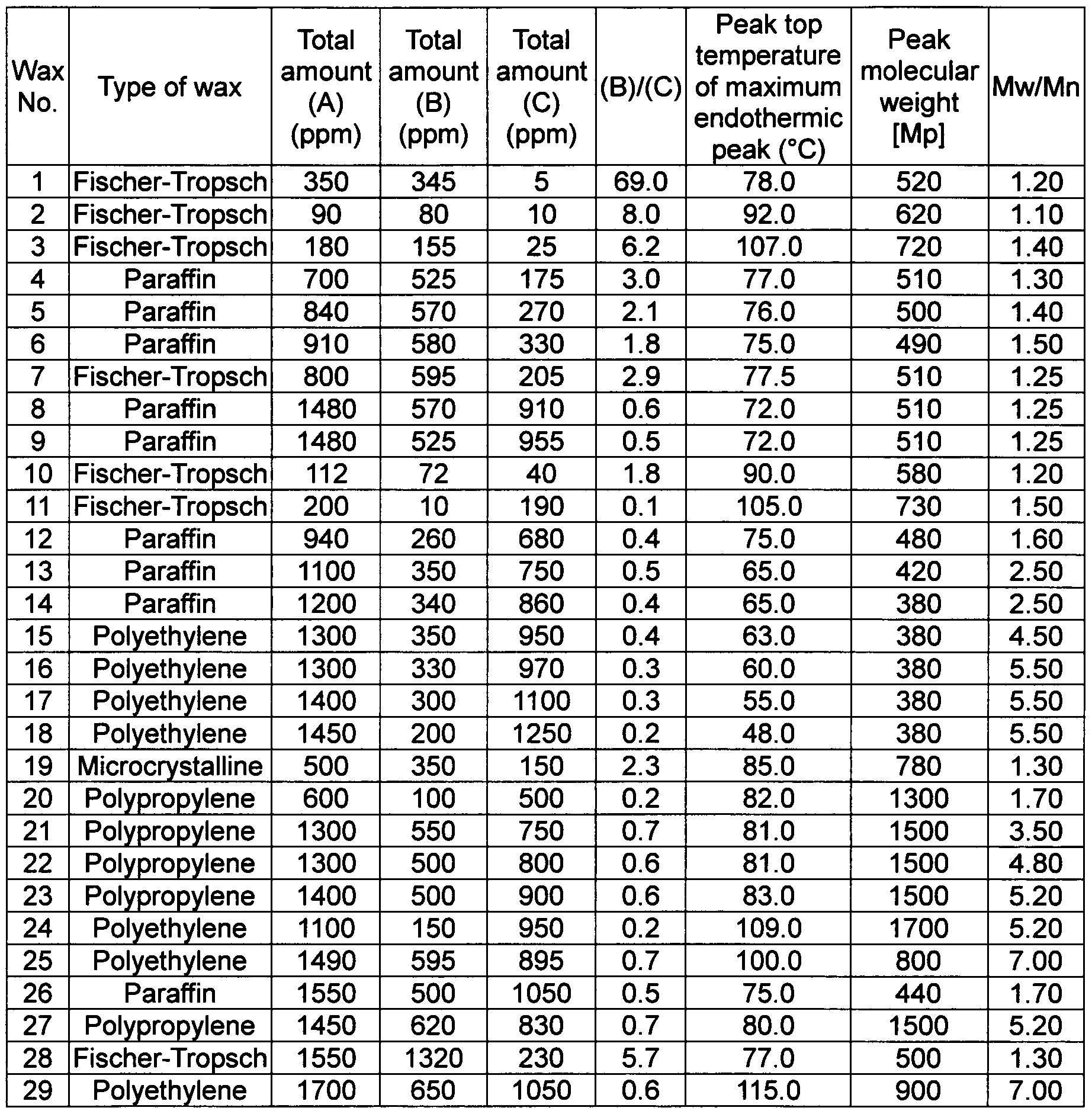
- Table 1 shows the measurement results of Waxes 1 to
- a suspension polymerization toner was produced by the following procedure.
- An aqueous medium having a pH of 5.2 was prepared by adding 9 parts by mass of tricalcium phosphate and 11 parts by mass of 10% hydrochloric acid to 1300 parts by mass of ion-exchanged water heated at 60 °C and stirring the resulting mixture using a TK-type homomixer (manufactured by
- a pigment dispersion composition was prepared by dispersing a mixture composed of:
- FCA-1001-NS charge control resin
- a dissolving solution was prepared in another container by dissolving the following materials with a propeller type stirring apparatus at 100 r/min:
- n-butyl acrylate 30.0 parts by mass
- adduct/bisphenol A propylene oxide (3 mol) adduct 50% by mol/50% by mol/0.1% by mol/88% by mol/22% by mol] (acid value: 10 mg KOH/g, peak molecular weight: 10000, weight- average molecular weight: 9900, Tg: 72°C).
- Wax 1 10.0 parts by mass
- the polymerizable monomer composition was added to the aqueous medium.
- 8.0 parts by mass of Perbutyl PV (10-hour half-life temperature: 54.6°C (manufactured by NOF Corp.)) was added as a
- the slurry containing the particles was cooled and washed with ten times its own volume of water, filtered, and dried, and then subjected to classifying to adjust the particle diameters to obtain toner particles .
- Toner No. 1 was subjected to a durability test of 200000 sheets using a commercially available laser beam printer LBP 9500C (manufactured by CANON KABUSHIKI KAISHA) provided with the following remodeling: the process speed of the plain paper mode was changed to 360 mm/sec, the process speed of the heavy paper mode was changed to 90 mm/sec, and the fixing temperature was set to 200 °C.
- Density stability was evaluated by outputting original images each having 20-mm square solid black patches at nine positions in the developing area and comparing the maximum density difference in image density of the nine- point average density of the image in the durability test from that of the initial image.
- the image concentration was measured using "Macbeth Reflection densitometer RD-918"
- A a maximum density difference of less than 0.15
- leading edge margin 5 mm, toner laid-on level: 0.45 mg/cm 2
- HP Color Laser Photo Paper glossy (220 g/m 2 ) manufactured by Hewlett-Packard Company at the heavy paper mode (process speed: 90 mm/sec, fixing temperature: 200°C), measuring the maximum value and the minimum value of 75° gloss in the fixed image, and determining the difference thereof .
- the output was performed under a low-temperature and low-humidity (temperature: 15°C, humidity: 10% RH) environment, and the gloss was measured using black glass having a glossiness of 96.9 as a reference surface with PG- 3D (incident angle ⁇ : 75°) manufactured by Nippon Denshoku Industries Co., Ltd.
- the criteria are as follows:
- A a glossiness difference of less than 2.0%
- C a glossiness difference of 4.0% or more and less than 6.0%
- D a glossiness difference of 6.0% or more.
- An emulsion aggregation toner was produced by the following procedure.
- n-butyl acrylate 20.0 parts by mass
- dodecanethiol 6.0 parts by mass
- Nonipol 400 manufactured by Sanyo Chemical Industries, Ltd.
- anionic surfactant Naogen SC, manufactured by Daiich Kogyo Seiyaku Co., Ltd.
- resin particle dispersion 1 in which resin particles having an average particle diameter of 0.17 ⁇ , a glass transition point of 57 °C, and a weight-average
- n-butyl acrylate 25.0 parts by mass
- Nonipol 400 manufactured by Sanyo Chemical Industries, Ltd.
- anionic surfactant Naogen SC, manufactured by Daiich Kogyo Seiyaku Co., Ltd.
- resin particle dispersion 2 in which resin particles having an average particle diameter of 0.1 ⁇ , a glass transition point of 61°C, and a weight-average
- Wax 2 (melting point: 92°C): 50.0 parts by mass
- anionic surfactant (Neogen SC, manufactured by Daiich Kogyo Seiyaku Co., Ltd.): 5.0 parts by mass, and
- anionic surfactant (Neogen SC, manufactured by Daiich Kogyo Seiyaku Co., Ltd.): 2.0 parts by mass, and
- anionic surfactant (Neogen SC, manufactured by Daiich Kogyo Seiyaku Co., Ltd.): 2.0 parts by mass, and
- resin particle dispersion 1 250.0 parts by mass
- resin particle dispersion 2 110.0 parts by mass
- coloring agent particle dispersion 1 50.0 pats by mass, and wax particle dispersion: 80.0 parts by mass
- the physical properties of the obtained toner No. 2 are shown in Table 2. Toner No. 2 was evaluated as in
- Example 1 Example 1
- Example 2 Example 1
- a toner by pulverization was produced by the following procedure.
- a styrene-butyl acrylate copolymer A (St/BA: 80/20, Tg: 67°C, Mw: 820000) was produced by suspension
- binder resin 1 polymerization using di-t-butyl peroxide as a polymerization initiator. Thirty parts by mass of copolymer A and 70 parts by mass of copolymer B were mixed in a solution to give binder resin 1.
- binder resin 1100.0 parts by mass
- Bontron E-88 manufactured by Orient Chemical Industries, Ltd.
- wax 34.0 parts by mass
- the physical properties of the obtained toner No. 3 are shown in Table 2. Toner No. 3 was evaluated as in Example 1, and the evaluation results are shown in Table 3.
- Toner Nos . 4 to 13 and 16 to 27 were produced by suspension polymerization as in Example 1 except that the types and contents of waxes used were changed to those shown in Table 2.
- the physical properties of toner Nos. 4 to 13 and 16 to 27 are shown in Table 2.
- Toner Nos. 4 to 13 and 16 to 27 were evaluated as in Example 1, and the evaluation results are shown in Table 3.
- Toner Nos. 14, 28, and 29 were produced by emulsion aggregation as in Example 2 except that Waxes 10, 24, and 25 were respectively used instead of Wax 2 and that the
- Toner No. 15 was produced by pulverization as in Example 3 except that Wax 11 was used instead of Wax 3.
- the physical properties of toner No. 15 are shown in Table 2.
- Toner No. 15 was evaluated as in Example 1, and the
- Toner Nos. 30 to 32 were produced by suspension polymerization as in Example 1 except that Waxes 26 to 28 were respectively used and that the content of each wax was changed to 17.0 parts by mass.
- the physical properties of toner Nos. 30 to 32 are shown in Table 2.
- Toner Nos . 30 to 32 were evaluated as in Example 1, and the evaluation results are shown in Table 3.
- Toner No. 33 was produced by emulsion aggregation as in Example 2 except that Wax 29 was used instead of Wax 2 and that the content of the wax was changed to 17.0 parts by mass.
- the physical properties of toner No. 33 are shown in Table 2.
- Toner No. 33 was evaluated as in Example 1, and the evaluation results are shown in Table 3.
Landscapes
- Physics & Mathematics (AREA)
- General Physics & Mathematics (AREA)
- Spectroscopy & Molecular Physics (AREA)
- Chemical & Material Sciences (AREA)
- Chemical Kinetics & Catalysis (AREA)
- Developing Agents For Electrophotography (AREA)
Abstract
Description

Claims
Priority Applications (4)
| Application Number | Priority Date | Filing Date | Title |
|---|---|---|---|
| KR1020137008006A KR101431403B1 (en) | 2010-09-08 | 2011-09-06 | Toner |
| EP11823688.4A EP2614408B1 (en) | 2010-09-08 | 2011-09-06 | Toner |
| US13/821,188 US8865385B2 (en) | 2010-09-08 | 2011-09-06 | Toner |
| CN201180043519.2A CN103119520B (en) | 2010-09-08 | 2011-09-06 | toner |
Applications Claiming Priority (2)
| Application Number | Priority Date | Filing Date | Title |
|---|---|---|---|
| JP2010-201066 | 2010-09-08 | ||
| JP2010201066 | 2010-09-08 |
Publications (1)
| Publication Number | Publication Date |
|---|---|
| WO2012033220A1 true WO2012033220A1 (en) | 2012-03-15 |
Family
ID=45810808
Family Applications (1)
| Application Number | Title | Priority Date | Filing Date |
|---|---|---|---|
| PCT/JP2011/070683 Ceased WO2012033220A1 (en) | 2010-09-08 | 2011-09-06 | Toner |
Country Status (6)
| Country | Link |
|---|---|
| US (1) | US8865385B2 (en) |
| EP (1) | EP2614408B1 (en) |
| JP (1) | JP4929416B2 (en) |
| KR (1) | KR101431403B1 (en) |
| CN (1) | CN103119520B (en) |
| WO (1) | WO2012033220A1 (en) |
Families Citing this family (6)
| Publication number | Priority date | Publication date | Assignee | Title |
|---|---|---|---|---|
| US9829818B2 (en) * | 2014-09-30 | 2017-11-28 | Canon Kabushiki Kaisha | Toner |
| US20160139522A1 (en) | 2014-11-18 | 2016-05-19 | Canon Kabushiki Kaisha | Toner |
| JP6755075B2 (en) * | 2014-11-21 | 2020-09-16 | 株式会社リコー | Toner, two-component developer, and color image forming equipment |
| JP2017191312A (en) * | 2016-04-11 | 2017-10-19 | キヤノン株式会社 | toner |
| JP2024034927A (en) * | 2022-09-01 | 2024-03-13 | 富士フイルムビジネスイノベーション株式会社 | Toner for developing electrostatic images, developers for electrostatic images, toner cartridges, process cartridges, and image forming devices |
| JP2025115440A (en) * | 2024-01-26 | 2025-08-07 | コニカミノルタ株式会社 | Toner for developing electrostatic latent images, image forming method and image forming apparatus |
Citations (7)
| Publication number | Priority date | Publication date | Assignee | Title |
|---|---|---|---|---|
| JPH05313403A (en) * | 1992-05-06 | 1993-11-26 | Mitsubishi Kasei Corp | Toner for electrostatic image development |
| JP2000321815A (en) | 1999-03-09 | 2000-11-24 | Canon Inc | toner |
| US6203959B1 (en) | 1999-03-09 | 2001-03-20 | Canon Kabushiki Kaisha | Toner |
| JP2001249486A (en) | 2000-03-07 | 2001-09-14 | Konica Corp | Toner, two-component developer and method of forming image |
| JP2003131418A (en) * | 2001-10-29 | 2003-05-09 | Konica Corp | Electrostatic latent image developing toner, method for manufacturing the same, developer, image forming method and image forming apparatus |
| JP2006084661A (en) | 2004-09-15 | 2006-03-30 | Fuji Xerox Co Ltd | Electrostatic latent image developing toner, electrostatic latent image developer, and method for manufacturing electrostatic latent image developing toner |
| WO2012077503A1 (en) | 2010-12-10 | 2012-06-14 | Kao Corporation | Method for forming fixed images |
Family Cites Families (1)
| Publication number | Priority date | Publication date | Assignee | Title |
|---|---|---|---|---|
| US8097391B2 (en) * | 2006-01-31 | 2012-01-17 | Zeon Corporation | Toner for developing electrostatic image |
-
2011
- 2011-09-05 JP JP2011192762A patent/JP4929416B2/en active Active
- 2011-09-06 WO PCT/JP2011/070683 patent/WO2012033220A1/en not_active Ceased
- 2011-09-06 KR KR1020137008006A patent/KR101431403B1/en not_active Expired - Fee Related
- 2011-09-06 CN CN201180043519.2A patent/CN103119520B/en active Active
- 2011-09-06 US US13/821,188 patent/US8865385B2/en active Active
- 2011-09-06 EP EP11823688.4A patent/EP2614408B1/en active Active
Patent Citations (8)
| Publication number | Priority date | Publication date | Assignee | Title |
|---|---|---|---|---|
| JPH05313403A (en) * | 1992-05-06 | 1993-11-26 | Mitsubishi Kasei Corp | Toner for electrostatic image development |
| JP2000321815A (en) | 1999-03-09 | 2000-11-24 | Canon Inc | toner |
| US6203959B1 (en) | 1999-03-09 | 2001-03-20 | Canon Kabushiki Kaisha | Toner |
| JP2001249486A (en) | 2000-03-07 | 2001-09-14 | Konica Corp | Toner, two-component developer and method of forming image |
| JP2003131418A (en) * | 2001-10-29 | 2003-05-09 | Konica Corp | Electrostatic latent image developing toner, method for manufacturing the same, developer, image forming method and image forming apparatus |
| JP2006084661A (en) | 2004-09-15 | 2006-03-30 | Fuji Xerox Co Ltd | Electrostatic latent image developing toner, electrostatic latent image developer, and method for manufacturing electrostatic latent image developing toner |
| US7432030B2 (en) | 2004-09-15 | 2008-10-07 | Fuji Xerox Co., Ltd. | Toner for developing electrostatic latent image, developer for developing electrostatic latent image, and process for producing toner for developing electrostatic latent image |
| WO2012077503A1 (en) | 2010-12-10 | 2012-06-14 | Kao Corporation | Method for forming fixed images |
Also Published As
| Publication number | Publication date |
|---|---|
| EP2614408B1 (en) | 2019-01-23 |
| KR20130073955A (en) | 2013-07-03 |
| EP2614408A1 (en) | 2013-07-17 |
| EP2614408A4 (en) | 2015-11-18 |
| CN103119520B (en) | 2015-01-28 |
| US20130164670A1 (en) | 2013-06-27 |
| JP2012078810A (en) | 2012-04-19 |
| KR101431403B1 (en) | 2014-08-19 |
| JP4929416B2 (en) | 2012-05-09 |
| US8865385B2 (en) | 2014-10-21 |
| CN103119520A (en) | 2013-05-22 |
Similar Documents
| Publication | Publication Date | Title |
|---|---|---|
| EP2614409B1 (en) | Toner | |
| US9964874B2 (en) | Toner | |
| JP7651340B2 (en) | Toner and method for producing the same | |
| KR101102202B1 (en) | Toner and toner manufacturing method | |
| EP2124107B1 (en) | Process for producing polymerization toner and toner | |
| US10216107B2 (en) | Toner and method of producing toner | |
| US8431308B2 (en) | Toner for developing electrostatic image and method of preparing the same | |
| US8865385B2 (en) | Toner | |
| US12158725B2 (en) | Toner | |
| JP5087996B2 (en) | Method for producing toner for developing electrostatic image | |
| KR100891311B1 (en) | Charge control resin, and toner | |
| JP2001147550A (en) | Toner for developing electrostatic images | |
| CN105051616A (en) | toner | |
| JP2007133216A (en) | Resin for toner, toner and two-component developer | |
| JP4717678B2 (en) | Charge control resin and toner | |
| JP5645579B2 (en) | toner | |
| JP2007133218A (en) | Resin for toner, toner and two-component developer | |
| JP2019095772A (en) | Method for producing binder resin composition |
Legal Events
| Date | Code | Title | Description |
|---|---|---|---|
| WWE | Wipo information: entry into national phase |
Ref document number: 201180043519.2 Country of ref document: CN |
|
| 121 | Ep: the epo has been informed by wipo that ep was designated in this application |
Ref document number: 11823688 Country of ref document: EP Kind code of ref document: A1 |
|
| WWE | Wipo information: entry into national phase |
Ref document number: 2011823688 Country of ref document: EP |
|
| WWE | Wipo information: entry into national phase |
Ref document number: 13821188 Country of ref document: US |
|
| NENP | Non-entry into the national phase |
Ref country code: DE |
|
| ENP | Entry into the national phase |
Ref document number: 20137008006 Country of ref document: KR Kind code of ref document: A |