WO2012033556A1 - Preparing a nickel phosphorus ligand complex - Google Patents
Preparing a nickel phosphorus ligand complex Download PDFInfo
- Publication number
- WO2012033556A1 WO2012033556A1 PCT/US2011/040193 US2011040193W WO2012033556A1 WO 2012033556 A1 WO2012033556 A1 WO 2012033556A1 US 2011040193 W US2011040193 W US 2011040193W WO 2012033556 A1 WO2012033556 A1 WO 2012033556A1
- Authority
- WO
- WIPO (PCT)
- Prior art keywords
- nickel
- phosphorus
- group
- ligand
- containing ligand
- Prior art date
- Legal status (The legal status is an assumption and is not a legal conclusion. Google has not performed a legal analysis and makes no representation as to the accuracy of the status listed.)
- Ceased
Links
Classifications
-
- C—CHEMISTRY; METALLURGY
- C07—ORGANIC CHEMISTRY
- C07F—ACYCLIC, CARBOCYCLIC OR HETEROCYCLIC COMPOUNDS CONTAINING ELEMENTS OTHER THAN CARBON, HYDROGEN, HALOGEN, OXYGEN, NITROGEN, SULFUR, SELENIUM OR TELLURIUM
- C07F15/00—Compounds containing elements of Groups 8, 9, 10 or 18 of the Periodic Table
- C07F15/04—Nickel compounds
-
- B—PERFORMING OPERATIONS; TRANSPORTING
- B01—PHYSICAL OR CHEMICAL PROCESSES OR APPARATUS IN GENERAL
- B01J—CHEMICAL OR PHYSICAL PROCESSES, e.g. CATALYSIS OR COLLOID CHEMISTRY; THEIR RELEVANT APPARATUS
- B01J31/00—Catalysts comprising hydrides, coordination complexes or organic compounds
- B01J31/16—Catalysts comprising hydrides, coordination complexes or organic compounds containing coordination complexes
- B01J31/18—Catalysts comprising hydrides, coordination complexes or organic compounds containing coordination complexes containing nitrogen, phosphorus, arsenic or antimony as complexing atoms, e.g. in pyridine ligands, or in resonance therewith, e.g. in isocyanide ligands C=N-R or as complexed central atoms
- B01J31/1845—Catalysts comprising hydrides, coordination complexes or organic compounds containing coordination complexes containing nitrogen, phosphorus, arsenic or antimony as complexing atoms, e.g. in pyridine ligands, or in resonance therewith, e.g. in isocyanide ligands C=N-R or as complexed central atoms the ligands containing phosphorus
-
- C—CHEMISTRY; METALLURGY
- C07—ORGANIC CHEMISTRY
- C07F—ACYCLIC, CARBOCYCLIC OR HETEROCYCLIC COMPOUNDS CONTAINING ELEMENTS OTHER THAN CARBON, HYDROGEN, HALOGEN, OXYGEN, NITROGEN, SULFUR, SELENIUM OR TELLURIUM
- C07F15/00—Compounds containing elements of Groups 8, 9, 10 or 18 of the Periodic Table
- C07F15/04—Nickel compounds
- C07F15/045—Nickel compounds without a metal-carbon linkage
-
- C—CHEMISTRY; METALLURGY
- C22—METALLURGY; FERROUS OR NON-FERROUS ALLOYS; TREATMENT OF ALLOYS OR NON-FERROUS METALS
- C22B—PRODUCTION AND REFINING OF METALS; PRETREATMENT OF RAW MATERIALS
- C22B23/00—Obtaining nickel or cobalt
- C22B23/02—Obtaining nickel or cobalt by dry processes
-
- C—CHEMISTRY; METALLURGY
- C22—METALLURGY; FERROUS OR NON-FERROUS ALLOYS; TREATMENT OF ALLOYS OR NON-FERROUS METALS
- C22B—PRODUCTION AND REFINING OF METALS; PRETREATMENT OF RAW MATERIALS
- C22B23/00—Obtaining nickel or cobalt
- C22B23/02—Obtaining nickel or cobalt by dry processes
- C22B23/021—Obtaining nickel or cobalt by dry processes by reduction in solid state, e.g. by segregation processes
-
- B—PERFORMING OPERATIONS; TRANSPORTING
- B01—PHYSICAL OR CHEMICAL PROCESSES OR APPARATUS IN GENERAL
- B01J—CHEMICAL OR PHYSICAL PROCESSES, e.g. CATALYSIS OR COLLOID CHEMISTRY; THEIR RELEVANT APPARATUS
- B01J2231/00—Catalytic reactions performed with catalysts classified in B01J31/00
- B01J2231/30—Addition reactions at carbon centres, i.e. to either C-C or C-X multiple bonds
- B01J2231/32—Addition reactions to C=C or C-C triple bonds
- B01J2231/322—Hydrocyanation
-
- B—PERFORMING OPERATIONS; TRANSPORTING
- B01—PHYSICAL OR CHEMICAL PROCESSES OR APPARATUS IN GENERAL
- B01J—CHEMICAL OR PHYSICAL PROCESSES, e.g. CATALYSIS OR COLLOID CHEMISTRY; THEIR RELEVANT APPARATUS
- B01J2531/00—Additional information regarding catalytic systems classified in B01J31/00
- B01J2531/80—Complexes comprising metals of Group VIII as the central metal
- B01J2531/84—Metals of the iron group
- B01J2531/847—Nickel
-
- B—PERFORMING OPERATIONS; TRANSPORTING
- B01—PHYSICAL OR CHEMICAL PROCESSES OR APPARATUS IN GENERAL
- B01J—CHEMICAL OR PHYSICAL PROCESSES, e.g. CATALYSIS OR COLLOID CHEMISTRY; THEIR RELEVANT APPARATUS
- B01J31/00—Catalysts comprising hydrides, coordination complexes or organic compounds
- B01J31/16—Catalysts comprising hydrides, coordination complexes or organic compounds containing coordination complexes
- B01J31/18—Catalysts comprising hydrides, coordination complexes or organic compounds containing coordination complexes containing nitrogen, phosphorus, arsenic or antimony as complexing atoms, e.g. in pyridine ligands, or in resonance therewith, e.g. in isocyanide ligands C=N-R or as complexed central atoms
- B01J31/1845—Catalysts comprising hydrides, coordination complexes or organic compounds containing coordination complexes containing nitrogen, phosphorus, arsenic or antimony as complexing atoms, e.g. in pyridine ligands, or in resonance therewith, e.g. in isocyanide ligands C=N-R or as complexed central atoms the ligands containing phosphorus
- B01J31/185—Phosphites ((RO)3P), their isomeric phosphonates (R(RO)2P=O) and RO-substitution derivatives thereof
-
- B—PERFORMING OPERATIONS; TRANSPORTING
- B01—PHYSICAL OR CHEMICAL PROCESSES OR APPARATUS IN GENERAL
- B01J—CHEMICAL OR PHYSICAL PROCESSES, e.g. CATALYSIS OR COLLOID CHEMISTRY; THEIR RELEVANT APPARATUS
- B01J31/00—Catalysts comprising hydrides, coordination complexes or organic compounds
- B01J31/16—Catalysts comprising hydrides, coordination complexes or organic compounds containing coordination complexes
- B01J31/22—Organic complexes
-
- C—CHEMISTRY; METALLURGY
- C07—ORGANIC CHEMISTRY
- C07F—ACYCLIC, CARBOCYCLIC OR HETEROCYCLIC COMPOUNDS CONTAINING ELEMENTS OTHER THAN CARBON, HYDROGEN, HALOGEN, OXYGEN, NITROGEN, SULFUR, SELENIUM OR TELLURIUM
- C07F19/00—Metal compounds according to more than one of main groups C07F1/00 - C07F17/00
- C07F19/005—Metal compounds according to more than one of main groups C07F1/00 - C07F17/00 without metal-C linkages
Definitions
- the invention includes the preparation of a nickel complex including nickel and at least one phosphorus-containing ligand by reacting a nickel metal with at least one phosphorus-containing ligand.
- Hydrocyanation catalyst systems particularly pertaining to the hydrocyanation of ethylenically unsaturated compounds, are known in the art.
- systems useful for the hydrocyanation of butadiene to form pentenenitrile (PN) and in the subsequent hydrocyanation of pentenenitrile to form adiponitrile (ADN) are known in the commercially important nylon synthesis field.
- U.S. patent number 3,903,120 describes the preparation of zerovalent nickel complexes of the types Ni(MZ 3 ) 4 and Ni(MZ 3 ) 2 A; wherein M is P, As or Sb; Z is R or OR, wherein R is an alkyl or aryl radical having up to 18 carbon atoms and can be the same or different, and at least one Z is OR; A is a monoolefinic compound having 2 to 20 carbon atoms; the R radicals of a given MZ3 of Ni(MZ 3 ) 2 A preferably being so chosen that the ligand has a cone angle of at least 130°; are prepared by reacting elemental nickel with the monodentate MZ 3 ligand at a temperature in the range of 0°C- 50°C in the presence of a halogen-containing derivative of the monodentate MZ 3 ligand as a catalyst. A more rapid reaction is realized by carrying out the preparation in an organonitrile solvent.
- U.S. patent number 4,416,825 also describes an improved, continuous process for the preparation of hydrocyanation catalysts including zerovalent nickel complexes with monodentate organophosphorus compounds (ligands) by controlling the temperature of the reaction relative to the amount of monodentate ligand and
- U.S. patent number 6,171 ,996 describes zero-valent nickel complexes including bidentate phosphite ligands can be prepared or generated according to techniques well known in the art, as described, for example, in U.S. patent numbers 3,496,217; 3,631 ,191 ; 3,846,461 ; 3,847,959; and 3,903,120.
- divalent nickel compounds can be combined with ? a reducing agent, to serve as a source of zerovalent nickel in the reaction.
- Suitable divalent nickel compounds are said to include compounds of the formula NiY 2 where Y is halide, carboxylate, or acetylacetonate.
- Suitable reducing agents are said to include metal borohydrides, metal aluminum hydrides, metal alkyls, Zn, Fe, Al, Na, or H 2 .
- the present invention provides a method of preparing a nickel complex including nickel and at least one phosphorus-containing ligand, including the steps of:
- step (b) within the first reaction zone of step (a), reacting at least a portion of the nickel metal with the at least one phosphorus-containing ligand to form a reaction mixture including the nickel complex including nickel and the at least one phosphorus- containing ligand;
- step (a) wherein at least a portion of the nickel metal charged in step (a) is prepared by the additional steps including:
- step (ii) reducing at least a portion of the nickel composition of step (i) to form the nickel metal.
- the BNC nickel produced by some embodiments of the method of the present invention can be converted to Ni(0) that is particularly well-suited to conversion to forming complexes with phosphorus-containing ligands.
- the Ni(0) that is generated by some embodiments of the method of the present invention can be flowable, can have lower carbon content, smaller particle size, or broader particle size distributions.
- the method of making BNC nickel, of making Ni(0), or both can be more efficient than commercially acquiring BNC or Ni(0), and can provide BNC or Ni(0) with superior properties to those available commercially, including for example novel properties.
- the nickel-ligand complex can be synthesized efficiently and with high yield, and can be a highly effective hydrocyanation catalyst.
- the nickel-ligand complex is
- the at least one phosphorus-containing ligand can be a bidentate phosphorus-containing ligand, or a monodentate phosphorus-containing ligand.
- Step (a) can optionally further include charging at least one Lewis acid to the first reaction zone.
- Step (a) can optionally further include charging at least one pentenenitrile solvent to the first reaction zone.
- the present invention provides a first method of preparing a nickel complex including nickel and at least one bidentate phosphorus-containing ligand, including the steps of:
- step (b) within the first reaction zone of step (a), reacting at least a portion of the nickel metal with at least one bidentate phosphorus-containing ligand to form a reaction mixture including a nickel complex including nickel and at least one bidentate
- step (a) wherein at least a portion of the nickel metal in charging step (a) is prepared by the additional steps including:
- nickel composition including nickel(ll) and at least one anion selected from the group consisting of carbonate, bicarbonate, oxalate, a C 1 to Ce carboxylate, hydroxide, and oxide; and
- step (ii) reducing at least a portion of the nickel composition provided in step (i) to form the nickel metal.
- step (b) is well known in the art and means the ligand molecule contains two phosphorus atoms, and both phosphorus atoms of the ligand can bond to a single nickel atom to form the nickel complex of step (b).
- the at least one bidentate phosphorus-containing ligand charged to the first reaction zone of step (a) can be at least one bidentate phosphorus-containing ligand selected from the group consisting of a bidentate phosphite, a bidentate phosphonite, a bidentate phosphinite, a bidentate phosphine, and a mixed bidentate ligand; wherein the mixed bidentate ligand is selected from the group consisting of a phosphite- phosphonite, a phosphite-phosphinite, a phosphite-phosphine, a phosphonite- phosphinite, a phosphonite-phosphine, and a phosphinite-phosphine.
- the at least one bidentate phosphorus-containing ligand charged to the first reaction zone of step (a) can be selected from members of the group consisting of Formula Ilia, Formula lllb, Formula lllc, or any combination of such members, Formula lllb
- R 1 is phenyl, unsubstituted or substituted with one or more C 1 to C 12 alkyl, C 1 to C 12 alkoxy groups, or groups of Formulae A and B, or -(CH 2 ) n OY 2 ; or naphthyl, unsubstituted or substituted with one or more C 1 to C-
- Y 1 is independently selected from the group of H, C 1 to C 18 alkyl, cycloalkyl, or aryl
- Y 2 is independently selected from the group of C 1 to C 18 alkyl, cycloalkyl, or aryl
- Y 3 is independently selected from the group of O or CH 2
- n 1 to 4;
- O-Z-O and 0-Z 1 -O are independently selected from the group consisting of structural Formulae IV, V, VI, VII, and VIII:
- R 2 , R 3 , R 4 , R 5 , R 6 , R 7 , R 8 , and R 9 are independently selected from the group consisting of H, C 1 to C 12 alkyl, and C 1 to C 12 alkoxy;
- X is O, S, or CH(R 10 );
- R 10 is H or C 1 to C 12 alkyl
- R 20 and R 30 are independently selected from the group consisting of H, C 1 to C 12 alkyl, and C 1 to C 12 alkoxy, and CO 2 R 13 ;
- R 13 is C 1 to C 12 alkyl or C 6 to C 10 aryl, unsubstituted or substituted with C 1 to C 4 alkyl;
- W is O, S, or CH(R 14 );
- R 14 is H or C 1 to C 12 alkyl
- R 15 is selected from the group consisting of H, C 1 to C 12 alkyl, and C 1 to C 12 alkoxy and CO 2 R 16 ;
- R 16 is C 1 to C 12 alkyl or C 6 to C 10 aryl, unsubstituted or substituted with C 1 to C 4 alkyl.
- the first method can further include charging a pentenenitrile in step (a) wherein the pentenenitrile is selected from one or more members of the group consisting of 2-pentenenitrile, 3-pentenenitrile, 4-pentenenitrile, 2-methyl-3-butenenitrile, 2-methyl-2-butenenitrile.
- the solvent includes between about 10% and about 100% by weight of 3-pentenenitrile.
- the first method can further include charging at least one monodentate phosphorus-containing ligand selected from the group consisting of a monodentate phosphite, a monodentate phosphonite, a monodentate phosphinite, and a monodentate phosphine.
- each ligand molecule contains a single phosphorus atom that can bond to a single nickel atom, provided that the nickel atom can be complexed by one or more monodentate ligands to form the nickel complex of step (b).
- the at least one Lewis acid charged to the first reaction zone of step (a) can be selected from the group consisting of inorganic or organometallic compounds that include an element selected from the group including scandium, titanium, vanadium, chromium, manganese, iron, cobalt, copper, zinc, boron, aluminum, yttrium, zirconium, niobium, molybdenum, cadmium, rhenium, lanthanum, europium, ytterbium, tantalum, samarium, and tin.
- inorganic or organometallic compounds that include an element selected from the group including scandium, titanium, vanadium, chromium, manganese, iron, cobalt, copper, zinc, boron, aluminum, yttrium, zirconium, niobium, molybdenum, cadmium, rhenium, lanthanum, europium, ytterbium, tantalum, samarium
- the at least one Lewis acid is selected from the group consisting of zinc chloride, ferrous chloride, or a combination of zinc chloride and ferrous chloride.
- the method can further include adjusting a first molar ratio between 0.5 and 2.5, wherein the first molar ratio is defined as total moles of the at least one Lewis acid charged in step (a) divided by total moles of the at least one bidentate phosphorus- containing ligand charged in step (a).
- the present invention provides a second method to prepare a nickel complex including nickel and at least one monodentate phosphorus- containing ligand, including the steps of:
- the at least one monodentate phosphorus-containing ligand is selected from the group consisting of a monodentate phosphite, a monodentate phosphonite, a monodentate phosphinite, and a monodentate phosphine; and (b).within the first reaction zone of step (a), reacting at least a portion of the nickel metal with at least one monodentate phosphorus-containing ligand to form a reaction mixture including a nickel complex including nickel and at least one
- step (a) wherein at least a portion of the nickel metal in charging step (a) is prepared by the additional steps including:
- nickel composition including nickel(ll) and at least one anion selected from the group consisting of carbonate, bicarbonate, oxalate, C 1 to C 6 carboxylate, hydroxide, and oxide; and
- step (ii) reducing at least a portion of the nickel composition provided in step (i) to form the nickel metal.
- the reducing of step (ii) can be performed with a reducing agent including carbonaceous material, hydrogen, or a combination of carbonaceous material and hydrogen.
- the temperature can be in a range of 150°C to 700°C and at a total pressure in a range of 0.01 atmosphere and 100 atmospheres.
- the reducing of step (ii) of the first method can be performed with hydrogen as the reducing agent at a temperature between 200°C to 600°C for a period of time between 0.01 to 24 hours.
- the reducing of step (ii) can be performed with a molar excess of hydrogen relative to the molar amount of nickel(ll) in the nickel composition, at a total pressure in a range of 0.8 to 5 atmospheres, at a temperature between 250°C to 350°C, and for a period of time between 0.16 to 12 hours to reduce greater than 90% of the nickel composition to the nickel metal.
- a carbonaceous material can be, for example, a material including carbon, wherein the material can be oxidized.
- the carbonaceous material can be selected from members of the group consisting of C 1 to C 9 hydrocarbons, natural gas, carbon monoxide, synthesis gas including carbon monoxide and hydrogen, fuel oil, coal, or any combination of such members.
- the second method can further include charging to the first reaction zone in step (a) at least one halogenated catalyst including a phosphorus-halide bond selected from the group consisting of PX 3 , R 17 PX 2 , R 18 OPX 2 , [R 19 ][R 0 ]PX, [R 21 ][R 22 O]PX, and [R 23 O][R 24 O]PX; wherein R 17 , R 18 , R 19 , R 20 , R 21 , R 22 , R 23 , and R 24 are independently selected from the group consisting of C 1 to C 18 hydrocarbyl radicals and each X is a halide independently selected from the group consisting of chloride, bromide, and iodide.
- a halogenated catalyst including a phosphorus-halide bond selected from the group consisting of PX 3 , R 17 PX 2 , R 18 OPX 2 , [R 19 ][R 0 ]PX, [R 21 ][
- the second method can further include adjusting a second molar ratio between 5 and 1000, wherein the second molar ratio is defined as total moles of the halogenated catalyst charged in step (a) per million total moles of the at least one monodentate phosphorus-containing ligand charged in step (a).
- At least one Lewis acid can be charged to the first reaction zone of step (a) wherein the Lewis acid can be selected from the group consisting of inorganic or organometallic compounds in which the cation is selected from the group including scandium, titanium, vanadium, chromium, manganese, iron, cobalt, copper, zinc, boron, aluminum, yttrium, zirconium, niobium, molybdenum, cadmium, rhenium, lanthanum, europium, ytterbium, tantalum, samarium, and tin.
- the Lewis acid can be selected from the group consisting of inorganic or organometallic compounds in which the cation is selected from the group including scandium, titanium, vanadium, chromium, manganese, iron, cobalt, copper, zinc, boron, aluminum, yttrium, zirconium, niobium, molybdenum, cadmium, rhenium,
- the method can further include charging an organonitrile in step (a), such as a pentenenitrile, selected from, for example, one or more members of the group consisting of 2-pentenenitrile, 3-pentenenitrile, 4-pentenenitrile, 2-methyl-3-butenenitrile, 2-methyl-2-butenenitrile, adiponitrile, 2-methylglutaronitrile, and ethylsuccinonitrile.
- a pentenenitrile selected from, for example, one or more members of the group consisting of 2-pentenenitrile, 3-pentenenitrile, 4-pentenenitrile, 2-methyl-3-butenenitrile, 2-methyl-2-butenenitrile, adiponitrile, 2-methylglutaronitrile, and ethylsuccinonitrile.
- the nickel composition provided in step (i) can be selected from at least one nickel composition of the group consisting of a basic nickel(ll) carbonate; nickel(ll) hydroxide; nickel(ll) oxide; hydrate complexes of basic nickel(ll) carbonate, nickel(ll) hydroxide, and nickel(ll) oxide; and ammonia complexes of basic nickel(ll) carbonate, nickel(ll) hydroxide, and nickel(ll) oxide.
- a basic nickel(ll) carbonate can have a carbon to nickel mole ratio of equal to or less than 0.5, for example as measured by elemental analysis of a basic nickel(ll) carbonate sample.
- the basic nickel(ll) carbonate provided in step (i) can be produced by precipitating the basic nickel(ll) carbonate from at least one aqueous solution selected from the group consisting of (1) an aqueous solution including nickel(ll), ammonia, ammonium carbonate, and water; (2) an aqueous solution including nickel(ll), carbonate anions, and water; and (3) an aqueous solution including nickel(ll), bicarbonate anions, and water.
- the basic nickel(ll) carbonate provided in step (i) can be produced from an ore including nickel.
- the basic nickel(ll) carbonate provided in step (i) of the first or second method can be produced from an ore including nickel and said basic nickel(ll) carbonate can optionally include at least one element selected from the group consisting of aluminum, calcium, cobalt, copper, iron, magnesium, manganese, sodium, sulfur, and zinc.
- the nickel composition provided in step (i) can be pre-heated between 150°C to 700°C prior to the reducing of step (ii).
- the nickel composition provided in step (i) can be pre-heated between 200°C to 600°C.
- the heating can take place in the presence of oxygen and/or inert gases like, for example, nitrogen, and other gases such as, for example, carbon dioxide, and steam. The heating can take place for a period of time between 0.01 to 24 hours prior to the reducing of additional step (ii).
- Surface areas of the nickel metal from the reducing of additional step (ii) can fall within a range between about 0.5 to about 30 square meters per gram of nickel metal.
- the reaction mixture temperature for the reacting step (b) can be adjusted between about 0°C and about 150°C. In one example, the reaction mixture temperature can be adjusted between about 40°C and about 100°C.
- a nickel complex from the reaction mixture of step (b) can be contacted with 3-pentenenitrile and hydrogen cyanide in the presence of a Lewis acid promoter in a second reaction zone to produce adiponitrile.
- a nickel complex from the reaction mixture of step (b) of the first or second method can also be contacted with 1 ,3-butadiene and hydrogen cyanide in a third reaction zone to produce 3-pentenenitrile, 2-methyl-3-butenenitrile, or a combination thereof.
- a nickel complex from the reaction mixture of step (b) of the first or second method can be contacted with 2-methyl-3-butenenitrile in a fourth reaction zone to produce 3-pentenenitrile.
- the catalyst includes a zero-valent nickel and at least one phosphorus- containing (P-containing) ligand selected from the group consisting of a phosphite, a phosphonite, a phosphinite, a phosphine, and a mixed P-containing ligand or a combination of such members.
- P-containing phosphorus- containing
- mixed P-containing ligand means a mixture of P-containing ligands including a combination of at least two multidentate P-containing ligands selected from the group consisting of a phosphite- phosphonite, a phosphite-phosphinite, a phosphite-phosphine, a phosphonite- phosphinite, a phosphonite-phosphine, and a phosphinite-phosphine.
- the catalyst can include at least one monodentate P-containing ligand selected from the group consisting of a phosphite, a phosphonite, a phosphinite, and a phosphine or a combination of such members, provided that the monodentate P- containing ligand does not detract from the beneficial aspects of the invention.
- the monodentate P-containing ligand can be present as an impurity from the synthesis of the P-containing ligand, or the monodentate P-containing ligand can be added as a single or additional component of the catalyst.
- the monodentate P-containing ligand can be a mixture of P-containing ligands.
- the term "catalyst” includes within its meaning a catalyst precursor composition, indicating that the zero-valent nickel at some point becomes bound to at least one P-containing ligand, and further in all likelihood, additional reactions occur during hydrocyanation, such as, for example, complexing of the initial catalyst composition to an ethylenically unsaturated compound.
- the term “catalyst” also includes within its meaning recycled catalyst, that is, a catalyst including a zero-valent nickel and at least one P-containing ligand which, having been used in the process of the invention, is returned or can be returned to the process and used again.
- the term "hydrocarbyl” is well known in the art and designates a hydrocarbon molecule from which at least one hydrogen atom has been removed. Such molecules can contain single, double, or triple bonds.
- aryl is well-known in the art and designates an aromatic hydrocarbon molecule from which at least one hydrogen atom has been removed.
- suitable aryl groups include, for example, those containing 6 to 10 carbon atoms, which can be unsubstituted or singly or multiply substituted. Suitable
- substituents include, for example, C 1 to C 4 hydrocarbyl, or halogen such as fluorine, chlorine, or bromine, or halogenated hydrocarbyl such as trifluoromethyl, or aryl such as phenyl.
- the P-containing ligands chemically bonded to nickel as complexes, including zero-valent nickel, and the free P-containing ligands, not bonded to said complexes, can be monodentate or multidentate, for example bidentate or tridentate.
- the P-containing ligand can be a single compound or a mixture of compounds.
- the P-containing ligand can be selected from the group consisting of a phosphite, a phosphonite, a phosphinite, a phosphine, and a mixed P-containing ligand or a combination of such members.
- a multidentate P-containing ligand can be represented by Formula I.
- X 11 , X 12 , X 13 , X 21 , X 22 , X 23 independently represent oxygen or a single bond;
- R 1 , R 12 independently represent identical or different, single or bridged organic radicals; R , R independently represent identical or different, single or bridged organic radicals; and
- Y represents a bridging group
- Formula I can represent a single compound or a mixture of different compounds having the indicated formula.
- all of the groups X 11 , X 12 , X 13 , X 21 , X 22 , X 23 can represent oxygen.
- the bridging group Y is joined to phosphite groups.
- the multidentate P-containing ligand represented by Formula I is a phosphite.
- X 11 and X 12 can each represent oxygen, and X 13 , a single bond; or X 11 and X 13 can each represent oxygen and X 12 , a single bond, so that the phosphorus atom surrounded by X , X 12 , and X 13 is the central atom of a phosphonite.
- X 21 , X 22 , and X 23 can each represent oxygen, so that the phosphorus atom surrounded by X 21 , X 22 , and X 23 can be the central atom of a phosphite; or X 21 and X 22 can each represent oxygen and X 23 , a single bond; or X 21 and X 23 can each represent oxygen and X 22 , a single bond, so that the phosphorus atom surrounded by X 21 , X 22 , and X 23 can be the central atom of a phosphonite; or X 23 can represent oxygen and X 21 and X 22 , each a single bond; or X 21 can represent oxygen and X 22 and X 23 , each a single bond, so that the phosphorus atom surrounded by X 21 , X 22 , and X 23 can be the central atom of a phosphinite; or X 21 , X 22 , and X 23 can each represent oxygen, so that the
- the multidentate ligand represented by Formula I is a phosphite-phosphonite and is an example of a mixed P-containing ligand.
- the multidentate P-containing ligand represented by Formula I is a phosphonite.
- the multidentate P-containing ligand represented by Formula I is a phosphonite-phosphinite and is an example of a mixed P-containing ligand.
- the multidentate P-containing ligand represented by Formula I is a phosphonite-phosphine and is an example of a mixed P-containing ligand.
- X 13 can represent oxygen and X 11 and X 12 , each a single bond; or X 11 can represent oxygen and X 12 and X 13 , each a single bond, so that the phosphorus atom surrounded by X 11 , X 12 , and X 13 is the central atom of a phosphinite.
- X 21 , X 22 , and X 23 can each represent oxygen, so that the phosphorus atom surrounded by X 21 , X 22 , and X 23 can be the central atom of a phosphite; or X 23 can represent oxygen and X 21 and X 22 , each a single bond; or X 21 can represent oxygen and X 22 and X 23 , each a single bond, so that the phosphorus atom surrounded by X 21 , X 22 , and X 23 can be the central atom of a phosphinite; or X 21 , X 22 , and X 23 can each represent a single bond, so that the phosphorus atom surrounded by X 21 , X 22 , and X 23 can be the central atom of a phosphine.
- the multidentate P-containing ligand represented by Formula I is a phosphite-phosphinite and is an example of a mixed P-containing ligand.
- the multidentate P-containing ligand represented by Formula I is a phosphinite.
- the multidentate P-containing ligand represented by Formula I is a phosphinite-phosphine and is an example of a mixed P-containing ligand.
- X 1 , X 12 , and X 13 can each represent a single bond, so that the phosphorus atom surrounded by X 11 , X 12 , and X 13 is the central atom of a phosphine.
- X 21 , X 22 , and X 23 can each represent oxygen, so that the phosphorus atom surrounded by X 21 , X 22 , and X 23 can be the central atom of a phosphite; or X , X , and X can each represent a single bond, so that the phosphorus atom surrounded by X 21 , X 22 , and X 23 can be the central atom of a phosphine.
- the multidentate P-containing ligand represented by Formula I is a phosphite-phosphine and is an example of a mixed P-containing ligand.
- the multidentate P-containing ligand represented by Formula I is a phosphine.
- Bridging group Y can be aryl groups substituted, for example, with C 1 to C 4 hydrocarbyl, or halogen such as fluorine, chlorine, or bromine, or halogenated hydrocarbyl such as trifluoromethyl, or aryl such as phenyl, or unsubstituted aryl groups, for example those with 6 to 20 carbon atoms in the aromatic system, for example 2,2'- biphenyl, 1 , 1 '-bi-2-naphthyl , pyrocatechol, or 1 ,1'-ferrocenyl.
- Radicals R 11 and R 12 can independently represent identical or different organic radicals.
- R 11 and R 12 can be aryl radicals, for example those containing 6 to 10 carbon atoms, which can be unsubstituted or singly or multiply substituted, for example by C 1 to C 4 hydrocarbyl, or halogen such as fluorine, chlorine, or bromine, or
- halogenated hydrocarbyl such as trifluoromethyl, or unsubstituted aryl such as phenyl and naphthyl, or substituted aryl groups.
- Radicals R 21 and R 22 can independently represent identical or different organic radicals.
- R 2 and R 22 can be aryl radicals, for example those containing 6 to 10 carbon atoms, which can be unsubstituted or singly or multiply substituted, for example by C 1 to C 4 hydrocarbyl, or halogen such as fluorine, chlorine, or bromine, or
- halogenated hydrocarbyl such as trifluoromethyl, or unsubstituted aryl such as phenyl and naphthyl, or substituted aryl groups.
- Radicals R 11 and R 12 can be single or bridged. Radicals R 21 and R 22 can also be single or bridged. Radicals R 11 , R 12 , R 21 , and R 22 can all be single, or two can be bridged and two single, or all four can be bridged in the manner described.
- the P-containing ligand can also be a polymeric ligand composition, as disclosed, for example, in United States Patent No. 6,284,865; United States Patent No. 6,924,345, or United States Published Patent Application No. 2003/135014. Methods for preparing such polymeric ligand compositions are well known in the art and are disclosed, for example, in the above cited references.
- the catalyst can include at least one monodentate P-containing ligand selected from the group consisting of a phosphite, a phosphonite, a phosphinite, and a phosphine or a combination of such members.
- the monodentate P-containing ligand can be added as an additional component of the catalyst when a multidentate P- containing ligand is used, or it can be present, for example, as an impurity from the synthesis of the P-containing ligand, or the monodentate P-containing ligand can be used without a multidentate P-containing ligand.
- the monodentate P-containing ligand can be represented by Formula II,
- X 1 , X 2 , X 3 independently represent oxygen or a single bond
- R 31 , R 32 , R 33 independently represent identical or different, single or bridged organic radicals.
- Formula II can represent a single compound or a mixture of different compounds having the indicated formula.
- all of the groups X 1 , X 2 , and X 3 can represent oxygen, so that Formula II represents a phosphite of formula P(OR 31 )(OR 32 )(OR 33 ), wherein R 31 , R 32 , and R 33 have the meanings defined herein.
- Formula II represents a phosphonite of formula P(OR 31 )(OR 32 )(R 33 ), P(R 31 )(OR 32 )(OR 33 ), or P(OR 31 )(R 32 )(OR 33 ), wherein R 31 , R 32 and R 33 have the meanings defined herein.
- Formula II represents a phosphinite of formula P(OR 31 )(R 32 )(R 33 ) or P(R 31 )(OR 32 )(R 33 ) or P(R 31 )(R 32 )(OR 33 ), wherein R 31 , R 32 and R 33 have the meanings defined herein.
- the groups X 1 , X 2 , X 3 can independently represent oxygen or a single bond. If all the groups X 1 , X 2 , and X 3 represent single bonds, Formula II represents a phosphine of formula P(R 31 )(R 32 )(R 33 ), wherein R 31 , R 32 and R 33 have the meanings defined herein.
- Radicals R 31 , R 32 and R 33 can independently represent identical or different organic radicals, for example hydrocarbyl radicals including 1 to 20 carbon atoms, such as methyl, ethyl, normal-propyl, iso-propyl, normal-butyl, iso-butyl, sec-butyl, and tert-butyl, aryl groups such as phenyl, o-tolyl, m-tolyl, p-tolyl, 1-naphthyl, or 2-naphthyl.
- the R 31 , R 32 and R 33 radicals can be connected to one another directly, meaning not solely via the central phosphorus atom.
- the R 31 , R 32 , and R 33 radicals can be not directly connected to one another.
- R 31 , R 32 and R 33 can be selected from the group composed of phenyl, o-tolyl, m-tolyl, and p-tolyl.
- a maximum of two of the R 31 , R 32 , and R 33 groups can be phenyl.
- a maximum of two of the R 31 , R 32 , and R 33 groups can be o-tolyl.
- Examples of compounds of Formula lla include (p-tolyl-0-)(phenyl-0-)2P, (m- tolyl-0-)(phenyl-0-) 2 P, (o-tolyl-0-)(phenyl-0-) 2 P, (p-tolyl-0-) 2 (phenyl-0-)P, (m-tolyl-O- ) 2 (phenyl-0-)P, (o-tolyl-0-) 2 (phenyl-O-)P, (m-tolyl-0-)(p-tolyl-0-)(phenyl-0-)P, (o-tolyl- 0-)(p-tolyl-0-)(phenyl-0-)P, (o-tolyl-0-)( m-tolyl-0-)(phenyl-0-)P, (p-tolyl-0-) 3 P, (m-tolyl- 0-)(p-tolyl-0-) 2 P, (o-tolyl-0-) 3 P
- Mixtures containing (m-tolyl-O-) 3 P, (m-tolyl-0-) 2 (p-tolyl-0-)P, (m-tolyl-0-)(p- tolyl-0-) 2 P, and (p-tolyl-0-) 3 P can be obtained, for example, by reacting a mixture containing m-cresol and p-cresol, in particular in a molar ratio of 2:1 as occurs in the distillative processing of crude oil, with a phosphorus trihalide such as phosphorus trichloride.
- R 31 is an aromatic radical having a C 1 to C 18 alkyl substituent in the o-position relative to the oxygen atom which connects the phosphorus atom to the aromatic system, or having an aromatic substituent in the o-position relative to the oxygen atom which connects the phosphorus atom to the aromatic system, or having an aromatic system fused on in the o-position relative to the oxygen atom which connects the phosphorus atom to the aromatic system;
- R 32 is an aromatic radical having a C 1 to C 18 alkyl substituent in the m-position relative to the oxygen atom which connects the phosphorus atom to the aromatic system, or having an aromatic substituent in the m-position relative to the oxygen atom which connects the phosphorus atom to the aromatic system, or having an aromatic system fused on in the m-position relative to the oxygen atom which connects the phosphorus atom to the aromatic system, where the aromatic radical bears a hydrogen atom in the o-position relative to the oxygen atom which connects the phosphorus atom to the aromatic system;
- R 33 is an aromatic radical having a C 1 to C 18 alkyl substituent in the p-position relative to the oxygen atom which connects the phosphorus atom to the aromatic system, or having an aromatic substituent in the p-position relative to the oxygen atom which connects the phosphorus atom to the aromatic system, where the aromatic radical bears a hydrogen atom in the o-position relative to the oxygen atom which connects the phosphorus atom to the aromatic system;
- R is an aromatic radical which bears substituents other than those defined for R 31 , R 32 and R 33 in the o-, m-, and p-position relative to the oxygen atom which connects the phosphorus atom to the aromatic system, where the aromatic radical bears a hydrogen atom in the o-position relative to the oxygen atom which connects the phosphorus atom to the aromatic system;
- x is 1 or 2;
- radical R 31 examples include o-tolyl, o-ethyl phenyl, o-normal-propylphenyl, o-iso-propylphenyl, o-normal-butylphenyl, o-sec-butylphenyl, o-tert-butylphenyl, (o-phenyl)phenyl, or 1-naphthyl groups.
- radical R 32 examples include m-tolyl, m-ethyl phenyl, m-normal- propylphenyl, m-iso-propylphenyl, m-normal-butylphenyl, m-sec-butylphenyl, m-tert- butylphenyl, (m-phenyl)-phenyl, or 2-naphthyl groups.
- radical R 33 examples include p-tolyl, p-ethylphenyl, p-normal-propylphenyl, p-iso-propylphenyl, p-normal-butylphenyl, p-sec-butylphenyl, p-tert-butyl phenyl, or (p- phenyl)phenyl groups.
- Radical R 34 can be, for example, phenyl.
- indices x, y, z, and p in compounds of Formula Mb can have the following possibilities:
- Examples of phosphites of Formula lib are those in which p is zero, and R , R 32 , and R 33 are independently selected from o-iso-propylphenyl, m-tolyl, and p-tolyl.
- Additional examples of phosphites of Formula lib are those in which R 31 is the o-iso-propylphenyl radical, R 32 is the m-tolyl radical, and R 33 is the p-tolyl radical, with the indices listed in the above table; also those in which R 31 is the o-tolyl radical, R 32 is the m-tolyl radical, and R 33 is the p-tolyl radical, with the indices listed in the table; also those in which R 31 is the 1-naphthyl radical, R 32 is the m-tolyl radical, and R 33 is the p- tolyl radical, with the indices listed in the table; also those in which R 31 is the o-tolyl radical, R 32 is the 2-naphthyl radical, and R 33 is the p-tolyl radical, with the indices listed in the table; and lastly, those in which R 31 is the o-iso-propylphenyl radical, R 32
- Phosphites having the Formula lib can be obtained as follows:
- phosphorus trihalide is reacted with an alcohol selected from the group including R 31 OH, R 32 OH, R 33 OH and R 34 OH or mixtures thereof to obtain a
- the aforementioned dihalogenophosphoric acid monoesters are reacted with an alcohol selected from the group including R 31 OH, R 32 OH, R 33 OH and R 34 OH or mixtures thereof to obtain a monohalogenophosphoric acid diester, and
- the aforementioned monohalogenophosphoric acid diester is reacted with an alcohol selected from the group including R 31 OH, R 32 OH, R 33 OH and R 34 OH or mixtures thereof to obtain a phosphite having the Formula lib.
- reaction can be performed in three separate steps. It is also possible to combine two of the three steps, for example a) with b) or b) with c). Alternatively, all steps a), b), and c) can be combined with each other.
- Suitable parameters and quantities of the alcohols selected from the group including R 31 OH, R 32 OH, R 33 OH and R 34 OH or mixtures thereof can be easily determined by conducting a few simple preliminary experiments.
- Published patent application WO2004/050588 describes methods for the selective synthesis of organophosphites having the Formula lib.
- Suitable phosphorus trihalides are in principle all phosphorus trihalides in which preferable CI, Br, I, particularly CI is used as the halide, as well as mixtures thereof. It is also possible to use mixtures of different equally or differently halogen- substituted phosphines as the phosphorus trihalide, for example PCI 3 . Further details regarding the reaction conditions during the production of phosphites of Formula lib and regarding the treatment are disclosed in United States Patent No. 6,770,770.
- Phosphites of Formula lib can also be used as a mixture of different phosphites as ligand. Such a mixture can be formed, for example, in the preparation of phosphites of Formula lib.
- the P-containing ligand of the catalyst and/or the free P-containing ligand is selected from at least one
- multidentate P-containing ligands include the following:
- ligands which, in combination with nickel, form highly active catalysts for the hydrocyanation of 1 ,3-butadiene or 3-pentenenitrile and the isomerization of 2-methyl-3-butenenitrile to 3-pentenenitrile are bidentate phosphite ligands of the following structural formulae:
- R 1 is phenyl, unsubstituted or substituted with one or more C 1 to C 12 alkyl, C 1 to C 1 2 alkoxy groups, or groups of Formulae A and B, or -(CH 2 ) n OY 2 ; or naphthyl, unsubstituted or substituted with one or more C 1 to C 12 alkyl or C 1 to C 12 alkoxy groups, or groups of Formulae A and B, or -(CH 2 ) n OY 2 ; or 5,6,7,8-tetrahydro-1- naphthyl;
- Y 1 is independently selected from the group of H, C 1 to C-ie alkyl, cycloalkyi, or aryl
- Y 2 is independently selected from the group of C 1 to C 18 alkyl, cycloalkyi, or aryl
- Y 3 is independently selected from the group of O or CH 2
- n 1 to 4;
- O-Z-0 and 0-Z 1 -0 are independently selected from the group consisting of structural Formulae IV, V, VI, VII, and VIII:
- R 2 , R 3 , R 4 , R 5 , R 6 , R 7 , R 8 , and R 9 are independently selected from the group consisting of H, C 1 to C 12 alkyl, and C 1 to C 12 alkoxy;
- X is O, S, or CH(R 10 );
- R 10 is H or C 1 to C 12 alkyl
- R and R are independently selected from the group consisting of H, C 1 to C 12 alkyl, and C 1 to C 12 alkoxy, and CO 2 R 13 ;
- R 13 is C 1 to C 12 alkyl or C 6 to C 10 aryl, unsubstituted or substituted with C 1 to C 4 alkyl;
- W is O, S, or CH(R 14 );
- R 14 is H or C 1 to C 12 alkyl
- R 15 is selected from the group consisting of H, C 1 to C 12 alkyl, and C 1 to C 12 alkoxy and CO 2 R 16 ;
- R 16 is C 1 to C 12 alkyl or C 6 to C 10 aryl, unsubstituted or substituted with C 1 to C 4 alkyl.
- the C 1 to C 12 alkyl, and C 1 to C 12 alkoxy groups can be straight chain or branched.
- bidentate phosphite ligands that are useful in the present process include a ligand selected from a member of the group represented by Formulae XXXIII and XXXIV, in which all like reference characters have the same meaning, except as further explicitly limited: Formula XXXIV
- R 41 and R 45 are independently selected from the group consisting of C 1 to C 5 hydrocarbyl, and each of R 42 , R 43 , R 44 , R 46 , R 47 and R 48 is independently selected from the group consisting of H and C 1 to C 4 hydrocarbyl.
- the bidentate phosphite ligand can be selected from a member of the group represented by Formula XXXIII and Formula XXXIV, wherein
- R 4 is methyl, ethyl, isopropyl or cyclopentyl
- R 42 is H or methyl
- R 43 is H or a C 1 to C 4 hydrocarbyl
- R 44 is H or methyl
- R 45 is methyl, ethyl or isopropyl
- R , R and R are independently selected from the group consisting of H and C 1 to C 4 hydrocarbyl.
- the bidentate phosphite ligand can be selected from a member of the group represented by Formula XXXIII, wherein
- R 4 , R 44 , and R 45 are methyl
- R 42 , R 46 , R 47 and R 48 are H;
- R 43 is a C 1 to C hydrocarbyl
- R 41 is isopropyl
- R 42 is H; R is a C 1 to C 4 hydrocarbyl;
- R 44 is H or methyl
- R 45 is methyl or ethyl
- R 46 and R 48 are H or methyl
- R 47 is H, methyl or tertiary-butyl
- the bidentate phosphite ligand can be selected from a member of the group represented by Formula XXXIV, wherein
- R 41 is isopropyl or cyclopentyl
- R 45 is methyl or isopropyl
- R 46 , R 47 , and R 48 are H.
- the bidentate phosphite ligand can be represented by Formula XXXIII, wherein R 41 is isopropyl; R 42 , R 46 , and R 48 are H; and R 43 , R 44 , R 45 , and R 47 are methyl.
- Formulae IX to XXXIV are two-dimensional representations of three-dimensional molecules and that rotation about chemical bonds can occur in the molecules to give configurations differing from those shown.
- rotation about the carbon-carbon bond between the 2- and 2'- positions of the biphenyl, octahydrobinaphthyl, and or binaphthyl bridging groups of Formulae IX to XXXIV, respectively can bring the two phosphorus atoms of each Formula in closer proximity to one another and can allow the phosphite ligand to bind to nickel in a bidentate fashion.
- the term "bidentate" is well known in the art and means both phosphorus atoms of the ligand are bonded to a single nickel atom.
- the P-containing ligands useful in the present invention can be prepared by any suitable synthetic means known in the art.
- the multidentate P-containing ligands can be synthesized analogously to the method described in United States Patent Nos. 6, 171,996 and 5,512,696, both of which are incorporated herein by reference.
- the reaction of two equivalents of an ortho-substituted phenol with phosphorus trichloride gives the corresponding phosphorochloridite.
- the reaction of the phosphorochloridite with the desired unsubstituted or substituted biphenol, octahydrobinaphthol, or binaphthol in the presence of triethylamine gives the bidentate phosphite ligand.
- the crude bidentate phosphite ligand can be worked up by the processes described in United States Patent Nos. 6,069,267 and 6,844,249, which are incorporated herein by reference.
- the bidentate phosphite ligand product mixture can typically contain the desired product in about 70% to about 90% selectivity, with other phosphite by-products such as monodentate phosphites making up the balance of the product mixture.
- the multidentate P-containing ligand itself, mixtures of the multidentate P- containing ligand and at least one monodentate P-containing ligand, or at least one monodentate P-containing ligand itself are suitable for use with the present invention.
- the source of the Ni(ll) of the nickel composition of step (ii) is basic nickel carbonate, also referred to as BNC nickel.
- BNC can be described with a chemical formula of
- BNC can be referred to as including nickel(ll) ions, carbonate ions, hydroxide ions, and water molecules.
- the BNC nickel is acquired through a
- the BNC nickel is synthesized using other sources of Ni(ll).
- the BNC nickel can be synthesized using the procedures disclosed herein. Certain forms of BNC nickel, including BNC nickel generated by some of the procedures detailed herein, can yield a Ni(0) that is particularly well-suited to formation of nickel(O) complexes with phosphorus-containing ligands, and can be particularly well- suited to the method of forming a nickel complex including nickel and at least one phosphorus-containing ligand disclosed herein. Ni(0) that is particularly well-suited to forming a nickel complex including nickel and at least one phosphorus-containing ligand includes Ni(0) that gives higher rates of formation of the nickel complex.
- Ni(0) that is well-suited to forming a nickel complex including nickel and at least one phosphorus-containing ligand include, for example, low carbon content, large surface area, small crystallite size (e.g. less than 89 nm), and optionally a broad size
- Ni(0) can have a surface area of, for example, about 0.5 square meters per gram, 2 m 2 /g, 4, 6, 10, 20, 30, 40, about 50 m 2 /g, or any value in between. In some examples, Ni(0) with a surface area greater than about 2 m 2 /g, 5 m 2 /g, 10 m 2 /g, 20 m 2 /g or greater than about 30 m 2 /g are particularly well-suited to forming nickel complexes with phosphorus-containing ligands.
- BNC nickel that has features including, for example, low carbonate content, a molar ratio of NiC0 3 :Ni(OH) 2 ⁇ approximately 1 , with a mass ratio of Ni:C of at least about 10:1 , or any combination thereof, can produce Ni(0) with low levels of carbon impurities, including carbon impurities due to carbonate impurities, and thus produces Ni(0) that is well-suited to nickel-ligand complex formation.
- the calcination or heating or BNC nickel having features including a low carbonate content, a molar ratio of NiC0 3 :Ni(OH) 2 ⁇ approximately 1 , with a mass ratio of Ni:C of at least about 10:1 , or any combination thereof, more readily produces CO 2 , and thus causes more complete conversion to NiO, with fewer carbon impurities in the NiO, including carbonate impurities.
- NiO that has a lower carbon content, including a lower carbonate content, less carbon impurities result in the Ni(0) product.
- novel nickel-containing solids including nickel metal, derived from nickel compositions of basic nickel carbonates, and methods of making the same.
- the nickel compositions can be made by contacting a precipitant solution to a nickel solution in a precipitation reactor to form a reaction mixture; and (ii) precipitating said nickel composition from said reaction mixture, wherein said nickel solution includes nickel(ll) ions and water and said precipitant solution is selected from the group consisting of: (a) bicarbonate ions and water, (b) carbonate ions and water, and (c) mixtures thereof.
- the mole ratio of bicarbonate ions to nickel ions in the reaction mixture at the conclusion of said feeding can range from 0.5:1 to 2:1 , including from about 0.5:1 to about 1.6:1 , from about 0.5:1 to about 1.2:1 , from about 1 :1 to about 1.9:1 , from about 1.2:1 to about 1.9:1 , from about 0.8:1 to about 1.4:1 , from about 1 :1 to about 1.8:1 , from about 1.0:1 to about 1.6:1 , from about 1 :1 to about 1.4:1 , from about 0.8:1 to about 1.4:1 , and from about 0.8:1 to about 1.2:1.
- the mole ratio of carbonate ions to nickel ions in the reaction mixture at the conclusion of said feeding can range from 0.3:1 to 1.6:1 , including from about 0.5:1 to about 1.4:1 , from about 1 :1 to about 1.2:1 , from about 0.8:1 to about 1.4:1 , from about 1.0:1 to about 1.6:1 , from about 1.0:1 to about 1.6:1 , from about 1.0:1 to about 1.4:1 , from about 0.8:1 to about 1.4:1 , and from about 0.8:1 to about 1.2:1.
- Blends of bicarbonates and carbonates can also be used in the precipitant solution.
- the molar ratio has a surprising effect on the resulting nickel metal's effectiveness of reacting with the phosphorus ligands.
- the precipitation reactor can be any suitable containment vessel such as a tank or pipe.
- the precipitation can be performed in a batch or continuous fashion.
- reaction mixture can be agitated prior to and/or during the precipitation of the nickel composition.
- agitation can be done by mechanical stirring, pumped circulation loop, or flow-through a static mixer.
- the use of high sheer during precipitation can prevent particle agglomeration and can give smaller resulting BNC nickel particles.
- Reactor designs, stirring designs, and the application of high amounts of power to stirring are examples of factors that can cause a high-sheer stirring of the reaction mixture during precipitation.
- the nickel composition can be precipitated within a temperature range of from about 0°C to about 90°C, including from about 20°C to about 90°C, from about 20°C to about 70°C, from about 20°C to about 50°C, from about 50°C to about 90°C, from about 60°C to about 80°C, and from about 65°C to about 75°C.
- increased temperature during precipitation can decrease the proportion of carbonate ions in the resulting BNC nickel.
- the nickel composition can be precipitated from the reaction mixture in the presence of added carbon dioxide.
- the carbon dioxide can be added to the precipitation reactor, added to the nickel solution, added to the precipitant solution, or added to the reaction mixture, and any combination thereof.
- the precipitant solution can be fed to the precipitation reactor over a period of from about 30 minutes to about 60 minutes, and can be done in a semi-continuous or continuous manner. Further, the precipitant solution can be added to the nickel solution in the precipitation reactor in a semi- continuous or continuous manner, for example, gradual addition. In some
- the use of a higher pH during precipitation can decrease the proportion of carbonate ions in the resulting BNC nickel precipitate.
- a pH value of about 4, 5, 6 or about 7 can be used.
- the pH increases from about 4.9 to about 5.8 during the precipitation.
- the reaction mixture can also be digested after contacting the precipitant solution to the nickel solution by heating the reaction mixture from between about 50°C and about 90°C for a period of from about 0.25 hours to about 24 hours.
- Other suitable temperature ranges include from about 60°C to about 80°C and from about 65°C to about 75°C.
- Other suitable time periods can range from about 1 hours to about 24 hours, including from about 4 hours to about 20 hours, from about 6 hours to about 16 hours, from about 1 to about 6 hours, and from about 1 hour to about 2 hours. In some embodiments, longer digestion times can cause larger BNC nickel particles in the resulting precipitate.
- the disclosed nickel composition methods can further include, after the precipitation step, washing the precipitated nickel composition with water; and partially drying the precipitated nickel composition.
- the precipitated nickel composition from the reaction mixture is separated from the reaction mixture by filtration or decantation, the resulting precipitated nickel composition is washed with water by filtration or decantation, and the resulting precipitated nickel composition is dried by water evaporation between 60°C and 100°C. Drying can be performed under ambient pressure or under vacuum, and in the presence of an inert gas such as nitrogen.
- the nickel solution including nickel(ll) ions and water, can be prepared by dissolving a nickel(ll) salt in water.
- the nickel salt can be any salt that is soluble in water, for example NiCI 2 , NiS0 4l and Ni(N0 3 ) 2 .
- the precipitant solution, including bicarbonate ions can be prepared by dissolving a bicarbonate salt, for example, NaHC0 3 and NH 4 HC0 3 , in water or prepared in-situ by dissolving CO 2 and an alkali metal hydroxide or ammonia in water by known methods.
- the precipitant solution including carbonate ions
- the precipitant solution can be prepared by dissolving a carbonate salt, for example Na 2 CC>3 or prepared in-situ by dissolving CO 2 and an alkali metal hydroxide in water by known methods.
- the anion of the nickel salt and cation of the bicarbonate or carbonate salt can be selected such that a salt produced from the precipitation, including both the cation and anion from the reaction mixture (for example NaCl), is soluble in the water of the reaction mixture.
- a salt produced from the precipitation including both the cation and anion from the reaction mixture (for example NaCl)
- Such a selection provides a method for separating said salt product from the precipitated nickel composition.
- a method of making a nickel-containing solid including nickel metal includes: (i) providing the nickel compositions disclosed above; and (ii) reducing at least a portion of the nickel composition of step (i) with a reducing agent to form a nickel-containing solid, including nickel metal, wherein said nickel-containing solid is adapted to effectively react with a bidendate phosphorus-containing ligand to form a nickel complex of the phosphorus-containing ligand.
- the nickel-containing solid is more reactive with phosphorus-containing ligands than nickel-containing solids made by other processes, such as INCO type 123 nickel metal powder, or various other Ni(0) compositions made from nickel oxide, nickel formate, nickel oxalate, nickel hydroxide, and nickel carbonate.
- the high reactivity is believed to be partially due to the BNC processes disclosed above, as well as the reducing process.
- the reducing agent can be hydrogen, carbon monoxide, methane, ammonia, merely to name a few non-limiting examples of suitable reducing agents.
- the amount of bicarbonate or carbonate ions fed relative to the nickel(ll) ions charged greatly affects the reactivity of the resulting nickel- containing solid with the phosphorus-containing ligand to make a nickel complex.
- the precipitated nickel composition made using bicarbonate ions filters and washes much faster than the precipitated nickel composition made using carbonate ions. Also, the filtered precipitated nickel composition made using bicarbonate ions dries to a soft powder with little shrinkage. For these reasons, producing the nickel-containing solid using bicarbonate ions provides further desirable properties for downstream processing and handling of the dried precipitated nickel composition.
- the reduction of the nickel composition with a reducing agent to form a nickel-containing solid can be performed at a temperature in the range from about 200°C to about 650°C, including from about 250°C to about 450°C, and from about 275°C to about 325°C.
- the reduction pressure can range from about 0.01 atmospheres to about 100 atmospheres.
- Reduction can be carried out for a period of at least about 30 minutes using a stoichiometric excess of a reducing agent, such as hydrogen, even though one mole of hydrogen per mole of nickel composition is the theoretical and stoichiometric amount required for reduction.
- the reducing period can be between about 1 to about 2 hours using a 2:1 mole ratio of hydrogen to nickel composition.
- the disclosed nickel containing solids can be reacted with a phosphorus- containing ligand to make a nickel complex of the phosphorus-containing ligand.
- Such complexes are useful as a catalyst precursor for at least one of the following reactions: (1) reacting 1 ,3-butadiene with hydrogen cyanide to produce 2-methyl-3-butenenitrile and 3-pentenenitrile; (2) reacting 2-methyl-3-butenenitrile to produce 3-pentenenitrile; (3) reacting 3-pentenenitrile with hydrogen cyanide in the presence of a Lewis acid to produce adiponitrile; and (4) reaction 2-pentenenitrile with hydrogen cyanide in the presence of a Lewis acid to produce 3-pentenenitrile, 4-pentenenitrile, and adiponitrile.
- ADN adiponitrile
- Aryl unsubstituted or substituted aryl radical including 6 to 18 carbon atoms
- BD 1 ,3-butadiene
- C4H 7 C ⁇ N a pentenenitrile selected from 4PN, 3PN, 2PN, 2M3BN, and 2M2BN isomers, or any combination of such members
- hrs hours
- c2PN cis-2-pentenenitrile
- c3PN cis-3-pentenenitrile
- dinitrile or dinitriles ADN, MGN, and ESN unless specifically limited
- ESN ethylsuccinonitrile
- 2M2BN 2-methyl-2-butenenitrile including both (E)-2M2BN and (Z)-2 2BN isomers unless specifically limited
- 2M3BN 2-methyl-3-butenenitrile
- (E)-2M2BN (E)-2- methyl-2-butenenitrile
- Vale Inco type 123 nickel metal powder (Chemical Abstract Service registry number 7440-02-0) from Vale Inco Limited, Toronto, Ontario, Canada, is produced by thermal decomposition of nickel carbonyl, Ni(CO) , and is said to have a particle size of 3.5 - 4.5 m as measured by a Fisher sub-sieve sizer and a typical specific surface area of about 0.4 m 2 /gram. This nickel powder is not soluble in the pentenenitrile solvent of the Examples.
- a sample of basic nickel(ll) carbonate (BNC) was supplied by MetChem Corporation, an American distributor of this material.
- the basic nickel(ll) carbonate provided is produced by precipitating the basic nickel(ll) carbonate from an aqueous solution including nickel(ll), ammonia, ammonium carbonate, and water.
- the basic nickel(ll) carbonate is produced from an ore including nickel and the basic nickel(ll) carbonate can optionally further include at least one element selected from the group consisting of aluminum, calcium, cobalt, copper, iron, magnesium, manganese, sodium, sulfur, and zinc.
- Table 1 One sample had a chemical analysis shown in Table 1.
- Suitable basic nickel carbonates can also be produced by precipitating the basic nickel(ll) carbonate from an aqueous solution including nickel(ll), carbonate anion, and water.
- Suitable basic nickel carbonates can also be produced by precipitating the basic nickel(ll) carbonate from an aqueous solution including nickel(ll), bicarbonate anions, and water.
- the BNC are nickel compositions including nickel(ll) and at least one anion selected from the group consisting of carbonate and hydroxide. But during drying, thermal treatment, and reduction at elevated temperatures, the BNC can partially or fully decompose to lose water, CO2, or both water and CO2 to produce nickel compositions including nickel(ll) and at least one anion selected from the group consisting of carbonate, bicarbonate, hydroxide, and oxide.
- Suitable nickel compositions of the invention can also be selected from the group consisting of a basic nickel(ll) carbonate; nickel(ll) hydroxide; nickel(ll) oxide; hydrate complexes of basic nickel(ll) carbonate, nickel(ll) hydroxide, and nickel(ll) oxide; and ammonia complexes of basic nickel(ll) carbonate, nickel(ll) hydroxide, and nickel(ll) oxide.
- Examples 1 and 6 use a monodentate phosphite, TTP, that is derived from the reaction of an m-cresol/p-cresol/phenol mixture with PCI 3 .
- TTP is an example of a compound of Formula II.
- This series of experiments use a recycled ligand as a source of TTP from an ADN manufacturing plant that includes the reaction steps (1 ) BD hydrocyanation to produce 3PN and 2M3BN, (2) isomerization of 2M3BN to 3PN, and (3) 3PN
- Example 1 (Comparative) [00112] To avoid contact with air, a reactor bottle, equipped with a magnetic stir bar, is charged with reactants inside a Vacuum Atmospheres dry box operating with a dry nitrogen atmosphere. To this bottle are added 100 gm of the recycle TTP solution and 5.0 gm of Vale Inco type 123 nickel metal powder. The reactor bottle was sealed, removed from the dry box, and moved to a laboratory fume hood where it is placed on a magnetic stir plate. The reaction mixture within the reaction bottle is then quickly heated to 80°C. Filtered liquid samples from the reaction mixture are removed from the reactor bottle at different time intervals and the measured soluble Ni(0) content of withdrawn samples using liquid chromatography (LC) is provided in the Example 1 column of Table 2.
- LC liquid chromatography
- suitable halogenated catalysts for this reaction to form nickel complexes of the ligand include compounds of the formula (RO) x R" y PX where R' and R" are alkyl or aryl radicals having up to 18 carbon atoms, being either the same or different, x and z are 1-2, y is 0 or 1 , and the sum of x, y and z equals 3 and wherein X is a halide selected from the group consisting of chloride, bromide and iodide.
- Such compounds are also said to be prepared in situ by reaction of an appropriate ligand having at least two ROP linkages (R is an alkyl or aryl radical having up to 18 carbon atoms, O is a oxygen atom, P is a phosphorus atom) with a suitable halide source as an initiator such as a halide or alkyl- substituted halide of phosphorus, arsenic or antimony such as CH3PCI2, CH 3 AsCI 2 or CH 3 SbCI 2 ; an appropriate metal halide; elemental halogen such as chlorine bromine or iodine; or the corresponding hydrogen halide or thionyl halide.
- ROP linkages R is an alkyl or aryl radical having up to 18 carbon atoms, O is a oxygen atom, P is a phosphorus atom
- a suitable halide source as an initiator such as a halide or alkyl- substituted halide of phosphorus, arsenic or antimony
- Suitable metal halides for this purpose include those of Cr, Ni, Ti, Cu, Co, Fe, Hg, Sn, Li, K, Ca, Ba, Sc, Ce, V, n, Be, Ru, Rh, Pd, Zn, Cd, Al, Th, Zr, and Hf.
- the halide can be chloride, bromide or iodide.
- Particularly suitable halide sources include PX 3 , TiX , ZrX , HfX and HX wherein X is chloride, bromide, or iodide. Mixtures of two or more of the initiators or halogenated catalyst can be used in carrying out the reaction to form the nickel complexes.
- Example 2 Comparative
- Example 2 shows that the Vale Inco type 123 nickel metal powder reacts with the monodentate TTP ligand upon the introduction of the PCI 3 to the reaction mixture.
- a measured surface area of the nickel metal is between 0.5 to 2.5 square meters per gram of nickel metal. From other BNC samples, a measured surface area of the nickel metal is up to 30 square meters per gram of nickel metal. In some cases, the reactivity of the nickel metal with the phosphorus-containing ligands can be higher as the surface area of the nickel metal increases.
- the preparation of the nickel metal is repeated further including pre-heating the BNC nickel composition between 50°C to 700°C, for example at a temperature between 200°C to 600°C, for a period of time between 0.01 to 24 hours to produce a pre-heated material prior to flowing hydrogen at 0.5 liter/minute and 1 atmosphere over this pre-heated material at 400°C for 16 hours.
- pre-heating the BNC nickel composition between 50°C to 700°C, for example at a temperature between 200°C to 600°C, for a period of time between 0.01 to 24 hours to produce a pre-heated material prior to flowing hydrogen at 0.5 liter/minute and 1 atmosphere over this pre-heated material at 400°C for 16 hours.
- air or nitrogen gas flows over the BNC nickel composition at a temperature between 200°C to 600°C, then hydrogen gas flows at 0.5 liter/minute and 1 atmosphere over this pre-heated material at 250°C to 350°C for 0.16 to 12 hours.
- Example 3 column of Table 2 The 100 mL glass reactor is charged with 100 gm of the recycle TTP solution and 5.0 gm of the nickel metal in a dry box and the measured soluble Ni(0) content of withdrawn samples is provided in the Example 3 column of Table 2.
- this Example is identical to Example 1 , except for the different source of nickel metal.
- this Example shows that the nickel metal from the reduction of BNC reacts with the monodentate TTP ligand without a halogenated catalyst of U.S. patent numbers 3,903,120 and 4,416,825 being present in the reaction mixture.
- Example 4 is identical to Example 3, except that 20 microliters of PCI 3 is also charged to the 100 mL glass reactor in the dry box (245 ppm CI) and the measured soluble Ni(0) content of withdrawn samples is provided in the Example 4 column of Table 2.
- Example 2 shows that the nickel metal from the reduction of BNC reacts faster with the monodentate TTP ligand when the same amount of PCI 3 is charged to the reaction mixture.
- Example 4 is repeated to form nickel complexes of TTP further including charging to the 100 mL glass reactor at least halogenated catalyst including a phosphorus-halide bond selected from the group consisting of R 17 PCl 2 , R 18 OPCl 2 , [R 19 ][R 20 ]PCI, [R 21 ][R 22 O]PCI, and [R 23 O][R 24 O]PCI; wherein R 17 , R 18 , R 19 , R 20 , R 21 , R 22 , R 23 , and R 24 are independently selected from the group consisting of C 1 to C 1 s hydrocarbyl radicals.
- halogenated catalyst including a phosphorus-halide bond selected from the group consisting of R 17 PCl 2 , R 18 OPCl 2 , [R 19 ][R 20 ]PCI, [R 21 ][R 22 O]PCI, and [R 23 O][R 24 O]PCI; wherein R 17 , R 18 , R 19 , R 20
- Example 4 is repeated to form nickel complexes of TTP further including adjusting a second molar ratio between 5 and 1000.
- the adjusting involves charging to the 100 mL glass reactor between 5 and 1000 total moles of the at least one
- halogenated catalyst including a phosphorus-halide bond per million total moles of the at least one monodentate phosphorus-containing ligand.
- Example 1 is repeated except that 0.047 gm of zinc chloride (ZnCI 2 ) is also charged to the reactor in the dry box prior to heating to 90°C in the laboratory fume hood.
- This ZnCI 2 charge corresponds to 245 ppm CI in the reactor, the same CI concentration as provided by the PCI 3 charge in Example 2.
- no increase in the soluble Ni(0) concentration was observed over a reaction period of 24 hours.
- This Example follows from U.S. patent number 3,903,120 but in this case no reaction occurred. The reason for this discrepancy is believed to be that the TTP ligand used in the ZnCI 2 experiments of U.S. patent number 3,903,120 also contained an organochlorodite of the formula (R'0) x R"yPX, which was the halogenated catalyst for the reaction to form nickel complexes rather than the added metal halide salt (ZnCI 2 ).
- Example 3 is repeated except that 0.047 gm of ZnCI 2 is also charged to the reactor (245 ppm CI) in the dry box prior to heating to 90°C in the laboratory fume hood.
- the Ni(0) concentration of the reactor contents in weight % is shown as a function of time in Table 2 below:
- Examples 1-6 demonstrate that the nickel metal from BNC is much more reactive with the monodentate TTP ligand than the Vale Inco type 123 nickel metal powder that is derived from Ni(CO) 4 thermal decomposition.
- Ligand A can be prepared by any suitable synthetic means known in the art.
- 3,3'-diisopropyl-5,5',6,6'-tetramethyl-2,2'-biphenol can be prepared by the procedure disclosed in U. S. Published Patent Application No. 2003/0100802 in which 4-methylthymol can undergo oxidative coupling to the substituted biphenol in the presence of a copper chlorohydroxide-TMEDA complex (TMEDA is ⁇ , ⁇ , ⁇ ', ⁇ '- tetramethylethylenediamine) and air.
- TEDA is ⁇ , ⁇ , ⁇ ', ⁇ '- tetramethylethylenediamine
- [(CH 3 )2C6H 3 O] 2 PCI can be prepared, for example, by the procedure disclosed in U.S. Published Patent Application No. 2004/0106815.
- anhydrous triethylamine and 2,4-xylenol can be added separately and concurrently in a controlled manner to PCI3 dissolved in an appropriate solvent under temperature-controlled conditions.
- the reaction of this phosphorochloridite with the 3,3'-diisopropyl-5,5',6,6'-tetramethyl-2,2'-biphenol to form the desired Ligand A can be performed, for example, according to the method disclosed in U.S. Patent No.
- Ligand A is an example of a compound of Formula I and the Ligand A solutions in 3PN solvent below do not contain any halogenated catalysts of U.S. patent number 3,903, 120.
- a reactor bottle equipped with a magnetic stir bar, is charged with reactants inside a Vacuum Atmospheres dry box operating with a dry nitrogen atmosphere.
- a 10% by weight Ligand A solution in 3PN solvent 80 gm of a 10% by weight Ligand A solution in 3PN solvent, 3.2 gm of Vale Inco type 123 nickel metal powder, and 1.0 gm of anhydrous ZnC ⁇ .
- the reactor bottle is sealed, removed from the dry box, and moved to a laboratory fume hood where it is placed on a magnetic stir plate.
- the reaction mixture within the reaction bottle is then heated to 80°C. Filtered liquid samples from the reaction mixture are removed from the reactor bottle at intervals of one hour, with a final sample being taken after 24 hours.
- Example 7 is repeated except that the reaction bottle is charged with 80 gm of 5% by weight Ligand A solution in 3PN solvent, 3.2 gm of Vale Inco type 123 nickel metal powder, 0.5 gm of ZnCI 2 , and 15 microliters of PCI 3 .
- a calibrated absorption method that detects the divalent nickel complex (Ligand A)Ni(r
- MetChem BNC is reduced with hydrogen to produce a nickel-containing solid including nickel metal similar to what is described in Example 3 except that 50 gm of BNC is charged into the glass reduction tube then hydrogen gas is flowed at 0.5 liter/minute over this material at 400°C for a shorter period of 4 hours.
- a measured surface area of the nickel metal is between 0.5 to 2.5 square meters per gram of nickel metal.
- the preparation of the nickel metal is repeated further including pre-heating the BNC nickel composition between 50°C to 400°C to produce a pre-heated material prior to flowing hydrogen at 0.5 liter/minute and 1 atmosphere over this pre-heated material at 400°C for 6 hours.
- the reacting of the Ligand A solution with a nickel metal of Example 9 is repeated to form nickel complexes of Ligand A while applying ultra-sonic energy to the reaction mixture.
- Example 9 This example is identical to Example 9, except that no ZnCI 2 is charged to the reactor. LC analysis of a filtered liquid sample taken from the reaction mixture after 24 hours shows only 23 ppm total soluble nickel to be present. This example indicates that a Lewis acid, like ZnCI 2 , provides higher levels of total soluble nickel even when using the reactive nickel of this invention.
- Example 9 is repeated to form nickel complexes of Ligand A wherein the at least one Lewis acid is selected from the group consisting of inorganic or organometallic compound in which the cation is selected from the group including scandium, titanium, vanadium, chromium, manganese, iron, cobalt, copper, zinc, boron, aluminum, yttrium, zirconium, niobium, molybdenum, cadmium, rhenium, lanthanum, europium, ytterbium, tantalum, samarium, and tin.
- the at least one Lewis acid is selected from the group consisting of inorganic or organometallic compound in which the cation is selected from the group including scandium, titanium, vanadium, chromium, manganese, iron, cobalt, copper, zinc, boron, aluminum, yttrium, zirconium, niobium, molybdenum, cadmium, rhenium,
- Example 9 is repeated to form nickel complexes of Ligand A further including adjusting a first molar ratio between 0.5 and 2.5.
- the adjusting involves charging to the reactor bottle between 0.5 and 2.5 total moles of the at least one Lewis acid per total mole of at least one bidentate phosphorus-containing ligand.
- Example 4 is repeated to form nickel complexes of TTP further including adjusting a second molar ratio between 5 and 1000.
- the adjusting involves charging to the 100 mL glass reactor between 5 and 1000 moles of the halogenated catalyst including a phosphorus-halide bond per million moles of the at least one monodentate phosphorus-containing ligand.
- Example 12 (Embodiment of the method provided by the present invention)
- Example 9 is repeated wherein the Ligand A solution in 3PN solvent further includes monodentate phosphite ligands of the following formulae.
- This Ligand A solution in 3PN solvent, including Ligand A, B, and C does not contain any halogenated catalysts of U.S. patent number 3,903, 120.
- X 1 , X 2 , X 3 independently represent oxygen or a single bond
- the at least one monodentate phosphorus-containing ligand of Formula II is selected from the group consisting of a monodentate phosphite, a monodentate phosphonite, a monodentate phosphinite, and a monodentate phosphine.
- X 11 , X 12 , X 13 , X 21 , X 22 , X 23 independently represent oxygen or a single bond;
- R 11 , R 12 independently represent identical or different, single or bridged organic radicals
- R 21 , R 22 independently represent identical or different, single or bridged organic radicals
- Y represents a bridging group
- the at least one bidentate phosphorus-containing ligand of Formula I is selected from the group consisting of a bidentate phosphite, a bidentate phosphonite, a bidentate phosphinite, a bidentate phosphine, and a mixed bidentate ligand; wherein the mixed bidentate ligand is selected from the group consisting of a phosphite- phosphonite, a phosphite-phosphinite, a phosphite-phosphine, a phosphonite- phosphinite, a phosphonite-phosphine, and a phosphinite-phosphine.
- the at least one bidentate phosphorus-containing ligand is selected from the group consisting of Formula Ilia, Formula lllb, Formula lllc, or any combinations of such members,
- R 1 is phenyl, unsubstituted or substituted with one or more C 1 to C 12 alkyl, C 1 to C 12 alkoxy groups, or groups of Formulae A and B, or -(CH 2 ) n OY 2 ; or naphthyl,
- Y 1 is independently selected from the group of H, C 1 to C 18 alkyl, cycloalkyl, or aryl
- Y 2 is independently selected from the group of C 1 to C 18 alkyl, cycloalkyl, or aryl
- Y 3 is independently selected from the group of O or CH 2
- n 1 to 4;
- O-Z-0 and O-Z 1 -O are independently selected from the group consisting of structural Formulae IV, V, VI, VII, and VIII:
- R 2 , R 3 , R 4 , R 5 , R 6 , R 7 , R 8 , and R 9 are independently selected from the group consisting of H, C 1 to C 12 alkyl, and C 1 to C 12 alkoxy;
- X is O, S, or CH(R 10 );
- R 10 is H or C 1 to C 12 alkyl
- R 20 and R 30 are independently selected from the group consisting of H, C 1 to C 12 alkyl, and C 1 to C 12 alkoxy, and CO 2 R 13 ;
- R 13 is C 1 to C 12 alkyl or C 6 to C 10 aryl, unsubstituted or substituted with C 1 to C 4 alkyl; W is 0, S, or CH(R 14 );
- R 14 is H or C 1 to C 12 alkyl
- R 15 is selected from the group consisting of H, C 1 to C 12 alkyl, and C 1 to C 12 alkoxy and CO 2 R 16 ;
- R 16 is C 1 to C 12 alkyl or C 6 to C 10 aryl, unsubstituted or substituted with C 1 to C 4 alkyl.
- Examples 4 and 9 are repeated with nickel metals from the reduction of nickel compositions including nickel(ll) and at least one anion selected from the group consisting of oxalate, a C 1 to C 6 carboxylate, hydroxide, and oxide.
- a black nickel(ll) oxide from the J. T. Baker chemical company (number 2792) is reduced with hydrogen at 300°C for a period of 16 hrs using a hydrogen flow rate of 0.2 liters/minute. After reduction, the resulting nickel-containing solid is black and magnetic indicating the presence of nickel metal.
- a reactor bottle is charged with 80 gm of a 5% by weight Ligand A solution in 3PN solvent, 3.2 gm of the nickel metal of this Example, and 0.5 gm of anhydrous ZnC ⁇ . After the reaction mixture inside the reactor bottle is heated to 80°C, filtered liquid samples are withdrawn as a function of time and analyzed for soluble nickel concentration, and the following results were obtained.
- a nickel(ll) hydroxide from the Research Inorganics Chemical company is reduced with hydrogen at 300°C for a period of 16 hrs using a hydrogen flow rate of 0.2 liters/minute. After reduction, the resulting the nickel-containing solids were black and magnetic indicating the presence of nickel metal.
- a reactor bottle Under a nitrogen atmosphere, a reactor bottle is charged with 80 gm of a 5% by weight Ligand A solution in 3PN solvent, 3.2 gm of the nickel metal of this Example, and 0.5 gm of anhydrous ZnC ⁇ . After the reaction mixture inside the reactor bottle is heated to 80°C, filtered liquid samples are withdrawn as a function of time and analyzed for soluble nickel concentration, and the following results were obtained.
- a nickel(ll) carbonate having the stated chemical formula NiC0 3 and a measured nickel content of 46.9% from the J. T. Baker chemical company (number 2764) is reduced with hydrogen at 300°C for a period of 16 hrs using a hydrogen flow rate of 0.2 liters/minute. After reduction, the resulting the nickel-containing solids were black and magnetic indicating the presence of nickel metal.
- a reactor bottle Under a nitrogen atmosphere, a reactor bottle is charged with 80 gm of a 5% by weight Ligand A solution in 3PN solvent, 3.2 gm of the nickel metal of this Example, and 0.5 gm of anhydrous ZnCI 2 . After the reaction mixture inside the reactor bottle is heated to 80°C, filtered liquid samples are withdrawn as a function of time and analyzed for soluble nickel concentration, and the following results were obtained.
- a Lewis acid promoter like ZnCI 2 , tri phenyl boron, or compounds of the chemical formula [Ni(C 4 H 7 C ⁇ N) 6 ] [(CeHsfeBCsNBCCeHsfek as disclosed in U.S. patent number 4,749,801 , soluble nickel complex of TTP from the reactors of Examples 3, 4, or 6 contacts HC ⁇ N and 3PN in a reaction zone.
- a catalyst forms converting 3PN to dinitriles including ADN, MGN, and ESN, wherein ADN is the major dinitrile product.
- a Lewis acid promoter like ZnCI 2 , tri phenyl boron, or compounds of the chemical formula [Ni(C H 7 C ⁇ N) 6 ] [(C 6 H5)3BC ⁇ NB(C 6 H5)3]2 as disclosed in U.S. patent number 4,749,801 , soluble nickel complex of a monodentate phosphorus-containing compound of Formula II from a reactor of Example 13 contacts HC ⁇ N and 3PN in a reaction zone.
- a catalyst forms converting 3PN to dinitriles including ADN, MGN, and ESN.
- a catalyst forms converting greater than 90% of the 3PN to dinitriles including ADN, MGN, and ESN, with an ADN distribution of 95-96%.
- the ADN distribution equals 100% * wt% ADN / (wt% ADN + wt% MGN + wt% ESN), as determined by gas chromatography (GC).
- 3 -C H 7 )C ⁇ N-ZnCI 2 can be in equilibrium with a divalent nickel complex of the form (Ligand A)Ni(n, 3 -C 4 H 7 C ⁇ N) and a zerovalent nickel complex of the form (Ligand A)Ni(r
- 2 -C 4 H 7 C N).
- a Lewis acid promoter like ZnCI 2
- a catalyst forms converting 3PN to dinitriles including ADN, MGN, and ESN.
- a catalyst forms to produce 3-pentenenitrile, 2-methyl-3-butenenitrile, or a combination thereof.
- a catalyst forms converting at least a portion of the 2-methyl-3-butenenitrile to 3-pentenenitrile.
Landscapes
- Chemical & Material Sciences (AREA)
- Organic Chemistry (AREA)
- Engineering & Computer Science (AREA)
- Materials Engineering (AREA)
- Manufacturing & Machinery (AREA)
- Mechanical Engineering (AREA)
- Metallurgy (AREA)
- Inorganic Chemistry (AREA)
- Chemical Kinetics & Catalysis (AREA)
- Catalysts (AREA)
- Organic Low-Molecular-Weight Compounds And Preparation Thereof (AREA)
Abstract
Description


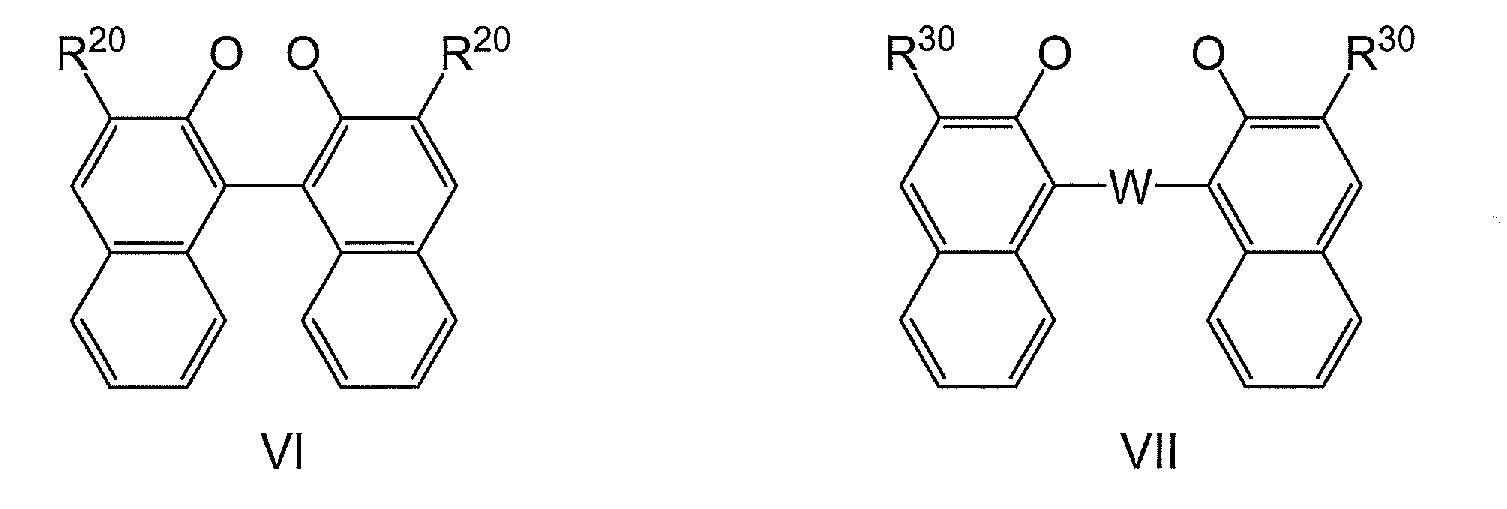





Claims


Priority Applications (5)
| Application Number | Priority Date | Filing Date | Title |
|---|---|---|---|
| CN201180043059.3A CN103080120B (en) | 2010-09-07 | 2011-06-13 | Preparation of nickel phosphorus ligand complexes |
| JP2013528194A JP2013536878A (en) | 2010-09-07 | 2011-06-13 | Preparation of nickel phosphorus ligand complex |
| US13/821,162 US9371346B2 (en) | 2010-09-07 | 2011-06-13 | Preparing a nickel phosphorus ligand complex |
| KR1020137005761A KR20130099931A (en) | 2010-09-07 | 2011-06-13 | Preparing a nickel phosphorus ligand complex |
| EP11727088.4A EP2614071B1 (en) | 2010-09-07 | 2011-06-13 | Preparing a nickel phosphorus ligand complex |
Applications Claiming Priority (4)
| Application Number | Priority Date | Filing Date | Title |
|---|---|---|---|
| US38044510P | 2010-09-07 | 2010-09-07 | |
| US61/380,445 | 2010-09-07 | ||
| PCT/US2010/060381 WO2011075494A1 (en) | 2009-12-18 | 2010-12-15 | Nickel metal compositions and nickel complexes derived from basic nickel carbonates |
| USPCT/US2010/060381 | 2010-12-15 |
Publications (1)
| Publication Number | Publication Date |
|---|---|
| WO2012033556A1 true WO2012033556A1 (en) | 2012-03-15 |
Family
ID=44509757
Family Applications (2)
| Application Number | Title | Priority Date | Filing Date |
|---|---|---|---|
| PCT/US2011/040193 Ceased WO2012033556A1 (en) | 2010-09-07 | 2011-06-13 | Preparing a nickel phosphorus ligand complex |
| PCT/US2011/040186 Ceased WO2012033555A1 (en) | 2010-09-07 | 2011-06-13 | Nickel compositions for preparing nickel metal and nickel complexes |
Family Applications After (1)
| Application Number | Title | Priority Date | Filing Date |
|---|---|---|---|
| PCT/US2011/040186 Ceased WO2012033555A1 (en) | 2010-09-07 | 2011-06-13 | Nickel compositions for preparing nickel metal and nickel complexes |
Country Status (7)
| Country | Link |
|---|---|
| US (2) | US9024049B2 (en) |
| EP (2) | EP2614071B1 (en) |
| JP (2) | JP5705986B2 (en) |
| CN (2) | CN103080119B (en) |
| DK (1) | DK2614070T3 (en) |
| TW (2) | TWI446965B (en) |
| WO (2) | WO2012033556A1 (en) |
Cited By (10)
| Publication number | Priority date | Publication date | Assignee | Title |
|---|---|---|---|---|
| WO2013052610A1 (en) | 2011-10-07 | 2013-04-11 | Invista Technologies S.A R.L. | Process for making nitriles |
| WO2013181096A1 (en) | 2012-06-01 | 2013-12-05 | Invista Technologies S.A.R.L. | Process for stabilizing hydrocyanation catalyst |
| WO2015009847A1 (en) | 2013-07-17 | 2015-01-22 | Invista Technologies S.À R.L. | Separating a solvent from a nickel catalyst by distillation |
| US9371346B2 (en) | 2010-09-07 | 2016-06-21 | Invista North America S.A.R.L. | Preparing a nickel phosphorus ligand complex |
| US9371343B2 (en) | 2009-12-18 | 2016-06-21 | Invista North America S.A. R.L. | Nickel metal compositions and nickel complexes derived from basic nickel carbonates |
| US9687835B2 (en) | 2012-12-07 | 2017-06-27 | Invista North America S.A.R.L. | Composition for improved nickel-ligand solubility |
| US9932298B2 (en) | 2012-12-07 | 2018-04-03 | Invista North America S.A R.L. | Process for producing pentenenitriles |
| US10087201B2 (en) | 2012-06-01 | 2018-10-02 | Invista North America S.A R.L. | Hydrolysis catalyst and process |
| US12521703B1 (en) * | 2022-08-02 | 2026-01-13 | Inv Nylon Chemicals Americas, Llc | Arsenic-containing ligands, catalytic compositions containing such ligands, and catalytic processes utilizing such catalytic compositions |
| US12600737B2 (en) | 2022-08-02 | 2026-04-14 | Inv Nylon Chemicals Americas, Llc | Bidentate phosphite ligands, catalytic compositions containing such ligands, and catalytic processes utilizing such catalytic compositions |
Families Citing this family (7)
| Publication number | Priority date | Publication date | Assignee | Title |
|---|---|---|---|---|
| CN105148999B (en) * | 2011-06-10 | 2017-09-05 | 因温斯特技术公司 | The improvement that nickel metal complex catalyzer is formed |
| EP2718013A2 (en) | 2011-06-10 | 2014-04-16 | Invista Technologies S.à.r.l. | Nickel calcination and reduction process including a fluidizing bed reactor |
| CN103012197B (en) * | 2012-12-18 | 2015-12-02 | 安徽省安庆市曙光化工股份有限公司 | The preparation method of 3 pentene nitrile and the preparation method of adiponitrile |
| CN106999920B (en) * | 2014-11-20 | 2021-11-02 | 英威达纺织(英国)有限公司 | Nickel with high ligand complexing activity and method for making the same |
| CN109651195B (en) * | 2019-01-08 | 2021-08-24 | 安徽省安庆市曙光化工股份有限公司 | 2-Pentenenitrile isomerization reaction generates the method for 3-pentenenitrile |
| CN111036306B (en) * | 2019-11-25 | 2021-06-15 | 中国科学院兰州化学物理研究所 | Cobalt-phosphine catalyst and preparation method and application thereof |
| CN114956979B (en) * | 2022-06-06 | 2023-04-28 | 中国科学技术大学 | Catalyst system for synthesizing phenylacetic acid from toluene |
Citations (45)
| Publication number | Priority date | Publication date | Assignee | Title |
|---|---|---|---|---|
| US3496217A (en) | 1967-05-23 | 1970-02-17 | Du Pont | Hydrocyanation of olefins |
| US3496215A (en) | 1965-11-23 | 1970-02-17 | Du Pont | Hydrocyanation of olefins using selected nickel phosphite catalysts |
| US3631191A (en) | 1970-04-08 | 1971-12-28 | Du Pont | Synthesis of zero valent nickel-tetrakis triaryl phosphite complexes |
| US3655723A (en) | 1969-10-31 | 1972-04-11 | Du Pont | Hydrocyanation of olefins |
| US3766237A (en) | 1972-01-25 | 1973-10-16 | Du Pont | Hydrocyanation of olefins |
| US3846461A (en) | 1972-10-25 | 1974-11-05 | Du Pont | Process of preparing a zerovalent nickel complex with organic phosphorus compounds |
| US3847959A (en) | 1972-10-25 | 1974-11-12 | Du Pont | Process of preparing a zerovalent nickel complex with organic phosphorus compounds |
| US3903120A (en) | 1973-06-19 | 1975-09-02 | Du Pont | Preparation of zerovalent nickel complexes from elemental nickel |
| US4416825A (en) | 1982-02-23 | 1983-11-22 | E. I. Du Pont De Nemours & Co. | Preparation of zerovalent nickel complexes |
| US4749801A (en) | 1986-06-04 | 1988-06-07 | E. I. Du Pont De Nemours And Company | [Hexakis(pentenenitrilo)nickel II]bis-[μ-(cyano) bis(triphenylborane) (I)], its method of preparation and its use |
| US5512695A (en) | 1994-04-14 | 1996-04-30 | E. I. Du Pont De Nemours And Company | Bidentate phosphite and nickel catalyst compositions for hydrocyanation of monoolefins |
| US5512696A (en) | 1995-07-21 | 1996-04-30 | E. I. Du Pont De Nemours And Company | Hydrocyanation process and multidentate phosphite and nickel catalyst composition therefor |
| US5523453A (en) | 1995-03-22 | 1996-06-04 | E. I. Du Pont De Nemours And Company | Process for hydrocyanation |
| US5543536A (en) | 1994-04-26 | 1996-08-06 | E. I. Du Pont De Nemours And Company | Monodentate phosphite and nickel catalyst composition for monoolefin hydrocyanation |
| US5693843A (en) | 1995-12-22 | 1997-12-02 | E. I. Du Pont De Nemours And Company | Process for hydrocyanation of diolefins and isomerization of nonconjugated 2 alkyl-3-monoalkenenitriles |
| US5723641A (en) | 1993-11-23 | 1998-03-03 | E. I. Du Pont De Nemours And Company | Processes and catalyst compositions for hydrocyanation of monoolefins |
| US5821378A (en) | 1995-01-27 | 1998-10-13 | E. I. Du Pont De Nemours And Company | Hydrocyanation of diolefins and isomerization of nonconjugated 2-alkyl-3-monoalkenenitriles |
| US5847191A (en) | 1997-07-29 | 1998-12-08 | E. I. Du Pont De Nemours And Company | Process for the hydrocyanation of monoolefins using bidentate phosphite ligands and zero-valent nickel |
| US5959135A (en) | 1997-07-29 | 1999-09-28 | E. I. Du Pont De Nemours And Company | Hydrocyanation processes and multidentate phosphite ligand and nickel catalyst compositions thereof |
| US5981772A (en) | 1997-07-29 | 1999-11-09 | E. I. Du Pont De Nemours And Company | Hydrocyanation of diolefins and isomerization of nonconjugated 2-alkyl-3-monoalkenenitriles |
| US6020516A (en) | 1997-07-29 | 2000-02-01 | E. I. Du Pont De Nemours And Company | Hydrocyanation of diolefins and isomerization of nonconjugated 2-alkyl-3-monoalkenenitriles |
| US6069267A (en) | 1997-07-29 | 2000-05-30 | E. I. Du Pont De Nemours And Company | Selective synthesis of organodiphosphite compounds |
| US6127567A (en) | 1997-07-29 | 2000-10-03 | E. I. Du Pont De Nemours And Company | Hydrocyanation processes and multidentate phosphite ligand and nickel catalyst compositions therefor |
| US6169198B1 (en) | 1997-08-04 | 2001-01-02 | Basf Aktiengesellshaft | Method for producing mixtures of monoolefinic C5-mononitriles by catalytic hydrocyanation |
| WO2001014392A1 (en) | 1999-08-20 | 2001-03-01 | E.I. Du Pont De Nemours And Company | METHOD FOR ELECTROCHEMICAL PRODUCTION OF Ni(0) PHOSPHITE AND DIPHOSPHITE COMPLEXES |
| US6197992B1 (en) | 1996-12-16 | 2001-03-06 | Basf Aktiengesellschaft | Monoolefinic C5 mononitriles, method for the production and the use thereof |
| US6242633B1 (en) | 1997-09-12 | 2001-06-05 | Basf Aktiengesellschaft | Catalyst comprising at least one phosphonite ligand based nickel (O) complex and method for the production of nitriles |
| US6284865B1 (en) | 1999-09-20 | 2001-09-04 | E. I. Du Pont De Nemours And Company | Polymeric phosphite composition and hydrocyanation of unsaturated organic compounds and the isomerization of unsaturated nitriles |
| WO2002013964A2 (en) | 2000-08-02 | 2002-02-21 | Basf Aktiengesellschaft | Suitable catalyst for producing nitriles |
| DE10046025A1 (en) | 2000-09-18 | 2002-03-28 | Basf Ag | Production of adiponitrile by hydrocyanation of butadiene uses a catalyst comprising a Group VIII metal complex having at least one tricyclic bifunctional phosphorus, arsenic or antimony ligand |
| US6380421B1 (en) | 1999-09-20 | 2002-04-30 | E. I. Du Pont De Nemours And Company | Multidentate phosphite ligands, catalytic compositions containing such ligands and catalytic processes utilizing such catalytic compositions |
| US6521778B1 (en) | 1998-06-05 | 2003-02-18 | Basf Aktiengesellschaft | Catalyst comprising a complex of a metal from subgroup VIII based on a bidentate phosphonite ligand, and method for producing nitriles |
| US20030100442A1 (en) * | 2001-11-26 | 2003-05-29 | Chu Luis A. | Process for the preparation of a nickel/phosphorous ligand catalyst for olefin hydrocyanation |
| US20030100802A1 (en) | 2001-11-26 | 2003-05-29 | Rafael Shapiro | Process for preparing 3,3',5,5',6,6'-hexaalkyl-2,2'-biphenols,3,3',4,4',5,5'-hexaalkyl-2,2'-biphenols and 3,3',4,4',5,5',6,6'-octaalkyl-2,2'-biphenols |
| US20030135014A1 (en) | 2001-11-26 | 2003-07-17 | Radu Nora S. | Polymeric, phosphorus-containing compositions and their use in hydrocyanation, isomerization and hydroformylation reactions |
| US6660877B2 (en) | 2002-03-07 | 2003-12-09 | E. I. Du Pont De Nemours And Company | Phosphonite ligands and their use in hydrocyanation |
| US20040106815A1 (en) | 2002-12-02 | 2004-06-03 | Ritter Joachim C. | Selective synthesis of organophosphites |
| US6770770B1 (en) | 1999-11-03 | 2004-08-03 | Basf Aktiengesellschaft | Phosphites |
| US6812352B2 (en) | 1999-09-20 | 2004-11-02 | Invista North America S.A.R.L. | Multidentate phosphite ligands, catalytic compositions containing such ligands, and catalytic processes utilizing such catalytic compositions |
| US6844249B2 (en) | 1999-07-09 | 2005-01-18 | Semiconductor Energy Laboratory Co., Ltd. | Method for manufacturing a semiconductor device using laser light |
| US20050090677A1 (en) | 2001-10-12 | 2005-04-28 | Basf Aktiengesellschaft | Phosphinites |
| US6924345B2 (en) | 2001-11-26 | 2005-08-02 | Invista North America S.A R.L. | Phosphorus-containing compositions and their use in hydrocyanation, isomerization and hydroformylation reactions |
| US7022866B2 (en) | 2001-10-12 | 2006-04-04 | Basf Aktiengesellschaft | Phosphonites |
| US7067685B2 (en) | 2001-10-12 | 2006-06-27 | Basf Aktiengesellschaft | Phosphonites, use thereof as ligand in transition metal complexes and method for production of nitriles |
| US20070060766A1 (en) | 2003-10-30 | 2007-03-15 | Michael Bartsch | Sterically hindered chelate phosphinite-phosphite ligand, catalyst, comprising at least one nickel(0) complex stabilized by said ligand and method for production of nitriles |
Family Cites Families (74)
| Publication number | Priority date | Publication date | Assignee | Title |
|---|---|---|---|---|
| FR517898A (en) | 1916-11-10 | 1921-05-14 | Hermann Berger | Improvements in the preparation of nickel-based catalysts, such as, in particular, those to be used for the transformation of unsaturated fatty acids and their glycerides into corresponding saturated compounds |
| GB255884A (en) | 1925-07-22 | 1927-04-28 | Ig Farbenindustrie Ag | Manufacture of nickel catalyst |
| CH127157A (en) | 1925-07-22 | 1928-08-01 | Ig Farbenindustrie Ag | Method for the preparation of a nickel catalyst. |
| NL79307C (en) | 1951-06-14 | |||
| SU116020A1 (en) | 1958-02-03 | 1958-11-30 | И.М. Вассерман | Method for precipitating basic nickel carbonate |
| US2913348A (en) | 1958-08-21 | 1959-11-17 | Du Pont | Organic coating composition containing basic nickel carbonate |
| US3350167A (en) | 1963-09-26 | 1967-10-31 | Hanson Van Winkle Munning Co | Method of preparing hydrated nickel carbonate and the product thereof |
| US3399050A (en) | 1964-04-13 | 1968-08-27 | Sherritt Gordon Mines Ltd | Production of nickel powder |
| CA879003A (en) | 1969-03-28 | 1971-08-24 | The International Nickel Company Of Canada | Separation of nickel from cobalt |
| CA975568A (en) | 1972-09-11 | 1975-10-07 | International Nickel Company Of Canada | Precipitation of nickel carbonate |
| SU710958A1 (en) | 1972-09-15 | 1980-01-25 | Норильский Ордена Ленина И Ордена Трудового Красного Знамени Горно- Металлургический Комбинат Им.А.П.Завенягина | Method of preparing basic nickel carbonate |
| CA970168A (en) | 1972-10-20 | 1975-07-01 | Sherritt Gordon Mines Limited | Production of nickel powder from impure nickel compounds |
| CA988306A (en) | 1973-04-09 | 1976-05-04 | International Nickel Company Of Canada | Reduction of nickel oxide |
| JPS5835200B2 (en) * | 1974-06-18 | 1983-08-01 | イ− アイ デユ ポン ドウ ヌム−ル アンド カンパニ− | 0 |
| CA1038169A (en) | 1975-06-25 | 1978-09-12 | Inco Limited | Carbonylation process |
| US4118342A (en) | 1977-06-21 | 1978-10-03 | Labofina S. A. | Process for producing catalysts |
| US4371474A (en) * | 1982-01-13 | 1983-02-01 | E. I. Du Pont De Nemours And Company | Hydrocyanation of olefins |
| NL191511C (en) | 1983-01-20 | 1995-08-21 | Unilever Nv | Process for the preparation of a nickel-containing catalyst. |
| NL190602C (en) | 1983-12-06 | 1994-05-16 | Unilever Nv | Process for preparing a nickel / nickel silicate catalyst and process for hydrogenating organic compounds therewith. |
| JPS61106422A (en) | 1984-10-31 | 1986-05-24 | Sumitomo Metal Mining Co Ltd | Method for producing high purity basic nickel carbonate |
| US4946068A (en) | 1985-09-30 | 1990-08-07 | Amoco Corporation | Fresh catalyst container |
| EP0322049B1 (en) | 1987-12-21 | 1993-04-07 | Unilever N.V. | Nickel/silica catalysts and their preparation |
| NL8901049A (en) | 1988-08-10 | 1990-03-01 | Unilever Nv | PROCESS FOR PREPARING NICKEL / ALUMINUM OXIDE CATALYSTS. |
| JPH0637308B2 (en) | 1988-12-26 | 1994-05-18 | 住友金属工業株式会社 | Method for producing nickel carbonate or nickel oxide |
| JPH03249943A (en) | 1990-02-28 | 1991-11-07 | Mitsubishi Heavy Ind Ltd | Methanol reforming catalyst |
| EP0496448B1 (en) | 1991-01-23 | 1994-03-30 | Unichema Chemie B.V. | Preparation of hydrogenation catalysts |
| JPH075494A (en) | 1993-06-18 | 1995-01-10 | Toyo Ink Mfg Co Ltd | Material for forming electrochromic layer and electrochromic device |
| DE9405113U1 (en) | 1994-03-25 | 1994-05-26 | Mauser-Werke GmbH, 50321 Brühl | Plastic container |
| US5449807A (en) * | 1994-11-18 | 1995-09-12 | E. I. Du Pont De Nemours And Company | Catalyzed vapor phase hydrocyanation of diolefinic compounds |
| JP3553706B2 (en) * | 1994-11-28 | 2004-08-11 | 財団法人石油産業活性化センター | Method for producing methanol |
| RU2102137C1 (en) | 1995-10-09 | 1998-01-20 | Институт нефтехимии и катализа с опытным заводом Академии наук Республики Башкортостан | Method of producing nickel catalyst for hydrogenation |
| US5981722A (en) | 1995-11-20 | 1999-11-09 | Board Of Regents For The University Of Oklahoma | Trypsin inhibitors with insecticidal properties obtained from PENTACLETHRA MACROLOBA |
| FR2743010B1 (en) * | 1995-12-29 | 1998-02-20 | Rhone Poulenc Fibres | PROCESS FOR THE PREPARATION BY HYDROGENATION OF CATALYSTS BASED ON TRANSITIONAL METAL AND PHOSPHINE |
| US5787353A (en) | 1996-03-26 | 1998-07-28 | Southeastern Technologies, Inc. | Process for the in situ recovery of chemical values from UF 6 gaseous diffusion process equipment |
| JPH1153534A (en) | 1997-07-31 | 1999-02-26 | Sony Corp | Image restoration method and apparatus |
| US7097890B1 (en) | 1998-07-31 | 2006-08-29 | Chevron Phillips Chemical Co. Lp | Polymer with pendent cyclic olefinic functions for oxygen scavenging packaging |
| EP0985448A1 (en) * | 1998-08-28 | 2000-03-15 | Engelhard Corporation | Nickel catalyst |
| US6494931B1 (en) | 1999-11-12 | 2002-12-17 | Mitsui Mining And Smelting Co., Ltd. | Nickel powder and conductive paste |
| JP4385457B2 (en) * | 1999-11-19 | 2009-12-16 | 堺化学工業株式会社 | Method for producing fine spherical metal nickel fine powder |
| JP2001335326A (en) | 2000-05-24 | 2001-12-04 | Sumitomo Metal Mining Co Ltd | Method for producing basic nickel carbonate |
| DE10136488A1 (en) | 2001-07-27 | 2003-02-06 | Basf Ag | Catalyst system comprising Ni(0) and phosphorous ligands is useful for the production of nitrile and dinitrile compounds |
| FI115522B (en) | 2001-12-21 | 2005-05-31 | Omg Finland Oy | Process for the preparation of metal carbonate |
| FR2842197A1 (en) * | 2002-07-15 | 2004-01-16 | Rhodia Polyamide Intermediates | PROCESS FOR THE PRODUCTION OF NITRILIC COMPOUNDS FROM ETHYLENE-UNSATURATED COMPOUNDS |
| US6906218B2 (en) | 2002-12-18 | 2005-06-14 | Invista North America S.A.R.L. | Cyclohexane derivatives and methods for their preparation |
| FR2849027B1 (en) | 2002-12-23 | 2005-01-21 | Rhodia Polyamide Intermediates | PROCESS FOR THE SYNTHESIS OF COMPOUNDS COMPRISING NITRIL FUNCTIONS FROM ETHYLENE-UNSATURATED COMPOUNDS |
| JP4063151B2 (en) * | 2003-06-11 | 2008-03-19 | 住友金属鉱山株式会社 | Porous spherical nickel powder and method for producing the same |
| DE102004004682A1 (en) | 2004-01-29 | 2005-08-18 | Basf Ag | Process for the preparation of adiponitrile by hydrocyanation of 1,3-butadiene |
| US7223714B2 (en) | 2004-11-04 | 2007-05-29 | Exxonmobil Chemical Patents Inc. | Method of transferring catalyst in a reaction system |
| US20060107792A1 (en) | 2004-11-19 | 2006-05-25 | Michael Collins | Method for producing fine, low bulk density, metallic nickel powder |
| SE529202C2 (en) | 2005-05-17 | 2007-05-29 | Sandvik Intellectual Property | Methods of manufacturing an agglomerated powder mixture of a slurry and agglomerated powder |
| US7854973B2 (en) | 2005-08-09 | 2010-12-21 | Sonoco Development, Inc. | Container and method for making container for oxygen-sensitive products |
| CN100363134C (en) | 2005-11-25 | 2008-01-23 | 北京科技大学 | A method for preparing nano-nickel powder by precipitation-hydrogen reduction process |
| EP1825914A1 (en) * | 2006-02-22 | 2007-08-29 | Basf Aktiengesellschaft | Improved process for the preparation of nickel(0) - phosphorus ligand - complexes |
| WO2007109005A2 (en) | 2006-03-17 | 2007-09-27 | Invista Technologies S.A R.L. | Method for the purification of triorganophosphites by treatment with a basic additive |
| US7544851B2 (en) | 2006-04-25 | 2009-06-09 | Exxonmobil Chemical Patents Inc. | Method of synthesizing aluminophosphate and silicoaluminophosphate molecular sieves |
| TW200806408A (en) * | 2006-06-27 | 2008-02-01 | Ishihara Sangyo Kaisha | Nickel fine particles, method for preparing the same and fluid composition comprising the same |
| US7659422B2 (en) | 2006-07-14 | 2010-02-09 | Invista North America S.A.R.L. | Hydrocyanation process with reduced yield losses |
| US7919646B2 (en) * | 2006-07-14 | 2011-04-05 | Invista North America S.A R.L. | Hydrocyanation of 2-pentenenitrile |
| US7709674B2 (en) * | 2006-07-14 | 2010-05-04 | Invista North America S.A R.L | Hydrocyanation process with reduced yield losses |
| CN100484882C (en) | 2006-12-29 | 2009-05-06 | 金川集团有限公司 | Method of preparing electronic grade nickel carbonate by sodium carbonate deposition |
| JP5007667B2 (en) * | 2007-12-28 | 2012-08-22 | 住友金属鉱山株式会社 | Nickel oxide powder and method for producing the same |
| KR20100135908A (en) * | 2008-04-16 | 2010-12-27 | 베일 인코 리미티드 | Process for producing nickel and cobalt using metal hydroxides, metal oxides and / or metal carbonates |
| CA2685668A1 (en) | 2008-11-24 | 2010-05-24 | Smith International, Inc. | A cutting element and a method of manufacturing a cutting element |
| CN101478044B (en) | 2009-01-07 | 2012-05-30 | 厦门钨业股份有限公司 | Multi-element composite positive pole material for lithium secondary battery and preparation thereof |
| CN101798627B (en) | 2009-02-09 | 2013-07-03 | 有研稀土新材料股份有限公司 | Method for precipitating rare earth |
| CN101519229A (en) | 2009-03-19 | 2009-09-02 | 金川集团有限公司 | Method for continuously synthesizing nickel carbonate |
| CN101708868B (en) | 2009-11-20 | 2011-06-15 | 江西核工业兴中科技有限公司 | Process for rapidly producing basic nickel carbonate or basic cobaltous carbonate |
| CN101733106B (en) | 2009-12-16 | 2012-08-29 | 南京大学 | Preparation method of supported nickel catalyst |
| KR20120104252A (en) | 2009-12-18 | 2012-09-20 | 인비스타 테크놀러지스 에스.에이.알.엘. | Nickel metal compositions and nickel complexes derived from basic nickel carbonates |
| WO2011094411A1 (en) | 2010-01-28 | 2011-08-04 | Packgen | Collapsible drum with reinforced ends |
| CN103080119B (en) | 2010-09-07 | 2015-04-08 | 因温斯特技术公司 | Nickel compositions for preparing nickel metal and nickel complexes |
| EP2718013A2 (en) | 2011-06-10 | 2014-04-16 | Invista Technologies S.à.r.l. | Nickel calcination and reduction process including a fluidizing bed reactor |
| CN105148999B (en) | 2011-06-10 | 2017-09-05 | 因温斯特技术公司 | The improvement that nickel metal complex catalyzer is formed |
| JP5896802B2 (en) | 2012-03-26 | 2016-03-30 | ユニチカ株式会社 | Resin composition |
-
2011
- 2011-06-13 CN CN201180042744.4A patent/CN103080119B/en active Active
- 2011-06-13 JP JP2013527072A patent/JP5705986B2/en not_active Expired - Fee Related
- 2011-06-13 DK DK11727087.6T patent/DK2614070T3/en active
- 2011-06-13 EP EP11727088.4A patent/EP2614071B1/en active Active
- 2011-06-13 CN CN201180043059.3A patent/CN103080120B/en active Active
- 2011-06-13 US US13/821,174 patent/US9024049B2/en active Active
- 2011-06-13 WO PCT/US2011/040193 patent/WO2012033556A1/en not_active Ceased
- 2011-06-13 US US13/821,162 patent/US9371346B2/en active Active
- 2011-06-13 WO PCT/US2011/040186 patent/WO2012033555A1/en not_active Ceased
- 2011-06-13 JP JP2013528194A patent/JP2013536878A/en active Pending
- 2011-06-13 EP EP11727087.6A patent/EP2614070B1/en active Active
- 2011-07-06 TW TW100123938A patent/TWI446965B/en not_active IP Right Cessation
- 2011-07-06 TW TW100123937A patent/TWI468413B/en not_active IP Right Cessation
Patent Citations (48)
| Publication number | Priority date | Publication date | Assignee | Title |
|---|---|---|---|---|
| US3496215A (en) | 1965-11-23 | 1970-02-17 | Du Pont | Hydrocyanation of olefins using selected nickel phosphite catalysts |
| US3496217A (en) | 1967-05-23 | 1970-02-17 | Du Pont | Hydrocyanation of olefins |
| US3655723A (en) | 1969-10-31 | 1972-04-11 | Du Pont | Hydrocyanation of olefins |
| US3631191A (en) | 1970-04-08 | 1971-12-28 | Du Pont | Synthesis of zero valent nickel-tetrakis triaryl phosphite complexes |
| US3766237A (en) | 1972-01-25 | 1973-10-16 | Du Pont | Hydrocyanation of olefins |
| US3846461A (en) | 1972-10-25 | 1974-11-05 | Du Pont | Process of preparing a zerovalent nickel complex with organic phosphorus compounds |
| US3847959A (en) | 1972-10-25 | 1974-11-12 | Du Pont | Process of preparing a zerovalent nickel complex with organic phosphorus compounds |
| US3903120A (en) | 1973-06-19 | 1975-09-02 | Du Pont | Preparation of zerovalent nickel complexes from elemental nickel |
| US4416825A (en) | 1982-02-23 | 1983-11-22 | E. I. Du Pont De Nemours & Co. | Preparation of zerovalent nickel complexes |
| US4749801A (en) | 1986-06-04 | 1988-06-07 | E. I. Du Pont De Nemours And Company | [Hexakis(pentenenitrilo)nickel II]bis-[μ-(cyano) bis(triphenylborane) (I)], its method of preparation and its use |
| US5723641A (en) | 1993-11-23 | 1998-03-03 | E. I. Du Pont De Nemours And Company | Processes and catalyst compositions for hydrocyanation of monoolefins |
| US5512695A (en) | 1994-04-14 | 1996-04-30 | E. I. Du Pont De Nemours And Company | Bidentate phosphite and nickel catalyst compositions for hydrocyanation of monoolefins |
| US5543536A (en) | 1994-04-26 | 1996-08-06 | E. I. Du Pont De Nemours And Company | Monodentate phosphite and nickel catalyst composition for monoolefin hydrocyanation |
| US5821378A (en) | 1995-01-27 | 1998-10-13 | E. I. Du Pont De Nemours And Company | Hydrocyanation of diolefins and isomerization of nonconjugated 2-alkyl-3-monoalkenenitriles |
| US5523453A (en) | 1995-03-22 | 1996-06-04 | E. I. Du Pont De Nemours And Company | Process for hydrocyanation |
| US5512696A (en) | 1995-07-21 | 1996-04-30 | E. I. Du Pont De Nemours And Company | Hydrocyanation process and multidentate phosphite and nickel catalyst composition therefor |
| US5693843A (en) | 1995-12-22 | 1997-12-02 | E. I. Du Pont De Nemours And Company | Process for hydrocyanation of diolefins and isomerization of nonconjugated 2 alkyl-3-monoalkenenitriles |
| US6197992B1 (en) | 1996-12-16 | 2001-03-06 | Basf Aktiengesellschaft | Monoolefinic C5 mononitriles, method for the production and the use thereof |
| US6171996B1 (en) | 1997-07-29 | 2001-01-09 | E. I. Du Pont De Nemours And Company | Hydrocyanation processes and multidentate phosphite ligand and nickel catalyst compositions therefor |
| US6020516A (en) | 1997-07-29 | 2000-02-01 | E. I. Du Pont De Nemours And Company | Hydrocyanation of diolefins and isomerization of nonconjugated 2-alkyl-3-monoalkenenitriles |
| US6069267A (en) | 1997-07-29 | 2000-05-30 | E. I. Du Pont De Nemours And Company | Selective synthesis of organodiphosphite compounds |
| US6127567A (en) | 1997-07-29 | 2000-10-03 | E. I. Du Pont De Nemours And Company | Hydrocyanation processes and multidentate phosphite ligand and nickel catalyst compositions therefor |
| US5959135A (en) | 1997-07-29 | 1999-09-28 | E. I. Du Pont De Nemours And Company | Hydrocyanation processes and multidentate phosphite ligand and nickel catalyst compositions thereof |
| US5847191A (en) | 1997-07-29 | 1998-12-08 | E. I. Du Pont De Nemours And Company | Process for the hydrocyanation of monoolefins using bidentate phosphite ligands and zero-valent nickel |
| US5981772A (en) | 1997-07-29 | 1999-11-09 | E. I. Du Pont De Nemours And Company | Hydrocyanation of diolefins and isomerization of nonconjugated 2-alkyl-3-monoalkenenitriles |
| US6169198B1 (en) | 1997-08-04 | 2001-01-02 | Basf Aktiengesellshaft | Method for producing mixtures of monoolefinic C5-mononitriles by catalytic hydrocyanation |
| US6242633B1 (en) | 1997-09-12 | 2001-06-05 | Basf Aktiengesellschaft | Catalyst comprising at least one phosphonite ligand based nickel (O) complex and method for the production of nitriles |
| US6521778B1 (en) | 1998-06-05 | 2003-02-18 | Basf Aktiengesellschaft | Catalyst comprising a complex of a metal from subgroup VIII based on a bidentate phosphonite ligand, and method for producing nitriles |
| US6844249B2 (en) | 1999-07-09 | 2005-01-18 | Semiconductor Energy Laboratory Co., Ltd. | Method for manufacturing a semiconductor device using laser light |
| WO2001014392A1 (en) | 1999-08-20 | 2001-03-01 | E.I. Du Pont De Nemours And Company | METHOD FOR ELECTROCHEMICAL PRODUCTION OF Ni(0) PHOSPHITE AND DIPHOSPHITE COMPLEXES |
| US6812352B2 (en) | 1999-09-20 | 2004-11-02 | Invista North America S.A.R.L. | Multidentate phosphite ligands, catalytic compositions containing such ligands, and catalytic processes utilizing such catalytic compositions |
| US6380421B1 (en) | 1999-09-20 | 2002-04-30 | E. I. Du Pont De Nemours And Company | Multidentate phosphite ligands, catalytic compositions containing such ligands and catalytic processes utilizing such catalytic compositions |
| US6284865B1 (en) | 1999-09-20 | 2001-09-04 | E. I. Du Pont De Nemours And Company | Polymeric phosphite composition and hydrocyanation of unsaturated organic compounds and the isomerization of unsaturated nitriles |
| US6770770B1 (en) | 1999-11-03 | 2004-08-03 | Basf Aktiengesellschaft | Phosphites |
| WO2002013964A2 (en) | 2000-08-02 | 2002-02-21 | Basf Aktiengesellschaft | Suitable catalyst for producing nitriles |
| DE10046025A1 (en) | 2000-09-18 | 2002-03-28 | Basf Ag | Production of adiponitrile by hydrocyanation of butadiene uses a catalyst comprising a Group VIII metal complex having at least one tricyclic bifunctional phosphorus, arsenic or antimony ligand |
| US7067685B2 (en) | 2001-10-12 | 2006-06-27 | Basf Aktiengesellschaft | Phosphonites, use thereof as ligand in transition metal complexes and method for production of nitriles |
| US7022866B2 (en) | 2001-10-12 | 2006-04-04 | Basf Aktiengesellschaft | Phosphonites |
| US20050090677A1 (en) | 2001-10-12 | 2005-04-28 | Basf Aktiengesellschaft | Phosphinites |
| US20030135014A1 (en) | 2001-11-26 | 2003-07-17 | Radu Nora S. | Polymeric, phosphorus-containing compositions and their use in hydrocyanation, isomerization and hydroformylation reactions |
| US6893996B2 (en) | 2001-11-26 | 2005-05-17 | Invista North America S.A.R.L. | Process for the preparation of a nickel/phosphorous ligand catalyst for olefin hydrocyanation |
| US6924345B2 (en) | 2001-11-26 | 2005-08-02 | Invista North America S.A R.L. | Phosphorus-containing compositions and their use in hydrocyanation, isomerization and hydroformylation reactions |
| US20030100802A1 (en) | 2001-11-26 | 2003-05-29 | Rafael Shapiro | Process for preparing 3,3',5,5',6,6'-hexaalkyl-2,2'-biphenols,3,3',4,4',5,5'-hexaalkyl-2,2'-biphenols and 3,3',4,4',5,5',6,6'-octaalkyl-2,2'-biphenols |
| US20030100442A1 (en) * | 2001-11-26 | 2003-05-29 | Chu Luis A. | Process for the preparation of a nickel/phosphorous ligand catalyst for olefin hydrocyanation |
| US6660877B2 (en) | 2002-03-07 | 2003-12-09 | E. I. Du Pont De Nemours And Company | Phosphonite ligands and their use in hydrocyanation |
| WO2004050588A2 (en) | 2002-12-02 | 2004-06-17 | Invista Technologies S.À.R.L. | A selective synthesis of organophosphites |
| US20040106815A1 (en) | 2002-12-02 | 2004-06-03 | Ritter Joachim C. | Selective synthesis of organophosphites |
| US20070060766A1 (en) | 2003-10-30 | 2007-03-15 | Michael Bartsch | Sterically hindered chelate phosphinite-phosphite ligand, catalyst, comprising at least one nickel(0) complex stabilized by said ligand and method for production of nitriles |
Non-Patent Citations (2)
| Title |
|---|
| LAURA BINI, J. AM. CHEM. SOC., vol. 129, 2007, pages 12622 - 12623 |
| TOLMAN ET AL., ADVANCES IN CATALYSIS, vol. 33, 1985, pages 1 |
Cited By (14)
| Publication number | Priority date | Publication date | Assignee | Title |
|---|---|---|---|---|
| US9371343B2 (en) | 2009-12-18 | 2016-06-21 | Invista North America S.A. R.L. | Nickel metal compositions and nickel complexes derived from basic nickel carbonates |
| US9371346B2 (en) | 2010-09-07 | 2016-06-21 | Invista North America S.A.R.L. | Preparing a nickel phosphorus ligand complex |
| US9040735B2 (en) | 2011-10-07 | 2015-05-26 | Invista North America S.A.R.L. | Process for making nitriles |
| WO2013052610A1 (en) | 2011-10-07 | 2013-04-11 | Invista Technologies S.A R.L. | Process for making nitriles |
| US9296768B2 (en) | 2012-06-01 | 2016-03-29 | Invista North America S.A R.L. | Process for stabilizing hydrocyanation catalyst |
| WO2013181096A1 (en) | 2012-06-01 | 2013-12-05 | Invista Technologies S.A.R.L. | Process for stabilizing hydrocyanation catalyst |
| US10087201B2 (en) | 2012-06-01 | 2018-10-02 | Invista North America S.A R.L. | Hydrolysis catalyst and process |
| US9687835B2 (en) | 2012-12-07 | 2017-06-27 | Invista North America S.A.R.L. | Composition for improved nickel-ligand solubility |
| US9932298B2 (en) | 2012-12-07 | 2018-04-03 | Invista North America S.A R.L. | Process for producing pentenenitriles |
| WO2015009847A1 (en) | 2013-07-17 | 2015-01-22 | Invista Technologies S.À R.L. | Separating a solvent from a nickel catalyst by distillation |
| US10759741B2 (en) | 2013-07-17 | 2020-09-01 | Invista North America S.A R.L. | Separating a solvent from a nickel catalyst by distillation |
| US12521703B1 (en) * | 2022-08-02 | 2026-01-13 | Inv Nylon Chemicals Americas, Llc | Arsenic-containing ligands, catalytic compositions containing such ligands, and catalytic processes utilizing such catalytic compositions |
| US20260014551A1 (en) * | 2022-08-02 | 2026-01-15 | Inv Nylon Chemicals Americas, Llc | Arsenic-containing ligands, catalytic compositions containing such ligands, and catalytic processes utilizing such catalytic compositions |
| US12600737B2 (en) | 2022-08-02 | 2026-04-14 | Inv Nylon Chemicals Americas, Llc | Bidentate phosphite ligands, catalytic compositions containing such ligands, and catalytic processes utilizing such catalytic compositions |
Also Published As
| Publication number | Publication date |
|---|---|
| TWI468413B (en) | 2015-01-11 |
| TW201213337A (en) | 2012-04-01 |
| US9024049B2 (en) | 2015-05-05 |
| EP2614070B1 (en) | 2017-07-26 |
| WO2012033555A1 (en) | 2012-03-15 |
| JP2013536839A (en) | 2013-09-26 |
| US20130345459A1 (en) | 2013-12-26 |
| JP5705986B2 (en) | 2015-04-22 |
| CN103080120B (en) | 2016-06-01 |
| CN103080120A (en) | 2013-05-01 |
| TWI446965B (en) | 2014-08-01 |
| CN103080119B (en) | 2015-04-08 |
| EP2614070A1 (en) | 2013-07-17 |
| US20130317242A1 (en) | 2013-11-28 |
| TW201210693A (en) | 2012-03-16 |
| HK1184161A1 (en) | 2014-01-17 |
| JP2013536878A (en) | 2013-09-26 |
| CN103080119A (en) | 2013-05-01 |
| EP2614071B1 (en) | 2015-12-02 |
| DK2614070T3 (en) | 2017-10-16 |
| US9371346B2 (en) | 2016-06-21 |
| EP2614071A1 (en) | 2013-07-17 |
Similar Documents
| Publication | Publication Date | Title |
|---|---|---|
| US9371346B2 (en) | Preparing a nickel phosphorus ligand complex | |
| US9371343B2 (en) | Nickel metal compositions and nickel complexes derived from basic nickel carbonates | |
| CN101484416B (en) | Hydrocyanation process with reduced yield losses | |
| CN101489992B (en) | Process for making 3-pentenenitrile by hydrocyanation of butadiene | |
| EP1587621B1 (en) | Process for the preparation of a nickel/phosphorous ligand catalyst for olefin hydrocyanation | |
| IT8224869A1 (en) | RECOVERY OF TRIARILBORANS | |
| KR20130099931A (en) | Preparing a nickel phosphorus ligand complex | |
| HK1184160A (en) | Preparing a nickel phosphorus ligand complex | |
| EP2928598A1 (en) | Composition for improved nickel-ligand solubility | |
| HK1184161B (en) | Nickel compositions for preparing nickel metal and nickel complexes |
Legal Events
| Date | Code | Title | Description |
|---|---|---|---|
| WWE | Wipo information: entry into national phase |
Ref document number: 201180043059.3 Country of ref document: CN |
|
| 121 | Ep: the epo has been informed by wipo that ep was designated in this application |
Ref document number: 11727088 Country of ref document: EP Kind code of ref document: A1 |
|
| ENP | Entry into the national phase |
Ref document number: 2013528194 Country of ref document: JP Kind code of ref document: A Ref document number: 20137005761 Country of ref document: KR Kind code of ref document: A |
|
| NENP | Non-entry into the national phase |
Ref country code: DE |
|
| WWE | Wipo information: entry into national phase |
Ref document number: 2011727088 Country of ref document: EP |
|
| WWE | Wipo information: entry into national phase |
Ref document number: 13821162 Country of ref document: US |